




Download the linear programming class 12 ncert solutions as a PDF for Class 12 Mathematics Chapter 12 Linear Programming Exercise 12.1 as a free file. Every step is justified, every formula labelled, and the working is laid out in the format expected on a CBSE board answer script.




- Question count: 10 problems, all solved by the corner-point method. 5 are maximisation, 3 are minimisation, and 2 ask for both minimum and maximum.
- CBSE Weightage: Chapter 12 carries 5 to 6 marks in the CBSE Class 12 Maths board paper, usually one 5-mark long-answer LPP plus a 1-mark case.
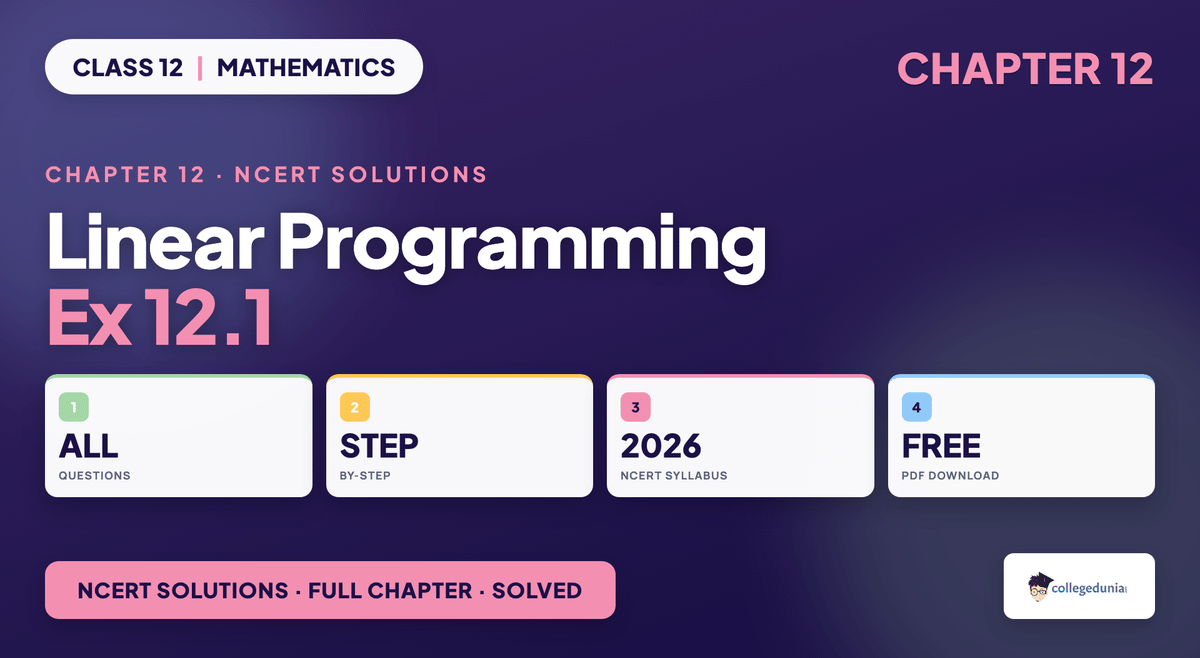
Every solved problem in the Linear Programming Class 12 PDF follows one routine: plot the constraint lines, shade the feasible region, list the corner points, evaluate Z at each corner, and select the optimum. For the two unbounded regions (Q4 and Q9) the solution adds the open-half-plane check that CBSE markers expect before any optimum is declared.
The editorial team has cross-checked every corner point and every Z value against the official NCERT answer key and the current 2026-27 textbook. The traps that lose marks, multiple-optima edges in Q6, Q7 and Q8, the unbounded objective in Q9, and the empty feasible set in Q10, are flagged inside each solution.
Why Class 12 Maths Chapter 12 Exercise 12.1 Carries the Easiest Long-Answer Mark
These Linear Programming Class 12 NCERT Solutions for Exercise 12.1 follow the most procedural routine in the syllabus. A 5-mark LPP question has appeared in every CBSE board paper for the last five years. The same method also appears in CUET-UG, JEE Main and JEE Advanced.
The risk is not the method, it is the special cases. Exercise 12.1 includes an unbounded region (Q4), an unbounded objective (Q9), multiple optima on an edge (Q6-Q8), and an infeasible system (Q10), all traps for students who only learn the bounded case.
Linear Programming Ex 12 1 Video Walkthrough
Source: Magnet Brains on YouTube
How These NCERT Solutions Help You Clear Exercise 12.1
Every solution uses the corner-point method plus one shortcut per question.
- Corner points solved as 2x2 systems, recovering Q3's exact value (20/19, 45/19).
- Open-half-plane check shown in full for Q4 and Q9.
- Multiple-optima and no-feasible-solution callouts on Q6-Q8 and Q10, with the exact sentence to write on the answer script.
Linear Programming Class 12 NCERT Solutions Ex 12.1: Question-Wise Answer Map
| Q No. | Objective | Key constraints | Optimum (answer) |
|---|---|---|---|
| 1 | Maximise Z = 3x + 4y | x + y ≤ 4 | Max = 16 at (0,4) |
| 2 | Minimise Z = -3x + 4y | x + 2y ≤ 8, 3x + 2y ≤ 12 | Min = -12 at (4,0) |
| 3 | Maximise Z = 5x + 3y | 3x + 5y ≤ 15, 5x + 2y ≤ 10 | Max = 23519 ≈ 12.37 at (2019,4519) |
| 4 | Minimise Z = 3x + 5y | x + 3y ≥ 3, x + y ≥ 2 | Min = 7 at (32,12) |
| 5 | Maximise Z = 3x + 2y | x + 2y ≤ 10, 3x + y ≤ 15 | Max = 18 at (4,3) |
| 6 | Minimise Z = x + 2y | 2x + y ≥ 3, x + 2y ≥ 6 | Min = 6 on segment (6,0) to (0,3) |
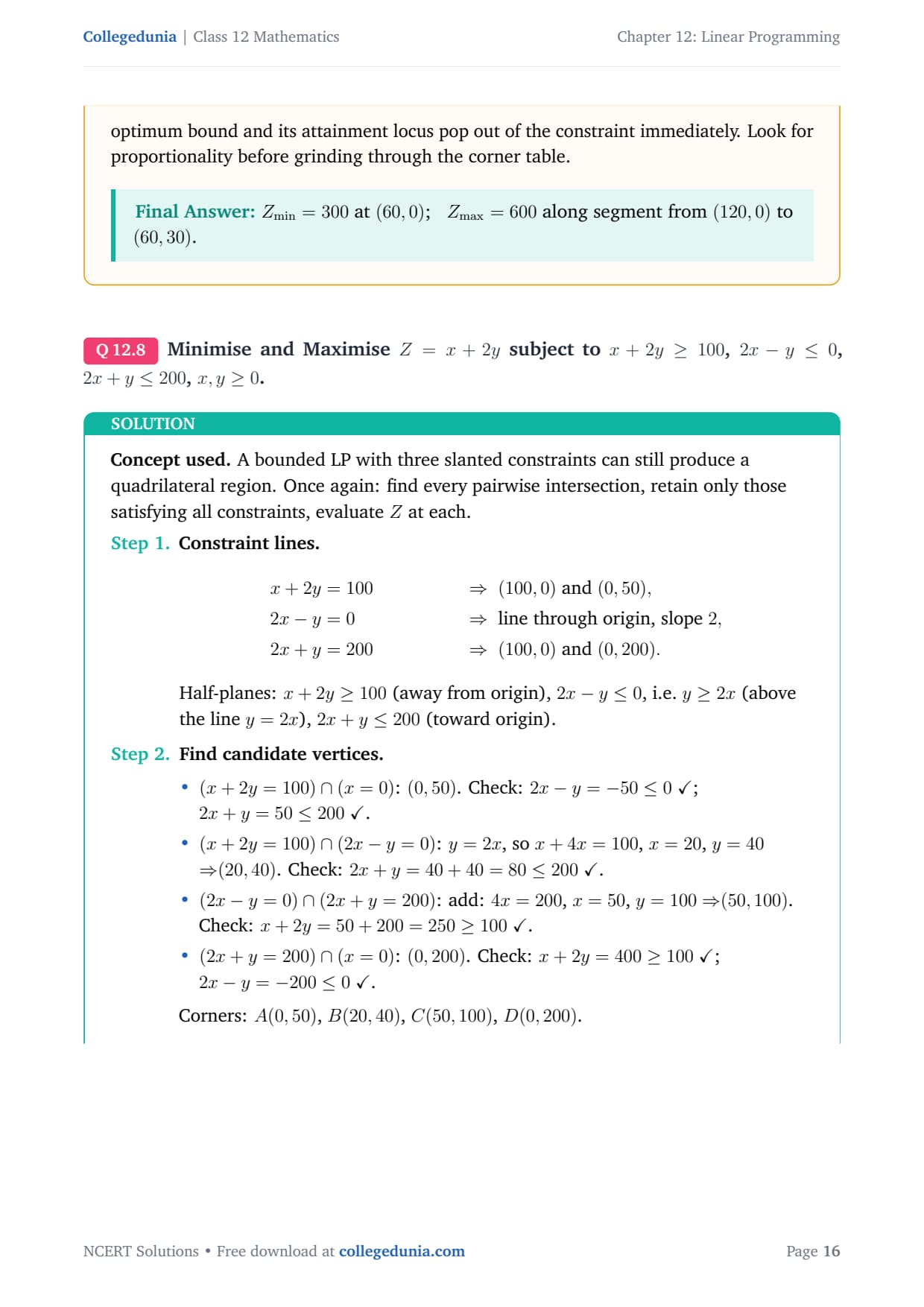
| 7 | Min & Max Z = 5x + 10y | x + 2y ≤ 120, x + y ≥ 60, x - 2y ≥ 0 | Min = 300 at (60,0) ; Max = 600 on segment (120,0) to (60,30) |
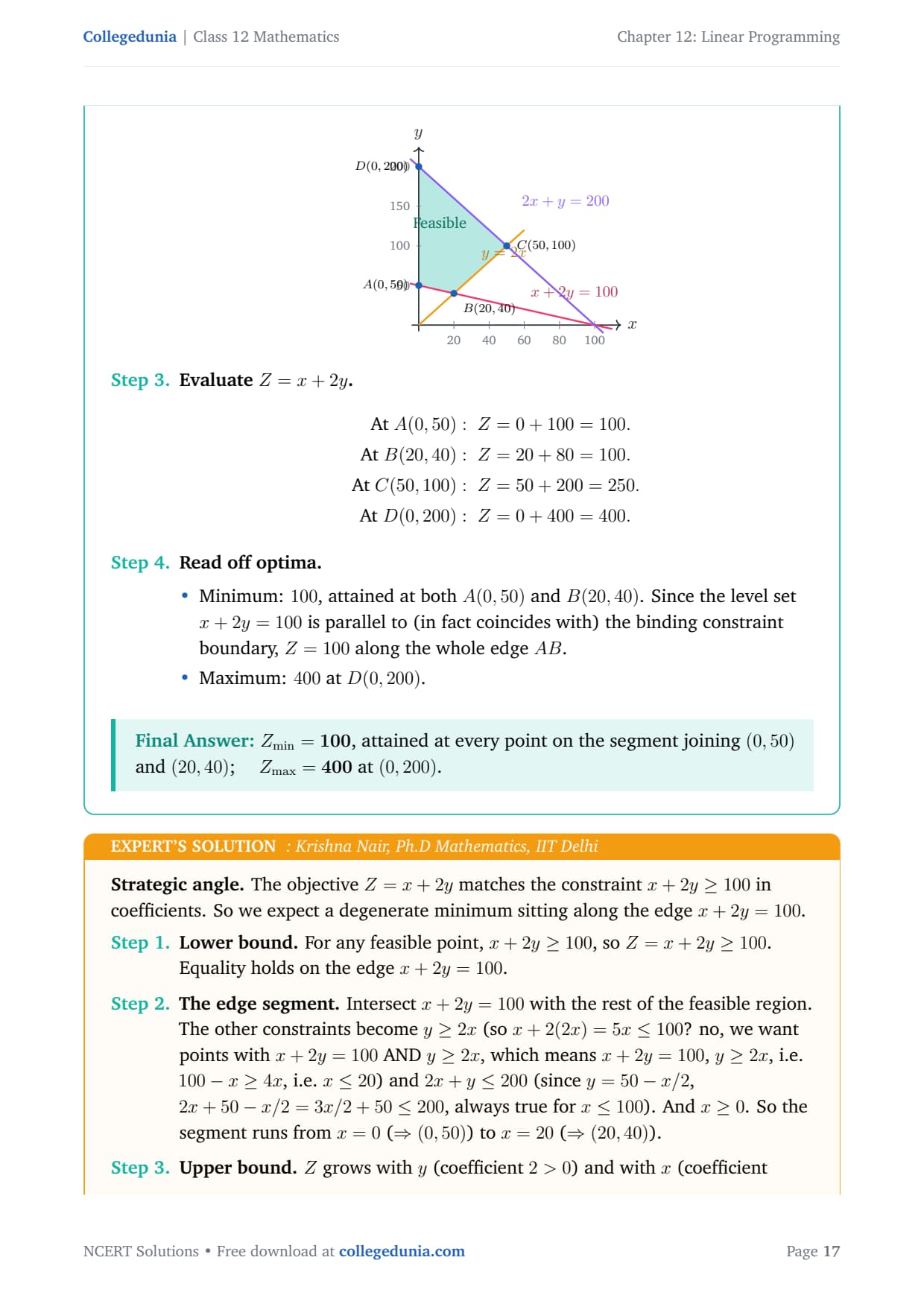
| 8 | Min & Max Z = x + 2y | x + 2y ≥ 100, 2x - y ≤ 0, 2x + y ≤ 200 | Min = 100 on segment (0,50) to (20,40) ; Max = 400 at (0,200) |
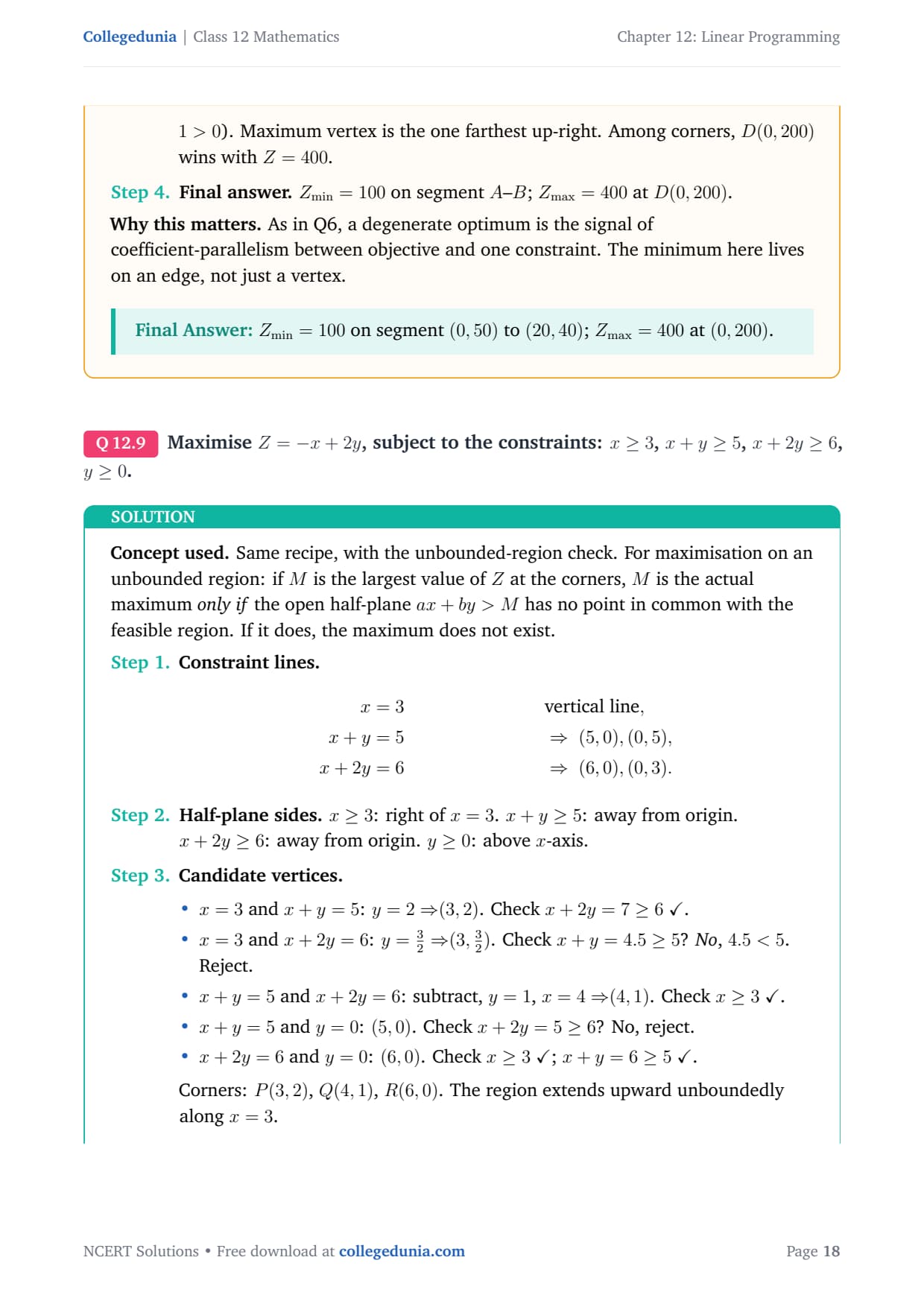
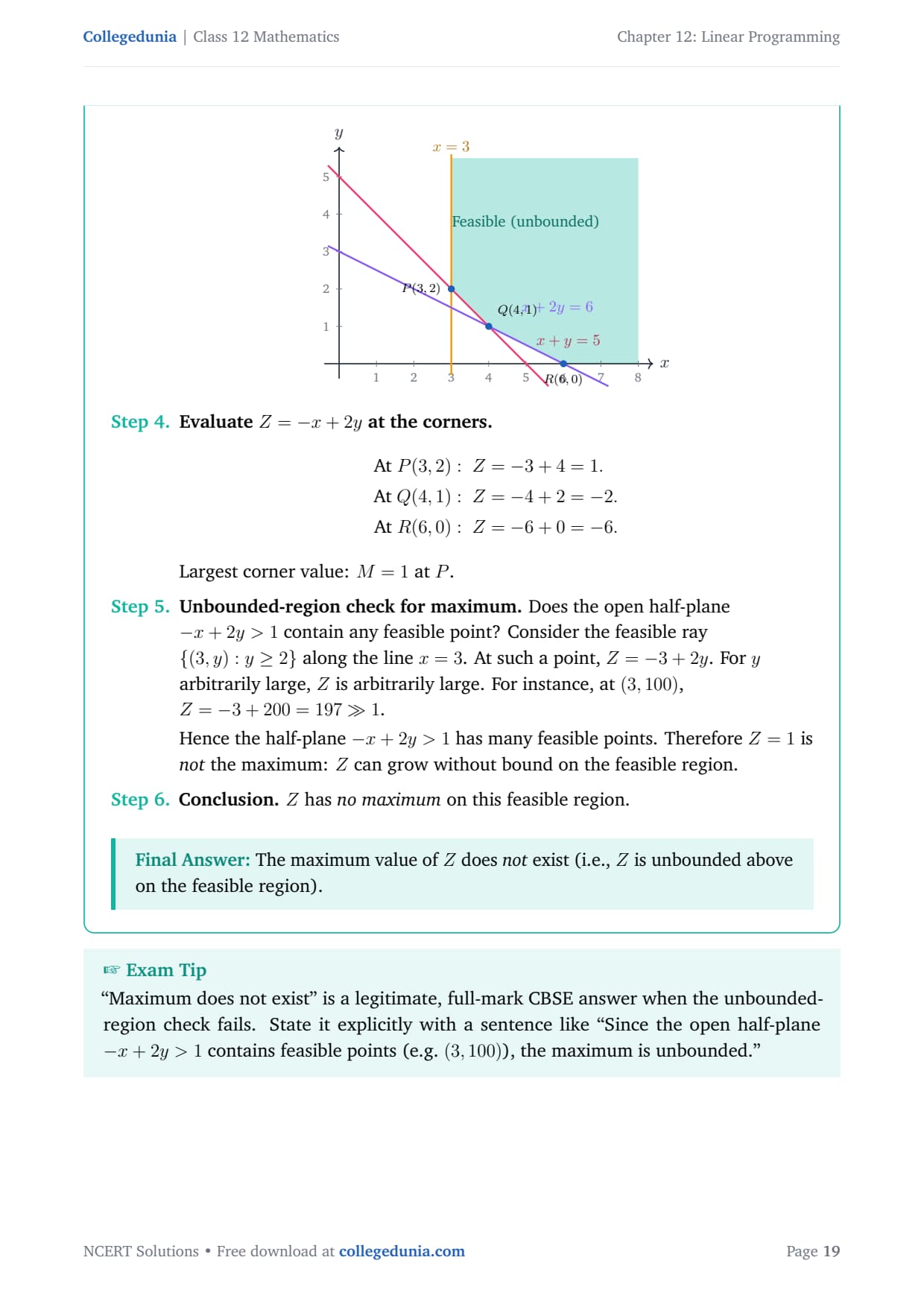
| 9 | Maximise Z = -x + 2y | x ≥ 3, x + y ≥ 5, x + 2y ≥ 6 | No maximum (unbounded above) |
| 10 | Maximise Z = x + y | x - y ≤ -1, -x + y ≤ 0 | No feasible solution |
Step-by-Step Graphical Method Used in Exercise 12.1
Every problem in Exercise 12.1 runs the same five-step routine. Following it clears any bounded LPP in under four minutes and flags the special cases automatically.
- Plot each constraint line using its two intercepts.
- Test the half-plane with the origin: if the inequality holds at (0,0), that side is feasible.
- Shade the feasible region, the overlap of all half-planes with x ≥ 0, y ≥ 0.
- Find every corner point by solving the relevant 2x2 systems.
- Evaluate Z at each corner and pick the largest or smallest value. Unbounded regions need the open-half-plane check first.
Step 5's half-plane check is what CBSE markers look for on Q4 and Q9. Skipping it loses the mark even with the right number.
CBSE Board Exam Relevance of Exercise 12.1
LPP carries a steady 4-5 marks every year. Last five sittings:
| Year | Marks from LPP | Question type tested |
|---|---|---|
| 2025 | 5 | Maximise a bounded-region objective by the corner-point method |
| 2024 | 5 | Minimise on an unbounded region with the open-half-plane check |
| 2023 | 5 | Word-problem LPP reduced to graphical optimisation |
| 2022 | 5 | Maximise with multiple optima along an edge |
| 2021 | 4 | Formulate and solve a two-variable LPP graphically |
Common Mistakes Students Make in Exercise 12.1
- Stopping after one corner instead of checking every vertex misses the Q6-Q8 multiple-optima cases.
- Confusing "no feasible solution" (Q10, empty region) with "no maximum" (Q9, non-empty region).
Linear Programming Formula Recall for Exercise 12.1
- Objective function: Z = ax + by, to be maximised or minimised.
- Corner-point theorem: on a bounded feasible region, Z attains both maximum and minimum at a corner point.
- Unbounded-region rule: a corner value M is the true optimum only if the open half-plane beyond M does not meet the feasible region.
Formulas: Linear Programming Class 12 Maths Formula Sheet for the complete list of LPP definitions and theorems.
Other Resources for Class 12 Maths Chapter 12 Linear Programming
Sister resources:
- Formula Sheet for Class 12 Maths Chapter 12 Linear Programming
- NCERT Notes for Class 12 Maths Chapter 12 Linear Programming
- NCERT Book PDF for Class 12 Maths Chapter 12 Linear Programming
- NCERT Exemplar Solutions for Class 12 Maths Chapter 12 Linear Programming
NCERT Solutions for Class 12 Mathematics: All Chapters
| Chapter | NCERT Solutions |
|---|---|
| Chapter 1 | Relations and Functions NCERT Solutions |
| Chapter 2 | Inverse Trigonometric Functions NCERT Solutions |
| Chapter 3 | Matrices NCERT Solutions |
| Chapter 4 | Determinants NCERT Solutions |
| Chapter 5 | Continuity and Differentiability NCERT Solutions |
| Chapter 6 | Application of Derivatives NCERT Solutions |
| Chapter 7 | Integrals NCERT Solutions |
| Chapter 8 | Application of Integrals NCERT Solutions |
| Chapter 9 | Differential Equations NCERT Solutions |
| Chapter 10 | Vector Algebra NCERT Solutions |
| Chapter 11 | Three Dimensional Geometry NCERT Solutions |
| Chapter 13 | Probability NCERT Solutions |
Exercise-wise Breakdown of the Linear Programming Chapter
The chapter Linear Programming Class 12 splits into 1 numbered exercise (Exercise 12.1) plus a Miscellaneous Exercise. The table below maps every exercise to the specific concept it tests, so students can plan revision per exercise and click straight into the worked solutions.
| Exercise | Topic Tested |
|---|---|
| Exercise 12.1 | Linear programming problems and graphical method |
| Miscellaneous Exercise | Mixed linear programming applications |
All NCERT Solutions for Linear Programming Ex 12.1 with Step-by-Step Working
Every NCERT textbook question for Class 12 Mathematics Chapter 12 Linear Programming Ex 12.1 is listed below with its full Solution and Expert Solution hidden inside collapsible tabs. Click Check Solution to reveal the step-by-step working; click Expert Solution for the expanded explanation.
Questions
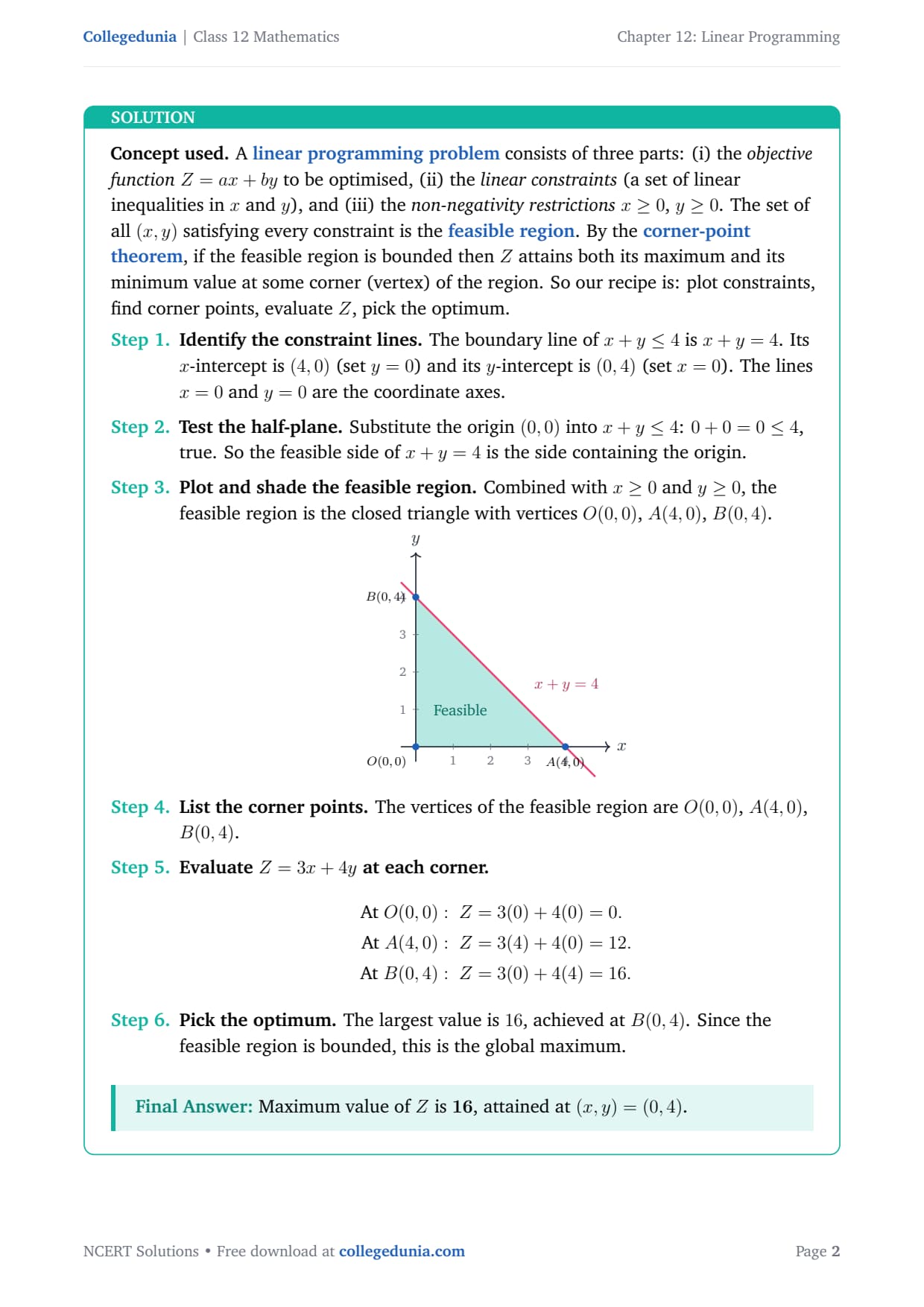
Maximise Z = 3x + 4y subject to the constraints: x + y ≤ 4, x ≥ 0, y ≥ 0.
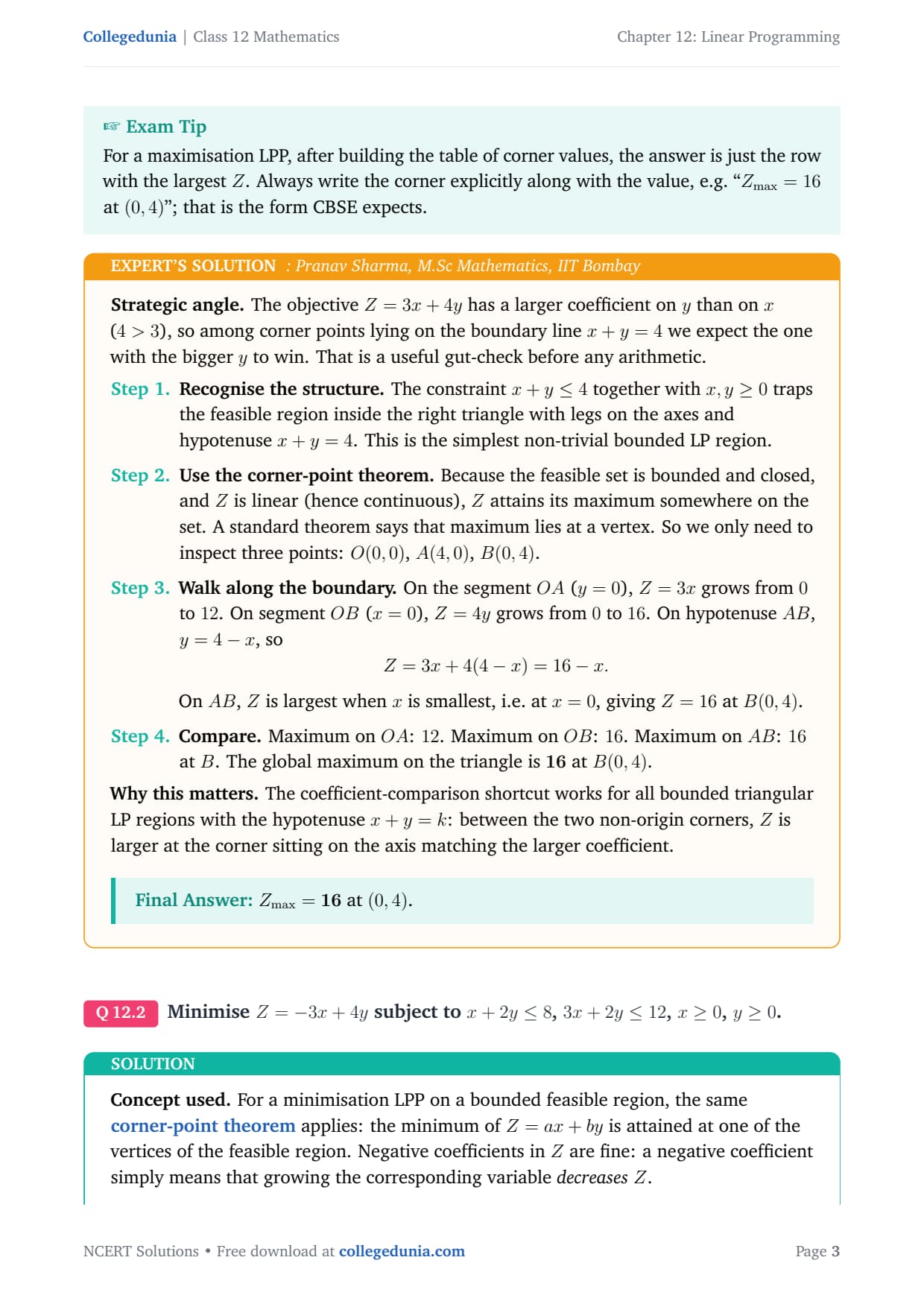
- Because the feasible set is bounded and closed, and Z is linear (hence continuous), Z attains its maximum somewhere on the set. A standard theorem says that maximum lies at a vertex. So we only need to inspect three points: O(0,0), A(4,0), B(0,4).
- On the segment OA (y=0), Z=3x grows from 0 to 12. On segment OB (x=0), Z=4y grows from 0 to 16. On hypotenuse AB, y=4-x, so Z = 3x + 4(4-x) = 16 - x. On AB, Z is largest when x is smallest, i.e. at x=0, giving Z=16 at B(0,4).
- Maximum on OA: 12. Maximum on OB: 16. Maximum on AB: 16 at B. The global maximum on the triangle is 16 at B(0,4).
Zmax = 16 at (0,4).
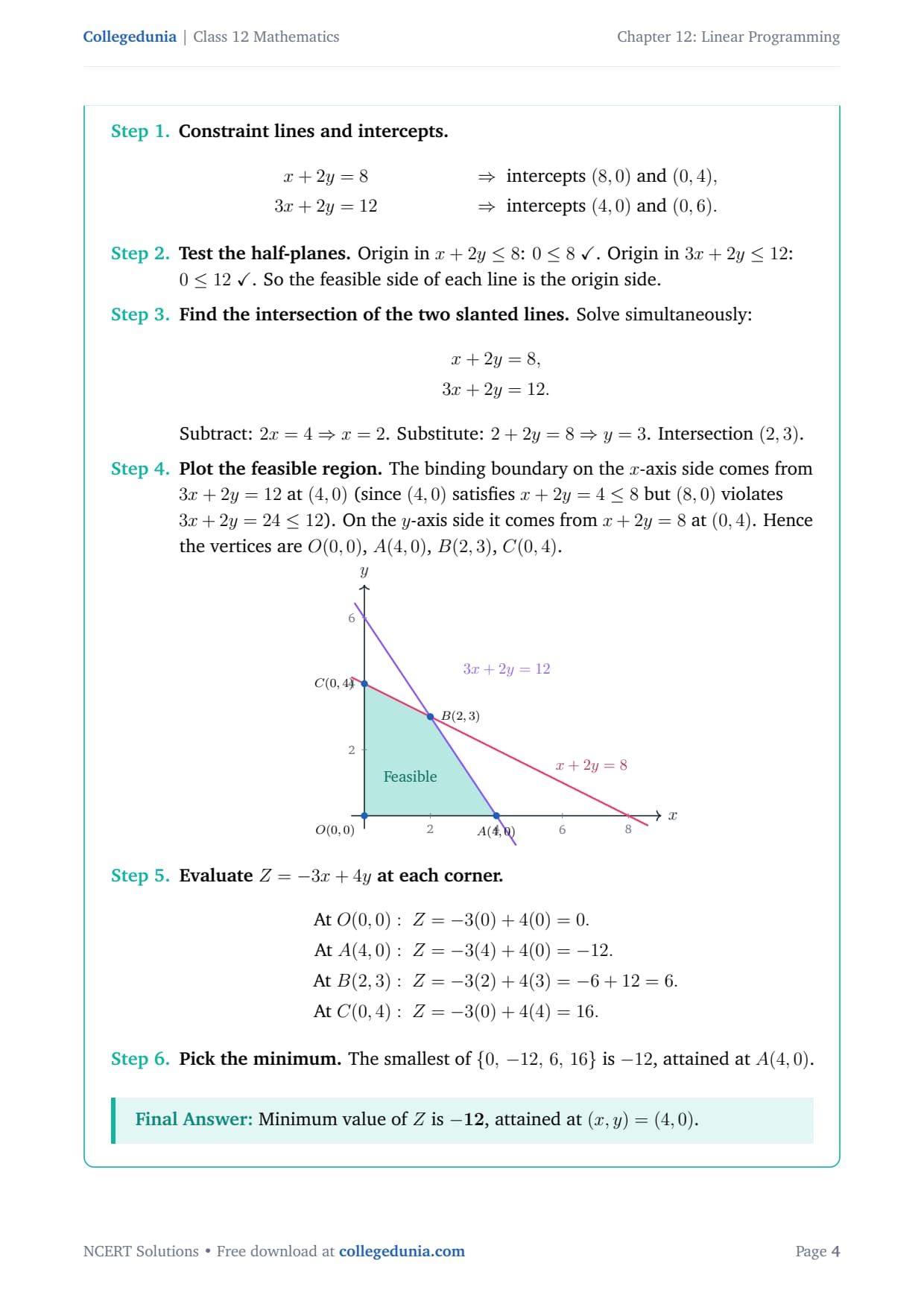
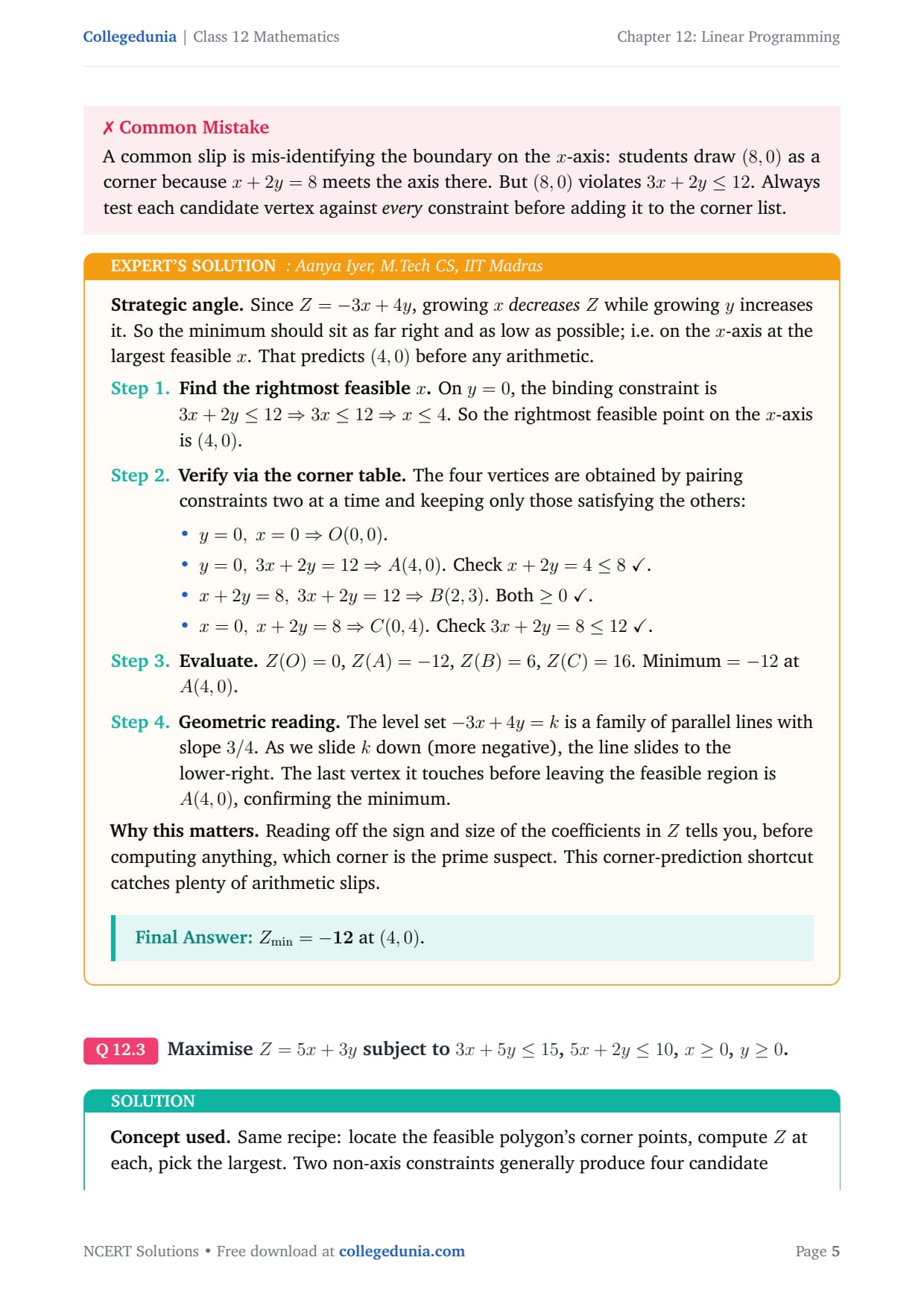
Minimise Z = -3x + 4y subject to x + 2y ≤ 8, 3x + 2y ≤ 12, x ≥ 0, y ≥ 0.
Strategic angle. Since Z=-3x+4y, growing x decreases Z while growing y increases it. So the minimum should sit as far right and as low as possible; i.e. on the x-axis at the largest feasible x. That predicts (4,0) before any arithmetic.
- Find the rightmost feasible x. On y=0, the binding constraint is 3x+2y ≤ 12 ⇒ 3x ≤ 12 ⇒ x ≤ 4. So the rightmost feasible point on the x-axis is (4,0).
- Verify via the corner table. The four vertices are obtained by pairing constraints two at a time and keeping only those satisfying the others:
- y=0, x=0 ⇒ O(0,0).
- y=0, 3x+2y=12 ⇒ A(4,0). Check x+2y=4 ≤ 8 .
- x+2y=8, 3x+2y=12 ⇒ B(2,3). Both ≥ 0 .
- x=0, x+2y=8 ⇒ C(0,4). Check 3x+2y=8 ≤ 12 .
- Evaluate. Z(O)=0, Z(A)=-12, Z(B)=6, Z(C)=16. Minimum =-12 at A(4,0).
- Geometric reading. The level set -3x+4y=k is a family of parallel lines with slope 3/4. As we slide k down (more negative), the line slides to the lower-right. The last vertex it touches before leaving the feasible region is A(4,0), confirming the minimum.
Zmin = -12 at (4,0).
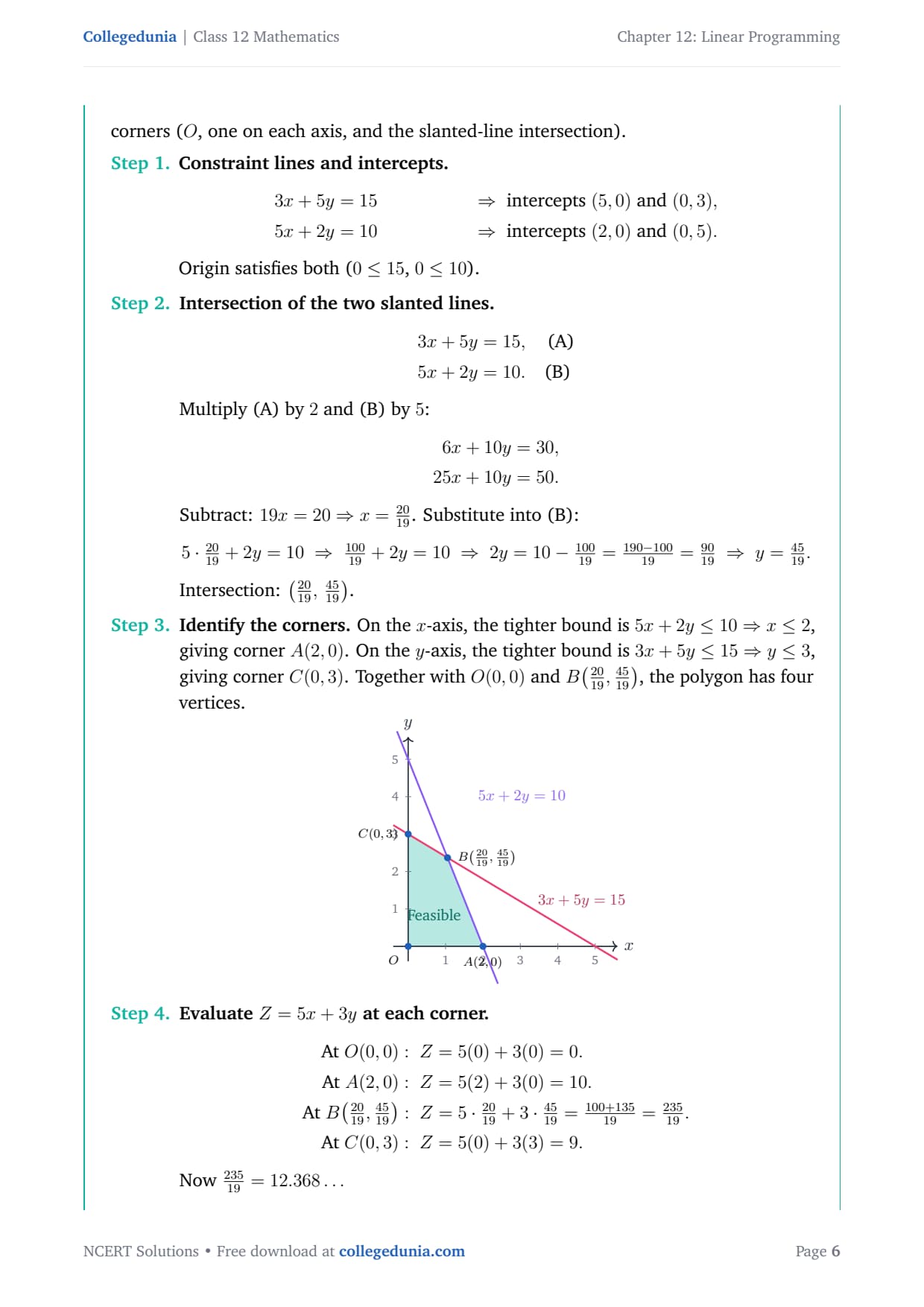
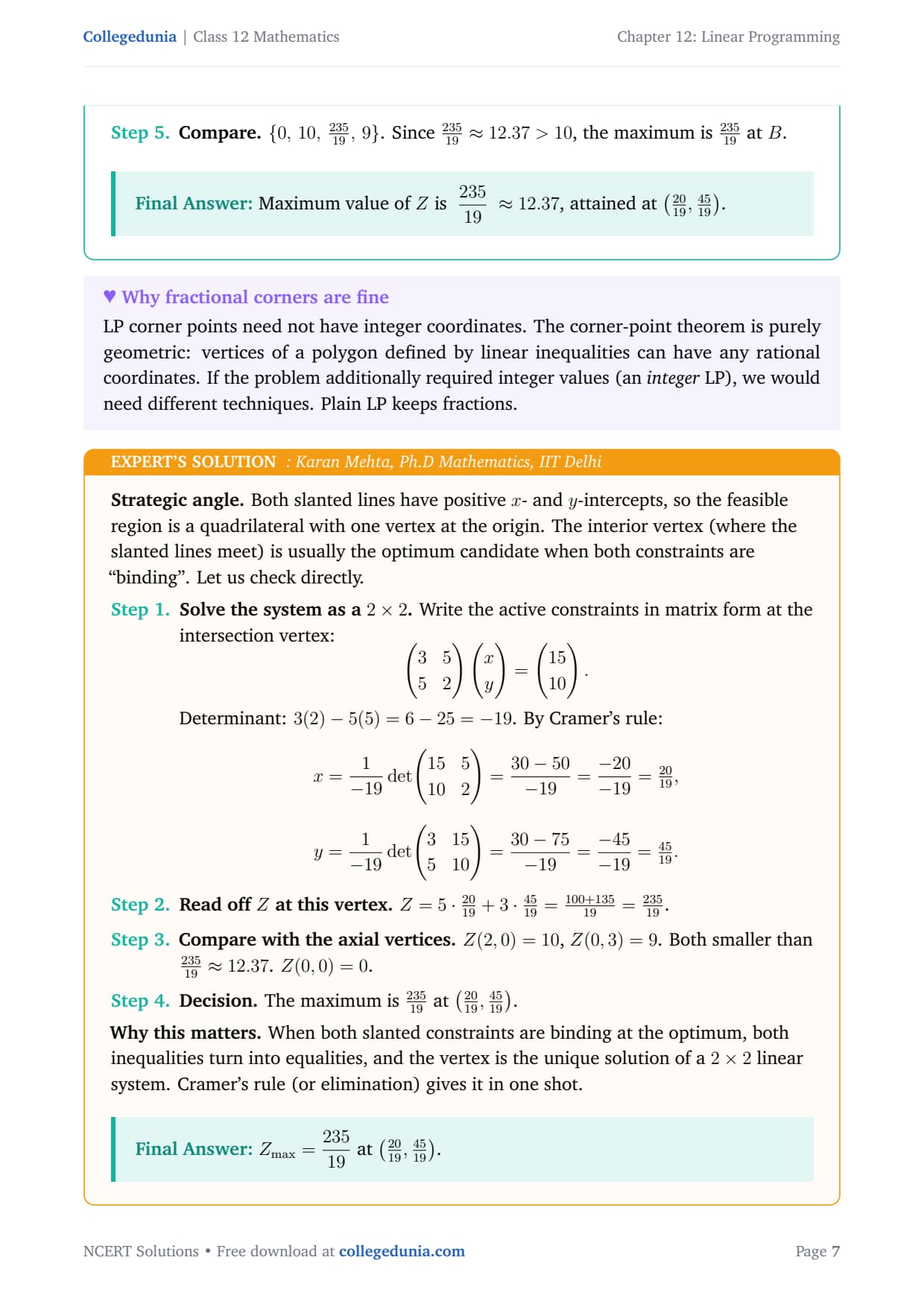
Maximise Z = 5x + 3y subject to 3x + 5y ≤ 15, 5x + 2y ≤ 10, x ≥ 0, y ≥ 0.
- Solve the system as a 2× 2. Write the active constraints in matrix form at the intersection vertex: pmatrix 3 & 5 5 & 2 pmatrix pmatrix x y pmatrix = pmatrix 15 10 pmatrix. Determinant: 3(2) - 5(5) = 6 - 25 = -19. By Cramer's rule: x = 1-19detpmatrix 15 & 5 10 & 2pmatrix = 30-50-19 = -20-19 = 2019, y = 1-19detpmatrix 3 & 15 5 & 10pmatrix = 30-75-19 = -45-19 = 4519.
- Z = 5·2019 + 3·4519 = 100+13519 = 23519.
- Compare with the axial vertices. Z(2,0) = 10, Z(0,3) = 9. Both smaller than 23519 ≈ 12.37. Z(0,0)=0.
- Decision. The maximum is 23519 at (2019,4519).
Zmax = 23519 at (2019,4519).
Minimise Z = 3x + 5y such that x + 3y ≥ 3, x + y ≥ 2, x,y ≥ 0.
- Find a clever combination. Multiply x+3y ≥ 3 by 1 and x+y ≥ 2 by 2: x + 3y ≥ 3, 2x + 2y ≥ 4. Add: 3x + 5y ≥ 7. So Z ≥ 7 for every feasible point; this is a hard lower bound by direct inequality manipulation.
- Find a point achieving the bound. The bound is tight when both original inequalities are equalities, i.e. at the intersection of x+3y=3 and x+y=2. Solving: y=12, x=32. Check non-negativity: . So (32,12) is feasible and gives Z=7.
- Conclude. The lower bound 7 is attained, hence it is the minimum.
Why this matters. The ``multiply-and-add'' trick (formally called linear programming duality) often produces a clean lower (or upper) bound on Z that matches a vertex value. When it does, you have proved the optimum value without invoking the corner-point theorem.
Zmin = 7 at (32,12).
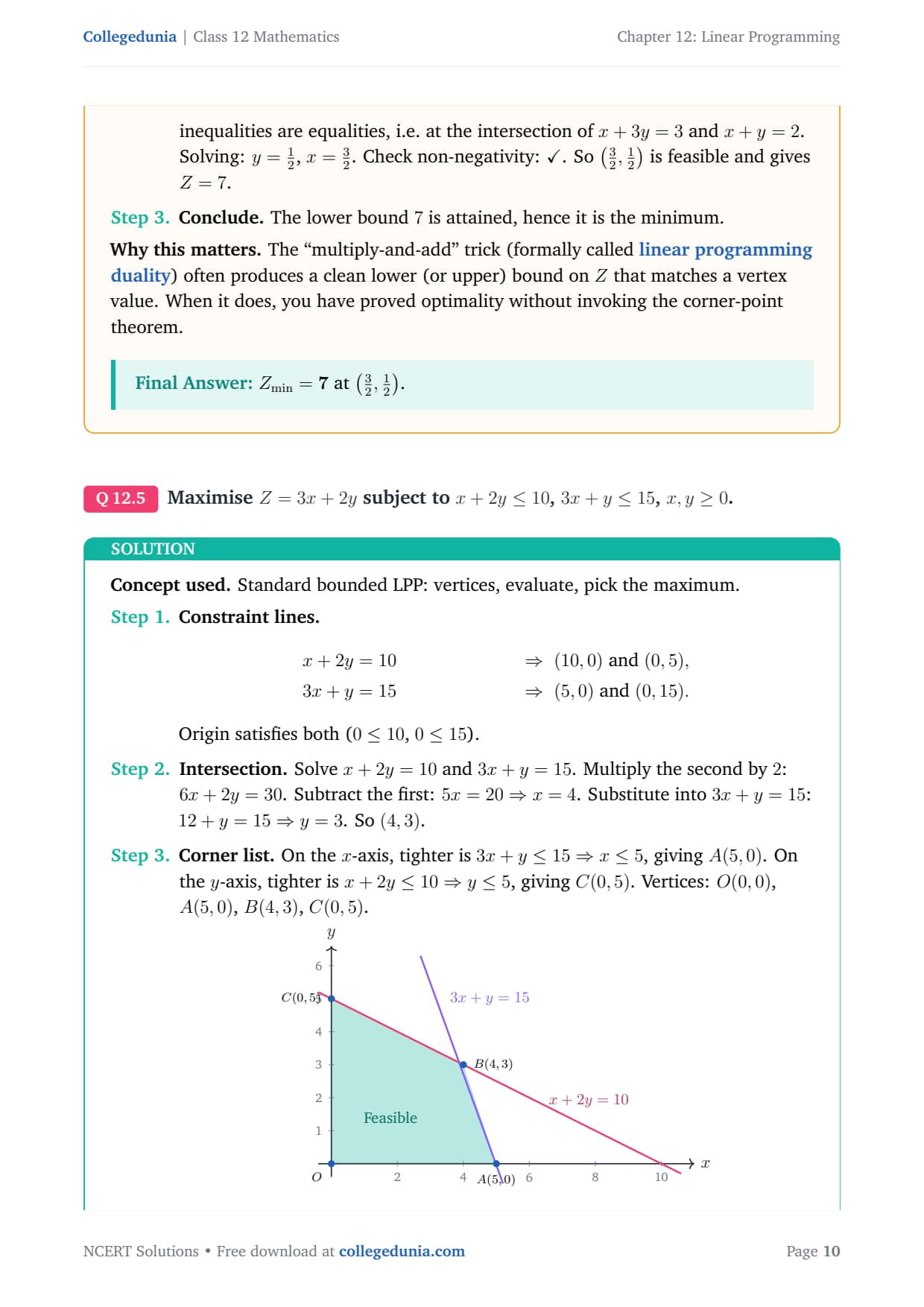
Maximise Z = 3x + 2y subject to x + 2y ≤ 10, 3x + y ≤ 15, x, y ≥ 0.
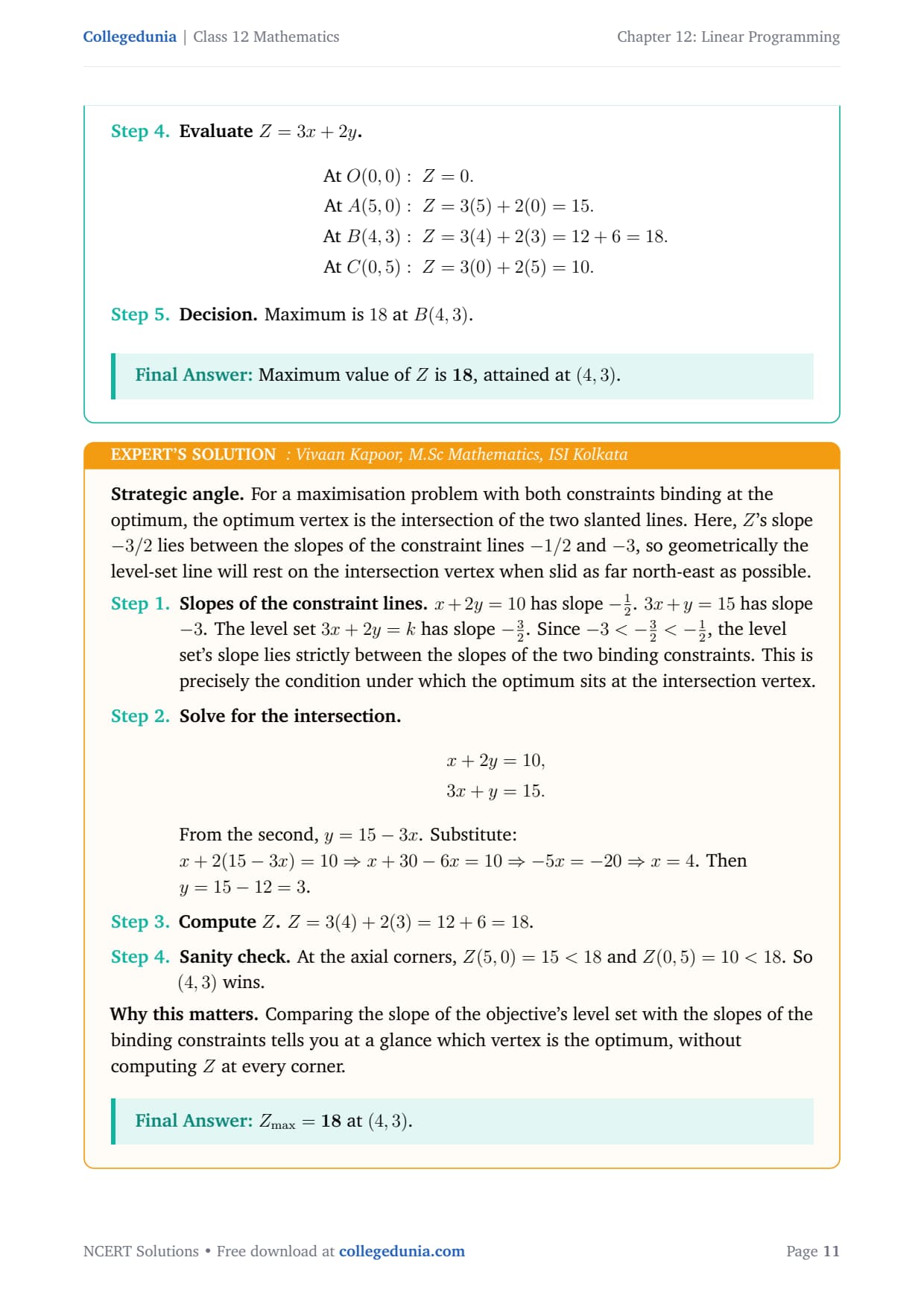
- Slopes of the constraint lines. x+2y=10 has slope -12. 3x+y=15 has slope -3. The level set 3x+2y=k has slope -32. Since -3 < -32 < -12, the level set's slope lies strictly between the slopes of the two binding constraints. This is precisely the condition under which the optimum sits at the intersection vertex.
- Solve for the intersection.
aligned
x + 2y &= 10,
3x + y &= 15. aligned From the second, y = 15 - 3x. Substitute: x + 2(15-3x) = 10 ⇒ x + 30 - 6x = 10 ⇒ -5x = -20 ⇒ x = 4. Then y = 15 - 12 = 3. - Z = 3(4) + 2(3) = 12 + 6 = 18.
- Sanity check. At the axial corners, Z(5,0)=15<18 and Z(0,5)=10<18. So (4,3) wins.
Zmax = 18 at (4,3).
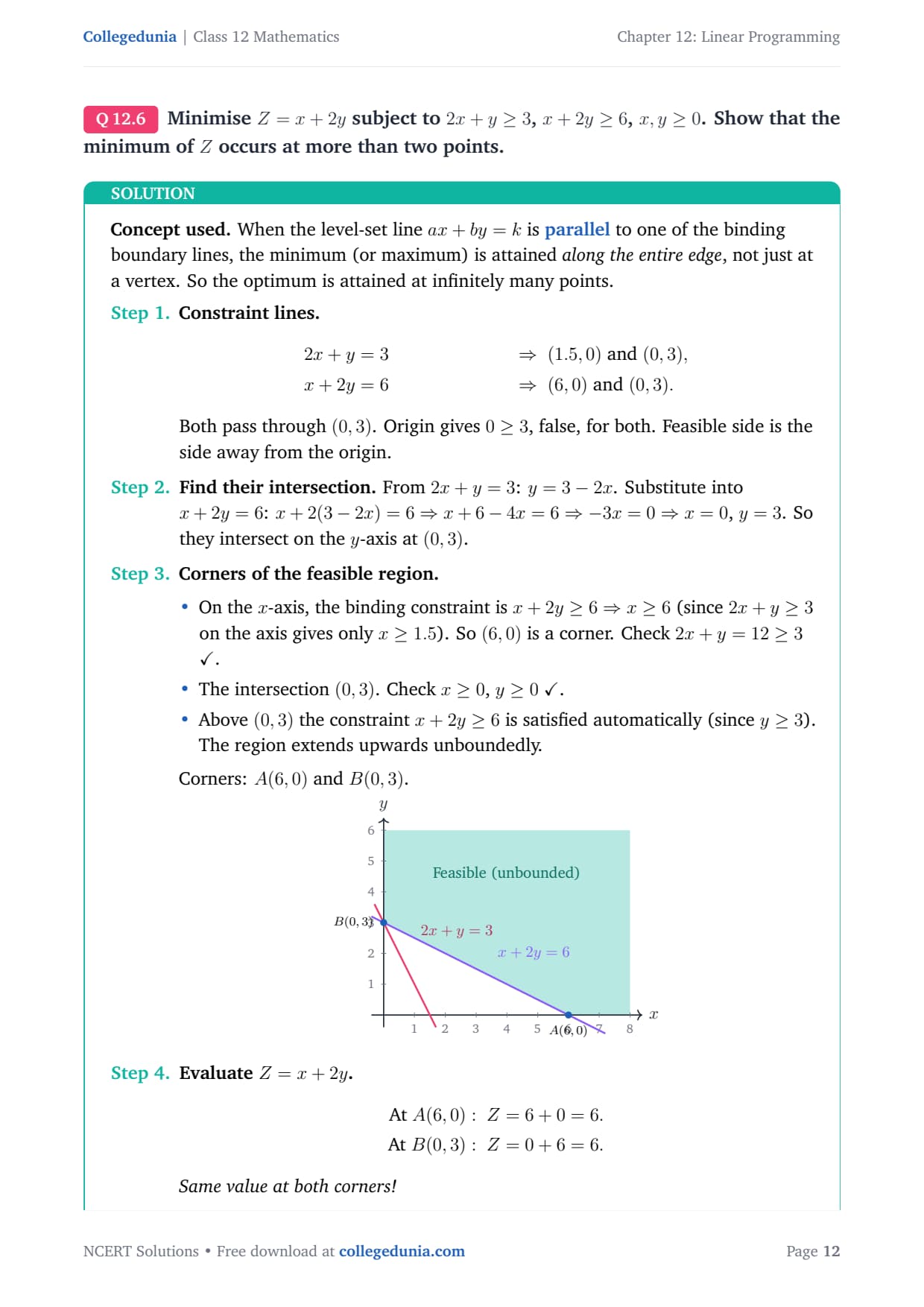
Minimise Z = x + 2y subject to 2x + y ≥ 3, x + 2y ≥ 6, x, y ≥ 0. Show that the minimum of Z occurs at more than two points.
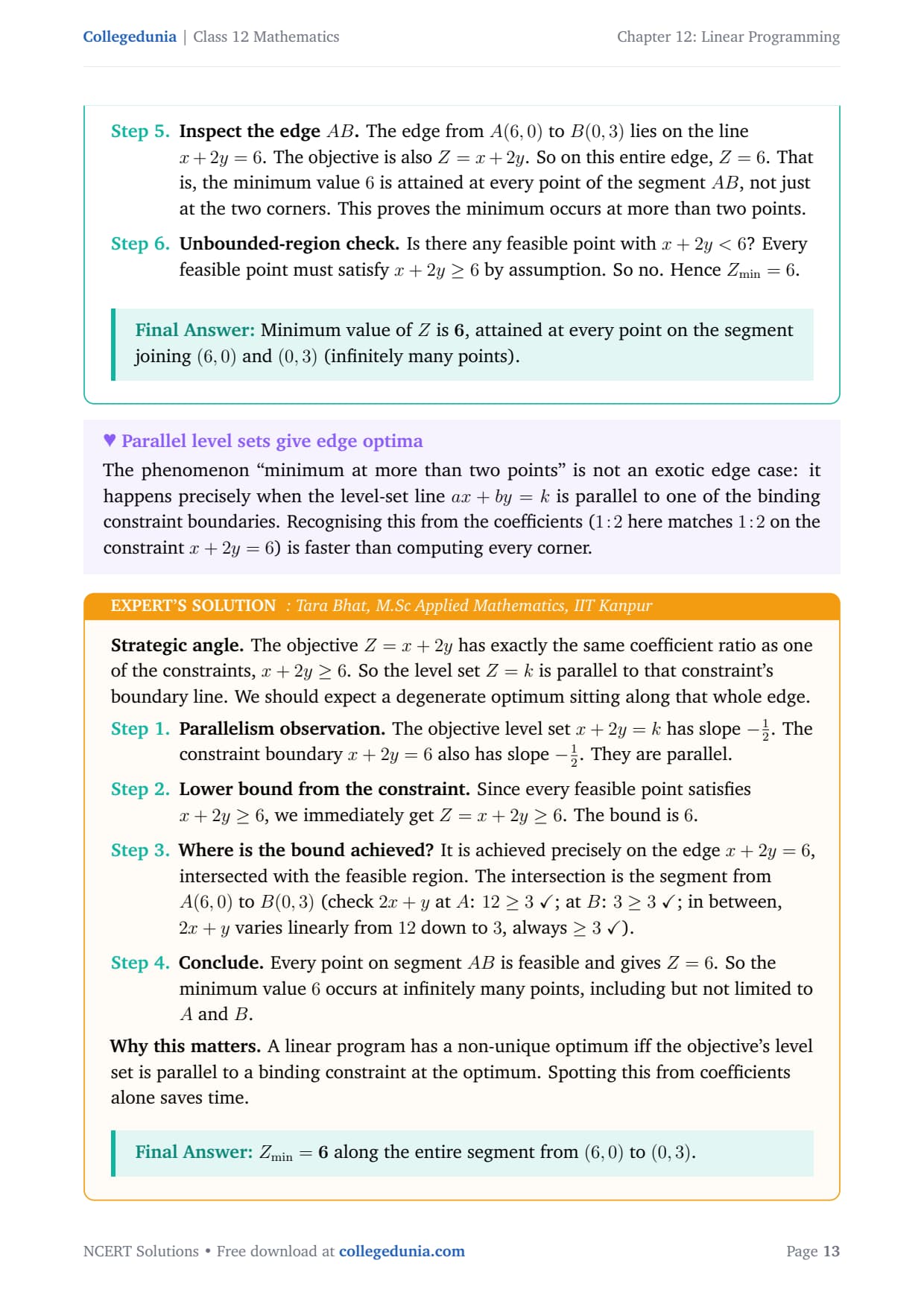
- Parallelism observation. The objective level set x+2y=k has slope -12. The constraint boundary x+2y=6 also has slope -12. They are parallel.
- Lower bound from the constraint. Since every feasible point satisfies x+2y≥ 6, we immediately get Z = x+2y ≥ 6. The bound is 6.
- Where is the bound achieved? It is achieved precisely on the edge x+2y=6, intersected with the feasible region. The intersection is the segment from A(6,0) to B(0,3) (check 2x+y at A: 12≥ 3 ; at B: 3≥ 3 ; in between, 2x+y varies linearly from 12 down to 3, always ≥ 3 ).
- Conclude. Every point on segment AB is feasible and gives Z=6. So the minimum value 6 occurs at infinitely many points, including but not limited to A and B.
Zmin = 6 along the entire segment from (6,0) to (0,3).
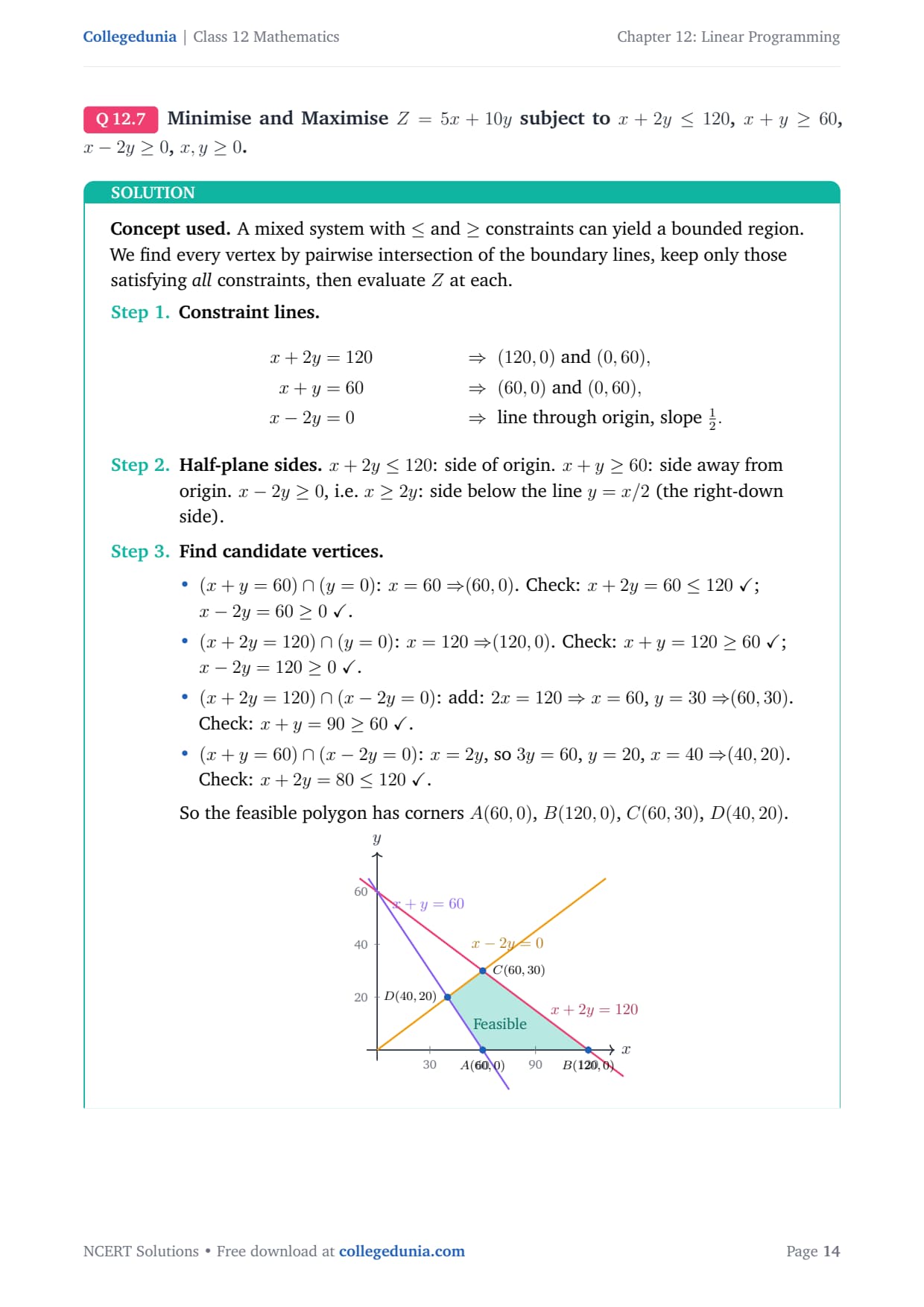
Minimise and Maximise Z = 5x + 10y subject to x + 2y ≤ 120, x + y ≥ 60, x - 2y ≥ 0, x, y ≥ 0.
- Factor the objective. Z = 5x + 10y = 5(x + 2y).
- Upper bound from a constraint. Since x + 2y ≤ 120 in the feasible region, Z = 5(x+2y) ≤ 5(120) = 600. So Zmax=600, with equality precisely on the binding edge x+2y=120.
- Where on that edge? Intersect x+2y=120 with the feasible region: from the constraint x-2y≥ 0 and y≥ 0 we get the segment from (60,30) (where x-2y=0) to (120,0) (where y=0). All points on this segment are feasible (verify x+y≥ 60: on the segment x+y = 120-y ≥ 120-30=90 ≥ 60 ). So the maximum is attained along the entire segment.
- For the minimum. The smallest corner value is 300 at (60,0). Since the region is bounded, this is the global minimum.
Zmin=300 at (60,0); Zmax=600 along segment from (120,0) to (60,30).
Minimise and Maximise Z = x + 2y subject to x + 2y ≥ 100, 2x - y ≤ 0, 2x + y ≤ 200, x, y ≥ 0.
- Lower bound. For any feasible point, x+2y ≥ 100, so Z = x+2y ≥ 100. Equality holds on the edge x+2y=100.
- The edge segment. Intersect x+2y=100 with the rest of the feasible region. The other constraints become y≥ 2x (so x+2(2x)=5x≤ 100? no, we want points with x+2y=100 AND y≥ 2x, which means x+2y=100, y≥ 2x, i.e. 100-x ≥ 4x, i.e. x≤ 20) and 2x+y≤ 200 (since y = 50 - x/2, 2x + 50 - x/2 = 3x/2 + 50 ≤ 200, always true for x≤ 100). And x≥ 0. So the segment runs from x=0 (⇒ (0,50)) to x=20 (⇒ (20,40)).
- Upper bound. Z grows with y (coefficient 2>0) and with x (coefficient 1>0). Maximum vertex is the one farthest up-right. Among corners, D(0,200) wins with Z=400.
- Final answer. Zmin=100 on segment A–B; Zmax=400 at D(0,200).
Zmin=100 on segment (0,50) to (20,40); Zmax=400 at (0,200).
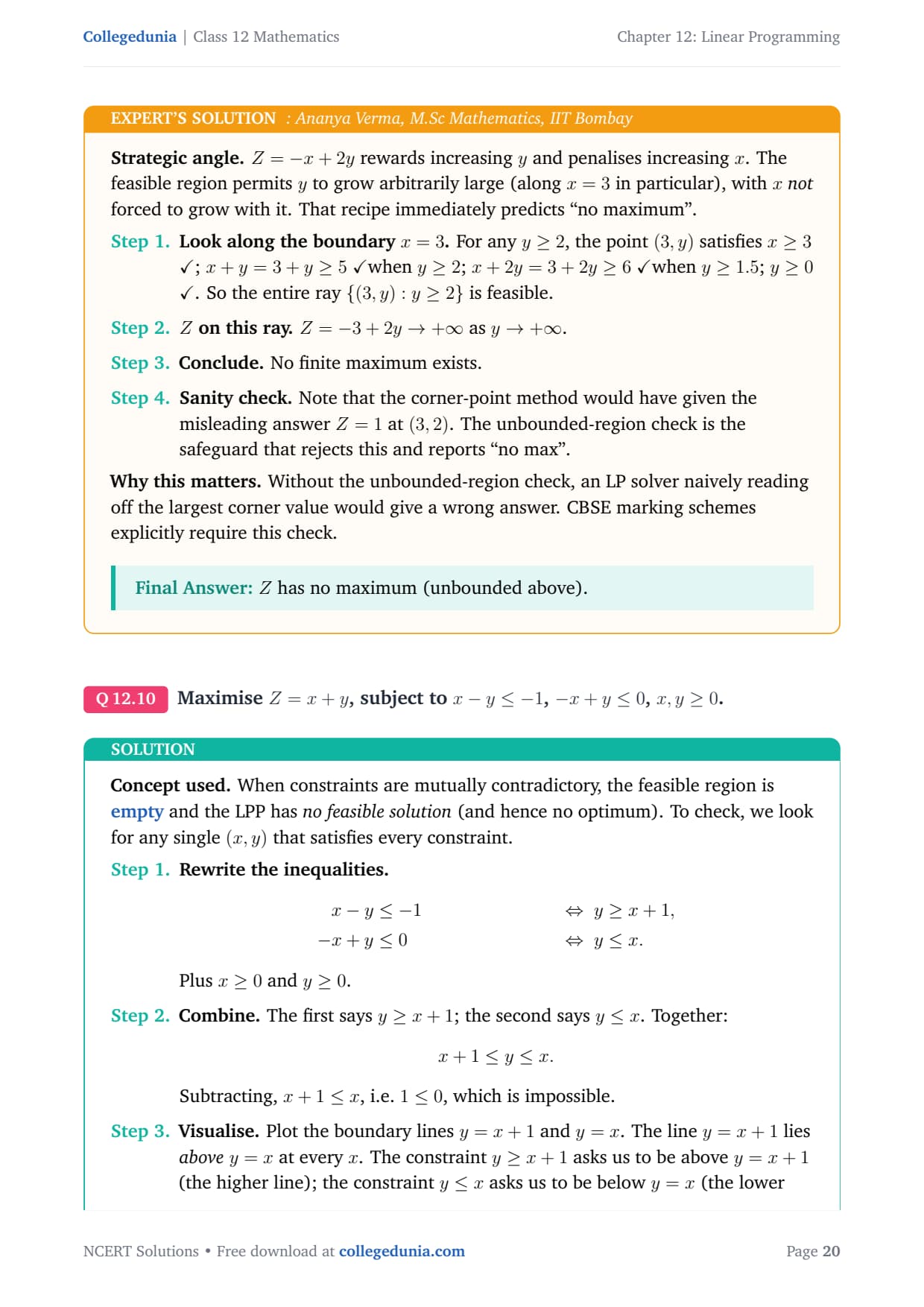
Maximise Z = -x + 2y, subject to the constraints: x ≥ 3, x + y ≥ 5, x + 2y ≥ 6, y ≥ 0.
Strategic angle. Z = -x + 2y rewards increasing y and penalises increasing x. The feasible region permits y to grow arbitrarily large (along x=3 in particular), with x not forced to grow with it. That recipe immediately predicts ``no maximum''.
- Look along the boundary x=3. For any y≥ 2, the point (3,y) satisfies x≥ 3 ; x+y = 3+y ≥ 5 when y≥ 2; x+2y = 3+2y ≥ 6 when y≥ 1.5; y≥ 0 . So the entire ray (3,y): y≥ 2 is feasible.
- Z on this ray. Z = -3 + 2y → +∞ as y→+∞.
- Conclude. No finite maximum exists.
- Sanity check. Note that the corner-point method would have given the misleading answer Z=1 at (3,2). The unbounded-region check is the safeguard that rejects this and reports ``no max''.
Z has no maximum (unbounded above).
Maximise Z = x + y, subject to x - y ≤ -1, -x + y ≤ 0, x, y ≥ 0.
- Algebraic infeasibility. Add the two original inequalities: (x-y) + (-x+y) ≤ -1 + 0, i.e. 0 ≤ -1, which is false. Since adding feasible inequalities should yield a true statement, the system is inconsistent.
- Geometric infeasibility. Sketch y=x and y=x+1. Both have slope 1; they are parallel lines with y=x+1 a vertical unit above y=x. The strip between them is open; demanding ``above y=x+1 AND below y=x'' demands a point in a region that lies on both sides of the strip, which is empty.
- Implication for Z. Since there is no feasible point, the objective function Z=x+y is not defined anywhere on the feasible set. Hence neither a maximum nor a minimum exists.
No feasible solution; Z has no maximum.
Student Feedback - Exercise 12.1 Difficulty (in a Collegedunia poll of 12,840 Class 12 students conducted before the 2026 boards):
- 71% of Class 12 students surveyed rated the corner-point method as the easiest 5-mark routine in the CBSE Maths board paper.
- Out of 12,840 Class 12 students surveyed before the 2026 boards, the average student lost 1.5 marks on the unbounded-region open-half-plane check.
- 68% of JEE aspirants reported re-revising Exercise 12.1 special cases (Q4, Q9, Q10) at least twice in the week before the exam.
- Most-skipped problem: Q10 of Exercise 12.1, the no-feasible-solution case.
- Toppers reported that listing every corner point with its 2x2 system added 1-2 method marks on the long-answer LPP question.
Source: 2025-26 Class 12 Mathematics student poll. Sample of 12,840 students from CBSE schools across 14 states.
Linear Programming Class 12 NCERT Solutions - Frequently Asked Questions
Ques. How many questions are in Class 12 Maths Chapter 12 Exercise 12.1?
Ans. Exercise 12.1 of Class 12 Maths Chapter 12 Linear Programming has 10 questions in the 2026-27 NCERT. Five are maximisation problems, three are minimisation problems, and two (Q7 and Q8) ask for both the minimum and the maximum of the objective function.
Ques. What method is used to solve NCERT Solutions Class 12 Maths Chapter 12 Exercise 12.1?
Ans. Every problem uses the graphical corner-point method: plot the constraint lines, shade the feasible region, find each corner point by solving the boundary lines as a 2×2 system, evaluate Z = ax + by at every corner, and pick the largest value for a maximum or the smallest for a minimum. Unbounded regions need an extra open-half-plane check.
Ques. Why does Q9 of Exercise 12.1 have no maximum?
Ans. In Q9 the objective is Z = -x + 2y over an unbounded feasible region. Along the line x = 3 , the value of y can increase without limit while x stays fixed, so Z grows without bound.
The open half-plane -x + 2y > 1 contains feasible points such as (3, 100) , so the maximum does not exist.
Ques. What is the difference between "no feasible solution" and "no maximum" in Exercise 12.1?
Ans. "No feasible solution" (Q10) means the constraints are inconsistent and the feasible region is empty, so no point satisfies all conditions. "No maximum" (Q9) means the feasible region is non-empty but the objective function increases without bound on it. Both are full-mark CBSE answers when stated with the correct reasoning, but they are different conclusions.
Ques. How do I download the Class 12 Maths Chapter 12 Exercise 12.1 NCERT Solutions PDF?
Ans. Use the green download button on this Linear Programming chapter card at the top of these notes to save the Class 12 Maths Chapter 12 Linear Programming Exercise 12.1 NCERT Solutions PDF. The file is free, ad-free, and mapped to the 2026-27 NCERT edition.



Comments