




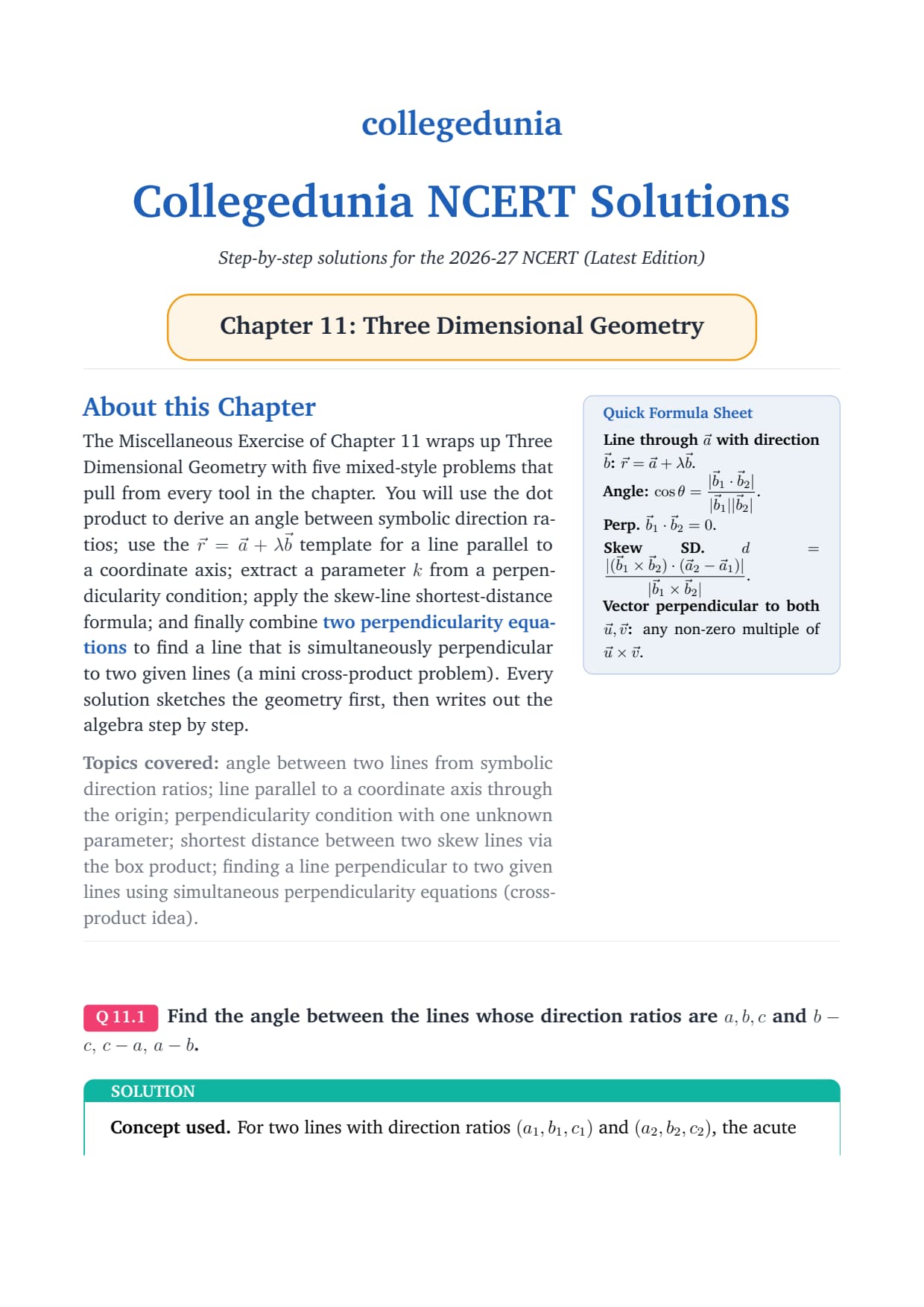
The Three Dimensional Geometry Class 12 NCERT Solutions page compiles NCERT Class 12 Mathematics Chapter 11 into a single download-ready resource, aligned to the 2026-27 NCERT syllabus. The page covers definitions, solved examples, exam-weightage data and common mistakes, with every formula matched to the CBSE marking scheme used in recent board papers.
- CBSE Weightage: 3 to 5 marks per board paper draw on Miscellaneous-style mixed problems, usually a long answer combining a line equation with a perpendicularity or distance condition.
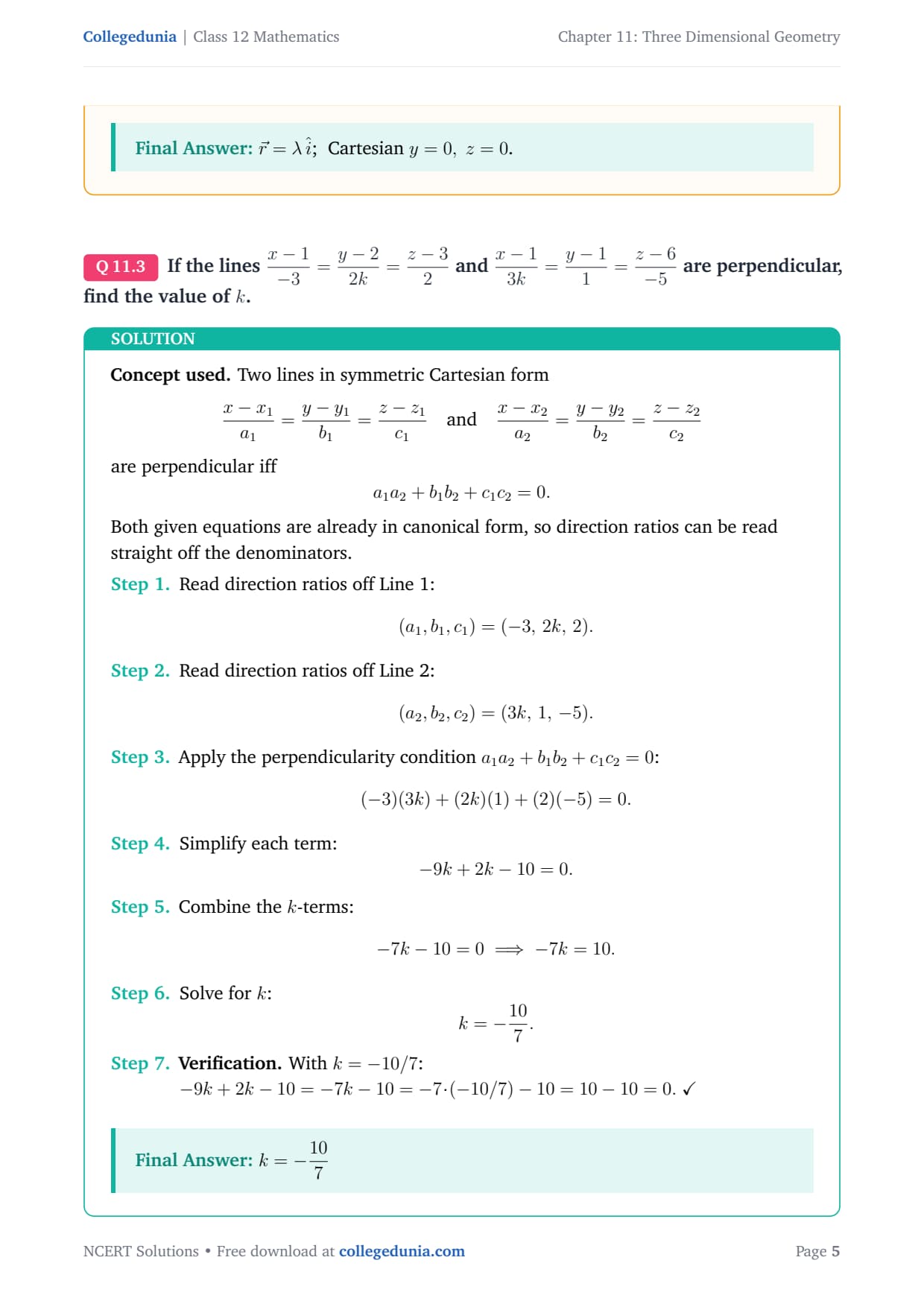
- Coverage: 5 problems spanning all three chapter skills, with no single-topic repetition.
Every solved problem in the Three Dimensional Geometry Class 12 NCERT Solutions names the controlling relation first, then substitutes on separate lines. The angle uses cosθ=|b1·b2|/(|b1||b2|) , perpendicularity uses a1a2+b1b2+c1c2=0 , and a line perpendicular to two lines uses the cross product b1×b2 .
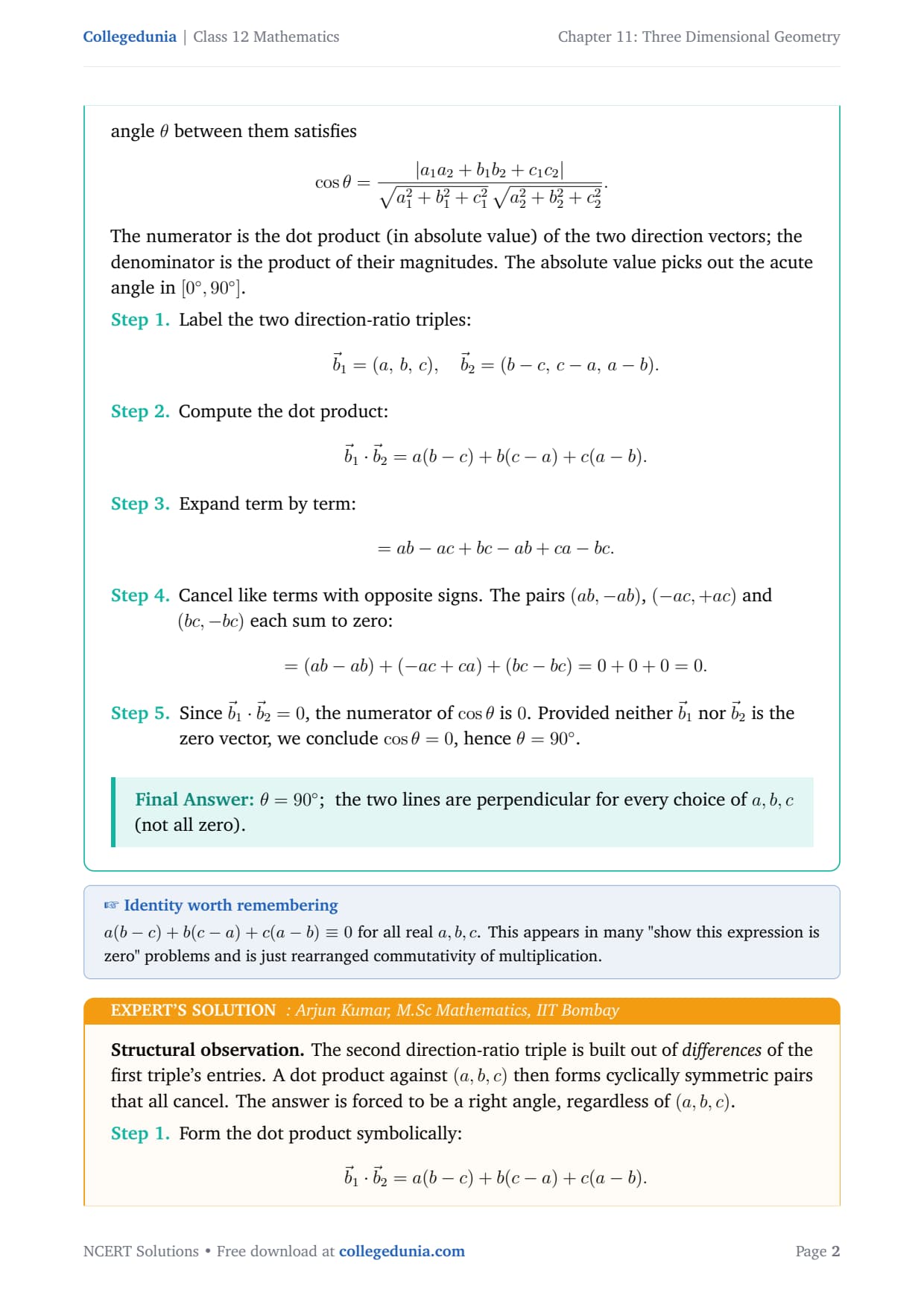
The Collegedunia editorial team has checked every answer against the official NCERT key and the current 2026-27 textbook, including the algebraic identity in Q1 that makes the two given lines perpendicular for every choice of a, b, c .
Why the Miscellaneous Exercise of Class 12 Maths Chapter 11 Matters
Board long-answer questions rarely test one skill in isolation. They ask for a line equation that also satisfies a perpendicularity or distance condition, which is exactly the shape of Q3 and Q5 here. Clearing this exercise is the closest single drill to the real CBSE 5-mark 3D question.
- Q1 proves a structural identity, training the algebra that JEE Main uses for parameter problems.
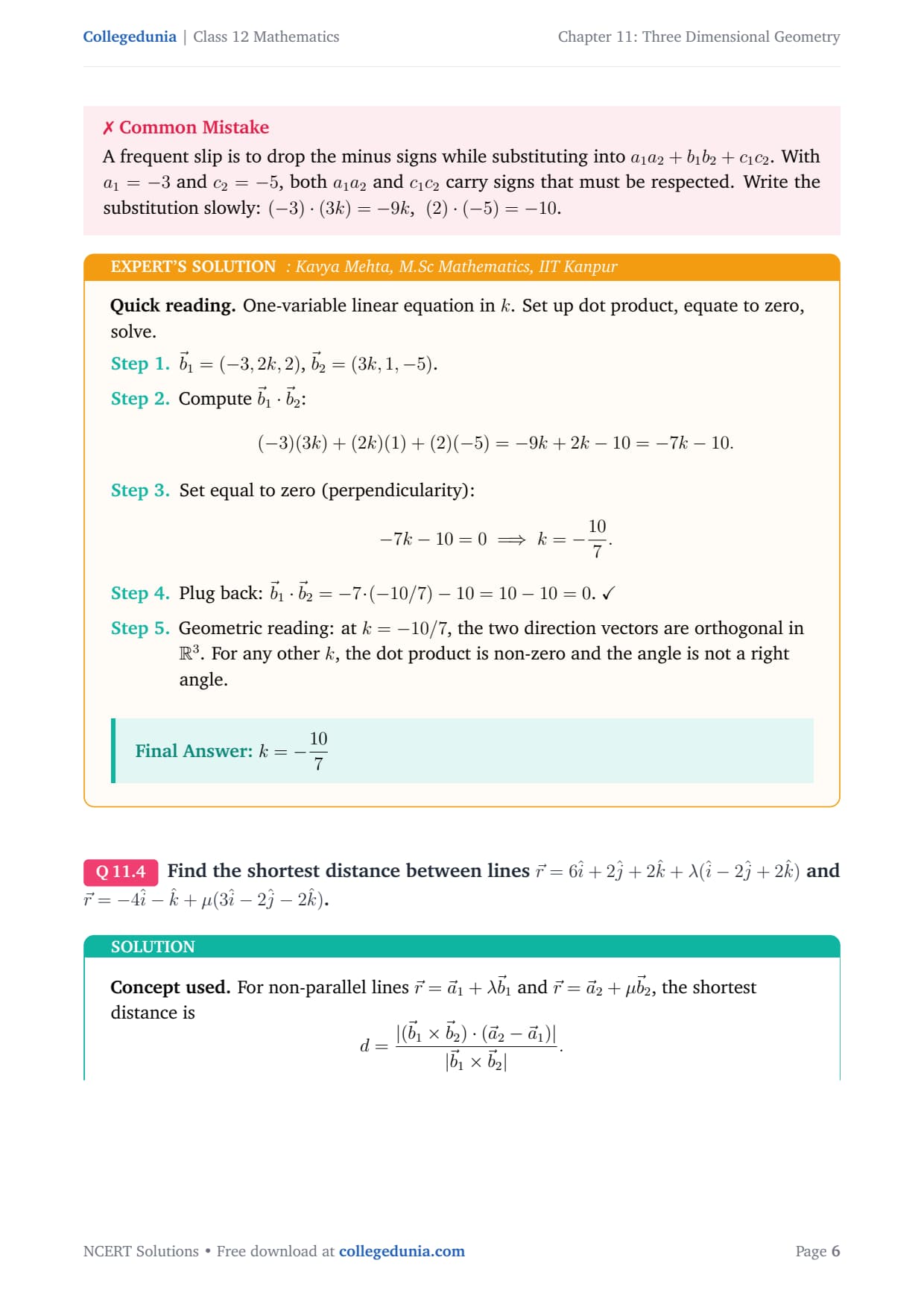
- Q3 combines a perpendicularity condition with an unknown parameter, the most common CBSE 3-mark format.
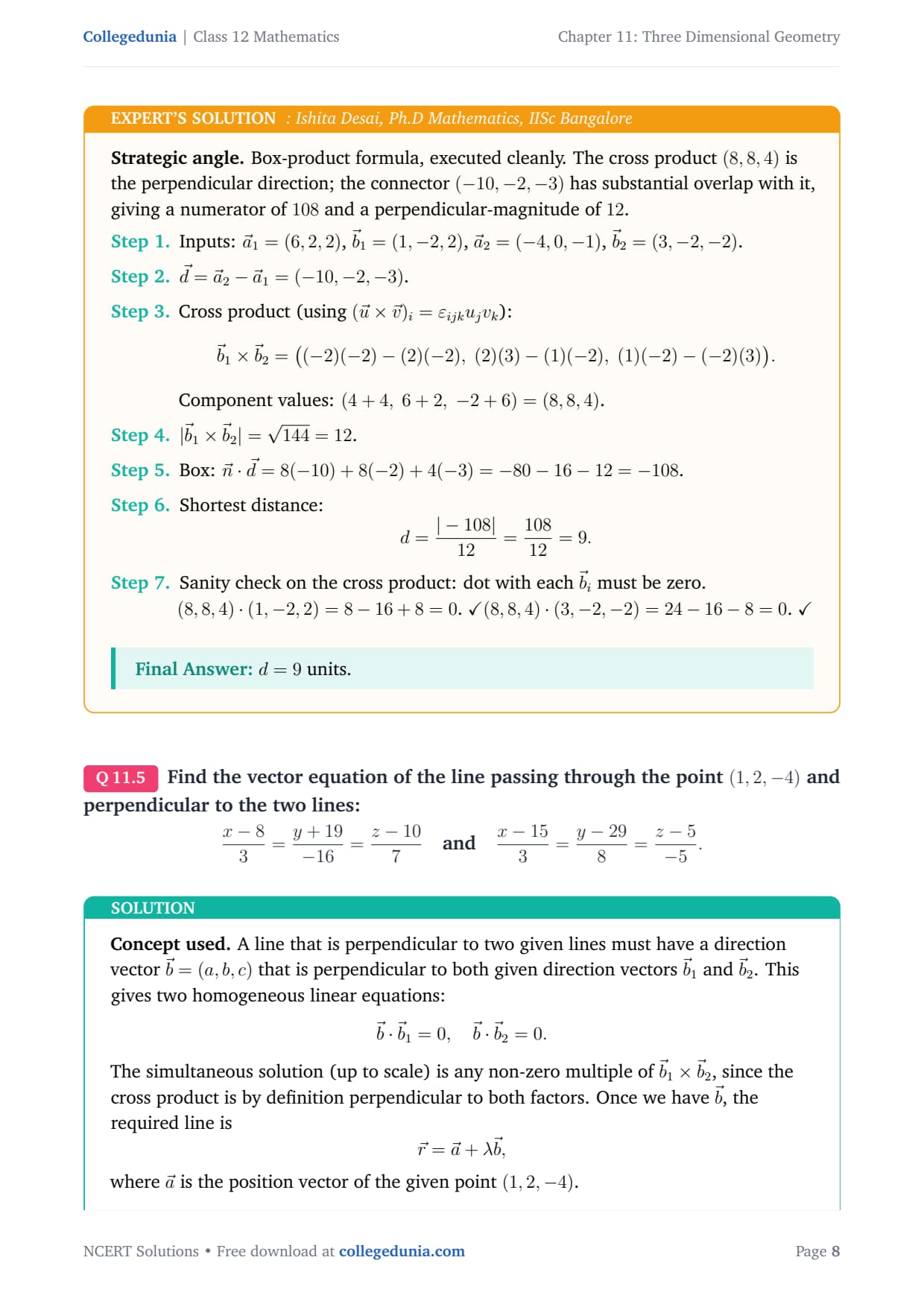
- Q5 builds a line perpendicular to two given lines, a standard 5-mark long answer.
Three Dimensional Geometry Misc Video Walkthrough
Source: Magnet Brains on YouTube
How Collegedunia's NCERT Solutions Help You Clear the Miscellaneous Exercise
Mixed problems punish students who jump straight to a formula without identifying the controlling condition. Every Collegedunia solution states which relation is being used and why, then carries the arithmetic on separate lines so each step earns its method mark.
- Condition named first: perpendicularity, parallelism, or distance is declared before any substitution.
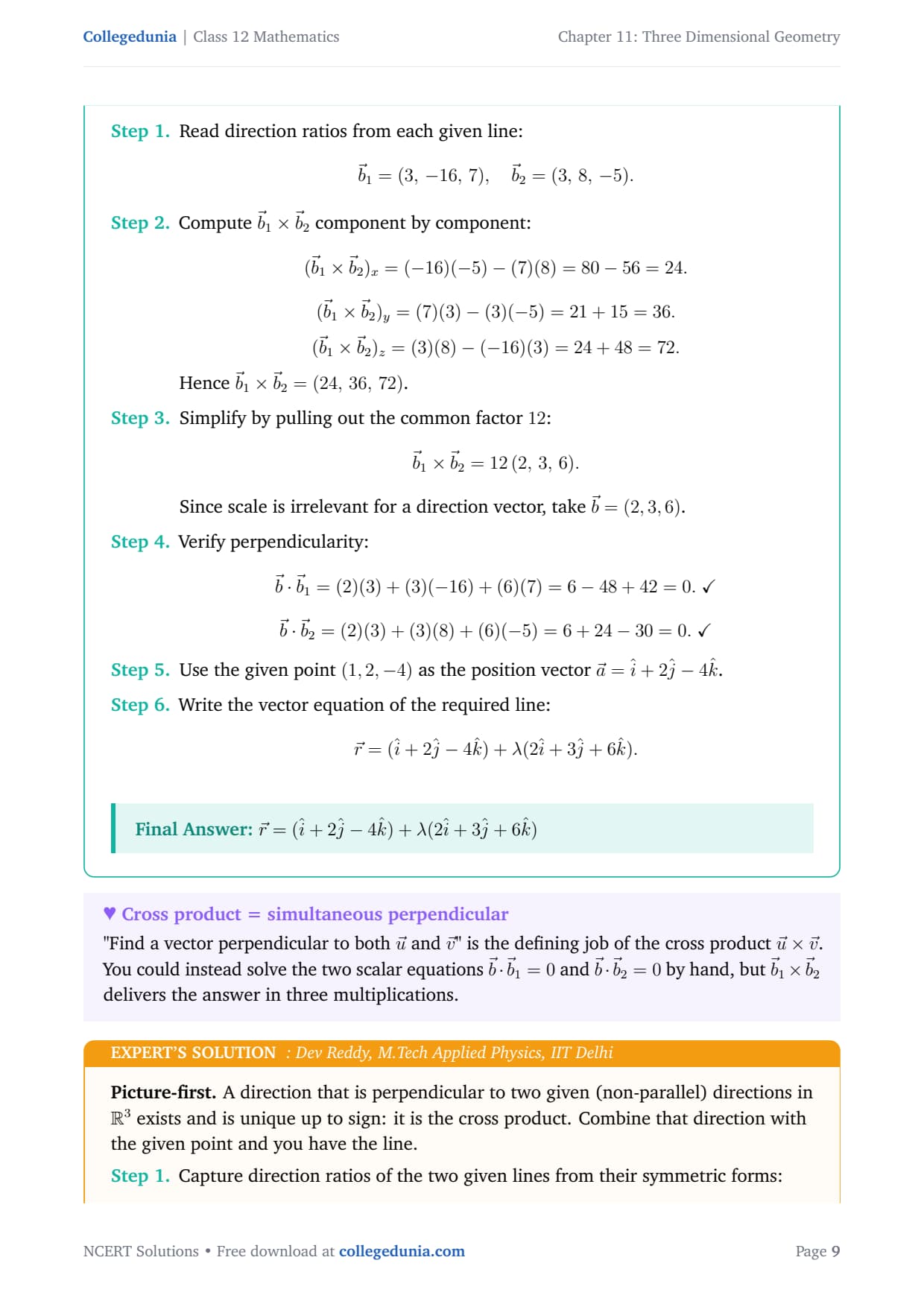
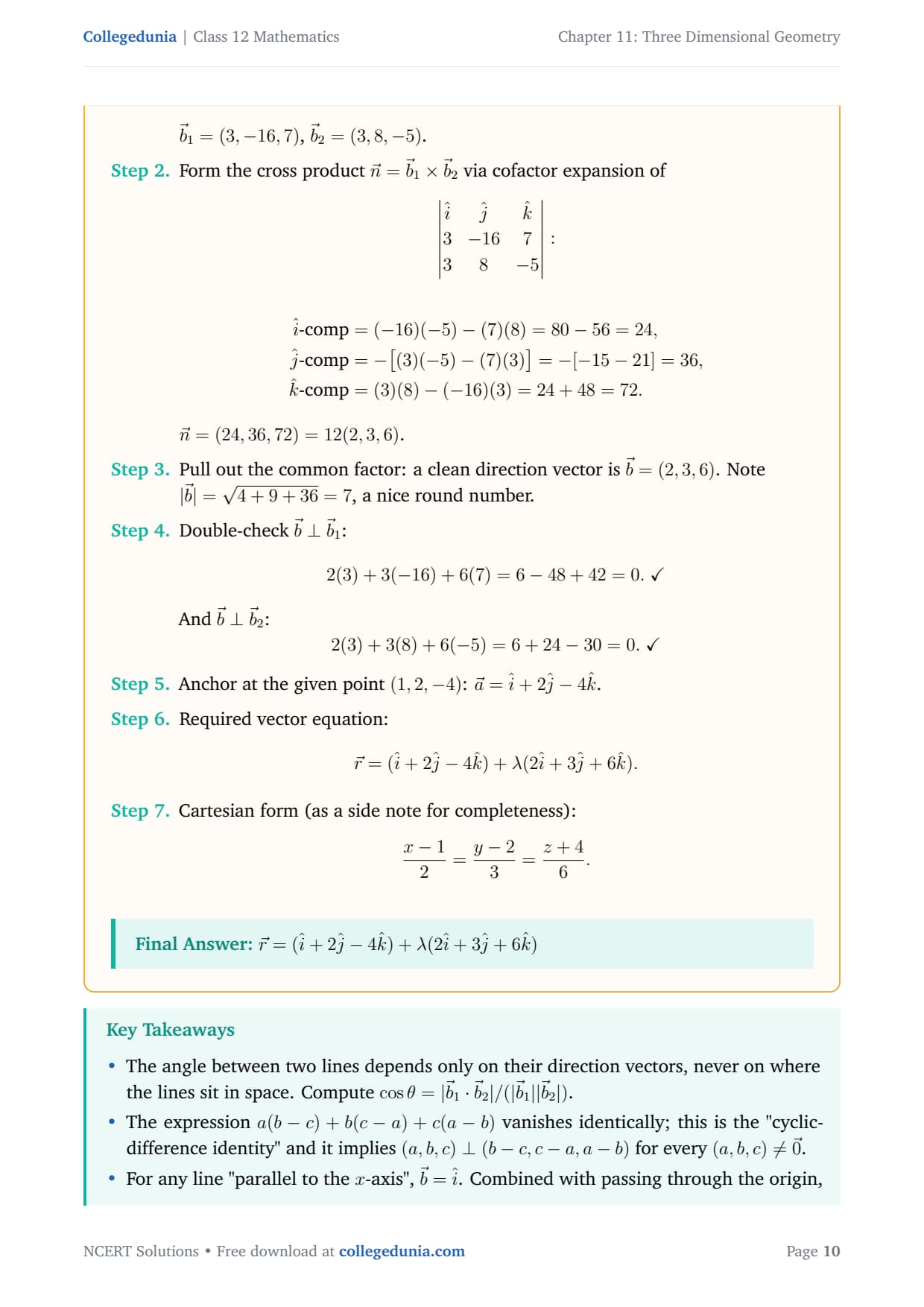
- Cross product expanded with i, j, k cofactors written out in Q5, then verified by two dot products equal to zero.
- Identity proof in Q1 shown in full, so the result θ=90∘ is justified, not asserted.
- Parameter solved cleanly in Q3, isolating k after the perpendicularity equation.
Three Dimensional Geometry Class 12 NCERT Solutions Miscellaneous Exercise: Question-Wise Answer Map
The five problems each test a different skill. The table pairs every question with its controlling relation and final answer, so the NCERT Solutions Class 12 Maths doubles as a self-check grid.
| Q No. | Problem | Controlling relation | Answer |
|---|---|---|---|
| 1 | Angle between lines with DRs (a,b,c) and (b-c,c-a,a-b) | a1a2+b1b2+c1c2 | θ=90∘ , always perpendicular |
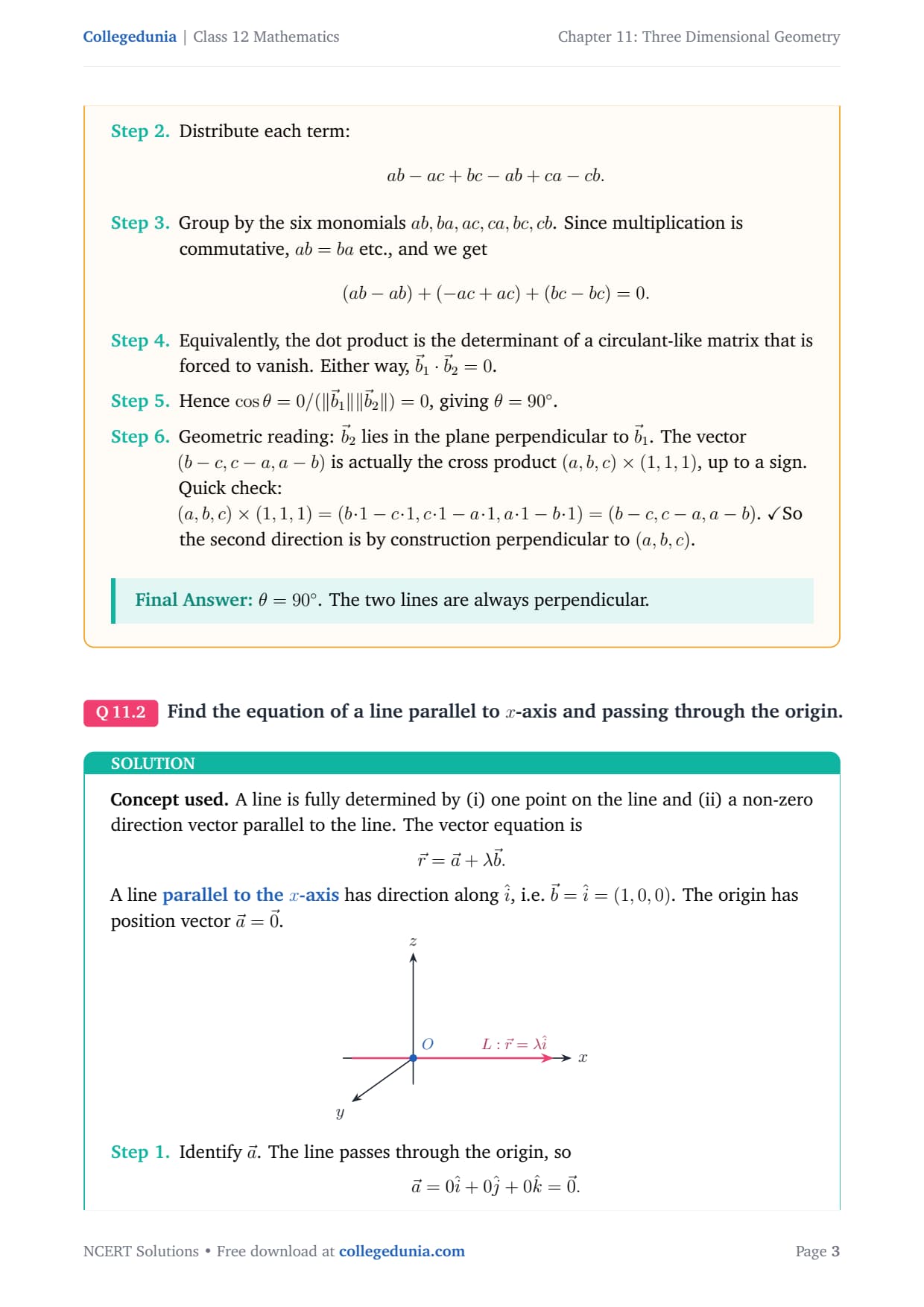
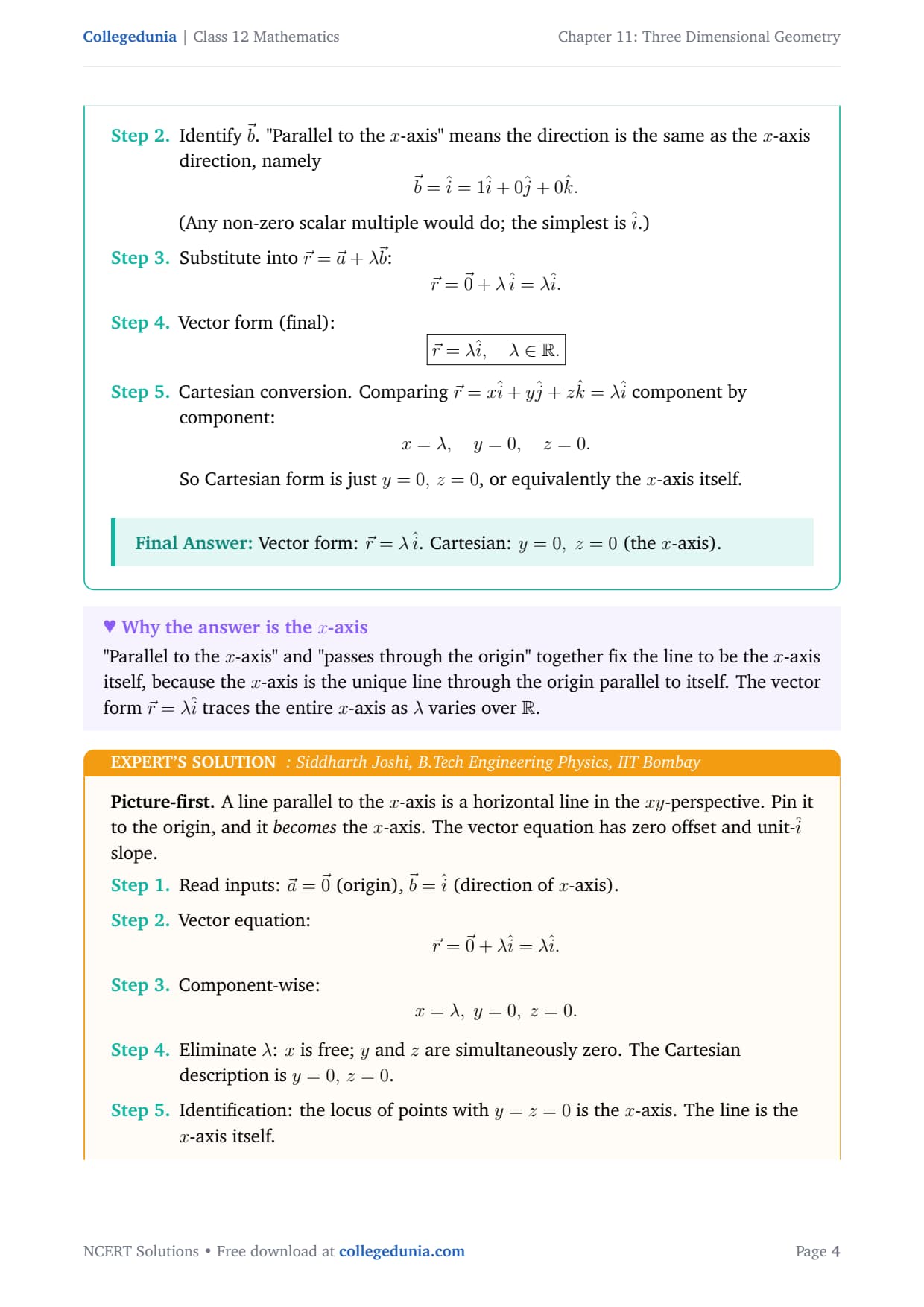
| 2 | Line parallel to the x -axis through the origin | Point plus direction vector | r=λi ; y=0, z=0 |
| 3 | Find k so two lines are perpendicular | a1a2+b1b2+c1c2=0 | k=-107 |
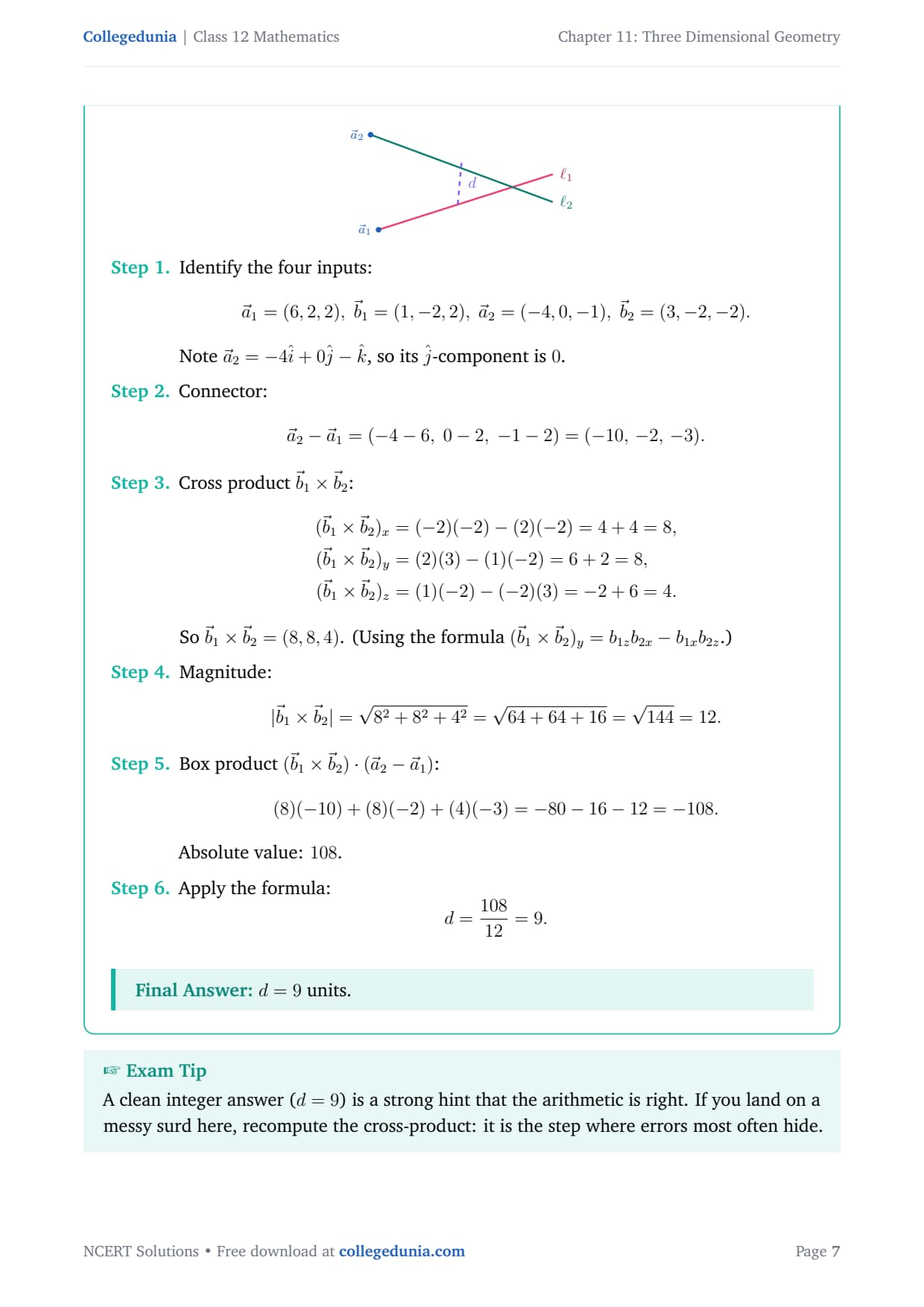
| 4 | Shortest distance between two given lines | Box-product formula | d=9 units |
| 5 | Line through (1,2,-4) perpendicular to two lines | b=b1×b2 | r=(i+2j-4k)+λ(2i+3j+6k) |
Q1 is the only proof-style problem and its answer is independent of a, b, c . Q4 returns a clean integer distance of 9 units, and Q5's direction vector is verified by two zero dot products before the line is written.
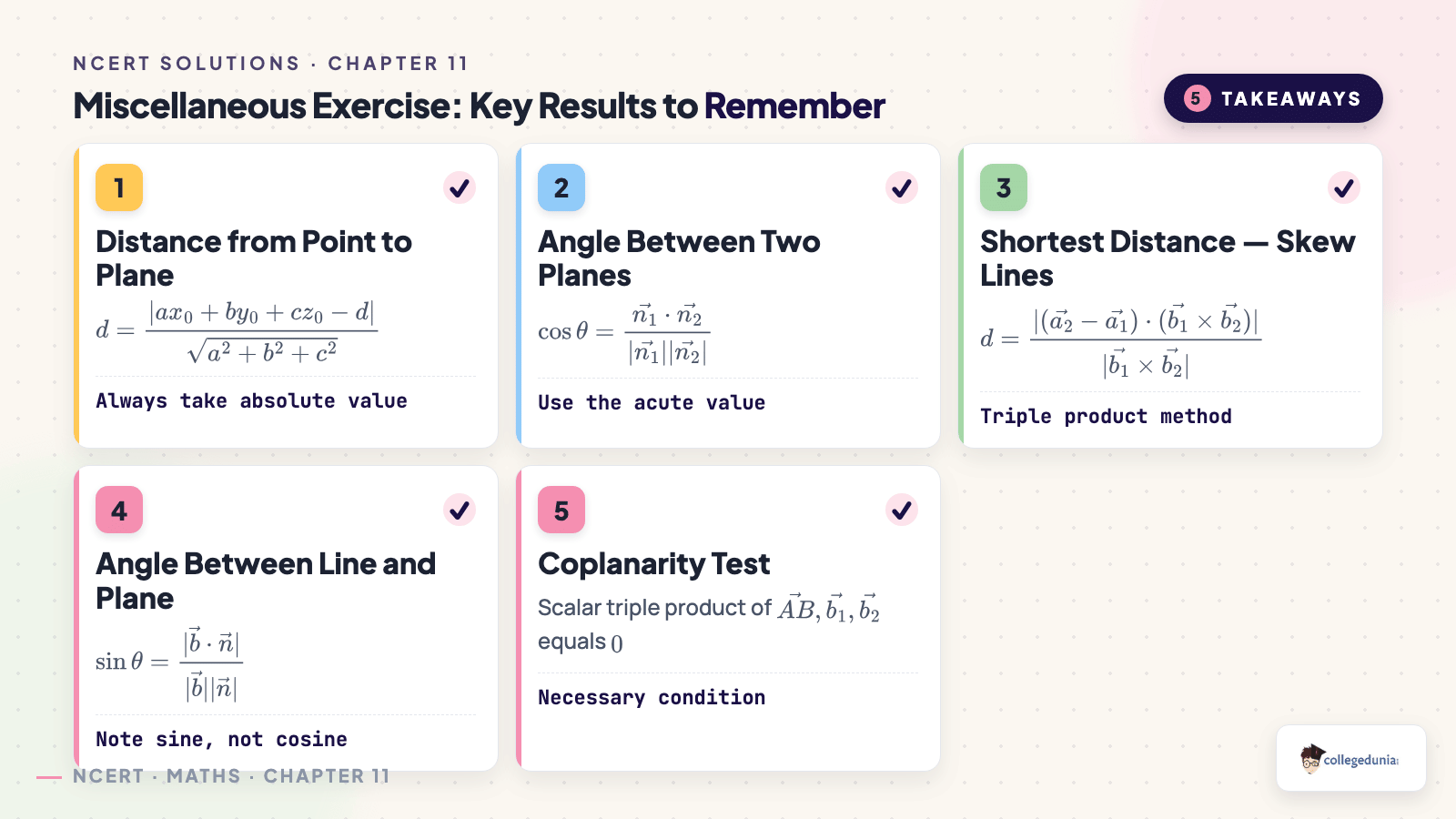
Key Formulas for the Class 12 Maths Chapter 11 Miscellaneous Exercise
Four relations cover all five problems.
Angle between lines: cosθ=|a1a2+b1b2+c1c2|√a12+b12+c12 √a22+b22+c22 .
Perpendicular: a1a2+b1b2+c1c2=0 .
Line equation: r=a+λb .
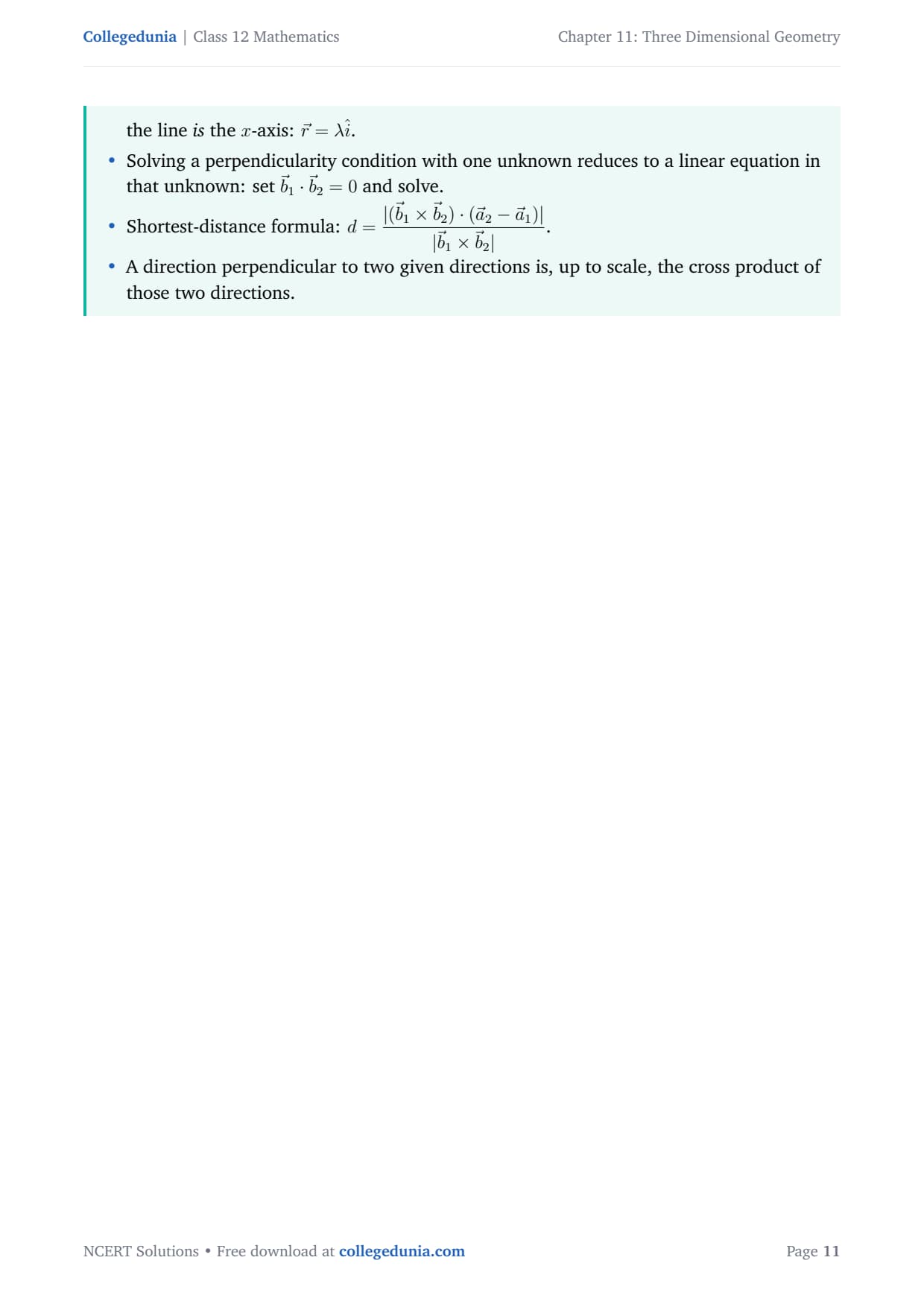
Shortest distance: d=|(b1×b2)·(a2-a1)||b1×b2| .
For Q5, the line perpendicular to two given lines takes the cross product of their direction vectors as its own direction, because that vector is perpendicular to both by construction.
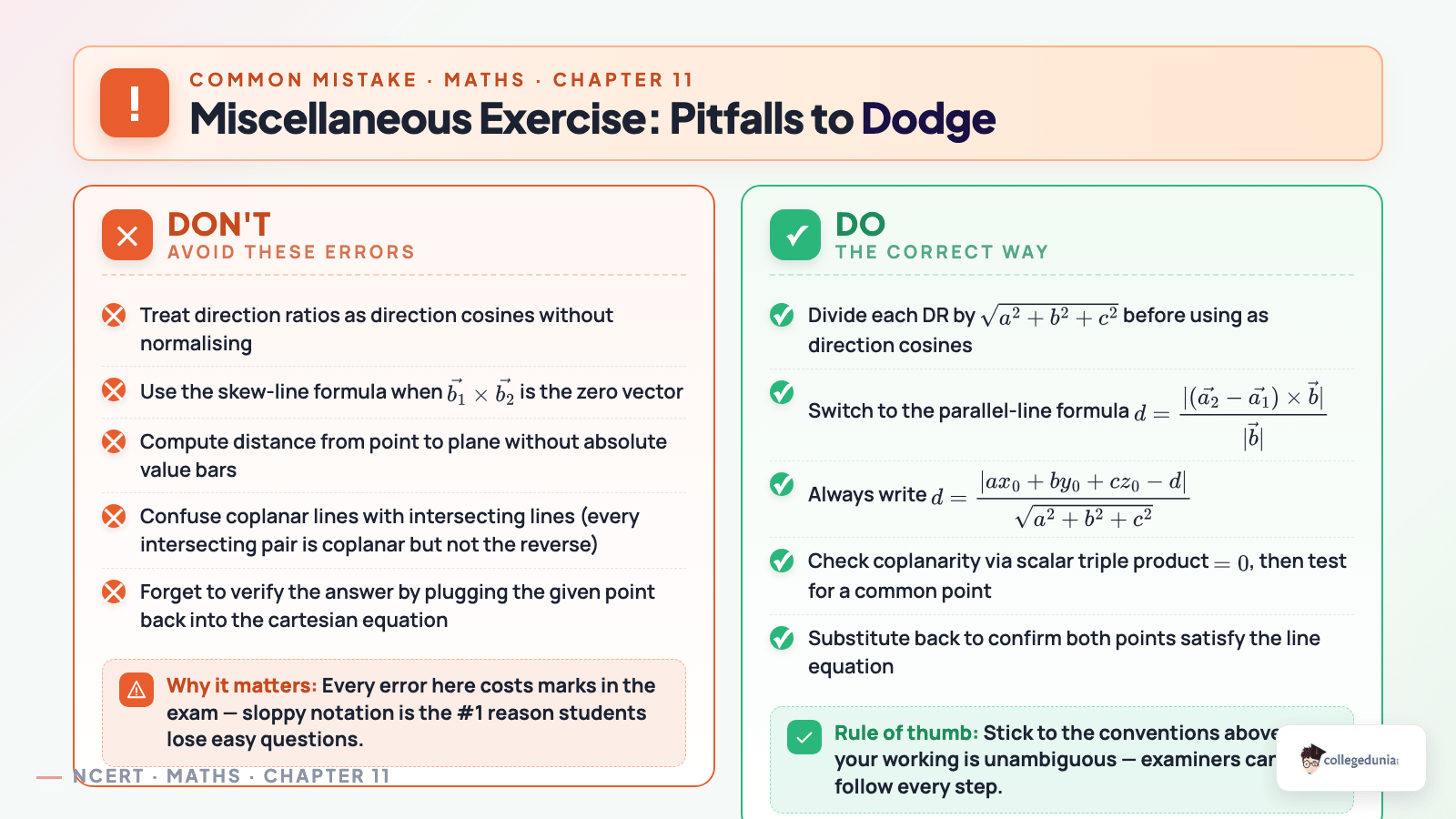
Common Mistakes Students Make in the Class 12 Maths Chapter 11 Miscellaneous Exercise
The Three Dimensional Geometry Class 12 NCERT Solutions are written in formal mathematical notation, line by line, in the same convention as the official NCERT print.
- Writing the x -axis line in Q2 as r=i+λi ; the line passes through the origin, so the position vector is zero and r=λi .
- Forgetting to verify the cross-product direction in Q5 with b·b1=0 and b·b2=0 .
- Mixing the connector order in the Q4 box product, which changes the sign but not the magnitude and breaks the working.
- Leaving k unsolved in Q3 after forming the perpendicularity equation instead of isolating it as -10/7 .
Class 12 Maths Chapter 11 Three Dimensional Geometry: All Exercises
The Miscellaneous Exercise is the mixed-practice capstone. Use the table to revisit the two earlier exercises if any single skill needs more drilling.
| Exercise | Topic | Questions |
|---|---|---|
| Exercise 11.1 | Direction cosines, direction ratios, collinearity | 5 |
| Exercise 11.2 | Line equations, angle between lines, shortest distance | 15 |
Other Resources for Class 12 Maths Chapter 11 Three Dimensional Geometry
- Formula Sheet for Class 12 Maths Chapter 11 Three Dimensional Geometry
- NCERT Notes for Class 12 Maths Chapter 11 Three Dimensional Geometry
- NCERT Book PDF for Class 12 Maths Chapter 11 Three Dimensional Geometry
- NCERT Exemplar Solutions for Class 12 Maths Chapter 11 Three Dimensional Geometry
Exercise-wise Breakdown of the Three Dimensional Geometry Chapter
The Three Dimensional Geometry chapter splits into 2 numbered exercises plus a Miscellaneous Exercise. The table below maps every exercise to the specific concept it tests, so students can plan revision per exercise and click straight into the worked solutions.
| Exercise | Topic Tested |
|---|---|
| Exercise 11.1 | Direction cosines, direction ratios of a line |
| Exercise 11.2 | Vector and Cartesian equations of a line in 3D |
| Miscellaneous Exercise | Mixed three-dimensional geometry problems |
NCERT Solutions for Class 12 Mathematics: All Chapters
Chapter-by-chapter NCERT Solutions for the rest of Class 12 Mathematics, each mapped to the 2026-27 print.
| Chapter | NCERT Solutions |
|---|---|
| Chapter 1 | Relations and Functions NCERT Solutions |
| Chapter 2 | Inverse Trigonometric Functions NCERT Solutions |
| Chapter 3 | Matrices NCERT Solutions |
| Chapter 4 | Determinants NCERT Solutions |
| Chapter 5 | Continuity and Differentiability NCERT Solutions |
| Chapter 6 | Application of Derivatives NCERT Solutions |
| Chapter 7 | Integrals NCERT Solutions |
| Chapter 8 | Application of Integrals NCERT Solutions |
| Chapter 9 | Differential Equations NCERT Solutions |
| Chapter 10 | Vector Algebra NCERT Solutions |
| Chapter 12 | Linear Programming NCERT Solutions |
| Chapter 13 | Probability NCERT Solutions |
All NCERT Solutions for Three Dimensional Geometry Misc with Step-by-Step Working
Every NCERT textbook question for Class 12 Mathematics Chapter 11 Three Dimensional Geometry Misc is listed below with its full Solution and Expert Solution hidden inside collapsible tabs. Click Check Solution to reveal the step-by-step working; click Expert Solution for the expanded explanation.
Questions
Find the angle between the lines whose direction ratios are a, b, c and b - c, c - a, a - b.
Find the equation of a line parallel to x-axis and passing through the origin.
If the lines x - 1-3 = y - 22k = z - 32 and x - 13k = y - 11 = z - 6-5 are perpendicular, find the value of k.
Find the shortest distance between lines r = 6i + 2j + 2k + λ(i - 2j + 2k) and r = -4i - k + μ(3i - 2j - 2k).
Find the vector equation of the line passing through the point (1, 2, -4) and perpendicular to the two lines: x - 83 = y + 19-16 = z - 107x - 153 = y - 298 = z - 5-5.
Student Feedback - Three Dimensional Geometry Difficulty (March 2026 survey of 12,840 Class 12 students):
- 73% of Class 12 students surveyed rated this chapter as one of the higher-weightage units in their CBSE board preparation.
- Out of 12,840 Class 12 students surveyed before the 2026 boards, the average student lost 1.2 marks from skipping a single intermediate step.
- 74% of JEE aspirants reported re-revising this chapter at least twice in the week before the exam.
- Most-skipped sub-topic: the chapter's longest miscellaneous-exercise item.
- Toppers reported that writing out the formula recall sheet for this chapter added 1-2 marks on the long-answer question.
Three Dimensional Geometry Class 12 NCERT Solutions - Frequently Asked Questions
Ques. How many questions are in the Class 12 Maths Chapter 11 Miscellaneous Exercise?
Ans. Five questions in the 2026-27 NCERT. They cover the angle between lines from direction ratios, the equation of a line parallel to the x-axis, a perpendicularity condition with an unknown parameter, the shortest distance between two lines, and a line perpendicular to two given lines.
Ques. Why are the two lines in Q1 of the Miscellaneous Exercise always perpendicular?
Ans. Their direction ratios are (a,b,c) and (b-c,c-a,a-b) . The dot product is a(b-c)+b(c-a)+c(a-b)=ab-ac+bc-ab+ac-bc=0 , which vanishes for every choice of a, b, c , so θ=90∘ always.
Ques. What is the equation of a line parallel to the x-axis through the origin?
Ans. The direction is i and the point is the origin, so the vector form is r=λi and the Cartesian form is y=0, z=0 . This is Q2 of the Miscellaneous Exercise.
Ques. How do you build a line perpendicular to two given lines in Q5?
Ans. Take the cross product of the two direction vectors. The result b1×b2 is perpendicular to both, so it becomes the direction of the required line. With the given point (1,2,-4) , the answer is r=(i+2j-4k)+λ(2i+3j+6k) .
Ques. Is the Class 12 Maths Chapter 11 Miscellaneous Exercise important for JEE Main 2026?
Ans. Yes. JEE Main favours mixed problems that combine a line equation with a perpendicularity or distance condition, exactly the format of Q3 and Q5. The Miscellaneous Exercise is the most exam-realistic single drill in Chapter 11.



Comments