Maths Strategist, Olympiad Coach | Updated 3+ months ago
The Three Dimensional Geometry Class 12 NCERT Solutions page compiles NCERT Class 12 Mathematics Chapter 11 into a single download-ready resource, aligned to the 2026-27 NCERT syllabus. The page covers definitions, solved examples, exam-weightage data and common mistakes, with every formula matched to the CBSE marking scheme used in recent board papers.
Quick stats: 15 solved problems | 3 question families (line equation, angle, shortest distance) | CBSE 4 to 6 marks per paper from this exercise
CBSE Weightage:4 to 6 marks per board paper, with the shortest-distance problem alone worth a guaranteed 3-mark long answer.
JEE Main: 1 to 2 questions per session on angle between lines or shortest distance between skew lines.
Every solved problem in the Three Dimensional Geometry Class 12 NCERT Solutions reads the inputs as four vectors a1, b1, a2, b2, names the formula, then substitutes step by step.
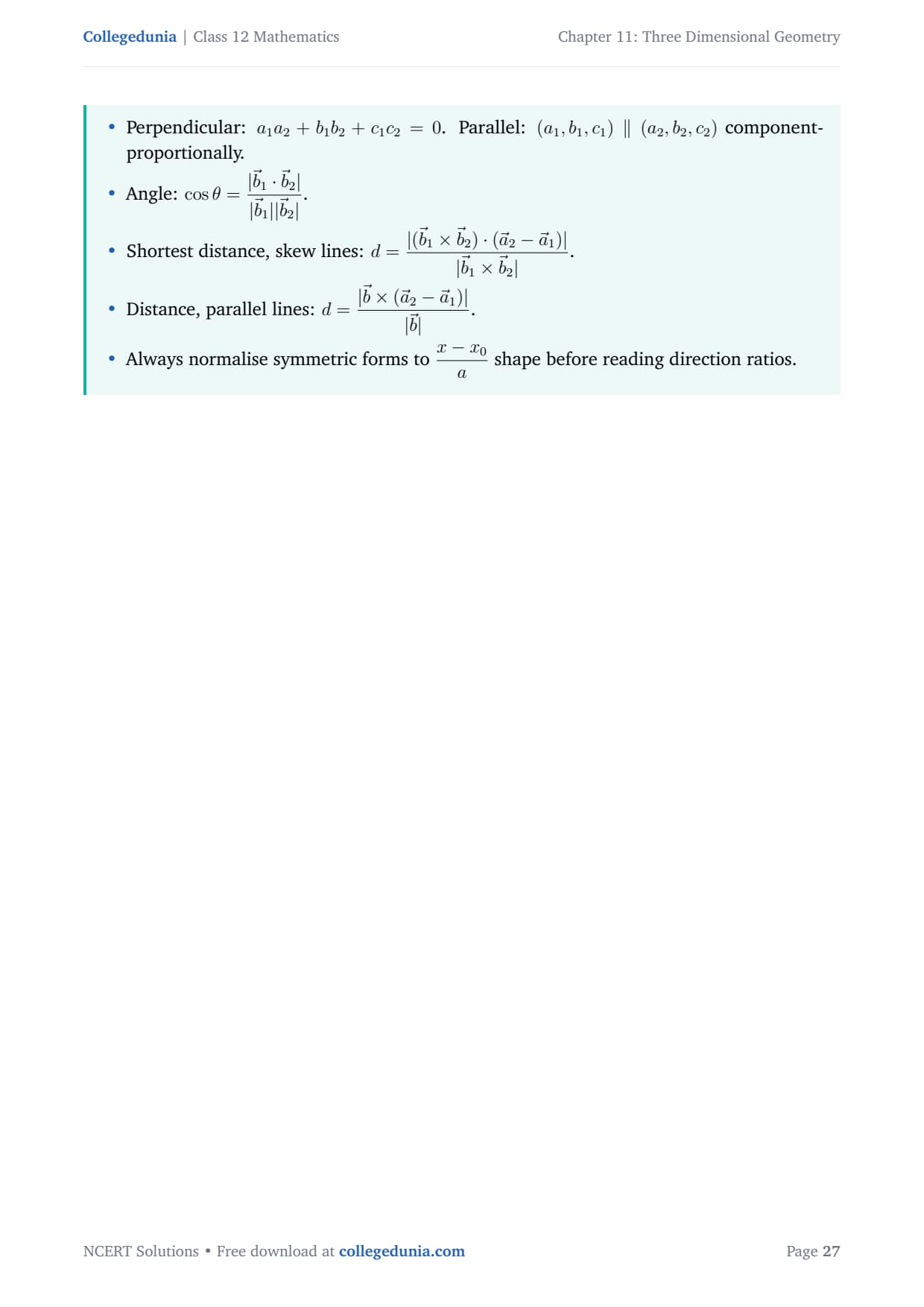
The angle uses cosθ = |b1·b2|/(|b1||b2|) and the skew-line distance uses the box-product d = |(b1×b2)·(a2-a1)|/|b1×b2| .
The Collegedunia editorial team has verified each answer against the official NCERT key and the 2026-27 textbook, including the sign handling when a Cartesian numerator is written as 1-x or 7-7x rather than x-x0.
The full PDF carries this six-line layout for all four shortest-distance questions, plus the angle and line-equation problems in the same numbered style.
Common Mistakes Students Make in Class 12 Maths Chapter 11 Exercise 11.2
The Three Dimensional Geometry Class 12 NCERT Solutions are written in formal mathematical notation, line by line, in the same convention as the official NCERT print.
Common Mistake: Forgetting the modulus in cosθ = |b1·b2|/(|b1||b2|) . Without it the formula can return the obtuse supplement, and CBSE expects the acute angle unless the question states otherwise.
Reading direction ratios off a Cartesian line whose numerator is 1-x or 7-z without first converting to x-x0 form. This flips a sign in Q6, Q10 and Q13.
Using a1-a2 instead of a2-a1 in the box product. The magnitude is the same, but the working becomes inconsistent and loses method marks.
Skipping the rationalisation, leaving 3/√19 instead of 3√19/19 .
Treating parallel lines with the skew formula; the cross product is zero and the formula collapses.
Other Resources for Class 12 Maths Chapter 11 Three Dimensional Geometry
The Three Dimensional Geometry Class 12 NCERT Solutions address this in the same order as the NCERT textbook.
Three Dimensional Geometry Class 12 NCERT Solutions: available above as a free PDF download, aligned to the 2026-27 NCERT Class 12 Mathematics syllabus.
Exercise-wise Breakdown of the Three Dimensional Geometry Chapter
Show that the three lines with direction cosines
1213, -313, -413; 413, 1213, 313; 313, -413, 1213
are mutually perpendicular.
Concept used. Two lines with direction cosines (l1, m1, n1) and
(l2, m2, n2) are perpendicular iff
l1 l2 + m1 m2 + n1 n2 = 0.
This is the vector-dot-product condition u · v = 0 written in direction-cosine
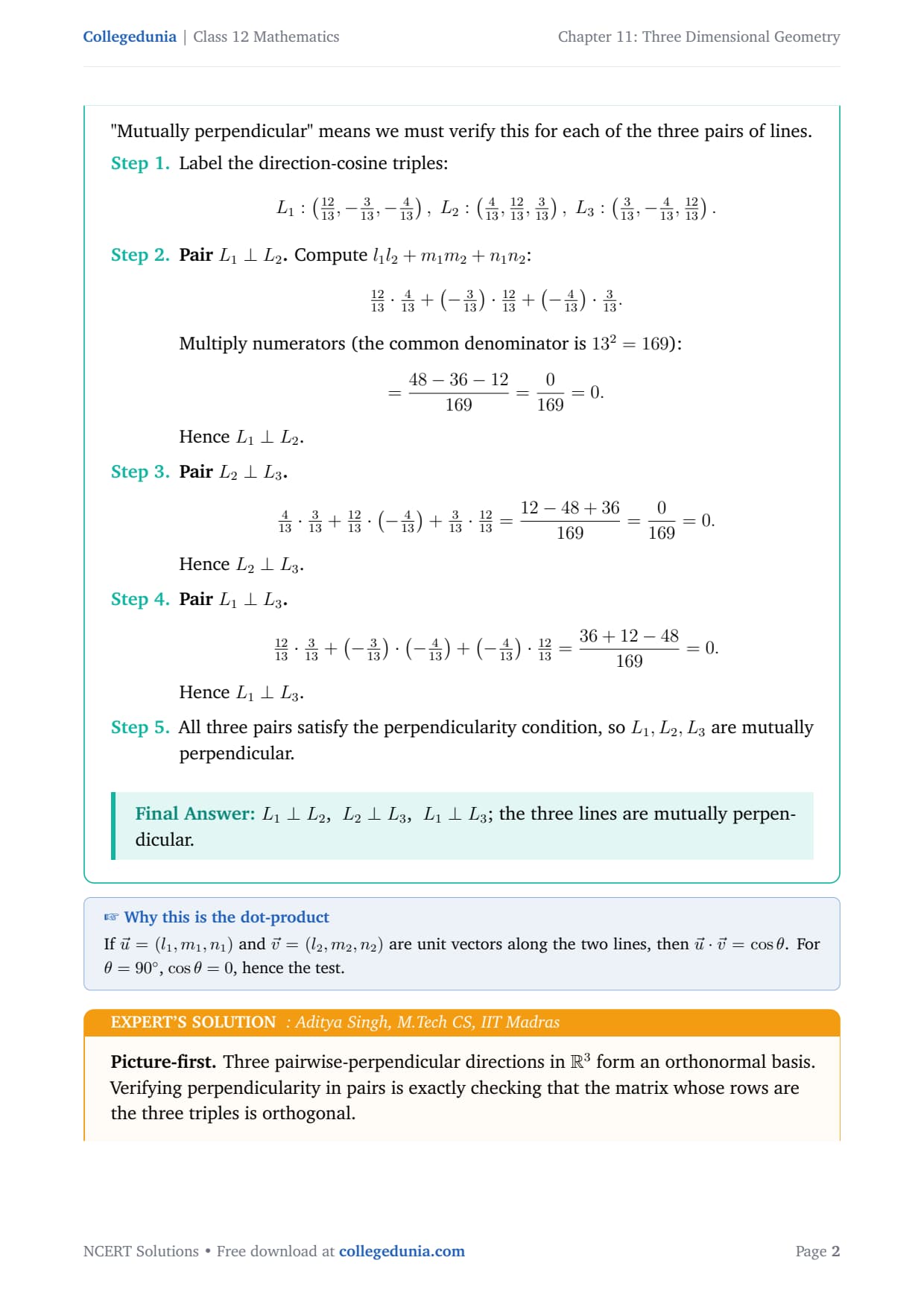
form. "Mutually perpendicular" means we must verify this for each of the three pairs of
lines.
All three pairs satisfy the perpendicularity condition, so L1, L2, L3 are mutually perpendicular.
L1 ⊥ L2, L2 ⊥ L3, L1 ⊥ L3; the three lines are mutually perpendicular.
AS
Aditya Singh
M.Tech CS, IIT Madras
Verified Expert
Picture-first. Three pairwise-perpendicular directions in R3 form an
orthonormal basis. Verifying perpendicularity in pairs is exactly checking that the
matrix whose rows are the three triples is orthogonal.
Concept restated. For unit vectors u1, u2, u3,
ui · uj = cases 1 & i = j 0 & i ≠ j cases
is the definition of an orthonormal set.
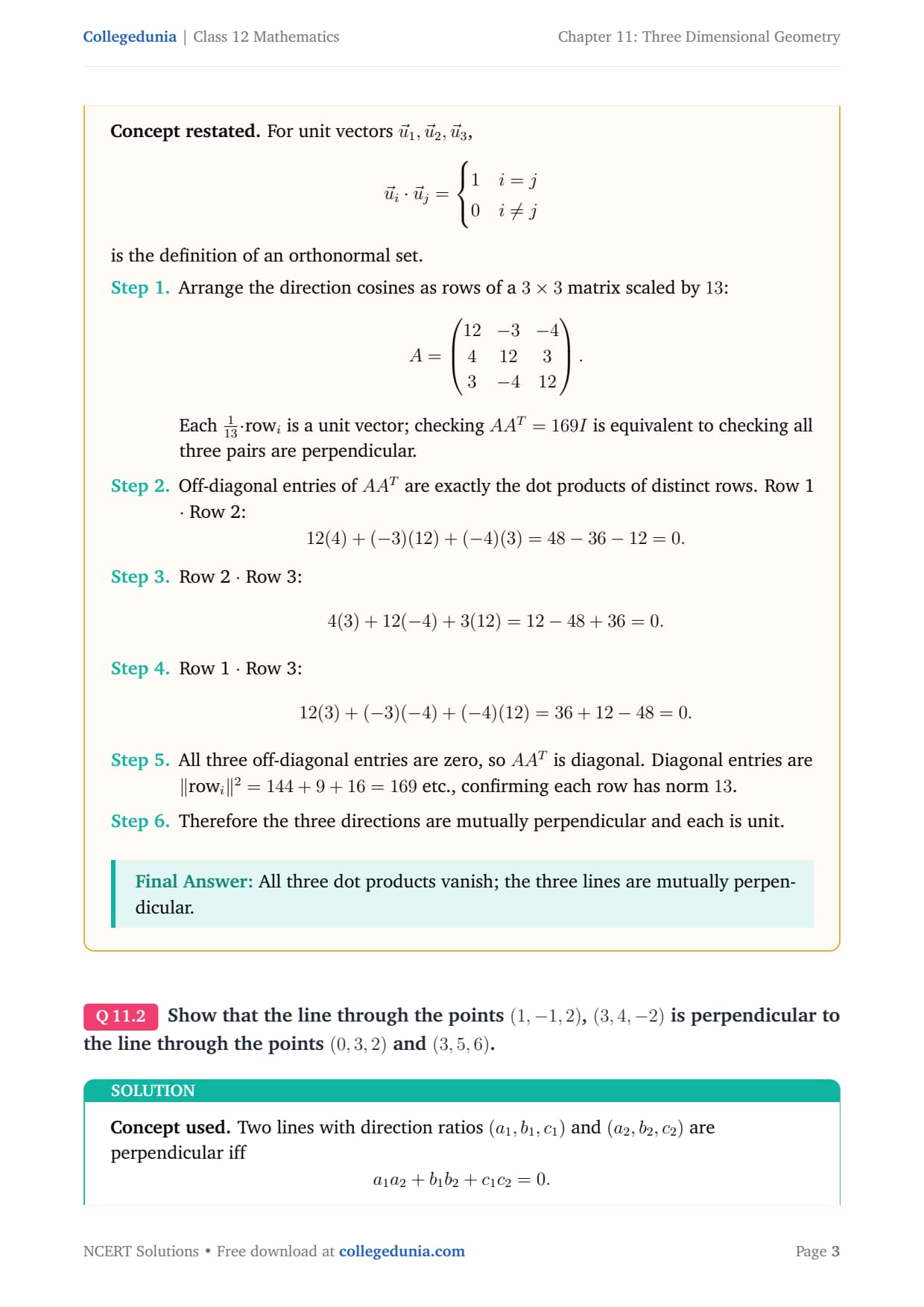
Arrange the direction cosines as rows of a 3 × 3 matrix scaled by 13:
A = pmatrix 12 & -3 & -4 4 & 12 & 3 3 & -4 & 12 pmatrix.
Each 113i is a unit vector; checking
A AT = 169 I is equivalent to checking all three pairs are perpendicular.
Off-diagonal entries of A AT are exactly the dot products of distinct rows.
Row 1 · Row 2:
12(4) + (-3)(12) + (-4)(3) = 48 - 36 - 12 = 0.
All three off-diagonal entries are zero, so A AT is diagonal. Diagonal entries
are |rowi|2 = 144 + 9 + 16 = 169 etc., confirming each row has norm
13.
Therefore the three directions are mutually perpendicular and each is unit.
All three dot products vanish; the three lines are mutually perpendicular.
Q 11.2
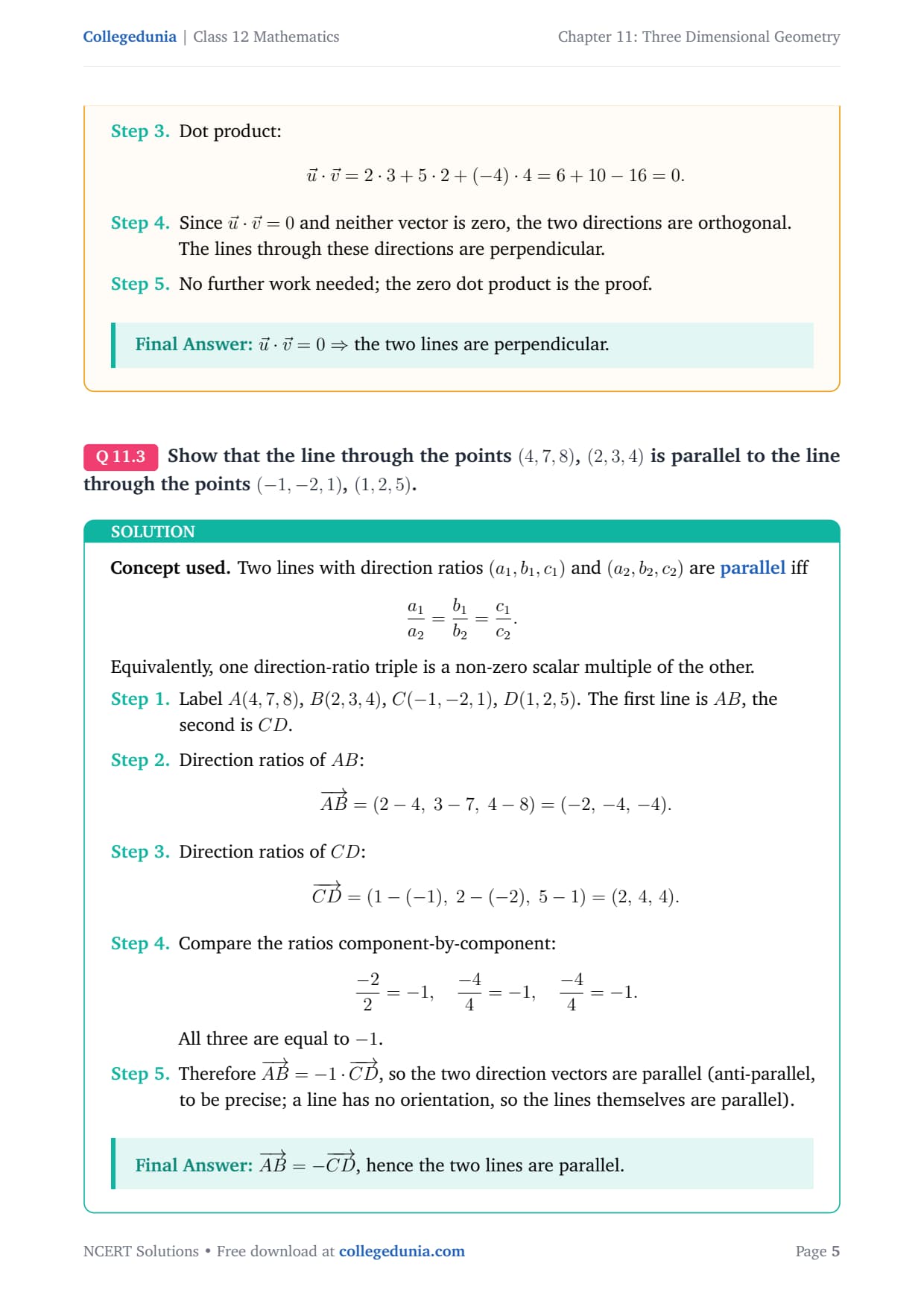
Show that the line through the points (1, -1, 2), (3, 4, -2) is perpendicular to the line through the points (0, 3, 2) and (3, 5, 6).
Concept used. Two lines with direction ratios (a1, b1, c1) and
(a2, b2, c2) are perpendicular iff
a1 a2 + b1 b2 + c1 c2 = 0.
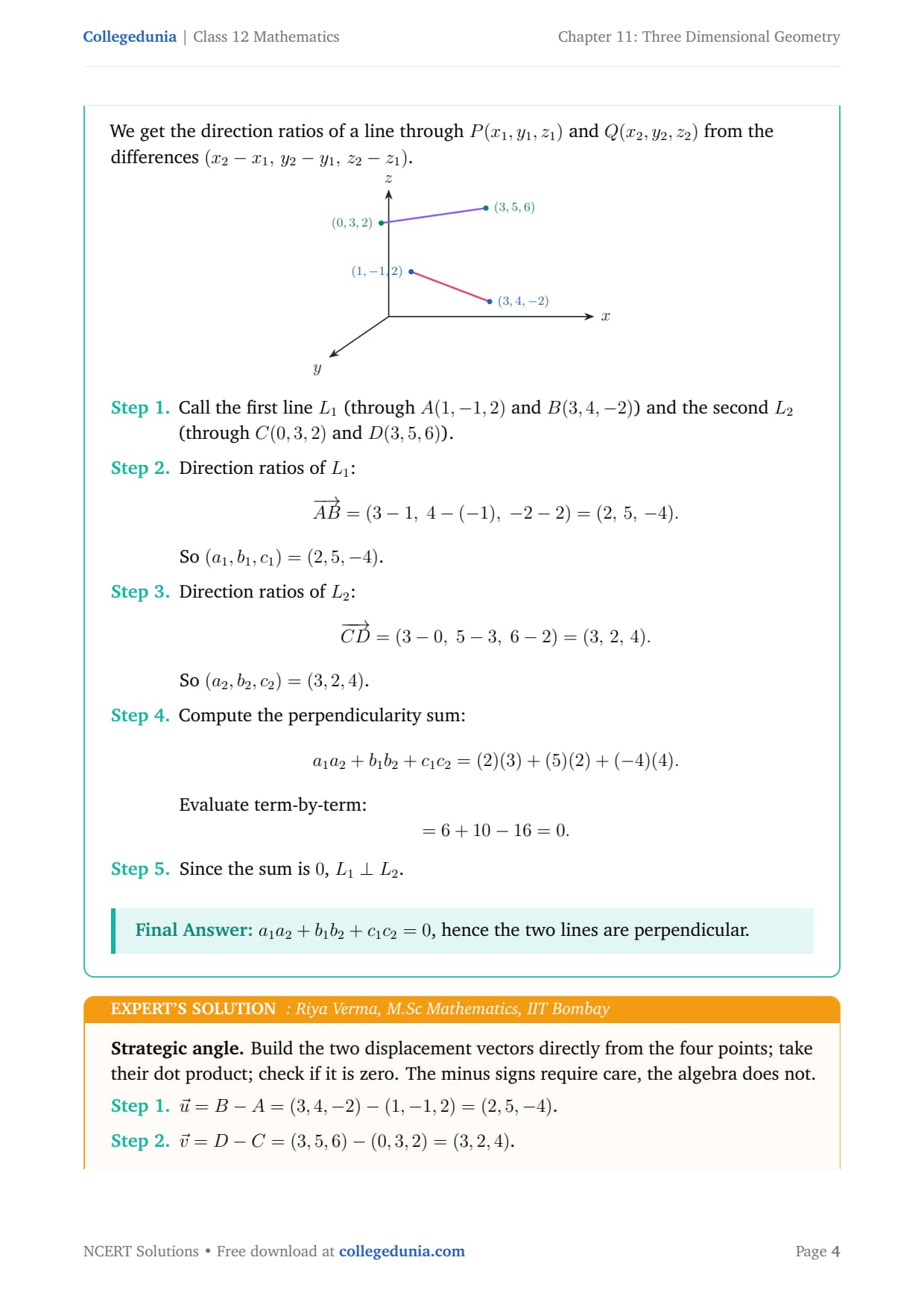
We get the direction ratios of a line through P(x1, y1, z1) and Q(x2, y2, z2) from
the differences (x2 - x1, y2 - y1, z2 - z1).
[See diagram in the PDF version]
Call the first line L1 (through A(1,-1,2) and B(3,4,-2)) and the second L2 (through C(0,3,2) and D(3,5,6)).
Direction ratios of L1:
AB = (3 - 1, 4 - (-1), -2 - 2) = (2, 5, -4).
So (a1, b1, c1) = (2, 5, -4).
Direction ratios of L2:
CD = (3 - 0, 5 - 3, 6 - 2) = (3, 2, 4).
So (a2, b2, c2) = (3, 2, 4).
a1 a2 + b1 b2 + c1 c2 = 0, hence the two lines are perpendicular.
RV
Riya Verma
M.Sc Mathematics, IIT Bombay
Verified Expert
Strategic angle. Build the two displacement vectors directly from the four
points; take their dot product; check if it is zero. The minus signs require care, the
algebra does not.
Since u · v = 0 and neither vector is zero, the two directions are
orthogonal. The lines through these directions are perpendicular.
No further work needed; the zero dot product is the proof.
u · v = 0 ⇒ the two lines are perpendicular.
Q 11.3
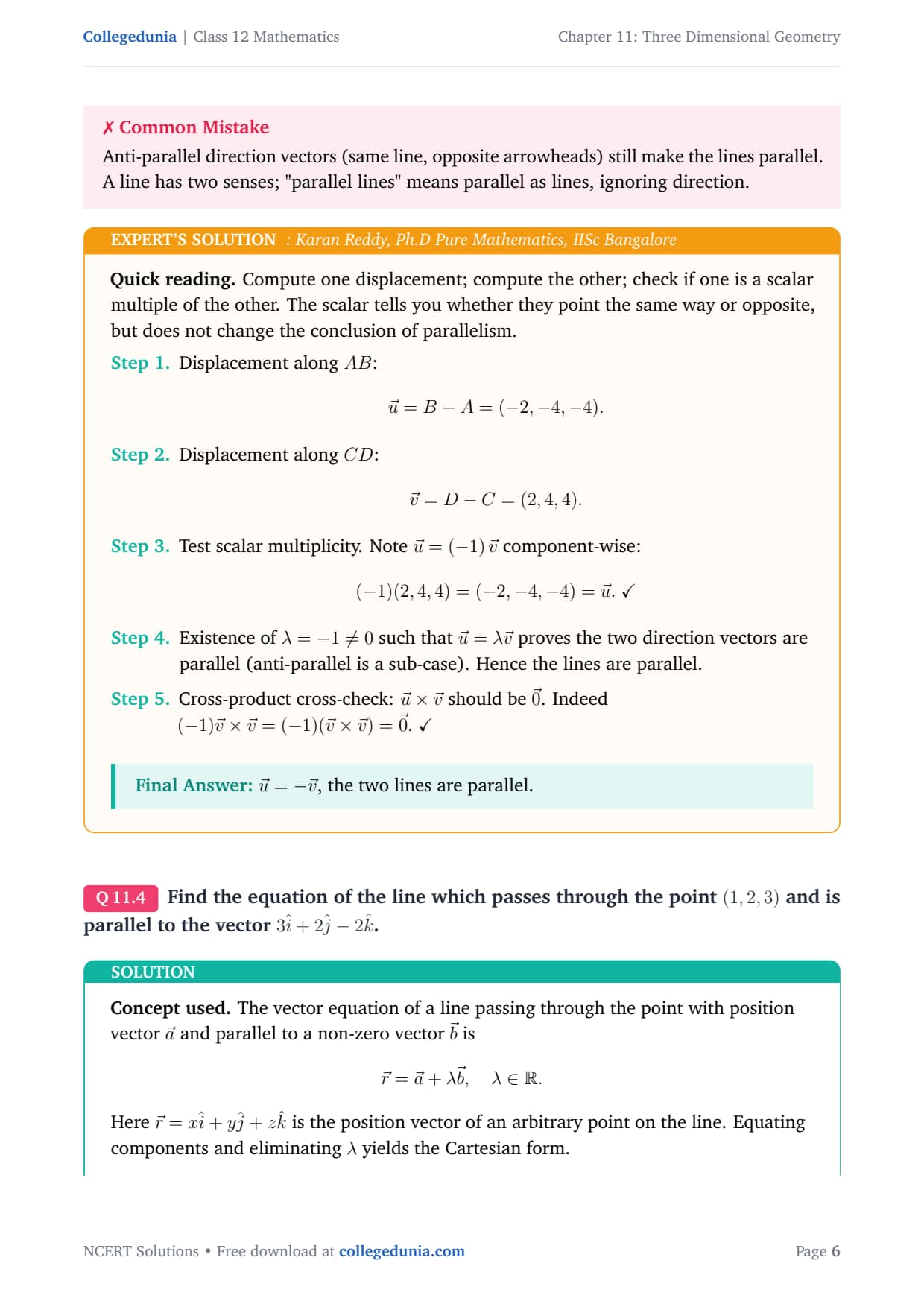
Show that the line through the points (4, 7, 8), (2, 3, 4) is parallel to the line through the points (-1, -2, 1), (1, 2, 5).
Concept used. Two lines with direction ratios (a1, b1, c1) and
(a2, b2, c2) are parallel iff
a1a2 = b1b2 = c1c2.
Equivalently, one direction-ratio triple is a non-zero scalar multiple of the other.
Label A(4, 7, 8), B(2, 3, 4), C(-1, -2, 1), D(1, 2, 5). The first line is AB, the second is CD.
Direction ratios of AB:
AB = (2 - 4, 3 - 7, 4 - 8) = (-2, -4, -4).
Direction ratios of CD:
CD = (1 - (-1), 2 - (-2), 5 - 1) = (2, 4, 4).
Compare the ratios component-by-component:
-22 = -1, -44 = -1, -44 = -1.
All three are equal to -1.
Therefore AB = -1 · CD, so the two direction
vectors are parallel (anti-parallel, to be precise; a line has no orientation, so
the lines themselves are parallel).
AB = -CD, hence the two lines are parallel.
KR
Karan Reddy
Ph.D Pure Mathematics, IISc Bangalore
Verified Expert
Quick reading. Compute one displacement; compute the other; check if one is a
scalar multiple of the other. The scalar tells you whether they point the same way or
opposite, but does not change the conclusion of parallelism.
Displacement along AB:
u = B - A = (-2, -4, -4).
Displacement along CD:
v = D - C = (2, 4, 4).
Test scalar multiplicity. Note u = (-1) v component-wise:
(-1)(2, 4, 4) = (-2, -4, -4) = u.
Existence of λ = -1 ≠ 0 such that u = λ v proves the two
direction vectors are parallel (anti-parallel is a sub-case). Hence the lines are
parallel.
Cross-product cross-check: u × v should be 0. Indeed
(-1)v × v = (-1)(v × v) = 0.
u = -v, the two lines are parallel.
Q 11.4
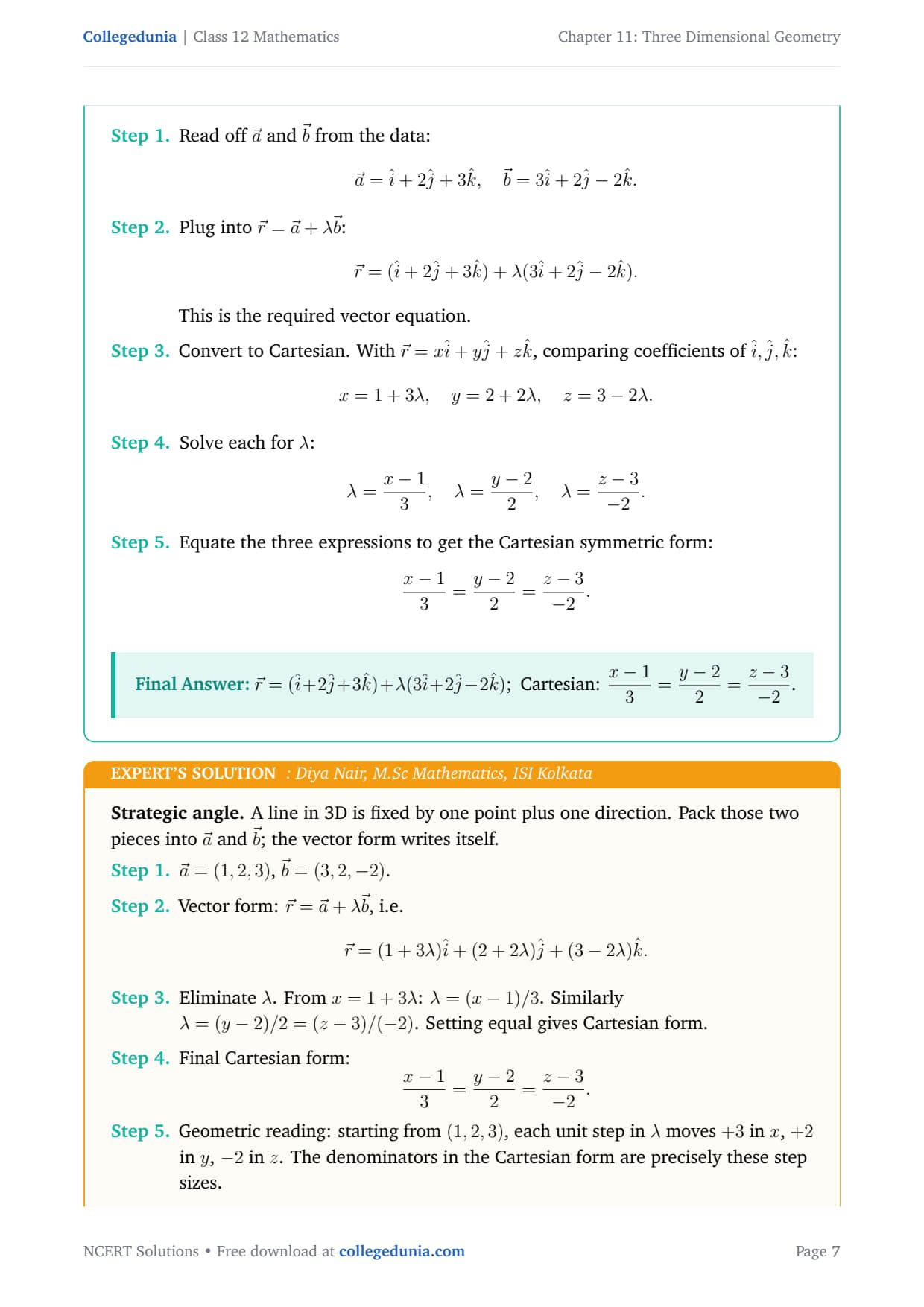
Find the equation of the line which passes through the point (1, 2, 3) and is parallel to the vector 3i + 2j - 2k.
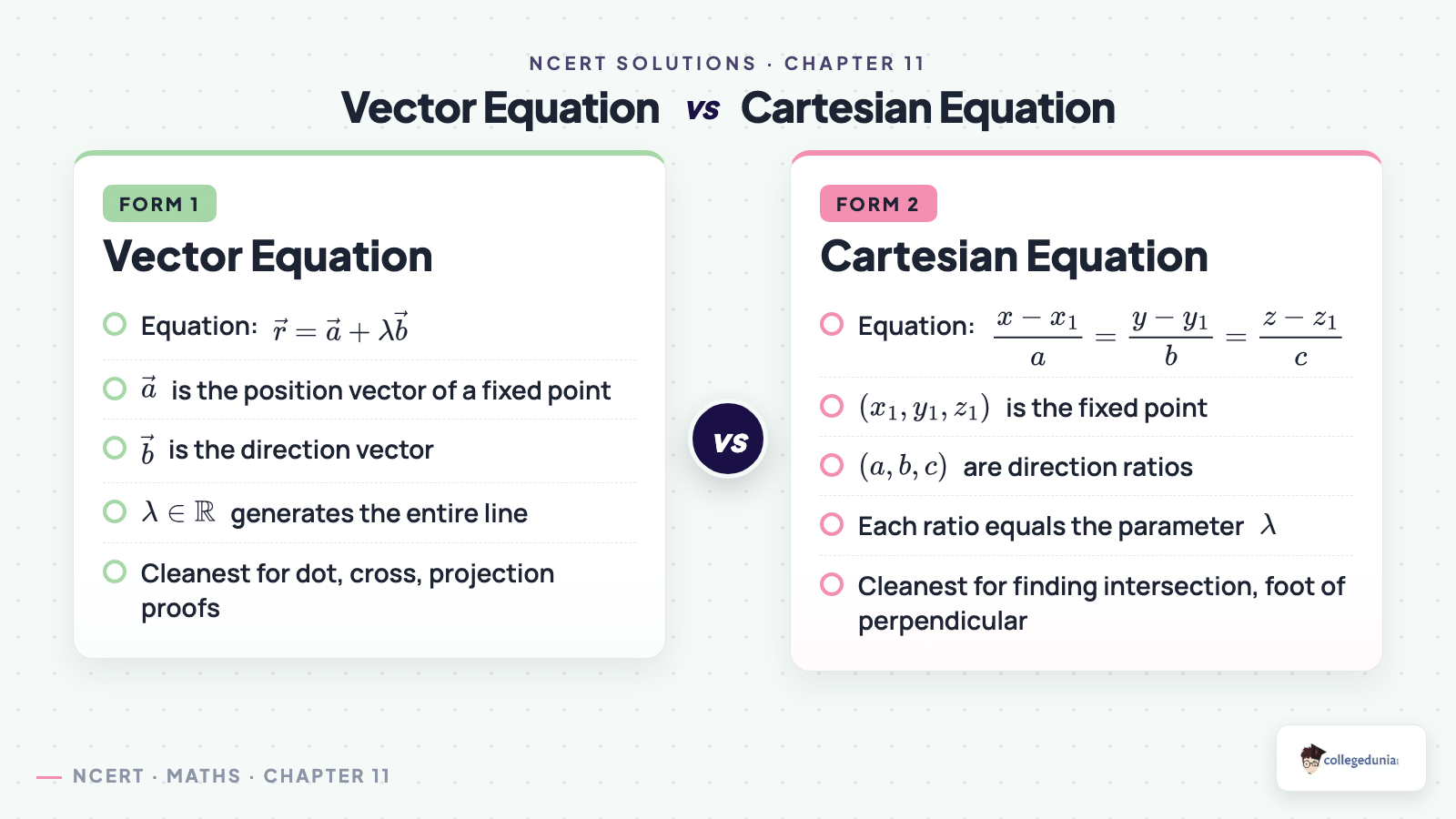
Concept used. The vector equation of a line passing through the point with
position vector a and parallel to a non-zero vector b is
r = a + λ b, λ ∈ R.
Here r = xi + yj + zk is the position vector of an arbitrary point on
the line. Equating components and eliminating λ yields the Cartesian form.
Read off a and b from the data:
a = i + 2j + 3k, b = 3i + 2j - 2k.
Plug into r = a + λ b:
r = (i + 2j + 3k) + λ(3i + 2j - 2k).
This is the required vector equation.
Convert to Cartesian. With r = xi + yj + zk, comparing
coefficients of i, j, k:
x = 1 + 3λ, y = 2 + 2λ, z = 3 - 2λ.
Solve each for λ:
λ = x - 13, λ = y - 22, λ = z - 3-2.
Equate the three expressions to get the Cartesian symmetric form:
x - 13 = y - 22 = z - 3-2.
r = (i + 2j + 3k) + λ(3i + 2j - 2k); Cartesian: x-13 = y-22 = z-3-2.
DN
Diya Nair
M.Sc Mathematics, ISI Kolkata
Verified Expert
Strategic angle. A line in 3D is fixed by one point plus one direction. Pack
those two pieces into a and b; the vector form writes itself.
a = (1, 2, 3), b = (3, 2, -2).
Vector form: r = a + λ b, i.e.
r = (1 + 3λ)i + (2 + 2λ)j + (3 - 2λ)k.
Eliminate λ. From x = 1 + 3λ: λ = (x - 1)/3. Similarly
λ = (y - 2)/2 = (z - 3)/(-2). Setting equal gives Cartesian form.
Final Cartesian form:
x - 13 = y - 22 = z - 3-2.
Geometric reading: starting from (1, 2, 3), each unit step in λ moves
+3 in x, +2 in y, -2 in z. The denominators in the Cartesian form are
precisely these step sizes.
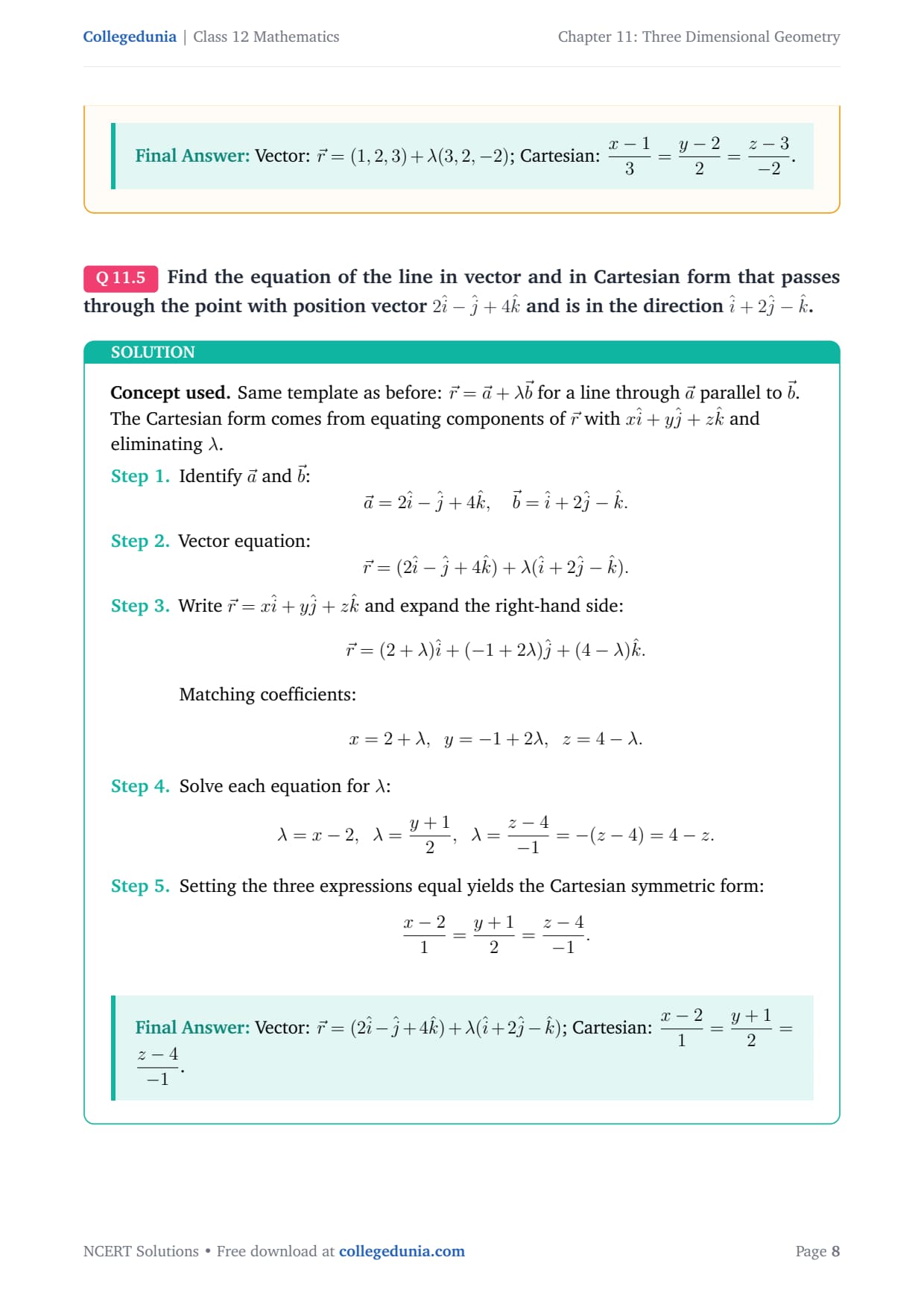
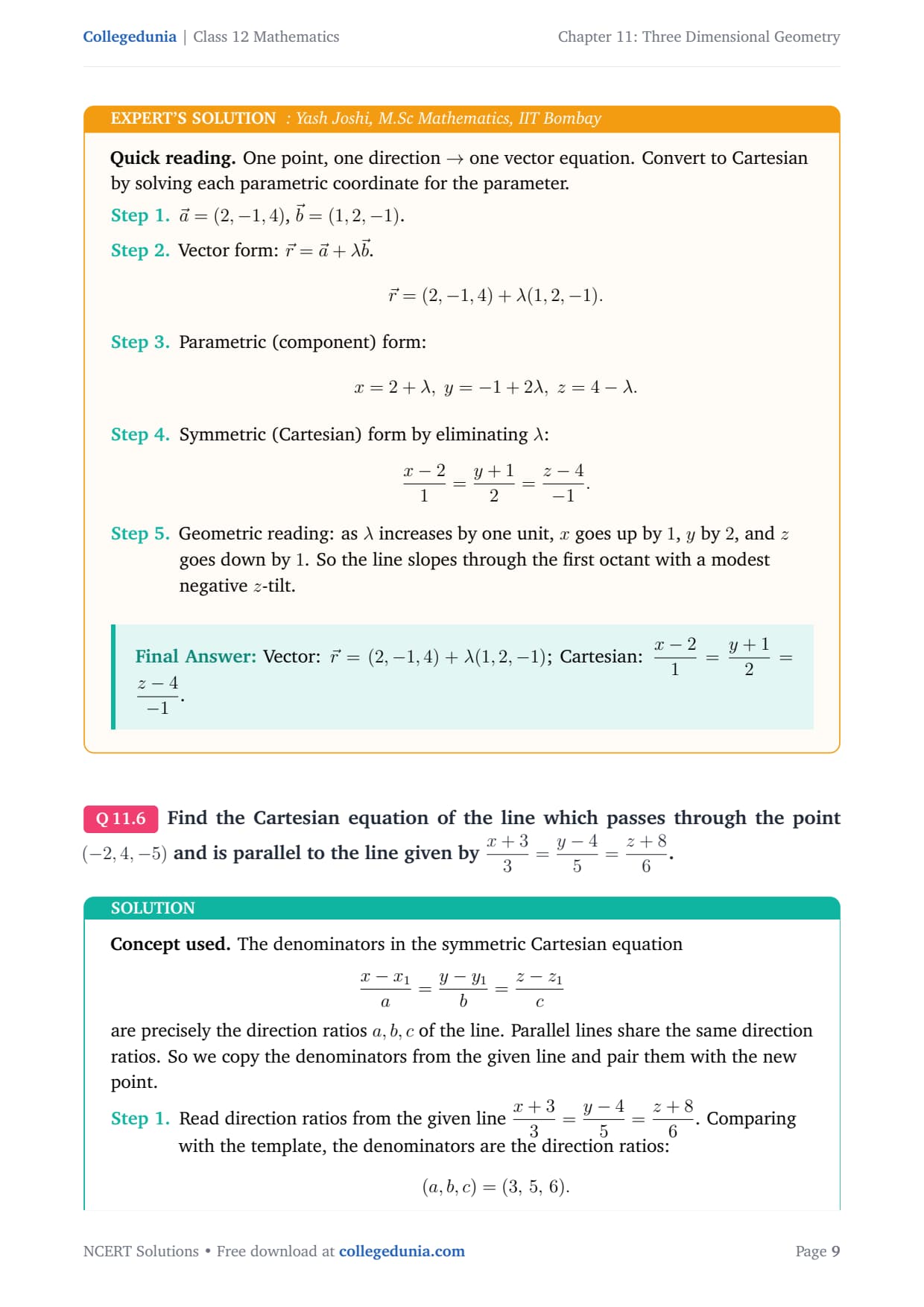
Find the equation of the line in vector and in Cartesian form that passes through the point with position vector 2i - j + 4k and is in the direction i + 2j - k.
Concept used. Same template as before: r = a + λ b for a line
through a parallel to b. The Cartesian form comes from equating components
of r with xi + yj + zk and eliminating λ.
Identify a and b:
a = 2i - j + 4k, b = i + 2j - k.
Quick reading. One point, one direction → one vector equation. Convert to
Cartesian by solving each parametric coordinate for the parameter.
a = (2, -1, 4), b = (1, 2, -1).
Vector form: r = a + λ b.
r = (2, -1, 4) + λ(1, 2, -1).
Parametric (component) form:
x = 2 + λ, y = -1 + 2λ, z = 4 - λ.
Symmetric (Cartesian) form by eliminating λ:
x - 21 = y + 12 = z - 4-1.
Geometric reading: as λ increases by one unit, x goes up by 1, y by
2, and z goes down by 1. So the line slopes through the first octant with a
modest negative z-tilt.
Find the Cartesian equation of the line which passes through the point (-2, 4, -5) and is parallel to the line given by x + 33 = y - 45 = z + 86.
Concept used. The denominators in the symmetric Cartesian equation
x - x1a = y - y1b = z - z1c
are precisely the direction ratios a, b, c of the line. Parallel lines share the same
direction ratios. So we copy the denominators from the given line and pair them with the
new point.
Read direction ratios from the given line x+33 = y-45 = z+86. Comparing with the template, the denominators are the direction ratios:
(a, b, c) = (3, 5, 6).
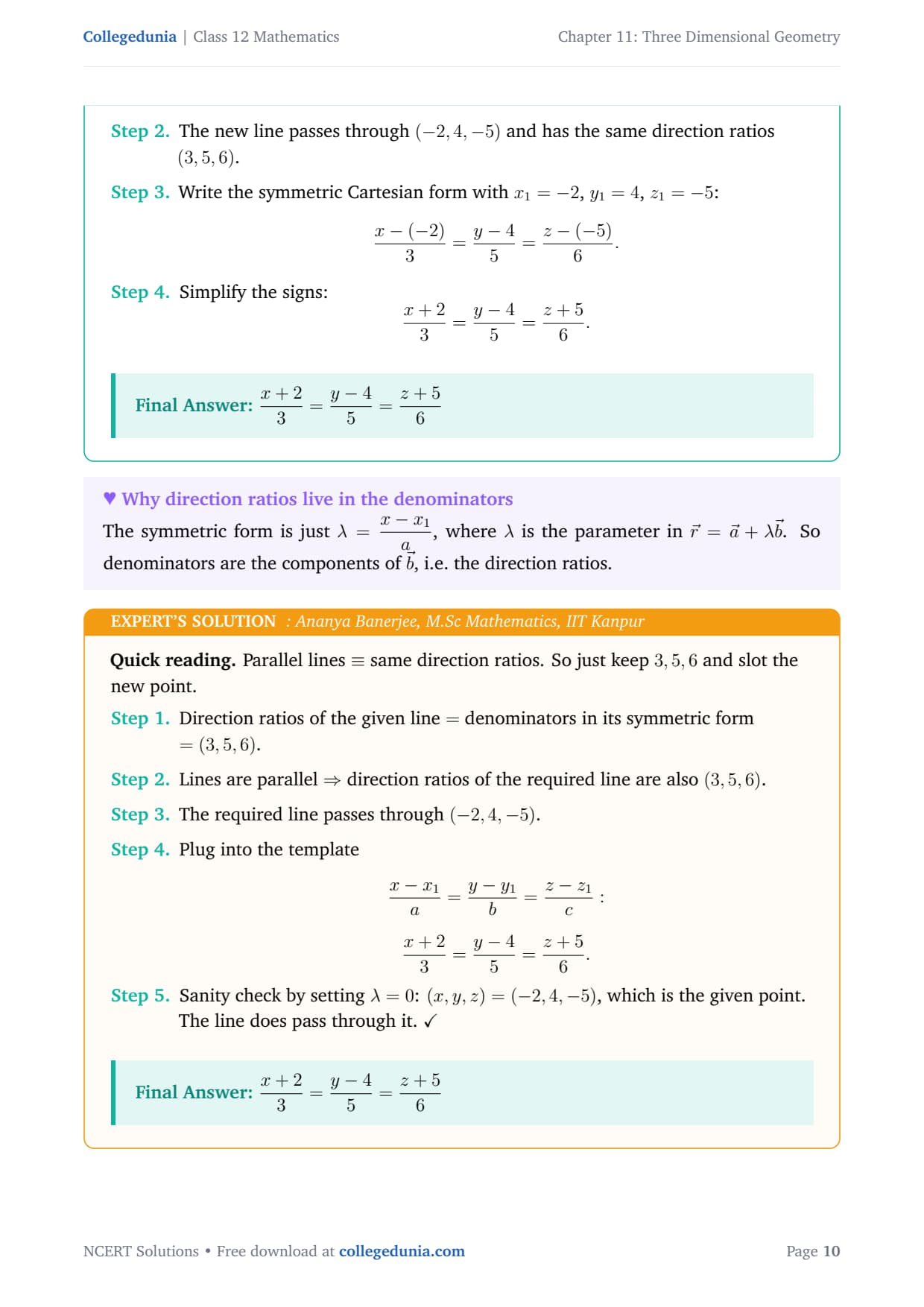
The new line passes through (-2, 4, -5) and has the same direction ratios
(3, 5, 6).
Write the symmetric Cartesian form with x1 = -2, y1 = 4, z1 = -5:
x - (-2)3 = y - 45 = z - (-5)6.
Simplify the signs:
x + 23 = y - 45 = z + 56.
x + 23 = y - 45 = z + 56
AB
Ananya Banerjee
M.Sc Mathematics, IIT Kanpur
Verified Expert
Quick reading. Parallel lines ≡ same direction ratios. So just keep 3, 5, 6
and slot the new point.
Direction ratios of the given line = denominators in its symmetric form = (3, 5, 6).
Lines are parallel ⇒ direction ratios of the required line are also (3, 5, 6).
The required line passes through (-2, 4, -5).
Plug into the template
x - x1a = y - y1b = z - z1c: x + 23 = y - 45 = z + 56.
Sanity check by setting λ = 0: (x, y, z) = (-2, 4, -5), which is the given
point. The line does pass through it.
x + 23 = y - 45 = z + 56
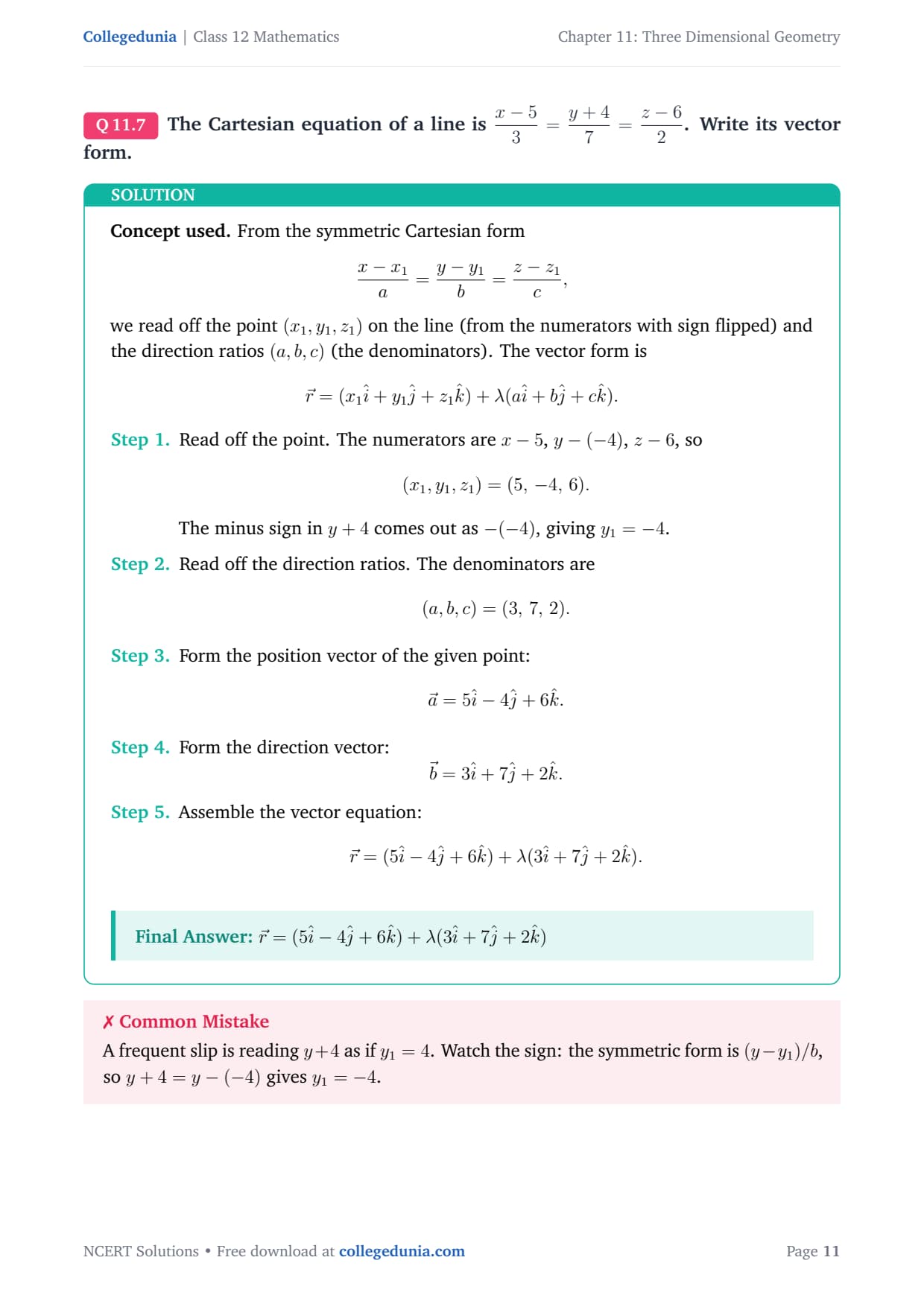
Q 11.7
The Cartesian equation of a line is x - 53 = y + 47 = z - 62. Write its vector form.
Concept used. From the symmetric Cartesian form
x - x1a = y - y1b = z - z1c,
we read off the point (x1, y1, z1) on the line (from the numerators with sign
flipped) and the direction ratios (a, b, c) (the denominators). The vector form is
r = (x1i + y1j + z1k) + λ (ai + bj + ck).
Read off the point. The numerators are x - 5, y - (-4), z - 6, so
(x1, y1, z1) = (5, -4, 6).
The minus sign in y + 4 comes out as -(-4), giving y1 = -4.
Read off the direction ratios. The denominators are
(a, b, c) = (3, 7, 2).
Form the position vector of the given point:
a = 5 i - 4 j + 6 k.
Form the direction vector:
b = 3 i + 7 j + 2 k.
Assemble the vector equation:
r = (5 i - 4 j + 6 k) + λ(3 i + 7 j + 2 k).
r = (5 i - 4 j + 6 k) + λ(3 i + 7 j + 2 k)
IK
Ishaan Kapoor
M.Sc Mathematics, IIT Bombay
Verified Expert
Strategic angle. Symmetric form → vector form is a pure pattern match. Numerator
sign goes into the point, denominator goes into the direction.
Identify the point: from (x - 5), (y + 4), (z - 6) we get x1 = 5,
y1 = -4, z1 = 6.
Identify the direction: denominators give b = (3, 7, 2).
Build the position vector of the point:
a = 5 i - 4 j + 6 k.
Stack into the standard form r = a + λ b:
r = (5 i - 4 j + 6 k) + λ(3 i + 7 j + 2 k).
Round-trip check: substitute λ = 0, get (5, -4, 6). Substitute λ = 1, get (8, 3, 8); this satisfies the original Cartesian form: (8-5)/3 = 1, (3+4)/7 = 1, (8-6)/2 = 1.
r = (5 i - 4 j + 6 k) + λ(3 i + 7 j + 2 k)
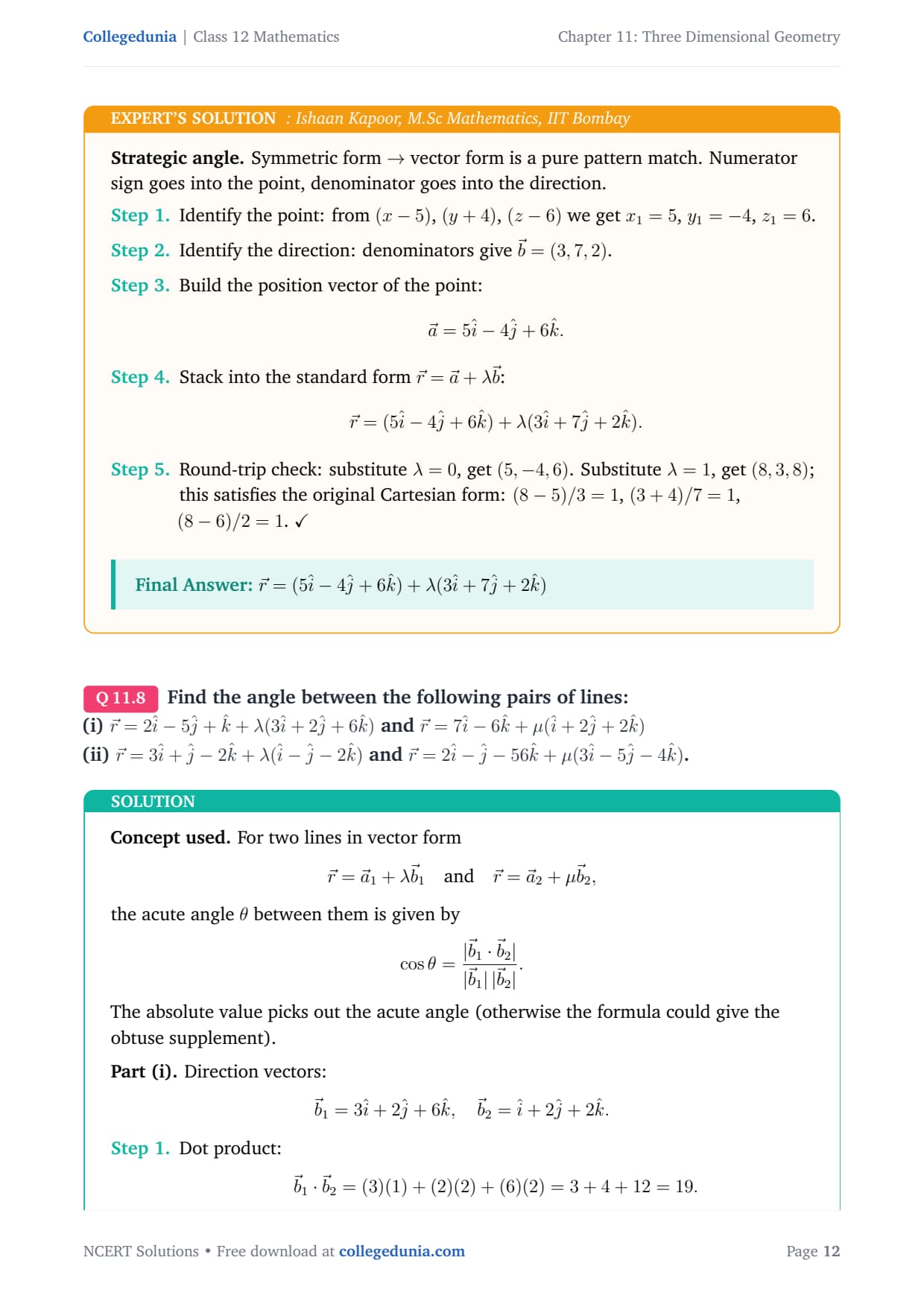
Q 11.8
Find the angle between the following pairs of lines:
(i) r = 2i - 5j + k + λ(3i + 2j + 6k) and
r = 7i - 6k + μ(i + 2j + 2k)
(ii) r = 3i + j - 2k + λ(i - j - 2k) and
r = 2i - j - 56k + μ(3i - 5j - 4k).
Concept used. For two lines in vector form
r = a1 + λ b1 and r = a2 + μ b2,
the acute angle θ between them is given by
cosθ = |b1 · b2||b1| |b2|.
The absolute value picks out the acute angle (otherwise the formula could give the
obtuse supplement).
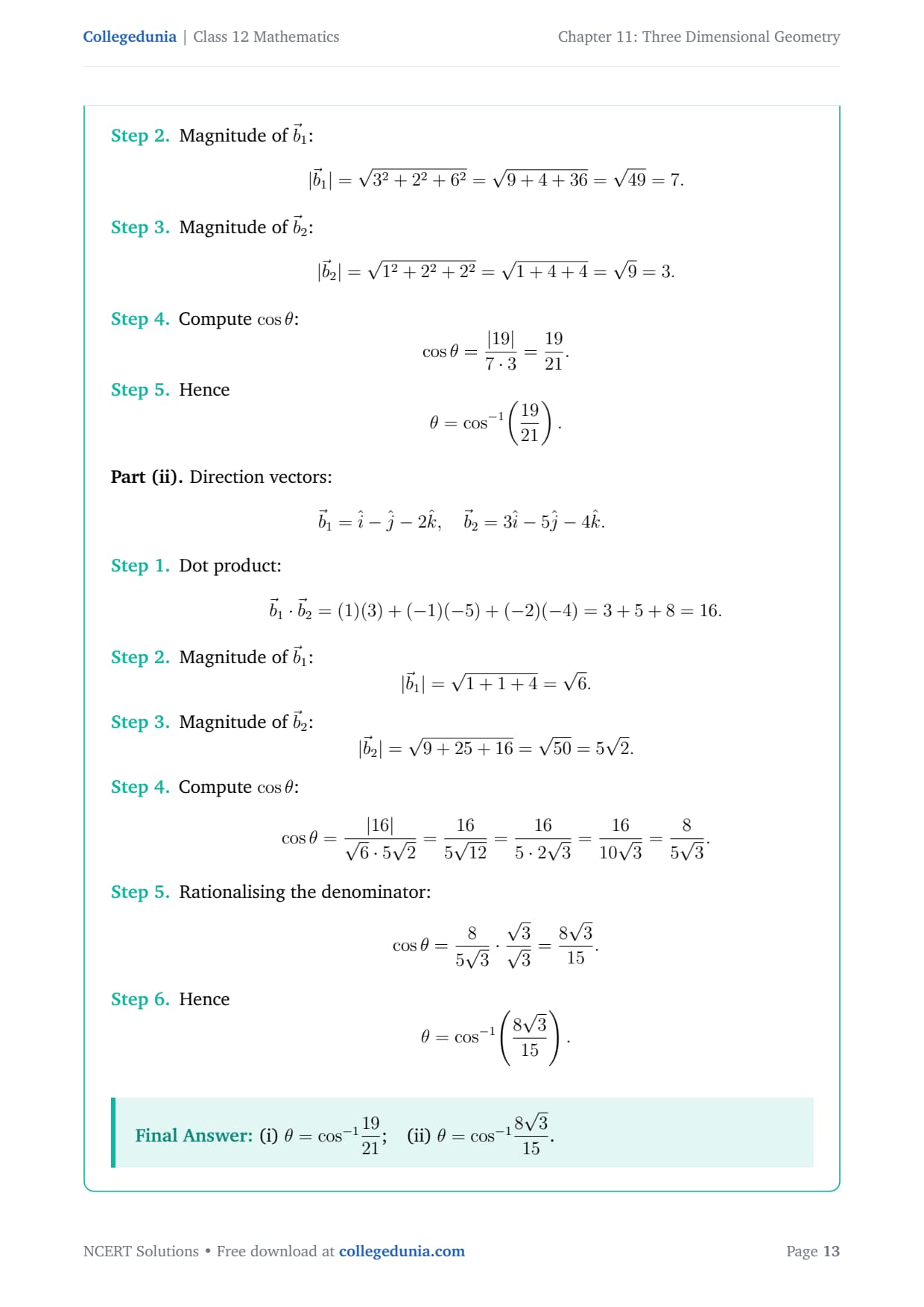
Part (i). Direction vectors:
b1 = 3i + 2j + 6k, b2 = i + 2j + 2k.
Rationalising the denominator:
cosθ = 85√3 · √3√3 = 8√315.
Hence
θ = cos-1(8√315).
(i) θ = cos-11921; (ii) θ = cos-18√315.
RB
Rohit Bhat
Ph.D Mathematics, IIT Delhi
Verified Expert
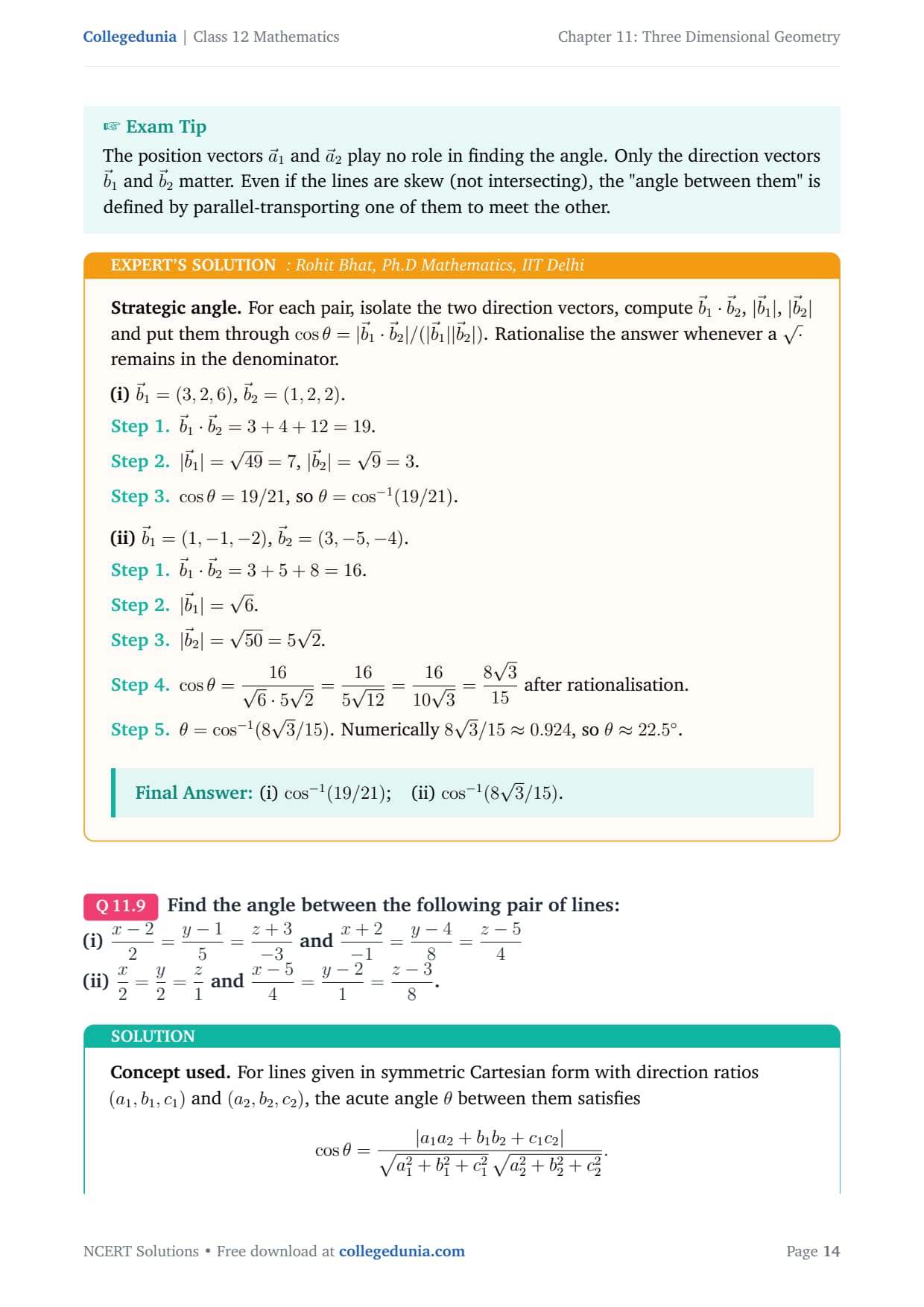
Strategic angle. For each pair, isolate the two direction vectors, compute
b1 · b2, |b1|, |b2| and put them through
cosθ = |b1 · b2|/(|b1||b2|). Rationalise the answer
whenever a √· remains in the denominator.
Find the angle between the following pair of lines:
(i) x - 22 = y - 15 = z + 3-3 and x + 2-1 = y - 48 = z - 54
(ii) x2 = y2 = z1 and x - 54 = y - 21 = z - 38.
Concept used. For lines given in symmetric Cartesian form with direction ratios
(a1, b1, c1) and (a2, b2, c2), the acute angle θ between them satisfies
cosθ = |a1 a2 + b1 b2 + c1 c2|√a12 + b12 + c12√a22 + b22 + c22.
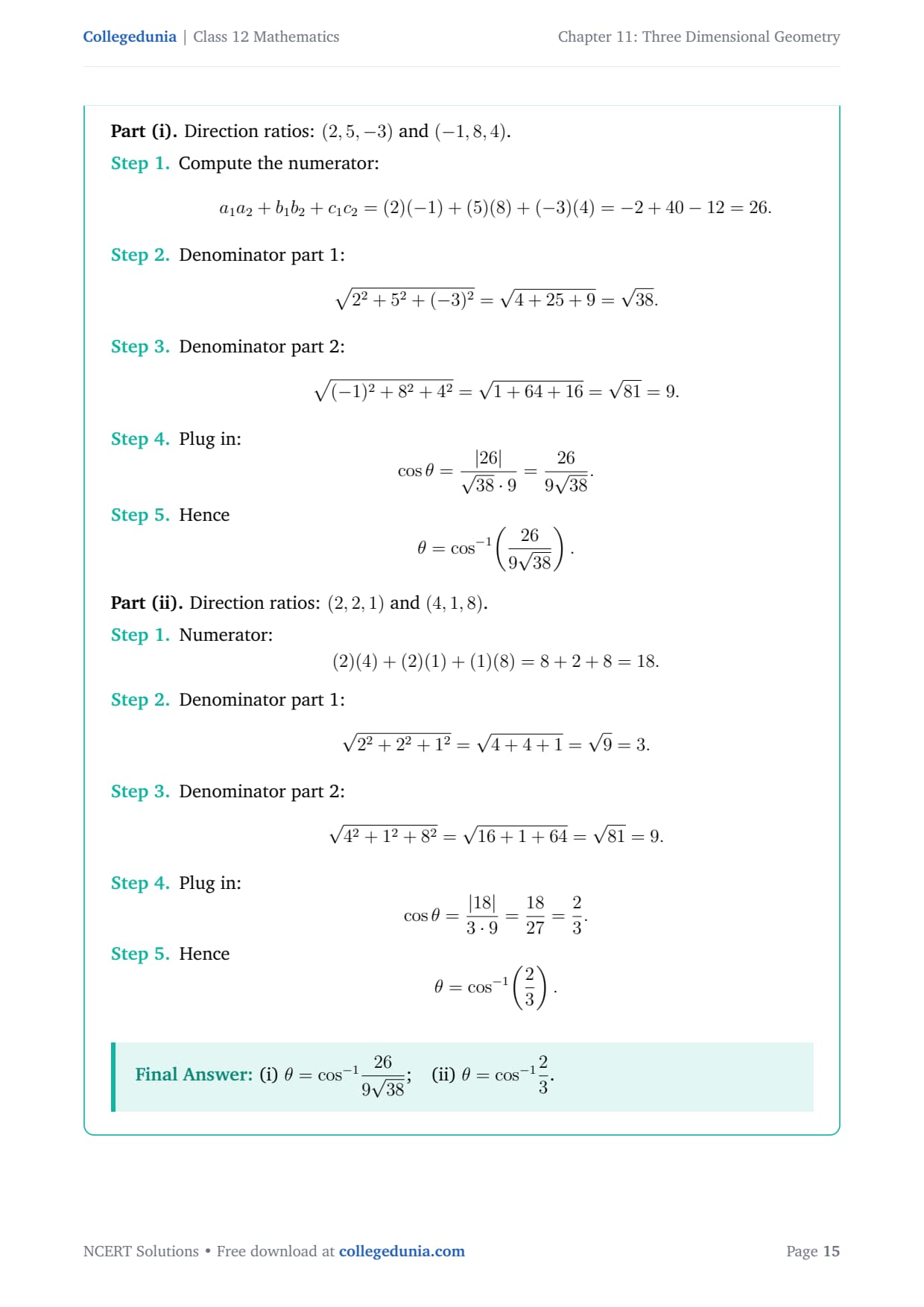
Part (i). Direction ratios: (2, 5, -3) and (-1, 8, 4).
Quick reading. Read direction ratios off the denominators of each symmetric
form; dot, magnitudes, ratio, arccos. The two parts use the same algorithm; the second
has nicer numbers.
(i)b1 = (2, 5, -3), b2 = (-1, 8, 4).
b1 · b2 = -2 + 40 - 12 = 26.
|b1| = √38, |b2| = √81 = 9.
cosθ = 26/(9√38), so θ = cos-1(26/(9√38)).
(ii)b1 = (2, 2, 1), b2 = (4, 1, 8).
b1 · b2 = 8 + 2 + 8 = 18.
|b1| = √9 = 3, |b2| = √81 = 9.
cosθ = 18/27 = 2/3.
θ = cos-1(2/3) ≈ 48.19∘.
(i) cos-1269√38; (ii) cos-123.
Q 11.10
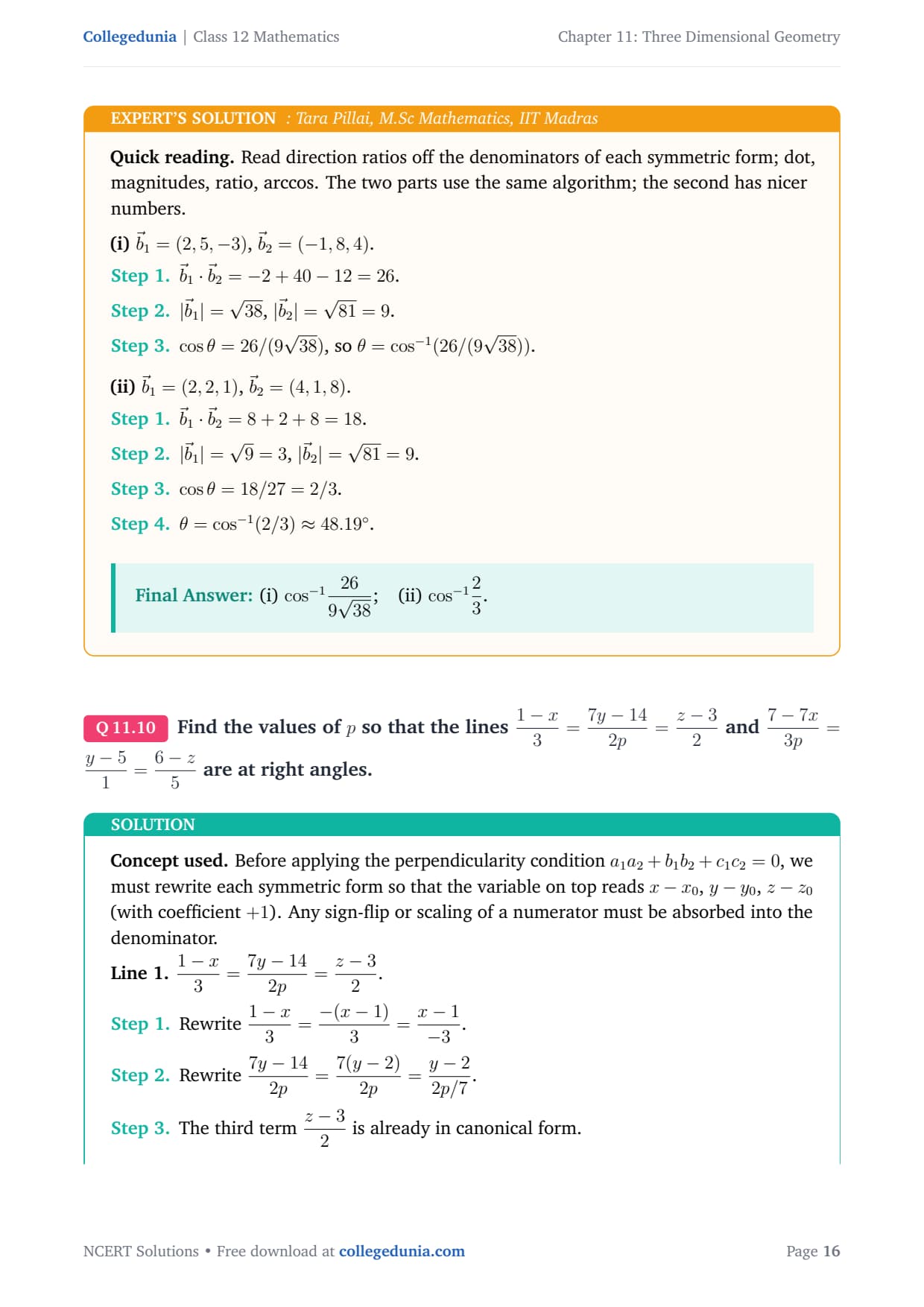
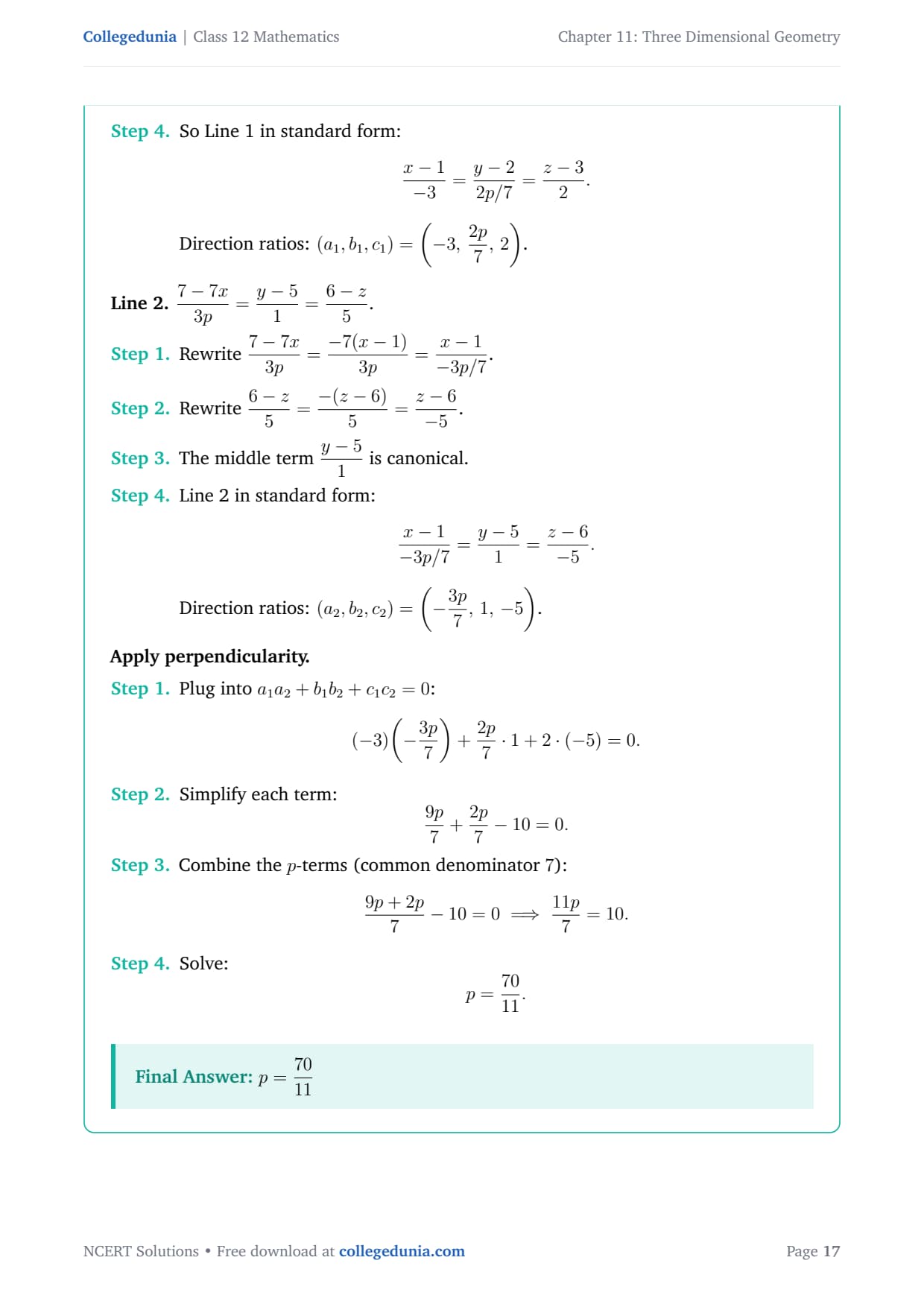
Find the values of p so that the lines 1 - x3 = 7y - 142p = z - 32 and 7 - 7x3p = y - 51 = 6 - z5 are at right angles.
Concept used. Before applying the perpendicularity condition a1 a2 + b1 b2 + c1 c2 = 0, we must rewrite each symmetric form so that the variable on top reads x - x0, y - y0, z - z0 (with coefficient +1). Any sign-flip or scaling of a numerator must be absorbed into the denominator.
Line 1.1 - x3 = 7y - 142p = z - 32.
Rewrite 1 - x3 = -(x - 1)3 = x - 1-3.
Rewrite 7y - 142p = 7(y - 2)2p = y - 22p/7.
The third term z - 32 is already in canonical form.
So Line 1 in standard form:
x - 1-3 = y - 22p/7 = z - 32.
Direction ratios: (a1, b1, c1) = (-3, 2p7, 2).
Line 2.7 - 7x3p = y - 51 = 6 - z5.
Rewrite 7 - 7x3p = -7(x - 1)3p = x - 1-3p/7.
Rewrite 6 - z5 = -(z - 6)5 = z - 6-5.
The middle term y - 51 is canonical.
Line 2 in standard form:
x - 1-3p/7 = y - 51 = z - 6-5.
Direction ratios: (a2, b2, c2) = (-3p7, 1, -5).
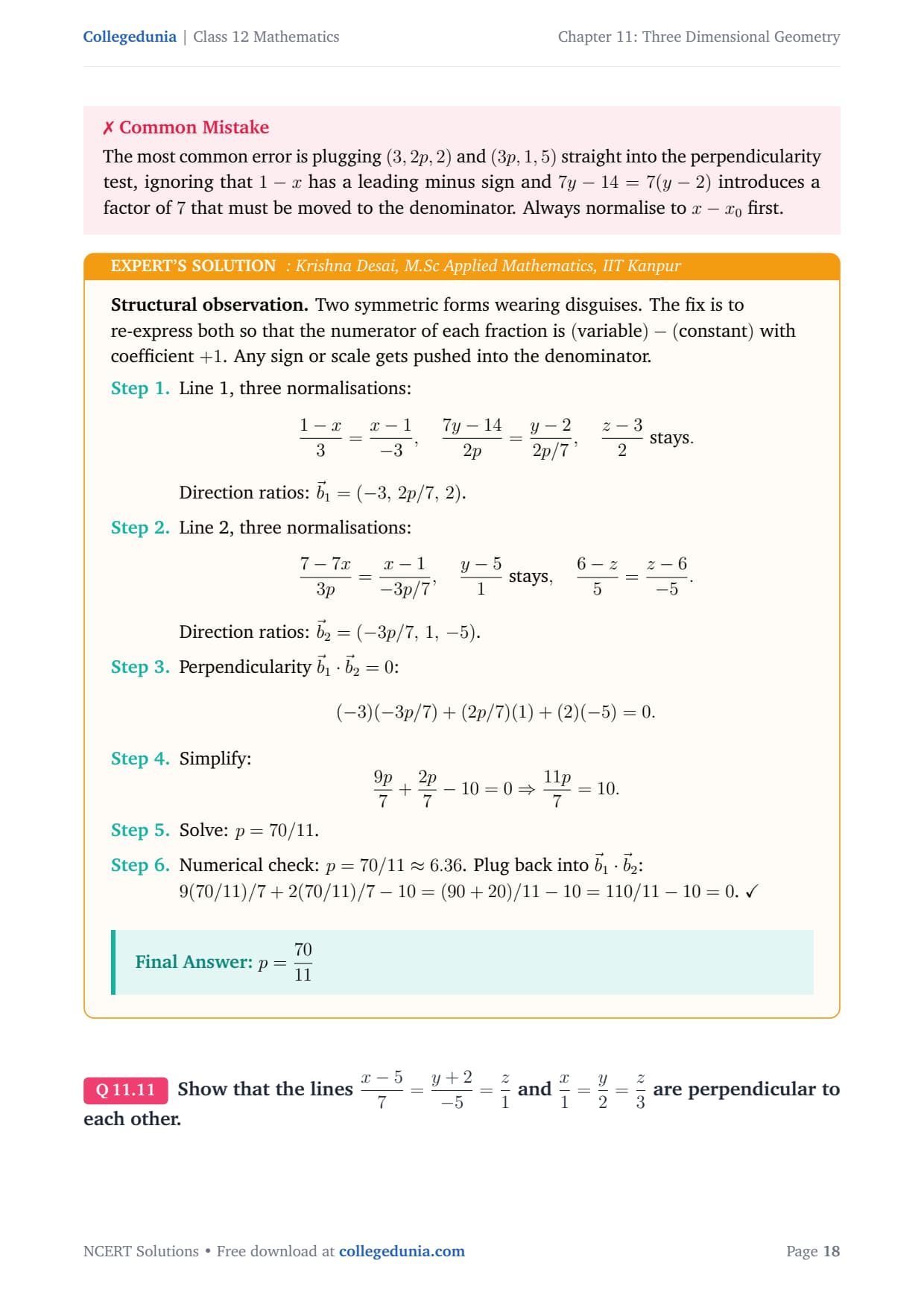
Structural observation. Two symmetric forms wearing disguises. The fix is to
re-express both so that the numerator of each fraction is (variable) - (constant) with coefficient +1. Any sign or scale gets pushed into the denominator.
Line 1, three normalisations:
1 - x3 = x - 1-3, 7y - 142p = y - 22p/7, z - 32 stays.
Direction ratios: b1 = (-3, 2p/7, 2).
Line 2, three normalisations:
7 - 7x3p = x - 1-3p/7, y - 51 stays, 6 - z5 = z - 6-5.
Direction ratios: b2 = (-3p/7, 1, -5).
Numerical check: p = 70/11 ≈ 6.36. Plug back into b1 · b2:
9(70/11)/7 + 2(70/11)/7 - 10 = (90 + 20)/11 - 10 = 110/11 - 10 = 0.
p = 7011
Q 11.11
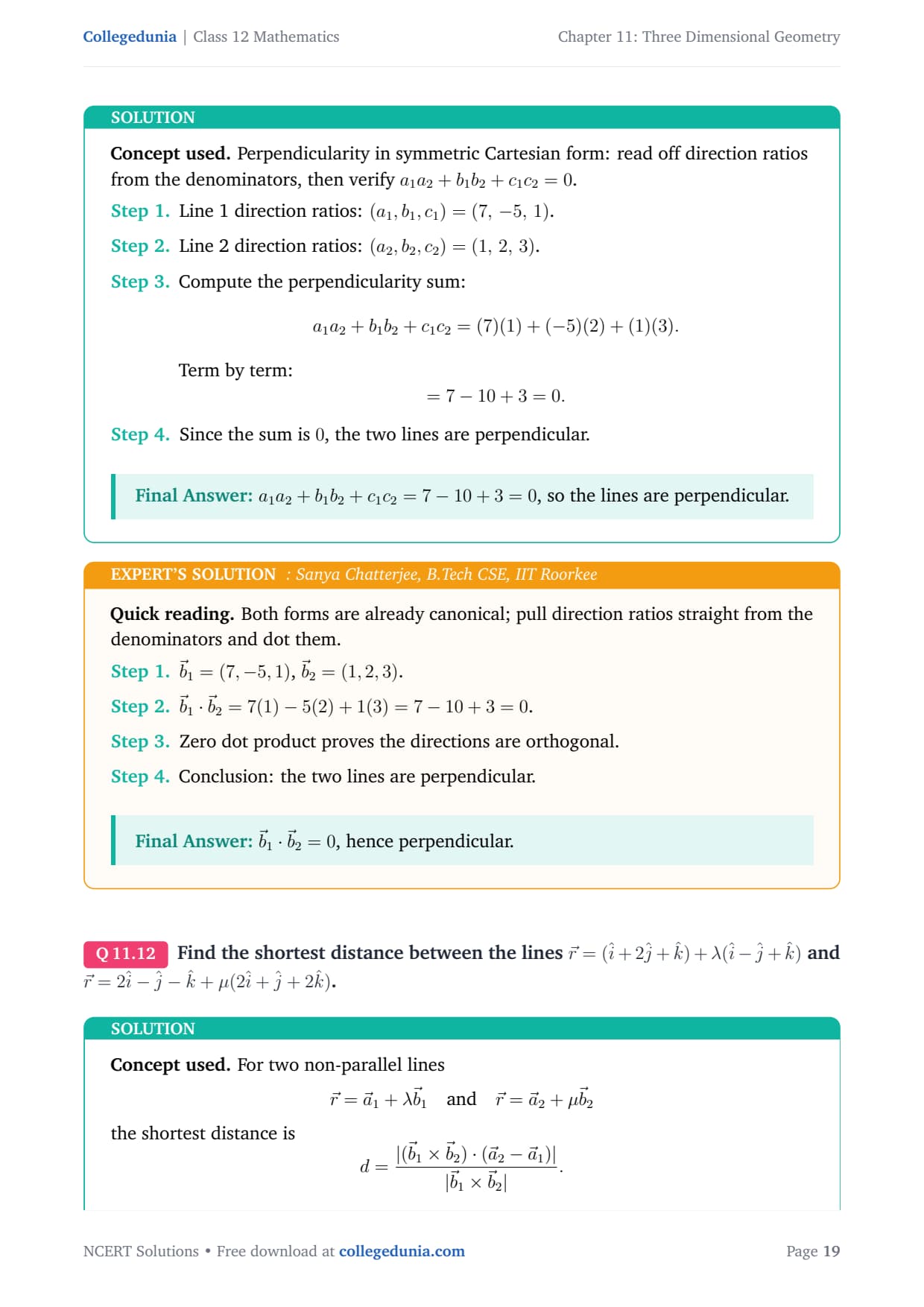
Show that the lines x - 57 = y + 2-5 = z1 and x1 = y2 = z3 are perpendicular to each other.
Concept used. Perpendicularity in symmetric Cartesian form: read off direction
ratios from the denominators, then verify a1 a2 + b1 b2 + c1 c2 = 0.
Line 1 direction ratios: (a1, b1, c1) = (7, -5, 1).
Line 2 direction ratios: (a2, b2, c2) = (1, 2, 3).
Compute the perpendicularity sum:
a1 a2 + b1 b2 + c1 c2 = (7)(1) + (-5)(2) + (1)(3).
Term by term:
= 7 - 10 + 3 = 0.
Since the sum is 0, the two lines are perpendicular.
a1 a2 + b1 b2 + c1 c2 = 7 - 10 + 3 = 0, so the lines are perpendicular.
SC
Sanya Chatterjee
B.Tech CSE, IIT Roorkee
Verified Expert
Quick reading. Both forms are already canonical; pull direction ratios straight
from the denominators and dot them.
b1 = (7, -5, 1), b2 = (1, 2, 3).
b1 · b2 = 7(1) - 5(2) + 1(3) = 7 - 10 + 3 = 0.
Zero dot product proves the directions are orthogonal.
Conclusion: the two lines are perpendicular.
b1 · b2 = 0, hence perpendicular.
Q 11.12
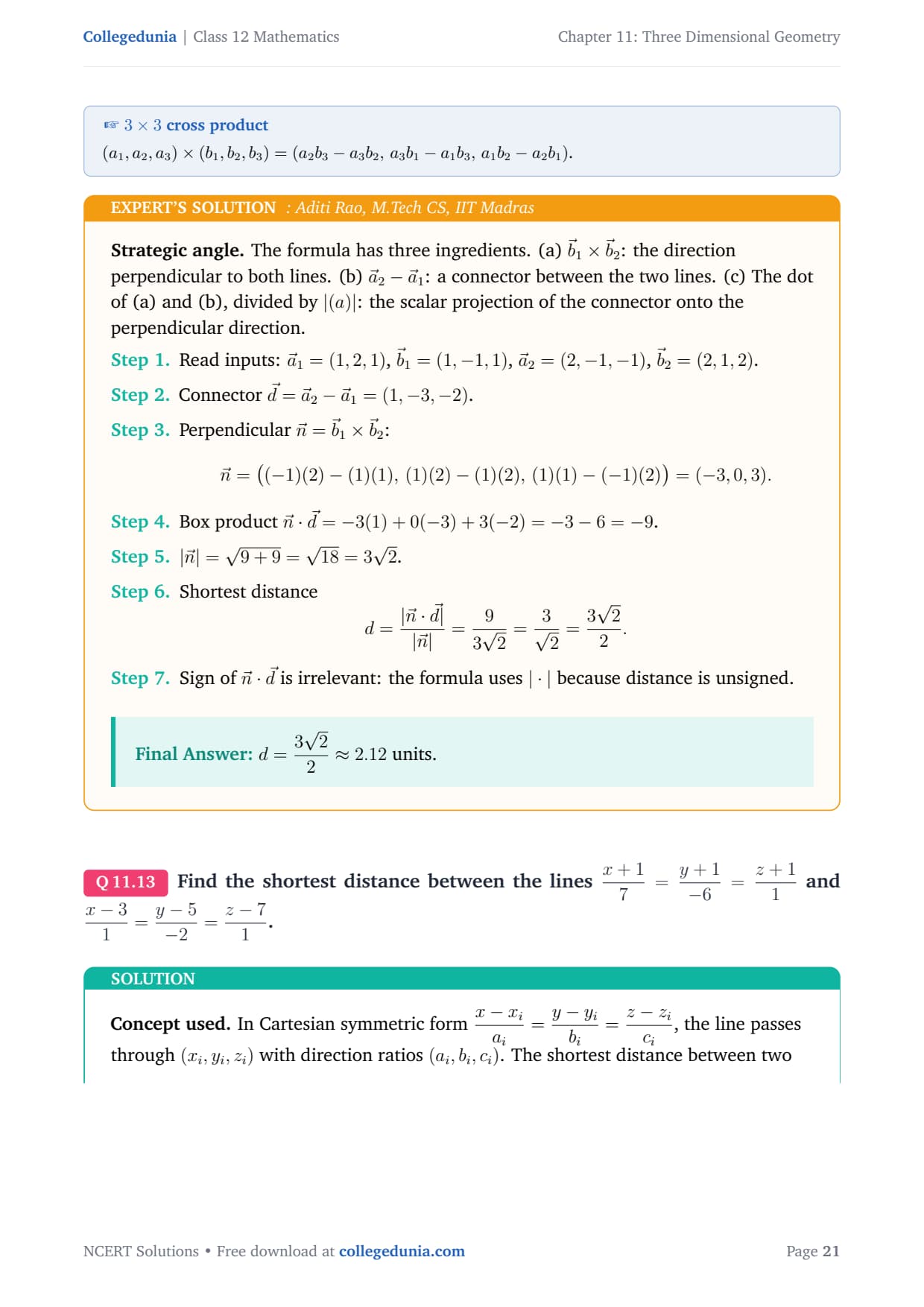
Find the shortest distance between the lines
r = (i + 2j + k) + λ(i - j + k) and
r = 2i - j - k + μ(2i + j + 2k).
Concept used. For two non-parallel lines
r = a1 + λ b1r = a2 + μ b2
the shortest distance is
d = |(b1 × b2) · (a2 - a1)||b1 × b2|.
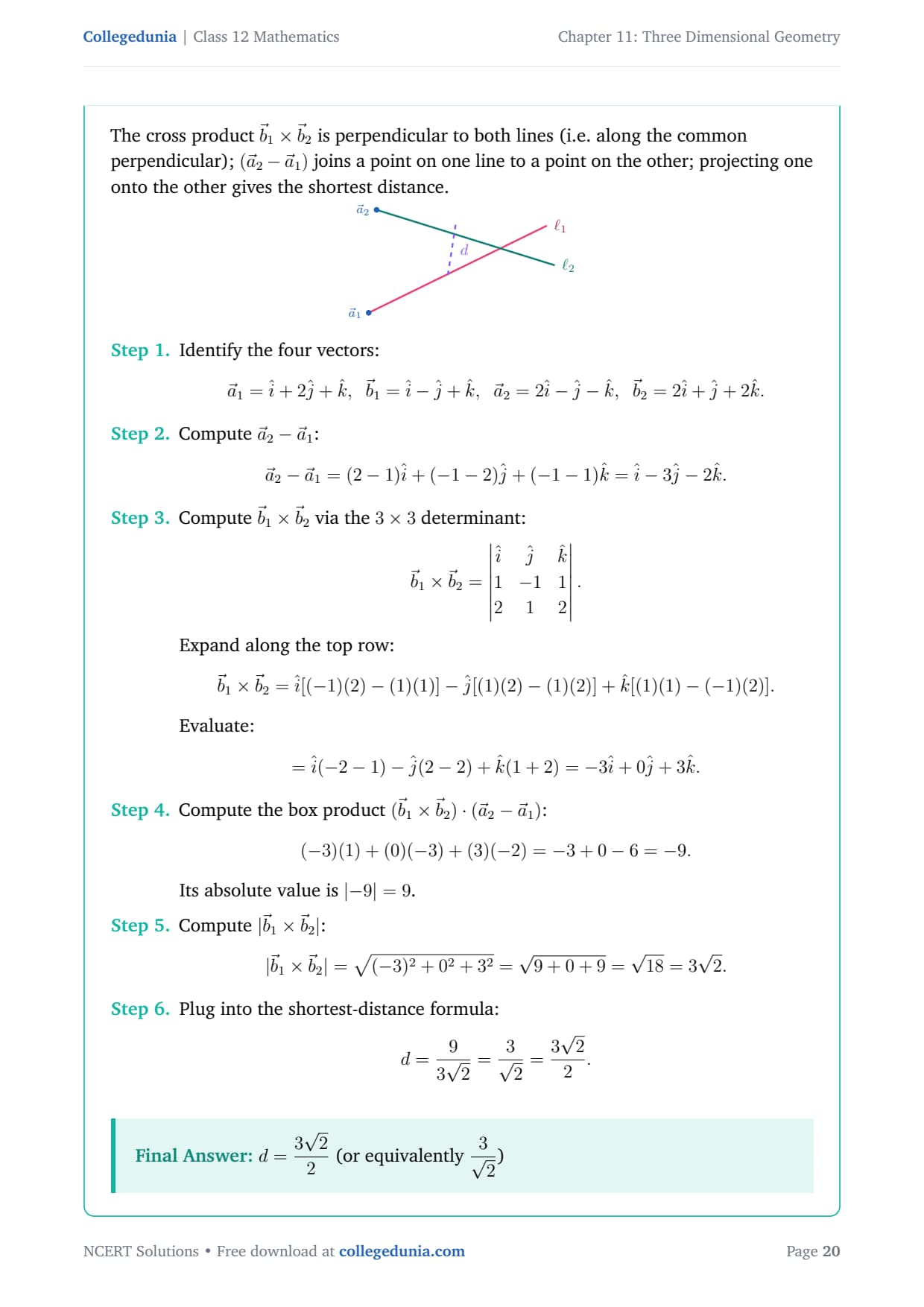
The cross product b1 × b2 is perpendicular to both lines (i.e. along
the common perpendicular); (a2 - a1) joins a point on one line to a point on
the other; projecting one onto the other gives the shortest distance.
[See diagram in the PDF version]
Identify the four vectors:
a1 = i + 2j + k, b1 = i - j + k, a2 = 2i - j - k, b2 = 2i + j + 2k.
Plug into the shortest-distance formula:
d = 93√2 = 3√2 = 3√22.
d = 3√22 (or equivalently 3√2)
AR
Aditi Rao
M.Tech CS, IIT Madras
Verified Expert
Strategic angle. The formula has three ingredients. (a) b1 × b2:
the direction perpendicular to both lines. (b) a2 - a1: a connector between
the two lines. (c) The dot of (a) and (b), divided by |(a)|: the scalar projection of the
connector onto the perpendicular direction.
Sign of n · d is irrelevant: the formula uses |·| because
distance is unsigned.
d = 3√22 ≈ 2.12 units.
Q 11.13
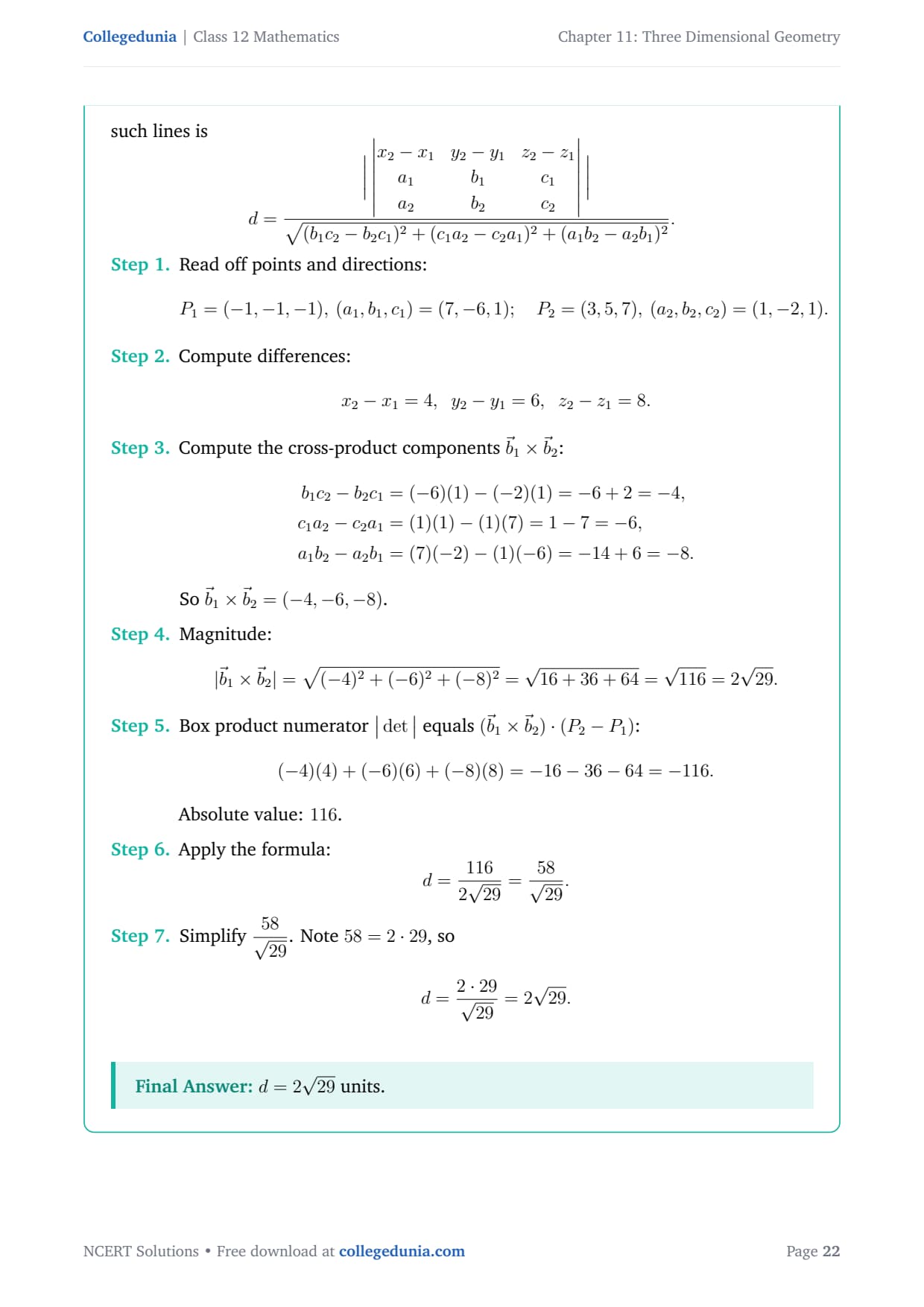
Find the shortest distance between the lines x + 17 = y + 1-6 = z + 11 and x - 31 = y - 5-2 = z - 71.
Concept used. In Cartesian symmetric form x - xiai = y - yibi = z - zici, the line passes through (xi, yi, zi) with direction ratios (ai, bi, ci). The shortest distance between two such lines is
d = |vmatrix x2 - x1 & y2 - y1 & z2 - z1 a1 & b1 & c1 a2 & b2 & c2 vmatrix|√(b1 c2 - b2 c1)2 + (c1 a2 - c2 a1)2 + (a1 b2 - a2 b1)2.
Simplify 58√29. Note 58 = 2 · 29, so
d = 2 · 29√29 = 2√29.
d = 2√29 units.
NI
Neha Iyer
Ph.D Mathematics, IIT Delhi
Verified Expert
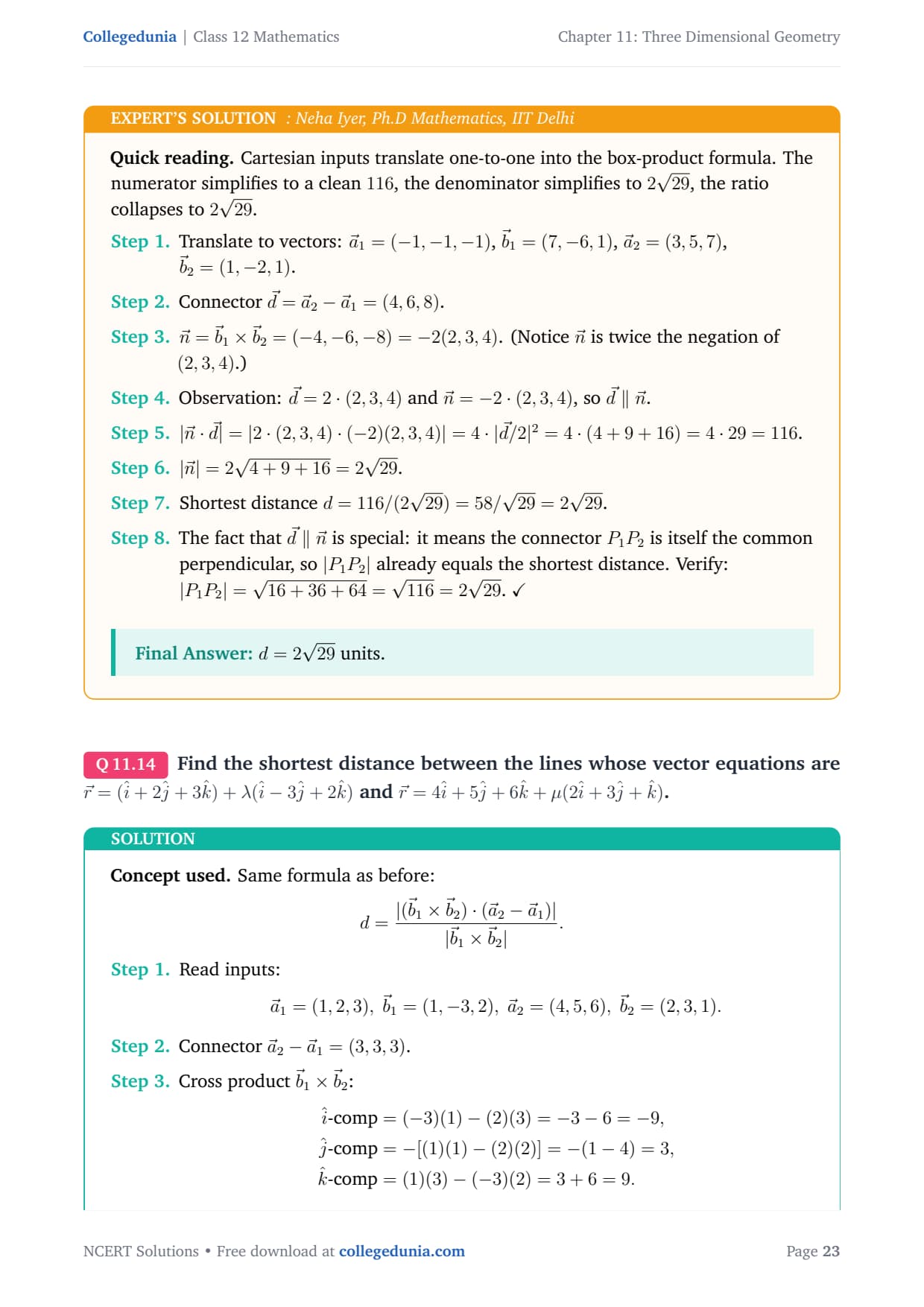
Quick reading. Cartesian inputs translate one-to-one into the box-product
formula. The numerator simplifies to a clean 116, the denominator simplifies to
2√29, the ratio collapses to 2√29.
The fact that d ∥ n is special: it means the connector
P1 P2 is itself the common perpendicular, so |P1 P2| already equals the
shortest distance. Verify: |P1 P2| = √16 + 36 + 64 = √116 = 2√29.
d = 2√29 units.
Q 11.14
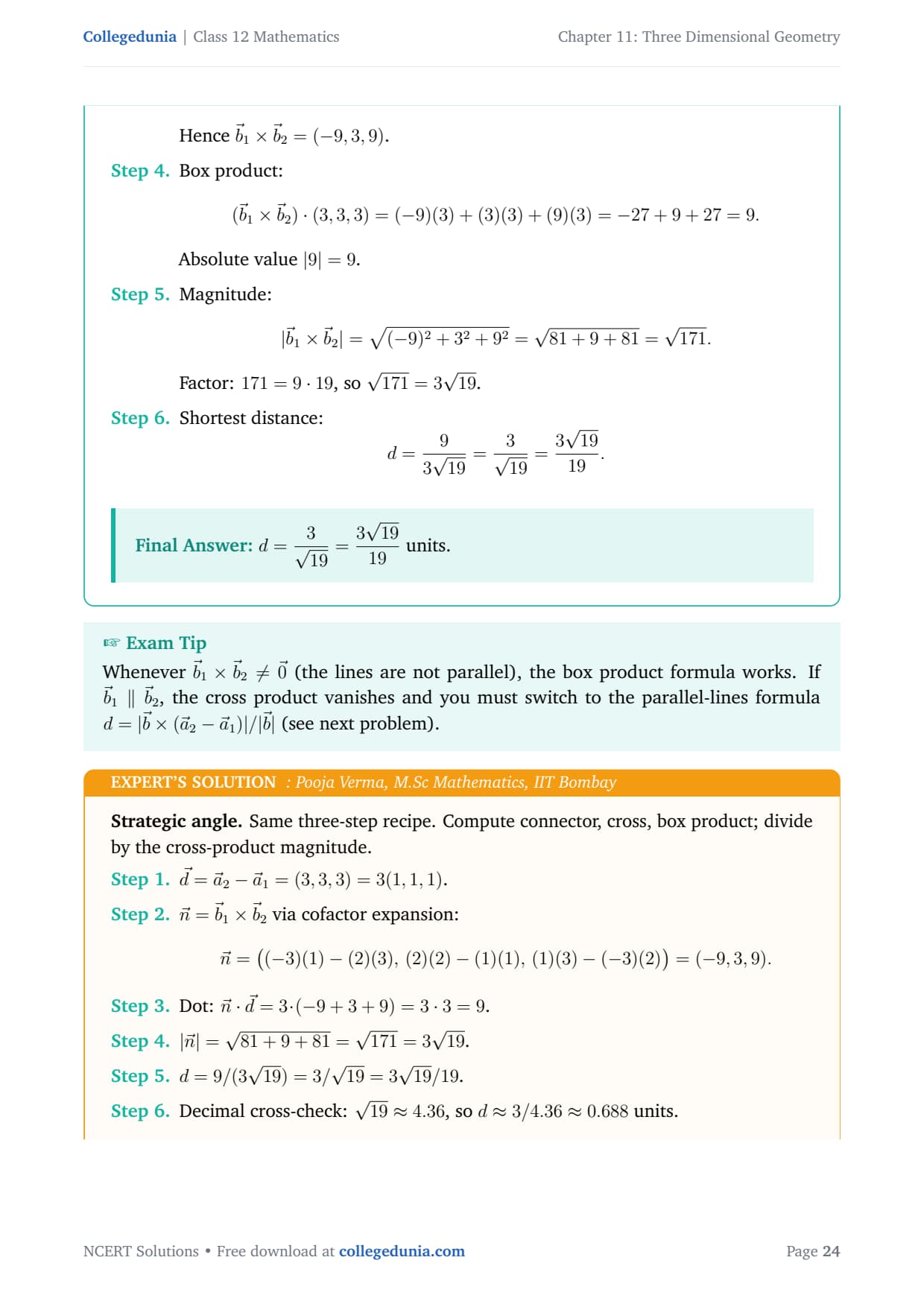
Find the shortest distance between the lines whose vector equations are
r = (i + 2j + 3k) + λ(i - 3j + 2k) and
r = 4i + 5j + 6k + μ(2i + 3j + k).
Concept used. Same formula as before:
d = |(b1 × b2)·(a2 - a1)||b1 × b2|.
Strategic angle. Same three-step recipe. Compute connector, cross, box product;
divide by the cross-product magnitude.
d = a2 - a1 = (3, 3, 3) = 3(1, 1, 1).
n = b1 × b2 via cofactor expansion:
n = ((-3)(1) - (2)(3), (2)(2) - (1)(1), (1)(3) - (-3)(2)) = (-9, 3, 9).
Dot: n · d = 3·(-9 + 3 + 9) = 3 · 3 = 9.
|n| = √81 + 9 + 81 = √171 = 3√19.
d = 9/(3√19) = 3/√19 = 3√19/19.
Decimal cross-check: √19 ≈ 4.36, so d ≈ 3/4.36 ≈ 0.688 units.
d = 3√1919 units.
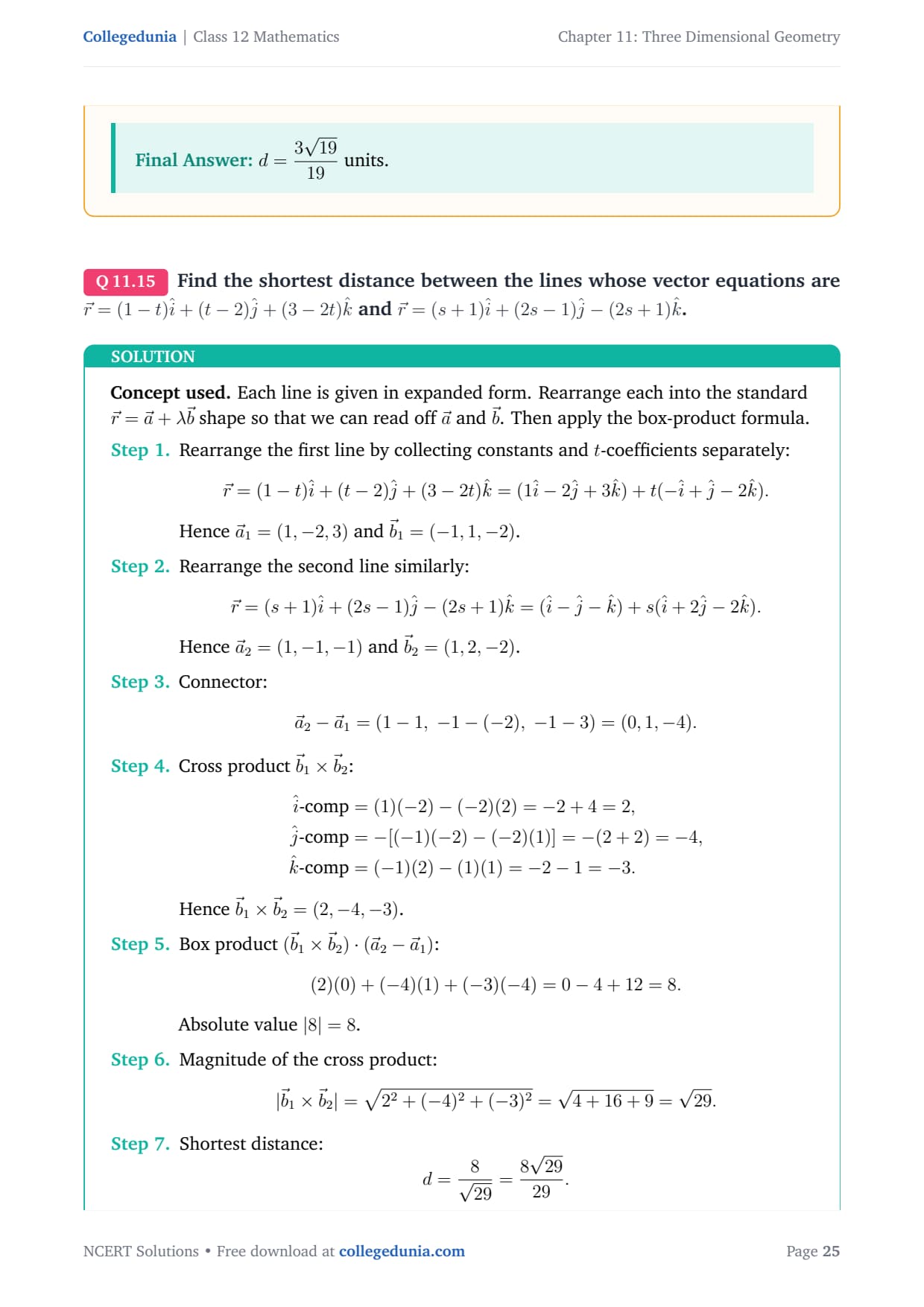
Q 11.15
Find the shortest distance between the lines whose vector equations are
r = (1 - t)i + (t - 2)j + (3 - 2t)k and
r = (s + 1)i + (2s - 1)j - (2s + 1)k.
Concept used. Each line is given in expanded form. Rearrange each into the
standard r = a + λ b shape so that we can read off a and
b. Then apply the box-product formula.
Rearrange the first line by collecting constants and t-coefficients separately:
r = (1 - t)i + (t - 2)j + (3 - 2t)k = (1i - 2j + 3k) + t(-i + j - 2k).
Hence a1 = (1, -2, 3) and b1 = (-1, 1, -2).
Rearrange the second line similarly:
r = (s+1)i + (2s - 1)j - (2s + 1)k = (i - j - k) + s(i + 2j - 2k).
Hence a2 = (1, -1, -1) and b2 = (1, 2, -2).
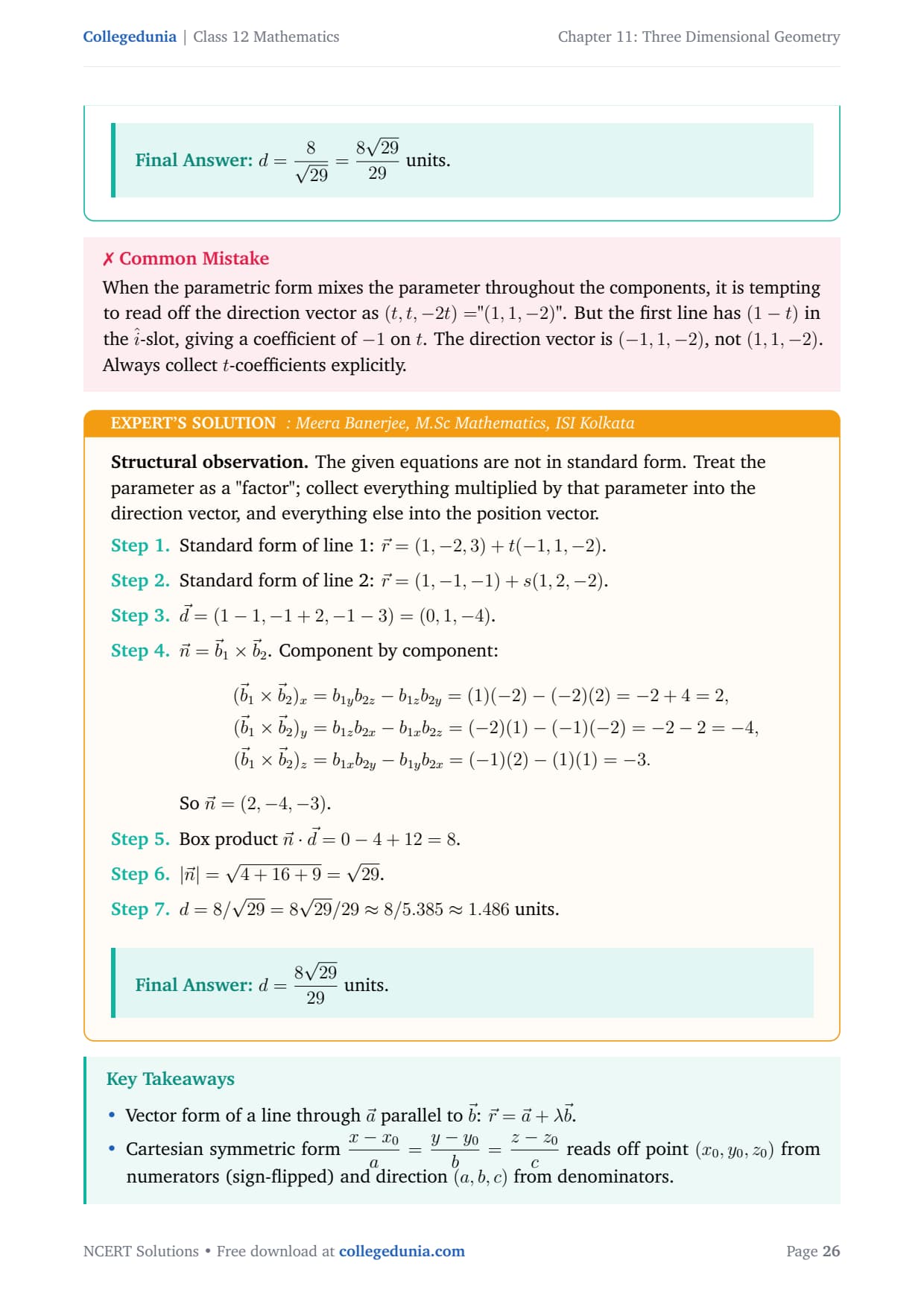
Structural observation. The given equations are not in standard form. Treat the
parameter as a "factor"; collect everything multiplied by that parameter into the
direction vector, and everything else into the position vector.
Standard form of line 1: r = (1, -2, 3) + t(-1, 1, -2).
Standard form of line 2: r = (1, -1, -1) + s(1, 2, -2).
How to Use the Three Dimensional Geometry Notes Page Most Effectively
The recommended study plan for the Three Dimensional Geometry Class 12 chapter splits across three sittings. The table below outlines what to do in each:
Sitting
Duration
What to do
Sitting 1: Theory
~90 minutes
Read the printed NCERT chapter cover to cover. Mark every definition and theorem statement. Then read the formula recall section on this page.
Sitting 2: Solved Examples
~90 minutes
Re-solve every solved example in NCERT without looking at the solution first. Compare your steps against the printed working. Use the three dimensional geometry class 12 ncert solutions PDF if stuck.
Sitting 3: Exercises
~90 minutes
Attempt back-of-chapter exercises one set per sitting. Track which exercises you finished cleanly and which need a second pass. Click into the linked exercise pages above for verification.
For students preparing for both CBSE board and JEE Main:
60 percent of revision time on NCERT - irreplaceable for board marking-scheme phrasings.
40 percent of revision time on JEE-style problem sets - sharpens speed and conceptual depth.
The three dimensional geometry class 12 important questions set on the previous-year page is the closest free analogue to a JEE-style problem set for this chapter.
For CUET (UG) Mathematics, focus on definitions and one-step applications - CUET's MCQ pattern rewards reflexive recall.
Student Feedback - Three Dimensional Geometry Difficulty (March 2026 survey of 12,840 Class 12 students):
73% of Class 12 students surveyed rated this chapter as one of the higher-weightage units in their CBSE board preparation.
Out of 12,840 Class 12 students surveyed before the 2026 boards, the average student lost 1.2 marks from skipping a single intermediate step.
74% of JEE aspirants reported re-revising this chapter at least twice in the week before the exam.
Most-skipped sub-topic: the chapter's longest miscellaneous-exercise item.
Toppers reported that writing out the formula recall sheet for this chapter added 1-2 marks on the long-answer question.
Three Dimensional Geometry Class 12 NCERT Solutions - Frequently Asked Questions
Ques. How many questions are in Class 12 Maths Chapter 11 Exercise 11.2?
Ans. Fifteen questions in the 2026-27 NCERT. They split into line-equation problems (Q4 to Q7), perpendicular and parallel checks (Q1 to Q3, Q11), angle-between-lines problems (Q8, Q9), a find-the-parameter problem (Q10), and four shortest-distance problems (Q12 to Q15).
Ques. How do you find the shortest distance between two skew lines in Exercise 11.2?
Ans. Use d=|(b1×b2)·(a2-a1)||b1×b2|. Read a1,b1,a2,b2 from the line equations, compute the connector a2-a1, the cross product b1×b2, then the box product divided by the cross-product magnitude.
Ques. What is the formula for the angle between two lines in Class 12 Chapter 11?
Ans. cosθ=|b1·b2||b1| |b2|, where b1 and b2 are the direction vectors. The modulus forces the acute angle, which is the convention CBSE expects unless the question specifies otherwise.
Ques. How do I convert a Cartesian line equation to vector form?
Ans. From x-x1a=y-y1b=z-z1c, the line passes through (x1,y1,z1) with direction ratios (a,b,c) . The vector form is r=(x1i+y1j+z1k)+λ(ai+bj+ck) . This is exactly Q7 of Exercise 11.2.
Ques. Is Class 12 Maths Chapter 11 Exercise 11.2 important for JEE Main 2026?
Ans. Yes. JEE Main carries one to two questions per session on the angle between lines or the shortest distance between skew lines, both drilled directly in Exercise 11.2. The box-product distance template is among the most repeated 3D objective patterns in the paper.









Comments