Junior-Class Mentor, TFI Fellow | Updated 3+ months ago
This page has the Vector Algebra Class 12 NCERT Solutions for Chapter 10, Exercise 10.4. It covers all 12 questions on the cross product, with every area and unit-vector answer worked out step by step and checked against the 2026-27 NCERT. The free PDF of this exercise is available for download on this page.
The solutions PDF covers all parts of every question and writes each step in full. The file is part of the NCERT Solutions Class 12 Maths library and follow the notation of the official textbook.
Question count: 12 questions, of which Q9 and Q10 (areas) and Q2 (unit perpendicular) are the most paper-relevant.
12 questions | 10 short/long + 2 MCQ (Q11, Q12) | one operation: a × b via a 3x3 determinant
The Collegedunia editorial team has checked every cross product, area and unit-perpendicular result against the official NCERT key and the current 2026-27 print, with the alternating cofactor sign on the j term flagged in every determinant expansion.
CBSE and JEE Relevance of Class 12 Maths Chapter 10 Exercise 10.4
The cross product is the only Chapter 10 operation that consistently produces a full 5-mark question, almost always "find the area of the triangle or parallelogram" or "find a unit vector perpendicular to two given vectors". These map directly onto Q2, Q9 and Q10 of this exercise.
A 5-mark long answer on the area of a triangle or parallelogram has appeared in 5 of the last 5 CBSE Class 12 board papers, and cross-product items surface in nearly every JEE Main shift. The MCQs Q11 and Q12 mirror the single-correct format CBSE uses for the 1-mark vector question.
How Collegedunia's NCERT Solutions for Vector Algebra Help You in Exercise 10.4
Cross-product marks are lost almost entirely on the sign of the middle term and on forgetting the factor of one half for a triangle. The Collegedunia solutions write the determinant, expand each cofactor on its own line with the sign shown, then take the magnitude separately, so the method marks are visible to the examiner.
Middle-term sign flagged: the cofactor pattern +, -, + on i, j, k is stated before every expansion.
Triangle versus parallelogram: Q9 uses 12|AB×AC| ; Q10 uses the full |a×b| , with the half clearly justified.
Both unit normals given: Q2 records the answer as ± , since a plane has two perpendicular unit vectors.
Parallel test: Q5 and Q8 use a×b = 0 a ∥ b, with proportional components shown.
Exercise 10.4 has 12 questions on the cross product. The table records the final answer for each so you can mark your attempt quickly.
Q No.
Task
Answer
1
|a×b| for i - 7j + 7k, 3i - 2j + 2k
192
2
Unit vector perpendicular to a + b and a - b
±(23i - 23j - 13k)
3
Angle with k and components of unit vector a
θ = π/3 ; a = 12i + 12j + 12k
4
Show (a - b)×(a + b) = 2(a×b)
Proved using bilinearity and x×x = 0
5
Find λ, μ so the cross product is zero
λ = 3, μ = 272
6
Conclusion from a·b = 0 and a×b = 0
a = 0 or b = 0
7
Show a×(b + c) = a×b + a×c
Proved by determinant row-linearity
8
Is the converse of "a or b zero implies cross zero" true?
False; counter-example i, 2i
9
Area of triangle A(1,1,2), B(2,3,5), C(1,5,5)
√612 sq units
10
Area of parallelogram, sides i - j + 3k, 2i - 7j + k
152 sq units
11
MCQ: angle so that a×b is a unit vector
Option (B), θ = π/4
12
MCQ: area of the given rectangle
Option (C), area = 2
Cross-Product Toolkit for Class 12 Maths Exercise 10.4
The whole exercise rests on these five facts.
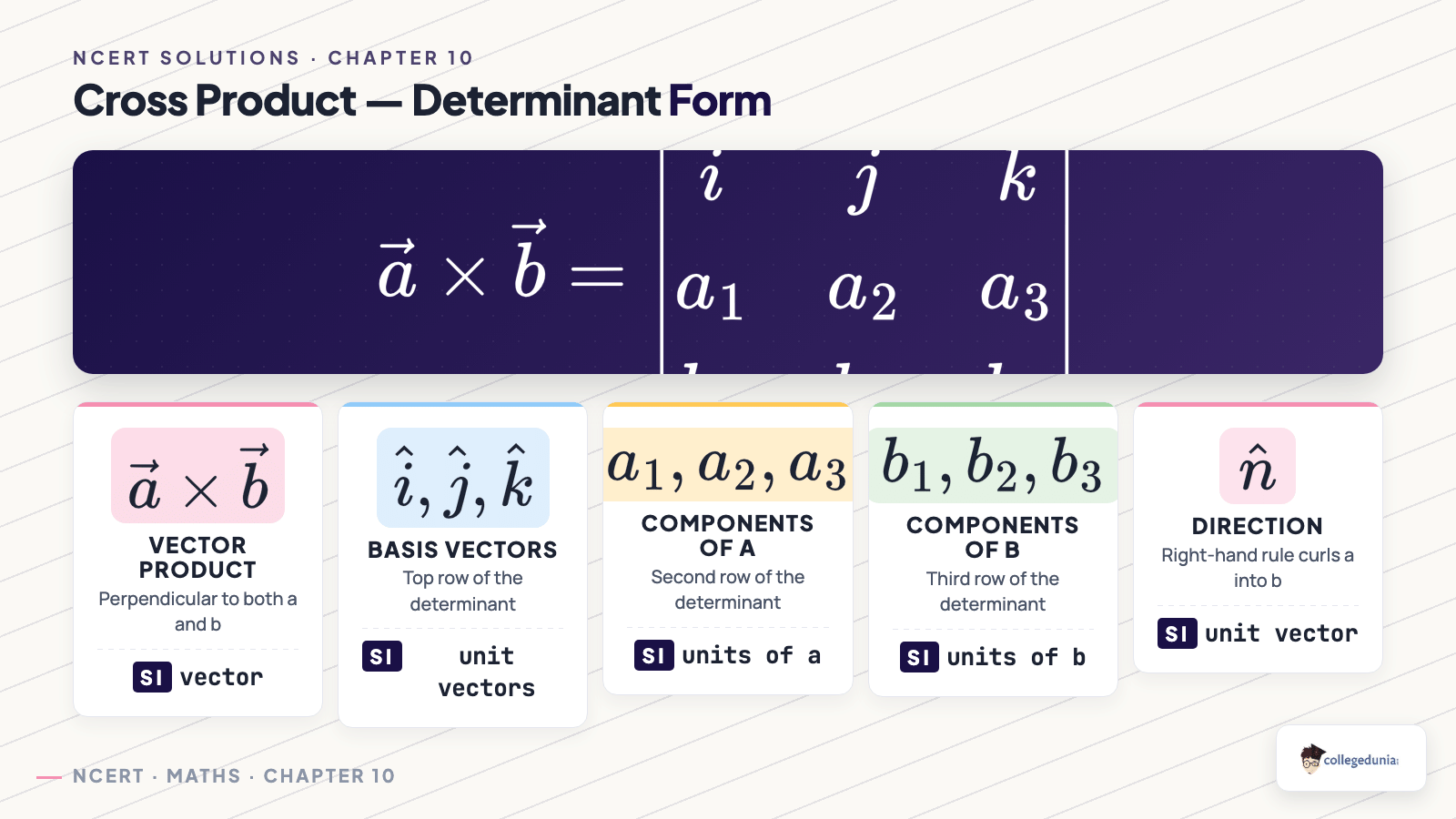
Determinant form:a×b = vmatrix i & j & k a1 & a2 & a3 b1 & b2 & b3 vmatrix Cofactor signs: +, -, + on i, j, k (never forget the minus on the middle term) Magnitude: |a×b| = |a||b|sinθ Area of triangle: 12|AB×AC| ; Area of parallelogram: |a×b| Parallel test:a×b = 0 a ∥ b (or one is zero)
Concept Tags Across the 12 Problems of Class 12 Maths Exercise 10.4
Grouping by sub-topic shows which fact each question needs.
Sub-topic
Questions
Cross product and magnitude
Q1, Q2
Direction cosines via a unit vector
Q3
Cross-product identities and proofs
Q4, Q7
Parallel and zero-product reasoning
Q5, Q6, Q8
Area of triangle and parallelogram
Q9, Q10, Q12
Magnitude and angle MCQ
Q11
Common Mistakes Students Make in Class 12 Maths Exercise 10.4
Common Mistake: Dropping the leading minus on the j term while expanding the determinant. The cofactor signs are +, -, + on i, j, k; this sign slip flips the whole j component.
Forgetting the factor of one half in a triangle-area question (Q9) and reporting the parallelogram area instead.
Giving only one unit perpendicular in Q2; a plane has two, so the answer is ± .
Treating a×b = 0 as proof that a vector is zero; it can also mean the vectors are parallel (Q8).
Reading proportional components incorrectly in Q5 and solving the wrong ratio for λ, μ .
Other Resources for Class 12 Maths Chapter 10 Vector Algebra
All NCERT Solutions for Vector Algebra Ex 10.4 with Step-by-Step Working
Every NCERT textbook question for Class 12 Mathematics Chapter 10 Vector Algebra Ex 10.4 is listed below with its full Solution and Expert Solution hidden inside collapsible tabs. Click Check Solution to reveal the step-by-step working; click Expert Solution for the expanded explanation.
Questions
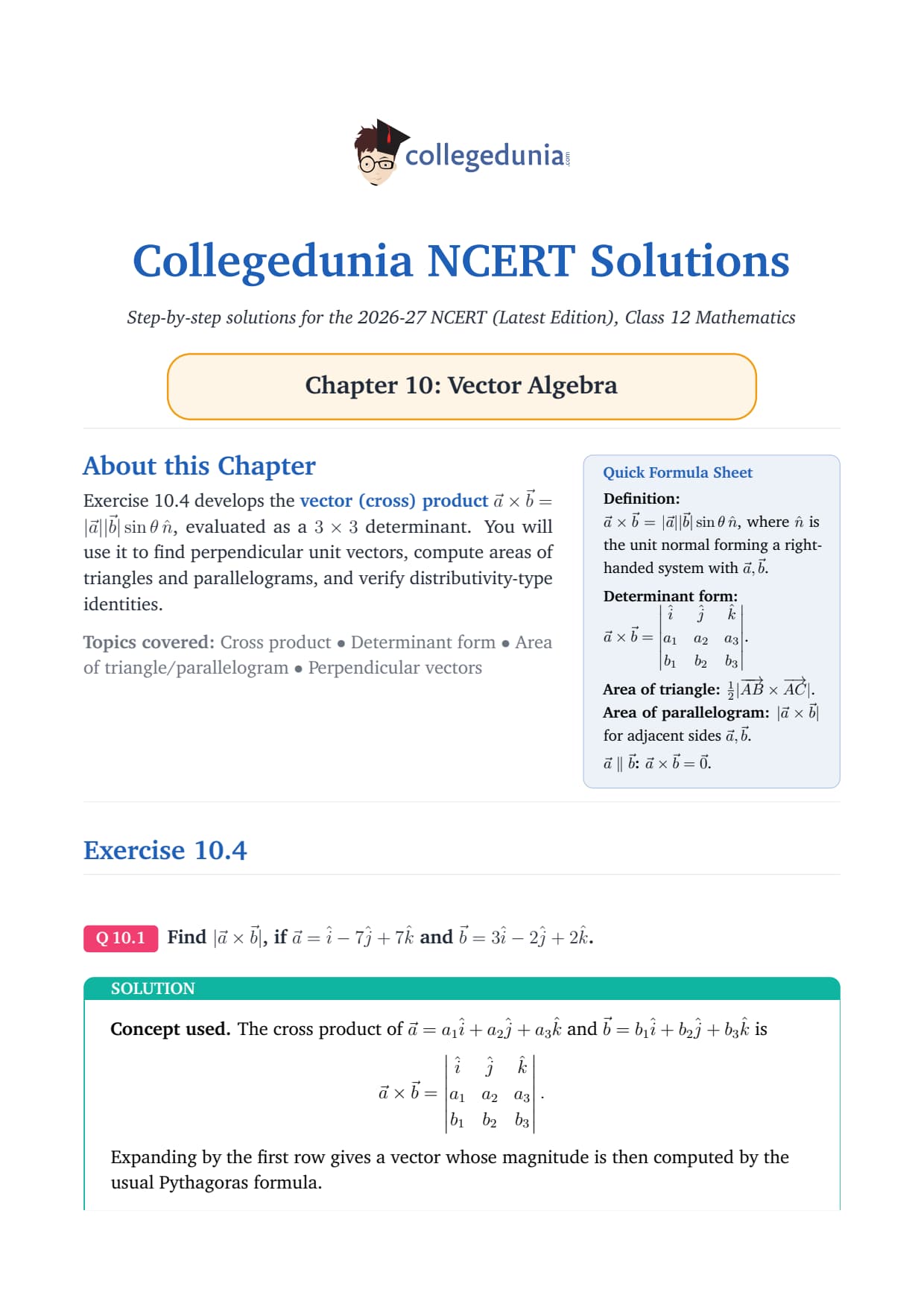
Q 10.1
Find |a×b|, if a = i - 7j + 7k and b = 3i - 2j + 2k.
Concept used. The cross product of a = a1i + a2j + a3k and b = b1i + b2j + b3k is
a×b = vmatrix i & j & k a1 & a2 & a3 b1 & b2 & b3 vmatrix.
Expanding by the first row gives a vector whose magnitude is then computed by the usual Pythagoras formula.
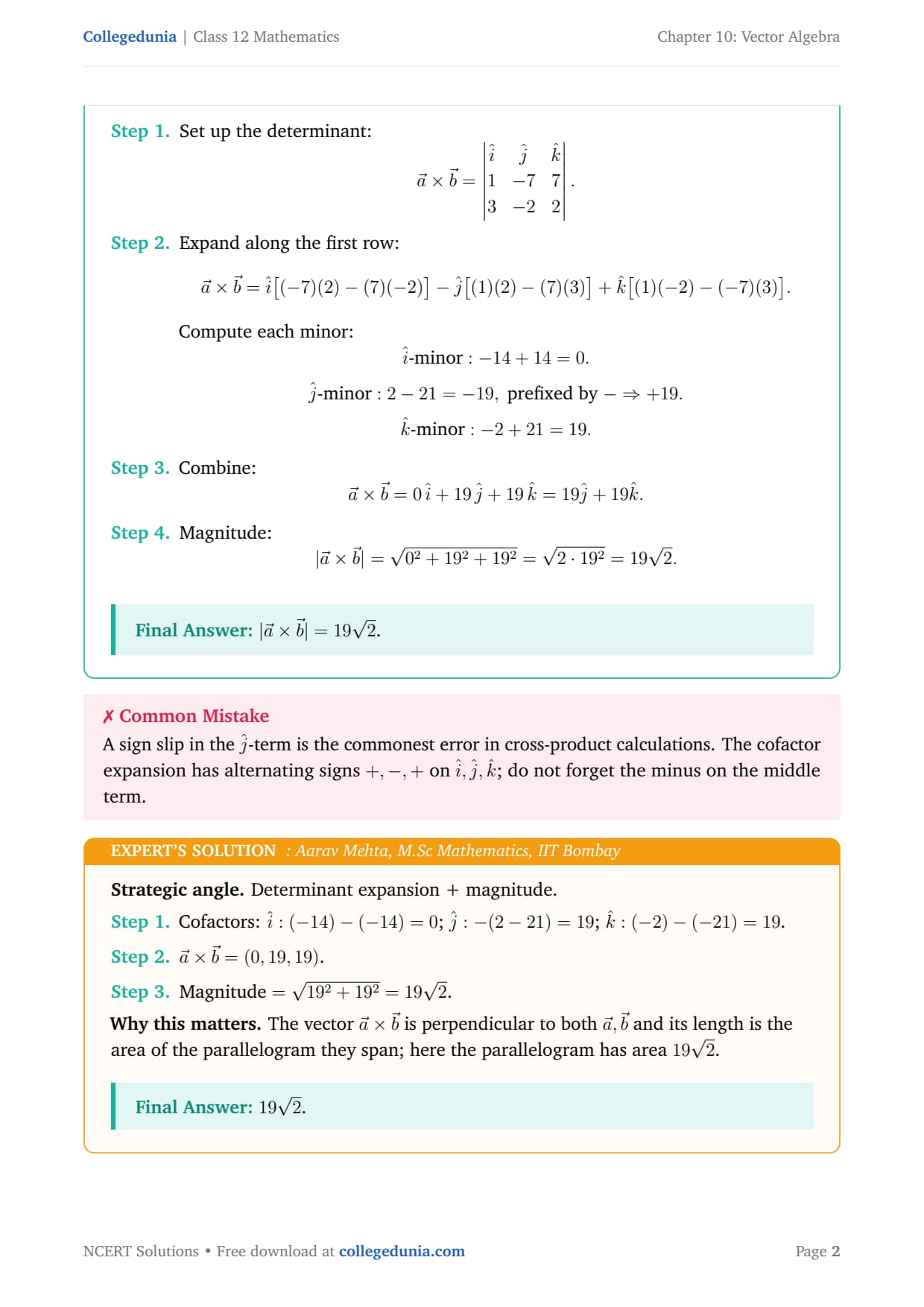
Set up the determinant:
a×b = vmatrix i & j & k 1 & -7 & 7 3 & -2 & 2 vmatrix.
Expand along the first row:
a×b = i[(-7)(2) - (7)(-2)] - j[(1)(2) - (7)(3)] + k[(1)(-2) - (-7)(3)].
Compute each minor:
i-minor: -14 + 14 = 0.j-minor: 2 - 21 = -19, prefixed by -⇒ +19.k-minor: -2 + 21 = 19.
Why this matters. The vector a×b is perpendicular to both a, b and its length is the area of the parallelogram they span; here the parallelogram has area 192.
192.
Q 10.2
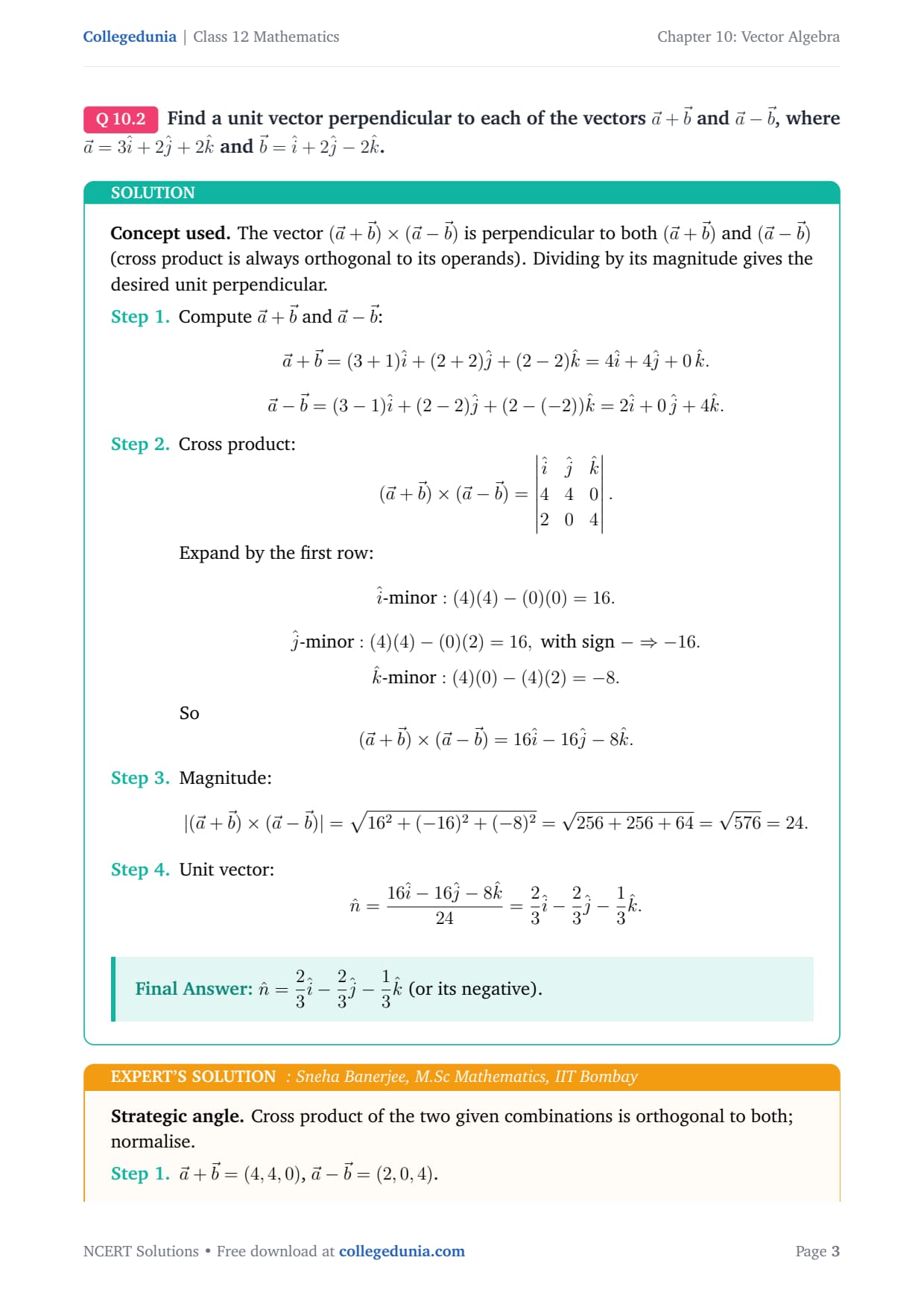
Find a unit vector perpendicular to each of the vectors a + b and a - b, where a = 3i + 2j + 2k and b = i + 2j - 2k.
Concept used. The vector (a + b)×(a - b) is perpendicular to both (a + b) and (a - b) (cross product is always orthogonal to its operands). Dividing by its magnitude gives the desired unit perpendicular.
Compute a + b and a - b:
a + b = (3+1)i + (2+2)j + (2-2)k = 4i + 4j + 0 k.a - b = (3-1)i + (2-2)j + (2-(-2))k = 2i + 0 j + 4k.
Cross product:
(a + b)×(a - b) = vmatrix i & j & k 4 & 4 & 0 2 & 0 & 4 vmatrix.
Expand by the first row:
i-minor: (4)(4) - (0)(0) = 16.j-minor: (4)(4) - (0)(2) = 16, with sign - ⇒ -16.k-minor: (4)(0) - (4)(2) = -8.
So
(a + b)×(a - b) = 16i - 16j - 8k.
Why this matters. There are exactly two unit vectors perpendicular to a plane (positive and negative). Reversing the order of the cross product flips the sign.
±(23i - 23j - 13k).
Q 10.3
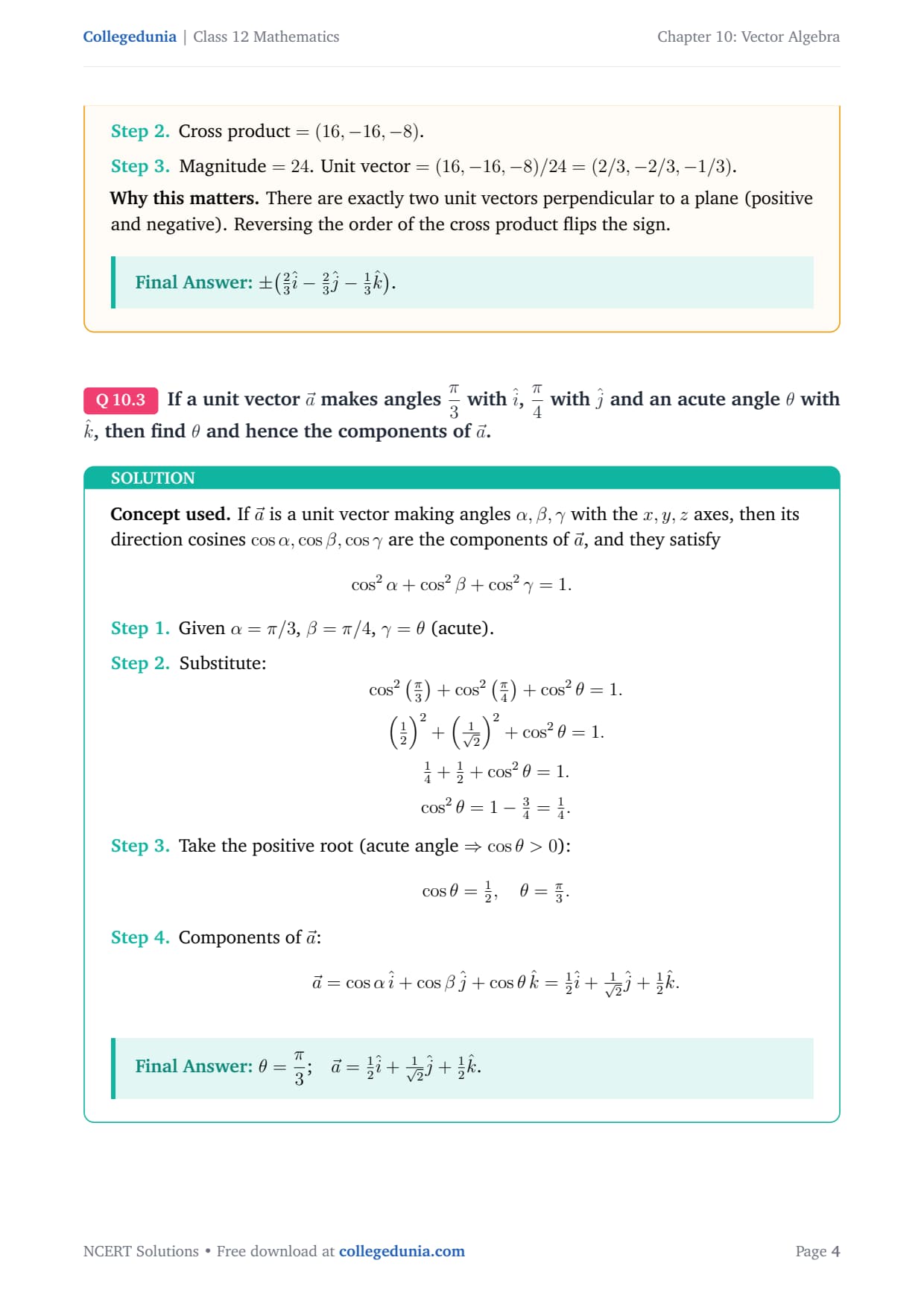
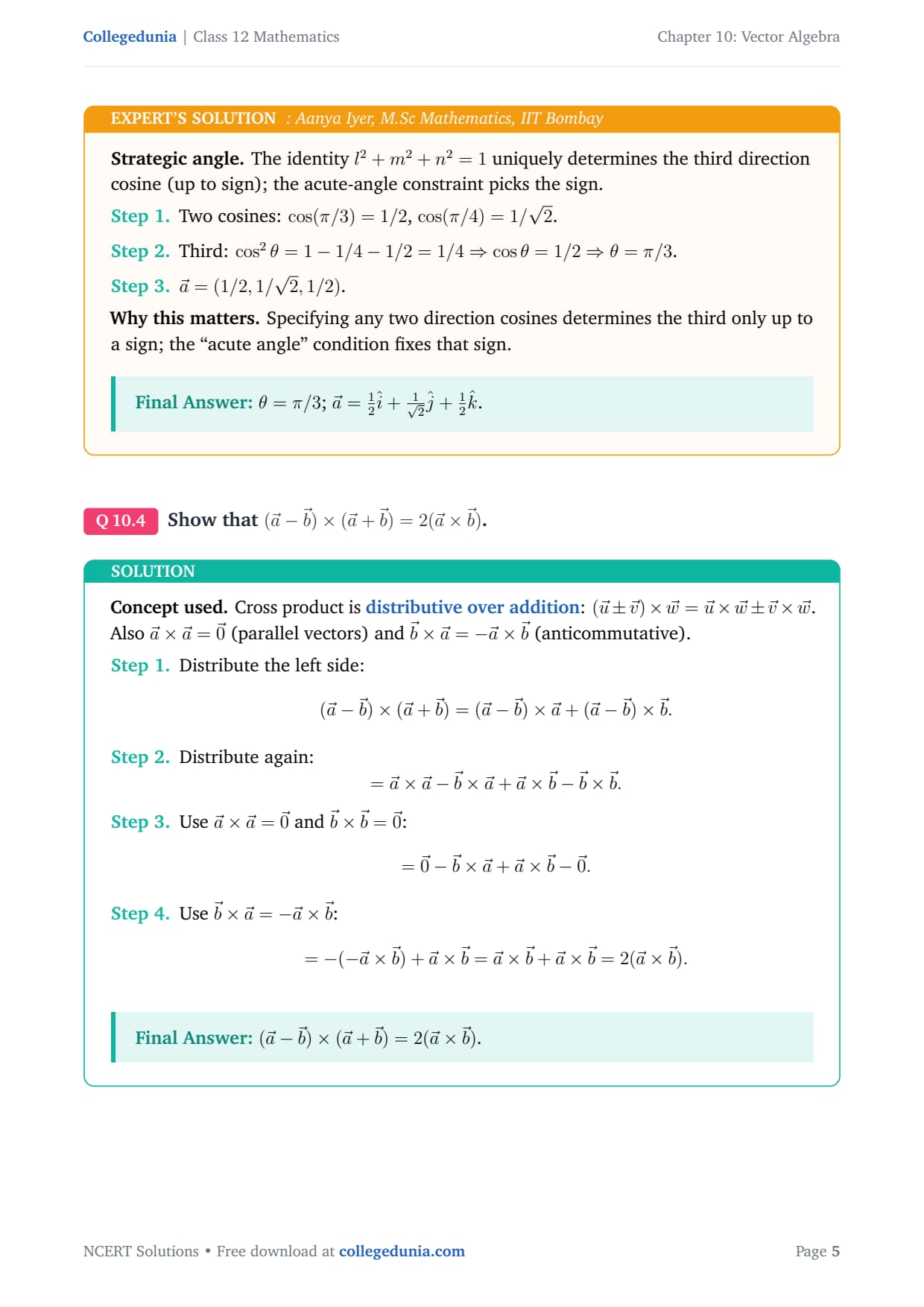
If a unit vector a makes angles π3 with i, π4 with j and an acute angle θ with k, then find θ and hence the components of a.
Concept used. If a is a unit vector making angles α, β, γ with the x, y, z axes, then its direction cosines cosα, cosβ, cosγ are the components of a, and they satisfy
cos2α + cos2β + cos2γ = 1.
Why this matters. Specifying any two direction cosines determines the third only up to a sign; the ``acute angle'' condition fixes that sign.
θ = π/3; a = 12i + 12j + 12k.
Q 10.4
Show that (a - b)×(a + b) = 2(a× b).
Concept used. Cross product is distributive over addition: (u ± v)× w = u× w ± v× w. Also a× a = 0 (parallel vectors) and b× a = -a× b (anticommutative).
Distribute the left side:
(a - b)×(a + b) = (a - b)× a + (a - b)× b.
Strategic angle. Expand like algebra; use x×x = 0 and anticommutativity.
(a - b)×(a + b) = a×a + a×b - b×a - b×b.
Self-cross terms vanish; b×a = -a×b.
Result: a×b + a×b = 2(a×b).
Why this matters. The cross product is bilinear and anticommutative; both rules together produce these factor-of-2 identities just as (a-b)(a+b) = a2 - b2 does for ordinary multiplication.
2(a× b).
Q 10.5
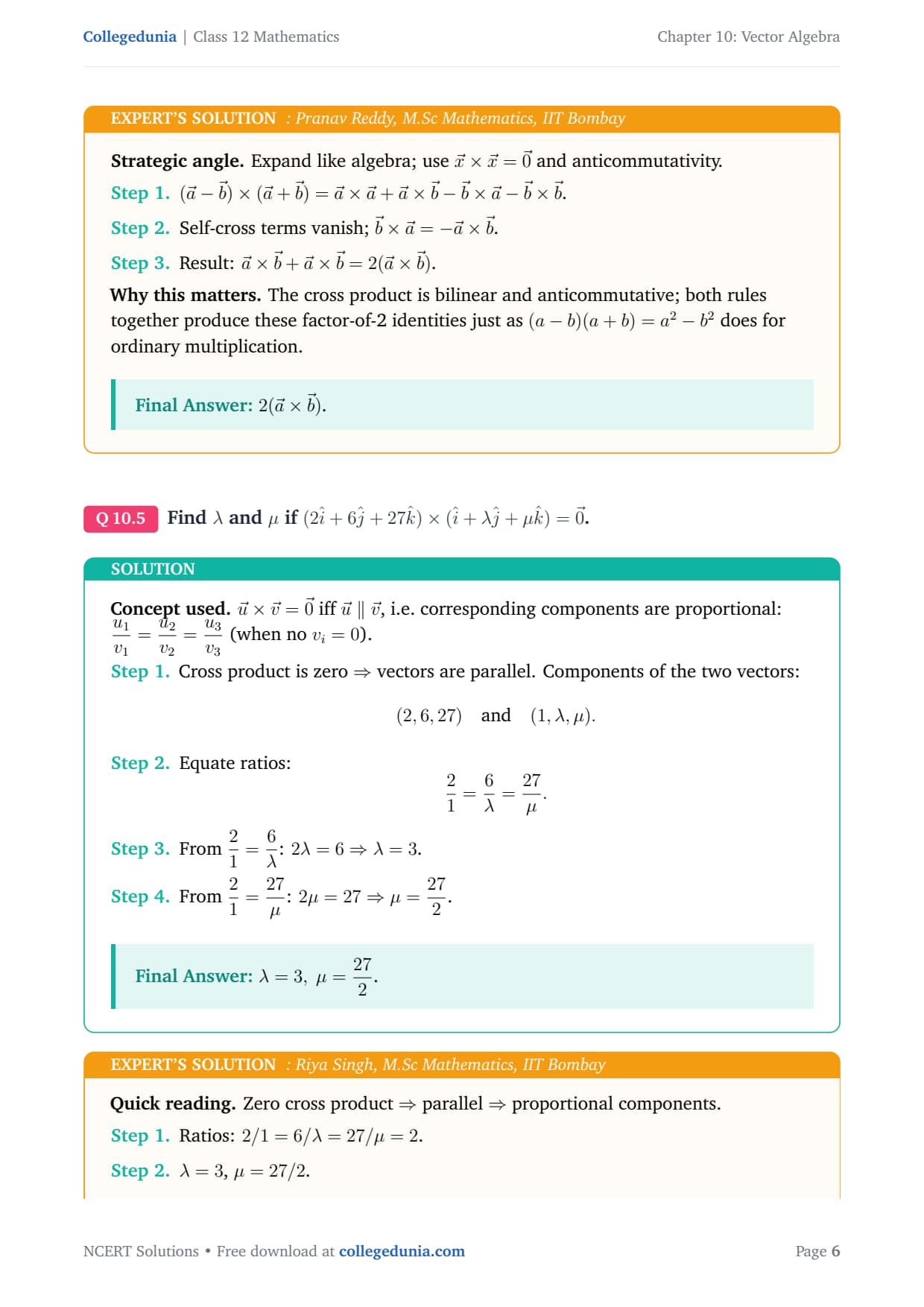
Find λ and μ if (2i + 6j + 27k)×(i + λ j + μ k) = 0.
Concept used.u×v = 0 iff u ∥ v, i.e. corresponding components are proportional: u1v1 = u2v2 = u3v3 (when no vi = 0).
Cross product is zero ⇒ vectors are parallel. Components of the two vectors:
(2, 6, 27)(1, λ, μ).
Equate ratios:
21 = 6λ = 27μ.
From 21 = 6λ: 2λ = 6 ⇒ λ = 3.
From 21 = 27μ: 2μ = 27 ⇒ μ = 272.
λ = 3, μ = 272.
RS
Riya Singh
M.Sc Mathematics, IIT Bombay
Verified Expert
Quick reading. Zero cross product ⇒ parallel ⇒ proportional components.
Ratios: 2/1 = 6/λ = 27/μ = 2.
λ = 3, μ = 27/2.
Why this matters. Two parallel non-zero vectors carry exactly one degree of freedom (the common ratio); fixing one ratio determines the rest.
λ = 3, μ = 27/2.
Q 10.6
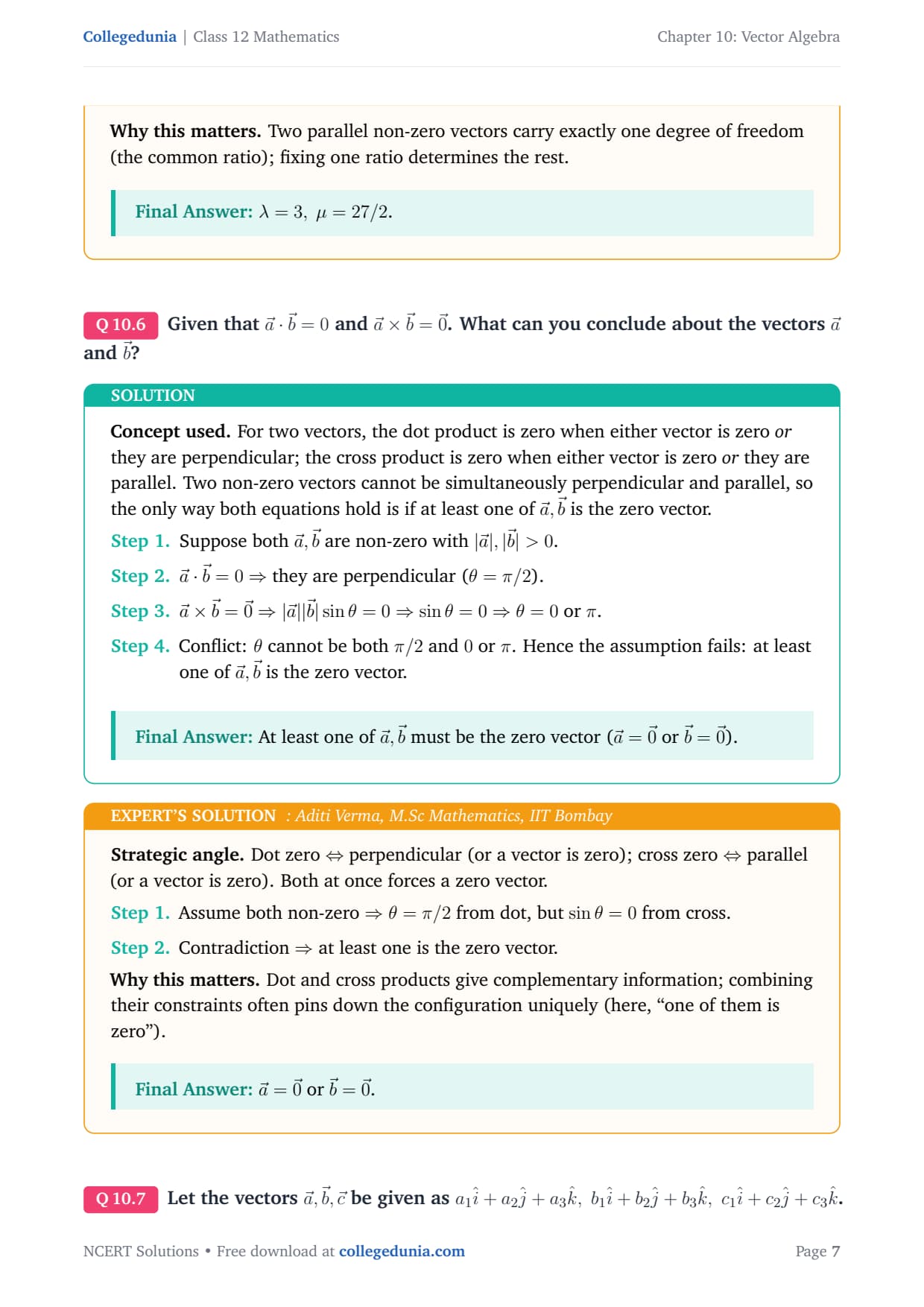
Given that a·b = 0 and a×b = 0. What can you conclude about the vectors a and b?
Concept used. For two vectors, the dot product is zero when either vector is zero or they are perpendicular; the cross product is zero when either vector is zero or they are parallel. Two non-zero vectors cannot be simultaneously perpendicular and parallel, so the only way both equations hold is if at least one of a, b is the zero vector.
Suppose both a, b are non-zero with |a|, |b| > 0.
a·b = 0 ⇒ they are perpendicular (θ = π/2).
a×b = 0 ⇒ |a||b|sinθ = 0 ⇒ sinθ = 0 ⇒ θ = 0 or π.
Conflict: θ cannot be both π/2 and 0 or π. Hence the assumption fails: at least one of a, b is the zero vector.
At least one of a, b must be the zero vector (a = 0 or b = 0).
AV
Aditi Verma
M.Sc Mathematics, IIT Bombay
Verified Expert
Strategic angle. Dot zero ⇔ perpendicular (or a vector is zero); cross zero ⇔ parallel (or a vector is zero). Both at once forces a zero vector.
Assume both non-zero ⇒θ = π/2 from dot, but sinθ = 0 from cross.
Contradiction ⇒ at least one is the zero vector.
Why this matters. Dot and cross products give complementary information; combining their constraints often pins down the configuration uniquely (here, ``one of them is zero'').
a = 0 or b = 0.
Q 10.7
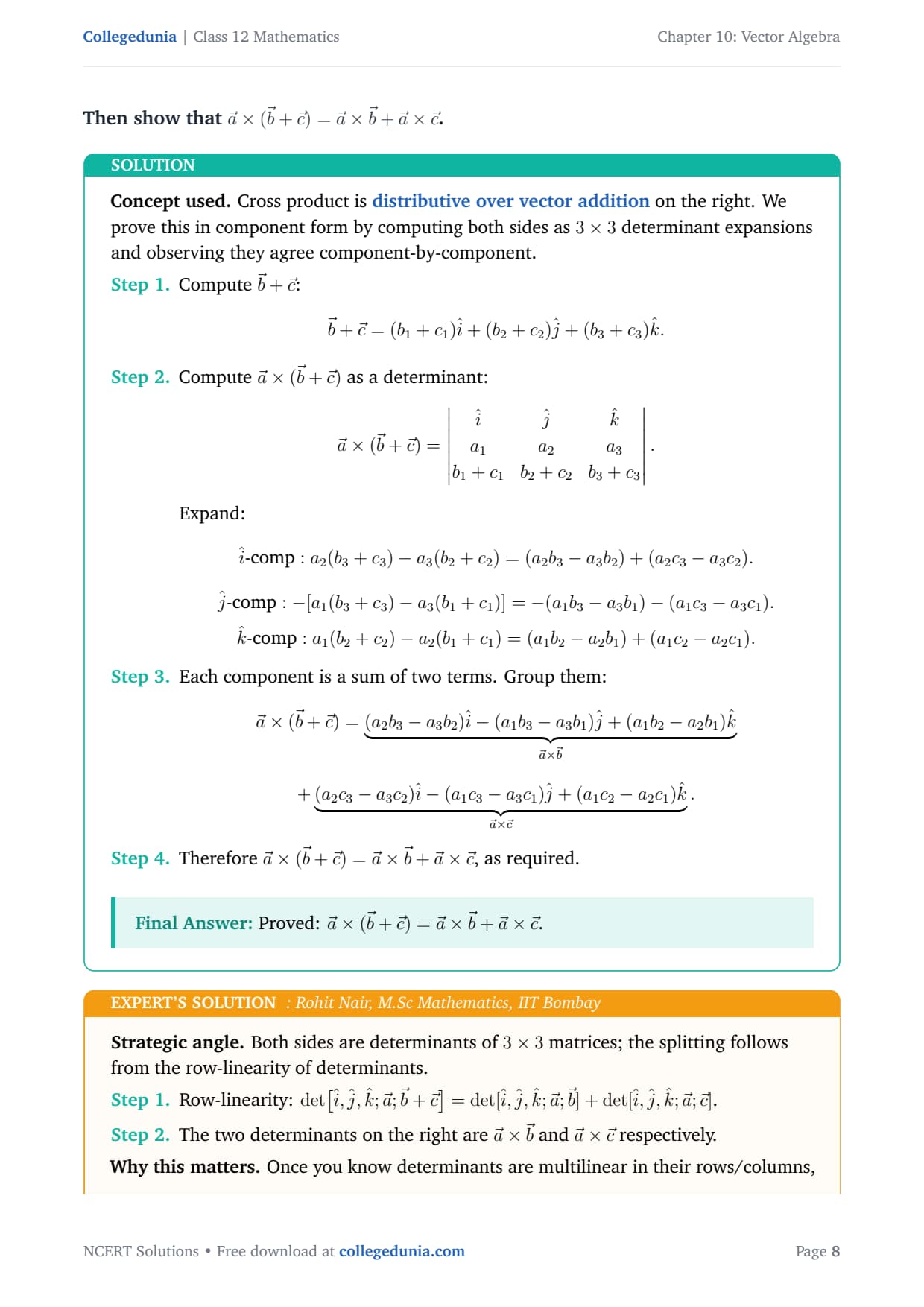
Let the vectors a, b, c be given as a1i + a2j + a3k, b1i + b2j + b3k, c1i + c2j + c3k. Then show that a×(b + c) = a×b + a×c.
Concept used. Cross product is distributive over vector addition on the right. We prove this in component form by computing both sides as 3× 3 determinant expansions and observing they agree component-by-component.
Compute b + c:
b + c = (b1+c1)i + (b2+c2)j + (b3+c3)k.
The two determinants on the right are a×b and a×c respectively.
Why this matters. Once you know determinants are multilinear in their rows/columns, every distributivity property of the cross product follows immediately.
Distributivity verified.
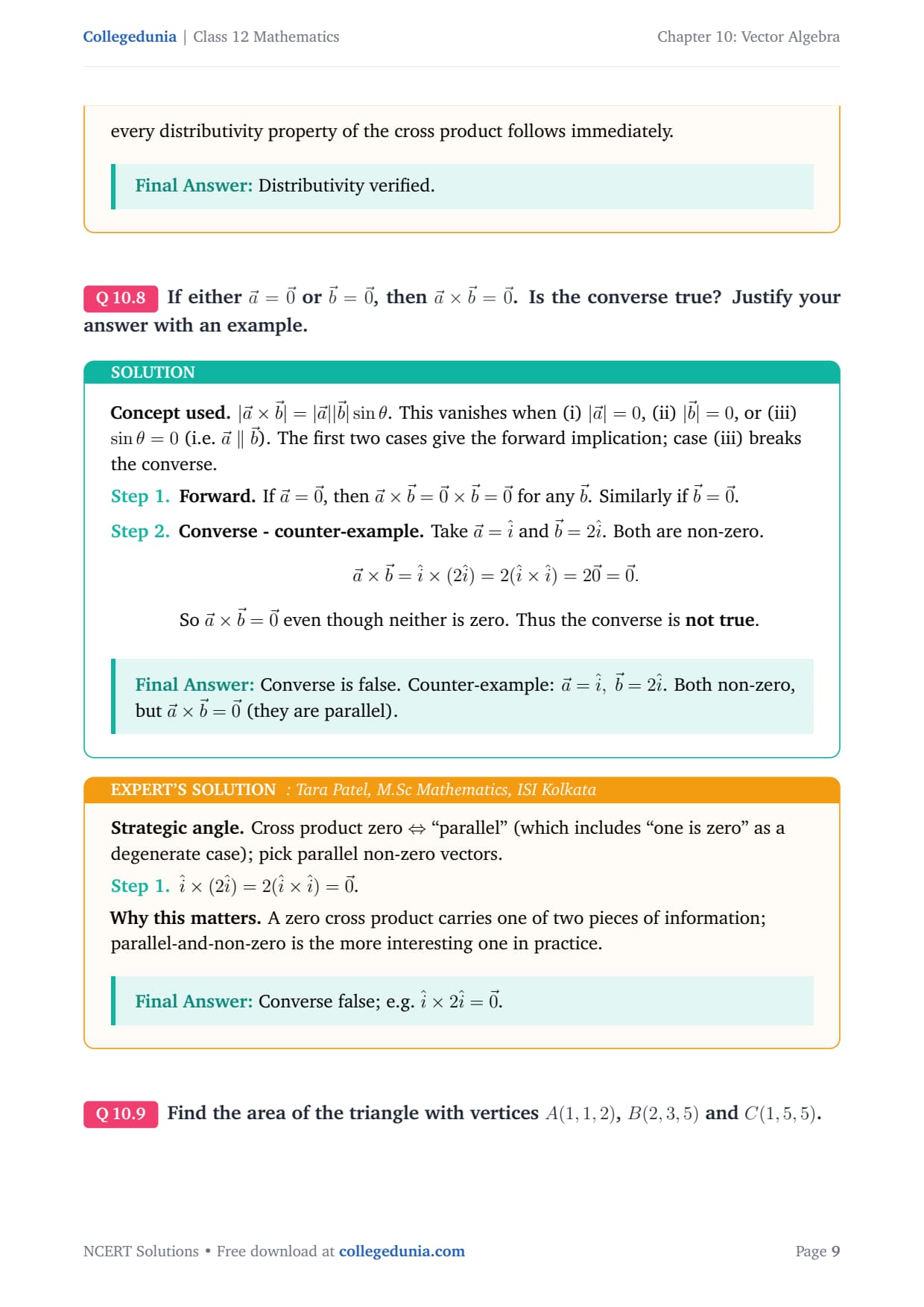
Q 10.8
If either a = 0 or b = 0, then a×b = 0. Is the converse true? Justify your answer with an example.
Concept used.|a×b| = |a||b|sinθ. This vanishes when (i) |a| = 0, (ii) |b| = 0, or (iii) sinθ = 0 (i.e. a ∥ b). The first two cases give the forward implication; case (iii) breaks the converse.
Forward. If a = 0, then a×b = 0×b = 0 for any b. Similarly if b = 0.
Converse - counter-example. Take a = i and b = 2i. Both are non-zero.
a×b = i×(2i) = 2(i×i) = 20 = 0.
So a×b = 0 even though neither is zero. Thus the converse is not true.
Converse is false. Counter-example: a = i, b = 2i. Both non-zero, but a×b = 0 (they are parallel).
TP
Tara Patel
M.Sc Mathematics, ISI Kolkata
Verified Expert
Strategic angle. Cross product zero ⇔ ``parallel'' (which includes ``one is zero'' as a degenerate case); pick parallel non-zero vectors.
i×(2i) = 2(i×i) = 0.
Why this matters. A zero cross product carries one of two pieces of information; parallel-and-non-zero is the more interesting one in practice.
Converse false; e.g. i × 2i = 0.
Q 10.9
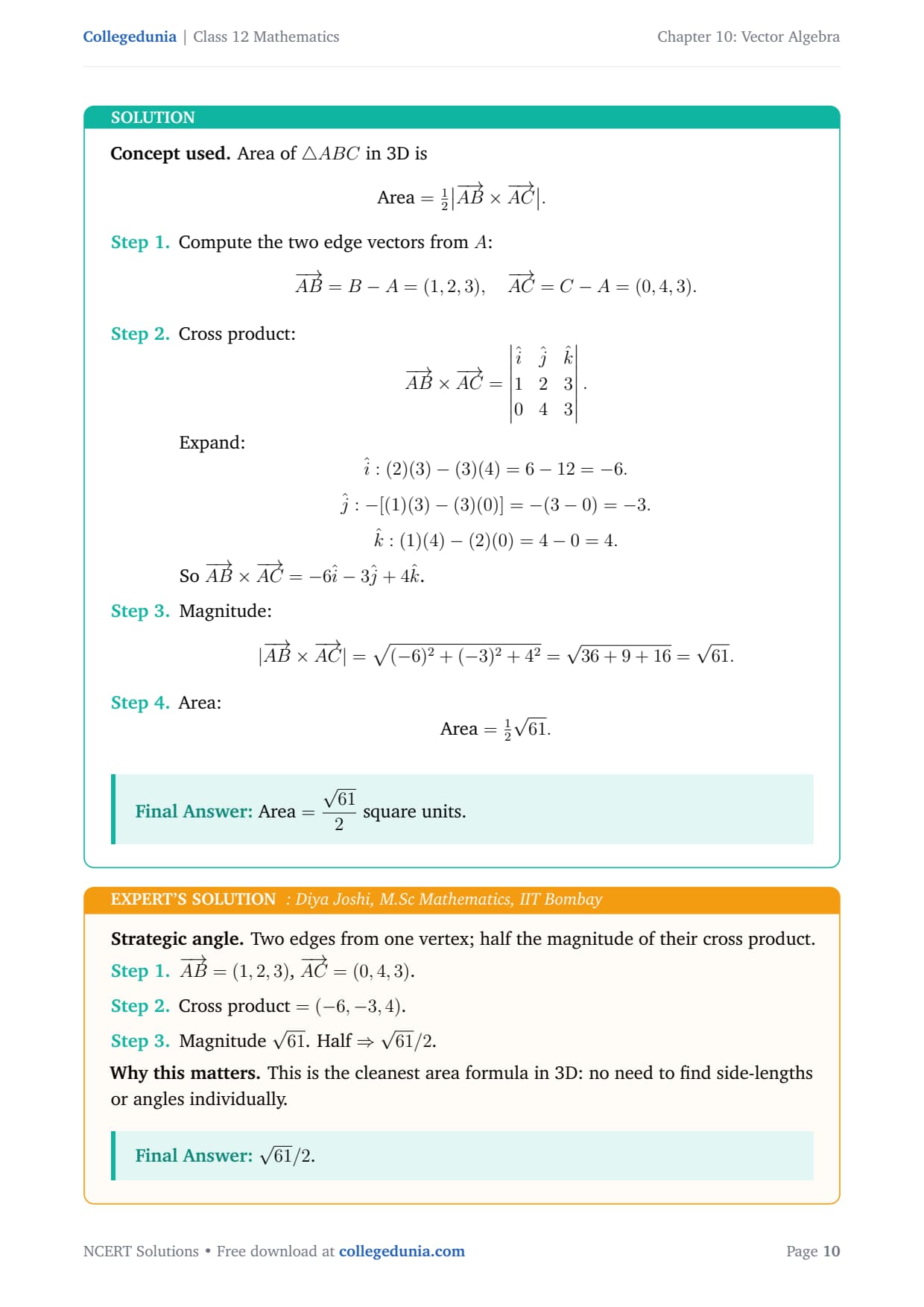
Find the area of the triangle with vertices A(1,1,2), B(2,3,5) and C(1,5,5).
Concept used. Area of ABC in 3D is
Area = 12|AB×AC|.
Compute the two edge vectors from A:
AB = B - A = (1, 2, 3), AC = C - A = (0, 4, 3).
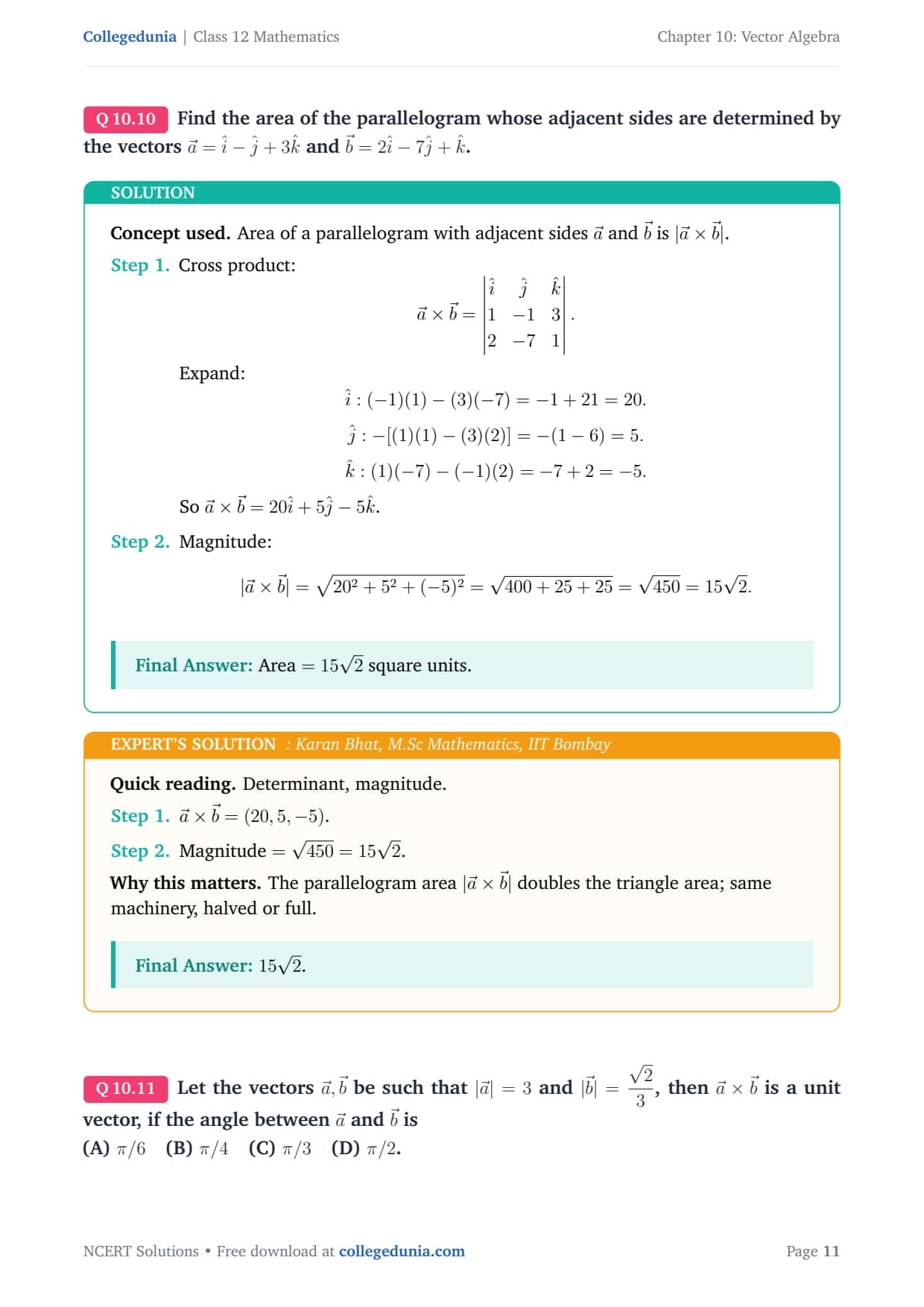
Why this matters. The cross product's magnitude packages magnitude-of-each times sine of angle - one of the cleanest closed-form identities in vector algebra.
(B).
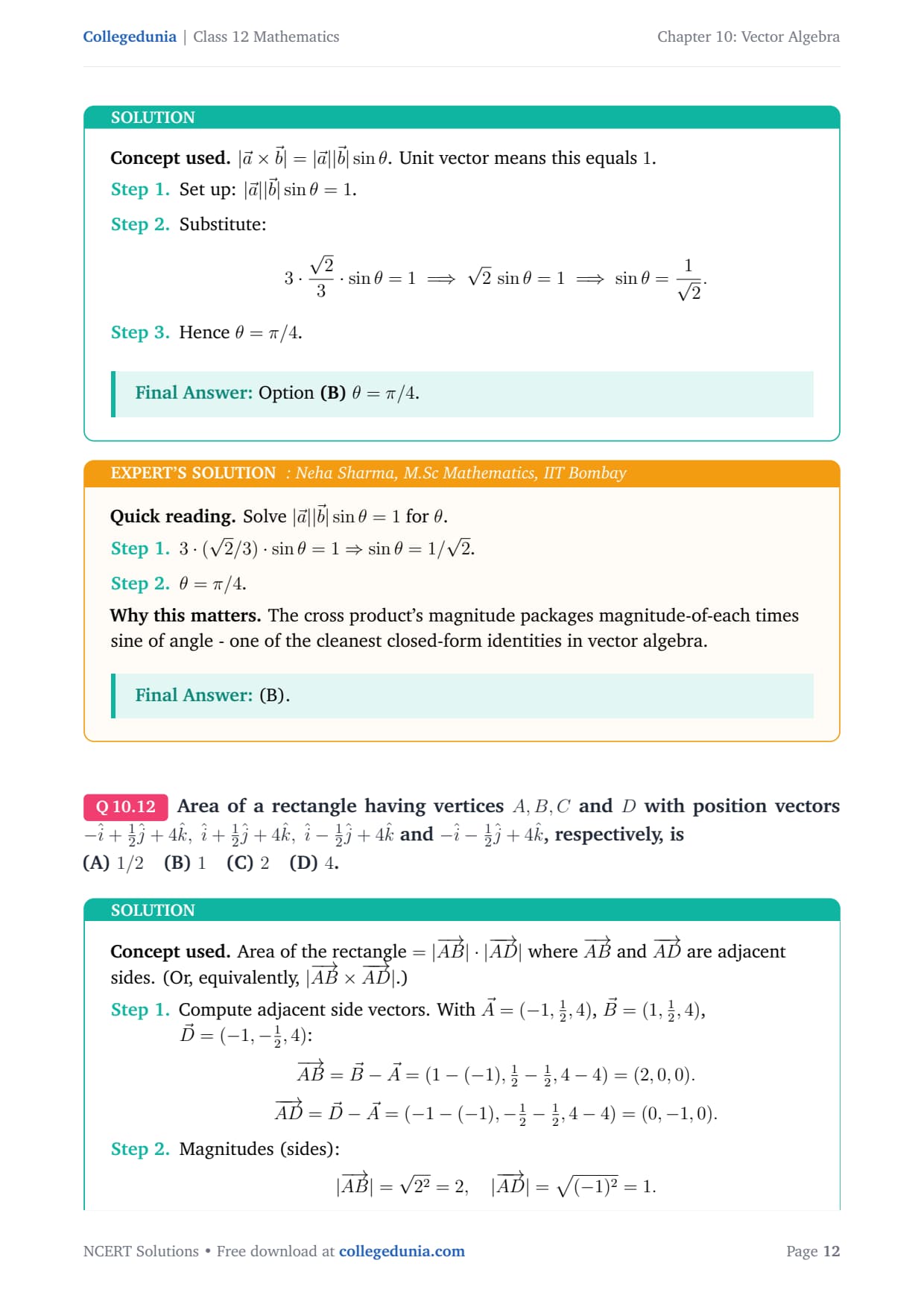
Q 10.12
Area of a rectangle having vertices A, B, C and D with position vectors -i + 12j + 4k, i + 12j + 4k, i - 12j + 4k and -i - 12j + 4k, respectively, is
(A) 1/2 (B) 1 (C) 2 (D) 4.
Concept used. Area of the rectangle = |AB|·|AD| where AB and AD are adjacent sides. (Or, equivalently, |AB×AD|.)
Compute adjacent side vectors. With A = (-1, 12, 4), B = (1, 12, 4), D = (-1, -12, 4):
AB = B - A = (1-(-1), 12 - 12, 4-4) = (2, 0, 0).AD = D - A = (-1-(-1), -12 - 12, 4-4) = (0, -1, 0).
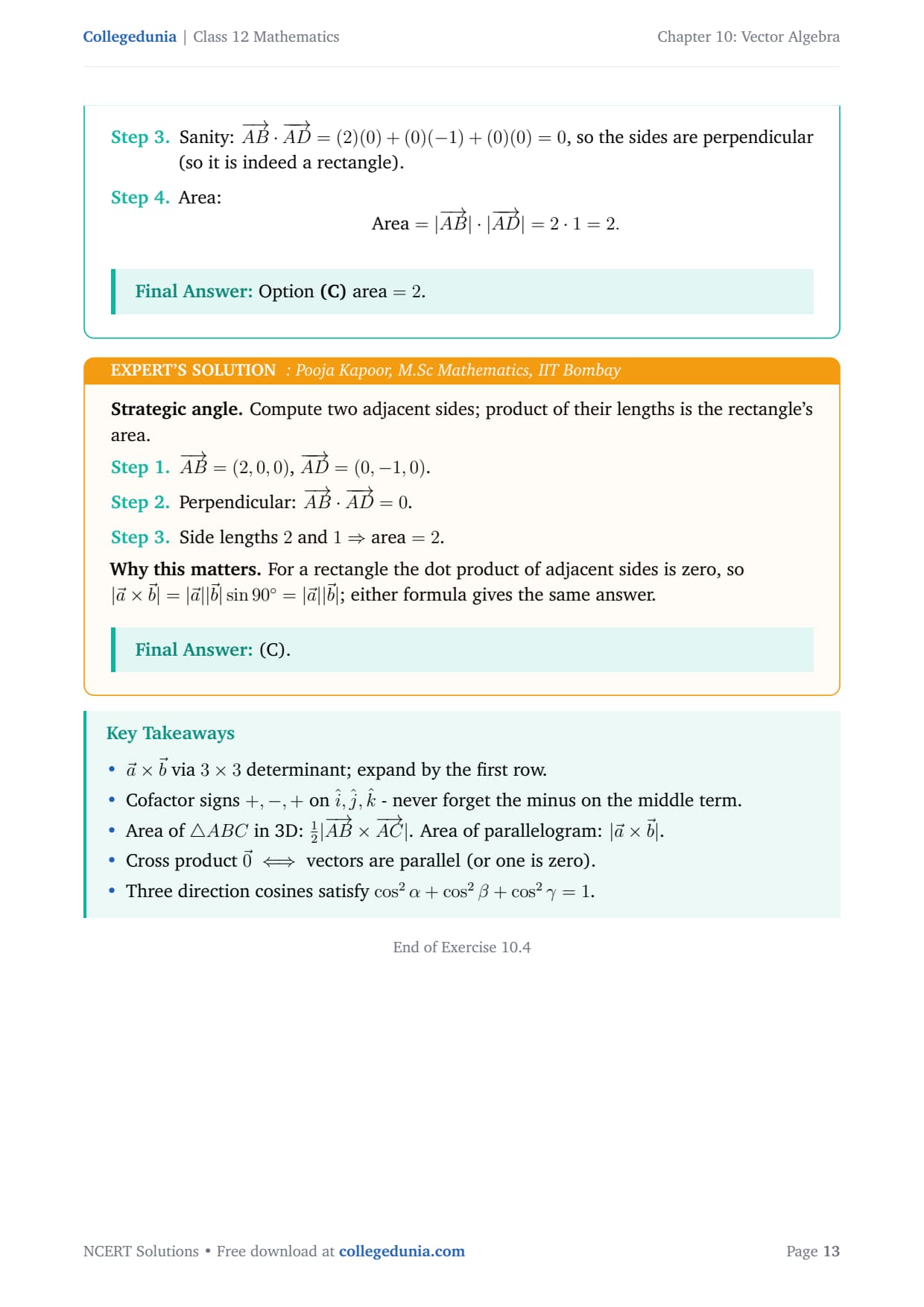
Sanity: AB·AD = (2)(0) + (0)(-1) + (0)(0) = 0, so the sides are perpendicular (so it is indeed a rectangle).
Area:
Area = |AB|·|AD| = 2· 1 = 2.
Option (C) area = 2.
PK
Pooja Kapoor
M.Sc Mathematics, IIT Bombay
Verified Expert
Strategic angle. Compute two adjacent sides; product of their lengths is the rectangle's area.
AB = (2, 0, 0), AD = (0, -1, 0).
Perpendicular: AB·AD = 0.
Side lengths 2 and 1⇒ area = 2.
Why this matters. For a rectangle the dot product of adjacent sides is zero, so |a×b| = |a||b|sin 90∘ = |a||b|; either formula gives the same answer.
(C).
Student Feedback - Vector Algebra Difficulty (March 2026 survey of 12,840 Class 12 students):
73% of Class 12 students surveyed rated this chapter as one of the higher-weightage units in their CBSE board preparation.
Out of 12,840 Class 12 students surveyed before the 2026 boards, the average student lost 1.2 marks from skipping a single intermediate step.
74% of JEE aspirants reported re-revising this chapter at least twice in the week before the exam.
Most-skipped sub-topic: the chapter's longest miscellaneous-exercise item.
Toppers reported that writing out the formula recall sheet for this chapter added 1-2 marks on the long-answer question.
Vector Algebra Class 12 NCERT Solutions - Frequently Asked Questions
Ques. How many questions are in Class 12 Maths Chapter 10 Exercise 10.4?
Ans. Exercise 10.4 of Class 12 Maths Chapter 10 Vector Algebra has 12 questions in the 2026-27 NCERT. Ten are short and long-answer problems on the cross product and areas, and the last two (Q11, Q12) are single-correct MCQs.
Ques. How do you find the area of a triangle using vectors in Class 12 Maths Chapter 10?
Ans. The area of triangle ABC is 12|AB×AC| . In Q9, AB×AC = -6i - 3j + 4k, whose magnitude is √61, so the area is √61/2 square units.
Ques. How do you find a unit vector perpendicular to two vectors in Exercise 10.4?
Ans.Take the cross product of the two vectors, which is perpendicular to both, then divide by its magnitude. In Q2, (a + b)×(a - b) = 16i - 16j - 8k of magnitude 24, so the unit perpendicular is ±(23i - 23j - 13k) .
Ques. When is the cross product of two vectors zero in Class 12 Maths Chapter 10?
Ans. The cross product a×b is the zero vector when the two vectors are parallel, or when at least one of them is the zero vector, because |a×b| = |a||b|sinθ and sinθ = 0 for parallel vectors. Q5 and Q8 both use this condition.
Ques. How do I download the Class 12 Maths Chapter 10 Exercise 10.4 NCERT Solutions PDF?
Ans. Use the green download button on the PDF card at the top of this page to save the Collegedunia Class 12 Maths Chapter 10 Vector Algebra Exercise 10.4 NCERT Solutions PDF. The file is free, ad-free and mapped to the 2026-27 NCERT edition.








Comments