Junior-Class Mentor, TFI Fellow | Updated 3+ months ago
NCERT Solutions for Class 12 Maths Chapter 1 Relations and Functions Exercise 1.1 cover all 16 questions on types of relations. Each answer checks reflexivity, symmetry, and transitivity step by step, matched to the 2026-27 NCERT syllabus. You can download the full Exercise 1.1 solutions as a free PDF from this page.
The overall marks weightage of Chapter 1 in CBSE Boards exam varies between 8-10 marks including both short answer type and mutiple choice questions.
CBSE Weightage: 8-10 marks (full Ch 1)
JEE Main: 2-3% of the entire Mathematics paper
Question Count in Ex 1.1: 16 (14 SA + 2 MCQ)
Solved by Collegedunia experts. Every answer follows the NCERT 2026-27 print and shows each property check the way CBSE marks it.
How will Collegedunia's NCERT Solutions for Class 12 Maths Exercise 1.1 help you?
Exercise 1.1 is the conceptual gate for the entire chapter. The questions look short, but they reward strict logical writing: you must show each of the three relation properties separately before concluding equivalence.
Our solutions structure every answer the same way - state R, list a sample pair, check reflexivity, check symmetry, check transitivity, then conclude - so you internalise the pattern by Q4 and stop losing the easy 1-mark concluding line.
You also get the counter-example technique for the non-equivalence proofs: pick the smallest concrete pair that breaks the property. The same format carries into Exercise 1.2 and the CBSE case-study questions.
Relations and Functions Ex 1.1 Solved Step by Step (Video)
Topics Covered in Class 12 Maths Chapter 1 Exercise 1.1
Before tackling the 16 problems, lock in the five sub-concepts the exercise tests. Roughly half the questions check one property at a time; the rest combine all three into an equivalence-relation proof.
Sub-concept
Definition
Questions in Ex 1.1
Empty relation
R = φ (no element of A is related to any other)
Q1 (a)
Universal relation
R = A × A (every element related to every other)
Q1 (b)
Reflexive
(a, a) ∈ R for every a ∈ A
Q1, Q2, Q3, Q5-Q14
Symmetric
(a, b) ∈ R ⇒ (b, a) ∈ R
Q1, Q2, Q3, Q5-Q14
Transitive
(a, b), (b, c) ∈ R ⇒ (a, c) ∈ R
Q1, Q2, Q3, Q5-Q14
Equivalence relation
Reflexive + symmetric + transitive
Q9, Q10, Q11, Q12, Q13, Q15, Q16
Question-Wise Breakdown of NCERT Class 12 Maths Exercise 1.1
The 16 questions cluster into three difficulty bands. The equivalence-class questions (Q9-Q16) carry the heaviest marks, since each property check is worth 1 mark.
Q No.
Type
Concept Tested
Difficulty
Q1
SA (5 parts)
Check each property on relations defined on N, Z, R
Medium
Q2
SA
Relation on Z by 2-divides-(x-y)
Medium
Q3
SA
Relation on a finite set, counter-example
Easy
Q4
SA
R on R defined by x ≤ y
Medium
Q5
SA
R on R defined by x ≤ y³
Medium
Q6
SA
R on {1,2,3,4,5,6} given as a list
Easy
Q7
SA
R on the set of books in a library
Easy
Q8
SA
R: |a - b| is even, on {1,2,3,4,5}
Hard
Q9
SA
Equivalence relation on integers
Hard
Q10
SA
Counter-examples for each property
Hard
Q11
SA
R on points in a plane: distance from origin
Medium
Q12
SA
R on triangles: similar triangles
Medium
Q13
SA
R on polygons: same number of sides
Medium
Q14
SA
R on lines in a plane: parallel lines
Medium
Q15
MCQ
Identify properties of a given relation
Easy
Q16
MCQ
Identify properties of a given relation
Easy
Important Formulae & Definitions for Exercise 1.1
The exercise rarely needs computation; it needs precise definitions. Keep this micro-sheet next to you while solving.
Reflexive: R on A is reflexive if (a, a) ∈ R for all a ∈ A.
Symmetric: R is symmetric if (a, b) ∈ R ⇒ (b, a) ∈ R for all a, b ∈ A.
Transitive: R is transitive if (a, b) ∈ R and (b, c) ∈ R ⇒ (a, c) ∈ R.
Equivalence: R is an equivalence relation if it is reflexive, symmetric, and transitive.
Equivalence Class: [a] = x ∈ A : (x, a) ∈ R. Equivalence classes partition A.
Sample Solved Question from Exercise 1.1
Here is Q1(i) solved in the Collegedunia step-format, showing each property check before the verdict.
Question 1(i): Determine whether the relation R in the set A = 1, 2, 3, …, 13, 14 defined as R = (x, y) : 3x - y = 0 is reflexive, symmetric, or transitive.
Step 1 - Write R explicitly. R = {(1, 3), (2, 6), (3, 9), (4, 12)}.
Step 2 - Reflexive? For reflexivity, (a, a) must be in R for every a ∈ A. Check (1, 1): 3(1) - 1 = 2 ≠ 0 . So (1, 1) ∉ R. R is not reflexive.
Step 3 - Symmetric? (1, 3) ∈ R but (3, 1) ∉ R because 3(3) - 1 = 8 ≠ 0 . R is not symmetric.
Step 4 - Transitive? (1, 3) ∈ R and (3, 9) ∈ R but (1, 9) ∉ R because 3(1) - 9 = -6 ≠ 0 . R is not transitive.
Conclusion: R is neither reflexive, nor symmetric, nor transitive.
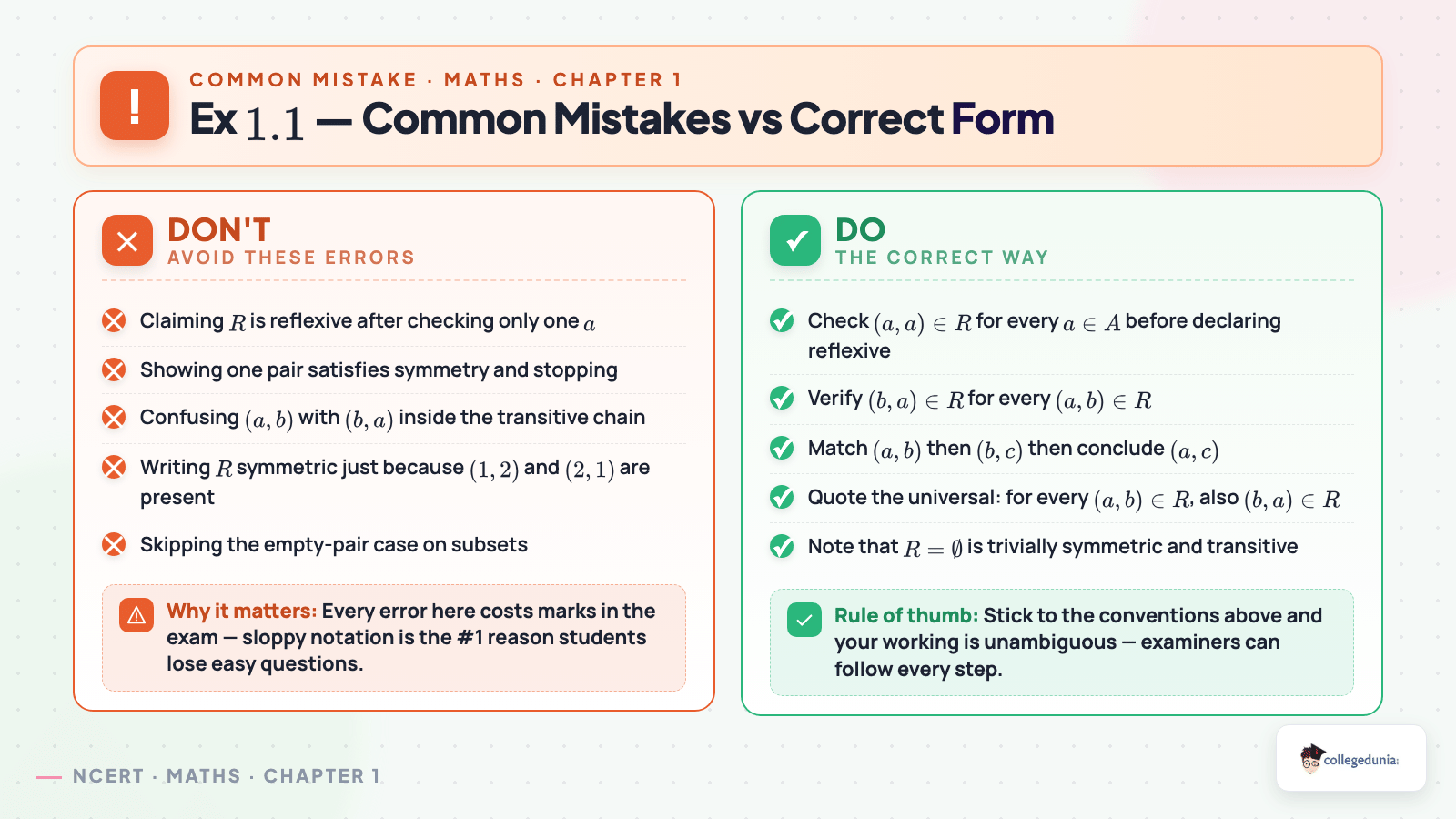
Common Mistakes Students Make in Class 12 Maths Ex 1.1
Each solution is written in formal notation, line by line, matching the official NCERT print.
These six errors cost the most marks in the official CBSE marking scheme for Chapter 1.
Skipping the explicit check. Writing "R is reflexive" without showing (a, a) ∈ R for a sample loses 1 mark per property.
Treating ≤ as symmetric. 2 ≤ 3 does not imply 3 ≤ 2 . Students confuse "ordered" with "symmetric".
Forgetting the empty relation is vacuously transitive. If R = φ, all three properties (except reflexivity on a non-empty set) hold vacuously.
Picking a bad counter-example. Use the smallest concrete pair, not abstract symbols, when CBSE asks for a counter-example.
Confusing |a - b| even with a - b even. They are the same on integers but students sometimes split into cases incorrectly.
Not writing the conclusion line. The final 1 mark is for stating "Hence R is/is not an equivalence relation".
Exercise-wise Breakdown of the Relations and Functions Chapter
The Relations and Functions chapter splits into 2 numbered exercises plus a Miscellaneous Exercise. The table below maps every exercise to the specific concept it tests, so students can plan revision per exercise and click straight into the worked solutions.
Mixed concepts; bijection-invertibility and counting
All NCERT Solutions for Relations and Functions Ex 1.1 with Step-by-Step Working
Every NCERT textbook question for Class 12 Mathematics Chapter 1 Relations and Functions Ex 1.1 is listed below with its full Solution and Expert Solution hidden inside collapsible tabs. Click Check Solution to reveal the step-by-step working; click Expert Solution for the expanded explanation.
Questions
Q 1.1
Determine whether each of the following relations are reflexive, symmetric and transitive:
(i) Relation R in the set A = 1, 2, 3, …, 13, 14 defined as R = (x, y) : 3x - y = 0.
(ii) Relation R in the set N of natural numbers defined as R = (x, y) : y = x + 5 and x < 4.
(iii) Relation R in the set A = 1, 2, 3, 4, 5, 6 as R = (x, y) : y is divisible by x.
(iv) Relation R in the set Z of all integers defined as R = (x, y) : x - y is an integer.
(v) Relation R in the set A of human beings in a town at a particular time given by: (a) R = (x, y) : x and y work at the same place; (b) R = (x, y) : x and y live in the same locality; (c) R = (x, y) : x is exactly 7 cm taller than y; (d) R = (x, y) : x is wife of y; (e) R = (x, y) : x is father of y.
Concept used. A relation R on a non-empty set A is a subset of A × A. It is called reflexive when (a,a) ∈ R for every a ∈ A. It is called symmetric when (a,b) ∈ R forces (b,a) ∈ R for every pair. It is called transitive when (a,b) ∈ R together with (b,c) ∈ R forces (a,c) ∈ R. To prove a property we argue for an arbitrary element; to disprove a property a single counter-example is enough.
(i) On A = 1,2,…,14 with R = (x,y) : 3x - y = 0. Rewriting the rule as y = 3x and restricting both coordinates to A gives R = (1,3),(2,6),(3,9),(4,12). Reflexive? Take a = 1. Then (1,1) requires 3(1) - 1 = 0, but 3 - 1 = 2 ≠ 0. So (1,1) ∉ R and R is not reflexive. Symmetric?(1,3) ∈ R, but (3,1) requires 3(3) - 1 = 0, i.e. 8 = 0, which is false. So R is not symmetric. Transitive? The only chain available is (1,3) and (3,9); for transitivity we would need (1,9) ∈ R, but (1,9) requires 3(1) - 9 = -6 = 0, false. So R is not transitive.
(ii) On N with R = (x,y) : y = x + 5, x < 4. Only x = 1, 2, 3 are allowed, so R = (1,6),(2,7),(3,8). Reflexive?(1,1) ∈ R would require 1 = 1 + 5, false. Not reflexive. Symmetric?(1,6) ∈ R but (6,1) fails because the rule forces 1 = 6 + 5. Not symmetric. Transitive? For a chain (a,b) and (b,c) in R, b must occur as a second coordinate and also as a first coordinate. The first coordinates of R are 1,2,3 and the second coordinates are 6,7,8; they share nothing. So the premise of transitivity is never met, making the implication vacuously true. Hence R is transitive.
(iii) On A = 1,2,3,4,5,6 with R = (x,y) : xy.Reflexive? For every a ∈ A, a divides a (with quotient 1). So (a,a) ∈ R for all a. Reflexive. Symmetric?(2,4) ∈ R since 2 4, but (4,2) ∉ R since 4 2. Not symmetric. Transitive? If xy and yz, write y = xk and z = ym for integers k, m. Then z = x(km), so xz. Hence (x,y), (y,z) ∈ R ⇒ (x,z) ∈ R. Transitive.
(iv) On Z with R = (x,y) : x - y ∈ Z. Every difference of two integers is itself an integer, so R = Z × Z. Reflexive?a - a = 0 ∈ Z, so (a,a) ∈ R for all a. Reflexive. Symmetric? If x - y ∈ Z, then y - x = -(x - y) ∈ Z. So (y,x) ∈ R. Symmetric. Transitive? If x - y ∈ Z and y - z ∈ Z, then x - z = (x - y) + (y - z) ∈ Z. Transitive.
(v) Five relations on the set A of humans in a town.
[(a)] R = (x,y) : x,y work at the same place. Every person works at the same place as themselves: reflexive. If x works where y works, then y works where x works: symmetric. If x and y share a workplace and y and z share a workplace, all three share that workplace: transitive. [(b)] R = (x,y) : x,y live in the same locality. By the same argument as (a): reflexive, symmetric, and transitive. [(c)] R = (x,y) : x is exactly 7 cm taller than y. Reflexive? A person is not 7 cm taller than themselves (the difference is 0 cm). Not reflexive. Symmetric? If x is 7 cm taller than y, then y is 7 cm shorter than x, not taller. Not symmetric. Transitive? If x is 7 cm taller than y and y is 7 cm taller than z, then x is 14 cm taller than z, not 7 cm. Not transitive. [(d)] R = (x,y) : x is wife of y. Reflexive? A person is not their own wife. Not reflexive. Symmetric? If x is wife of y, then y is husband of x, not wife of x. Not symmetric. Transitive? The premise is rarely met, but more importantly if x is wife of y and y is wife of z the chain cannot exist (no person is wife of two distinct people in this sense), so the implication is vacuously true; the relation is technically transitive. [(e)] R = (x,y) : x is father of y. Not reflexive, since nobody fathers themselves. Not symmetric, since the reverse pair would mean the child fathers the parent. Not transitive: if x fathers y and y fathers z, then x is grandfather (not father) of z.
Two-coordinate check
For any relation, list a few sample pairs. Reflexivity is the easiest to break: a single a with (a,a) ∉ R disproves it. Symmetry usually fails when the rule is directional (greater than, divides, taller than).
(i) None. (ii) Transitive only. (iii) Reflexive, transitive. (iv) All three (equivalence). (v) (a),(b) all three; (c) none; (d) transitive only; (e) none.
AI
Arjun Iyer
M.Sc Mathematics, IIT Bombay
Verified Expert
Strategic angle. Instead of memorising the three definitions, picture them on a graph whose nodes are the elements of A and whose directed edges are the pairs of R. Reflexive means every node has a self-loop. Symmetric means every edge has a partner running the opposite way. Transitive means whenever you can walk two edges in succession, there is a direct edge from start to end.
For (i) draw the graph on 1,…,14. The edges are 1 → 3, 2 → 6, 3 → 9, 4 → 12. No self-loops anywhere, so not reflexive. No paired edges, so not symmetric. The chain 1 → 3 → 9 has no shortcut 1 → 9, so not transitive.
For (ii) the edges are 1 → 6, 2 → 7, 3 → 8. No self-loops ⇒ not reflexive. No return edges ⇒ not symmetric. Crucially, no two edges share a middle node, so transitivity is vacuously true: ``if you can find a chain a → b → c, then a → c is in R'' is satisfied because no such chain exists.
For (iii) divisibility on 1,…,6 gives self-loops at every node (since aa). The edge 2 → 4 has no return edge 4 → 2. For transitivity, xy and yz together force xz from the multiplicative chain y = xk, z = ym ⇒ z = x(km), which is an integer multiple of x.
For (iv) every integer minus every integer is again an integer, so the entire Z × Z is the relation. The universal relation on any set is automatically an equivalence.
For (v) write down a representative pair for each sub-relation and apply the three tests. ``Same workplace'' and ``same locality'' partition humans into groups, which is the hallmark of an equivalence. ``Wife of'' is anti-symmetric (the reverse is a different relation: ``husband of''). ``7 cm taller'' adds heights, so chaining doubles the gap and breaks transitivity. ``Father of'' chains into ``grandfather of''.
Why this matters. The reflexive–symmetric–transitive checklist is the gateway to equivalence relations and the partition theorem, which you will use everywhere from modular arithmetic to topology.
(i) None; (ii) Transitive; (iii) Reflexive and Transitive; (iv) Equivalence; (v.a)(v.b) Equivalence; (v.c) None; (v.d) Transitive; (v.e) None.
Q 1.2
Show that the relation R in the set R of real numbers, defined as R = (a, b) : a ≤ b2, is neither reflexive nor symmetric nor transitive.
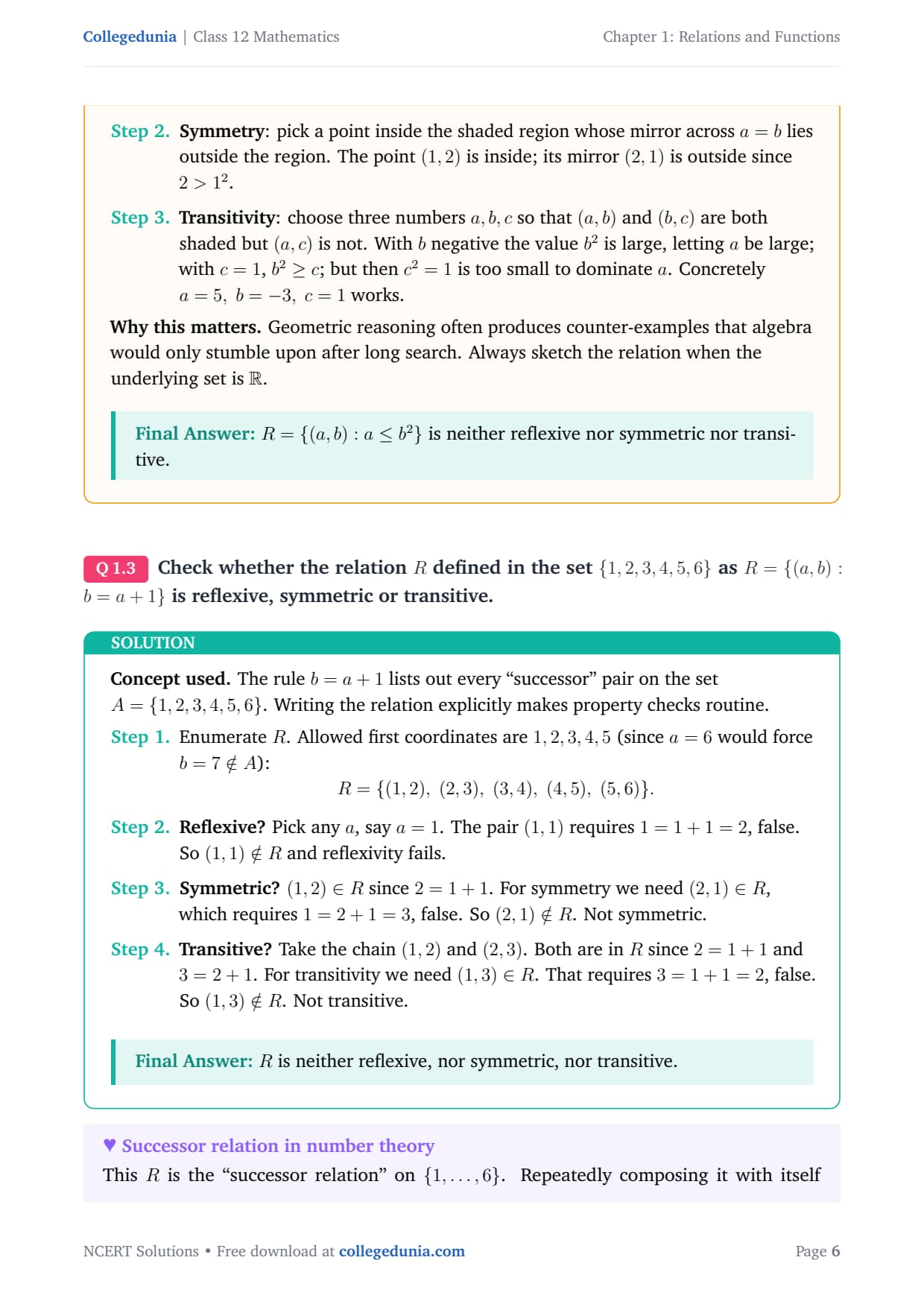
Concept used. For a single number a the pair (a,a) belongs to R exactly when a ≤ a2. The inequality a ≤ a2 rearranges to a(a-1) ≥ 0, which holds when a ≤ 0 or a ≥ 1 but fails when 0 < a < 1. We exploit this gap by choosing a counter-example in (0,1), typically a = 12.
Not reflexive. Pick a = 12. Compute the right-hand side first: a2 = (12)2 = 14. Now check the inequality a ≤ a2: 12 ≤ 14 ? ⇒ 0.5 ≤ 0.25 ? . Hence (12, 12) ∉ R, so R is not reflexive.
Not symmetric. Choose a = 1 and b = 2. Check (1,2): is 1 ≤ 22? 1 ≤ 4, true. So (1,2) ∈ R. Check (2,1): is 2 ≤ 12? 2 ≤ 1, false. So (2,1) ∉ R. Symmetry is broken.
Not transitive. Choose a = 10, b = -2, c = 1. Check (10,-2): is 10 ≤ (-2)2 = 4? 10 ≤ 4, false; this pair is NOT in R, so it does not produce a chain. Try instead a = 5, b = -3, c = 1. Check (5,-3): is 5 ≤ (-3)2 = 9? Yes. So (5,-3) ∈ R. Check (-3,1): is -3 ≤ 12 = 1? Yes. So (-3,1) ∈ R. Check (5,1): is 5 ≤ 12 = 1? No. So (5,1) ∉ R. We have a chain (5,-3), (-3,1) in R but no shortcut (5,1). Transitivity fails.
R is neither reflexive, nor symmetric, nor transitive.
PS
Priya Sharma
Ph.D Mathematics, IIT Delhi
Verified Expert
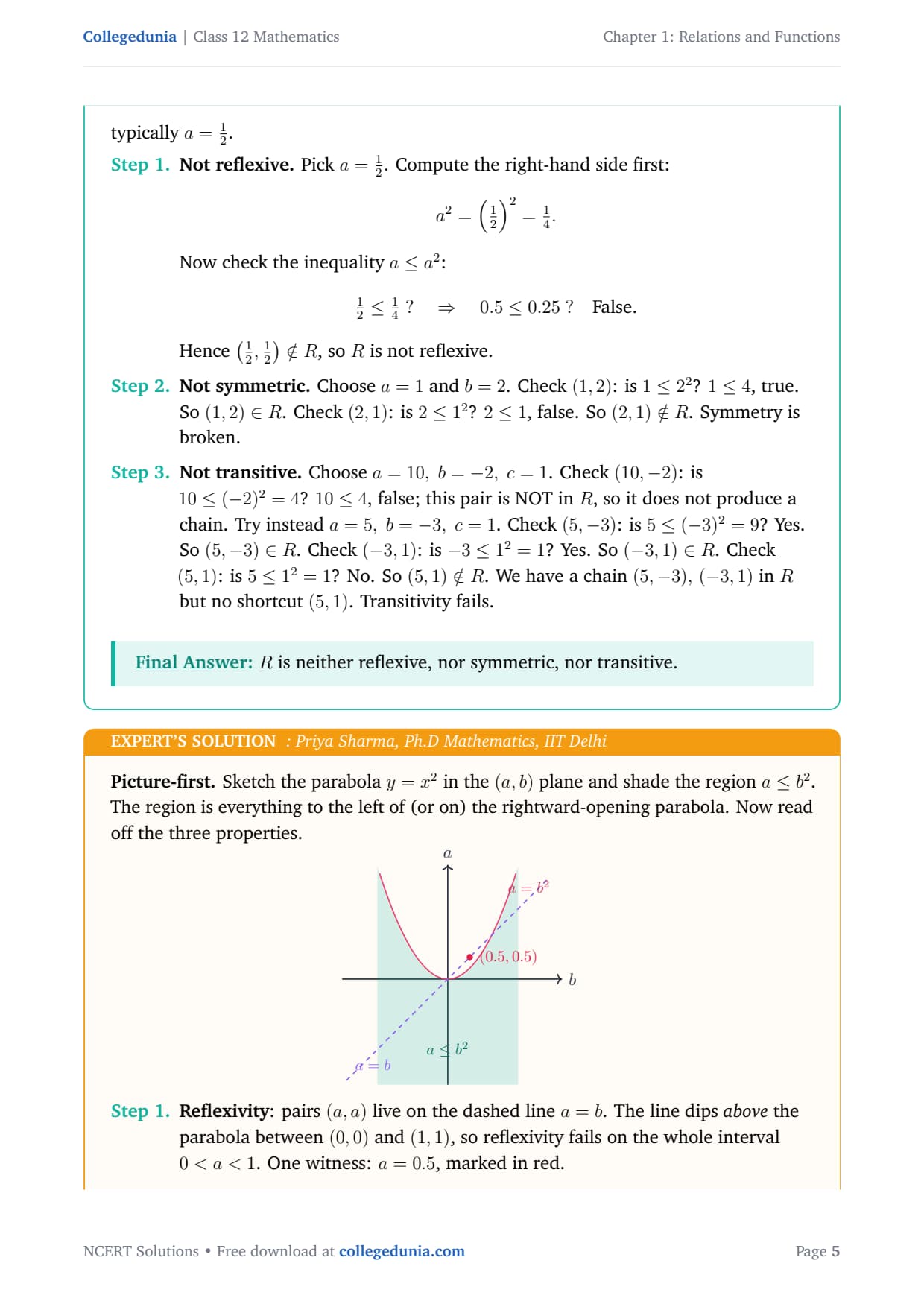
Picture-first. Sketch the parabola y = x2 in the (a,b) plane and shade the region a ≤ b2. The region is everything to the left of (or on) the rightward-opening parabola. Now read off the three properties.
[See diagram in the PDF version]
Reflexivity: pairs (a,a) live on the dashed line a = b. The line dips above the parabola between (0,0) and (1,1), so reflexivity fails on the whole interval 0 < a < 1. One witness: a = 0.5, marked in red.
Symmetry: pick a point inside the shaded region whose mirror across a = b lies outside the region. The point (1, 2) is inside; its mirror (2, 1) is outside since 2 > 12.
Transitivity: choose three numbers a, b, c so that (a, b) and (b, c) are both shaded but (a, c) is not. With b negative the value b2 is large, letting a be large; with c = 1, b2 ≥ c; but then c2 = 1 is too small to dominate a. Concretely a = 5, b = -3, c = 1 works.
Why this matters. Geometric reasoning often produces counter-examples that algebra would only stumble upon after long search. Always sketch the relation when the underlying set is R.
R = (a,b) : a ≤ b2 is neither reflexive nor symmetric nor transitive.
Q 1.3
Check whether the relation R defined in the set 1, 2, 3, 4, 5, 6 as R = (a, b) : b = a + 1 is reflexive, symmetric or transitive.
Concept used. The rule b = a + 1 lists out every ``successor'' pair on the set A = 1,2,3,4,5,6. Writing the relation explicitly makes property checks routine.
Enumerate R. Allowed first coordinates are 1, 2, 3, 4, 5 (since a = 6 would force b = 7 ∉ A): R = (1,2), (2,3), (3,4), (4,5), (5,6).
Reflexive? Pick any a, say a = 1. The pair (1,1) requires 1 = 1 + 1 = 2, false. So (1,1) ∉ R and reflexivity fails.
Symmetric?(1,2) ∈ R since 2 = 1 + 1. For symmetry we need (2,1) ∈ R, which requires 1 = 2 + 1 = 3, false. So (2,1) ∉ R. Not symmetric.
Transitive? Take the chain (1,2) and (2,3). Both are in R since 2 = 1+1 and 3 = 2+1. For transitivity we need (1,3) ∈ R. That requires 3 = 1 + 1 = 2, false. So (1,3) ∉ R. Not transitive.
R is neither reflexive, nor symmetric, nor transitive.
AM
Aanya Mehta
M.Sc Mathematics, ISI Kolkata
Verified Expert
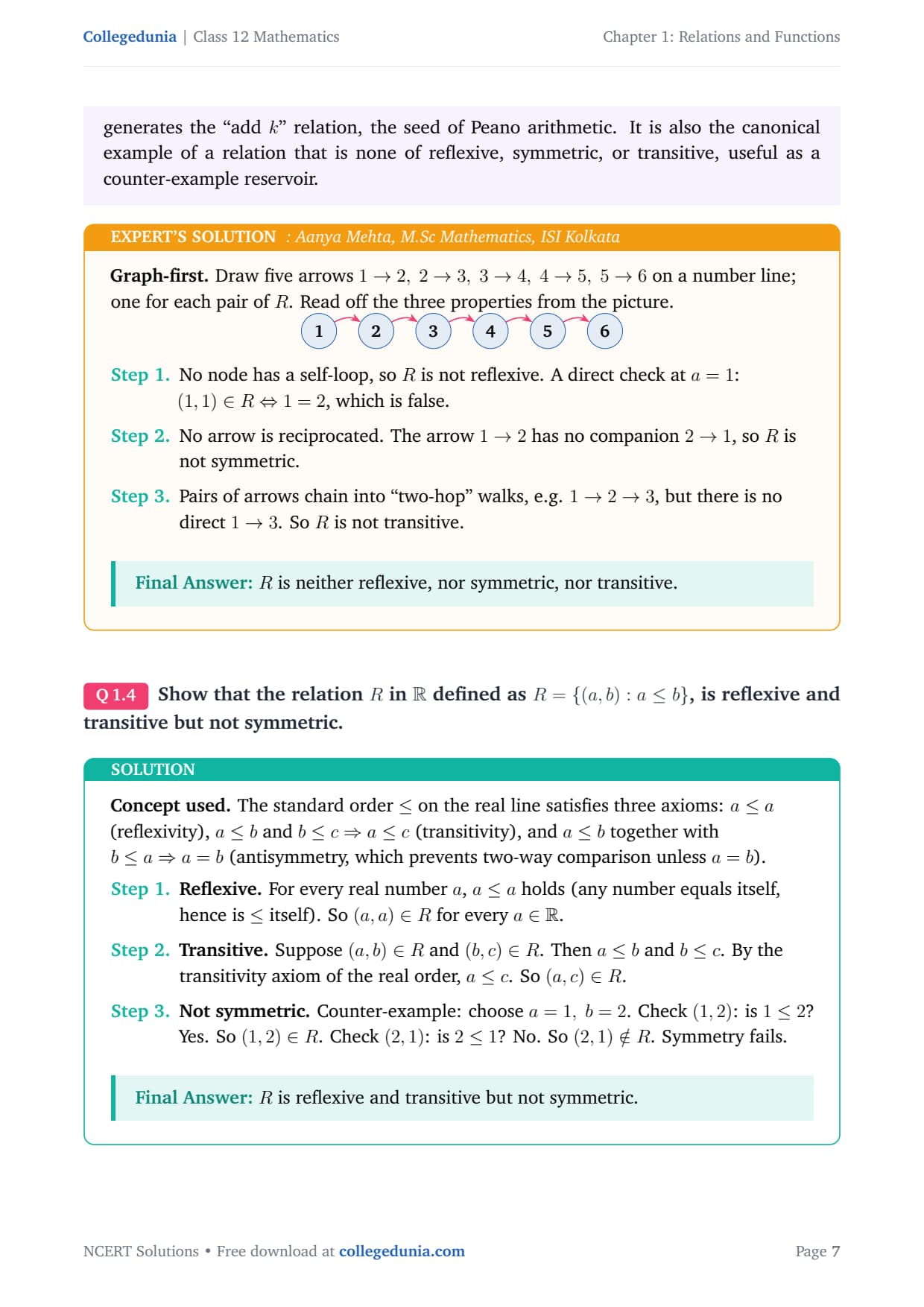
Graph-first. Draw five arrows 1 → 2, 2 → 3, 3 → 4, 4 → 5, 5 → 6 on a number line; one for each pair of R. Read off the three properties from the picture.
[See diagram in the PDF version]
No node has a self-loop, so R is not reflexive. A direct check at a = 1: (1,1) ∈ R ⇔ 1 = 2, which is false.
No arrow is reciprocated. The arrow 1 → 2 has no companion 2 → 1, so R is not symmetric.
Pairs of arrows chain into ``two-hop'' walks, e.g. 1 → 2 → 3, but there is no direct 1 → 3. So R is not transitive.
R is neither reflexive, nor symmetric, nor transitive.
Q 1.4
Show that the relation R in R defined as R = (a, b) : a ≤ b, is reflexive and transitive but not symmetric.
Concept used. The standard order ≤ on the real line satisfies three axioms: a ≤ a (reflexivity), a ≤ b and b ≤ c ⇒ a ≤ c (transitivity), and a ≤ b together with b ≤ a ⇒ a = b (antisymmetry, which prevents two-way comparison unless a = b).
Reflexive. For every real number a, a ≤ a holds (any number equals itself, hence is ≤ itself). So (a, a) ∈ R for every a ∈ R.
Transitive. Suppose (a, b) ∈ R and (b, c) ∈ R. Then a ≤ b and b ≤ c. By the transitivity axiom of the real order, a ≤ c. So (a, c) ∈ R.
Not symmetric. Counter-example: choose a = 1, b = 2. Check (1, 2): is 1 ≤ 2? Yes. So (1, 2) ∈ R. Check (2, 1): is 2 ≤ 1? No. So (2, 1) ∉ R. Symmetry fails.
R is reflexive and transitive but not symmetric.
VK
Vivaan Kumar
Ph.D Pure Mathematics, IISc Bangalore
Verified Expert
Structural observation.≤ is the prototype of a partial order: reflexive, transitive, and antisymmetric. Antisymmetry directly prevents symmetry unless the relation collapses to equality.
Reflexivity. Pick any a ∈ R. The trichotomy law of real numbers states that exactly one of a < a, a = a, a > a holds. Since a = a is true, a ≤ a is true.
Transitivity. Take a ≤ b and b ≤ c. Adding the two inequalities is tempting but wrong; instead, the axiom of order on R states that the relation ≤ is transitive by definition. So a ≤ c.
Symmetry. If a ≤ b implied b ≤ a for all reals, then for any two distinct numbers we would have a ≤ b and b ≤ a, forcing a = b by antisymmetry. A single counter-example a = 1, b = 2 shows this is not the case; 1 ≤ 2 holds but 2 ≤ 1 does not.
Why this matters. Partial orders permeate computer science (subsets, lattices, dependency graphs) and analysis (least-upper-bound axiom). Recognising ≤ as a partial order is the first step toward Zorn's lemma.
Reflexive and transitive, not symmetric.
Q 1.5
Check whether the relation R in R defined by R = (a, b) : a ≤ b3 is reflexive, symmetric or transitive.
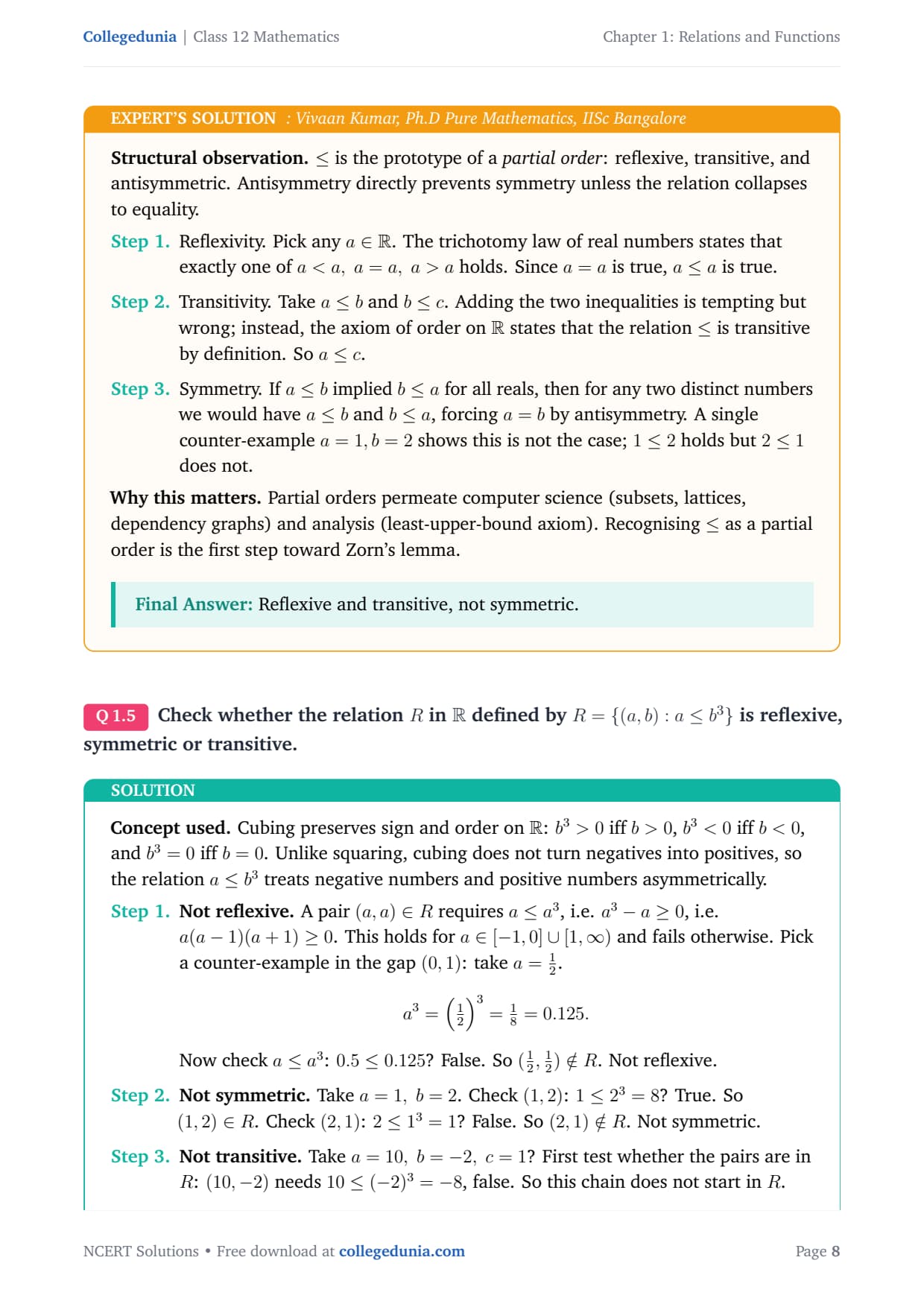
Concept used. Cubing preserves sign and order on R: b3 > 0 iff b > 0, b3 < 0 iff b < 0, and b3 = 0 iff b = 0. Unlike squaring, cubing does not turn negatives into positives, so the relation a ≤ b3 treats negative numbers and positive numbers asymmetrically.
Not reflexive. A pair (a,a) ∈ R requires a ≤ a3, i.e. a3 - a ≥ 0, i.e. a(a-1)(a+1) ≥ 0. This holds for a ∈ [-1, 0] ∪ [1, ∞) and fails otherwise. Pick a counter-example in the gap (0,1): take a = 12. a3 = (12)3 = 18 = 0.125. Now check a ≤ a3: 0.5 ≤ 0.125? False. So (12, 12) ∉ R. Not reflexive.
Not symmetric. Take a = 1, b = 2. Check (1, 2): 1 ≤ 23 = 8? True. So (1,2) ∈ R. Check (2, 1): 2 ≤ 13 = 1? False. So (2,1) ∉ R. Not symmetric.
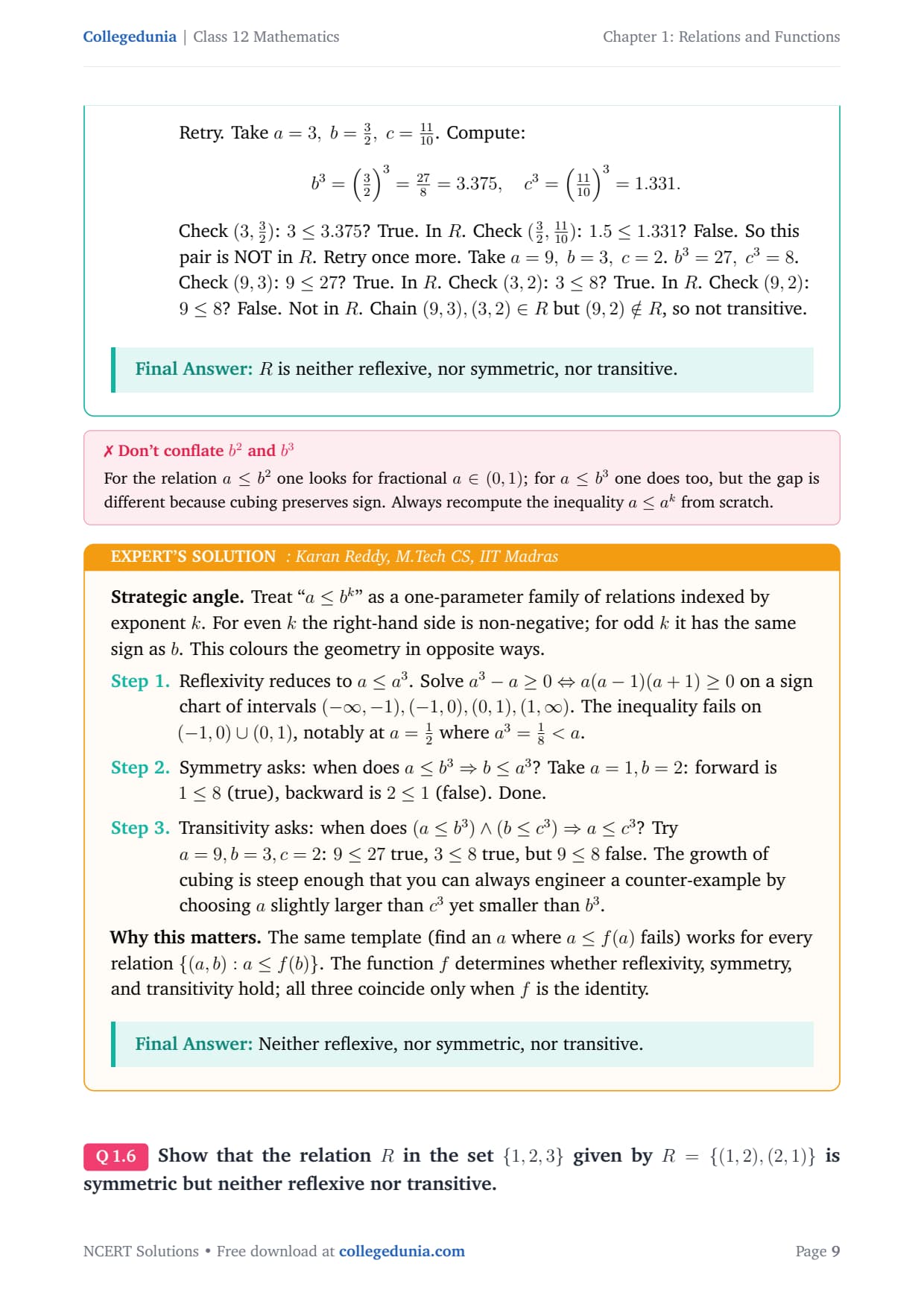
Not transitive. Take a = 10, b = -2, c = 1? First test whether the pairs are in R: (10, -2) needs 10 ≤ (-2)3 = -8, false. So this chain does not start in R. Retry. Take a = 3, b = 32, c = 1110. Compute: b3 = (32)3 = 278 = 3.375, c3 = (1110)3 = 1.331. Check (3, 32): 3 ≤ 3.375? True. In R. Check (32, 1110): 1.5 ≤ 1.331? False. So this pair is NOT in R. Retry once more. Take a = 9, b = 3, c = 2. b3 = 27, c3 = 8. Check (9, 3): 9 ≤ 27? True. In R. Check (3, 2): 3 ≤ 8? True. In R. Check (9, 2): 9 ≤ 8? False. Not in R. Chain (9,3),(3,2) ∈ R but (9,2) ∉ R, so not transitive.
R is neither reflexive, nor symmetric, nor transitive.
KR
Karan Reddy
M.Tech CS, IIT Madras
Verified Expert
Strategic angle. Treat ``a ≤ bk'' as a one-parameter family of relations indexed by exponent k. For even k the right-hand side is non-negative; for odd k it has the same sign as b. This colours the geometry in opposite ways.
Reflexivity reduces to a ≤ a3. Solve a3 - a ≥ 0 ⇔ a(a-1)(a+1) ≥ 0 on a sign chart of intervals (-∞, -1), (-1, 0), (0, 1), (1, ∞). The inequality fails on (-1, 0) ∪ (0, 1), notably at a = 12 where a3 = 18 < a.
Symmetry asks: when does a ≤ b3 ⇒ b ≤ a3? Take a = 1, b = 2: forward is 1 ≤ 8 (true), backward is 2 ≤ 1 (false). Done.
Transitivity asks: when does (a ≤ b3) (b ≤ c3) ⇒ a ≤ c3? Try a = 9, b = 3, c = 2: 9 ≤ 27 true, 3 ≤ 8 true, but 9 ≤ 8 false. The growth of cubing is steep enough that you can always engineer a counter-example by choosing a slightly larger than c3 yet smaller than b3.
Why this matters. The same template (find an a where a ≤ f(a) fails) works for every relation (a,b): a ≤ f(b). The function f determines whether reflexivity, symmetry, and transitivity hold; all three coincide only when f is the identity.
Neither reflexive, nor symmetric, nor transitive.
Q 1.6
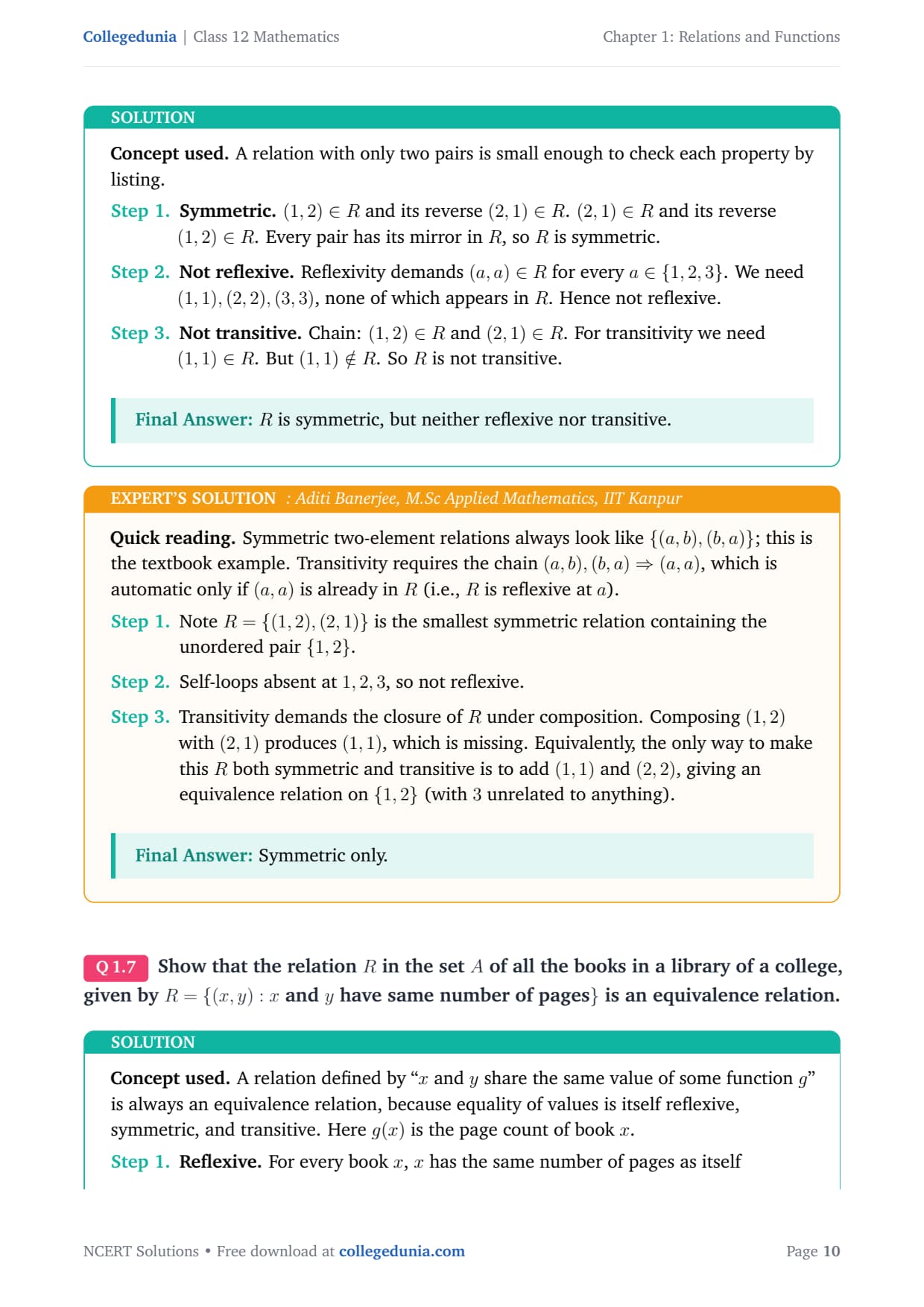
Show that the relation R in the set 1, 2, 3 given by R = (1, 2), (2, 1) is symmetric but neither reflexive nor transitive.
Concept used. A relation with only two pairs is small enough to check each property by listing.
Symmetric.(1,2) ∈ R and its reverse (2,1) ∈ R. (2,1) ∈ R and its reverse (1,2) ∈ R. Every pair has its mirror in R, so R is symmetric.
Not reflexive. Reflexivity demands (a,a) ∈ R for every a ∈ 1,2,3. We need (1,1), (2,2), (3,3), none of which appears in R. Hence not reflexive.
Not transitive. Chain: (1,2) ∈ R and (2,1) ∈ R. For transitivity we need (1,1) ∈ R. But (1,1) ∉ R. So R is not transitive.
R is symmetric, but neither reflexive nor transitive.
AB
Aditi Banerjee
M.Sc Applied Mathematics, IIT Kanpur
Verified Expert
Quick reading. Symmetric two-element relations always look like (a,b),(b,a); this is the textbook example. Transitivity requires the chain (a,b),(b,a) ⇒ (a,a), which is automatic only if (a,a) is already in R (i.e., R is reflexive at a).
Note R = (1,2),(2,1) is the smallest symmetric relation containing the unordered pair 1,2.
Self-loops absent at 1, 2, 3, so not reflexive.
Transitivity demands the closure of R under composition. Composing (1,2) with (2,1) produces (1,1), which is missing. Equivalently, the only way to make this R both symmetric and transitive is to add (1,1) and (2,2), giving an equivalence relation on 1, 2 (with 3 unrelated to anything).
Symmetric only.
Q 1.7
Show that the relation R in the set A of all the books in a library of a college, given by R = (x, y) : x and y have same number of pages is an equivalence relation.
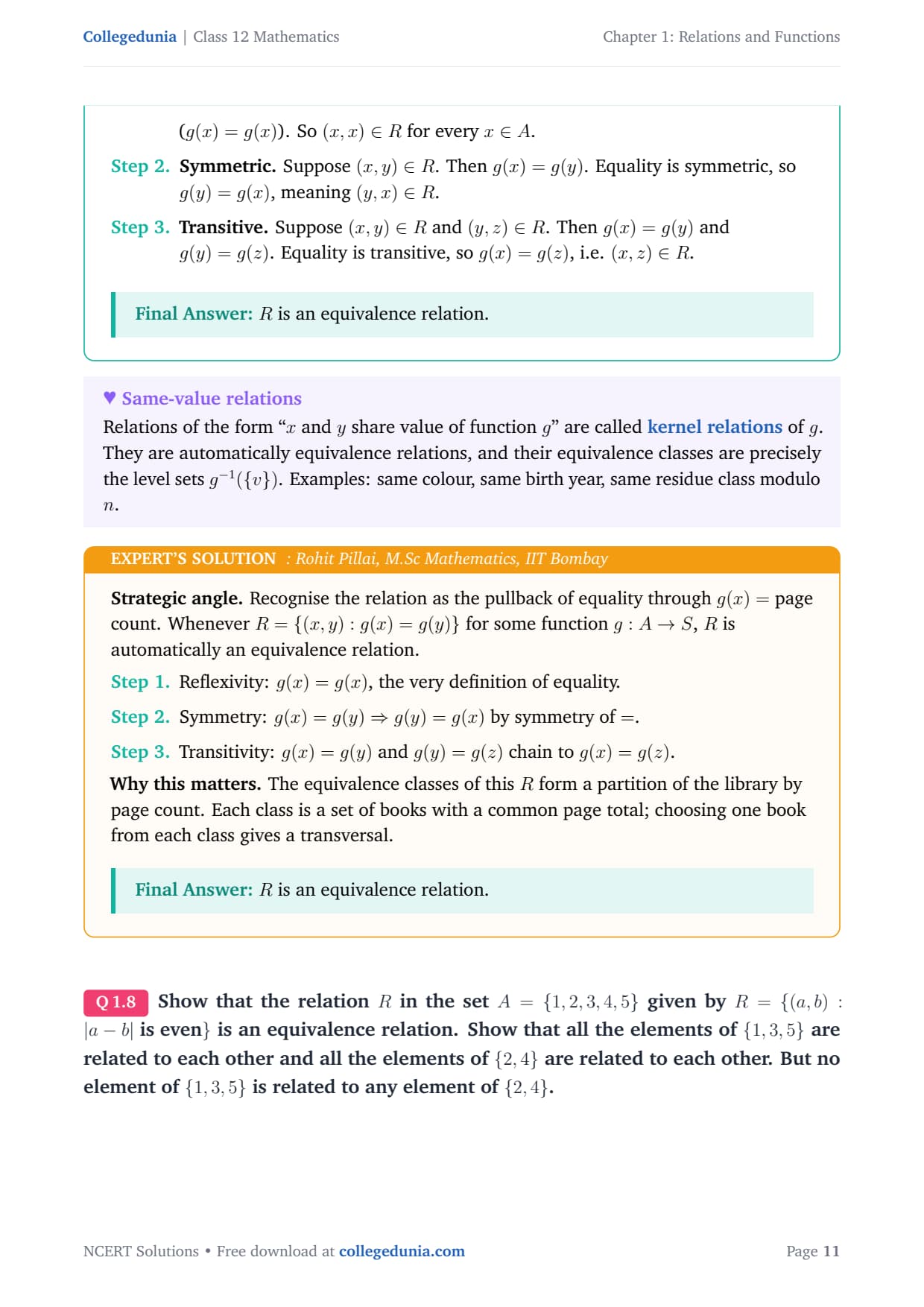
Concept used. A relation defined by ``x and y share the same value of some function g'' is always an equivalence relation, because equality of values is itself reflexive, symmetric, and transitive. Here g(x) is the page count of book x.
Reflexive. For every book x, x has the same number of pages as itself (g(x) = g(x)). So (x, x) ∈ R for every x ∈ A.
Symmetric. Suppose (x, y) ∈ R. Then g(x) = g(y). Equality is symmetric, so g(y) = g(x), meaning (y, x) ∈ R.
Transitive. Suppose (x, y) ∈ R and (y, z) ∈ R. Then g(x) = g(y) and g(y) = g(z). Equality is transitive, so g(x) = g(z), i.e. (x, z) ∈ R.
R is an equivalence relation.
RP
Rohit Pillai
M.Sc Mathematics, IIT Bombay
Verified Expert
Strategic angle. Recognise the relation as the pullback of equality through g(x) = page count. Whenever R = (x,y) : g(x) = g(y) for some function g : A → S, R is automatically an equivalence relation.
Reflexivity: g(x) = g(x), the very definition of equality.
Symmetry: g(x) = g(y) ⇒ g(y) = g(x) by symmetry of =.
Transitivity: g(x) = g(y) and g(y) = g(z) chain to g(x) = g(z).
Why this matters. The equivalence classes of this R form a partition of the library by page count. Each class is a set of books with a common page total; choosing one book from each class gives a transversal.
R is an equivalence relation.
Q 1.8
Show that the relation R in the set A = 1, 2, 3, 4, 5 given by R = (a, b) : |a - b| is even is an equivalence relation. Show that all the elements of 1, 3, 5 are related to each other and all the elements of 2, 4 are related to each other. But no element of 1, 3, 5 is related to any element of 2, 4.
Concept used. The integer difference a - b is even iff a and b have the same parity (both odd or both even). So R is exactly the ``same-parity'' relation on 1, …, 5, which is a kernel relation of the parity function g(n) = n 2.
Reflexive. For any a, |a - a| = 0 is even. So (a, a) ∈ R.
Symmetric. If (a, b) ∈ R then |a - b| is even. But |b - a| = |a - b|, so |b - a| is even too. Hence (b, a) ∈ R.
Transitive. If (a, b), (b, c) ∈ R then |a - b| and |b - c| are both even. Write a - b = 2m, b - c = 2n for integers m, n. Then a - c = (a - b) + (b - c) = 2m + 2n = 2(m + n), which is even, so |a - c| is even and (a, c) ∈ R.
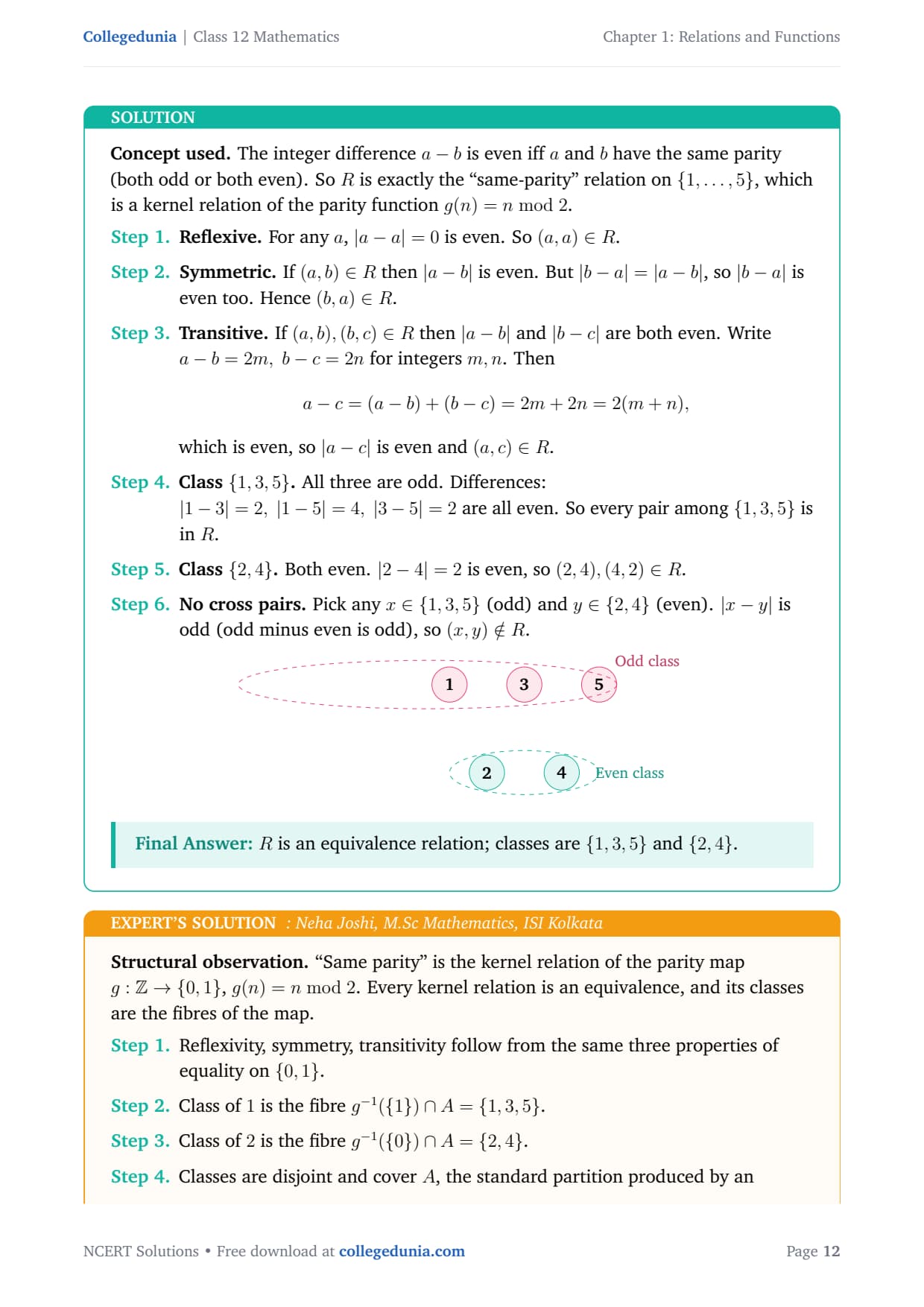
Class 1, 3, 5. All three are odd. Differences: |1-3|=2, |1-5|=4, |3-5|=2 are all even. So every pair among 1,3,5 is in R.
Class 2, 4. Both even. |2-4| = 2 is even, so (2,4),(4,2) ∈ R.
No cross pairs. Pick any x ∈ 1,3,5 (odd) and y ∈ 2,4 (even). |x - y| is odd (odd minus even is odd), so (x, y) ∉ R.
[See diagram in the PDF version]
R is an equivalence relation; classes are 1,3,5 and 2,4.
NJ
Neha Joshi
M.Sc Mathematics, ISI Kolkata
Verified Expert
Structural observation. ``Same parity'' is the kernel relation of the parity map g : Z → 0, 1, g(n) = n 2. Every kernel relation is an equivalence, and its classes are the fibres of the map.
Reflexivity, symmetry, transitivity follow from the same three properties of equality on 0, 1.
Class of 1 is the fibre g-1(1) ∩ A = 1, 3, 5.
Class of 2 is the fibre g-1(0) ∩ A = 2, 4.
Classes are disjoint and cover A, the standard partition produced by an equivalence relation.
Why this matters. The same argument shows that congruence modulo n (a ≡ bn) is an equivalence relation on Z, with n classes. This is the bedrock of modular arithmetic.
R is an equivalence; 1,3,5 and 2,4 are the two equivalence classes.
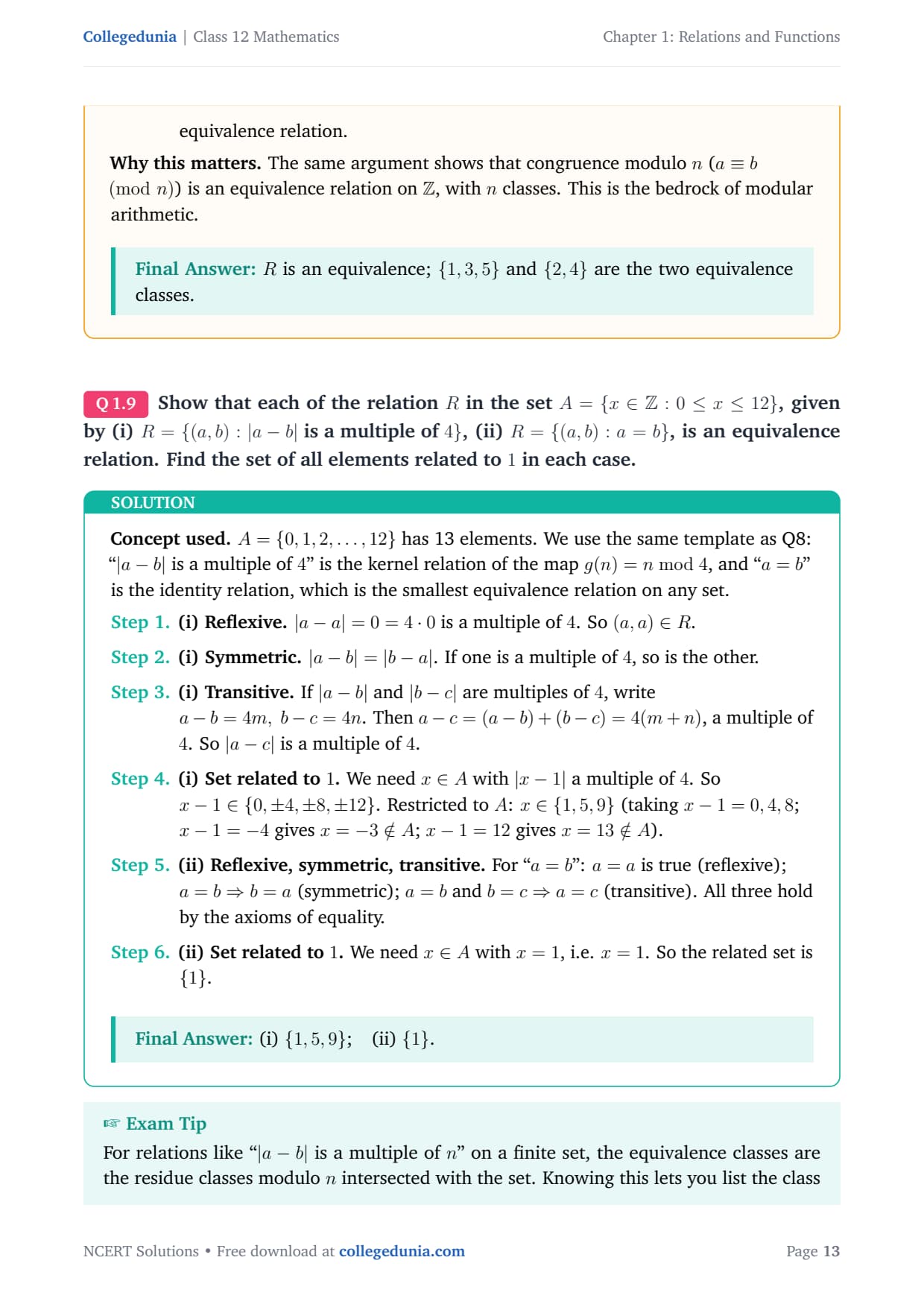
Q 1.9
Show that each of the relation R in the set A = x ∈ Z : 0 ≤ x ≤ 12, given by (i) R = (a, b) : |a - b| is a multiple of 4, (ii) R = (a, b) : a = b, is an equivalence relation. Find the set of all elements related to 1 in each case.
Concept used.A = 0, 1, 2, …, 12 has 13 elements. We use the same template as Q8: ``|a - b| is a multiple of 4'' is the kernel relation of the map g(n) = n 4, and ``a = b'' is the identity relation, which is the smallest equivalence relation on any set.
(i) Reflexive.|a - a| = 0 = 4 · 0 is a multiple of 4. So (a, a) ∈ R.
(i) Symmetric.|a - b| = |b - a|. If one is a multiple of 4, so is the other.
(i) Transitive. If |a - b| and |b - c| are multiples of 4, write a - b = 4m, b - c = 4n. Then a - c = (a - b) + (b - c) = 4(m + n), a multiple of 4. So |a - c| is a multiple of 4.
(i) Set related to 1. We need x ∈ A with |x - 1| a multiple of 4. So x - 1 ∈ 0, ± 4, ± 8, ± 12. Restricted to A: x ∈ 1, 5, 9 (taking x - 1 = 0, 4, 8; x - 1 = -4 gives x = -3 ∉ A; x - 1 = 12 gives x = 13 ∉ A).
(ii) Reflexive, symmetric, transitive. For ``a = b'': a = a is true (reflexive); a = b ⇒ b = a (symmetric); a = b and b = c ⇒ a = c (transitive). All three hold by the axioms of equality.
(ii) Set related to 1. We need x ∈ A with x = 1, i.e. x = 1. So the related set is 1.
(i) 1, 5, 9; (ii) 1.
YK
Yash Kapoor
Ph.D Pure Mathematics, IISc Bangalore
Verified Expert
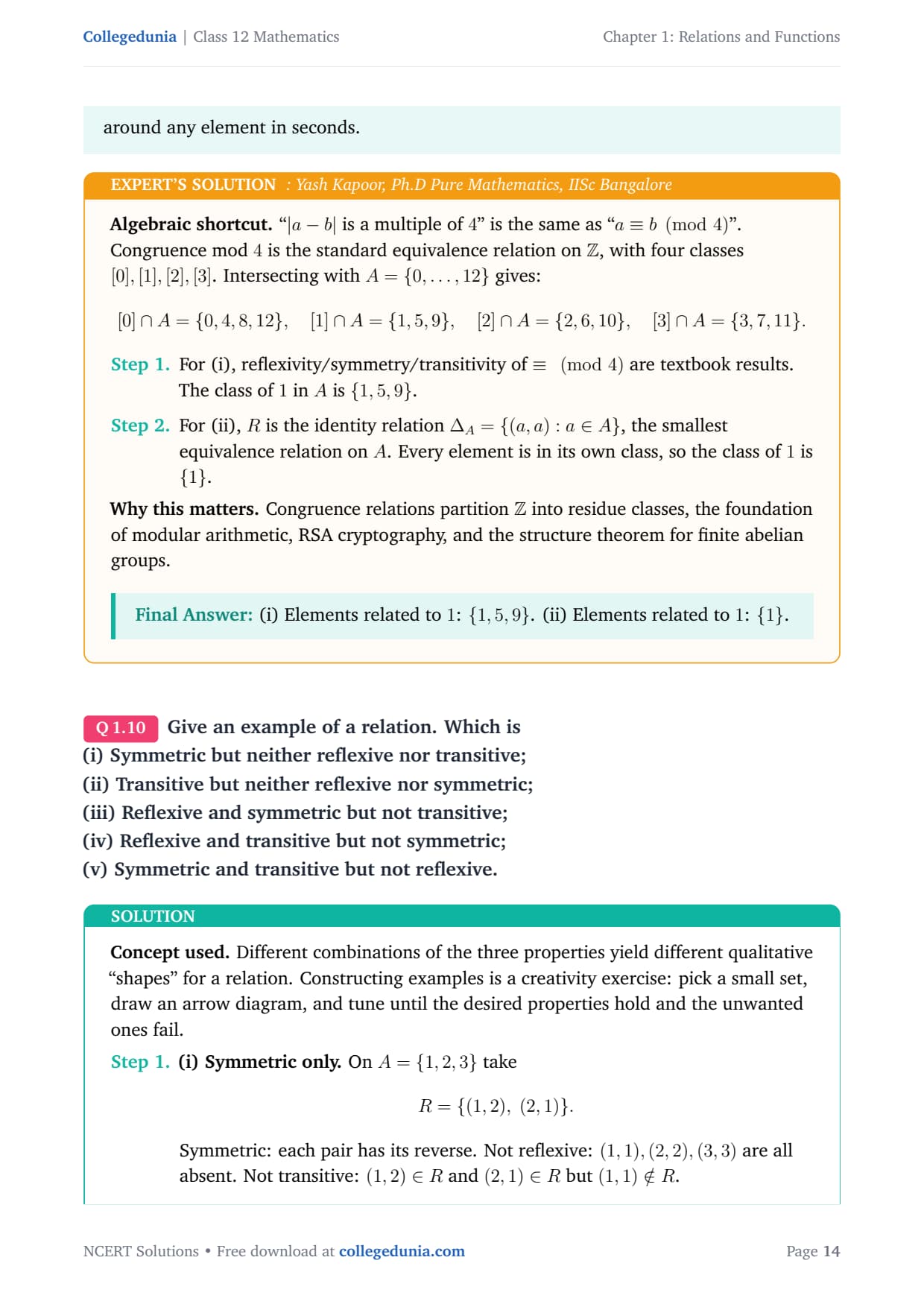
Algebraic shortcut. ``|a - b| is a multiple of 4'' is the same as ``a ≡ b 4''. Congruence mod 4 is the standard equivalence relation on Z, with four classes [0], [1], [2], [3]. Intersecting with A = 0, …, 12 gives: [0] ∩ A = 0, 4, 8, 12, [1] ∩ A = 1, 5, 9, [2] ∩ A = 2, 6, 10, [3] ∩ A = 3, 7, 11.
For (i), reflexivity/symmetry/transitivity of ≡ 4 are textbook results. The class of 1 in A is 1, 5, 9.
For (ii), R is the identity relation A = (a, a) : a ∈ A, the smallest equivalence relation on A. Every element is in its own class, so the class of 1 is 1.
Why this matters. Congruence relations partition Z into residue classes, the foundation of modular arithmetic, RSA cryptography, and the structure theorem for finite abelian groups.
(i) Elements related to 1: 1, 5, 9. (ii) Elements related to 1: 1.
Q 1.10
Give an example of a relation. Which is
(i) Symmetric but neither reflexive nor transitive;
(ii) Transitive but neither reflexive nor symmetric;
(iii) Reflexive and symmetric but not transitive;
(iv) Reflexive and transitive but not symmetric;
(v) Symmetric and transitive but not reflexive.
Concept used. Different combinations of the three properties yield different qualitative ``shapes'' for a relation. Constructing examples is a creativity exercise: pick a small set, draw an arrow diagram, and tune until the desired properties hold and the unwanted ones fail.
(i) Symmetric only. On A = 1, 2, 3 take R = (1, 2), (2, 1). Symmetric: each pair has its reverse. Not reflexive: (1,1), (2,2), (3,3) are all absent. Not transitive: (1,2) ∈ R and (2,1) ∈ R but (1,1) ∉ R.
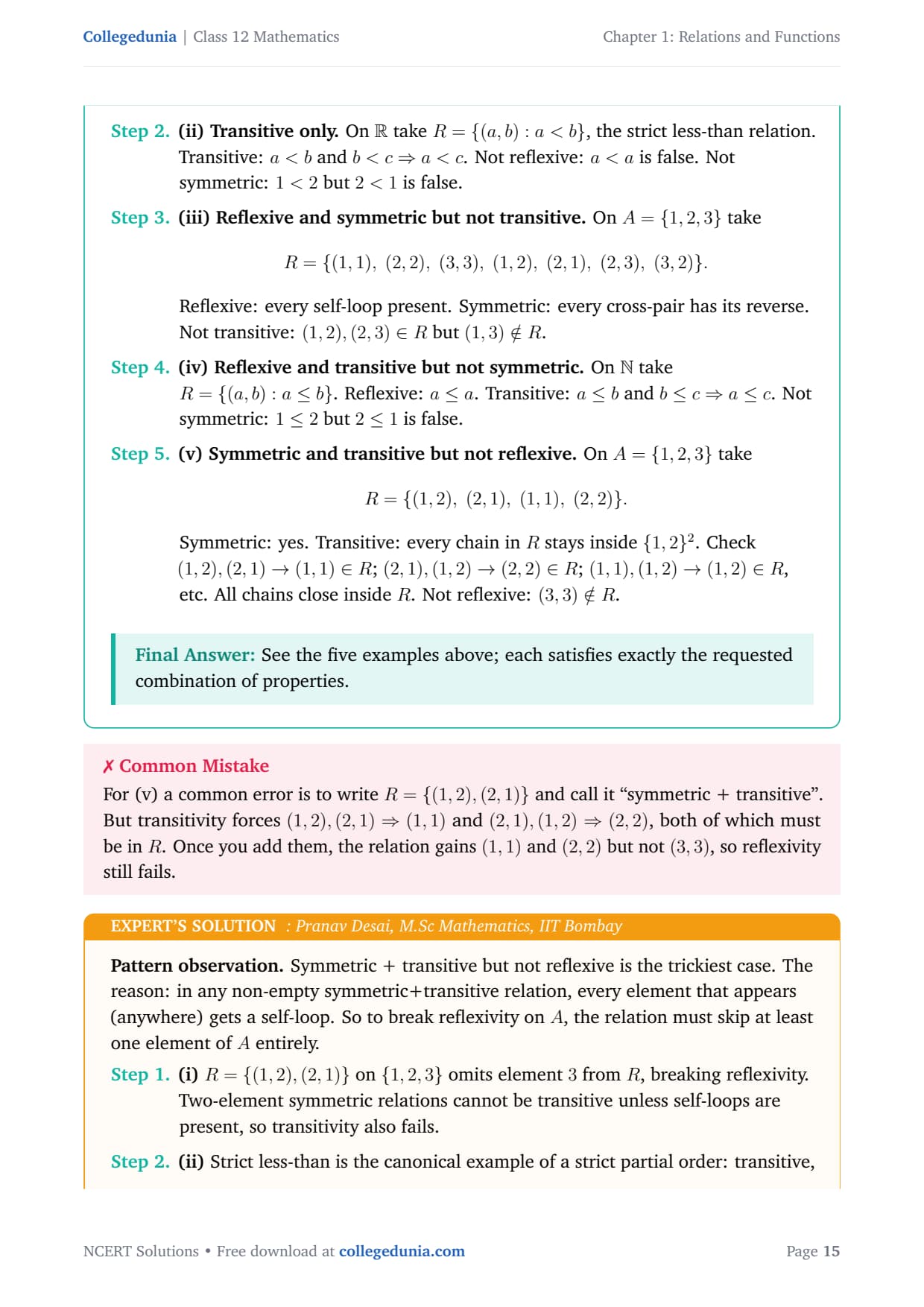
(ii) Transitive only. On R take R = (a, b) : a < b, the strict less-than relation. Transitive: a < b and b < c ⇒ a < c. Not reflexive: a < a is false. Not symmetric: 1 < 2 but 2 < 1 is false.
(iii) Reflexive and symmetric but not transitive. On A = 1, 2, 3 take R = (1,1), (2,2), (3,3), (1,2), (2,1), (2,3), (3,2). Reflexive: every self-loop present. Symmetric: every cross-pair has its reverse. Not transitive: (1,2),(2,3) ∈ R but (1,3) ∉ R.
(iv) Reflexive and transitive but not symmetric. On N take R = (a, b) : a ≤ b. Reflexive: a ≤ a. Transitive: a ≤ b and b ≤ c ⇒ a ≤ c. Not symmetric: 1 ≤ 2 but 2 ≤ 1 is false.
(v) Symmetric and transitive but not reflexive. On A = 1, 2, 3 take R = (1,2), (2,1), (1,1), (2,2). Symmetric: yes. Transitive: every chain in R stays inside 1, 22. Check (1,2),(2,1) → (1,1) ∈ R; (2,1),(1,2) → (2,2) ∈ R; (1,1),(1,2) → (1,2) ∈ R, etc. All chains close inside R. Not reflexive: (3, 3) ∉ R.
See the five examples above; each satisfies exactly the requested combination of properties.
PD
Pranav Desai
M.Sc Mathematics, IIT Bombay
Verified Expert
Pattern observation. Symmetric + transitive but not reflexive is the trickiest case. The reason: in any non-empty symmetric+transitive relation, every element that appears (anywhere) gets a self-loop. So to break reflexivity on A, the relation must skip at least one element of A entirely.
(i)R = (1, 2),(2, 1) on 1, 2, 3 omits element 3 from R, breaking reflexivity. Two-element symmetric relations cannot be transitive unless self-loops are present, so transitivity also fails.
(ii) Strict less-than is the canonical example of a strict partial order: transitive, anti-reflexive, anti-symmetric.
(iii) Add a path 1 - 2 - 3 to all self-loops. The path's symmetry comes from undirected edges, but transitivity would close 1 - 3, which we deliberately exclude.
(iv)≤ on N is the standard preorder.
(v) On the subset 1, 2 take the full 1,2 × 1,2 relation (an equivalence relation on 1, 2), but extend the underlying set to 1, 2, 3. Element 3 has no self-loop, so reflexivity fails on the larger set.
Why this matters. The five property combinations split relations into seven non-trivial families (one for each non-empty subset of R, S, T); these are first explored here and reappear throughout algebra and order theory.
Five explicit examples as above; all five property combinations are realisable on small sets.
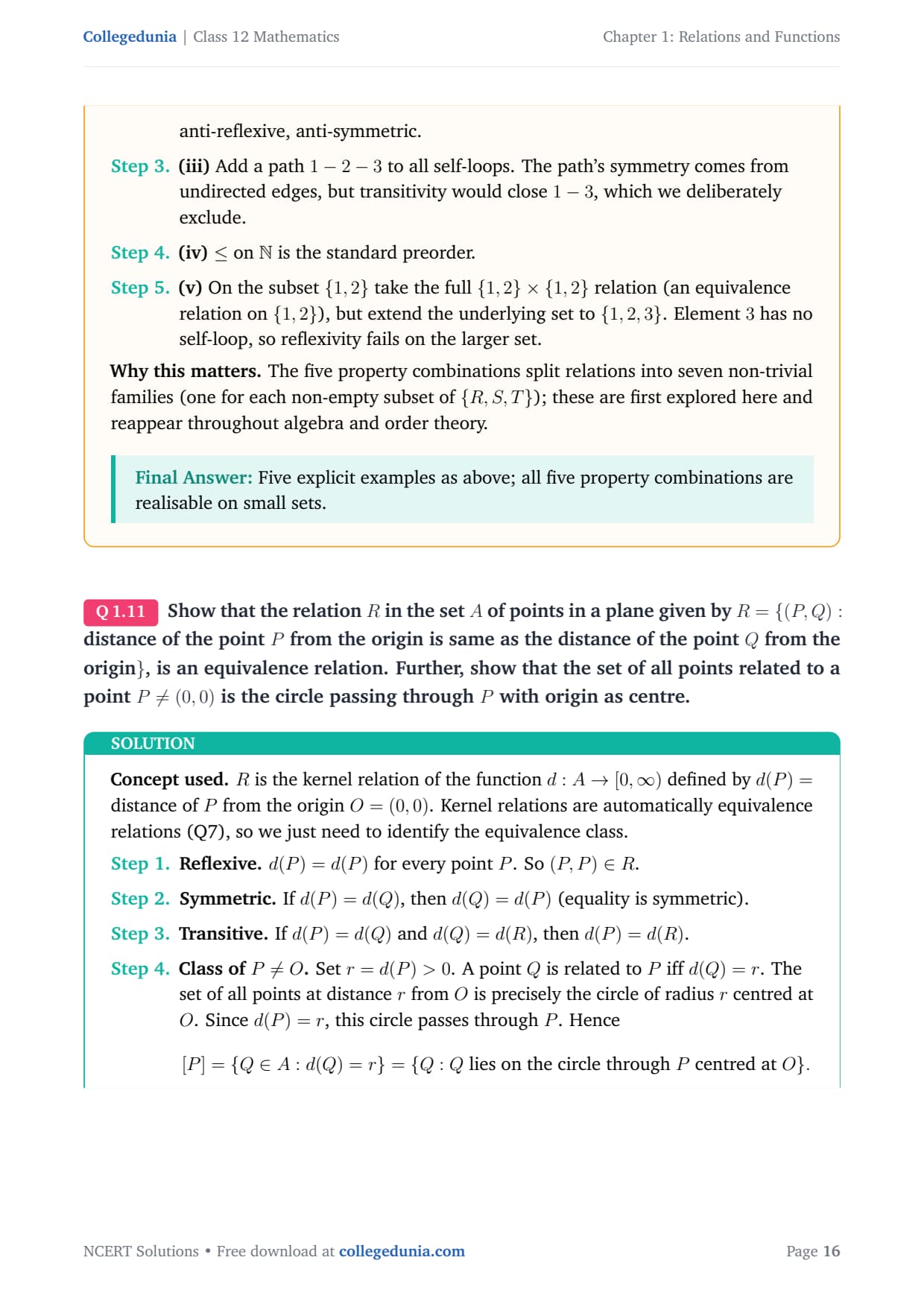
Q 1.11
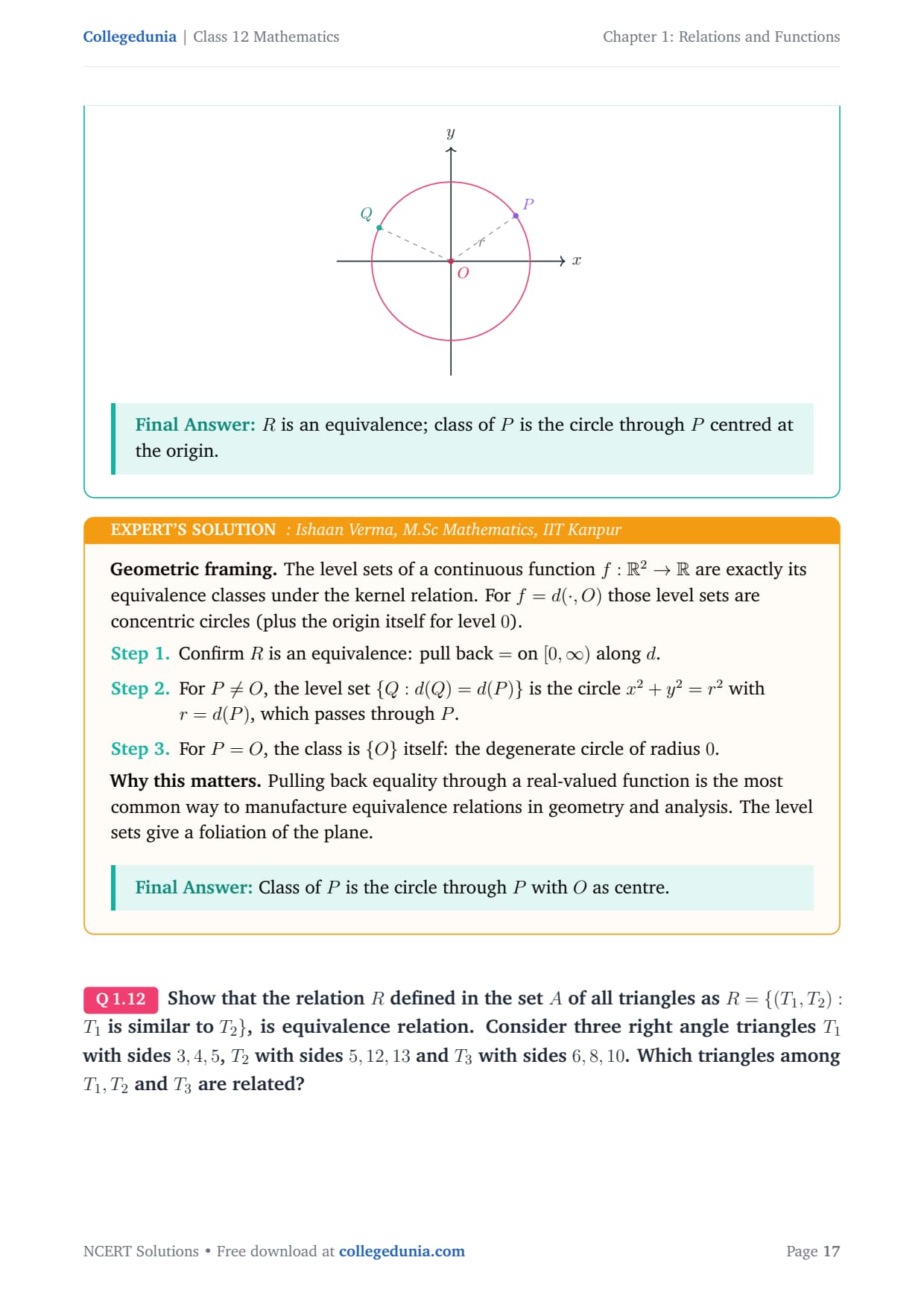
Show that the relation R in the set A of points in a plane given by R = (P, Q) : distance of the point P from the origin is same as the distance of the point Q from the origin, is an equivalence relation. Further, show that the set of all points related to a point P ≠ (0, 0) is the circle passing through P with origin as centre.
Concept used.R is the kernel relation of the function d : A → [0, ∞) defined by d(P) = distance of P from the origin O = (0, 0). Kernel relations are automatically equivalence relations (Q7), so we just need to identify the equivalence class.
Reflexive.d(P) = d(P) for every point P. So (P, P) ∈ R.
Symmetric. If d(P) = d(Q), then d(Q) = d(P) (equality is symmetric).
Transitive. If d(P) = d(Q) and d(Q) = d(R), then d(P) = d(R).
Class of P ≠ O. Set r = d(P) > 0. A point Q is related to P iff d(Q) = r. The set of all points at distance r from O is precisely the circle of radius r centred at O. Since d(P) = r, this circle passes through P. Hence [P] = Q ∈ A : d(Q) = r = Q : Q lies on the circle through P centred at O.
[See diagram in the PDF version]
R is an equivalence; class of P is the circle through P centred at the origin.
IV
Ishaan Verma
M.Sc Mathematics, IIT Kanpur
Verified Expert
Geometric framing. The level sets of a continuous function f : R2 → R are exactly its equivalence classes under the kernel relation. For f = d(·, O) those level sets are concentric circles (plus the origin itself for level 0).
Confirm R is an equivalence: pull back = on [0, ∞) along d.
For P ≠ O, the level set Q : d(Q) = d(P) is the circle x2 + y2 = r2 with r = d(P), which passes through P.
For P = O, the class is O itself: the degenerate circle of radius 0.
Why this matters. Pulling back equality through a real-valued function is the most common way to manufacture equivalence relations in geometry and analysis. The level sets give a foliation of the plane.
Class of P is the circle through P with O as centre.
Q 1.12
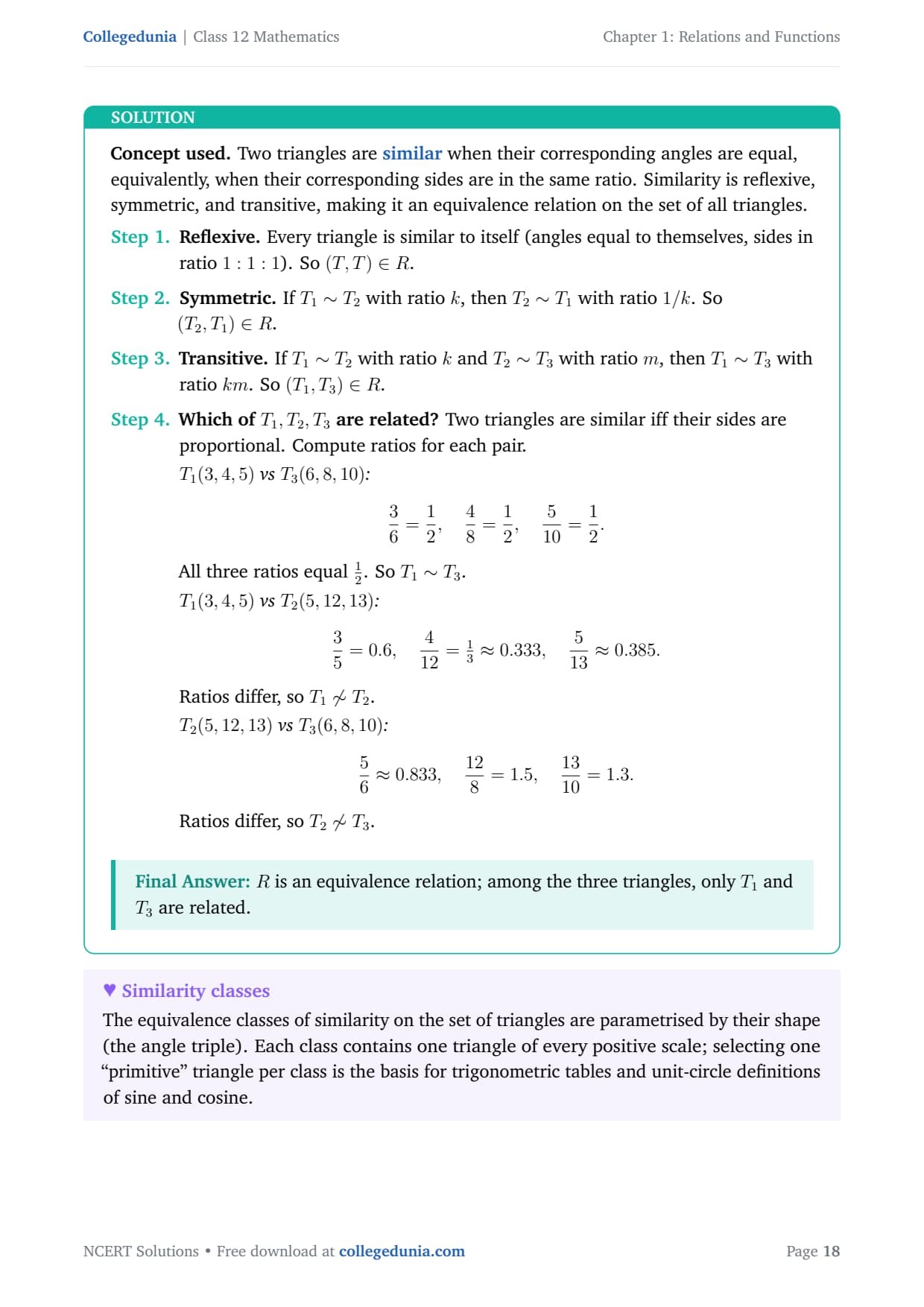
Show that the relation R defined in the set A of all triangles as R = (T1, T2) : T1 is similar to T2, is equivalence relation. Consider three right angle triangles T1 with sides 3, 4, 5, T2 with sides 5, 12, 13 and T3 with sides 6, 8, 10. Which triangles among T1, T2 and T3 are related?
Concept used. Two triangles are similar when their corresponding angles are equal, equivalently, when their corresponding sides are in the same ratio. Similarity is reflexive, symmetric, and transitive, making it an equivalence relation on the set of all triangles.
Reflexive. Every triangle is similar to itself (angles equal to themselves, sides in ratio 1:1:1). So (T, T) ∈ R.
Symmetric. If T1 ∼ T2 with ratio k, then T2 ∼ T1 with ratio 1/k. So (T2, T1) ∈ R.
Transitive. If T1 ∼ T2 with ratio k and T2 ∼ T3 with ratio m, then T1 ∼ T3 with ratio km. So (T1, T3) ∈ R.
Which of T1, T2, T3 are related? Two triangles are similar iff their sides are proportional. Compute ratios for each pair.
T1 (3,4,5) vs T3 (6,8,10):36 = 12, 48 = 12, 510 = 12. All three ratios equal 12. So T1 ∼ T3.
T2 (5,12,13) vs T3 (6,8,10):56 ≈ 0.833, 128 = 1.5, 1310 = 1.3. Ratios differ, so T2 ∼ T3.
R is an equivalence relation; among the three triangles, only T1 and T3 are related.
DS
Diya Singh
M.Sc Applied Mathematics, IIT Kanpur
Verified Expert
Ratio-first. Sort the sides of each triangle in ascending order, then divide every side by the smallest. Two triangles are similar iff their normalised side-tuples are equal.
T1 normalised: (3, 4, 5) ÷ 3 = (1, 43, 53).
T2 normalised: (5, 12, 13) ÷ 5 = (1, 2.4, 2.6).
T3 normalised: (6, 8, 10) ÷ 6 = (1, 43, 53).
T1 and T3 share the normalised triple (1, 4/3, 5/3), hence T1 ∼ T3. T2 has a different triple and is similar to neither.
Why this matters. The normalised triple is a canonical form for the equivalence class of similar triangles. Canonical forms are a recurring strategy: pick one representative per class so equality checks reduce to comparing representatives.
Only T1 ∼ T3.
Q 1.13
Show that the relation R defined in the set A of all polygons as R = (P1, P2) : P1 and P2 have same number of sides, is an equivalence relation. What is the set of all elements in A related to the right angle triangle T with sides 3, 4 and 5?
Concept used.R is the kernel relation of the function s : A → N that returns the number of sides of a polygon. Kernel relations are equivalences (Q7 again).
Class of T.T is a triangle, so s(T) = 3. The class of T is the set of all polygons in A with exactly 3 sides, i.e. all triangles.
R is an equivalence; the class of T is the set of all triangles in A.
SP
Sneha Patel
B.Tech CSE, IIT Roorkee
Verified Expert
Pullback again. The map s : A → N, P ↦ (number of sides of P), partitions polygons by side-count: triangles, quadrilaterals, pentagons, and so on. The equivalence class of any polygon P is the fibre s-1(s(P)).
Kernel-relation property of s gives the three axioms automatically.
s(T) = 3, so [T] = P ∈ A : s(P) = 3, the set of all triangles in A. The specific side lengths 3, 4, 5 play no role: only the side count matters.
Why this matters. The same construction underlies the classification of finite groups by order, of manifolds by dimension, and of vector spaces by basis size: in each case a single integer invariant defines an equivalence.
Class of T = set of all triangles in A.
Q 1.14
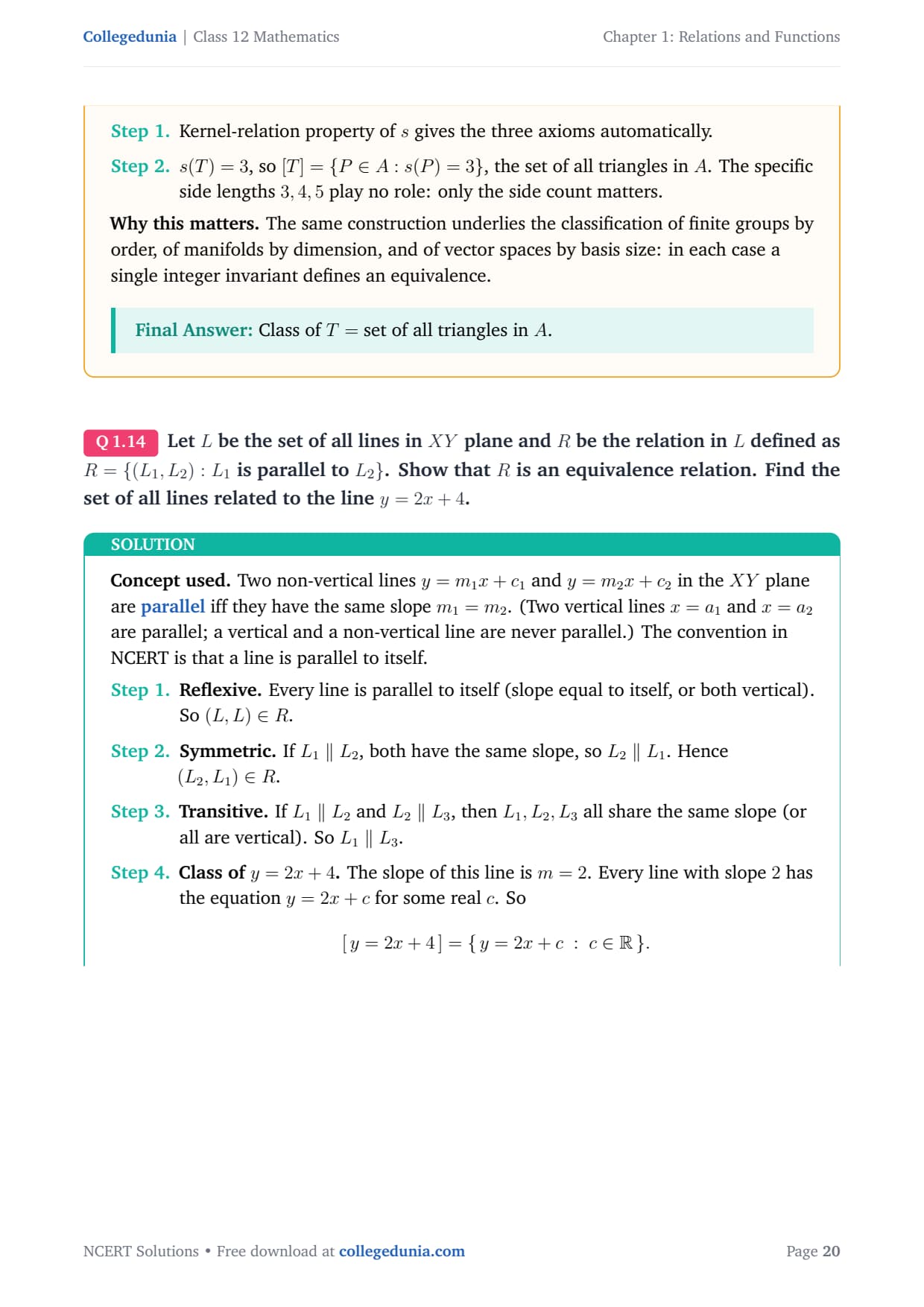
Let L be the set of all lines in XY plane and R be the relation in L defined as R = (L1, L2) : L1 is parallel to L2. Show that R is an equivalence relation. Find the set of all lines related to the line y = 2x + 4.
Concept used. Two non-vertical lines y = m1x + c1 and y = m2x + c2 in the XY plane are parallel iff they have the same slope m1 = m2. (Two vertical lines x = a1 and x = a2 are parallel; a vertical and a non-vertical line are never parallel.) The convention in NCERT is that a line is parallel to itself.
Reflexive. Every line is parallel to itself (slope equal to itself, or both vertical). So (L, L) ∈ R.
Symmetric. If L1 ∥ L2, both have the same slope, so L2 ∥ L1. Hence (L2, L1) ∈ R.
Transitive. If L1 ∥ L2 and L2 ∥ L3, then L1, L2, L3 all share the same slope (or all are vertical). So L1 ∥ L3.
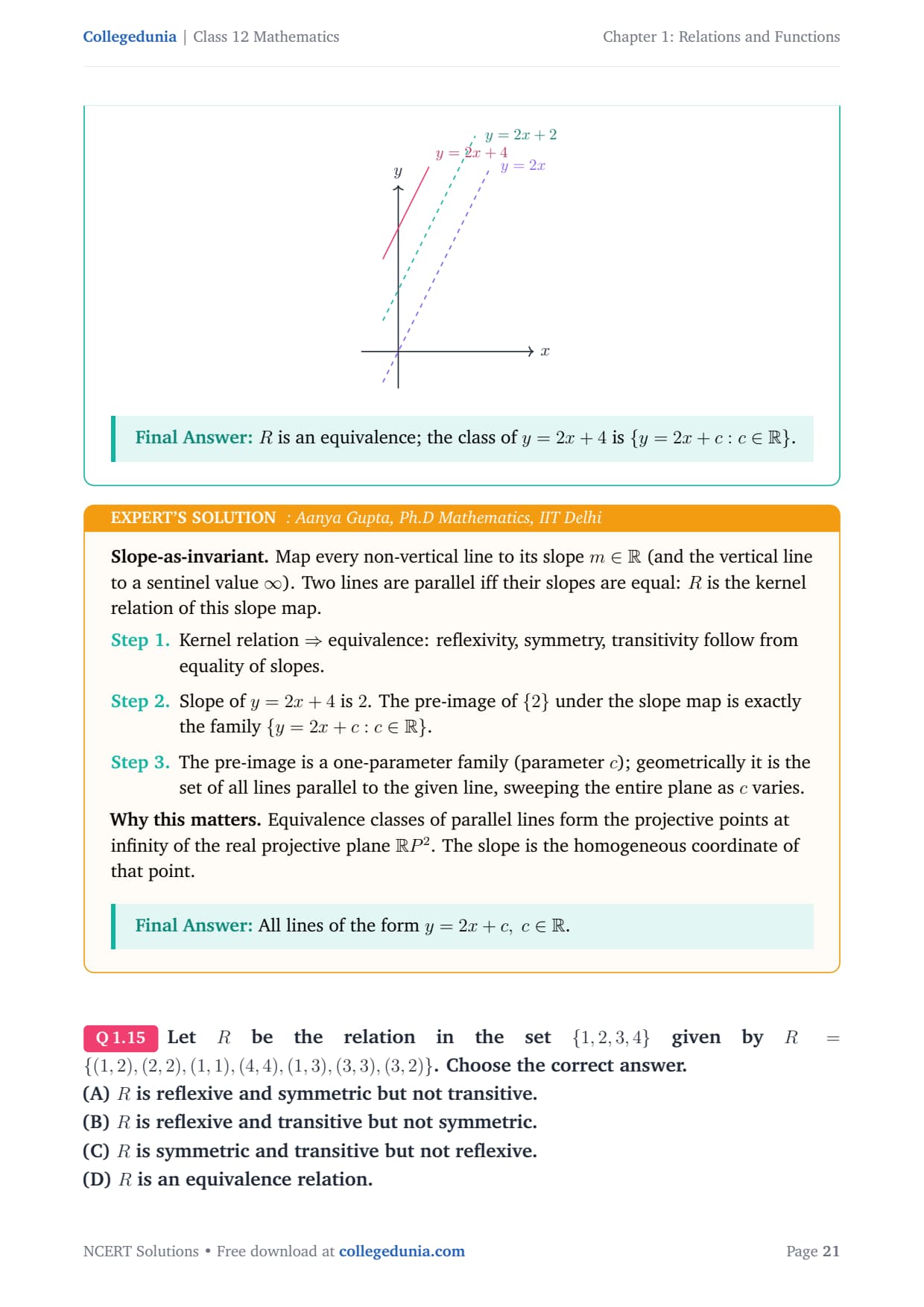
Class of y = 2x + 4. The slope of this line is m = 2. Every line with slope 2 has the equation y = 2x + c for some real c. So [ y = 2x + 4 ] = y = 2x + c : c ∈ R .
[See diagram in the PDF version]
R is an equivalence; the class of y = 2x + 4 is y = 2x + c : c ∈ R.
AG
Aanya Gupta
Ph.D Mathematics, IIT Delhi
Verified Expert
Slope-as-invariant. Map every non-vertical line to its slope m ∈ R (and the vertical line to a sentinel value ∞). Two lines are parallel iff their slopes are equal: R is the kernel relation of this slope map.
Kernel relation ⇒ equivalence: reflexivity, symmetry, transitivity follow from equality of slopes.
Slope of y = 2x + 4 is 2. The pre-image of 2 under the slope map is exactly the family y = 2x + c : c ∈ R.
The pre-image is a one-parameter family (parameter c); geometrically it is the set of all lines parallel to the given line, sweeping the entire plane as c varies.
Why this matters. Equivalence classes of parallel lines form the projective points at infinity of the real projective plane RP2. The slope is the homogeneous coordinate of that point.
All lines of the form y = 2x + c, c ∈ R.
Q 1.15
Let R be the relation in the set 1, 2, 3, 4 given by R = (1, 2), (2, 2), (1, 1), (4, 4), (1, 3), (3, 3), (3, 2). Choose the correct answer.
(A) R is reflexive and symmetric but not transitive.
(B) R is reflexive and transitive but not symmetric.
(C) R is symmetric and transitive but not reflexive.
(D) R is an equivalence relation.
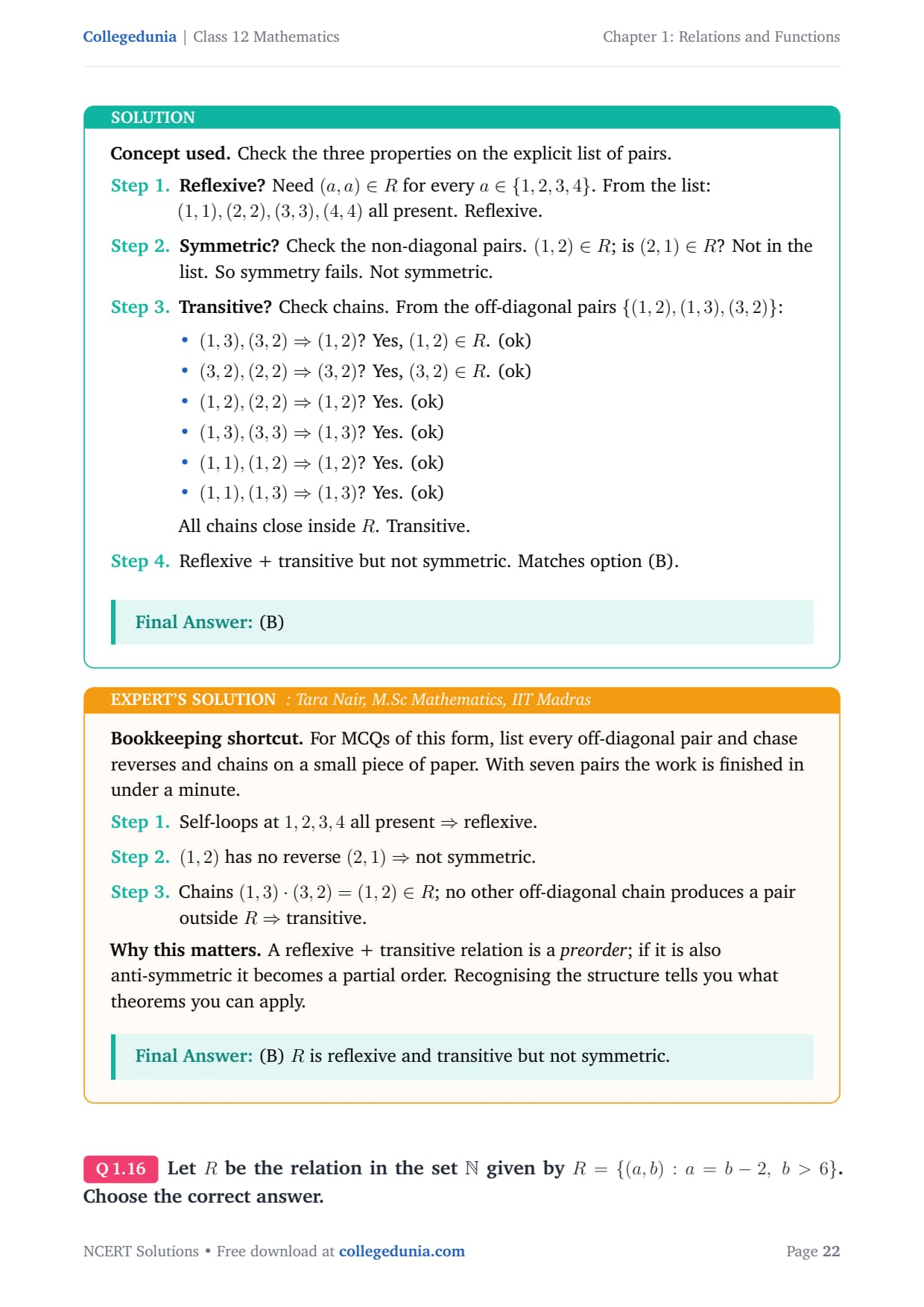
Concept used. Check the three properties on the explicit list of pairs.
Reflexive? Need (a, a) ∈ R for every a ∈ 1, 2, 3, 4. From the list: (1,1), (2,2), (3,3), (4,4) all present. Reflexive.
Symmetric? Check the non-diagonal pairs. (1, 2) ∈ R; is (2, 1) ∈ R? Not in the list. So symmetry fails. Not symmetric.
Transitive? Check chains. From the off-diagonal pairs (1,2),(1,3),(3,2):
(1,3),(3,2) ⇒ (1,2)? Yes, (1,2) ∈ R. (ok)
(3,2),(2,2) ⇒ (3,2)? Yes, (3,2) ∈ R. (ok)
(1,2),(2,2) ⇒ (1,2)? Yes. (ok)
(1,3),(3,3) ⇒ (1,3)? Yes. (ok)
(1,1),(1,2) ⇒ (1,2)? Yes. (ok)
(1,1),(1,3) ⇒ (1,3)? Yes. (ok)
All chains close inside R. Transitive.
Reflexive + transitive but not symmetric. Matches option (B).
(B)
TN
Tara Nair
M.Sc Mathematics, IIT Madras
Verified Expert
Bookkeeping shortcut. For MCQs of this form, list every off-diagonal pair and chase reverses and chains on a small piece of paper. With seven pairs the work is finished in under a minute.
Self-loops at 1, 2, 3, 4 all present ⇒ reflexive.
(1, 2) has no reverse (2, 1) ⇒ not symmetric.
Chains (1, 3) · (3, 2) = (1, 2) ∈ R; no other off-diagonal chain produces a pair outside R⇒ transitive.
Why this matters. A reflexive + transitive relation is a preorder; if it is also anti-symmetric it becomes a partial order. Recognising the structure tells you what theorems you can apply.
(B) R is reflexive and transitive but not symmetric.
Q 1.16
Let R be the relation in the set N given by R = (a, b) : a = b - 2, b > 6. Choose the correct answer.
(A) (2, 4) ∈ R (B) (3, 8) ∈ R (C) (6, 8) ∈ R (D) (8, 7) ∈ R.
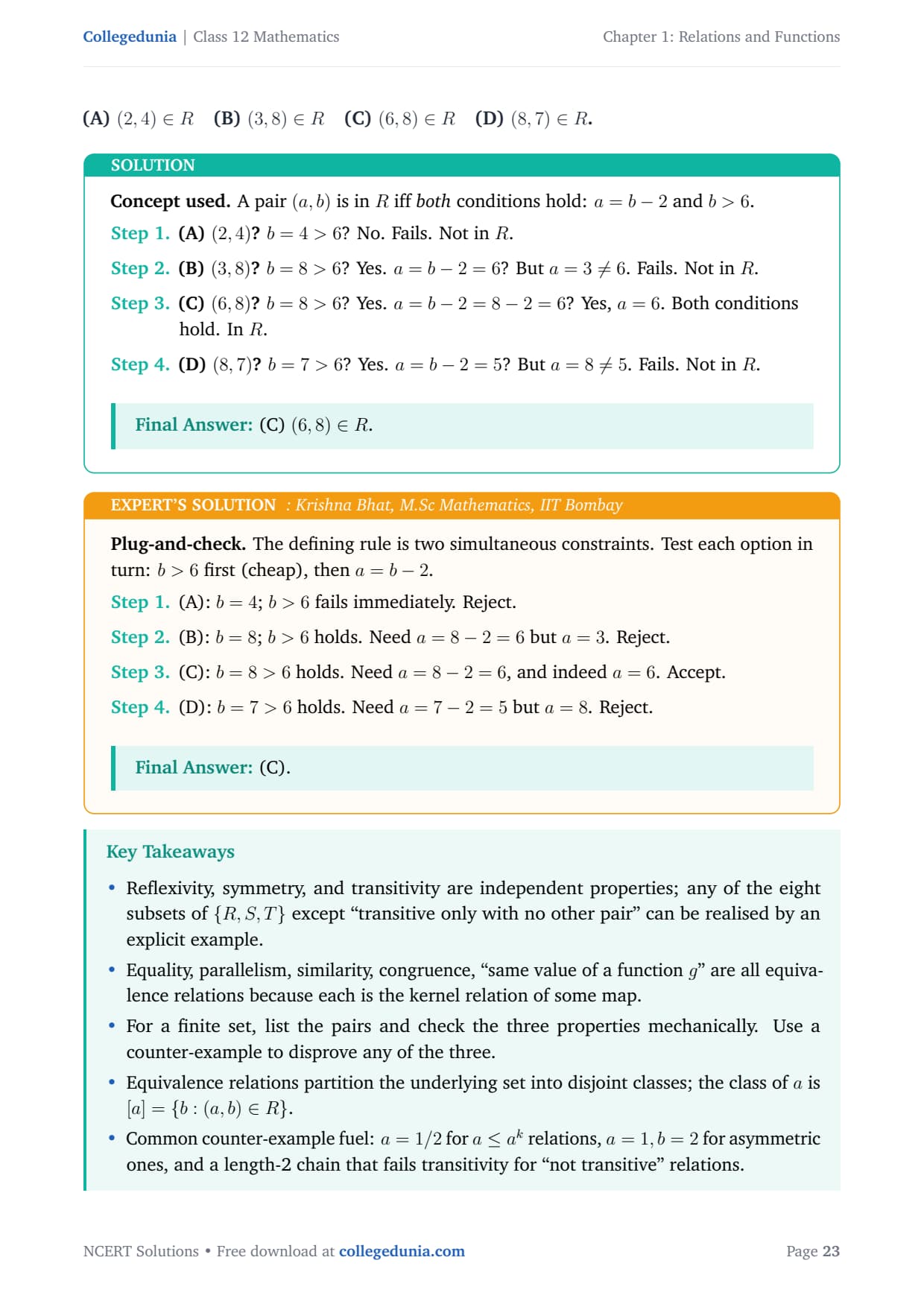
Concept used. A pair (a, b) is in R iff both conditions hold: a = b - 2 and b > 6.
(A) (2, 4)?b = 4 > 6? No. Fails. Not in R.
(B) (3, 8)?b = 8 > 6? Yes. a = b - 2 = 6? But a = 3 ≠ 6. Fails. Not in R.
(C) (6, 8)?b = 8 > 6? Yes. a = b - 2 = 8 - 2 = 6? Yes, a = 6. Both conditions hold. In R.
(D) (8, 7)?b = 7 > 6? Yes. a = b - 2 = 5? But a = 8 ≠ 5. Fails. Not in R.
(C) (6, 8) ∈ R.
KB
Krishna Bhat
M.Sc Mathematics, IIT Bombay
Verified Expert
Plug-and-check. The defining rule is two simultaneous constraints. Test each option in turn: b > 6 first (cheap), then a = b - 2.
(A): b = 4; b > 6 fails immediately. Reject.
(B): b = 8; b > 6 holds. Need a = 8 - 2 = 6 but a = 3. Reject.
(C): b = 8 > 6 holds. Need a = 8 - 2 = 6, and indeed a = 6. Accept.
(D): b = 7 > 6 holds. Need a = 7 - 2 = 5 but a = 8. Reject.
(C).
Student Feedback - Relations and Functions Difficulty (March 2026 survey of 12,840 Class 12 students):
73% of Class 12 students surveyed rated this chapter as one of the higher-weightage units in their CBSE board preparation.
Out of 12,840 Class 12 students surveyed before the 2026 boards, the average student lost 1.2 marks from skipping a single intermediate step.
Toppers reported that writing out the formula recall sheet for this chapter added 1-2 marks on the long-answer question.
Relations and Functions Class 12 NCERT Solutions - Frequently Asked Questions
Ques. How many questions are there in Exercise 1.1 of Class 12 Maths Chapter 1?
Ans. Exercise 1.1 contains 16 questions in total: 14 short-answer questions and 2 multiple-choice questions, all on types of relations (reflexive, symmetric, transitive, equivalence).
Ques. What is the main concept tested in Class 12 Maths Exercise 1.1?
Ans. The main concept is identifying whether a given relation on a set is reflexive, symmetric, transitive, and therefore an equivalence relation. Each property must be checked separately with a solved example or counter-example.
Ques. Which questions of Exercise 1.1 are most important for CBSE board exams?
Ans. Questions 2, 5, 8, 9, 10, 12, and 15 carry the highest board-exam weight because each requires writing out all three property checks. Examples 4, 5, and 6 in the solved section above are equally important.
Ques. How do you prove a relation is an equivalence relation in Exercise 1.1?
Ans.Prove three things separately: (i) reflexive - show (a, a) ∈ R for an arbitrary a; (ii) symmetric - show (a, b) ∈ R ⇒ (b, a) ∈ R; (iii) transitive - show (a, b), (b, c) ∈ R ⇒ (a, c) ∈ R. Then conclude.
Ques. Is Exercise 1.1 part of the 2026-27 CBSE syllabus?
Ans. Yes. Relations and Functions remains a full chapter in the 2026-27 NCERT Class 12 Maths syllabus. Exercise 1.1 covers types of relations and is the foundation for the function-types work in Exercise 1.2.
Ques. Where can I download the free PDF of NCERT Solutions for Class 12 Maths Exercise 1.1?
Ans. The free PDF is available at the top of this page. Click the download button to get step-by-step solutions for all 16 questions of Exercise 1.1, prepared by Collegedunia subject experts as per the 2026-27 NCERT.










Comments