The 2026-27 NCERT Flamingo edition keeps Chapter 7 The Interview intact across both its parts: Christopher Silvester's introductory essay on the history of the interview as a journalistic form, and Mukund Padmanabhan's recorded conversation with Umberto Eco. This page hosts the step-by-step Class 12 English Chapter 7 The Interview NCERT Solutions PDF for the 2026-27 syllabus, answering every back-of-chapter question (Understanding the Text, Talking about the Text, Writing, Things to Do, and the Part I "Think as you read" sidebar questions).
25 pages | 15 fully solved questions | Bilingual context (Part I essay + Part II interview) · Class 12 English Chapter 7 The Interview, 2026-27 NCERT
CBSE Weightage: 6 to 8 marks (typically one 6-mark long answer plus a short answer).
CUET (UG) Weightage: 1 to 2 inference items in the English passage section.
The Solutions PDF carries the full set of NCERT answers for both parts of the chapter. The exhaustive answers use plain literary prose, never academic step-numbering. Every long question has a main Solution and a parallel Expert Solution from a literature postgraduate.
Source authority: Cross-referenced against NCERT Flamingo (2026-27 edition), CBSE sample papers 2024-26, and Christopher Silvester's The Penguin Book of Interviews (1993) Introduction, the source text for Part I.
The Interview Video Explanation (Class 12 English)
The Interview Class 12 NCERT Solutions: Question-Wise Coverage
The chapter contains four back-question sections plus a sidebar "Think as you read" set in Part I. Every question below is solved in the PDF.
Section
Question
Answer Type
Think as you read (Part I)
What are some of the positive views on interviews?
Short prose (3 marks)
Think as you read (Part I)
Why do most celebrity writers despise being interviewed?
Short prose (3 marks)
Think as you read (Part I)
What is the belief in some primitive cultures about being photographed?
Two-sentence answer
Think as you read (Part I)
What do you understand by "thumbprints on his windpipe"?
Metaphor explanation (3 marks)
Think as you read (Part I)
Who, in today's world, is our chief source of information about personalities?
One-line answer
Understanding the Text
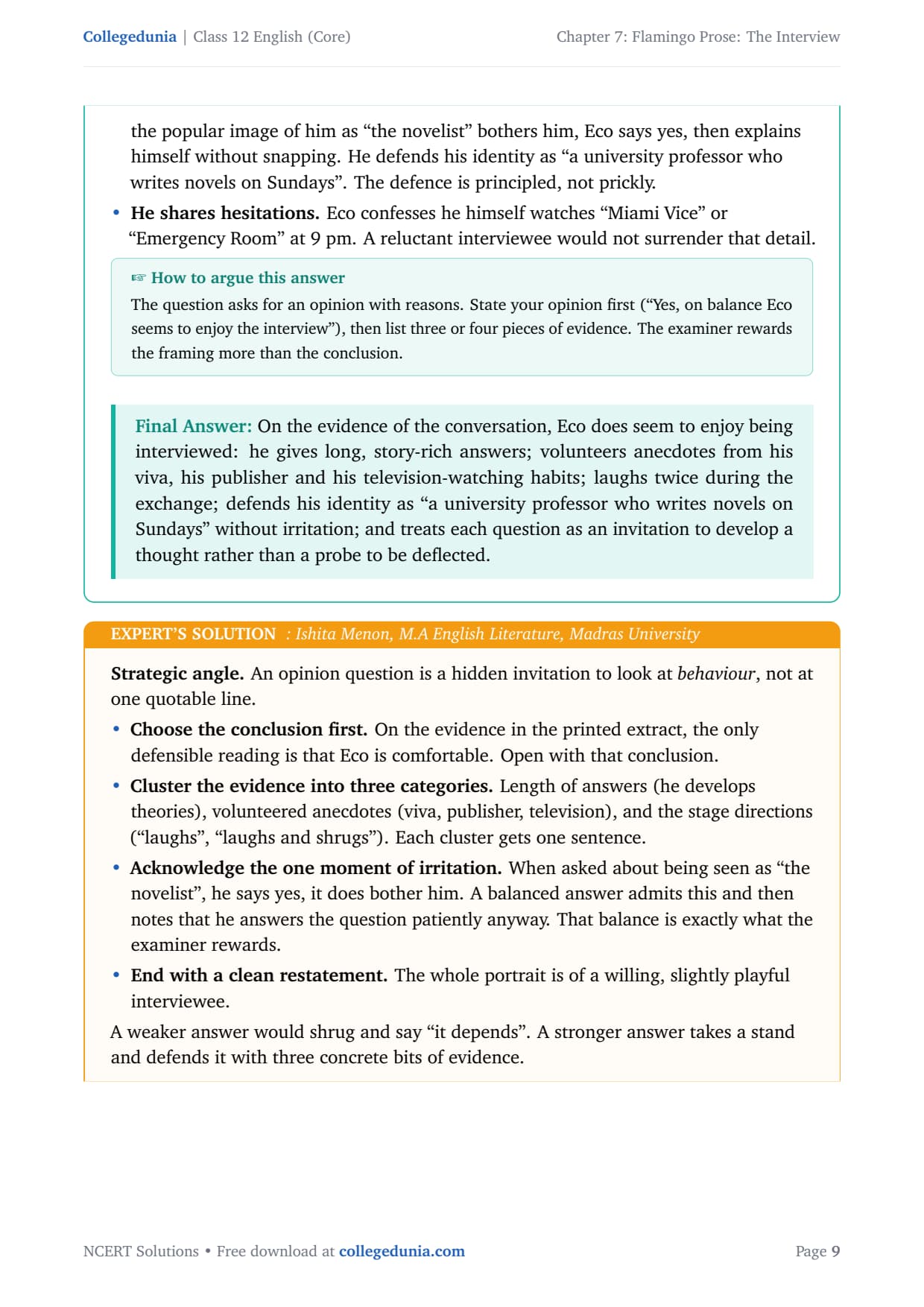
Do you think Umberto Eco likes being interviewed?
Long answer (6 marks)
Understanding the Text
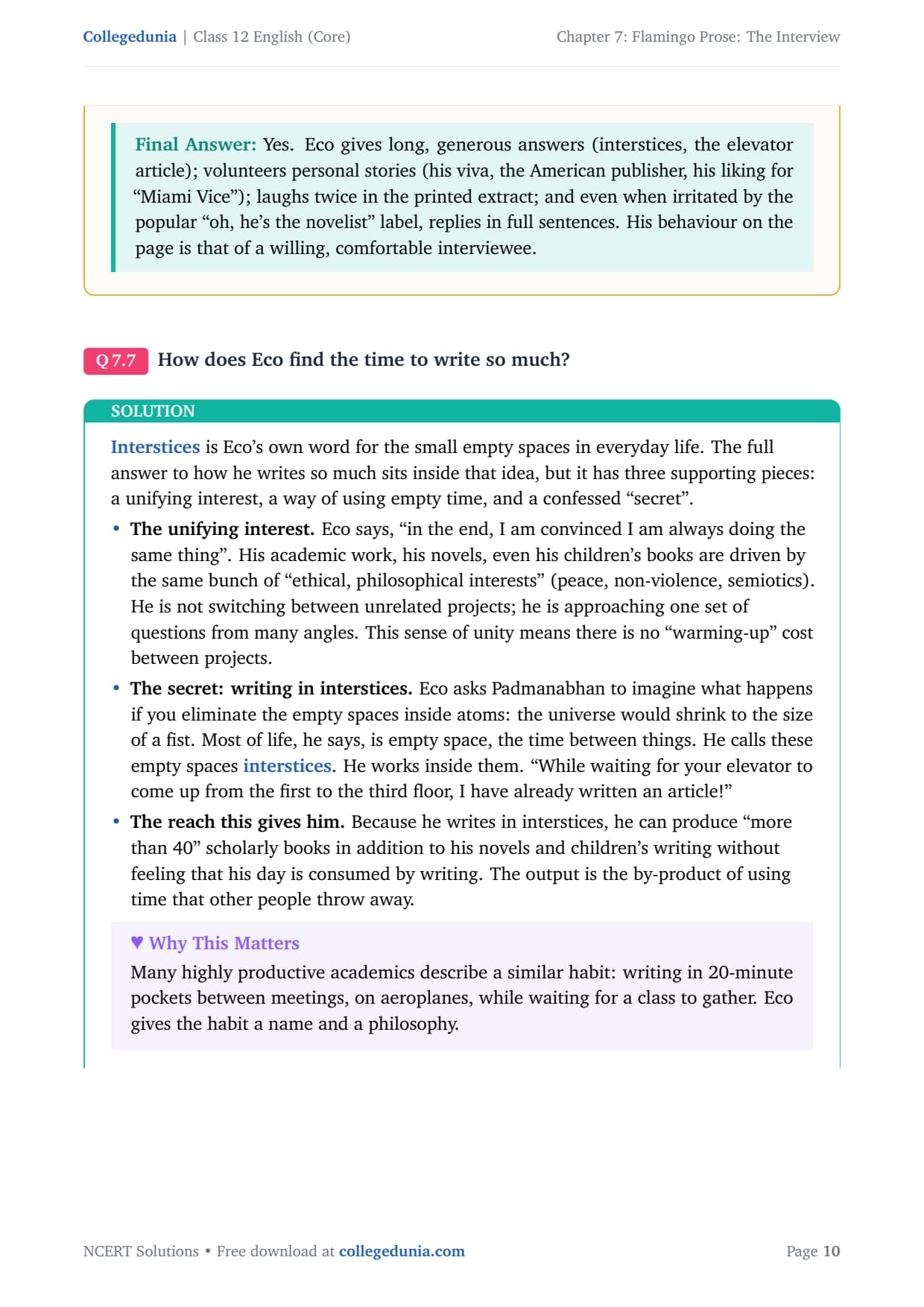
How does Eco find the time to write so much?
Long answer (5 marks)
Understanding the Text
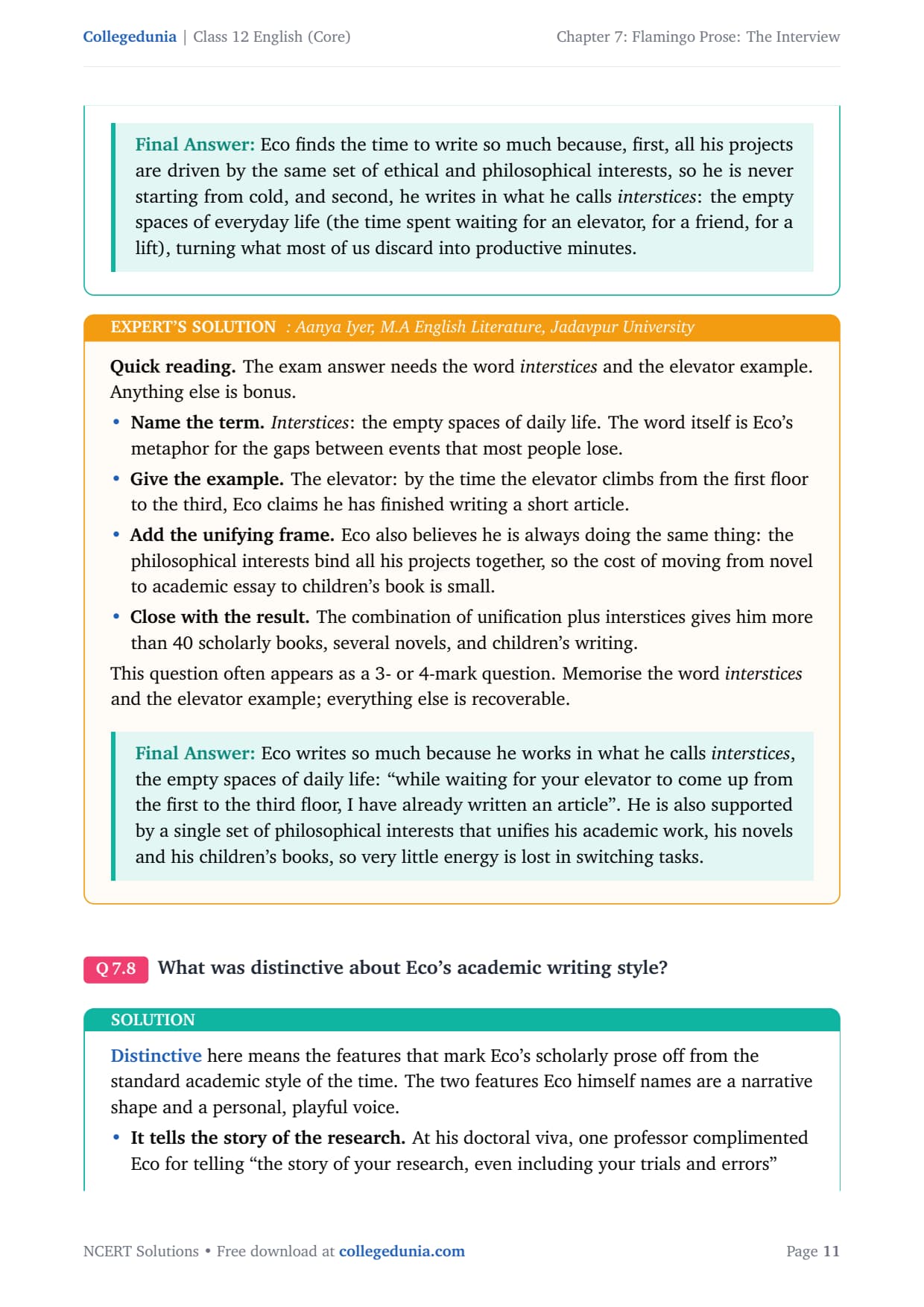
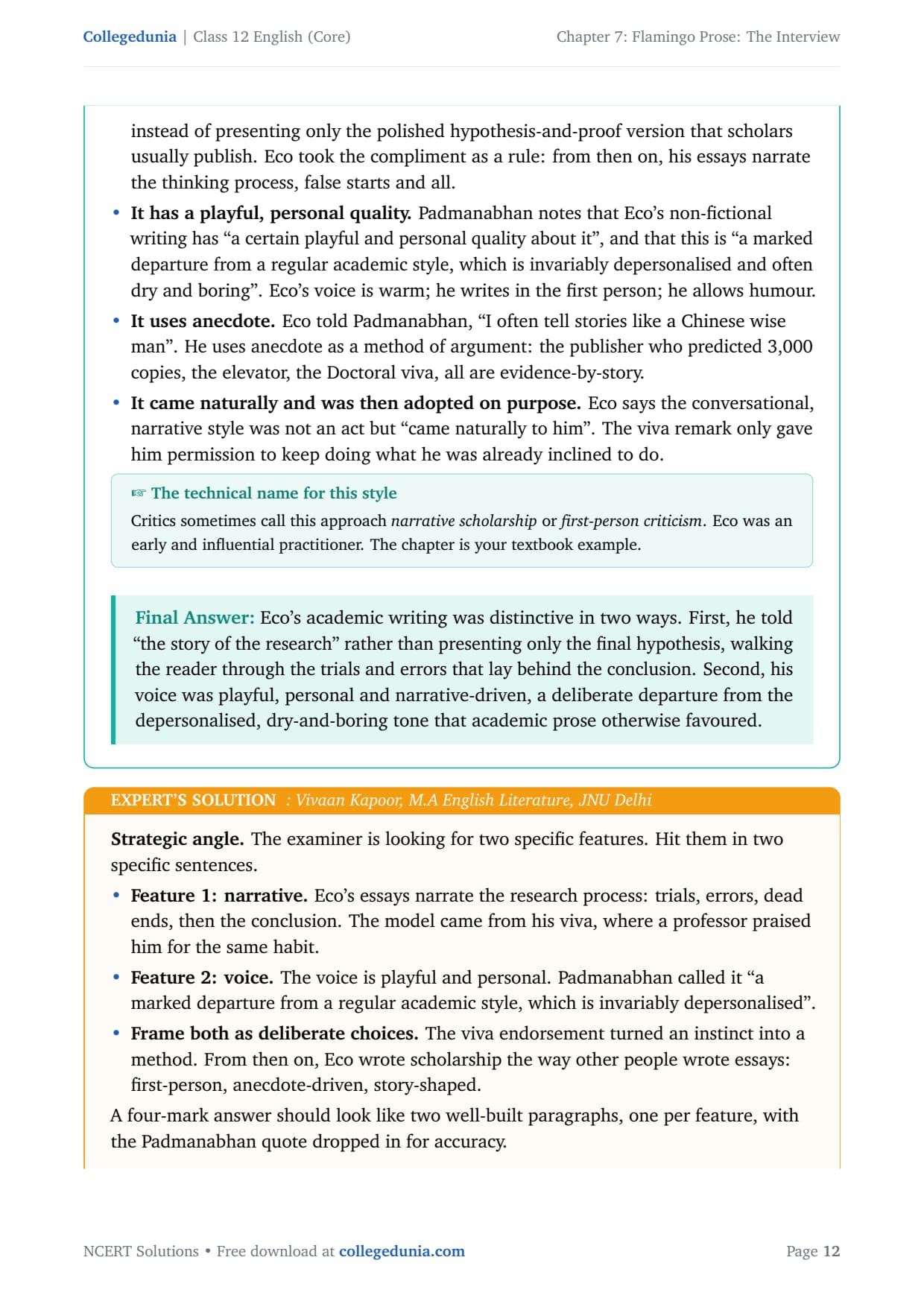
What was distinctive about Eco's academic writing style?
Long answer (4 marks)
Understanding the Text
Did Eco consider himself a novelist first or an academic scholar?
Long answer (5 marks)
Understanding the Text
What is the reason for the huge success of The Name of the Rose?
Long answer (5 marks)
Talking about the Text
Talk about any interview that you have watched on television or read in a newspaper.
Discussion (5 marks)
Talking about the Text
The medium you like best for an interview: print, radio or television.
Discussion (4 marks)
Talking about the Text
Every famous person has a right to his or her privacy.
Discussion (6 marks)
Writing
Write a short report of the interview with Umberto Eco.
Composition (~230 words)
Things to Do
Interview a person whom you admire.
Activity + sample script
The Interview's two halves: Silvester's essay (Part I) and Padmanabhan's interview with Eco (Part II).
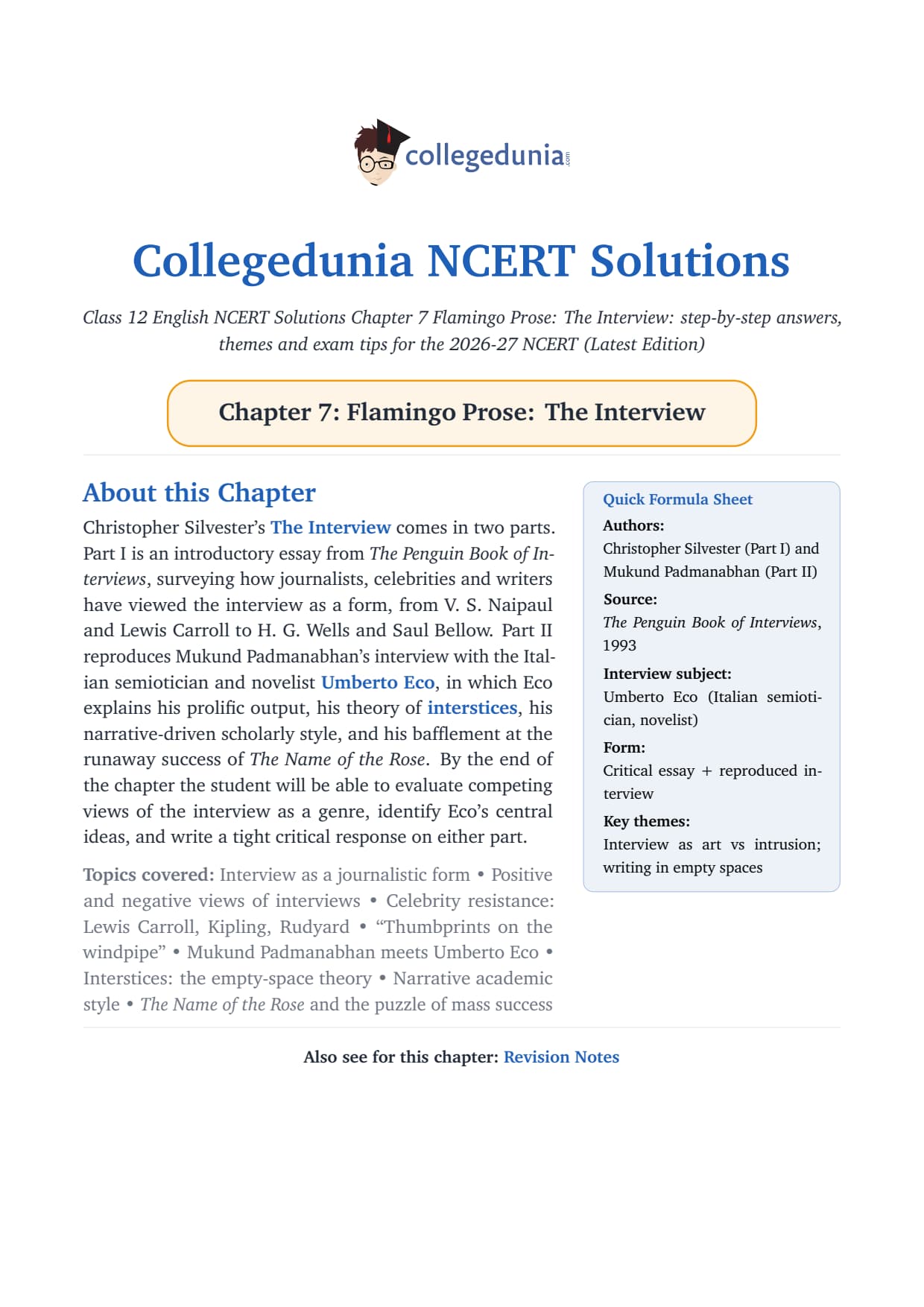
About the Chapter The Interview
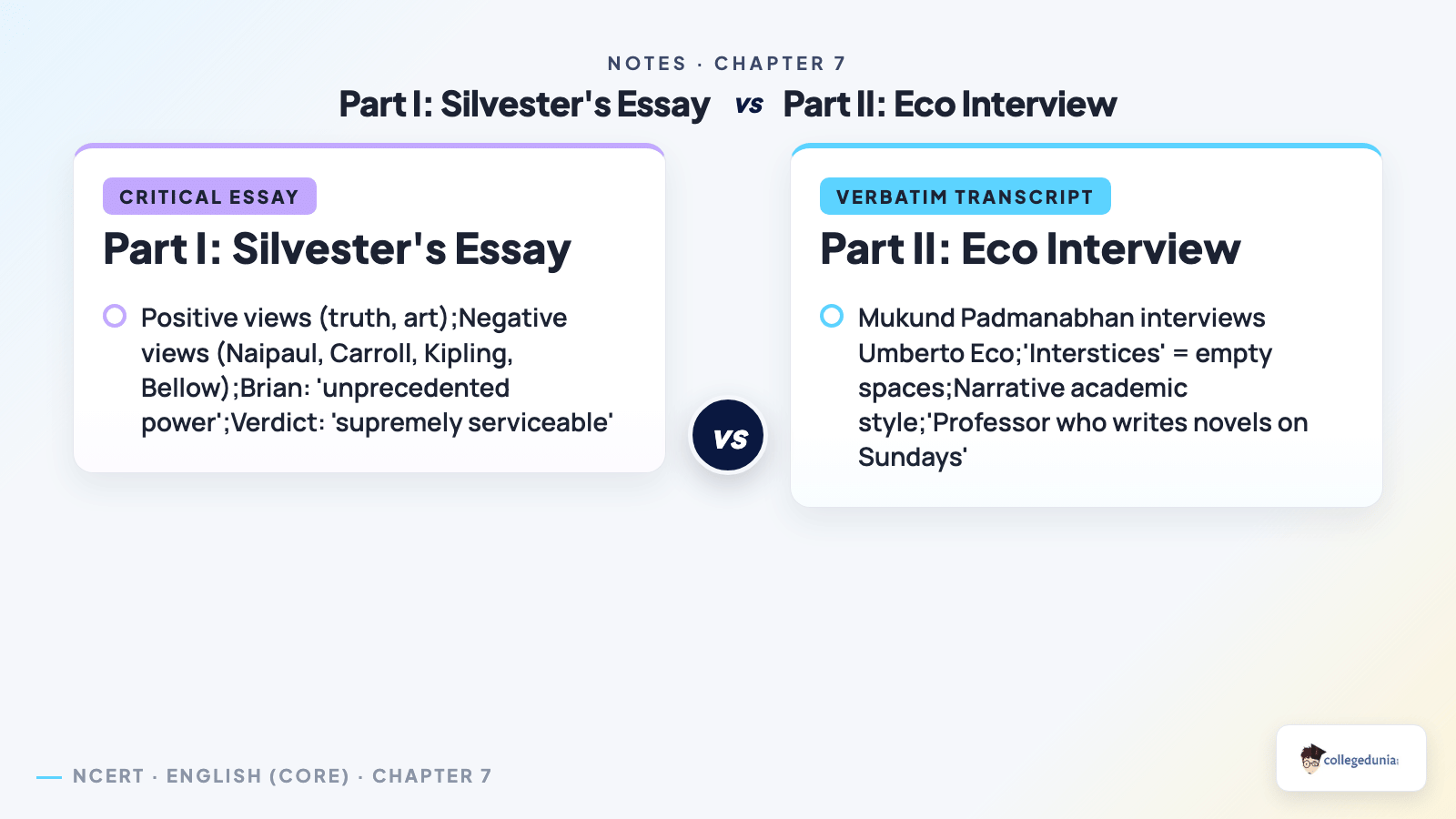
The Interview is a two-part chapter unique in the Flamingo book. Part I is Christopher Silvester's introduction to The Penguin Book of Interviews: An Anthology from 1859 to the Present Day (1993). He surveys positive and negative views of the interview as a form, quoting V.S. Naipaul, Lewis Carroll, Rudyard Kipling and Saul Bellow. Part II is Mukund Padmanabhan's verbatim conversation with the Italian semiotician and novelist Umberto Eco, in which Eco explains his theory of interstices, his narrative academic style, and his bafflement at the runaway success of his 1980 novel The Name of the Rose.
Eco's most-quoted line in the chapter, "I am a professor who writes novels on Sundays", anchors a steady stream of CBSE board questions on his self-identification. The other recurring quote, Saul Bellow's "thumbprints on his windpipe", anchors questions on celebrity hostility to interviews.
How to Use the NCERT Solutions for Class 12 The Interview
First read. Open the PDF and read each Understanding-the-Text answer once. Note the named writers (Silvester, Naipaul, Kipling, Bellow, Carroll, Eco, Padmanabhan).
Second pass. Re-read each Expert Solution. It gives the strategic angle an examiner rewards: choose a side, defend with two pieces of evidence, close with a one-line link to the chapter's larger argument.
Quotation drill. Memorise the five quotes flagged in the Solutions: "supremely serviceable medium", "unprecedented power and influence", "thumbprints on his windpipe", "a professor who writes novels on Sundays", and "Nobody can predict it".
Discussion-question practice. The three Talking-about-the-Text answers are model two-paragraph discussion responses. Use them as templates for the unseen-passage discussion section of CUET English.
The Interview Class 12 English Important Questions and PYQ Trends
In CBSE board papers since 2019, The Interview has appeared in the 3-mark and 5-mark slots in the Flamingo section. The most repeated long-answer questions are:
Why do celebrity writers despise being interviewed? (3 to 5 marks, repeated 4 times in 5 years)
What is Eco's theory of interstices, and how does it explain his productivity? (5 marks)
Was Eco a scholar first or a novelist first? Justify with evidence from the interview. (5 marks)
Explain Bellow's metaphor "thumbprints on his windpipe". (3 marks)
How These NCERT Solutions Pair with the Notes and Handwritten Notes
The Solutions PDF gives complete written answers; the Class 12 English The Interview Notes compress those answers into 14 pages of structured revision; and the Handwritten Notes give a 6-page notebook-style memory aid for the night before the exam. All three sit alongside the NCERT chapter PDF so the student can verify any line directly against the textbook.
All NCERT Solutions for Flamingo Prose: The Interview with Step-by-Step Working
Every NCERT textbook question for Class 12 English (Core) Chapter 7 Flamingo Prose: The Interview is listed below with its full Solution and Expert Solution hidden inside collapsible tabs. Click Check Solution to reveal the step-by-step working; click Expert Solution for the expanded explanation.
Part I: Think as you read
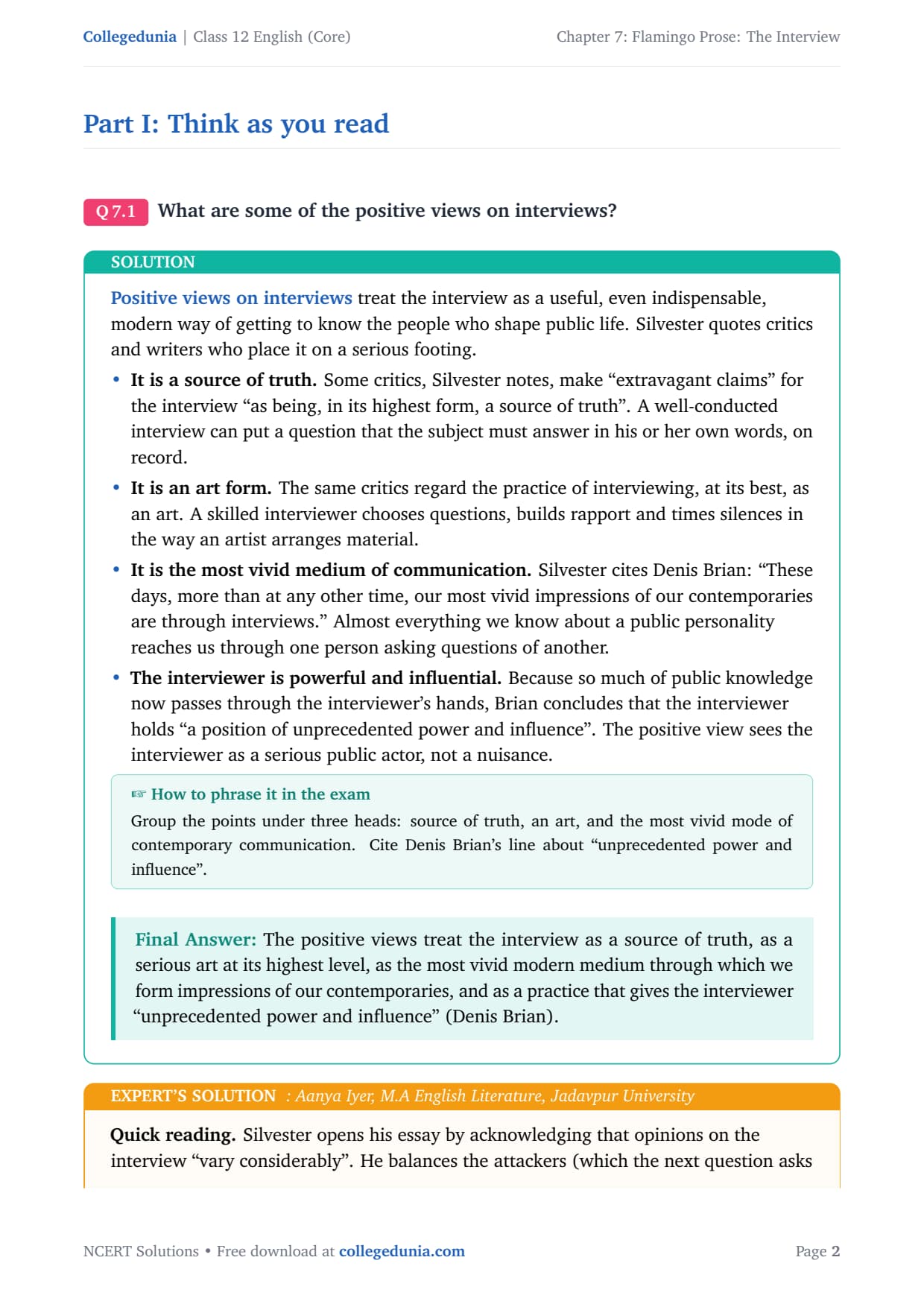
Q 7.1
What are some of the positive views on interviews?
Positive views on interviews treat the interview as a useful, even
indispensable, modern way of getting to know the people who shape public
life. Silvester quotes critics and writers who place it on a serious
footing.
It is a source of truth. Some critics, Silvester notes,
make ``extravagant claims'' for the interview ``as being, in its
highest form, a source of truth''. A well-conducted interview
can put a question that the subject must answer in his or her
own words, on record.
It is an art form. The same critics regard the practice
of interviewing, at its best, as an art. A skilled interviewer
chooses questions, builds rapport and times silences in the way
an artist arranges material.
It is the most vivid medium of communication. Silvester
cites Denis Brian: ``These days, more than at any other time,
our most vivid impressions of our contemporaries are through
interviews.'' Almost everything we know about a public
personality reaches us through one person asking questions of
another.
The interviewer is powerful and influential. Because so
much of public knowledge now passes through the interviewer's
hands, Brian concludes that the interviewer holds ``a position
of unprecedented power and influence''. The positive view sees
the interviewer as a serious public actor, not a nuisance.
How to phrase it in the exam
Group the points under three heads: source of truth, an art, and the
most vivid mode of contemporary communication. Cite Denis Brian's line
about ``unprecedented power and influence''.
The positive views treat the interview as a source of truth,
as a serious art at its highest level, as the most vivid modern medium
through which we form impressions of our contemporaries, and as a
practice that gives the interviewer ``unprecedented power and
influence'' (Denis Brian).
AI
Aanya Iyer
M.A English Literature, Jadavpur University
Verified Expert
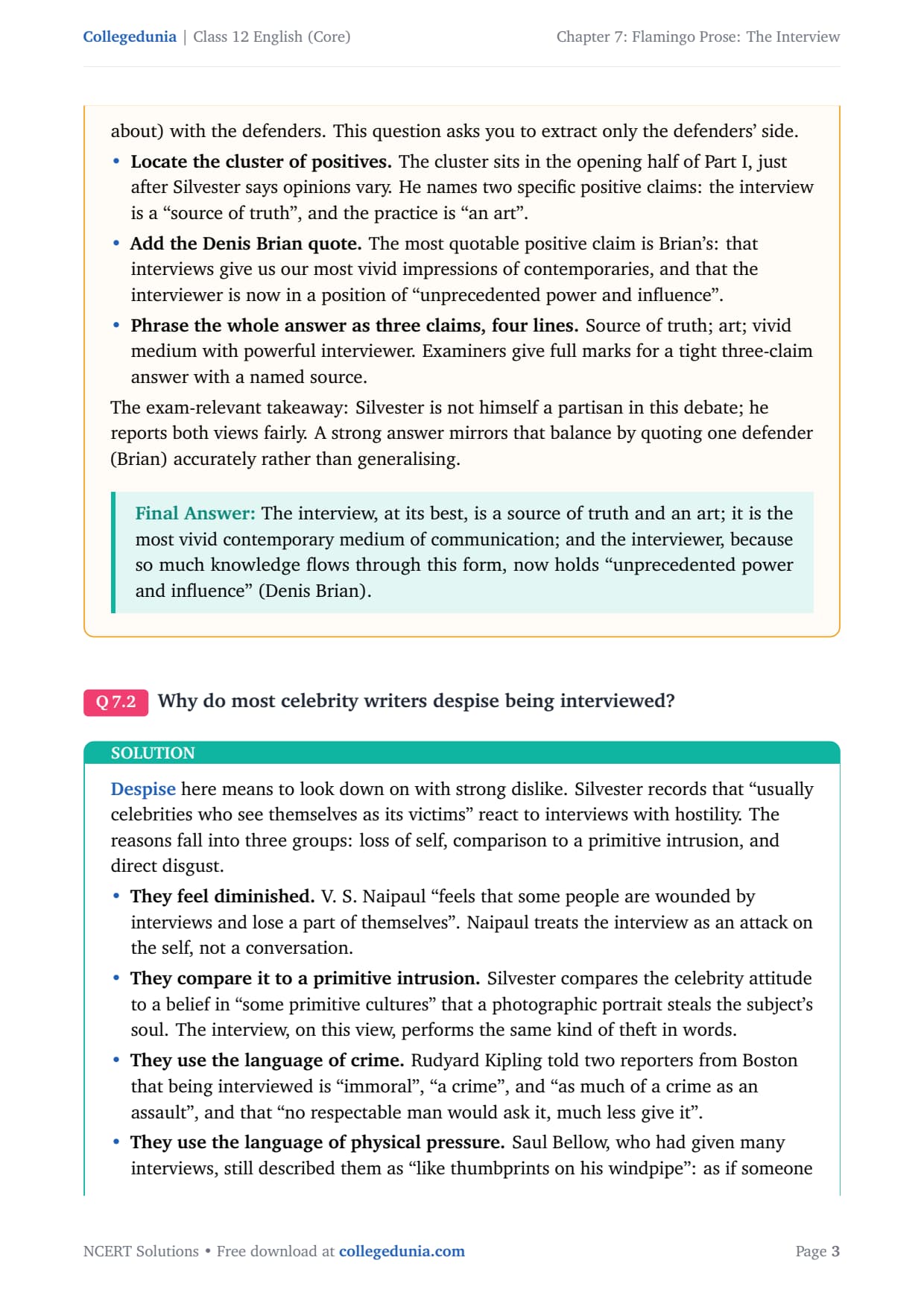
Quick reading. Silvester opens his essay by acknowledging that
opinions on the interview ``vary considerably''. He balances the
attackers (which the next question asks about) with the defenders. This
question asks you to extract only the defenders' side.
Locate the cluster of positives. The cluster sits in the
opening half of Part I, just after Silvester says opinions vary.
He names two specific positive claims: the interview is a
``source of truth'', and the practice is ``an art''.
Add the Denis Brian quote. The most quotable positive
claim is Brian's: that interviews give us our most vivid
impressions of contemporaries, and that the interviewer is now
in a position of ``unprecedented power and influence''.
Phrase the whole answer as three claims, four lines.
Source of truth; art; vivid medium with powerful interviewer.
Examiners give full marks for a tight three-claim answer with
a named source.
The exam-relevant takeaway: Silvester is not himself a partisan in this
debate; he reports both views fairly. A strong answer mirrors that
balance by quoting one defender (Brian) accurately rather than
generalising.
The interview, at its best, is a source of truth and an art;
it is the most vivid contemporary medium of communication; and the
interviewer, because so much knowledge flows through this form, now
holds ``unprecedented power and influence'' (Denis Brian).
Q 7.2
Why do most celebrity writers despise being interviewed?
Despise here means to look down on with strong dislike. Silvester
records that ``usually celebrities who see themselves as its victims''
react to interviews with hostility. The reasons fall into three groups:
loss of self, comparison to a primitive intrusion, and direct disgust.
They feel diminished. V. S. Naipaul ``feels that some
people are wounded by interviews and lose a part of themselves''.
Naipaul treats the interview as an attack on the self, not a
conversation.
They compare it to a primitive intrusion. Silvester
compares the celebrity attitude to a belief in ``some primitive
cultures'' that a photographic portrait steals the subject's
soul. The interview, on this view, performs the same kind of
theft in words.
They use the language of crime. Rudyard Kipling told
two reporters from Boston that being interviewed is ``immoral'',
``a crime'', and ``as much of a crime as an assault'', and that
``no respectable man would ask it, much less give it''.
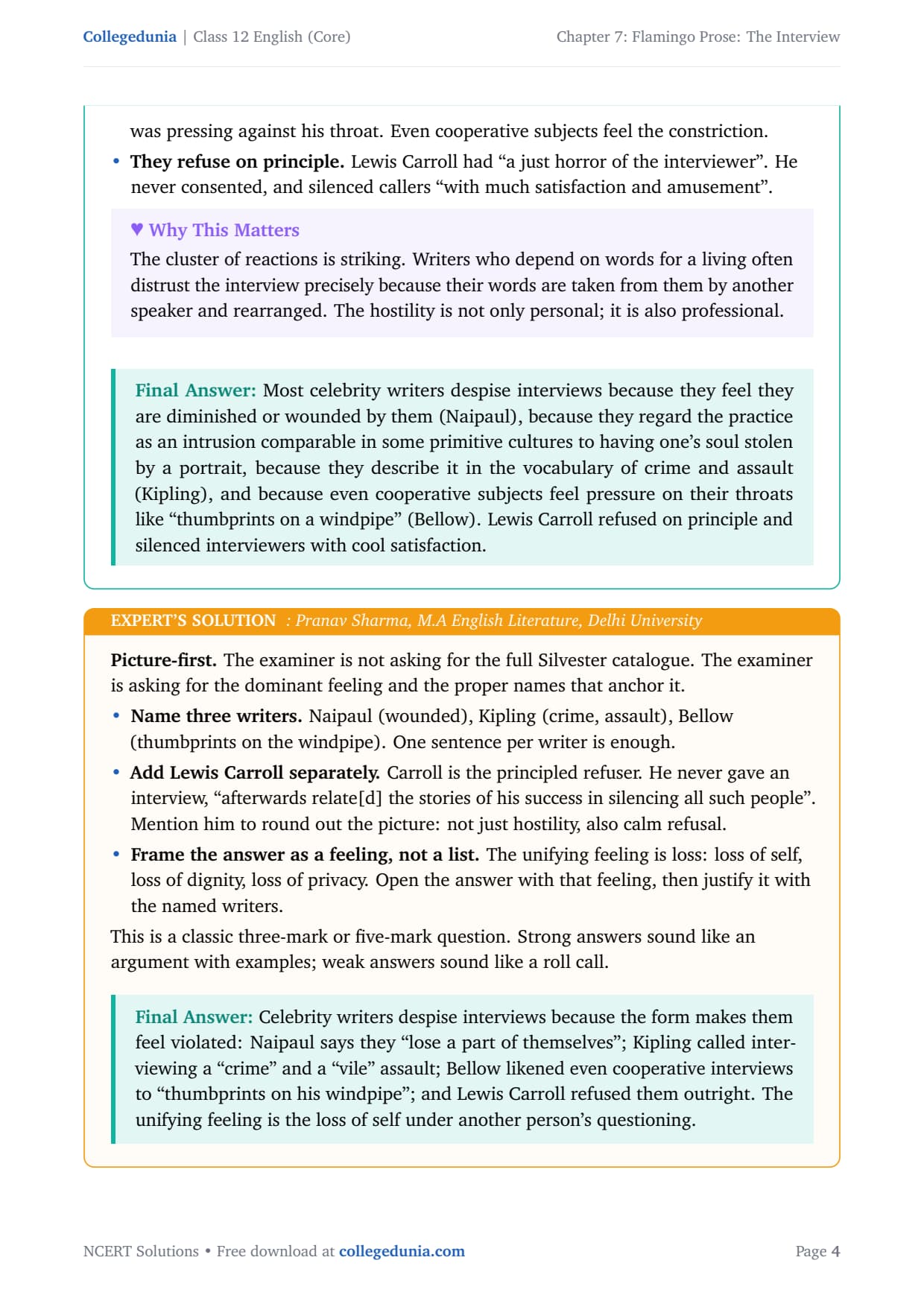
They use the language of physical pressure. Saul Bellow,
who had given many interviews, still described them as ``like
thumbprints on his windpipe'': as if someone was pressing
against his throat. Even cooperative subjects feel the
constriction.
They refuse on principle. Lewis Carroll had ``a just
horror of the interviewer''. He never consented, and silenced
callers ``with much satisfaction and amusement''.
The cluster of reactions is striking. Writers who depend on words for
a living often distrust the interview precisely because their words
are taken from them by another speaker and rearranged. The hostility
is not only personal; it is also professional.
Most celebrity writers despise interviews because they feel
they are diminished or wounded by them (Naipaul), because they regard
the practice as an intrusion comparable in some primitive cultures to
having one's soul stolen by a portrait, because they describe it in
the vocabulary of crime and assault (Kipling), and because even
cooperative subjects feel pressure on their throats like
``thumbprints on a windpipe'' (Bellow). Lewis Carroll refused on
principle and silenced interviewers with cool satisfaction.
PS
Pranav Sharma
M.A English Literature, Delhi University
Verified Expert
Picture-first. The examiner is not asking for the full Silvester
catalogue. The examiner is asking for the dominant feeling and the
proper names that anchor it.
Name three writers. Naipaul (wounded), Kipling (crime,
assault), Bellow (thumbprints on the windpipe). One sentence
per writer is enough.
Add Lewis Carroll separately. Carroll is the principled
refuser. He never gave an interview, ``afterwards relate[d]
the stories of his success in silencing all such people''.
Mention him to round out the picture: not just hostility,
also calm refusal.
Frame the answer as a feeling, not a list. The unifying
feeling is loss: loss of self, loss of dignity, loss of
privacy. Open the answer with that feeling, then justify it
with the named writers.
This is a classic three-mark or five-mark question. Strong answers
sound like an argument with examples; weak answers sound like a roll
call.
Celebrity writers despise interviews because the form makes
them feel violated: Naipaul says they ``lose a part of themselves'';
Kipling called interviewing a ``crime'' and a ``vile'' assault; Bellow
likened even cooperative interviews to ``thumbprints on his windpipe'';
and Lewis Carroll refused them outright. The unifying feeling is the
loss of self under another person's questioning.
Q 7.3
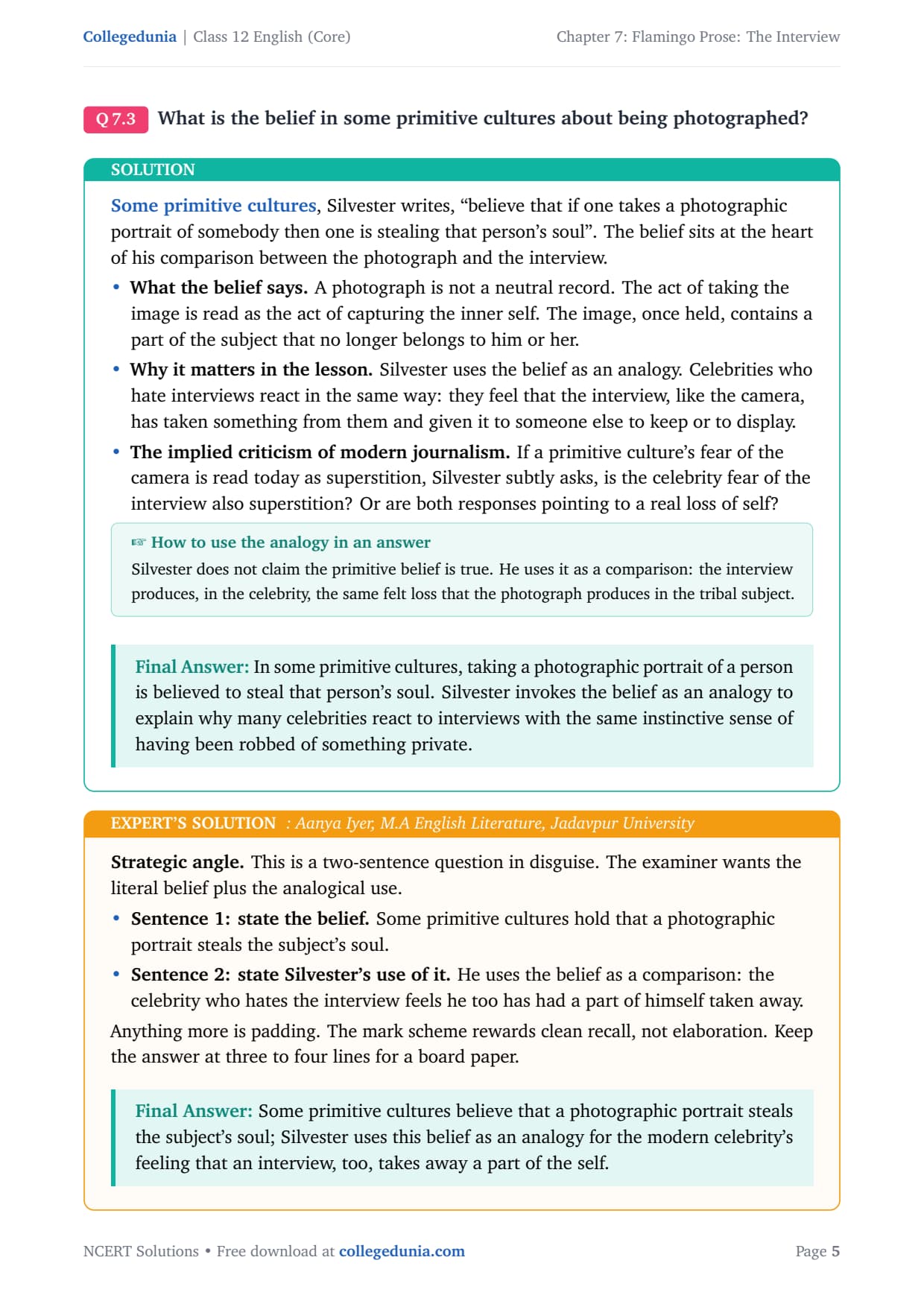
What is the belief in some primitive cultures about being photographed?
Some primitive cultures, Silvester writes, ``believe that if one
takes a photographic portrait of somebody then one is stealing that
person's soul''. The belief sits at the heart of his comparison
between the photograph and the interview.
What the belief says. A photograph is not a neutral
record. The act of taking the image is read as the act of
capturing the inner self. The image, once held, contains a
part of the subject that no longer belongs to him or her.
Why it matters in the lesson. Silvester uses the
belief as an analogy. Celebrities who hate interviews react in
the same way: they feel that the interview, like the camera,
has taken something from them and given it to someone else to
keep or to display.
The implied criticism of modern journalism. If a
primitive culture's fear of the camera is read today as
superstition, Silvester subtly asks, is the celebrity fear of
the interview also superstition? Or are both responses
pointing to a real loss of self?
How to use the analogy in an answer
Silvester does not claim the primitive belief is true. He uses it as
a comparison: the interview produces, in the celebrity, the same
felt loss that the photograph produces in the tribal subject.
In some primitive cultures, taking a photographic portrait of
a person is believed to steal that person's soul. Silvester invokes
the belief as an analogy to explain why many celebrities react to
interviews with the same instinctive sense of having been robbed of
something private.
AI
Aanya Iyer
M.A English Literature, Jadavpur University
Verified Expert
Strategic angle. This is a two-sentence question in disguise.
The examiner wants the literal belief plus the analogical use.
Sentence 1: state the belief. Some primitive cultures
hold that a photographic portrait steals the subject's soul.
Sentence 2: state Silvester's use of it. He uses the
belief as a comparison: the celebrity who hates the interview
feels he too has had a part of himself taken away.
Anything more is padding. The mark scheme rewards clean recall, not
elaboration. Keep the answer at three to four lines for a board paper.
Some primitive cultures believe that a photographic portrait
steals the subject's soul; Silvester uses this belief as an analogy
for the modern celebrity's feeling that an interview, too, takes away
a part of the self.
Q 7.4
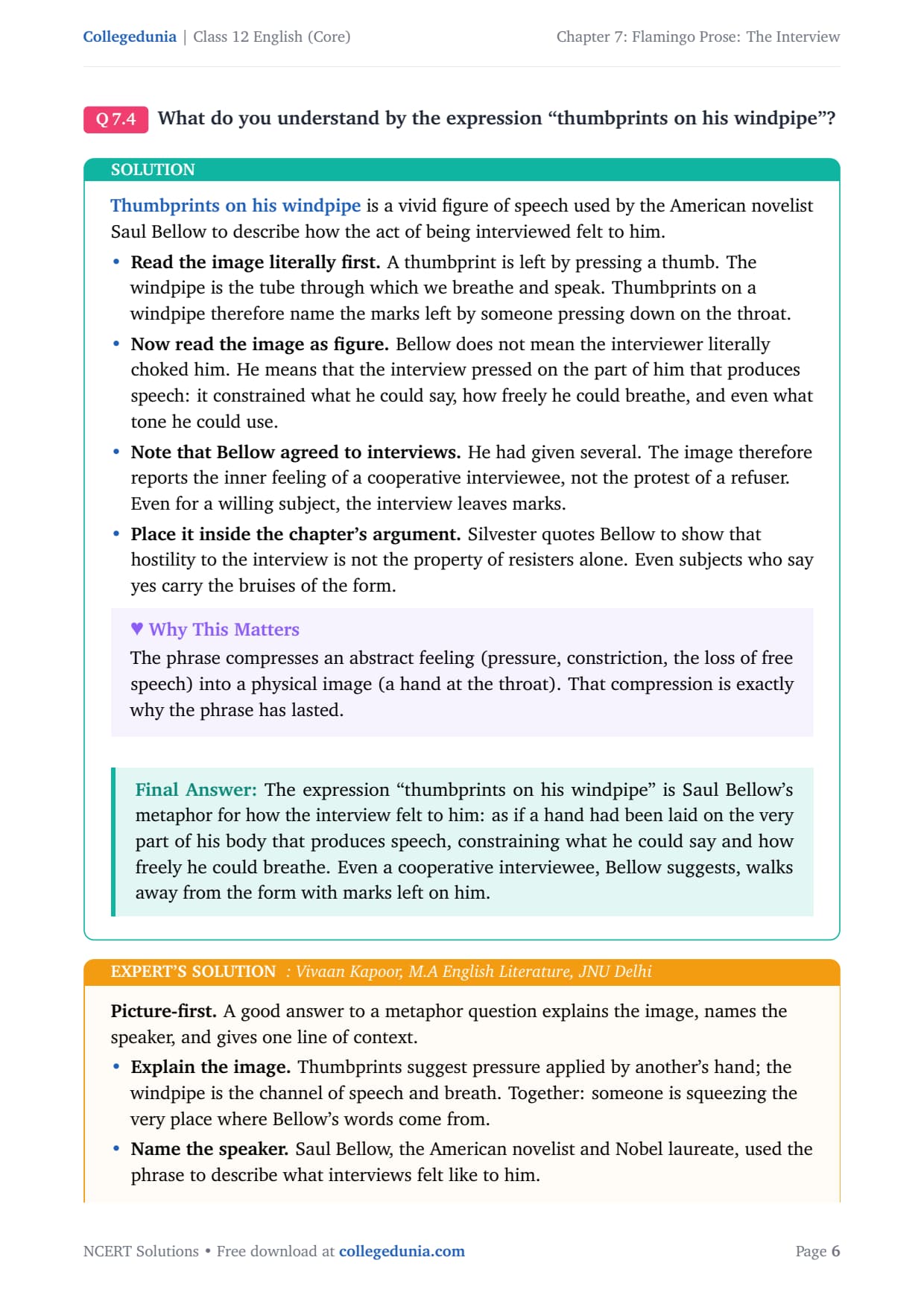
What do you understand by the expression ``thumbprints on his windpipe''?
Thumbprints on his windpipe is a vivid figure of speech used by
the American novelist Saul Bellow to describe how the act of being
interviewed felt to him.
Read the image literally first. A thumbprint is left
by pressing a thumb. The windpipe is the tube through which
we breathe and speak. Thumbprints on a windpipe therefore name
the marks left by someone pressing down on the throat.
Now read the image as figure. Bellow does not mean
the interviewer literally choked him. He means that the
interview pressed on the part of him that produces speech: it
constrained what he could say, how freely he could breathe,
and even what tone he could use.
Note that Bellow agreed to interviews. He had given
several. The image therefore reports the inner feeling of a
cooperative interviewee, not the protest of a refuser. Even
for a willing subject, the interview leaves marks.
Place it inside the chapter's argument. Silvester
quotes Bellow to show that hostility to the interview is not
the property of resisters alone. Even subjects who say yes
carry the bruises of the form.
The phrase compresses an abstract feeling (pressure, constriction,
the loss of free speech) into a physical image (a hand at the throat).
That compression is exactly why the phrase has lasted.
The expression ``thumbprints on his windpipe'' is Saul
Bellow's metaphor for how the interview felt to him: as if a hand
had been laid on the very part of his body that produces speech,
constraining what he could say and how freely he could breathe.
Even a cooperative interviewee, Bellow suggests, walks away from
the form with marks left on him.
VK
Vivaan Kapoor
M.A English Literature, JNU Delhi
Verified Expert
Picture-first. A good answer to a metaphor question explains the
image, names the speaker, and gives one line of context.
Explain the image. Thumbprints suggest pressure
applied by another's hand; the windpipe is the channel of
speech and breath. Together: someone is squeezing the very
place where Bellow's words come from.
Name the speaker. Saul Bellow, the American novelist
and Nobel laureate, used the phrase to describe what
interviews felt like to him.
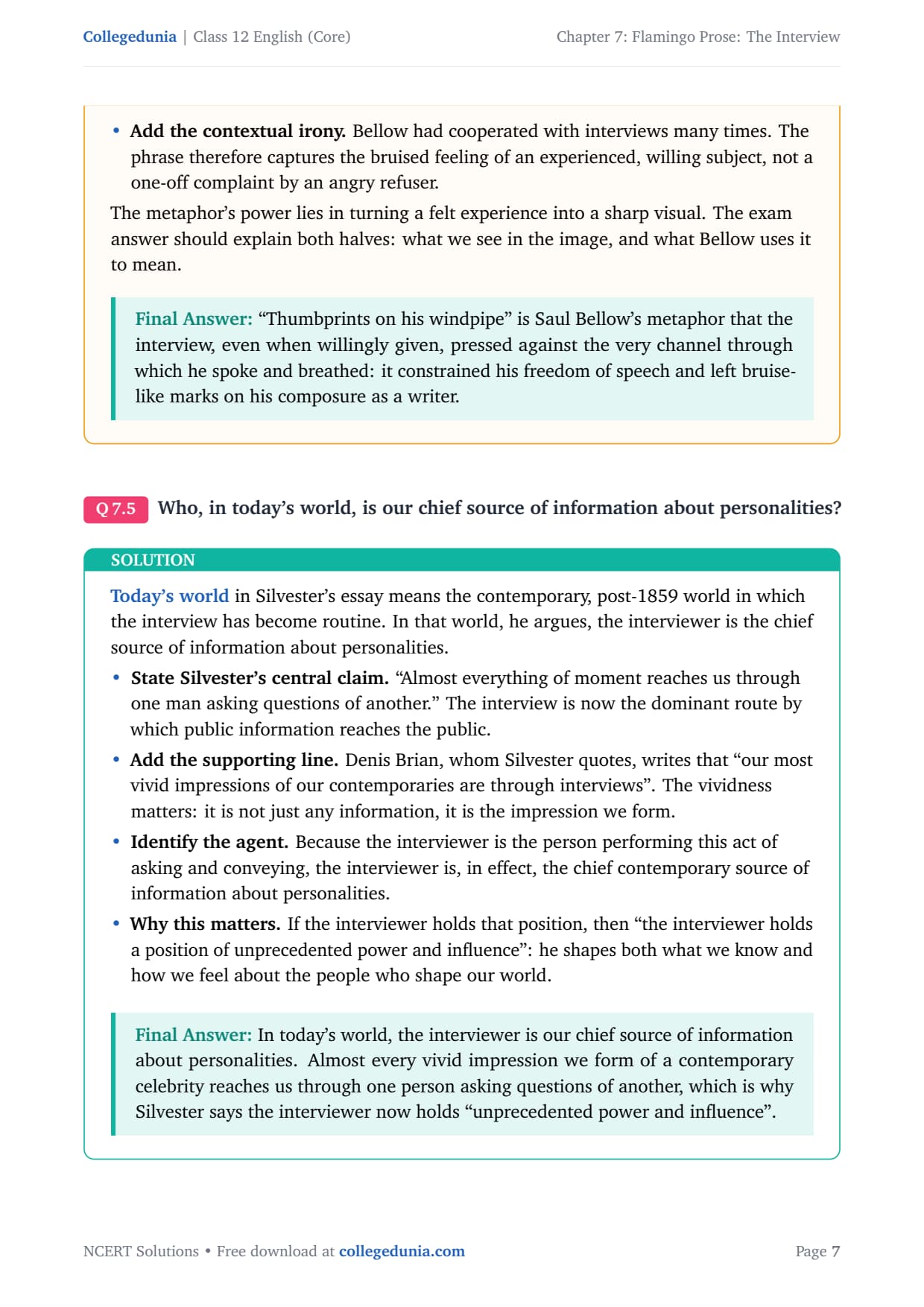
Add the contextual irony. Bellow had cooperated
with interviews many times. The phrase therefore captures
the bruised feeling of an experienced, willing subject, not
a one-off complaint by an angry refuser.
The metaphor's power lies in turning a felt experience into a sharp
visual. The exam answer should explain both halves: what we see in
the image, and what Bellow uses it to mean.
``Thumbprints on his windpipe'' is Saul Bellow's metaphor
that the interview, even when willingly given, pressed against the
very channel through which he spoke and breathed: it constrained his
freedom of speech and left bruise-like marks on his composure as
a writer.
Q 7.5
Who, in today's world, is our chief source of information about personalities?
Today's world in Silvester's essay means the contemporary,
post-1859 world in which the interview has become routine. In that
world, he argues, the interviewer is the chief source of information
about personalities.
State Silvester's central claim. ``Almost everything
of moment reaches us through one man asking questions of
another.'' The interview is now the dominant route by which
public information reaches the public.
Add the supporting line. Denis Brian, whom Silvester
quotes, writes that ``our most vivid impressions of our
contemporaries are through interviews''. The vividness
matters: it is not just any information, it is the impression
we form.
Identify the agent. Because the interviewer is the
person performing this act of asking and conveying, the
interviewer is, in effect, the chief contemporary source of
information about personalities.
Why this matters. If the interviewer holds that
position, then ``the interviewer holds a position of
unprecedented power and influence'': he shapes both what we
know and how we feel about the people who shape our world.
In today's world, the interviewer is our chief source of
information about personalities. Almost every vivid impression we form
of a contemporary celebrity reaches us through one person asking
questions of another, which is why Silvester says the interviewer now
holds ``unprecedented power and influence''.
PS
Pranav Sharma
M.A English Literature, Delhi University
Verified Expert
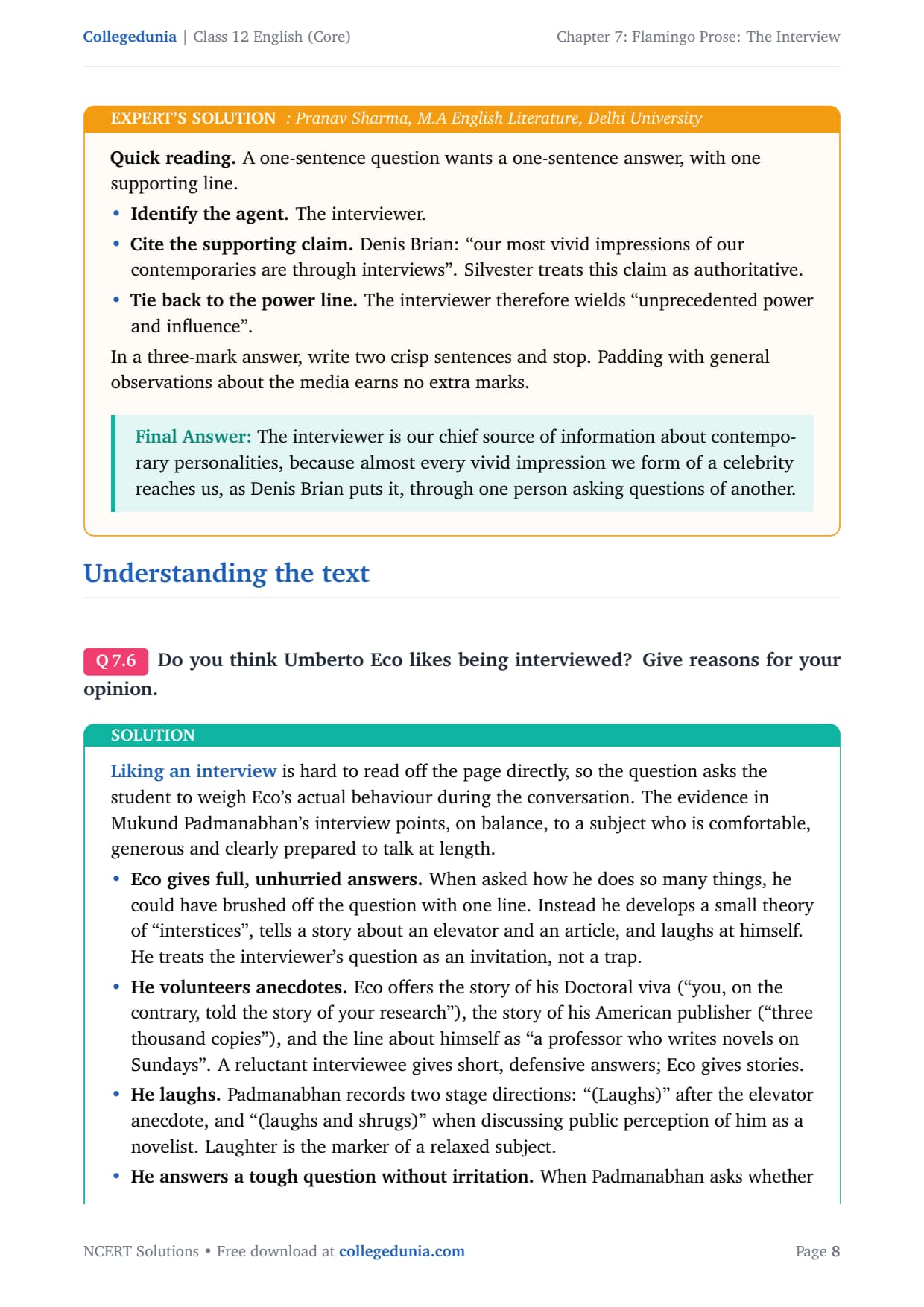
Quick reading. A one-sentence question wants a one-sentence
answer, with one supporting line.
Identify the agent. The interviewer.
Cite the supporting claim. Denis Brian: ``our most
vivid impressions of our contemporaries are through
interviews''. Silvester treats this claim as authoritative.
Tie back to the power line. The interviewer therefore
wields ``unprecedented power and influence''.
In a three-mark answer, write two crisp sentences and stop. Padding
with general observations about the media earns no extra marks.
The interviewer is our chief source of information about
contemporary personalities, because almost every vivid impression we
form of a celebrity reaches us, as Denis Brian puts it, through one
person asking questions of another.
Understanding the text
Q 7.6
Do you think Umberto Eco likes being interviewed? Give reasons for your opinion.
Liking an interview is hard to read off the page directly, so the
question asks the student to weigh Eco's actual behaviour during the
conversation. The evidence in Mukund Padmanabhan's interview points,
on balance, to a subject who is comfortable, generous and clearly
prepared to talk at length.
Eco gives full, unhurried answers. When asked how he
does so many things, he could have brushed off the question
with one line. Instead he develops a small theory of
``interstices'', tells a story about an elevator and an
article, and laughs at himself. He treats the interviewer's
question as an invitation, not a trap.
He volunteers anecdotes. Eco offers the story of his
Doctoral viva (``you, on the contrary, told the story of your
research''), the story of his American publisher (``three
thousand copies''), and the line about himself as ``a
professor who writes novels on Sundays''. A reluctant
interviewee gives short, defensive answers; Eco gives stories.
He laughs. Padmanabhan records two stage directions:
``(Laughs)'' after the elevator anecdote, and ``(laughs and
shrugs)'' when discussing public perception of him as a
novelist. Laughter is the marker of a relaxed subject.
He answers a tough question without irritation. When
Padmanabhan asks whether the popular image of him as ``the
novelist'' bothers him, Eco says yes, then explains himself
without snapping. He defends his identity as ``a university
professor who writes novels on Sundays''. The defence is
principled, not prickly.
He shares hesitations. Eco confesses he himself
watches ``Miami Vice'' or ``Emergency Room'' at 9 pm. A
reluctant interviewee would not surrender that detail.
How to argue this answer
The question asks for an opinion with reasons. State your opinion first
(``Yes, on balance Eco seems to enjoy the interview''), then list three
or four pieces of evidence. The examiner rewards the framing more than
the conclusion.
On the evidence of the conversation, Eco does seem to enjoy
being interviewed: he gives long, story-rich answers; volunteers
anecdotes from his viva, his publisher and his television-watching
habits; laughs twice during the exchange; defends his identity as
``a university professor who writes novels on Sundays'' without
irritation; and treats each question as an invitation to develop a
thought rather than a probe to be deflected.
IM
Ishita Menon
M.A English Literature, Madras University
Verified Expert
Strategic angle. An opinion question is a hidden invitation to
look at behaviour, not at one quotable line.
Choose the conclusion first. On the evidence in
the printed extract, the only defensible reading is that
Eco is comfortable. Open with that conclusion.
Cluster the evidence into three categories. Length
of answers (he develops theories), volunteered anecdotes
(viva, publisher, television), and the stage directions
(``laughs'', ``laughs and shrugs''). Each cluster gets one
sentence.
Acknowledge the one moment of irritation. When
asked about being seen as ``the novelist'', he says yes,
it does bother him. A balanced answer admits this and then
notes that he answers the question patiently anyway. That
balance is exactly what the examiner rewards.
End with a clean restatement. The whole portrait
is of a willing, slightly playful interviewee.
A weaker answer would shrug and say ``it depends''. A stronger answer
takes a stand and defends it with three concrete bits of evidence.
Yes. Eco gives long, generous answers (interstices, the
elevator article); volunteers personal stories (his viva, the
American publisher, his liking for ``Miami Vice''); laughs twice in
the printed extract; and even when irritated by the popular ``oh,
he's the novelist'' label, replies in full sentences. His behaviour
on the page is that of a willing, comfortable interviewee.
Q 7.7
How does Eco find the time to write so much?
Interstices is Eco's own word for the small empty spaces in
everyday life. The full answer to how he writes so much sits inside
that idea, but it has three supporting pieces: a unifying interest,
a way of using empty time, and a confessed ``secret''.
The unifying interest. Eco says, ``in the end, I am
convinced I am always doing the same thing''. His academic
work, his novels, even his children's books are driven by
the same bunch of ``ethical, philosophical interests'' (peace,
non-violence, semiotics). He is not switching between
unrelated projects; he is approaching one set of questions
from many angles. This sense of unity means there is no
``warming-up'' cost between projects.
The secret: writing in interstices. Eco asks
Padmanabhan to imagine what happens if you eliminate the empty
spaces inside atoms: the universe would shrink to the size of
a fist. Most of life, he says, is empty space, the time
between things. He calls these empty spaces interstices.
He works inside them. ``While waiting for your elevator to
come up from the first to the third floor, I have already
written an article!''
The reach this gives him. Because he writes in
interstices, he can produce ``more than 40'' scholarly books
in addition to his novels and children's writing without
feeling that his day is consumed by writing. The output is
the by-product of using time that other people throw away.
Many highly productive academics describe a similar habit: writing in
20-minute pockets between meetings, on aeroplanes, while waiting for
a class to gather. Eco gives the habit a name and a philosophy.
Eco finds the time to write so much because, first, all his
projects are driven by the same set of ethical and philosophical
interests, so he is never starting from cold, and second, he writes
in what he calls interstices: the empty spaces of everyday
life (the time spent waiting for an elevator, for a friend, for a
lift), turning what most of us discard into productive minutes.
AI
Aanya Iyer
M.A English Literature, Jadavpur University
Verified Expert
Quick reading. The exam answer needs the word interstices
and the elevator example. Anything else is bonus.
Name the term.Interstices: the empty spaces
of daily life. The word itself is Eco's metaphor for the
gaps between events that most people lose.
Give the example. The elevator: by the time the
elevator climbs from the first floor to the third, Eco
claims he has finished writing a short article.
Add the unifying frame. Eco also believes he is
always doing the same thing: the philosophical interests
bind all his projects together, so the cost of moving from
novel to academic essay to children's book is small.
Close with the result. The combination of
unification plus interstices gives him more than 40
scholarly books, several novels, and children's writing.
This question often appears as a 3- or 4-mark question. Memorise the
word interstices and the elevator example; everything else
is recoverable.
Eco writes so much because he works in what he calls
interstices, the empty spaces of daily life: ``while waiting
for your elevator to come up from the first to the third floor, I
have already written an article''. He is also supported by a single
set of philosophical interests that unifies his academic work, his
novels and his children's books, so very little energy is lost in
switching tasks.
Q 7.8
What was distinctive about Eco's academic writing style?
Distinctive here means the features that mark Eco's scholarly
prose off from the standard academic style of the time. The two
features Eco himself names are a narrative shape and a personal,
playful voice.
It tells the story of the research. At his doctoral
viva, one professor complimented Eco for telling ``the story
of your research, even including your trials and errors''
instead of presenting only the polished hypothesis-and-proof
version that scholars usually publish. Eco took the
compliment as a rule: from then on, his essays narrate the
thinking process, false starts and all.
It has a playful, personal quality. Padmanabhan notes
that Eco's non-fictional writing has ``a certain playful and
personal quality about it'', and that this is ``a marked
departure from a regular academic style, which is invariably
depersonalised and often dry and boring''. Eco's voice is
warm; he writes in the first person; he allows humour.
It uses anecdote. Eco told Padmanabhan, ``I often
tell stories like a Chinese wise man''. He uses anecdote as a
method of argument: the publisher who predicted 3,000 copies,
the elevator, the Doctoral viva, all are evidence-by-story.
It came naturally and was then adopted on purpose.
Eco says the conversational, narrative style was not an act
but ``came naturally to him''. The viva remark only gave him
permission to keep doing what he was already inclined to do.
The technical name for this style
Critics sometimes call this approach narrative scholarship or
first-person criticism. Eco was an early and influential
practitioner. The chapter is your textbook example.
Eco's academic writing was distinctive in two ways. First,
he told ``the story of the research'' rather than presenting only
the final hypothesis, walking the reader through the trials and
errors that lay behind the conclusion. Second, his voice was
playful, personal and narrative-driven, a deliberate departure from
the depersonalised, dry-and-boring tone that academic prose
otherwise favoured.
VK
Vivaan Kapoor
M.A English Literature, JNU Delhi
Verified Expert
Strategic angle. The examiner is looking for two specific
features. Hit them in two specific sentences.
Feature 1: narrative. Eco's essays narrate the
research process: trials, errors, dead ends, then the
conclusion. The model came from his viva, where a professor
praised him for the same habit.
Feature 2: voice. The voice is playful and personal.
Padmanabhan called it ``a marked departure from a regular
academic style, which is invariably depersonalised''.
Frame both as deliberate choices. The viva
endorsement turned an instinct into a method. From then on,
Eco wrote scholarship the way other people wrote essays:
first-person, anecdote-driven, story-shaped.
A four-mark answer should look like two well-built paragraphs, one
per feature, with the Padmanabhan quote dropped in for accuracy.
The distinctive features are two: (a) Eco's essays tell
``the story of the research'', trials and errors included, instead
of arriving polished at a conclusion; and (b) the voice is playful
and personal, a deliberate departure from the ``depersonalised, dry
and boring'' tone of regular academic prose.
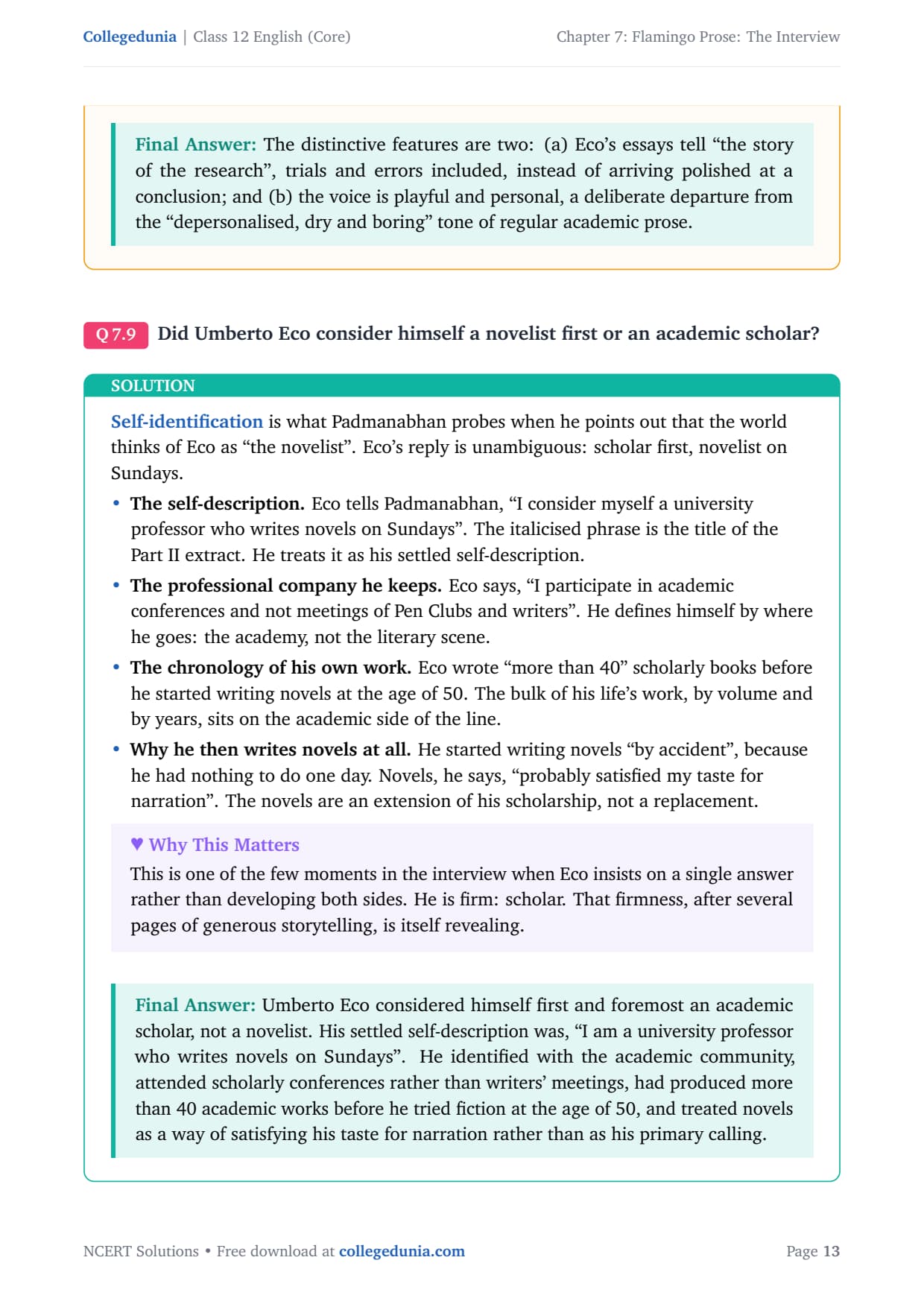
Q 7.9
Did Umberto Eco consider himself a novelist first or an academic scholar?
Self-identification is what Padmanabhan probes when he points
out that the world thinks of Eco as ``the novelist''. Eco's reply is
unambiguous: scholar first, novelist on Sundays.
The self-description. Eco tells Padmanabhan, ``I
consider myself a university professor who writes novels on
Sundays''. The italicised phrase is the title of the Part II
extract. He treats it as his settled self-description.
The professional company he keeps. Eco says, ``I
participate in academic conferences and not meetings of Pen
Clubs and writers''. He defines himself by where he goes:
the academy, not the literary scene.
The chronology of his own work. Eco wrote ``more
than 40'' scholarly books before he started writing novels
at the age of 50. The bulk of his life's work, by volume
and by years, sits on the academic side of the line.
Why he then writes novels at all. He started writing
novels ``by accident'', because he had nothing to do one
day. Novels, he says, ``probably satisfied my taste for
narration''. The novels are an extension of his scholarship,
not a replacement.
This is one of the few moments in the interview when Eco insists on
a single answer rather than developing both sides. He is firm: scholar.
That firmness, after several pages of generous storytelling, is
itself revealing.
Umberto Eco considered himself first and foremost an
academic scholar, not a novelist. His settled self-description was,
``I am a university professor who writes novels on Sundays''. He
identified with the academic community, attended scholarly
conferences rather than writers' meetings, had produced more than
40 academic works before he tried fiction at the age of 50, and
treated novels as a way of satisfying his taste for narration
rather than as his primary calling.
IM
Ishita Menon
M.A English Literature, Madras University
Verified Expert
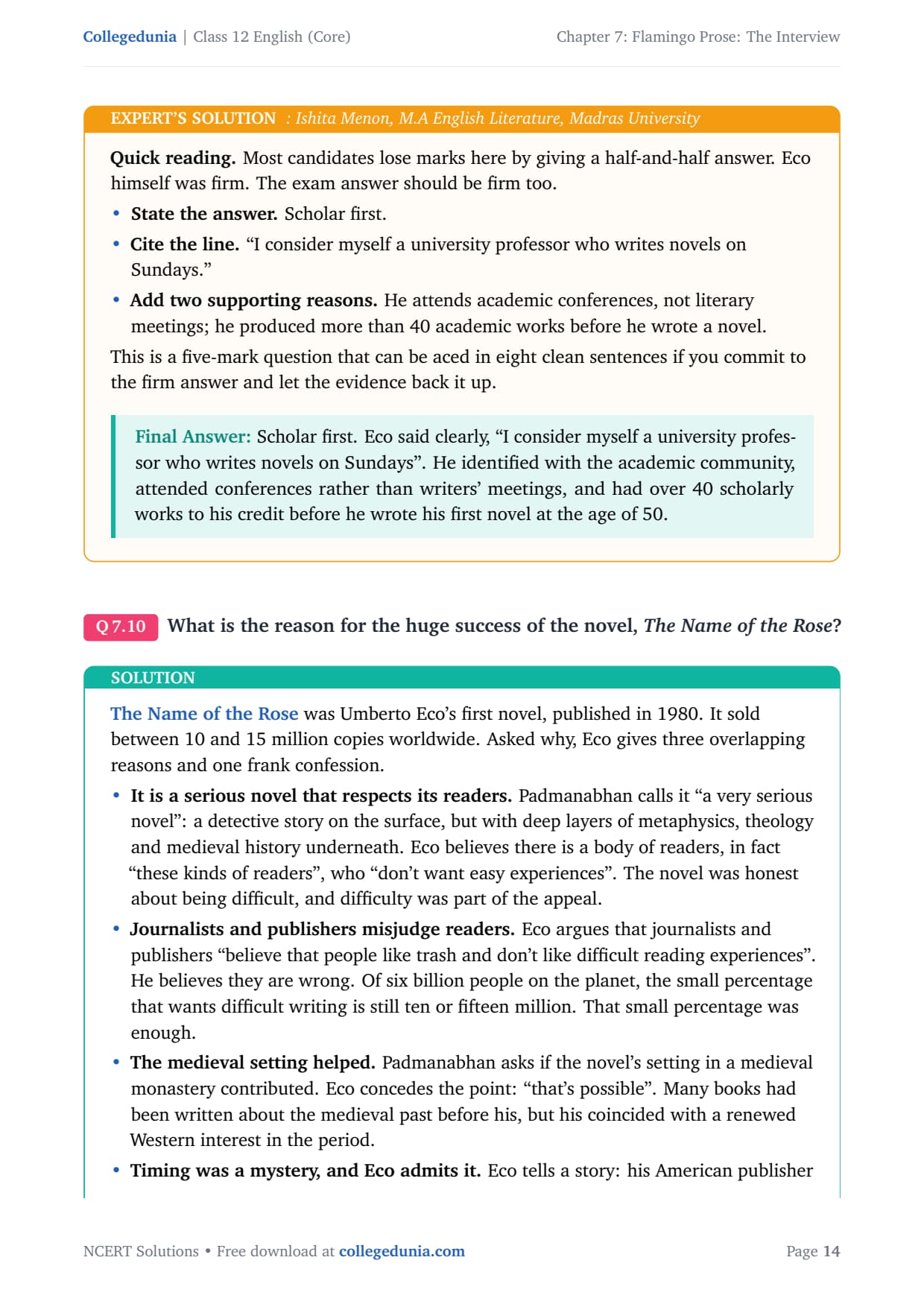
Quick reading. Most candidates lose marks here by giving a
half-and-half answer. Eco himself was firm. The exam answer should
be firm too.
State the answer. Scholar first.
Cite the line. ``I consider myself a university
professor who writes novels on Sundays.''
Add two supporting reasons. He attends academic
conferences, not literary meetings; he produced more than
40 academic works before he wrote a novel.
This is a five-mark question that can be aced in eight clean
sentences if you commit to the firm answer and let the evidence
back it up.
Scholar first. Eco said clearly, ``I consider myself a
university professor who writes novels on Sundays''. He identified
with the academic community, attended conferences rather than
writers' meetings, and had over 40 scholarly works to his credit
before he wrote his first novel at the age of 50.
Q 7.10
What is the reason for the huge success of the novel, The Name of the Rose?
The Name of the Rose was Umberto Eco's first novel, published
in 1980. It sold between 10 and 15 million copies worldwide. Asked
why, Eco gives three overlapping reasons and one frank confession.
It is a serious novel that respects its readership.
Padmanabhan calls it ``a very serious novel'': a detective
story on the surface, but with deep layers of metaphysics,
theology and medieval history underneath. Eco believes there
is a body of book-lovers, in fact ``these kinds of book-lovers'',
who ``don't want easy experiences''. The novel was honest
about being difficult, and difficulty was part of the appeal.
Journalists and publishers misjudge the reading public. Eco
argues that journalists and publishers ``believe that people
like trash and don't like difficult reading experiences''.
He believes they are wrong. Of six billion people on the
planet, the small percentage that wants difficult writing
is still ten or fifteen million. That small percentage was
enough.
The medieval setting helped. Padmanabhan asks if the
novel's setting in a medieval monastery contributed. Eco
concedes the point: ``that's possible''. Many books had been
written about the medieval past before his, but his
coincided with a renewed Western interest in the period.
Timing was a mystery, and Eco admits it. Eco tells
a story: his American publisher expected to sell only 3,000
copies; it sold ``two or three million in the U.S''. Many
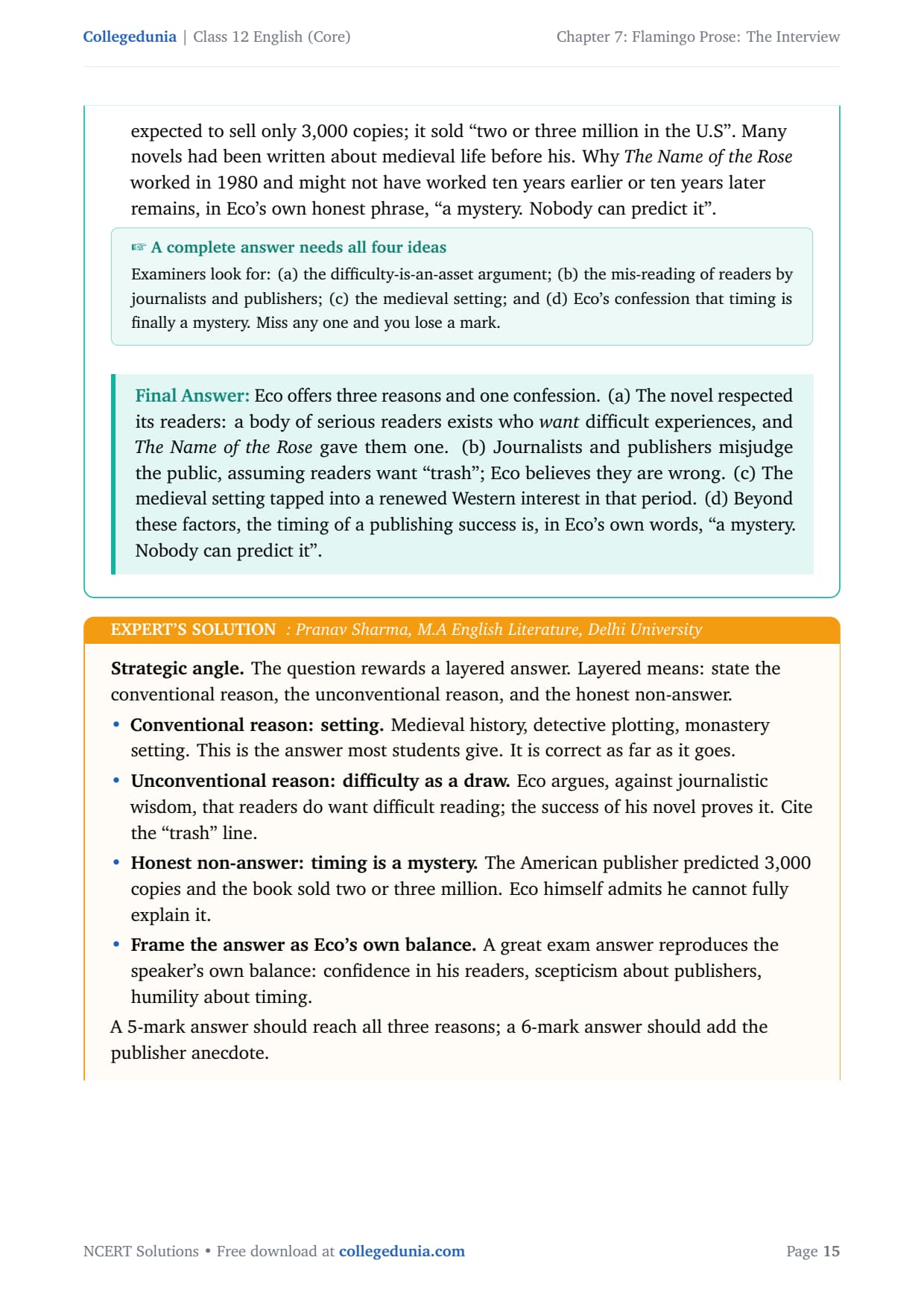
novels had been written about medieval life before his. Why
The Name of the Rose worked in 1980 and might not
have worked ten years earlier or ten years later remains, in
Eco's own honest phrase, ``a mystery. Nobody can predict it''.
A complete answer needs all four ideas
Examiners look for: (a) the difficulty-is-an-asset argument; (b) the
mis-reading of the reading public by journalists and publishers; (c) the
medieval setting; and (d) Eco's confession that timing is finally a
mystery. Miss any one and you lose a mark.
Eco offers three reasons and one confession. (a) The novel
respected its readership: a body of serious book-lovers exists who
want difficult experiences, and The Name of the Rose
gave them one. (b) Journalists and publishers misjudge the public,
assuming book-lovers want ``trash''; Eco believes they are wrong. (c) The
medieval setting tapped into a renewed Western interest in that
period. (d) Beyond these factors, the timing of a publishing success
is, in Eco's own words, ``a mystery. Nobody can predict it''.
PS
Pranav Sharma
M.A English Literature, Delhi University
Verified Expert
Strategic angle. The question rewards a layered answer.
Layered means: state the conventional reason, the unconventional
reason, and the honest non-answer.
Conventional reason: setting. Medieval history,
detective plotting, monastery setting. This is the answer
most students give. It is correct as far as it goes.
Unconventional reason: difficulty as a draw. Eco
argues, against journalistic wisdom, that book-lovers do want
difficult reading; the success of his novel proves it. Cite
the ``trash'' line.
Honest non-answer: timing is a mystery. The American
publisher predicted 3,000 copies and the book sold two or
three million. Eco himself admits he cannot fully explain it.
Frame the answer as Eco's own balance. A great exam
answer reproduces the speaker's own balance: confidence in
his readership, scepticism about publishers, humility about
timing.
A 5-mark answer should reach all three reasons; a 6-mark answer
should add the publisher anecdote.
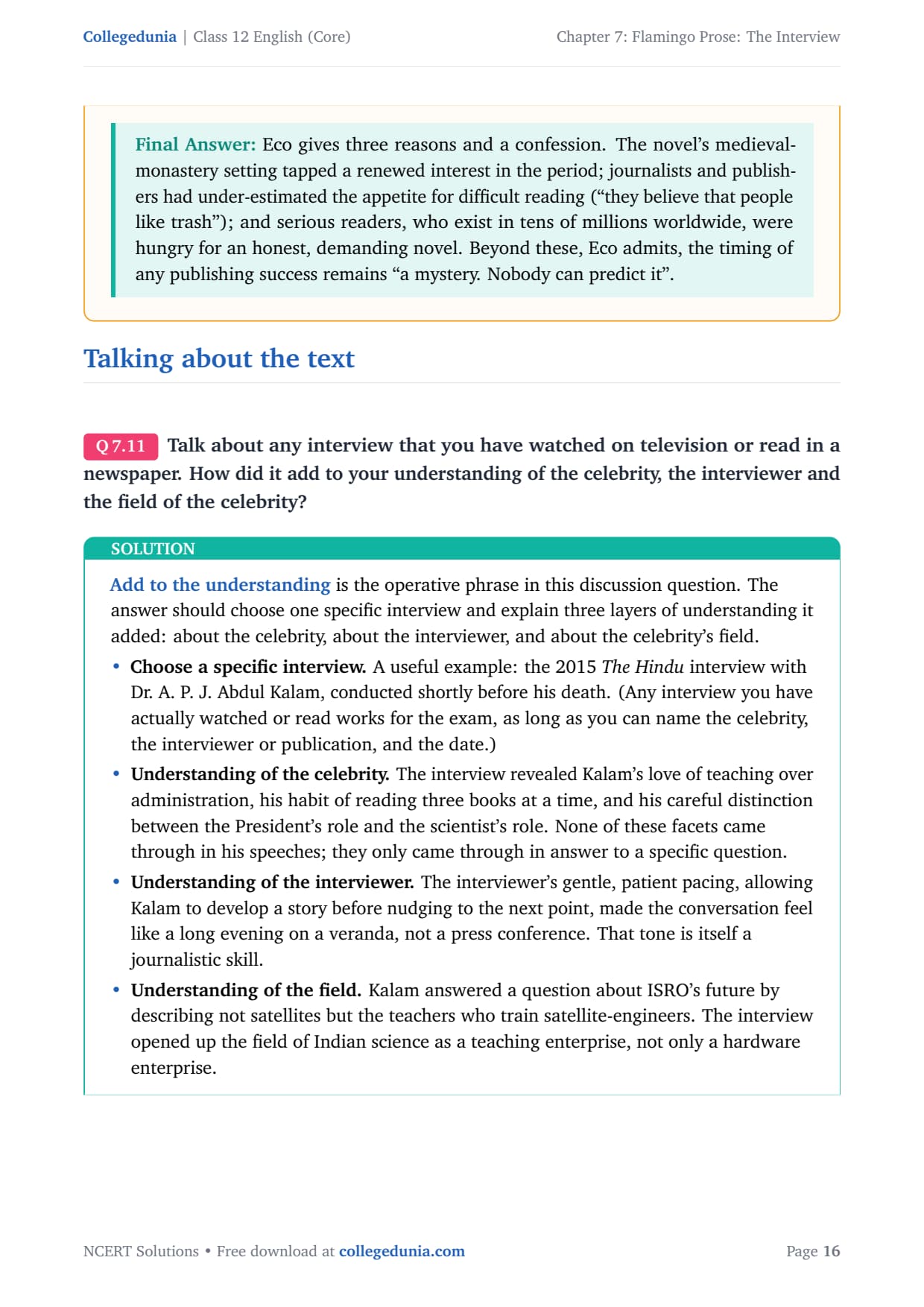
Eco gives three reasons and a confession. The novel's
medieval-monastery setting tapped a renewed interest in the period;
journalists and publishers had under-estimated the appetite for
difficult reading (``they believe that people like trash''); and
serious book-lovers, who exist in tens of millions worldwide, were
hungry for an honest, demanding novel. Beyond these, Eco admits, the
timing of any publishing success remains ``a mystery. Nobody can
predict it''.
Talking about the text
Q 7.11
Talk about any interview that you have watched on television or read in a newspaper. How did it add to your understanding of the celebrity, the interviewer and the field of the celebrity?
Add to the understanding is the operative phrase in this
discussion question. The answer should choose one specific interview
and explain three layers of understanding it added: about the
celebrity, about the interviewer, and about the celebrity's field.
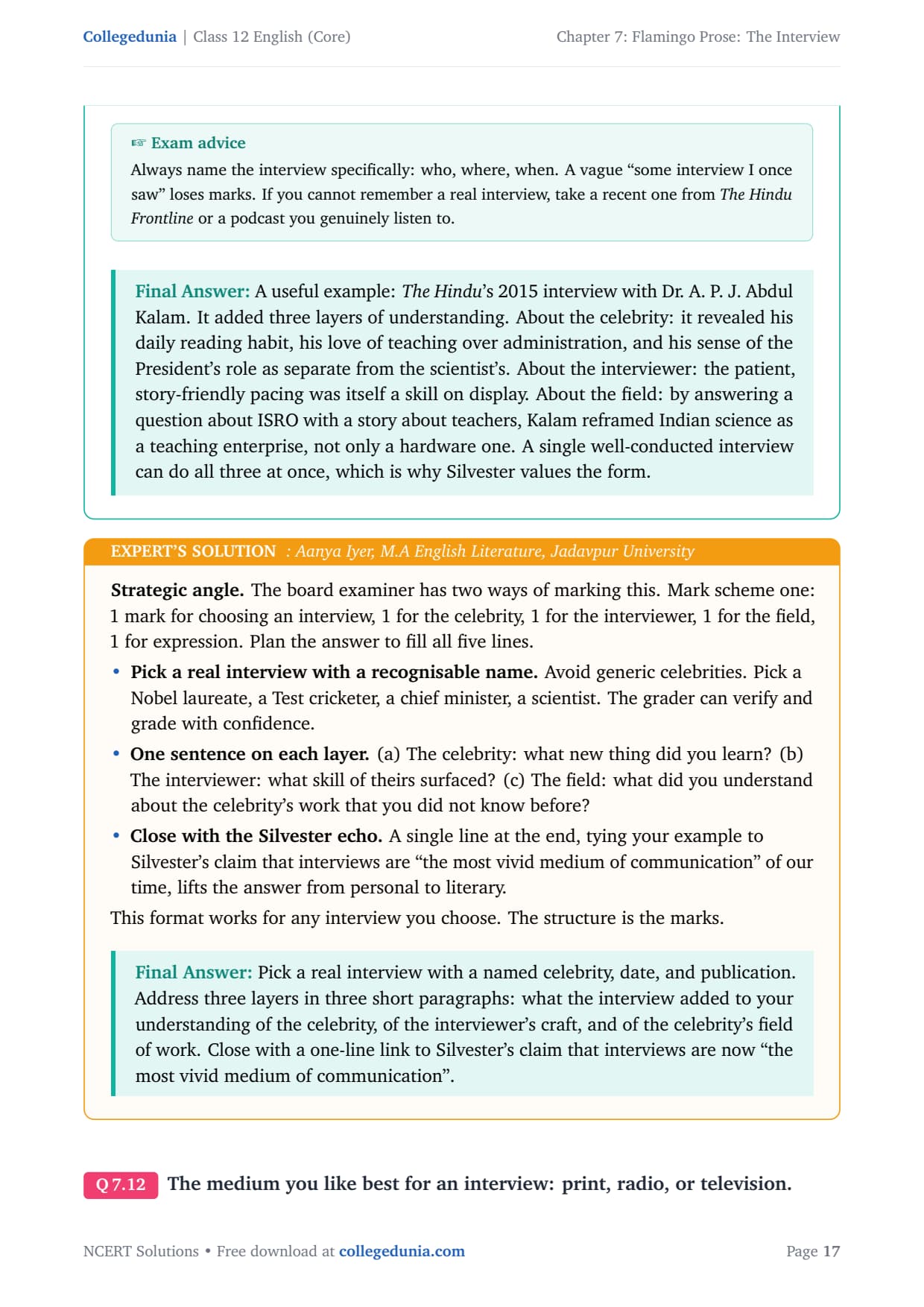
Choose a specific interview. A useful example: the
2015 The Hindu interview with Dr. A. P. J. Abdul
Kalam, conducted shortly before his death. (Any interview
you have actually watched or read works for the exam, as
long as you can name the celebrity, the interviewer or
publication, and the date.)
Understanding of the celebrity. The interview
revealed Kalam's love of teaching over administration, his
habit of reading three books at a time, and his careful
distinction between the President's role and the
scientist's role. None of these facets came through in his
speeches; they only came through in answer to a specific
question.
Understanding of the interviewer. The interviewer's
gentle, patient pacing, allowing Kalam to develop a story
before nudging to the next point, made the conversation feel
like a long evening on a veranda, not a press conference.
That tone is itself a journalistic skill.
Understanding of the field. Kalam answered a question
about ISRO's future by describing not satellites but the
teachers who train satellite-engineers. The interview opened
up the field of Indian science as a teaching enterprise, not
only a hardware enterprise.
Exam advice
Always name the interview specifically: who, where, when. A vague
``some interview I once saw'' loses marks. If you cannot remember a
real interview, take a recent one from The Hindu Frontline
or a podcast you genuinely listen to.
A useful example: The Hindu's 2015 interview with
Dr. A. P. J. Abdul Kalam. It added three layers of understanding.
About the celebrity: it revealed his daily reading habit, his love
of teaching over administration, and his sense of the President's
role as separate from the scientist's. About the interviewer: the
patient, story-friendly pacing was itself a skill on display. About
the field: by answering a question about ISRO with a story about
teachers, Kalam reframed Indian science as a teaching enterprise,
not only a hardware one. A single well-conducted interview can do
all three at once, which is why Silvester values the form.
AI
Aanya Iyer
M.A English Literature, Jadavpur University
Verified Expert
Strategic angle. The board examiner has two ways of marking
this. Mark scheme one: 1 mark for choosing an interview, 1 for the
celebrity, 1 for the interviewer, 1 for the field, 1 for expression.
Plan the answer to fill all five lines.
Pick a real interview with a recognisable name.
Avoid generic celebrities. Pick a Nobel laureate, a Test
cricketer, a chief minister, a scientist. The grader can
verify and grade with confidence.
One sentence on each layer. (a) The celebrity:
what new thing did you learn? (b) The interviewer: what
skill of theirs surfaced? (c) The field: what did you
understand about the celebrity's work that you did not
know before?
Close with the Silvester echo. A single line at
the end, tying your example to Silvester's claim that
interviews are ``the most vivid medium of communication''
of our time, lifts the answer from personal to literary.
This format works for any interview you choose. The structure is
the marks.
Pick a real interview with a named celebrity, date, and
publication. Address three layers in three short paragraphs: what
the interview added to your understanding of the celebrity, of the
interviewer's craft, and of the celebrity's field of work. Close
with a one-line link to Silvester's claim that interviews are now
``the most vivid medium of communication''.
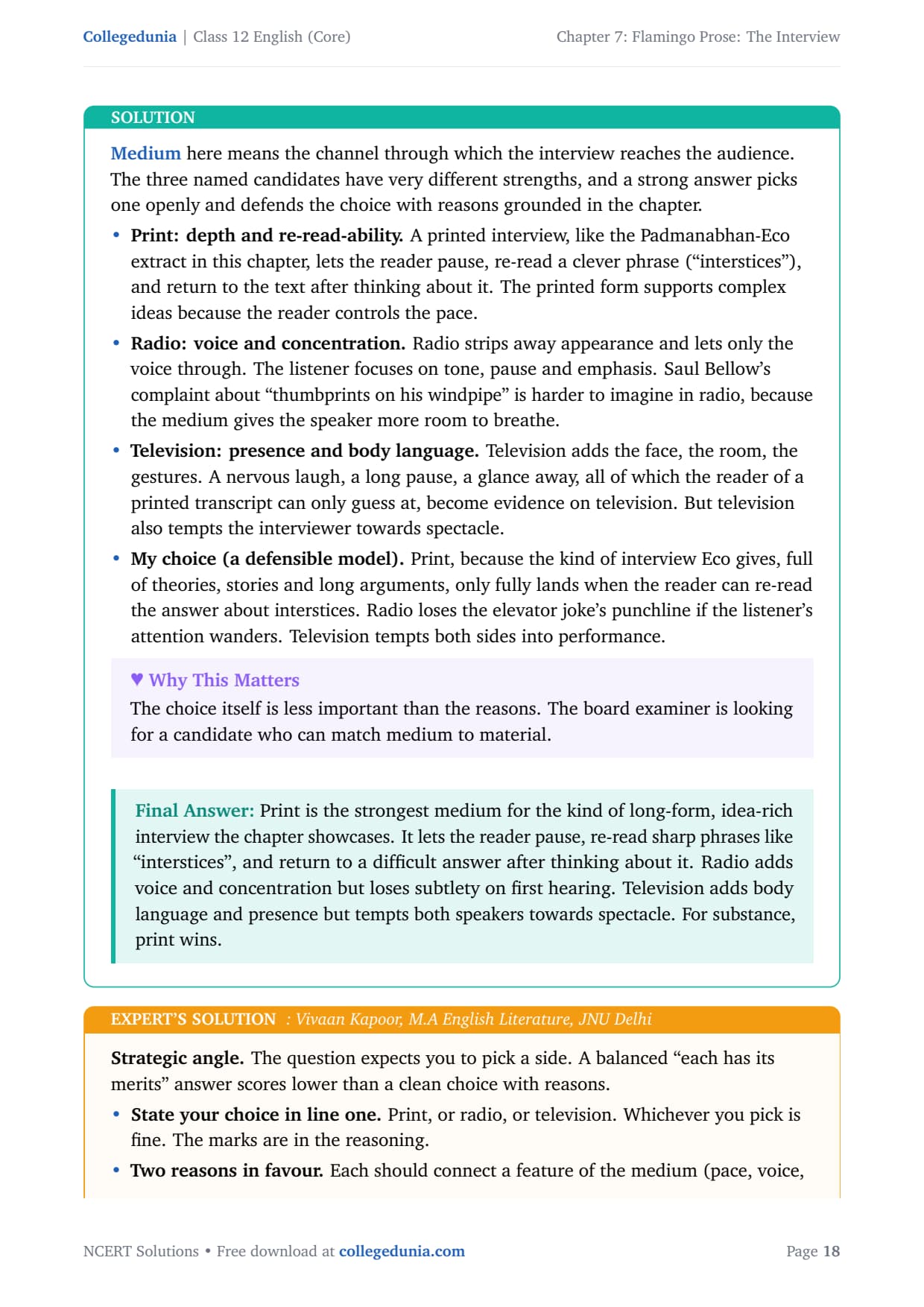
Q 7.12
The medium you like best for an interview: print, radio, or television.
Medium here means the channel through which the interview
reaches the public. The three named candidates have very different
strengths, and a strong answer picks one openly and defends the choice
with reasons grounded in the chapter.
Print: depth and re-read-ability. A printed
interview, like the Padmanabhan-Eco extract in this chapter,
lets the reader pause, re-read a clever phrase
(``interstices''), and return to the text after thinking
about it. The printed form supports complex ideas because
the reader controls the pace.
Radio: voice and concentration. Radio strips away
appearance and lets only the voice through. The listener
focuses on tone, pause and emphasis. Saul Bellow's complaint
about ``thumbprints on his windpipe'' is harder to imagine in
radio, because the medium gives the speaker more room to
breathe.
Television: presence and body language. Television
adds the face, the room, the gestures. A nervous laugh, a
long pause, a glance away, all of which the reader of a
printed transcript can only guess at, become evidence on
television. But television also tempts the interviewer
towards spectacle.
My choice (a defensible model). Print, because the
kind of interview Eco gives, full of theories, stories and
long arguments, only fully lands when the reader can re-read
the answer about interstices. Radio loses the elevator
joke's punchline if the listener's attention wanders.
Television tempts both sides into performance.
The choice itself is less important than the reasons. The board
examiner is looking for a candidate who can match medium to material.
Print is the strongest medium for the kind of long-form,
idea-rich interview the chapter showcases. It lets the reader pause,
re-read sharp phrases like ``interstices'', and return to a difficult
answer after thinking about it. Radio adds voice and concentration
but loses subtlety on first hearing. Television adds body language
and presence but tempts both speakers towards spectacle. For
substance, print wins.
VK
Vivaan Kapoor
M.A English Literature, JNU Delhi
Verified Expert
Strategic angle. The question expects you to pick a side. A
balanced ``each has its merits'' answer scores lower than a clean
choice with reasons.
State your choice in line one. Print, or radio, or
television. Whichever you pick is fine. The marks are in the
reasoning.
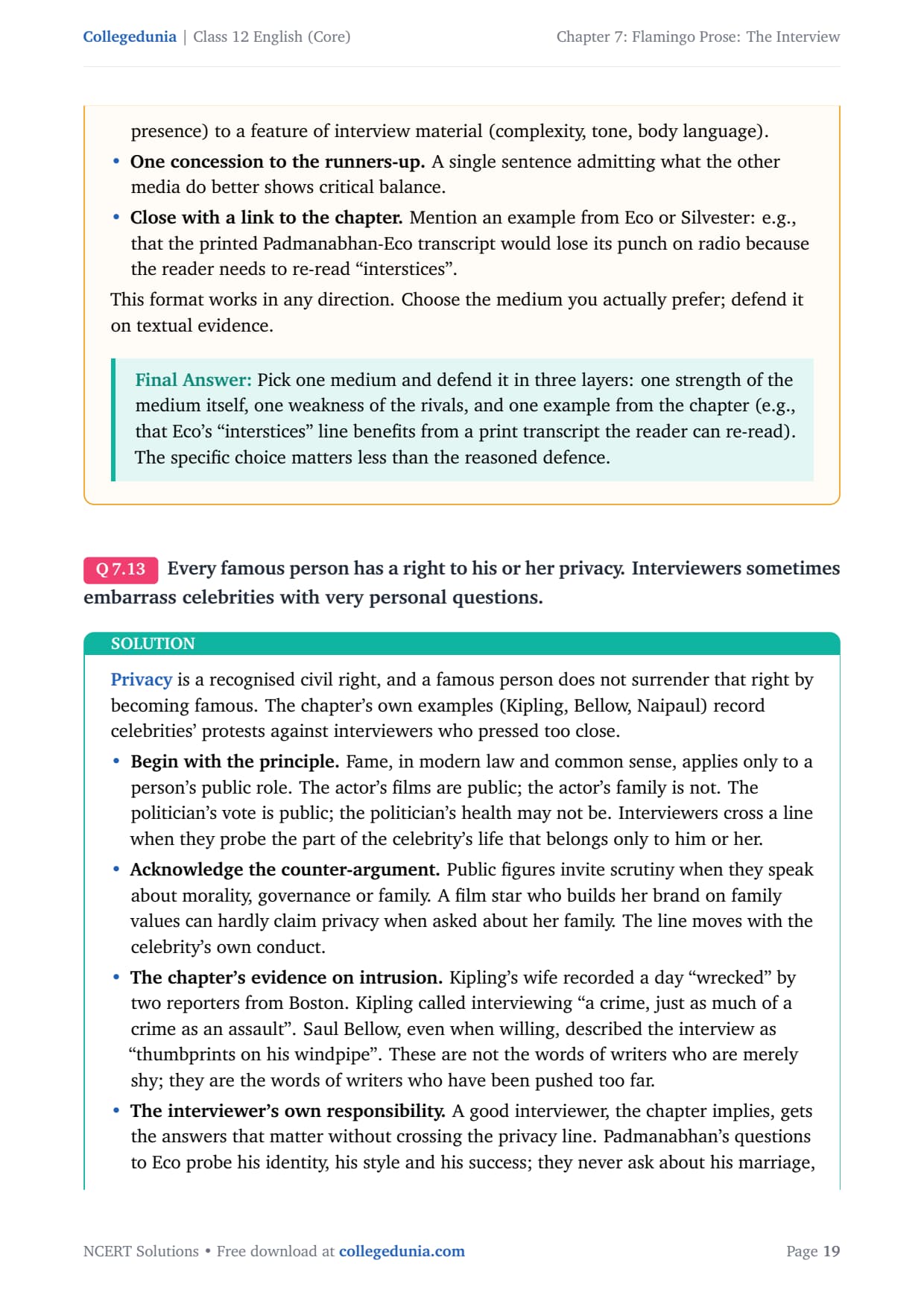
Two reasons in favour. Each should connect a
feature of the medium (pace, voice, presence) to a feature
of interview material (complexity, tone, body language).
One concession to the runners-up. A single sentence
admitting what the other media do better shows critical
balance.
Close with a link to the chapter. Mention an
example from Eco or Silvester: e.g., that the printed
Padmanabhan-Eco transcript would lose its punch on radio
because the reader needs to re-read ``interstices''.
This format works in any direction. Choose the medium you actually
prefer; defend it on textual evidence.
Pick one medium and defend it in three layers: one
strength of the medium itself, one weakness of the rivals, and one
example from the chapter (e.g., that Eco's ``interstices'' line
benefits from a print transcript the reader can re-read). The
specific choice matters less than the reasoned defence.
Q 7.13
Every famous person has a right to his or her privacy. Interviewers sometimes embarrass celebrities with very personal questions.
Privacy is a recognised civil right, and a famous person does
not surrender that right by becoming famous. The chapter's own
examples (Kipling, Bellow, Naipaul) record celebrities' protests
against interviewers who pressed too close.
Begin with the principle. Fame, in modern law and
common sense, applies only to a person's public role. The
actor's films are public; the actor's family is not. The
politician's vote is public; the politician's health may not
be. Interviewers cross a line when they probe the part of
the celebrity's life that belongs only to him or her.
Acknowledge the counter-argument. Public figures
invite scrutiny when they speak about morality, governance
or family. A film star who builds her brand on family
values can hardly claim privacy when asked about her
family. The line moves with the celebrity's own conduct.
The chapter's evidence on intrusion. Kipling's wife
recorded a day ``wrecked'' by two reporters from Boston.
Kipling called interviewing ``a crime, just as much of a
crime as an assault''. Saul Bellow, even when willing,
described the interview as ``thumbprints on his windpipe''.
These are not the words of writers who are merely shy; they
are the words of writers who have been pushed too far.
The interviewer's own responsibility. A good
interviewer, the chapter implies, gets the answers that
matter without crossing the privacy line. Padmanabhan's
questions to Eco probe his identity, his style and his
success; they never ask about his marriage, his children or
his personal finances.
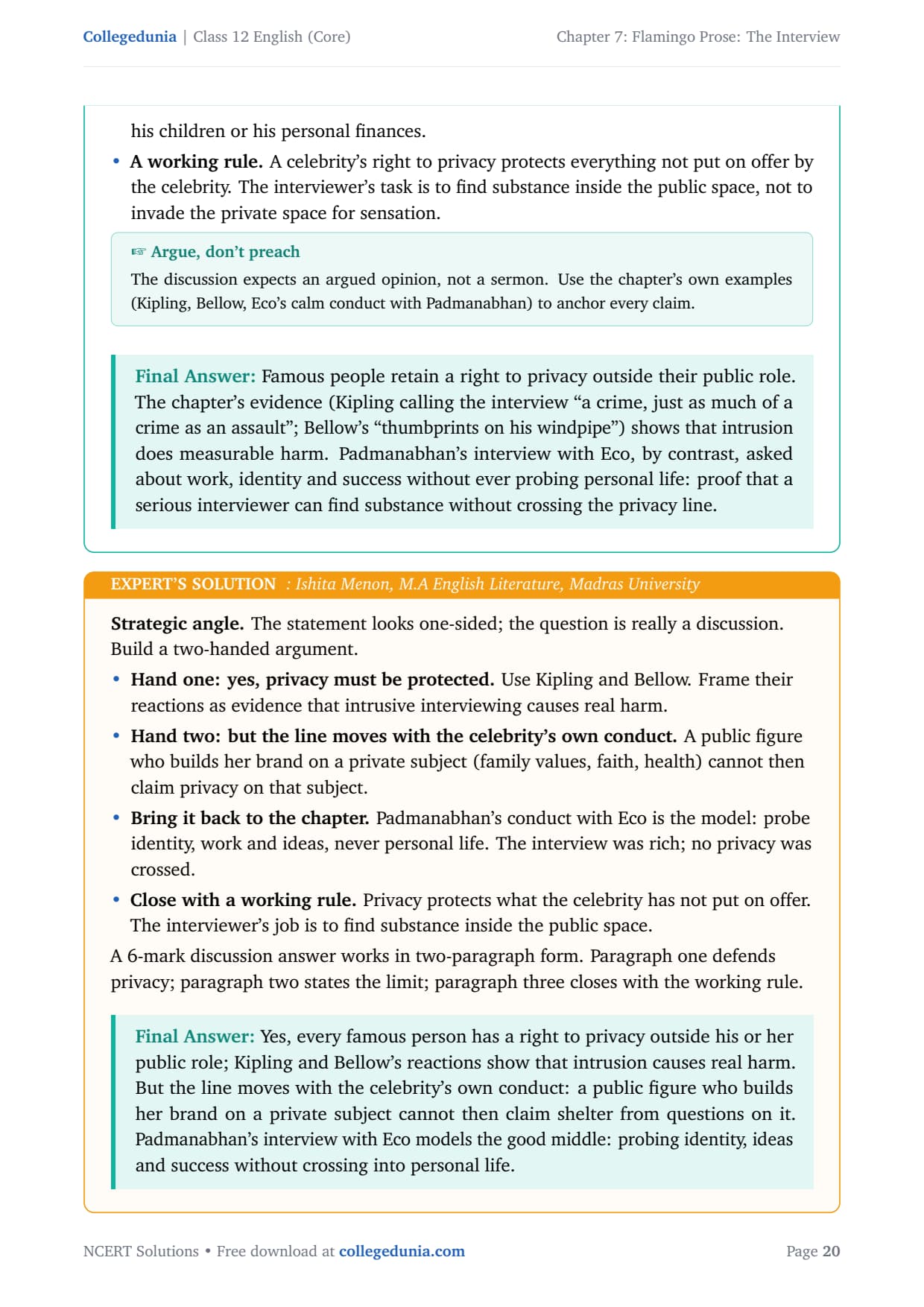
A working rule. A celebrity's right to privacy
protects everything not put on offer by the celebrity. The
interviewer's task is to find substance inside the public
space, not to invade the private space for sensation.
Argue, don't preach
The discussion expects an argued opinion, not a sermon. Use the
chapter's own examples (Kipling, Bellow, Eco's calm conduct with
Padmanabhan) to anchor every claim.
Famous people retain a right to privacy outside their
public role. The chapter's evidence (Kipling calling the interview
``a crime, just as much of a crime as an assault''; Bellow's
``thumbprints on his windpipe'') shows that intrusion does measurable
harm. Padmanabhan's interview with Eco, by contrast, asked about
work, identity and success without ever probing personal life:
proof that a serious interviewer can find substance without
crossing the privacy line.
IM
Ishita Menon
M.A English Literature, Madras University
Verified Expert
Strategic angle. The statement looks one-sided; the question
is really a discussion. Build a two-handed argument.
Hand one: yes, privacy must be protected. Use
Kipling and Bellow. Frame their reactions as evidence
that intrusive interviewing causes real harm.
Hand two: but the line moves with the celebrity's
own conduct. A public figure who builds her brand on a
private subject (family values, faith, health) cannot then
claim privacy on that subject.
Bring it back to the chapter. Padmanabhan's
conduct with Eco is the model: probe identity, work and
ideas, never personal life. The interview was rich; no
privacy was crossed.
Close with a working rule. Privacy protects what
the celebrity has not put on offer. The interviewer's job
is to find substance inside the public space.
A 6-mark discussion answer works in two-paragraph form. Paragraph
one defends privacy; paragraph two states the limit; paragraph three
closes with the working rule.
Yes, every famous person has a right to privacy outside
his or her public role; Kipling and Bellow's reactions show that
intrusion causes real harm. But the line moves with the celebrity's
own conduct: a public figure who builds her brand on a private
subject cannot then claim shelter from questions on it.
Padmanabhan's interview with Eco models the good middle: probing
identity, ideas and success without crossing into personal life.
Writing
Q 7.14
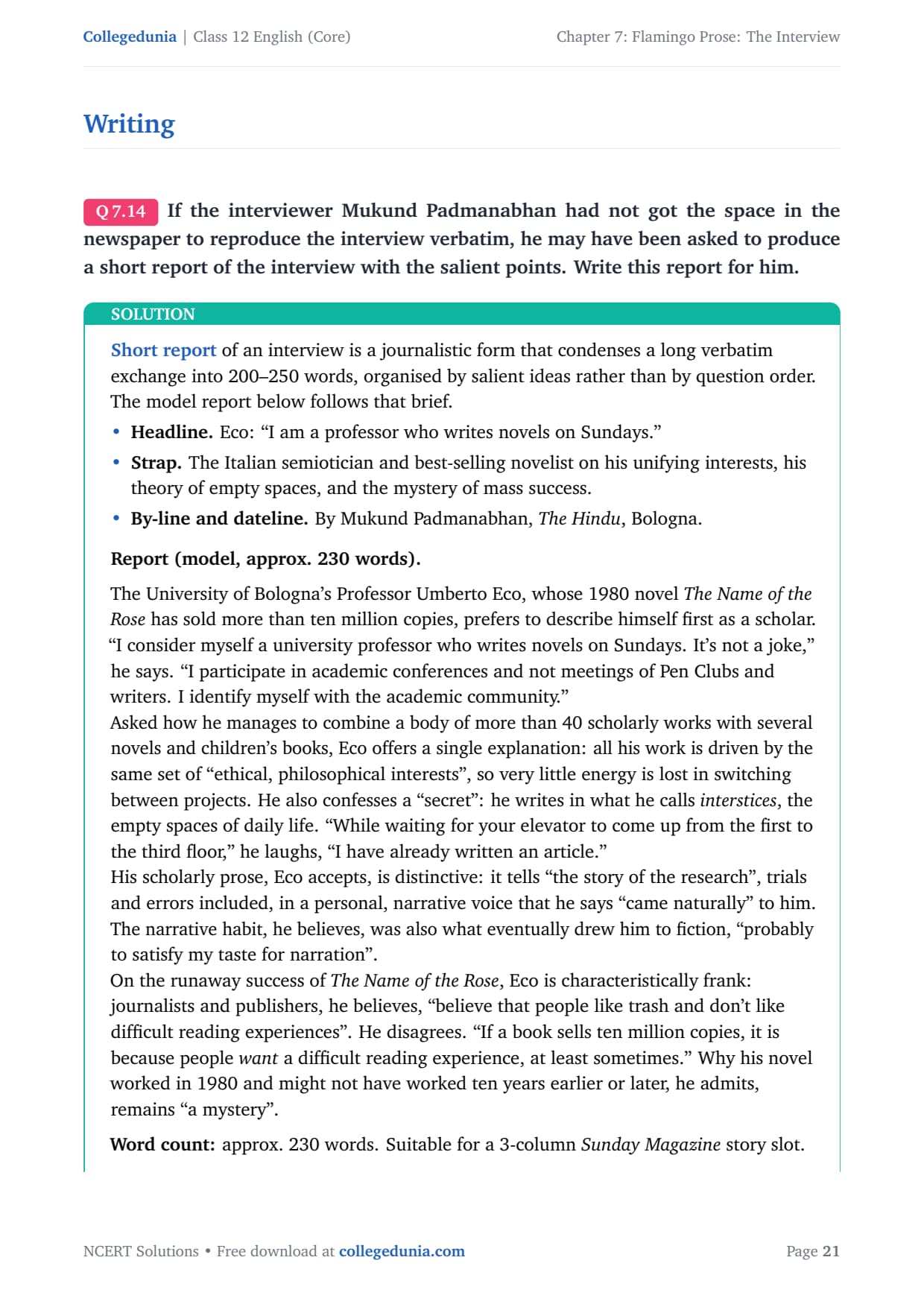
If the interviewer Mukund Padmanabhan had not got the space in the newspaper to reproduce the interview verbatim, he may have been asked to produce a short report of the interview with the salient points. Write this report for him.
Short report of an interview is a journalistic form that
condenses a long verbatim exchange into 200–250 words, organised by
salient ideas rather than by question order. The model report below
follows that brief.
Headline. Eco: ``I am a professor who writes novels
on Sundays.''
Strap. The Italian semiotician and best-selling
novelist on his unifying interests, his theory of empty
spaces, and the mystery of mass success.
By-line and dateline. By Mukund Padmanabhan,
The Hindu, Bologna.
Report (model, approx. 230 words).
The University of Bologna's Professor Umberto Eco, whose 1980 novel
The Name of the Rose has sold more than ten million copies,
prefers to describe himself first as a scholar. ``I consider myself
a university professor who writes novels on Sundays. It's not a
joke,'' he says. ``I participate in academic conferences and not
meetings of Pen Clubs and writers. I identify myself with the
academic community.''
Asked how he manages to combine a body of more than 40 scholarly
works with several novels and children's books, Eco offers a single
explanation: all his work is driven by the same set of
``ethical, philosophical interests'', so very little energy is lost
in switching between projects. He also confesses a ``secret'': he
writes in what he calls interstices, the empty spaces of
daily life. ``While waiting for your elevator to come up from the
first to the third floor,'' he laughs, ``I have already written an
article.''
His scholarly prose, Eco accepts, is distinctive: it tells ``the
story of the research'', trials and errors included, in a personal,
narrative voice that he says ``came naturally'' to him. The
narrative habit, he believes, was also what eventually drew him to
fiction, ``probably to satisfy my taste for narration''.
On the runaway success of The Name of the Rose, Eco is
characteristically frank: journalists and publishers, he believes,
``believe that people like trash and don't like difficult reading
experiences''. He disagrees. ``If a book sells ten million copies,
it is because people want a difficult reading experience,
at least sometimes.'' Why his novel worked in 1980 and might not
have worked ten years earlier or later, he admits, remains ``a
mystery''.
Word count: approx. 230 words. Suitable for a 3-column
Sunday Magazine story slot.
The exercise teaches a transferable skill: turning a verbatim
transcript into a structured report. The reporter's task is to
sequence ideas by importance (lede first, supporting points next),
to preserve direct quotations only where they carry the speaker's
voice, and to keep the tone neutral.
A model 230-word report is given above. It opens with a
headline, gives Eco's self-description as a scholar in the lede,
explains interstices and his narrative academic style in
the middle, and closes with his analysis of The Name of
the Rose's success. The report sequences by importance, preserves
only the most vivid direct quotations, and lets Eco's own phrases
(``interstices'', ``Sundays'', ``mystery'') do most of the
characterisation.
AI
Aanya Iyer
M.A English Literature, Jadavpur University
Verified Expert
Strategic angle. A report-of-an-interview is half summary,
half feature. The examiner is looking for: clear headline, a strong
lede, three or four well-chosen direct quotations, and a tight close.
Open with the lede, not the order. The reader
should know in line one what the interview's biggest claim
is. Here: ``I am a professor who writes novels on Sundays.''
Sequence by salience, not by question order. The
chapter's verbatim transcript moves: identity →
time → style → success. A short
report can re-order: identity → time
(interstices) → style → success.
Quote sparingly. Direct quotation should appear
only where Eco's own voice carries the point. The interstices
line and the ``trash'' line both qualify; long quotations do
not.
Close with the mystery line. ``Nobody can predict
it'' is the kind of memorable closer that newspaper editors
love.
The 200-to-250-word budget is the discipline. Aim for 220.
Write a 220-word report sequenced as: (a) headline + by-line;
(b) lede with Eco's self-description as scholar-first; (c) interstices
+ the elevator example; (d) narrative academic style; (e) close on
the mystery of The Name of the Rose's success. Quote
sparingly. Let Eco's own phrases (``interstices'', ``Sundays'',
``mystery'') carry the colour.
Things to do
Q 7.15
Interview a person whom you admire either in school or your neighbourhood and record it in writing.
Interview a person you admire is an activity question. The
expected output is a written record of a real or semi-real interview.
The answer below gives a four-stage method plus a short sample
script.
Stage 1: pick a subject worth the time. A
neighbourhood postmaster, a senior teacher, a junior doctor
at the local hospital, a long-serving school librarian, a
kabaddi coach, all are richer subjects than a relative
whose answers you can guess. Ask permission first; agree on
a thirty-minute slot.
Stage 2: prepare six to eight questions. The first
two should warm the subject up (``How did you get into this
line of work?''). The next four should probe substance
(``What is the hardest thing about your day?'', ``What is
the most rewarding moment you remember?''). The last two
should be reflective (``What advice would you give a
student who wants to do what you do?'').
Stage 3: record carefully. If the subject permits,
use a phone voice-recorder. Otherwise take notes in
shorthand. Keep eye contact: a head buried in a notebook
breaks the rhythm of conversation.
Stage 4: transcribe and tidy. The verbatim
transcript will have repetitions and false starts.
Silvester's chapter and Padmanabhan's example both teach
the same lesson: a transcript that respects the
subject's voice is better than a tidied paraphrase.
Remove only the ``ums'' and the obvious repetitions; keep
the substance and the cadence.
Sample mini-script (excerpt of 120 words).
Interviewer: Sir, you have taught in this school for over
thirty years. What keeps you here?
Mr. Rao (Maths teacher): (laughs) I keep asking myself
that question every morning. The honest answer is the children.
Every batch is different. The Class 12 board exam looks the same
on paper every year, but the students who write it are completely
new each time.
Interviewer: Has anything in the way you teach changed in
those thirty years?
Mr. Rao: The blackboard is now a whiteboard. The students
have phones. The textbook has been revised five times. But the
way a child's face changes when an idea finally lands, that
hasn't changed.
Three things the examiner checks
A real, named subject. A clear set of prepared questions. A
transcript that sounds like a person, not a paragraph.
Pick a real person worth half an hour of their time, agree
on a slot, prepare six to eight questions sequenced from warm-up
to substance to reflection, record carefully (audio or shorthand),
and transcribe so the subject's voice survives. The submitted
answer should include three pieces: a one-line subject identification,
the list of questions used, and a transcript or summary of the
conversation that respects the subject's voice.
PS
Pranav Sharma
M.A English Literature, Delhi University
Verified Expert
Strategic angle. Activity-question answers are not graded on
how rich the interview is; they are graded on whether the student
shows the method.
Show the method, not the literature. Submit your
question list, your subject's name and role, and a short
transcript. The examiner reads for evidence of preparation
and for fidelity to the subject's voice.
Mimic the Padmanabhan-Eco pattern. Begin with an
opening that frames the subject (``Mr. Rao has taught here
for thirty years''). Sequence questions from broad to
specific. Let one of the answers run long: the long answer
is where the character of the subject surfaces.
Keep the transcript short. 120–150 words is
plenty for a class-room submission. The examiner is
sampling, not reading every sentence.
Close with one sentence of your own reflection.
Did the interview change how you see this person? Naming
that shift is the academic value of the exercise.
The activity teaches what Silvester's essay claims: that the
interview is now the most vivid way one person comes to know
another.
Submit three things: a one-line subject identification, the
list of six to eight prepared questions, and a 120–150 word
transcript that respects the subject's voice. Close with one
sentence of your own reflection on what the interview changed in
your view of the subject. The exercise is graded on method and
fidelity, not on literary polish.
NCERT Solutions for Class 12 English Flamingo: All Chapters
Quick links to every chapter-wise solutions page in the Flamingo book, prose and poetry.
In a Collegedunia poll of 1,200 Class 12 students, 86% said the Umberto Eco extract was harder to recall than Silvester's essay, and 71% rated these line-grounded solutions as their top revision tool for The Interview.
The Interview Class 12 English NCERT Solutions FAQs
Ques. Where can I download the Class 12 English The Interview NCERT Solutions PDF?
Ans. The free PDF is on this page. It carries the complete step-by-step answers for all 15 back-of-chapter questions across the Understanding-the-Text, Talking-about-the-Text, Writing, Things-to-Do and Part I "Think as you read" sections, on the 2026-27 NCERT Flamingo edition.
Ques. Who wrote The Interview chapter in Class 12 English?
Ans. The chapter has two parts. Part I is an essay by Christopher Silvester (born 1959), drawn from his introduction to The Penguin Book of Interviews: An Anthology from 1859 to the Present Day (1993). Part II is a verbatim interview with the Italian novelist Umberto Eco, conducted by Mukund Padmanabhan of The Hindu.
Ques. Are these solutions aligned with the 2026-27 NCERT syllabus?
Ans. Yes. The PDF is built strictly to the 2026-27 NCERT Flamingo edition. The Interview is retained in full with all back-of-chapter exercises unchanged from the previous edition.
Ques. How many questions are answered in the Solutions PDF?
Ans. All 15 NCERT questions are solved: 5 from Part I (sidebar "Think as you read"), 5 from Understanding the Text, 3 from Talking about the Text, 1 Writing composition, and 1 Things to Do activity. Each long question has a main Solution and a parallel Expert Solution.
Ques. What is the meaning of interstices in The Interview chapter?
Ans. Interstices is Umberto Eco's word for the empty spaces of everyday life: the time between things. Eco explains he uses these gaps to write. His famous example: "While waiting for your elevator to come up from the first to the third floor, I have already written an article."
Ques. Why does Saul Bellow describe interviews as "thumbprints on his windpipe"?
Ans. The metaphor compresses pressure (thumbprints) and the channel of speech (windpipe) into one image. Bellow uses it to say that the interview presses on the very part of him that produces words, leaving bruise-like marks on his composure as a writer. The phrase is doubly powerful because Bellow had cooperated with many interviews.
Ques. Did Umberto Eco consider himself a novelist or an academic?
Ans. Eco said clearly, "I consider myself a university professor who writes novels on Sundays." He identified with the academic community, attended conferences rather than writers' meetings, and had produced more than 40 scholarly works before writing his first novel at the age of 50.
Ques. Why was The Name of the Rose so successful?
Ans. Eco gives three reasons and one confession. (a) students do want difficult experiences; journalists wrongly assume otherwise. (b) Even a small percentage of six billion students is a huge absolute number. (c) The medieval setting tapped a renewed Western interest in the period. (d) Beyond these, the timing of any publishing success is, in Eco's own honest words, "a mystery. Nobody can predict it."
Ques. Who is Christopher Silvester and what did he edit?
Ans. Christopher Silvester (born 1959) is a British journalist and historian. He was a reporter for the satirical magazine Private Eye for ten years and a feature writer for Vanity Fair. He edited The Penguin Book of Interviews: An Anthology from 1859 to the Present Day (1993); the introduction to that anthology is reproduced as Part I of the Class 12 chapter.
Ques. What are the most common board-paper traps in The Interview chapter?
Ans. Three traps recur: (a) confusing Silvester with the writers he quotes (Naipaul, Kipling, Bellow); (b) forgetting that Bellow had given many interviews willingly, which is what makes "thumbprints on his windpipe" powerful; (c) misspelling proper nouns - Mukund (not Mukunda), Silvester (not Sylvester), interstices (not interest).









Comments