




NCERT Solutions for Class 12 English (Suppl.) Chapter 8 Kaleidoscope: Poems by Blake explain The Divine Image and The Human Abstract with direct NCERT-style answers. The PDF follows the 2026-27 syllabus, covers every textbook question from Understanding the Poem and Language Work, and helps students compare Blake's ideas on mercy, pity, peace, love, cruelty, fear and hypocrisy.
Chapter8Kaleidoscope:PoemsbyBlakeSolutions.pdf?page=1&dpi=150)
Chapter8Kaleidoscope:PoemsbyBlakeSolutions.pdf?page=2&dpi=150)
Chapter8Kaleidoscope:PoemsbyBlakeSolutions.pdf?page=3&dpi=150)
Chapter8Kaleidoscope:PoemsbyBlakeSolutions.pdf?page=4&dpi=150)
Chapter8Kaleidoscope:PoemsbyBlakeSolutions.pdf?page=5&dpi=150)
Chapter8Kaleidoscope:PoemsbyBlakeSolutions.pdf?page=6&dpi=150)
Chapter8Kaleidoscope:PoemsbyBlakeSolutions.pdf?page=7&dpi=150)
Chapter8Kaleidoscope:PoemsbyBlakeSolutions.pdf?page=8&dpi=150)
Chapter8Kaleidoscope:PoemsbyBlakeSolutions.pdf?page=9&dpi=150)
Chapter8Kaleidoscope:PoemsbyBlakeSolutions.pdf?page=10&dpi=150)
Chapter8Kaleidoscope:PoemsbyBlakeSolutions.pdf?page=11&dpi=150)
Chapter8Kaleidoscope:PoemsbyBlakeSolutions.pdf?page=12&dpi=150)
Chapter8Kaleidoscope:PoemsbyBlakeSolutions.pdf?page=13&dpi=150)
Chapter8Kaleidoscope:PoemsbyBlakeSolutions_flat_MobileCard.pdf?page=1&dpi=150)
Chapter8Kaleidoscope:PoemsbyBlakeSolutions_flat_MobileCard.pdf?page=2&dpi=150)
Chapter8Kaleidoscope:PoemsbyBlakeSolutions_flat_MobileCard.pdf?page=3&dpi=150)
Chapter8Kaleidoscope:PoemsbyBlakeSolutions_flat_MobileCard.pdf?page=4&dpi=150)
Chapter8Kaleidoscope:PoemsbyBlakeSolutions_flat_MobileCard.pdf?page=5&dpi=150)
Chapter8Kaleidoscope:PoemsbyBlakeSolutions_flat_MobileCard.pdf?page=6&dpi=150)
Chapter8Kaleidoscope:PoemsbyBlakeSolutions_flat_MobileCard.pdf?page=7&dpi=150)
Chapter8Kaleidoscope:PoemsbyBlakeSolutions_flat_MobileCard.pdf?page=8&dpi=150)
Chapter8Kaleidoscope:PoemsbyBlakeSolutions_flat_MobileCard.pdf?page=9&dpi=150)
Chapter8Kaleidoscope:PoemsbyBlakeSolutions_flat_MobileCard.pdf?page=10&dpi=150)
Chapter8Kaleidoscope:PoemsbyBlakeSolutions_flat_MobileCard.pdf?page=11&dpi=150)
Chapter8Kaleidoscope:PoemsbyBlakeSolutions_flat_MobileCard.pdf?page=12&dpi=150)
Chapter8Kaleidoscope:PoemsbyBlakeSolutions_flat_MobileCard.pdf?page=13&dpi=150)
Chapter8Kaleidoscope:PoemsbyBlakeSolutions_flat_MobileCard.pdf?page=14&dpi=150)
Chapter8Kaleidoscope:PoemsbyBlakeSolutions_flat_MobileCard.pdf?page=15&dpi=150)
Chapter8Kaleidoscope:PoemsbyBlakeSolutions_flat_MobileCard.pdf?page=16&dpi=150)
Chapter8Kaleidoscope:PoemsbyBlakeSolutions_flat_MobileCard.pdf?page=17&dpi=150)
Chapter8Kaleidoscope:PoemsbyBlakeSolutions_flat_MobileCard.pdf?page=18&dpi=150)
Chapter8Kaleidoscope:PoemsbyBlakeSolutions_flat_MobileCard.pdf?page=19&dpi=150)
Chapter8Kaleidoscope:PoemsbyBlakeSolutions_flat_MobileCard.pdf?page=20&dpi=150)
Chapter8Kaleidoscope:PoemsbyBlakeSolutions_flat_MobileCard.pdf?page=21&dpi=150)
Chapter8Kaleidoscope:PoemsbyBlakeSolutions_flat_MobileCard.pdf?page=22&dpi=150)
Chapter8Kaleidoscope:PoemsbyBlakeSolutions_flat_MobileCard.pdf?page=23&dpi=150)
Chapter8Kaleidoscope:PoemsbyBlakeSolutions_flat_MobileCard.pdf?page=24&dpi=150)
Chapter8Kaleidoscope:PoemsbyBlakeSolutions_flat_MobileCard.pdf?page=25&dpi=150)
- Chapter 8 has 6 solved NCERT questions with expert explanations.
- The answers compare Blake's positive and critical view of human virtues.
- The PDF includes concise exam-ready points for poetry analysis.
Latest Update: These NCERT Solutions are aligned with the Class 12 English Kaleidoscope 2026-27 textbook sequence and use the chapter source text for both poems.
Student Feedback: Students asked for this chapter in a format that separates Blake's devotional language in The Divine Image from his social criticism in The Human Abstract. This page therefore marks the main contrast, the useful quote zones, and the answer structure needed for NCERT poetry questions.
|
Table of Contents |
What Poems by Blake Class 12 Solutions Cover
Chapter 8 brings two poems by William Blake into the Class 12 English supplementary course. The Divine Image presents Mercy, Pity, Peace and Love as virtues that make humanity resemble the divine. The Human Abstract looks at the same moral vocabulary from a sharper angle, showing how pity, mercy and humility can also grow inside social injustice. The NCERT questions ask students to notice this movement from celebration to critique.
The solutions in the PDF are designed for students who need answers that are clear, textual and compact. They explain what Blake praises, what he exposes, and how the symbolic tree in The Human Abstract turns private fear into public deception. Use the two poems together whenever a question asks about Blake's view of human nature.
| Poem | Main Focus | How to Answer |
|---|---|---|
| The Divine Image | Human virtues as signs of God | Write about Mercy, Pity, Peace and Love as shared human and divine qualities. |
| The Human Abstract | Virtues distorted by fear and self-interest | Explain how cruelty, poverty, humility and mystery create a dark moral system. |
| Language Work | Common phrase patterns | Identify how paired words build moral contrast in Blake's style. |
Poems by Blake Explanation for Class 12
Source: Magnet Brains on YouTube
The Divine Image and The Human Abstract Compared
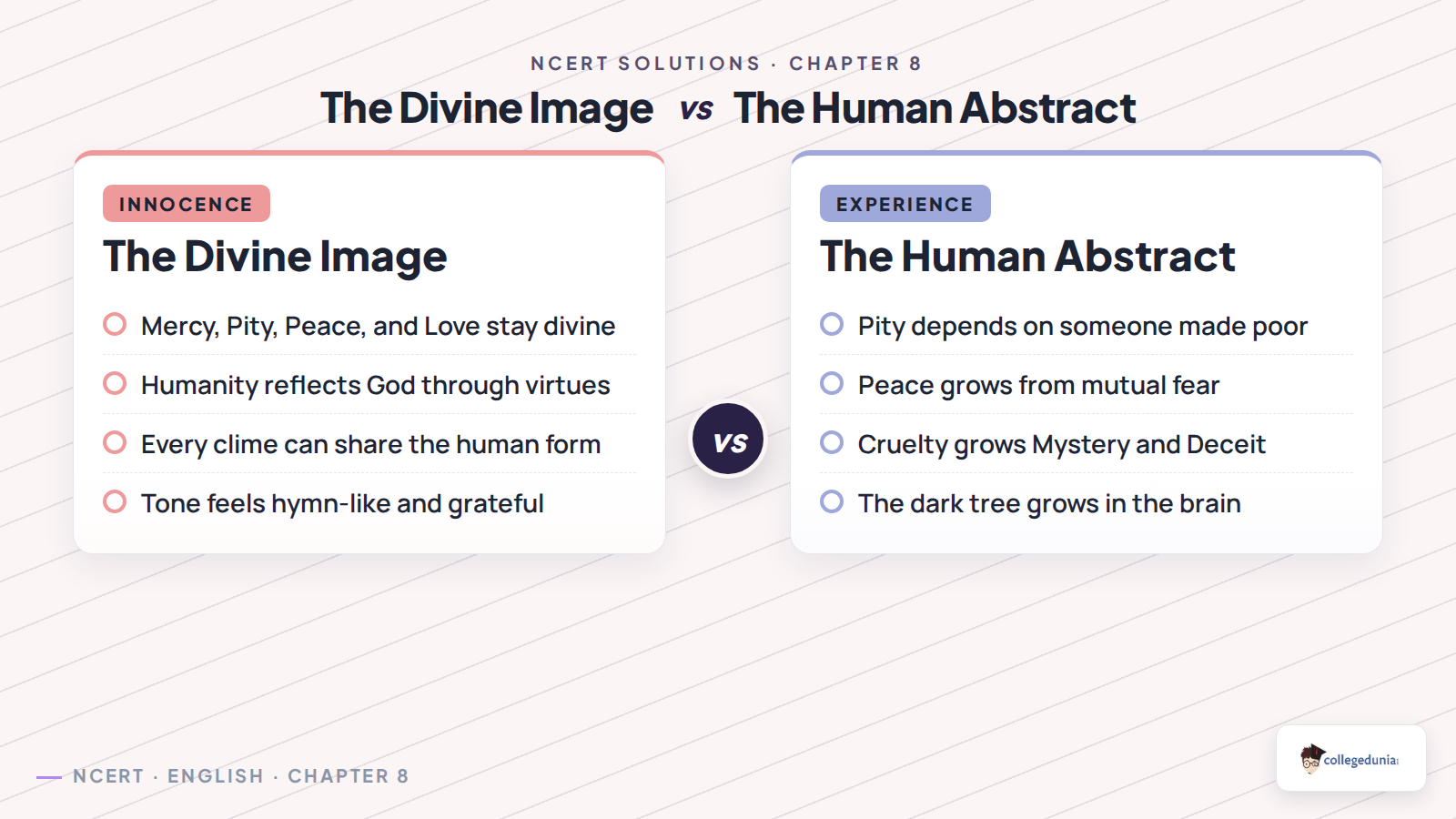
The Divine Image sounds like a hymn because Blake treats the virtues as universal and sacred. When people pray in distress, they pray to Mercy, Pity, Peace and Love. These are not abstract words only; Blake says they take human form. Mercy has a human heart, Pity a human face, Love a human form and Peace a human dress.
The Human Abstract reverses this comfort. It asks whether pity would exist without poverty and whether mercy would be needed if everyone were happy. The poem then traces a sequence: fear gives rise to humility, humility grows into mystery, and mystery becomes a tree that shelters deceit. The contrast is important because Blake does not reject goodness. He questions the social conditions that make goodness depend on suffering.
- For The Divine Image: focus on unity, compassion and shared human dignity.
- For The Human Abstract: focus on poverty, cruelty, fear, mystery and institutional deception.
- For comparison answers: show how the second poem complicates the first without cancelling it.
Human Form Divine in Blake's Poem
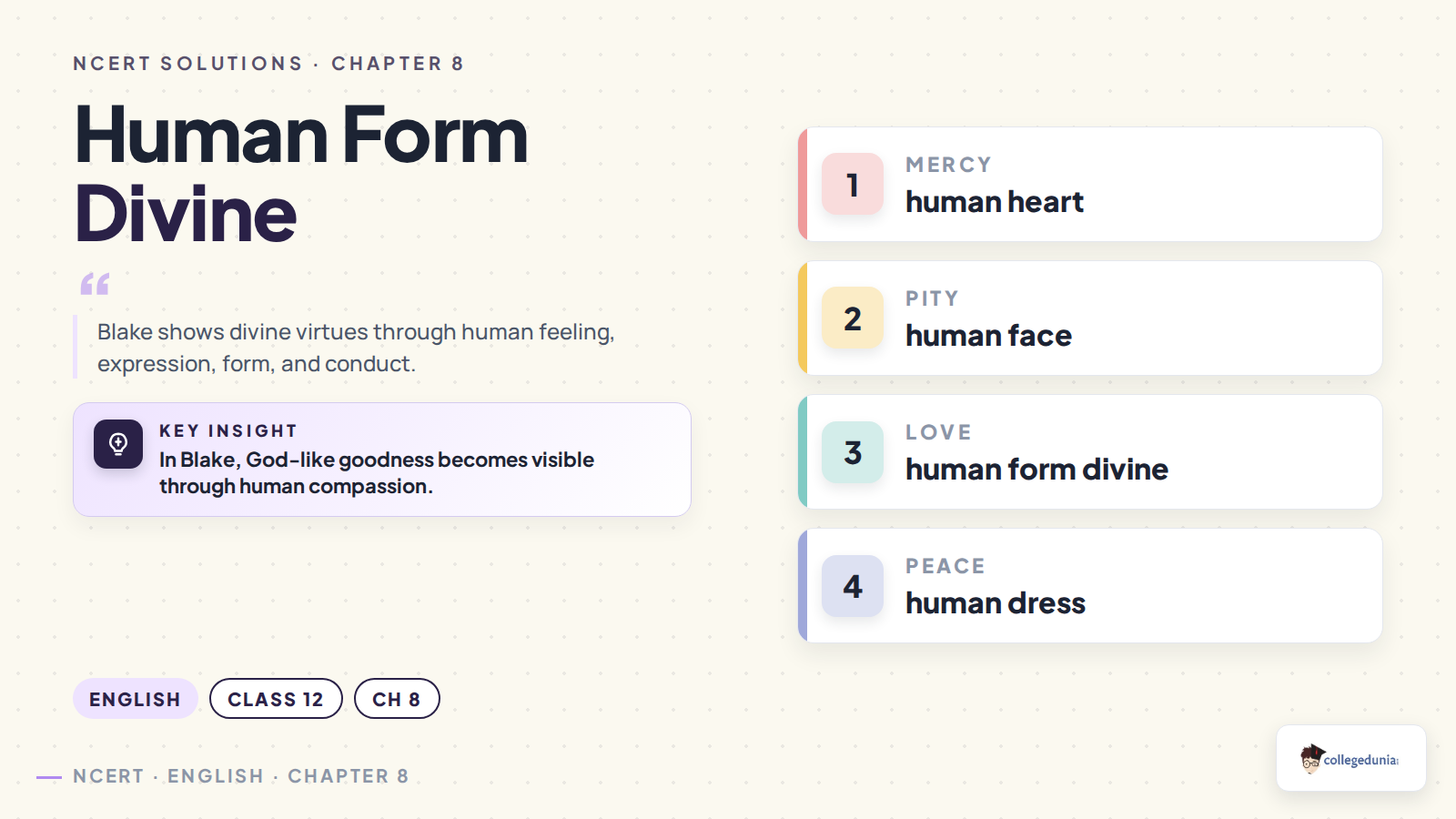
The phrase human form divine is central to The Divine Image. Blake suggests that the best human qualities are not separate from God. A person who shows mercy or love is showing something sacred through human action. That is why the poem can move from prayer to ethics so naturally. Worship is not only ritual; it is also compassion in daily life.
For NCERT answers, do not treat this phrase as a decorative line. Link it to the poem's full argument. Mercy, Pity, Peace and Love belong to both God and humanity. The poem therefore asks students to see moral behaviour as the place where divine presence becomes visible.
- Use the phrase when answering questions on Blake's idea of God and humanity.
- Connect the phrase with the four virtues named in the poem.
- Contrast it with the tree of mystery in The Human Abstract for higher-value answers.
How to Use These NCERT Solutions for Better Answers
The best way to study Chapter 8 is to first understand the argument of each poem, then revise the exact NCERT answers. Start with The Divine Image and list the four virtues. Next, read The Human Abstract and trace the darker chain from pity and mercy to fear, humility, mystery and deceit. This sequence helps students avoid vague answers such as "the poem is about goodness" or "the poem is about evil".
In poetry answers, short evidence matters more than long plot summary. Mention the key idea, explain the symbol, and add one phrase from the poem when it fits naturally. The PDF keeps this pattern steady across all answers so students can revise faster before school tests and board-style practice.
- Before writing: identify whether the question asks for meaning, comparison, symbol or language.
- While writing: use two to four focused sentences instead of a general paragraph.
- After writing: check that your answer names the poem and explains the exact virtue or symbol asked.
Class 12 English Supplementary Chapter 8 Resource Links
Use these Chapter 8 resources together when revising the poems. The Solutions PDF is best for question practice, while notes and book links help students return to the chapter text before writing final answers.
| Resource | Best Use | Link |
|---|---|---|
| NCERT Notes | Revise poem themes, symbols and contrast points | Open Notes |
| Handwritten Notes | Use quick revision pages before tests | Open Handwritten Notes |
| NCERT Book PDF | Read the original poems and textbook questions | Open Book PDF |
All NCERT Solutions for Class 12 English Supplementary Chapters
The table below connects this chapter with other Kaleidoscope solution pages. Use it to move across the prose and poetry chapters while keeping the same NCERT answer format.
| Chapter | Chapter Title | NCERT Solutions |
|---|---|---|
| Chapter 1 | Kaleidoscope: I Sell My Dreams | Open Solutions |
| Chapter 2 | Kaleidoscope: Eveline | Open Solutions |
| Chapter 3 | Kaleidoscope: A Wedding in Brownsville | Open Solutions |
| Chapter 4 | Kaleidoscope: Tomorrow | Open Solutions |
| Chapter 5 | Kaleidoscope: One Centimetre | Open Solutions |
| Chapter 6 | Kaleidoscope: A Lecture upon the Shadow | Open Solutions |
| Chapter 7 | Kaleidoscope: Poems by Milton | Open Solutions |
| Chapter 8 | Kaleidoscope: Poems by Blake | Open Solutions |
All NCERT Solutions for Chapter 8 Poems by Blake with Step-by-Step Solutions
The companion question bank opens every solved NCERT question from Chapter 8 in a tabbed format. Students can first try the answer, then check the solution and expert explanation without leaving the chapter flow.
Open full question bank: questions-ncert-solutions-class-12-english-supplementary-chapter-8-kaleidoscope-poems-by-blake.html
Poems by Blake Class 12 English NCERT Solutions FAQs
Ques. What does Poems by Blake Class 12 cover?
Ans. The chapter covers Blake's The Divine Image and The Human Abstract, along with questions on virtues, social criticism, symbolism and language patterns.
Ques. How many solved questions are in the PDF?
Ans. The PDF includes 6 solved NCERT questions from Understanding the Poem and Language Work, with both direct solutions and expert explanations.
Ques. What is the main idea of The Divine Image?
Ans. The Divine Image presents Mercy, Pity, Peace and Love as virtues that unite humanity with the divine and make compassion a sacred human quality.
Ques. What is the main idea of The Human Abstract?
Ans. The Human Abstract questions virtues that depend on suffering and shows how fear, humility, mystery and deceit can grow inside an unjust society.
Ques. Are these NCERT Solutions useful for the 2026-27 syllabus?
Ans. Yes. The solutions follow the Class 12 English supplementary Chapter 8 textbook questions and are prepared for the 2026-27 NCERT syllabus sequence.



Comments