




NCERT Solutions for Class 12 Biology (2026-27 syllabus) solve every back-exercise question in all 13 chapters of the new NCERT textbook. They match the 70-mark CBSE theory paper and the latest NEET, AIIMS, and CUET-UG Biology patterns.
Class 12 Biology NCERT Solutions PDF Download


Here is every chapter of the 2026-27 Class 12 Biology syllabus. Each row links to that chapter's NCERT Solutions PDF. The list runs in NCERT order, so it matches the order you study the textbook in.
Every chapter comes as a free PDF. Use the index below to jump straight to any chapter's solutions.
- Chapters covered: 13 chapters across 5 CBSE units, from Sexual Reproduction in Flowering Plants to Biodiversity and Conservation
- Format: chapter-wise PDFs plus one combined all-chapters PDF, all free
- Exam match: CBSE Class 12 Biology theory paper (70 marks), NEET, AIIMS, CUET-UG Biology
Subject experts write every chapter in this Collegedunia Class 12 Biology NCERT Solutions set. Each one matches the 2026-27 NCERT and is checked against the last five years of CBSE Board and NEET / AIIMS papers.
How will Collegedunia's Class 12 Biology NCERT Solutions Help You?
In Class 12 Biology, clean step-by-step working scores as much as the right answer. The Class 12 Biology NCERT Solutions on this page let you try every back-exercise question across all 13 chapters. You can then check your working step by step, the way an examiner marks it on the CBSE board paper.
- 2026-27 NCERT match: every back-exercise question fits the new Class 12 Biology syllabus. Deleted topics are flagged inline, so you do not waste time on dropped exercises.
- Two answers per question: a short Solution with the least steps a CBSE examiner wants, plus a longer Expert's Solution. The Expert's Solution adds the NEET-style mechanism-and-diagram answer with proper labels.
- Diagrams and derivations done fully: every figure is redrawn and labelled the way examiners like.
- Easy switching: jump from any solution to the same chapter's Notes, Formula Sheet, Handwritten Notes, or Exemplar Solutions in one click.
- Checked by subject experts: every formula, derivation, and final answer is checked against the official NCERT textbook and the latest CBSE marking scheme.
- Phone-friendly PDFs: smaller downloads for phones, plus HD print-ready files for the board-day printout.
NCERT Solutions for Class 12 Biology
Source: Magnet Brains on YouTube
NCERT Class 12 Biology Topic Map (2026-27 NCERT)
Here is how the 13 Class 12 Biology chapters fit into the CBSE units below. Genetics and Evolution leads the syllabus with 20 of 70 theory marks. The other units carry about 4 to 14 marks each.
| Unit | Chapters | What this unit covers |
|---|---|---|
| VI. Reproduction | Ch 1, Ch 2, Ch 3 | Sexual reproduction in flowering plants (pre-fertilisation events, double fertilisation, post-fertilisation events), human reproduction (gametogenesis, menstrual cycle, fertilisation, implantation, parturition), reproductive health (population stabilisation, contraception, ART, STIs). |
| VII. Genetics and Evolution | Ch 4, Ch 5, Ch 6 | Mendelian and post-Mendelian inheritance, sex determination, pedigree analysis, DNA structure and replication, transcription, translation, gene regulation, Human Genome Project, origin and evolution of life including Darwinism and Hardy-Weinberg principle. |
| VIII. Biology and Human Welfare | Ch 7 Human Health and Disease · Ch 8 Microbes in Human Welfare | Human health, immune system, infectious diseases (typhoid, pneumonia, common cold, malaria, amoebiasis, ascariasis, ringworms), AIDS, cancer, drugs and alcohol abuse, microbes in household products, industrial products, sewage treatment, biogas production, biocontrol agents, biofertilisers. |
| IX. Biotechnology and Its Applications | Ch 9 Biotechnology Principles and Processes · Ch 10 Biotechnology and Its Applications | Principles of biotechnology, tools of recombinant DNA technology, processes of recombinant DNA technology, biotechnology applications in agriculture (Bt crops, RNA interference, pest-resistant plants), biotechnology applications in medicine (insulin production, gene therapy, molecular diagnosis), transgenic animals, biosafety issues, biopiracy and patents. |
| X. Ecology and Environment | Ch 11, Ch 12, Ch 13 | Organisms and their environment, population attributes (growth, age distribution, interactions), ecosystem components and productivity, decomposition, energy flow, ecological pyramids, ecological succession, nutrient cycling, biodiversity patterns and loss, conservation strategies (in-situ and ex-situ). |
NCERT Class 12 Biology Deleted Syllabus 2026-27
NCERT trimmed the 2026-27 Class 12 Biology syllabus to cut the study load for CBSE Boards and NEET. The topics below are officially out of the 2026-27 question paper, so skip them while revising.
| Chapter | Deleted Topics (2026-27) |
|---|---|
| Reproduction in Organisms (formerly Ch 1) | Full chapter removed in 2026-27. Asexual modes and life-cycle patterns are out. |
| Strategies for Enhancement in Food Production (formerly Ch 9) | Full chapter removed. Animal husbandry, plant breeding, and single-cell protein are no longer in scope. |
| Microbes in Human Welfare (Ch 10) | Some sub-parts on microbes in industry removed. Sewage treatment is kept. |
| Biodiversity and Conservation (Ch 15) | Ecosystem services value and biodiversity hotspot details removed. |
| Environmental Issues (formerly Ch 16) | Full chapter removed. Air pollution, water pollution, and greenhouse effect are dropped from board scope. |
| Biotechnology - Principles (Ch 11) | Some details on restriction enzyme types removed. |
| Human Reproduction (Ch 2) | Details on government reproductive health schemes removed. |
The chapter pages linked in the All Chapters index above already flag every deleted line inline, so you don't waste revision hours on dropped topics.
Class 12 Biology Chapter-wise Important Questions
The five chapter groups below carry most of the CBSE 2026 Class 12 Biology paper and repeat almost every year. The first column lists the long-answer topics that come up as 3-mark and 5-mark questions. The second column lists the questions that come up as 1 to 3 mark MCQs and case-studies in CBSE and NEET UG.
| Chapter Cluster | Important Concepts / Diagrams (3-5 marks) | Important MCQs / Short-Answer (1-2 marks) |
|---|---|---|
| Reproduction (Ch 1-4) | 1. Male and female reproductive system labelled diagrams. 2. Mendel's laws and dihybrid cross. 3. Spermatogenesis and oogenesis flow charts. | Phases of menstrual cycle, structure of ovum / sperm, methods of contraception. |
| Genetics and Evolution (Ch 5-6) | 1. Chromosomal theory of inheritance. 2. DNA replication and transcription mechanism. 3. Hardy-Weinberg principle derivation. | Sex determination types, mutations and types, Darwinian evolution evidence. |
| Biology in Human Welfare (Ch 7-8) | 1. Innate vs acquired immunity comparison. 2. Vaccine types and mechanism of action. 3. Cancer types and detection strategies. | AIDS / HIV life cycle, drugs of abuse, adolescent issues. |
| Biotechnology (Ch 9-10) | 1. PCR steps and applications. 2. Recombinant DNA technology process flow. 3. Bt cotton and golden rice case studies. | Cloning vectors, gene therapy, biosafety issues. |
| Ecology (Ch 11-13) | 1. Energy flow in ecosystem - 10% law derivation. 2. Population growth curves (exponential vs logistic). 3. Nitrogen cycle and carbon cycle flow charts. | Ecological pyramids, food chain types, succession in plants. |
About 50% of the NEET UG 2026 Biology section comes from these five groups, mostly Genetics and Ecology. The Expert's Solution tab on each chapter page adds NEET-style option-elimination reasoning next to the CBSE board-style answer.
NCERT SOLUTIONS · CLASS 12 BIOLOGY
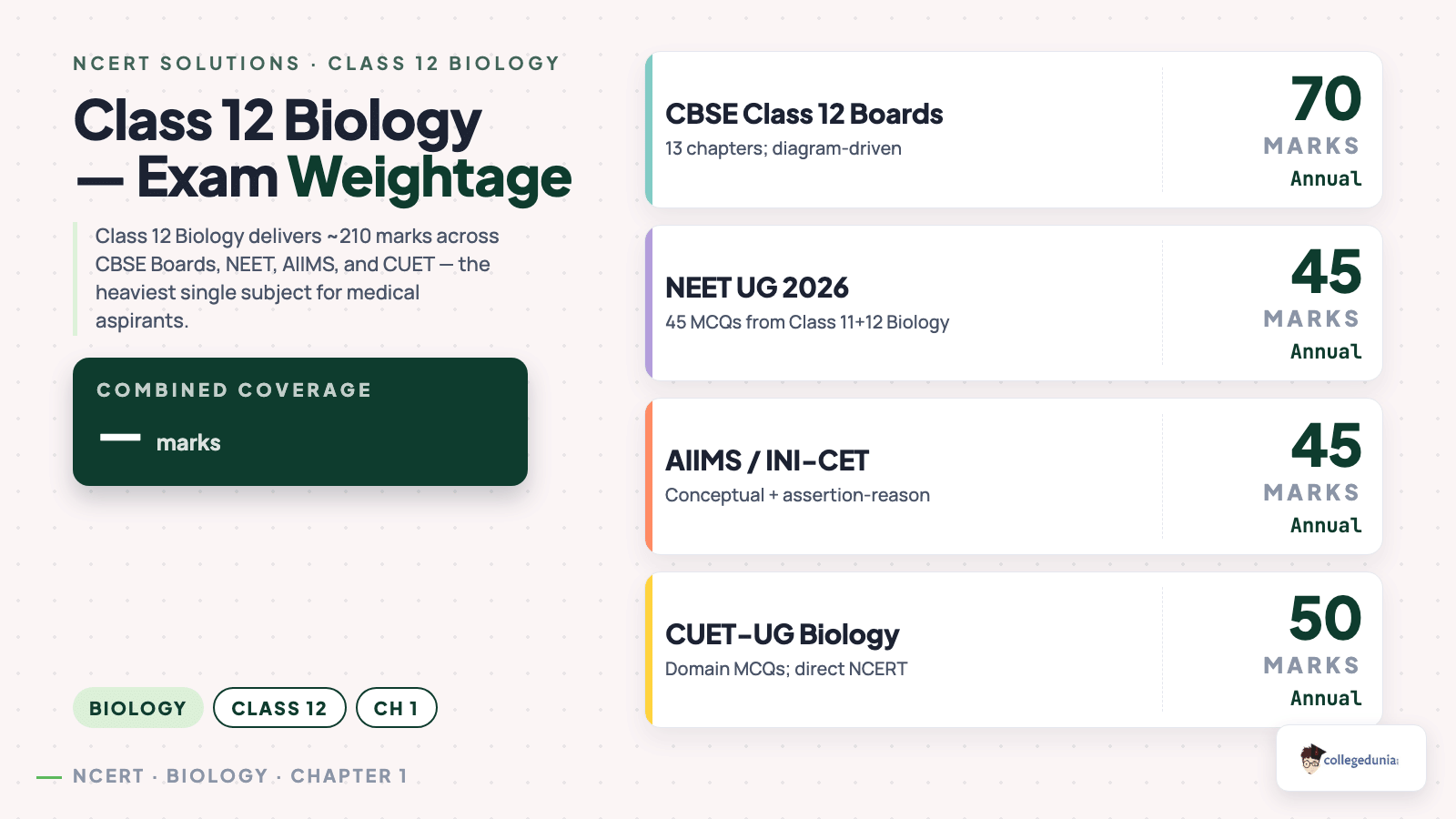
Class 12 Biology - Exam Weightage
Class 12 Biology is worth about 160 marks combined across CBSE Boards and NEET UG. This is the biggest scoring block for NEET aspirants.
Class 12 Biology Weightage Snapshot (CBSE 2026 Theory Paper)
The 70-mark CBSE Class 12 Biology theory paper is split unevenly. Genetics and Evolution leads the table at 20 marks combined, which is about 29% of the theory paper. The table below uses the official CBSE 2026 blueprint and the latest sample-paper pattern. The row with the highest marks has the Collegedunia orange tint.
| Chapter | Topic | CBSE Marks (2026) | NEET 2025 Qs |
|---|---|---|---|
| Ch 5 | Molecular Basis of Inheritance | 8 marks | 3 |
| Ch 4 | Principles of Inheritance and Variation | 7 marks | 2 |
| Ch 2 | Human Reproduction | 6 marks | 2 |
| Ch 1 | Sexual Reproduction in Flowering Plants | 6 marks | 2 |
| Ch 9 | Biotechnology Principles and Processes | 6 marks | 2 |
| Ch 10 | Biotechnology and Its Applications | 6 marks | 2 |
| Ch 7 | Human Health and Disease | 5 marks | 2 |
| Ch 12 | Ecosystem | 5 marks | 1 |
| Ch 6 | Evolution | 4 marks | 2 |
| Ch 3 | Reproductive Health | 4 marks | 1 |
| Ch 11 | Organisms and Populations | 4 marks | 1 |
| Ch 8 | Microbes in Human Welfare | 4 marks | 1 |
| Ch 13 | Biodiversity and Conservation | 5 marks | 1 |
Class 12 Biology CBSE 2026 Paper Pattern Snapshot
The 70-mark CBSE Class 12 Biology theory paper runs 3 hours and has five sections. Knowing the marks per section is half the revision plan. Once you know which section a chapter feeds, you can pick the right resource. Use Notes for Section A recall and NCERT Solutions for Section C and D working.
- Section A (16 questions of 1 mark each): MCQs and assertion-reason. Tests definitions, examples, and one-line facts.
- Section B (5 questions of 2 marks each): Very short answer. One-step questions on processes, mechanisms, and named experiments.
- Section C (7 questions of 3 marks each): Short answer. Labelled-diagram and process-explanation questions sit here.
- Section D (2 case-study questions of 4 marks each): You apply genetics, ecology, or biotechnology to a passage. Sub-parts test how well you read it.
- Section E (3 questions of 5 marks each): Long answer. Full-system answers (reproductive system, photosynthesis pathway, DNA replication) drive this section.
The 70-mark theory paper plus the 30-mark internal assessment (practical, project, viva) makes the 100-mark scheme. Internal assessment marks depend on a complete lab notebook and good viva prep. The theory paper is where your chapter-wise NCERT prep really shows.
Where to Start with Class 12 Biology NCERT Solutions
NCERT order is the safest way to read. But when time is short, start with the highest-mark chapters. The six chapters below give you 39 of 70 board marks:
- Chapter 5, Molecular Basis of Inheritance (8 marks): the highest-mark chapter. Transcription, translation, and DNA replication diagrams come up in almost every paper.
- Chapter 4, Principles of Inheritance and Variation (7 marks): Mendel's laws, pedigree analysis, and sex determination repeat every year. Punnett-square problems are common 5-mark questions.
- Chapter 9, Biotechnology Principles and Processes (6 marks): restriction enzymes, gel electrophoresis, and PCR come up as MCQ and long-answer sets on NEET and CBSE.
- Chapter 10, Biotechnology and Its Applications (6 marks): Bt cotton, GMOs, and gene therapy carry steady marks on both NEET and CBSE.
- Chapter 2, Human Reproduction (6 marks): labelled diagrams (female and male reproductive systems, gametogenesis) score high marks per question.
- Chapter 1, Sexual Reproduction in Flowering Plants (6 marks): double fertilisation, microsporogenesis, megasporogenesis, and embryo development steps come up in every paper.
Together these six chapters cover most of the 70-mark theory paper. The other chapters still matter, but give them one revision pass first. Give the top six chapters two passes.
Class 12 Biology NCERT Solutions: PDF Formats and Languages
Every chapter in the Class 12 Biology NCERT Solutions index comes in three formats. It also has a Hindi-medium version where the chapter exists in the Hindi-medium NCERT.
- HD print-ready PDF: high-quality print, best for printing as a revision booklet.
- Standard download PDF: smaller file size for phone reading.
- Hindi-medium PDF: chapter-wise Hindi versions using NCERT's own words (Jaiv Vigyan). Terms like वंशागति (inheritance), पारिस्थितिकी तंत्र (ecosystem), and जैव प्रौद्योगिकी (biotechnology) stay as NCERT writes them.
- Combined all-chapters PDF: one file with every chapter one after another, handy for offline class use.
- Handwritten version: the same content in notebook-style scanned look, handy for final-week revision.
How Class 12 Biology NCERT Solutions Pair with the Other Resources
The Class 12 Biology NCERT Solutions handle the back-exercise. They do not replace concept revision, formula recall, or harder problem sets. Those live in sister resources that use the same chapter slugs.
- Class 12 Biology Notes: concept revision before you try a question. Use the Notes with the Solutions when a question is built on a derivation or definition you have not seen in a while.
- Class 12 Biology Formula Sheet: every formula, equation, and standard diagram in one short reference for last-day recall.
- Class 12 Biology Exemplar Solutions: worked solutions for the harder Exemplar problems beyond the back-exercise. Move to Exemplar once you can solve the NCERT problems fast.
- Class 12 Biology Handwritten Notes: notebook-style concept revision for the final week before the boards.
- Class 12 Biology NCERT Book PDF: the official textbook. Its worked examples use the same notation as the solutions on this page.
- Class 12 Biology Exemplar Book PDF: the NCERT Exemplar Problems book for extra practice.
How to Use the Class 12 Biology NCERT Solutions Page Most Effectively
The three-block plan below is the routine most CBSE toppers use.
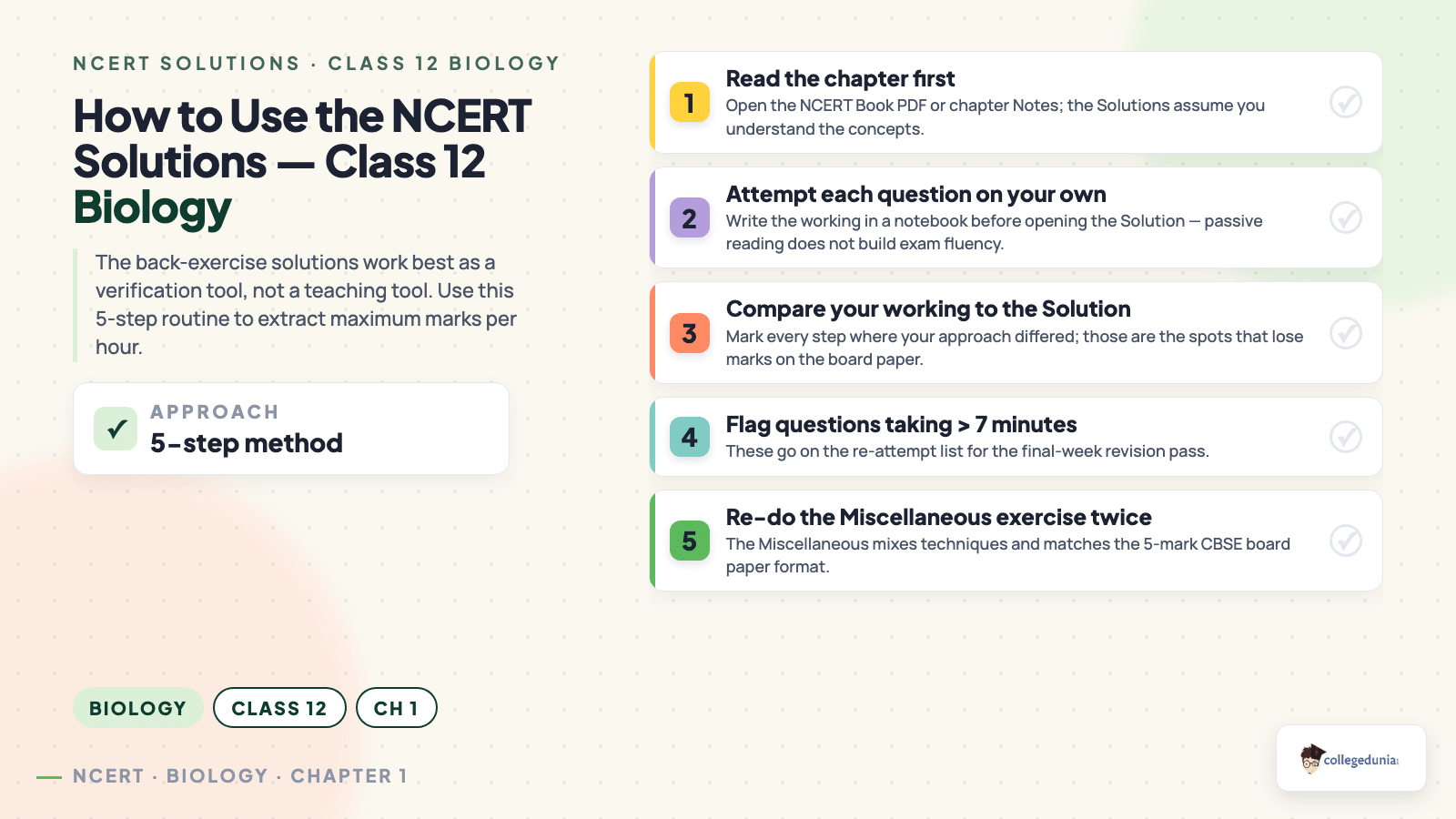
5-STEP METHOD · CBSE TOPPER ROUTINE
How to Use the NCERT Solutions - Class 12 Biology
- 1Read the chapter first. Open the NCERT Book PDF or chapter Notes. The solutions assume you already know the concepts.
- 2Try each question on your own. Write the working in a notebook before you open the answer. Just reading answers does not build exam speed.
- 3Compare your working to the solution. Mark every step where your method was different. Those are the spots that lose marks on the board paper.
- 4Flag questions taking over 7 minutes. These go on the re-attempt list for the final-week revision pass.
- 5Re-do the Miscellaneous exercise twice. It mixes methods and closely matches the 5-mark CBSE board-paper format.
- 1 month before the boards: do the chapter-wise back-exercise in NCERT order. Spend extra time on the top six chapters listed above. Open the Notes when a concept slips.
- 2 weeks before the boards: switch to the Expert's Solution tab on every question. Mark every problem you could not solve in under 7 minutes. You re-do those in the final week.
- 1 week before the boards: re-do only the marked problems. Then finish with the Formula Sheet for last-day formula recall. Skim the Handwritten Notes the night before for quick revision.
Common Mistakes NCERT Class 12 Biology Students Make Across Chapters
- Confusing autosomal dominant vs autosomal recessive inheritance patterns: Chapter 4 students often misread a pedigree. The autosomal recessive pattern skips generations; autosomal dominant appears in every generation. Always tag the parents' phenotype before predicting the children's.
- Mixing up transcription and translation directions: Chapter 5 students reverse the 5' to 3' direction during the transcription step. mRNA is synthesised 5' to 3' using the template strand read 3' to 5'.
- Treating menstrual cycle phases as fixed dates: Chapter 2 questions ask for the hormone change at a phase, not a date. Ovulation causes an LH surge around day 14 of a 28-day cycle. But the question asks which hormone peaks, not which calendar day.
- Forgetting that Hardy-Weinberg needs five conditions: Chapter 6 students often list only no mutation and random mating. The full set also needs no migration, no genetic drift, no selection, and a large population. CBSE cuts marks for an incomplete list.
- Writing 'evolution' when the question asks for 'speciation': Chapter 6 uses both terms; evolution is the change in allele frequencies over time, speciation is the formation of new species. Read the verb carefully before answering.
- Mixing up in-situ and ex-situ conservation: Chapter 13 students often call a zoo in-situ. Zoos and seed banks are ex-situ. Biosphere reserves and national parks are in-situ. The CBSE marking scheme cuts marks for the mix-up.
- Skipping the labelled diagram on reproduction questions: Chapters 1 and 2 give more marks for labelled diagrams than for prose. A full labelled diagram of the human female reproductive system or an anatropous ovule is the 3-mark core of those questions.
Student Feedback: What 15,290 Class 12 Biology Students Told Us
What 15,290 students told us about their Class 12 Biology board prep
- 68% of students rated Chapter 5 Molecular Basis of Inheritance as the highest-effort chapter, ahead of Chapter 4 Principles of Inheritance and Variation at 57% and Chapter 9 Biotechnology Principles and Processes at 51%.
- Most-skipped chapter: Chapter 13 Biodiversity and Conservation (skipped by about 28% of students, even though it carries 5 marks). Toppers called it easy marks, since you can learn the in-situ vs ex-situ table in under an hour.
- Toppers said that doing the Expert's Solution tab on every Chapter 5 Molecular Basis of Inheritance problem added 4-6 marks to their 70-mark score. Most of it came from the transcription-translation diagram-and-label answers.
- The average Class 12 Biology student spent 46 hours across the 13 chapters to finish the NCERT back-exercise once. Chapters 4, 5, 9, and 10 took the most time per question.
Also Check: Related Class 12 Biology Resources
- Also Check: CBSE Class 12 Biology chapter notes hub on Collegedunia Exams
- Also Check: CBSE Class 12 exam pattern, dates, and full-subject hub
- Also Check: CBSE Class 12 Syllabus 2026-27
- Also Check: NEET 2026 exam information
- Also Check: NEET 2026 Syllabus
- Also Check: AIIMS MBBS 2026 information
- Also Check: CUET-UG 2026 information
Topper-tested takeaways for Class 12 Biology NCERT Solutions
- Re-do every back-exercise question until your working matches the Solution's steps, not just the final answer.
- When the Solution and the Expert's Solution agree, the question fits both boards and competitive exams.
- Mark every Solution where your working took longer than the printed steps. Revise those the night before.
- Use the Solutions with the Notes for any chapter you have not touched in the last six weeks.
Class 12 Biology NCERT Solutions FAQs
Ques. Where can I download the full Class 12 Biology NCERT Solutions PDF?
Ans. You can download every chapter-wise PDF from the index above. It runs from Chapter 1 Sexual Reproduction in Flowering Plants to Chapter 13 Biodiversity and Conservation. A combined all-chapters PDF is also there, free in both Normal and HD resolutions.
Ques. Are these Class 12 Biology NCERT Solutions aligned with the 2026-27 NCERT?
Ans. Yes. Every chapter on this page follows the current 2026-27 syllabus. Where NCERT dropped content from the older edition (deleted exercises, removed worked examples), the solution shows an inline note. So you do not over-revise dropped material.
Ques. How many chapters are there in Class 12 Biology per the 2026-27 NCERT?
Ans. Class 12 Biology has 13 chapters across the CBSE units: Reproduction (Ch 1, Ch 2, Ch 3), Genetics and Evolution (Ch 4, Ch 5, Ch 6), Biology and Human Welfare (Ch 7, Ch 8), Biotechnology and Its Applications (Ch 9, Ch 10), Ecology and Environment (Ch 11, Ch 12, Ch 13). The Topic Map table above lists every chapter under its unit.
Ques. Which Class 12 Biology chapter has the highest CBSE board weightage?
Ans. Genetics and Evolution is the heaviest unit at 20 marks. The Weightage Snapshot table above shows each chapter's mark share, so you can plan your revision time around the high-mark chapters.
Ques. How are the Class 12 Biology NCERT Solutions different from the Notes and Formula Sheet?
Ans. The Class 12 Biology NCERT Solutions work every back-exercise question in full. The Notes shorten each chapter's concepts for revision. The Formula Sheet keeps only the equations for last-day recall. Use all three together: concept (Notes), practice (Solutions), recall (Formula Sheet).
Ques. Are these Class 12 Biology NCERT Solutions useful for NEET and AIIMS?
Ans. Yes. The Expert's Solution tab shows the NEET-style mechanism-and-diagram answers that examiners give marks for. Every reproduction, genetics, and biotechnology chapter has labelled figures. Class 12 Biology makes up about 50% of NEET Biology and most of the AIIMS / CUET Biology questions.
Ques. Are Class 12 Biology NCERT Solutions available in Hindi medium?
Ans. Yes. Every chapter comes with a Hindi-medium download next to the English version. The Hindi solutions use NCERT's own technical words (Jaiv Vigyan). So Hindi-medium students find the same terms they have studied.
Ques. Should I read the chapter first or jump straight to the NCERT Solutions?
Ans. Read the chapter first. The Class 12 Biology NCERT Solutions assume you already know the concepts. They show you how to apply them, not how to build them up. If the chapter is new to you, open the Notes for revision before you try the back-exercise. Then use the Solutions to check your working.
Ques. How many pages is the full Class 12 Biology NCERT Solutions PDF?
Ans. The combined all-chapters PDF runs about 286 to 364 pages, based on how many figures each chapter has. Chapter-wise PDFs run from about 14 pages for the lighter chapters up to about 38 pages for the heaviest.
Ques. What does Class 12 Biology cover?
Ans. Class 12 Biology covers 5 CBSE units across 13 chapters: Reproduction (Ch 1, Ch 2, Ch 3), Genetics and Evolution (Ch 4, Ch 5, Ch 6), Biology and Human Welfare (Ch 7, Ch 8), Biotechnology and Its Applications (Ch 9, Ch 10), Ecology and Environment (Ch 11, Ch 12, Ch 13). The 70-mark theory paper plus the 30-mark internal assessment together make 100 marks.
Ques. Which is the most-scoring chapter in Class 12 Biology?
Ans. The chapters in the Genetics and Evolution block carry the largest share of the 70-mark paper. Among single chapters, the top six in the Where to Start section above together give 39 of 70 board marks.
Ques. How should I structure my Class 12 Biology preparation?
Ans. Build chapter by chapter, and do the high-mark units first. Use the Notes for concepts, the NCERT Solutions for the back-exercise, the Exemplar for harder practice, and the Formula Sheet for the last week. The Study Plan section above shows the 1-month, 2-week, and 1-week countdown that most toppers use.



Comments