The NCERT Solutions for Class 11 Psychology Chapter 1 What is Psychology? cover all 8 textbook review questions from the latest 2026-27 NCERT book. The chapter builds the foundation of Psychology through behaviour, mental processes, scientific method, historical growth, and the practical branches that connect Psychology with everyday life.
Covers every review question from Chapter 1 with a direct solution and an expert explanation.
Focuses on high scoring ideas: overt and covert behaviour, scientific psychology, schools of thought, and applied branches.
Useful for school exams because the answers separate definitions, examples, and application points clearly.
Student Feedback: In a Collegedunia poll of 9,840 Class 11 Psychology students preparing for the 2026-27 school exams, 68% said they could define psychology but struggled to explain how scientific psychology differs from popular beliefs.
Source: 2026-27 Class 11 Psychology student poll across CBSE schools.
Every answer in this chapter set is checked against the 2026-27 NCERT Psychology textbook and written so that students can revise the concept, example, and exam framing together.
Chapter 1 introduces Psychology as the scientific study of behaviour, experience, and mental processes. It begins with visible and inner behaviour, then explains why Psychology is a science and how it moved from philosophical questions about mind to laboratory research and applied work.
Chapter area
What students must know
Where it helps in answers
Meaning of behaviour
Behaviour includes overt actions and covert mental activity
Question 1
Scientific method
Psychology tests claims with evidence instead of accepting popular beliefs
Question 2
Evolution of Psychology
From philosophy to experimental, behavioural, psychoanalytic, Gestalt, cognitive, and applied approaches
Question 3
Interdisciplinary work
Psychologists work with doctors, teachers, law experts, social workers, and environmental experts
Question 4
Professional roles
Psychologist, psychiatrist, counsellor, and clinical psychologist have different training and work areas
Question 5
Applications
Psychology supports learning, health, work, sports, environment, crime prevention, and social change
Questions 6 to 8
Use this chapter as a vocabulary chapter first. If you can define behaviour, scientific psychology, counselling, clinical psychology, environmental psychology, and forensic psychology accurately, most long answers become easier to organise.
Behaviour, Experience and Mental Processes in Psychology
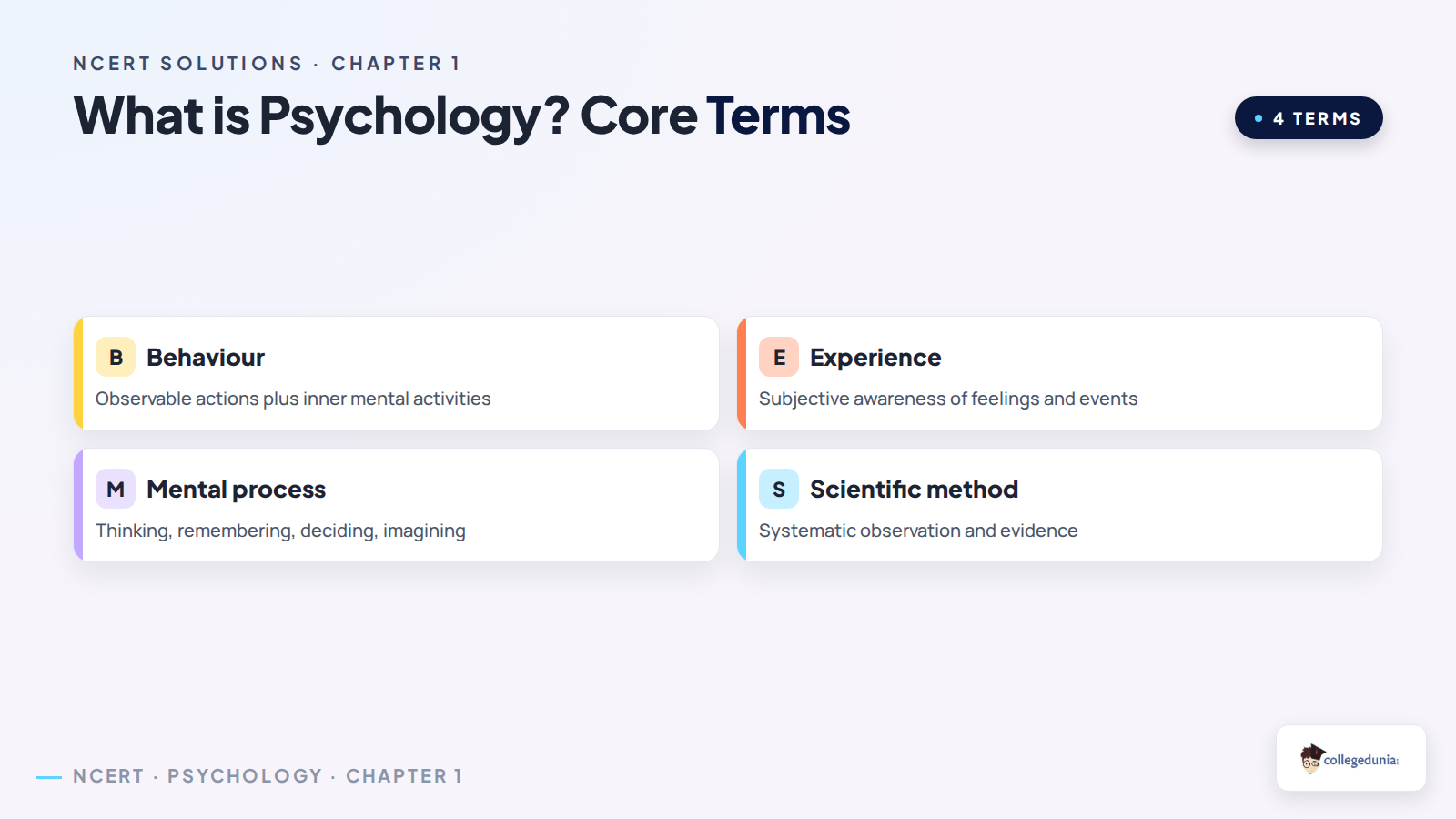
The chapter uses behaviour in a broad way. It does not mean only movement. Overt behaviour can be seen directly, such as speaking, writing, smiling, or walking. Covert behaviour happens inside the person, such as feeling anxious, remembering a poem, silently planning an answer, or imagining a future goal.
Behaviour: any activity or response of a person that psychology can study.
Experience: the felt side of life, such as fear, joy, stress, confidence, or confusion.
Mental process: thinking, remembering, judging, problem solving, decision making, and imagining.
Scientific psychology: the study of these areas through systematic observation and evidence.
The safest exam line is simple: Psychology studies what people do, what they feel, and how they think. This keeps the answer wider than behaviourism alone and closer to the NCERT framing.
Scientific Psychology Compared with Popular Notions
Popular psychology often spreads through sayings, media claims, casual advice, and personal experience. Scientific psychology asks a stricter question: what is the evidence? A scientific claim should be clear enough to test, and its method should be open enough for others to repeat or check.
Point of difference
Scientific psychology
Popular notion
Source
Research, observation, experiment, testing, interview, and case study
Tradition, media, personal belief, or a common saying
Method
Systematic and planned
Casual and often untested
Evidence
Claims are accepted when data support them
Claims may be accepted because they sound familiar
Correction
New evidence can change the explanation
Beliefs may continue even when exceptions exist
Write examples carefully. A statement such as "people can always read personality from a face" is a popular belief unless it is tested. A psychologist would define the claim, choose a method, collect data, and then decide what the result actually shows.
Branches of Psychology Students Meet in Chapter 1
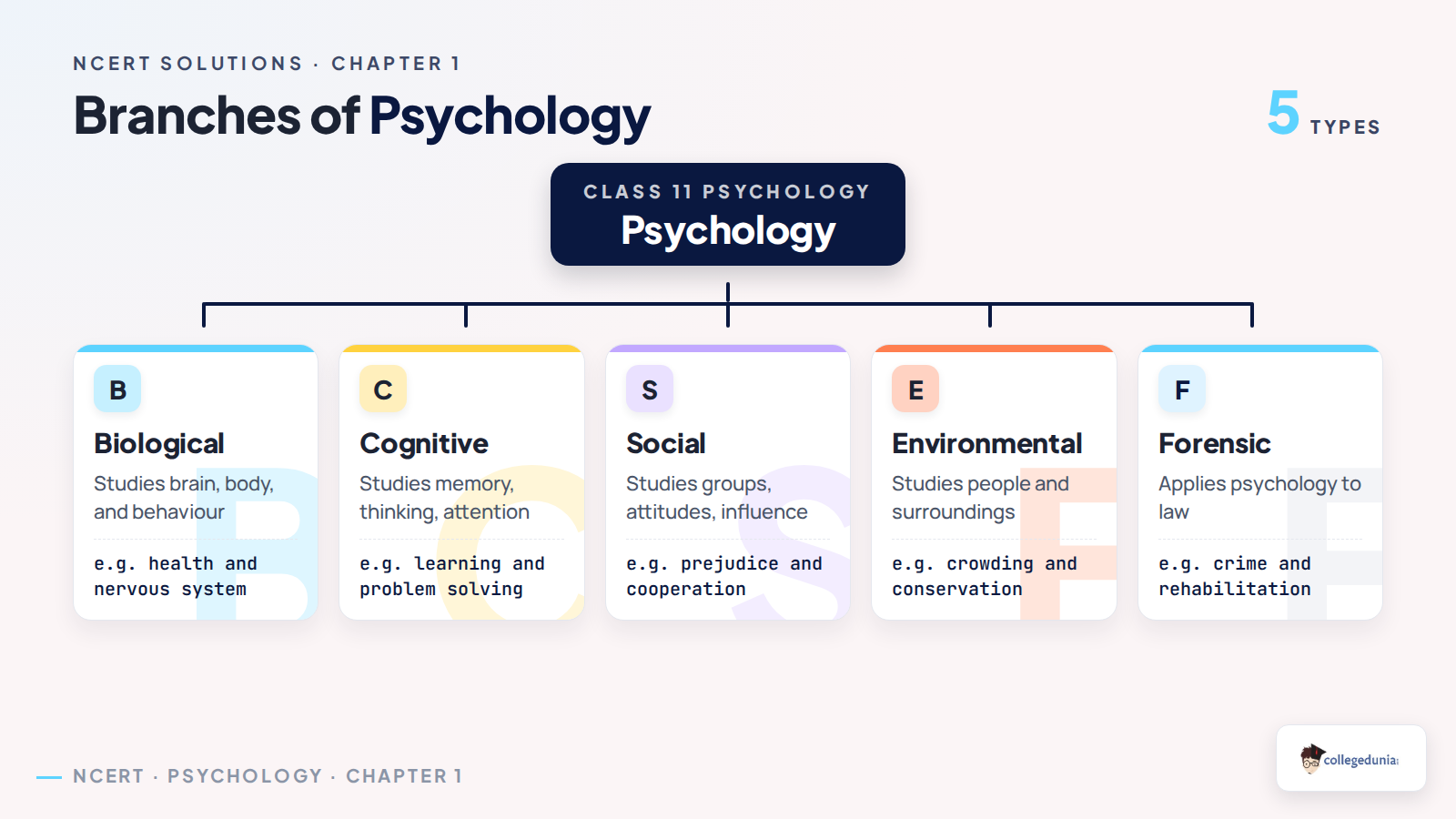
Chapter 1 is also a map of where Psychology is used. The subject helps students understand self and society, but it also works with other disciplines in practical settings. Clinical psychology studies and treats psychological disorders. Counselling psychology helps people handle adjustment, decision making, study stress, relationships, and normal life difficulties.
Educational psychology: learning, motivation, classroom behaviour, and special learning needs.
Environmental psychology: how physical surroundings, crowding, noise, habits, and attitudes affect behaviour toward the environment.
Organisational psychology: work behaviour, leadership, job satisfaction, stress, and team functioning.
For crime-related social problems, forensic psychology is the most suitable field because it connects behaviour with law, assessment, prevention, victim support, and rehabilitation. For environment friendly behaviour, environmental psychology studies attitudes and habits, then helps design reminders, campaigns, and settings that make good behaviour easier.
How to Write Better Answers from What is Psychology?
The chapter is conceptual, so answers should not become vague paragraphs. Use a fixed pattern: define the term, give the contrast or branch, add an example, and then connect it to the question. That pattern works for behaviour, scientific psychology, professional roles, and applied branches.
Start with the exact term. For example, behaviour, scientific psychology, psychiatrist, or forensic psychology.
Add a distinction. Use overt versus covert, scientific versus popular, psychologist versus psychiatrist, or counsellor versus clinical psychologist.
Use one example from everyday life. Learning, anxiety, crime, pollution, school adjustment, or workplace stress is enough.
Close with the application. Explain how psychology helps people understand, predict, or change behaviour.
This is why the solved PDF keeps each answer in steps. It lets students revise the content and also copy the answer structure into a school exam without making the response unnecessarily long.
All NCERT Solutions for Class 11 Psychology Chapter 1 What is Psychology? with Step-by-Step Solutions
Review Questions
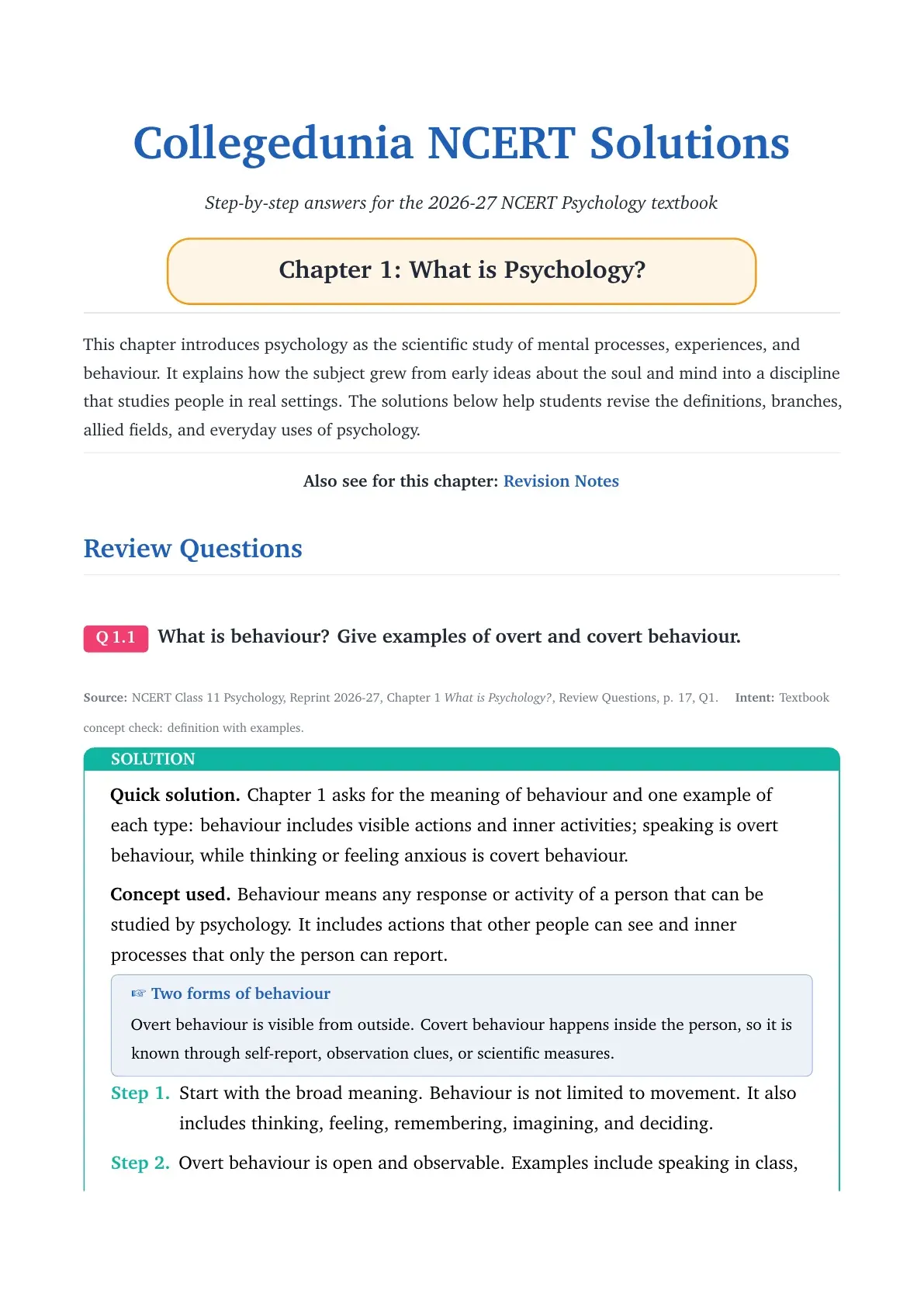
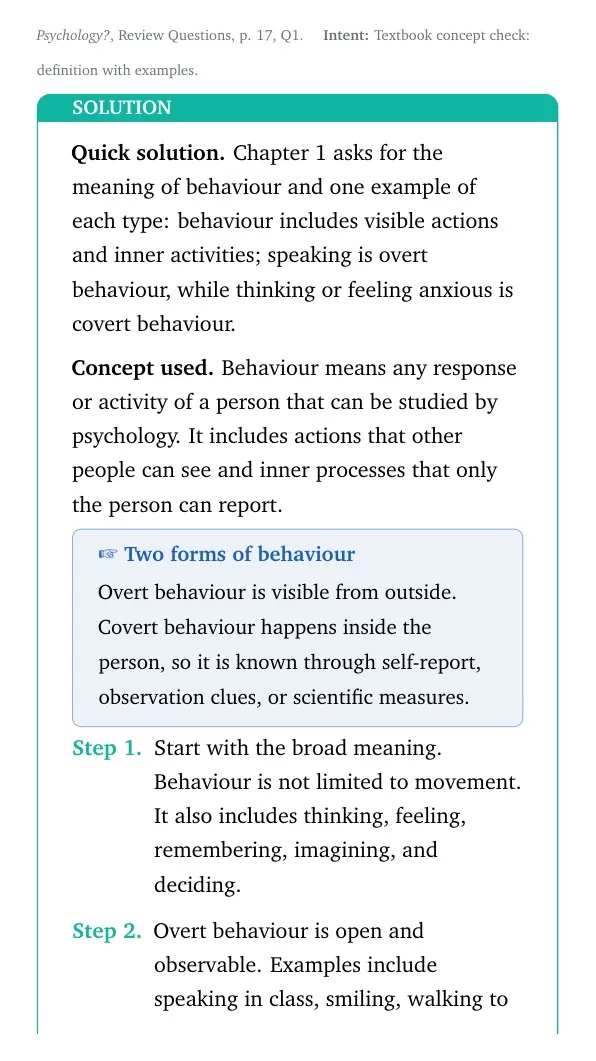
Q 1.1
What is behaviour? Give examples of overt and covert behaviour.
Chapter 1 asks for the meaning of behaviour and one example of each type: behaviour includes visible actions and inner activities; speaking is overt behaviour, while thinking or feeling anxious is covert behaviour.
Concept used. Behaviour means any response or activity of a person that can be studied by psychology. It includes actions that other people can see and inner processes that only the person can report.
Two forms of behaviour
Overt behaviour is visible from outside. Covert behaviour happens inside the person, so it is known through self-report, observation clues, or scientific measures.
Start with the broad meaning. Behaviour is not limited to movement. It also includes thinking, feeling, remembering, imagining, and deciding.
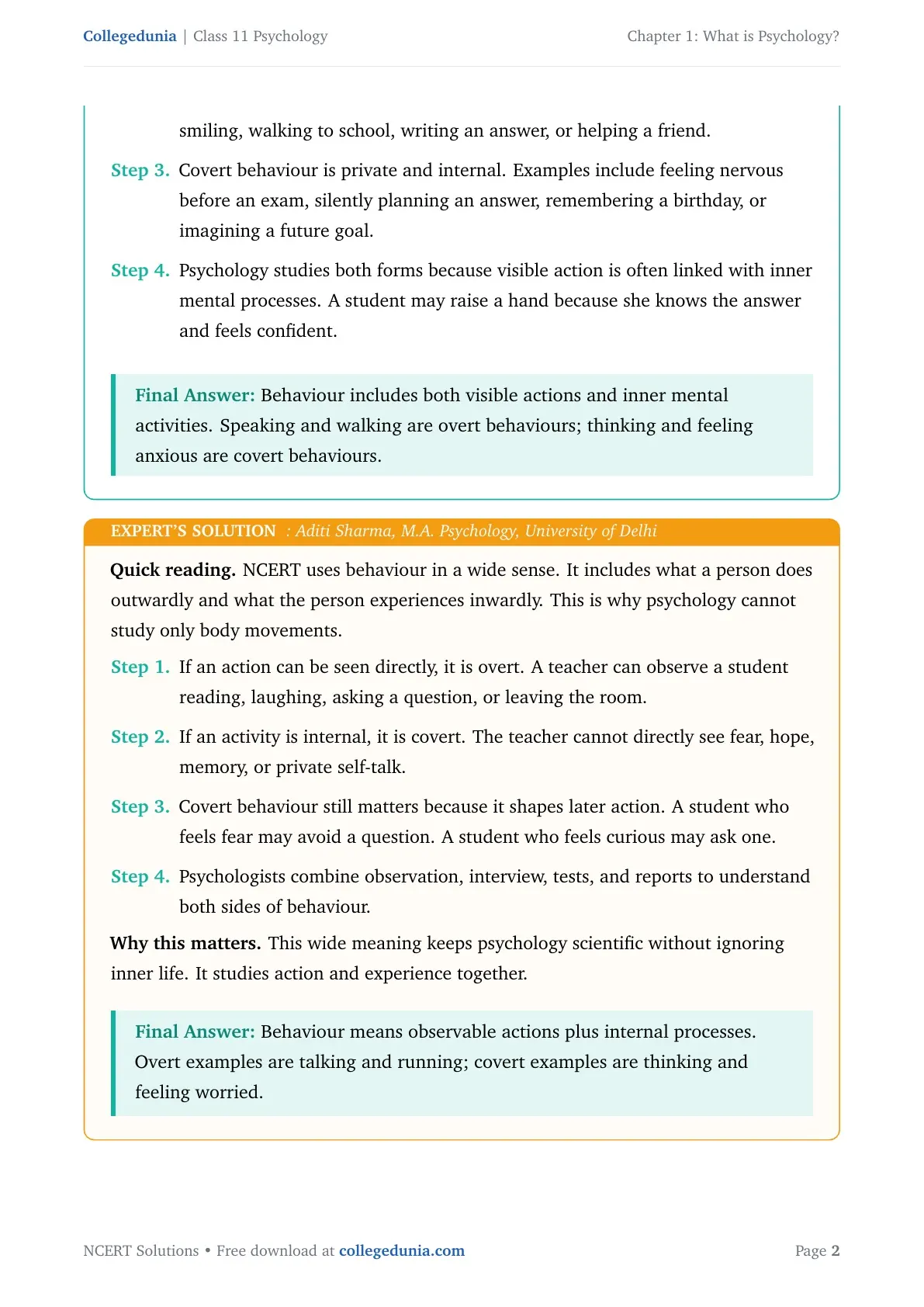
Overt behaviour is open and observable. Examples include speaking in class, smiling, walking to school, writing an answer, or helping a friend.
Covert behaviour is private and internal. Examples include feeling nervous before an exam, silently planning an answer, remembering a birthday, or imagining a future goal.
Psychology studies both forms because visible action is often linked with inner mental processes. A student may raise a hand because she knows the answer and feels confident.
Behaviour includes both visible actions and inner mental activities. Speaking and walking are overt behaviours; thinking and feeling anxious are covert behaviours.
AS
Aditi Sharma
M.A. Psychology, University of Delhi
Verified Expert
Quick reading. NCERT uses behaviour in a wide sense. It includes what a person does outwardly and what the person experiences inwardly. This is why psychology cannot study only body movements.
If an action can be seen directly, it is overt. A teacher can observe a student reading, laughing, asking a question, or leaving the room.
If an activity is internal, it is covert. The teacher cannot directly see fear, hope, memory, or private self-talk.
Covert behaviour still matters because it shapes later action. A student who feels fear may avoid a question. A student who feels curious may ask one.
Psychologists combine observation, interview, tests, and reports to understand both sides of behaviour.
Why this matters. This wide meaning keeps psychology scientific without ignoring inner life. It studies action and experience together.
Behaviour means observable actions plus internal processes. Overt examples are talking and running; covert examples are thinking and feeling worried.
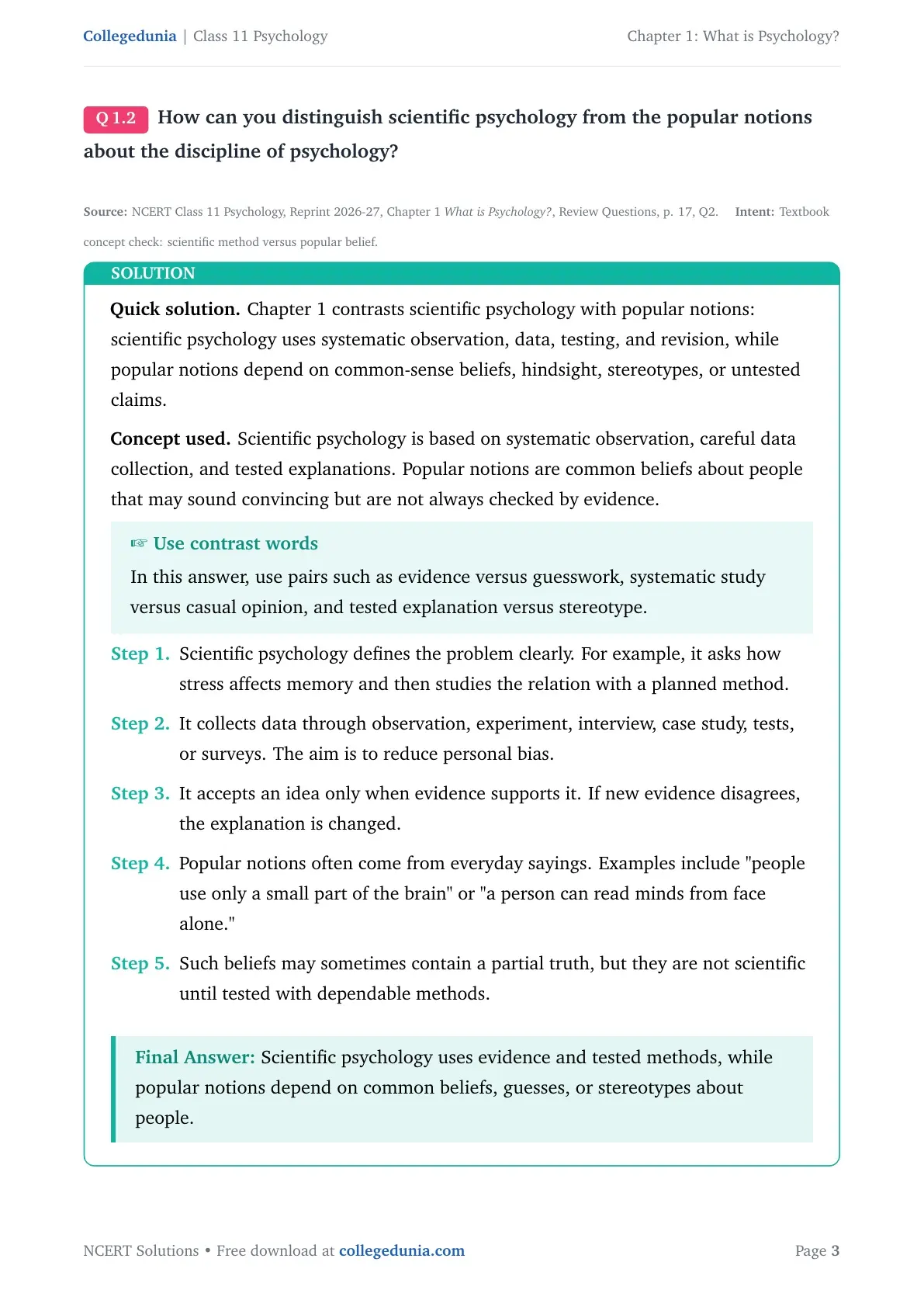
Q 1.2
How can you distinguish scientific psychology from the popular notions about the discipline of psychology?
Chapter 1 contrasts scientific psychology with popular notions: scientific psychology uses systematic observation, data, testing, and revision, while popular notions depend on common-sense beliefs, hindsight, stereotypes, or untested claims.
Concept used. Scientific psychology is based on systematic observation, careful data collection, and tested explanations. Popular notions are common beliefs about people that may sound convincing but are not always checked by evidence.
Use contrast words
In this answer, use pairs such as evidence versus guesswork, systematic study versus casual opinion, and tested explanation versus stereotype.
Scientific psychology defines the problem clearly. For example, it asks how stress affects memory and then studies the relation with a planned method.
It collects data through observation, experiment, interview, case study, tests, or surveys. The aim is to reduce personal bias.
It accepts an idea only when evidence supports it. If new evidence disagrees, the explanation is changed.
Popular notions often come from everyday sayings. Examples include "people use only a small part of the brain" or "a person can read minds from face alone."
Such beliefs may sometimes contain a partial truth, but they are not scientific until tested with dependable methods.
Scientific psychology uses evidence and tested methods, while popular notions depend on common beliefs, guesses, or stereotypes about people.
RM
Rohit Mehta
M.Sc Applied Psychology, Christ University
Verified Expert
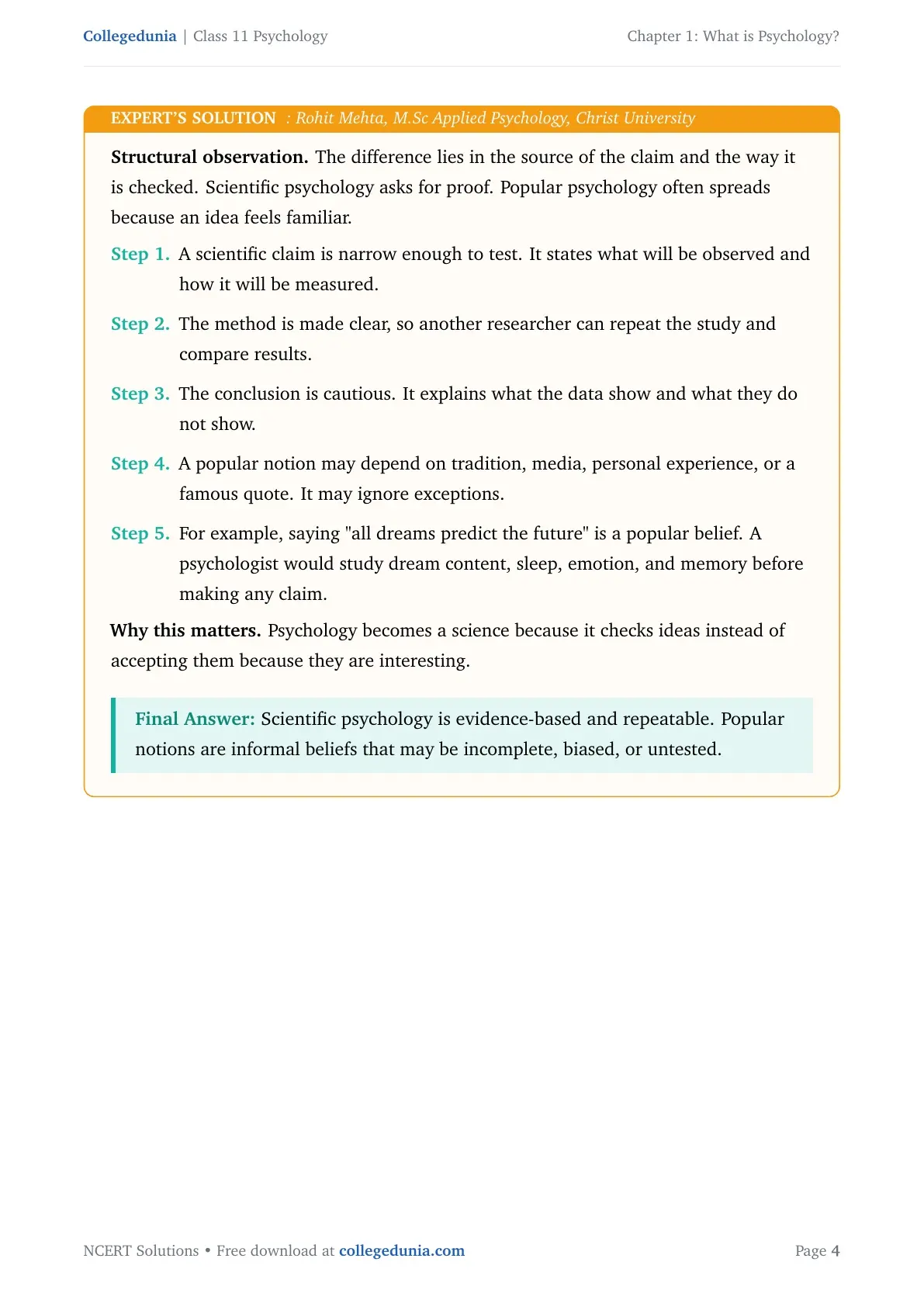
Structural observation. The difference lies in the source of the claim and the way it is checked. Scientific psychology asks for proof. Popular psychology often spreads because an idea feels familiar.
A scientific claim is narrow enough to test. It states what will be observed and how it will be measured.
The method is made clear, so another researcher can repeat the study and compare results.
The conclusion is cautious. It explains what the data show and what they do not show.
A popular notion may depend on tradition, media, personal experience, or a famous quote. It may ignore exceptions.
For example, saying "all dreams predict the future" is a popular belief. A psychologist would study dream content, sleep, emotion, and memory before making any claim.
Why this matters. Psychology becomes a science because it checks ideas instead of accepting them because they are interesting.
Scientific psychology is evidence-based and repeatable. Popular notions are informal beliefs that may be incomplete, biased, or untested.
Q 1.3
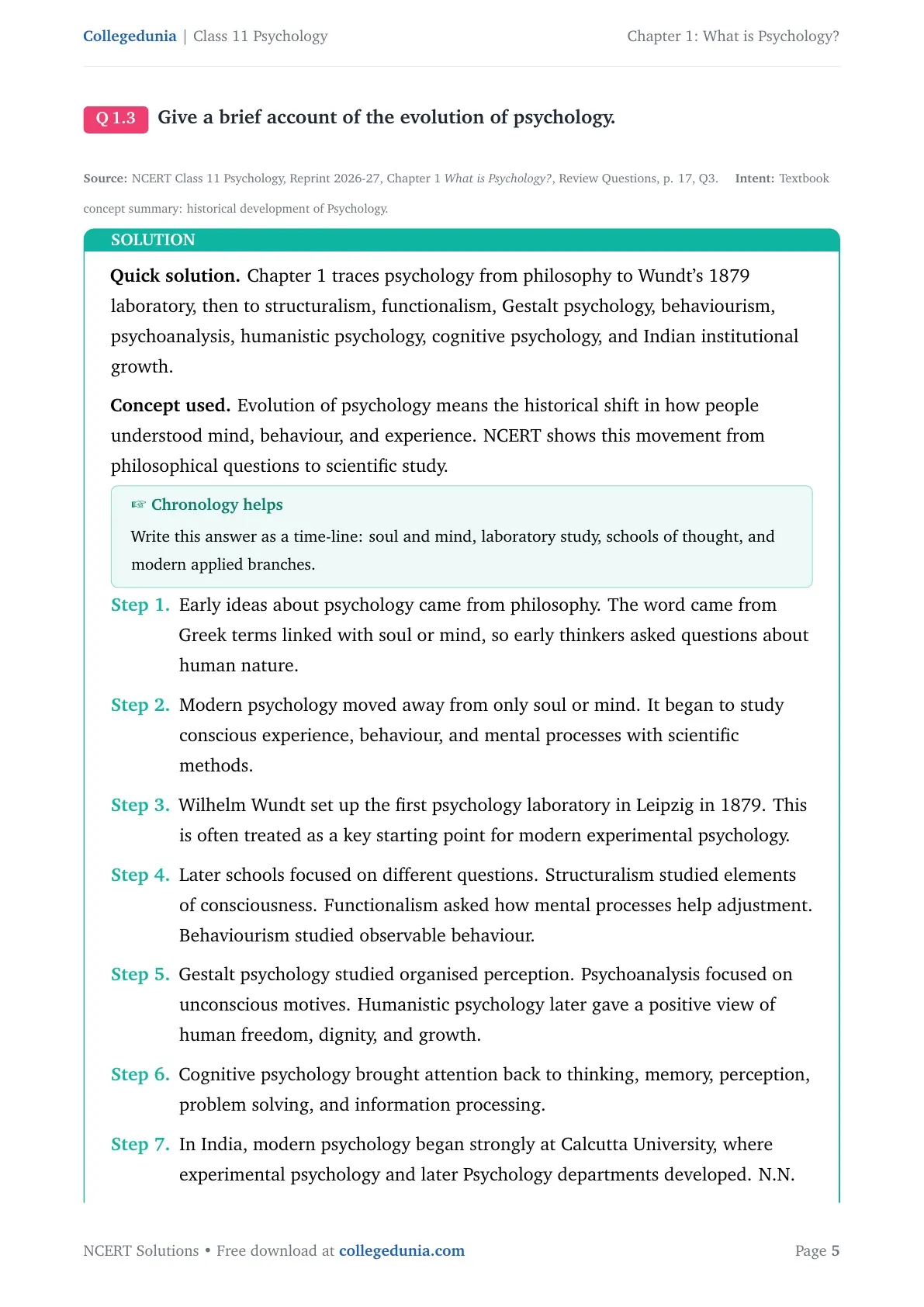
Give a brief account of the evolution of psychology.
Chapter 1 traces psychology from philosophy to Wundt's 1879 laboratory, then to structuralism, functionalism, Gestalt psychology, behaviourism, psychoanalysis, humanistic psychology, cognitive psychology, and Indian institutional growth.
Concept used. Evolution of psychology means the historical shift in how people understood mind, behaviour, and experience. NCERT shows this movement from philosophical questions to scientific study.
Chronology helps
Write this answer as a time-line: soul and mind, laboratory study, schools of thought, and modern applied branches.
Early ideas about psychology came from philosophy. The word came from Greek terms linked with soul or mind, so early thinkers asked questions about human nature.
Modern psychology moved away from only soul or mind. It began to study conscious experience, behaviour, and mental processes with scientific methods.
Wilhelm Wundt set up the first psychology laboratory in Leipzig in 1879. This is often treated as a key starting point for modern experimental psychology.
Later schools focused on different questions. Structuralism studied elements of consciousness. Functionalism asked how mental processes help adjustment. Behaviourism studied observable behaviour.
Gestalt psychology studied organised perception. Psychoanalysis focused on unconscious motives. Humanistic psychology later gave a positive view of human freedom, dignity, and growth.
Cognitive psychology brought attention back to thinking, memory, perception, problem solving, and information processing.
In India, modern psychology began strongly at Calcutta University, where experimental psychology and later Psychology departments developed. N.N. Sengupta brought Wundt's experimental tradition, while G. Bose helped build psychoanalytic work.
Indian psychology then expanded into testing, applied branches, problem-oriented research, indigenisation, and current professional work in schools, hospitals, organisations, sports, development, and technology.
Psychology evolved from philosophical study of soul and mind into a scientific discipline shaped by experimental, behavioural, psychoanalytic, humanistic, cognitive, and Indian applied developments.
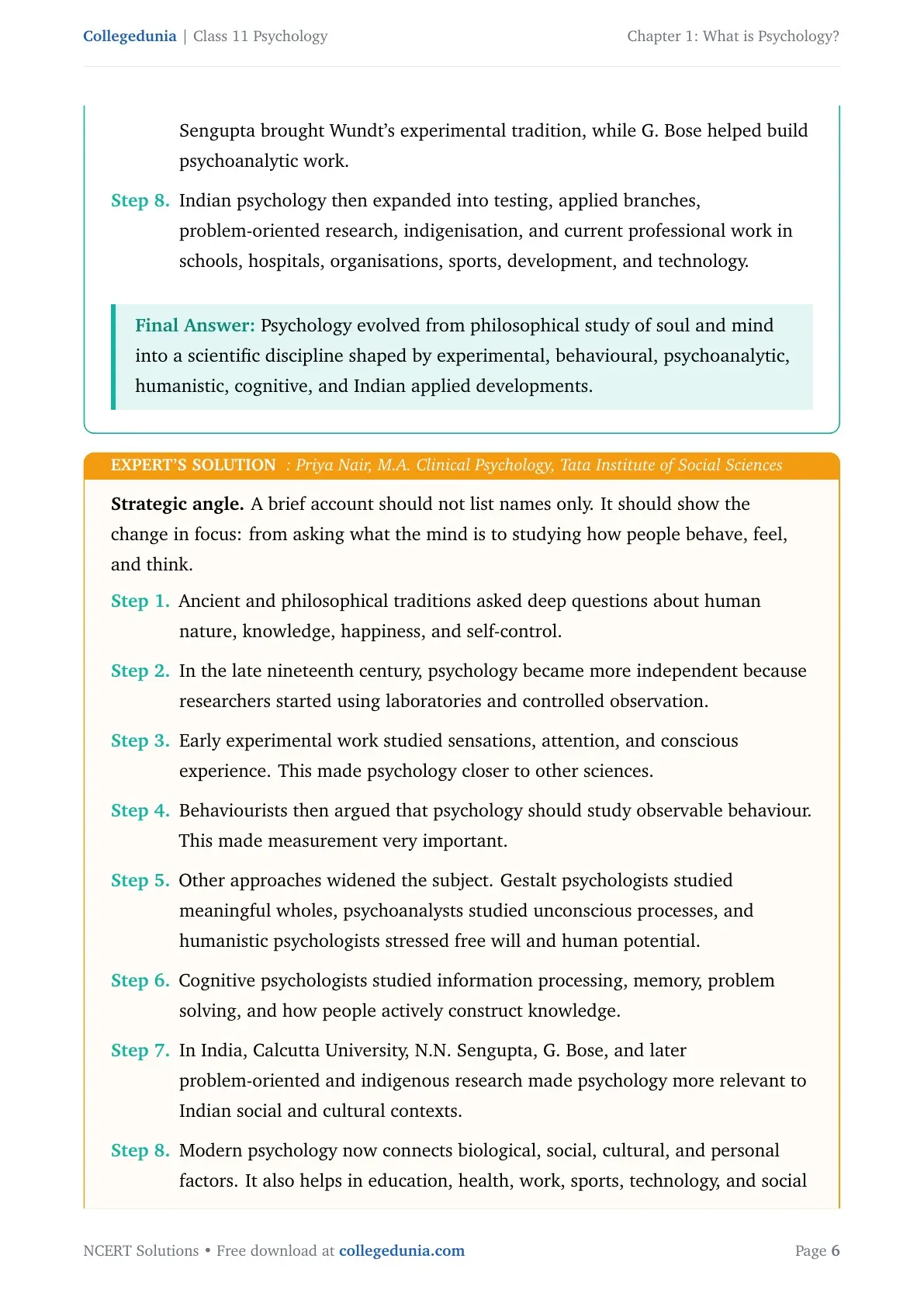
PN
Priya Nair
M.A. Clinical Psychology, Tata Institute of Social Sciences
Verified Expert
Strategic angle. A brief account should not list names only. It should show the change in focus: from asking what the mind is to studying how people behave, feel, and think.
Ancient and philosophical traditions asked deep questions about human nature, knowledge, happiness, and self-control.
In the late nineteenth century, psychology became more independent because researchers started using laboratories and controlled observation.
Early experimental work studied sensations, attention, and conscious experience. This made psychology closer to other sciences.
Behaviourists then argued that psychology should study observable behaviour. This made measurement very important.
Other approaches widened the subject. Gestalt psychologists studied meaningful wholes, psychoanalysts studied unconscious processes, and humanistic psychologists stressed free will and human potential.
Cognitive psychologists studied information processing, memory, problem solving, and how people actively construct knowledge.
In India, Calcutta University, N.N. Sengupta, G. Bose, and later problem-oriented and indigenous research made psychology more relevant to Indian social and cultural contexts.
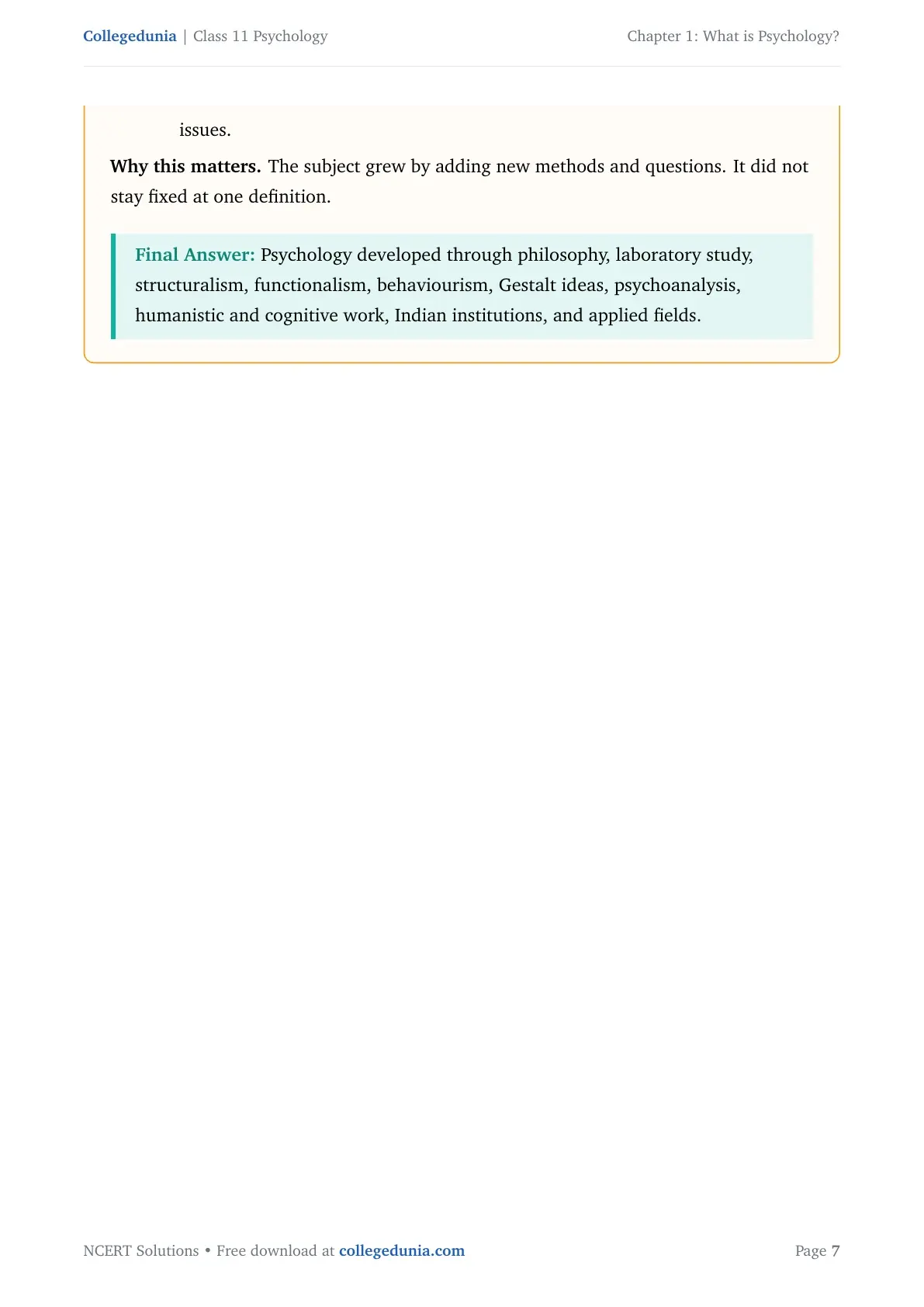
Modern psychology now connects biological, social, cultural, and personal factors. It also helps in education, health, work, sports, technology, and social issues.
Why this matters. The subject grew by adding new methods and questions. It did not stay fixed at one definition.
Psychology developed through philosophy, laboratory study, structuralism, functionalism, behaviourism, Gestalt ideas, psychoanalysis, humanistic and cognitive work, Indian institutions, and applied fields.
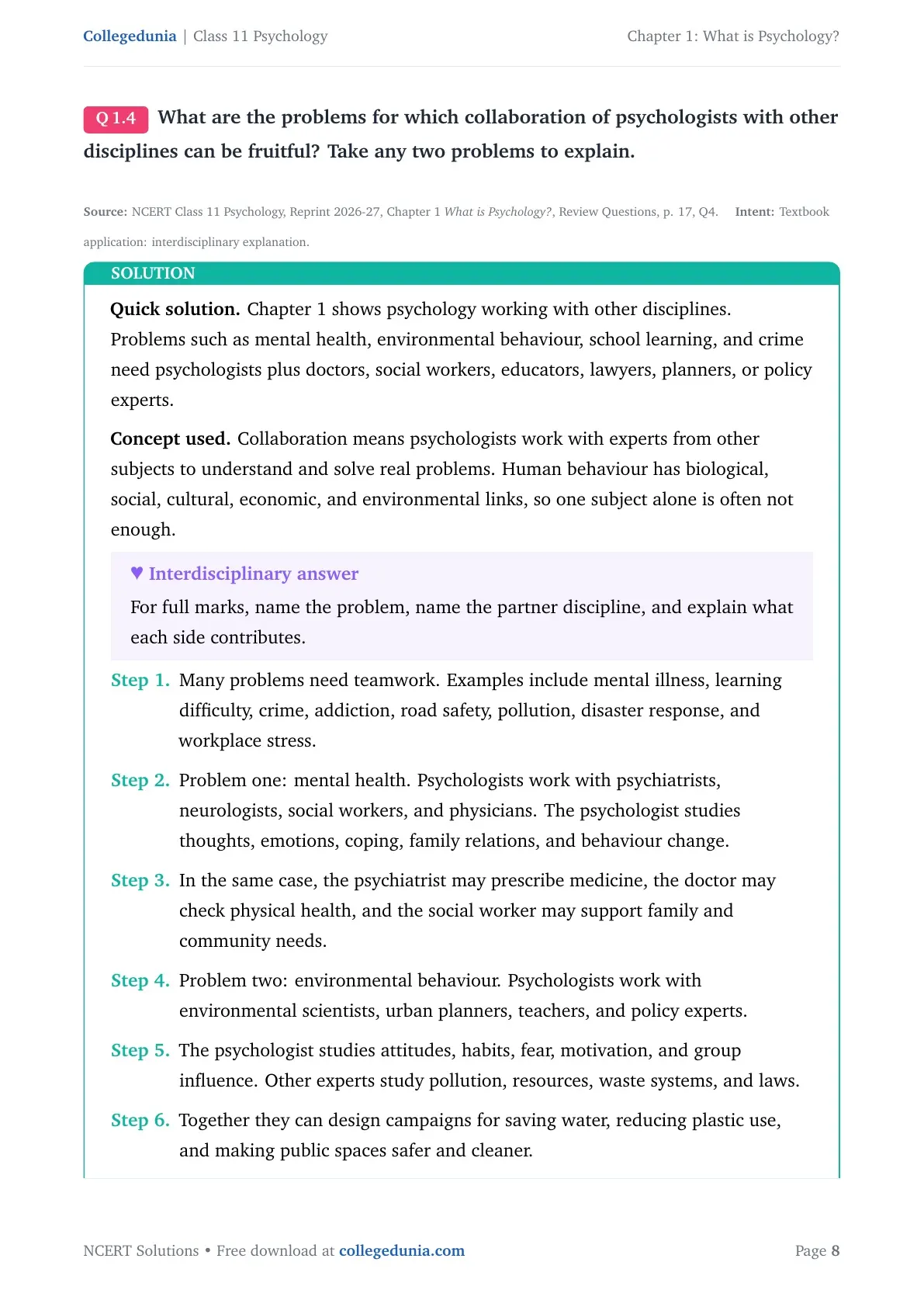
Q 1.4
What are the problems for which collaboration of psychologists with other disciplines can be fruitful? Take any two problems to explain.
Chapter 1 shows psychology working with other disciplines. Problems such as mental health, environmental behaviour, school learning, and crime need psychologists plus doctors, social workers, educators, lawyers, planners, or policy experts.
Concept used. Collaboration means psychologists work with experts from other subjects to understand and solve real problems. Human behaviour has biological, social, cultural, economic, and environmental links, so one subject alone is often not enough.
Interdisciplinary answer
For full marks, name the problem, name the partner discipline, and explain what each side contributes.
Many problems need teamwork. Examples include mental illness, learning difficulty, crime, addiction, road safety, pollution, disaster response, and workplace stress.
Problem one: mental health. Psychologists work with psychiatrists, neurologists, social workers, and physicians. The psychologist studies thoughts, emotions, coping, family relations, and behaviour change.
In the same case, the psychiatrist may prescribe medicine, the doctor may check physical health, and the social worker may support family and community needs.
Problem two: environmental behaviour. Psychologists work with environmental scientists, urban planners, teachers, and policy experts.
The psychologist studies attitudes, habits, fear, motivation, and group influence. Other experts study pollution, resources, waste systems, and laws.
Together they can design campaigns for saving water, reducing plastic use, and making public spaces safer and cleaner.
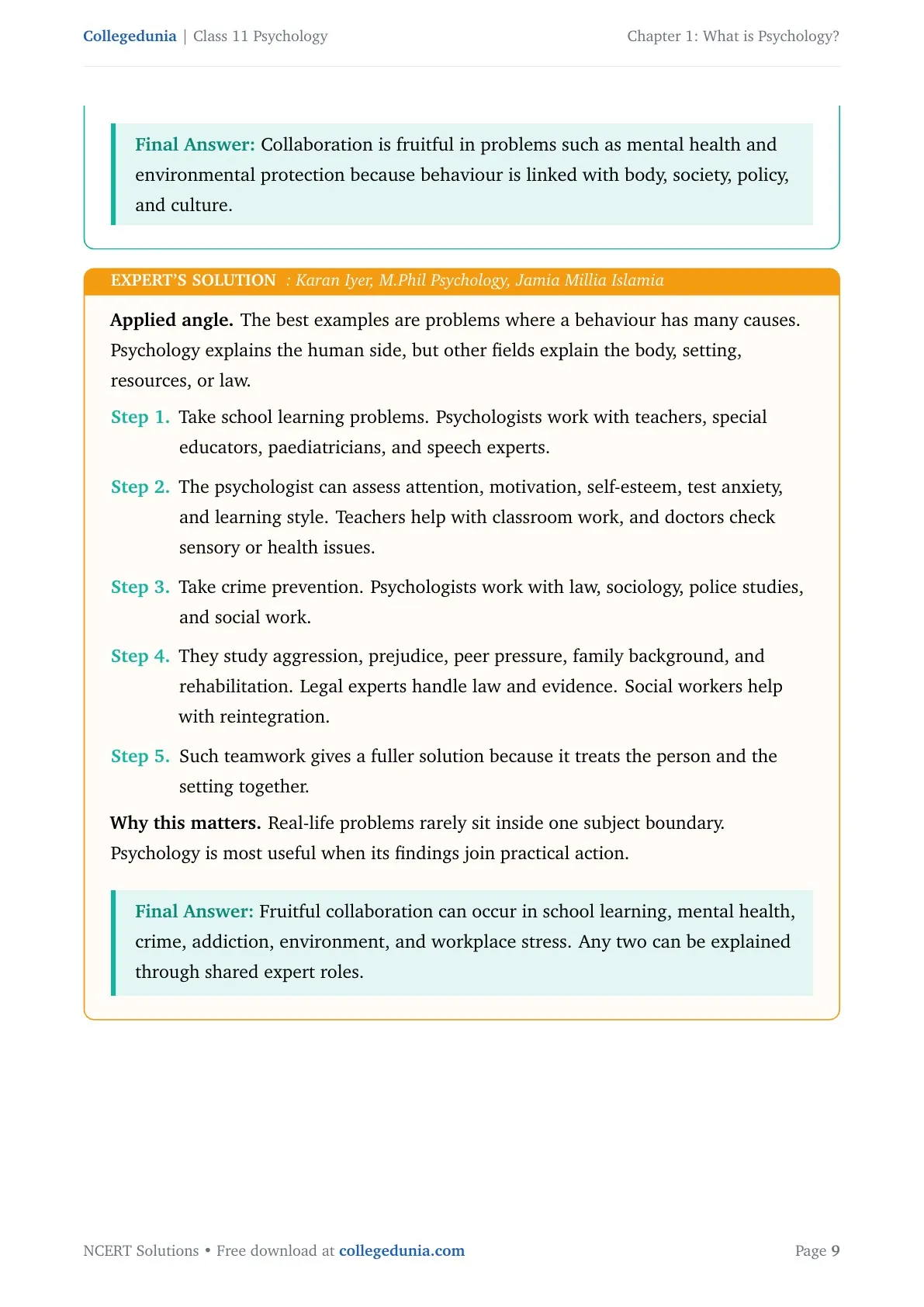
Collaboration is fruitful in problems such as mental health and environmental protection because behaviour is linked with body, society, policy, and culture.
KI
Karan Iyer
M.Phil Psychology, Jamia Millia Islamia
Verified Expert
Applied angle. The best examples are problems where a behaviour has many causes. Psychology explains the human side, but other fields explain the body, setting, resources, or law.
Take school learning problems. Psychologists work with teachers, special educators, paediatricians, and speech experts.
The psychologist can assess attention, motivation, self-esteem, test anxiety, and learning style. Teachers help with classroom work, and doctors check sensory or health issues.
Take crime prevention. Psychologists work with law, sociology, police studies, and social work.
They study aggression, prejudice, peer pressure, family background, and rehabilitation. Legal experts handle law and evidence. Social workers help with reintegration.
Such teamwork gives a fuller solution because it treats the person and the setting together.
Why this matters. Real-life problems rarely sit inside one subject boundary. Psychology is most useful when its findings join practical action.
Fruitful collaboration can occur in school learning, mental health, crime, addiction, environment, and workplace stress. Any two can be explained through shared expert roles.
Q 1.5
Differentiate between (a) a psychologist and a psychiatrist (b) a counsellor and a clinical psychologist.
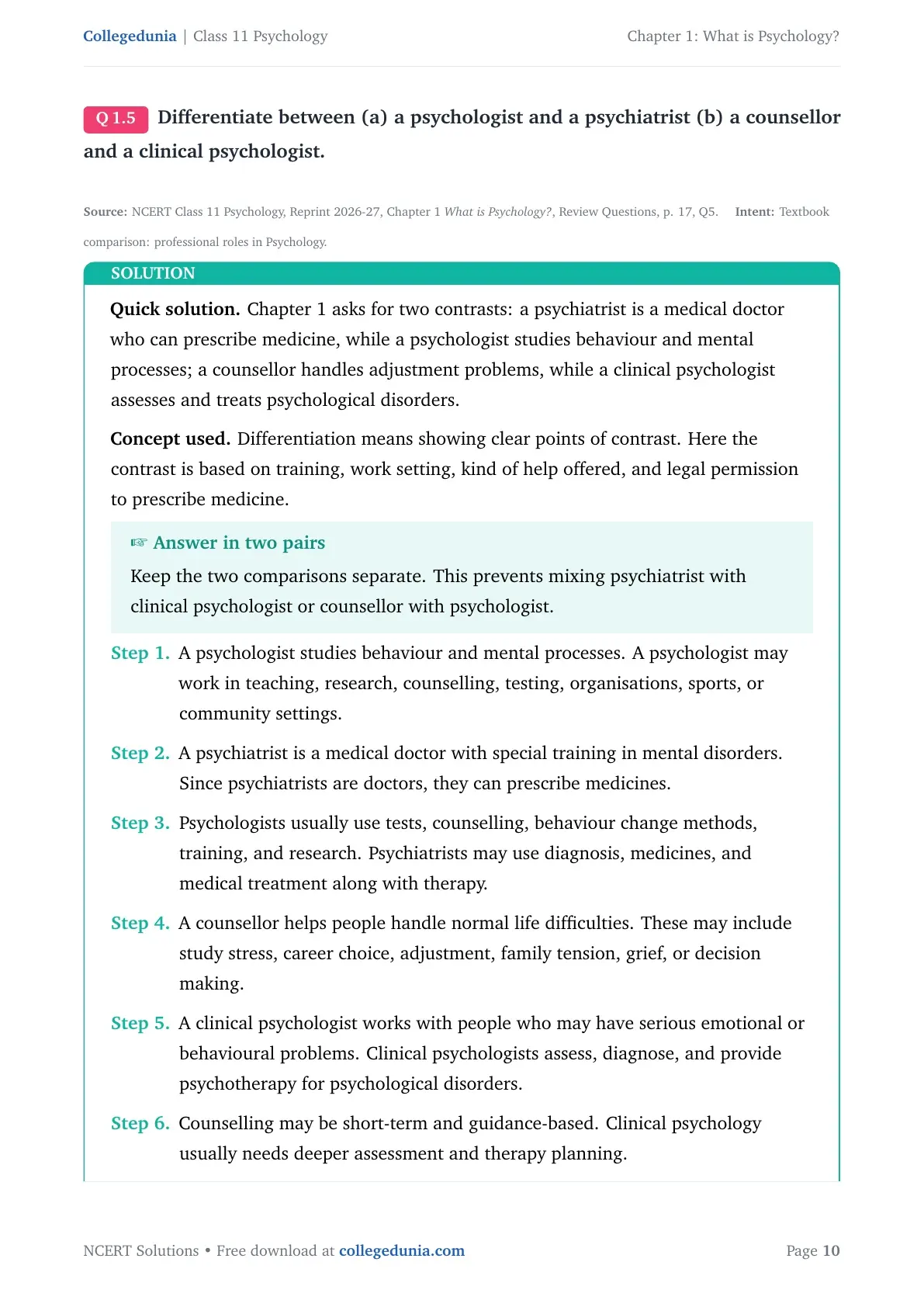
Chapter 1 asks for two contrasts: a psychiatrist is a medical doctor who can prescribe medicine, while a psychologist studies behaviour and mental processes; a counsellor handles adjustment problems, while a clinical psychologist assesses and treats psychological disorders.
Concept used. Differentiation means showing clear points of contrast. Here the contrast is based on training, work setting, kind of help offered, and legal permission to prescribe medicine.
Answer in two pairs
Keep the two comparisons separate. This prevents mixing psychiatrist with clinical psychologist or counsellor with psychologist.
A psychologist studies behaviour and mental processes. A psychologist may work in teaching, research, counselling, testing, organisations, sports, or community settings.
A psychiatrist is a medical doctor with special training in mental disorders. Since psychiatrists are doctors, they can prescribe medicines.
Psychologists usually use tests, counselling, behaviour change methods, training, and research. Psychiatrists may use diagnosis, medicines, and medical treatment along with therapy.
A counsellor helps people handle normal life difficulties. These may include study stress, career choice, adjustment, family tension, grief, or decision making.
A clinical psychologist works with people who may have serious emotional or behavioural problems. Clinical psychologists assess, diagnose, and provide psychotherapy for psychological disorders.
Counselling may be short-term and guidance-based. Clinical psychology usually needs deeper assessment and therapy planning.
A psychiatrist is a medical doctor who can prescribe medicines; a psychologist need not be a doctor. A counsellor handles everyday adjustment problems, while a clinical psychologist treats deeper psychological disorders.
SG
Sneha Gupta
M.Sc Counselling Psychology, Banaras Hindu University
Verified Expert
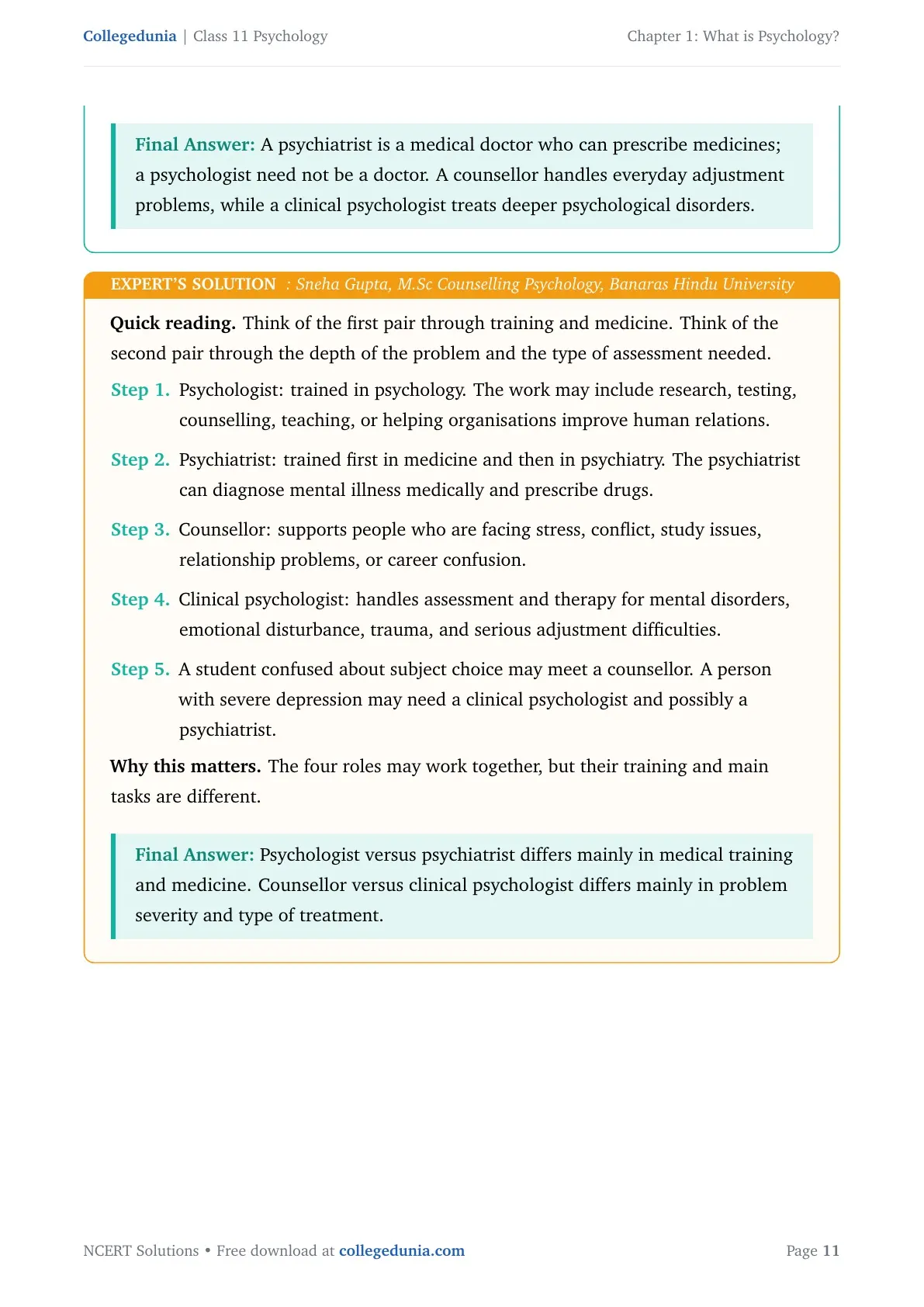
Quick reading. Think of the first pair through training and medicine. Think of the second pair through the depth of the problem and the type of assessment needed.
Psychologist: trained in psychology. The work may include research, testing, counselling, teaching, or helping organisations improve human relations.
Psychiatrist: trained first in medicine and then in psychiatry. The psychiatrist can diagnose mental illness medically and prescribe drugs.
Counsellor: supports people who are facing stress, conflict, study issues, relationship problems, or career confusion.
Clinical psychologist: handles assessment and therapy for mental disorders, emotional disturbance, trauma, and serious adjustment difficulties.
A student confused about subject choice may meet a counsellor. A person with severe depression may need a clinical psychologist and possibly a psychiatrist.
Why this matters. The four roles may work together, but their training and main tasks are different.
Psychologist versus psychiatrist differs mainly in medical training and medicine. Counsellor versus clinical psychologist differs mainly in problem severity and type of treatment.
Q 1.6
Describe some of the areas of everyday life where understanding of psychology can be put to practice.
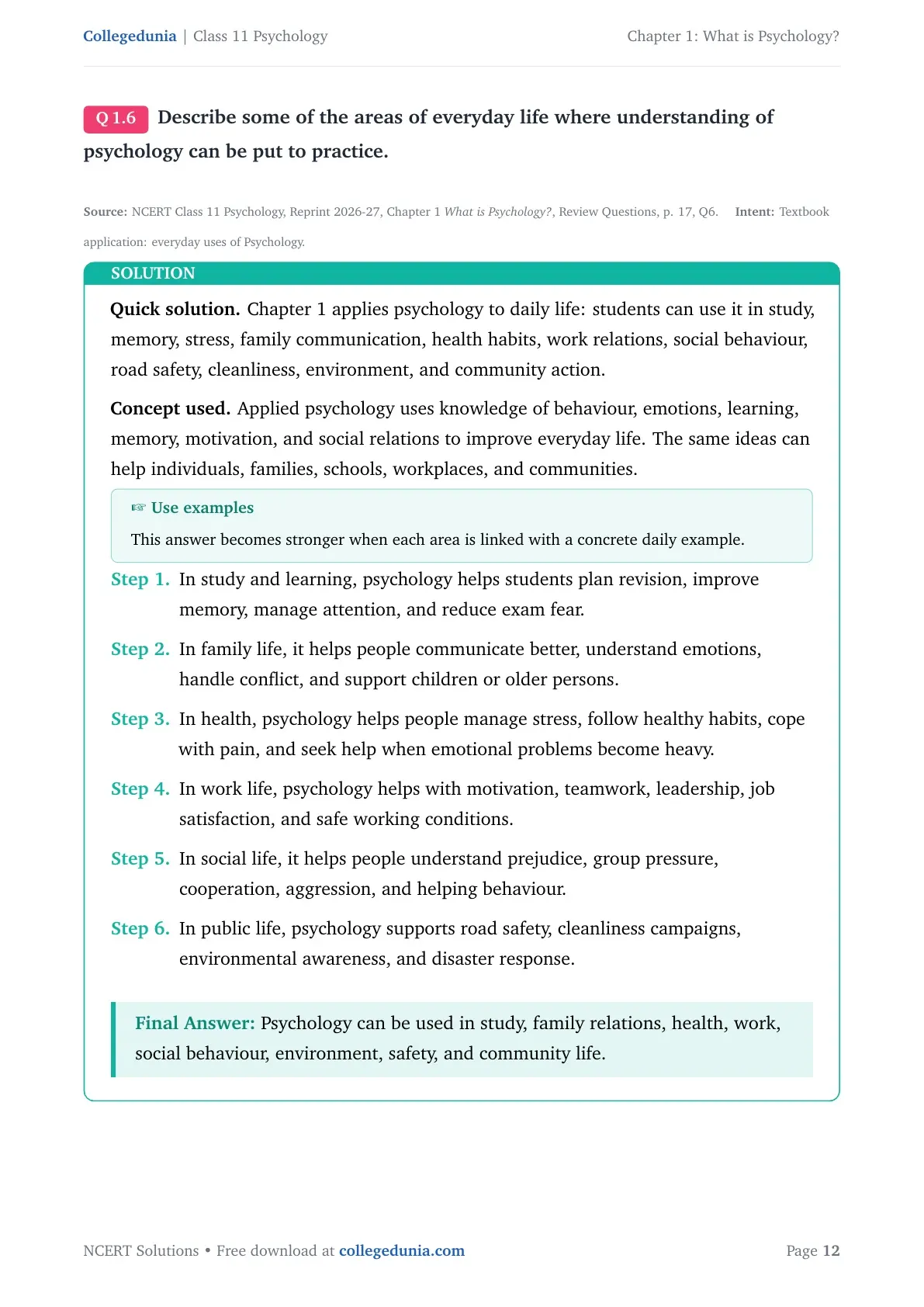
Chapter 1 applies psychology to daily life: students can use it in study, memory, stress, family communication, health habits, work relations, social behaviour, road safety, cleanliness, environment, and community action.
Concept used. Applied psychology uses knowledge of behaviour, emotions, learning, memory, motivation, and social relations to improve everyday life. The same ideas can help individuals, families, schools, workplaces, and communities.
Use examples
This answer becomes stronger when each area is linked with a concrete daily example.
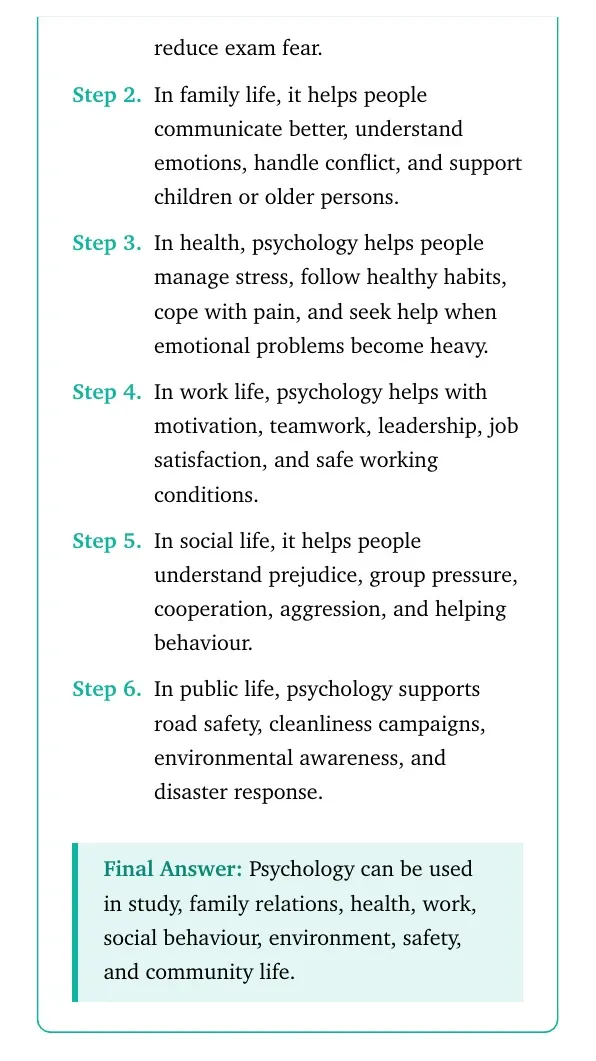
In study and learning, psychology helps students plan revision, improve memory, manage attention, and reduce exam fear.
In family life, it helps people communicate better, understand emotions, handle conflict, and support children or older persons.
In health, psychology helps people manage stress, follow healthy habits, cope with pain, and seek help when emotional problems become heavy.
In work life, psychology helps with motivation, teamwork, leadership, job satisfaction, and safe working conditions.
In social life, it helps people understand prejudice, group pressure, cooperation, aggression, and helping behaviour.
In public life, psychology supports road safety, cleanliness campaigns, environmental awareness, and disaster response.
Psychology can be used in study, family relations, health, work, social behaviour, environment, safety, and community life.
AR
Arjun Rao
M.A. Psychology, University of Hyderabad
Verified Expert
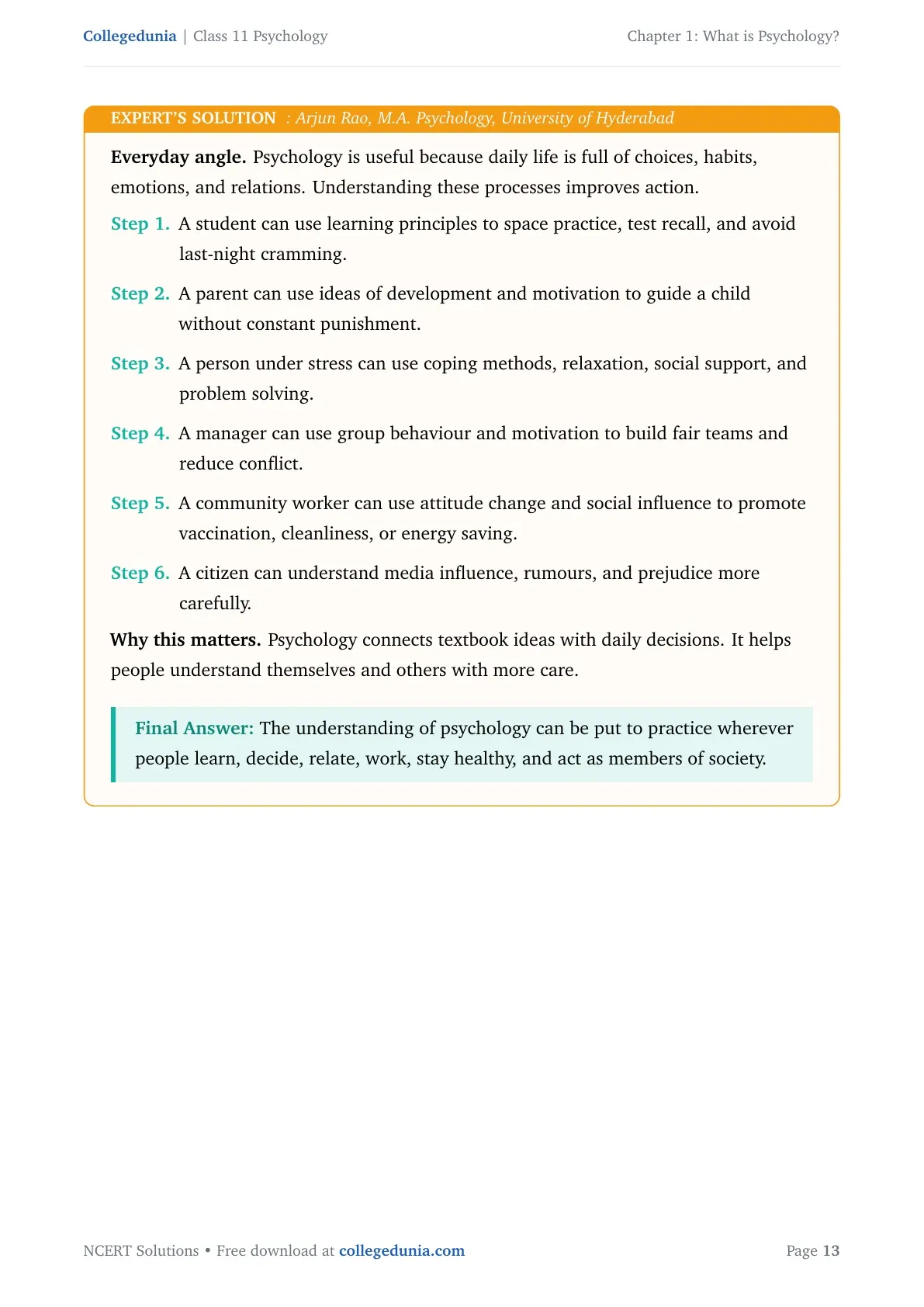
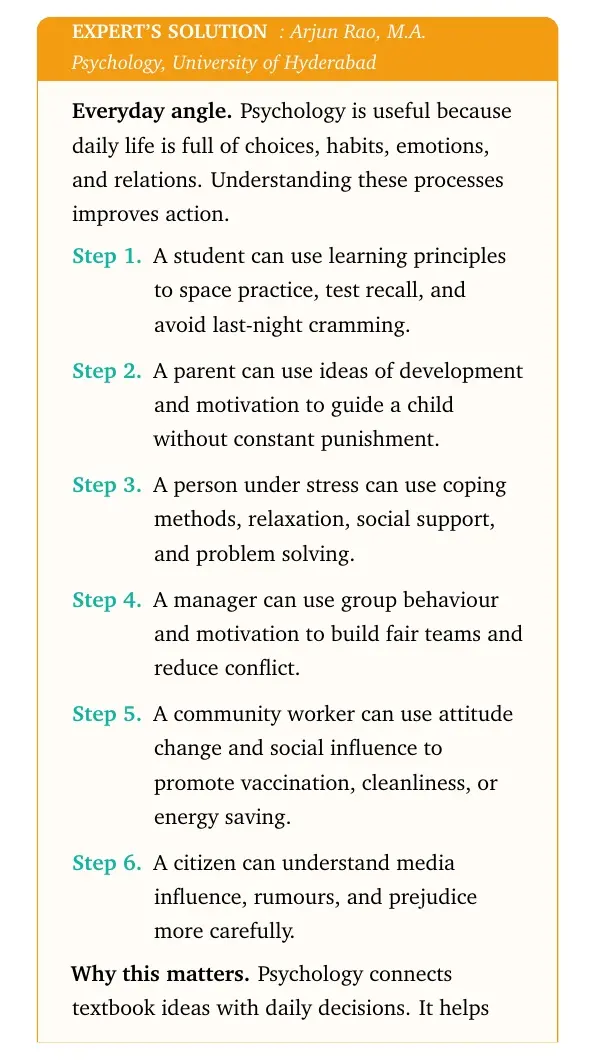
Everyday angle. Psychology is useful because daily life is full of choices, habits, emotions, and relations. Understanding these processes improves action.
A student can use learning principles to space practice, test recall, and avoid last-night cramming.
A parent can use ideas of development and motivation to guide a child without constant punishment.
A person under stress can use coping methods, relaxation, social support, and problem solving.
A manager can use group behaviour and motivation to build fair teams and reduce conflict.
A community worker can use attitude change and social influence to promote vaccination, cleanliness, or energy saving.
A citizen can understand media influence, rumours, and prejudice more carefully.
Why this matters. Psychology connects textbook ideas with daily decisions. It helps people understand themselves and others with more care.
The understanding of psychology can be put to practice wherever people learn, decide, relate, work, stay healthy, and act as members of society.
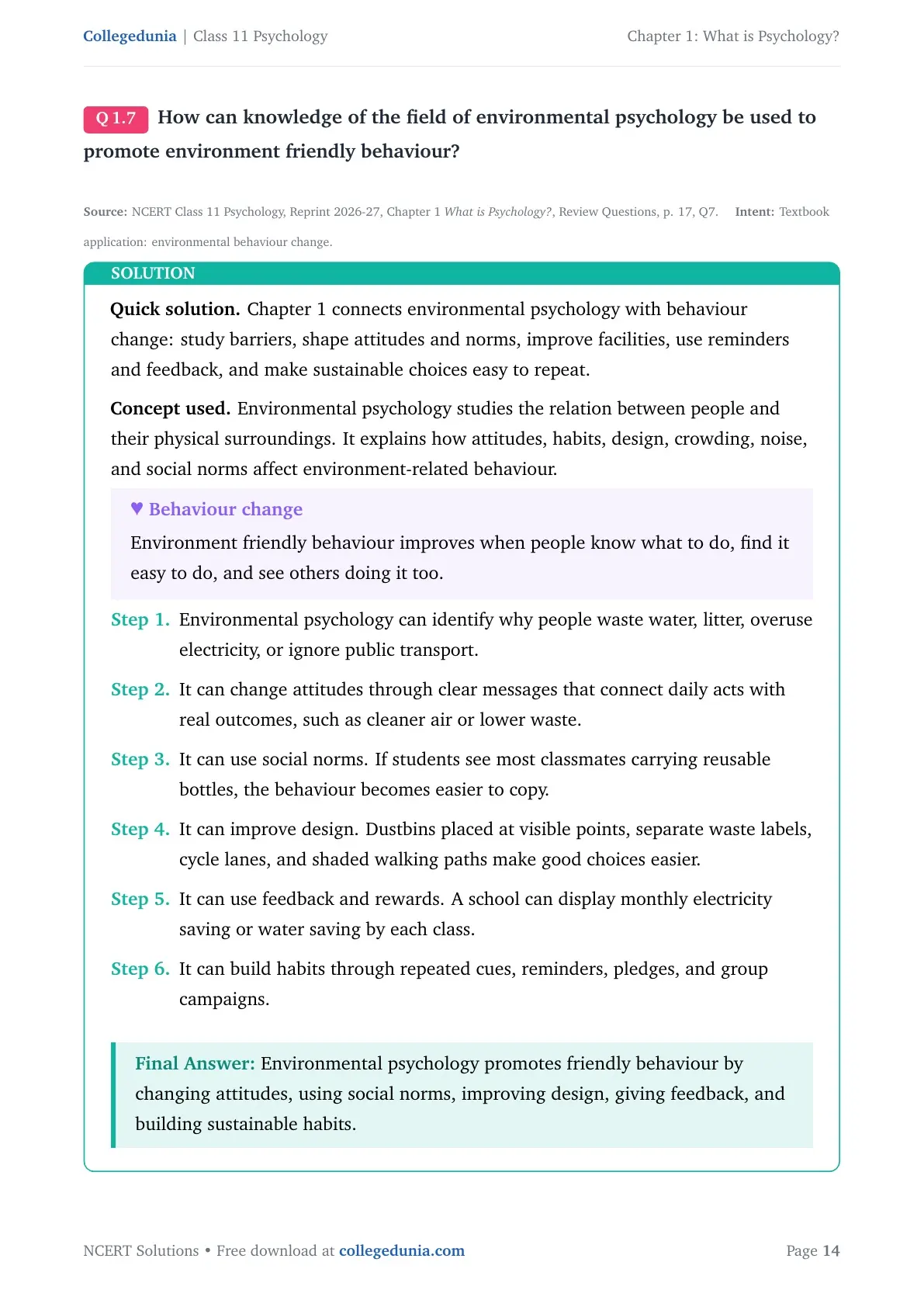
Q 1.7
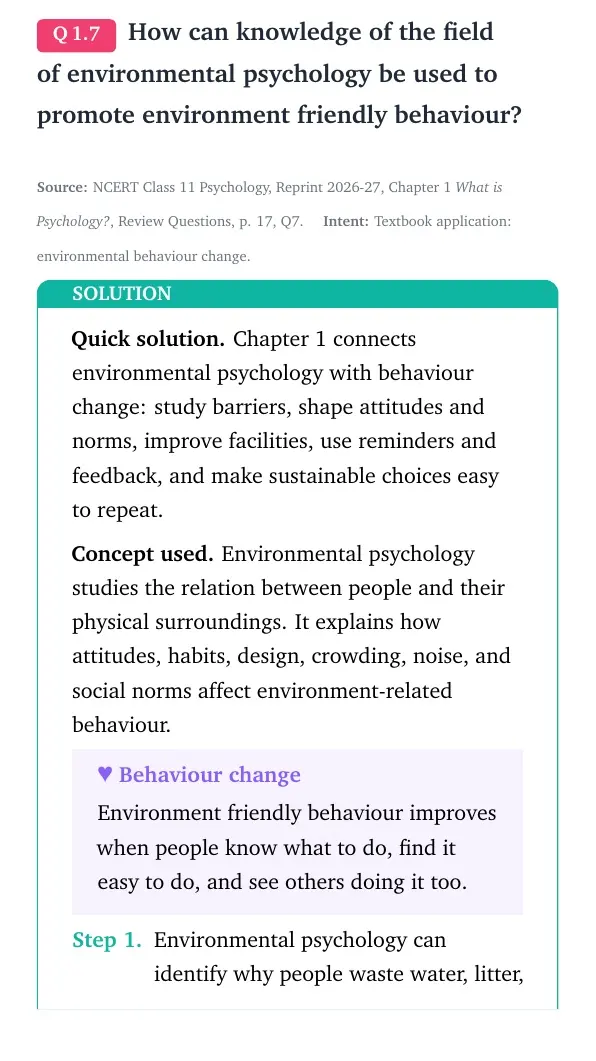
How can knowledge of the field of environmental psychology be used to promote environment friendly behaviour?
Chapter 1 connects environmental psychology with behaviour change: study barriers, shape attitudes and norms, improve facilities, use reminders and feedback, and make sustainable choices easy to repeat.
Concept used. Environmental psychology studies the relation between people and their physical surroundings. It explains how attitudes, habits, design, crowding, noise, and social norms affect environment-related behaviour.
Behaviour change
Environment friendly behaviour improves when people know what to do, find it easy to do, and see others doing it too.
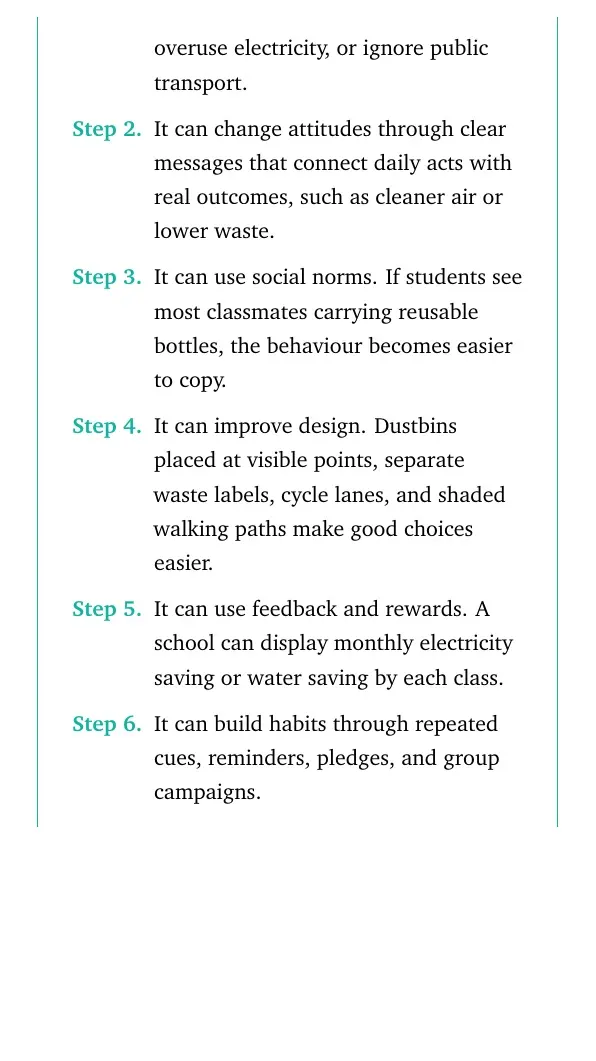
Environmental psychology can identify why people waste water, litter, overuse electricity, or ignore public transport.
It can change attitudes through clear messages that connect daily acts with real outcomes, such as cleaner air or lower waste.
It can use social norms. If students see most classmates carrying reusable bottles, the behaviour becomes easier to copy.
It can improve design. Dustbins placed at visible points, separate waste labels, cycle lanes, and shaded walking paths make good choices easier.
It can use feedback and rewards. A school can display monthly electricity saving or water saving by each class.
It can build habits through repeated cues, reminders, pledges, and group campaigns.
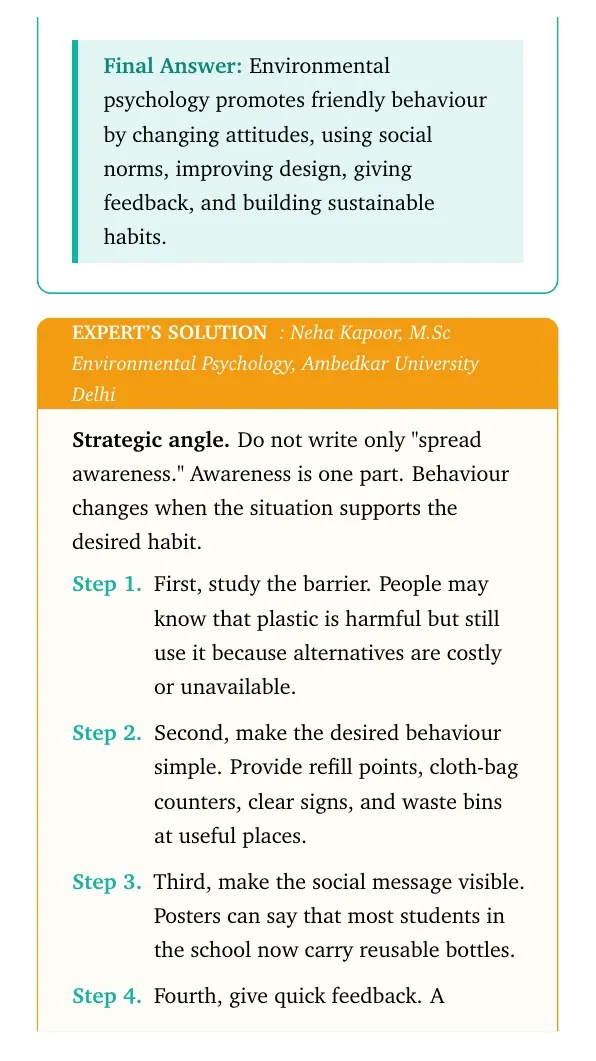
Environmental psychology promotes friendly behaviour by changing attitudes, using social norms, improving design, giving feedback, and building sustainable habits.
NK
Neha Kapoor
M.Sc Environmental Psychology, Ambedkar University Delhi
Verified Expert
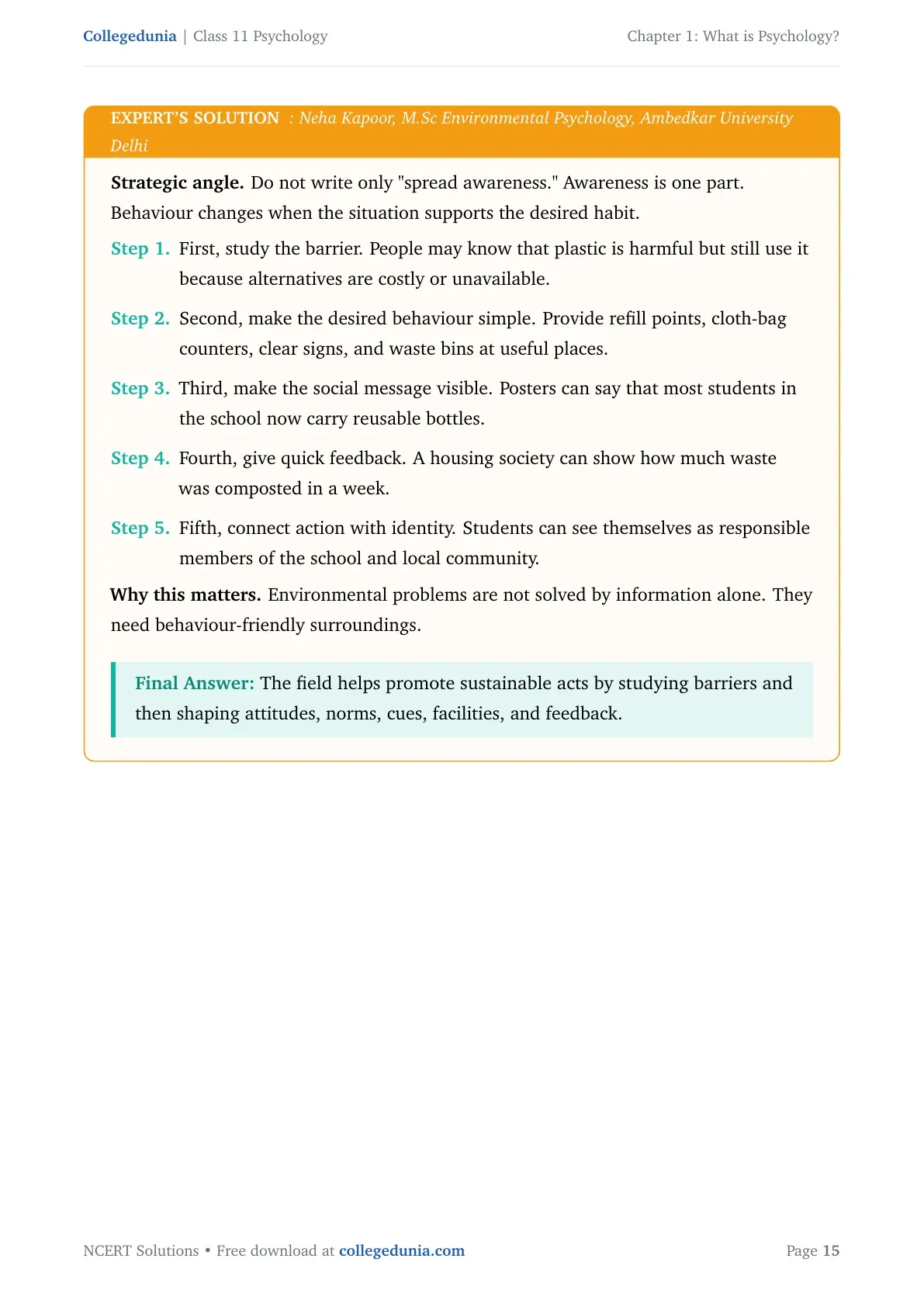
Strategic angle. Do not write only "spread awareness." Awareness is one part. Behaviour changes when the situation supports the desired habit.
First, study the barrier. People may know that plastic is harmful but still use it because alternatives are costly or unavailable.
Second, make the desired behaviour simple. Provide refill points, cloth-bag counters, clear signs, and waste bins at useful places.
Third, make the social message visible. Posters can say that most students in the school now carry reusable bottles.
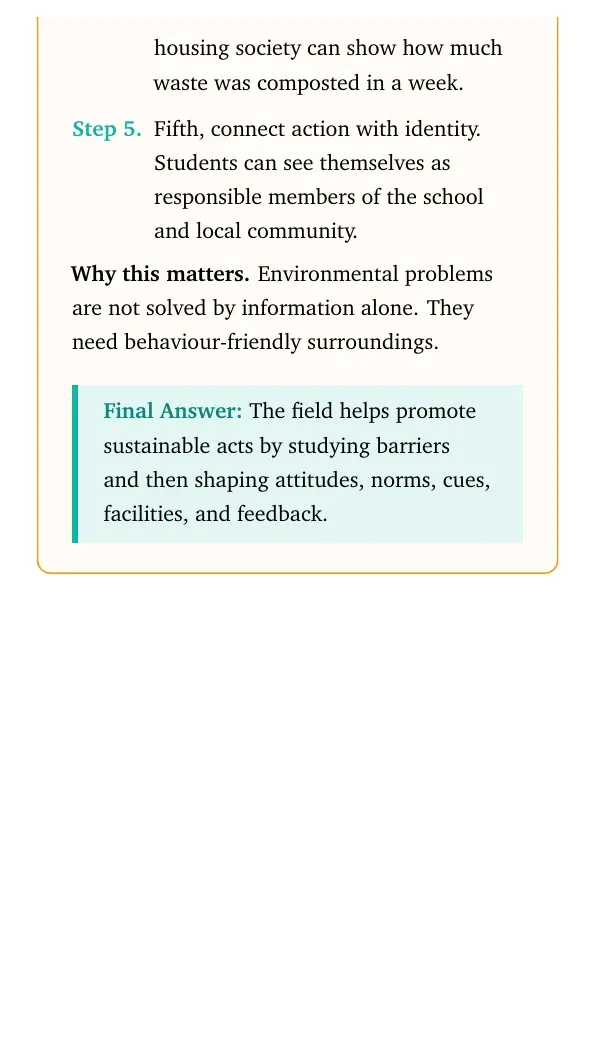
Fourth, give quick feedback. A housing society can show how much waste was composted in a week.
Fifth, connect action with identity. Students can see themselves as responsible members of the school and local community.
Why this matters. Environmental problems are not solved by information alone. They need behaviour-friendly surroundings.
The field helps promote sustainable acts by studying barriers and then shaping attitudes, norms, cues, facilities, and feedback.
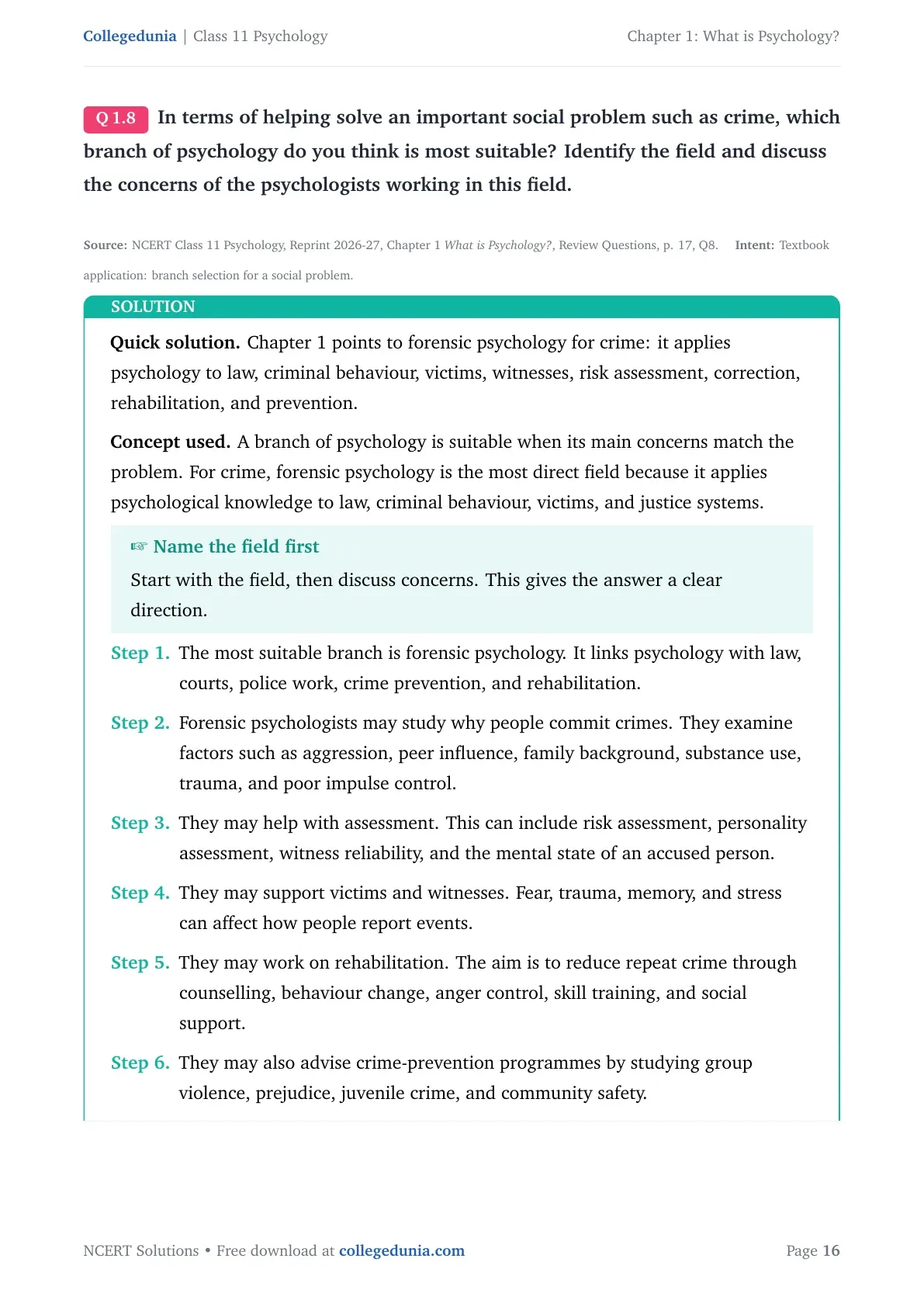
Q 1.8
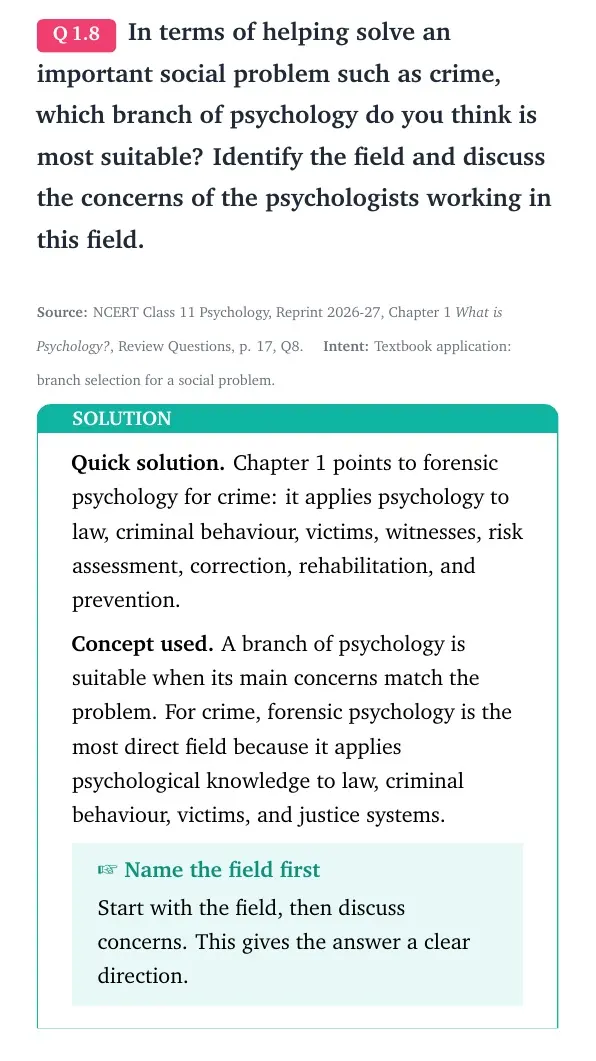
In terms of helping solve an important social problem such as crime, which branch of psychology do you think is most suitable? Identify the field and discuss the concerns of the psychologists working in this field.
Chapter 1 points to forensic psychology for crime: it applies psychology to law, criminal behaviour, victims, witnesses, risk assessment, correction, rehabilitation, and prevention.
Concept used. A branch of psychology is suitable when its main concerns match the problem. For crime, forensic psychology is the most direct field because it applies psychological knowledge to law, criminal behaviour, victims, and justice systems.
Name the field first
Start with the field, then discuss concerns. This gives the answer a clear direction.
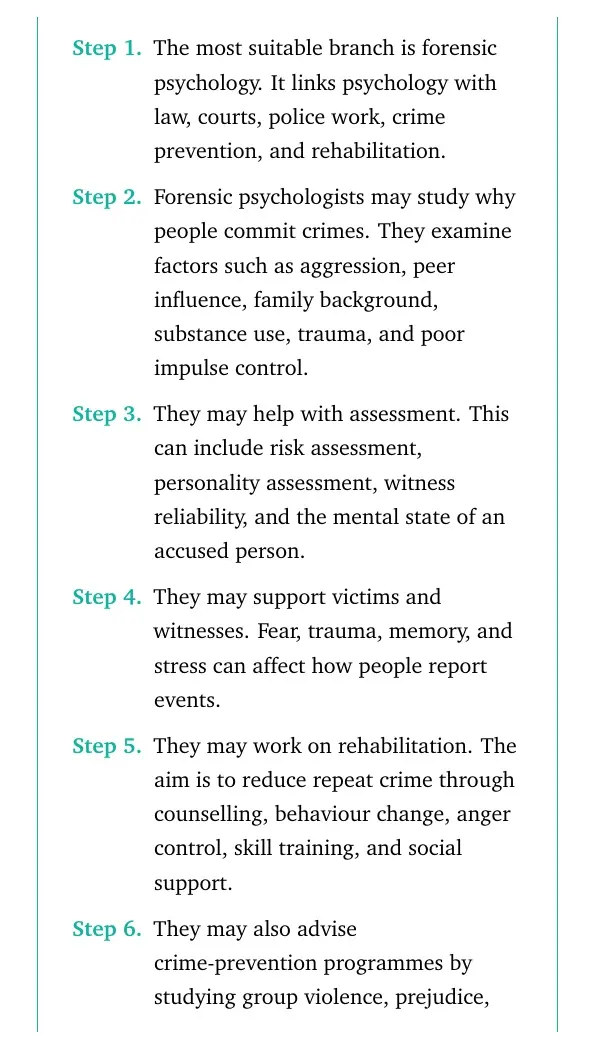
The most suitable branch is forensic psychology. It links psychology with law, courts, police work, crime prevention, and rehabilitation.
Forensic psychologists may study why people commit crimes. They examine factors such as aggression, peer influence, family background, substance use, trauma, and poor impulse control.
They may help with assessment. This can include risk assessment, personality assessment, witness reliability, and the mental state of an accused person.
They may support victims and witnesses. Fear, trauma, memory, and stress can affect how people report events.
They may work on rehabilitation. The aim is to reduce repeat crime through counselling, behaviour change, anger control, skill training, and social support.
They may also advise crime-prevention programmes by studying group violence, prejudice, juvenile crime, and community safety.
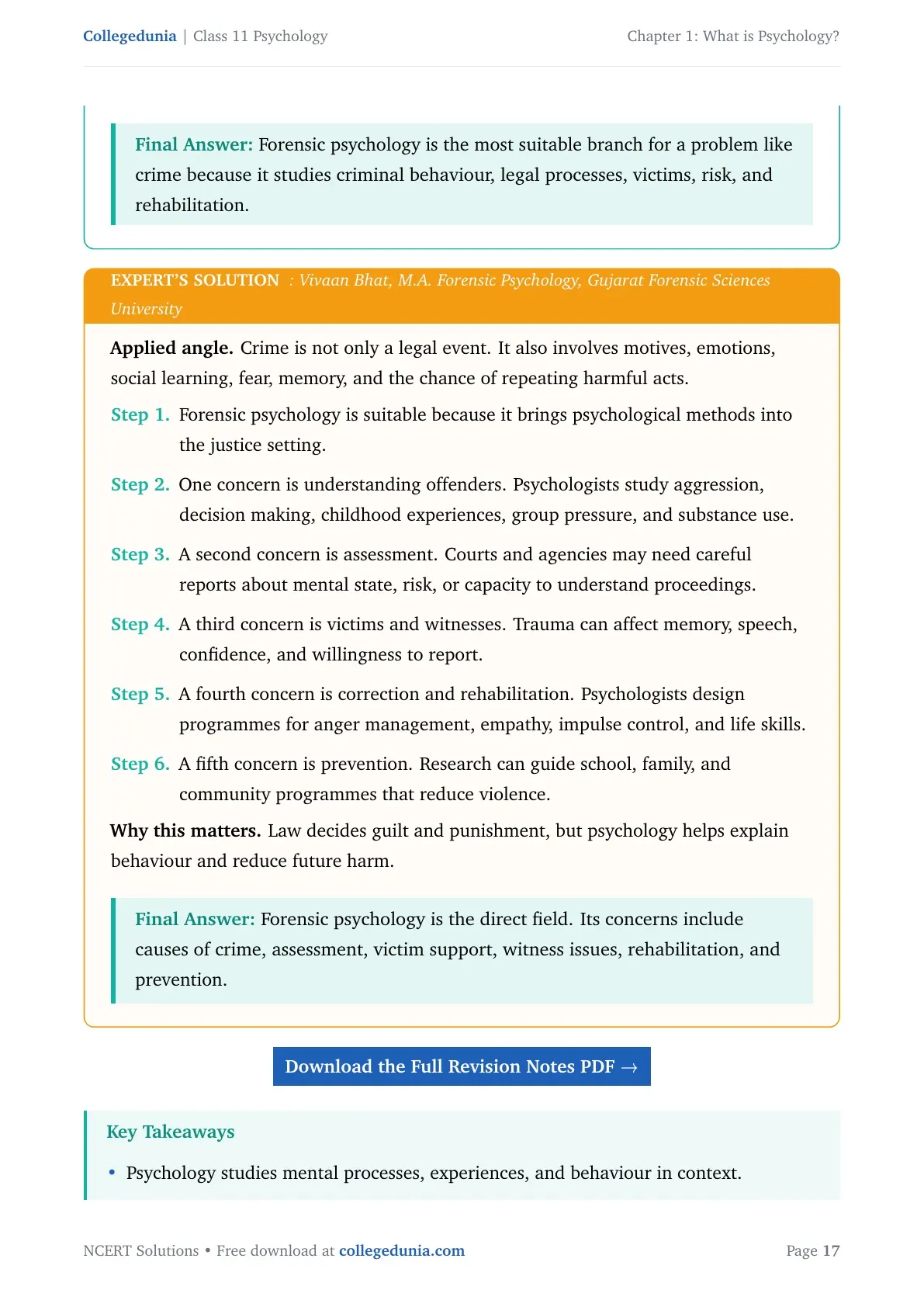
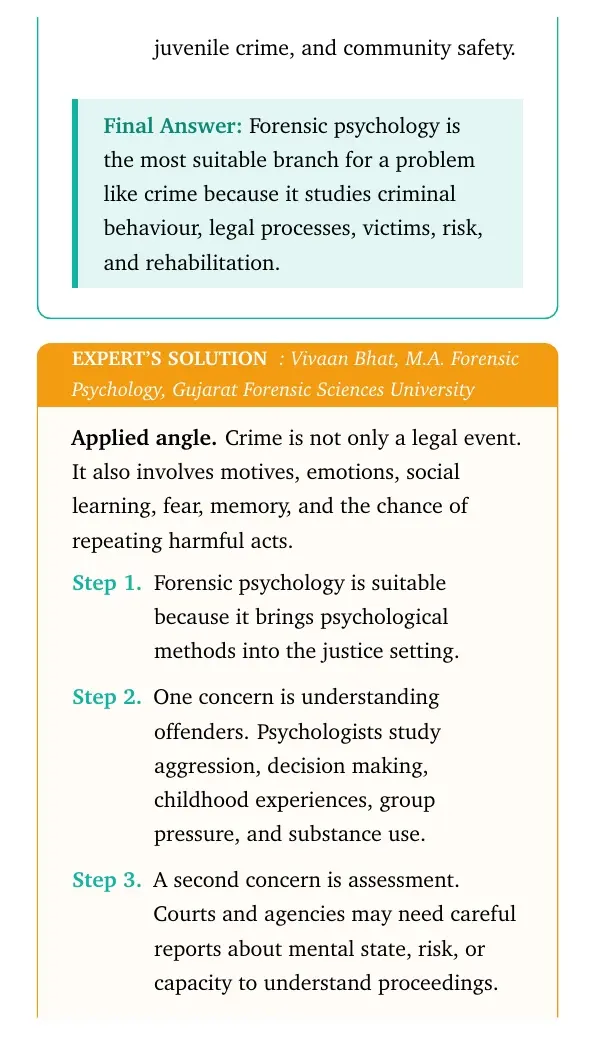
Forensic psychology is the most suitable branch for a problem like crime because it studies criminal behaviour, legal processes, victims, risk, and rehabilitation.
VB
Vivaan Bhat
M.A. Forensic Psychology, Gujarat Forensic Sciences University
Verified Expert
Applied angle. Crime is not only a legal event. It also involves motives, emotions, social learning, fear, memory, and the chance of repeating harmful acts.
Forensic psychology is suitable because it brings psychological methods into the justice setting.
One concern is understanding offenders. Psychologists study aggression, decision making, childhood experiences, group pressure, and substance use.
A second concern is assessment. Courts and agencies may need careful reports about mental state, risk, or capacity to understand proceedings.
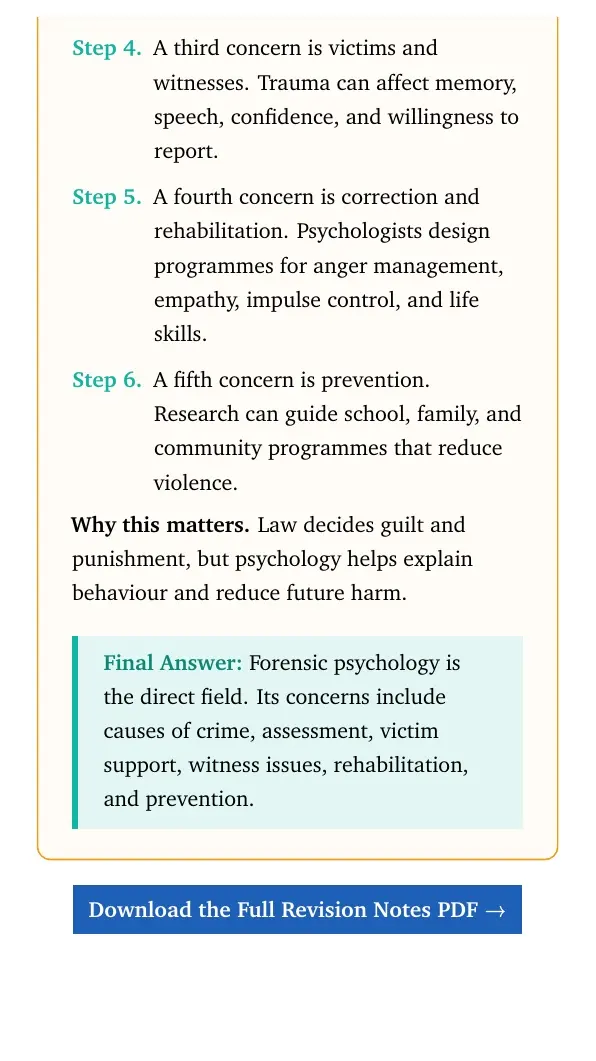
A third concern is victims and witnesses. Trauma can affect memory, speech, confidence, and willingness to report.
A fourth concern is correction and rehabilitation. Psychologists design programmes for anger management, empathy, impulse control, and life skills.
A fifth concern is prevention. Research can guide school, family, and community programmes that reduce violence.
Why this matters. Law decides guilt and punishment, but psychology helps explain behaviour and reduce future harm.
Forensic psychology is the direct field. Its concerns include causes of crime, assessment, victim support, witness issues, rehabilitation, and prevention.
Related Psychology Resources for What is Psychology?
Use the solutions PDF for answers, then move to the notes and book PDF when you want to revise the chapter theory in a different format.
Ques. How many questions are solved in Class 11 Psychology Chapter 1 What is Psychology?
Ans. The chapter has 8 NCERT review questions. This page and the downloadable PDF include a stepwise solution and an expert explanation for each one.
Ques. What is the main idea of Chapter 1 What is Psychology?
Ans. The main idea is that Psychology scientifically studies behaviour, experience, and mental processes. It also explains how the subject developed and where it is applied.
Ques. What is the difference between overt and covert behaviour?
Ans. Overt behaviour is visible, such as speaking or walking. Covert behaviour is internal, such as thinking, remembering, feeling nervous, or silently planning an answer.
Ques. Which branch of Psychology is linked with crime?
Ans. Forensic psychology is linked with crime. It studies criminal behaviour, witness and victim issues, risk assessment, legal settings, prevention, and rehabilitation.








Comments