The NCERT Solutions for Class 10 Science Chapter 7 How do Organisms Reproduce? cover all 23 questions (12 in-text and 11 exercise) for the 2026-27 CBSE syllabus, following the textbook flow: DNA copying and variation, the asexual modes, sexual reproduction in plants and humans, and reproductive health.
All 23 NCERT questions solved with clear steps, comparison tables, and an Expert Solution per question.
Covers fission, budding, fragmentation, regeneration, spores, vegetative propagation, pollination, fertilisation, the human reproductive system, menstruation and contraception.
Aligned with the 2026-27 CBSE Class 10 Science syllabus.
Solved by Collegedunia Science Experts
These NCERT Solutions for Class 10 Science Chapter 7 How do Organisms Reproduce? are checked against the latest 2026-27 NCERT textbook and refined against the last five years of CBSE board papers. Each of the 23 questions gives a Check Solution for the clean board answer and an Expert Solution for extra marks.
Question Breakdown of the How do Organisms Reproduce? Chapter NCERT Solutions
Chapter 7 carries 12 in-text questions and 11 exercise questions. The table below maps each section to its topic, answer style and typical mark weight.
Section
Topic covered
Answer style
Typical marks
DNA & variation
Why DNA copying matters
Two-idea answer
2 to 3 marks
Asexual modes
Fission, budding, spores, regeneration
Comparison table; examples
2 to 3 marks
Sexual reproduction (plants)
Flower parts, pollination vs fertilisation
Labelled diagram; compare
3 to 5 marks
Reproduction in humans
Testis, placenta, menstruation
Organ-to-function pairs
2 to 5 marks
Reproductive health
Contraception; copper-T and STDs
Classify; Yes/No with reason
2 to 3 marks
Exercise MCQs
Budding organism, female parts, anther
One option with a reason
1 mark each
DNA Copying and the Importance of Variation
Every organism stores its body's instructions in its DNA. Reproduction copies this DNA and hands one full set to the offspring, which is why a cat has kittens.
Copy first, then divide: the parent cell doubles its DNA, then splits, so each cell gets a full set.
Same kind: the inherited DNA keeps offspring in the same species.
Tiny errors: no copy is perfect, so small differences (variation) appear.
So variation helps the species over many generations, even when it gives no benefit to one individual now. Asexual reproduction makes almost no variation; sexual reproduction makes a lot.
Quick Tip: When asked why DNA copying is "essential", give two ideas: it preserves the body design and its small errors supply variation.
Asexual Reproduction: Fission, Budding, Spores and Vegetative Propagation
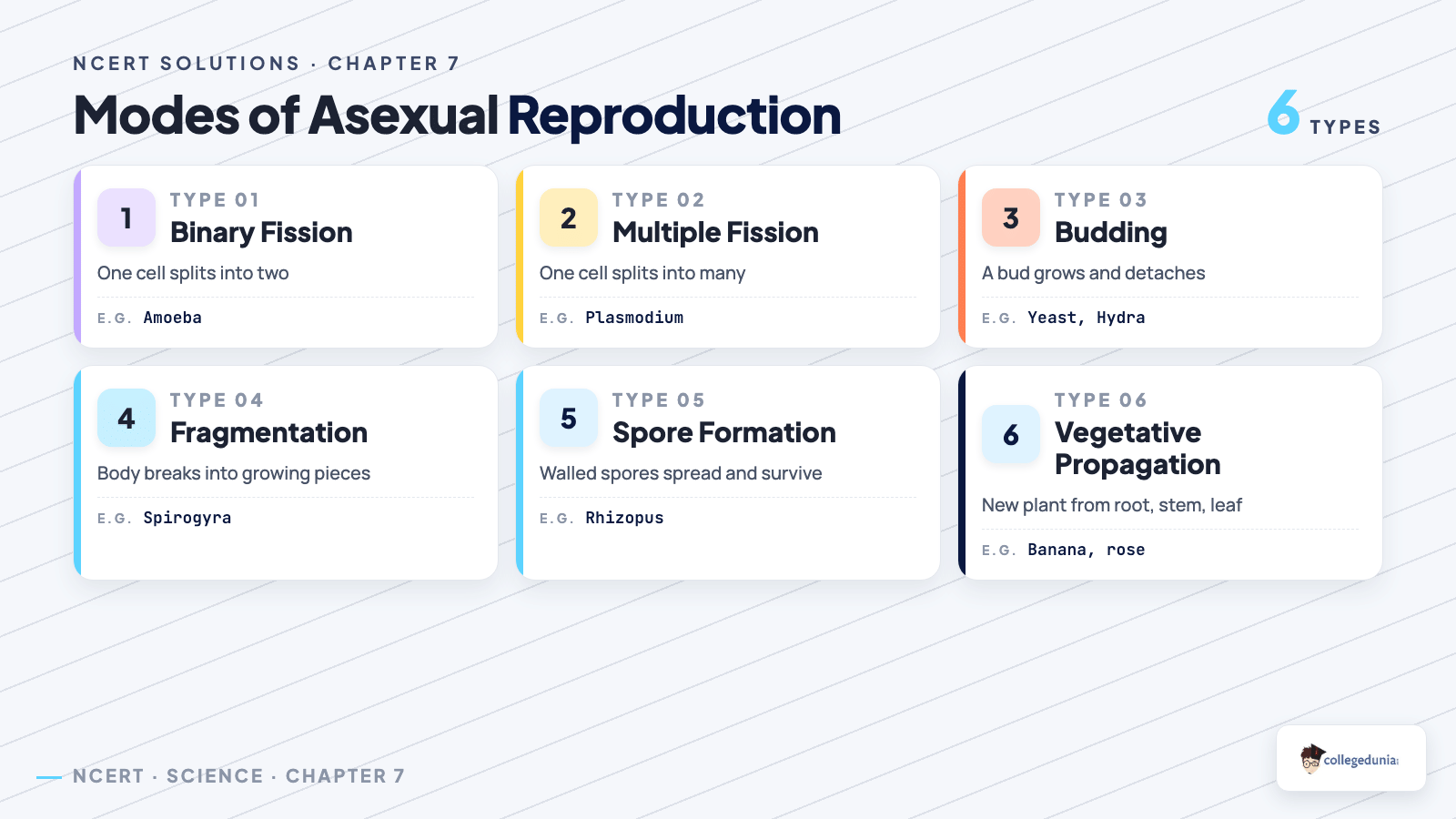
In asexual reproduction one parent makes near-exact copies, with no fusion of gametes. The chapter names these modes, each with a star example:
Mode
What happens
Example
Binary fission
One cell splits into two
Amoeba, Leishmania
Multiple fission
One cell splits into many at once
Plasmodium
Budding
A bud grows and detaches
Yeast, Hydra
Fragmentation
The body breaks into pieces that grow
Spirogyra
Regeneration
A cut piece rebuilds a whole body
Planaria, Hydra
Spore formation
Walled spores form in a sporangium
Rhizopus
Vegetative propagation
A new plant grows from a root, stem or leaf
Banana, rose, potato
Two distinctions are tested most years. Binary fission gives two cells, multiple fission gives many. And regeneration is not always reproduction: a cut Planaria grows a new animal, but a healing human wound does not.
Sexual Reproduction in Flowering Plants: Pollination and Fertilisation
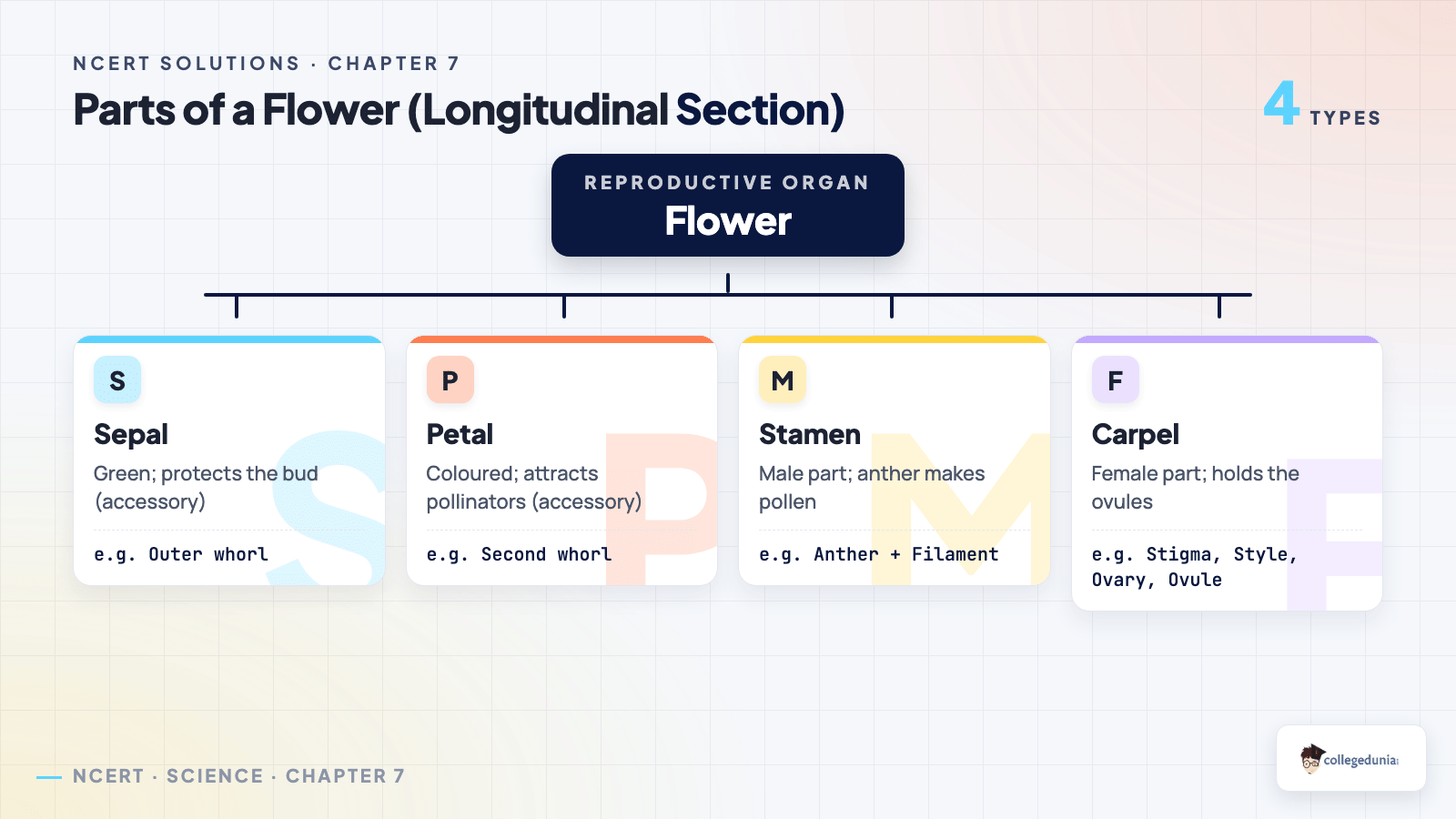
A flower has four whorls: sepals, petals, the male stamen (anther plus filament) and the female carpel (stigma, style, ovary, ovules). Pollination and fertilisation follow in that order.
Step
What it is
Where it happens
Pollination
Pollen moves from anther to stigma
By wind, water or insects
Fertilisation
Male gamete fuses with the egg to form a zygote
Inside the ovule
So pollination only moves the pollen, while fertilisation is the fusion of two gametes. After fertilisation the ovule becomes the seed and the ovary the fruit. In a "draw the flower" question, the marks are for the labels: stigma, style, ovary, ovule, anther, filament, petal and sepal.
Reproduction in Human Beings: Organs, the Placenta and Menstruation
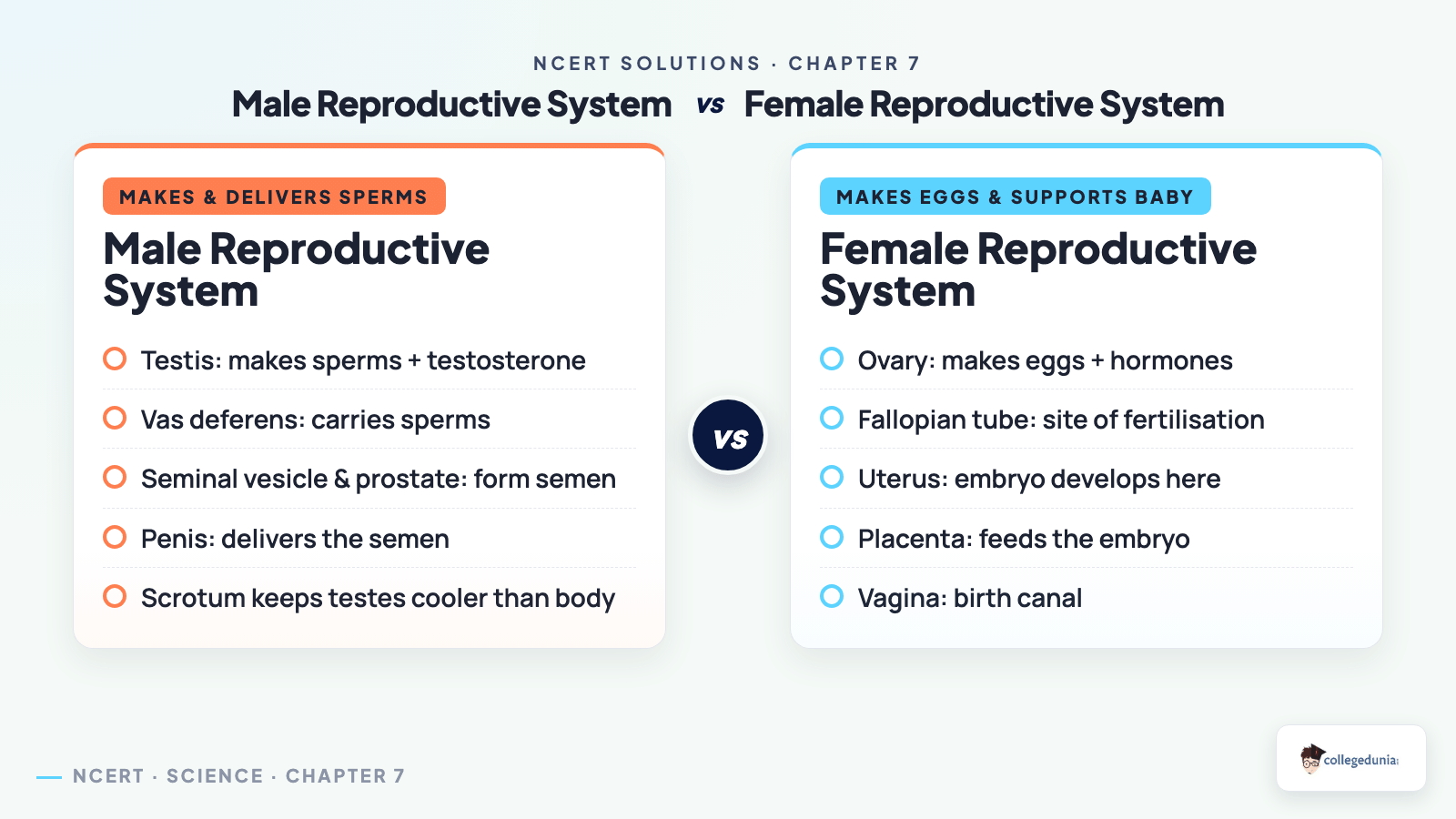
The male system makes and delivers sperms; the female system makes eggs and supports the baby.
Part
System
Main job
Testis
Male
Makes sperms and testosterone
Seminal vesicle & prostate
Male
Add fluid to form semen
Ovary
Female
Makes eggs and hormones
Fallopian tube
Female
Site of fertilisation
Uterus
Female
Where the embryo develops
The placenta feeds the embryo: villi on the embryo's side sit in the mother's blood spaces, so glucose and oxygen pass in and wastes pass out, with the two bloods never mixing. Menstruation is the monthly reset: if the egg is not fertilised, the uterine lining is shed over a 28-day cycle. The key word is unfertilised.
Reproductive Health and Methods of Contraception
Contraception prevents pregnancy. The methods fall into four groups:
Barrier: a condom or diaphragm keeps sperm and egg apart; the condom also blocks STDs.
Chemical / hormonal: oral pills stop an egg from being released.
Intra-uterine devices: a copper-T stops a fertilised egg from settling.
Surgical: vasectomy and tubectomy cut the gamete ducts.
A favourite board question asks whether a copper-T protects against STDs. The answer is a firm No: it only prevents pregnancy. Only a condom stops the fluid exchange that carries STD germs, so contraception is not disease prevention.
Common Mistakes Students Make in the How do Organisms Reproduce? Chapter
The repeat-offender mistakes:
Mixing pollination with fertilisation: pollination moves pollen; fertilisation is the gamete fusion that comes second.
Calling regeneration reproduction in humans: a healing wound makes no new person.
Vas deferens is a male duct, not a female one.
Saying a copper-T stops STDs: it only stops pregnancy.
How to Use the How do Organisms Reproduce? NCERT Solutions PDF for Board Prep
Revise in two passes. First, note the asexual modes, flower parts, the pollination-then-fertilisation order, the human parts and the four contraception groups. Then practise drawing the flower and human systems and writing the difference tables from memory, checking against these solutions. In the board paper, expect a difference question, a "name the part" or MCQ, and a reproductive-health question.
Other Resources for Class 10 Science Chapter 7 How do Organisms Reproduce?
Pair this with the other Class 10 Science Chapter 7 resources below.
71% of Class 10 students said the hardest part was telling apart the asexual modes, and 3 out of 5 lost marks by mixing up pollination with fertilisation. A neat labelled diagram added 1 to 2 marks, and the average student spent 4 to 5 hours on this chapter.
Source: 2026-27 Class 10 Science student poll. Sample of 10,200 students from CBSE schools, conducted before the 2026 boards.
NCERT Solutions for Class 10 Science: All Chapters
Related Links: NCERT Solutions for the other Class 10 Science chapters:
All NCERT Solutions for Class 10 Science Chapter 7 How do Organisms Reproduce? with Step-by-Step Solutions
Tap Check Solution for the board answer and Expert Solution for the extra-mark strategy on each question below.
Q 1
What is the importance of DNA copying in reproduction?
DNA (deoxyribonucleic acid) is the chemical inside the cell that carries the information for building and running the body. This information decides the body design of the organism. During reproduction a parent must hand a copy of this information to its offspring so that the new individual is of the same kind.
Reproduction begins with the copying of the DNA in the parent cell, which then divides so each new cell gets one full set.
Because the DNA is copied, the offspring inherit the same basic body design, which is why a dog gives birth to a puppy, not a kitten.
DNA copying also makes the cell build extra cellular material, so the two new cells each have enough to work normally.
Copying is never perfectly exact; the small differences that creep in are the source of variation, the raw material for long-term survival of the species.
Answer: DNA copying passes the body-design information from parent to offspring, so the new individual is of the same kind; the tiny copying errors also create useful variations.
AI
Ananya Iyer
M.Sc Botany, University of Delhi
Verified Expert
A board answer here is judged on two ideas: continuity of body design and the origin of variation. Mention both and you secure full marks.
DNA copying keeps the offspring of the same species, because the inherited blueprint makes the same proteins, the same tissues and the same body plan as the parent.
No copying is perfect, so each new copy carries a few small changes that build up over generations as variation, giving the species a better chance if the environment changes.
So DNA copying does two jobs at once: it preserves the body design and it keeps the door open for slow change.
Answer: DNA copying both preserves the parent's body design in the offspring and, through small copying errors, supplies the variation a species needs to survive over time.
Q 2
Why is variation beneficial to the species but not necessarily for the individual?
Variation means the small differences that appear among the offspring of the same parents. A species is the whole group of similar organisms, while an individual is just one member. Whether a variation helps depends on the surroundings and on the time scale we look at.
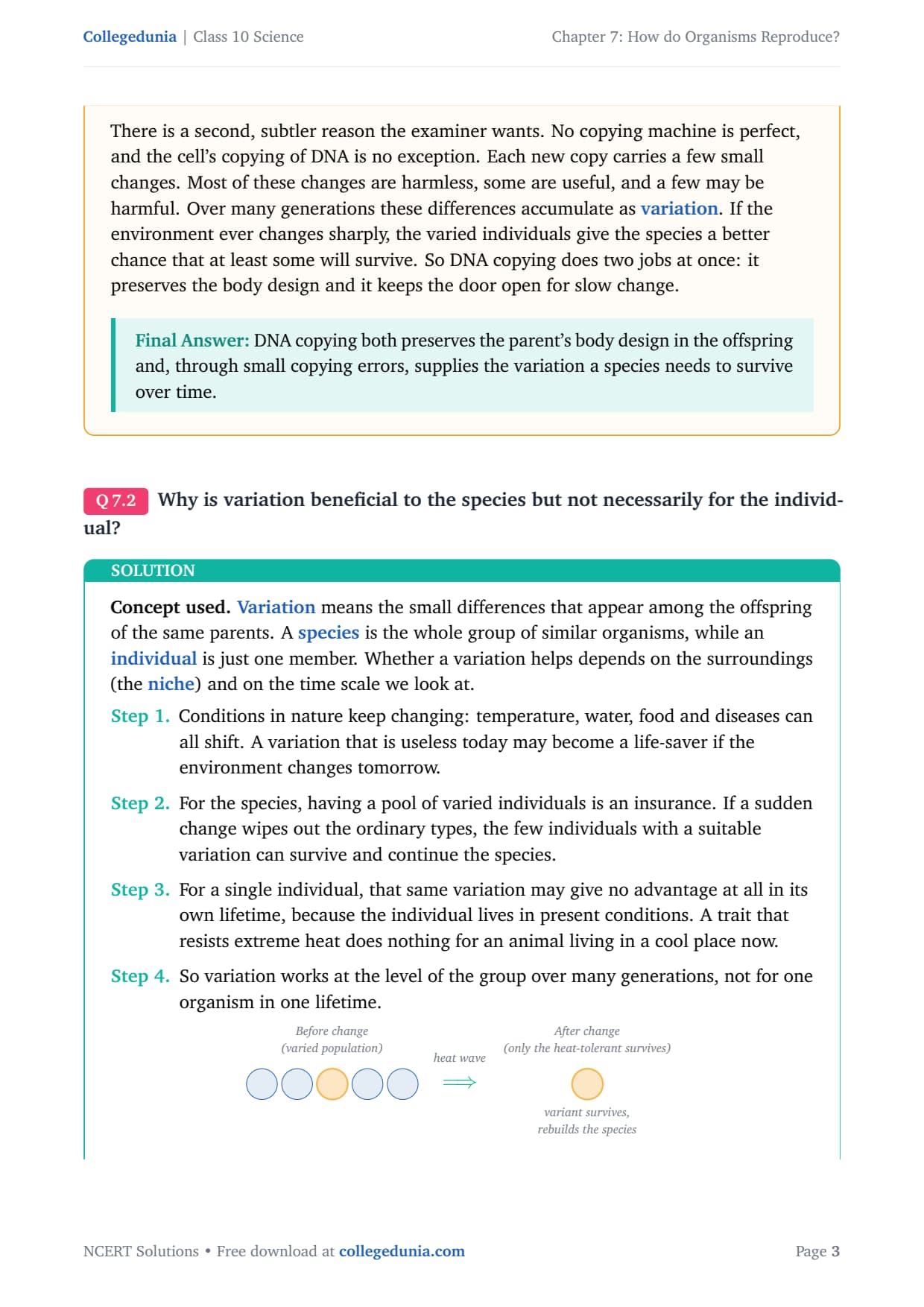
Conditions in nature keep changing: temperature, water, food and disease can all shift, so a variation that is useless today may become a life-saver tomorrow.
For the species, a pool of varied individuals is an insurance: if a sudden change wipes out the ordinary types, the few with a suitable variation can survive and continue the species.
For a single individual, that same variation may give no advantage in its own lifetime, because the individual lives in present conditions only.
So variation works at the level of the group over many generations, not for one organism in one lifetime.
Answer: Variation gives the species a better chance of surviving environmental change, since some varied individuals may cope; but a single individual may gain no benefit from its variation in its own lifetime.
RM
Rohan Mehta
Ph.D Genetics, Banaras Hindu University
Verified Expert
Students often write that variation always helps. The question deliberately separates two levels, the species and the individual, so your answer must keep them apart.
A species survives across time, not one season: a population that is all alike has only one response to change, while a varied population is likely to contain a few members that suit the new conditions.
For one individual, a trait tuned to a future or different condition gives no edge right now, so the variation is in effect banked for the species rather than spent by the member.
Answer: Variation is a long-term insurance for the species against a changing environment, but it need not give any present advantage to the individual that carries it.
Q 3
How does binary fission differ from multiple fission?
Fission is an asexual mode in which a single unicellular organism splits to form new individuals. The difference between the two kinds lies in how many offspring form at one time and what happens to the nucleus.
Feature
Binary fission
Multiple fission
Number of offspring
Two daughter cells
Many daughter cells at once
Nucleus
Divides once, then the cell splits
Divides repeatedly first, then the cytoplasm splits
When it happens
Usually in favourable conditions
Often helps survive unfavourable conditions
Example
Amoeba, Leishmania, bacteria
Plasmodium (malaria parasite)
Answer: Binary fission forms two daughter cells from one parent (one nuclear division), as in Amoeba; multiple fission forms many daughter cells at once (the nucleus divides repeatedly first), as in Plasmodium.
SK
Sneha Kulkarni
M.Sc Zoology, Savitribai Phule Pune University
Verified Expert
The cleanest full-mark response is a two-column comparison. Pick three clear points of difference: number of offspring, behaviour of the nucleus, and a named example for each.
In binary fission the nucleus divides once and the cytoplasm follows at once, splitting the parent into two roughly equal halves, which suits a cell multiplying while food and space are plentiful.
In multiple fission the nucleus divides again and again while the cytoplasm waits, so the cell can encase itself in a wall, divide quietly, and release a shower of offspring when conditions improve, exactly as Plasmodium does in malaria.
Answer: Binary fission: one parent gives two daughters after a single nuclear division (Amoeba). Multiple fission: one parent gives many daughters at once after repeated nuclear divisions (Plasmodium).
Q 4
How will an organism be benefited if it reproduces through spores?
Spores are tiny asexual reproductive units that form inside a case called the sporangium, as in the bread mould Rhizopus. Each spore can grow into a new individual on its own, and their structure gives several survival advantages.
Spores are produced in very large numbers, so a single parent gives rise to a great many offspring.
Each spore has a thick, hard wall that protects the living material inside from heat, cold and lack of water, letting it survive long bad spells.
Spores are extremely small and light, so air, water and animals carry them easily, spreading the organism to new places.
When a spore lands somewhere moist and suitable, the wall breaks and it germinates into a new individual.
Answer: Spores let an organism produce many offspring that are protected by a thick wall, can survive harsh conditions, and spread easily through air and water to new places.
AS
Aditya Sharma
M.Sc Microbiology, University of Hyderabad
Verified Expert
Frame the benefit around two themes the examiner rewards: survival in bad conditions, and dispersal to new ground. Each spore feature maps onto one of these themes.
Because spores are made in huge numbers, the organism is not betting on a single offspring; even if most fall on poor ground, a few will find a moist, food-rich spot.
The thick wall seals the contents against drying, heat and cold so the spore stays dormant and waits, and its lightness lets wind and water carry it far.
This mix of mass production, protection and easy dispersal is why spore formation is so successful in fungi, mosses and ferns.
Answer: Spores benefit the organism through large numbers, a tough protective wall for surviving harsh conditions, and small light bodies that spread widely and germinate when conditions are favourable.
Q 5
Can you think of reasons why more complex organisms cannot give rise to new individuals through regeneration?
Regeneration is the ability of some simple organisms, such as Hydra and Planaria, to grow a complete new individual from a small cut piece of the body. It depends on cells that can still become any kind of cell. Complex organisms are built differently.
Complex organisms have a highly organised body of many specialised tissues and organs (heart, lungs, brain, liver), each doing one fixed job.
These specialised cells have largely lost the ability to change into other cell types, so a stray body part cannot rebuild the missing organs.
The organs work together as one system; a small part on its own cannot organise and coordinate the formation of a whole new, balanced body.
So complex organisms reproduce through reproductive organs and gametes; regeneration in them, if any, only heals wounds.
Answer: Complex organisms have specialised tissues and organs whose cells cannot change back into other cell types, so a body part cannot reorganise into a complete new individual; they reproduce through dedicated reproductive organs instead.
MN
Meera Nair
Ph.D Developmental Biology, IISER Pune
Verified Expert
The deeper reason ties to division of labour: the more a body specialises its cells, the less flexible each cell becomes, and the harder it is to rebuild the whole from a part.
A trained cell has switched off most of its genes and committed to one role, so it can no longer reinvent itself, unlike the flexible cells of Planaria.
Building a new individual also needs organs laid out in the right places and order, and a small fragment carries neither the positional information nor the coordinating systems for this.
So complex organisms route reproduction through dedicated organs and gametes, where the full developmental programme can run from a single zygote.
Answer: Because their cells are specialised and have lost the flexibility to form other cell types, and because a fragment cannot organise a whole coordinated body, complex organisms cannot reproduce by regeneration.
Q 6
Why is vegetative propagation practised for growing some types of plants?
Vegetative propagation is an asexual method in which a new plant grows from a part of the parent plant, a root, stem or leaf, not from a seed. Growers use it on purpose for several practical gains.
Plants grown this way can flower and bear fruit earlier than plants raised from seeds, which is useful for the farmer.
The new plants are exact copies (clones) of the parent, so all its good qualities (taste, colour, size) are kept unchanged.
Some plants, such as banana, orange, rose and jasmine, have lost the ability to make viable seeds, so this is the only practical way to grow more of them.
It is often cheaper and faster to raise many identical plants this way, for example through cuttings, layering and grafting.
Answer: Vegetative propagation is practised because it gives earlier flowering and fruiting, produces exact copies of a desirable parent, and is the only way to grow plants like banana and rose that do not make viable seeds.
PD
Priya Deshpande
M.Sc Plant Biotechnology, University of Pune
Verified Expert
Read this through the eyes of a nursery owner. Each reason answers a real business need: speed, sameness, and the ability to grow difficult plants.
The biggest attraction is uniformity: a cutting or graft is genetically identical to the parent, so one excellent mango tree can fill an orchard with trees bearing the very same fruit, which seeds cannot promise.
Speed comes next, because a plant from a piece of the parent already has mature tissue and fruits sooner than a seedling, and the method also rescues seedless plants like banana and rose.
Answer: Growers use vegetative propagation for earlier and reliable fruiting, exact copies of a desirable parent, and to multiply plants such as banana and rose that produce no viable seeds.
Q 7
Why is DNA copying an essential part of the process of reproduction?
The instructions for the entire body design of an organism are stored in its DNA. Reproduction must hand a complete set of these instructions to the offspring, which is only possible if the DNA is first copied.
Every reproduction event starts with the parent cell copying its DNA, so each new cell receives a full set of instructions.
Because the offspring receive a copy of the parent's DNA, they develop the same basic body design and belong to the same species.
Along with copying the DNA, the cell builds extra cell material so each daughter cell is complete and able to function.
The small errors during copying provide the variation that helps the species adapt and survive over generations.
Answer: DNA copying is essential because it passes the complete body-design information to the offspring so they are of the same kind, and the small errors in copying also create the variation a species needs.
KR
Karthik Reddy
Ph.D Molecular Biology, University of Hyderabad
Verified Expert
Although this looks like a repeat of the first question, the examiner wants the word essential addressed: reproduction simply cannot occur without DNA copying, and you should say why.
A single copy of DNA cannot serve two cells, so before a cell splits it must duplicate its DNA; skip this and the daughter cells lack a complete blueprint and cannot build a proper body.
The faithful copy also fixes the identity of the offspring across generations, while the slight imperfection in copying quietly supplies variation.
So one process accomplishes two essentials at once: it preserves the body design and supplies the differences that let the species endure.
Answer: DNA copying is indispensable because reproduction is the handing on of instructions; without a copy the offspring would lack the blueprint to build a body, while the small copying errors also generate useful variation.
Q 8
How is the process of pollination different from fertilisation?
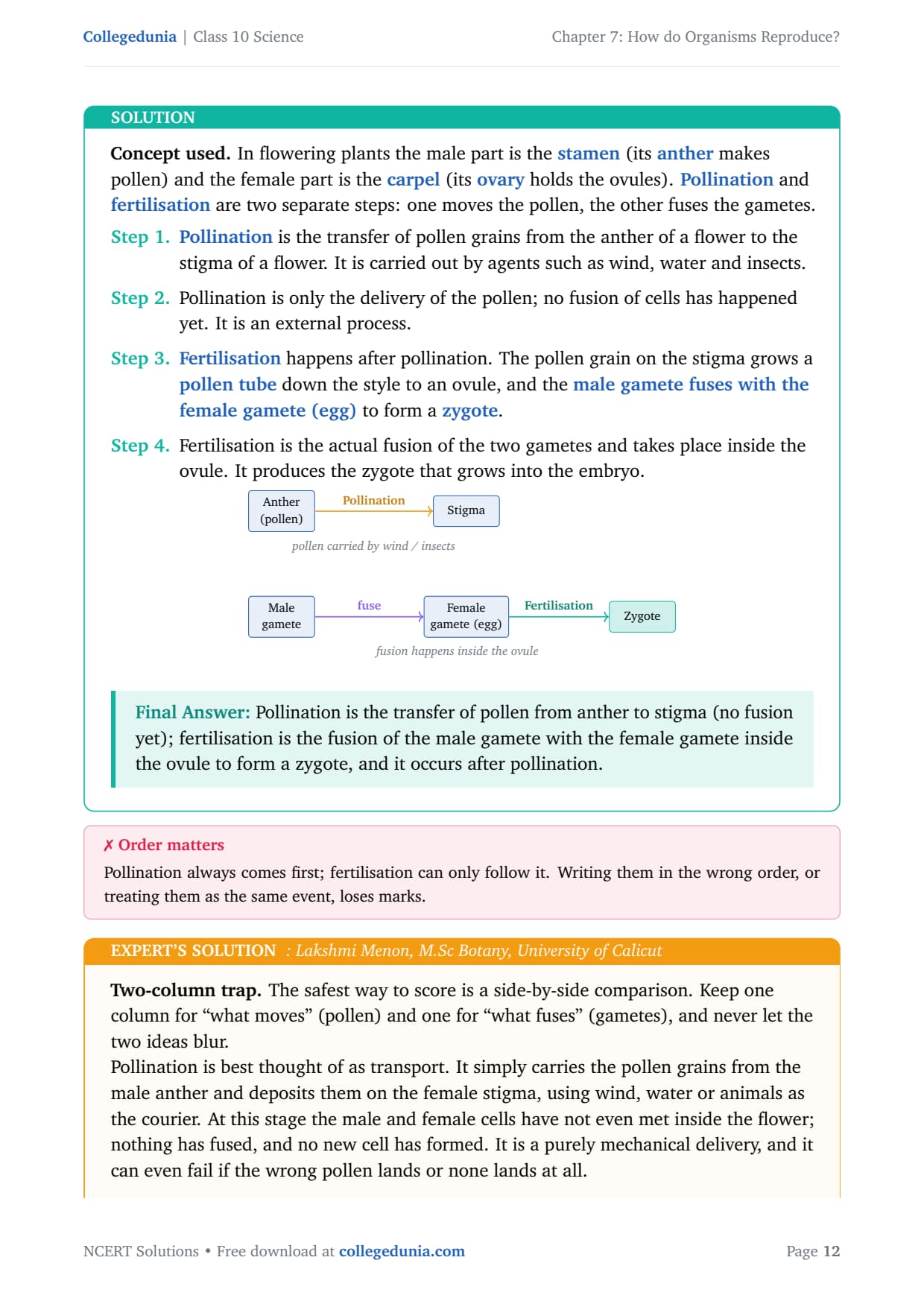
In flowering plants the male part is the stamen (its anther makes pollen) and the female part is the carpel (its ovary holds the ovules). Pollination and fertilisation are two separate steps: one moves the pollen, the other fuses the gametes.
Pollination
Fertilisation
Transfer of pollen from anther to stigma
Fusion of male and female gametes
Carried out by wind, water and insects
Pollen tube carries the male gamete to the egg
No fusion of cells yet; an external process
Happens inside the ovule; forms the zygote
Comes first
Follows pollination
Answer: Pollination is the transfer of pollen from anther to stigma (no fusion yet); fertilisation is the fusion of the male gamete with the female gamete inside the ovule to form a zygote, and it occurs after pollination.
LM
Lakshmi Menon
M.Sc Botany, University of Calicut
Verified Expert
The safest way to score is a side-by-side comparison. Keep one column for "what moves" (pollen) and one for "what fuses" (gametes), and never let the two ideas blur.
Pollination is transport: it carries pollen from the anther to the stigma using wind, water or animals, with nothing yet fused inside the flower.
Fertilisation comes next: the pollen germinates, a pollen tube grows down the style, and the male gamete fuses with the egg to make the zygote that grows into the embryo.
Answer: Pollination only transports pollen from anther to stigma, while fertilisation is the actual fusion of male and female gametes inside the ovule to form the zygote; pollination precedes fertilisation.
Q 9
What is the role of the seminal vesicles and the prostate gland?
In the human male reproductive system, the sperms made in the testes travel through the vas deferens. Two glands, the seminal vesicles and the prostate gland, open into this path and add their fluids to the sperms.
The seminal vesicles and prostate gland pour their secretions into the vas deferens, so the sperms travel suspended in this fluid.
The sperms together with these secretions form a fluid called semen, which makes the transport of sperms much easier.
The secretions provide nutrition to the sperms, containing sugars such as fructose that give energy to move.
The fluid keeps the sperms active and helps them swim, improving their chance of reaching the egg.
Answer: The seminal vesicles and prostate gland add their secretions to the sperms in the vas deferens, forming semen; this fluid nourishes the sperms (with sugars such as fructose) and makes their transport and movement easier.
AP
Arjun Pillai
Ph.D Reproductive Physiology, AIIMS New Delhi
Verified Expert
Tie both glands to one purpose, semen formation, then split that purpose into nutrition and transport. This keeps the answer focused and complete.
The seminal vesicle secretion is rich in fructose, the sugar the sperms burn for the energy to swim the long distance to the egg.
The prostate adds a thin, slightly alkaline fluid that keeps the sperms active and helps them move freely.
Together the two glands turn fragile, immobile cells into a mobile, nourished population with a real chance of fertilisation, so a board answer must mention both nutrition and transport.
Answer: Both glands secrete fluids into the vas deferens that combine with sperms to form semen, supplying nutrition (fructose for energy) and a fluid medium that eases the transport and movement of the sperms.
Q 10
What are the changes seen in girls at the time of puberty?
Puberty is the stage when the body becomes sexually mature and capable of reproduction. It is brought about by hormones. In girls, several visible and internal changes appear.
The breasts develop and increase in size, and the region around the nipple darkens.
New hair grows in the armpits and the genital (pubic) area, and thinner hair may appear on the arms and legs.
Menstruation begins; the ovaries start releasing eggs and the monthly menstrual cycle starts.
The skin often becomes oily and pimples or acne may appear on the face.
Answer: At puberty in girls the breasts develop, hair grows in the armpits and pubic region, menstruation begins, and the skin becomes oily, often with pimples.
DK
Divya Krishnan
M.D Obstetrics and Gynaecology, CMC Vellore
Verified Expert
Group the changes into the obvious external signs and the key internal milestone, menstruation, which signals that reproduction is now possible.
Externally, the breasts develop, coarse hair appears in the armpits and around the genitals, and active oil glands give oily skin and acne.
Internally, menstruation (menarche) begins as the ovaries mature and release eggs and the uterus starts its monthly cycle, marking the point at which the reproductive system is functional.
Answer: Puberty in girls brings breast development, growth of underarm and pubic hair, the onset of menstruation, and oily skin with possible acne, all driven by sex hormones.
Q 11
How does the embryo get nourishment inside the mother's body?
After fertilisation the embryo is embedded in the lining of the uterus and develops there. It is fed through a special tissue called the placenta, which connects the embryo to the mother.
The embryo gets its nourishment from the mother's blood through the placenta.
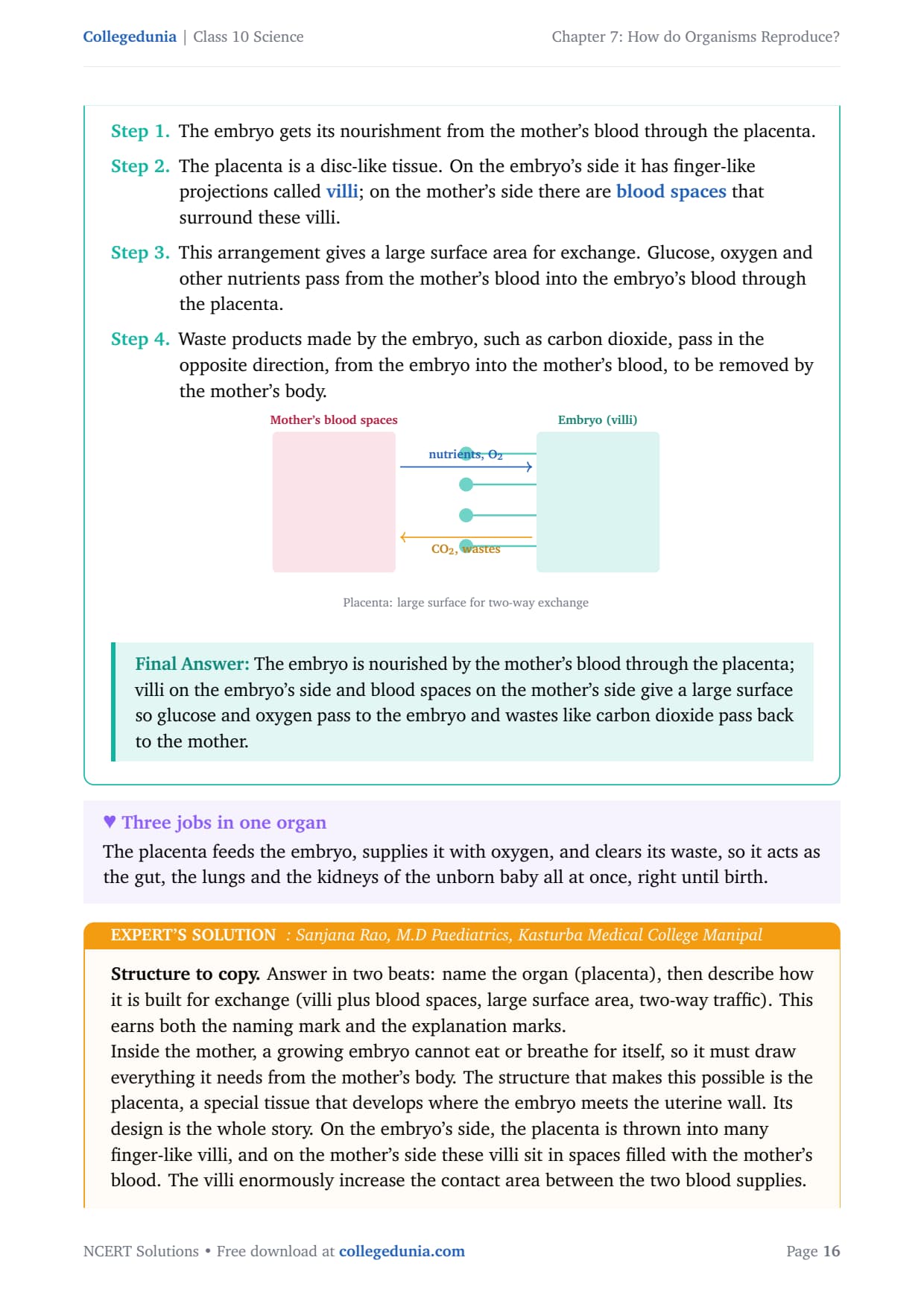
The placenta is a disc-like tissue: on the embryo's side it has finger-like projections called villi; on the mother's side there are blood spaces around these villi.
This gives a large surface area for exchange, so glucose, oxygen and other nutrients pass from the mother's blood to the embryo.
Waste products such as carbon dioxide pass the other way, from the embryo into the mother's blood, to be removed by her body.
Answer: The embryo is nourished by the mother's blood through the placenta; villi on the embryo's side and blood spaces on the mother's side give a large surface so glucose and oxygen pass to the embryo and wastes like carbon dioxide pass back to the mother.
SR
Sanjana Rao
M.D Paediatrics, Kasturba Medical College Manipal
Verified Expert
Answer in two beats: name the organ (placenta), then describe how it is built for exchange (villi plus blood spaces, large surface area, two-way traffic).
On the embryo's side the placenta is thrown into many villi sitting in spaces filled with the mother's blood, hugely increasing the contact area between the two blood supplies.
Across this interface glucose and oxygen diffuse into the embryo and carbon dioxide and wastes diffuse back, the two bloods never actually mixing.
In this way the placenta acts at once as the embryo's gut, lungs and kidneys until birth.
Answer: Through the placenta: villi on the embryo and blood spaces on the mother create a large surface where glucose and oxygen diffuse into the embryo and wastes such as carbon dioxide diffuse back to the mother, the two bloods never mixing.
Q 12
If a woman is using a copper-T, will it help in protecting her from sexually transmitted diseases?
A copper-T (an intra-uterine device, or IUD) is a contraceptive placed inside the uterus. Sexually transmitted diseases (STDs) are infections passed from one person to another during sexual contact. We must check whether a copper-T can block such infections.
A copper-T works only inside the uterus, stopping a pregnancy by preventing the fertilised egg from settling and developing.
It is not a barrier between the two partners, so the body fluids that carry the germs of STDs still pass freely.
Therefore a copper-T does not protect a woman from STDs such as HIV/AIDS, gonorrhoea or syphilis.
To prevent STDs, a barrier method like a condom is needed, because it physically stops the exchange of body fluids.
Answer: No. A copper-T only prevents pregnancy; it is not a barrier and does not stop the exchange of body fluids, so it cannot protect against sexually transmitted diseases. A condom is needed for that.
NB
Neha Bhat
M.D Community Medicine, Maulana Azad Medical College
Verified Expert
The examiner wants a clear "No" with a reason rooted in how the device works. Contrast it with a barrier method to show you understand the difference.
The copper-T acts only within the uterus, making the womb unsuitable for a fertilised egg to implant, but it sits well above the point where body fluids meet.
STDs spread through that exchange of fluids, so a woman using a copper-T is left fully exposed; only a barrier method like a condom interrupts the exchange.
This distinction, contraception versus disease prevention, is the heart of the answer.
Answer: No, the copper-T only prevents pregnancy and is not a barrier, so it gives no protection against sexually transmitted diseases; a barrier method such as a condom is needed for that.
Q 13
Asexual reproduction takes place through budding in (a) Amoeba. (b) Yeast. (c) Plasmodium. (d) Leishmania.
Budding is an asexual mode in which a small outgrowth, or bud, forms on the parent body, grows, and then detaches as a new individual. We must pick the organism that reproduces this way.
Amoeba reproduces by binary fission, not budding.
Yeast reproduces by budding: a small bud appears on the parent cell, enlarges, and separates as a new yeast cell. So (b) is correct.
Plasmodium reproduces by multiple fission.
Leishmania reproduces by binary fission in a definite plane.
Answer: Correct option (b) Yeast. Yeast reproduces by budding, while Amoeba and Leishmania use binary fission and Plasmodium uses multiple fission.
VJ
Vikram Joshi
M.Sc Zoology, University of Mumbai
Verified Expert
For a "which organism uses budding" question, recall the standard textbook examples of budding, then eliminate the rest. Yeast and Hydra are the two classic budding organisms in this chapter.
Budding here is shown by yeast (a daughter cell pinches off as a bud) and by Hydra (a bud grows on the body wall and later separates); of the four options only yeast belongs to this group.
The other three are fission distractors: Amoeba and Leishmania divide by binary fission, while Plasmodium multiplies by multiple fission.
Answer: Option (b) Yeast is correct; it is the only organism in the list that reproduces by budding.
Q 14
Which of the following is not a part of the female reproductive system in human beings? (a) Ovary (b) Uterus (c) Vas deferens (d) Fallopian tube
The female reproductive system in humans is made of the ovaries, the fallopian tubes (oviducts), the uterus and the vagina. We must find the part that does not belong to it.
The ovary makes eggs and female hormones, so it is part of the female system.
The uterus is where the embryo develops, so it is part of the female system.
The vas deferens carries sperms in the male body, so it is part of the male system, not the female. Hence (c) is the answer.
The fallopian tube carries the egg and is where fertilisation occurs, so it is part of the female system.
Answer: Correct option (c) Vas deferens. It belongs to the male reproductive system; the ovary, uterus and fallopian tube are all parts of the female system.
PS
Pooja Saxena
M.D Anatomy, King George's Medical University Lucknow
Verified Expert
List the four female parts from memory, then strike out any option that is not on that list. The odd one will be a male organ.
The female set is: a pair of ovaries that release eggs, the fallopian tubes that carry the egg, the uterus where the embryo grows, and the vagina that opens to the outside.
The vas deferens does not appear in this set; it is the long male duct that conveys sperms from the testis towards the urethra.
Answer: Option (c) Vas deferens is correct; it is a male duct that carries sperms and is not part of the female reproductive system.
The stamen is the male part of a flower. It has two parts: a stalk called the filament and a swollen top called the anther. We must recall what the anther holds.
Sepals are the green leaf-like parts at the base of the flower; they are not inside the anther.
Ovules are inside the ovary of the carpel (the female part), not in the anther.
The pistil (carpel) is the whole female part of the flower, not something held inside the anther.
The anther produces and contains pollen grains, which carry the male gametes. So (d) is correct.
Answer: Correct option (d) pollen grains. The anther is the part of the stamen that produces and holds the pollen grains.
RA
Ritu Agarwal
M.Sc Botany, University of Rajasthan
Verified Expert
Fix the male side of the flower in your mind: the stamen made of filament and anther, with the anther as the pollen sac. The other three options belong elsewhere.
The anther is simply a sac in which pollen grains are formed and stored, and each pollen grain carries the male gametes delivered to the stigma during pollination.
Sepals are the protective green parts outside the bud, ovules lie in the ovary, and the pistil is the entire female organ, none of which is inside the anther.
Answer: Option (d) pollen grains is correct; the anther is the pollen-producing sac of the stamen.
Q 16
What are the advantages of sexual reproduction over asexual reproduction?
In asexual reproduction a single parent makes offspring that are exact copies, so there is almost no variation. In sexual reproduction two parents contribute, and the mixing of their DNA creates new combinations. This difference is the source of every advantage.
Sexual reproduction produces a large amount of variation among the offspring, because the genetic material of two parents is combined.
This variation helps the species adapt to changes in the environment and improves its chances of long-term survival.
It promotes the gradual evolution of the species, as useful new combinations of traits can appear and be passed on.
Errors in the DNA that might build up in asexual copies are reduced, because new gene combinations help mask and remove harmful ones, giving healthier offspring.
Answer: Sexual reproduction mixes the DNA of two parents, so it creates much more variation than asexual reproduction; this variation helps the species adapt to a changing environment, drives evolution, and yields healthier offspring.
SI
Suresh Iyer
Ph.D Evolutionary Biology, Jawaharlal Nehru University
Verified Expert
Build the answer as a contrast: asexual gives copies and little change; sexual gives mixing and rich variation. Every advantage of sexual reproduction flows from that single fact.
Asexual offspring are near-identical clones, so a whole clonal population can be wiped out together when the environment shifts or a new disease appears.
Sexual reproduction combines genetic material from two parents to make new combinations, so a varied population is far more likely to contain individuals that can cope, which aids adaptation, fuels evolution and prevents harmful changes from piling up.
Answer: By combining the DNA of two parents, sexual reproduction generates rich variation that aids adaptation, survival, evolution and healthier offspring, advantages that the near-identical offspring of asexual reproduction lack.
Q 17
What are the functions performed by the testis in human beings?
The testes are the main male reproductive organs, present as a pair in the scrotum outside the abdomen. They carry out two key functions, one to do with cells and one to do with hormones.
The testes produce the male gametes, that is, the sperms, by cell division.
The testes also produce the male sex hormone called testosterone.
Testosterone controls the formation of sperms and brings about the male secondary sexual characters at puberty, such as a deeper voice, facial and body hair, and broad shoulders.
The testes lie in the scrotum, outside the body cavity, because sperm formation needs a temperature lower than normal body temperature.
Answer: The testes perform two functions: they produce the male gametes (sperms), and they secrete the male sex hormone testosterone, which controls sperm formation and the male secondary sexual characters at puberty.
RS
Ravi Subramanian
Ph.D Endocrinology, University of Madras
Verified Expert
The testis is both a gamete factory and an endocrine gland. A complete answer names both roles and links the hormone to puberty.
Inside fine coiled tubes, cells divide and mature into millions of sperms continuously from puberty onward, making the male capable of fathering offspring.
The testis also releases testosterone into the blood, which keeps sperm production running and triggers the deeper voice, facial and body hair and broader shoulders of puberty.
Naming both the gamete role and the hormone role gives the full answer.
Answer: The testis produces sperms (the male gametes) and secretes the hormone testosterone, which sustains sperm production and brings about the male secondary sexual characters at puberty.
Q 18
Why does menstruation occur?
Each month the uterus prepares for a possible pregnancy by building a thick, soft, blood-rich lining to receive a fertilised egg. Menstruation is what happens to this lining when no pregnancy occurs.
Once a month an ovary releases an egg (ovulation), and the uterus lining becomes thick and well supplied with blood, ready to nourish an embryo.
If the egg is not fertilised, no embryo is formed and the thick lining is no longer needed.
The lining then breaks down and is shed through the vagina as blood and mucus. This monthly flow is menstruation.
The cycle lasts about 28 days and repeats, with the uterus building a fresh lining each time.
Answer: Menstruation occurs because, when the released egg is not fertilised, the thick blood-rich uterine lining built up to support a pregnancy is no longer needed; it breaks down and is shed through the vagina as blood and mucus, about every 28 days.
AV
Anjali Verma
M.D Physiology, Grant Medical College Mumbai
Verified Expert
Present menstruation as the consequence of an unfertilised egg: first the preparation, then the failure to conceive, then the shedding. This order makes the reasoning watertight.
Around mid-cycle an ovary releases an egg and the uterus thickens its lining with blood vessels so a fertilised egg could implant and be nourished.
In most cycles the egg is not fertilised, so the body dismantles the unused lining, discharging it as the menstrual flow over a few days in a roughly 28-day cycle.
So menstruation is not a disorder but the regular outcome of an unfertilised egg, after which the uterus rebuilds its lining.
Answer: Menstruation happens when the egg released in a cycle is not fertilised, so the thick uterine lining prepared for pregnancy is shed through the vagina as blood and mucus, in a roughly 28-day cycle.
Q 19
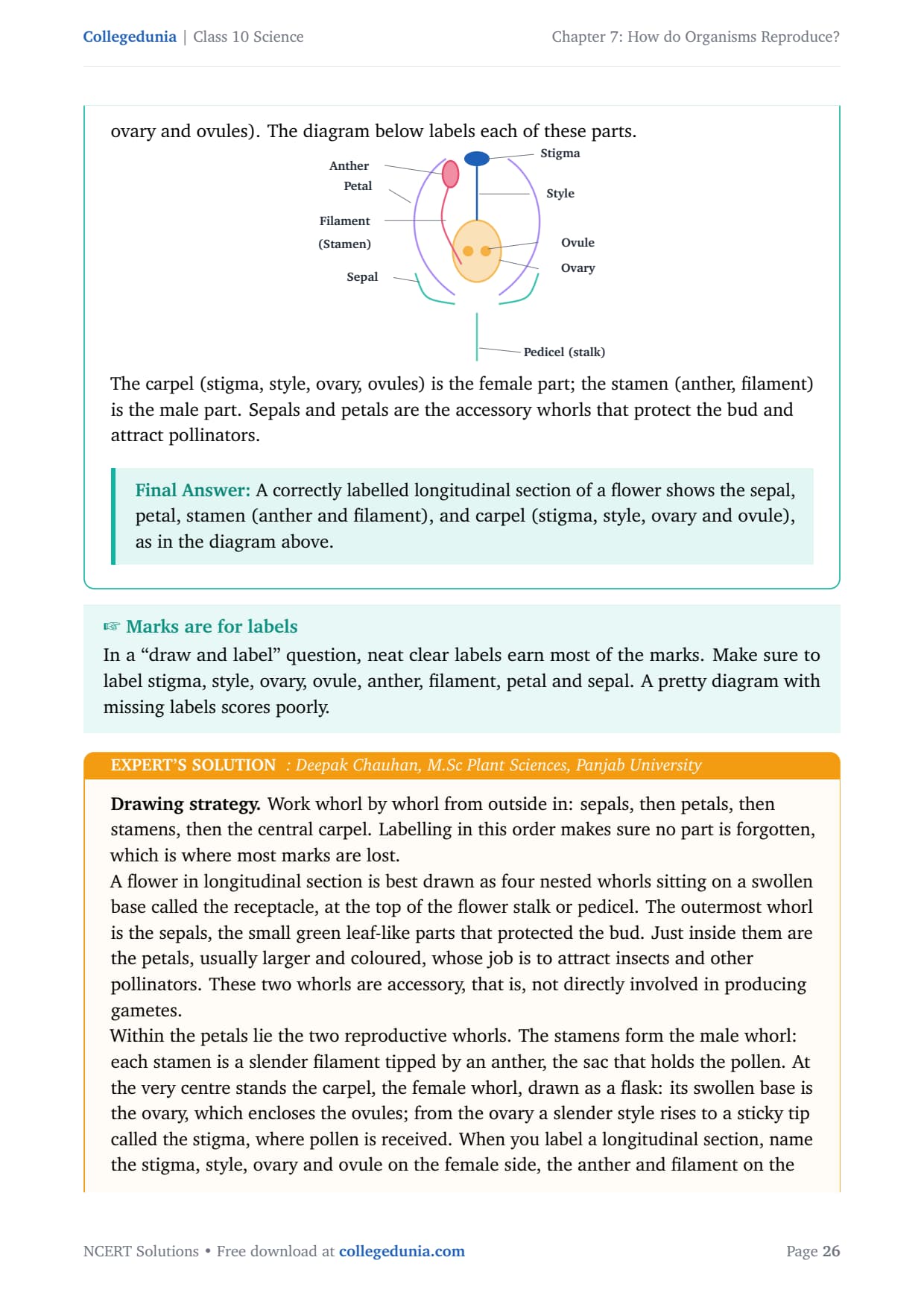
Draw a labelled diagram of the longitudinal section of a flower.
A flower is the reproductive part of a plant. A longitudinal section (a cut from top to bottom) shows the four whorls: the green sepals, the coloured petals, the male stamens (each an anther on a filament) and the female carpel (stigma, style, ovary and ovules).
The carpel (stigma, style, ovary, ovules) is the female part of the flower.
The stamen (anther, filament) is the male part.
The sepals and petals are accessory whorls that protect the bud and attract pollinators.
Answer: A correctly labelled longitudinal section shows the sepal, petal, stamen (anther and filament), and carpel (stigma, style, ovary and ovule), as in the diagram above.
DC
Deepak Chauhan
M.Sc Plant Sciences, Panjab University
Verified Expert
Work whorl by whorl from outside in: sepals, then petals, then stamens, then the central carpel. Labelling in this order makes sure no part is forgotten, which is where most marks are lost.
The outer two whorls are accessory: the small green sepals that protected the bud, and the larger coloured petals that attract pollinators.
Within them lie the reproductive whorls: each stamen is a filament tipped by a pollen-bearing anther, and at the centre the carpel is a flask whose ovary holds the ovules, with a style rising to a sticky stigma.
Label the stigma, style, ovary and ovule on the female side, the anther and filament on the male side, and the petal and sepal outside.
Answer: The labelled longitudinal section must show, from outside in: sepal, petal, stamen (anther + filament), and carpel (stigma, style, ovary, ovule), drawn on the receptacle at the top of the pedicel.
Q 20
What are the different methods of contraception?
Contraception means the deliberate prevention of pregnancy. The methods work by stopping one of the steps that lead to pregnancy: the meeting of sperm and egg, the change of hormones, the implantation of the embryo, or the supply of gametes.
Method
How it works
Example
Barrier
A physical barrier stops sperm reaching the egg; also guards against STDs
Condom, diaphragm
Chemical / hormonal
Hormones change the balance so no egg is released
Oral pills
Intra-uterine device
Placed in the uterus; stops the fertilised egg settling
Copper-T
Surgical
Blocks the path of the gametes
Vasectomy (male), tubectomy (female)
Answer: Contraception methods are barrier methods (condom, diaphragm), chemical methods (hormonal oral pills), intra-uterine devices (copper-T), and surgical methods (vasectomy in males, tubectomy in females).
FS
Farhan Sheikh
M.D Public Health, Aligarh Muslim University
Verified Expert
The cleanest full-mark answer groups the methods into four types (barrier, hormonal, IUD, surgical) and names one example of each. Examiners reward the classification as much as the examples.
Barrier methods keep sperm and egg apart with a physical shield, and the condom has the added value of guarding against STDs; hormonal methods like the oral pill stop an egg from being released.
The copper-T prevents a fertilised egg from implanting, while surgical methods (vasectomy and tubectomy) cut and tie the vas deferens or fallopian tube to block the gametes permanently.
Answer: The main contraceptive methods are barrier (condom, diaphragm), chemical/hormonal (oral pills), intra-uterine devices (copper-T), and surgical (vasectomy and tubectomy), each interrupting a different step on the way to pregnancy.
Q 21
How are the modes for reproduction different in unicellular and multicellular organisms?
A unicellular organism is made of a single cell, so reproduction and body growth are the same act of cell division. A multicellular organism has many specialised cells, so it needs special cells or organs set apart for reproduction.
In unicellular organisms (such as Amoeba, bacteria, yeast, Plasmodium), the whole single cell divides, by binary fission, multiple fission or budding.
Here there are no separate reproductive organs; the entire body takes part in producing offspring.
In multicellular organisms the body has many specialised cells, so the whole body cannot simply split; they use fragmentation, regeneration, spore formation, vegetative propagation, or sexual reproduction.
In complex multicellular organisms, reproduction is carried out by special reproductive organs that produce gametes; only these cells, not the whole body, make the offspring.
Answer: Unicellular organisms reproduce by simple division of the whole single cell (binary fission, multiple fission, budding), while multicellular organisms use specialised cells, tissues or reproductive organs (such as spores, vegetative parts or gametes) because their bodies are made of many specialised cells.
NG
Nandini Gupta
M.Sc Microbiology, University of Lucknow
Verified Expert
The whole answer rests on one idea: the number of cells in the body decides how an organism can reproduce. Build the contrast from there and it writes itself.
A unicellular organism is its single cell, so it simply copies its DNA and divides (fission or budding) with no special organs, because there is no room for them.
A multicellular body has divided labour among interdependent cells, so it sets aside particular cells or structures, and complex ones develop dedicated reproductive organs that produce gametes.
The move from one cell to many cells is exactly what forces the shift from whole-body division to specialised modes.
Answer: In unicellular organisms the single whole cell divides (fission or budding) with no special organs; in multicellular organisms, whose bodies have specialised cells, reproduction is done through special reproductive cells, structures or organs that produce gametes.
Q 22
How does reproduction help in providing stability to populations of species?
A population stays stable when its numbers and basic features do not crash over time. Reproduction keeps a population stable by replacing the individuals that die and by passing on a reliable body design, while also supplying variation.
Reproduction makes new individuals of the same kind, replacing those lost to death, disease or predators, so the number stays roughly steady.
Through DNA copying, reproduction passes on the same body design from one generation to the next, keeping the population's characteristic features and identity.
The variation produced (especially in sexual reproduction) lets the population adapt to environmental change, so it is not wiped out when conditions shift.
Together, replacement of numbers, continuity of body design and adaptability give the population stability over many generations.
Answer: Reproduction provides stability by continually replacing dead individuals with new ones of the same kind, passing on a reliable body design through DNA copying, and supplying variation so the population can adapt to environmental change and survive over generations.
HP
Harish Patel
Ph.D Ecology, Gujarat University
Verified Expert
Lift the discussion from the individual to the whole population. Stability here means steady numbers, a constant kind, and the ability to weather change, and reproduction delivers all three.
Individuals are constantly removed by ageing, disease and predation, and reproduction supplies fresh individuals to take their place, so the head count does not collapse.
Because DNA is copied and handed on, each generation keeps the same body design, while the variation that sexual reproduction adds acts as a reserve of adaptability when the environment changes.
Answer: Reproduction stabilises a population by replacing lost individuals to keep numbers steady, conserving the body design through DNA copying so the kind stays constant, and supplying variation that lets the population adapt to environmental change.
Q 23
What could be the reasons for adopting contraceptive methods?
Contraceptive methods prevent unwanted pregnancy and, in some cases, infection. People and societies adopt them for several health and social reasons.
To prevent unwanted pregnancy and to space and limit the number of children, so a family can be cared for properly.
To protect the health of the mother, as too many or too closely spaced pregnancies weaken her body.
To help control the rapid growth of population, so resources like food, water and jobs are not overstretched.
To prevent the spread of sexually transmitted diseases, since barrier methods such as condoms stop the exchange of body fluids that carry the germs.
Answer: Contraceptive methods are adopted to prevent unwanted pregnancy and space births, to protect the mother's health, to control the rapid growth of population, and (with barrier methods) to prevent sexually transmitted diseases.
KJ
Kavita Joshi
M.D Family Medicine, Government Medical College Nagpur
Verified Expert
Sort the reasons into two baskets, one about the individual and the family, the other about the wider community. This makes the answer well rounded and easy to mark.
For the family, contraception lets people space out births so each child is properly cared for, and protects the mother's health from repeated or closely spaced pregnancies.
For society, it helps slow rapid population growth that strains shared resources, and barrier methods like the condom reduce the spread of sexually transmitted diseases.
Answer: People adopt contraception to prevent unwanted pregnancy and space births, to safeguard the mother's health, to slow the rapid growth of population, and to limit the spread of sexually transmitted diseases.
NCERT Solutions Class 10 Science Chapter 7 How do Organisms Reproduce? FAQs
Ques. How many questions are there in NCERT Class 10 Science Chapter 7 How do Organisms Reproduce?
Ans. There are 23 questions in NCERT Class 10 Science Chapter 7 How do Organisms Reproduce?: 12 in-text questions in the boxes inside the chapter and 11 end-of-chapter exercise questions. All 23 are solved with a step-by-step Check Solution and an Expert Solution. The exercise set includes three MCQs (on the budding organism, the female reproductive parts, and the contents of the anther) and long-answer questions on sexual versus asexual reproduction, the testis, menstruation, the flower diagram and contraception.
Ques. What is the difference between pollination and fertilisation?
Ans. Pollination is the transfer of pollen grains from the anther of a flower to the stigma, carried out by wind, water or insects; nothing has fused yet. Fertilisation happens after pollination, when the pollen grain grows a pollen tube down the style and the male gamete fuses with the female gamete (egg) inside the ovule to form the zygote. So pollination only moves the pollen, while fertilisation is the actual fusion of gametes, and pollination always comes first.
Ques. How does binary fission differ from multiple fission?
Ans. In binary fission the parent cell divides into two daughter cells: the nucleus divides once and then the cell splits, as in Amoeba and Leishmania. In multiple fission the parent cell divides into many daughter cells at once: the nucleus divides repeatedly inside the cell first, and only then does the cytoplasm split around each nucleus, as in Plasmodium. So the simplest test is the number of offspring, two for binary and many for multiple, which follows from how many times the nucleus divides.
Ques. Why is DNA copying essential in reproduction?
Ans. DNA carries the information for the whole body design of an organism, and reproduction must hand a complete copy of this information to the offspring. So the parent cell first copies its DNA, then divides, so each new cell gets a full set of instructions and develops into the same kind of organism. DNA copying is also slightly imperfect, and the small errors create the variation that helps a species adapt and survive over generations. So DNA copying both preserves the body design and supplies variation.
Ques. Why does menstruation occur?
Ans. Each month the uterus builds a thick, blood-rich lining to receive a fertilised egg, and an ovary releases an egg. If the egg is not fertilised, no embryo forms and the thick lining is no longer needed, so it breaks down and is shed through the vagina as blood and mucus. This monthly flow is menstruation, and the cycle lasts about 28 days. The key word in the answer is "unfertilised", because the lining is shed only because the egg was not fertilised.
Ques. Does a copper-T protect against sexually transmitted diseases?
Ans. No. A copper-T is an intra-uterine device that works only inside the uterus to prevent pregnancy by stopping a fertilised egg from settling. It is not a barrier between partners, so the body fluids that carry the germs of sexually transmitted diseases such as HIV/AIDS still pass freely. To protect against STDs a barrier method like a condom is needed, because it physically stops the exchange of body fluids. So a copper-T prevents pregnancy but gives no protection against STDs.
Ques. How many pages is the Class 10 Science How do Organisms Reproduce? NCERT Solutions PDF?
Ans. The How do Organisms Reproduce? NCERT Solutions PDF covers all 23 questions (12 in-text and 11 exercise) with step-by-step Check Solutions, labelled diagrams of binary and multiple fission, the longitudinal section of a flower and the placenta, and an Expert Solution for each question. It is free to download for the 2026-27 session and is built for the CBSE Class 10 board exam.
Ques. Is the NCERT Solutions for Class 10 Science Chapter 7 aligned with the 2026-27 syllabus?
Ans. Yes. This page reflects the current 2026-27 CBSE syllabus for Class 10 Science. Every answer follows the NCERT textbook flow for How do Organisms Reproduce?, covering DNA copying and variation, the asexual modes of reproduction, sexual reproduction in flowering plants, reproduction in human beings, and reproductive health and contraception. The solutions are written in plain English for board exam students and are useful for both the CBSE board exam and school unit tests.








Comments