




The Class 8 Maths Quadrilaterals notes cover rectangles, squares, parallelograms, rhombuses, kites and trapeziums, with every property proved the way the 2026-27 NCERT Ganita Prakash Part 1 textbook proves it.
- Chapter Length: a 30-page notes PDF with 20 diagrams, property tables and worked answers to the Figure it Out questions.
- Properties Covered: angles, sides and diagonals of each quadrilateral, with the congruence reasoning behind them.
- Pairs With: the Quadrilaterals solutions page, which works the exercise questions in full.
These Class 8 Maths notes for Quadrilaterals follow the 2026-27 NCERT Ganita Prakash Part 1 textbook section by section, from the carpenter's problem to the kite and trapezium.
Student Feedback
Class 8 students most often write to us about three things in Quadrilaterals: how to tell a rhombus from a kite, why the diagonals of a rectangle are equal, and how to justify a name in a "which quadrilateral is this" question. The notes answer each with a diagram and the matching congruence step, so start with the diagonal sections if those are your trouble spots.
What Quadrilaterals Covers in the 2026-27 NCERT
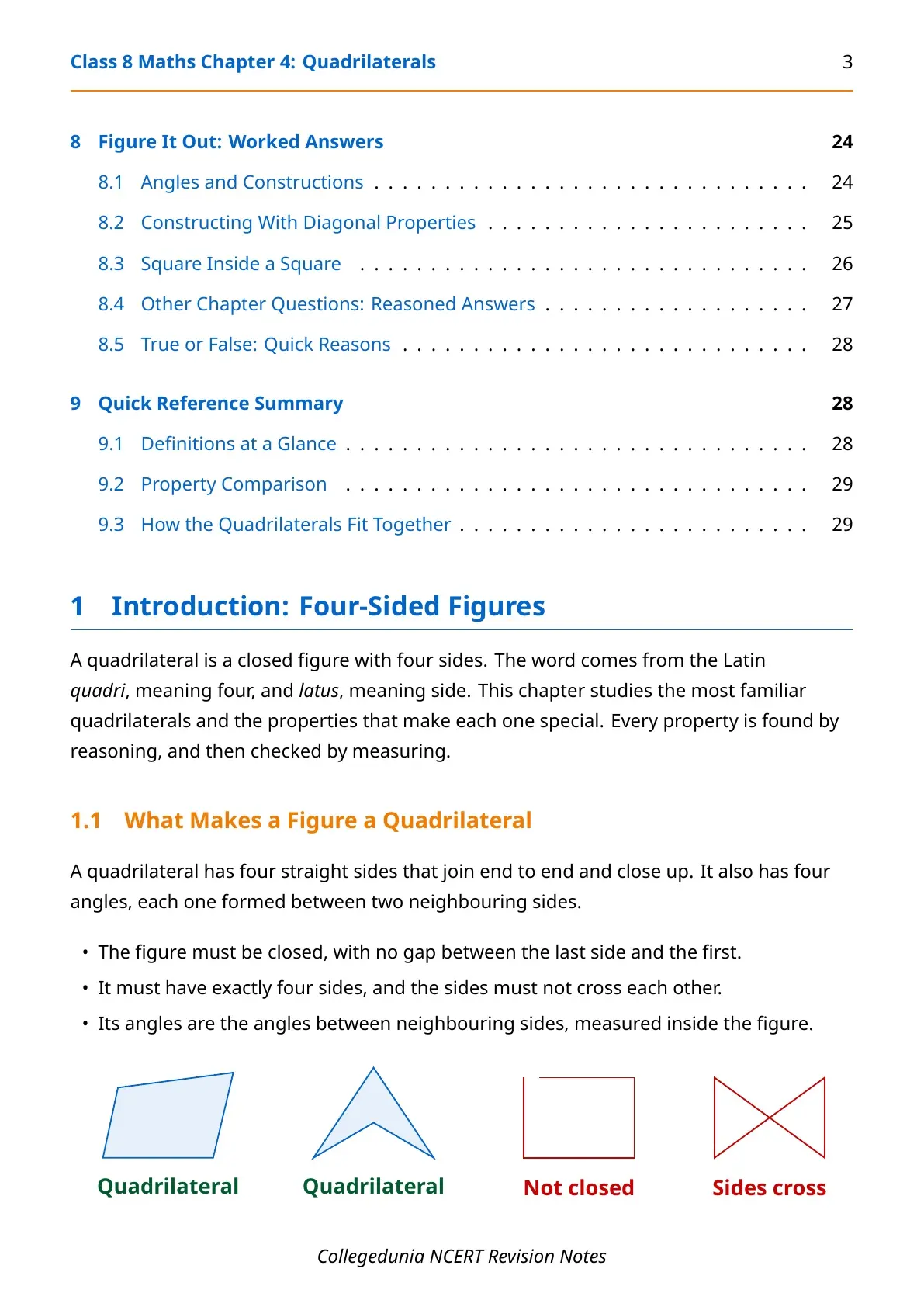
A quadrilateral is a closed figure with four straight sides, and the word comes from the Latin quadri (four) and latus (side). The chapter does not hand you a list of properties to memorise. It deduces each one using congruent triangles and parallel lines, then asks you to check it by measuring.
- Rectangles and squares, and the carpenter's problem that leads to their diagonal properties
- The angle sum of a quadrilateral, which is always 360°
- Parallelograms and the rhombus, with ten numbered deductions across the chapter
- The kite, the trapezium and the isosceles trapezium
- Geoboard and cardboard-triangle activities for naming a quadrilateral with a reason
Angle Sum Property of a Quadrilateral
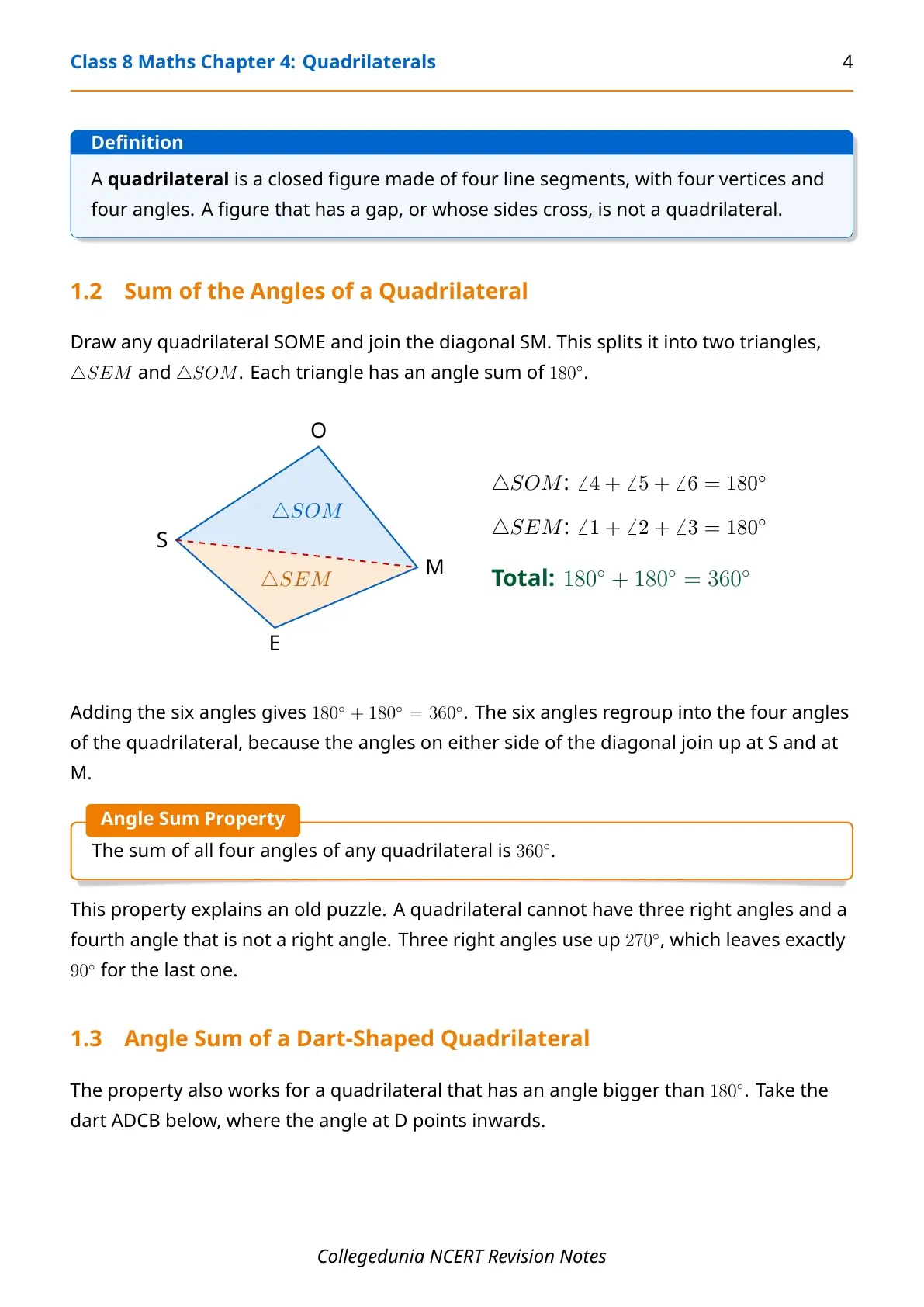
Draw any quadrilateral SOME and join the diagonal SM. This splits it into two triangles, and each triangle has an angle sum of 180°. The six angles of the two triangles together make up the four angles of the quadrilateral, so the sum is 180° + 180° = 360°.
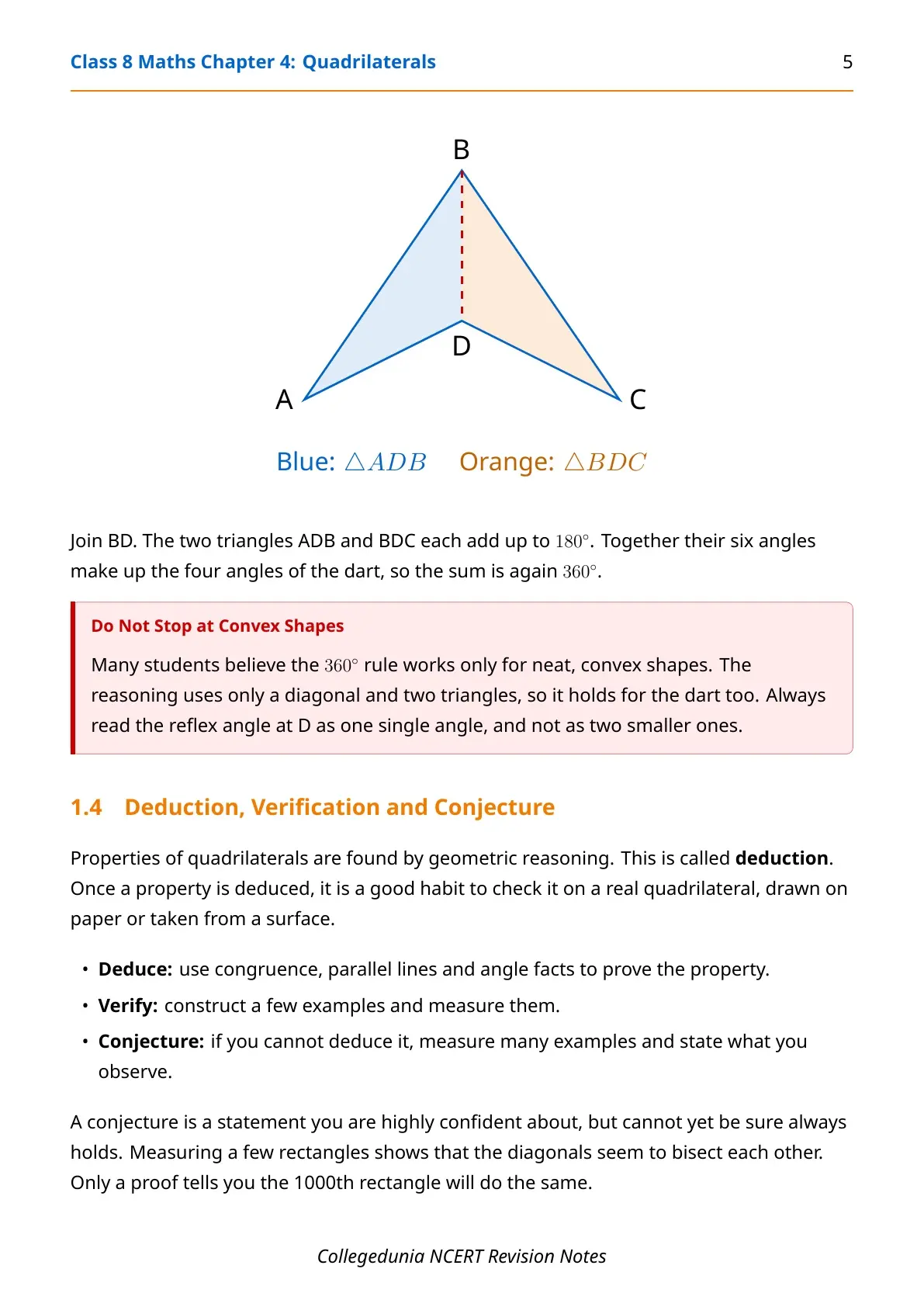
The same argument works for a dart-shaped quadrilateral with one angle bigger than 180°, because it also splits into two triangles along a diagonal. It also explains why no quadrilateral can have exactly three right angles. Three right angles use up 270°, which forces the fourth angle to be 90° too.
Quadrilaterals Class 8 Maths Explained in One Video
Source: eSaral Class 8, 9 & 10 on YouTube
Rectangle Properties and the Carpenter's Problem
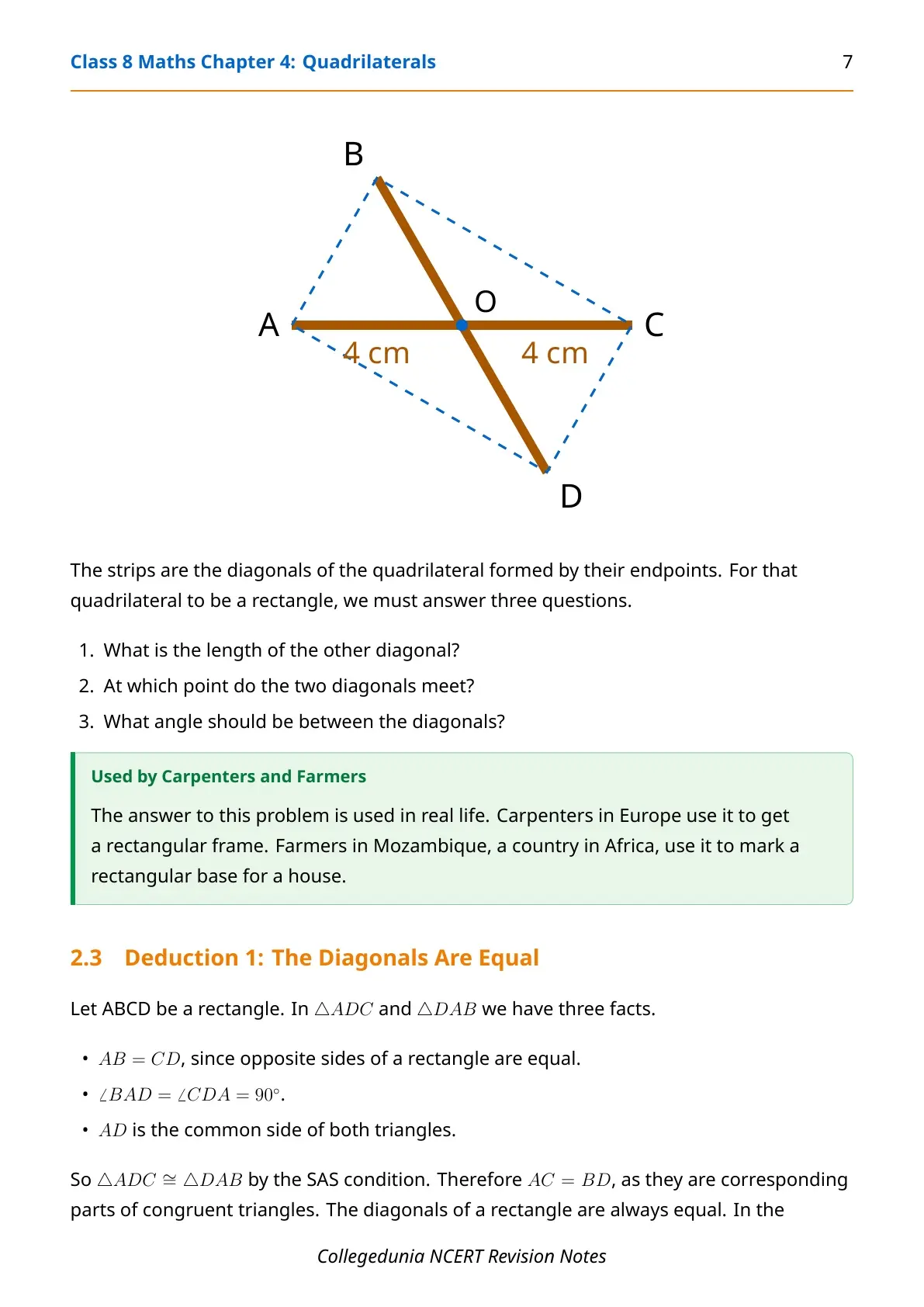
A carpenter has two strips of wood and a thread. She wants the thread, passed through the four endpoints of the strips, to form a rectangle. One strip is 8 cm long. The strips act as the diagonals, so the problem asks what the second diagonal should be, where the two should cross, and at what angle.
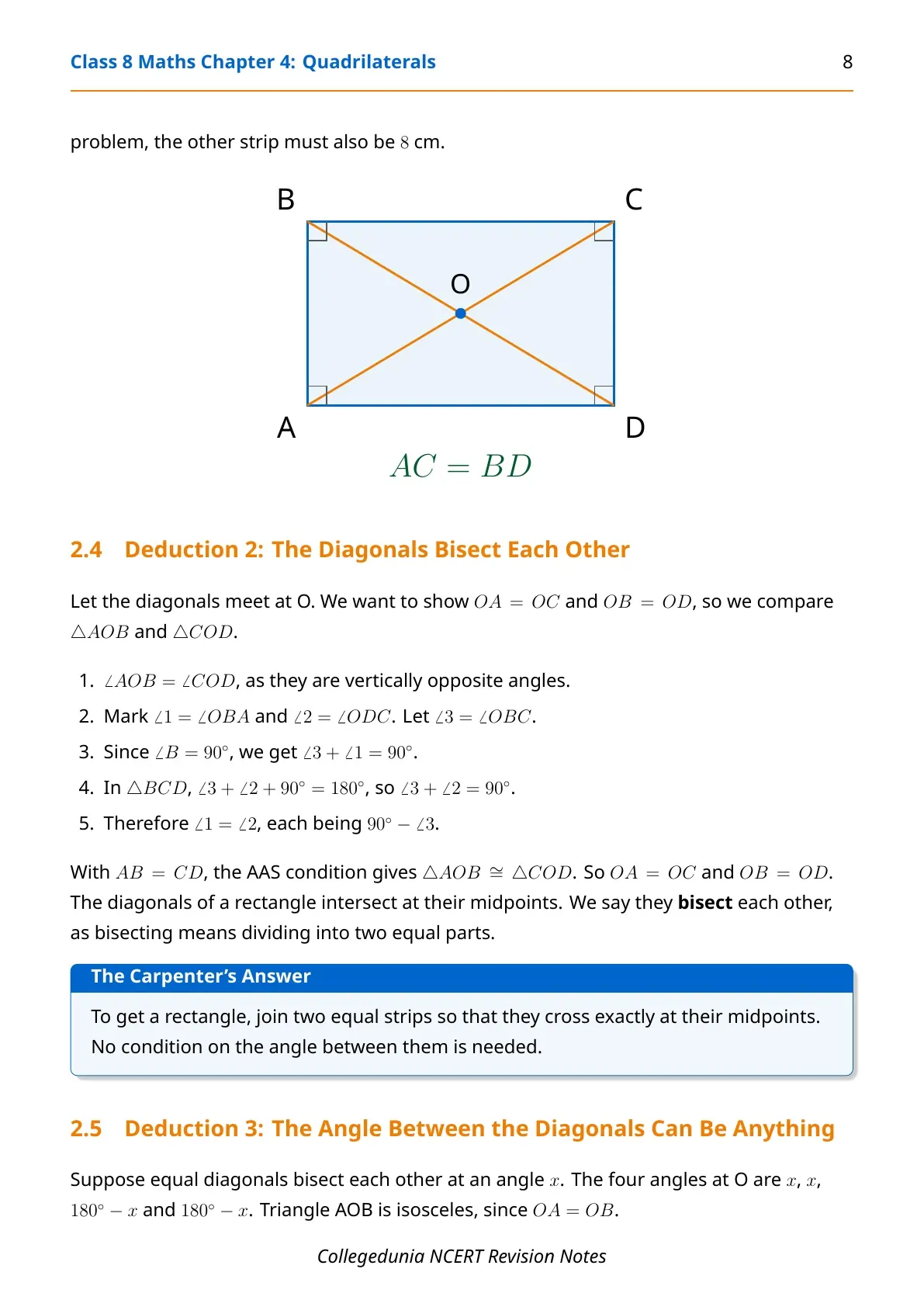
- The diagonals of a rectangle are equal. In the rectangle ABCD, triangles ADC and DAB are congruent by SAS, so AC = BD. The other strip is also 8 cm.
- The diagonals bisect each other. Triangles AOB and COD are congruent by AAS, so OA = OC and OB = OD. The strips must cross at their midpoints.
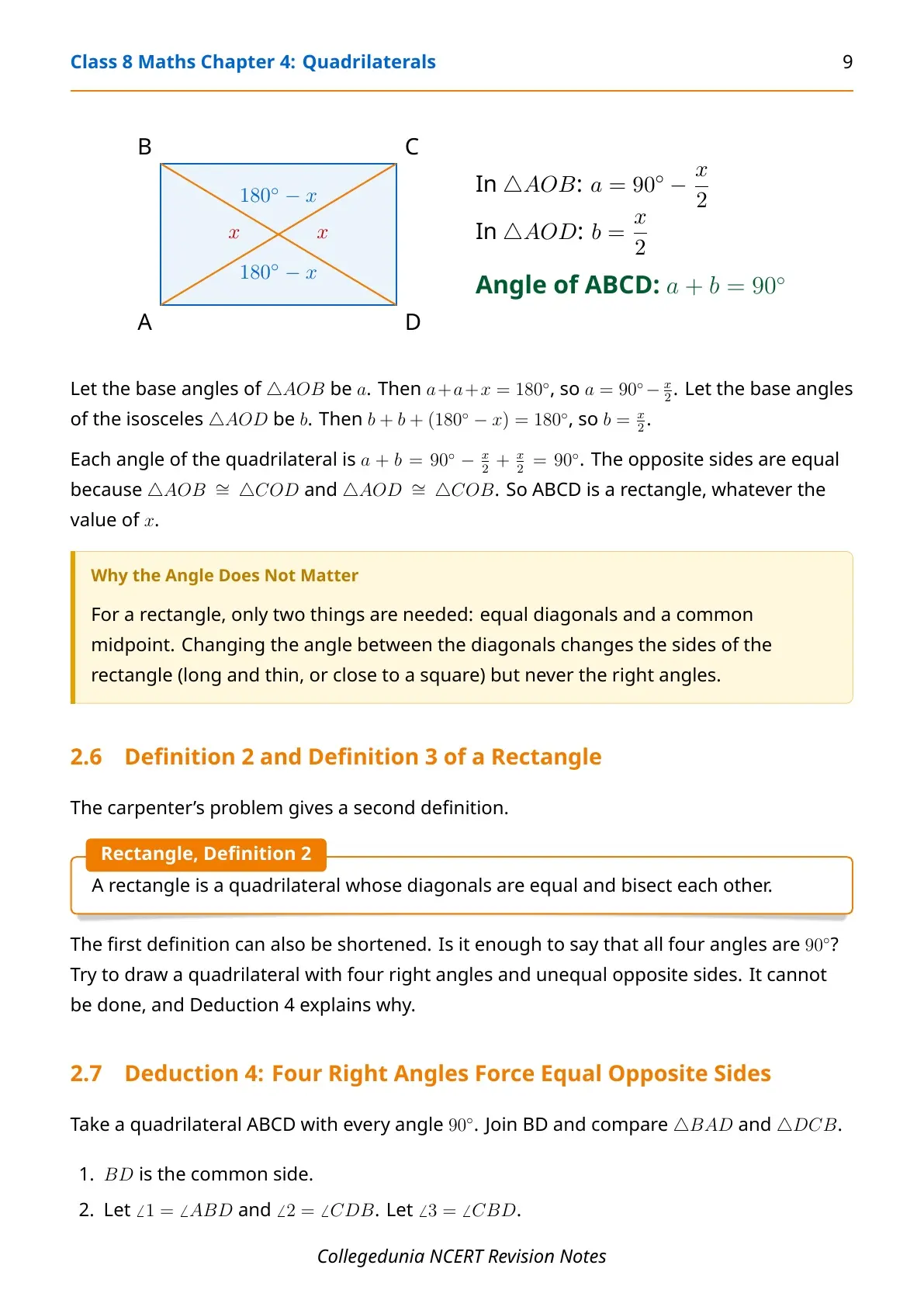
- The angle between the diagonals can be anything. If it is x, the angles of the figure work out to (90° − x/2) + x/2 = 90°.
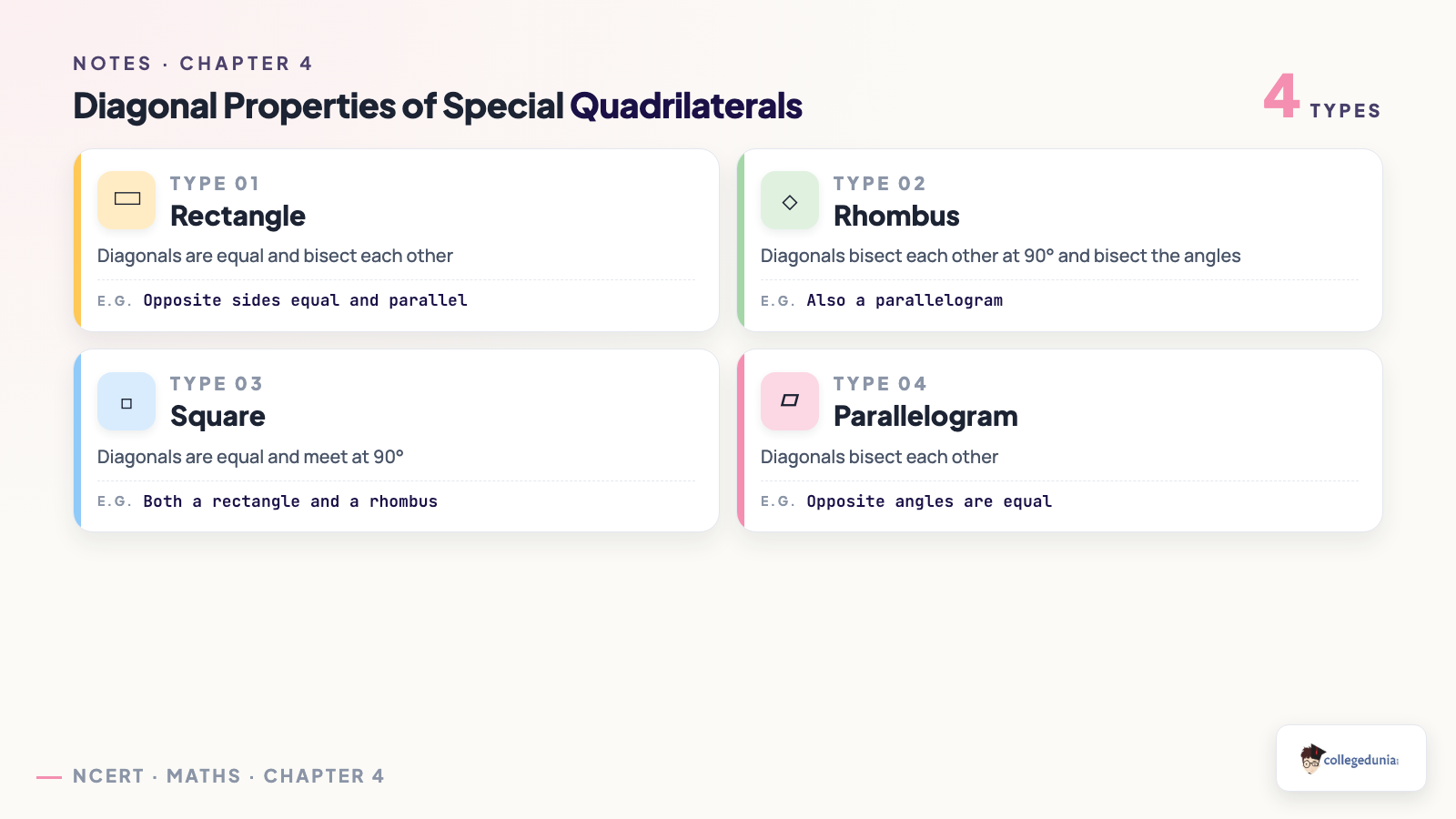
This gives a second definition: a rectangle is a quadrilateral whose diagonals are equal and bisect each other. The chapter then shows that four right angles alone are enough. Join a diagonal BD, and triangles BAD and DCB are congruent by AAS, so the opposite sides come out equal without being assumed.
| Property of a rectangle | Reason in the chapter |
|---|---|
| All angles are 90° | Definition |
| Opposite sides are equal | Congruent triangles BAD and DCB |
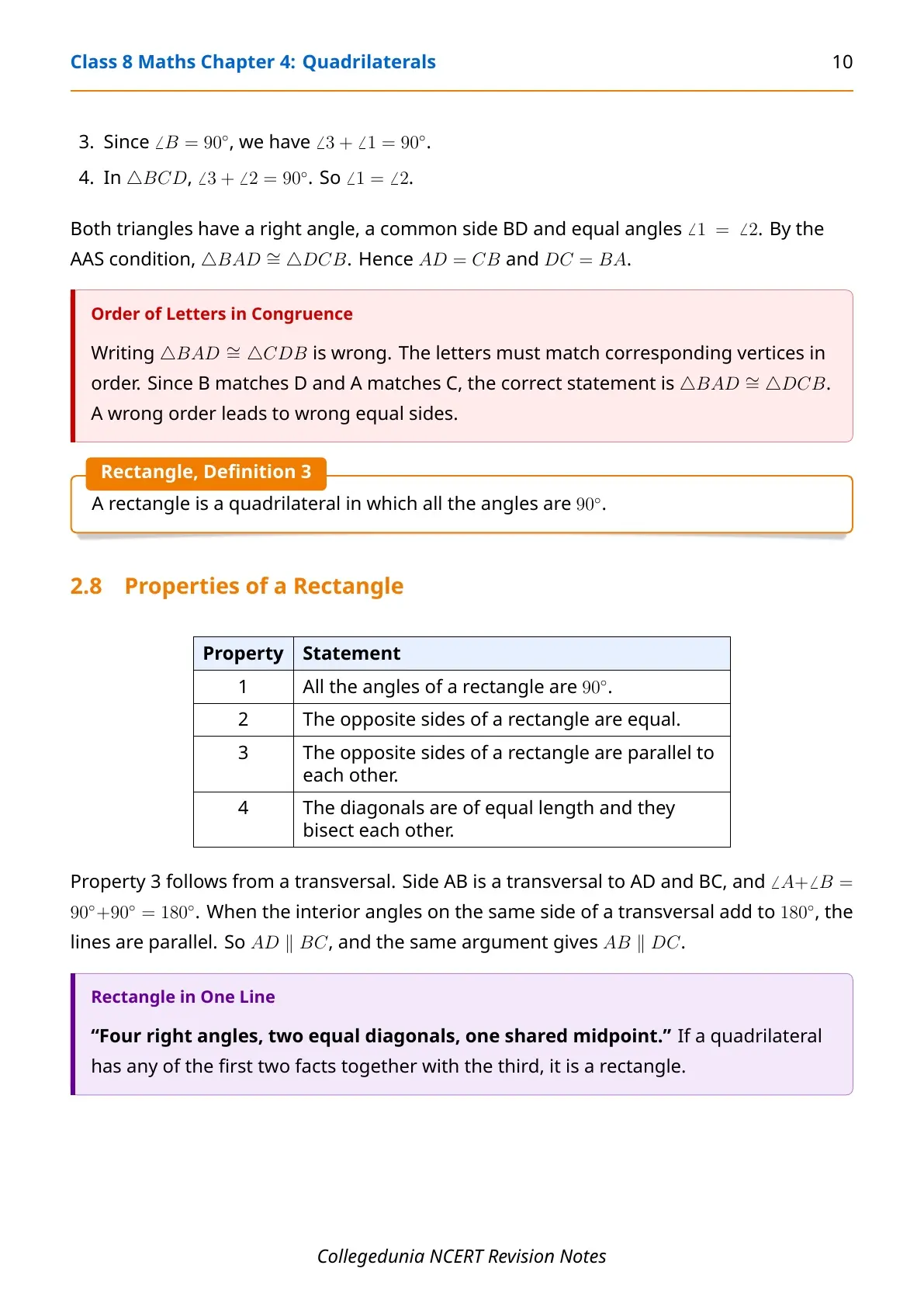
| Opposite sides are parallel | Interior angles on one side of a transversal add to 180° |
| Diagonals are equal and bisect each other | SAS and AAS congruence |
Square: A Special Rectangle
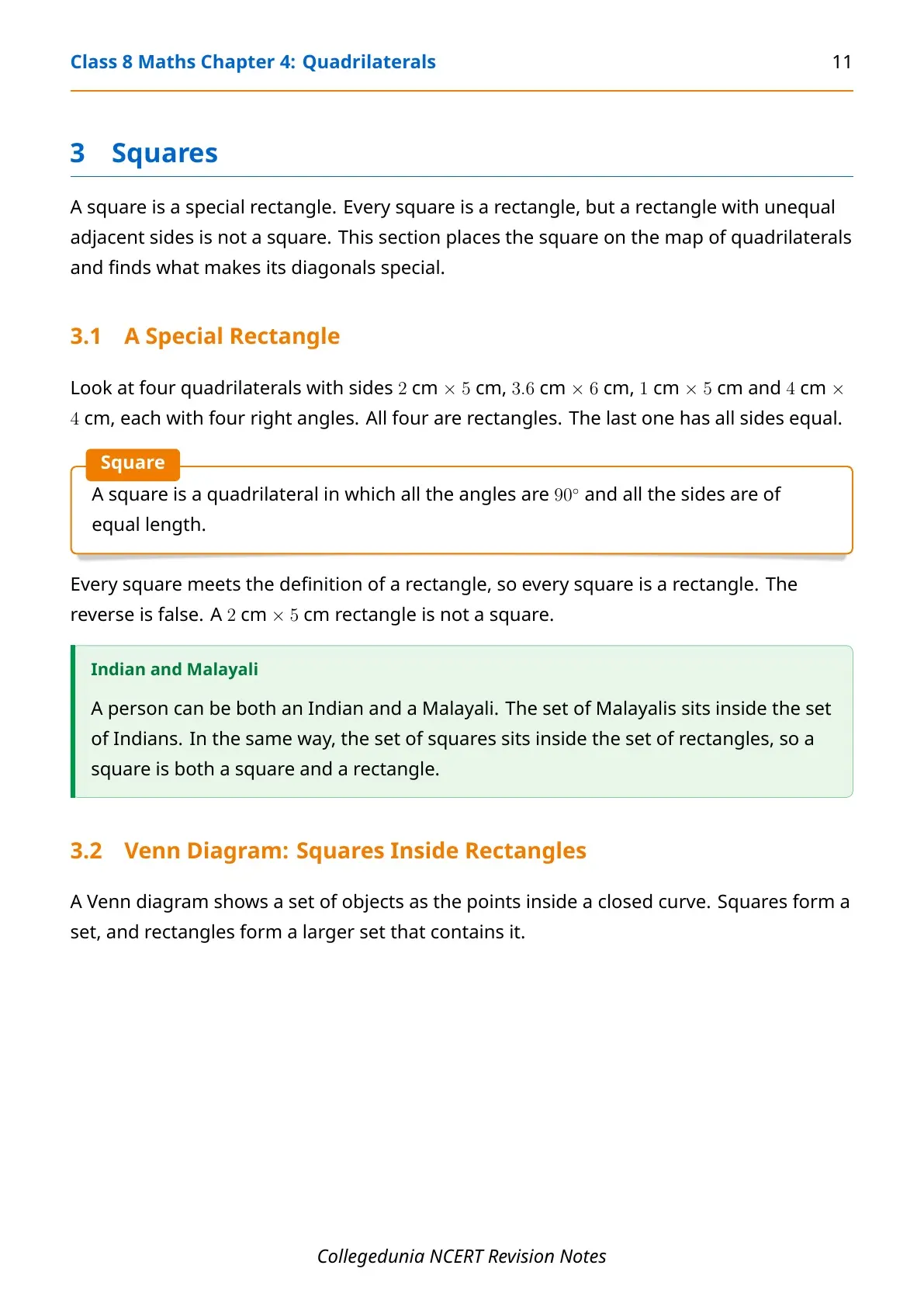
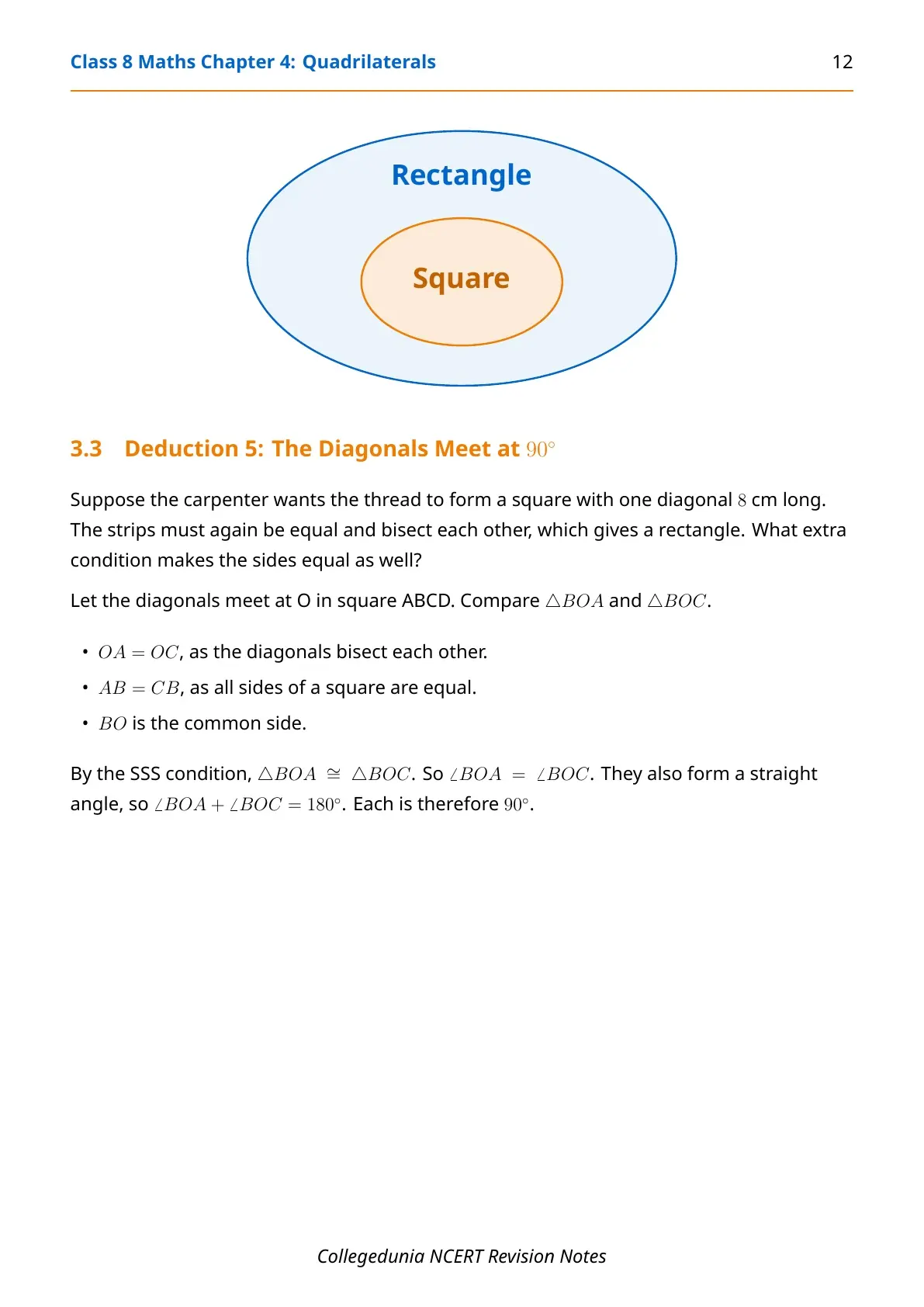
A square is a quadrilateral with all angles 90° and all sides equal. Every square is a rectangle, but a rectangle with unequal neighbouring sides is not a square. The chapter compares this to being both an Indian and a Malayali: one set sits inside the other.
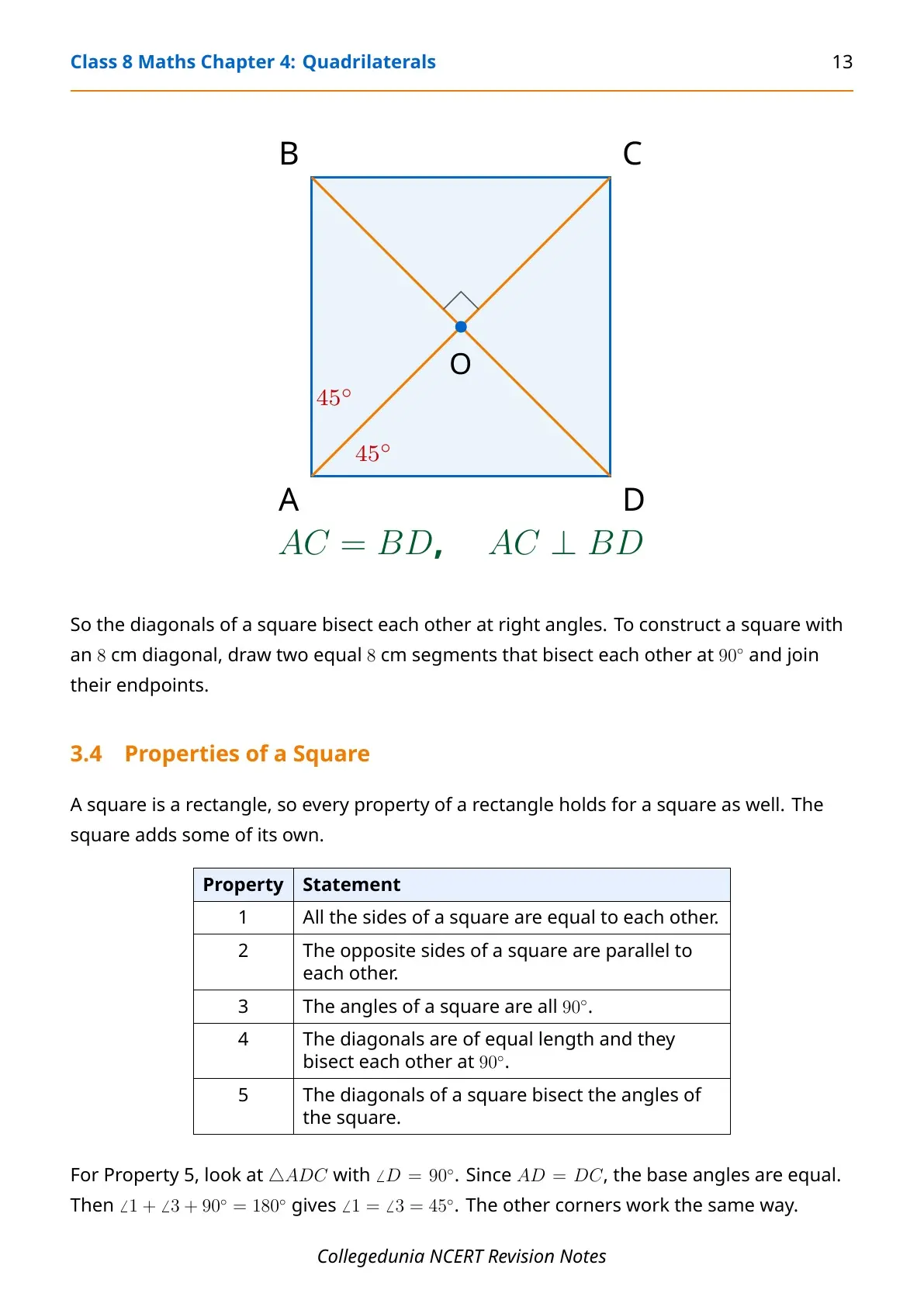
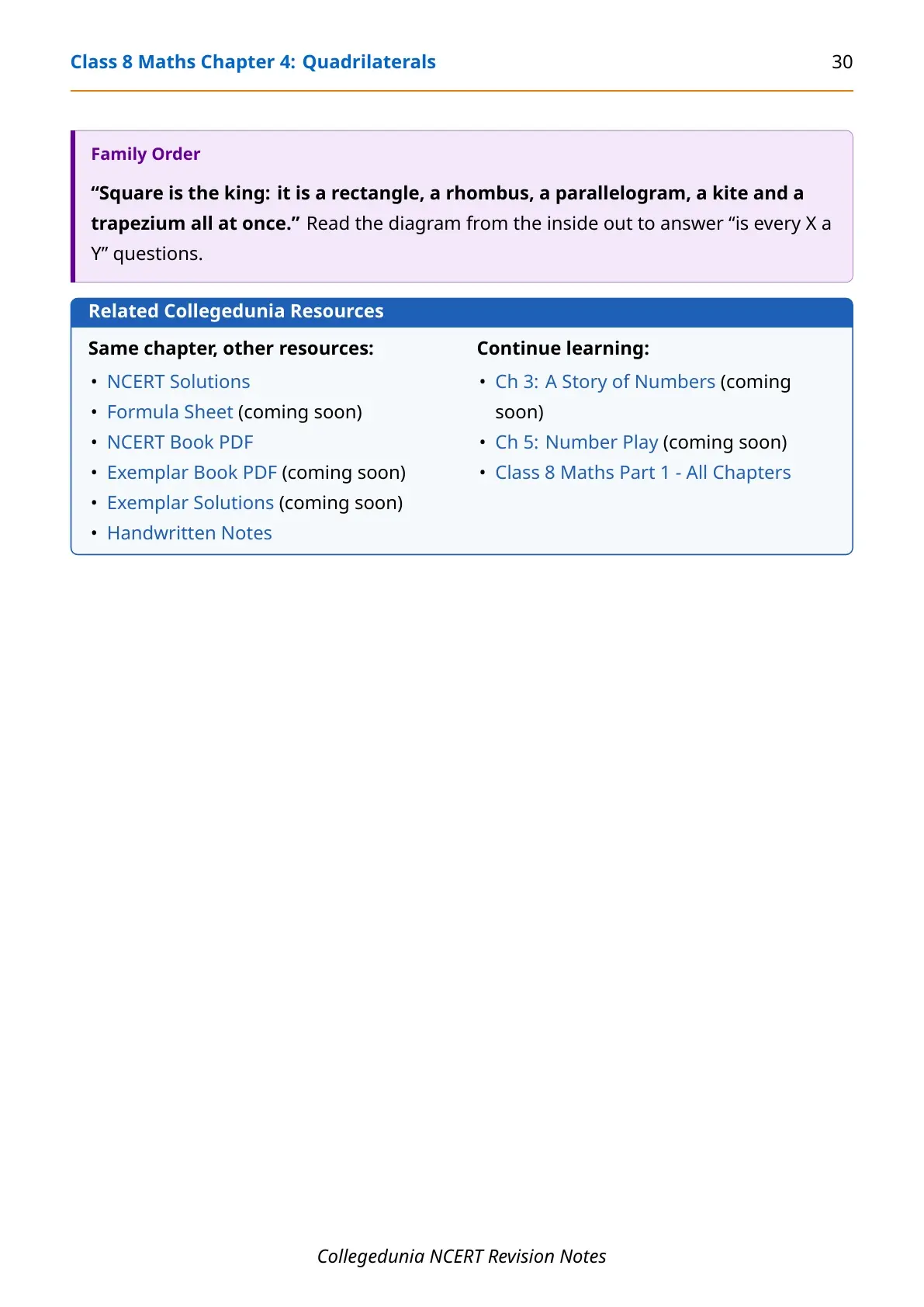
For the carpenter to get a square, the equal diagonals must also meet at a right angle. Triangles BOA and BOC are congruent by SSS, so ∠BOA = ∠BOC, and as the two angles lie on a straight line, each is 90°. A square therefore has every rectangle property plus two of its own.
- The diagonals meet at 90°.
- The diagonals bisect the angles of the square, so each corner is split into two 45° angles.
Parallelogram Properties and Deductions
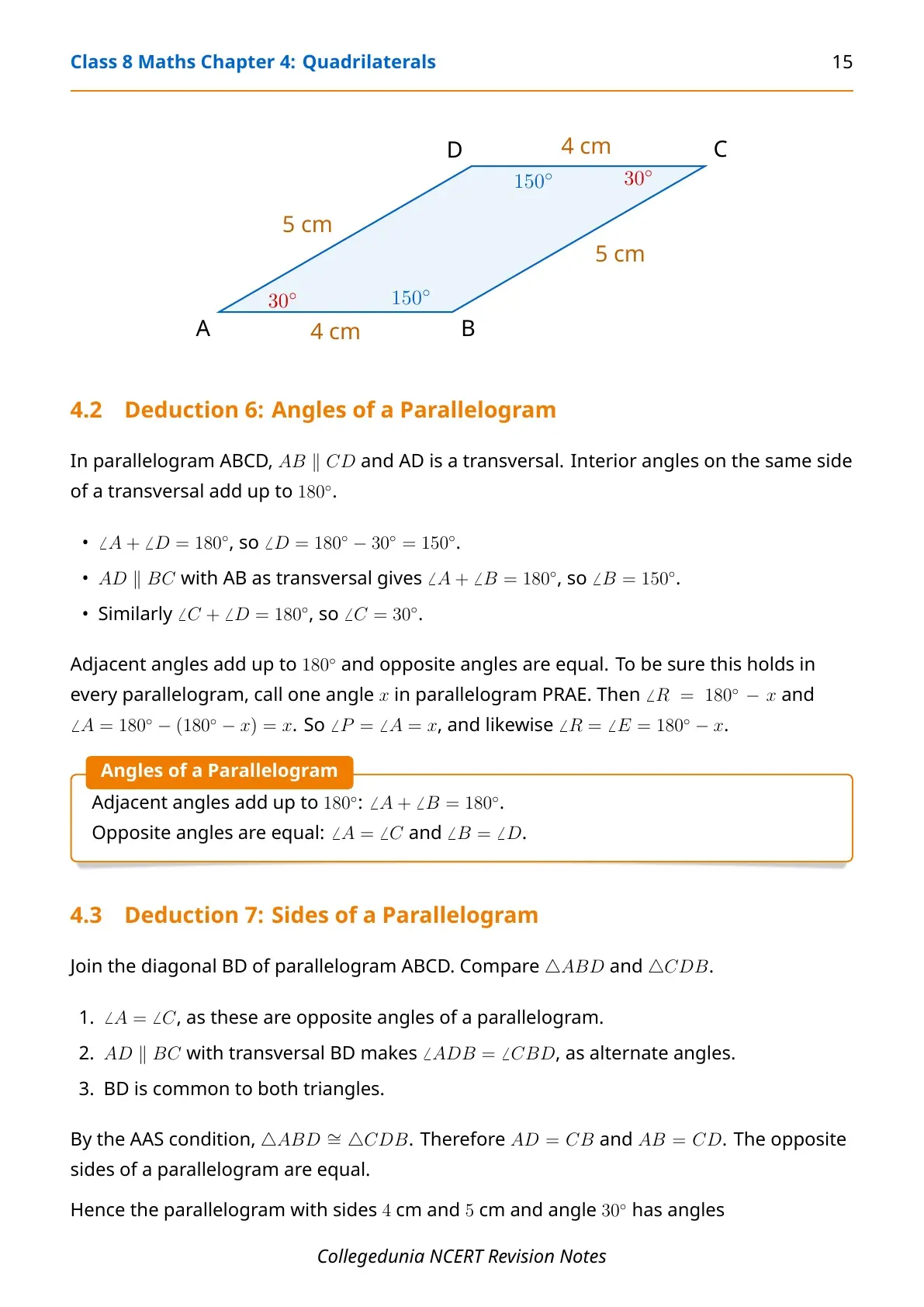
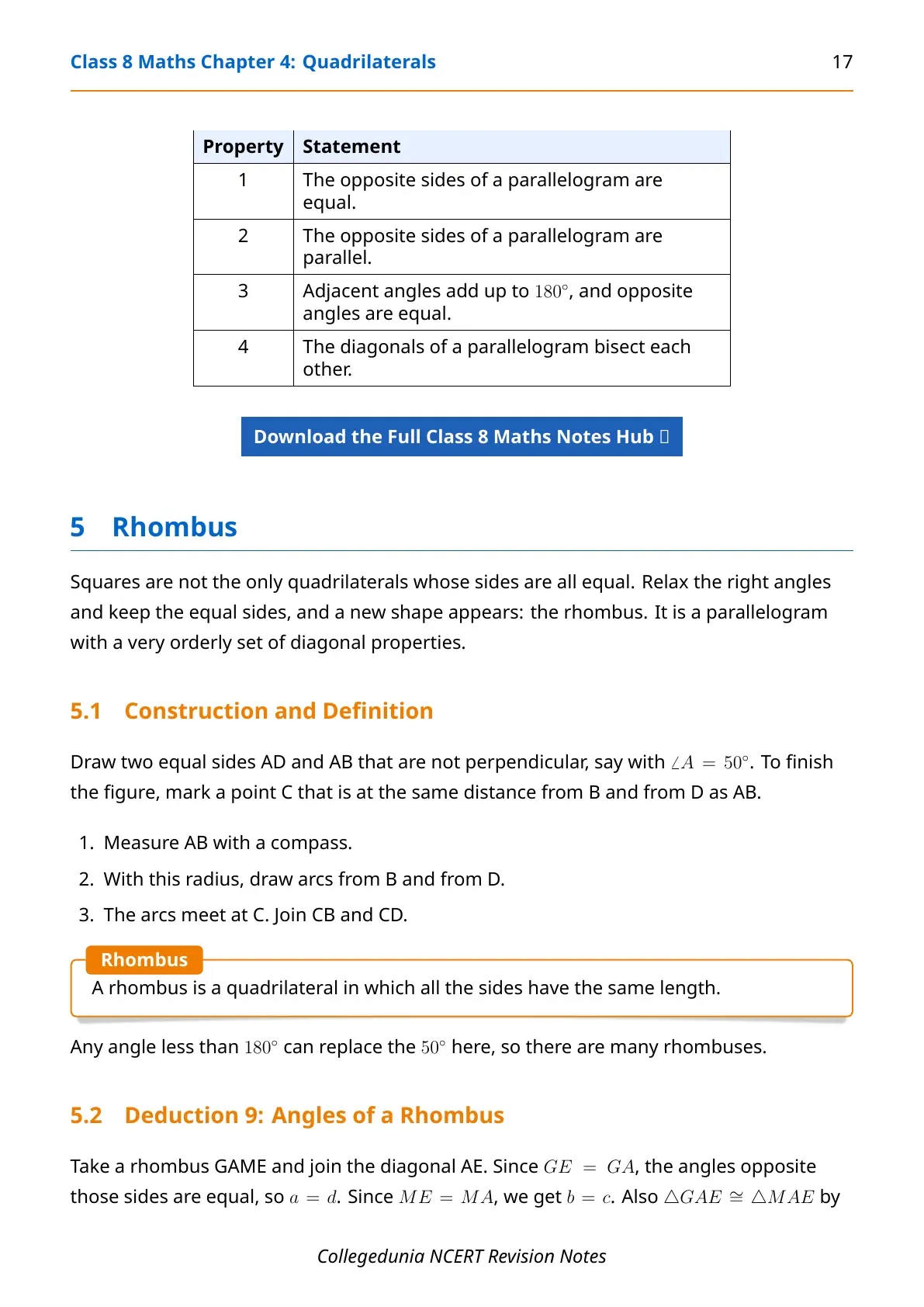
A parallelogram is a quadrilateral in which the opposite sides are parallel. A rectangle is a parallelogram with all angles equal to 90°. The chapter builds one with sides 4 cm and 5 cm and an angle of 30°, and reads off the rest using three deductions.
- Adjacent angles add up to 180°, since they are interior angles on the same side of a transversal. The 30° parallelogram has angles 30°, 150°, 30° and 150°.
- Opposite angles are equal. If one angle is x, the next is 180° − x and the one after is x again.
- Opposite sides are equal, because triangles ABD and CDB are congruent by AAS. Writing them as ABD and CBD instead would pair the wrong vertices.
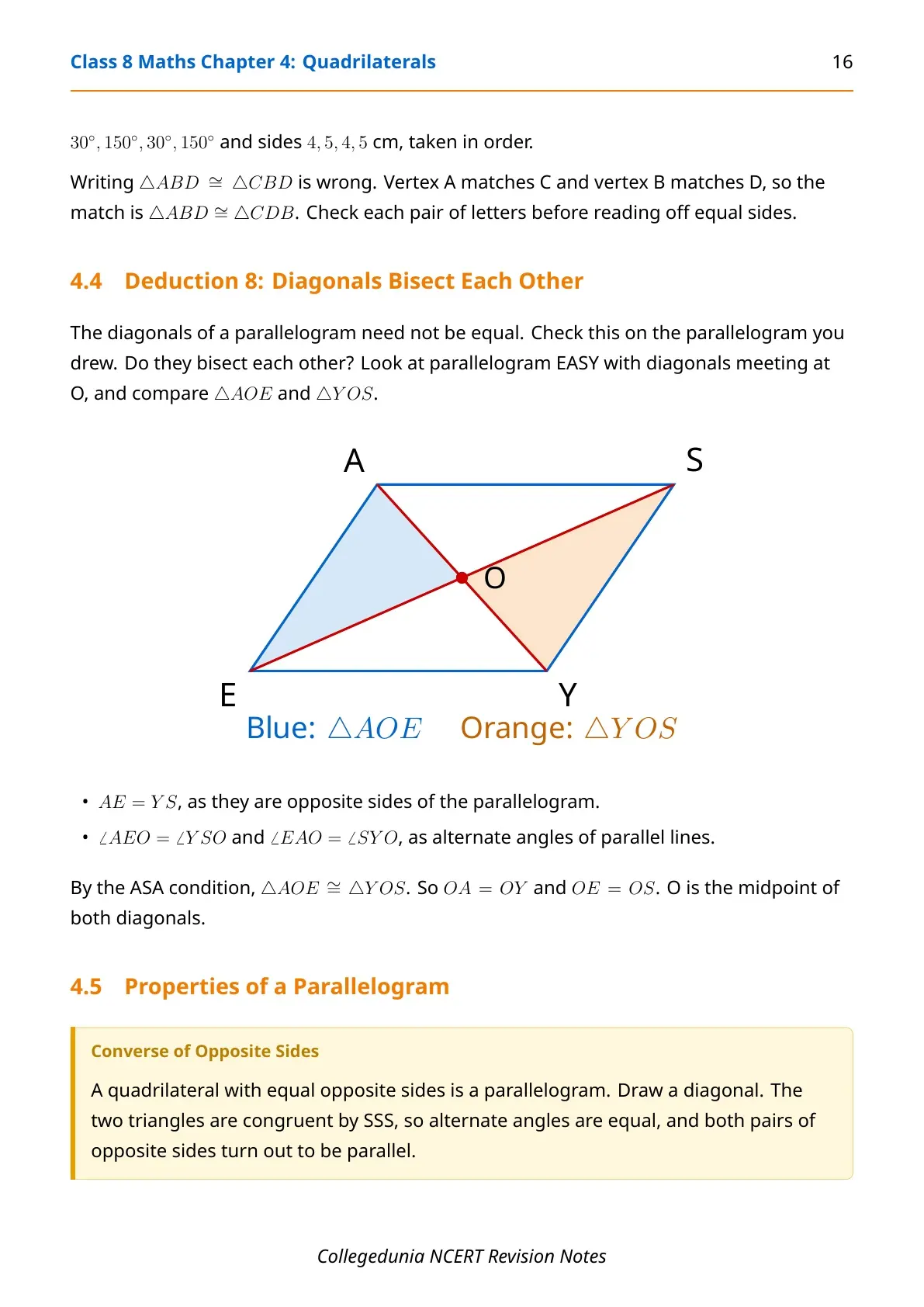
- The diagonals bisect each other, because triangles AOE and YOS in the parallelogram EASY are congruent by ASA.
The diagonals of a parallelogram need not be equal, which is the main difference from a rectangle. Two useful converses also come out of the chapter. A quadrilateral with equal opposite sides is a parallelogram, and so is one whose diagonals bisect each other.
Rhombus Properties: Angles and Diagonals
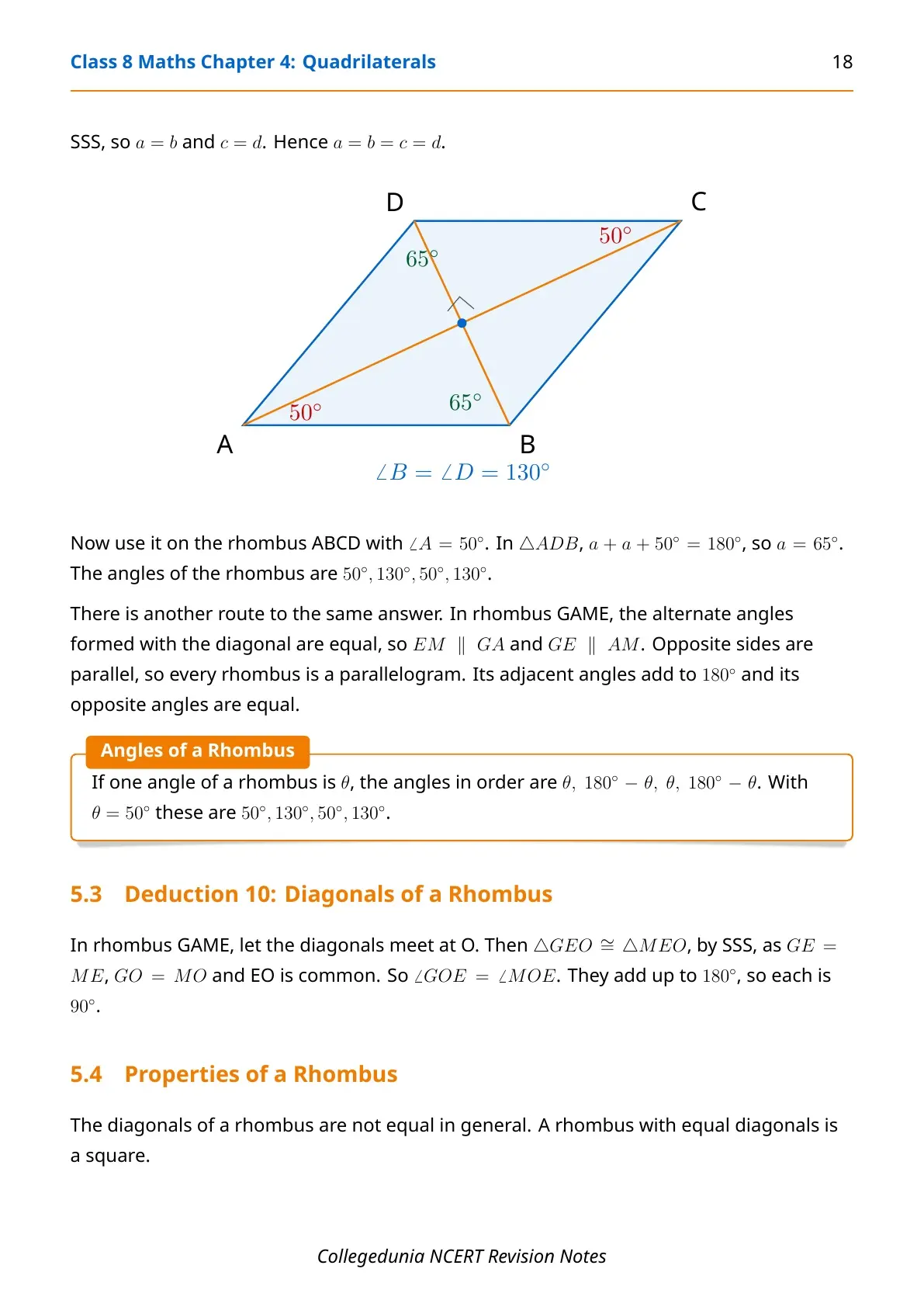
A rhombus is a quadrilateral with four equal sides. To draw one with an angle of 50°, make AB = AD, then cut arcs of the same radius from B and D to find C. In triangle ADB, the base angles are equal, so each is (180° − 50°)/2 = 65°, and the rhombus has angles 50°, 130°, 50° and 130°.
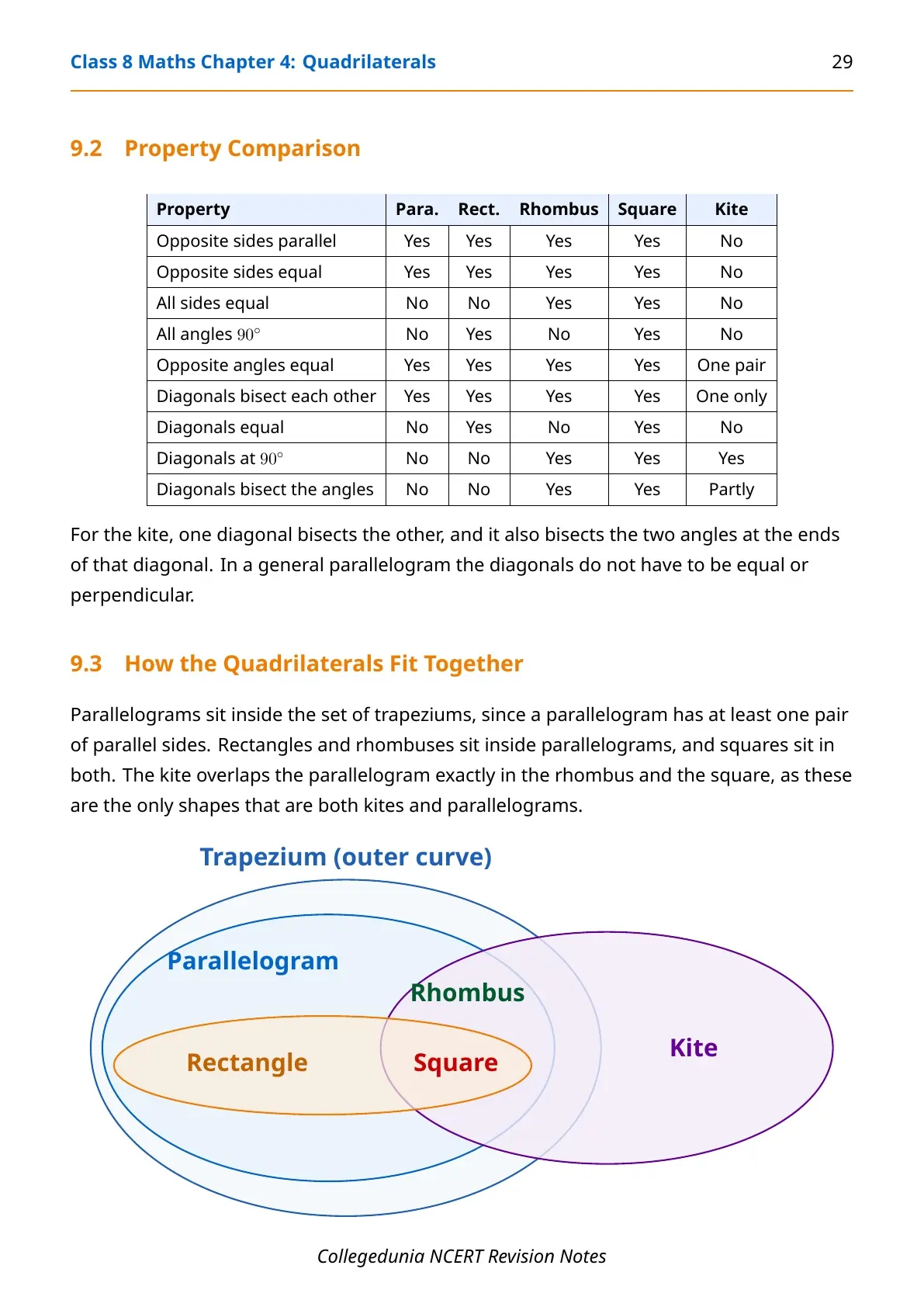
The alternate angles formed by a diagonal are equal, so the opposite sides are parallel. Every rhombus is therefore a parallelogram, and all parallelogram properties hold for it as well. Its own properties follow from the congruent triangles on either side of the diagonals.
| Property | Rectangle | Rhombus | Square |
|---|---|---|---|
| All sides equal | No | Yes | Yes |
| All angles 90° | Yes | No | Yes |
| Diagonals equal | Yes | No | Yes |
| Diagonals meet at 90° | No | Yes | Yes |
| Diagonals bisect the angles | No | Yes | Yes |
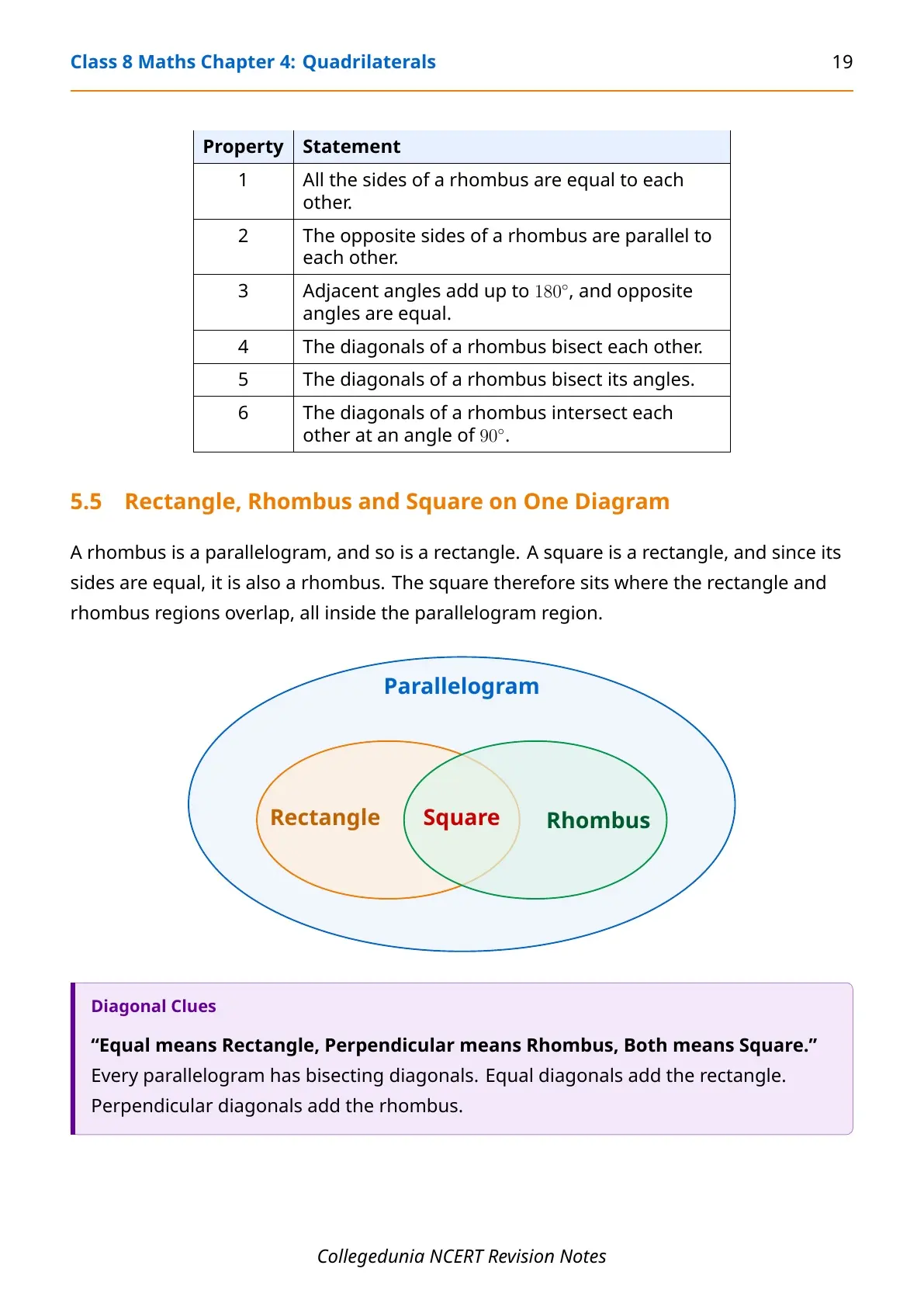
A rhombus with equal diagonals is a square. This is why the Venn diagram in the chapter places the square where the rectangle and the rhombus overlap, with both sitting inside the parallelogram.
Kite, Trapezium and Isosceles Trapezium
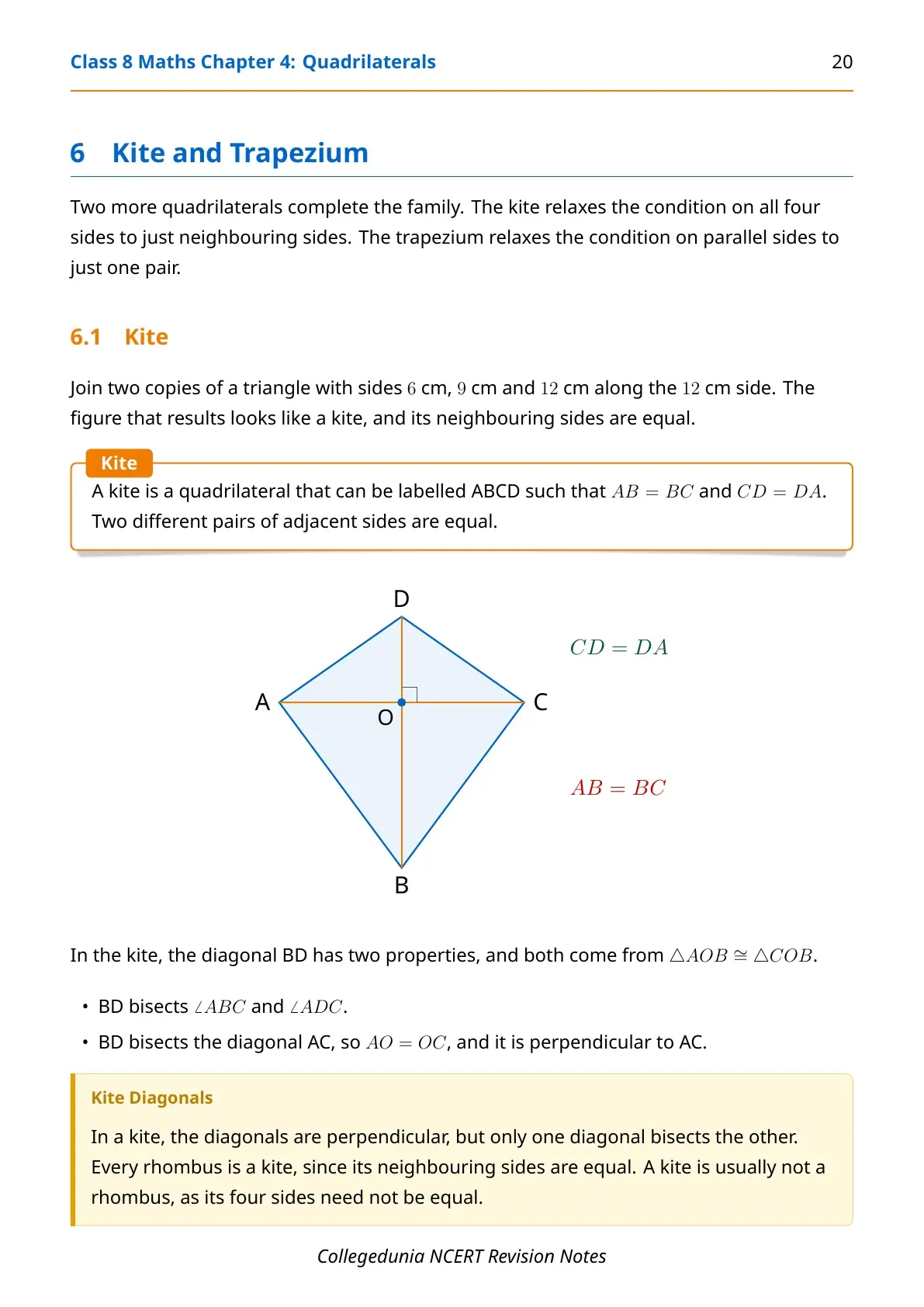
A kite is a quadrilateral that can be labelled ABCD with AB = BC and CD = DA, so two different pairs of neighbouring sides are equal. In a kite, the diagonal BD bisects the angles at B and D, and it cuts the other diagonal AC at its midpoint at a right angle. Triangle AOB is congruent to triangle COB.
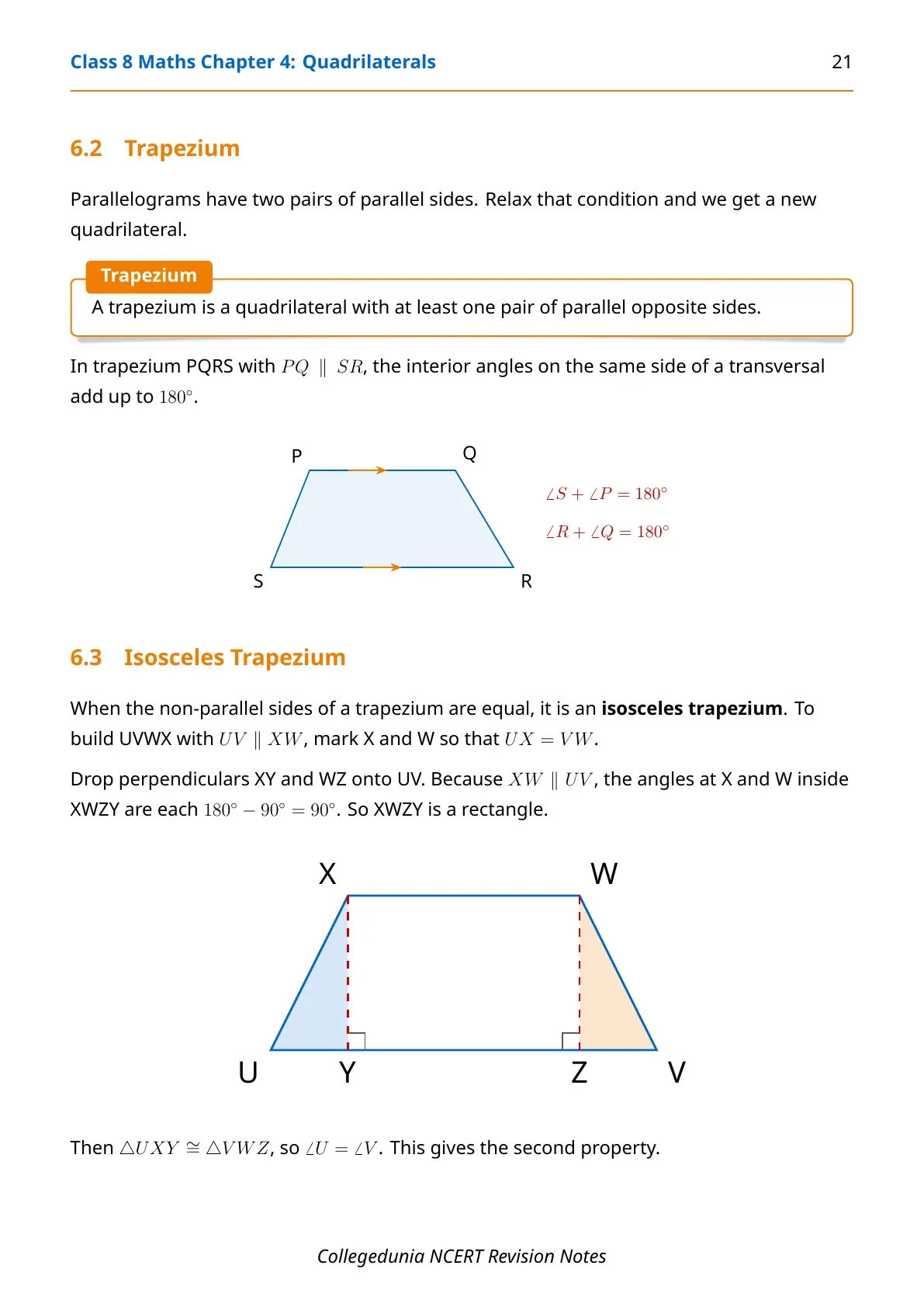
A trapezium is a quadrilateral with at least one pair of parallel opposite sides. If PQ is parallel to SR, then ∠S + ∠P = 180° and ∠R + ∠Q = 180°. When the non-parallel sides are equal it is an isosceles trapezium, and the angles opposite the equal sides are equal.
That last fact needs a small construction. Drop perpendiculars XY and WZ from the upper base onto the lower base. XWZY is a rectangle, and triangles UXY and VWZ are congruent, so ∠U = ∠V.
Activities: Geoboard, Triangles and Paper Folding
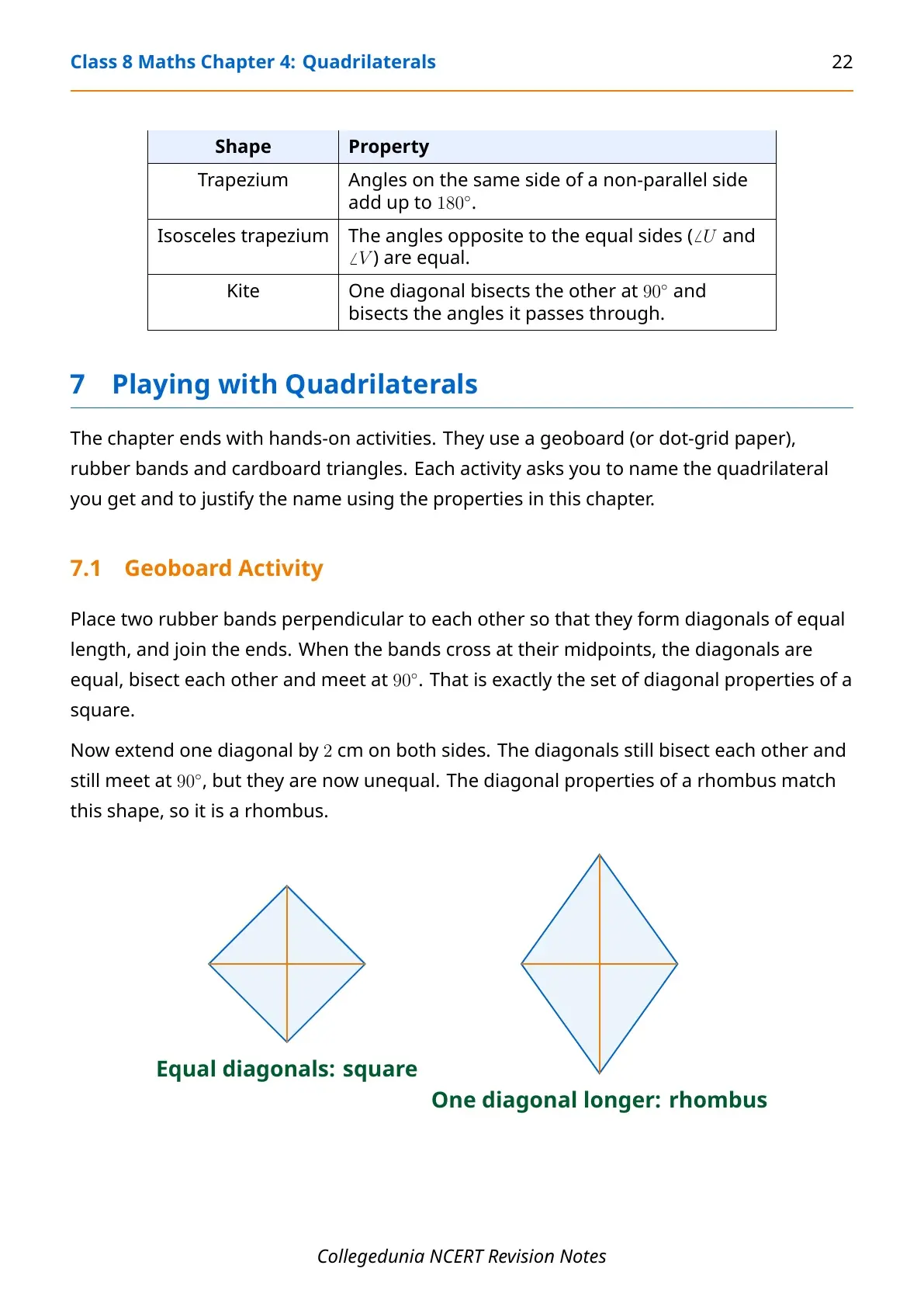
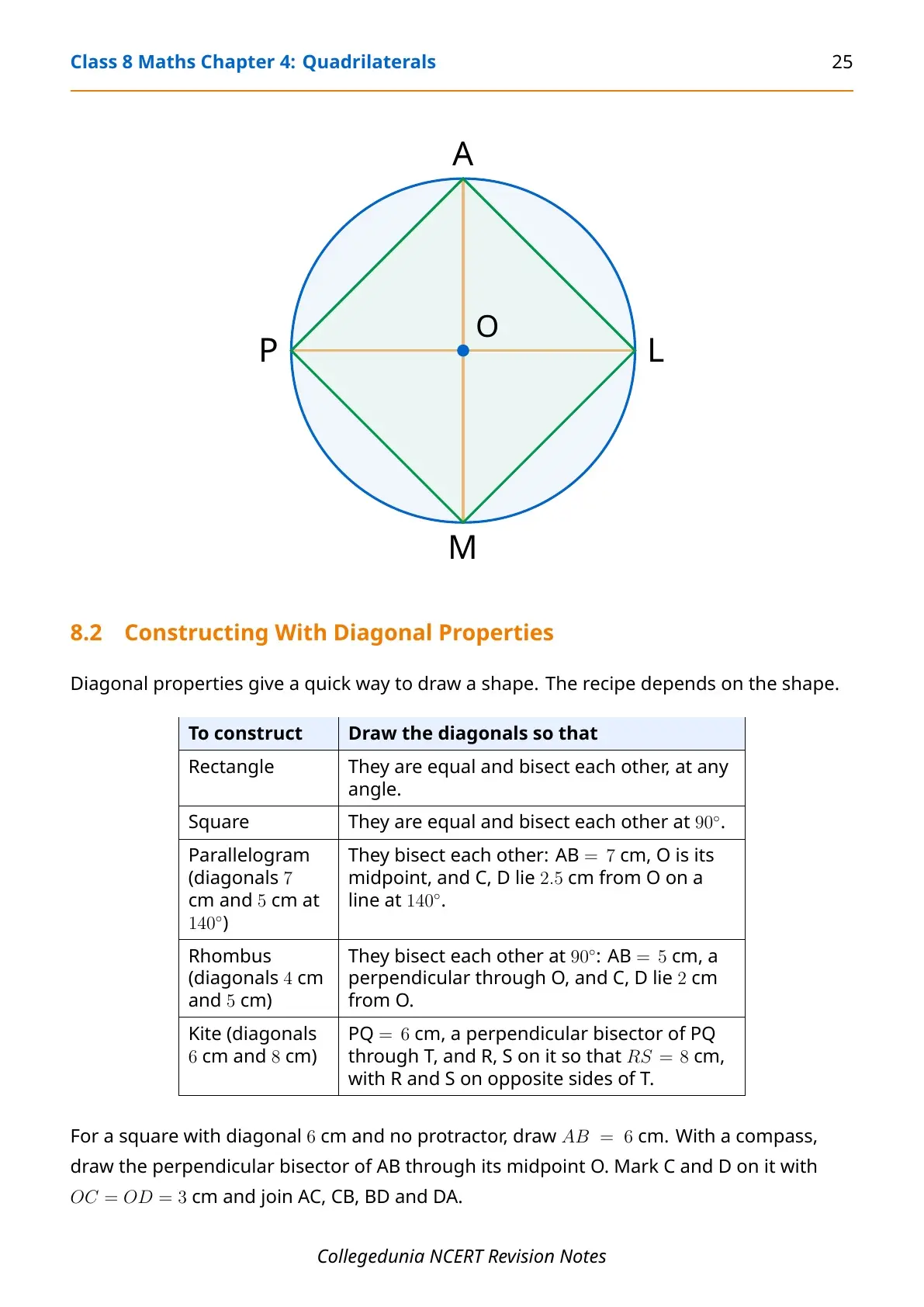
The last sections ask you to name the quadrilateral you get and justify the name. Two perpendicular rubber bands of equal length crossing at their midpoints give a square. Stretch one diagonal by 2 cm on both sides and the diagonals still bisect each other at 90° but are no longer equal, which gives a rhombus.
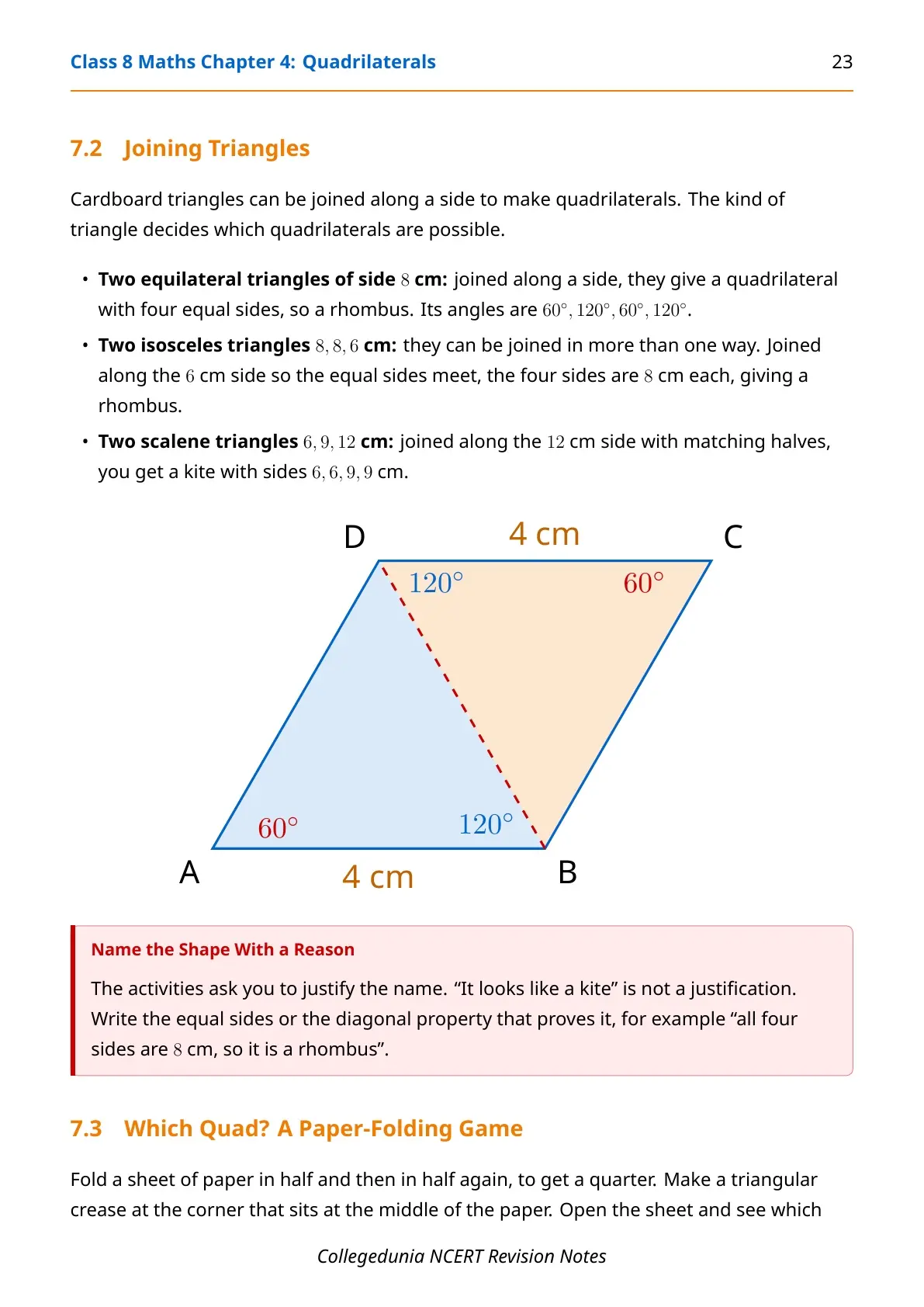
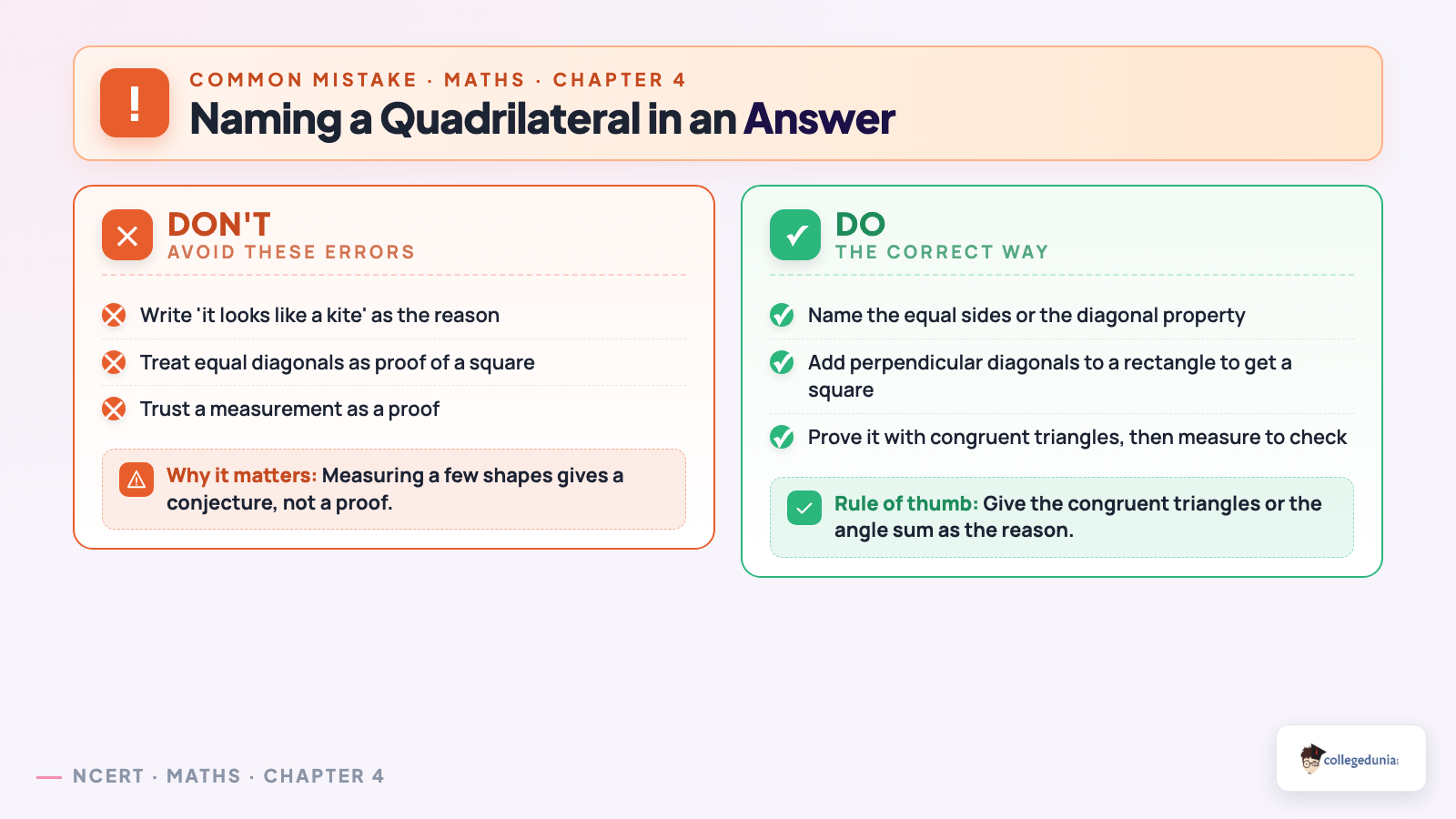
Two cardboard triangles joined along a side also give quadrilaterals. Two equilateral triangles of side 8 cm make a rhombus with angles 60°, 120°, 60° and 120°. Two copies of a 6 cm, 9 cm, 12 cm triangle joined along the 12 cm side make a kite. A reason such as "all four sides are equal" is what earns the marks, not "it looks like a kite".
Worked Answers to Figure it Out
The notes PDF works the chapter's exercise questions with the reasoning shown. These are the types to practise first.
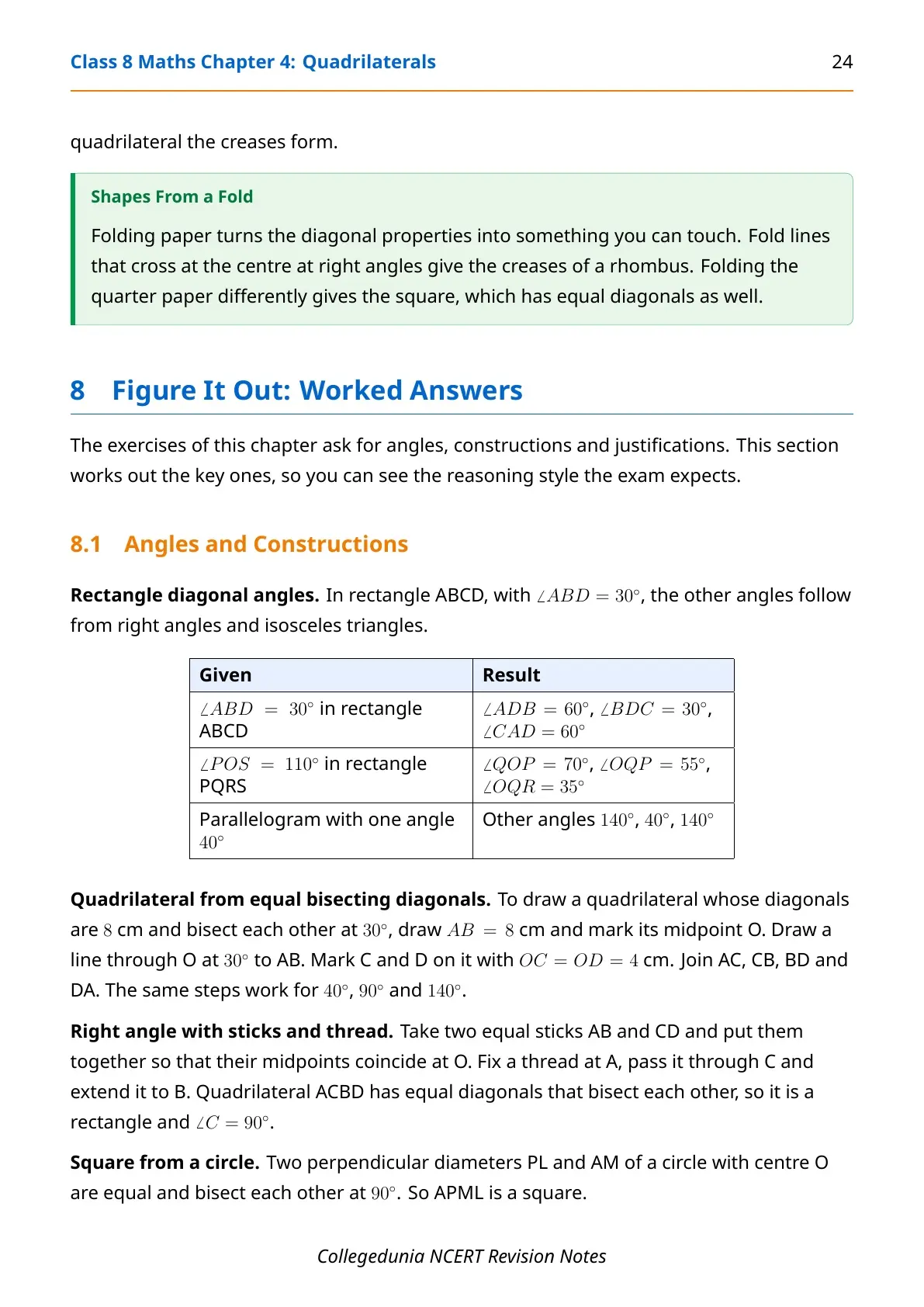
- Finding angles: in a rectangle with ∠ABD = 30°, the other angles are 60°, 30° and 60°. In a trapezium PQRS with ∠P = 135° and PQ parallel to SR, ∠S = 45°.
- Constructing: for diagonals 7 cm and 5 cm meeting at 140°, draw the 7 cm diagonal, mark its midpoint, and put the 5 cm diagonal through that point at 140°.
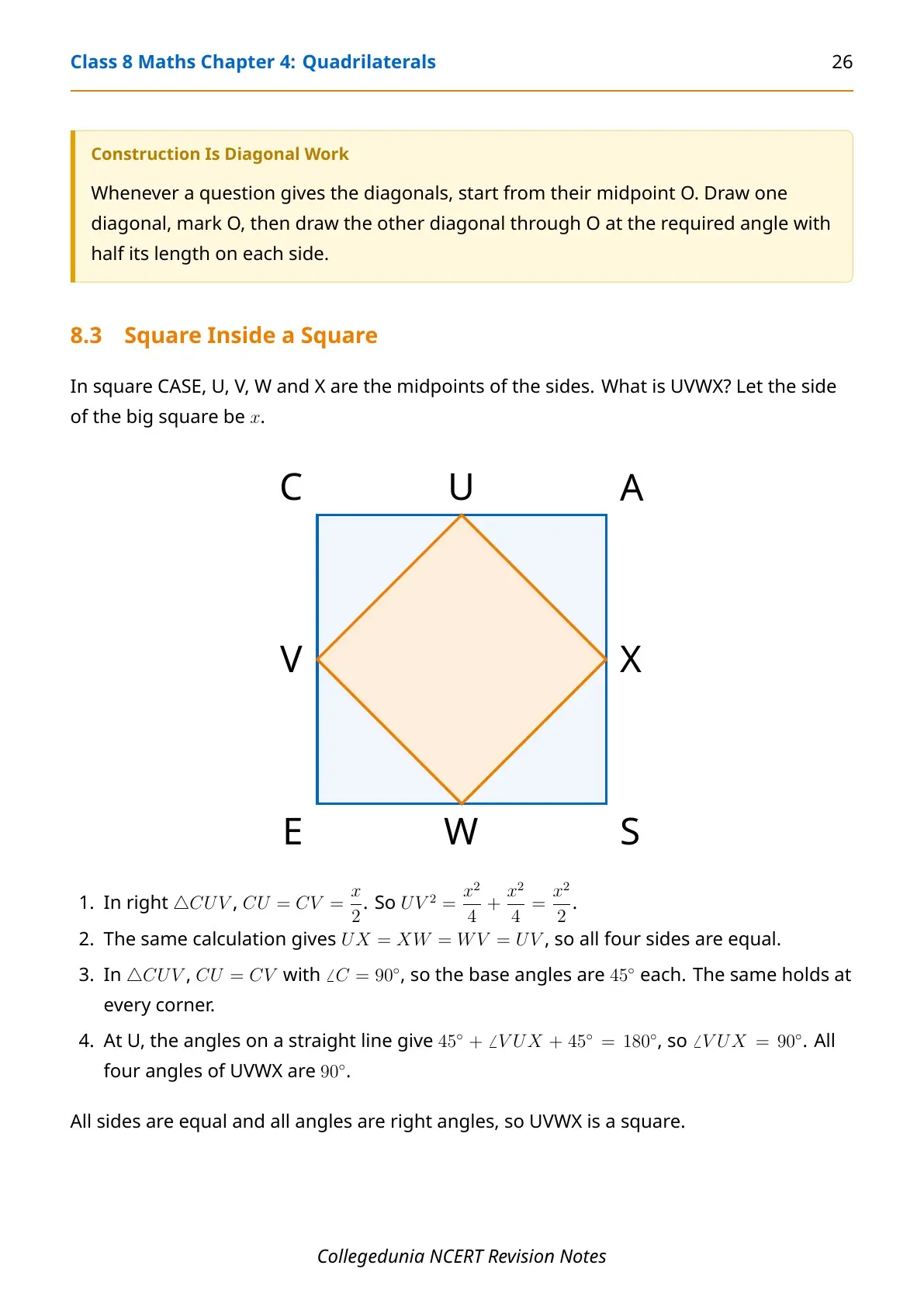
- Square inside a square: joining the midpoints of the sides of square CASE gives a square UVWX with each side equal to x/√2.
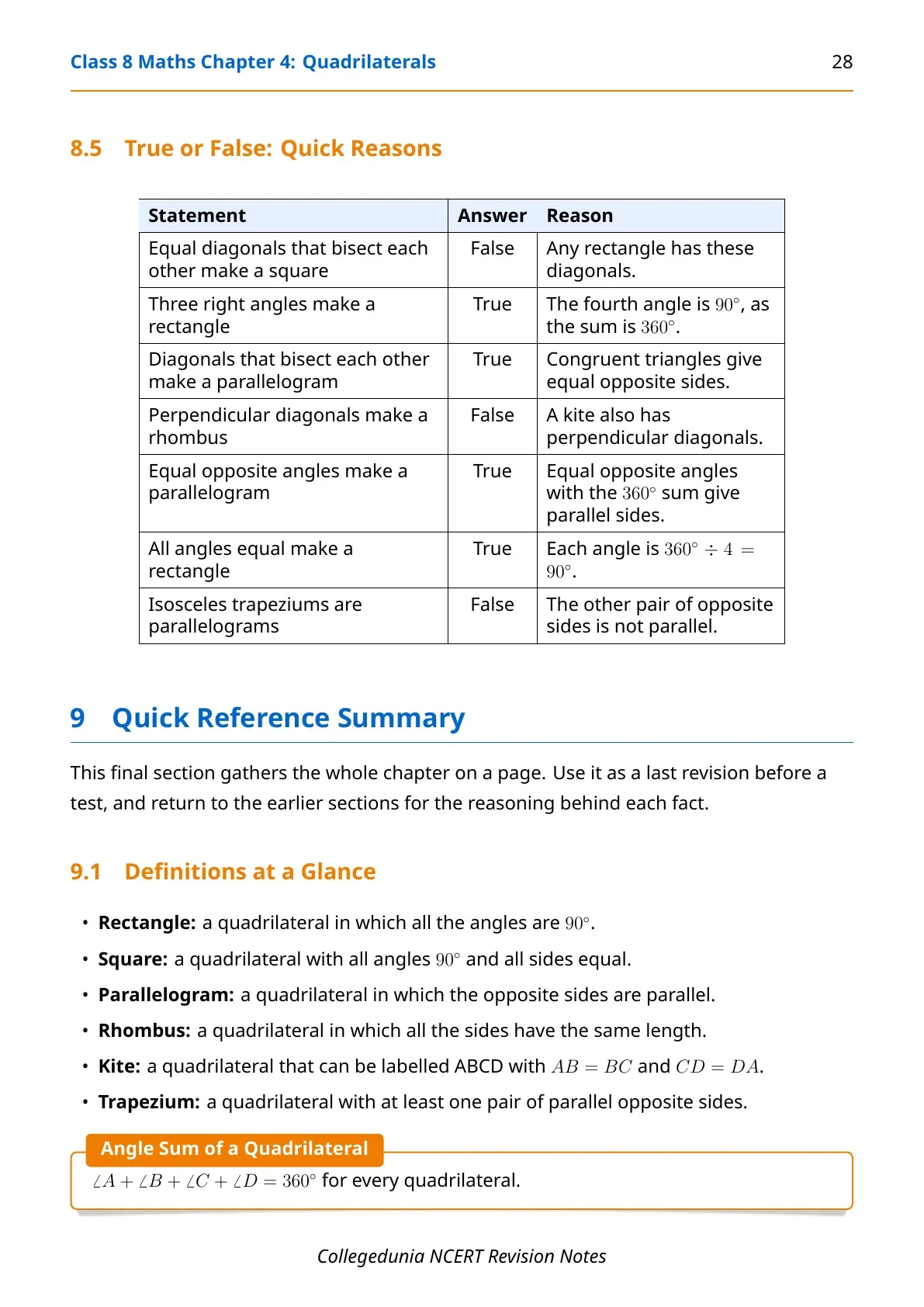
- True or false: a quadrilateral whose diagonals are perpendicular need not be a rhombus, because a kite also has perpendicular diagonals.
Quadrilaterals Properties at a Glance
This is the set worth keeping on one revision card.
| Quadrilateral | Definition | Diagonals |
|---|---|---|
| Rectangle | All angles 90° | Equal, bisect each other |
| Square | All angles 90°, all sides equal | Equal, bisect each other at 90° |
| Parallelogram | Opposite sides parallel | Bisect each other |
| Rhombus | All sides equal | Bisect each other at 90°, bisect the angles |
| Kite | AB = BC and CD = DA | Perpendicular, one bisects the other |
| Trapezium | At least one pair of parallel sides | No fixed rule in the chapter |
How to Use the Quadrilaterals Notes Page
Read the rectangle section first, because the squares, parallelograms and rhombuses all reuse its congruence arguments. Then redraw each figure yourself and write the triangle pair before reading the reason.
Keep the activity and exercise sections for last. Try each question on paper before reading the worked answer, and use the comparison table at the end of the PDF to check which properties you have missed.
More Class 8 Maths Part 1 Resources for Quadrilaterals
These pages are live. The solutions, handwritten notes and book PDF for Quadrilaterals sit alongside this page.
Quadrilaterals Class 8 Maths Notes FAQs
Ques. Where can I download Quadrilaterals Class 8 Maths Notes PDF?
Ans. You can download the Quadrilaterals Class 8 Maths Notes PDF from the card on this page. It is free and needs no login.
Ques. Do these notes follow the 2026-27 NCERT?
Ans. Yes. They follow Chapter 4 of the Ganita Prakash Part 1 textbook for Class 8 in the 2026-27 session.
Ques. How many pages is the Quadrilaterals notes PDF?
Ans. The PDF runs 30 pages. It covers rectangles, squares, parallelograms, rhombuses, kites, trapeziums, the chapter activities and worked answers to Figure it Out.
Ques. What is the sum of the angles of a quadrilateral?
Ans. It is 360°. A diagonal splits any quadrilateral into two triangles, and each triangle has an angle sum of 180°.
Ques. What are the properties of a rectangle in Class 8?
Ans. All angles are 90°, opposite sides are equal and parallel, and the diagonals are equal and bisect each other.
Ques. How is a square different from a rectangle?
Ans. A square is a rectangle with all four sides equal. Its diagonals also meet at 90° and bisect the angles of the square, which a general rectangle's diagonals do not.
Ques. What are the properties of a parallelogram?
Ans. Opposite sides are equal and parallel, adjacent angles add up to 180°, opposite angles are equal, and the diagonals bisect each other.
Ques. What are the properties of a rhombus?
Ans. All sides are equal and opposite sides are parallel. The diagonals bisect each other at 90° and bisect the angles of the rhombus.
Ques. What is the difference between a kite and a rhombus?
Ans. A kite has two different pairs of equal neighbouring sides, while a rhombus has all four sides equal. Every rhombus is a kite, but a kite is usually not a rhombus.
Ques. What is an isosceles trapezium?
Ans. It is a trapezium whose non-parallel sides are equal. The angles opposite the equal sides are also equal.



Comments