Physics Strategist, JEE/NEET | Updated on - Jul 23, 2026
The NCERT Solutions for Class 10 Science Chapter 3 Metals and Non-metals solve all 31 questions (15 in-text and 16 exercise) for the 2026-27 CBSE syllabus, covering physical and chemical properties, the reactivity series, ionic compounds, metallurgy and corrosion.
All 31 NCERT questions solved with balanced equations and an Expert Solution per question.
Full coverage of metals, non-metals, the reactivity series, ionic compounds, metallurgy, corrosion and alloys for the 2026-27 CBSE syllabus.
Solved by Collegedunia Science Experts
These NCERT Solutions for Class 10 Science Chapter 3 Metals and Non-metals are checked against the latest 2026-27 NCERT textbook and refined against the last five years of CBSE board papers. Each of the 31 questions gives a Check Solution for the clean board answer and an Expert Solution for extra marks.
What the NCERT Solutions for Class 10 Science Chapter 3 Metals and Non-metals Cover
This chapter answers how metals and non-metals differ and what happens when they react with oxygen, water and acids. These solutions follow the NCERT order, covering properties, the reactivity series, ionic bonding, metallurgy and corrosion, while filling the gaps students hit in the exam.
Metals and Non-metals Class 10 Science Video Solutions
Rust, non-metal oxides, aqua regia, copper vs steel
Reason + example
2 to 5
Physical and Chemical Properties of Metals and Non-metals
Metals are mostly shiny, malleable, ductile and good conductors; non-metals are dull, brittle and poor conductors, with a few exceptions the board loves to test.
Property
Metals
Non-metals
Appearance
Shiny (lustrous)
Dull (except iodine, diamond)
Malleable / ductile
Yes (gold, silver, copper)
No, they are brittle
Conductivity
Good (except lead, mercury)
Poor (except graphite)
Reaction with oxygen
Form basic oxides
Form acidic or neutral oxides
Reaction with acids
Reactive metals give hydrogen
Do not react to give hydrogen
Chemically, metals lose electrons to form positive ions, while non-metals gain electrons. This is why metal oxides are basic and most non-metal oxides are acidic. Memorise the four exceptions: mercury (liquid metal), sodium and potassium (knife-soft), lead and mercury (poor conductors), and graphite (the non-metal that conducts).
Reactivity Series of Metals: Reactions with Water, Air and Acids
The reactivity series lists metals from most reactive (top) to least reactive (bottom). It predicts reactions with oxygen, water and acids, and which metal displaces another from its salt solution.
Order (high to low): K, Na, Ca, Mg, Al, Zn, Fe, Pb, (H), Cu, Hg, Ag, Au.
With water: K and Na react with cold water, Ca and Mg slower, and iron only with steam: 3Fe + 4H2O → Fe3O4 + 4H2.
With dilute acids: metals above hydrogen displace it, e.g. Zn + 2HCl → ZnCl2 + H2; Cu, Ag, Au do not.
Displacement: a more reactive metal pushes out a less reactive one, e.g. Fe + CuSO4 → FeSO4 + Cu. Turn every "X displaces Y" clue into X > Y to build the order.
Ionic Compounds: How Metals and Non-metals Combine by Electron Transfer
When a metal reacts with a non-metal, the metal gives away its outer electrons and the non-metal takes them. The oppositely charged ions stick together to form an ionic compound.
Sodium oxide: two Na atoms each give one electron to oxygen, forming Na+ and O2- in Na2O. Magnesium gives two electrons to oxygen, forming MgO.
Ionic compounds are hard solids with high melting points, and conduct electricity when molten or dissolved in water.
Metallurgy: Minerals, Ores, Extraction and Refining of Metals
Most metals occur as compounds. Getting a pure metal from its ore is called metallurgy, and the steps depend on the metal's place in the reactivity series.
Term or step
Meaning
Mineral
Any natural substance in which a metal occurs.
Ore
A mineral from which a metal is extracted profitably.
Gangue
Rocky impurities mixed with the ore, removed first.
Reduction
Heating the oxide with a reducing agent (carbon) to get the metal.
Electrolytic refining
Purifying by electrolysis: impure metal anode, pure metal cathode.
Low (gold, silver, copper): often occur in the free state.
Middle (iron, zinc, lead): extracted by reduction of oxides with carbon.
Top (sodium, magnesium, aluminium): extracted by electrolysis of molten salts.
Carbonate and sulphide ores are first changed to oxides (calcination or roasting), as oxides are easier to reduce.
Corrosion and Alloys: Protecting Metals from Damage
Corrosion is the slow eating away of a metal by air and moisture. Rusting of iron is the most common example.
Rusting needs both air (oxygen) and moisture (water); remove either and the iron is safe.
Prevention: painting, oiling, greasing, galvanisation (zinc coating), and alloying.
An alloy is a homogeneous mixture of a metal with other metals or non-metals, made for better strength or rust resistance.
Common Mistakes Students Make in the Metals and Non-metals Chapter
The repeat-offender mistakes in this chapter's board answers:
Iron and steam: iron gives Fe3O4 (not Fe2O3), and only with steam, never cold water.
Reversing displacement: copper displaces silver, but silver cannot displace copper.
Swapping malleable and ductile: malleable = sheets, ductile = wires.
Mineral, ore and gangue: every ore is a mineral, but not every mineral is an ore; gangue is the impurity removed.
Aluminium resists corrosion because a thin oxide layer protects it, though it is itself reactive.
How to Use the Metals and Non-metals NCERT Solutions PDF for Board Prep
Use two passes: first read the properties, exception metals, reactivity series and ionic bonding, drawing the reactivity ladder once. Then work the equations and metallurgy definitions by hand before checking them here, naming the gas or precipitate each time. In the board paper this chapter shows up as property comparisons, displacement, balanced equations and reason-based questions.
Other Resources for Class 10 Science Chapter 3 Metals and Non-metals
Pair this NCERT Solutions PDF with the matching resources for Class 10 Science Chapter 3, linked below.
Resource
What it covers
Open
NCERT Solutions
Step-by-step answers to all 31 questions, with an Expert Solution for each.
68% of Class 10 students said the reactivity series and the metallurgy steps were the trickiest part of this chapter. 3 out of 5 students told us they lost marks by writing the wrong product for the metal and steam reaction or by mixing up displacement directions.
Toppers found that drawing the reactivity ladder once and naming the gas or precipitate in every answer added 1 to 2 marks on the longer questions, and the average student spent 3 to 4 hours on this chapter across the first read and exercise practice.
Source: 2026-27 Class 10 Science student poll. Sample of 10,400 students from CBSE schools across 15 states, conducted before the 2026 boards.
NCERT Solutions for Class 10 Science: All Chapters
Related Links: Open the NCERT Solutions for the other Class 10 Science chapters below.
All NCERT Solutions for Class 10 Science Chapter 3 Metals and Non-metals with Step-by-Step Solutions
Q 1
Give an example of a metal which (i) is a liquid at room temperature. (ii) can be easily cut with a knife. (iii) is the best conductor of heat. (iv) is a poor conductor of heat.
Concept used. Most metals are hard solids that conduct heat very
well, but a few are exceptions. A metal that is soft enough to cut
has weak metallic bonding, and the ability to conduct heat (called thermal
conductivity) is different from one metal to another. We pick the standard
NCERT example for each case.
(i) Liquid at room temperature. Mercury (Hg) is the
only metal that is a liquid at ordinary room temperature.
(ii) Easily cut with a knife. Sodium (Na) and
potassium (K) are so soft that a knife cuts them like butter.
(iii) Best conductor of heat. Silver (Ag) is the best
conductor of heat among all metals; copper comes a close second.
(iv) Poor conductor of heat. Lead (Pb) and mercury
(Hg) are poor conductors of heat compared to other metals.
Answer: (i) Mercury, (ii) Sodium (or potassium), (iii) Silver, (iv) Lead (or mercury).
RD
Rohan Deshmukh
M.Sc Chemistry, University of Delhi
Verified Expert
Why these are exceptions. Each answer here goes against the general
picture of metals, so it helps to know the reason rather than just the name.
The general rule is that metals are solid, hard and good conductors, so you
should be able to explain why each of these four does not fit that rule.
A liquid metal exists because mercury has very weak forces between its atoms,
so it cannot stay solid at room temperature; this is why thermometers and old
barometers used it. Sodium and potassium are cut easily because they are
alkali metals with only one loosely held outer electron, which makes
their metallic bonding weak and the metal soft. Silver conducts heat best
because its free electrons move through the lattice with very little
resistance, which is also why silver is the best electrical conductor.
Lead and mercury sit at the poor end of the conductivity list. Their electron
clouds carry heat less freely than silver or copper, so cooking pots are never
made of lead. Knowing the reason lets you answer a twisted version of the
question, such as “name a metal used in thermometers” (mercury) or “why is
silver not used for everyday wiring” (it is costly, so copper is used
instead).
Concept used. Both words describe how a metal changes shape when a
force is applied without breaking. They come from the way metal atoms can
slide over each other while the metallic bonding still holds them together.
Malleable: a substance is malleable if it can be beaten or
hammered into thin sheets without breaking. Gold, silver and
aluminium are highly malleable, which is why aluminium foil and gold
leaf can be made.
Ductile: a substance is ductile if it can be drawn (pulled)
into thin wires. Copper and aluminium are very ductile, which is why
they are made into electrical wires.
Both properties are typical of metals and are missing in most
non-metals, which are brittle and break when hammered.
Answer: Malleable means it can be hammered into thin sheets; ductile means it can be drawn into thin wires.
SI
Sneha Iyer
M.Sc Materials Science, IIT Bombay
Verified Expert
The atom-level picture. The reason metals are malleable and ductile
is the same in both cases, so it is worth understanding once. In a metal the
positive ions sit in a regular pattern inside a “sea” of free electrons.
When you hammer or pull the metal, layers of ions slide past one another, but
the free electrons keep flowing around them and hold the whole structure
together. So the shape changes without the metal cracking.
This is very different from an ionic or brittle solid, where pushing the
layers brings like charges next to each other; they repel and the crystal
shatters. That is why chalk, glass and most non-metals break instead of
bending. The practical pay-off is huge: malleability lets us roll steel into
car body panels and beat gold into leaf thinner than paper, while ductility
lets us pull copper into the kilometres of wire that carry electricity to your
home. Both properties are decided by the metallic bonding, so any factor that
weakens that bonding (such as impurities) reduces malleability and ductility.
Answer: Malleable = can be beaten into sheets; ductile = can be drawn into wires; both follow from sliding layers in metallic bonding.
Q 3
Why is sodium kept immersed in kerosene oil?
Concept used.Reactivity of a metal tells us how eagerly it
reacts with oxygen and water. Sodium is one of the most reactive metals, so it
reacts very fast even with the oxygen and moisture in ordinary air.
Sodium reacts so vigorously with oxygen that it catches fire if left
open in air:
4Na + O2 → 2Na2O .
It also reacts violently with water (and even with the small amount of
moisture in air), giving hydrogen gas, which can catch fire:
2Na + 2H2O → 2NaOH + H2 ↑ .
To stop this, sodium is stored under kerosene oil. Kerosene does not
react with sodium and it keeps air and moisture away from the metal
surface, so the sodium stays safe.
Answer: Sodium is so reactive that it catches fire in air and reacts violently with moisture; kerosene cuts off contact with air and water, so it is kept immersed in kerosene.
AM
Aditya Menon
M.Sc Chemistry, IIT Kanpur
Verified Expert
Reactivity-first reasoning. The cleanest way to answer any “why is
this metal stored under X” question is to first place the metal on the
reactivity series and then ask what it would react with if left open. Sodium
and potassium sit right at the top of the series, so they react with both the
oxygen and the water vapour present in ordinary air.
If a piece of sodium is left in the open, a fresh cut surface dulls almost at
once as it forms sodium oxide, and on a humid day enough heat can build up
from the reaction with moisture to set the hydrogen on fire. Kerosene is a
non-polar hydrocarbon that does not react with sodium and is also denser
handling-wise convenient, so the metal stays fully covered and air-free.
Note that potassium and lithium are stored the same way for the same reason.
This is a one-mark question that students lose marks on by writing only “it
is reactive” without naming what it reacts with (oxygen and moisture)
and why kerosene works (it keeps both away).
Answer: Sodium reacts violently with air and moisture; kerosene keeps both away, preventing fire and oxidation.
Q 4
Write equations for the reactions of (i) iron with steam (ii) calcium and potassium with water.
Concept used. Metals react with water (or steam) to give a metal
oxide or hydroxide plus hydrogen gas. How fast and how hot the reaction is
depends on the metal's position in the reactivity series: very
reactive metals (potassium) react with cold water, moderately reactive metals
(calcium) react more gently, and less reactive metals (iron) react only with
steam.
(i) Iron with steam. Iron does not react with cold water; it
reacts only with steam to give iron(II,III) oxide and hydrogen:
3Fe + 4H2O → Fe3O4 + 4H2 ↑ .
(The water here is in the form of steam.)
(ii) Calcium with water. Calcium reacts with cold water,
but less violently than potassium; the hydrogen does not catch fire:
Ca + 2H2O → Ca(OH)2 + H2 ↑ .
(ii) Potassium with water. Potassium reacts so violently with
cold water that the hydrogen produced catches fire at once:
2K + 2H2O → 2KOH + H2 ↑ (+ heat, catches fire) .
Read it off the reactivity series. The single idea behind all three
equations is position in the reactivity series, so train yourself to predict
the product before balancing. Potassium is near the top, so it tears water
apart even when cold and the reaction is fast enough to ignite the hydrogen.
Calcium is a little lower, so it still reacts with cold water but calmly,
and you actually see the calcium float as hydrogen bubbles stick to it.
Iron is well below both, so cold water has no effect and even hot water barely
reacts; only high-temperature steam pushes the reaction, and the product is
the mixed oxide Fe3O4 rather than a hydroxide. A neat balancing check for
the iron equation: 3 Fe on the left match 3 Fe in Fe3O4, and 4 H2O
supply 4 O and 8 H, which match 4 O in Fe3O4 and 8 H in 4 H2.
Getting the product right first, then balancing, stops the most common error
of writing a hydroxide for the steam reaction.
Samples of four metals A, B, C and D were taken and added to the following solutions one by one. The results obtained are: with iron(II) sulphate, A shows no reaction and B shows displacement; with copper(II) sulphate, A shows displacement; with zinc sulphate, B shows no reaction; with silver nitrate, C shows displacement; metal D shows no reaction with any of the four solutions. Use these results to answer about metals A, B, C and D. (i) Which is the most reactive metal? (ii) What would you observe if B is added to a solution of copper(II) sulphate? (iii) Arrange the metals A, B, C and D in the order of decreasing reactivity.
Concept used. A more reactive metal displaces a less
reactive metal from the solution of its salt. So if metal X pushes metal Y out
of Y's salt solution, then X is more reactive than Y. We compare the four
metals using this single rule.
Read each clue.
B displaces iron from FeSO4, so B is more reactive than
iron (and more reactive than A, which cannot).
A displaces copper from CuSO4, so A is more reactive than
copper.
C displaces only silver from AgNO3, so C is just more
reactive than silver but below copper and iron.
D displaces nothing, so D is the least reactive of all four.
(i) Most reactive. B is the only metal that displaces iron,
so B is the most reactive.
(ii) B added to CuSO4. Since B is more reactive than
copper, it displaces copper:
B + CuSO4 → BSO4 + Cu .
You would see the blue colour of the copper sulphate solution fade,
and a reddish-brown deposit of copper would settle on metal B.
(iii) Decreasing order. B (most) > A > C > D (least).
Answer: (i) B is the most reactive. (ii) Copper is displaced: blue colour fades and reddish-brown copper deposits on B. (iii) Order: B > A > C > D.
IK
Ishaan Kapoor
M.Sc Chemistry, IIT Madras
Verified Expert
Logic-table method. Treat the table as a set of yes/no clues and turn
each “displacement” into a ranking statement, then combine them. B displaces
iron, which means B sits above iron in the series; A cannot displace iron but
can displace copper, so A sits between iron and copper; C displaces only the
least reactive metal (silver), so C sits just above silver; and D displaces
nothing, so it is the lowest of the four.
Lining these up gives B above A above C above D, which is exactly the
decreasing order asked for. For part (ii), the prediction follows from B being
above copper: B kicks copper out of copper sulphate, so the tell-tale signs
are the fading of the blue colour (because Cu↑2+ ions leave the solution)
and a reddish-brown copper coating on B. A good habit on these questions is to
name the colour change, because that is what an examiner uses to check you
truly understand displacement rather than just memorising an order. The same
reasoning predicts that A would also displace copper, but C and D would not.
Answer: B > A > C > D; B displaces copper from CuSO4 (blue fades, reddish copper deposits).
Q 6
Which gas is produced when dilute hydrochloric acid is added to a reactive metal? Write the chemical reaction when iron reacts with dilute H2SO4.
Concept used. When a reactive metal reacts with a dilute acid, the
metal pushes out (displaces) the hydrogen of the acid as hydrogen
gas, and a salt is formed. The general reaction is
Metal + dilute acid → salt + hydrogen gas .
Dilute hydrochloric acid added to a reactive metal produces hydrogen
gas (H2). You can test it: it burns with a “pop” sound when a
lighted matchstick is brought near.
For iron with dilute sulphuric acid, iron forms iron(II) sulphate and
hydrogen gas is released:
Fe + H2SO4 → FeSO4 + H2 ↑ .
Check the balance: 1 Fe, 1 S, 4 O and 2 H on each side. The equation
is balanced.
Answer: Hydrogen gas is produced. Fe + H2SO4 → FeSO4 + H2.
MJ
Meera Joshi
M.Sc Chemistry, Banaras Hindu University
Verified Expert
Why iron gives the +2 salt. The reaction of metals with dilute
acids is really a displacement of hydrogen, so it is worth knowing both the
gas test and the salt produced. With dilute H2SO4, iron forms iron(II)
sulphate, FeSO4, where iron carries a +2 charge; dilute sulphuric acid
is not a strong enough oxidiser to push iron to the +3 state, so you should
never write Fe2(SO4)3 for this dilute reaction.
The hydrogen gas itself is confirmed by the pop test, in which the gas burns
explosively with oxygen in a small sample. A second point examiners check is
that very unreactive metals such as copper, silver and gold do not
react with dilute HCl or dilute H2SO4 at all, because they lie below
hydrogen in the reactivity series and so cannot displace it. So the phrase “a
reactive metal” in the question is doing real work: only metals above
hydrogen liberate H2 from dilute acids.
Answer: Hydrogen gas; Fe + H2SO4 → FeSO4 + H2 (iron forms the +2 salt).
Q 7
What would you observe when zinc is added to a solution of iron(II) sulphate? Write the chemical reaction that takes place.
Concept used. Zinc is more reactive than iron (zinc is above iron in
the reactivity series). So zinc displaces iron from iron(II)
sulphate solution. This is a displacement reaction.
Zinc displaces iron from the solution:
Zn + FeSO4 → ZnSO4 + Fe .
What you observe. The light green colour of the iron(II)
sulphate solution slowly fades (because Fe↑2+ ions are being
removed and replaced by colourless Zn↑2+ ions).
A greyish deposit of iron metal collects on the surface of the zinc.
Answer: Zinc displaces iron: Zn + FeSO4 → ZnSO4 + Fe. The green colour of the solution fades and grey iron deposits on the zinc.
AS
Arjun Saxena
M.Sc Chemistry, IIT Roorkee
Verified Expert
Spot the colour clue. Displacement questions are graded as much on the
observation as on the equation, so always state the colour change. Here zinc
sits above iron in the activity series, so zinc goes into solution as
colourless Zn↑2+ while iron comes out as the metal. As the green
Fe↑2+ ions leave the solution, the characteristic pale-green colour of
iron(II) sulphate fades towards colourless.
At the same time a dull grey layer of iron settles on the zinc piece, which is
the visible proof that the metal has been displaced. A handy way to be sure of
the direction is to ask “is the added metal higher in the series than the
metal in the salt?” If yes, displacement happens; if no (for example, copper
added to zinc sulphate), nothing happens. This single check stops students
from writing impossible reactions in which a less reactive metal displaces a
more reactive one.
Answer:Zn + FeSO4 → ZnSO4 + Fe; green colour fades, grey iron deposits on zinc.
Q 8
(i) Write the electron-dot structures for sodium, oxygen and magnesium. (ii) Show the formation of Na2O and MgO by the transfer of electrons. (iii) What are the ions present in these compounds?
Concept used. An electron-dot structure (Lewis structure)
shows only the outermost (valence) electrons of an atom as dots around its
symbol. In an ionic bond, a metal gives away its valence electrons
and a non-metal takes them, so both reach a stable, full outer shell (the
noble-gas arrangement). We use the valence electrons: Na has 1, Mg has 2 and
O has 6.
(i) Electron-dot structures (showing only valence electrons):
Sodium (Na, 1 valence electron): Na •
Magnesium (Mg, 2 valence electrons): • Mg •
Oxygen (O, 6 valence electrons): drawn as the symbol O with
six dots around it (two lone pairs and two single electrons).
(ii) Formation of Na2O. Each sodium atom loses its 1
valence electron; one oxygen atom gains 2 electrons (from two sodium
atoms):
2Na → 2Na↑+ + 2e↑-, O + 2e↑- → O↑2-,
giving Na2O, i.e. (Na↑+)2 O↑2-.
(ii) Formation of MgO. One magnesium atom loses 2
electrons and one oxygen atom gains those 2 electrons:
Mg → Mg↑2+ + 2e↑-, O + 2e↑- → O↑2-,
giving MgO, i.e. Mg↑2+ O↑2-.
(iii) Ions present. In Na2O: Na↑+ and O↑2-.
In MgO: Mg↑2+ and O↑2-.
Answer: Na loses 1 e^-, Mg loses 2 e^-, O gains 2 e^-. Na2O contains Na↑+ and O↑2-; MgO contains Mg↑2+ and O↑2-.
NR
Nandini Rao
Ph.D Inorganic Chemistry, IISc Bangalore
Verified Expert
Octet-driven thinking. Every ionic-formation question is really about
each atom reaching a stable octet, so reason from electron count rather than
memorising formulas. Sodium has the configuration 2, 8, 1, so losing one
electron leaves the stable 2, 8 of neon and gives Na↑+. Magnesium is 2,
8, 2, so it loses two electrons to reach the same 2, 8 and becomes
Mg↑2+. Oxygen is 2, 6 and needs two more electrons to reach the 2, 8
of neon, so it becomes O↑2-.
Now the formula is just charge balancing. One oxide ion carries -2, so it
needs +2 of metal charge to neutralise it. Two sodium ions (2 × +1)
do that, giving Na2O; a single magnesium ion (+2) does it alone, giving
MgO. This is why the two oxides have different formulas even though both
contain oxygen. A useful self-check on the dot diagrams is that after transfer
every ion should show a complete octet of eight dots, and the total positive
charge must equal the total negative charge. Doing it this way means you can
write the formula of any metal oxide without rote learning.
Answer:Na↑+, Mg↑2+ and O↑2- ions; charge balance gives Na2O and MgO.
Q 9
Why do ionic compounds have high melting points?
Concept used. An ionic compound is made of positive and
negative ions held together by strong electrostatic forces of
attraction (also called ionic bonds). These forces act in all directions and
join the ions into a giant, tightly packed crystal lattice.
In the solid, every ion is surrounded by ions of opposite charge, and
the attraction between them is very strong.
To melt the solid, this strong attraction between the oppositely
charged ions has to be broken so the ions can move freely.
Breaking so many strong bonds needs a large amount of heat energy.
That is why ionic compounds melt only at high temperatures and so have
high melting (and boiling) points.
Answer: Because the oppositely charged ions are held by strong electrostatic forces in a giant lattice; a large amount of heat energy is needed to break these forces, so the melting point is high.
VB
Vikram Bhatt
M.Sc Physical Chemistry, University of Pune
Verified Expert
Lattice-energy angle. The high melting point of an ionic solid comes
straight from the strength of its lattice, so it helps to connect the idea to
“lattice energy”. Lattice energy is the energy released when gaseous ions
come together to form one mole of the solid, and it is large because the
+ and - ions attract strongly and pack closely. To melt the solid
you must supply enough thermal energy to overcome a big chunk of that lattice
energy, which only happens at a high temperature.
Two factors make the lattice energy, and therefore the melting point, even
higher: larger ionic charges and smaller ionic sizes. That is why magnesium
oxide (Mg↑2+, O↑2-, both doubly charged) melts far higher
(around 2800 ^°C) than sodium chloride (singly charged ions). The same
strong lattice also explains why ionic compounds are hard and brittle, and why
they conduct electricity only when molten or dissolved, since the ions become
free to move only then. So one idea, strong electrostatic attraction in a
lattice, explains a whole family of properties.
Answer: Strong electrostatic forces in the ionic lattice need a large amount of heat to break, so melting points are high (higher still for small, highly charged ions).
Q 10
Define the following terms. (i) Mineral (ii) Ore (iii) Gangue
Concept used. These three words describe the natural sources of
metals and the unwanted material that comes with them. They follow a clear
ladder: all ores are minerals, but not all minerals are ores.
(i) Mineral. The elements or compounds that occur naturally
in the earth's crust are called minerals.
(ii) Ore. A mineral from which a metal can be extracted
profitably (in a cost-effective way) is called an ore. So an
ore is a mineral that is rich enough in the metal to be worth mining.
(iii) Gangue. The unwanted earthy or rocky impurities (sand,
clay, soil) present along with the ore are called gangue.
These are removed before the metal is extracted.
Answer: Mineral = naturally occurring element/compound in the crust; ore = a mineral from which a metal can be profitably extracted; gangue = the unwanted impurities present with the ore.
PR
Pooja Reddy
M.Sc Geology, Osmania University
Verified Expert
Think of it as a sorting funnel. The three terms make sense if you
picture how a metal travels from the ground to a factory. At the widest part
of the funnel are minerals, the huge variety of naturally occurring compounds
in the crust. Most of them are too poor in metal or too hard to process to be
useful, so only a fraction make it through the funnel.
The ones that contain enough metal to extract at a profit are the ores; the
economics matter, because a low-grade mineral may technically contain a metal
yet cost more to process than the metal is worth. When an ore is dug up it
never comes clean: it is mixed with sand, clay and rocky matter called gangue,
which has to be separated out (by methods such as washing or magnetic
separation) before the actual extraction begins. So the chain is mineral
→ ore (rich enough to be worth it) → remove gangue → extract metal.
Keeping this order in mind makes the rest of the metallurgy section much easier
to follow.
Answer: Mineral (any natural compound) ⊃ ore (profitable to extract); gangue is the rocky impurity removed before extraction.
Q 11
Name two metals which are found in nature in the free state.
Concept used. A metal is found in the free state (also
called the native state) when it occurs as the pure metal, not combined with
other elements. Only the least reactive metals, which sit at the bottom of the
reactivity series, are found this way, because they do not react with
air, water or other substances.
Very unreactive metals do not combine with oxygen or other elements,
so they stay as the pure metal in nature.
The common examples are gold (Au) and silver (Ag); platinum
and copper are also sometimes found in the free state.
Answer: Gold and silver (also platinum and, sometimes, copper) are found in nature in the free state.
KS
Karthik Subramanian
M.Sc Chemistry, IIT Madras
Verified Expert
Tie it to the reactivity series. The simplest way to answer “which
metals are found free” is to look at the very bottom of the reactivity
series, because reactivity and the way a metal occurs in nature are directly
linked. Metals near the bottom, such as gold, silver and platinum, are so
unreactive that they do not combine with oxygen, water or sulphur over
geological time, and so they survive as shiny lumps of pure metal, which is
exactly why ancient civilisations could find and use gold without any
chemistry.
Metals higher up the series are far more reactive and are always locked away
as oxides, sulphides or carbonates; you will never find pure sodium or
magnesium lying in the ground. Copper is an interesting in-between case:
mostly it occurs as compounds, but small amounts of native copper are found
because it is only moderately reactive. So the rule to remember is simple, the
lower a metal sits in the reactivity series, the more likely it is to be found
in the free state.
Answer: Gold and silver (least reactive metals) are found in the free state.
Q 12
What chemical process is used for obtaining a metal from its oxide?
Concept used.Reduction is the chemical process in which a
metal oxide loses its oxygen and gives the free metal. So obtaining a metal
from its oxide is done by reduction, using a suitable reducing agent.
For moderately reactive metals (like zinc, iron, lead), the
oxide is heated with a reducing agent such as carbon (coke):
ZnO + C → Zn + CO ↑ .
Carbon takes away the oxygen, leaving the metal.
For highly reactive metals (like sodium, magnesium,
aluminium), carbon cannot reduce their oxides, so the molten oxide (or
chloride) is reduced by passing electricity through it
(electrolytic reduction). For example, aluminium is obtained
by the electrolysis of molten aluminium oxide.
Answer: The metal is obtained by reduction of its oxide: heating with a reducing agent like carbon for moderately reactive metals, and electrolytic reduction for highly reactive metals.
AP
Ananya Pillai
M.Tech Metallurgical Engineering, IIT Kharagpur
Verified Expert
Match the method to the reactivity. The key to extraction questions is
that the choice of reducing method depends on where the metal sits in the
reactivity series, so always ask “how reactive is this metal” first. For
metals in the middle of the series, the oxide is cheap to reduce by heating
with carbon, which grabs the oxygen and leaves the metal; this is how iron is
made in a blast furnace and how zinc is obtained from zinc oxide.
For metals at the top of the series, carbon is not a strong enough reducing
agent, because these metals hold on to oxygen too tightly. Instead the molten
oxide or chloride is reduced electrolytically: the metal ions pick up
electrons at the cathode and are deposited as the pure metal. Aluminium,
sodium, calcium and magnesium are all extracted this way. So the single idea
“reduction of the oxide” splits into two practical routes, carbon reduction
for moderately reactive metals and electrolytic reduction for highly reactive
ones, and naming the right route earns full marks.
Answer: Reduction of the oxide: carbon (coke) reduction for moderately reactive metals, electrolytic reduction for highly reactive metals.
Q 13
Metallic oxides of zinc, magnesium and copper were heated with the metals zinc, magnesium and copper (each oxide with each metal). In which cases will you find displacement reactions taking place?
Concept used. A displacement reaction happens only when a
more reactive metal is heated with the oxide of a less reactive metal; the
more reactive metal takes the oxygen and frees the less reactive metal. The
reactivity order here is magnesium > zinc > copper.
Magnesium with zinc oxide and with copper oxide. Magnesium is
more reactive than both zinc and copper, so it displaces them:
ZnO + Mg → MgO + Zn, CuO + Mg → MgO + Cu .
Zinc with copper oxide. Zinc is more reactive than copper, so
it displaces copper:
CuO + Zn → ZnO + Cu .
No reaction in the other cases. Copper cannot displace zinc or
magnesium (it is least reactive), and zinc cannot displace magnesium.
A metal also does not react with its own oxide.
Answer: Displacement happens in three cases: ZnO + Mg, CuO + Mg and CuO + Zn (a more reactive metal displaces a less reactive one). All other combinations show no reaction.
DA
Devansh Agarwal
M.Sc Chemistry, IIT Delhi
Verified Expert
Above-or-below check. This grid question is fast once you fix the
order magnesium > zinc > copper and apply one rule: a metal displaces
another from its oxide only if it is more reactive. Run through each pairing
asking “is the added metal above the oxide's metal in the series?” If yes,
write the displacement; if no, write no reaction.
Magnesium is at the top, so it displaces both zinc and copper from their
oxides, giving two reactions. Zinc is in the middle, so it displaces only
copper (which is below it) but cannot touch magnesium oxide. Copper is at the
bottom, so it displaces nothing. A metal never reacts with its own oxide, which
removes the three diagonal cells at once. This leaves exactly three
displacement reactions, the same three NCERT expects. The grid habit is worth
keeping because the board often dresses the same idea up with different metals,
and the method does not change.
Answer: Three displacements: ZnO + Mg, CuO + Mg, CuO + Zn; everything else is no reaction.
Q 14
Which metals do not corrode easily?
Concept used.Corrosion is the slow eating away of a metal
by the action of air, moisture and chemicals around it (for example, the
rusting of iron). A metal corrodes easily only if it is reactive, so the least
reactive metals barely corrode at all.
The metals at the bottom of the reactivity series are very unreactive,
so they do not react with air or moisture.
Therefore gold (Au), silver (Ag) and platinum (Pt) do
not corrode easily; they keep their shine for years. This is one
reason they are used for jewellery.
Answer: The least reactive metals, gold, silver and platinum, do not corrode easily.
RM
Riya Malhotra
M.Sc Chemistry, University of Calcutta
Verified Expert
Noble metals resist corrosion. The metals that resist corrosion are
exactly the noble metals at the bottom of the reactivity series, so this is one
more property that follows from reactivity. Gold, silver and platinum hardly
react with oxygen, water or most acids, so the surface stays metallic and
shiny instead of turning into an oxide or sulphide layer; this is why they are
prized for ornaments, coins and high-quality electrical contacts.
There is one subtlety to note: silver does slowly tarnish, forming a thin
black coat of silver sulphide when it meets traces of sulphur compounds in
air, but this is surface tarnishing rather than the deep corrosion that
destroys iron. Aluminium is a different case again; it is reactive, yet it
appears not to corrode because it quickly forms a thin, tough, sticky layer of
aluminium oxide that seals the metal underneath and stops further attack. So
the honest answer to “which metals do not corrode easily” is the noble
metals, gold, silver and platinum, with aluminium protected by its own oxide
coat.
Answer: Gold, silver and platinum (the least reactive metals) do not corrode easily.
Q 15
What are alloys?
Concept used. An alloy is a homogeneous (uniform) mixture
of two or more metals, or of a metal and a non-metal. Alloys are made to
improve the properties of a metal, such as making it harder, stronger or more
resistant to corrosion.
An alloy is prepared by first melting the main metal and then
dissolving the other element(s) in it, after which the mixture is
cooled.
Examples. Steel is an alloy of iron and a small amount of
carbon (a non-metal); brass is an alloy of copper and zinc; bronze is
an alloy of copper and tin.
Alloying changes properties usefully: for example, pure iron is soft,
but adding carbon makes steel hard and strong.
Answer: An alloy is a homogeneous mixture of two or more metals, or of a metal and a non-metal (e.g. steel, brass, bronze).
HG
Harshita Goyal
M.Tech Metallurgical Engineering, IIT Kanpur
Verified Expert
Why we bother alloying. Alloys exist because pure metals are often too
soft, too reactive or too weak for real use, so understanding the purpose makes
the definition stick. Mixing in another element disturbs the regular
arrangement of atoms in the metal, which makes it harder for the layers to
slide and so makes the alloy harder and stronger than the pure metal; this is
why steel is used for tools and buildings rather than soft pure iron.
Alloying can also lower the melting point (solder, an alloy of lead and tin, is
used to join wires), improve corrosion resistance (stainless steel resists rust
because of added chromium and nickel), or change appearance (brass looks
golden). Two special points the board likes: an amalgam is an alloy in which
one of the metals is mercury, and the alloy of a metal with a non-metal, such
as iron with carbon in steel, still counts as an alloy. So an alloy is best
described as a deliberately made homogeneous mixture designed to give a metal
better properties.
Answer: An alloy is a homogeneous mixture of metals (or a metal and a non-metal), made to improve hardness, strength or corrosion resistance.
Q 16
Which of the following pairs will give displacement reactions?
(a) NaCl solution and copper metal (b) MgCl2 solution and aluminium metal (c) FeSO4 solution and silver metal (d) AgNO3 solution and copper metal.
Concept used. A displacement reaction occurs when the metal
added is more reactive than the metal present in the salt solution. So
we check, in each pair, whether the added metal is above the salt's metal in
the reactivity series.
(a) Copper added to NaCl solution: copper is far less
reactive than sodium, so no displacement.
(b) Aluminium added to MgCl2 solution: aluminium is less
reactive than magnesium, so no displacement.
(c) Silver added to FeSO4 solution: silver is less
reactive than iron, so no displacement.
(d) Copper added to AgNO3 solution: copper is more
reactive than silver, so copper displaces silver:
Cu + 2AgNO3 → Cu(NO3)2 + 2Ag .
Answer: Option (d): AgNO3 solution and copper metal (copper displaces the less reactive silver).
TS
Tanvi Shah
M.Sc Chemistry, IIT Bombay
Verified Expert
One quick scan. For an MCQ like this you do not need to balance every
equation; just place the added metal and the salt's metal on the reactivity
series and keep only the pair where the added metal is higher. In (a), (b) and
(c) the added metal (copper, aluminium, silver) is below the salt's metal
(sodium, magnesium, iron respectively), so those are ruled out instantly.
Only (d) has the added metal above the salt's metal, since copper lies above
silver, so copper pushes silver out of silver nitrate and a shiny grey deposit
of silver forms on the copper while the solution turns blue from Cu↑2+.
That blue colour and silver deposit is the classic demonstration of
displacement, and it is the same reaction used to silver-plate objects. So the
answer is (d), and the trick of scanning for “added metal higher than salt
metal” solves the whole question in seconds.
Which of the following methods is suitable for preventing an iron frying pan from rusting?
(a) Applying grease (b) Applying paint (c) Applying a coating of zinc (d) All of the above.
Concept used.Rusting of iron needs both air (oxygen) and
moisture (water). Any method that keeps air and water away from the iron
surface will prevent rusting. Greasing, painting and coating with zinc all do
this.
Grease and paint form a barrier layer that stops air and moisture from
touching the iron.
Coating with zinc (galvanisation) also keeps out air and
moisture, and even if scratched, the more reactive zinc corrodes
first and protects the iron.
However, for a frying pan specifically, grease and a thin zinc layer
are practical; in the strict NCERT MCQ all three are listed as
rust-prevention methods, so the chosen answer is (d) all of the above.
Answer: Option (d): all of the above, since grease, paint and a zinc coating each keep air and moisture away from the iron.
AV
Aakash Verma
M.Sc Chemistry, University of Delhi
Verified Expert
Barrier thinking. The cleanest way to read a rust-prevention MCQ is to
ask of each option “does it keep oxygen and moisture off the iron?” Grease
leaves an oily water-repelling film, paint dries into a sealing skin, and a
zinc coating both seals the surface and offers sacrificial protection, so all
three answer “yes”. That immediately points to option (d).
It is worth knowing why zinc is special among the three. Even if the zinc layer
gets scratched, the iron still does not rust, because zinc is more reactive
than iron and so corrodes in its place; this is called sacrificial protection
and is the principle behind galvanised sheets and the zinc blocks bolted to
ships. Grease and paint, by contrast, stop protecting the metal the moment the
film is broken. For a frying pan that is heated, a heat-stable coating matters,
but as a general rust-prevention list the NCERT answer is all of the above.
Answer: (d) All of the above; each method blocks air and moisture, and zinc also gives sacrificial protection.
Q 18
An element reacts with oxygen to give a compound with a high melting point. This compound is also soluble in water. The element is likely to be
(a) calcium (b) carbon (c) silicon (d) iron.
Concept used. A high-melting-point oxide that dissolves in water and
gives a basic solution points to a reactive metal oxide. Metals form
basic oxides; many metal oxides have high melting points (ionic), and the
oxides of very reactive metals like calcium dissolve in water to form alkalis.
Carbon and silicon are non-metals; their oxides (CO2, SiO2)
do not behave as the clue says (CO2 is a gas; SiO2 is
high-melting but insoluble in water).
Iron oxide is high-melting but is not soluble in water.
Calcium reacts with oxygen to form calcium oxide (CaO, quicklime),
which has a high melting point and dissolves in water to give calcium
hydroxide (slaked lime):
2Ca + O2 → 2CaO, CaO + H2O → Ca(OH)2 .
Answer: Option (a): calcium. Its oxide CaO has a high melting point and dissolves in water to give Ca(OH)2.
LK
Lavanya Krishnan
M.Sc Chemistry, IIT Madras
Verified Expert
Decode the three clues together. This MCQ packs three clues into one
sentence, and only calcium satisfies all of them, so test each option against
all three. The compound has a high melting point, which suggests an ionic
(metal) oxide; it is soluble in water, which narrows it to the oxides of very
reactive metals; and “element reacts with oxygen” implies the element is the
metal itself.
Carbon and silicon fail at once because they are non-metals: carbon dioxide is
a gas, and silicon dioxide, though high-melting, is insoluble in water. Iron
oxide is high-melting but insoluble, so it fails the second clue. Calcium ticks
every box: CaO is ionic and high-melting, and it reacts with water to give
the alkali Ca(OH)2, which is the slaking of lime you see on construction
sites. So the only element that fits all three clues is calcium, option (a).
Answer: (a) Calcium; CaO is high-melting and soluble, giving Ca(OH)2 in water.
Q 19
Food cans are coated with tin and not with zinc because
(a) zinc is costlier than tin. (b) zinc has a higher melting point than tin. (c) zinc is more reactive than tin. (d) zinc is less reactive than tin.
Concept used. The reactivity of a metal decides whether it is safe to
keep in contact with food. A metal that is more reactive can react with the
acids in food and contaminate it, which would be harmful. So a less reactive
metal is the safe choice for food cans.
Zinc is more reactive than tin (zinc lies above tin in the reactivity
series).
Because zinc is more reactive, it would react with the weak acids in
food and dissolve into it, making the food unsafe to eat.
Tin is less reactive, so it does not react with food, which is why food
cans are coated (tin-plated) with tin and not with zinc.
Answer: Option (c): zinc is more reactive than tin, so it would react with food; tin, being less reactive, is the safe coating.
SR
Siddharth Rao
M.Sc Chemistry, IIT Kanpur
Verified Expert
Reactivity, not cost, is the reason. The tempting wrong answer is the
cost option, but the real reason is reactivity, so reason it through. Zinc sits
above tin in the activity series, which means zinc reacts more readily with the
mild acids naturally present in many foods (citric acid in fruit, for example).
If a can were lined with zinc, those acids would slowly dissolve zinc ions into
the food, and zinc compounds in quantity are harmful, so the food would be
unsafe.
Tin is less reactive and far more resistant to these food acids, so a thin tin
coating stays put and keeps the iron of the can sealed away from both the food
and the air. That is why “tin cans” are tin-plated steel. Note the contrast
with iron buckets, which are galvanised (zinc-coated) precisely because zinc's
higher reactivity gives sacrificial protection, but that very reactivity is
unacceptable for food. So the correct answer is (c), zinc is more reactive than
tin.
Answer: (c) Zinc is more reactive than tin and would react with and contaminate food; tin is safe.
Q 20
You are given a hammer, a battery, a bulb, wires and a switch. (a) How could you use them to distinguish between samples of metals and non-metals? (b) Assess the usefulness of these tests in distinguishing between metals and non-metals.
Concept used. Two key physical properties separate metals from
non-metals: metals are malleable (can be hammered into sheets) and
metals are good conductors of electricity, while most non-metals are
brittle and are poor conductors (insulators). We use the hammer to test
malleability and the simple electric circuit to test conductivity.
(a) Hammer test (malleability). Hammer the sample. A metal
flattens into a sheet (it is malleable); a non-metal breaks into
pieces (it is brittle).
(a) Circuit test (conductivity). Connect the battery, bulb,
switch and wires into a circuit, leaving a gap. Place the sample
across the gap and close the switch. If the bulb glows, the sample
conducts electricity and is a metal; if the bulb does not glow, the
sample is a non-metal.
(b) Usefulness. These tests are generally useful and easy to
do, but they are not perfect. Some non-metals are exceptions, for
example graphite (a form of carbon) conducts electricity and would
make the bulb glow, and some metals are not very hard. So the tests
work for most samples but can mislead for these special cases; using
both tests together gives a more reliable answer.
Answer: (a) Hammer the sample (metals flatten, non-metals break) and pass current through it in a circuit (bulb glows for metals). (b) Useful for most samples, but not foolproof: graphite (a non-metal) conducts and would make the bulb glow, so use both tests together.
NB
Neha Bhardwaj
M.Sc Physics, IIT Delhi
Verified Expert
Two independent tests, then judge them. A good answer here does two
things: describe each test clearly and then weigh how reliable it is. The
hammer probes malleability, a mechanical property, while the circuit probes
electrical conductivity, an electrical property, so together they sample two
very different metal-like behaviours, which makes a combined verdict stronger
than either test alone.
The assessment part is what carries the higher marks. The conductivity test is
quick and clear but fails for graphite, which conducts despite being a
non-metal, and the malleability test can be ambiguous for samples that are
small or hard. Because each test has a blind spot, the sensible conclusion is
that the tests are useful as a first screen but should be used together, and
borderline results should be confirmed by other properties such as lustre,
sound on striking, or reaction with acid. Showing this balanced judgement,
rather than claiming the tests are perfect, is exactly what an “assess”
command word is looking for.
Answer: Hammer test (malleability) plus circuit test (conductivity) identify most metals; both have exceptions (e.g. conducting graphite), so use them together.
Q 21
What are amphoteric oxides? Give two examples of amphoteric oxides.
Concept used. Most metal oxides are basic and most non-metal oxides
are acidic. But some metal oxides can behave both ways: they react with
acids (like a base) and also react with bases (like an acid). Such oxides are
called amphoteric oxides.
An amphoteric oxide reacts with an acid to form salt and water (basic
behaviour) and also reacts with a base to form salt and water (acidic
behaviour).
The two common examples are aluminium oxide (Al2O3) and zinc
oxide (ZnO). For aluminium oxide:
Al2O3 + 6HCl → 2AlCl3 + 3H2O (with acid),
Al2O3 + 2NaOH → 2NaAlO2 + H2O (with base).
Answer: Amphoteric oxides are metal oxides that react with both acids and bases to give salt and water. Examples: aluminium oxide (Al2O3) and zinc oxide (ZnO).
MT
Manish Tiwari
M.Sc Inorganic Chemistry, Banaras Hindu University
Verified Expert
The “both ways” idea. The word amphoteric means “both”, so an
amphoteric oxide is one that shows both acidic and basic character, and the
cleanest way to prove it is with a pair of reactions. Reacting with an acid
shows its basic side; reacting with an alkali shows its acidic side. Aluminium
oxide and zinc oxide are the textbook pair, both belonging to metals that sit
in a borderline region of the periodic table where the oxide is not strongly
basic.
It helps to contrast the three oxide types: sodium oxide is purely basic (it
only reacts with acids), sulphur dioxide is purely acidic (it only reacts with
bases), and Al2O3 and ZnO sit in between, reacting with both. When
you write the equations, the acid reaction gives the normal salt (such as
AlCl3), while the base reaction gives a special salt called an aluminate
or zincate (such as NaAlO2). Knowing both products, not just the
definition, is what turns a two-mark answer into a full-mark one.
Answer: Amphoteric oxides react with both acids and bases; examples are Al2O3 and ZnO.
Q 22
Name two metals which will displace hydrogen from dilute acids, and two metals which will not.
Concept used. A metal can displace hydrogen from a dilute acid only if
it lies above hydrogen in the reactivity series. Metals below
hydrogen cannot push out the hydrogen, so they do not react with dilute acids
to give hydrogen gas.
Metals above hydrogen are more reactive than hydrogen, so they
displace it. Examples: zinc (Zn) and magnesium (Mg) (also
iron and aluminium).
Zn + 2HCl → ZnCl2 + H2 ↑ .
Metals below hydrogen are less reactive than hydrogen, so they do not
displace it. Examples: copper (Cu) and silver (Ag) (also
gold).
Answer: Will displace hydrogen: zinc and magnesium (above hydrogen). Will not displace hydrogen: copper and silver (below hydrogen).
SN
Shreya Nambiar
M.Sc Chemistry, University of Hyderabad
Verified Expert
Read the series around hydrogen. The whole answer hinges on where
hydrogen sits in the reactivity series, so picture the series with hydrogen
marked in the middle. Everything above hydrogen, such as potassium, sodium,
calcium, magnesium, aluminium, zinc and iron, is more reactive than hydrogen
and can therefore kick it out of a dilute acid as H2 gas, which you
confirm with the pop test.
Everything below hydrogen, namely copper, silver, gold and platinum, is less
reactive than hydrogen and so cannot displace it; that is why a copper coin
dropped in dilute hydrochloric acid gives no bubbles. This single dividing line
explains a lot of chapter facts at once: it is why reactive metals fizz in
acids while noble metals do not, and why noble metals are used for jewellery
and coins. So to answer the question safely, pick any two metals from above
hydrogen (zinc, magnesium) and any two from below it (copper, silver).
In the electrolytic refining of a metal M, what would you take as the anode, the cathode and the electrolyte?
Concept used.Electrolytic refining is a method to purify a
metal using electrolysis. When current is passed, the impure metal at the
anode dissolves into the solution and pure metal deposits on the cathode. So
the three parts are chosen as follows.
Anode (positive electrode): a thick block of the
impure metal M.
Cathode (negative electrode): a thin strip of the pure
metal M.
Electrolyte: a water-soluble salt solution of the same metal
M (for example, for copper refining the electrolyte is copper sulphate
solution acidified with a little sulphuric acid).
On passing current, M dissolves from the impure anode into the
electrolyte and an equal amount of pure M deposits on the cathode; the
impurities settle below the anode as “anode mud”.
Answer: Anode = impure metal M; cathode = pure metal M; electrolyte = a solution of a salt of metal M.
RK
Rahul Khanna
M.Tech Metallurgical Engineering, IIT Roorkee
Verified Expert
Follow the metal's journey. Electrolytic refining makes sense if you
trace where the metal goes during electrolysis. The impure metal is made the
anode, so when current flows it dissolves: its atoms lose electrons and enter
the electrolyte as positive ions. Those same ions are pulled to the cathode,
which is a thin sheet of pure metal, where they gain electrons and deposit as
pure metal, so the cathode slowly grows.
The electrolyte must contain ions of the same metal, which is why a soluble
salt of M is used; for copper the standard choice is acidified copper sulphate
solution. The clever part is what happens to the impurities: more reactive
impurities stay dissolved in the solution, while less reactive ones such as
gold and silver simply fall to the bottom as anode mud, which is collected and
sold. So the rule to remember is impure metal at the anode, pure metal at the
cathode, and a salt solution of the metal as the electrolyte.
Answer: Anode: impure M; cathode: pure M; electrolyte: a soluble salt solution of M.
Q 24
Pratyush took sulphur powder on a spatula and heated it. He collected the gas evolved by inverting a test tube over it. (a) What will be the action of the gas on (i) dry litmus paper? (ii) moist litmus paper? (b) Write a balanced chemical equation for the reaction taking place.
Concept used. Sulphur is a non-metal, and non-metals burn in
air to form acidic oxides. Sulphur burns to give sulphur dioxide
(SO2), which is an acidic gas. An acidic gas shows its acidic nature only
when water is present, because it must first dissolve in water to form an acid.
Heating sulphur in air burns it to sulphur dioxide:
S + O2 → SO2 .
(a)(i) Dry litmus paper. The dry gas has no water to react
with, so it shows no action on dry litmus paper (the colour
does not change).
(a)(ii) Moist litmus paper. With moisture present, SO2
dissolves to form sulphurous acid (H2SO3), which turns moist
blue litmus paper red, showing the gas is acidic:
SO2 + H2O → H2SO3 .
Answer: (a)(i) No action on dry litmus. (a)(ii) Turns moist blue litmus red (gas is acidic). (b) S + O2 → SO2 (and SO2 + H2O → H2SO3 on the moist paper).
RS
Ritika Sen
M.Sc Chemistry, University of Calcutta
Verified Expert
Non-metal oxide = acidic. The backbone of this question is that
non-metals form acidic oxides, so identify the gas first and the litmus
behaviour follows. Burning sulphur gives sulphur dioxide, a colourless gas
with a sharp, choking smell, and being a non-metal oxide it is acidic. The dry
versus moist contrast is the real test of understanding: with no water, the gas
cannot form an acid, so dry litmus is unaffected, but on moist litmus the
SO2 dissolves to sulphurous acid and turns blue litmus red.
This same pattern is why non-metal oxides such as CO2, SO2 and
NO2 make rainwater acidic and contribute to acid rain. Contrast it with a
metal oxide such as magnesium oxide, which would turn moist red litmus blue
because metal oxides are basic. So from one observation, that the gas reddens
moist blue litmus, you can correctly conclude the burning element is a
non-metal. The balanced equation S + O2 → SO2 is already balanced as
written, with one sulphur and two oxygen atoms on each side.
Answer: No change on dry litmus; reddens moist blue litmus (acidic); S + O2 → SO2.
Q 25
State two ways to prevent the rusting of iron.
Concept used.Rusting of iron needs both oxygen and moisture
together. Any method that keeps air and water away from the iron surface, or
makes the iron less reactive, will prevent rusting.
Way 1: Galvanisation. Coating iron with a thin layer of zinc
(galvanisation) keeps out air and moisture; even if the layer is
scratched, the more reactive zinc corrodes first and protects the iron.
Way 2: Painting / oiling / greasing. Applying paint, grease or
oil forms a barrier on the surface that stops air and moisture from
reaching the iron. (Alloying iron to make stainless steel is another
method.)
Answer: Two ways: (1) galvanisation (coating with zinc), and (2) painting, oiling or greasing the surface to keep out air and moisture.
GM
Gaurav Malik
M.Tech Metallurgical Engineering, IIT Kharagpur
Verified Expert
Attack the two conditions for rust. Since rusting needs oxygen and
water acting together, every prevention method works by removing at least one
of them, so frame your two ways around that. The first family is barrier
methods: paint, grease, oil or a coating of a less reactive metal physically
seal the surface so neither air nor moisture can reach the iron. These are
cheap and common, but they stop working the moment the coating is broken.
The second, smarter family is sacrificial protection, of which galvanising is
the everyday example. Coating iron with the more reactive metal zinc means that
even a scratched surface stays safe, because the zinc corrodes in preference to
the iron; the same idea is used by bolting blocks of magnesium or zinc to
ships and pipelines. A third route is alloying, turning iron into stainless
steel by adding chromium and nickel so the metal itself resists rust. Naming
one barrier method and one sacrificial method gives two genuinely different
answers.
Answer: Galvanising (sacrificial zinc coat) and painting/oiling/greasing (barrier); both keep oxygen and moisture off the iron.
Q 26
What type of oxides are formed when non-metals combine with oxygen?
Concept used. The character of an oxide (acidic, basic or neutral)
depends on whether the element is a metal or a non-metal. Non-metals
combine with oxygen to form oxides that are mostly acidic, and a few
that are neutral.
Most non-metal oxides are acidic: they dissolve in water to
form acids and turn moist blue litmus red. Examples: carbon dioxide
(CO2, gives carbonic acid) and sulphur dioxide (SO2, gives
sulphurous acid).
A few non-metal oxides are neutral: they are neither acidic nor
basic. Examples: water (H2O), carbon monoxide (CO) and
nitrous oxide (N2O).
Answer: Non-metals form acidic oxides (e.g. CO2, SO2) and some neutral oxides (e.g. CO, H2O, N2O).
AM
Aishwarya Menon
M.Sc Chemistry, IIT Madras
Verified Expert
Metal vs non-metal oxides. The cleanest way to remember oxide
character is to split it by metal versus non-metal, so anchor this answer to
that contrast. Metal oxides are basic (and a couple, like Al2O3 and
ZnO, are amphoteric), while non-metal oxides are mostly acidic, because
non-metals tend to gain or share electrons and their oxides dissolve in water
to give acids.
So when sulphur or carbon burns, the oxide formed reddens moist litmus and is
acidic. The detail that earns the extra mark is remembering the small set of
neutral non-metal oxides, water, carbon monoxide and nitrous oxide, which do
not show acidic or basic behaviour. This acidic character of non-metal oxides
is the chemistry behind acid rain, where SO2 and oxides of nitrogen
dissolve in rainwater. Framing the answer as “non-metals give acidic oxides,
with a few neutral exceptions” captures the full picture.
Answer: Acidic oxides mainly (e.g. CO2, SO2), with a few neutral ones (e.g. CO, H2O, N2O).
Q 27
Give reasons. (a) Platinum, gold and silver are used to make jewellery. (b) Sodium, potassium and lithium are stored under oil. (c) Aluminium is a highly reactive metal, yet it is used to make utensils for cooking. (d) Carbonate and sulphide ores are usually converted into oxides during the process of extraction.
Concept used. Each part is explained by a metal's place in the
reactivity series and by the idea that metal oxides are easier to
reduce than carbonates or sulphides. We answer each part with the matching
reason.
(a) Jewellery. Platinum, gold and silver are very unreactive
(they sit at the bottom of the reactivity series). They do not corrode
or tarnish easily and keep their shine, and they are also malleable and
ductile, so they are ideal for jewellery.
(b) Stored under oil. Sodium, potassium and lithium are
extremely reactive; they react vigorously with the oxygen and moisture
in air and can even catch fire. Storing them under oil (kerosene)
keeps air and water away, so they stay safe.
(c) Aluminium for utensils. Although aluminium is reactive,
its surface quickly forms a thin, hard, sticky layer of aluminium
oxide (Al2O3). This oxide layer is unreactive and protects the
metal beneath from further reaction, so aluminium is safe and durable
for cooking utensils. Aluminium is also a good conductor of heat and
is light.
(d) Carbonates and sulphides to oxides. It is much easier to
get a metal from its oxide (by reduction) than from its carbonate or
sulphide. So carbonate ores are heated in limited air
(calcination) and sulphide ores are heated strongly in air
(roasting) to convert them into oxides first, which are then
reduced to the metal.
Answer: (a) They are unreactive, do not tarnish, and are malleable/ductile. (b) They are very reactive and react with air and moisture, so oil keeps them safe. (c) A protective Al2O3 layer stops further reaction. (d) Oxides are far easier to reduce to the metal than carbonates or sulphides.
SK
Sanya Kapoor
M.Sc Chemistry, IIT Kanpur
Verified Expert
One idea, four answers. All four parts come from two big themes,
reactivity and ease of reduction, so apply these ideas rather than learning
four separate facts. Reactivity explains (a), (b) and (c): the noble metals are
at the bottom of the series, so they neither corrode nor lose lustre, making
them perfect for jewellery; the alkali metals are at the very top, so they
must be sealed under oil to keep air and water away; and aluminium, though
reactive, is saved by a self-formed oxide skin that is thin, tough and
non-porous, so the metal inside is shielded.
Part (d) is about the metallurgy that follows. Reduction of an oxide is far
easier and cheaper than reduction of a carbonate or sulphide, so the first job
in extraction is to turn the ore into the oxide: carbonate ores are calcined
(heated in limited air) and sulphide ores are roasted (heated strongly in
air). After that, a reducing agent such as carbon, or electrolysis for very
reactive metals, finishes the job. Presenting the four answers under these
two linked ideas shows the examiner you understand the chapter as a connected
whole rather than as isolated facts.
Answer: (a) Unreactive and lustrous; (b) too reactive, so oil keeps air/water out; (c) protective Al2O3 layer; (d) oxides are easier to reduce than carbonates/sulphides.
Q 28
You must have seen tarnished copper vessels being cleaned with lemon or tamarind juice. Explain why these sour substances are effective in cleaning the vessels.
Concept used. Copper vessels become dull because copper reacts slowly
with moist air to form a green or black tarnish, which is mainly basic copper
carbonate / copper oxide. Lemon and tamarind juice are sour because
they contain weak acids (citric acid and tartaric acid). Acids react with these
basic tarnish layers (a neutralisation), dissolving them and bringing back the
shine.
The tarnish on copper is a basic compound (copper oxide / basic copper
carbonate) formed by reaction with air and moisture.
Lemon and tamarind juice contain acids (citric acid, tartaric acid).
The acid neutralises and dissolves the basic tarnish layer, removing it
from the surface and exposing the clean, shiny copper underneath.
Answer: Lemon and tamarind juice contain mild acids that react with and dissolve the basic copper oxide/carbonate tarnish, so the copper surface becomes shiny again.
AS
Ankit Saxena
M.Sc Chemistry, University of Delhi
Verified Expert
Acid dissolves a basic coat. This is a neat real-life neutralisation
question, so explain it as acid meeting base. When copper is exposed to moist
air it slowly forms a dull coating of copper oxide and basic copper carbonate;
both are basic in nature. To clean the vessel you need something that reacts
with and dissolves this basic layer, and a mild acid does exactly that.
Lemon juice contains citric acid and tamarind contains tartaric acid, so
rubbing the vessel with either provides acid that reacts with the basic
tarnish, forming a soluble copper salt that wipes away and revealing bright
copper beneath. The key insight is that the acid attacks the tarnish, not the
underlying copper metal, which is why a brief clean restores shine without
eating into the vessel. The same chemistry is why we descale kettles with
vinegar or citric acid: a mild acid removes a basic or carbonate deposit by
neutralisation.
Answer: The mild acids in lemon/tamarind juice dissolve the basic copper tarnish by neutralisation, restoring the shine.
Q 29
Differentiate between metal and non-metal on the basis of their chemical properties.
Concept used. Metals and non-metals differ in how they behave
chemically: in how they react with oxygen, water and acids, and in whether they
lose or gain electrons. We list these chemical differences side by side.
Reaction with oxygen. Metals form basic oxides (some
amphoteric); non-metals form acidic or neutral oxides.
Reaction with water. Reactive metals react with water/steam to
give hydrogen; non-metals do not react with water.
Reaction with dilute acids. Metals above hydrogen displace
hydrogen from dilute acids; non-metals do not displace hydrogen from
acids.
Electron behaviour (nature of ions). Metals lose electrons to
form positive ions (electropositive); non-metals gain electrons to form
negative ions (electronegative).
Reaction with chlorine / hydrogen. Metals form ionic
chlorides; non-metals form covalent chlorides and combine with hydrogen
to form stable hydrides.
Answer: Metals: form basic oxides, react with water and dilute acids (release H2), lose electrons to form positive ions. Non-metals: form acidic/neutral oxides, do not react with water, do not displace hydrogen from acids, gain electrons to form negative ions.
NR
Nikhil Reddy
M.Sc Chemistry, IIT Madras
Verified Expert
Sort everything by electrons lost or gained. The single idea that
organises every chemical difference between metals and non-metals is electron
behaviour, so build the answer around it. Metals are electropositive: they
readily lose electrons to form positive ions, and this is why they form basic
oxides, why reactive ones displace hydrogen from acids, and why their chlorides
are ionic. Non-metals are electronegative: they tend to gain electrons to form
negative ions, which is why they form acidic oxides, do not displace hydrogen
from acids, and form covalent compounds.
So instead of memorising a long list, remember the cause (electron loss versus
gain) and derive each property from it. This also explains the exceptions
neatly: amphoteric oxides such as Al2O3 sit at the metal-non-metal
borderline, and graphite conducts electricity though it is a non-metal. The
question asks specifically for chemical properties, so keep to oxide
nature, reaction with water and acids, and ion formation, and present them in a
clean two-column table for the clearest answer.
Answer: Metals lose electrons (positive ions, basic oxides, react with acids/water); non-metals gain electrons (negative ions, acidic/neutral oxides, no reaction with acids).
Q 30
A man went door to door posing as a goldsmith. He promised to bring back the glitter of old and dull gold ornaments. An unsuspecting lady gave a set of gold bangles to him which he dipped in a particular solution. The bangles sparkled like new but their weight was reduced drastically. The lady was upset but after a futile argument the man beat a hasty retreat. Can you play the detective to find out the nature of the solution he had used?
Concept used. Gold is very unreactive and does not dissolve in any
single common acid. But it does dissolve in aqua regia, a freshly
prepared mixture of concentrated hydrochloric acid and concentrated nitric
acid in the ratio 3:1. This is the only common solution that can attack gold.
The man dipped the bangles in aqua regia (3 parts conc. HCl + 1 part
conc. HNO3).
Aqua regia dissolved the outer layer of gold from the bangles. Removing
this dull outer layer exposed the bright gold underneath, so the
bangles “sparkled like new”.
But because a layer of gold was dissolved away (and went off with the
man in the solution), the bangles lost mass, so their weight reduced
drastically. This is how the man cheated the lady.
Answer: The solution was aqua regia (3:1 mixture of concentrated HCl and concentrated HNO3). It dissolved the outer gold layer, making the bangles shine but reducing their weight.
PJ
Pranav Joshi
M.Sc Chemistry, IIT Bombay
Verified Expert
Only one solution dissolves gold. The detective work here turns on a
single fact: gold is so unreactive that no ordinary acid dissolves it, and the
one common reagent that does is aqua regia, so that has to be the answer. Aqua
regia is a 3:1 mixture of concentrated hydrochloric and nitric acids, and it
works because the nitric acid oxidises the gold while the chloride ions from
the hydrochloric acid lock up the gold as a soluble chloride complex, the two
acting together where neither could alone.
The con relies on dissolving just the outer skin of gold. Stripping that thin
layer exposes fresh, bright gold underneath, so the bangles look newly
polished, but the dissolved gold leaves with the man in the solution, and the
ornaments are measurably lighter. So the chemistry both restores the shine and
explains the lost weight, which is exactly the clue the question hands you. The
takeaway worth remembering is that aqua regia is the standard answer whenever a
problem mentions dissolving gold or platinum.
Answer: Aqua regia (3 conc. HCl : 1 conc. HNO3); it dissolved the outer gold layer, so shine returned but weight fell.
Q 31
Give reasons why copper is used to make hot water tanks and not steel (an alloy of iron).
Concept used. The metal for a hot water tank must not react with hot
water or steam, and should conduct heat well. We compare copper and iron
(steel) on this basis using the reactivity series and the
metal-steam reaction.
Copper is less reactive than iron; it does not react with cold
water, hot water or even steam. So a copper tank stays intact when
holding hot water.
Iron (and steel) reacts with steam to form iron oxide and hydrogen
(here the water is in the form of steam):
3Fe + 4H2O → Fe3O4 + 4H2 ↑ .
(In words: iron + steam → iron oxide + hydrogen.) So a
steel tank would react with the steam from hot water and get damaged.
Copper is also a good conductor of heat, which is an added advantage for
a hot water tank.
Answer: Copper does not react with hot water or steam (it is less reactive than iron), whereas iron/steel reacts with steam to form iron oxide and hydrogen. Hence copper, not steel, is used for hot water tanks.
DP
Divya Pillai
M.Tech Metallurgical Engineering, IIT Kharagpur
Verified Expert
Compare reactivity with steam. The choice of copper over steel comes
down to how each metal behaves with hot water and steam, so compare them
directly. Iron lies above copper in the reactivity series, and crucially iron
reacts with steam to form iron oxide and hydrogen gas; in a hot water tank that
constant exposure to hot water and steam would slowly corrode a steel tank and
weaken it. Copper, being below iron and below hydrogen in the series, does not
react with cold water, hot water or steam, so a copper tank stays sound for
years.
There is a useful bonus reason: copper is an excellent conductor of heat, which
helps a hot water tank heat and hold water efficiently, and copper also
resists ordinary corrosion well. Steel would need extra protection such as
galvanising or enamelling to survive the same conditions. So the full answer is
that copper is chosen because it does not react with hot water or steam and
conducts heat well, while steel would react with steam and corrode.
Answer: Copper does not react with hot water or steam and conducts heat well; iron/steel reacts with steam (3Fe + 4H2O → Fe3O4 + 4H2), so copper is used.
NCERT Solutions Class 10 Science Chapter 3 Metals and Non-metals FAQs
Ques. How many questions are there in NCERT Class 10 Science Chapter 3 Metals and Non-metals?
Ans. There are 31 questions in all: 15 in-text questions inside the chapter and 16 end-of-chapter exercise questions. All 31 are solved here with full step-by-step answers and an Expert Solution. The mix covers physical and chemical properties, the reactivity series, ionic compounds, metallurgy, corrosion and alloys.
Ques. What is the reactivity series of metals in Class 10 Science Chapter 3?
Ans. The reactivity series is a list of metals arranged from most reactive at the top to least reactive at the bottom: potassium, sodium, calcium, magnesium, aluminium, zinc, iron, lead, (hydrogen), copper, mercury, silver and gold. It tells us how a metal reacts with water, air and acids, and which metal can displace another from its salt solution. A more reactive metal always displaces a less reactive one.
Ques. What is the difference between a metal and a non-metal?
Ans. Metals are usually shiny, hard, malleable, ductile and good conductors of heat and electricity, and they form basic oxides by losing electrons. Non-metals are usually dull, brittle and poor conductors, and they form acidic or neutral oxides by gaining electrons. There are exceptions: mercury is a liquid metal, sodium is soft, and graphite is a non-metal that conducts electricity.
Ques. Why is sodium kept immersed in kerosene oil?
Ans. Sodium is one of the most reactive metals, so it reacts very fast with the oxygen and moisture in air and can even catch fire. Keeping sodium under kerosene oil cuts off contact with air and water, because kerosene does not react with sodium. This stops the metal from oxidising or catching fire, so sodium is always stored immersed in kerosene.
Ques. How do ionic compounds form in Class 10 Science Chapter 3?
Ans. Ionic compounds form when a metal gives away its outer electrons and a non-metal takes them, so both reach a stable, full outer shell. The metal becomes a positive ion and the non-metal becomes a negative ion, and the opposite charges attract strongly to form the compound. For example, sodium gives one electron to chlorine to form sodium chloride. These compounds are hard solids with high melting points and conduct electricity when molten or dissolved in water.
Ques. How many pages is the Class 10 Science Chapter 3 Metals and Non-metals NCERT Solutions PDF?
Ans. The Metals and Non-metals NCERT Solutions PDF covers all 31 questions with balanced equations, step-by-step working, and an Expert Solution for each question. It is free to download for the 2026-27 session and follows the latest NCERT textbook exactly.
Ques. What is the difference between a mineral, an ore and gangue?
Ans. A mineral is any natural substance in which a metal occurs. An ore is a mineral from which a metal can be extracted easily and profitably, so every ore is a mineral but not every mineral is an ore. Gangue is the rocky impurity, such as sand and clay, mixed with the ore, which is removed before the metal is extracted.
Ques. Is the NCERT Solutions for Class 10 Science Chapter 3 aligned with the 2026-27 syllabus?
Ans. Yes. This page reflects the current 2026-27 CBSE syllabus for Class 10 Science. The Metals and Non-metals chapter is unchanged for the current cycle, and every answer follows the NCERT textbook, including the properties of metals and non-metals, the reactivity series, ionic bonding, metallurgy and corrosion. The solutions are written in plain English for the CBSE board exam.





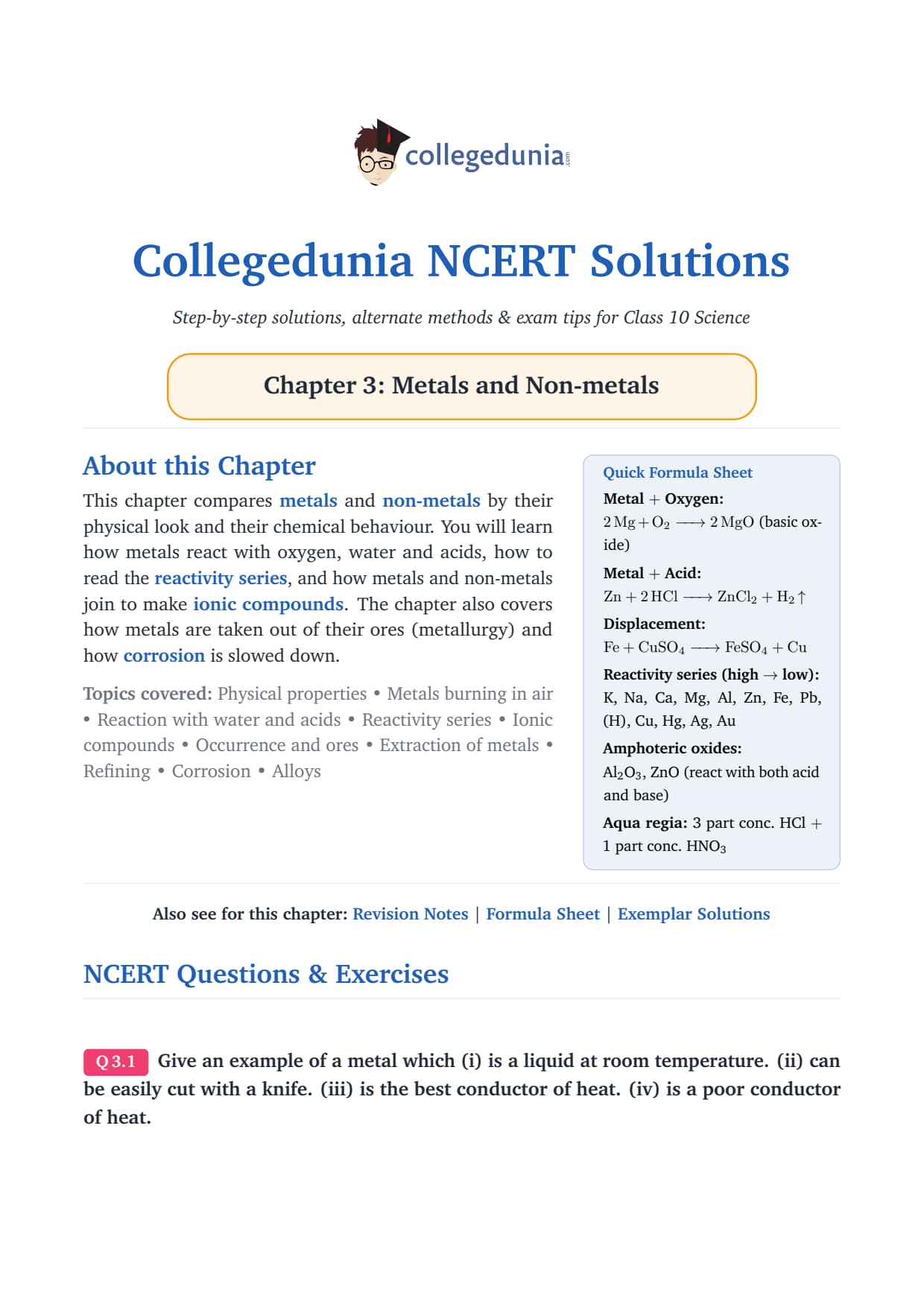
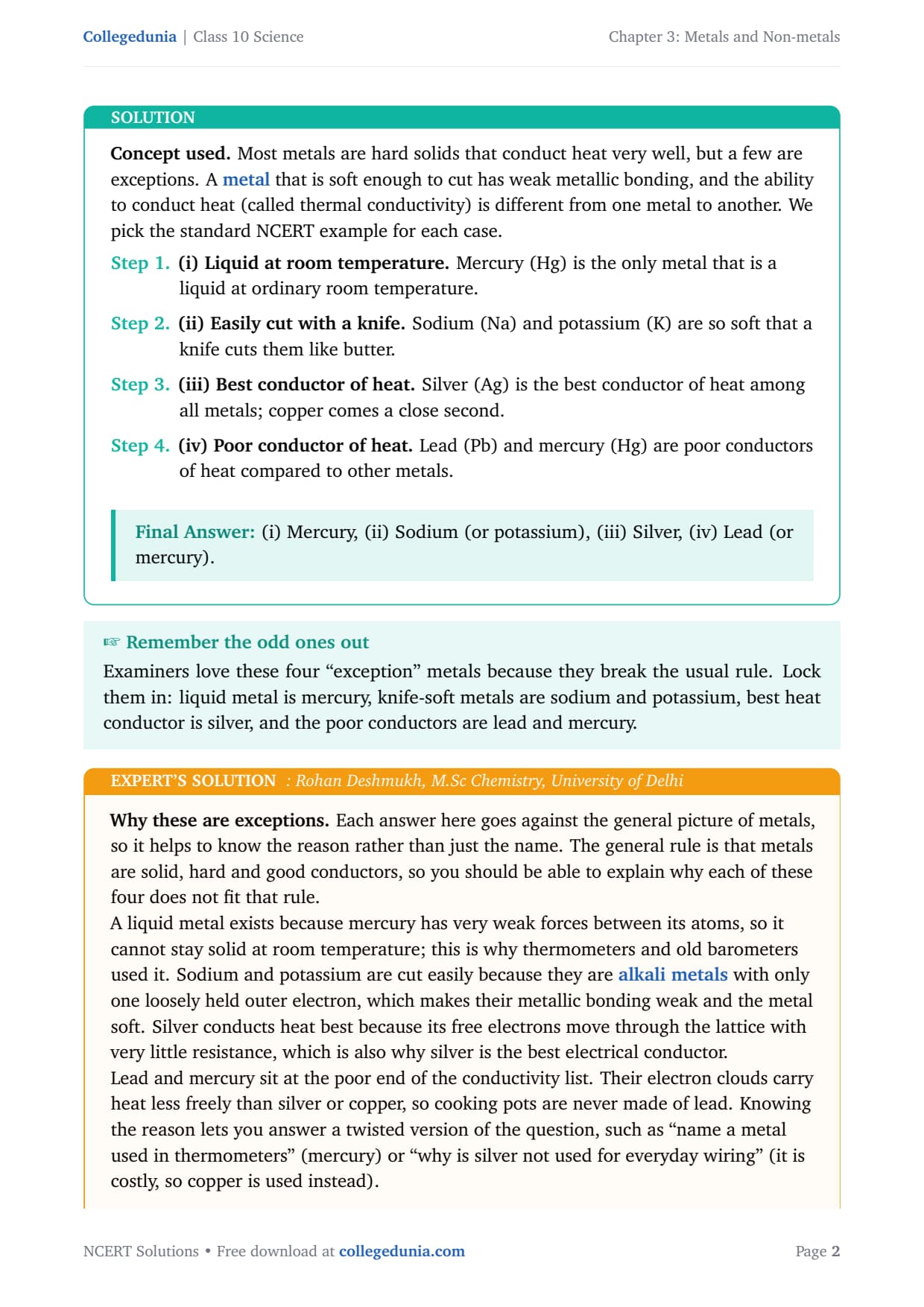
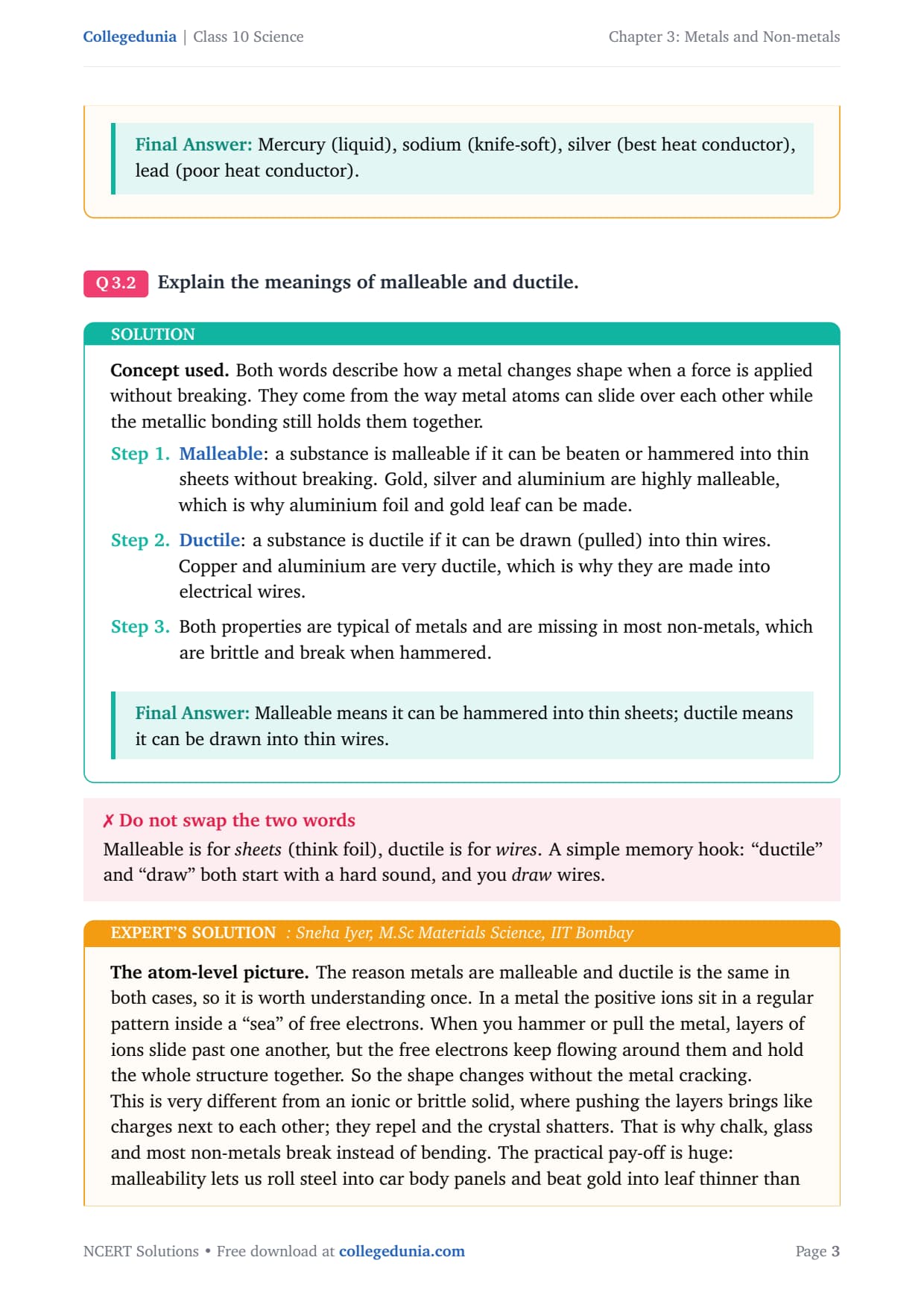
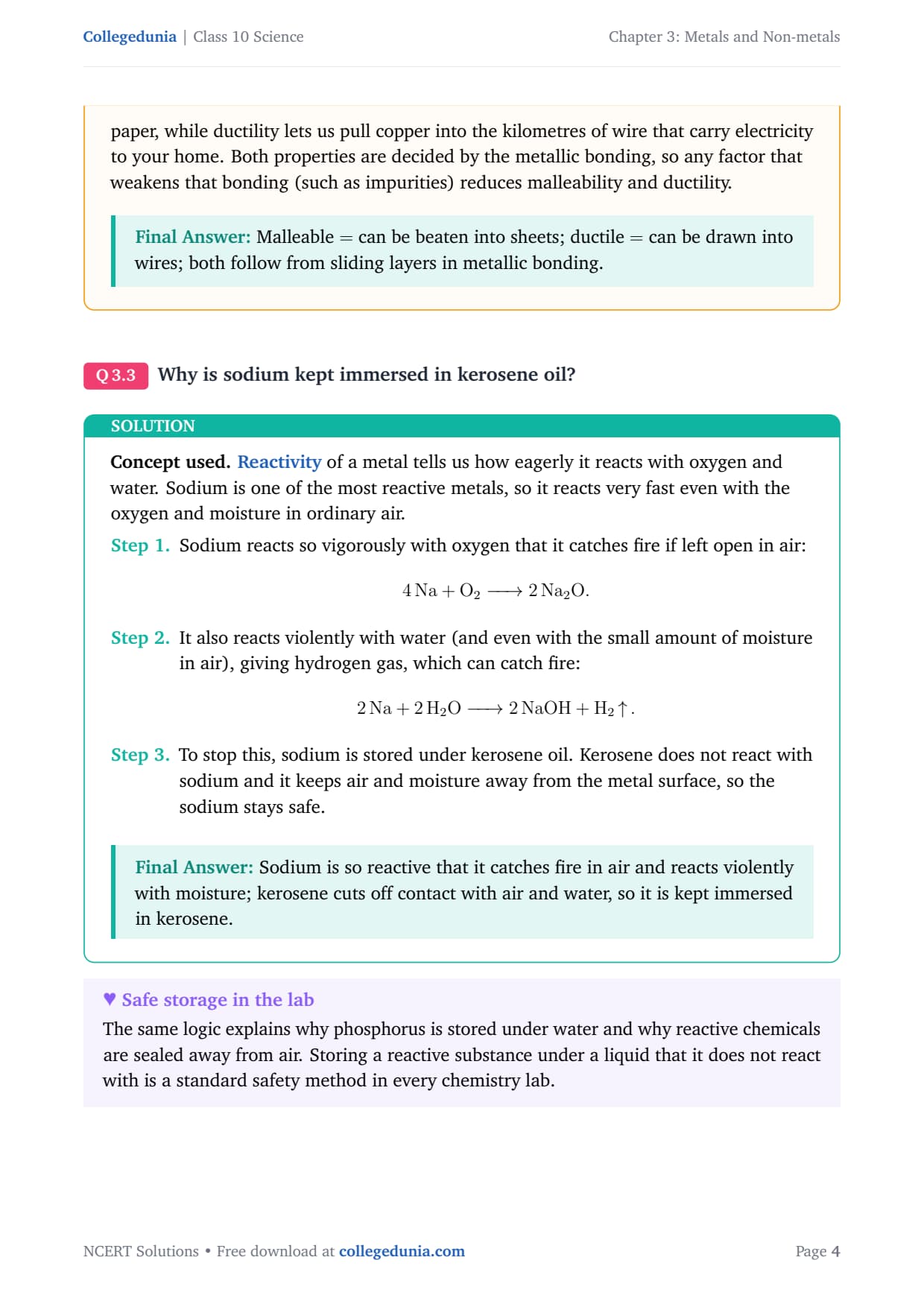
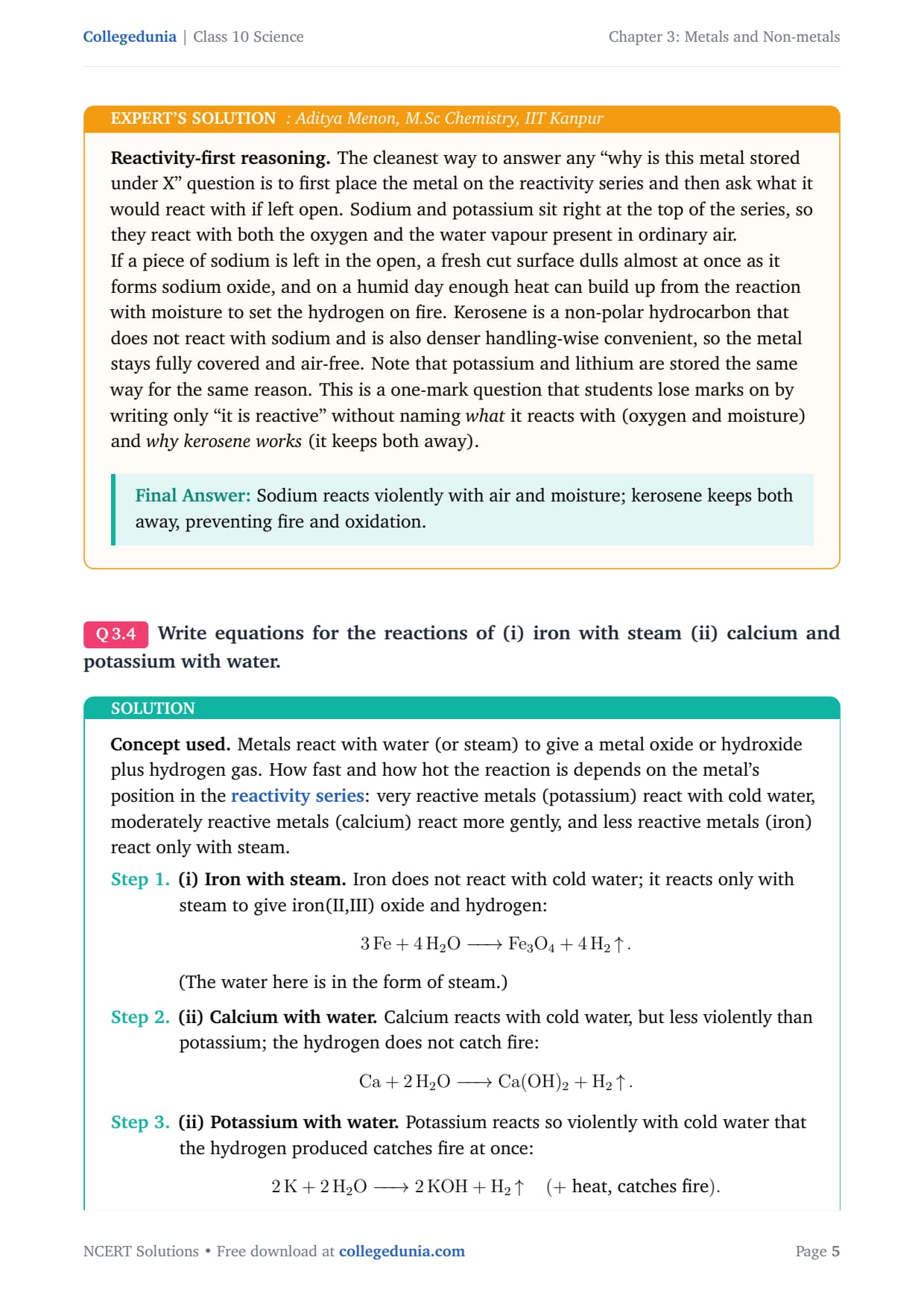
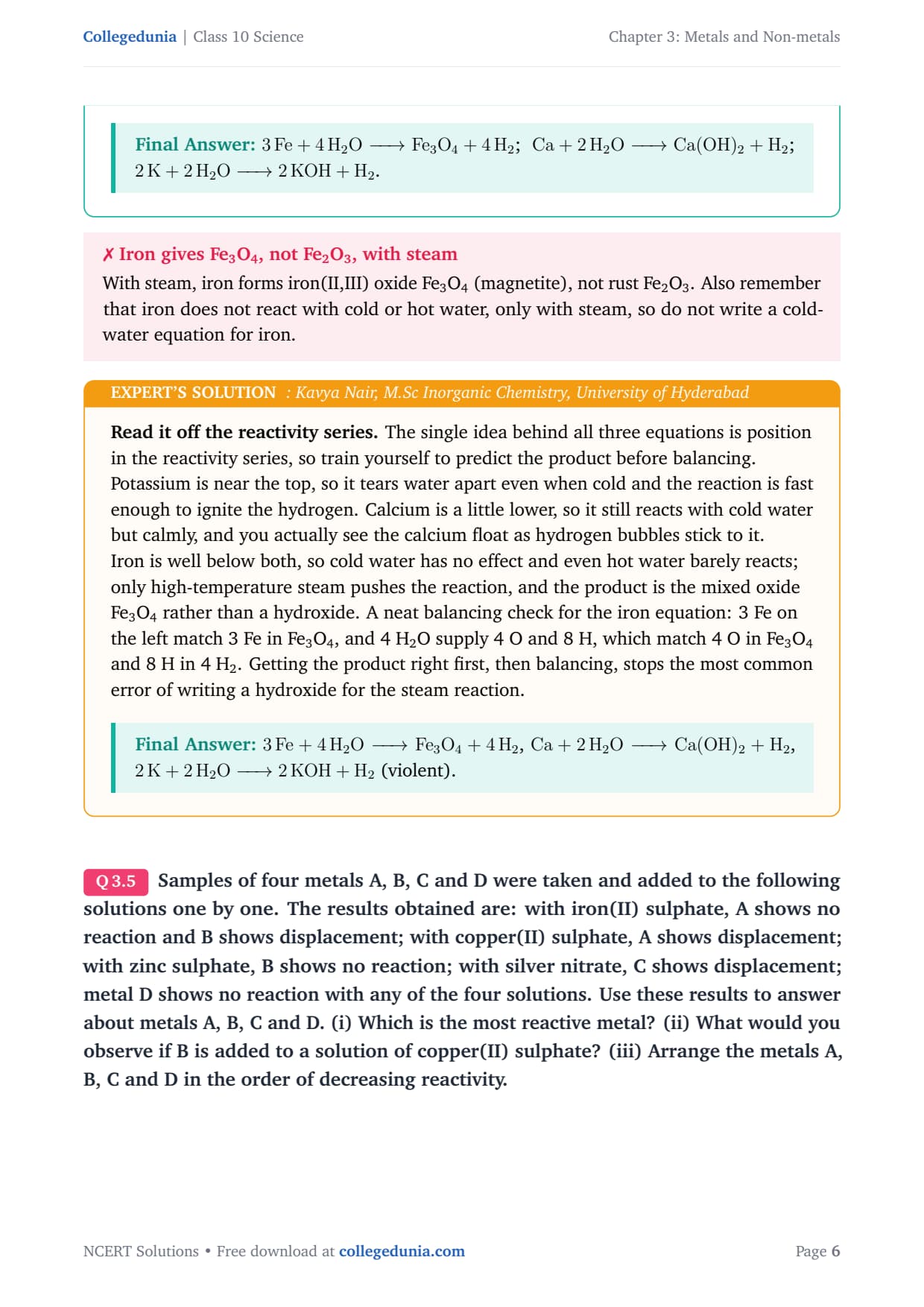
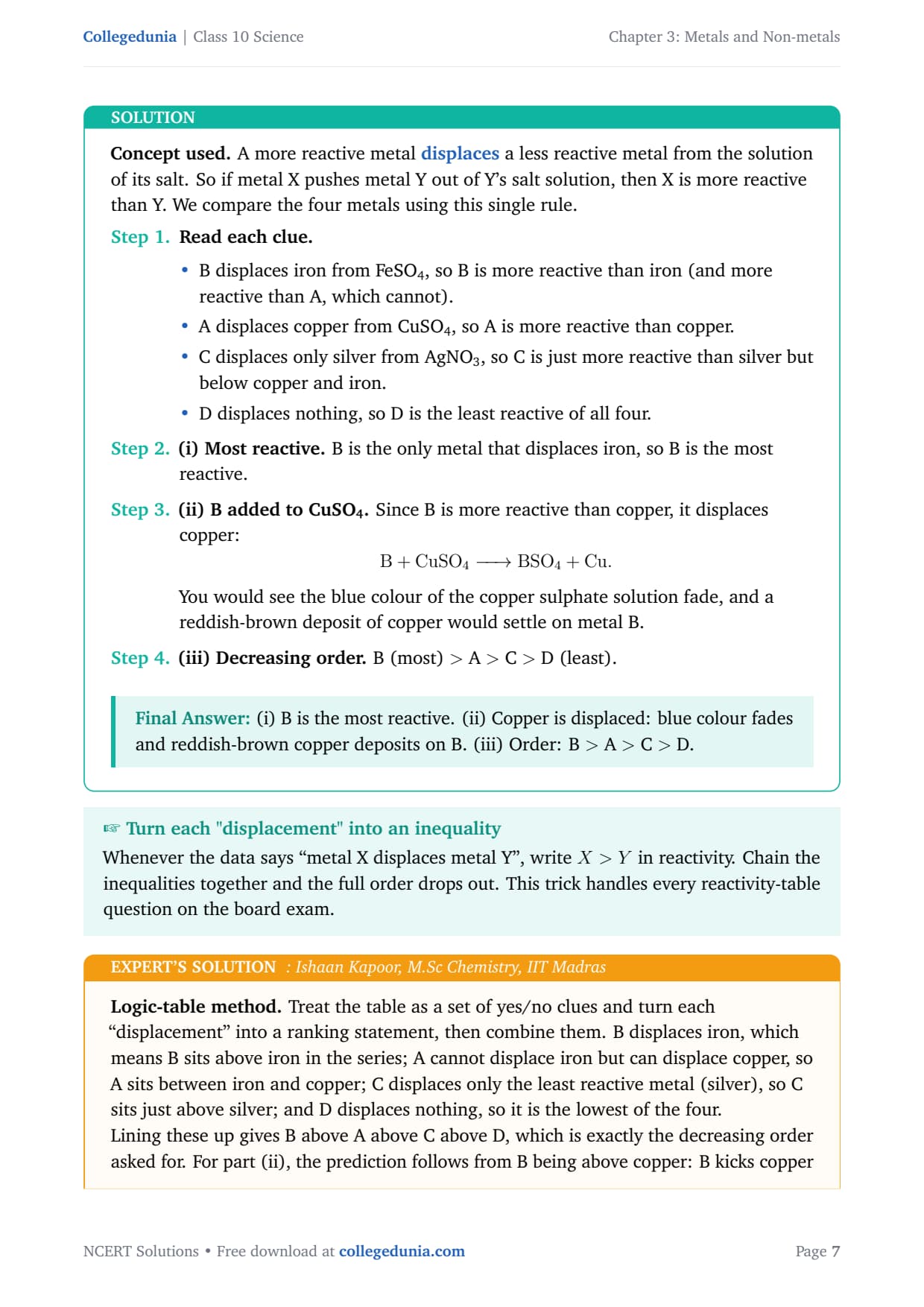
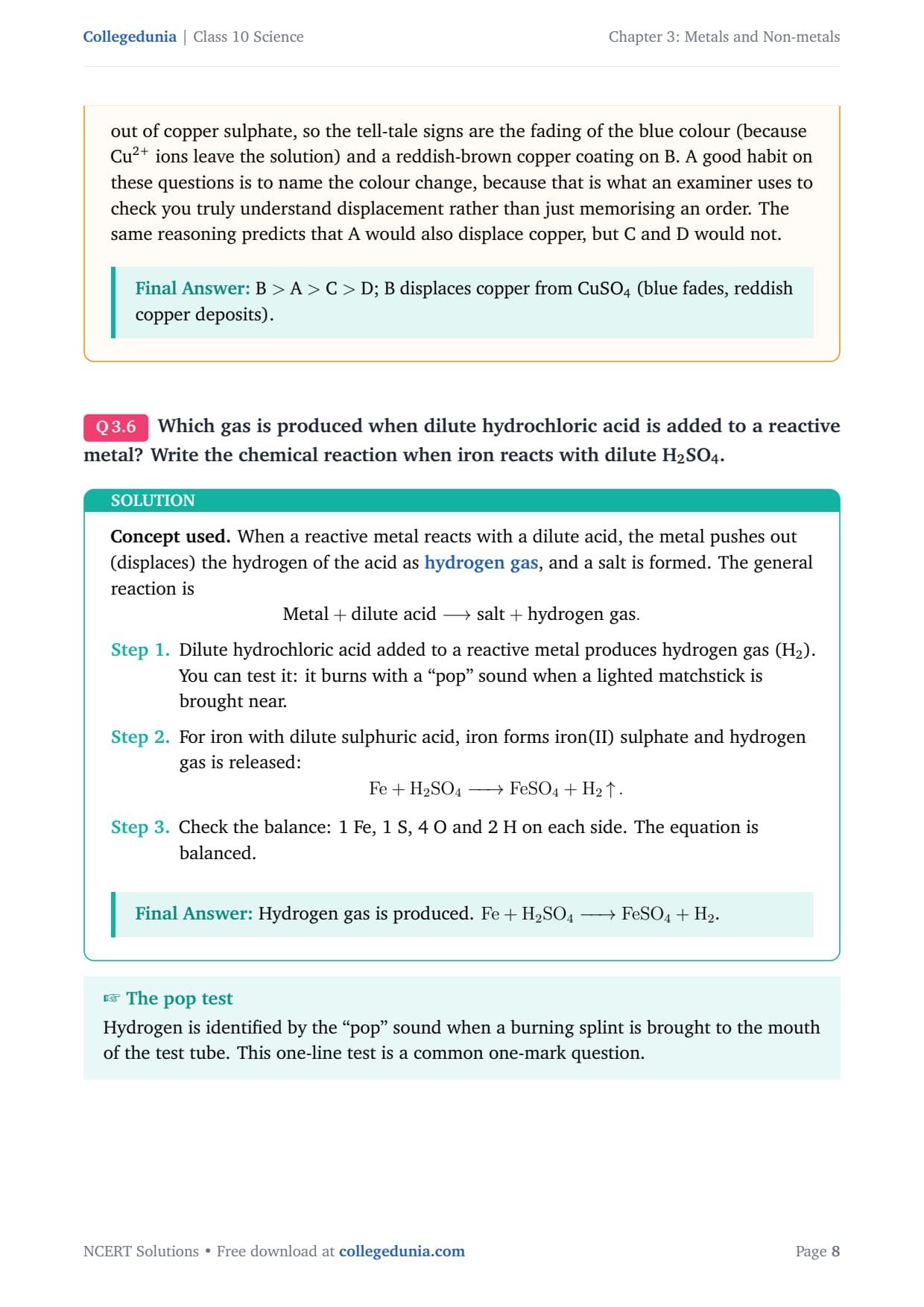
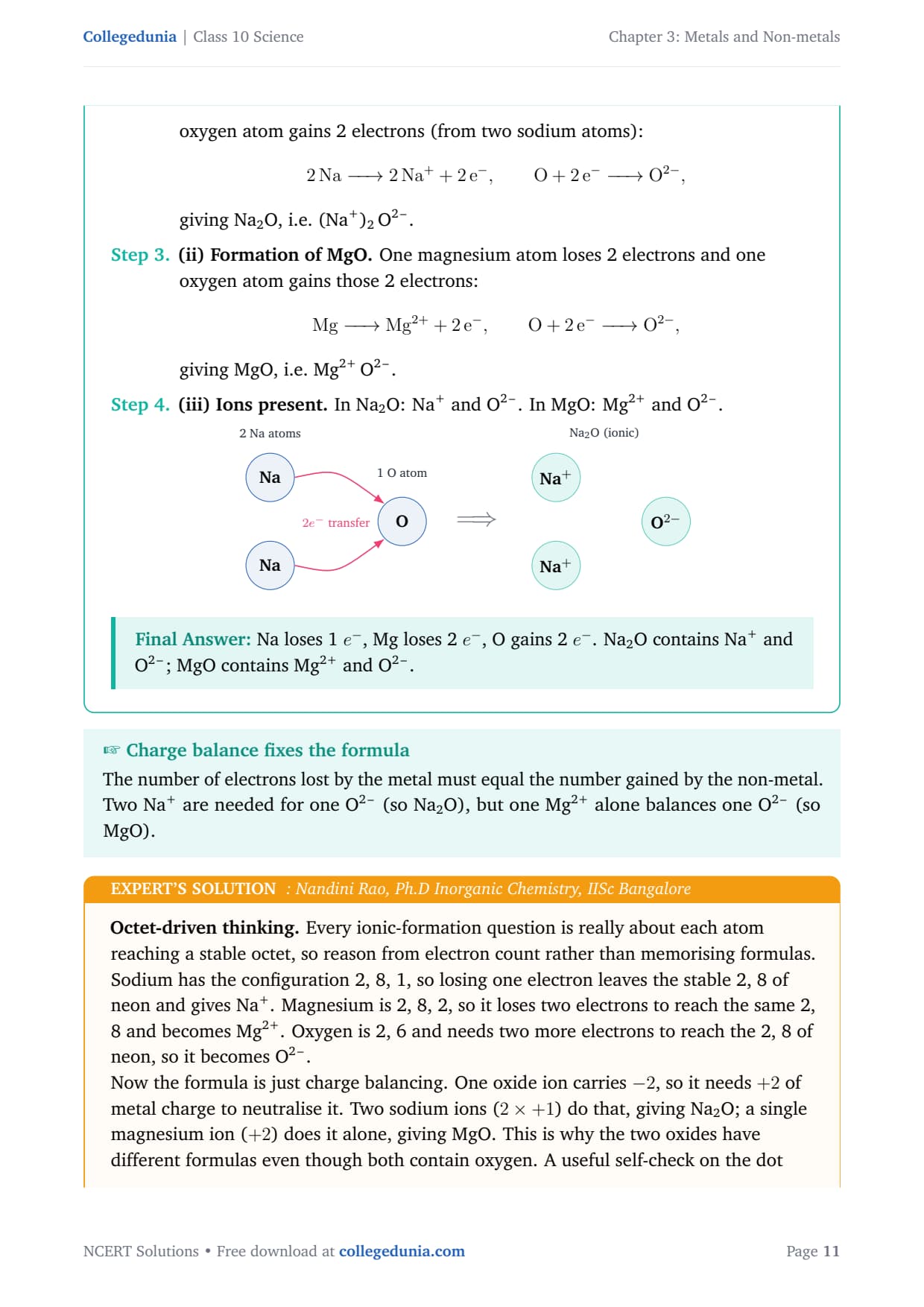
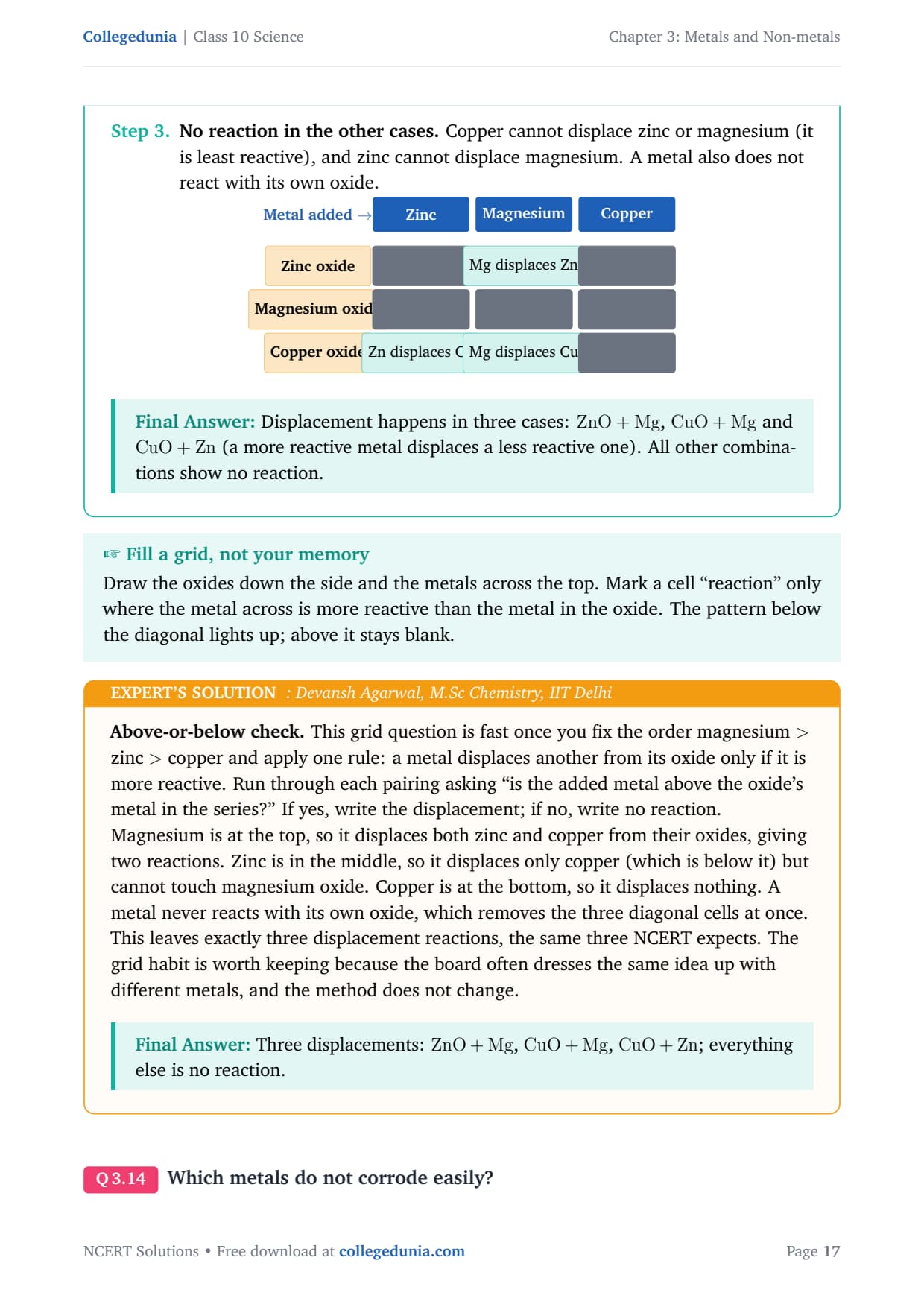
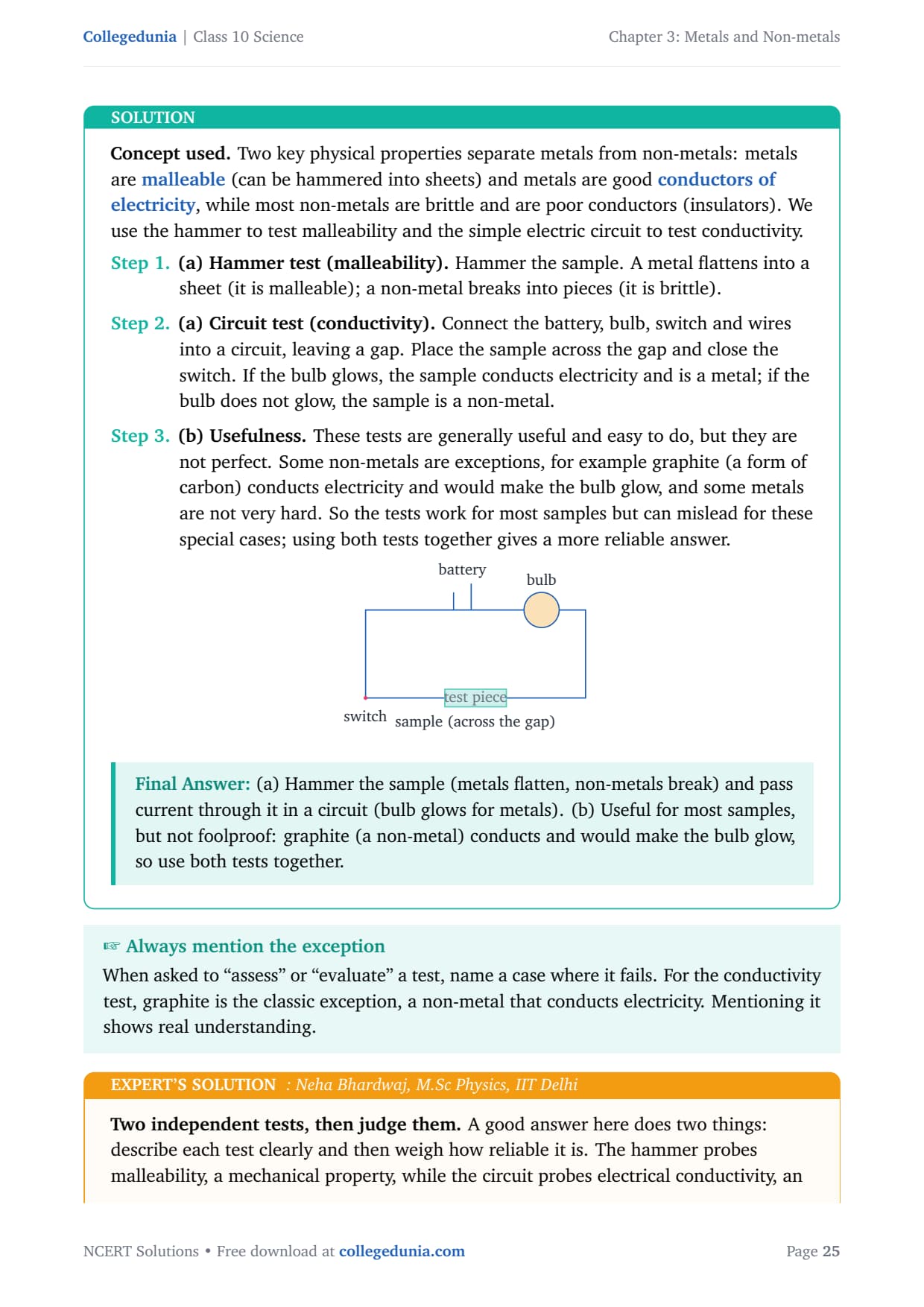



Comments