The NCERT Solutions for Class 10 Science Chapter 1 Chemical Reactions and Equations cover all 28 questions (8 in-text and 20 exercise questions), written for the 2026-27 CBSE syllabus.
Every answer follows the textbook flow: how to write and balance a chemical equation, the four reaction types, and how oxidation and reduction lead to corrosion and rancidity.
All 28 NCERT questions solved with balanced equations, step-by-step working, and an Expert Solution per question that adds board-exam strategy.
Full coverage of balancing equations, combination, decomposition, displacement and double displacement reactions, redox, corrosion and rancidity that the CBSE board paper tests directly.
Answers are aligned with the 2026-27 CBSE Class 10 Science syllabus, written in plain English for board exam students.
Solved by Collegedunia Science Experts
These NCERT Solutions for Class 10 Science Chapter 1 Chemical Reactions and Equations are checked against the latest 2026-27 NCERT textbook and refined against the last five years of CBSE board papers. Each of the 28 questions gives a Check Solution for the clean board answer and an Expert Solution for extra marks.
What the NCERT Solutions for Class 10 Science Chapter 1 Chemical Reactions and Equations Cover
This chapter answers one big question: how do we write what happens in a chemical reaction, and how do we sort reactions into types? These solutions follow the NCERT order and fill the gaps students hit in the exam.
Chemical equations and balancing: writing a word equation, turning it into a skeletal equation, then balancing it so atoms of each element are equal on both sides.
Types of reactions: combination, decomposition, displacement and double displacement, each with the standard NCERT example.
Oxidation and reduction: gain or loss of oxygen, redox reactions, and why both always happen together.
Effects of oxidation in daily life: corrosion (rusting of iron) and rancidity (spoiling of oils and fats), plus how to prevent each.
Chemical Reactions and Equations Class 10 Science Video Solutions
Question-wise Breakdown of the Chemical Reactions and Equations NCERT Solutions
Chapter 1 has 8 in-text questions and 20 exercise questions, 28 in all. The table below maps the main question groups to their topic, the answer style CBSE rewards, and the typical mark weight.
Questions
Topic covered
Answer style
Typical marks
In-text Q 1, 4, 5, 6
Reasoning on magnesium ribbon, whitewashing, electrolysis, copper sulphate colour
Reason plus a balanced equation
2 to 3 marks
In-text Q 2, 3
Balancing equations and adding state symbols
Balanced equation with (s), (l), (g), (aq)
3 marks
In-text Q 7, 8
Double displacement example, oxidation and reduction
Equation plus naming the type or species
2 to 3 marks
Q 9, 10, 11
MCQs on redox, reaction type, metal with acid
Correct option with a one-line reason
1 mark each
Q 12 to 16
Balancing and translating word equations, naming types
Balanced equation, type named
3 to 5 marks
Q 17 to 24
Exothermic and endothermic, displacement vs double displacement, redox
Definition with two examples each
3 marks
Q 25 to 28
Identify a metal, painting iron, nitrogen flushing, corrosion and rancidity
Reason with a daily-life example
2 to 3 marks
The balancing questions (Q 13 to 16) and definition questions (Q 17, 21, 24, 28) carry the heaviest marks. Students who name the reaction type, write a fully balanced equation and add state symbols where asked score full marks.
How to Write and Balance a Chemical Equation
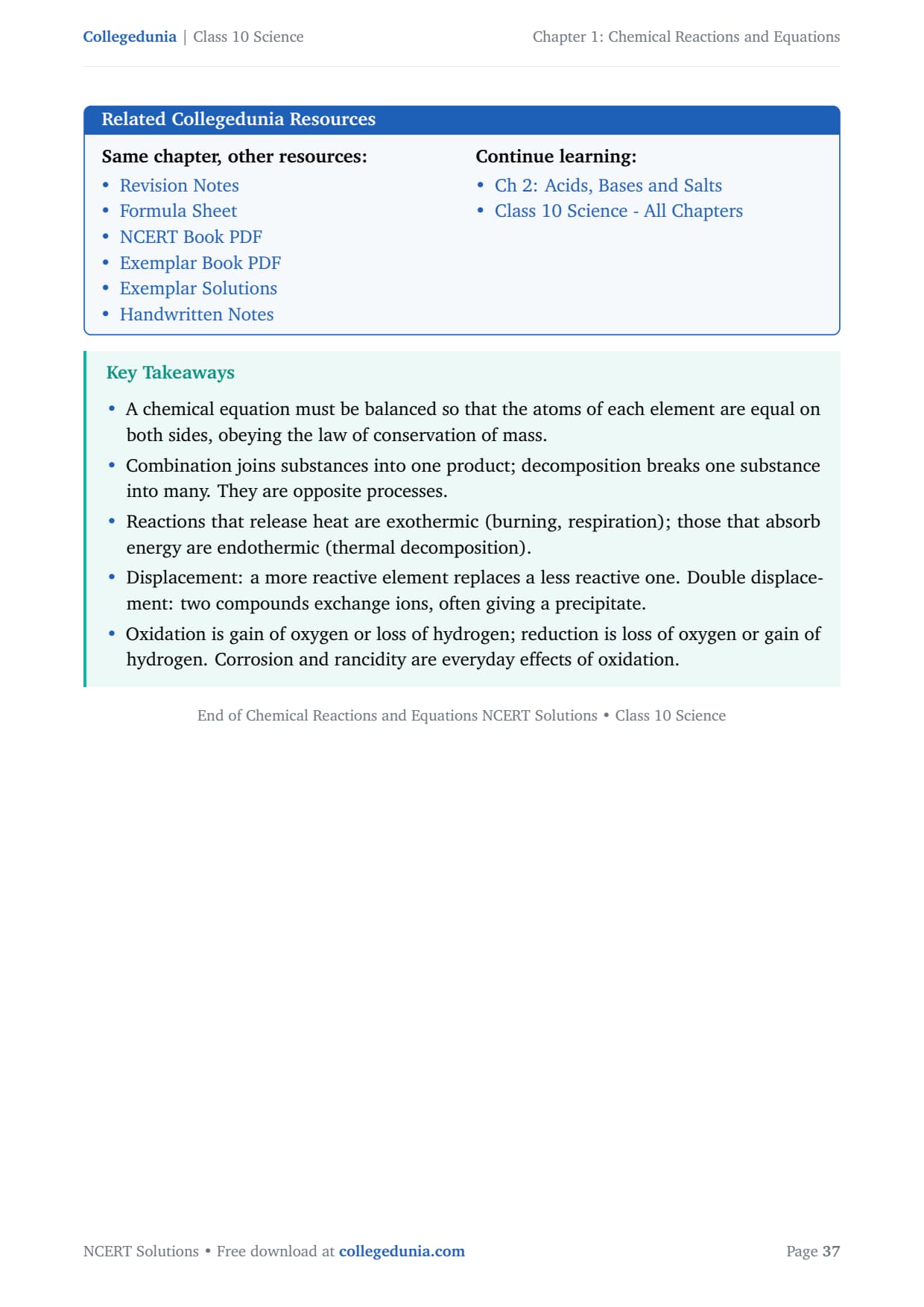
A chemical equation is a short way of writing a reaction using formulae. A balanced chemical equation has the same number of atoms of each element on both sides of the arrow, because of the law of conservation of mass: atoms are never created or destroyed, only rearranged.
Step 1: write the word equation, then replace each name with its correct formula to get a skeletal equation.
Step 2: balance using the hit-and-trial method, changing only the coefficients (the big numbers in front), never the formulae.
Step 3: balance metals first, then groups like SO4 and NO3 as single units, then hydrogen, and oxygen last.
Step 4: add state symbols if the question asks: (s), (l), (g) and (aq).
For example, sodium reacting with water is the classic odd-hydrogen case. Taking two water molecules makes the hydrogen even, giving 2Na + 2H2O → 2NaOH + H2. Counting atoms on both sides confirms the balance.
Quick Tip: Treat a group like sulphate (SO4) as one block while balancing. Counting three sulphate groups at once is far quicker than counting S and O separately, and you make fewer slips on questions like aluminium sulphate.
Types of Chemical Reactions: Combination, Decomposition, Displacement and Double Displacement
The NCERT chapter sorts most reactions into four types. Learning the general shape of each makes both the equations and the classification questions easy.
Type
General form
NCERT example
Combination
A + B → AB
CaO + H2O → Ca(OH)2
Decomposition
AB → A + B
CaCO3 → CaO + CO2
Displacement
A + BC → AC + B
Fe + CuSO4 → FeSO4 + Cu
Double displacement
AB + CD → AD + CB
Na2SO4 + BaCl2 → BaSO4 + 2NaCl
Combination joins substances into one product, while decomposition breaks one substance into many, so they are opposite processes. Displacement needs a more reactive element to push out a less reactive one, and double displacement is an ion swap between two compounds, often giving a precipitate.
Remember: Count the reactants and products first to spot the type. One reactant breaking apart is decomposition; two compounds swapping ions is double displacement; a free element plus a compound is displacement.
Oxidation and Reduction: Redox, Corrosion and Rancidity
Oxidation is the gain of oxygen (or loss of hydrogen), and reduction is the loss of oxygen (or gain of hydrogen). In a redox reaction both happen at the same time, with one substance oxidised while another is reduced.
In CuO + H2 → Cu + H2O, copper oxide is reduced (loses oxygen) and hydrogen is oxidised (gains oxygen).
Corrosion is the slow eating away of a metal by air and moisture; the rusting of iron is the common example, prevented by painting, oiling or galvanising.
Rancidity is the oxidation of oils and fats in food, which spoils smell and taste; it is slowed by flushing packets with unreactive nitrogen.
Both corrosion and rancidity are everyday effects of the same idea, oxidation. The trick in the board exam is to keep them apart: corrosion happens to metals, while rancidity happens to oils and fats in food.
Common Mistakes Students Make in the Chemical Reactions and Equations Chapter
The repeat-offender mistakes in this chapter's board answers:
Leaving an equation unbalanced: always re-count every element after writing the coefficients.
Forgetting state symbols: when the question gives physical states, add (s), (l), (g) and (aq), and mark a precipitate (s).
Mixing up who is oxidised: in CuO + H2 → Cu + H2O, hydrogen is oxidised and copper oxide is reduced, not copper.
Confusing displacement with double displacement: a free element means displacement; two compounds swapping ions means double displacement.
Mixing corrosion with rancidity: corrosion is of metals (rusting of iron); rancidity is of oils and fats (stale butter).
How to Use the Chemical Reactions and Equations NCERT Solutions PDF for Board Prep
This chapter is short but mark-rich, and the best approach is two passes: one for the concepts and one for balancing and classifying reactions by hand.
First pass (1 hour): read the chapter and note the law of conservation of mass, the four reaction types with one example each, and the meaning of oxidation and reduction.
Second pass (1.5 to 2 hours): work the balancing questions (Q 13 to 16) and definition questions on paper first, then check against these solutions. Watch state symbols and naming the reaction type, as these decide full marks.
CBSE angle: the chapter is tested through balancing, classification and reason-based questions, and lays the base for acids, bases and salts and for metals and non-metals.
Previous Year Question Trends from the Chemical Reactions and Equations Chapter
The chapter is tested in CBSE board papers mainly through balancing and classification questions, with reason-based questions on corrosion, rancidity and everyday reactions.
Year
Question type asked
Marks
2025
Balance an equation and name the type of reaction
3
2024
Define oxidation and reduction with one example each; explain rancidity
3 + 2
2023
Write the reaction of quick lime with water; name the type
3
2022
Difference between displacement and double displacement with equations
3
Also Check: The full set of CBSE board paper questions for this chapter is in the downloadable PDF above, updated for the 2026-27 cycle.
Other Resources for Class 10 Science Chapter 1 Chemical Reactions and Equations
Pair this NCERT Solutions PDF with the matching revision notes, handwritten notes and the official NCERT book chapter. All resources for Class 10 Science Chapter 1 Chemical Reactions and Equations are linked below.
Resource
What it covers
Open
NCERT Solutions
Step-by-step answers to all 28 questions, with an Expert Solution for each.
You are here
Notes
Concept-first revision notes on equations, reaction types, redox, corrosion and rancidity.
71% of Class 10 students said balancing chemical equations was the hardest part of this chapter. 3 out of 5 students told us they lost marks by forgetting state symbols like (s), (l), (g) and (aq) in the board exam.
Toppers found that naming the reaction type before writing the equation added 1 to 2 marks on the 3-mark questions, and the average student spent 2 to 3 hours on this chapter across the first read and exercise practice.
Source: 2026-27 Class 10 Science student poll. Sample of 9,800 students from CBSE schools across 14 states, conducted before the 2026 boards.
NCERT Solutions for Class 10 Science: All Chapters
Related Links: Use the table below to open the NCERT Solutions for the other chapters of Class 10 Science. Every chapter ships with the same step-by-step answer style, full PDF download, and revision FAQ.
Chapter
NCERT Solutions link
Chapter 1
Chemical Reactions and Equations NCERT Solutions (You are here)
All NCERT Solutions for Class 10 Science Chapter 1 Chemical Reactions and Equations with Step-by-Step Solutions
Q 1
Why should a magnesium ribbon be cleaned before burning in air?
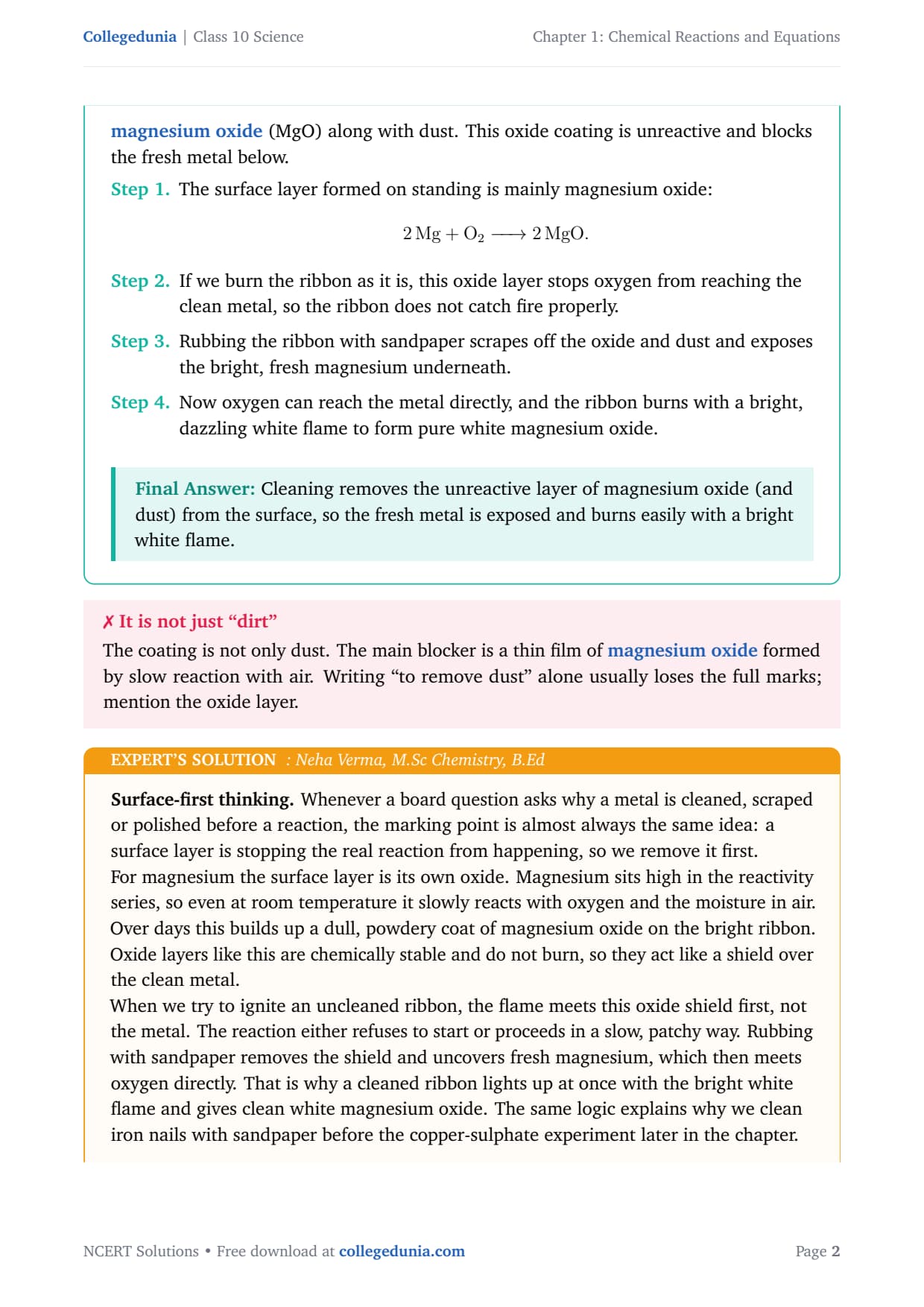
A chemical reaction starts only when the reacting surfaces can touch each other. Magnesium is a reactive metal, so on storage its shiny surface slowly reacts with the oxygen and moisture in air and gets covered with a dull white layer of magnesium oxide (MgO) together with dust. This oxide coating is unreactive and blocks the fresh metal below.
The surface layer formed on standing is mainly magnesium oxide: 2Mg + O2 → 2MgO.
If we burn the ribbon as it is, this oxide layer stops oxygen from reaching the clean metal, so the ribbon does not catch fire properly.
Rubbing the ribbon with sandpaper scrapes off the oxide and dust and exposes the bright, fresh magnesium underneath.
Now oxygen can reach the metal directly, and the ribbon burns with a bright, dazzling white flame to form pure white magnesium oxide.
Answer: Cleaning removes the unreactive layer of magnesium oxide (and dust) from the surface, so the fresh metal is exposed and burns easily with a bright white flame.
NV
Neha Verma
M.Sc Chemistry, B.Ed
Verified Expert
Surface-first thinking. Whenever a board question asks why a metal is cleaned, scraped or polished before a reaction, the marking point is almost always the same idea: a surface layer is stopping the real reaction, so we remove it first.
For magnesium the surface layer is its own oxide. Magnesium sits high in the reactivity series, so even at room temperature it slowly reacts with oxygen and the moisture in air. Over days this builds up a dull, powdery coat of magnesium oxide on the bright ribbon. Oxide layers like this are chemically stable and do not burn, so they act like a shield over the clean metal.
When we try to ignite an uncleaned ribbon, the flame meets this oxide shield first, not the metal, so the reaction either refuses to start or proceeds in a slow, patchy way. Rubbing with sandpaper removes the shield and uncovers fresh magnesium, which then meets oxygen directly. That is why a cleaned ribbon lights up at once with a bright white flame and gives clean white magnesium oxide.
Answer: We clean the ribbon to remove its unreactive magnesium-oxide coating, exposing fresh metal so combustion starts quickly and burns cleanly.
Q 2
Write the balanced equation for the following chemical reactions.
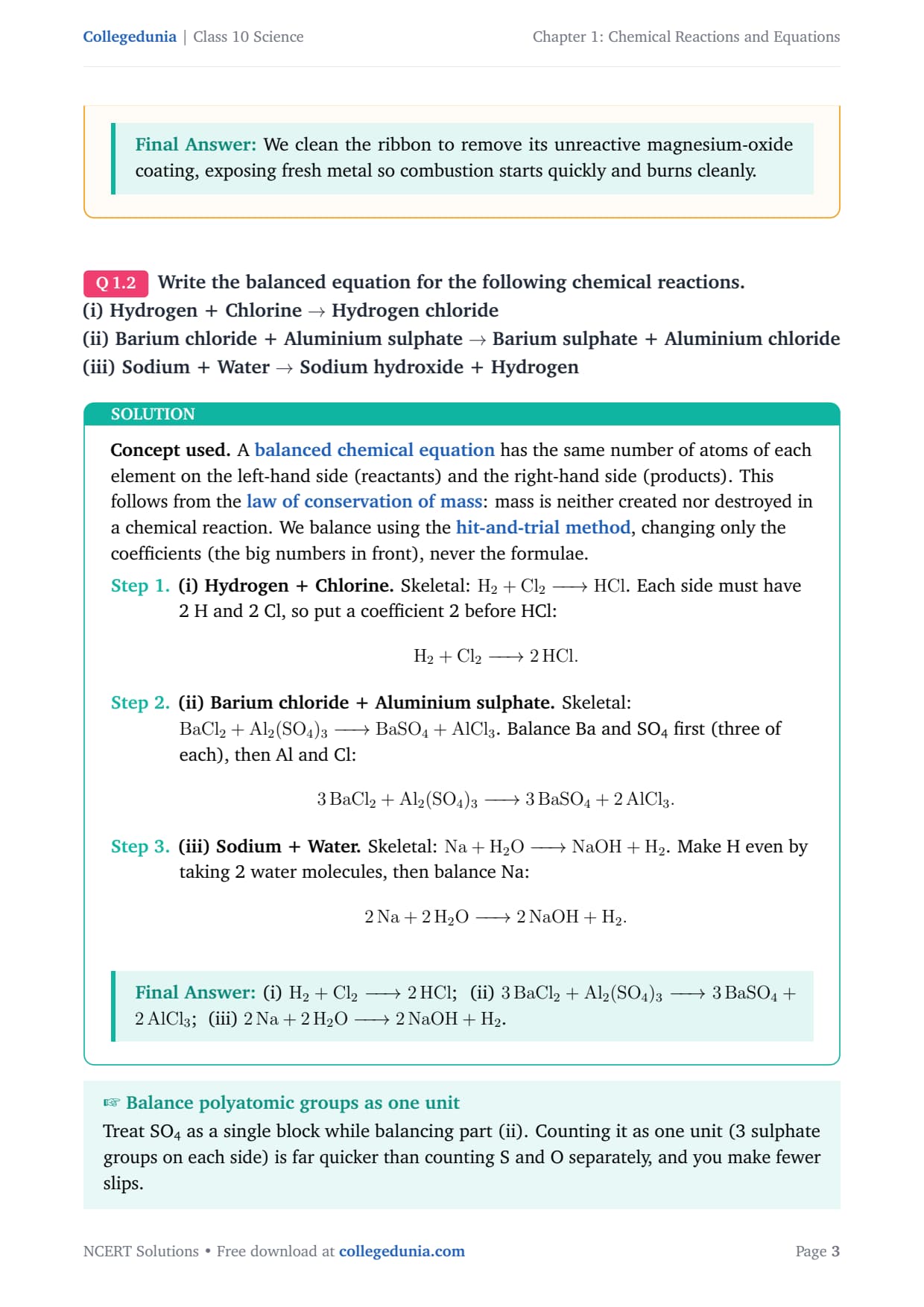
A balanced chemical equation has the same number of atoms of each element on the reactant side and the product side. This follows from the law of conservation of mass. We balance using the hit-and-trial method, changing only the coefficients (the big numbers in front), never the formulae.
(i) Skeletal H2 + Cl2 → HCl. Each side needs 2 H and 2 Cl, so put 2 before HCl: H2 + Cl2 → 2HCl.
(ii) Balance Ba and SO4 first (three of each), then Al and Cl: 3BaCl2 + Al2(SO4)3 → 3BaSO4 + 2AlCl3.
(iii) Make hydrogen even by taking 2 water molecules, then balance sodium: 2Na + 2H2O → 2NaOH + H2.
Order of balancing. A clean routine prevents most errors: balance metals first, then non-metal groups (like sulphate), then hydrogen, and finally oxygen. Leave free elements such as H2 or O2 for the last step, because their coefficients can soak up any leftover atoms.
In part (i) the count is symmetric, so only HCl needs a 2. In part (ii) aluminium sulphate brings two aluminium atoms and three sulphate groups in one formula, so the right approach is to fix three barium sulphate units and two aluminium chloride units, which forces three barium chloride units on the left. Always re-count at the end: 3 Ba, 6 Cl, 2 Al, 3 S, 12 O on each side.
Part (iii) is the classic odd-hydrogen case. Because hydrogen leaves as H2 (an even number), we take two water molecules so the hydrogen comes out even, which then needs two NaOH and two Na. This metal-with-water pattern repeats for potassium and calcium, so learning it once pays off across the chapter.
Write a balanced chemical equation with state symbols for the following reactions.
(i) Solutions of barium chloride and sodium sulphate in water react to give insoluble barium sulphate and the solution of sodium chloride. (ii) Sodium hydroxide solution (in water) reacts with hydrochloric acid solution (in water) to produce sodium chloride solution and water.
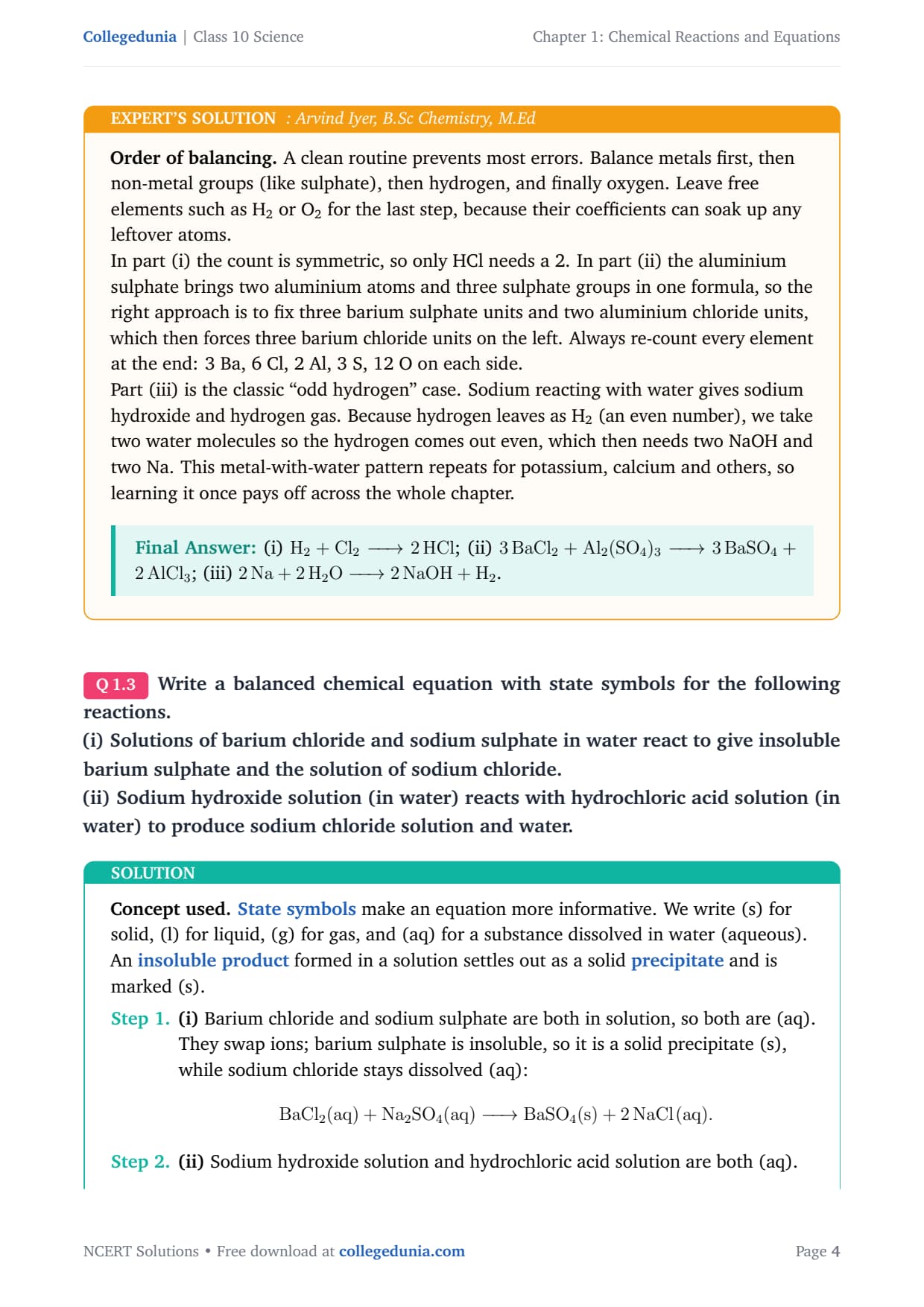
State symbols make an equation more informative: (s) for solid, (l) for liquid, (g) for gas, and (aq) for a substance dissolved in water. An insoluble product formed in a solution settles out as a solid precipitate and is marked (s).
(i) Both salts are in solution, so both are (aq). They swap ions; barium sulphate is insoluble, so it is a solid (s), while sodium chloride stays dissolved (aq): BaCl2(aq) + Na2SO4(aq) → BaSO4(s) + 2NaCl(aq).
(ii) Both reactants are (aq); this neutralisation gives sodium chloride solution (aq) and water (l): NaOH(aq) + HCl(aq) → NaCl(aq) + H2O(l).
Read the words, assign the states. Board questions like this hand you the physical states inside the sentence. "Solution in water" means (aq), "insoluble" means a solid (s) precipitate, and "water" as a product is liquid (l). Translate each phrase before you balance, and the state symbols fall into place.
Part (i) is a double displacement (precipitation) reaction: the ions of the two dissolved salts change partners. Barium pairs with sulphate to make insoluble barium sulphate, which leaves the solution as a white solid, while sodium pairs with chloride to make sodium chloride, which stays dissolved. The chloride count forces a 2 before sodium chloride.
Part (ii) is a neutralisation, a special double displacement between an acid and a base. The hydrogen of the acid joins the hydroxide of the base to form water, while sodium and chloride form common salt in solution. Both species are in a 1:1 ratio, so no extra coefficients are needed. A small down-arrow can also mark a precipitate and an up-arrow an escaping gas.
A solution of a substance 'X' is used for whitewashing.
(i) Name the substance 'X' and write its formula. (ii) Write the reaction of the substance 'X' named in (i) above with water.
Whitewashing uses a substance that reacts with water to give slaked lime (calcium hydroxide), which then slowly reacts with carbon dioxide in air to coat walls with a shiny layer. The substance used is calcium oxide, also called quick lime, formula CaO.
(i) 'X' is calcium oxide (quick lime), CaO.
(ii) Calcium oxide reacts vigorously with water, giving out heat, to form calcium hydroxide (slaked lime). This is a combination reaction: CaO(s) + H2O(l) → Ca(OH)2(aq) (heat is released).
A solution of slaked lime is spread on walls. Over two to three days it reacts with carbon dioxide in air to form a thin, shiny layer of calcium carbonate: Ca(OH)2(aq) + CO2(g) → CaCO3(s) + H2O(l).
Answer: 'X' is calcium oxide (quick lime), CaO; with water it gives slaked lime: CaO(s) + H2O(l) → Ca(OH)2(aq) (releasing heat).
MG
Manish Gupta
B.Tech Chemical Engineering, M.Sc Chemistry
Verified Expert
Trace the chain of reactions. This question is easy if you remember the three-stage lime story: quick lime, then slaked lime, then the carbonate finish. Many students name slaked lime as 'X', but 'X' is the starting substance used to make the whitewash solution, so it must be calcium oxide.
Calcium oxide is produced industrially by heating limestone, and it reacts so strongly with water that the mixture becomes hot enough to steam. This exothermic combination gives calcium hydroxide, a mild base that dissolves slightly in water to form lime water, which the painter brushes over the wall.
The finishing reaction happens on the wall itself: carbon dioxide from the air reacts with the calcium hydroxide layer to deposit calcium carbonate, a hard white solid that gives the bright, smooth finish. So three compounds appear in order, calcium oxide, calcium hydroxide and calcium carbonate, and naming all three with their roles secures full marks.
Answer: 'X' is calcium oxide, CaO; CaO(s) + H2O(l) → Ca(OH)2(aq), an exothermic combination reaction giving slaked lime.
Q 5
Why is the amount of gas collected in one of the test tubes in Activity 1.7 double of the amount collected in the other? Name this gas.
Activity 1.7 is the electrolysis of water: passing electricity through acidified water decomposes it into hydrogen and oxygen gases. The balanced equation fixes the ratio of the two gases by the law of conservation of mass.
Water decomposes on passing electric current: 2H2O(l) → 2H2(g) + O2(g).
From the equation, 2 volumes of hydrogen are produced for every 1 volume of oxygen, so the volume of hydrogen is double that of oxygen.
Hydrogen is set free at the cathode (negative electrode) and oxygen at the anode (positive electrode). The test tube over the cathode therefore fills with twice as much gas.
Answer: Water has twice as many hydrogen atoms as oxygen atoms, so on electrolysis the volume of hydrogen is double that of oxygen. The gas collected in double amount is hydrogen.
RS
Ritu Saxena
M.Sc Chemistry, B.Ed
Verified Expert
Let the formula decide the ratio. The cleanest way to answer is to read the volumes straight off the balanced equation. Decomposing water gives two hydrogen molecules for each oxygen molecule, and for gases the molecule ratio equals the volume ratio, so hydrogen comes out at twice the volume of oxygen with no calculation needed.
This is a decomposition reaction driven by electricity, an electrolytic decomposition. Pure water barely conducts, so a few drops of dilute sulphuric acid are added to let the current pass. As the current flows, bubbles rise at both carbon electrodes, but the tube over the negative electrode fills roughly twice as fast.
Identifying the gases is the natural next step: a burning splint near the hydrogen tube gives a small "pop" sound, while the gas in the other tube relights a glowing splint, confirming oxygen. So the gas collected in double amount is hydrogen, released at the cathode, exactly as the 2:1 ratio in the equation predicts.
Answer: Hydrogen is collected in double the amount because water has hydrogen and oxygen atoms in a 2:1 ratio; the gas in larger amount is hydrogen.
Q 6
Why does the colour of copper sulphate solution change when an iron nail is dipped in it?
This is a displacement reaction. In the reactivity series, iron is more reactive than copper, and a more reactive metal displaces a less reactive metal from its salt solution. The blue colour of copper sulphate solution is due to copper ions; as they are removed, the colour changes.
Iron, being more reactive, displaces copper from copper sulphate solution: Fe(s) + CuSO4(aq) → FeSO4(aq) + Cu(s) (copper sulphate is blue; iron sulphate is light green).
The blue copper(II) ions are slowly replaced by light-green iron(II) ions, so the deep blue colour fades and turns greenish.
The displaced copper deposits on the iron nail as a reddish-brown coating, so the nail looks brownish.
Answer: Iron is more reactive than copper, so it displaces copper from the solution. The blue colour (due to copper ions) fades to light green (iron sulphate), and a brown copper layer forms on the nail.
DM
Deepak Menon
M.Sc Chemistry, B.Ed
Verified Expert
Follow the more reactive metal. The key to every displacement question is the reactivity series. Iron stands above copper, which means iron holds on to sulphate more strongly than copper does, so when an iron nail sits in copper sulphate, iron pushes copper out of the salt and takes its place.
The visible change tracks the ions in solution. The blue of copper sulphate is caused by dissolved copper ions. As iron goes into solution as iron(II) ions and copper comes out as metal, the population of blue copper ions falls and pale green iron ions build up, so the liquid shifts from blue toward green. The copper that leaves the solution settles on the nail as a thin reddish-brown layer.
This single experiment shows three observations at once: a fading blue colour, a greenish tint appearing, and a brown coating on the iron. All three come from the one displacement reaction, and quoting them together makes the answer complete.
Answer: Because iron displaces copper from copper sulphate, copper ions (blue) are removed and iron sulphate (light green) forms, so the solution colour changes and copper coats the nail.
Q 7
Give an example of a double displacement reaction other than the one given in Activity 1.10.
A double displacement reaction is one in which two compounds in solution exchange their ions to form two new compounds. Many of these are precipitation reactions, where one product is insoluble and settles out as a precipitate.
Choose two soluble salts whose ions, when swapped, give an insoluble product. Silver nitrate and sodium chloride solutions work well.
On mixing, silver pairs with chloride and sodium pairs with nitrate: AgNO3(aq) + NaCl(aq) → AgCl(s) + NaNO3(aq).
Silver chloride (AgCl) is a white insoluble solid, so it forms a white precipitate, confirming a double displacement (precipitation) reaction.
Answer:AgNO3(aq) + NaCl(aq) → AgCl(s) + NaNO3(aq). The white precipitate of silver chloride confirms a double displacement reaction.
KJ
Kavita Joshi
M.Sc Chemistry, M.Phil
Verified Expert
Pick a guaranteed precipitate. To answer safely, choose a pair of salts you know gives an insoluble product, because a visible precipitate is the surest proof of double displacement. Silver chloride and barium sulphate are the two classic "always insoluble" choices, so reactions producing them are reliable examples.
Take silver nitrate and sodium chloride, both freely soluble in water. When the solutions meet, the ions rearrange: silver joins chloride, and sodium joins nitrate. Silver chloride cannot stay dissolved, so it appears at once as a white solid that clouds the mixture, while sodium nitrate remains in solution.
Another fully acceptable answer is lead nitrate with potassium iodide, which gives a bright yellow precipitate of lead iodide. Both fit the ion-exchange shape AB + CD → AD + CB and both produce a clear precipitate, so either earns the marks.
Answer:AgNO3(aq) + NaCl(aq) → AgCl(s) + NaNO3(aq), a double displacement reaction giving a white precipitate of silver chloride.
Q 8
Identify the substances that are oxidised and the substances that are reduced in the following reactions.
Oxidation is the gain of oxygen or loss of hydrogen by a substance. Reduction is the loss of oxygen or gain of hydrogen by a substance. In a redox reaction both happen together: one reactant is oxidised while the other is reduced.
(i)4Na + O2 → 2Na2O. Sodium gains oxygen to become sodium oxide, so sodium is oxidised. Oxygen is the substance added to sodium.
(ii)CuO + H2 → Cu + H2O. Copper oxide loses oxygen to become copper, so copper oxide is reduced. Hydrogen gains oxygen to become water, so hydrogen is oxidised.
Both reactions are redox reactions because oxidation and reduction occur side by side.
Answer: (i) Sodium is oxidised (it gains oxygen). (ii) Copper oxide is reduced (loses oxygen) and hydrogen is oxidised (gains oxygen).
AB
Anil Bhatt
M.Sc Chemistry, B.Ed
Verified Expert
Track the oxygen. For Class 10 the quickest route is to follow the oxygen atoms: whoever gains oxygen during the reaction is oxidised, and whoever loses oxygen is reduced. Apply this rule to each substance separately and the answer drops out.
In the first reaction sodium starts as a free metal and ends inside sodium oxide, so it has clearly gained oxygen and is oxidised. The oxygen molecule is the oxidising agent here, since it supplies the oxygen that sodium picks up.
In the second reaction, copper oxide begins with oxygen attached and ends as bare copper metal, so it has lost oxygen and is reduced. Meanwhile hydrogen begins as a free gas and ends combined in water, so it has gained oxygen and is oxidised. A cross-check by gain or loss of hydrogen gives the same answer: hydrogen is the reducing agent because it removes oxygen from copper oxide. Stating both the substance and the reason earns full marks.
Answer: (i) Sodium is oxidised. (ii) Copper oxide is reduced; hydrogen is oxidised. Both are redox reactions.
Q 9
Which of the statements about the reaction below are incorrect?
2PbO(s) + C(s) → 2Pb(s) + CO2(g)
(a) Lead is getting reduced. (b) Carbon dioxide is getting oxidised. (c) Carbon is getting oxidised. (d) Lead oxide is getting reduced.
(i) (a) and (b) (ii) (a) and (c) (iii) (a), (b) and (c) (iv) all
Use the oxygen rule: oxidation is gain of oxygen, reduction is loss of oxygen. Check each statement against 2PbO + C → 2Pb + CO2, where lead oxide loses oxygen and carbon gains oxygen.
Lead oxide (PbO) loses oxygen to become lead, so lead oxide is reduced. Statement (d) is correct; statement (a) "lead is getting reduced" is incorrect because it is the oxide, not the metal, that is reduced.
Carbon gains oxygen to become carbon dioxide, so carbon is oxidised. Statement (c) is correct.
Statement (b) says carbon dioxide is getting oxidised, but carbon dioxide is the product formed when carbon takes up oxygen; it is not being oxidised, so (b) is incorrect.
The incorrect statements are (a) and (b), which is option (i).
Answer: Option (i): statements (a) and (b) are incorrect.
PN
Pooja Nair
M.Sc Chemistry, B.Ed
Verified Expert
Decide the truth first, then judge each line. For a statement-checking question, never grade the options one by one without first settling the actual chemistry. Here oxygen moves from lead oxide to carbon, so lead oxide is reduced and carbon is oxidised. Hold these two facts and test each statement against them.
Statement (a) claims lead is getting reduced. The substance that loses oxygen is lead oxide; lead itself is the product of that reduction, so naming "lead" as the thing reduced is wrong, making (a) incorrect. Statement (d), which says lead oxide is reduced, is the correct version of the same idea.
Statement (b) says carbon dioxide is oxidised, but it is what forms after carbon picks up oxygen, so it is a product, not something being oxidised, making (b) incorrect. Statement (c), carbon is oxidised, is correct. So exactly two statements, (a) and (b), are wrong, giving option (i).
Answer: The incorrect statements are (a) and (b), so the answer is option (i).
In a displacement reaction a more reactive element displaces a less reactive element from its compound, following the pattern A + BC → AC + B. Aluminium is more reactive than iron, so it can displace iron from iron(III) oxide.
A free element (aluminium) reacts with a compound (iron oxide) and pushes out another element (iron).
Aluminium, being more reactive, takes the oxygen and forms aluminium oxide, while iron is set free: Fe2O3 + 2Al → Al2O3 + 2Fe (a lot of heat is released).
This matches A + BC → AC + B, the displacement pattern. It is not combination, decomposition or double displacement.
Answer: Option (d): it is a displacement reaction (aluminium displaces iron). This is the highly exothermic thermite reaction.
RP
Rohan Pillai
B.Tech Metallurgical Engineering, M.Tech
Verified Expert
Match the skeleton to the type. The fastest way to classify a reaction is to compare its skeleton with the four standard patterns. Here one free element (aluminium) reacts with one compound (iron oxide), and another element (iron) comes out free, which is precisely the displacement shape A + BC → AC + B, so the answer is option (d).
The driving force is the reactivity order: aluminium lies above iron, so aluminium has the stronger pull on oxygen. When the mixture is ignited, aluminium strips oxygen from iron(III) oxide to form aluminium oxide, leaving iron behind, and the energy released is enough to melt the iron.
It is worth knowing this is also a redox reaction, since aluminium is oxidised and iron is reduced, but the type asked for is based on structure, which is displacement. Industrially this is the thermite reaction, prized for welding rail tracks because it makes molten iron exactly where it is needed.
Answer: Displacement reaction, option (d); aluminium displaces iron in the exothermic thermite reaction.
Q 11
What happens when dilute hydrochloric acid is added to iron filings? Tick the correct answer.
(a) Hydrogen gas and iron chloride are produced. (b) Chlorine gas and iron hydroxide are produced. (c) No reaction takes place. (d) Iron salt and water are produced.
A metal more reactive than hydrogen displaces hydrogen from a dilute acid. This is a displacement reaction of a metal with an acid, giving a salt and hydrogen gas. Iron is more reactive than hydrogen, so it reacts with dilute hydrochloric acid.
Iron displaces hydrogen from hydrochloric acid to form iron(II) chloride and hydrogen gas: Fe(s) + 2HCl(aq) → FeCl2(aq) + H2(g).
The salt formed is iron chloride and the gas released is hydrogen, seen as bubbles around the iron filings.
Chlorine gas and iron hydroxide are not formed, a reaction does take place, and water is not a product, so option (a) is correct.
Answer: Option (a): hydrogen gas and iron chloride are produced.
SK
Shreya Kulkarni
M.Sc Chemistry, B.Ed
Verified Expert
Use the metal-acid rule. The reliable rule for any metal added to a dilute acid is: salt plus hydrogen gas, provided the metal lies above hydrogen in the reactivity series. Iron does lie above hydrogen, so it reacts and pushes hydrogen out of the acid. That single rule eliminates three of the four options.
The salt takes its name from the acid: hydrochloric acid gives a chloride, so the salt is iron chloride. The hydrogen displaced leaves as a gas, seen as a steady stream of bubbles. There is no way for chlorine gas or a hydroxide to form here, because chlorine stays locked in the chloride salt and no source of hydroxide is present.
Option (d), iron salt and water, fits an acid-plus-base neutralisation, not an acid-plus-metal reaction; water is not produced when a metal reacts with an acid. So the only consistent choice is (a).
Answer: Option (a): dilute hydrochloric acid reacts with iron filings to give iron chloride and hydrogen gas.
Q 12
What is a balanced chemical equation? Why should chemical equations be balanced?
A balanced chemical equation is one in which the number of atoms of each element is equal on the reactant side and the product side. Balancing is required by the law of conservation of mass.
Definition. An equation is balanced when each element has the same number of atoms on both sides of the arrow. For example, 3Fe + 4H2O → Fe3O4 + 4H2 has 3 Fe, 8 H and 4 O on both sides.
Reason. By the law of conservation of mass, mass can neither be created nor destroyed in a chemical reaction, so the total mass of reactants must equal the total mass of products.
Since atoms are not created or destroyed, the number of atoms of each element must stay the same before and after the reaction. An equation that obeys this is balanced; one that does not is wrong.
Answer: A balanced equation has equal atoms of each element on both sides. Equations must be balanced to obey the law of conservation of mass.
VD
Vikram Desai
M.Sc Chemistry, M.Ed
Verified Expert
Tie the definition to the law. A complete answer here has two parts: what a balanced equation is, and why we insist on it. Keep them separate and support the second with the law of conservation of mass, which is the real reason behind balancing.
A balanced equation is simply one where the atom count of every element agrees on both sides of the arrow. We achieve this by adjusting coefficients only, never the chemical formulae, because changing a formula would change the substance itself. A quick way to verify is to list each element and tally its atoms on the left and the right.
The reason we must balance is physical, not just neat bookkeeping. Atoms are neither created nor destroyed in a chemical change; they are only rearranged. So the same atoms that enter as reactants must reappear among the products, which forces equal atom counts and hence equal mass. An unbalanced equation would imply atoms appearing from nowhere or vanishing.
Answer: A balanced equation has equal atoms of each element on both sides; we balance to satisfy the law of conservation of mass.
Q 13
Translate the following statements into chemical equations and then balance them.
(a) Hydrogen gas combines with nitrogen to form ammonia. (b) Hydrogen sulphide gas burns in air to give water and sulphur dioxide. (c) Barium chloride reacts with aluminium sulphate to give aluminium chloride and a precipitate of barium sulphate. (d) Potassium metal reacts with water to give potassium hydroxide and hydrogen gas.
First convert each sentence into a skeletal equation using correct chemical formulae, then balance it by adjusting coefficients so that atoms of each element are equal on both sides.
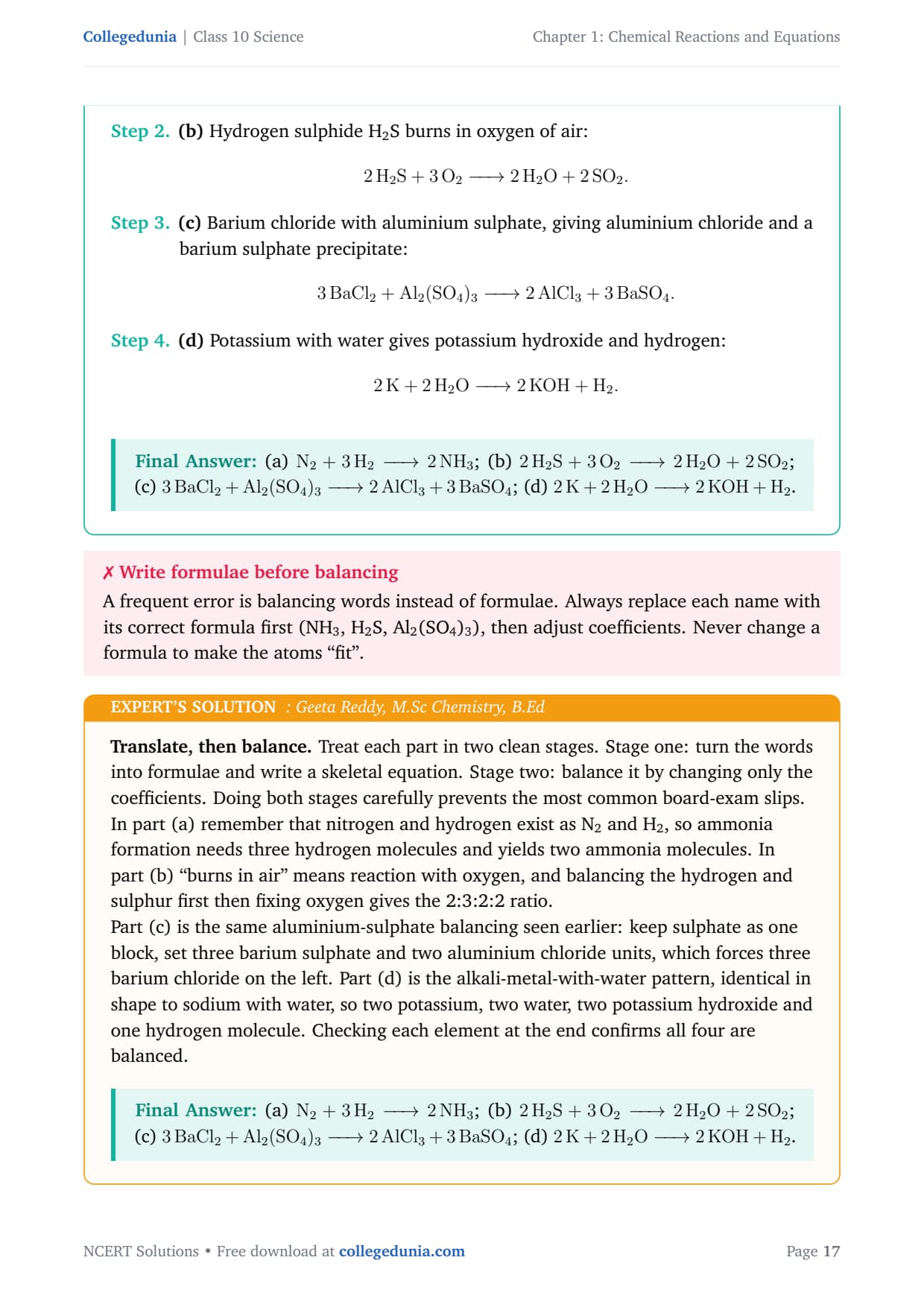
(a) Ammonia is NH3; nitrogen and hydrogen are diatomic: N2 + 3H2 → 2NH3.
(b) Hydrogen sulphide H2S burns in oxygen of air: 2H2S + 3O2 → 2H2O + 2SO2.
(c) Barium chloride with aluminium sulphate, giving aluminium chloride and a barium sulphate precipitate: 3BaCl2 + Al2(SO4)3 → 2AlCl3 + 3BaSO4.
(d) Potassium with water gives potassium hydroxide and hydrogen: 2K + 2H2O → 2KOH + H2.
Translate, then balance. Treat each part in two clean stages. Stage one: turn the words into formulae and write a skeletal equation. Stage two: balance it by changing only the coefficients. Doing both stages carefully prevents the most common board-exam slips.
In part (a) remember that nitrogen and hydrogen exist as N2 and H2, so ammonia formation needs three hydrogen molecules and yields two ammonia molecules. In part (b) "burns in air" means reaction with oxygen, and balancing hydrogen and sulphur first then fixing oxygen gives the 2:3:2:2 ratio.
Part (c) is the same aluminium-sulphate balancing seen earlier: keep sulphate as one block, set three barium sulphate and two aluminium chloride units, which forces three barium chloride on the left. Part (d) is the alkali-metal-with-water pattern, identical in shape to sodium with water.
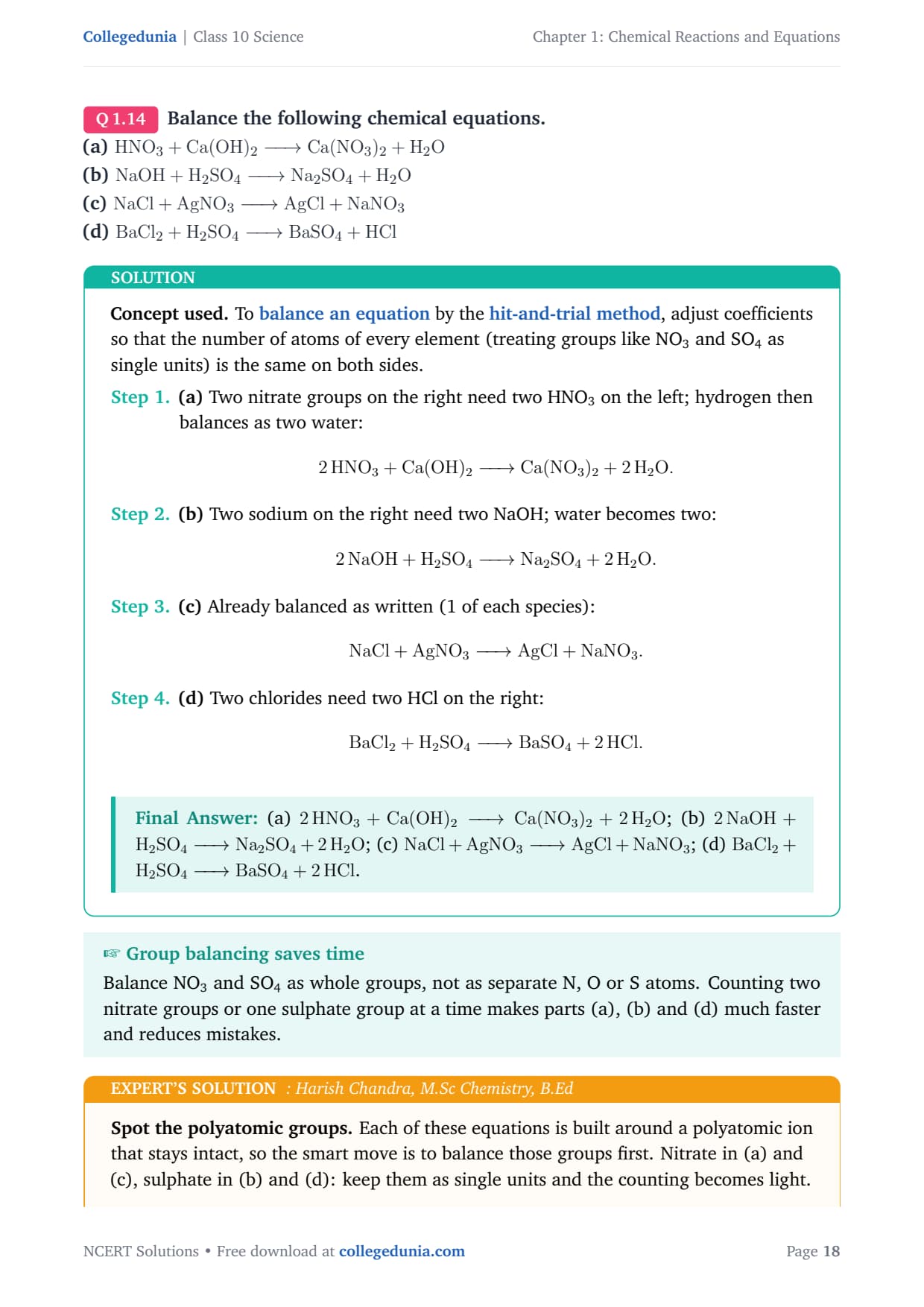
To balance by the hit-and-trial method, adjust coefficients so that the number of atoms of every element (treating groups like NO3 and SO4 as single units) is the same on both sides.
(a) Two nitrate groups on the right need two HNO3; hydrogen then balances as two water: 2HNO3 + Ca(OH)2 → Ca(NO3)2 + 2H2O.
(b) Two sodium on the right need two NaOH; water becomes two: 2NaOH + H2SO4 → Na2SO4 + 2H2O.
(c) Already balanced (1 of each species): NaCl + AgNO3 → AgCl + NaNO3.
(d) Two chlorides need two HCl on the right: BaCl2 + H2SO4 → BaSO4 + 2HCl.
Spot the polyatomic groups. Each of these equations is built around a polyatomic ion that stays intact, so the smart move is to balance those groups first: nitrate in (a) and (c), sulphate in (b) and (d). Keep them as single units and the counting becomes light.
In (a) the calcium nitrate product carries two nitrate groups, so two nitric acid molecules are needed, and the four hydrogens form two water molecules. In (b) sodium sulphate has two sodium atoms, so two sodium hydroxide units are required, and again two water molecules balance the hydrogen and oxygen.
Equation (c) is a quiet one: one of each species already balances sodium, chlorine, silver and nitrate, so no coefficient is needed; confirm rather than force a number. In (d) the single sulphate transfers cleanly to barium sulphate, but the two chlorides released require two hydrochloric acid molecules.
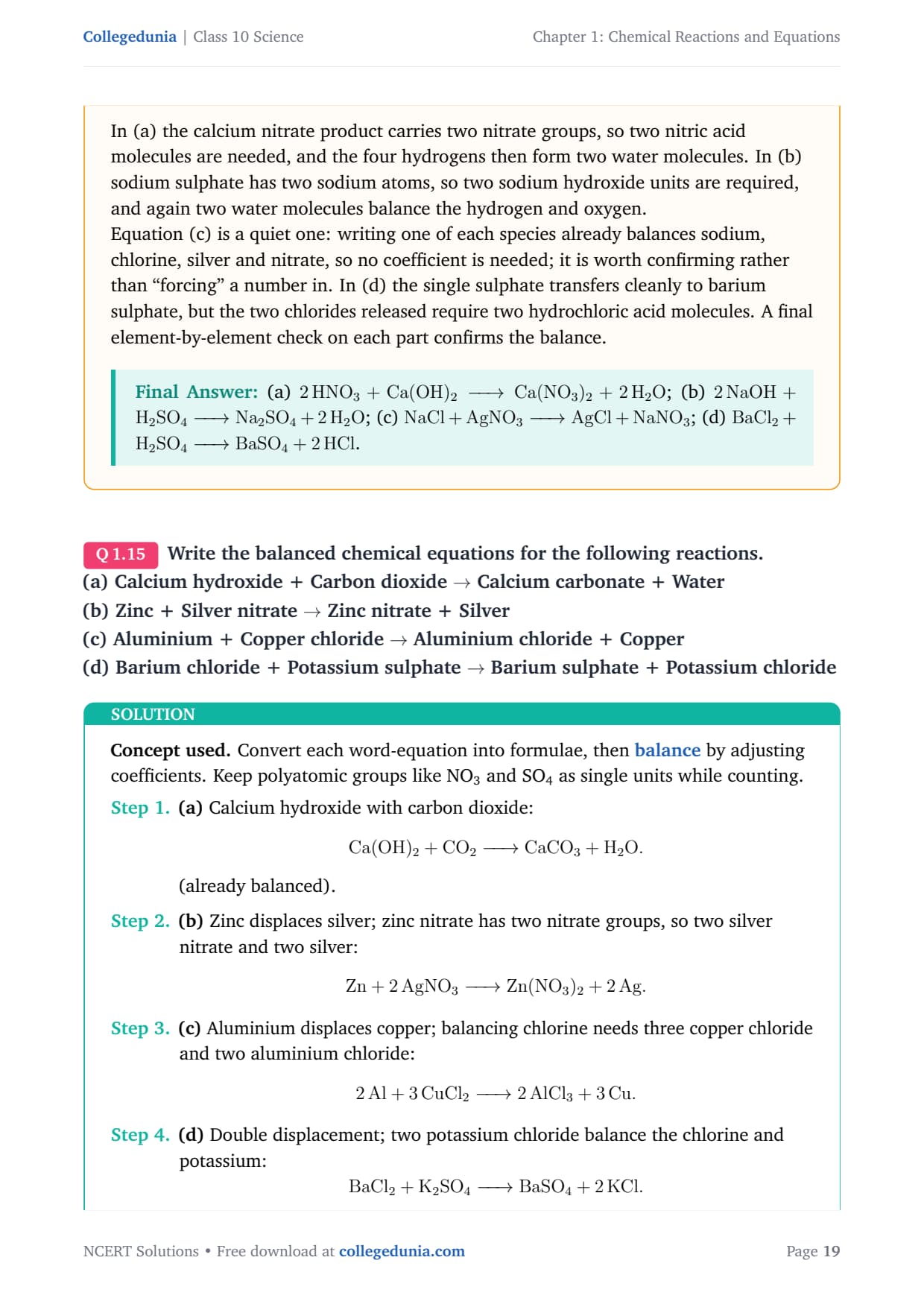
Convert each word-equation into formulae, then balance by adjusting coefficients. Keep polyatomic groups like NO3 and SO4 as single units while counting.
(a) Calcium hydroxide with carbon dioxide: Ca(OH)2 + CO2 → CaCO3 + H2O (already balanced).
(b) Zinc displaces silver; zinc nitrate has two nitrate groups, so two silver nitrate and two silver: Zn + 2AgNO3 → Zn(NO3)2 + 2Ag.
(c) Aluminium displaces copper; balancing chlorine needs three copper chloride and two aluminium chloride: 2Al + 3CuCl2 → 2AlCl3 + 3Cu.
(d) Double displacement; two potassium chloride balance the chlorine and potassium: BaCl2 + K2SO4 → BaSO4 + 2KCl.
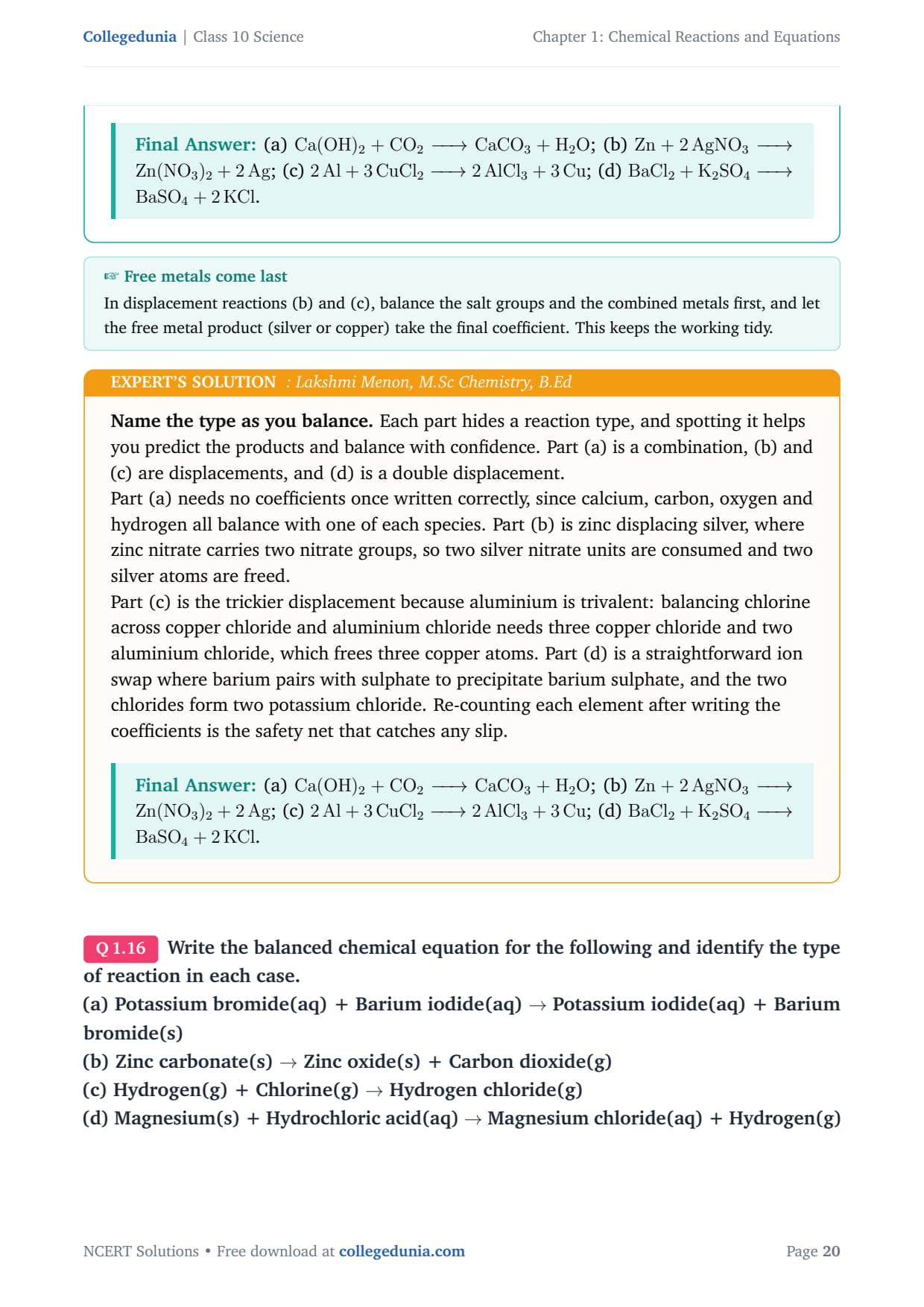
Name the type as you balance. Each part hides a reaction type, and spotting it helps you predict the products and balance with confidence. Part (a) is a combination, (b) and (c) are displacements, and (d) is a double displacement.
Part (a) needs no coefficients once written correctly, since calcium, carbon, oxygen and hydrogen all balance with one of each species. Part (b) is zinc displacing silver, where zinc nitrate carries two nitrate groups, so two silver nitrate units are consumed and two silver atoms are freed.
Part (c) is the trickier displacement because aluminium is trivalent: balancing chlorine across copper chloride and aluminium chloride needs three copper chloride and two aluminium chloride, freeing three copper atoms. Part (d) is a straightforward ion swap where barium pairs with sulphate to precipitate barium sulphate, and the two chlorides form two potassium chloride.
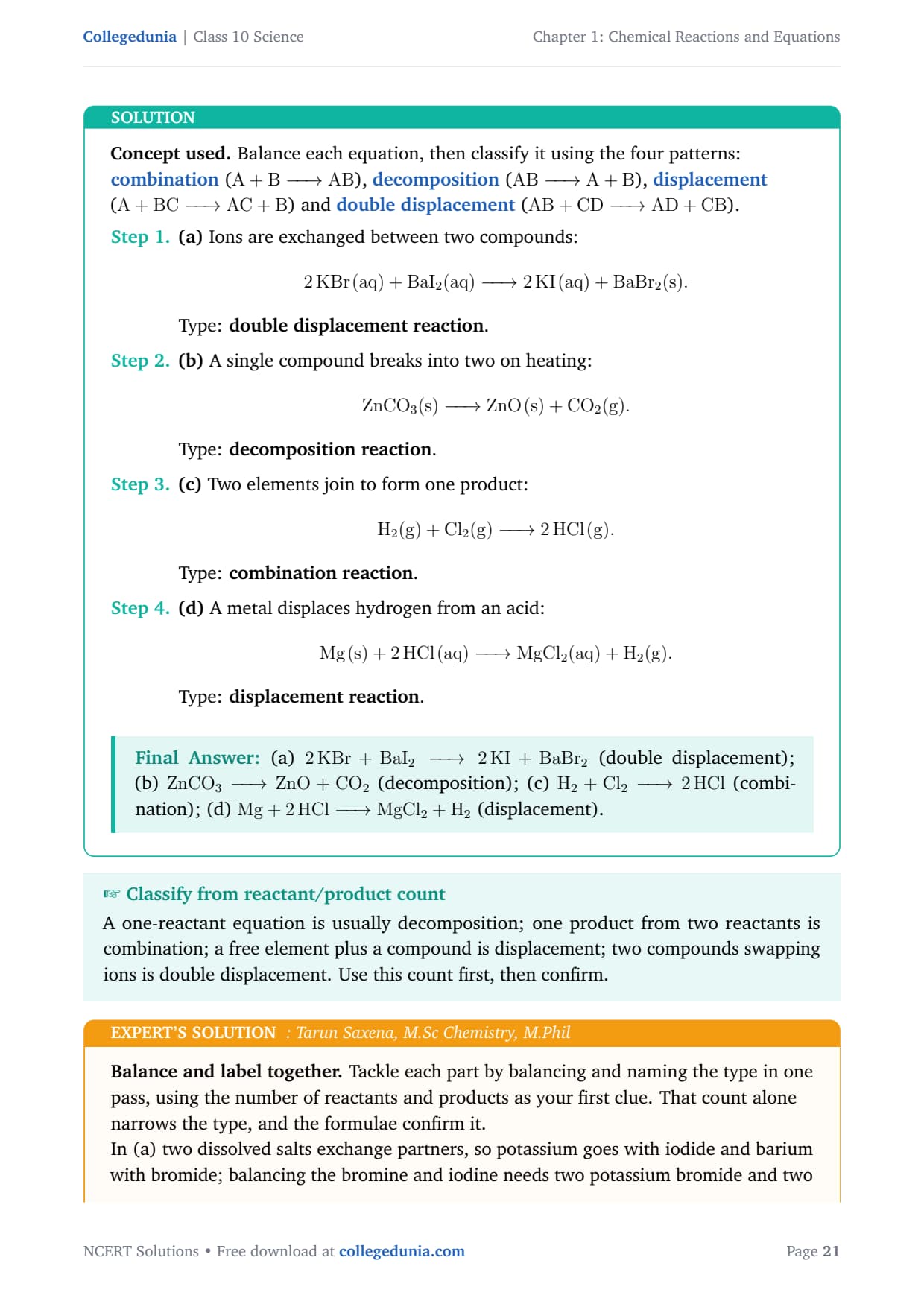
Balance each equation, then classify it using the four patterns: combinationA + B → AB, decompositionAB → A + B, displacementA + BC → AC + B and double displacementAB + CD → AD + CB.
(a) Ions are exchanged between two compounds: 2KBr(aq) + BaI2(aq) → 2KI(aq) + BaBr2(s). Type: double displacement.
(b) A single compound breaks into two on heating: ZnCO3(s) → ZnO(s) + CO2(g). Type: decomposition.
(c) Two elements join to form one product: H2(g) + Cl2(g) → 2HCl(g). Type: combination.
(d) A metal displaces hydrogen from an acid: Mg(s) + 2HCl(aq) → MgCl2(aq) + H2(g). Type: displacement.
Answer: (a) double displacement; (b) decomposition; (c) combination; (d) displacement, with balanced equations as shown.
TS
Tarun Saxena
M.Sc Chemistry, M.Phil
Verified Expert
Balance and label together. Tackle each part by balancing and naming the type in one pass, using the number of reactants and products as your first clue. That count alone narrows the type, and the formulae confirm it.
In (a) two dissolved salts exchange partners, so potassium goes with iodide and barium with bromide; balancing bromine and iodine needs two potassium bromide and two potassium iodide, marking it a double displacement. In (b) only one reactant, zinc carbonate, appears, and it splits into two products on heating, the hallmark of decomposition.
In (c) two elements combine into a single compound, hydrogen chloride, the clean signature of a combination reaction, and a 2 before HCl balances it. In (d) a free metal, magnesium, reacts with an acid to release hydrogen and form a salt, a displacement; the two chlorides require two hydrochloric acid molecules.
Answer: (a) double displacement; (b) decomposition; (c) combination; (d) displacement, with balanced equations as shown.
Q 17
What does one mean by exothermic and endothermic reactions? Give examples.
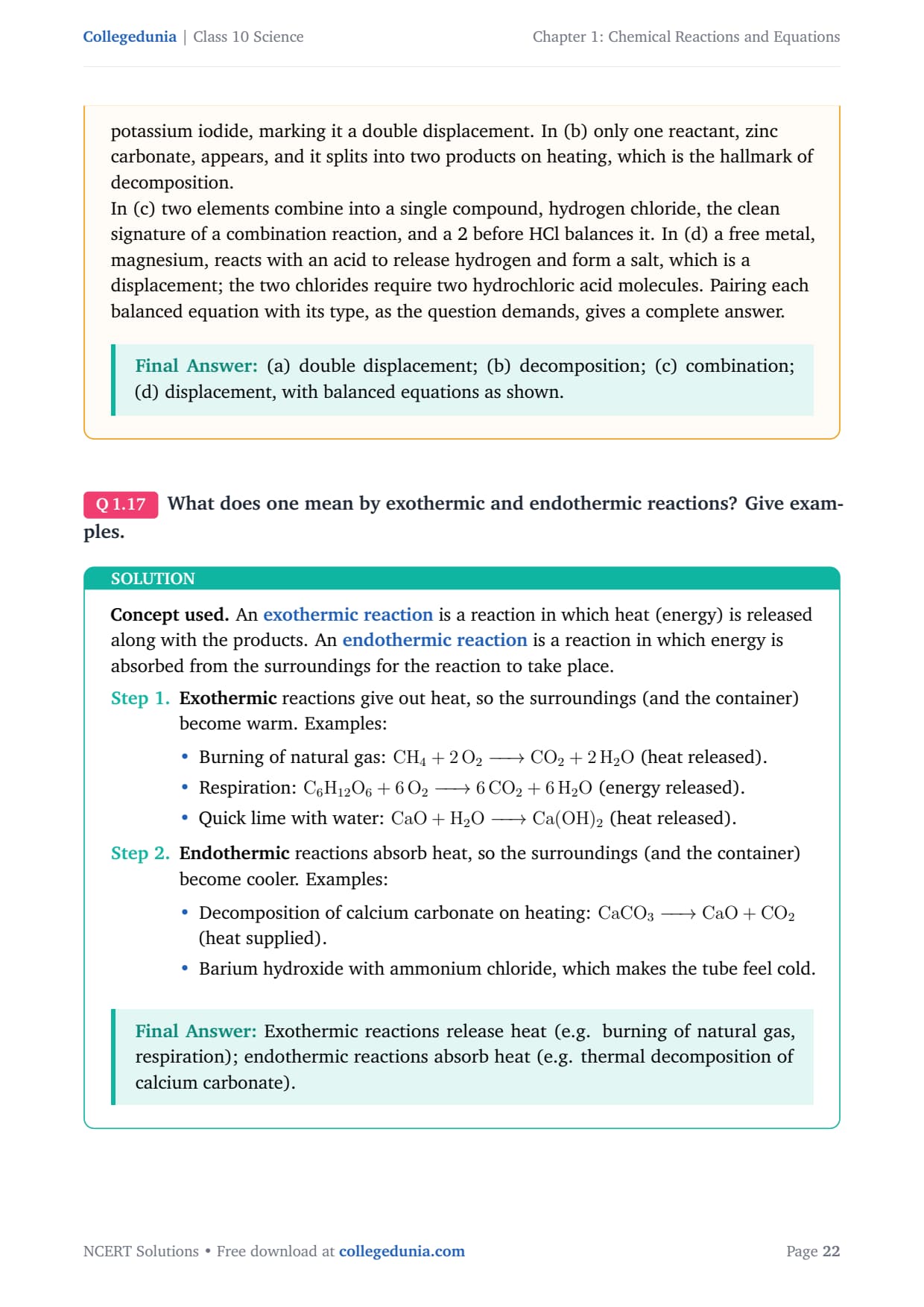
An exothermic reaction is one in which heat (energy) is released along with the products. An endothermic reaction is one in which energy is absorbed from the surroundings for the reaction to take place.
Exothermic reactions give out heat, so the surroundings become warm. Examples: burning of natural gas CH4 + 2O2 → CO2 + 2H2O; respiration C6H12O6 + 6O2 → 6CO2 + 6H2O; quick lime with water CaO + H2O → Ca(OH)2.
Endothermic reactions absorb heat, so the surroundings become cooler. Examples: decomposition of calcium carbonate on heating CaCO3 → CaO + CO2; barium hydroxide with ammonium chloride, which makes the tube feel cold.
Answer: Exothermic reactions release heat (burning of natural gas, respiration); endothermic reactions absorb heat (thermal decomposition of calcium carbonate).
AN
Asha Nair
M.Sc Chemistry, B.Ed
Verified Expert
Define by the direction of heat. The whole distinction rests on which way heat flows. If a reaction gives heat out to the surroundings, it is exothermic; if it pulls heat in from the surroundings, it is endothermic. Build your answer around this single idea and then attach examples.
Exothermic reactions are very common because most fuels burn and most combination reactions release energy. Burning natural gas and respiration both release energy that we use for heat and for living. Quick lime reacting with water is so strongly exothermic that the mixture can steam.
Endothermic reactions need a continuous supply of energy to proceed, usually as heat. Decomposing calcium carbonate requires constant heating in a kiln, and it stops the moment heating stops. The barium hydroxide and ammonium chloride mixture draws so much heat from its surroundings that the test tube turns cold to the touch.
Answer: Exothermic reactions release heat (burning of natural gas, respiration); endothermic reactions absorb heat (decomposition of calcium carbonate).
Q 18
Why is respiration considered an exothermic reaction? Explain.
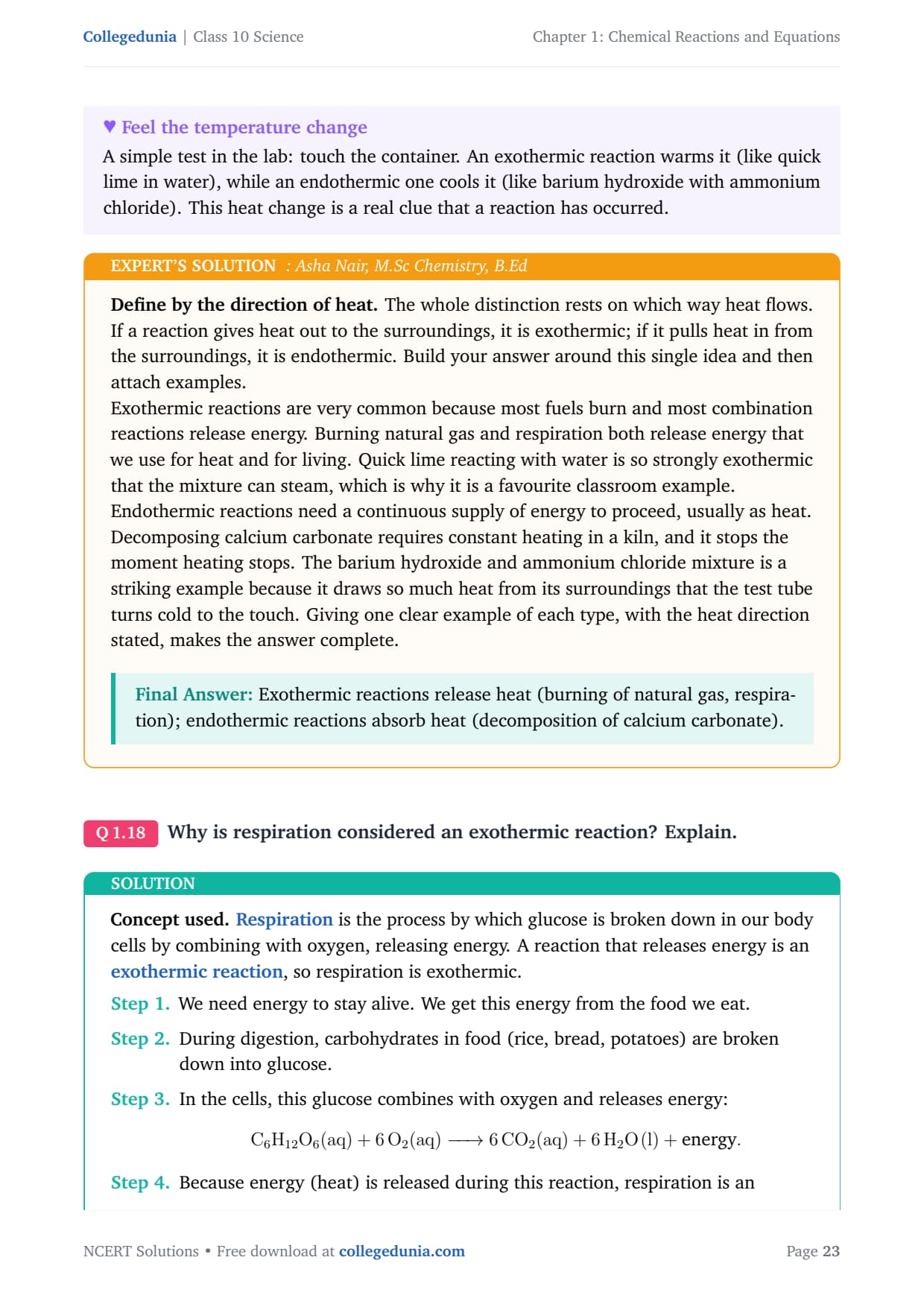
Respiration is the process by which glucose is broken down in our body cells by combining with oxygen, releasing energy. A reaction that releases energy is an exothermic reaction, so respiration is exothermic.
We need energy to stay alive, and we get this energy from the food we eat.
During digestion, carbohydrates in food (rice, bread, potatoes) are broken down into glucose.
In the cells, this glucose combines with oxygen and releases energy: C6H12O6(aq) + 6O2(aq) → 6CO2(aq) + 6H2O(l) + energy.
Because energy (heat) is released during this reaction, respiration is an exothermic reaction.
Answer: Respiration breaks down glucose using oxygen and releases energy; since energy is given out, respiration is an exothermic reaction.
SP
Sneha Pillai
M.Sc Biochemistry, B.Ed
Verified Expert
Connect food, oxygen and energy. The marking idea is that respiration gives out energy, and any energy-releasing reaction is exothermic. Build the explanation from food to glucose to energy, and the conclusion follows naturally.
Our body cannot run without a constant supply of energy, and that energy comes from the food we eat. The carbohydrates in our meals are first broken down during digestion into a simple sugar, glucose, the fuel that cells actually use.
Inside the cells, glucose reacts with oxygen and is broken down into carbon dioxide and water, and in doing so it releases energy. This release of energy is exactly what defines an exothermic reaction. The released energy keeps the body warm and drives movement, growth and repair.
Answer: Respiration oxidises glucose to release energy; because energy is given out, it is an exothermic reaction.
Q 19
Why are decomposition reactions called the opposite of combination reactions? Write equations for these reactions.
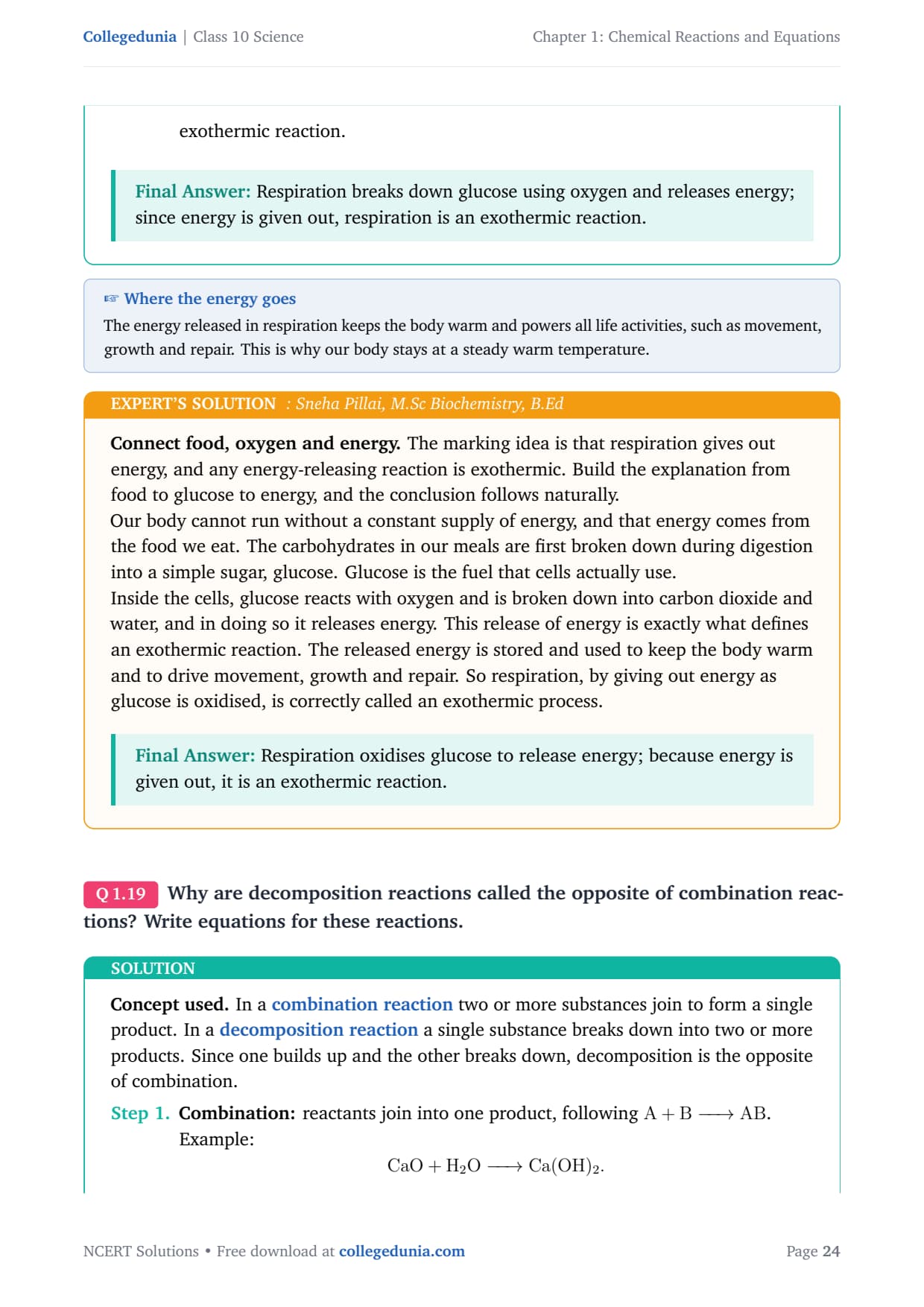
In a combination reaction two or more substances join to form a single product. In a decomposition reaction a single substance breaks down into two or more products. Since one builds up and the other breaks down, decomposition is the opposite of combination.
Combination: reactants join into one product, A + B → AB. Example: CaO + H2O → Ca(OH)2.
Decomposition: a single reactant splits into more than one product, AB → A + B. Example: CaCO3 → CaO + CO2 (on heating).
In combination, substances combine and usually energy is released; in decomposition, a substance breaks apart and usually energy is absorbed. The two are exact reverses of each other.
Answer: Combination joins substances into one product CaO + H2O → Ca(OH)2; decomposition breaks one substance into many CaCO3 → CaO + CO2. They are reverse processes, hence opposite.
MA
Mohit Agarwal
M.Sc Chemistry, B.Ed
Verified Expert
Contrast the structures. The clearest way to justify "opposite" is to put the two general patterns side by side. Combination is A + B → AB, many into one. Decomposition is AB → A + B, one into many. They are exact reverses, so the label fits perfectly.
The energy story reinforces the contrast. Combination reactions usually give out energy; calcium oxide combining with water releases so much heat that the mixture warms up. That is energy coming out as the new bonds form.
Decomposition reactions usually need energy put in to break the existing bonds. Calcium carbonate does not fall apart on its own; it must be heated strongly to split into calcium oxide and carbon dioxide. So one process assembles a larger molecule and releases energy, while the other dismantles a molecule and absorbs energy.
Answer: Decomposition AB → A + B reverses combination A + B → AB, so it is the opposite; e.g. CaCO3 → CaO + CO2 vs CaO + H2O → Ca(OH)2.
Q 20
Write one equation each for decomposition reactions where energy is supplied in the form of heat, light or electricity.
Decomposition reactions need energy to break a single reactant into simpler products. The energy can be supplied as heat (thermal decomposition), light (photo-decomposition) or electricity (electrolytic decomposition).
One clean example per energy type. The question wants exactly three equations, one for each energy source, so the best strategy is to pick a single, well-known decomposition for heat, light and electricity, and state the source in words rather than on the arrow.
For heat, the standard choice is the thermal decomposition of calcium carbonate into calcium oxide and carbon dioxide, an important industrial reaction used to make quick lime for cement. Heating supplies the energy that breaks the carbonate apart.
For light, silver chloride is the classic example: it turns from white to grey in sunlight as it decomposes into silver and chlorine, once used in black-and-white photography. For electricity, the electrolysis of water splits it into hydrogen and oxygen in a 2:1 volume ratio.
What is the difference between displacement and double displacement reactions? Write equations for these reactions.
In a displacement reaction a more reactive element takes the place of a less reactive element in a compound. In a double displacement reaction two compounds exchange their ions to form two new compounds. The key difference is in how many compounds take part and what is exchanged.
DisplacementA + BC → AC + B: one element and one compound react; the element displaces another element. Example: Fe(s) + CuSO4(aq) → FeSO4(aq) + Cu(s) (iron displaces copper).
Double displacementAB + CD → AD + CB: two compounds react and swap ions. Example: Na2SO4(aq) + BaCl2(aq) → BaSO4(s) + 2NaCl(aq) (sulphate and chloride change partners).
So in displacement a single atom is replaced, while in double displacement two ions are exchanged between two compounds.
Answer: Displacement: a more reactive element replaces another, Fe + CuSO4 → FeSO4 + Cu. Double displacement: two compounds exchange ions, Na2SO4 + BaCl2 → BaSO4 + 2NaCl.
NK
Naveen Kumar
M.Sc Chemistry, B.Ed
Verified Expert
Compare what gets swapped. The cleanest contrast is to ask: is a single element being replaced, or are two ions being exchanged? Displacement replaces one element; double displacement exchanges ions between two compounds. Anchor your answer on this and support it with one equation each.
In displacement, a free, more reactive element pushes a less reactive element out of its compound. Iron in copper sulphate is the textbook case: iron, being more reactive, takes the place of copper, forming iron sulphate and depositing copper. Only one element changes hands, and the reactivity series decides the outcome.
In double displacement, two compounds in solution trade their partner ions, often producing a precipitate. Sodium sulphate with barium chloride is the standard example: sulphate goes to barium and chloride goes to sodium, so barium sulphate falls out as a white solid while sodium chloride stays dissolved.
Answer: Displacement replaces one element Fe + CuSO4 → FeSO4 + Cu; double displacement exchanges ions of two compounds Na2SO4 + BaCl2 → BaSO4 + 2NaCl.
Q 22
In the refining of silver, the recovery of silver from silver nitrate solution involved displacement by copper metal. Write down the reaction involved.
This is a displacement reaction. Copper is more reactive than silver in the reactivity series, so copper can displace silver from silver nitrate solution, setting free the silver metal.
Copper, being more reactive than silver, displaces silver from silver nitrate solution.
Copper goes into solution as copper nitrate, while silver is set free as the metal: Cu(s) + 2AgNO3(aq) → Cu(NO3)2(aq) + 2Ag(s).
Two silver nitrate units are needed because copper nitrate carries two nitrate groups, which also frees two silver atoms.
Answer:Cu(s) + 2AgNO3(aq) → Cu(NO3)2(aq) + 2Ag(s). Copper displaces silver from silver nitrate solution (a displacement reaction).
KB
Kiran Bose
B.Tech Metallurgical Engineering, M.Tech
Verified Expert
Apply the reactivity series. Recovering a metal from its salt solution by adding a more reactive metal is a standard displacement, and the reactivity series tells you whether it will work. Copper lies above silver, so copper can push silver out of silver nitrate, which is exactly what the refining step uses.
When copper metal is dipped into silver nitrate solution, copper atoms go into solution while silver ions are reduced and deposit as shining silver metal. The solution, originally containing silver nitrate, gradually turns blue as copper nitrate forms in its place.
Balancing requires care with the nitrate groups: copper nitrate contains two nitrate groups, so two silver nitrate molecules react and two silver atoms are released for every copper atom that dissolves. The net result is pure silver recovered as a solid and copper carried away in solution as copper nitrate.
Answer:Cu + 2AgNO3 → Cu(NO3)2 + 2Ag; copper, being more reactive, displaces silver from the solution.
Q 23
What do you mean by a precipitation reaction? Explain by giving examples.
A precipitation reaction is a reaction in which two solutions react to form an insoluble solid, called a precipitate, which settles out of the solution. Most precipitation reactions are double displacement reactions.
When two soluble salts in solution react, their ions may combine to form a product insoluble in water; this insoluble solid is the precipitate.
Example 1: sodium sulphate and barium chloride give a white precipitate of barium sulphate: Na2SO4(aq) + BaCl2(aq) → BaSO4(s) + 2NaCl(aq).
Example 2: silver nitrate and sodium chloride give a white precipitate of silver chloride: AgNO3(aq) + NaCl(aq) → AgCl(s) + NaNO3(aq).
Answer: A precipitation reaction forms an insoluble solid (precipitate) from two solutions; e.g. Na2SO4 + BaCl2 → BaSO4(s) + 2NaCl gives a white precipitate of barium sulphate.
MI
Meera Iyer
M.Sc Chemistry, B.Ed
Verified Expert
Lead with the insoluble product. The defining feature of a precipitation reaction is that a solid drops out of a clear solution, so frame your answer around that insoluble product. Begin by stating that two solutions react to give an insoluble precipitate, then support it with examples whose precipitates you can name.
These reactions are almost always double displacements: two dissolved salts swap their ions, and one of the new combinations happens to be insoluble. The insoluble combination cannot stay dissolved, so it appears as a cloud of fine solid that slowly settles to the bottom.
Sodium sulphate with barium chloride is the classic example, giving a white precipitate of barium sulphate while sodium chloride stays in solution. Silver nitrate with sodium chloride is another, giving a white precipitate of silver chloride. Naming the colour of the precipitate (white here) adds detail that examiners reward.
Answer: A precipitation reaction produces an insoluble precipitate from two solutions; e.g. Na2SO4 + BaCl2 → BaSO4(s) + 2NaCl and AgNO3 + NaCl → AgCl(s) + NaNO3.
Q 24
Explain the following in terms of gain or loss of oxygen with two examples each.
(a) Oxidation (b) Reduction
In terms of oxygen, oxidation is the gain of oxygen by a substance, and reduction is the loss of oxygen by a substance. In a redox reaction, one substance is oxidised while another is reduced.
(a) Oxidation (gain of oxygen):2Cu + O2 → 2CuO (copper gains oxygen, so copper is oxidised); 2Mg + O2 → 2MgO (magnesium gains oxygen, so magnesium is oxidised).
(b) Reduction (loss of oxygen):CuO + H2 → Cu + H2O (copper oxide loses oxygen, so it is reduced); ZnO + C → Zn + CO (zinc oxide loses oxygen, so it is reduced).
Answer: (a) Oxidation is gain of oxygen, e.g. 2Cu + O2 → 2CuO and 2Mg + O2 → 2MgO. (b) Reduction is loss of oxygen, e.g. CuO + H2 → Cu + H2O and ZnO + C → Zn + CO.
AnB
Anita Bhatt
M.Sc Chemistry, B.Ed
Verified Expert
Define by oxygen, then prove with examples. For Class 10 the oxygen definition is the simplest and the most expected: oxidation is gain of oxygen, reduction is loss of oxygen. State both definitions plainly, then back each with two equations where the oxygen change is obvious.
For oxidation, the burning of metals is ideal because the metal visibly takes up oxygen to form an oxide. Copper heated in air forms black copper oxide, and magnesium burns to form white magnesium oxide; in both, the element gains oxygen and is oxidised.
For reduction, choose reactions where an oxide loses its oxygen. Copper oxide heated with hydrogen turns back to copper, losing oxygen to form water. Zinc oxide heated with carbon gives zinc and carbon monoxide, again the oxide losing oxygen. Both processes accompany each other in a redox reaction.
Answer: (a) Oxidation is gain of oxygen 2Cu + O2 → 2CuO, 2Mg + O2 → 2MgO. (b) Reduction is loss of oxygen CuO + H2 → Cu + H2O, ZnO + C → Zn + CO.
Q 25
A shiny brown coloured element 'X' on heating in air becomes black in colour. Name the element 'X' and the black coloured compound formed.
A shiny brown metal that turns black on heating in air is being oxidised: it gains oxygen from the air to form a black oxide. This describes copper, which forms black copper(II) oxide on heating.
The shiny brown element 'X' is copper (Cu).
On heating in air, copper reacts with the oxygen of the air, so copper is oxidised: 2Cu + O2 → 2CuO (on heating).
The black coloured compound formed is copper(II) oxide (CuO), which coats the surface of the copper.
Answer: 'X' is copper (Cu); the black compound formed is copper(II) oxide (CuO).
SaR
Sanjay Rao
M.Sc Chemistry, B.Ed
Verified Expert
Read the clues like a detective. Identification questions give you colour and behaviour clues that point to one metal. "Shiny brown" and "turns black on heating in air" together describe copper, whose reddish-brown surface darkens to black copper oxide when heated.
The chemistry behind the colour change is straightforward oxidation. On heating, copper combines with oxygen from the air, and oxygen is added to the metal, so the copper is oxidised. The product is copper(II) oxide, a black solid that forms a coating over the bright metal.
A neat way to confirm the identity is to recall the reverse reaction from the chapter: when this black coated copper oxide is heated in a stream of hydrogen, the black layer turns back to brown copper as the oxide is reduced. That round trip, brown to black to brown, is unique to copper among the common metals here.
Answer: 'X' is copper, and the black compound formed on heating in air is copper(II) oxide, CuO.
Q 26
Why do we apply paint on iron articles?
Iron articles undergo corrosion (rusting) when exposed to air and moisture. Rusting happens when iron reacts with the oxygen and water (moisture) in air. A coat of paint forms a barrier that keeps air and moisture away from the iron.
When iron is left exposed, it reacts with oxygen and moisture in the air and gets coated with a reddish-brown layer of rust. This is corrosion.
Corrosion slowly eats away the metal and weakens iron objects such as gates, railings, bridges and car bodies.
Applying paint covers the iron surface and stops air and moisture from coming into contact with the iron.
With air and moisture kept away, rusting is prevented, so painting protects iron articles from corrosion and makes them last longer.
Answer: We paint iron articles to keep out air and moisture, which prevents rusting (corrosion) and protects the iron from being damaged.
RvS
Ravi Shankar
B.Tech Civil Engineering, M.Tech
Verified Expert
Stop the air and water reaching the metal. The single idea behind painting iron is to break contact between the metal and its attackers, oxygen and moisture. Rusting needs both air and water; if either is kept away from the iron, rust cannot form, and paint provides that barrier.
Left unprotected, iron reacts with oxygen and moisture to form a flaky reddish-brown rust. Rust does not cling tightly like some protective oxides; it keeps flaking off and exposing fresh metal, so the object slowly weakens and crumbles. For large structures such as bridges and railway tracks, this damage is both dangerous and expensive.
A coat of paint seals the surface so that air and water cannot touch the iron underneath, preventing the rusting reaction from starting. The paint must be renewed when it chips, because a break in the coat lets moisture reach the metal again. Oiling, greasing and galvanising work on the same principle.
Answer: Paint forms a protective layer that keeps air and moisture away from iron, preventing rusting (corrosion) and extending the life of the article.
Q 27
Oil and fat containing food items are flushed with nitrogen. Why?
Oils and fats turn rancid when they are oxidised by the oxygen in air, which changes their smell and taste. Nitrogen is an unreactive (inert) gas, so flushing the packet with nitrogen removes oxygen and prevents oxidation.
When fats and oils are oxidised by oxygen in the air, they become rancid: their smell and taste change and the food spoils.
Nitrogen is an unreactive gas. Filling the food packet with nitrogen drives out the air (and hence the oxygen) from inside the packet.
With no oxygen present, the oils and fats cannot be oxidised, so they do not turn rancid.
This keeps oil and fat containing foods, such as chips, fresh for a longer time.
Answer: Nitrogen is unreactive and removes oxygen from the packet, so the oils and fats are not oxidised and do not turn rancid; this keeps the food fresh longer.
FK
Farah Khan
M.Sc Food Technology, B.Ed
Verified Expert
Replace the reactive gas with an inert one. The reason chips and similar foods are packed in nitrogen is to keep oxygen away from the oils and fats inside. Oxygen is the gas that turns these foods rancid, so removing it protects both the flavour and the safety of the food.
When oils and fats are exposed to the oxygen in air, they undergo oxidation and become rancid. Rancid food smells and tastes unpleasant and is no longer good to eat. Because the spoilage is an oxidation reaction, it can be slowed simply by denying the food its supply of oxygen.
Nitrogen is ideal because it is chemically unreactive and harmless. When a packet is flushed with nitrogen, the gas pushes out the air, leaving almost no oxygen inside the sealed pack, so the oxidation cannot proceed. The puffed-up packet of chips is filled with nitrogen for exactly this reason, and it also cushions the contents from getting crushed. Antioxidants and airtight storage help too.
Answer: Nitrogen is unreactive and displaces oxygen from the pack, preventing the oxidation that causes rancidity and keeping oil and fat rich foods fresh.
Q 28
Explain the following terms with one example each.
(a) Corrosion (b) Rancidity
Corrosion is the slow eating away of a metal by the action of air, moisture or chemicals around it. Rancidity is the spoiling of oils and fats by oxidation, which changes their smell and taste. Both are everyday effects of oxidation.
(a) Corrosion. When a metal is attacked by substances around it, such as moisture and acids, it is slowly damaged. Example: the rusting of iron, where iron forms a reddish-brown coating of rust in moist air. The black coating on silver and the green coating on copper are also corrosion.
(b) Rancidity. When oils and fats in food are oxidised on standing, they become rancid and their smell and taste change. Example: the unpleasant smell and taste of butter or chips left open for a long time.
Answer: (a) Corrosion: slow eating away of a metal by its surroundings, e.g. rusting of iron. (b) Rancidity: oxidation of oils and fats that changes their smell and taste, e.g. butter going stale.
SnA
Sania Ahmed
M.Sc Chemistry, B.Ed
Verified Expert
Two oxidation effects, two materials. Corrosion and rancidity are both consequences of oxidation, but they act on different things, so the clearest answer defines each and gives a matching example. Corrosion attacks metals; rancidity spoils food.
Corrosion is the gradual damage to a metal caused by the air, moisture and chemicals around it. The most familiar case is the rusting of iron, where moist air turns the shiny metal into flaky reddish-brown rust. Silver tarnishing black and copper turning green are corrosion too, each metal forming its own coating.
Rancidity is what happens to oils and fats when they are oxidised on exposure to air over time. The food develops a foul smell and an off taste, as anyone who has smelt stale butter or old chips knows. Both are oxidation processes, but corrosion is tied to metals and rancidity to food.
Answer: (a) Corrosion is the slow damage of a metal by its surroundings (rusting of iron). (b) Rancidity is the oxidation of oils and fats that spoils smell and taste (stale butter).
NCERT Solutions Class 10 Science Chapter 1 Chemical Reactions and Equations FAQs
Ques. How many questions are there in NCERT Class 10 Science Chapter 1 Chemical Reactions and Equations?
Ans. There are 28 questions in all: 8 in-text questions inside the chapter and 20 end-of-chapter exercise questions. All 28 are solved here with full step-by-step answers and an Expert Solution. The mix covers balancing equations, the four reaction types, oxidation and reduction, and daily-life topics like corrosion and rancidity.
Ques. What is a balanced chemical equation and why must it be balanced?
Ans. A balanced chemical equation has the same number of atoms of each element on the reactant side and the product side. It must be balanced because of the law of conservation of mass, which says mass is neither created nor destroyed in a chemical reaction. Since atoms are only rearranged, never gained or lost, their count must stay equal on both sides. We balance by adjusting only the coefficients, never the formulae.
Ques. What are the four main types of chemical reactions in Class 10 Science Chapter 1?
Ans. The four main types are combination (two or more substances join to form one product), decomposition (one substance breaks into two or more), displacement (a more reactive element replaces a less reactive one), and double displacement (two compounds exchange ions, often forming a precipitate). A handy clue is to count the reactants and products first, then confirm with the formulae.
Ques. What is the difference between oxidation and reduction?
Ans. Oxidation is the gain of oxygen or the loss of hydrogen by a substance, while reduction is the loss of oxygen or the gain of hydrogen. Both always happen together in a redox reaction. For example, in copper oxide reacting with hydrogen, copper oxide is reduced because it loses oxygen, and hydrogen is oxidised because it gains oxygen to form water.
Ques. What are corrosion and rancidity in Class 10 Science?
Ans. Corrosion is the slow eating away of a metal by air, moisture and chemicals around it; the rusting of iron is the common example, prevented by painting, oiling or galvanising. Rancidity is the spoiling of oils and fats in food when they are oxidised by air, which changes their smell and taste; it is slowed by flushing packets with unreactive nitrogen, adding antioxidants, or storing food in airtight containers in the fridge.
Ques. How many pages is the Class 10 Science Chapter 1 Chemical Reactions and Equations NCERT Solutions PDF?
Ans. The Chemical Reactions and Equations NCERT Solutions PDF covers all 28 questions with balanced equations, step-by-step working, and an Expert Solution for each question. It is free to download for the 2026-27 session and follows the latest NCERT textbook exactly.
Ques. Why is respiration considered an exothermic reaction?
Ans. Respiration breaks down glucose in our body cells by combining it with oxygen, and in doing so it releases energy. Any reaction that releases energy is exothermic, so respiration is an exothermic reaction. The energy released keeps the body warm and powers movement, growth and repair. The reaction is glucose plus oxygen giving carbon dioxide, water and energy.
Ques. Is the NCERT Solutions for Class 10 Science Chapter 1 aligned with the 2026-27 syllabus?
Ans. Yes. This page reflects the current 2026-27 CBSE syllabus for Class 10 Science. The Chemical Reactions and Equations chapter is unchanged for the current cycle, and every answer follows the NCERT textbook, including the law of conservation of mass, the four reaction types, and oxidation and reduction. The solutions are written in plain English for the CBSE board exam.







Comments