Maths Strategist, Olympiad Coach | Updated 3+ months ago
The NCERT Solutions for Class 10 Maths Chapter 9 Some Applications of Trigonometry cover all 15 questions from Exercise 9.1, written for the 2026-27 CBSE syllabus. Each solution sets up the right triangle, names the angle of elevation or depression, and picks the correct trigonometric ratio step by step.
All 15 Exercise 9.1 questions solved step by step, with an Expert Solution per question that adds board-exam strategy and common-error warnings.
Full coverage of angle of elevation, angle of depression, single right triangle problems, and two-triangle problems using tan 30°, tan 45°, and tan 60° with exact surd answers.
Answers aligned with the 2026-27 CBSE Class 10 Mathematics syllabus, useful for school tests and the board exam alike.
Every answer in this Collegedunia set is checked by Maths experts, mapped to the 2026-27 NCERT textbook, and matched to the last five years of CBSE Class 10 board papers.
What Class 10 Maths Chapter 9 Some Applications of Trigonometry Covers
Chapter 9 takes the trigonometric ratios from Chapter 8 and uses them on real measurement problems. If you know one angle and one side of a right triangle, you can find any other side. That idea finds heights of towers, depths of valleys, and distances between objects.
Line of sight: the straight line from your eye to the object. The angle of elevation or depression is measured from the horizontal through this line.
Angle of elevation: the angle above the horizontal when you look up, such as at the top of a tower.
Angle of depression: the angle below the horizontal when you look down, such as at a ship from a lighthouse.
Single triangle (Q1 to Q10) vs two triangles (Q11 to Q15): two-triangle problems share one side and carry more marks.
Key Ideas and Formulas for Heights and Distances
The chapter is all application. There are no new identities to prove. It rests on three tan values plus one drawing habit. The table below has every value you need for Exercise 9.1.
Value / rule
What it gives
Used in
tan 30° = 1/√3
Height = distance × tanθ when the angle is small
Q1, Q2, Q3, Q11, Q12, Q13
tan 45° = 1
Opposite equals adjacent, so the triangle is isosceles right
Q4, Q6, Q9, Q10, Q14, Q15
tan 60° = √3
Opposite side is longer than the adjacent side
Q5, Q6, Q7, Q8, Q10, Q11, Q12, Q15
sin 30° = 1/2, cos 30° = √3/2
Use when the slant (hypotenuse) is a rope, slide, or cable
Q1, Q2, Q3
Elevation = depression
Equal as alternate angles when two horizontals are parallel
Q10, Q11, Q12, Q13, Q15
Quick Tip: Draw the right triangle first, then label the angle and name the known and unknown sides. If the unknown is the opposite side, use tan when you know the adjacent side, or sin when you know the slant.
How to Solve Each Question in Exercise 9.1
One four-step method works for every question. Follow it to keep the full method marks.
Step 1, draw and label: sketch it, mark the right angle at the base, and write the angle and the known length.
Step 2, name the sides: for that angle, pick the opposite (height), the adjacent (distance), and the hypotenuse (slant).
Step 3, choose the ratio: tan links opposite and adjacent, sin links opposite and slant, cos links adjacent and slant.
Step 4, solve: substitute, simplify, and write a rationalised surd answer with one closing sentence.
For two-triangle problems, call the height h and the unknown distance d. Write one tangent equation from each triangle. They share h or d, so you can remove one unknown and find the other.
Solved Example and Common Mistakes
Take Q1: a 20 m rope runs from the top of a pole to the ground at 30°. The pole is opposite the angle and the rope is the slant, so use sine.
sin 30∘ = pole20 ⇒ 12 = pole20 ⇒ pole = 10 m.
Mistakes that lose marks in the board exam:
Skipping the diagram: without it students mix up opposite and adjacent. Examiners expect a labelled figure.
Mixing elevation and depression: one points up, one points down. They are equal only as alternate angles in parallel-line setups.
Not rationalising surds: write 40/√3 as 40√3/3 , and keep √3 exact, not 1.73.
Stopping after the first triangle: in two-triangle problems, re-read the question to see what is still left to find.
Other Resources for Class 10 Maths Chapter 9
Pair these NCERT Solutions with the matching Collegedunia notes, formula sheet, handwritten notes, and the official book chapter below.
Related Links: Use the table below to open the NCERT Solutions for the other chapters of Class 10 Maths. Every chapter ships with the same step-by-step answer style, full PDF download, and revision FAQ.
All NCERT Solutions for Class 10 Maths Chapter 9 Some Applications of Trigonometry with Step-by-Step Solutions
Exercise 9.1
Q 9.1
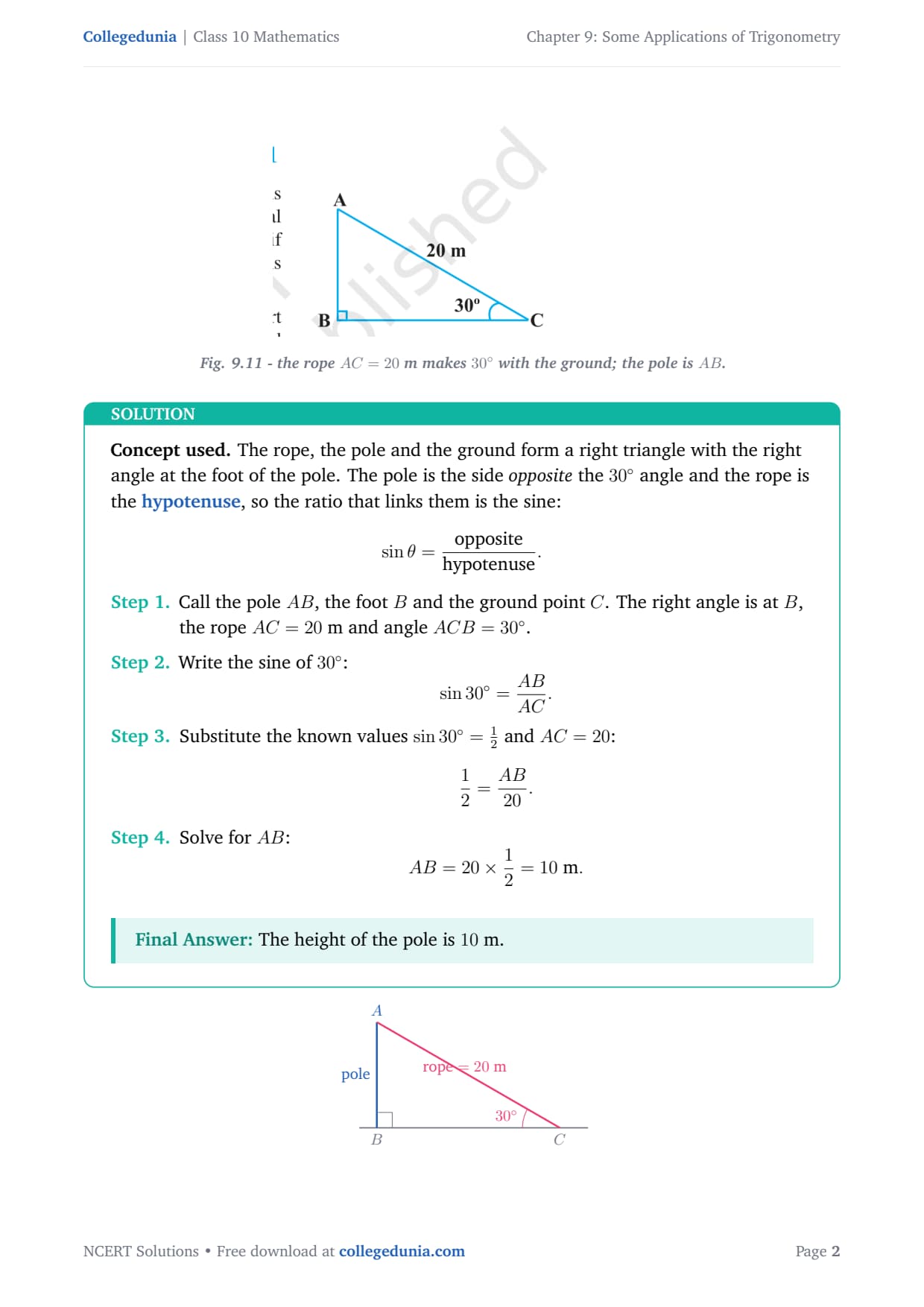
A circus artist is climbing a 20 m long rope, which is
tightly stretched and tied from the top of a vertical pole to the
ground. Find the height of the pole, if the angle made by the rope with
the ground level is 30∘ (see Fig. 9.11).
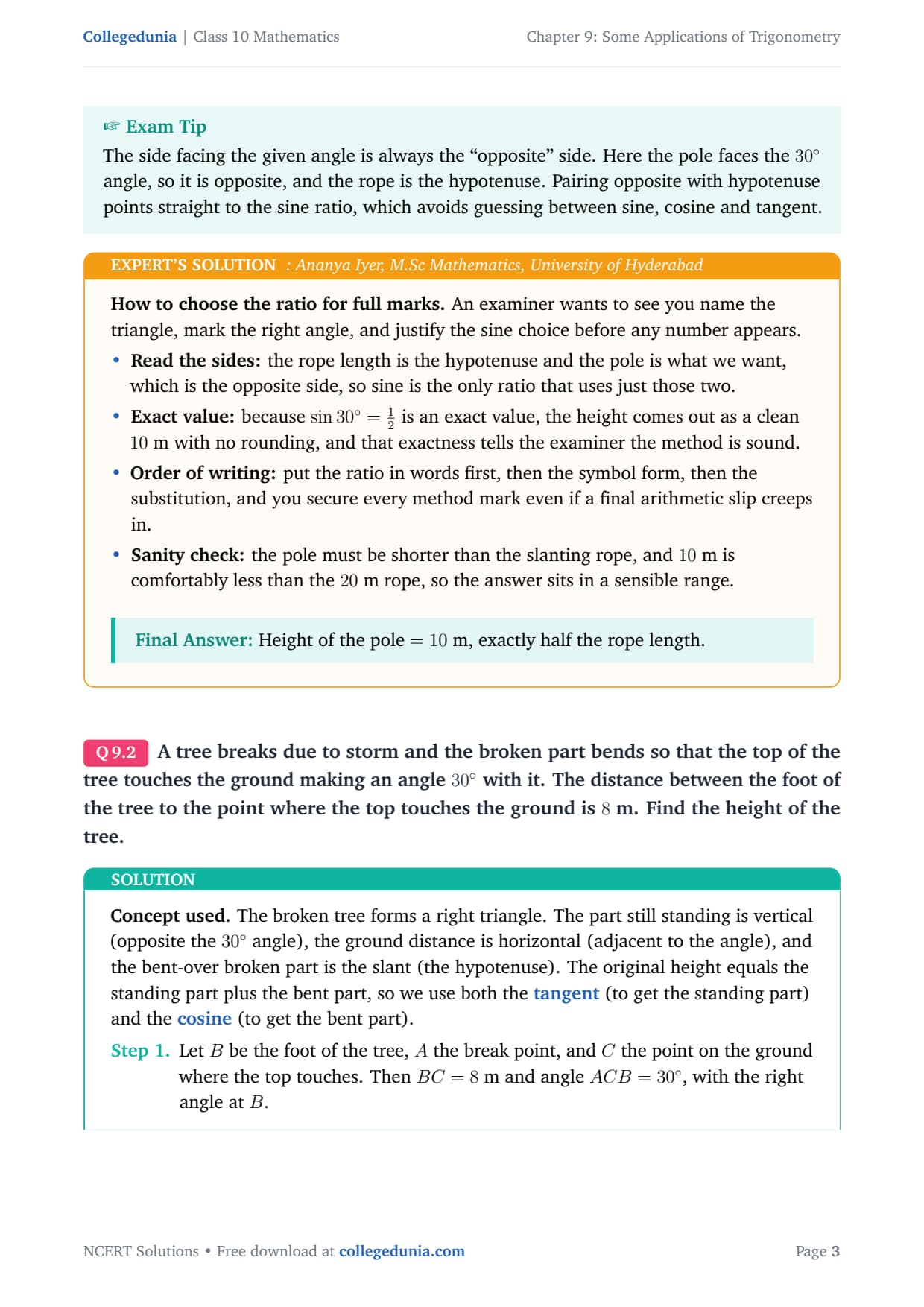
Concept used. The rope, the pole and the ground form a right
triangle with the right angle at the foot of the pole. The pole is the
side opposite the 30∘ angle and the rope is the
hypotenuse, so the ratio that links them is the sine:
sinθ=oppositehypotenuse.
Call the pole AB, the foot B and the ground point C. The
right angle is at B, the rope AC=20 m and angle
ACB=30∘.
Write the sine of 30∘:
sin 30∘=ABAC.
Substitute the known values sin 30∘=12 and
AC=20:
12=AB20.
Solve for AB:
AB=20×12=10 m.
The height of the pole is 10 m.
AI
Ananya Iyer
M.Sc Mathematics, University of Hyderabad
Verified Expert
How to choose the ratio for full marks. An examiner wants to see
you name the triangle, mark the right angle, and justify the sine choice
before any number appears.
Read the sides: the rope length is the hypotenuse and the
pole is what we want, which is the opposite side, so sine is the
only ratio that uses just those two.
Exact value: because sin 30∘=12 is an
exact value, the height comes out as a clean 10 m with no
rounding, and that exactness tells the examiner the method is
sound.
Order of writing: put the ratio in words first, then the
symbol form, then the substitution, and you secure every method
mark even if a final arithmetic slip creeps in.
Sanity check: the pole must be shorter than the slanting
rope, and 10 m is comfortably less than the 20 m rope, so the
answer sits in a sensible range.
Height of the pole =10 m, exactly half the rope length.
Q 9.2
A tree breaks due to storm and the broken part bends so that
the top of the tree touches the ground making an angle 30∘ with
it. The distance between the foot of the tree to the point where the top
touches the ground is 8 m. Find the height of the tree.
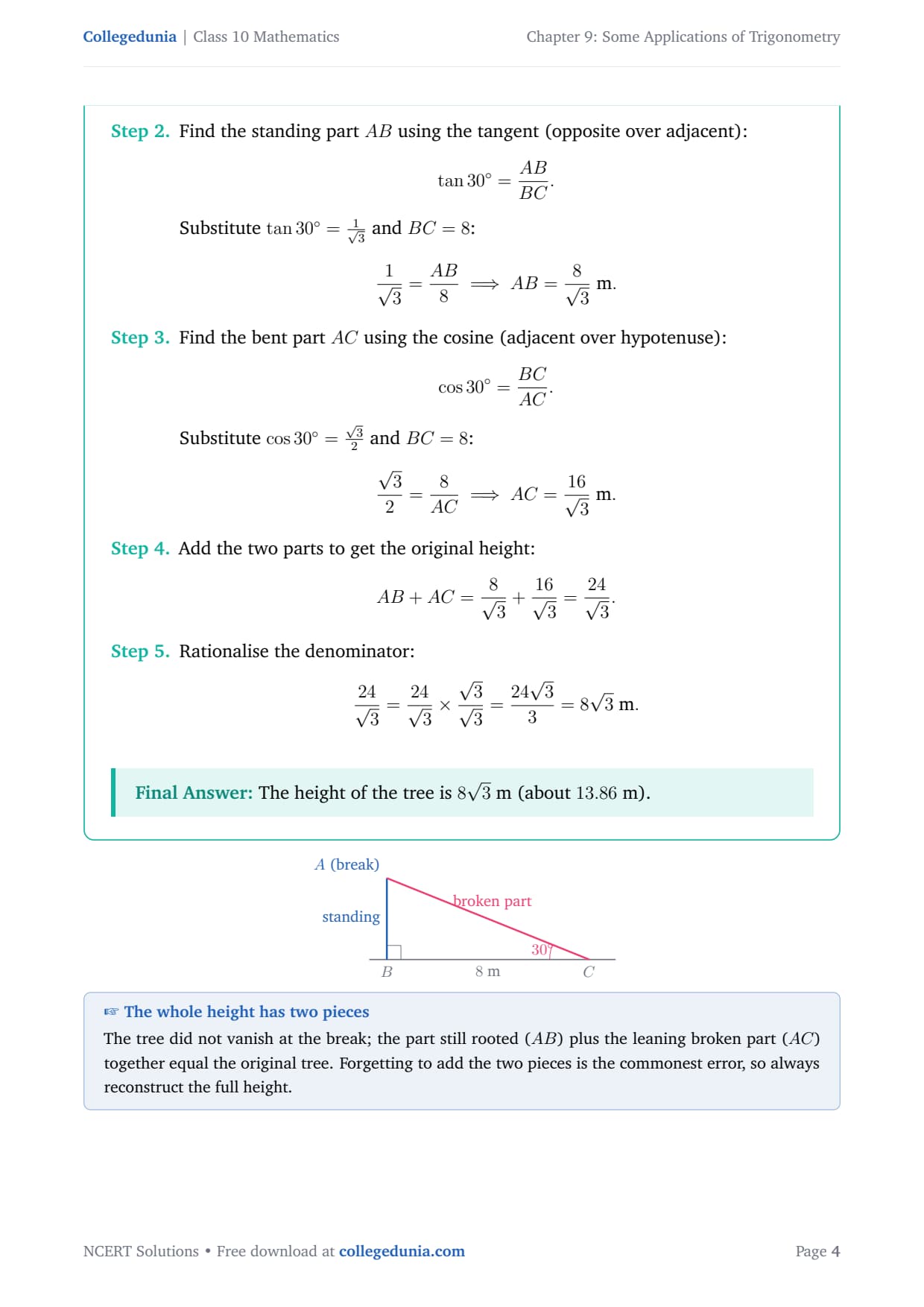
Concept used. The broken tree forms a right triangle. The part
still standing is vertical (opposite the 30∘ angle), the ground
distance is horizontal (adjacent to the angle), and the bent-over broken
part is the slant (the hypotenuse). The original height equals the
standing part plus the bent part, so we use both the tangent
(to get the standing part) and the cosine (to get the bent
part).
Let B be the foot of the tree, A the break point, and C the
point on the ground where the top touches. Then BC=8 m and
angle ACB=30∘, with the right angle at B.
Find the standing part AB using the tangent (opposite over
adjacent):
tan 30∘=ABBC.
Substitute tan 30∘=13 and BC=8:
13=AB8 AB=83m.
Find the bent part AC using the cosine (adjacent over
hypotenuse):
cos 30∘=BCAC.
Substitute cos 30∘=32 and BC=8:
32=8AC AC=163m.
Add the two parts to get the original height:
AB+AC=83+163=243.
Rationalise the denominator:
243=243×33=2433=83 m.
The height of the tree is 8√3 m (about 13.86 m).
RV
Rohan Verma
B.Tech Civil Engineering, NIT Trichy
Verified Expert
A faster single-formula route. Instead of finding the two parts
separately, notice that the total height equals BC(tan 30∘+sec
30∘) and pack both pieces into one line.
Shared base: reading the picture carefully is what makes
this quick, since the horizontal ground distance between the foot
and the touch point is shared by both right-triangle ratios, so the
same eight metres feeds into both.
Two pieces: the vertical standing piece is the base times
the tangent of the angle, and the slanting broken piece is the base
times the secant of the same angle, so the original height is just
their sum.
One step: the sum collapses to
8(13+23)=8·33=83,
and the answer drops out in a single line once the common factor of
eight is taken outside the bracket.
Why the surd matters: a neat surd such as 83
signals to the examiner that the special-angle values were handled
correctly, which earns more credit than a rounded decimal would.
Rebuild the whole: always reconstruct the full original
object, here the entire tree before it broke, rather than stopping
at one of its parts, because the question asks for the original
height and not just a piece.
83 m, obtained in one line as 8(tan 30∘+sec 30∘).
Q 9.3
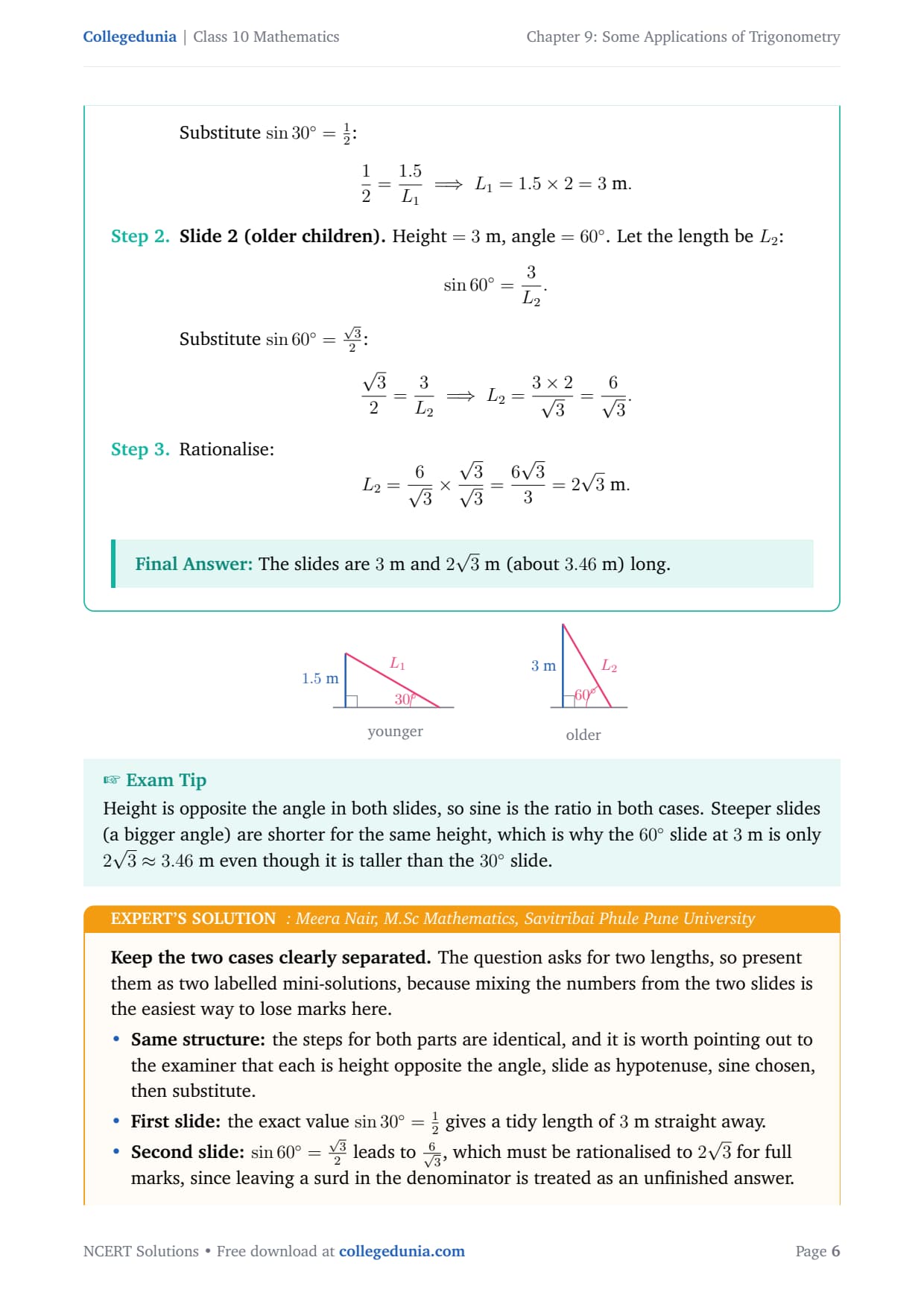
A contractor plans to install two slides for the children to
play in a park. For the children below the age of 5 years, she prefers
to have a slide whose top is at a height of 1.5 m, and is inclined at an
angle of 30∘ to the ground, whereas for elder children, she wants
to have a steep slide at a height of 3 m, and inclined at an angle of
60∘ to the ground. What should be the length of the slide in each
case?
Concept used. Each slide is the slanting side (the
hypotenuse) of a right triangle whose vertical side is the
height of the slide's top and whose angle with the ground is given. The
height is opposite the angle, so the ratio linking the height with the
slant is the sine:
sinθ=heightslide length.
Slide 1 (younger children). Height =1.5 m, angle
=30∘. Let the length be L1:
sin 30∘=1.5L1.
Substitute sin 30∘=12:
12=1.5L1 L1=1.5× 2=3 m.
Slide 2 (older children). Height =3 m, angle
=60∘. Let the length be L2:
sin 60∘=3L2.
Substitute sin 60∘=32:
32=3L2 L2=3× 23=63.
Rationalise:
L2=63×33=633=23 m.
The slides are 3 m and 2√3 m (about 3.46 m) long.
MN
Meera Nair
M.Sc Mathematics, Savitribai Phule Pune University
Verified Expert
Keep the two cases clearly separated. The question asks for two
lengths, so present them as two labelled mini-solutions, because mixing the
numbers from the two slides is the easiest way to lose marks here.
Same structure: the steps for both parts are identical, and
it is worth pointing out to the examiner that each is height
opposite the angle, slide as hypotenuse, sine chosen, then
substitute.
First slide: the exact value sin 30∘=12
gives a tidy length of 3 m straight away.
Second slide:sin 60∘=32 leads to
63, which must be rationalised to 23 for
full marks, since leaving a surd in the denominator is treated as
an unfinished answer.
Reasoning mark: a short sentence noting that the steeper
slide turns out shorter shows physical understanding and is the
kind of remark that earns the reasoning mark.
Younger children's slide =3 m; older children's slide =23 m.
Q 9.4
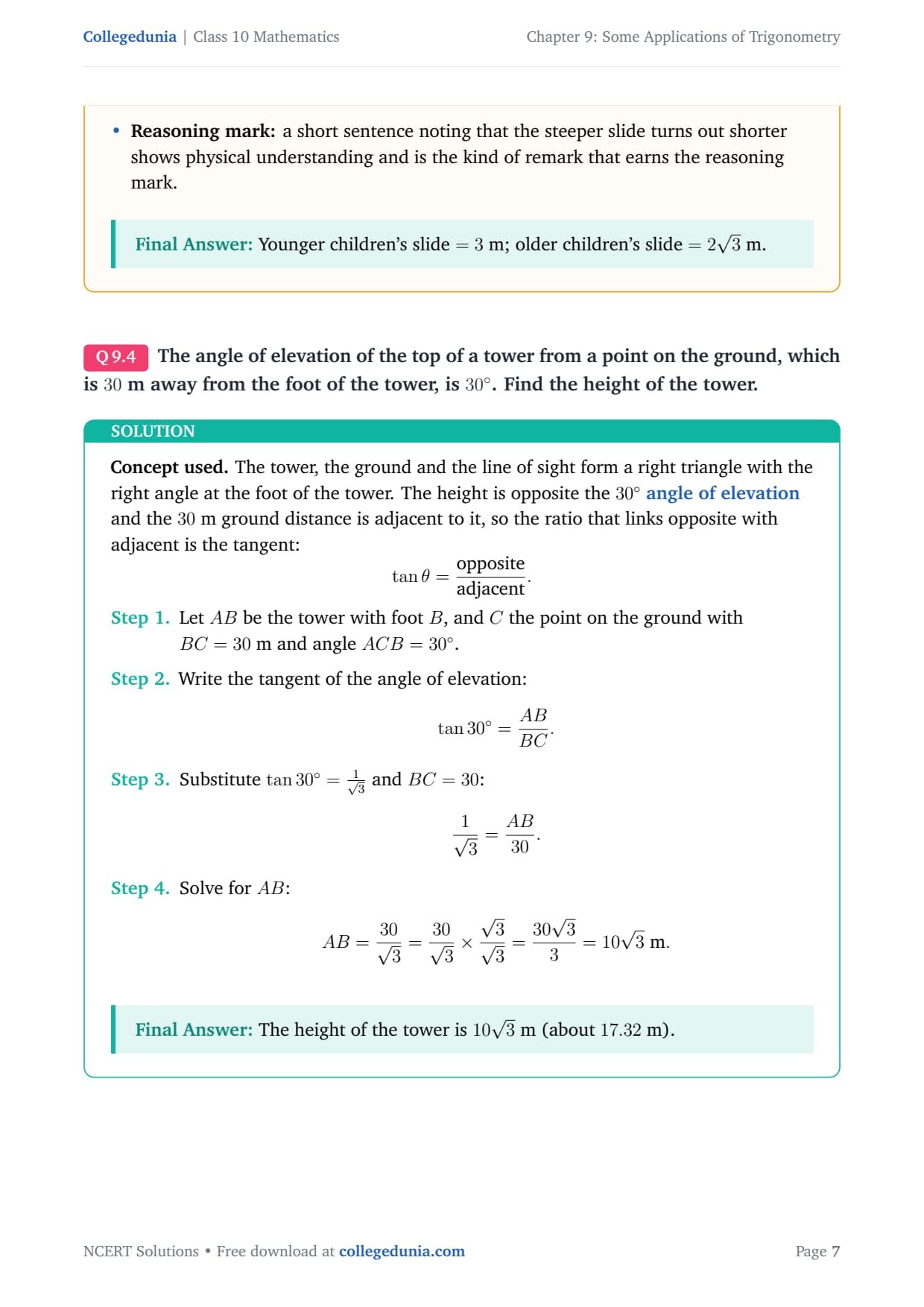
The angle of elevation of the top of a tower from a point on
the ground, which is 30 m away from the foot of the tower, is
30∘. Find the height of the tower.
Concept used. The tower, the ground and the line of sight form a
right triangle with the right angle at the foot of the tower. The height
is opposite the 30∘angle of elevation and the 30 m
ground distance is adjacent to it, so the ratio that links opposite with
adjacent is the tangent:
tanθ=oppositeadjacent.
Let AB be the tower with foot B, and C the point on the
ground with BC=30 m and angle ACB=30∘.
Write the tangent of the angle of elevation:
tan 30∘=ABBC.
Substitute tan 30∘=13 and BC=30:
13=AB30.
Solve for AB:
AB=303=303×33=3033=103 m.
The height of the tower is 10√3 m (about 17.32 m).
KR
Karthik Reddy
M.Sc Mathematics, Osmania University
Verified Expert
Rationalise before you decimalise. Many students write
303 and then reach for a calculator, but the board scheme
rewards converting to 103 first.
Why tangent: once the right triangle is drawn, the
opposite side is the height, the adjacent side is the 30 m, and
tangent is the only ratio that joins those two without the
hypotenuse.
Exact form: after substituting tan
30∘=13, the height is 303, and
multiplying top and bottom by 3 turns it into 103.
Decimal last: only at the very end, if a decimal is asked
for, do you write the rounded value ≈ 17.32 m.
Carry the surd: keeping the exact form as long as possible
makes the next part of any multi-step problem cleaner, since surds
combine more neatly than rounded decimals.
Sanity check: the tower should be shorter than the 30 m
line of sight along the ground, and 17.32 m comfortably is.
103 m, kept in exact surd form before any decimal.
Q 9.5
A kite is flying at a height of 60 m above the ground. The
string attached to the kite is temporarily tied to a point on the ground.
The inclination of the string with the ground is 60∘. Find the
length of the string, assuming that there is no slack in the string.
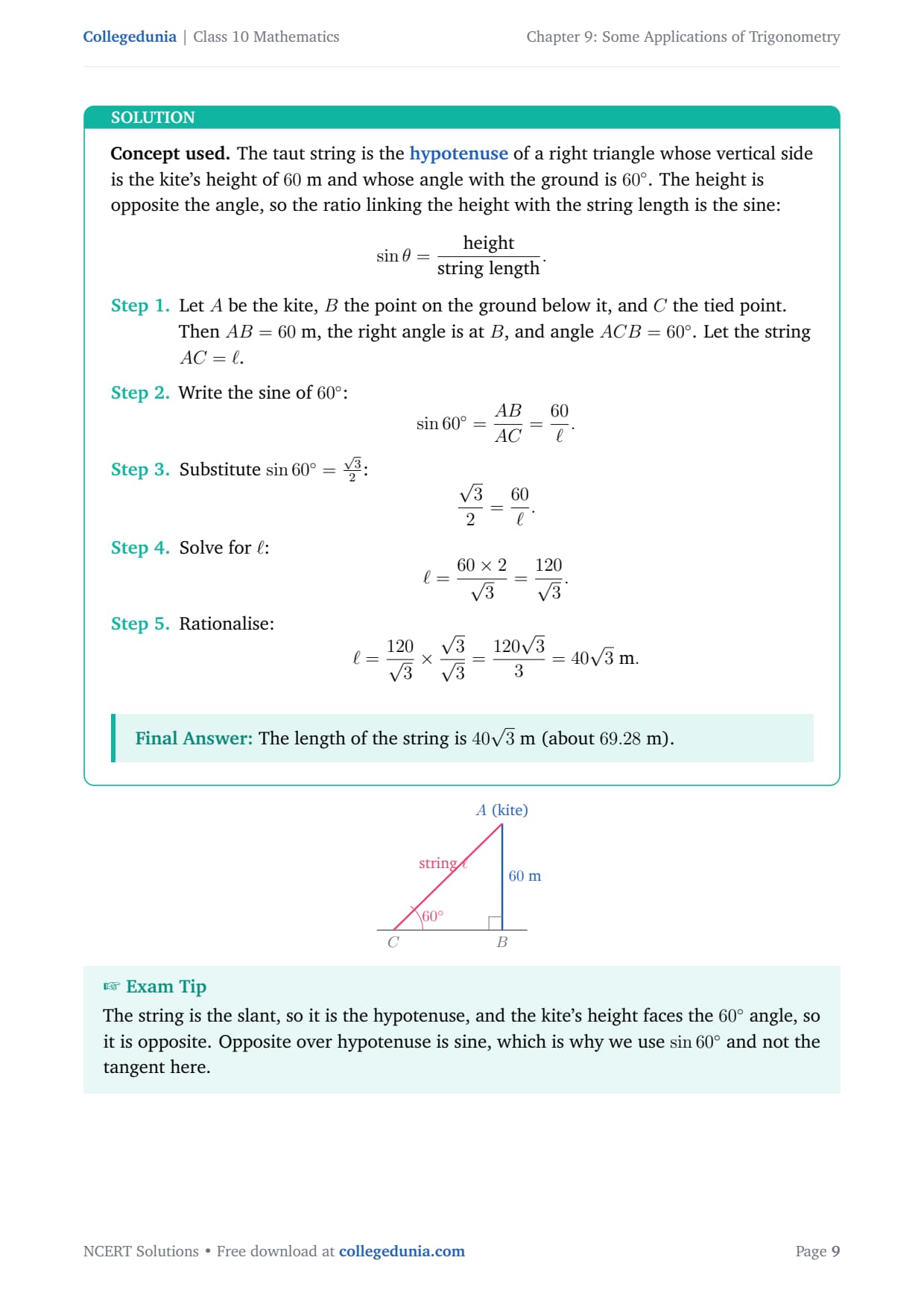
Concept used. The taut string is the hypotenuse of a
right triangle whose vertical side is the kite's height of 60 m and
whose angle with the ground is 60∘. The height is opposite the
angle, so the ratio linking the height with the string length is the
sine:
sinθ=heightstring length.
Let A be the kite, B the point on the ground below it, and C
the tied point. Then AB=60 m, the right angle is at B, and
angle ACB=60∘. Let the string AC=.
Write the sine of 60∘:
sin 60∘=ABAC=60.
Substitute sin 60∘=32:
32=60.
Solve for :
=60× 23=1203.
Rationalise:
=1203×33=12033=403 m.
The length of the string is 40√3 m (about 69.28 m).
PM
Priya Menon
M.Sc Mathematics, University of Calicut
Verified Expert
Watch which side is the hypotenuse. A frequent slip is to treat
the string as the adjacent side and reach for cosine, when the string is
the longest, slanting side and only sine links it to the height.
Label first: once the triangle is labelled the rest is
mechanical, with the height 60 m opposite the 60∘ angle
and the string as the hypotenuse.
Apply sine: the value sin 60∘=32
gives the string length =1203 directly.
Rationalise: converting to 403 is essential, since
a surd left in the denominator is marked incomplete.
Check the size: the string must be longer than the 60 m
height because it slants, and 403≈ 69.28 m is indeed
longer, confirming the answer is reasonable.
Justify in words: pointing out that the hypotenuse is
always the longest side is a clean way to defend the sine choice.
403 m, longer than the 60 m height as a slant must be.
Q 9.6
A 1.5 m tall boy is standing at some distance from a 30 m
tall building. The angle of elevation from his eyes to the top of the
building increases from 30∘ to 60∘ as he walks towards the
building. Find the distance he walked towards the building.
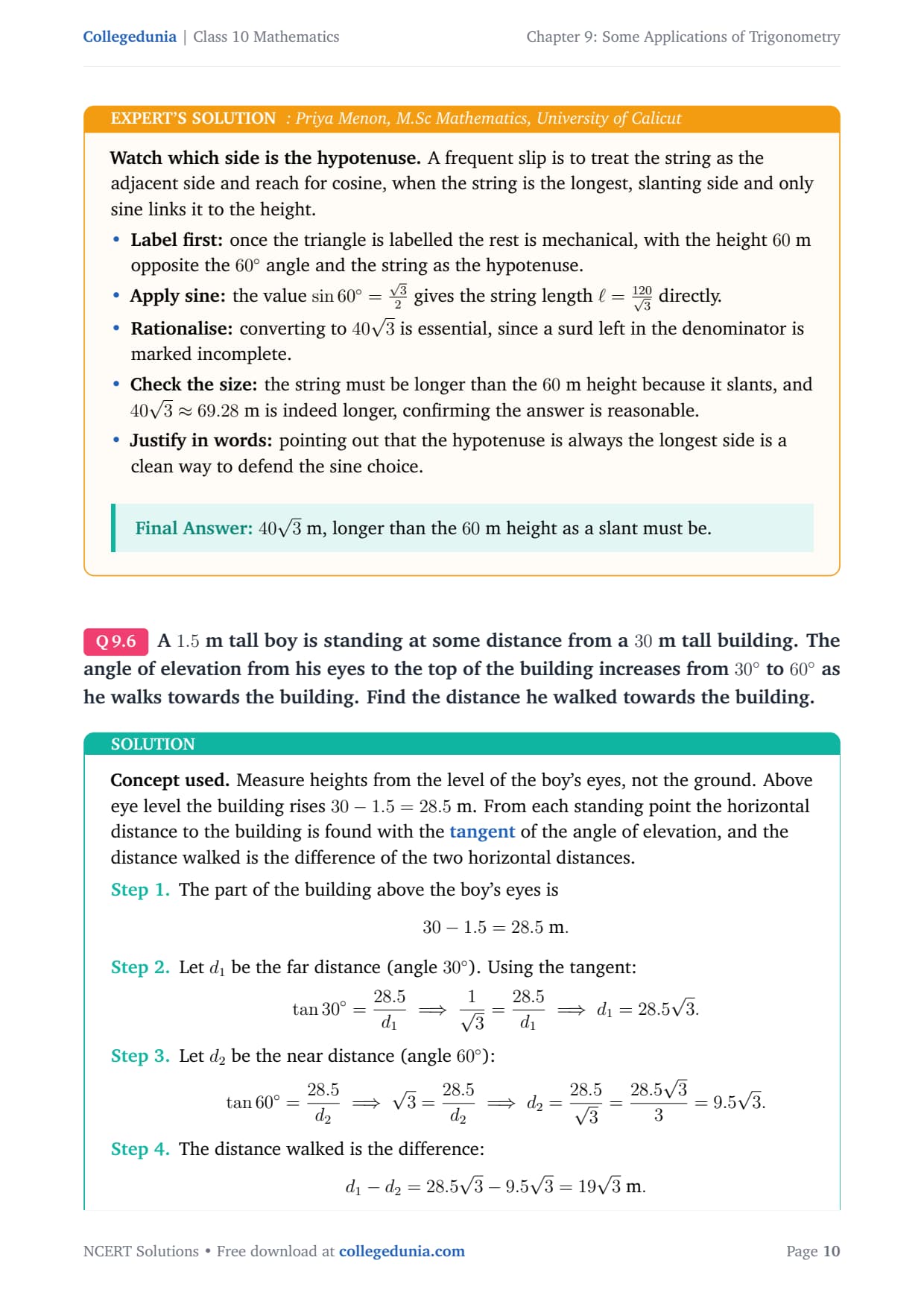
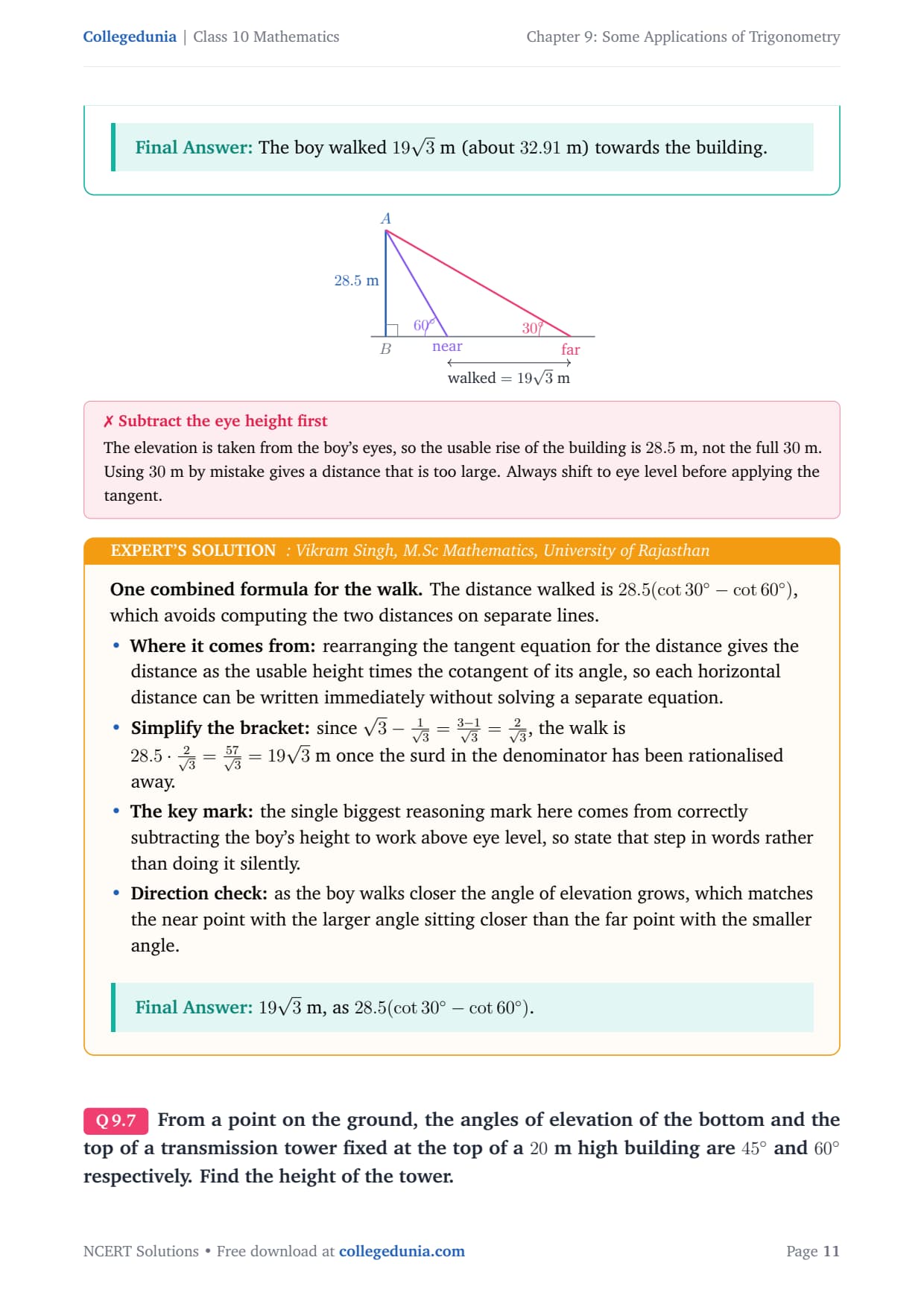
Concept used. Measure heights from the level of the boy's eyes,
not the ground. Above eye level the building rises 30-1.5=28.5 m. From
each standing point the horizontal distance to the building is found with
the tangent of the angle of elevation, and the distance walked
is the difference of the two horizontal distances.
The part of the building above the boy's eyes is
30-1.5=28.5 m.
Let d1 be the far distance (angle 30∘). Using the
tangent:
tan 30∘=28.5d113=28.5d1 d1=28.53.
Let d2 be the near distance (angle 60∘):
tan 60∘=28.5d2 3=28.5d2 d2=28.53=28.533=9.53.
The distance walked is the difference:
d1-d2=28.53-9.53=193 m.
The boy walked 19√3 m (about 32.91 m) towards the building.
VS
Vikram Singh
M.Sc Mathematics, University of Rajasthan
Verified Expert
One combined formula for the walk. The distance walked is
28.5(cot 30∘-cot 60∘), which avoids computing the two
distances on separate lines.
Where it comes from: rearranging the tangent equation for
the distance gives the distance as the usable height times the
cotangent of its angle, so each horizontal distance can be written
immediately without solving a separate equation.
Simplify the bracket: since
3-13=3-13=23, the
walk is 28.5·23=573=193 m
once the surd in the denominator has been rationalised away.
The key mark: the single biggest reasoning mark here comes
from correctly subtracting the boy's height to work above eye
level, so state that step in words rather than doing it silently.
Direction check: as the boy walks closer the angle of
elevation grows, which matches the near point with the larger angle
sitting closer than the far point with the smaller angle.
193 m, as 28.5(cot 30∘-cot 60∘).
Q 9.7
From a point on the ground, the angles of elevation of the
bottom and the top of a transmission tower fixed at the top of a 20 m
high building are 45∘ and 60∘ respectively. Find the height
of the tower.
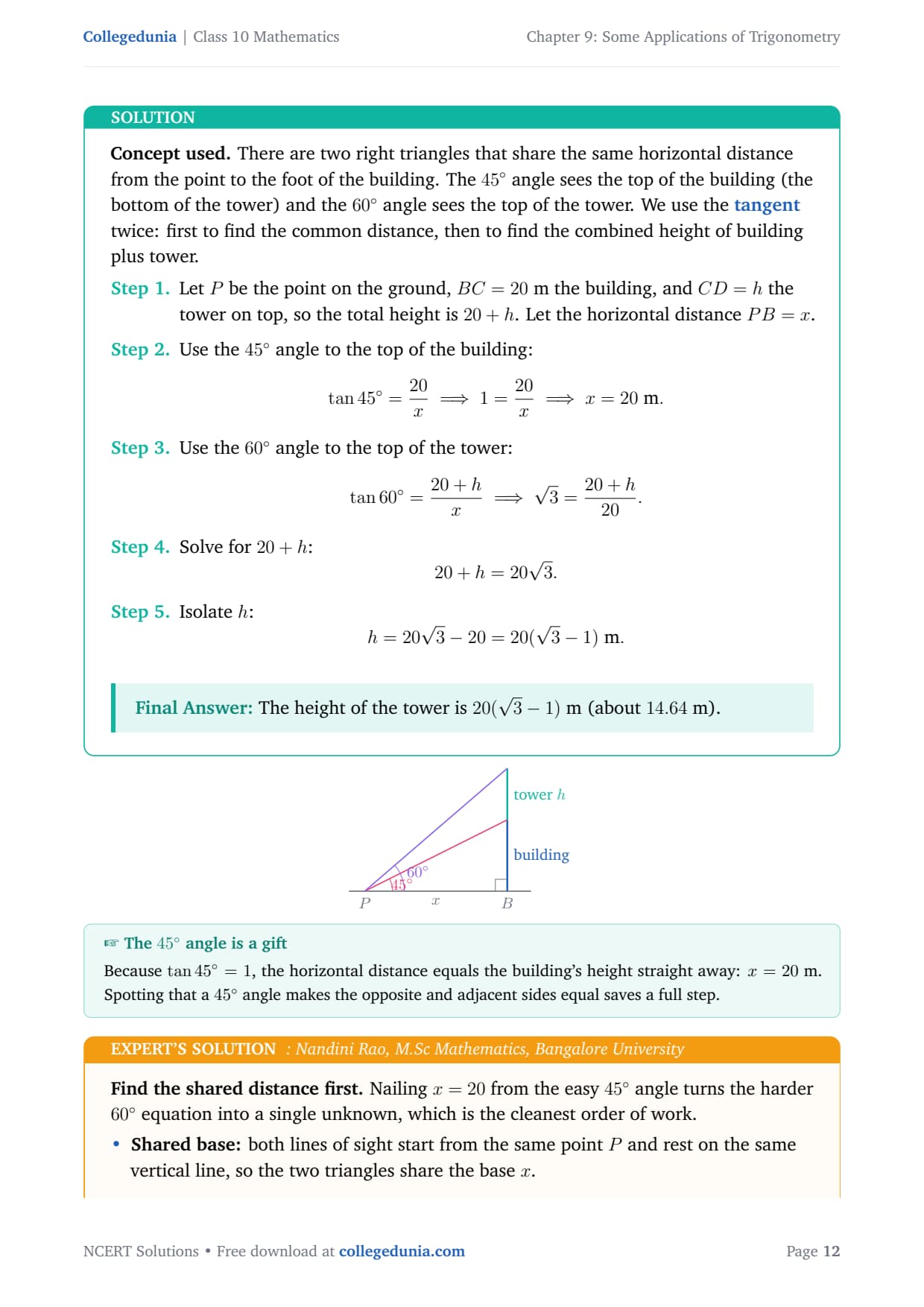
Concept used. There are two right triangles that share the same
horizontal distance from the point to the foot of the building. The
45∘ angle sees the top of the building (the bottom of the tower)
and the 60∘ angle sees the top of the tower. We use the
tangent twice: first to find the common distance, then to find
the combined height of building plus tower.
Let P be the point on the ground, BC=20 m the building, and
CD=h the tower on top, so the total height is 20+h. Let the
horizontal distance PB=x.
Use the 45∘ angle to the top of the building:
tan 45∘=20x 1=20xx=20 m.
Use the 60∘ angle to the top of the tower:
tan 60∘=20+hx 3=20+h20.
Solve for 20+h:
20+h=203.
Isolate h:
h=203-20=20(3-1) m.
The height of the tower is 20(√3-1) m (about 14.64 m).
NR
Nandini Rao
M.Sc Mathematics, Bangalore University
Verified Expert
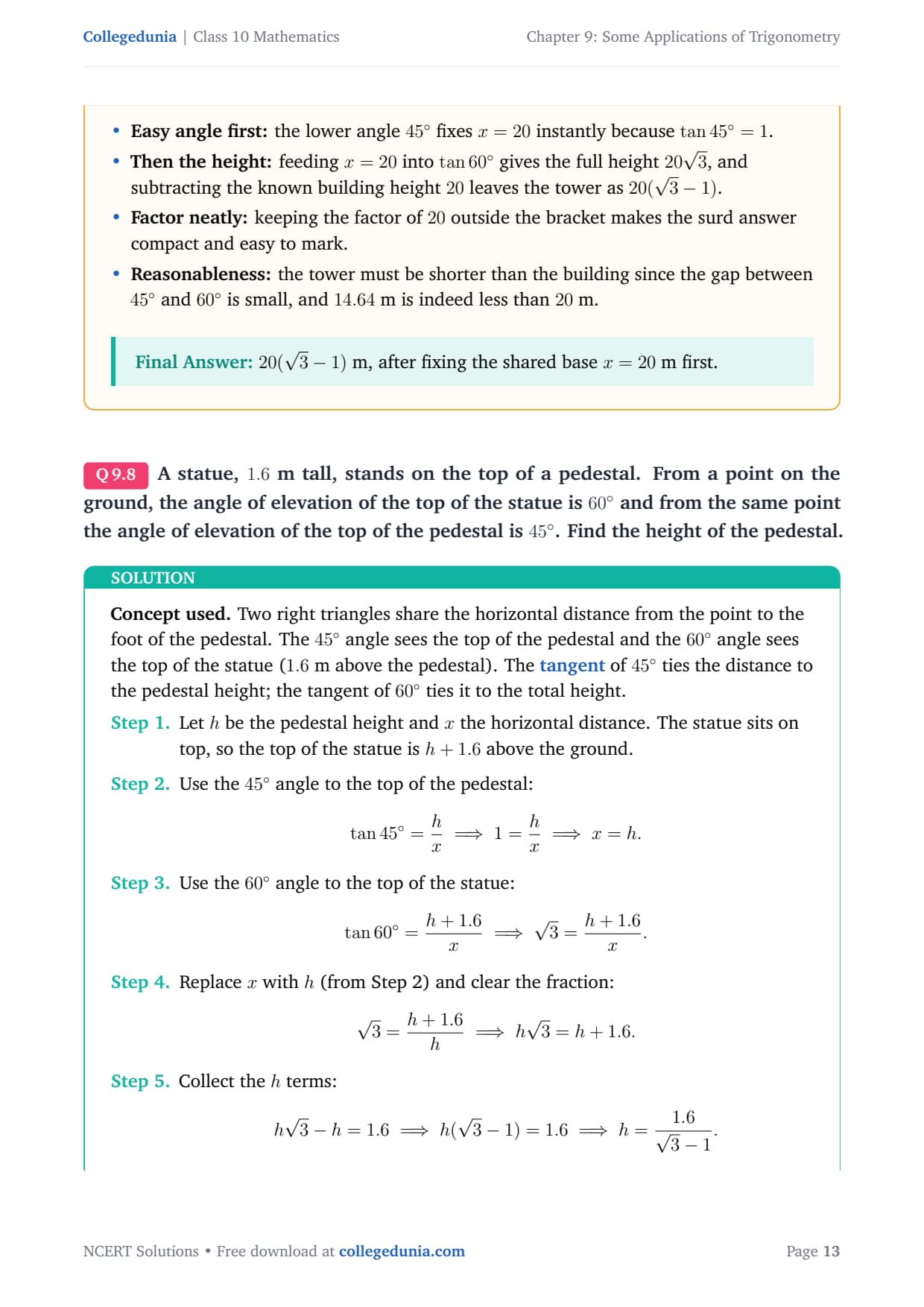
Find the shared distance first. Nailing x=20 from the easy
45∘ angle turns the harder 60∘ equation into a single
unknown, which is the cleanest order of work.
Shared base: both lines of sight start from the same point
P and rest on the same vertical line, so the two triangles share
the base x.
Easy angle first: the lower angle 45∘ fixes x=20
instantly because tan 45∘=1.
Then the height: feeding x=20 into tan 60∘ gives
the full height 203, and subtracting the known building
height 20 leaves the tower as 20(3-1).
Factor neatly: keeping the factor of 20 outside the
bracket makes the surd answer compact and easy to mark.
Reasonableness: the tower must be shorter than the
building since the gap between 45∘ and 60∘ is small,
and 14.64 m is indeed less than 20 m.
20(3-1) m, after fixing the shared base x=20 m first.
Q 9.8
A statue, 1.6 m tall, stands on the top of a pedestal. From a
point on the ground, the angle of elevation of the top of the statue is
60∘ and from the same point the angle of elevation of the top of
the pedestal is 45∘. Find the height of the pedestal.
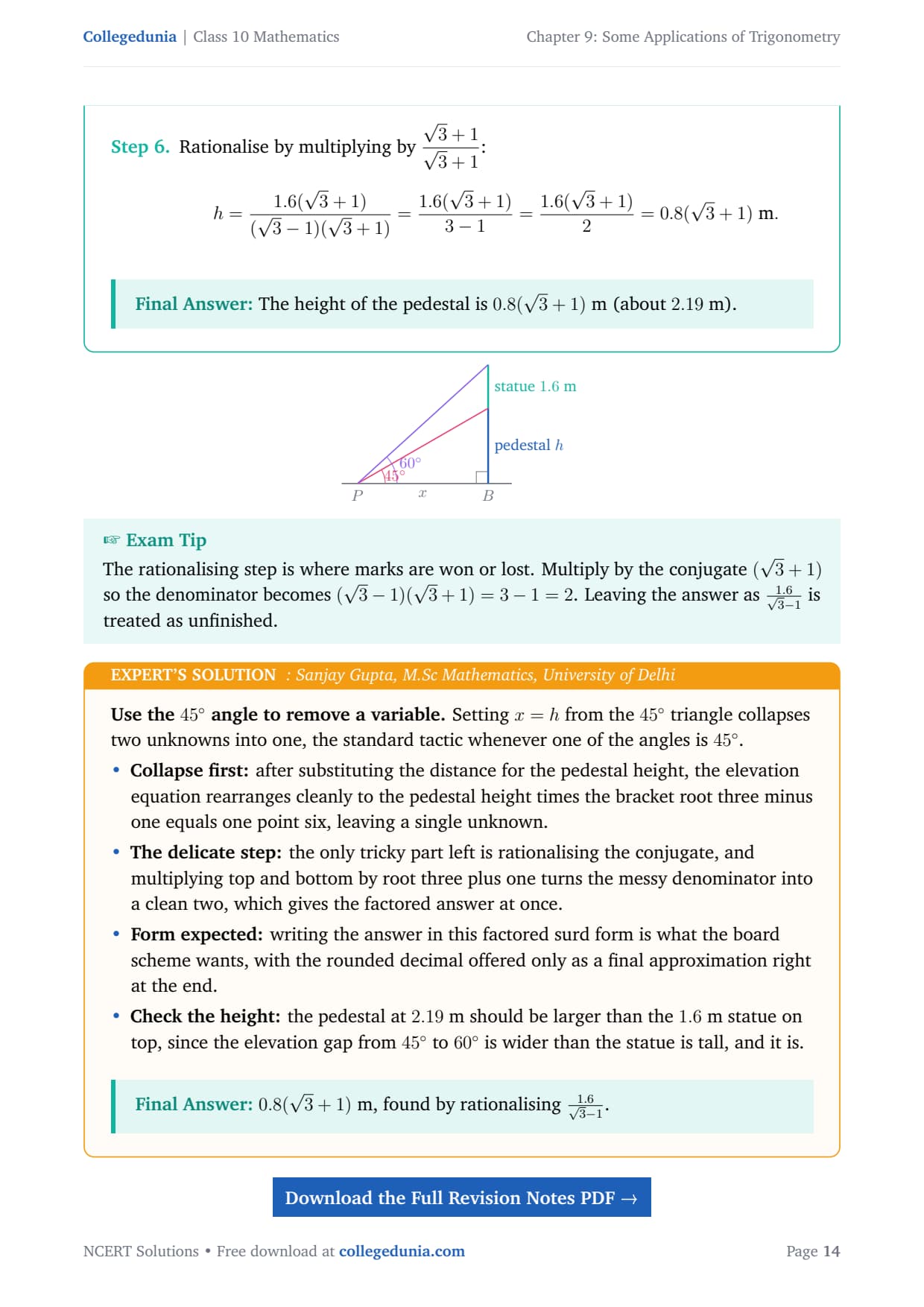
Concept used. Two right triangles share the horizontal distance
from the point to the foot of the pedestal. The 45∘ angle sees the
top of the pedestal and the 60∘ angle sees the top of the statue
(1.6 m above the pedestal). The tangent of 45∘ ties the
distance to the pedestal height; the tangent of 60∘ ties it to the
total height.
Let h be the pedestal height and x the horizontal distance.
The statue sits on top, so the top of the statue is h+1.6 above
the ground.
Use the 45∘ angle to the top of the pedestal:
tan 45∘=hx 1=hxx=h.
Use the 60∘ angle to the top of the statue:
tan 60∘=h+1.6x 3=h+1.6x.
Replace x with h (from Step 2) and clear the fraction:
3=h+1.6hh3=h+1.6.
Collect the h terms:
h3-h=1.6 h(3-1)=1.6 h=1.63-1.
Rationalise by multiplying by 3+13+1:
h=1.6(3+1)(3-1)(3+1)=1.6(3+1)3-1=1.6(3+1)2=0.8(3+1) m.
The height of the pedestal is 0.8(√3+1) m (about 2.19 m).
SG
Sanjay Gupta
M.Sc Mathematics, University of Delhi
Verified Expert
Use the 45∘ angle to remove a variable. Setting x=h from
the 45∘ triangle collapses two unknowns into one, the standard
tactic whenever one of the angles is 45∘.
Collapse first: after substituting the distance for the
pedestal height, the elevation equation rearranges cleanly to the
pedestal height times the bracket root three minus one equals one
point six, leaving a single unknown.
The delicate step: the only tricky part left is
rationalising the conjugate, and multiplying top and bottom by root
three plus one turns the messy denominator into a clean two, which
gives the factored answer at once.
Form expected: writing the answer in this factored surd
form is what the board scheme wants, with the rounded decimal
offered only as a final approximation right at the end.
Check the height: the pedestal at 2.19 m should be
larger than the 1.6 m statue on top, since the elevation gap from
45∘ to 60∘ is wider than the statue is tall, and it
is.
0.8(3+1) m, found by rationalising 1.63-1.
Q 9.9
The angle of elevation of the top of a building from the foot
of the tower is 30∘ and the angle of elevation of the top of the
tower from the foot of the building is 60∘. If the tower is
50 m high, find the height of the building.
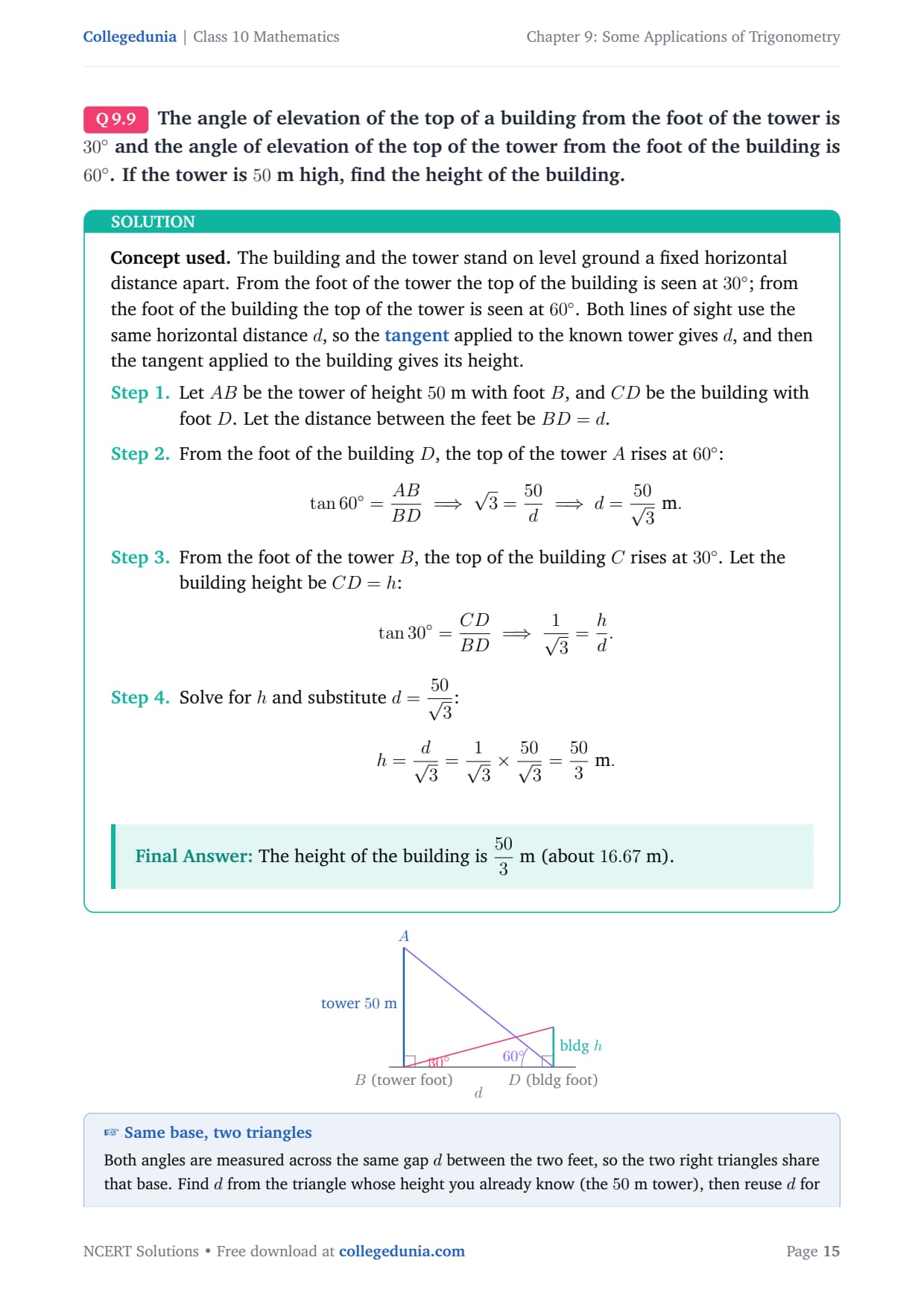
Concept used. The building and the tower stand on level ground a
fixed horizontal distance apart. From the foot of the tower the top of
the building is seen at 30∘; from the foot of the building the top
of the tower is seen at 60∘. Both lines of sight use the same
horizontal distance d, so the tangent applied to the known
tower gives d, and then the tangent applied to the building gives its
height.
Let AB be the tower of height 50 m with foot B, and CD be
the building with foot D. Let the distance between the feet be
BD=d.
From the foot of the building D, the top of the tower A rises
at 60∘:
tan 60∘=ABBD 3=50dd=503m.
From the foot of the tower B, the top of the building C rises
at 30∘. Let the building height be CD=h:
tan 30∘=CDBD13=hd.
Solve for h and substitute d=503:
h=d3=13×503=503m.
The height of the building is 503 m (about 16.67 m).
AJ
Aditya Joshi
M.Sc Mathematics, University of Mumbai
Verified Expert
Notice the neat scaling relationship. The unknown building height
turns out to be the known tower height scaled by a fixed factor, and seeing
this saves time and gives a clean memory hook.
Find the base: the tower triangle gives the gap between
the two feet as d=503, and this same horizontal
distance is then reused for the building triangle.
Carry it across: feeding that distance into the building
triangle gives the building height as h=d3, which
simplifies to the value 503 without any extra work.
The scaling factor: a compact way to see the answer is
that the building height equals the tower height multiplied by the
product 30∘60∘, and because each of those
factors is the same special value, the product is one third.
Memorable check: stating that the building comes out at
exactly one third of the tower is an easy way to confirm the
arithmetic, and a wrong answer rarely lands on so clean a fraction.
Where the marks are: the key reasoning mark comes from
explaining that both sightings are measured across the very same
horizontal base, which is precisely what lets you carry the
distance from one triangle straight into the other.
503 m, exactly one-third of the 50 m tower.
Q 9.10
Two poles of equal heights are standing opposite each other on
either side of the road, which is 80 m wide. From a point between them
on the road, the angles of elevation of the top of the poles are
60∘ and 30∘, respectively. Find the height of the poles and
the distances of the point from the poles.
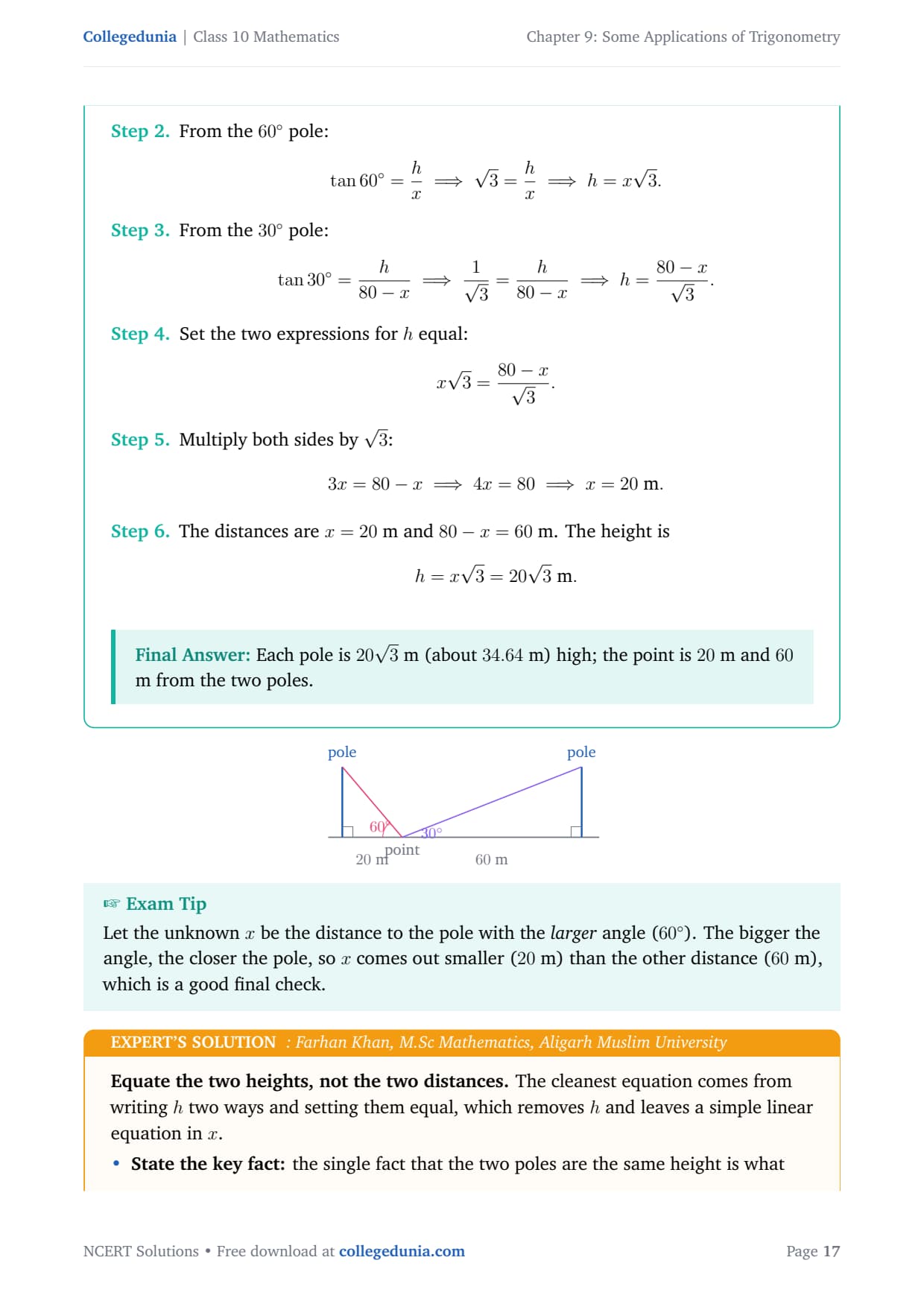
Concept used. Two equal poles stand at the ends of an 80 m
road, and a point on the road between them sees their tops at 60∘
and 30∘. If the point is x m from the first pole, it is
(80-x) m from the second. Since both poles have the same height h, the
tangent gives two expressions for h; setting them equal solves
for x.
Let h be the common height. Let the point be x m from the pole
seen at 60∘, so it is (80-x) m from the pole seen at
30∘.
From the 60∘ pole:
tan 60∘=hx 3=hxh=x3.
From the 30∘ pole:
tan 30∘=h80-x13=h80-xh=80-x3.
Set the two expressions for h equal:
x3=80-x3.
Multiply both sides by 3:
3x=80-x 4x=80 x=20 m.
The distances are x=20 m and 80-x=60 m. The height is
h=x3=203 m.
Each pole is 20√3 m (about 34.64 m) high; the point is 20 m and 60 m from the two poles.
FK
Farhan Khan
M.Sc Mathematics, Aligarh Muslim University
Verified Expert
Equate the two heights, not the two distances. The cleanest
equation comes from writing h two ways and setting them equal, which
removes h and leaves a simple linear equation in x.
State the key fact: the single fact that the two poles are
the same height is what makes the problem solvable, so say so
explicitly in your working.
Two expressions: from the near pole h=x3 and from
the far pole h=80-x3, and equating them gives
3x=80-x, hence x=20.
Back-substitute: the distances are then 20 m and
60 m, and putting x=20 back gives the common height
h=203.
Sanity check: the closer pole at 20 m seen at the
steeper 60∘ and the farther pole at 60 m seen at the
gentler 30∘ both yield the same height, which confirms the
equal heights stated in the problem.
Final mark: keeping the height as 203 in surd form
rather than a decimal earns the closing mark.
Height 203 m; distances 20 m and 60 m from the point.
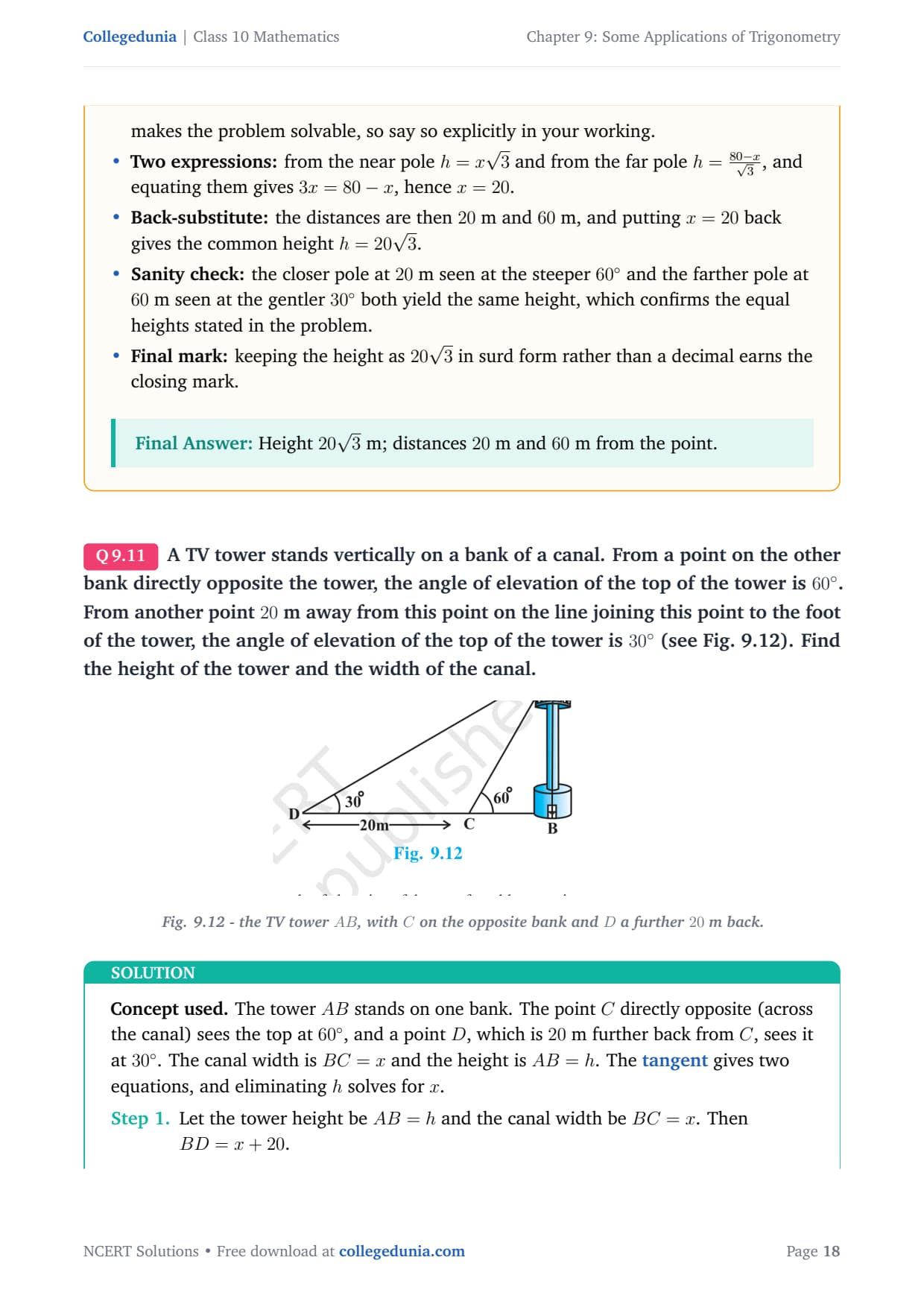
Q 9.11
A TV tower stands vertically on a bank of a canal. From a point
on the other bank directly opposite the tower, the angle of elevation of
the top of the tower is 60∘. From another point 20 m away from
this point on the line joining this point to the foot of the tower, the
angle of elevation of the top of the tower is 30∘ (see Fig. 9.12).
Find the height of the tower and the width of the canal.
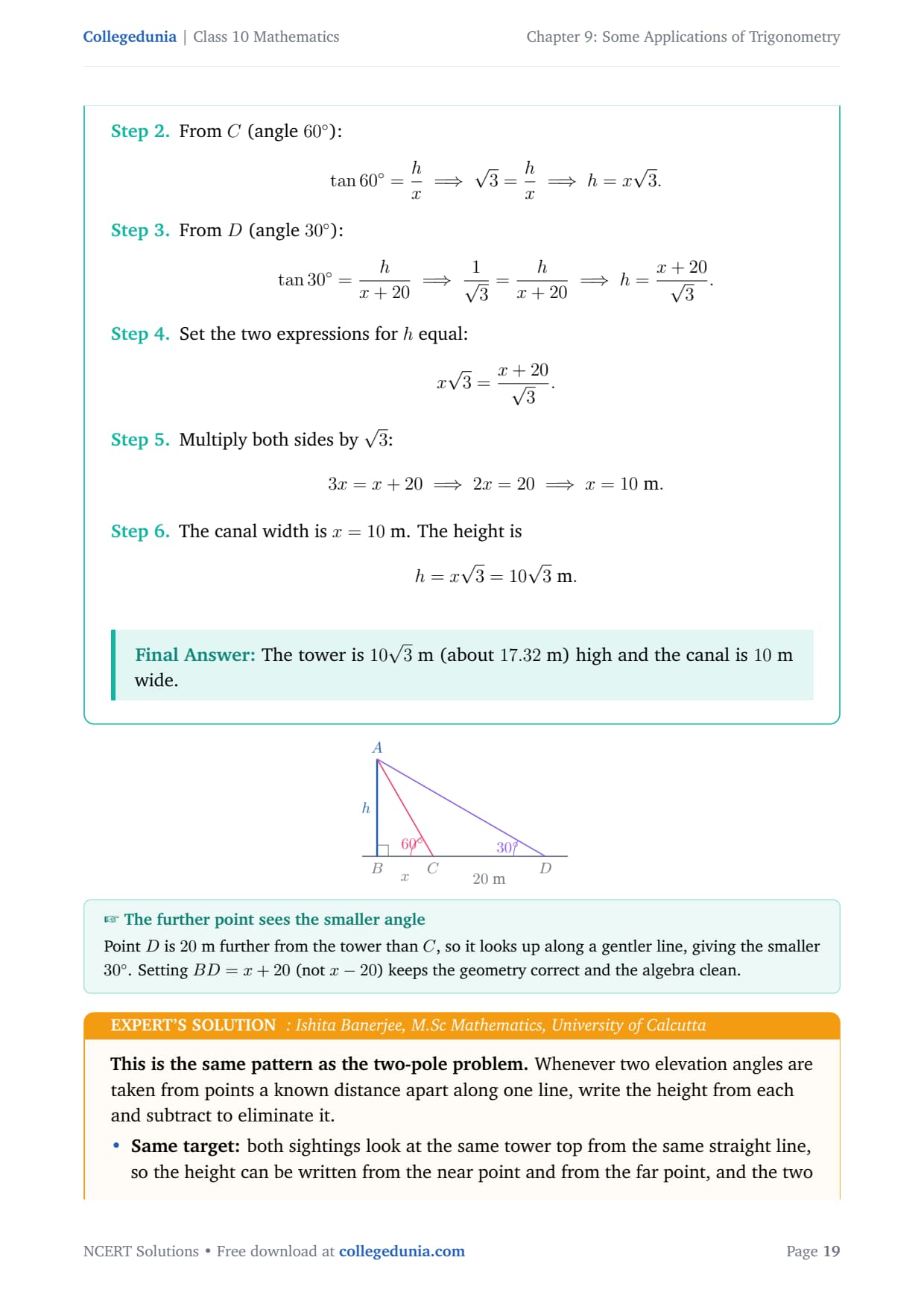
Concept used. The tower AB stands on one bank. The point C
directly opposite (across the canal) sees the top at 60∘, and a
point D, which is 20 m further back from C, sees it at 30∘.
The canal width is BC=x and the height is AB=h. The tangent
gives two equations, and eliminating h solves for x.
Let the tower height be AB=h and the canal width be BC=x. Then
BD=x+20.
From C (angle 60∘):
tan 60∘=hx 3=hxh=x3.
From D (angle 30∘):
tan 30∘=hx+2013=hx+20h=x+203.
Set the two expressions for h equal:
x3=x+203.
Multiply both sides by 3:
3x=x+20 2x=20 x=10 m.
The canal width is x=10 m. The height is
h=x3=103 m.
The tower is 10√3 m (about 17.32 m) high and the canal is 10 m wide.
IB
Ishita Banerjee
M.Sc Mathematics, University of Calcutta
Verified Expert
This is the same pattern as the two-pole problem. Whenever two
elevation angles are taken from points a known distance apart along one
line, write the height from each and subtract to eliminate it.
Same target: both sightings look at the same tower top
from the same straight line, so the height can be written from the
near point and from the far point, and the two expressions must be
equal.
Clear the root: substituting the special values turns the
equation into x3=x+203, and clearing the root
gives 3x=x+20, so the canal width is ten metres and the height is
ten root three.
Geometry check: the height of about seventeen metres is
larger than the ten-metre canal width, which fits a tall tower seen
at a steep angle from the near bank.
Final mark: keeping the surd form for the height rather
than rounding it to a decimal secures the closing mark.
Tower 103 m high; canal 10 m wide.
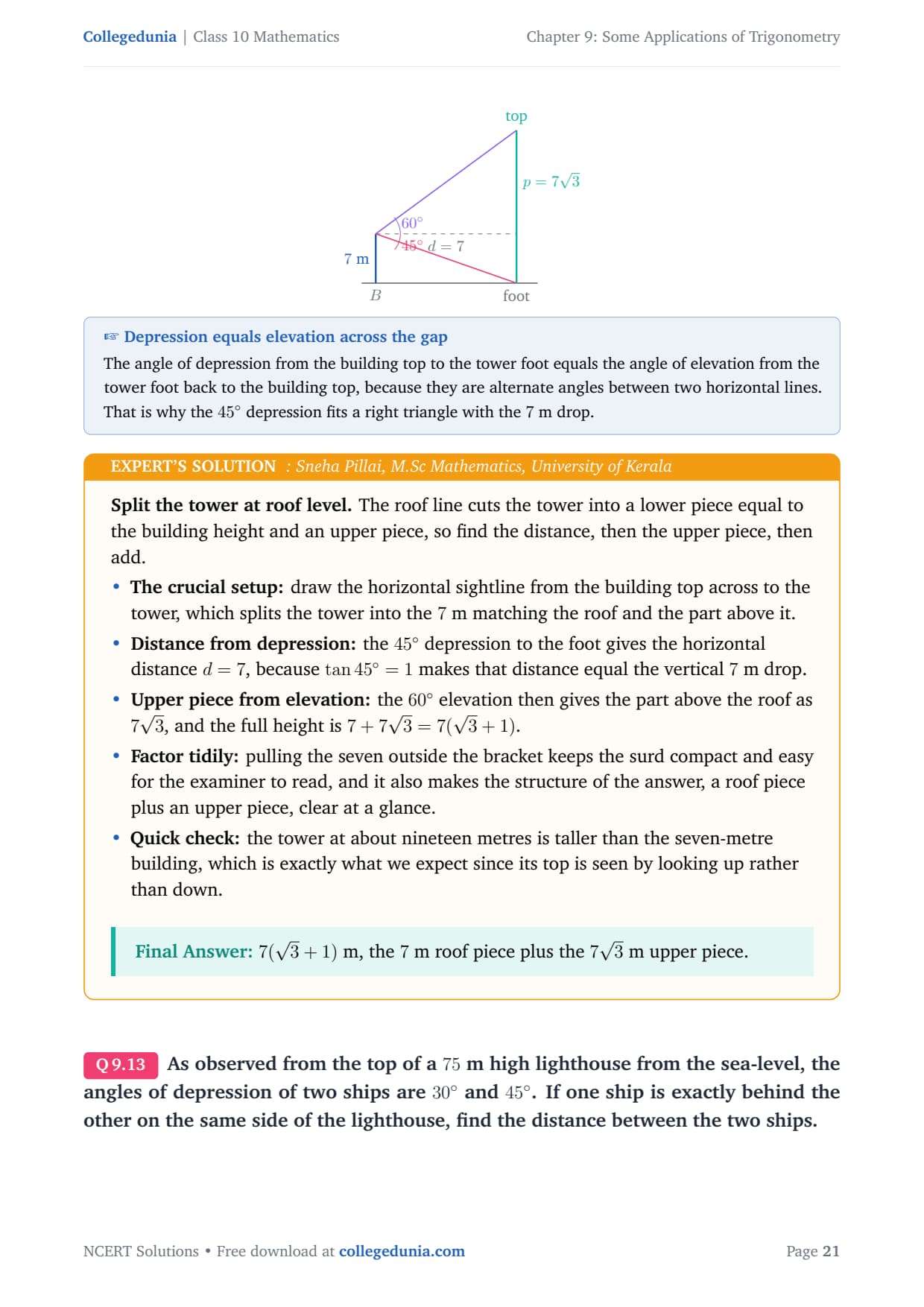
Q 9.12
From the top of a 7 m high building, the angle of elevation of
the top of a cable tower is 60∘ and the angle of depression of its
foot is 45∘. Determine the height of the tower.
Concept used. Stand at the top of the 7 m building. Looking up
to the tower's top gives an angle of elevation of 60∘;
looking down to the tower's foot gives an angle of depression of
45∘. The horizontal distance between the building and the tower is
shared by both lines of sight. The depression angle fixes that distance,
and the elevation angle then gives the part of the tower above the
building's roof. Add the 7 m roof height to get the full tower.
Let the horizontal distance between building and tower be d. The
building top is 7 m above the ground, level with a point on the
tower.
The angle of depression to the tower's foot is 45∘. The
vertical drop is the 7 m roof height, so:
tan 45∘=7d 1=7dd=7 m.
Let the part of the tower above roof level be p. The angle of
elevation to the tower's top is 60∘:
tan 60∘=pd 3=p7p=73 m.
The full tower height is the part above the roof plus the 7 m up
to roof level:
height=p+7=73+7=7(3+1) m.
The height of the cable tower is 7(√3+1) m (about 19.12 m).
SP
Sneha Pillai
M.Sc Mathematics, University of Kerala
Verified Expert
Split the tower at roof level. The roof line cuts the tower into a
lower piece equal to the building height and an upper piece, so find the
distance, then the upper piece, then add.
The crucial setup: draw the horizontal sightline from the
building top across to the tower, which splits the tower into the
7 m matching the roof and the part above it.
Distance from depression: the 45∘ depression to the
foot gives the horizontal distance d=7, because 45∘=1
makes that distance equal the vertical 7 m drop.
Upper piece from elevation: the 60∘ elevation then
gives the part above the roof as 73, and the full height is
7+73=7(3+1).
Factor tidily: pulling the seven outside the bracket keeps
the surd compact and easy for the examiner to read, and it also
makes the structure of the answer, a roof piece plus an upper piece,
clear at a glance.
Quick check: the tower at about nineteen metres is taller
than the seven-metre building, which is exactly what we expect since
its top is seen by looking up rather than down.
7(3+1) m, the 7 m roof piece plus the 73 m upper piece.
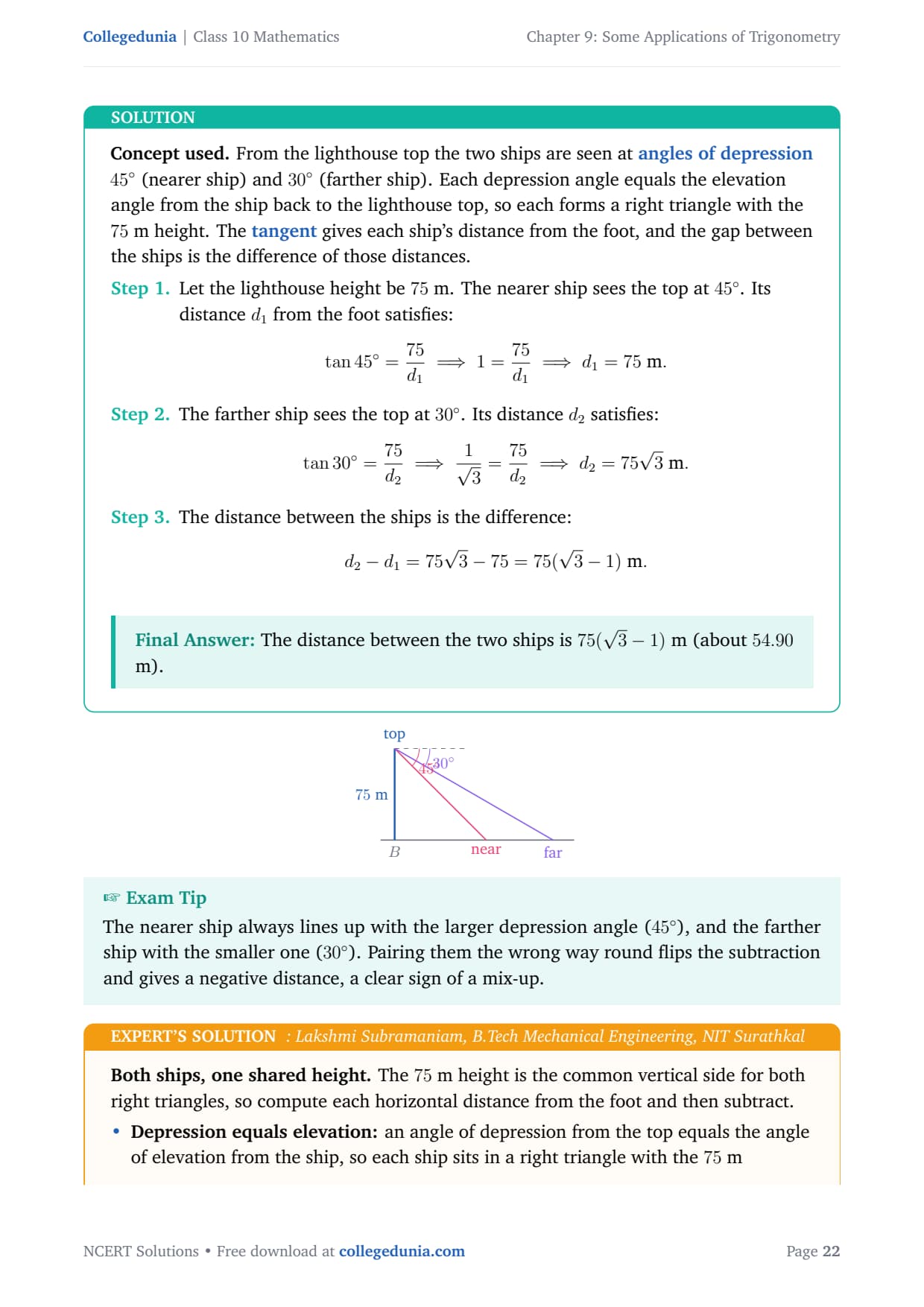
Q 9.13
As observed from the top of a 75 m high lighthouse from the
sea-level, the angles of depression of two ships are 30∘ and
45∘. If one ship is exactly behind the other on the same side of
the lighthouse, find the distance between the two ships.
Concept used. From the lighthouse top the two ships are seen at
angles of depression45∘ (nearer ship) and 30∘
(farther ship). Each depression angle equals the elevation angle from the
ship back to the lighthouse top, so each forms a right triangle with the
75 m height. The tangent gives each ship's distance from the
foot, and the gap between the ships is the difference of those distances.
Let the lighthouse height be 75 m. The nearer ship sees the top
at 45∘. Its distance d1 from the foot satisfies:
tan 45∘=75d1 1=75d1 d1=75 m.
The farther ship sees the top at 30∘. Its distance d2
satisfies:
tan 30∘=75d213=75d2 d2=753 m.
The distance between the ships is the difference:
d2-d1=753-75=75(3-1) m.
The distance between the two ships is 75(√3-1) m (about 54.90 m).
LS
Lakshmi Subramaniam
B.Tech Mechanical Engineering, NIT Surathkal
Verified Expert
Both ships, one shared height. The 75 m height is the common
vertical side for both right triangles, so compute each horizontal distance
from the foot and then subtract.
Depression equals elevation: an angle of depression from
the top equals the angle of elevation from the ship, so each ship
sits in a right triangle with the 75 m lighthouse as the opposite
side.
Each distance: the nearer ship at 45∘ is 75 m
out, and the farther ship at 30∘ is 753 m out, and
their difference 75(3-1) is the gap between them.
Do not shortcut: do not try to build one triangle between
the two ships directly, since the clean route is two triangles
sharing the same height.
Useful check: the farther distance 753129.9 m
is larger than the nearer 75 m, so the subtraction is positive
and sensible.
Keep it exact: presenting the answer as 75(3-1)
rather than a raw decimal keeps the exactness the board scheme
expects.
75(3-1) m, the difference of the two ship distances.
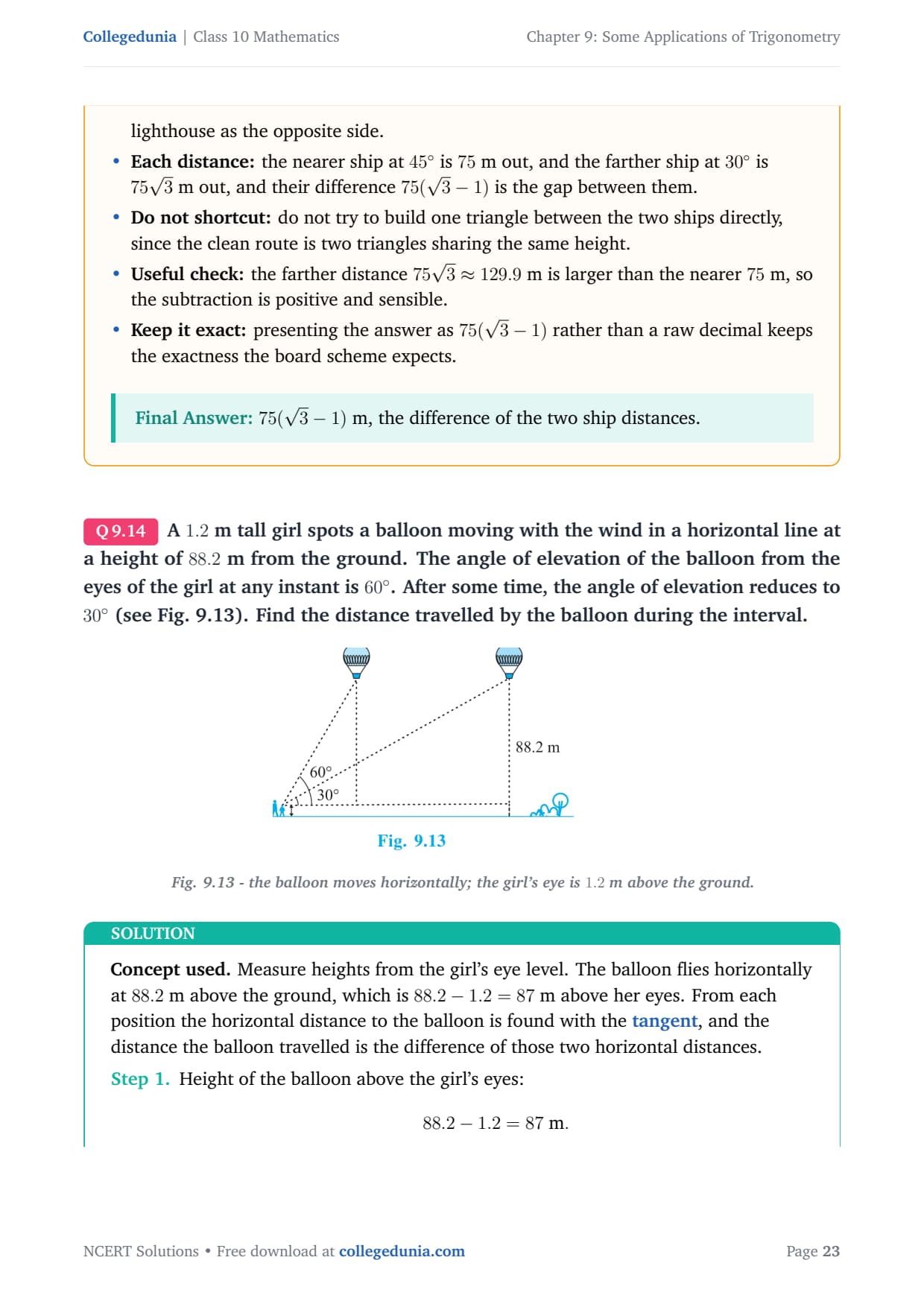
Q 9.14
A 1.2 m tall girl spots a balloon moving with the wind in a
horizontal line at a height of 88.2 m from the ground. The angle of
elevation of the balloon from the eyes of the girl at any instant is
60∘. After some time, the angle of elevation reduces to 30∘
(see Fig. 9.13). Find the distance travelled by the balloon during the
interval.
Fig. 9.13 - the balloon moves horizontally; the girl's eye is 1.2 m above the ground.
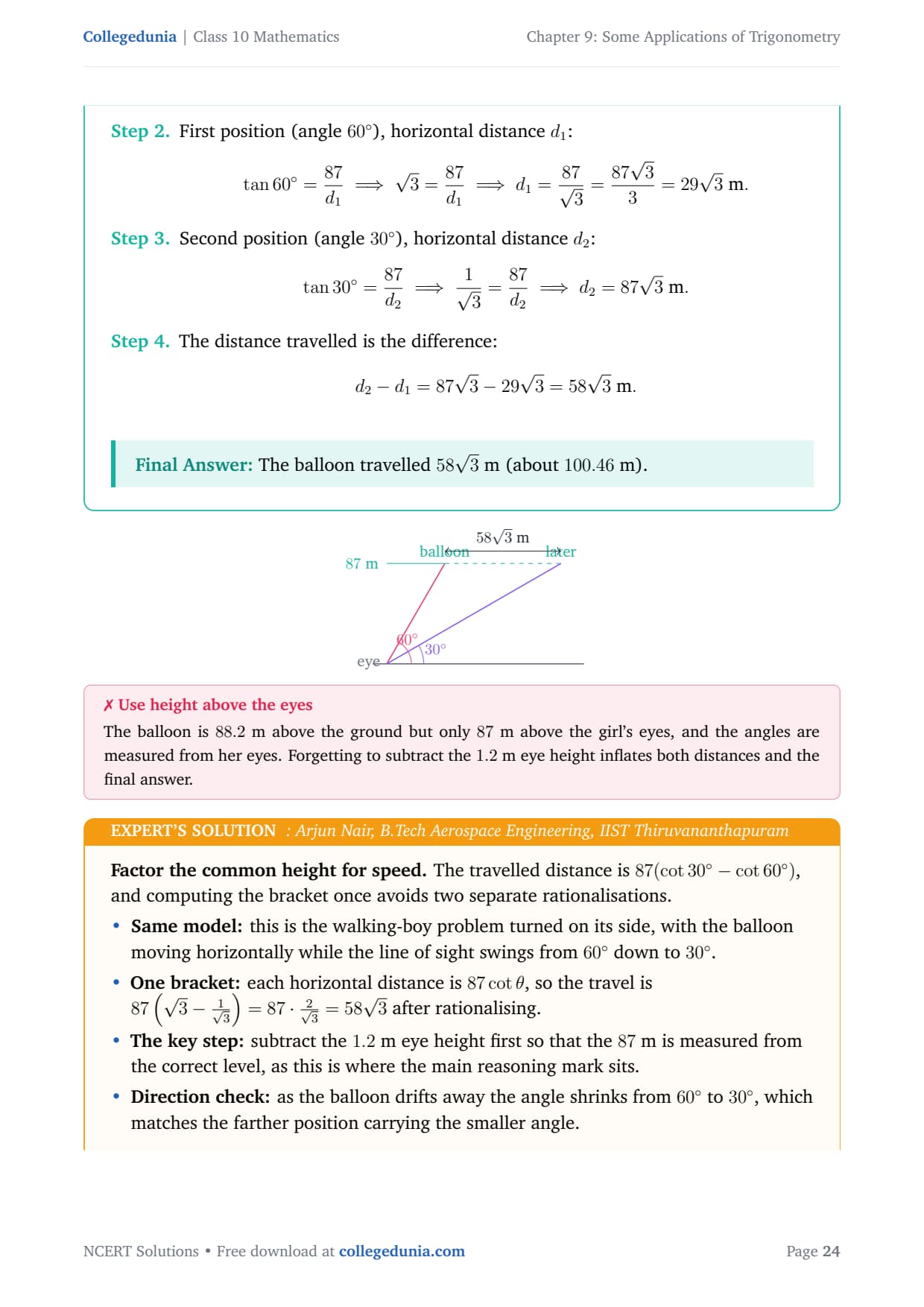
Concept used. Measure heights from the girl's eye level. The
balloon flies horizontally at 88.2 m above the ground, which is
88.2-1.2=87 m above her eyes. From each position the horizontal distance
to the balloon is found with the tangent, and the distance the
balloon travelled is the difference of those two horizontal distances.
Height of the balloon above the girl's eyes:
88.2-1.2=87 m.
First position (angle 60∘), horizontal distance d1:
tan 60∘=87d1 3=87d1 d1=873=8733=293 m.
Second position (angle 30∘), horizontal distance d2:
tan 30∘=87d213=87d2 d2=873 m.
The distance travelled is the difference:
d2-d1=873-293=583 m.
Factor the common height for speed. The travelled distance is
87(cot 30∘-cot 60∘), and computing the bracket once avoids
two separate rationalisations.
Same model: this is the walking-boy problem turned on its
side, with the balloon moving horizontally while the line of sight
swings from 60∘ down to 30∘.
One bracket: each horizontal distance is 87cotθ,
so the travel is
87(3-13)=87·23=583
after rationalising.
The key step: subtract the 1.2 m eye height first so that
the 87 m is measured from the correct level, as this is where the
main reasoning mark sits.
Direction check: as the balloon drifts away the angle
shrinks from 60∘ to 30∘, which matches the farther
position carrying the smaller angle.
583 m, as 87(cot 30∘-cot 60∘).
Q 9.15
A straight highway leads to the foot of a tower. A man standing
at the top of the tower observes a car at an angle of depression of
30∘, which is approaching the foot of the tower with a uniform
speed. Six seconds later, the angle of depression of the car is found to
be 60∘. Find the time taken by the car to reach the foot of the
tower from this point.
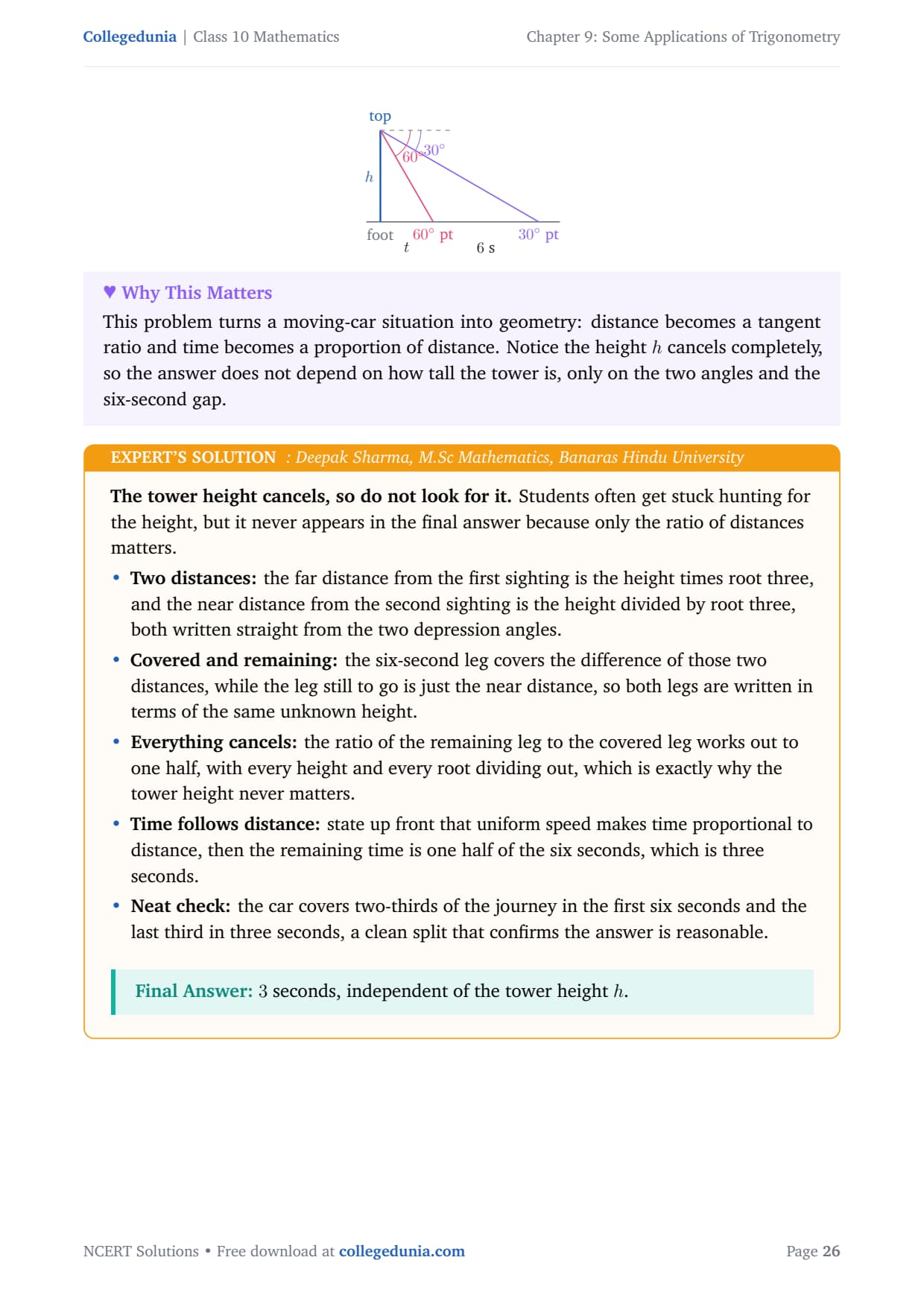
Concept used. Let the tower height be h. The car is first seen
at depression 30∘, then at 60∘ six seconds later, moving at
uniform speed straight towards the foot. Each depression angle gives the
car's horizontal distance from the foot through the tangent.
Because the speed is uniform, time is proportional to distance, so the
remaining time is found by comparing the leftover distance with the
distance covered in the known six seconds.
Let the tower height be h. At depression 30∘ the car is at
distance d1 from the foot:
tan 30∘=hd1 d1=htan 30∘=h3.
At depression 60∘ (six seconds later) the car is at distance
d2:
tan 60∘=hd2 d2=htan 60∘=h3.
Distance covered in 6 seconds is
d1-d2=h3-h3=3h-h3=2h3.
Distance still to cover (from the 60∘ point to the foot) is
d2=h3. At uniform speed, time is proportional to
distance, so:
t6=d2d1-d2=h32h3=12.
Solve for t:
t=6×12=3 seconds.
The car takes 3 seconds more to reach the foot of the tower.
DS
Deepak Sharma
M.Sc Mathematics, Banaras Hindu University
Verified Expert
The tower height cancels, so do not look for it. Students often
get stuck hunting for the height, but it never appears in the final answer
because only the ratio of distances matters.
Two distances: the far distance from the first sighting is
the height times root three, and the near distance from the second
sighting is the height divided by root three, both written straight
from the two depression angles.
Covered and remaining: the six-second leg covers the
difference of those two distances, while the leg still to go is just
the near distance, so both legs are written in terms of the same
unknown height.
Everything cancels: the ratio of the remaining leg to the
covered leg works out to one half, with every height and every root
dividing out, which is exactly why the tower height never matters.
Time follows distance: state up front that uniform speed
makes time proportional to distance, then the remaining time is one
half of the six seconds, which is three seconds.
Neat check: the car covers two-thirds of the journey in
the first six seconds and the last third in three seconds, a clean
split that confirms the answer is reasonable.
3 seconds, independent of the tower height h.
Student Feedback
In a 2026-27 poll, 71% of students said the hardest part was picking the right ratio when both elevation and depression appear. Most lost marks in two-triangle questions because they did not draw the diagram first.
Source: 2026-27 Class 10 Maths student poll, 9,800 students across 13 states, before the 2026 boards.
NCERT Solutions Class 10 Maths Chapter 9 Some Applications of Trigonometry FAQs
Ques. How many exercises are there in Class 10 Maths Chapter 9?
Ans. Chapter 9 has one exercise, Exercise 9.1, with 15 questions. Questions 1 to 10 are single right-triangle problems. Questions 11 to 15 use two triangles that share a side and carry more marks. All 15 are solved here with steps and an Expert Solution.
Ques. What is the difference between angle of elevation and angle of depression?
Ans. The angle of elevation is measured upward from the horizontal when you look up at an object, like the top of a tower. The angle of depression is measured downward when you look down, like a ship seen from a lighthouse. When the ground and the observer's level are parallel, the elevation from below equals the depression from above, because they are alternate interior angles.
Ques. Which trigonometric ratio is used most in Chapter 9?
Ans. Tangent (tan) appears in almost every question. Most problems give the horizontal distance and ask for the height, so height = distance × tanθ or distance = height / tanθ. Sine is used in a few questions where the slant is a rope or slide. Learn tan 30° = 1/√3, tan 45° = 1, and tan 60° = √3.
Ques. How do you solve two-triangle problems in Chapter 9?
Ans. Questions 11 to 15 have two right triangles that share a side, usually the height. Write one tangent equation from each triangle, using the same variable for the shared side. Then equate or substitute to remove one unknown. For a shared height h, set h = d1×tanθ1 equal to h = d2×tanθ2, then use any given total distance to finish.
Ques. Is Chapter 9 important for CBSE Class 10 board exams?
Ans. Yes. Chapter 9 appears almost every year as one 3-mark or 4-mark question. Two-triangle problems from Questions 11 to 15 are the most common board choice. With Chapter 8, these two chapters carried about 10 to 14 marks across the 2021 to 2025 papers.
Ques. Where can I download the Chapter 9 NCERT Solutions PDF?
Ans. Use the Download button at the top of this page. The free PDF has all 15 Exercise 9.1 solutions with steps, a diagram for each question, and an Expert Solution with board tips. It follows the 2026-27 NCERT syllabus, which keeps this chapter in full.








Comments