Junior-Class Mentor, TFI Fellow | Updated 3+ months ago
The NCERT Solutions for Class 10 Maths Chapter 8 Introduction to Trigonometry cover all questions from Exercises 8.1, 8.2, and 8.3, written for the 2026-27 CBSE syllabus. Each solution sets out the trigonometric ratio, identity, or complementary-angle rule in clear, board-exam steps.
All exercise questions solved step by step in plain English, with an Expert Solution per question that adds board-exam strategy.
Full coverage of trigonometric ratios, the standard angle table (0°, 30°, 45°, 60°, 90°), complementary angle identities, and the three fundamental Pythagorean identities with solved examples at each stage.
Answers aligned with the 2026-27 CBSE Class 10 Mathematics syllabus, useful for school tests and the board exam alike.
Every answer here is checked by Collegedunia Maths experts, mapped to the 2026-27 NCERT textbook, and matched with the last five years of CBSE board papers.
What the NCERT Solutions for Class 10 Maths Chapter 8 Cover
Chapter 8 studies the link between the angles and sides of a right-angled triangle. You learn six trigonometric ratios, their fixed values at standard angles, and a few key identities. These solutions work through every question in Exercises 8.1, 8.2, and 8.3.
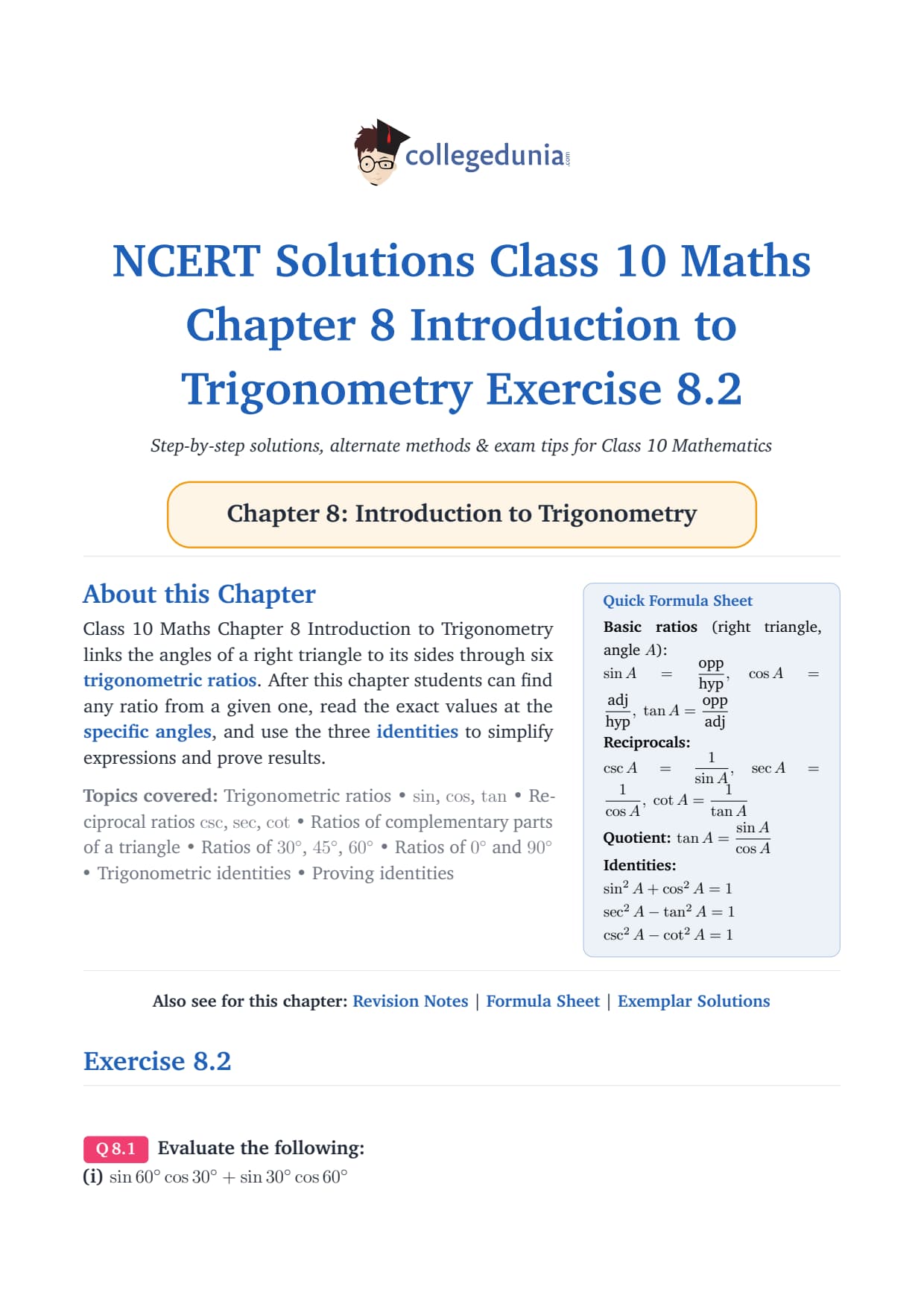
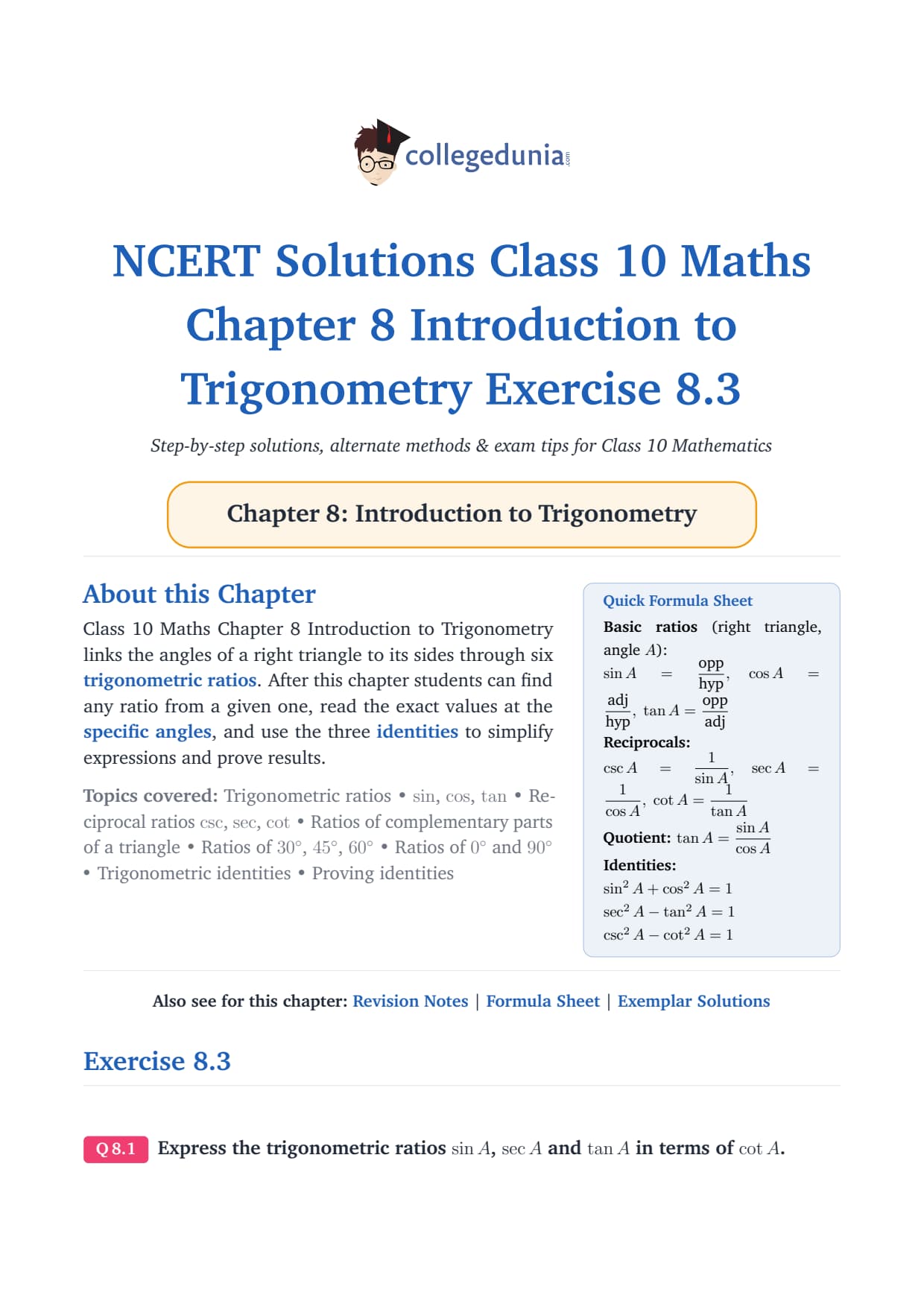
Six ratios: for an angle A, sin A = opposite/hypotenuse, cos A = adjacent/hypotenuse, tan A = opposite/adjacent. The reciprocals are cosec A, sec A, and cot A.
Standard angle table: the values of sin, cos, and tan at 0°, 30°, 45°, 60°, and 90° are fixed. You must learn them, as Exercise 8.2 needs them.
Three Pythagorean identities: sin²A + cos²A = 1; 1 + tan²A = sec²A; 1 + cot²A = cosec²A. They link the ratios without using the angle.
Complementary angles: sin(90° - A) = cos A, cos(90° - A) = sin A, tan(90° - A) = cot A, and so on. Exercise 8.3 is based on these.
Exercise and Topic Map for Chapter 8 NCERT Solutions
Chapter 8 has three exercises. The table below shows the topic, the method CBSE wants, and the usual marks in board papers.
Complementary angle identities: simplifying and proving using sin(90° - A) = cos A and the rest
Swap each complementary form for its co-function, then cancel or combine
2 to 4
Exercise 8.1 builds the base. Once you can find all six ratios from one ratio, the other two exercises feel easy.
Key Ideas Tested in Class 10 Maths Chapter 8
Three ideas drive every question in this chapter. Here is the standard angle table you must learn, since Exercise 8.2 uses it in every part.
Ratio
0°
30°
45°
60°
90°
sin
0
1/2
1/√2
√3/2
1
cos
1
√3/2
1/√2
1/2
0
tan
0
1/√3
1
√3
not defined
The six ratios: from one given ratio, find the missing side by Pythagoras, then find the other five. If sin A = 3/5, the opposite side is 3 and the hypotenuse is 5, so the base is √(25 - 9) = 4. So cos A = 4/5 and tan A = 3/4.
Memory trick for sin: the values follow √0/2, √1/2, √2/2, √3/2, √4/2. Cosine reads the same list backwards, and tan = sin/cos.
The three identities: sin²A + cos²A = 1, 1 + tan²A = sec²A, and 1 + cot²A = cosec²A let you change one ratio into another without the angle.
Complementary angles: in Exercise 8.3, swap one ratio in each pair, for example sin 72° = cos 18°. Matching pairs then cancel or join to give a simple number.
Quick Tip: Draw the right triangle and label all three sides before you write any ratio. Students who label first make far fewer errors. The Pythagoras step is where most marks slip.
Solved Example from Chapter 8 with Solved Examples
A common question gives one ratio, such as tan A = 4/3, and asks for the value of (1 + sin A)(1 - sin A). Here is the full method.
From tan A = 4/3, the opposite side is 4 and the base is 3, so the hypotenuse is 5. Then sin A = 4/5.
(1 + 4/5)(1 - 4/5) = (9/5)(1/5) = 9/25.
Write the triangle once at the top of your working. It saves time and stops side mix-ups.
Common mistakes in board answers:
Mixing sin and cos: some students write sin 30° = √3/2, which is really cos 30°. Check the table first.
Skipping rationalised form: CBSE wants 1/√2 written as √2/2 in the final answer.
No labels: in Exercise 8.1, students who skip the triangle put the wrong side in the ratio.
Computing A first: in Exercise 8.3, apply the complementary rule first, never find the angle.
Other Resources for Class 10 Maths Chapter 8
Pair these solutions with the notes, formula sheet, handwritten notes, and the official NCERT book chapter, all linked below.
Resource
What it covers
Open
NCERT Solutions
Step-by-step answers to all exercise questions, with an Expert Solution for each.
Related Links: Open the NCERT Solutions for the other Class 10 Maths chapters below. Each one has the same step-by-step style, a PDF download, and a revision FAQ.
All NCERT Solutions for Class 10 Maths Chapter 8 Introduction to Trigonometry with Step-by-Step Solutions
Exercise 8.1
Q 8.1
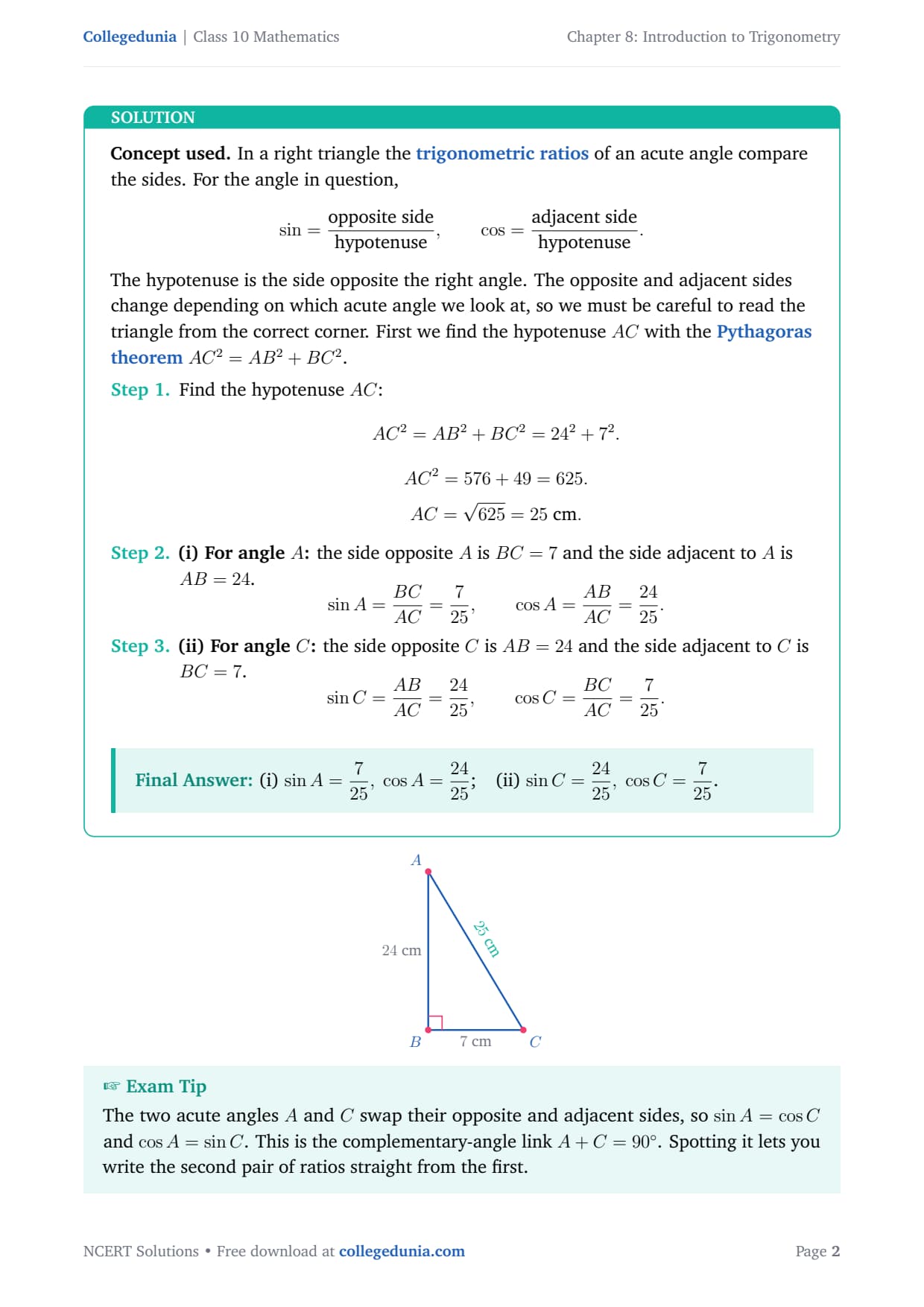
In ABC, right-angled at B, AB=24 cm,
BC=7 cm. Determine: (i) sin A, cos A
(ii) sin C, cos C.
Concept used. In a right triangle the trigonometric
ratios of an acute angle compare the sides. For the angle in question,
sin=opposite sidehypotenuse,
cos=adjacent sidehypotenuse.
The hypotenuse is the side opposite the right angle. The opposite and
adjacent sides change depending on which acute angle we look at, so we
must be careful to read the triangle from the correct corner. First we
find the hypotenuse AC with the Pythagoras theoremAC2=AB2+BC2.
Find the hypotenuse AC:
AC2=AB2+BC2=242+72. AC2=576+49=625. AC=√625=25 cm.
(i) For angle A: the side opposite A is
BC=7 and the side adjacent to A is AB=24.
sin A=BCAC=725,
cos A=ABAC=2425.
(ii) For angle C: the side opposite C is
AB=24 and the side adjacent to C is BC=7.
sin C=ABAC=2425,
cos C=BCAC=725.
(i) sin A=725, cos A=2425; (ii) sin C=2425, cos C=725.
AI
Ananya Iyer
M.Sc Mathematics, University of Hyderabad
Verified Expert
How to present this for full marks.
Hypotenuse first: a board examiner wants the longest
side worked out before any ratio, so state Pythagoras once to get
AC=√242+72=√625=25 cm, and spotting the standard
(7,24,25) triple confirms that value at a single glance.
Name the sides: before you substitute, write down which
side is opposite the angle and which is beside it, since for
angle A the opposite side is BC=7 and the adjacent side is
AB=24, so the two ratios follow at once.
Swap for C: the same two sides switch their roles at
the other corner of the triangle, and naming them again keeps the
working clear, giving sin C=2425 and
cos C=725.
Why it scores: writing the named side beside each
fraction earns the method marks even if a final arithmetic slip
creeps in, and it makes the pattern that links the two angles an
easy self-check at the end.
sin A=cos C=725 and cos A=sin C=2425, with AC=25 cm.
Q 8.2
In Fig. 8.13, find tan P-cot R.
Concept used. From the figure PQR is right-angled
at Q, with PQ=12 cm and hypotenuse PR=13 cm. We first find the
third side QR by the Pythagoras theorem, then read the
ratios:
tan=oppositeadjacent,
cot=adjacentopposite.
For each ratio we must look from the correct vertex.
Find QR using PR2=PQ2+QR2:
132=122+QR2. 169=144+QR2 QR2=25 QR=5 cm.
For angle P: the side opposite P is QR=5 and the
side adjacent to P is PQ=12.
tan P=QRPQ=512.
For angle R: the side opposite R is PQ=12 and the
side adjacent to R is QR=5.
cot R=QRPQ=512.
Subtract:
tan P-cot R=512-512=0.
tan P-cot R=0.
RV
Rohan Verma
B.Tech Civil Engineering, NIT Trichy
Verified Expert
Spot the Pythagorean triple.
Read the triple: with PQ=12 and PR=13 the missing
leg is QR=5, so the longer square-root step is skipped and a
sign slip avoided.
Tangent at P: this is the side facing P over the
side beside it, QRPQ=512.
Cotangent at R: the side beside R over the side
facing it gives the same 512, because P and R are
complementary, so their difference vanishes.
Worth memorising: keeping the common triples
(3,4,5), (5,12,13) and (8,15,17) in mind lets you head
straight to the ratios, a real time saver in the board exam.
tan P=cot R=512, so their difference is 0.
Q 8.3
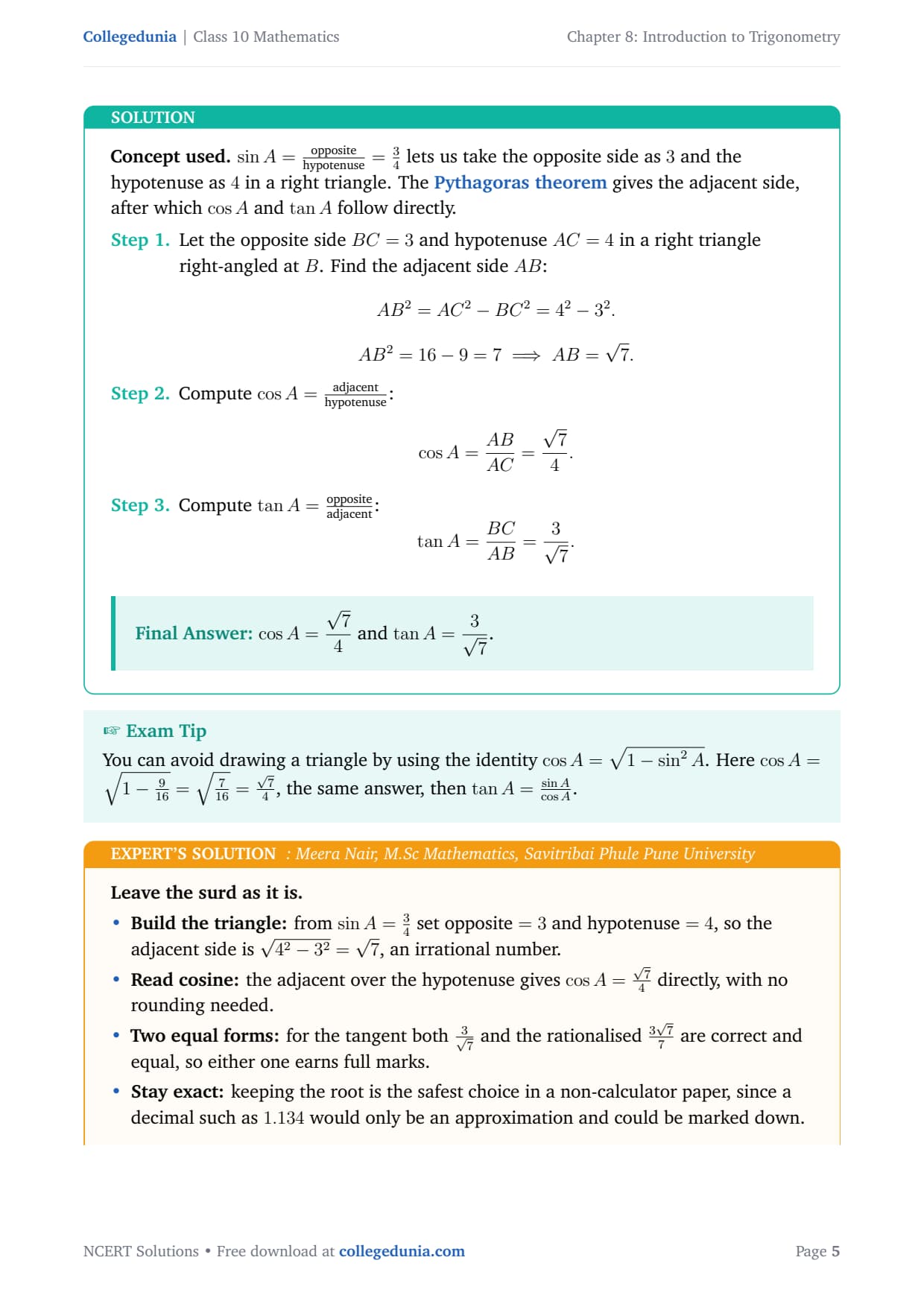
If sin A=34, calculate cos A and tan A.
Concept used.sin A=oppositehypotenuse=34
lets us take the opposite side as 3 and the hypotenuse as 4 in a
right triangle. The Pythagoras theorem gives the adjacent
side, after which cos A and tan A follow directly.
Let the opposite side BC=3 and hypotenuse AC=4 in a right
triangle right-angled at B. Find the adjacent side AB:
AB2=AC2-BC2=42-32. AB2=16-9=7 AB=√7.
Compute cos A=adjacenthypotenuse:
cos A=ABAC=√74.
Compute tan A=oppositeadjacent:
tan A=BCAB=3√7.
cos A=√74 and tan A=3√7.
MN
Meera Nair
M.Sc Mathematics, Savitribai Phule Pune University
Verified Expert
Leave the surd as it is.
Build the triangle: from sin A=34 set opposite
=3 and hypotenuse =4, so the adjacent side is
√42-32=7, an irrational number.
Read cosine: the adjacent over the hypotenuse gives
cos A=74 directly, with no rounding needed.
Two equal forms: for the tangent both 37
and the rationalised 377 are correct and equal,
so either one earns full marks.
Stay exact: keeping the root is the safest choice in a
non-calculator paper, since a decimal such as 1.134 would only
be an approximation and could be marked down.
cos A=74, tan A=37=377.
Q 8.4
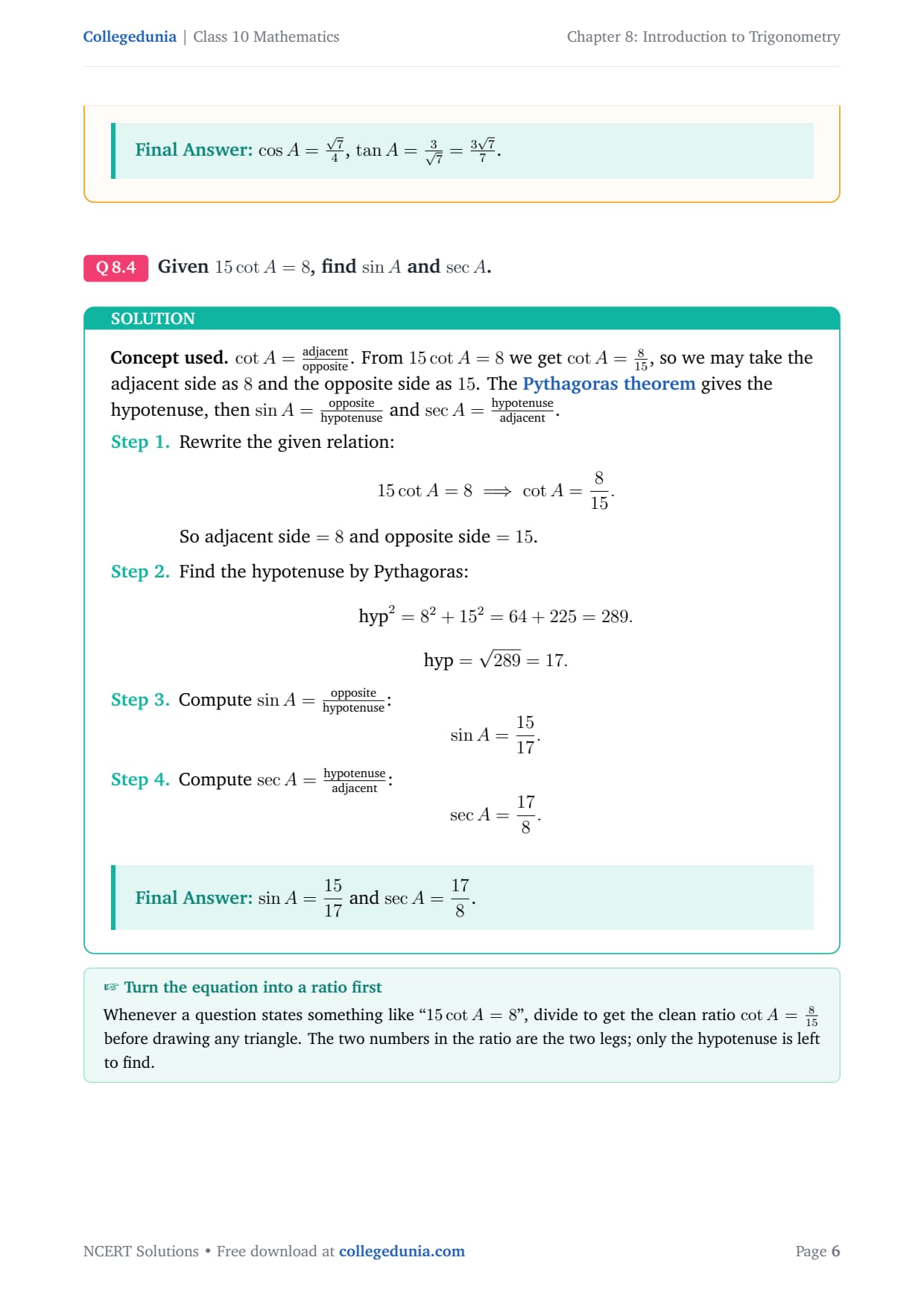
Given 15cot A=8, find sin A and sec A.
Concept used.cot A=adjacentopposite.
From 15cot A=8 we get cot A=815, so we may take the
adjacent side as 8 and the opposite side as 15. The
Pythagoras theorem gives the hypotenuse, then
sin A=oppositehypotenuse and
sec A=hypotenuseadjacent.
Rewrite the given relation:
15cot A=8 cot A=815.
So adjacent side =8 and opposite side =15.
Find the hypotenuse by Pythagoras:
hyp2=82+152=64+225=289. hyp=√289=17.
Compute sin A=oppositehypotenuse:
sin A=1517.
Compute sec A=hypotenuseadjacent:
sec A=178.
sin A=1517 and sec A=178.
KR
Karthik Reddy
M.Sc Mathematics, Osmania University
Verified Expert
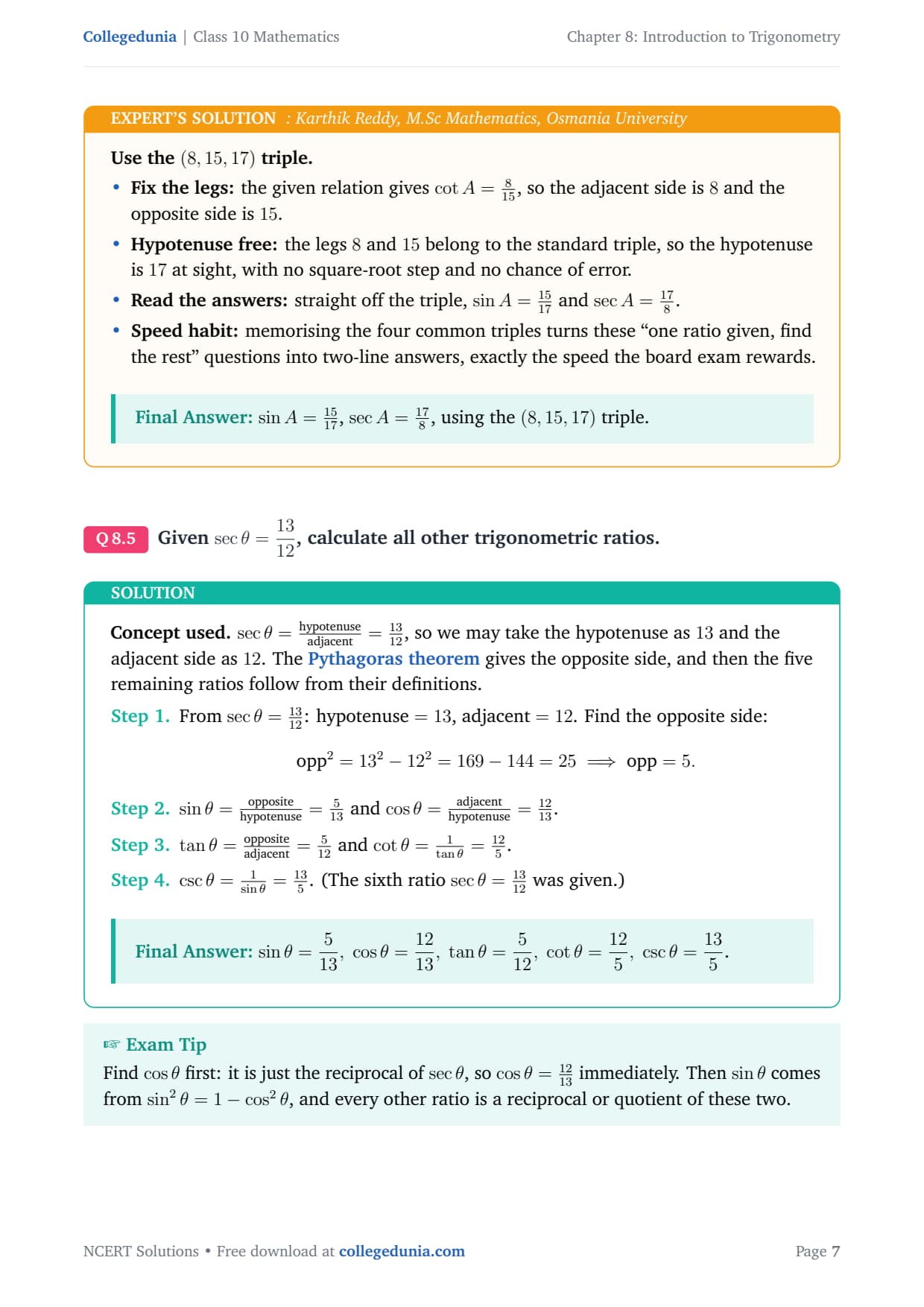
Use the (8,15,17) triple.
Fix the legs: the given relation gives
cot A=815, so the adjacent side is 8 and the
opposite side is 15.
Hypotenuse free: the legs 8 and 15 belong to the
standard triple, so the hypotenuse is 17 at sight, with no
square-root step and no chance of error.
Read the answers: straight off the triple,
sin A=1517 and sec A=178.
Speed habit: memorising the four common triples turns
these ``one ratio given, find the rest'' questions into two-line
answers, exactly the speed the board exam rewards.
sin A=1517, sec A=178, using the (8,15,17) triple.
Q 8.5
Given secθ=1312, calculate all other
trigonometric ratios.
Concept used.secθ=hypotenuseadjacent=1312,
so we may take the hypotenuse as 13 and the adjacent side as 12. The
Pythagoras theorem gives the opposite side, and then the five
remaining ratios follow from their definitions.
From secθ=1312: hypotenuse =13, adjacent
=12. Find the opposite side:
opp2=132-122=169-144=25 opp=5.
sinθ=oppositehypotenuse=513
and cosθ=adjacenthypotenuse=1213.
tanθ=oppositeadjacent=512
and cotθ=1tanθ=125.
cscθ=1sinθ=135. (The sixth
ratio secθ=1312 was given.)
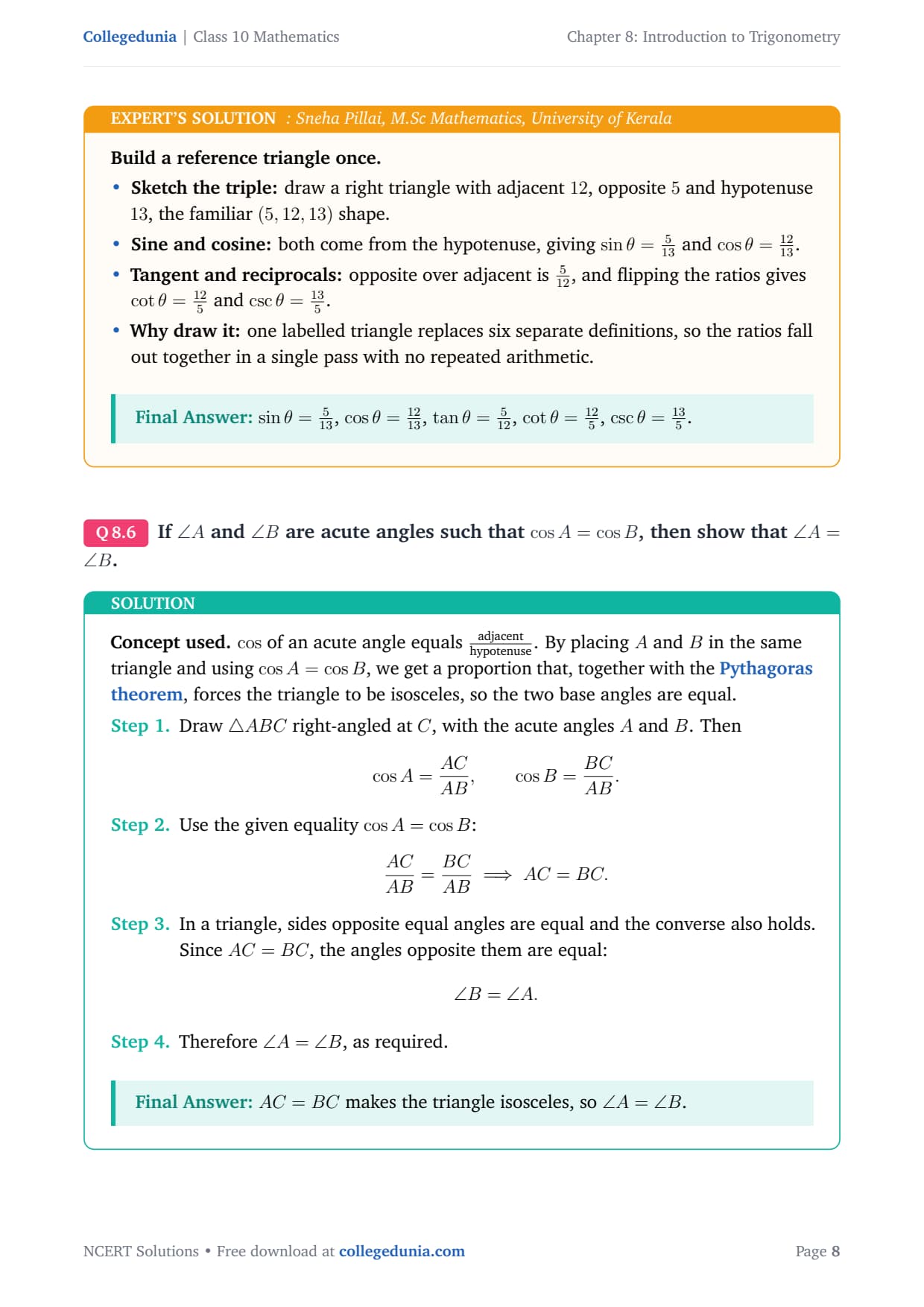
If ∠ A and ∠ B are acute angles such that
cos A=cos B, then show that ∠ A=∠ B.
Concept used.cos of an acute angle equals
adjacenthypotenuse. By placing A and B in
the same triangle and using cos A=cos B, we get a proportion that,
together with the Pythagoras theorem, forces the triangle to
be isosceles, so the two base angles are equal.
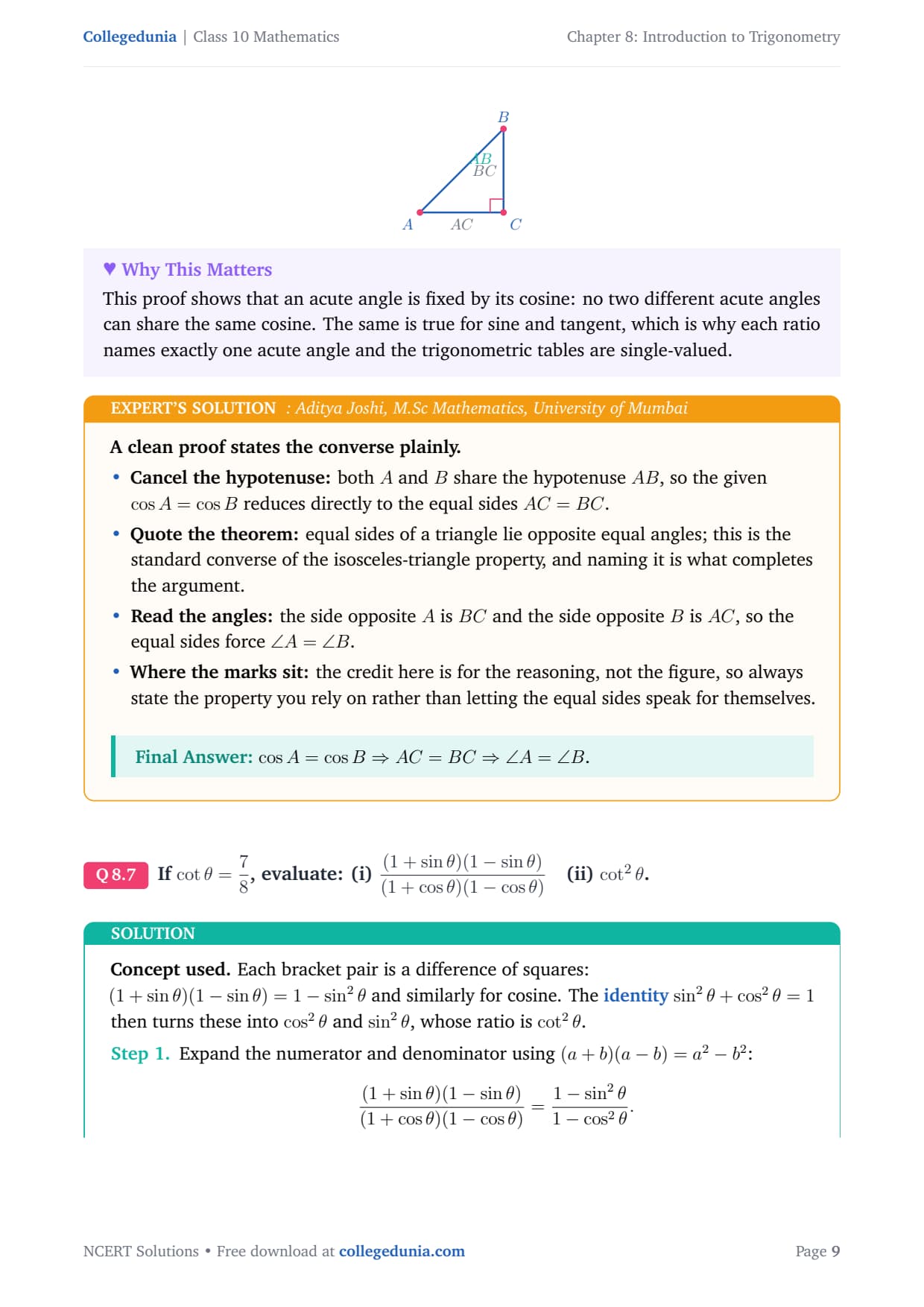
Draw ABC right-angled at C, with the acute angles
A and B. Then
cos A=ACAB, cos B=BCAB.
Use the given equality cos A=cos B:
ACAB=BCAB AC=BC.
In a triangle, sides opposite equal angles are equal and the
converse also holds. Since AC=BC, the angles opposite them are
equal:
∠ B=∠ A.
Therefore ∠ A=∠ B, as required.
AC=BC makes the triangle isosceles, so ∠ A=∠ B.
AJ
Aditya Joshi
M.Sc Mathematics, University of Mumbai
Verified Expert
A clean proof states the converse plainly.
Cancel the hypotenuse: both A and B share the
hypotenuse AB, so the given cos A=cos B reduces directly to
the equal sides AC=BC.
Quote the theorem: equal sides of a triangle lie
opposite equal angles; this is the standard converse of the
isosceles-triangle property, and naming it is what completes the
argument.
Read the angles: the side opposite A is BC and the
side opposite B is AC, so the equal sides force
∠ A=∠ B.
Where the marks sit: the credit here is for the
reasoning, not the figure, so always state the property you rely
on rather than letting the equal sides speak for themselves.
cos A=cos B⇒ AC=BC⇒∠ A=∠ B.
Q 8.7
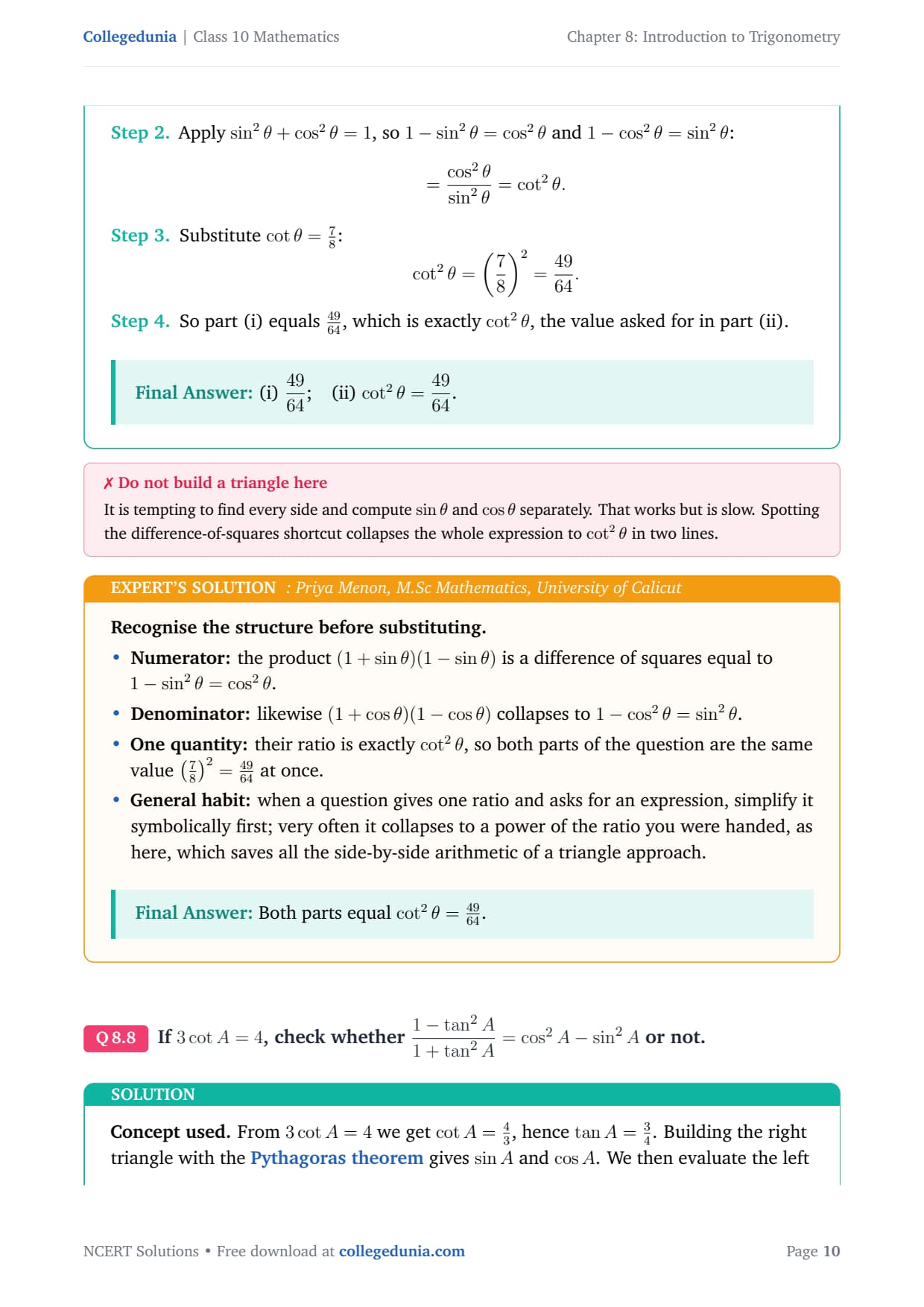
If cotθ=78, evaluate:
(i) (1+sinθ)(1-sinθ)(1+cosθ)(1-cosθ)
(ii) cot2θ.
Concept used. Each bracket pair is a difference of squares:
(1+sinθ)(1-sinθ)=1-sin2θ and similarly for cosine.
The identitysin2θ+cos2θ=1 then turns these
into cos2θ and sin2θ, whose ratio is cot2θ.
Expand the numerator and denominator using
(a+b)(a-b)=a2-b2:
(1+sinθ)(1-sinθ)(1+cosθ)(1-cosθ)
=1-sin2θ1-cos2θ.
Apply sin2θ+cos2θ=1, so
1-sin2θ=cos2θ and 1-cos2θ=sin2θ:
=cos2θsin2θ=cot2θ.
Substitute cotθ=78:
cot2θ=(78)2=4964.
So part (i) equals 4964, which is exactly
cot2θ, the value asked for in part (ii).
(i) 4964; (ii) cot2θ=4964.
PM
Priya Menon
M.Sc Mathematics, University of Calicut
Verified Expert
Recognise the structure before substituting.
Numerator: the product (1+sinθ)(1-sinθ) is
a difference of squares equal to 1-sin2θ=cos2θ.
Denominator: likewise (1+cosθ)(1-cosθ)
collapses to 1-cos2θ=sin2θ.
One quantity: their ratio is exactly cot2θ, so
both parts of the question are the same value
(78)2=4964 at once.
General habit: when a question gives one ratio and asks
for an expression, simplify it symbolically first; very often it
collapses to a power of the ratio you were handed, as here, which
saves all the side-by-side arithmetic of a triangle approach.
Both parts equal cot2θ=4964.
Q 8.8
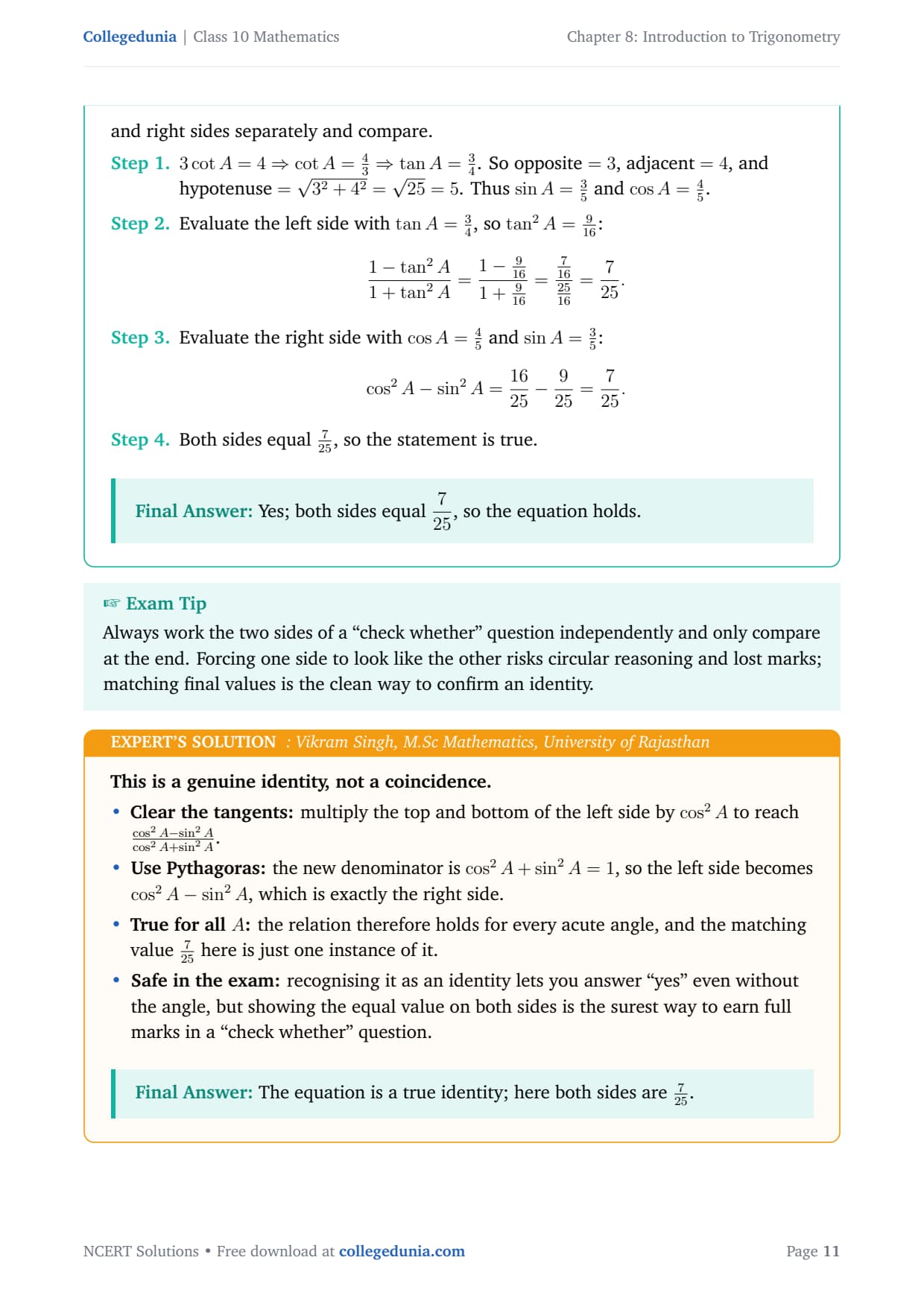
If 3cot A=4, check whether
1-tan2A1+tan2A=cos2A-sin2A or not.
Concept used. From 3cot A=4 we get cot A=43, hence
tan A=34. Building the right triangle with the
Pythagoras theorem gives sin A and cos A. We then
evaluate the left and right sides separately and compare.
3cot A=4A=43A=34.
So opposite =3, adjacent =4, and hypotenuse
=√32+42=√25=5. Thus
sin A=35 and cos A=45.
Evaluate the left side with tan A=34, so
tan2A=916:
1-tan2A1+tan2A
=1-9161+916
=7162516=725.
Evaluate the right side with cos A=45 and
sin A=35:
cos2A-sin2A=1625-925=725.
Both sides equal 725, so the statement is true.
Yes; both sides equal 725, so the equation holds.
VS
Vikram Singh
M.Sc Mathematics, University of Rajasthan
Verified Expert
This is a genuine identity, not a coincidence.
Clear the tangents: multiply the top and bottom of the
left side by cos2A to reach
cos2A-sin2Acos2A+sin2A.
Use Pythagoras: the new denominator is
cos2A+sin2A=1, so the left side becomes
cos2A-sin2A, which is exactly the right side.
True for all A: the relation therefore holds for every
acute angle, and the matching value 725 here is just
one instance of it.
Safe in the exam: recognising it as an identity lets you
answer ``yes'' even without the angle, but showing the equal
value on both sides is the surest way to earn full marks in a
``check whether'' question.
The equation is a true identity; here both sides are 725.
Q 8.9
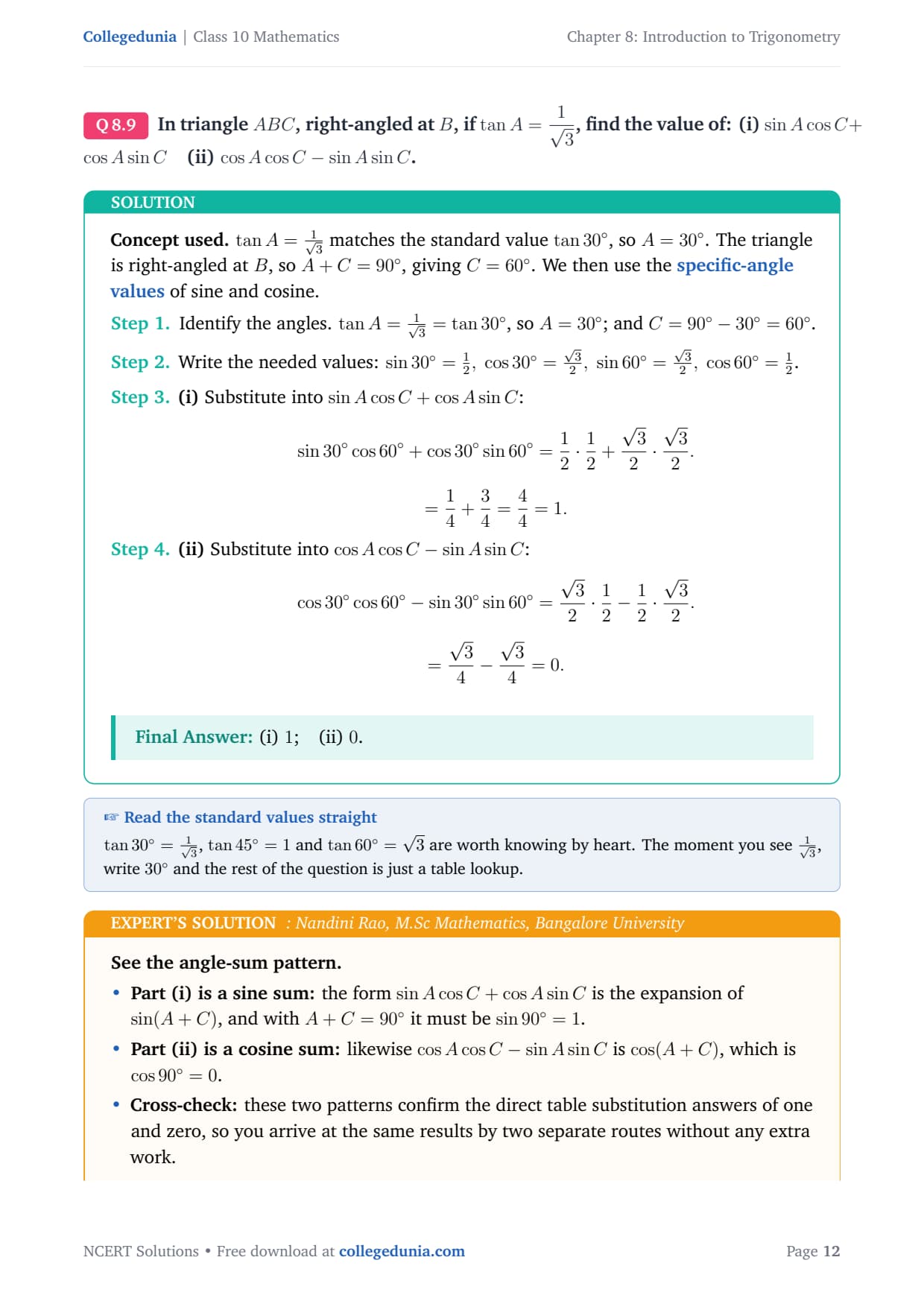
In triangle ABC, right-angled at B, if
tan A=13, find the value of:
(i) sin Acos C+cos Asin C
(ii) cos Acos C-sin Asin C.
Concept used.tan A=13 matches the standard
value tan 30∘, so A=30∘. The triangle is right-angled at
B, so A+C=90∘, giving C=60∘. We then use the
specific-angle values of sine and cosine.
Identify the angles. tan A=13=30∘, so
A=30∘; and C=90∘-30∘=60∘.
Write the needed values:
30∘=12, 30∘=32,
60∘=32, 60∘=12.
(i) Substitute into sin Acos C+cos Asin C:
30∘60∘+30∘60∘
=12·12+32·32. =14+34=44=1.
(ii) Substitute into cos Acos C-sin Asin C:
30∘60∘-30∘60∘
=32·12-12·32. =34-34=0.
(i) 1; (ii) 0.
NR
Nandini Rao
M.Sc Mathematics, Bangalore University
Verified Expert
See the angle-sum pattern.
Part (i) is a sine sum: the form
sin Acos C+cos Asin C is the expansion of sin(A+C), and
with A+C=90∘ it must be 90∘=1.
Part (ii) is a cosine sum: likewise
cos Acos C-sin Asin C is cos(A+C), which is
90∘=0.
Cross-check: these two patterns confirm the direct table
substitution answers of one and zero, so you arrive at the same
results by two separate routes without any extra work.
Why it helps: although the angle-sum formulas are studied
formally only later, spotting them here is a fast and reliable way
to be sure that your standard-value substitution has been carried
out correctly.
(i) sin(A+C)=90∘=1; (ii) cos(A+C)=90∘=0.
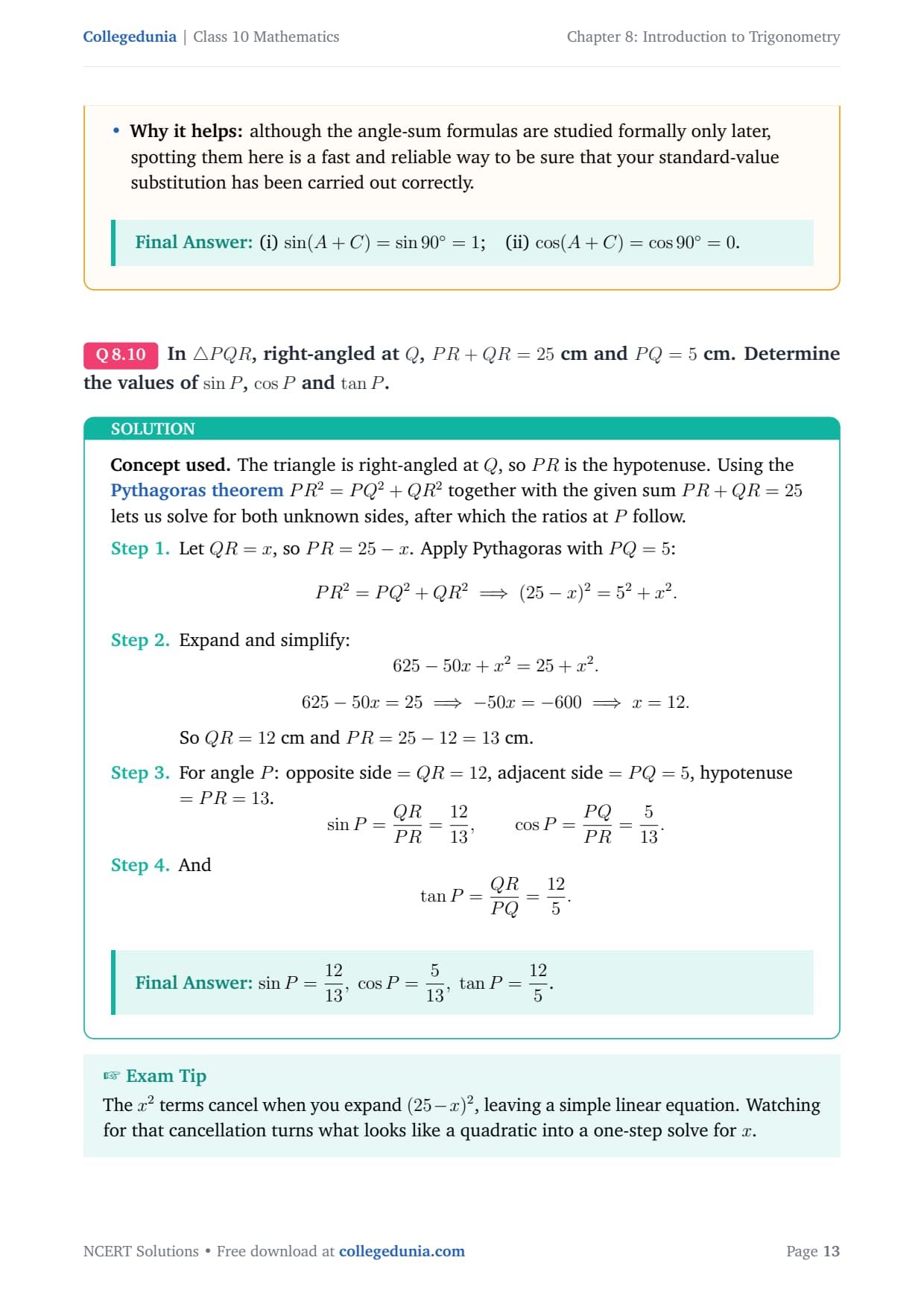
Q 8.10
In PQR, right-angled at Q, PR+QR=25 cm and
PQ=5 cm. Determine the values of sin P, cos P and tan P.
Concept used. The triangle is right-angled at Q, so PR is
the hypotenuse. Using the Pythagoras theoremPR2=PQ2+QR2 together with the given sum PR+QR=25 lets us solve
for both unknown sides, after which the ratios at P follow.
Let QR=x, so PR=25-x. Apply Pythagoras with PQ=5:
PR2=PQ2+QR2 (25-x)2=52+x2.
Expand and simplify:
625-50x+x2=25+x2. 625-50x=25 -50x=-600 x=12.
So QR=12 cm and PR=25-12=13 cm.
For angle P: opposite side =QR=12, adjacent side =PQ=5,
hypotenuse =PR=13.
sin P=QRPR=1213,
cos P=PQPR=513.
And
tan P=QRPQ=125.
sin P=1213, cos P=513, tan P=125.
SG
Sanjay Gupta
M.Sc Mathematics, University of Delhi
Verified Expert
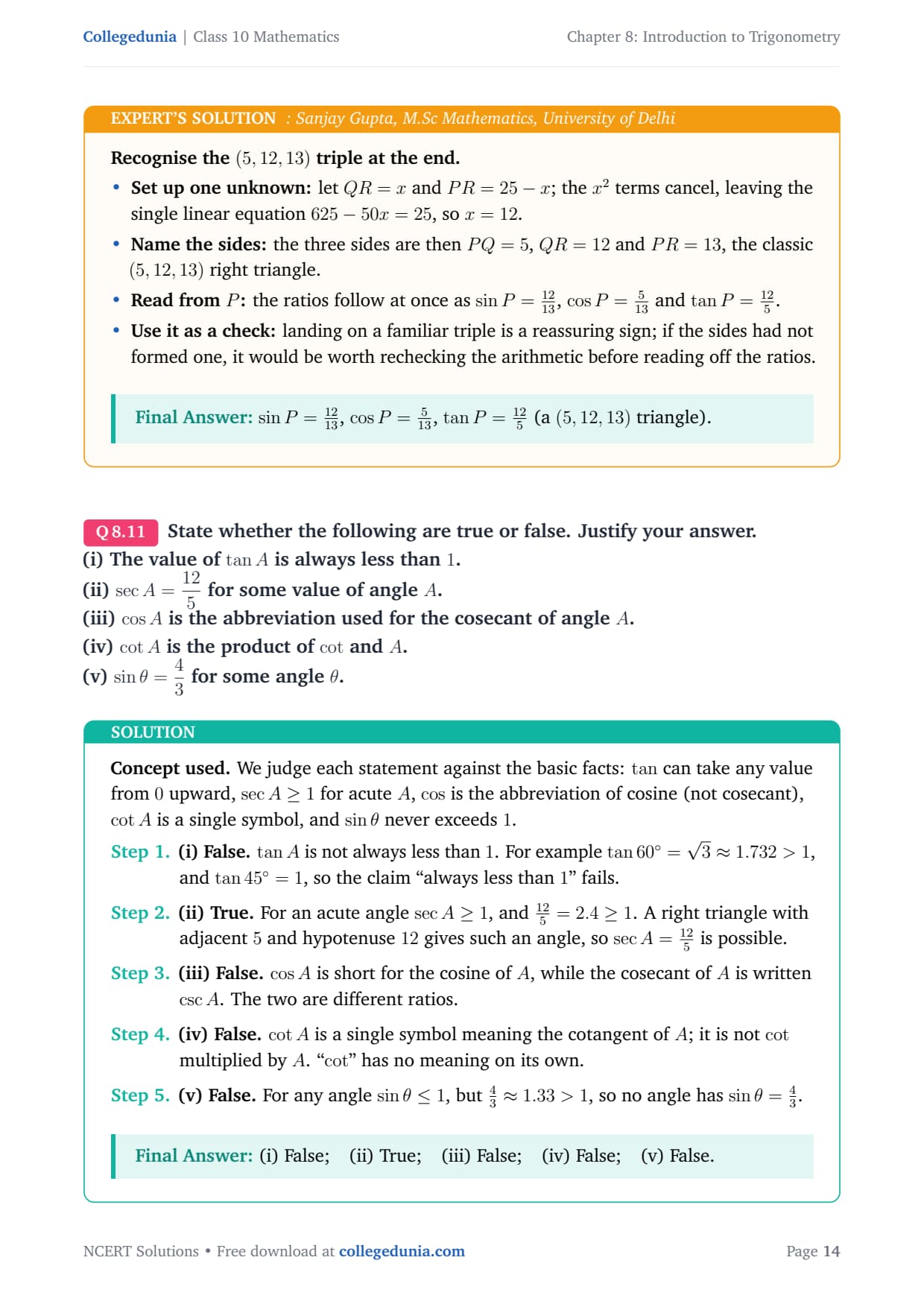
Recognise the (5,12,13) triple at the end.
Set up one unknown: let QR=x and PR=25-x; the
x2 terms cancel, leaving the single linear equation
625-50x=25, so x=12.
Name the sides: the three sides are then PQ=5,
QR=12 and PR=13, the classic (5,12,13) right triangle.
Read from P: the ratios follow at once as
sin P=1213, cos P=513 and
tan P=125.
Use it as a check: landing on a familiar triple is a
reassuring sign; if the sides had not formed one, it would be
worth rechecking the arithmetic before reading off the ratios.
sin P=1213, cos P=513, tan P=125 (a (5,12,13) triangle).
Q 8.11
State whether the following are true or false. Justify your
answer.
(i) The value of tan A is always less than 1.
(ii) sec A=125 for some value of angle A.
(iii) cos A is the abbreviation used for the cosecant of angle A.
(iv) cot A is the product of cot and A.
(v) sinθ=43 for some angle θ.
Concept used. We judge each statement against the basic facts:
tan can take any value from 0 upward, sec A≥ 1 for acute A,
cos is the abbreviation of cosine (not cosecant), cot A is a single
symbol, and sinθ never exceeds 1.
(i) False.tan A is not always less than 1. For
example 60∘=31.732>1, and
45∘=1, so the claim ``always less than 1'' fails.
(ii) True. For an acute angle sec A≥ 1, and
125=2.4≥ 1. A right triangle with adjacent 5 and
hypotenuse 12 gives such an angle, so sec A=125 is
possible.
(iii) False.cos A is short for the cosine of
A, while the cosecant of A is written csc A. The two are
different ratios.
(iv) False.cot A is a single symbol meaning the
cotangent of A; it is not cot multiplied by A. ``cot''
has no meaning on its own.
(v) False. For any angle sinθ≤ 1, but
431.33>1, so no angle has
sinθ=43.
(i) False; (ii) True; (iii) False; (iv) False; (v) False.
FK
Farhan Khan
M.Sc Mathematics, Aligarh Muslim University
Verified Expert
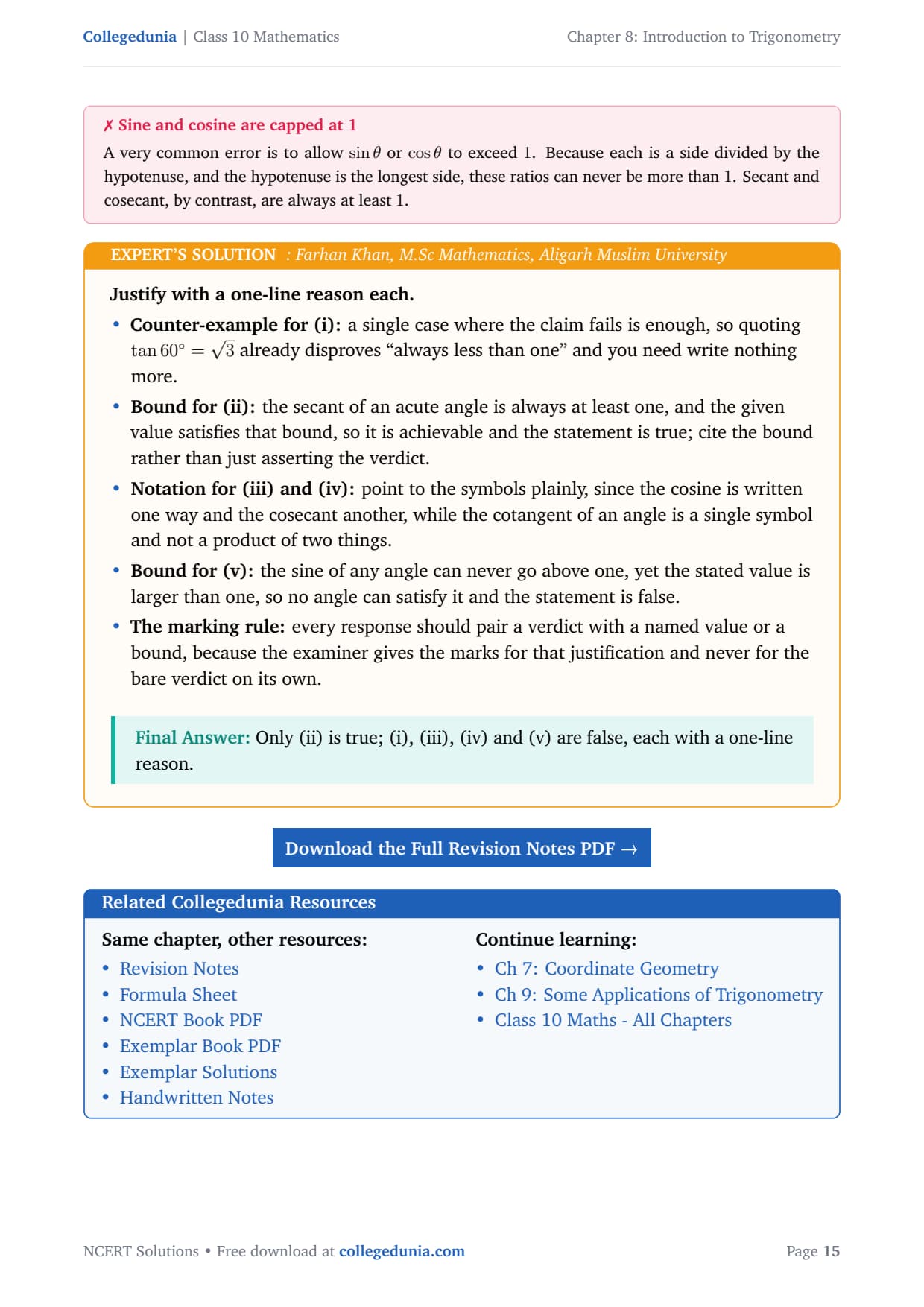
Justify with a one-line reason each.
Counter-example for (i): a single case where the claim
fails is enough, so quoting 60∘=3 already
disproves ``always less than one'' and you need write nothing
more.
Bound for (ii): the secant of an acute angle is always
at least one, and the given value satisfies that bound, so it is
achievable and the statement is true; cite the bound rather than
just asserting the verdict.
Notation for (iii) and (iv): point to the symbols
plainly, since the cosine is written one way and the cosecant
another, while the cotangent of an angle is a single symbol and
not a product of two things.
Bound for (v): the sine of any angle can never go above
one, yet the stated value is larger than one, so no angle can
satisfy it and the statement is false.
The marking rule: every response should pair a verdict
with a named value or a bound, because the examiner gives the
marks for that justification and never for the bare verdict on
its own.
Only (ii) is true; (i), (iii), (iv) and (v) are false, each with a one-line reason.
NCERT solutions Class 10 Mathematics Chapter 8 Introduction to Trigonometry
All 4 questions with collapsible Solution and Expert Solution. Tap a button to reveal the working.
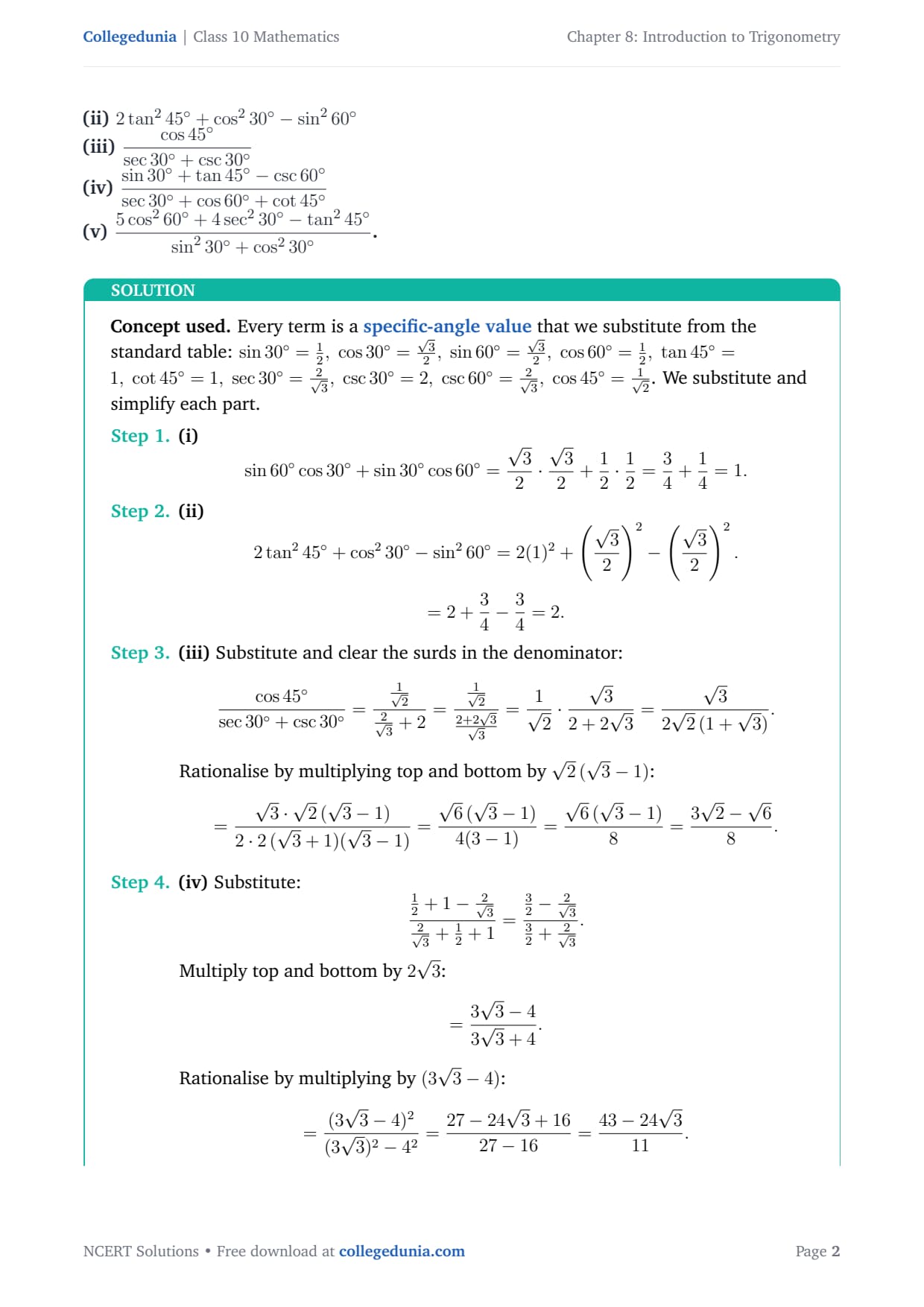
Concept used. Every term is a specific-angle value
that we substitute from the standard table:
30∘=12, 30∘=32,
60∘=32, 60∘=12,
45∘=1, 45∘=1,
30∘=23, 30∘=2,
60∘=23, 45∘=12.
We substitute and simplify each part.
(i) 60∘30∘+30∘60∘
=32·32+12·12
=34+14=1.
(ii) 2tan2 45∘+cos2 30∘-sin2 60∘
=2(1)2+(32)2-(32)2. =2+34-34=2.
(iii) Substitute and clear the surds in the denominator:
45∘30∘+30∘
=1223+2
=122+233
=12·32+23
=322 (1+3).
Rationalise by multiplying top and bottom by
2 (3-1):
=3·2 (3-1)22 (3+1)(3-1)
=6 (3-1)4(3-1)
=6 (3-1)8
=32-68.
(iv) Substitute:
12+1-2323+12+1
=32-2332+23.
Multiply top and bottom by 23:
=33-433+4.
Rationalise by multiplying by (33-4):
=(33-4)2(33)2-42
=27-243+1627-16
=43-24311.
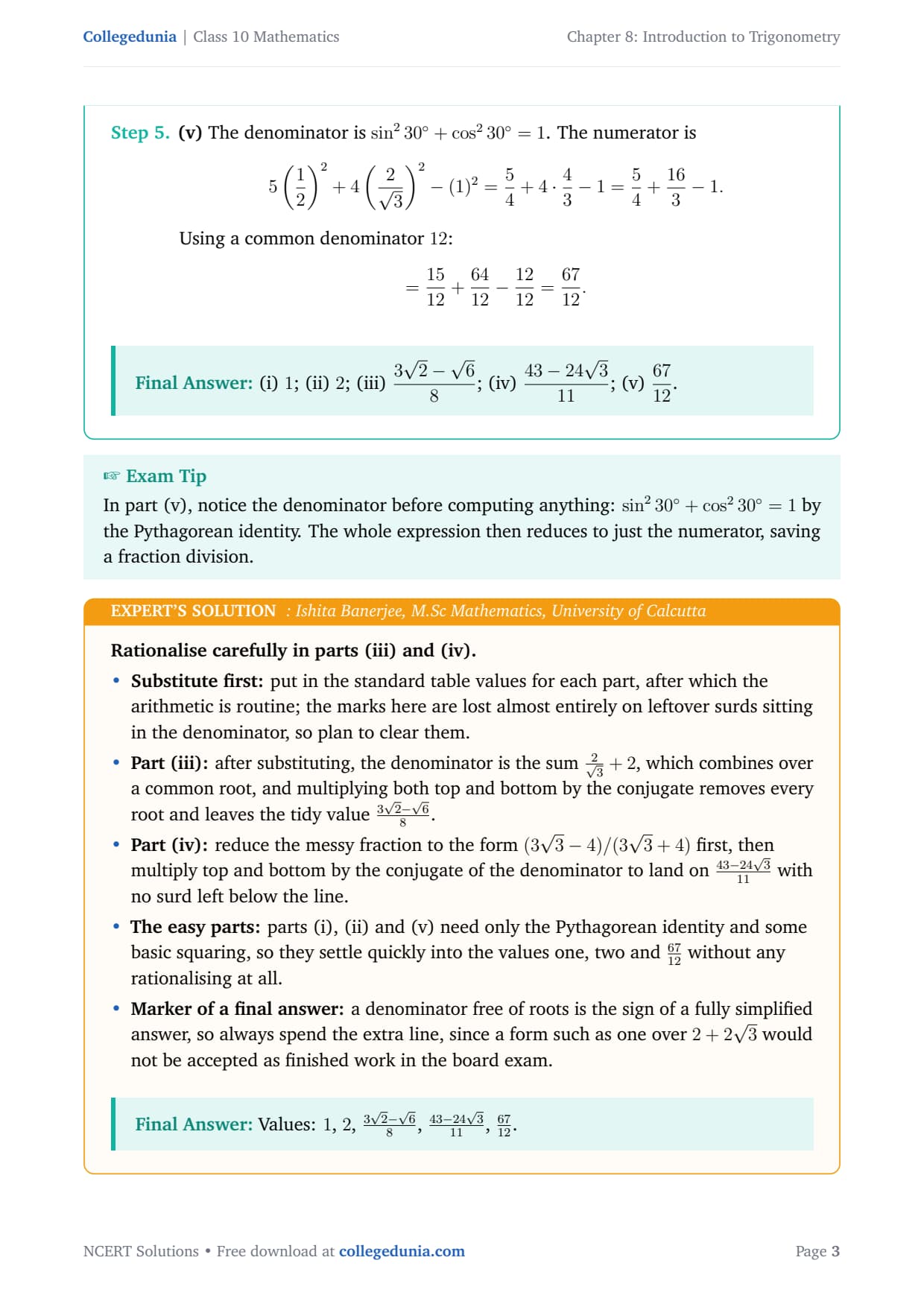
(v) The denominator is
sin2 30∘+cos2 30∘=1. The numerator is
5(12)2+4(23)2-(1)2
=54+4·43-1=54+163-1.
Using a common denominator 12:
=1512+6412-1212=6712.
(i) 1; (ii) 2; (iii) 32-68; (iv) 43-24311; (v) 6712.
IB
Ishita Banerjee
M.Sc Mathematics, University of Calcutta
Verified Expert
Rationalise carefully in parts (iii) and (iv).
Substitute first: put in the standard table values for
each part, after which the arithmetic is routine; the marks here
are lost almost entirely on leftover surds sitting in the
denominator, so plan to clear them.
Part (iii): after substituting, the denominator is the
sum 23+2, which combines over a common root, and
multiplying both top and bottom by the conjugate removes every
root and leaves the tidy value 32-68.
Part (iv): reduce the messy fraction to the form
(33-4)/(33+4) first, then multiply top and
bottom by the conjugate of the denominator to land on
43-24311 with no surd left below the line.
The easy parts: parts (i), (ii) and (v) need only the
Pythagorean identity and some basic squaring, so they settle
quickly into the values one, two and 6712 without any
rationalising at all.
Marker of a final answer: a denominator free of roots is
the sign of a fully simplified answer, so always spend the extra
line, since a form such as one over 2+23 would not be
accepted as finished work in the board exam.
Values: 1, 2, 32-68, 43-24311, 6712.
Q 8.2
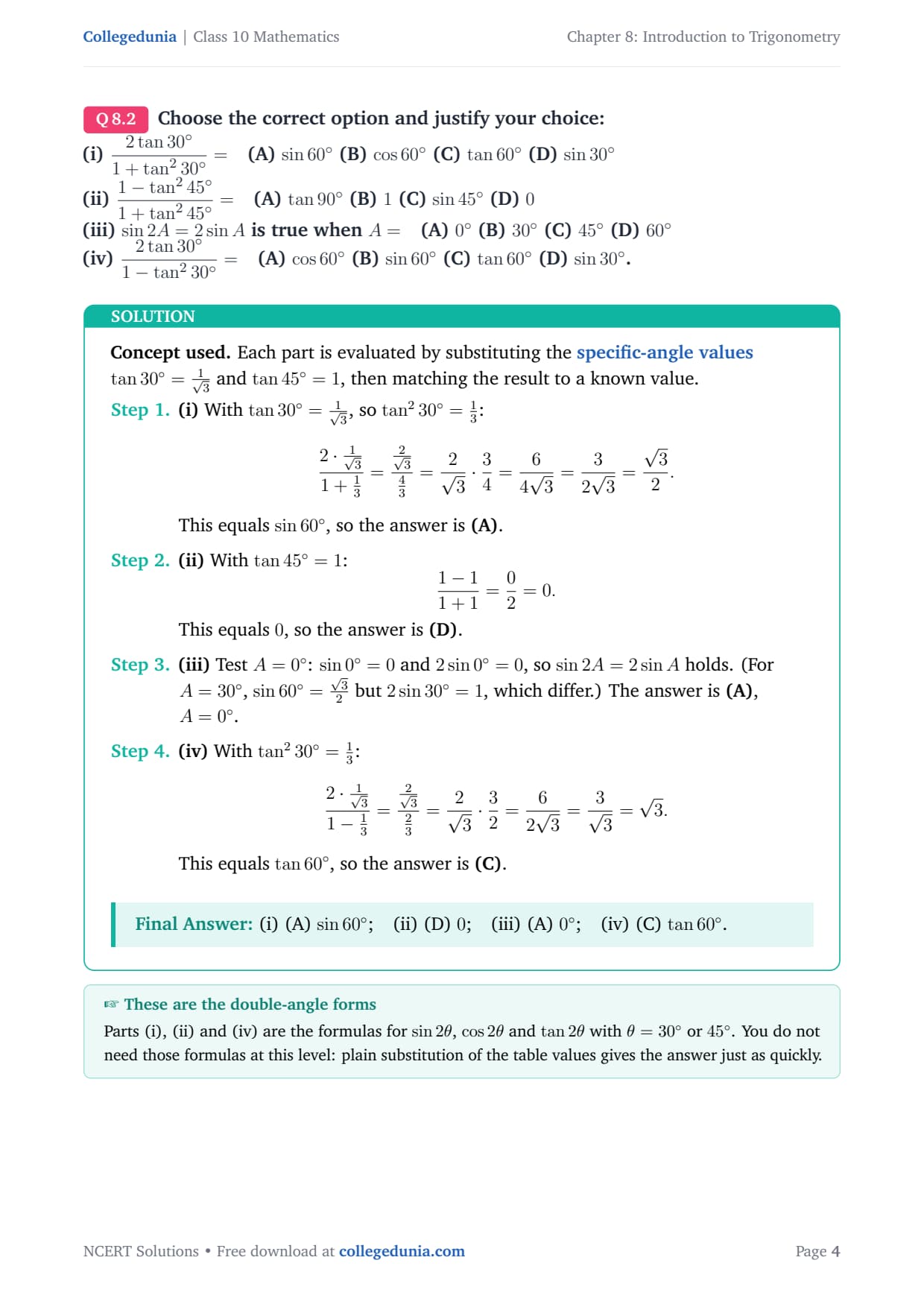
Choose the correct option and justify your choice:
(i) 230∘1+tan2 30∘=
(A) 60∘ (B) 60∘ (C) 60∘ (D) 30∘
(ii) 1-tan2 45∘1+tan2 45∘=
(A) 90∘ (B) 1 (C) 45∘ (D) 0
(iii) 2A=2sin A is true when A=
(A) 0∘ (B) 30∘ (C) 45∘ (D) 60∘
(iv) 230∘1-tan2 30∘=
(A) 60∘ (B) 60∘ (C) 60∘ (D) 30∘.
Concept used. Each part is evaluated by substituting the
specific-angle values30∘=13 and
45∘=1, then matching the result to a known value.
(i) With 30∘=13, so
tan2 30∘=13:
2·131+13
=2343
=23·34=643=323=32.
This equals 60∘, so the answer is (A).
(ii) With 45∘=1:
1-11+1=02=0.
This equals 0, so the answer is (D).
(iii) Test A=0∘: 0∘=0 and
20∘=0, so 2A=2sin A holds. (For
A=30∘, 60∘=32 but
230∘=1, which differ.) The answer is (A),
A=0∘.
(iv) With tan2 30∘=13:
2·131-13
=2323
=23·32=623=33=3.
This equals 60∘, so the answer is (C).
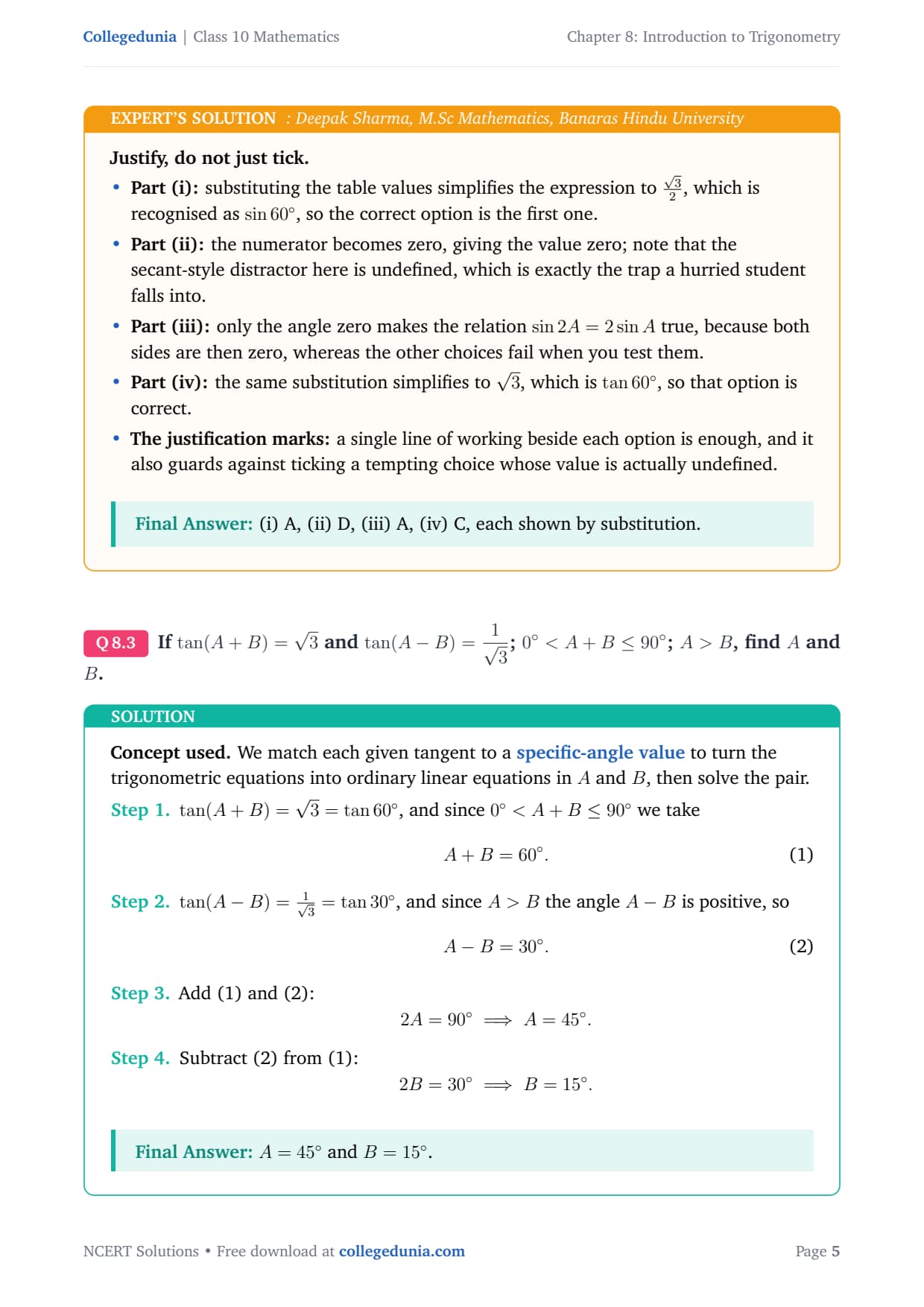
Part (i): substituting the table values simplifies the
expression to 32, which is recognised as
60∘, so the correct option is the first one.
Part (ii): the numerator becomes zero, giving the value
zero; note that the secant-style distractor here is undefined,
which is exactly the trap a hurried student falls into.
Part (iii): only the angle zero makes the relation
2A=2sin A true, because both sides are then zero, whereas
the other choices fail when you test them.
Part (iv): the same substitution simplifies to
3, which is 60∘, so that option is correct.
The justification marks: a single line of working beside
each option is enough, and it also guards against ticking a
tempting choice whose value is actually undefined.
(i) A, (ii) D, (iii) A, (iv) C, each shown by substitution.
Q 8.3
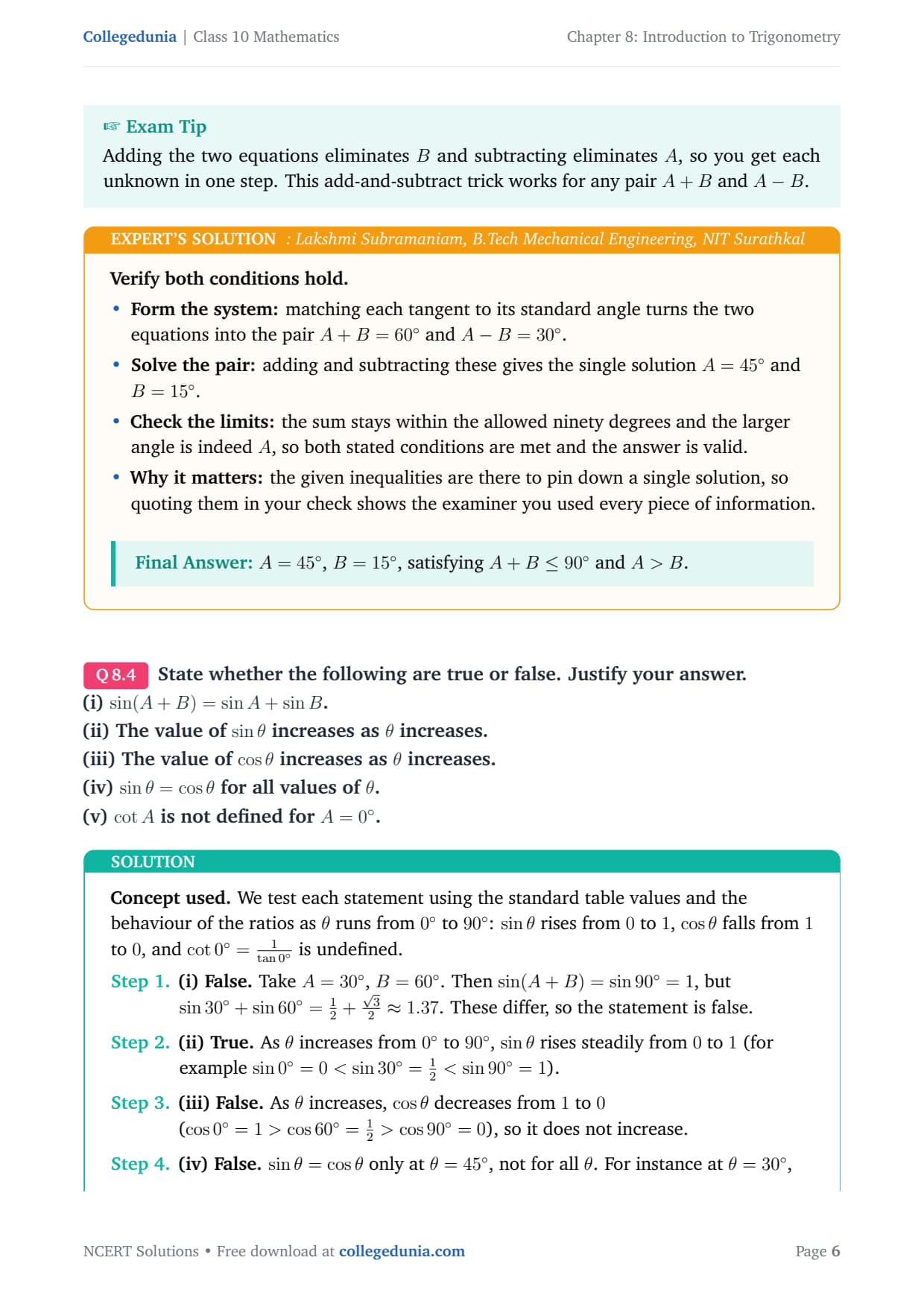
If tan(A+B)=3 and tan(A-B)=13;
0∘∘; A>B, find A and B.
Concept used. We match each given tangent to a
specific-angle value to turn the trigonometric equations into
ordinary linear equations in A and B, then solve the pair.
tan(A+B)=3=60∘, and since
0∘∘ we take
A+B=60∘. 1
tan(A-B)=13=30∘, and since A>B the
angle A-B is positive, so
A-B=30∘. 2
Add (1) and (2):
2A=90∘A=45∘.
Subtract (2) from (1):
2B=30∘B=15∘.
A=45∘ and B=15∘.
LS
Lakshmi Subramaniam
B.Tech Mechanical Engineering, NIT Surathkal
Verified Expert
Verify both conditions hold.
Form the system: matching each tangent to its standard
angle turns the two equations into the pair A+B=60∘ and
A-B=30∘.
Solve the pair: adding and subtracting these gives the
single solution A=45∘ and B=15∘.
Check the limits: the sum stays within the allowed
ninety degrees and the larger angle is indeed A, so both stated
conditions are met and the answer is valid.
Why it matters: the given inequalities are there to pin
down a single solution, so quoting them in your check shows the
examiner you used every piece of information.
A=45∘, B=15∘, satisfying A+B90∘ and A>B.
Q 8.4
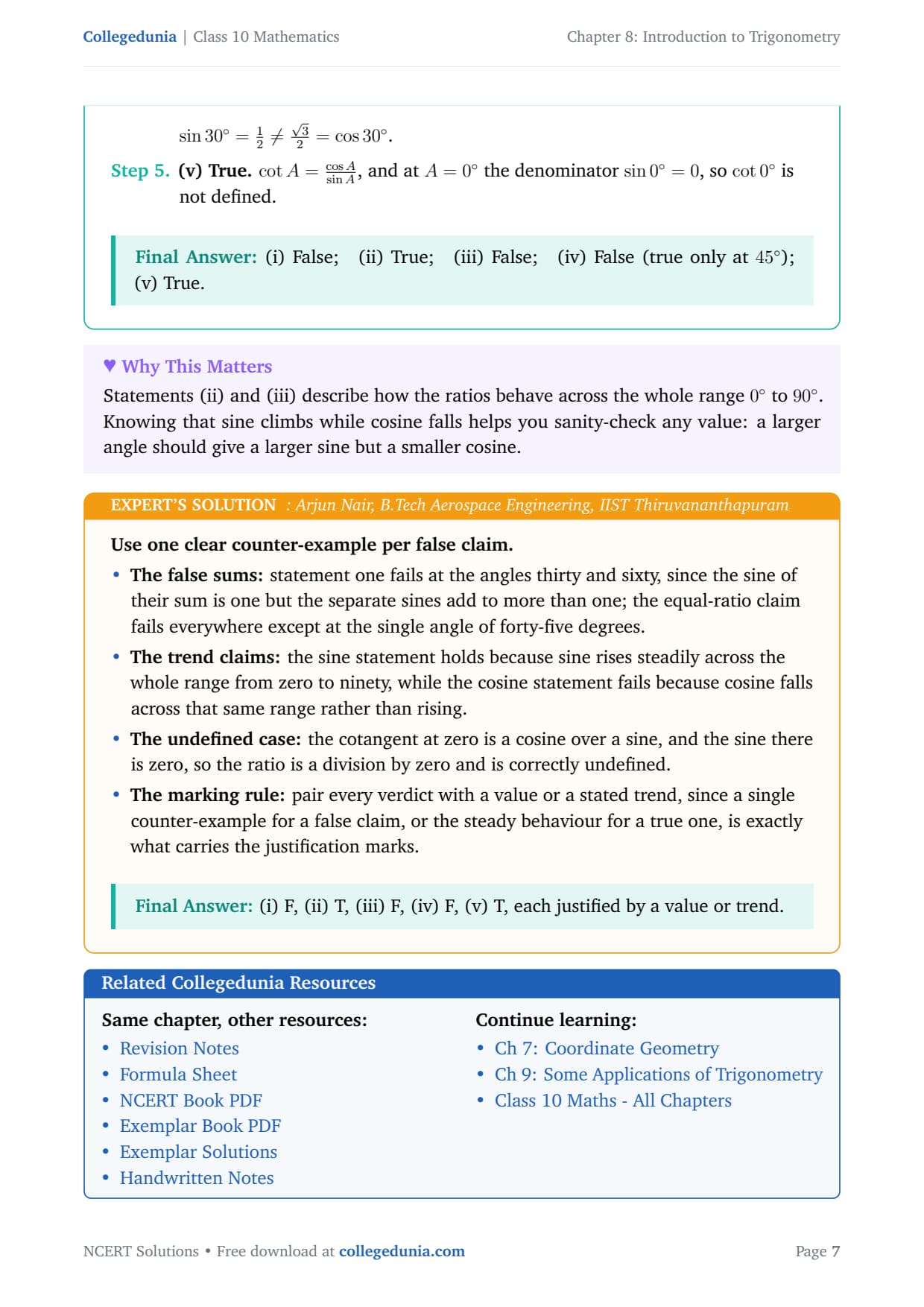
State whether the following are true or false. Justify your
answer.
(i) sin(A+B)=sin A+sin B.
(ii) The value of sinθ increases as θ increases.
(iii) The value of cosθ increases as θ increases.
(iv) sinθ=cosθ for all values of θ.
(v) cot A is not defined for A=0∘.
Concept used. We test each statement using the standard table
values and the behaviour of the ratios as θ runs from 0∘
to 90∘: sinθ rises from 0 to 1, cosθ falls
from 1 to 0, and 0∘=10∘ is undefined.
(i) False. Take A=30∘, B=60∘. Then
sin(A+B)=90∘=1, but
30∘+60∘=12+321.37.
These differ, so the statement is false.
(ii) True. As θ increases from 0∘ to
90∘, sinθ rises steadily from 0 to 1
(for example 0∘=0<30∘=12<90∘=1).
(iii) False. As θ increases, cosθ
decreases from 1 to 0
(0∘=1>60∘=12>90∘=0), so it
does not increase.
(iv) False.sinθ=cosθ only at
θ=45∘, not for all θ. For instance at
θ=30∘, 30∘=12≠32=30∘.
(v) True.cot A=cos Asin A, and at
A=0∘ the denominator 0∘=0, so 0∘ is
not defined.
(i) False; (ii) True; (iii) False; (iv) False (true only at 45∘); (v) True.
The false sums: statement one fails at the angles thirty
and sixty, since the sine of their sum is one but the separate
sines add to more than one; the equal-ratio claim fails
everywhere except at the single angle of forty-five degrees.
The trend claims: the sine statement holds because sine
rises steadily across the whole range from zero to ninety, while
the cosine statement fails because cosine falls across that same
range rather than rising.
The undefined case: the cotangent at zero is a cosine
over a sine, and the sine there is zero, so the ratio is a
division by zero and is correctly undefined.
The marking rule: pair every verdict with a value or a
stated trend, since a single counter-example for a false claim,
or the steady behaviour for a true one, is exactly what carries
the justification marks.
(i) F, (ii) T, (iii) F, (iv) F, (v) T, each justified by a value or trend.
NCERT solutions Class 10 Mathematics Chapter 8 Introduction to Trigonometry
All 4 questions with collapsible Solution and Expert Solution. Tap a button to reveal the working.
Exercise 8.3
Q 8.1
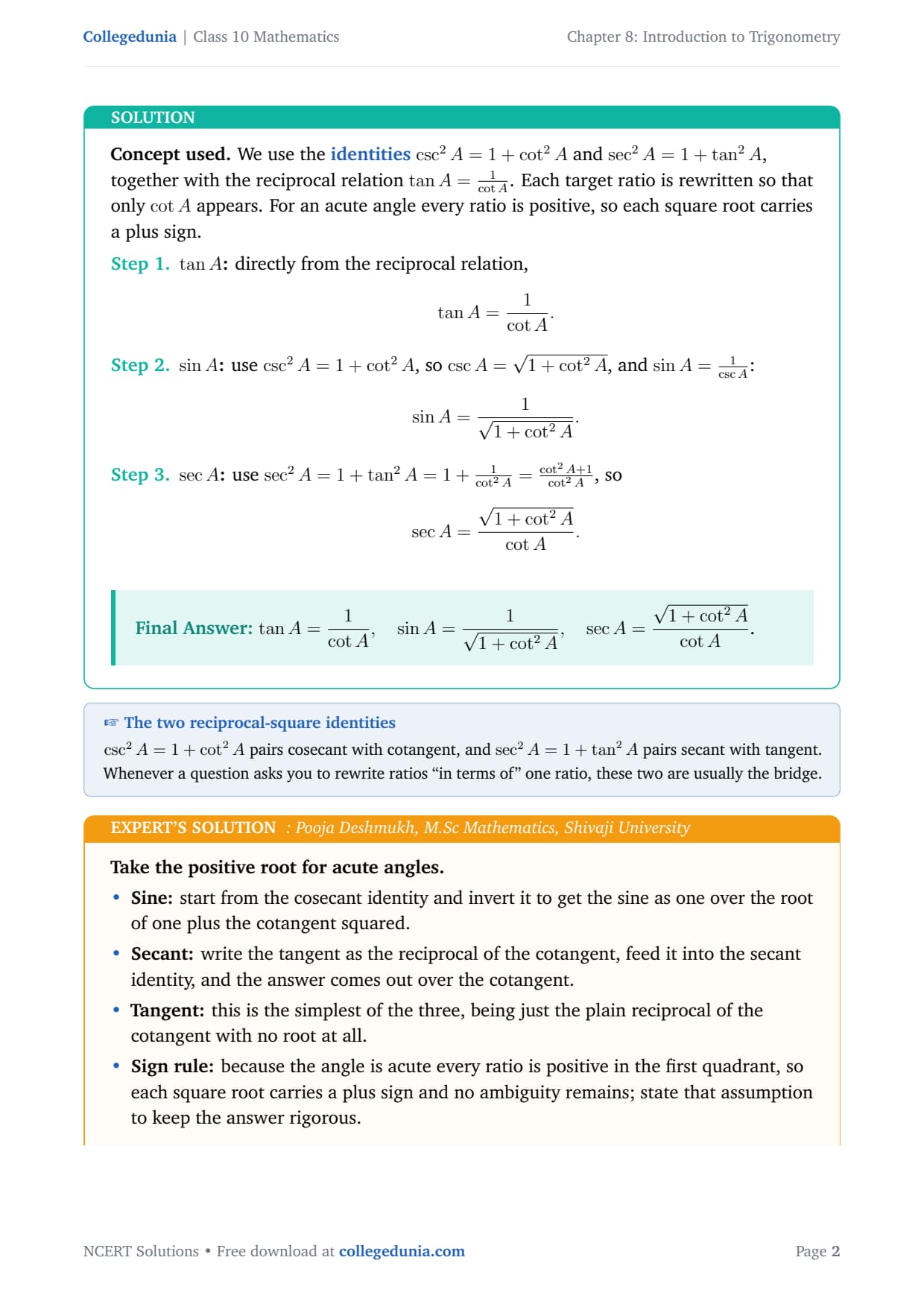
Express the trigonometric ratios sin A, sec A and
tan A in terms of cot A.
Concept used. We use the identitiescsc2A=1+cot2A and sec2A=1+tan2A, together with the
reciprocal relation tan A=1cot A. Each target ratio is
rewritten so that only cot A appears. For an acute angle every ratio
is positive, so each square root carries a plus sign.
tan A: directly from the reciprocal relation,
tan A=1cot A.
sin A: use csc2A=1+cot2A, so
csc A=√1+cot2A, and sin A=1csc A:
sin A=1√1+cot2A.
sec A: use sec2A=1+tan2A=1+1cot2A=cot2A+1cot2A,
so
sec A=√1+cot2Acot A.
tan A=1cot A, sin A=1√1+cot2A, sec A=√1+cot2Acot A.
PD
Pooja Deshmukh
M.Sc Mathematics, Shivaji University
Verified Expert
Take the positive root for acute angles.
Sine: start from the cosecant identity and invert it to
get the sine as one over the root of one plus the cotangent
squared.
Secant: write the tangent as the reciprocal of the
cotangent, feed it into the secant identity, and the answer comes
out over the cotangent.
Tangent: this is the simplest of the three, being just
the plain reciprocal of the cotangent with no root at all.
Sign rule: because the angle is acute every ratio is
positive in the first quadrant, so each square root carries a
plus sign and no ambiguity remains; state that assumption to keep
the answer rigorous.
sin A=1√1+cot2A, sec A=√1+cot2Acot A, tan A=1cot A.
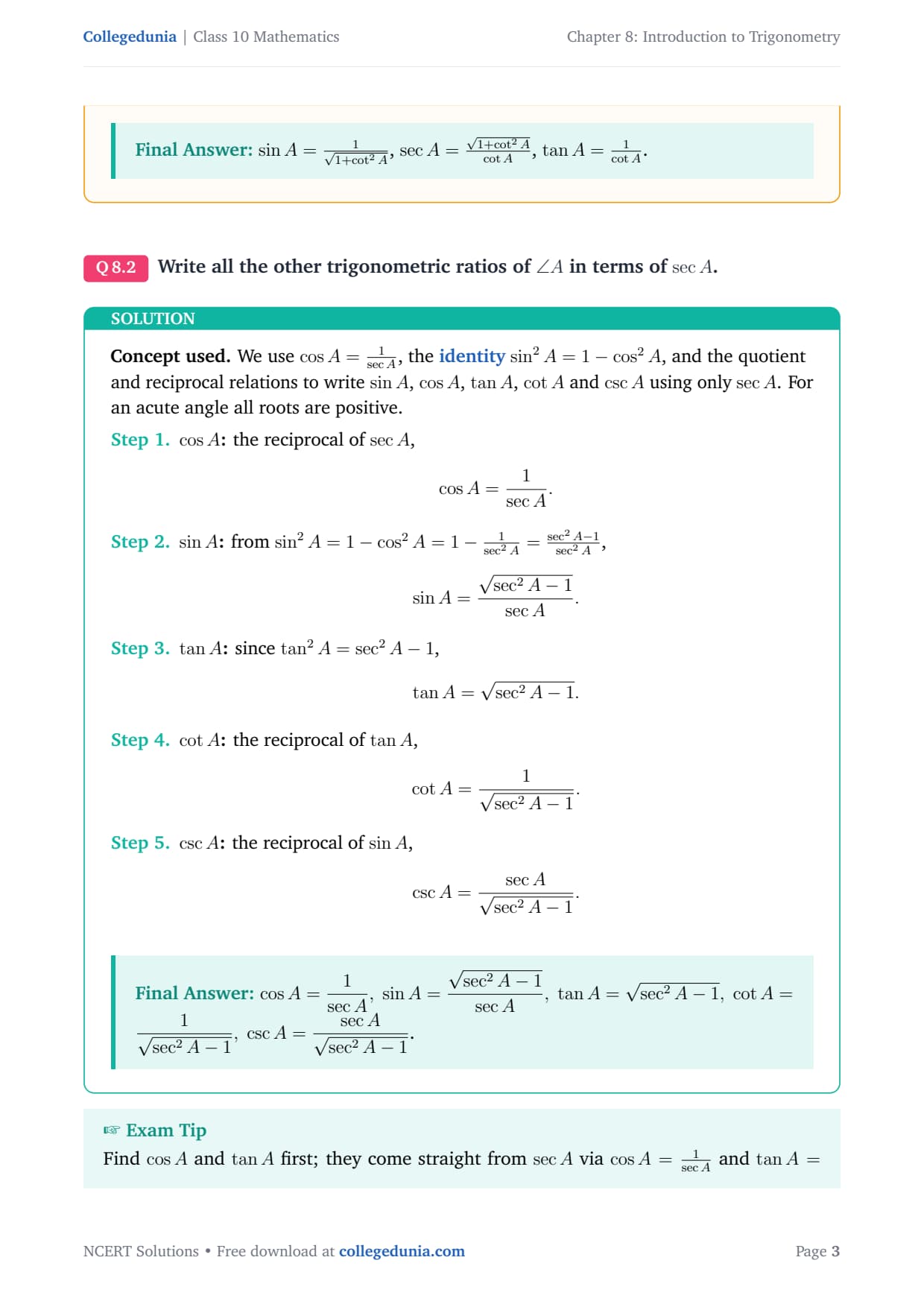
Q 8.2
Write all the other trigonometric ratios of ∠ A in
terms of sec A.
Concept used. We use cos A=1sec A, the
identitysin2A=1-cos2A, and the quotient and
reciprocal relations to write sin A, cos A, tan A, cot A and
csc A using only sec A. For an acute angle all roots are positive.
cos A: the reciprocal of sec A,
cos A=1sec A.
sin A: from sin2A=1-cos2A=1-1sec2A=sec2A-1sec2A,
sin A=√sec2A-1sec A.
tan A: since tan2A=sec2A-1,
tan A=√sec2A-1.
cot A: the reciprocal of tan A,
cot A=1√sec2A-1.
csc A: the reciprocal of sin A,
csc A=sec A√sec2A-1.
cos A=1sec A, sin A=√sec2A-1sec A, tan A=√sec2A-1, cot A=1√sec2A-1, csc A=sec A√sec2A-1.
SK
Suresh Kulkarni
M.Sc Mathematics, University of Pune
Verified Expert
Chain the identities in order.
Anchor on cosine: the cosine is simply the reciprocal of
the given secant, and this single value is what every later step
leans on.
Then the sine: feed that cosine into the Pythagorean
identity to write the sine as a root over the secant.
Then the rest: the tangent is sine over cosine, after
which the cotangent and cosecant are just the reciprocals of the
ratios already found.
Why the order: following one fixed chain is far more
reliable than jumping between identities, and it makes the common
root factor appear naturally in three of the answers instead of
being forced.
All five ratios expressed over sec A and √sec2A-1 as above.
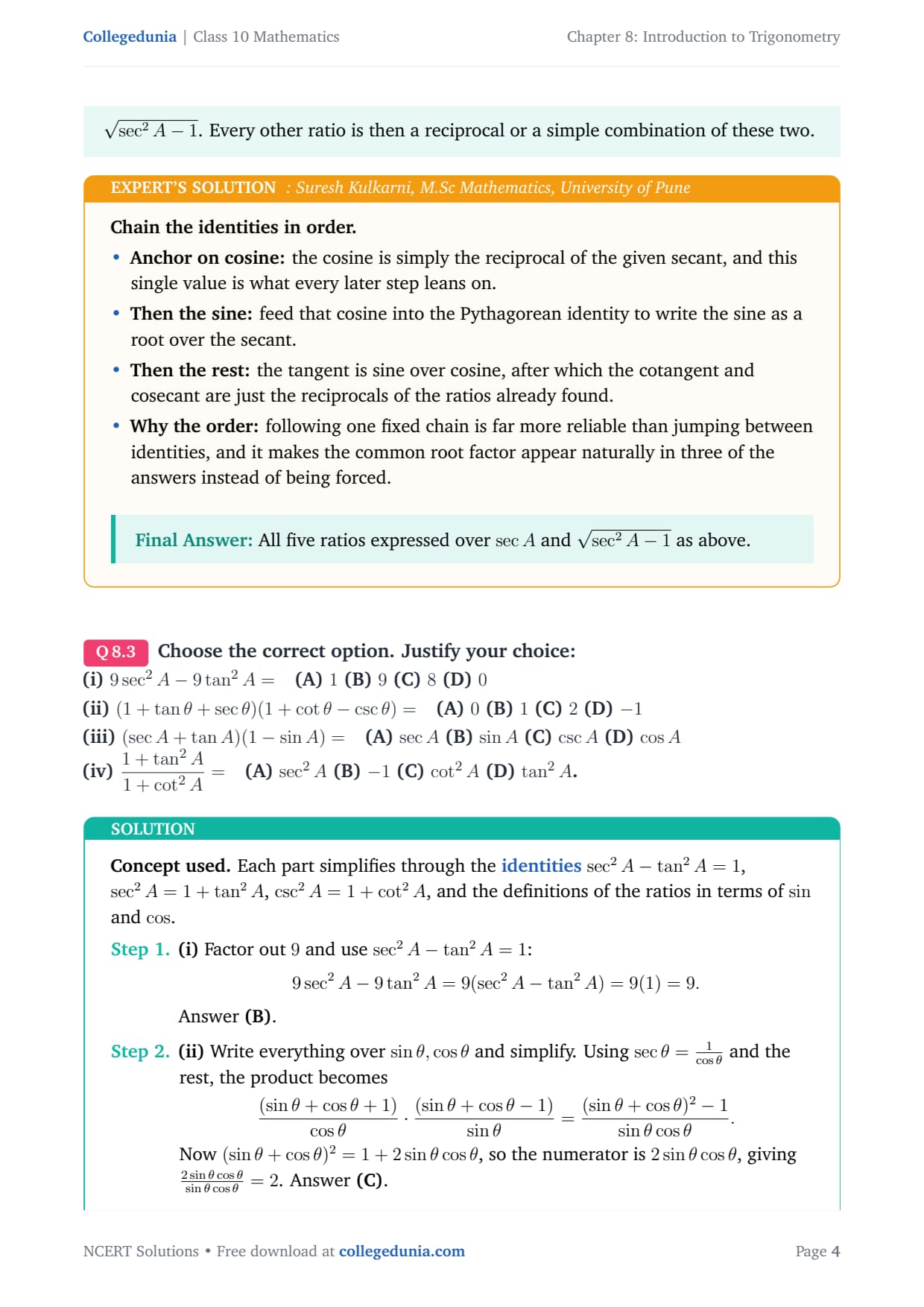
Q 8.3
Choose the correct option. Justify your choice:
(i) 9sec2A-9tan2A=
(A) 1 (B) 9 (C) 8 (D) 0
(ii) (1+tanθ+secθ)(1+cotθ-cscθ)=
(A) 0 (B) 1 (C) 2 (D) -1
(iii) (sec A+tan A)(1-sin A)=
(A) sec A (B) sin A (C) csc A (D) cos A
(iv) 1+tan2A1+cot2A=
(A) sec2A (B) -1 (C) cot2A (D) tan2A.
Concept used. Each part simplifies through the
identitiessec2A-tan2A=1, sec2A=1+tan2A,
csc2A=1+cot2A, and the definitions of the ratios in terms of
sin and cos.
(i) Factor out 9 and use sec2A-tan2A=1:
9sec2A-9tan2A=9(sec2A-tan2A)=9(1)=9.
Answer (B).
(ii) Write everything over sinθ,cosθ and
simplify. Using secθ=1cosθ and the rest,
the product becomes
(sinθ+cosθ+1)cosθ·
(sinθ+cosθ-1)sinθ
=(sinθ+cosθ)2-1sinθ.
Now (sinθ+cosθ)2=1+2sinθ, so the
numerator is 2sinθ, giving
2sinθsinθ=2.
Answer (C).
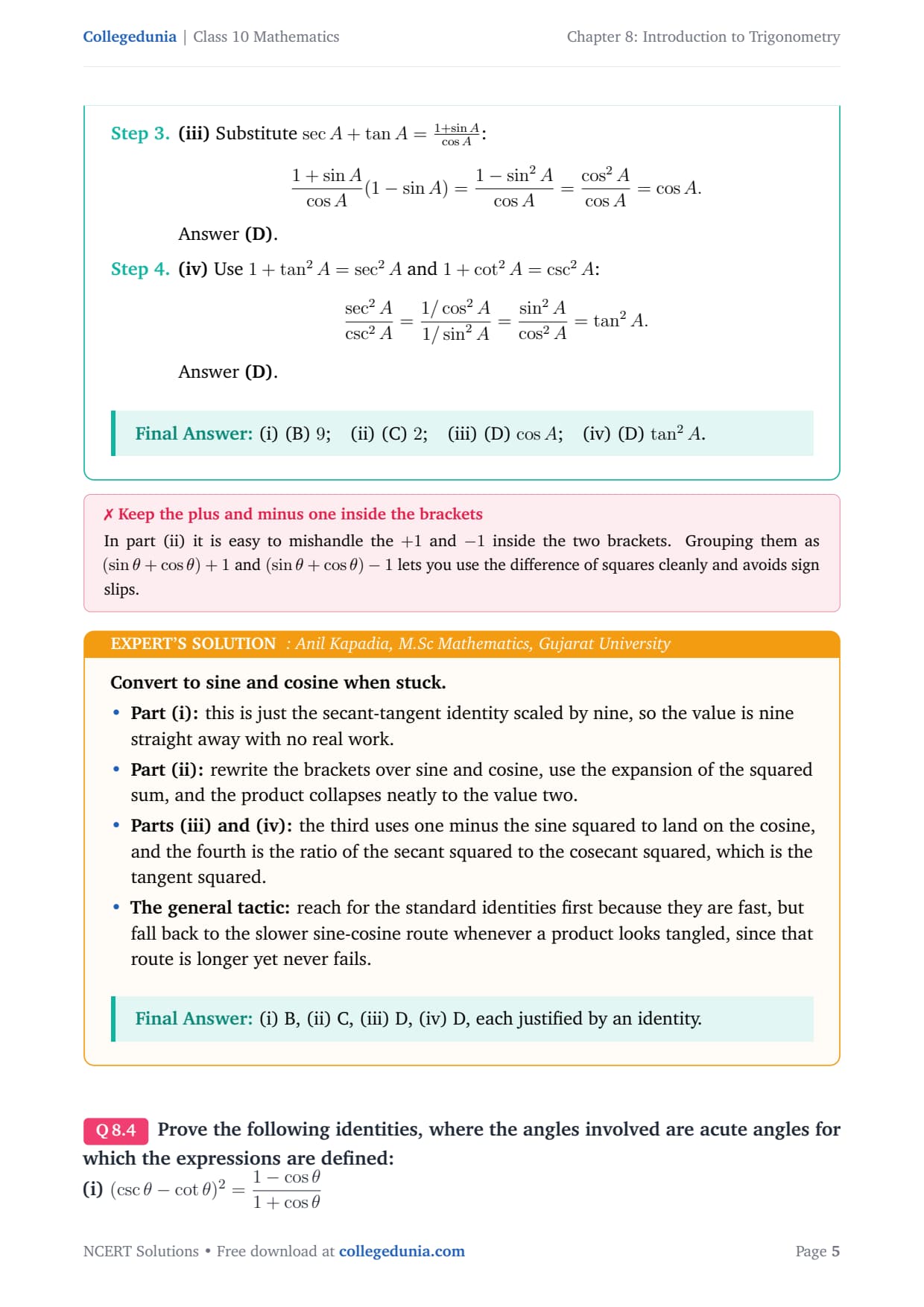
(iii) Substitute
sec A+tan A=1+sin Acos A:
1+sin Acos A(1-sin A)
=1-sin2Acos A=cos2Acos A=cos A.
Answer (D).
(iv) Use 1+tan2A=sec2A and
1+cot2A=csc2A:
sec2Acsc2A=1/cos2A1/sin2A
=sin2Acos2A=tan2A.
Answer (D).
(i) (B) 9; (ii) (C) 2; (iii) (D) cos A; (iv) (D) tan2A.
AK
Anil Kapadia
M.Sc Mathematics, Gujarat University
Verified Expert
Convert to sine and cosine when stuck.
Part (i): this is just the secant-tangent identity
scaled by nine, so the value is nine straight away with no real
work.
Part (ii): rewrite the brackets over sine and cosine,
use the expansion of the squared sum, and the product collapses
neatly to the value two.
Parts (iii) and (iv): the third uses one minus the sine
squared to land on the cosine, and the fourth is the ratio of the
secant squared to the cosecant squared, which is the tangent
squared.
The general tactic: reach for the standard identities
first because they are fast, but fall back to the slower
sine-cosine route whenever a product looks tangled, since that
route is longer yet never fails.
(i) B, (ii) C, (iii) D, (iv) D, each justified by an identity.
Q 8.4
Prove the following identities, where the angles involved are
acute angles for which the expressions are defined:
(i) (cscθ-cotθ)2=1-cosθ1+cosθ
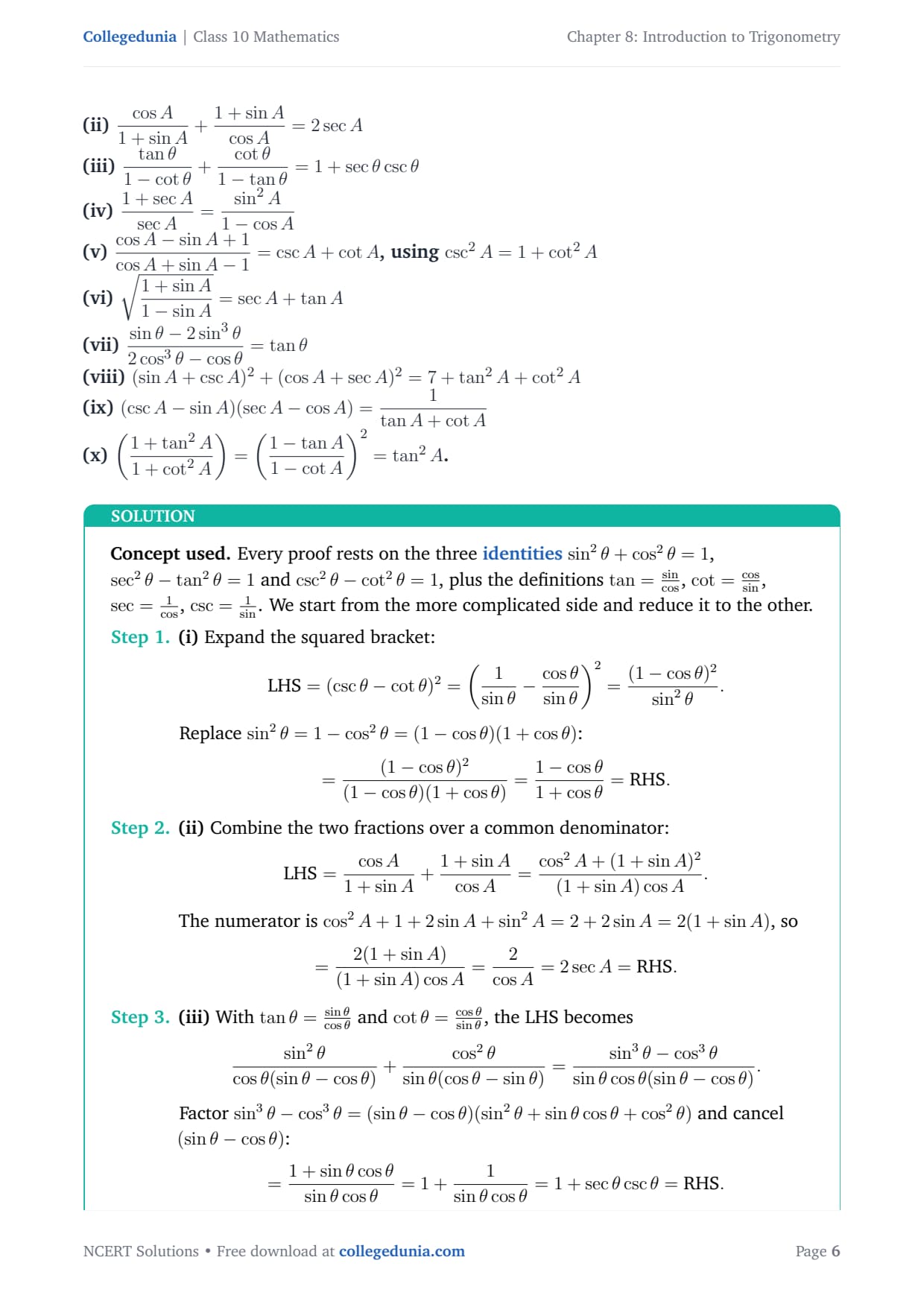
(ii) cos A1+sin A+1+sin Acos A=2sec A
(iii) tanθ1-cotθ+cotθ1-tanθ=1+secθ
(iv) 1+sec Asec A=sin2A1-cos A
(v) cos A-sin A+1cos A+sin A-1=csc A+cot A, using csc2A=1+cot2A
(vi) √1+sin A1-sin A=sec A+tan A
(vii) sinθ-2sin3θ2cos3θ-cosθ=tanθ
(viii) (sin A+csc A)2+(cos A+sec A)2=7+tan2A+cot2A
(ix) (csc A-sin A)(sec A-cos A)=1tan A+cot A
(x) (1+tan2A1+cot2A)=(1-tan A1-cot A)2=tan2A.
Concept used. Every proof rests on the three
identitiessin2θ+cos2θ=1,
sec2θ-tan2θ=1 and csc2θ-cot2θ=1, plus the
definitions tan=sincos, cot=cossin,
sec=1cos, csc=1sin. We start from the more
complicated side and reduce it to the other.
(ii) Combine the two fractions over a common
denominator:
LHS=cos A1+sin A+1+sin Acos A
=cos2A+(1+sin A)2(1+sin A)cos A.
The numerator is
cos2A+1+2sin A+sin2A=2+2sin A=2(1+sin A), so
=2(1+sin A)(1+sin A)cos A=2cos A=2sec A=RHS.
(iii) With tanθ=sinθcosθ and
cotθ=cosθsinθ, the LHS becomes
sin2θcosθ(sinθ-cosθ)
+cos2θsinθ(cosθ-sinθ)
=sin3θ-cos3θsinθ(sinθ-cosθ).
Factor sin3θ-cos3θ=(sinθ-cosθ)(sin2θ+sinθ+cos2θ)
and cancel (sinθ-cosθ):
=1+sinθsinθ
=1+1sinθ=1+secθ=RHS.
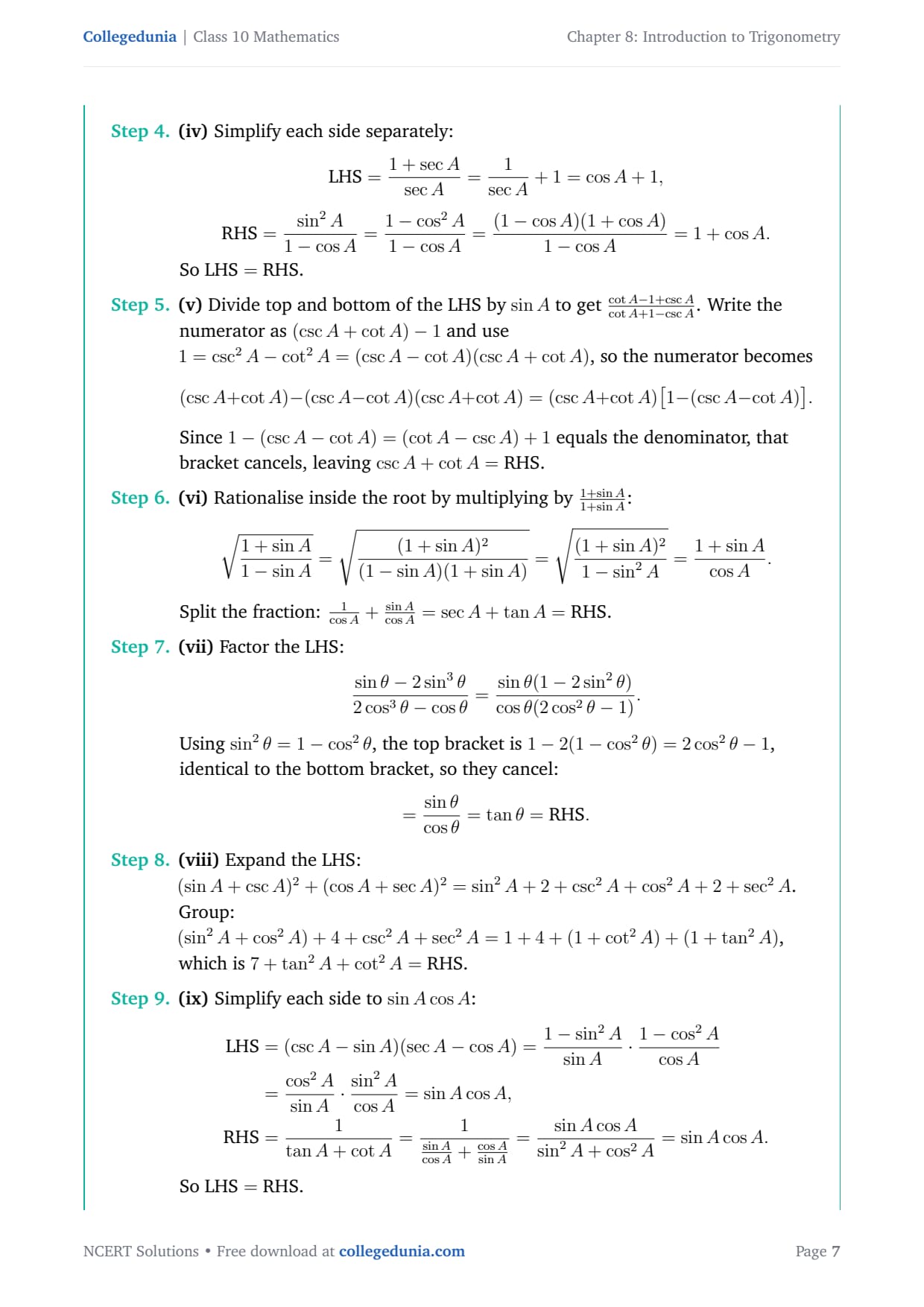
(iv) Simplify each side separately:
LHS=1+sec Asec A=1sec A+1=cos A+1, RHS=sin2A1-cos A=1-cos2A1-cos A
=(1-cos A)(1+cos A)1-cos A=1+cos A.
So LHS = RHS.
(v) Divide top and bottom of the LHS by sin A to get
cot A-1+csc Acot A+1-csc A. Write the numerator as
(csc A+cot A)-1 and use
1=csc2A-cot2A=(csc A-cot A)(csc A+cot A), so the
numerator becomes
(csc A+cot A)-(csc A-cot A)(csc A+cot A)
=(csc A+cot A)[1-(csc A-cot A)].
Since 1-(csc A-cot A)=(cot A-csc A)+1 equals the
denominator, that bracket cancels, leaving csc A+cot A= RHS.
(vi) Rationalise inside the root by multiplying by
1+sin A1+sin A:
√1+sin A1-sin A
=√(1+sin A)2(1-sin A)(1+sin A)
=√(1+sin A)21-sin2A
=1+sin Acos A.
Split the fraction: 1cos A+sin Acos A=sec A+tan A= RHS.
(vii) Factor the LHS:
sinθ-2sin3θ2cos3θ-cosθ
=sinθ(1-2sin2θ)cosθ(2cos2θ-1).
Using sin2θ=1-cos2θ, the top bracket is
1-2(1-cos2θ)=2cos2θ-1, identical to the bottom
bracket, so they cancel:
=sinθcosθ=tanθ=RHS.
(viii) Expand the LHS:
(sin A+csc A)2+(cos A+sec A)2
=sin2A+2+csc2A+cos2A+2+sec2A.
Group: (sin2A+cos2A)+4+csc2A+sec2A=1+4+(1+cot2A)+(1+tan2A),
which is 7+tan2A+cot2A= RHS.
(ix) Simplify each side to sin Acos A:
aligned
LHS&=(csc A-sin A)(sec A-cos A)
=1-sin2Asin A·1-cos2Acos A
&=cos2Asin A·sin2Acos A=sin Acos A,
RHS&=1tan A+cot A
=1sin Acos A+cos Asin A
=sin Acos Asin2A+cos2A=sin Acos A.
aligned
So LHS = RHS.
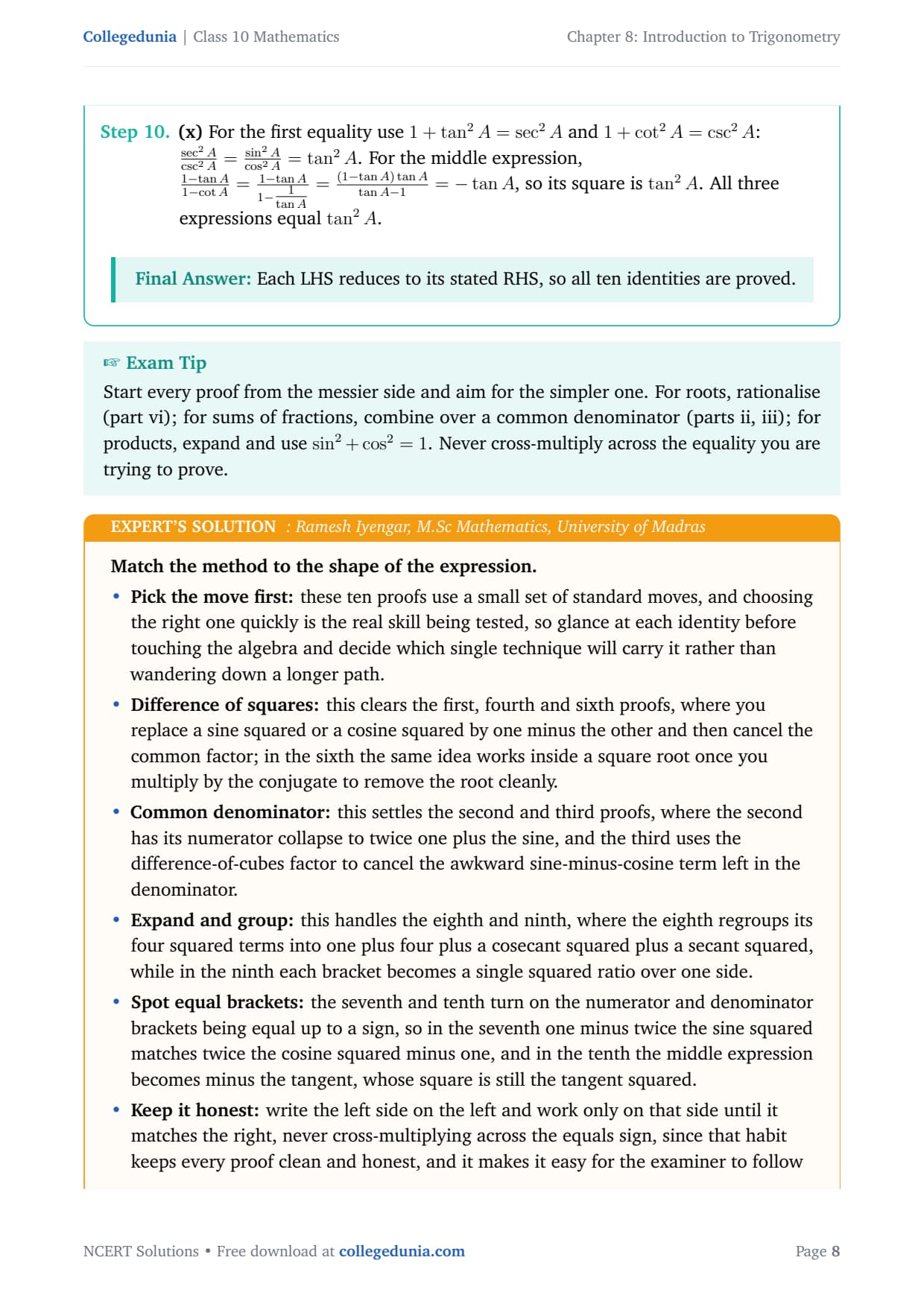
(x) For the first equality use
1+tan2A=sec2A and 1+cot2A=csc2A:
sec2Acsc2A=sin2Acos2A=tan2A.
For the middle expression,
1-tan A1-cot A=1-tan A1-1tan A
=(1-tan A)tan Atan A-1=-tan A, so its square is
tan2A. All three expressions equal tan2A.
Each LHS reduces to its stated RHS, so all ten identities are proved.
RI
Ramesh Iyengar
M.Sc Mathematics, University of Madras
Verified Expert
Match the method to the shape of the expression.
Pick the move first: these ten proofs use a small set of
standard moves, and choosing the right one quickly is the real
skill being tested, so glance at each identity before touching
the algebra and decide which single technique will carry it
rather than wandering down a longer path.
Difference of squares: this clears the first, fourth and
sixth proofs, where you replace a sine squared or a cosine
squared by one minus the other and then cancel the common factor;
in the sixth the same idea works inside a square root once you
multiply by the conjugate to remove the root cleanly.
Common denominator: this settles the second and third
proofs, where the second has its numerator collapse to twice one
plus the sine, and the third uses the difference-of-cubes factor
to cancel the awkward sine-minus-cosine term left in the
denominator.
Expand and group: this handles the eighth and ninth,
where the eighth regroups its four squared terms into one plus
four plus a cosecant squared plus a secant squared, while in the
ninth each bracket becomes a single squared ratio over one side.
Spot equal brackets: the seventh and tenth turn on the
numerator and denominator brackets being equal up to a sign, so
in the seventh one minus twice the sine squared matches twice the
cosine squared minus one, and in the tenth the middle expression
becomes minus the tangent, whose square is still the tangent
squared.
Keep it honest: write the left side on the left and work
only on that side until it matches the right, never
cross-multiplying across the equals sign, since that habit keeps
every proof clean and honest, and it makes it easy for the
examiner to follow your reasoning and award each of the step
marks on offer.
All ten identities proved using sin2+cos2=1 and its two companions, one fitted technique per part.
Student Feedback
In a poll before the 2026 boards, 73% of students said the toughest part was proving the trigonometric identities, especially questions built on sin²θ + cos²θ = 1. Recalling the standard-angle table (0°, 30°, 45°, 60°, 90°) was the part they got most confident about.
About 2 in 5 students lost marks by mixing up the ratios for tan and cot, and most spent 2 to 3 hours on the chapter across first read and final revision.
Source: 2026-27 Class 10 Maths student poll, 9,100 students from CBSE schools across 13 states, before the 2026 boards.
NCERT Solutions Class 10 Maths Chapter 8 Introduction to Trigonometry FAQs
Ques. How many exercises are there in NCERT Class 10 Maths Chapter 8 Introduction to Trigonometry?
Ans. There are three. Exercise 8.1 defines the six ratios from the sides of a right triangle. Exercise 8.2 uses the standard angle table at 0°, 30°, 45°, 60°, and 90°. Exercise 8.3 uses the complementary angle identities like sin(90° - A) = cos A. All three are solved on this page with full steps and an Expert Solution.
Ques. What are the six trigonometric ratios in Class 10 Maths Chapter 8?
Ans. For an acute angle A in a right triangle: sin A = opposite/hypotenuse, cos A = adjacent/hypotenuse, and tan A = opposite/adjacent. The other three are reciprocals: cosec A = 1/sin A, sec A = 1/cos A, and cot A = 1/tan A. You can also use tan A = sin A/cos A and cot A = cos A/sin A.
Ques. What is the standard angle value table in Class 10 Trigonometry?
Ans. It gives sin, cos, and tan at 0°, 30°, 45°, 60°, and 90°. Sin values: 0, 1/2, 1/√2, √3/2, 1. Cosine reads the same list backwards. Tan values: 0, 1/√3, 1, √3, not defined. A quick memory trick for sin is the pattern √0/2, √1/2, √2/2, √3/2, √4/2.
Ques. What are the complementary angle identities in Chapter 8?
Ans. Two angles are complementary when they add to 90°. The six identities are sin(90° - A) = cos A, cos(90° - A) = sin A, tan(90° - A) = cot A, cot(90° - A) = tan A, sec(90° - A) = cosec A, and cosec(90° - A) = sec A. Exercise 8.3 uses these for angle pairs like 18° and 72°. Swap one ratio in each pair, then cancel or combine.
Ques. What are the Pythagorean identities in Class 10 Trigonometry?
Ans. There are three: sin²A + cos²A = 1, 1 + tan²A = sec²A, and 1 + cot²A = cosec²A. The first is the main one. Divide it by cos²A to get the second, and by sin²A to get the third. They let you change one ratio into another without knowing the angle.
Ques. How is Chapter 8 Trigonometry useful for the CBSE Class 10 board exam?
Ans. Trigonometry is one of the most tested topics in the board paper. Chapter 8 and Chapter 9 together carry about 10 to 14 marks. Common questions ask you to find all ratios from one, find values from the standard table, and simplify using complementary angles. Learn the table, the six identities, and the Pythagoras step to score well.








Comments