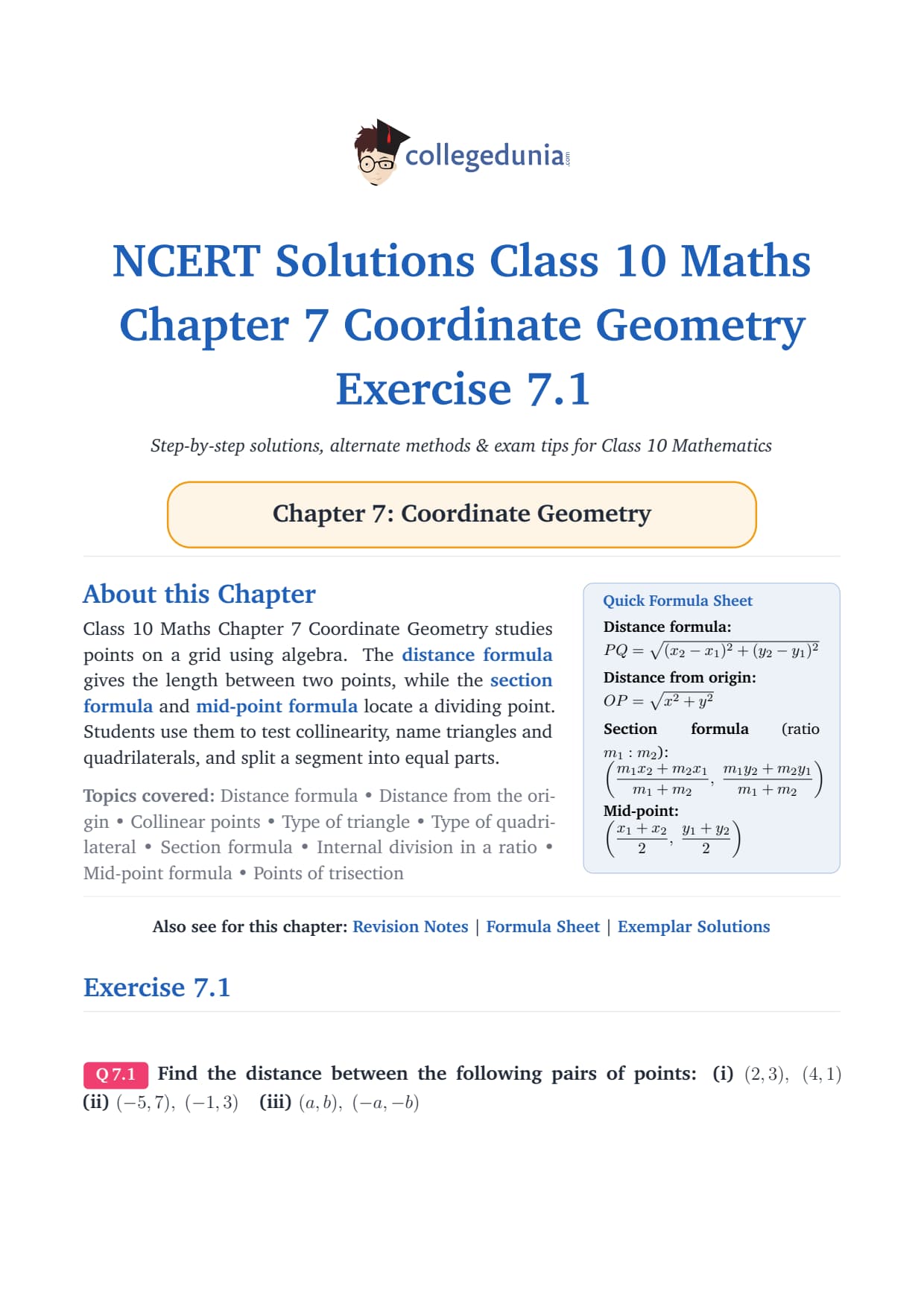
The NCERT Solutions for Class 10 Maths Chapter 7 Coordinate Geometry answer every question in Exercises 7.1 and 7.2, written for the 2026-27 CBSE syllabus. Each solution uses the Distance Formula, Section Formula, and Midpoint Formula in clear, board-exam steps.
Every exercise question solved step by step in plain English, with an Expert Solution that adds board-exam strategy.
Full coverage of the Distance Formula, Section Formula, Midpoint Formula, and area of a triangle, with solved examples.
Every answer in this Collegedunia compilation is checked by Mathematics teachers, mapped to the 2026-27 NCERT textbook, and matched to recent CBSE Class 10 board papers.
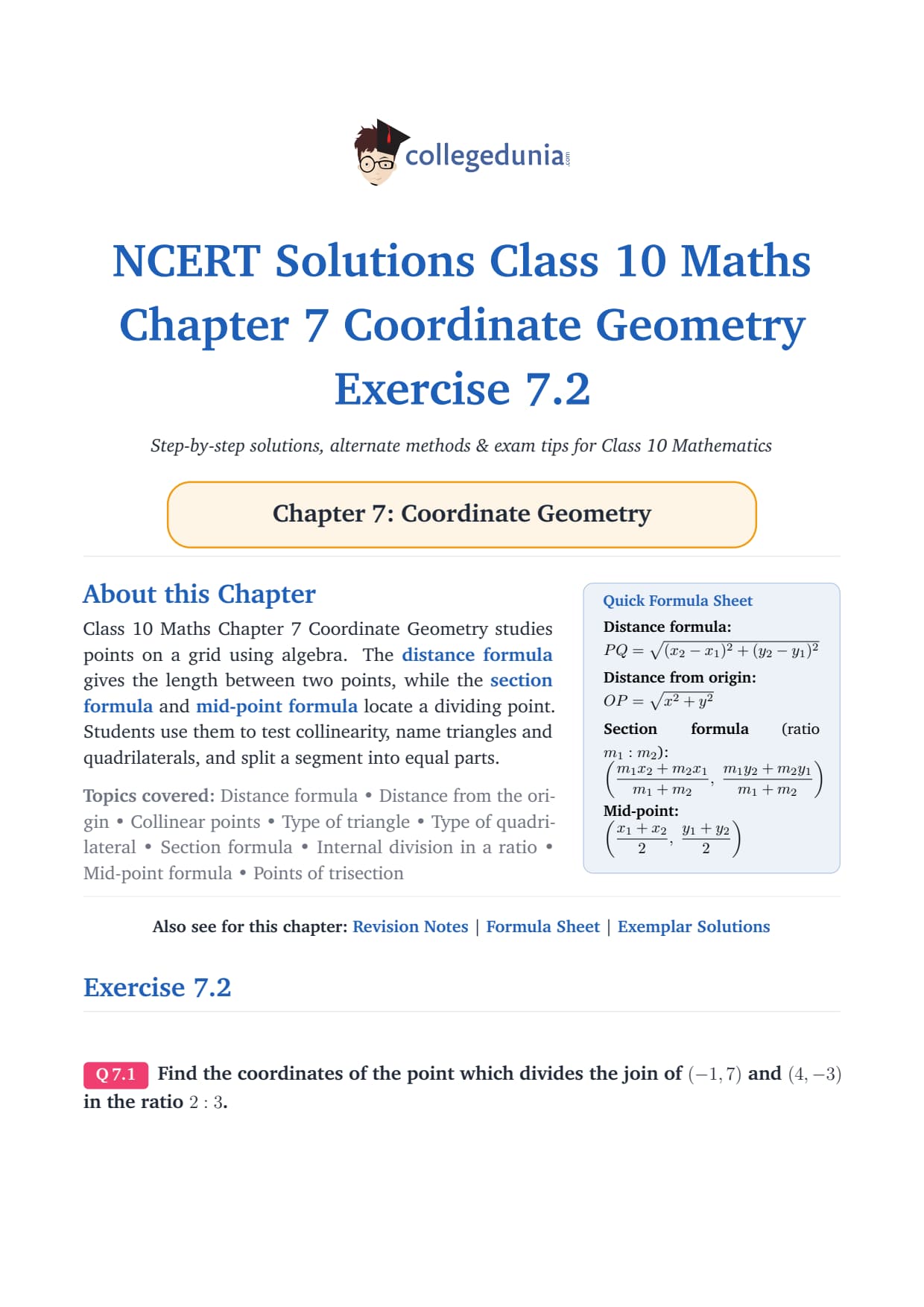
The card below lists the three formulas you will use most in this chapter.
Exercise-wise Breakdown of Coordinate Geometry NCERT Solutions
Chapter 7 links algebra and geometry: you find positions, distances, and ratios using just numbers. It has two exercises. The table below maps each one to its topic, the method CBSE rewards, and the usual marks in board papers.
Section Formula and Midpoint Formula: finding a dividing point, trisection, centroid of a triangle, collinearity via area, area of a triangle using coordinates
Apply the Section/Midpoint Formula, equate coordinates for unknowns, use the area = 0 condition for collinearity
3 to 5 marks
Exercise 7.2 carries the heavier marks. Decide which point is P1 and which is P2 before you write any formula. This step alone cuts most substitution errors.
Distance Formula and Section Formula: How to Use Them
The Distance Formula, PQ = √[(x2 - x1)2 + (y2 - y1)2], comes from the Pythagoras Theorem. The Section Formula gives the point dividing PQ in ratio m:n as ((mx2 + nx1)/(m + n), (my2 + ny1)/(m + n)). Here (x, y) are coordinates and m and n are the two parts of the ratio. Common uses:
Distance from origin: the distance from P(x, y) to the origin O(0, 0) is √(x2 + y2).
Checking a shape: find all sides, then check the rule. A square has four equal sides and equal diagonals. A rhombus has equal sides but unequal diagonals.
Midpoint: use m = n = 1 to get ((x1 + x2)/2, (y1 + y2)/2). This is the most tested short question.
Trisection: two points split PQ into ratios 1:2 and 2:1 from P.
k:1 trick: when the ratio is unknown, set it as k:1. Apply the formula, match one coordinate to the given value, and solve for k.
Quick Tip: Do not stop at the root. Write √50 as 5√2 and simplify every surd. CBSE wants the simplified form, so an unsimplified root loses a mark.
Area of a Triangle from Coordinates and Solved Example
The area of triangle ABC with vertices A(x1, y1), B(x2, y2), C(x3, y3) is (1/2)|x1(y2 - y3) + x2(y3 - y1) + x3(y1 - y2)|. Always take the absolute value. If the area is 0, the three points are collinear.
Solved example. Find the area of triangle A(1, 1), B(4, 1), C(1, 5).
All NCERT Solutions for Class 10 Maths Chapter 7 Coordinate Geometry with Step-by-Step Solutions
Exercise 7.1
Q 7.1
Find the distance between the following pairs of points:
(i) (2,3), (4,1)
(ii) (-5,7), (-1,3)
(iii) (a,b), (-a,-b)
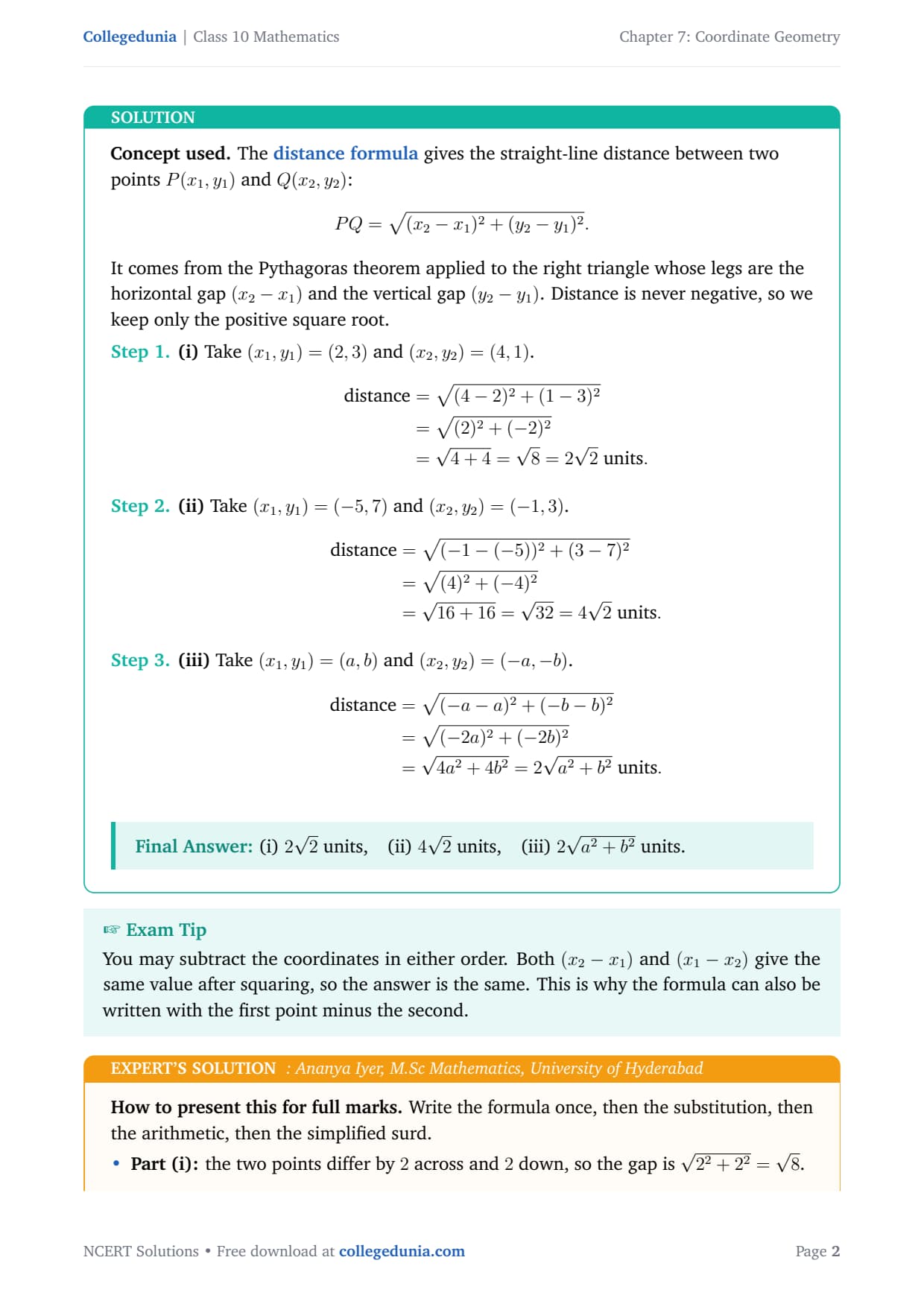
Concept used. The distance formula gives the
straight-line distance between two points P(x1,y1) and
Q(x2,y2):
PQ=√(x2-x1)2+(y2-y1)2.
It comes from the Pythagoras theorem applied to the right triangle
whose legs are the horizontal gap (x2-x1) and the vertical gap
(y2-y1). Distance is never negative, so we keep only the positive
square root.
(i) Take (x1,y1)=(2,3) and (x2,y2)=(4,1).
aligned
distance&=√(4-2)2+(1-3)2
&=√(2)2+(-2)2
&=√4+4=√8=2√2 units.
aligned
(ii) Take (x1,y1)=(-5,7) and (x2,y2)=(-1,3).
aligned
distance&=√(-1-(-5))2+(3-7)2
&=√(4)2+(-4)2
&=√16+16=√32=4√2 units.
aligned
(iii) Take (x1,y1)=(a,b) and (x2,y2)=(-a,-b).
aligned
distance&=√(-a-a)2+(-b-b)2
&=√(-2a)2+(-2b)2
&=√4a2+4b2=2√a2+b2 units.
aligned
(i) 2√2 units, (ii) 4√2 units, (iii) 2√a2+b2 units.
AI
Ananya Iyer
M.Sc Mathematics, University of Hyderabad
Verified Expert
How to present this for full marks. Write the formula once,
then the substitution, then the arithmetic, then the simplified surd.
Part (i): the two points differ by 2 across and 2
down, so the gap is √22+22=√8. Always pull out
the largest perfect square here, giving 2√2.
Part (ii): the differences are 4 and -4, and the
signs vanish on squaring, so the length is √32=4√2.
Part (iii): treat the letters like numbers. The point
(-a,-b) is the reflection of (a,b) through the origin, so the
segment is twice the distance of (a,b) from the origin.
Why surds: a neat surd answer tells the examiner you
handled the radical correctly, which earns more than a rounded
decimal in a proof-style question.
2√2, 4√2 and 2√a2+b2 units respectively.
Q 7.2
Find the distance between the points (0,0) and (36,15).
Can you now find the distance between the two towns A and B
discussed in Section 7.2?
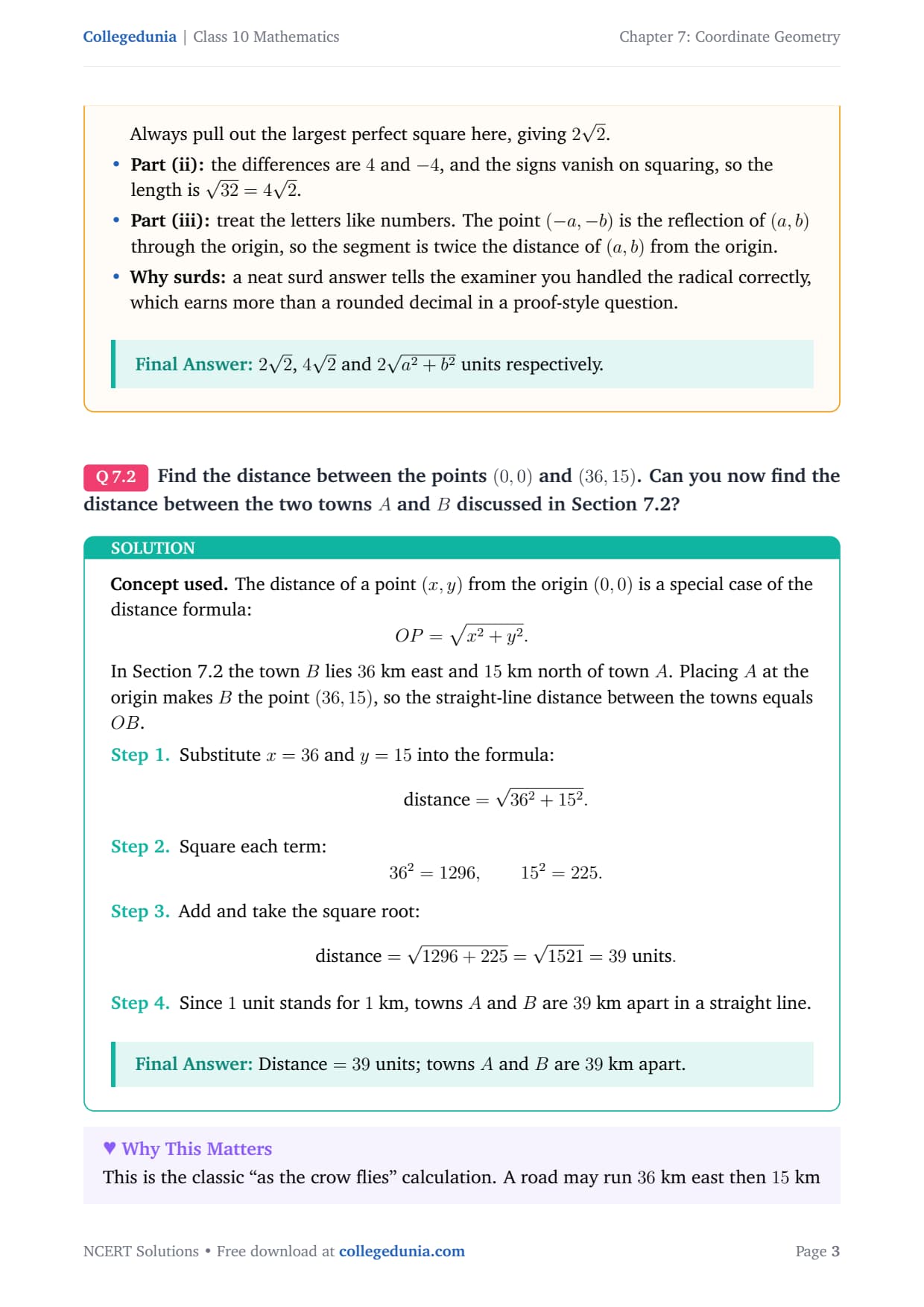
Concept used. The distance of a point (x,y) from the origin
(0,0) is a special case of the distance formula:
OP=√x2+y2.
In Section 7.2 the town B lies 36 km east and 15 km north of town
A. Placing A at the origin makes B the point (36,15), so the
straight-line distance between the towns equals OB.
Substitute x=36 and y=15 into the formula:
distance=√362+152.
Square each term:
362=1296, 152=225.
Add and take the square root:
distance=√1296+225=√1521=39 units.
Since 1 unit stands for 1 km, towns A and B are 39 km
apart in a straight line.
Distance =39 units; towns A and B are 39 km apart.
RV
Rohan Verma
B.Tech Civil Engineering, NIT Trichy
Verified Expert
Spot the Pythagorean triple. Trained eyes read (36,15) as a
scaled standard triple, so the distance comes out at sight.
Factor: pull the common 3 out, since 36=3× 12
and 15=3× 5, leaving the clean leg pair (12,5).
Recognise: the pair (12,5) has hypotenuse
√122+52=13, one of the standard right-triangle triples.
Scale back: multiply by the factor 3 to get the
distance 3× 13=39 km, with √1521 used only as a check.
Why it helps: knowing the common triples saves time in
the board exam, where many distance questions are built from them
on purpose, and the straight 39 km beats the 51 km road path.
39 units, so towns A and B are 39 km apart.
Q 7.3
Determine if the points (1,5), (2,3) and (-2,-11) are
collinear.
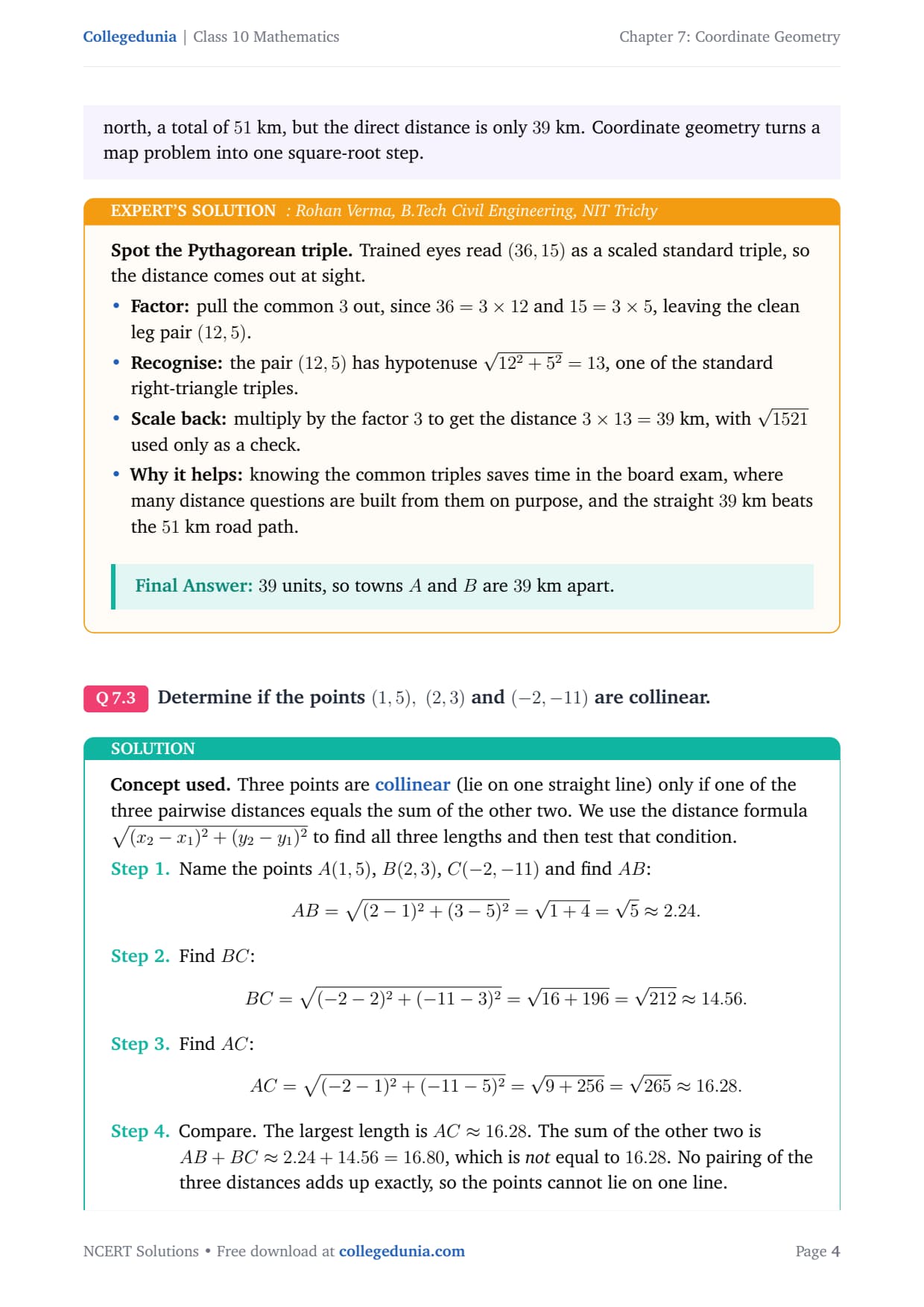
Concept used. Three points are collinear (lie on one
straight line) only if one of the three pairwise distances equals the
sum of the other two. We use the distance formula
√(x2-x1)2+(y2-y1)2 to find all three lengths and then
test that condition.
Name the points A(1,5), B(2,3), C(-2,-11) and find AB:
AB=√(2-1)2+(3-5)2=√1+4=√5≈ 2.24.
Compare. The largest length is AC≈ 16.28. The sum of
the other two is AB+BC≈ 2.24+14.56=16.80, which is
not equal to 16.28. No pairing of the three distances
adds up exactly, so the points cannot lie on one line.
The points are not collinear (no pairwise sum of distances matches the third).
MN
Meera Nair
M.Sc Mathematics, Savitribai Phule Pune University
Verified Expert
A faster slope check. Computing three surds is slow, so compare
the slopes of two segments instead with only subtraction and division.
Slope of AB: the rise over run from A to B is
3-52-1=-2, a clean whole number.
Slope of AC: the rise over run from A to C is
-11-5-2-1=163≈ 5.33, a different value.
Verdict: the slopes differ, so the two segments point in
different directions from the shared point A. The three points
are therefore not collinear, agreeing with the distance test.
The rule: equal slopes through a shared point mean
collinear, while unequal slopes mean a genuine triangle. Both
methods score, but the slope check is quicker when the numbers
are ugly under the root.
Not collinear, confirmed by unequal slopes -2 and 163.
Q 7.4
Check whether (5,-2), (6,4) and (7,-2) are the vertices
of an isosceles triangle.
Concept used. A triangle is isosceles when at least
two of its sides have equal length. We find the three side lengths with
the distance formula and check for a matching pair.
Name the points A(5,-2), B(6,4), C(7,-2). Find AB:
AB=√(6-5)2+(4-(-2))2=√1+36=√37.
Find BC:
BC=√(7-6)2+(-2-4)2=√1+36=√37.
Find CA:
CA=√(5-7)2+(-2-(-2))2=√4+0=√4=2.
Compare: AB=BC=√37 while CA=2. Two sides are equal, so
the triangle is isosceles.
Yes; since AB=BC=√37, the three points form an isosceles triangle.
KR
Karthik Reddy
M.Sc Mathematics, Osmania University
Verified Expert
Symmetry tells the story. The vertex B sits exactly above the
mid-point of the base AC, which proves the triangle isosceles at sight.
Find the base mid-point: the mid-point of A(5,-2) and
C(7,-2) is (5+72,-2-22)=(6,-2).
Spot the alignment: the vertex B(6,4) lies directly
above (6,-2) on the vertical line x=6, which is the
perpendicular bisector of the base AC.
Conclude: any point on the perpendicular bisector of
AC is equidistant from A and C, so the two slant sides are
equal without any further calculation and the triangle is isosceles.
Carry it forward: this perpendicular-bisector idea
reappears whenever a question asks for a point equidistant from
two others, so it is worth recognising early.
Isosceles: B lies on the perpendicular bisector of AC, so AB=BC=√37.
Q 7.5
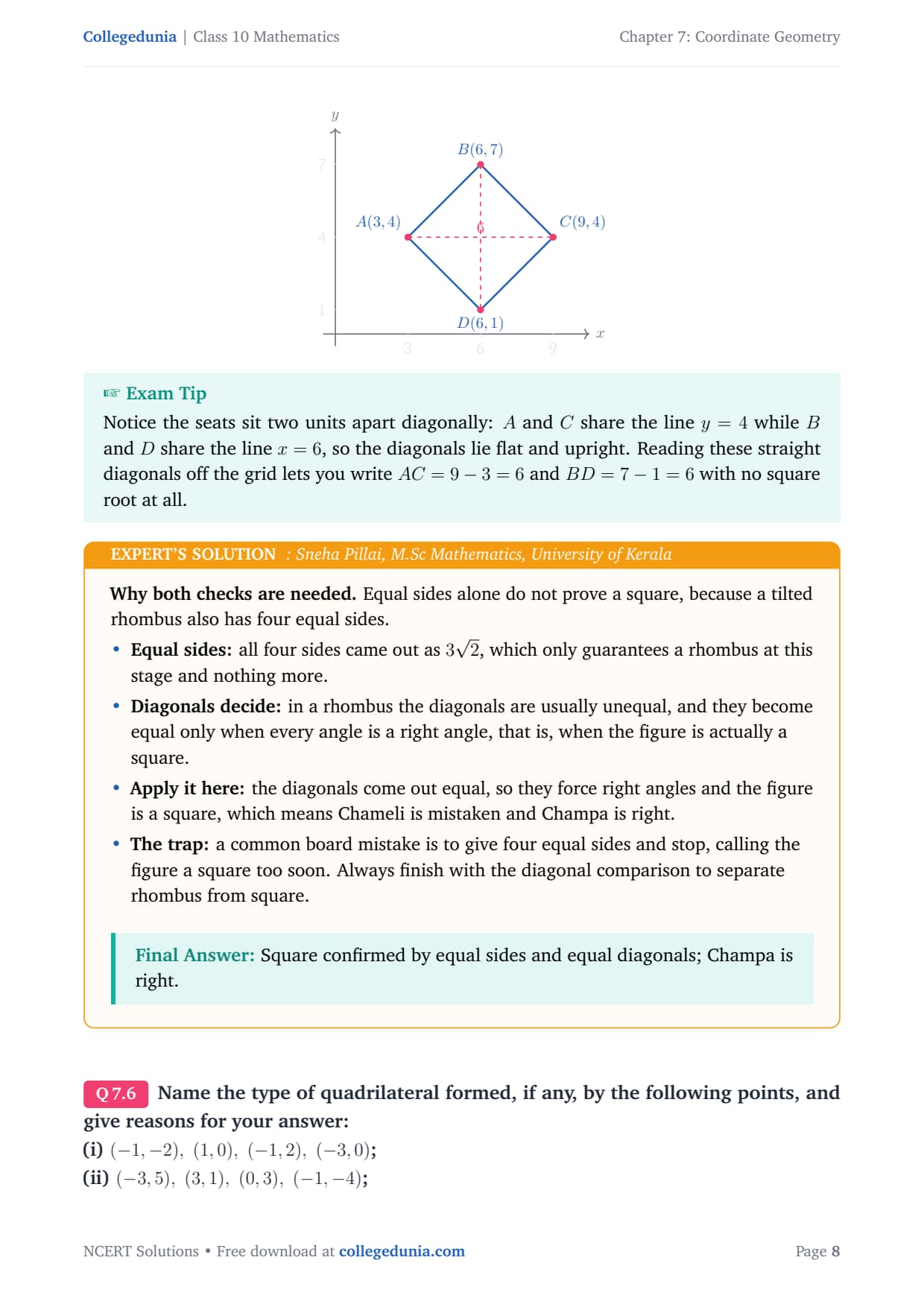
In a classroom, 4 friends are seated at the points A, B,
C and D as shown in Fig. 7.8. Champa and Chameli walk into the class
and after observing for a few minutes Champa asks Chameli, ``Don't you
think ABCD is a square?'' Chameli disagrees. Using the distance
formula, find which of them is correct.
Concept used. A quadrilateral is a square when all
four sides are equal and the two diagonals are equal. We read the
coordinates off the grid, find the four sides and both diagonals with
the distance formula, and check both conditions.
From the figure the seats are A(3,4), B(6,7), C(9,4),
D(6,1). Find the four sides:
aligned
AB&=√(6-3)2+(7-4)2=√9+9=√18=3√2,
BC&=√(9-6)2+(4-7)2=√9+9=√18=3√2,
CD&=√(6-9)2+(1-4)2=√9+9=√18=3√2,
DA&=√(3-6)2+(4-1)2=√9+9=√18=3√2.
aligned
All four sides equal 3√2, so ABCD is at least a
rhombus. Now test the diagonals:
aligned
AC&=√(9-3)2+(4-4)2=√36+0=6,
BD&=√(6-6)2+(1-7)2=√0+36=6.
aligned
The diagonals are equal (AC=BD=6). Equal sides plus equal
diagonals means the figure is a square.
ABCD is a square (sides 3√2, diagonals 6), so Champa is correct.
SP
Sneha Pillai
M.Sc Mathematics, University of Kerala
Verified Expert
Why both checks are needed. Equal sides alone do not prove a
square, because a tilted rhombus also has four equal sides.
Equal sides: all four sides came out as 3√2,
which only guarantees a rhombus at this stage and nothing more.
Diagonals decide: in a rhombus the diagonals are usually
unequal, and they become equal only when every angle is a right
angle, that is, when the figure is actually a square.
Apply it here: the diagonals come out equal, so they
force right angles and the figure is a square, which means
Chameli is mistaken and Champa is right.
The trap: a common board mistake is to give four equal
sides and stop, calling the figure a square too soon. Always
finish with the diagonal comparison to separate rhombus from square.
Square confirmed by equal sides and equal diagonals; Champa is right.
Q 7.6
Name the type of quadrilateral formed, if any, by the
following points, and give reasons for your answer:
(i) (-1,-2), (1,0), (-1,2), (-3,0);
(ii) (-3,5), (3,1), (0,3), (-1,-4);
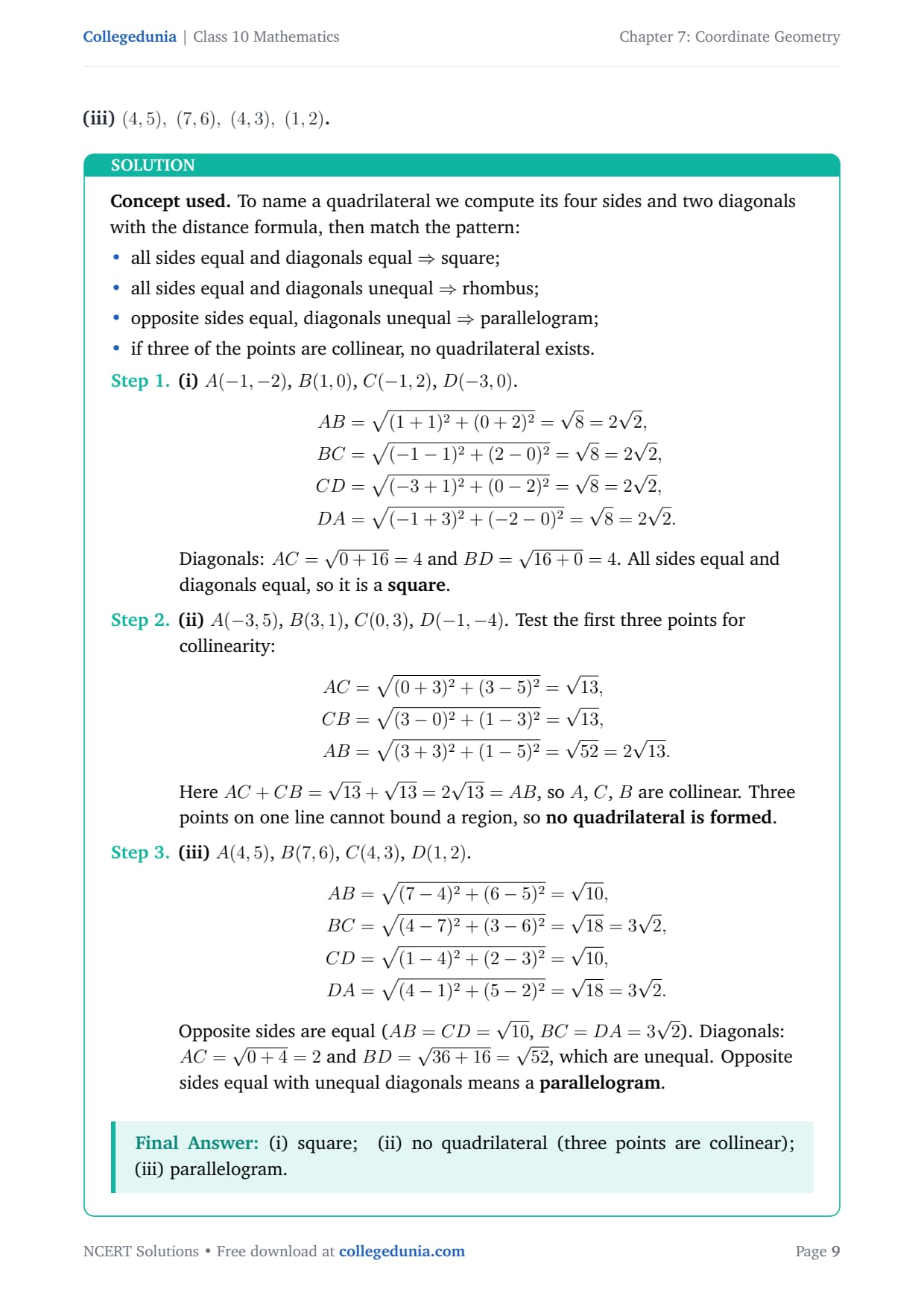
(iii) (4,5), (7,6), (4,3), (1,2).
Concept used. To name a quadrilateral we compute its four
sides and two diagonals with the distance formula, then match the
pattern:
if three of the points are collinear, no quadrilateral exists.
(i)A(-1,-2), B(1,0), C(-1,2), D(-3,0).
aligned
AB&=√(1+1)2+(0+2)2=√8=2√2,
BC&=√(-1-1)2+(2-0)2=√8=2√2,
CD&=√(-3+1)2+(0-2)2=√8=2√2,
DA&=√(-1+3)2+(-2-0)2=√8=2√2.
aligned
Diagonals: AC=√0+16=4 and BD=√16+0=4. All sides
equal and diagonals equal, so it is a square.
(ii)A(-3,5), B(3,1), C(0,3), D(-1,-4). Test
the first three points for collinearity:
aligned
AC&=√(0+3)2+(3-5)2=√13,
CB&=√(3-0)2+(1-3)2=√13,
AB&=√(3+3)2+(1-5)2=√52=2√13.
aligned
Here AC+CB=√13+√13=2√13=AB, so A, C, B
are collinear. Three points on one line cannot bound a region,
so no quadrilateral is formed.
(iii)A(4,5), B(7,6), C(4,3), D(1,2).
aligned
AB&=√(7-4)2+(6-5)2=√10,
BC&=√(4-7)2+(3-6)2=√18=3√2,
CD&=√(1-4)2+(2-3)2=√10,
DA&=√(4-1)2+(5-2)2=√18=3√2.
aligned
Opposite sides are equal (AB=CD=√10, BC=DA=3√2).
Diagonals: AC=√0+4=2 and BD=√36+16=√52,
which are unequal. Opposite sides equal with unequal diagonals
means a parallelogram.
(i) square; (ii) no quadrilateral (three points are collinear); (iii) parallelogram.
AJ
Aditya Joshi
M.Sc Mathematics, University of Mumbai
Verified Expert
Always run the collinearity check first. Part (ii) is the trap
of this question, and skipping the check is how most marks are lost here.
Part (i): the four equal sides together with the equal
diagonals give a square in just two short comparison steps, since
nothing else has both properties at once.
Part (ii): the sum of two short distances equals the
third, which exposes that one vertex sits on the segment joining
the other two. With three points falling in a straight line there
is no enclosed region, so there is no quadrilateral to name at all.
Part (iii): matching opposite sides but unequal diagonals
is the exact signature of a parallelogram, and the unequal
diagonals are what separate it from a rectangle, which would need
equal diagonals instead.
Where the marks are: the reasoning marks come from the
comparison sentence and not from the arithmetic. State plainly
which sides or diagonals match, or fail to match, before you name
each figure, and never compute four sides without checking
collinearity first.
(i) square, (ii) no quadrilateral, (iii) parallelogram, each justified by side and diagonal comparison.
Q 7.7
Find the point on the x-axis which is equidistant from
(2,-5) and (-2,9).
Concept used. Any point on the x-axis has y-coordinate
0, so it can be written as P(x,0). ``Equidistant'' means PA=PB;
squaring both sides removes the roots and leaves a simple equation in
x.
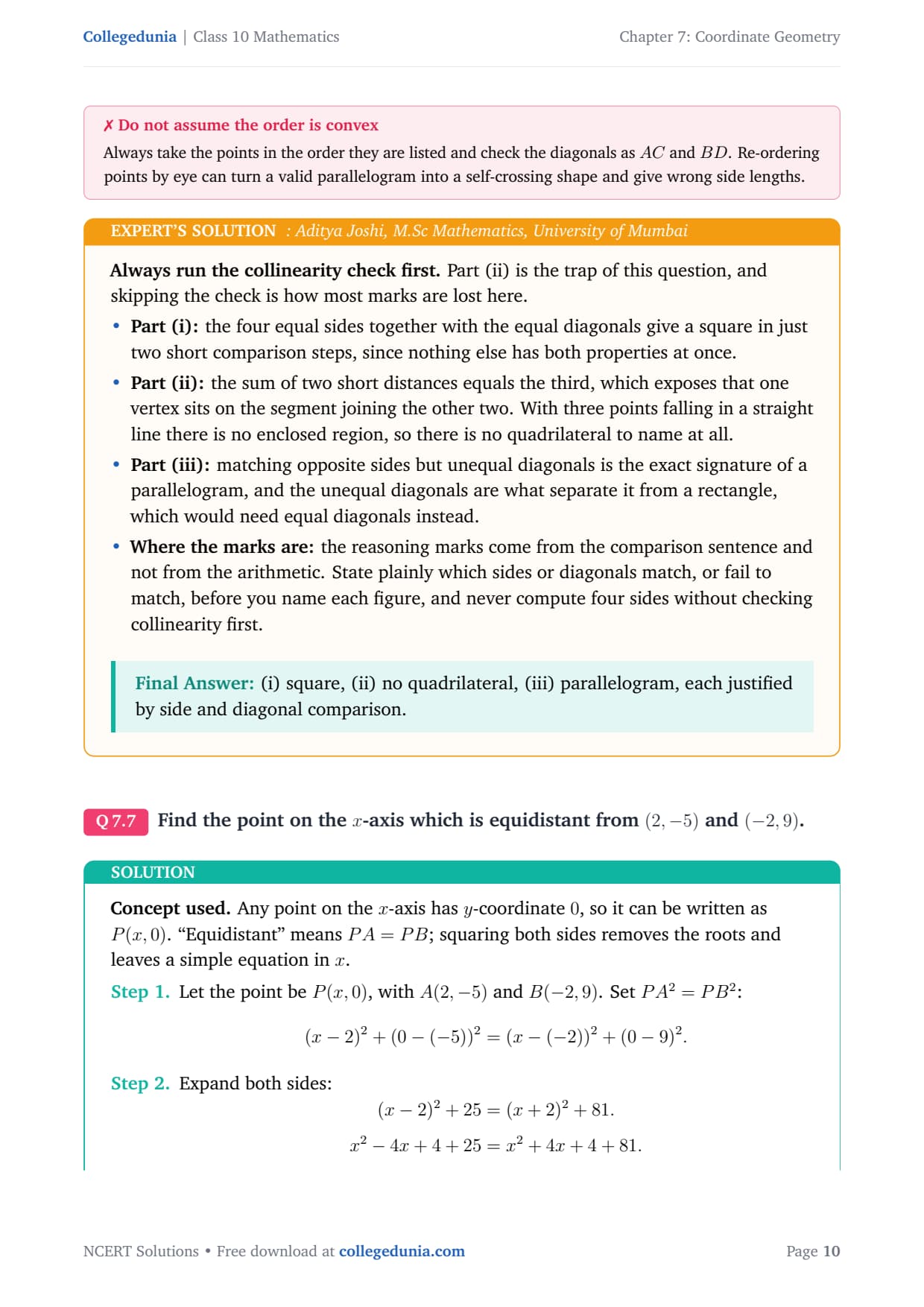
Let the point be P(x,0), with A(2,-5) and B(-2,9). Set
PA2=PB2:
(x-2)2+(0-(-5))2=(x-(-2))2+(0-9)2.
Expand both sides:
(x-2)2+25=(x+2)2+81. x2-4x+4+25=x2+4x+4+81.
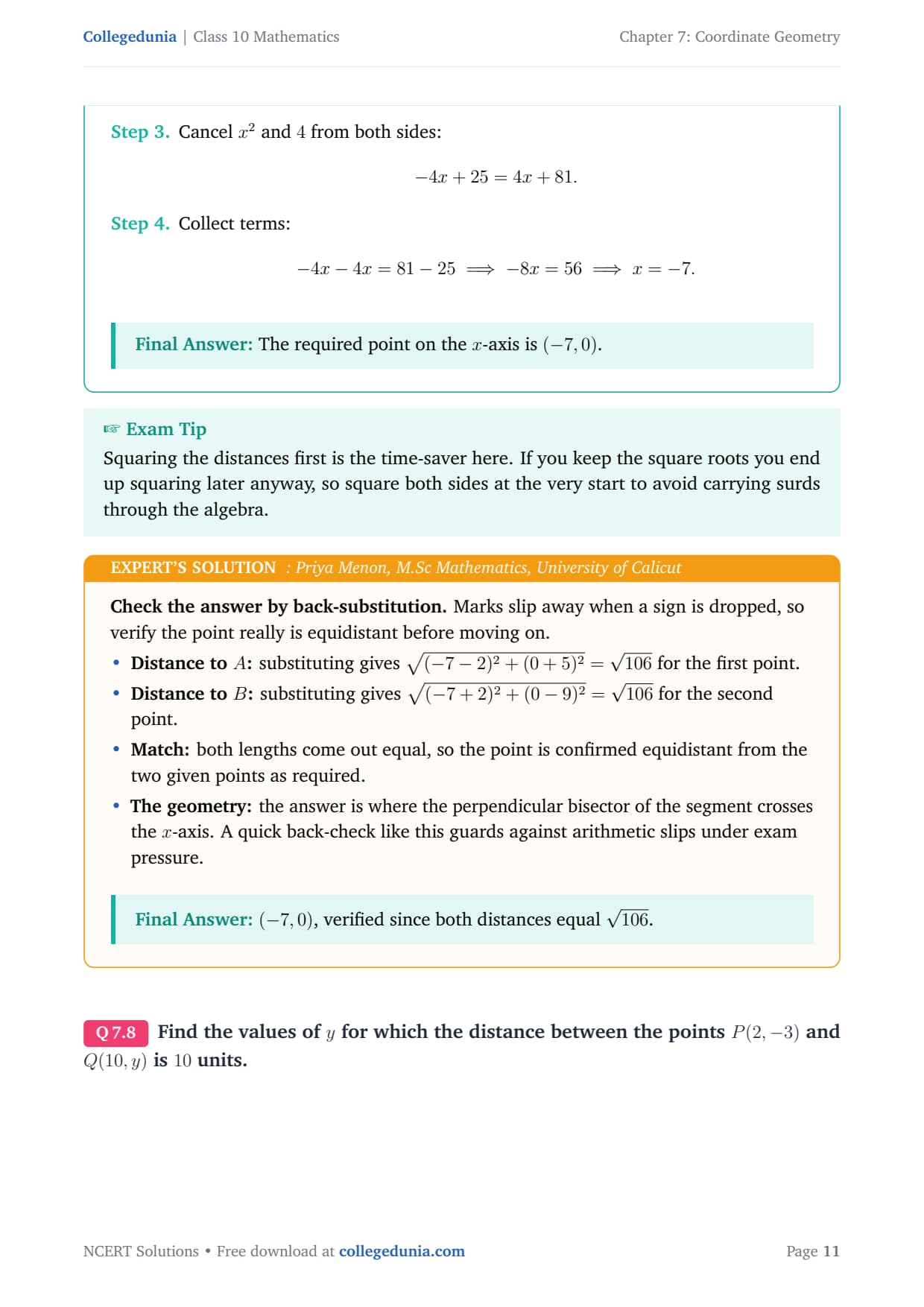
Cancel x2 and 4 from both sides:
-4x+25=4x+81.
Collect terms:
-4x-4x=81-25 -8x=56 x=-7.
The required point on the x-axis is (-7,0).
PM
Priya Menon
M.Sc Mathematics, University of Calicut
Verified Expert
Check the answer by back-substitution. Marks slip away when a
sign is dropped, so verify the point really is equidistant before moving on.
Distance to A: substituting gives
√(-7-2)2+(0+5)2=√106 for the first point.
Distance to B: substituting gives
√(-7+2)2+(0-9)2=√106 for the second point.
Match: both lengths come out equal, so the point is
confirmed equidistant from the two given points as required.
The geometry: the answer is where the perpendicular
bisector of the segment crosses the x-axis. A quick back-check
like this guards against arithmetic slips under exam pressure.
(-7,0), verified since both distances equal √106.
Q 7.8
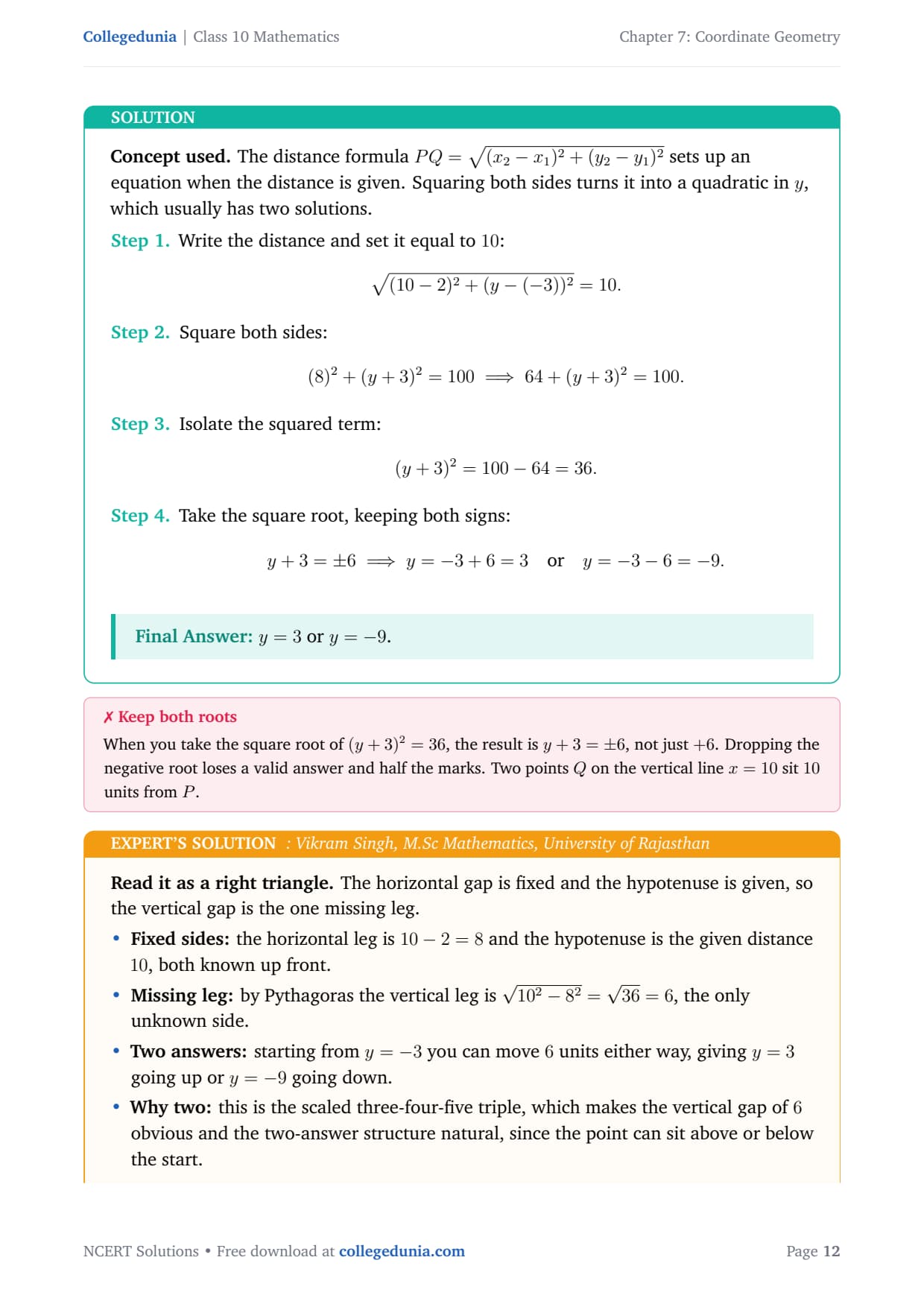
Find the values of y for which the distance between the
points P(2,-3) and Q(10,y) is 10 units.
Concept used. The distance formula
PQ=√(x2-x1)2+(y2-y1)2 sets up an equation when the
distance is given. Squaring both sides turns it into a quadratic in y,
which usually has two solutions.
Write the distance and set it equal to 10:
√(10-2)2+(y-(-3))2=10.
Square both sides:
(8)2+(y+3)2=100 64+(y+3)2=100.
Isolate the squared term:
(y+3)2=100-64=36.
Take the square root, keeping both signs:
y+3=± 6 y=-3+6=3 y=-3-6=-9.
y=3 or y=-9.
VS
Vikram Singh
M.Sc Mathematics, University of Rajasthan
Verified Expert
Read it as a right triangle. The horizontal gap is fixed and the
hypotenuse is given, so the vertical gap is the one missing leg.
Fixed sides: the horizontal leg is 10-2=8 and the
hypotenuse is the given distance 10, both known up front.
Missing leg: by Pythagoras the vertical leg is
√102-82=√36=6, the only unknown side.
Two answers: starting from y=-3 you can move 6 units
either way, giving y=3 going up or y=-9 going down.
Why two: this is the scaled three-four-five triple, which
makes the vertical gap of 6 obvious and the two-answer structure
natural, since the point can sit above or below the start.
y=3 or y=-9.
Q 7.9
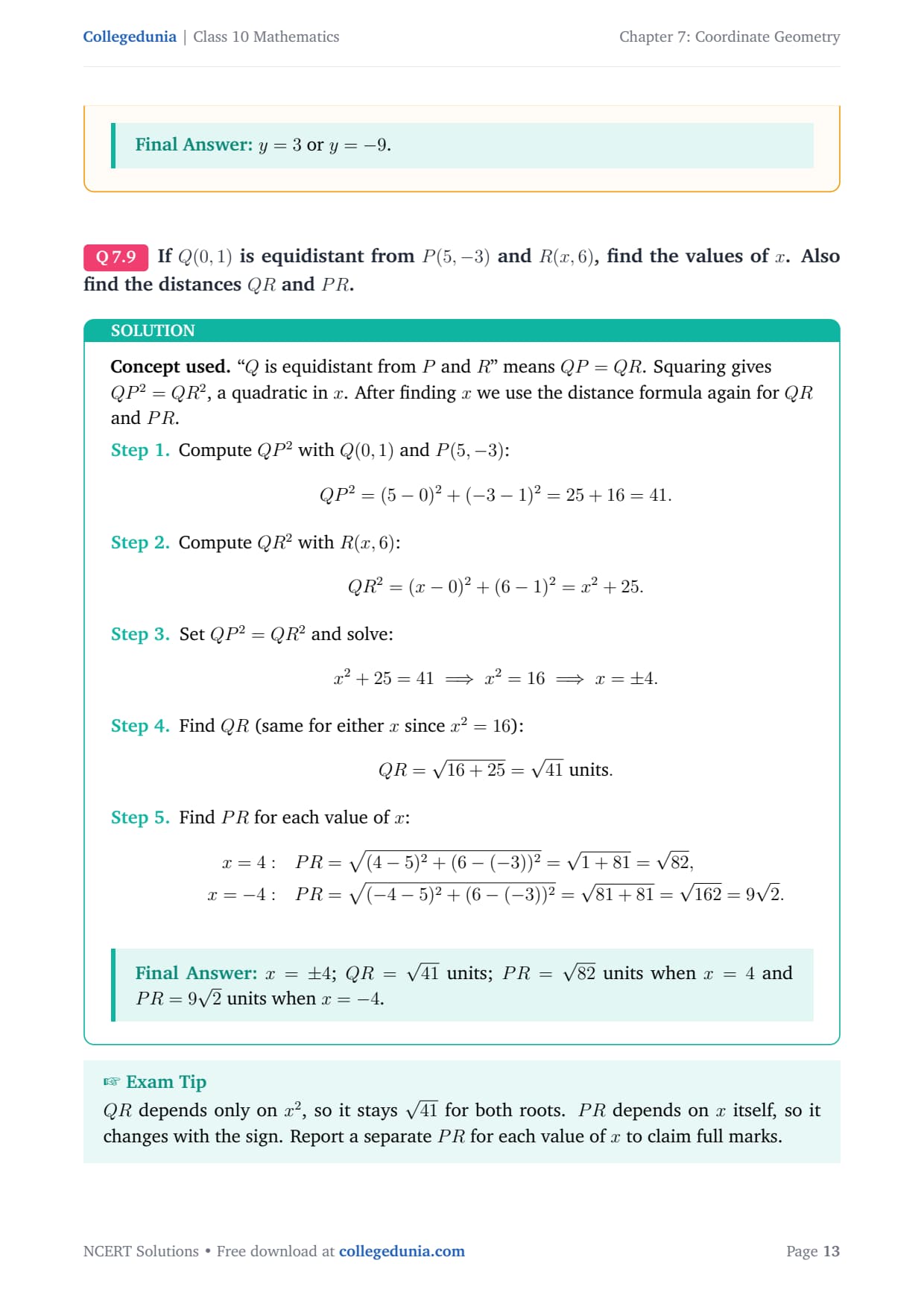
If Q(0,1) is equidistant from P(5,-3) and R(x,6), find
the values of x. Also find the distances QR and PR.
Concept used. ``Q is equidistant from P and R'' means
QP=QR. Squaring gives QP2=QR2, a quadratic in x. After finding
x we use the distance formula again for QR and PR.
Compute QP2 with Q(0,1) and P(5,-3):
QP2=(5-0)2+(-3-1)2=25+16=41.
Compute QR2 with R(x,6):
QR2=(x-0)2+(6-1)2=x2+25.
Set QP2=QR2 and solve:
x2+25=41 x2=16 x=± 4.
Find QR (same for either x since x2=16):
QR=√16+25=√41 units.
Find PR for each value of x:
aligned
x=4:& PR=√(4-5)2+(6-(-3))2=√1+81=√82, x=-4:& PR=√(-4-5)2+(6-(-3))2=√81+81=√162=9√2.
aligned
x=± 4; QR=√41 units; PR=√82 units when x=4 and PR=9√2 units when x=-4.
NR
Nandini Rao
M.Sc Mathematics, Bangalore University
Verified Expert
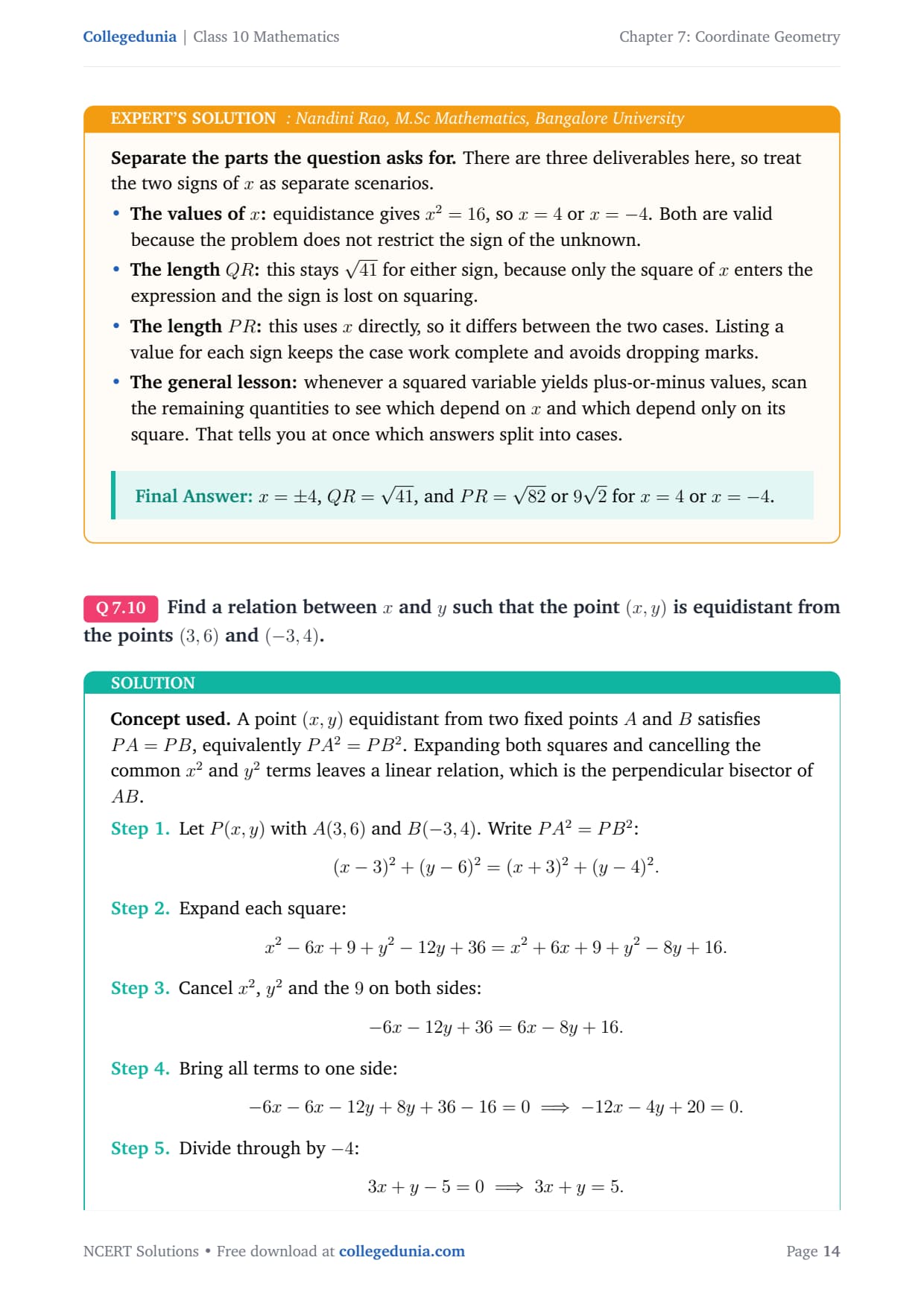
Separate the parts the question asks for. There are three
deliverables here, so treat the two signs of x as separate scenarios.
The values of x: equidistance gives x2=16, so x=4
or x=-4. Both are valid because the problem does not restrict
the sign of the unknown.
The length QR: this stays √41 for either sign,
because only the square of x enters the expression and the sign
is lost on squaring.
The length PR: this uses x directly, so it differs
between the two cases. Listing a value for each sign keeps the
case work complete and avoids dropping marks.
The general lesson: whenever a squared variable yields
plus-or-minus values, scan the remaining quantities to see which
depend on x and which depend only on its square. That tells you
at once which answers split into cases.
x=± 4, QR=√41, and PR=√82 or 9√2 for x=4 or x=-4.
Q 7.10
Find a relation between x and y such that the point
(x,y) is equidistant from the points (3,6) and (-3,4).
Concept used. A point (x,y) equidistant from two fixed points
A and B satisfies PA=PB, equivalently PA2=PB2. Expanding both
squares and cancelling the common x2 and y2 terms leaves a linear
relation, which is the perpendicular bisector of AB.
Let P(x,y) with A(3,6) and B(-3,4). Write PA2=PB2:
(x-3)2+(y-6)2=(x+3)2+(y-4)2.
Expand each square:
x2-6x+9+y2-12y+36=x2+6x+9+y2-8y+16.
Cancel x2, y2 and the 9 on both sides:
-6x-12y+36=6x-8y+16.
Bring all terms to one side:
-6x-6x-12y+8y+36-16=0 -12x-4y+20=0.
Divide through by -4:
3x+y-5=0 3x+y=5.
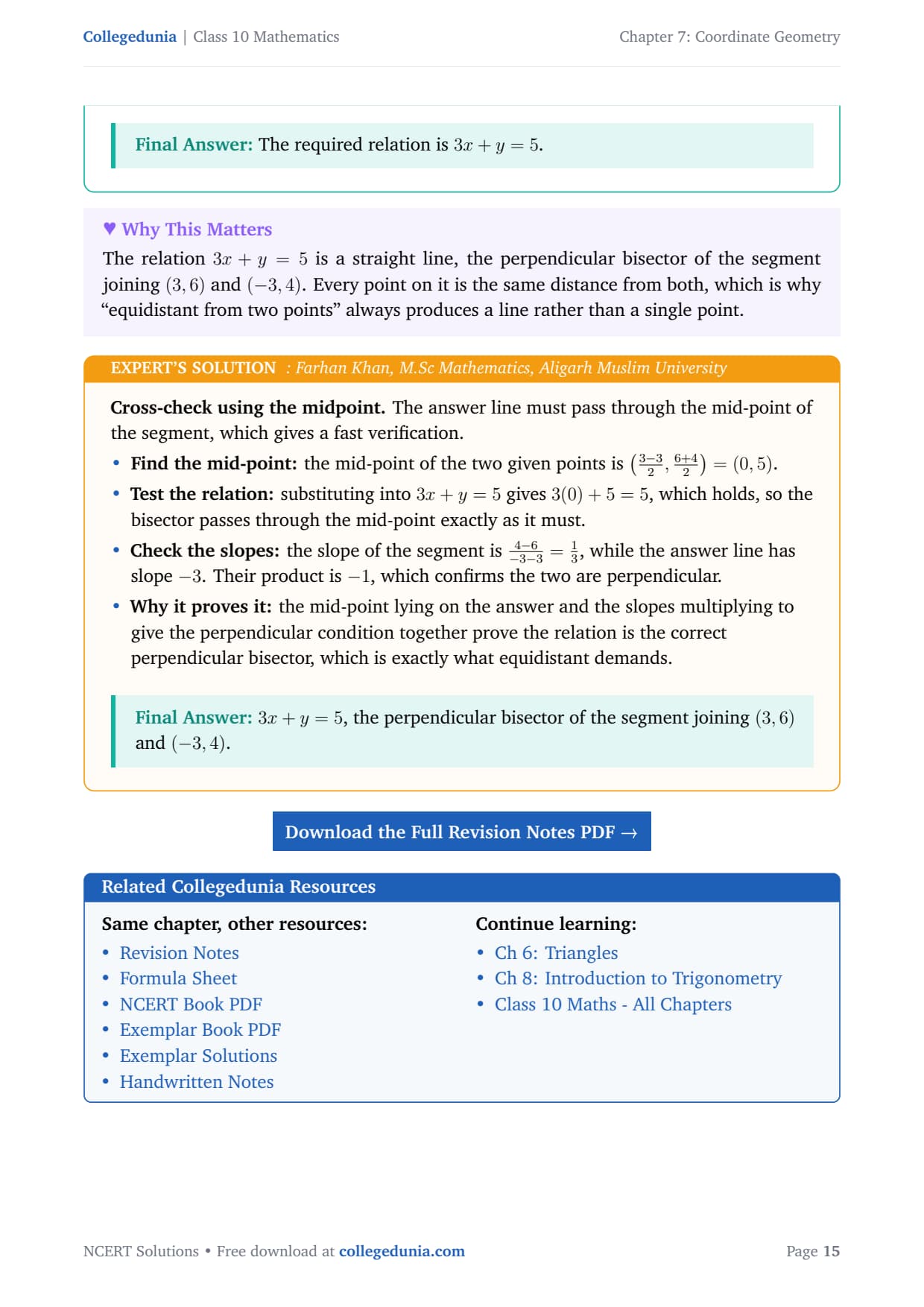
The required relation is 3x+y=5.
FK
Farhan Khan
M.Sc Mathematics, Aligarh Muslim University
Verified Expert
Cross-check using the midpoint. The answer line must pass
through the mid-point of the segment, which gives a fast verification.
Find the mid-point: the mid-point of the two given
points is (3-32,6+42)=(0,5).
Test the relation: substituting into 3x+y=5 gives
3(0)+5=5, which holds, so the bisector passes through the
mid-point exactly as it must.
Check the slopes: the slope of the segment is
4-6-3-3=13, while the answer line has slope
-3. Their product is -1, which confirms the two are perpendicular.
Why it proves it: the mid-point lying on the answer and
the slopes multiplying to give the perpendicular condition together
prove the relation is the correct perpendicular bisector, which is
exactly what equidistant demands.
3x+y=5, the perpendicular bisector of the segment joining (3,6) and (-3,4).
NCERT solutions Class 10 Mathematics Chapter 7 Coordinate Geometry
All 10 questions with collapsible Solution and Expert Solution. Tap a button to reveal the working.
Exercise 7.2
Q 7.1
Find the coordinates of the point which divides the join of
(-1,7) and (4,-3) in the ratio 2:3.
Concept used. The section formula gives the point
P(x,y) that divides the segment from A(x1,y1) to B(x2,y2)
internally in the ratio m1:m2:
P=(m1x2+m2x1m1+m2, m1y2+m2y1m1+m2).
Here A(-1,7), B(4,-3) and m1:m2=2:3.
Identify the values: x1=-1, y1=7, x2=4, y2=-3,
m1=2, m2=3, so m1+m2=5.
Find the x-coordinate:
x=2(4)+3(-1)5=8-35=55=1.
Find the y-coordinate:
y=2(-3)+3(7)5=-6+215=155=3.
The point is (1,3).
IB
Ishita Banerjee
M.Sc Mathematics, University of Calcutta
Verified Expert
Sanity-check the position. A two-to-three split puts the point a
little nearer the first end, so its coordinates should lean that way.
Read the ratio: the two parts total 5, so the point
sits two-fifths of the way along from the first end toward the second.
Walk the fraction: moving two-fifths along gives
x=-1+25(4-(-1))=1 and y=7+25(-3-7)=3.
Confirm: this fraction-of-the-way method lands on the
same point as the section formula, so the two agree.
Why bother: reading the ratio as a fraction of the
journey is a quick mental check that the point lands on the
correct side of the segment and not beyond either end.
(1,3), lying two-fifths of the way from (-1,7) to (4,-3).
Q 7.2
Find the coordinates of the points of trisection of the line
segment joining (4,-1) and (-2,-3).
Concept used. The points of trisection cut a segment
into three equal parts. If P and Q are these points with AP=PQ=QB,
then P divides AB in the ratio 1:2 and Q divides it in 2:1.
Apply the section formula twice.
Take A(4,-1) and B(-2,-3). For P, use m1:m2=1:2:
P=(1(-2)+2(4)1+2, 1(-3)+2(-1)1+2).
Simplify P:
P=(-2+83, -3-23)=(63, -53)=(2, -53).
For Q, use m1:m2=2:1:
Q=(2(-2)+1(4)2+1, 2(-3)+1(-1)2+1).
Simplify Q:
Q=(-4+43, -6-13)=(03, -73)=(0, -73).
The points of trisection are (2,-53) and (0,-73).
SG
Sanjay Gupta
M.Sc Mathematics, University of Delhi
Verified Expert
Picture the two cut points. The first cut sits one-third along
the segment and the second sits two-thirds along, so both coordinates
should step evenly between the ends.
Step the x: the full change in x is -6, so each
third changes it by -2. Starting at 4 the cuts fall at 2 and
then 0, ending at -2, which matches the computed values.
Step the y: the full change in y is -2, so each
third changes it by -23. Starting at -1 the cuts
fall at -53 and then -73.
Pair them: reading the two coordinate lists together
gives the same two trisection points found by the section formula.
The hallmark: equal steps in both coordinates are the
signature of trisection, and checking them catches any ratio
mix-up at once before it costs marks.
(2,-53) and (0,-73).
Q 7.3
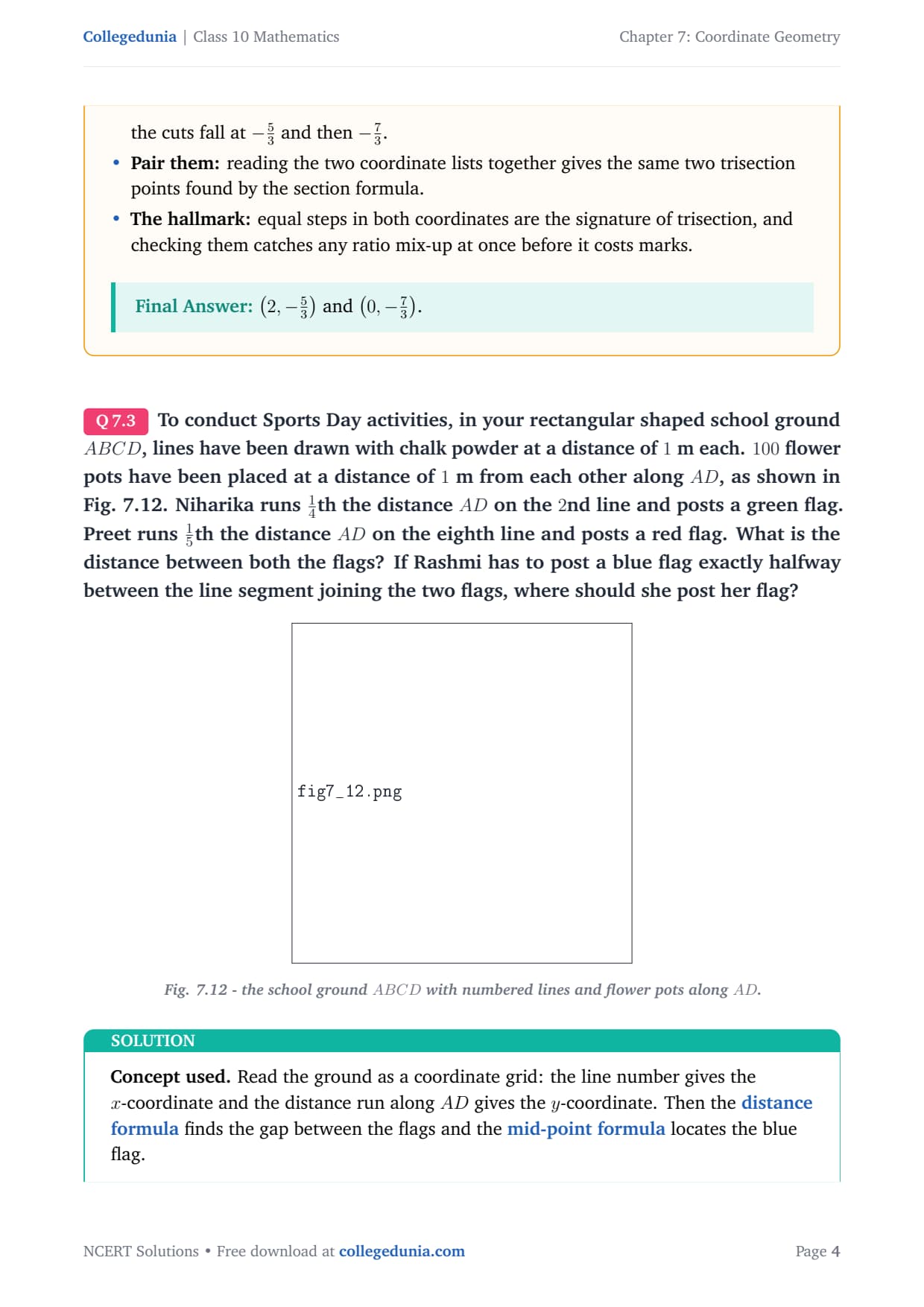
To conduct Sports Day activities, in your rectangular shaped
school ground ABCD, lines have been drawn with chalk powder at a
distance of 1 m each. 100 flower pots have been placed at a distance
of 1 m from each other along AD, as shown in Fig. 7.12. Niharika
runs 14th the distance AD on the 2nd line and posts a
green flag. Preet runs 15th the distance AD on the eighth
line and posts a red flag. What is the distance between both the flags?
If Rashmi has to post a blue flag exactly halfway between the line
segment joining the two flags, where should she post her flag?
Concept used. Read the ground as a coordinate grid: the line
number gives the x-coordinate and the distance run along AD gives
the y-coordinate. Then the distance formula finds the gap
between the flags and the mid-point formula locates the blue
flag.
Niharika's green flag: on the 2nd line, 14 of
AD=14× 100=25 m up. So the green flag is at
G(2,25).
Preet's red flag: on the 8th line, 15 of
AD=15× 100=20 m up. So the red flag is at
R(8,20).
Distance between the flags:
GR=√(8-2)2+(20-25)2=√62+(-5)2=√36+25=√61m.
Blue flag is the mid-point of GR:
(2+82, 25+202)=(102, 452)=(5, 22.5).
So Rashmi posts the blue flag on the 5th line, 22.5 m up
AD.
Distance between the flags =√61 m; the blue flag goes at (5, 22.5), that is, on the 5th line at 22.5 m.
LS
Lakshmi Subramaniam
B.Tech Mechanical Engineering, NIT Surathkal
Verified Expert
Set up the model carefully. The only real work is turning the
story into points; after that the formulas are mechanical.
Green flag: one-quarter of the 100 pots is 25 m,
paired with line 2, which fixes the green flag at (2,25).
Red flag: one-fifth of the same length is 20 m,
paired with line 8, which fixes the red flag at (8,20).
Apply the formulas: the horizontal gap is 6 and the
vertical gap is 5, so the flags are √61 m apart, and the
mid-point places the blue flag squarely between the two.
Read the answer: a halfway flag always lands at the
mid-point, so it sits on line 5 at the listed height, equally far
from both runners. Careful modelling of the words earns the method
marks here, not the arithmetic.
Flags are √61 m apart; the blue flag is at (5, 22.5).
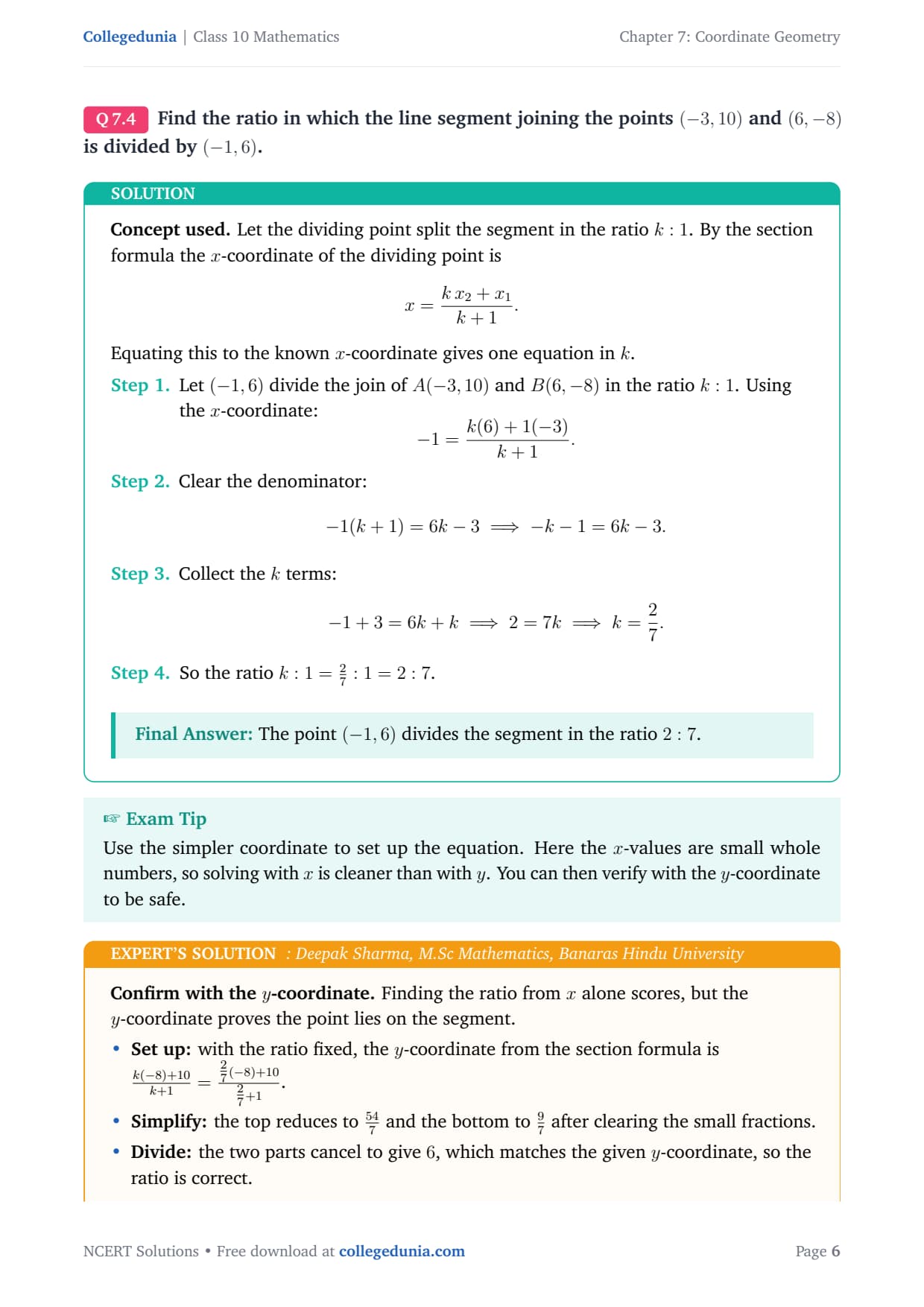
Q 7.4
Find the ratio in which the line segment joining the points
(-3,10) and (6,-8) is divided by (-1,6).
Concept used. Let the dividing point split the segment in the
ratio k:1. By the section formula the x-coordinate of the dividing
point is
x=k x2+x1k+1.
Equating this to the known x-coordinate gives one equation in k.
Let (-1,6) divide the join of A(-3,10) and B(6,-8) in the
ratio k:1. Using the x-coordinate:
-1=k(6)+1(-3)k+1.
Clear the denominator:
-1(k+1)=6k-3 -k-1=6k-3.
Collect the k terms:
-1+3=6k+k 2=7k k=27.
So the ratio k:1=27:1=2:7.
The point (-1,6) divides the segment in the ratio 2:7.
DS
Deepak Sharma
M.Sc Mathematics, Banaras Hindu University
Verified Expert
Confirm with the y-coordinate. Finding the ratio from x
alone scores, but the y-coordinate proves the point lies on the segment.
Set up: with the ratio fixed, the y-coordinate from the
section formula is
k(-8)+10k+1=27(-8)+1027+1.
Simplify: the top reduces to 547 and the
bottom to 97 after clearing the small fractions.
Divide: the two parts cancel to give 6, which matches
the given y-coordinate, so the ratio is correct.
The habit: checking the second coordinate is the standard
guard against a point that satisfies x but lies off the line.
Always run it when the ratio is the final answer.
Ratio 2:7, confirmed by the matching y-coordinate 6.
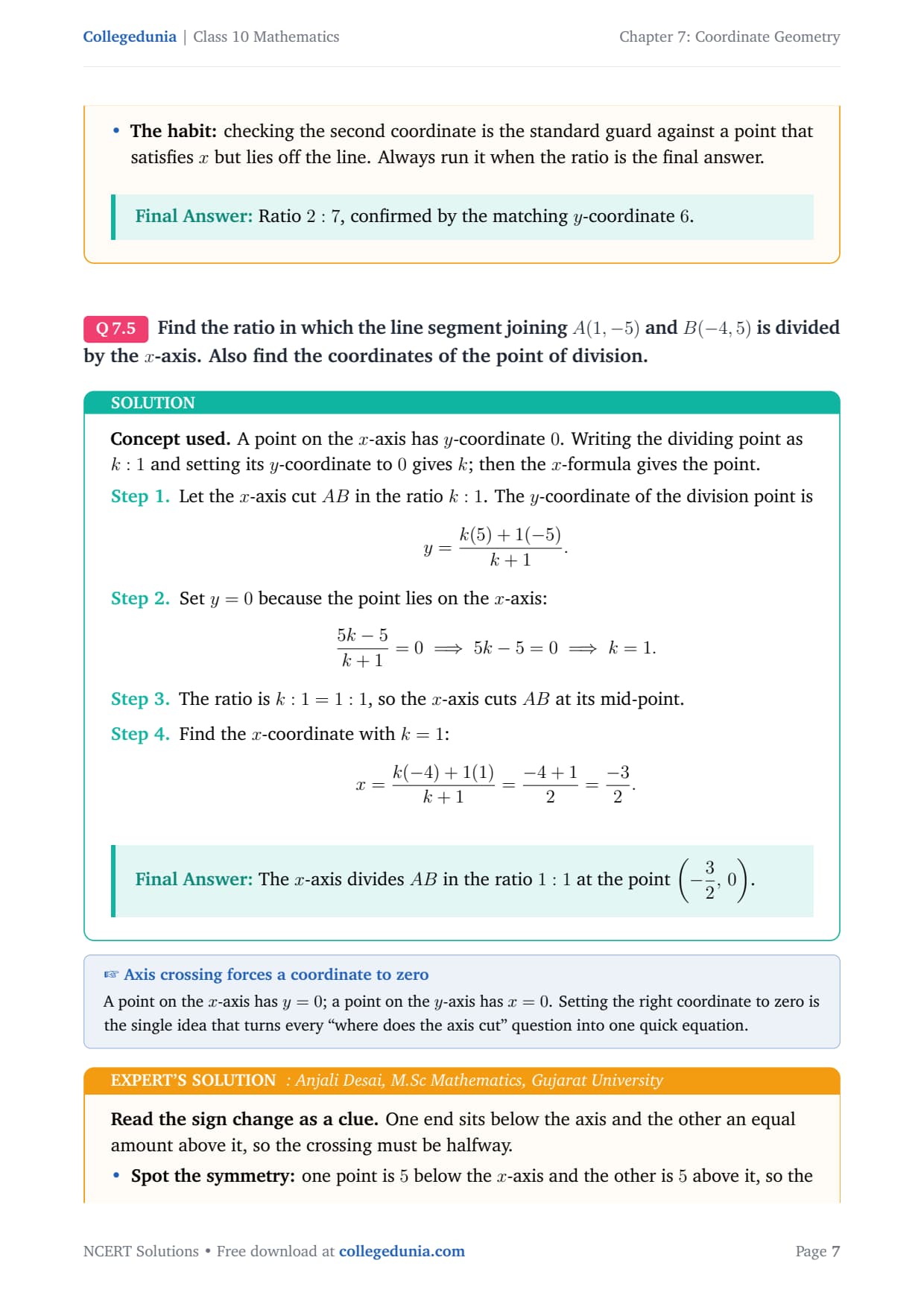
Q 7.5
Find the ratio in which the line segment joining A(1,-5)
and B(-4,5) is divided by the x-axis. Also find the coordinates of
the point of division.
Concept used. A point on the x-axis has y-coordinate 0.
Writing the dividing point as k:1 and setting its y-coordinate to
0 gives k; then the x-formula gives the point.
Let the x-axis cut AB in the ratio k:1. The
y-coordinate of the division point is
y=k(5)+1(-5)k+1.
Set y=0 because the point lies on the x-axis:
5k-5k+1=0 5k-5=0 k=1.
The ratio is k:1=1:1, so the x-axis cuts AB at its
mid-point.
Find the x-coordinate with k=1:
x=k(-4)+1(1)k+1=-4+12=-32.
The x-axis divides AB in the ratio 1:1 at the point (-32, 0).
AD
Anjali Desai
M.Sc Mathematics, Gujarat University
Verified Expert
Read the sign change as a clue. One end sits below the axis and
the other an equal amount above it, so the crossing must be halfway.
Spot the symmetry: one point is 5 below the x-axis
and the other is 5 above it, so the axis sits midway between
them in the vertical direction.
Predict the ratio: midway means a ratio of one-to-one,
which the equation 5k-5=0 confirms with the value k=1.
Find the point: the mid-point x-coordinate is
1+(-4)2=-32, giving the crossing point on the axis.
The shortcut: whenever the two y-values are equal and
opposite, the axis always bisects the segment, so you can predict
the one-to-one ratio and use the calculation purely as a check.
Ratio 1:1; point of division (-32,0).
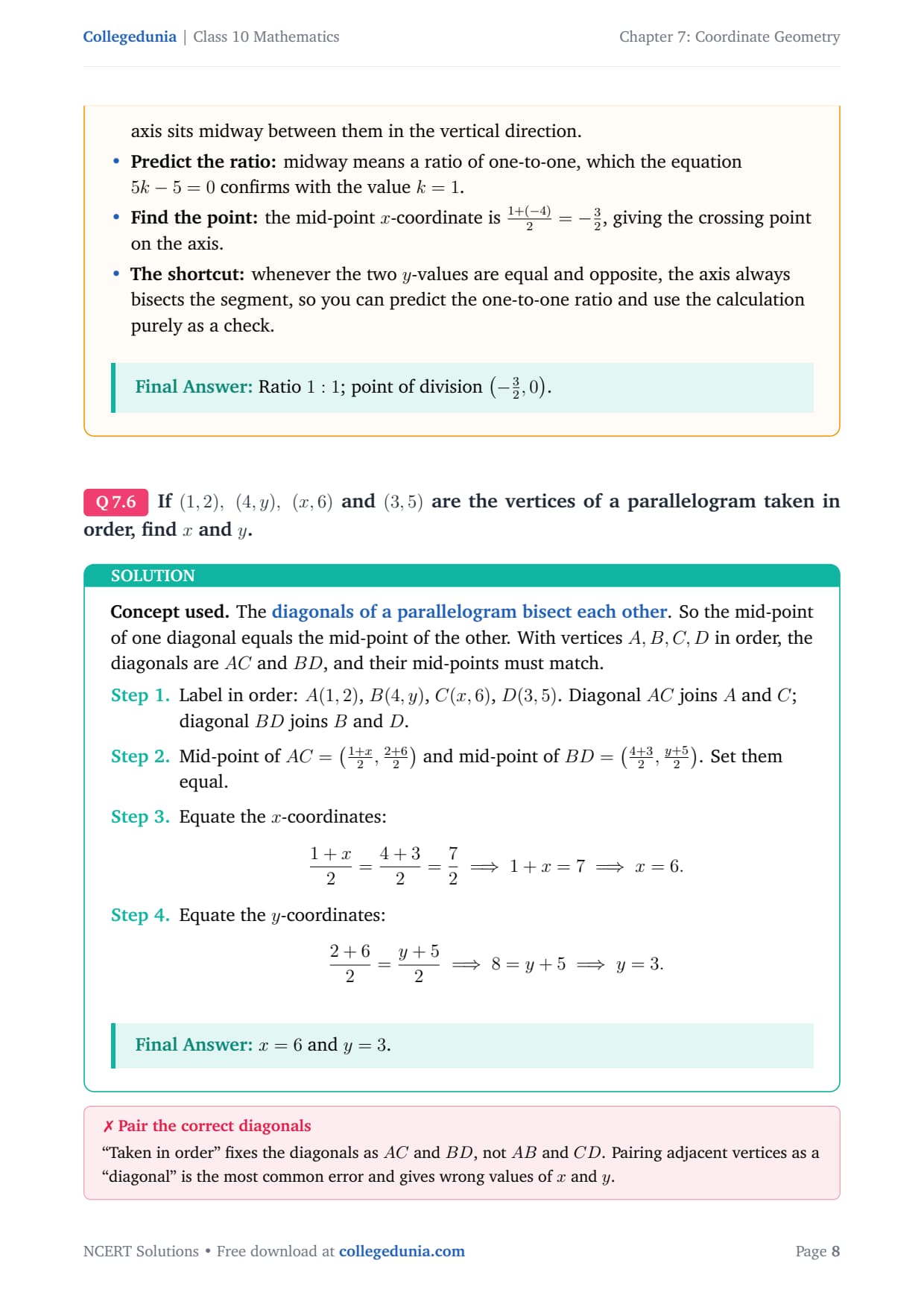
Q 7.6
If (1,2), (4,y), (x,6) and (3,5) are the vertices of a
parallelogram taken in order, find x and y.
Concept used. The diagonals of a parallelogram bisect
each other. So the mid-point of one diagonal equals the mid-point of
the other. With vertices A,B,C,D in order, the diagonals are AC and
BD, and their mid-points must match.
Label in order: A(1,2), B(4,y), C(x,6), D(3,5). Diagonal
AC joins A and C; diagonal BD joins B and D.
Mid-point of AC=(1+x2,2+62) and
mid-point of BD=(4+32,y+52).
Set them equal.
Equate the x-coordinates:
1+x2=4+32=72 1+x=7 x=6.
Equate the y-coordinates:
2+62=y+52 8=y+5 y=3.
x=6 and y=3.
SK
Suresh Kumar
M.Sc Mathematics, University of Madras
Verified Expert
Why the diagonal property wins here. The mid-point method needs
only one equation per unknown and avoids the side-vector notation that
this class has not yet covered.
Shared centre: the two diagonals meet at one common
mid-point, found from the known coordinates of three vertices, so
both diagonals must pass through it.
Solve for x: forcing the first diagonal to pass through
that shared centre gives a single equation that fixes the value of x.
Solve for y: forcing the second diagonal through the
same centre gives a second equation that fixes the value of y.
The takeaway: the single fact that diagonals bisect each
other resolves both unknowns cleanly, which is why it is the
preferred approach for parallelogram problems at this level.
x=6, y=3, from the equal mid-points of the diagonals.
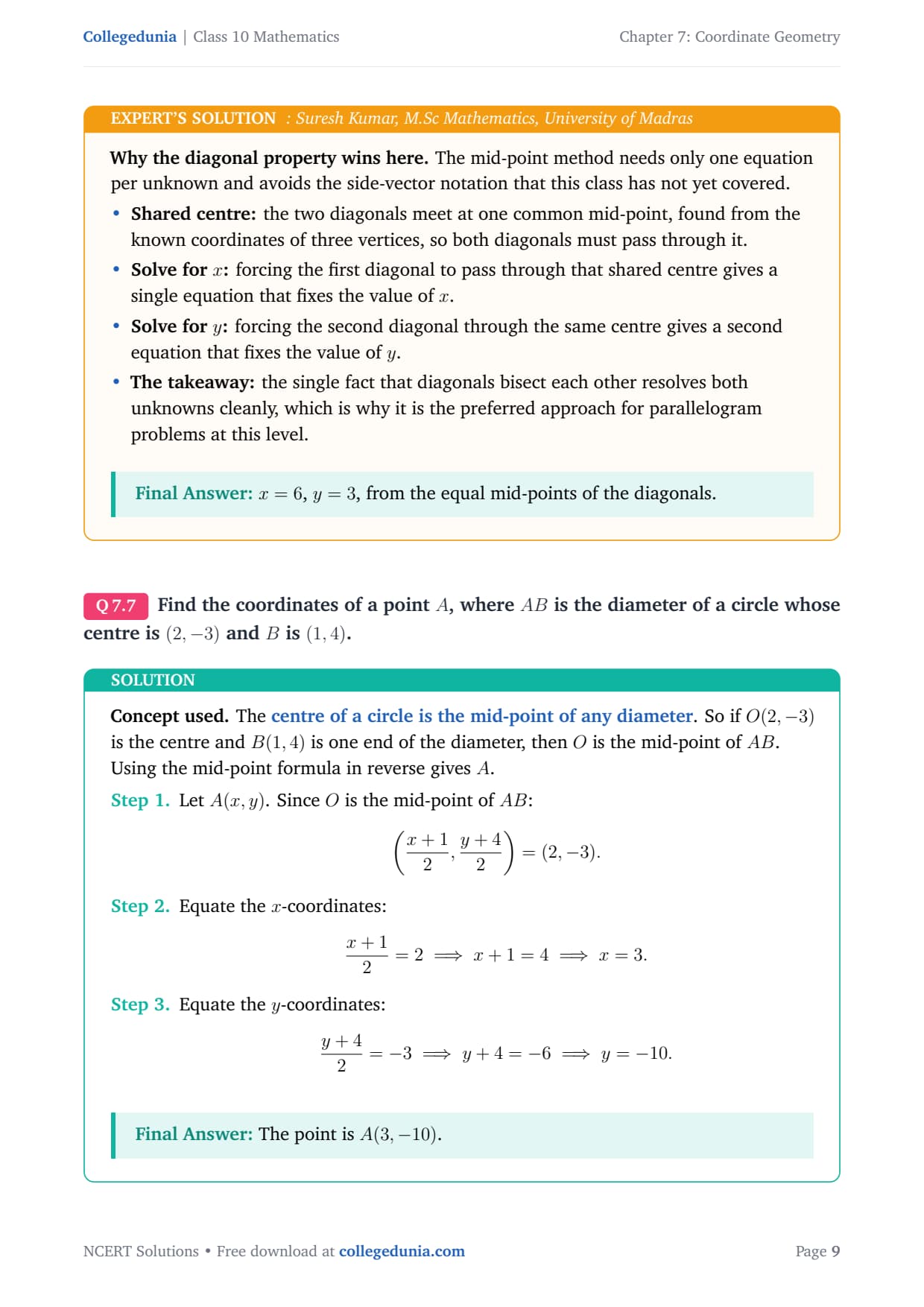
Q 7.7
Find the coordinates of a point A, where AB is the
diameter of a circle whose centre is (2,-3) and B is (1,4).
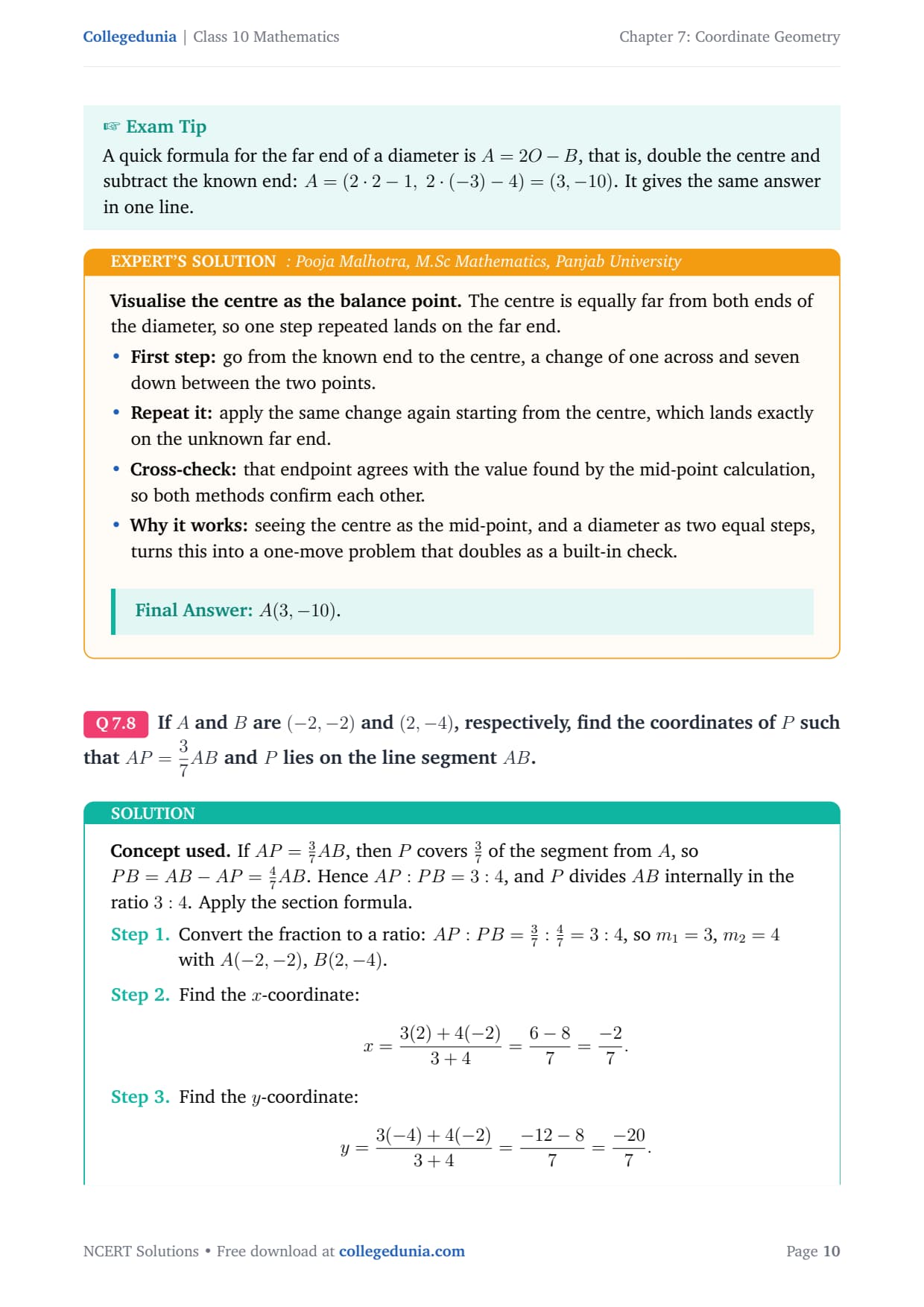
Concept used. The centre of a circle is the mid-point
of any diameter. So if O(2,-3) is the centre and B(1,4) is one end
of the diameter, then O is the mid-point of AB. Using the mid-point
formula in reverse gives A.
Let A(x,y). Since O is the mid-point of AB:
(x+12,y+42)=(2,-3).
Equate the x-coordinates:
x+12=2 x+1=4 x=3.
Equate the y-coordinates:
y+42=-3 y+4=-6 y=-10.
The point is A(3,-10).
PM
Pooja Malhotra
M.Sc Mathematics, Panjab University
Verified Expert
Visualise the centre as the balance point. The centre is equally
far from both ends of the diameter, so one step repeated lands on the
far end.
First step: go from the known end to the centre, a
change of one across and seven down between the two points.
Repeat it: apply the same change again starting from the
centre, which lands exactly on the unknown far end.
Cross-check: that endpoint agrees with the value found by
the mid-point calculation, so both methods confirm each other.
Why it works: seeing the centre as the mid-point, and a
diameter as two equal steps, turns this into a one-move problem
that doubles as a built-in check.
A(3,-10).
Q 7.8
If A and B are (-2,-2) and (2,-4), respectively, find
the coordinates of P such that AP=37AB and P lies on the
line segment AB.
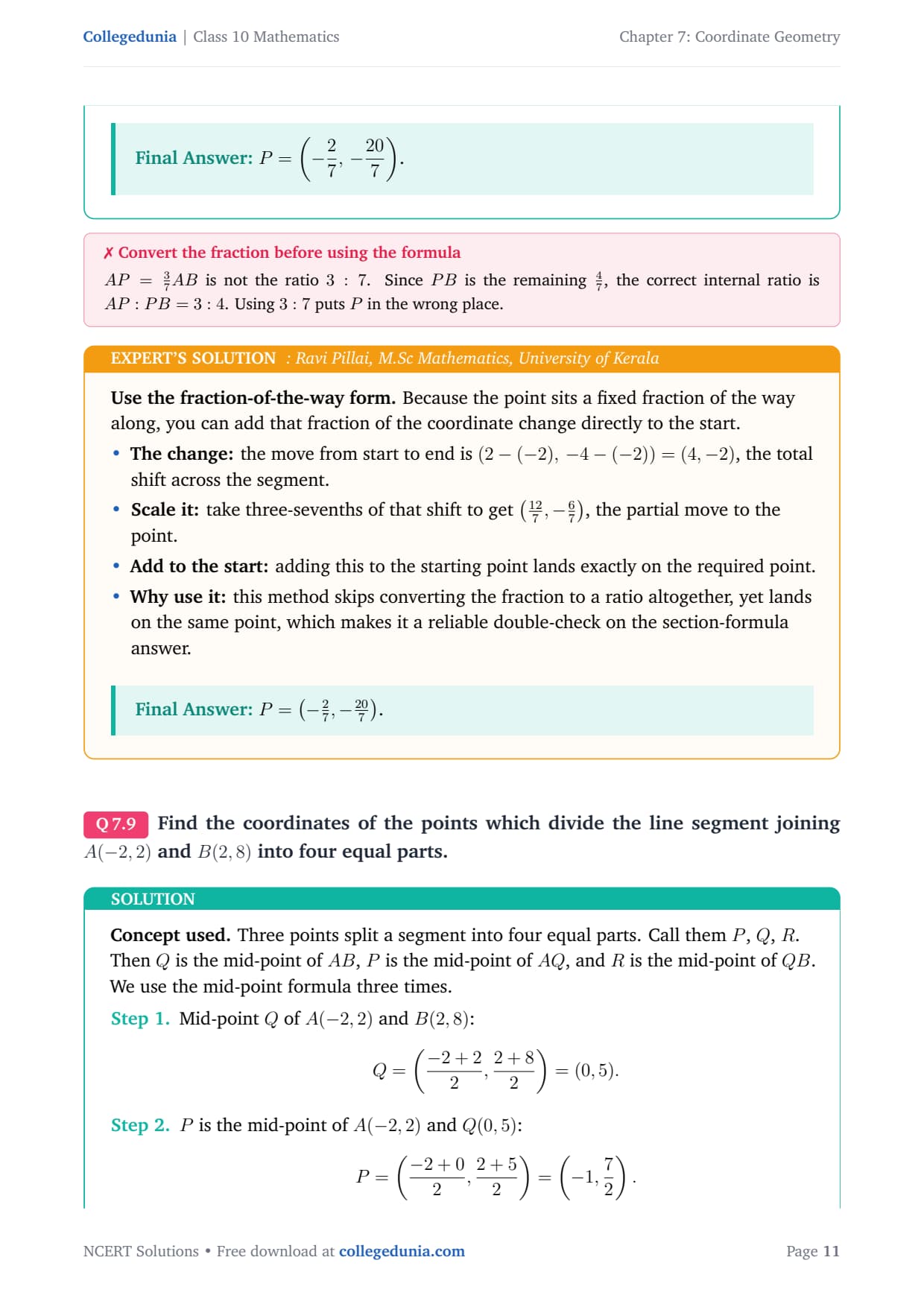
Concept used. If AP=37AB, then P covers
37 of the segment from A, so PB=AB-AP=47AB.
Hence AP:PB=3:4, and P divides AB internally in the ratio 3:4.
Apply the section formula.
Convert the fraction to a ratio: AP:PB=37:47=3:4,
so m1=3, m2=4 with A(-2,-2), B(2,-4).
Find the x-coordinate:
x=3(2)+4(-2)3+4=6-87=-27.
Find the y-coordinate:
y=3(-4)+4(-2)3+4=-12-87=-207.
P=(-27, -207).
RP
Ravi Pillai
M.Sc Mathematics, University of Kerala
Verified Expert
Use the fraction-of-the-way form. Because the point sits a
fixed fraction of the way along, you can add that fraction of the
coordinate change directly to the start.
The change: the move from start to end is
(2-(-2), -4-(-2))=(4,-2), the total shift across the segment.
Scale it: take three-sevenths of that shift to get
(127,-67), the partial move to the point.
Add to the start: adding this to the starting point
lands exactly on the required point.
Why use it: this method skips converting the fraction to
a ratio altogether, yet lands on the same point, which makes it a
reliable double-check on the section-formula answer.
P=(-27,-207).
Q 7.9
Find the coordinates of the points which divide the line
segment joining A(-2,2) and B(2,8) into four equal parts.
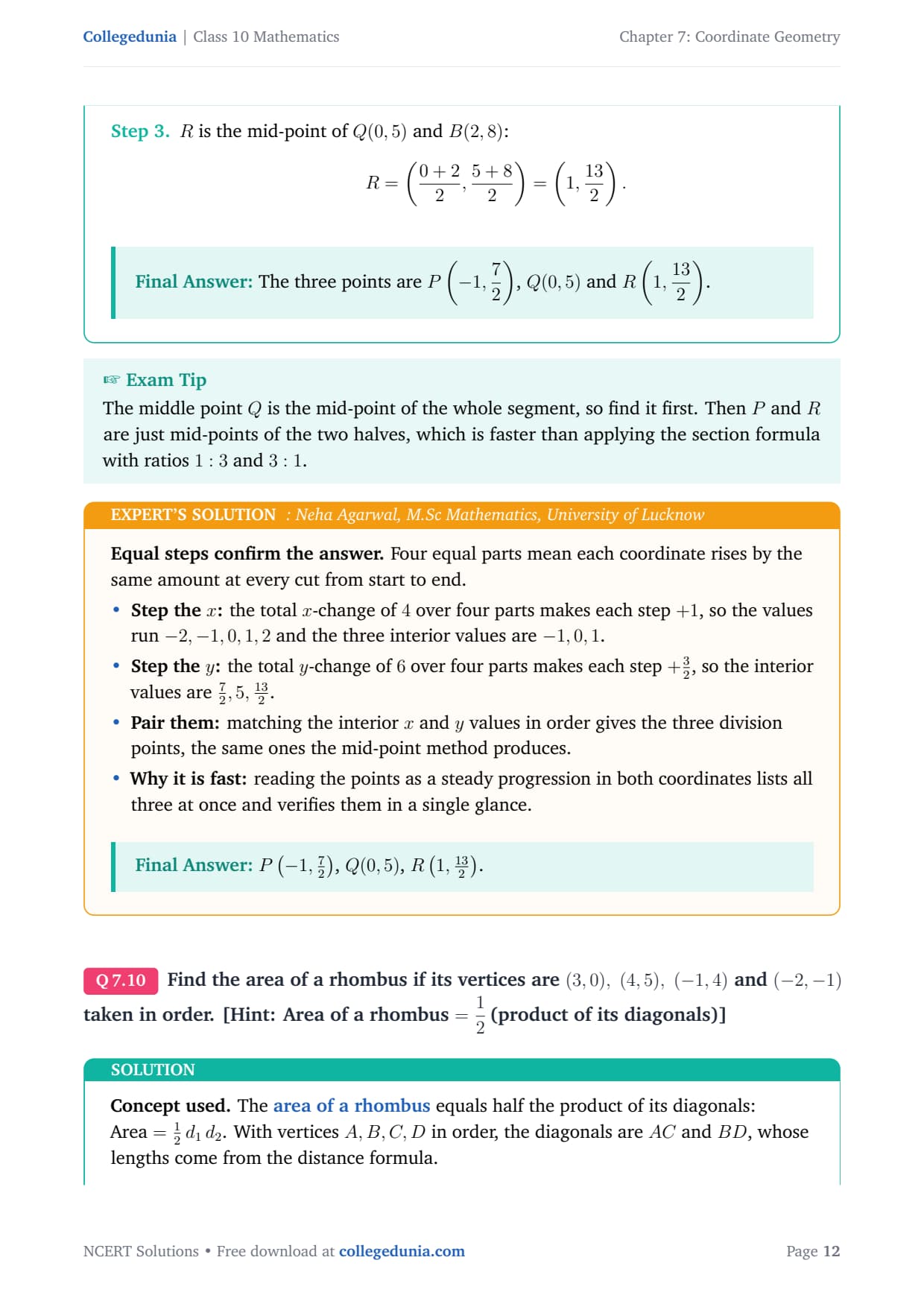
Concept used. Three points split a segment into four equal
parts. Call them P, Q, R. Then Q is the mid-point of AB, P
is the mid-point of AQ, and R is the mid-point of QB. We use the
mid-point formula three times.
Mid-point Q of A(-2,2) and B(2,8):
Q=(-2+22,2+82)=(0,5).
P is the mid-point of A(-2,2) and Q(0,5):
P=(-2+02,2+52)=(-1,72).
R is the mid-point of Q(0,5) and B(2,8):
R=(0+22,5+82)=(1,132).
The three points are P(-1,72), Q(0,5) and R(1,132).
NA
Neha Agarwal
M.Sc Mathematics, University of Lucknow
Verified Expert
Equal steps confirm the answer. Four equal parts mean each
coordinate rises by the same amount at every cut from start to end.
Step the x: the total x-change of 4 over four parts
makes each step +1, so the values run -2,-1,0,1,2 and the three
interior values are -1,0,1.
Step the y: the total y-change of 6 over four parts
makes each step +32, so the interior values are
72,5,132.
Pair them: matching the interior x and y values in
order gives the three division points, the same ones the mid-point
method produces.
Why it is fast: reading the points as a steady
progression in both coordinates lists all three at once and
verifies them in a single glance.
P(-1,72), Q(0,5), R(1,132).
Q 7.10
Find the area of a rhombus if its vertices are (3,0), (4,5),
(-1,4) and (-2,-1) taken in order.
[Hint: Area of a rhombus =12(product of its diagonals)]
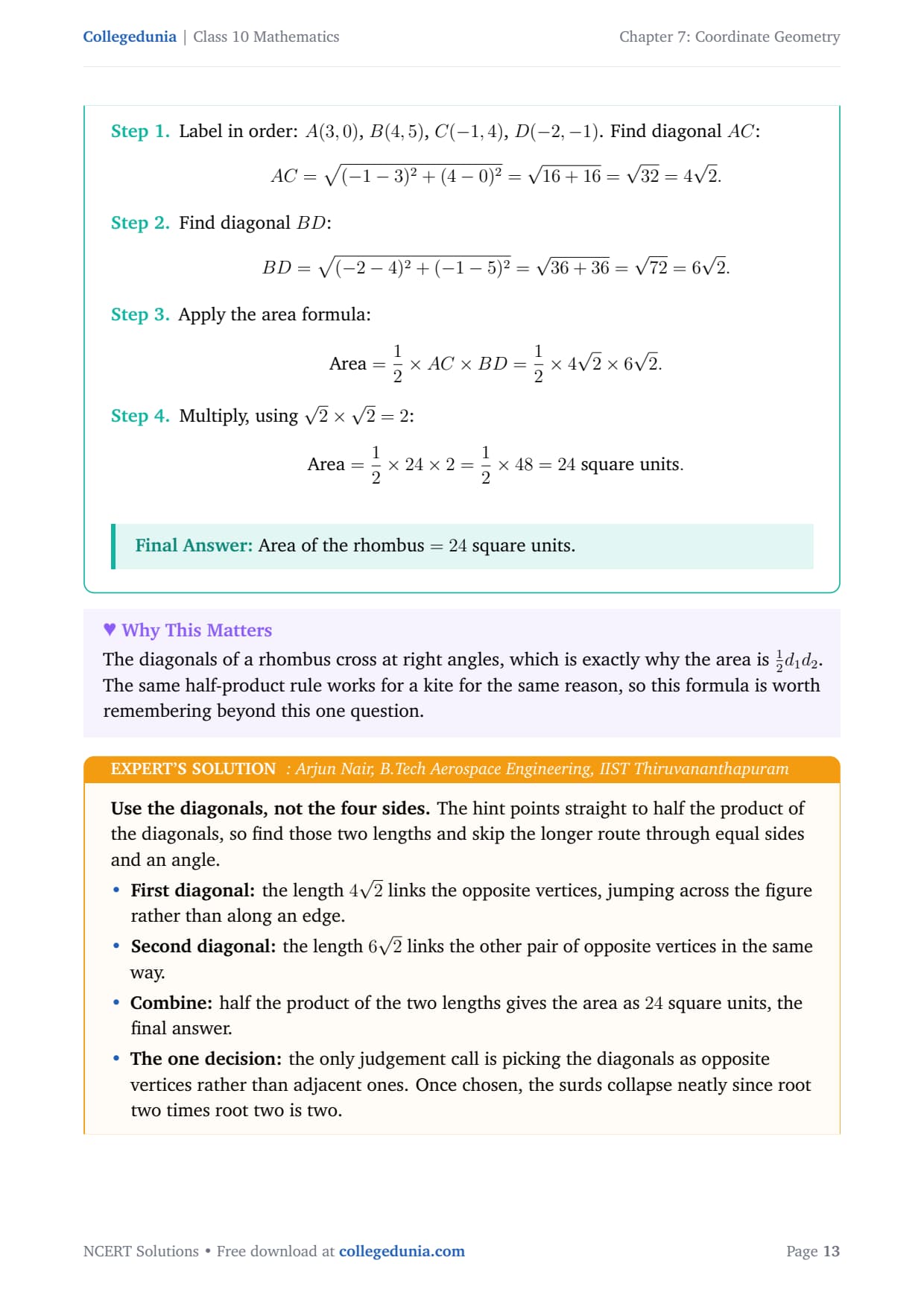
Concept used. The area of a rhombus equals half the
product of its diagonals: Area=12 d1 d2. With
vertices A,B,C,D in order, the diagonals are AC and BD, whose
lengths come from the distance formula.
Use the diagonals, not the four sides. The hint points straight
to half the product of the diagonals, so find those two lengths and skip
the longer route through equal sides and an angle.
First diagonal: the length 4√2 links the opposite
vertices, jumping across the figure rather than along an edge.
Second diagonal: the length 6√2 links the other
pair of opposite vertices in the same way.
Combine: half the product of the two lengths gives the
area as 24 square units, the final answer.
The one decision: the only judgement call is picking the
diagonals as opposite vertices rather than adjacent ones. Once
chosen, the surds collapse neatly since root two times root two is two.
24 square units.
Student Feedback
In a poll before the 2026 boards, 71% of students said the tricky part was keeping the order of coordinates (x, y) right while using the Section Formula. Many also lost marks by mixing up which point is P1 and which is P2.
The fix that helped most: write the full formula once, then put in the numbers. Most students spent about 2 hours on the chapter.
Source: 2026-27 Class 10 Mathematics student poll, 9,200 students from CBSE schools.
NCERT Solutions Class 10 Maths Chapter 7 Coordinate Geometry FAQs
Ques. How many exercises are there in NCERT Class 10 Maths Chapter 7 Coordinate Geometry?
Ans. There are two exercises. Exercise 7.1 uses the Distance Formula to find the gap between two points, check shapes, and solve for unknown coordinates. Exercise 7.2 covers the Section Formula, Midpoint Formula, trisection, the area of a triangle from coordinates, and collinearity. Both exercises are fully solved on this page with an Expert Solution.
Ques. What is the Distance Formula in Class 10 Coordinate Geometry?
Ans. The Distance Formula gives the distance between two points P(x1, y1) and Q(x2, y2): PQ = √[(x2 - x1)2 + (y2 - y1)2]. It comes from the Pythagoras Theorem. For a point (x, y) and the origin, it becomes √(x2 + y2). Always simplify the surd, so √50 becomes 5√2.
Ques. What is the Section Formula in Class 10 Maths Chapter 7?
Ans. The Section Formula gives the point that divides the segment P1(x1, y1) to P2(x2, y2) in the ratio m:n: x = (mx2 + nx1)/(m + n), y = (my2 + ny1)/(m + n). The Midpoint Formula is the special case m = n = 1. Write the formula with subscripts before you put in numbers.
Ques. How do you find the area of a triangle using coordinates?
Ans. The area of a triangle with vertices A(x1, y1), B(x2, y2), C(x3, y3) is (1/2)|x1(y2 - y3) + x2(y3 - y1) + x3(y1 - y2)|. Always take the absolute value, since area is positive. If the area is 0, the three points lie on one line (collinear).
Ques. What is the k:1 trick for finding the ratio in which a point divides a segment?
Ans. When the ratio is unknown, set it as k:1 instead of m:n, so you have one unknown. Apply the Section Formula with m = k and n = 1. Then match one coordinate to the given value (y = 0 for the x-axis, x = 0 for the y-axis) and solve for k. The ratio is k:1.
Ques. How is Coordinate Geometry useful for the CBSE Class 10 board exam?
Ans. Coordinate Geometry comes in the CBSE Class 10 Maths board paper every year and is easy to score in. Common questions ask for the distance between points, proof that points form a shape, a point or ratio from the Section Formula, or the area of a triangle. These carry 2 to 5 marks. Write the formula in full, simplify surds, and state the conclusion to get full marks.







Comments