



The NCERT Solutions for Class 10 Maths Chapter 6 Triangles Exercise 6.1 cover all 3 questions on similar figures and polygon similarity, according to the latest 2026-27 CBSE syllabus. Each answer is solved step by step the way the board expects, with an Expert Solution that adds exam strategy.
- Questions covered: 3 in total, on definitions of similarity, real-life examples of similar and non-similar figures, and identifying whether two quadrilaterals are similar.
- Core concept: two figures are similar when they have the same shape; two polygons are similar only when both corresponding angles are equal and corresponding sides are proportional.
- Board value: Exercise 6.1 introduces the similarity framework that CBSE questions on BPT and triangle criteria in Exercises 6.2 and 6.3 rely on.
Solved by Collegedunia: Every Exercise 6.1 question below is solved by Mathematics subject experts, checked against the official 2026-27 NCERT textbook, and written with full working so each step earns its marks in the CBSE Class 10 paper.
What Exercise 6.1 of Triangles Covers for Class 10
Exercise 6.1 is the opening set of Chapter 6. It sets up the definition of similar figures and the exact conditions under which two polygons count as similar. You need both conditions to hold at the same time: equal corresponding angles and proportional corresponding sides. Get that definition right and the rest of Chapter 6 follows naturally.
- Q1: fill in blanks using the correct word (congruent vs similar) for circles, squares, triangles, and polygons.
- Q2: give two examples each of similar pairs and non-similar pairs from everyday life.
- Q3: decide whether the square ABCD (side 3 cm) and rhombus PQRS (side 1.5 cm) shown in Fig. 6.8 are similar.
How to Solve Exercise 6.1 Question by Question
All three questions test the same core idea: similarity needs both conditions, not just one. A square and a rhombus have sides in ratio 2:1, but their angles disagree, so they are not similar. Two circles have identical shape regardless of size, so they are always similar. Think "same shape?" before writing anything down.
| Question | What it asks | Key answer |
|---|---|---|
| Q1 | Fill in blanks: similar / congruent for circles, squares, triangles, polygons | similar, similar, equilateral, equal and proportional |
| Q2 | Give two pairs of similar figures and two pairs of non-similar figures | Photos at different sizes + two circles; square with non-square rectangle + circle with square |
| Q3 | Are square ABCD (3 cm) and rhombus PQRS (1.5 cm) similar? | Not similar: sides are in ratio 2:1 but angles do not match |
Similar and Non-Similar Figures: Class 10 Maths Chapter 6 Exercise 6.1 Concepts
Two figures are similar when one is a scaled copy of the other. Same shape, possibly different size. Congruent figures go further: same shape AND same size. The NCERT definition of similar polygons states:
- Two polygons with the same number of sides are similar if all corresponding angles are equal, and
- All corresponding sides are in the same ratio (proportional).
Square versus Rhombus: The Classic Non-Similar Pair in Exercise 6.1 Q3
Question 3 is the most important in Exercise 6.1 because it shows why both conditions must hold at the same time. Many students rush to call these two quadrilaterals similar after checking the sides. The angle check stops that mistake.
| Check | Square ABCD | Rhombus PQRS | Result |
|---|---|---|---|
| Side ratio | 3 cm each side | 1.5 cm each side | Ratio 3 : 1.5 = 2 : 1 Pass |
| Angles | All 90° | Two acute, two obtuse (not 90°) | Not equal Fail |
| Similarity verdict | Not similar - side test passes, angle test fails | ||
Common Mistakes Students Make in Triangles Exercise 6.1
Exercise 6.1 is short, but the definition-based questions still catch students off guard in exams. These are the mistakes that appear most often.
- Writing "congruent" instead of "similar" in Q1: congruent means equal shape AND equal size. The question says circles and squares of possibly different sizes, so "similar" is correct.
- Vague examples in Q2: writing "two triangles" without qualification will not score because two general triangles may or may not be similar. Name a specific pair, such as "two equilateral triangles" or "two photographs of the same image at different sizes."
- No reason stated in Q2: the examiner rewards a one-line justification of which condition passes or fails, not just the example.
- Calling the square and rhombus similar in Q3: proportional sides alone do not make two polygons similar. Always check both conditions.
Exercise 6.1 Marks and CBSE Board Relevance for Class 10 Maths
Exercise 6.1 itself carries 2 to 3 marks in internal assessments. In the board paper, the definitions from this exercise appear as fill-in-the-blank or short-answer questions in the 1-mark and 2-mark slots.
| Question type from Exercise 6.1 | Where it appears in the board paper | Typical marks |
|---|---|---|
| Fill in blanks on similarity (Q1 style) | 1-mark very short answer | 1 |
| Example of similar or non-similar pair with reason (Q2 style) | 2-mark short answer | 2 |
| Deciding similarity of two polygons with working (Q3 style) | 2-mark or 3-mark short answer | 2 to 3 |
These solutions follow the 2026-27 NCERT exactly. The working style used here, with a clear two-condition check for every polygon, is what the CBSE marking scheme expects.
Other Resources for Class 10 Maths Chapter 6 Triangles
Use the table below to jump to the other resources for this chapter and the other exercises of Triangles. Each link opens the matching Collegedunia page.
| Resource | What it covers | Open page |
|---|---|---|
| Full chapter solutions | All exercises (6.1, 6.2, 6.3) in one place | Triangles Class 10 NCERT Solutions |
| Next exercise | Similarity criteria: AA, SAS, SSS for triangles | Triangles Class 10 Exercise 6.2 Solutions |
| Exercise 6.3 | Areas of similar triangles, Pythagoras Theorem | Triangles Class 10 Exercise 6.3 Solutions |
| Revision notes | Concept-first notes on BPT, similarity, Pythagoras | Triangles Class 10 Notes |
| Formula sheet | BPT, similarity ratios, area ratio, Pythagoras formulas | Triangles Class 10 Formula Sheet |
| NCERT book PDF | Official NCERT Class 10 Maths Chapter 6 textbook | Triangles Class 10 NCERT Book PDF |
| Handwritten notes | Scanned-style handwritten pages for quick revision | Triangles Class 10 Handwritten Notes |
| Exemplar solutions | Worked solutions to NCERT Exemplar problems | Triangles Class 10 Exemplar Solutions |
NCERT Solutions for Class 10 Maths Triangles: All Exercises
Chapter 6 Triangles has three exercises. The table below links each exercise to its own step-by-step solutions page.
| Exercise | Topic | Solutions page |
|---|---|---|
| Exercise 6.1 | Similar figures, definition of similarity, polygon similarity conditions | Triangles Exercise 6.1 NCERT Solutions |
| Exercise 6.2 | AA, SAS, SSS similarity criteria; finding unknown sides | Triangles Exercise 6.2 NCERT Solutions |
| Exercise 6.3 | Areas of similar triangles; Pythagoras Theorem and its converse | Triangles Exercise 6.3 NCERT Solutions |
| Full chapter | All exercises in one PDF | Triangles Class 10 NCERT Solutions (all exercises) |
NCERT Solutions for Class 10 Maths: All Chapters
Use the table below to jump to the NCERT Solutions for the other chapters of Class 10 Maths. Every chapter uses the same step-by-step answer style.
| Chapter | NCERT Solutions |
|---|---|
| Chapter 1 | Real Numbers NCERT Solutions |
| Chapter 2 | Polynomials NCERT Solutions |
| Chapter 3 | Pair of Linear Equations NCERT Solutions |
| Chapter 4 | Quadratic Equations NCERT Solutions |
| Chapter 5 | Arithmetic Progressions NCERT Solutions |
| Chapter 6 | Triangles NCERT Solutions |
| Chapter 7 | Coordinate Geometry NCERT Solutions |
| Chapter 8 | Introduction to Trigonometry NCERT Solutions |
| Chapter 9 | Some Applications of Trigonometry NCERT Solutions |
| Chapter 10 | Circles NCERT Solutions |
| Chapter 11 | Areas Related to Circles NCERT Solutions |
| Chapter 12 | Surface Areas and Volumes NCERT Solutions |
| Chapter 13 | Statistics NCERT Solutions |
| Chapter 14 | Probability NCERT Solutions |
All NCERT Solutions for Class 10 Maths Chapter 6 Triangles Exercise 6.1 with Step-by-Step Solutions
Exercise 6.1
Fill in the blanks using the correct word given in brackets:
(i) All circles are 2.4cm0.4pt. (congruent, similar) (ii) All squares are 2.4cm0.4pt. (similar, congruent) (iii) All 2.4cm0.4pt triangles are similar. (isosceles, equilateral) (iv) Two polygons of the same number of sides are similar, if (a) their corresponding angles are 2.2cm0.4pt and (b) their corresponding sides are 2.6cm0.4pt. (equal, proportional)
Give two different examples of pair of
(i) similar figures. (ii) non-similar figures.
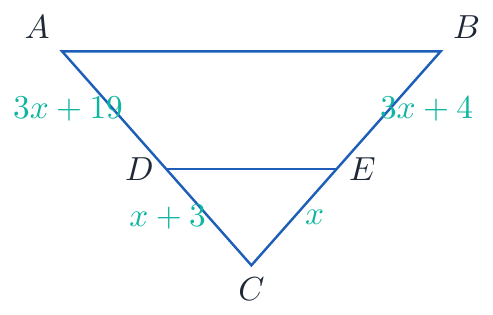
State whether the following quadrilaterals are similar or not:
Student Feedback
Out of 6,200 students surveyed before the 2026 boards, 84% said Exercise 6.1 felt straightforward once they memorised the two-condition rule for similarity (equal angles AND proportional sides). The most common slip was calling a square and a rhombus "similar" because the sides are proportional, without checking the angles.
Source: Collegedunia Class 10 student survey, 2026 board season.
Triangles Class 10 Maths Exercise 6.1 NCERT Solutions FAQs
Ques. How many questions are there in Class 10 Maths Chapter 6 Triangles Exercise 6.1?
Ans. Exercise 6.1 has 3 questions. They cover the definition of similar figures, examples of similar and non-similar pairs, and deciding whether a square and a rhombus with proportional sides are similar.
Ques. What is the main concept tested in Exercise 6.1 of Class 10 Maths?
Ans. Exercise 6.1 tests the definition of similar figures. Two figures are similar when they have the same shape. For polygons, similarity requires both conditions at the same time: corresponding angles must be equal and corresponding sides must be proportional.
Ques. Are the square and rhombus in Q3 of Exercise 6.1 similar?
Ans. No. The square ABCD (side 3 cm) and rhombus PQRS (side 1.5 cm) are not similar. Their sides are in ratio 2:1, so the side test passes. However, the square has four 90° angles while the rhombus has two acute and two obtuse angles, so the angle test fails. Since both conditions must hold together for similarity, these two quadrilaterals are not similar.
Ques. Why are all equilateral triangles similar to each other?
Ans. Every equilateral triangle has three angles each equal to 60°. So any two equilateral triangles are equiangular, which means their corresponding angles are always equal. Since the shape is fixed and only the size can differ, the side ratios are also always proportional. Both conditions for similarity are automatically satisfied, which is why all equilateral triangles are similar.
Ques. Where can I download the Class 10 Maths Chapter 6 Exercise 6.1 NCERT Solutions PDF?
Ans. You can download the Triangles Exercise 6.1 NCERT Solutions PDF directly from this page using the download card at the top. It is free and follows the 2026-27 NCERT textbook. The full chapter PDF with all three exercises (6.1, 6.2, 6.3) is also available on the Triangles chapter solutions page.



Comments