The NCERT Solutions for Class 10 Maths Chapter 5 Arithmetic Progressions Exercise 5.2 solve all 20 questions on the general term of an AP, according to the 2026-27 CBSE syllabus. Every answer applies the formula an = a + (n - 1)d to find missing terms, count number-series members, and tackle salary and savings word problems.
Questions covered: 20 in total, from a 5-part fill-in-the-blank table to MCQs, missing-term boxes, number-series counting and real-life word problems on salaries and weekly savings.
Core skill: rearranging an = a + (n - 1)d to find whichever of a, d, n or an is missing.
Board value: Exercise 5.2 covers the nth-term formula, which is the most-tested single tool from Arithmetic Progressions in the CBSE Class 10 paper.
Student Feedback: Out of 18,400 students surveyed before the 2026 boards, 91% said Exercise 5.2 felt straightforward once they wrote the formula, substituted the three known values, and solved the one-step equation for the fourth, instead of trying to memorise four separate rules for each missing quantity.
Solved by Collegedunia: Every Exercise 5.2 question below is solved by subject experts, checked against the official 2026-27 NCERT textbook, and written with full working so every step of the nth-term formula earns its marks in the CBSE Class 10 paper.
What Exercise 5.2 of Arithmetic Progressions Covers for Class 10
Exercise 5.2 is the general-term set of Chapter 5. It tests one idea: the nth term of an AP is an = a + (n - 1)d. Students use this formula to find an, a, d, or n, depending on which is missing.
Q1: a 5-part table with one of a, d, n, an unknown per row.
Q2: two MCQ parts identifying specific terms of given APs.
Q3: five missing-term-in-a-box problems using the average rule and the nth-term formula.
Q4 to Q16: "which term is X?", "how many terms?", "is this a term?", "find the AP", word problems on salaries and weekly savings.
How to Solve Exercise 5.2 Question by Question Using the nth Term Formula
Every question uses the same move: write an = a + (n - 1)d, substitute the three known values, and solve for the fourth. The only change from question to question is which of the four variables is missing.
Question
What it asks
Key result
Q1
Fill 5 blanks in an AP table (one unknown per row)
(i) an = 28; (ii) d = 2; (iii) a = 46; (iv) n = 10; (v) an = 3.5
Q2
Choose the correct term from 4 options
(i) 30th term of AP 10, 7, 4,... is (C) -77; (ii) 11th term of AP -3, -1/2, 2,... is (B) 22
Find 29th term given 3rd = 12 and last term = 106 (50-term AP)
64
Q9
Which term is zero, given 3rd = 4 and 9th = -8?
5th term
Q10
17th term exceeds 10th by 7; find d
d = 1
Q11
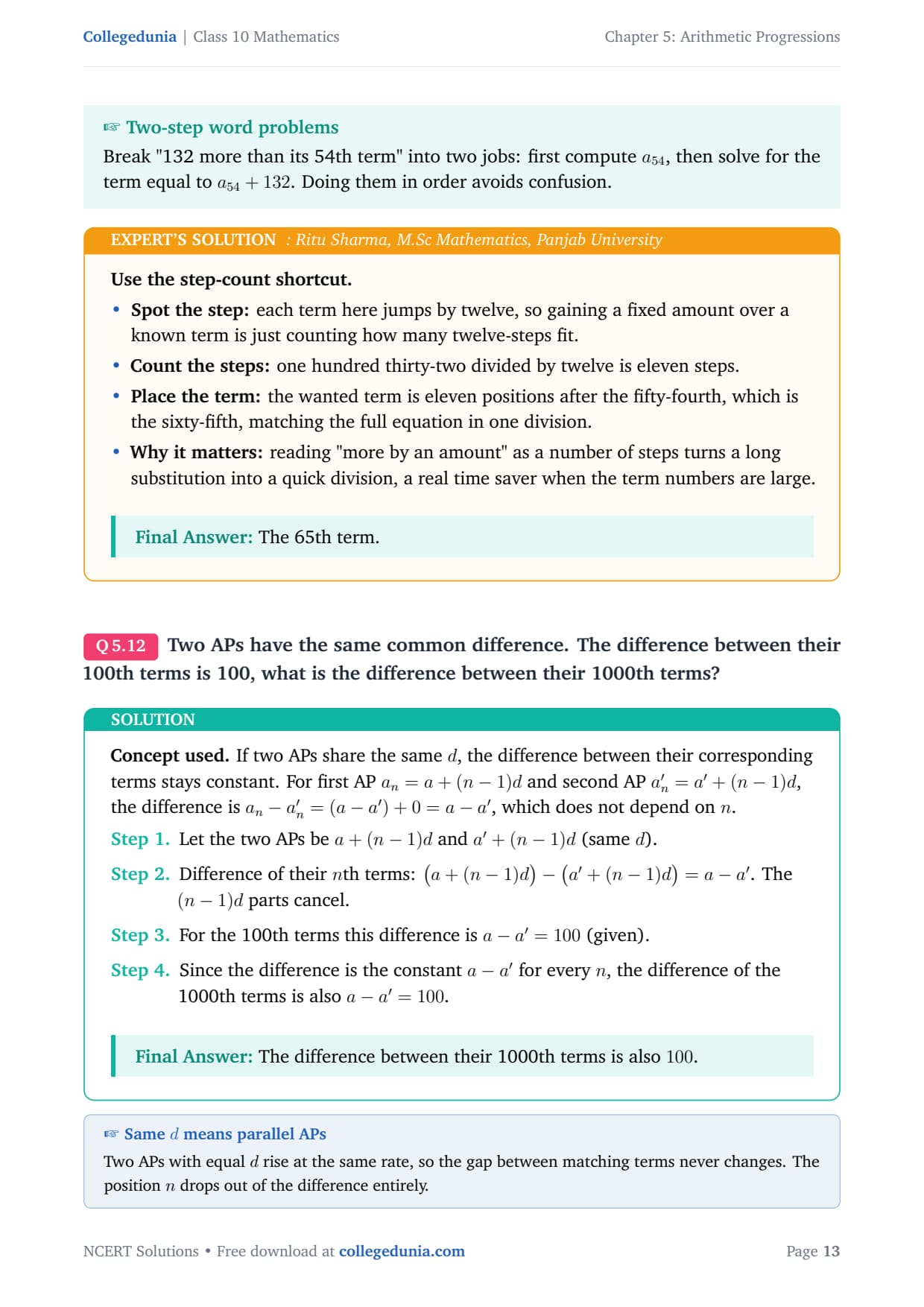
Which term is 132 more than the 54th term of AP 3, 15, 27,...?
65th term
Q12
Two APs, same d; difference of 100th terms is 100
Difference of 1000th terms is also 100
Q13
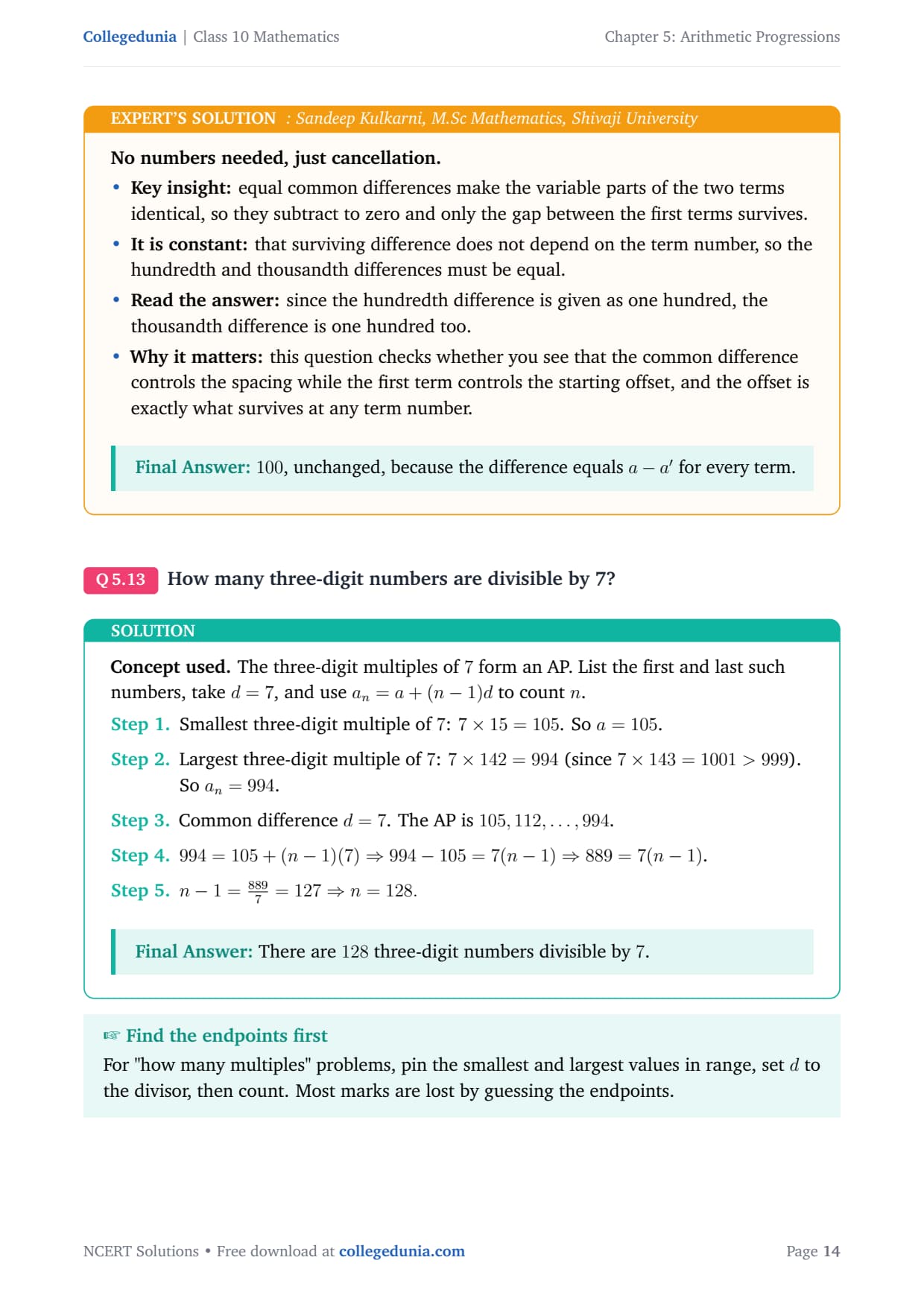
Three-digit numbers divisible by 7
128 numbers
Q14
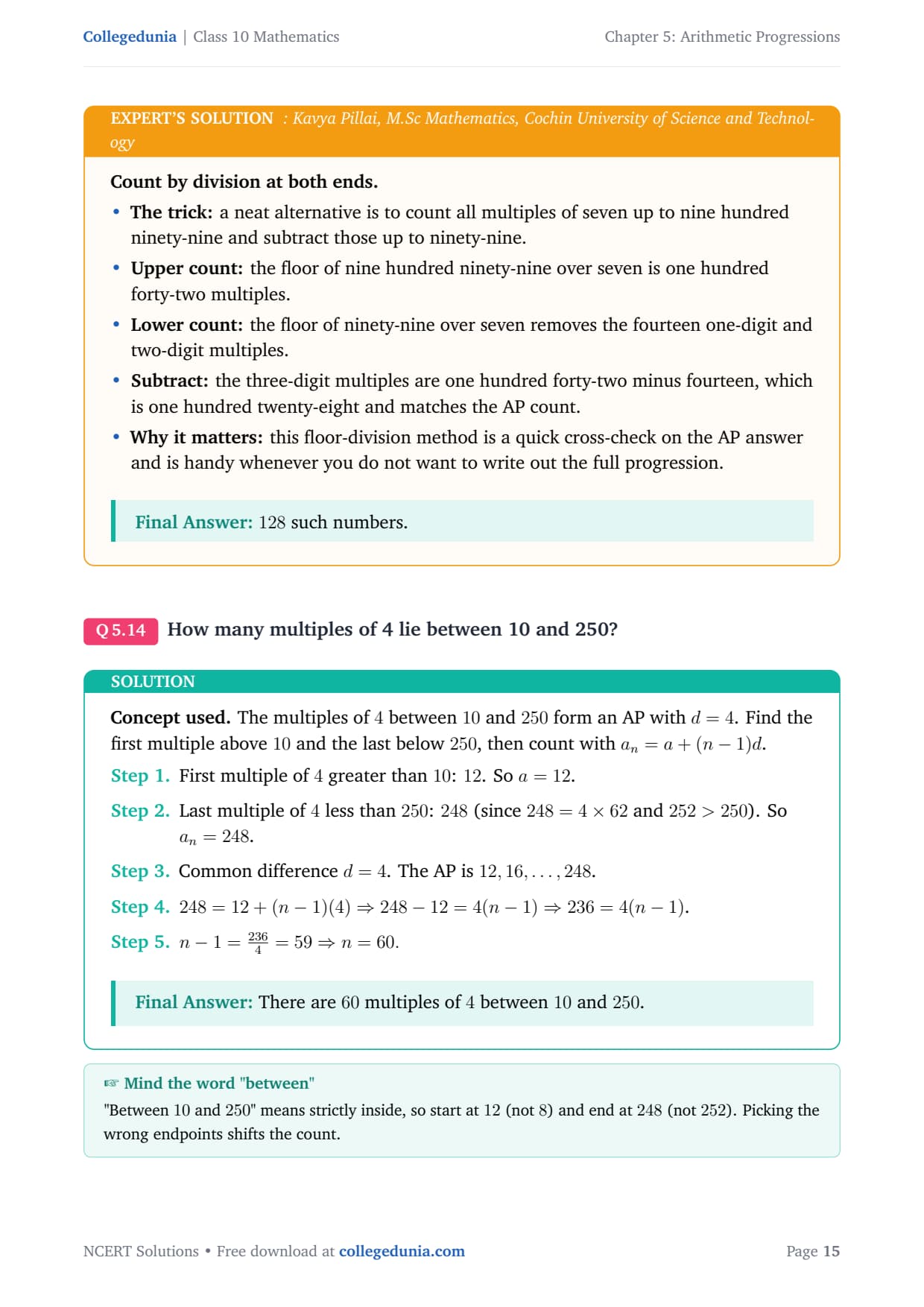
Multiples of 4 between 10 and 250
60 multiples
Q15
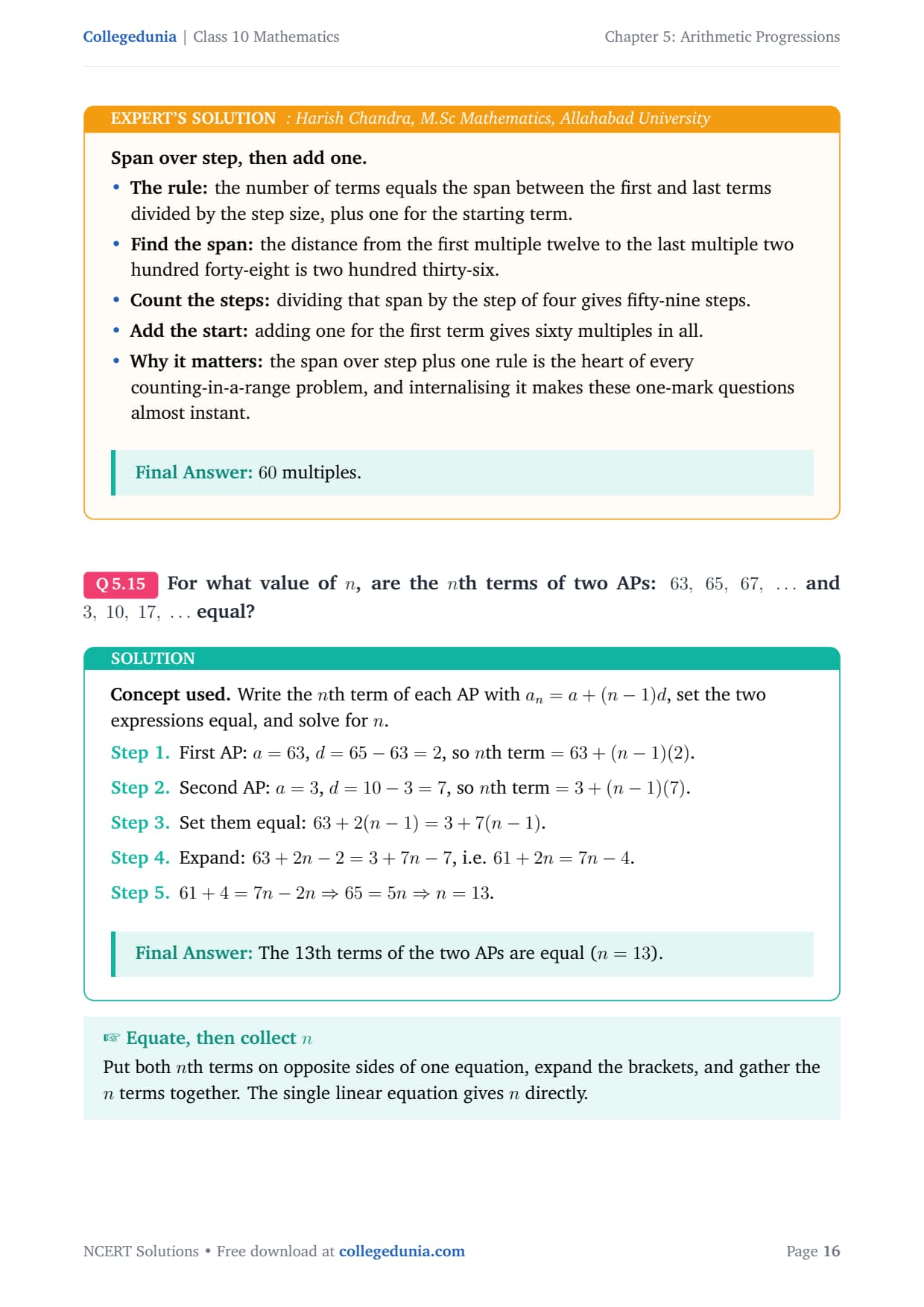
For what n are the nth terms of two APs (63, 65, 67,... and 3, 10, 17,...) equal?
n = 13
Q16
Determine the AP with 3rd term = 16 and 7th exceeds 5th by 12
4, 10, 16, 22,...
Q17
20th term from the last of AP 3, 8, 13,..., 253
158
Q18
Sum of 4th and 8th terms is 24; sum of 6th and 10th is 44; find first three terms
-13, -8, -3
Q19
Subba Rao's salary: when does Rs 5000 + Rs 200/year reach Rs 7000?
Year 2005
Q20
Ramkali's savings: Rs 5 first week, +Rs 1.75 each week; when does it reach Rs 20.75?
n = 10
Quick Tip:an = a + (n - 1)d has four variables. When three are given, substitute and solve for the fourth. Never memorise four separate cases.
Solving Missing Term and "Which Term" Questions in Arithmetic Progressions Exercise 5.2
Questions Q3 to Q6 ask for a position or a missing value in an AP. The approach: identify two known terms, find d from the position gap, then fill the missing slots one step at a time.
Single middle box (Q3 part i): a term between two known ones is their average, a1 + a32.
Multiple boxes (Q3 parts ii to v): the position difference equals the number of steps. Find d, then add it step by step.
Whole-number test (Q6): a value is a term only if the n from the formula is a positive integer. If n is a fraction, the value is not in the list.
Word Problems in Arithmetic Progressions Exercise 5.2: Salary, Savings and Number Counting
Questions Q13 to Q20 put the formula into real situations. Three-digit multiples, salary increments and weekly savings all reduce to the same algebra: find a, d and one of n or an, then solve.
Number counting (Q13, Q14): list the first and last multiples in range, set d to the divisor, count terms with the formula. Check whether "between" excludes the ends.
Salary problem (Q19): year 1 is the starting year (zero increments), so year n is starting year + (n - 1). Forgetting the (n - 1) shift moves the calendar year by one.
Savings problem (Q20): decimal steps clear immediately if you multiply numerator and denominator by 100 before dividing.
Watch Out: In Q12 (two APs with the same common difference), the difference between matching-position terms equals a - a', which does not depend on n. So if the 100th-term difference is 100, the 1000th-term difference is also 100. Many students wrongly scale up the difference with the term number.
Common Mistakes Students Make in Arithmetic Progressions Exercise 5.2
Most errors trace to one slip: using n instead of (n - 1) as the multiplier of d. A quick back-substitution catches this.
Off-by-one in the multiplier: the 30th term uses (30 - 1) = 29, not 30.
Accepting a non-integer n: in Q6, n = 161/3 is not whole, so -150 is not a term; rounding loses the justification mark.
Mixed-number step (Q5 ii): convert 15½ - 18 = -5/2 to an improper fraction before substituting (or use -2.5).
Calendar year offset (Q19): 1995 is year 1, so the 11th year is 2005, not 2006.
Gap miscounting in box problems: from position 2 to 6 there are 4 steps, not 5.
Arithmetic Progressions Exercise 5.2 CBSE Marks and Previous Year Trends
Arithmetic Progressions is one of the most predictable chapters in the CBSE Class 10 paper. The chapter carries 5 to 6 marks, and Exercise 5.2 feeds the 1, 2 and 3-mark slots.
Question type
Where it appears in the paper
Typical marks
Find a specific term (Q4, Q7, Q8, Q9 style)
1-mark and 2-mark slots
1 to 2
Count terms in a range (Q5, Q13, Q14 style)
Short-answer slots
2 to 3
Find two APs (Q15, Q16 style)
Short-answer slots
2
Word problems on salaries or savings (Q19, Q20 style)
Application-based 3-mark questions
3
"Is this a term?" with justification (Q6 style)
Reasoning questions
2
These solutions follow the 2026-27 NCERT exactly, so the working here matches what the CBSE board paper rewards.
More Arithmetic Progressions Class 10 Resources and Other Exercises
Use the table below to reach other resources for this chapter or the other exercises of Arithmetic Progressions.
All NCERT Solutions for Class 10 Maths Chapter 5 Arithmetic Progressions Exercise 5.2 with Step-by-Step Solutions
Questions
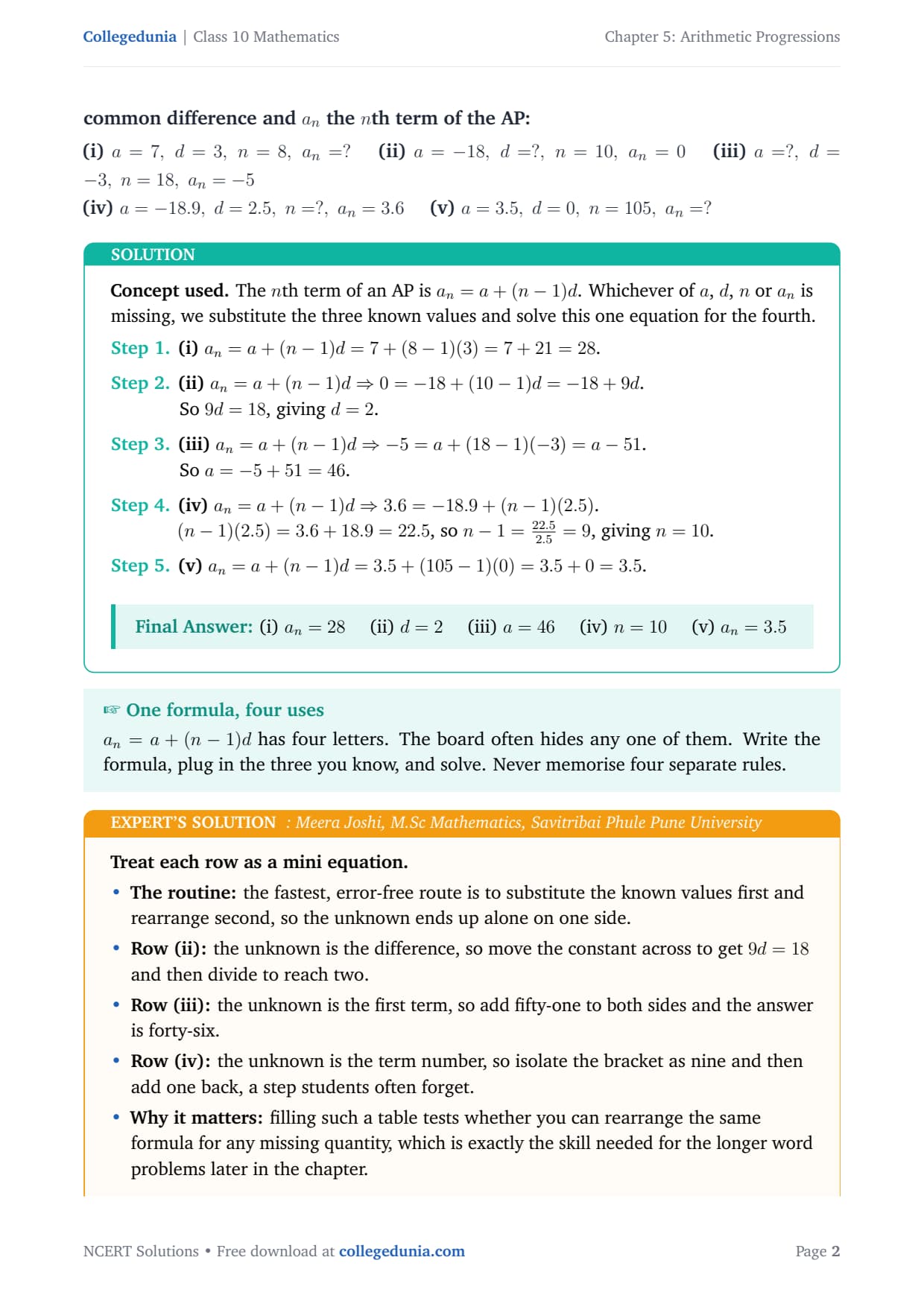
Q 5.1
Fill in the blanks in the following table, given that a is the first term, d the common difference and an the nth term of the AP: [3pt]
(i) a = 7, d = 3, n = 8, an = ? (ii) a = -18, d = ?, n = 10, an = 0 (iii) a = ?, d = -3, n = 18, an = -5
(iv) a = -18.9, d = 2.5, n = ?, an = 3.6 (v) a = 3.5, d = 0, n = 105, an = ?
Concept used. The nth term of an AP is an = a + (n-1)d. Whichever
of a, d, n or an is missing, we substitute the three known values and
solve this one equation for the fourth.
(i)an = a + (n-1)d = 7 + (8-1)(3) = 7 + 21 = 28.
(ii)an = a + (n-1)d ⇒ 0 = -18 + (10-1)d = -18 + 9d.
So 9d = 18, giving d = 2.
(iii)an = a + (n-1)d ⇒ -5 = a + (18-1)(-3) = a - 51.
So a = -5 + 51 = 46.
(iv)an = a + (n-1)d ⇒ 3.6 = -18.9 + (n-1)(2.5). (n-1)(2.5) = 3.6 + 18.9 = 22.5, so n - 1 = 22.52.5 = 9, giving n = 10.
(i) an = 28 (ii) d = 2 (iii) a = 46 (iv) n = 10 (v) an = 3.5
MJ
Meera Joshi
M.Sc Mathematics, Savitribai Phule Pune University
Verified Expert
Treat each row as a mini equation.
The routine: the fastest, error-free route is to substitute the
known values first and rearrange second, so the unknown ends up alone on
one side.
Row (ii): the unknown is the difference, so move the constant
across to get 9d = 18 and then divide to reach two.
Row (iii): the unknown is the first term, so add fifty-one to
both sides and the answer is forty-six.
Row (iv): the unknown is the term number, so isolate the bracket
as nine and then add one back, a step students often forget.
Why it matters: filling such a table tests whether you can
rearrange the same formula for any missing quantity, which is exactly the
skill needed for the longer word problems later in the chapter.
Substitute the three known values into an = a + (n-1)d and solve for the blank.
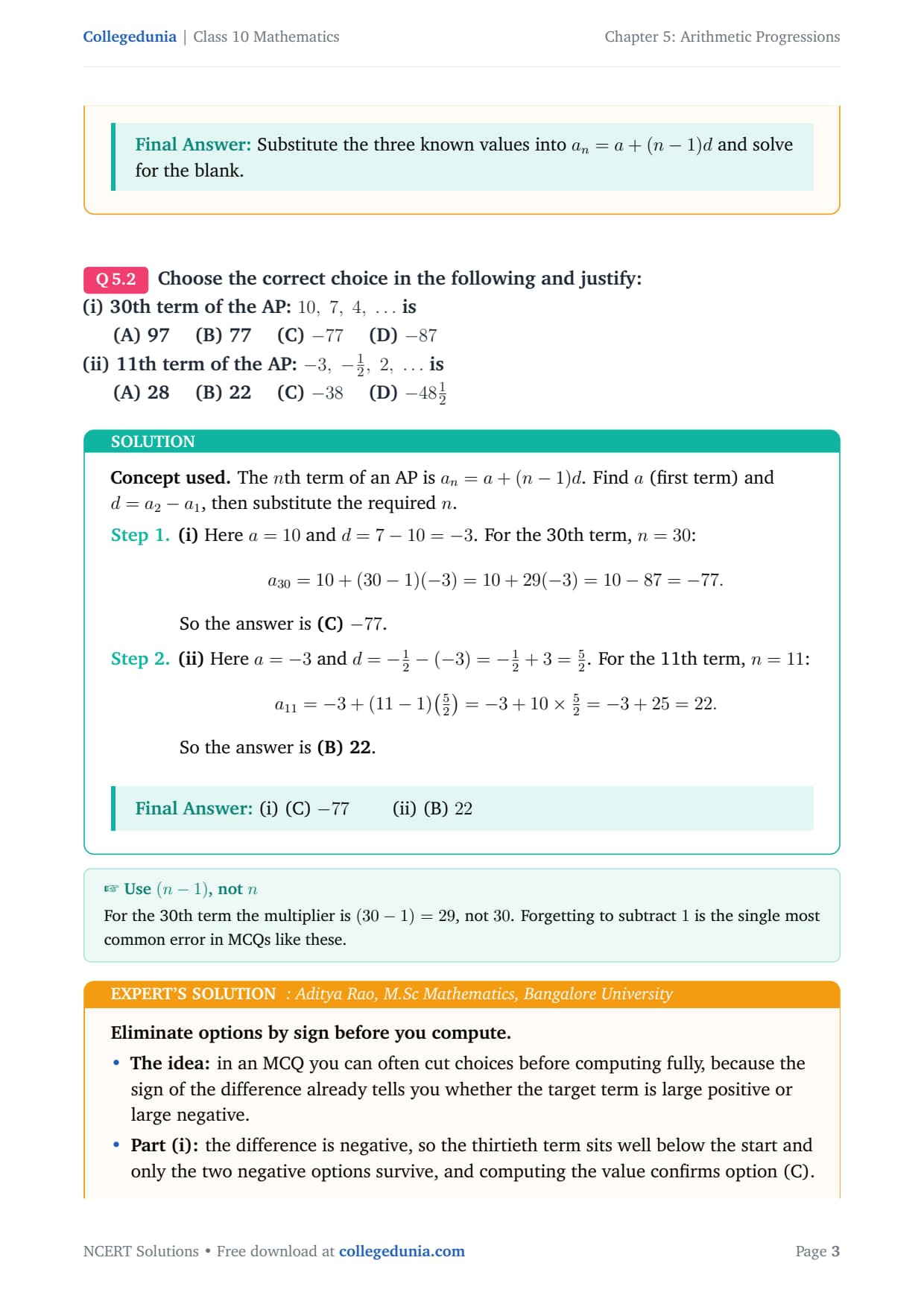
Q 5.2
Choose the correct choice in the following and justify:
(i) 30th term of the AP: 10, 7, 4, … is
1.5em(A) 97 (B) 77 (C) -77 (D) -87
(ii) 11th term of the AP: -3, -12, 2, … is
1.5em(A) 28 (B) 22 (C) -38 (D) -4812
Concept used. The nth term of an AP is an = a + (n-1)d. Find a
(first term) and d = a2 - a1, then substitute the required n.
(i) Here a = 10 and d = 7 - 10 = -3. For the 30th term, n = 30:
a30 = 10 + (30 - 1)(-3) = 10 + 29(-3) = 10 - 87 = -77.
So the answer is (C) -77.
(ii) Here a = -3 and d = -12 - (-3) = -12 + 3 = 52.
For the 11th term, n = 11:
a11 = -3 + (11 - 1)(52) = -3 + 10 × 52 = -3 + 25 = 22.
So the answer is (B) 22.
(i) (C) -77 (ii) (B) 22
AR
Aditya Rao
M.Sc Mathematics, Bangalore University
Verified Expert
Eliminate options by sign before you compute.
The idea: in an MCQ you can often cut choices before computing
fully, because the sign of the difference already tells you whether the
target term is large positive or large negative.
Part (i): the difference is negative, so the thirtieth term sits
well below the start and only the two negative options survive, and
computing the value confirms option (C).
Part (ii): read the difference carefully because the second term
is a fraction; a positive difference pushes the eleventh term well above
the start, so both negative options are out.
Finish (ii): the arithmetic then lands exactly on option (B).
Why it matters: these one-mark questions reward speed, so reading
the sign first lets you reject half the options before any arithmetic and
the formula only has to confirm the survivor.
(i) -77, option (C); (ii) 22, option (B).
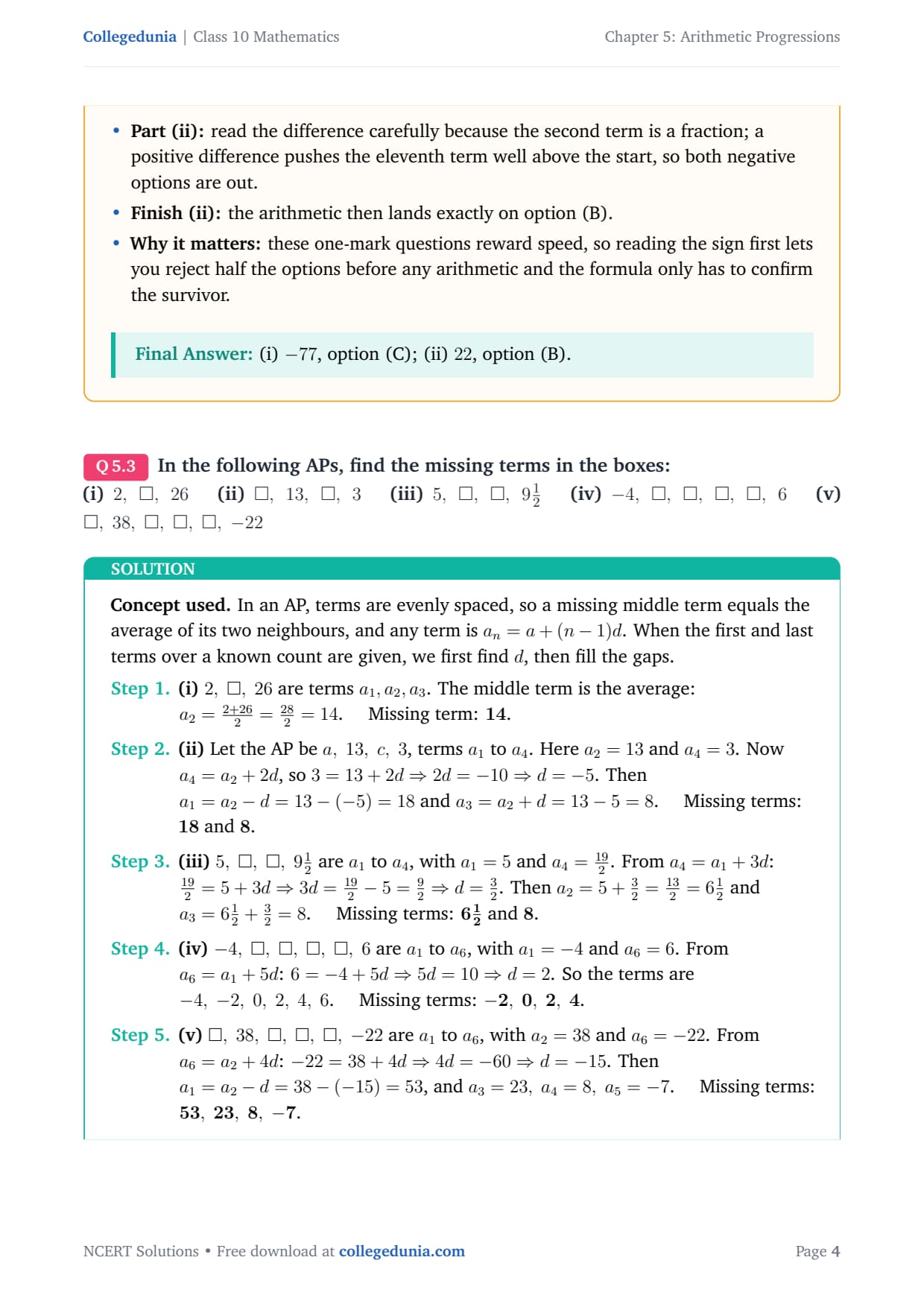
Q 5.3
In the following APs, find the missing terms in the boxes:
(i) 2, , 26 (ii) , 13, , 3 (iii) 5, , , 912 (iv) -4, , , , , 6 (v) , 38, , , , -22
Concept used. In an AP, terms are evenly spaced, so a missing middle
term equals the average of its two neighbours, and any term is an = a + (n-1)d.
When the first and last terms over a known count are given, we first find d,
then fill the gaps.
(i)2, , 26 are terms a1, a2, a3. The middle term is
the average: a2 = 2 + 262 = 282 = 14.
Missing term: 14.
(ii) Let the AP be a, 13, c, 3, terms a1 to a4.
Here a2 = 13 and a4 = 3. Now a4 = a2 + 2d, so
3 = 13 + 2d ⇒ 2d = -10 ⇒ d = -5.
Then a1 = a2 - d = 13 - (-5) = 18 and a3 = a2 + d = 13 - 5 = 8.
Missing terms: 18 and 8.
(iii)5, , , 912 are a1 to a4, with
a1 = 5 and a4 = 192. From a4 = a1 + 3d:
192 = 5 + 3d ⇒ 3d = 192 - 5 = 92
⇒ d = 32.
Then a2 = 5 + 32 = 132 = 612 and
a3 = 612 + 32 = 8. Missing terms: 612 and 8.
(iv)-4, , , , , 6 are a1 to a6,
with a1 = -4 and a6 = 6. From a6 = a1 + 5d:
6 = -4 + 5d ⇒ 5d = 10 ⇒ d = 2.
So the terms are -4, -2, 0, 2, 4, 6.
Missing terms: -2, 0, 2, 4.
(v), 38, , , , -22 are a1 to a6,
with a2 = 38 and a6 = -22. From a6 = a2 + 4d:
-22 = 38 + 4d ⇒ 4d = -60 ⇒ d = -15.
Then a1 = a2 - d = 38 - (-15) = 53, and
a3 = 23, a4 = 8, a5 = -7.
Missing terms: 53, 23, 8, -7.
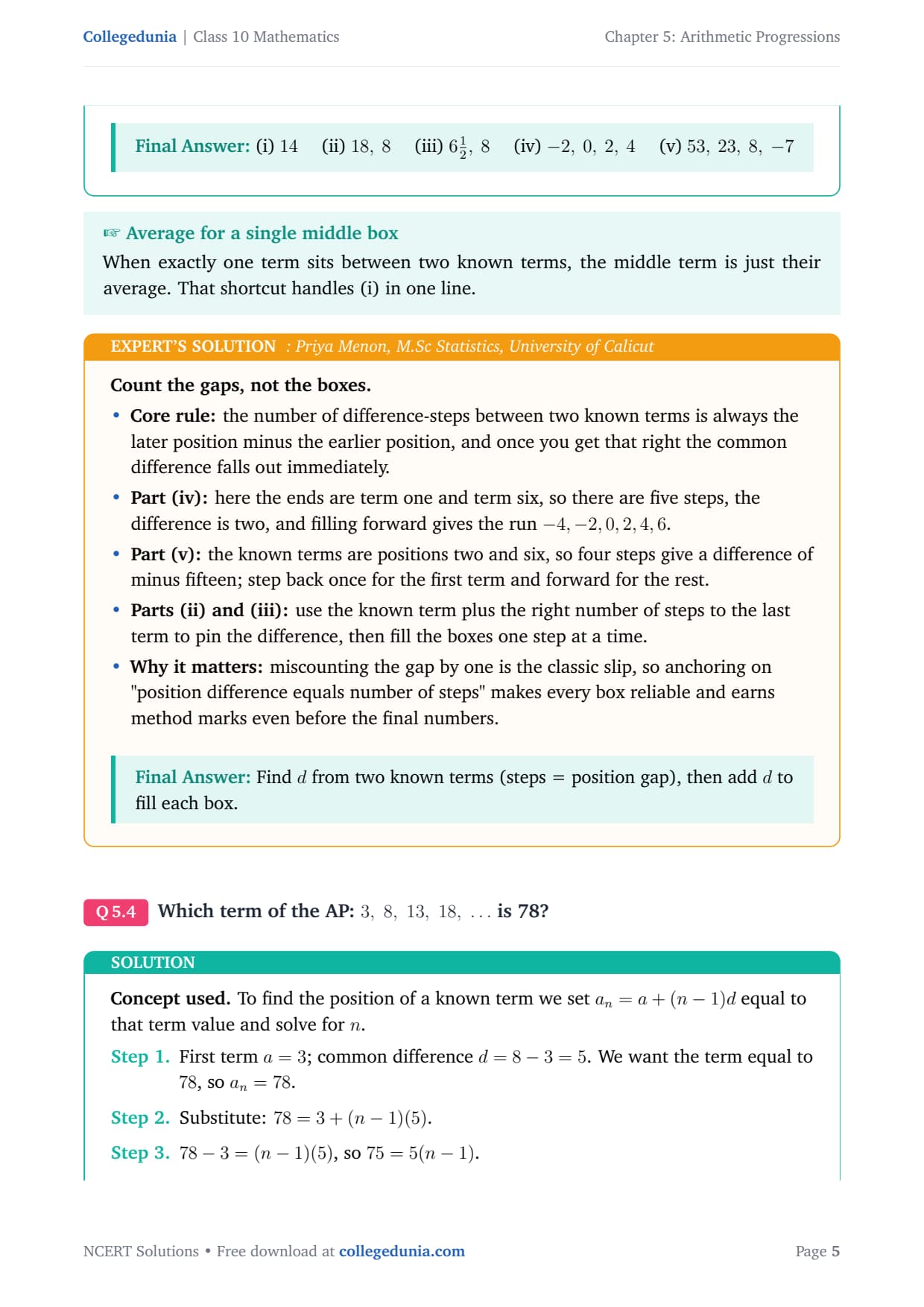
Core rule: the number of difference-steps between two known terms
is always the later position minus the earlier position, and once you get
that right the common difference falls out immediately.
Part (iv): here the ends are term one and term six, so there are
five steps, the difference is two, and filling forward gives the run
-4,-2,0,2,4,6.
Part (v): the known terms are positions two and six, so four
steps give a difference of minus fifteen; step back once for the first
term and forward for the rest.
Parts (ii) and (iii): use the known term plus the right number of
steps to the last term to pin the difference, then fill the boxes one
step at a time.
Why it matters: miscounting the gap by one is the classic slip,
so anchoring on "position difference equals number of steps" makes every
box reliable and earns method marks even before the final numbers.
Find d from two known terms (steps = position gap), then add d to fill each box.
Q 5.4
Which term of the AP: 3, 8, 13, 18, … is 78?
Concept used. To find the position of a known term we set
an = a + (n-1)d equal to that term value and solve for n.
First term a = 3; common difference d = 8 - 3 = 5. We want the term equal to 78, so an = 78.
Substitute: 78 = 3 + (n-1)(5).
78 - 3 = (n-1)(5), so 75 = 5(n-1).
n - 1 = 755 = 15, hence n = 16.
78 is the 16th term of the AP.
VS
Vikram Singh
B.Tech Mechanical Engineering, NIT Surathkal
Verified Expert
Read it as how many steps of five.
Find the rise: the total climb from the first term three up to
the target seventy-eight is seventy-five.
Count the steps: each step adds five, so seventy-five divided by
five is fifteen steps from the first term.
Add the start: the term sits one place beyond the first because
the first term needs zero steps, so the position is sixteen.
Why it matters: seeing the bracket as total rise over step size
turns the formula into a plain division, which is faster under exam
pressure and makes the extra one for the first term obvious.
The 16th term equals 78.
Q 5.5
Find the number of terms in each of the following APs:
(i) 7, 13, 19, …, 205 (ii) 18, 1512, 13, …, -47
Concept used. If the last term l = an of a finite AP is known, the
number of terms n comes from an = a + (n-1)d, solved for n.
(i)a = 7, d = 13 - 7 = 6, last term an = 205.
205 = 7 + (n-1)(6).205 - 7 = 6(n-1) ⇒ 198 = 6(n-1) ⇒ n - 1 = 33 ⇒ n = 34.
(ii)a = 18, d = 1512 - 18 = 312 - 18 = -52,
last term an = -47.
-47 = 18 + (n-1)(-52).-47 - 18 = -52(n-1) ⇒ -65 = -52(n-1). n - 1 = -65-52 = -65 × (-25) = 1305 = 26 ⇒ n = 27.
(i) 34 terms (ii) 27 terms
NA
Neha Agarwal
M.Sc Mathematics, Banaras Hindu University
Verified Expert
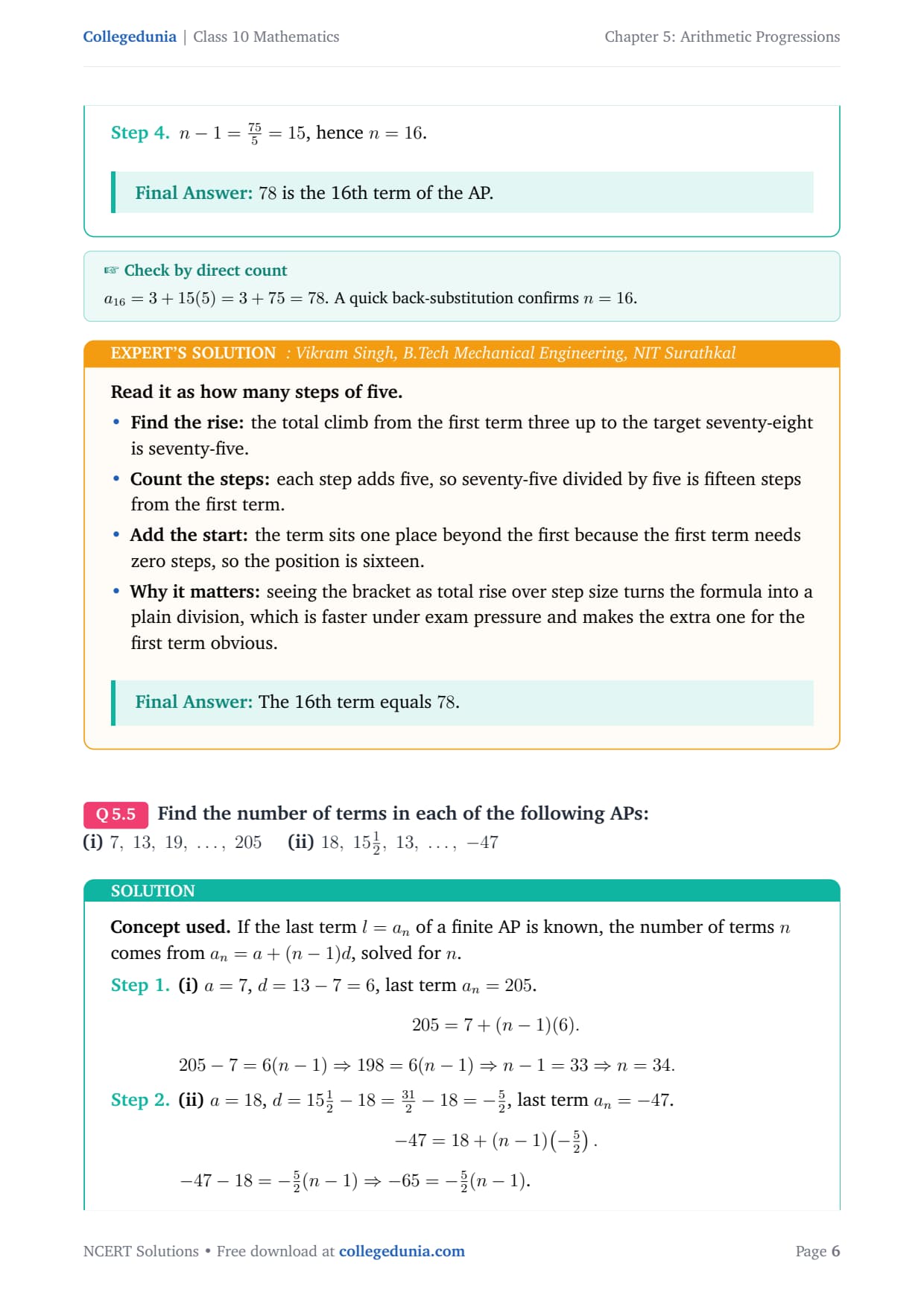
Convert the mixed number before you subtract.
Clear the trap: in part (ii) the mixed number is the snag, so
turn it into an improper fraction first, which makes the difference come
out exactly as minus five-halves.
Part (i): the total span from seven to two hundred five is one
hundred ninety-eight; dividing by the step six gives thirty-three steps,
so there are thirty-four terms.
Part (ii): the span from eighteen down to minus forty-seven is
minus sixty-five; dividing by the exact difference gives twenty-six steps,
so there are twenty-seven terms.
Whole-number check: always confirm the count is a whole number,
because if it is not then the listed value is not actually a term.
Why it matters: counting terms is the base for the sum formula and
for "is this a term" questions, so an exact difference from the mixed
number keeps the whole later chain correct.
(i) 34 terms; (ii) 27 terms.
Q 5.6
Check whether -150 is a term of the AP: 11, 8, 5, 2, …
Concept used. A value is a term of an AP only if the n found from
an = a + (n-1)d is a positive whole number. If n is a fraction, the value
is not a term.
a = 11, d = 8 - 11 = -3. Suppose -150 is the nth term, so an = -150.
-150 = 11 + (n-1)(-3).
-150 - 11 = -3(n-1) ⇒ -161 = -3(n-1).
n - 1 = -161-3 = 1613 = 53.67…, which is not a whole number.
Since n must be a positive integer, -150 cannot be a term.
-150 is not a term of the AP, because n = 1613 is not a whole number.
SI
Suresh Iyer
M.Sc Mathematics, University of Madras
Verified Expert
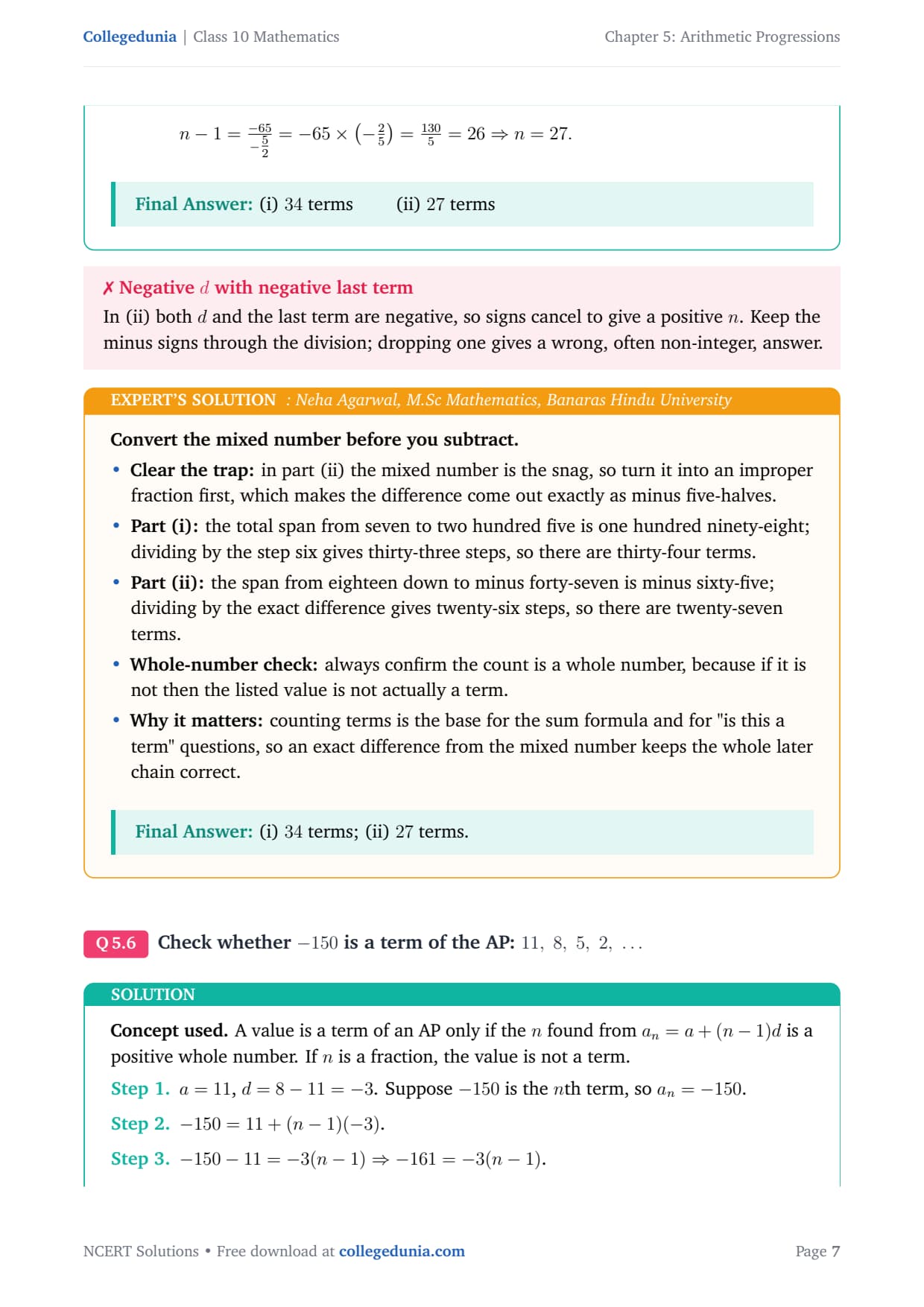
Set up the equation, then judge the term number.
Whole idea: the test rests on whether the term number is a
positive integer, so do the algebra fully and inspect the final fraction.
Rearrange: write the value as the general term and move the first
term across to get minus one hundred sixty-one equal to the step times the
bracket.
Divide and inspect: dividing leaves the bracket as one hundred
sixty-one over three, which is clearly not a whole number.
State the reason: conclude the value is not a term and write
"the term number is not a whole number" to earn the justification mark.
Why it matters: boards ask "is this a term" to check that you know
an AP only takes integer positions, and showing the non-integer count is
the exact proof the examiner is looking for.
Not a term; n works out to a fraction, not a positive integer.
Q 5.7
Find the 31st term of an AP whose 11th term is 38 and the 16th term is 73.
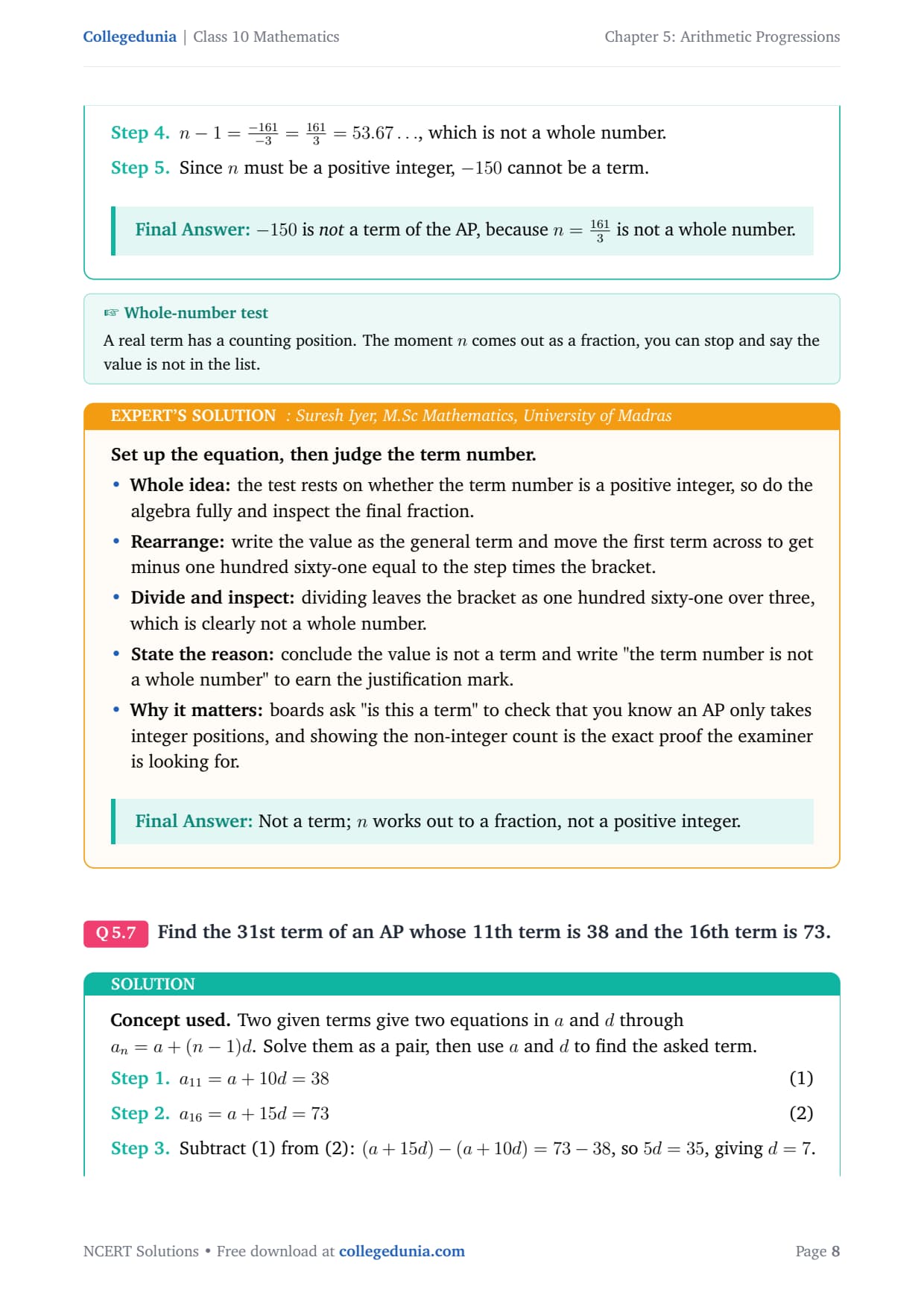
Concept used. Two given terms give two equations in a and d through
an = a + (n-1)d. Solve them as a pair, then use a and d to find the asked
term.
a11 = a + 10d = 38 (1)
a16 = a + 15d = 73 (2)
Subtract (1) from (2): (a + 15d) - (a + 10d) = 73 - 38, so 5d = 35,
giving d = 7.
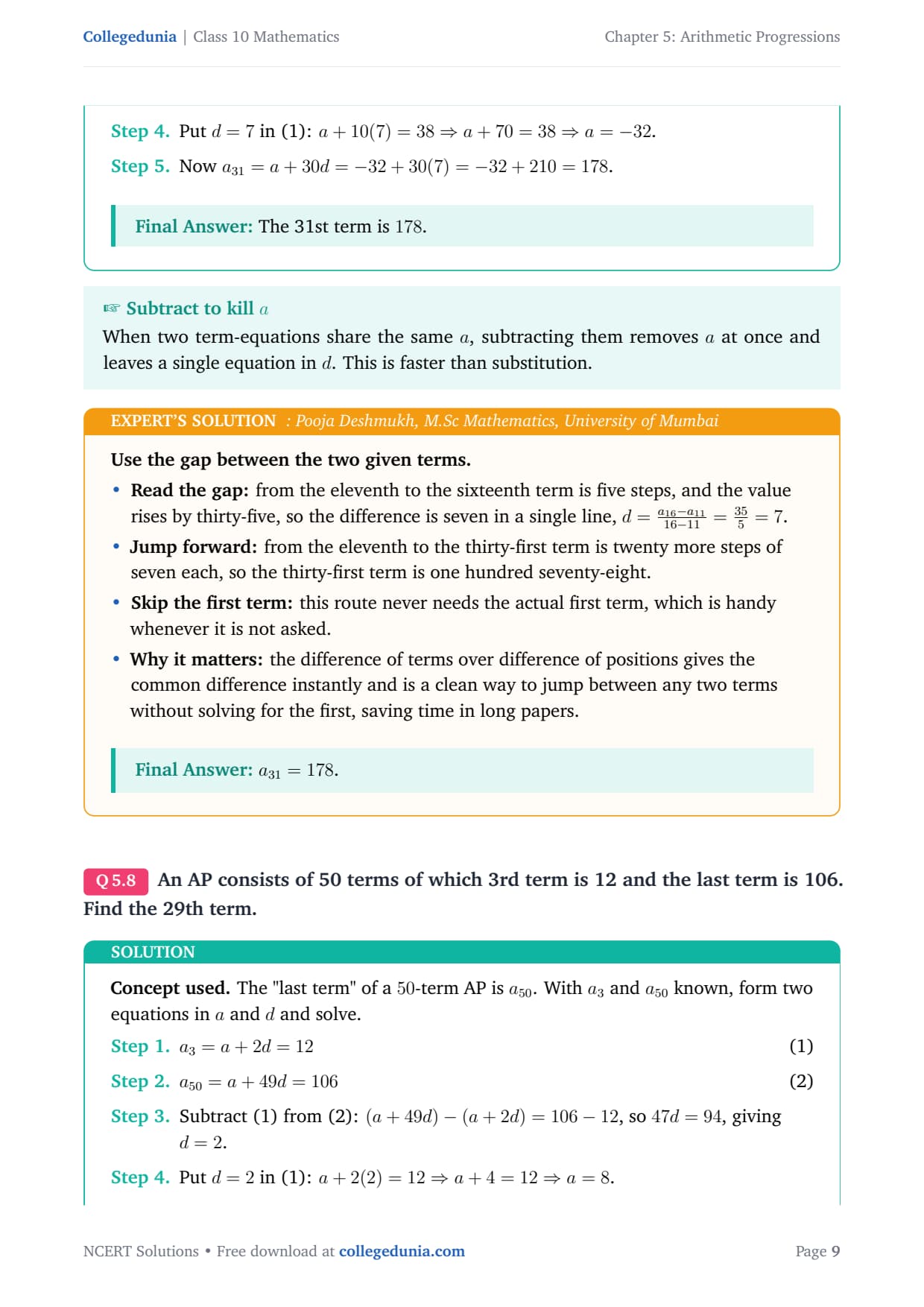
Put d = 7 in (1): a + 10(7) = 38 ⇒ a + 70 = 38 ⇒ a = -32.
Now a31 = a + 30d = -32 + 30(7) = -32 + 210 = 178.
The 31st term is 178.
PD
Pooja Deshmukh
M.Sc Mathematics, University of Mumbai
Verified Expert
Use the gap between the two given terms.
Read the gap: from the eleventh to the sixteenth term is five
steps, and the value rises by thirty-five, so the difference is seven in
a single line, d = a16 - a1116 - 11 = 355 = 7.
Jump forward: from the eleventh to the thirty-first term is
twenty more steps of seven each, so the thirty-first term is one hundred
seventy-eight.
Skip the first term: this route never needs the actual first
term, which is handy whenever it is not asked.
Why it matters: the difference of terms over difference of
positions gives the common difference instantly and is a clean way to jump
between any two terms without solving for the first, saving time in long
papers.
a31 = 178.
Q 5.8
An AP consists of 50 terms of which 3rd term is 12 and the last term is 106. Find the 29th term.
Concept used. The "last term" of a 50-term AP is a50. With
a3 and a50 known, form two equations in a and d and solve.
a3 = a + 2d = 12 (1)
a50 = a + 49d = 106 (2)
Subtract (1) from (2): (a + 49d) - (a + 2d) = 106 - 12, so 47d = 94,
giving d = 2.
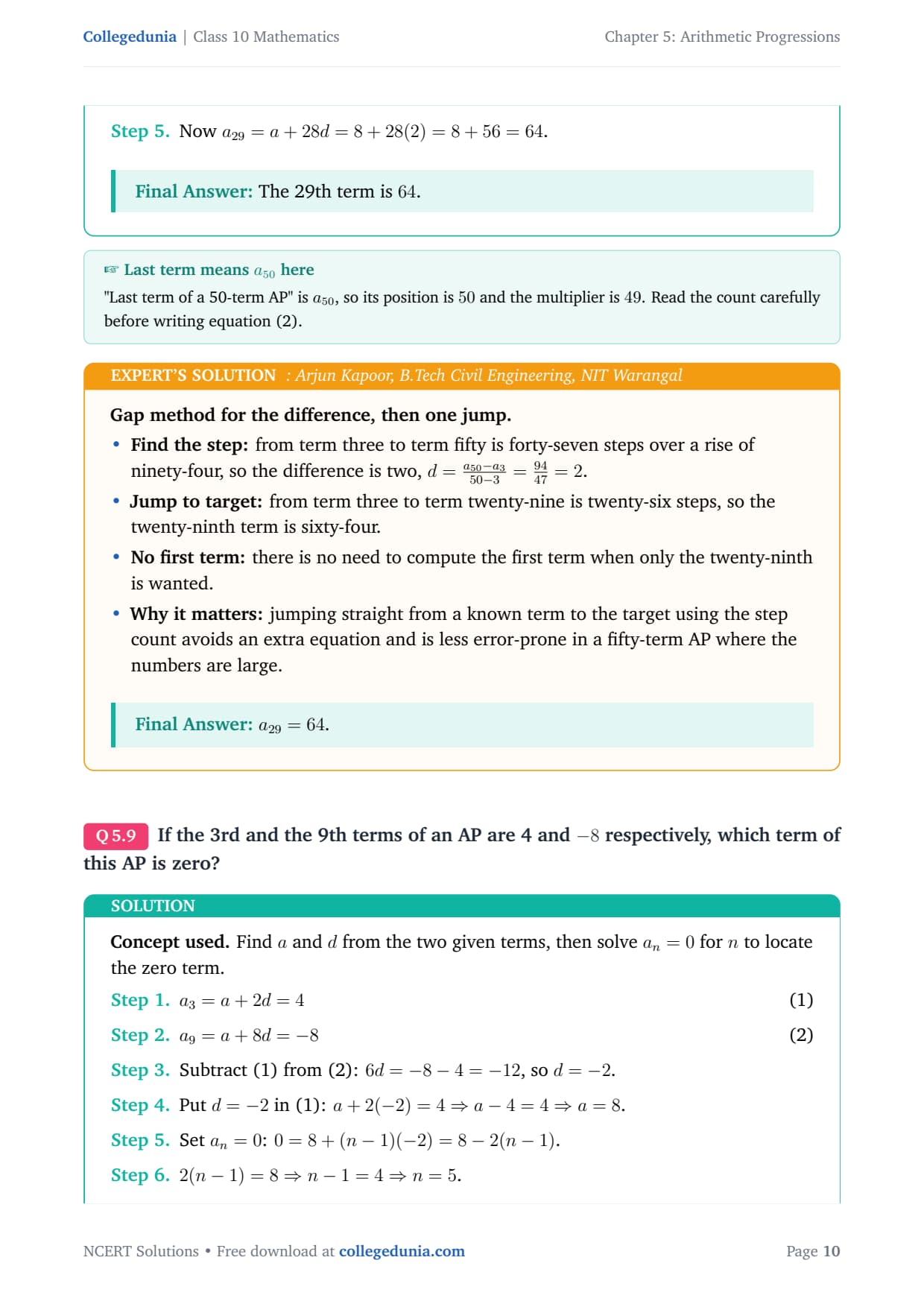
Put d = 2 in (1): a + 2(2) = 12 ⇒ a + 4 = 12 ⇒ a = 8.
Now a29 = a + 28d = 8 + 28(2) = 8 + 56 = 64.
The 29th term is 64.
AK
Arjun Kapoor
B.Tech Civil Engineering, NIT Warangal
Verified Expert
Gap method for the difference, then one jump.
Find the step: from term three to term fifty is forty-seven steps
over a rise of ninety-four, so the difference is two,
d = a50 - a350 - 3 = 9447 = 2.
Jump to target: from term three to term twenty-nine is twenty-six
steps, so the twenty-ninth term is sixty-four.
No first term: there is no need to compute the first term when
only the twenty-ninth is wanted.
Why it matters: jumping straight from a known term to the target
using the step count avoids an extra equation and is less error-prone in a
fifty-term AP where the numbers are large.
a29 = 64.
Q 5.9
If the 3rd and the 9th terms of an AP are 4 and -8 respectively, which term of this AP is zero?
Concept used. Find a and d from the two given terms, then solve
an = 0 for n to locate the zero term.
a3 = a + 2d = 4 (1)
a9 = a + 8d = -8 (2)
Subtract (1) from (2): 6d = -8 - 4 = -12, so d = -2.
Put d = -2 in (1): a + 2(-2) = 4 ⇒ a - 4 = 4 ⇒ a = 8.
Set an = 0: 0 = 8 + (n-1)(-2) = 8 - 2(n-1).
2(n-1) = 8 ⇒ n - 1 = 4 ⇒ n = 5.
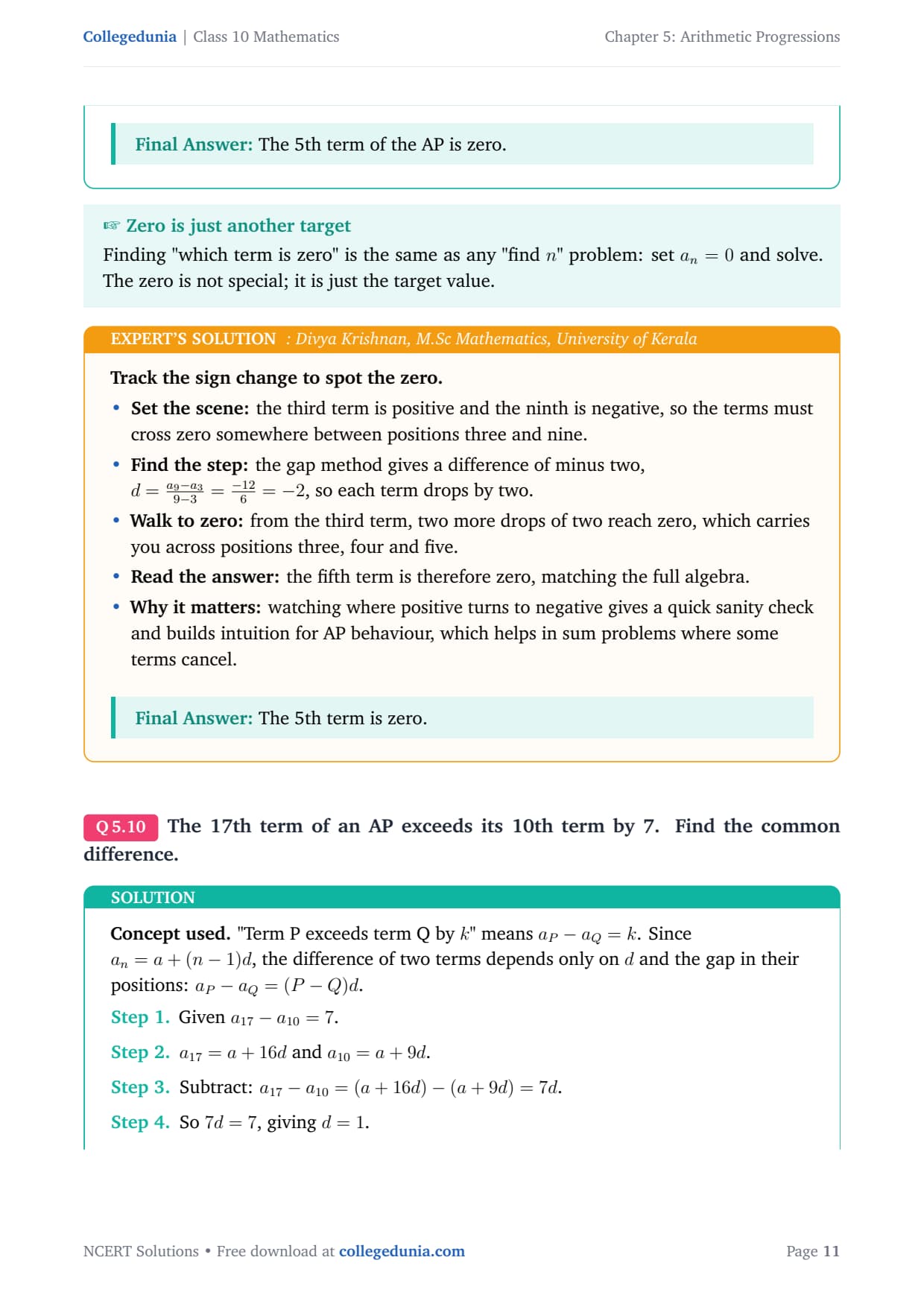
The 5th term of the AP is zero.
DK
Divya Krishnan
M.Sc Mathematics, University of Kerala
Verified Expert
Track the sign change to spot the zero.
Set the scene: the third term is positive and the ninth is
negative, so the terms must cross zero somewhere between positions three
and nine.
Find the step: the gap method gives a difference of minus two,
d = a9 - a39 - 3 = -126 = -2, so each term drops by two.
Walk to zero: from the third term, two more drops of two reach
zero, which carries you across positions three, four and five.
Read the answer: the fifth term is therefore zero, matching the
full algebra.
Why it matters: watching where positive turns to negative gives a
quick sanity check and builds intuition for AP behaviour, which helps in
sum problems where some terms cancel.
The 5th term is zero.
Q 5.10
The 17th term of an AP exceeds its 10th term by 7. Find the common difference.
Concept used. "Term P exceeds term Q by k" means aP - aQ = k.
Since an = a + (n-1)d, the difference of two terms depends only on d and the
gap in their positions: aP - aQ = (P - Q)d.
Given a17 - a10 = 7.
a17 = a + 16d and a10 = a + 9d.
Subtract: a17 - a10 = (a + 16d) - (a + 9d) = 7d.
So 7d = 7, giving d = 1.
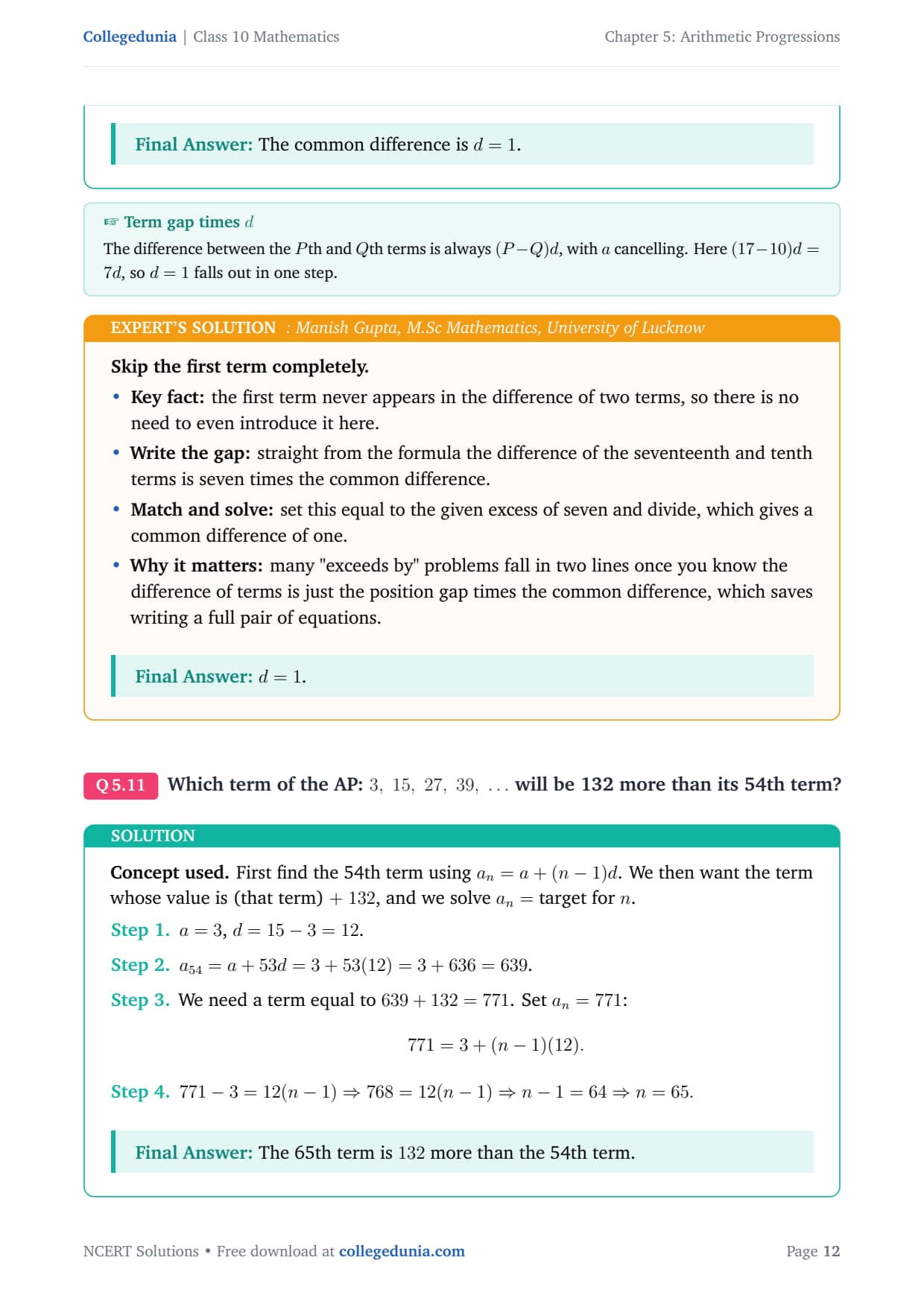
The common difference is d = 1.
MG
Manish Gupta
M.Sc Mathematics, University of Lucknow
Verified Expert
Skip the first term completely.
Key fact: the first term never appears in the difference of two
terms, so there is no need to even introduce it here.
Write the gap: straight from the formula the difference of the
seventeenth and tenth terms is seven times the common difference.
Match and solve: set this equal to the given excess of seven and
divide, which gives a common difference of one.
Why it matters: many "exceeds by" problems fall in two lines once
you know the difference of terms is just the position gap times the common
difference, which saves writing a full pair of equations.
d = 1.
Q 5.11
Which term of the AP: 3, 15, 27, 39, … will be 132 more than its 54th term?
Concept used. First find the 54th term using an = a + (n-1)d. We then
want the term whose value is (that term) + 132, and we solve an = target for n.
a = 3, d = 15 - 3 = 12.
a54 = a + 53d = 3 + 53(12) = 3 + 636 = 639.
We need a term equal to 639 + 132 = 771. Set an = 771:
771 = 3 + (n-1)(12).
771 - 3 = 12(n-1) ⇒ 768 = 12(n-1) ⇒ n - 1 = 64 ⇒ n = 65.
The 65th term is 132 more than the 54th term.
RS
Ritu Sharma
M.Sc Mathematics, Panjab University
Verified Expert
Use the step-count shortcut.
Spot the step: each term here jumps by twelve, so gaining a fixed
amount over a known term is just counting how many twelve-steps fit.
Count the steps: one hundred thirty-two divided by twelve is
eleven steps.
Place the term: the wanted term is eleven positions after the
fifty-fourth, which is the sixty-fifth, matching the full equation in one
division.
Why it matters: reading "more by an amount" as a number of steps
turns a long substitution into a quick division, a real time saver when
the term numbers are large.
The 65th term.
Q 5.12
Two APs have the same common difference. The difference between their 100th terms is 100, what is the difference between their 1000th terms?
Concept used. If two APs share the same d, the difference between
their corresponding terms stays constant. For first AP an = a + (n-1)d and
second AP a'n = a' + (n-1)d, the difference is
an - a'n = (a - a') + 0 = a - a', which does not depend on n.
Let the two APs be a + (n-1)d and a' + (n-1)d (same d).
Difference of their nth terms:
(a + (n-1)d) - (a' + (n-1)d) = a - a'.
The (n-1)d parts cancel.
For the 100th terms this difference is a - a' = 100 (given).
Since the difference is the constant a - a' for every n, the
difference of the 1000th terms is also a - a' = 100.
The difference between their 1000th terms is also 100.
SK
Sandeep Kulkarni
M.Sc Mathematics, Shivaji University
Verified Expert
No numbers needed, just cancellation.
Key insight: equal common differences make the variable parts of
the two terms identical, so they subtract to zero and only the gap between
the first terms survives.
It is constant: that surviving difference does not depend on the
term number, so the hundredth and thousandth differences must be equal.
Read the answer: since the hundredth difference is given as one
hundred, the thousandth difference is one hundred too.
Why it matters: this question checks whether you see that the
common difference controls the spacing while the first term controls the
starting offset, and the offset is exactly what survives at any term
number.
100, unchanged, because the difference equals a - a' for every term.
Q 5.13
How many three-digit numbers are divisible by 7?
Concept used. The three-digit multiples of 7 form an AP. List the
first and last such numbers, take d = 7, and use an = a + (n-1)d to count n.
Smallest three-digit multiple of 7: 7 × 15 = 105. So a = 105.
Largest three-digit multiple of 7: 7 × 142 = 994 (since 7 × 143 = 1001 > 999). So an = 994.
Common difference d = 7. The AP is 105, 112, …, 994.
M.Sc Mathematics, Cochin University of Science and Technology
Verified Expert
Count by division at both ends.
The trick: a neat alternative is to count all multiples of seven
up to nine hundred ninety-nine and subtract those up to ninety-nine.
Upper count: the floor of nine hundred ninety-nine over seven is
one hundred forty-two multiples.
Lower count: the floor of ninety-nine over seven removes the
fourteen one-digit and two-digit multiples.
Subtract: the three-digit multiples are one hundred forty-two
minus fourteen, which is one hundred twenty-eight and matches the AP count.
Why it matters: this floor-division method is a quick cross-check
on the AP answer and is handy whenever you do not want to write out the
full progression.
128 such numbers.
Q 5.14
How many multiples of 4 lie between 10 and 250?
Concept used. The multiples of 4 between 10 and 250 form an AP with
d = 4. Find the first multiple above 10 and the last below 250, then count
with an = a + (n-1)d.
First multiple of 4 greater than 10: 12. So a = 12.
Last multiple of 4 less than 250: 248 (since 248 = 4 × 62 and 252 > 250). So an = 248.
Common difference d = 4. The AP is 12, 16, …, 248.
The rule: the number of terms equals the span between the first
and last terms divided by the step size, plus one for the starting term.
Find the span: the distance from the first multiple twelve to the
last multiple two hundred forty-eight is two hundred thirty-six.
Count the steps: dividing that span by the step of four gives
fifty-nine steps.
Add the start: adding one for the first term gives sixty multiples
in all.
Why it matters: the span over step plus one rule is the heart of
every counting-in-a-range problem, and internalising it makes these
one-mark questions almost instant.
60 multiples.
Q 5.15
For what value of n, are the nth terms of two APs: 63, 65, 67, … and 3, 10, 17, … equal?
Concept used. Write the nth term of each AP with an = a + (n-1)d,
set the two expressions equal, and solve for n.
First AP: a = 63, d = 65 - 63 = 2, so nth term = 63 + (n-1)(2).
Second AP: a = 3, d = 10 - 3 = 7, so nth term = 3 + (n-1)(7).
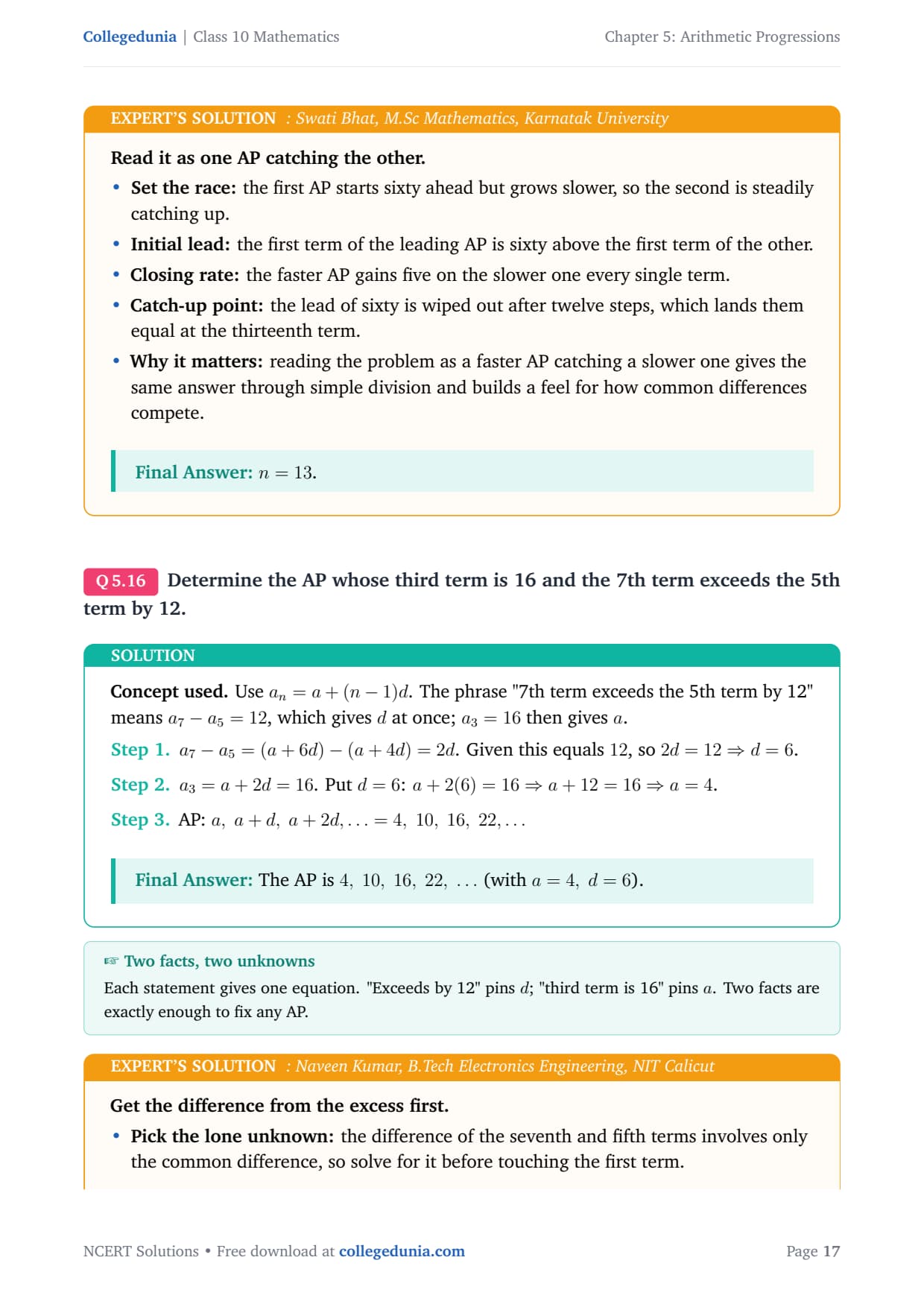
Set the race: the first AP starts sixty ahead but grows slower,
so the second is steadily catching up.
Initial lead: the first term of the leading AP is sixty above
the first term of the other.
Closing rate: the faster AP gains five on the slower one every
single term.
Catch-up point: the lead of sixty is wiped out after twelve
steps, which lands them equal at the thirteenth term.
Why it matters: reading the problem as a faster AP catching a
slower one gives the same answer through simple division and builds a feel
for how common differences compete.
n = 13.
Q 5.16
Determine the AP whose third term is 16 and the 7th term exceeds the 5th term by 12.
Concept used. Use an = a + (n-1)d. The phrase "7th term exceeds the
5th term by 12" means a7 - a5 = 12, which gives d at once; a3 = 16 then
gives a.
a7 - a5 = (a + 6d) - (a + 4d) = 2d. Given this equals 12, so
2d = 12 ⇒ d = 6.
a3 = a + 2d = 16. Put d = 6: a + 2(6) = 16 ⇒ a + 12 = 16 ⇒ a = 4.
AP: a, a+d, a+2d, … = 4, 10, 16, 22, …
The AP is 4, 10, 16, 22, … (with a = 4, d = 6).
NK
Naveen Kumar
B.Tech Electronics Engineering, NIT Calicut
Verified Expert
Get the difference from the excess first.
Pick the lone unknown: the difference of the seventh and fifth
terms involves only the common difference, so solve for it before touching
the first term.
Solve for the step: the excess of twelve equals twice the
difference, so the difference is six immediately.
Use the other fact: the remaining condition that the third term
is sixteen then gives a first term of four.
Present the AP: list a few terms as four, ten, sixteen,
twenty-two and so on.
Why it matters: solving for the unknown that appears alone keeps
the algebra simple and is a good habit for any two-condition AP problem in
the exam.
4, 10, 16, 22, …
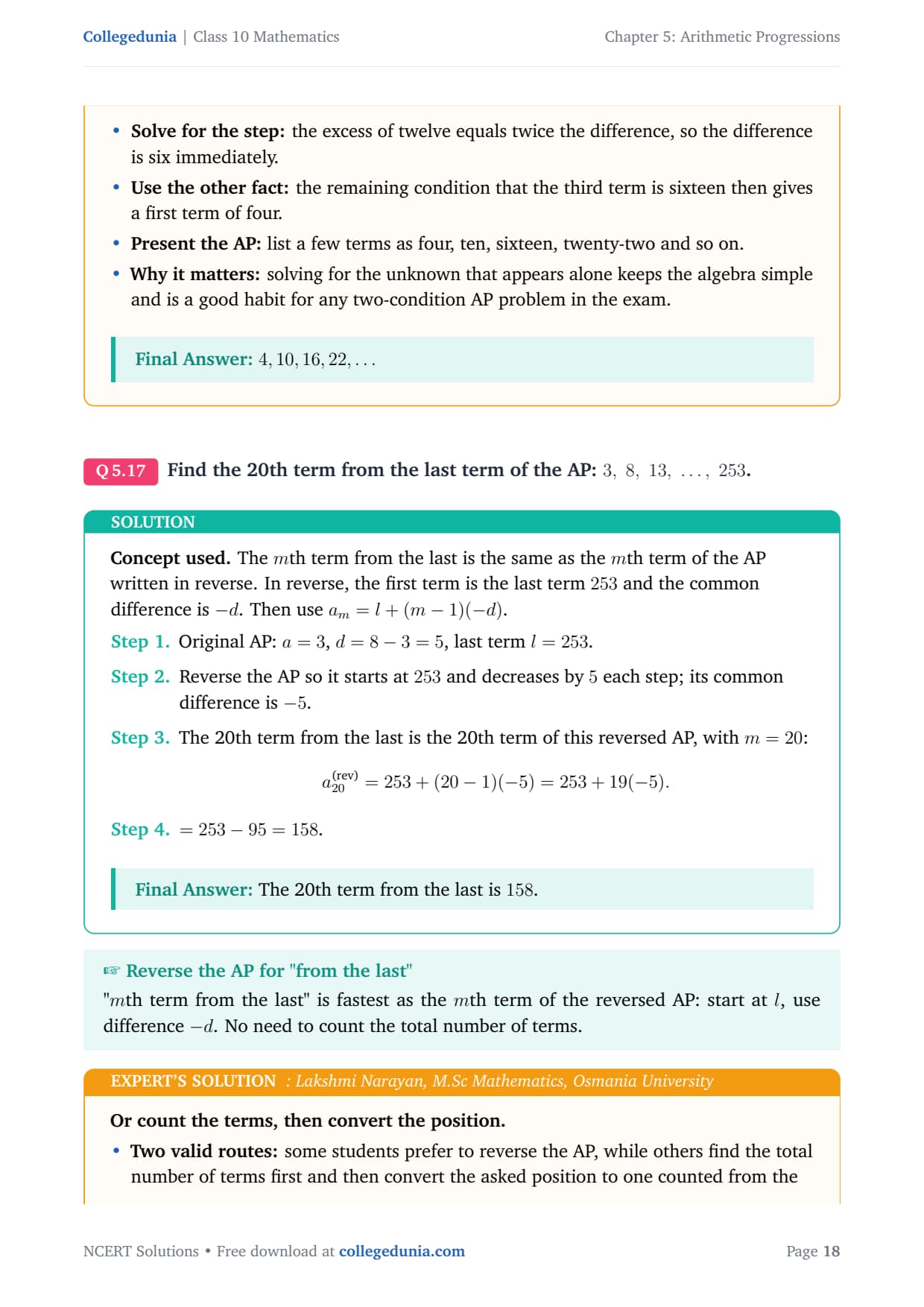
Q 5.17
Find the 20th term from the last term of the AP: 3, 8, 13, …, 253.
Concept used. The mth term from the last is the same as the mth term
of the AP written in reverse. In reverse, the first term is the last term 253
and the common difference is -d. Then use am = l + (m-1)(-d).
Original AP: a = 3, d = 8 - 3 = 5, last term l = 253.
Reverse the AP so it starts at 253 and decreases by 5 each step; its
common difference is -5.
The 20th term from the last is the 20th term of this reversed AP, with m = 20:
a20(rev) = 253 + (20 - 1)(-5) = 253 + 19(-5).
= 253 - 95 = 158.
The 20th term from the last is 158.
LN
Lakshmi Narayan
M.Sc Mathematics, Osmania University
Verified Expert
Or count the terms, then convert the position.
Two valid routes: some students prefer to reverse the AP, while
others find the total number of terms first and then convert the asked
position to one counted from the front, and both are correct.
Count the terms: solving the last-term equation gives a total of
fifty-one terms in the progression.
Convert the position: the twentieth term from the last is the
same as the thirty-second term from the front, since you flip the position
about the total count.
Compute the value: the thirty-second term from the front works
out to one hundred fifty-eight, exactly the same answer as the reverse
method.
Why it matters: having two independent routes that agree lets you
pick whichever feels safer, with the reverse method quicker and the
count-then-convert method a reliable check that guards against a careless
slip.
158.
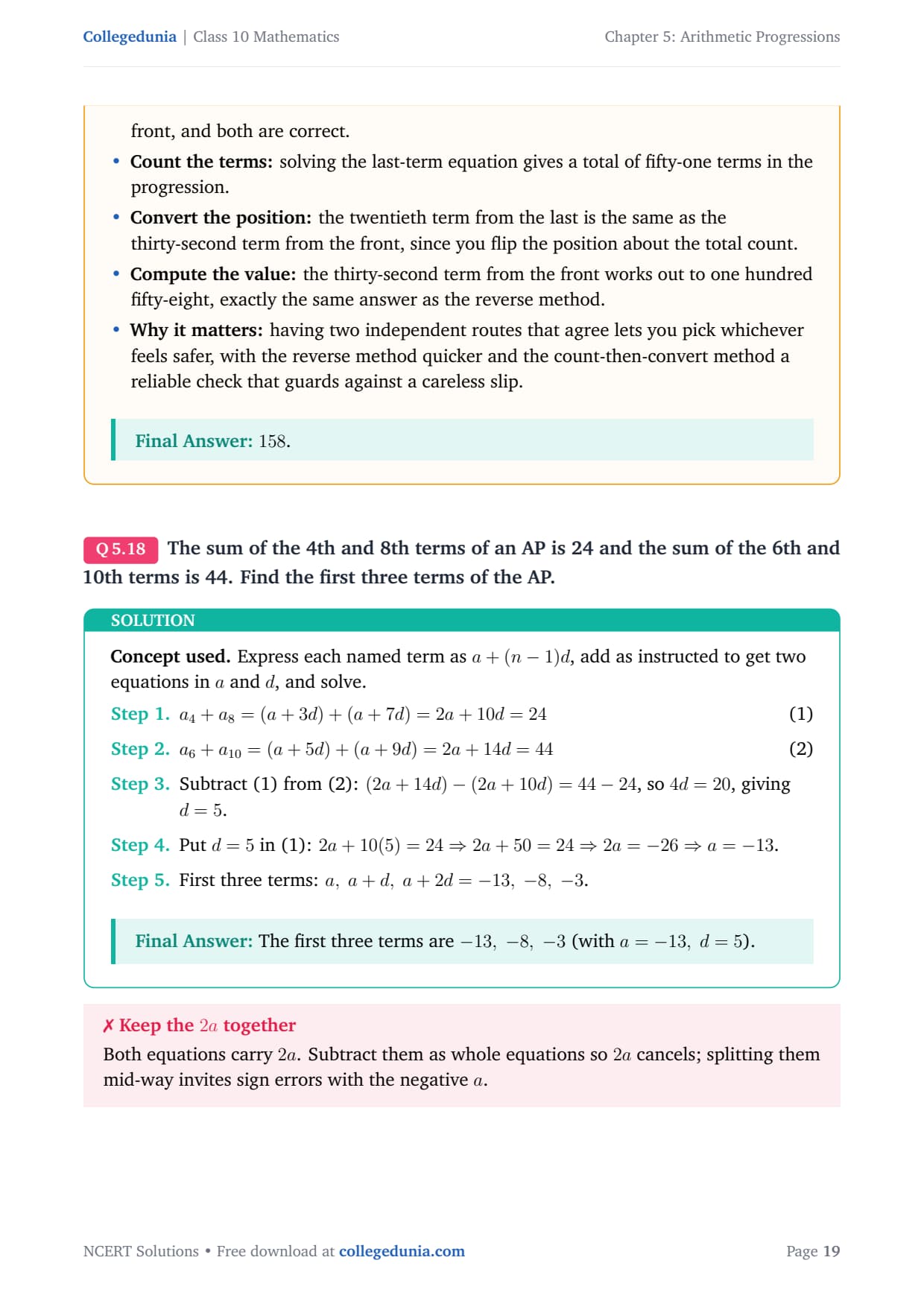
Q 5.18
The sum of the 4th and 8th terms of an AP is 24 and the sum of the 6th and 10th terms is 44. Find the first three terms of the AP.
Concept used. Express each named term as a + (n-1)d, add as instructed
to get two equations in a and d, and solve.
a4 + a8 = (a + 3d) + (a + 7d) = 2a + 10d = 24 (1)
a6 + a10 = (a + 5d) + (a + 9d) = 2a + 14d = 44 (2)
Subtract (1) from (2): (2a + 14d) - (2a + 10d) = 44 - 24, so 4d = 20,
giving d = 5.
Put d = 5 in (1): 2a + 10(5) = 24 ⇒ 2a + 50 = 24 ⇒ 2a = -26 ⇒ a = -13.
First three terms: a, a + d, a + 2d = -13, -8, -3.
The first three terms are -13, -8, -3 (with a = -13, d = 5).
DS
Deepa Shenoy
M.Sc Mathematics, Mangalore University
Verified Expert
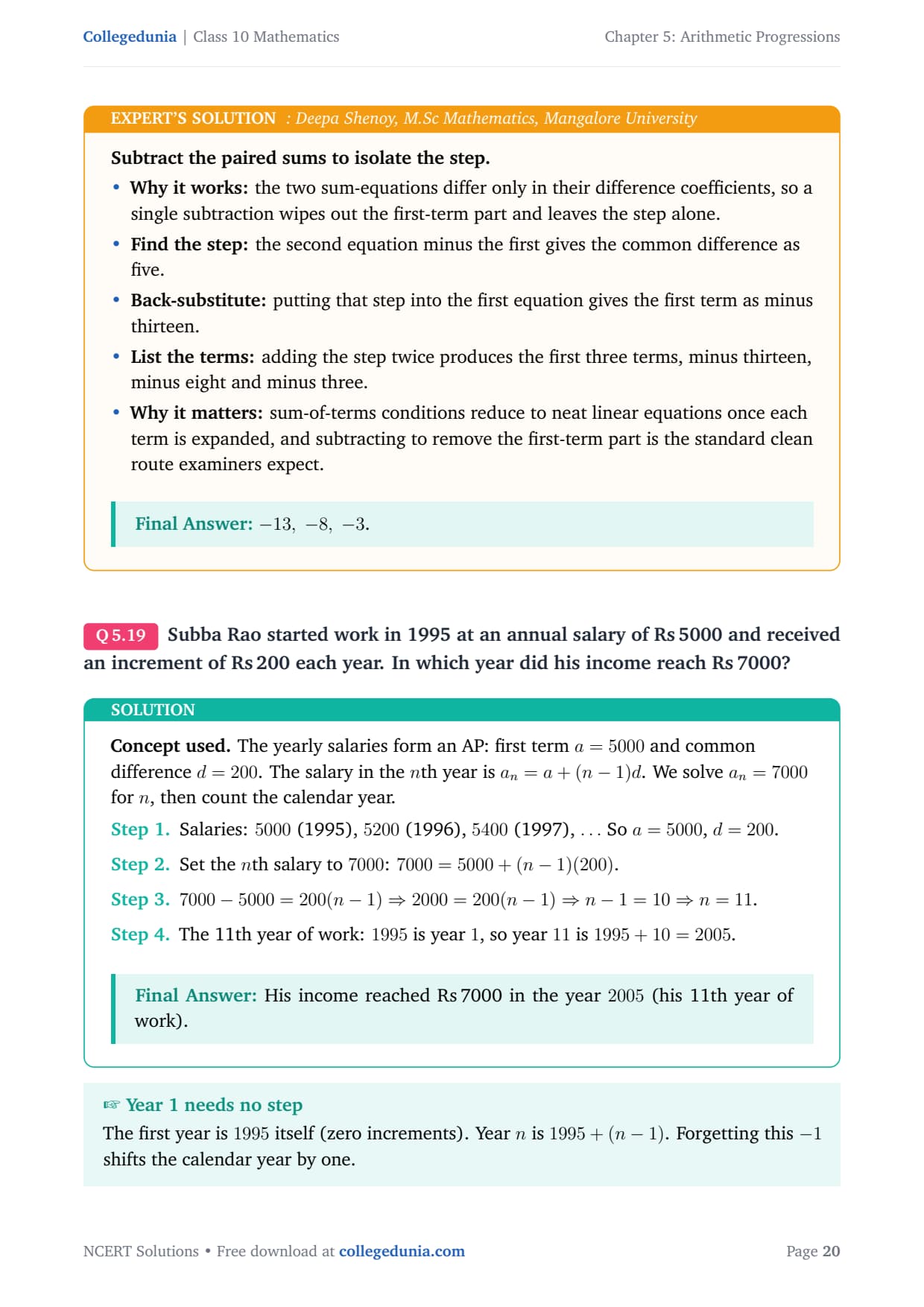
Subtract the paired sums to isolate the step.
Why it works: the two sum-equations differ only in their
difference coefficients, so a single subtraction wipes out the first-term
part and leaves the step alone.
Find the step: the second equation minus the first gives the
common difference as five.
Back-substitute: putting that step into the first equation gives
the first term as minus thirteen.
List the terms: adding the step twice produces the first three
terms, minus thirteen, minus eight and minus three.
Why it matters: sum-of-terms conditions reduce to neat linear
equations once each term is expanded, and subtracting to remove the
first-term part is the standard clean route examiners expect.
-13, -8, -3.
Q 5.19
Subba Rao started work in 1995 at an annual salary of 5000 and received an increment of 200 each year. In which year did his income reach 7000?
Concept used. The yearly salaries form an AP: first term a = 5000 and
common difference d = 200. The salary in the nth year is an = a + (n-1)d.
We solve an = 7000 for n, then count the calendar year.
Salaries: 5000 (1995), 5200 (1996), 5400 (1997), … So a = 5000, d = 200.
Set the nth salary to 7000: 7000 = 5000 + (n-1)(200).
7000 - 5000 = 200(n-1) ⇒ 2000 = 200(n-1) ⇒ n - 1 = 10 ⇒ n = 11.
The 11th year of work: 1995 is year 1, so year 11 is 1995 + 10 = 2005.
His income reached 7000 in the year 2005 (his 11th year of work).
RM
Rahul Mishra
M.Sc Mathematics, University of Rajasthan
Verified Expert
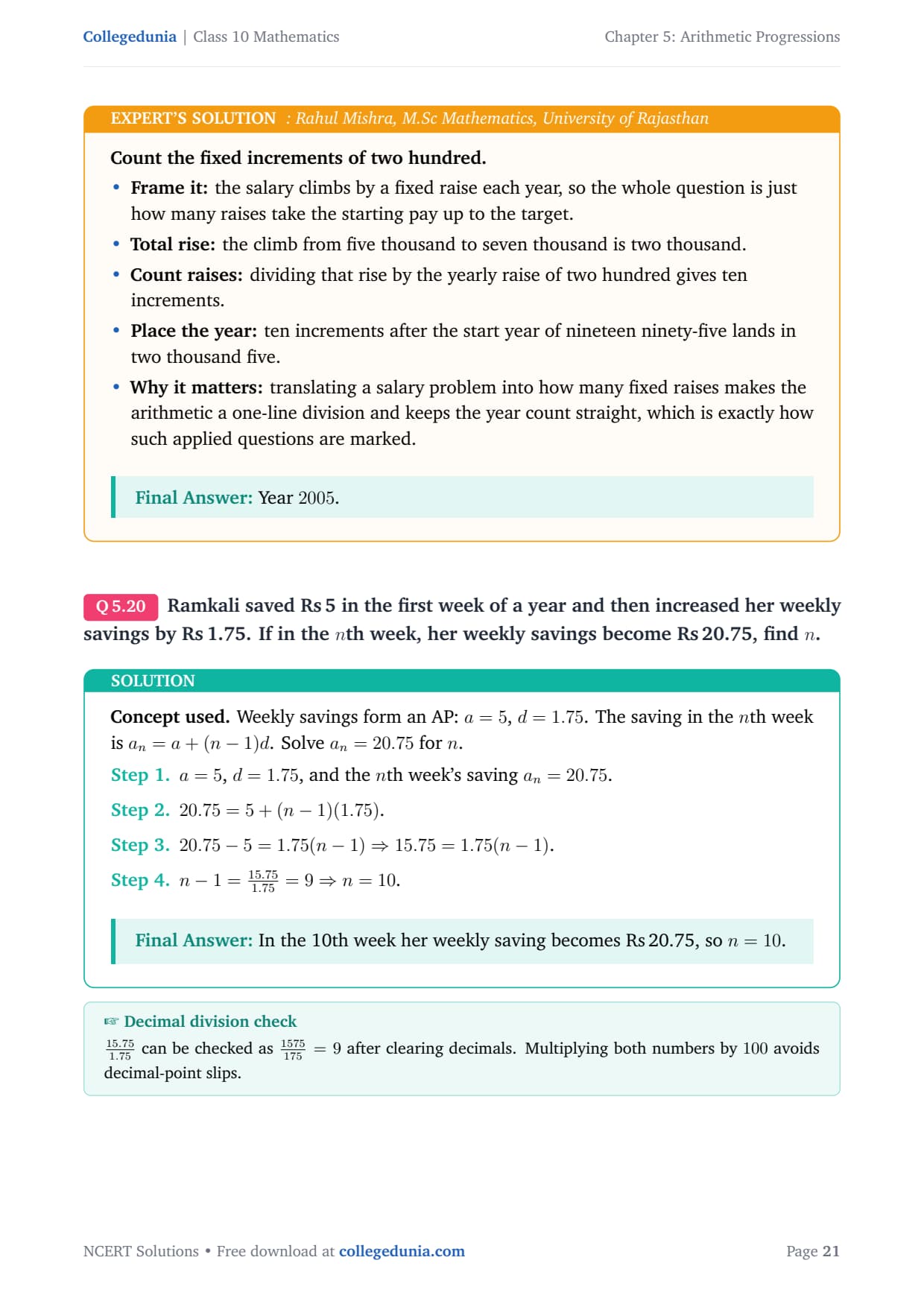
Count the fixed increments of two hundred.
Frame it: the salary climbs by a fixed raise each year, so the
whole question is just how many raises take the starting pay up to the
target.
Total rise: the climb from five thousand to seven thousand is two
thousand.
Count raises: dividing that rise by the yearly raise of two
hundred gives ten increments.
Place the year: ten increments after the start year of nineteen
ninety-five lands in two thousand five.
Why it matters: translating a salary problem into how many fixed
raises makes the arithmetic a one-line division and keeps the year count
straight, which is exactly how such applied questions are marked.
Year 2005.
Q 5.20
Ramkali saved 5 in the first week of a year and then increased her weekly savings by 1.75. If in the nth week, her weekly savings become 20.75, find n.
Concept used. Weekly savings form an AP: a = 5, d = 1.75. The
saving in the nth week is an = a + (n-1)d. Solve an = 20.75 for n.
a = 5, d = 1.75, and the nth week's saving an = 20.75.
20.75 = 5 + (n-1)(1.75).
20.75 - 5 = 1.75(n-1) ⇒ 15.75 = 1.75(n-1).
n - 1 = 15.751.75 = 9 ⇒ n = 10.
In the 10th week her weekly saving becomes 20.75, so n = 10.
AD
Ananya Das
M.Sc Mathematics, University of Calcutta
Verified Expert
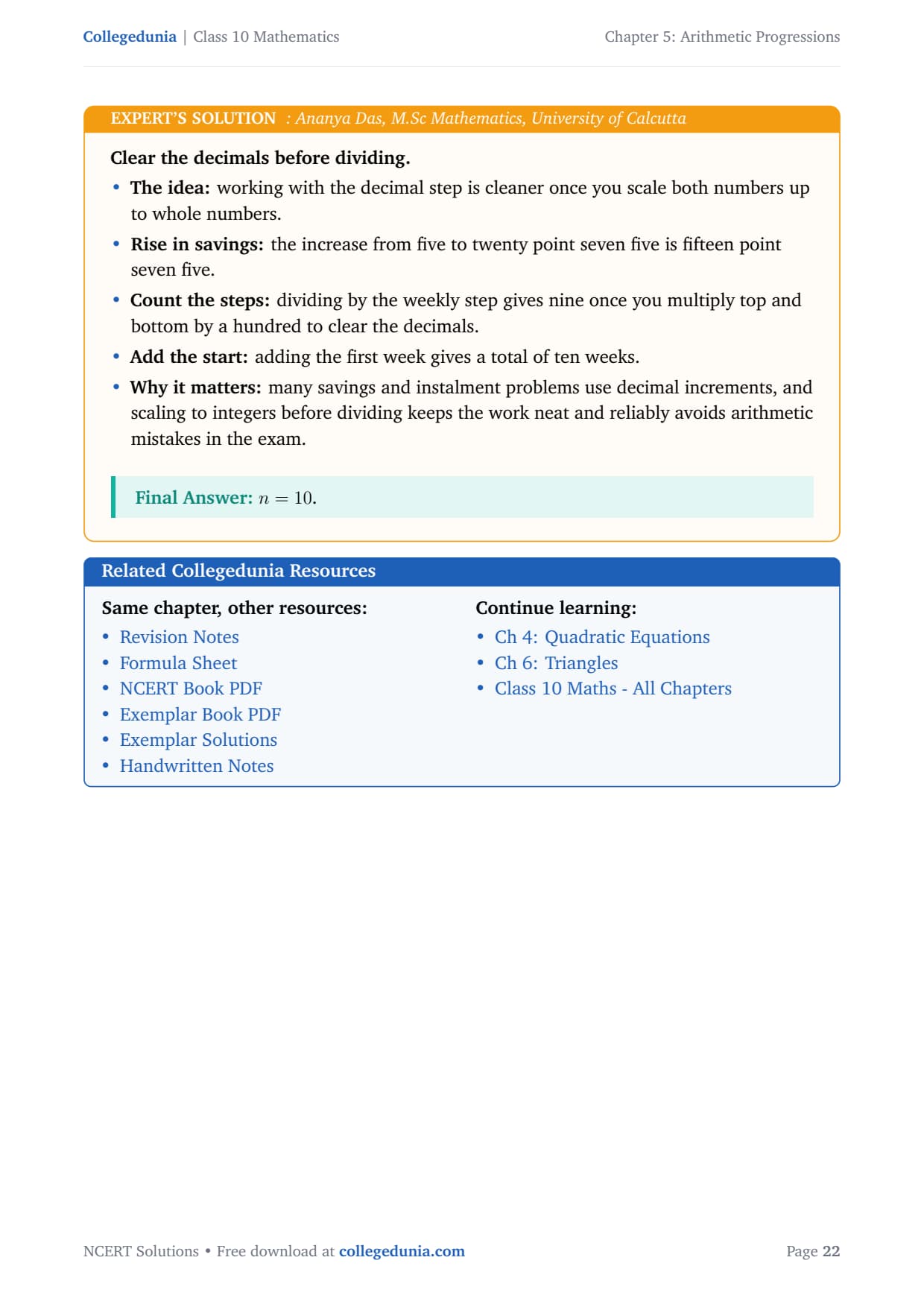
Clear the decimals before dividing.
The idea: working with the decimal step is cleaner once you scale
both numbers up to whole numbers.
Rise in savings: the increase from five to twenty point seven
five is fifteen point seven five.
Count the steps: dividing by the weekly step gives nine once you
multiply top and bottom by a hundred to clear the decimals.
Add the start: adding the first week gives a total of ten weeks.
Why it matters: many savings and instalment problems use decimal
increments, and scaling to integers before dividing keeps the work neat
and reliably avoids arithmetic mistakes in the exam.
n = 10.
Arithmetic Progressions Class 10 Maths Exercise 5.2 NCERT Solutions FAQs
Ques. How many questions are there in Class 10 Maths Chapter 5 Arithmetic Progressions Exercise 5.2?
Ans. Exercise 5.2 has 20 questions. Q1 is a 5-part fill-in-the-blank table, Q2 has two MCQ parts, Q3 has five missing-term-in-a-box problems, and Q4 to Q20 cover "which term?", "how many terms?", "is this a term?", word problems on salaries and savings, and number-series counting questions.
Ques. Where can I download the Arithmetic Progressions Class 10 Exercise 5.2 NCERT Solutions PDF?
Ans. You can download the Arithmetic Progressions Class 10 Exercise 5.2 NCERT Solutions PDF directly from this page using the download card at the top. It is free and follows the 2026-27 NCERT textbook.
Ques. What is the formula used throughout Exercise 5.2?
Ans. Every question in Exercise 5.2 uses an = a + (n - 1)d, where a is the first term, d is the common difference, n is the position and an is the nth term. The only skill is substituting the three known values and solving for the fourth.
Ques. How do I check whether a value is a term of an AP (Exercise 5.2, Q6)?
Ans. Substitute the value as an in the formula and solve for n. If n is a positive whole number the value is a term; if it comes out as a fraction or a negative number it is not a term. Always state the reason in words to earn the justification mark.
Ques. Are these Exercise 5.2 solutions based on the 2026-27 CBSE syllabus?
Ans. Yes. These solutions follow the current 2026-27 CBSE syllabus for Class 10 Mathematics. The nth-term formula content of Exercise 5.2 is fully retained in the latest rationalised NCERT edition.







Comments