The NCERT Solutions for Class 10 Maths Chapter 5 Arithmetic Progressions answer all exercise questions from Exercises 5.1, 5.2, 5.3 and 5.4, written for the latest 2026-27 CBSE syllabus. Every solution follows the textbook method: identifying whether a list is an AP, using the nth term formula an = a + (n − 1)d, and applying the sum formula Sn = (n/2)[2a + (n − 1)d].
All exercise questions solved step by step in plain English, with an Expert Solution per question that adds board-exam strategy.
Full coverage of finding the nth term, sum of n terms, the number of terms, missing common difference and word problems involving salaries, savings and stacked objects.
Answers aligned with the 2026-27 CBSE Class 10 Mathematics syllabus, useful for school tests and the board exam alike.
Every answer here is checked by Maths teachers, mapped to the 2026-27 NCERT textbook, and matched to the last five years of CBSE board papers.
The card below sets out the two formulas you will use most in this chapter.
What Class 10 Maths Chapter 5 Arithmetic Progressions Covers
An arithmetic progression (AP) is a list of numbers where each term goes up or down by the same fixed amount. The chapter has four exercises, covered in order.
Recognising an AP: check that the gap between terms stays the same (Exercise 5.1).
nth term: an = a + (n-1)d, the value of any term you want (Exercise 5.2).
Sum of n terms: Sn = n2[2a + (n-1)d] (Exercise 5.3).
Word problems: salaries, savings, stacked logs and rows of seats (Exercise 5.4).
Exercise-wise Breakdown of Arithmetic Progressions NCERT Solutions
The table maps each exercise to its topic, the method CBSE rewards, and the usual marks.
Word problems: salaries, savings, stacked objects, auditorium seats
Identify a and d from the problem, apply the correct formula, interpret the result
3 to 5 marks
Exercises 5.3 and 5.4 carry the most marks. Write a, d and n in a short labelled list before any formula, and most sign errors go away.
Key Ideas Tested: nth Term, Sum and Finding d
Three ideas run through the chapter. In every formula, a is the first term, d is the common difference and n is the position.
Find d: subtract any term from the next one, so d = a2 - a1. A negative d means the AP goes down.
nth term an = a + (n-1)d: put in a, d and n to get any term. To check if a value is in the AP, set an equal to it and solve for n.
Sum Sn = n2[2a + (n-1)d]: use this when you know a, d and n. If the last term l is given, the shorter form Sn = n2(a + l) is faster.
Quick Tip: When you solve an = (a given value) for n, check that n is a whole number. A fraction means the value is not a term of the AP. The same check fits "how many terms" questions.
One useful link: an = Sn - Sn-1. If a question gives Sn as a formula, set n = 1 for the first term, then find d from S2 - S1.
Four steps for AP word problems (Exercise 5.4)
Exercise 5.4 asks about salaries, savings, rows of seats and stacked logs. These come up most years, and the method is the same each time.
Label a and d: say what the first term and the fixed change mean here (starting salary, extra seats per row, and so on).
Pick the formula: use the nth term for one specific term, and the sum for a total.
Substitute and solve: put the values in, simplify, and solve for the unknown.
Check the answer: a count of months or items must be a positive whole number.
Common mistakes to avoid:
Mixing up Sn and an: "total salary after 10 months" wants S10, not a10.
Wrong sign for d: when the list goes down, d is negative.
Skipping the n check: a non-whole n means a setup error.
Wrong sum formula: if the last term l is given, use Sn = n2(a + l).
Other Resources for Class 10 Maths Chapter 5
Pair this NCERT Solutions PDF with the matching Collegedunia notes, formula sheet, handwritten notes and the official NCERT book chapter below.
Resource
What it covers
Open
NCERT Solutions
Step-by-step answers to all exercise questions, with an Expert Solution for each.
Related Links: Open the Collegedunia NCERT Solutions for the other chapters of Class 10 Maths below. Each one uses the same step-by-step style, a full PDF download, and a revision FAQ.
All NCERT Solutions for Class 10 Maths Chapter 5 Arithmetic Progressions with Step-by-Step Solutions
Questions
Q 5.1
In which of the following situations, does the list of numbers involved make an arithmetic progression, and why?
(i) The taxi fare after each km when the fare is 15 for the first km and 8 for each additional km.
(ii) The amount of air present in a cylinder when a vacuum pump removes 14 of the air remaining in the cylinder at a time.
(iii) The cost of digging a well after every metre of digging, when it costs 150 for the first metre and rises by 50 for each subsequent metre.
(iv) The amount of money in the account every year, when 10000 is deposited at compound interest at 8% per annum.
Concept used. A list of numbers a1, a2, a3, … is an
arithmetic progression (AP) only if the difference between any term
and the one just before it is always the same. That fixed difference is the
common difference d = a2 - a1 = a3 - a2 = …. So to test a situation,
we write the first few terms and check whether every step adds the same amount.
(i) First km costs 15; each later km adds 8.
Fares: 15, 23, 31, 39, …
Differences: 23-15 = 8, 31-23 = 8, 39-31 = 8. Same each time, so d = 8.
This is an AP.
(ii) Each step removes 14 of the air left, so the air
remaining becomes 34 of the previous amount. If the start is
V, the terms are V, 34 V, 916V, …
Differences: 34 V - V = -14 V, then
916V - 34 V = -316V. These are not equal, so
this is not an AP (each term is multiplied, not added to).
(iii) First metre costs 150; each later metre adds
50. Costs: 150, 200, 250, 300, …
Differences are all 50, so d = 50. This is an AP.
(iv) Compound interest multiplies the amount by 1.08 each
year: 10000, 10000(1.08), 10000(1.08)2, …
The yearly increase keeps growing, so the differences are not equal.
This is not an AP.
(i) AP, d = 8. (ii) Not an AP. (iii) AP, d = 50. (iv) Not an AP.
AV
Anjali Verma
M.Sc Mathematics, University of Delhi
Verified Expert
Decide in one glance: does it add, or does it scale?
The test: ask whether the same rupee or unit amount gets added
every step, or whether the quantity gets scaled. A flat add is an AP; a
percentage or fraction of what is left is not.
Flat adds: in (i) the rule is plus 8 per km and in (iii)
plus 50 per metre. The phrases "each additional" and "rises by"
signal a constant add, so both are APs.
Shrinking add: in (ii) the pump takes a fraction of the air that
remains, so the amount removed shrinks each time and the step is never
constant, so it fails the test.
Growing percent: in (iv) compound interest grows the money by a
fixed percentage, not a fixed rupee amount, so the yearly increase keeps
rising and it is not an AP.
Why it matters: examiners mix a compound-interest trap into such
lists to see if students confuse constant addition with constant ratio.
Spotting add versus scale earns the full reasoning marks.
(i) and (iii) are APs (constant add); (ii) and (iv) are not (constant ratio).
Q 5.2
Write first four terms of the AP, when the first term a and the common difference d are given as follows:
(i) a = 10, d = 10 (ii) a = -2, d = 0 (iii) a = 4, d = -3 (iv) a = -1, d = 12 (v) a = -1.25, d = -0.25
Concept used. The terms of an AP are built from the first term a by
repeatedly adding the common difference d. So the four terms are
a, a+d, a+2d, a+3d.
Set the slots: for each part write the four slots
a, a+d, a+2d, a+3d first, then plug in the given values rather than
adding in your head. This is how toppers avoid silent slips.
Zero is allowed: in (ii) the difference is zero, so the AP is the
constant list -2,-2,-2,-2. Many students wrongly assume the difference
must be non-zero.
Keep the form: in (iv) and (v) hold the fractions and decimals
exactly as given and never round, so the run -1.25, -1.50, -1.75, -2.00
stays clean.
Why it matters: generating terms from the first value and the
difference is the base skill for every later question, so fixing the signs
and the zero case here prevents a chain of errors in harder problems.
Add d to the previous term three times; the four terms come straight out.
Q 5.3
For the following APs, write the first term and the common difference:
(i) 3, 1, -1, -3, … (ii) -5, -1, 3, 7, … (iii) 13, 53, 93, 133, … (iv) 0.6, 1.7, 2.8, 3.9, …
Concept used. For any AP the first term is simply a = a1,
the very first number in the list. The common difference is
d = a2 - a1 (second term minus first term).
(i)a = 3; d = a2 - a1 = 1 - 3 = -2.
(ii)a = -5; d = -1 - (-5) = -1 + 5 = 4.
(iii)a = 13; d = 53 - 13 = 43.
(iv)a = 0.6; d = 1.7 - 0.6 = 1.1.
(i) a = 3, d = -2 (ii) a = -5, d = 4 (iii) a = 13, d = 43 (iv) a = 0.6, d = 1.1
SP
Sneha Patel
B.Tech Electrical Engineering, IIT Gandhinagar
Verified Expert
Confirm the difference with a third term.
Double-check rule: the fast way to be sure of the difference is
to also compute the next gap and see it matches the first.
Part (i): the first gap is -2 and the next gap -1-1 is also
-2. They agree, so the difference is safely -2.
Part (iii): keeping a common denominator over three lets you read
the difference off instantly as four-thirds.
Part (iv): with decimals just subtract carefully, since both
1.7-0.6 and 2.8-1.7 give 1.1.
Why it matters: reading the first term and difference correctly
from a printed list is the first line of almost every AP solution, so a
quick second check removes careless slips before they spread.
a is the first number listed; d = a2 - a1, confirmed by a3 - a2.
Q 5.4
Which of the following are APs? If they form an AP, find the common difference d and write three more terms.
(i) 2, 4, 8, 16, … (ii) 2, 52, 3, 72, … (iii) -1.2, -3.2, -5.2, -7.2, …
(iv) -10, -6, -2, 2, … (v) 3, 3+2, 3+22, 3+32, …
(vi) 0.2, 0.22, 0.222, 0.2222, … (vii) 0, -4, -8, -12, …
(viii) -12, -12, -12, -12, … (ix) 1, 3, 9, 27, … (x) a, 2a, 3a, 4a, …
(xi) a, a2, a3, a4, … (xii) 2, 8, √18, √32, …
(xiii) 3, 6, 9, √12, … (xiv) 12, 32, 52, 72, … (xv) 12, 52, 72, 73, …
Concept used. A list is an AP only if a2 - a1 = a3 - a2 = a4 - a3,
that is, every consecutive difference is equal to one fixed value d. If it is
an AP, the next three terms are got by adding d to the last given term, three
times.
(i)2,4,8,16: differences 2,4,8 are not equal. Not an AP.
(ii)2, 52, 3, 72: differences 12, 12, 12.
AP, d = 12; next three: 4, 92, 5.
(iii)-1.2, -3.2, -5.2, -7.2: each difference -2.
AP, d = -2; next three: -9.2, -11.2, -13.2.
(iv)-10, -6, -2, 2: each difference +4.
AP, d = 4; next three: 6, 10, 14.
(v)3, 3+2, 3+22, 3+32: each difference 2.
AP, d = 2; next three: 3+42, 3+52, 3+62.
(vi)0.2, 0.22, 0.222: differences 0.02, 0.002 not equal. Not an AP.
(vii)0, -4, -8, -12: each difference -4.
AP, d = -4; next three: -16, -20, -24.
(viii)-12, -12, -12, -12: each difference 0.
AP, d = 0; next three: -12, -12, -12.
(ix)1, 3, 9, 27: differences 2, 6, 18 not equal. Not an AP.
(x)a, 2a, 3a, 4a: each difference a.
AP, d = a; next three: 5a, 6a, 7a.
(xi)a, a2, a3, a4: differences a2 - a, a3 - a2 not equal in general. Not an AP.
(xii) Simplify: 2, 8 = 22, √18 = 32, √32 = 42.
Each difference 2. AP, d = 2; next three:
52 = √50, 62 = √72, 72 = √98.
(xiii)3, 6, 9, √12: differences
6 - 3 ≈ 0.717, 9 - 6 ≈ 0.551 not equal. Not an AP.
(xiv)1, 9, 25, 49: differences 8, 16, 24 not equal. Not an AP.
(xv)1, 25, 49, 73: differences 24, 24, 24 all equal.
AP, d = 24; next three: 97, 121, 145.
Group the lookalike traps by type before computing.
Three families: the fifteen lists hide three classic traps, which
are powers that are really geometric, surds that must be simplified first,
and squares or decimals that only pretend to be regular.
Geometric traps: parts (i), (ix) and (xi) multiply by a fixed
factor, so their gaps grow instead of staying constant, and you can reject
all three at once without much work.
Surd traps: part (xii) cleans up to a multiple of root two and is
a genuine AP, while part (xiii) collapses to terms whose gaps are unequal,
so simplify every root before you judge the pattern.
Square traps: the odd squares in (xiv) give rising gaps and fail,
whereas (xv) keeps a constant gap of twenty-four once you read its last
entry as the plain number seventy-three rather than a square.
Why it matters: examiners pack this question with lookalikes to
test whether you actually compute differences instead of guessing from the
shape, so sorting them into powers, surds and squares handles all fifteen
quickly and correctly.
Compute consecutive differences (after simplifying surds): nine are APs, six are not.
NCERT solutions Class 10 Mathematics Chapter 5 Arithmetic Progressions
All 20 questions with collapsible Solution and Expert Solution. Tap a button to reveal the working.
Questions
Q 5.1
Fill in the blanks in the following table, given that a is the first term, d the common difference and an the nth term of the AP: [3pt]
(i) a = 7, d = 3, n = 8, an = ? (ii) a = -18, d = ?, n = 10, an = 0 (iii) a = ?, d = -3, n = 18, an = -5
(iv) a = -18.9, d = 2.5, n = ?, an = 3.6 (v) a = 3.5, d = 0, n = 105, an = ?
Concept used. The nth term of an AP is an = a + (n-1)d. Whichever
of a, d, n or an is missing, we substitute the three known values and
solve this one equation for the fourth.
(i)an = a + (n-1)d = 7 + (8-1)(3) = 7 + 21 = 28.
(ii)an = a + (n-1)d ⇒ 0 = -18 + (10-1)d = -18 + 9d.
So 9d = 18, giving d = 2.
(iii)an = a + (n-1)d ⇒ -5 = a + (18-1)(-3) = a - 51.
So a = -5 + 51 = 46.
(iv)an = a + (n-1)d ⇒ 3.6 = -18.9 + (n-1)(2.5). (n-1)(2.5) = 3.6 + 18.9 = 22.5, so n - 1 = 22.52.5 = 9, giving n = 10.
(i) an = 28 (ii) d = 2 (iii) a = 46 (iv) n = 10 (v) an = 3.5
MJ
Meera Joshi
M.Sc Mathematics, Savitribai Phule Pune University
Verified Expert
Treat each row as a mini equation.
The routine: the fastest, error-free route is to substitute the
known values first and rearrange second, so the unknown ends up alone on
one side.
Row (ii): the unknown is the difference, so move the constant
across to get 9d = 18 and then divide to reach two.
Row (iii): the unknown is the first term, so add fifty-one to
both sides and the answer is forty-six.
Row (iv): the unknown is the term number, so isolate the bracket
as nine and then add one back, a step students often forget.
Why it matters: filling such a table tests whether you can
rearrange the same formula for any missing quantity, which is exactly the
skill needed for the longer word problems later in the chapter.
Substitute the three known values into an = a + (n-1)d and solve for the blank.
Q 5.2
Choose the correct choice in the following and justify:
(i) 30th term of the AP: 10, 7, 4, … is
1.5em(A) 97 (B) 77 (C) -77 (D) -87
(ii) 11th term of the AP: -3, -12, 2, … is
1.5em(A) 28 (B) 22 (C) -38 (D) -4812
Concept used. The nth term of an AP is an = a + (n-1)d. Find a
(first term) and d = a2 - a1, then substitute the required n.
(i) Here a = 10 and d = 7 - 10 = -3. For the 30th term, n = 30:
a30 = 10 + (30 - 1)(-3) = 10 + 29(-3) = 10 - 87 = -77.
So the answer is (C) -77.
(ii) Here a = -3 and d = -12 - (-3) = -12 + 3 = 52.
For the 11th term, n = 11:
a11 = -3 + (11 - 1)(52) = -3 + 10 × 52 = -3 + 25 = 22.
So the answer is (B) 22.
(i) (C) -77 (ii) (B) 22
AR
Aditya Rao
M.Sc Mathematics, Bangalore University
Verified Expert
Eliminate options by sign before you compute.
The idea: in an MCQ you can often cut choices before computing
fully, because the sign of the difference already tells you whether the
target term is large positive or large negative.
Part (i): the difference is negative, so the thirtieth term sits
well below the start and only the two negative options survive, and
computing the value confirms option (C).
Part (ii): read the difference carefully because the second term
is a fraction; a positive difference pushes the eleventh term well above
the start, so both negative options are out.
Finish (ii): the arithmetic then lands exactly on option (B).
Why it matters: these one-mark questions reward speed, so reading
the sign first lets you reject half the options before any arithmetic and
the formula only has to confirm the survivor.
(i) -77, option (C); (ii) 22, option (B).
Q 5.3
In the following APs, find the missing terms in the boxes:
(i) 2, , 26 (ii) , 13, , 3 (iii) 5, , , 912 (iv) -4, , , , , 6 (v) , 38, , , , -22
Concept used. In an AP, terms are evenly spaced, so a missing middle
term equals the average of its two neighbours, and any term is an = a + (n-1)d.
When the first and last terms over a known count are given, we first find d,
then fill the gaps.
(i)2, , 26 are terms a1, a2, a3. The middle term is
the average: a2 = 2 + 262 = 282 = 14.
Missing term: 14.
(ii) Let the AP be a, 13, c, 3, terms a1 to a4.
Here a2 = 13 and a4 = 3. Now a4 = a2 + 2d, so
3 = 13 + 2d ⇒ 2d = -10 ⇒ d = -5.
Then a1 = a2 - d = 13 - (-5) = 18 and a3 = a2 + d = 13 - 5 = 8.
Missing terms: 18 and 8.
(iii)5, , , 912 are a1 to a4, with
a1 = 5 and a4 = 192. From a4 = a1 + 3d:
192 = 5 + 3d ⇒ 3d = 192 - 5 = 92
⇒ d = 32.
Then a2 = 5 + 32 = 132 = 612 and
a3 = 612 + 32 = 8. Missing terms: 612 and 8.
(iv)-4, , , , , 6 are a1 to a6,
with a1 = -4 and a6 = 6. From a6 = a1 + 5d:
6 = -4 + 5d ⇒ 5d = 10 ⇒ d = 2.
So the terms are -4, -2, 0, 2, 4, 6.
Missing terms: -2, 0, 2, 4.
(v), 38, , , , -22 are a1 to a6,
with a2 = 38 and a6 = -22. From a6 = a2 + 4d:
-22 = 38 + 4d ⇒ 4d = -60 ⇒ d = -15.
Then a1 = a2 - d = 38 - (-15) = 53, and
a3 = 23, a4 = 8, a5 = -7.
Missing terms: 53, 23, 8, -7.
Core rule: the number of difference-steps between two known terms
is always the later position minus the earlier position, and once you get
that right the common difference falls out immediately.
Part (iv): here the ends are term one and term six, so there are
five steps, the difference is two, and filling forward gives the run
-4,-2,0,2,4,6.
Part (v): the known terms are positions two and six, so four
steps give a difference of minus fifteen; step back once for the first
term and forward for the rest.
Parts (ii) and (iii): use the known term plus the right number of
steps to the last term to pin the difference, then fill the boxes one
step at a time.
Why it matters: miscounting the gap by one is the classic slip,
so anchoring on "position difference equals number of steps" makes every
box reliable and earns method marks even before the final numbers.
Find d from two known terms (steps = position gap), then add d to fill each box.
Q 5.4
Which term of the AP: 3, 8, 13, 18, … is 78?
Concept used. To find the position of a known term we set
an = a + (n-1)d equal to that term value and solve for n.
First term a = 3; common difference d = 8 - 3 = 5. We want the term equal to 78, so an = 78.
Substitute: 78 = 3 + (n-1)(5).
78 - 3 = (n-1)(5), so 75 = 5(n-1).
n - 1 = 755 = 15, hence n = 16.
78 is the 16th term of the AP.
VS
Vikram Singh
B.Tech Mechanical Engineering, NIT Surathkal
Verified Expert
Read it as how many steps of five.
Find the rise: the total climb from the first term three up to
the target seventy-eight is seventy-five.
Count the steps: each step adds five, so seventy-five divided by
five is fifteen steps from the first term.
Add the start: the term sits one place beyond the first because
the first term needs zero steps, so the position is sixteen.
Why it matters: seeing the bracket as total rise over step size
turns the formula into a plain division, which is faster under exam
pressure and makes the extra one for the first term obvious.
The 16th term equals 78.
Q 5.5
Find the number of terms in each of the following APs:
(i) 7, 13, 19, …, 205 (ii) 18, 1512, 13, …, -47
Concept used. If the last term l = an of a finite AP is known, the
number of terms n comes from an = a + (n-1)d, solved for n.
(i)a = 7, d = 13 - 7 = 6, last term an = 205.
205 = 7 + (n-1)(6).205 - 7 = 6(n-1) ⇒ 198 = 6(n-1) ⇒ n - 1 = 33 ⇒ n = 34.
(ii)a = 18, d = 1512 - 18 = 312 - 18 = -52,
last term an = -47.
-47 = 18 + (n-1)(-52).-47 - 18 = -52(n-1) ⇒ -65 = -52(n-1). n - 1 = -65-52 = -65 × (-25) = 1305 = 26 ⇒ n = 27.
(i) 34 terms (ii) 27 terms
NA
Neha Agarwal
M.Sc Mathematics, Banaras Hindu University
Verified Expert
Convert the mixed number before you subtract.
Clear the trap: in part (ii) the mixed number is the snag, so
turn it into an improper fraction first, which makes the difference come
out exactly as minus five-halves.
Part (i): the total span from seven to two hundred five is one
hundred ninety-eight; dividing by the step six gives thirty-three steps,
so there are thirty-four terms.
Part (ii): the span from eighteen down to minus forty-seven is
minus sixty-five; dividing by the exact difference gives twenty-six steps,
so there are twenty-seven terms.
Whole-number check: always confirm the count is a whole number,
because if it is not then the listed value is not actually a term.
Why it matters: counting terms is the base for the sum formula and
for "is this a term" questions, so an exact difference from the mixed
number keeps the whole later chain correct.
(i) 34 terms; (ii) 27 terms.
Q 5.6
Check whether -150 is a term of the AP: 11, 8, 5, 2, …
Concept used. A value is a term of an AP only if the n found from
an = a + (n-1)d is a positive whole number. If n is a fraction, the value
is not a term.
a = 11, d = 8 - 11 = -3. Suppose -150 is the nth term, so an = -150.
-150 = 11 + (n-1)(-3).
-150 - 11 = -3(n-1) ⇒ -161 = -3(n-1).
n - 1 = -161-3 = 1613 = 53.67…, which is not a whole number.
Since n must be a positive integer, -150 cannot be a term.
-150 is not a term of the AP, because n = 1613 is not a whole number.
SI
Suresh Iyer
M.Sc Mathematics, University of Madras
Verified Expert
Set up the equation, then judge the term number.
Whole idea: the test rests on whether the term number is a
positive integer, so do the algebra fully and inspect the final fraction.
Rearrange: write the value as the general term and move the first
term across to get minus one hundred sixty-one equal to the step times the
bracket.
Divide and inspect: dividing leaves the bracket as one hundred
sixty-one over three, which is clearly not a whole number.
State the reason: conclude the value is not a term and write
"the term number is not a whole number" to earn the justification mark.
Why it matters: boards ask "is this a term" to check that you know
an AP only takes integer positions, and showing the non-integer count is
the exact proof the examiner is looking for.
Not a term; n works out to a fraction, not a positive integer.
Q 5.7
Find the 31st term of an AP whose 11th term is 38 and the 16th term is 73.
Concept used. Two given terms give two equations in a and d through
an = a + (n-1)d. Solve them as a pair, then use a and d to find the asked
term.
a11 = a + 10d = 38 (1)
a16 = a + 15d = 73 (2)
Subtract (1) from (2): (a + 15d) - (a + 10d) = 73 - 38, so 5d = 35,
giving d = 7.
Put d = 7 in (1): a + 10(7) = 38 ⇒ a + 70 = 38 ⇒ a = -32.
Now a31 = a + 30d = -32 + 30(7) = -32 + 210 = 178.
The 31st term is 178.
PD
Pooja Deshmukh
M.Sc Mathematics, University of Mumbai
Verified Expert
Use the gap between the two given terms.
Read the gap: from the eleventh to the sixteenth term is five
steps, and the value rises by thirty-five, so the difference is seven in
a single line, d = a16 - a1116 - 11 = 355 = 7.
Jump forward: from the eleventh to the thirty-first term is
twenty more steps of seven each, so the thirty-first term is one hundred
seventy-eight.
Skip the first term: this route never needs the actual first
term, which is handy whenever it is not asked.
Why it matters: the difference of terms over difference of
positions gives the common difference instantly and is a clean way to jump
between any two terms without solving for the first, saving time in long
papers.
a31 = 178.
Q 5.8
An AP consists of 50 terms of which 3rd term is 12 and the last term is 106. Find the 29th term.
Concept used. The "last term" of a 50-term AP is a50. With
a3 and a50 known, form two equations in a and d and solve.
a3 = a + 2d = 12 (1)
a50 = a + 49d = 106 (2)
Subtract (1) from (2): (a + 49d) - (a + 2d) = 106 - 12, so 47d = 94,
giving d = 2.
Put d = 2 in (1): a + 2(2) = 12 ⇒ a + 4 = 12 ⇒ a = 8.
Now a29 = a + 28d = 8 + 28(2) = 8 + 56 = 64.
The 29th term is 64.
AK
Arjun Kapoor
B.Tech Civil Engineering, NIT Warangal
Verified Expert
Gap method for the difference, then one jump.
Find the step: from term three to term fifty is forty-seven steps
over a rise of ninety-four, so the difference is two,
d = a50 - a350 - 3 = 9447 = 2.
Jump to target: from term three to term twenty-nine is twenty-six
steps, so the twenty-ninth term is sixty-four.
No first term: there is no need to compute the first term when
only the twenty-ninth is wanted.
Why it matters: jumping straight from a known term to the target
using the step count avoids an extra equation and is less error-prone in a
fifty-term AP where the numbers are large.
a29 = 64.
Q 5.9
If the 3rd and the 9th terms of an AP are 4 and -8 respectively, which term of this AP is zero?
Concept used. Find a and d from the two given terms, then solve
an = 0 for n to locate the zero term.
a3 = a + 2d = 4 (1)
a9 = a + 8d = -8 (2)
Subtract (1) from (2): 6d = -8 - 4 = -12, so d = -2.
Put d = -2 in (1): a + 2(-2) = 4 ⇒ a - 4 = 4 ⇒ a = 8.
Set an = 0: 0 = 8 + (n-1)(-2) = 8 - 2(n-1).
2(n-1) = 8 ⇒ n - 1 = 4 ⇒ n = 5.
The 5th term of the AP is zero.
DK
Divya Krishnan
M.Sc Mathematics, University of Kerala
Verified Expert
Track the sign change to spot the zero.
Set the scene: the third term is positive and the ninth is
negative, so the terms must cross zero somewhere between positions three
and nine.
Find the step: the gap method gives a difference of minus two,
d = a9 - a39 - 3 = -126 = -2, so each term drops by two.
Walk to zero: from the third term, two more drops of two reach
zero, which carries you across positions three, four and five.
Read the answer: the fifth term is therefore zero, matching the
full algebra.
Why it matters: watching where positive turns to negative gives a
quick sanity check and builds intuition for AP behaviour, which helps in
sum problems where some terms cancel.
The 5th term is zero.
Q 5.10
The 17th term of an AP exceeds its 10th term by 7. Find the common difference.
Concept used. "Term P exceeds term Q by k" means aP - aQ = k.
Since an = a + (n-1)d, the difference of two terms depends only on d and the
gap in their positions: aP - aQ = (P - Q)d.
Given a17 - a10 = 7.
a17 = a + 16d and a10 = a + 9d.
Subtract: a17 - a10 = (a + 16d) - (a + 9d) = 7d.
So 7d = 7, giving d = 1.
The common difference is d = 1.
MG
Manish Gupta
M.Sc Mathematics, University of Lucknow
Verified Expert
Skip the first term completely.
Key fact: the first term never appears in the difference of two
terms, so there is no need to even introduce it here.
Write the gap: straight from the formula the difference of the
seventeenth and tenth terms is seven times the common difference.
Match and solve: set this equal to the given excess of seven and
divide, which gives a common difference of one.
Why it matters: many "exceeds by" problems fall in two lines once
you know the difference of terms is just the position gap times the common
difference, which saves writing a full pair of equations.
d = 1.
Q 5.11
Which term of the AP: 3, 15, 27, 39, … will be 132 more than its 54th term?
Concept used. First find the 54th term using an = a + (n-1)d. We then
want the term whose value is (that term) + 132, and we solve an = target for n.
a = 3, d = 15 - 3 = 12.
a54 = a + 53d = 3 + 53(12) = 3 + 636 = 639.
We need a term equal to 639 + 132 = 771. Set an = 771:
771 = 3 + (n-1)(12).
771 - 3 = 12(n-1) ⇒ 768 = 12(n-1) ⇒ n - 1 = 64 ⇒ n = 65.
The 65th term is 132 more than the 54th term.
RS
Ritu Sharma
M.Sc Mathematics, Panjab University
Verified Expert
Use the step-count shortcut.
Spot the step: each term here jumps by twelve, so gaining a fixed
amount over a known term is just counting how many twelve-steps fit.
Count the steps: one hundred thirty-two divided by twelve is
eleven steps.
Place the term: the wanted term is eleven positions after the
fifty-fourth, which is the sixty-fifth, matching the full equation in one
division.
Why it matters: reading "more by an amount" as a number of steps
turns a long substitution into a quick division, a real time saver when
the term numbers are large.
The 65th term.
Q 5.12
Two APs have the same common difference. The difference between their 100th terms is 100, what is the difference between their 1000th terms?
Concept used. If two APs share the same d, the difference between
their corresponding terms stays constant. For first AP an = a + (n-1)d and
second AP a'n = a' + (n-1)d, the difference is
an - a'n = (a - a') + 0 = a - a', which does not depend on n.
Let the two APs be a + (n-1)d and a' + (n-1)d (same d).
Difference of their nth terms:
(a + (n-1)d) - (a' + (n-1)d) = a - a'.
The (n-1)d parts cancel.
For the 100th terms this difference is a - a' = 100 (given).
Since the difference is the constant a - a' for every n, the
difference of the 1000th terms is also a - a' = 100.
The difference between their 1000th terms is also 100.
SK
Sandeep Kulkarni
M.Sc Mathematics, Shivaji University
Verified Expert
No numbers needed, just cancellation.
Key insight: equal common differences make the variable parts of
the two terms identical, so they subtract to zero and only the gap between
the first terms survives.
It is constant: that surviving difference does not depend on the
term number, so the hundredth and thousandth differences must be equal.
Read the answer: since the hundredth difference is given as one
hundred, the thousandth difference is one hundred too.
Why it matters: this question checks whether you see that the
common difference controls the spacing while the first term controls the
starting offset, and the offset is exactly what survives at any term
number.
100, unchanged, because the difference equals a - a' for every term.
Q 5.13
How many three-digit numbers are divisible by 7?
Concept used. The three-digit multiples of 7 form an AP. List the
first and last such numbers, take d = 7, and use an = a + (n-1)d to count n.
Smallest three-digit multiple of 7: 7 × 15 = 105. So a = 105.
Largest three-digit multiple of 7: 7 × 142 = 994 (since 7 × 143 = 1001 > 999). So an = 994.
Common difference d = 7. The AP is 105, 112, …, 994.
M.Sc Mathematics, Cochin University of Science and Technology
Verified Expert
Count by division at both ends.
The trick: a neat alternative is to count all multiples of seven
up to nine hundred ninety-nine and subtract those up to ninety-nine.
Upper count: the floor of nine hundred ninety-nine over seven is
one hundred forty-two multiples.
Lower count: the floor of ninety-nine over seven removes the
fourteen one-digit and two-digit multiples.
Subtract: the three-digit multiples are one hundred forty-two
minus fourteen, which is one hundred twenty-eight and matches the AP count.
Why it matters: this floor-division method is a quick cross-check
on the AP answer and is handy whenever you do not want to write out the
full progression.
128 such numbers.
Q 5.14
How many multiples of 4 lie between 10 and 250?
Concept used. The multiples of 4 between 10 and 250 form an AP with
d = 4. Find the first multiple above 10 and the last below 250, then count
with an = a + (n-1)d.
First multiple of 4 greater than 10: 12. So a = 12.
Last multiple of 4 less than 250: 248 (since 248 = 4 × 62 and 252 > 250). So an = 248.
Common difference d = 4. The AP is 12, 16, …, 248.
The rule: the number of terms equals the span between the first
and last terms divided by the step size, plus one for the starting term.
Find the span: the distance from the first multiple twelve to the
last multiple two hundred forty-eight is two hundred thirty-six.
Count the steps: dividing that span by the step of four gives
fifty-nine steps.
Add the start: adding one for the first term gives sixty multiples
in all.
Why it matters: the span over step plus one rule is the heart of
every counting-in-a-range problem, and internalising it makes these
one-mark questions almost instant.
60 multiples.
Q 5.15
For what value of n, are the nth terms of two APs: 63, 65, 67, … and 3, 10, 17, … equal?
Concept used. Write the nth term of each AP with an = a + (n-1)d,
set the two expressions equal, and solve for n.
First AP: a = 63, d = 65 - 63 = 2, so nth term = 63 + (n-1)(2).
Second AP: a = 3, d = 10 - 3 = 7, so nth term = 3 + (n-1)(7).
Set the race: the first AP starts sixty ahead but grows slower,
so the second is steadily catching up.
Initial lead: the first term of the leading AP is sixty above
the first term of the other.
Closing rate: the faster AP gains five on the slower one every
single term.
Catch-up point: the lead of sixty is wiped out after twelve
steps, which lands them equal at the thirteenth term.
Why it matters: reading the problem as a faster AP catching a
slower one gives the same answer through simple division and builds a feel
for how common differences compete.
n = 13.
Q 5.16
Determine the AP whose third term is 16 and the 7th term exceeds the 5th term by 12.
Concept used. Use an = a + (n-1)d. The phrase "7th term exceeds the
5th term by 12" means a7 - a5 = 12, which gives d at once; a3 = 16 then
gives a.
a7 - a5 = (a + 6d) - (a + 4d) = 2d. Given this equals 12, so
2d = 12 ⇒ d = 6.
a3 = a + 2d = 16. Put d = 6: a + 2(6) = 16 ⇒ a + 12 = 16 ⇒ a = 4.
AP: a, a+d, a+2d, … = 4, 10, 16, 22, …
The AP is 4, 10, 16, 22, … (with a = 4, d = 6).
NK
Naveen Kumar
B.Tech Electronics Engineering, NIT Calicut
Verified Expert
Get the difference from the excess first.
Pick the lone unknown: the difference of the seventh and fifth
terms involves only the common difference, so solve for it before touching
the first term.
Solve for the step: the excess of twelve equals twice the
difference, so the difference is six immediately.
Use the other fact: the remaining condition that the third term
is sixteen then gives a first term of four.
Present the AP: list a few terms as four, ten, sixteen,
twenty-two and so on.
Why it matters: solving for the unknown that appears alone keeps
the algebra simple and is a good habit for any two-condition AP problem in
the exam.
4, 10, 16, 22, …
Q 5.17
Find the 20th term from the last term of the AP: 3, 8, 13, …, 253.
Concept used. The mth term from the last is the same as the mth term
of the AP written in reverse. In reverse, the first term is the last term 253
and the common difference is -d. Then use am = l + (m-1)(-d).
Original AP: a = 3, d = 8 - 3 = 5, last term l = 253.
Reverse the AP so it starts at 253 and decreases by 5 each step; its
common difference is -5.
The 20th term from the last is the 20th term of this reversed AP, with m = 20:
a20(rev) = 253 + (20 - 1)(-5) = 253 + 19(-5).
= 253 - 95 = 158.
The 20th term from the last is 158.
LN
Lakshmi Narayan
M.Sc Mathematics, Osmania University
Verified Expert
Or count the terms, then convert the position.
Two valid routes: some students prefer to reverse the AP, while
others find the total number of terms first and then convert the asked
position to one counted from the front, and both are correct.
Count the terms: solving the last-term equation gives a total of
fifty-one terms in the progression.
Convert the position: the twentieth term from the last is the
same as the thirty-second term from the front, since you flip the position
about the total count.
Compute the value: the thirty-second term from the front works
out to one hundred fifty-eight, exactly the same answer as the reverse
method.
Why it matters: having two independent routes that agree lets you
pick whichever feels safer, with the reverse method quicker and the
count-then-convert method a reliable check that guards against a careless
slip.
158.
Q 5.18
The sum of the 4th and 8th terms of an AP is 24 and the sum of the 6th and 10th terms is 44. Find the first three terms of the AP.
Concept used. Express each named term as a + (n-1)d, add as instructed
to get two equations in a and d, and solve.
a4 + a8 = (a + 3d) + (a + 7d) = 2a + 10d = 24 (1)
a6 + a10 = (a + 5d) + (a + 9d) = 2a + 14d = 44 (2)
Subtract (1) from (2): (2a + 14d) - (2a + 10d) = 44 - 24, so 4d = 20,
giving d = 5.
Put d = 5 in (1): 2a + 10(5) = 24 ⇒ 2a + 50 = 24 ⇒ 2a = -26 ⇒ a = -13.
First three terms: a, a + d, a + 2d = -13, -8, -3.
The first three terms are -13, -8, -3 (with a = -13, d = 5).
DS
Deepa Shenoy
M.Sc Mathematics, Mangalore University
Verified Expert
Subtract the paired sums to isolate the step.
Why it works: the two sum-equations differ only in their
difference coefficients, so a single subtraction wipes out the first-term
part and leaves the step alone.
Find the step: the second equation minus the first gives the
common difference as five.
Back-substitute: putting that step into the first equation gives
the first term as minus thirteen.
List the terms: adding the step twice produces the first three
terms, minus thirteen, minus eight and minus three.
Why it matters: sum-of-terms conditions reduce to neat linear
equations once each term is expanded, and subtracting to remove the
first-term part is the standard clean route examiners expect.
-13, -8, -3.
Q 5.19
Subba Rao started work in 1995 at an annual salary of 5000 and received an increment of 200 each year. In which year did his income reach 7000?
Concept used. The yearly salaries form an AP: first term a = 5000 and
common difference d = 200. The salary in the nth year is an = a + (n-1)d.
We solve an = 7000 for n, then count the calendar year.
Salaries: 5000 (1995), 5200 (1996), 5400 (1997), … So a = 5000, d = 200.
Set the nth salary to 7000: 7000 = 5000 + (n-1)(200).
7000 - 5000 = 200(n-1) ⇒ 2000 = 200(n-1) ⇒ n - 1 = 10 ⇒ n = 11.
The 11th year of work: 1995 is year 1, so year 11 is 1995 + 10 = 2005.
His income reached 7000 in the year 2005 (his 11th year of work).
RM
Rahul Mishra
M.Sc Mathematics, University of Rajasthan
Verified Expert
Count the fixed increments of two hundred.
Frame it: the salary climbs by a fixed raise each year, so the
whole question is just how many raises take the starting pay up to the
target.
Total rise: the climb from five thousand to seven thousand is two
thousand.
Count raises: dividing that rise by the yearly raise of two
hundred gives ten increments.
Place the year: ten increments after the start year of nineteen
ninety-five lands in two thousand five.
Why it matters: translating a salary problem into how many fixed
raises makes the arithmetic a one-line division and keeps the year count
straight, which is exactly how such applied questions are marked.
Year 2005.
Q 5.20
Ramkali saved 5 in the first week of a year and then increased her weekly savings by 1.75. If in the nth week, her weekly savings become 20.75, find n.
Concept used. Weekly savings form an AP: a = 5, d = 1.75. The
saving in the nth week is an = a + (n-1)d. Solve an = 20.75 for n.
a = 5, d = 1.75, and the nth week's saving an = 20.75.
20.75 = 5 + (n-1)(1.75).
20.75 - 5 = 1.75(n-1) ⇒ 15.75 = 1.75(n-1).
n - 1 = 15.751.75 = 9 ⇒ n = 10.
In the 10th week her weekly saving becomes 20.75, so n = 10.
AD
Ananya Das
M.Sc Mathematics, University of Calcutta
Verified Expert
Clear the decimals before dividing.
The idea: working with the decimal step is cleaner once you scale
both numbers up to whole numbers.
Rise in savings: the increase from five to twenty point seven
five is fifteen point seven five.
Count the steps: dividing by the weekly step gives nine once you
multiply top and bottom by a hundred to clear the decimals.
Add the start: adding the first week gives a total of ten weeks.
Why it matters: many savings and instalment problems use decimal
increments, and scaling to integers before dividing keeps the work neat
and reliably avoids arithmetic mistakes in the exam.
n = 10.
NCERT solutions Class 10 Mathematics Chapter 5 Arithmetic Progressions
All 20 questions with collapsible Solution and Expert Solution. Tap a button to reveal the working.
Questions
Q 5.1
Find the sum of the following APs:
(i) 2, 7, 12, …, to 10 terms. (ii) -37, -33, -29, …, to 12 terms.
(iii) 0.6, 1.7, 2.8, …, to 100 terms. (iv) 115, 112, 110, …, to 11 terms.
Concept used. The sum of the first n terms of an AP is
Sn = n2[ 2a + (n-1)d ], where a is the first term and
d = a2 - a1.
Spot the hard part: the first three sums are routine, and only
the fraction AP in part (iv) needs care, so choose a single common
denominator of sixty up front and the rest becomes plain arithmetic.
Find the step: subtracting the first two terms over the common
denominator gives a difference of one over sixty.
Add inside the bracket: rewrite the leading fraction over sixty
so it adds cleanly to the rest, which simplifies to three over ten.
Finish the sum: multiplying by the half-count factor gives the
final value of thirty-three over twenty.
Why it matters: sum problems with fractions are really a test of
denominator handling, and converting everything to a single denominator
before adding is the safest route to the exact answer the board expects.
(ii)a = 34, d = 32 - 34 = -2, l = 10.
Find n: 10 = 34 + (n-1)(-2) ⇒ -24 = -2(n-1) ⇒ n - 1 = 12 ⇒ n = 13.
Then S13 = 132(34 + 10) = 132(44) = 13 × 22 = 286.
(iii)a = -5, d = -8 - (-5) = -3, l = -230.
Find n: -230 = -5 + (n-1)(-3) ⇒ -225 = -3(n-1) ⇒ n - 1 = 75 ⇒ n = 76.
Then S76 = 762(-5 + (-230)) = 38 × (-235) = -8930.
(i) 104612 (ii) 286 (iii) -8930
SK
Shruti Kulkarni
M.Sc Mathematics, Pune University
Verified Expert
Two-stage routine: count, then average.
Same shape: every "up to a last term" sum follows the same two
stages, so handle all three parts with one routine.
Stage one, count: use the last-term equation to find the number
of terms, which gives twenty-three, thirteen and seventy-six.
Stage two, average: average the two ends and scale by the count,
Sn = n × a+l2; for part (iii) the average term is
-5+(-230)2, and times seventy-six gives minus eight thousand
nine hundred thirty.
Read the form: this half-count times sum-of-ends is simply the
number of terms times the average term.
Why it matters: reading the sum as count times average term
demystifies the formula and gives a built-in sanity check, since the sum
should sit near the count times the middle value.
(i) 104612; (ii) 286; (iii) -8930.
Q 5.3
In an AP:
(i) given a = 5, d = 3, an = 50, find n and Sn. (ii) given a = 7, a13 = 35, find d and S13.
(iii) given a12 = 37, d = 3, find a and S12. (iv) given a3 = 15, S10 = 125, find d and a10.
(v) given d = 5, S9 = 75, find a and a9. (vi) given a = 2, d = 8, Sn = 90, find n and an.
(vii) given a = 8, an = 62, Sn = 210, find n and d. (viii) given an = 4, d = 2, Sn = -14, find n and a.
(ix) given a = 3, n = 8, S = 192, find d. (x) given l = 28, S = 144, and there are total 9 terms. Find a.
Concept used. We use the three relations an = a + (n-1)d,
Sn = n2[2a + (n-1)d] and Sn = n2(a + l), picking the one
that fits the known quantities, and solve for the unknowns.
Watch the quadratics: parts (vi) and (viii) turn into quadratics
in the term count, and only a positive whole number is a valid count.
Part (vi): the quadratic factors cleanly, so reject the negative
root, keep five, and the fifth term is thirty-four.
Part (viii): again the quadratic factors, so reject the negative
root, keep seven, and the first term is minus eight.
The rest: everywhere else just match the known quantities to the
right formula and solve linearly, taking extra care with the fractions in
parts (ii) and (v).
Why it matters: the sum formula can produce a quadratic in the
count, and knowing the count must be a positive integer lets you discard
the extra root instantly, a step examiners specifically check.
Solve the matching formula for the unknowns; discard any non-positive or non-integer n.
Q 5.4
How many terms of the AP: 9, 17, 25, … must be taken to give a sum of 636?
Concept used. Set Sn = n2[2a + (n-1)d] equal to the target
sum. This gives a quadratic in n; solve and keep the positive integer root.
√10201 = 101, so n = -5 + 1018 = 968 = 12 (rejecting the negative root).
12 terms of the AP add up to 636.
NT
Nisha Thomas
M.Sc Mathematics, Mahatma Gandhi University
Verified Expert
Tidy the quadratic before you solve it.
The crux: the whole question turns on reducing the quadratic
carefully and then recognising that its discriminant is a perfect square.
Form the equation: the sum formula gives the tidy quadratic
4n2 + 5n - 636 = 0.
Check the discriminant: the discriminant works out to ten
thousand two hundred one, which is exactly the square of one hundred one.
Take the valid root: this gives a count of twelve once the
negative root is rejected, n = -5 + 1018 = 12.
Why it matters: a clean perfect-square discriminant signals you
are on track, and spotting it confirms the count without a calculator,
exactly the kind of number boards design.
n = 12 terms.
Q 5.5
The first term of an AP is 5, the last term is 45 and the sum is 400. Find the number of terms and the common difference.
Concept used. With first term a, last term l and sum Sn known,
use Sn = n2(a + l) to get n, then l = a + (n-1)d to get d.
a = 5, l = 45, Sn = 400. From Sn = n2(a + l):
400 = n2(5 + 45) = n2(50) = 25n.
So n = 40025 = 16.
Now use l = a + (n-1)d: 45 = 5 + (16 - 1)d = 5 + 15d.
15d = 40 ⇒ d = 4015 = 83.
Number of terms n = 16; common difference d = 83.
AJ
Abhishek Jain
M.Sc Mathematics, University of Delhi
Verified Expert
Read the sum as count times average term.
The shortcut: the sum equals the count times the average of the
two ends, so the count appears at sight once you know that average.
Average term: the average of the first and last terms is
twenty-five.
Count the terms: dividing the total of four hundred by that
average of twenty-five gives sixteen terms.
Find the step: the last-term equation then gives the common
difference as eight-thirds.
Why it matters: treating the sum as count times average term
makes the count obvious and gives a quick check, since sixteen terms
averaging twenty-five indeed add to four hundred.
n = 16, d = 83.
Q 5.6
The first and the last terms of an AP are 17 and 350 respectively. If the common difference is 9, how many terms are there and what is their sum?
Concept used. Find the number of terms from l = a + (n-1)d, then the
sum from Sn = n2(a + l).
a = 17, l = 350, d = 9. From l = a + (n-1)d:
350 = 17 + (n-1)(9).
350 - 17 = 9(n-1) ⇒ 333 = 9(n-1) ⇒ n - 1 = 37 ⇒ n = 38.
Find the count: the total rise from seventeen to three hundred
fifty is three hundred thirty-three, and dividing by the step of nine gives
thirty-seven steps, so there are thirty-eight terms.
Average the ends: the average of the first and last terms is one
hundred eighty-three point five.
Scale to the sum: multiplying that average by the thirty-eight
terms gives six thousand nine hundred seventy-three, matching the formula.
Why it matters: splitting the work into counting the terms and
then averaging them gives two simple computations and a natural
cross-check on the final sum.
38 terms; sum = 6973.
Q 5.7
Find the sum of first 22 terms of an AP in which d = 7 and 22nd term is 149.
Concept used. The 22nd term is the last term here, l = a22 = 149.
First find a from a22 = a + 21d, then use S22 = 222(a + a22).
a22 = a + 21d = 149 with d = 7: a + 21(7) = 149 ⇒ a + 147 = 149 ⇒ a = 2.
Find the first term: the twenty-second-term equation collapses to
a first term of two.
Average the ends: the average of the first and last terms is
seventy-five point five.
Scale to the sum: multiplying that average by the twenty-two
terms gives one thousand six hundred sixty-one.
Why it matters: once the last term is identified as the
twenty-second term, the sum needs only the first term, which one equation
supplies, keeping a seemingly long problem to two lines.
S22 = 1661.
Q 5.8
Find the sum of first 51 terms of an AP whose second and third terms are 14 and 18 respectively.
Concept used. From two consecutive terms, d = a3 - a2 and
a = a2 - d. Then use S51 = 512[2a + 50d].
The pivot: the whole problem rests on getting the first term
right from the given second term.
Find the step: the two consecutive terms give a common difference
of four.
Step back: moving one place back from the second term gives a
first term of ten.
Plug into the sum: the sum formula for fifty-one terms then gives
five thousand six hundred ten.
Why it matters: a single misread, using the second term as the
first, would throw off the entire sum, so stepping back to the true first
term is the safeguard examiners reward.
S51 = 5610.
Q 5.9
If the sum of first 7 terms of an AP is 49 and that of 17 terms is 289, find the sum of first n terms.
Concept used. Write S7 and S17 using Sn = n2[2a + (n-1)d],
form two equations in a and d, solve, then substitute back to get the general Sn.
S7 = 72[2a + 6d] = 49 ⇒ 7(a + 3d) = 49 ⇒ a + 3d = 7 (1)
General sum: Sn = n2[2(1) + (n-1)(2)] = n2[2 + 2n - 2] = n2(2n) = n2.
Sn = n2.
RB
Ramesh Babu
M.Sc Mathematics, Andhra University
Verified Expert
Notice the perfect squares in the data.
Early hint: the two given sums are the squares of seven and
seventeen, which already hints that the sum of the first count of terms
may equal the count squared.
Reduce the conditions: dividing each condition by its count gives
the tidy pair that yields a step of two and a first term of one.
Get the closed form: substituting these back collapses the sum
formula to the count squared.
Check it: the closed form reproduces both given sums exactly,
matching the perfect squares.
Why it matters: finding a clean closed form lets you write any
partial sum instantly and is a satisfying confirmation that the given data
were consistent.
Sn = n2.
Q 5.10
Show that a1, a2, …, an, … form an AP where an is defined as below. Also find the sum of the first 15 terms in each case.
(i) an = 3 + 4n (ii) an = 9 - 5n
Concept used. A list is an AP if an+1 - an is the same constant for
all n; that constant is d. Then a1 is the first term, and
S15 = 152[2a + 14d].
(i)an = 3 + 4n. Then an+1 = 3 + 4(n+1) = 7 + 4n. an+1 - an = (7 + 4n) - (3 + 4n) = 4, a constant, so it is an AP with d = 4.
First term a1 = 3 + 4(1) = 7. S15 = 152[2(7) + 14(4)] = 152[14 + 56] = 152(70) = 525.
(ii)an = 9 - 5n. Then an+1 = 9 - 5(n+1) = 4 - 5n. an+1 - an = (4 - 5n) - (9 - 5n) = -5, a constant, so it is an AP with d = -5.
First term a1 = 9 - 5(1) = 4. S15 = 152[2(4) + 14(-5)] = 152[8 - 70] = 152(-62) = -465.
(i) d = 4, AP confirmed, S15 = 525. (ii) d = -5, AP confirmed, S15 = -465.
SR
Sunita Rao
M.Sc Mathematics, Gujarat University
Verified Expert
The coefficient of the term number is the step.
Key shortcut: when the term formula is linear in the term number,
the coefficient of that number is automatically the common difference.
Part (i): the term coefficient is four, so the difference is four
and the first term is seven.
Part (ii): the term coefficient is minus five, so the difference
is minus five and the first term is four.
The sums: the fifteen-term sums then come out as five hundred
twenty-five and minus four hundred sixty-five.
Why it matters: recognising that any linear term formula is always
an AP with that coefficient as the difference lets you read the step off
instantly and focus your working on the sum.
(i) AP with d = 4, S15 = 525; (ii) AP with d = -5, S15 = -465.
Q 5.11
If the sum of the first n terms of an AP is 4n - n2, what is the first term (that is S1)? What is the sum of first two terms? What is the second term? Similarly, find the 3rd, the 10th and the nth terms.
Concept used. Given Sn, the first term is S1, and any term is the
gap between successive sums: an = Sn - Sn-1.
Sn = 4n - n2. First term: S1 = 4(1) - 12 = 4 - 1 = 3. So a1 = 3.
Sum of first two terms: S2 = 4(2) - 22 = 8 - 4 = 4.
Clean route: the tidy way to the general term is the difference
between successive sums, which collapses the quadratic neatly.
Shift the sum: compute the sum to one fewer term, which expands
to a simple quadratic in the term number.
Subtract: the difference of the two sums cancels the square term
and leaves the linear term formula five minus twice the count.
Check it: that formula reproduces the first, second and tenth
terms exactly, all matching the direct values.
Why it matters: once you have the term formula, every individual
term and the difference of minus two follow at once, and deriving the term
formula from the sum is a core skill the board tests through this exact
question type.
The sum of the first 40 positive integers divisible by 6 is 4920.
GS
Geetha Subramanian
M.Sc Mathematics, Bharathiar University
Verified Expert
Pull the common factor out of the sum.
The idea: the multiples of six are just six times the plain
counting numbers, so factor the six out and add the counting numbers.
Sum the counts: the first forty counting numbers add to eight
hundred twenty by the well-known formula.
Multiply back: six times eight hundred twenty is four thousand
nine hundred twenty, agreeing with the direct AP formula.
Why it matters: factoring out the common multiplier turns the
problem into the familiar sum of the first forty natural numbers, a fast
and reliable cross-check.
4920.
Q 5.13
Find the sum of the first 15 multiples of 8.
Concept used. The multiples of 8 are 8, 16, 24, …, an AP with
a = 8 and d = 8. Use Sn = n2[2a + (n-1)d] for n = 15.
The idea: the first fifteen multiples of eight are just eight
times the first fifteen counting numbers, so pull the eight out.
Sum the counts: the first fifteen counting numbers add to one
hundred twenty.
Multiply back: eight times one hundred twenty is nine hundred
sixty.
Why it matters: recognising the first few multiples of a number
as that number times the triangular sum is a shortcut that works for any
divisor and saves plugging into the long AP formula.
960.
Q 5.14
Find the sum of the odd numbers between 0 and 50.
Concept used. The odd numbers between 0 and 50 are 1, 3, 5, …, 49,
an AP with a = 1, d = 2, last term l = 49. Find n, then sum with
Sn = n2(a + l).
a = 1, d = 2, l = 49. Find n: 49 = 1 + (n-1)(2) ⇒ 48 = 2(n-1) ⇒ n - 1 = 24 ⇒ n = 25.
The sum of the odd numbers between 0 and 50 is 625.
RN
Rekha Nambiar
M.Sc Mathematics, University of Calicut
Verified Expert
Use the odd-number square law.
The law: the sum of the first count of odd numbers equals that
count squared, which short-circuits the whole problem.
Count them: the odd numbers from one to forty-nine number
twenty-five in all.
Apply it: the sum of the first twenty-five odd numbers is
therefore twenty-five squared, six hundred twenty-five.
Cross-check: this matches the full AP-sum computation exactly.
Why it matters: the identity is worth remembering, since it
answers this whole question in one line and reinforces the link between
APs and perfect squares.
625.
Q 5.15
A contract on construction job specifies a penalty for delay of completion beyond a certain date as follows: 200 for the first day, 250 for the second day, 300 for the third day, etc., the penalty for each succeeding day being 50 more than for the preceding day. How much money the contractor has to pay as penalty, if he has delayed the work by 30 days?
Concept used. Daily penalties form an AP: a = 200, d = 50. The total
penalty for 30 days is S30 = 302[2a + (30-1)d].
The contractor has to pay 27750 as penalty for the 30-day delay.
PT
Pankaj Tiwari
M.Sc Mathematics, University of Allahabad
Verified Expert
Average daily penalty times the number of days.
Last-day penalty: the thirtieth day's penalty is the first day
plus twenty-nine raises of fifty, which is one thousand six hundred fifty.
Average it: the average of the first and last day penalties is
nine hundred twenty-five.
Scale to total: multiplying that average by the thirty days gives
twenty-seven thousand seven hundred fifty, matching the sum formula.
Why it matters: computing the last term and averaging is a sturdy
way to cross-check a penalty or instalment total, making sure you have not
confused the final-day amount with the running total.
27750.
Q 5.16
A sum of 700 is to be used to give seven cash prizes to students of a school for their overall academic performance. If each prize is 20 less than its preceding prize, find the value of each of the prizes.
Concept used. The prizes form an AP with n = 7 terms, common difference
d = -20 (each is 20 less), and total S7 = 700. Use
Sn = n2[2a + (n-1)d] to find the first (largest) prize a, then list
all seven.
The seven prizes (subtracting 20 each time):
160, 140, 120, 100, 80, 60, 40 (in rupees).
The prizes are 160, 140, 120, 100, 80, 60 and 40.
SR
Sangeeta Roy
M.Sc Mathematics, Jadavpur University
Verified Expert
Anchor on the middle prize.
Find the centre: for an odd number of terms the average prize is
the middle one, and the total divided by seven makes that middle prize one
hundred rupees.
Build outward: step up by twenty to the higher prizes and down by
twenty to the lower ones around that centre to get the seven values.
Sanity check: the seven prizes are symmetric about one hundred
rupees and add back to the given total of seven hundred.
Why it matters: for an odd-length AP the middle term equals the
average, so spotting that the fourth prize is one hundred rupees lets you
build the list outward without solving for the first term first.
160, 140, 120, 100, 80, 60, 40.
Q 5.17
In a school, students thought of planting trees in and around the school to reduce air pollution. It was decided that the number of trees, that each section of each class will plant, will be the same as the class, in which they are studying, e.g., a section of Class I will plant 1 tree, a section of Class II will plant 2 trees and so on till Class XII. There are three sections of each class. How many trees will be planted by the students?
Concept used. One section of class k plants k trees, and there are
3 sections per class. The total per class is 3k, for k = 1 to 12. These
totals 3, 6, 9, …, 36 form an AP; sum them.
Trees by all sections of class k: 3 × k. For k = 1 to 12:
3, 6, 9, …, 36.
The plan: it is cleaner to add the per-section counts first and
multiply by the three sections only at the end.
One section: a single section across the twelve classes plants
the sum of one to twelve, which is seventy-eight trees.
All sections: with three sections per class the total is three
times seventy-eight, which is two hundred thirty-four.
Cross-check: this matches the direct AP sum of three, six and so
on up to thirty-six.
Why it matters: pulling the section count outside the sum reduces
the problem to adding the first twelve natural numbers, a quicker and less
error-prone path.
234 trees.
Q 5.18
A spiral is made up of successive semicircles, with centres alternately at A and B, starting with centre at A, of radii 0.5 cm, 1.0 cm, 1.5 cm, 2.0 cm, … as shown in Fig. 5.4. What is the total length of such a spiral made up of thirteen consecutive semicircles? (Take π = 227)
Concept used. The length of a semicircle of radius r is half the
circumference, π r. The thirteen semicircle lengths form an AP because the
radii 0.5, 1.0, 1.5, … increase by a fixed step. Sum the thirteen lengths.
Length of the kth semicircle = π rk, where the radii are
r1 = 0.5, r2 = 1.0, r3 = 1.5, … cm (each 0.5 cm more).
So the lengths are π(0.5), π(1.0), π(1.5), …, an AP with
a = 0.5π and d = 0.5π, for n = 13 terms.
Total length L = S13 = π (0.5 + 1.0 + 1.5 + ⋯ + 13 terms).
The radii sum is 0.5(1 + 2 + ⋯ + 13) = 0.5 × 13 × 142 = 0.5 × 91 = 45.5 cm.
L = π × 45.5 = 227 × 45.5 = 22 × 45.57 = 10017 = 143 cm.
The total length of the spiral is 143 cm.
BS
Bhavna Shah
M.Sc Mathematics, Sardar Patel University
Verified Expert
Sum the radii, then multiply by pi.
Factor pi out: every semicircle length is pi times its radius, so
pull the pi outside all thirteen lengths and add only the radii.
Add the radii: the thirteen radii form their own AP and sum to
forty-five point five centimetres.
Multiply back: the total length is pi times forty-five point
five, using the given value of twenty-two over seven.
Clean cancellation: the numerator becomes one thousand and one,
which divides by seven to a clean one hundred forty-three centimetres.
Why it matters: taking the common pi outside turns a geometry
problem into a plain AP sum of radii, and the clean cancellation confirms
the chosen value of pi was meant to give a whole number.
143 cm.
Q 5.19
200 logs are stacked in the following manner: 20 logs in the bottom row, 19 in the next row, 18 in the row next to it and so on (see Fig. 5.5). In how many rows are the 200 logs placed and how many logs are in the top row?
Concept used. Logs per row form an AP: a = 20, d = -1. The total is
Sn = 200. Solving Sn = n2[2a + (n-1)d] = 200 gives n (number of
rows), and an = a + (n-1)d gives the logs in the top row.
Test n = 25: top row a25 = 20 + 24(-1) = -4, which is impossible
(a row cannot have negative logs). So reject n = 25.
Take n = 16: top row a16 = 20 + 15(-1) = 20 - 15 = 5 logs.
The logs are placed in 16 rows, with 5 logs in the top row.
DG
Dinesh Gowda
M.Sc Mathematics, Tumkur University
Verified Expert
Reality-check both roots of the quadratic.
Two candidates: the quadratic for the number of rows gives two
values, sixteen and twenty-five, but only one can be physically real.
Reject the bad root: for twenty-five rows the top row would hold
minus four logs, which is meaningless.
Keep the good root: for sixteen rows the top row holds five logs,
a sensible positive count.
Why it matters: word problems often yield two algebraic roots, but
physical limits such as no negative logs decide the real answer, and
checking the top-row count is the deciding step examiners look for.
16 rows; 5 logs in the top row.
Q 5.20
In a potato race, a bucket is placed at the starting point, which is 5 m from the first potato, and the other potatoes are placed 3 m apart in a straight line. There are ten potatoes in the line (see Fig. 5.6). A competitor starts from the bucket, picks up the nearest potato, runs back with it, drops it in the bucket, runs back to pick up the next potato, runs to the bucket to drop it in, and she continues in the same way until all the potatoes are in the bucket. What is the total distance the competitor has to run? [Hint: To pick up the first potato and the second potato, the total distance (in metres) run by a competitor is 2 × 5 + 2 × (5 + 3).]
Concept used. For each potato the competitor runs to it and back, so the
distance is twice the potato's distance from the bucket. These round-trip
distances form an AP; sum the ten of them.
Distances of potatoes from the bucket: 5, 5+3, 5+6, … = 5, 8, 11, … m.
Each potato needs a there-and-back run, so the run distances are
2 × 5 = 10, 2 × 8 = 16, 2 × 11 = 22, … m.
The total distance the competitor has to run is 370 m.
AP
Anita Pradhan
M.Sc Mathematics, Utkal University
Verified Expert
Factor the doubling out of the sum.
The idea: the total run is twice the sum of the one-way distances,
so add the one-way distances first and double at the end.
One-way AP: the one-way distances form a simple AP starting at
five with a step of three over ten terms.
One-way sum: that AP sums to one hundred eighty-five metres.
Double it: the total run is twice one hundred eighty-five, which
is three hundred seventy metres.
Why it matters: pulling the doubling outside lets you sum the
simpler one-way distances first, keeping the numbers small and the
doubling explicit so the return trip is never missed.
370 m.
NCERT solutions Class 10 Mathematics Chapter 5 Arithmetic Progressions
All 5 questions with collapsible Solution and Expert Solution. Tap a button to reveal the working.
Questions
Q 5.1
Which term of the AP: 121, 117, 113, … is its first negative term? [Hint: Find n for an < 0.]
Concept used. The first negative term is the smallest n for which
an < 0. Write an = a + (n-1)d, solve the inequality an < 0 for n, and
take the least whole number satisfying it.
a = 121, d = 117 - 121 = -4. So an = 121 + (n-1)(-4) = 121 - 4(n-1) = 125 - 4n.
We want an < 0: 125 - 4n < 0.
125 < 4n ⇒ n > 1254 = 31.25.
The smallest whole number greater than 31.25 is n = 32.
The 32nd term (a32 = -3) is the first negative term.
KB
Kiran Bedi
M.Sc Mathematics, Kurukshetra University
Verified Expert
Find where the term crosses zero.
Crossing point: set the term formula equal to zero and the
crossing falls near a term number of thirty-one point two five, where the
sign flips.
Straddle it: the thirty-first term is just positive while the
thirty-second is just negative.
Read the answer: so the first negative term is the thirty-second.
Why it matters: treating "first negative term" as a crossing
point of the term formula makes the rounding direction obvious and guards
against the off-by-one error that catches many students.
The 32nd term, equal to -3.
Q 5.2
The sum of the third and the seventh terms of an AP is 6 and their product is 8. Find the sum of first sixteen terms of the AP.
Concept used. Write a3 and a7 in terms of a and d. Their sum and
product give two equations; solve for a and d, then compute S16.
a3 = a + 2d and a7 = a + 6d.
Sum: (a + 2d) + (a + 6d) = 2a + 8d = 6, so a + 4d = 3 (1).
Product: (a + 2d)(a + 6d) = 8 (2).
From (1), a = 3 - 4d. Then a + 2d = 3 - 2d and a + 6d = 3 + 2d.
S16 = 76 (when d = 12, a = 1) or S16 = 20 (when d = -12, a = 5).
SA
Srinivas Acharya
M.Sc Mathematics, Mysore University
Verified Expert
Centre the two terms on their average.
The setup: since the two terms add to six their average is three,
so write them as three minus twice the step and three plus twice the step,
as they sit two steps either side of the middle.
Auto-sum: written this way the two terms automatically add to six,
so the sum condition is already satisfied.
Use the product: the product becomes a difference of squares set
equal to eight, which gives the step as plus or minus one half.
Two answers: each sign of the step gives a first term and hence
a sixteen-term sum of either seventy-six or twenty.
Why it matters: expressing symmetric terms as average plus or
minus an offset turns the product condition into a clean difference of
squares, which is faster and avoids expanding a messy quadratic.
S16 = 76 or 20.
Q 5.3
A ladder has rungs 25 cm apart (see Fig. 5.7). The rungs decrease uniformly in length from 45 cm at the bottom to 25 cm at the top. If the top and the bottom rungs are 212 m apart, what is the length of the wood required for the rungs? [Hint: Number of rungs = 25025 + 1.]
Concept used. The rung lengths form an AP from 45 cm down to 25 cm.
First count the rungs from the spacing, then the total wood is the sum
Sn = n2(a + l) of the rung lengths.
The top and bottom rungs are 212 m = 250 cm apart, and rungs are
25 cm apart. Number of gaps = 25025 = 10, so number of rungs
= 10 + 1 = 11.
The lengths form an AP with first (bottom) term a = 45 cm, last (top)
term l = 25 cm, and n = 11 rungs.
The total length of wood required for the rungs is 385 cm (i.e. 3.85 m).
MK
Madhuri Kale
M.Sc Mathematics, Dr. Babasaheb Ambedkar Marathwada University
Verified Expert
Count the rungs first, then average the ends.
Use the hint: the hint hands you the rung count, after which the
total length is just the count times the average rung length.
Count the rungs: the spacing divides into the height as ten gaps,
so there are eleven rungs in all.
Average the ends: the average of the longest and shortest rung is
thirty-five centimetres.
Scale to total: eleven rungs times thirty-five centimetres gives
three hundred eighty-five centimetres of wood.
Why it matters: converting all lengths to centimetres up front
and reading the sum as count times average length keeps the units
consistent and the arithmetic in whole numbers, exactly how the board
expects it presented.
385 cm of wood.
Q 5.4
The houses of a row are numbered consecutively from 1 to 49. Show that there is a value of x such that the sum of the numbers of the houses preceding the house numbered x is equal to the sum of the numbers of the houses following it. Find this value of x. [Hint: Sx-1 = S49 - Sx.]
Concept used. House numbers 1, 2, …, 49 are an AP with a = 1,
d = 1. The sum of the first k numbers is Sk = k(k+1)2. The
condition is (sum before house x) = (sum after house x), i.e.
Sx-1 = S49 - Sx.
Sum of all 49 numbers: S49 = 49 × 502 = 1225.
Sum before house x (houses 1 to x-1): Sx-1 = (x-1)x2.
Sum after house x (houses x+1 to 49): S49 - Sx = 1225 - x(x+1)2.
Set them equal: (x-1)x2 = 1225 - x(x+1)2.
Multiply through by 2: (x-1)x = 2450 - x(x+1), so x2 - x = 2450 - x2 - x.
x2 - x + x2 + x = 2450 ⇒ 2x2 = 2450 ⇒ x2 = 1225 ⇒ x = 35 (positive value).
Such a house exists, and its number is x = 35.
VA
Vivek Anand
M.Sc Mathematics, Patna University
Verified Expert
See it as the balance point of the whole row.
Frame it: the chosen house splits the numbers so both sides have
an equal sum, which is the balance idea behind the algebra.
Rearrange the hint: the given condition just says the sum to the
chosen house plus the sum before it equals the total of all forty-nine.
Collapse it: expanding those two sums neatly cancels to the
chosen house number squared.
Solve: so the house number squared equals the total of one
thousand two hundred twenty-five, giving thirty-five.
Why it matters: recognising that the balance condition collapses
to a single square is a clean result and shows the house comes out whole
only because the total is a perfect square, which earns full reasoning
marks.
x = 35.
Q 5.5
A small terrace at a football ground comprises of 15 steps each of which is 50 m long and built of solid concrete. Each step has a rise of 14 m and a tread of 12 m (see Fig. 5.8). Calculate the total volume of concrete required to build the terrace. [Hint: Volume of concrete required to build the first step = 14 × 12 × 50 m3.]
Concept used. Each step is a cuboid of concrete. The kth step from the
top must support k rises of height 14 m, so its height grows step by
step, making the step volumes an AP. Sum the 15 volumes.
Each step has tread 12 m and length 50 m; the cross-section that
repeats has width 12 m. The first step has height 14 m.
Volume of step 1 = 14 × 12 × 50 = 508 = 6.25 m3.
Each lower step is one rise taller, so its height increases by 14 m,
adding 14 × 12 × 50 = 6.25 m3 each time. The
volumes are 6.25, 12.5, 18.75, …, an AP with a = 6.25, d = 6.25.
The key picture: every step volume is a whole-number multiple of
the first step's volume, so treat each step as a stack of identical
concrete blocks rather than a separate cuboid.
Size the block: the unit block is the first step, whose volume is
six point two five cubic metres.
Count the blocks: the fifteen steps hold one, two, three and so on
up to fifteen such blocks, which sum to one hundred twenty blocks.
Multiply back: one hundred twenty blocks at six point two five
cubic metres each give a total of seven hundred fifty cubic metres.
Why it matters: seeing each step as a stack of identical blocks
turns the volume problem into the sum of the first fifteen natural numbers,
which is quicker and makes the final answer easy to verify.
750 m3.
Student Feedback
In a poll before the 2026 boards, 69% of students said the hardest step was rearranging the sum formula Sn = (n/2)[2a + (n - 1)d] to solve for n when the sum was given. Finding the nth term an = a + (n - 1)d felt easy; it was the quadratic in n from the sum that tripped them up.
About 3 in 5 students lost a mark by counting terms wrong (off-by-one on n), and most spent 2 to 3 hours on the chapter across first read and final revision.
Source: 2026-27 Class 10 Maths student poll, 8,900 students from CBSE schools across 13 states, before the 2026 boards.
NCERT Solutions Class 10 Maths Chapter 5 Arithmetic Progressions FAQs
Ques. How many exercises are there in NCERT Class 10 Maths Chapter 5 Arithmetic Progressions?
Ans. There are four. Exercise 5.1 is about spotting an AP and finding the first term a and common difference d. Exercise 5.2 covers the nth term. Exercise 5.3 covers the sum of n terms. Exercise 5.4 has word problems on salaries, savings, stacked logs and rows of seats. Every question here is solved step by step.
Ques. What is the nth term formula for an AP in Class 10 Maths?
Ans. The nth term is an = a + (n − 1)d. Here a is the first term, d is the common difference and n is the position you want. To get a term, put in a, d and n. To find the position of a value, set an equal to it and solve for n, then check that n is a positive whole number.
Ques. What are the two sum formulas for an AP and when do you use each?
Ans. The two forms are Sn = (n/2)[2a + (n − 1)d] and Sn = (n/2)(a + l), where l is the last term. Use the first when you know a, d and n. Use the second when the question gives the last term l, since it saves a step. Both give the same answer.
Ques. Why must n be a positive whole number in AP problems?
Ans. The position of a term cannot be a fraction or a negative number. So when a question asks "is X a term of the AP", set an = X and solve for n. If n is a fraction or negative, X is not a term. In "how many terms" questions, a non-whole n means a mistake in your setup.
Ques. How is an AP used in salary or savings word problems?
Ans. The starting amount is the first term a, and the fixed yearly change is the common difference d. Use the nth term formula for the amount in a single year. Use the sum formula for the total over n years. Then check the answer fits the problem: a salary cannot be negative, and a count of items must be a whole number.
Ques. Is the Arithmetic Progressions chapter important for CBSE board exams?
Ans. Yes. Arithmetic Progressions is tested almost every year, usually for 3 to 5 marks. Common types are the nth term from given conditions, the number of terms when the sum is given, and salary or savings word problems. If you know the nth term and sum formulas and when to use each, you can score full marks here.




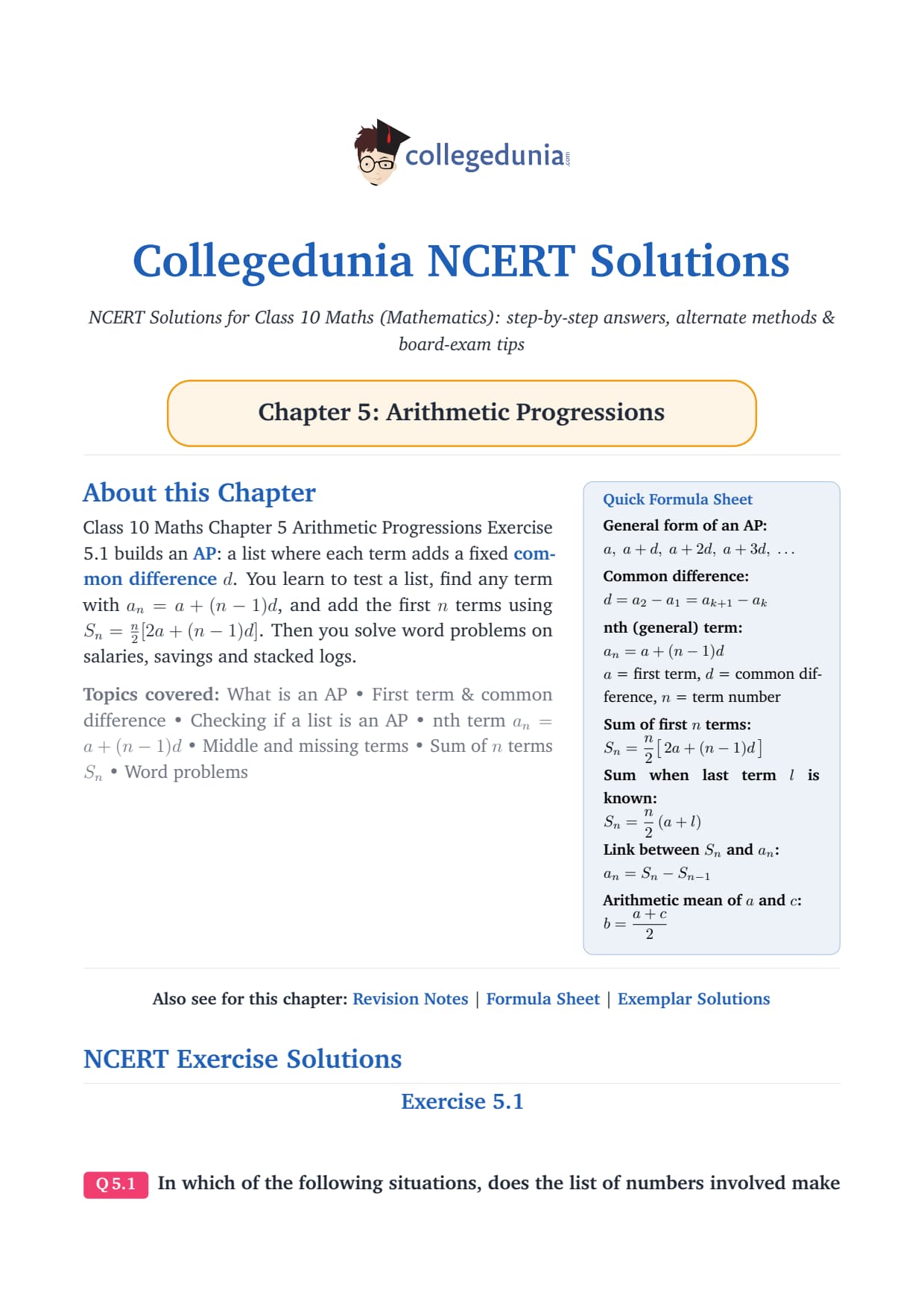
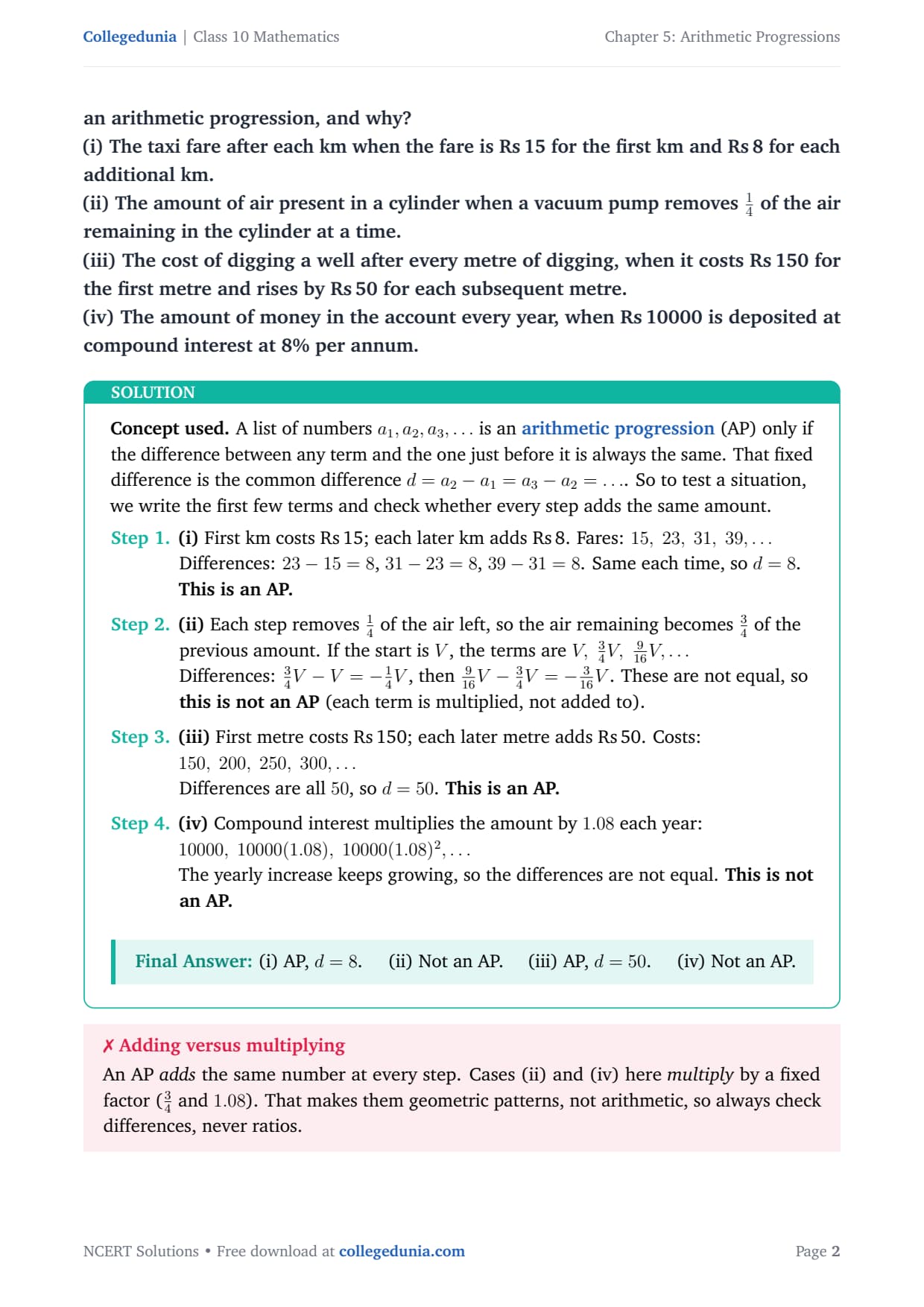
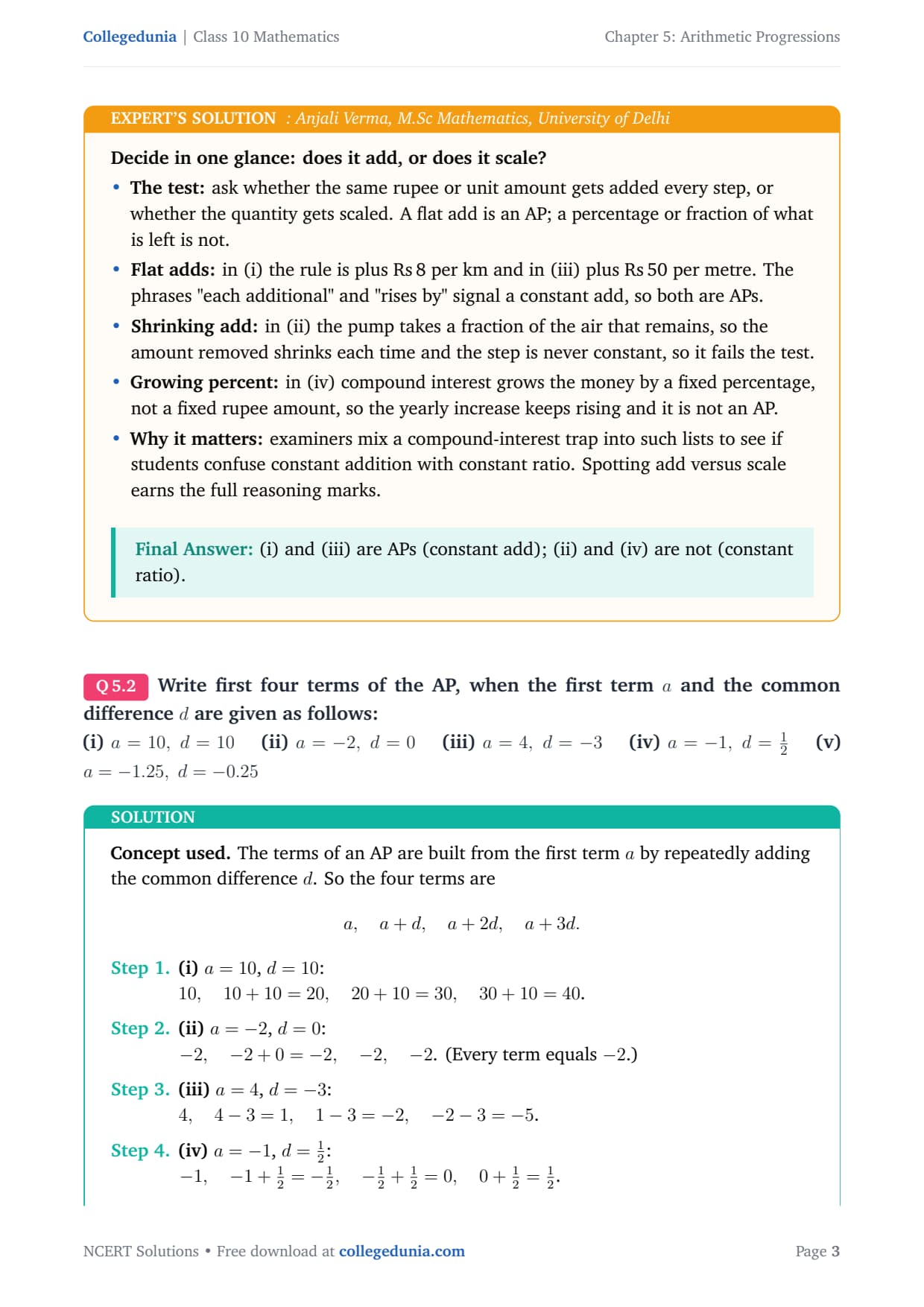
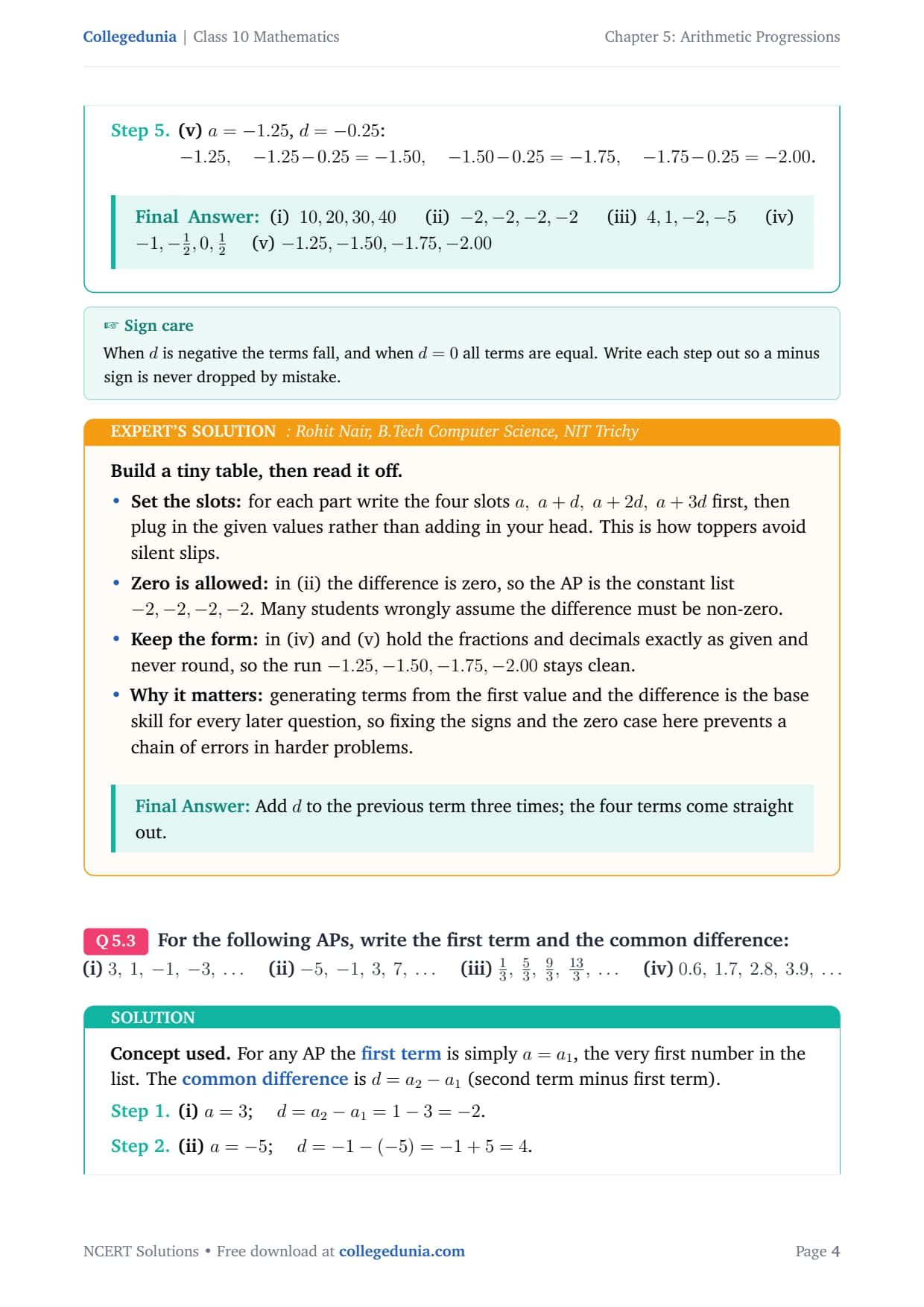
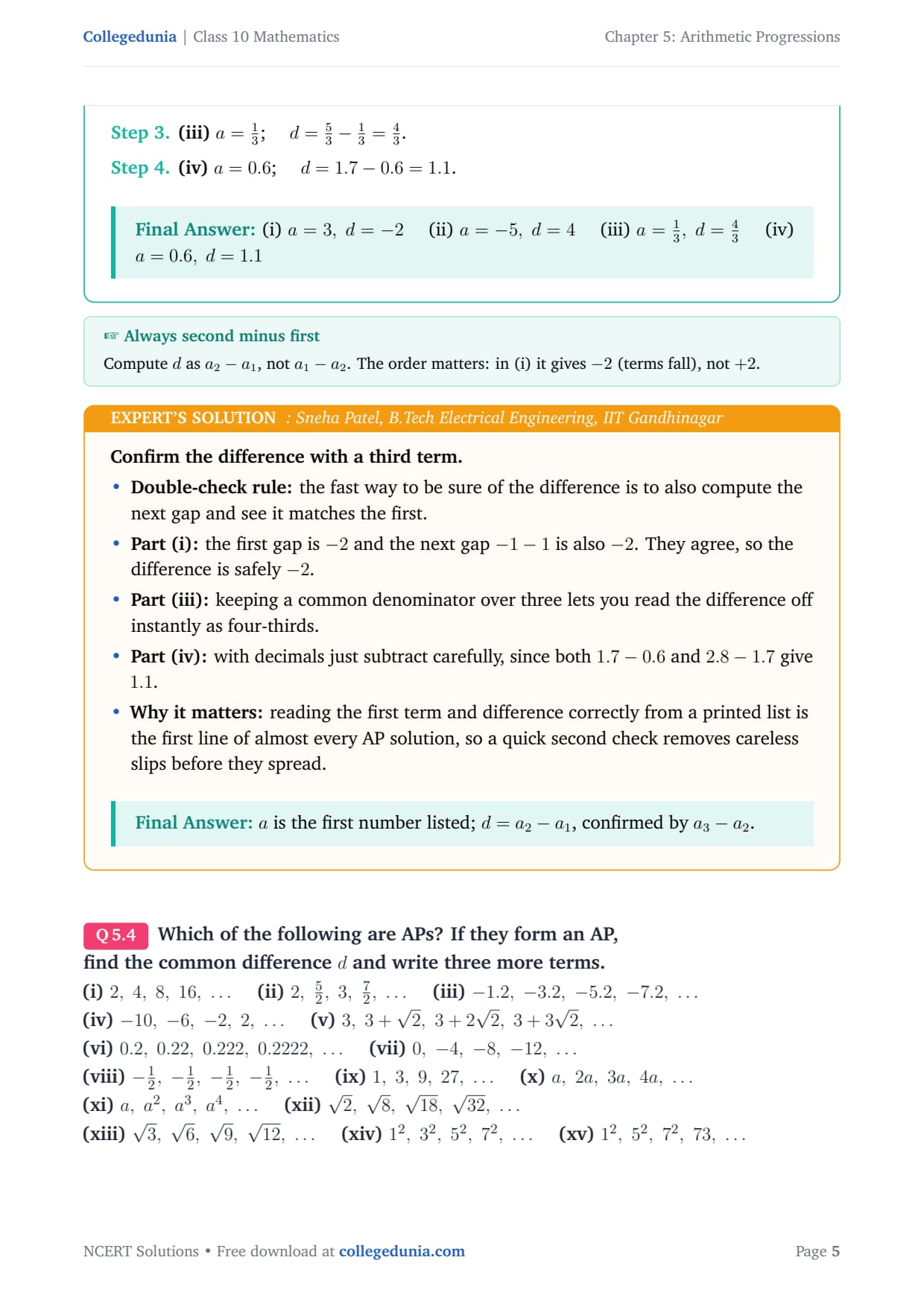
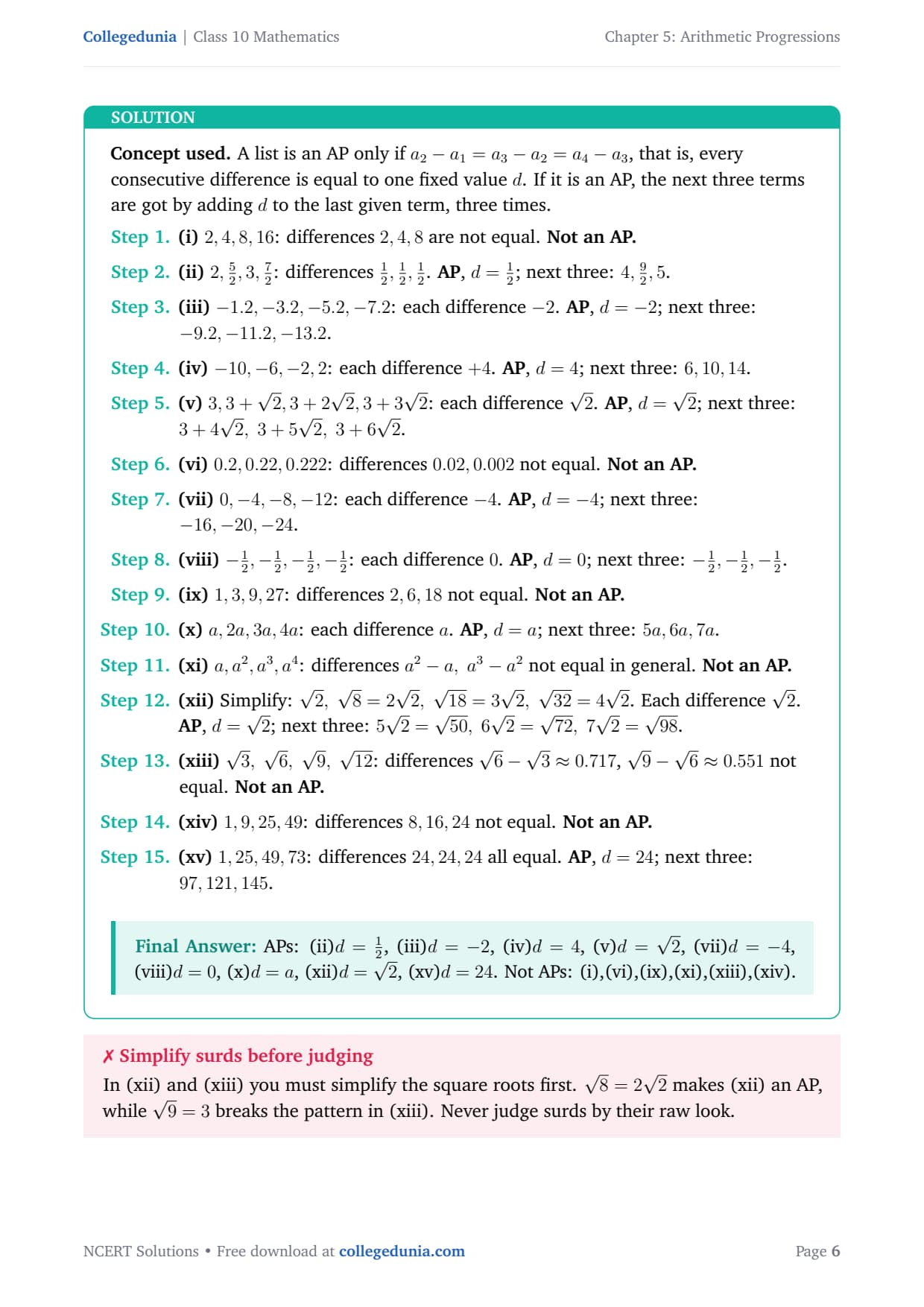
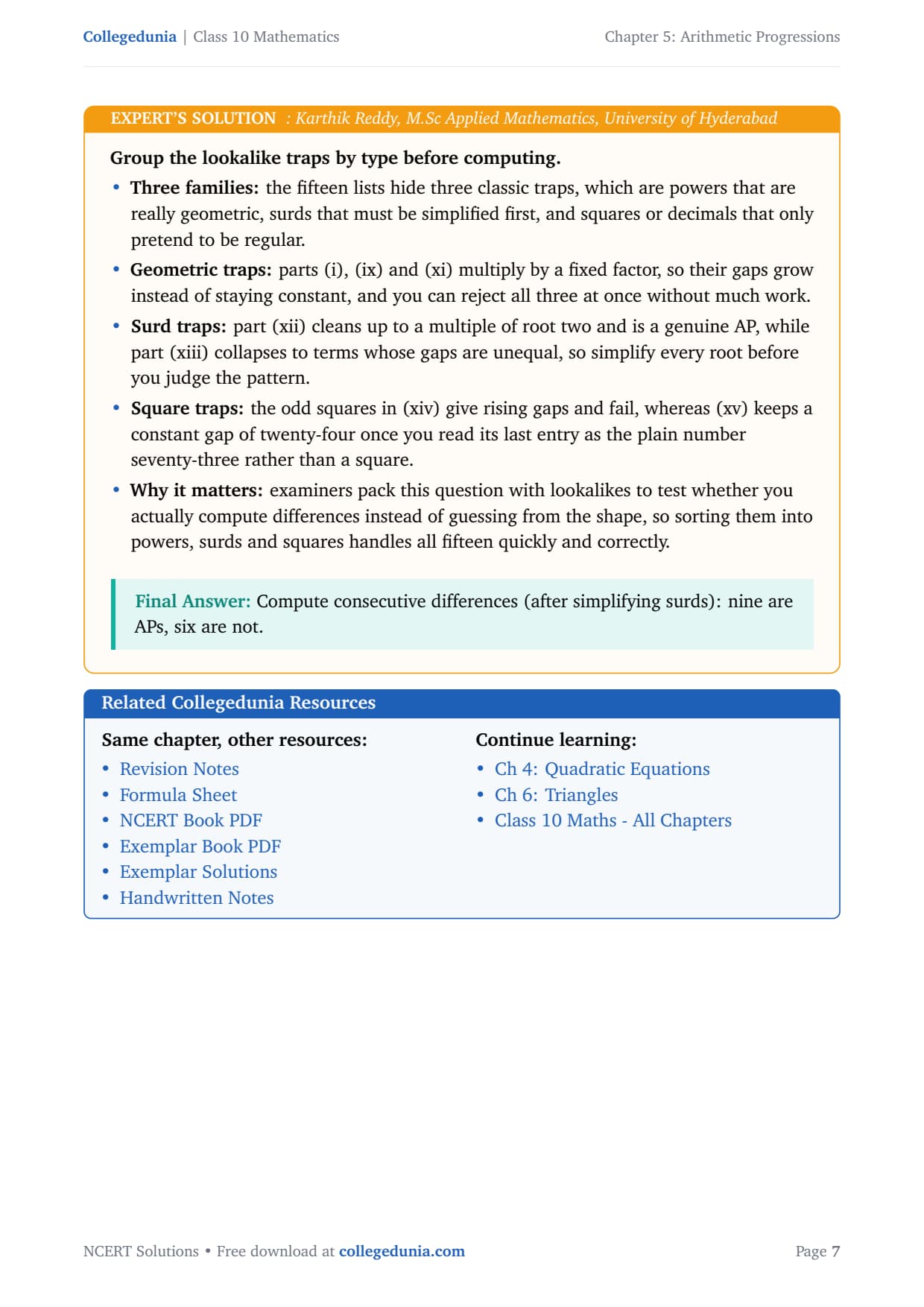
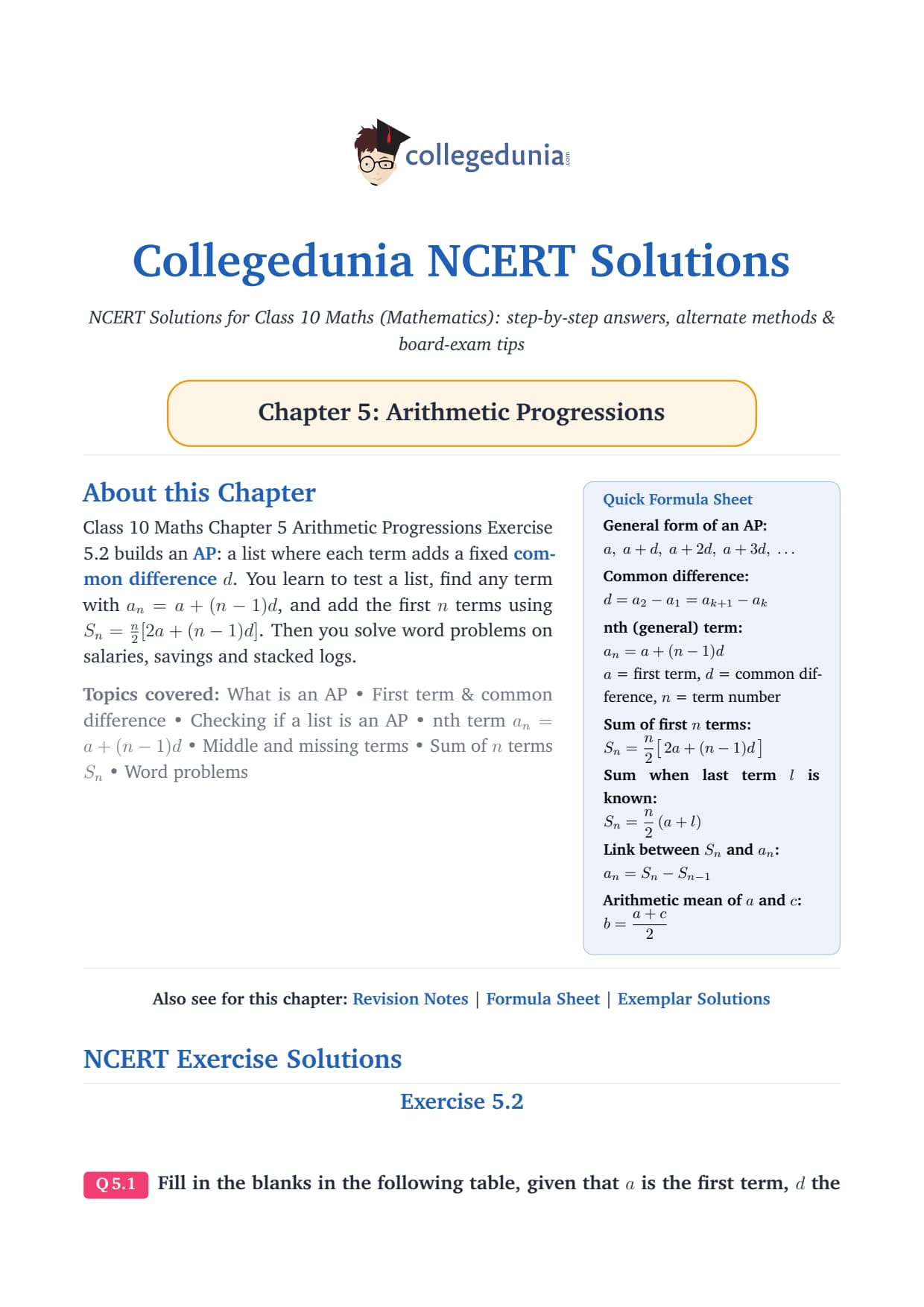
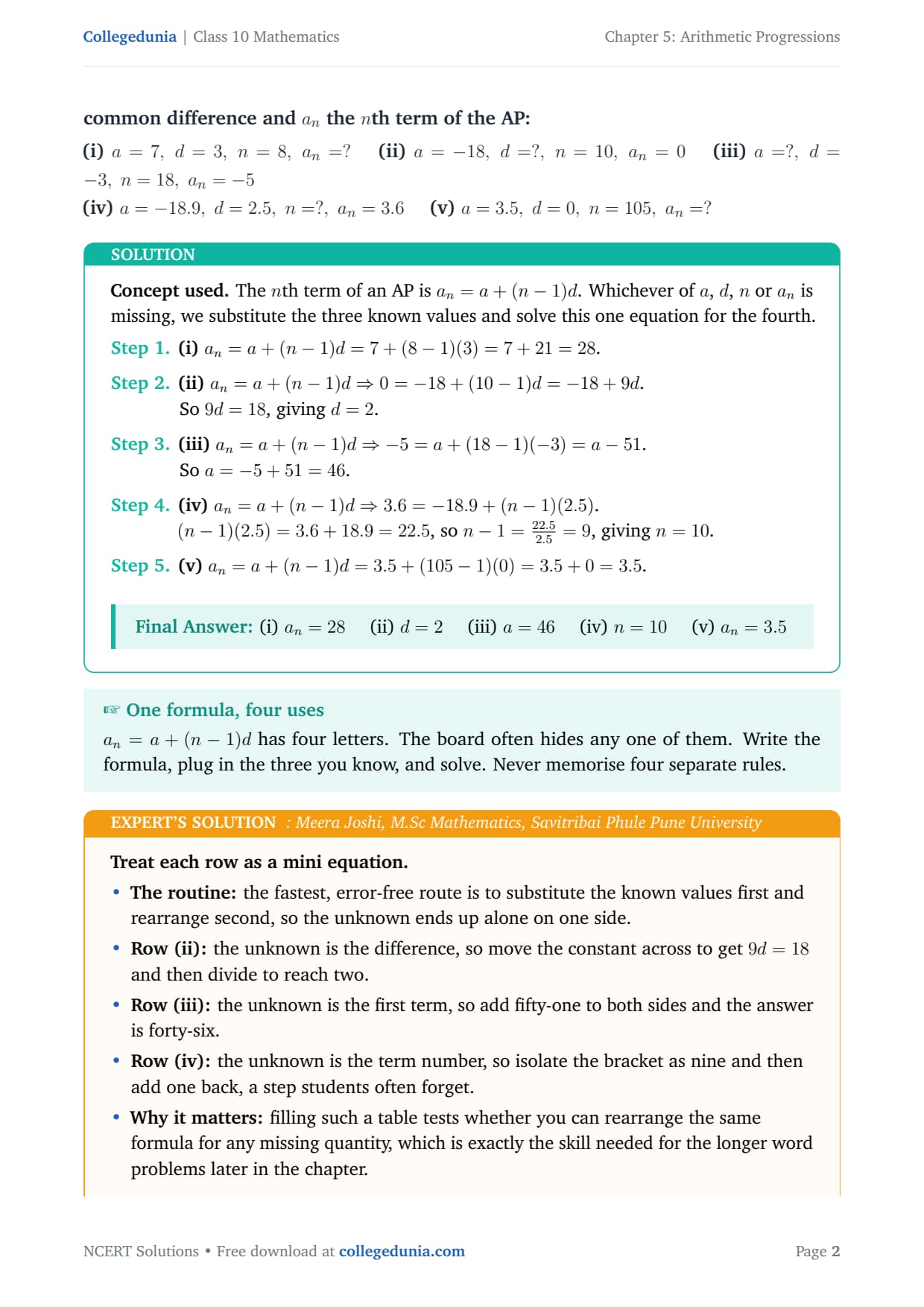
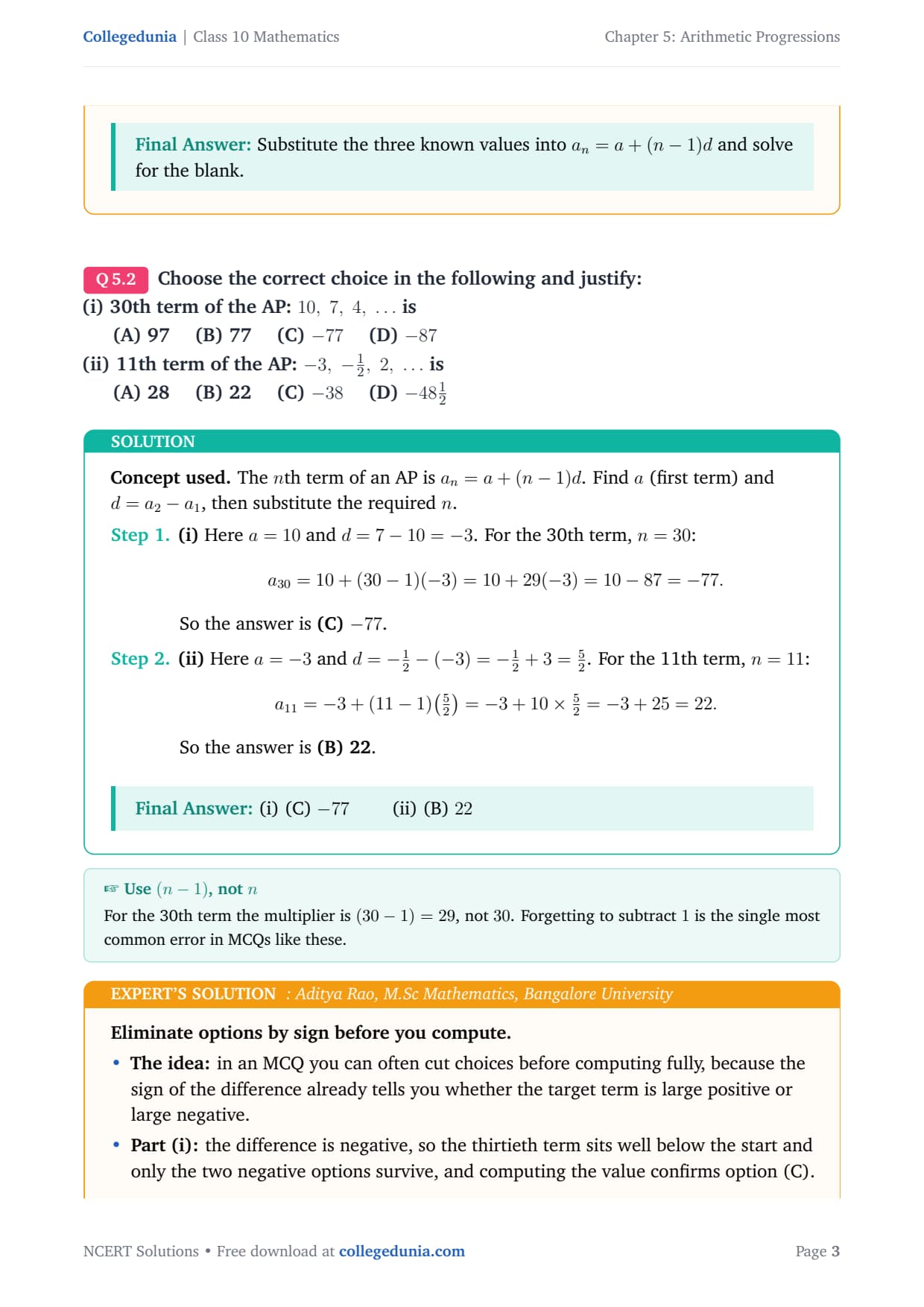
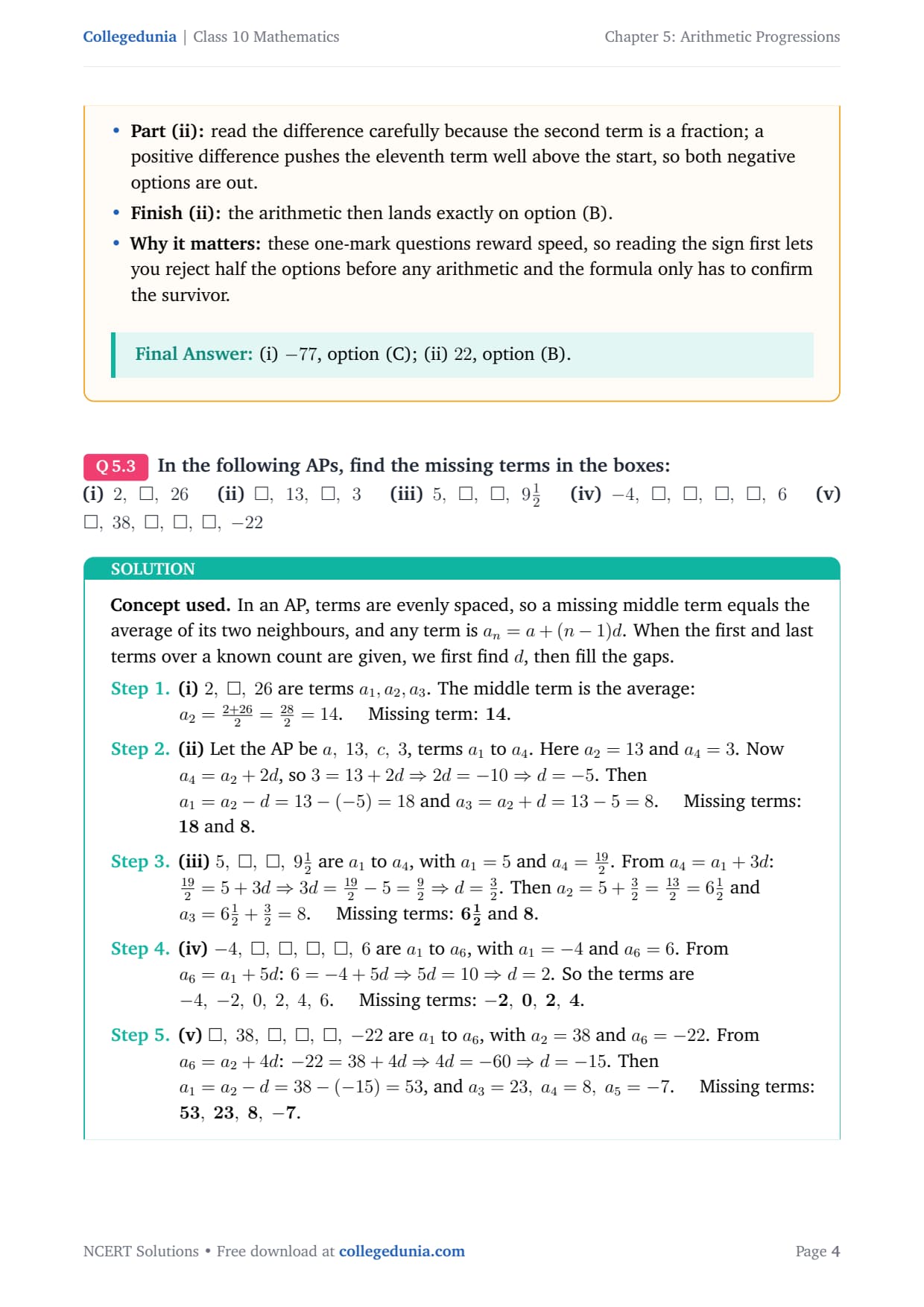
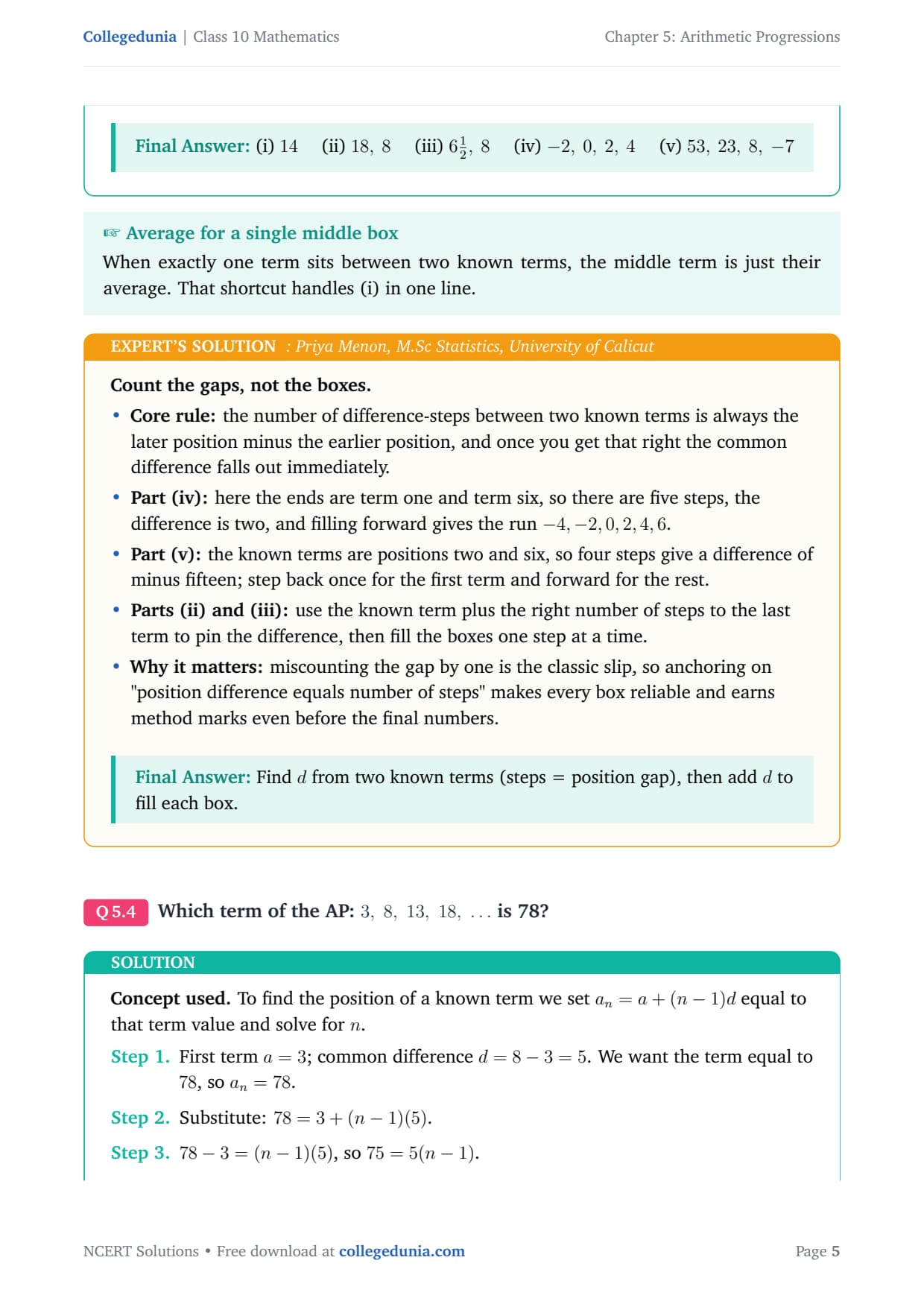
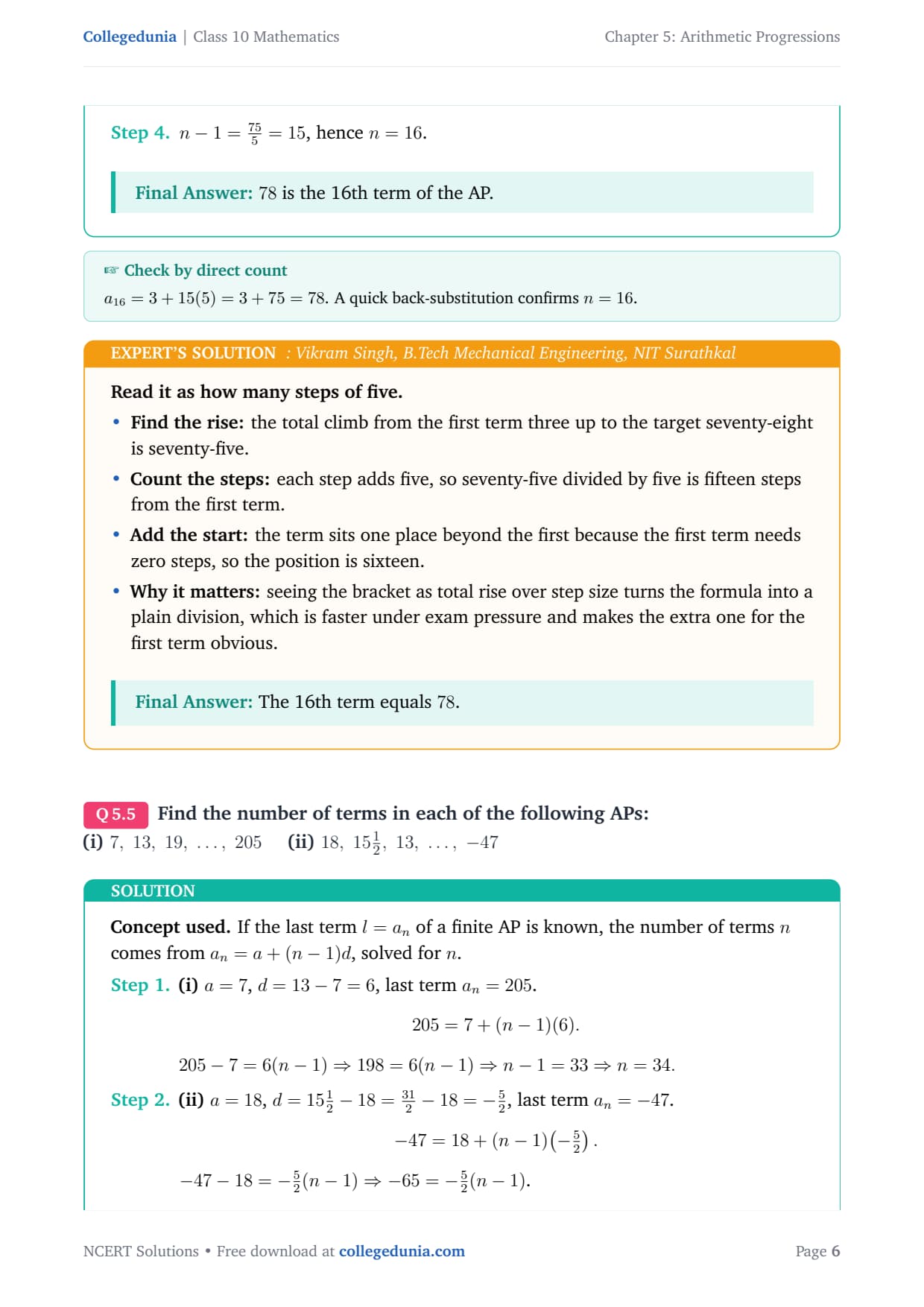
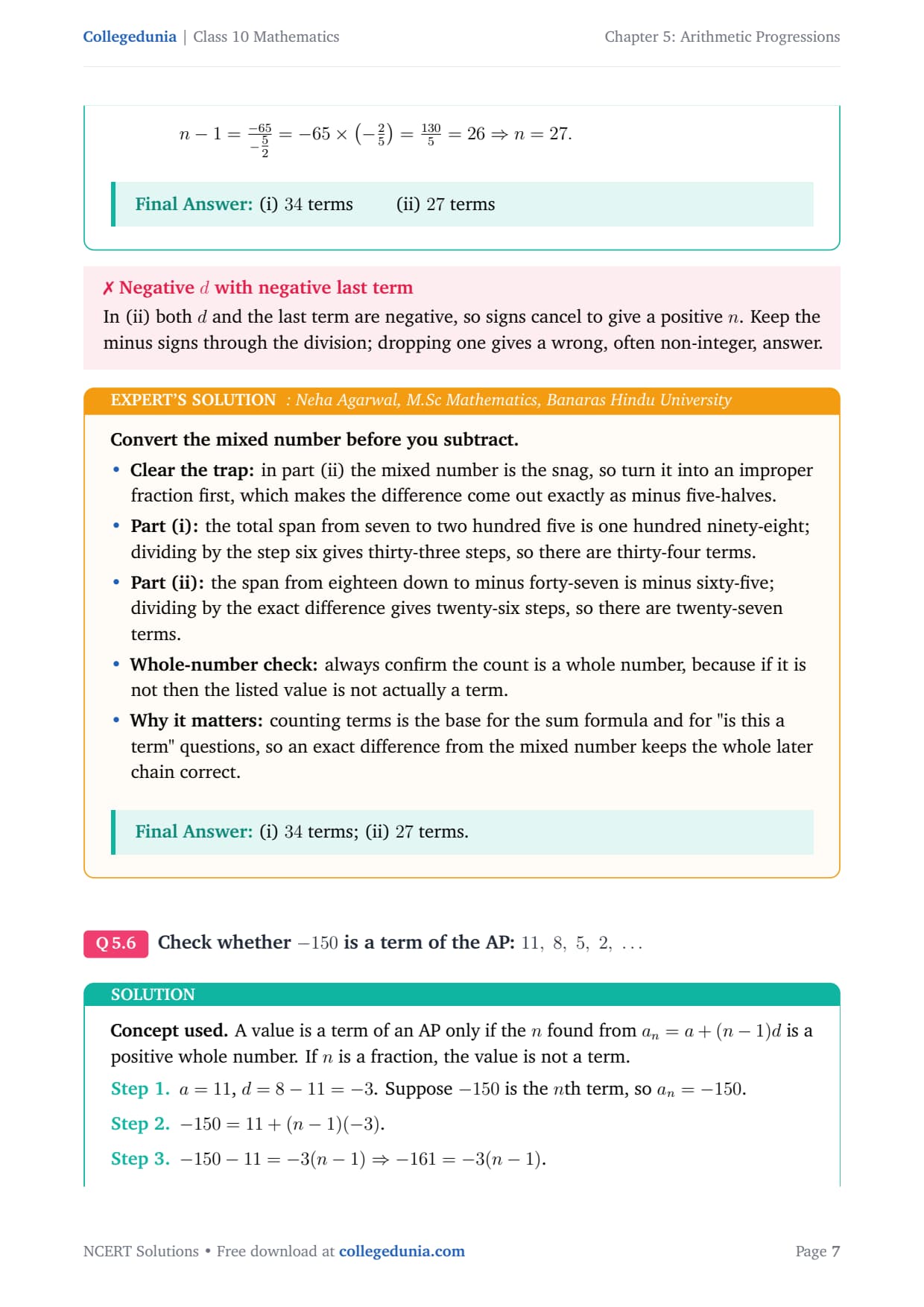
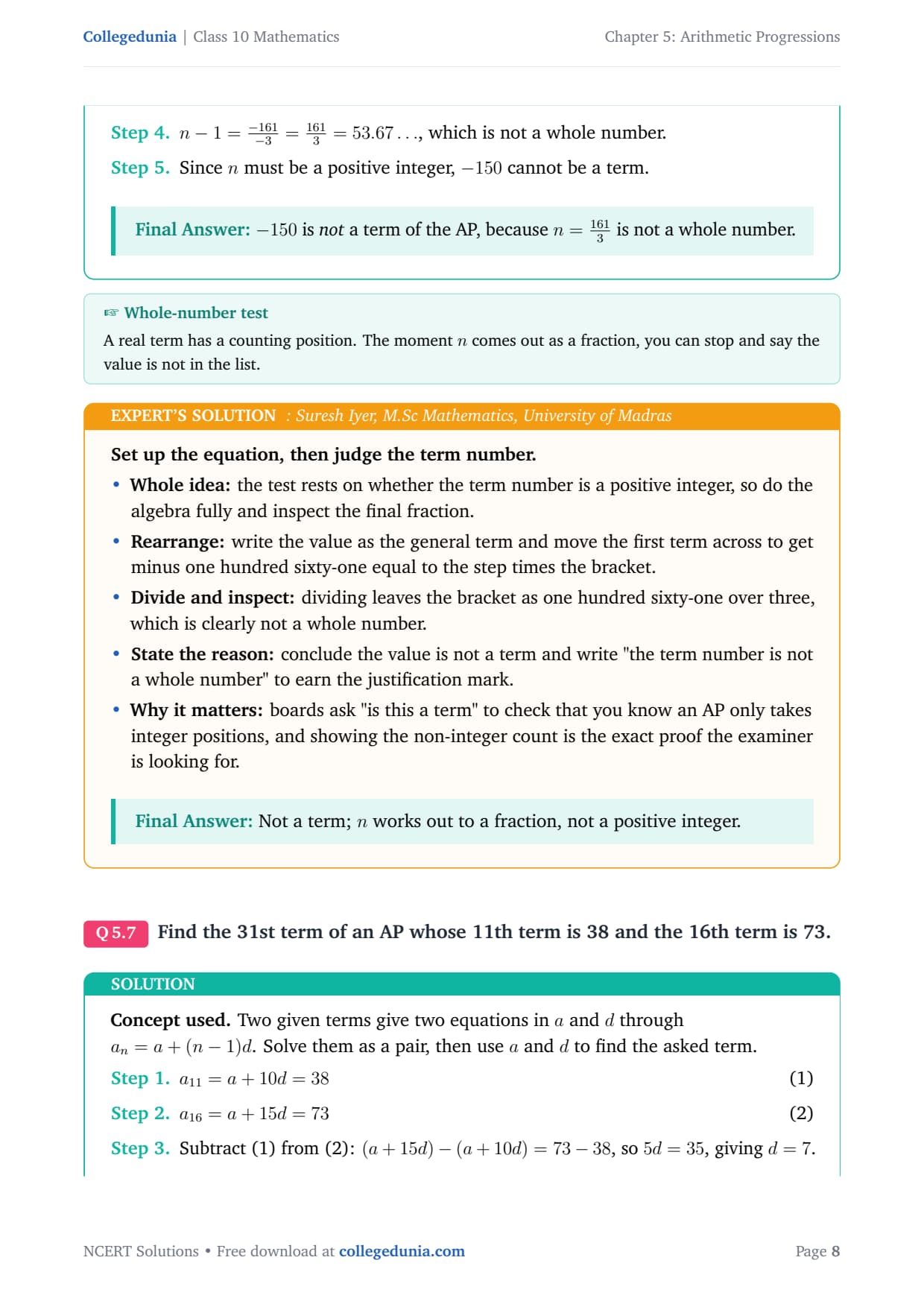
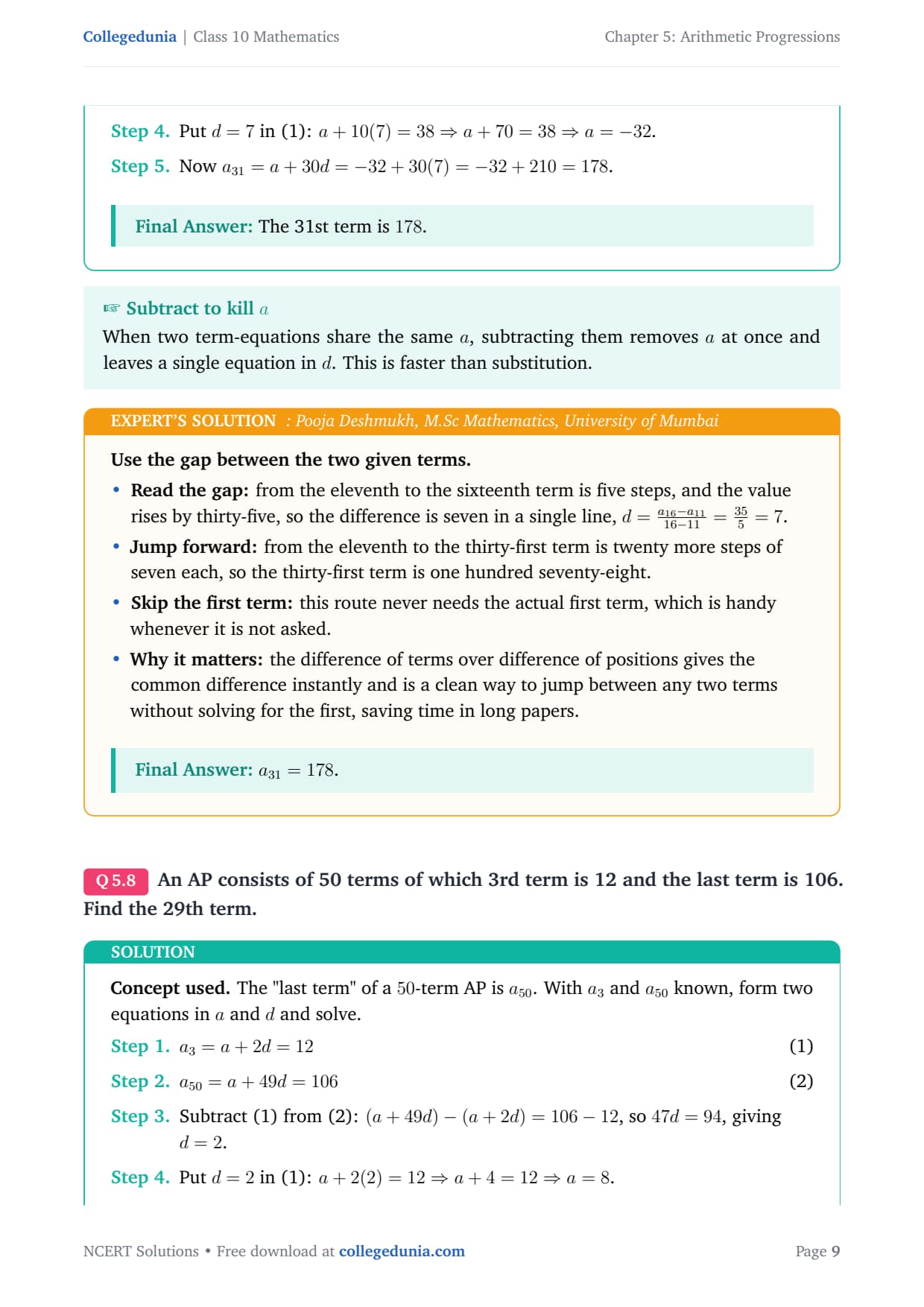
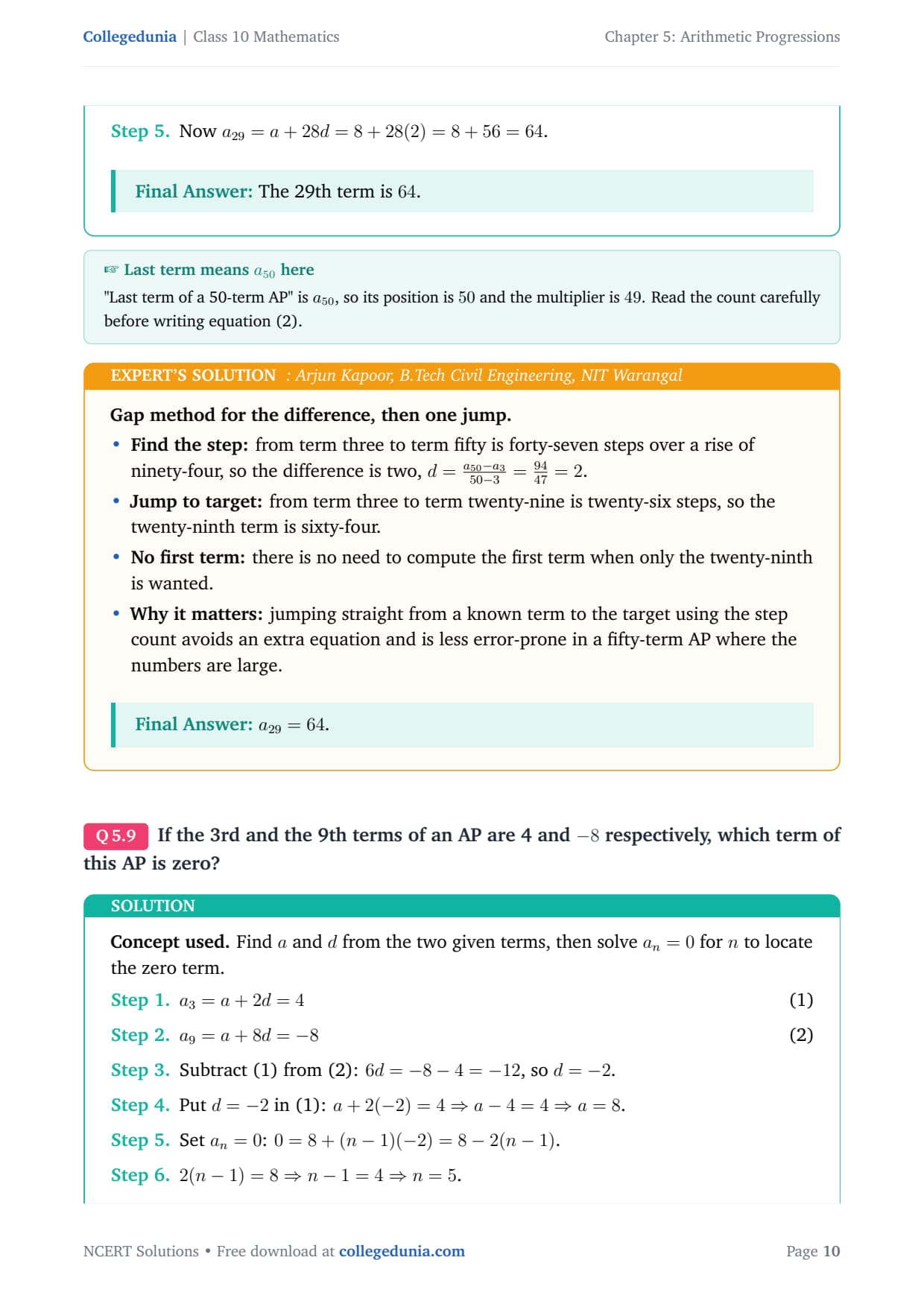
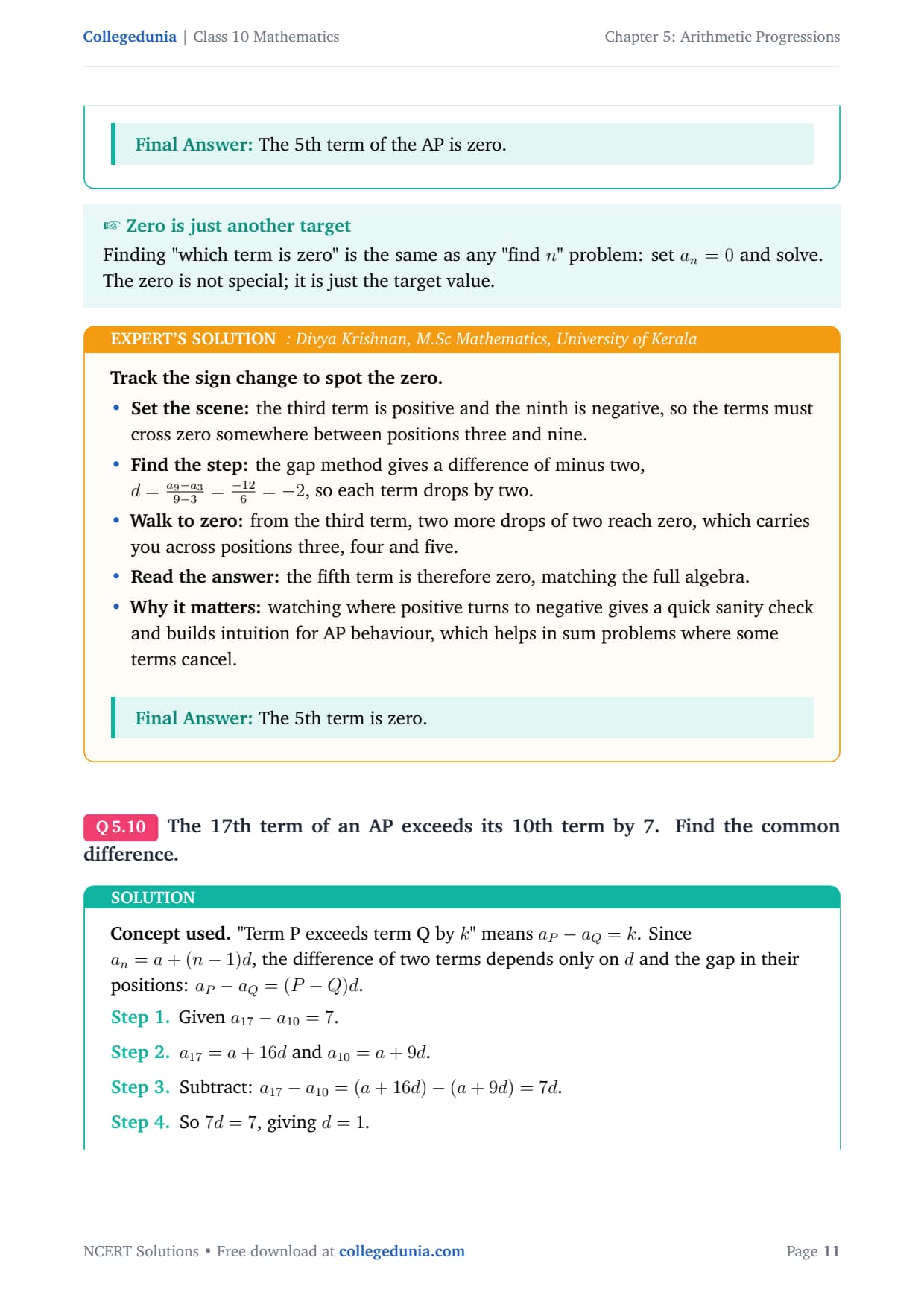
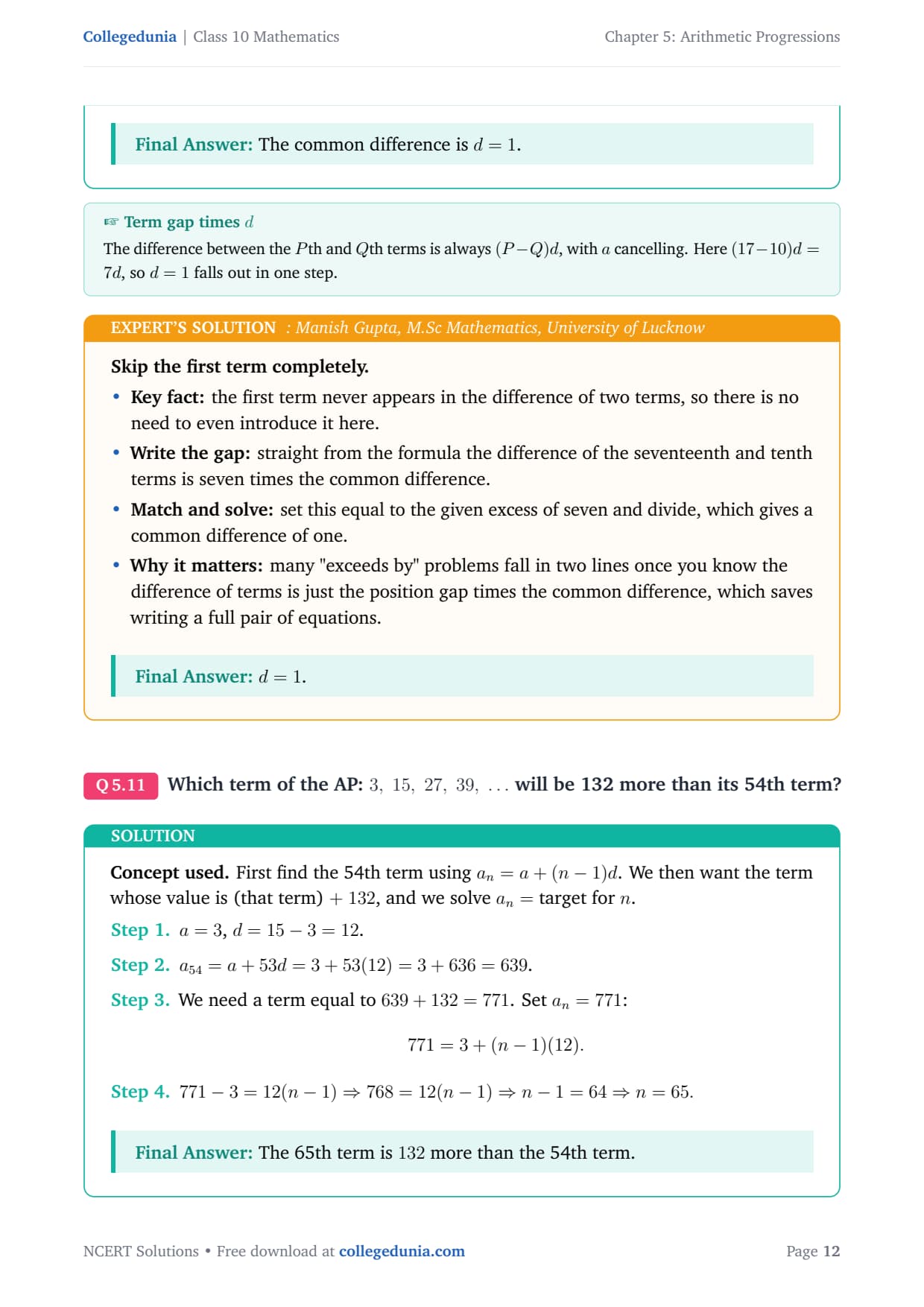
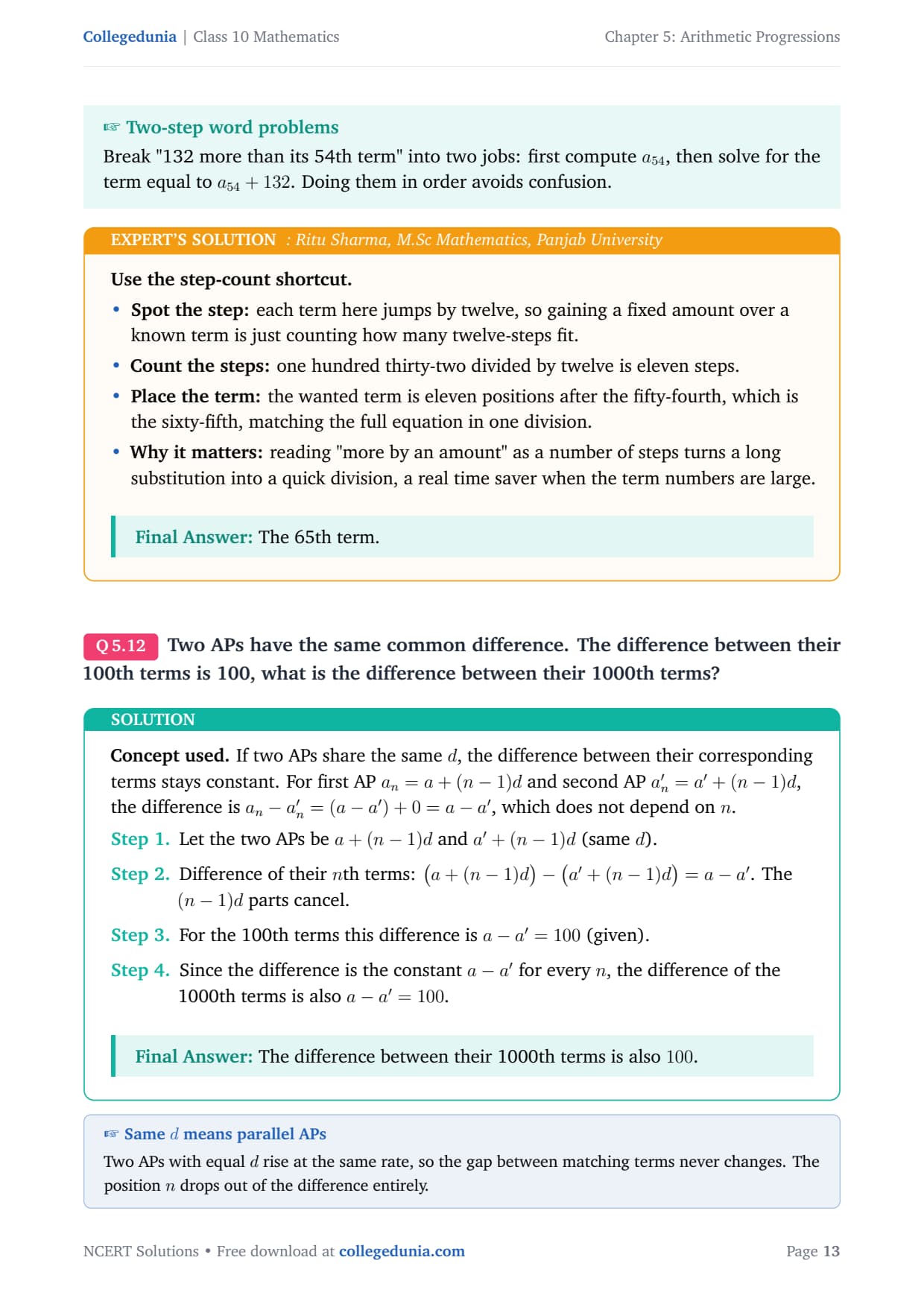
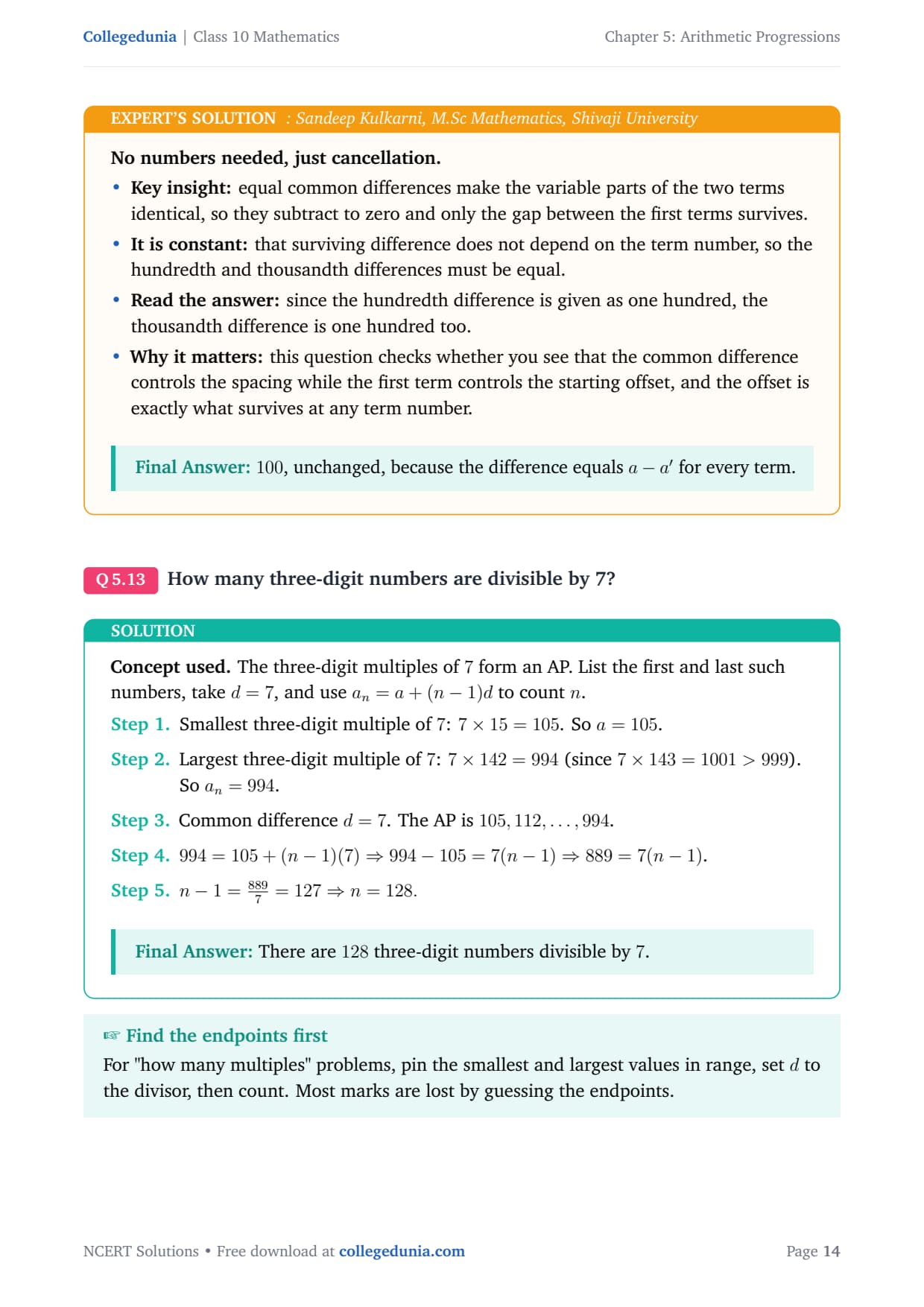
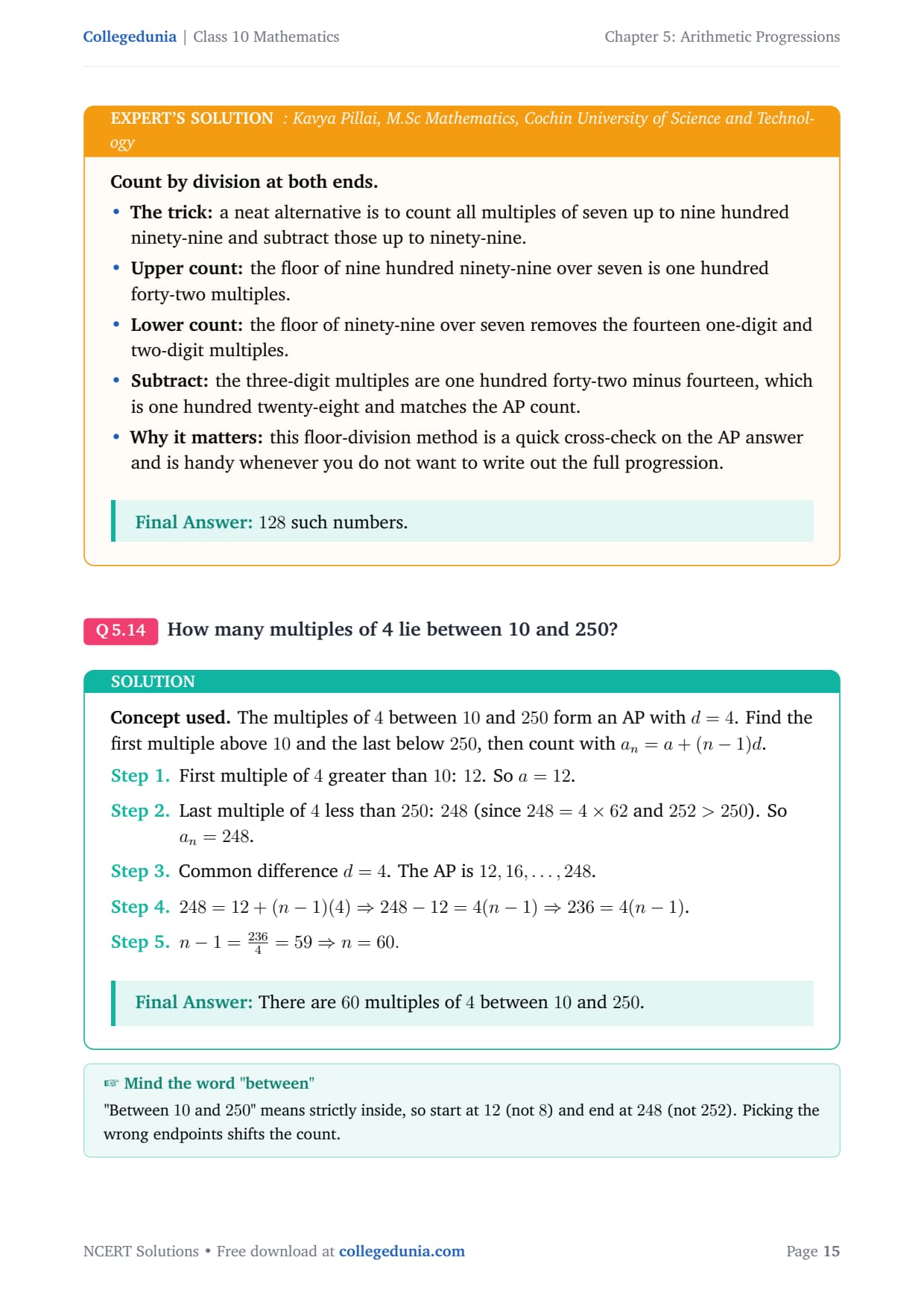
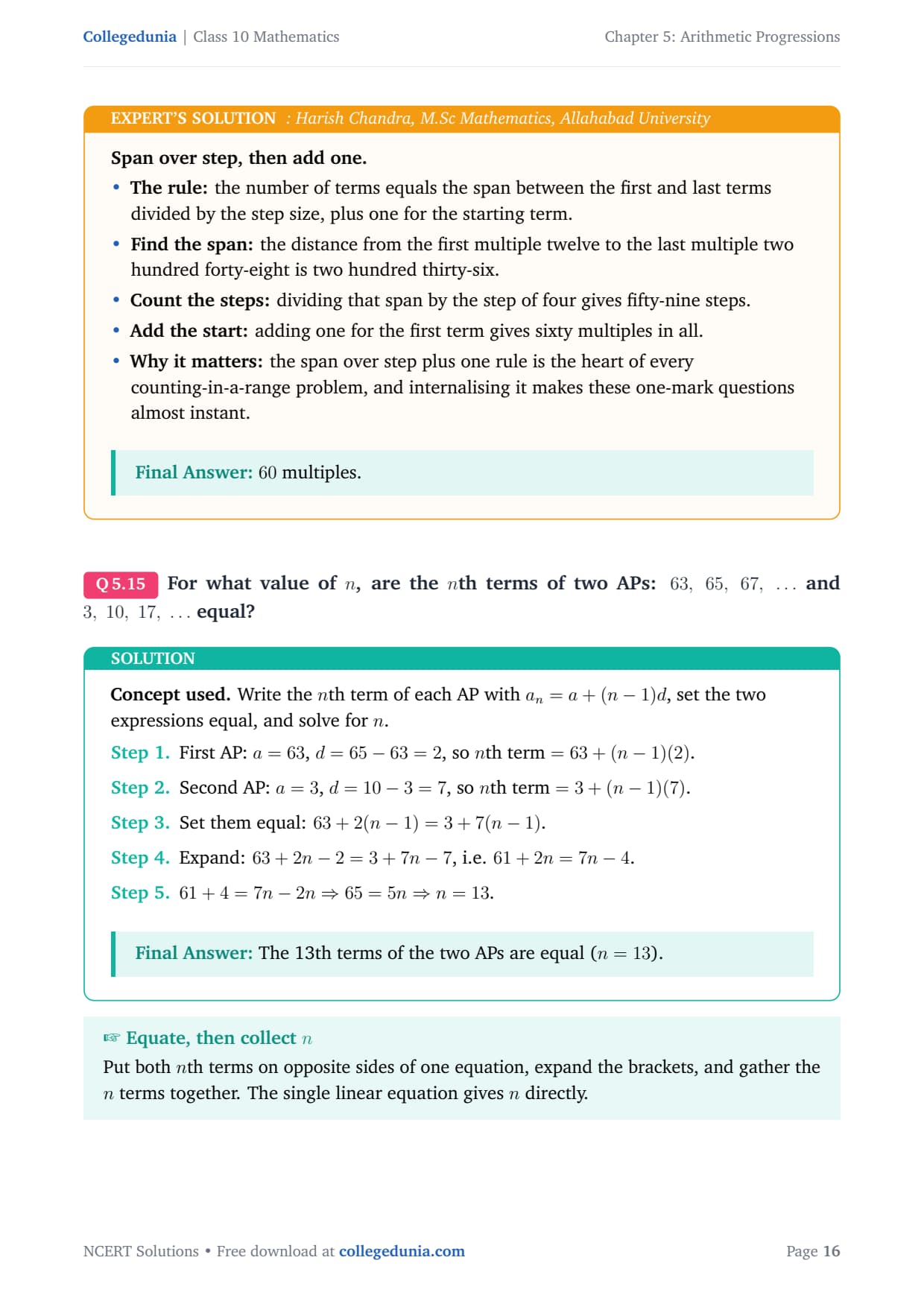
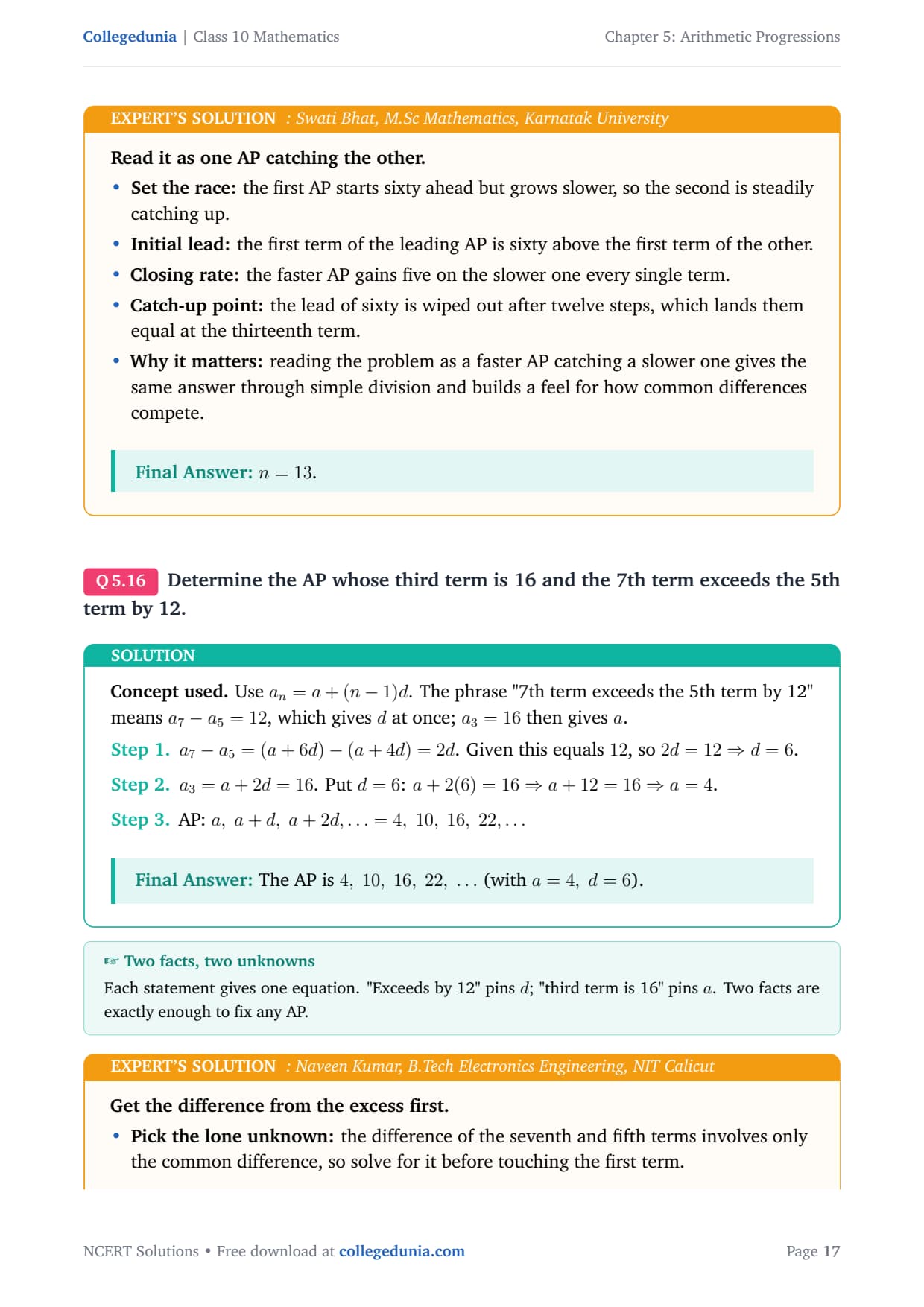
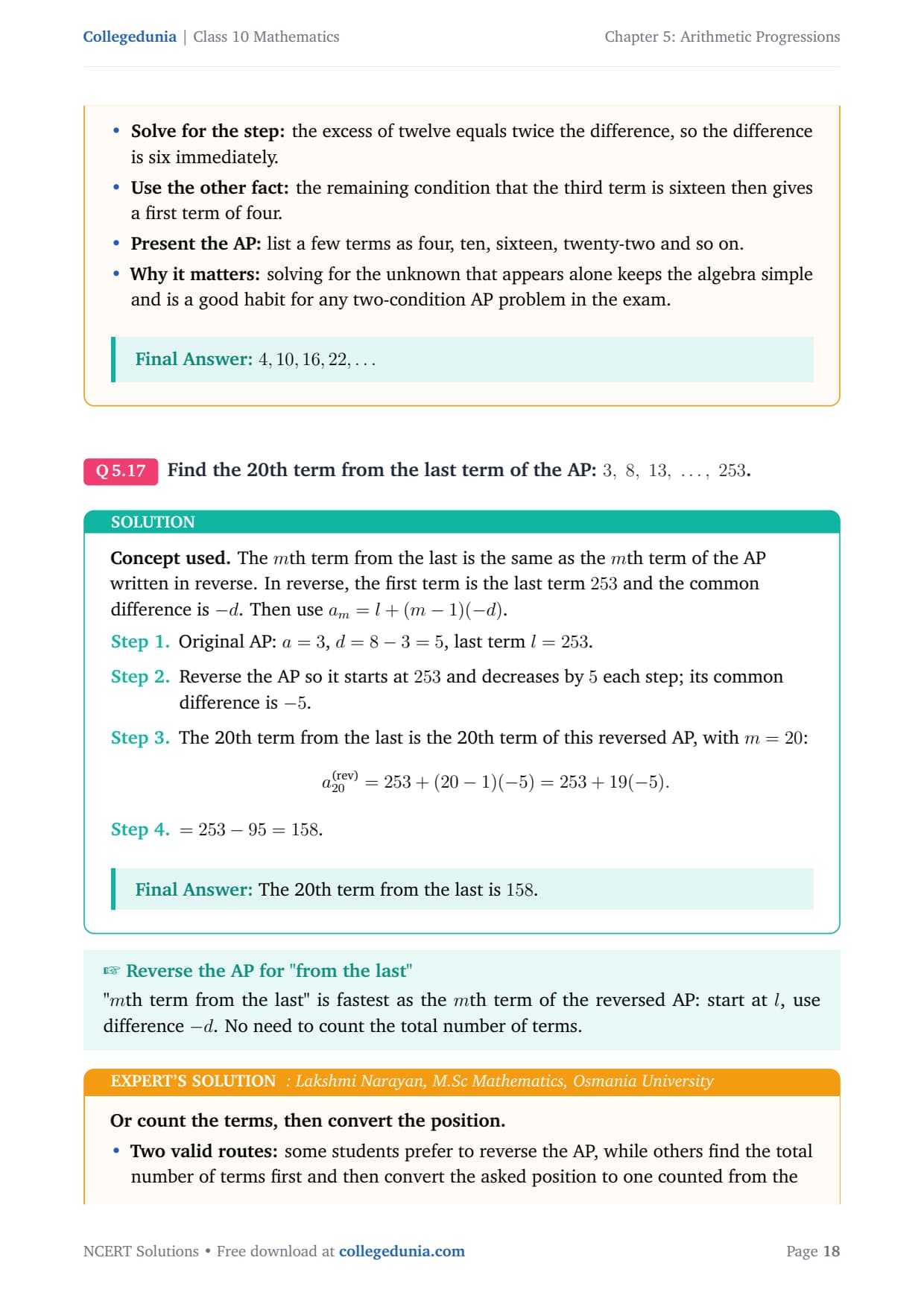
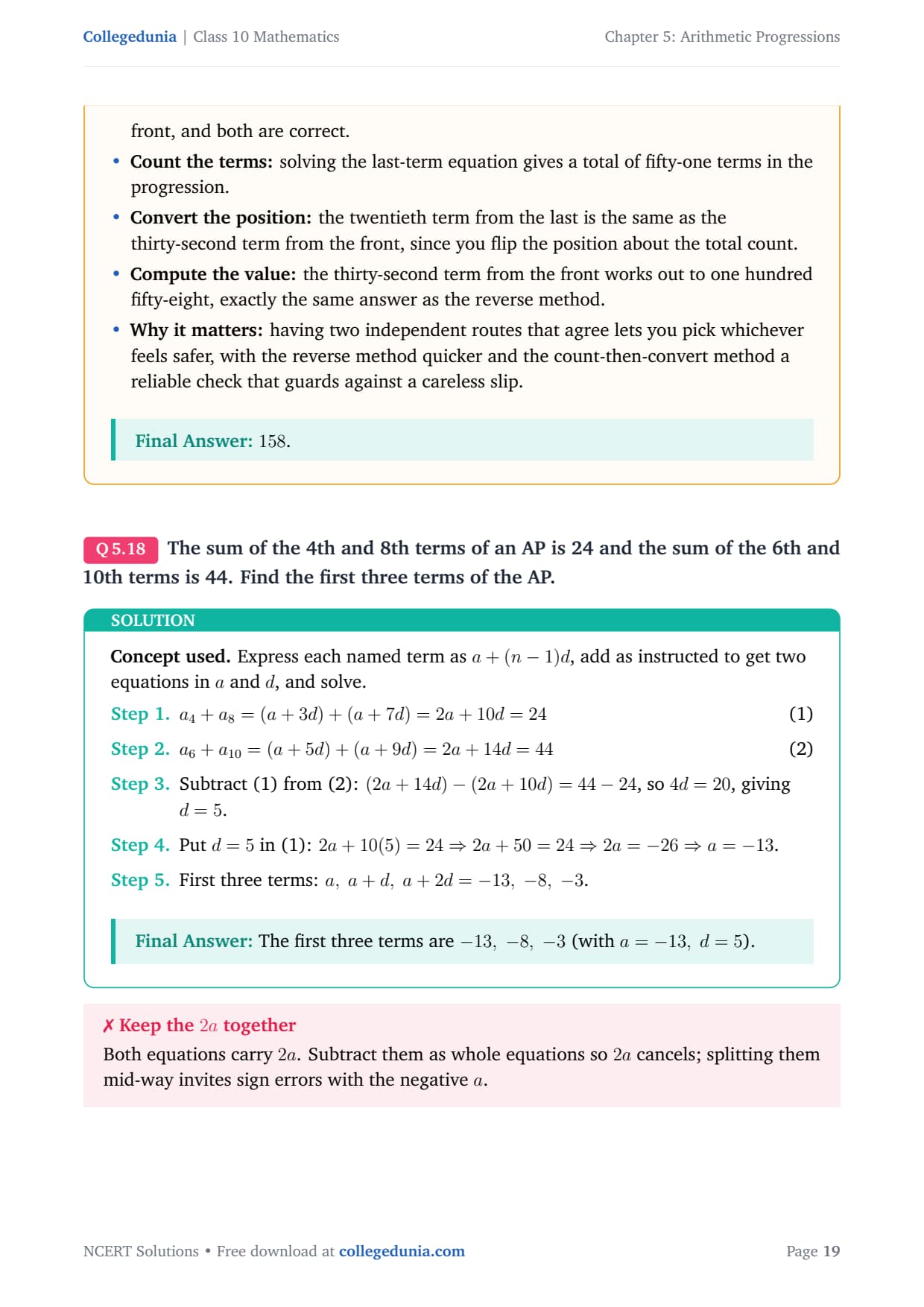
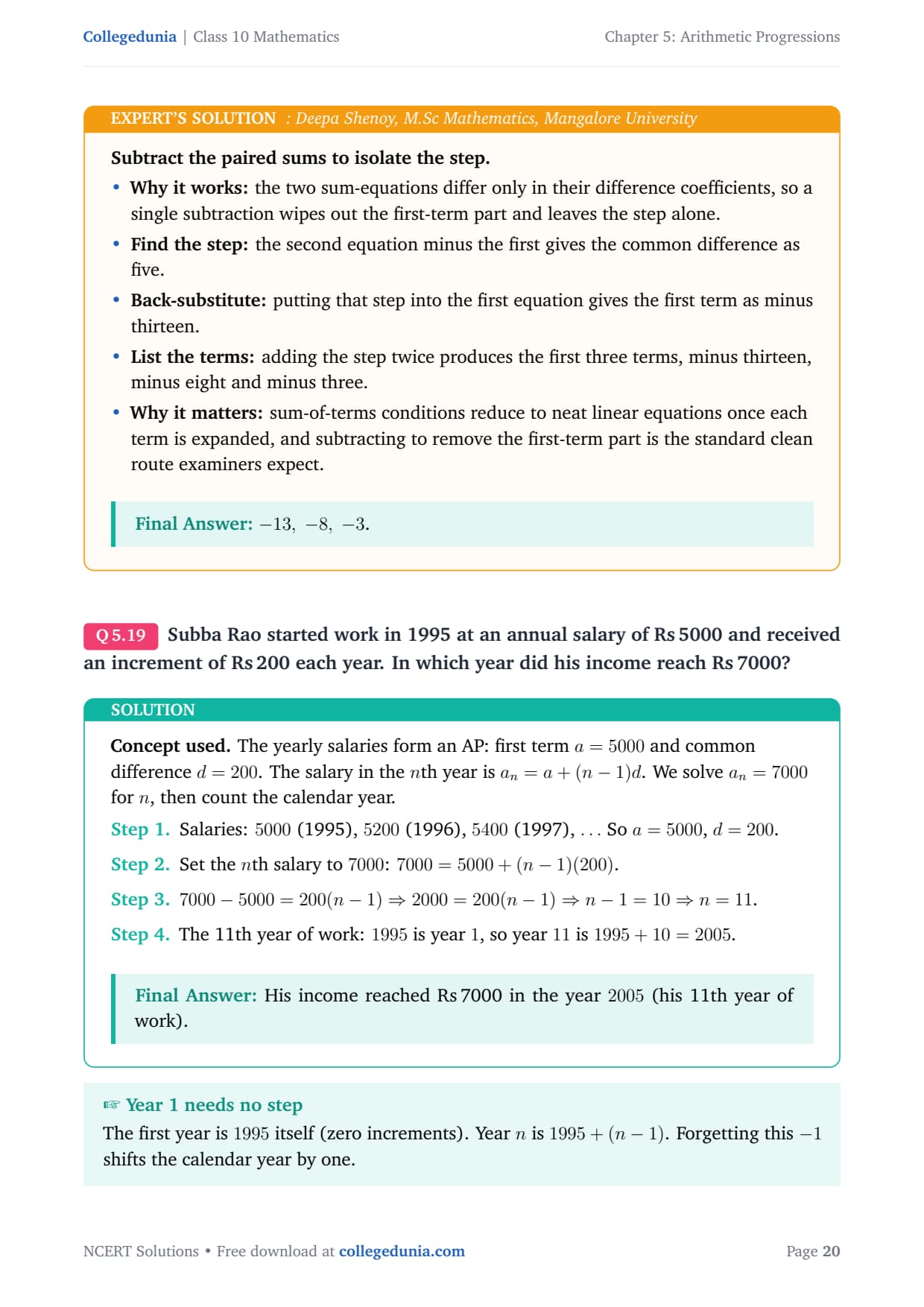
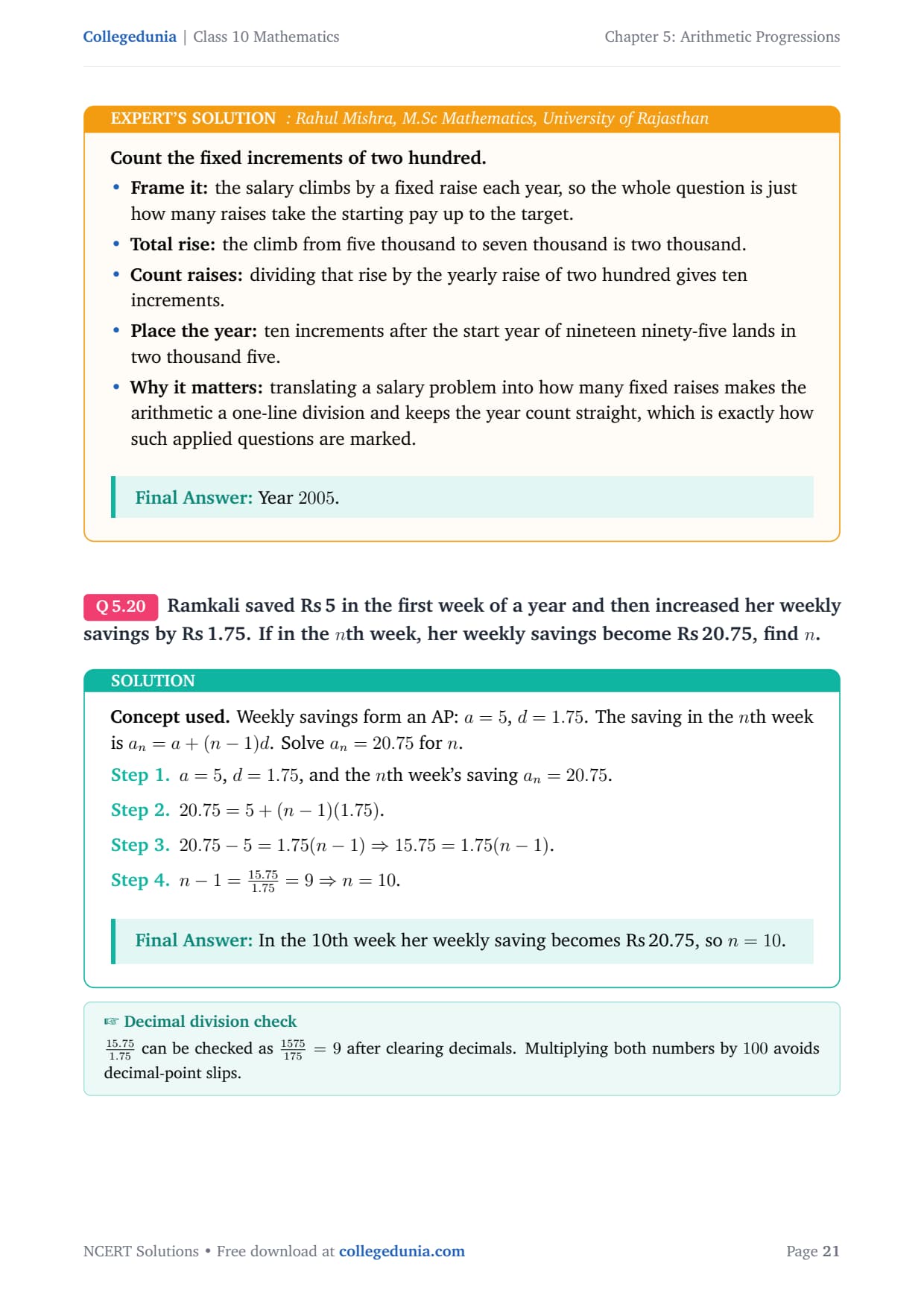
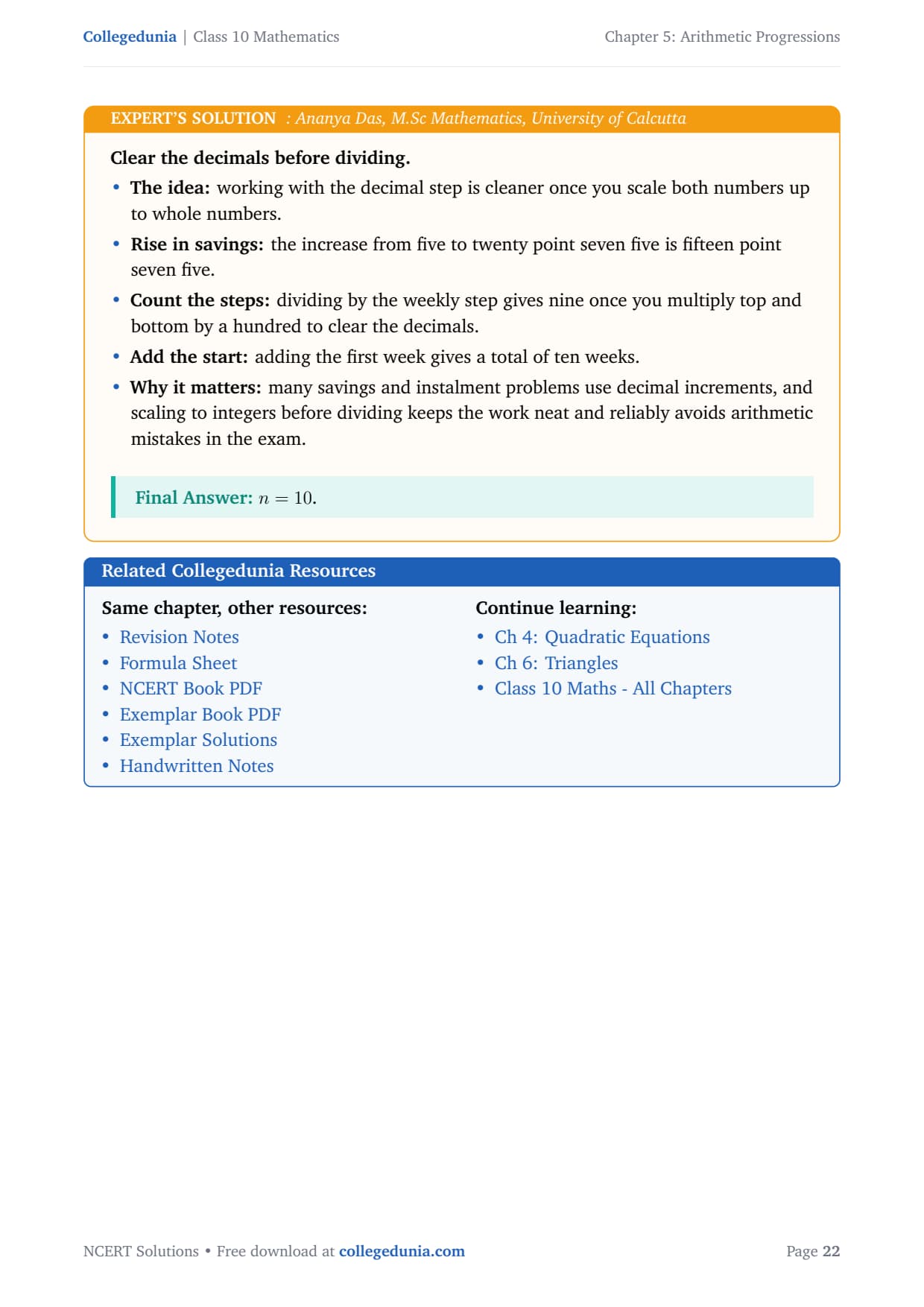
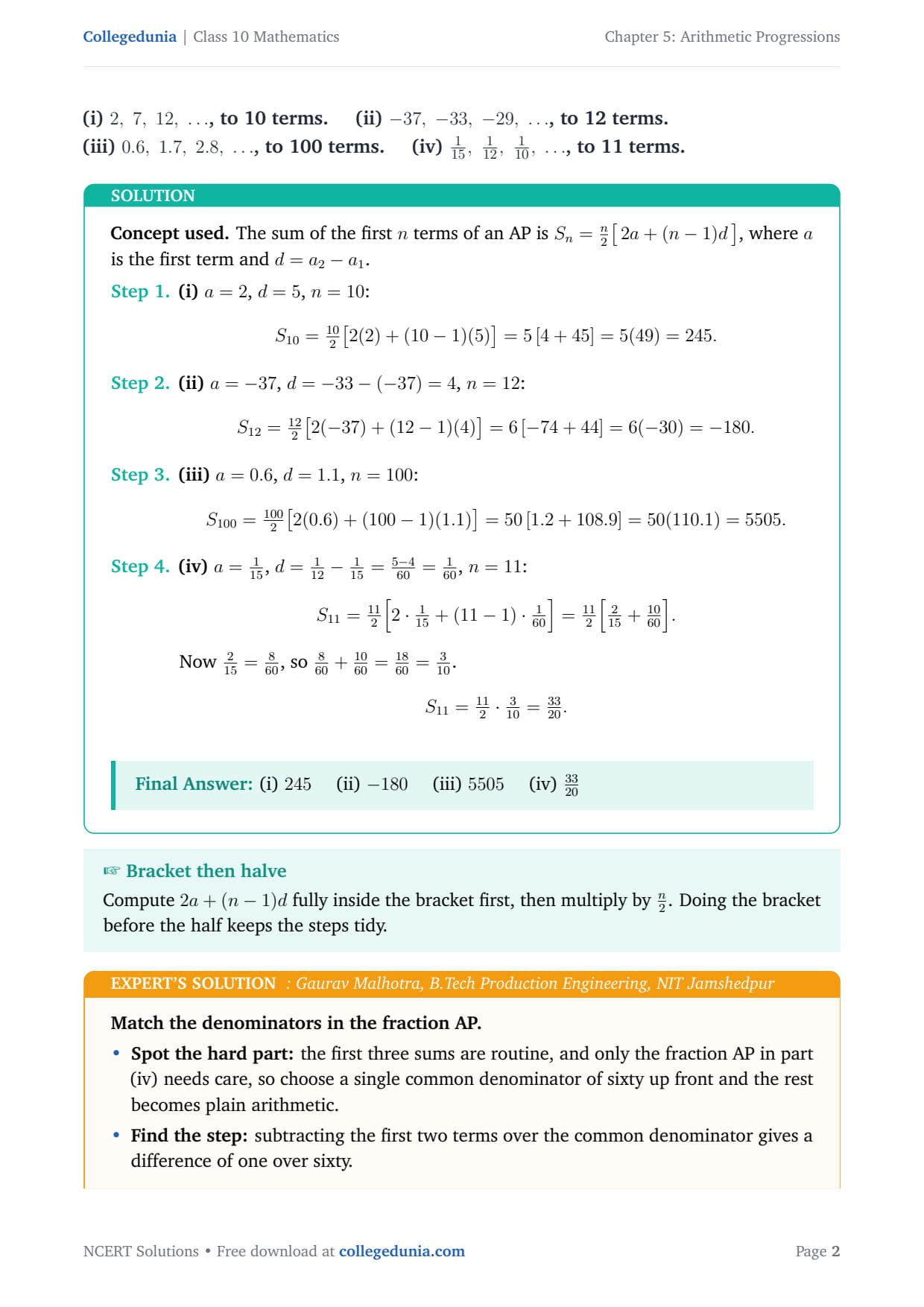
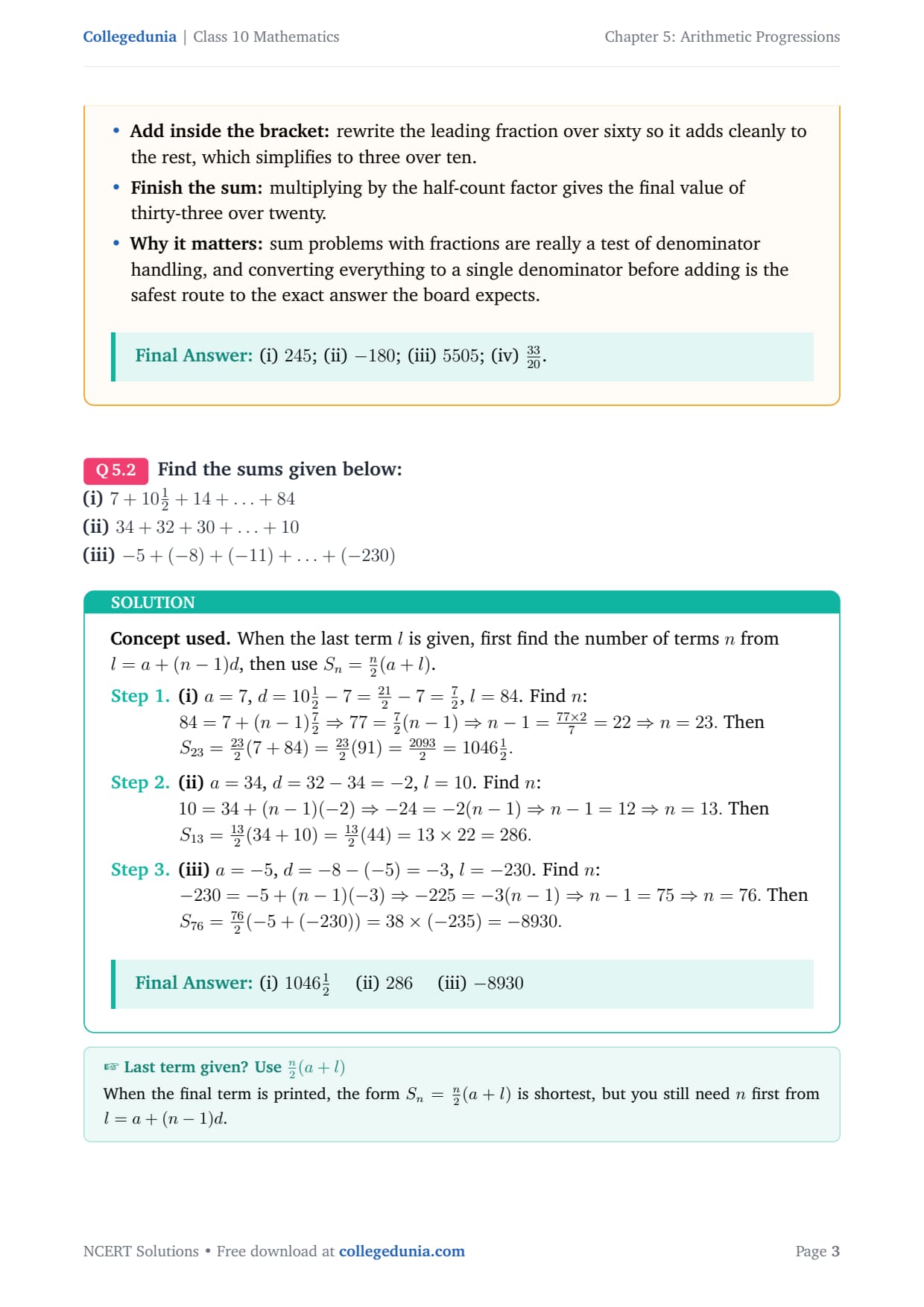
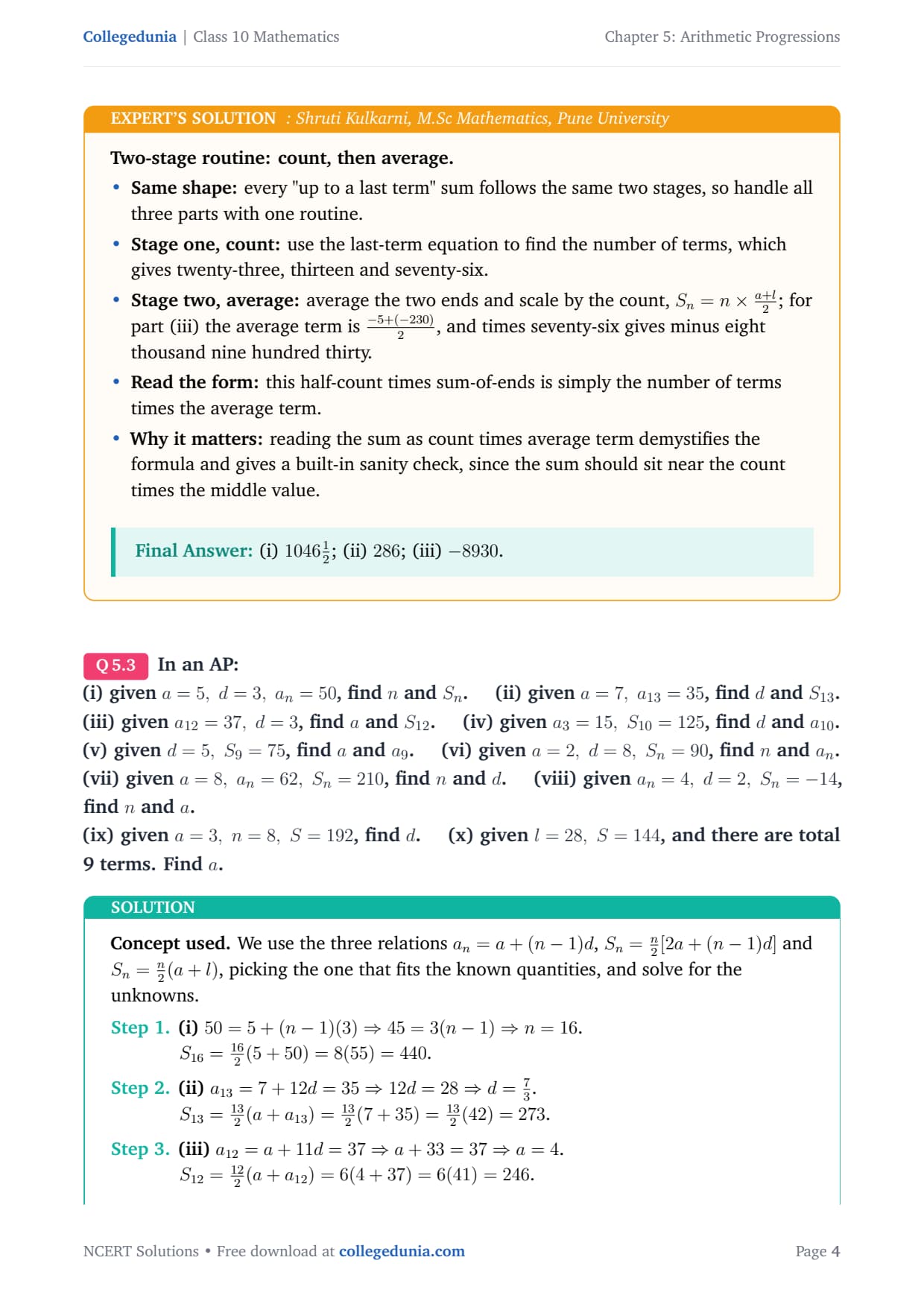
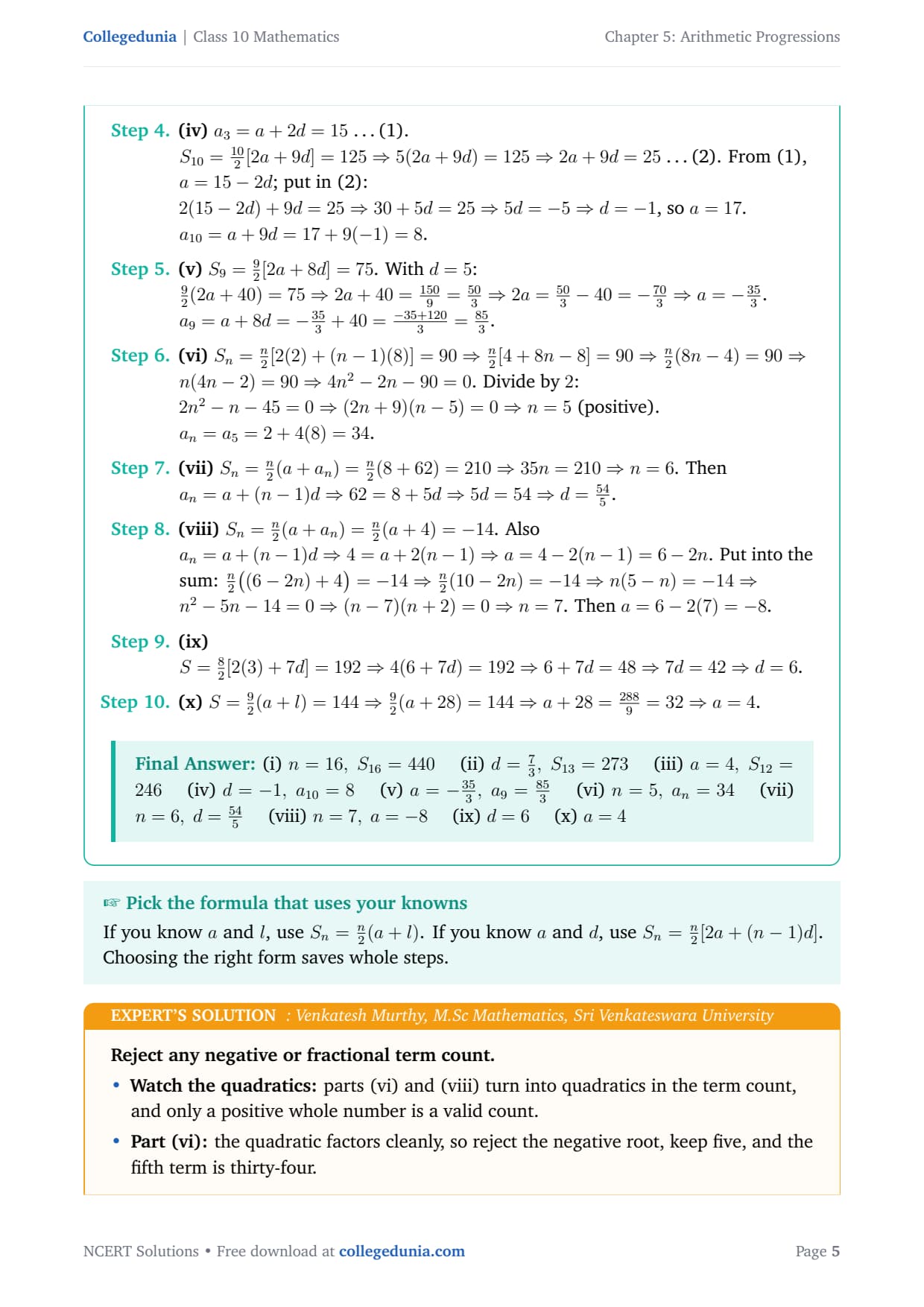
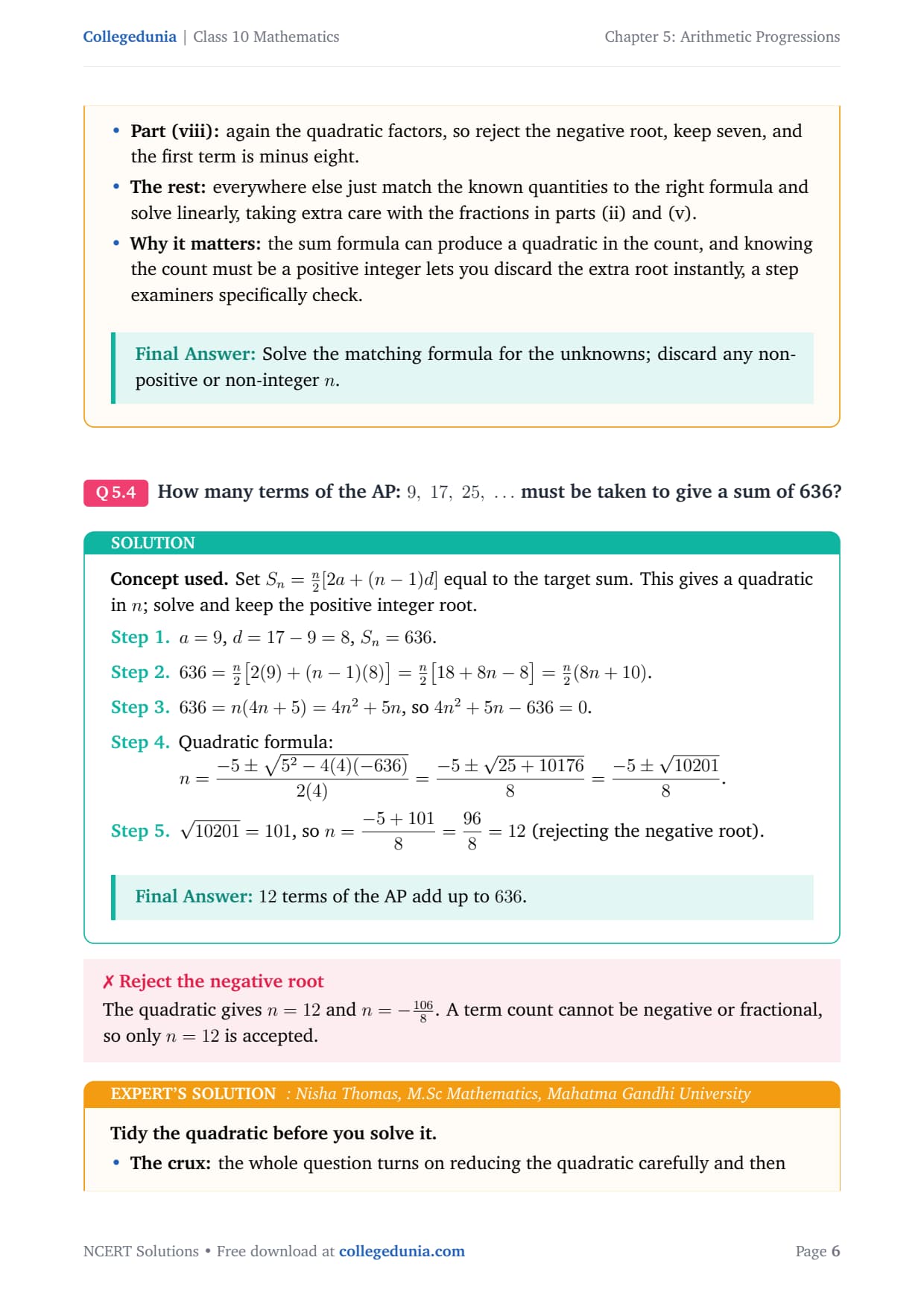
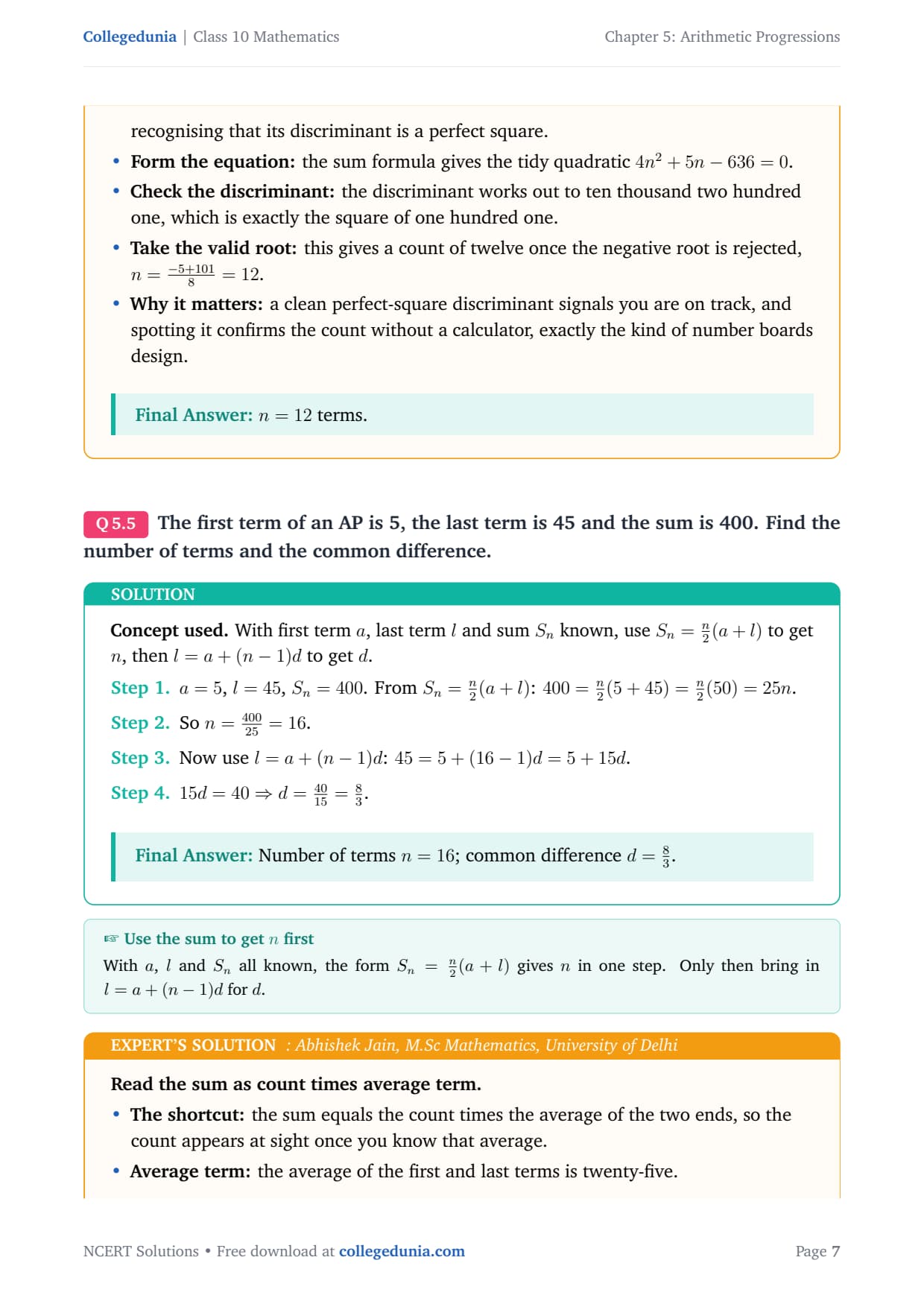
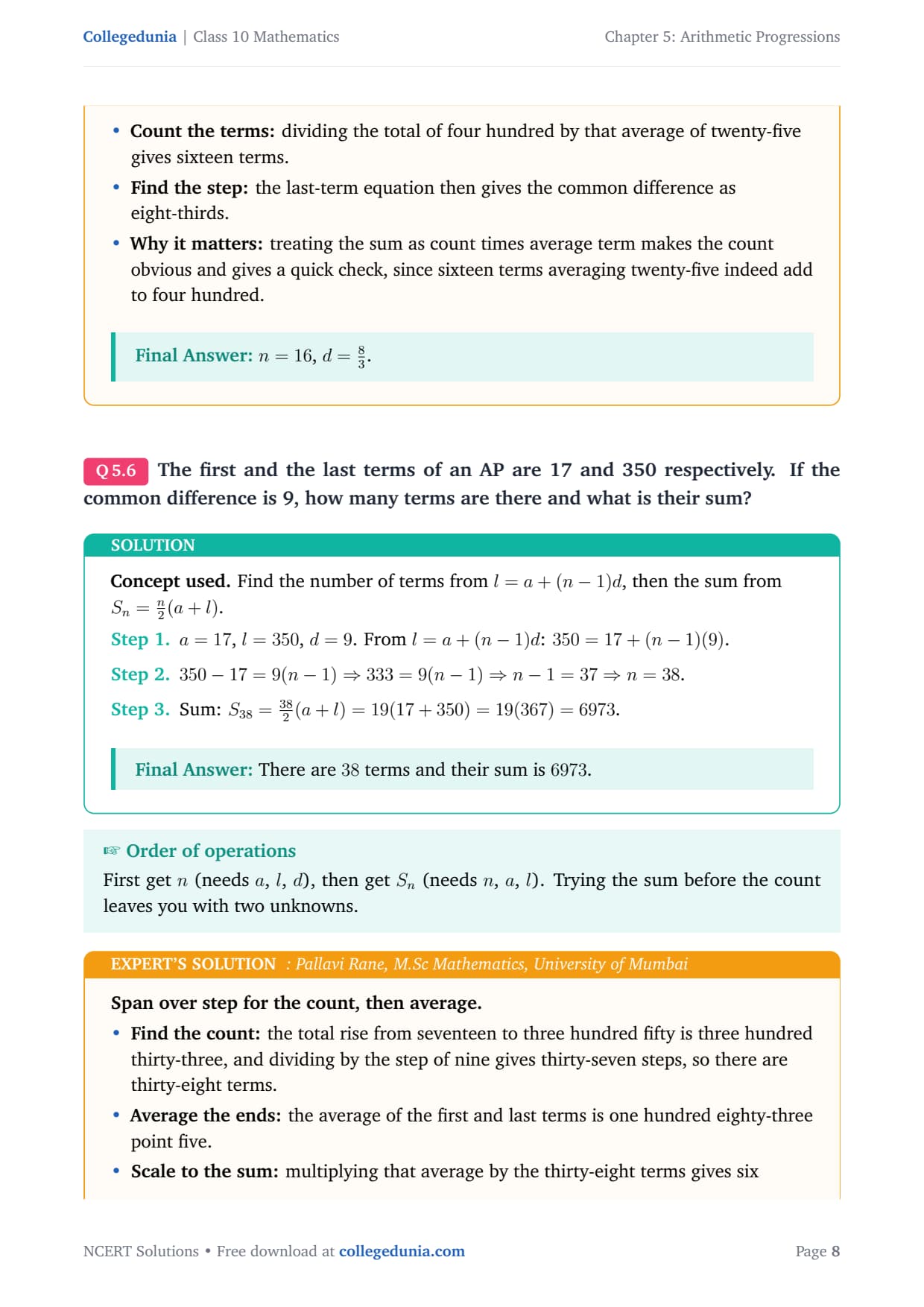
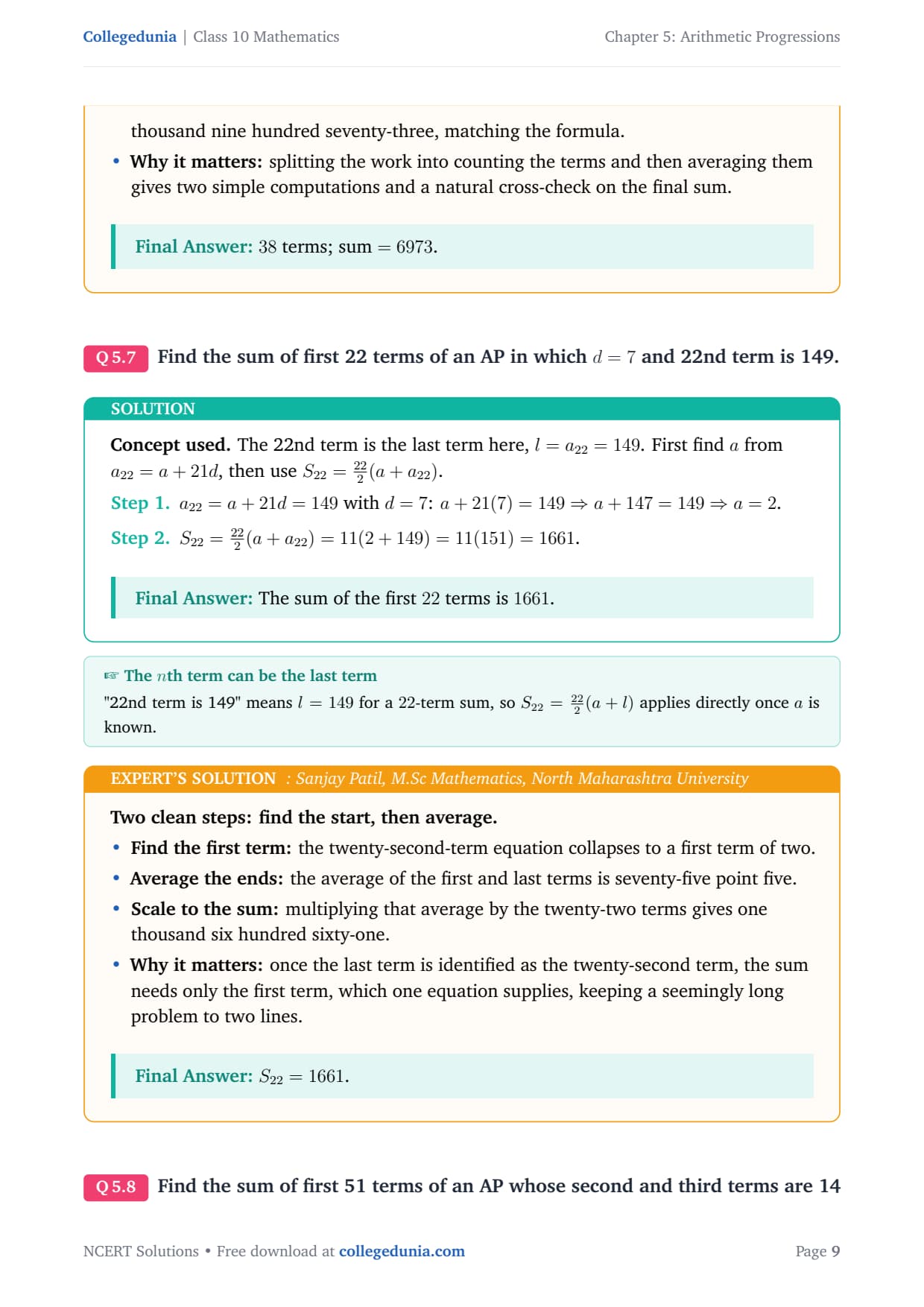
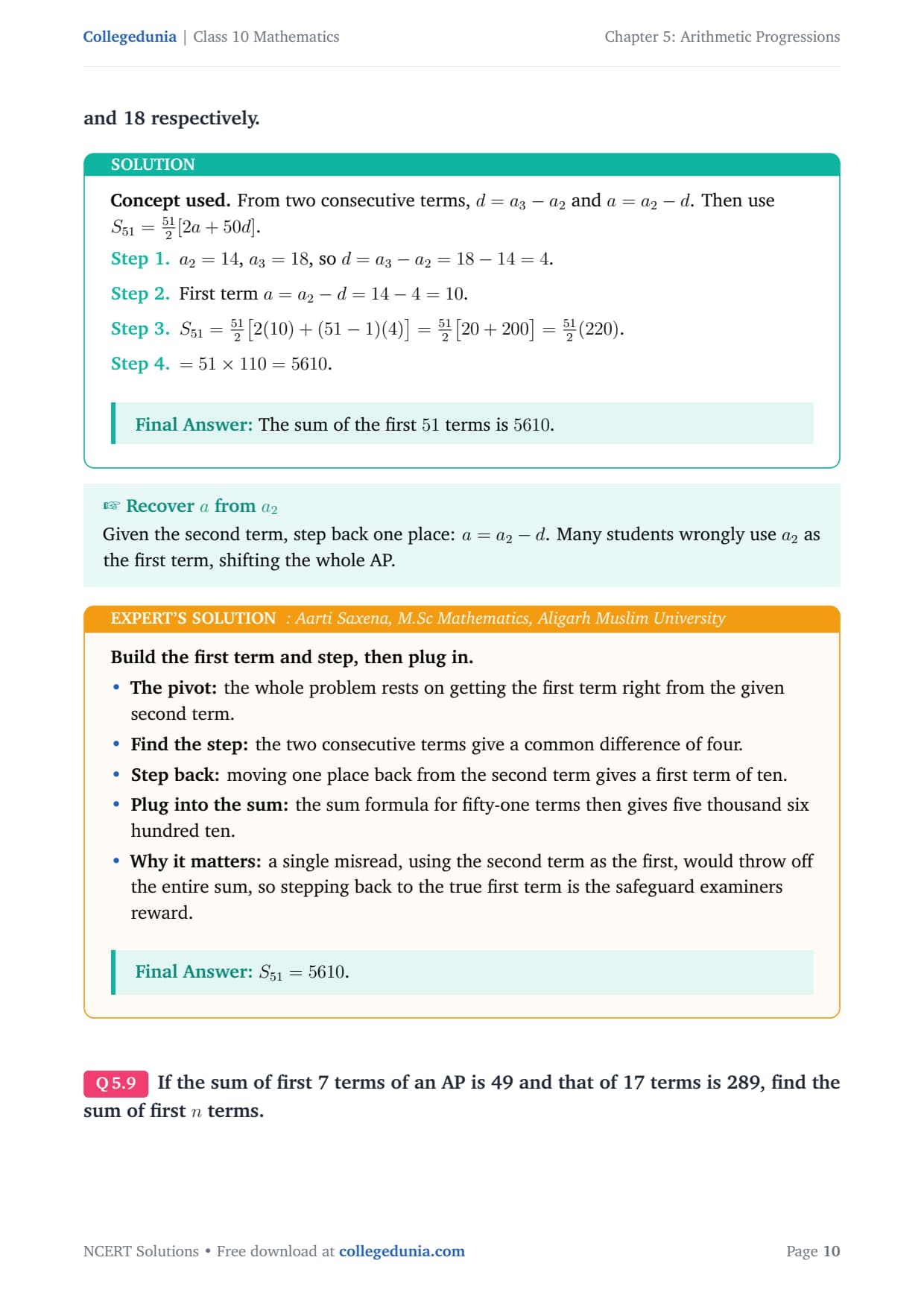
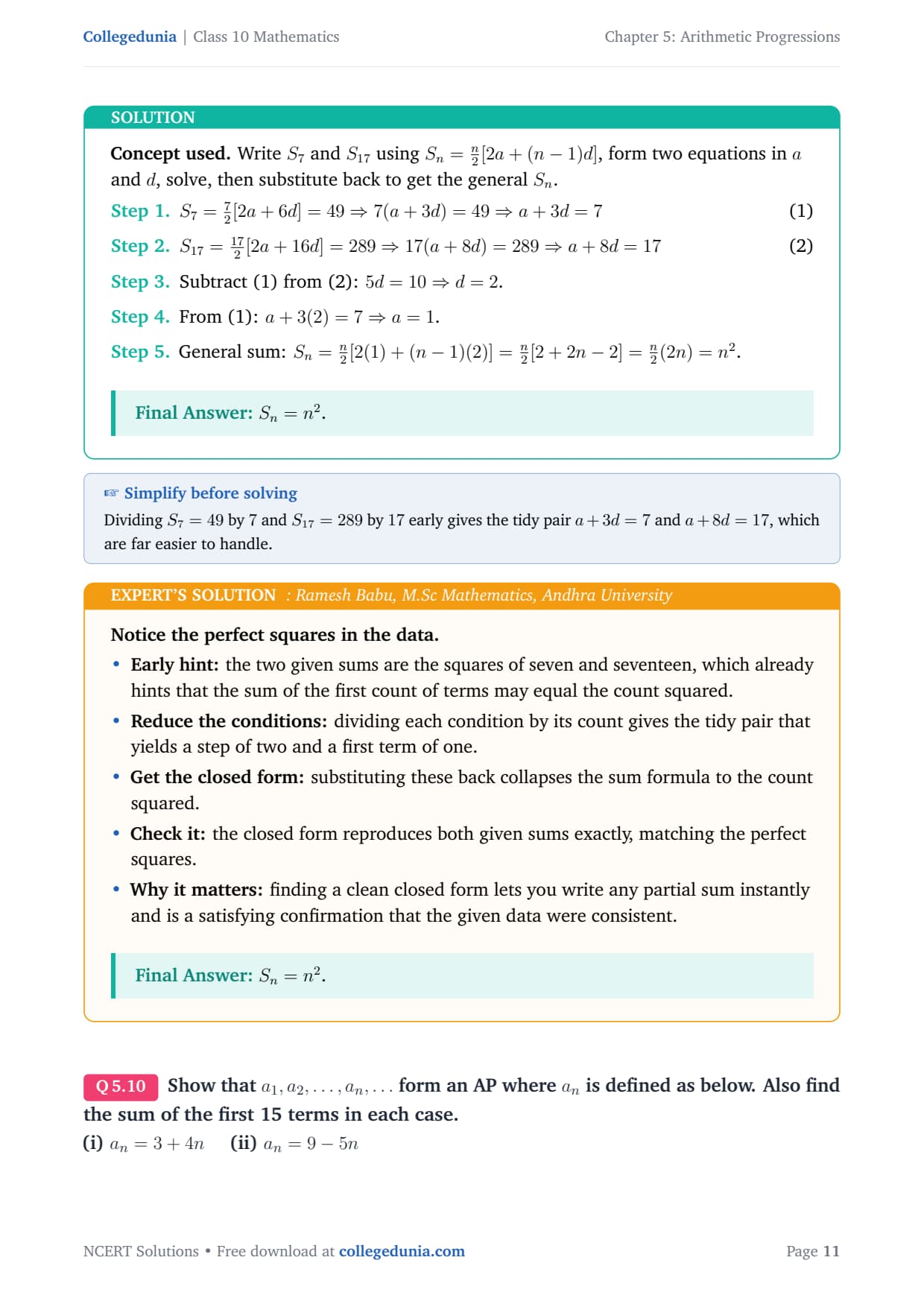
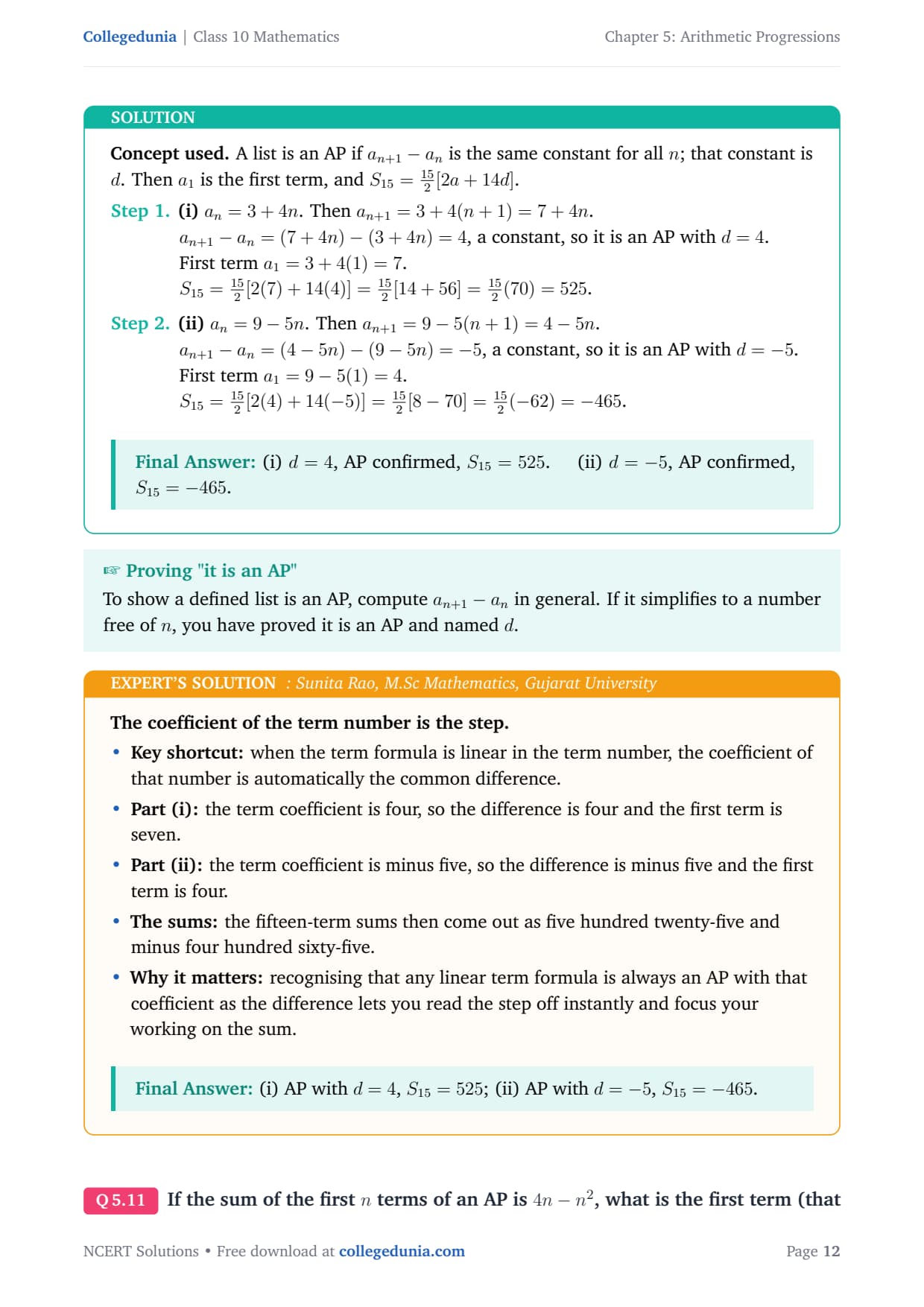
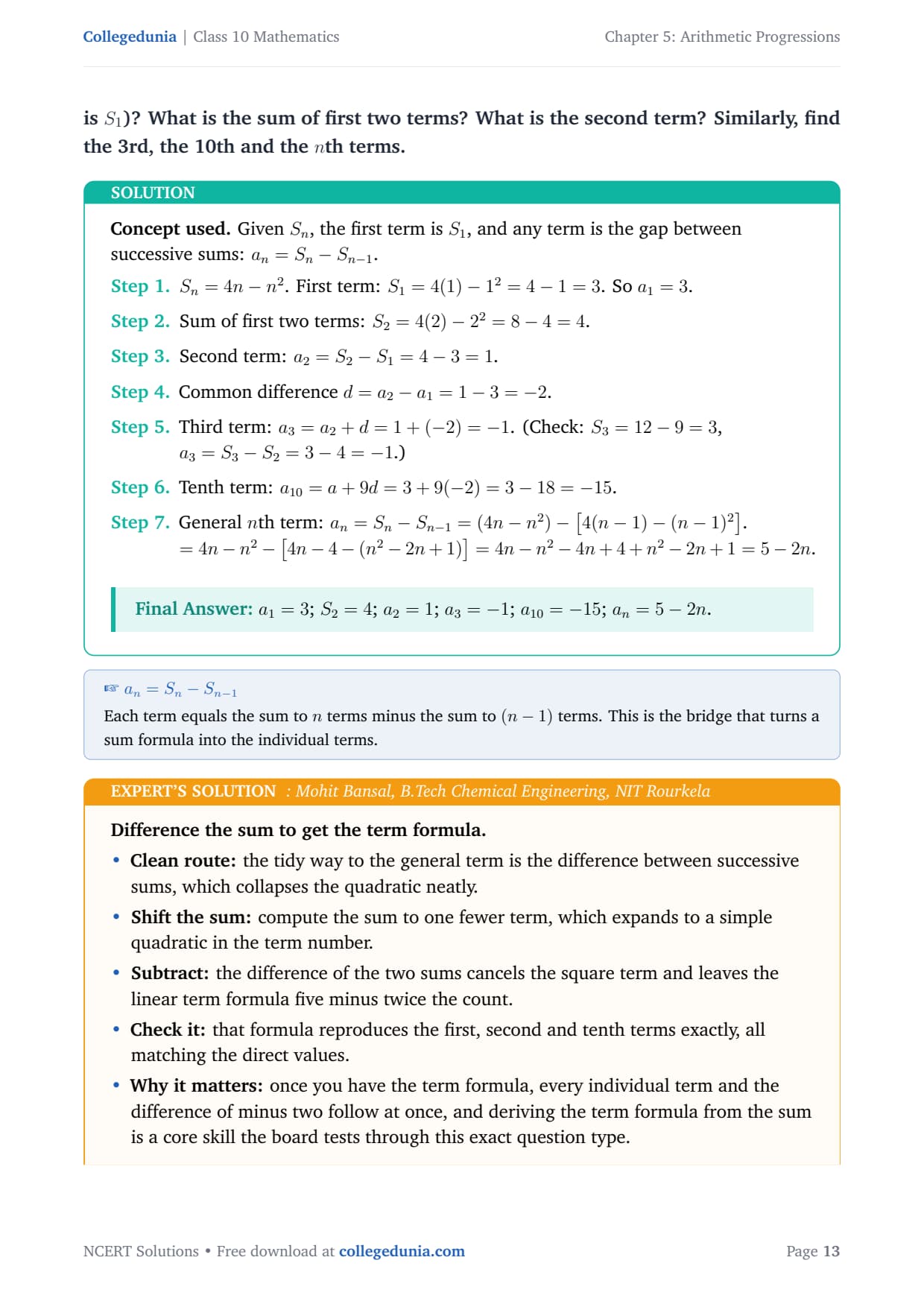
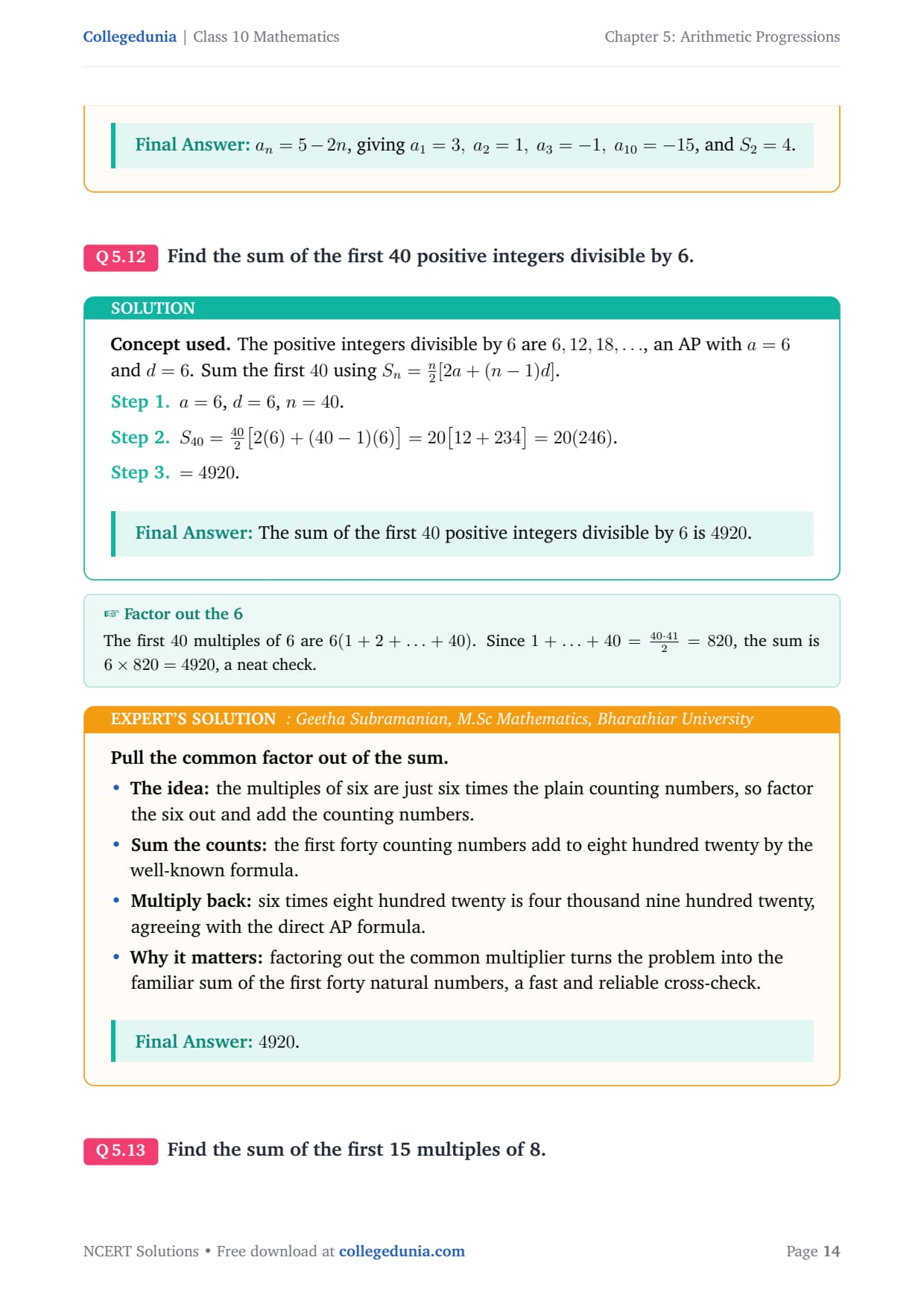
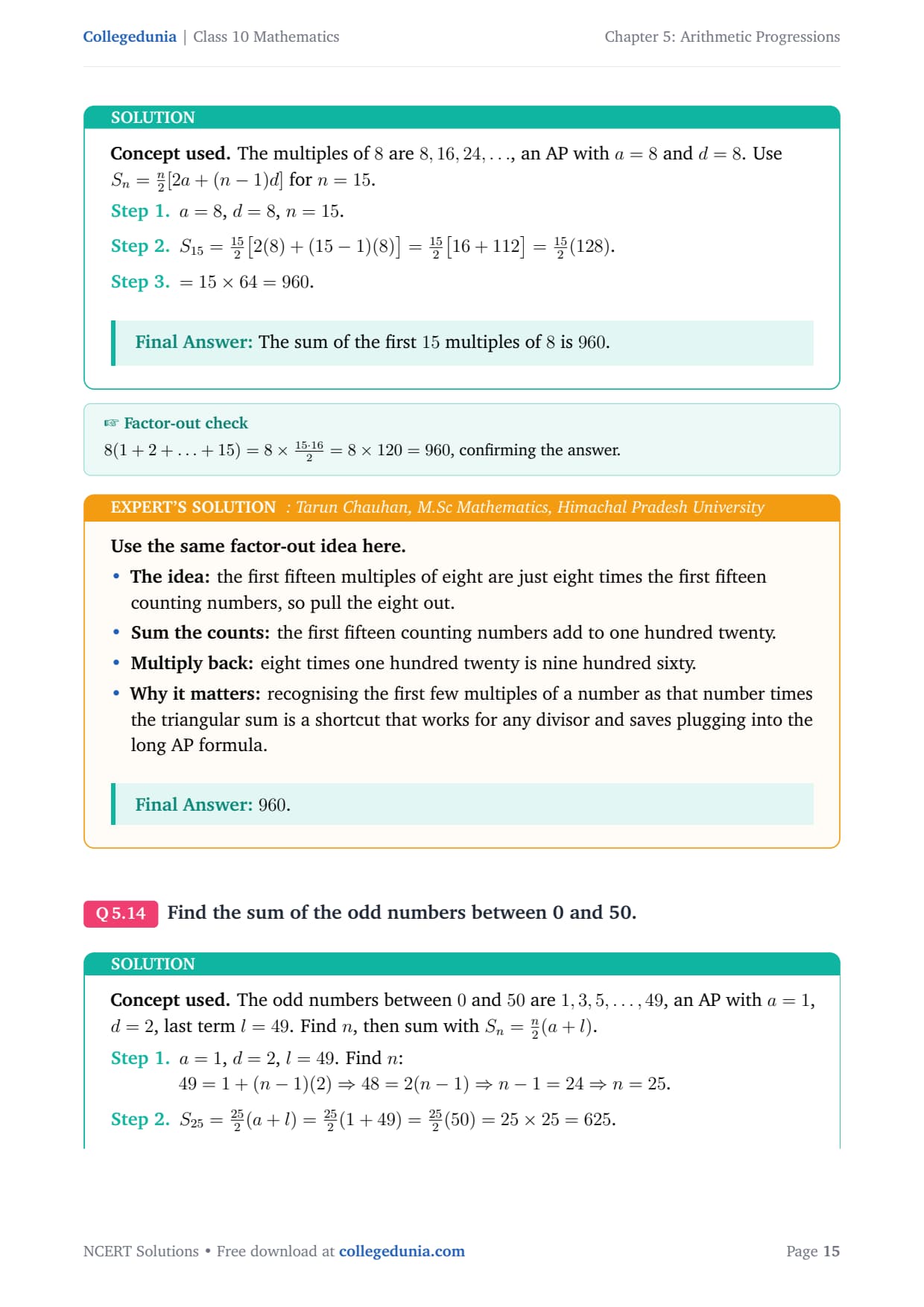




Comments