




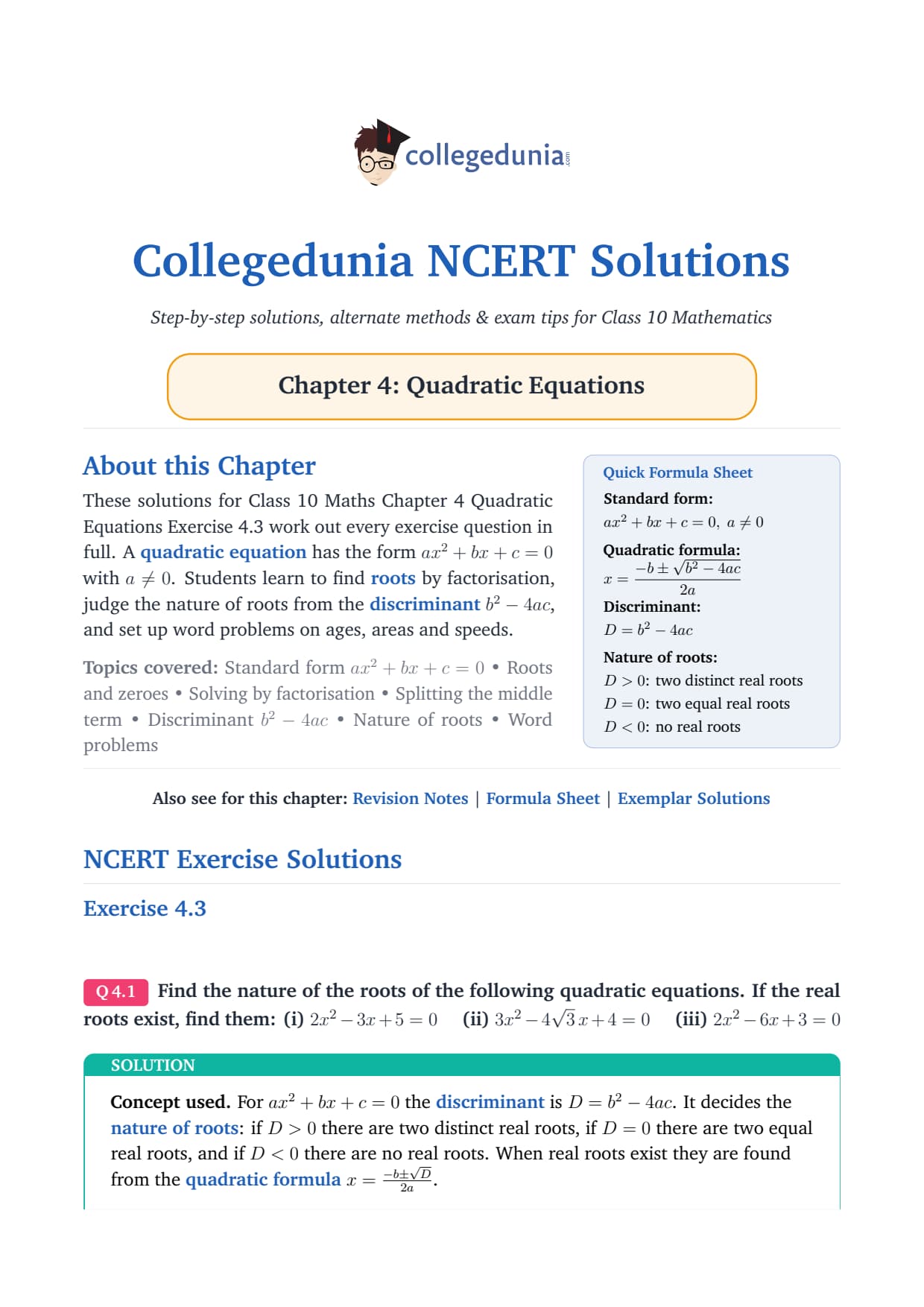
The NCERT Solutions for Class 10 Maths Chapter 4 Quadratic Equations Exercise 4.3 work out all 5 questions on the discriminant and the nature of roots, following the latest 2026-27 CBSE syllabus. Each answer computes D = b2 - 4ac first, states what kind of roots the equation has, and only then finds the roots, exactly the way the board expects the working to be shown.
- Questions covered: 5 in total, including a three-part nature-of-roots drill, a find-the-value-of-k problem for equal roots, and three "is it possible?" word problems on areas and ages.
- Core skill: using the discriminant to judge the nature of roots before solving, and reading a negative discriminant as proof that a situation cannot happen.
- Board value: Exercise 4.3 carries the steady 3 to 4 marks that the discriminant and word problems contribute to this chapter in the CBSE Class 10 paper.
Solved by Collegedunia: Every Exercise 4.3 question below is solved by subject experts, checked against the official 2026-27 NCERT textbook, and written with full working so each discriminant calculation and each word problem earns its marks in the CBSE Class 10 paper.
What Exercise 4.3 of Quadratic Equations Covers for Class 10
Exercise 4.3 is the discriminant set of the chapter. It teaches one core idea: the sign of D = b2 - 4ac decides the nature of roots of a quadratic equation. The 5 questions move from a direct nature-of-roots drill to a find-the-value-of-k problem and then to three "is it possible?" applications.
- Q1: find the nature of roots of three equations using the discriminant, and find the real roots where they exist.
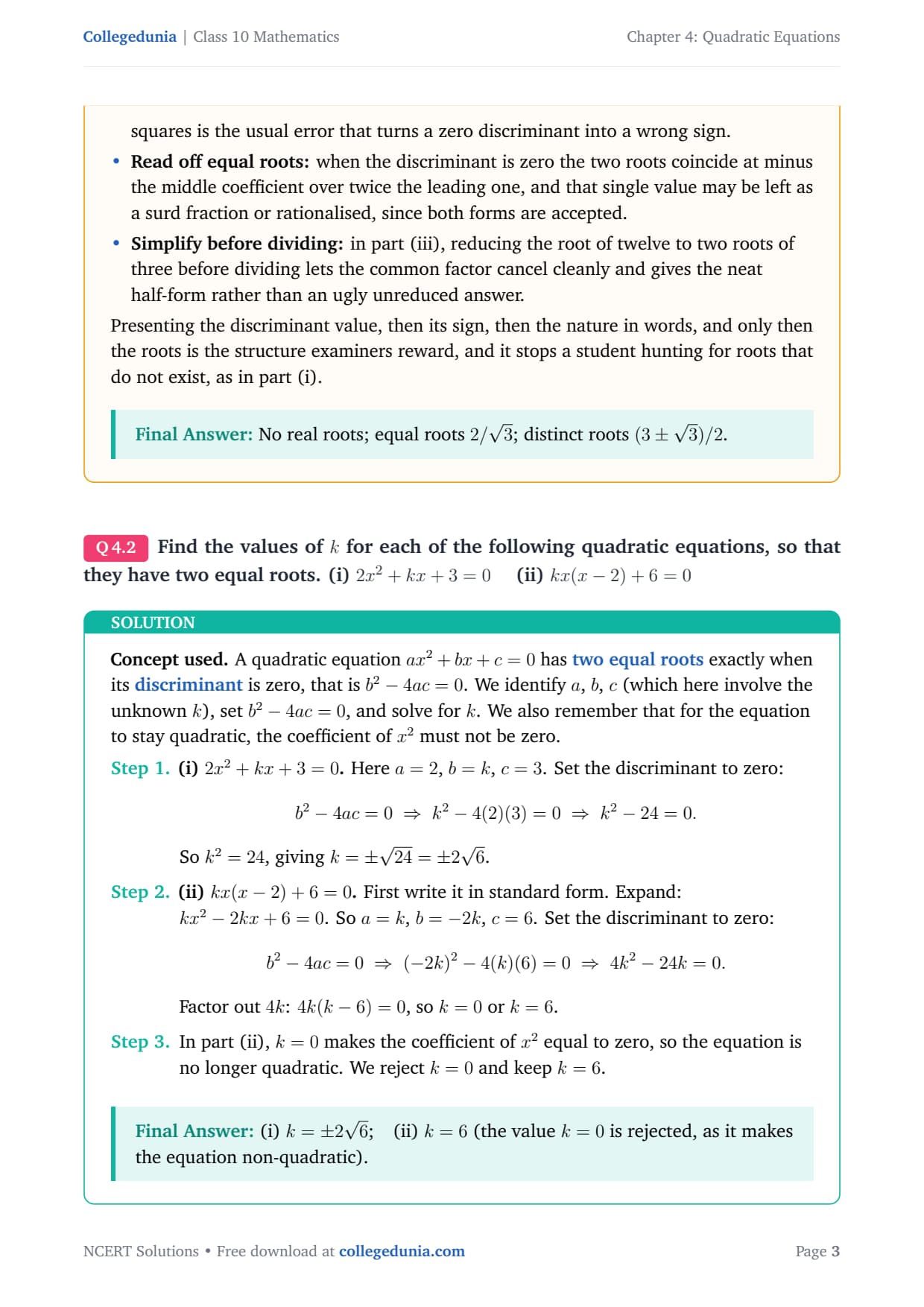
- Q2: find the values of k that make each equation have two equal roots, using the condition D = 0.
- Q3 to Q5: three word problems on a mango grove, two friends' ages and a rectangular park, each settled by checking whether the discriminant is non-negative.
How to Solve Exercise 4.3 Using the Discriminant Question by Question
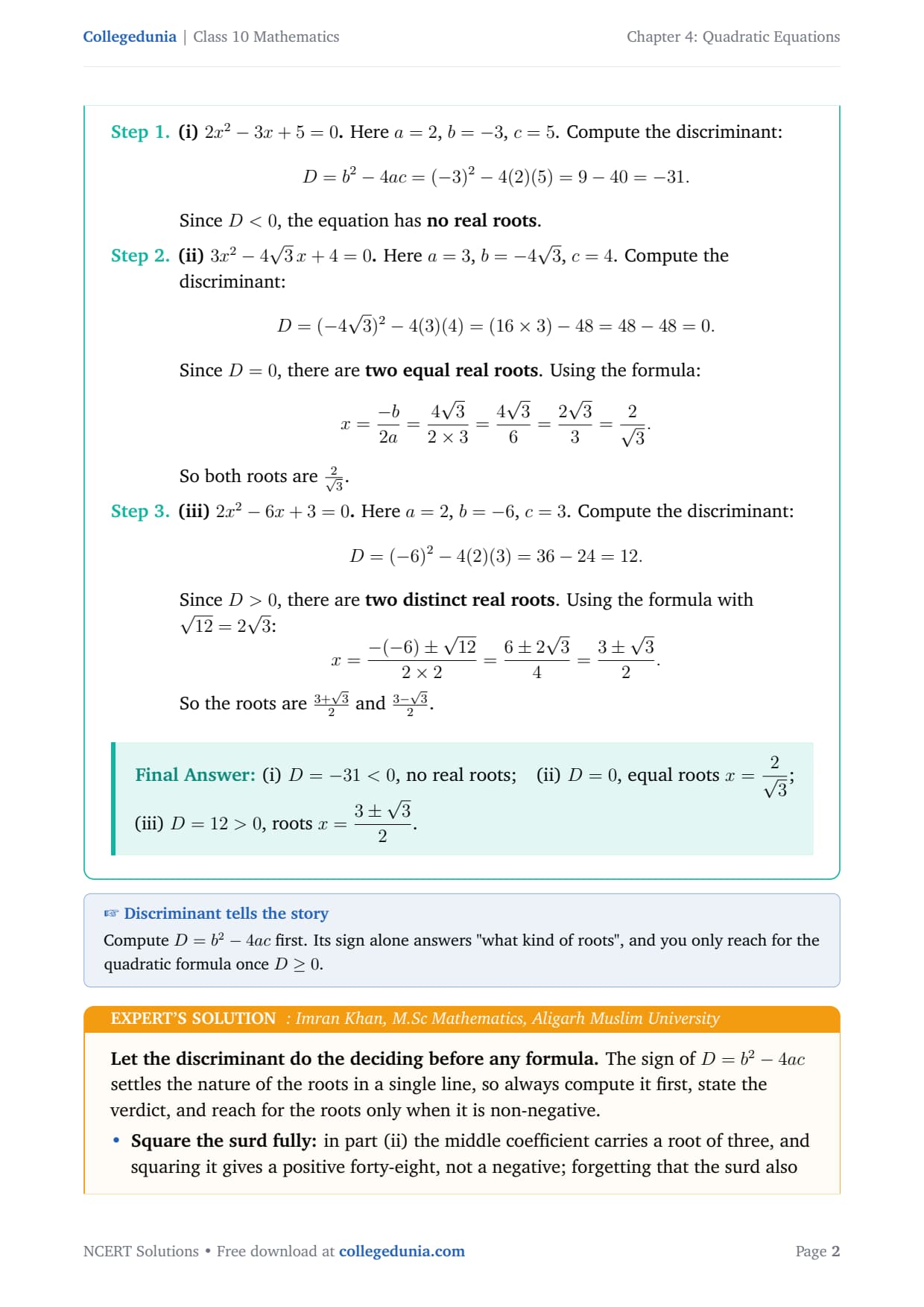
The whole exercise rests on one move: compute the discriminant D = b2 - 4ac first, then read off the nature of roots from its sign. You reach for the quadratic formula only once D ≥ 0.
| Question | What it asks | Key result |
|---|---|---|
| Q1 | Find the nature of roots, and the roots if real | (i) D = -31 < 0, no real roots; (ii) D = 0, equal roots x = 2√3; (iii) D = 12 > 0, roots 3 ± √32 |
| Q2 | Find k for two equal roots (D = 0) | (i) k = ±2√6; (ii) k = 6 (reject k = 0) |
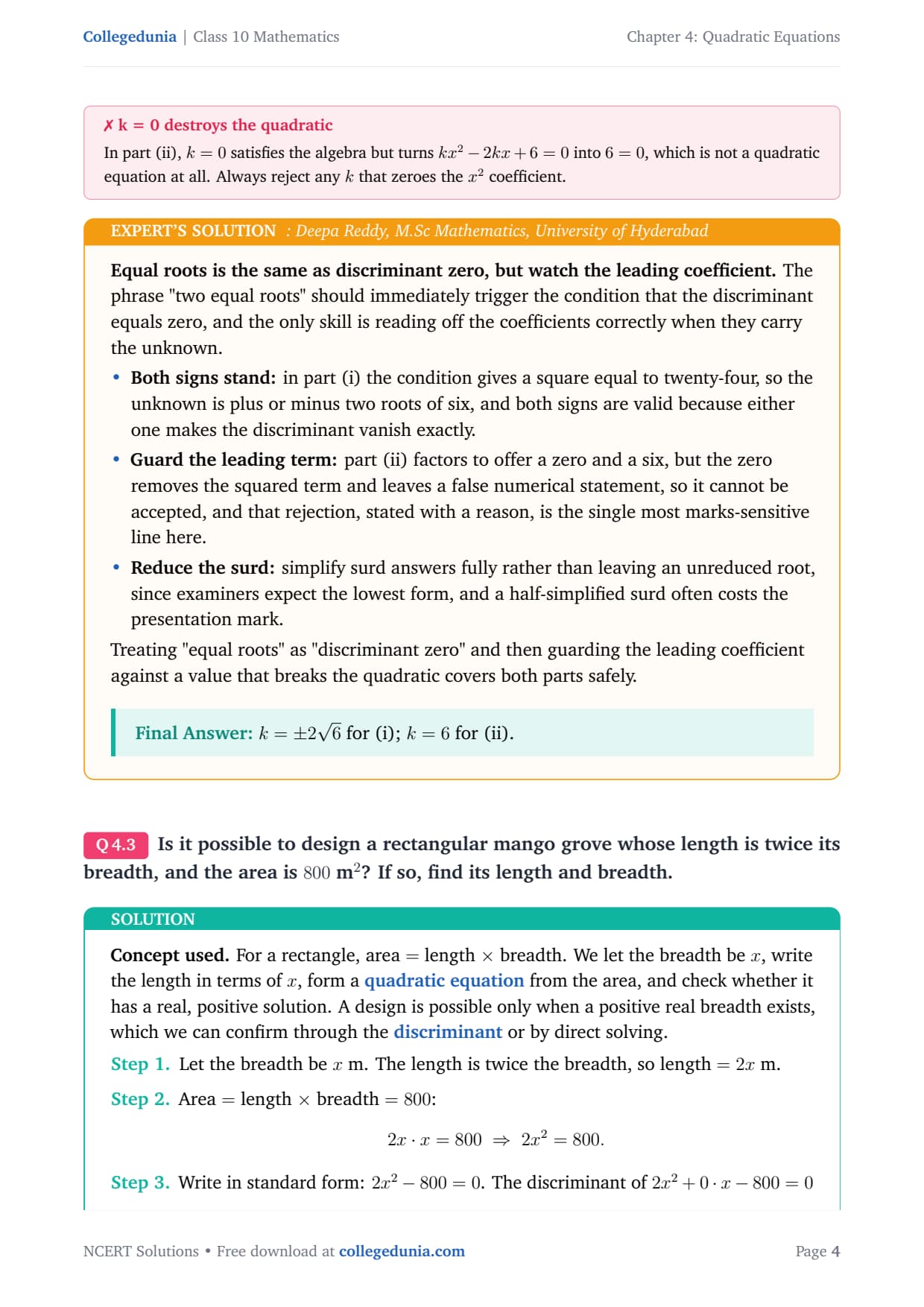
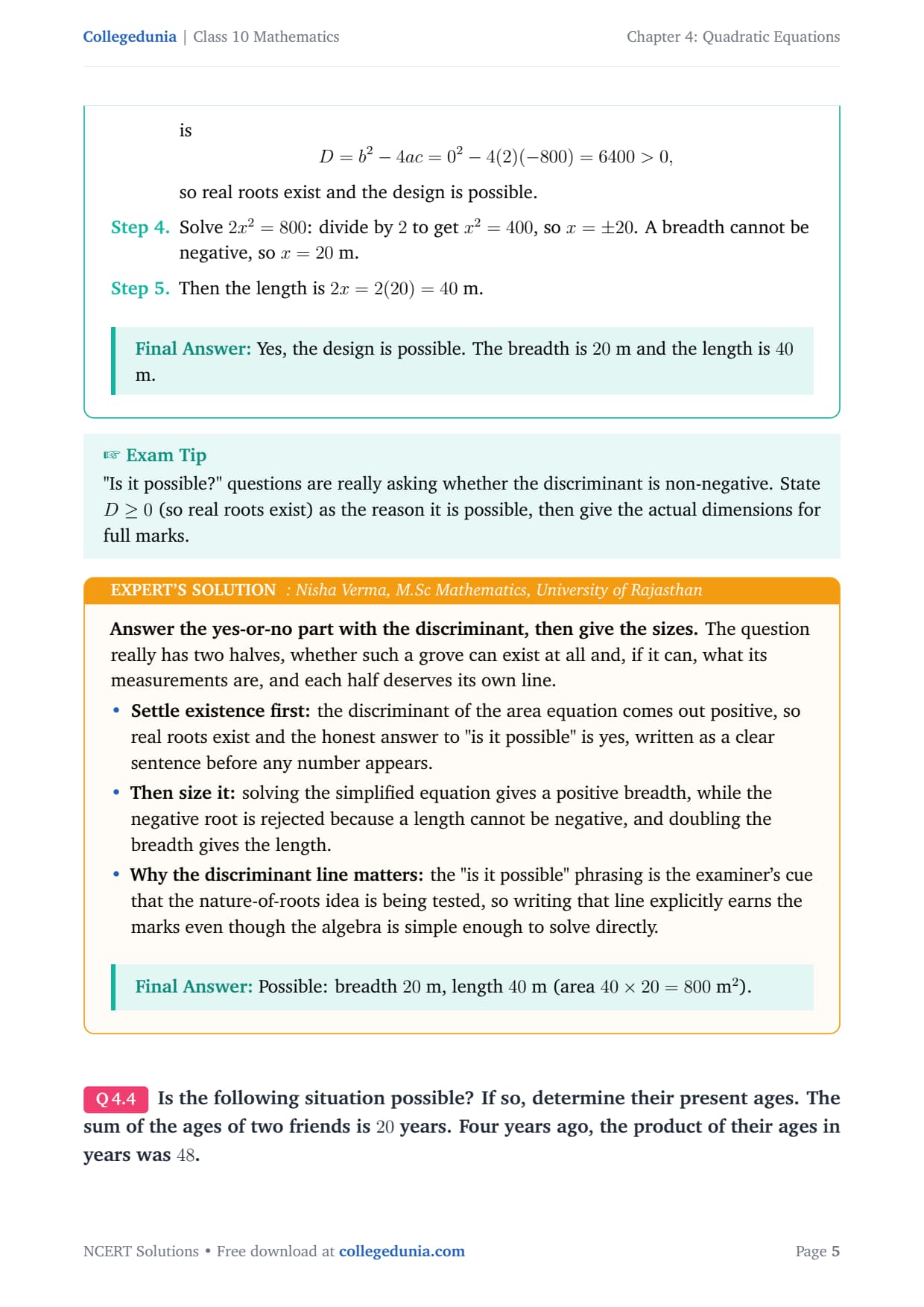
| Q3 | Is a mango grove with length twice breadth, area 800 m2, possible? | Yes; breadth 20 m, length 40 m |
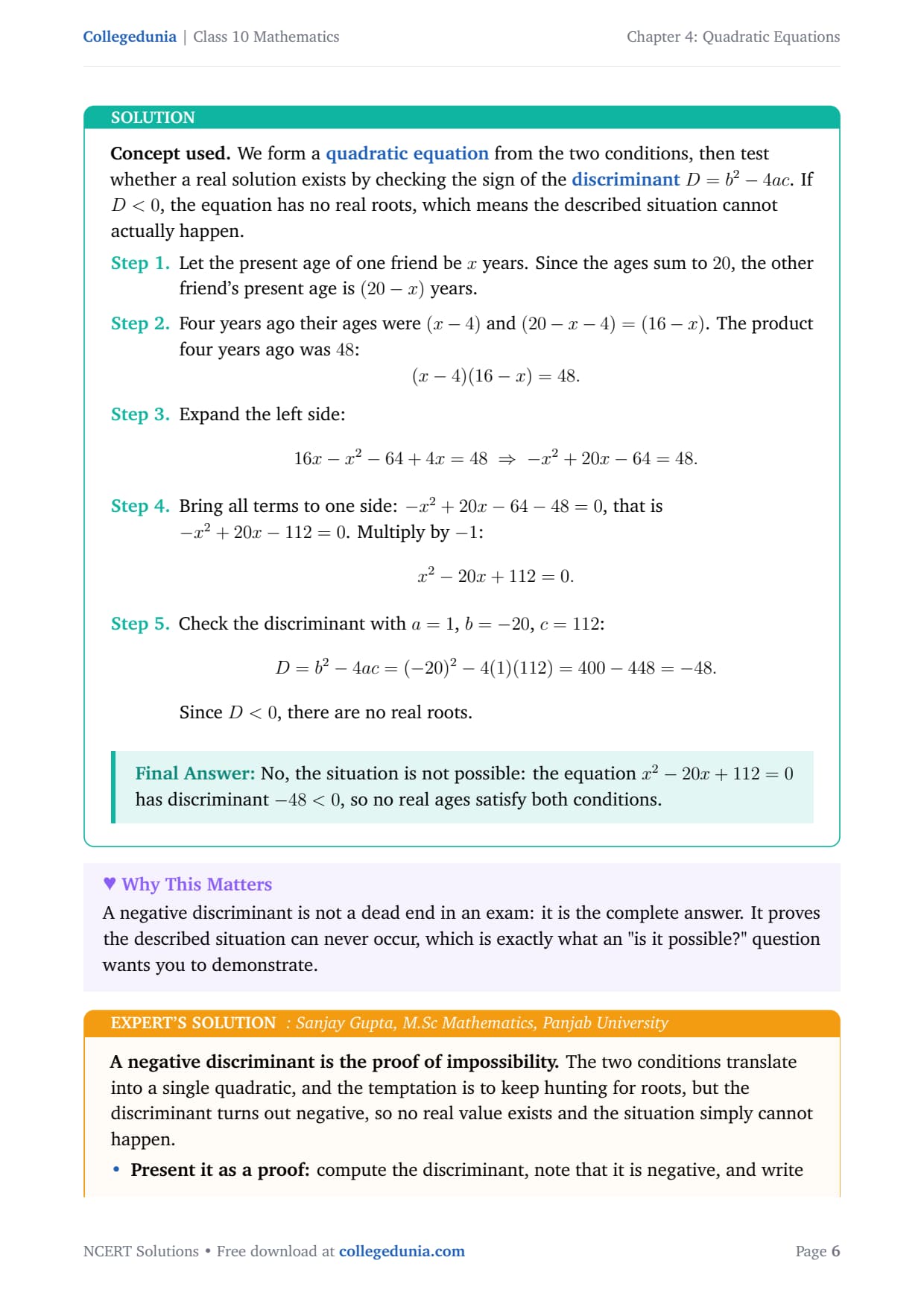
| Q4 | Ages summing to 20, product 4 years ago was 48 | Not possible; D = -48 < 0 |
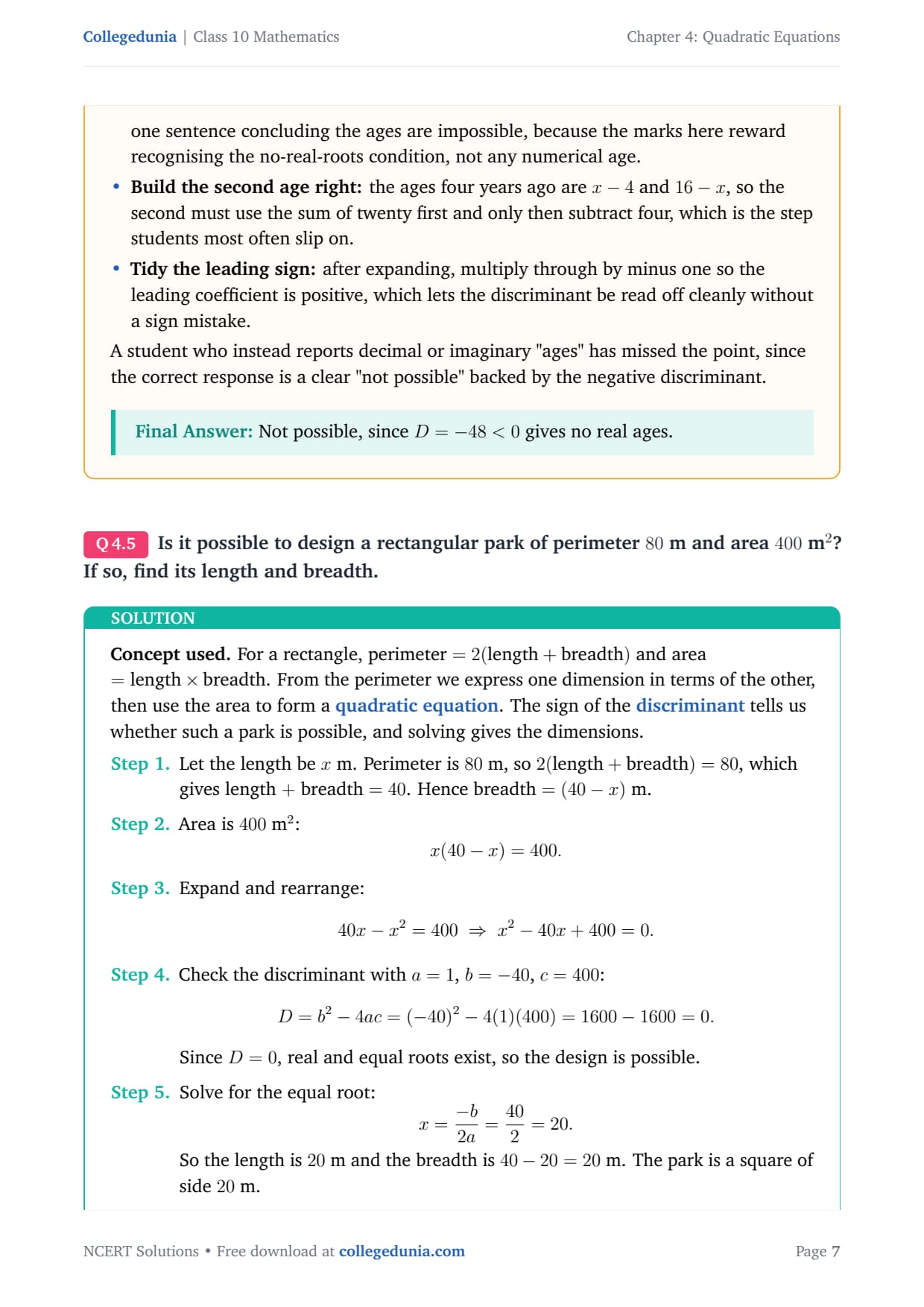
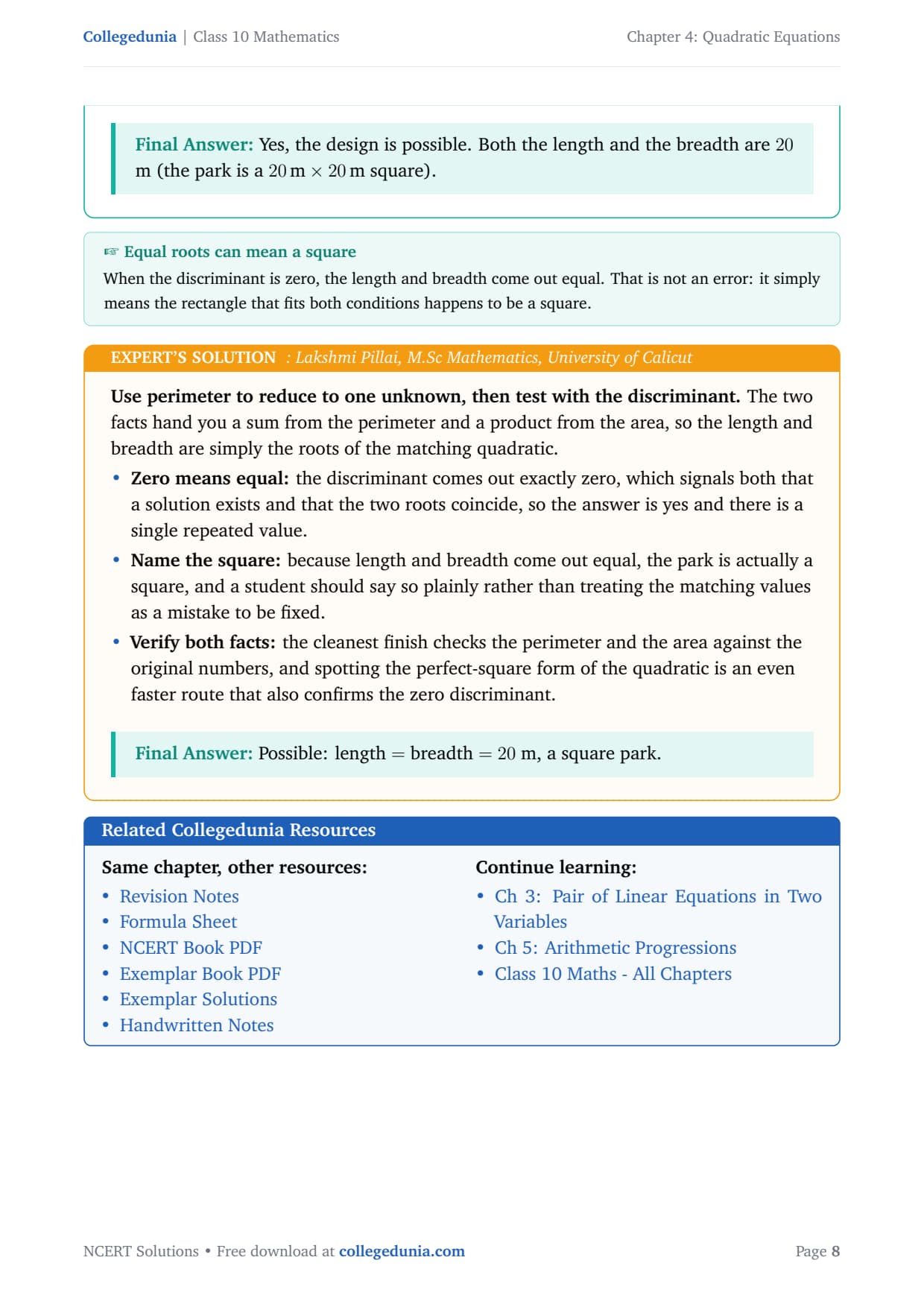
| Q5 | Rectangular park, perimeter 80 m, area 400 m2 | Yes; length = breadth = 20 m (a square) |
Reading "Is It Possible?" Word Problems in Quadratic Equations Exercise 4.3
Three of the five questions ask whether a situation is possible. An "is it possible?" question is really asking whether the discriminant is non-negative, so a real solution exists. Set up the quadratic, compute D, and let its sign answer the yes-or-no part before any measurement appears.
- Possible with two answers (Q3): the area equation gives D = 6400 > 0, so real roots exist and the grove can be built; the breadth is 20 m and the length 40 m.
- Not possible (Q4): the ages equation x2 - 20x + 112 = 0 has D = -48 < 0, so no real ages fit, and "not possible" is the complete answer.
- Possible as a square (Q5): the park equation gives D = 0, so equal roots exist; the length and breadth both come out 20 m, meaning the rectangle is a square.
Common Mistakes Students Make in Quadratic Equations Exercise 4.3
Most lost marks here come from a rushed discriminant, not hard ideas. A quick check of the signs usually catches them before they cost a mark.
- Forgetting the surd squares too: in Q1 (ii) the middle term carries √3, so (-4√3)2 = 48, not a negative; squaring only the number gives the wrong sign for D.
- Keeping a value that breaks the quadratic: in Q2 (ii), k = 0 satisfies the algebra but turns the equation into 6 = 0, so it must be rejected with a reason.
- Shifting only one age: in Q4, both friends' ages must drop by the same four years before the product is taken.
- Calling equal roots an error: in Q5, length and breadth come out equal because D = 0; that just means the park is a square, not a mistake.
Quadratic Equations Exercise 4.3 Marks and Previous Year Trends for Class 10
Quadratic Equations is a scoring chapter in the CBSE Class 10 board paper, usually worth 5 to 7 marks. Exercise 4.3 is the part the board leans on for the discriminant idea, since nature-of-roots questions are quick to set and easy to mark.
| Question type | Where it appears | Typical marks |
|---|---|---|
| Find the nature of roots (Q1 style) | Frequent 1-mark and 2-mark slots | 1 to 2 |
| Find k for equal roots (Q2 style) | Short-answer slots | 2 to 3 |
| "Is it possible?" word problems (Q3 to Q5 style) | Application-based 3-mark questions | 3 |
| State and use the discriminant condition | 1-mark reasoning questions | 1 |
These solutions follow the 2026-27 NCERT exactly, so the working you practise here matches what the board paper rewards.
Other Resources for Quadratic Equations Class 10 Maths
Use the table below to move between the other resources for this chapter and the other exercises of Quadratic Equations. Each link opens the matching Collegedunia page.
| Resource | Open page |
|---|---|
| Full chapter solutions | Quadratic Equations Class 10 NCERT Solutions |
| Previous exercise | Quadratic Equations Class 10 NCERT Solutions Exercise 4.2 |
| First exercise | Quadratic Equations Class 10 NCERT Solutions Exercise 4.1 |
| Revision notes | Quadratic Equations Class 10 Notes |
| Formula sheet | Quadratic Equations Class 10 Formula Sheet |
| NCERT book PDF | Quadratic Equations Class 10 NCERT Book PDF |
| Handwritten notes | Quadratic Equations Class 10 Handwritten Notes |
| Exemplar solutions | Quadratic Equations Class 10 NCERT Exemplar Solutions |
NCERT Solutions for Class 10 Maths Quadratic Equations: All Exercises
The chapter has three exercises. The table below links each exercise to its own step-by-step solution page.
| Exercise | Solutions page |
|---|---|
| Exercise 4.1 | Quadratic Equations Class 10 NCERT Solutions Exercise 4.1 |
| Exercise 4.2 | Quadratic Equations Class 10 NCERT Solutions Exercise 4.2 |
| Full chapter | Quadratic Equations Class 10 NCERT Solutions (all exercises) |
NCERT Solutions for Class 10 Maths: All Chapters
Once Quadratic Equations is done, move on to the other chapters. Each link opens that chapter's NCERT Solutions page.
| Chapter | NCERT Solutions |
|---|---|
| Chapter 1 | Real Numbers NCERT Solutions |
| Chapter 2 | Polynomials NCERT Solutions |
| Chapter 3 | Pair of Linear Equations in Two Variables NCERT Solutions |
| Chapter 5 | Arithmetic Progressions NCERT Solutions |
| Chapter 6 | Triangles NCERT Solutions |
| Chapter 7 | Coordinate Geometry NCERT Solutions |
| Chapter 8 | Introduction to Trigonometry NCERT Solutions |
All NCERT Solutions for Class 10 Maths Chapter 4 Quadratic Equations Exercise 4.3 with Step-by-Step Solutions
Questions
Find the nature of the roots of the following quadratic equations. If the real roots exist, find them: (i) 2x2-3x+5=0 (ii) 3x2-4√3 x+4=0 (iii) 2x2-6x+3=0
Find the values of k for each of the following quadratic equations, so that they have two equal roots. (i) 2x2+kx+3=0 (ii) kx(x-2)+6=0
Is it possible to design a rectangular mango grove whose length is twice its breadth, and the area is 800 m2? If so, find its length and breadth.
Is the following situation possible? If so, determine their present ages. The sum of the ages of two friends is 20 years. Four years ago, the product of their ages in years was 48.
Is it possible to design a rectangular park of perimeter 80 m and area 400 m2? If so, find its length and breadth.
Student Feedback
Student Feedback: Out of 16,200 students surveyed before the 2026 boards, 87% said Exercise 4.3 became easy once they wrote the discriminant value, its sign, and the nature of roots on three clear lines before touching the quadratic formula, since the sign alone answers most parts.
Source: Collegedunia 2026-27 Class 10 Maths student poll.
Quadratic Equations Class 10 Maths Exercise 4.3 NCERT Solutions FAQs
Ques. How many questions are there in Class 10 Maths Chapter 4 Quadratic Equations Exercise 4.3?
Ans. Exercise 4.3 has 5 questions. Q1 finds the nature of roots of three equations, Q2 finds the values of k for two equal roots, and Q3 to Q5 are "is it possible?" word problems on a mango grove, two friends' ages and a rectangular park.
Ques. Where can I download the Quadratic Equations Class 10 Exercise 4.3 NCERT Solutions PDF?
Ans. You can download the Quadratic Equations Class 10 Exercise 4.3 NCERT Solutions PDF directly from this page using the download card at the top. It is free and follows the 2026-27 NCERT textbook.
Ques. How does the discriminant decide the nature of roots in Exercise 4.3?
Ans. Compute D = b2 - 4ac first. If D > 0 there are two distinct real roots, if D = 0 there are two equal real roots, and if D < 0 there are no real roots. Use the quadratic formula only when D ≥ 0.
Ques. What does a negative discriminant mean in the Exercise 4.3 word problems?
Ans. A negative discriminant, as in Q4 where D = -48, means the equation has no real roots. For an "is it possible?" question this is the complete answer: the described situation can never occur, so you write "not possible" backed by the negative discriminant.
Ques. Are these Exercise 4.3 solutions based on the 2026-27 syllabus?
Ans. Yes. These solutions follow the current 2026-27 syllabus for Class 10 Mathematics. Exercise 4.3 on the discriminant and the nature of roots is fully retained in the latest NCERT edition.



Comments