



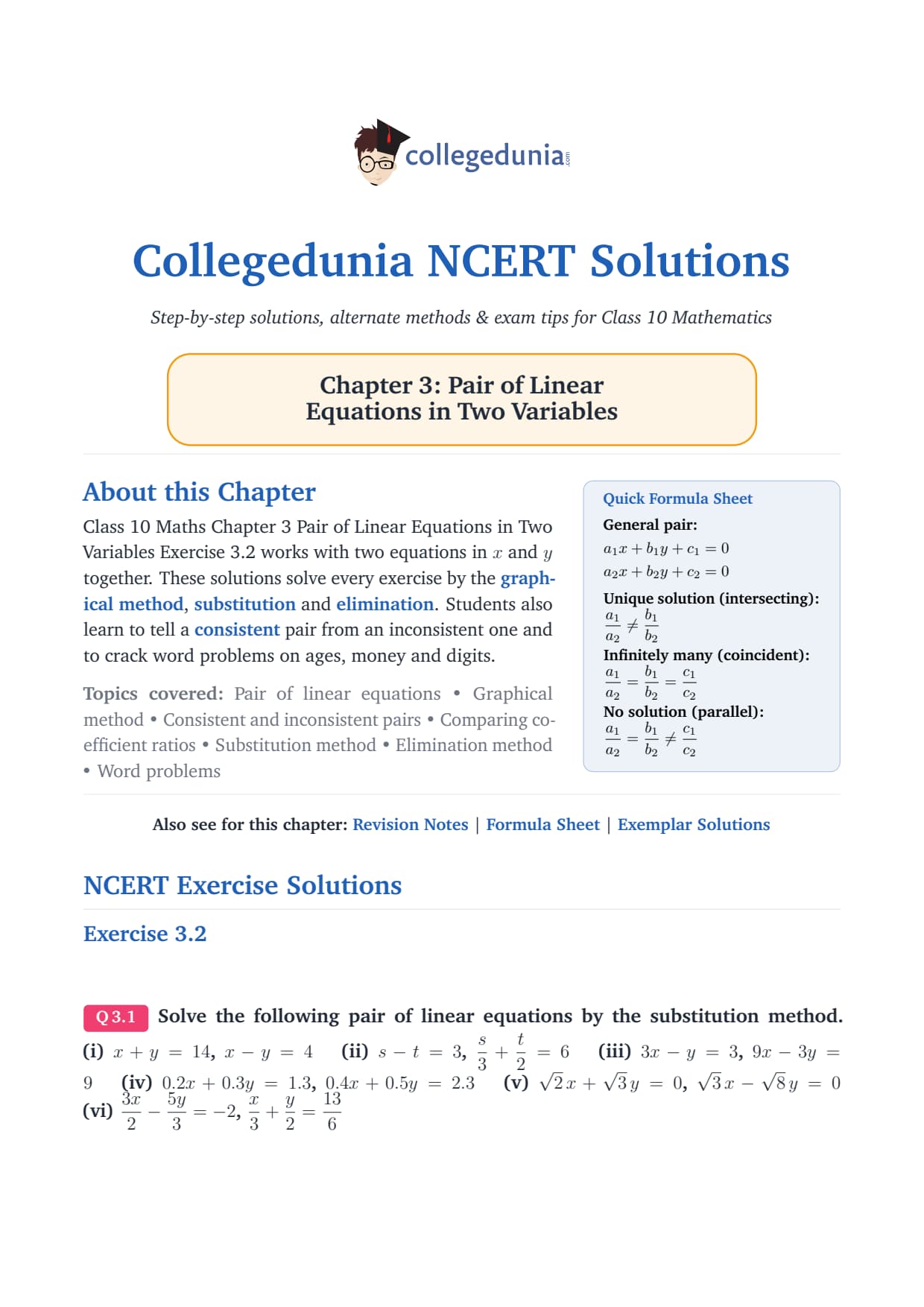
The NCERT Solutions for Class 10 Maths Chapter 3 Pair of Linear Equations in Two Variables Exercise 3.2 cover all 3 questions on the substitution method, following the latest 2026-27 CBSE syllabus. Each answer clears fractions and decimals first, then expresses one variable in terms of the other and substitutes, exactly the way the board expects the working to be shown.
- Questions covered: 3 in total, including a six-part drill on substitution, a solve-and-find-the-slope problem, and six word problems on numbers, angles, money and ages.
- Core skill: isolating one variable, substituting it into the second equation, and reading special cases like infinitely many solutions and the zero solution correctly.
- Board value: Exercise 3.2 carries the steady 3 to 5 marks that substitution and word problems contribute to this chapter in the CBSE Class 10 paper.
Solved by Collegedunia: Every Exercise 3.2 question below is solved by subject experts, checked against the official 2026-27 NCERT textbook, and written with full working so each substitution and each word problem earns its marks in the CBSE Class 10 paper.
What Exercise 3.2 of Pair of Linear Equations in Two Variables Covers for Class 10
Exercise 3.2 is the substitution-method set of the chapter. It teaches one core technique: solve a pair of linear equations by expressing one variable in terms of the other and substituting. The 3 questions move from a six-part drill to a slope problem and then to six word problems.
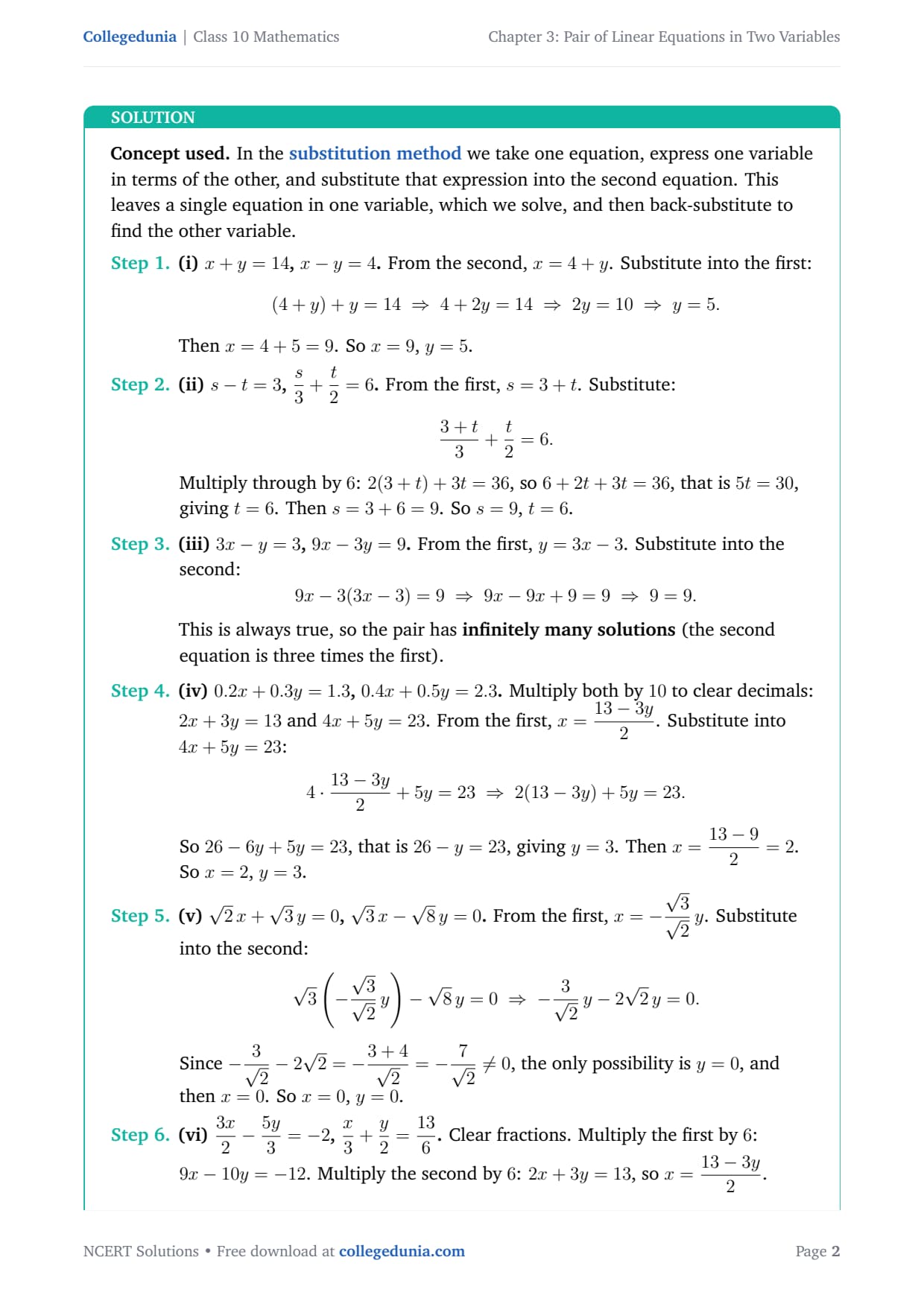
- Q1: six pairs solved by substitution, including ones with fractions, decimals and surds, plus the infinitely-many and zero-solution cases.
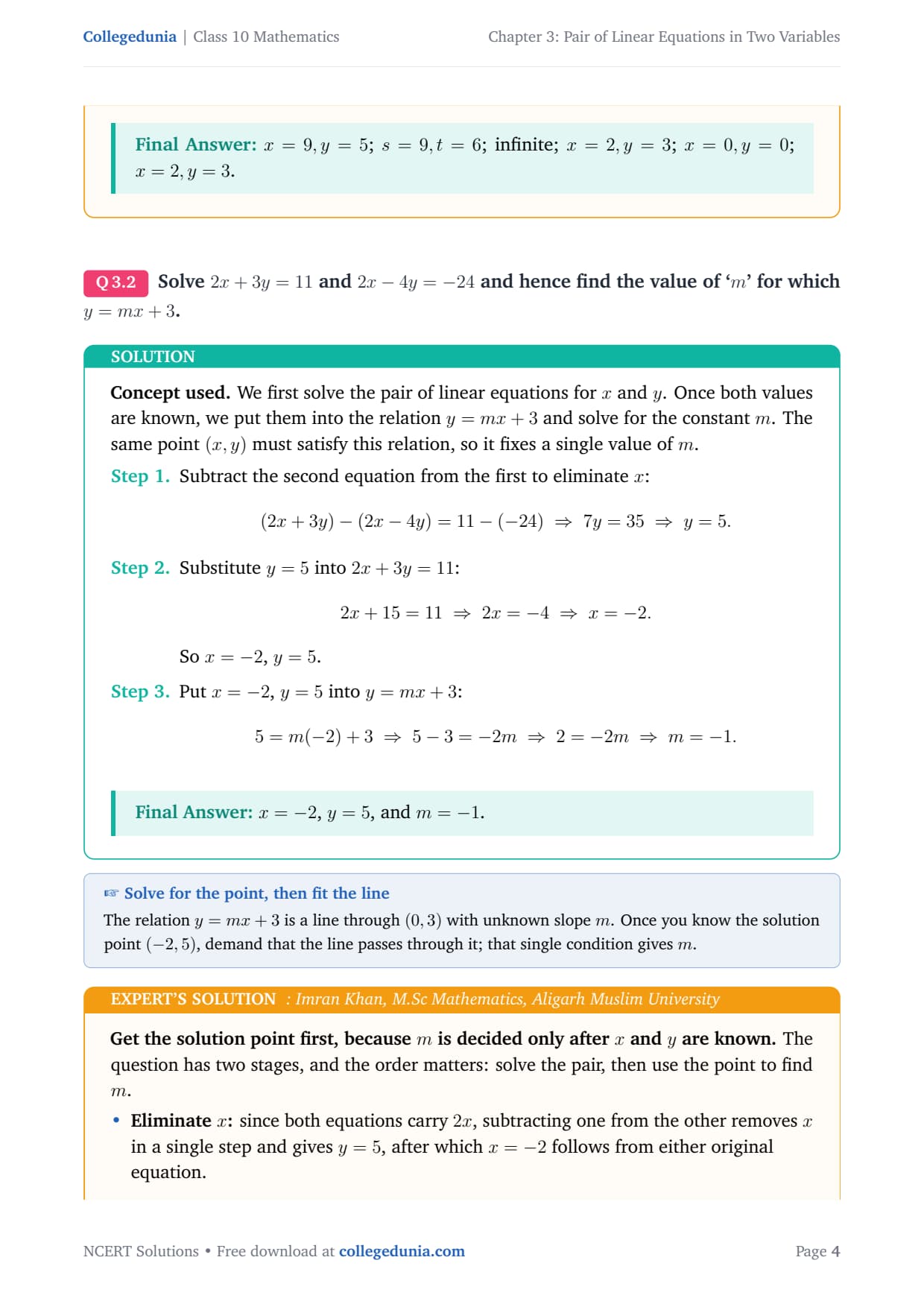
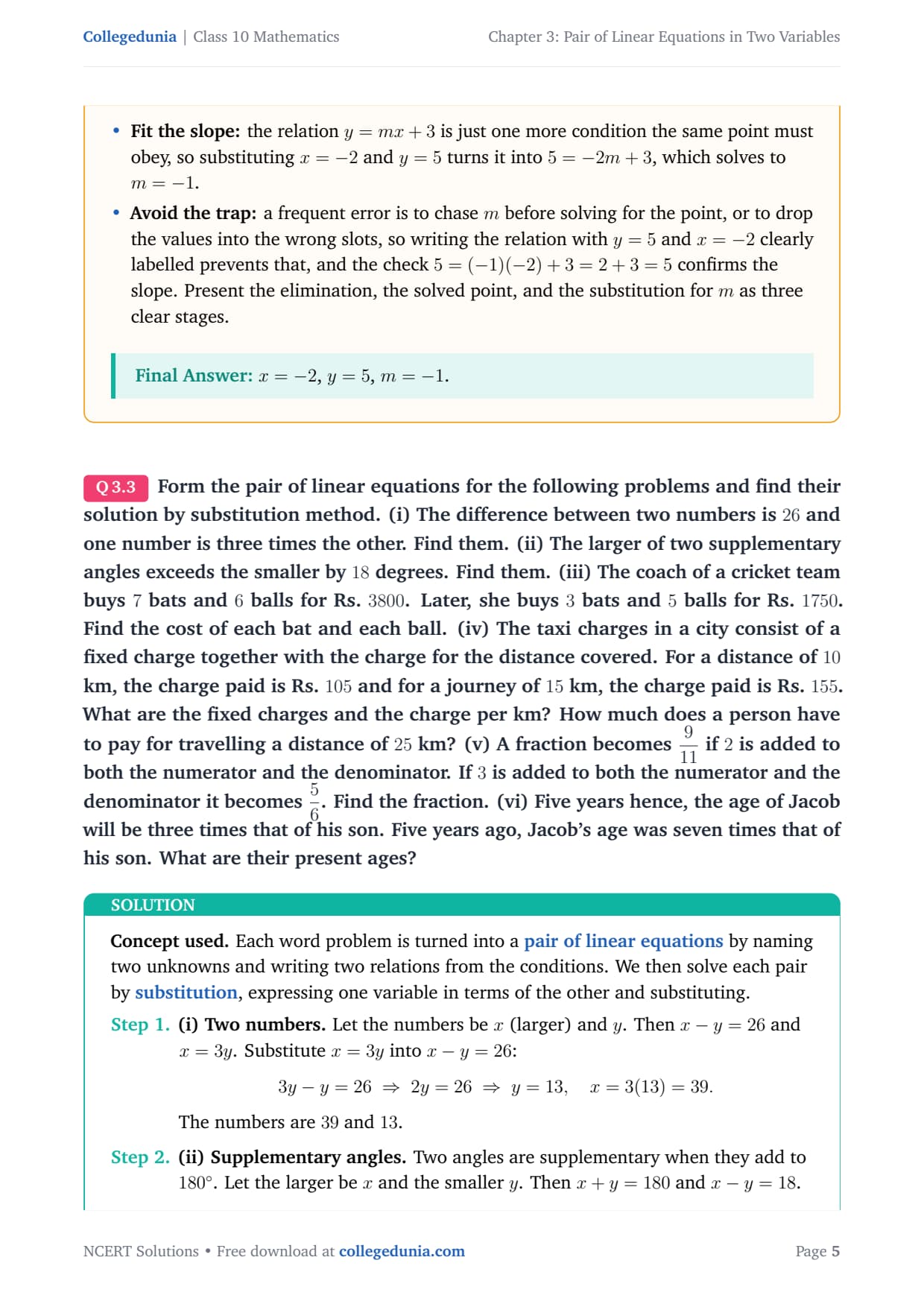
- Q2: solve a pair, then use the solution point to find the slope m in y = mx + 3.
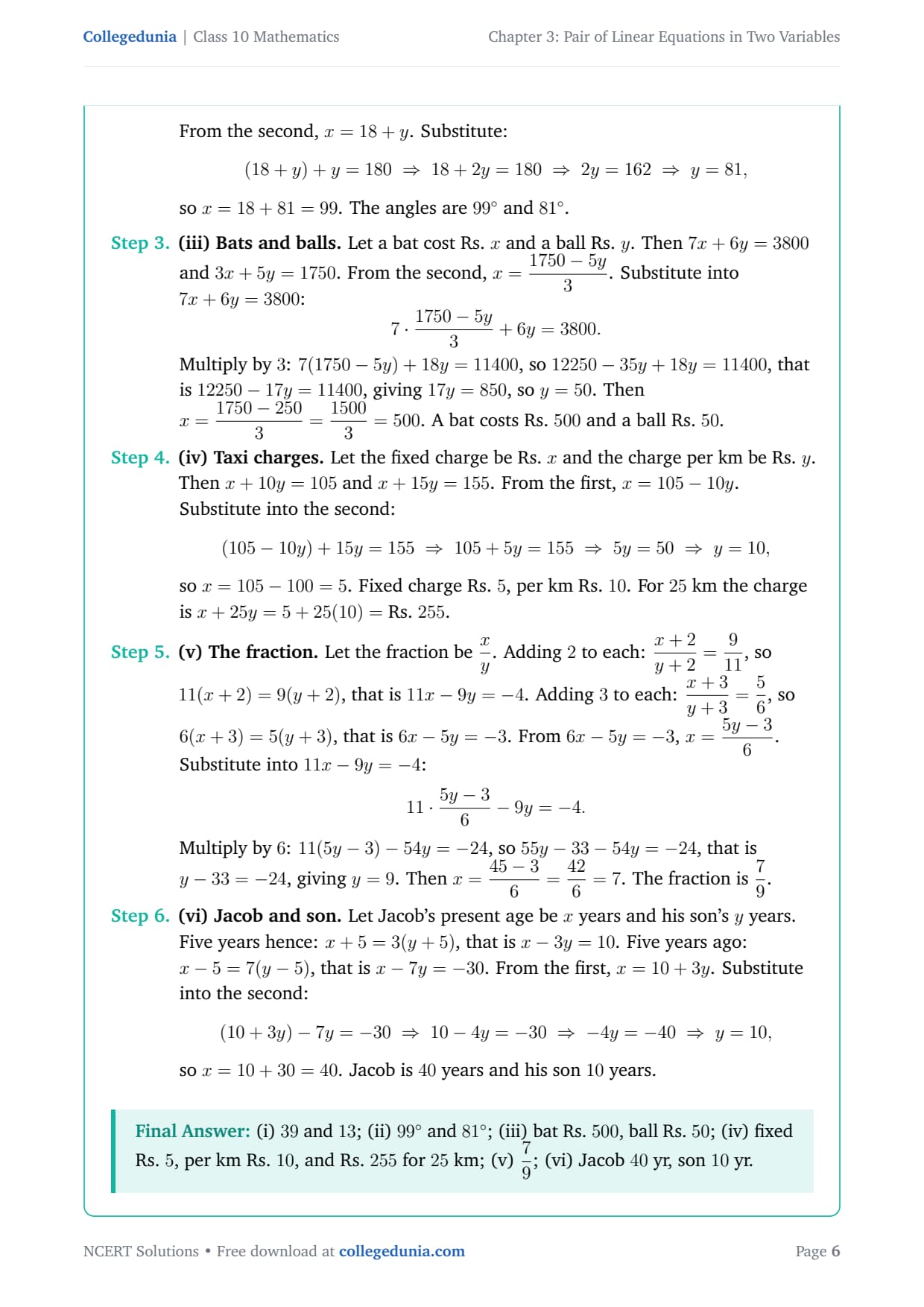
- Q3: six word problems on two numbers, supplementary angles, bats and balls, taxi charges, a fraction, and the ages of Jacob and his son.
How to Solve Exercise 3.2 by the Substitution Method Question by Question
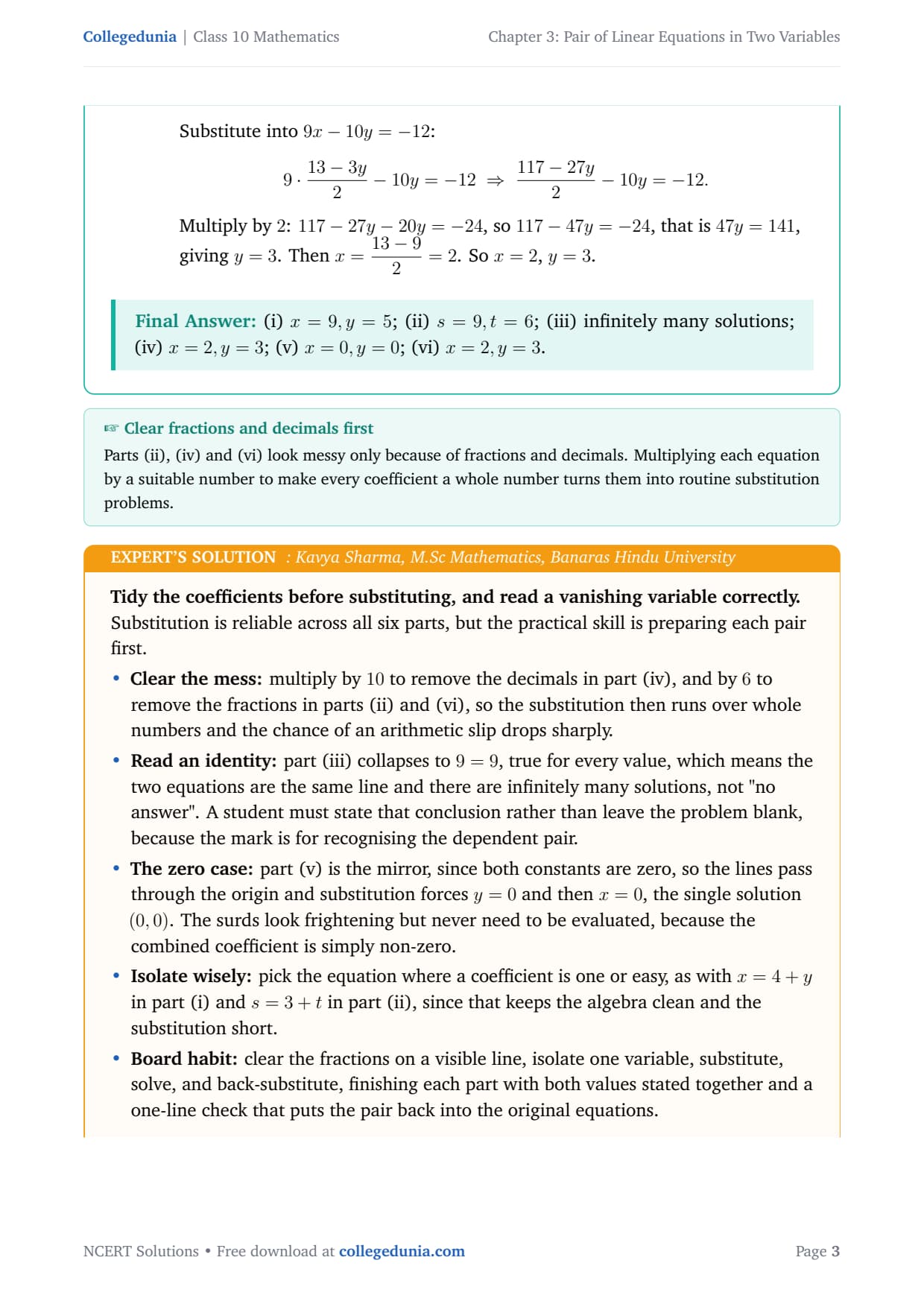
The whole exercise rests on one move: isolate a variable, then substitute it into the other equation. Clear any fractions or decimals first so the working stays over whole numbers and the substitution is short.
| Question | What it asks | Key result |
|---|---|---|
| Q1 | Solve six pairs by substitution | (i) x = 9, y = 5; (ii) s = 9, t = 6; (iii) infinitely many; (iv) x = 2, y = 3; (v) x = 0, y = 0; (vi) x = 2, y = 3 |
| Q2 | Solve the pair, then find the slope m | x = -2, y = 5, m = -1 |
| Q3 | Form and solve six word problems | 39 and 13; 99°, 81°; bat Rs. 500, ball Rs. 50; fixed Rs. 5, rate Rs. 10, Rs. 255 for 25 km; 7/9; Jacob 40, son 10 |
Reading Special Cases in Exercise 3.2: Infinitely Many and Zero Solutions
Two parts of Q1 are not ordinary substitutions, and students lose marks by leaving them blank. When the algebra collapses to a true statement, the pair has infinitely many solutions; when both constants are zero, the only solution is the origin. Recognising these two cases is exactly what the marker is checking.
- Identity (Q1 part iii): substitution gives 9 = 9, true for every value, so the second equation is just three times the first and the pair has infinitely many solutions.
- Zero solution (Q1 part v): both constant terms are zero, so the lines pass through the origin; the non-zero combined coefficient forces y = 0 and then x = 0, giving the single point (0, 0).
- Surds need no decimals: the √2, √3, √8 in part (v) look hard but never need evaluating, because all that matters is that the coefficient of y is not zero.
Common Mistakes Students Make in Pair of Linear Equations Exercise 3.2
Most lost marks here come from rushed set-up, not hard ideas. A quick check of your working usually catches them before they cost a mark.
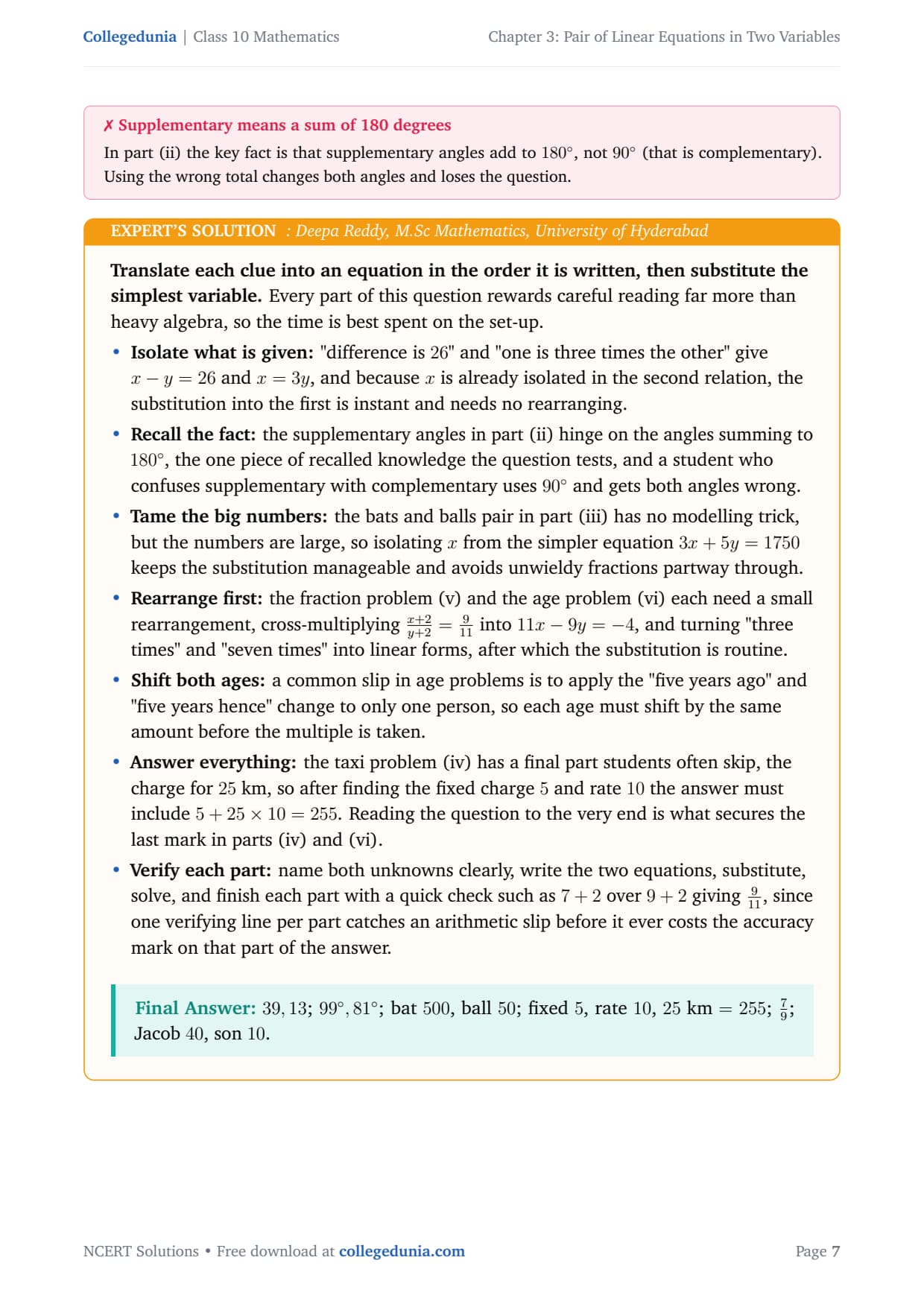
- Substituting before clearing fractions: in Q1 (ii), (iv) and (vi), multiply each equation by a suitable number first so every coefficient is a whole number.
- Confusing supplementary with complementary: in Q3 (ii), supplementary angles add to 180°, not 90°; the wrong total changes both angles.
- Shifting only one age: in Q3 (vi), both Jacob and his son must change by the same five years before the multiple is taken.
- Skipping the last part: Q3 (iv) asks for the 25 km charge after the fixed charge and rate; missing 5 + 25 × 10 = 255 drops the final mark.
Pair of Linear Equations Exercise 3.2 Marks and Previous Year Trends for Class 10
Pair of Linear Equations is a scoring chapter in the CBSE Class 10 board paper, usually worth 5 to 6 marks. Exercise 3.2 is the part that builds the algebraic method, since substitution and word problems are easy to set and easy to mark.
| Question type | Where it appears | Typical marks |
|---|---|---|
| Solving a pair by substitution (Q1 style) | Frequent 2-mark and 3-mark slots | 2 to 3 |
| Solve then find a constant like m (Q2 style) | Short-answer slots | 3 |
| Word problems on age, money, fractions (Q3 style) | Application-based 3 to 5-mark questions | 3 to 5 |
| Special cases, infinitely many or no solution | 1-mark and 2-mark reasoning questions | 1 to 2 |
These solutions follow the 2026-27 NCERT exactly, so the working you practise here matches what the board paper rewards.
Other Resources for Pair of Linear Equations Class 10 Maths
Use the table below to move between the other resources for this chapter and the other exercises of Pair of Linear Equations. Each link opens the matching Collegedunia page.
| Resource | Open page |
|---|---|
| Full chapter solutions | Pair of Linear Equations Class 10 NCERT Solutions |
| Previous exercise | Pair of Linear Equations Class 10 NCERT Solutions Exercise 3.1 |
| Next exercise | Pair of Linear Equations Class 10 NCERT Solutions Exercise 3.3 |
| Revision notes | Pair of Linear Equations Class 10 Notes |
| Formula sheet | Pair of Linear Equations Class 10 Formula Sheet |
| NCERT book PDF | Pair of Linear Equations Class 10 NCERT Book PDF |
| Handwritten notes | Pair of Linear Equations Class 10 Handwritten Notes |
| Exemplar solutions | Pair of Linear Equations Class 10 NCERT Exemplar Solutions |
NCERT Solutions for Class 10 Maths Pair of Linear Equations in Two Variables: All Exercises
The chapter has three exercises. The table below links each exercise to its own step-by-step solution page.
| Exercise | Solutions page |
|---|---|
| Exercise 3.1 | Pair of Linear Equations Class 10 NCERT Solutions Exercise 3.1 |
| Exercise 3.3 | Pair of Linear Equations Class 10 NCERT Solutions Exercise 3.3 |
| Full chapter | Pair of Linear Equations Class 10 NCERT Solutions (all exercises) |
NCERT Solutions for Class 10 Maths: All Chapters
Once Pair of Linear Equations is done, move on to the other chapters. Each link opens that chapter's NCERT Solutions page.
| Chapter | NCERT Solutions |
|---|---|
| Chapter 1 | Real Numbers NCERT Solutions |
| Chapter 2 | Polynomials NCERT Solutions |
| Chapter 4 | Quadratic Equations NCERT Solutions |
| Chapter 5 | Arithmetic Progressions NCERT Solutions |
| Chapter 6 | Triangles NCERT Solutions |
| Chapter 7 | Coordinate Geometry NCERT Solutions |
| Chapter 8 | Introduction to Trigonometry NCERT Solutions |
All NCERT Solutions for Class 10 Maths Chapter 3 Pair of Linear Equations in Two Variables Exercise 3.2 with Step-by-Step Solutions
Questions
Solve the following pair of linear equations by the substitution method. (i) x+y=14, x-y=4 (ii) s-t=3, s3+t2=6 (iii) 3x-y=3, 9x-3y=9 (iv) 0.2x+0.3y=1.3, 0.4x+0.5y=2.3 (v) √2 x+√3 y=0, √3 x-√8 y=0 (vi) 3x2-5y3=-2, x3+y2=136
Solve 2x+3y=11 and 2x-4y=-24 and hence find the value of `m' for which y=mx+3.
Form the pair of linear equations for the following problems and find their solution by substitution method. (i) The difference between two numbers is 26 and one number is three times the other. Find them. (ii) The larger of two supplementary angles exceeds the smaller by 18 degrees. Find them. (iii) The coach of a cricket team buys 7 bats and 6 balls for Rs. 3800. Later, she buys 3 bats and 5 balls for Rs. 1750. Find the cost of each bat and each ball. (iv) The taxi charges in a city consist of a fixed charge together with the charge for the distance covered. For a distance of 10 km, the charge paid is Rs. 105 and for a journey of 15 km, the charge paid is Rs. 155. What are the fixed charges and the charge per km? How much does a person have to pay for travelling a distance of 25 km? (v) A fraction becomes 911 if 2 is added to both the numerator and the denominator. If 3 is added to both the numerator and the denominator it becomes 56. Find the fraction. (vi) Five years hence, the age of Jacob will be three times that of his son. Five years ago, Jacob's age was seven times that of his son. What are their present ages?
Student Feedback
Student Feedback: Out of 15,400 students surveyed before the 2026 boards, 84% said Exercise 3.2 became easy once they cleared every fraction and decimal before substituting, since the substitution then runs over whole numbers and the arithmetic slips almost vanish.
Source: Collegedunia 2026-27 Class 10 Maths student poll.
Pair of Linear Equations in Two Variables Class 10 Maths Exercise 3.2 NCERT Solutions FAQs
Ques. How many questions are there in Class 10 Maths Chapter 3 Pair of Linear Equations in Two Variables Exercise 3.2?
Ans. Exercise 3.2 has 3 questions. Q1 solves six pairs by the substitution method, Q2 solves a pair and then finds the slope m, and Q3 forms and solves six word problems on numbers, angles, money and ages.
Ques. Where can I download the Pair of Linear Equations Class 10 Exercise 3.2 NCERT Solutions PDF?
Ans. You can download the Pair of Linear Equations Class 10 Exercise 3.2 NCERT Solutions PDF directly from this page using the download card at the top. It is free and follows the 2026-27 NCERT textbook.
Ques. How do I solve a pair of linear equations by the substitution method in Exercise 3.2?
Ans. Express one variable in terms of the other from one equation, then substitute that expression into the second equation to get a single equation in one variable. Solve it, then back-substitute to find the other variable. Clear any fractions or decimals first so the working stays over whole numbers.
Ques. What does it mean when Q1 part (iii) of Exercise 3.2 gives 9 = 9?
Ans. The statement 9 = 9 is true for every value, so the two equations describe the same line. The pair therefore has infinitely many solutions, not "no solution". You should state this conclusion, because the mark is for recognising the dependent pair.
Ques. Are these Exercise 3.2 solutions based on the 2026-27 syllabus?
Ans. Yes. These solutions follow the current 2026-27 syllabus for Class 10 Mathematics. Exercise 3.2 on the substitution method is fully retained in the latest NCERT edition.



Comments