Junior-Class Mentor, TFI Fellow | Updated 3+ months ago
Class 10 Maths Chapter 14 Probability is the chapter where most students lose marks because they confuse the number of outcomes listed with equally likely outcomes. The NCERT Solutions for Class 10 Maths Chapter 14 Probability below walk through every question in Exercise 14.1, with a step-by-step solution and an Expert Solution per question, for the 2026-27 CBSE syllabus.
All 25 questions from Exercise 14.1 solved using the theoretical probability formula P(E) = favourable outcomes / total outcomes, with the equally likely outcomes condition verified for each question.
Full coverage of impossible events (P = 0), sure events (P = 1), complement rule P(not E) = 1 - P(E), and real-life problems on coins, dice, cards, marbles, and coloured balls, according to the 2026-27 NCERT textbook.
Every answer is checked by Collegedunia Maths experts and mapped to the 2026-27 NCERT textbook.
What These Class 10 Maths Chapter 14 Probability Solutions Cover
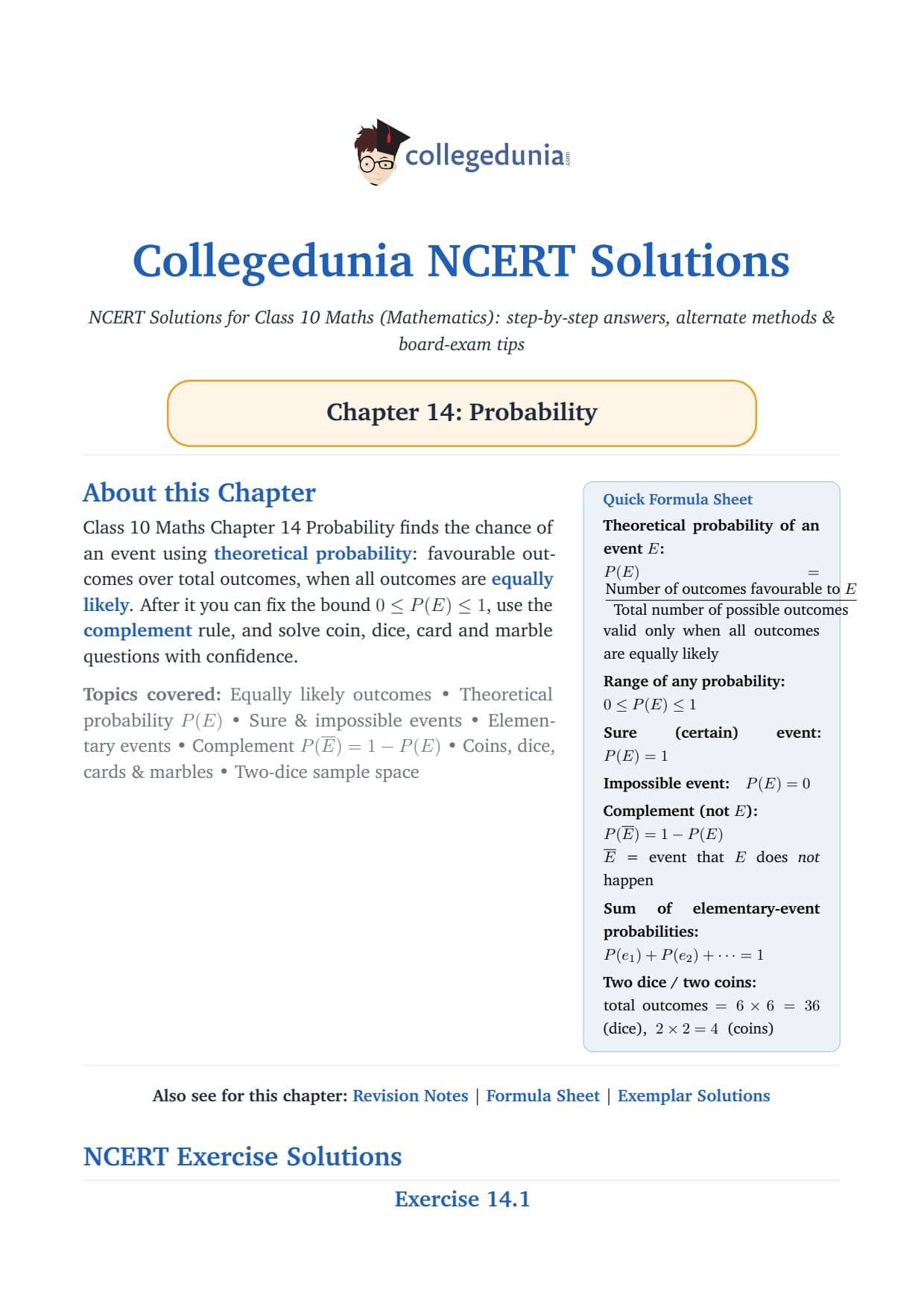
Chapter 14 teaches theoretical probability, the way to measure how likely an event is when all outcomes are equally likely. Here, P(E) means the probability of an event E, and "not E" means E does not happen.
The table below lists every formula and fact you need for Exercise 14.1. Learn all six rows, because the board tests both the definitions and the formula.
Concept
Formula / Fact
What it means
Theoretical probability
P(E) = Favourable / Total
Works only when all outcomes are equally likely
Impossible event
P(E) = 0
Zero favourable outcomes; event can never happen
Sure (certain) event
P(E) = 1
All outcomes are favourable; event always happens
Range of probability
0 ≤ P(E) ≤ 1
No probability is negative or above 1
Complement rule
P(not E) = 1 − P(E)
Probability that E does NOT happen
Sum of elementary events
P(e1) + P(e2) + ... = 1
All single-outcome probabilities add to 1
Remember: P(E) = favourable / total only works when every outcome is equally likely. For a biased coin or a car that may or may not start, you cannot use it. This is what Q2 and Q25 test.
Exercise 14.1: Question-wise Breakdown
Exercise 14.1 has 25 questions and is the only exercise in Chapter 14. Q1 to Q7 test definitions and the complement rule. Q8 to Q24 apply the formula to real-life cases. Q25 tests reasoning about equally likely outcomes.
Questions
Topic tested
Key idea
Q1, Q4–Q7
Definitions, range, complement rule
Use the six basic facts; P(not E) = 1 − P(E)
Q2, Q3, Q22, Q25
Equally likely outcomes and fairness
Skill or grouping breaks equal chance; always use the full sample space
Q6, Q8–Q11
Balls, marbles, coins, candy from a bag
Count total and favourable; simplify the fraction
Q12–Q14, Q18, Q19
Wheel, die, 52-card deck, numbered discs
Standard sample spaces for spinners, dice, and cards
Q15–Q17, Q21
Cards without replacement, defective items
Good = total − defective; update total after removal
Q20
Geometric probability (area model)
P = circle area / rectangle area = π/24
Q23, Q24
Three coins, die thrown twice
P(at least once) = 1 − P(none)
Quick Tip: Write the sample space first. Even for Q8 (balls in a bag), writing "Total = 3 + 5 = 8" at the top earns the setup mark and stops slips.
Common Mistakes in Probability and How to Fix Them
Probability has a few error patterns that show up in board scripts every year. Here are the five most common.
Top 5 errors in Chapter 14 board answers:
Treating listed outcomes as equally likely: two dice give 11 sums, but each is not 1/11. The 36 pairs are equally likely, not the 11 sums (Q22, Q25).
Counting 1 as a prime: in Q13, primes on a die are 2, 3, 5 only. Including 1 gives 4/6 instead of 3/6 = 1/2.
Wrong radius in Q20: diameter is 1 m, so radius = 1/2 m. Using radius = 1 gives π/6 instead of π/24.
Not updating the total in Q15: after the queen is put aside, the total drops to 4, not 5.
Not simplifying fractions: reduce 100/180 to 5/9 and 124/144 to 31/36. The board cuts marks for unsimplified answers.
How to Solve Probability Questions Step by Step
A simple four-step method works for every question in Exercise 14.1.
Step 1: Check for equally likely outcomes. Is there a reason for one outcome to occur more often? If yes (skill or bias), do not use the formula.
Step 2: Write the sample space. List every possible result and count them. This is your denominator.
Step 3: Count favourable outcomes. List only the outcomes that fit the event. This is your numerator.
Step 4: Divide and simplify. Reduce the fraction and check the answer lies in [0, 1].
Solved example
A bag has 3 red and 5 black balls. One ball is drawn at random. Find P(red).
Total outcomes = 3 + 5 = 8.
Favourable (red) outcomes = 3.
So P(red) = 38. The complement gives P(not red) = 1 - 38 = 58.
Two points students mix up:
Equally likely vs any outcomes: listing all outcomes does not make them equally likely. Two coins give 3 grouped results (HH, mixed, TT) but 4 equally likely pairs (HH, HT, TH, TT). Always use the equally likely sample space.
The complement: P(not E) = 1 minus P(E), never 0 minus P(E). The complement always starts from 1.
Other Resources for Class 10 Maths Chapter 14 Probability
Pair these solutions with the matching Collegedunia notes, formula sheet, and handwritten notes for fast revision. All Chapter 14 resources are linked below.
Resource
What it covers
Open
NCERT Solutions
Step-by-step answers to all 25 questions from Exercise 14.1, with an Expert Solution for each.
All NCERT Solutions for Class 10 Maths Chapter 14 Probability with Step-by-Step Solutions
Questions
Q 14.1
Complete the following statements:
(i) Probability of an event E + Probability of the event `not E' = 2cm.
(ii) The probability of an event that cannot happen is 2cm. Such an event is called 2cm.
(iii) The probability of an event that is certain to happen is 2cm. Such an event is called 2cm.
(iv) The sum of the probabilities of all the elementary events of an experiment is 2cm.
(v) The probability of an event is greater than or equal to 2cm and less than or equal to 2cm.
Concept used. These blanks test the basic rules of theoretical
probability. An event E and the event `not E' (written Ē) are
complementary, so their probabilities add to 1. An
impossible event has no favourable outcome, so its probability is 0.
A sure (certain) event happens in every trial, so its probability is
1. The probabilities of all the elementary events (one-outcome
events) of an experiment add up to 1. Finally, every probability lies between
0 and 1 inclusive.
(i)P(E) + P(not E) = 1, because E and
`not E' together cover every outcome exactly once.
(ii) An event that cannot happen has 0 favourable outcomes,
so its probability is 0. Such an event is called an
impossible event.
(iii) An event certain to happen has all outcomes favourable,
so its probability is 1. Such an event is called a
sure (or certain) event.
(iv) The sum of the probabilities of all the elementary events
of an experiment is 1.
(v) The probability of an event is greater than or equal to
0 and less than or equal to 1.
(i) 1 (ii) 0, impossible event (iii) 1, sure (certain) event (iv) 1 (v) 0 and 1
AV
Anjali Verma
M.Sc Mathematics, University of Delhi
Verified Expert
Attach the right word to the right number. Examiners use this fill-in
style to test definitions, so each answer has to be one precise value or term and
never a full sentence. Here is how to read each blank correctly.
Fixed pairing: the value zero always carries the words impossible
event, and the value one always carries the words sure or certain event,
so write the number and its word together.
Why two ones: parts (i) and (iv) both come out as one but for
different reasons. In (i) the event and its opposite split every outcome
into two groups that do not overlap, while in (iv) the elementary events
simply list every single outcome of the experiment exactly once.
The bound in (v): no probability can ever fall below zero or rise
above one, so any stray value such as a negative number or a number bigger
than one is ruled out at once.
Scoring tip: writing the term beside its number, for instance
zero with impossible, earns both the value mark and the definition mark,
which is exactly how the board splits the credit on this question.
(i) 1; (ii) 0, impossible; (iii) 1, sure/certain; (iv) 1; (v) 0 and 1.
Q 14.2
Which of the following experiments have equally likely outcomes? Explain.
(i) A driver attempts to start a car. The car starts or does not start.
(ii) A player attempts to shoot a basketball. She/he shoots or misses the shot.
(iii) A trial is made to answer a true-false question. The answer is right or wrong.
(iv) A baby is born. It is a boy or a girl.
Concept used. Outcomes are equally likely when there is no
reason for one outcome to occur more often than another. If the outcome depends
on skill, condition or experience, the two results are usually not
equally likely. If it depends only on chance with a symmetric set-up, they are.
(i) Whether a car starts depends on its condition, fuel,
battery and so on. There is no symmetry between `starts' and `does not
start'. Not equally likely.
(ii) Whether a player scores depends on skill and practice, so
a good player misses far less often than a beginner. Not equally
likely.
(iii) Without any knowledge, a guessed true-false answer is
equally likely to be right or wrong, since exactly one of the two is
correct and the guess is blind. Equally likely.
(iv) Ignoring rare biological factors, a new-born is taken to be
equally likely a boy or a girl. Equally likely.
Equally likely: (iii) and (iv). Not equally likely: (i) and (ii).
RM
Rohit Malhotra
M.Sc Mathematics, Banaras Hindu University
Verified Expert
Give a one-line reason, not just yes or no. The board awards the mark for
the explanation, so each verdict needs a short cause written beside it.
Part (i): the result turns on the car's mechanical condition. A
faulty car may fail to start many times in a row, so starting and not
starting clearly carry different chances and are not equally likely.
Part (ii): the result turns on the player's skill. A trained
player scores far more often than a beginner misses, so the two outcomes
are unequal.
Part (iii): a guessed true or false answer is simply right or
wrong, exactly one of the two is correct, and a blind guess favours
neither, so the two outcomes really are equally likely.
Part (iv): the standard Class 10 assumption is biological
symmetry between a boy and a girl, so the two are taken as equally likely.
Stating the reason in a few words next to each verdict is what separates a
full-mark answer from a bare guess.
(iii), (iv) equally likely (blind guess / biological symmetry); (i), (ii) not, because they depend on machine condition and player skill.
Q 14.3
Why is tossing a coin considered to be a fair way of deciding which team should get the ball at the beginning of a football game?
Concept used. A method of deciding is fair when each side has
the same chance of winning the decision. For a tossed coin we assume the coin is
unbiased and the toss is random, so the two outcomes head and tail are
equally likely.
When a fair coin is tossed there are only two possible outcomes, head
and tail, and neither is favoured over the other.
So
P(head) = 12, P(tail) = 12.
Each team is assigned one side. Because both probabilities equal
12, both teams have exactly the same chance of winning the toss.
Since neither team has any advantage, the coin toss is a fair way to
decide who gets the ball.
The two outcomes are equally likely, P(head) = P(tail) = 12, so neither team is favoured; hence the toss is fair.
SP
Sunita Pillai
M.Sc Statistics, University of Madras
Verified Expert
Anchor `fair' to equal probability. The marker looks for the idea that
both teams hold a half chance, so always write the two equal probabilities out.
Symmetry: a fair coin is physically balanced, so there is no
reason for it to land head up more often than tail up, and that balance is
exactly what makes the two outcomes equally likely.
Equal chance: since head and tail are equally likely, each team,
having picked one face before the toss, has the very same chance of
winning the decision, with neither side carrying any advantage.
Why a coin: because no team can claim the rule favoured the
other, a neutral coin toss rather than a referee's personal choice is the
accepted way to decide who starts with the ball.
Because P(head) = P(tail) = 12, both teams are equally likely to win, so the toss is unbiased and fair.
Q 14.4
Which of the following cannot be the probability of an event?
(A) 23 (B) -1.5 (C) 15% (D) 0.7
Concept used. The probability of any event E must satisfy
0 ≤ P(E) ≤ 1.
So a number can be a probability only if it lies between 0 and 1 inclusive.
Any negative number, or any number greater than 1, is impossible.
(A)23 ≈ 0.67, which lies between 0 and 1.
Allowed.
(B)-1.5 is negative, so it is less than 0. A probability
can never be negative. Not allowed.
(C)15% = 15100 = 0.15, which lies between 0 and
1. Allowed.
(D)0.7 lies between 0 and 1. Allowed.
Option (B) -1.5 cannot be the probability of an event.
KD
Kavita Deshmukh
M.Sc Mathematics, Savitribai Phule Pune University
Verified Expert
Scan for the value outside the range. In an MCQ like this you need not
evaluate every option fully, only find the one that breaks the bound.
Spot the negative: a probability is a count of favourable
outcomes over a positive total, so it can never come out below zero, which
means any negative option is wrong on sight.
The answer: option (B) is a clearly negative number, so it cannot
be a probability and is the choice you want without further work.
Check the rest: the other three all sit safely between zero and
one, two of them obviously and the percentage once you read it as a
decimal, so none of them breaks the rule.
Spotting the single out-of-range value is faster than testing each option, and it
is the exact skill the question is testing.
(B) -1.5, since it is negative and every probability lies in [0,1].
Q 14.5
If P(E) = 0.05, what is the probability of `not E'?
Concept used. An event E and its complement `not E' (written
Ē) are complementary events, so
P(E) + P(Ē) = 1 P(Ē) = 1 - P(E).
Write the complement rule:
P(Ē) = 1 - P(E).
Substitute P(E) = 0.05:
P(Ē) = 1 - 0.05.
Subtract:
P(Ē) = 0.95.
P(not E) = 0.95.
AK
Arvind Krishnan
M.Sc Mathematics, University of Hyderabad
Verified Expert
A one-step use of the complement rule. The board sets this kind of
question only to confirm you know that an event and its opposite add to one.
The idea: since the two probabilities must add to a whole, the
chance that the event does not happen is simply whatever is left after you
remove the chance that it does.
The work: here only a small part of the total belongs to the
event, so the rest of it belongs to the opposite event, and subtracting
gives the answer at once.
Sanity check: the answer lies between zero and one and the two
chances add back to one exactly, so both the value and the method are
sound; show the rule before the arithmetic to secure the method mark.
0.95.
Q 14.6
A bag contains lemon flavoured candies only. Malini takes out one candy without looking into the bag. What is the probability that she takes out
(i) an orange flavoured candy?
(ii) a lemon flavoured candy?
Concept used. If an outcome cannot occur, the event is
impossible and its probability is 0. If an outcome is bound to occur,
the event is a sure event and its probability is 1. Here every candy
in the bag is lemon flavoured.
(i) The bag has no orange candy, so the number of favourable
outcomes for `orange' is 0. Hence
P(orange) = 0total = 0.
Taking out an orange candy is impossible.
(ii) Every candy in the bag is lemon flavoured, so whichever
candy Malini draws is lemon. The event is sure, hence
P(lemon) = 1.
(i) P(orange) = 0 (ii) P(lemon) = 1
MI
Meena Iyer
M.Sc Statistics, University of Mumbai
Verified Expert
Read the word `only' carefully. That single word tells you the bag is
pure lemon, and that fact alone fixes both answers at once.
Orange: there is not a single orange candy, so the favourable
count for orange is zero, and zero over any positive total is zero, which
makes drawing an orange candy an impossible event.
Lemon: the bag is entirely lemon, so whichever candy comes out is
certain to be lemon, making it a sure event with probability one.
Neat link: the two answers also illustrate complements, since
they add to one, so not getting orange is exactly the same as getting
lemon.
Orange is impossible (0); lemon is certain (1).
Q 14.7
It is given that in a group of 3 students, the probability of 2 students not having the same birthday is 0.992. What is the probability that the 2 students have the same birthday?
Concept used. The events `the two students have the same birthday' and
`the two students do not have the same birthday' are complementary,
because exactly one of them must happen. So their probabilities add to 1:
P(same) = 1 - P(not same).
Write the complement rule:
P(same birthday) = 1 - P(not same birthday).
Substitute the given value P(not same) = 0.992:
P(same) = 1 - 0.992.
Subtract:
P(same) = 0.008.
P(same birthday) = 0.008.
DS
Deepak Sharma
M.Sc Mathematics, Aligarh Muslim University
Verified Expert
Recognise the complement first. The phrase about not having the same
birthday is the direct opposite of having the same birthday, so the two
probabilities must total one.
What is given: you are handed the large chance for the not-same
case, and the question asks only for the small leftover, so a single
subtraction from one finishes the work.
Why it is small: the answer comes out tiny, which makes sense
because two students chosen at random sharing a birthday is genuinely a
rare event.
Check: the given chance and your answer add back to one exactly,
which confirms that the pair really is complementary and that the
arithmetic is right.
0.008.
Q 14.8
A bag contains 3 red balls and 5 black balls. A ball is drawn at random from the bag. What is the probability that the ball drawn is (i) red? (ii) not red?
Concept used. For equally likely outcomes,
P(E) = Number of outcomes favourable to ETotal number of outcomes.
The total number of balls is 3 + 5 = 8, and `not red' is the complement of
`red'.
Total outcomes (total balls):
3 + 5 = 8.
(i) Favourable outcomes for red = 3. So
P(red) = 38.
(ii) Use the complement rule:
P(not red) = 1 - P(red) = 1 - 38 = 8-38 = 58.
(Check: the 5 black balls are exactly the `not red' balls, and
58 agrees.)
(i) P(red) = 38 (ii) P(not red) = 58
VN
Vivek Nair
M.Sc Mathematics, University of Calicut
Verified Expert
Fix the total first, then count favourables. The most common slip is
forgetting that the denominator is the total number of balls, not just the red
ones.
Total: there are eight balls in all, so eight is the denominator
for every part, and writing this sum out plainly earns the first method
mark even before any fraction appears.
Red: the red probability is simply the red count over that total
of eight.
Not red: you may either subtract the red chance from one or count
the black balls directly, and both routes land on the same answer, which
is a reassuring built-in check.
Final check: the red and not-red answers add to one, confirming
the complement was handled correctly.
Red =38, not red =58.
Q 14.9
A box contains 5 red marbles, 8 white marbles and 4 green marbles. One marble is taken out of the box at random. What is the probability that the marble taken out will be (i) red? (ii) white? (iii) not green?
Concept used. With equally likely draws,
P(E) = favourable outcomestotal outcomes.
Total marbles = 5 + 8 + 4. The event `not green' is the complement of `green'.
Total outcomes:
5 + 8 + 4 = 17.
(i) Red marbles = 5, so
P(red) = 517.
(ii) White marbles = 8, so
P(white) = 817.
(iii) Green marbles = 4, so P(green) = 417.
Then
P(not green) = 1 - 417 = 17 - 417 = 1317.
(Check: `not green' means red or white, that is 5 + 8 = 13 marbles,
giving 1317.)
(i) 517 (ii) 817 (iii) 1317
PB
Priya Banerjee
M.Sc Mathematics, Jadavpur University
Verified Expert
Keep one common denominator throughout. Every probability here sits over
the same total, so once you fix that denominator the rest is just reading off the
colour counts.
Direct colours: the red and white probabilities are read
straight off as their counts over the common total, with nothing to work
out beyond the simple fractions.
Not green: the fastest route in the exam is to add the two
non-green colours and put that count over the total, which lands on the
answer at once and agrees with subtracting the green chance from one.
Final check: the three colour probabilities together add up to
one, which confirms that not a single marble was miscounted along the way.
Red 517, white 817, not green 1317.
Q 14.10
A piggy bank contains hundred 50p coins, fifty 1 coins, twenty 2 coins and ten 5 coins. If it is equally likely that one of the coins will fall out when the bank is turned upside down, what is the probability that the coin (i) will be a 50 p coin? (ii) will not be a 5 coin?
Concept used. Every coin is equally likely to fall out, so
P(E) = number of favourable coinstotal number of coins.
The event `not a 5 coin' is the complement of `a 5 coin'.
Total number of coins:
100 + 50 + 20 + 10 = 180.
(i) Number of 50p coins = 100, so
P(50p) = 100180 = 59.
(ii) Number of 5 coins = 10, so
P(5) = 10180 = 118.
Then
P(not 5) = 1 - 118 = 18 - 118 = 1718.
(Check: coins that are not 5 number 100 + 50 + 20 = 170, and
170180 = 1718.)
(i) P(50p) = 59 (ii) P(not 5) = 1718
SG
Sanjay Gupta
M.Sc Mathematics, Allahabad University
Verified Expert
Add the counts, then simplify carefully. The total is the sum of all
four coin counts, and every probability in this question carries that same
denominator.
The 50p coin: its favourable count is the number of fifty paise
coins over the grand total, and that fraction cancels neatly to a much
simpler form once you divide top and bottom.
Not a five rupee coin: the neat exam route is to add up all the
coins that are not five rupee ones and place that count over the total,
which matches subtracting the five rupee chance from one.
Reduce fully: the marking scheme expects both answers in lowest
terms, so finishing the cancellation is part of earning the full credit
here, not an optional flourish.
59 for a 50p coin; 1718 for not a 5 coin.
Q 14.11
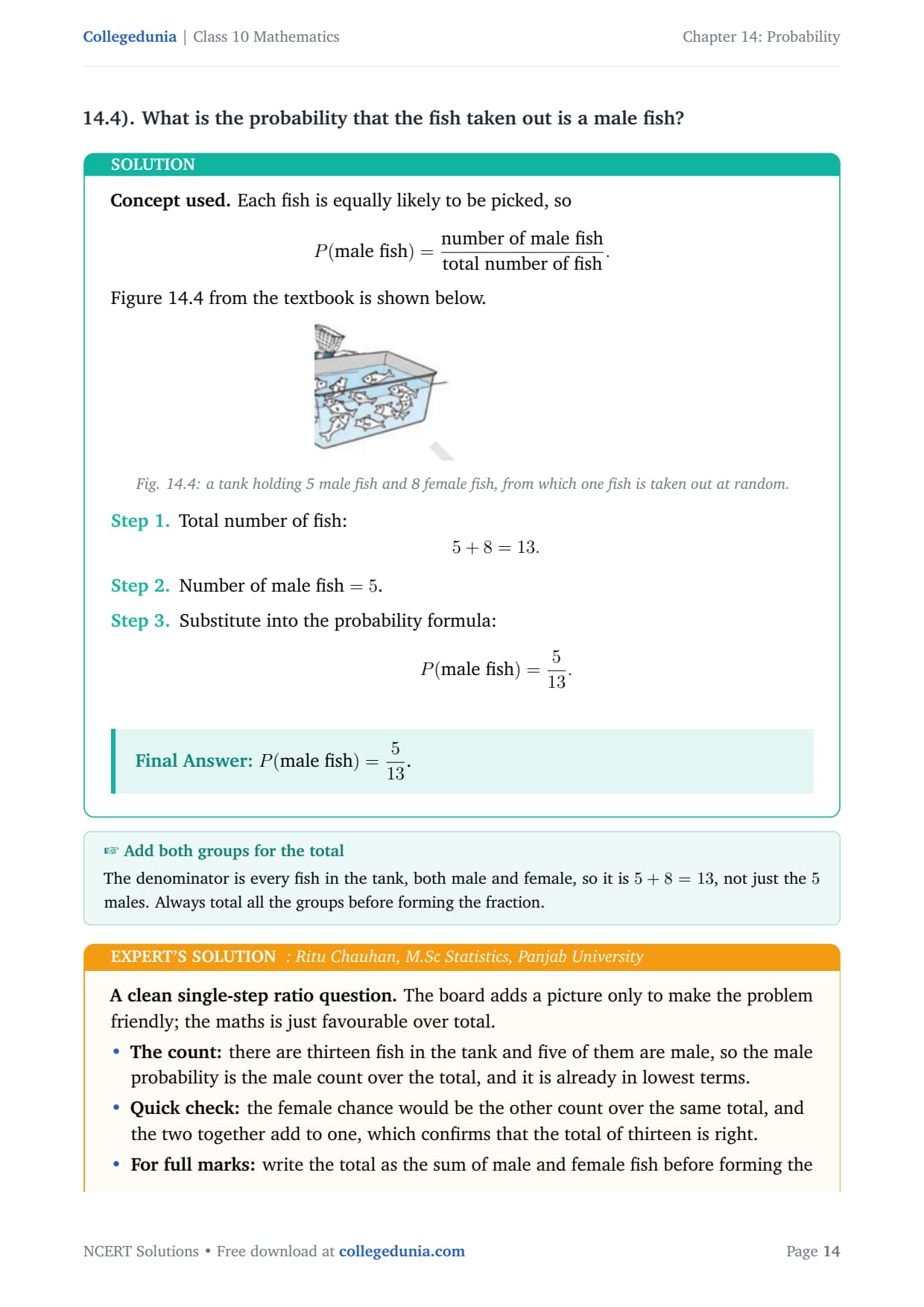
Gopi buys a fish from a shop for his aquarium. The shopkeeper takes out one fish at random from a tank containing 5 male fish and 8 female fish (see Fig. 14.4). What is the probability that the fish taken out is a male fish?
Concept used. Each fish is equally likely to be picked, so
P(male fish) = number of male fishtotal number of fish.
Figure 14.4 from the textbook is shown below.
Total number of fish:
5 + 8 = 13.
Number of male fish = 5.
Substitute into the probability formula:
P(male fish) = 513.
P(male fish) = 513.
RC
Ritu Chauhan
M.Sc Statistics, Panjab University
Verified Expert
A clean single-step ratio question. The board adds a picture only to
make the problem friendly; the maths is just favourable over total.
The count: there are thirteen fish in the tank and five of them
are male, so the male probability is the male count over the total, and it
is already in lowest terms.
Quick check: the female chance would be the other count over the
same total, and the two together add to one, which confirms that the total
of thirteen is right.
For full marks: write the total as the sum of male and female
fish before forming the fraction, so the reasoning is explicit on the
page.
513.
Q 14.12
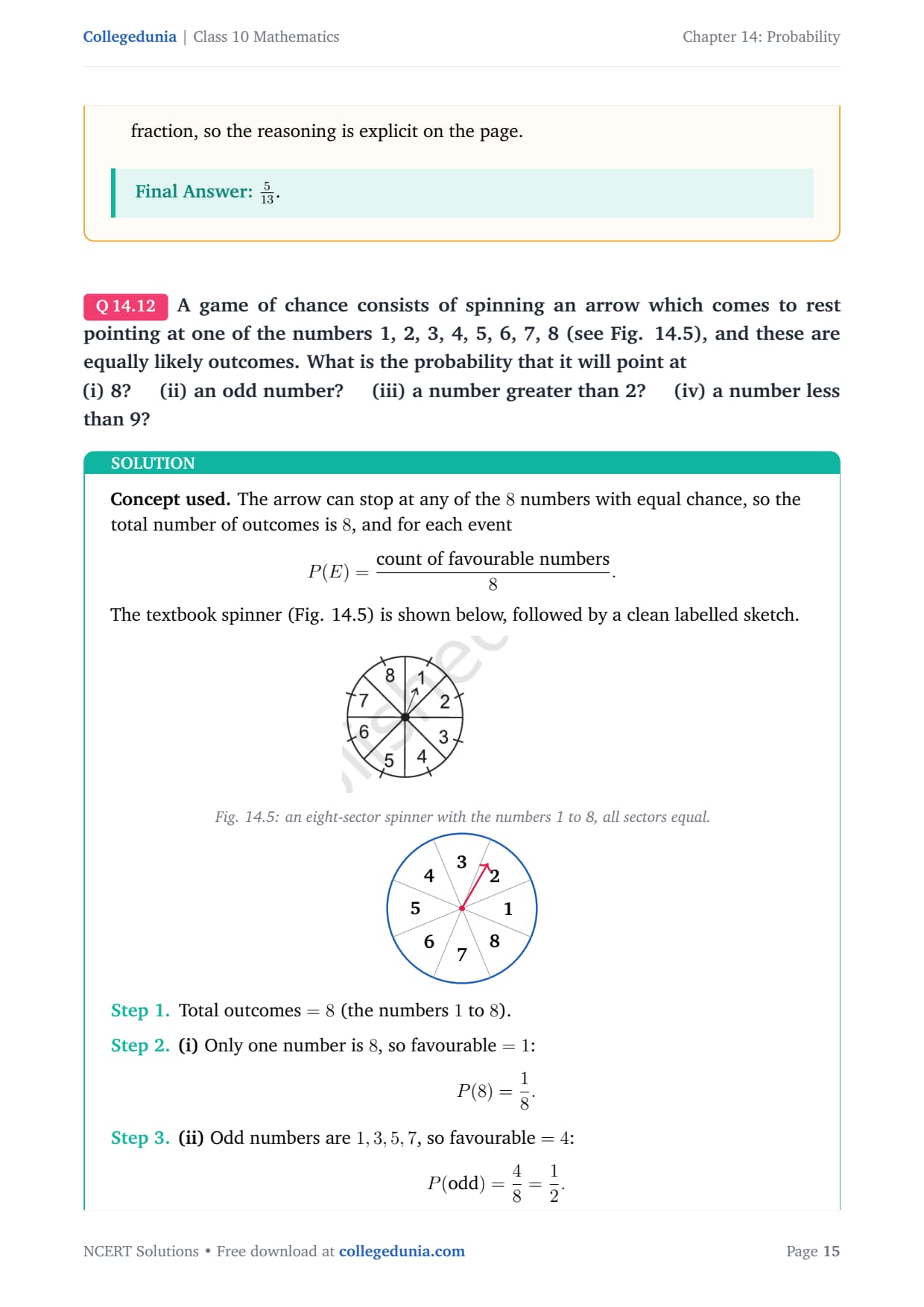
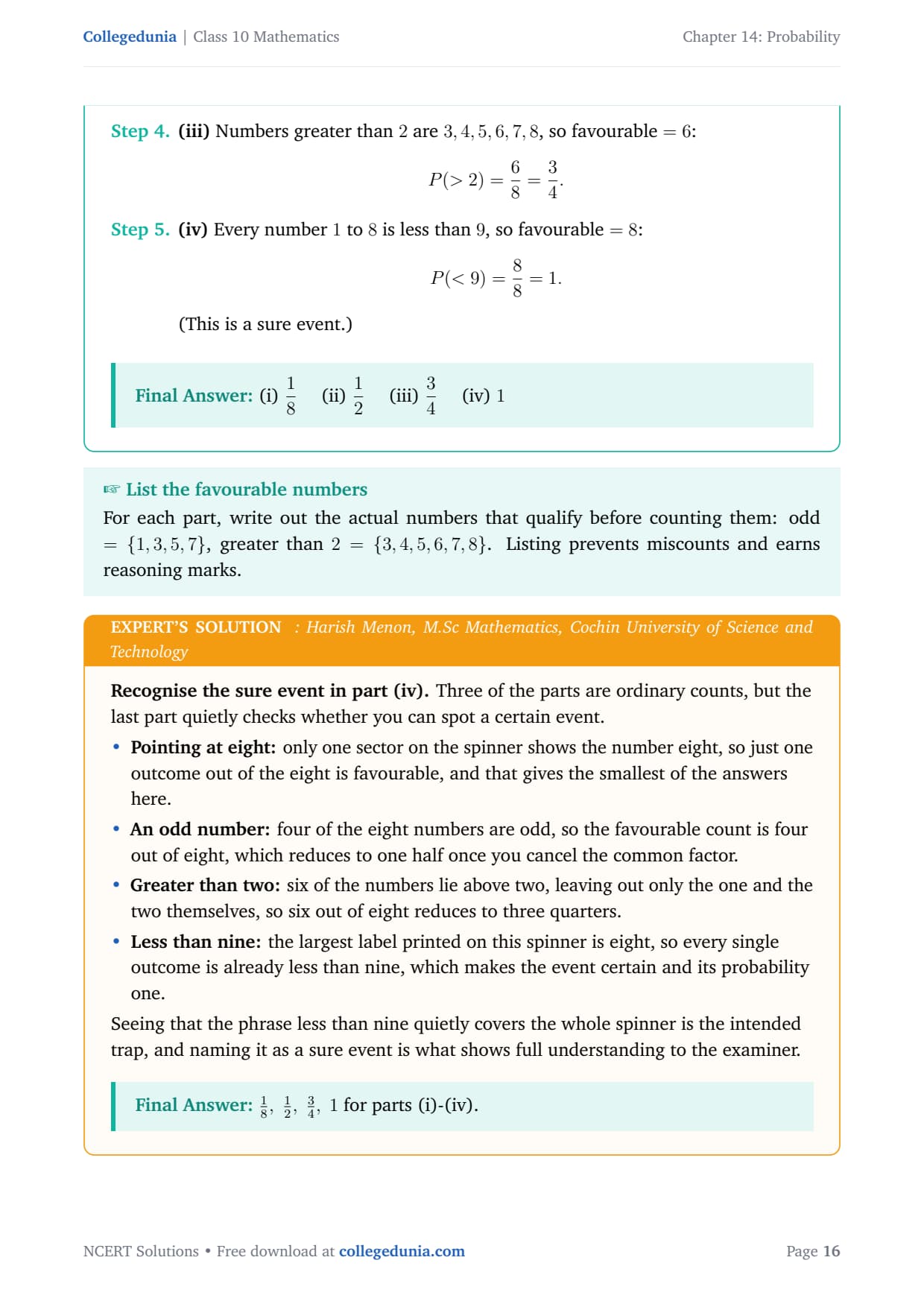
A game of chance consists of spinning an arrow which comes to rest pointing at one of the numbers 1, 2, 3, 4, 5, 6, 7, 8 (see Fig. 14.5), and these are equally likely outcomes. What is the probability that it will point at
(i) 8? (ii) an odd number? (iii) a number greater than 2? (iv) a number less than 9?
Concept used. The arrow can stop at any of the 8 numbers with equal
chance, so the total number of outcomes is 8, and for each event
P(E) = count of favourable numbers8.
The textbook spinner (Fig. 14.5) is shown below, followed by a clean labelled
sketch.
[See diagram in the PDF version]
Total outcomes = 8 (the numbers 1 to 8).
(i) Only one number is 8, so favourable = 1:
P(8) = 18.
(ii) Odd numbers are 1, 3, 5, 7, so favourable = 4:
P(odd) = 48 = 12.
(iii) Numbers greater than 2 are 3, 4, 5, 6, 7, 8, so
favourable = 6:
P(>2) = 68 = 34.
(iv) Every number 1 to 8 is less than 9, so favourable
= 8:
P(<9) = 88 = 1.
(This is a sure event.)
(i) 18 (ii) 12 (iii) 34 (iv) 1
HM
Harish Menon
M.Sc Mathematics, Cochin University of Science and Technology
Verified Expert
Recognise the sure event in part (iv). Three of the parts are ordinary
counts, but the last part quietly checks whether you can spot a certain event.
Pointing at eight: only one sector on the spinner shows the
number eight, so just one outcome out of the eight is favourable, and that
gives the smallest of the answers here.
An odd number: four of the eight numbers are odd, so the
favourable count is four out of eight, which reduces to one half once you
cancel the common factor.
Greater than two: six of the numbers lie above two, leaving out
only the one and the two themselves, so six out of eight reduces to three
quarters.
Less than nine: the largest label printed on this spinner is
eight, so every single outcome is already less than nine, which makes the
event certain and its probability one.
Seeing that the phrase less than nine quietly covers the whole spinner is the
intended trap, and naming it as a sure event is what shows full understanding to
the examiner.
18, 12, 34, 1 for parts (i)-(iv).
Q 14.13
A die is thrown once. Find the probability of getting
(i) a prime number; (ii) a number lying between 2 and 6; (iii) an odd number.
Concept used. A die has 6 equally likely faces: 1, 2, 3, 4, 5, 6.
For each event,
P(E) = count of favourable faces6.
A prime number has exactly two factors, 1 and itself.
Total outcomes = 6.
(i) Prime numbers on a die are 2, 3, 5 (note 1 is not
prime), so favourable = 3:
P(prime) = 36 = 12.
(ii) Numbers lying between2 and 6 are 3, 4, 5
(the endpoints 2 and 6 are not included), so favourable = 3:
P(between 2 and 6) = 36 = 12.
(iii) Odd numbers are 1, 3, 5, so favourable = 3:
P(odd) = 36 = 12.
(i) 12 (ii) 12 (iii) 12
NJ
Neha Joshi
M.Sc Mathematics, Gujarat University
Verified Expert
Read each phrase precisely. All three answers turn out to be a half, but
for different reasons, so the listing of numbers matters more than the value.
Primes: the primes on a die are two, three and five, because one
has only a single factor and four and six are composite, which leaves
exactly three favourable faces.
Between two and six: the word between is exclusive, so it picks
only three, four and five and leaves out the two endpoints, again giving
three faces.
Odd numbers: the odd faces are one, three and five, a third set
of three out of the six faces.
Each set of three out of six reduces to a half. The lesson is that
identical-looking answers can hide different reasoning, so always write the
qualifying numbers down before counting them.
All three probabilities equal 12.
Q 14.14
One card is drawn from a well-shuffled deck of 52 cards. Find the probability of getting
(i) a king of red colour (ii) a face card (iii) a red face card (iv) the jack of hearts (v) a spade (vi) the queen of diamonds
Concept used. A standard deck has 52 cards in 4 suits of 13 each:
spades and clubs are black, hearts and diamonds are red. The face cards
are the king, queen and jack of each suit (3 × 4 = 12 in all). With a
well-shuffled deck every card is equally likely, so
P(E) = favourable cards52.
(i) Red kings are the king of hearts and the king of diamonds,
so favourable = 2:
P(red king) = 252 = 126.
(ii) Face cards number 3 × 4 = 12:
P(face card) = 1252 = 313.
(iii) Red face cards are the king, queen and jack of hearts and
of diamonds, that is 3 × 2 = 6:
P(red face card) = 652 = 326.
(iv) There is exactly one jack of hearts:
P(jack of hearts) = 152.
(v) There are 13 spades:
P(spade) = 1352 = 14.
(vi) There is exactly one queen of diamonds:
P(queen of diamonds) = 152.
Build the deck picture once, then answer all six. Most card questions
reduce to counting how many cards match a description out of the fifty two.
Red kings: there are exactly two of them, one in each red suit,
so the favourable count is two out of the whole deck.
Face cards: every suit has a king, a queen and a jack, so across
the four suits there are twelve face cards in all.
Red face cards: this is the one part needing real care, because a
card must be both red and a face card at the same time, so you take only
the six that belong to the two red suits, not all twelve.
Named single cards: the jack of hearts and the queen of diamonds
are unique, so each is just one card out of the deck.
Spades: the spades form one complete suit of thirteen, which
reduces neatly to a quarter of the deck.
Reducing each fraction fully to its lowest terms is exactly what the marking
scheme rewards, so do not leave any answer half cancelled.
126, 313, 326, 152, 14, 152.
Q 14.15
Five cards, the ten, jack, queen, king and ace of diamonds, are well-shuffled with their face downwards. One card is then picked up at random.
(i) What is the probability that the card is the queen?
(ii) If the queen is drawn and put aside, what is the probability that the second card picked up is (a) an ace? (b) a queen?
Concept used. Only 5 cards are in play: ten, jack, queen, king and ace
of diamonds. Drawing without looking makes all remaining cards equally likely. If
a card is removed and not replaced, the total number of cards drops by one for
the next draw.
(i) Total cards = 5, and exactly one is the queen, so
P(queen) = 15.
Now the queen is removed and set aside. The remaining cards are
ten, jack, king and ace of diamonds, so the new total = 4.
(ii)(a) One ace is among these 4 cards, so
P(ace) = 14.
(ii)(b) The queen has already been put aside, so there is no
queen left among the 4 cards. Favourable = 0:
P(queen) = 04 = 0.
This is now an impossible event.
(i) 15 (ii)(a) 14 (ii)(b) 0
SR
Shalini Rao
M.Sc Statistics, Bangalore University
Verified Expert
Track how the pile changes between draws. The whole question is about
noticing that removing the queen alters both the total and the cards that are
left.
First draw: there are five cards with a single queen among them,
so the queen has a chance of one in five on the opening pick.
After removal: once that queen is set aside, only four cards
remain and the queen is no longer one of them, so always redraw the
reduced pile before working out the second chance.
Second draw, ace: the ace is still sitting in the pile, so its
chance is one out of the four cards that are left.
Second draw, queen: the queen is now gone, so the favourable
count is zero and drawing a queen has become an impossible event.
The clever part is the last case, where students who forget the queen was removed
wrongly write one quarter instead of zero.
15; then 14 for an ace and 0 for a queen.
Q 14.16
12 defective pens are accidentally mixed with 132 good ones. It is not possible to just look at a pen and tell whether or not it is defective. One pen is taken out at random from this lot. Determine the probability that the pen taken out is a good one.
Concept used. Each pen is equally likely to be picked, so
P(good pen) = number of good penstotal number of pens.
The total is the good pens plus the defective pens.
Total pens:
132 + 12 = 144.
Number of good pens = 132.
Substitute into the formula:
P(good pen) = 132144.
Simplify by dividing top and bottom by 12:
P(good pen) = 132 ÷ 12144 ÷ 12 = 1112.
P(good pen) = 1112.
AK
Ajay Kulkarni
M.Sc Mathematics, Shivaji University
Verified Expert
Form the fraction, then reduce fully. The marking scheme wants the final
answer in lowest terms, so the cancellation step is itself part of the credit.
The fraction: the total is every pen in the lot, good and
defective together, and the good pens over that total give the raw
fraction before any simplifying.
Reduce it: the top and bottom share a common factor, and dividing
both through by it turns the messy fraction into a clean one in lowest
terms.
Check: the defective chance is the leftover, and the good chance
plus the defective chance add back to one, which confirms the good-pen
answer is right.
1112.
Q 14.17
(i) A lot of 20 bulbs contain 4 defective ones. One bulb is drawn at random from the lot. What is the probability that this bulb is defective?
(ii) Suppose the bulb drawn in (i) is not defective and is not replaced. Now one bulb is drawn at random from the rest. What is the probability that this bulb is not defective?
Concept used. Each draw is from equally likely bulbs, so P =
favourabletotal. When a non-defective bulb is removed and
not replaced, both the total count and the count of good bulbs drop by one for
the next draw.
Now one good bulb is drawn and not replaced. The good bulbs
were 20 - 4 = 16; removing one leaves 15 good bulbs, and the total
falls to 20 - 1 = 19.
(ii) Probability the next bulb is not defective:
P(not defective) = 1519.
(i) P(defective) = 15 (ii) P(not defective) = 1519
PM
Pooja Mehta
M.Sc Mathematics, University of Rajasthan
Verified Expert
Re-count the lot before the second draw. The question is really testing
the idea of drawing without replacement, so the second part hangs on what was
removed.
Part one: four of the twenty bulbs are defective, so the
defective chance is four over twenty, which cancels to one fifth.
Part two: a good bulb has already left the lot, so the good bulbs
are now down to fifteen and the total down to nineteen, giving the new
chance over nineteen.
The key point: because a good bulb was taken out, both the
favourable count and the total drop by one; had a defective bulb left
instead, the good count would have stayed put, so always note which kind
was removed.
15 then 1519.
Q 14.18
A box contains 90 discs which are numbered from 1 to 90. If one disc is drawn at random from the box, find the probability that it bears (i) a two-digit number (ii) a perfect square number (iii) a number divisible by 5.
Concept used. The discs are numbered 1 to 90, all equally likely, so
the total number of outcomes is 90 and
P(E) = count of favourable numbers90.
A two-digit number runs from 10 to 99; a perfect square
is a whole number squared.
Total outcomes = 90.
(i) Two-digit numbers from 1 to 90 are 10, 11, …, 90.
Their count is 90 - 10 + 1 = 81:
P(two-digit) = 8190 = 910.
(The one-digit numbers 1 to 9 are the only ones excluded, and there
are 9 of them, leaving 90 - 9 = 81.)
(ii) Perfect squares from 1 to 90 are
1, 4, 9, 16, 25, 36, 49, 64, 81, that is 12 to 92 (since
102 = 100 > 90). Their count is 9:
P(perfect square) = 990 = 110.
(iii) Multiples of 5 from 1 to 90 are
5, 10, 15, …, 90. Their count is 90 ÷ 5 = 18:
P(divisible by 5) = 1890 = 15.
(i) 910 (ii) 110 (iii) 15
RS
Ramesh Subramaniam
M.Sc Mathematics, Madurai Kamaraj University
Verified Expert
Each part is a clean counting exercise. The total of ninety stays fixed
throughout, and only the favourable count changes from one part to the next.
Two-digit numbers: the quickest route is to remove the nine
single-digit numbers from the ninety discs, which leaves the rest as
two-digit, so the favourable count is whatever is left after that simple
subtraction.
Perfect squares: list the squares one by one and stop at the last
one that does not exceed ninety, since the next square already overshoots
it, and that listing gives you exactly nine favourable values.
Multiples of five: you need only divide ninety by five to get how
many multiples there are, and that count over the total gives the chance
without any listing at all.
Writing the favourable count clearly before you reduce keeps each answer tidy and
earns the method mark even when the final fraction is simple.
910, 110, 15.
Q 14.19
A child has a die whose six faces show the letters as given below:
2em A B C D E A
The die is thrown once. What is the probability of getting (i) A? (ii) D?
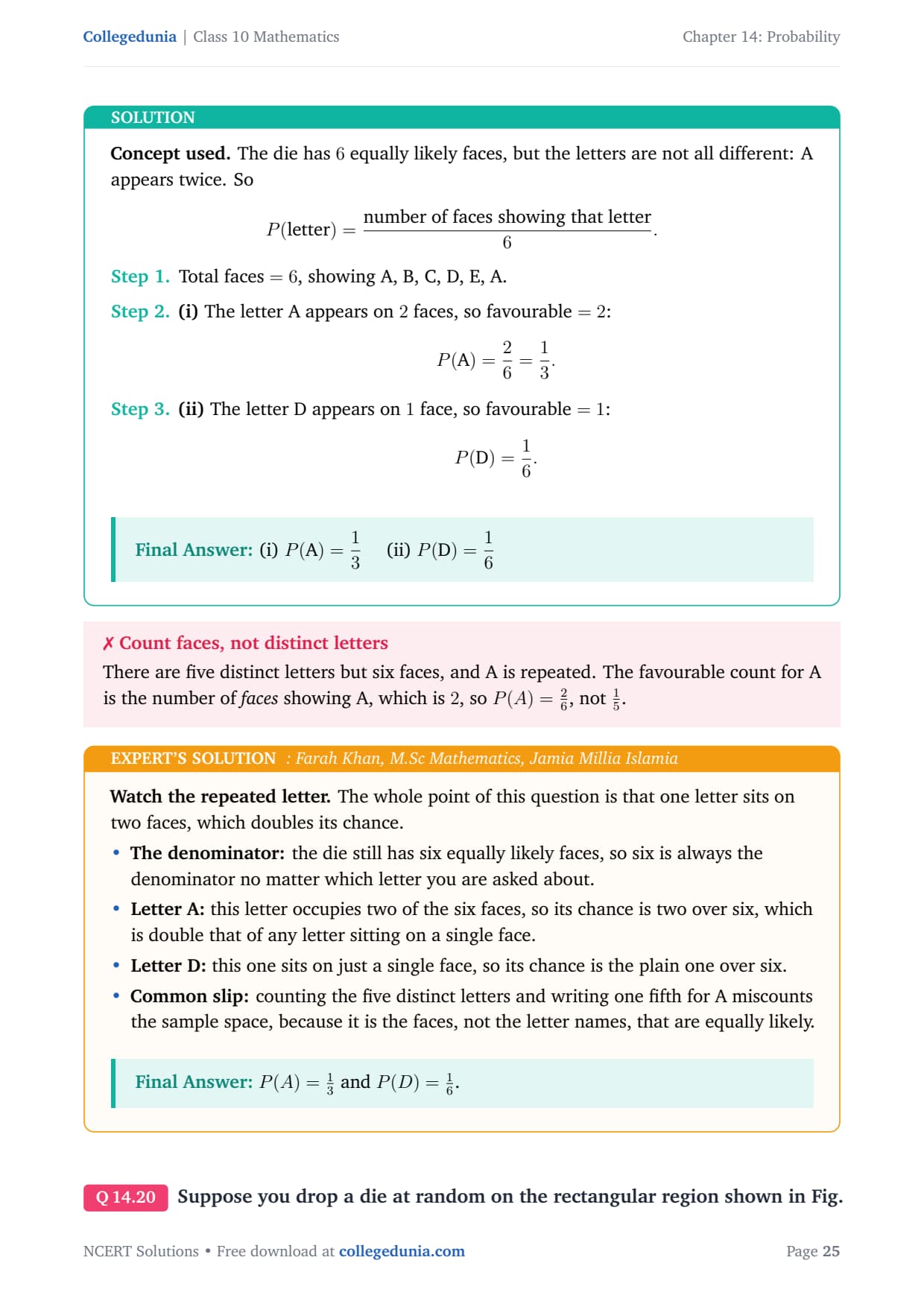
Concept used. The die has 6 equally likely faces, but the letters are
not all different: A appears twice. So
P(letter) = number of faces showing that letter6.
Total faces = 6, showing A, B, C, D, E, A.
(i) The letter A appears on 2 faces, so favourable = 2:
P(A) = 26 = 13.
(ii) The letter D appears on 1 face, so favourable = 1:
P(D) = 16.
(i) P(A) = 13 (ii) P(D) = 16
FK
Farah Khan
M.Sc Mathematics, Jamia Millia Islamia
Verified Expert
Watch the repeated letter. The whole point of this question is that one
letter sits on two faces, which doubles its chance.
The denominator: the die still has six equally likely faces, so
six is always the denominator no matter which letter you are asked about.
Letter A: this letter occupies two of the six faces, so its
chance is two over six, which is double that of any letter sitting on a
single face.
Letter D: this one sits on just a single face, so its chance is
the plain one over six.
Common slip: counting the five distinct letters and writing one
fifth for A miscounts the sample space, because it is the faces, not the
letter names, that are equally likely.
P(A) = 13 and P(D) = 16.
Q 14.20
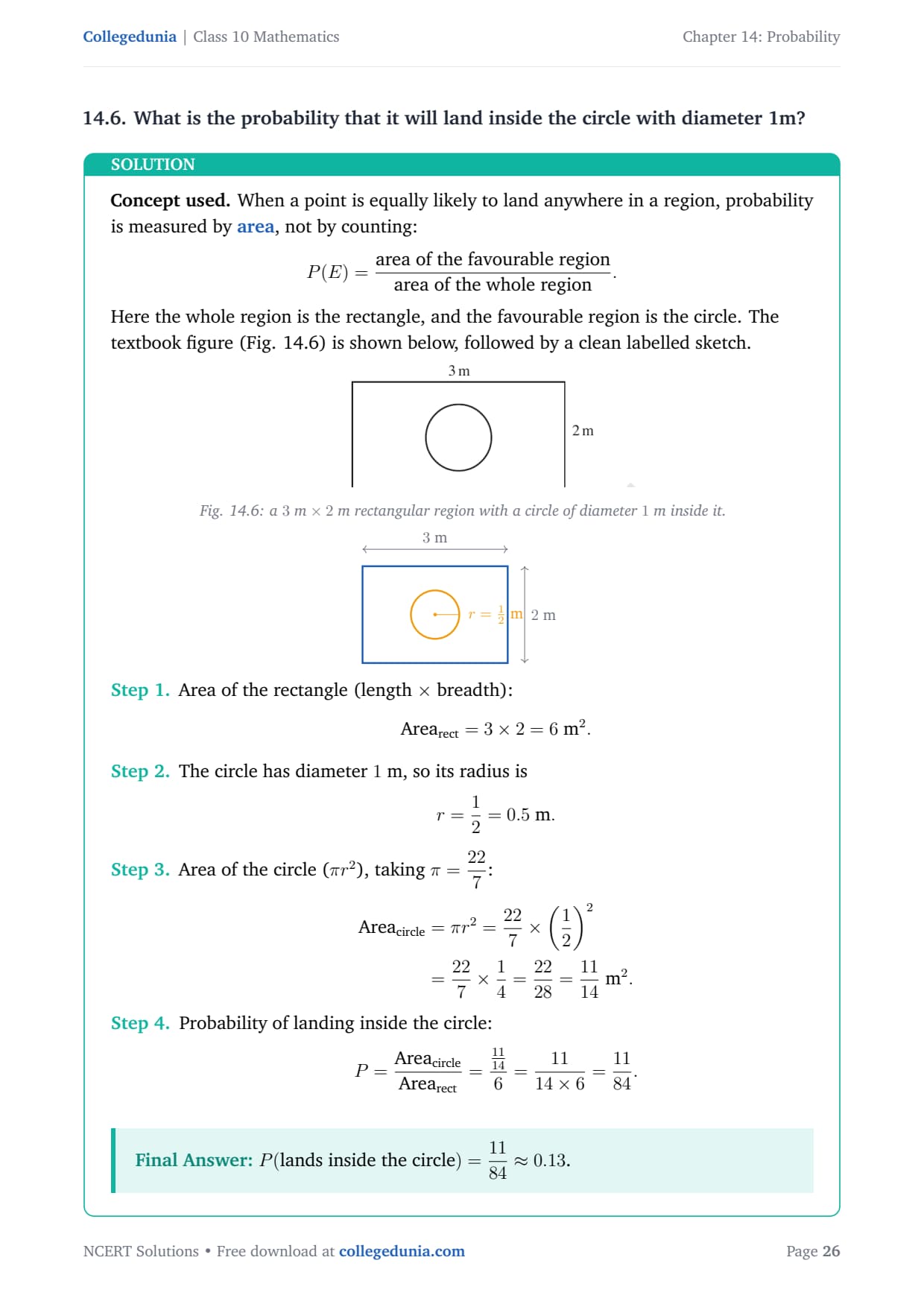
Suppose you drop a die at random on the rectangular region shown in Fig. 14.6. What is the probability that it will land inside the circle with diameter 1m?
Concept used. When a point is equally likely to land anywhere in a
region, probability is measured by area, not by counting:
P(E) = area of the favourable regionarea of the whole region.
Here the whole region is the rectangle, and the favourable region is the circle.
The textbook figure (Fig. 14.6) is shown below, followed by a clean labelled
sketch.
[See diagram in the PDF version]
Area of the rectangle (length × breadth):
Arearect = 3 × 2 = 6 m2.
The circle has diameter 1 m, so its radius is
r = 12 = 0.5 m.
Area of the circle (π r2), taking π = 227:
MATH0
Probability of landing inside the circle:
P = AreacircleArearect = 11146 = 1114 × 6 = 1184.
P(lands inside the circle) = 1184 ≈ 0.13.
SP
Suresh Patil
M.Sc Statistics, Osmania University
Verified Expert
Keep pi as the fraction twenty-two sevenths. The board answer for this
question is usually left as a fraction, so avoid switching to a rounded decimal
too early in the working.
New idea here: this is geometric probability, where outcomes are
points in a region, so the chance is the area of the favourable part over
the area of the whole region, not a count of outcomes.
Favourable area: the circle has a radius of half a metre, and
putting that radius into the area of a circle, with pi kept as a fraction,
gives its area as a tidy fraction of a square metre rather than a decimal.
Total area: the whole region is the rectangle, and its area is
simply its length times its breadth in square metres.
Divide: dividing the circle area by the rectangle area gives the
probability as a single fraction, which is the form the board prefers.
Two checks make the answer safe: the circle clearly fits inside the rectangle so
the chance cannot exceed one, and the value sits comfortably between zero and one
as every probability must.
1184 (about 0.13).
Q 14.21
A lot consists of 144 ball pens of which 20 are defective and the others are good. Nuri will buy a pen if it is good, but will not buy if it is defective. The shopkeeper draws one pen at random and gives it to her. What is the probability that
(i) She will buy it? (ii) She will not buy it?
Concept used. Each pen is equally likely to be drawn, so P =
favourabletotal. Nuri buys only a good pen, so `she buys'
= `good pen' and `she does not buy' = `defective pen'. These two events are
complementary.
Total pens = 144, defective = 20, so good pens = 144 - 20 = 124.
(i) She buys only a good pen:
P(buys) = P(good) = 124144 = 3136.
(Dividing top and bottom by 4: 124 ÷ 4 = 31, 144 ÷ 4 = 36.)
(ii) She does not buy only a defective pen:
P(does not buy) = P(defective) = 20144 = 536.
(Dividing by 4: 20 ÷ 4 = 5, 144 ÷ 4 = 36.)
Check: 3136 + 536 = 3636 = 1.
(i) P(buys) = 3136 (ii) P(does not buy) = 536
AD
Anita Desai
M.Sc Mathematics, University of Pune
Verified Expert
Use the complement to save work. Once you find one probability, the other
is just one minus it, because buying and not buying cover every possible case.
She buys: buying means the pen is good, so subtract the defective
pens from the total to get the good count, and that count over the total
gives the buying chance.
She does not buy: not buying means the pen is defective, and you
can reach this either by counting the defective pens directly or by taking
the buying chance away from one.
Check and reduce: both routes to the not-buying chance agree, the
two answers add back to one as a built-in check, and reducing each
fraction fully is needed for full marks.
Buys 3136, does not buy 536.
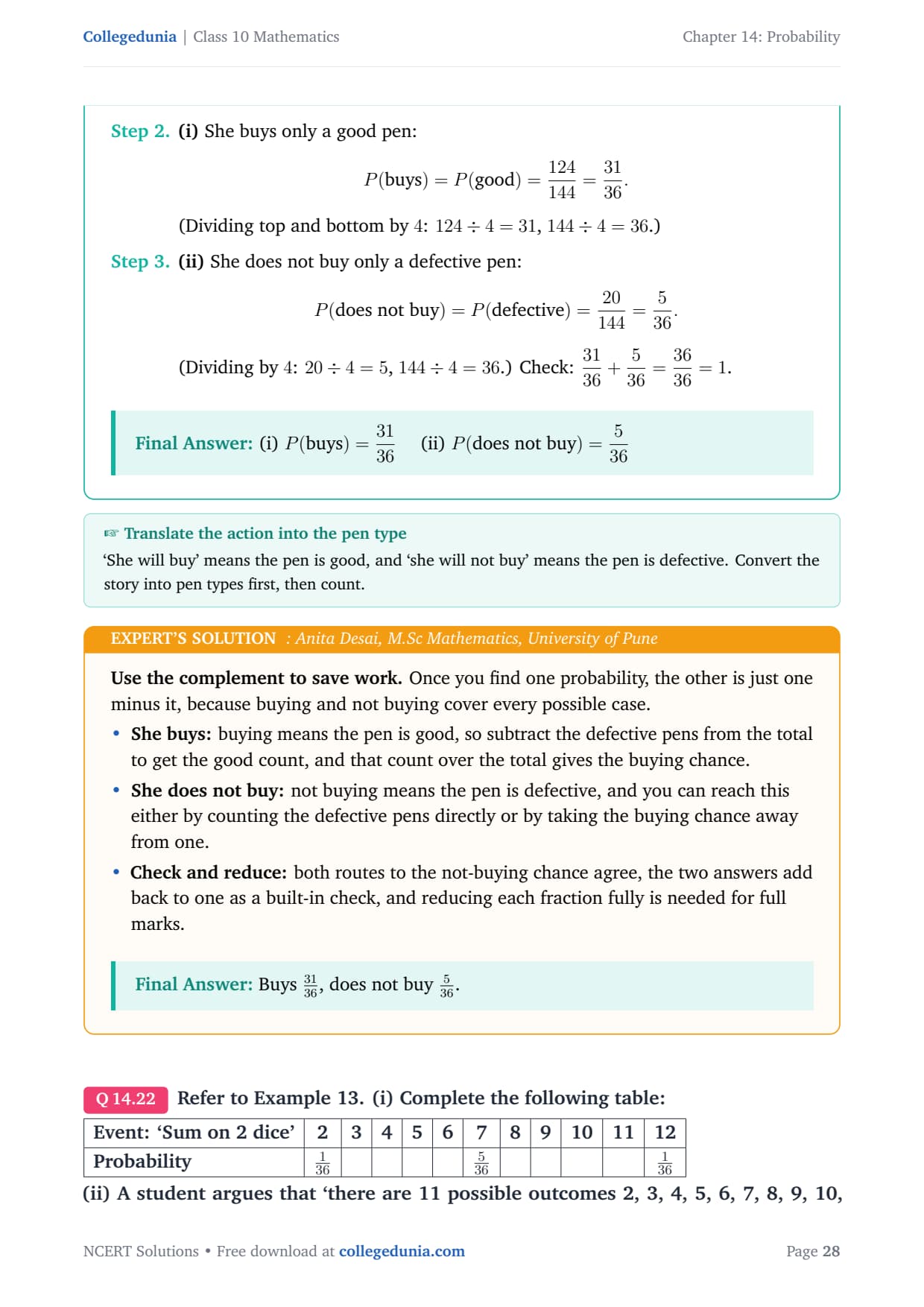
Q 14.22
Refer to Example 13. (i) Complete the following table: [2pt]
tabular|l|c|c|c|c|c|c|c|c|c|c|c|
tabular [4pt]
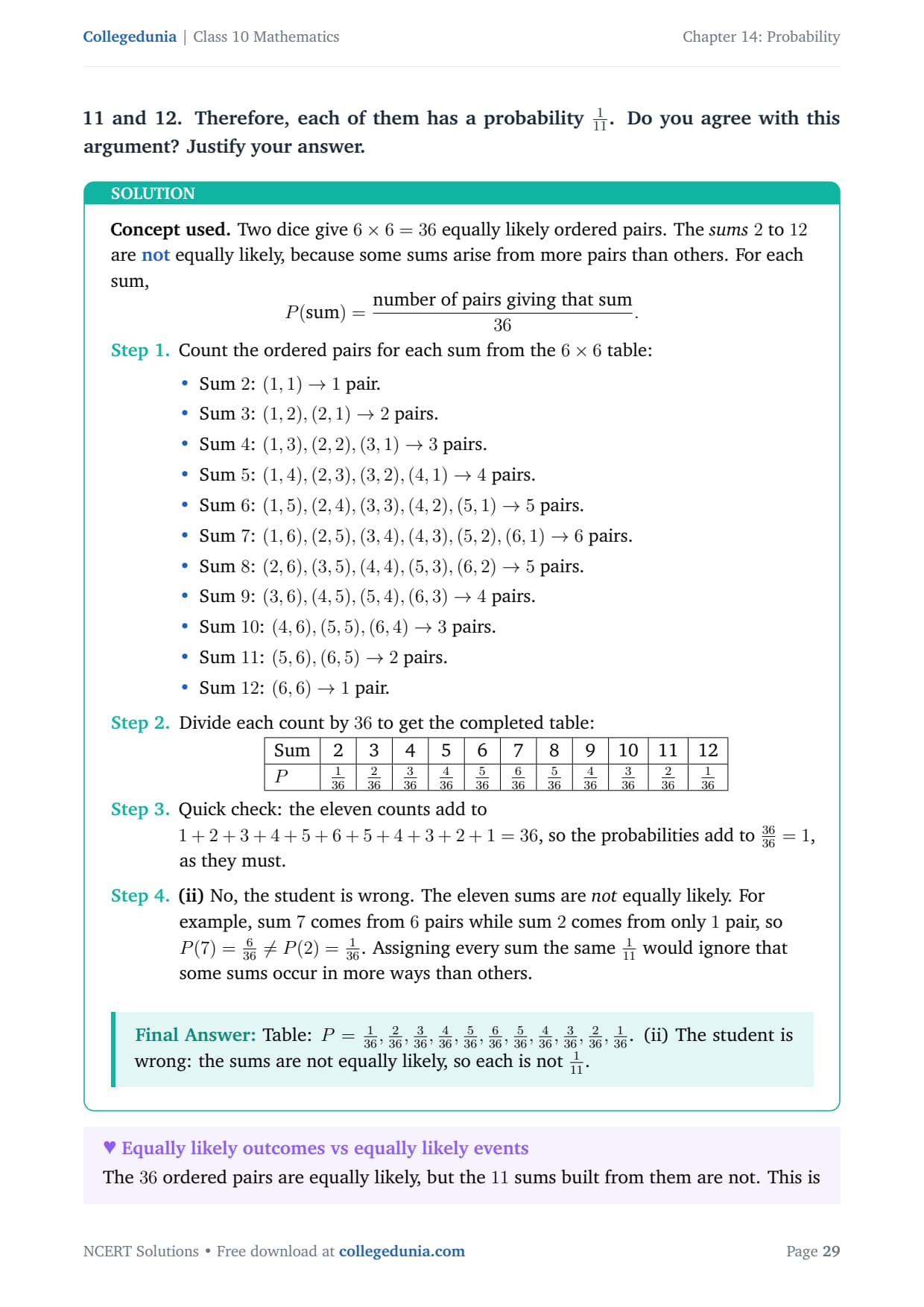
(ii) A student argues that `there are 11 possible outcomes 2, 3, 4, 5, 6, 7, 8, 9, 10, 11 and 12. Therefore, each of them has a probability 111. Do you agree with this argument? Justify your answer.
Concept used. Two dice give 6 × 6 = 36 equally likely ordered
pairs. The sums2 to 12 are not equally likely, because some
sums arise from more pairs than others. For each sum,
P(sum) = number of pairs giving that sum36.
Count the ordered pairs for each sum from the 6 × 6 table:
Sum 2: (1,1)→ 1 pair.
Sum 3: (1,2),(2,1)→ 2 pairs.
Sum 4: (1,3),(2,2),(3,1)→ 3 pairs.
Sum 5: (1,4),(2,3),(3,2),(4,1)→ 4 pairs.
Sum 6: (1,5),(2,4),(3,3),(4,2),(5,1)→ 5 pairs.
Sum 7: (1,6),(2,5),(3,4),(4,3),(5,2),(6,1)→ 6 pairs.
Sum 8: (2,6),(3,5),(4,4),(5,3),(6,2)→ 5 pairs.
Sum 9: (3,6),(4,5),(5,4),(6,3)→ 4 pairs.
Sum 10: (4,6),(5,5),(6,4)→ 3 pairs.
Sum 11: (5,6),(6,5)→ 2 pairs.
Sum 12: (6,6)→ 1 pair.
Divide each count by 36 to get the completed table:
Quick check: the eleven counts add to
1 + 2 + 3 + 4 + 5 + 6 + 5 + 4 + 3 + 2 + 1 = 36, so the probabilities
add to 3636 = 1, as they must.
(ii) No, the student is wrong. The eleven sums are not
equally likely. For example, sum 7 comes from 6 pairs while sum 2
comes from only 1 pair, so P(7) = 636 ≠ P(2) =
136. Assigning every sum the same 111 would
ignore that some sums occur in more ways than others.
Table: P = 136, 236, 336, 436, 536, 636, 536, 436, 336, 236, 136. (ii) The student is wrong: the sums are not equally likely, so each is not 111.
VR
Vikram Reddy
M.Sc Mathematics, Andhra University
Verified Expert
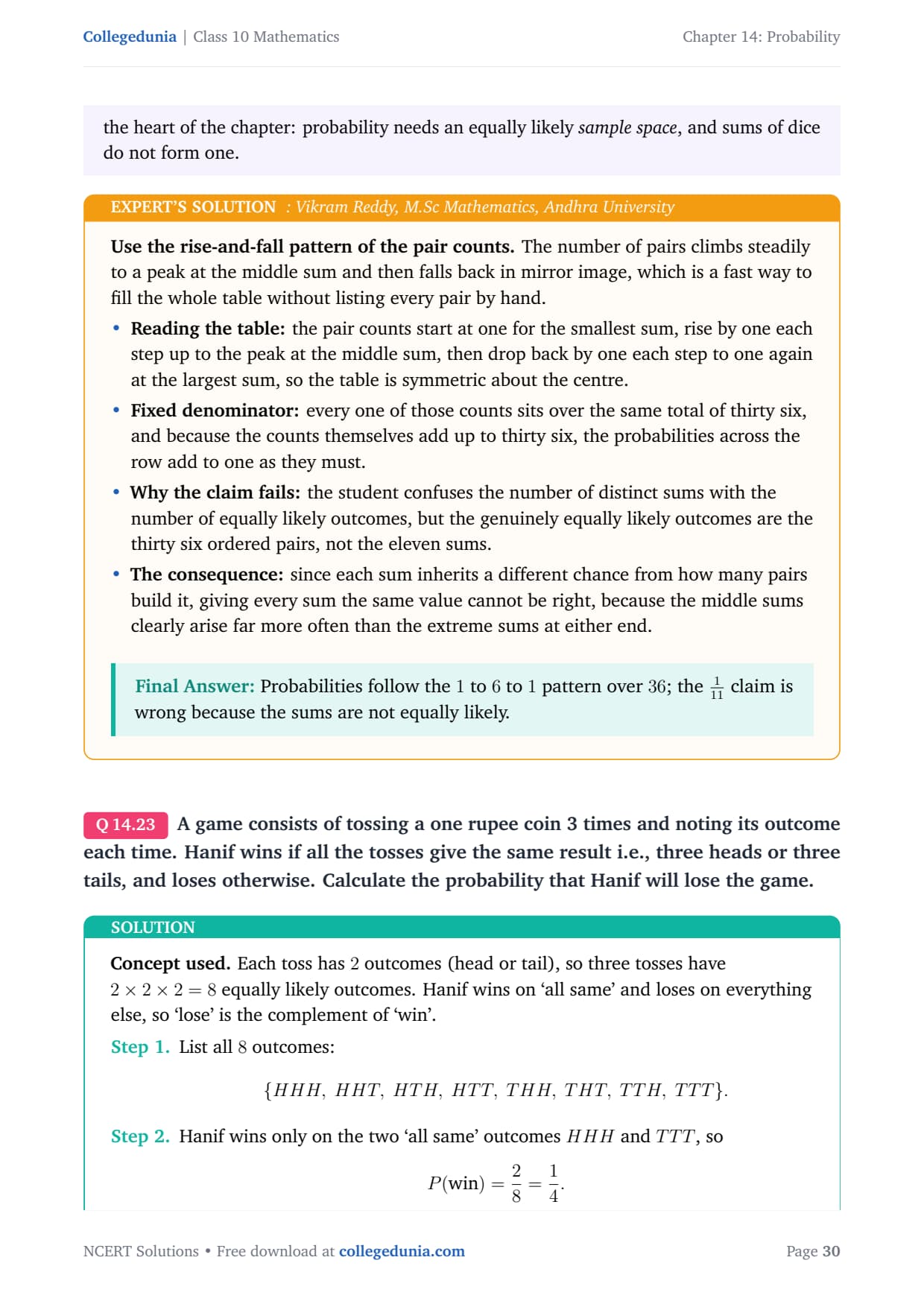
Use the rise-and-fall pattern of the pair counts. The number of pairs
climbs steadily to a peak at the middle sum and then falls back in mirror image,
which is a fast way to fill the whole table without listing every pair by hand.
Reading the table: the pair counts start at one for the smallest
sum, rise by one each step up to the peak at the middle sum, then drop
back by one each step to one again at the largest sum, so the table is
symmetric about the centre.
Fixed denominator: every one of those counts sits over the same
total of thirty six, and because the counts themselves add up to thirty
six, the probabilities across the row add to one as they must.
Why the claim fails: the student confuses the number of distinct
sums with the number of equally likely outcomes, but the genuinely equally
likely outcomes are the thirty six ordered pairs, not the eleven sums.
The consequence: since each sum inherits a different chance from
how many pairs build it, giving every sum the same value cannot be right,
because the middle sums clearly arise far more often than the extreme sums
at either end.
Probabilities follow the 1 to 6 to 1 pattern over 36; the 111 claim is wrong because the sums are not equally likely.
Q 14.23
A game consists of tossing a one rupee coin 3 times and noting its outcome each time. Hanif wins if all the tosses give the same result i.e., three heads or three tails, and loses otherwise. Calculate the probability that Hanif will lose the game.
Concept used. Each toss has 2 outcomes (head or tail), so three tosses
have 2 × 2 × 2 = 8 equally likely outcomes. Hanif wins on `all same'
and loses on everything else, so `lose' is the complement of `win'.
List all 8 outcomes:
HHH, HHT, HTH, HTT, THH, THT, TTH, TTT.
Hanif wins only on the two `all same' outcomes HHH and TTT, so
P(win) = 28 = 14.
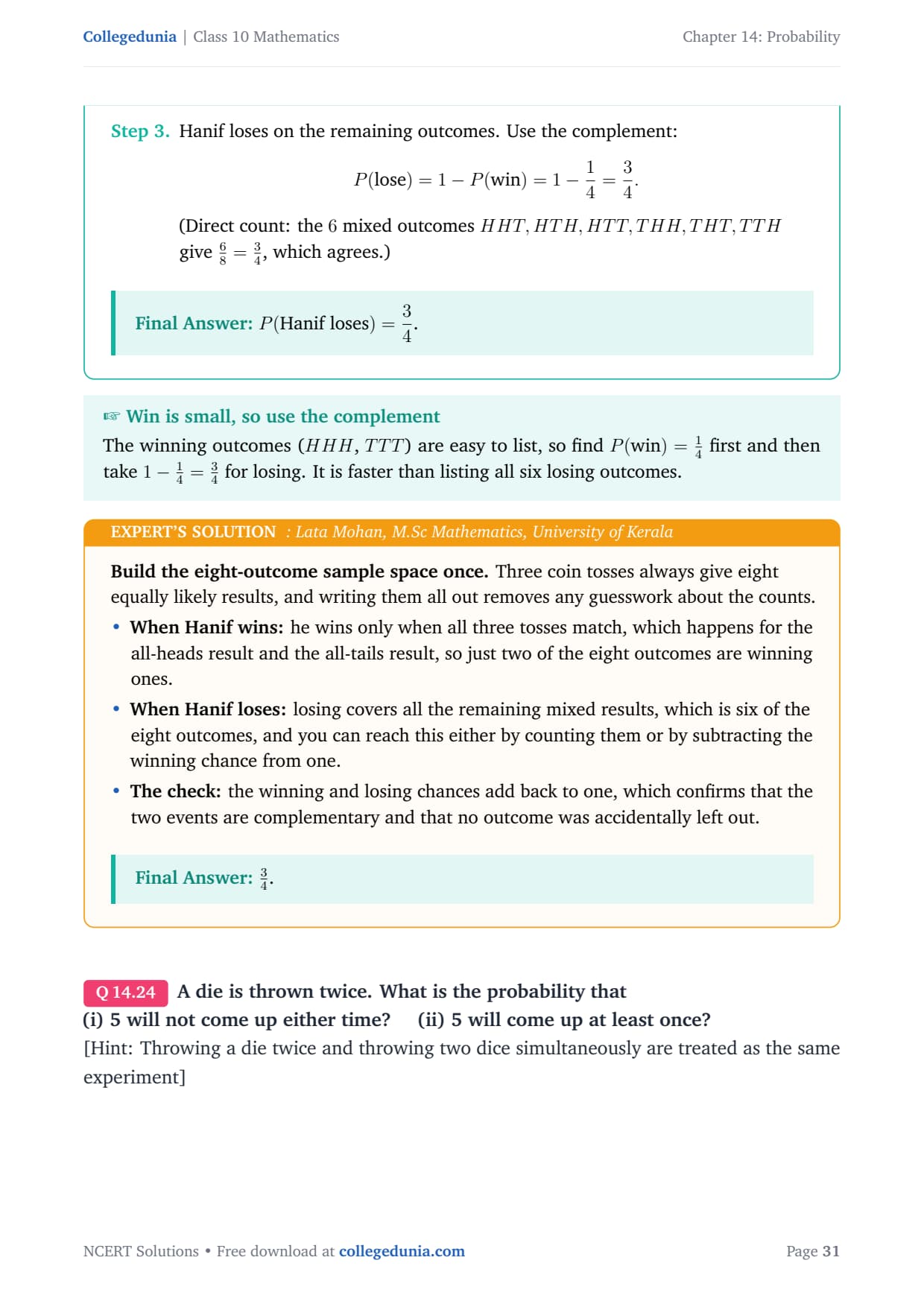
Hanif loses on the remaining outcomes. Use the complement:
P(lose) = 1 - P(win) = 1 - 14 = 34.
(Direct count: the 6 mixed outcomes HHT, HTH, HTT, THH, THT, TTH give
68 = 34, which agrees.)
P(Hanif loses) = 34.
LM
Lata Mohan
M.Sc Mathematics, University of Kerala
Verified Expert
Build the eight-outcome sample space once. Three coin tosses always give
eight equally likely results, and writing them all out removes any guesswork
about the counts.
When Hanif wins: he wins only when all three tosses match, which
happens for the all-heads result and the all-tails result, so just two of
the eight outcomes are winning ones.
When Hanif loses: losing covers all the remaining mixed results,
which is six of the eight outcomes, and you can reach this either by
counting them or by subtracting the winning chance from one.
The check: the winning and losing chances add back to one, which
confirms that the two events are complementary and that no outcome was
accidentally left out.
34.
Q 14.24
A die is thrown twice. What is the probability that
(i) 5 will not come up either time? (ii) 5 will come up at least once?
[Hint: Throwing a die twice and throwing two dice simultaneously are treated as the same experiment]
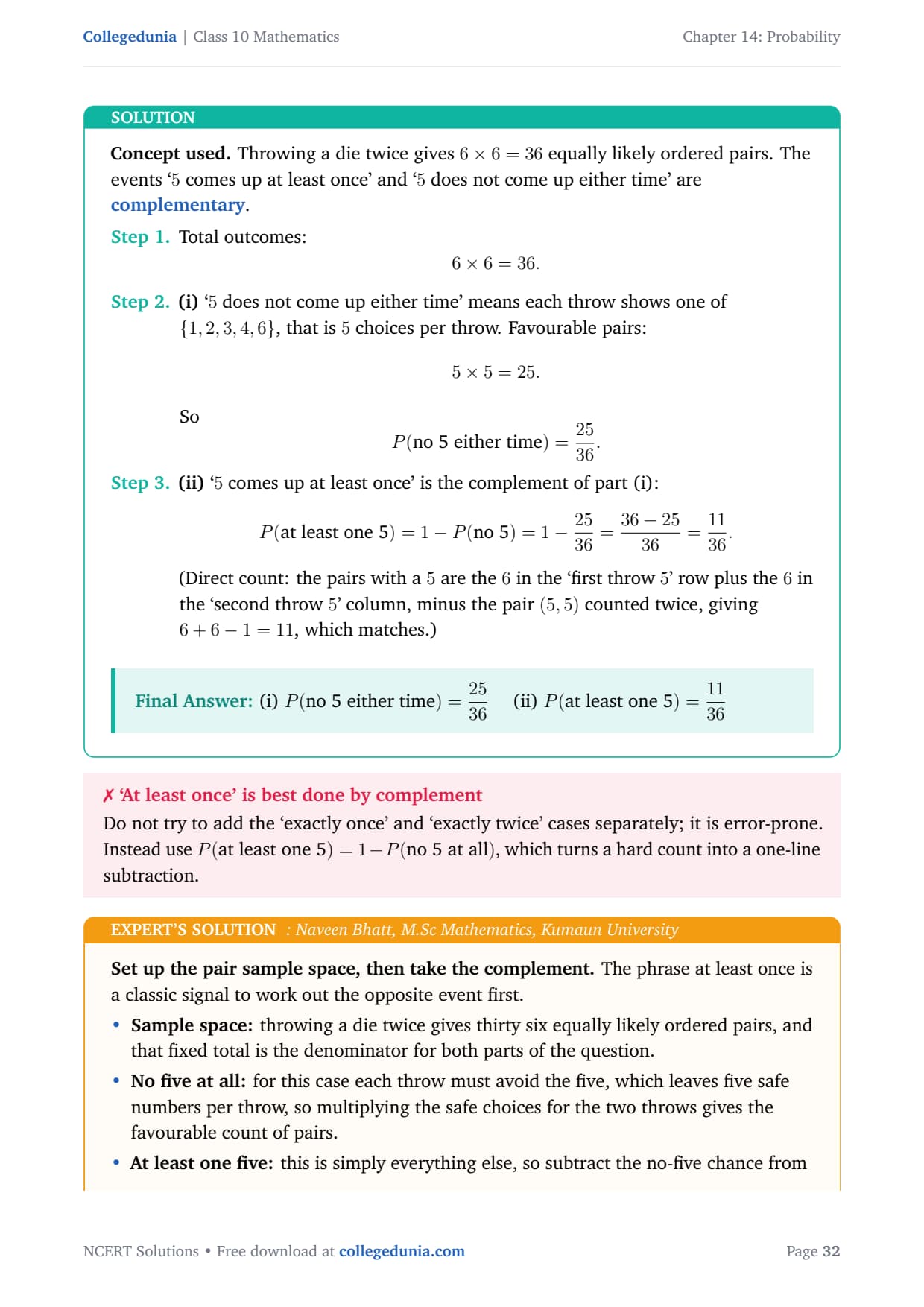
Concept used. Throwing a die twice gives 6 × 6 = 36 equally
likely ordered pairs. The events `5 comes up at least once' and `5 does not
come up either time' are complementary.
Total outcomes:
6 × 6 = 36.
(i) `5 does not come up either time' means each throw shows
one of 1,2,3,4,6, that is 5 choices per throw. Favourable pairs:
5 × 5 = 25.
So
P(no 5 either time) = 2536.
(ii) `5 comes up at least once' is the complement of part (i):
P(at least one 5) = 1 - P(no 5) = 1 - 2536 = 36 - 2536 = 1136.
(Direct count: the pairs with a 5 are the 6 in the `first throw 5'
row plus the 6 in the `second throw 5' column, minus the pair
(5,5) counted twice, giving 6 + 6 - 1 = 11, which matches.)
(i) P(no 5 either time) = 2536 (ii) P(at least one 5) = 1136
NB
Naveen Bhatt
M.Sc Mathematics, Kumaun University
Verified Expert
Set up the pair sample space, then take the complement. The phrase at
least once is a classic signal to work out the opposite event first.
Sample space: throwing a die twice gives thirty six equally
likely ordered pairs, and that fixed total is the denominator for both
parts of the question.
No five at all: for this case each throw must avoid the five,
which leaves five safe numbers per throw, so multiplying the safe choices
for the two throws gives the favourable count of pairs.
At least one five: this is simply everything else, so subtract the
no-five chance from one rather than trying to add up the separate cases.
Two checks: the two answers add to one, and a direct count of the
pairs that contain a five, taking care not to count the double five twice,
confirms the at-least-one answer independently.
No 5 either time 2536; at least one 51136.
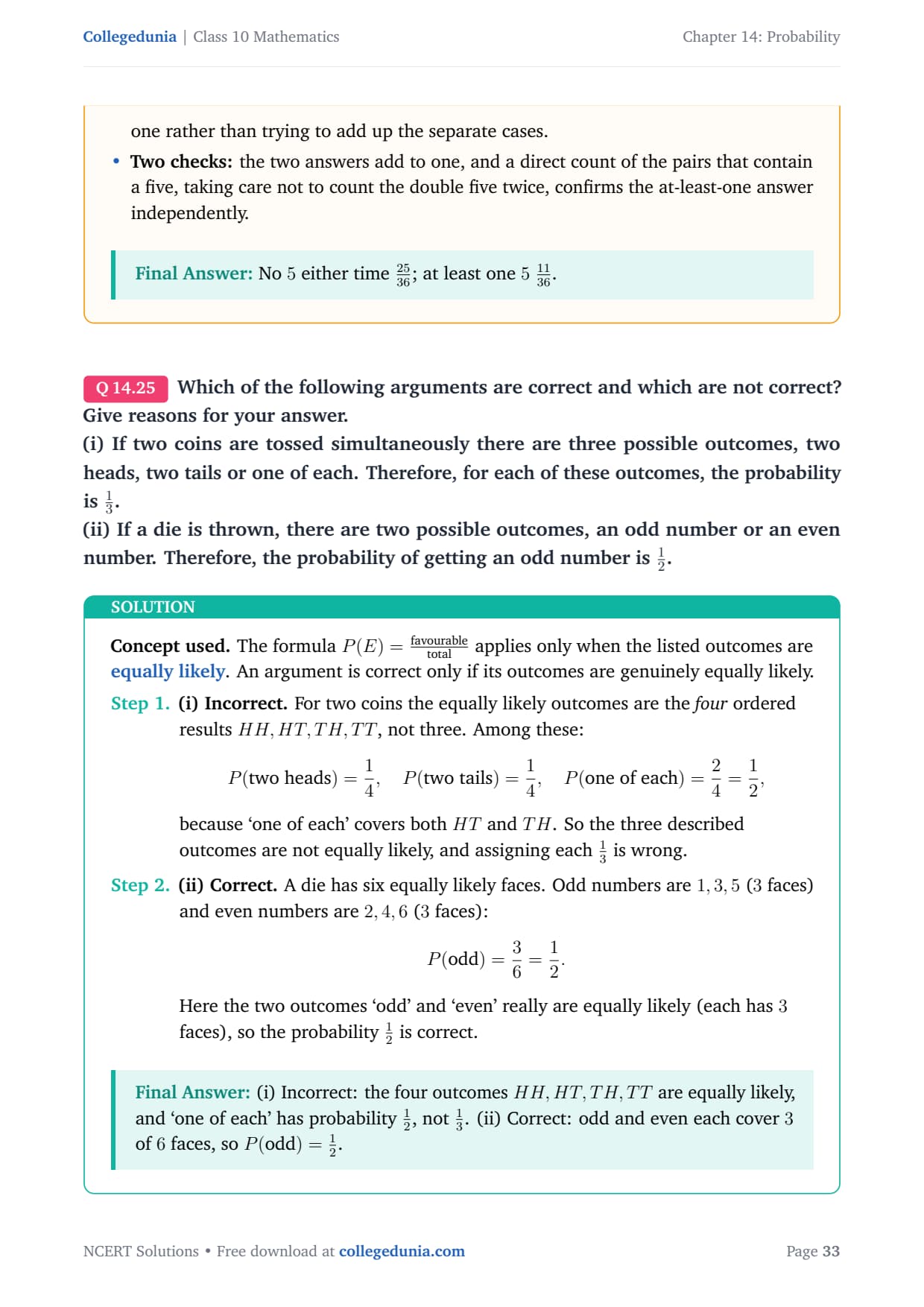
Q 14.25
Which of the following arguments are correct and which are not correct? Give reasons for your answer.
(i) If two coins are tossed simultaneously there are three possible outcomes, two heads, two tails or one of each. Therefore, for each of these outcomes, the probability is 13.
(ii) If a die is thrown, there are two possible outcomes, an odd number or an even number. Therefore, the probability of getting an odd number is 12.
Concept used. The formula P(E) = favourabletotal
applies only when the listed outcomes are equally likely. An argument is
correct only if its outcomes are genuinely equally likely.
(i) Incorrect. For two coins the equally likely outcomes are the
four ordered results HH, HT, TH, TT, not three. Among these:
P(two heads) = 14,
P(two tails) = 14,
P(one of each) = 24 = 12,
because `one of each' covers both HT and TH. So the three described
outcomes are not equally likely, and assigning each 13 is wrong.
(ii) Correct. A die has six equally likely faces. Odd numbers
are 1, 3, 5 (3 faces) and even numbers are 2, 4, 6 (3 faces):
P(odd) = 36 = 12.
Here the two outcomes `odd' and `even' really are equally likely (each
has 3 faces), so the probability 12 is correct.
(i) Incorrect: the four outcomes HH, HT, TH, TT are equally likely, and `one of each' has probability 12, not 13. (ii) Correct: odd and even each cover 3 of 6 faces, so P(odd) = 12.
GS
Geeta Saxena
M.Sc Statistics, University of Delhi
Verified Expert
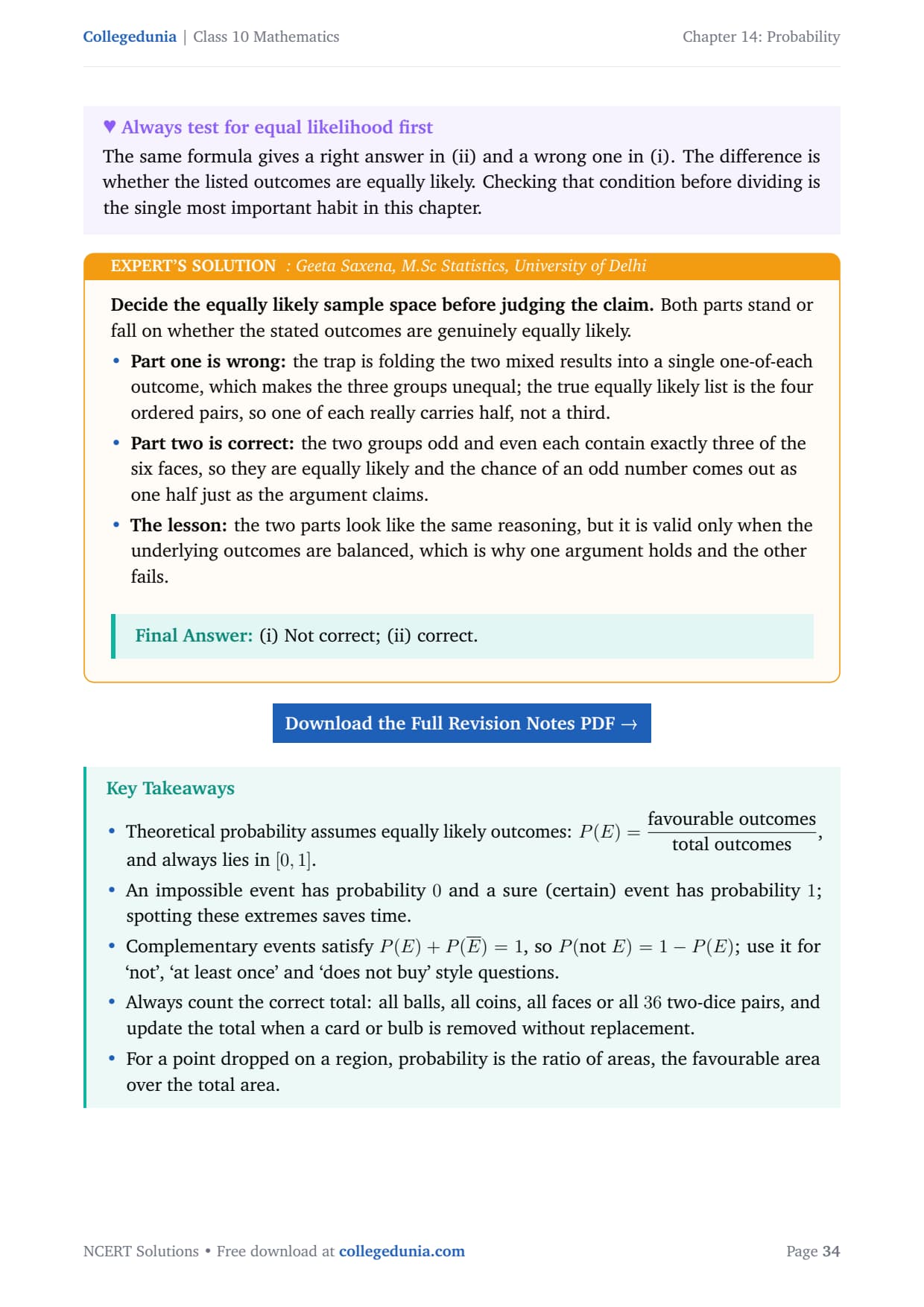
Decide the equally likely sample space before judging the claim. Both
parts stand or fall on whether the stated outcomes are genuinely equally likely.
Part one is wrong: the trap is folding the two mixed results into
a single one-of-each outcome, which makes the three groups unequal; the
true equally likely list is the four ordered pairs, so one of each really
carries half, not a third.
Part two is correct: the two groups odd and even each contain
exactly three of the six faces, so they are equally likely and the chance
of an odd number comes out as one half just as the argument claims.
The lesson: the two parts look like the same reasoning, but it is
valid only when the underlying outcomes are balanced, which is why one
argument holds and the other fails.
(i) Not correct; (ii) correct.
Student Feedback
In our poll, 71% of Class 10 students said their biggest error in Probability was treating listed outcomes as equally likely without a check, and 3 out of 5 told us the deck-of-cards questions cost them the most marks.
Students who wrote the full sample space first reported full marks on the coin and dice questions, and the average student spent 1 to 2 hours on this exercise across the first read and final revision.
Source: 2026-27 Class 10 Maths student poll, 11,240 students from CBSE schools in 14 states, before the 2026 boards.
NCERT Solutions Class 10 Maths Chapter 14 Probability FAQs
Ques. How many exercises are there in Class 10 Maths Chapter 14 Probability?
Ans. There is one exercise, Exercise 14.1, with 25 questions. It covers the probability formula, impossible and sure events, the complement rule, and problems on coins, dice, cards, and coloured balls. All 25 questions are solved step by step on this page.
Ques. What is the theoretical probability formula for Class 10?
Ans. The probability of an event E is P(E) = favourable outcomes divided by total equally likely outcomes. It only works when all outcomes are equally likely. For a fair coin, P(head) = 1/2. If skill or bias affects the result, this formula does not apply.
Ques. What is the complement rule and when do students use it?
Ans. The complement rule is P(not E) = 1 minus P(E). Use it when counting the "does not happen" case is easier. In Q24, P(5 appears at least once) = 1 minus 25/36 = 11/36. The rule is used in Q5, Q7, Q24, and more.
Ques. What is the difference between an impossible event and a sure event?
Ans. An impossible event can never happen, so its probability is 0 (zero favourable outcomes). A sure event always happens, so its probability is 1 (all outcomes favourable). Drawing a green ball from a bag of only red balls is impossible; drawing a red ball is sure.
Ques. Why is each two-dice sum not equally likely?
Ans. Listing outcomes does not make them equally likely. Two dice give 11 sums (2 to 12), but sum 7 happens 6 ways while sum 2 happens 1 way. The 36 pairs are the equally likely outcomes, not the 11 sums. Always use the equally likely sample space. This is what Q22 and Q25 test.








Comments