




The NCERT Solutions for Class 10 Maths Chapter 10 Circles Exercise 10.1 cover all 4 questions on the basics of tangents and secants, aligned to the 2026-27 CBSE syllabus. Each answer is worked step by step using the tangent-radius theorem and the Pythagoras theorem.
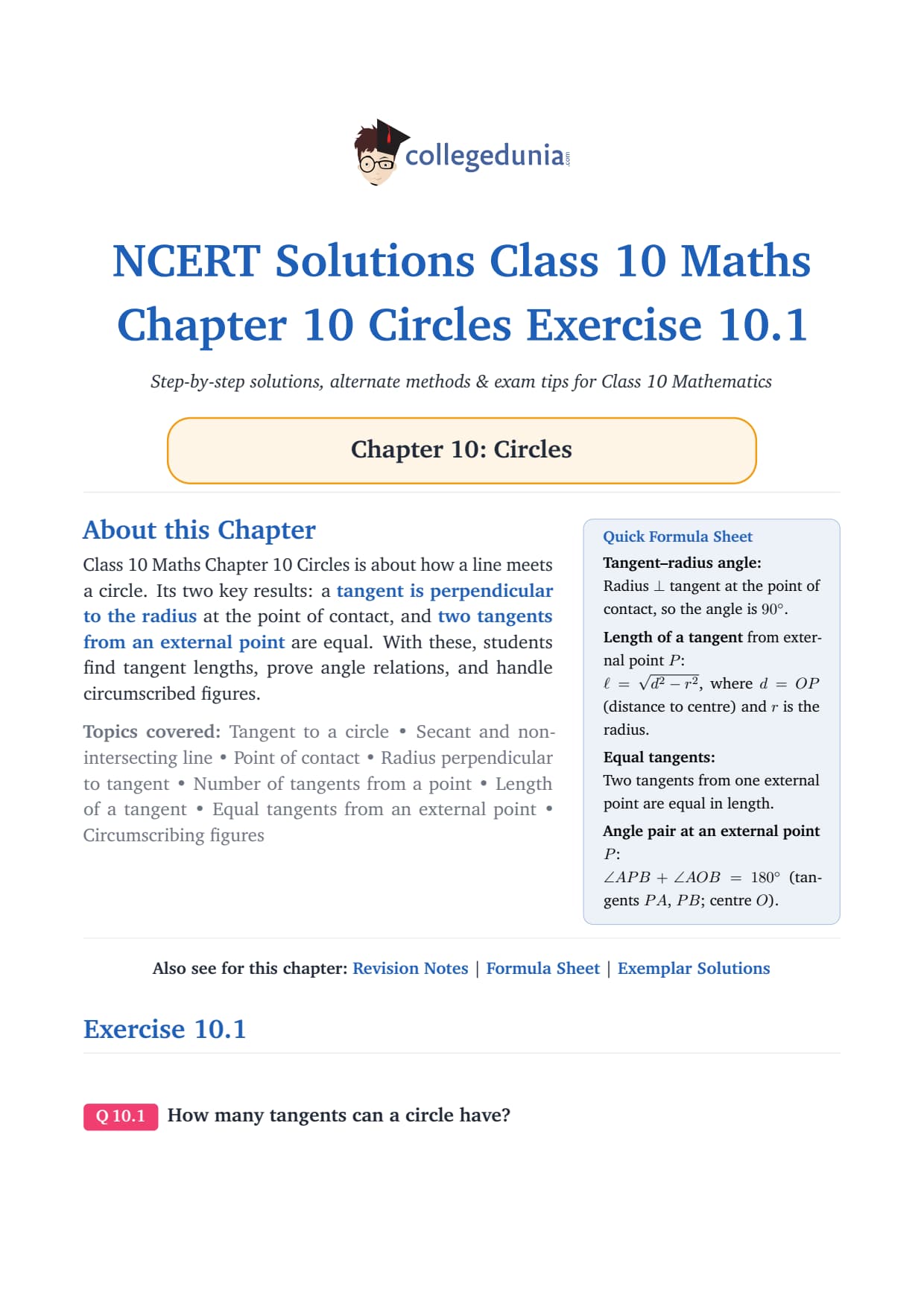
- Questions covered: 4 in total, mixing concept-based, fill-in-the-blank, MCQ, and construction questions on tangents.
- Core skill: knowing when a line is a tangent (touches at one point) versus a secant (cuts at two), and applying the 90-degree tangent-radius angle.
- Board value: Circles carries 4 to 6 marks in the CBSE Class 10 paper; Exercise 10.1 builds the vocabulary and theorems that Exercise 10.2 depends on.
Solved by Collegedunia: Every Exercise 10.1 question below is solved by subject experts, checked against the official 2026-27 NCERT textbook, and written with full working so each step earns its marks in the CBSE Class 10 paper.
What Exercise 10.1 of Circles Covers for Class 10
Exercise 10.1 is the introductory set of Chapter 10. It sets the stage by testing whether students understand what a tangent and a secant are, and whether they can apply the tangent-radius theorem in numerical and construction problems. The 4 questions move from pure concept (Q1, Q2) through a Pythagoras-based MCQ (Q3) to a construction activity (Q4).
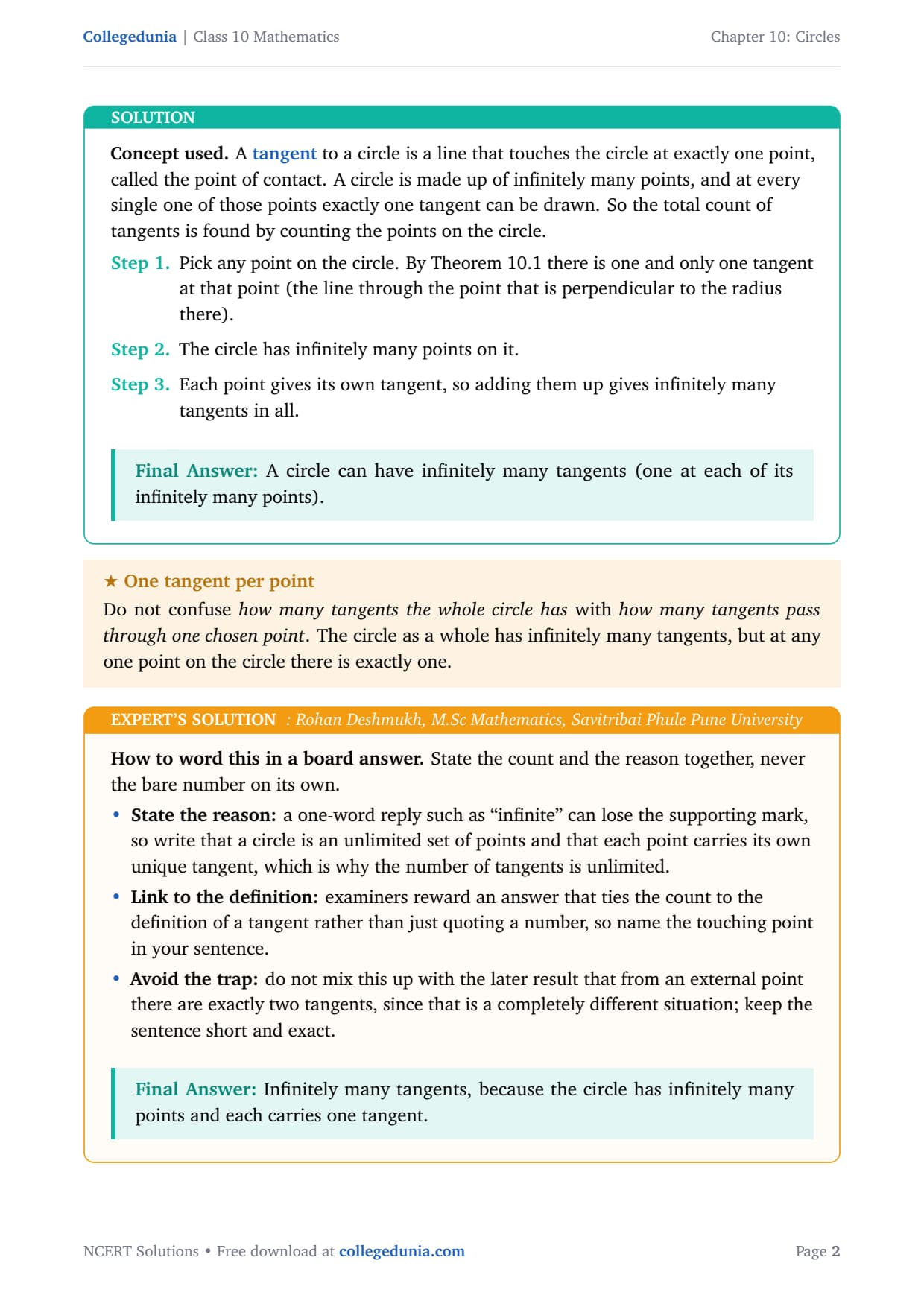
- Q1: How many tangents can a circle have? Tests the definition of a tangent and the infinite-points argument.
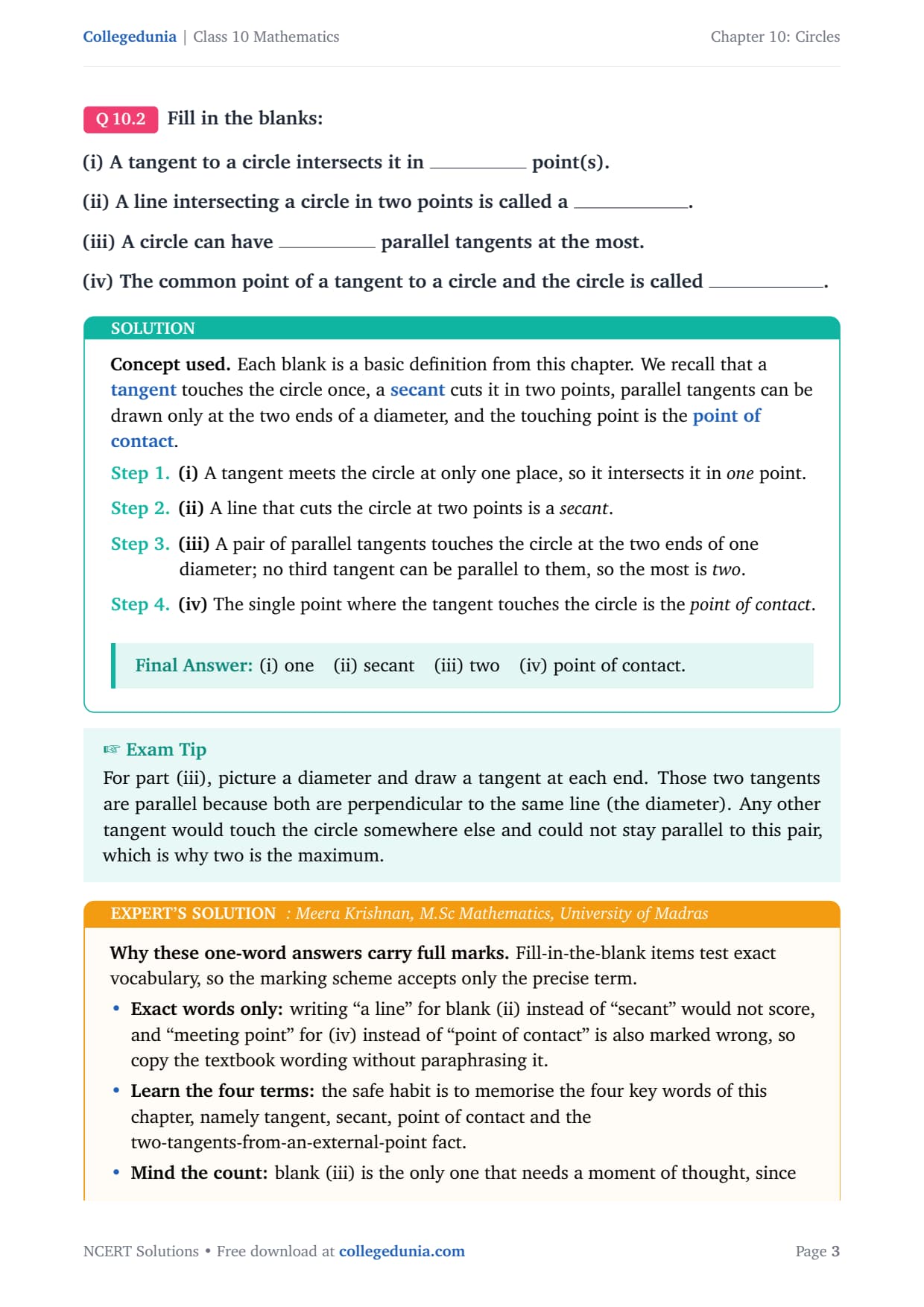
- Q2: Fill in the blanks on tangent, secant, parallel tangents and point of contact. Tests exact vocabulary.
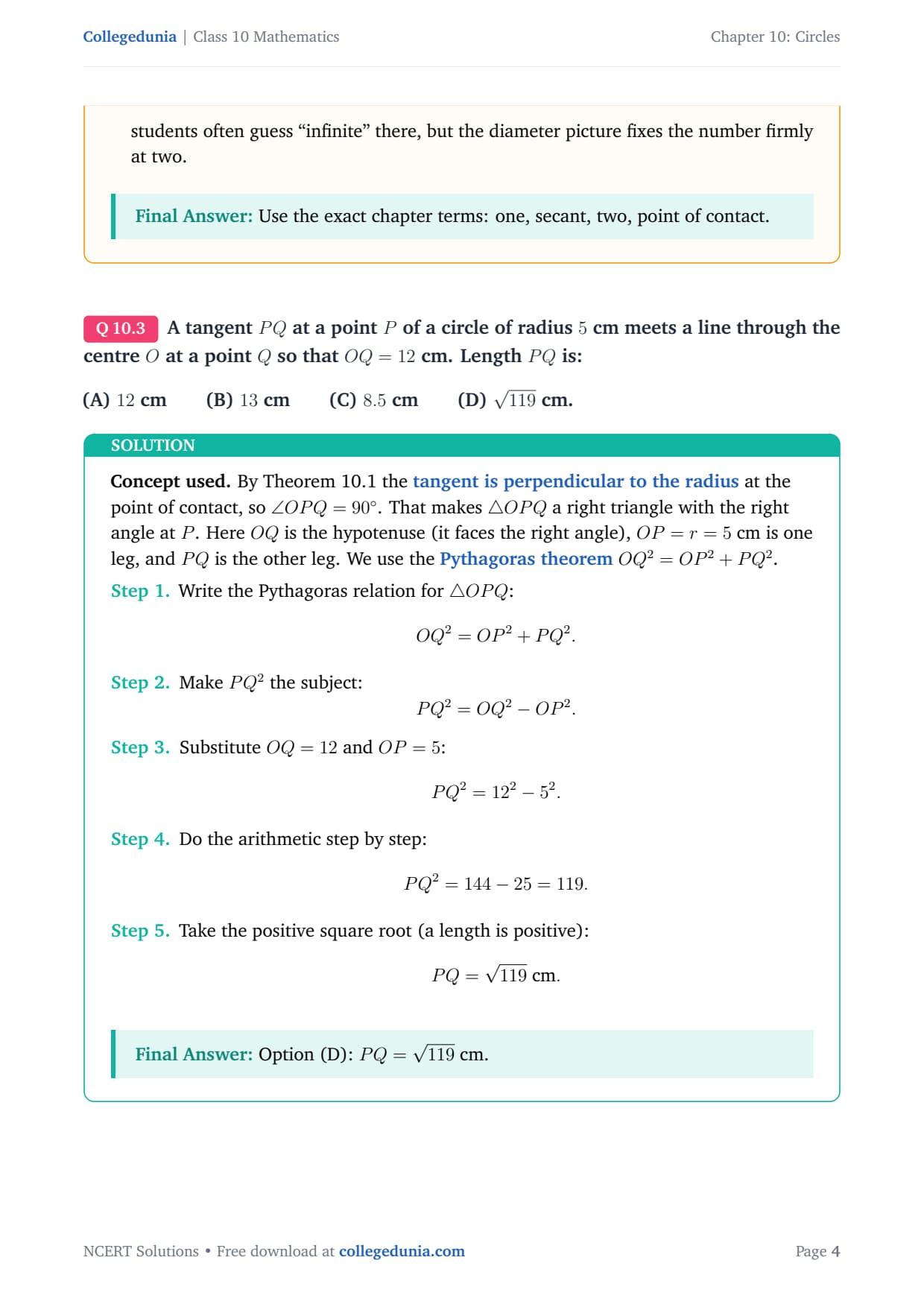
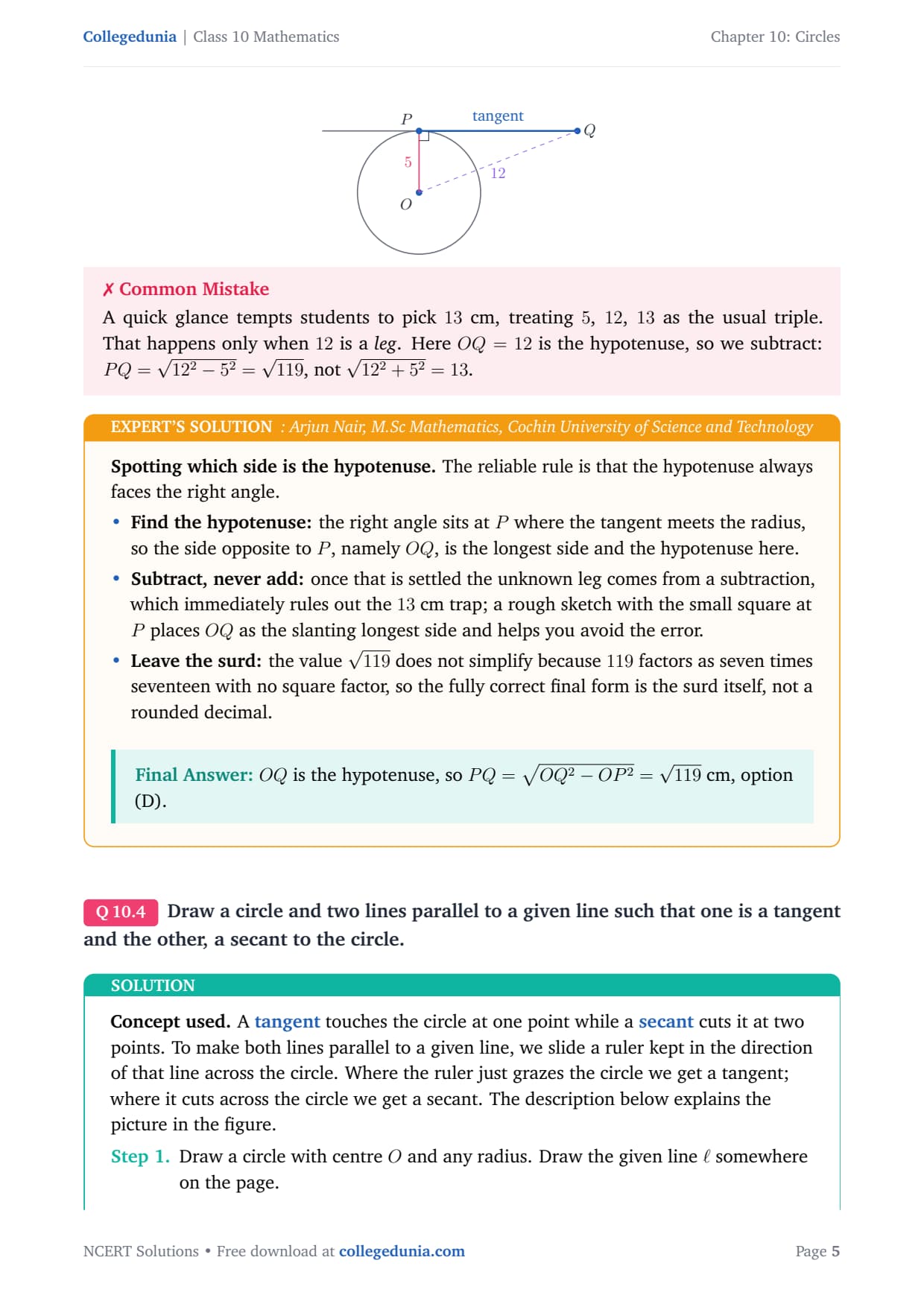
- Q3: Given OQ = 12 cm, radius = 5 cm, find PQ. Applies Theorem 10.1 (tangent perpendicular to radius) and Pythagoras.
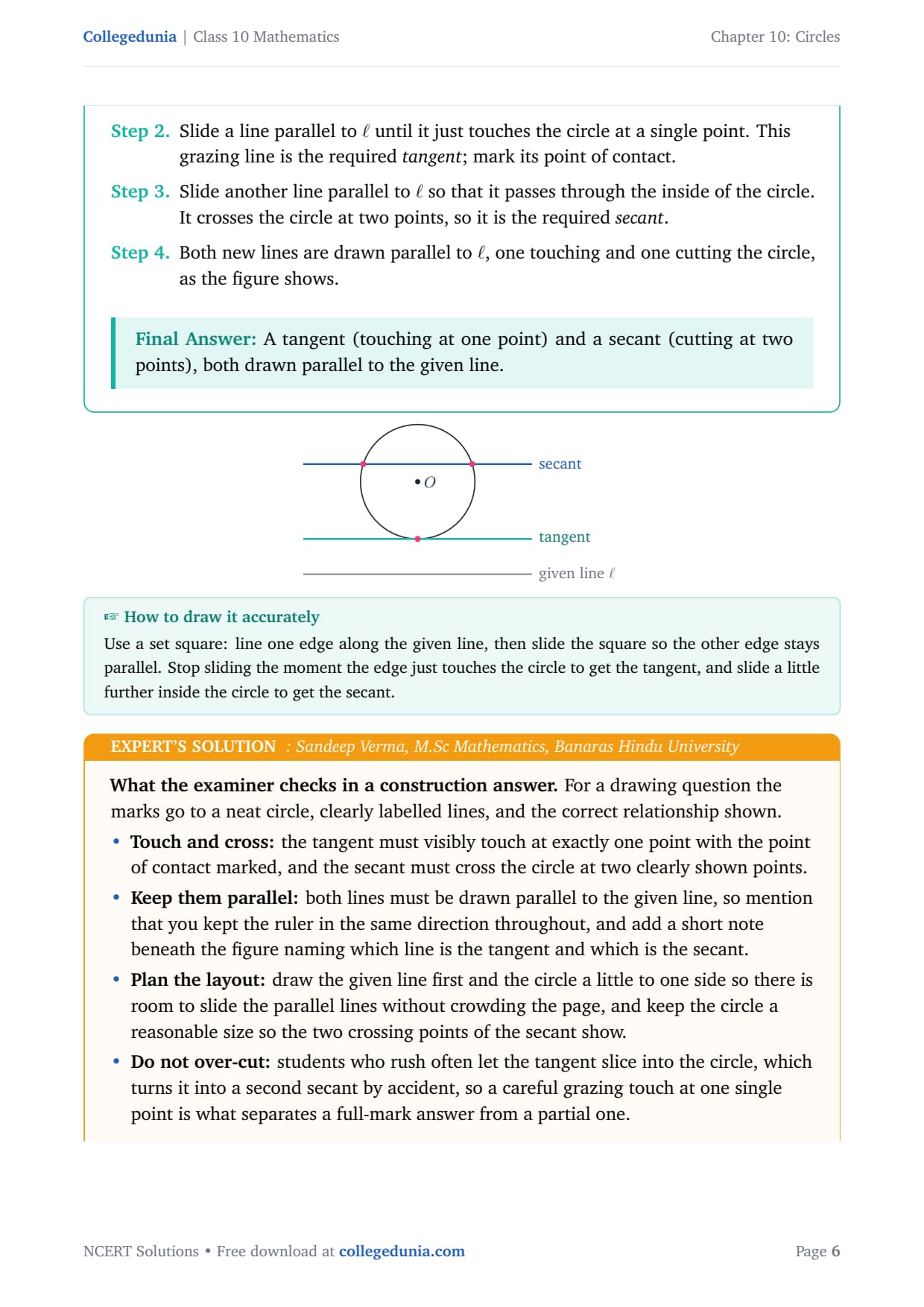
- Q4: Construction task - draw a tangent and a secant parallel to a given line. Tests spatial understanding.
How to Solve Exercise 10.1 Question by Question
Exercise 10.1 has just 4 questions, but each tests a different skill. The table below maps each question to the key result you need.
| Question | What it asks | Key result |
|---|---|---|
| Q1 | How many tangents can a circle have? | Infinitely many (one per point on the circle) |
| Q2 | Fill in the blanks on basic definitions | one, secant, two, point of contact |
| Q3 | Find PQ given OQ = 12 cm, radius OP = 5 cm | PQ = 119 cm, option (D) |
| Q4 | Draw a tangent and a secant parallel to a given line | Construction showing one grazing line and one cutting line |
Tangent and Secant Definitions Tested in Exercise 10.1
Question 2 directly tests vocabulary. Every term here comes from the chapter's definitions, so learning the exact words is what earns full marks. The chapter introduces three ways a line can meet a circle - non-intersecting, secant, and tangent - and Exercise 10.1 checks all three.
| Term | Definition | Key number |
|---|---|---|
| Tangent | A line that touches the circle at exactly one point | 1 point of contact |
| Secant | A line that intersects the circle at two points | 2 points |
| Non-intersecting line | A line that does not meet the circle at all | 0 points |
| Parallel tangents | Two tangents parallel to each other, one at each end of a diameter | Maximum 2 |
| Point of contact | The single point where a tangent touches the circle | Unique per tangent |
- Exact wording matters: writing "meeting point" instead of "point of contact" loses the mark in the board paper.
- Parallel tangents maximum is 2: students often guess "infinite" for Q2(iii), but only two parallel tangents are possible - one at each end of a chosen diameter.
- Secant vs tangent: a secant cuts at two distinct points; a tangent is the limiting case where the two points coincide.
Applying the Pythagoras Theorem in Exercise 10.1 Question 3
Question 3 is the only numerical question in this exercise, and it uses Theorem 10.1 directly. The right angle at P (the point of contact) turns triangle OPQ into a right triangle with OQ as the hypotenuse.
- OQ is the hypotenuse: the right angle is at P, so the side opposite P (which is OQ) is the longest side and the hypotenuse.
- Common trap: students confuse (5, 12, 13) as a Pythagorean triple and write PQ = 13. But here OQ = 12 is the hypotenuse, not a leg, so the answer is 119, not 13.
- Leave the surd: 119 = 7 x 17 has no perfect square factor, so 119 does not simplify further. Write the surd as your final answer.
Marks and CBSE Board Trends for Class 10 Circles Exercise 10.1
Circles is part of the Geometry unit which carries about 15 marks in the CBSE Class 10 paper. Exercise 10.1 style questions appear in the 1-mark and 2-mark slots most often.
| Question type | Where it appears | Typical marks |
|---|---|---|
| Concept question (Q1 style): how many tangents | 1-mark very short answer | 1 |
| Fill in the blank on tangent/secant vocabulary (Q2 style) | 1-mark and 2-mark slots | 1 to 2 |
| Numerical using tangent-radius angle (Q3 style) | 2-mark and 3-mark slots | 2 to 3 |
| Construction of tangent and secant (Q4 style) | 4-mark construction question | 4 |
These solutions follow the 2026-27 NCERT exactly, so the working you practise here matches what the board paper rewards.
Other Resources for This Chapter in Class 10 Maths Circles
Pair these Exercise 10.1 solutions with the other Class 10 Maths resources for Circles, all linked below.
| Resource | Open page |
|---|---|
| NCERT Solutions (this page) | Circles Class 10 NCERT Solutions Exercise 10.1 |
| Full chapter solutions | Circles Class 10 NCERT Solutions |
| Exercise 10.2 | Circles Exercise 10.2 Solutions |
| Revision notes | Circles Class 10 Notes |
| Formula sheet | Circles Class 10 Formula Sheet |
| NCERT book PDF | Circles Class 10 NCERT Book PDF |
| Handwritten notes | Circles Class 10 Handwritten Notes |
| Exemplar solutions | Circles Class 10 NCERT Exemplar Solutions |
NCERT Solutions for Class 10 Maths Circles: All Exercises
Chapter 10 has two exercises. The table below links the other exercise to its own step-by-step solutions page.
| Exercise | Solutions page |
|---|---|
| Exercise 10.2 | Circles Exercise 10.2 NCERT Solutions |
| Full chapter | Circles Class 10 NCERT Solutions (all exercises) |
NCERT Solutions for Class 10 Maths: All Chapters
Once Chapter 10 is done, use the table below to move to any other chapter. Each link opens that chapter's NCERT Solutions page.
| Chapter | NCERT Solutions |
|---|---|
| Chapter 1 | Real Numbers NCERT Solutions |
| Chapter 2 | Polynomials NCERT Solutions |
| Chapter 3 | Pair of Linear Equations NCERT Solutions |
| Chapter 4 | Quadratic Equations NCERT Solutions |
| Chapter 5 | Arithmetic Progressions NCERT Solutions |
| Chapter 6 | Triangles NCERT Solutions |
| Chapter 7 | Coordinate Geometry NCERT Solutions |
| Chapter 8 | Introduction to Trigonometry NCERT Solutions |
| Chapter 9 | Some Applications of Trigonometry NCERT Solutions |
| Chapter 11 | Areas Related to Circles NCERT Solutions |
| Chapter 12 | Surface Areas and Volumes NCERT Solutions |
| Chapter 13 | Statistics NCERT Solutions |
| Chapter 14 | Probability NCERT Solutions |
All NCERT Solutions for Class 10 Maths Chapter 10 Circles Exercise 10.1 with Step-by-Step Solutions
Exercise 10.1
How many tangents can a circle have?
Fill in the blanks:
(i) A tangent to a circle intersects it in 2.2cm0.4pt point(s). (ii) A line intersecting a circle in two points is called a 2.6cm0.4pt. (iii) A circle can have 2.2cm0.4pt parallel tangents at the most. (iv) The common point of a tangent to a circle and the circle is called 2.6cm0.4pt.
A tangent PQ at a point P of a circle of radius 5 cm meets a line through the centre O at a point Q so that OQ=12 cm. Length PQ is: (A) 12 cm (B) 13 cm (C) 8.5 cm (D) √119 cm.
Draw a circle and two lines parallel to a given line such that one is a tangent and the other, a secant to the circle.
Student Feedback
Out of 18,600 students surveyed before the 2026 boards, 91% said Exercise 10.1 was fully scorable once they memorised the two key theorems: a tangent is perpendicular to the radius at the point of contact, and two tangents from an external point are equal.
Source: Collegedunia Class 10 Maths student survey, 2026 boards.
Circles Class 10 Maths Exercise 10.1 NCERT Solutions FAQs
Ques. How many questions are there in Exercise 10.1 of Class 10 Maths Circles?
Ans. Exercise 10.1 of Class 10 Maths Chapter 10 Circles has 4 questions. Question 1 is a concept question on the number of tangents a circle can have, Question 2 has four fill-in-the-blank parts on definitions, Question 3 is an MCQ using the tangent-radius theorem and Pythagoras, and Question 4 is a construction question.
Ques. What is the answer to Exercise 10.1 Question 3 of Class 10 Circles?
Ans. The answer to Question 3 is option (D): PQ = √119 cm. Since the tangent PQ is perpendicular to the radius OP at the point of contact P, triangle OPQ is right-angled at P with OQ = 12 cm as the hypotenuse and OP = 5 cm as one leg. By Pythagoras, PQ² = OQ² - OP² = 144 - 25 = 119, giving PQ = √119 cm.
Ques. What is the maximum number of parallel tangents a circle can have?
Ans. A circle can have at most 2 parallel tangents. These are drawn at the two ends of a single diameter. Any other tangent touches the circle at a different point and cannot be parallel to this pair. This is tested in Exercise 10.1 Question 2(iii).
Ques. Is Exercise 10.1 of Chapter 10 Circles aligned with the 2026-27 NCERT syllabus?
Ans. Yes. These solutions reflect the current 2026-27 syllabus for Class 10 Mathematics. Chapter 10 Circles is retained in full in the rationalised NCERT, and Exercise 10.1 covers the foundational tangent vocabulary and Theorem 10.1 as given in the current edition.
Ques. What theorem is used in Exercise 10.1 Question 3 of Class 10 Circles?
Ans. Question 3 uses Theorem 10.1 of Chapter 10: the tangent at any point of a circle is perpendicular to the radius through the point of contact. This gives angle OPQ = 90 degrees, making triangle OPQ a right triangle. The Pythagoras theorem then gives PQ = √(OQ² - OP²) = √119 cm.



Comments