




About 15 to 20 marks of the Class 10 Social Science board paper come from Geography, and Agriculture is one of its most frequently set chapters.
Chapter4AgricultureSolutions.pdf?page=1&dpi=150)
Chapter4AgricultureSolutions.pdf?page=2&dpi=150)
Chapter4AgricultureSolutions.pdf?page=3&dpi=150)
Chapter4AgricultureSolutions.pdf?page=4&dpi=150)
Chapter4AgricultureSolutions.pdf?page=5&dpi=150)
Chapter4AgricultureSolutions.pdf?page=6&dpi=150)
Chapter4AgricultureSolutions.pdf?page=7&dpi=150)
Chapter4AgricultureSolutions.pdf?page=8&dpi=150)
Chapter4AgricultureSolutions.pdf?page=9&dpi=150)
Chapter4AgricultureSolutions.pdf?page=10&dpi=150)
Chapter4AgricultureSolutions.pdf?page=11&dpi=150)
Chapter4AgricultureSolutions.pdf?page=12&dpi=150)
Chapter4AgricultureSolutions.pdf?page=13&dpi=150)
Chapter4AgricultureSolutions.pdf?page=14&dpi=150)
The NCERT Solutions for Class 10 Geography Chapter 4 Agriculture answer every exercise question as per the 2026-27 CBSE syllabus. Each answer names the types of farming, the three cropping seasons, the major crops with their growing conditions, and the technological and institutional reforms, so the ncert solutions class 10 geography chapter 4 Agriculture set keeps every fact you need for the boards.
- 8 NCERT questions solved: 3 MCQs, 3 short-answer (30 words) and 2 long-answer (120 words), each step-by-step.
- This chapter is a regular source of 1, 3 and 5 mark questions in the Class 10 board paper.
- Free PDF download in Normal and HD, plus a Hindi-medium read of every answer.
Every answer here is written by Collegedunia subject experts and checked against the 2026-27 NCERT textbook.
What This Class 10 Geography Chapter Covers for the Boards
This chapter explains how agriculture feeds India and supplies raw material to industry. It then teaches you to classify the types of farming, sort crops into the three cropping seasons, name the growing conditions of major crops, and list the supporting reforms.
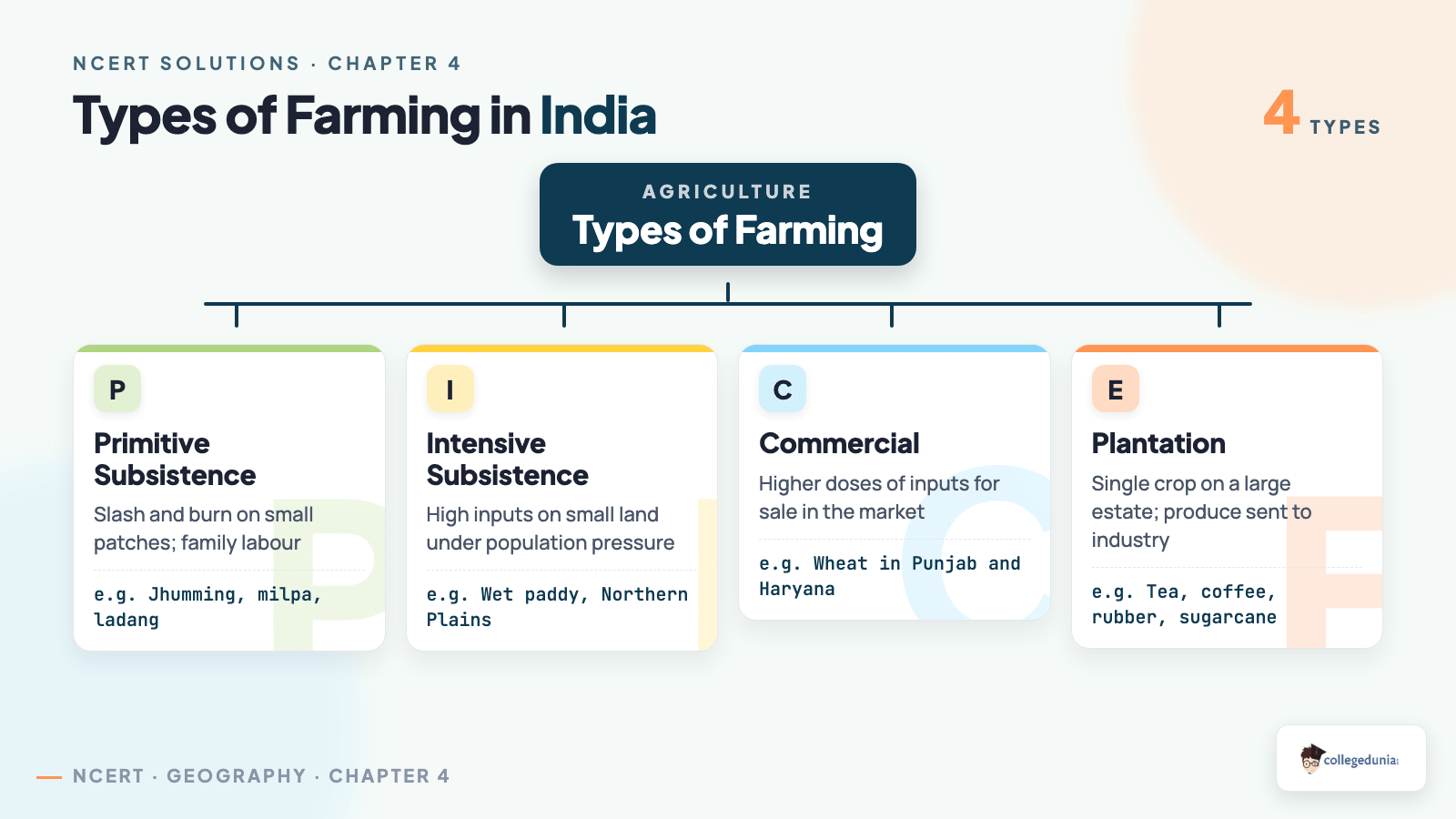
- Types of farming: primitive subsistence (slash and burn / jhumming), intensive subsistence, commercial and plantation.
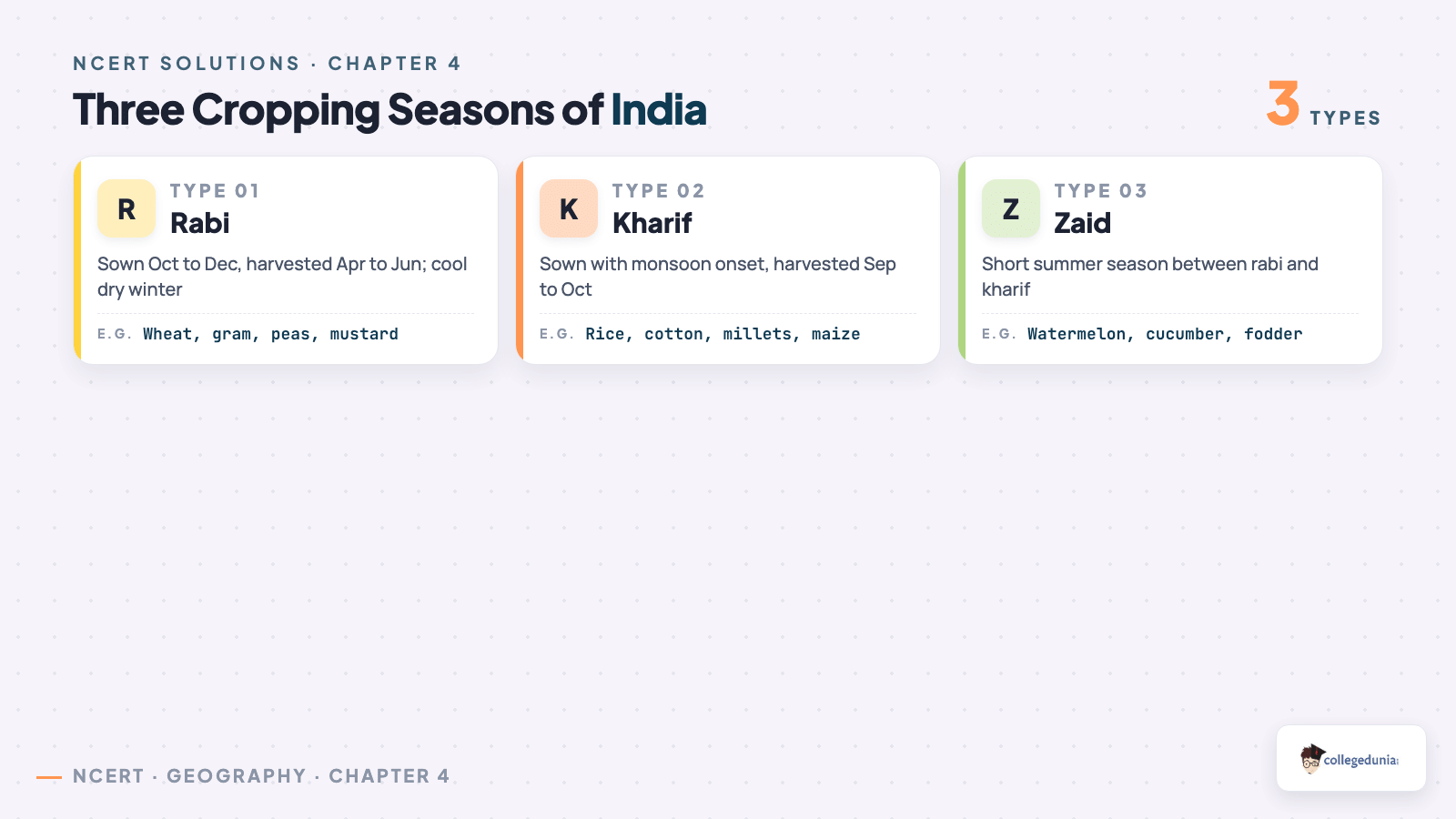
- Cropping seasons: rabi, kharif and zaid, with their sowing and harvesting months.
- Major crops: rice, wheat, millets, maize, pulses and the non-food crops sugarcane, oilseeds, tea, coffee, cotton and jute.
- Geographical conditions: the temperature, rainfall and soil each major crop needs.
- Reforms: technological and institutional, from the Green and White Revolutions to the Kissan Credit Card and Minimum Support Price.
Agriculture Class 10 One-Shot Revision for Boards
Source: Magnet Brains on YouTube
Geography Class 10 Chapter 4 Question Answer: MCQ Section
The three geography class 10 chapter 4 MCQs test the farming-type definition, the cropping season and the crop family. In the class 10 geography chapter 4 question answer set, the trick is to fix one keyword to each term first, then read the options.
| Question | Answer and the one fact that proves it |
|---|---|
| System where a single crop is grown on a large area | (b) Plantation Agriculture. A single crop on a large estate, capital-intensive, with produce sent to industry. |
| Which one of the following is a rabi crop | (b) Gram. A pulse sown in winter and harvested in summer, while rice, millets and cotton are kharif crops. |
| Which one of the following is a leguminous crop | (a) Pulses. Legumes whose root nodules fix nitrogen, unlike jowar, millets and sesamum. |
Tip: learn one keyword per term. That single defining line is usually worth the full mark.
Agriculture Important Question: 30-Word Section
The 30-word questions carry the short-answer marks. Each agriculture important question asks for a precise list, so padding wastes the word limit. A well-set question rewards a crop with its four growing conditions, or a named list of reforms.
- One beverage crop: tea needs a warm, moist, frost-free climate, frequent even showers, deep humus-rich soil and cheap skilled labour.
- One staple crop and its regions: rice, grown in the northern and north-eastern plains, coasts and deltas, and by irrigation in Punjab, Haryana and western Uttar Pradesh.
- Institutional reforms: land reforms, crop insurance, Grameen and cooperative banks, the Kissan Credit Card, PAIS and Minimum Support Price.
Memorise the four conditions of tea (climate, rainfall, soil, labour) and keep rice to wet plains and deltas ready.
Major Crops of India Explained for Class 10 Geography
The major crops of India are the most asked topic here, and the MCQ, 30-word and 120-word questions all draw on them. The quickest way to remember a crop is to tie it to its cropping season first, then temperature, rainfall and region follow.
| Crop | Season and the conditions it needs |
|---|---|
| Rice | Kharif; needs temperature above 25 degrees, high humidity and rainfall above 100 cm; grown in plains, coasts, deltas and by irrigation in the dry north-west. |
| Wheat | Rabi; needs a cool season, bright sunshine at ripening and 50 to 75 cm rainfall; grown in the Ganga-Satluj plains and black-soil Deccan. |
| Millets (jowar, bajra, ragi) | Kharif coarse grains; rain-fed and hardy; jowar and bajra in dry areas, ragi on red and laterite soils. |
| Pulses | Legumes that fix nitrogen and restore soil fertility; grown in rotation with cereals, mostly in dry areas. |
| Tea | Plantation crop; warm, moist, frost-free climate, frequent even showers, deep humus-rich soil and cheap labour. |
A handy memory rule: rice to monsoon and water, wheat to cool winter, tea to hill plantation.
Technological and Institutional Reforms in This Chapter
The two 120-word questions test the reforms the government uses to raise production. The chapter splits these into technological reforms (better seeds, irrigation, inputs) and institutional reforms (land, credit, insurance, prices). Name both kinds for full marks.
| Reform | What it does for the farmer |
|---|---|
| Land reforms | Collectivisation, consolidation of holdings and abolition of zamindari, the focus of the First Five Year Plan. |
| Green and White Revolutions | HYV seeds, fertilisers and irrigation for crops; Operation Flood for milk, both raising output from the 1960s. |
| Crop insurance and rural credit | Cover against drought, flood and disease, plus Grameen and cooperative banks giving low-interest loans. |
| Kissan Credit Card and PAIS | Easy credit through the KCC and cover under the Personal Accident Insurance Scheme. |
| Minimum Support Price | Remunerative and procurement prices, plus weather bulletins, to stop exploitation by middlemen. |
Group the reforms under three heads, land, credit and protection, so eight items become three buckets that are easy to recall.
Common Mistakes Students Make in This Class 10 Geography Chapter
A few slips lose easy marks every year. Fix these before the exam.
- Ticking rice or millets as a rabi crop. The question asks the season, and only gram is sown in winter.
- Listing only the climate for rice and forgetting rainfall above 100 cm and the dry north-west irrigation regions.
- Mixing up reforms. The Green Revolution is technological, while land consolidation and the KCC are institutional.
- Padding a 30-word answer past the limit instead of giving the exact list asked for.
How to Use the NCERT Solutions Class 10 Geography Chapter 4 Page
Use the solutions in three short blocks: read the chapter, attempt the questions yourself, then compare and fix the gaps.
- Read and list: read the chapter and note every crop, its season and its conditions.
- Attempt first: answer all 8 questions on your own before opening the solutions.
- Compare and flag: match your answer with the solution and mark the missing fact-lines.
For long-answer practice, write the reforms and rice-conditions answers in full at least once. The ncert solutions class 10 geography chapter 4 Agriculture set mirrors the board's 5-mark pattern.
Practice All NCERT Solutions for This Class 10 Geography Chapter with Step-by-Step Solutions
Open the question bank below to attempt all 8 solved questions with collapsible Solution and Expert Solution tabs. Every agriculture question answer is mapped to the NCERT text.
All Solved Questions for this Class 10 Geography Chapter
Practise every MCQ, 30-word and 120-word question with step-by-step and expert solutions.
Student Feedback on This Class 10 Geography Chapter
What 15,240 students told us about studying this chapter before the 2026 boards.
- 69% of students most often left a condition out of the rice geographical-conditions answer.
- 61% of students found the reforms 120-word answer hardest to keep inside the word limit.
- Most-confused pair: rabi versus kharif crops, mixed up by about 37% of students.
Source: 2026-27 Class 10 Geography student poll. Sample of 15,240 students from CBSE schools across 15 states.
Class 10 Geography Other Resources for This Chapter
Pair these solutions with the other Class 10 Geography resources for this chapter, all linked below.
| Resource | Best used for |
|---|---|
| Agriculture Class 10 Notes | Quick concept recap before the exam |
| Agriculture Class 10 Handwritten Notes | Last-minute scanned revision |
| Agriculture Class 10 NCERT Book PDF | Reading the original chapter text |
All Chapters NCERT Solutions for Class 10 Geography (Contemp India II)
Browse the full set of ncert solutions for class 10 geography chapter by chapter.
| Chapter | NCERT Solutions |
|---|---|
| Chapter 1 | Resources and Development Class 10 NCERT Solutions |
| Chapter 2 | Forest and Wildlife Resources Class 10 NCERT Solutions |
| Chapter 3 | Water Resources Class 10 NCERT Solutions |
| Chapter 4 | Agriculture Class 10 NCERT Solutions |
| Chapter 5 | Minerals and Energy Resources Class 10 NCERT Solutions |
| Chapter 6 | Manufacturing Industries Class 10 NCERT Solutions |
| Chapter 7 | Lifelines of National Economy Class 10 NCERT Solutions |
Agriculture Class 10 Geography NCERT Solutions FAQs
Ques. Where can I download the NCERT Solutions Class 10 Geography Chapter 4 Agriculture PDF?
Ans. You can download the agriculture class 10 ncert solutions PDF directly from this page. Both the Normal and HD versions are free, and a Hindi-medium read is available too.
Ques. How many questions are solved in class 10 geography chapter 4 question answer?
Ans. All 8 NCERT questions are solved: 3 MCQs, 3 short 30-word answers and 2 long 120-word answers, each with a step-by-step solution and an expert version.
Ques. Is this NCERT Solutions page aligned with the 2026-27 syllabus?
Ans. Yes. This page reflects the current 2026-27 syllabus for Class 10 Geography, and every answer is checked against the latest NCERT edition of Contemporary India II.
Ques. What are the geographical conditions required for the growth of rice?
Ans. Rice is a kharif crop that needs high temperature above 25 degrees Celsius, high humidity and annual rainfall above 100 cm. It grows in the plains, coastal and deltaic regions, and in low-rainfall areas with the help of canal and tubewell irrigation.
Ques. Which crop is a rabi crop and which is a kharif crop in this chapter?
Ans. Gram is a rabi crop, sown in winter from October to December and harvested from April to June. Rice, millets and cotton are kharif crops, sown with the onset of the monsoon and harvested in September and October.
Ques. What institutional reform programmes did the government introduce for farmers?
Ans. Land reforms (collectivisation, consolidation of holdings and abolition of zamindari), crop insurance, Grameen and cooperative banks, the Kissan Credit Card, the Personal Accident Insurance Scheme, weather bulletins and the Minimum Support Price were all introduced in the interest of farmers.
Ques. Why are pulses called leguminous crops in agriculture class 10?
Ans. Pulses are legumes whose root nodules carry bacteria that fix nitrogen from the air into the soil. This restores soil fertility, so pulses (except arhar) are grown in rotation with cereals to keep the soil healthy.



Comments