




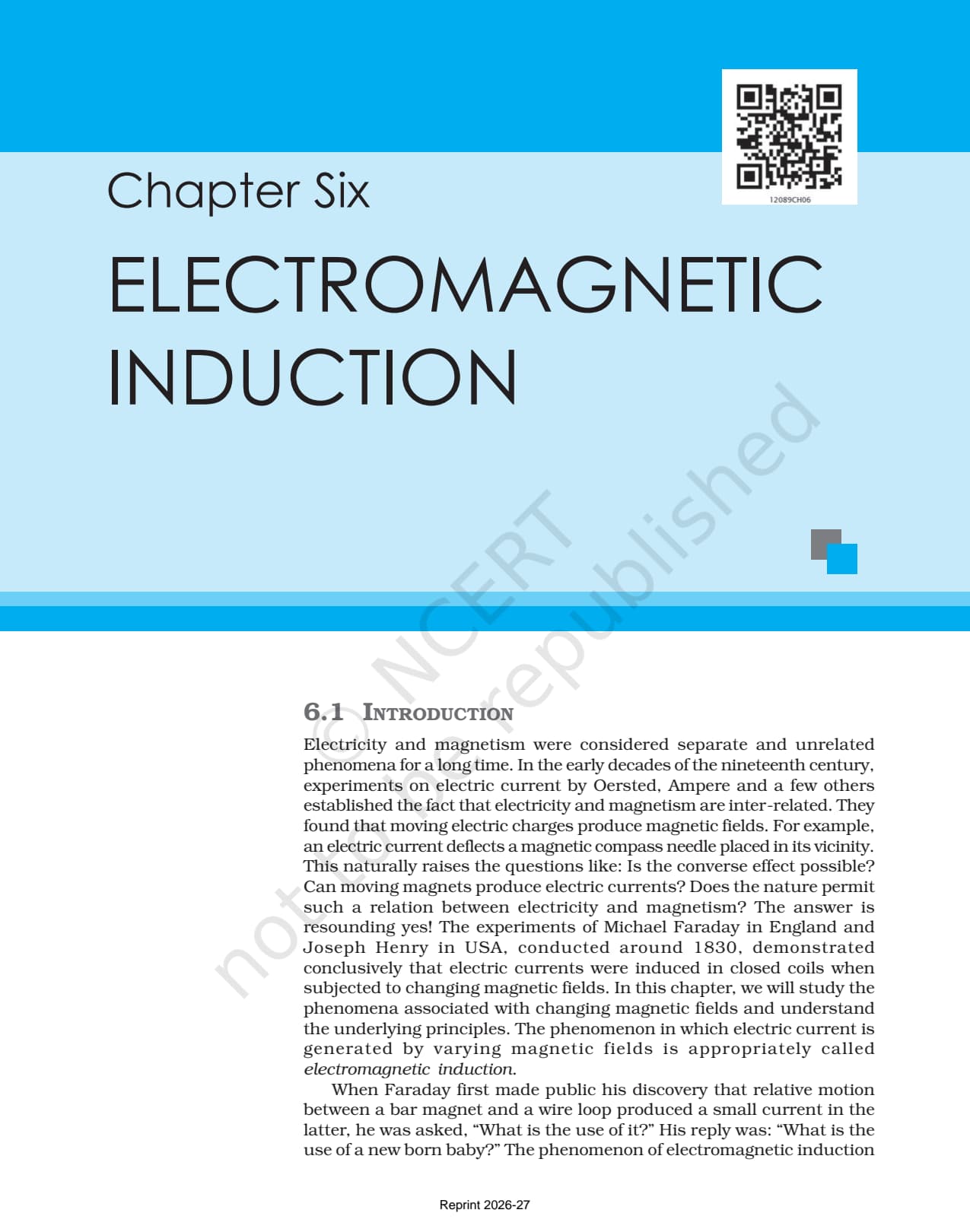
Download the NCERT Book PDF for Class 12 Physics Chapter 6 Electromagnetic Induction free from this page. This is the official NCERT chapter, aligned to the 2026-27 syllabus. The flipbook below lets students read it online or save it for offline study.
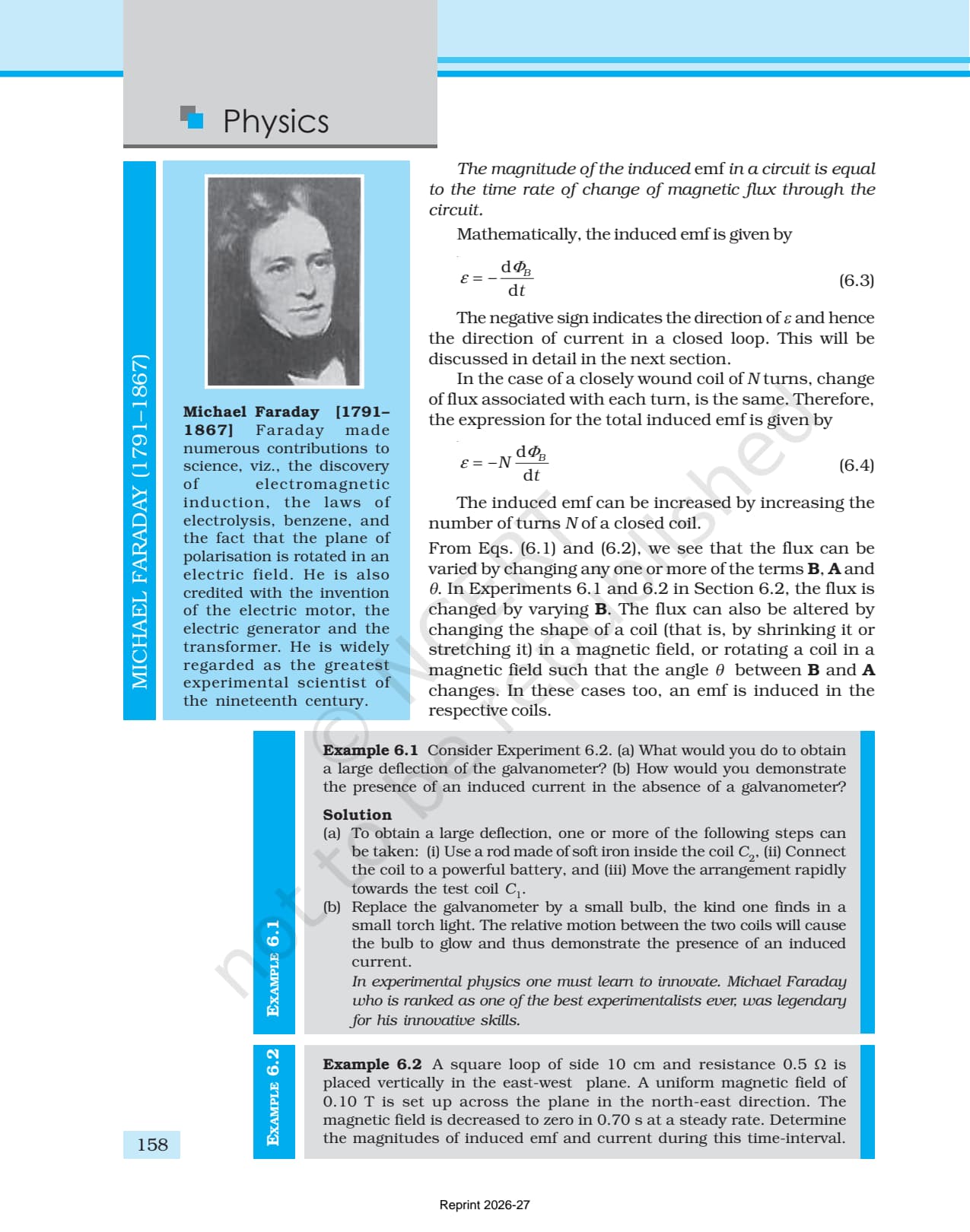
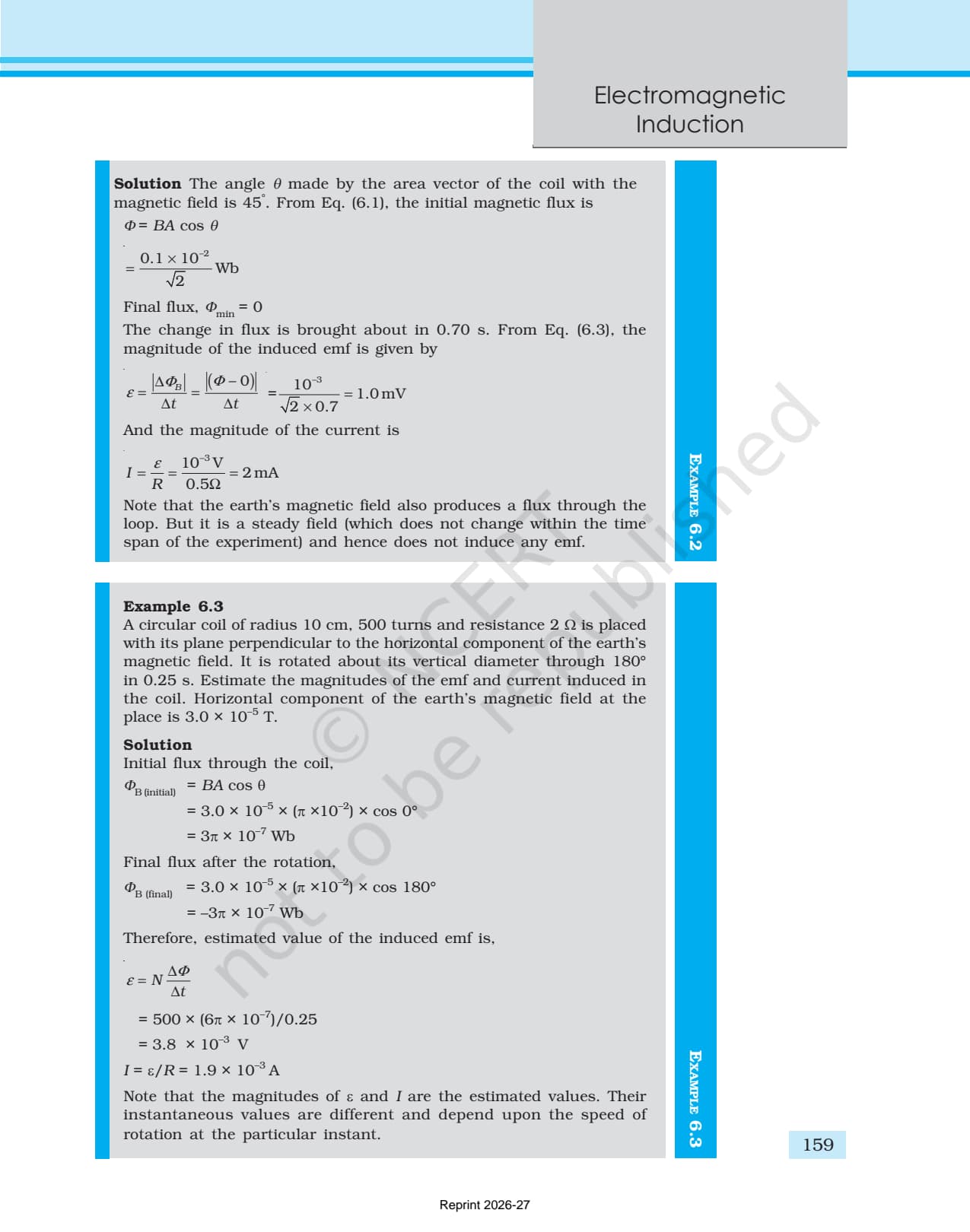
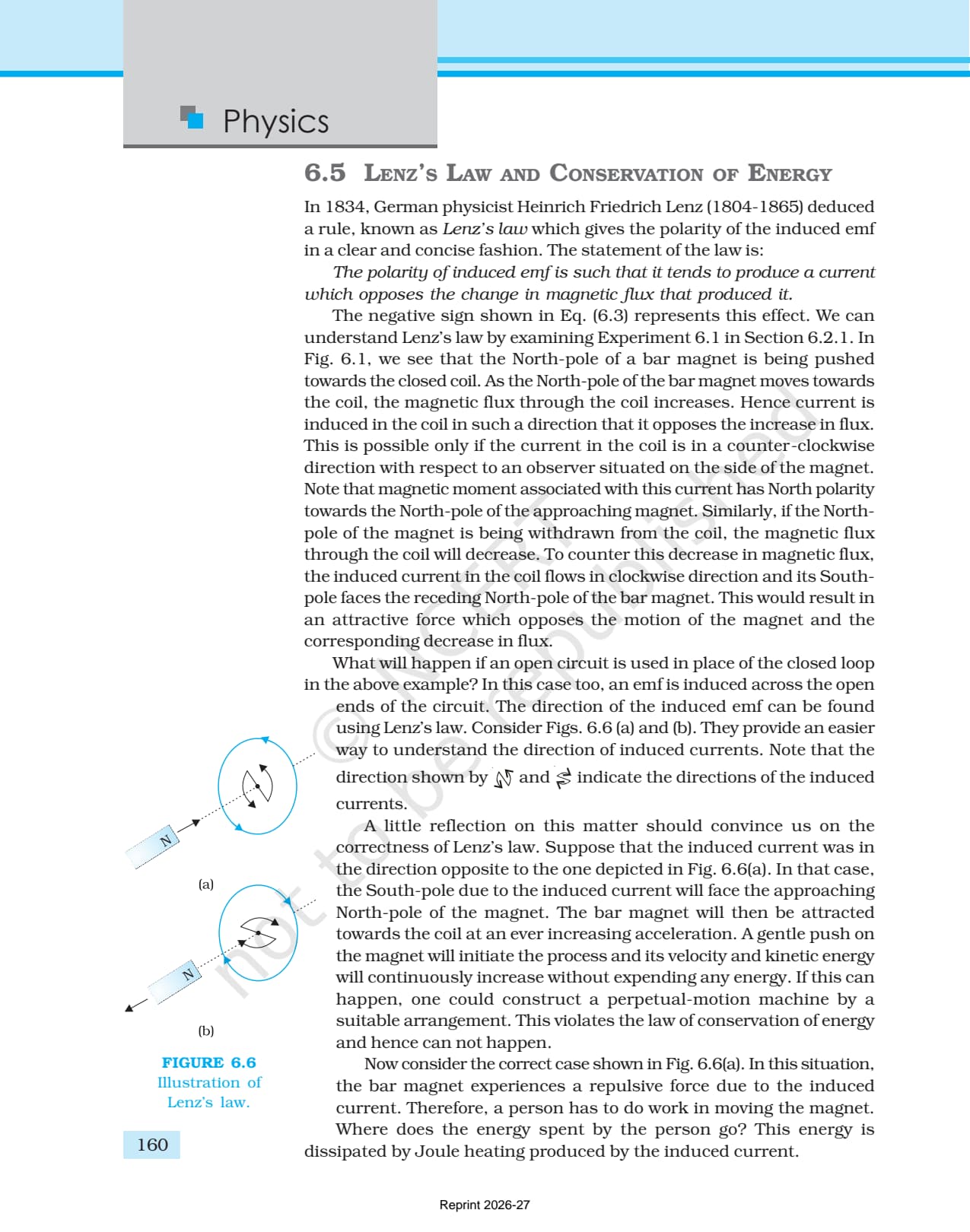
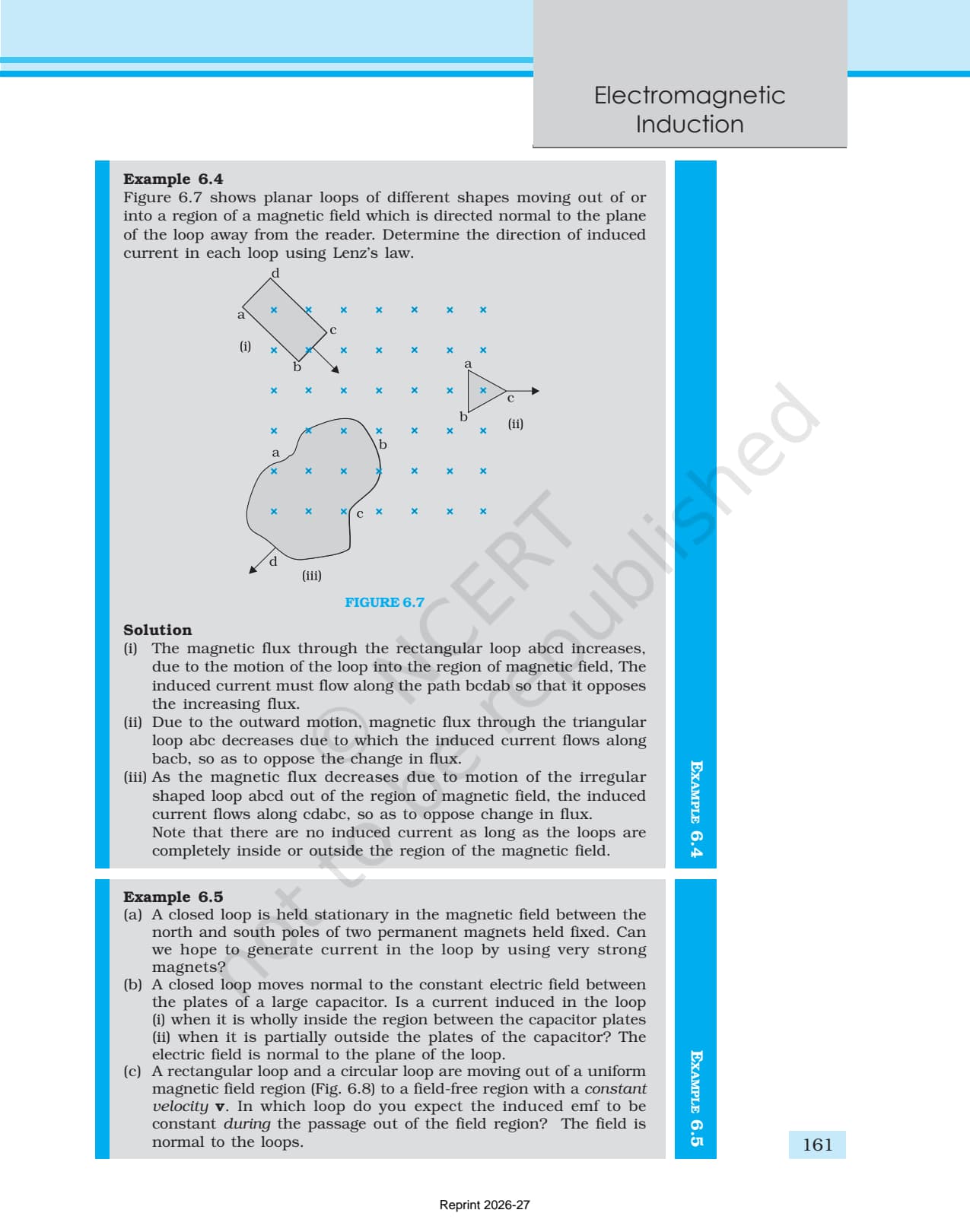
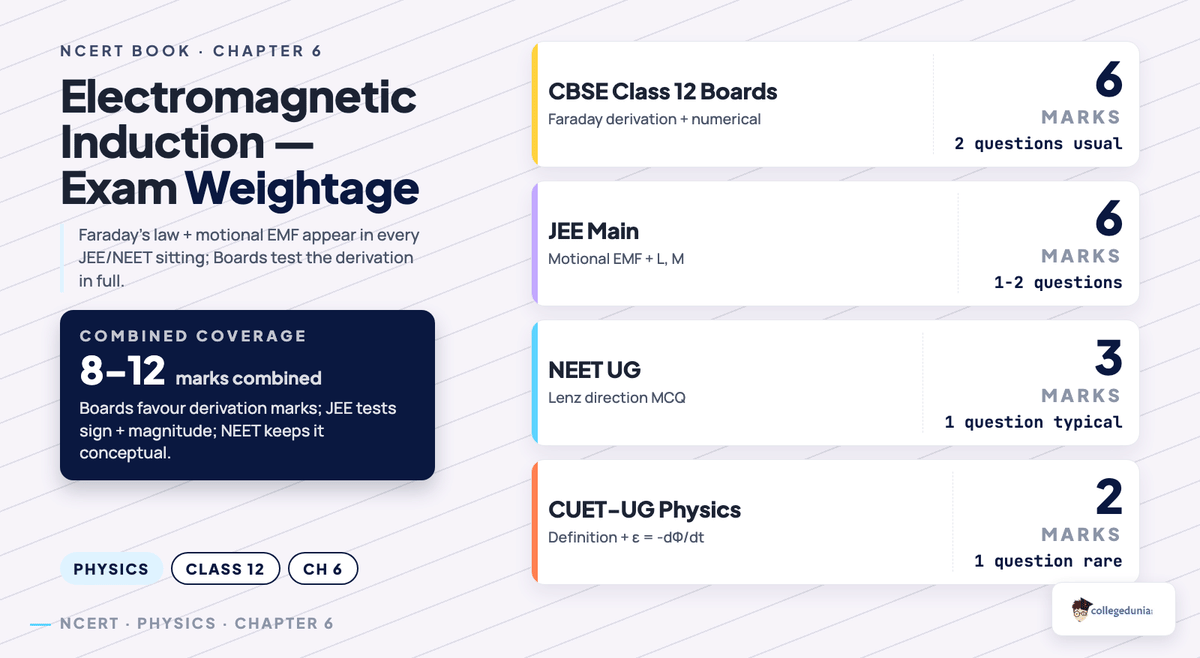
- CBSE Weightage: 4-6 marks (one short answer plus one 3-mark numerical)
- JEE Main Weightage: 2-3% (1-2 questions per paper)
- NEET Weightage: 1-2 questions per year
Class 12 Physics Chapter 6 Electromagnetic Induction - NCERT Section Breakdown
The table maps every section of Chapter 6 to its page range in the 2026-27 PDF. Use it to jump directly to the section you need when using the flipbook above.
| Section | Title | Approx. Pages | One-Line Description |
|---|---|---|---|
| 6.1 | Introduction | 1 | Historical context, Oersted to Faraday to Henry. |
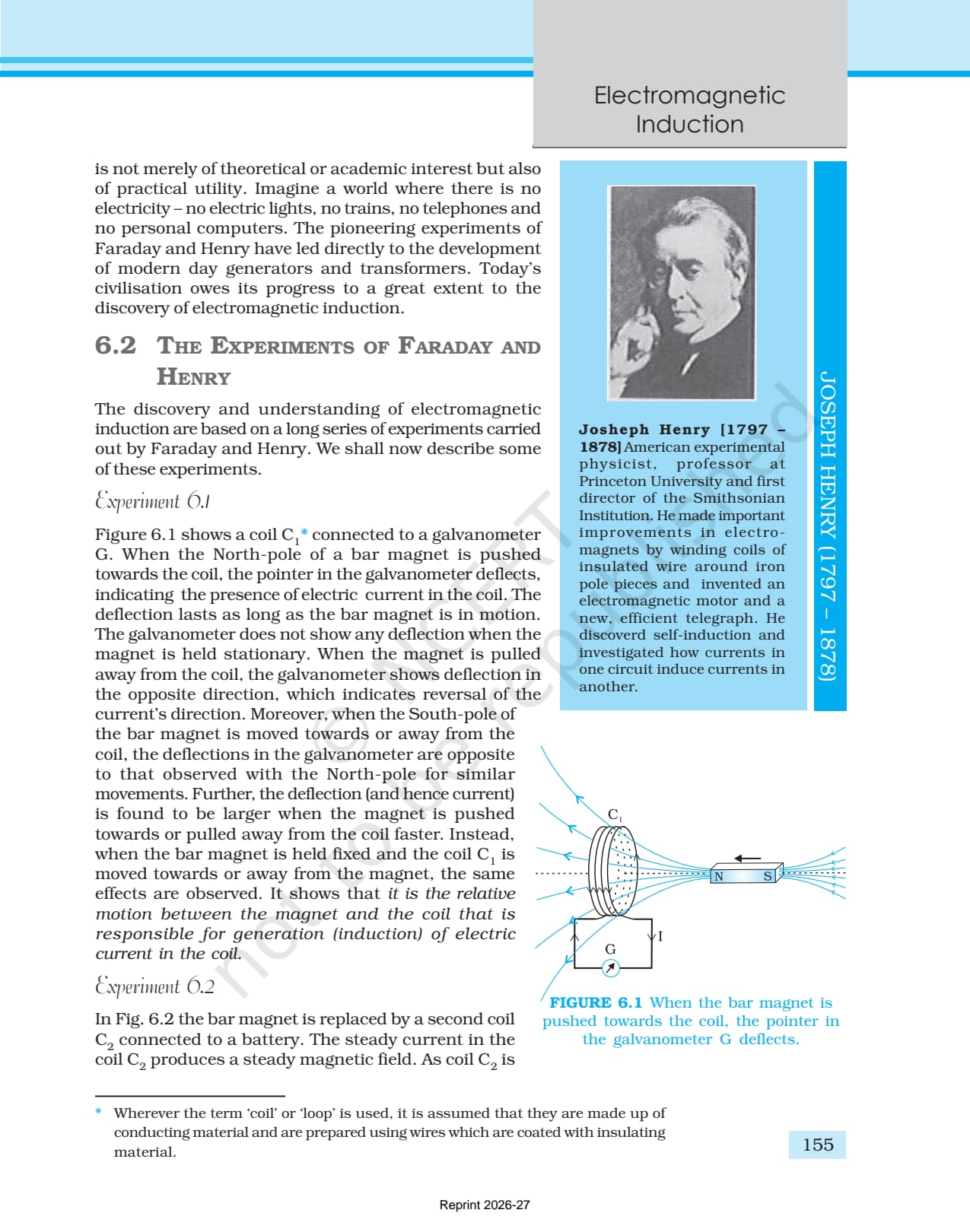
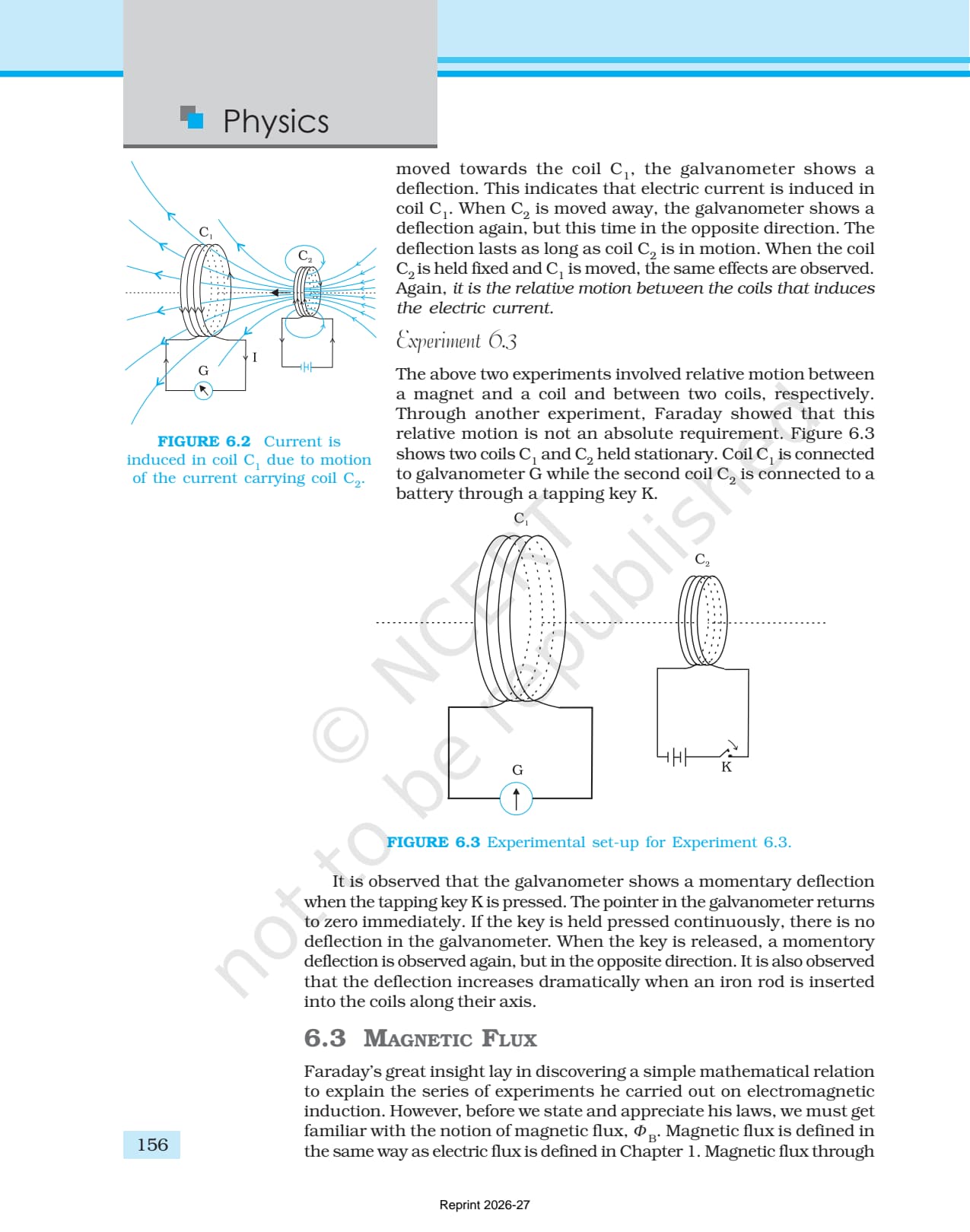
| 6.2 | The Experiments of Faraday and Henry | 2 | Three classic bar-magnet and coil demonstrations. |
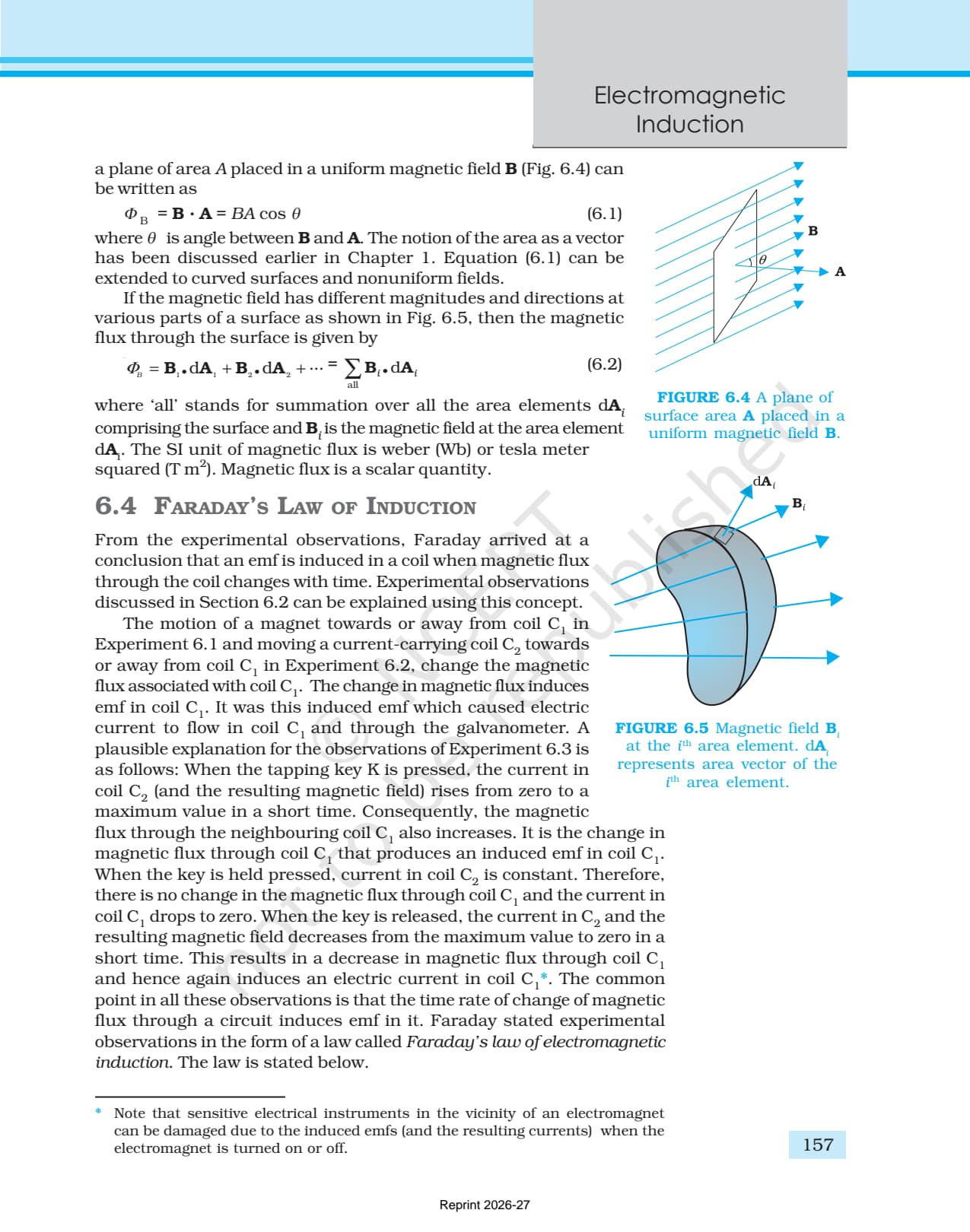
| 6.3 | Magnetic Flux | 1.5 | Definition Phi = B.A, weber as the SI unit. |
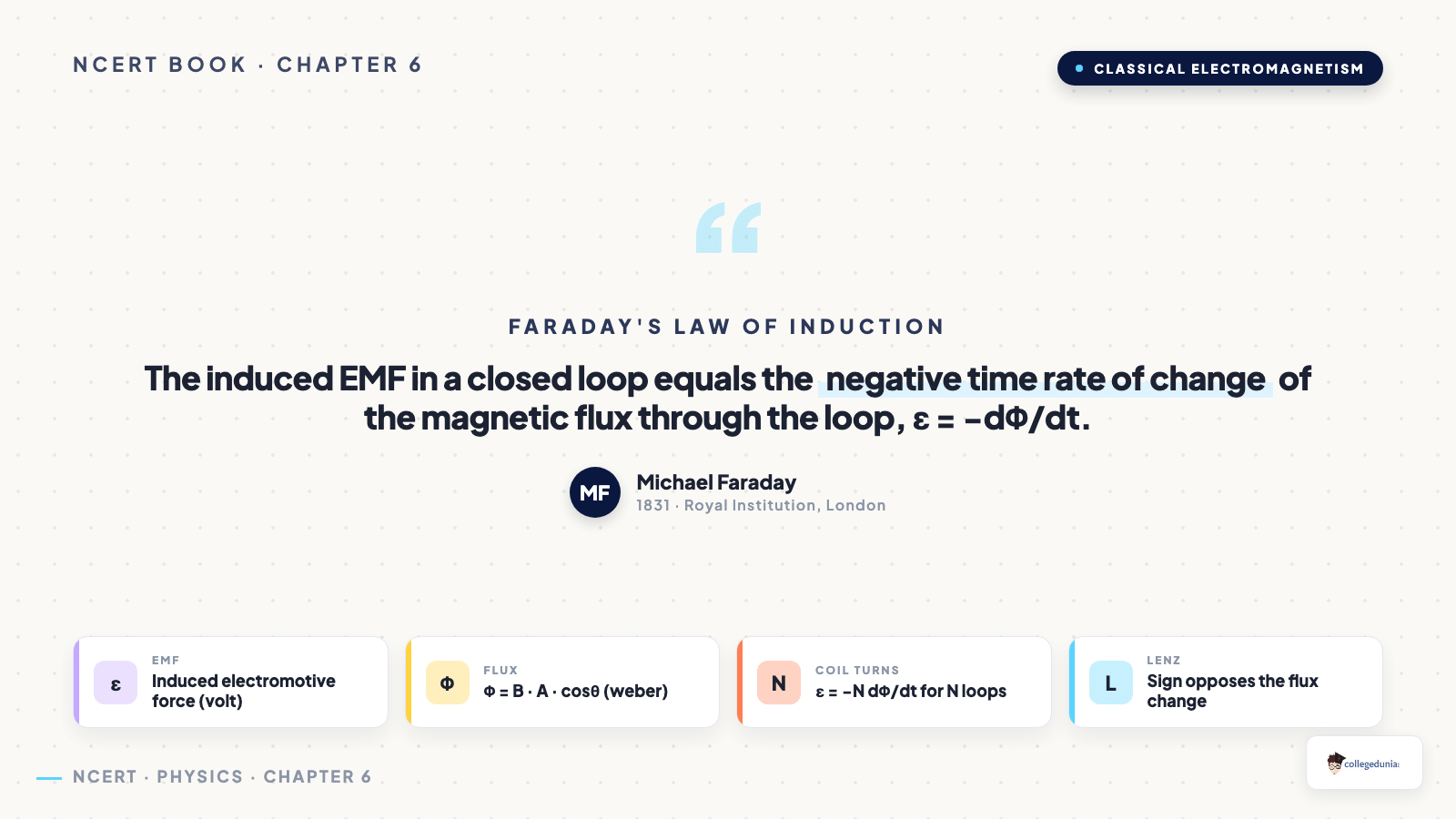
| 6.4 | Faraday's Law of Induction | 3 | Induced EMF equals negative time rate of flux change. |
| 6.5 | Lenz's Law and Conservation of Energy | 3 | Sign rule for the direction of induced current. |
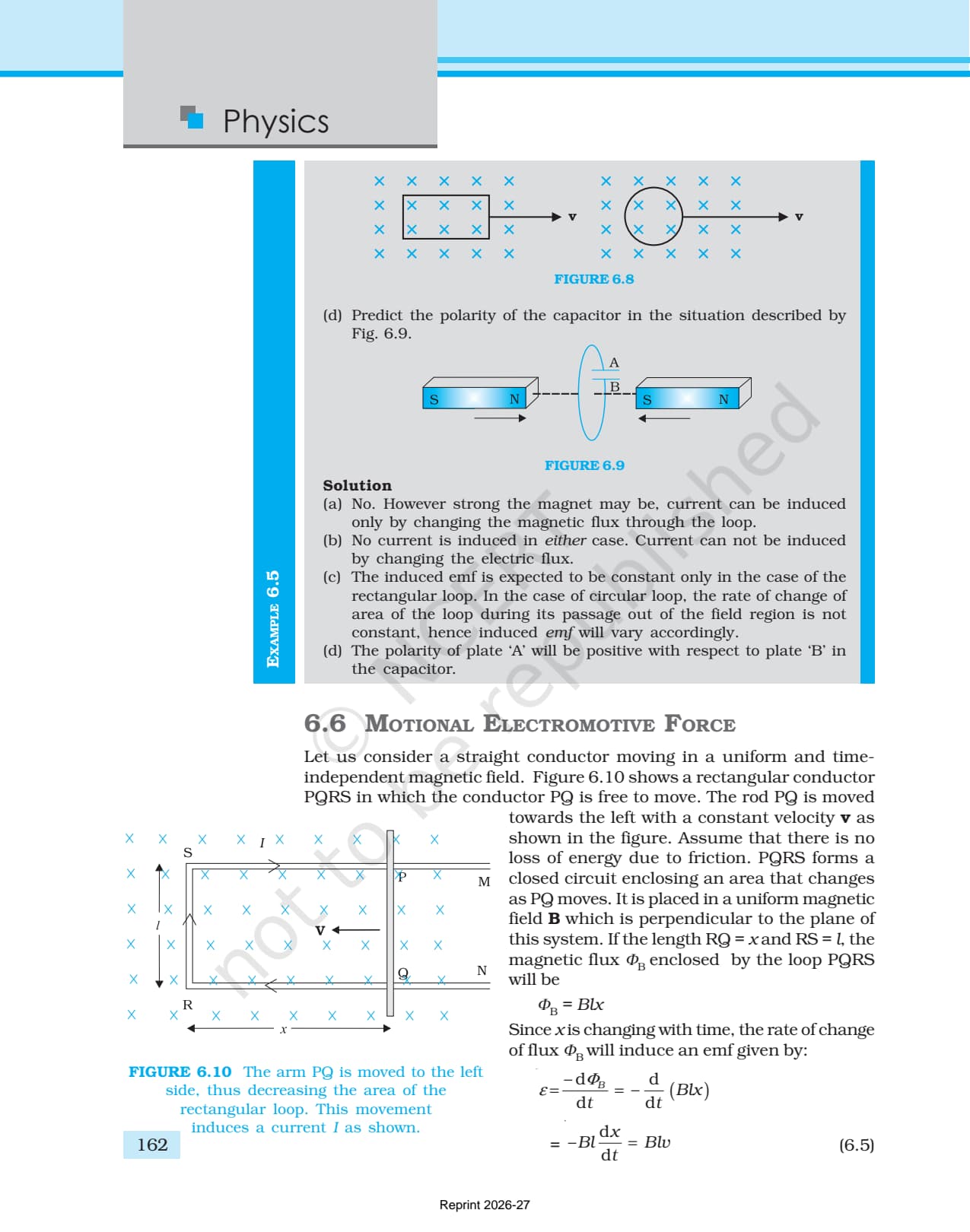
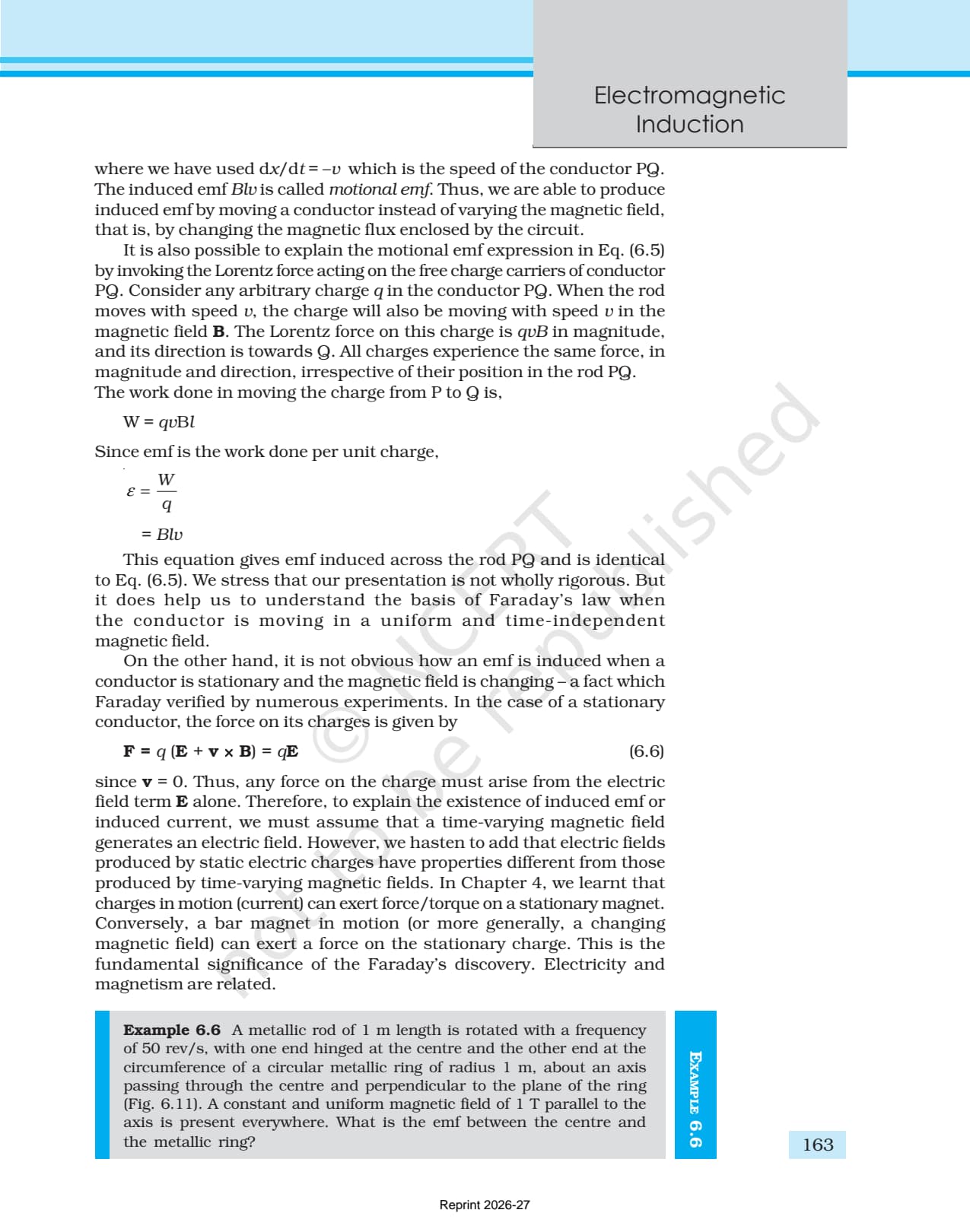
| 6.6 | Motional Electromotive Force | 4 | EMF in a moving rod, Lorentz force route. |
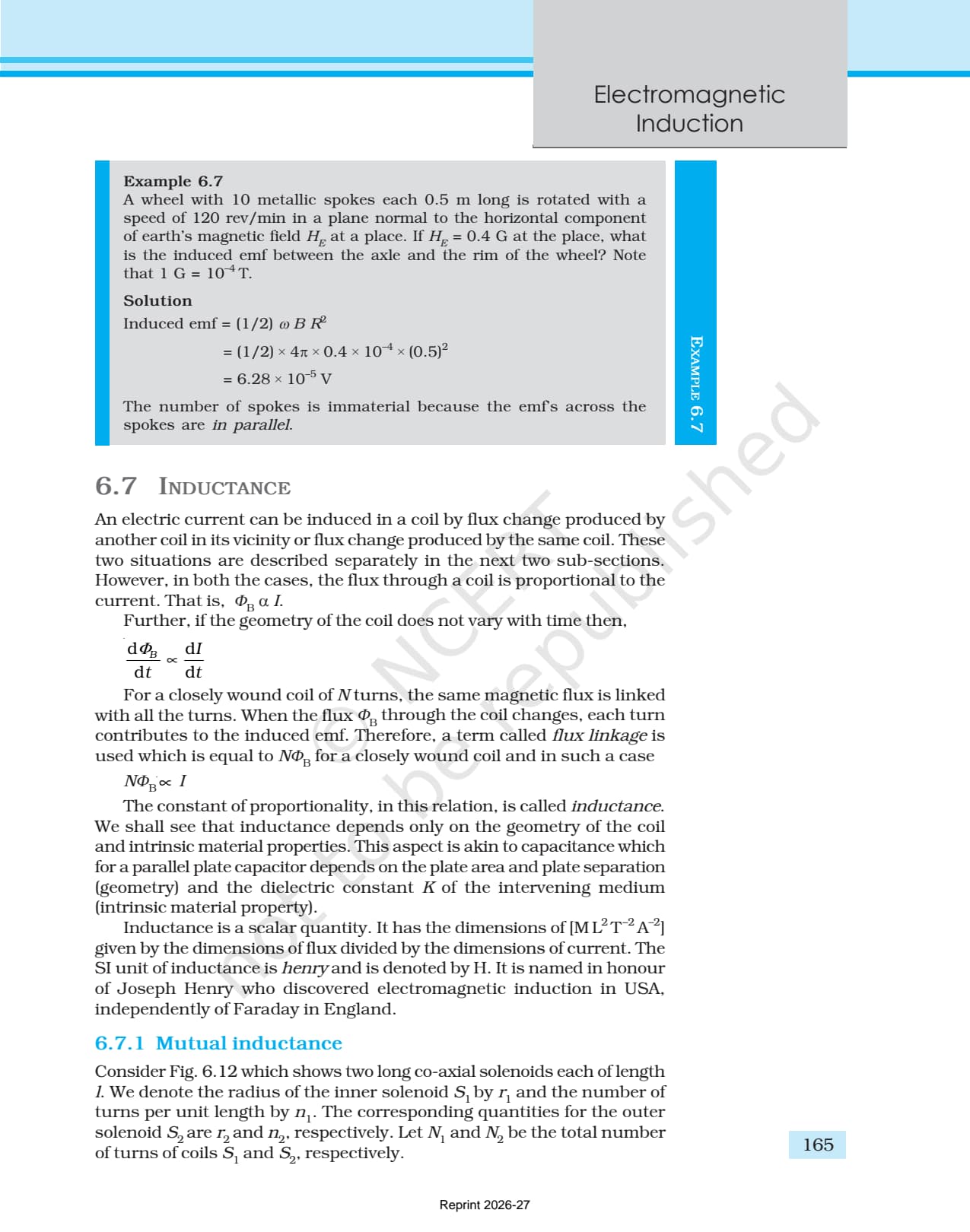
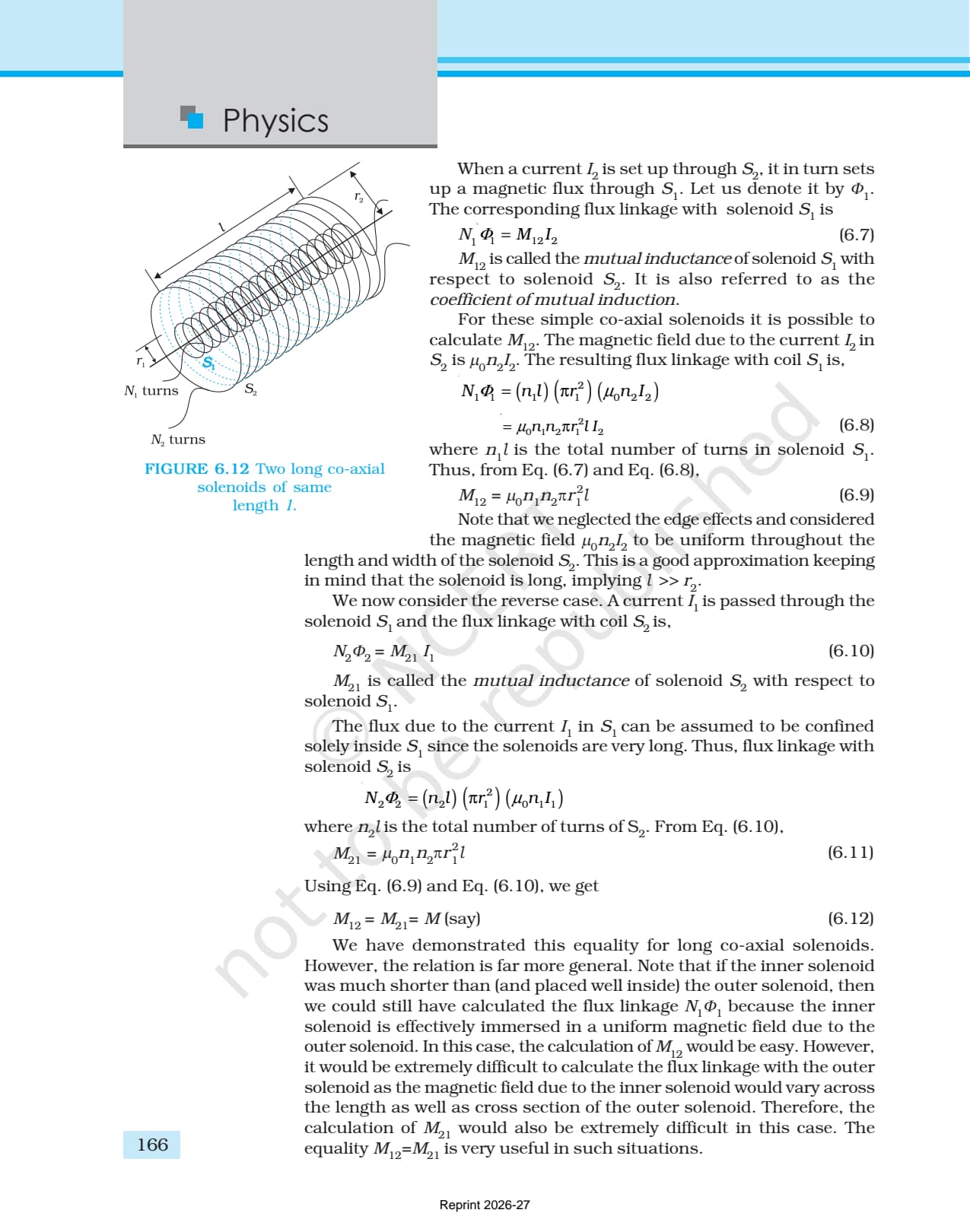
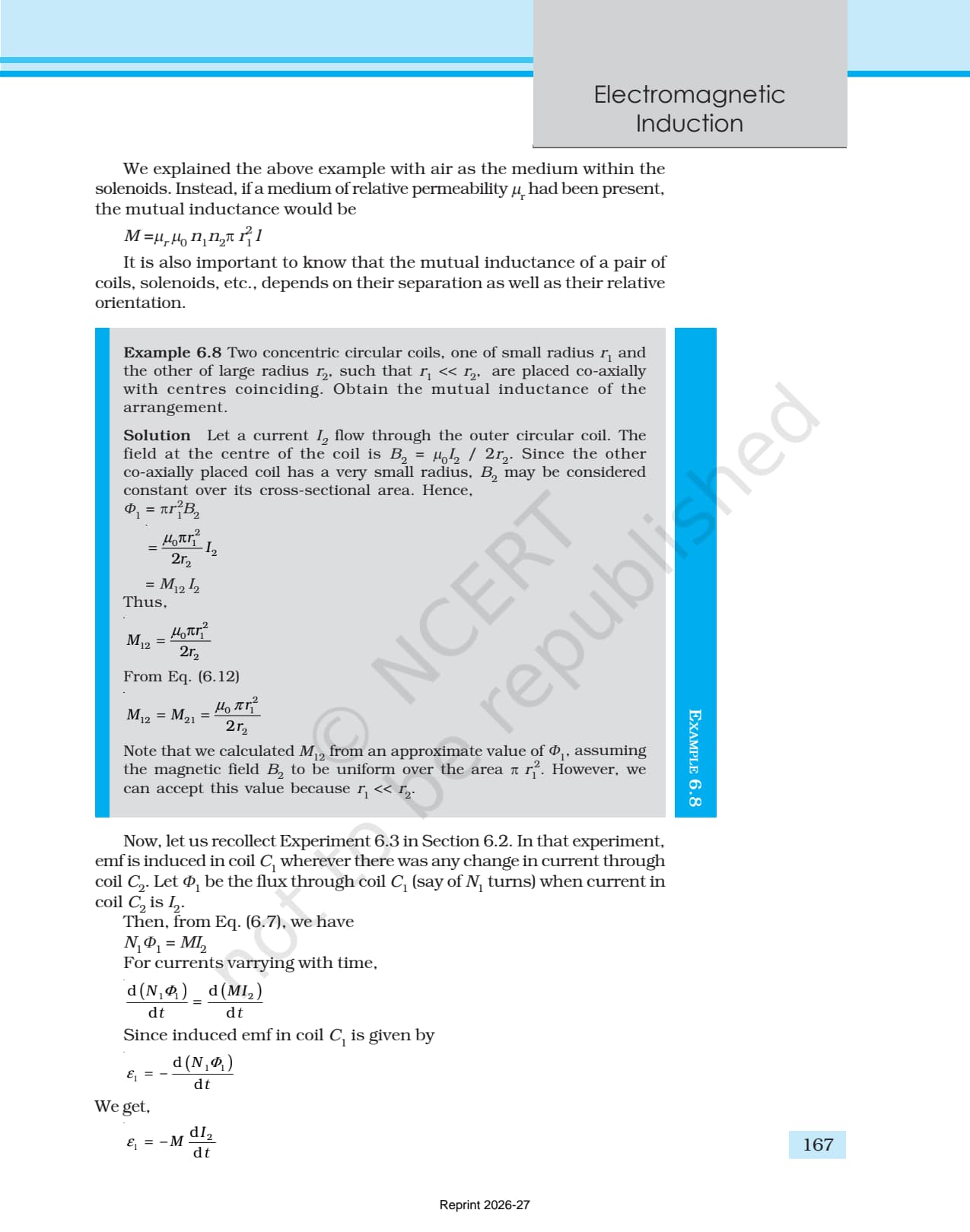
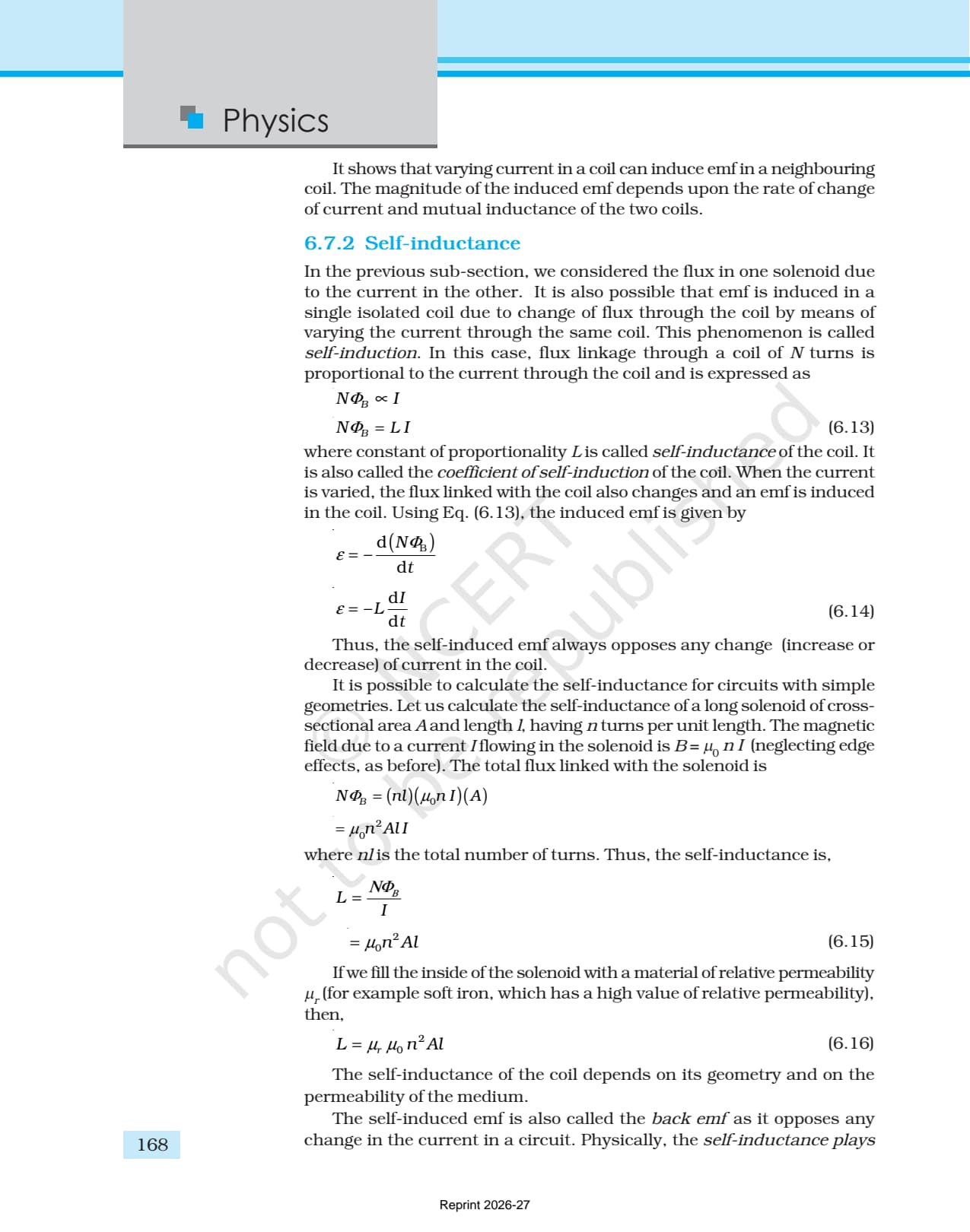
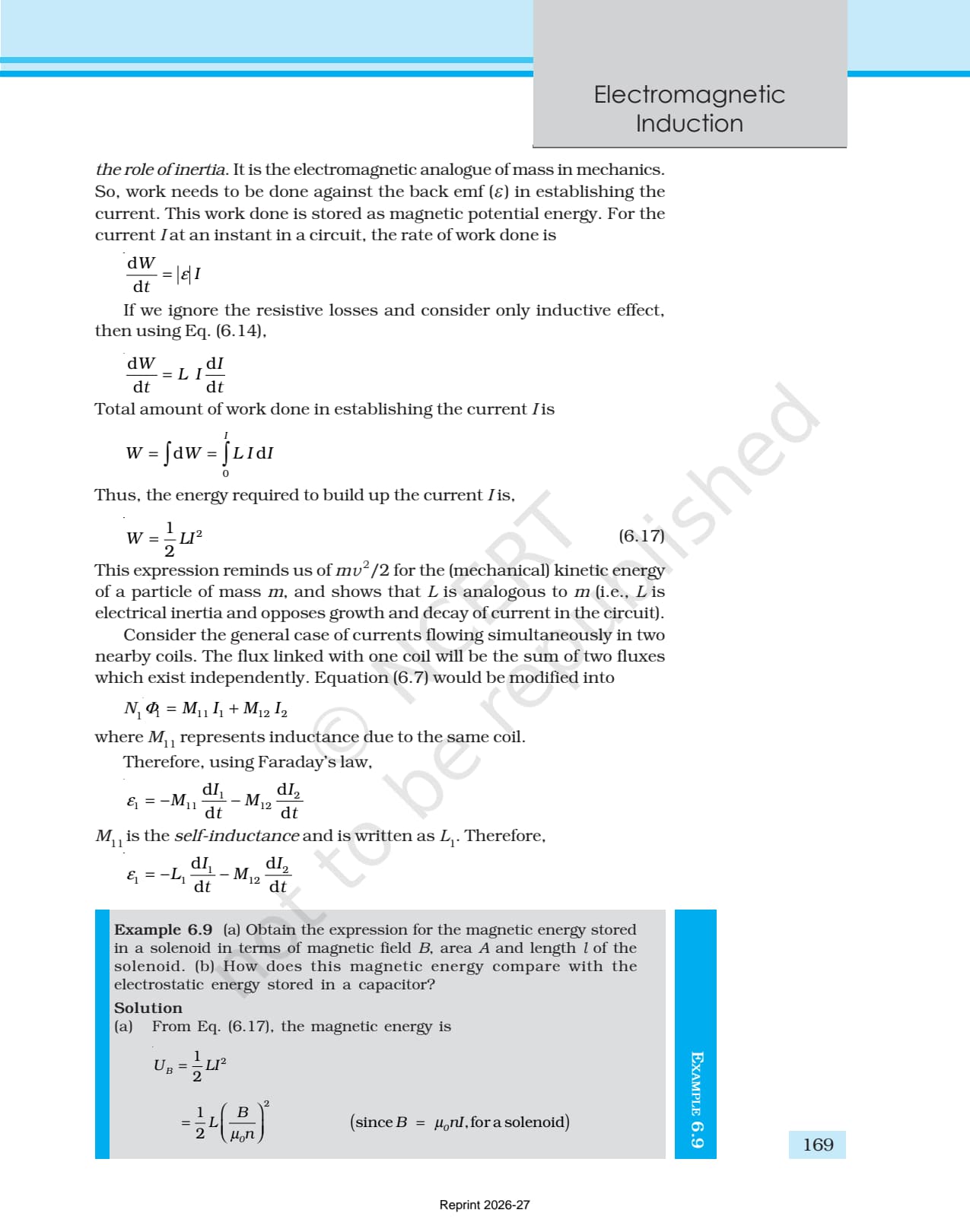
| 6.7 | Inductance | 5 | Self, mutual, energy stored, eddy currents. |
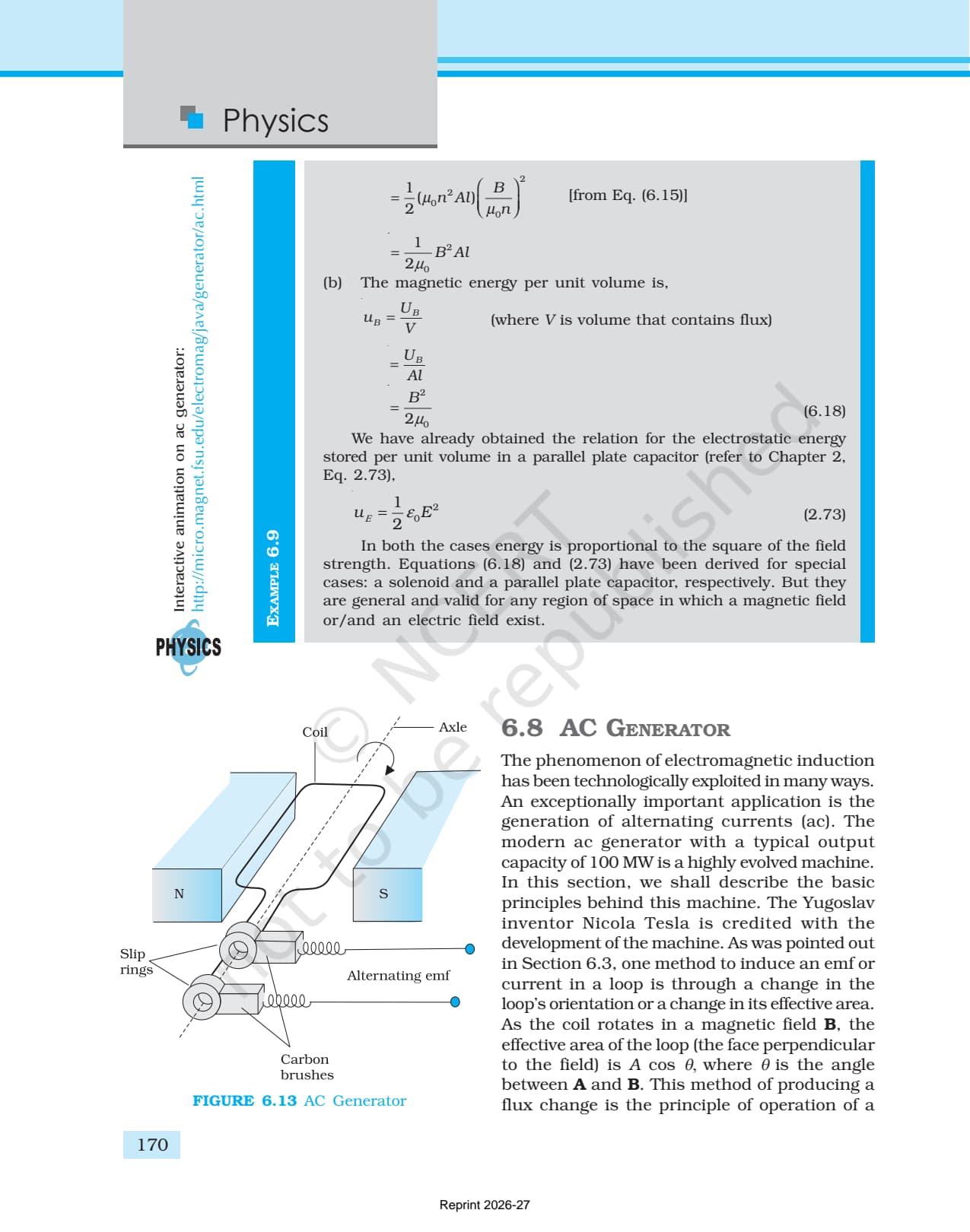
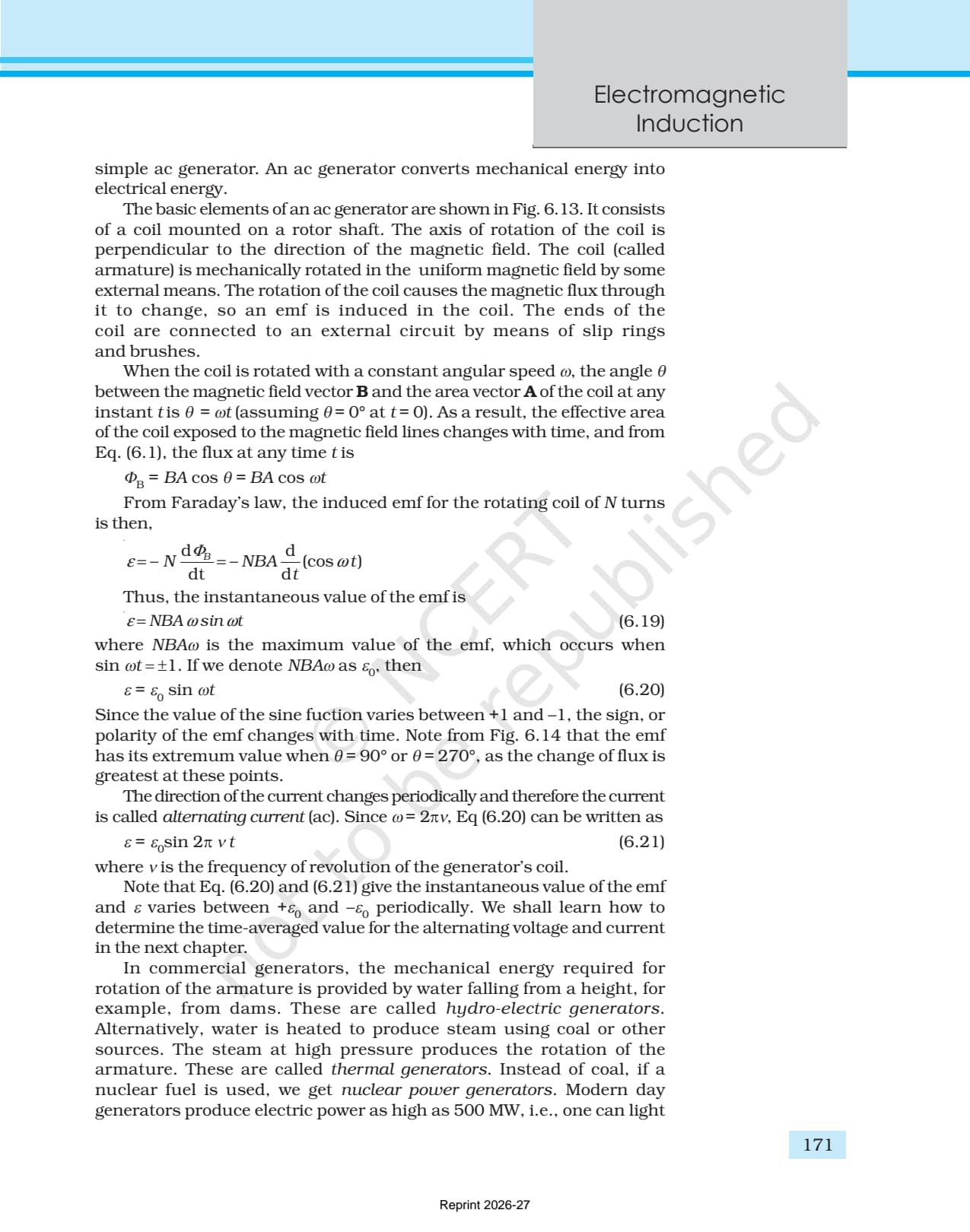
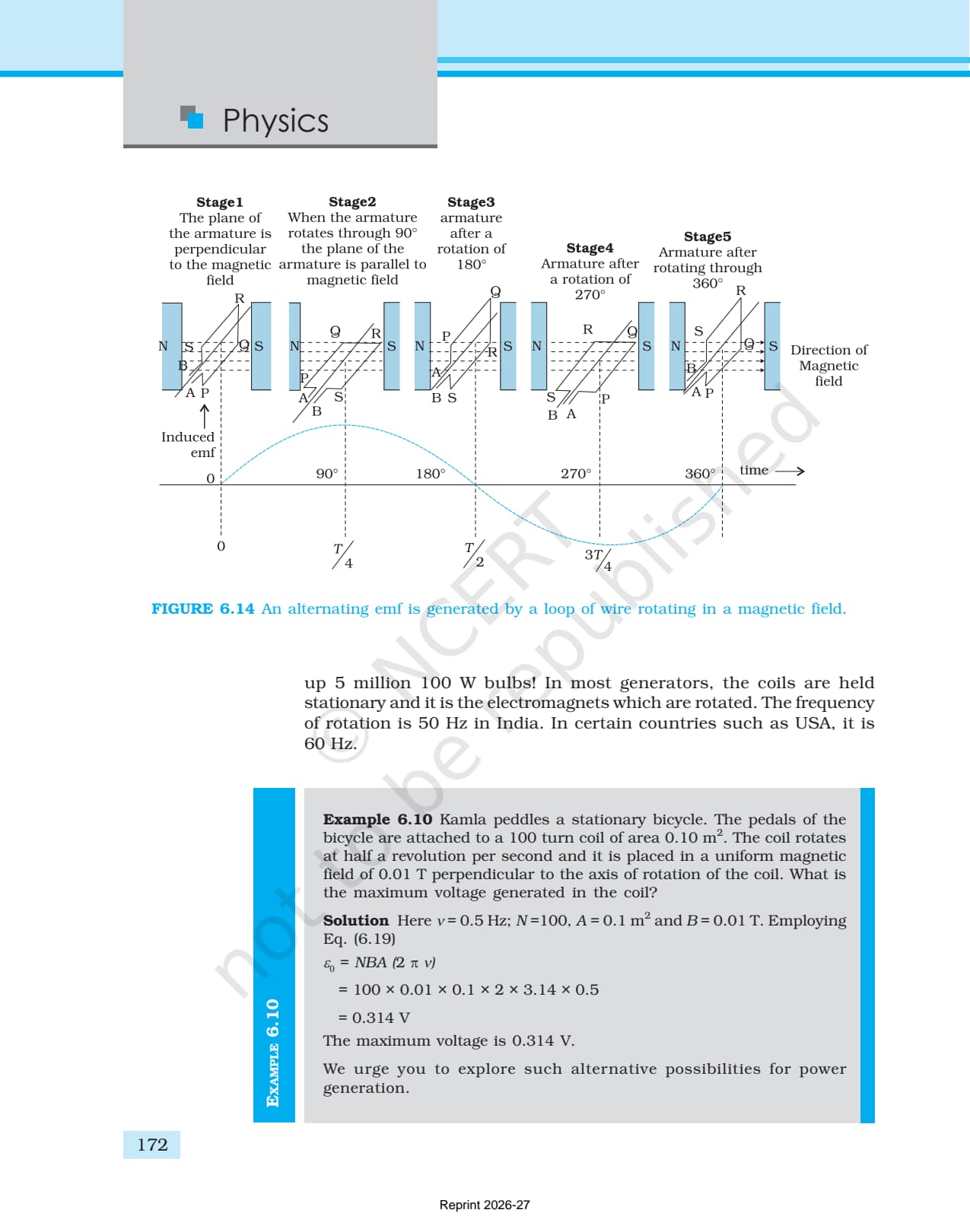
| 6.8 | AC Generator | 2.5 | Rotating coil producing sinusoidal EMF. |
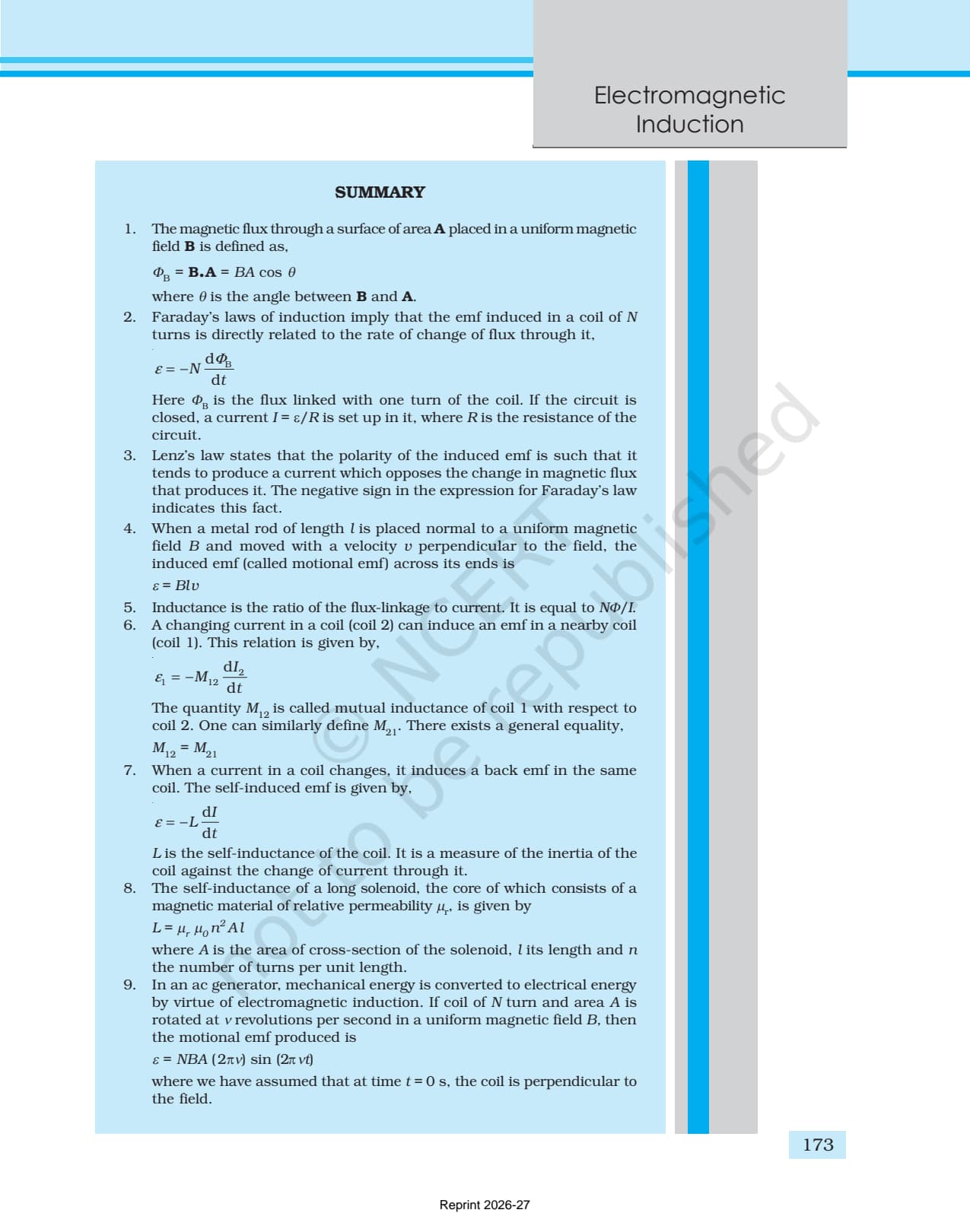
| - | Summary, Points to Ponder, Exercises | 4 | Recap, conceptual prompts, 17 Exercise questions. |
Sections 6.6 and 6.7 together account for nearly 35% of the chapter pages and almost half of the marks. If you have one day, read 6.4 to 6.7 in full and skim the rest.
Electromagnetic Induction Class 12 - Video Lecture
Source: NCERT Wallah on YouTube
Intext Examples in Class 12 Physics Chapter 6 Electromagnetic Induction
Chapter 6 has 10 intext Examples that split into three problem types: motional EMF, flux change with a stationary coil, and self or mutual inductance. Work through all three types deliberately to cover the exam range.
| Example | Sub-topic | What it Covers |
|---|---|---|
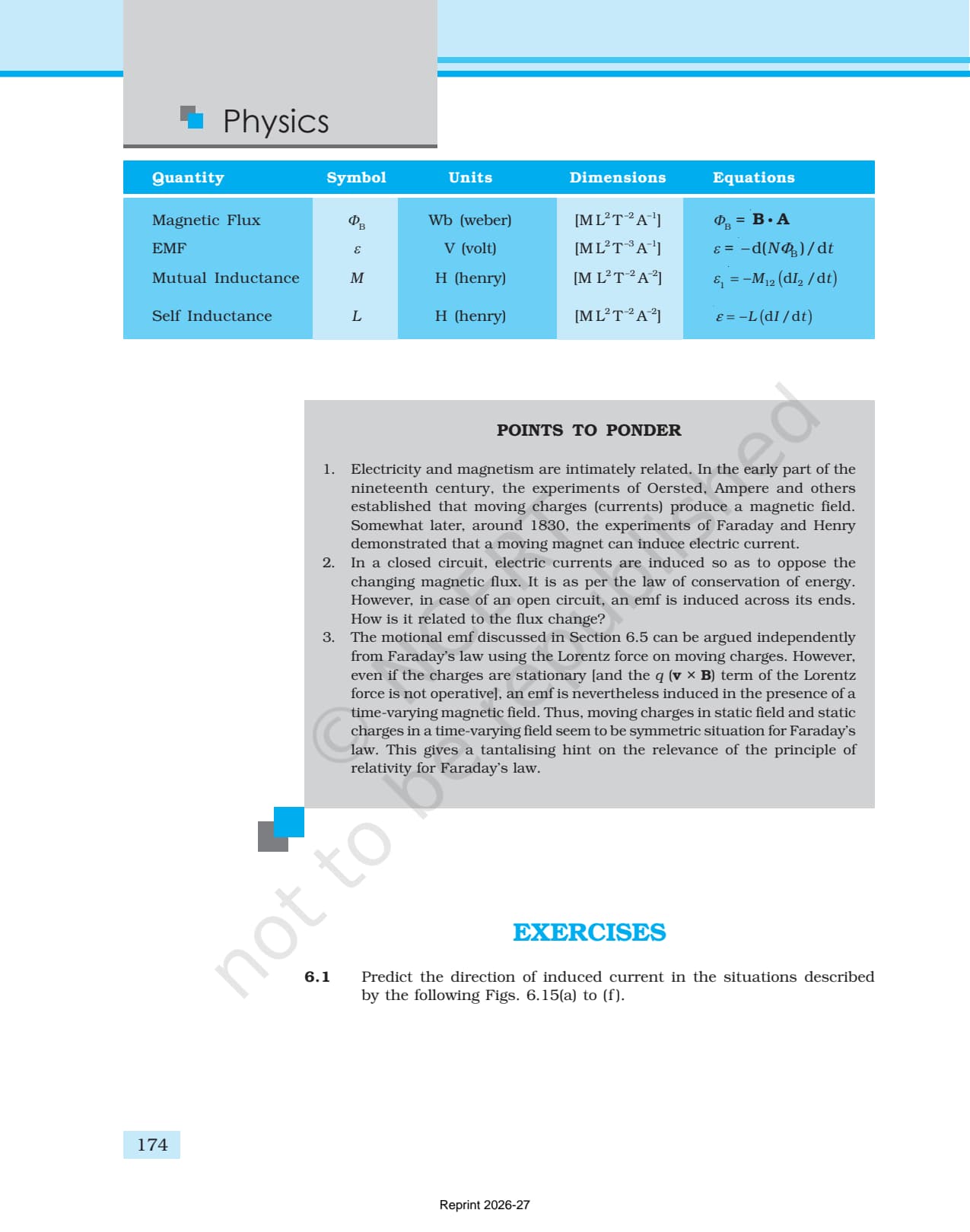
| Example 6.1 | Magnetic flux through a coil | Phi = BA cos theta computation |
| Example 6.2 | Induced EMF in a moving conductor | Direct application of epsilon = BLv |
| Example 6.3 | Polarity using Lenz's law | Sign convention practice |
| Example 6.4 | Rectangular loop entering a field | Piecewise flux change |
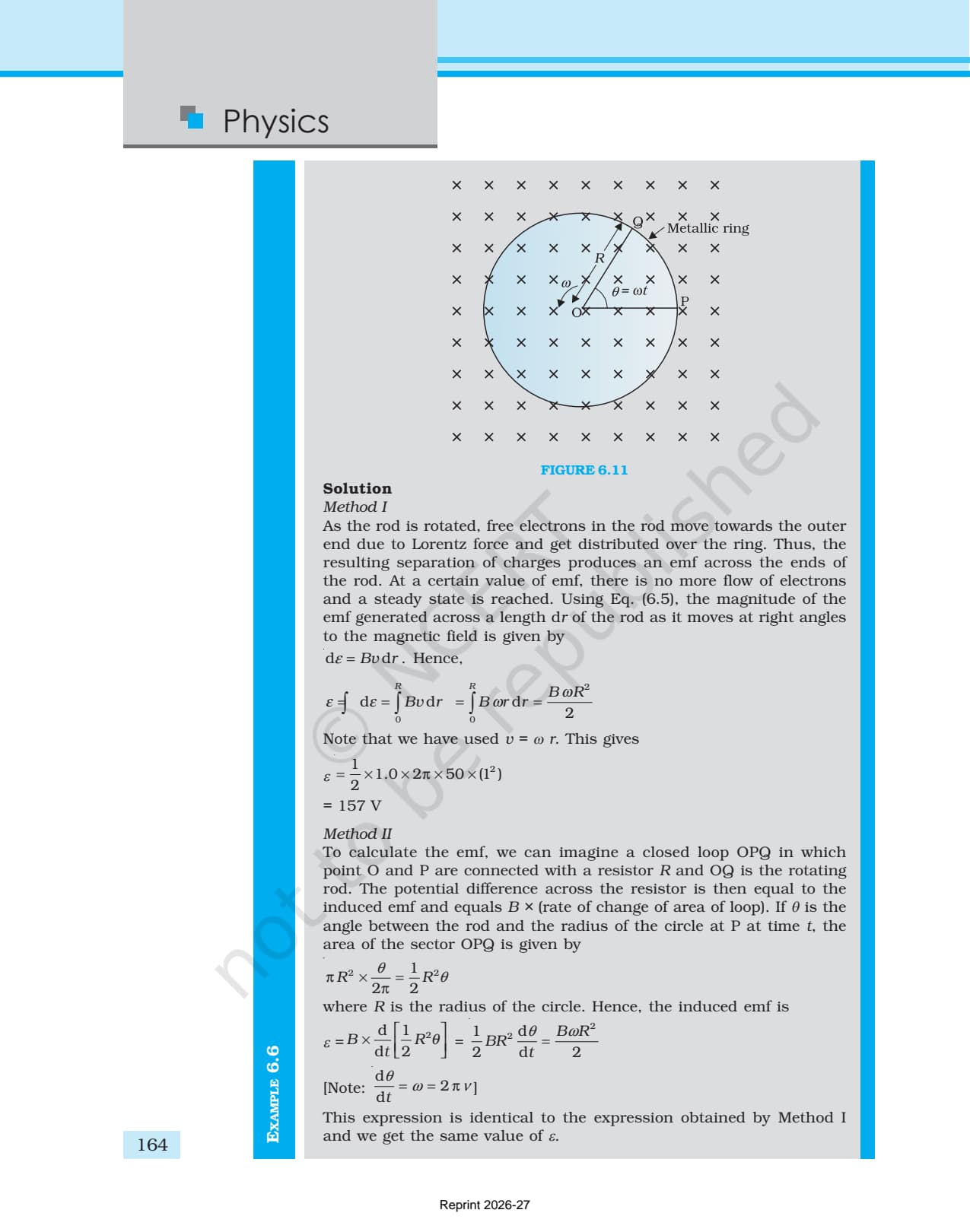
| Example 6.5 | EMF in a rotating rod | epsilon = B omega L squared by 2 |
| Example 6.6 | Charge through galvanometer when flux changes | q = N delta-Phi / R |
| Example 6.7 | Self inductance of a solenoid | L = mu naught N squared A / L |
| Example 6.8 | Mutual inductance of coaxial solenoids | M calculation, two-coil setup |
| Example 6.9 | EMF and current in AC generator coil | Sinusoidal EMF expression |
| Example 6.10 | Power and torque in AC generator | Mechanical-to-electrical energy balance |
JEE Main and NEET favour inductance problems slightly more than the NCERT Example ratio. Add extra problems beyond Examples 6.7 and 6.8 if you target these exams.
Key Formulae in Electromagnetic Induction - Class 12 Physics Chapter 6
The five formulae below appear in almost every CBSE Board and JEE Main numerical on this chapter. See the dedicated Formula Sheet for dimensional checks and a decision tree on when to use each one.
| Concept | Formula | SI Unit |
|---|---|---|
| Magnetic flux | Phi = B.A = BA cos theta | weber |
| Faraday's law | epsilon = -dPhi/dt | volt |
| Motional EMF (straight rod) | epsilon = BLv | volt |
| Self inductance (solenoid) | L = mu naught N squared A / L | henry |
| Energy stored in inductor | U = half L I squared | joule |
Full formula table: Electromagnetic Induction Class 12 Physics Formula Sheet.
Electromagnetic Induction PYQ Trends - CBSE, JEE Main, NEET
Three question patterns show up most often across the last five years of exams.
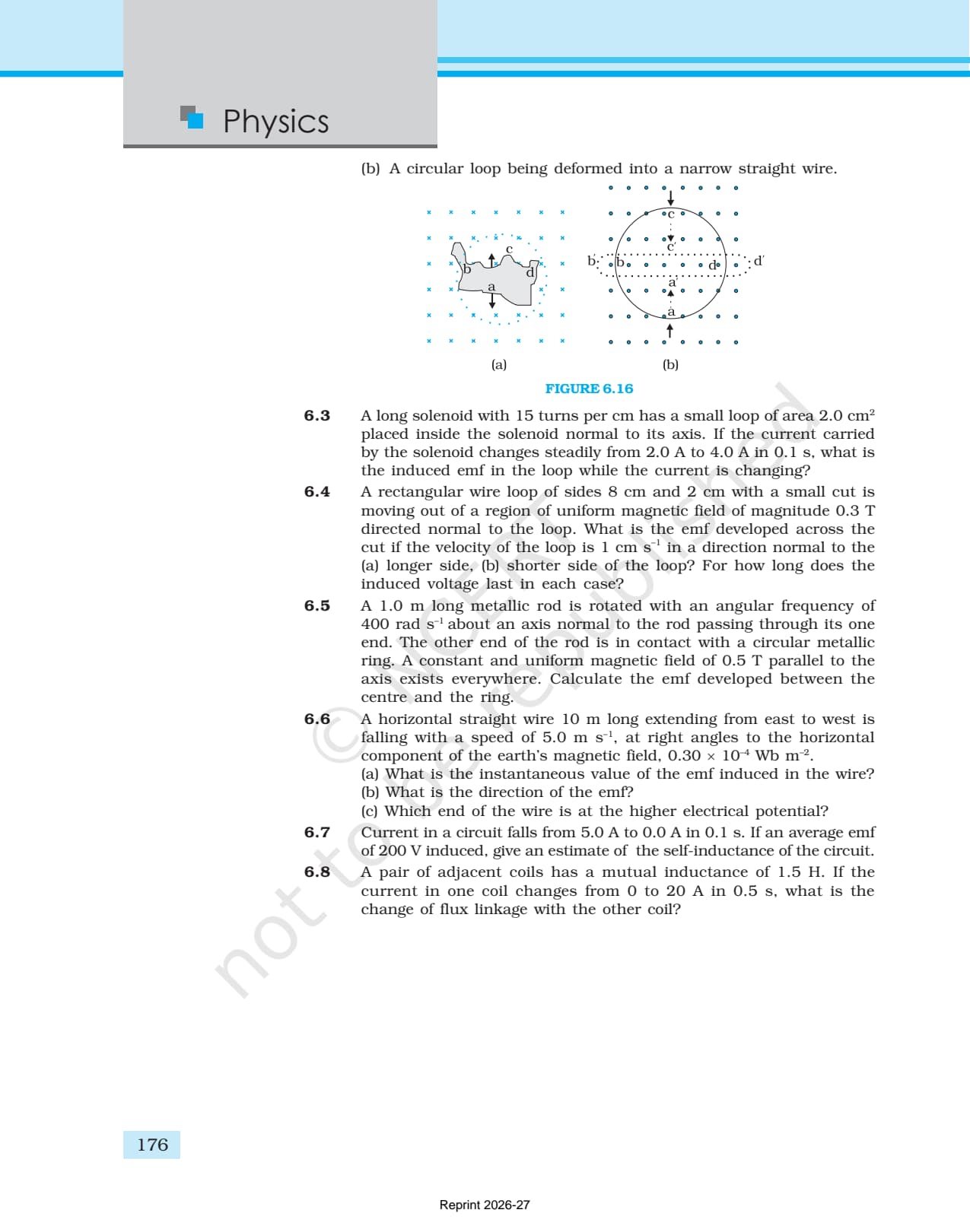
- Motional EMF on rails: a rod sliding on parallel conducting rails in a uniform field. CBSE Board 2025 set this as a 3-marker.
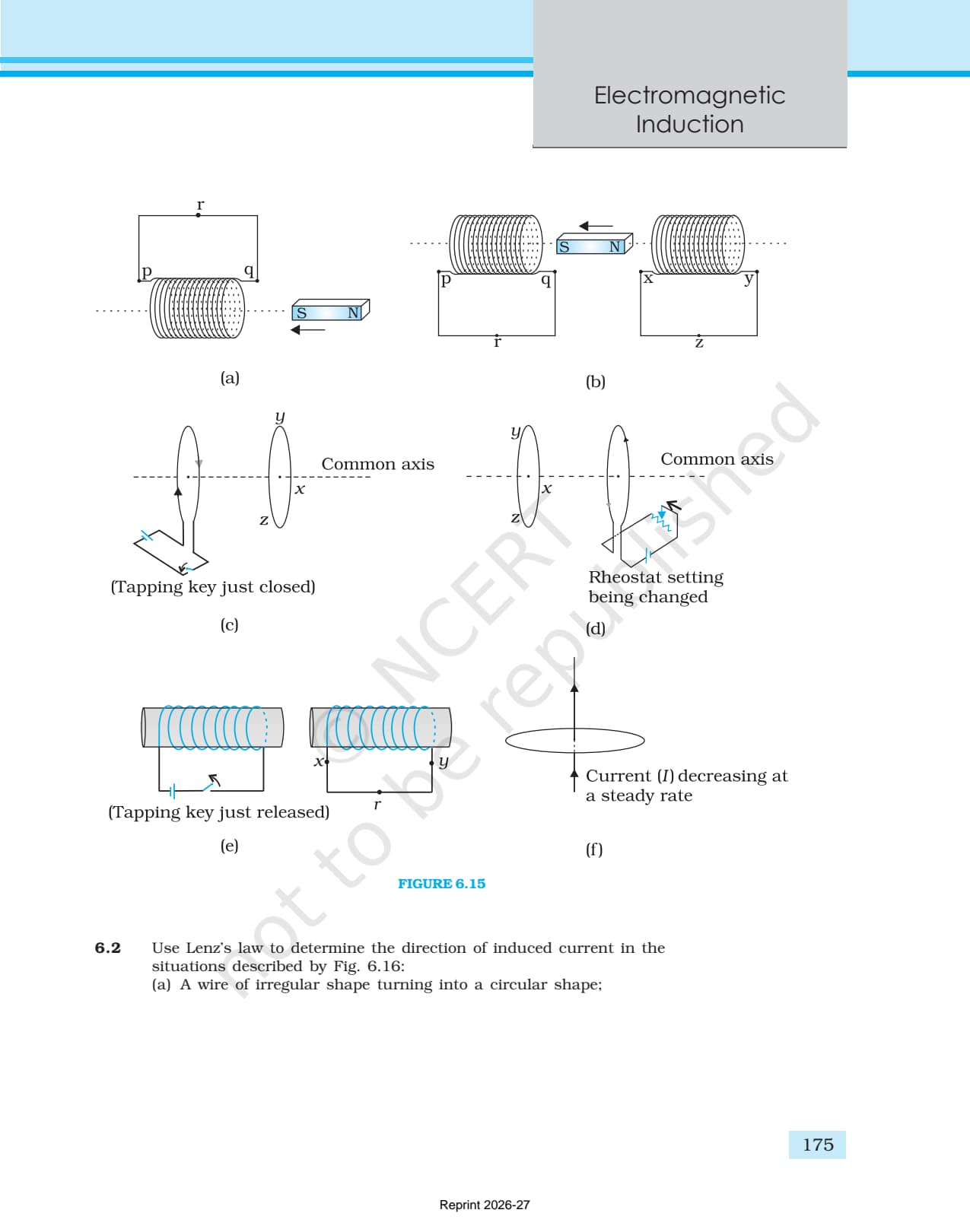
- Lenz's law sign convention: direction of induced current when a magnet approaches or recedes from a coil. JEE Main 2025 and NEET 2024 both used this stem.
- Mutual inductance plus AC generator derivation: coaxial solenoid M derivation and the NBA-omega result, set in CBSE 2024 and 2022 as 5-mark long answers.
Full PYQ map (2021-2026): Electromagnetic Induction Class 12 Physics NCERT Solutions.
How to Study Class 12 Physics Chapter 6 Electromagnetic Induction
Most students finish Chapter 6 in three sittings. Here is a practical day-by-day split.
| Day | Sections | Reading Time | Practice |
|---|---|---|---|
| Day 1 | 6.1, 6.2, 6.3, 6.4 | 90 min | Examples 6.1 to 6.3, Exercises 6.1 to 6.4 |
| Day 2 | 6.5, 6.6 | 90 min | Examples 6.4 to 6.6, Exercises 6.5 to 6.10 |
| Day 3 | 6.7, 6.8 plus Summary | 120 min | Examples 6.7 to 6.10, Exercises 6.11 to 6.17 |
Day 3 is the heaviest because Section 6.7 covers self inductance, mutual inductance, energy stored, and eddy currents. Keep a buffer of one hour for the AC generator derivation. It is a recurring 5-mark Board question.
Before starting Chapter 6, revise Chapter 4 Section 4.4 on the Lorentz force and Chapter 5 Section 5.4 on the magnetic field of a long solenoid. Both results are reused inside Sections 6.6 and 6.7 without re-derivation.
Student Feedback
"The section table on this page helped me know exactly where to open the PDF during revision. The formula table saved me 20 minutes before my Board exam." - Class 12 student, Delhi
Other Resources for Electromagnetic Induction Class 12 Physics
| Resource | Link |
|---|---|
| NCERT Book PDF | Electromagnetic Induction |
| NCERT Solutions | Electromagnetic Induction Solutions |
| Notes | Electromagnetic Induction Notes |
| Formula Sheet | Electromagnetic Induction Formula Sheet |
NCERT Book PDF for Class 12 Physics: All Chapters
Other Class 12 Physics NCERT Book PDFs you can get as free downloads:
| Chapter | Resource |
|---|---|
| Chapter 1 | Electric Charges and Fields NCERT PDF |
| Chapter 2 | Electrostatic Potential and Capacitance NCERT PDF |
| Chapter 3 | Current Electricity NCERT PDF |
| Chapter 4 | Moving Charges and Magnetism NCERT PDF |
| Chapter 5 | Magnetism and Matter NCERT PDF |
| Chapter 6 | Electromagnetic Induction NCERT PDF |
| Chapter 7 | Alternating Current NCERT PDF |
| Chapter 8 | Electromagnetic Waves NCERT PDF |
| Chapter 9 | Ray Optics and Optical Instruments NCERT PDF |
| Chapter 10 | Wave Optics NCERT PDF |
| Chapter 11 | Dual Nature of Radiation and Matter NCERT PDF |
| Chapter 12 | Atoms NCERT PDF |
| Chapter 13 | Nuclei NCERT PDF |
| Chapter 14 | Semiconductor Electronics NCERT PDF |
Electromagnetic Induction Class 12 Physics NCERT PDF - Frequently Asked Questions
Ques. Where can I download the Electromagnetic Induction NCERT PDF for Class 12 Physics?
Ans. You can get the PDF directly from the flipbook on this page. It is free and aligned to the 2026-27 NCERT edition.
Ques. Is this PDF aligned with the 2026-27 CBSE syllabus?
Ans. Yes. Chapter 6 retains its eight-section structure, the three Faraday-Henry experiments, the Lorentz-force route to motional EMF, and the AC generator derivation, with 17 Exercise questions.
Ques. How many pages is the Class 12 Physics Electromagnetic Induction NCERT PDF?
Ans. The PDF runs approximately 26 pages and covers Sections 6.1 to 6.8, ten intext Examples, the Summary, Points to Ponder, and 17 Exercise questions.
Ques. What is the weightage of Electromagnetic Induction in CBSE Class 12 Physics?
Ans. The chapter contributes about 4 to 6 marks in the CBSE Board paper, usually through one short answer on Lenz's law or magnetic flux and one numerical on motional EMF or inductance.
Ques. Which sections of Chapter 6 should students prioritise for JEE Main?
Ans. Section 6.6 Motional EMF and Section 6.7 Inductance are the two highest-yield sections for JEE Main. Example 6.5 on the rotating rod and Example 6.8 on coaxial solenoids are the most representative problems to drill.



Comments