




The Class 12 Geography Chapter 4 Primary Activities textbook PDF is the official NCERT source for every board question on hunting and gathering, pastoralism, agriculture types, and mining. It carries about 5 to 7 marks in the CBSE board exam and is a key chapter for CUET and UPSC Geography as well.
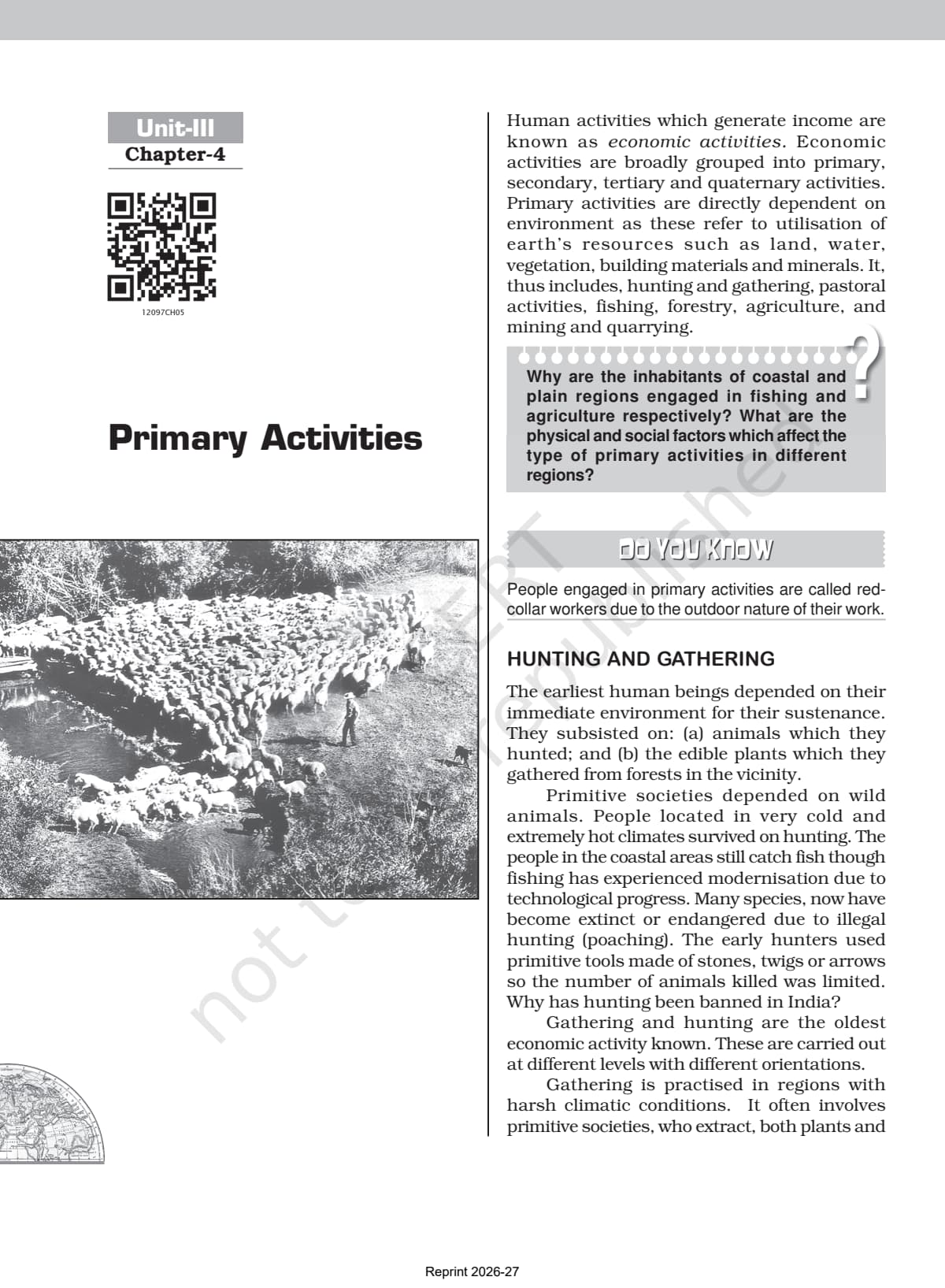
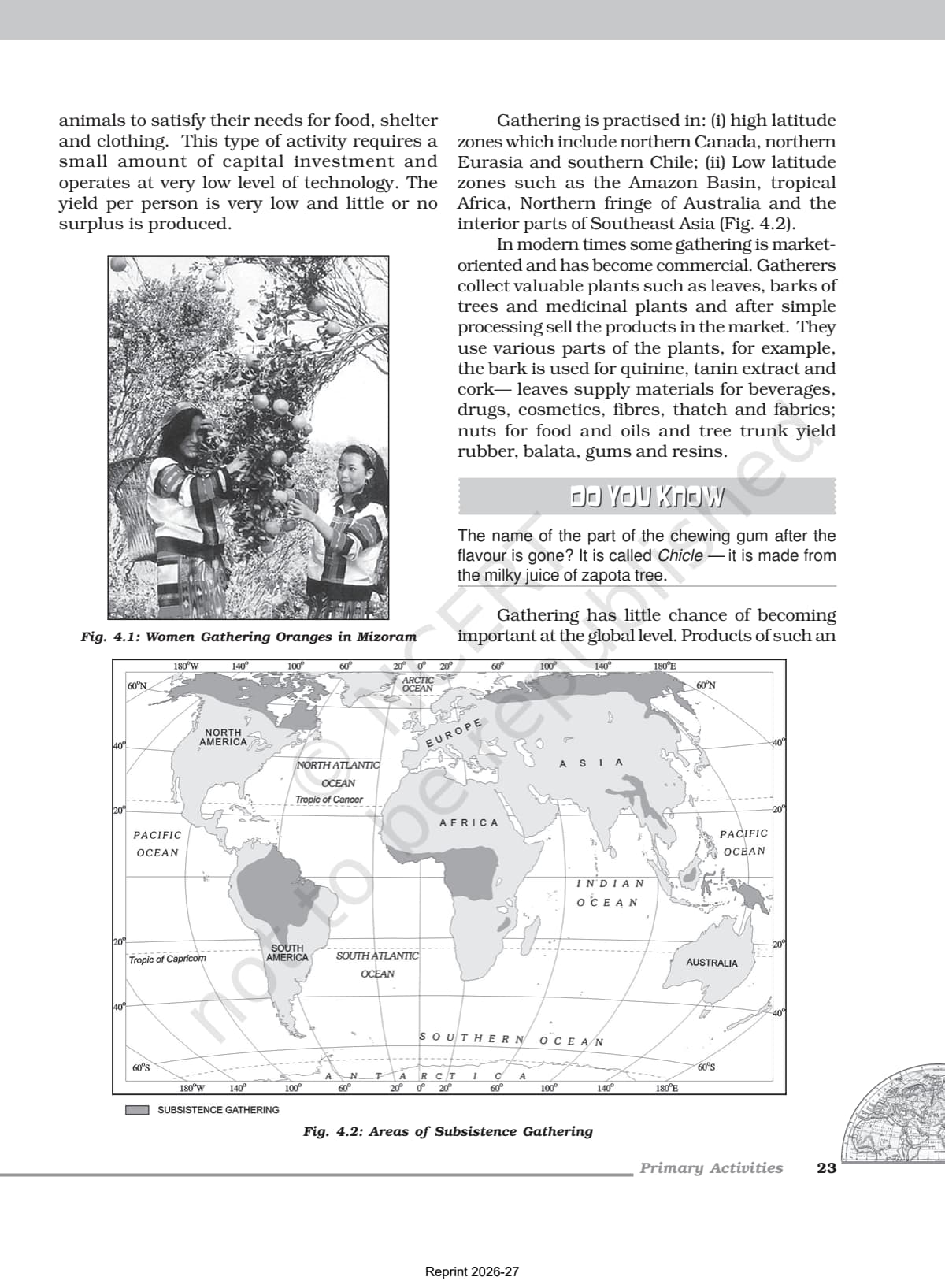
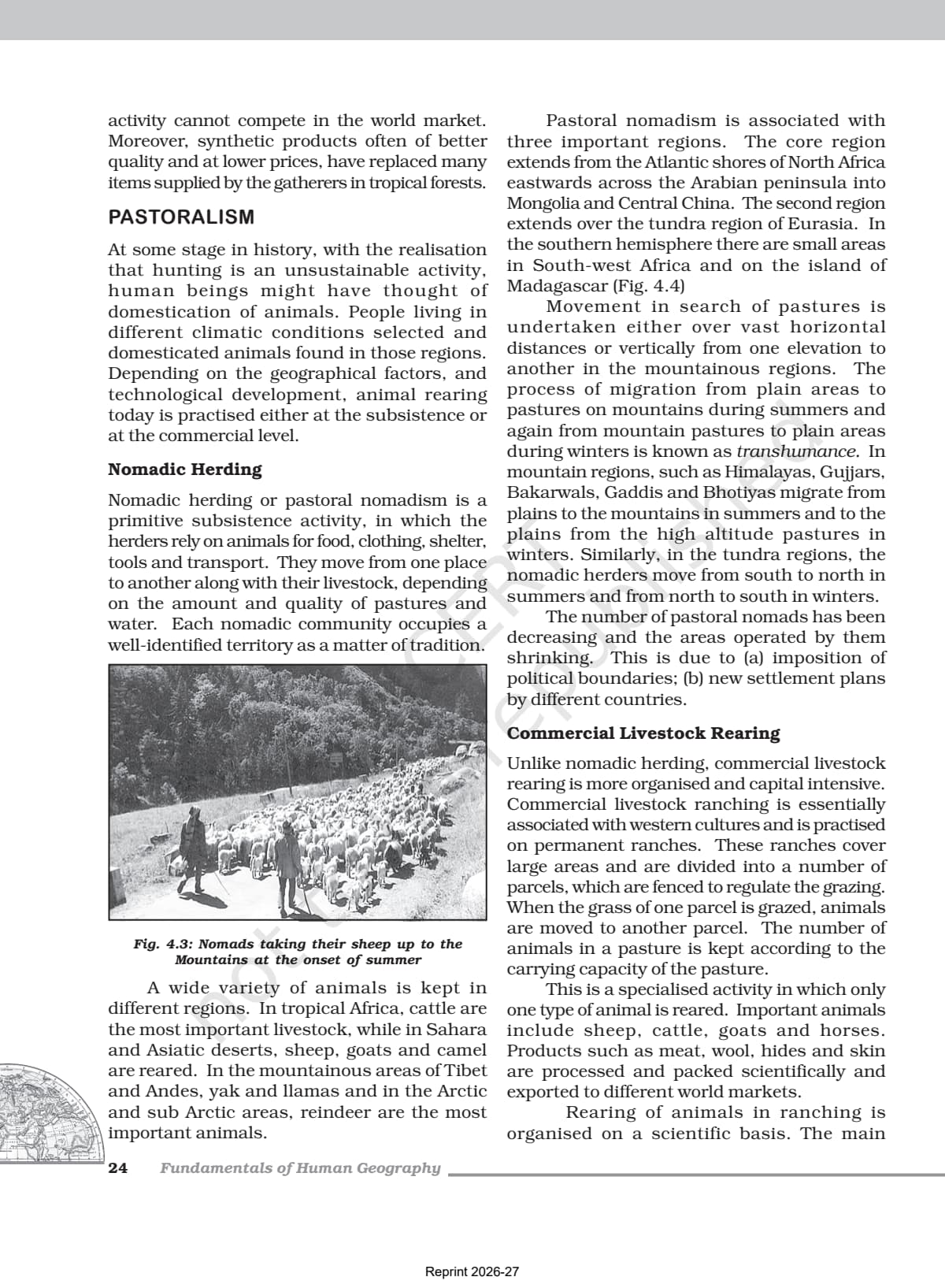
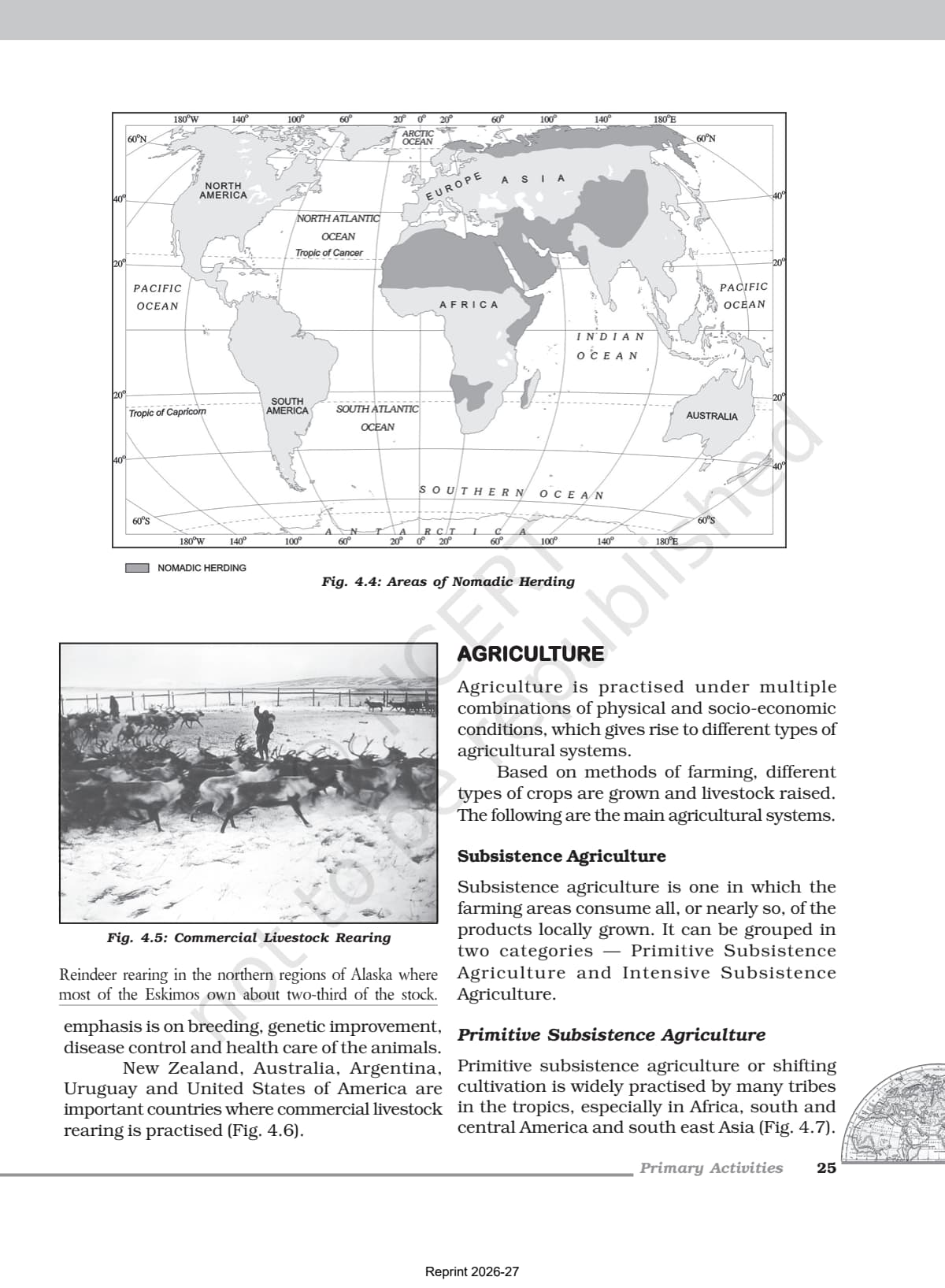
- Official NCERT Fundamentals of Human Geography Class 12 Chapter 4 PDF covering hunting and gathering, nomadic herding, commercial livestock rearing, all major agricultural systems, and mining methods.
- 5-7 marks CBSE board-paper weightage for Chapter 4; the official textbook is the only source CBSE references when it sets definition, short-answer, and map-based questions on primary activities.
- Pair with the matching NCERT Solutions, Notes and Handwritten Notes for full chapter coverage.
Student Feedback
In a 2026 Collegedunia poll of 9,200 Class 12 Geography students, 81% said reading the NCERT chapter PDF directly helped them answer board questions more accurately than any guide book. Students who read the full PDF averaged 4.6 out of 5 marks on this chapter.
What This Chapter Covers in the NCERT Class 12 Book
The primary activities class 12 geography chapter explains how people get food, raw materials, and minerals directly from the earth. The official NCERT PDF is the source CBSE uses for definition and short-answer questions here, so students preparing for the 2026-27 board paper should read it first. The chapter moves from the most primitive activity (hunting and gathering) through pastoralism and agriculture to mining, covering the major agricultural systems and the factors that decide whether mining is profitable.
Source: Magnet Brains on YouTube
Topics in the Chapter (Section-Wise Map of the NCERT PDF)
The NCERT PDF for primary activities class 12 is split into numbered sub-sections. The table below maps each sub-topic to its main concept and its dominant exam angle.
| Section | NCERT Sub-topic | Dominant Exam Concept |
|---|---|---|
| 4.1 | Hunting and Gathering | Oldest economic activity; primitive tools; regions of practice; modern market-oriented gathering |
| 4.2 | Pastoralism | Nomadic herding vs commercial livestock rearing; transhumance; major pastoral regions |
| 4.3 | Subsistence Agriculture | Primitive subsistence (shifting cultivation / Jhum / Milpa / Ladang) vs intensive subsistence (wet paddy and other crops) |
| 4.4 | Plantation Agriculture | European-introduced; single crop; large estates; examples by country (tea, coffee, rubber, sugarcane) |
| 4.5 | Extensive Commercial Grain Cultivation | Mechanised wheat farming; low yield per acre, high yield per person; Prairies, Steppes, Pampas |
| 4.6 | Mixed Farming, Dairy, Mediterranean, Market Gardening | Crop rotation; dairy near urban centres; viticulture; truck farming; factory farming |
| 4.7 | Collective and Co-operative Farming | Kolkhoz model; co-operative success in Denmark; voluntary pooling |
| 4.8 | Mining | Physical and economic factors; open-cast vs shaft method; developing vs developed economies |
Section 4.3 on subsistence agriculture and Section 4.4 on plantation agriculture together carry most of the board-paper questions from this chapter, because both are full of named concepts that CBSE frames as short answers, MCQs, and map questions.
Key Concepts From the NCERT Class 12 Geography Textbook
These are the ideas students must reproduce in NCERT phrasing to score full marks on theory questions. The four blocks below come straight from this chapter.
Hunting, Gathering, and Pastoralism
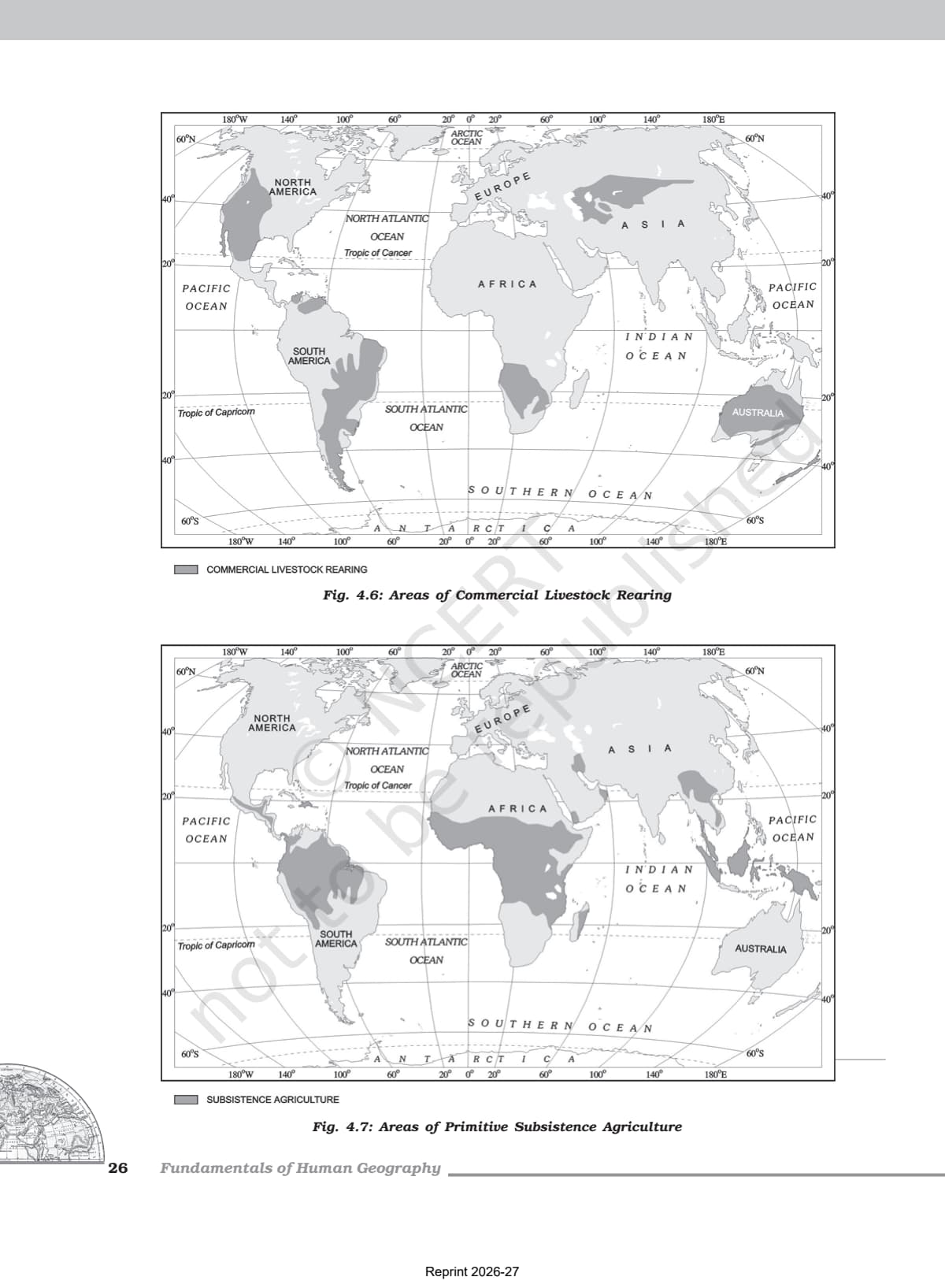
Gathering is practised in harsh climates, uses very little capital, and involves collecting plants and animals for food, shelter, and clothing; modern gathering is market-oriented (bark, leaves, nuts, and medicinal plants sold after simple processing). Pastoral nomadism sees herders move with their livestock in search of pastures, and the seasonal move between plains and mountain pastures is called transhumance (Gujjars, Bakarwals, Gaddis, Bhotiyas in the Himalayas). Commercial livestock rearing, by contrast, is organised on permanent ranches in New Zealand, Australia, Argentina, and Uruguay.
Subsistence Agriculture
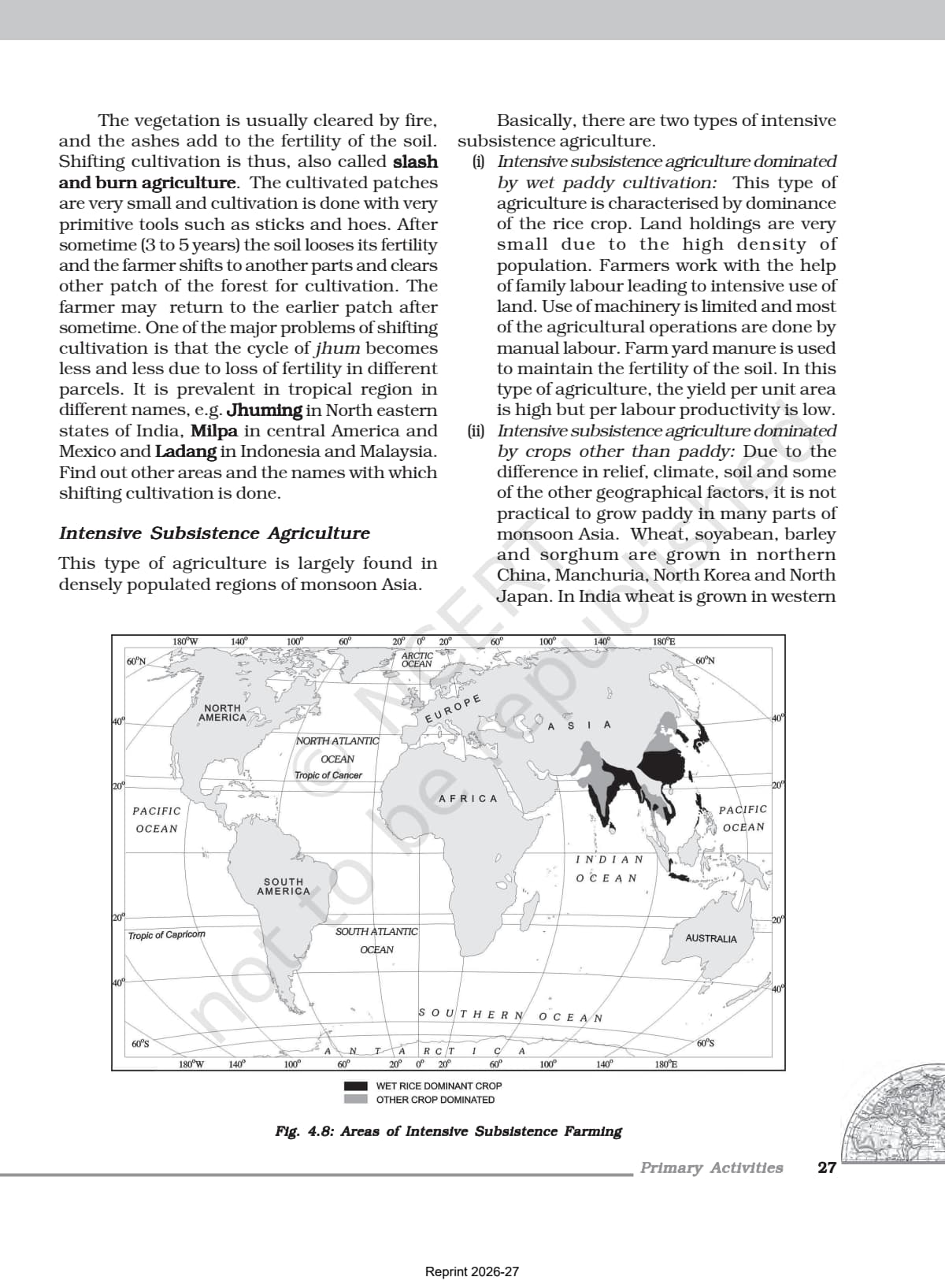
Primitive subsistence agriculture (shifting cultivation) clears vegetation by fire and crops a patch for three to five years before moving on; its local names are Jhuming (northeast India), Milpa (Central America and Mexico), and Ladang (Indonesia and Malaysia). Intensive subsistence agriculture is found in densely populated monsoon Asia, with tiny holdings, high yield per unit area but low yield per labour, and heavy family labour. Rice dominates wet areas, with wheat, soyabean, barley, and sorghum in drier parts.
Plantation and Commercial Agriculture
Plantation agriculture was introduced by Europeans in tropical colonies and features large estates, heavy capital, single-crop specialisation, cheap labour, and good transport links to factories and export markets (tea, coffee, rubber, cotton, oil palm, sugarcane). Extensive commercial grain cultivation runs on very large, fully mechanised farms with low yield per acre but high yield per person, in the Prairies, Steppes, Pampas, Velds, and Australian Downs.
Mining: Factors and Methods
Mining profitability depends on physical factors (size, grade, and mode of occurrence of the deposit) and economic factors (demand, technology, capital, and labour and transport costs). Open-cast (surface) mining is the cheapest method for minerals near the surface, with large, rapid output. Underground (shaft) mining is used when ore lies deep; shafts are sunk and galleries radiate out, but it is risky due to poisonous gases, fires, floods, and cave-ins.
Previous Year Question Trends From This Chapter
The primary activities class 12 important questions follow a steady pattern, and 2026-27 should look similar as no structural change has been announced. This chapter has carried 5 to 7 marks across recent papers, mostly through definition, short-answer, and comparison questions.
| Year | Marks | Question Types | Most Common Topic |
|---|---|---|---|
| 2025 | 6 | 2 MCQs + 1 short answer + 1 long answer | Types of agriculture; plantation features |
| 2024 | 5 | 1 MCQ + 2 short answers | Shifting cultivation names and regions; transhumance |
| 2023 | 5 | 2 MCQs + 1 short answer + 1 definition | Commercial livestock rearing vs nomadic herding; mining methods |
| 2022 | 7 | 1 MCQ + 2 short answers + 1 long answer | Agricultural systems; plantation crops by country |
| 2020 | 5 | 1 long answer + 1 MCQ | Features of plantation agriculture; extensive commercial grain farming |
The most repeated question type is a three or five mark question on the features of plantation agriculture or the difference between nomadic herding and commercial livestock rearing. Both need textbook phrasing and named examples, which come only from reading the official PDF.
Connecting This Chapter to the Rest of Fundamentals of Human Geography
Primary activities are the starting point of all economic geography, so this chapter feeds directly into the later chapters shown below.
| Later Chapter | Concept Inherited From Chapter 4 |
|---|---|
| Chapter 5: Secondary Activities | Raw materials from mining and agriculture form the input base for all manufacturing industries |
| Chapter 6: Tertiary and Quaternary Activities | Service sector growth is linked to reduced dependence on primary activities in high-HDI economies |
| Chapter 7: Transport and Communication | Plantation and commercial grain areas require bulk transport infrastructure to reach export markets |
| Chapter 8: International Trade | Primary commodities (wheat, coffee, rubber, minerals) form the export base of developing economies |
Quick Glossary From the NCERT Chapter
Learn to define each term in one line for one-mark MCQs and two-mark short answers, using the textbook phrasing.
- Primary activities: Economic activities directly dependent on the environment; they use earth's resources such as land, water, vegetation, building materials, and minerals.
- Red-collar workers: People engaged in primary activities; named for the outdoor nature of their work.
- Transhumance: Seasonal migration of herders from the plains to mountain pastures in summers and back in winters.
- Shifting cultivation: Primitive subsistence farming where vegetation is cleared by fire and a patch is cropped for 3-5 years before the farmer moves on.
- Plantation agriculture: Large-scale, single-crop farming introduced by Europeans in tropical colonies; large capital, cheap labour, export-oriented.
- Viticulture: The cultivation of grapes; a Mediterranean speciality used mainly for wine.
- Kolkhoz: The collective farming model of the erstwhile Soviet Union; based on social ownership and collective labour.
- Open-cast mining: Surface mining of minerals near the earth's surface; the cheapest and most rapid method.
Also Explore Other Resources for Class 12 Geography Chapter 4
| Resource | Link |
|---|---|
| NCERT Solutions | Class 12 Geography Chapter 4 NCERT Solutions |
| Revision Notes | Class 12 Geography Chapter 4 Notes |
| Handwritten Notes | Class 12 Geography Chapter 4 Handwritten Notes |
| Subject Hub | Class 12 Geography All Chapters |
All Chapters: Class 12 Geography NCERT Book PDF (Fundamentals of Human Geography)
| Chapter | NCERT Book PDF |
|---|---|
| Chapter 1 | Human Geography: Nature and Scope NCERT Book PDF |
| Chapter 2 | The World Population: Distribution, Density and Growth NCERT Book PDF |
| Chapter 3 | Human Development NCERT Book PDF |
| Chapter 4 | Primary Activities NCERT Book PDF (You are here) |
| Chapter 5 | Secondary Activities NCERT Book PDF |
| Chapter 6 | Tertiary and Quaternary Activities NCERT Book PDF |
| Chapter 7 | Transport and Communication NCERT Book PDF |
| Chapter 8 | International Trade NCERT Book PDF |
Frequently Asked Questions on Class 12 Geography Chapter 4 NCERT Book PDF
Ques. Where can students download the official NCERT Class 12 Geography Chapter 4 PDF?
Ans. Students can download the official primary activities class 12 NCERT book PDF directly from the download card at the top of this page. The PDF is the single-chapter file from the Fundamentals of Human Geography textbook, aligned to the 2026-27 CBSE syllabus.
Ques. What are primary activities according to the NCERT Class 12 Geography textbook?
Ans. According to the NCERT textbook, primary activities are economic activities that are directly dependent on the environment. They refer to the utilisation of earth's resources such as land, water, vegetation, building materials, and minerals. Primary activities include hunting and gathering, pastoral activities, fishing, forestry, agriculture, and mining and quarrying. People engaged in primary activities are called red-collar workers due to the outdoor nature of their work.
Ques. What is transhumance as explained in the NCERT Class 12 Geography Chapter 4?
Ans. Transhumance is the process of seasonal migration from plain areas to pastures on mountains during summers and back from mountain pastures to the plains during winters. In mountain regions like the Himalayas, Gujjars, Bakarwals, Gaddis, and Bhotiyas migrate upwards in summers and return to the plains in winters. In tundra regions, herders move from south to north in summers and from north to south in winters.
Ques. What are the local names for shifting cultivation mentioned in the NCERT Chapter 4?
Ans. Shifting cultivation is known by different names in different regions. It is called Jhuming in the north-eastern states of India, Milpa in Central America and Mexico, and Ladang in Indonesia and Malaysia. The practice is also called slash-and-burn agriculture because the vegetation is cleared by fire and the ashes add to the fertility of the soil.
Ques. What are the characteristic features of plantation agriculture according to NCERT Class 12?
Ans. According to the NCERT textbook, plantation agriculture is characterised by: (1) large estates or plantations; (2) large capital investment; (3) managerial and technical support; (4) scientific methods of cultivation; (5) single-crop specialisation (monoculture); (6) cheap labour; and (7) a good system of transportation linking estates to factories and export markets. Important plantation crops include tea, coffee, cocoa, rubber, cotton, oil palm, sugarcane, bananas, and pineapples.
Ques. How does the NCERT Class 12 Geography chapter distinguish between nomadic herding and commercial livestock rearing?
Ans. Nomadic herding is a primitive subsistence activity where herders move with their livestock in search of pastures and water. Herders rely on animals for food, clothing, shelter, tools, and transport. Commercial livestock rearing is more organised and capital intensive. It is practised on permanent ranches, animals are divided into fenced parcels, only one type of animal is reared, and products like meat, wool, hides, and skin are scientifically processed and exported. Countries like New Zealand, Australia, Argentina, Uruguay, and the USA are major commercial livestock rearing countries.
Ques. What are the two methods of mining explained in the NCERT Class 12 Geography Chapter 4?
Ans. The NCERT textbook explains two main methods of mining. Open-cast (surface) mining is the easiest and cheapest method for minerals occurring close to the surface. Overhead costs are low, and output is large and rapid. Underground (shaft) mining is used when ore lies deep below the surface. Vertical shafts are sunk and underground galleries radiate to reach the minerals. This method requires lifts, drills, haulage vehicles, and ventilation systems. It is riskier due to poisonous gases, fires, floods, and cave-ins.
Ques. What are the two factors that determine the profitability of mining according to the NCERT chapter?
Ans. According to the NCERT textbook, the profitability of mining depends on two main factors. Physical factors include the size, grade, and mode of occurrence of the mineral deposits. Economic factors include the demand for the mineral, the technology available and used, the capital required to develop infrastructure, and the labour and transport costs. Both sets of factors together determine whether mining a particular deposit is economically worthwhile.
Ques. What is the difference between intensive subsistence agriculture dominated by wet paddy and that dominated by other crops?
Ans. In wet paddy-dominated intensive subsistence agriculture, rice is the dominant crop. Land holdings are very small, farmers use family labour, machinery is limited, and yield per unit area is high but yield per labour is low. In intensive subsistence agriculture dominated by other crops, differences in relief, climate, and soil make paddy cultivation impractical. Crops like wheat, soyabean, barley, and sorghum are grown in northern China, Manchuria, North Korea, and North Japan. In India, wheat is grown in the western Indo-Gangetic plains and millets in dry parts of western and southern India.
Ques. Is the Class 12 Geography syllabus changing for 2026-27?
Ans. No major changes have been announced. The Fundamentals of Human Geography textbook chapter structure remains the same for 2026-27, and the official NCERT PDF available on this page is aligned to the 2026-27 CBSE syllabus. CBSE marking schemes continue to reward textbook phrasing in theory questions and specific named examples (like local names for shifting cultivation) from this chapter.
Ques. What is the best order to use the NCERT PDF, Notes, and Solutions for Class 12 Geography Chapter 4?
Ans. Read the NCERT PDF cold first, marking unfamiliar terms like transhumance, viticulture, Kolkhoz, and open-cast mining. Then open the Class 12 Geography Chapter 4 Notes alongside the PDF and build a comparison table of agricultural types. Attempt all exercise questions and verify them against the NCERT Solutions. Use the handwritten notes for last-mile revision the night before the exam.
Ques. How does CUET test Class 12 Geography Chapter 4 Primary Activities?
Ans. CUET Geography tests this chapter through MCQs on definitions (primary activities, red-collar workers, transhumance), local names for shifting cultivation (Jhuming, Milpa, Ladang), characteristic features of plantation agriculture, regions of commercial livestock rearing, differences between open-cast and shaft mining, and the types of intensive subsistence agriculture. All questions are drawn from the NCERT textbook, so reading the official PDF is the most effective preparation for both CUET and the CBSE board exam.



Comments