




The NCERT Book for Class 10 Science Chapter 6 Control and Coordination is the official CBSE textbook chapter, free to read and download for the 2026-27 session. This chapter explains how living bodies sense changes and respond to them, through the nervous system and the endocrine (hormone) system in animals, and through chemical signals and tropic movements in plants.
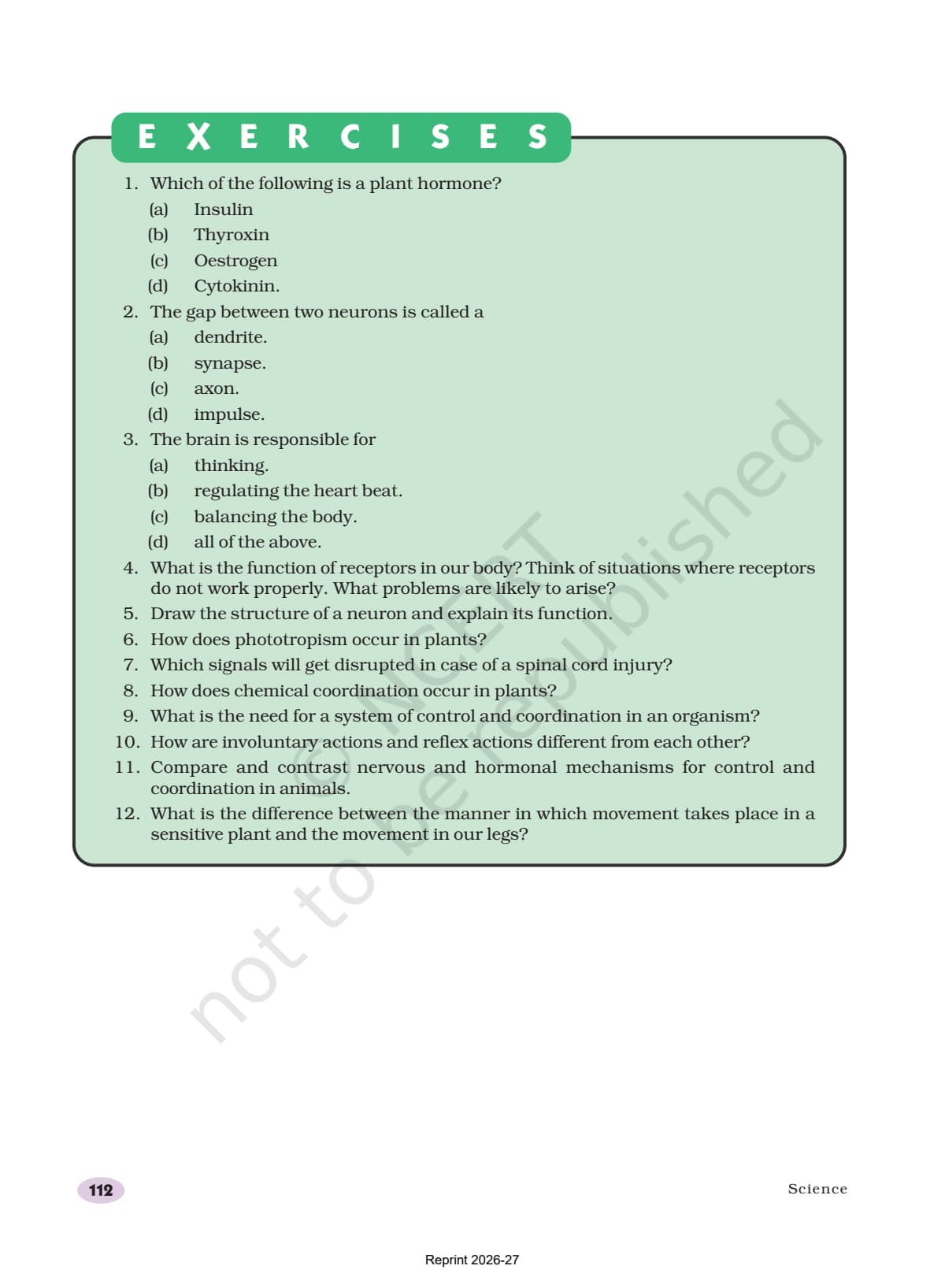
- Official NCERT textbook PDF of Chapter 6, with every activity, figure, in-text question and exercise exactly as printed.
- Covers the neuron and synapse, reflex action and the reflex arc, the human brain, plant tropisms and plant hormones, and animal hormones like adrenaline, thyroxin and insulin.
- Aligned with the 2026-27 CBSE Class 10 Science syllabus, useful for board exam revision and as the base text for the solutions and notes.
This page hosts the official NCERT Class 10 Science textbook chapter, mapped to the 2026-27 CBSE syllabus and checked page by page against the printed Control and Coordination chapter.
Student Feedback: What 12,600 students told us about this chapter
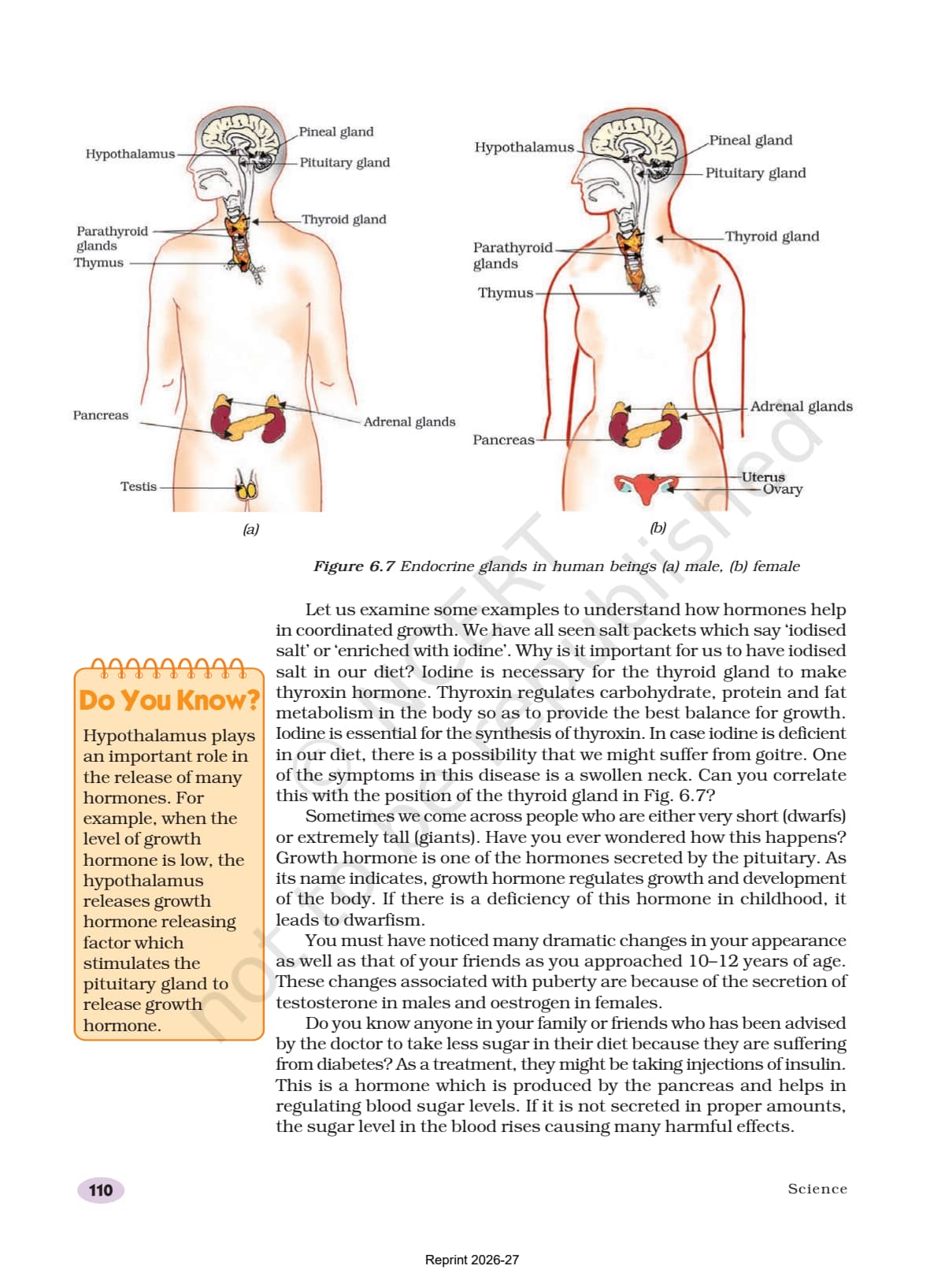
74% of Class 10 students said the reflex arc, the parts of the human brain and the endocrine gland diagram were the parts of this chapter they mixed up most in class tests. 3 out of 5 students told us that labelling the official NCERT figures (Fig. 6.2 reflex arc, Fig. 6.3 human brain, Fig. 6.7 endocrine glands) themselves, instead of just reading them, was what finally made the chapter stick.
Students reported spending on average 4 to 5 hours on the full chapter across the first read and revision, and toppers said reading the official book diagrams for the neuron, the brain and the glands stopped them from naming the wrong part or the wrong hormone in the board exam.
Source: 2026-27 Class 10 Science student poll. Sample of 12,600 students from CBSE schools across 13 states, taken before the 2026 board exams.
What the NCERT Book for Class 10 Science Chapter 6 Control and Coordination Covers
The PDF above is the complete official NCERT chapter, as printed in the 2026-27 textbook. It builds from the two control systems of animals, the fast nervous system and the slower hormonal system, to how plants coordinate without nerves.
- Animals: nervous system: the neuron, the synapse, the reflex arc and the human brain.
- Coordination in plants: the touch response of the sensitive plant and the growth-based tropic movements.
- Hormones in animals: the endocrine glands and key hormones, adrenaline, thyroxin, growth hormone and insulin.
Control and Coordination Class 10 Science Full Chapter Video
Source: Magnet Brains on YouTube
What is Control and Coordination in Class 10 Science Chapter 6
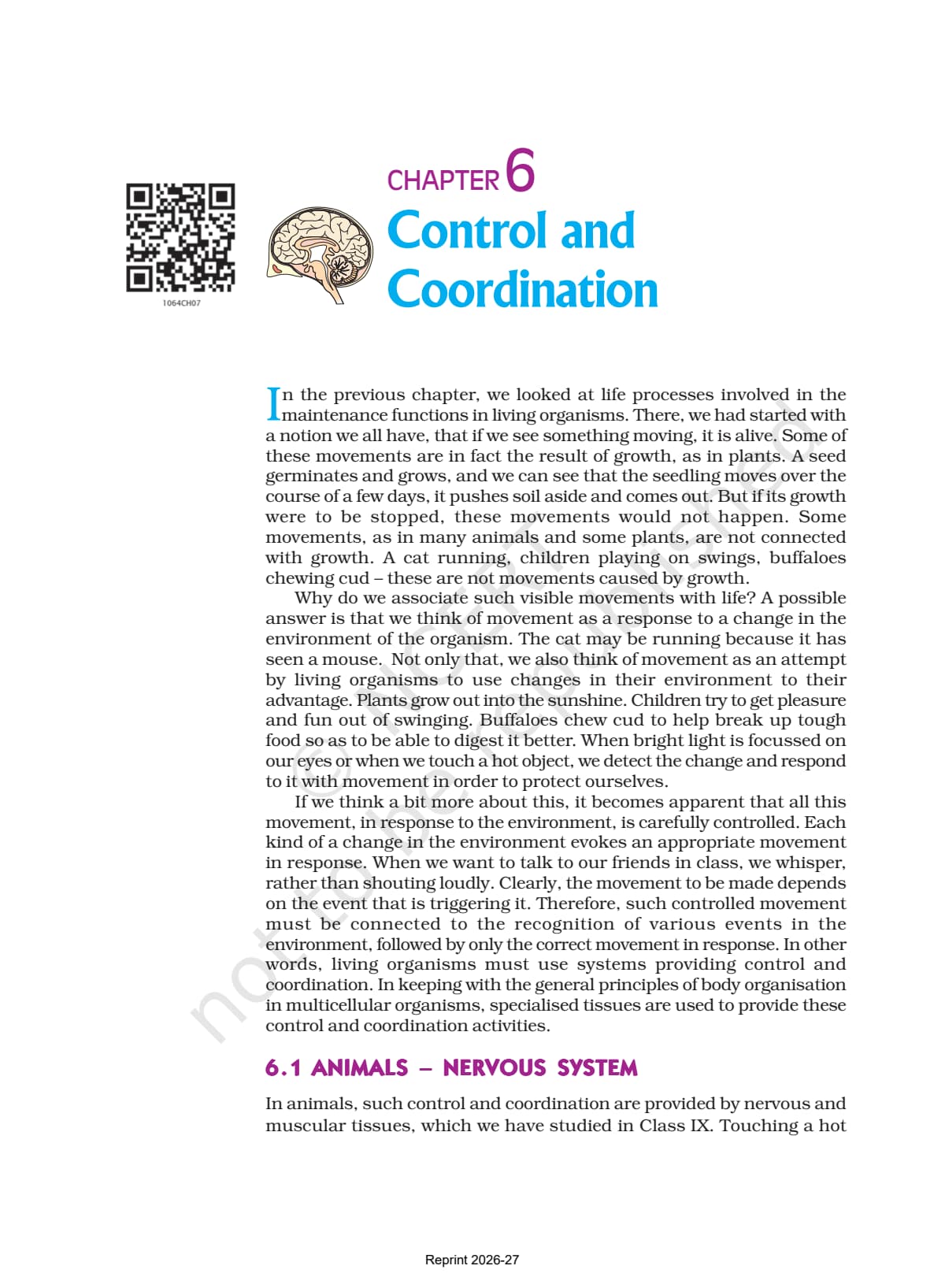
A cat running or a plant bending to light are responses to a change in the surroundings. Every change in the environment, called a stimulus, needs a controlled, matching response, and the systems that recognise the change and produce that response are called control and coordination.
| System | Found in | Speed | Carrier |
|---|---|---|---|
| Nervous system | Animals only | Very fast | Electrical impulses along neurons |
| Endocrine (hormone) system | Animals | Slower, longer-lasting | Chemical hormones in the blood |
| Chemical coordination in plants | Plants only | Slow | Plant hormones diffusing cell to cell |
Animals coordinate using nervous and muscular tissue, but plants have neither, so they rely on chemical signals and on changing the water in their cells. The nervous system gives quick responses; hormones give slower, body-wide control.
Nervous System: The Neuron and the Synapse in Class 10 Science
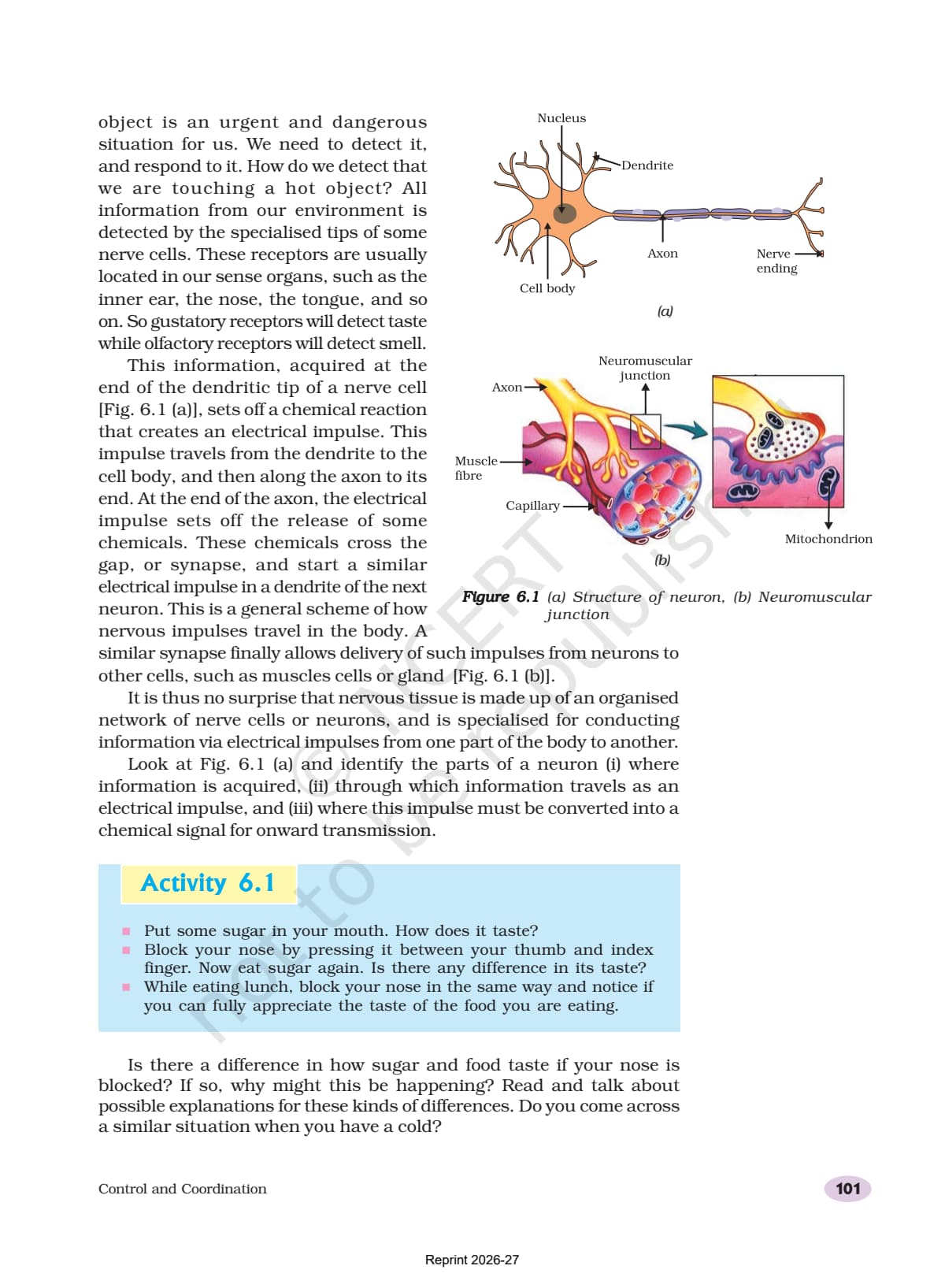
Information from the environment is detected by the tips of special nerve cells called receptors in the sense organs, for example gustatory receptors for taste and olfactory receptors for smell. The basic unit of the nervous system is the nerve cell or neuron.
| Part of the neuron | What it does |
|---|---|
| Dendrite | The tip where information is picked up, setting off a chemical reaction |
| Cell body | Holds the nucleus; the impulse passes from the dendrite into the cell body |
| Axon | Carries the electrical impulse away from the cell body to the nerve ending |
| Nerve ending (synapse) | Releases chemicals to pass the impulse to the next neuron or to a muscle |
Information at the dendrite sets off a chemical change that creates an electrical impulse, which moves to the cell body and along the axon. At the axon's end the impulse releases chemicals that cross the gap, called a synapse, and start a fresh impulse in the next neuron's dendrite. A similar synapse lets the impulse reach a muscle or gland. Because chemicals are released on one side only, the impulse travels in one direction.
Reflex Action and the Reflex Arc in Class 10 Science
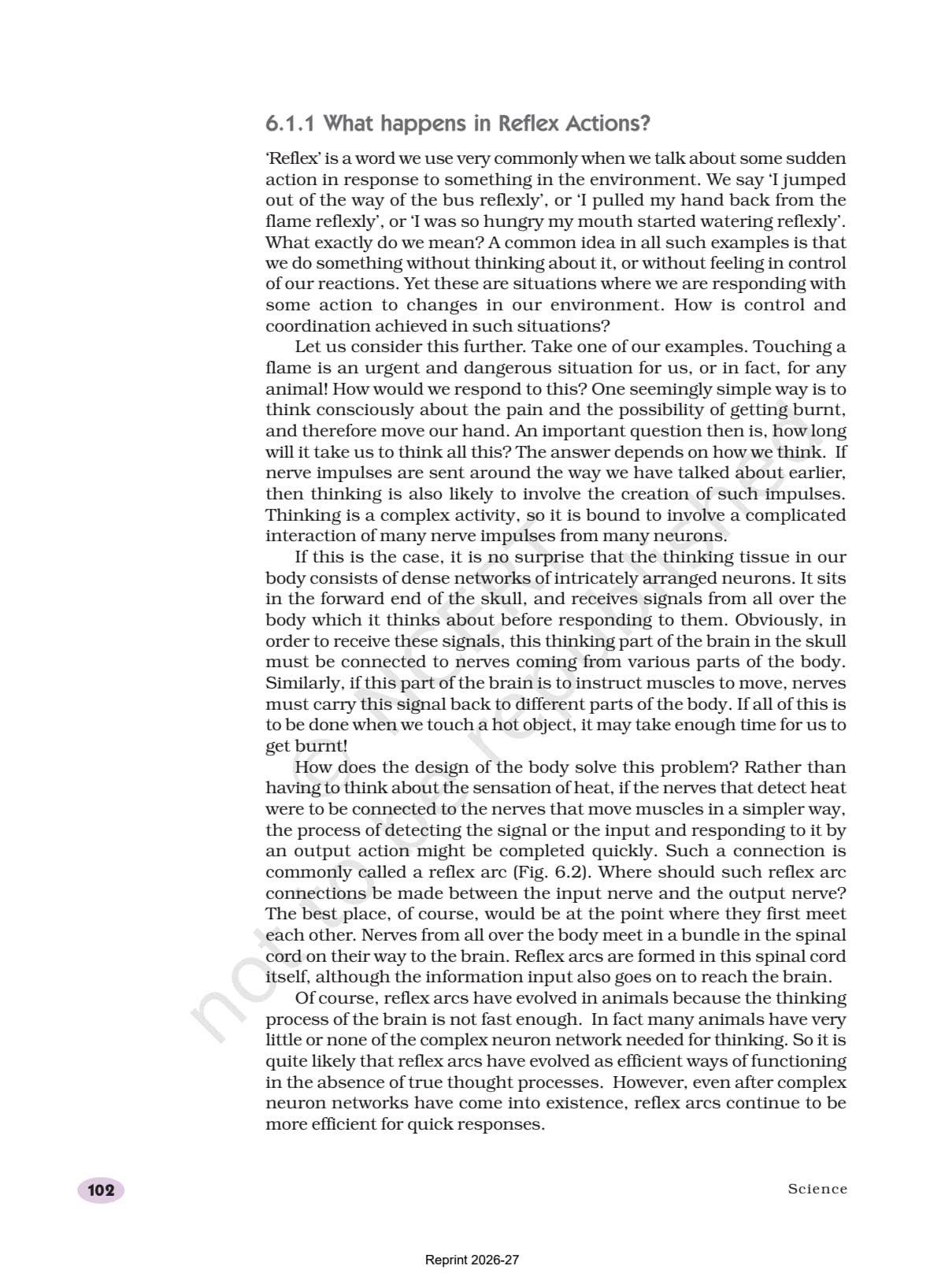
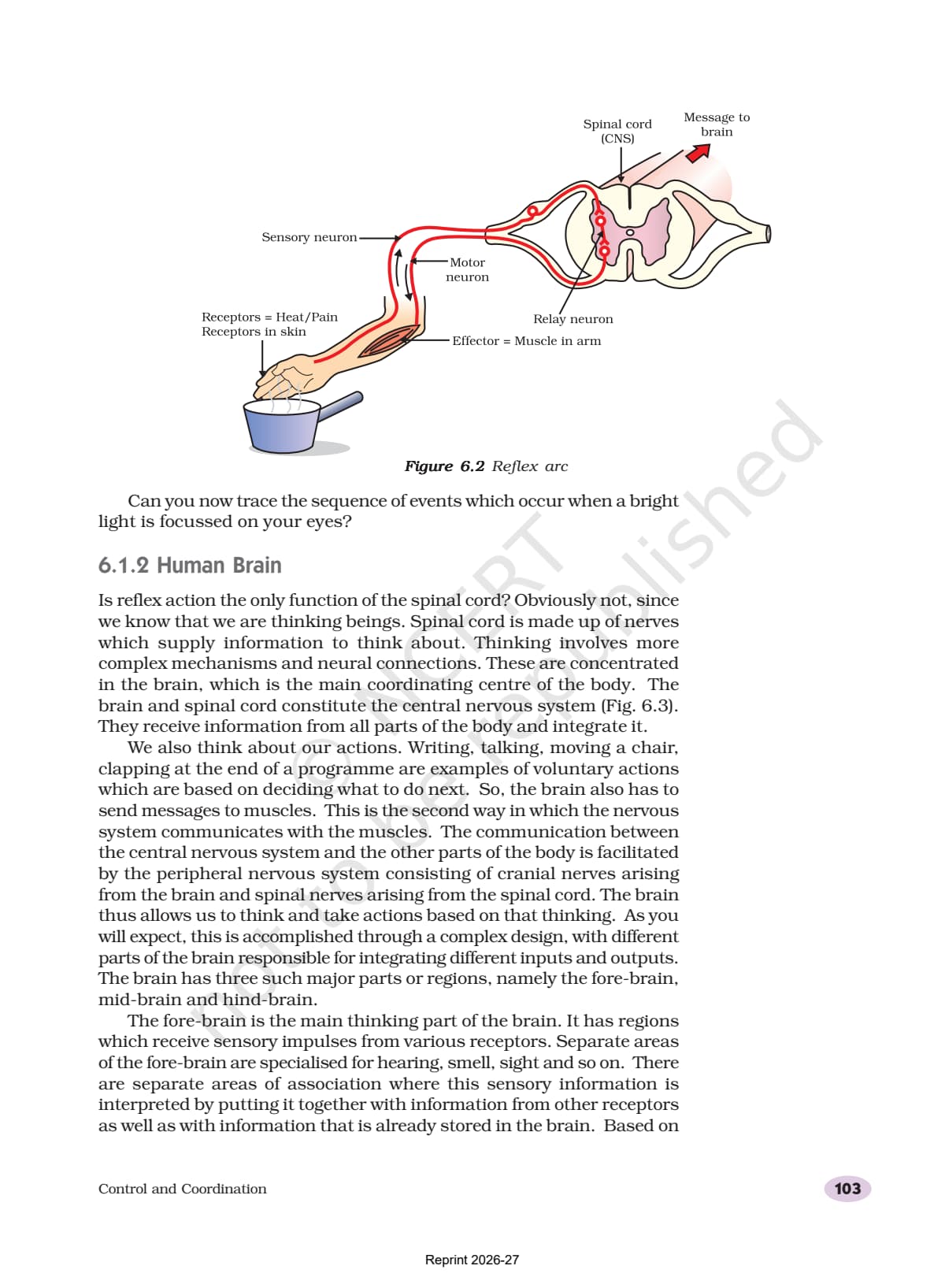
A reflex action is a sudden, automatic response to a stimulus, like pulling your hand back from a flame. Thinking is slow because it needs many neurons, and for a dangerous stimulus the body cannot wait. Instead, the nerves that detect the stimulus connect to the nerves that move the muscles through a short path called a reflex arc, so the response is quick.
The reflex arc is built in the spinal cord, where nerves meet on their way to the brain. Naming this fixed sequence is a high-frequency board question.
| Step | Part involved | What it does |
|---|---|---|
| 1. Receptor | Heat or pain receptors in the skin | Detect the stimulus, for example a hot object |
| 2. Sensory neuron | Carries the impulse inward | Takes the message to the spinal cord |
| 3. Relay neuron | Inside the spinal cord | Connects the sensory neuron to the motor neuron |
| 4. Motor neuron | Carries the impulse outward | Takes the order to the muscle |
| 5. Effector | Muscle in the arm | Contracts and pulls the hand away |
The information also reaches the brain, so we feel the pain a moment later, but the protective movement has already happened. Reflex arcs evolved because thinking is not fast enough, and many simple animals have little thinking tissue.
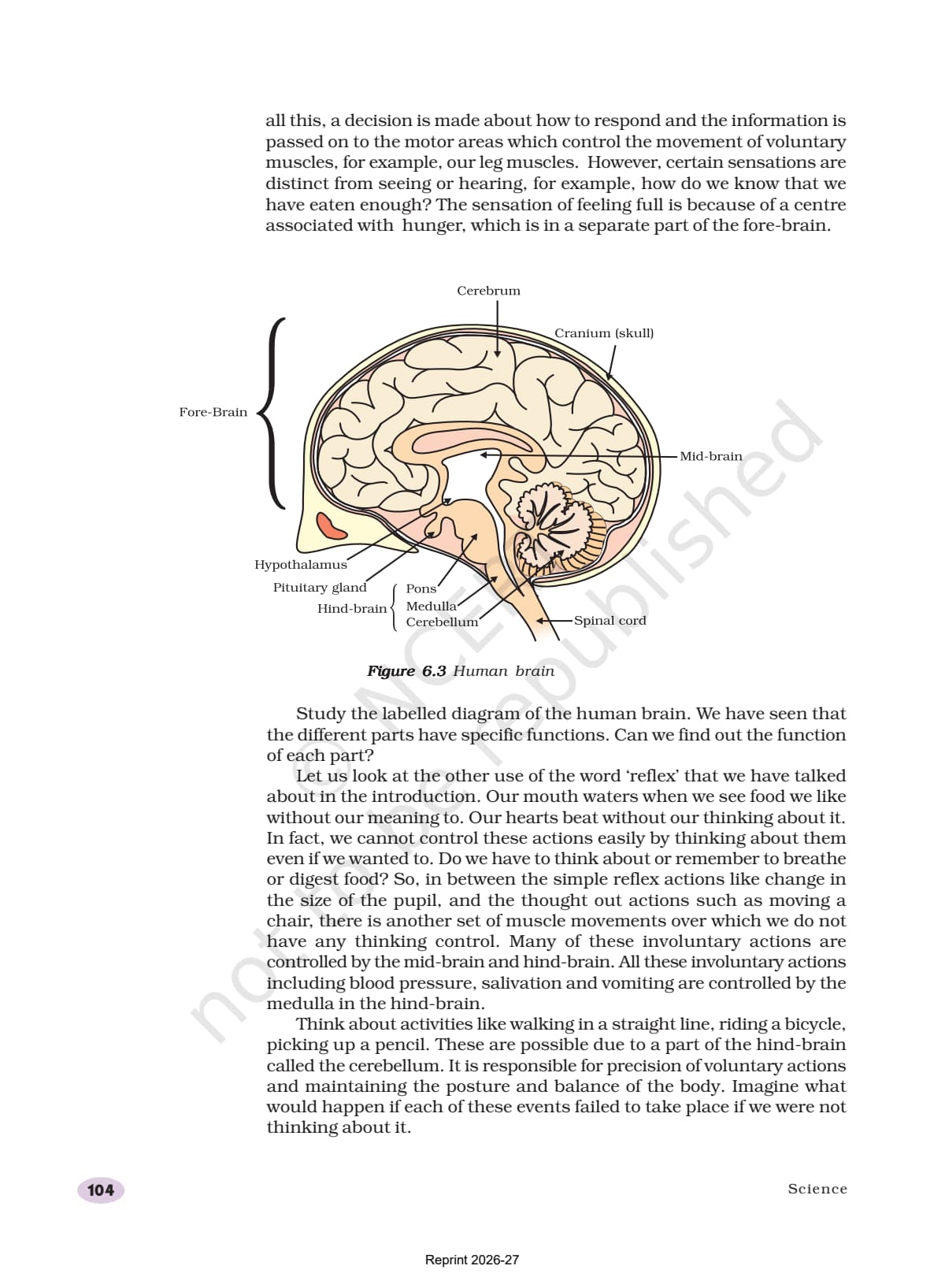
The Human Brain in Class 10 Science Chapter 6 Control and Coordination
The brain is the main coordinating centre, and with the spinal cord forms the central nervous system. The peripheral nervous system, made of cranial and spinal nerves, links it to the body. The textbook divides the brain into three regions, and matching each to its job is the core of this section.
| Brain region | Main job | Examples |
|---|---|---|
| Fore-brain | Thinking, sensing, voluntary action and hunger | Hearing, smell, sight, deciding to move a chair, feeling full |
| Mid-brain | Controls some involuntary actions | Reflex movements of the head, neck and eye |
| Hind-brain (medulla) | Controls vital involuntary actions | Blood pressure, salivation, vomiting, heartbeat |
| Hind-brain (cerebellum) | Precision of voluntary action, posture and balance | Walking straight, riding a bicycle, picking up a pencil |
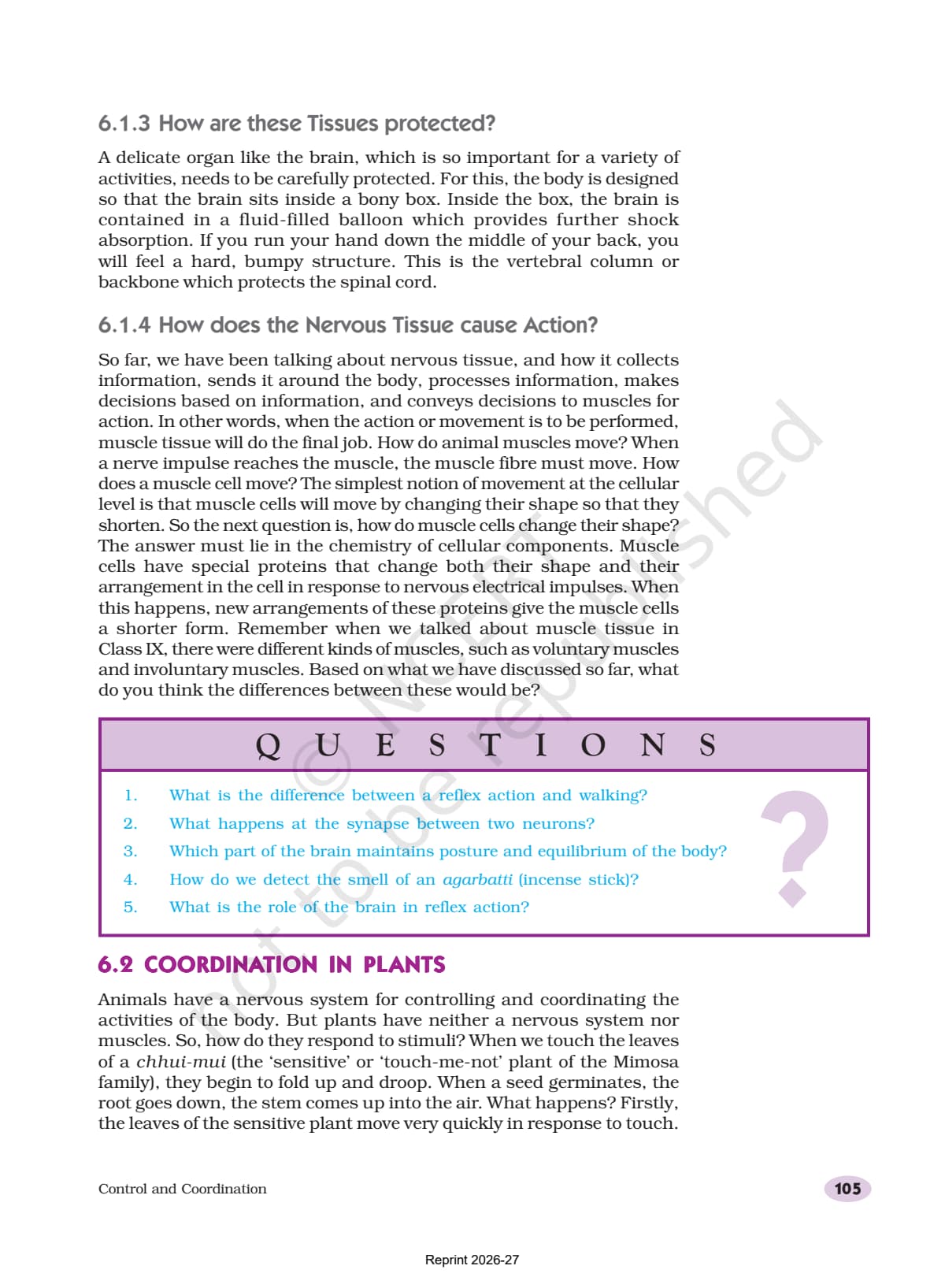
The textbook also separates three kinds of action. Voluntary actions like writing or talking are decided by the fore-brain. Involuntary actions like heartbeat, breathing and digestion go on without our control, managed by the mid-brain and hind-brain. Reflex actions like the knee-jerk are the fastest of all and use the spinal cord. The delicate brain is protected by the bony skull and a fluid-filled balloon for shock absorption, while the spinal cord is protected by the vertebral column or backbone.
- Fore-brain: the main thinking part, with separate areas for hearing, smell and sight, plus a centre for hunger.
- Medulla (hind-brain): runs blood pressure, salivation and vomiting, all without any thinking.
- Cerebellum (hind-brain): keeps posture and balance and makes voluntary actions smooth and precise.
Coordination in Plants: Tropic Movements in Class 10 Science
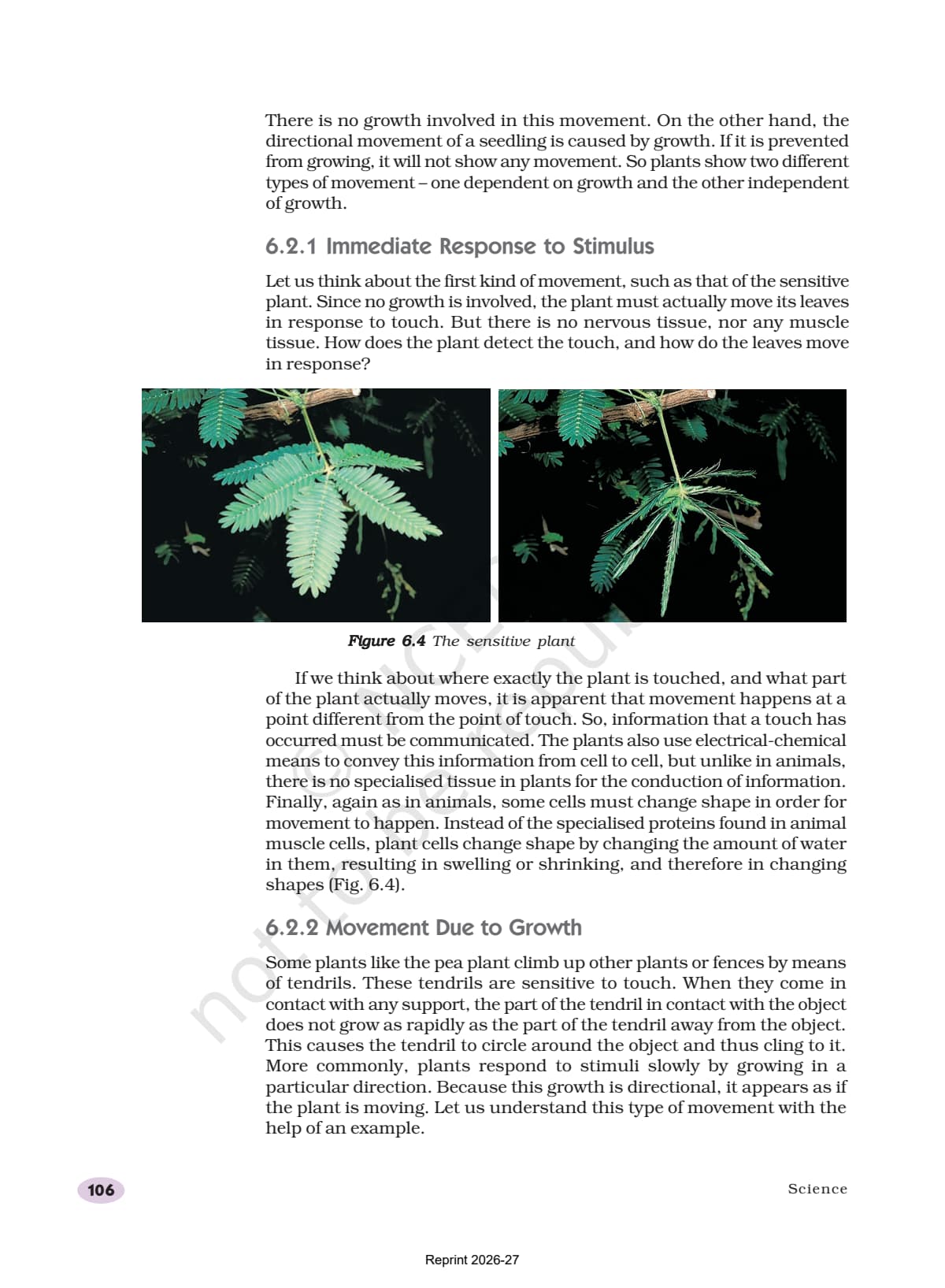
Section 6.2 turns to plants, which have neither a nervous system nor muscles, yet still respond to the world. The textbook gives two clear examples: the leaves of a chhui-mui (the touch-me-not or sensitive plant) fold quickly when touched, and a germinating seed sends its root down and its shoot up. Plants show two kinds of movement, one that does not depend on growth, like the touch-me-not folding, and one that depends on growth, like a shoot bending toward light.
The sensitive plant's quick response is an immediate response to stimulus. There is no nervous tissue, so the plant uses electrical-chemical signals from cell to cell, and the cells move by changing the amount of water in them, which makes them swell or shrink. The slower, growth-based responses are called tropic movements, and they are directional.
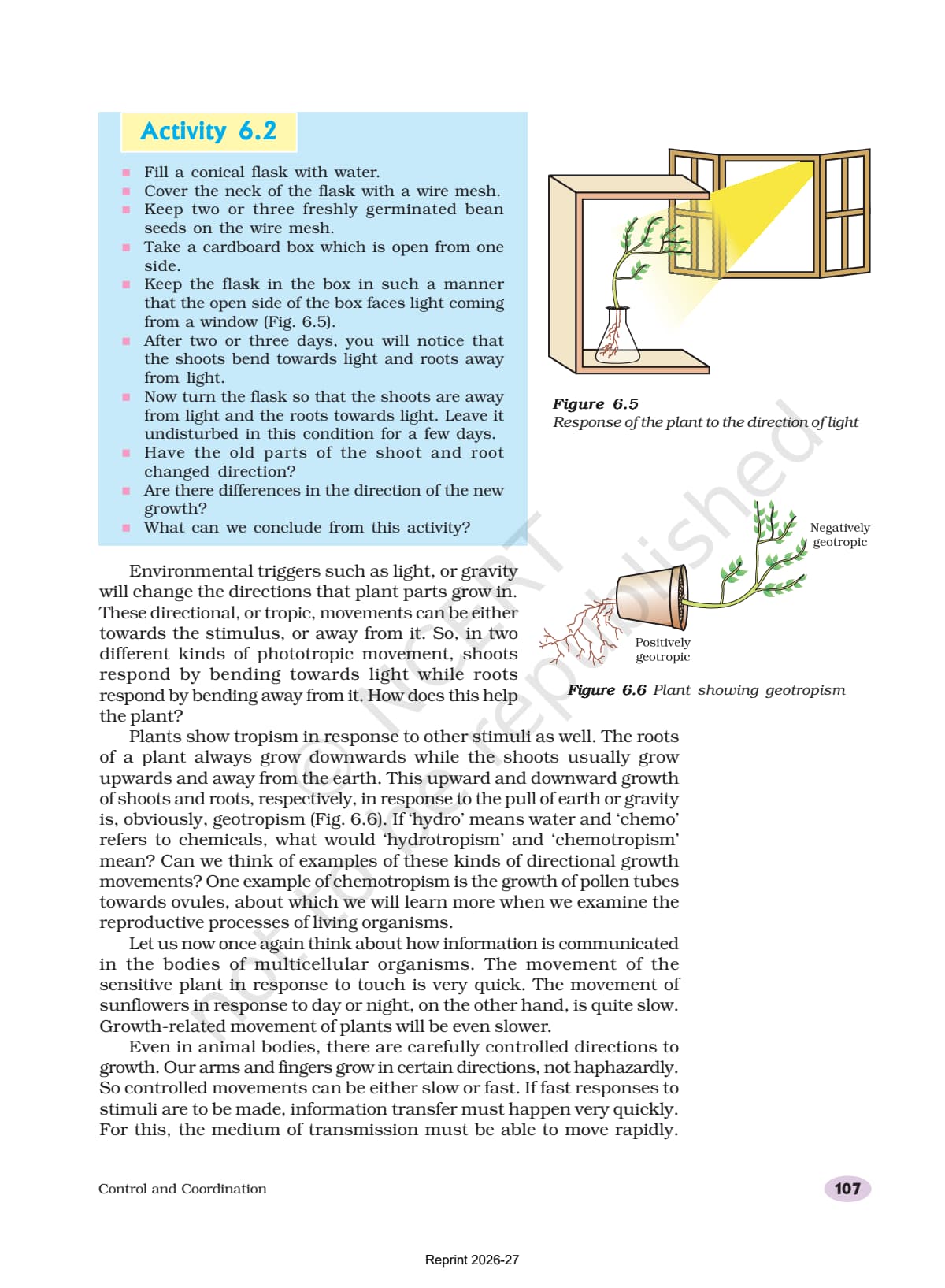
| Tropism | Stimulus | How the plant responds |
|---|---|---|
| Phototropism | Light | Shoots bend toward light; roots bend away from it |
| Geotropism | Gravity | Roots grow downward (positive); shoots grow upward (negative) |
| Hydrotropism | Water | Roots grow toward water in the soil |
| Chemotropism | Chemicals | The pollen tube grows toward the ovule |
A tropic movement can be toward the stimulus (positive) or away from it (negative). A climbing tendril is touch-sensitive: when it meets a support, the side touching the support grows more slowly than the far side, so the tendril curls around and clings. This directional growth, faster on one side than the other, is what makes the plant appear to move, even though it is really growing.
Plant Hormones in Class 10 Science Chapter 6 Control and Coordination
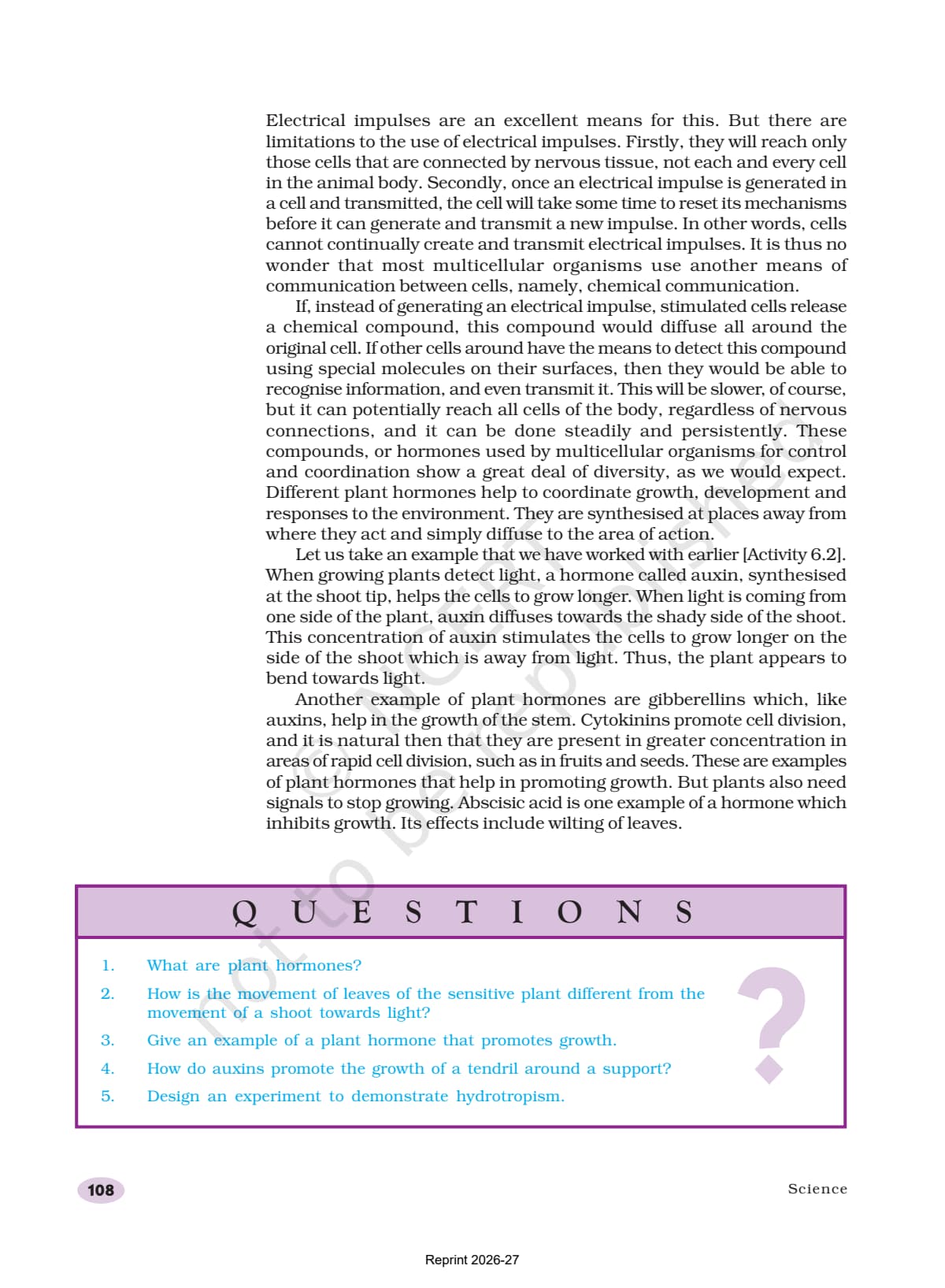
Plants coordinate slowly using chemical signals called plant hormones (phytohormones). They are made at one place, often the tip of a shoot, and simply diffuse to the area where they act. The textbook explains the bending toward light with the hormone auxin: when light falls on one side, auxin moves to the shady side and makes those cells grow longer, so the shoot bends toward the light.
| Plant hormone | Main function |
|---|---|
| Auxin | Made at the shoot tip; helps cells grow longer and drives the bending toward light |
| Gibberellin | Helps in the growth of the stem |
| Cytokinin | Promotes cell division; found where cells divide fast, as in fruits and seeds |
| Abscisic acid | Inhibits growth; causes wilting of leaves (a stop signal) |
The four plant hormones split neatly into two groups. Auxin, gibberellin and cytokinin promote growth in different ways, while abscisic acid works the other way and stops growth. Auxin makes cells longer, cytokinin makes cells divide, gibberellin lengthens the stem, and abscisic acid is the brake that triggers wilting. Because hormones reach cells by slow diffusion through the blood-free plant body, plant coordination is steady and gradual, not fast like an animal's reflex.
Hormones in Animals: The Endocrine System in Class 10 Science
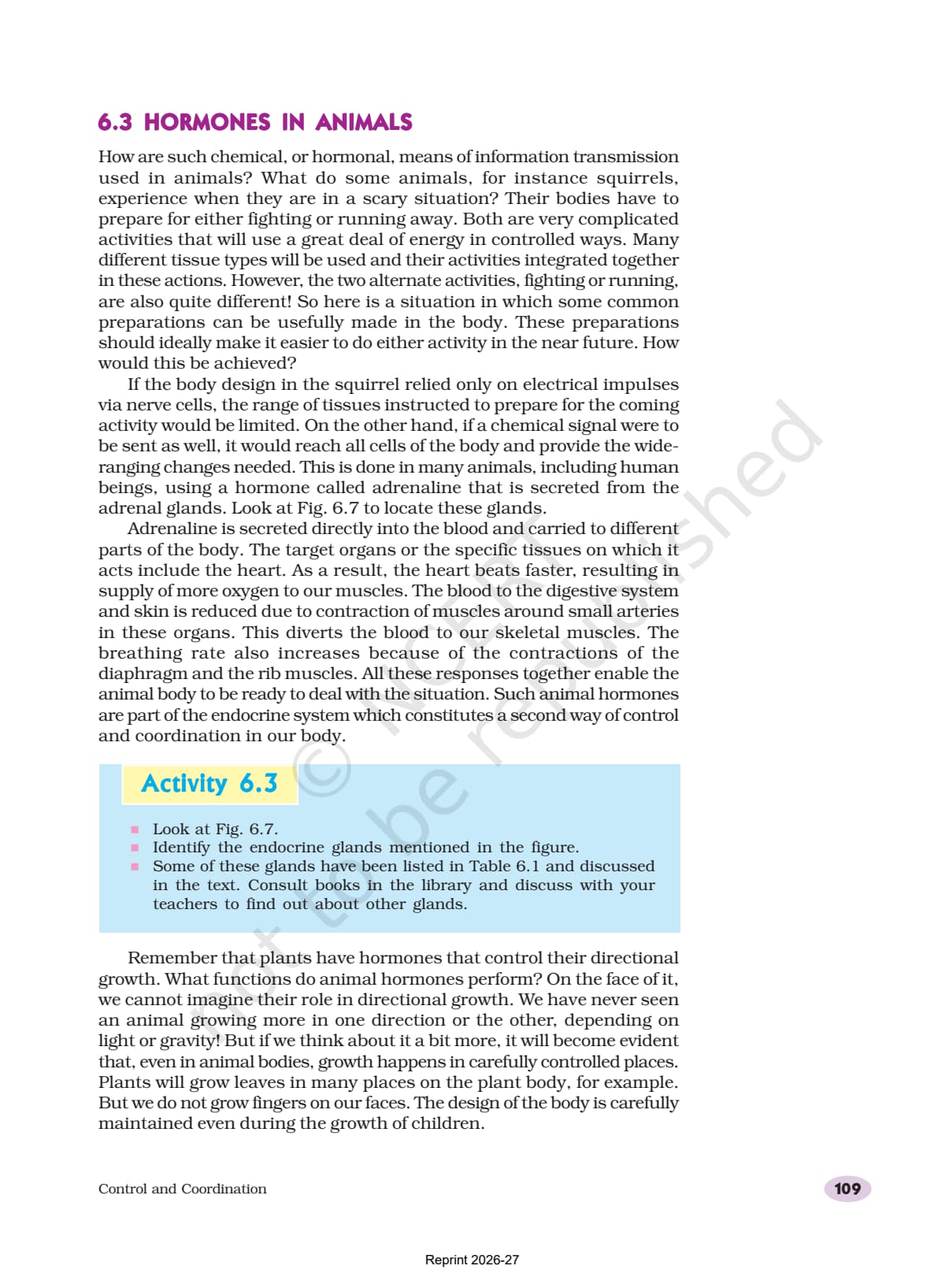
Section 6.3 covers the second control system of animals, chemical coordination through hormones. These are secreted by endocrine glands directly into the blood, which carries them to a target organ where they act. The classic example is a scared squirrel: the hormone adrenaline from the adrenal glands speeds up the heart, raises the breathing rate and diverts blood to the muscles, getting the body ready to fight or run.
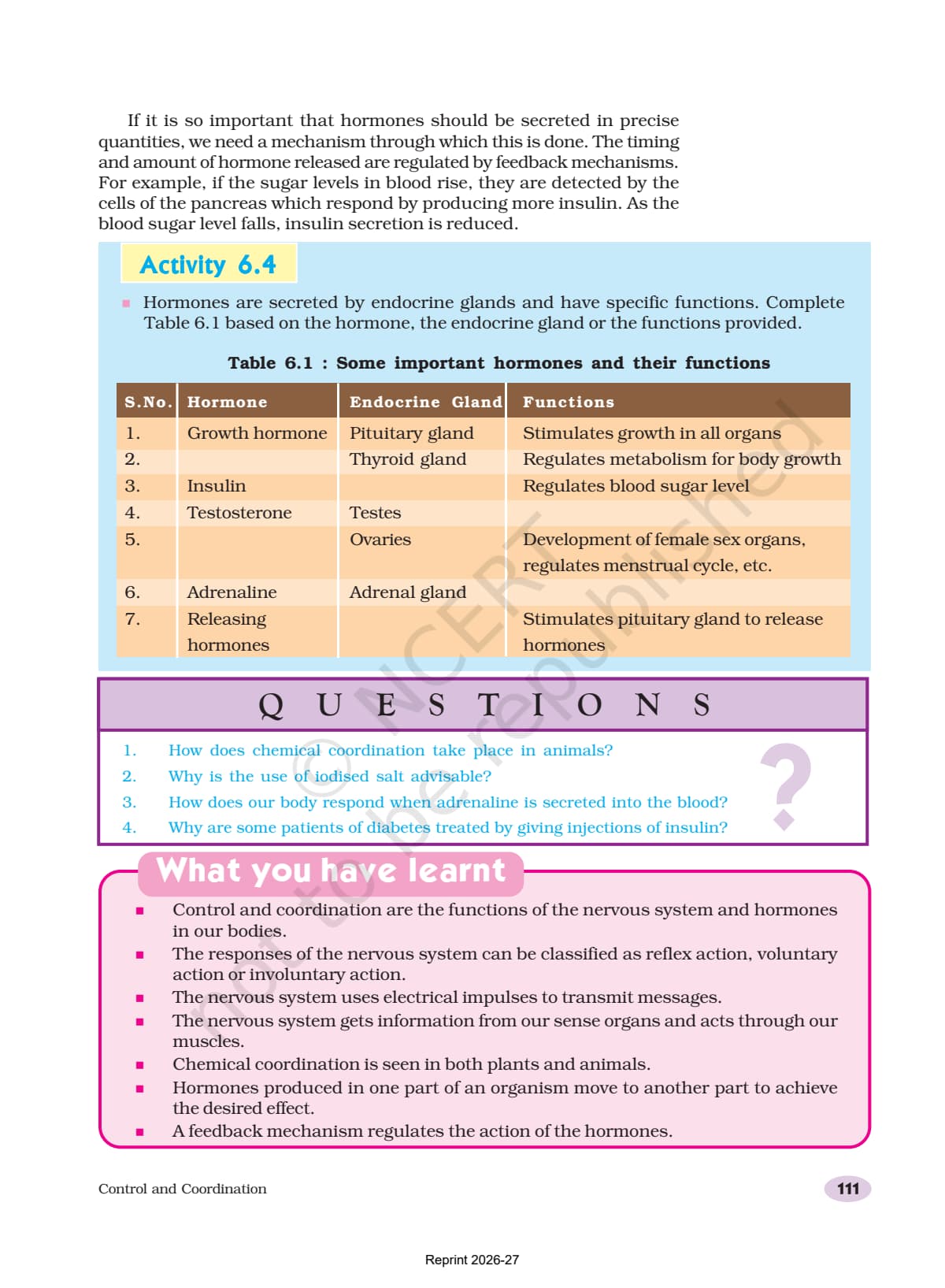
| Hormone | Gland | Main function |
|---|---|---|
| Growth hormone | Pituitary gland | Regulates growth and development; too little in childhood causes dwarfism |
| Thyroxin | Thyroid gland | Regulates carbohydrate, protein and fat metabolism; needs iodine |
| Insulin | Pancreas | Regulates blood sugar; too little causes diabetes |
| Adrenaline | Adrenal gland | Prepares the body for fight or run in a scary situation |
| Testosterone / Oestrogen | Testes / Ovaries | Bring the changes of puberty in males and females |
The textbook explains why iodised salt matters: iodine is needed to make thyroxin, and too little iodine can cause goitre, a swollen neck. It also notes that insulin from the pancreas keeps blood sugar in check, and a shortage causes diabetes, treated with insulin injections. The amount of each hormone is kept right by a feedback mechanism: when blood sugar rises, the pancreas makes more insulin, and as the sugar falls, insulin secretion drops again.
- Endocrine glands pour hormones straight into the blood, so they reach all cells, unlike nerves that reach only connected cells.
- Thyroxin needs iodine; an iodine-poor diet can cause goitre, which is why iodised salt is advised.
- Feedback control keeps hormone levels precise, raising or lowering secretion as the body's need changes.
Other Resources for Class 10 Science Chapter 6 Control and Coordination
Read the official NCERT Book chapter above, then revise with the matching NCERT Solutions, revision notes, formula sheet and handwritten notes. All resources for Class 10 Science Chapter 6 Control and Coordination are linked in the table below.
| Resource | What it covers | Open |
|---|---|---|
| NCERT Book PDF | Official Class 10 Science Chapter 6 textbook, with every activity, figure and exercise. | You are here |
| NCERT Solutions | Step-by-step answers to all in-text and exercise questions of the chapter. | Class 10 Science Chapter 6 NCERT Solutions |
| Notes | Concept-first revision notes on the nervous system, plant coordination and hormones. | Class 10 Science Chapter 6 Notes |
| Formula Sheet | Quick reference of key terms, glands, hormones and diagrams for fast revision. | Class 10 Science Chapter 6 Formula Sheet |
| Handwritten Notes | Scanned-style handwritten pages for last-minute board revision. | Class 10 Science Chapter 6 Handwritten Notes |
NCERT Book for Class 10 Science: All Chapters
Related Links: Use the table below to open the official NCERT Book PDF for the other chapters of Class 10 Science. Every chapter ships with the same official textbook PDF, chapter overview, and board-ready FAQ.
| Chapter | NCERT Book PDF link |
|---|---|
| Chapter 1 | Chemical Reactions and Equations NCERT Book PDF |
| Chapter 2 | Acids, Bases and Salts NCERT Book PDF |
| Chapter 3 | Metals and Non-metals NCERT Book PDF |
| Chapter 4 | Carbon and its Compounds NCERT Book PDF |
| Chapter 5 | Life Processes NCERT Book PDF |
| Chapter 6 | Control and Coordination NCERT Book PDF (You are here) |
| Chapter 7 | How do Organisms Reproduce NCERT Book PDF |
| Chapter 8 | Heredity NCERT Book PDF |
| Chapter 9 | Light Reflection and Refraction NCERT Book PDF |
| Chapter 10 | The Human Eye and the Colourful World NCERT Book PDF |
| Chapter 11 | Electricity NCERT Book PDF |
| Chapter 12 | Magnetic Effects of Electric Current NCERT Book PDF |
| Chapter 13 | Our Environment NCERT Book PDF |
NCERT Book Class 10 Science Chapter 6 Control and Coordination FAQs
Ques. What does Chapter 6 Control and Coordination cover in the Class 10 Science NCERT Book?
Ans. Chapter 6 of the Class 10 Science NCERT Book covers how living bodies sense changes and respond to them. It begins by explaining what control and coordination mean and why animals use a fast nervous system as well as slower hormones. It then covers the nervous system, the structure of a neuron, the synapse, reflex action and the reflex arc, and the human brain with its fore-brain, mid-brain and hind-brain. The chapter goes on to coordination in plants through tropic movements and plant hormones, and ends with hormones in animals, the endocrine glands and key hormones such as adrenaline, thyroxin and insulin. The chapter is aligned with the 2026-27 CBSE syllabus.
Ques. What is a reflex action and what is the reflex arc in Class 10 Science Chapter 6?
Ans. A reflex action is a sudden and automatic response to a stimulus, such as pulling your hand back from a hot object before you fully feel the pain. It is fast because the response is not decided by the brain. The path it follows is called the reflex arc, and it runs in order: the receptors in the skin detect the heat, a sensory neuron carries the impulse to the spinal cord, a relay neuron connects it to a motor neuron, and the motor neuron makes the effector muscle in the arm contract and pull the hand away. The information also travels on to the brain, so we feel the pain a moment later, but the protective movement has already happened in the spinal cord.
Ques. What are the three main parts of the human brain and their functions?
Ans. The human brain has three major regions. The fore-brain is the main thinking part, with separate areas for hearing, smell and sight, a centre for hunger, and the control of voluntary actions like writing or moving a chair. The mid-brain controls some involuntary actions such as reflex movements of the head and eyes. The hind-brain has the medulla, which controls vital involuntary actions like blood pressure, salivation and vomiting, and the cerebellum, which looks after posture, balance and the precision of voluntary actions such as walking straight or riding a bicycle. The brain and the spinal cord together form the central nervous system.
Ques. How do plants respond to stimuli without a nervous system in Class 10 Science Chapter 6?
Ans. Plants have neither a nervous system nor muscles, so they coordinate using chemical signals and by changing the amount of water in their cells. They show two kinds of movement. One is independent of growth, like the quick folding of the touch-me-not plant's leaves when touched, where cells move by swelling or shrinking with water. The other is a slow, growth-dependent movement called a tropic movement, such as a shoot bending toward light (phototropism), roots growing downward with gravity (geotropism), roots growing toward water (hydrotropism) and a pollen tube growing toward the ovule (chemotropism). Plant hormones like auxin control this directional growth.
Ques. What are plant hormones and what does each one do in Class 10 Science?
Ans. Plant hormones, or phytohormones, are chemical signals that help plants coordinate growth and respond to the environment. There are four main ones. Auxin is made at the shoot tip and helps cells grow longer, which is what makes a shoot bend toward light. Gibberellin helps the stem grow. Cytokinin promotes cell division and is found where cells divide fast, such as in fruits and seeds. Abscisic acid works the other way and inhibits growth, and its effects include the wilting of leaves. A simple way to remember them is three to grow, auxin, gibberellin and cytokinin, and one to stop, abscisic acid.
Ques. Why is the use of iodised salt advised in Class 10 Science Chapter 6?
Ans. Iodised salt is advised because iodine is needed by the thyroid gland to make the hormone thyroxin. Thyroxin regulates the metabolism of carbohydrates, proteins and fats so the body grows in a balanced way. If the diet does not have enough iodine, the body cannot make enough thyroxin, and this can cause a disease called goitre, one symptom of which is a swollen neck. Using iodised salt makes sure the diet has enough iodine to keep thyroxin production normal, which is why the salt packets you see in shops are often labelled iodised or enriched with iodine.
Ques. Is the Class 10 Science Chapter 6 NCERT Book PDF free to download for 2026-27?
Ans. Yes. The official NCERT Book PDF for Class 10 Science Chapter 6 Control and Coordination is free to read and download on this page for the 2026-27 session. It is the complete chapter as printed in the CBSE textbook, including every activity, figure, in-text question and end-of-chapter exercise. You can pair the book with the linked NCERT Solutions and revision notes for the same chapter so that you read the textbook and revise from one place before the board exam.
Ques. Are these NCERT Book contents aligned with the 2026-27 CBSE syllabus?
Ans. Yes. This page hosts the official NCERT Class 10 Science textbook chapter for the current 2026-27 CBSE syllabus. The Control and Coordination chapter is unchanged for this cycle, so the nervous system, plant coordination and hormone content you read here is exam-correct. Because it is the official book, it is the safest base text for board preparation, and the linked solutions, notes and formula sheet for the same chapter all follow this textbook order.



Comments