




The NCERT Book for Class 10 Maths Chapter 11 Areas Related to Circles is the official CBSE textbook chapter, free to read and download for 2026-27. It builds on your circle geometry from Chapter 10. You learn to find the area and perimeter of sectors, segments, and figures that mix circular parts with other shapes.
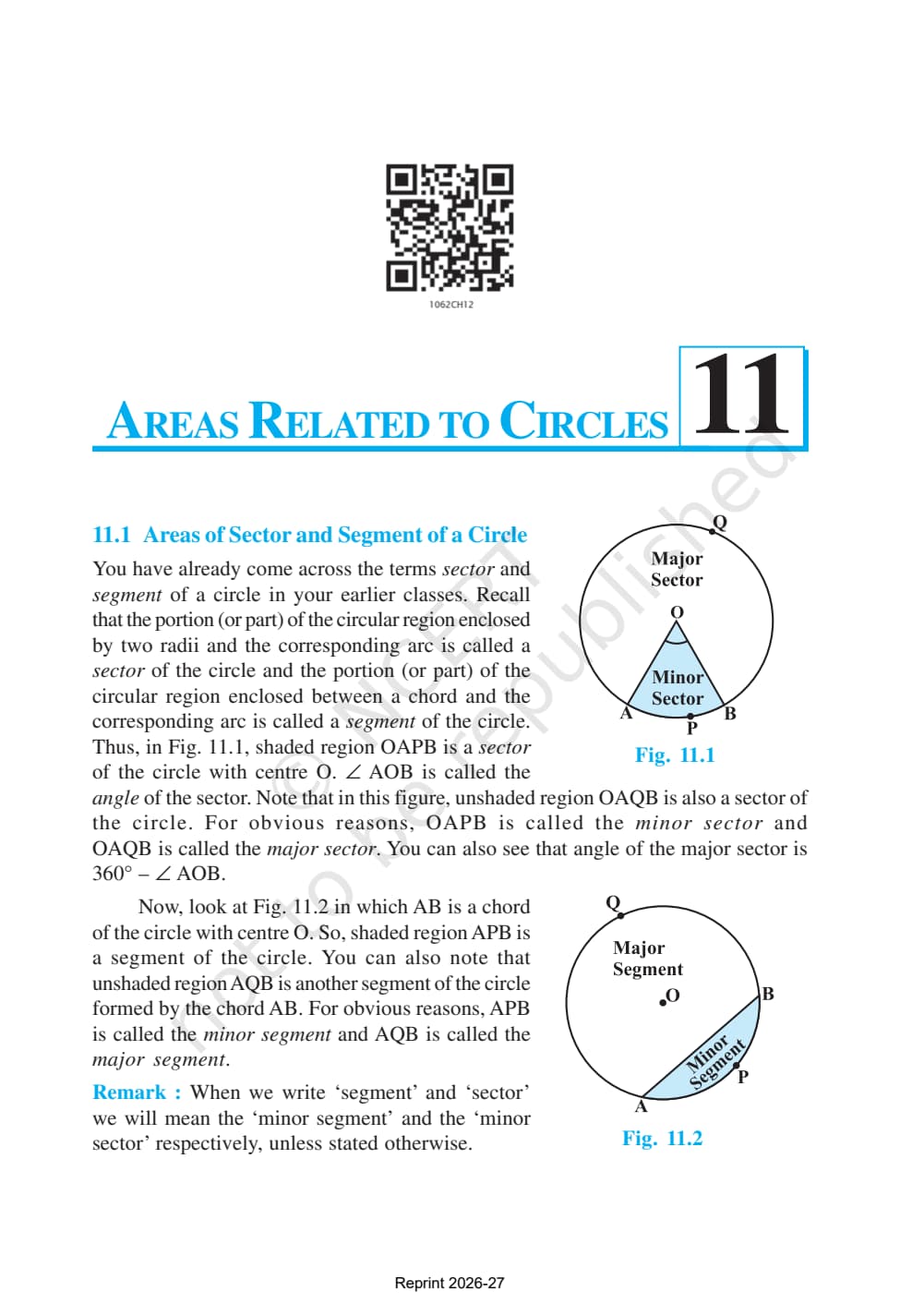
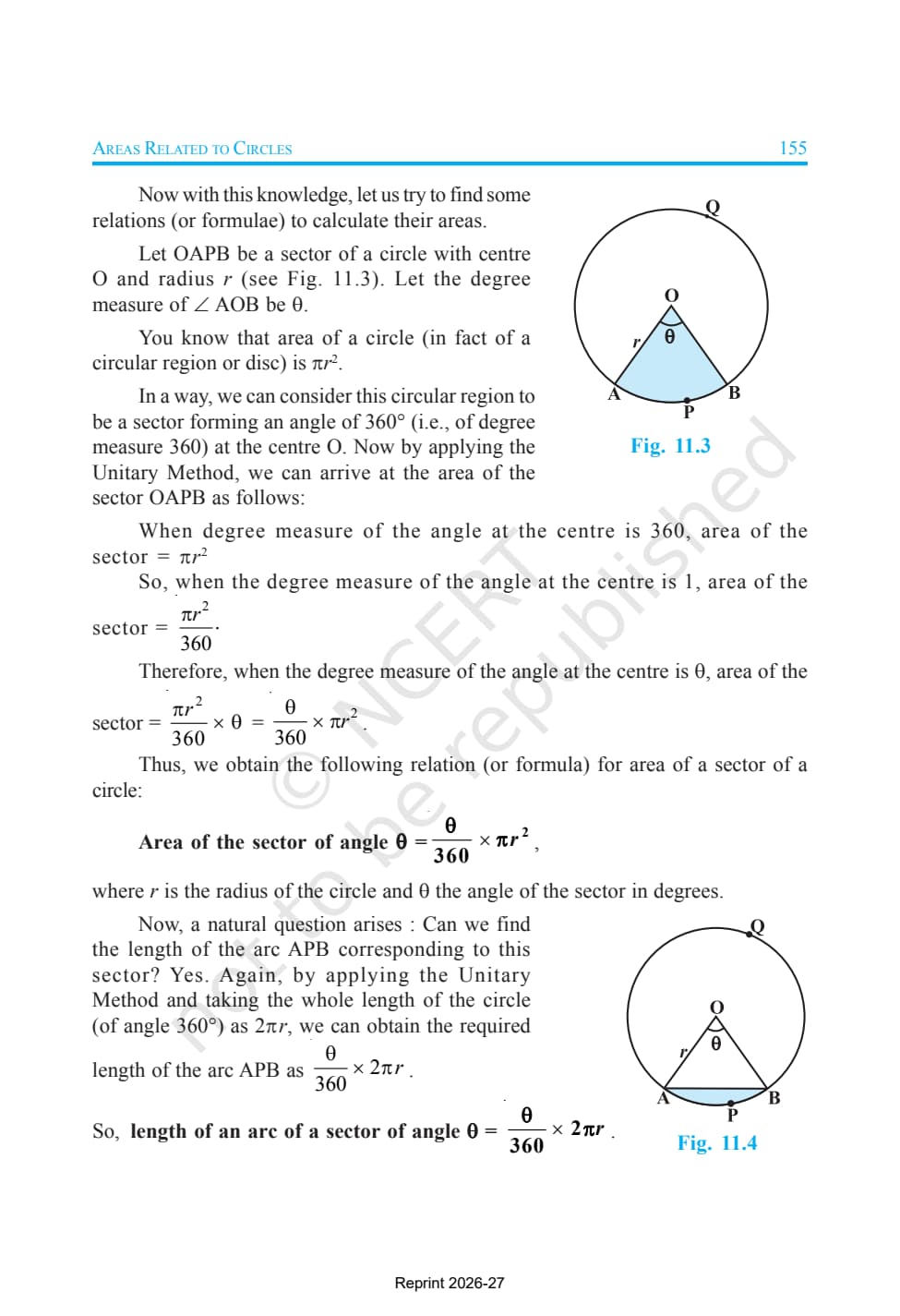
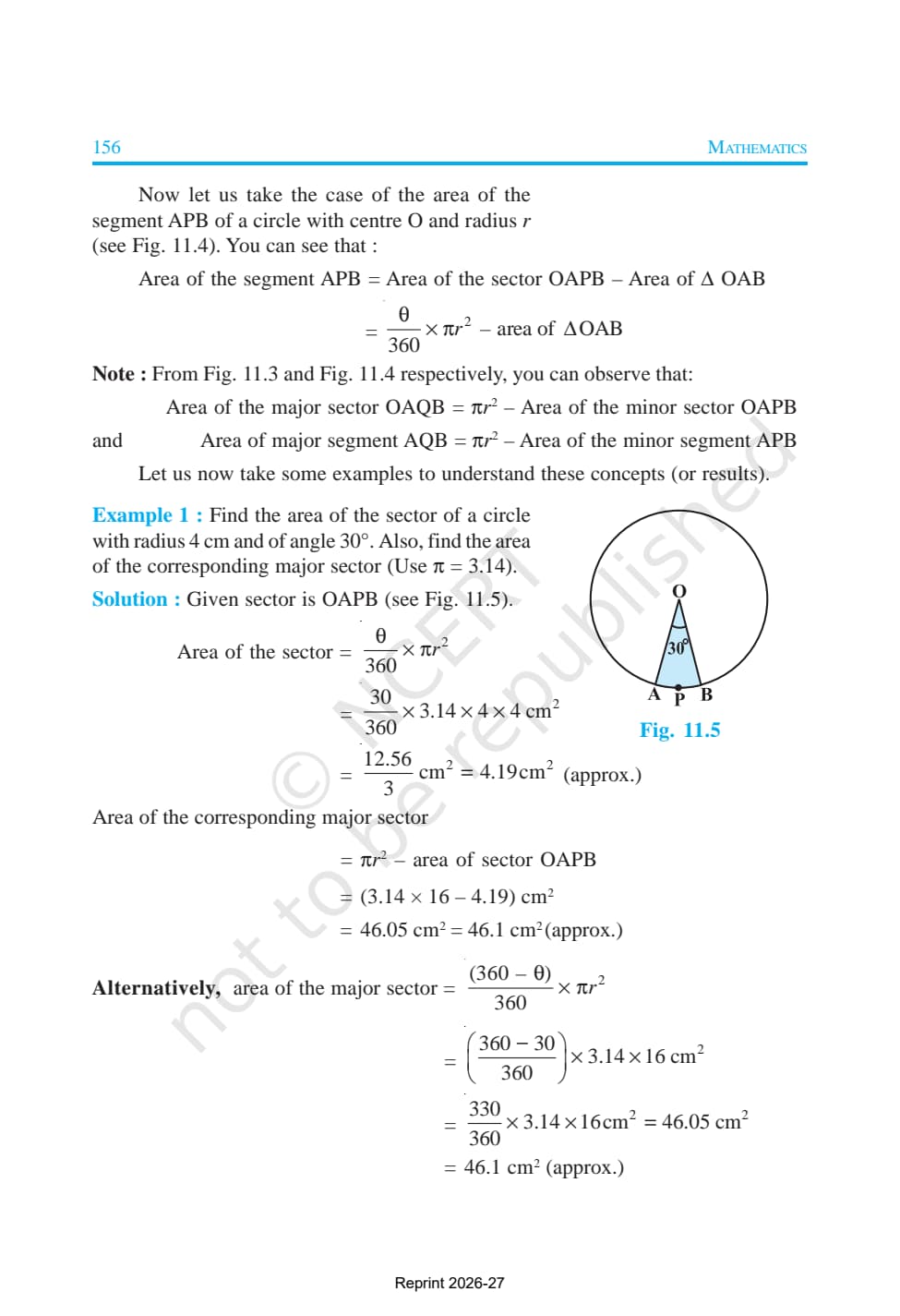
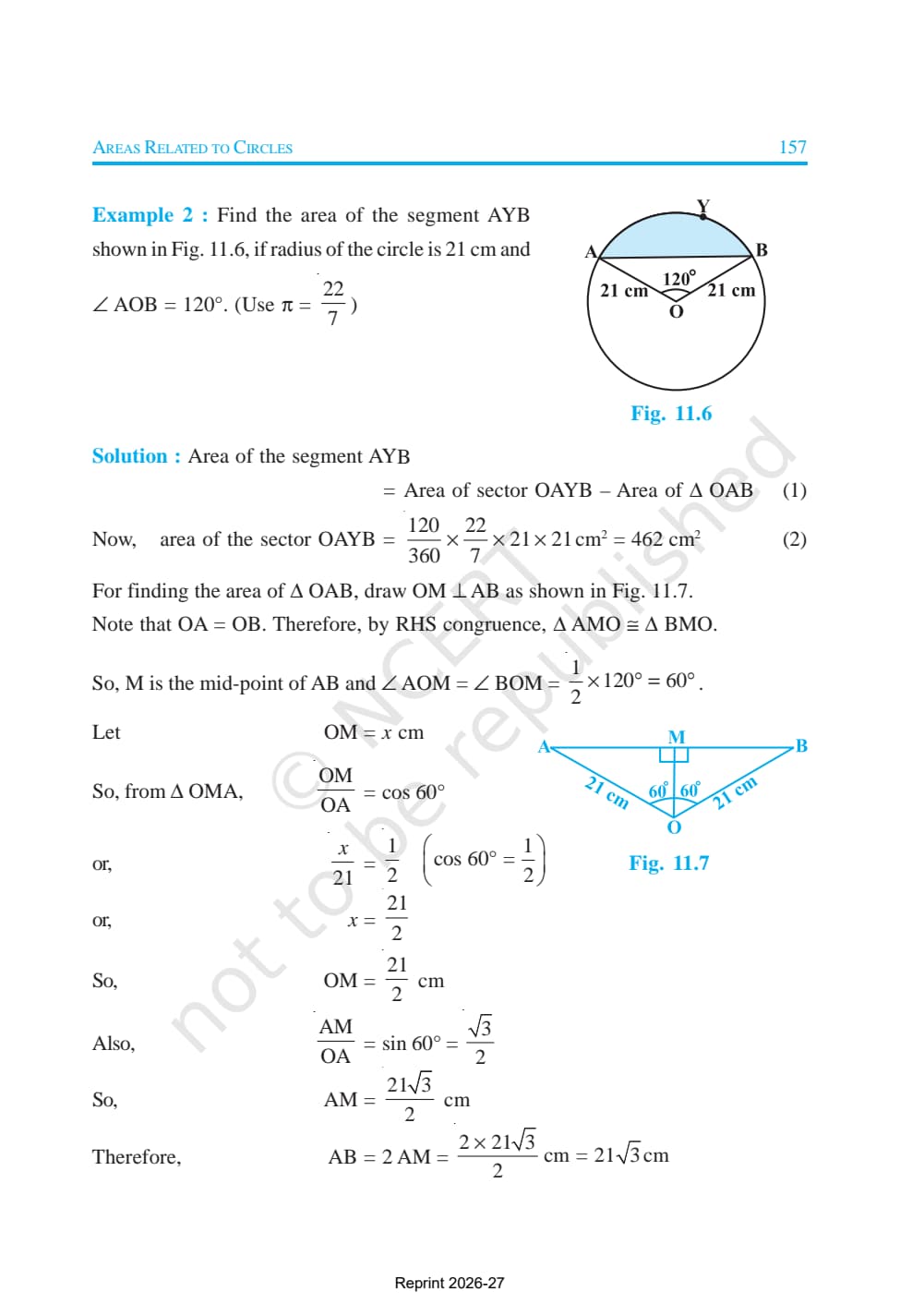
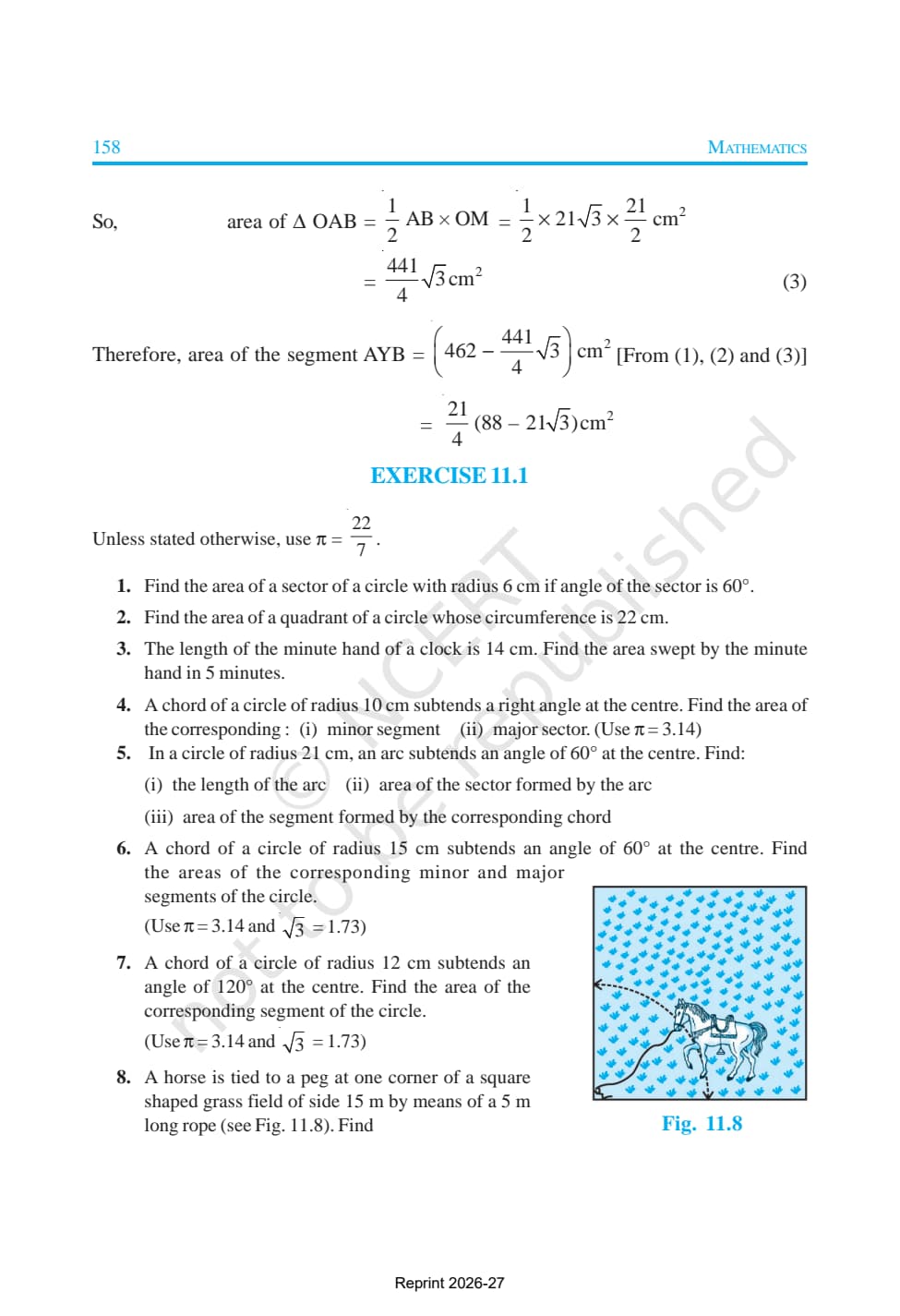
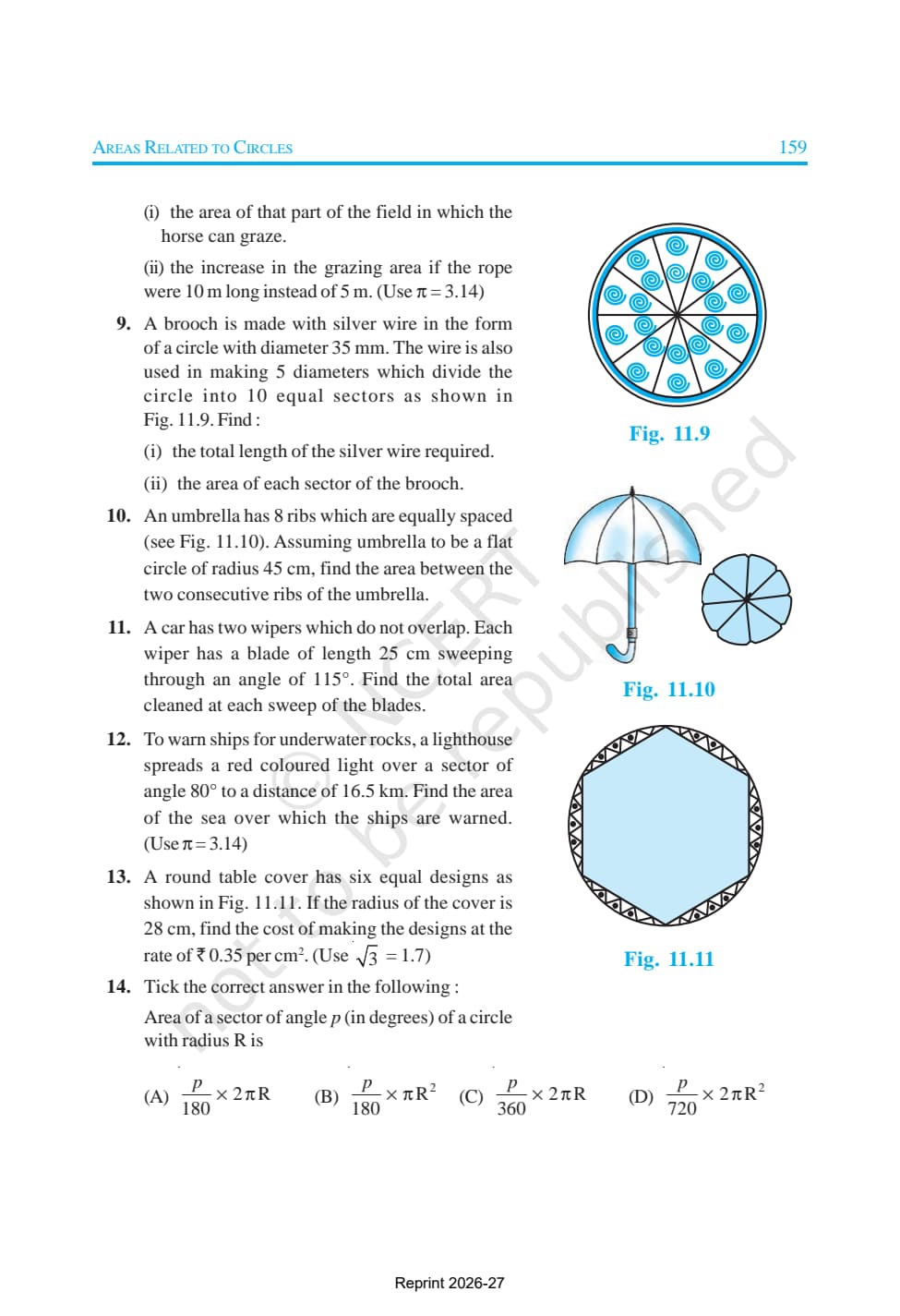
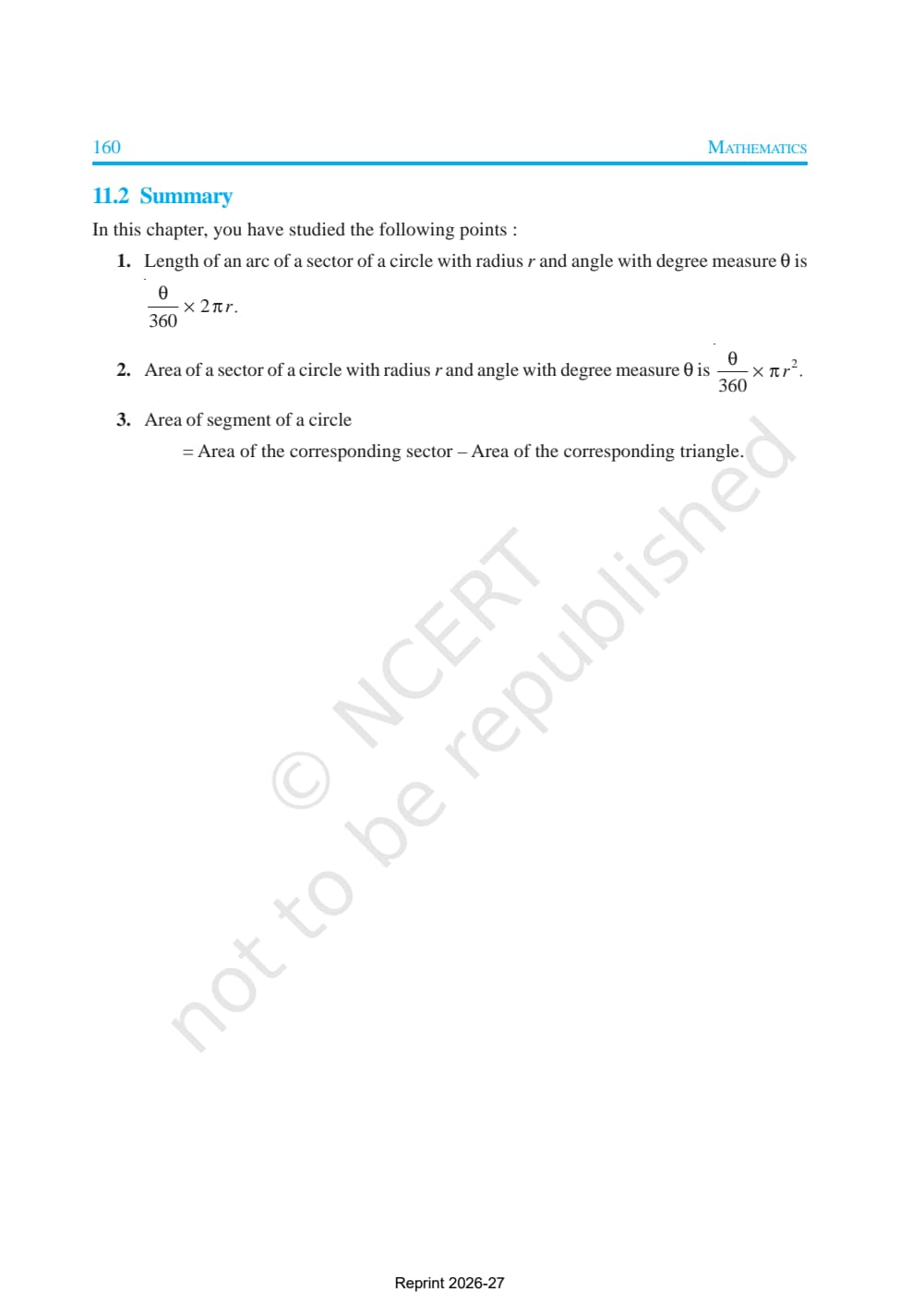
- Official NCERT textbook PDF of the chapter, with every theorem, solved example, and exercise exactly as printed.
- Covers perimeter and area of a sector, area of a segment, and areas of combinations of circles with triangles, squares, and rectangles.
- Set to the 2026-27 CBSE syllabus. Useful for board revision and as the base text for the solutions and notes.
This page hosts the official NCERT Class 10 Maths textbook chapter, mapped to the 2026-27 CBSE syllabus and checked page by page against the printed Areas Related to Circles chapter.
Student Feedback: What 9,200 students told us about this chapter
68% of Class 10 students said areas of combinations of figures were the trickiest part in class tests. 3 out of 5 students said reading the NCERT chapter example by example helped them pick the right formula for combination problems in the board exam.
Students spent about 2 to 3 hours on the chapter across the first read and revision. High scorers kept the official book open beside their notes, which stopped them from mixing up sector and segment formulas under pressure.
Source: 2026-27 Class 10 Maths student poll, 9,200 students from CBSE schools in 14 states, before the 2026 boards.
Watch Areas Related to Circles Class 10 Maths Explained
Source: Ritik Mishra - 9th & 10th on YouTube
What the NCERT Book Chapter Covers
The downloadable PDF above is the complete official NCERT chapter, exactly as printed in the 2026-27 textbook. Chapter 11 builds on the circle properties from Chapter 10 and shifts from lengths and angles to areas and perimeters of parts of a circle. Reading the chapter in order is the best way to fix the formulas before you move to solutions and notes, because each solved example in the book shows the exact reasoning the CBSE board expects.
- Perimeter and area of a sector: two formulas derived from the angle at the centre, covering arc length and sector area.
- Area of a segment: the region between a chord and the arc it cuts off, calculated as sector area minus the triangle area.
- Areas of combinations of figures: problems where a circle or its parts are combined with squares, triangles, rectangles, or other polygons, covering the most common CBSE question type from this chapter.
Perimeter and Area of a Sector: Key Formulas for Class 10 Maths
The first main section of Chapter 11 defines a sector and derives the two formulas students use in almost every question. If the radius of a circle is r and the angle of the sector at the centre is θ (in degrees), the chapter gives:
Area of sector = (θ / 360) × πr²
The book explains these by comparing the sector to a fraction of the full circle. A sector with a central angle of 60° is one-sixth of the circle, so its arc length is one-sixth of the circumference and its area one-sixth of the total. This proportional thinking is the cleanest way to remember the formulas.
| Quantity | Formula | What it measures |
|---|---|---|
| Arc length (l) | (θ / 360) × 2πr | Length of the curved boundary of the sector |
| Perimeter of sector | l + 2r | Total boundary = arc + two radii |
| Area of sector | (θ / 360) × πr² | Area of the pie-slice region |
| Area of minor segment | Area of sector − Area of triangle OAB | Region between chord AB and minor arc |
| Area of major segment | πr² − Area of minor segment | Remaining region of the circle |
Area of a Segment of a Circle Explained for CBSE Class 10
A segment is the region between a chord and the arc it cuts off. Chapter 11 distinguishes between the minor segment (the smaller piece, cut by the chord from the minor arc side) and the major segment (the larger piece). The method the NCERT book uses is clean:
- Draw the two radii to the ends of the chord to form a triangle OAB and a sector OAB.
- Area of minor segment = Area of sector OAB − Area of triangle OAB.
- For the triangle area, use the standard formula (½ × base × height), or, if the triangle is equilateral or isosceles, the specific formula for that shape.
- Area of major segment = Area of circle − Area of minor segment.
The NCERT chapter walks through several solved examples of this subtraction approach. For a sector with a central angle of 60° and radius r, the triangle OAB is equilateral, which makes the area of triangle OAB equal to (√3 / 4) × r². This is a common shortcut that appears directly in board questions.
Areas of Combinations of Plane Figures
This is the heaviest section of Chapter 11 in terms of board marks. It asks you to find the area of regions that are formed by combining circles with other shapes such as squares, triangles, and rectangles. The approach in every case is the same: break the combined figure into parts whose individual areas you can calculate, then add or subtract.
The NCERT chapter covers these standard combination types:
| Figure type | Method | Sample board question |
|---|---|---|
| Circle inside a square | Area of square − area of circle | Find the area of the shaded region when a circle of diameter 14 cm is inscribed in a square. |
| Semicircle on one side of a rectangle | Area of rectangle + area of semicircle | A racing track with two straight sides and two semicircular ends: find the area of the track. |
| Sectors at corners of a square | Area of square − sum of four quarter-circle sectors | A square park has a quarter-circle flower bed at each corner: find the ungrazed area. |
| Equilateral triangle with semicircles on sides | Area of triangle + 3 × area of semicircle | Find the total area of a figure with an equilateral triangle and a semicircle on each side. |
| Ring (annulus) | π(R² − r²) where R and r are outer and inner radii | A circular path of width 7 m surrounds a circular pool: find the area of the path. |
The NCERT book covers most of these types through solved examples before presenting them as exercise questions. The standard value of π used in this chapter is 22/7 for most problems, or the exact π where the answer is left in terms of π. Always check which value the question asks for.
Solved Examples and the Exercise in the NCERT Book Chapter 11
Chapter 11 is structured differently from most chapters: it has one exercise with problems that span all three topics of the chapter. Before the exercise, the book works through a rich set of solved examples that model the approach for each question type.
| Section | What it covers | Type of question |
|---|---|---|
| Solved examples (Sector) | Arc length, sector area, perimeter of sector | Direct application of formulas |
| Solved examples (Segment) | Minor and major segment area using subtraction method | Multi-step with triangle area |
| Solved examples (Combinations) | Shaded regions, racing tracks, flower beds, rings | Add or subtract partial areas |
| Exercise 11.1 | All three topic types mixed together | Short and long answer, CBSE-style |
A popular solved example asks for the area swept by the minute hand of a clock in 5 minutes. The trick is treating the minute hand as the radius and recognising that 5 minutes equals 30° (since 360° in 60 minutes). This pattern, converting time to angle and then applying the sector formula, reappears in board exam questions almost every year.
Also Check:
- Class 10 Maths Chapter 11 Areas Related to Circles NCERT Solutions
- Class 10 Maths Chapter 11 Areas Related to Circles Formula Sheet
How to Use the NCERT Book PDF for Board Revision in Areas Related to Circles
The official textbook is the safest source because every solved example, formula, and exercise question is exactly what the CBSE board expects. Use this PDF in two reading passes, paired with the solutions and notes linked below.
First pass: read each section and its solved examples
Read the theory on sectors and segments first. For each solved example, cover the solution, try it yourself, then check your method against the book. Notice how the NCERT identifies the shape, states the formula, substitutes values, and simplifies. The board awards marks for each step.
Second pass: attempt the exercise unaided
Solve every question in Exercise 11.1 without looking at the answers, drawing a labelled figure for each. This single drill covers the full range of board questions from this chapter. Check your work against the NCERT Solutions afterwards.
CBSE board angle
Areas Related to Circles sits in the Mensuration unit, which typically carries around 10 marks. Short answer questions on sector and segment area, and long answer questions on combination figures, appear most years. Reading the official chapter closely is direct board preparation.
Other Resources for This Chapter
Read the official NCERT Book chapter above, then revise with the matching NCERT Solutions, revision notes, formula sheet, and handwritten notes. All resources for Class 10 Maths Chapter 11 are linked in the table below.
| Resource | What it covers | Open |
|---|---|---|
| NCERT Book PDF | Official Class 10 Maths Chapter 11 textbook, with every solved example and exercise. | You are here |
| NCERT Solutions | Step-by-step answers to all exercise questions of Chapter 11. | Class 10 Maths Chapter 11 NCERT Solutions |
| Notes | Concept-first revision notes on sectors, segments, and combination figures. | Class 10 Maths Chapter 11 Notes |
| Formula Sheet | Quick reference of all key formulas for fast revision before the board exam. | Class 10 Maths Chapter 11 Formula Sheet |
| Handwritten Notes | Scanned-style handwritten pages for last-minute board revision. | Class 10 Maths Chapter 11 Handwritten Notes |
| Exemplar Solutions | Worked solutions to NCERT Exemplar problems for deeper practice. | Class 10 Maths Chapter 11 Exemplar Solutions |
| Exemplar Book PDF | Official NCERT Exemplar chapter PDF for additional problem practice. | Class 10 Maths Chapter 11 Exemplar Book PDF |
NCERT Book for Class 10 Maths: All Chapters
Related Links: Use the table below to open the official NCERT Book PDF for the other chapters of Class 10 Maths. Every chapter ships with the same official textbook PDF, chapter overview, and board-ready FAQ.
| Chapter | NCERT Book PDF link |
|---|---|
| Chapter 1 | Real Numbers NCERT Book PDF |
| Chapter 2 | Polynomials NCERT Book PDF |
| Chapter 3 | Pair of Linear Equations in Two Variables NCERT Book PDF |
| Chapter 4 | Quadratic Equations NCERT Book PDF |
| Chapter 5 | Arithmetic Progressions NCERT Book PDF |
| Chapter 6 | Triangles NCERT Book PDF |
| Chapter 7 | Coordinate Geometry NCERT Book PDF |
| Chapter 8 | Introduction to Trigonometry NCERT Book PDF |
| Chapter 9 | Some Applications of Trigonometry NCERT Book PDF |
| Chapter 10 | Circles NCERT Book PDF |
| Chapter 11 | Areas Related to Circles NCERT Book PDF (You are here) |
| Chapter 12 | Surface Areas and Volumes NCERT Book PDF |
| Chapter 13 | Statistics NCERT Book PDF |
| Chapter 14 | Probability NCERT Book PDF |
Areas Related to Circles Class 10 Maths Chapter 11 NCERT Book FAQs
Ques. What does Chapter 11 Areas Related to Circles cover in the Class 10 Maths NCERT Book?
Ans. Chapter 11 of the Class 10 Maths NCERT Book covers three main topics. First, it derives and applies the formulas for the arc length and area of a sector of a circle. Second, it explains how to find the area of a segment, both minor and major, by subtracting the triangle area from the sector area. Third, it extends these ideas to areas of combinations of plane figures, where parts of a circle are joined with squares, rectangles, triangles, or other shapes to form composite regions. The chapter has one exercise and is fully aligned with the 2026-27 CBSE syllabus.
Ques. What is the formula for the area of a sector in Class 10 Maths?
Ans. The area of a sector with radius r and central angle theta (in degrees) is given by (theta divided by 360) multiplied by pi r squared. The arc length of the same sector is (theta divided by 360) multiplied by 2 pi r. The perimeter of the sector is the arc length plus two radii. These three formulas are the starting point for almost every question in Chapter 11, including the more complex combination-figure problems in the exercise.
Ques. How is the area of a segment of a circle calculated?
Ans. The area of a minor segment is found by subtracting the area of triangle OAB from the area of sector OAB, where O is the centre and A and B are the endpoints of the chord. The area of triangle OAB is calculated using the base and height formula, or, if the triangle is equilateral (which happens when the central angle is 60 degrees), using the formula root 3 over 4 times r squared. The area of the major segment is then the total circle area minus the minor segment area. This subtraction method is used throughout the NCERT chapter.
Ques. Is the Class 10 Maths Chapter 11 NCERT Book PDF free to download for 2026-27?
Ans. Yes. The official NCERT Book PDF for Class 10 Maths Chapter 11 Areas Related to Circles is free to read and download on this page for the 2026-27 session. It is the complete chapter exactly as printed in the CBSE textbook, including all the solved examples and Exercise 11.1. You can pair the book PDF with the NCERT Solutions and revision notes for the same chapter, both linked on this page, so you can read, practise, and revise from one place.
Ques. How many exercises are there in Class 10 Maths Chapter 11 Areas Related to Circles?
Ans. Chapter 11 has one exercise, Exercise 11.1, which contains questions that cover all three topics of the chapter: sectors, segments, and combinations of figures. The questions range from straightforward formula-application problems to multi-step combination-figure problems where you need to add or subtract areas. Before the exercise, the NCERT book works through a series of solved examples that model the correct method for each type, so students should read all the examples carefully before attempting the exercise on their own.
Ques. How is this chapter important for the CBSE Class 10 Maths board exam?
Ans. Areas Related to Circles is part of the Mensuration unit in CBSE Class 10 Maths, which carries significant marks in the board exam. Questions from this chapter appear as short answer problems on sector and segment area, and as long answer problems on combination figures. Students who know the three core formulas and practise the NCERT solved examples and exercise questions are well prepared for the board paper, since the board question style closely mirrors what the NCERT book show.
Ques. Are the contents aligned with the 2026-27 CBSE syllabus?
Ans. Yes. This page hosts the official NCERT Class 10 Maths textbook chapter for the current 2026-27 CBSE syllabus. The chapter covers sectors, segments, and combinations of plane figures, which are the topics prescribed in the Mensuration unit for Class 10. Because it is the official NCERT text, everything you read here is exam-correct for the 2026-27 board exam, and the linked solutions, notes, and formula sheet for Chapter 11 all follow this textbook order.



Comments