




These Notes for Class 12 Sociology Chapter 8 Social Movements give a clear, short summary of the whole chapter, set to the latest 2026-27 CBSE syllabus. They cover what a social movement is, its features, the reformist, redemptive and revolutionary types, the old and new movements, and the ecological, peasant, worker, Dalit, tribal and women's movements. Students can use them for fast revision before the board exam.
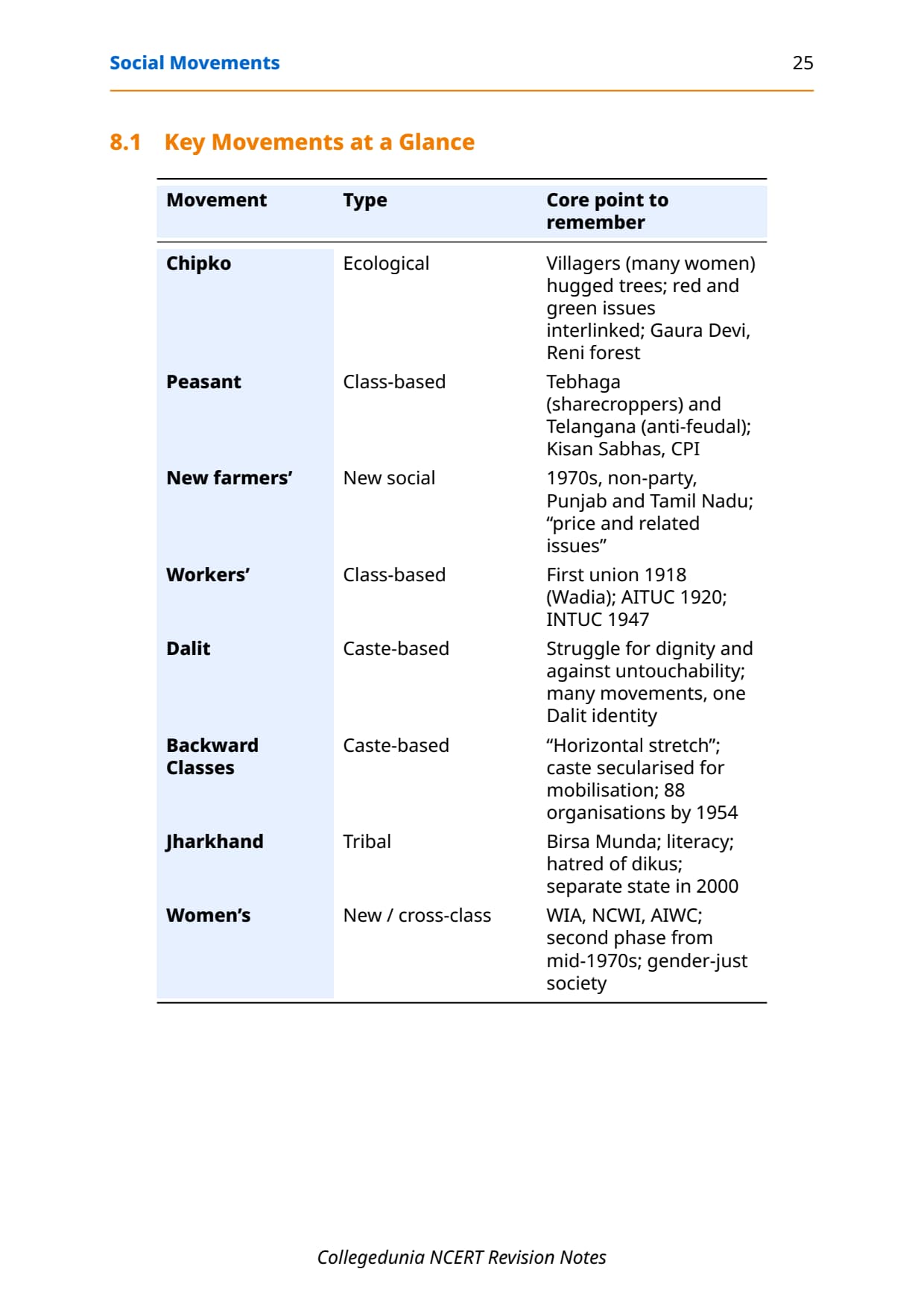
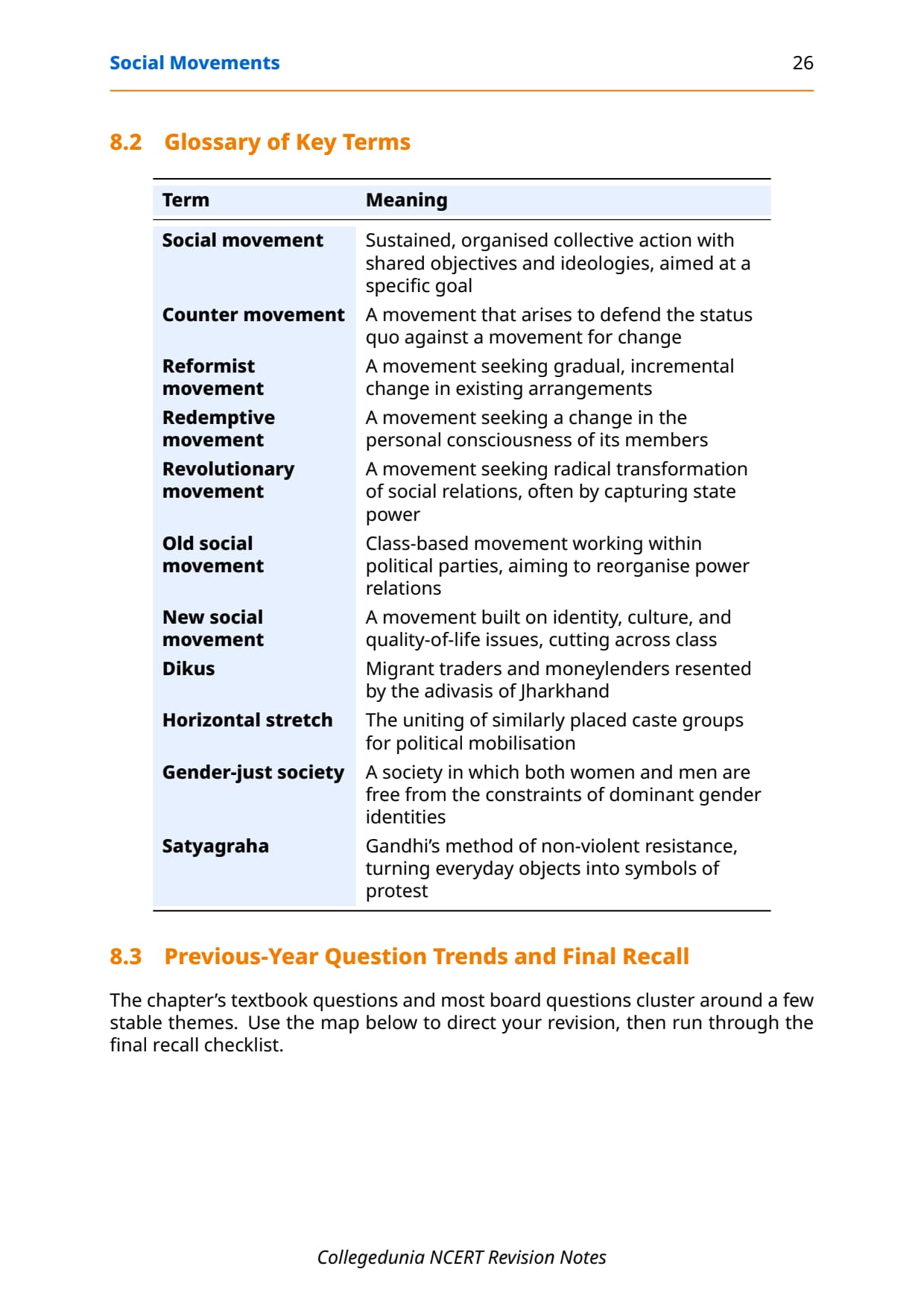
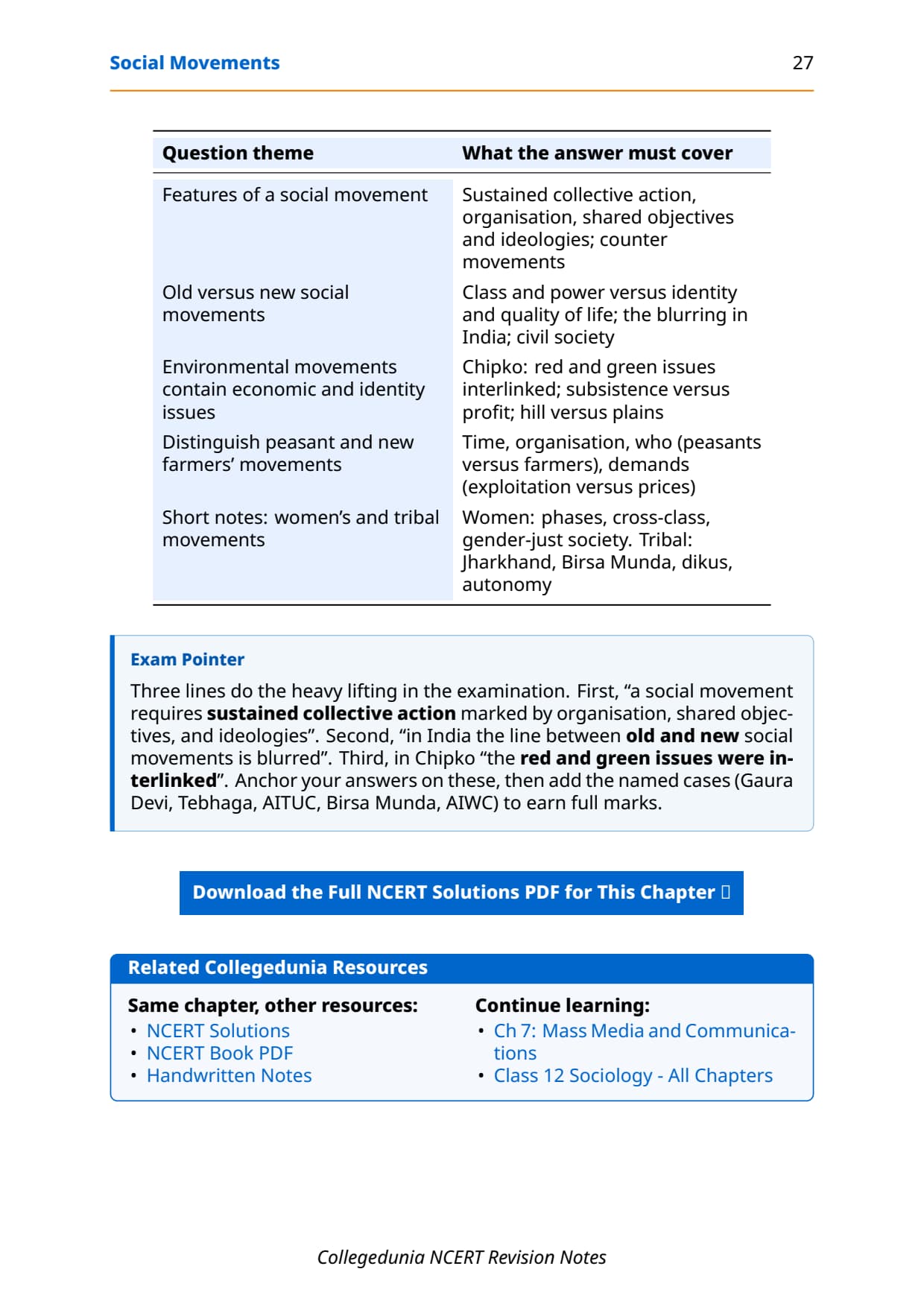
- One-page summary of every topic in Social Change and Development in India Chapter 8.
- This Class 12 Sociology chapter usually carries 5 to 6 marks per board paper.
- Pairs with the NCERT Solutions, Handwritten Notes and Book PDF linked lower on this page.
These Class 12 Sociology Chapter 8 Notes are written by subject experts from the official NCERT Social Change and Development in India textbook, in plain English for quick board revision.
Student Feedback: In a Collegedunia poll of 7,540 Class 12 Sociology students taken before the 2026 boards, 70% of students said a one-page summary of Social Movements helped them keep the many movements straight far better than re-reading the textbook. Most students wanted the types and key terms listed in one place, which these Notes do.
Source: 2026-27 Class 12 Sociology student poll. Sample of 7,540 students from CBSE schools across 11 states.
Social Movements Class 12 Notes Overview
Social Movements is the last chapter of Social Change and Development in India. It explains how groups come together in sustained collective action to bring about, or to resist, change in society. The chapter has a few clear blocks that students should keep separate in their minds.
- What and why: the features of a social movement and why sociology studies it.
- Types: reformist, redemptive and revolutionary, plus old versus new movements.
- Indian movements: ecological, peasant, worker, Dalit, backward-caste, tribal and women's.
These Notes summarise each block in one place, so students do not have to re-read the full chapter. Keep this overview in mind, then read each section below as a quick recap of the main NCERT points.
Features and Types of a Social Movement
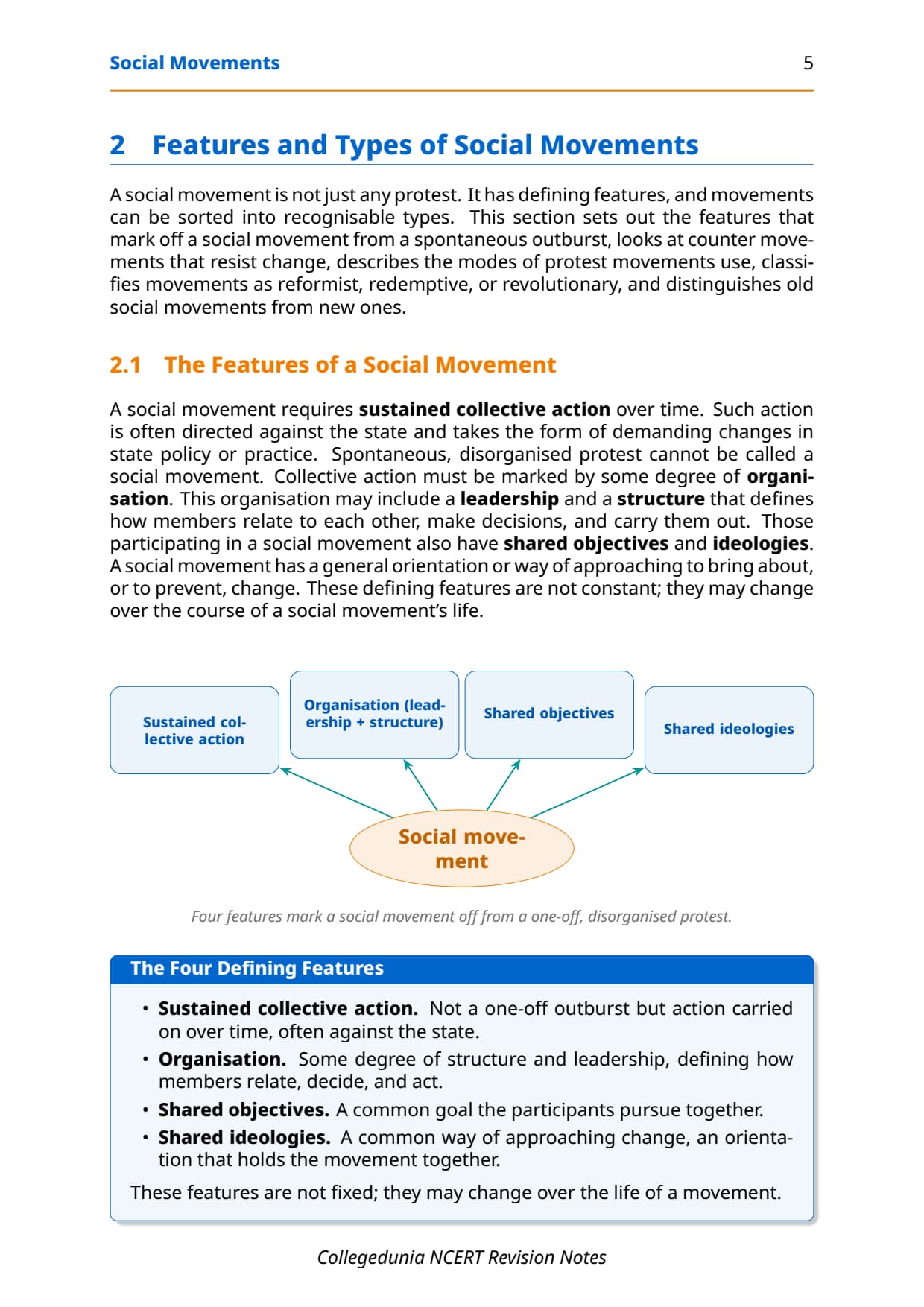
The definition and the typology are the two most-tested ideas in the chapter. The Notes below sum up both so students can recall them fast. A spontaneous, disorganised protest is not a social movement.
- Sustained collective action: the action runs over time and is often aimed at the State.
- Organisation, aims and ideology: there is leadership, structure, shared objectives and a way of approaching change.
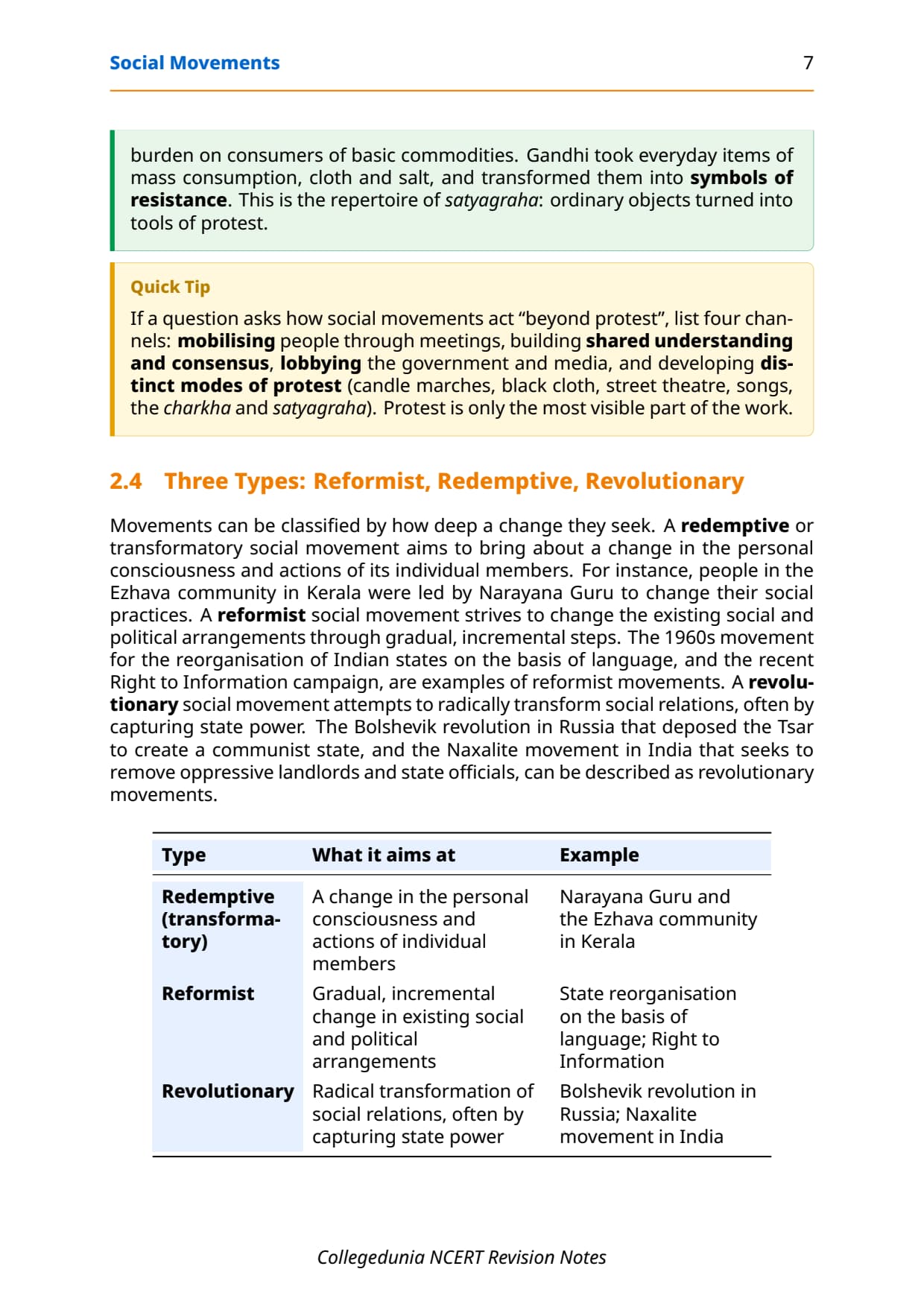
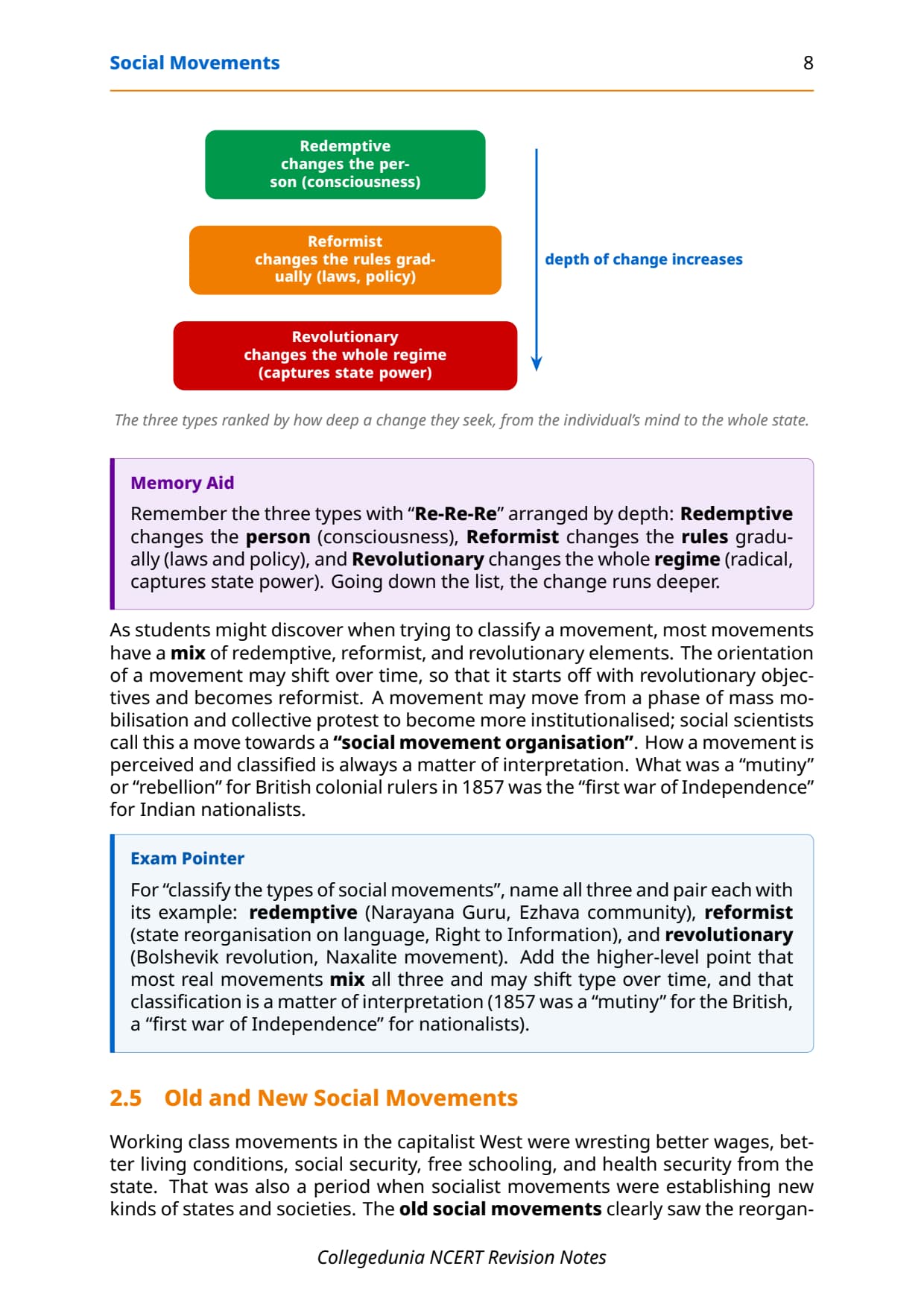
- Reformist type: gradual change, such as state reorganisation and the Right to Information campaign.
- Redemptive type: changes members' consciousness, such as Narayana Guru's reform of the Ezhavas.
- Revolutionary type: radical change, such as the Naxalite movement.
The point to remember is that most real movements mix all three types and can shift over time. The image below collects the three types with their Indian examples for one-look revision.
Old and New Social Movements and the Indian Movements
The old-new distinction and the main Indian movements are the most-asked areas in this chapter. The Notes here sum them up so students can recall them fast.
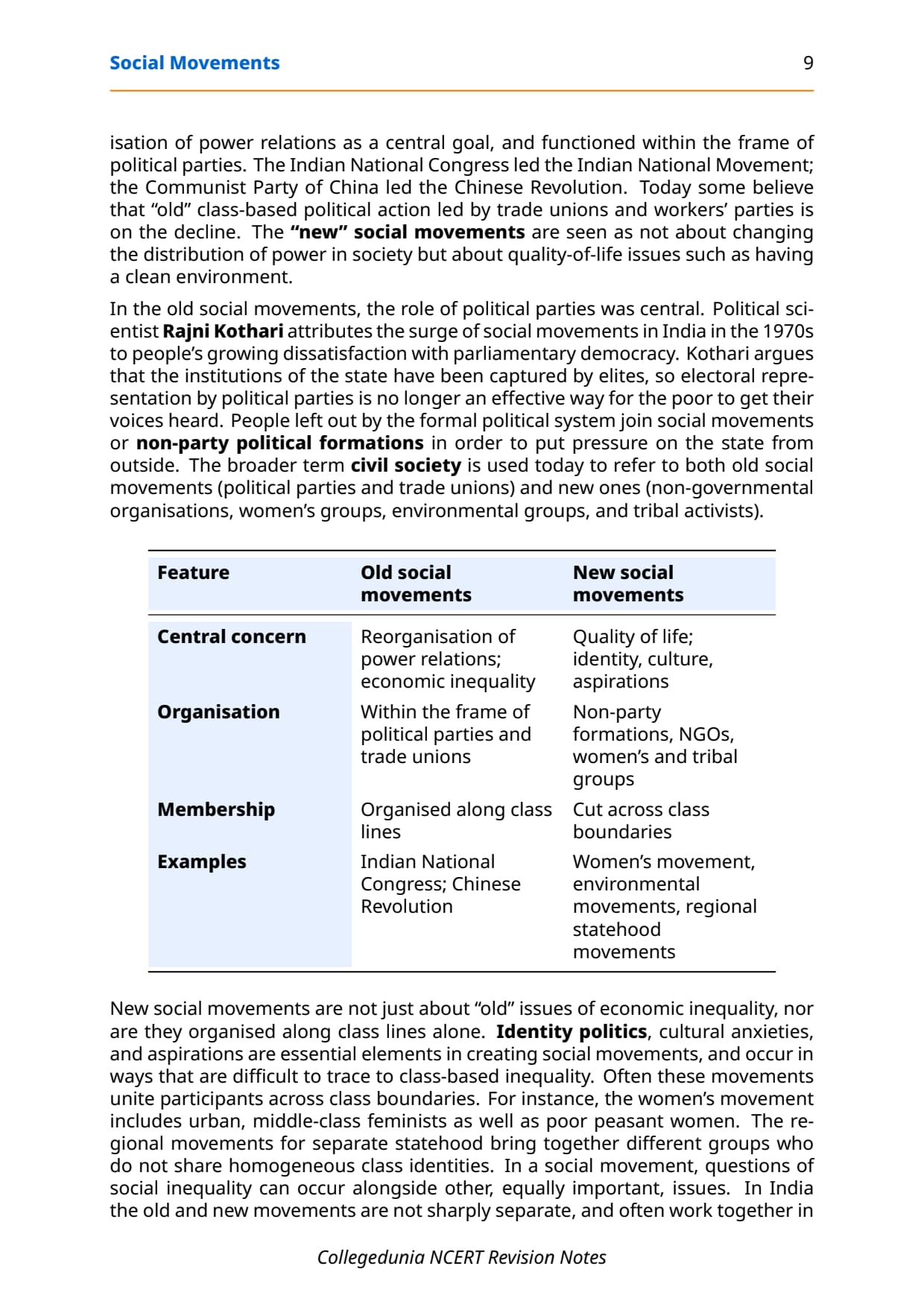
- Old movements: class based, worked through political parties, aimed at reorganising power.
- New movements: built on identity politics, led by non-party groups, focused on quality of life.
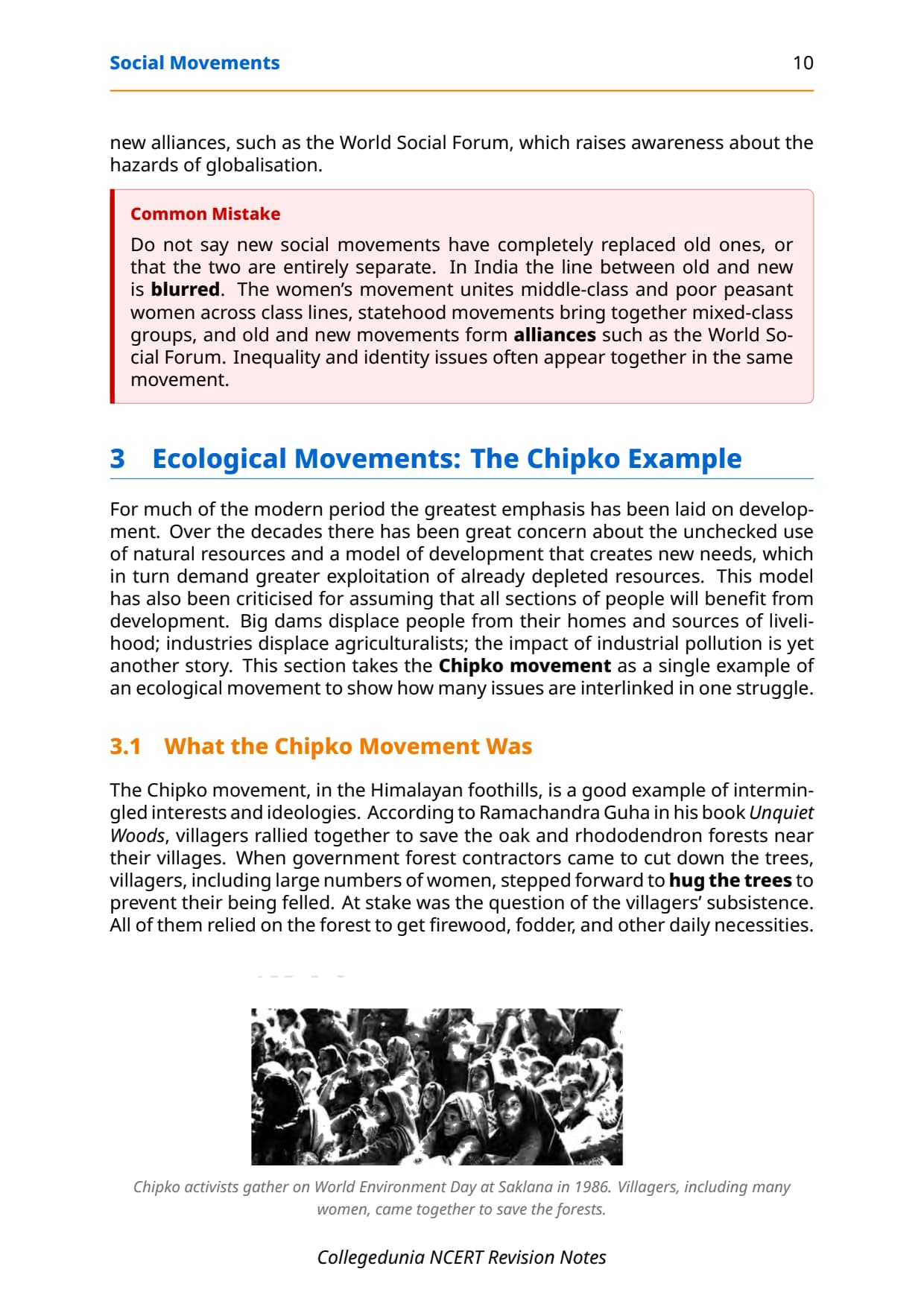
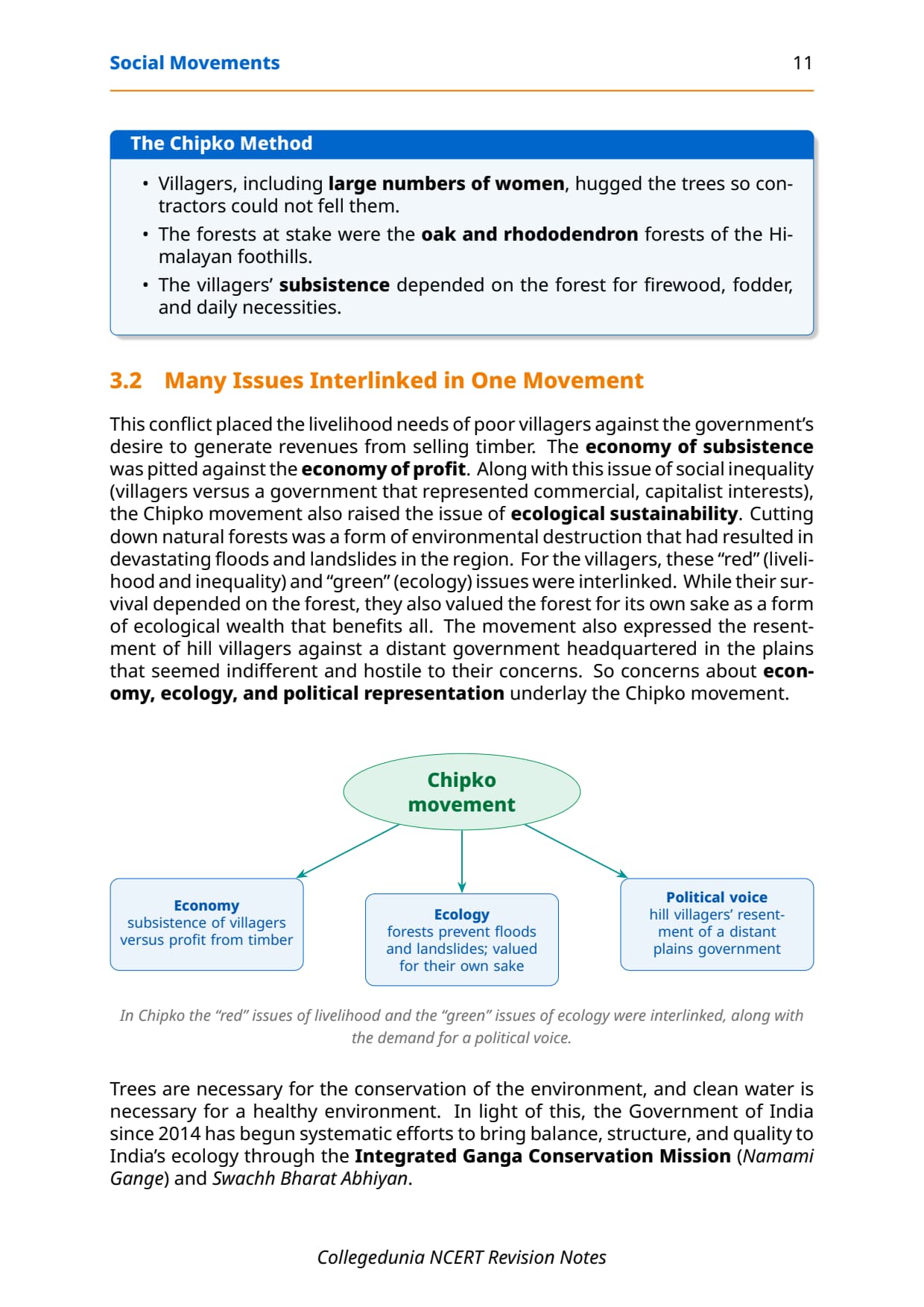
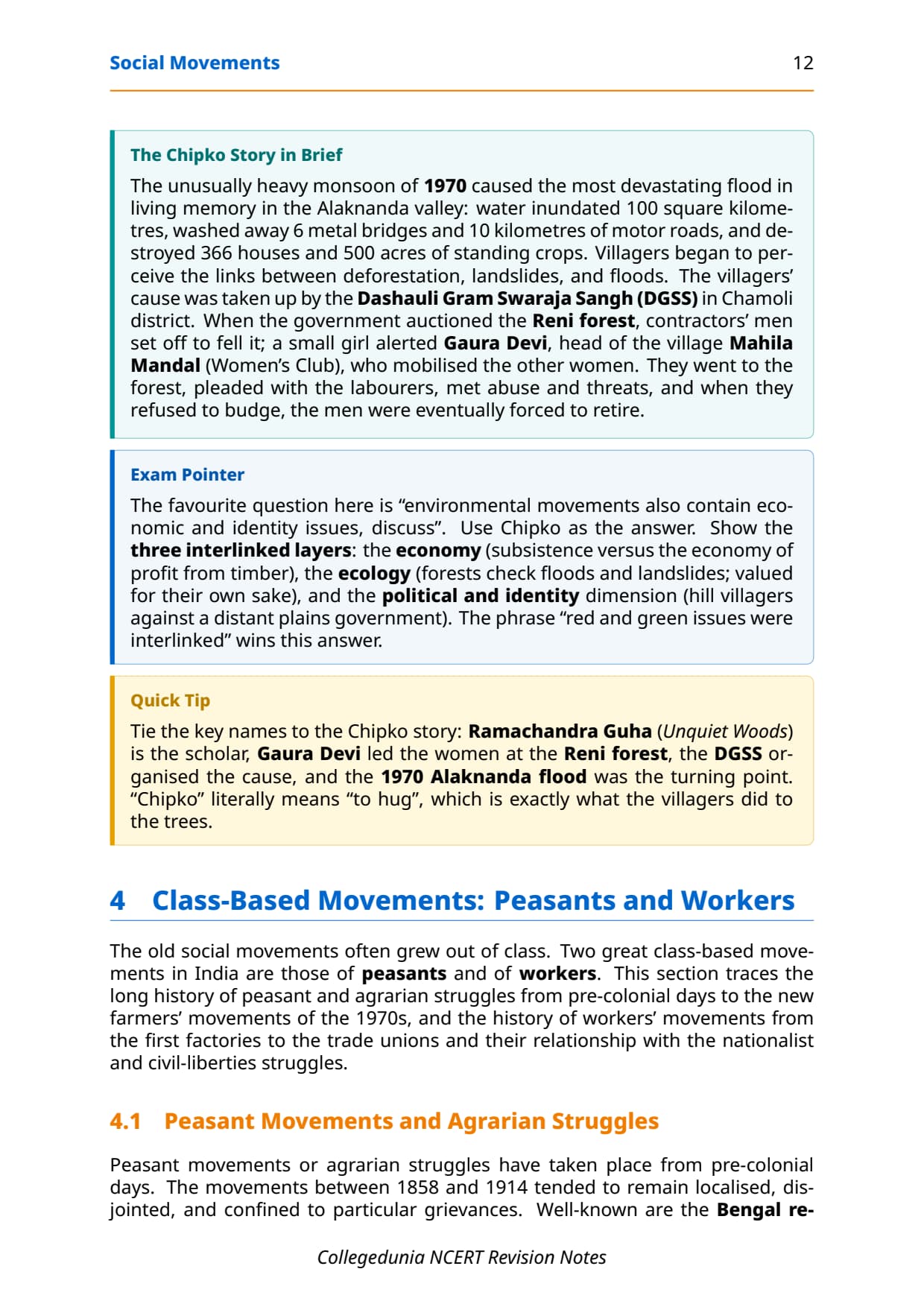
- Ecological: the Chipko movement linked economy, ecology and political representation.
- Class based: peasant movements (Tebhaga, Telangana) and the workers' or trade union movement.
- Caste, tribal and women's: the Dalit movement for dignity, the Jharkhand tribal movement, and the women's movement against dowry and violence.
The key recall point is that in India old and new movements overlap rather than stay separate. Rajni Kothari linked the rise of non-party formations to dissatisfaction with parliamentary democracy in the 1970s. The image below sets the old and new movements side by side.
Social Movements Key Terms to Memorise
A handful of terms carry most of the marks in this chapter. Learning them in one place saves a lot of time. The table below lists each term with a one-line meaning for quick recall.
| Term | One-line meaning |
|---|---|
| Social movement | Sustained, organised collective action to bring about or resist change. |
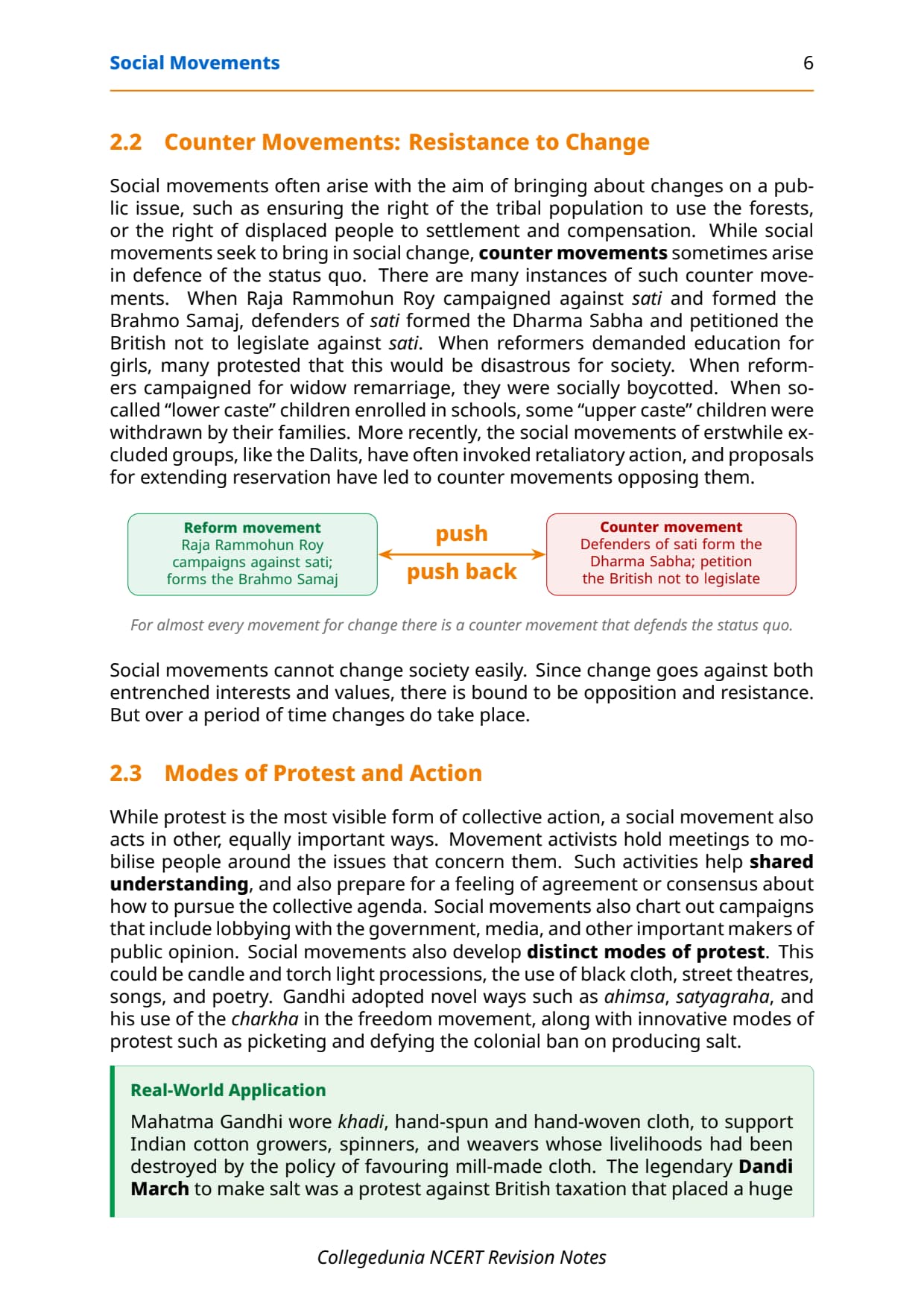
| Counter movement | A movement that arises to defend the status quo, like the Dharma Sabha. |
| Redemptive movement | One that aims to change members' personal consciousness. |
| New social movement | Identity and quality-of-life movement, often non-party based. |
| Chipko movement | Ecological movement that hugged trees to stop felling in the Himalayan foothills. |
| Dikus | Migrant traders and moneylenders resented by Jharkhand adivasis. |
Students who keep these six terms ready can answer most short questions in social movements class 12 without re-reading the chapter.
Quick Revision and Last-Minute Recall
For the night before the exam, a short recall list beats re-reading the whole chapter. The points below are the ones examiners reward most.
- A social movement needs sustained, organised collective action, not a one-off protest.
- The three types are reformist, redemptive and revolutionary, and they usually mix.
- In India old and new movements overlap, blending class and identity issues.
- Chipko shows that ecology, economy and politics are interlinked.
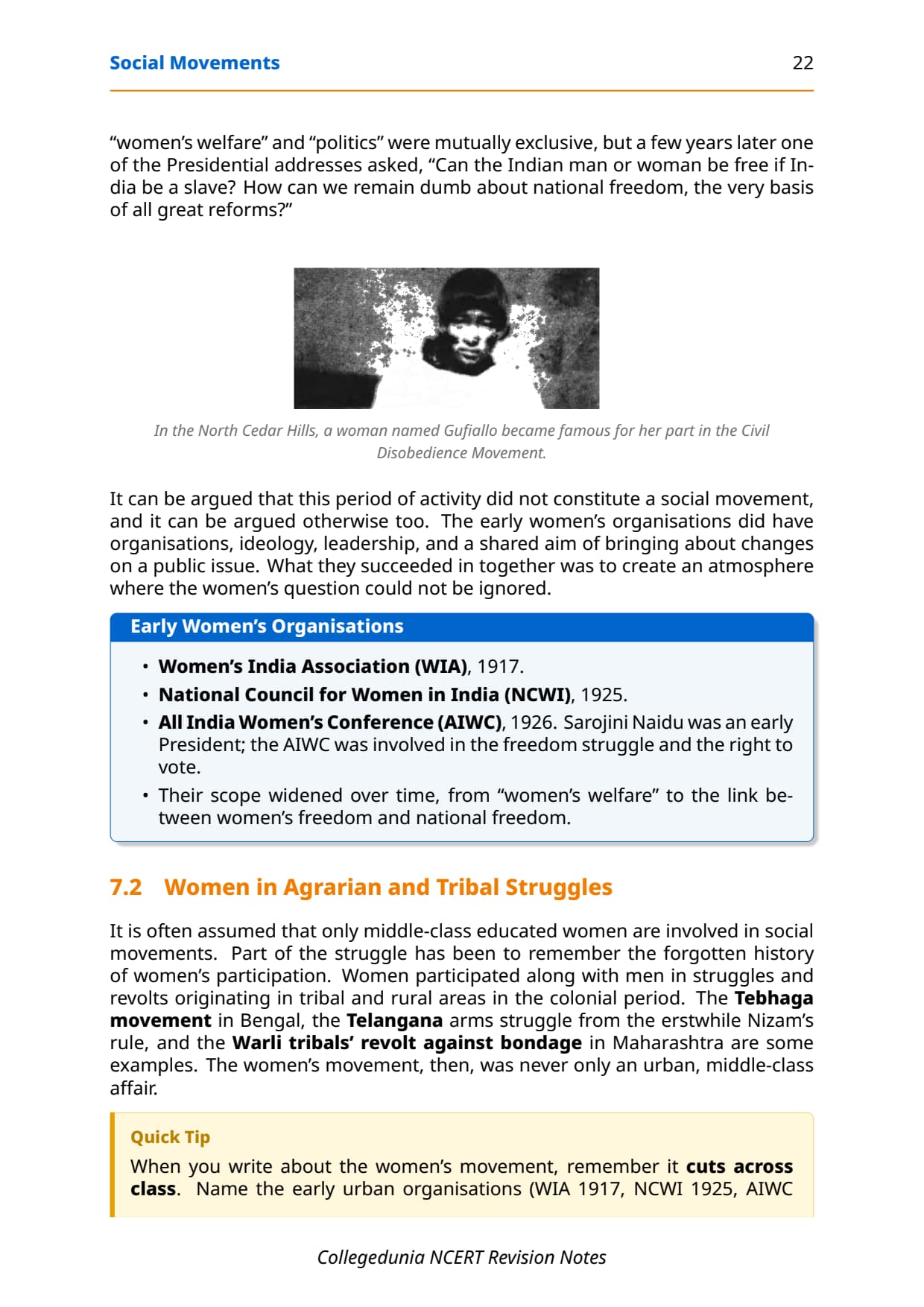
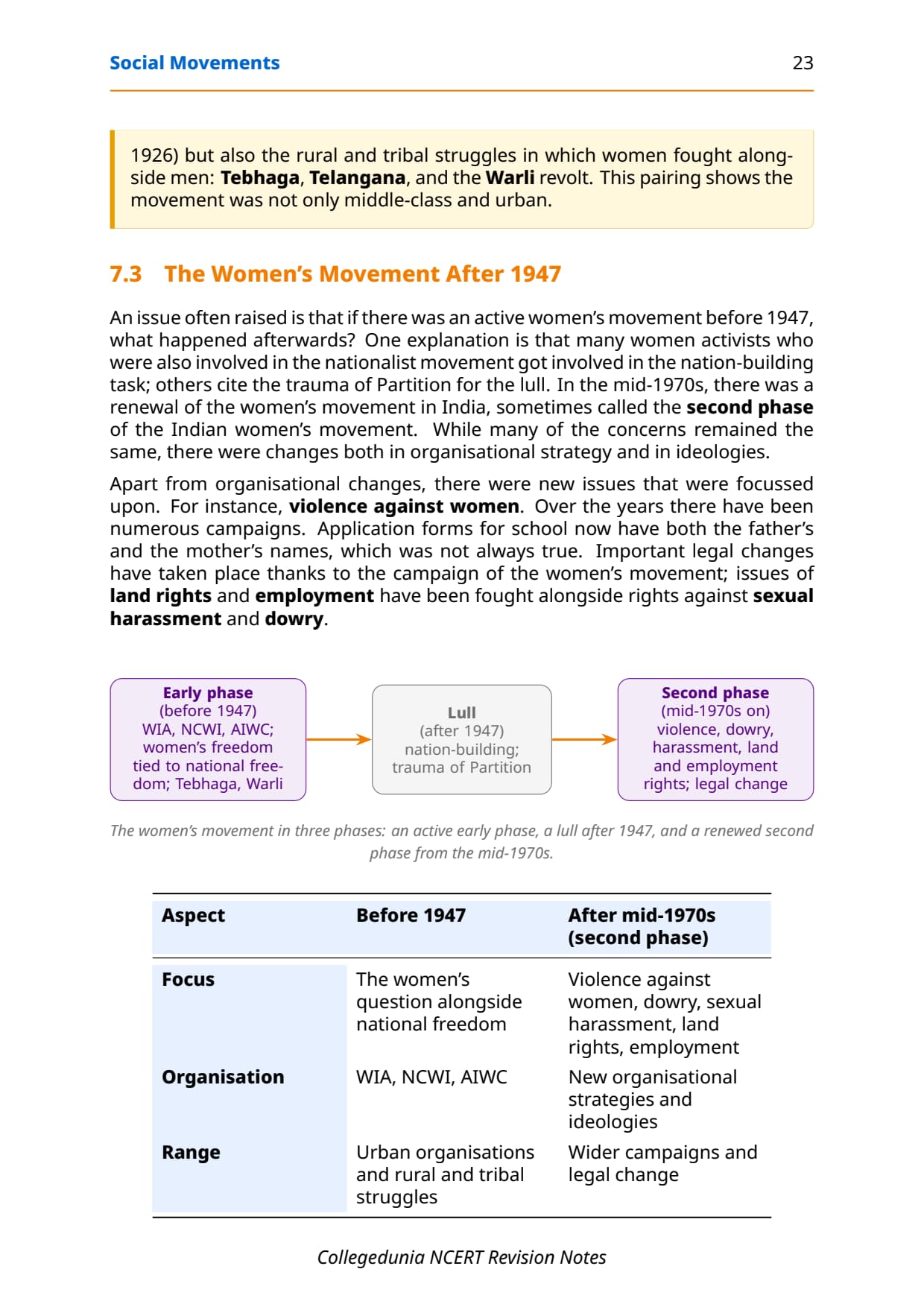
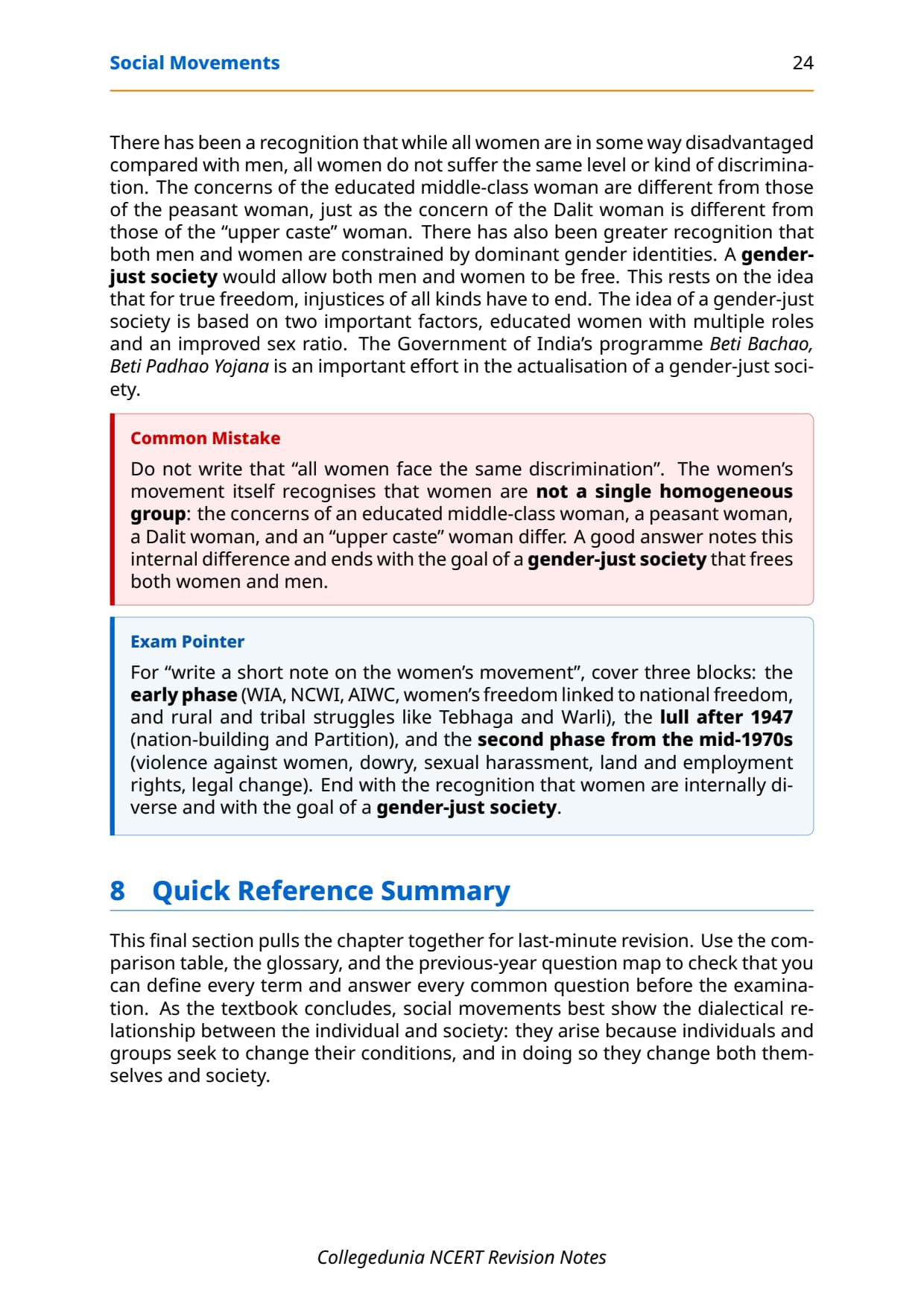
- Women joined peasant and tribal revolts, not only middle-class campaigns.
Reading this recall list twice, once a week before and once the night before, fixes the main points well. Keep a clear example for each movement, since examples lift a short answer to full marks.
How These Notes Pair with the Solutions and Book PDF
These Notes give the summary. To revise the full chapter, students should use them alongside the other resources for the same chapter, all linked in the table below.
| Resource | Best used for |
|---|---|
| Social Movements NCERT Solutions | Full point-wise answers to all 5 exercise questions |
| Social Movements Handwritten Notes | Last-minute, one-shot revision in a scanned notebook style |
| Social Movements NCERT Book PDF | Reading the original NCERT chapter text |
Tip: read these Notes first to get the map of the chapter, then attempt the Solutions on your own. That order builds memory faster than reading answers straight away.
All Notes for Class 12 Sociology
The table links the Notes for every chapter in both Class 12 Sociology books, so students can move across the course in one click. Social Movements is highlighted.
| Chapter | Notes |
|---|---|
| Indian Society | |
| Chapter 1 | Introducing Indian Society |
| Chapter 2 | The Demographic Structure of the Indian Society |
| Chapter 3 | Social Institutions - Continuity and Change |
| Chapter 4 | The Market as a Social Institution |
| Chapter 5 | Patterns of Social Inequality and Exclusion |
| Chapter 6 | The Challenges of Cultural Diversity |
| Social Change and Development in India | |
| Chapter 1 | Structural Change |
| Chapter 2 | Cultural Change |
| Chapter 3 | The Constitution and Social Change |
| Chapter 4 | Change and Development in Rural Society |
| Chapter 5 | Change and Development in Industrial Society |
| Chapter 6 | Globalisation and Social Change |
| Chapter 7 | Mass Media and Communications |
| Chapter 8 | Social Movements |
FAQs on Social Movements Class 12 Notes
Social Movements Class 12 Sociology Notes Common Questions
Ques. Where can I download the class 12 sociology chapter 8 Notes PDF?
Ans. You can download the Social Movements Class 12 Sociology Notes PDF directly from this page. It is free, follows the 2026-27 NCERT, and summarises the whole chapter in plain English.
Ques. What are the features of a social movement in Class 12 Sociology?
Ans. A social movement needs sustained collective action over time, some organisation with leadership and structure, shared objectives and an ideology, and distinct modes of protest. A spontaneous, disorganised one-off protest is not a social movement, and these features can change over time.
Ques. What are the three types of social movements?
Ans. They are reformist (gradual change, like state reorganisation), redemptive (changing members' consciousness, like Narayana Guru's reform of the Ezhavas), and revolutionary (radical change, like the Naxalite movement). Most real movements mix all three types.
Ques. What is the Chipko movement in short?
Ans. Chipko was an ecological movement in the Himalayan foothills where villagers, including many women, hugged oak and rhododendron trees to stop contractors felling them. It linked the economy of subsistence, ecological sustainability and the resentment of hill villagers against a distant government.
Ques. Are these Notes enough for the board exam?
Ans. These Notes give a full summary and the key terms, which is enough for fast revision. For full marks, pair them with the NCERT Solutions on this site so you also practise the five exercise answers in your own words.



Comments