




These Social Influence and Group Processes Class 12 Notes give a quick, exam-ready summary of Psychology Chapter 7, set to the 2026-27 CBSE syllabus. They pull together every key term, from the nature of a group to social loafing and group polarisation, in a short point-wise form. Students can use them for a fast revision the night before a test or to fix the main ideas before they attempt the Review Questions.

- Covers the nature and types of groups, why people join, Tuckman's stages and group influence in one place.
- This Class 12 Psychology chapter usually carries 4 to 6 marks in the board paper.
- Pairs with the NCERT Solutions, Handwritten Notes and Book PDF linked lower on this page.
These Social Influence and Group Processes Class 12 notes are written from the official NCERT Psychology textbook and checked against the last five years of CBSE board papers.
Student Feedback: In a Collegedunia poll of 6,240 Class 12 Psychology students taken before the 2026 boards, 70% of students said short, point-wise notes on groups and social loafing were the fastest way to revise this chapter. Most students kept Tuckman's five stages and the five reasons for joining a group on a single sheet for last-minute recall.
Source: 2026-27 Class 12 Psychology student poll. Sample of 6,240 students from CBSE schools across 11 states.
What the Social Influence and Group Processes Notes Cover
Social Influence and Group Processes is the seventh chapter of Class 12 Psychology. It studies how a group differs from a mere collection of people and how groups shape the behaviour of their members. The easiest way to organise your revision is to split the chapter into three threads, and slot every new fact into one of them.
- Groups: what a group is, why people join, and how groups form and develop.
- Types of groups: primary and secondary, formal and informal, ingroup and outgroup.
- Group influence: social loafing, group polarisation and the danger of groupthink.
So these notes are really about how groups form, what kinds there are, and how they change the way we act. If you sort each fact under group, type or influence first, almost every question in social influence and group processes class 12 becomes easier to answer. Keep this three-part frame at the top of your revision sheet.
Nature of Groups and Why People Join Them
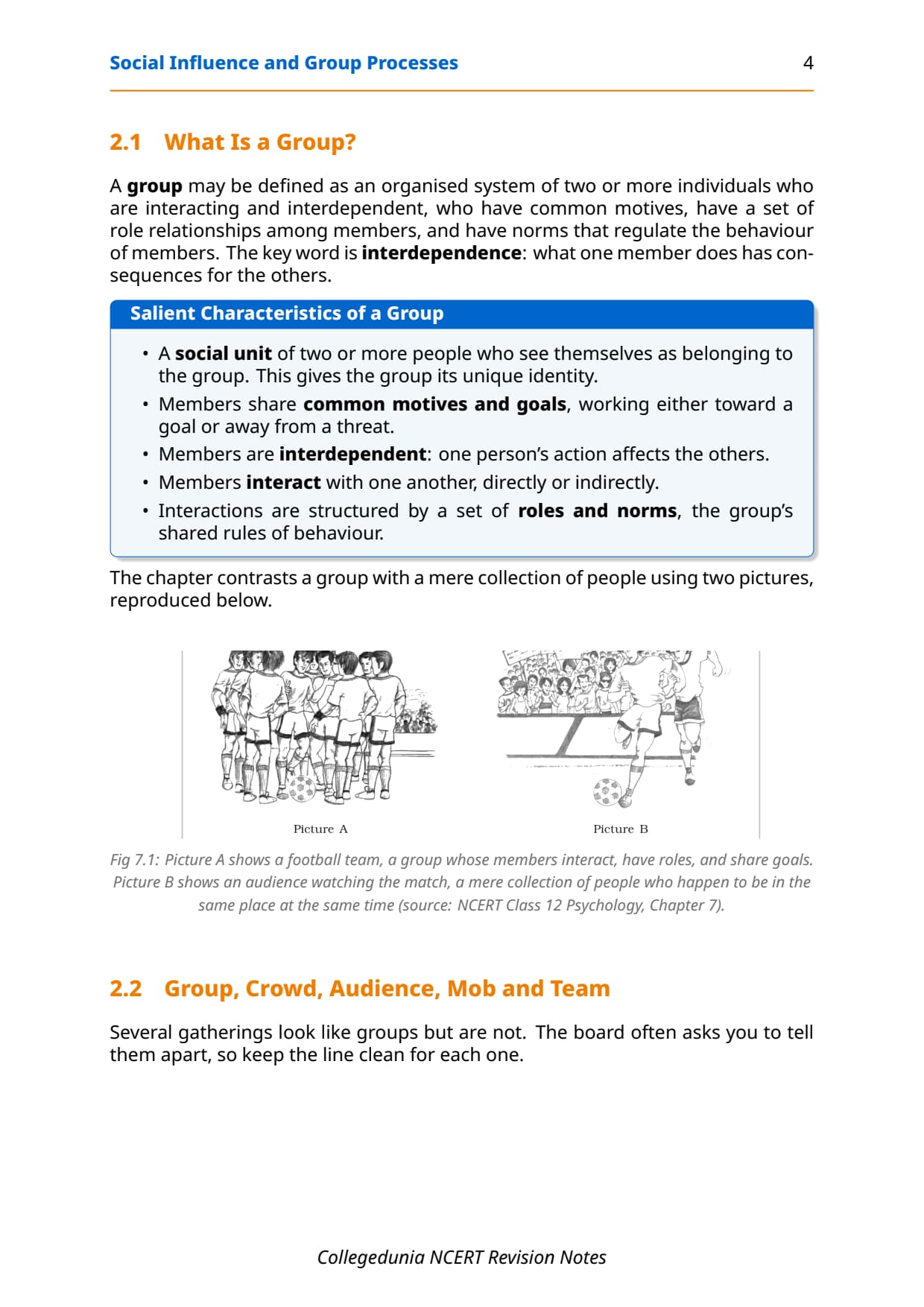
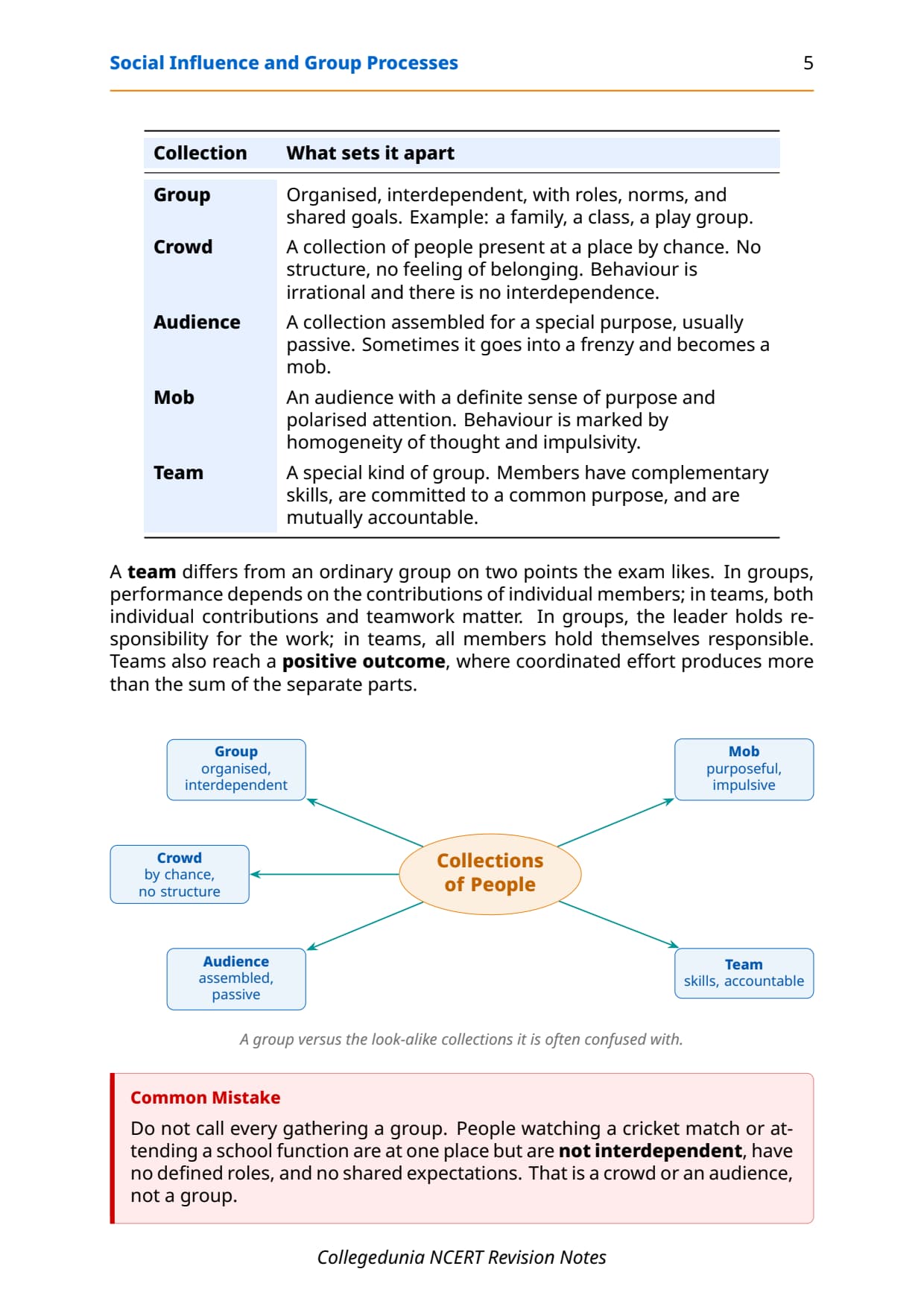
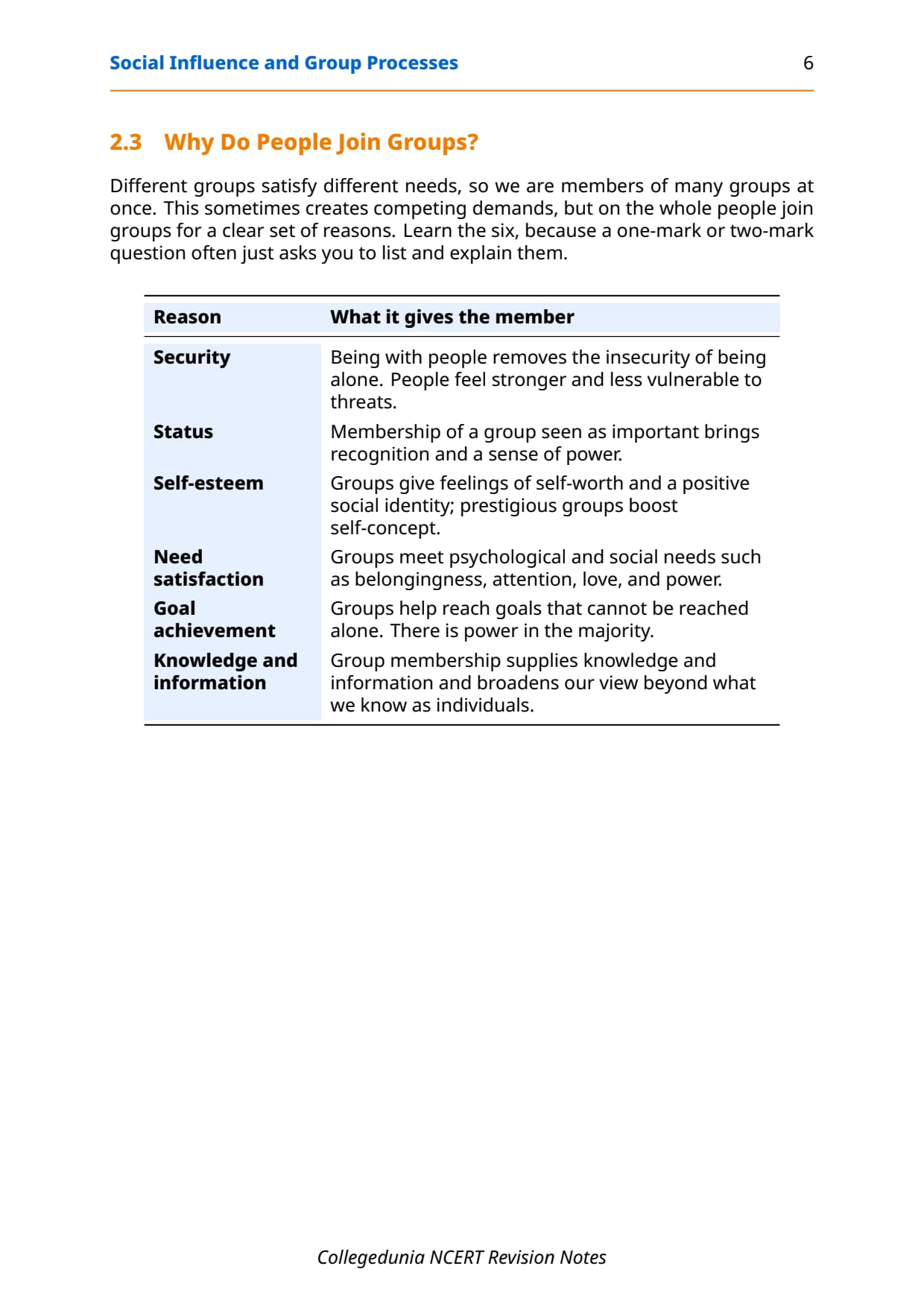
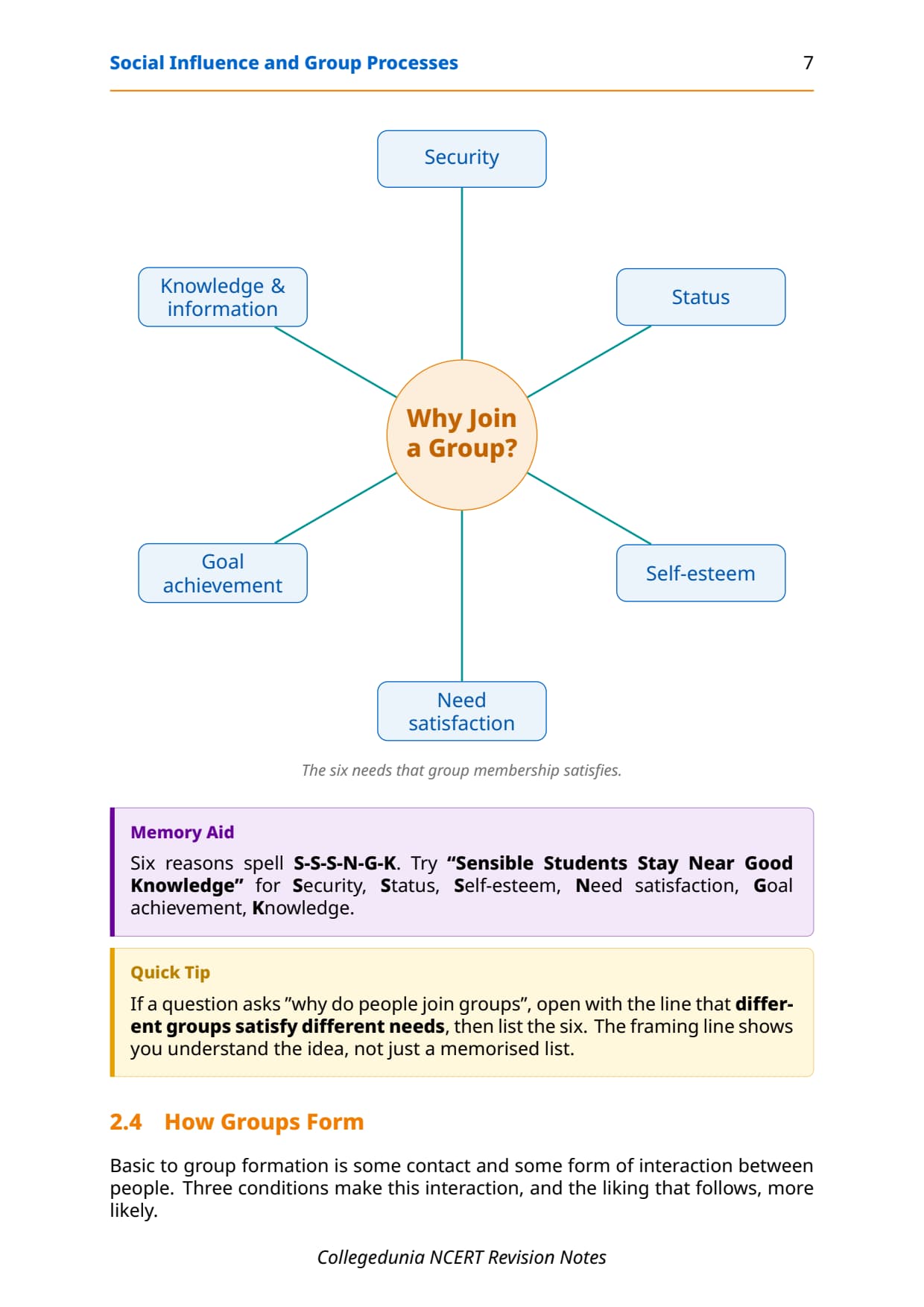
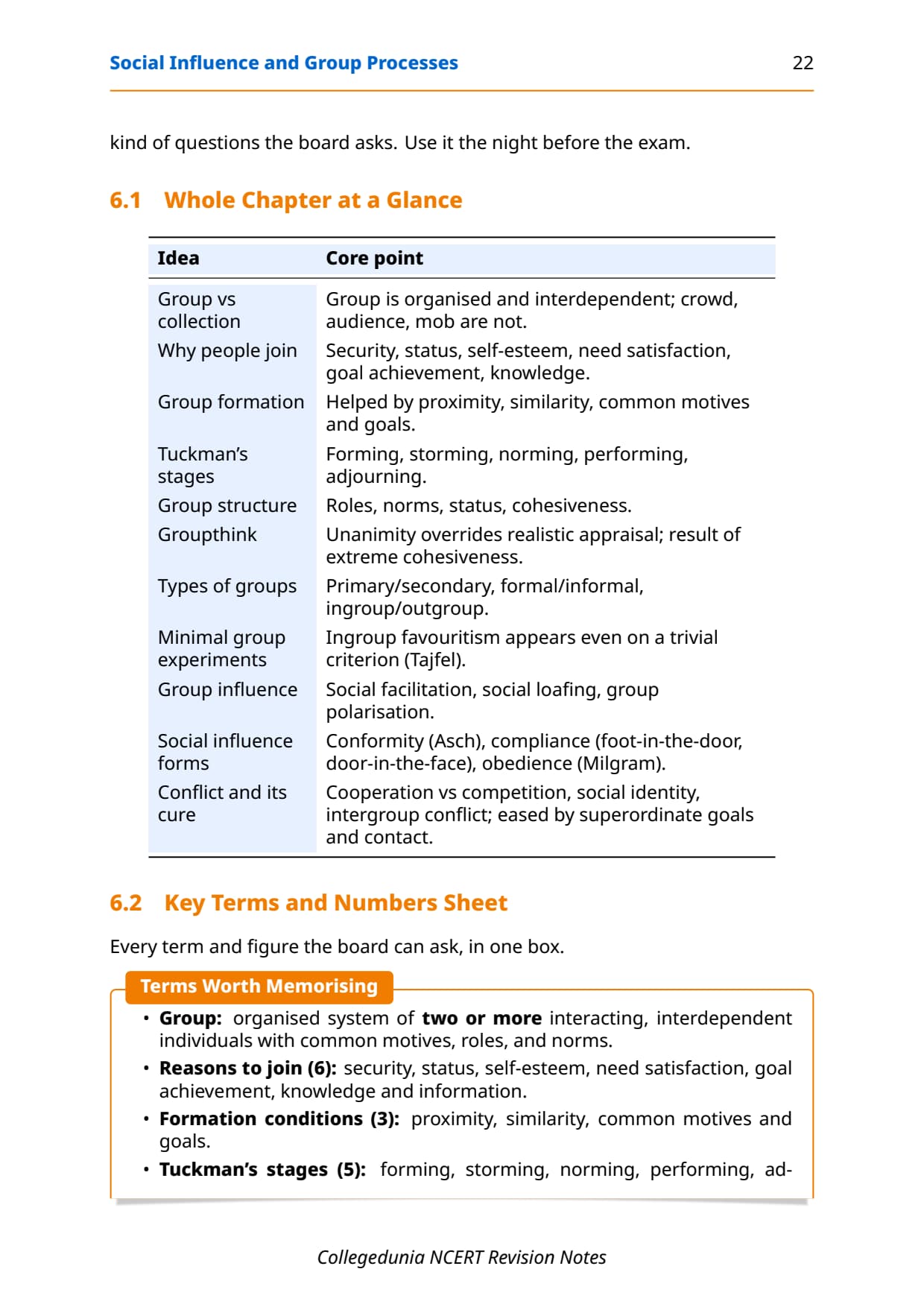
A group is an organised system of two or more people who interact, are interdependent, share common motives, hold role relationships, and follow norms. That is what sets it apart from a crowd, a mob or a casual gathering. For quick revision, learn the five reasons people join groups as a boxed list you can copy onto the answer sheet.
- Security: being with people gives comfort and protection.
- Status and self-esteem: a respected group brings recognition and self-worth.
- Psychological and social needs: belongingness, attention, love and power.
- Goal achievement and knowledge: groups reach goals and supply information one person cannot.
The point examiners test most is that a group has interdependence, roles and norms, while a crowd does not. A crowd is irrational and has no belongingness; a team is a special group with complementary skills and mutual accountability. Keep both the join-reasons list and this group-versus-crowd point ready for the long answer.
How Groups Form and Develop: Tuckman's Stages
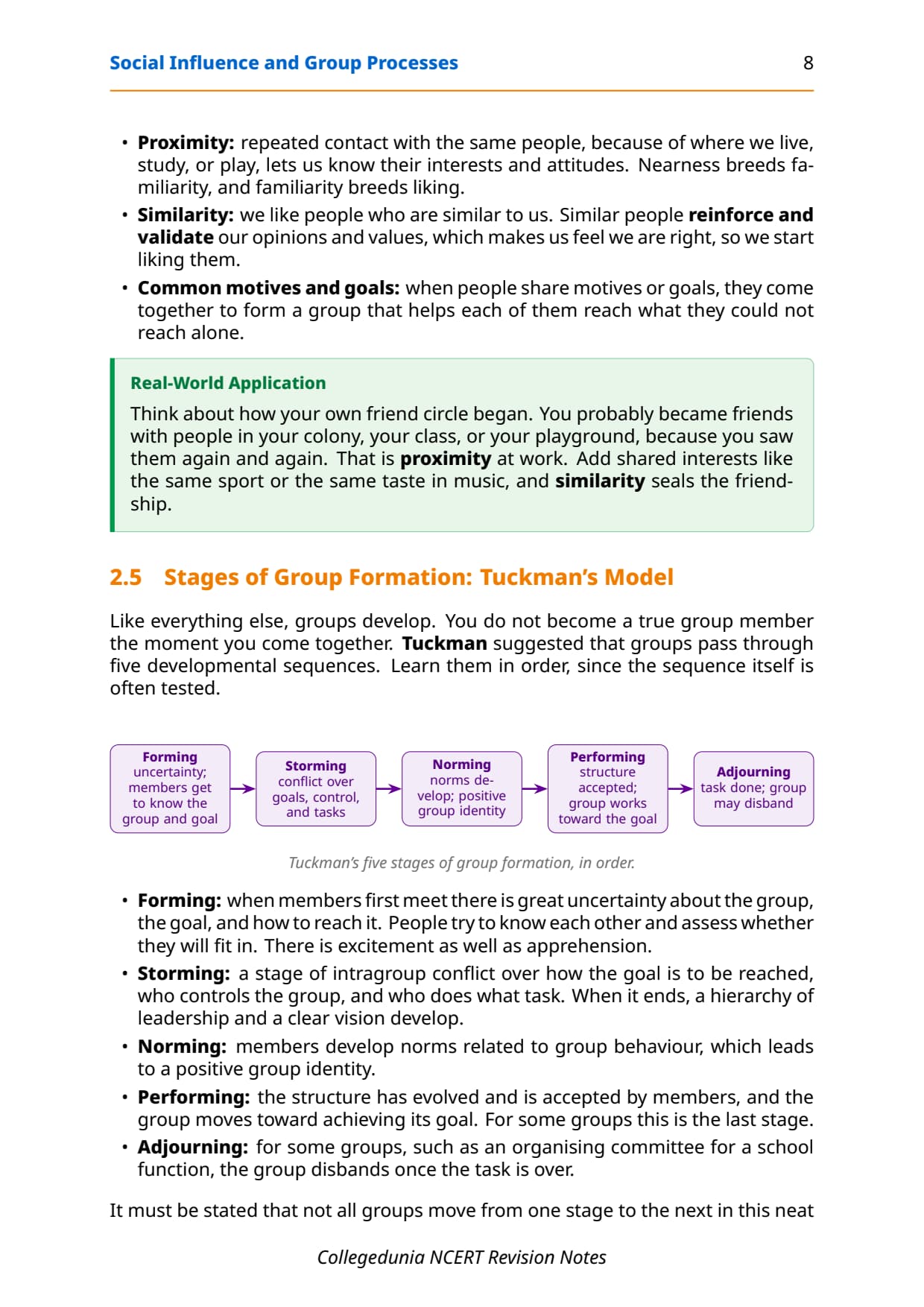
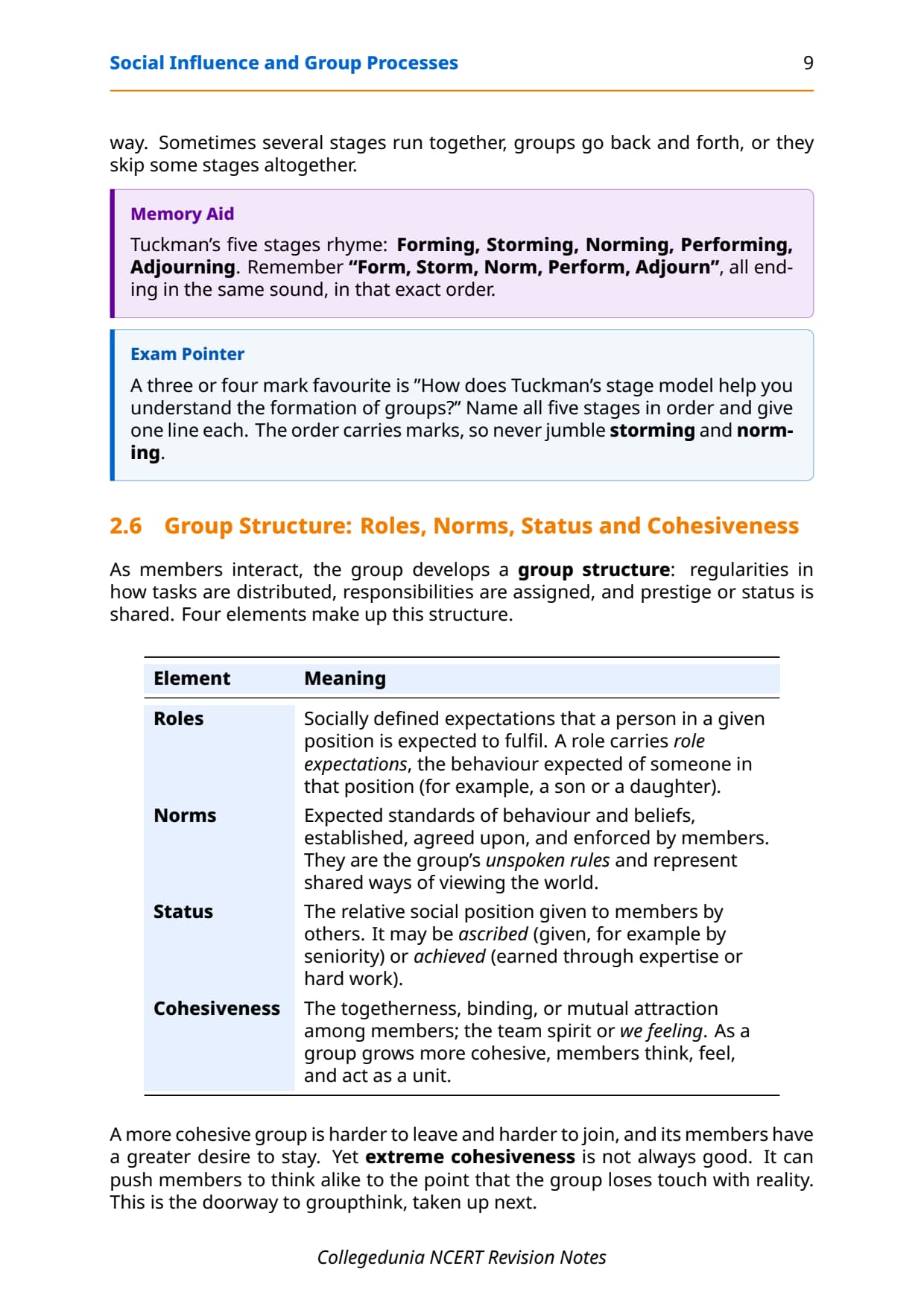
Groups do not form the moment people come together; they develop over time. These notes keep Tuckman's five stages and the conditions of formation as clear lists. Learn them this way and you can answer any version of the formation question.
| Stage | What happens |
|---|---|
| Forming | Members meet; uncertainty about the group, goal and how to reach it. |
| Storming | Conflict over goals, control and roles; a leadership hierarchy emerges. |
| Norming | Members develop norms and a positive group identity. |
| Performing | The structure is accepted; the group works towards its goal. |
| Adjourning | Task-based groups disband once the work is done. |
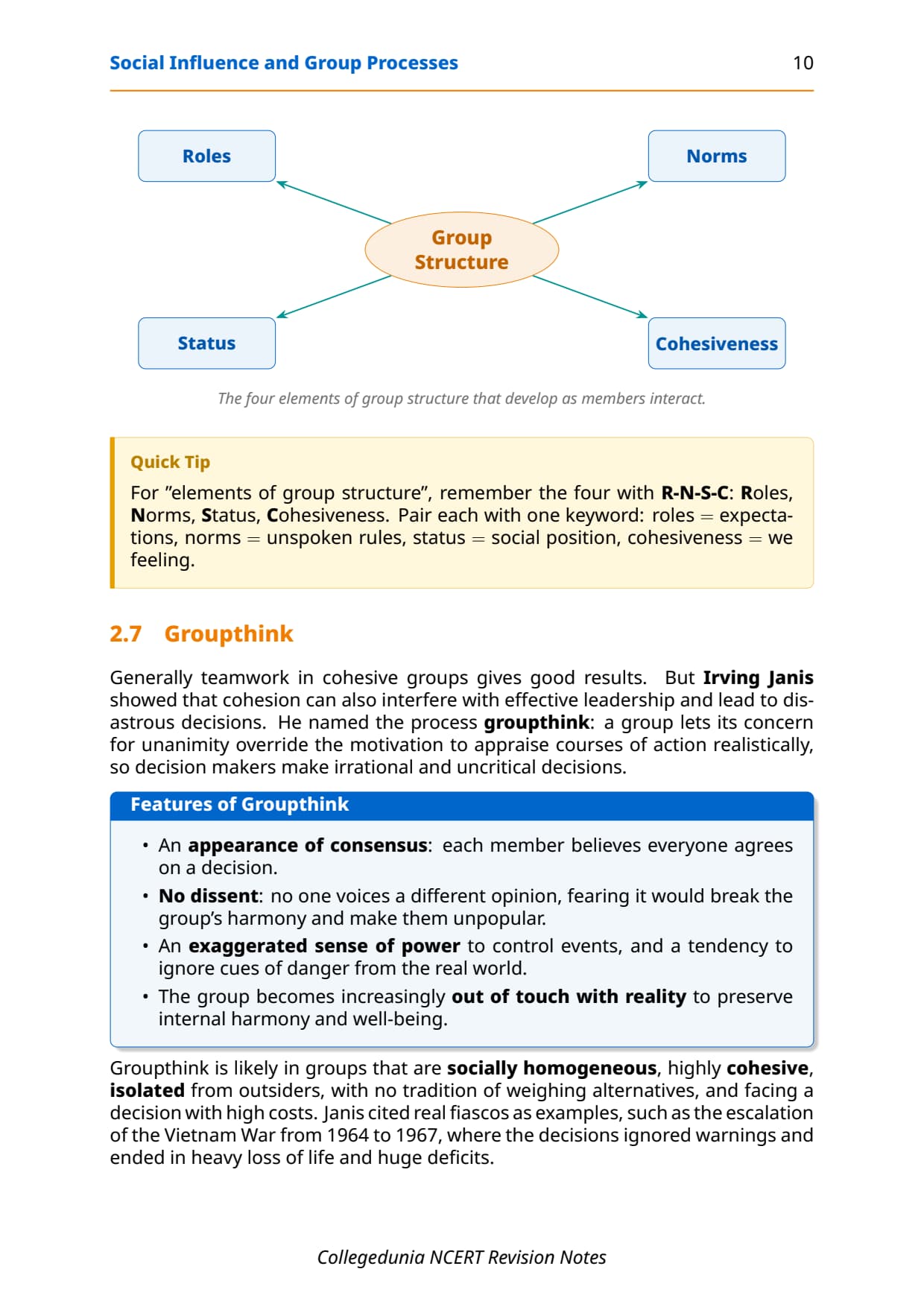
For formation, also remember the conditions that bring people together: proximity, similarity and common motives and goals. The four elements of group structure are roles, norms, status and cohesiveness. Keep Tuckman's stages, the formation conditions and the structure elements as three separate lists so you never mix them up.
Types of Groups
Groups come in pairs of types, and NCERT names three pairs. This is a favourite short answer, so these notes give the three contrasts side by side. The exam often asks you to differentiate one pair.
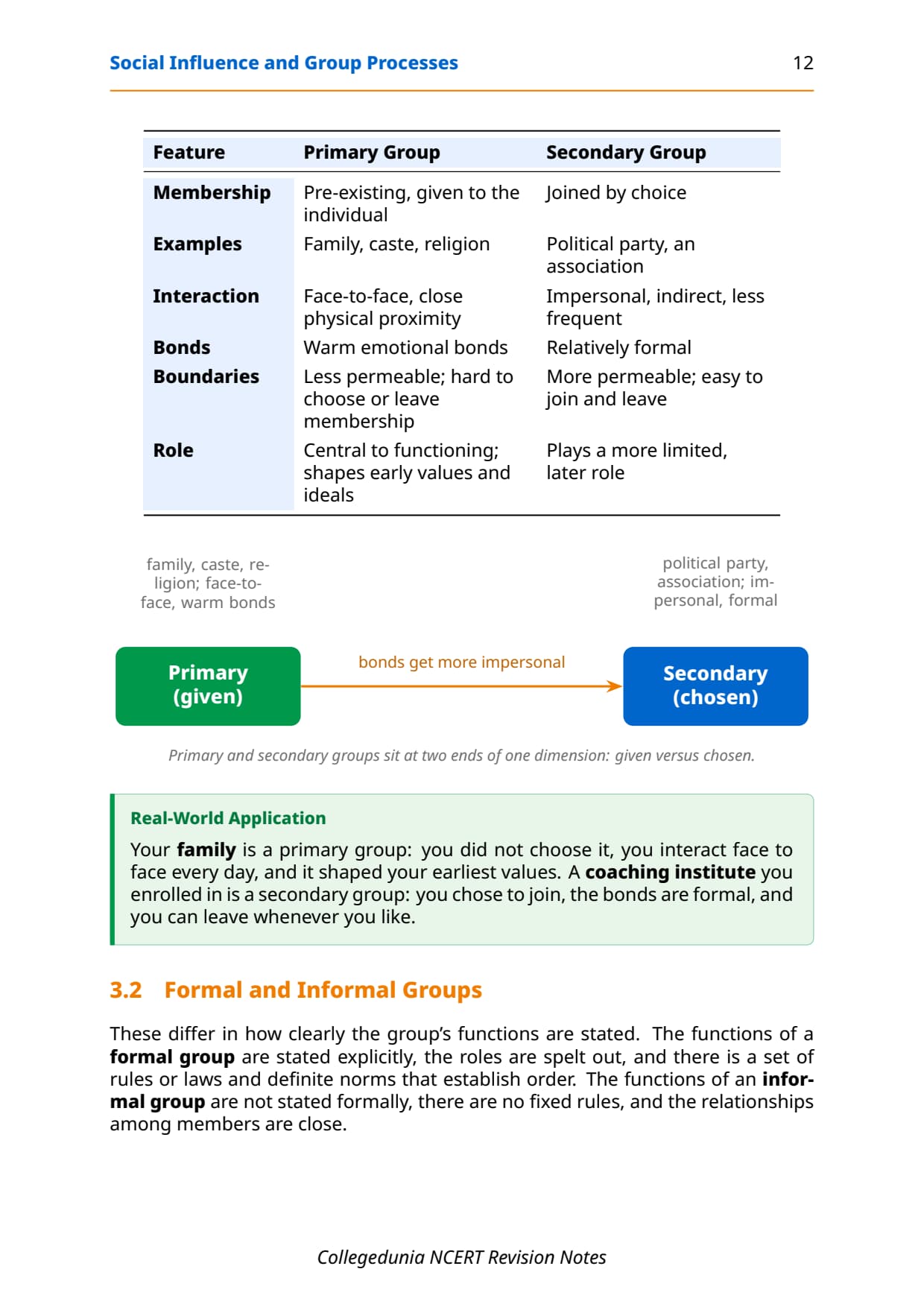
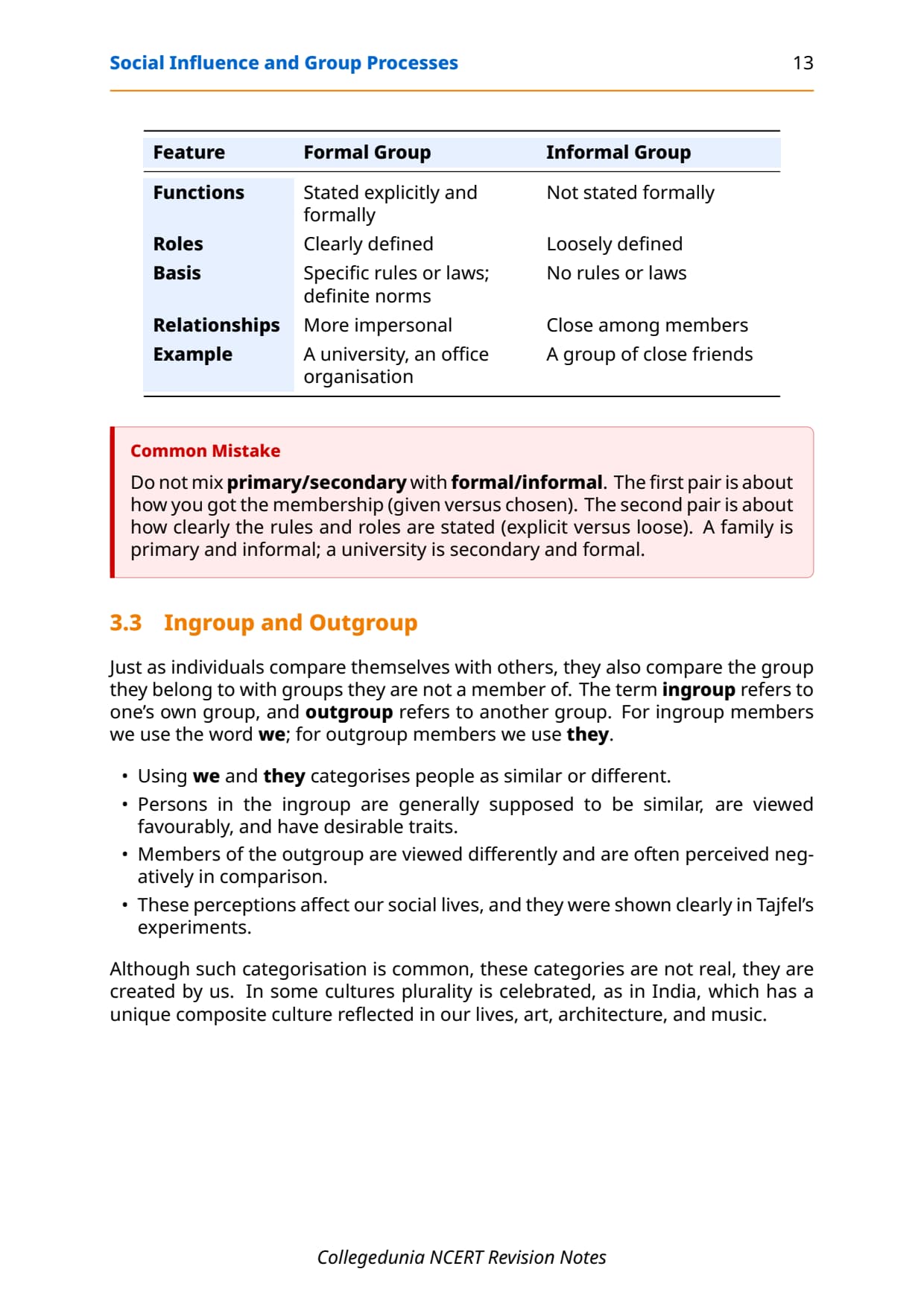
- Primary and secondary: a primary group is pre-existing with close, face-to-face bonds (family); a secondary group is joined by choice and is more impersonal (a political party).
- Formal and informal: a formal group has openly stated rules and roles (an office); an informal group rests on personal ties with no stated rules (friends).
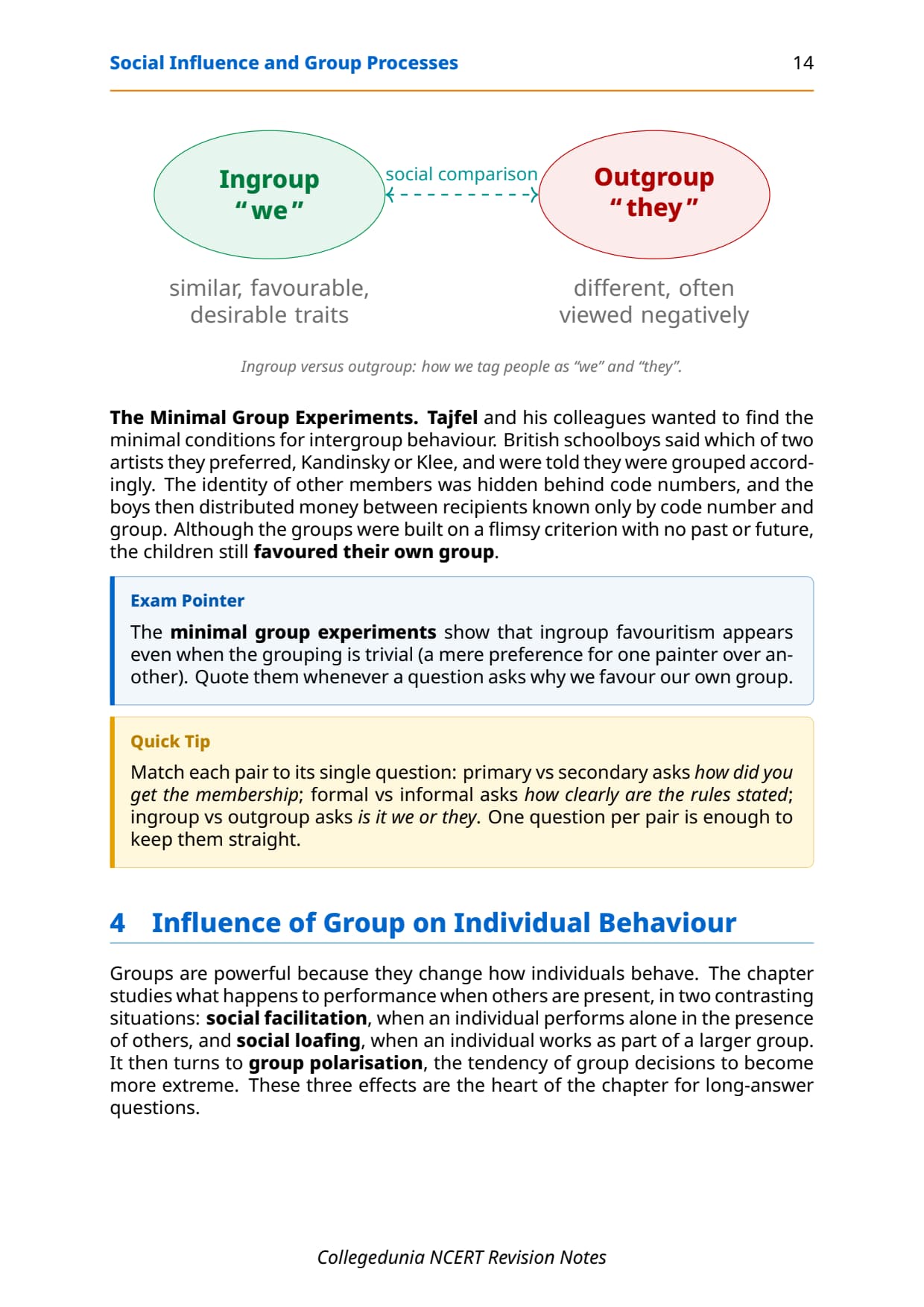
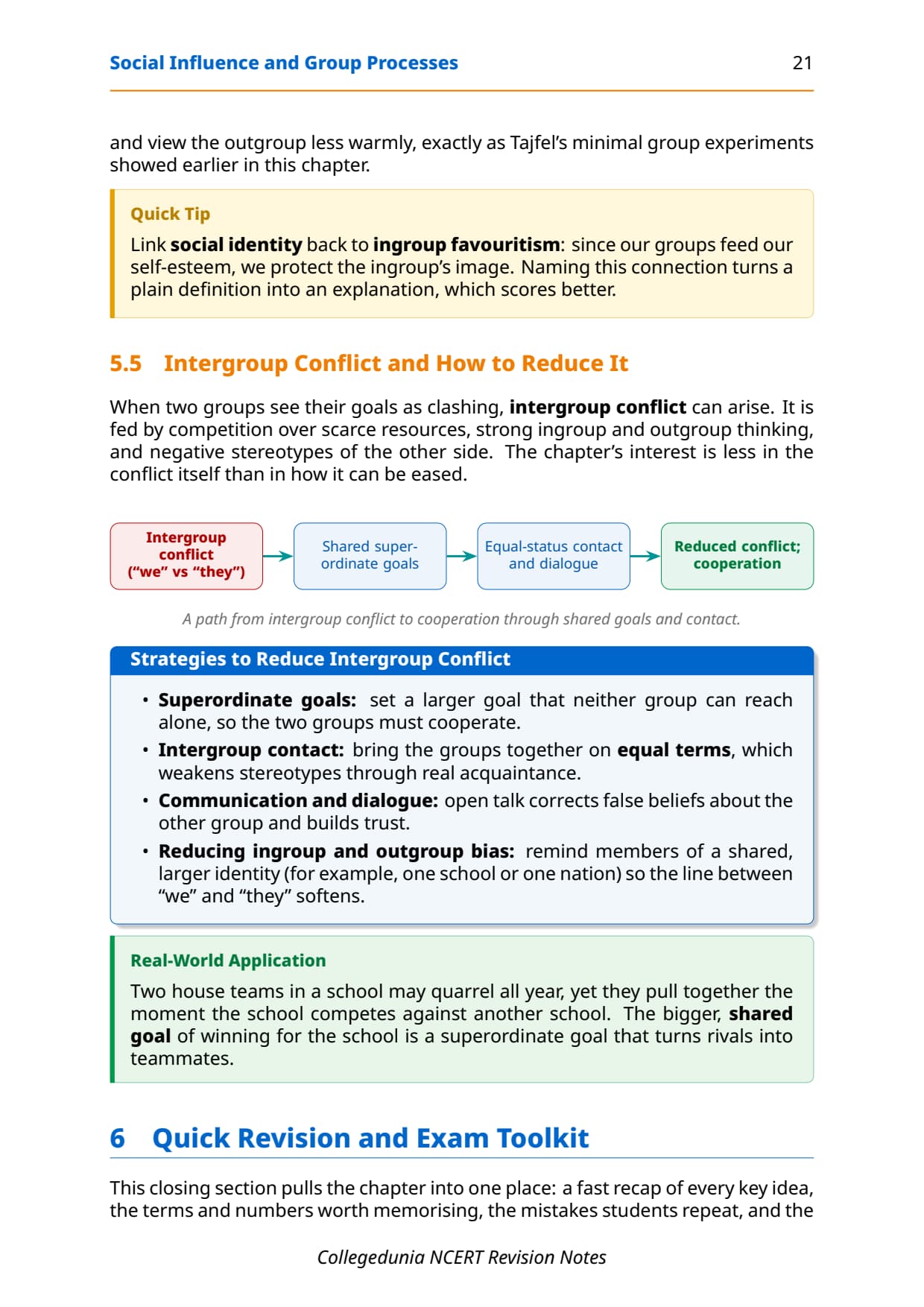
- Ingroup and outgroup: the ingroup is one's own group (we), seen favourably; the outgroup is another group (they), seen less favourably.
The judgement to remember is that the ingroup-outgroup line is socially created, not real. Naming the defining criterion of each pair, how stated the rules are, how the bond forms, or whose side it is on, is what earns the marks here, so keep all three contrasts ready.
How Groups Influence Individual Behaviour
The last part of the chapter is group influence: how being in a group changes what we do. These three terms are close, so these notes keep them apart in a clear table. Learning the contrast first makes every influence answer easier.
| Process | What it is |
|---|---|
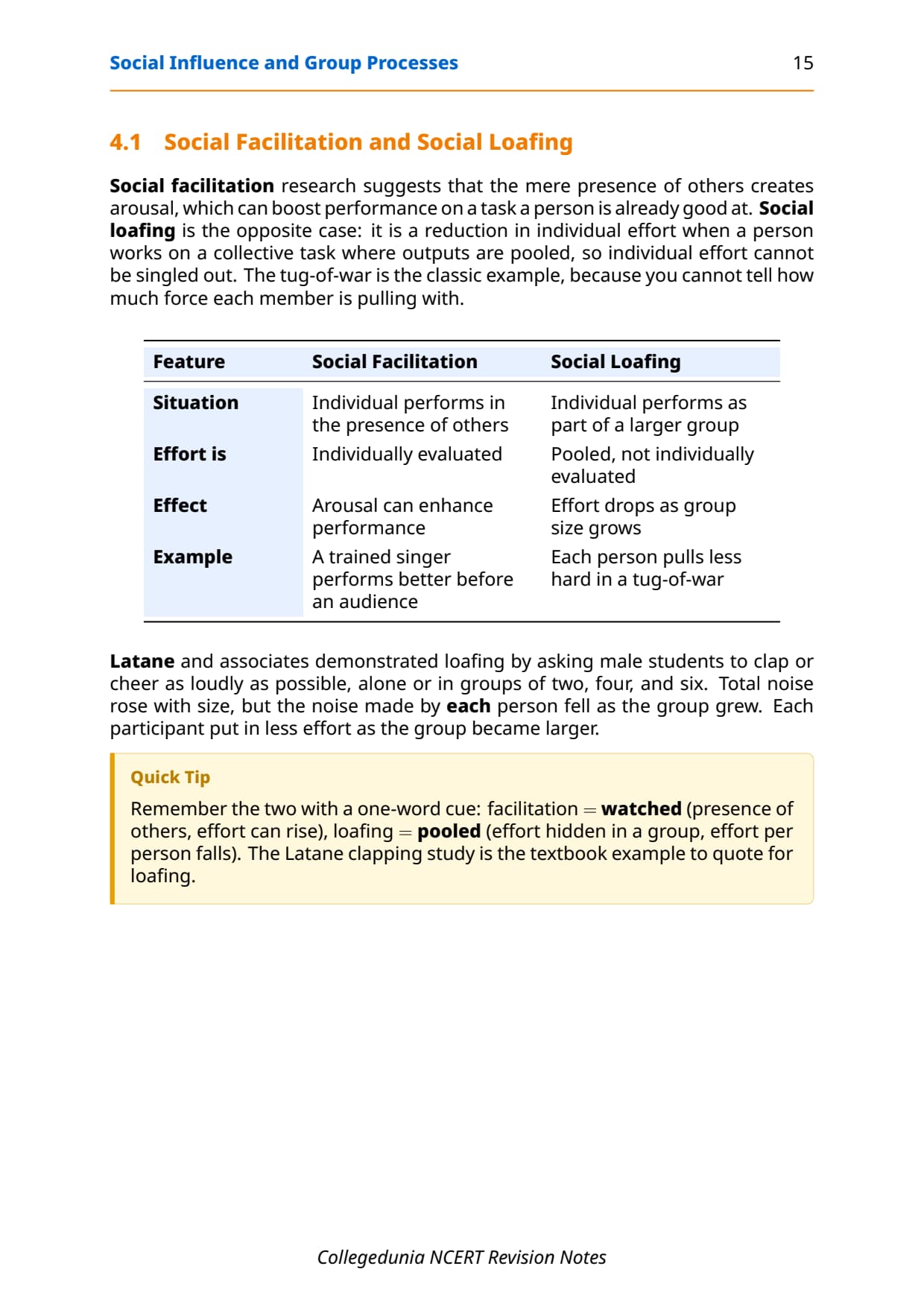
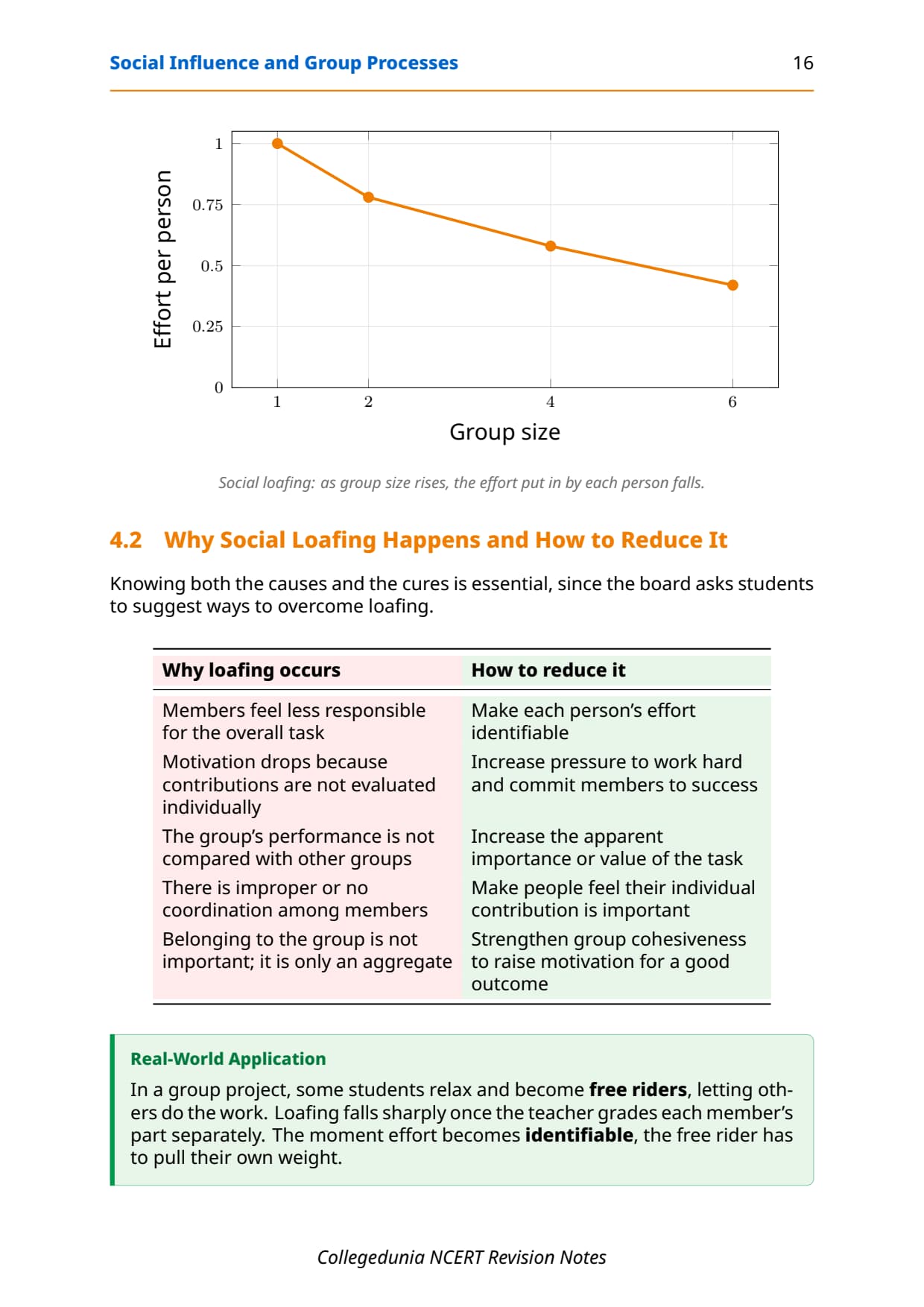
| Social loafing | Individual effort drops when work is pooled and not evaluated individually. |
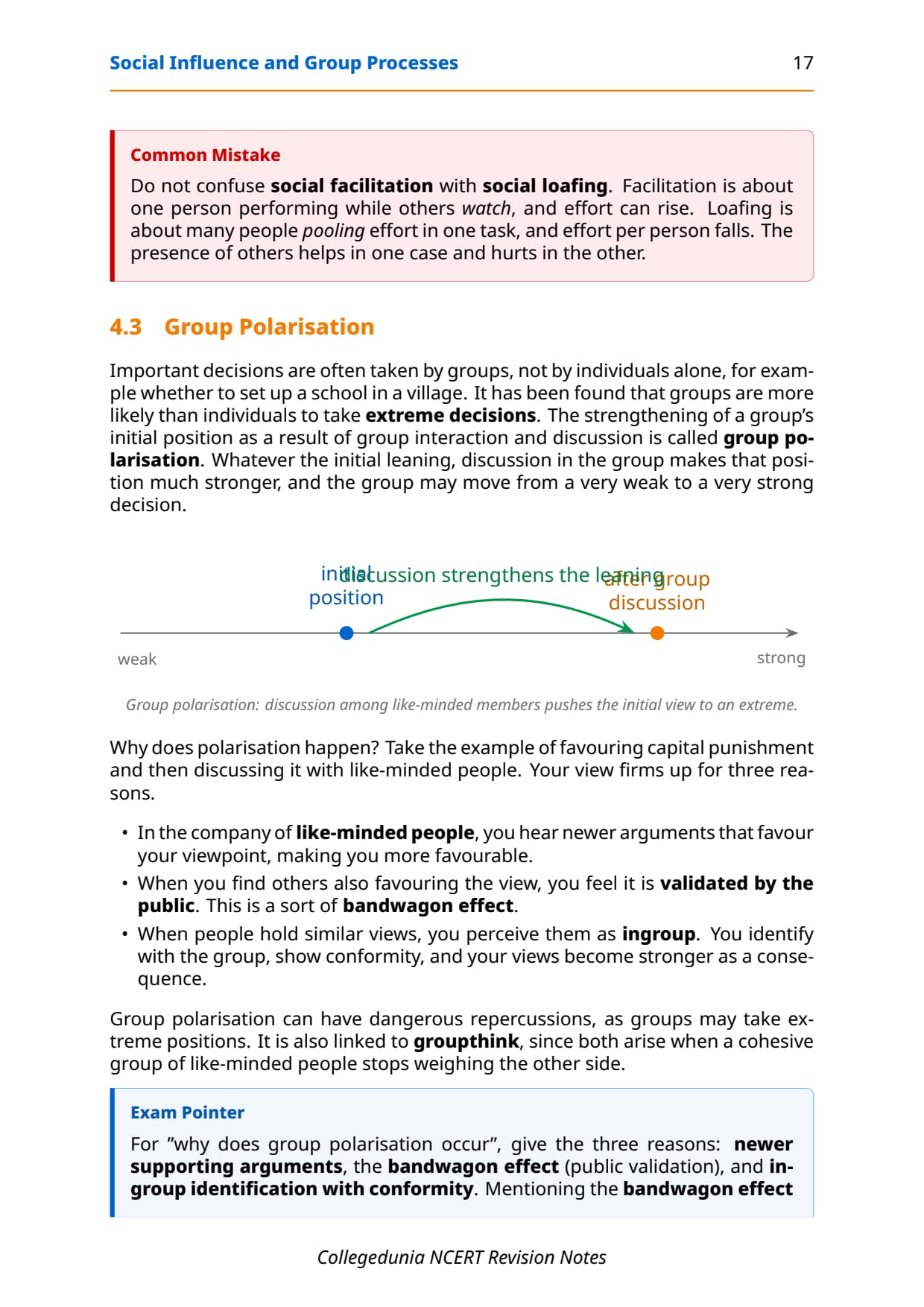
| Group polarisation | The group's starting view becomes more extreme after discussion. |
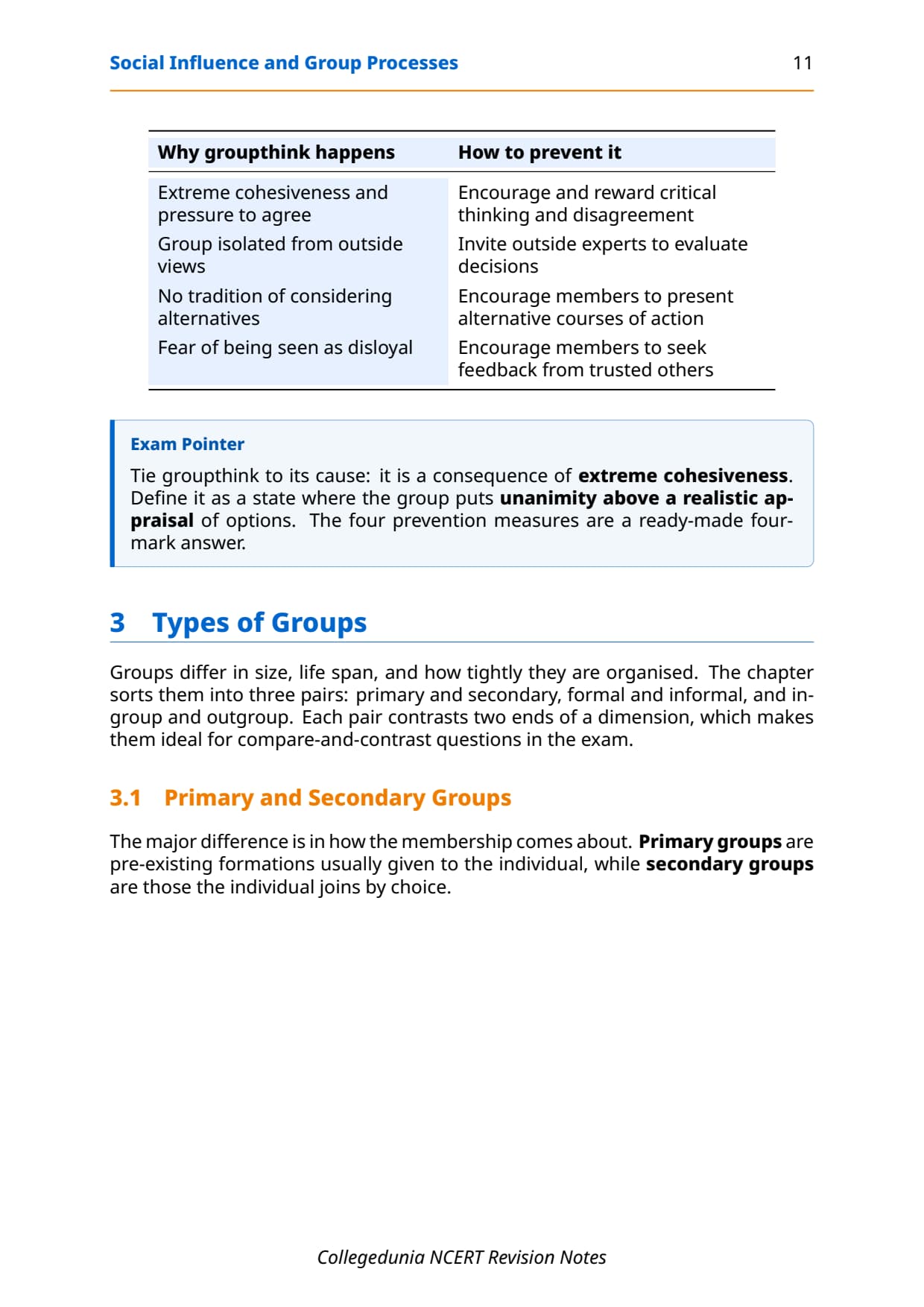
| Groupthink | A highly cohesive group makes irrational decisions because dissent is silenced. |
The sharp point for your sheet is that social loafing lowers effort, polarisation sharpens opinion, and groupthink hurts judgement. Social loafing can be reduced by making each contribution identifiable and valued. Polarisation runs on new arguments, validation and a bandwagon effect. Groupthink is the cost of extreme cohesiveness, and it is prevented by encouraging dissent and inviting outside views.
Social Influence and Group Processes Important Questions and Exam Pointers
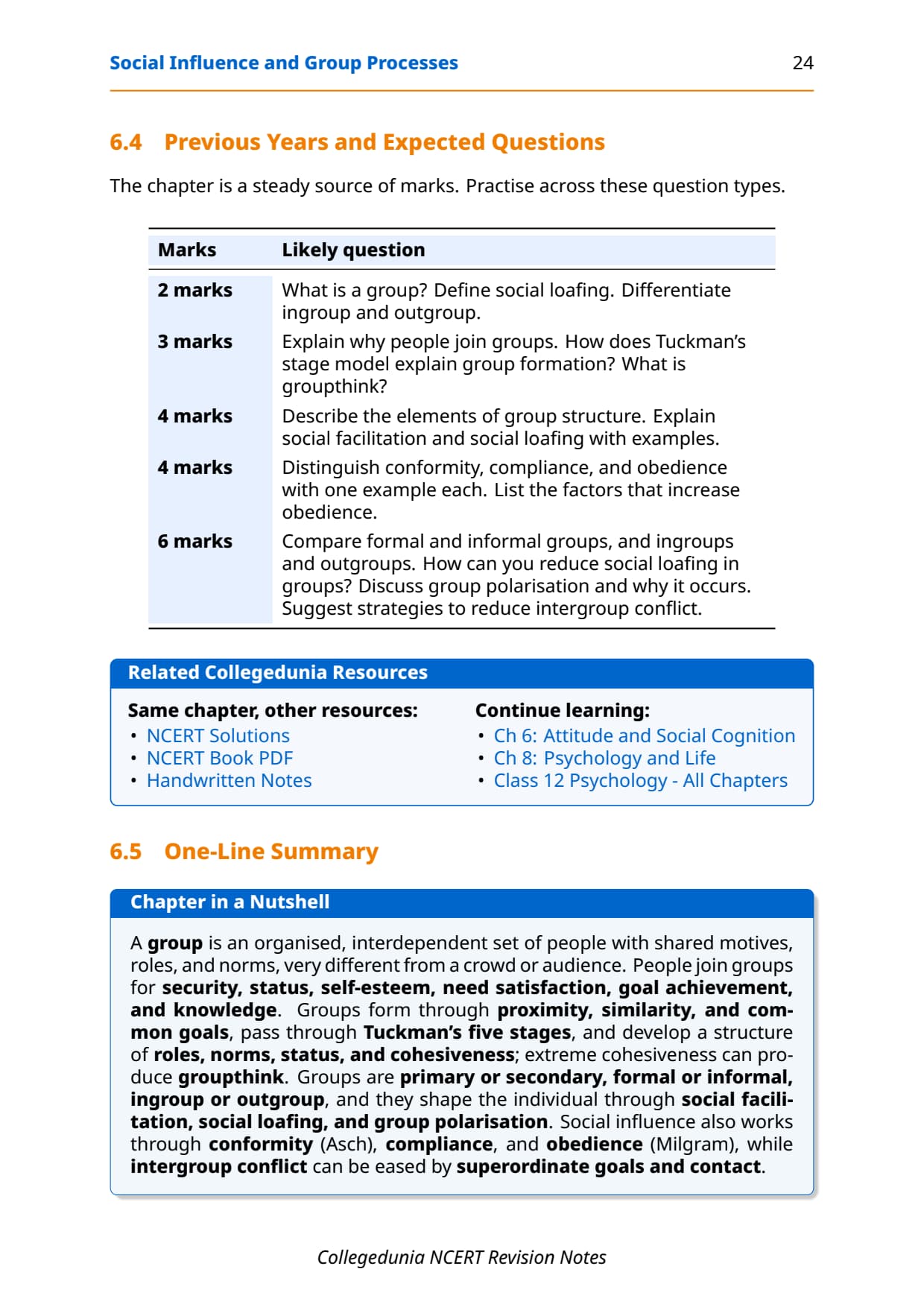
CBSE sets a steady mix of objective, short and long answers from this chapter. Knowing the pattern helps students decide how much to write and which topics to revise first. A focused list of social influence and group processes important questions saves a lot of time before the board exam.
- Long answer (5 to 6 marks): how groups influence behaviour, or Tuckman's stages of group formation.
- Short answer (4 marks): the reasons people join groups, or how to reduce social loafing.
- Differentiate: formal versus informal, or ingroup versus outgroup, a near-certain repeat.
- Apply it: name a group you joined and the motives behind it.
For quick recall, students often practise a short class 12 psychology chapter 7 mcq drill and a list of social influence and group processes class 12 important questions. The most repeated items are Tuckman's stages and the social loafing cures, so keep those points ready in your own words.
Common Mistakes Students Make in This Chapter
A few errors cost marks every year. Most come from blurring close terms or dropping one item from a list. Fixing these five points is the quickest way to lift a score, so add them to the end of your revision sheet.
- Naming only some of Tuckman's stages; you must give all five, forming, storming, norming, performing and adjourning.
- Treating group polarisation and groupthink as the same thing.
- Mixing the types of groups with the reasons people join them.
- Saying social loafing is laziness; it is the drop in effort when work is pooled and unevaluated.
- Forgetting that the ingroup-outgroup split is socially created, not real.
Students who fix these five points usually move from average to high marks. The exam rewards precise terms and a balanced view, so name each idea exactly and give one clear example.
How These Notes Pair with the Solutions and Book PDF
These revision notes summarise the chapter. To prepare fully, students should use them alongside the other resources for the same chapter, all linked in the table below. Read the notes first, then test yourself with the solutions, and open the Book PDF whenever you need the original text.
| Resource | Best used for |
|---|---|
| Social Influence and Group Processes NCERT Solutions | Step-by-step answers to all 5 Review Questions |
| Social Influence and Group Processes Handwritten Notes | Last-minute, one-shot revision in a scanned notebook style |
| Social Influence and Group Processes NCERT Book PDF | Reading the original NCERT chapter text |
Tip: read these notes first, then attempt the solutions on your own, and only then check the model answers. That order builds memory faster than copying answers straight away.
All Class 12 Psychology Notes by Chapter
The table links the revision notes for every chapter in Class 12 Psychology, so students can move across the course in one click. Social Influence and Group Processes is highlighted.
| Chapter | Notes |
|---|---|
| Chapter 1 | Variations in Psychological Attributes |
| Chapter 2 | Self and Personality |
| Chapter 3 | Meeting Life Challenges |
| Chapter 4 | Psychological Disorders |
| Chapter 5 | Therapeutic Approaches |
| Chapter 6 | Attitude and Social Cognition |
| Chapter 7 | Social Influence and Group Processes |
FAQs on Social Influence and Group Processes Class 12 Notes
Social Influence and Group Processes Class 12 Psychology Notes Common Questions
Ques. Where can I download the Social Influence and Group Processes Class 12 notes PDF?
Ans. You can download the Social Influence and Group Processes Class 12 Psychology notes PDF directly from this page. It is free, follows the 2026-27 NCERT, and covers the nature and types of groups, why people join, Tuckman's stages and group influence in a short, point-wise format.
Ques. What does the Social Influence and Group Processes chapter cover for Class 12?
Ans. It covers the nature and formation of groups, the reasons people join them, Tuckman's five stages, group structure, the types of groups, and how groups influence behaviour through social loafing, group polarisation and groupthink.
Ques. What are Tuckman's five stages of group formation?
Ans. The five stages are forming (uncertainty), storming (conflict), norming (shared norms and identity), performing (working towards the goal) and adjourning (disbanding). A full answer names all five and explains that storming is a needed step.
Ques. Why is Social Influence and Group Processes important for the board exam?
Ans. Because it is a high-scoring theory chapter. Tuckman's stages, the reasons for joining a group and the social loafing cures appear almost every year, so revising these notes well secures both objective and long-answer marks.
Ques. How should I use these notes to revise quickly?
Ans. Read the notes once under the group, type and influence frame, keep Tuckman's five stages and the five join-reasons on one sheet, then write the key lists from memory. Finish by attempting a short class 12 psychology chapter 7 mcq drill to test the small facts.



Comments