




These Variations in Psychological Attributes Class 12 Notes give a quick, exam-ready summary of how people differ on psychological qualities, with the spotlight on intelligence, set to the 2026-27 CBSE syllabus. The notes pull together every key theory, name and number from Chapter 1 of Class 12 Psychology. Students can use them for a fast revision the night before a test or to fix the main ideas before they attempt the review questions.
- Covers individual differences, the theories of intelligence, IQ, culture, emotional intelligence and creativity in one place.
- This Class 12 Psychology chapter usually carries 6 to 7 marks in the board paper.
- Pairs with the NCERT Solutions, Handwritten Notes and Book PDF linked lower on this page.
These Variations in Psychological Attributes Class 12 notes are written from the official NCERT Psychology textbook and checked against the last five years of CBSE board papers.
Student Feedback: In a Collegedunia poll of 8,540 Class 12 Psychology students taken before the 2026 boards, 73% of students said short, point-wise notes on the theories of intelligence and the IQ table were the fastest way to revise this chapter. Most students kept the eight Gardner types and the IQ bands on a single sheet for last-minute recall.
Source: 2026-27 Class 12 Psychology student poll. Sample of 8,540 students from CBSE schools across 12 states.
What the Variations in Psychological Attributes Notes Cover
Variations in Psychological Attributes is the first chapter of Class 12 Psychology. It studies how people differ from one another on psychological qualities, above all on intelligence. These notes condense the whole chapter into a fast, point-wise summary.
The easiest way to organise your revision is to split the chapter into three threads:
- The basics: individual differences, situationism and how attributes are assessed.
- The theories: the psychometric and information-processing models of intelligence.
- The wider picture: IQ, culture, emotional intelligence, aptitude and creativity.
So these notes are really about human variation and how it is measured. If you sort each fact under one of these threads first, almost every question in Variations in Psychological Attributes class 12 becomes easier to answer. Keep this frame at the top of your revision sheet and slot each new detail into the right box as you read.
Individual Differences, Situationism and Assessment
The chapter opens with why people differ and how those differences are measured. Learn these as a boxed list so you can copy them straight onto the answer sheet. Each one carries its own follow-up questions in the exam.
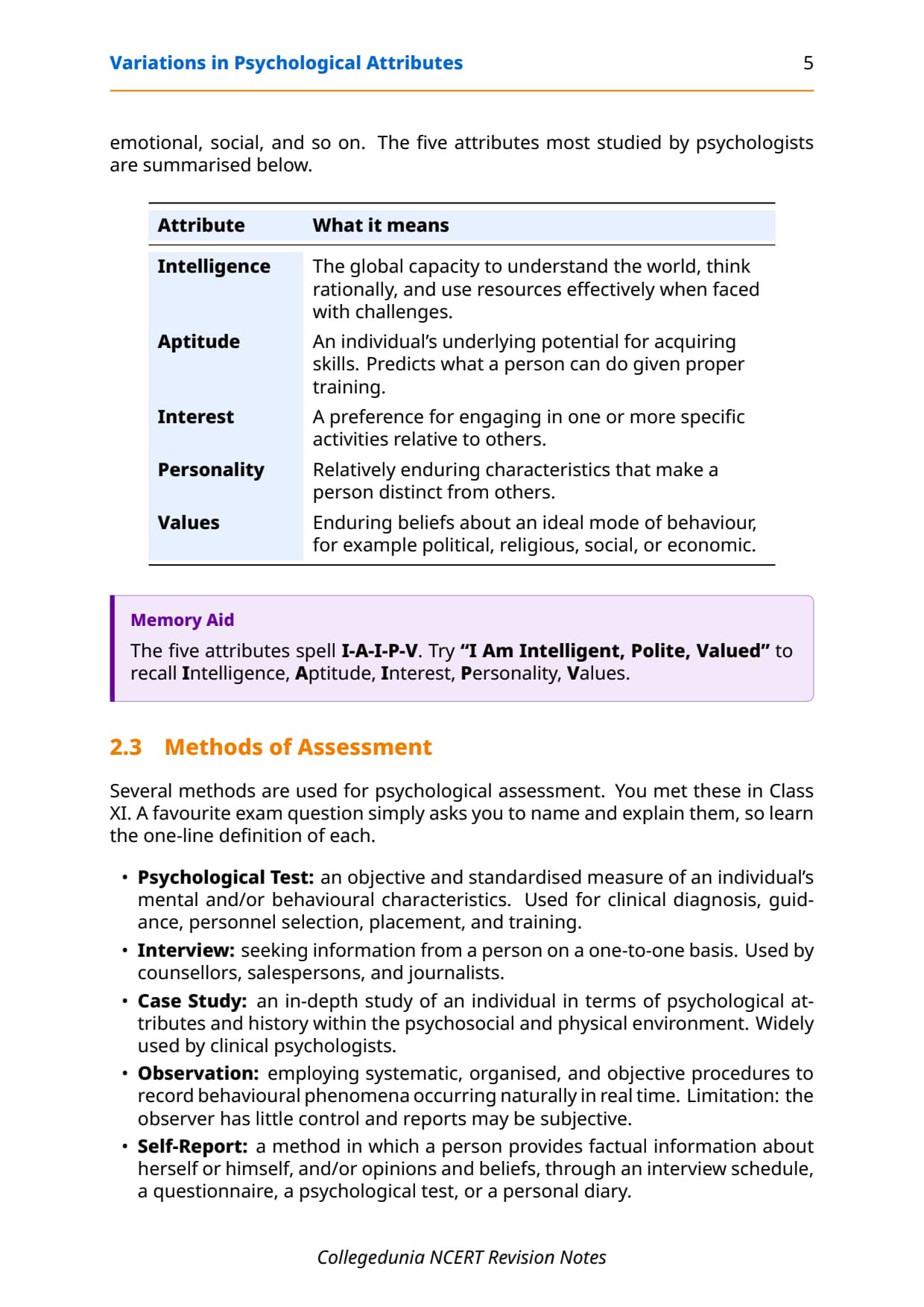
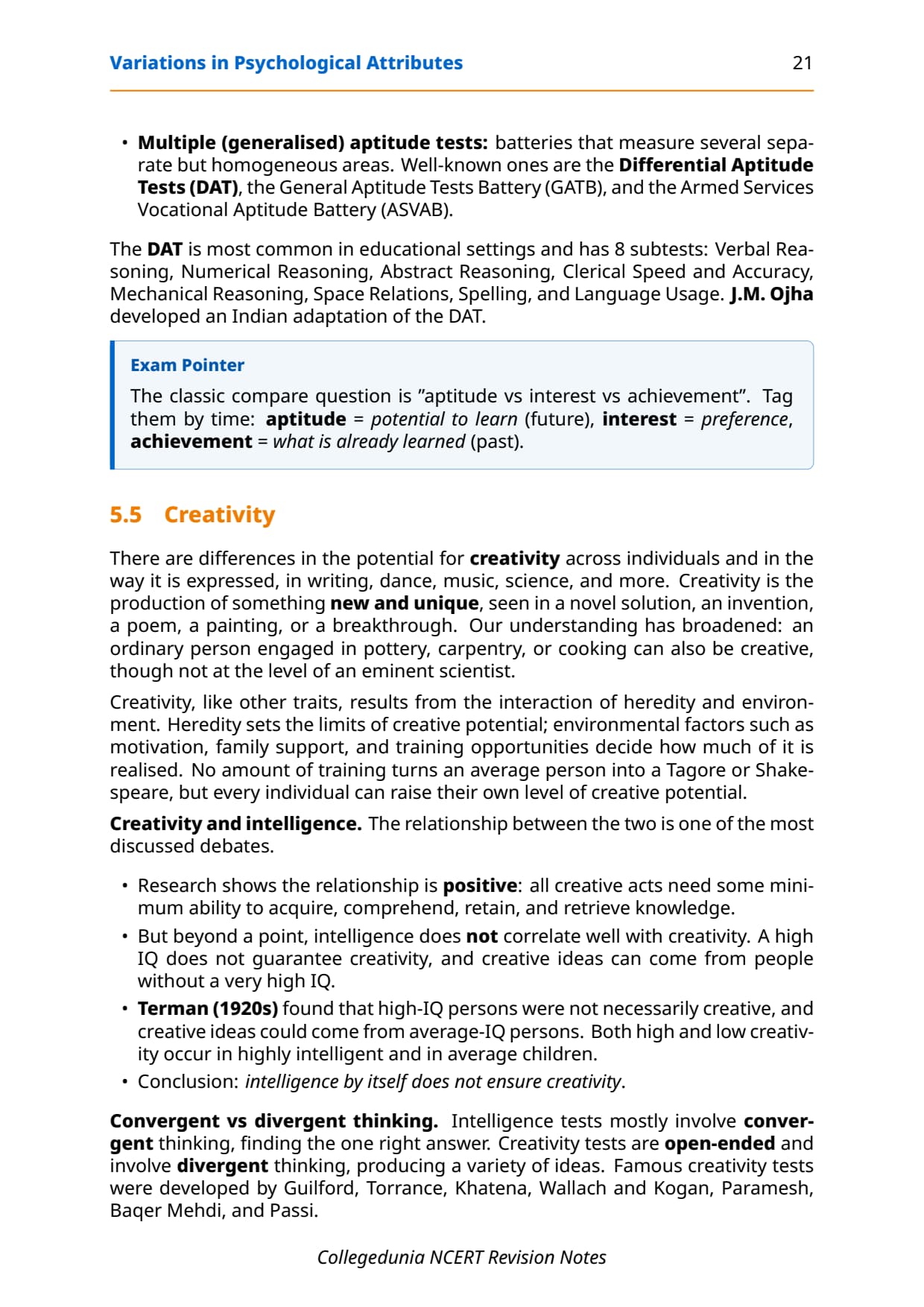
- Individual differences: the distinctiveness and variations among people's characteristics and behaviour.
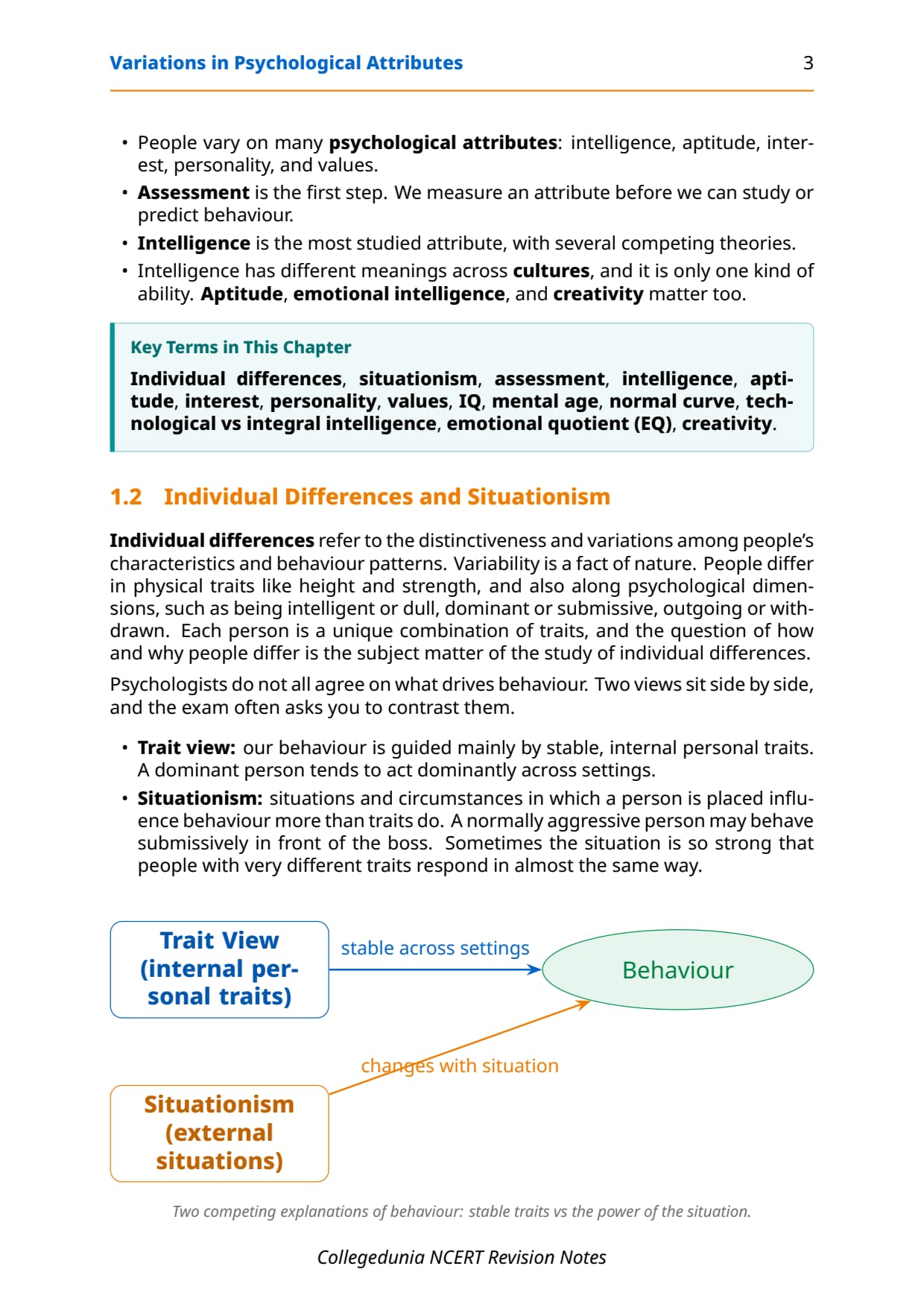
- Situationism: external situations, not just traits, can shape how a person behaves.
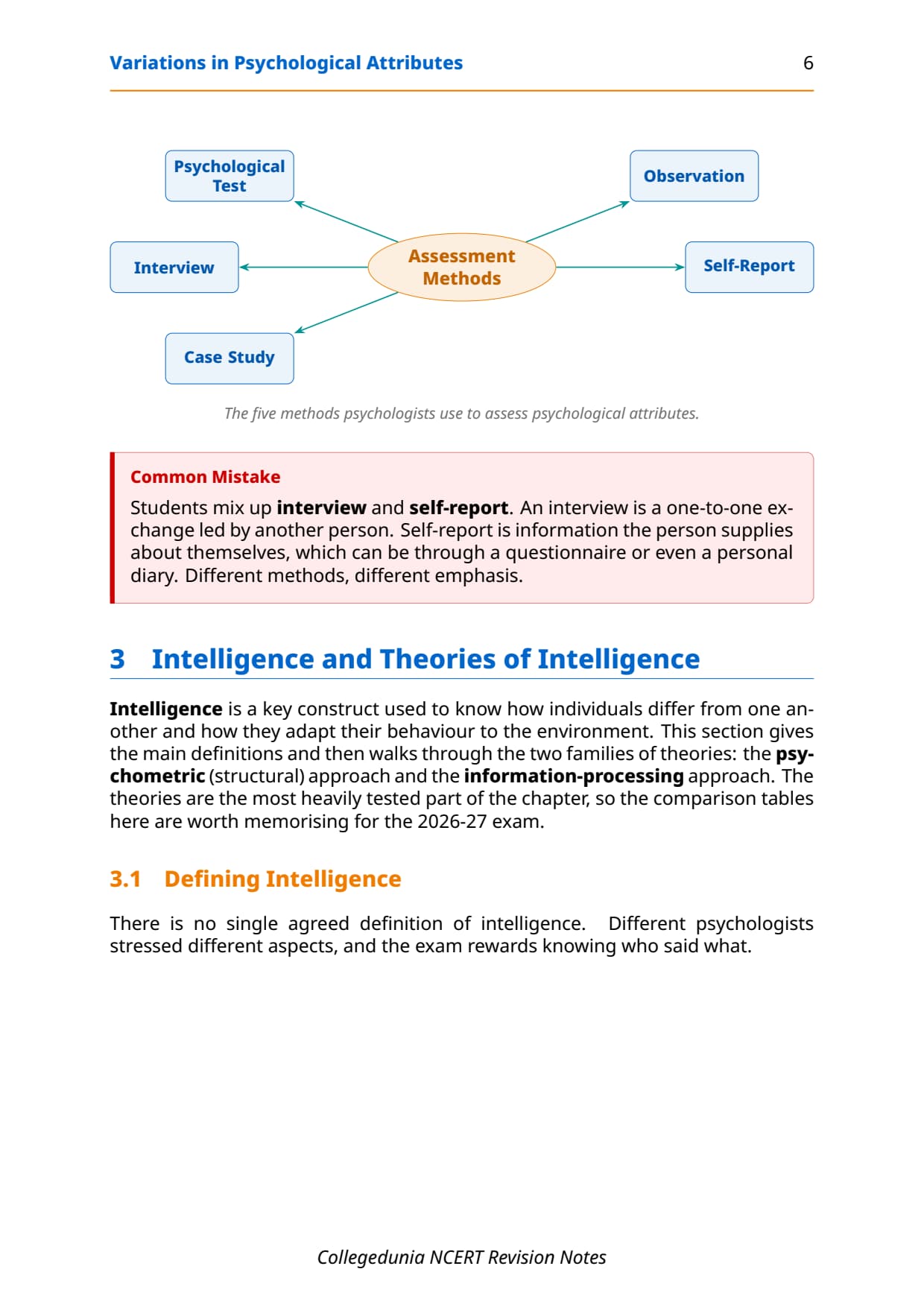
- Assessment: tests, interviews, case studies, observation and self-reports measure attributes.
The point examiners test most is that a good psychological test must be reliable, valid and standardised. Formal assessment is objective and organised, unlike a casual judgement of a person. Keep this idea ready, because questions on assessment turn on whether a method gives the same result each time and measures what it claims to measure.
Theories of Intelligence at a Glance
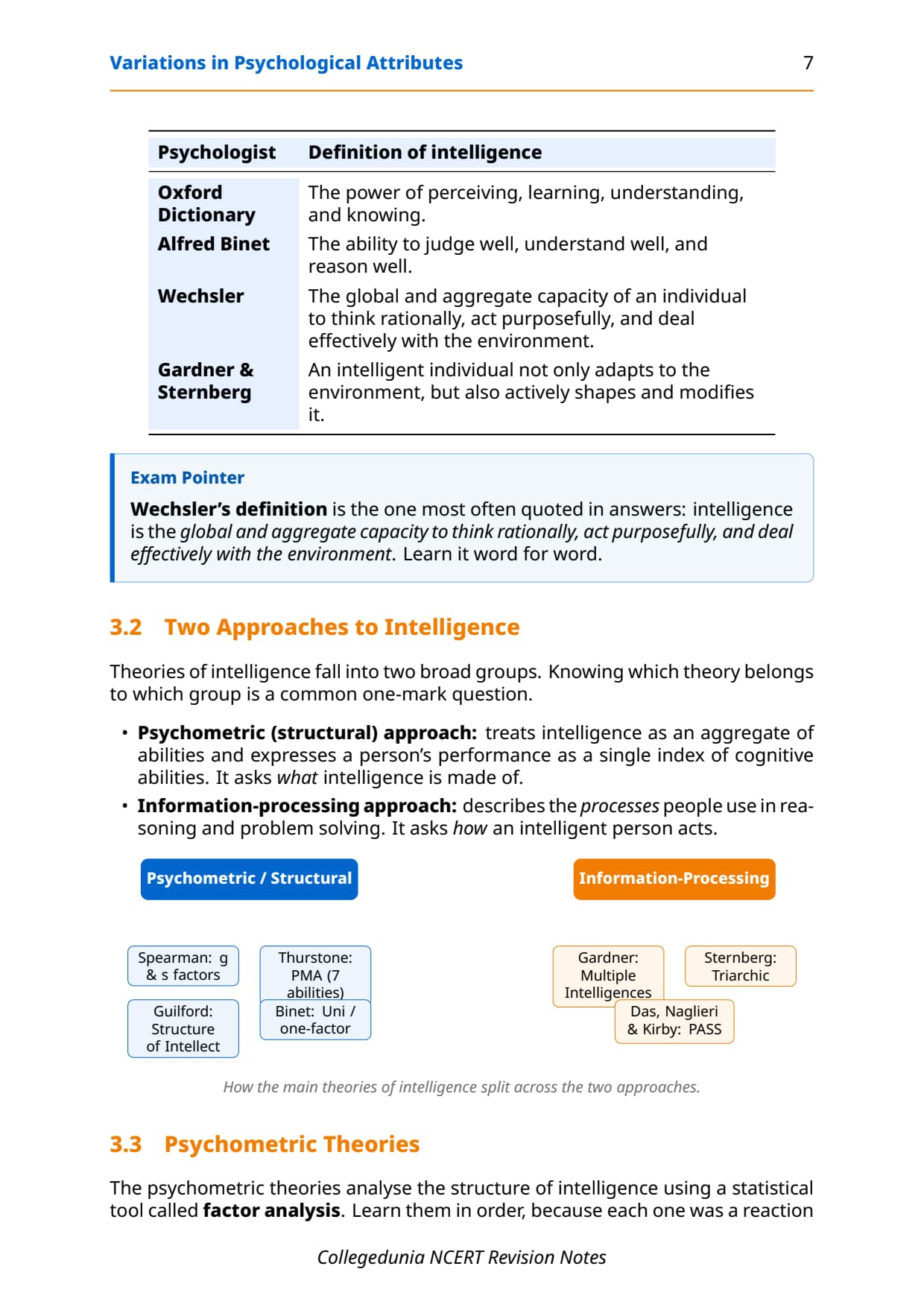
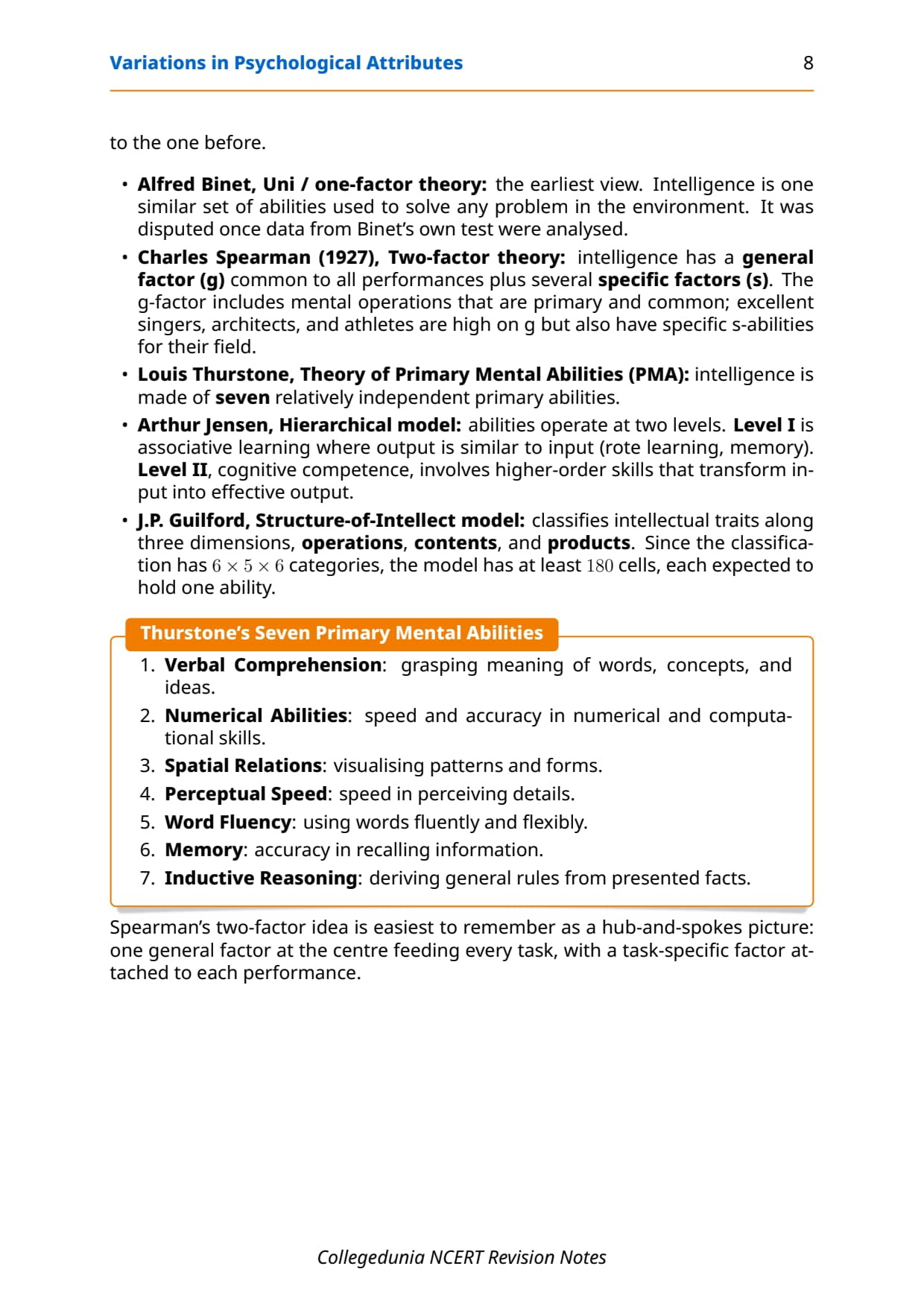
The theories of intelligence are the heart of the chapter and a long-answer favourite, so these notes keep them as a clear table rather than a story. Learn one model from each family and you can answer any version of the question.
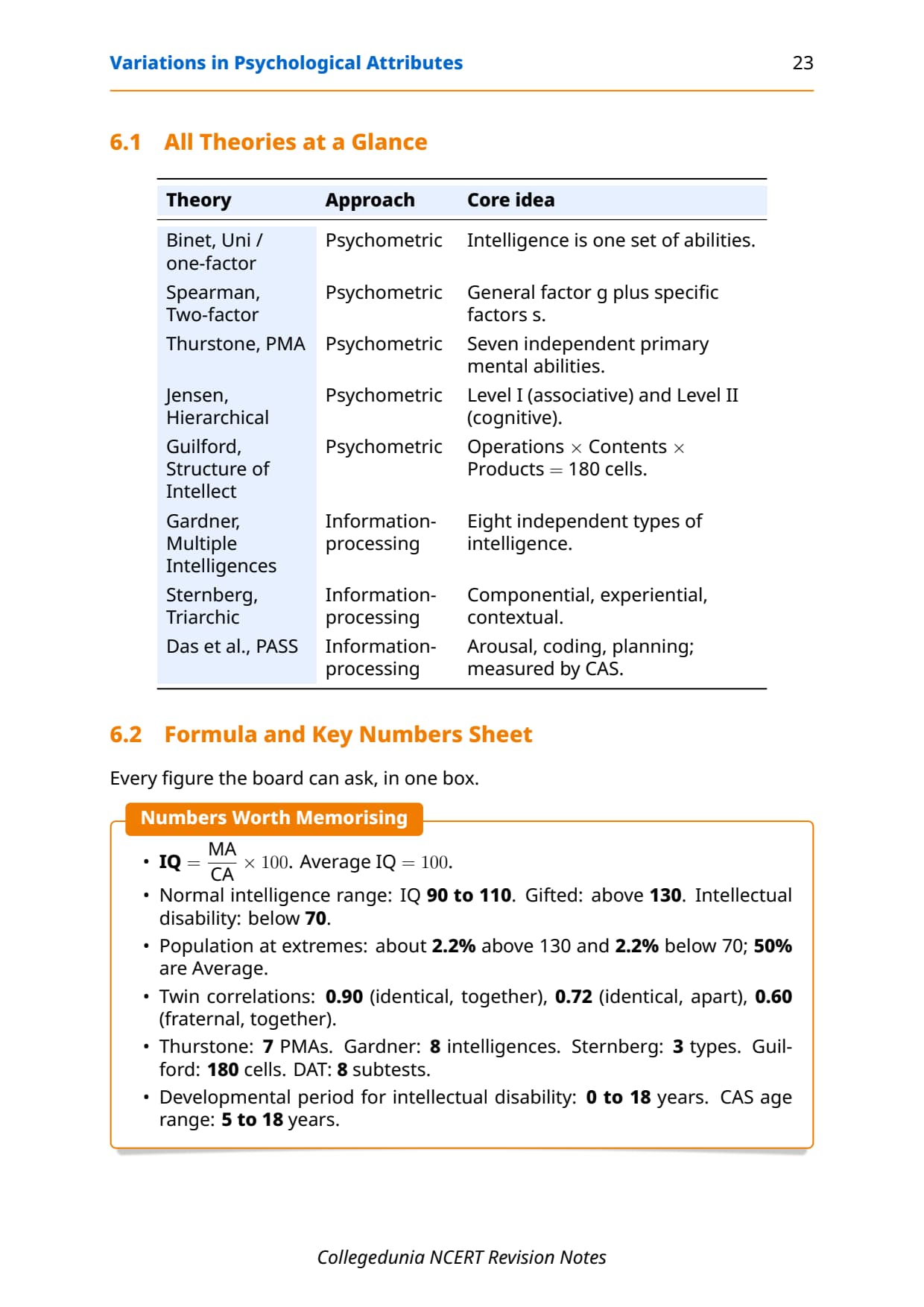
| Theory | Core idea |
|---|---|
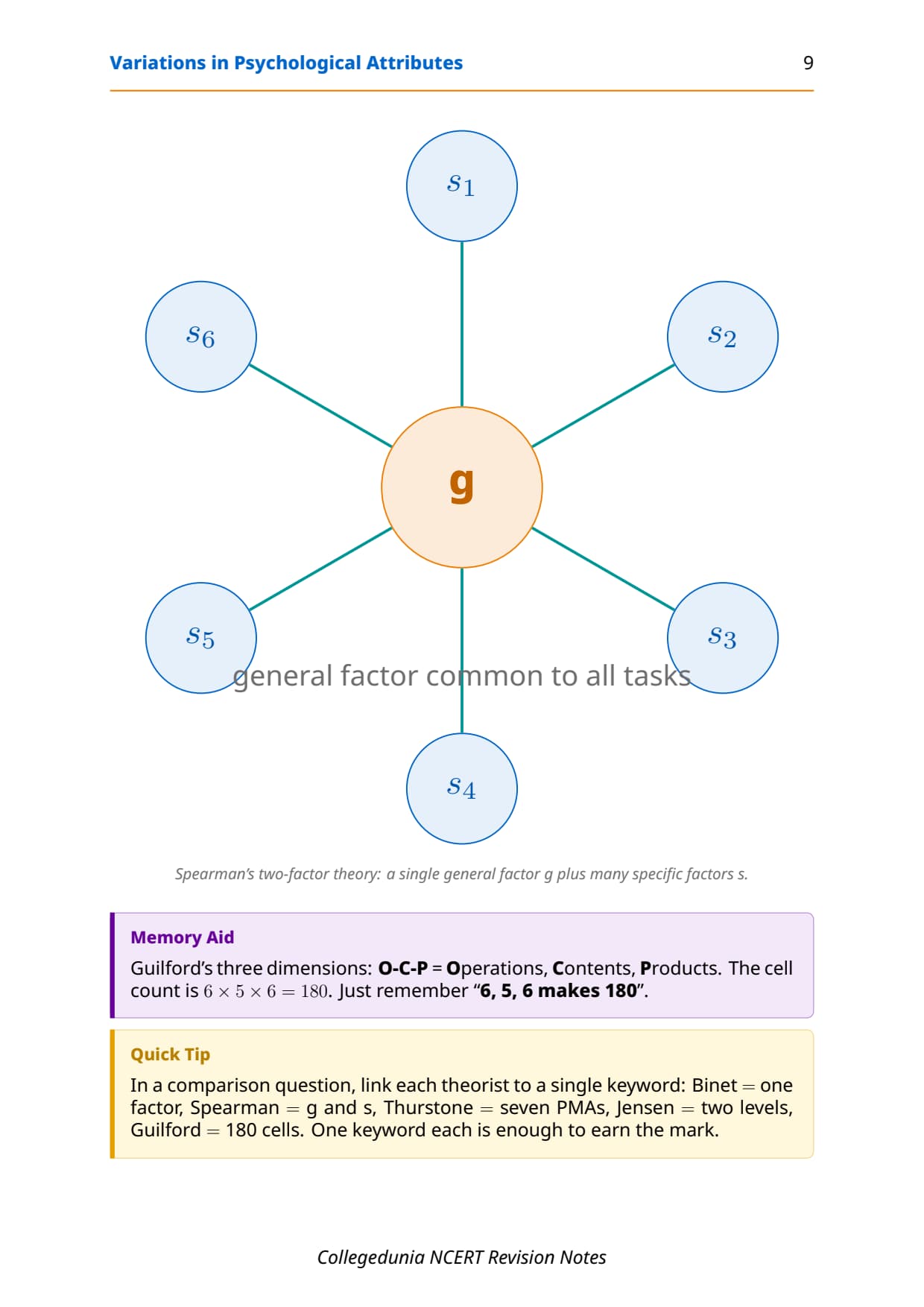
| Spearman (two-factor) | One general factor (g) plus specific factors (s) for each task. |
| Thurstone (PMA) | Seven primary mental abilities, fairly independent of each other. |
| Guilford (SOI) | Structure of intellect crossing operations, contents and products. |
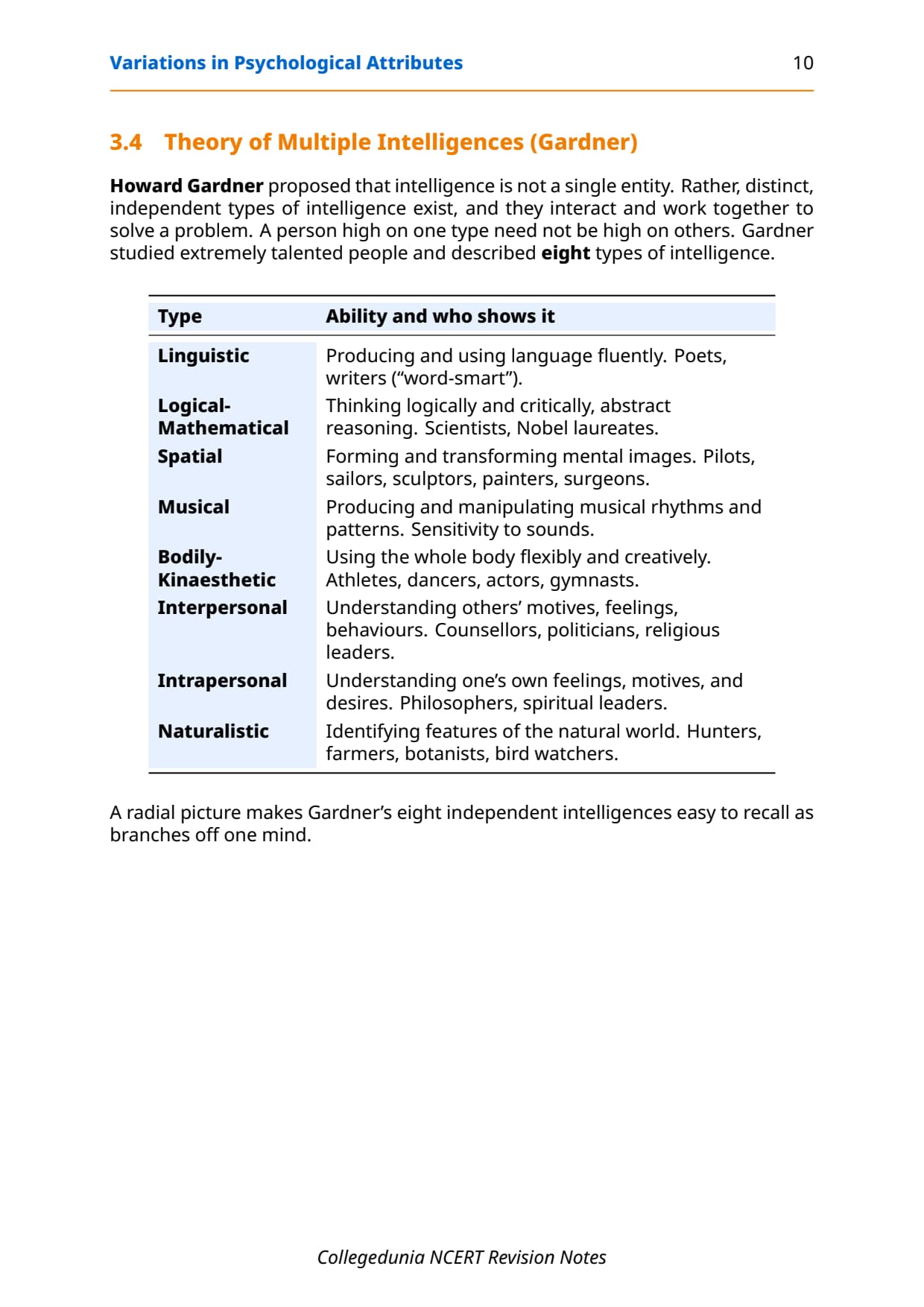
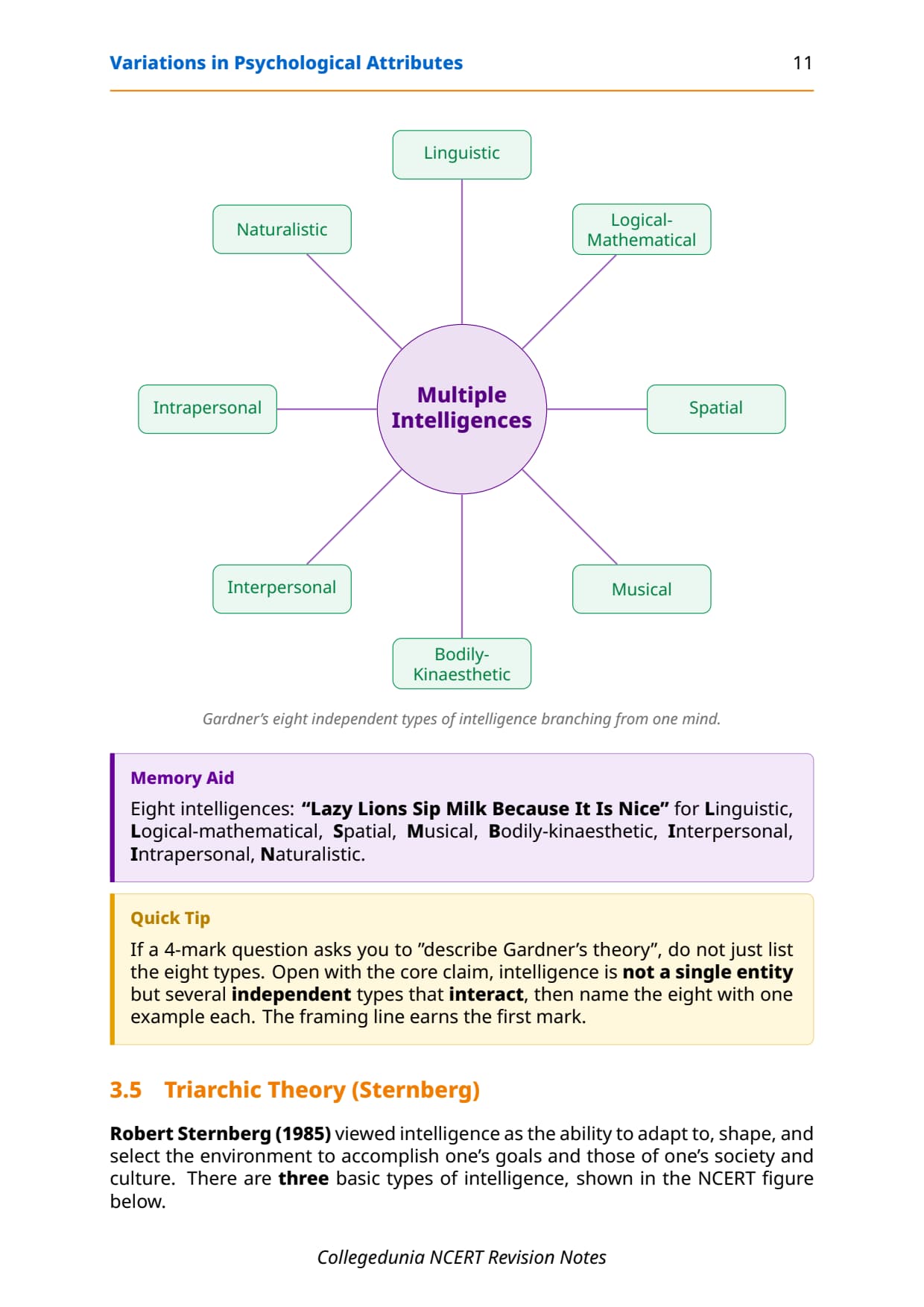
| Gardner (multiple) | Eight independent intelligences that still interact to solve problems. |
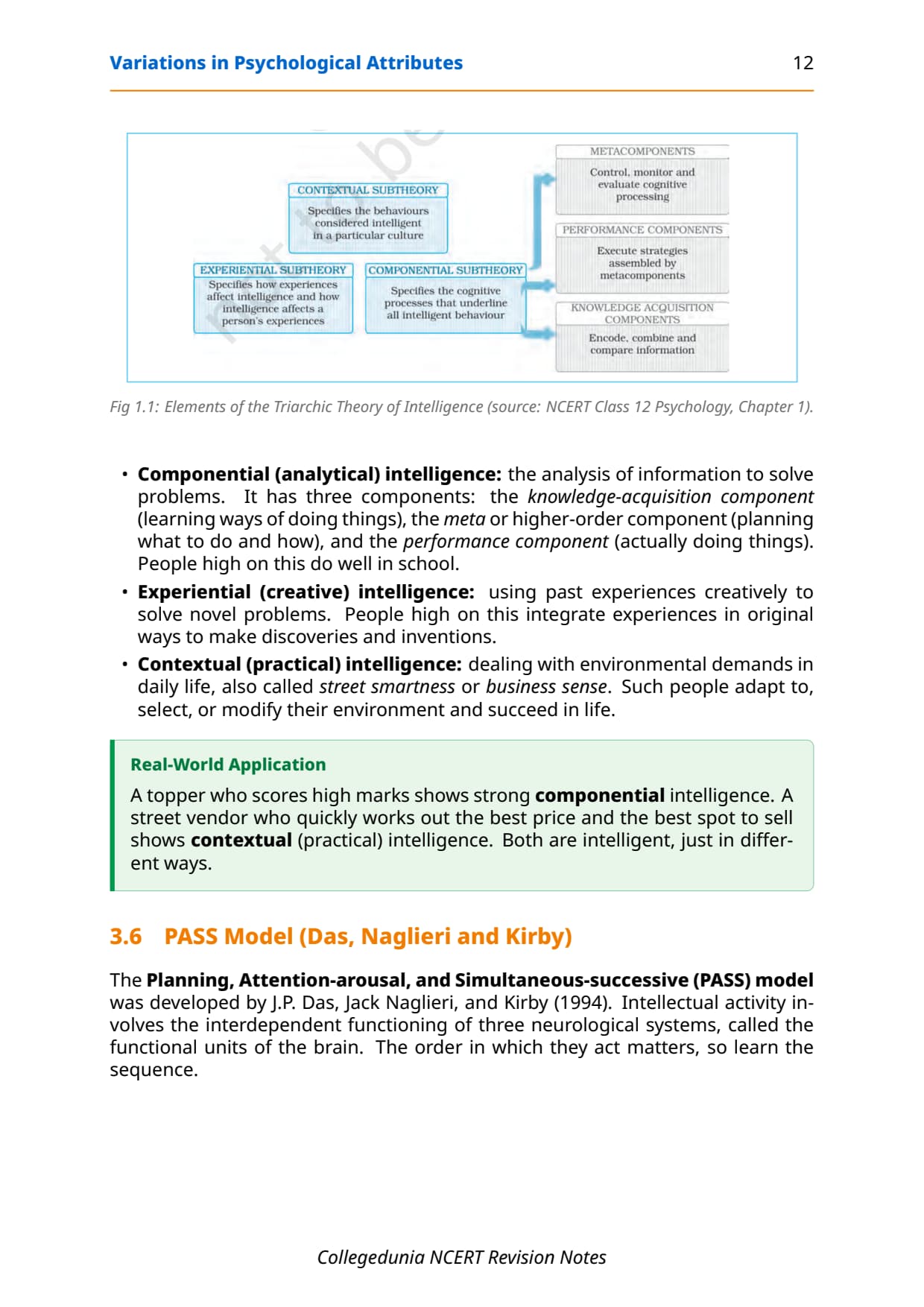
| Sternberg (triarchic) | Componential (analytical), experiential (creative), contextual (practical). |
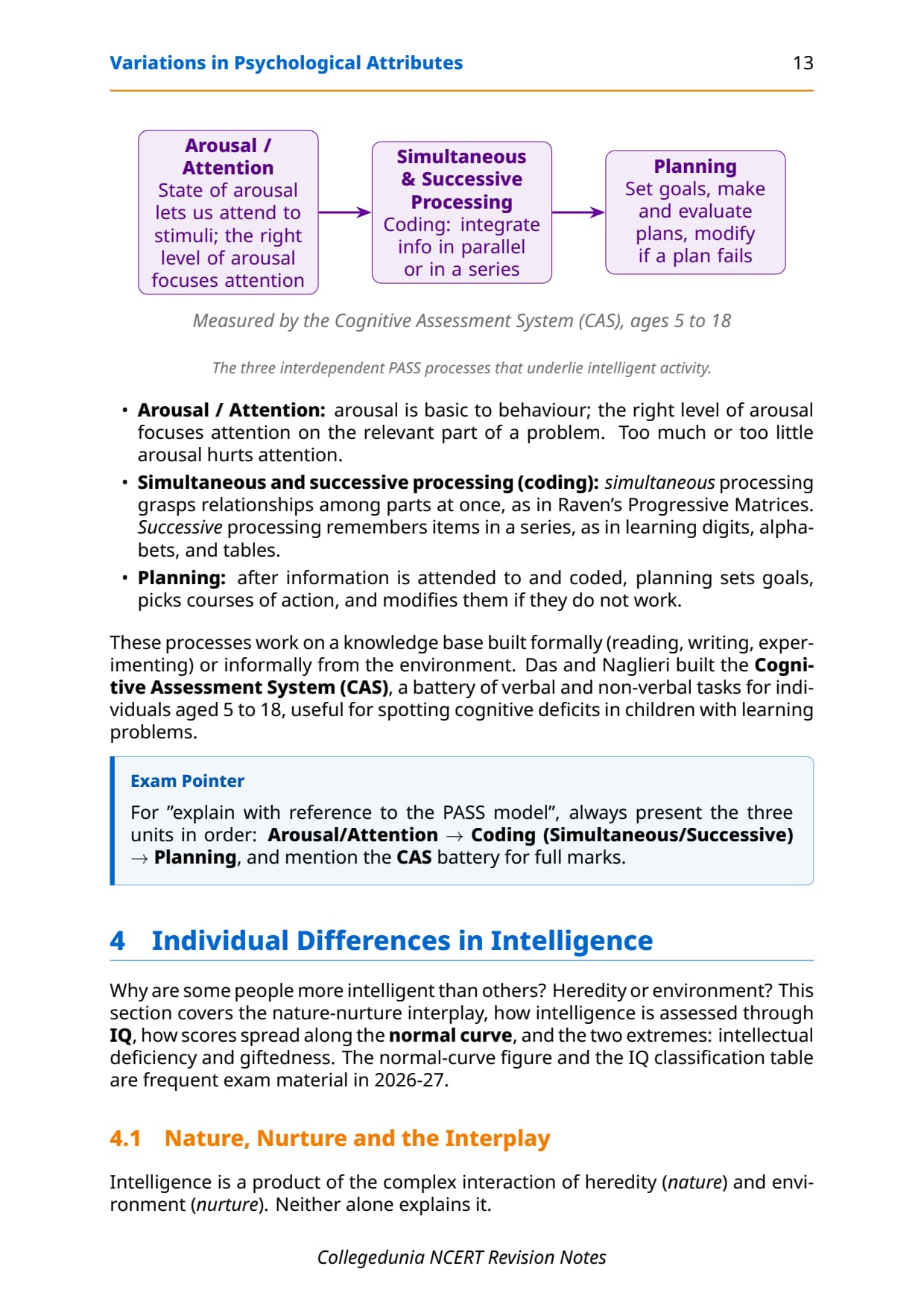
| Das, Naglieri, Kirby (PASS) | Planning, Attention-arousal, Simultaneous-successive processing. |
The one-line takeaway for your sheet is that psychometric models ask "how much" intelligence, information-processing models ask "how" it works. The shift from Spearman to Sternberg and Das is the shift from a single score to mental processes. Keep this distinction clear in your notes.
IQ, the Normal Curve and Its Classification
IQ is the single most tested idea in the chapter, so these notes keep the formula and the bands side by side. Learn each one as a short boxed point.
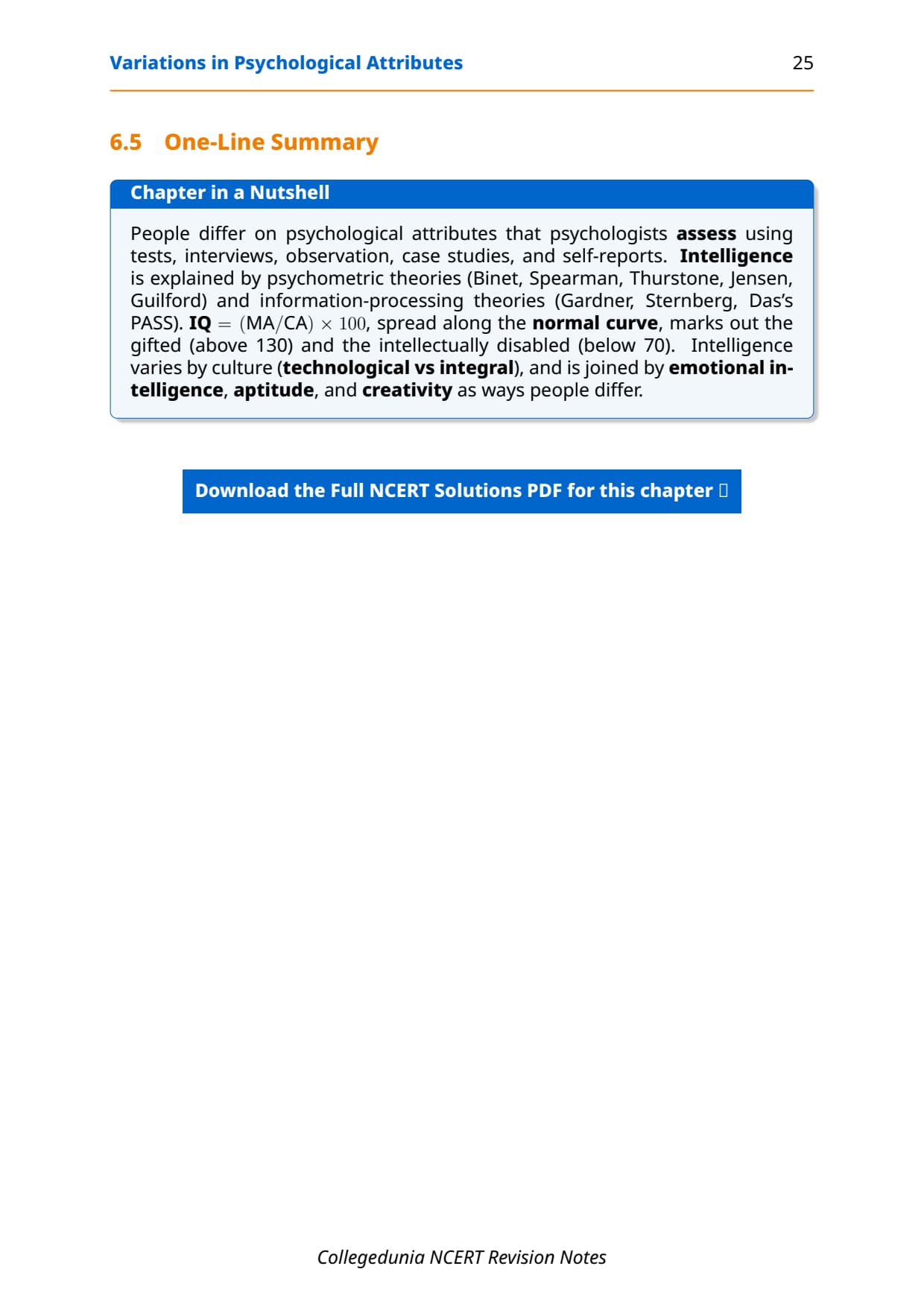
- The formula: IQ equals mental age over chronological age, times 100 (William Stern, 1912).
- Reading it: mental age above chronological age gives IQ above 100; the population average is 100.
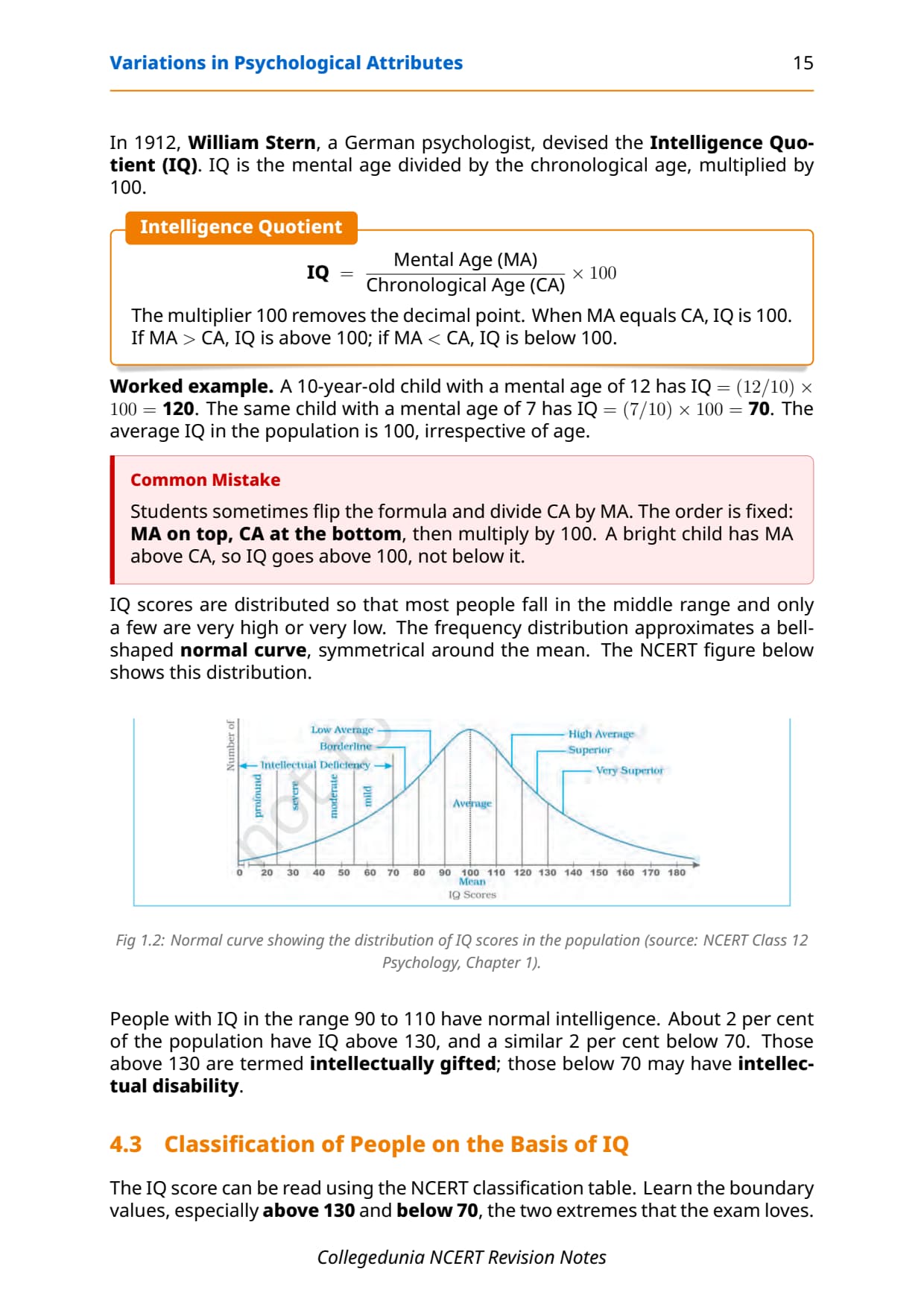
- The curve: IQ scores follow a symmetrical, bell-shaped normal curve around the mean of 100.
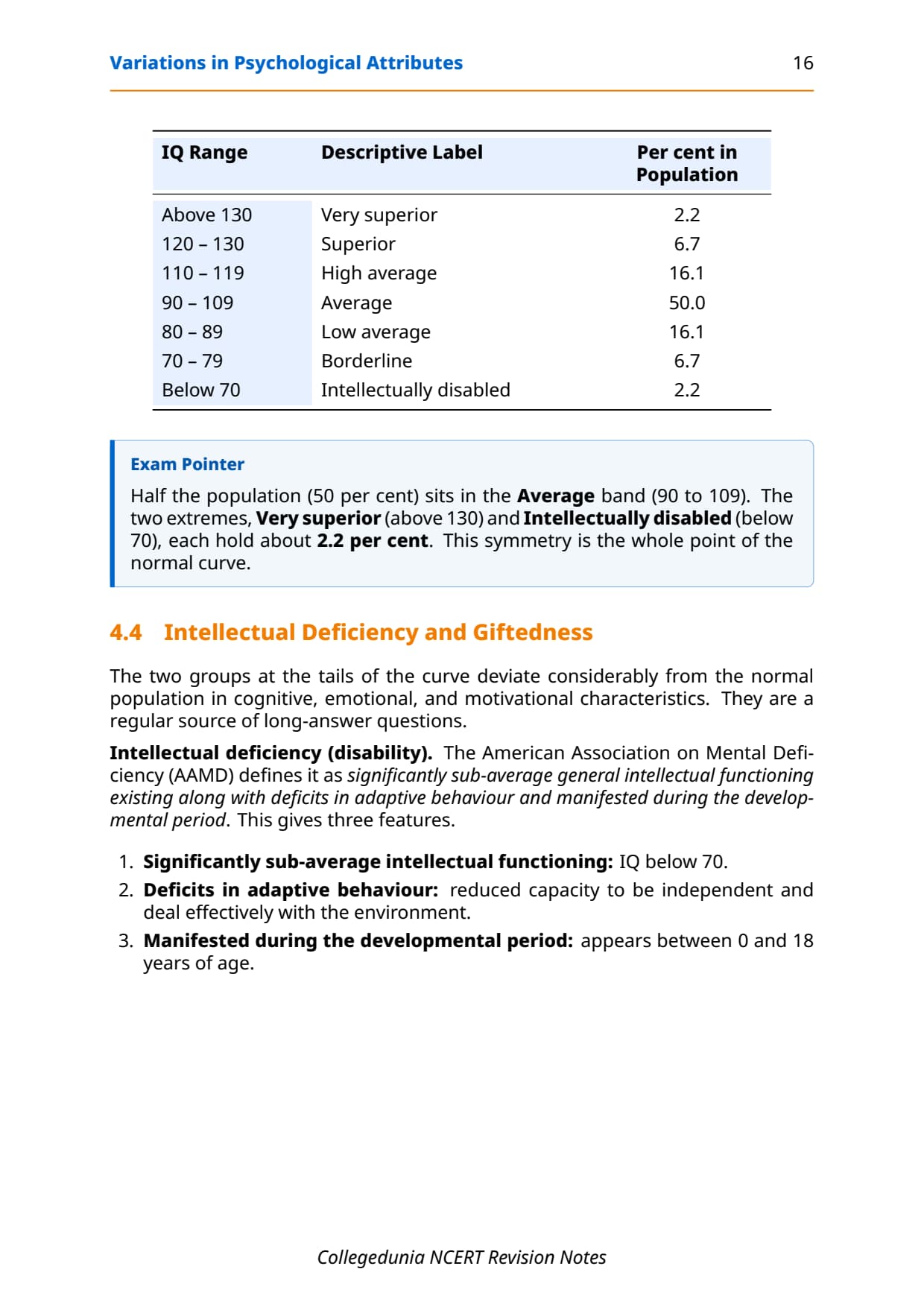
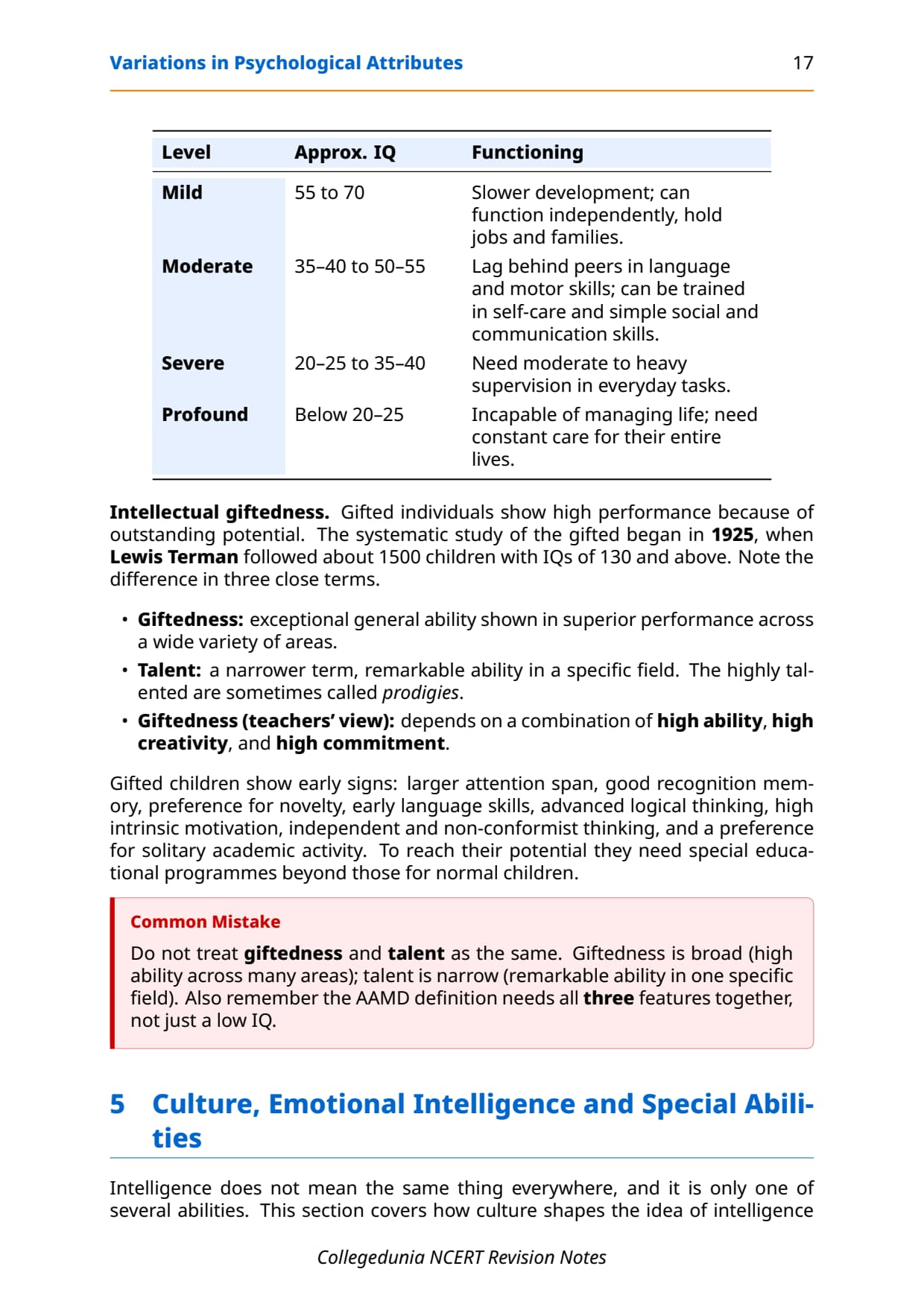
- The bands: Very superior (above 130) down through Average (90 to 109) to Intellectually disabled (below 70).
The honest revision line is that about 50 per cent of people sit in the average band, with only about 2.2 per cent at each extreme. The curve is symmetrical, so the same percentage sits at the top and the bottom. Always show the substitution line, such as 12 over 10 times 100, before the final IQ number, because markers reward the working.
Culture, Emotional Intelligence and Creativity
The chapter widens the idea of intelligence in its closing part. These notes give the culture, EQ, aptitude and creativity points in order, because the exam asks for all of them.
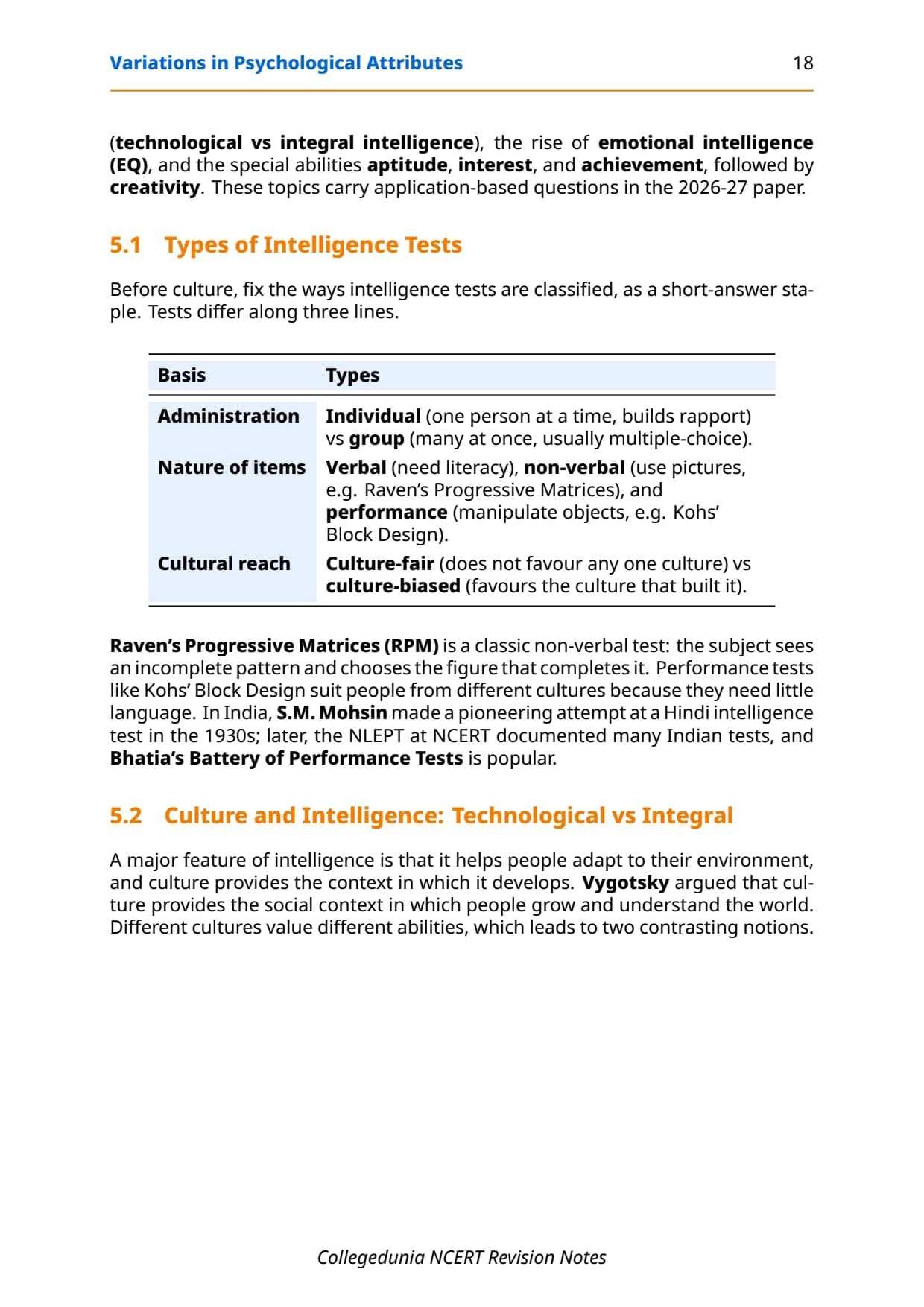
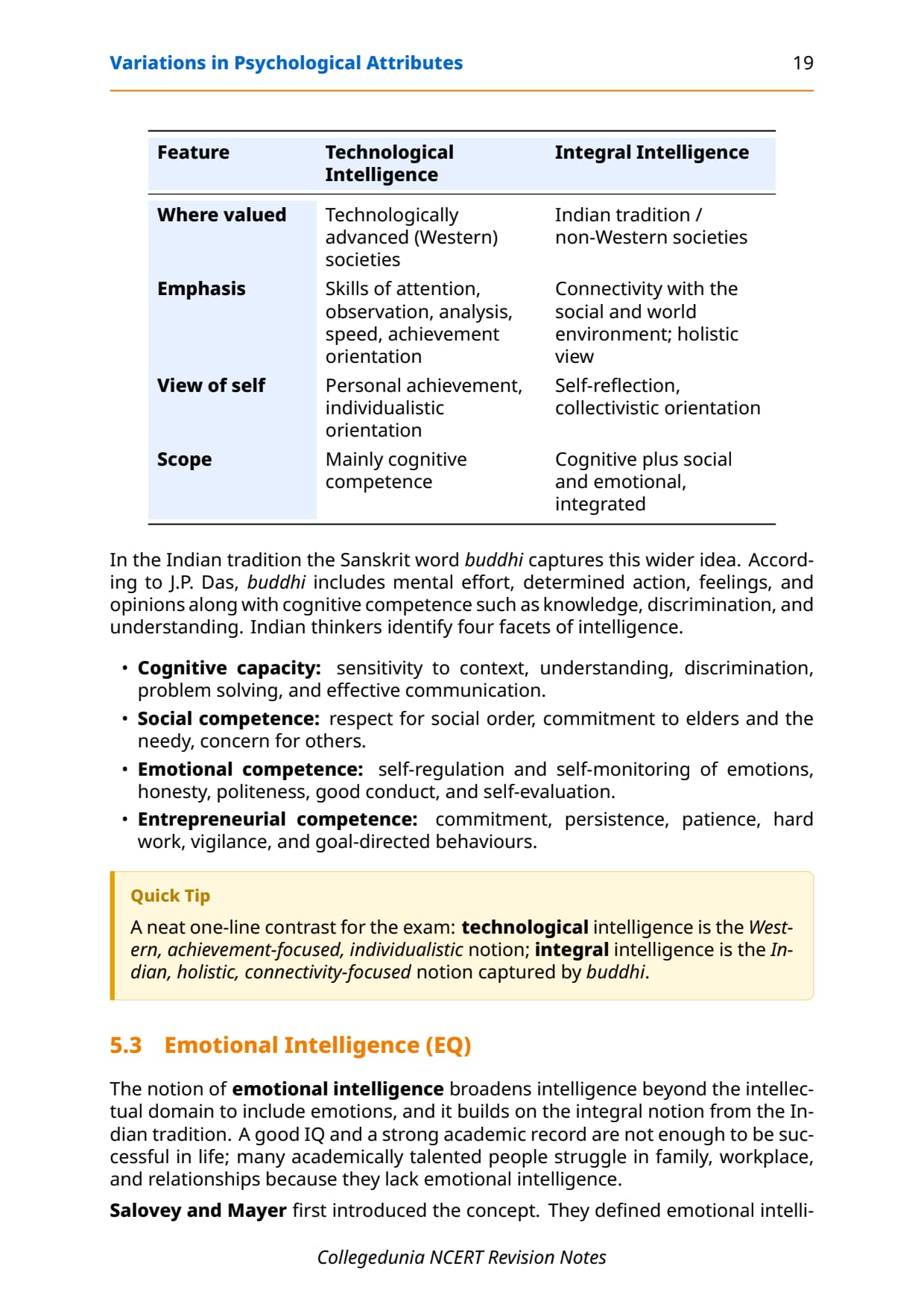
- Culture: Western "technological" intelligence (analysis, speed, achievement) versus Indian "integral" intelligence (buddhi).
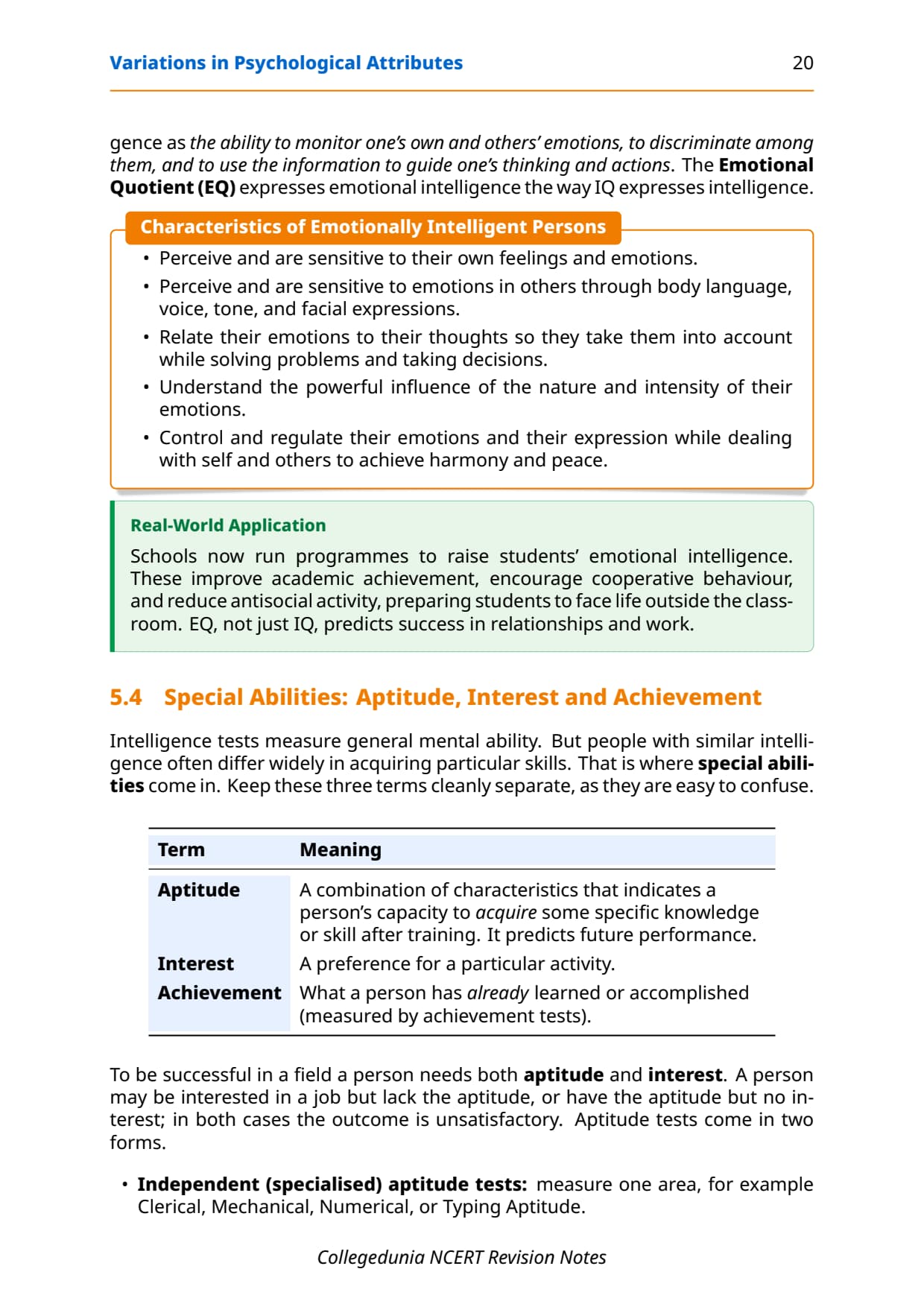
- Emotional intelligence: perceiving, understanding and managing one's own and others' emotions (Salovey and Mayer).
- Aptitude versus interest: aptitude is potential for a skill; interest is a preference; success needs both.
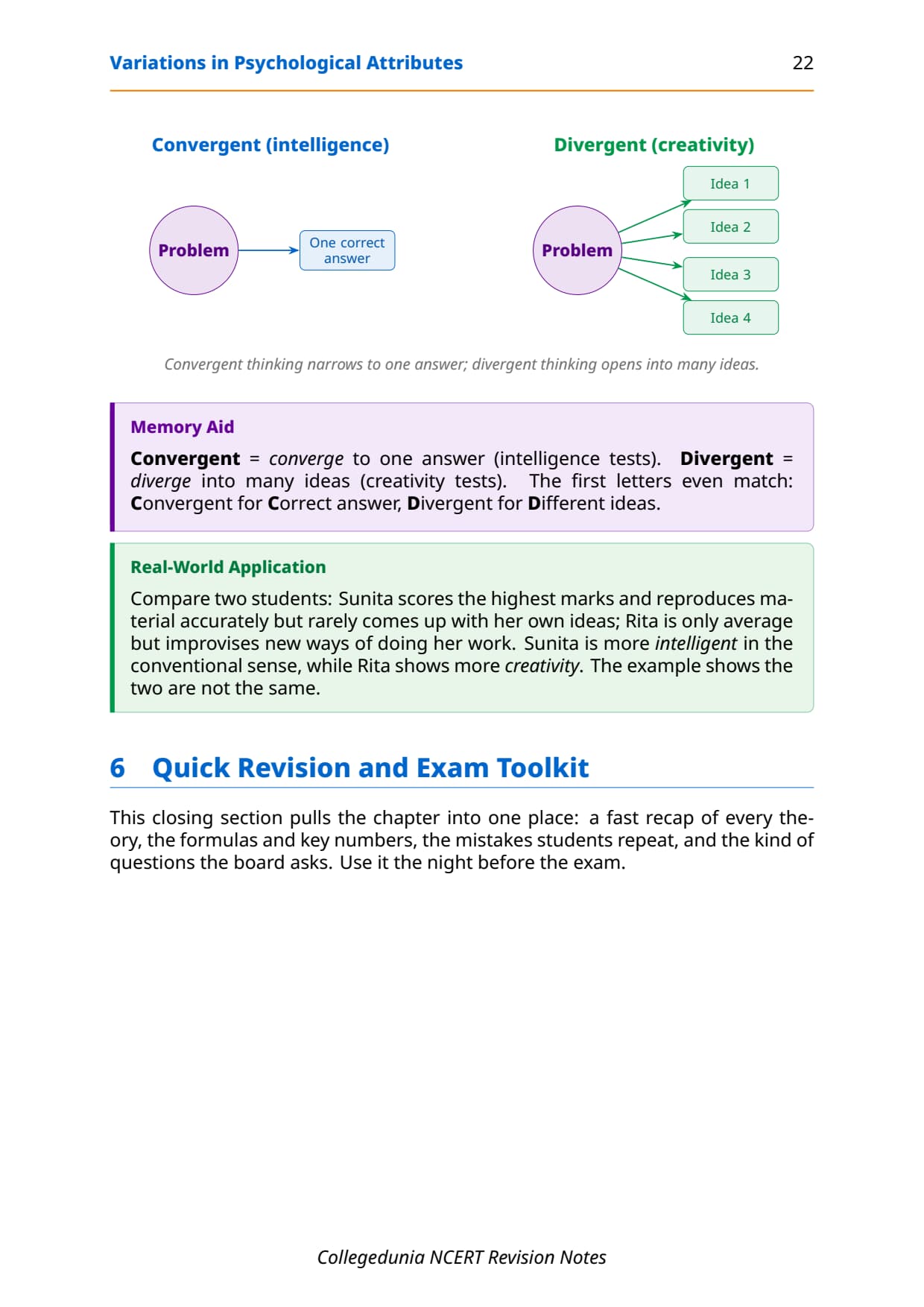
- Creativity: a minimum intelligence is needed, but a high IQ does not guarantee creativity.
The judgement to remember is that intelligence is conceptualised differently across cultures, so a culture-biased test can unfairly judge people from another culture. Keep the Western "technological" and Indian "integral" labels as two clear notes, and tie creativity to divergent thinking for the full-marks answer.
Variations in Psychological Attributes Important Questions and Exam Pointers
CBSE sets a steady mix of MCQ, short and long answers from this chapter. Knowing the pattern helps students decide how much to write and which topics to revise first. A focused list of Variations in Psychological Attributes important questions saves a lot of time before the board exam.
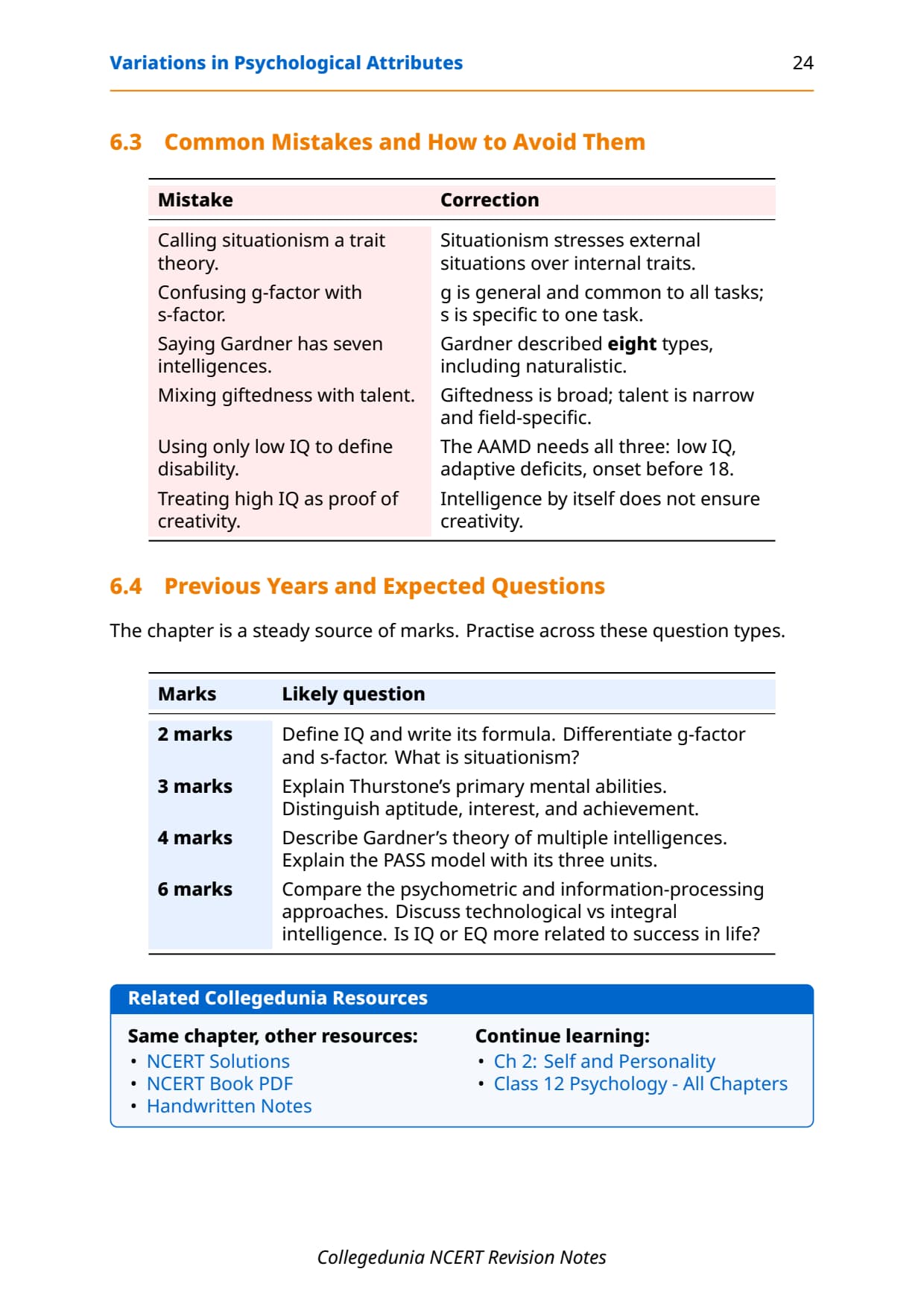
- Long answer (6 marks): Gardner's eight intelligences, the PASS model, or the IQ classification table.
- Short answer (4 marks): the triarchic theory, verbal versus performance tests, or aptitude versus interest.
- Opinion-based: IQ versus EQ for success in life, or how creativity relates to intelligence.
- Objective and MCQ: the IQ formula, the normal curve, the eight Gardner types and the PASS units.
For quick recall, students often practise a short class 12 psychology chapter 1 mcq drill and a list of Variations in Psychological Attributes class 12 important questions. The most repeated items are the theories of intelligence and the IQ table, so keep those answer points ready in your own words. Reading these notes once, then writing the key lists from memory, is the fastest way to lock the chapter in.
Common Mistakes Students Make in This Chapter
A few errors cost marks every year. Most come from flipping the IQ formula or naming only some of Gardner's intelligences. Fixing these five points is the quickest way to lift a score, so add them to the end of your revision sheet.
- Flipping the IQ formula. It is always mental age over chronological age times 100.
- Naming only six or seven of Gardner's intelligences. The exam needs all eight.
- Confusing aptitude with interest. Aptitude is potential; interest is a preference.
- Saying high IQ guarantees creativity. A minimum intelligence is needed, but high IQ does not ensure it.
- Treating the PASS units as fully separate. They are independent in function but interdependent in action.
Students who fix these five points usually move from average to high marks. The exam rewards precise names and numbers, so always show the IQ working and list all eight Gardner types in full. These notes flag each soft point so you can phrase it safely in the answer sheet.
How These Notes Pair with the Solutions and Book PDF
These revision notes summarise the chapter. To prepare fully, students should use them alongside the other resources for the same chapter, all linked in the table below. Read the notes first, then test yourself with the solutions, and open the book PDF whenever you need the original text and figures.
| Resource | Best used for |
|---|---|
| Variations in Psychological Attributes NCERT Solutions | Step-by-step answers to all 12 review questions |
| Variations in Psychological Attributes Handwritten Notes | Last-minute, one-shot revision in a scanned notebook style |
| Variations in Psychological Attributes NCERT Book PDF | Reading the original NCERT chapter text and figures |
Tip: read these notes first, then attempt the solutions on your own, and only then check the model answers. That order builds memory faster than copying answers straight away.
All Class 12 Psychology Notes by Chapter
The table links the revision notes for every chapter in Class 12 Psychology, so students can move across the course in one click. Variations in Psychological Attributes is highlighted.
| Chapter | Notes |
|---|---|
| Chapter 1 | Variations in Psychological Attributes |
| Chapter 2 | Self and Personality |
| Chapter 3 | Meeting Life Challenges |
| Chapter 4 | Psychological Disorders |
| Chapter 5 | Therapeutic Approaches |
| Chapter 6 | Attitude and Social Cognition |
| Chapter 7 | Social Influence and Group Processes |
FAQs on Variations in Psychological Attributes Class 12 Notes
Variations in Psychological Attributes Class 12 Psychology Notes Common Questions
Ques. Where can I download the Variations in Psychological Attributes Class 12 notes PDF?
Ans. You can download the Variations in Psychological Attributes Class 12 Psychology notes PDF directly from this page. It is free, follows the 2026-27 NCERT, and covers individual differences, the theories of intelligence, IQ, culture, emotional intelligence and creativity in a short, point-wise format.
Ques. What does the Variations in Psychological Attributes chapter cover for Class 12?
Ans. It covers individual differences and situationism, how attributes are assessed, the psychometric and information-processing theories of intelligence, IQ and its classification, cultural views of intelligence, emotional intelligence, aptitude and creativity.
Ques. What is the IQ formula in Class 12 Psychology Chapter 1?
Ans. IQ equals mental age divided by chronological age, multiplied by 100, devised by William Stern in 1912. The population average is 100, and scores follow a symmetrical normal curve with about 2.2 per cent of people at each extreme.
Ques. Why is Variations in Psychological Attributes important for the board exam?
Ans. Because it is a high-scoring opening chapter that introduces the theories of intelligence used across psychology. Gardner's intelligences, the PASS model and the IQ table appear almost every year, so revising these notes well secures both MCQ and long-answer marks.
Ques. How should I use these notes to revise quickly?
Ans. Read the notes once under the three-thread frame, keep the eight Gardner types and the IQ bands on one sheet, then write the key lists from memory. Finish by attempting a short class 12 psychology chapter 1 mcq drill to test the small facts.



Comments