




These Regional Aspirations Class 12 Notes give a quick, exam-ready summary of how Jammu and Kashmir, Punjab and the North-East pushed for autonomy and recognition, set to the 2026-27 CBSE syllabus. The notes pull together every key state, accord and term from Chapter 7 of Politics in India Since Independence. Students can use them for a fast revision the night before a test or to fix the main ideas before they attempt the back-exercise questions.
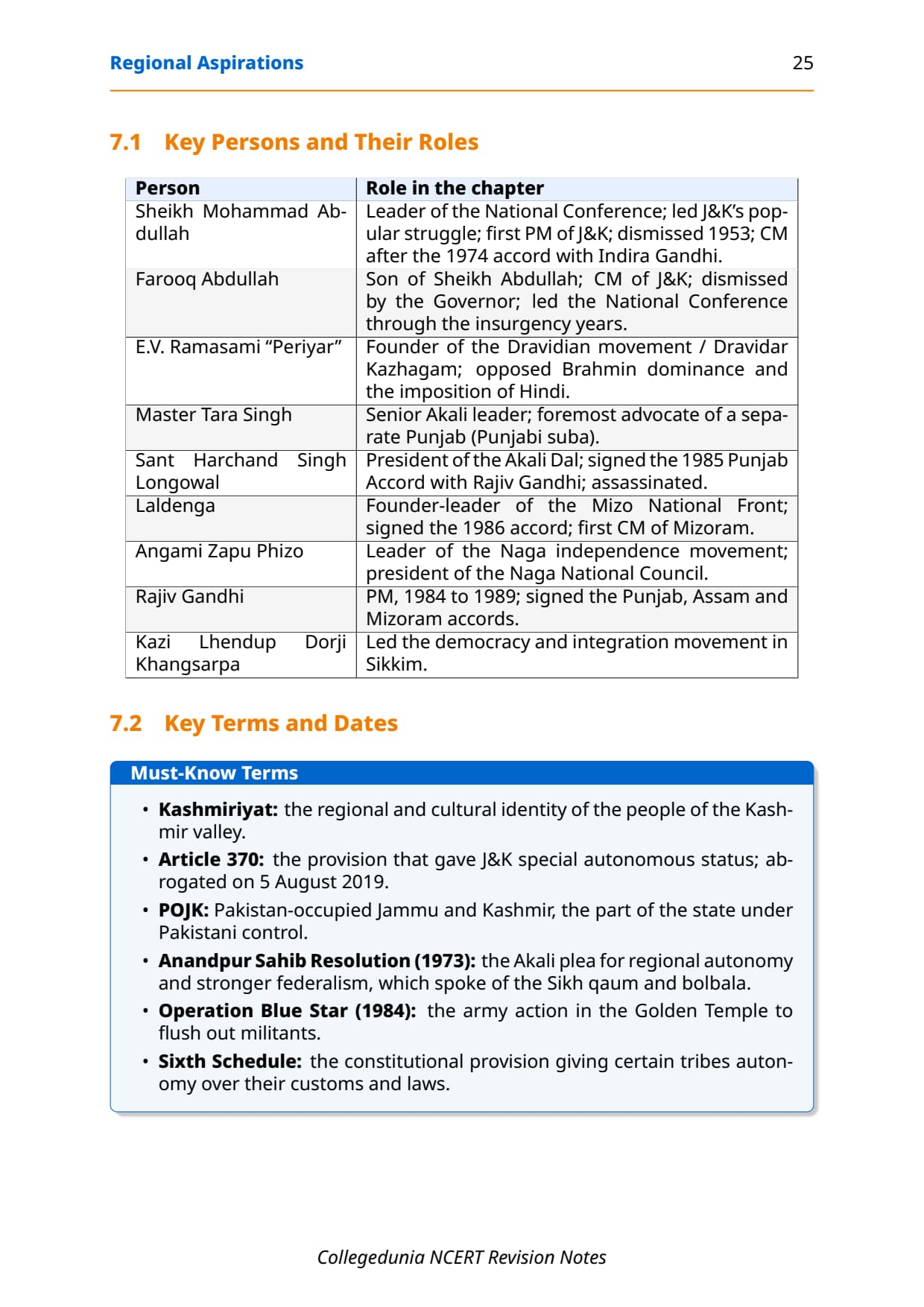
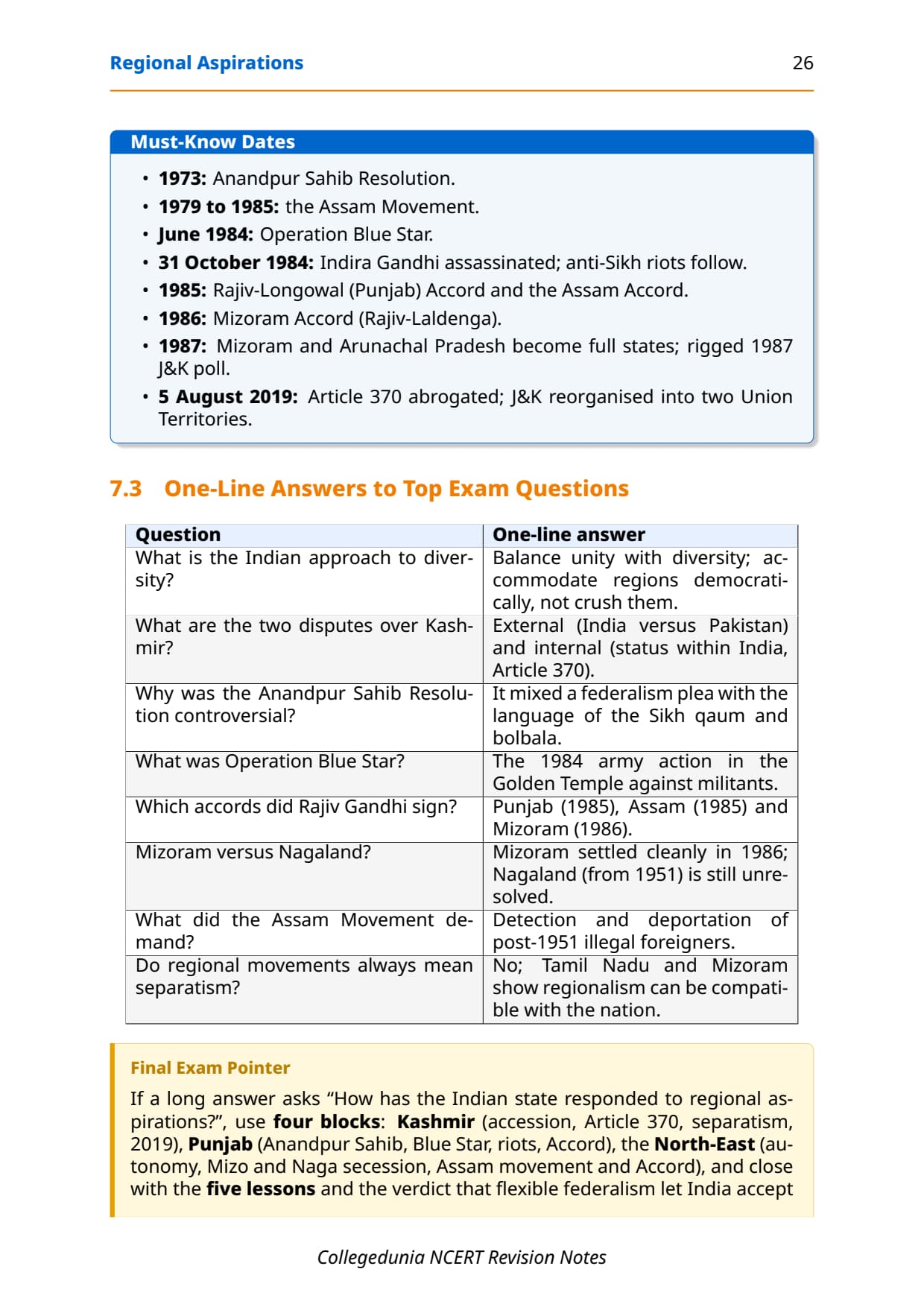
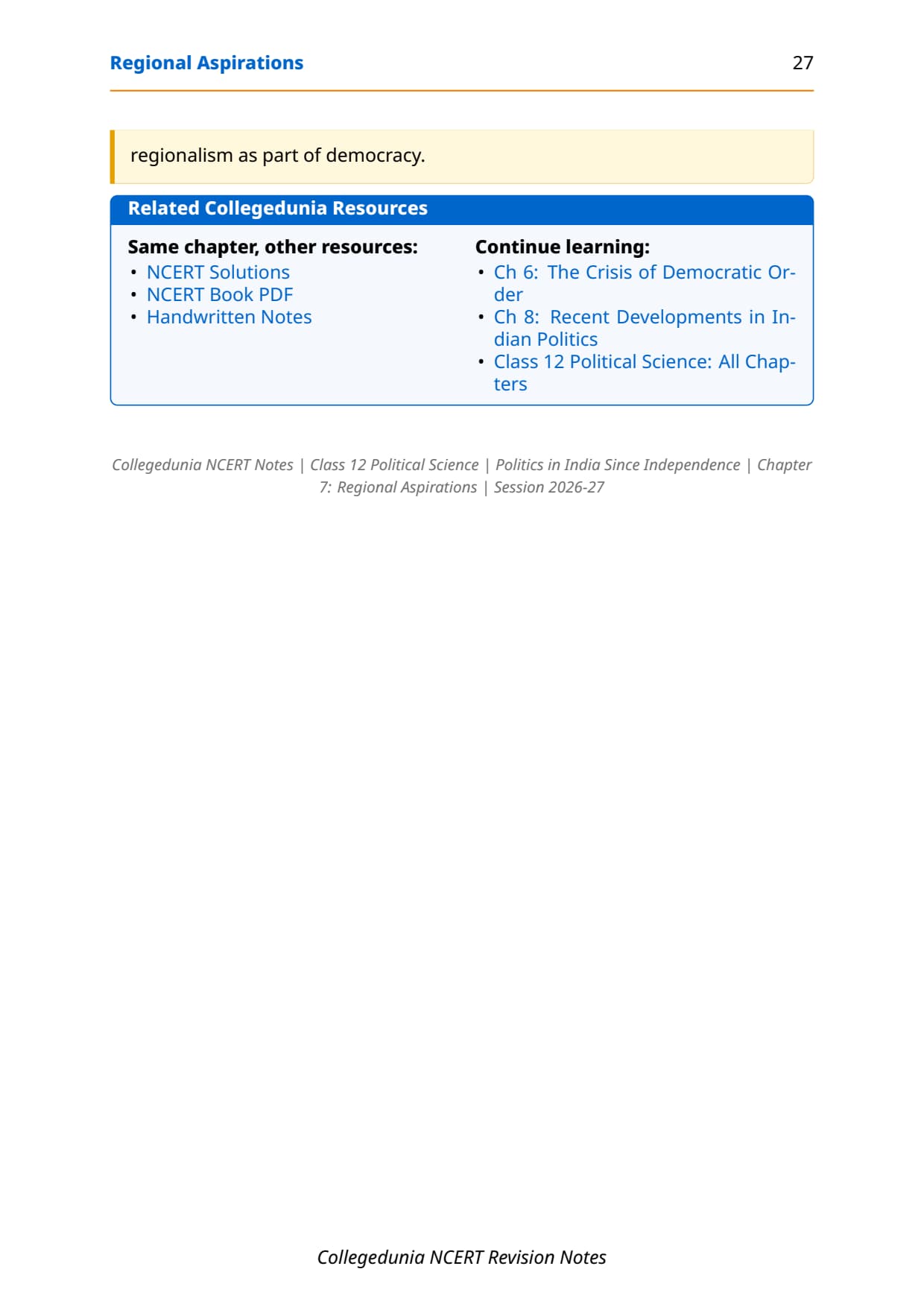
- Covers Jammu and Kashmir, Punjab, the North-East and the unity-in-diversity theme in one place.
- This Class 12 Political Science chapter usually carries 5 to 6 marks in the board paper.
- Pairs with the NCERT Solutions, Handwritten Notes and Book PDF linked lower on this page.
These Regional Aspirations Class 12 notes are written from the official NCERT Politics in India Since Independence textbook and checked against the last five years of CBSE board papers.
Student Feedback: In a Collegedunia poll of 8,470 Class 12 Political Science students taken before the 2026 boards, 72% of students said short, point-wise notes on the three case regions and the accords were the fastest way to revise this chapter. Most students kept the states, years and key terms on a single sheet for last-minute recall.
Source: 2026-27 Class 12 Political Science student poll. Sample of 8,470 students from CBSE schools across 12 states.
What the Regional Aspirations Notes Cover
Regional Aspirations is the seventh chapter of Politics in India Since Independence. It studies how regions like Jammu and Kashmir, Punjab and the North-East pushed for autonomy, statehood or recognition after 1947. The chapter shows that a region can demand more powers and still stay part of India, an idea captured in unity in diversity.
The easiest way to organise your revision is to split the chapter into three threads:
- The demand: what each region wanted, from autonomy to recognition.
- The settlement: how India responded, mostly through accords and dialogue.
- The lesson: why diversity and national unity can live together.
So these notes are really about how a diverse country holds together. If you sort each case under demand, settlement and lesson first, almost every question in Regional Aspirations class 12 becomes easier to answer. Keep this three-part frame at the top of your revision sheet and slot each new detail into one of the boxes as you read.
Why Regions Make Demands
India is one of the most diverse countries in the world, with many languages, religions and tribes. After Independence, different regions began to ask for a fairer share and a stronger voice. For quick revision, learn the reasons as four short, boxed points so you can copy them straight onto the answer sheet.
- Identity: a region wants its language, culture or tribe to be respected.
- Autonomy: a region asks for more powers, through statehood or a special status.
- Development: a region resents being left behind and wants a fairer share of resources.
- The Indian way: most demands are met through dialogue and accords, not force.
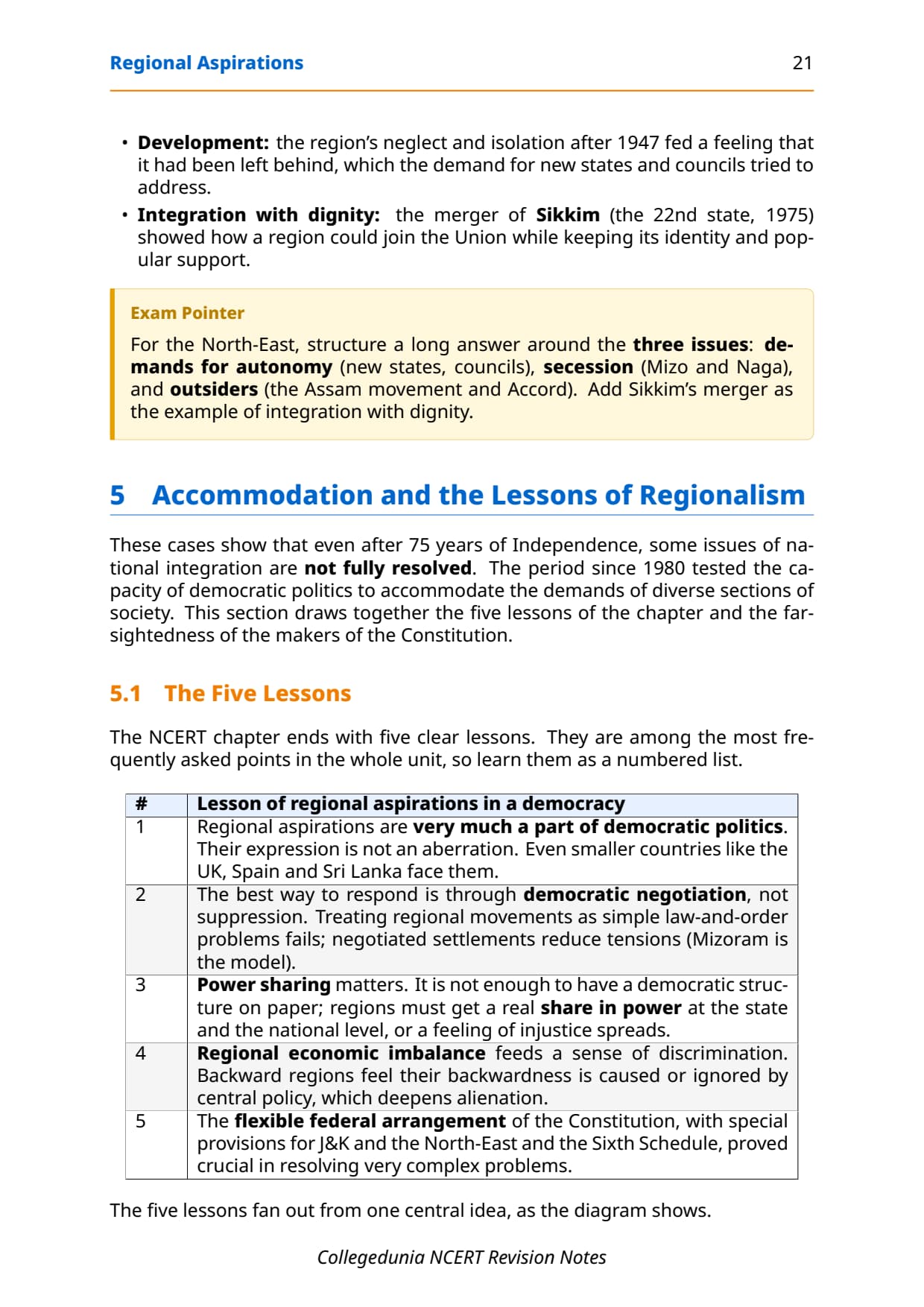
The point examiners test most is that regional aspirations are a normal part of democracy, not a threat to unity. Most movements asked for autonomy or statehood within India, and only a few small groups wanted a separate nation. Keep this balance ready, because the unity-in-diversity question and the separatism question both turn on it.
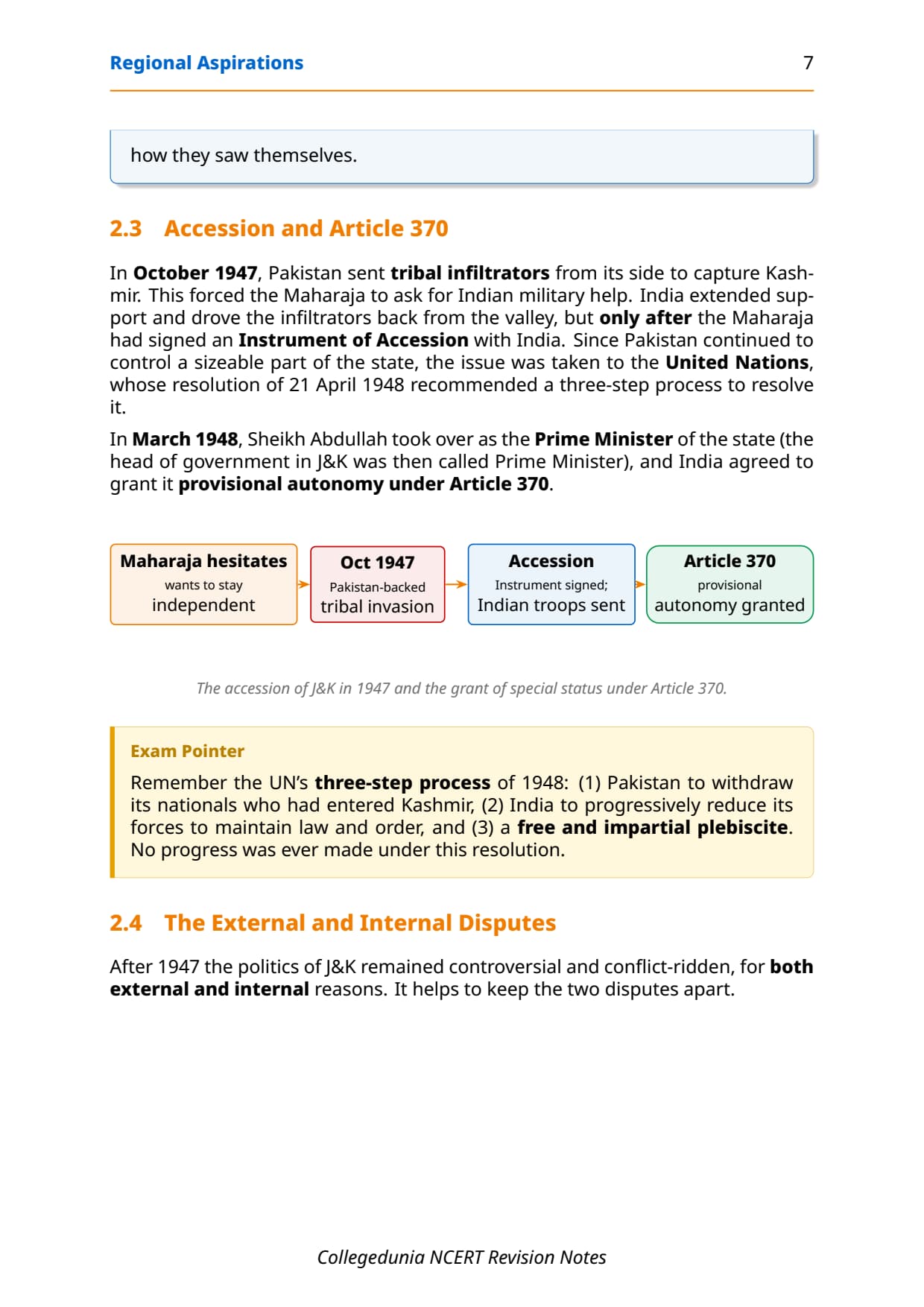
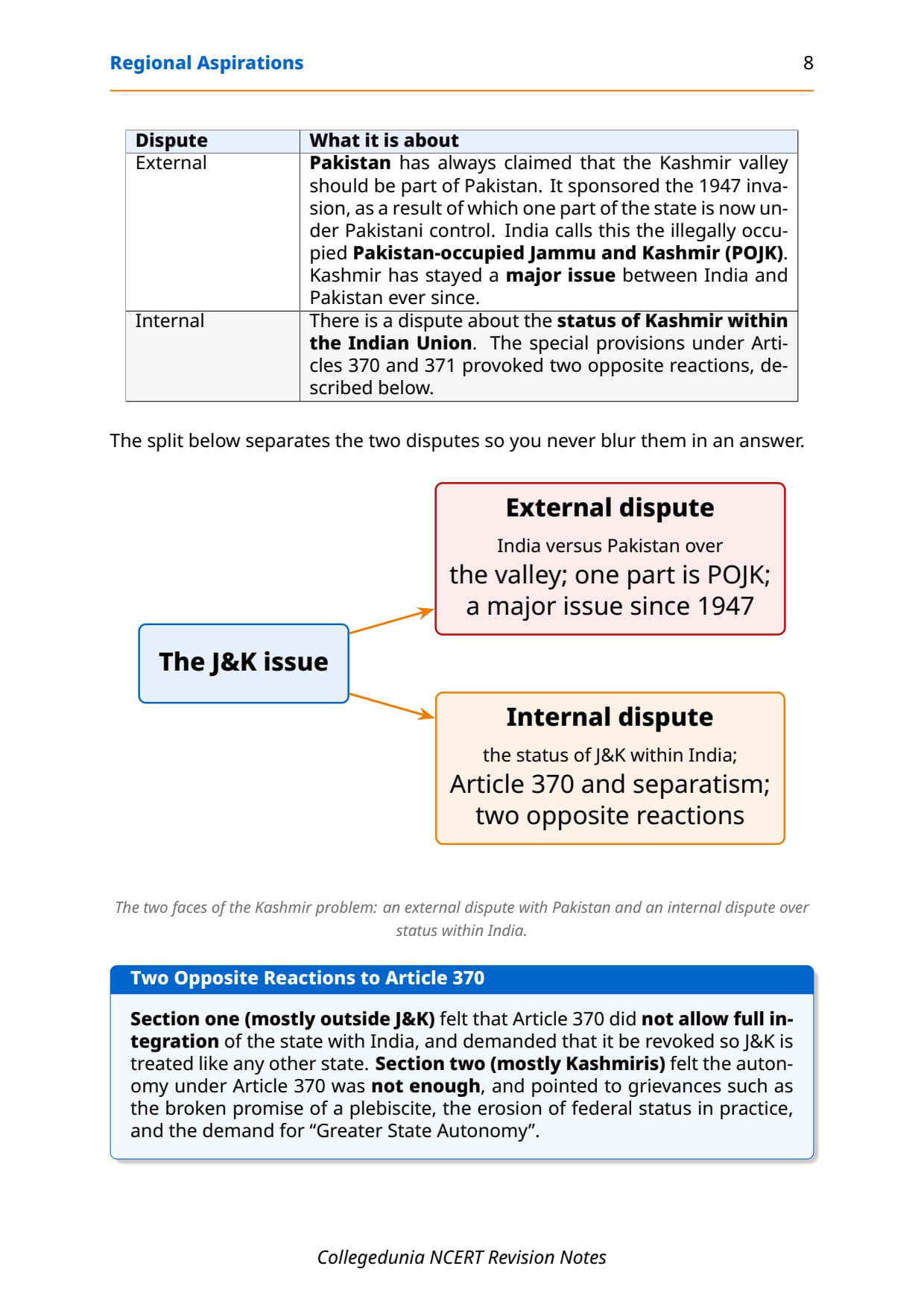
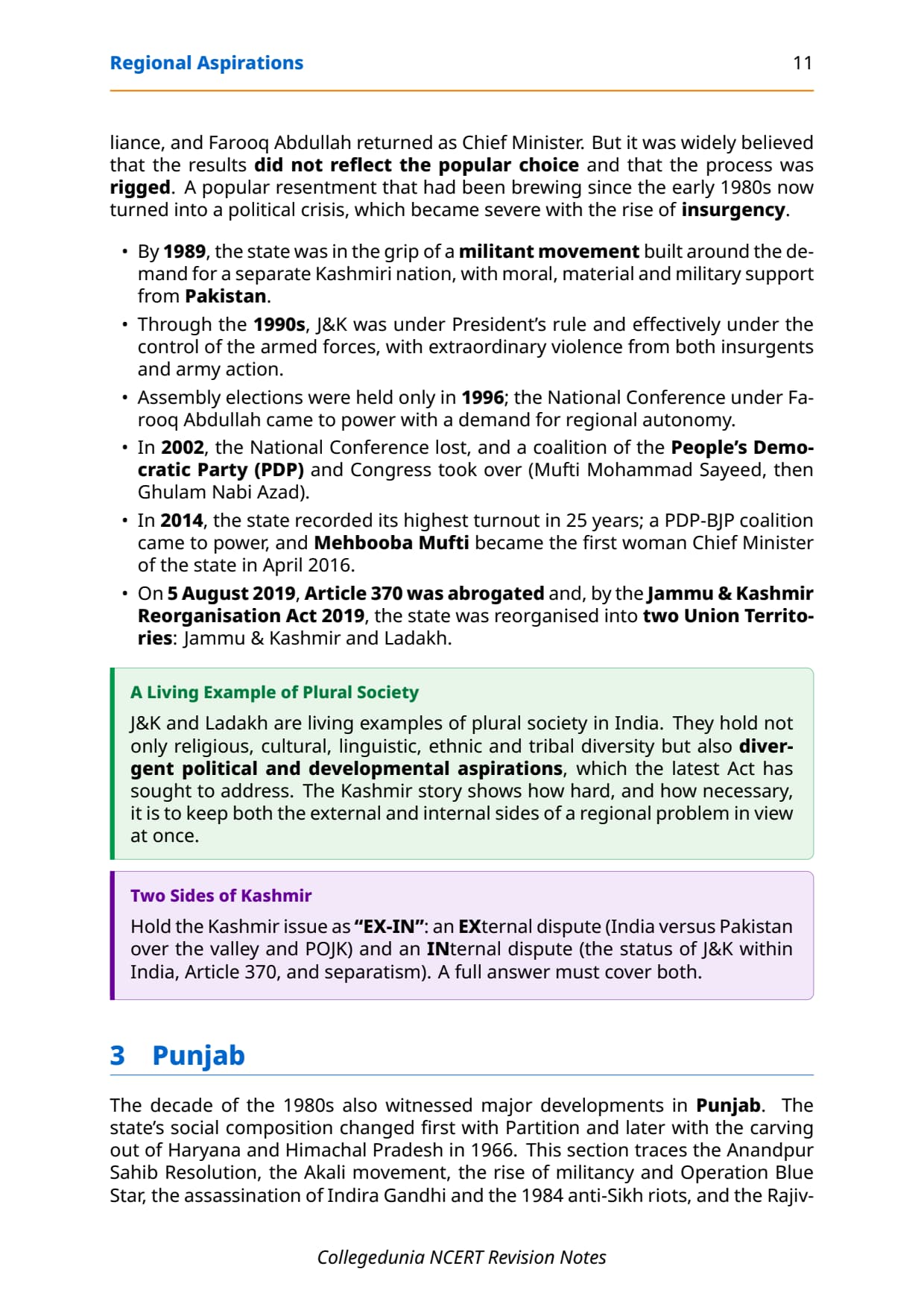
Jammu and Kashmir and Article 370
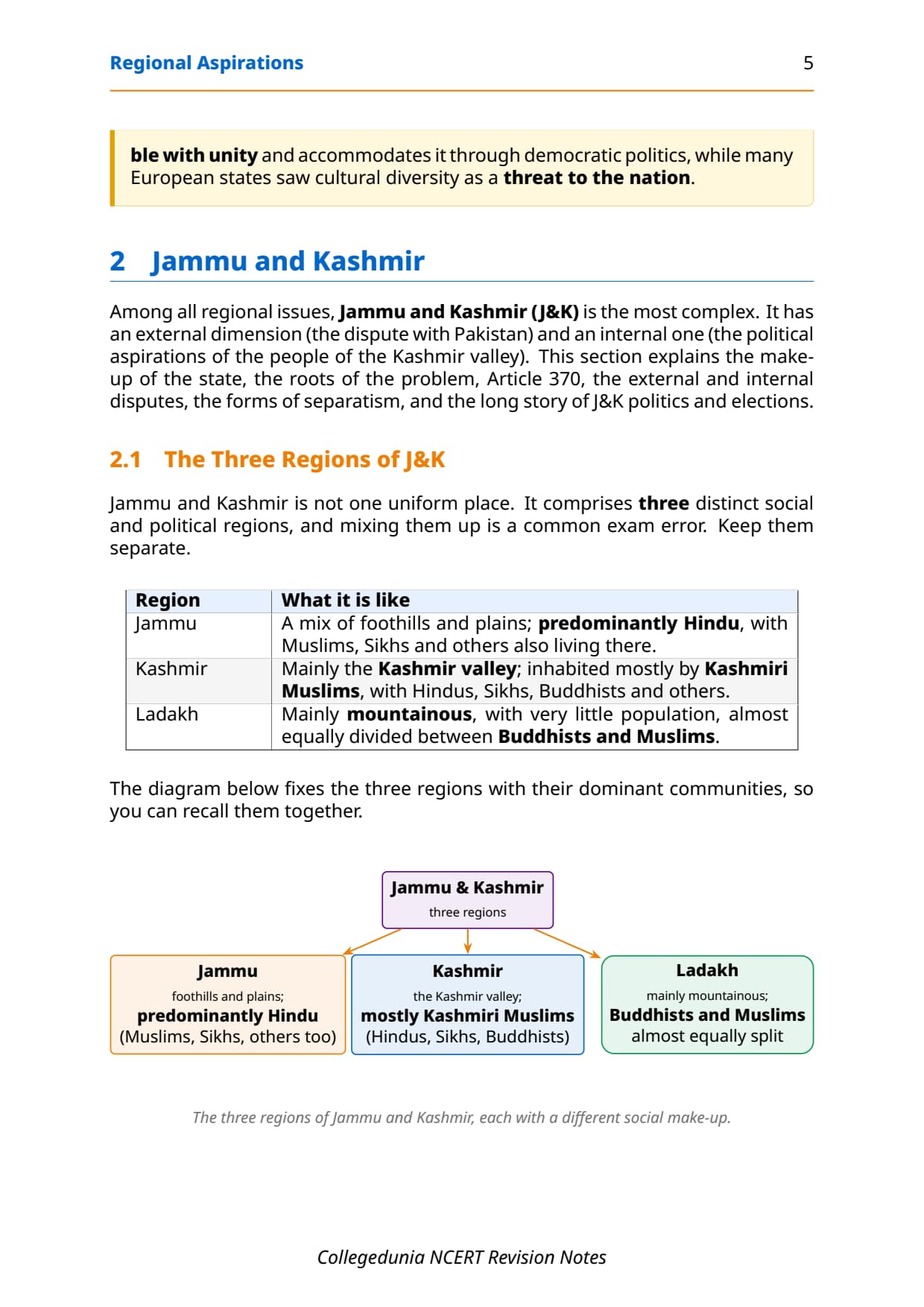
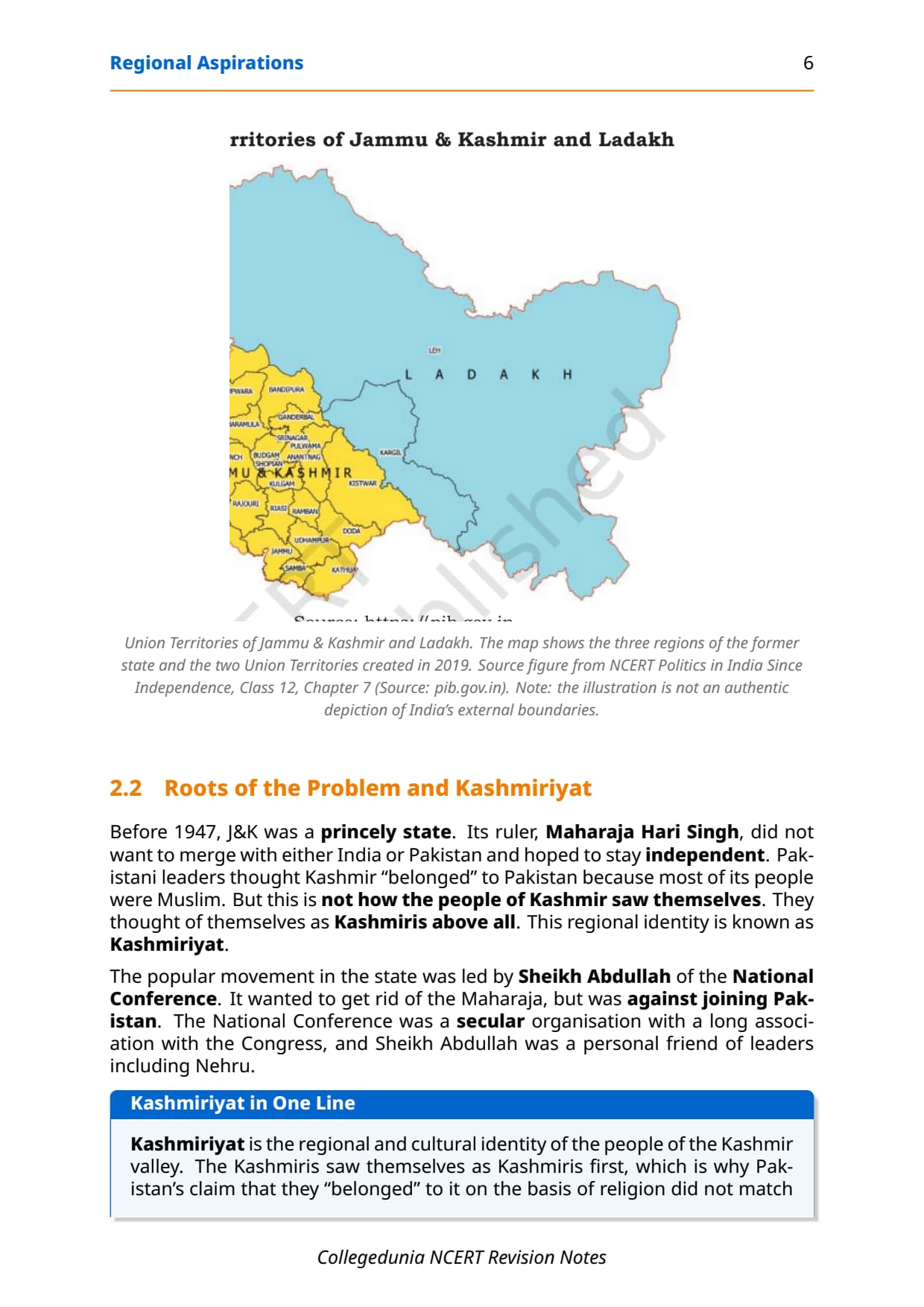
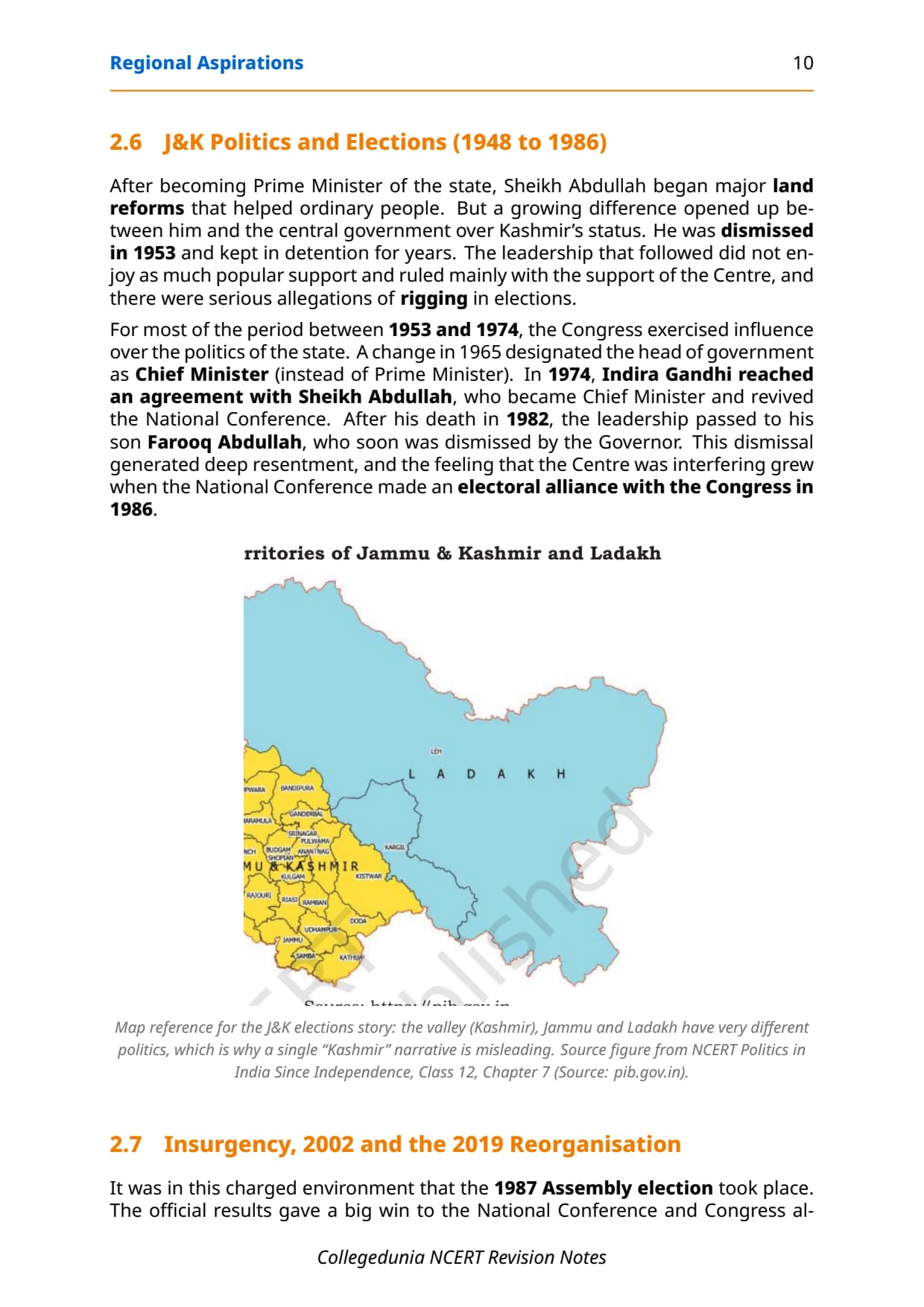
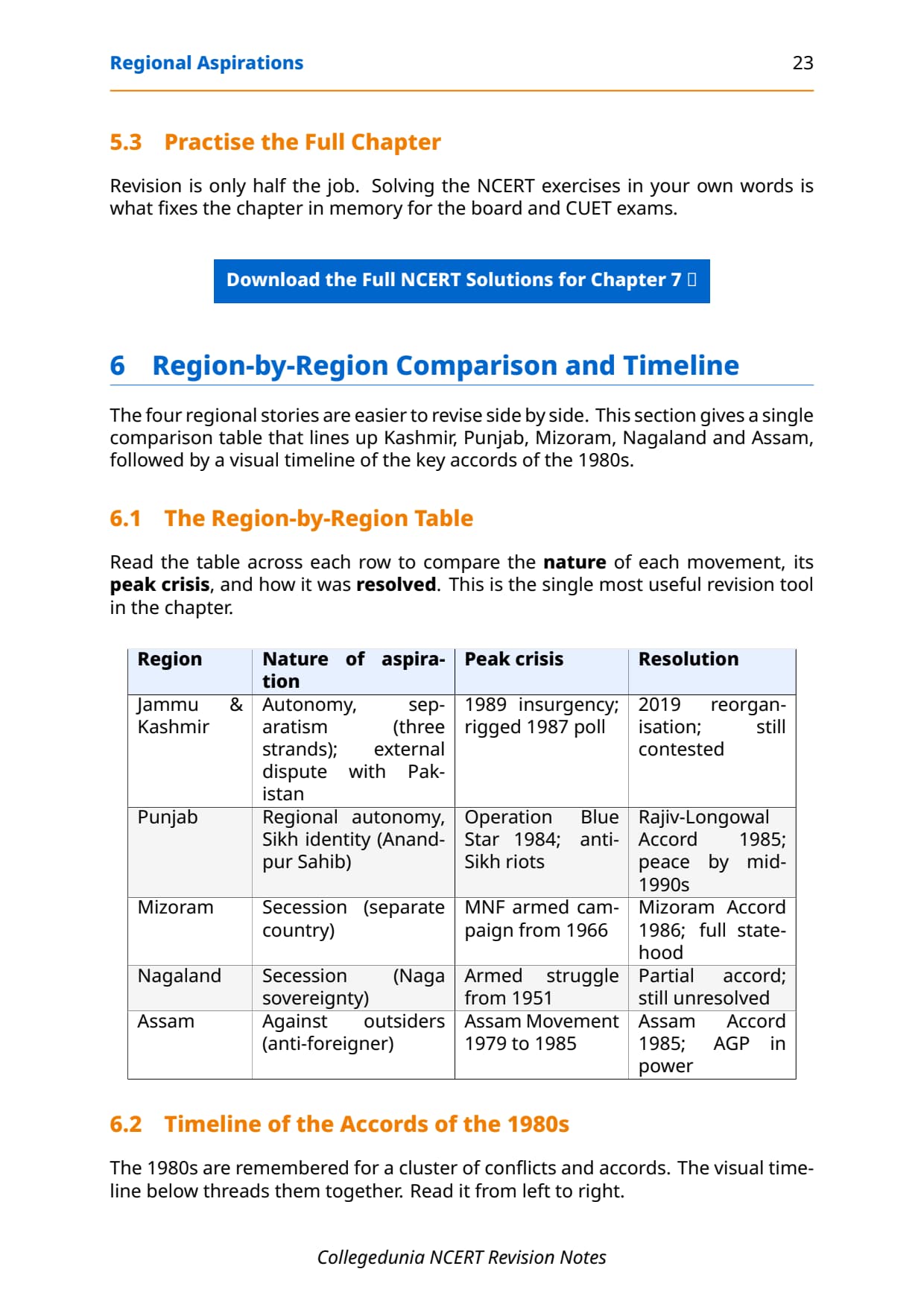
Jammu and Kashmir is the most-asked case, so these notes keep it as a clear, three-part table. The state had three regions and a long debate over Article 370, which gave it a special status. Learn the regions and the positions and you can answer any version of the question.
| Region | What to recall |
|---|---|
| Kashmir valley | Mainly Kashmiri-speaking and Muslim-majority; centre of the autonomy debate. |
| Jammu | Foothills and plains with many languages, religions and castes. |
| Ladakh | Mostly mountainous and thinly populated, with Buddhist and Muslim communities. |
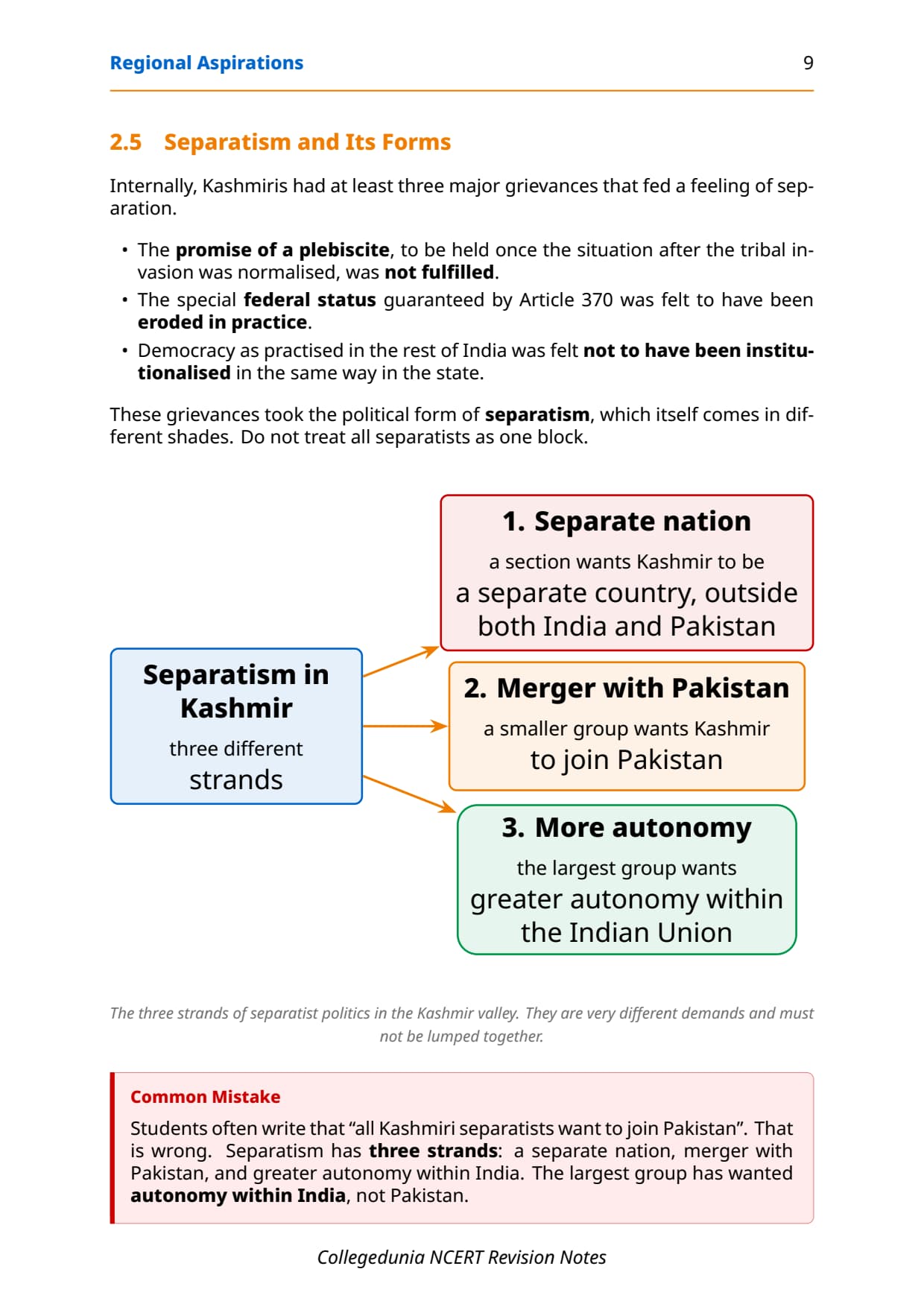
The one-line takeaway for your sheet is that there are three positions on autonomy: revoke Article 370, say it was never enough, or demand a separate nation. The reasonable view is that more democracy and genuine autonomy within India are fair, but the separatist demand for a separate country is not justifiable. Keep these three positions clear in your notes.
Punjab: Resolution, Crisis and Accord
The Punjab story runs from a demand for a Punjabi-speaking state to militancy and a peace accord. These notes keep the chain of events as a table rather than a story, because the exam wants the order clear. Learn the four turning points and the long answer writes itself.
| Event | What it meant |
|---|---|
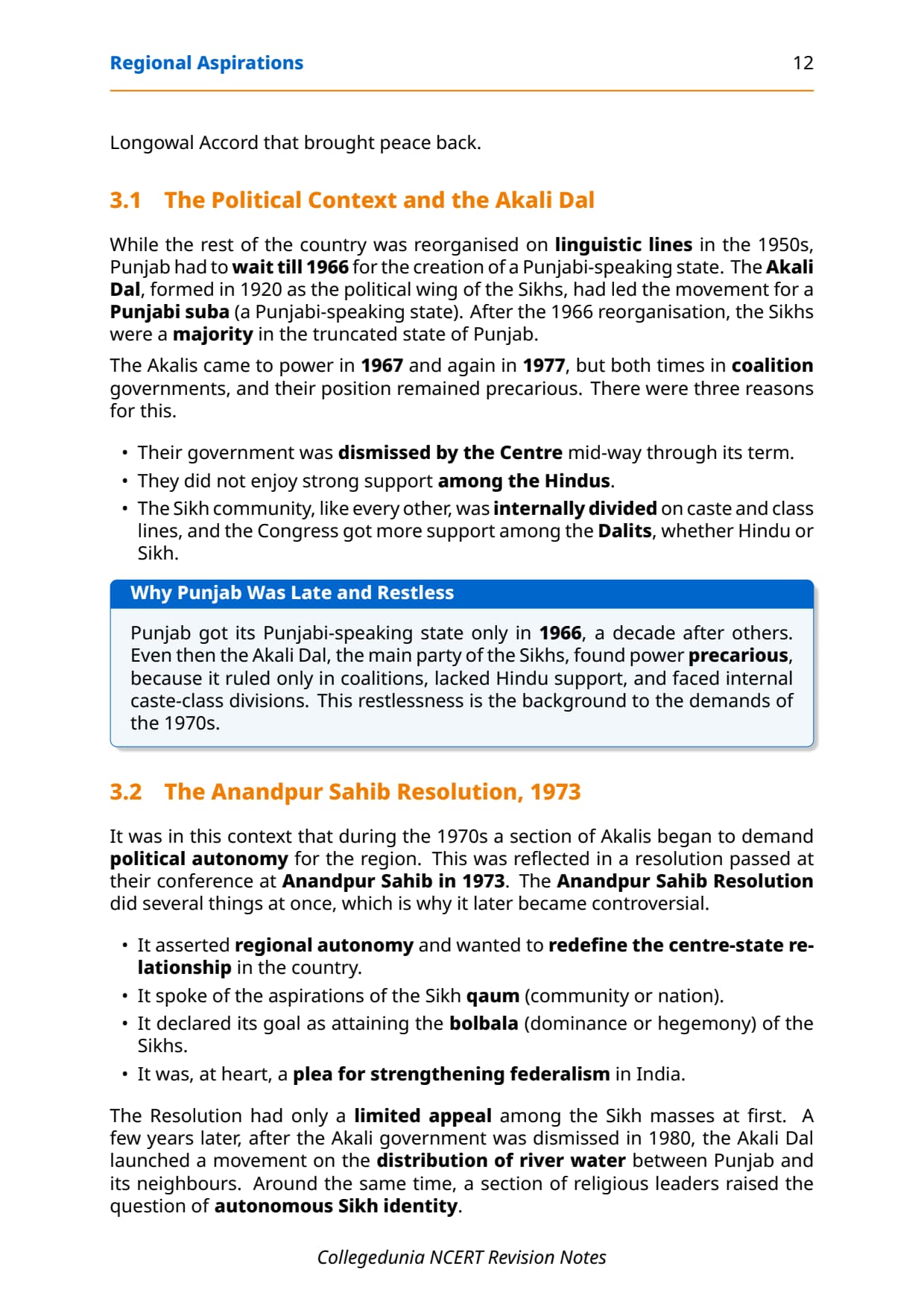
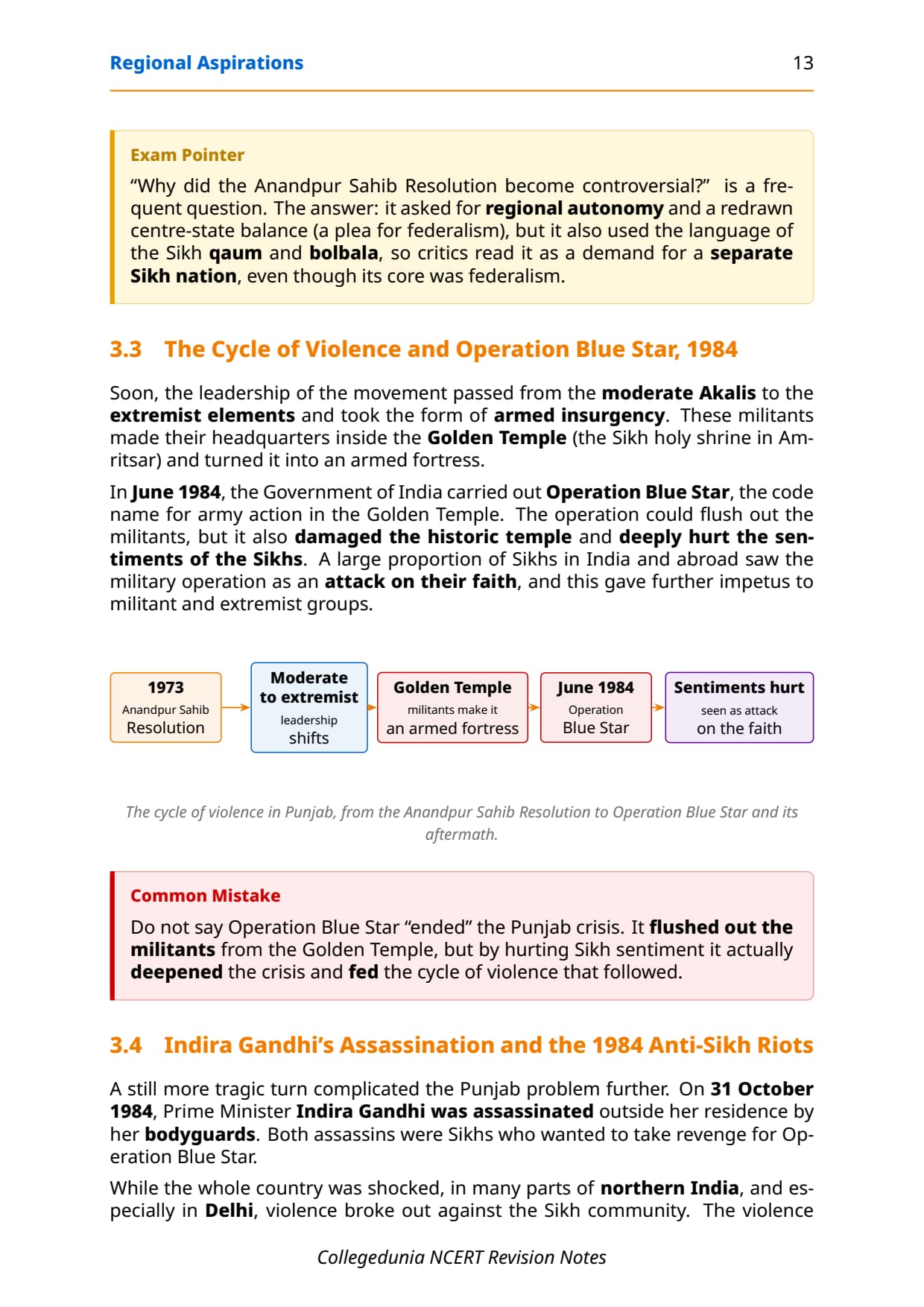
| Anandpur Sahib Resolution (1973) | The Akali Dal asked for more regional autonomy and a stronger federal balance. |
| Why controversial | It could be read as a demand for a separate Sikh nation and as weakening the Centre. |
| Operation Blue Star (1984) | Militancy grew; the army action at the Golden Temple deepened the crisis. |
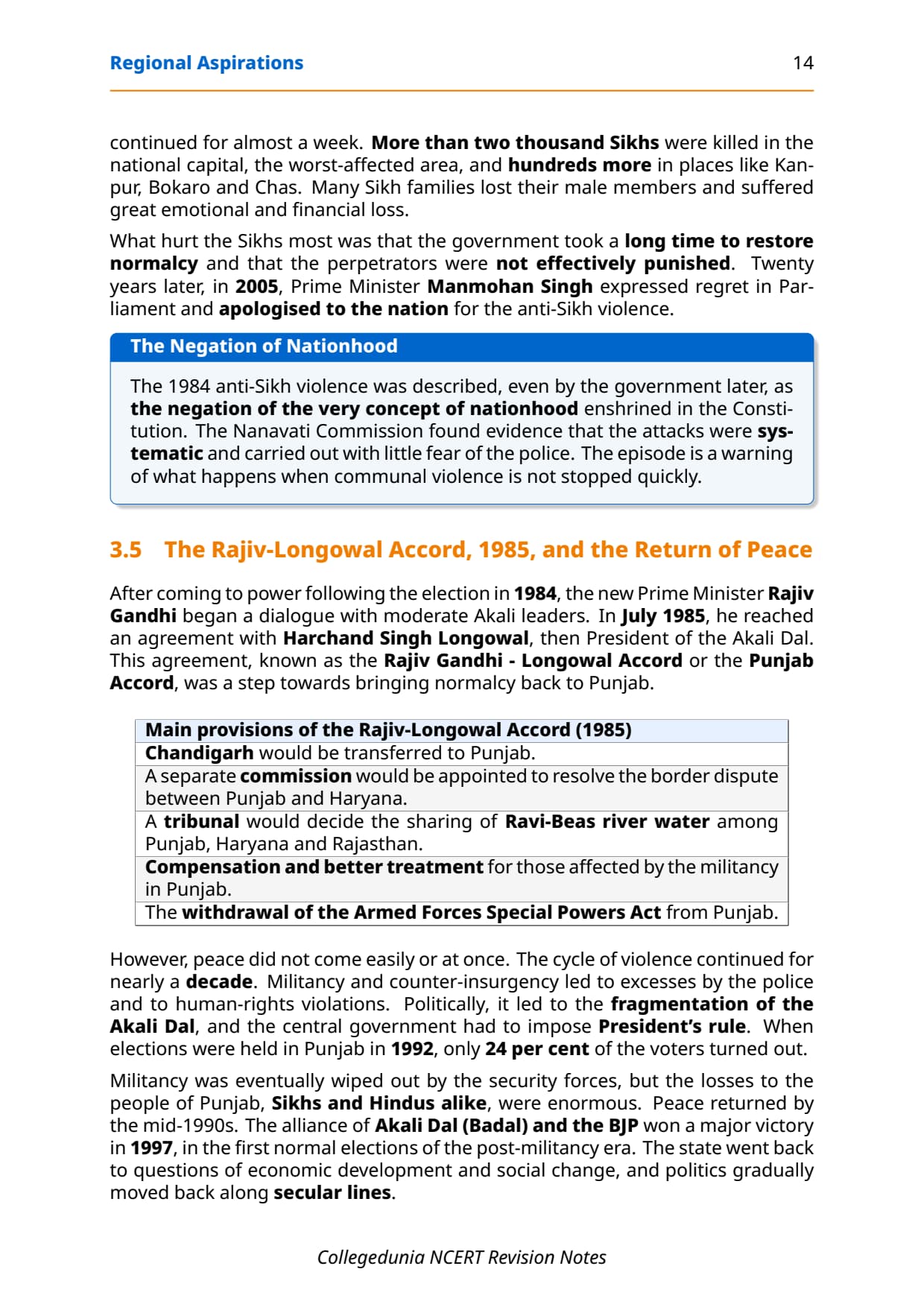
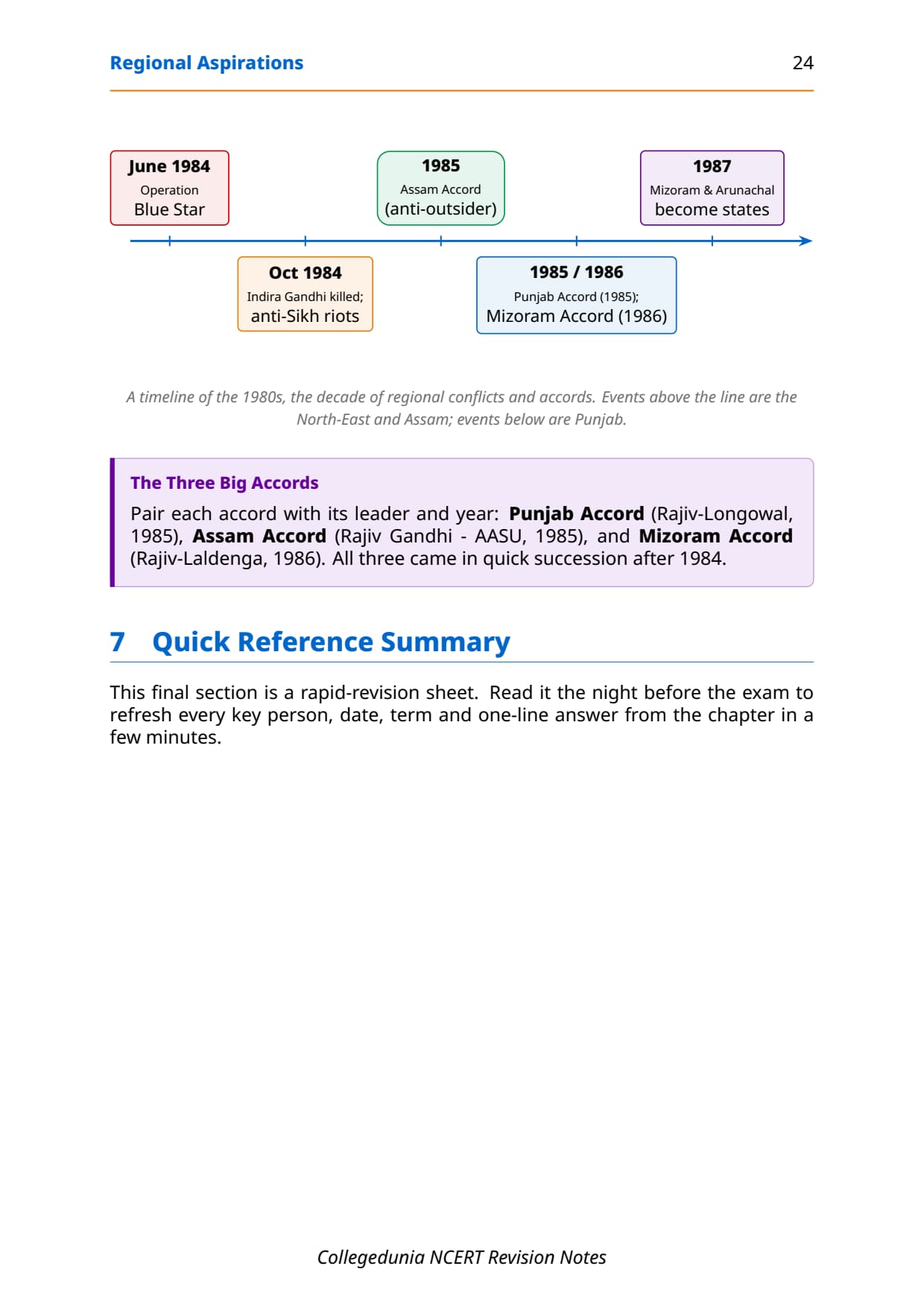
| Punjab Accord (1985) | The Rajiv-Longowal accord tried to settle Chandigarh, borders and river water. |
The sharp note to remember is that the resolution began as a plea for federal balance but was later seized by extremists. The Punjab Accord settled the big political question of ending militancy, yet its clauses on Chandigarh, the Punjab-Haryana border and river water could spark fresh tension. Keep the provisions and these possible disputes as two short lists.
The North-East: Three Kinds of Demand
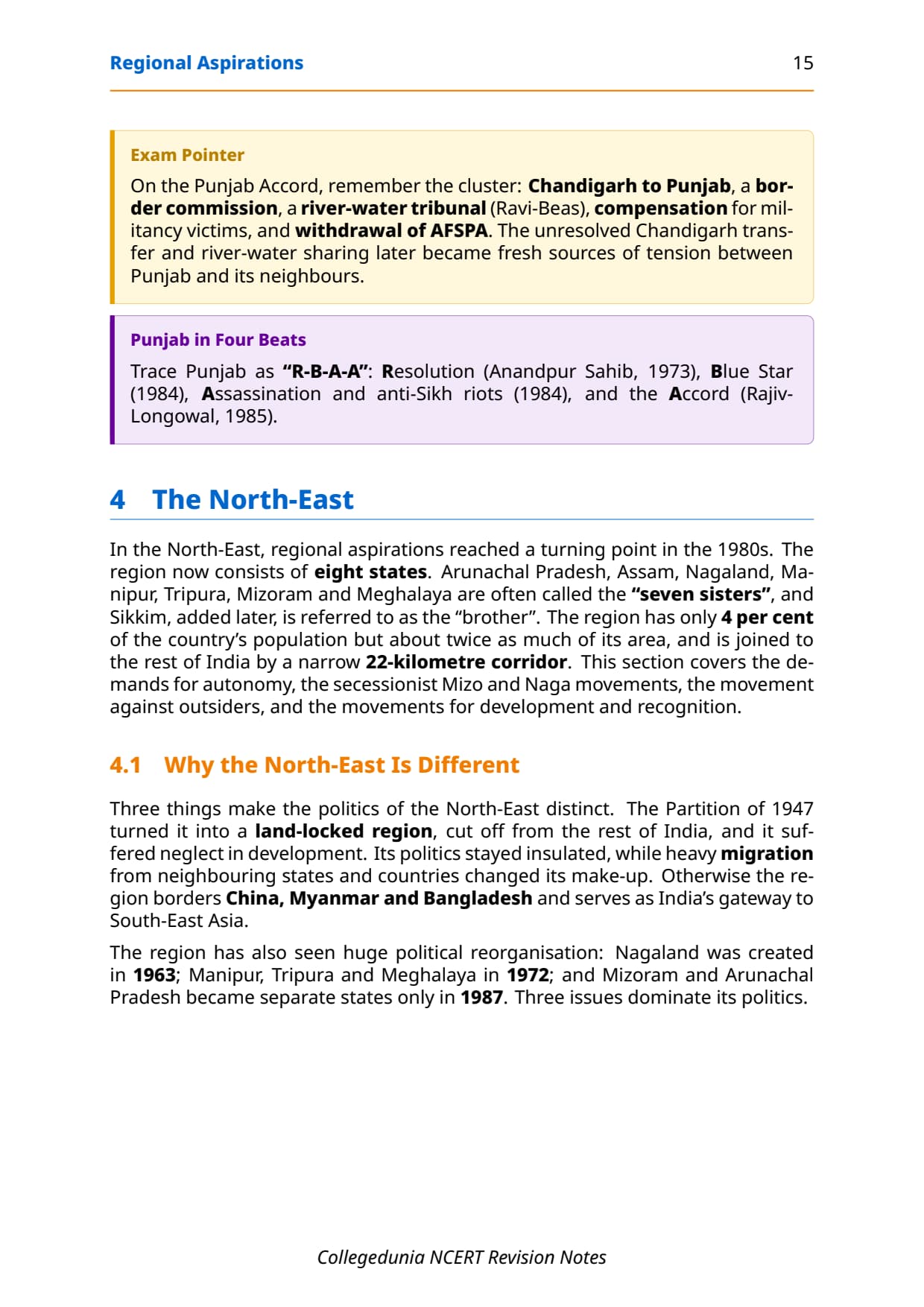
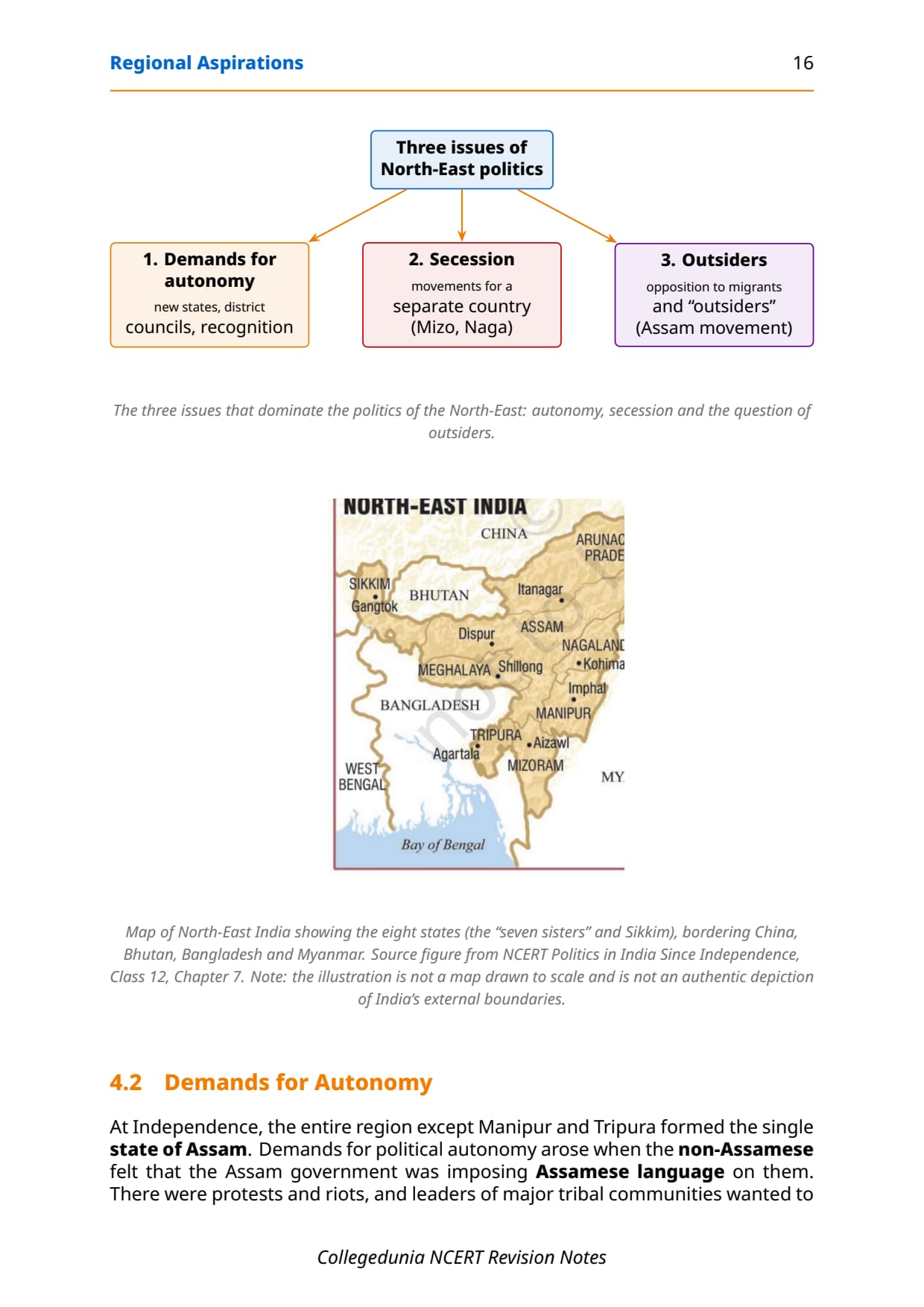
The North-East shows three kinds of regional demand at once, which is exactly what the map-work question tests. These notes keep the three layers separate so you can place each state correctly. Learn them as a boxed list.
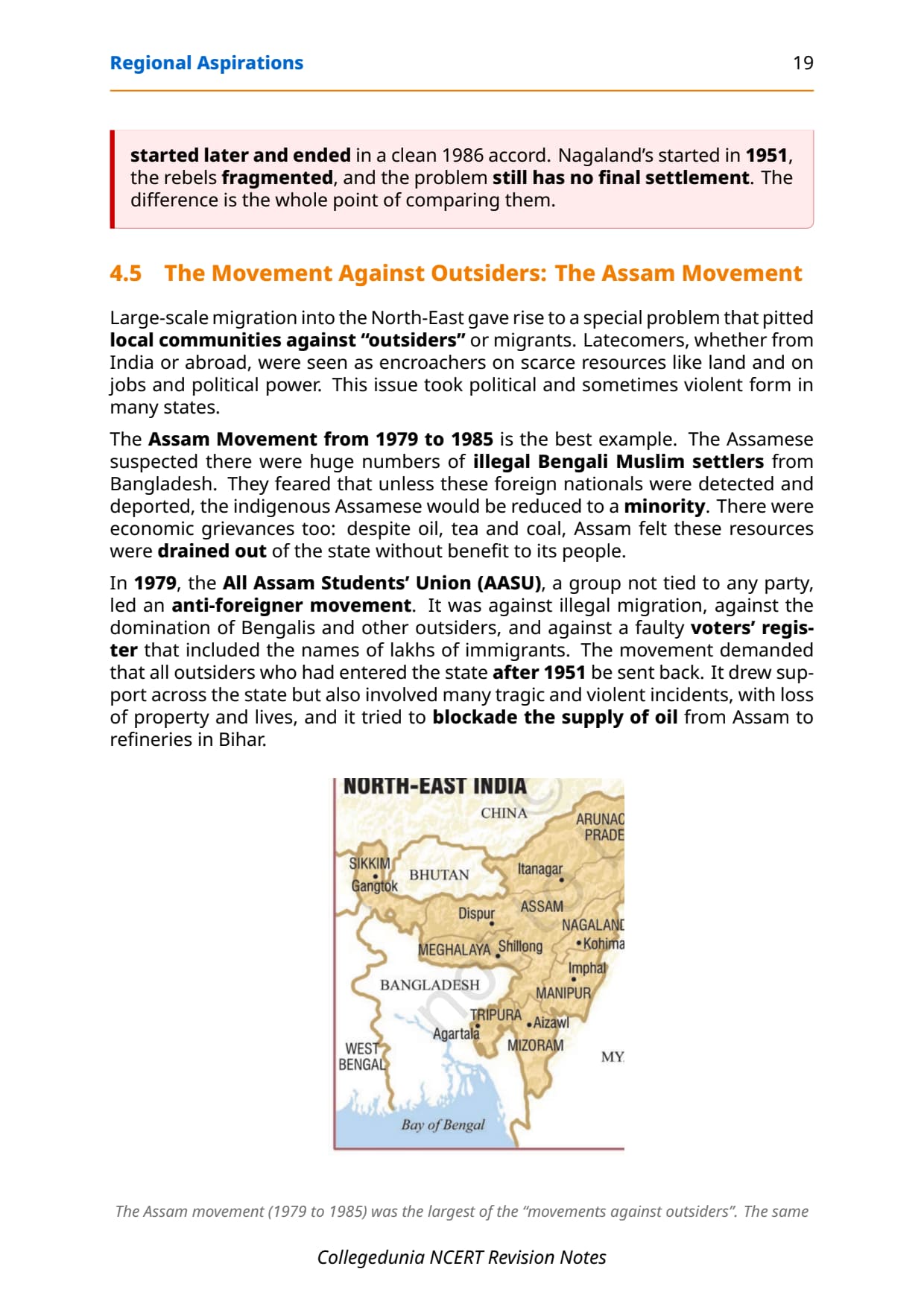
- Against outsiders: the Assam Movement (1979 to 1985), led by the AASU, opposed illegal migrants.
- For greater autonomy: the Bodos, Karbis and Dimasas in Assam pressed for more self-rule.
- For separate existence: Nagaland and Mizoram saw groups demand secession from India.
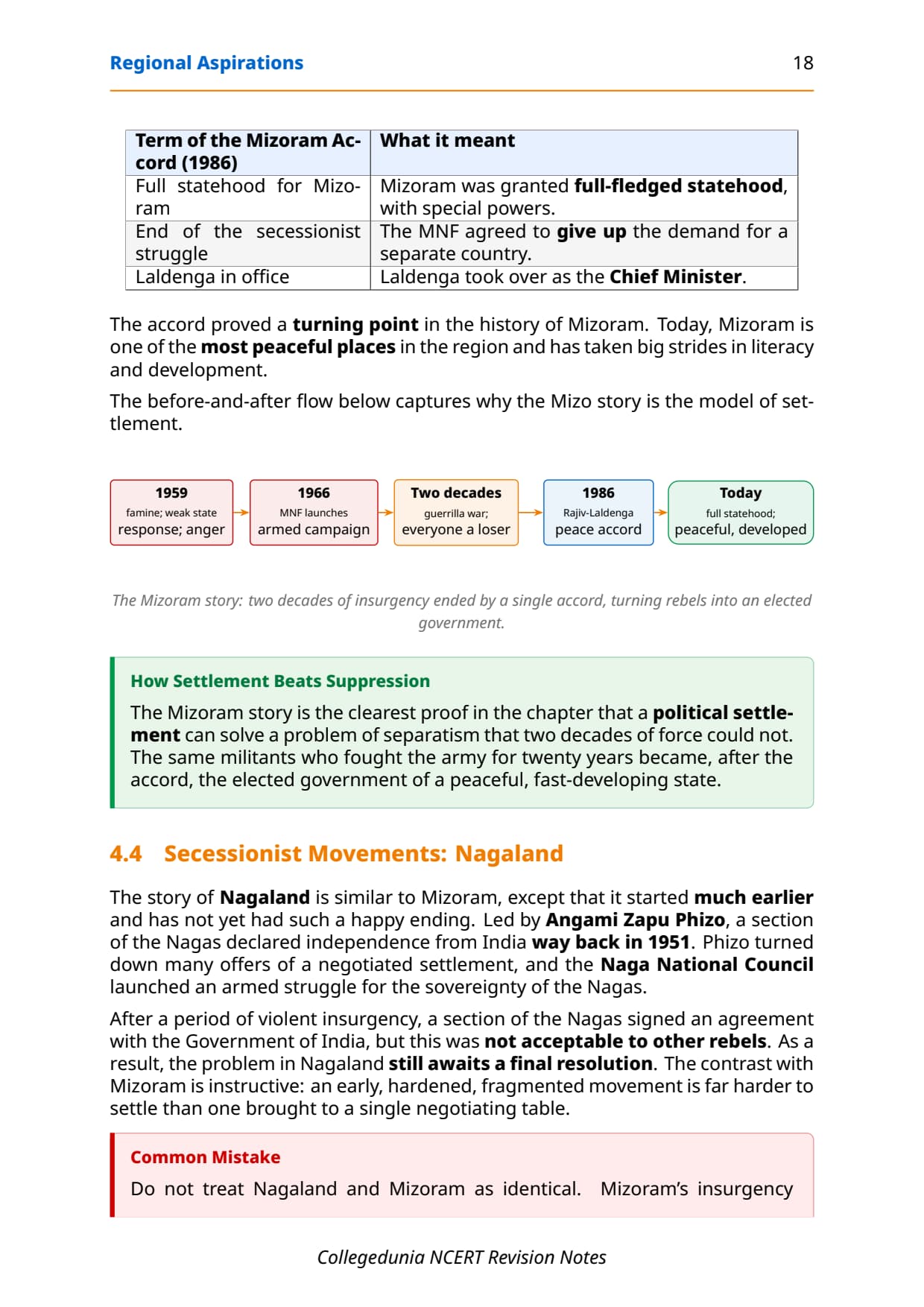
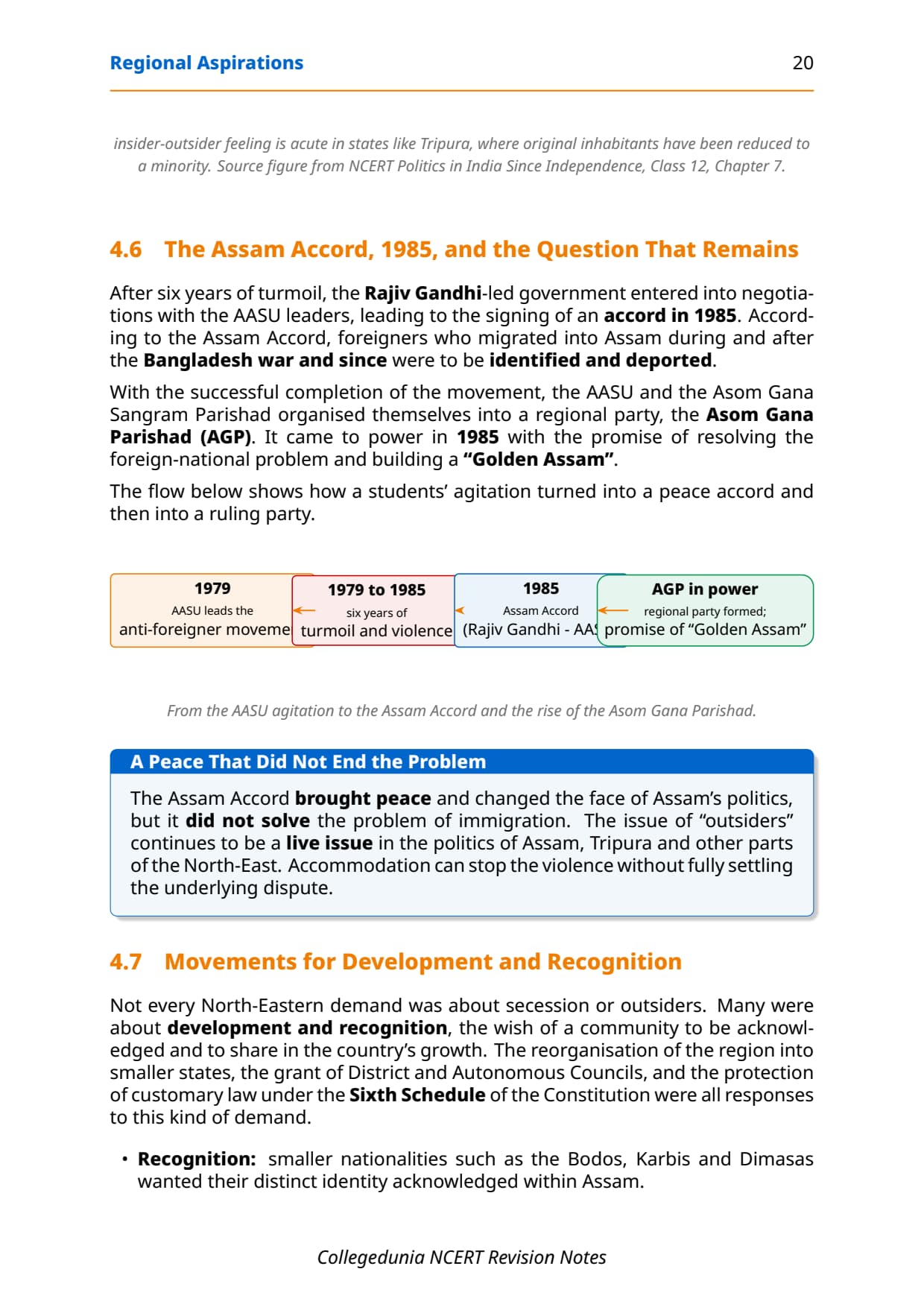
The honest revision line is that the Assam Movement combined cultural pride with economic backwardness. It grew from a fear for Assamese identity and from anger over poverty and the use of the region's resources. The notes also flag that even hard insurgencies were settled by talks: the Mizo accord of 1986 ended two decades of conflict and granted statehood. So the North-East is the clearest proof that dialogue beat force.
Unity in Diversity: The Big Lesson
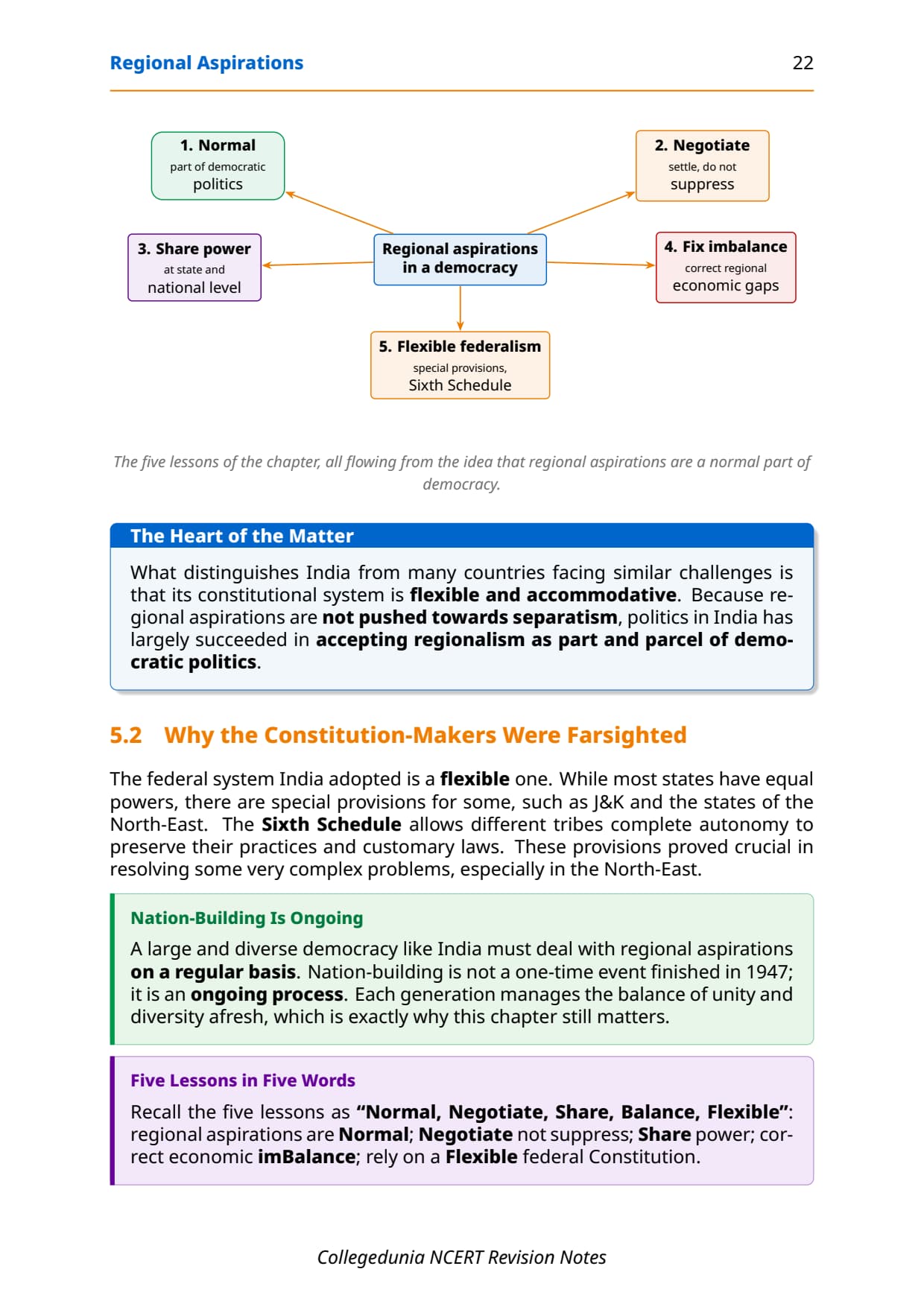
The chapter ends with one big lesson: regional demands and national unity can live together. These notes keep the lesson and its proof side by side, because it is a regular long answer. Memorise the table and the essay is easy to plan.
| Lesson | Proof from the chapter |
|---|---|
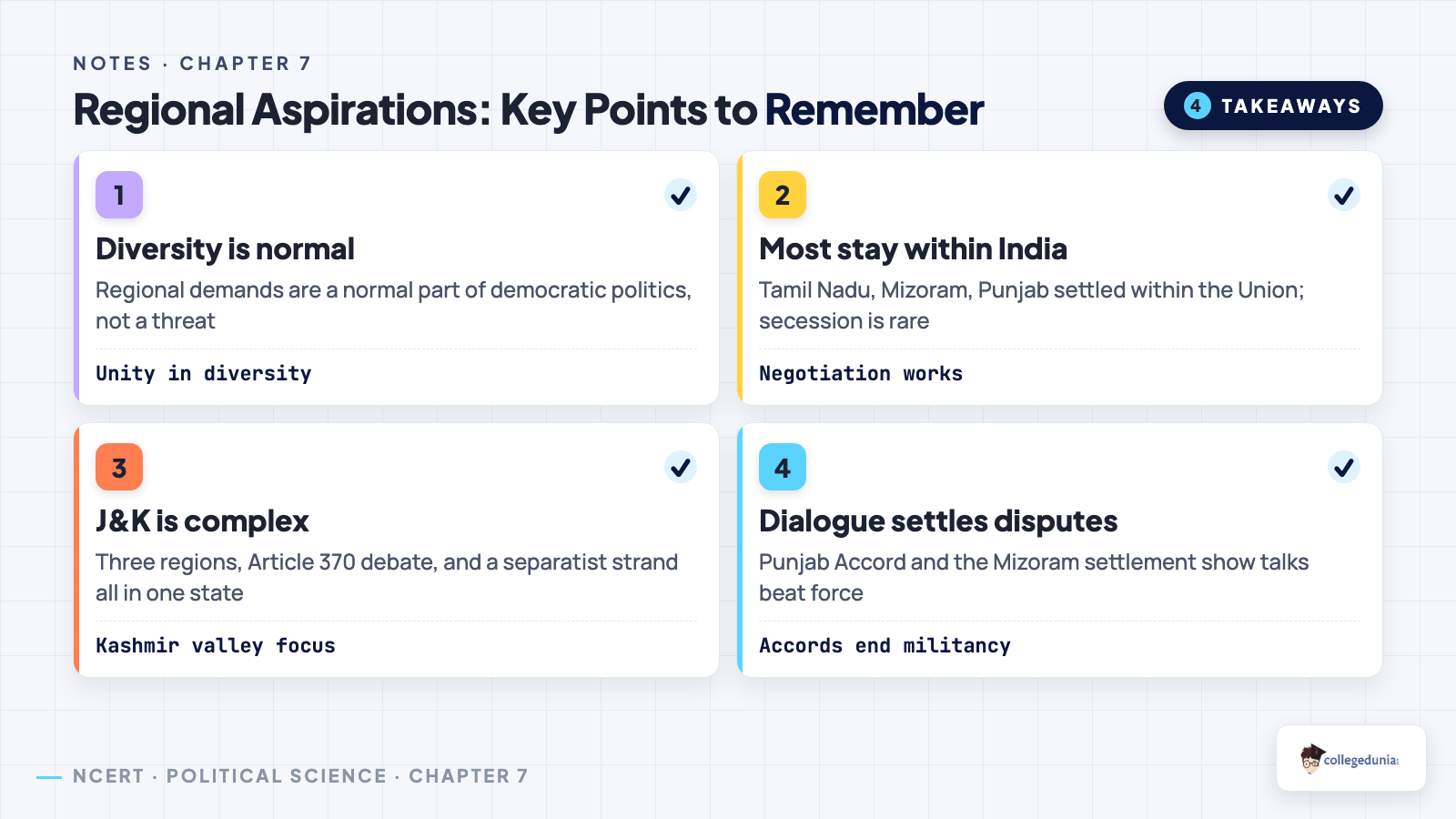
| Diversity is normal | Regional demands are a routine part of Indian democracy, not a threat. |
| Most stay within India | Tamil Nadu, Mizoram and Punjab settled their demands inside the Union. |
| Dialogue works | The Punjab, Assam and Mizo accords show negotiation beats force. |
The point for your notes is that all regional movements need not lead to separatist demands. Most asked only for autonomy, statehood or recognition and stopped well short of leaving India. The Uttarakhand poster in the chapter, which appeals to "every Indian" in seven languages, shows how a regional demand can be made in the language of the nation. This single image sums up the unity-in-diversity answer.
Regional Aspirations Important Questions and Exam Pointers
CBSE sets a steady mix of map-work, short and long answers from this chapter. Knowing the pattern helps students decide how much to write and which topics to revise first. A focused list of Regional Aspirations important questions saves a lot of time before the board exam.
- Long answer (5 to 6 marks): Jammu and Kashmir autonomy, or the Assam movement as pride plus backwardness.
- Short answer (4 marks): provisions of the Punjab accord, or why the Anandpur Sahib Resolution was controversial.
- Map and source-based: placing North-East states on a map, or a passage on unity in diversity.
- Objective and MCQ: matching movements to states, key years and the accords.
For quick recall, students often practise a short class 12 political science chapter 7 mcq drill and a list of Regional Aspirations class 12 important questions. The most repeated items are the Jammu and Kashmir positions and the unity-in-diversity judgement, so keep those answer points ready in your own words. Reading these notes once, then writing the key lists from memory, is the fastest way to lock the chapter in.
Common Mistakes Students Make in This Chapter
A few errors cost marks every year. Most come from mixing up the North-East states or treating every regional demand as separatism. Fixing these five points is the quickest way to lift a score, so add them to the end of your revision sheet.
- Calling every regional demand "separatist" - most ask only for autonomy or statehood within India.
- Confusing the three layers in the North-East - keep outsiders, autonomy and secession separate.
- Forgetting that the Anandpur Sahib Resolution began as a federal-autonomy demand, not a call for a separate nation.
- Missing one of the three regions of Jammu and Kashmir - always name Kashmir valley, Jammu and Ladakh.
- Writing that India only used force - most demands were settled by accords and dialogue.
Students who fix these five points usually move from average to high marks. The exam rewards a balanced view, so always show both the demand and how it was settled before you judge a movement. These notes flag each soft point so you can phrase it safely in the answer sheet.
How These Notes Pair with the Solutions and Book PDF
These revision notes summarise the chapter. To prepare fully, students should use them alongside the other resources for the same chapter, all linked in the table below. Read the notes first, then test yourself with the solutions, and open the book PDF whenever you need the original text, maps and figures.
| Resource | Best used for |
|---|---|
| Regional Aspirations NCERT Solutions | Step-by-step answers to all 10 back-exercise questions |
| Regional Aspirations Handwritten Notes | Last-minute, one-shot revision in a scanned notebook style |
| Regional Aspirations NCERT Book PDF | Reading the original NCERT chapter text, maps and figures |
Tip: read these notes first, then attempt the solutions on your own, and only then check the model answers. That order builds memory faster than copying answers straight away.
All Class 12 Political Science Notes by Chapter
The table links the revision notes for every chapter in both Class 12 Political Science books, so students can move across the course in one click. Regional Aspirations is highlighted.
| Chapter | Notes |
|---|---|
| Contemporary World Politics | |
| Chapter 1 | The End of Bipolarity |
| Chapter 2 | Contemporary Centres of Power |
| Chapter 3 | Contemporary South Asia |
| Chapter 4 | International Organisations |
| Chapter 5 | Security in the Contemporary World |
| Chapter 6 | Environment and Natural Resources |
| Chapter 7 | Globalisation |
| Politics in India Since Independence | |
| Chapter 1 | Challenges of Nation Building |
| Chapter 2 | Era of One-Party Dominance |
| Chapter 3 | Politics of Planned Development |
| Chapter 4 | India's External Relations |
| Chapter 5 | Challenges to and Restoration of the Congress System |
| Chapter 6 | The Crisis of Democratic Order |
| Chapter 7 | Regional Aspirations |
| Chapter 8 | Recent Developments in Indian Politics |
FAQs on Regional Aspirations Class 12 Notes
Regional Aspirations Class 12 Political Science Notes Common Questions
Ques. Where can I download the Regional Aspirations Class 12 notes PDF?
Ans. You can download the Regional Aspirations Class 12 Political Science notes PDF directly from this page. It is free, follows the 2026-27 NCERT, and covers Jammu and Kashmir, Punjab, the North-East and the unity-in-diversity theme in a short, point-wise format.
Ques. What does Regional Aspirations chapter cover for Class 12?
Ans. It covers how regions like Jammu and Kashmir, Punjab and the North-East pushed for autonomy, statehood or recognition, the accords that settled many demands, and the lesson that diversity and national unity can live together.
Ques. What is the difference between an autonomy demand and a separatist demand?
Ans. An autonomy demand asks for more powers, statehood or recognition while staying within India. A separatist demand goes further and wants the region to leave India and become a separate country. The chapter shows that most movements asked only for autonomy.
Ques. Why is Regional Aspirations important for the board exam?
Ans. Because it is a scoring chapter with regular map-work, short and long answers. The Jammu and Kashmir positions, the Punjab accord and the unity-in-diversity point appear almost every year, so revising these notes well secures both objective and long-answer marks.
Ques. How should I use these notes to revise quickly?
Ans. Read the notes once under the demand, settlement and lesson frame, keep all states, accords and years on one sheet, then write the key lists from memory. Finish by attempting a short class 12 political science chapter 7 mcq drill to test the small facts.



Comments