




These Challenges of Nation Building Class 12 Notes give a quick, exam-ready summary of how independent India built itself as one nation, set to the 2026-27 CBSE syllabus. The notes pull together every key date, name and idea from Chapter 1 of Politics in India Since Independence. Students can use them for a fast revision the night before a test or to fix the main ideas before they attempt the back-exercise questions.
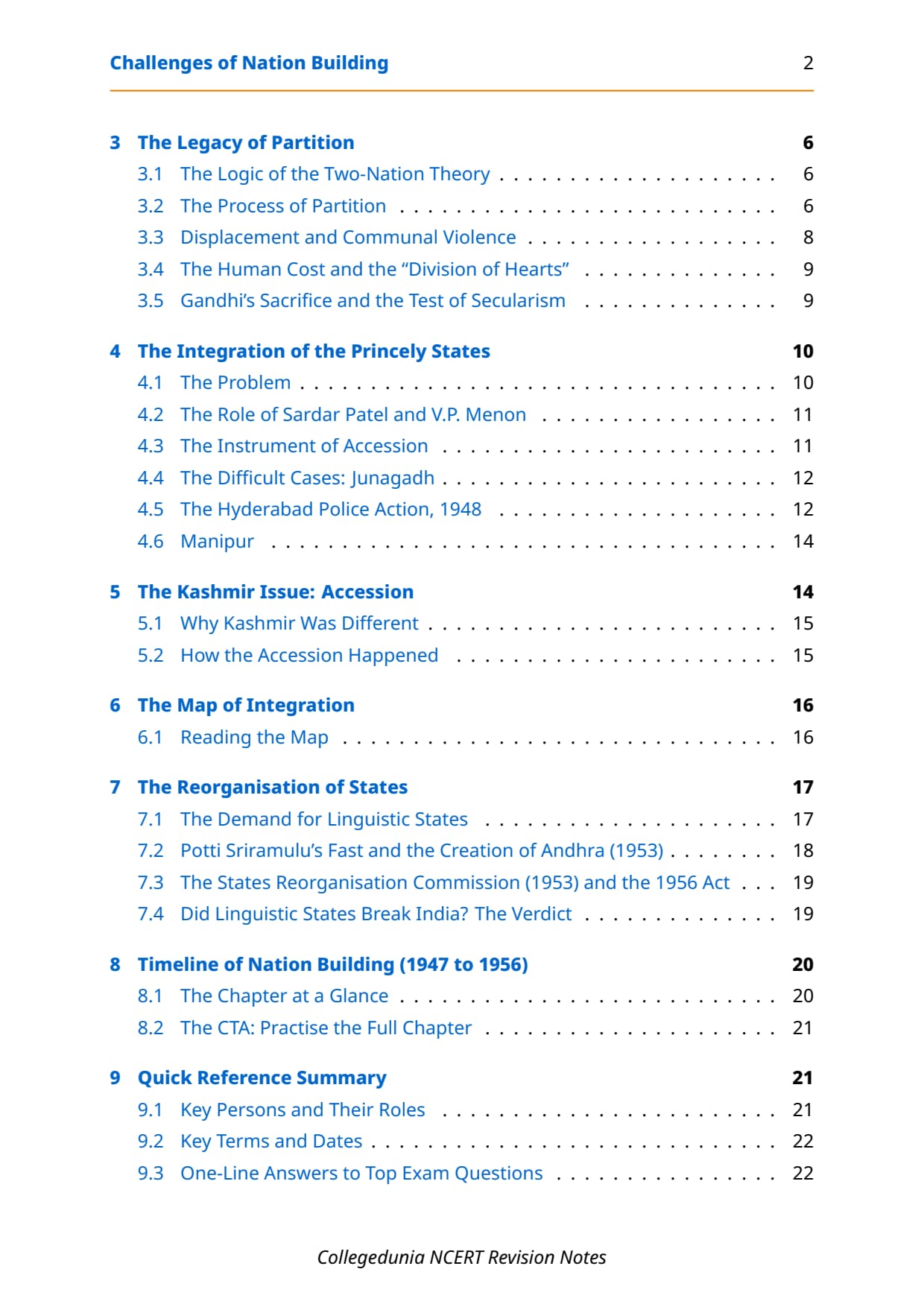
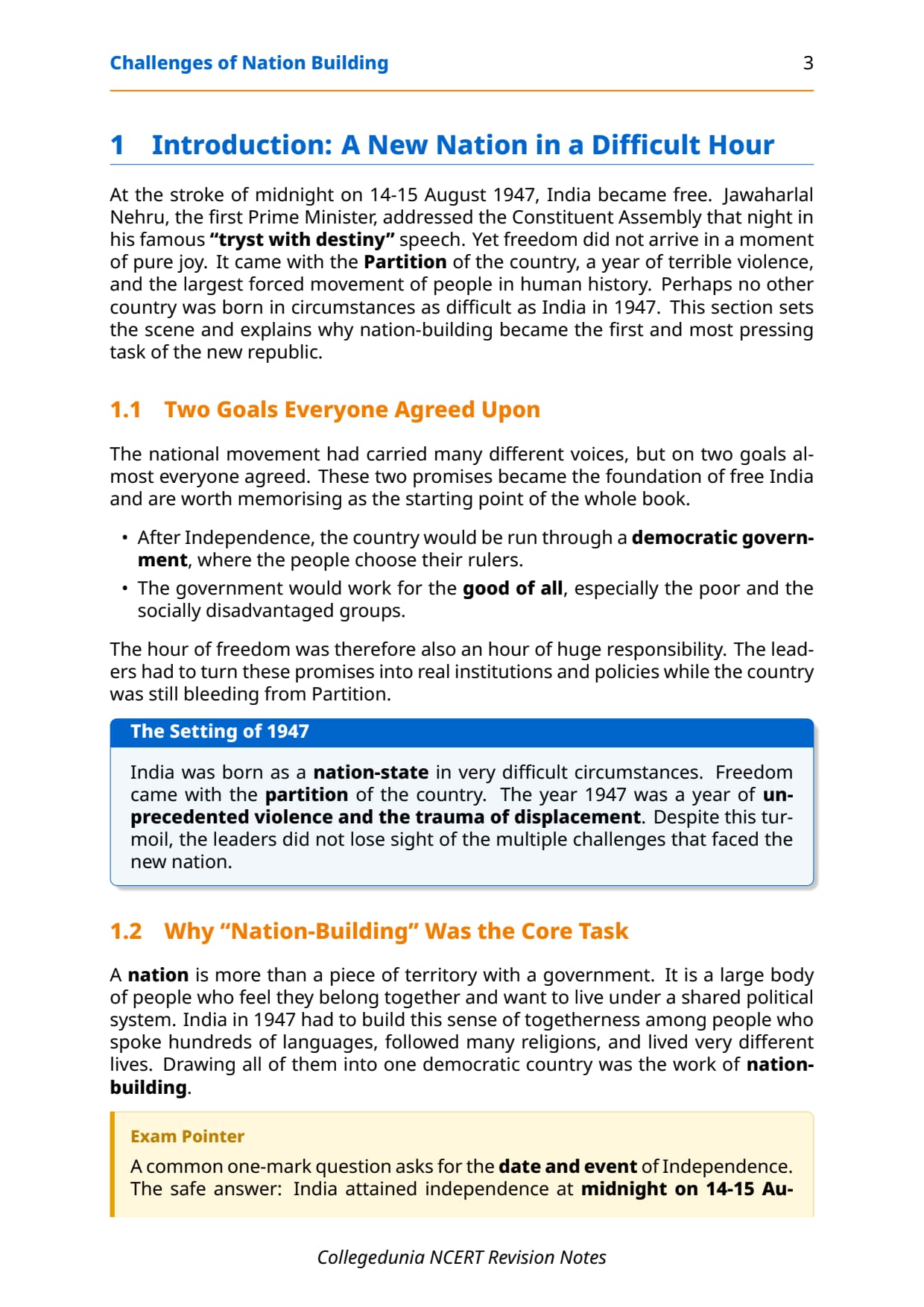
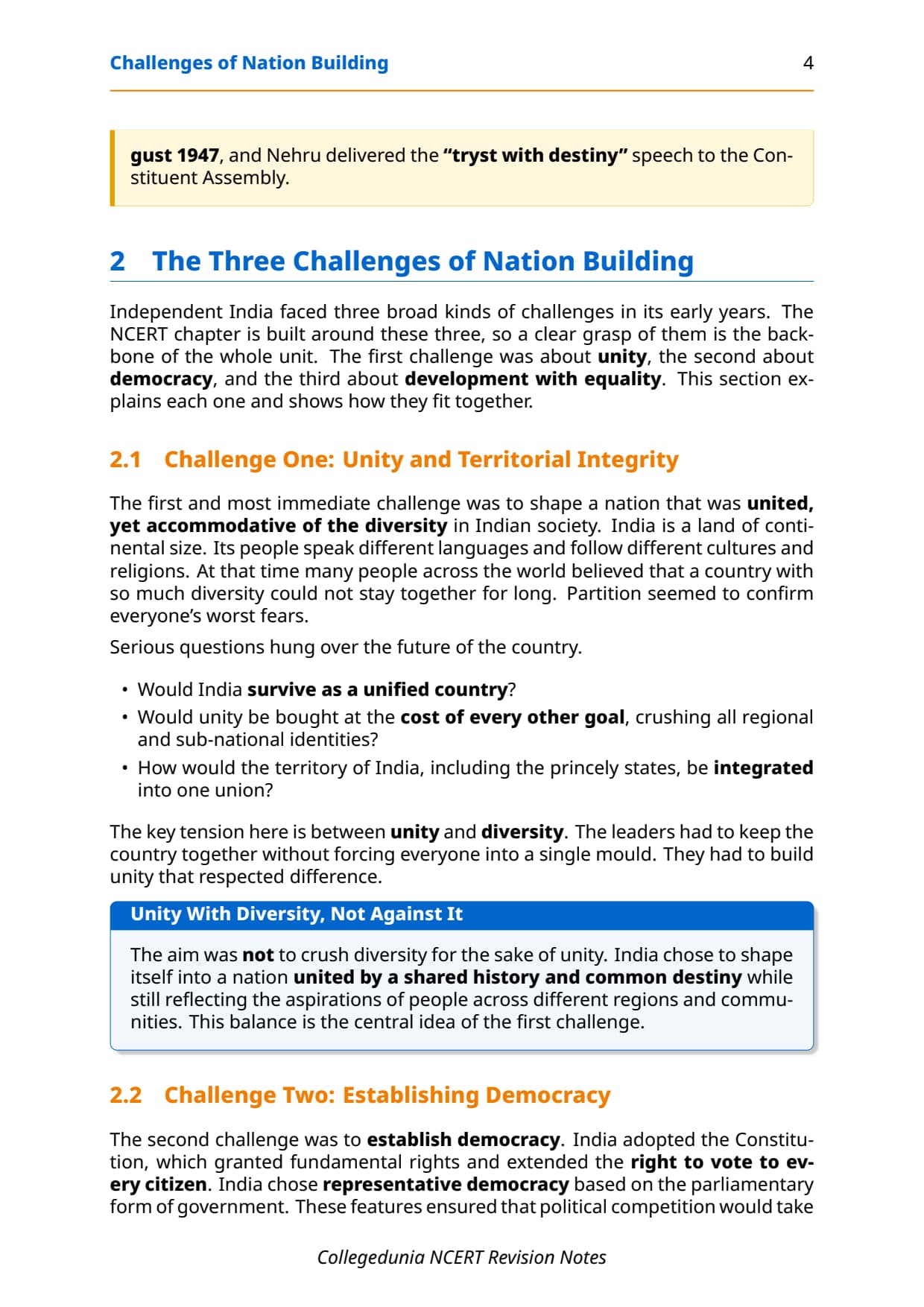
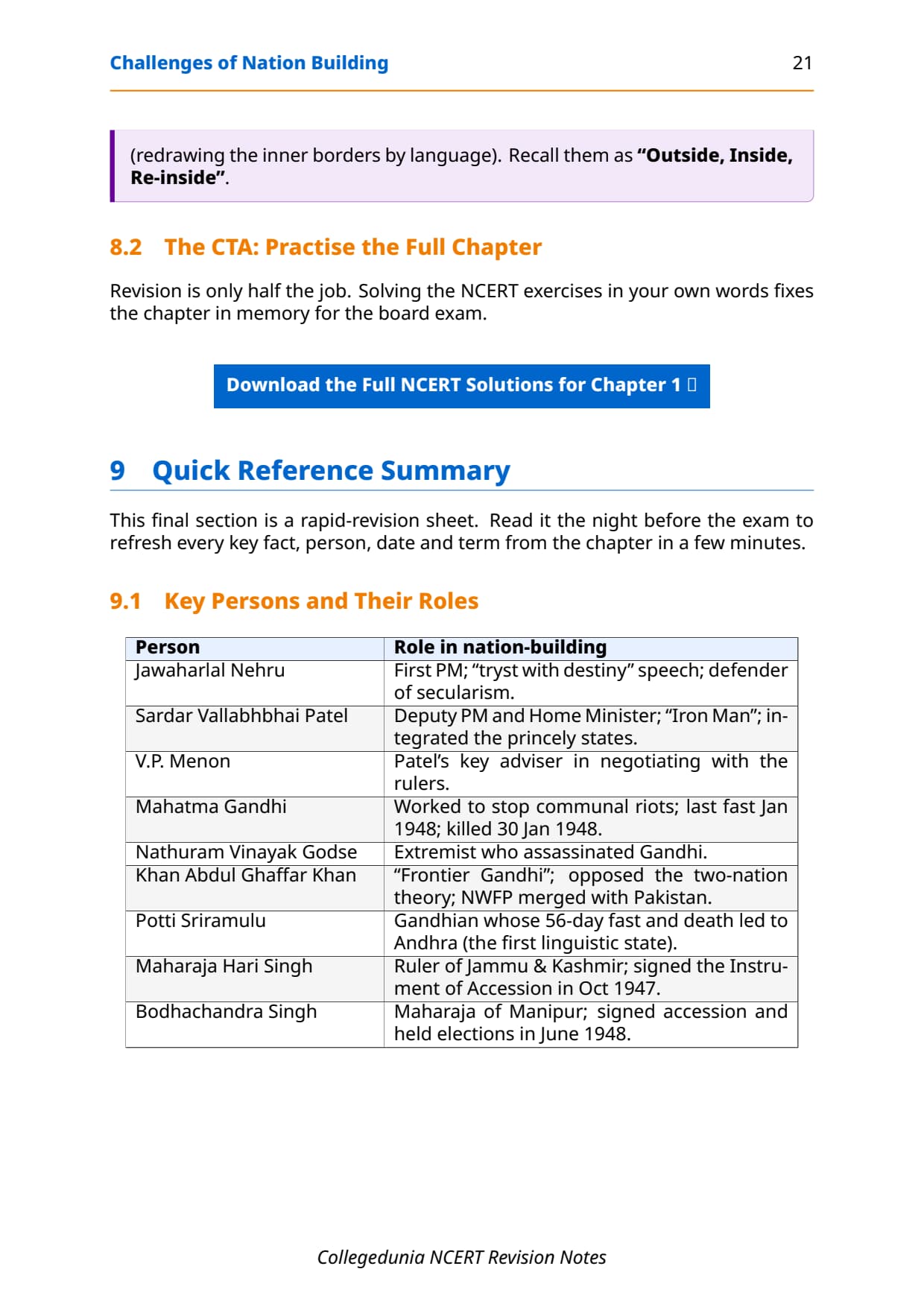
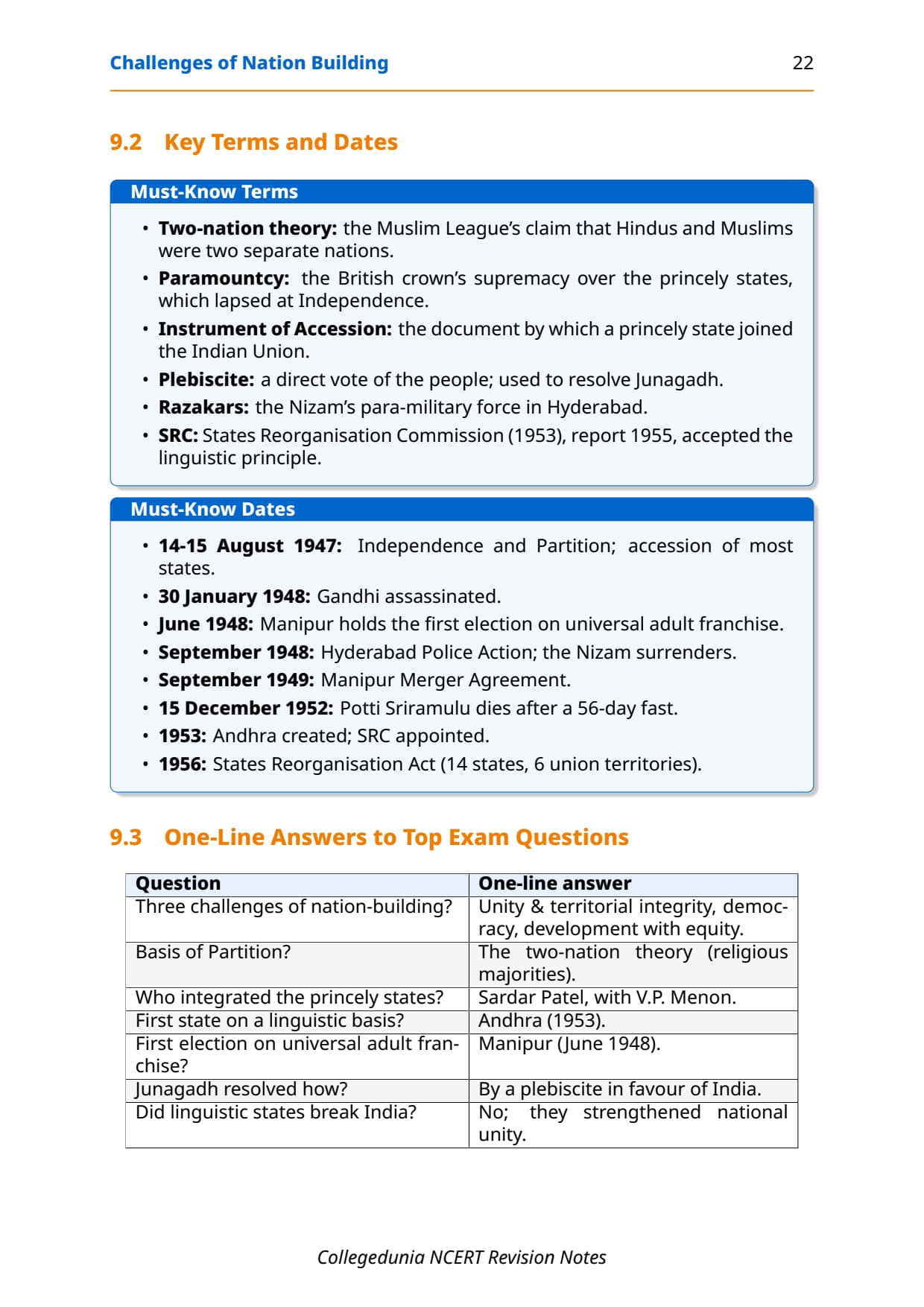
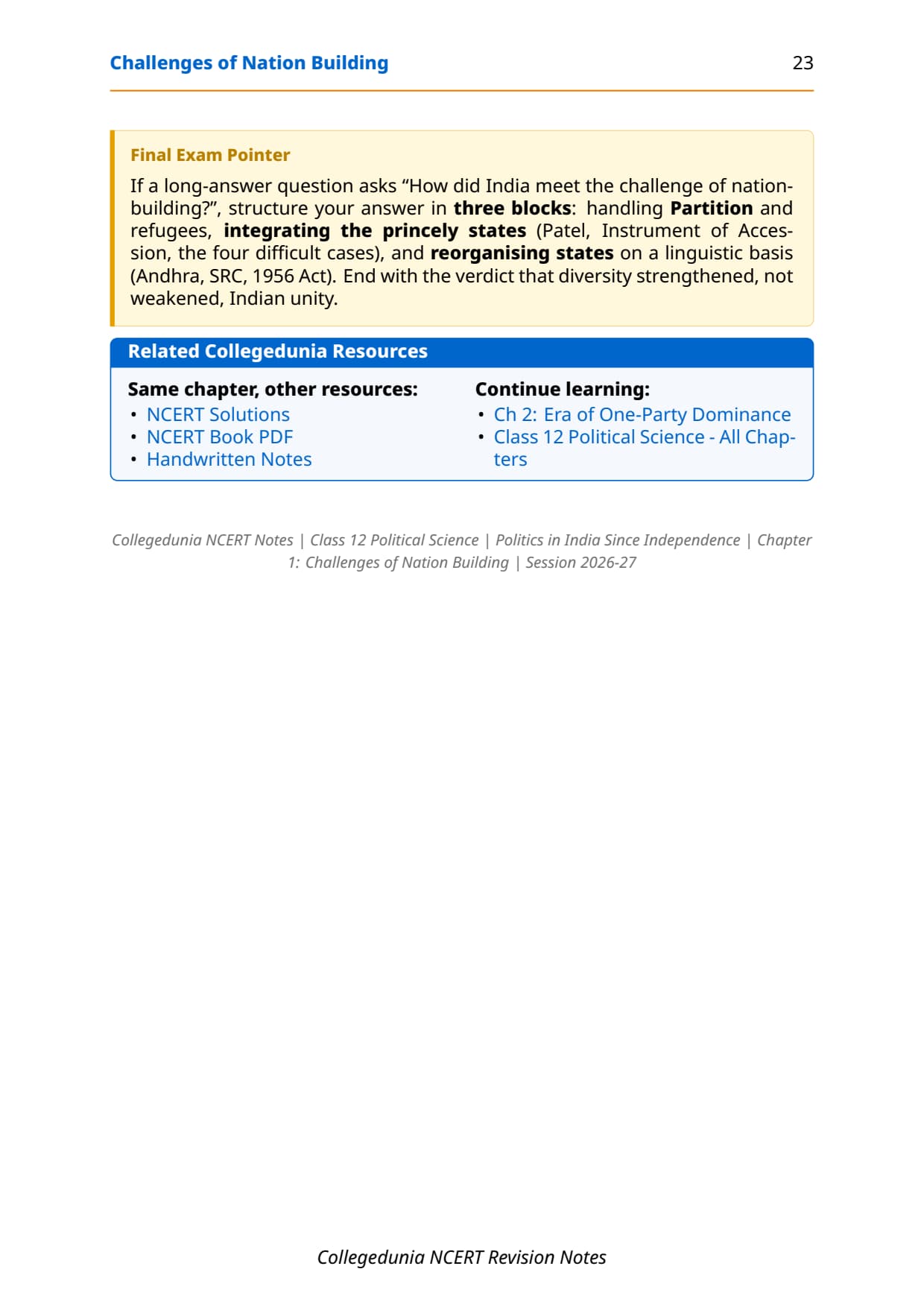
- Covers the three challenges, Partition, secularism, the Princely States and linguistic reorganisation in one place.
- This Class 12 Political Science chapter usually carries 5 to 6 marks in the board paper.
- Pairs with the NCERT Solutions, Handwritten Notes and Book PDF linked lower on this page.
These Challenges of Nation Building Class 12 notes are written from the official NCERT Politics in India Since Independence textbook and checked against the last five years of CBSE board papers.
Student Feedback: In a Collegedunia poll of 8,720 Class 12 Political Science students taken before the 2026 boards, 72% of students said short, point-wise notes on Partition, the Princely States and the 1956 reorganisation were the fastest way to revise this chapter. Most students kept the dates and key numbers on a single sheet for last-minute recall.
Source: 2026-27 Class 12 Political Science student poll. Sample of 8,720 students from CBSE schools across 12 states.
What the Challenges of Nation Building Notes Cover
Challenges of Nation Building is the first chapter of Politics in India Since Independence. It studies how the new nation dealt with its first big test in 1947: how to hold a vast, diverse land together as one democratic country. These notes condense the whole chapter into a fast, point-wise summary.
The easiest way to organise your revision is to split the chapter into three threads:
- The three challenges: unity in diversity, democracy and development.
- The two tasks: Partition's lessons and the integration of the Princely States.
- The internal map: reorganising states on a linguistic basis up to 1956.
So these notes are really about the foundation of modern India. If you sort each fact under one of these threads first, almost every question in Challenges of Nation Building class 12 becomes easier to answer. Keep this frame at the top of your revision sheet and slot each new detail into the right box as you read.
The Three Challenges of Nation Building
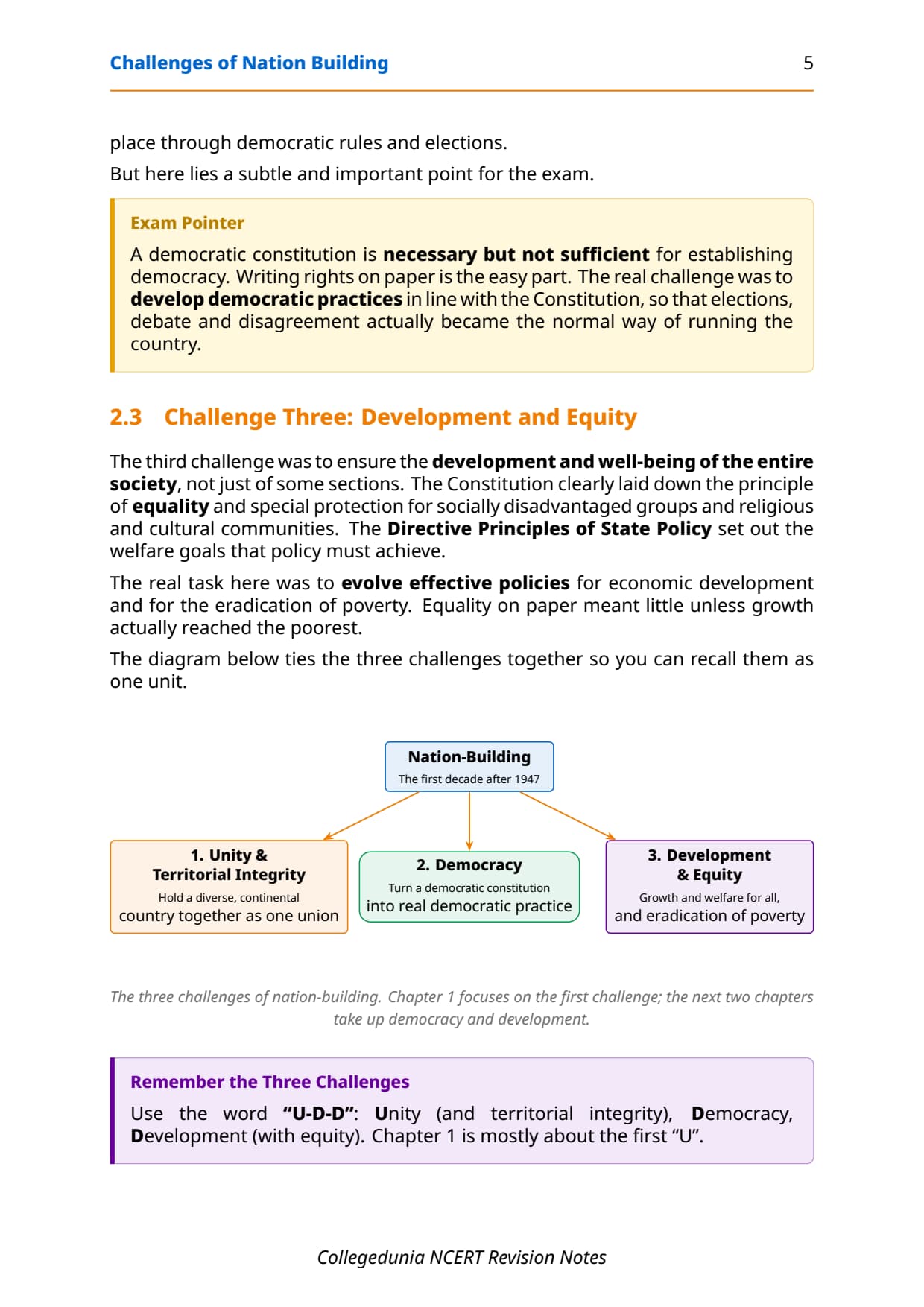
India faced three challenges at once in 1947. Learn them as a boxed list so you can copy them straight onto the answer sheet. Each one carries its own follow-up questions in the exam.
- Unity in diversity: hold together many languages, religions and cultures as one nation.
- Democracy: run the country through free elections, fundamental rights and the vote for all.
- Development: ensure growth and welfare for everyone, especially the poor and the weak.
The point examiners test most is that India met the first challenge by accepting diversity, not by forcing uniformity. The nation is an imagined community held together by a shared history, common aspirations and a common destiny. Keep this idea ready, because the "imagined community" question and the linguistic-states answer both turn on it.
Partition: Two-Nation Theory, Violence and Migration
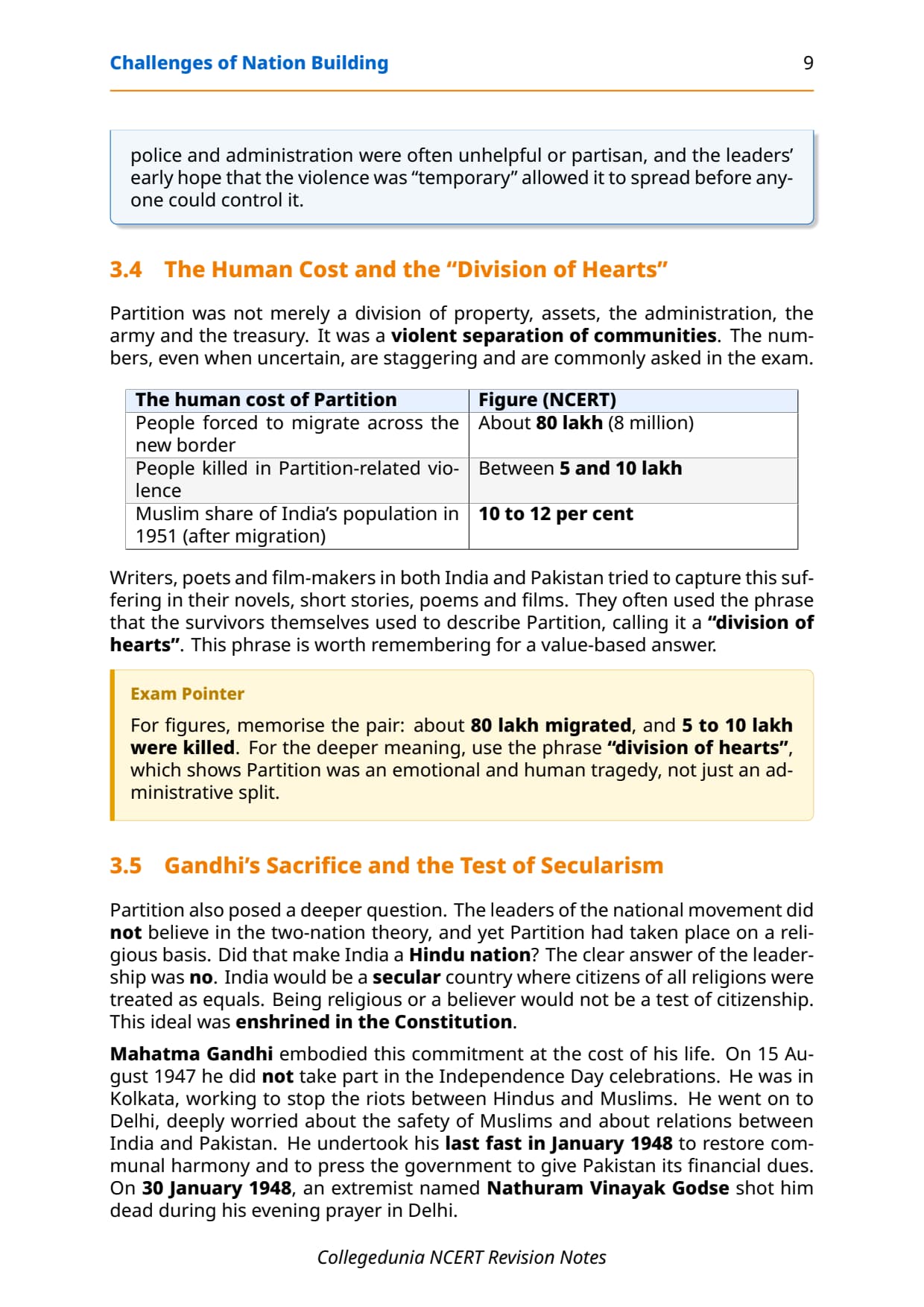
Partition was the first test of 1947. The causes and the human cost are a long-answer favourite, so these notes keep them as a clear table rather than a story. Learn the facts as a list and you can answer any version of the question.
| Aspect | What to recall |
|---|---|
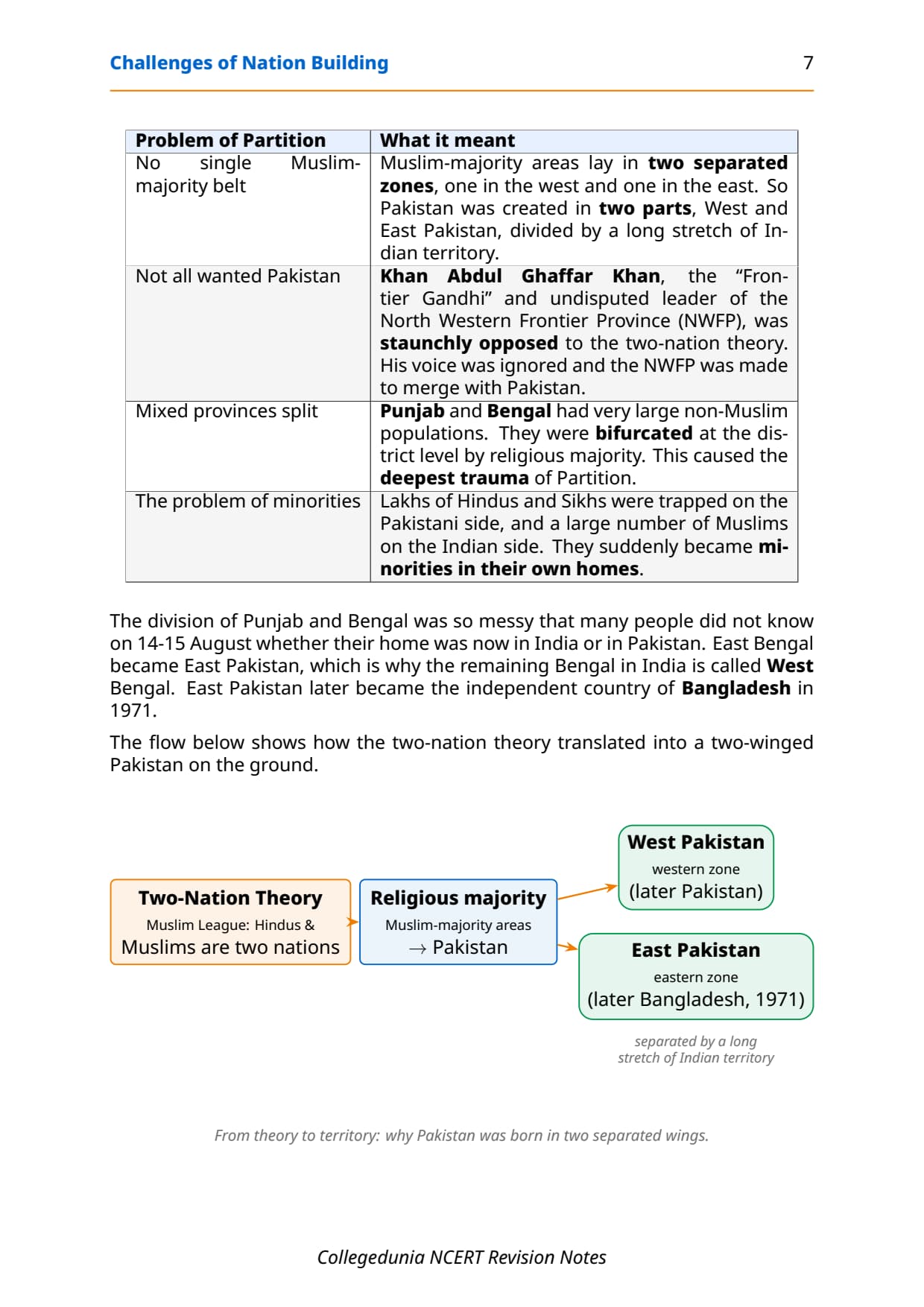
| The basis | The "two-nation theory" of the Muslim League: Hindus and Muslims as two separate peoples. |
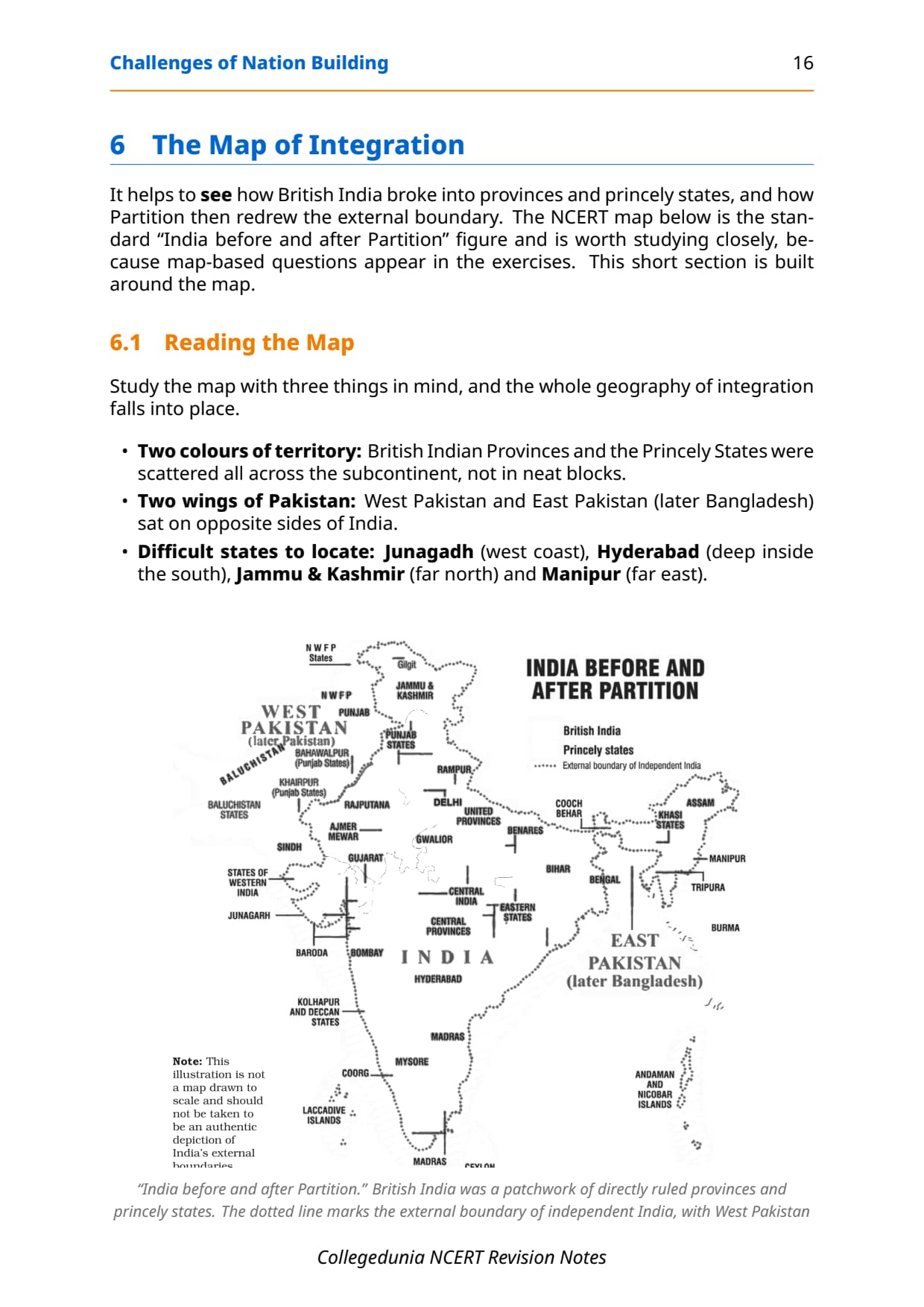
| Provinces split | Punjab and Bengal, both Muslim-majority, were divided on religion. |
| Two-part Pakistan | West and East Pakistan were separated by Indian land and were not contiguous. |
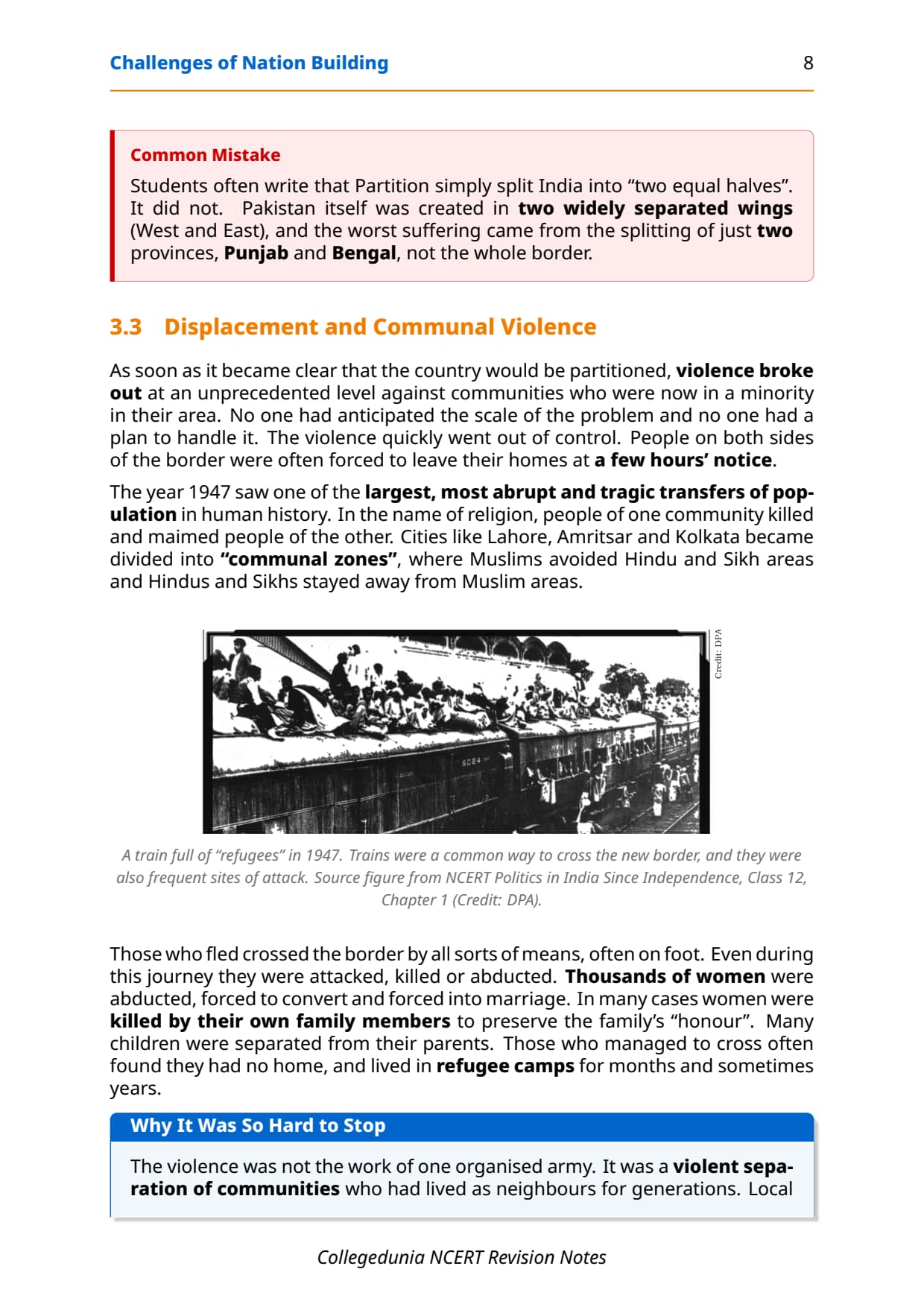
| Displacement | About 80 lakh people crossed the new border in a sudden, unplanned transfer. |
| Violence | Five to ten lakh people were killed in the communal violence. |
The one-line takeaway for your sheet is that the movement of people was never planned. The exam trap is the line that the scheme "included a plan for transfer of population", which is false. Land and assets were divided carefully, but the exodus itself was sudden and unplanned. Keep this distinction clear in your notes.
Secularism and Nehru's Reasons
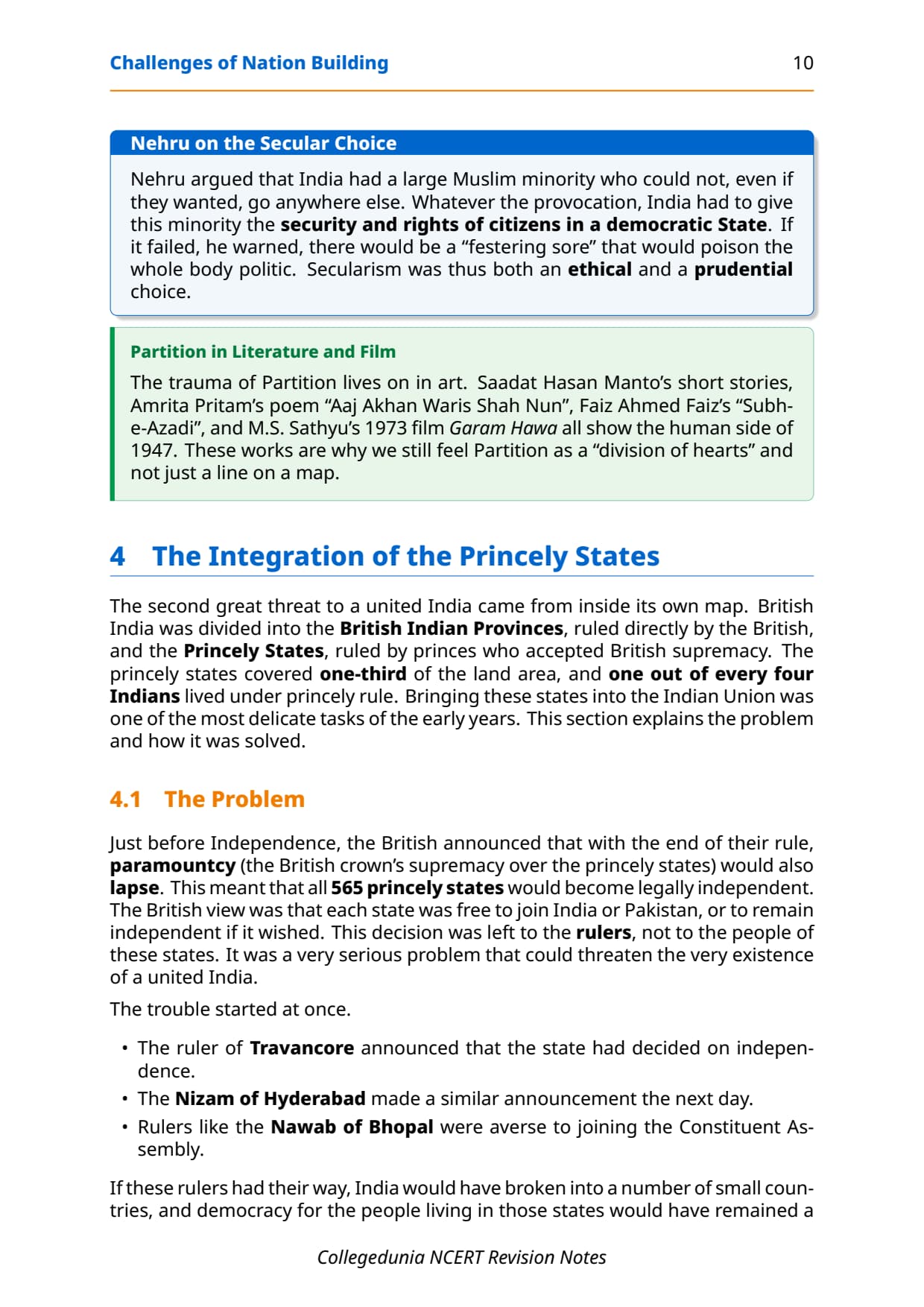
A secular state was India's answer to a divided society. These notes keep Nehru's reasons side by side, because the exam asks what kind of reasons they were. Learn each one as a short boxed point.
- Equality of all citizens: no faith gets superior or inferior status.
- India is genuinely diverse: a Hindu-only nation would betray the freedom movement.
- Duty to minorities: Muslims formed 10 to 12 per cent of India in 1951.
- A practical safeguard: the "festering sore" warning from Nehru's 1947 letter.
The honest revision line is that Nehru's secularism was both ethical and prudential. It was ethical because equality of faiths was a moral ideal, and prudential because a fairly treated minority kept India stable. Tie the "festering sore" line to the prudential side so the point sticks, and you can argue both halves in the long answer.
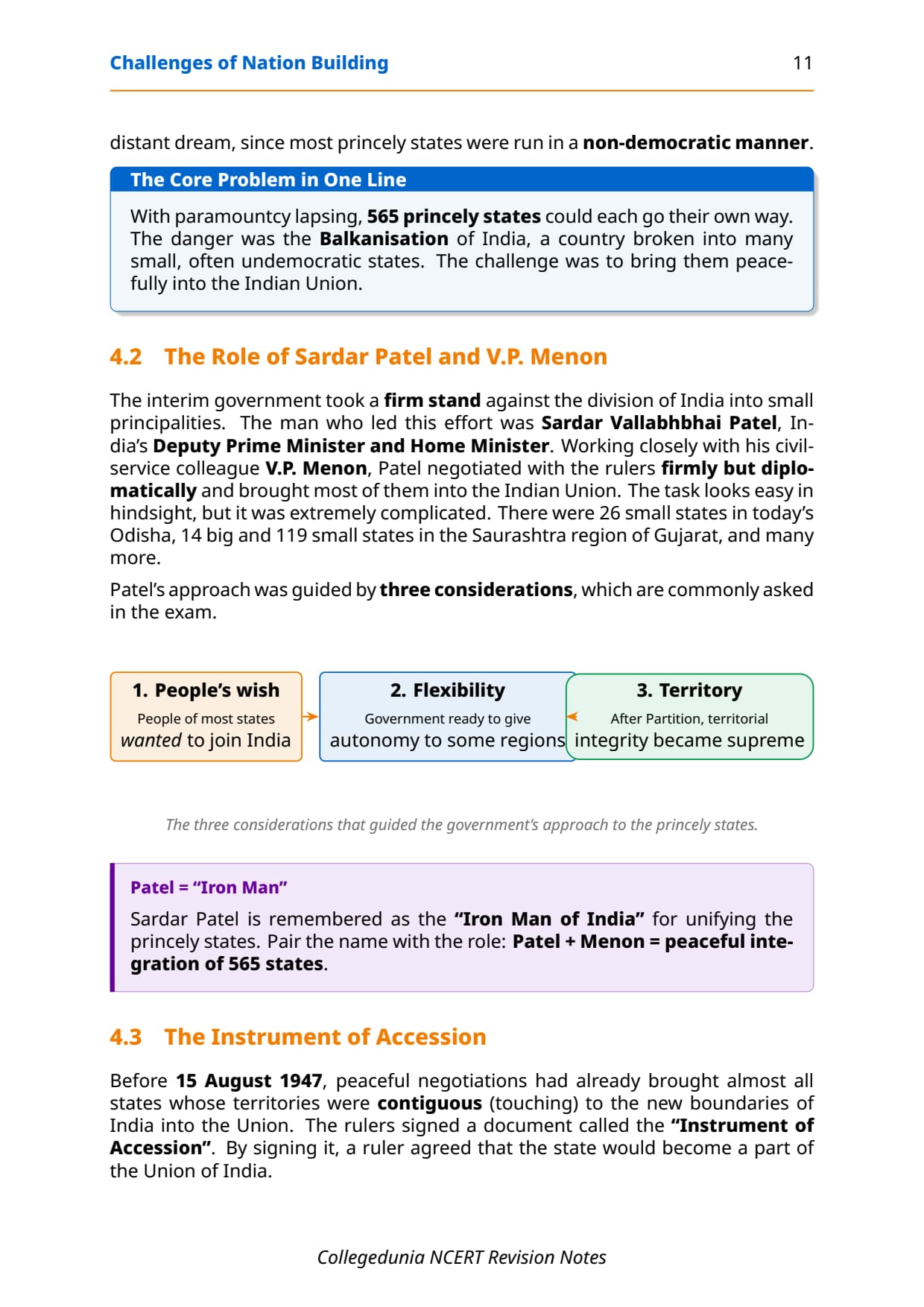
Integration of the Princely States
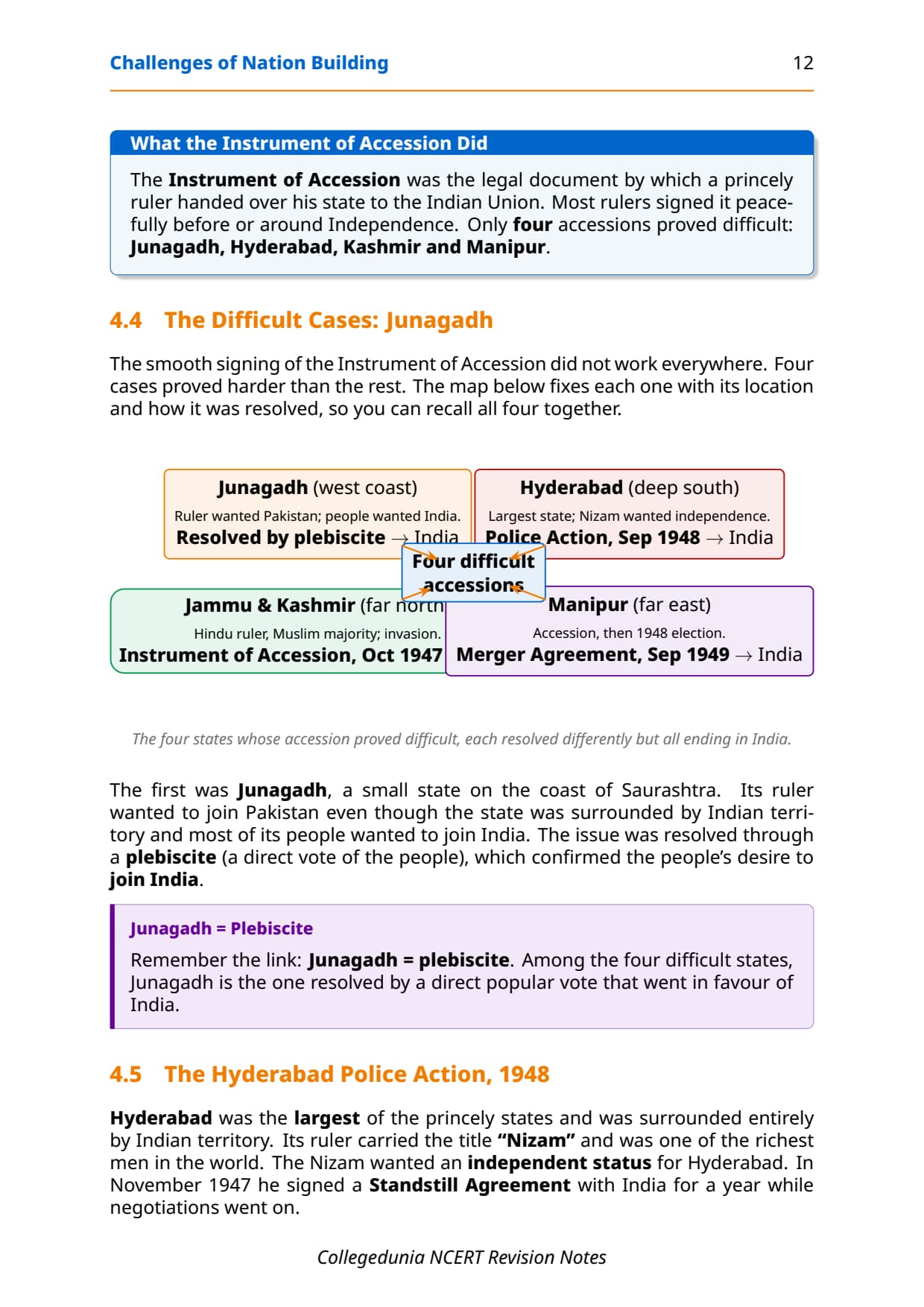
Bringing the Princely States into India was the second great task. This topic links to Sardar Patel, so it is a regular short and long answer. The table keeps the key cases side by side for fast revision.
| State | How it joined |
|---|---|
| Most states | Signed the Instrument of Accession; Patel negotiated firmly but diplomatically. |
| Junagadh | A plebiscite confirmed the people's wish to join India. |
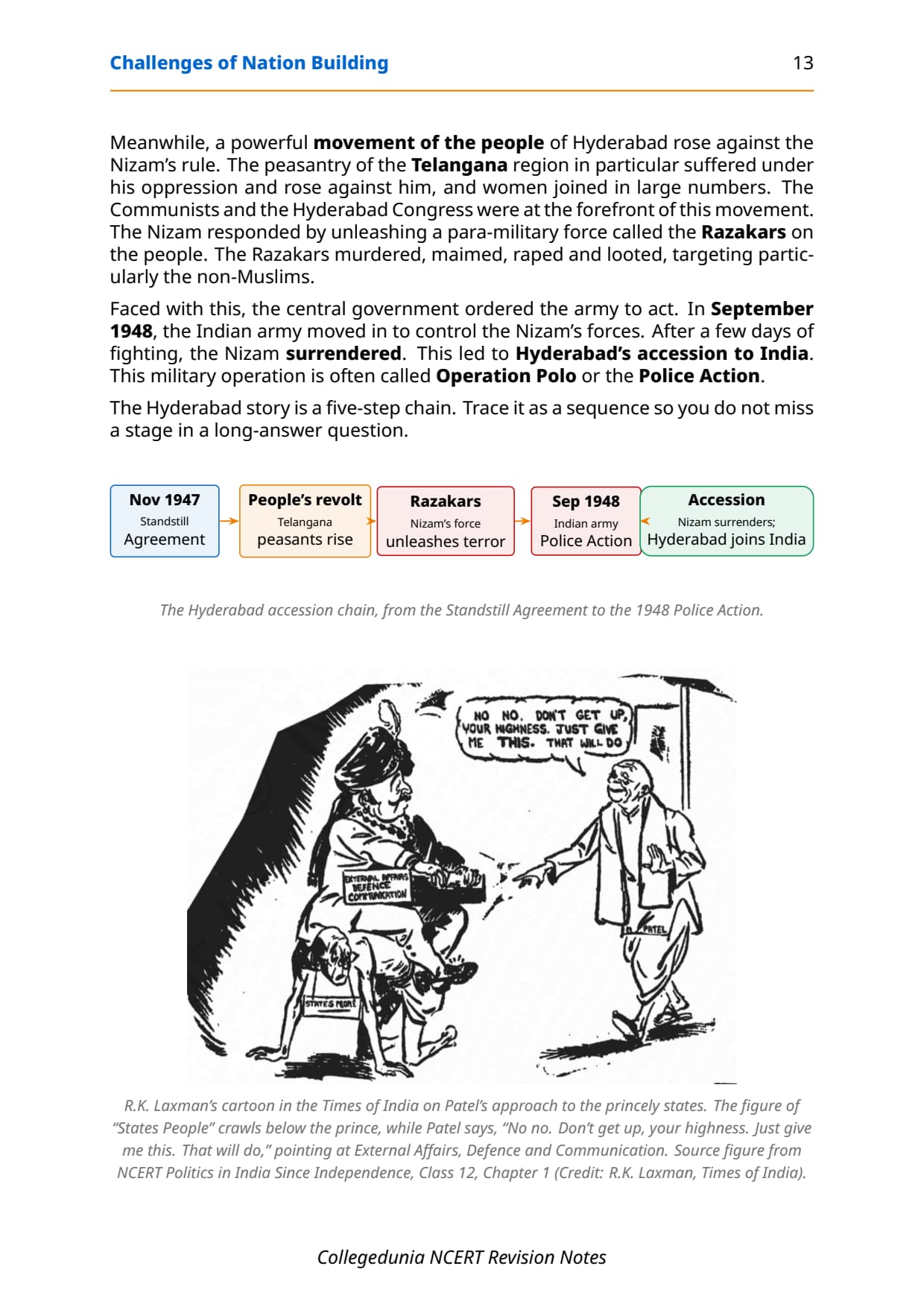
| Hyderabad | Army action in September 1948 before the Nizam acceded. |
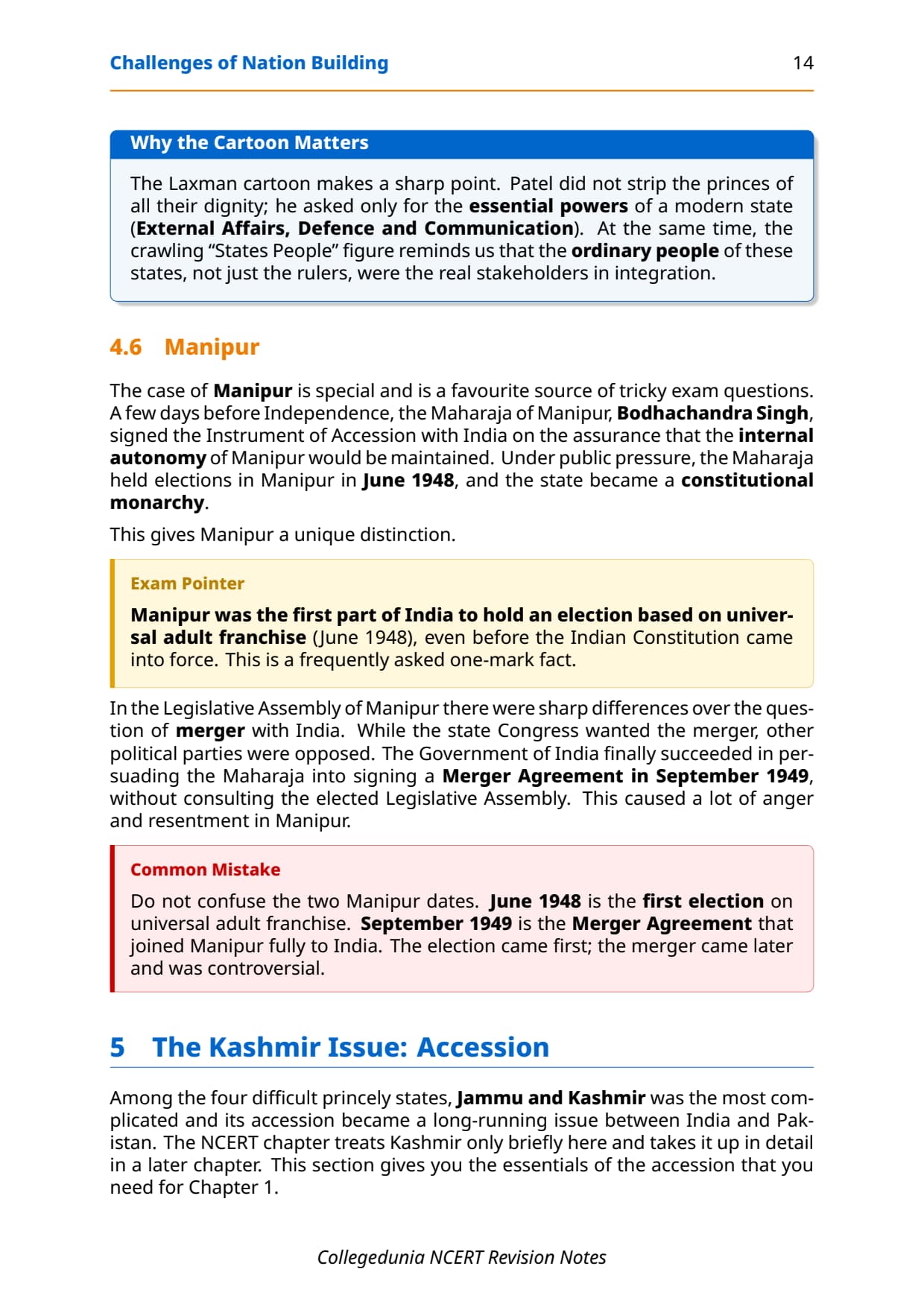
| Manipur | First election on universal adult franchise (June 1948); contested merger in 1949. |
The sharp point for your notes is that there were 565 Princely States, all brought in by Patel through the Instrument of Accession. Most joined peacefully and the merger extended democracy, but force was used in Hyderabad and the assembly was bypassed in Manipur. So integration mixed persuasion with pressure, the key idea for the opinion-type question.
Reorganisation of States on a Linguistic Basis
Drawing the internal map of India was the third task. These notes give the trigger, the Commission and the result in order, because the exam asks for all three.
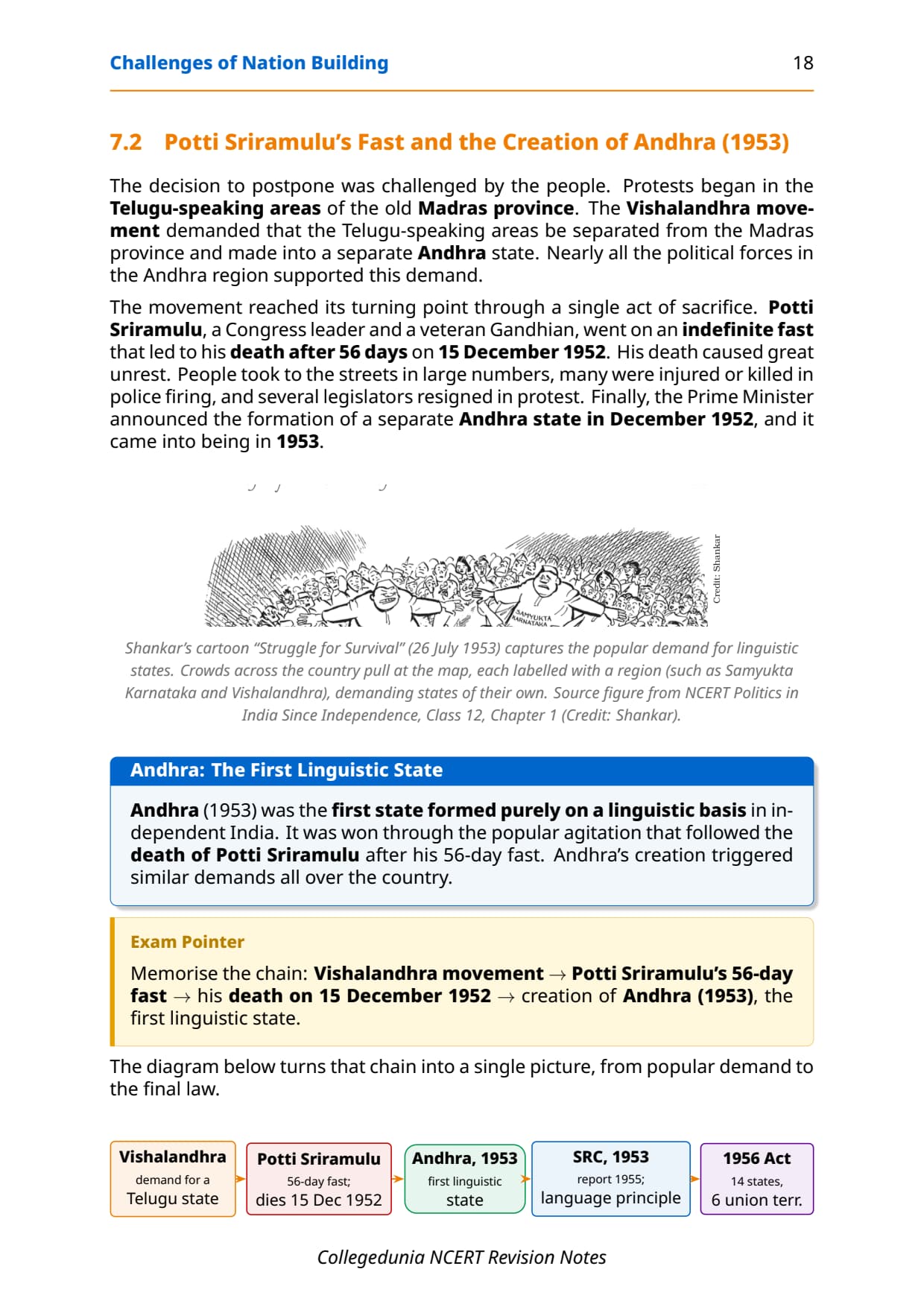
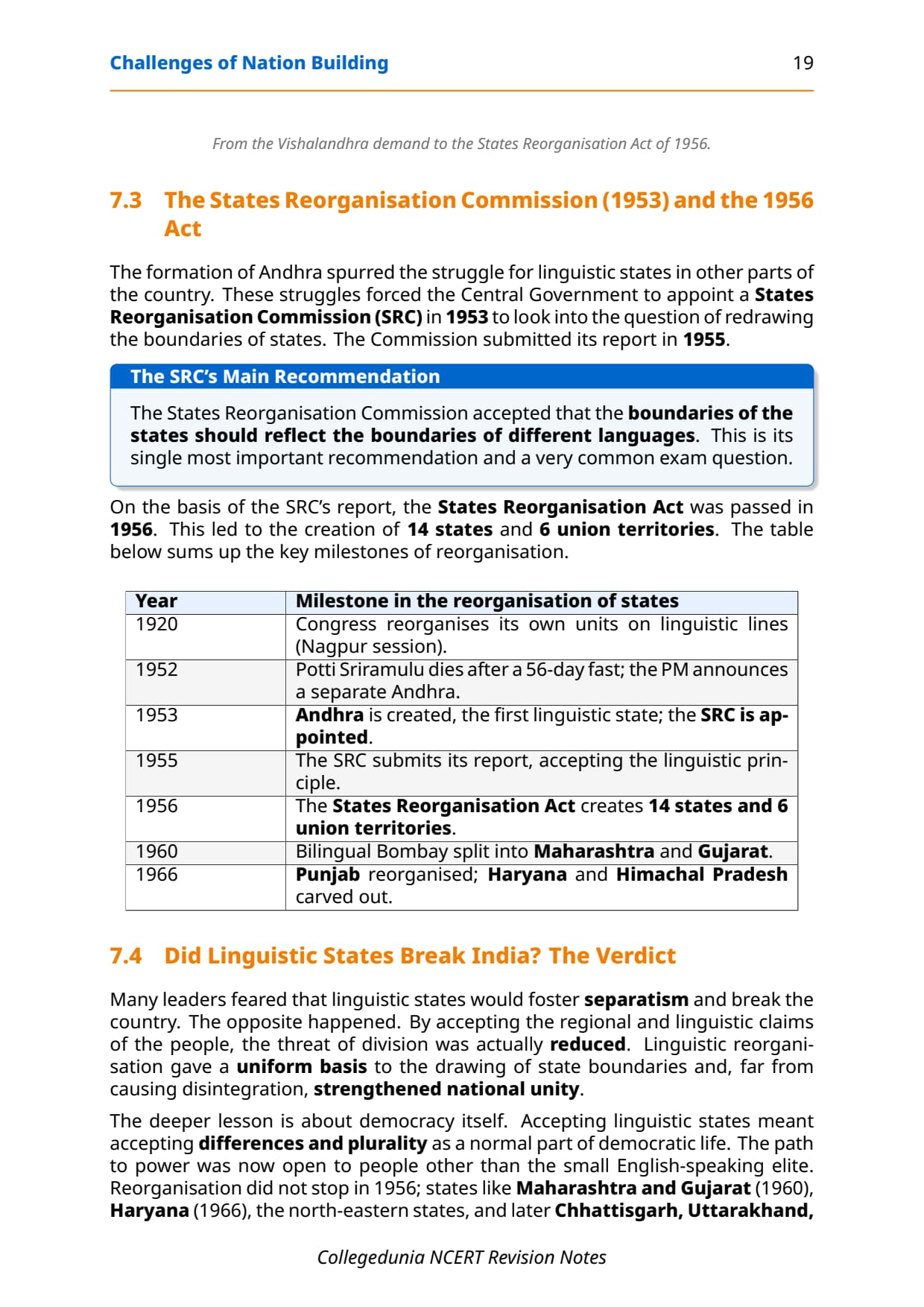
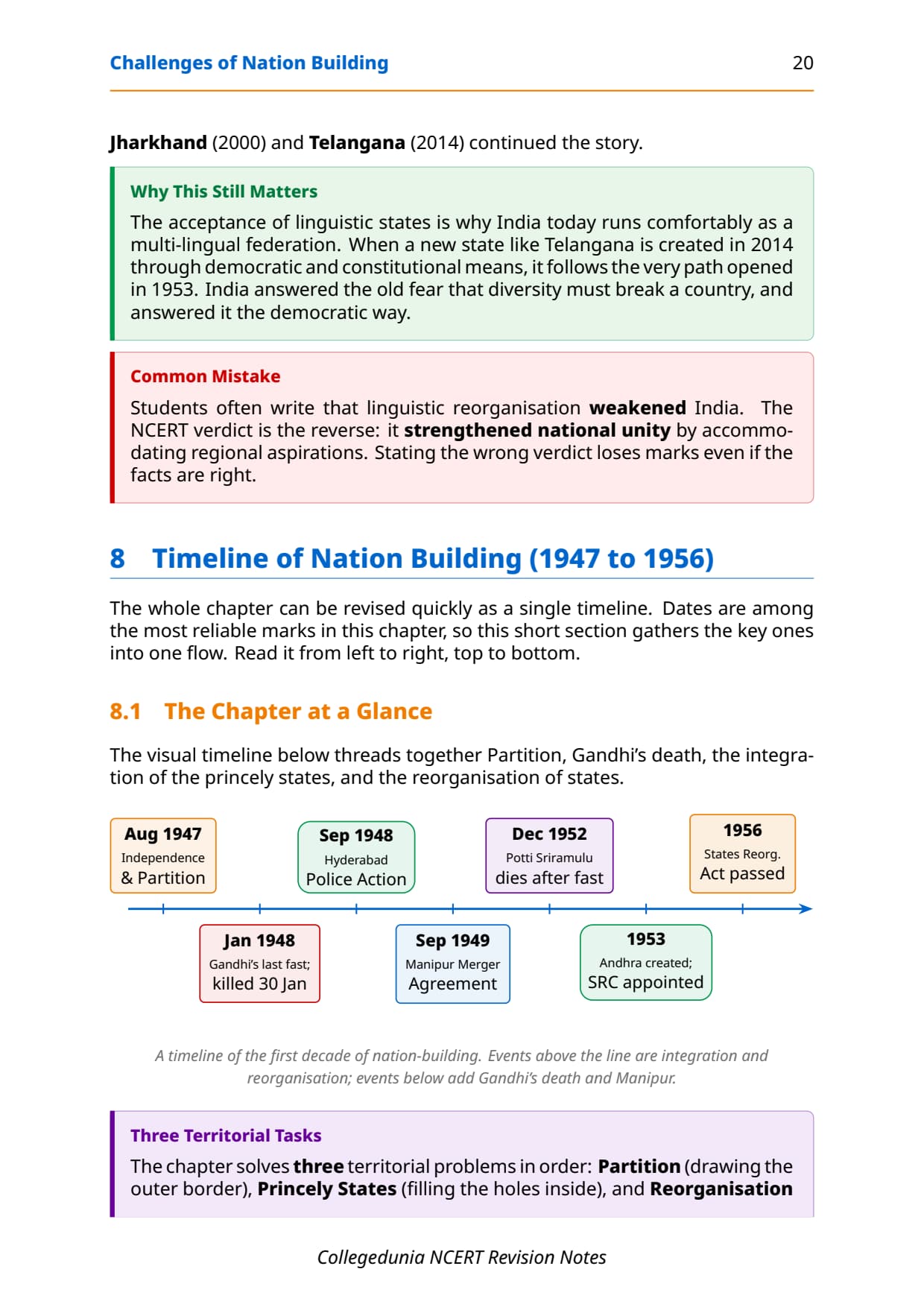
- 1952: Potti Sriramulu's fast-unto-death leads to the formation of Andhra in December.
- 1953: the States Reorganisation Commission (SRC) is set up to redraw state boundaries.
- The recommendation: state boundaries should follow the boundaries of different languages.
- 1956: the States Reorganisation Act creates 14 states and 6 union territories.
The judgement to remember is that linguistic states strengthened unity rather than breaking it. Many feared they would split the country, but they opened politics to ordinary people and deepened democracy. Keep the trigger, the linguistic recommendation and the 1956 result as three clear notes for full marks.
Challenges of Nation Building Important Questions and Exam Pointers
CBSE sets a steady mix of MCQ, short and long answers from this chapter. Knowing the pattern helps students decide how much to write and which topics to revise first. A focused list of Challenges of Nation Building important questions saves a lot of time before the board exam.
- Long answer (5 to 6 marks): Nehru's reasons for secularism, or the features that make India a nation.
- Short answer (4 marks): the integration of the Princely States, or the task of the SRC.
- Source-based: a passage on Partition, the Gandhi-Nehru statements, or the India-Soviet comparison.
- Objective and MCQ: the two-nation theory, the 565 states, key dates and the 1956 Act.
For quick recall, students often practise a short class 12 political science chapter 1 mcq drill and a list of Challenges of Nation Building class 12 important questions. The most repeated items are secularism and the integration of the states, so keep those answer points ready in your own words. Reading these notes once, then writing the key lists from memory, is the fastest way to lock the chapter in.
Common Mistakes Students Make in This Chapter
A few errors cost marks every year. Most come from missing the "unplanned" point in Partition or giving only one side of the secularism debate. Fixing these five points is the quickest way to lift a score, so add them to the end of your revision sheet.
- Saying the Partition scheme "planned" the population transfer - it did not; the exodus was unplanned.
- Calling Nehru's secularism only ethical - it was also prudential, a safeguard for India's unity.
- Forgetting the exact numbers: 565 Princely States, and 14 states with 6 union territories in 1956.
- Mixing up the cases: Hyderabad meant force, Manipur a contested merger, Junagadh a plebiscite.
- Writing that linguistic states broke India - in fact they strengthened unity and deepened democracy.
Students who fix these five points usually move from average to high marks. The exam rewards a balanced view, so always give both sides before you judge, especially on secularism and on integration. These notes flag each soft point so you can phrase it safely in the answer sheet.
How These Notes Pair with the Solutions and Book PDF
These revision notes summarise the chapter. To prepare fully, students should use them alongside the other resources for the same chapter, all linked in the table below. Read the notes first, then test yourself with the solutions, and open the book PDF whenever you need the original text and figures.
| Resource | Best used for |
|---|---|
| Challenges of Nation Building NCERT Solutions | Step-by-step answers to all 10 back-exercise questions |
| Challenges of Nation Building Handwritten Notes | Last-minute, one-shot revision in a scanned notebook style |
| Challenges of Nation Building NCERT Book PDF | Reading the original NCERT chapter text and figures |
Tip: read these notes first, then attempt the solutions on your own, and only then check the model answers. That order builds memory faster than copying answers straight away.
All Class 12 Political Science Notes by Chapter
The table links the revision notes for every chapter in both Class 12 Political Science books, so students can move across the course in one click. Challenges of Nation Building is highlighted.
| Chapter | Notes |
|---|---|
| Contemporary World Politics | |
| Chapter 1 | The End of Bipolarity |
| Chapter 2 | Contemporary Centres of Power |
| Chapter 3 | Contemporary South Asia |
| Chapter 4 | International Organisations |
| Chapter 5 | Security in the Contemporary World |
| Chapter 6 | Environment and Natural Resources |
| Chapter 7 | Globalisation |
| Politics in India Since Independence | |
| Chapter 1 | Challenges of Nation Building |
| Chapter 2 | Era of One-Party Dominance |
| Chapter 3 | Politics of Planned Development |
| Chapter 4 | India's External Relations |
| Chapter 5 | Challenges to and Restoration of the Congress System |
| Chapter 6 | The Crisis of Democratic Order |
| Chapter 7 | Regional Aspirations |
| Chapter 8 | Recent Developments in Indian Politics |
FAQs on Challenges of Nation Building Class 12 Notes
Challenges of Nation Building Class 12 Political Science Notes Common Questions
Ques. Where can I download the Challenges of Nation Building Class 12 notes PDF?
Ans. You can download the Challenges of Nation Building Class 12 Political Science notes PDF directly from this page. It is free, follows the 2026-27 NCERT, and covers the three challenges, Partition, secularism, the Princely States and linguistic reorganisation in a short, point-wise format.
Ques. What does the Challenges of Nation Building chapter cover for Class 12?
Ans. It covers the three challenges of nation building, the trauma of Partition, India's choice of secularism, the integration of 565 Princely States led by Sardar Patel, and the reorganisation of states on a linguistic basis up to the 1956 Act.
Ques. What were the three challenges of nation building?
Ans. The three challenges were building unity in a land of huge diversity, establishing democracy with rights and free elections for all, and ensuring development and welfare for everyone, especially the poor. The chapter shows how India met all three in its first decade.
Ques. Why is Challenges of Nation Building important for the board exam?
Ans. Because it is a high-scoring opening chapter that sets up the whole of Politics in India Since Independence. Secularism, the integration of the Princely States and the linguistic reorganisation appear almost every year, so revising these notes well secures both MCQ and long-answer marks.
Ques. How should I use these notes to revise quickly?
Ans. Read the notes once under the three-challenges frame, keep all dates and key numbers on one sheet, then write the key lists from memory. Finish by attempting a short class 12 political science chapter 1 mcq drill to test the small facts.



Comments