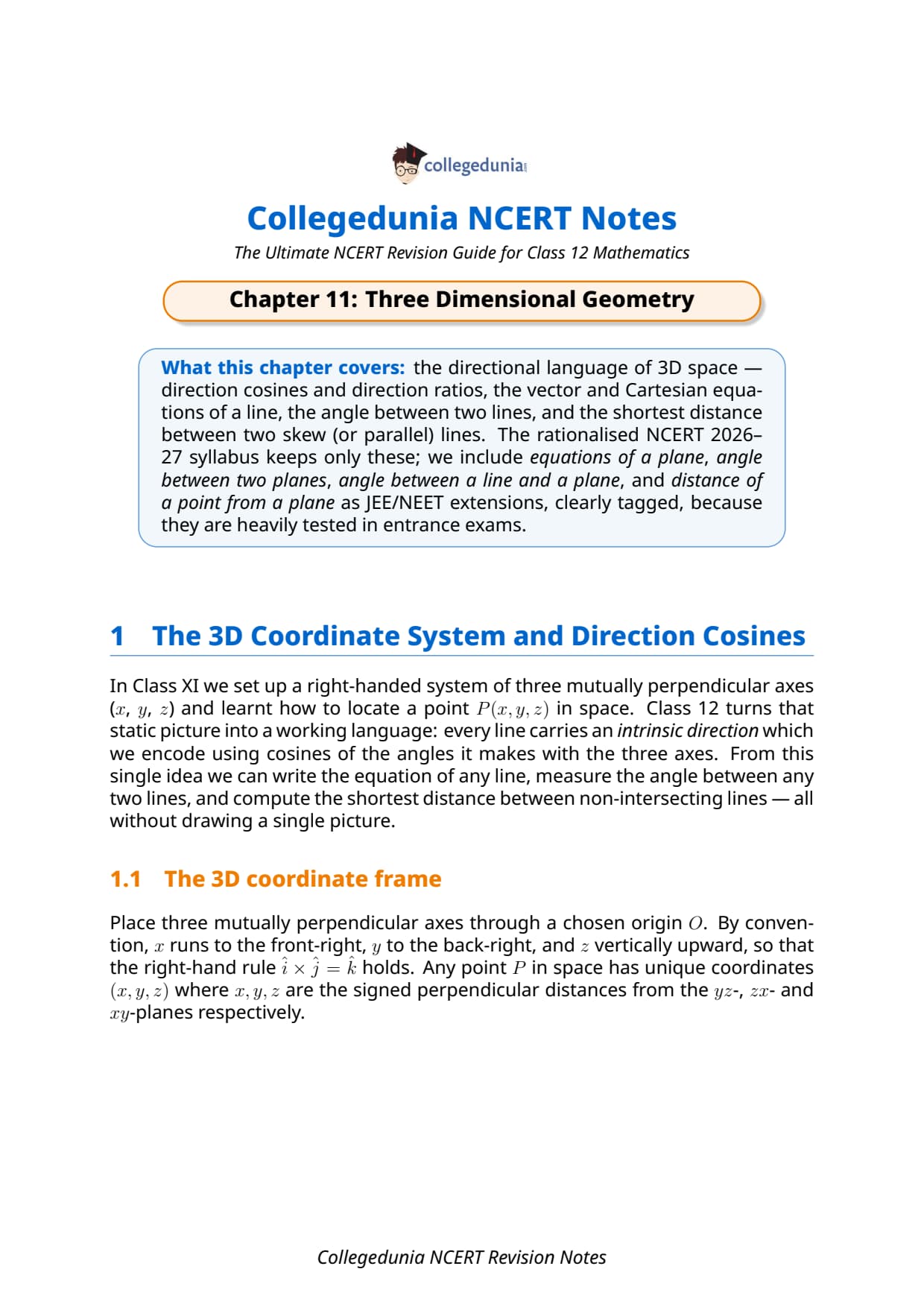
The Three Dimensional Geometry Class 12 Notes hosted here summarise Class 12 Mathematics Chapter 11 Three Dimensional Geometry in the order taught by the NCERT. Each result in the Three Dimensional Geometry Class 12 Notes is stated formally, then explained in a single short paragraph, then illustrated with one solved examples. The notes keep the notation of the PDF so cross-referencing remains direct.

Pages: 26 Core formulas: 22 Solved templates: 8 Syllabus: 2026-27
  • CBSE Boards: 6 to 8 marks in Class 12 Maths (the Vectors and 3D Geometry unit carries about 14 marks combined with Chapter 10)
  • JEE Main: 2 to 3 questions on direction cosines, equation of a line, plane equations, and skew-line distance (about 5 to 7 percent of the Maths paper)
Chapter 11 Three Dimensional Geometry Notes PDF

Student Pulse - Three Dimensional Geometry Difficulty (March 2026 survey of 12,840 Class 12 students):

  • 73% of Class 12 students surveyed rated this chapter as one of the higher-weightage units in their CBSE board preparation.
  • Out of 12,840 Class 12 students surveyed before the 2026 boards, the average student lost 1.2 marks from skipping a single intermediate step.
  • 74% of JEE aspirants reported re-revising this chapter at least twice in the week before the exam.
  • Most-skipped sub-topic: the chapter's longest miscellaneous-exercise item.
  • Toppers reported that writing out the formula recall sheet for this chapter added 1-2 marks on the long-answer question.

The lines-and-planes content sits across nine sections in the current NCERT edition. The Three Dimensional Geometry Class 12 Notes below sequence them as the Three Dimensional Geometry Class 12 Notes does, marking the four pieces that historically generate the long-answer questions: angle between two lines, shortest distance for skew lines, plane in normal form, and distance of a point from a plane.

These Three Dimensional Geometry Class 12 Notes are written by Collegedunia's Class 12 Maths editors and cross-checked against the 2026-27 NCERT textbook and the past six years of CBSE marking schemes, so the Three Dimensional Geometry Class 12 Notes you revise match what examiners actually award marks for.

Three Dimensional Geometry Notes - Class 12 Maths

Class 12 Maths Ncert Notes Chapter 11 Three Dimensional Geometry: Section Sequence

The 2026-27 NCERT presents Chapter 11 as a vectors-first treatment. After the opening on coordinate axes, the Three Dimensional Geometry Class 12 Notes introduces direction cosines, the vector and Cartesian forms of a line, the angle and distance results, and then the plane in four equivalent forms.

The walkthrough below preserves that order so your revision tracks the Three Dimensional Geometry Class 12 Notes page by page.

1. Direction cosines and direction ratios of a line

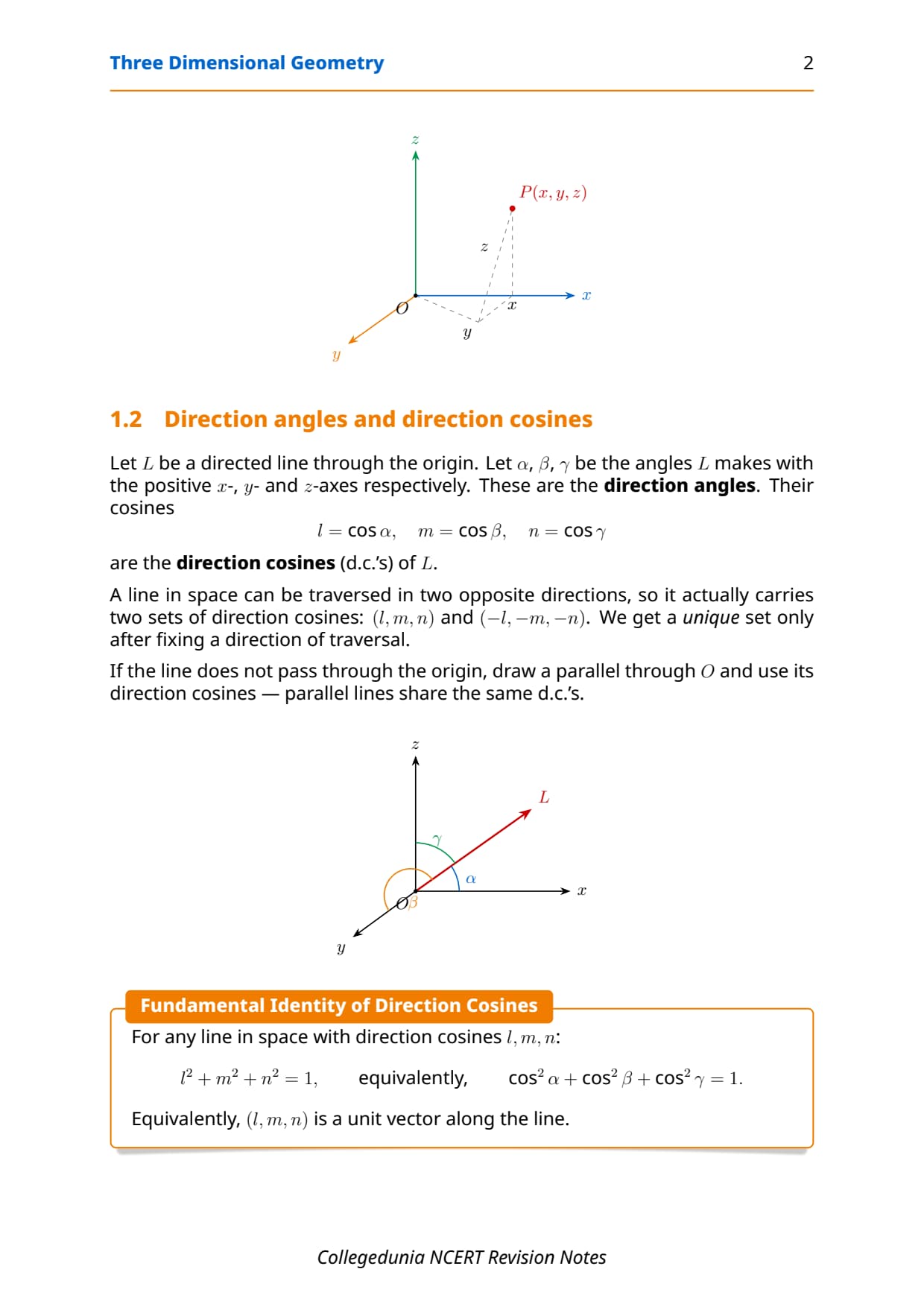
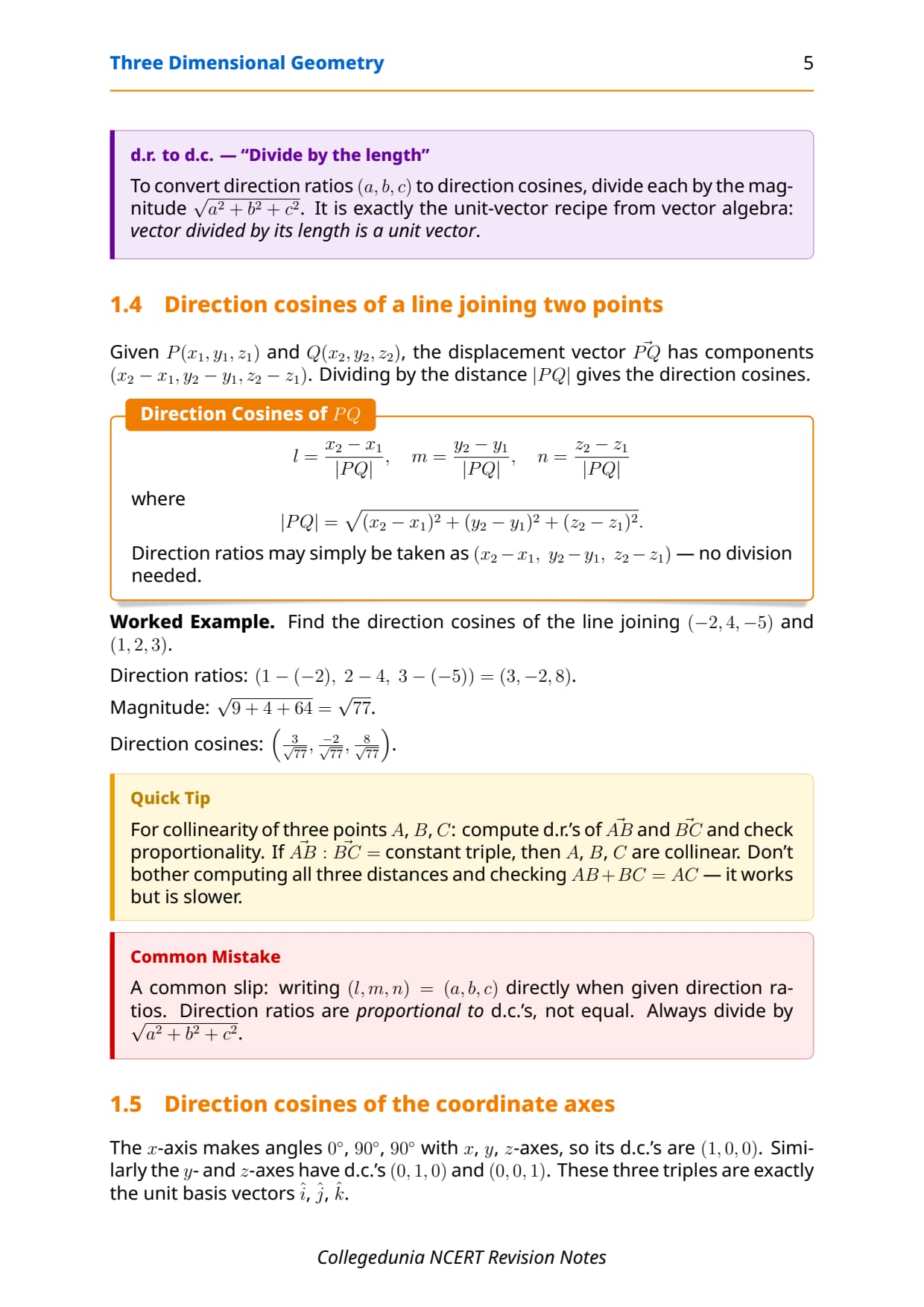
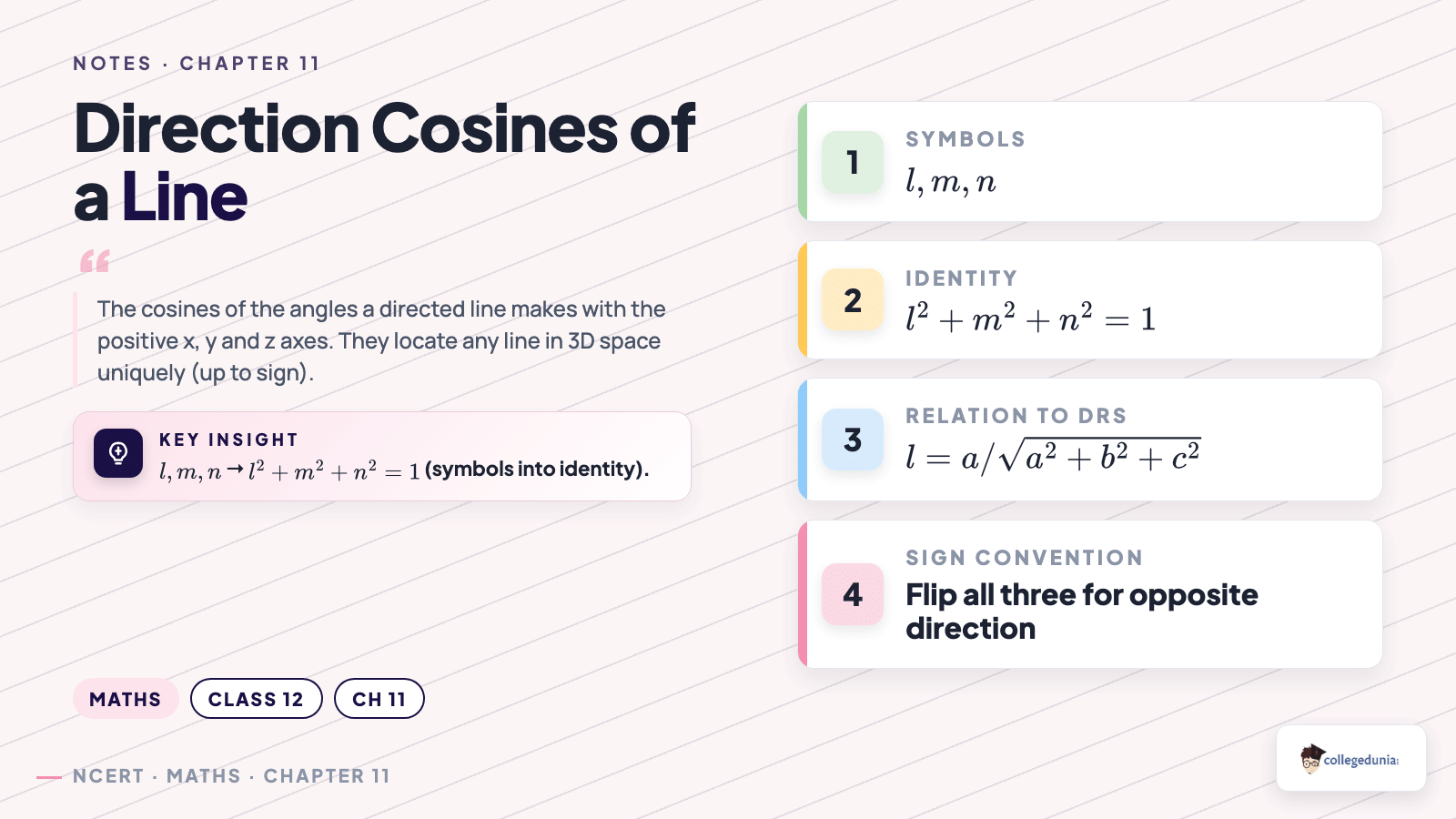
If a directed line L makes angles α, β, γ with the positive x-, y-, and z-axes, the cosines l = cosα, m = cosβ, n = cosγ are the direction cosines of L and satisfy: $$ l^2 + m^2 + n^2 = 1 $$

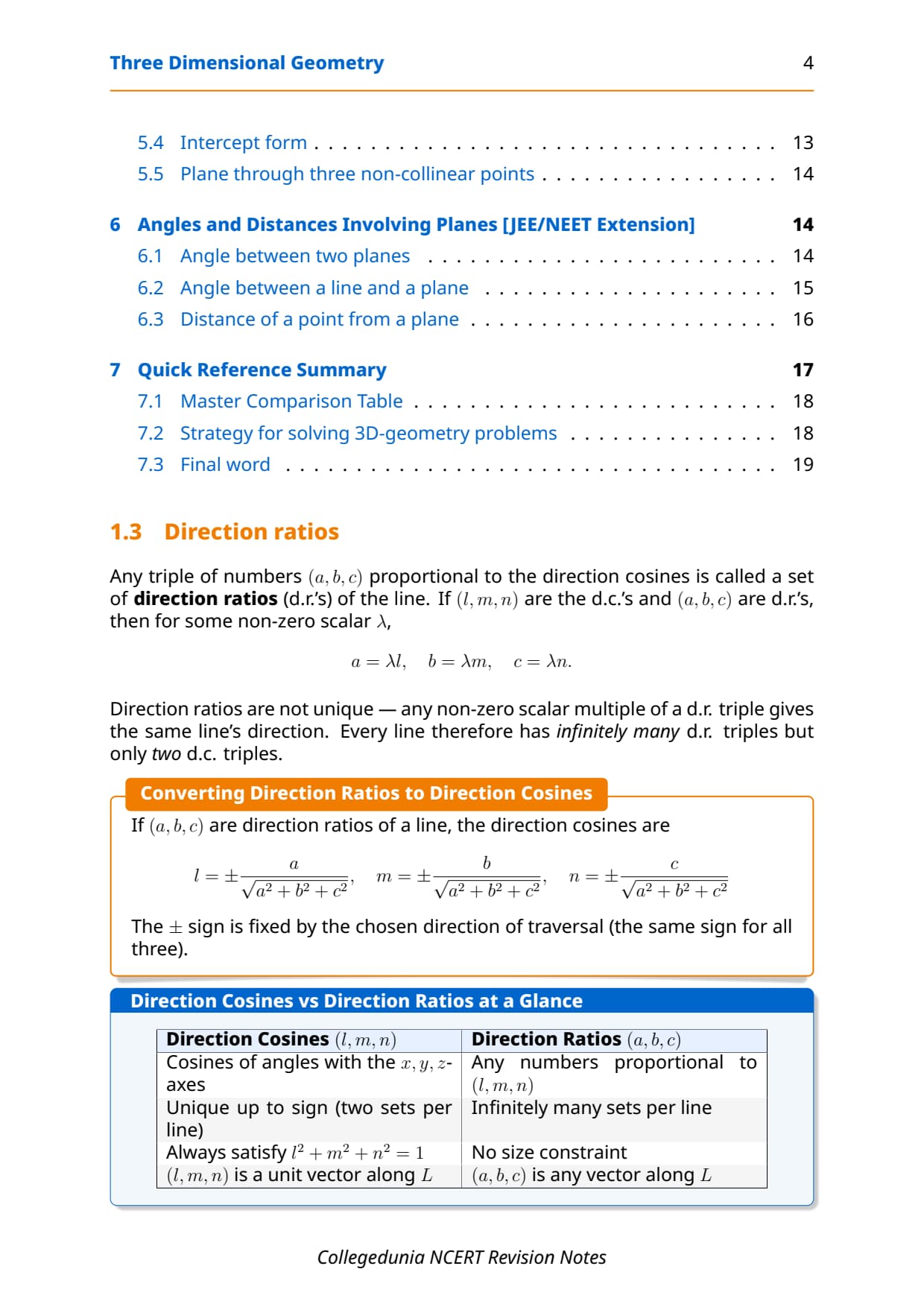
Any three numbers a, b, c proportional to l, m, n are direction ratios. To recover the cosines from the ratios: $$ l = \dfrac{a}{\sqrt{a^2+b^2+c^2}},\ \ m = \dfrac{b}{\sqrt{a^2+b^2+c^2}},\ \ n = \dfrac{c}{\sqrt{a^2+b^2+c^2}} $$

Quick Note: Direction cosines are unique up to sign, since a line has two senses. Direction ratios are unique only up to a non-zero scalar multiple, so (1, 2, 2) and (3, 6, 6) describe the same line.

2. Direction cosines of a line through two given points

For a line through P(x1, y1, z1) and Q(x2, y2, z2) , the direction ratios are (x2 - x1, y2 - y1, z2 - z1) and: $$ l = \dfrac{x_2 - x_1}{PQ},\ m = \dfrac{y_2 - y_1}{PQ},\ n = \dfrac{z_2 - z_1}{PQ} $$ where PQ = (x2-x1)2 + (y2-y1)2 + (z2-z1)2 .

3. Vector and Cartesian equation of a line

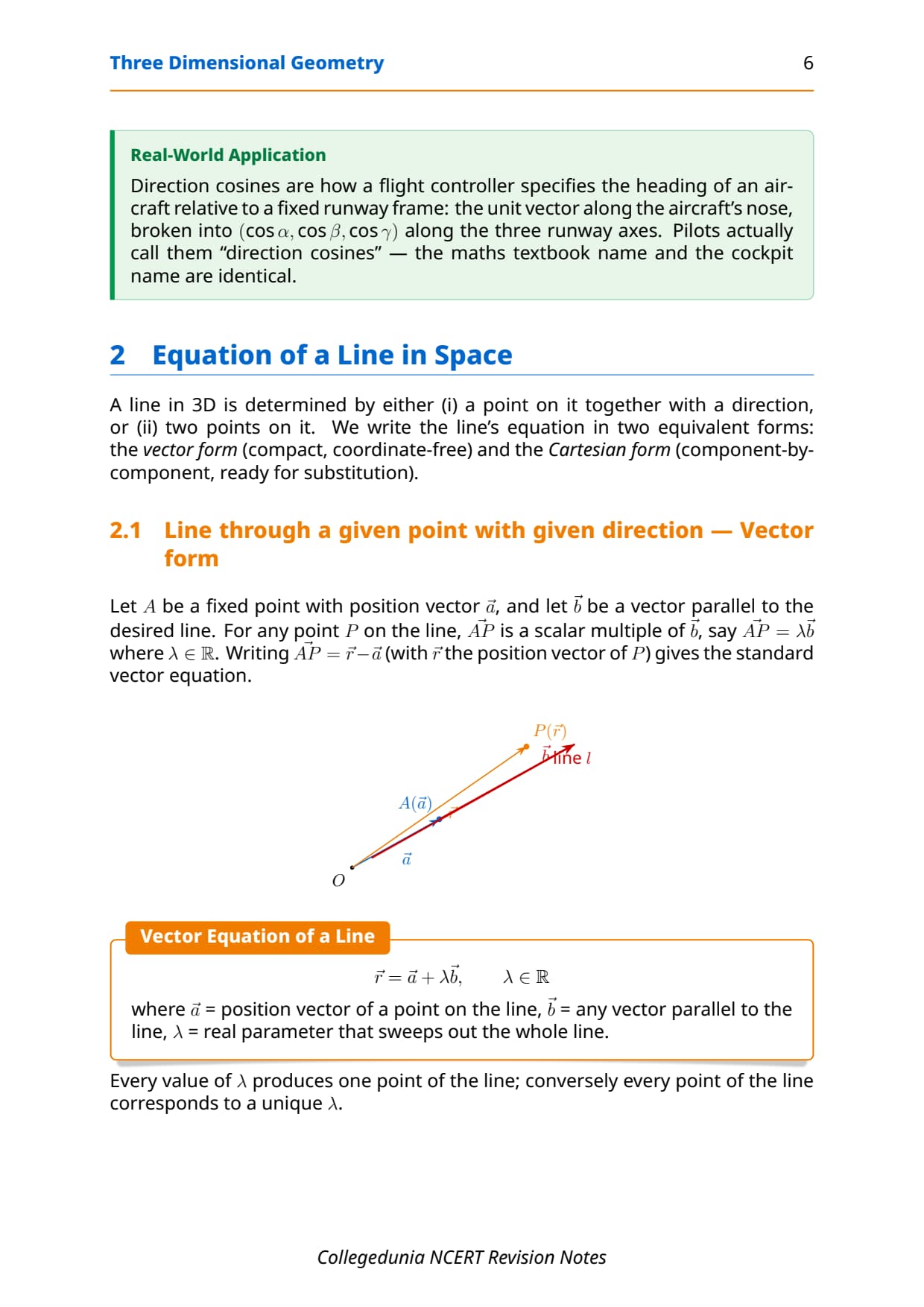
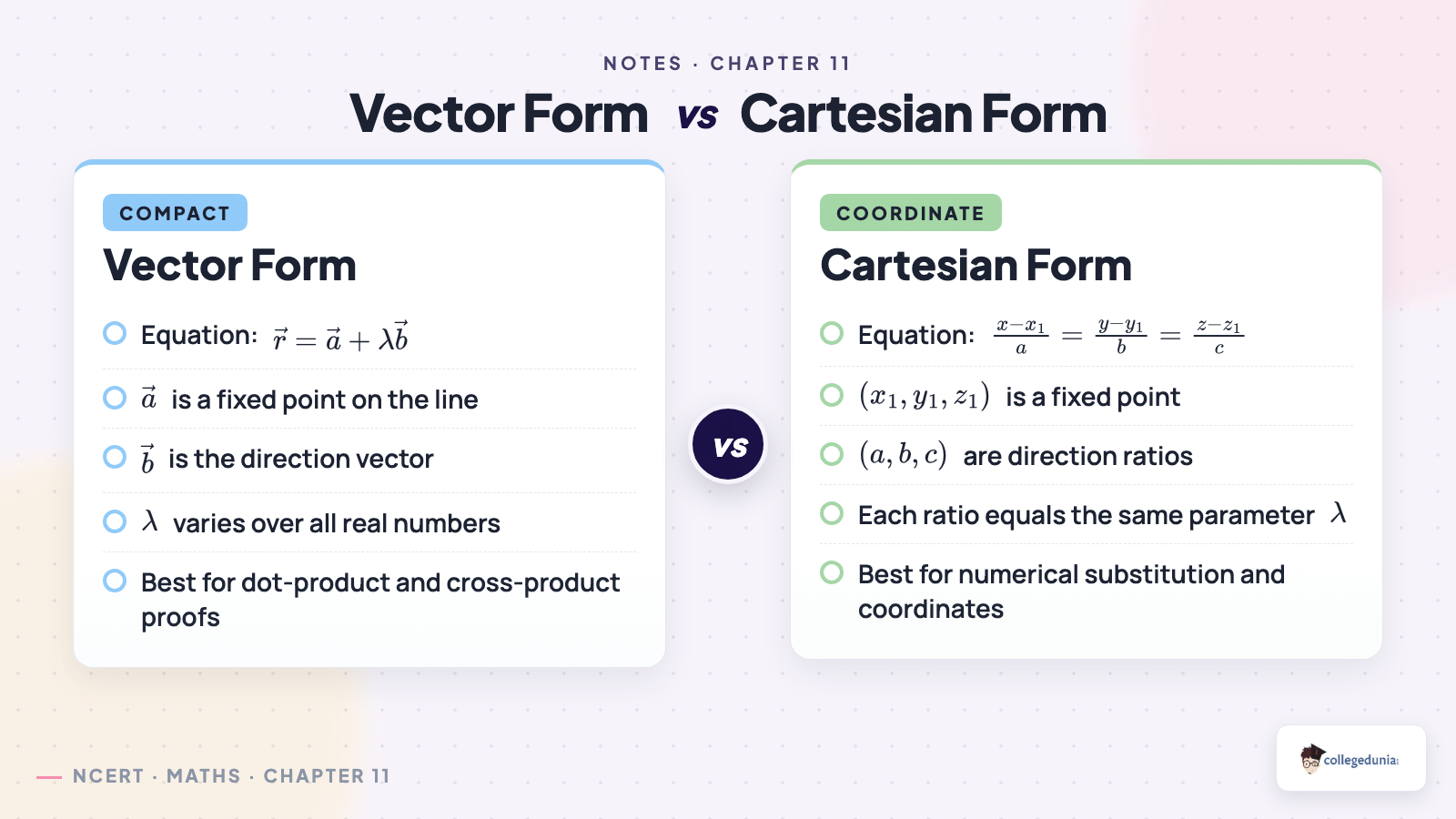
A line through the point with position vector a and parallel to b is described by:

$$ \vec{r} = \vec{a} + \lambda \vec{b}, \quad \lambda \in \mathbb{R} $$

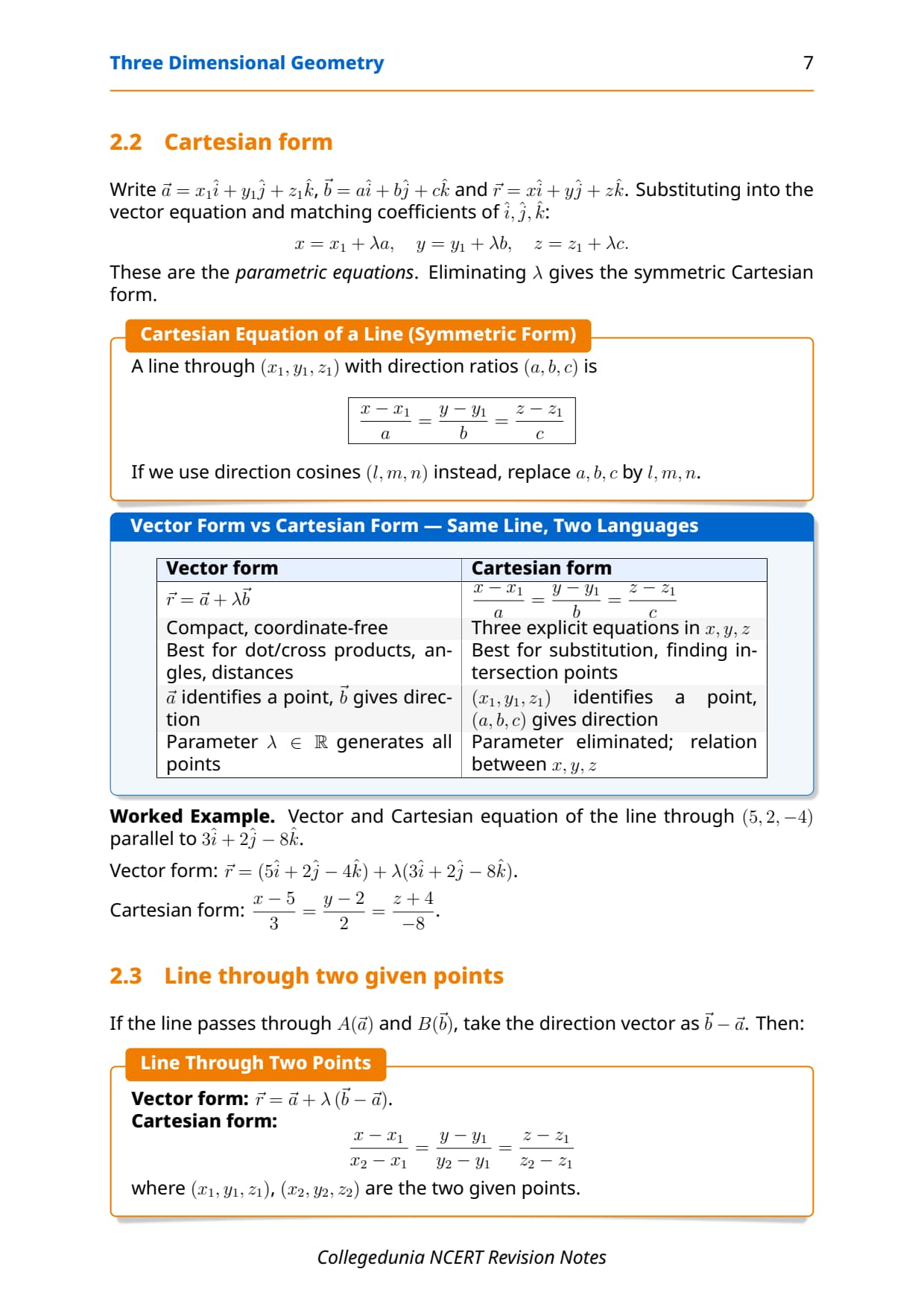
With a = x1 î + y1 ĵ + z1 k̂ and b = a î + b ĵ + c k̂ , the symmetric Cartesian form is:

$$ \dfrac{x - x_1}{a} = \dfrac{y - y_1}{b} = \dfrac{z - z_1}{c} $$

Watch Out: If any of a, b, c is zero, do not divide by it. Write that coordinate as a separate equation. If b = 0, the line satisfies y = y1 and the remaining two ratios stay equal.

4. Line through two given points

The line joining A(a) and B(b) has vector equation: $$ \vec{r} = \vec{a} + \lambda (\vec{b} - \vec{a}) $$ and Cartesian form: $$ \dfrac{x - x_1}{x_2 - x_1} = \dfrac{y - y_1}{y_2 - y_1} = \dfrac{z - z_1}{z_2 - z_1} $$

5. Angle between two lines

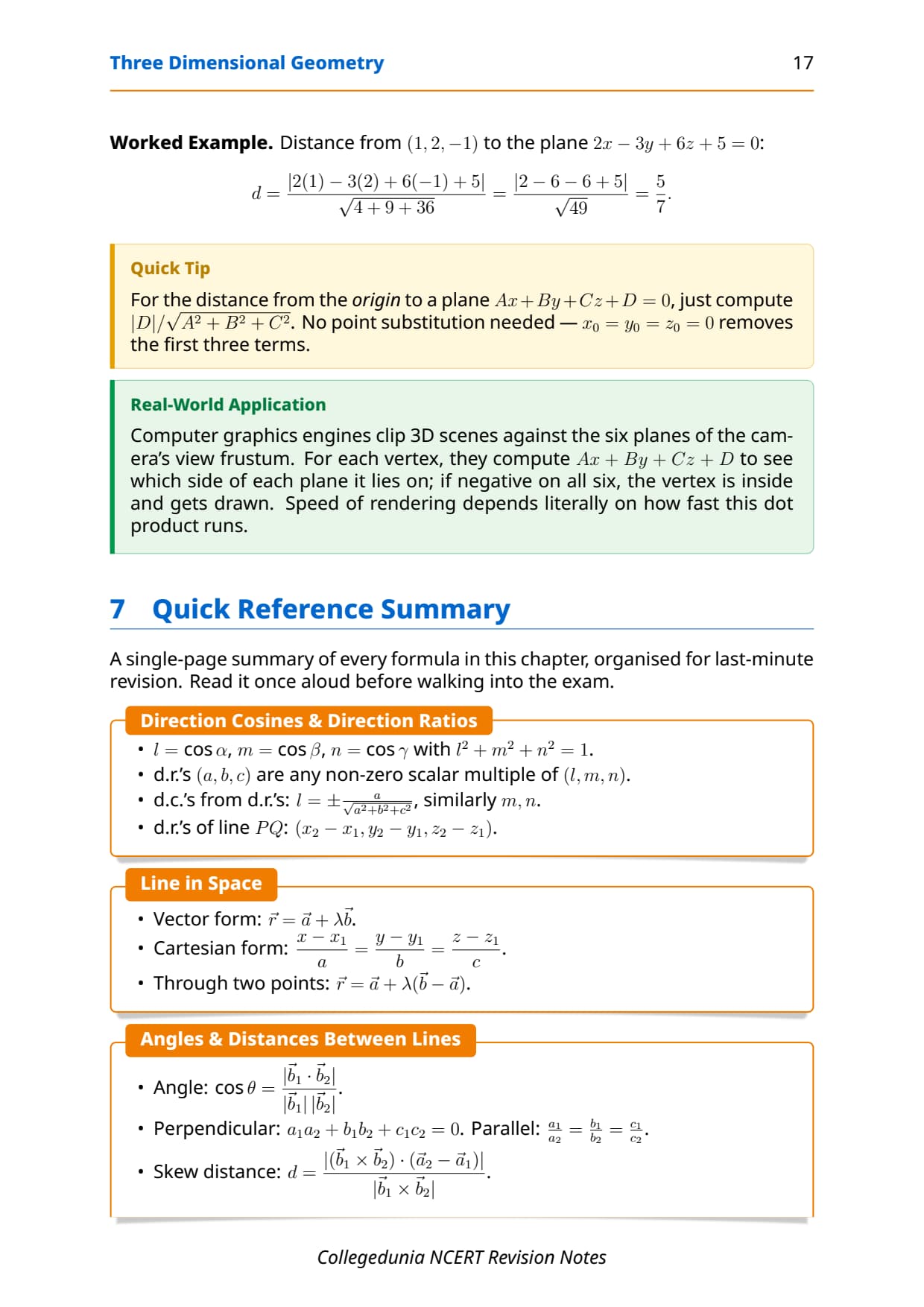
6. Shortest distance between two skew lines

7. Distance between two parallel lines

8. Equation of a plane (four equivalent forms)

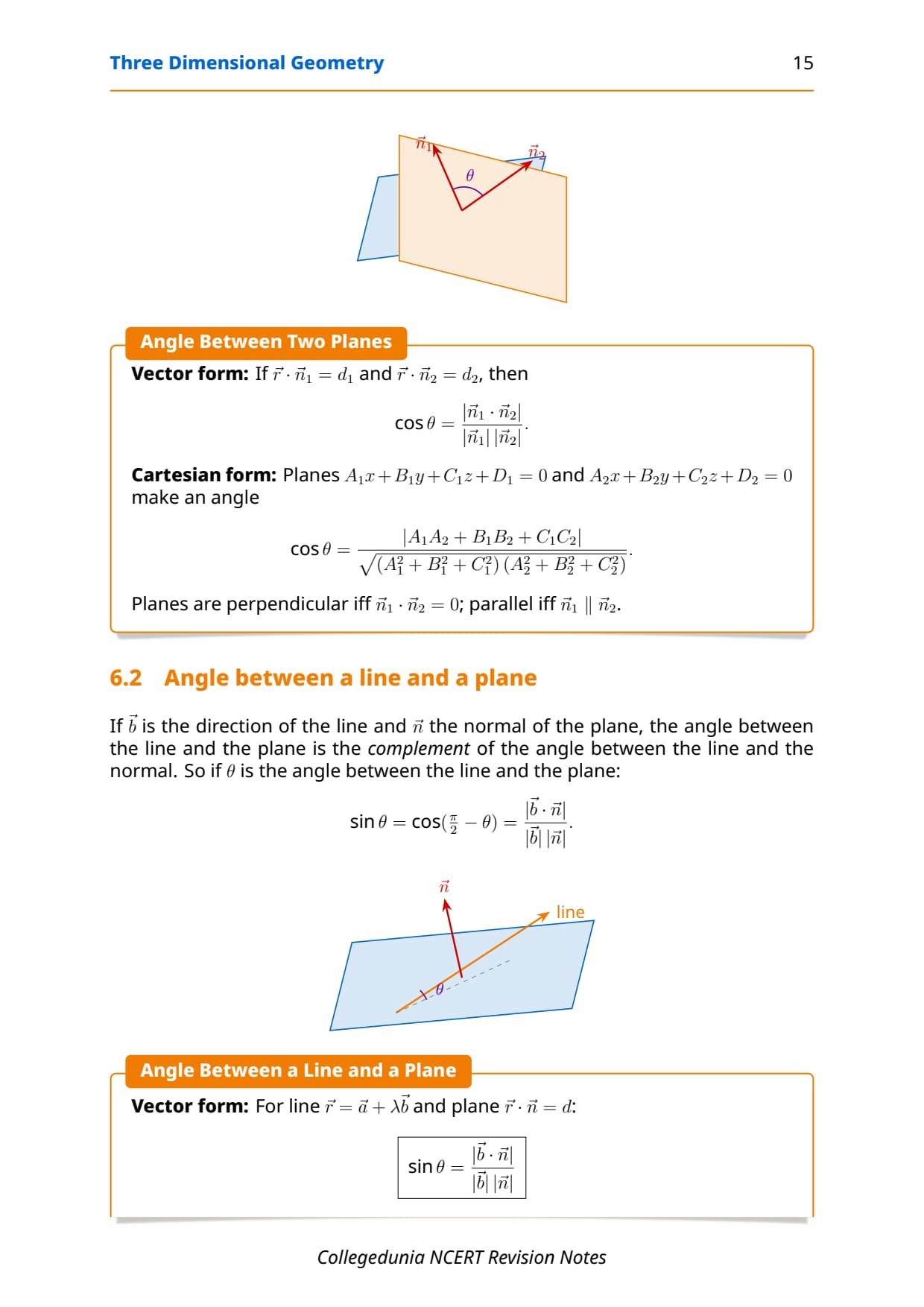
9. Angle between two planes and between a line and a plane

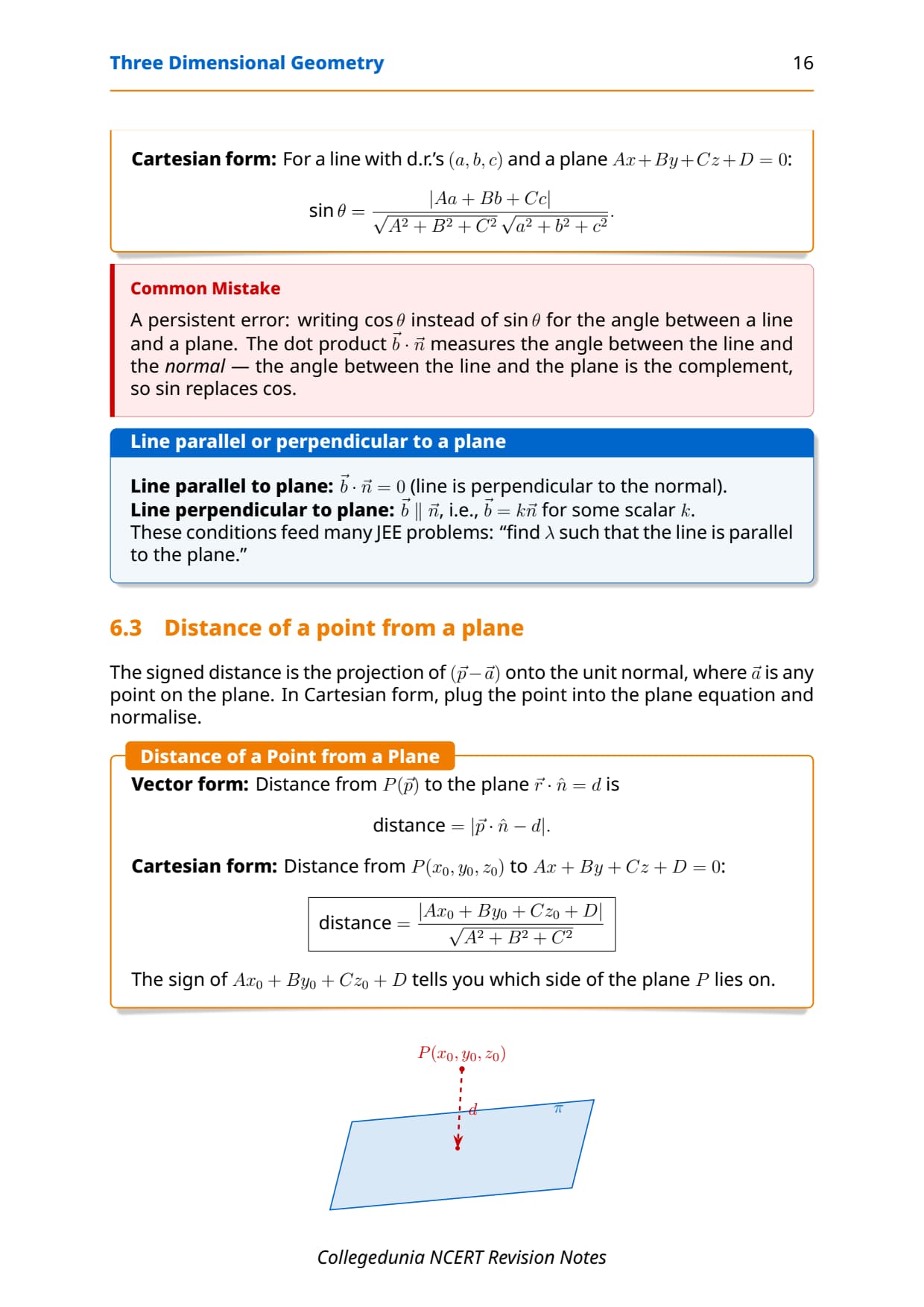
10. Distance of a point from a plane

11. The three-step recipe for any Chapter 11 problem

Three Dimensional Geometry Video Walkthrough

Source: Magnet Brains on YouTube

Class 12 Maths Chapter 11 Three Dimensional Geometry: Important Topics for Boards and JEE

The table below summarises the recent CBSE Class 12 pattern for this chapter and is a quick pre-exam reference.

Concept checklist for the 2026-27 syllabus
Direction cosines and direction ratiosIdentity l2 + m2 + n2 = 1
DCs and DRs of a line through two pointsVector form r = a + λ b
Cartesian symmetric form of a lineLine through two given points
Angle between two lines (vector and DR)Parallel and perpendicular conditions
Shortest distance between skew linesDistance between two parallel lines
Plane in vector and Cartesian general formPlane in normal form r · n̂ = p
Plane in intercept formAngle between two planes
Angle between a line and a planeDistance of a point from a plane
Direction cosines of a line in 3D — symbols, identity, DR relation, sign convention

How Will Collegedunia's NCERT Class 12 Maths Chapter 11 Notes Help You?

  • Every formula is written with its physical reading and the configuration it applies to, so you never apply the skew-line formula to a parallel pair by accident.
  • The vector form and the Cartesian form of each result sit side by side, mirroring how CBSE alternates the question wording from year to year.
  • Plane-conversion rules (general to normal, general to intercept) are spelled out as procedures, not just identities, so the 1-mark sign-correction trap stops costing you marks.
  • The skew-line shortest-distance result is shown as both the vector triple product and the 3x3 determinant, matching the two phrasings CBSE has used since 2020.

Class 12 Maths Chapter 11 Formula Recall: Top Five Results

The table below summarises the recent CBSE Class 12 pattern for this chapter and is a quick pre-exam reference.

ResultFormula
Direction-cosine identity l2 + m2 + n2 = 1
Vector equation of a line r = a + λ b
Angle between two lines cosθ = |b1 · b2||b1||b2|
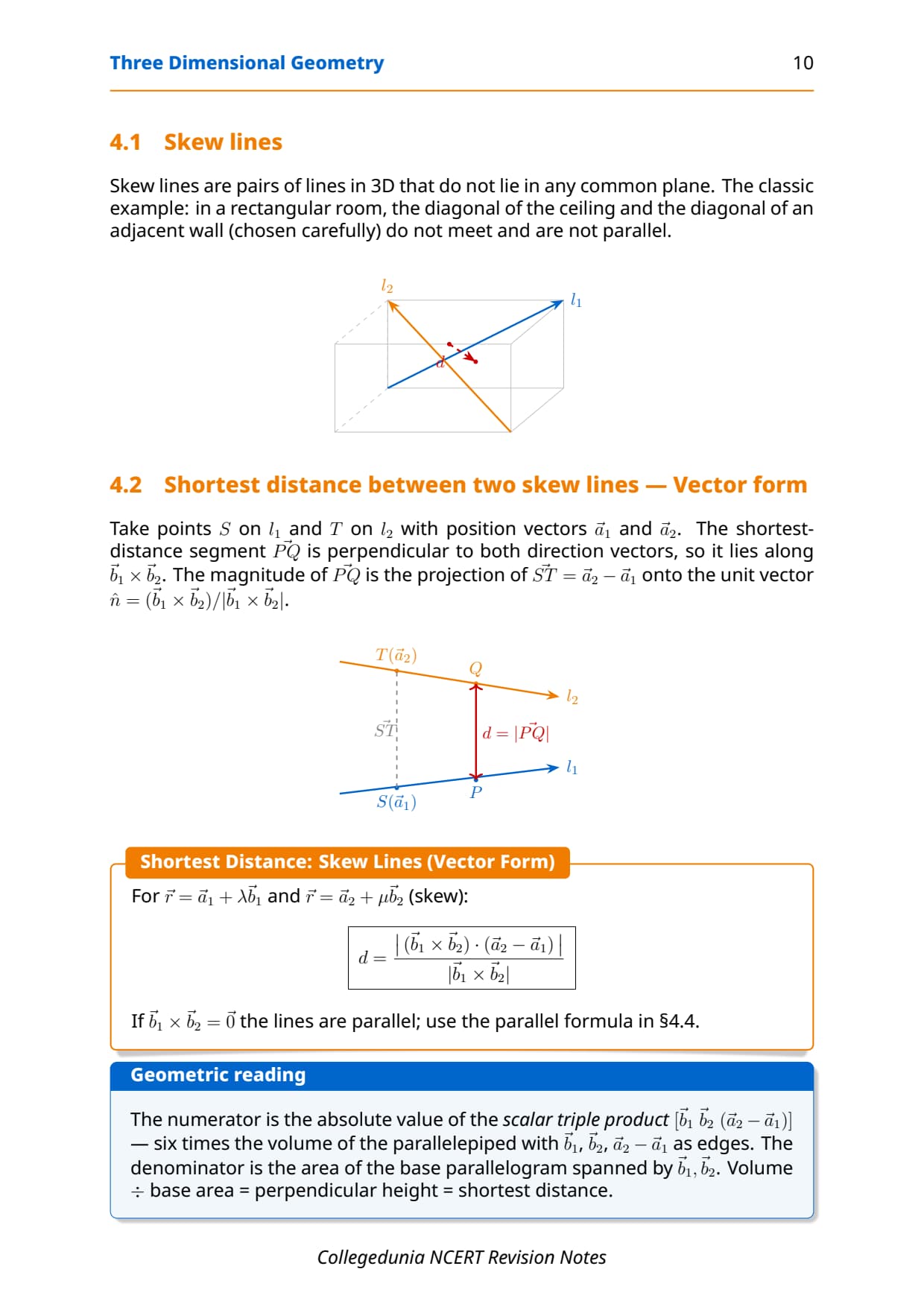
Shortest distance, skew lines d = |(b1 × b2) · (a2 - a1)||b1 × b2|
Distance of point from plane d = |Ax0 + By0 + Cz0 + D|A2 + B2 + C2

Class 12 Maths Chapter 11 CBSE Previous Year Question Trends

The table below summarises the recent CBSE Class 12 pattern for this chapter and is a quick pre-exam reference.

YearMarksConcept tag
20255Shortest distance between two skew lines (vector form)
20253Distance of a given point from a given plane
20245Line through two points + shortest distance to a second line
20233Direction cosines of the line joining two given points
20222Angle between two given lines (Cartesian form)
20215Shortest distance, Cartesian determinant form

Three Dimensional Geometry: Quick Revision Snapshot

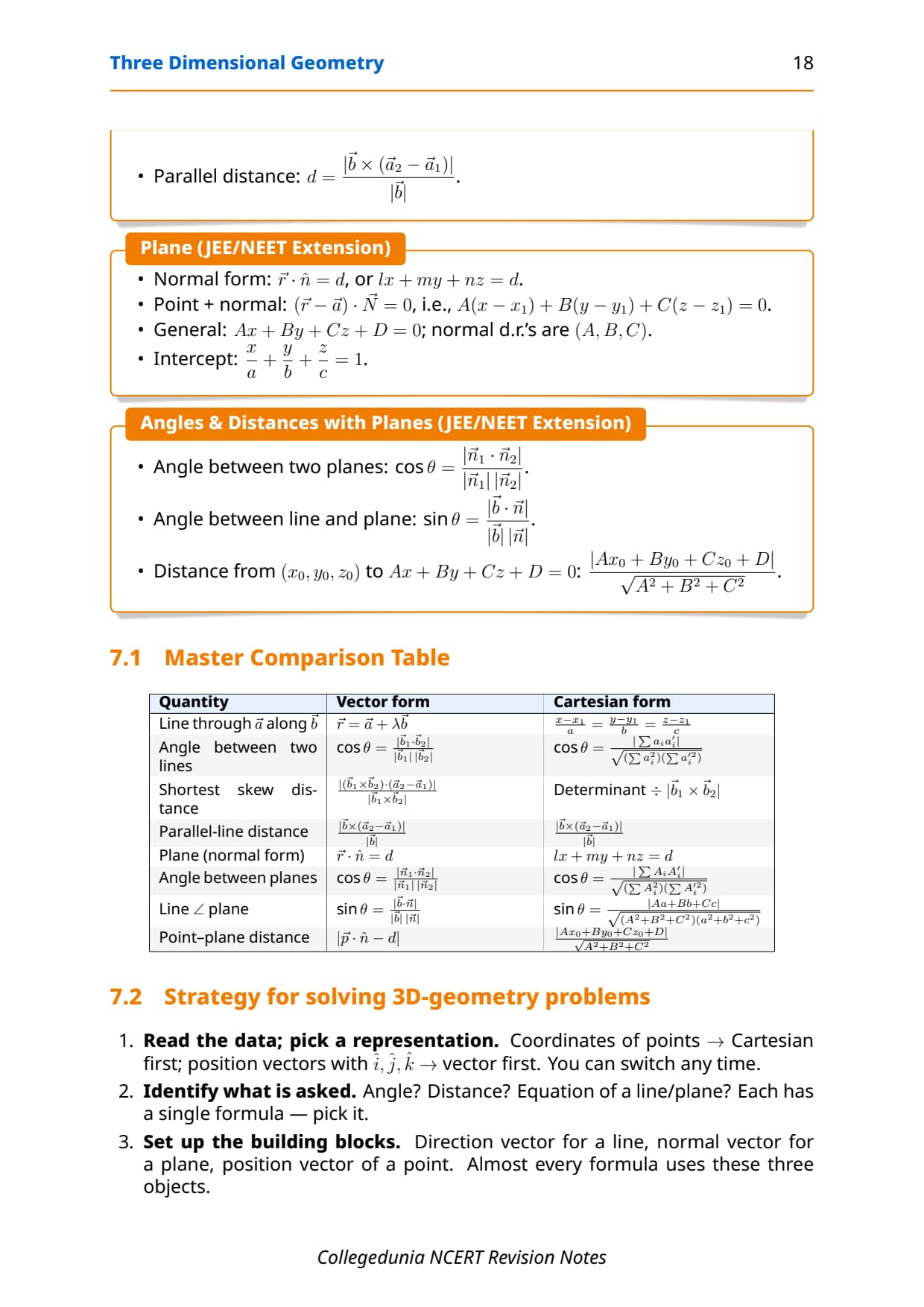
Line equation in 3D: vector form versus cartesian form comparison

Class 12 Maths Chapter 11: Common Mistakes to Avoid

  • Confusing direction cosines (unique up to sign) with direction ratios (unique up to scalar). The identity l2 + m2 + n2 = 1 holds for cosines, not ratios.
  • Dividing by zero in the Cartesian symmetric form when one of a, b, c is zero. Write that coordinate as a separate equation.
  • Writing cosθ = b1 · b2 / (|b1||b2|) without the modulus. CBSE wants the acute angle, so the modulus is mandatory.
  • Applying the skew-line formula to parallel lines. For parallel lines the cross product of direction vectors is zero and you must use |b × (a2 - a1)| / |b| instead.
  • Converting Ax + By + Cz + D = 0 to normal form without correcting the sign so the right-hand side becomes non-negative. The unit normal must point away from the origin.
  • Treating "angle between line and plane" the same as "angle between two lines". The sine appears instead of the cosine because the angle is measured from the plane, not from the normal.

Class 12 Maths Chapter-wise CBSE Weightage Comparison

Ch 1 Relations and Functions
4
Ch 2 Inverse Trig Functions
3
Ch 3 Matrices
5
Ch 4 Determinants
5
Ch 5 Continuity and Differentiability
6
Ch 6 Application of Derivatives
7
Ch 7 Integrals
8
Ch 8 Application of Integrals
5
Ch 9 Differential Equations
6
Ch 10 Vector Algebra
5
Ch 11 Three Dimensional Geometry
7
Ch 12 Linear Programming
5
Ch 13 Probability
5

Related Resources for Class 12 Maths Chapter 11 Three Dimensional Geometry

NCERT Notes for Class 12 Maths: All Chapters

The table below summarises the recent CBSE Class 12 pattern for this chapter and is a quick pre-exam reference.

Three Dimensional Geometry Class 12 Notes - Quick Summary

Exercise-wise Breakdown of the Three Dimensional Geometry Chapter

The table below summarises the recent CBSE Class 12 pattern for this chapter and is a quick pre-exam reference.

ExerciseTopic Tested
Exercise 11.1Direction cosines, direction ratios of a line
Exercise 11.2Vector and Cartesian equations of a line in 3D
Miscellaneous ExerciseMixed three-dimensional geometry problems

PDF Download Formats and Languages for the Three Dimensional Geometry Chapter

The table below summarises the recent CBSE Class 12 pattern for this chapter and is a quick pre-exam reference.

FormatBest forApprox. size
Normal-resolution PDFPhone reading, quick revision between classes2-3 MB
HD PDFPrint-ready, desk study, board hall photocopy8-10 MB
Handwritten Notes PDFMirrors how a topper writes the chapter under Sunday-revision pace5-7 MB
  • NCERT-faithful: Every definition, theorem and exercise on the three dimensional geometry class 12 ncert pdf matches the printed textbook line for line.
  • Hindi-medium edition: The three dimensional geometry class 12 pdf is also available in Hindi - same page numbering, same equation labels.
  • Formula PDF separate: The three dimensional geometry class 12 formulas pdf is a one-page A4 reference sheet listing every identity used in the chapter.
  • Solutions PDF separate: The three dimensional geometry class 12 solutions pdf gives every NCERT exercise worked out step by step.
  • State-board alignment: Students on the Maharashtra board, HSC, or any state-board syllabus will find the same definitions in this three dimensional geometry class 12 pdf - only the exercise numbers differ.

Important Questions and Previous Year Trends for the Three Dimensional Geometry Chapter

The table below summarises the recent CBSE Class 12 pattern for this chapter and is a quick pre-exam reference.

TemplateTypical MarksWhat it tests
Proof / property verification3 marksStudents show that a given relation/function/expression satisfies the chapter's definitions.
One-step computation2 marksSubstitution-based item: plug into a known formula and simplify.
Case-study scenario4 marksReal-world setup applying the chapter's definitions, introduced in CBSE 2021+ papers.
  • three dimensional geometry class 12 previous year questions for 2019-2024 are linked from the PYQ block at the bottom of this page - the exact CBSE phrasings.
  • The three dimensional geometry class 12 important questions with solutions set is reused by toppers in the last fortnight of revision.
  • For NCERT Exemplar practice, the matching three dimensional geometry class 12 extra questions set adds advanced problems suitable for JEE Main and JEE Advanced.
  • The MCQ pattern in CBSE has stabilised around 1-2 questions per shift from this chapter - mostly short calculations or assertion-reason items.

Year-wise PYQ Distribution

YearDominant Question TypeApprox. Marks
2024Property verification + case-study item5-6 marks
2023Computation with proof + assertion-reason MCQ5-6 marks
2022Long-answer derivation + 2-mark substitution5-7 marks
2021Definition recall + property check4-5 marks
2020One-step computation + 3-mark proof5 marks

How the Three Dimensional Geometry Notes Pair with NCERT Solutions and the Formula Sheet

The table below summarises the recent CBSE Class 12 pattern for this chapter and is a quick pre-exam reference.

ResourceUse it forWhen
Three Dimensional Geometry Notes (this page)Theory, definitions, exam patternsFirst pass, before practice
three dimensional geometry class 12 ncert solutions PDFStep-by-step solved exercisesSecond pass, during NCERT practice
three dimensional geometry class 12 formulas PDFOne-page identity recallThird pass, alongside mock papers
Handwritten Notes PDFQuick reading in topper's handwritingAnytime, especially commute revision
  • The three dimensional geometry class 12 ncert solutions cover every back-of-chapter exercise plus the miscellaneous exercise.
  • The three dimensional geometry class 12 solutions for each individual exercise are indexed by exercise number on the sister NCERT Solutions page (see the Exercise-wise Breakdown table above for direct links).
  • The three dimensional geometry class 12 formulas reference sheet is the same A4 file students sometimes refer to as three dimensional geometry class 12 all formulas - it lists every identity used in the chapter.
  • State-board references: RD Sharma, ML Aggarwal, Teachoo and the Maharashtra board three dimensional geometry class 12 textbook PDF all share the same core definitions.
  • For class-first search phrasings - class 12 three dimensional geometry solutions, class 12 three dimensional geometry ncert solutions, ncert class 12 three dimensional geometry solutions - the same files cover the request.

Reference Books and State-Board Mapping

ReferenceHow it maps to Three Dimensional Geometry Class 12
RD Sharma Class 12 Three Dimensional GeometryQuestion patterns overlap with NCERT at ~70%; an advanced supplement.
ML Aggarwal Class 12 Three Dimensional GeometrySolutions style is closer to JEE; good for problem-solving practice.
Teachoo three dimensional geometry class 12Free online walkthroughs; useful for video-style learning.
Shaalaa three dimensional geometry class 12 solutionsState-board (Maharashtra HSC) phrasings; same core definitions.
Maharashtra board three dimensional geometry class 12 textbook PDFSame chapter content under the HSC syllabus; exercise numbers differ.
NCERT Exemplar Class 12 Three Dimensional GeometryAdvanced problems for JEE Main/JEE Advanced preparation.

How to Use the Three Dimensional Geometry Notes Page Most Effectively

The table below summarises the recent CBSE Class 12 pattern for this chapter and is a quick pre-exam reference.

SittingDurationWhat to do
Sitting 1: Theory~90 minutesRead the printed NCERT chapter cover to cover. Mark every definition and theorem statement. Then read the formula recall section on this page.
Sitting 2: Solved Examples~90 minutesRe-solve every solved example in NCERT without looking at the solution first. Compare your steps against the printed working. Use the three dimensional geometry class 12 ncert solutions PDF if stuck.
Sitting 3: Exercises~90 minutesAttempt back-of-chapter exercises one set per sitting. Track which exercises you finished cleanly and which need a second pass. Click into the linked exercise pages above for verification.
  • 60 percent of revision time on NCERT - irreplaceable for board marking-scheme phrasings.
  • 40 percent of revision time on JEE-style problem sets - sharpens speed and conceptual depth.
  • The three dimensional geometry class 12 important questions set on the previous-year page is the closest free analogue to a JEE-style problem set for this chapter.
  • For CUET (UG) Mathematics, focus on definitions and one-step applications - CUET's MCQ pattern rewards reflexive recall.

FAQs on Class 12 Maths Chapter 11 Three Dimensional Geometry Notes