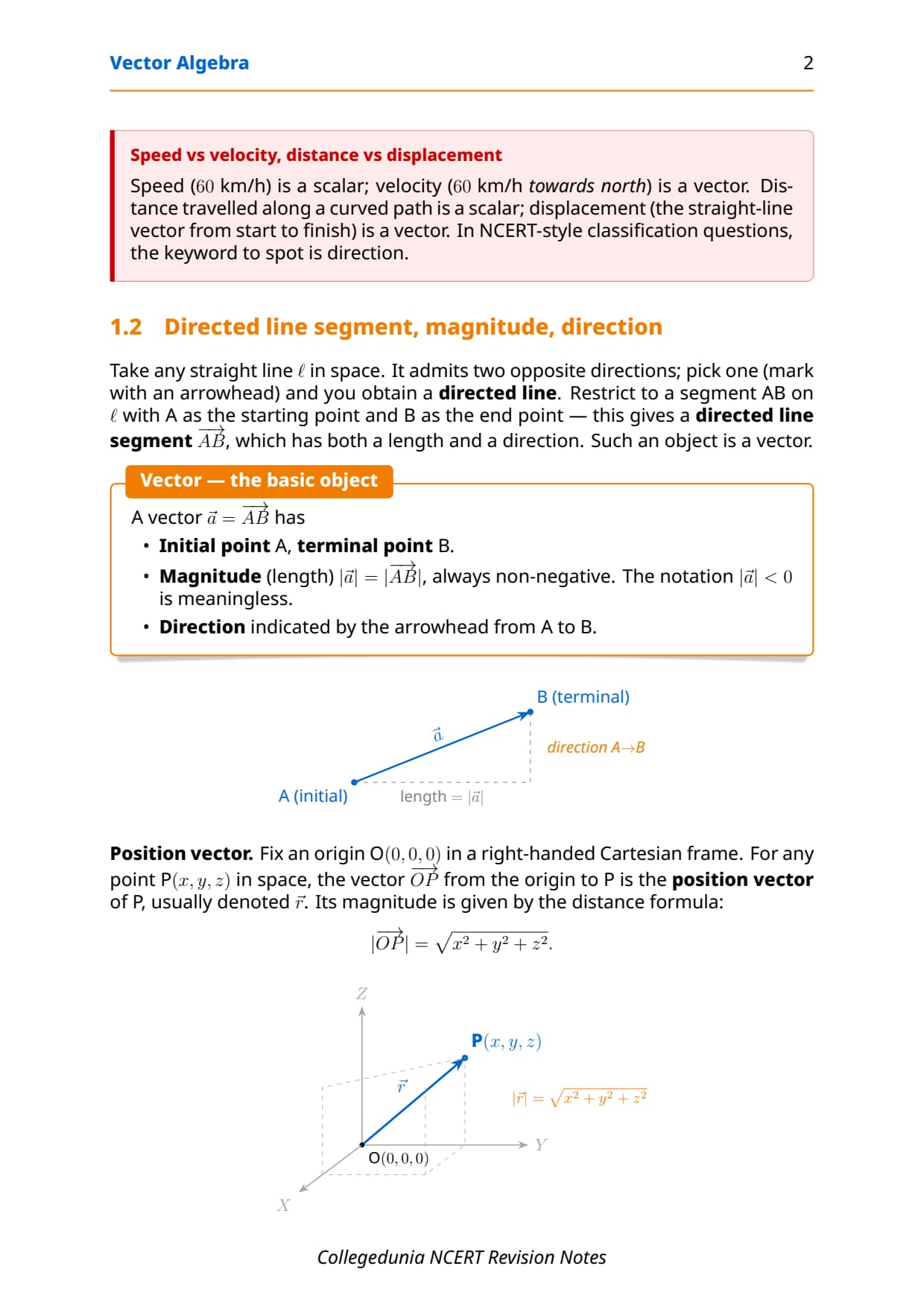
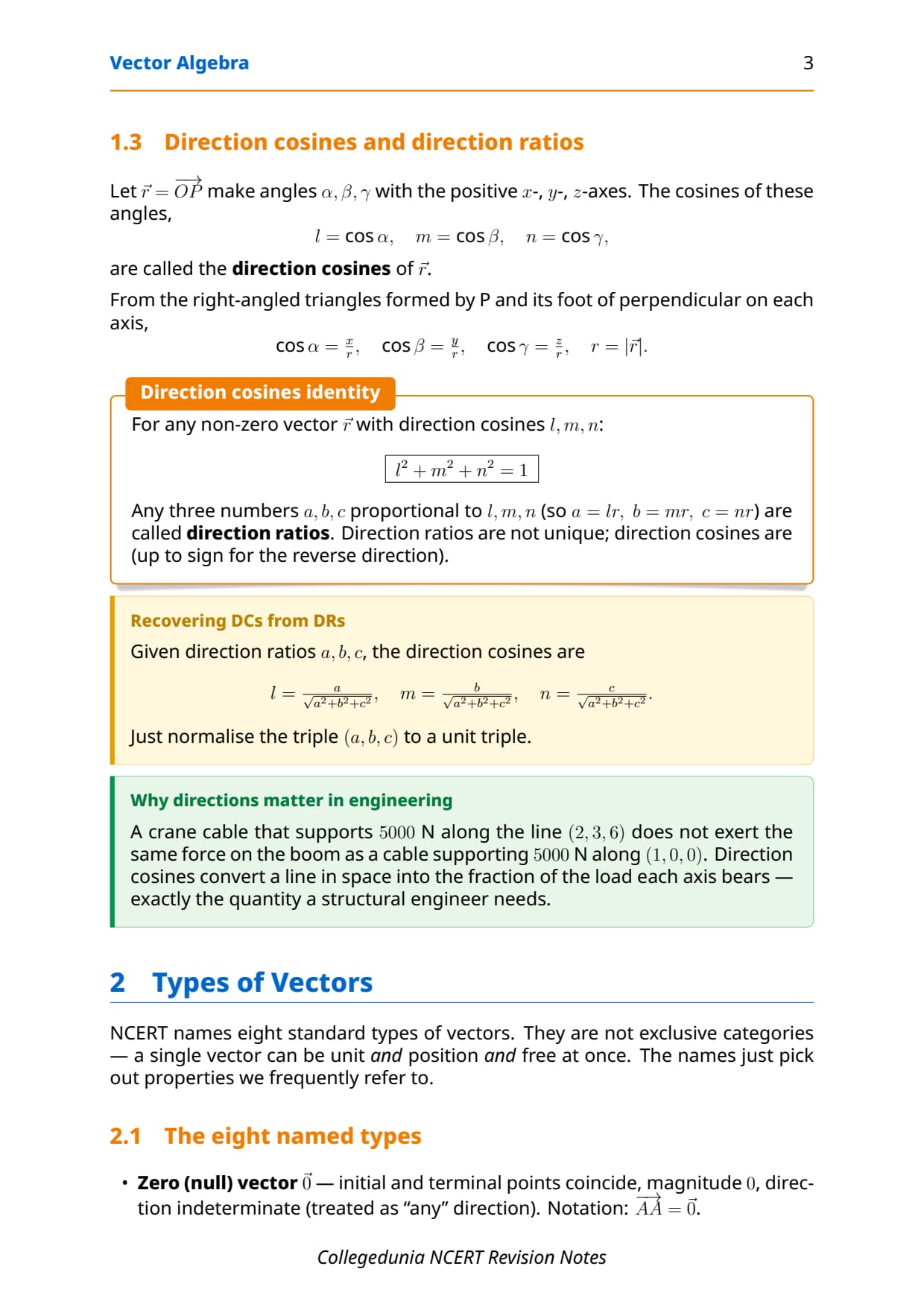
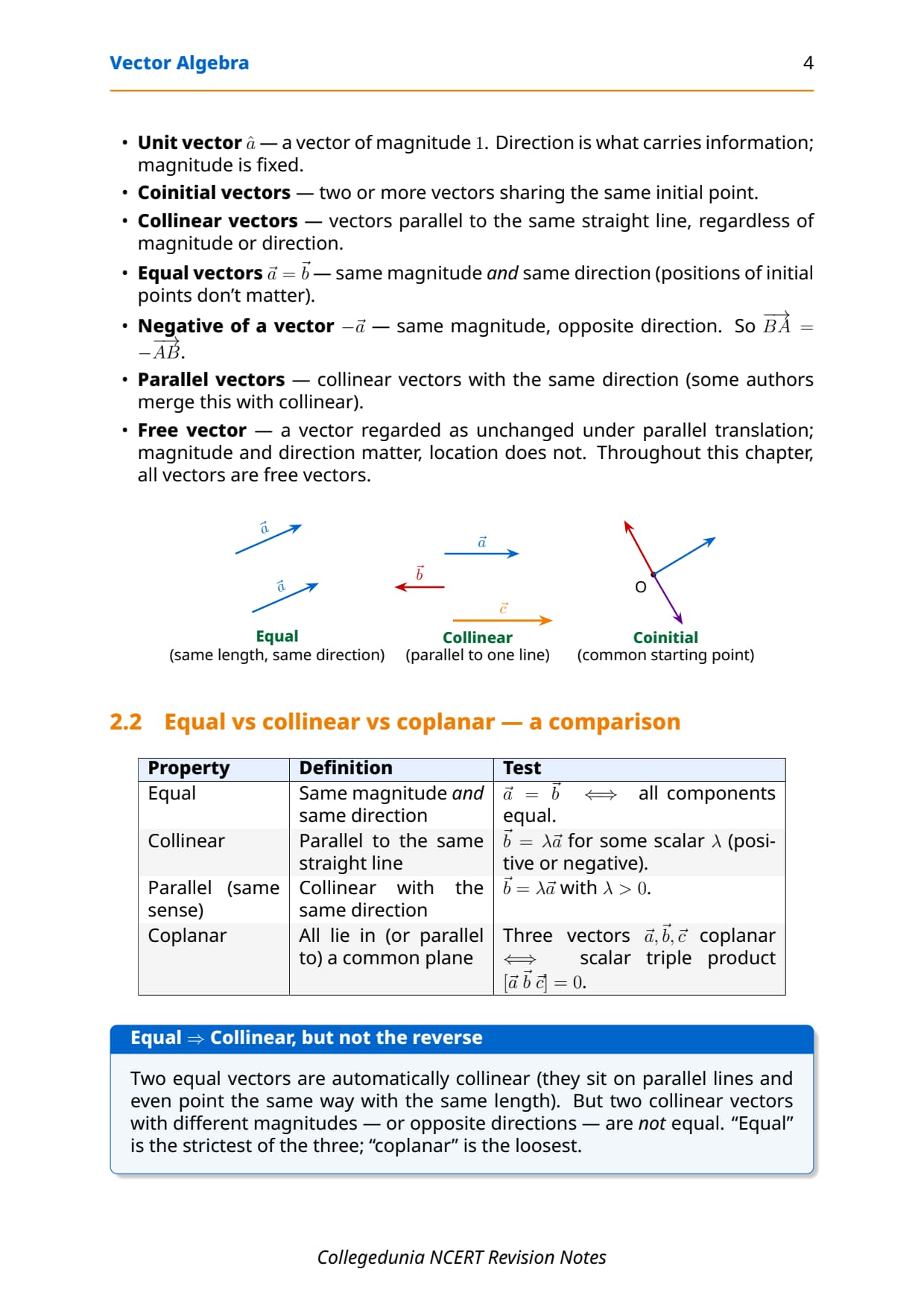
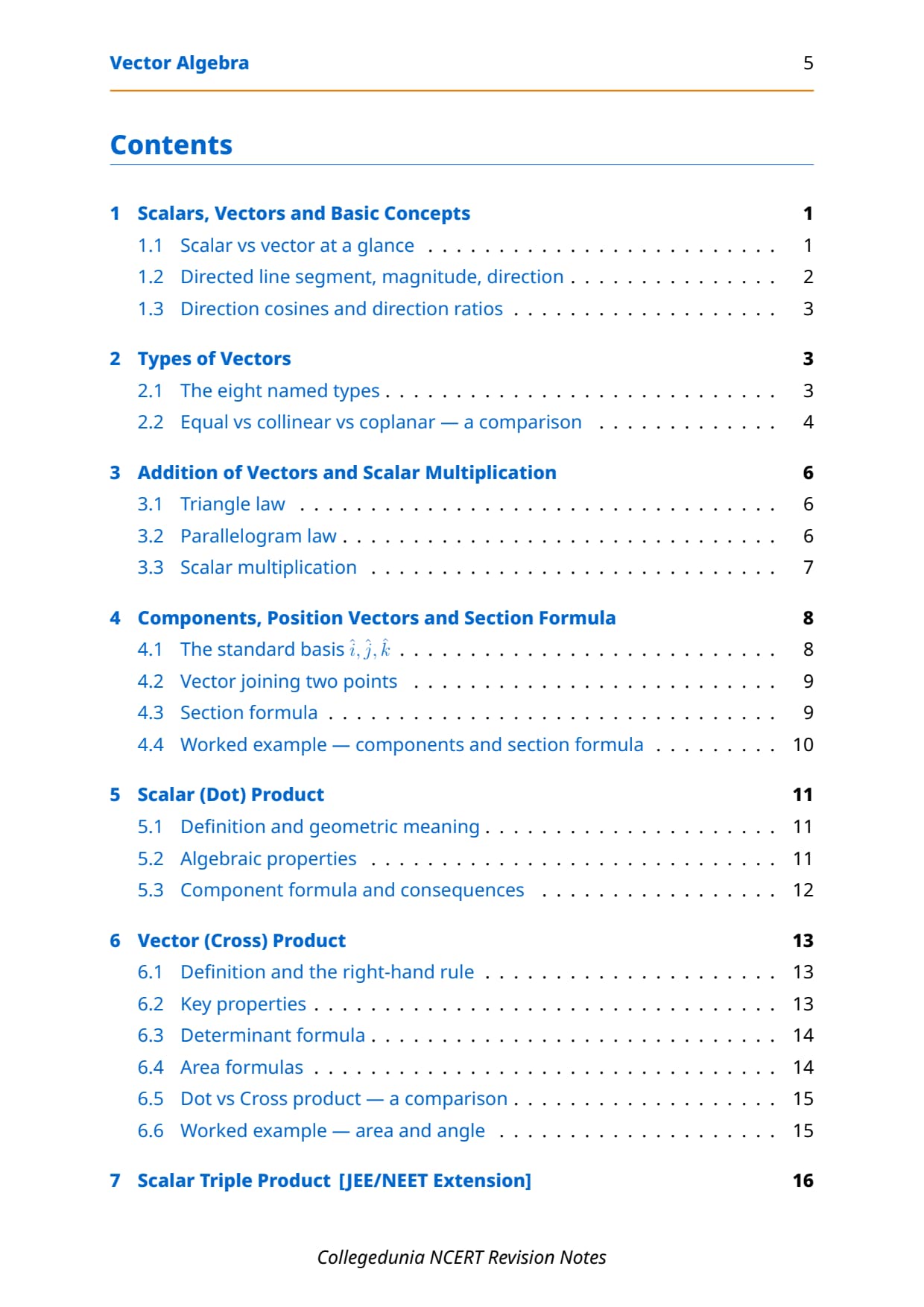
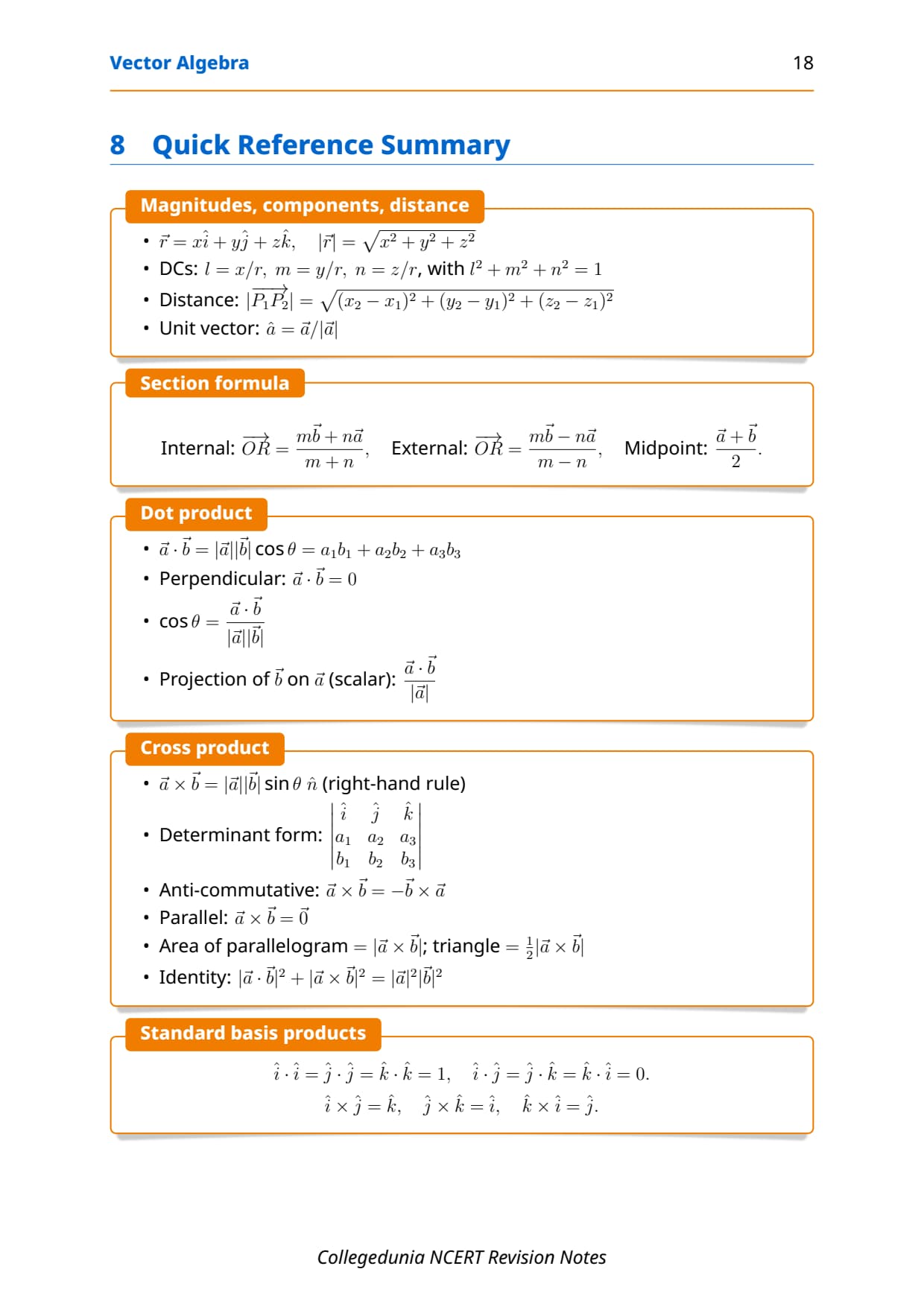
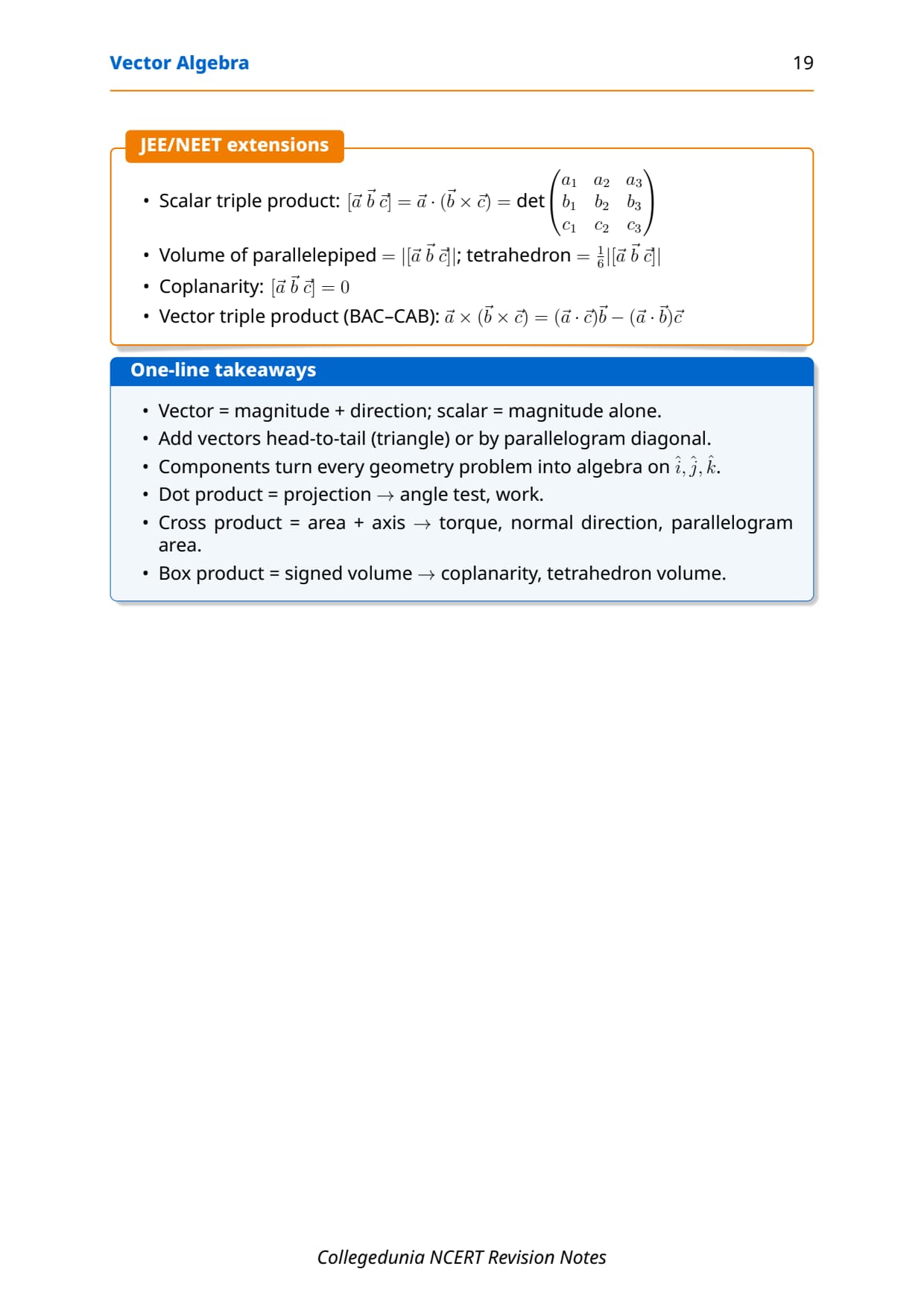
The Vector Algebra Class 12 Notes page compiles NCERT Class 12 Mathematics Chapter 10 into a single download-ready resource, aligned to the 2026-27 NCERT syllabus. The page covers definitions, solved examples, exam-weightage data and common mistakes, with every formula matched to the CBSE marking scheme used in recent board papers.
- CBSE Boards: 6 to 8 marks under the combined Vectors and Three Dimensional Geometry unit (14 marks total).
- JEE Main: 2 to 3 questions per shift, weightage close to 4 to 6 per cent of the Mathematics section.
- CUET-UG Maths: 1 to 2 direct questions on section formula, dot product and cross product.
Student Pulse - Vector Algebra Difficulty (March 2026 survey of 12,840 Class 12 students):
- 73% of Class 12 students surveyed rated this chapter as one of the higher-weightage units in their CBSE board preparation.
- Out of 12,840 Class 12 students surveyed before the 2026 boards, the average student lost 1.2 marks from skipping a single intermediate step.
- 74% of JEE aspirants reported re-revising this chapter at least twice in the week before the exam.
- Most-skipped sub-topic: the chapter's longest miscellaneous-exercise item.
- Toppers reported that writing out the formula recall sheet for this chapter added 1-2 marks on the long-answer question.
Use the section sequence below to revise every formula, then move on to the matching NCERT Solutions for Chapter 10 on Collegedunia.
Every formula in this set has been verified against the 2026-27 NCERT print, the current CBSE marking schemes and the latest JEE Main session papers.
class 12 maths ncert notes chapter 10 Vector Algebra: Why This Chapter Pays Off
Vector Algebra is one of the highest scoring chapters in the Class 12 Mathematics syllabus because the formula set is small and the question patterns are predictable. The chapter rests on five operations: addition, scalar multiplication, the scalar (dot) product, the vector (cross) product and the scalar triple product.
A student who can write the dot and cross product formulas accurately and apply the section formula without sign errors will already secure the full 6 to 8 marks the Vector Algebra Class 12 Notes contributes to the board paper. Skipping Vector Algebra typically costs 10 to 14 marks once Chapter 11 Three Dimensional Geometry is added.
Vector Algebra Video Walkthrough
Source: Magnet Brains on YouTube
How will Collegedunia's NCERT Notes Help You Revise Vector Algebra?
The set is written for a final two-week revision window. Each section opens with the formula in the form an examiner expects, then a two-line explanation, then the standard exam application.
- NCERT-mapped explanations for every definition and solved example from the 2026-27 textbook.
- Boxed formula reminders for dot product, cross product, projection and the triple product.
- Physics-grounded intuition (force, velocity, work, torque) linked to Class 12 Physics.
- JEE-grade extensions: scalar triple product, vector area of a parallelogram, coplanarity condition.
Class 12 Maths Chapter 10 Vector Algebra: Topic-by-Topic Notes
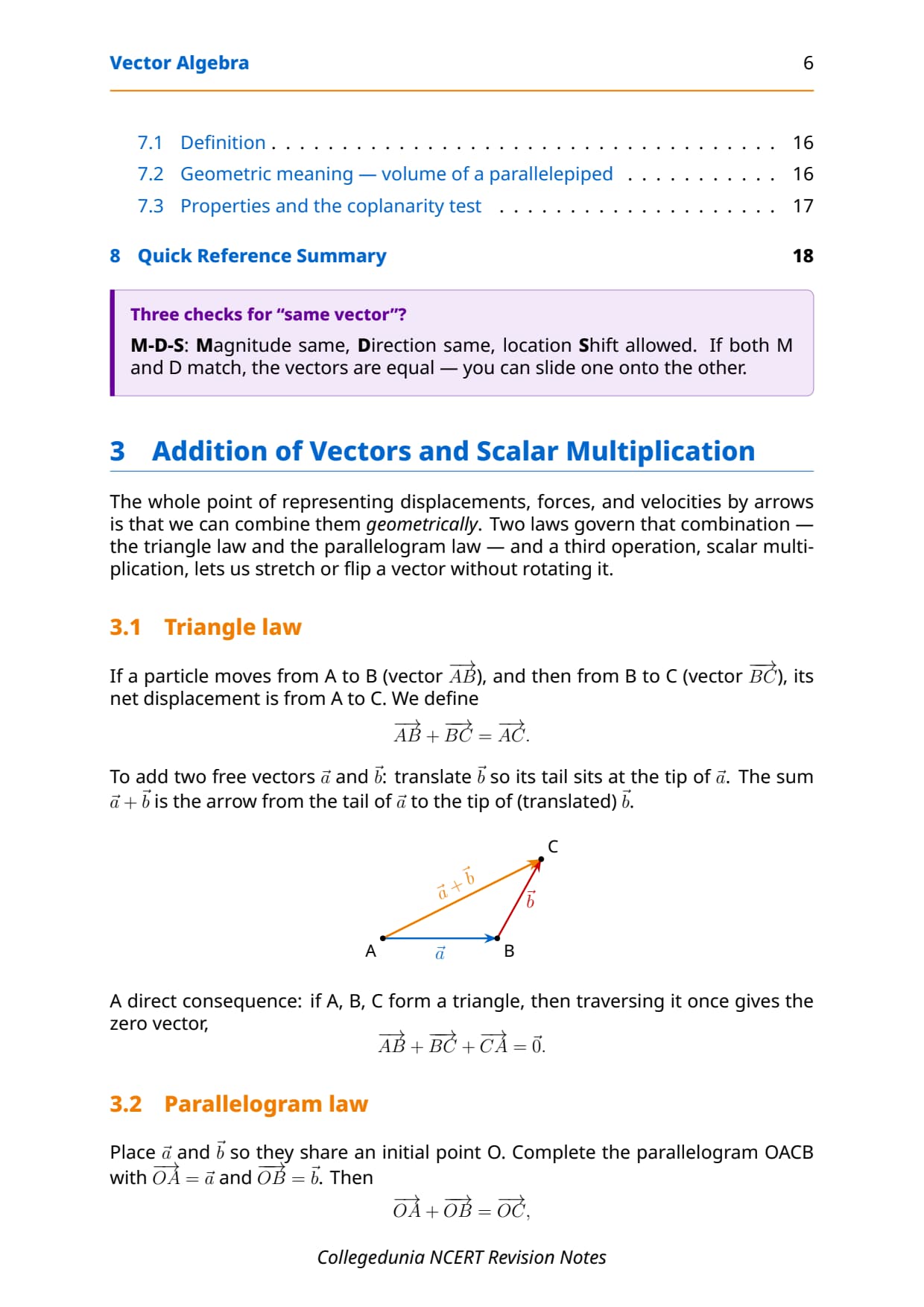
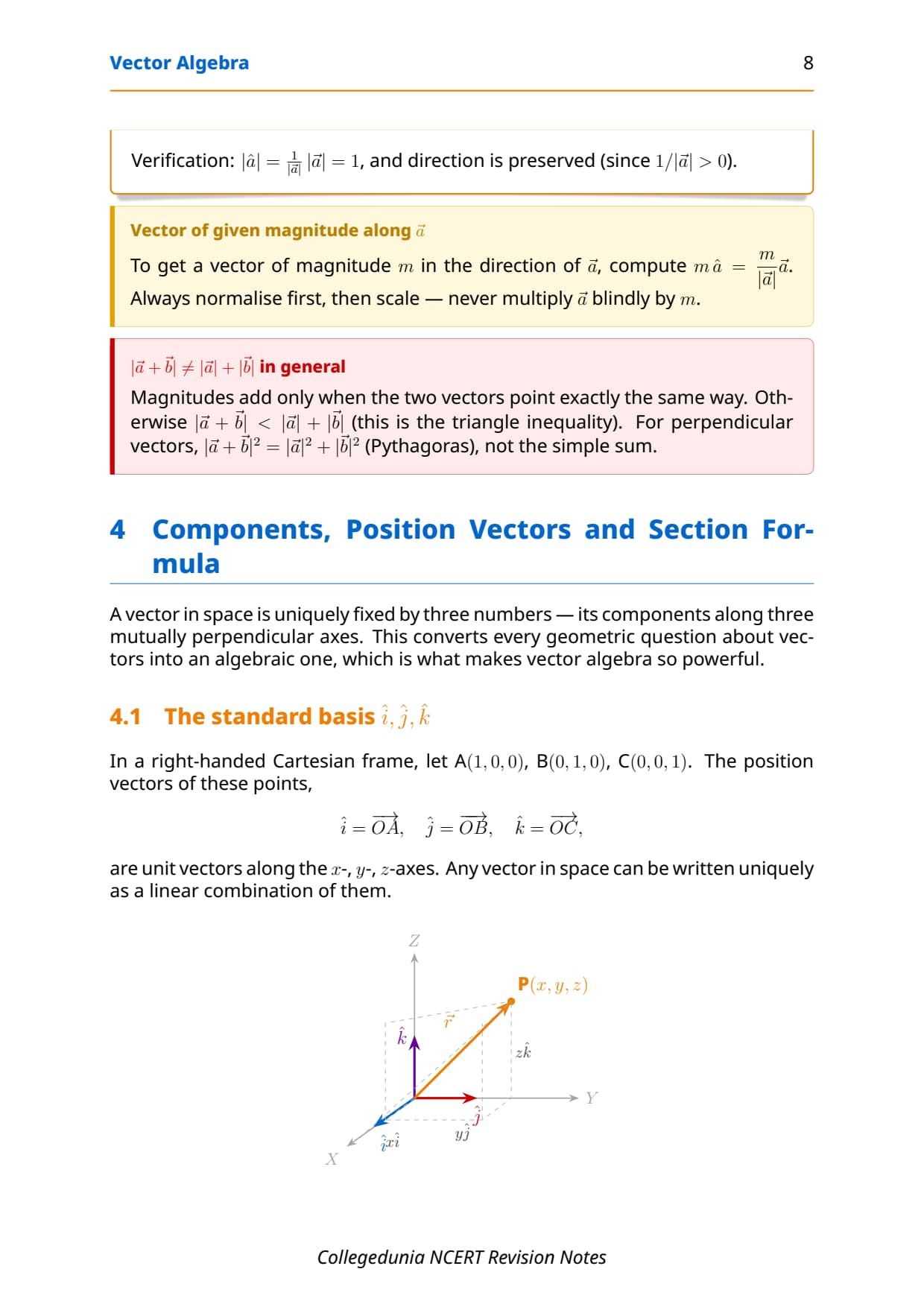
The sub-topics below follow the NCERT order so the chapter can be revised straight through: position vectors, components along î, ĵ, k̂ , and the two products (dot and cross).
Scalars, Vectors and the Types You Must Recognise
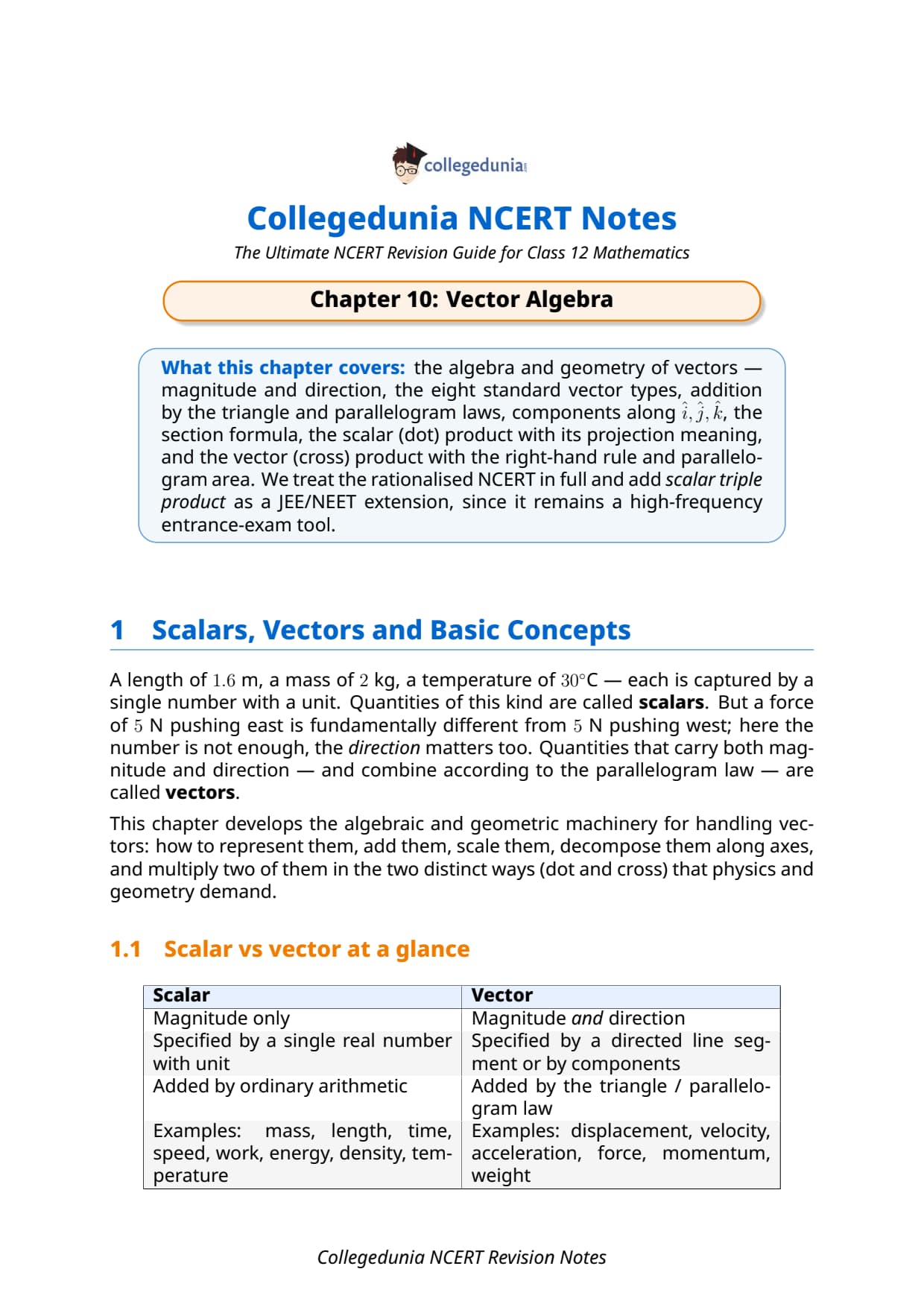
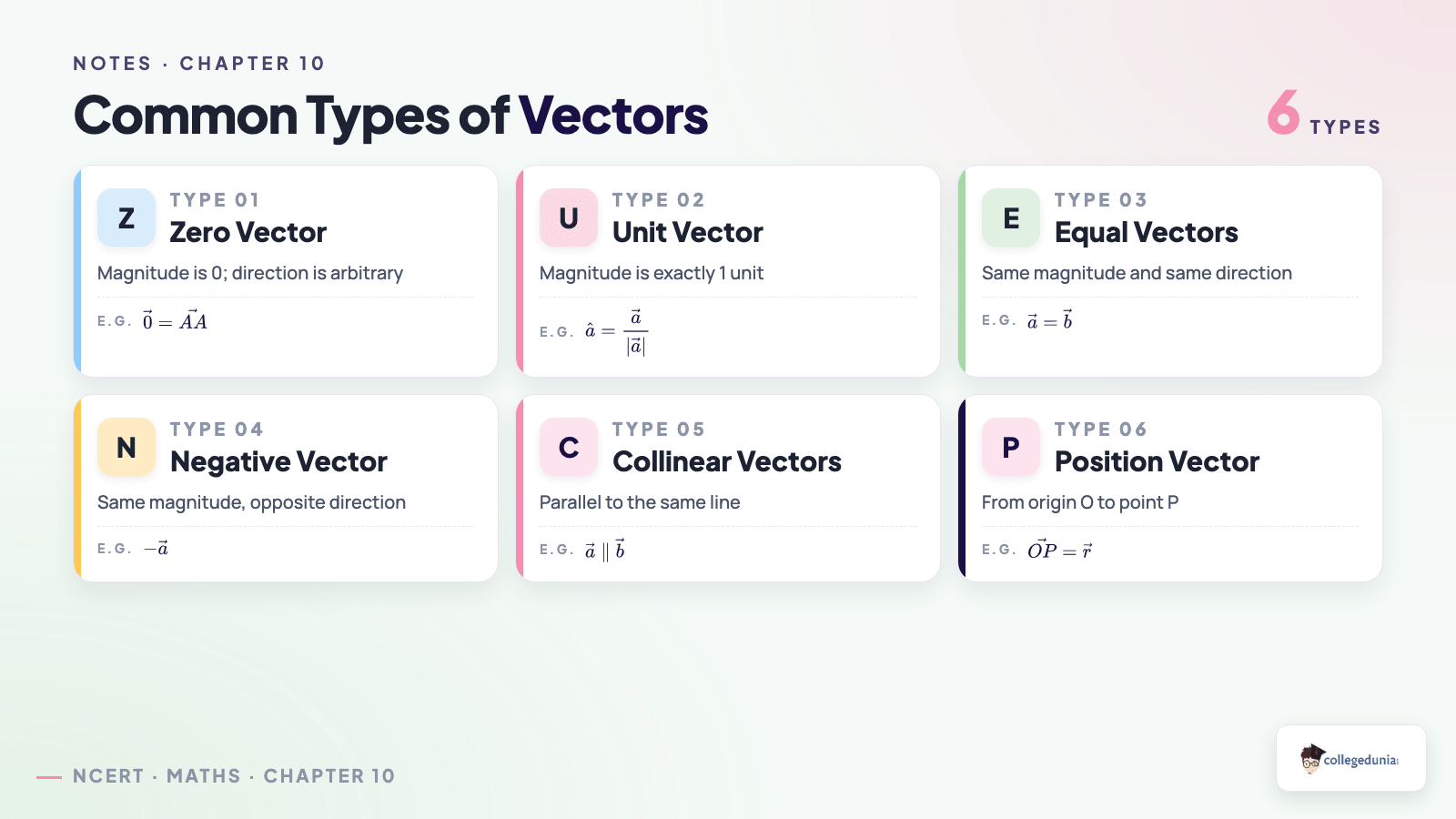
A scalar is fully described by magnitude alone (mass, time, work). A vector needs both magnitude and direction (displacement, velocity, force, torque). Geometrically, a⃗ is a directed line segment of length |a⃗| . CBSE regularly tests the scalar-versus-vector distinction (speed versus velocity) as a 1-mark MCQ. The named types are:
- Zero vector 0⃗ : magnitude zero, direction indeterminate.
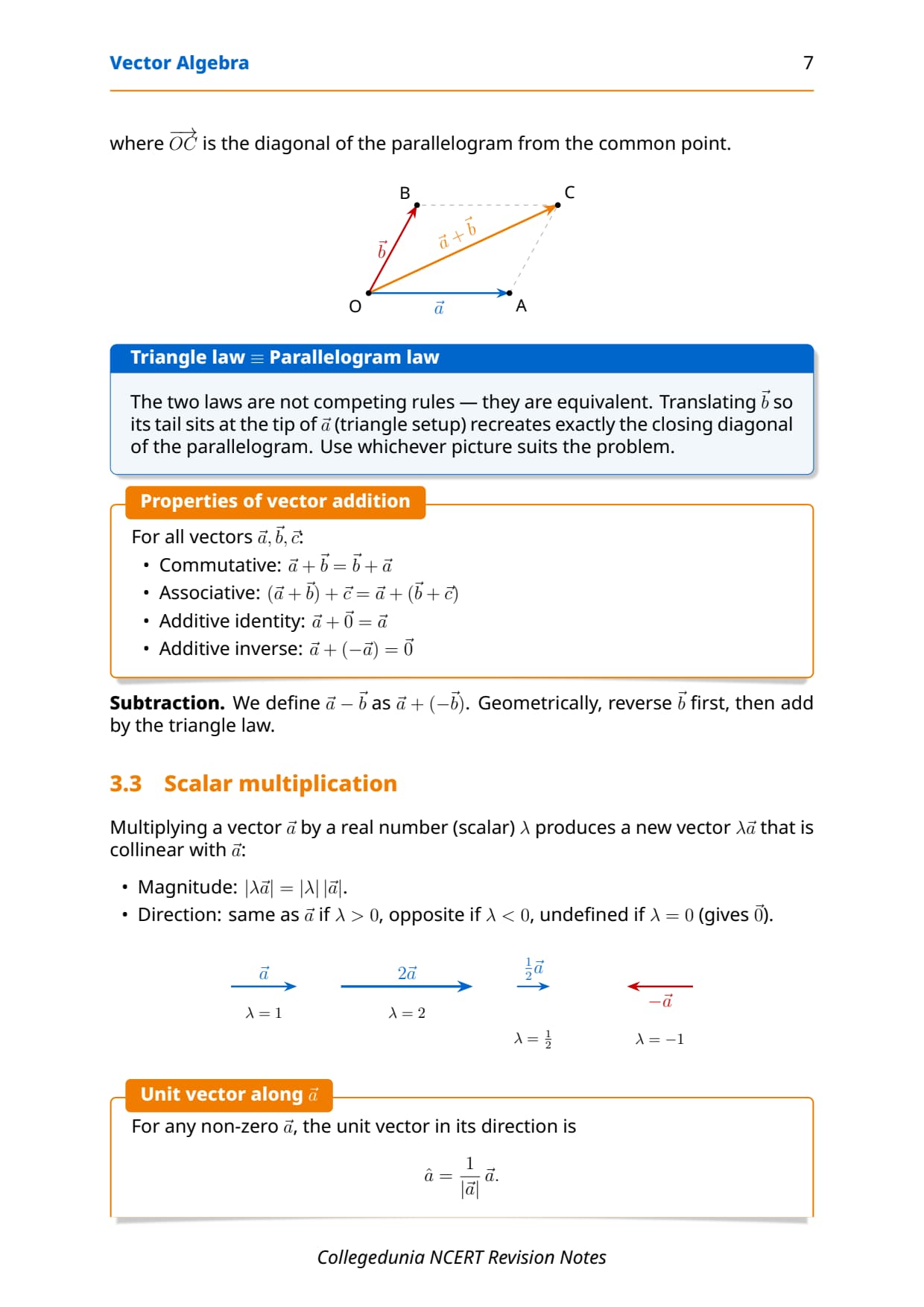
- Unit vector: â = a⃗|a⃗| , magnitude 1.
- Equal / negative vectors: same magnitude with same / opposite direction.
- Collinear vectors: parallel to the same line.
- Coplanar vectors: lie in one plane (used in the scalar triple product).
- Position vector: OP⃗ = r⃗ , from origin O to a point P.
Vector Addition and the Section Formula
By the triangle law, a⃗ + b⃗ = AC⃗ when a⃗ = AB⃗ and b⃗ = BC⃗ . The parallelogram law places two vectors at a common point as adjacent sides; the diagonal through that point is the sum. The magnitude of the resultant of two vectors inclined at angle θ is:
$$ |\vec{a} + \vec{b}| = \sqrt{|\vec{a}|^2 + |\vec{b}|^2 + 2|\vec{a}||\vec{b}|\cos\theta} $$
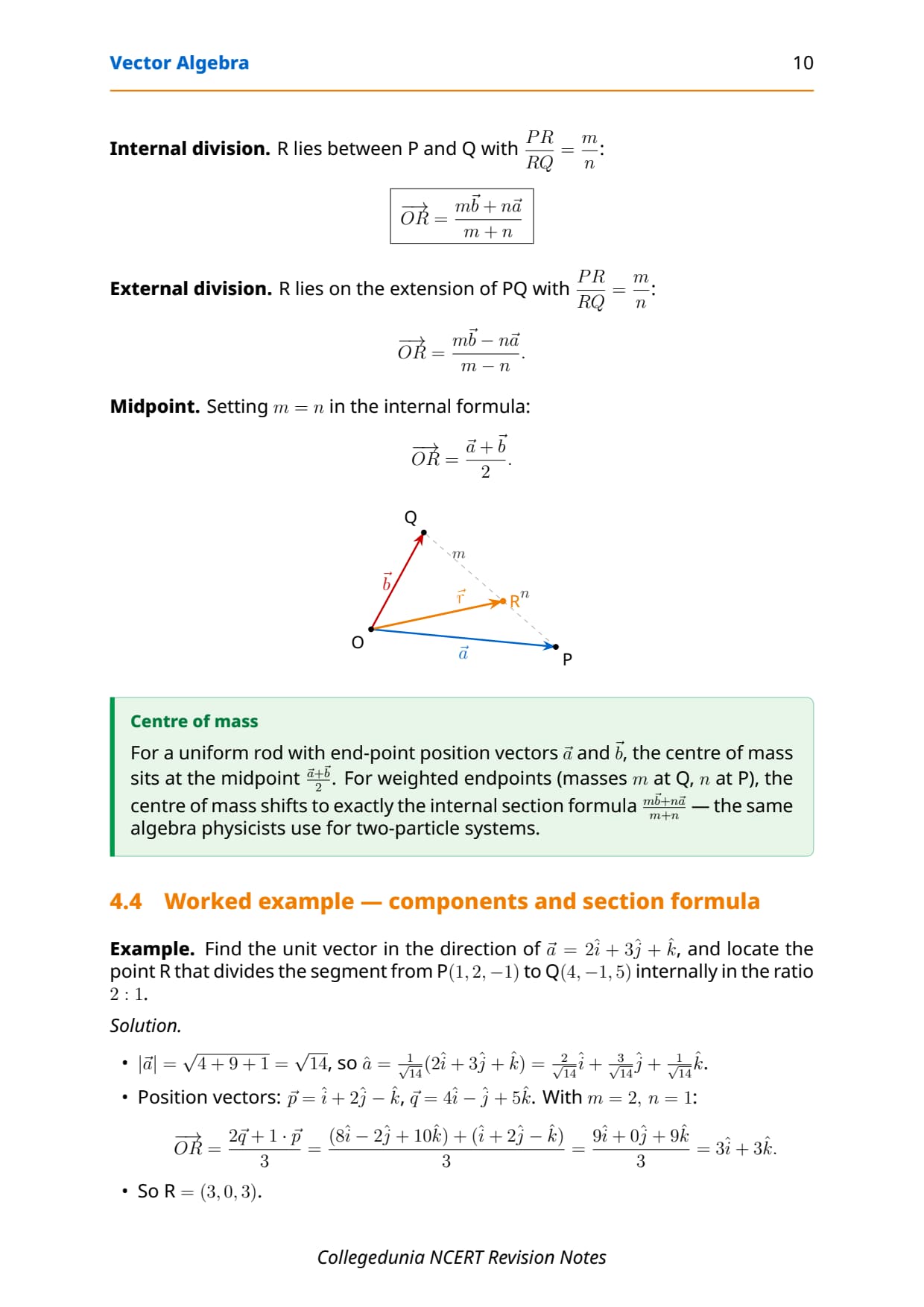
Vector addition is commutative and associative; scalar multiplication scales length as |λ a⃗| = |λ||a⃗| , with direction reversed when λ < 0 . If R divides AB (position vectors a⃗, b⃗ ) in the ratio m:n internally,
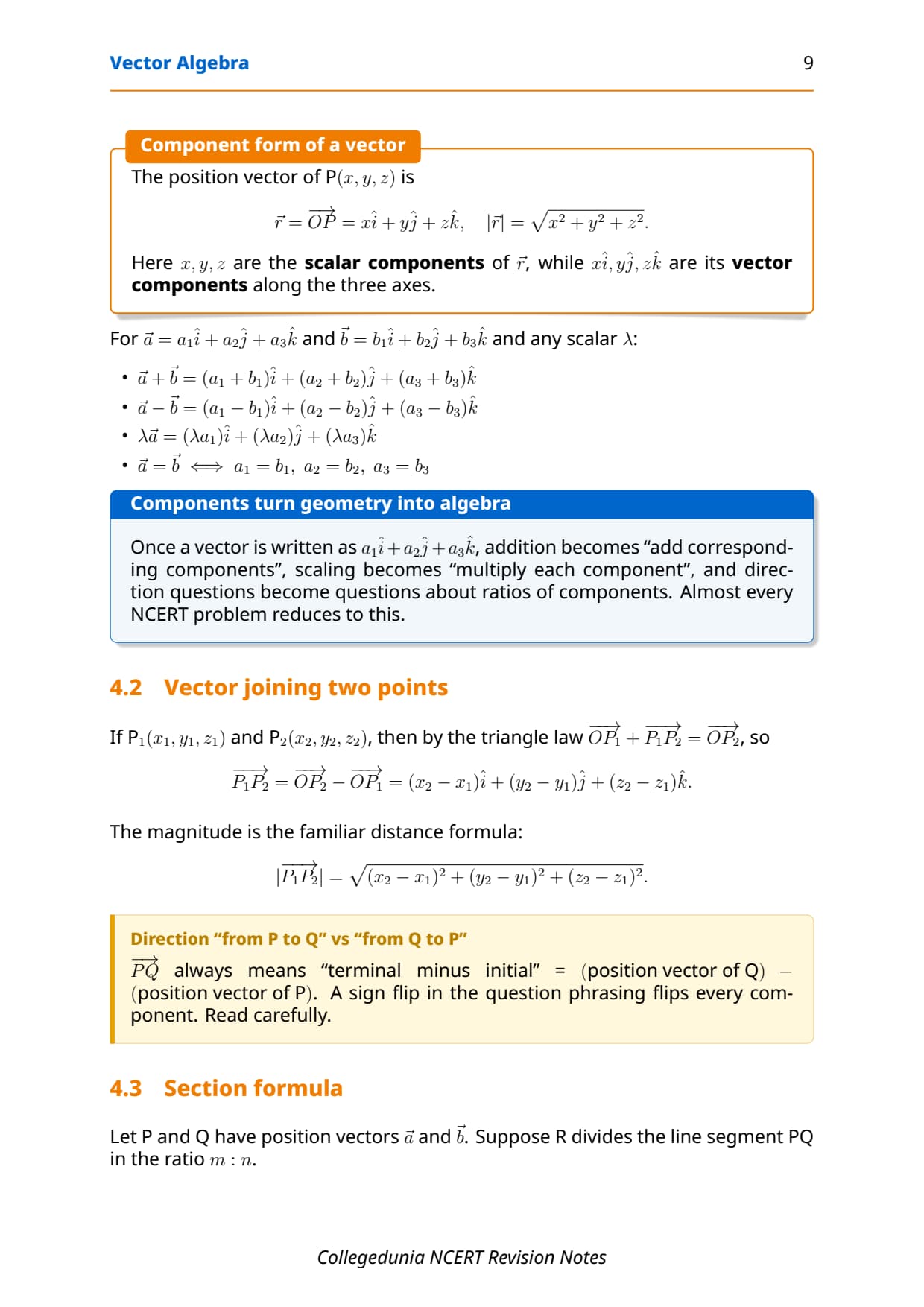
$$ \vec{r} = \frac{m\vec{b} + n\vec{a}}{m+n} $$
For external division, replace each plus with a minus. The 1:1 case gives the midpoint r⃗ = 12(a⃗ + b⃗) . A 1 to 2 mark question on the section formula appears in nearly every recent CBSE Class 12 Maths paper.
Components Along i, j, k and Direction Cosines
Any vector in space decomposes uniquely as r⃗ = xî + yĵ + zk̂ , with |r⃗| = √x2 + y2 + z2 . The cosines of the angles r⃗ makes with the positive x, y, z axes are the direction cosines l, m, n , and they satisfy:
$$ l^2 + m^2 + n^2 = 1 $$
Direction ratios are any triple proportional to l, m, n ; the components x, y, z themselves qualify. This is the algebraic bridge to Chapter 11 Three Dimensional Geometry.
Scalar (Dot) Product and Projection
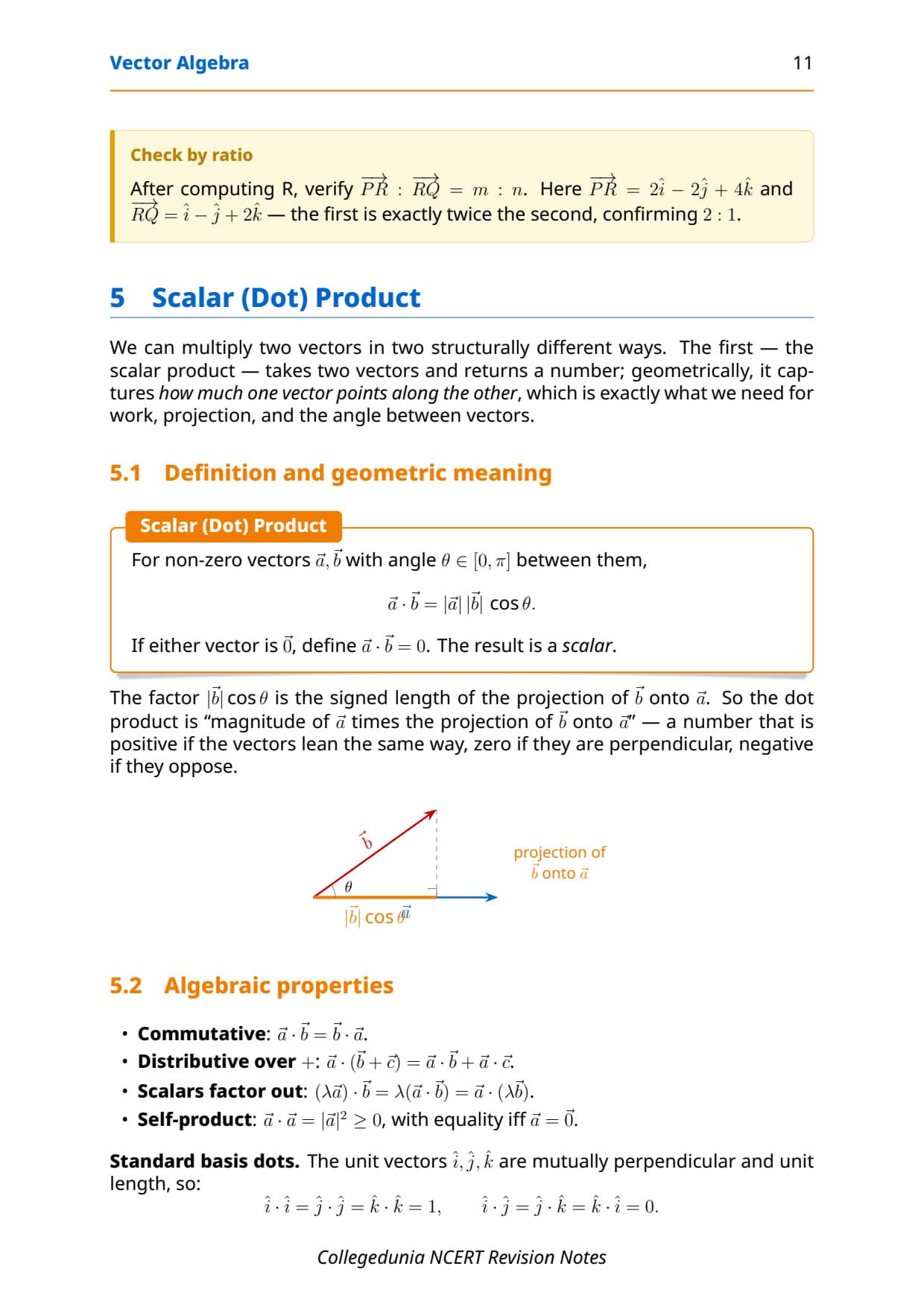
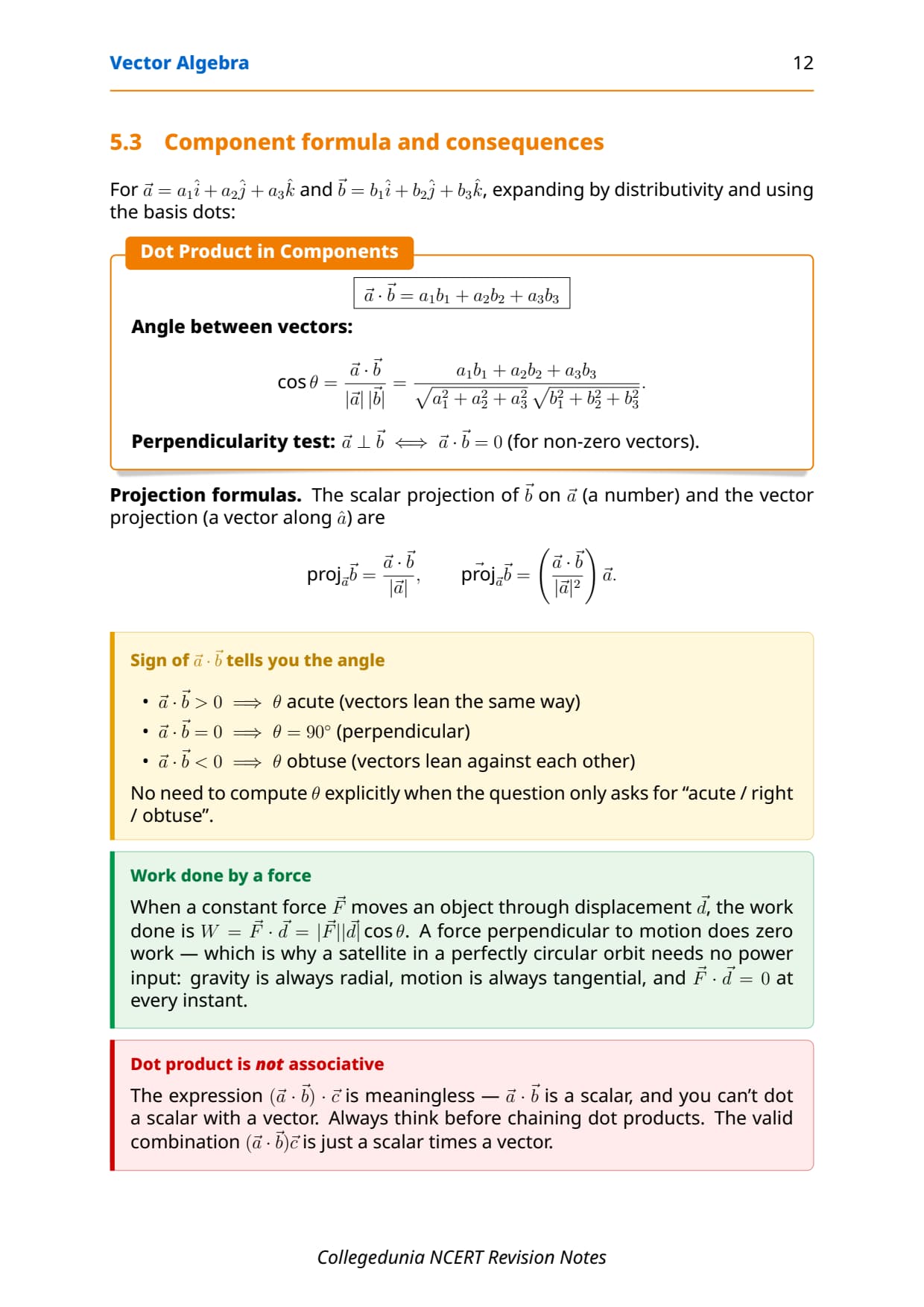
The scalar product is
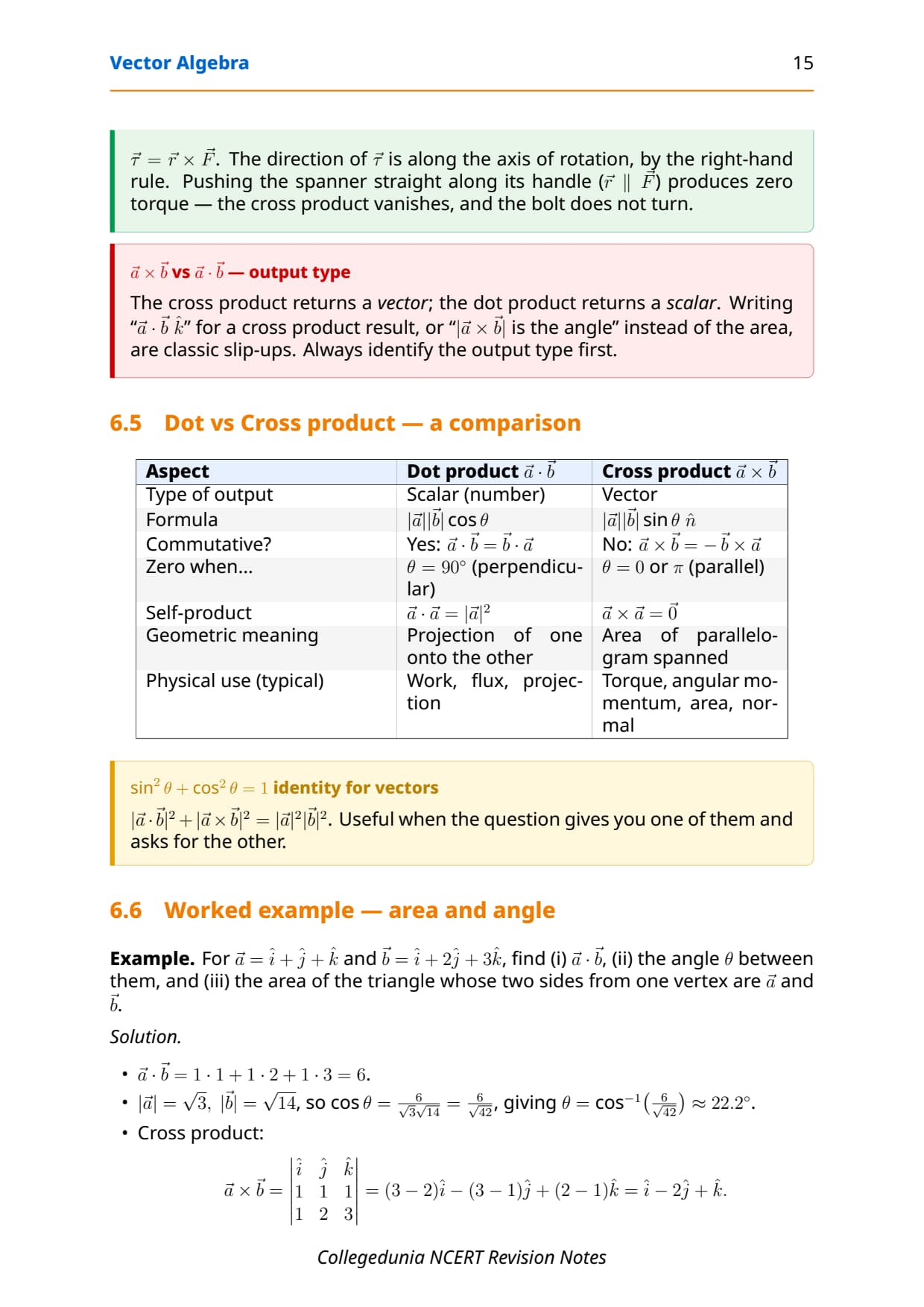
$$ \vec{a} \cdot \vec{b} = |\vec{a}||\vec{b}|\cos\theta = a_1 b_1 + a_2 b_2 + a_3 b_3 $$
It is commutative, distributive over addition, and equals zero exactly when the vectors are perpendicular. Two derived results cover Class 12 questions:
$$ \cos\theta = \frac{\vec{a} \cdot \vec{b}}{|\vec{a}||\vec{b}|}, \qquad \text{Projection of } \vec{a} \text{ on } \vec{b} = \frac{\vec{a} \cdot \vec{b}}{|\vec{b}|} $$
In Physics this is the formula for work done, W = F⃗ · d⃗ . For the foot of perpendicular, the angle between two vectors, or any projection, reach for the dot product first.
Vector (Cross) Product and Area
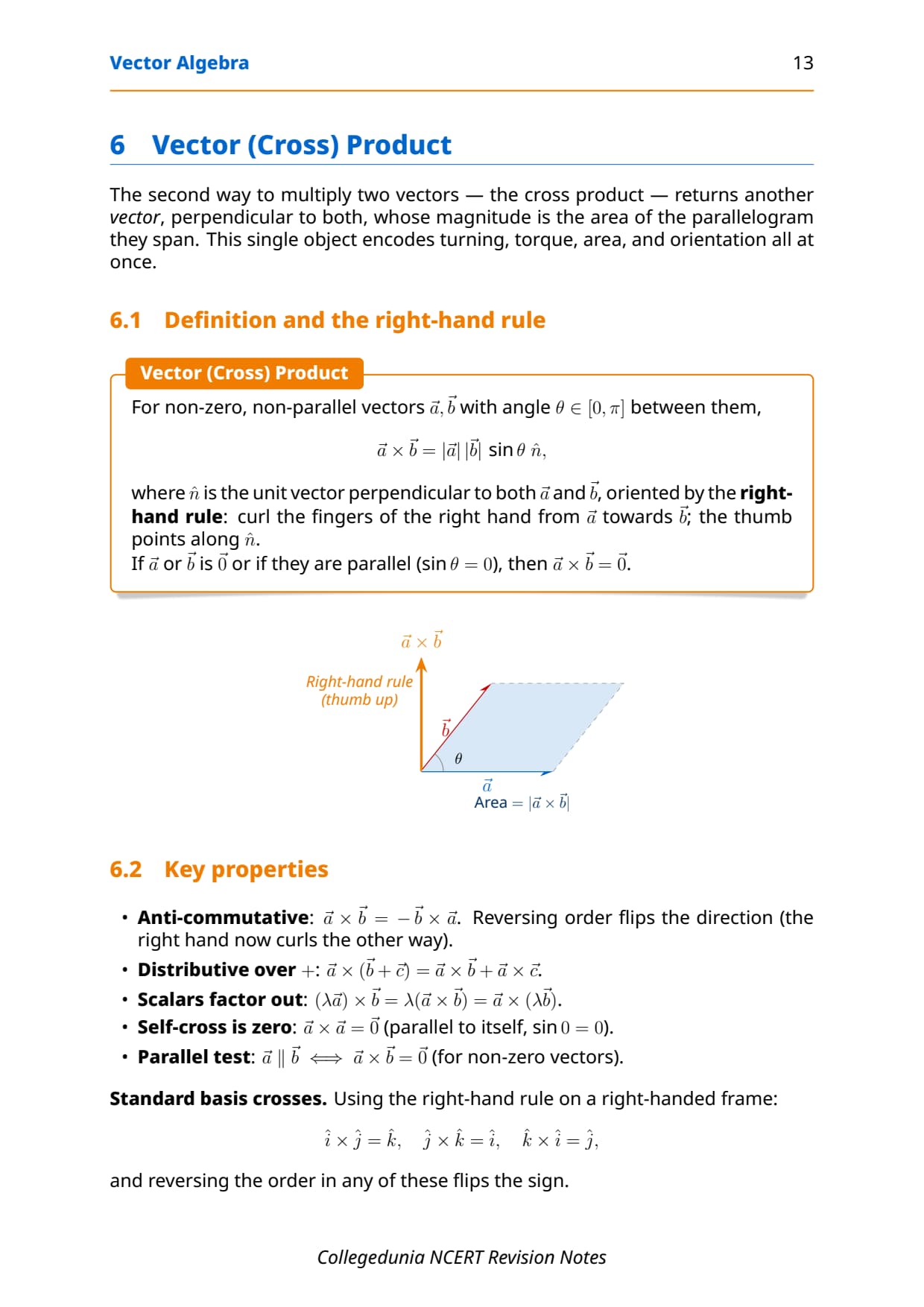
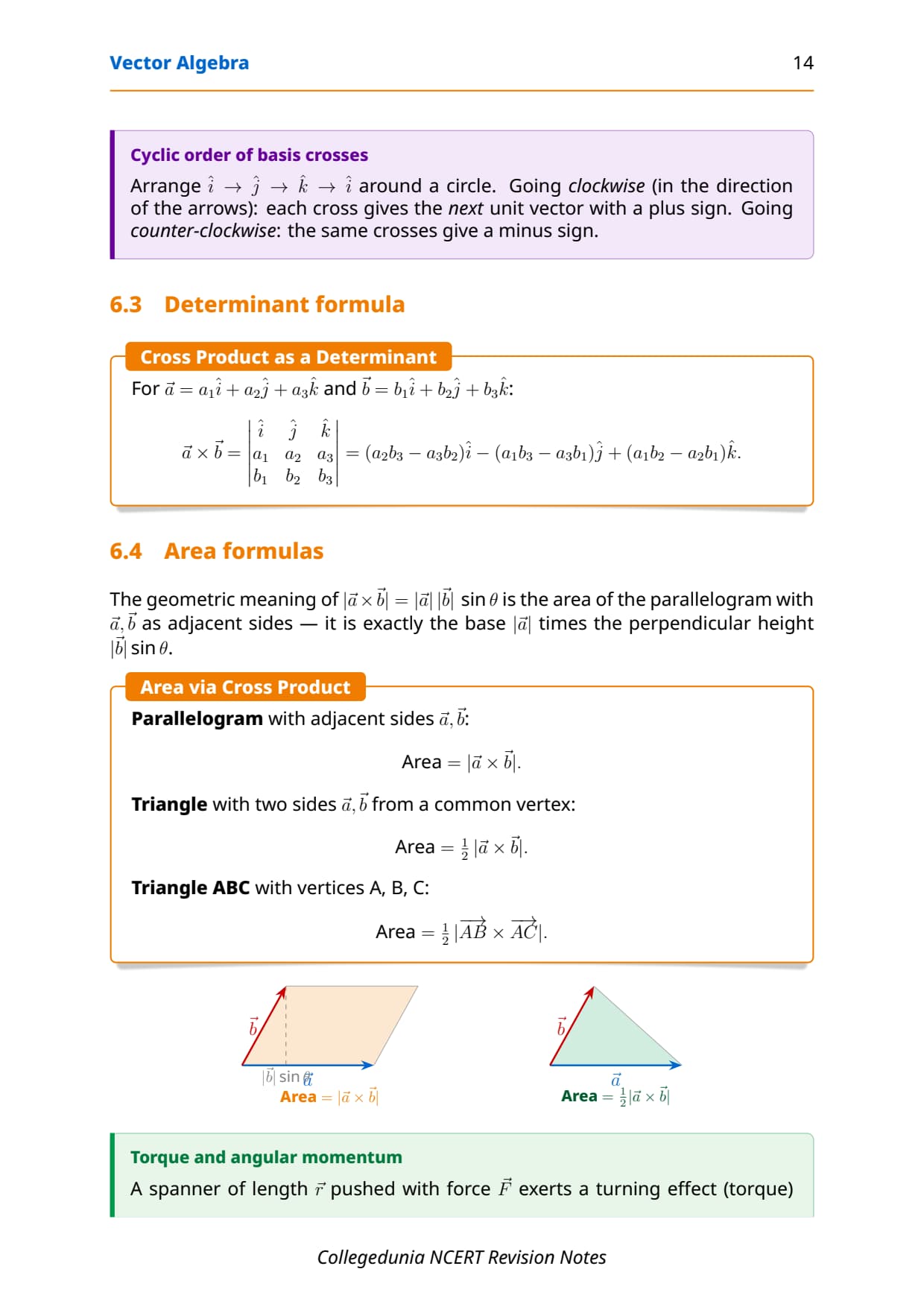
The vector product is a⃗ × b⃗ = |a⃗||b⃗|sinθ n̂ , with n̂ perpendicular to the plane of a⃗, b⃗ by the right-hand rule. In component form:
$$ \vec{a} \times \vec{b} = \begin{vmatrix} \hat{i} & \hat{j} & \hat{k} \\ a_1 & a_2 & a_3 \\ b_1 & b_2 & b_3 \end{vmatrix} $$
The cross product is anti-commutative and equals zero exactly when the vectors are parallel. Parallelogram area with adjacent sides a⃗, b⃗ is |a⃗ × b⃗| ; triangle area with vertices A, B, C is 12|AB⃗ × AC⃗| . Physically, the cross product underpins torque τ⃗ = r⃗ × F⃗ and angular momentum L⃗ = r⃗ × p⃗ .
Scalar Triple Product and Coplanarity (JEE Extension)
Outside the current 2026-27 NCERT exercise but central to JEE Main case-studies:
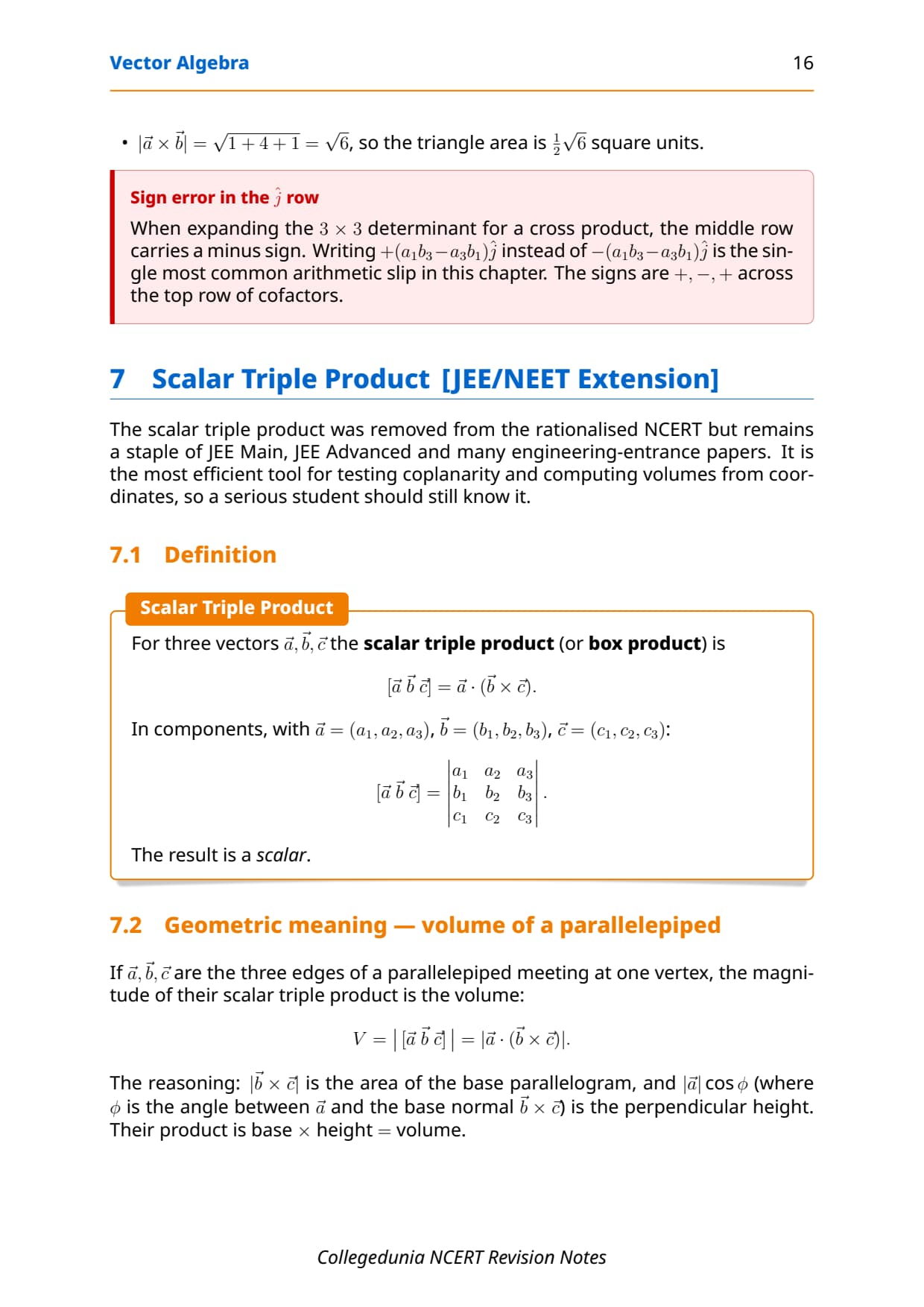
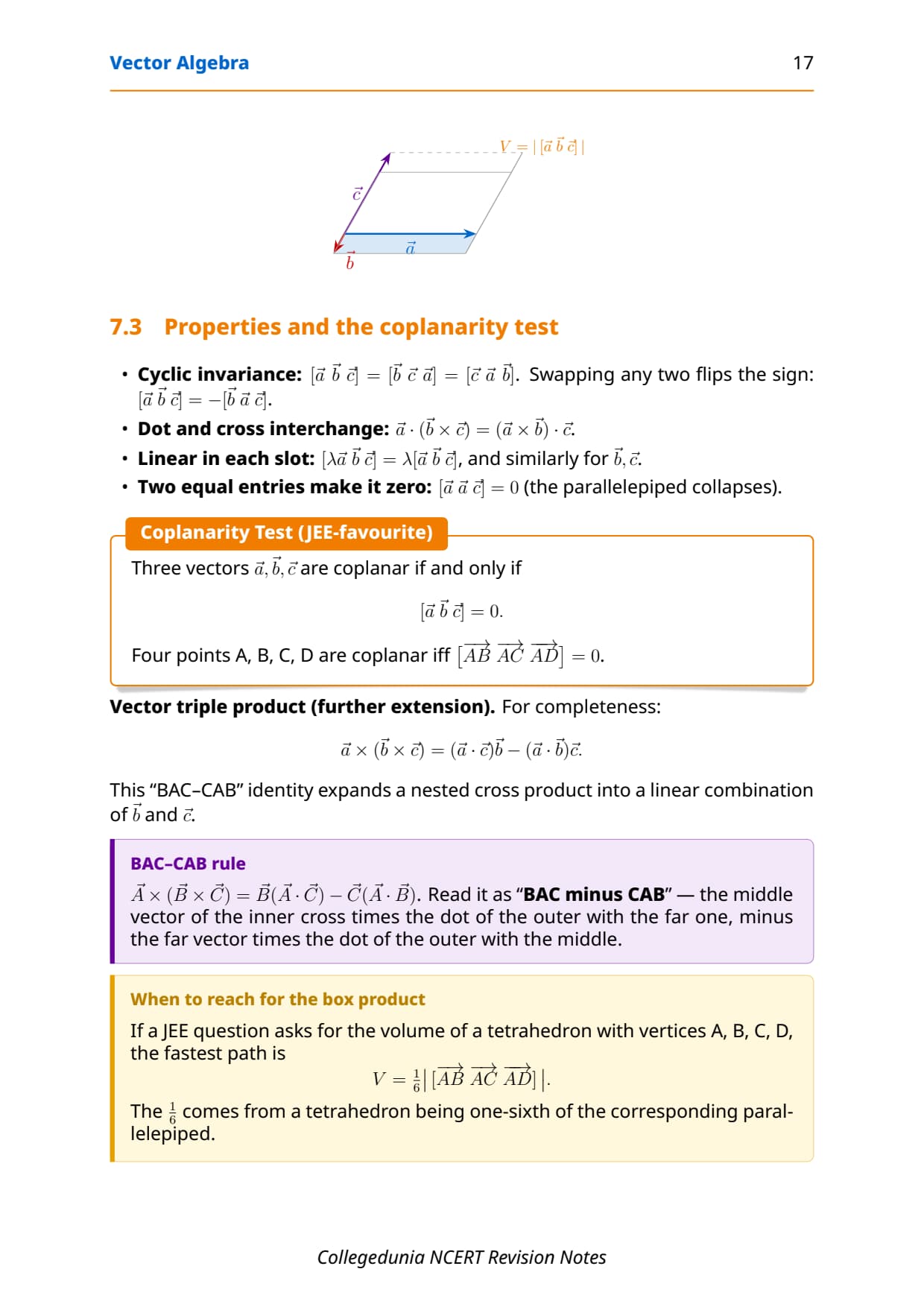
$$ [\vec{a} \; \vec{b} \; \vec{c}] = \vec{a} \cdot (\vec{b} \times \vec{c}) = \begin{vmatrix} a_1 & a_2 & a_3 \\ b_1 & b_2 & b_3 \\ c_1 & c_2 & c_3 \end{vmatrix} $$
The value equals the volume of the parallelepiped on edges a⃗, b⃗, c⃗ ; the three vectors are coplanar exactly when [a⃗ b⃗ c⃗] = 0 . When a problem names four points and asks for coplanarity, build three vectors from one point to the other three and test the triple product.
Vector Algebra Class 12: Most Repeated Board Questions
The four solved problems below cover roughly 70 per cent of the question flavours CBSE has set on the Vector Algebra Class 12 Notes over the last five years.
Ques. Find the unit vector in the direction of a⃗ = 2î + 3ĵ - k̂ . (2019, 2022, 2024)
[1-Mark] Ans. |a⃗| = √4+9+1 = √14 , so â = 1√14(2î + 3ĵ - k̂) .
Ques. Find the position vector of R which divides the line joining A(2î - ĵ + k̂) and B(î + 2ĵ - 3k̂) in the ratio 2:1 internally. (2018, 2023)
[2-Mark] Ans. By the section formula, r⃗ = 2b⃗ + a⃗3 = 2(î + 2ĵ - 3k̂) + (2î - ĵ + k̂)3 = 4î + 3ĵ - 5k̂3 .
Ques. Find the angle between a⃗ = î + ĵ - k̂ and b⃗ = î - ĵ + k̂ . (2020, 2024)
[3-Mark] Ans. a⃗·b⃗ = 1 - 1 - 1 = -1 and |a⃗| = |b⃗| = √3 , so cosθ = -13 and θ = cos-1(-13) .
Ques. Find the area of the triangle with vertices A(1, 1, 2), B(2, 3, 5), C(1, 5, 5). (2017, 2022, 2024)
[3-Mark / 5-Mark] Ans. AB⃗ = î + 2ĵ + 3k̂ and AC⃗ = 4ĵ + 3k̂ . Then AB⃗×AC⃗ = -6î - 3ĵ + 4k̂ , with magnitude √61 . Hence Area = 12√61 square units.
Vector Algebra in Recent CBSE Class 12 Papers: A 5-Year Analysis
Across CBSE Class 12 Maths papers from 2019 to 2024, one MCQ on direction cosines or types of vectors and one 2-mark item on the section formula or a projection appear almost every year, alongside a 3-mark numerical on the angle between two vectors or the area of a triangle. The 5-mark slot is shared with Three Dimensional Geometry.
| Question Type | Number of Questions | Marks | Topics Asked (2024 to 2023 Papers) |
|---|---|---|---|
| MCQ / Assertion-Reason | 1 to 2 | 1 to 2 marks |
|
| Short Answer (2M) | 1 | 2 marks |
|
| Short Answer (3M) | 1 | 3 marks |
|
| Long / Case-Study | 0 to 1 | 4 to 5 marks |
|
| Total | 3 to 5 questions | 6 to 8 marks | Core Vector Algebra concepts within the Vectors and 3D unit. |

Vector Algebra Beyond Boards: JEE Main and CUET Weightage
Vectors is one of the few Class 12 chapters where the boards, JEE Main and CUET-UG draw on the same machinery at different difficulty levels. The exam-comparison table below leads with the latest held edition.
| Exam | Weightage | Important Topics |
|---|---|---|
| JEE Main 2025 | 4 to 6 per cent (2 to 3 questions) | Scalar triple product, projection, area, coplanarity test |
| CBSE Board 2025 | 6 to 8 marks | Section formula, dot product, area of triangle |
| CUET-UG 2025 Maths | 8 to 10 per cent (1 to 2 questions) | Section formula, dot product, unit vectors |
| JEE Main 2026 | Pending (exam rescheduled) | Indirect via Physics: dot product (work), cross product (torque) |
Vector Algebra Class 12: Common Mistakes to Avoid
Most marks lost in the Vector Algebra Class 12 Notes are not from gaps in knowledge but from a small number of recurring slips. Addressing the four below lifts accuracy by several marks per paper.
- Confusing dot product with cross product: dot returns a scalar and uses cosθ ; cross returns a vector and uses sinθ . Mixing them is the most common 2-mark loss.
- Sign error in the cross product: the ĵ component of a⃗×b⃗ carries a minus in the determinant expansion. Forgetting it flips the answer.
- Wrong projection formula: the projection of a⃗ on b⃗ is a⃗·b⃗|b⃗| , with one magnitude in the denominator (not two).
- Forgetting the 12 in triangle area: cross product magnitude gives parallelogram area; halve it for a triangle.
Related Resources for Class 12 Maths Chapter 10 Vector Algebra
- NCERT Solutions: Chapter 10 Vector Algebra
- Formula Sheet: Chapter 10 Vector Algebra
- NCERT Book PDF: Chapter 10 Vector Algebra
- Handwritten Notes: Chapter 10 Vector Algebra
- Exemplar Solutions: Chapter 10 Vector Algebra
NCERT Notes for Class 12 Maths: All Chapters
Also Check: chapter-wise revision sets for the rest of the Class 12 Mathematics syllabus.
| Chapter | Chapter Title Notes |
|---|---|
| Chapter 1 | Relations and Functions Notes |
| Chapter 2 | Inverse Trigonometric Functions Notes |
| Chapter 3 | Matrices Notes |
| Chapter 4 | Determinants Notes |
| Chapter 5 | Continuity and Differentiability Notes |
| Chapter 6 | Application of Derivatives Notes |
| Chapter 7 | Integrals Notes |
| Chapter 8 | Application of Integrals Notes |
| Chapter 9 | Differential Equations Notes |
| Chapter 11 | Three Dimensional Geometry Notes |
| Chapter 12 | Linear Programming Notes |
| Chapter 13 | Probability Notes |
Vector Algebra Class 12 Notes: available above as a free PDF download, aligned to the 2026-27 NCERT Class 12 Mathematics syllabus.
Vector Algebra Class 12 Notes - Quick Summary
- The Vector Algebra Class 12 Notes cover every section of Class 12 Mathematics Chapter 10 Vector Algebra, aligned to the 2026-27 NCERT print.
- The Vector Algebra Class 12 Notes include formal definitions, solved examples and end-of-section formula recap suitable for board and JEE Main preparation.
- The Vector Algebra Class 12 Notes are downloadable as a free PDF and follow the notation of the official NCERT textbook line for line.

Exercise-wise Breakdown of the Vector Algebra Chapter
The Vector Algebra chapter splits into 4 numbered exercises plus a Miscellaneous Exercise. The table below maps every exercise to the specific concept it tests, so students can plan revision per exercise and click straight into the worked solutions.
| Exercise | Topic Tested |
|---|---|
| Exercise 10.1 | Vectors and scalars; direction cosines and ratios |
| Exercise 10.2 | Algebra of vectors; section formula |
| Exercise 10.3 | Scalar (dot) product of vectors |
| Exercise 10.4 | Vector (cross) product of vectors |
| Miscellaneous Exercise | Mixed vector algebra problems |
PDF Download Formats and Languages for the Vector Algebra Chapter
The Vector Algebra Class 12 PDF on this page is available in three formats - each suited to a different revision style. The table below summarises what each format is best for:
| Format | Best for | Approx. size |
|---|---|---|
| Normal-resolution PDF | Phone reading, quick revision between classes | 2-3 MB |
| HD PDF | Print-ready, desk study, board hall photocopy | 8-10 MB |
| Handwritten Notes PDF | Mirrors how a topper writes the chapter under Sunday-revision pace | 5-7 MB |
The vector algebra class 12 ncert pdf and the parallel Hindi-medium edition both follow the same notation and equation numbering as the printed NCERT 2026-27 release. Key points students should know:
- NCERT-faithful: Every definition, theorem and exercise on the vector algebra class 12 ncert pdf matches the printed textbook line for line.
- Hindi-medium edition: The vector algebra class 12 pdf is also available in Hindi - same page numbering, same equation labels.
- Formula PDF separate: The vector algebra class 12 formulas pdf is a one-page A4 reference sheet listing every identity used in the chapter.
- Solutions PDF separate: The vector algebra class 12 solutions pdf gives every NCERT exercise worked out step by step.
- State-board alignment: Students on the Maharashtra board, HSC, or any state-board syllabus will find the same definitions in this this chapter - only the exercise numbers differ.
Tip: Many toppers keep two parallel copies - a printed formula sheet on A4 for desk revision (the vector algebra class 12 formulas pdf), and the full these notes on a phone for commute revision. Both files are free and linked above.
Important Questions and Previous Year Trends for the Vector Algebra Chapter
The most repeated question patterns in CBSE Class 12 Maths for the Vector Algebra chapter have settled into a stable cluster across 2019 to 2024 boards. Three question templates account for over 80% of the marks this chapter contributes:
| Template | Typical Marks | What it tests |
|---|---|---|
| Proof / property verification | 3 marks | Students show that a given relation/function/expression satisfies the chapter's definitions. |
| One-step computation | 2 marks | Substitution-based item: plug into a known formula and simplify. |
| Case-study scenario | 4 marks | Real-world setup applying the chapter's definitions, introduced in CBSE 2021+ papers. |
Walking through one example of each template before the exam covers most of the predictable vector algebra class 12 important questions you will see on board day.
- vector algebra class 12 previous year questions for 2019-2024 are linked from the PYQ block at the bottom of this page - the exact CBSE phrasings.
- The vector algebra class 12 important questions with solutions set is reused by toppers in the last fortnight of revision.
- For NCERT Exemplar practice, the matching these notes extra questions set adds advanced problems suitable for JEE Main and JEE Advanced.
- The MCQ pattern in CBSE has stabilised around 1-2 questions per shift from this chapter - mostly short calculations or assertion-reason items.
Year-wise PYQ Distribution
The table below maps the dominant question type asked from the Vector Algebra chapter across recent CBSE Class 12 Maths boards:
| Year | Dominant Question Type | Approx. Marks |
|---|---|---|
| 2024 | Property verification + case-study item | 5-6 marks |
| 2023 | Computation with proof + assertion-reason MCQ | 5-6 marks |
| 2022 | Long-answer derivation + 2-mark substitution | 5-7 marks |
| 2021 | Definition recall + property check | 4-5 marks |
| 2020 | One-step computation + 3-mark proof | 5 marks |
The full vector algebra class 12 important questions with solutions set (every year, every paper, every question type) is linked from the PYQ page at the bottom of this article.
How the Vector Algebra Notes Pair with NCERT Solutions and the Formula Sheet
The Vector Algebra Class 12 notes work best when paired with two sister resources from the Class 12 Maths hub. The table below shows how each resource fits into a typical revision week:
| Resource | Use it for | When |
|---|---|---|
| Vector Algebra Notes (this page) | Theory, definitions, exam patterns | First pass, before practice |
| vector algebra class 12 ncert solutions PDF | Step-by-step solved exercises | Second pass, during NCERT practice |
| vector algebra class 12 formulas PDF | One-page identity recall | Third pass, alongside mock papers |
| Handwritten Notes PDF | Quick reading in topper's handwriting | Anytime, especially commute revision |
Around 60 percent of the chapter's scoring vocabulary appears on all three pages, so cross-resource use reinforces recall without adding study time.
- The vector algebra class 12 ncert solutions cover every back-of-chapter exercise plus the miscellaneous exercise.
- The vector algebra class 12 solutions for each individual exercise are indexed by exercise number on the sister NCERT Solutions page (see the Exercise-wise Breakdown table above for direct links).
- The vector algebra class 12 formulas reference sheet is the same A4 file students sometimes refer to as this Class 12 page all formulas - it lists every identity used in the chapter.
- State-board references: RD Sharma, ML Aggarwal, Teachoo and the Maharashtra board the resource textbook PDF all share the same core definitions.
- For class-first search phrasings - class 12 vector algebra solutions, class 12 vector algebra ncert solutions, ncert class 12 vector algebra solutions - the same files cover the request.
Reference Books and State-Board Mapping
Students using reference books beyond NCERT, or studying under a state board, can map this chapter cleanly:
| Reference | How it maps to the chapter notes |
|---|---|
| RD Sharma Class 12 Vector Algebra | Question patterns overlap with NCERT at ~70%; an advanced supplement. |
| ML Aggarwal Class 12 Vector Algebra | Solutions style is closer to JEE; good for problem-solving practice. |
| Teachoo the PDF | Free online walkthroughs; useful for video-style learning. |
| Shaalaa vector algebra class 12 solutions | State-board (Maharashtra HSC) phrasings; same core definitions. |
| Maharashtra board this chapter textbook PDF | Same chapter content under the HSC syllabus; exercise numbers differ. |
| NCERT Exemplar Class 12 Vector Algebra | Advanced problems for JEE Main/JEE Advanced preparation. |
How to Use the Vector Algebra Notes Page Most Effectively
The recommended study plan for these notes chapter splits across three sittings. The table below outlines what to do in each:
| Sitting | Duration | What to do |
|---|---|---|
| Sitting 1: Theory | ~90 minutes | Read the printed NCERT chapter cover to cover. Mark every definition and theorem statement. Then read the formula recall section on this page. |
| Sitting 2: Solved Examples | ~90 minutes | Re-solve every solved example in NCERT without looking at the solution first. Compare your steps against the printed working. Use the vector algebra class 12 ncert solutions PDF if stuck. |
| Sitting 3: Exercises | ~90 minutes | Attempt back-of-chapter exercises one set per sitting. Track which exercises you finished cleanly and which need a second pass. Click into the linked exercise pages above for verification. |
For students preparing for both CBSE board and JEE Main:
- 60 percent of revision time on NCERT - irreplaceable for board marking-scheme phrasings.
- 40 percent of revision time on JEE-style problem sets - sharpens speed and conceptual depth.
- The vector algebra class 12 important questions set on the previous-year page is the closest free analogue to a JEE-style problem set for this chapter.
- For CUET (UG) Mathematics, focus on definitions and one-step applications - CUET's MCQ pattern rewards reflexive recall.
Vector Algebra Class 12 Notes - Frequently Asked Questions
Ques. Is Chapter 10 Vector Algebra important for CBSE Class 12 Board Exams 2026?
Ans. Yes. Vector Algebra is paired with Three Dimensional Geometry under one unit and contributes roughly 6 to 8 marks every year. With a small formula set and predictable question patterns, it is one of the most scoring chapters in the Class 12 Mathematics syllabus.
Ques. What is the difference between the dot product and the cross product in Vector Algebra?
Ans. The dot product returns a scalar, a⃗·b⃗ = |a⃗||b⃗|cosθ , and is used for angle and projection. The cross product returns a vector, a⃗×b⃗ = |a⃗||b⃗|sinθ n̂ , and is used for area and torque. The dot product is commutative; the cross product is anti-commutative.
Ques. How do I find the projection of one vector on another?
Ans. The projection of vector a⃗ on vector b⃗ is a⃗·b⃗|b⃗| . Compute the dot product, then divide by the magnitude of the vector you are projecting onto, not by both magnitudes. Multiply by b̂ when a vector projection (rather than a scalar projection) is requested.
Ques. Which formulas are most important in Class 12 Vector Algebra?
Ans. Five formulas cover almost the entire chapter: magnitude |r⃗| = √x2+y2+z2 , the section formula, the dot product a⃗·b⃗ , the cross product a⃗×b⃗ , and the area-of-triangle relation 12|AB⃗×AC⃗| . These five formulas alone are enough to attempt every typical board question.
Ques. How many hours should a student spend on Chapter 10 Vector Algebra?
Ans. Around 6 to 8 hours is sufficient for the board exam: roughly 3 hours on definitions and operations, 3 hours on numerical practice, and 1 to 2 hours on revising formulas and solving previous-year questions. JEE aspirants should add 3 to 4 hours for the scalar triple product and coplanarity problems.
Ques. Should Chapter 10 Vector Algebra be studied before Chapter 11 Three Dimensional Geometry?
Ans. Yes, strictly in this order. Three Dimensional Geometry uses position vectors, direction ratios and the section formula continuously, all of which are introduced in Chapter 10. Completing Vector Algebra first reduces preparation time for 3D Geometry by nearly half.





Comments