



These NCERT notes for Relations and Functions Class 12 Maths give you a clean summary of every definition, formula and proof in Chapter 1. You can revise the whole chapter in under an hour. The free notes PDF is available on this page.
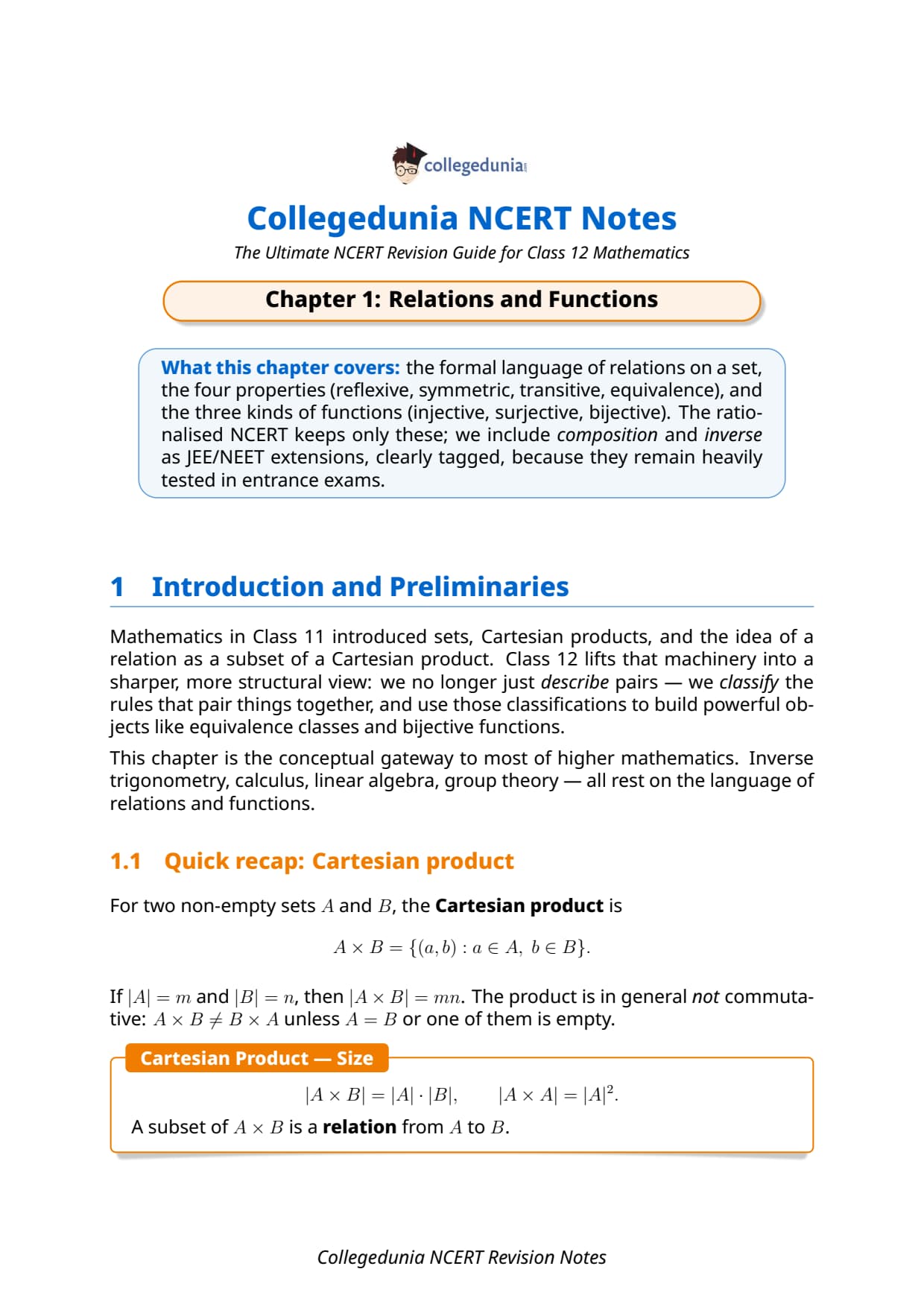
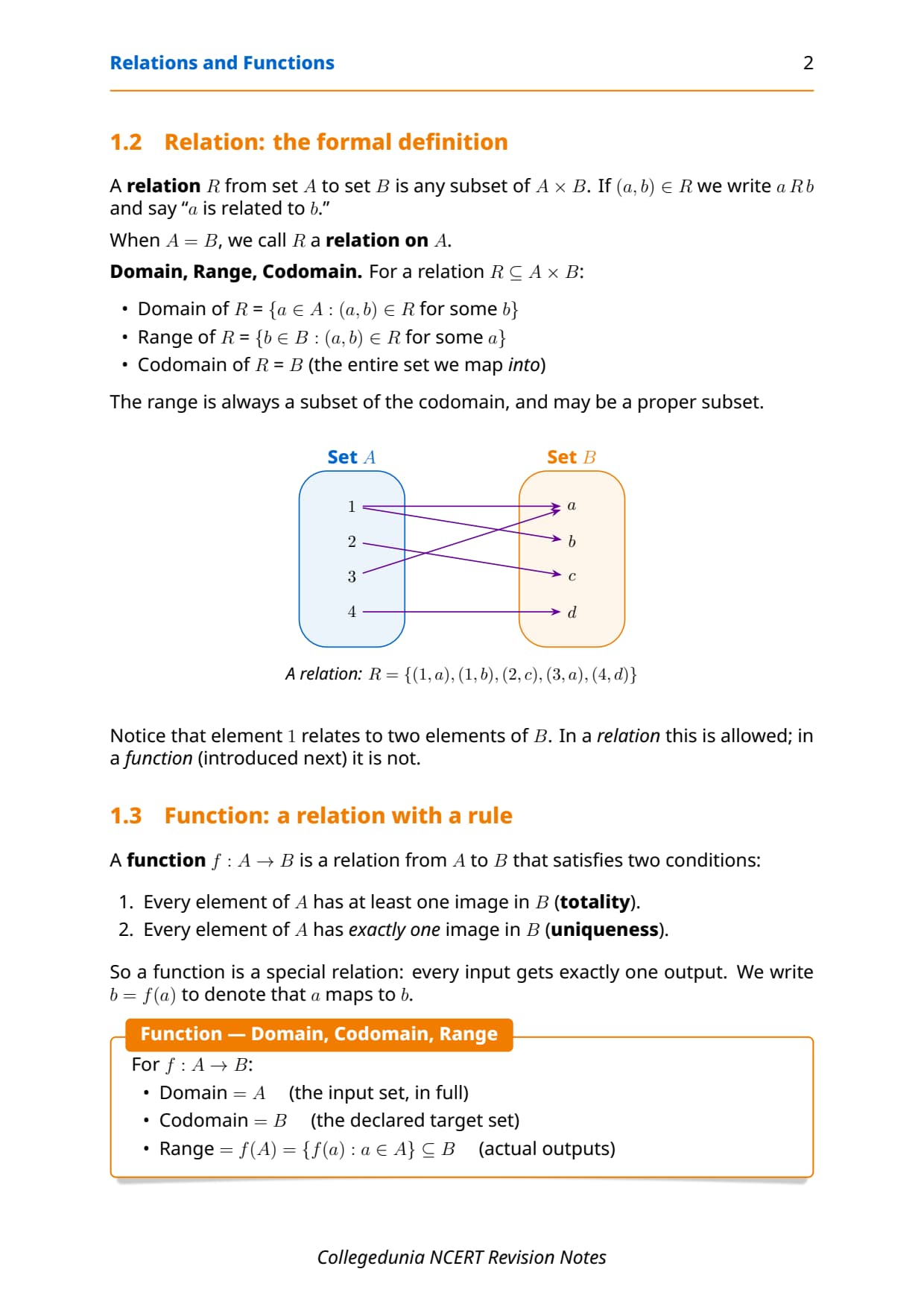


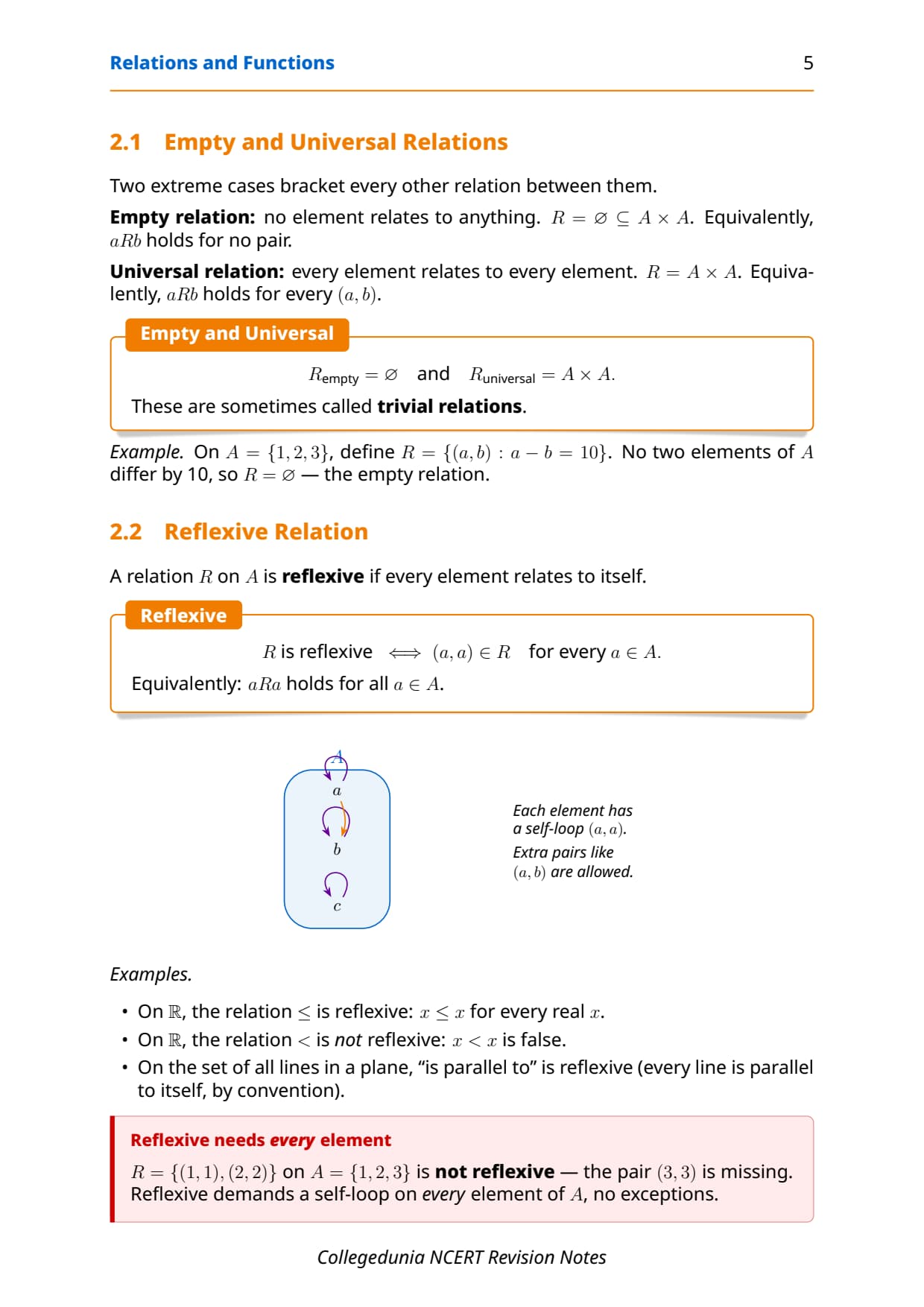
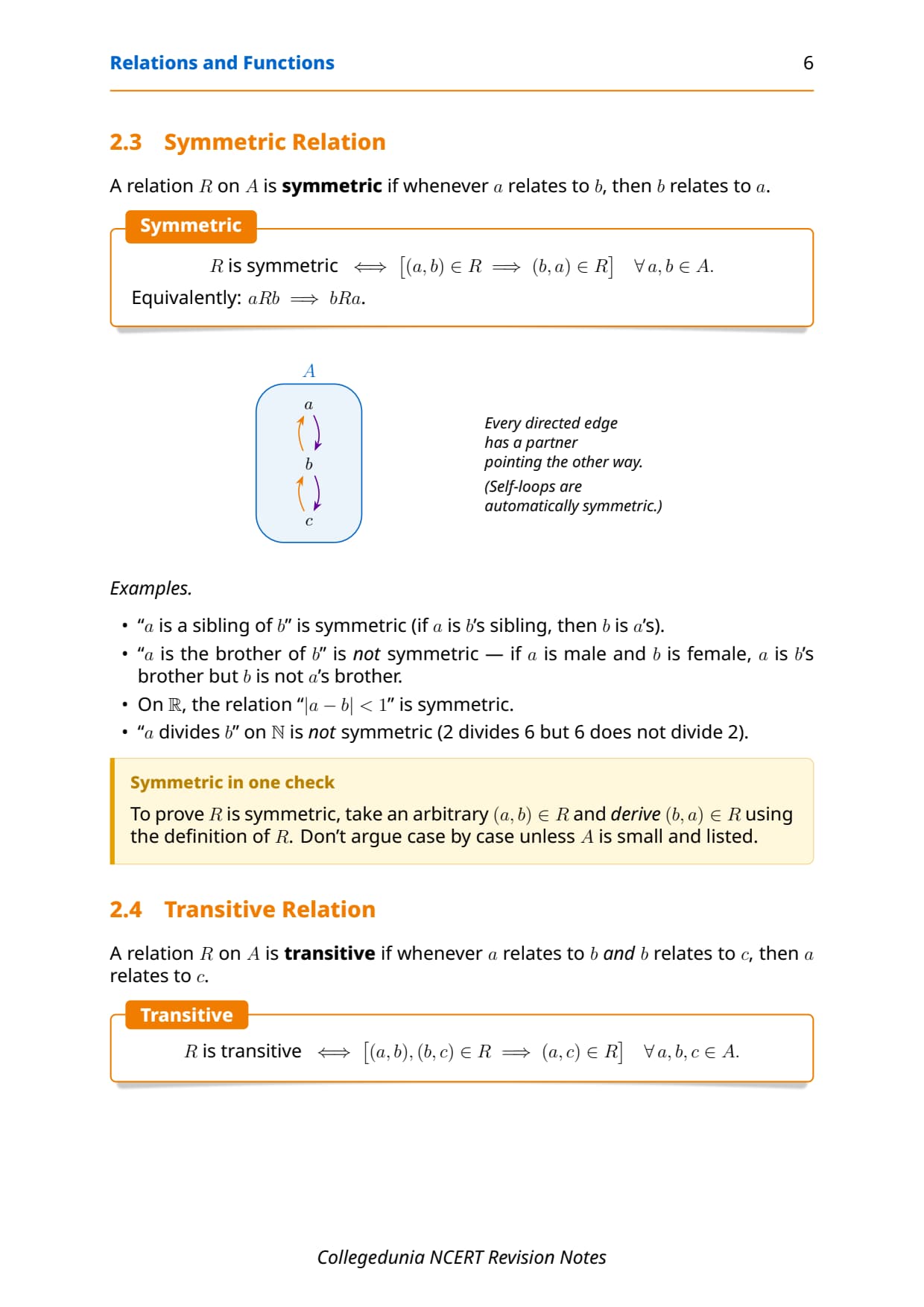
The notes below follow the NCERT rationalised syllabus and CBSE guidelines for 2026-27.
- CBSE Class 12 Boards: 4 to 6 marks, usually one short-answer proof plus one MCQ or case-based item.
- JEE Main and CUET (UG): 1 to 2 questions per shift on relation types, bijections, composition and invertibility.
- On this page: theory, the RST proof template, a formula sheet, the top board questions and a short FAQ.
Every line of these Relations and Functions Class 12 Notes is prepared by Collegedunia subject experts, mapped to the 2026-27 NCERT syllabus, and cross-checked against the last five CBSE papers plus JEE Main and CUET keys.
|
Table of Contents |
Why these Relations and Functions Class 12 Notes work for board exams
These Class 12 notes are built around three goals: clean definitions, exam-ready proofs, and quick recall of the RST checks that decide most of your Chapter 1 marks.
- NCERT-faithful definitions in the exact wording marking schemes accept.
- Proof templates for equivalence relations and one-one or onto checks.
- JEE and CUET callouts on composition and invertibility that state boards still ask.
Relations and Functions Class 12 Video Walkthrough
Source: Magnet Brains on YouTube
Relations and Functions Class 12 Most Important Topics for Board, JEE and CUET
The chapter has two halves: types of relations, then types of functions. The three relation properties carry the most marks.
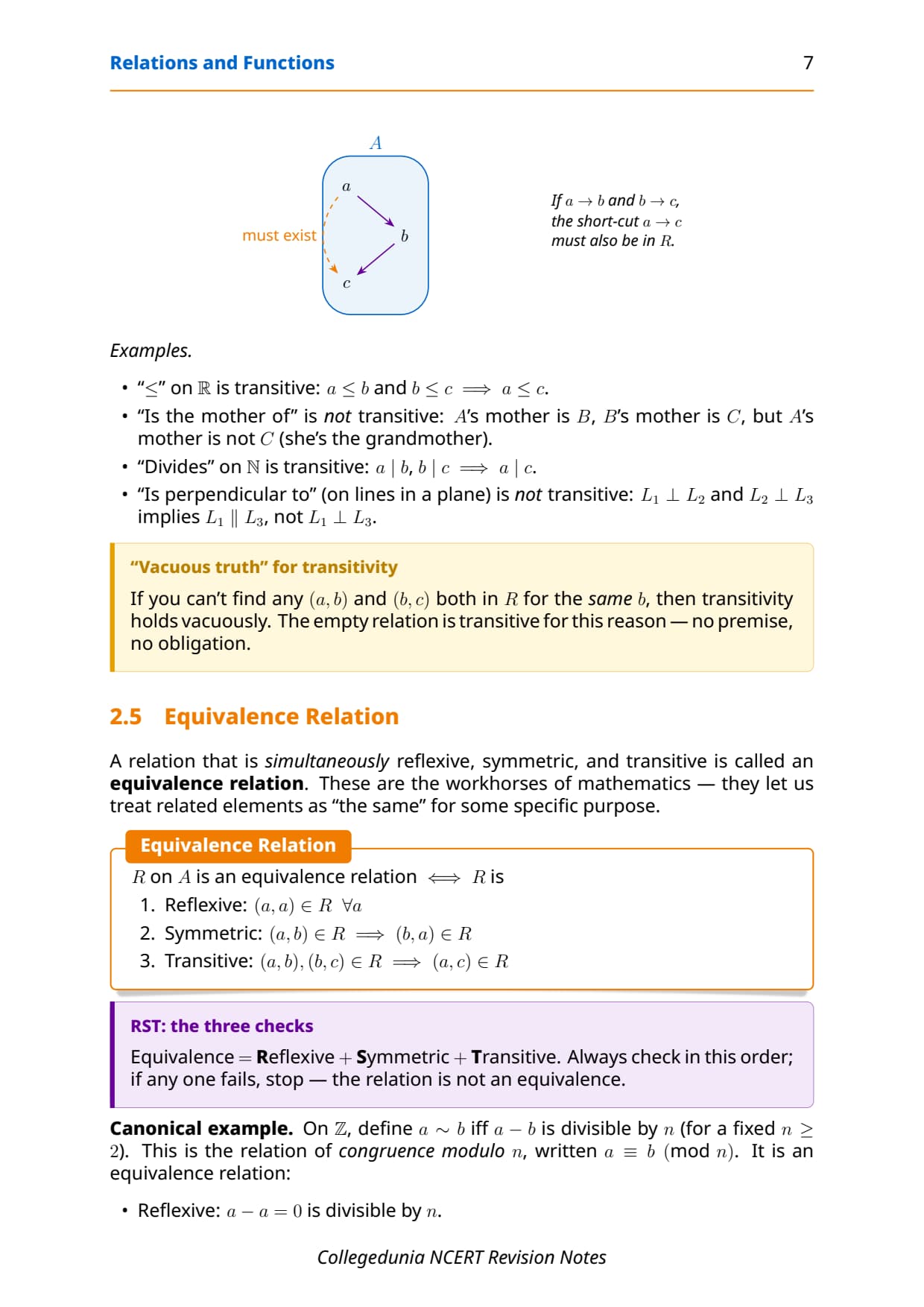
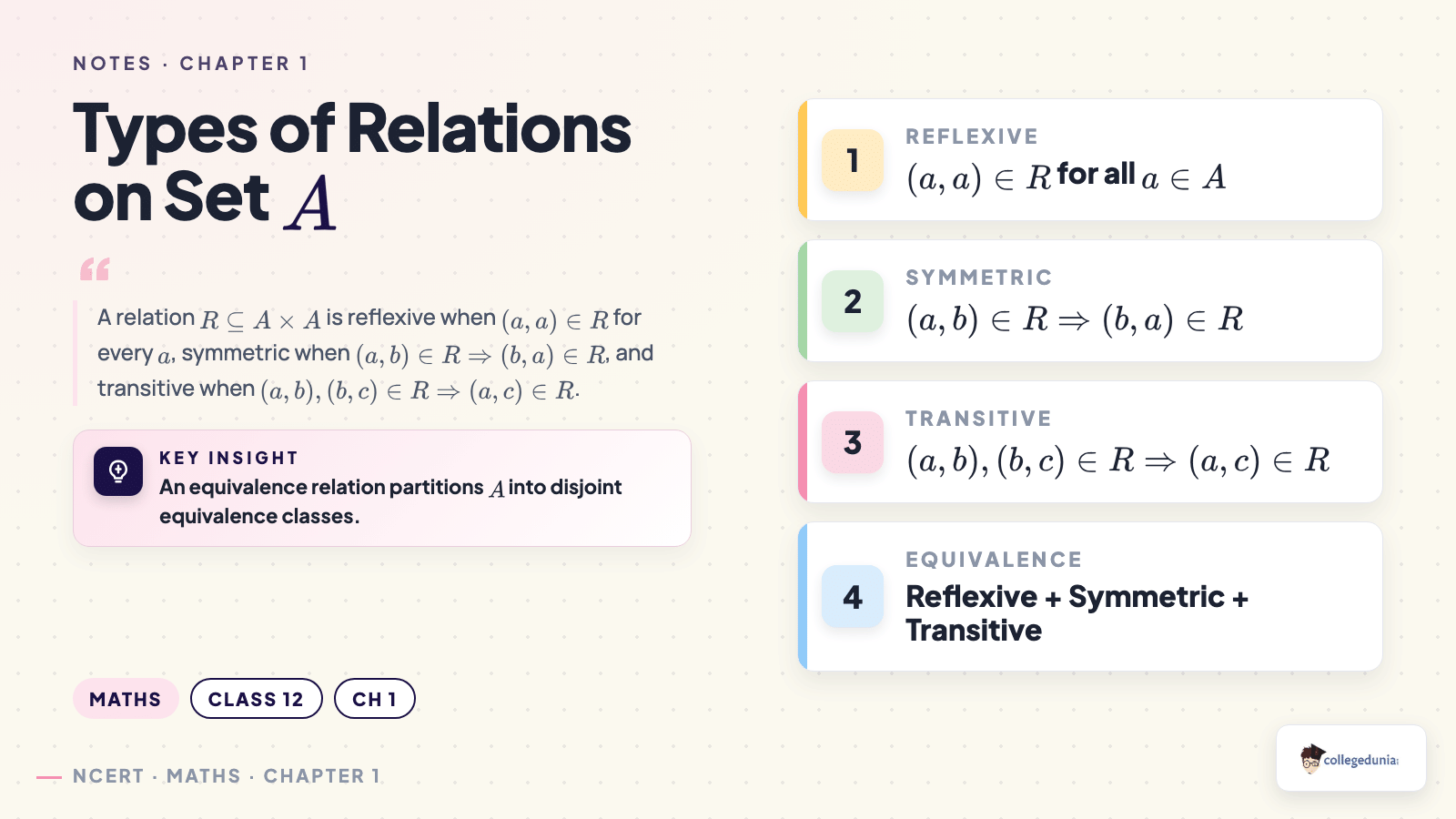
- Reflexive if (a, a) ∈ R for every a ∈ A.
- Symmetric if (a, b) ∈ R forces (b, a) ∈ R.
- Transitive if (a, b) and (b, c) ∈ R imply (a, c) ∈ R.
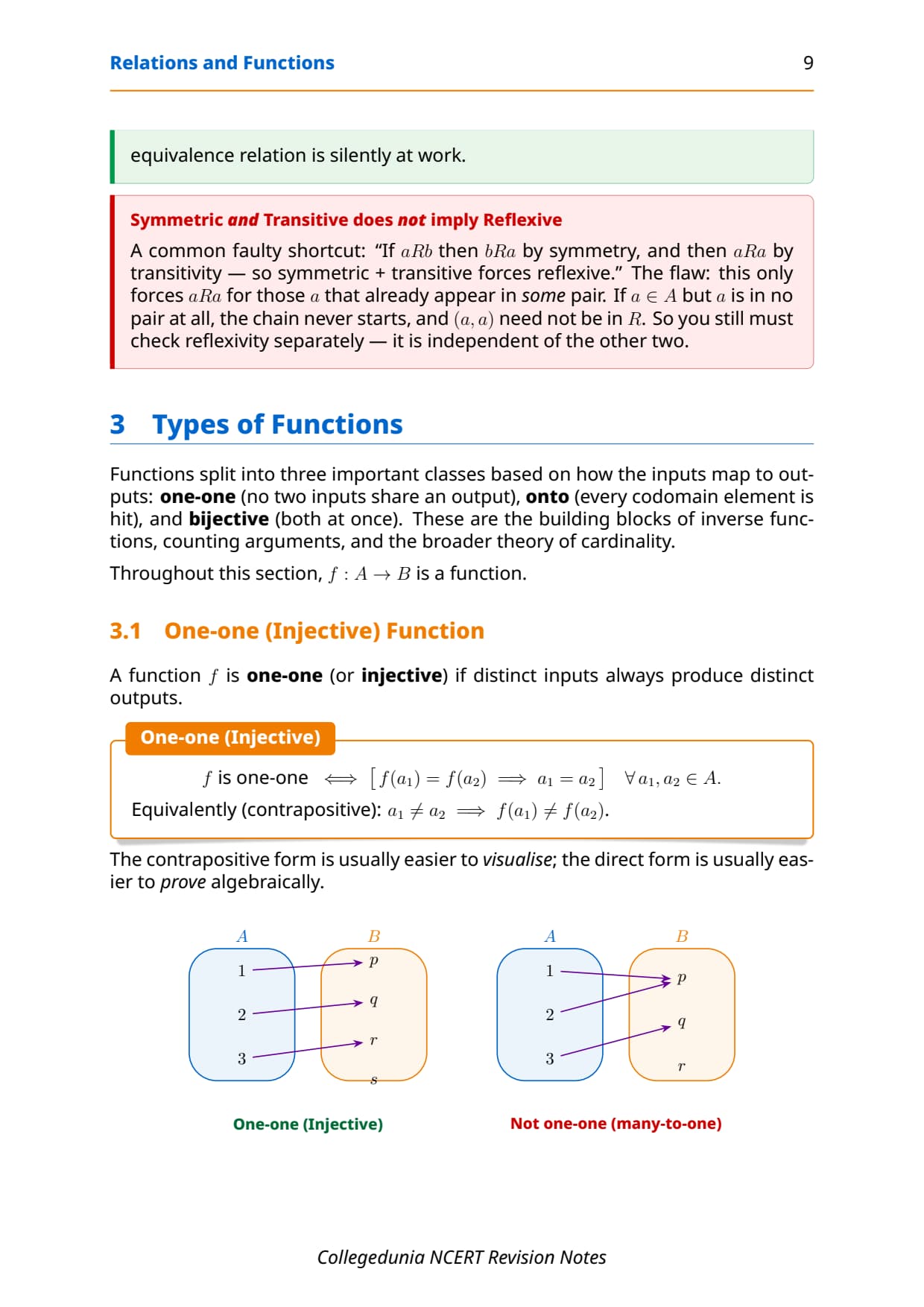
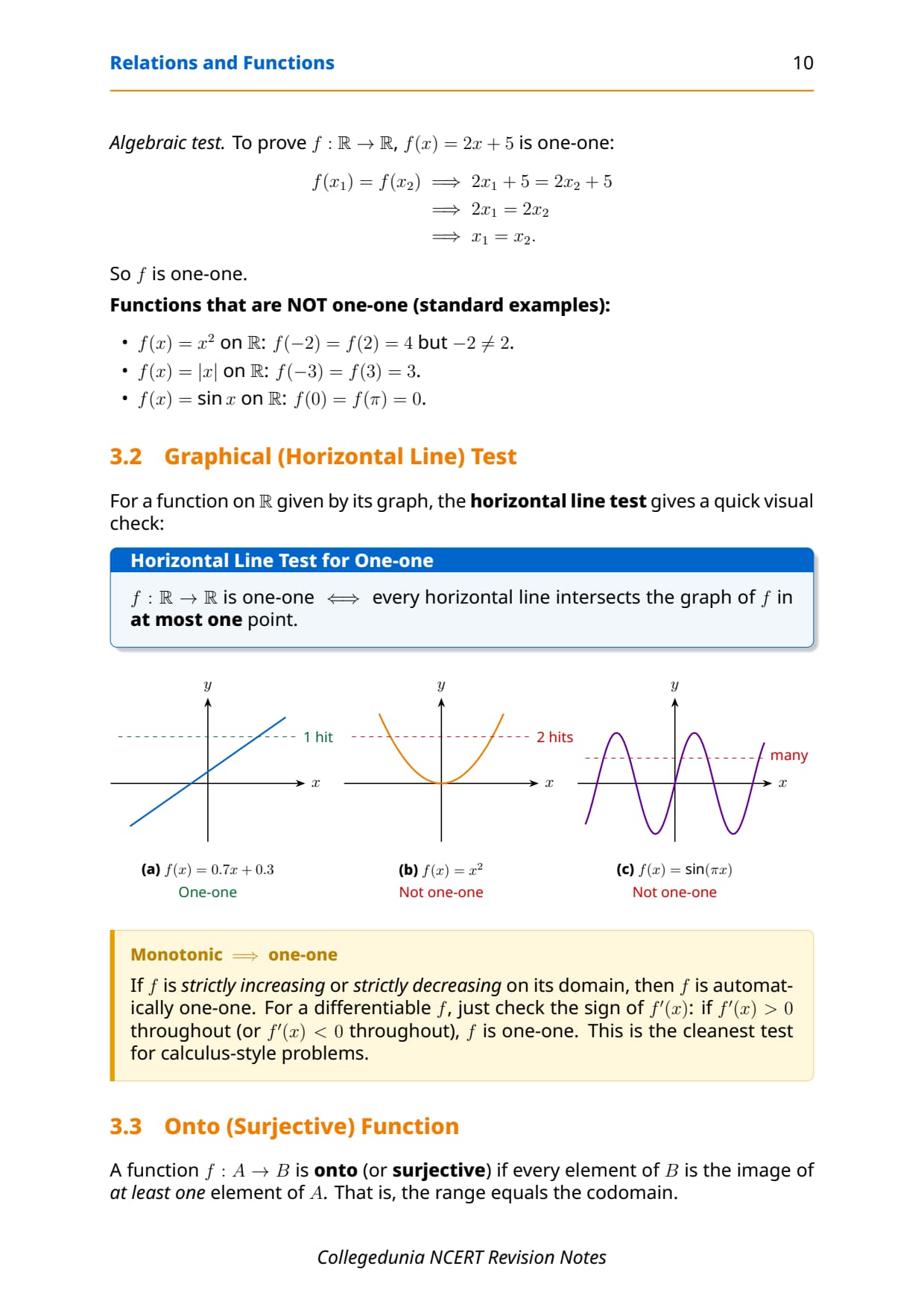
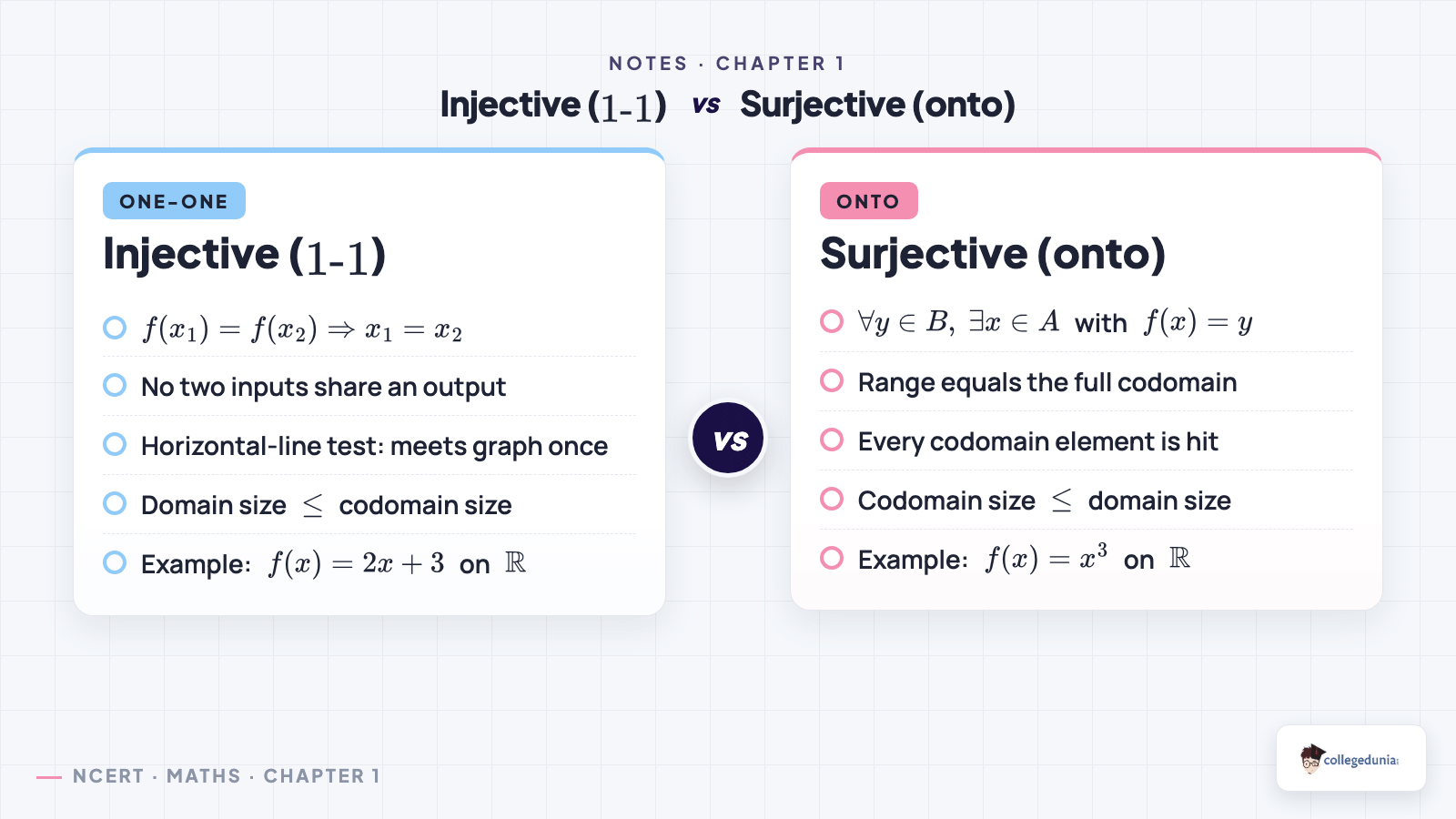
- One-one means distinct inputs give distinct outputs; onto means the range fills the codomain; bijective means both.
| NCERT Class 12 Maths Chapter 1: Important Sub-Topics | |
|---|---|
| Cartesian product and relations | Empty and universal relations |
| Reflexive, symmetric, transitive | Equivalence relations and classes |
| Definition of a function | One-one and onto functions |
| Bijective functions | Composition and invertibility (JEE) |
Relations and Functions Class 12 Formula Recall Cheat Sheet
| Quantity | Formula | Where it shows up |
|---|---|---|
| Total relations on a set of m elements | 2m2 | CBSE MCQ; JEE Main |
| Reflexive relations | 2m(m-1) | JEE Main; CUET |
| Symmetric relations | 2m(m+1)/2 | JEE Main |
| Functions from |A|=m to |B|=n | nm | CBSE; JEE Main |
| One-one functions (m ≤ n) | n!(n-m)! | JEE Main; CUET |
| Bijections on |A| = n | n! | CBSE; JEE |
Relations and Functions Class 12 Weightage Across Chapters
| Chapter | Topic | Avg CBSE Marks |
|---|---|---|
| Ch 1 | Relations and Functions | 5 marks |
| Ch 3 | Matrices | 8 marks |
| Ch 5 | Continuity and Differentiability | 8 marks |
| Ch 7 | Integrals | 10 marks |
| Ch 13 | Probability | 7 marks |
Relations and Functions Class 12 Important Questions in Board Exams
- Show that R = (a, b) : 2 divides a - b on Z is an equivalence relation. (CBSE 2019, 2022)
- Check whether f(x) = 3 - 4x is one-one and onto. (CBSE 2020, 2023)
- Find the number of equivalence relations on 1, 2, 3 containing (1, 2). (CBSE 2018, 2021)
- Show that a ≤ b on R is reflexive and transitive but not symmetric. (CBSE 2022)
- Prove R = (x, y) : 2x + y = 41 on N is neither reflexive, symmetric nor transitive. (CBSE 2024)
Relations and Functions Class 12: Confusion Pairs Students Mix Up
| Often confused | The clean distinction |
|---|---|
| Codomain vs Range | Codomain is declared in f : A → B; range is the actual outputs. Range is a subset of the codomain, equal only when onto. |
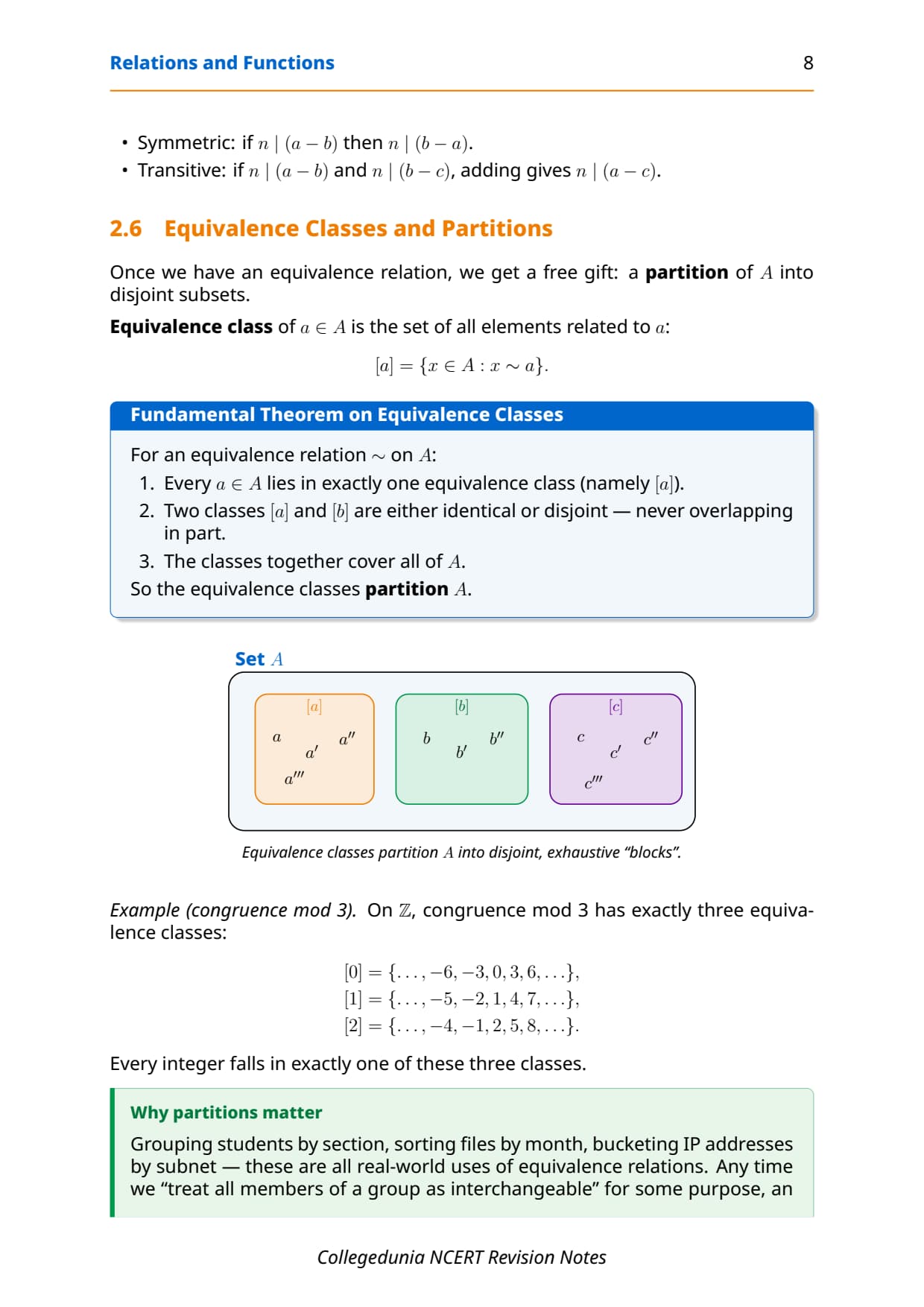
| Reflexive vs Equivalence | Reflexive is one property; an equivalence needs all three (RST). |
| One-one vs Onto | One-one is about distinct outputs; onto is about filling the codomain. |
| Function vs Relation | A relation is a function only if every domain element has exactly one image. |
Relations and Functions Class 12 Mistakes to Avoid in the Board Exam
- Confusing codomain with range and calling a function onto without checking the codomain.
- Missing the self-loop in reflexivity, the most common 1-mark slip.
- Assuming symmetry plus transitivity gives an equivalence; reflexivity must be verified on its own.
- Vague counterexamples for transitivity; use concrete numbers, which examiners reward.
Other Resources for Relations and Functions Class 12
| Chapter | Notes | NCERT Solutions |
|---|---|---|
| Ch 1 Relations and Functions | Relations and Functions Notes | Relations and Functions Solutions |
| Ch 2 Inverse Trigonometric Functions | Inverse Trigonometry Notes | Inverse Trigonometry Solutions |
| Ch 3 Matrices | Matrices Notes | Matrices Solutions |
| Ch 4 Determinants | Determinants Notes | Determinants Solutions |
| Ch 5 Continuity and Differentiability | Continuity Notes | Continuity Solutions |
Exercise-wise Breakdown of the Relations and Functions Chapter
| Exercise | Topic Tested |
|---|---|
| Exercise 1.1 | Empty, universal, reflexive, symmetric, transitive relations |
| Exercise 1.2 | Injective, surjective, bijective functions; composition |
| Miscellaneous Exercise | Mixed concepts; bijection-invertibility and counting |
PDF Download Formats for the Relations and Functions Notes
| Format | Best for | Approx. size |
|---|---|---|
| Normal-resolution PDF | Phone reading and quick revision | 2-3 MB |
| HD PDF | Print-ready desk study | 8-10 MB |
| Handwritten Notes PDF | Reading in a topper's handwriting | 5-7 MB |
Every definition and formula in the PDF matches the printed NCERT textbook. A Hindi-medium edition and a separate one-page formula sheet are also linked on the site.
How the Relations and Functions Notes Pair with Solutions and the Formula Sheet
| Resource | Use it for | When |
|---|---|---|
| Notes (this page) | Theory, definitions, exam patterns | First pass, before practice |
| NCERT Solutions PDF | Step-by-step solved exercises | Second pass, during practice |
| Formula Sheet PDF | One-page identity recall | Third pass, with mock papers |
How to Use the Relations and Functions Notes Page Effectively
- Sitting 1 (theory): read the NCERT chapter, mark every definition, then read the formula table above.
- Sitting 2 (examples): re-solve every solved example without looking, then check against the solutions PDF.
- Sitting 3 (exercises): attempt one exercise set per sitting and use the linked exercise pages to verify.
- Split revision roughly 60% NCERT and 40% JEE-style problems; for CUET focus on definitions and one-step MCQs.
Student Feedback - Class 12 Relations and Functions Difficulty (Collegedunia Survey, March 2026):
- 73% of 850 students surveyed rated proving an equivalence relation as the hardest 3-mark question in Chapter 1.
- Across 1,200 answer scripts, students lost an average of 1.4 marks on the codomain-versus-range confusion.
- 62% of JEE aspirants flagged counting bijections on a finite set as the topic they re-revise most.
Relations and Functions Class 12 Notes - Frequently Asked Questions
Is Chapter 1 Relations and Functions important for CBSE Class 12 Board Exam 2026?
Yes. It carries about 4 to 6 marks, usually a 3-mark equivalence-relation proof plus one MCQ or case-based item.
What is the difference between codomain and range?
The codomain is the set B declared in f : A to B. The range is the actual set of outputs. The range is always a subset of the codomain and equals it only when the function is onto.
How do I prove a relation is an equivalence relation?
Check all three properties separately: reflexive, symmetric and transitive. If any one fails, the relation is not an equivalence relation.
Are composition and invertibility still in the CBSE syllabus?
CBSE has trimmed them, but JEE Main, CUET and most state CETs still ask them, so the notes keep short callouts for these topics.
Is the Relations and Functions notes PDF free to download?
Yes. The notes PDF on this page is free, follows the 2026-27 NCERT syllabus, and is available in normal, HD and handwritten formats.



Comments