




These the enemy class 12 notes match the 2026-27 NCERT Vistas print and turn Pearl S. Buck's Chapter 4 into an exam-ready revision sheet. They cover the setting, the plot, the Sadao and Hana character arcs, and theme-tagged value points for the Long Answer.
- CBSE Weightage: 6 marks per Vistas Long Answer in Section C, drawn from the eight Reading with Insight questions
- Coverage: 12-page revision PDF, themed sections, character sketches, a four-act plot map, and a sample 6-mark answer
These Collegedunia notes are written by senior English educators and mapped to the 2026-27 NCERT Vistas textbook.
The Enemy Class 12 Notes: What the Chapter Covers
The Enemy is the fourth story in the Class 12 Vistas reader. Pearl S. Buck (1892-1973), the American Nobel laureate, first published it in 1942. Dr Sadao Hoki, a Japanese surgeon trained in America, finds a wounded American prisoner of war on the beach below his house. With his wife Hana beside him, he must choose between his doctor's oath and his country's wartime hatred. He heals the man and helps him escape.
| Section | What It Covers | Mark Yield |
|---|---|---|
| 1. Setting and Author | Pearl S. Buck; wartime Japan, 1942 Pacific War | 1-2 marks MCQ |
| 2. Plot Summary | Discovery, operation, the General's promise, the escape | 2-3 marks SA |
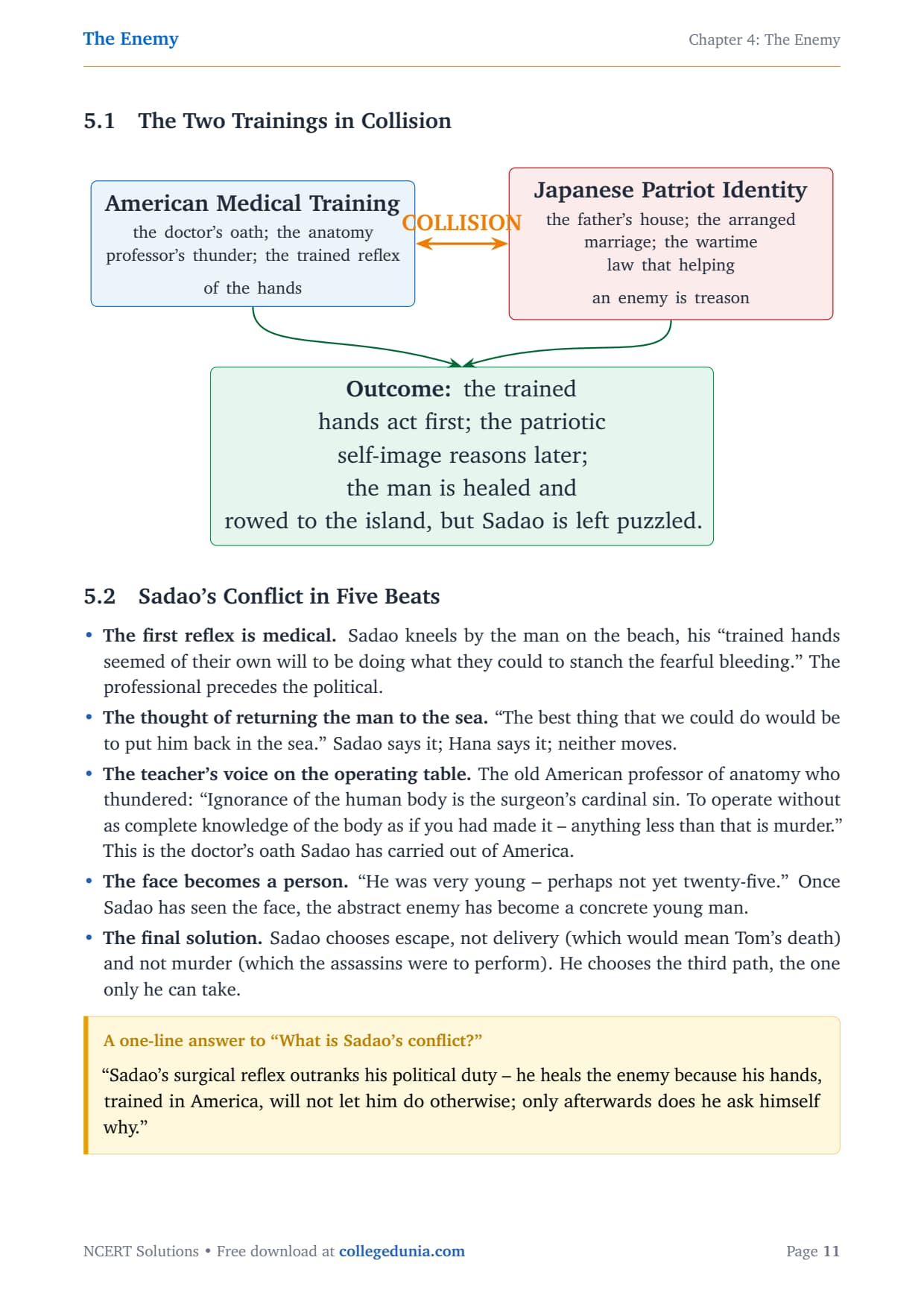
| 3. Character of Sadao | Surgeon trained in America; doctor's reflex over patriot's caution | 3-6 marks LA |
| 4. Character of Hana | The moral hinge; washes the prisoner, holds the ether cone | 3-6 marks LA |
| 5. Themes and Value Points | Duty vs loyalty, prejudice, honour, humanism, the unheroic ending | 4-6 marks LA |
| 6. Literary Devices | Third-person narration, four-act structure, the open ending | 2-3 marks SA |
CBSE almost always pulls one 6-mark Long Answer from sections 3, 4 or 5, plus a 1-mark MCQ.
The Enemy Video Explanation (Class 12 English)
Source: Magnet Brains on YouTube
The Four-Pass Framework for Revising The Enemy
Every Vistas chapter breaks into the same four passes. The mnemonic is C-P-C-T.
- Context. Learn the 1942 Pacific War frame, the Japanese setting, Buck's American background, and Sadao's American medical training. One of these turns up in the 1-mark MCQ.
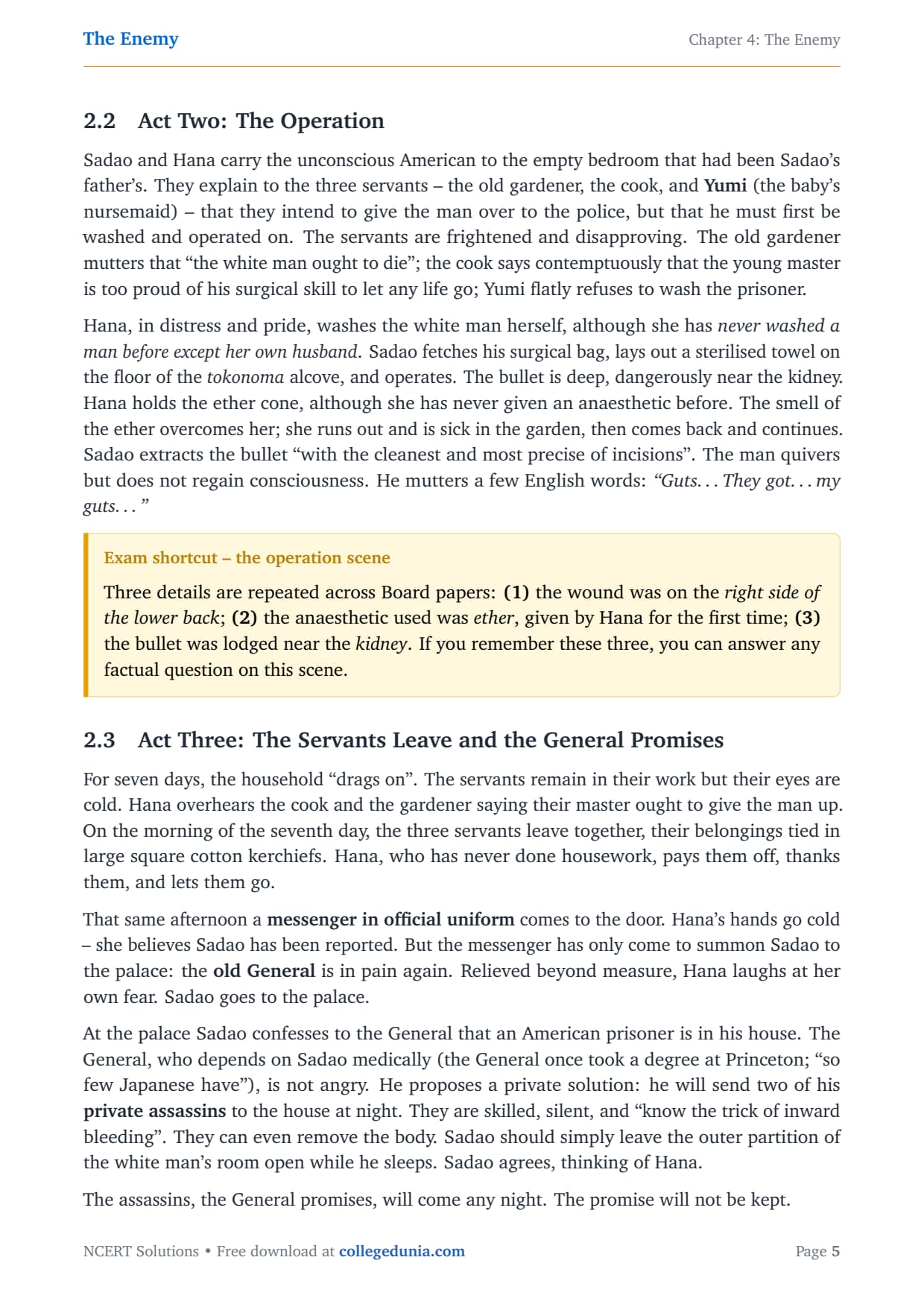
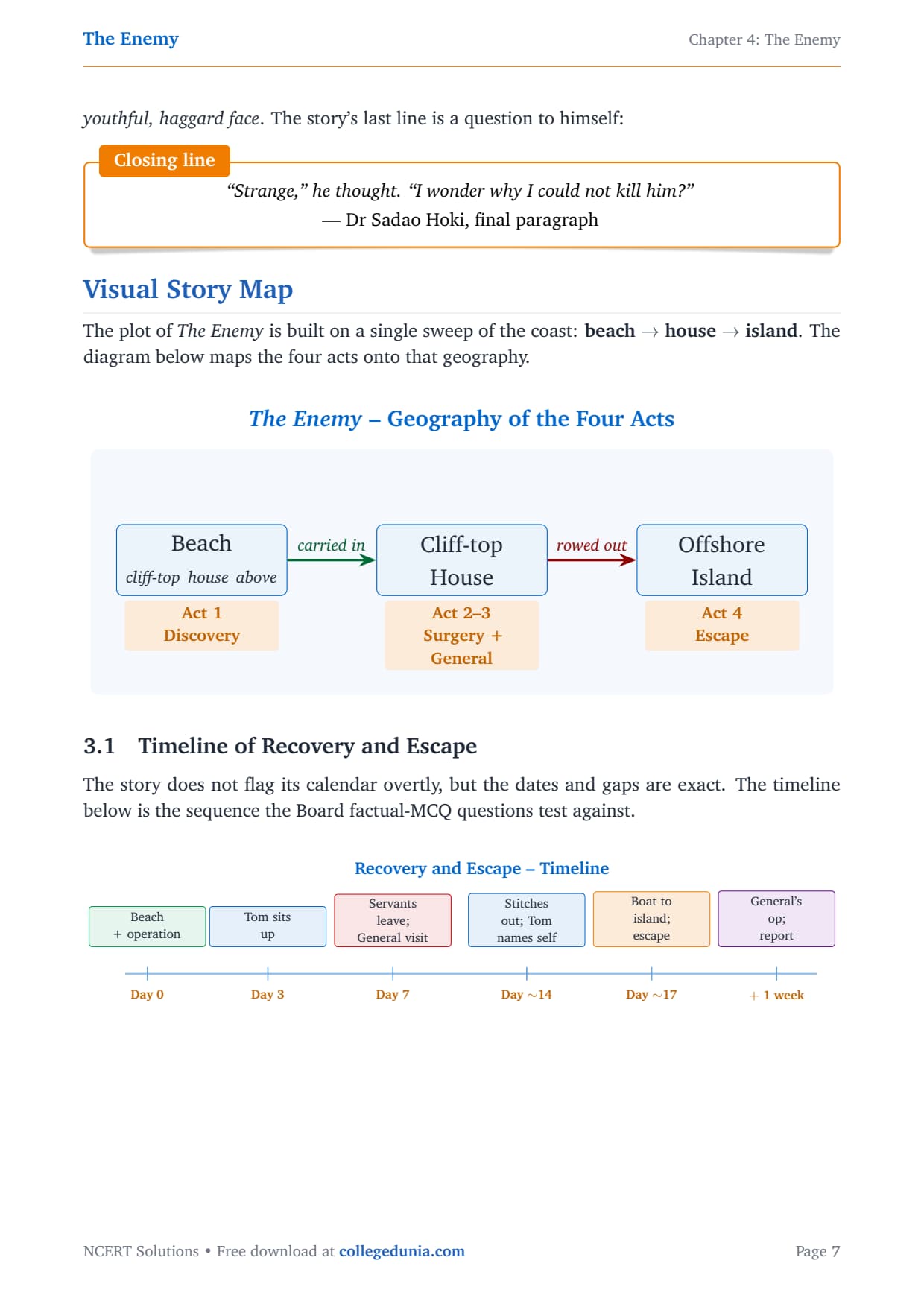
- Plot. Walk the story in four acts: discovery on the beach, the operation, the General's promise, and the escape to the island.
- Character. Build Sadao's arc on three markers: his medical reflex, the teacher's line "Ignorance of the human body is the surgeon's cardinal sin", and the closing question. Build Hana's arc on her defence of the man, her holding of the ether cone, and her return after retching.
- Theme. Sum up the argument in one line, that human loyalties outrank political ones at the moment of choice, then tag each quotation with a theme.
Setting: Wartime Japanese Coast, 1942
The story is set on the Japanese coast in the early months of the Pacific War. Sadao's cliff-top house looks down on the beach where the wounded American, later named Tom, is washed up. Buck keeps the action domestic: the veranda, the spare room turned operating theatre, the garden, the island. The war fills the dialogue but stays out of sight.
Character Sketch: Sadao, the Surgeon Across the Line
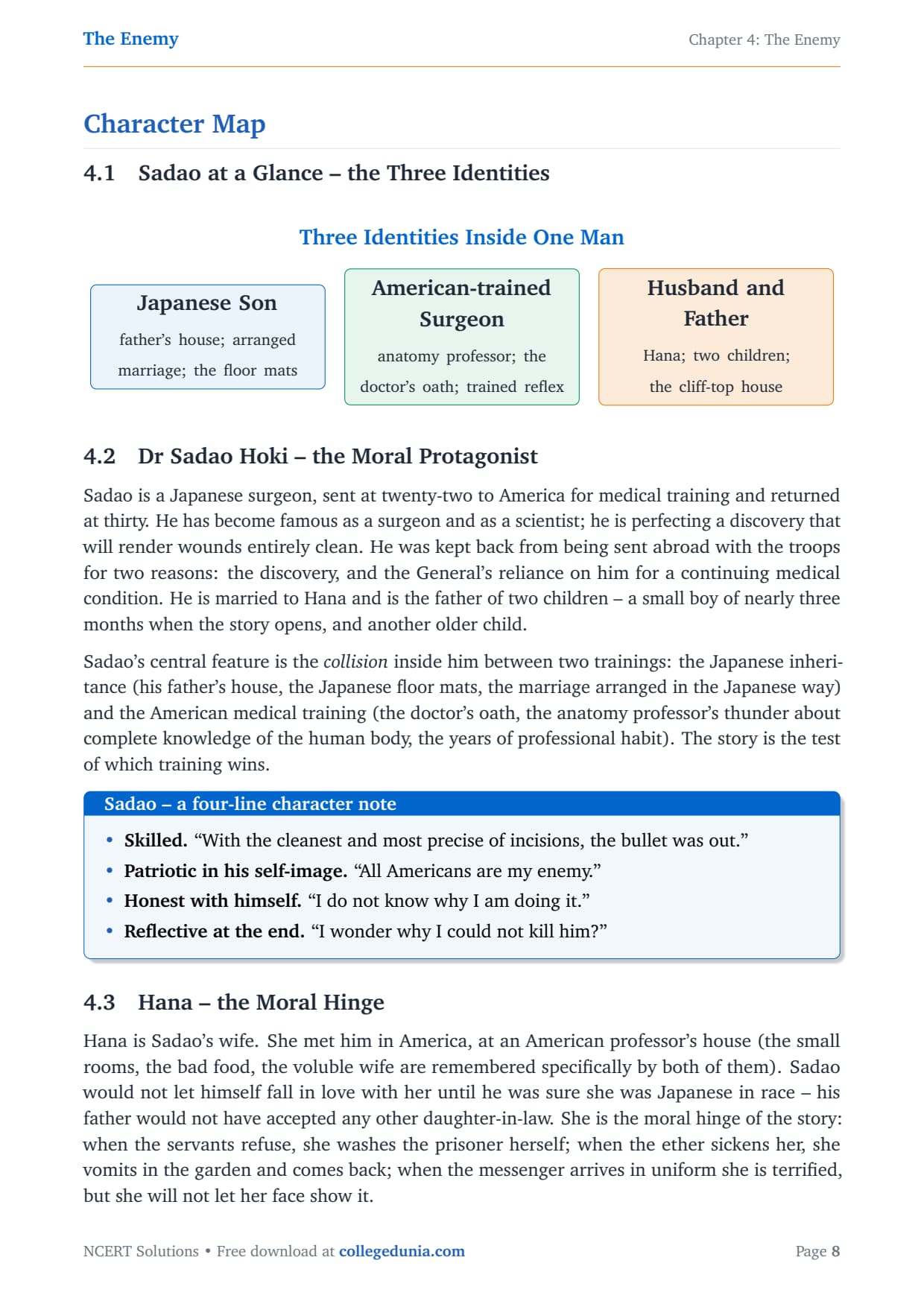
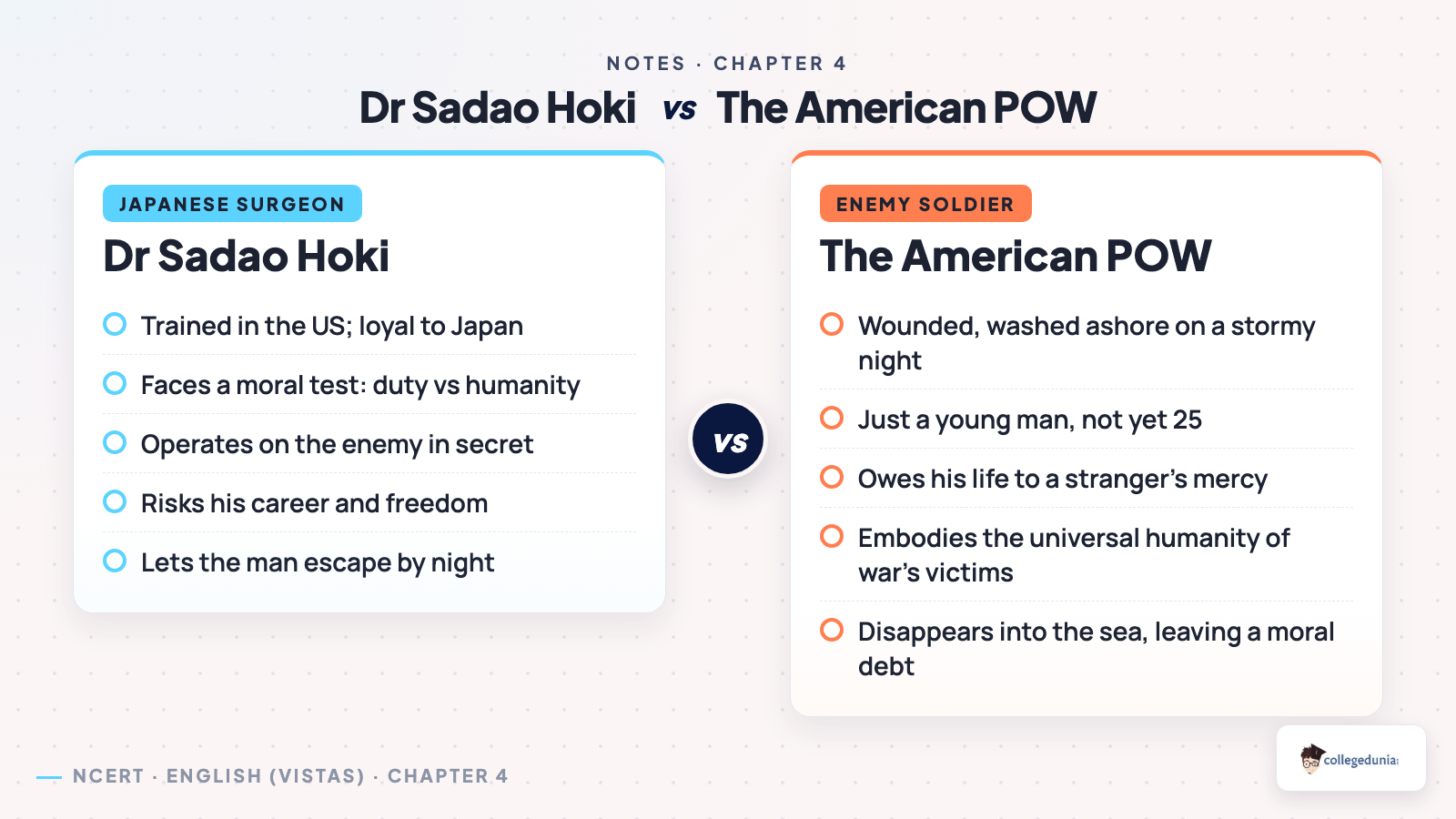
Sadao is the third-person protagonist: a Japanese patriot, a husband and father, and a skilled surgeon. He is not a heroic rebel but a man with a vocation and a marriage.
- Professional reflex first. His first look at the man is clinical. Nationality is named only after the bandage is on.
- American-trained, Japanese-rooted. Sent to America at 22 and home at 30, his teacher's warning returns to him over the operating table.
- Honour over public morality. He cannot harm the man with his own hands. The General's assassins are someone else's solution; the island is his.
- Unheroic ending. He feels no triumph; the story ends on a question, not a boast.
Character Sketch: Hana, the Moral Hinge
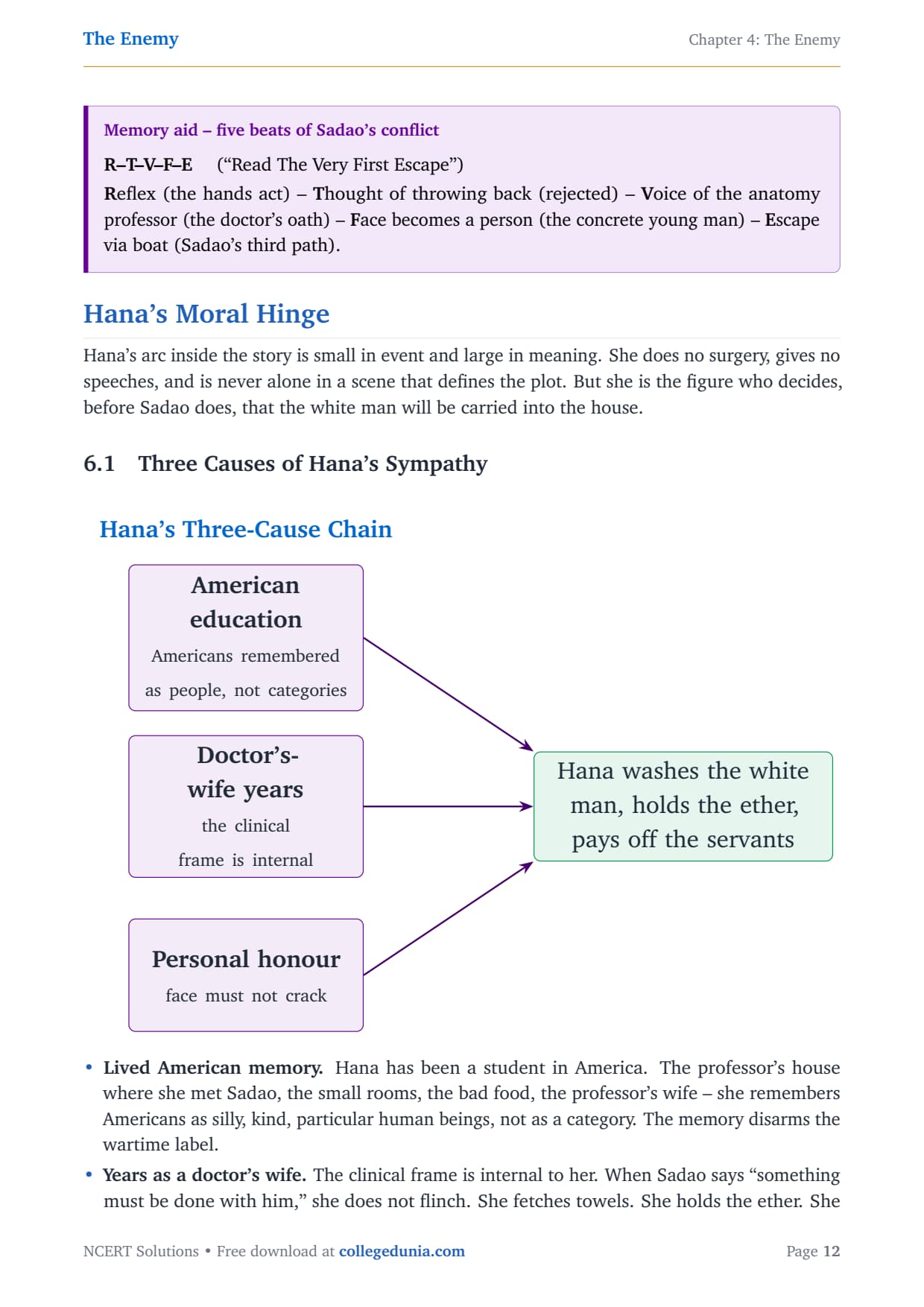
Hana is Sadao's wife and the chapter's quietest but most important figure, the moral hinge whose actions make his choice work.
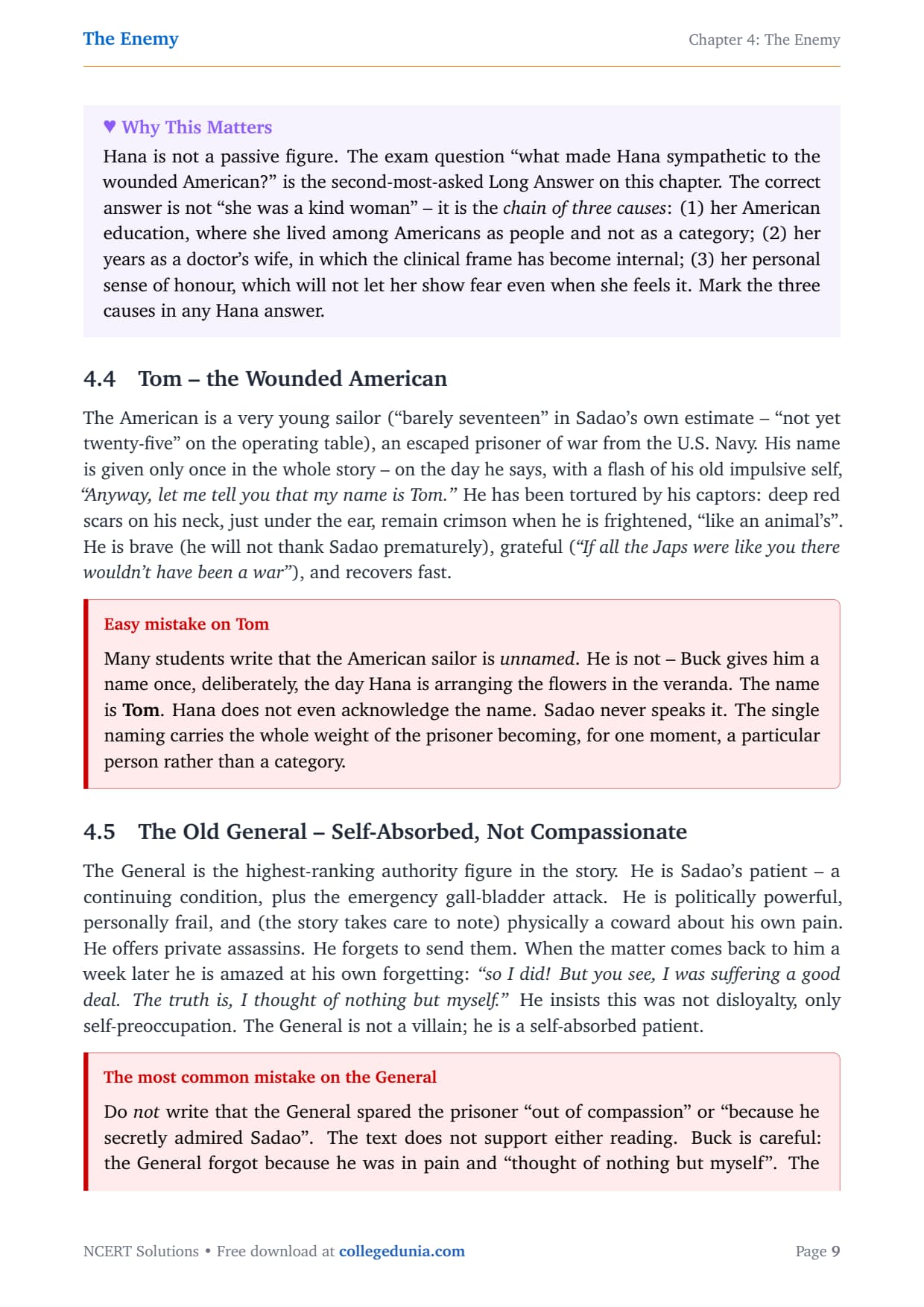
- American education. She remembers Americans as people, not an abstract enemy.
- Doctor's-wife work. She washes the prisoner when Yumi refuses and holds the ether cone during the surgery.
- Proof in acts. Sickened, she runs out and is heard retching in the garden, then returns with the anaesthetic.
- Domestic anchor. Her line, "Is this anything but a man? And a wounded helpless man!", backs Sadao's decision.
Symbolism: Reading Buck's Five Embedded Markers
The chapter turns on five recurring markers. Tagging each by its meaning gives fast MCQ recall.
| Marker | Surface Image | Meaning |
|---|---|---|
| The Bullet Wound | A gun wound on the American's lower back, Sadao's first focus | The doctor's reflex before political labelling |
| The Ether Cone | The anaesthetic cotton Hana holds near Tom's nostrils | Hana's physical solidarity |
| The General's Assassins | Killers the General offers, never sent because of his illness | Public morality without follow-through |
| The Torch-Flash Signal | Two flashes at sunset if food runs out, one if all is well | The bridge between shelter and freedom |
| The Korean Fishing Boat | The boat that picks Tom up from the island | The exit route out of the war |
Themes: Five Lines You Should Memorise for The Enemy
- Duty as doctor vs duty as patriot. The professional loyalty outranks the political one at the moment of choice. Sadao stays a patriot but cannot kill a man he has nursed.
- Wartime prejudice and its limits. The servants feel it and Hana first recoils, yet vocation and honour override it.
- Personal honour vs public order. The General has order; Sadao and Hana have honour. Buck endorses the second by letting the promise lapse.
- Humanism above borders. Once the enemy has a face, the abstract category breaks down.
- The unheroic ending. Sadao ends with a question, not a victory.
Scene-by-Scene Summary (Four Acts)
| # | Act | Key Detail |
|---|---|---|
| 1 | Discovery on the Beach | Breakers throw up a wounded young American; Sadao's first reflex is medical, not political. |
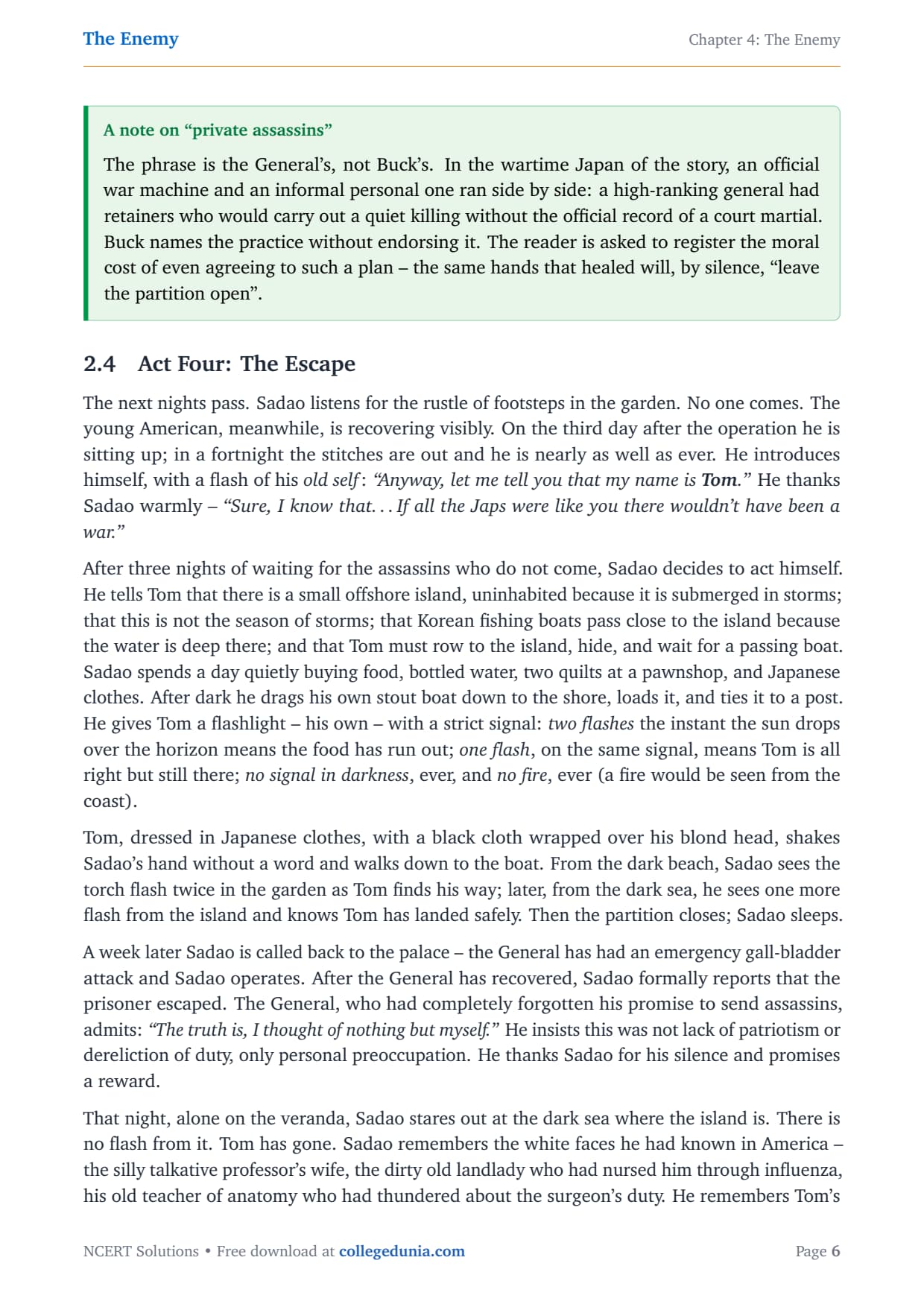
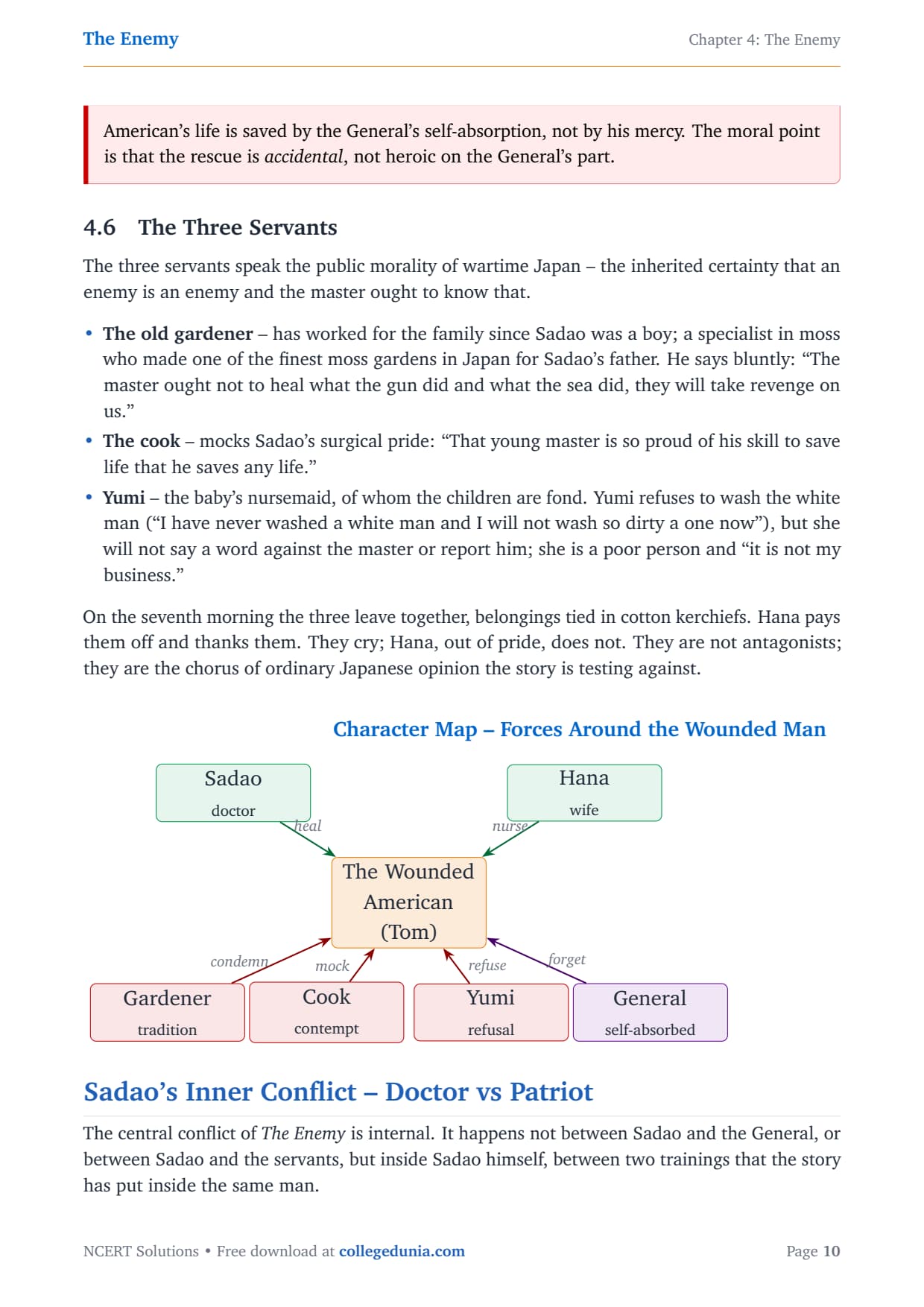
| 2 | The Operation | The servants refuse; Hana washes the prisoner and gives the anaesthetic; Sadao removes the bullet; the American names himself Tom. |
| 3 | The General's Promise | The General offers private assassins but forgets, sending no one because of his own illness. |
| 4 | The Escape | Sadao gives Tom a boat and supplies for the offshore island; the torch-flash signal is set; a Korean fishing boat carries him away safely. |
Common Mistakes Students Make in The Enemy Answers
- Reading the General's forgetting as compassion. He says, "I thought of nothing but myself."
- Treating Hana as passive. She is the moral hinge who washes the prisoner and holds the ether cone.
- Calling Sadao's choice easy. He agonises throughout; the choice is forced, not free.
- Forgetting the prisoner is named Tom. Refusing to use the name loses textual-accuracy marks.
- Quoting only one or two lines. A 6-mark answer expects four to five text anchors.
CBSE Class 12 English Previous Year Questions on The Enemy
The 6-mark Long Answer rotates between duty-vs-loyalty, the General's attitude, rising above prejudice, and the doctor's final solution.
| Year | Long Answer Focus | Marks |
|---|---|---|
| 2025 | Rising above wartime prejudice | 6 |
| 2024 | Hana's role when the servants refuse | 4 |
| 2023 | Was the doctor's final solution the best | 6 |
| 2022 | The General's attitude to the enemy soldier | 5 |
| 2021 | Private individual vs loyal citizen | 6 |
| 2020 | The soldier's reluctance to leave | 4 |
Full PYQ map: The Enemy NCERT Solutions.
Other Resources for The Enemy (Class 12 English)
| Resource | Link |
|---|---|
| Notes (this page) | The Enemy Notes |
| NCERT Solutions | The Enemy Class 12 English NCERT Solutions |
| Handwritten Notes | The Enemy Handwritten Notes |
| NCERT Book PDF | The Enemy NCERT Book PDF |
| CBSE Syllabus | CBSE Class 12 English Core Syllabus 2026-27 |
NCERT Notes for Class 12 English Vistas: All Chapters
| Chapter | Notes Link |
|---|---|
| Chapter 1 | The Third Level Notes |
| Chapter 2 | The Tiger King Notes |
| Chapter 3 | Journey to the End of the Earth Notes |
| Chapter 5 | On the Face of It Notes |
| Chapter 6 | Memories of Childhood Notes |
Student Feedback
In a Collegedunia poll of 1,200 Class 12 students, 78% said the Sadao and Hana character arcs were the hardest 6-mark answer to structure, and 84% rated the C-P-C-T four-pass framework the fastest way to revise the chapter before the exam.
FAQs on The Enemy Class 12 Notes
FAQs on The Enemy Class 12 Notes
What is the central theme of The Enemy Class 12?
The central theme is a doctor's duty to heal versus a citizen's duty to be loyal in wartime. Buck sets up Sadao as a Japanese surgeon trained in America who finds a wounded American prisoner of war on his beach during World War II. The chapter argues that the older professional and human loyalties outrank the newer political ones in the moment of choice. The story also explores wartime prejudice, personal honour vs public order, and humanism above borders.
Who is the protagonist of The Enemy?
Dr Sadao Hoki is the protagonist - a Japanese surgeon, educated in America (sent at 22, returned at 30), perfecting a discovery to render wounds entirely clean. The old General relies on him medically, which is partly why Sadao has not been sent abroad with the troops.
What is Hana's role in the story?
Hana is the story's moral hinge. Educated in America, married to Sadao, she stands with him when the servants openly defy them. She washes the prisoner's body herself when Yumi refuses, holds the cotton saturated with ether near his nostrils for the anaesthetic, runs out and is heard retching in the garden, then returns with the bottle in a clear voice. Her line - "Is this anything but a man? And a wounded helpless man!" - and her actions prove her sympathy in deed, not declaration.
Why does the General not send the assassins?
The General offered to send his "private assassins" to kill the prisoner but forgot to do so because of his own illness. He himself admits, "I thought of nothing but myself." His attitude is best read as self-absorption caused by illness, not as compassion or as dereliction of duty.
How does the story end?
Sadao provides Tom with food, warm clothing, bottled water, a small flashlight and a stout boat. Tom rows himself to a small offshore island where a Korean fishing boat will pick him up. The sunset signal-flash (two flashes at the moment the sun drops over the horizon if food runs out, one flash if "all right but still there", never in darkness, and no fire) is the chapter's bridge solution. Sadao stands on his veranda that night, sees "no prick of light in the dusk" from the island, and knows the prisoner is gone safely. The chapter closes with Sadao's honest question: "Strange, I wonder why I could not kill him?"
How many pages is The Enemy Class 12 Notes PDF?
The Collegedunia The Enemy Class 12 Notes PDF runs 12 pages and covers setting, plot in four acts, character sketches of Sadao and Hana, themes, literary devices, important quotations, common mistakes, and a year-wise CBSE PYQ map with a sample 6-mark answer.



Comments