




Evolution is the slow, heritable change in the genetic makeup of populations over generations. Class 12 Biology Chapter 6 Evolution is a high-yield NEET topic and a steady CBSE Board scorer. This page hosts the 2026-27 NCERT notes PDF, sub-topic weightage, a Hardy-Weinberg worked example, and the human-evolution timeline.
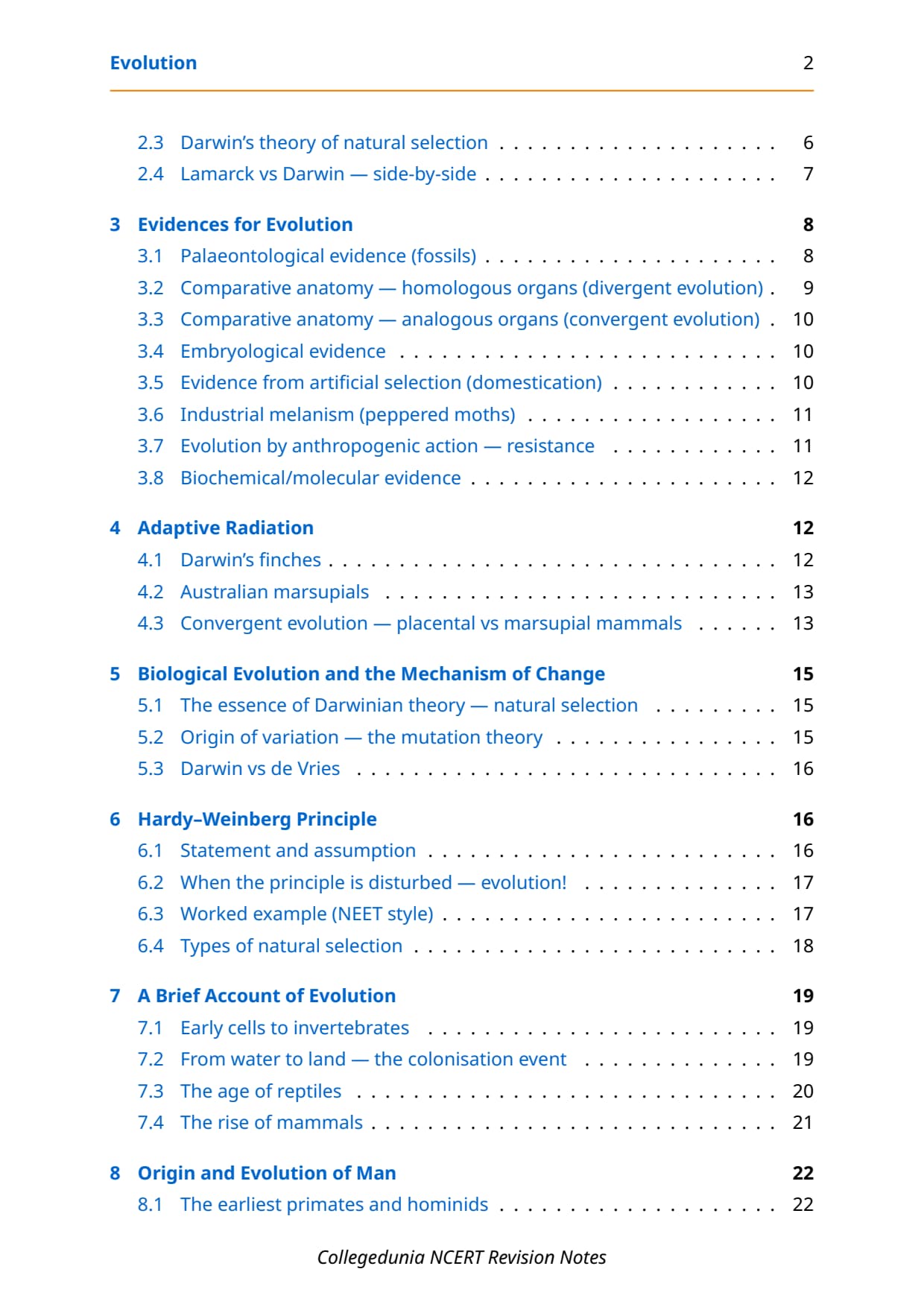


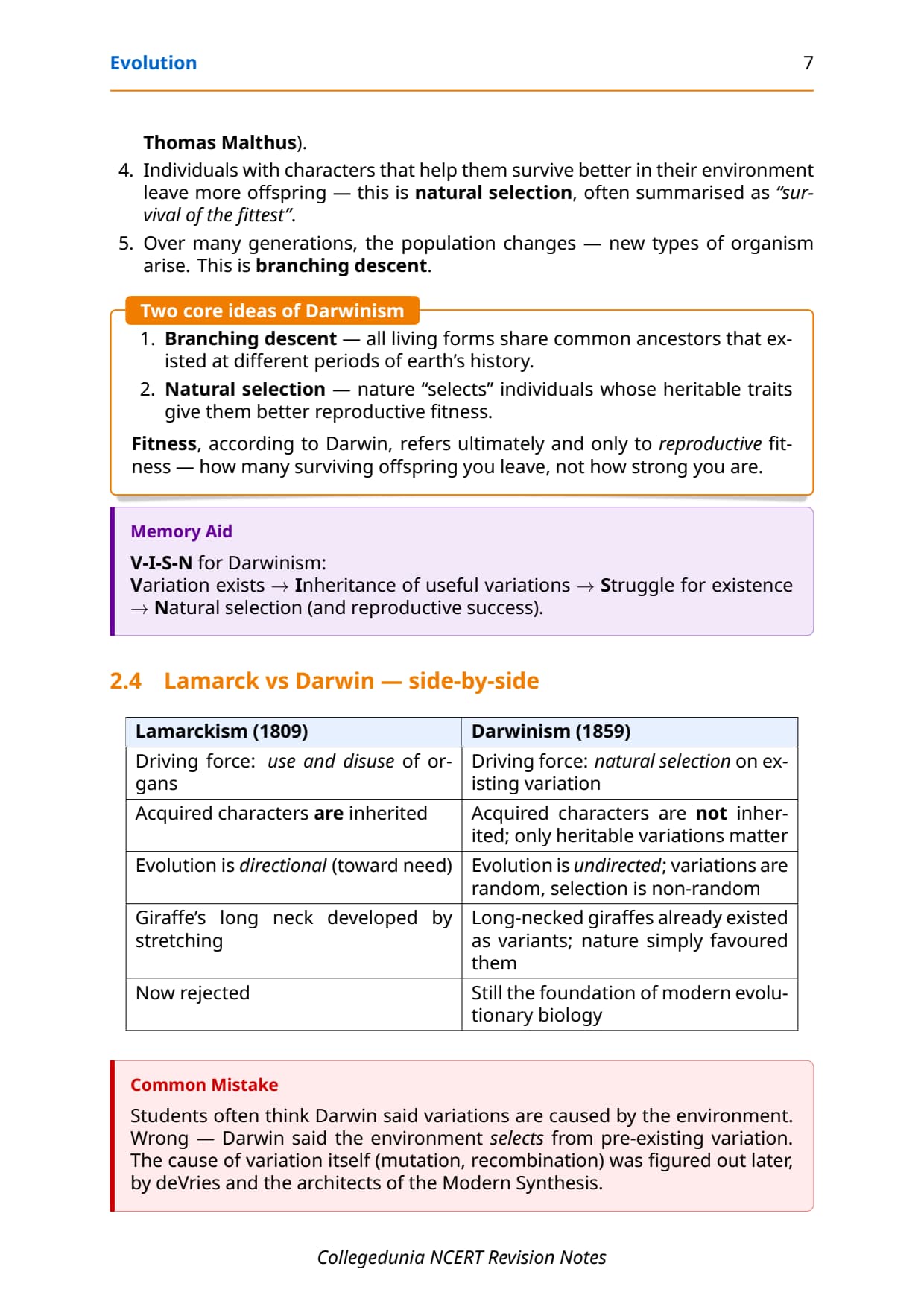
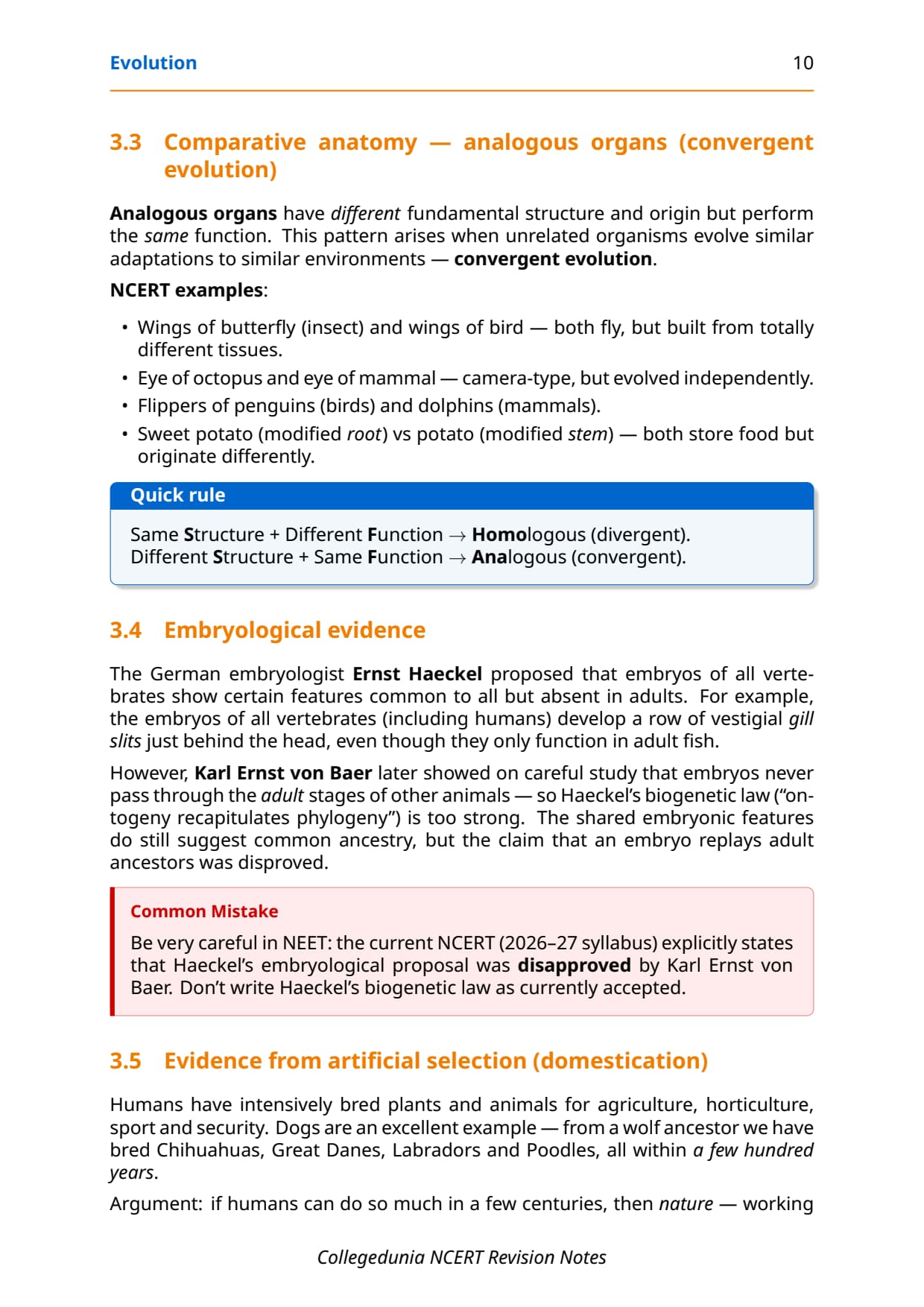

- CBSE Weightage: 6 to 8 marks, part of Unit VII (Genetics and Evolution).
- NEET Weightage: 3 to 5 questions every year.
Why Evolution Is High-Yield for NEET and CBSE Class 12 Biology
One idea, natural selection, links Genetics, Ecology, and Human Health. About 3 to 5 NEET questions sit here each year, so mastering it can earn 12 to 20 marks. The current 2026-27 NCERT keeps all nine sub-topics intact, from origin of life to human evolution.
- Built for two exams: a CBSE 5-marker and a NEET MCQ, side by side.
- NEET extras: microspheres, RNA-world, and speciation types.
Evolution Video Lecture for Class 12 Biology
Source: Magnet Brains on YouTube
Evolution Glossary: 12 Must-Know Terms for Class 12 Biology
Most confusion in this chapter comes from overlapping terms. This glossary fixes each term to one precise meaning.
| Term | One-Line Meaning |
|---|---|
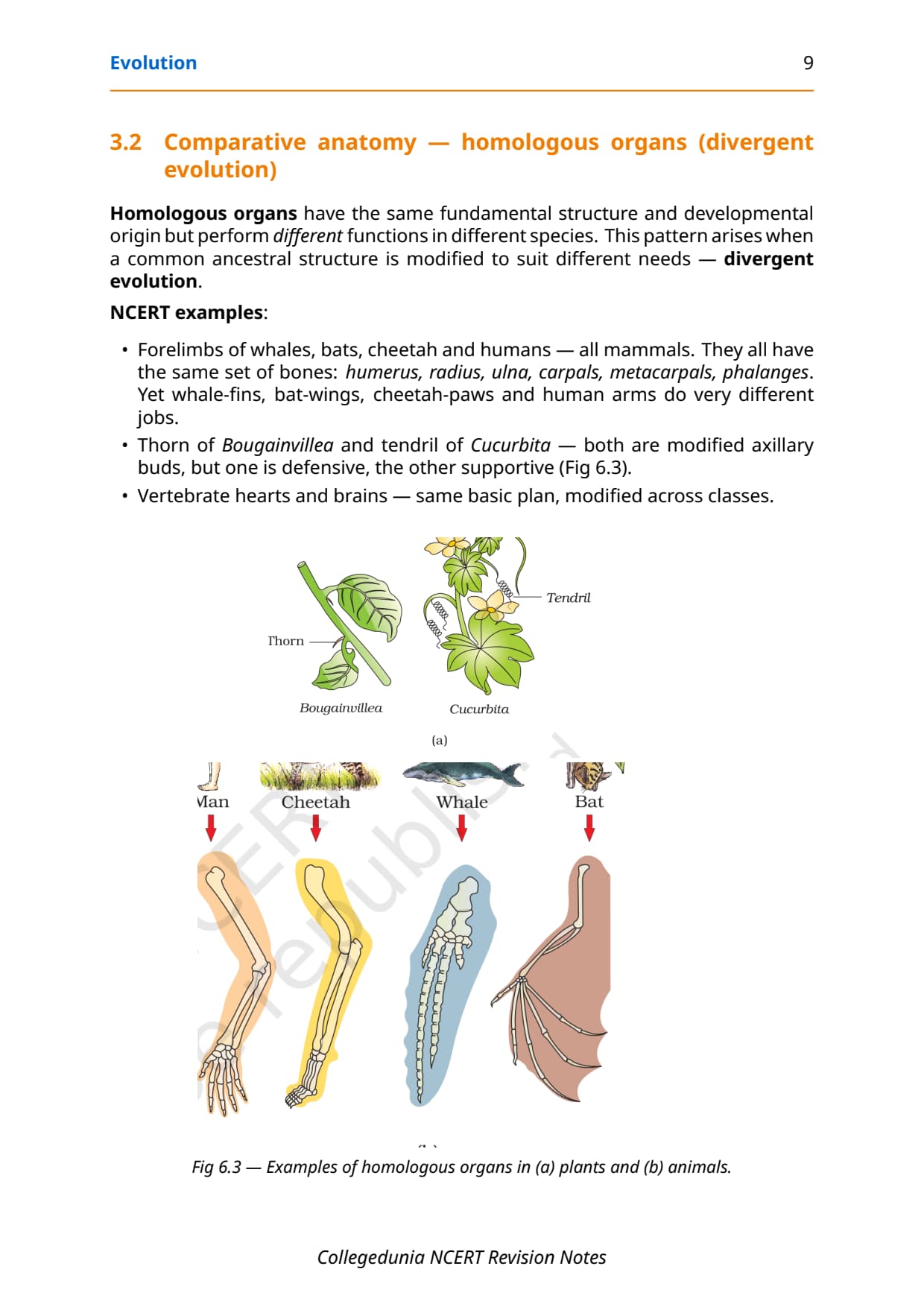
| Homologous organs | Same origin, different function; shows divergent evolution. |
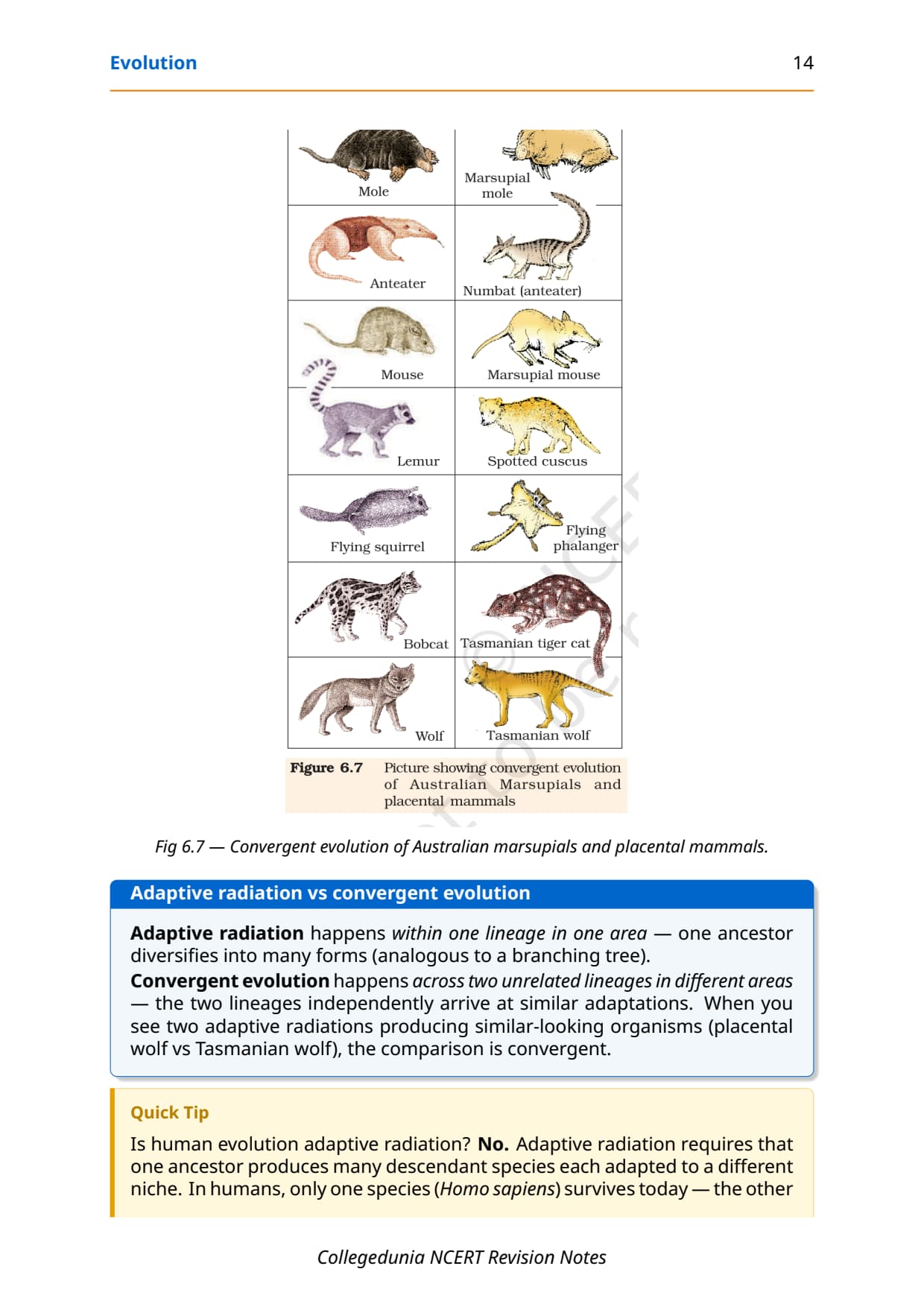
| Analogous organs | Different origin, same function; shows convergent evolution. |
| Vestigial organs | Reduced, non-functional remnants (appendix, wisdom teeth). |
| Adaptive radiation | One ancestor diversifies into many niches. |
| Convergent evolution | Unrelated species evolve similar features under similar pressure. |
| Genetic drift | Random allele-frequency change in small populations. |
| Founder effect | Drift when a small group starts a new population. |
| Bottleneck effect | Drift when a population is suddenly cut in size. |
| Hardy-Weinberg equilibrium | Allele frequencies stay constant each generation. |
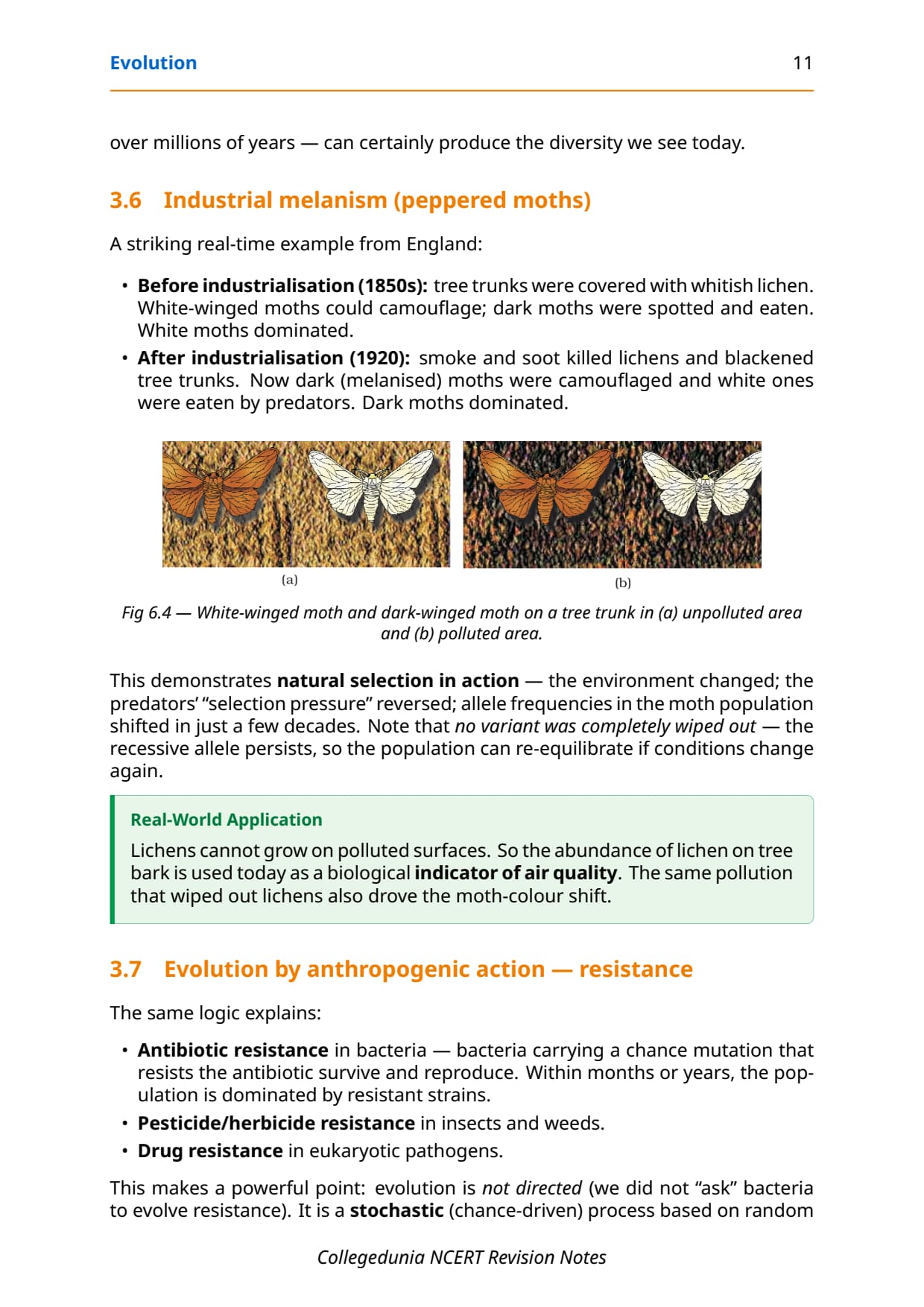
| Industrial melanism | Rise of dark peppered moths after industrialisation. |
| Speciation | New species forms through reproductive isolation. |
| Coacervates | Oparin's protein droplets, proposed as protocells. |
Evolution Topic-by-Topic Notes for Class 12 Biology
Origin of Life (Big Bang to First Cell)
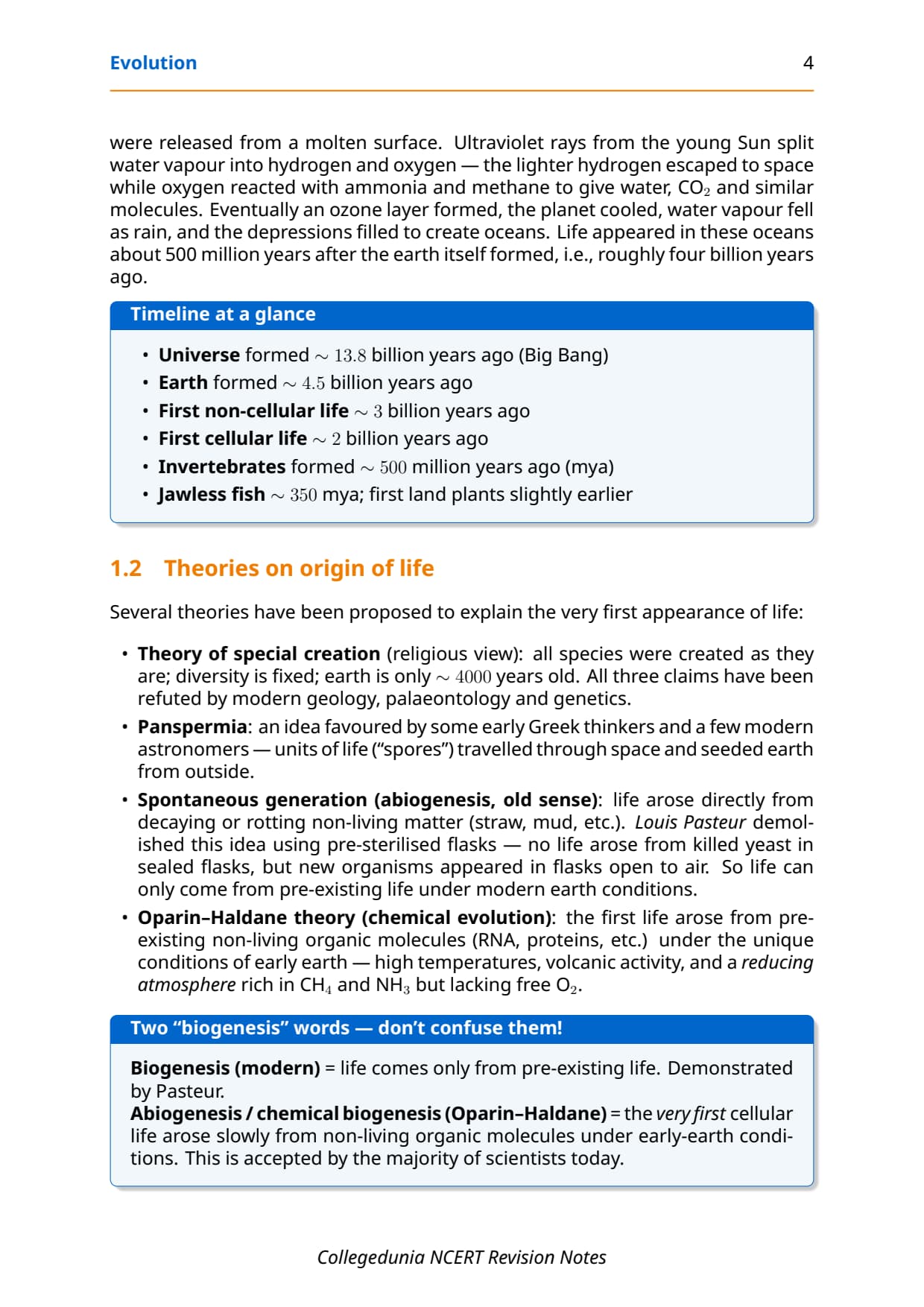
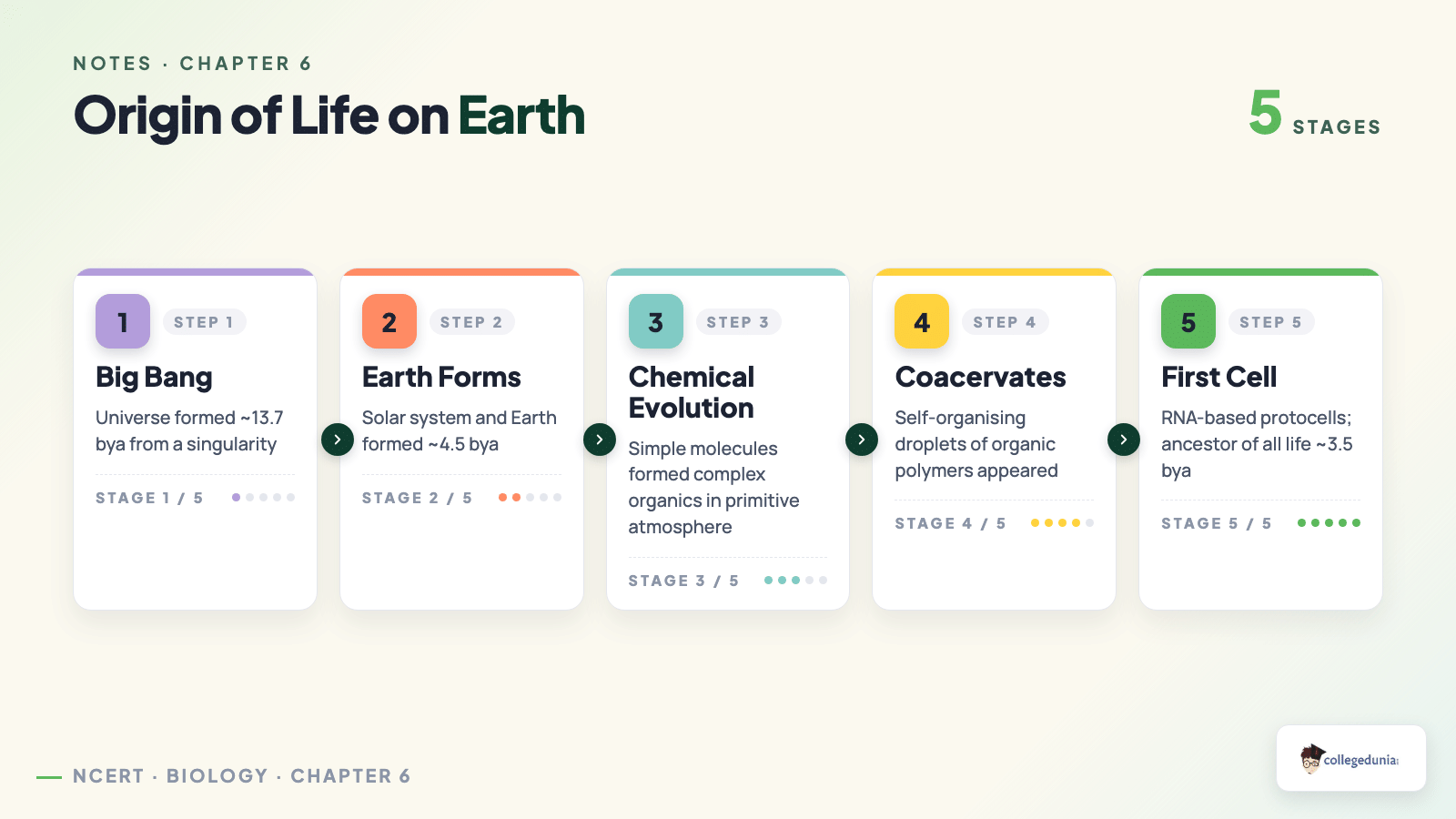
The earth formed around 4.5 billion years ago. Its early atmosphere had no free oxygen and was rich in methane (CH4), ammonia (NH3), and water vapour. Oparin and Haldane proposed that life arose from non-living molecules in this "hot dilute soup". Miller and Urey (1953) tested this in a sealed sparking apparatus and recovered amino acids and sugars.
Theories of Evolution (Special Creation, Lamarckism, Darwinism)
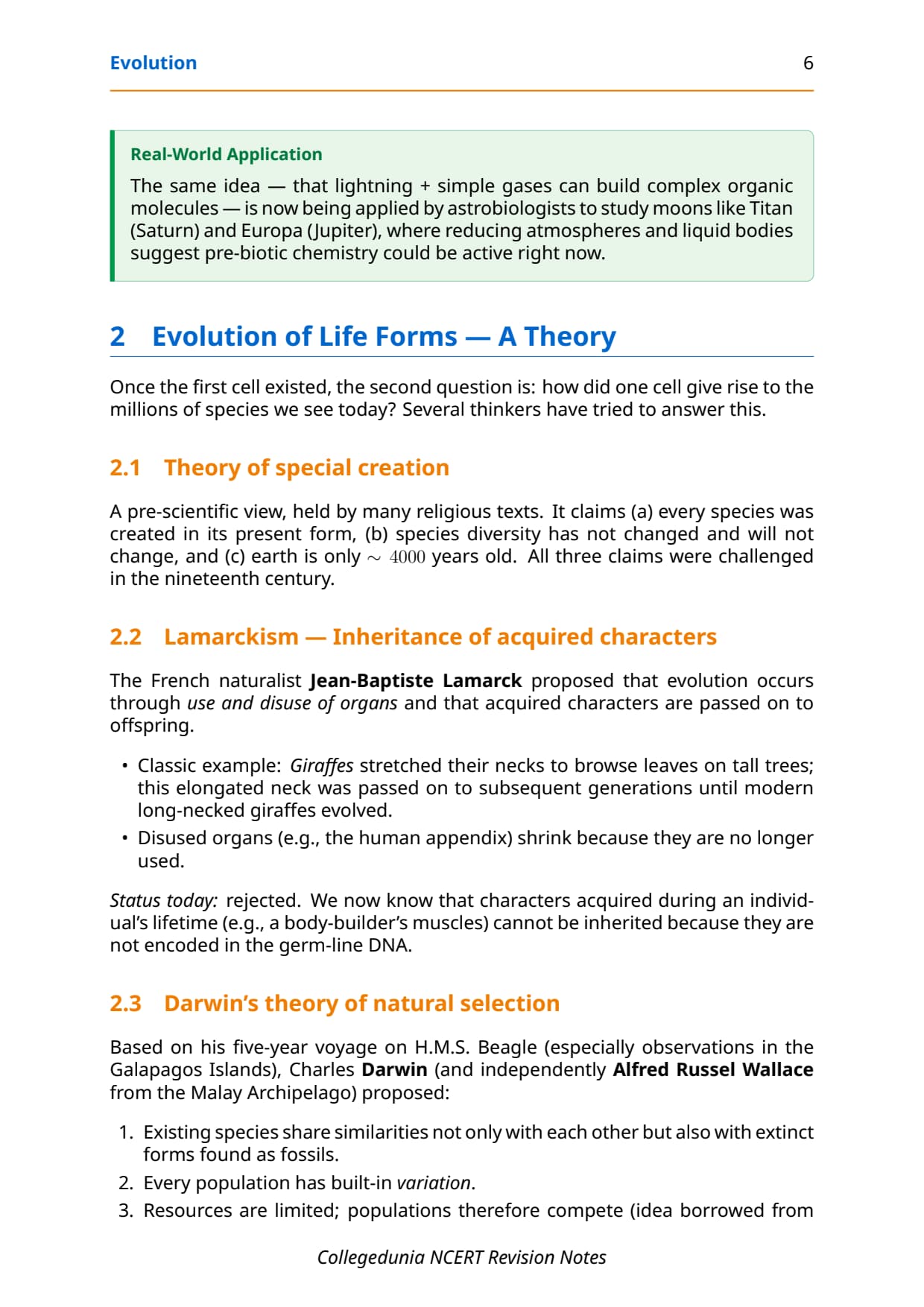
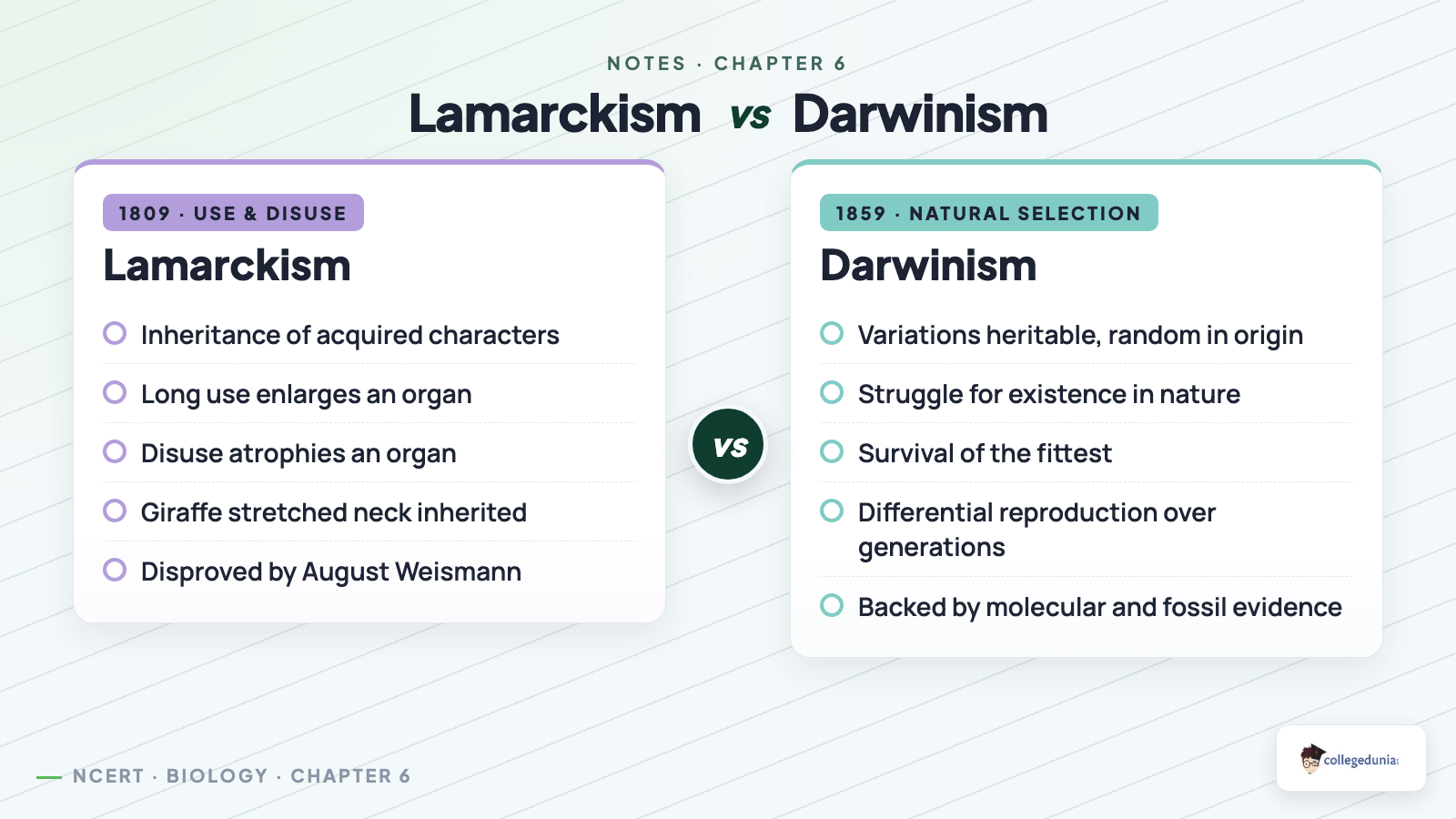
Special creation says species never change; fossils disproved it. Lamarckism (1809) proposed use and disuse plus inheritance of acquired characters, like giraffe necks lengthening; it failed because body changes are not heritable. Darwinism (1859) says variation exists naturally, the environment selects favourable variants, and survivors pass them on. This is natural selection, the most-tested idea of the chapter. de Vries (1901) added the mutation theory: sudden heritable changes drive speciation.
Evidence for Evolution (Eight Categories)
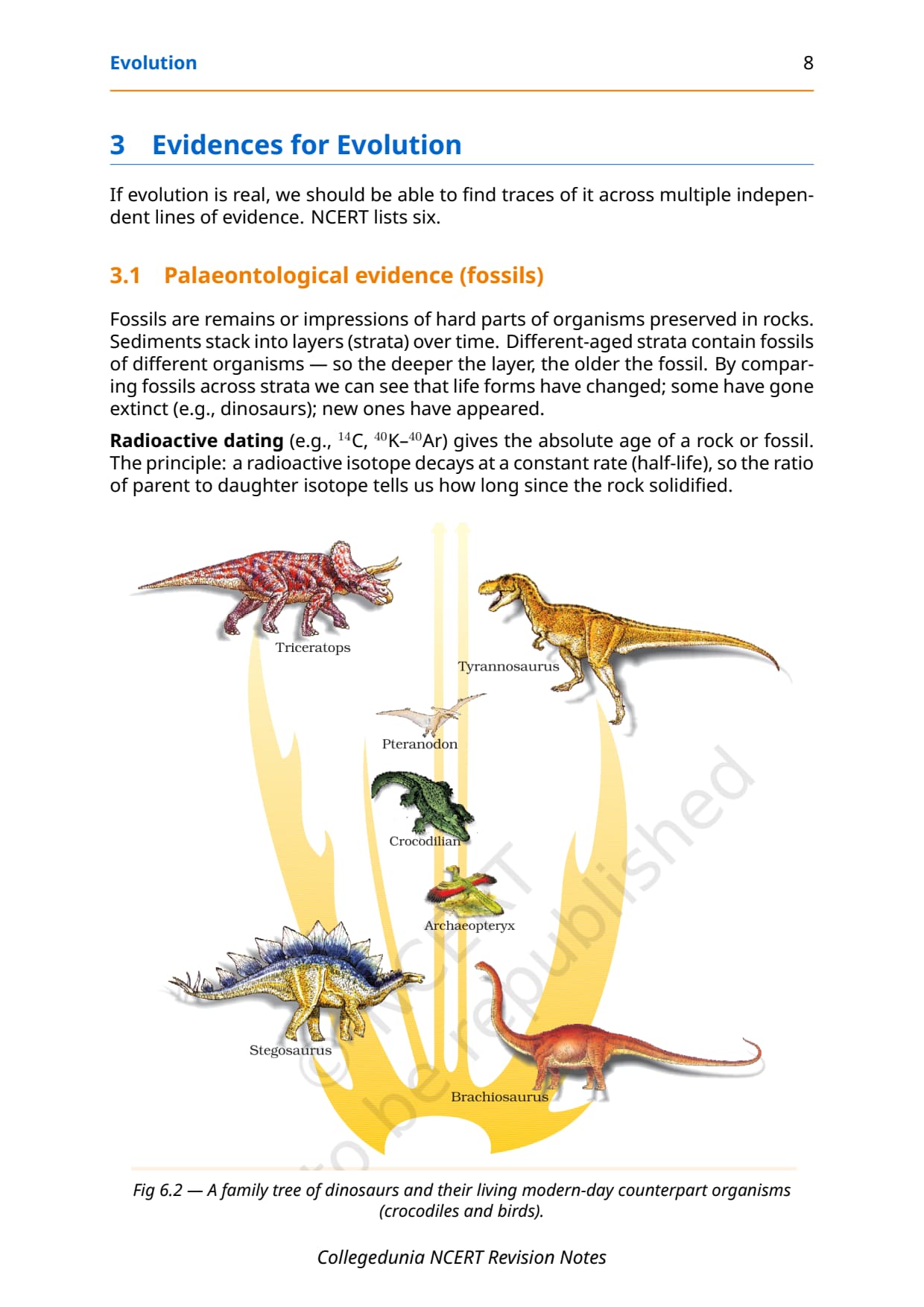
All evidence groups into eight buckets: palaeontological (fossils), homologous organs (divergent), analogous organs (convergent), embryological (von Baer), artificial selection (dog breeds, cabbage to broccoli), industrial melanism (Biston betularia), anthropogenic resistance (DDT, antibiotics), and biochemical (shared DNA, ATP, amino acids).
Adaptive Radiation (Darwin's Finches and Marsupials)
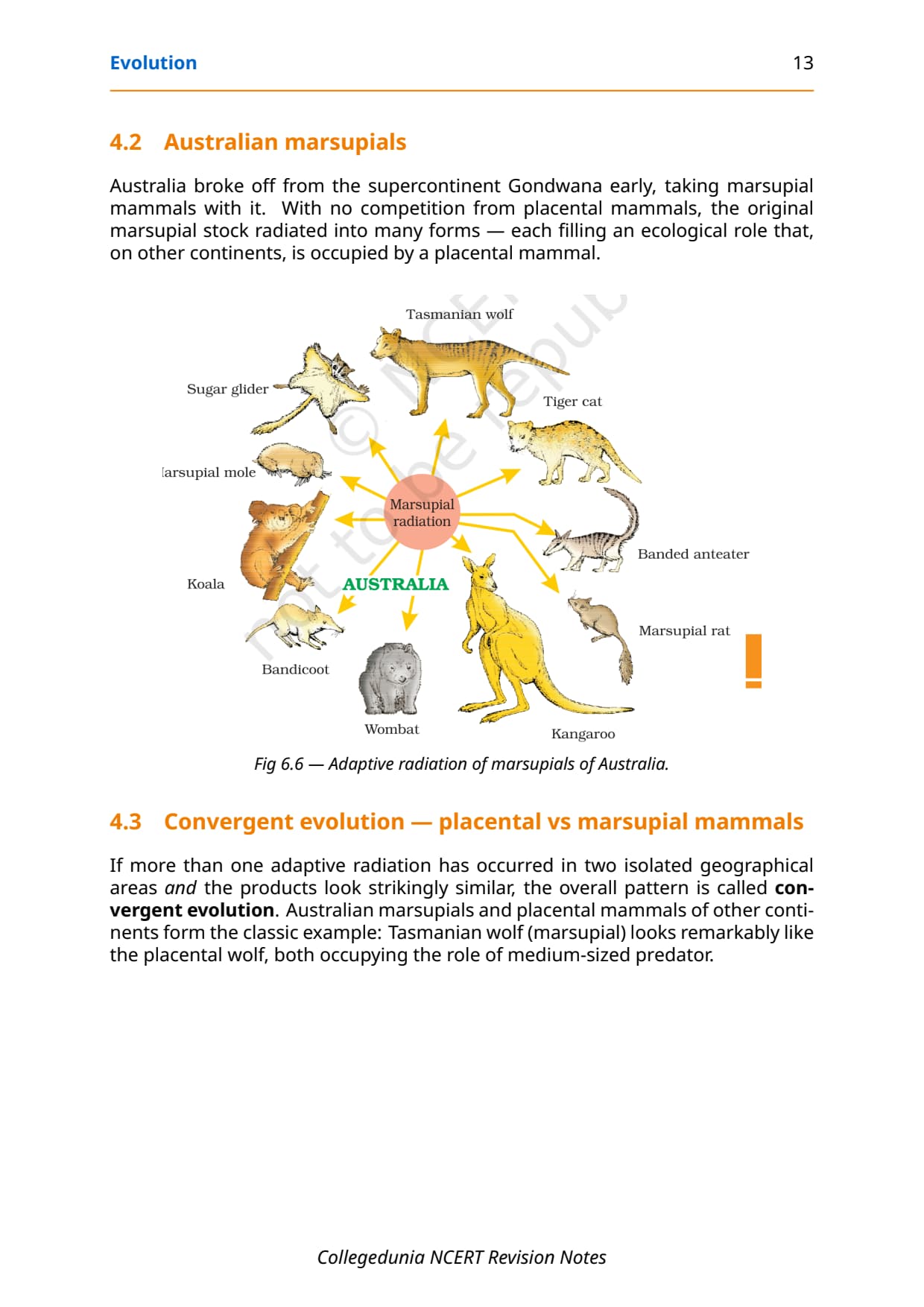
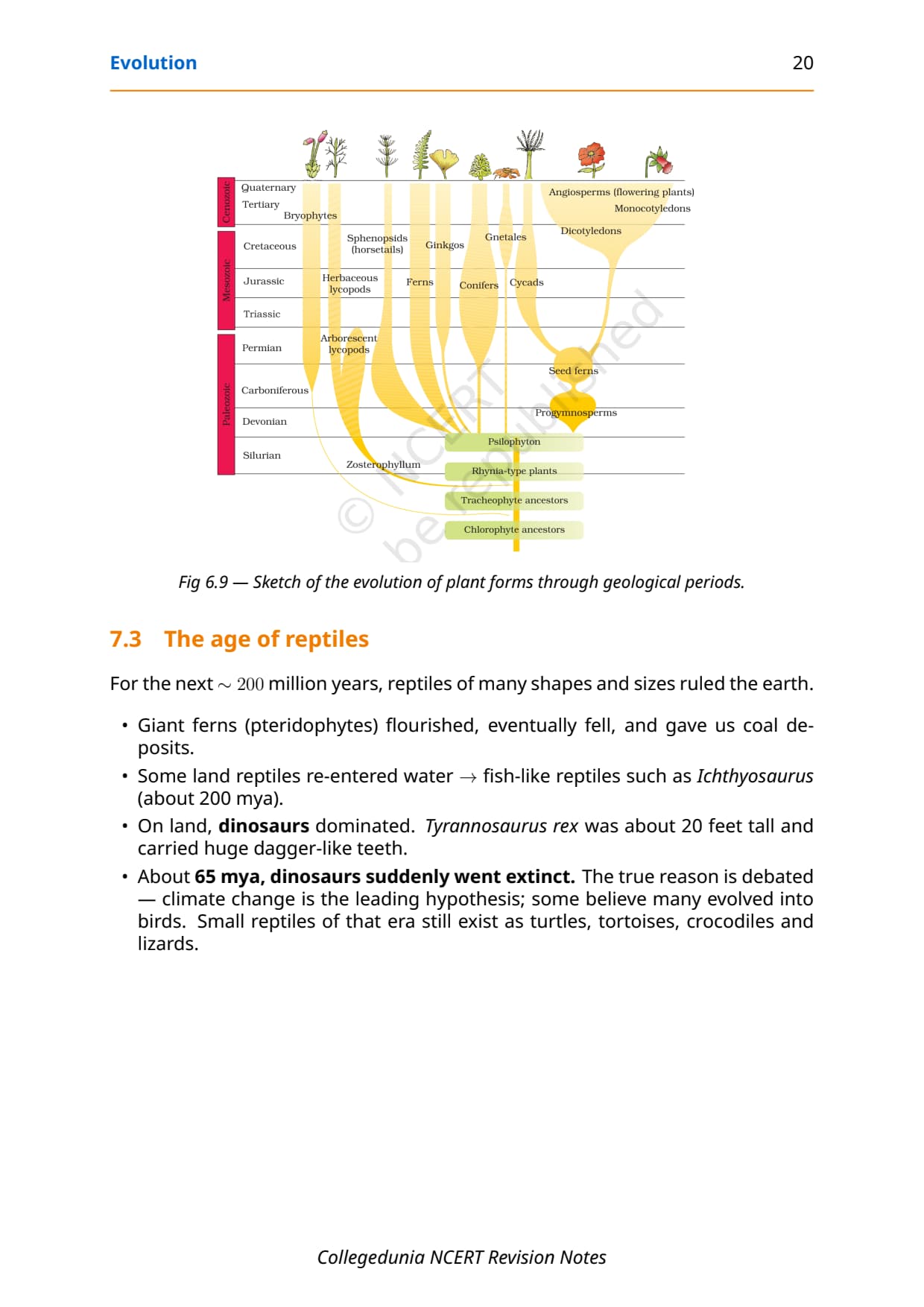
Darwin's finches on the Galapagos started as one seed-eating ancestor and radiated into 13 species with different beaks. Australian marsupials radiated into forms parallel to placental mammals. Radiation within one continent is adaptive radiation; the cross-continent likeness is convergent evolution, a favourite exam trap.
Hardy-Weinberg Principle
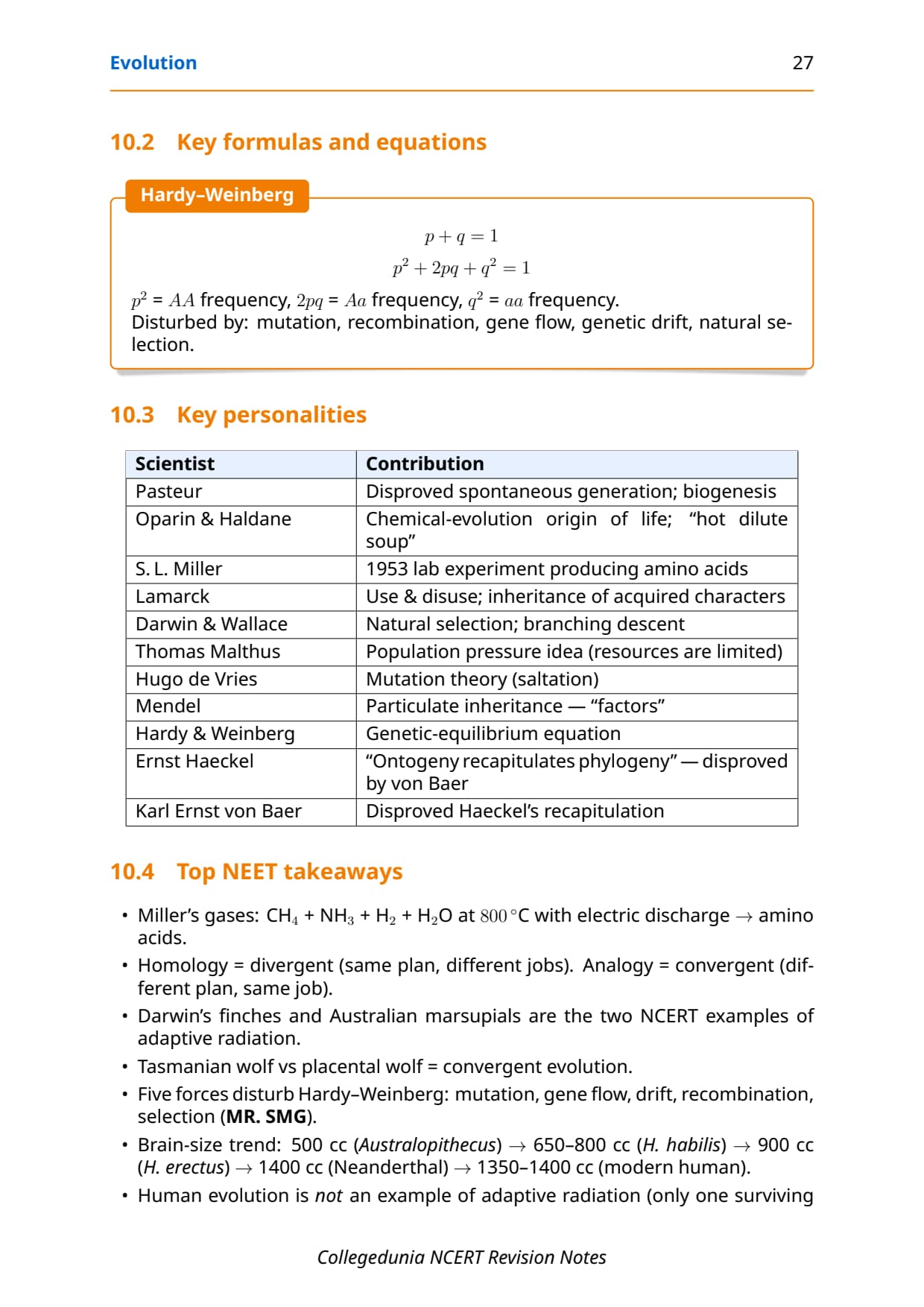
In a non-evolving population, allele frequencies stay constant each generation. With p + q = 1, the genotype frequencies follow:
$$p^2 + 2pq + q^2 = 1$$
Here p2 is homozygous dominant, 2pq heterozygous, and q2 homozygous recessive. It holds only with no mutation, random mating, no gene flow, a large population, and no selection. Disturb any one and evolution begins.
q2 = 0.0036, so q = 0.06 and p = 0.94.
2pq = 0.1128, so about 1128 carriers, the usual MCQ ask.
Mechanism of Evolution and Human Evolution
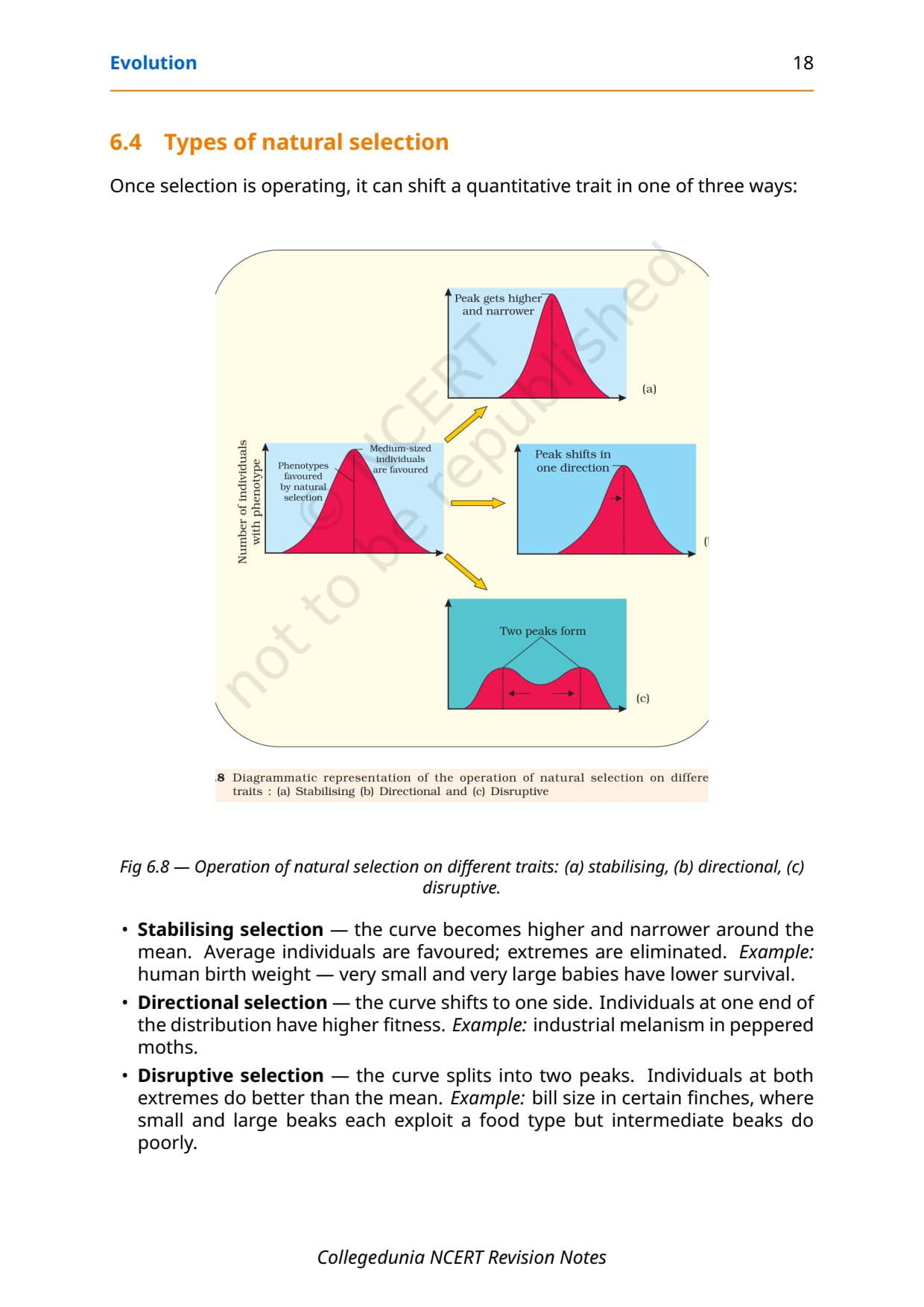
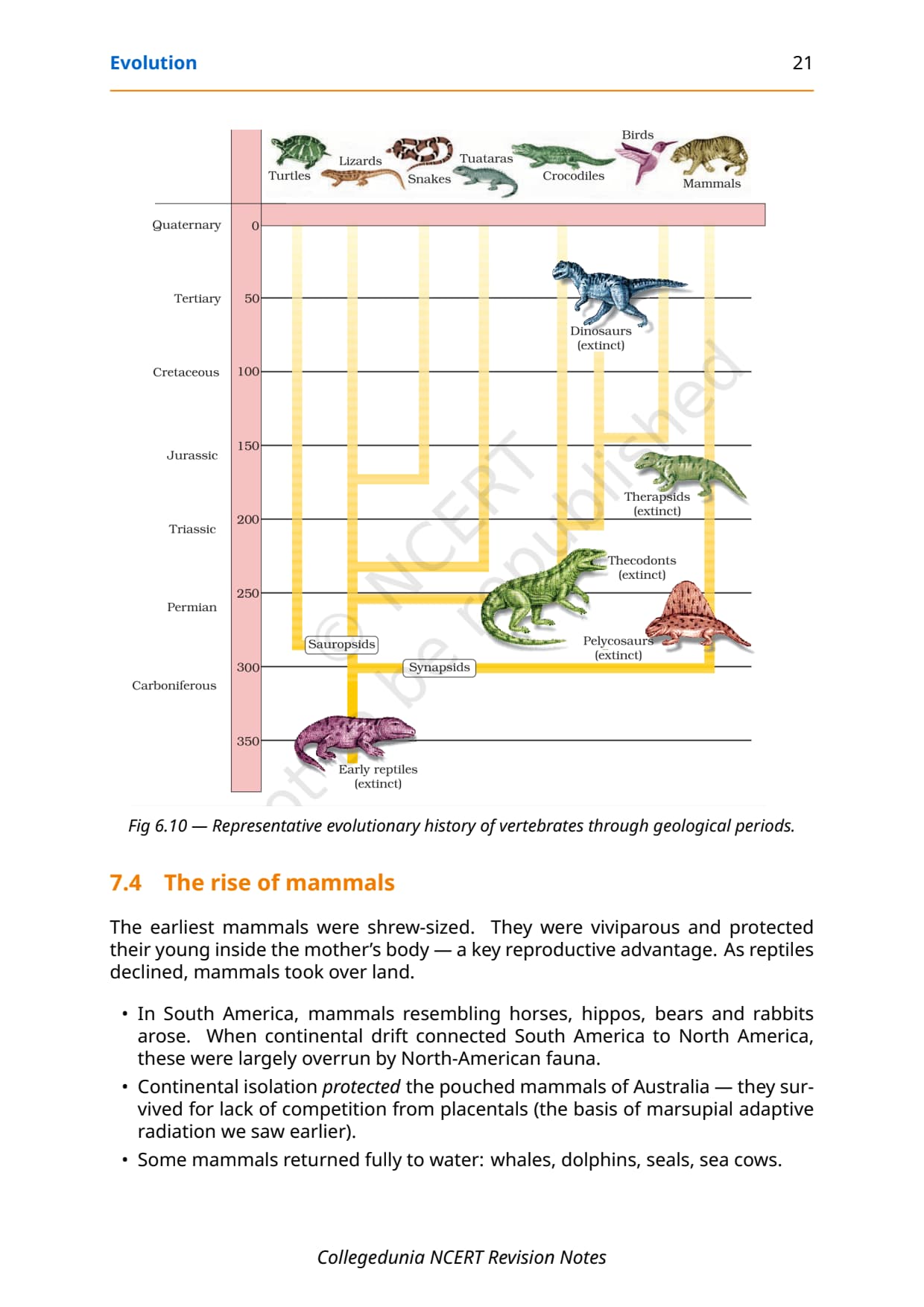
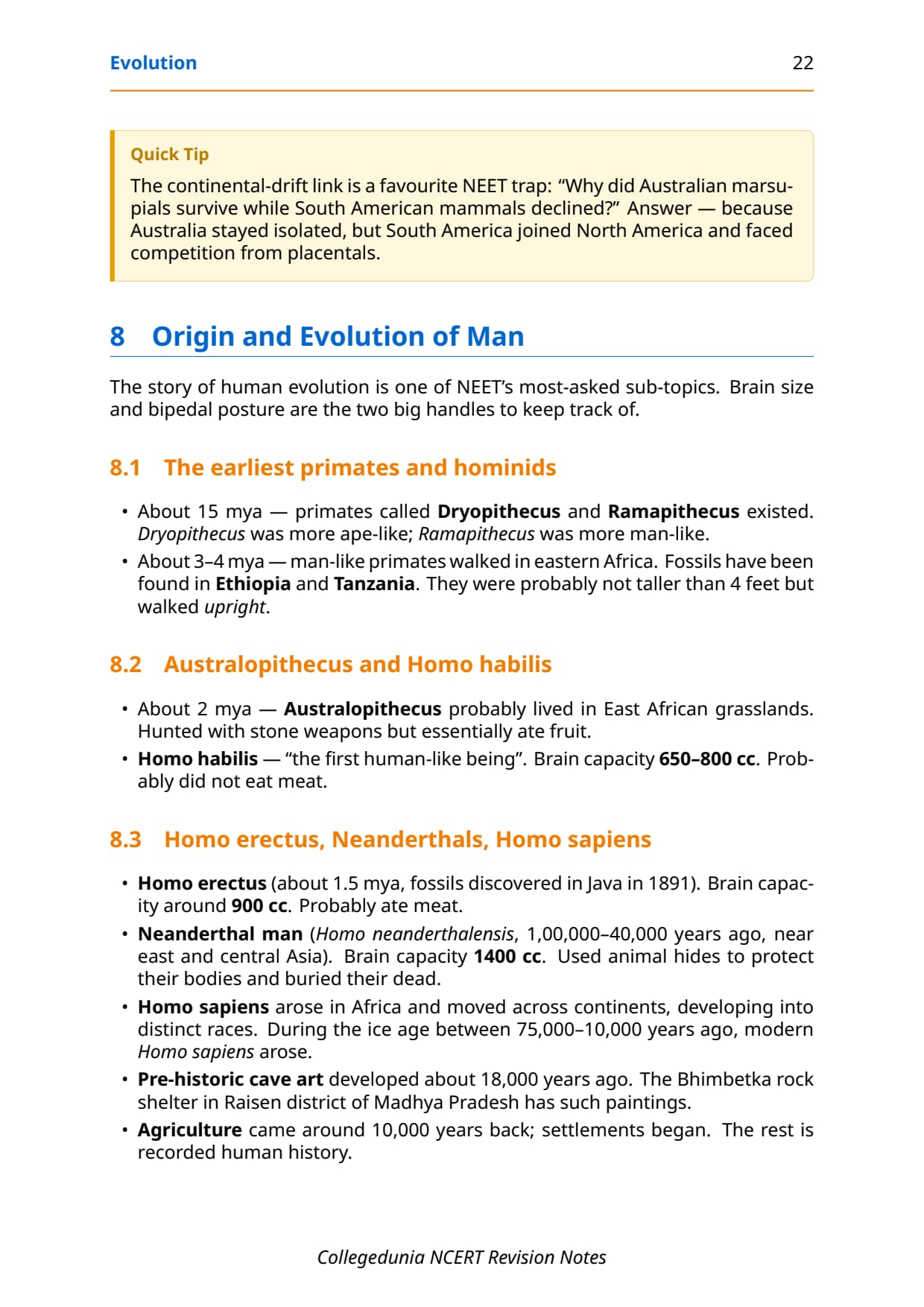
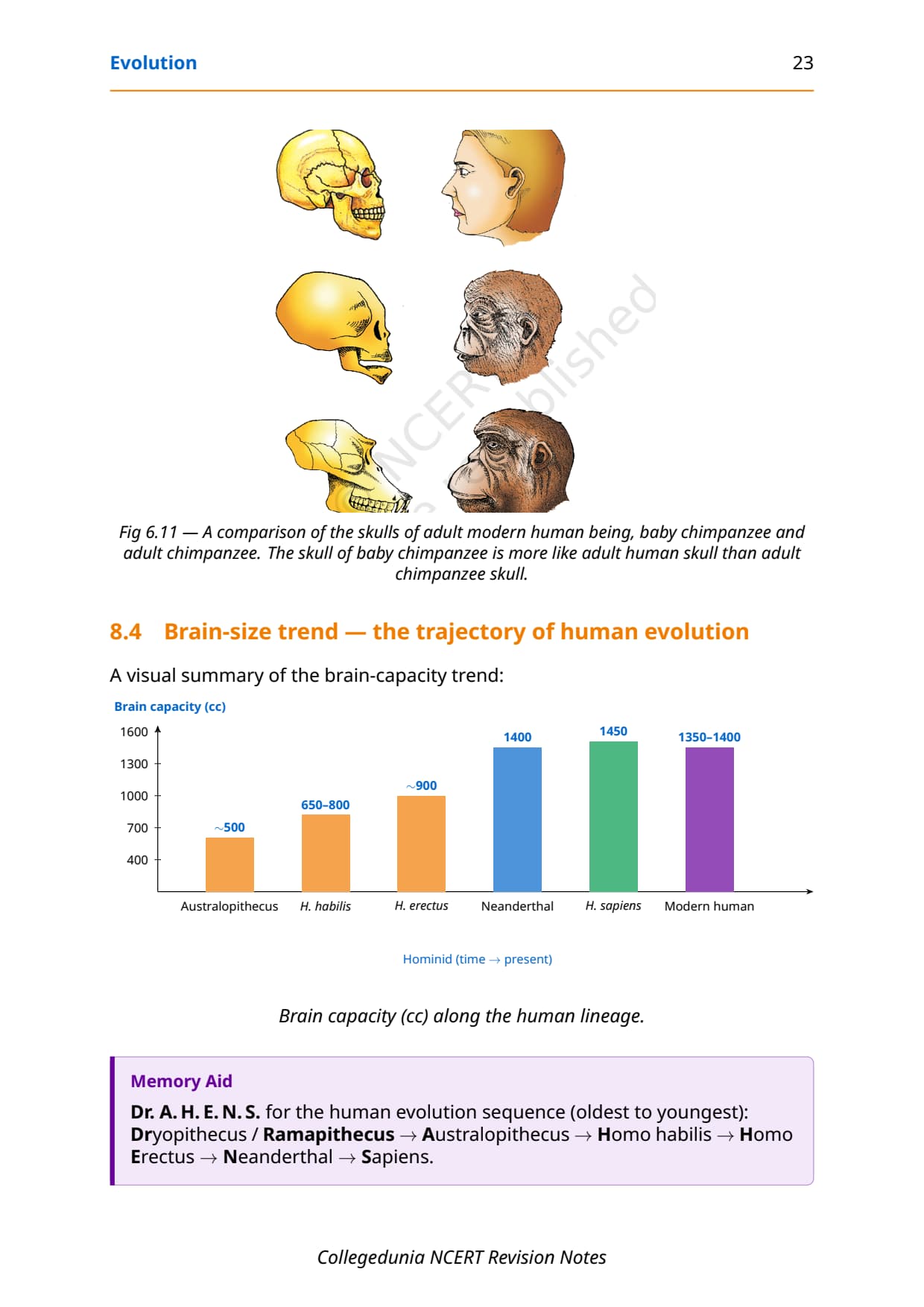
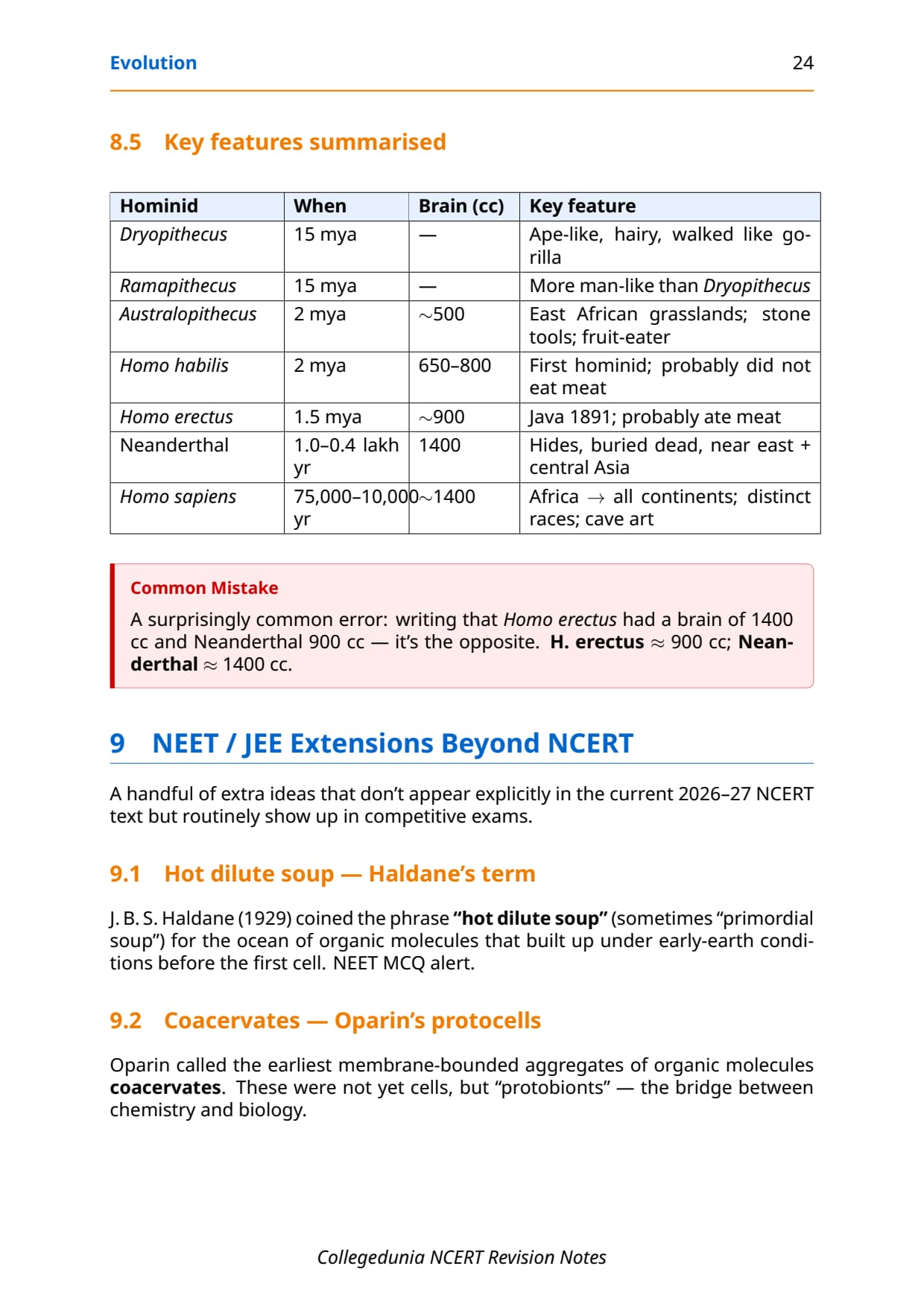
Five forces violate Hardy-Weinberg: mutation, natural selection, genetic drift, gene flow, and non-random mating. Selection is stabilising, directional, or disruptive. Human evolution runs: Dryopithecus → Ramapithecus → Australopithecus → Homo habilis (first tool maker) → Homo erectus → Neanderthals (1400 cc) → Homo sapiens.
Evolution Important Derivations and Key Statements for Class 12 Boards
Biology has no algebra here except Hardy-Weinberg. This is the must-state, must-explain block for CBSE.
- Hardy-Weinberg equation: derive p2 + 2pq + q2 = 1 and state the five disturbing factors (CBSE 2024).
- Miller-Urey apparatus: labelled diagram with gases and products (CBSE 2023).
- Lamarck vs Darwin: tabular contrast on the giraffe example (CBSE 2025).
- Industrial melanism: frequency shift in Biston betularia (CBSE 2024).
- Adaptive radiation: Darwin's finches with beak-function mapping (CBSE 2023).
- Human evolution: Dryopithecus to Homo sapiens, one feature each (NEET 2024).
Evolution Topic-wise Weightage for CBSE Class 12 Biology
Sub-topics do not carry equal weight. This split uses the last five CBSE and NEET papers.
| Sub-topic | Weightage | CBSE / NEET Frequency |
|---|---|---|
| Hardy-Weinberg principle | High | Almost every NEET; CBSE 4 of 5 years |
| Evidence for evolution (8 categories) | High | Almost every year |
| Adaptive radiation (finches, marsupials) | High | NEET 4 of 5 years |
| Theories (Lamarck, Darwin, de Vries) | Medium | CBSE 3 of 5 years |
| Human evolution sequence | Medium | NEET 3 of 5 years |
| Origin of life (Miller, Oparin) | Medium | 2 of 5 years each |
Most Repeated Evolution Questions in CBSE Class 12 Boards (2021-2025)
A high-confidence repeat list for revision.
- CBSE 2025 (3-mark): differentiate homologous and analogous organs.
- CBSE 2024 (5-mark): explain Hardy-Weinberg and its five assumptions.
- CBSE 2023 (3-mark): draw the Miller-Urey apparatus and what it proved.
- CBSE 2022 (3-mark): compare Lamarck and Darwin using the giraffe.
- CBSE 2022 (5-mark): adaptive radiation in finches and marsupials.
- CBSE 2021 (3-mark): industrial melanism as evidence for natural selection.
Common Misconceptions Students Hold About Evolution
Five wrong beliefs to fix before the exam.
- "Humans evolved from monkeys." No. Both share a common ancestor.
- "Lamarck was fully wrong." No. Only inheritance of acquired characters failed.
- "Fittest means strongest." No. Fittest means best-reproducing.
- "Mutations are always harmful." No. Most are neutral.
- "Analogous organs prove ancestry." No. Homologous organs do.
NEET-Only Evolution Extensions Beyond the Class 12 NCERT
Topics NEET asks but the textbook covers thinly; the full notes PDF explains each.
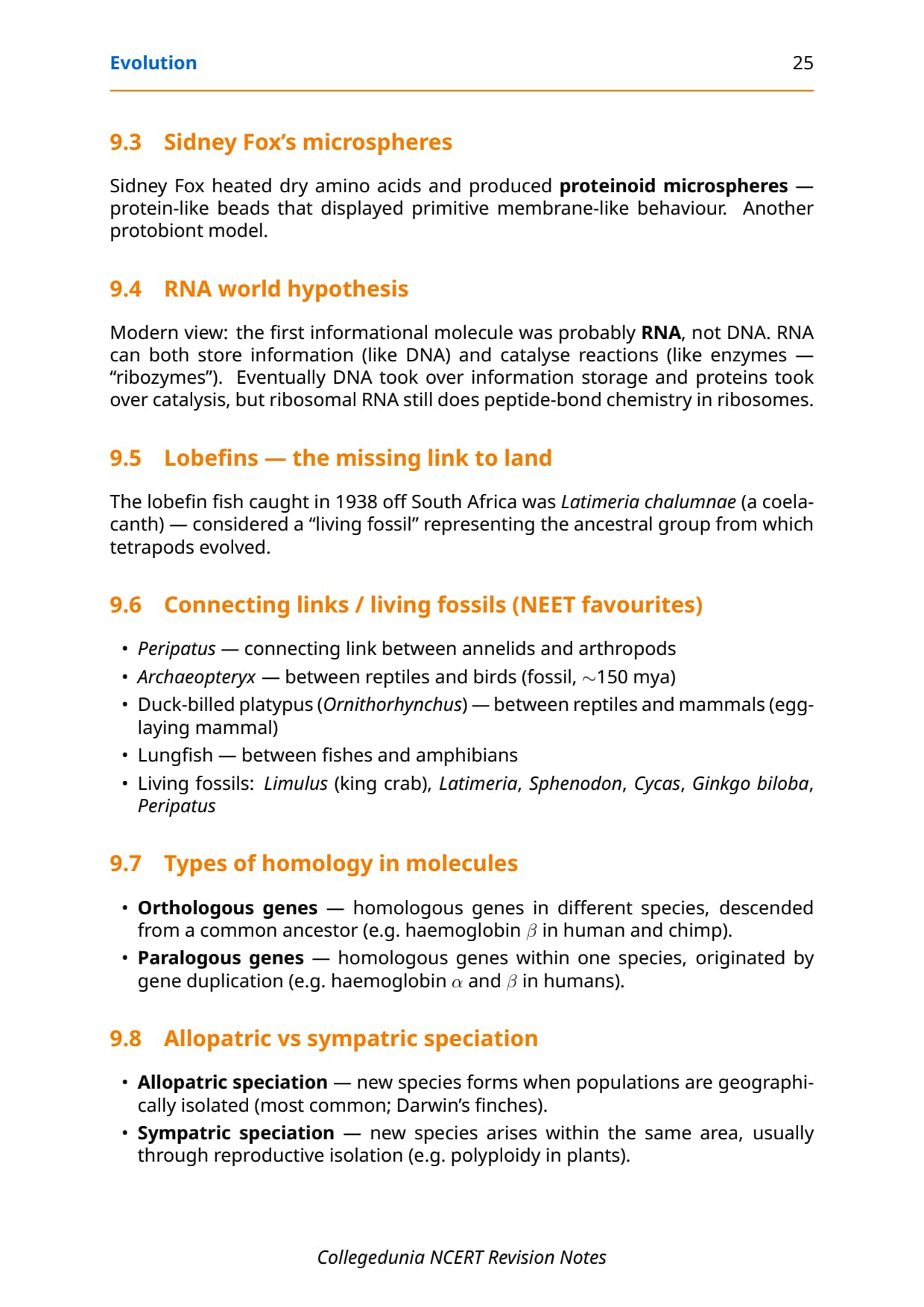
- Coacervates vs microspheres: Oparin's droplets vs Sidney Fox's proteinoids; both protocells.
- RNA-world hypothesis: RNA preceded DNA; ribozymes are evidence.
- Connecting links and living fossils: Archaeopteryx, Peripatus, Latimeria, Limulus.
- Allopatric vs sympatric speciation: geographic isolation vs same-area split.
- Real-world selection: antibiotic and DDT resistance, natural selection in real time.
Class 12 Biology Evolution Cross-Chapter Concept Map
Evolution feeds into several other chapters, as the map below shows.
| Linked Chapter | What Carries Over |
|---|---|
| Ch 5 Molecular Basis of Inheritance | Hardy-Weinberg reuses allele frequencies; mutation as variation. |
| Ch 4 Principles of Inheritance | Carrier-frequency sums reuse Hardy-Weinberg arithmetic. |
| Ch 7 Human Health and Disease | Antibiotic resistance leans on natural selection. |
| Ch 11 Organisms and Populations | Adaptive radiation and niches reappear in ecology. |
Student Feedback from a Class 12 Biology Evolution Survey
Student Feedback
In a survey of 10,900 Class 12 Biology students, the same pain points came up:
- 72% rated the Hardy-Weinberg derivation the hardest sub-topic.
- 62% lost marks on the Darwin vs Lamarck contrast.
- 4 out of 5 skipped the Miller-Urey labelled diagram.
- The average student needed 5.4 hours for the first read.
Source: Class 12 Biology survey of 10,900 students across 18 states.
Other Resources for Evolution Class 12 Biology
All Class 12 Biology Notes Chapters
| Chapter | Notes Link |
|---|---|
| Chapter 1 | Sexual Reproduction in Flowering Plants |
| Chapter 2 | Human Reproduction |
| Chapter 3 | Reproductive Health |
| Chapter 4 | Principles of Inheritance and Variation |
| Chapter 5 | Molecular Basis of Inheritance |
| Chapter 6 | Evolution |
| Chapter 7 | Human Health and Disease |
| Chapter 8 | Microbes in Human Welfare |
| Chapter 9 | Biotechnology - Principles and Processes |
| Chapter 10 | Biotechnology and Its Applications |
| Chapter 11 | Organisms and Populations |
| Chapter 12 | Ecosystem |
| Chapter 13 | Biodiversity and Conservation |
Evolution Class 12 Biology FAQ Section
Evolution Class 12 Biology Notes FAQs
Ques. Where can I download the Evolution Class 12 Biology Notes PDF?
Ans. You can download the Evolution Class 12 Biology Notes PDF directly from this page. Both Normal and HD versions are free.
Ques. Are these Evolution notes aligned with the 2026-27 NCERT?
Ans. Yes. These notes reflect the current 2026-27 NCERT for Class 12 Biology Chapter 6 Evolution. All nine sub-topics, including Miller's experiment, Hardy-Weinberg, and the human-evolution sequence, are intact in the new edition.
Ques. How many pages is the Class 12th Biology Evolution Notes PDF?
Ans. The Notes PDF runs 28 pages and covers origin of life, theories of evolution, all eight evidence categories, adaptive radiation, Hardy-Weinberg with a worked NEET example, human evolution, and a quick-reference summary block.
Ques. What is the Hardy-Weinberg principle in simple terms?
Ans. Hardy-Weinberg says that in a non-evolving population, allele frequencies remain constant from generation to generation. The genotype frequencies follow p squared plus 2pq plus q squared equals 1, where p and q are the two allele frequencies. The principle holds only if there is no mutation, no selection, no gene flow, no genetic drift, and mating is random. If any of these five conditions is violated, the population evolves.
Ques. What are the main theories of evolution covered in Class 12 Biology?
Ans. The chapter covers four theories: special creation (independent unchanging creation of species), Lamarckism (use and disuse plus inheritance of acquired characters), Darwinism (variation plus natural selection), and de Vries's mutation theory (large sudden heritable changes drive speciation). Darwin and de Vries together form the modern evolutionary synthesis.
Ques. What is adaptive radiation? Give two examples.
Ans. Adaptive radiation is the diversification of one ancestral species into many different forms, each adapted to a specific niche in the same geographic area. Two classic examples are Darwin's finches on the Galapagos Islands (13 species with different beak shapes for different food sources) and Australian marsupials (one ancestor diversified into marsupial mole, marsupial wolf, marsupial mouse, and many others).
Ques. Are these notes enough for NEET preparation in Evolution?
Ans. Yes. The notes cover the full NCERT plus the NEET-only extensions (Sidney Fox microspheres, RNA-world hypothesis, lobefins, allopatric vs sympatric speciation, vestigial organs, connecting links and living fossils). Combined with the worked Hardy-Weinberg numerical, these notes match the depth NEET tests on this chapter.
Ques. How is the human evolution sequence to be remembered?
Ans. Use the mnemonic Dear Ram, Australia Has Excellent New Sapiens for Dryopithecus, Ramapithecus, Australopithecus, Homo habilis, Homo erectus, Neanderthals, Homo sapiens. Brain capacity rises roughly from 400 cc in Australopithecus to 1400 cc in Neanderthals and about 1350 cc in modern Homo sapiens.



Comments