




These Class 11 Physics Notes Chapter 3 Motion in a Plane pull together every vector rule, projectile formula, and circular-motion result that the Boards, JEE Main, JEE Advanced, NEET, CUET and NDA papers actually test in 2026-27. Use them to revise the whole chapter fast, with formulas, definitions and diagrams in one place.
This chapter moves you from motion along a line to motion in two dimensions, so every vector skill here is used again in force, work and circular-motion chapters later.
- CBSE Weightage: 6 to 8 marks, usually one short answer on vectors plus one projectile or circular-motion numerical.
- Topics covered: scalars and vectors, vector addition, resolution and unit vectors, projectile motion, and uniform circular motion.
- Key formulas: range and maximum height of a projectile, time of flight, and centripetal acceleration.
These Class 11 Physics Notes Chapter 3 Motion in a Plane are curated by subject experts, based on the 2026-27 NCERT textbook, and checked against the last five years of CBSE Board, JEE Main and NEET papers.
Topic-by-Topic Summary of Motion in a Plane
The chapter builds two-dimensional motion step by step. It starts with vectors, teaches you to add and split them, then applies that to projectiles and circular motion. Here is the quick map of what each topic gives you.
- Scalars and vectors: the difference between a quantity with only size and one with size and direction.
- Vector addition: the triangle and parallelogram laws for combining two vectors.
- Resolution of vectors: splitting a vector into perpendicular components using unit vectors.
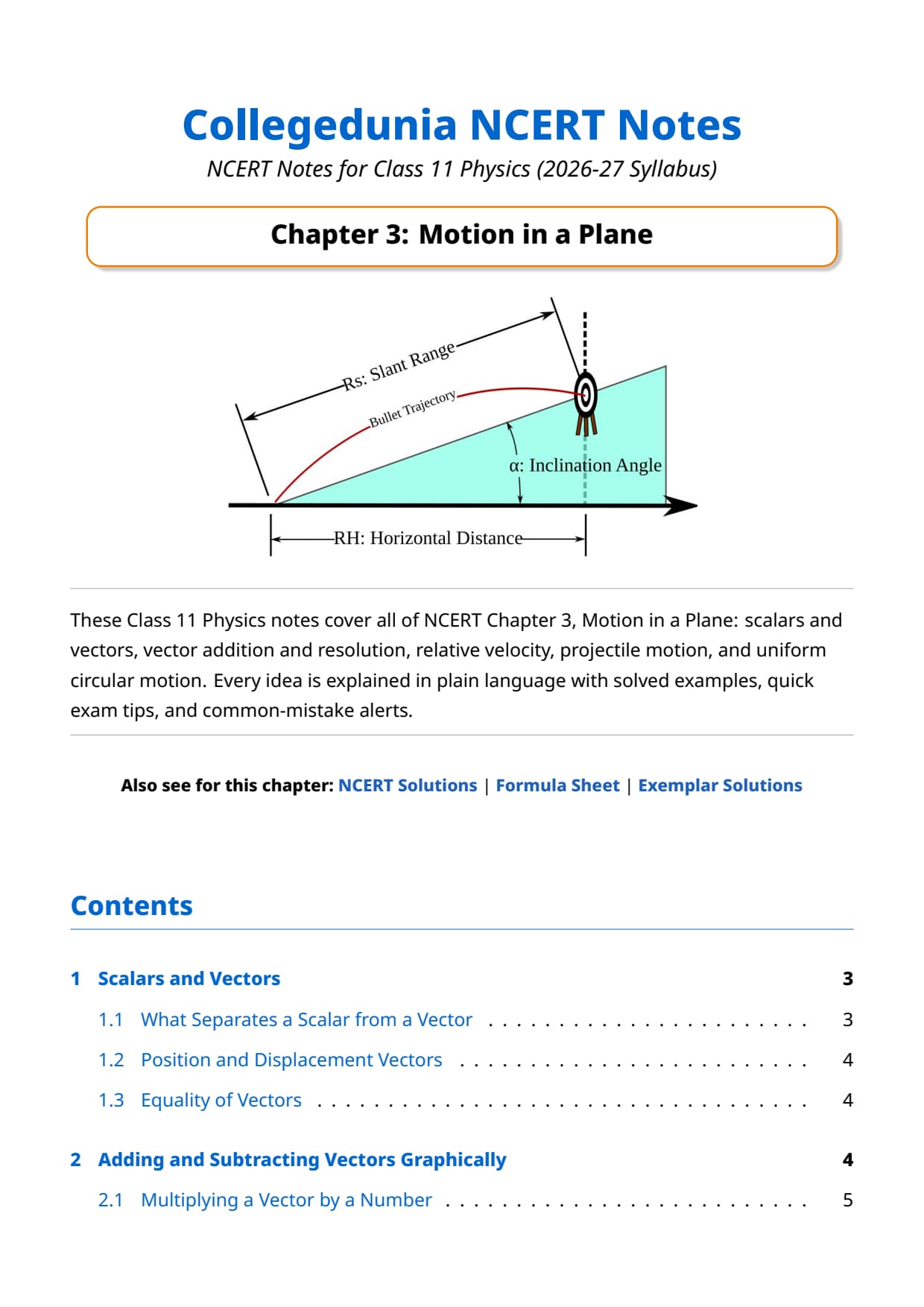
- Projectile motion: motion under gravity with a horizontal launch, giving a parabolic path.
- Uniform circular motion: motion in a circle at constant speed, with a centre-pointing acceleration.
Revise the topics in this order, because each one uses the one before it. Get vector resolution right first, and both projectile and circular motion become far easier. These Class 11 Physics Notes Chapter 3 Motion in a Plane follow the same sequence as the NCERT textbook.
Scalars and Vectors in Motion in a Plane
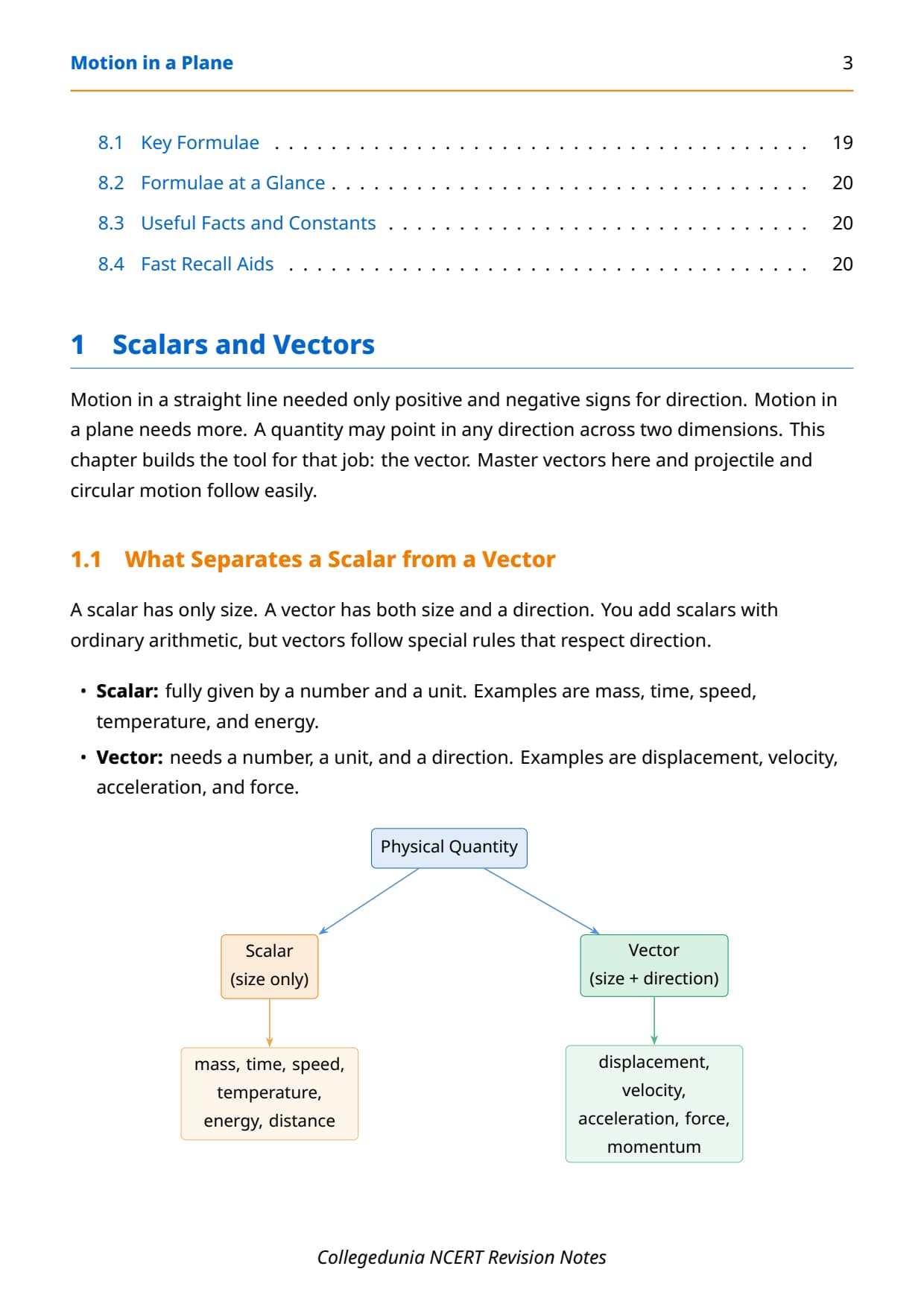
Two-dimensional motion starts with telling two kinds of quantity apart. A scalar has only size, while a vector has both size and direction. Getting this split right is the first step in every numerical of the chapter.
| Type | What it has | Examples |
|---|---|---|
| Scalar | Size (magnitude) only | Distance, speed, mass, time, temperature |
| Vector | Size and direction | Displacement, velocity, acceleration, force |
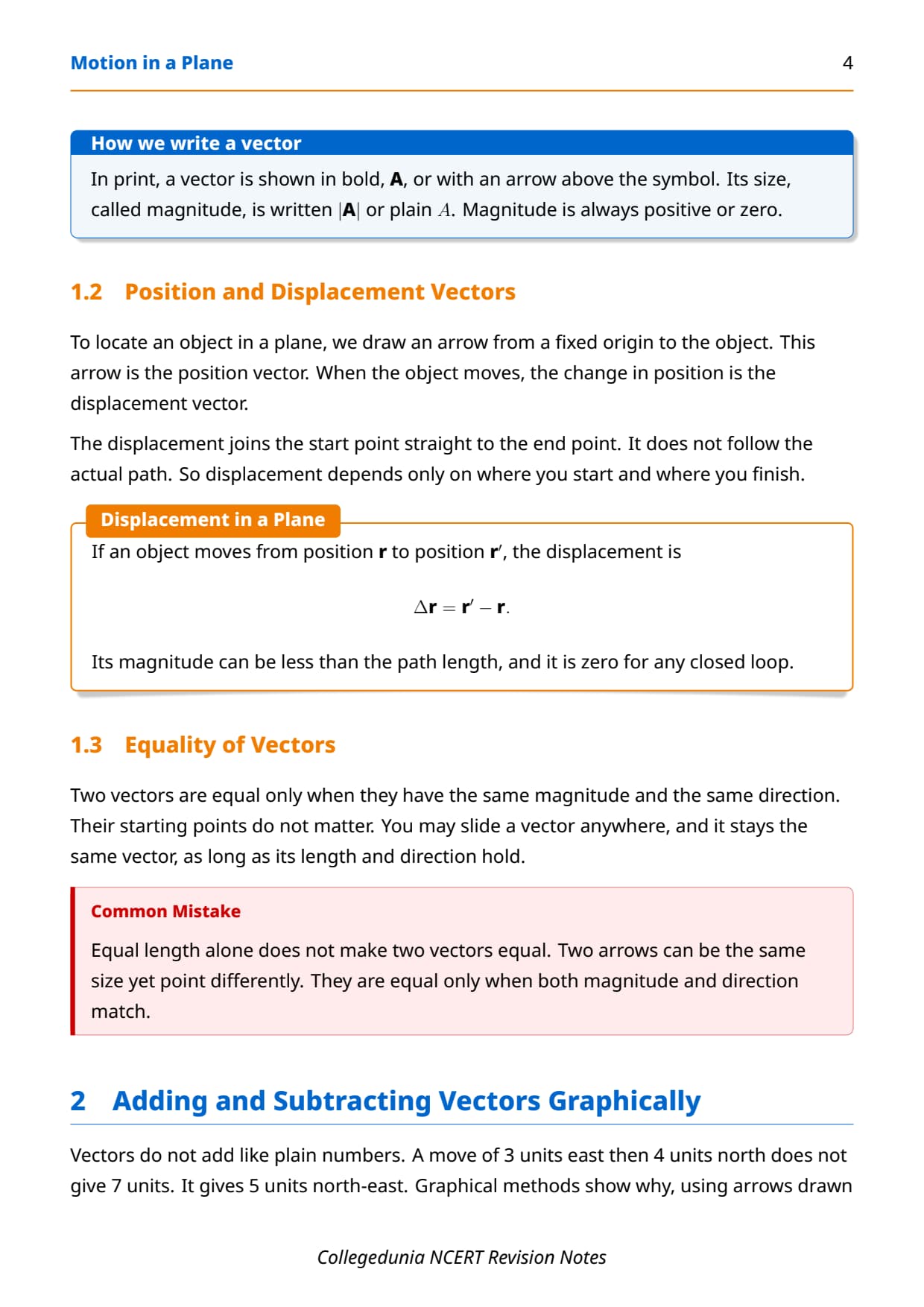
A vector is drawn as an arrow: its length shows the magnitude and the arrowhead shows the direction. Two vectors are equal only when both their magnitude and direction match. This is why velocity can change even when speed stays the same, a fact that runs through the whole of Motion in a Plane.
Vector Addition: Triangle and Parallelogram Laws
Vectors do not add like ordinary numbers, because direction matters. The chapter gives two graphical laws to add them, and both give the same result. Learn both, since numericals switch between them.
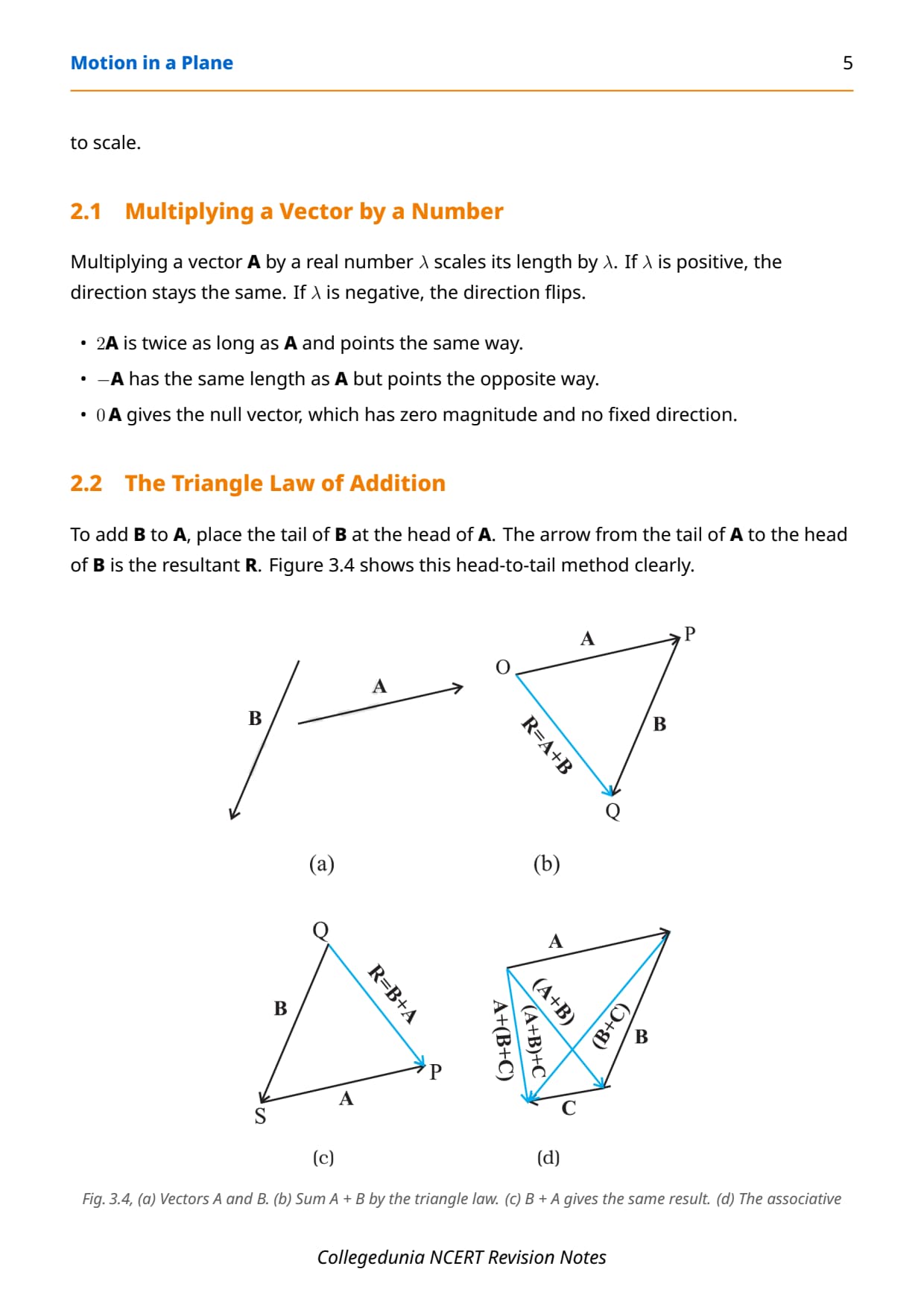
- Triangle law: place the tail of the second vector at the head of the first; the vector from the first tail to the second head is the resultant.
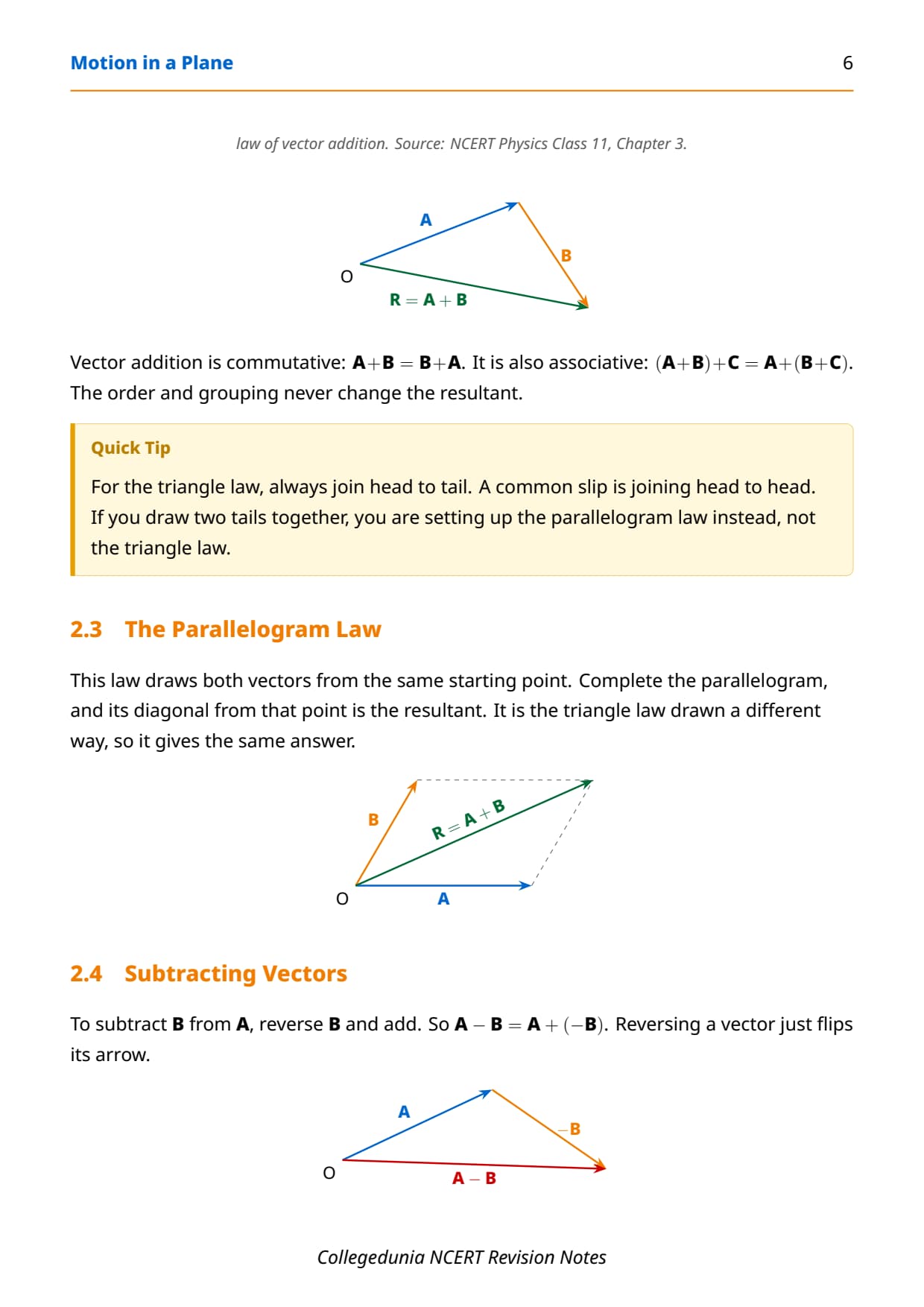
- Parallelogram law: draw both vectors from a common point, complete the parallelogram, and the diagonal is the resultant.
- Commutative property: the order does not matter, so A + B = B + A.
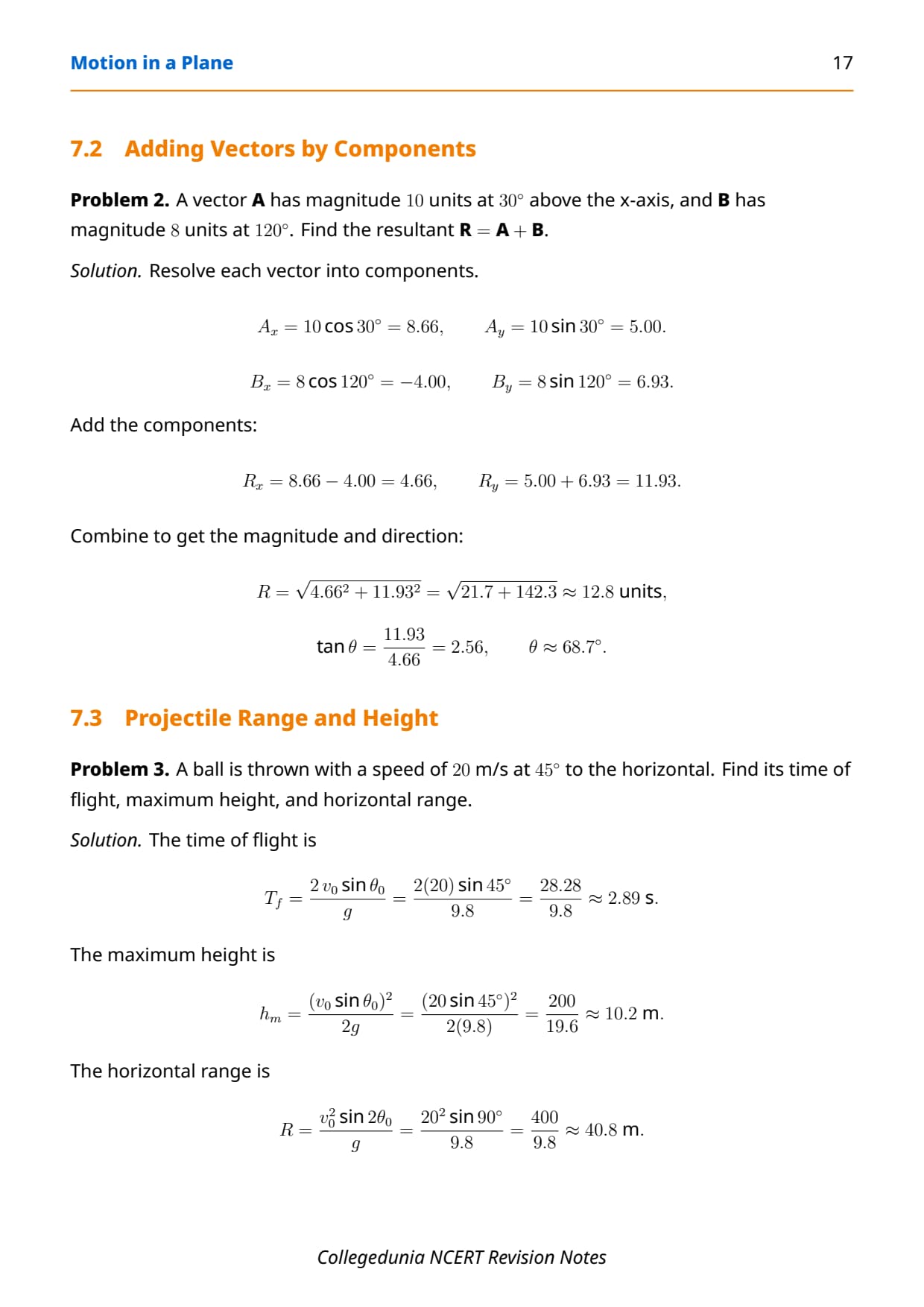
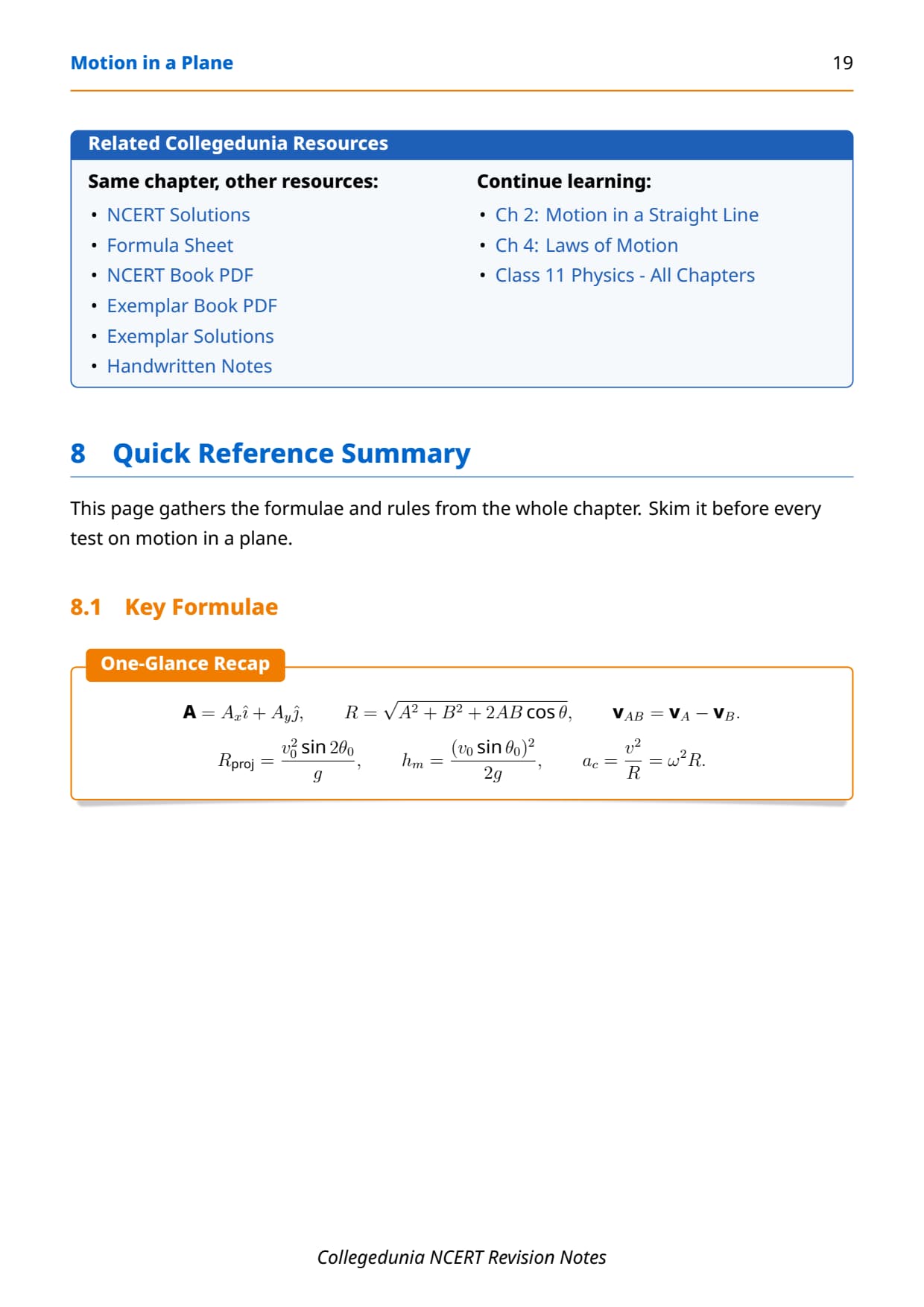
For two vectors of magnitude A and B at an angle θ, the resultant magnitude is R = √(A2 + B2 + 2AB cosθ). The resultant is largest when the vectors point the same way and smallest when they point opposite ways. Keep this check ready, because it catches most sign errors in the exam.
Resolution of Vectors and Unit Vectors
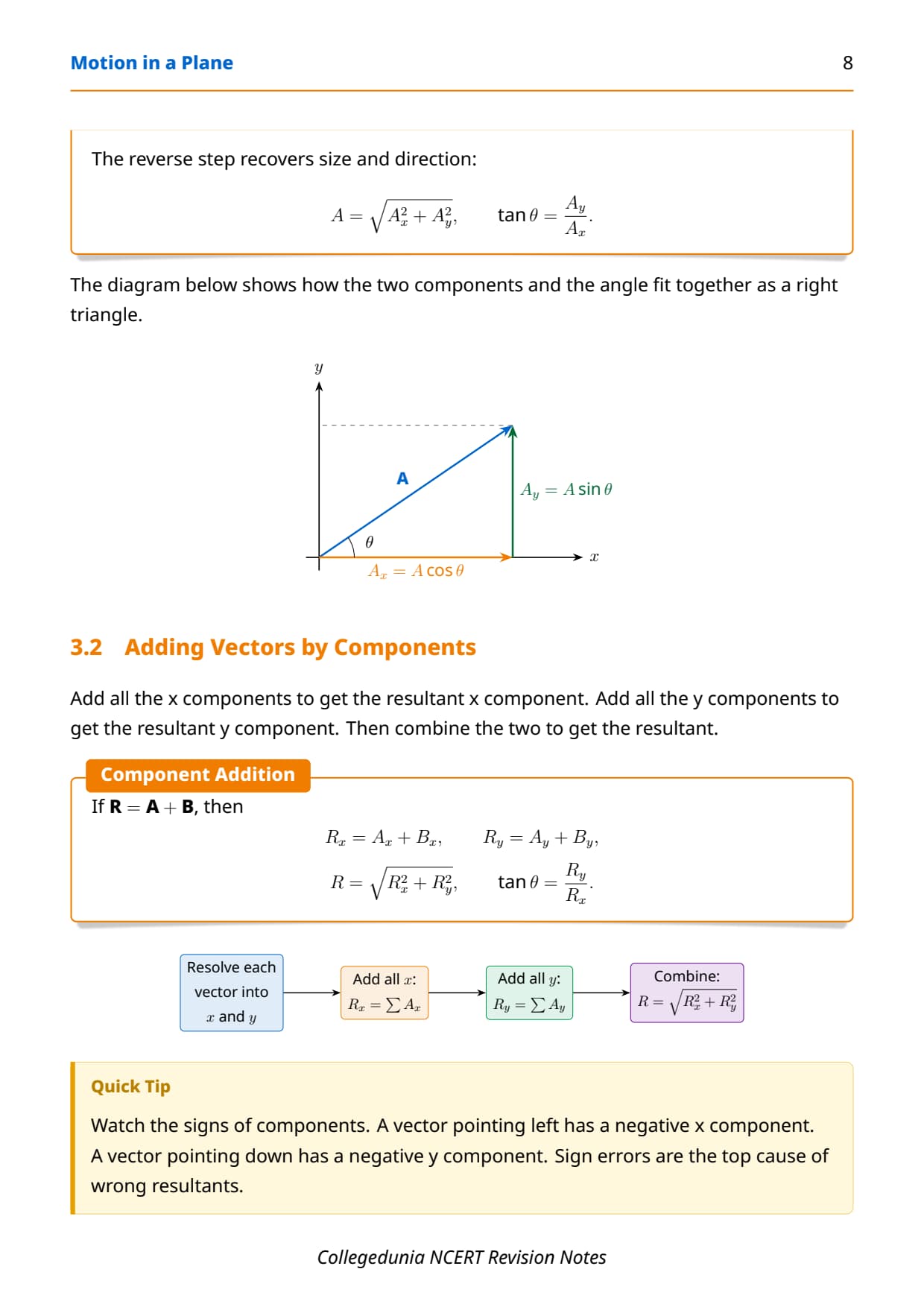
Resolution is the reverse of addition. It splits one vector into two perpendicular parts, usually along the x and y axes. This is the single most useful skill in the chapter, because it turns a hard two-dimensional problem into two simple one-dimensional ones.
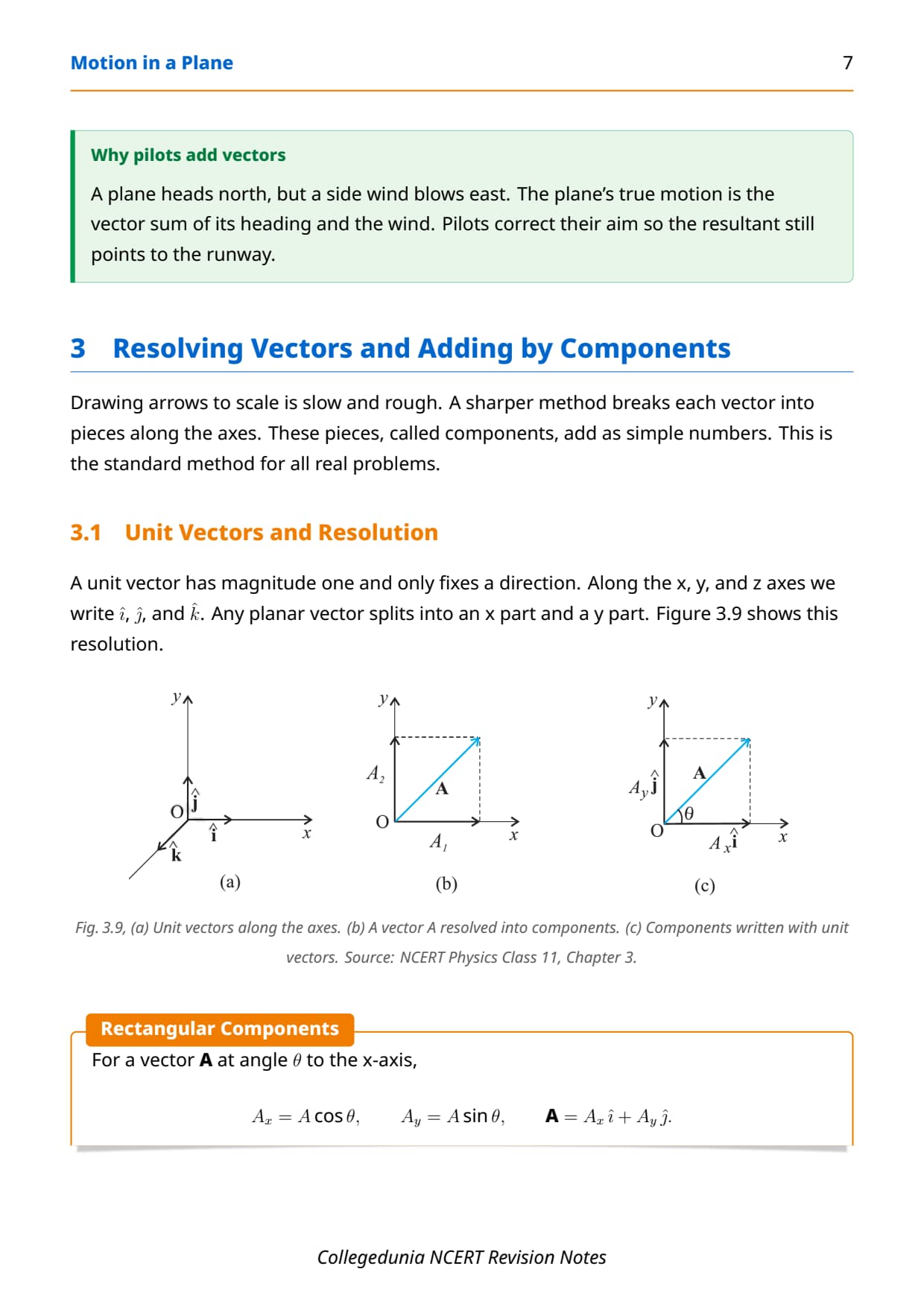
- A vector A at angle θ splits into Ax = A cosθ and Ay = A sinθ.
- The unit vectors î, ĵ and k̂ point along the x, y and z axes and each have magnitude one.
- Any vector is written as A = Ax î + Ay ĵ.
Once a vector is in component form, you add vectors by adding their x-parts and their y-parts separately. Always resolve first, then add component by component. This method is faster and less error-prone than the graphical laws, and markers award full credit for it in these Class 11 Physics Notes Chapter 3 Motion in a Plane.
All Formulas for Motion in a Plane
Every formula you need for the chapter sits in one table below, with its meaning and its SI unit. Learn the projectile rows first, since those carry the most marks in both Boards and entrance papers.
| Formula | What it means | SI unit |
|---|---|---|
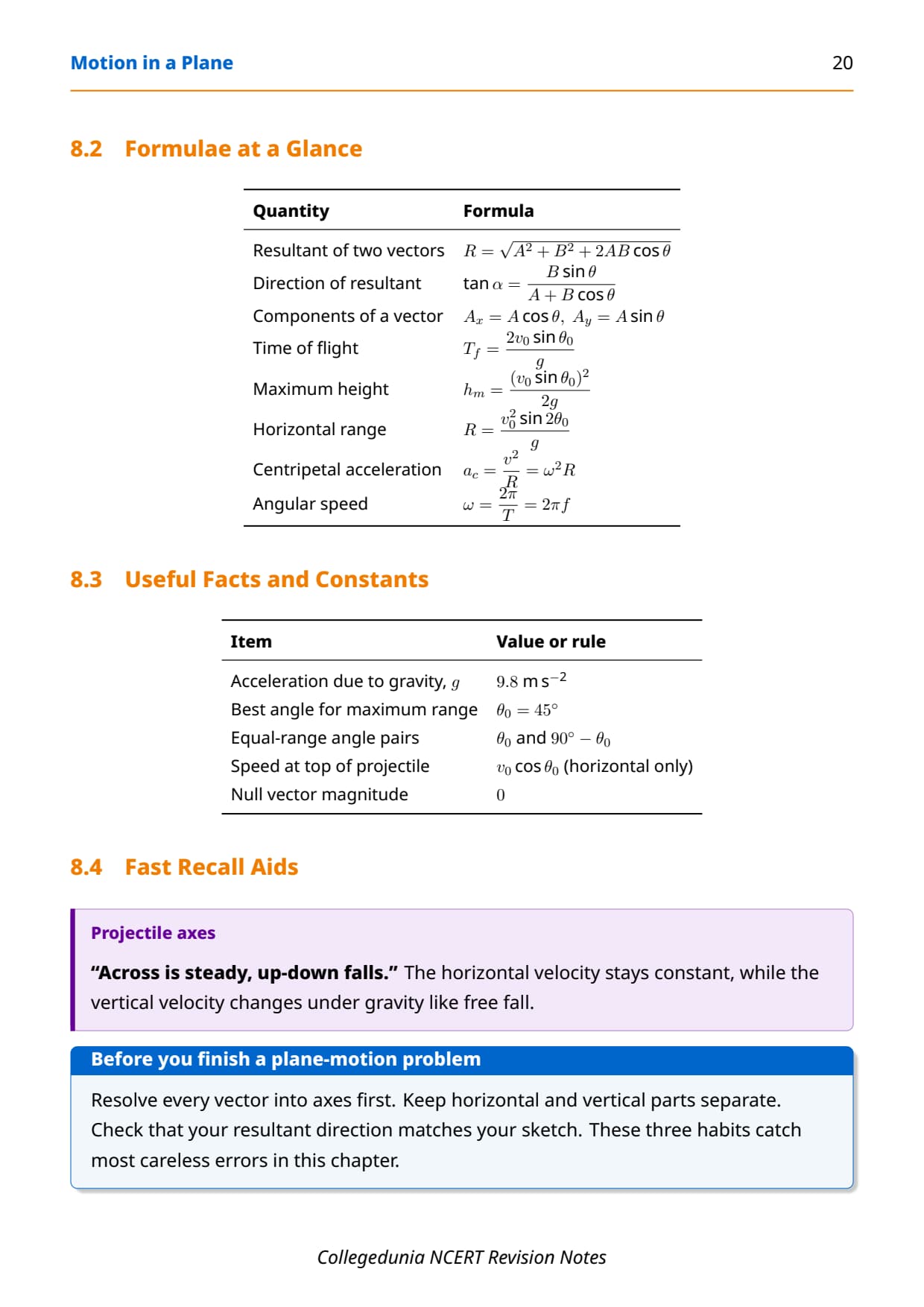
| R = √(A2 + B2 + 2AB cosθ) | Magnitude of the resultant of two vectors | Same unit as the vectors |
| tanα = (B sinθ)/(A + B cosθ) | Direction of the resultant from vector A | Dimensionless (angle) |
| Ax = A cosθ, Ay = A sinθ | Components of a vector | Same unit as the vector |
| T = (2u sinθ)/g | Time of flight of a projectile | second (s) |
| H = (u2 sin2θ)/(2g) | Maximum height of a projectile | metre (m) |
| R = (u2 sin2θ)/g | Horizontal range of a projectile | metre (m) |
| y = x tanθ − (gx2)/(2u2 cos2θ) | Equation of the parabolic path | metre (m) |
| ac = v2/r | Centripetal acceleration | m s-2 |
| v = rω | Link between linear and angular speed | m s-1 |
| ac = ω2r | Centripetal acceleration from angular speed | m s-2 |
Carry the SI unit on every line of your working. Losing the unit is a silent way to drop the final mark even when the number is right. Keep this table open while you solve the back-exercise numericals.
Key Definitions and Derivations for Motion in a Plane
Boards short-answer questions often ask for a clean definition in one or two lines. Learn these word-for-word, because a vague definition loses easy marks. Each one also sets up a derivation you can be asked to show.
| Term | Definition |
|---|---|
| Scalar | A quantity that has magnitude only, with no direction. |
| Vector | A quantity that has both magnitude and direction and obeys the laws of vector addition. |
| Unit vector | A vector of magnitude one used to show direction. |
| Projectile | An object thrown into the air that moves under gravity alone. |
| Uniform circular motion | Motion of a body in a circle at constant speed. |
| Centripetal acceleration | The centre-pointing acceleration of a body in circular motion. |
A common derivation asks you to prove the range formula of a projectile. Resolve the launch velocity, write the horizontal and vertical motion separately, then eliminate time to get R = (u2 sin2θ)/g. The same method gives maximum height and time of flight, so learn it once.
Projectile Motion: Range, Maximum Height and Time of Flight
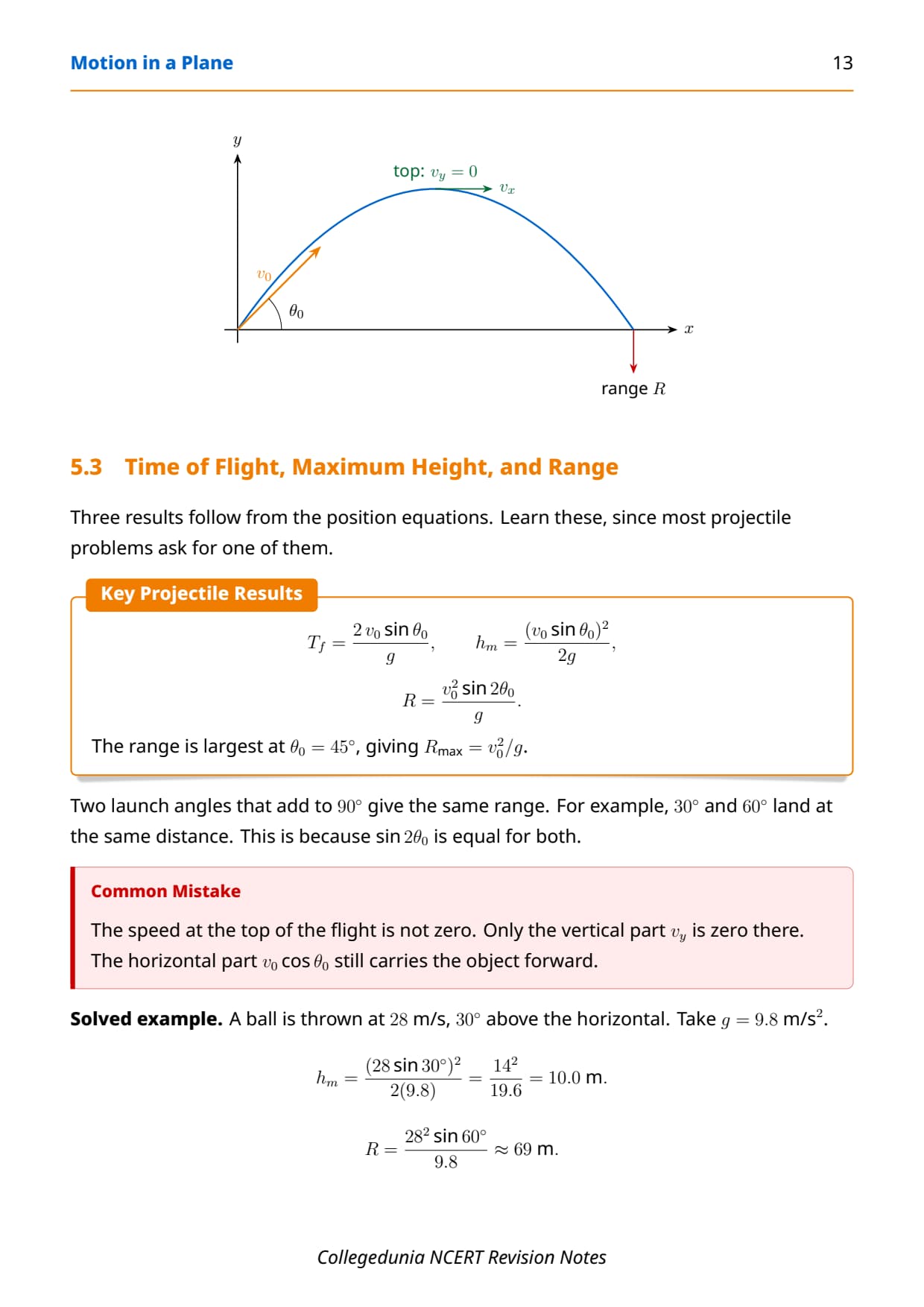
Projectile motion is the flagship topic of the chapter. A projectile has constant horizontal velocity and a vertical motion controlled by gravity. Because the two directions are independent, you treat them separately and combine the results.
- Horizontal motion: velocity stays constant at u cosθ, since no horizontal force acts.
- Vertical motion: velocity starts at u sinθ and changes under gravity g.
- Path shape: the two motions together trace a parabola.
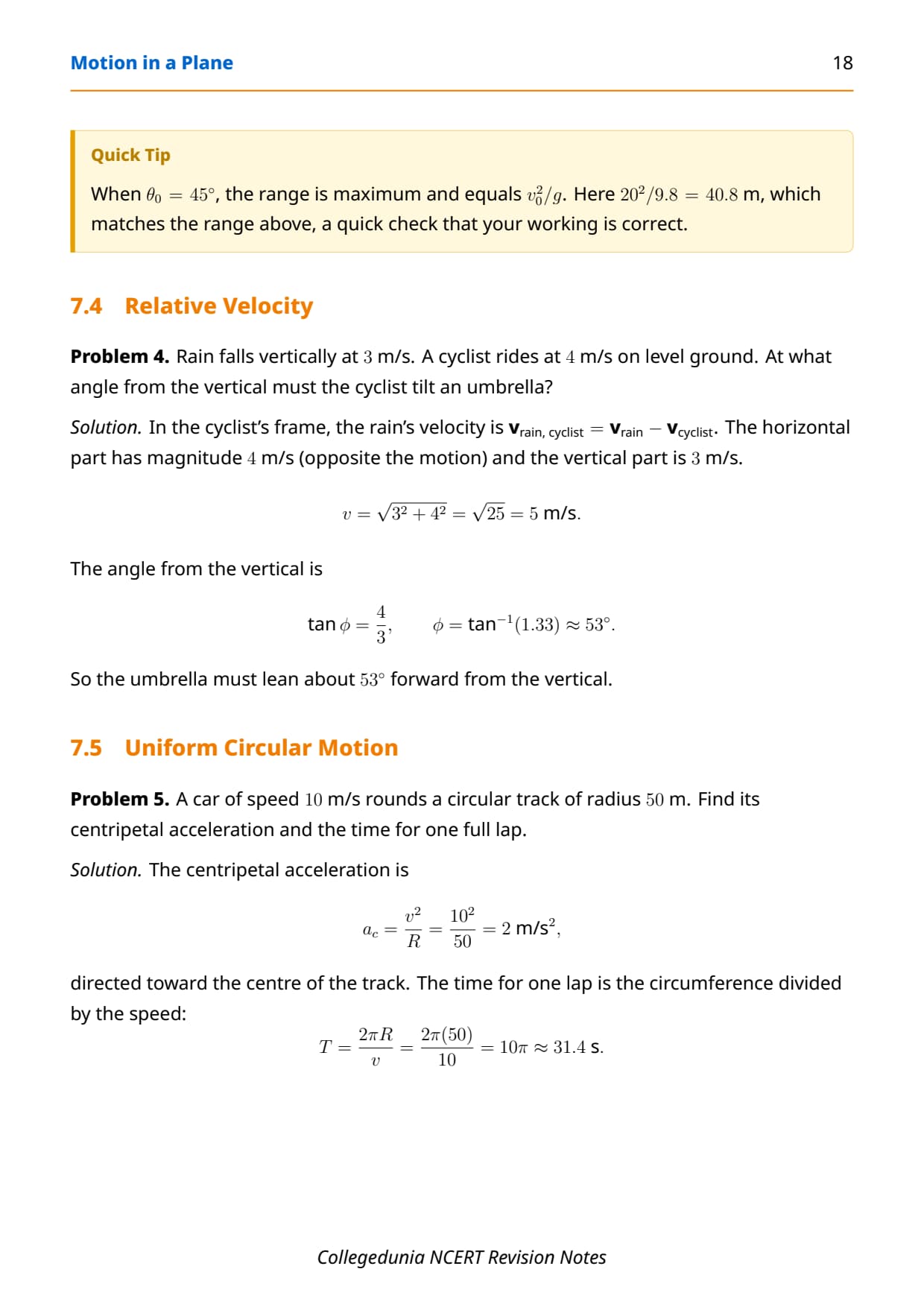
The range is maximum at a launch angle of 45 degrees, and two angles that add to 90 degrees give the same range. Maximum height depends on the vertical part of the speed, so a steeper throw goes higher but not always further. These results are a favourite in JEE Main and NEET objective questions, so keep them at your fingertips.
Uniform Circular Motion and Centripetal Acceleration
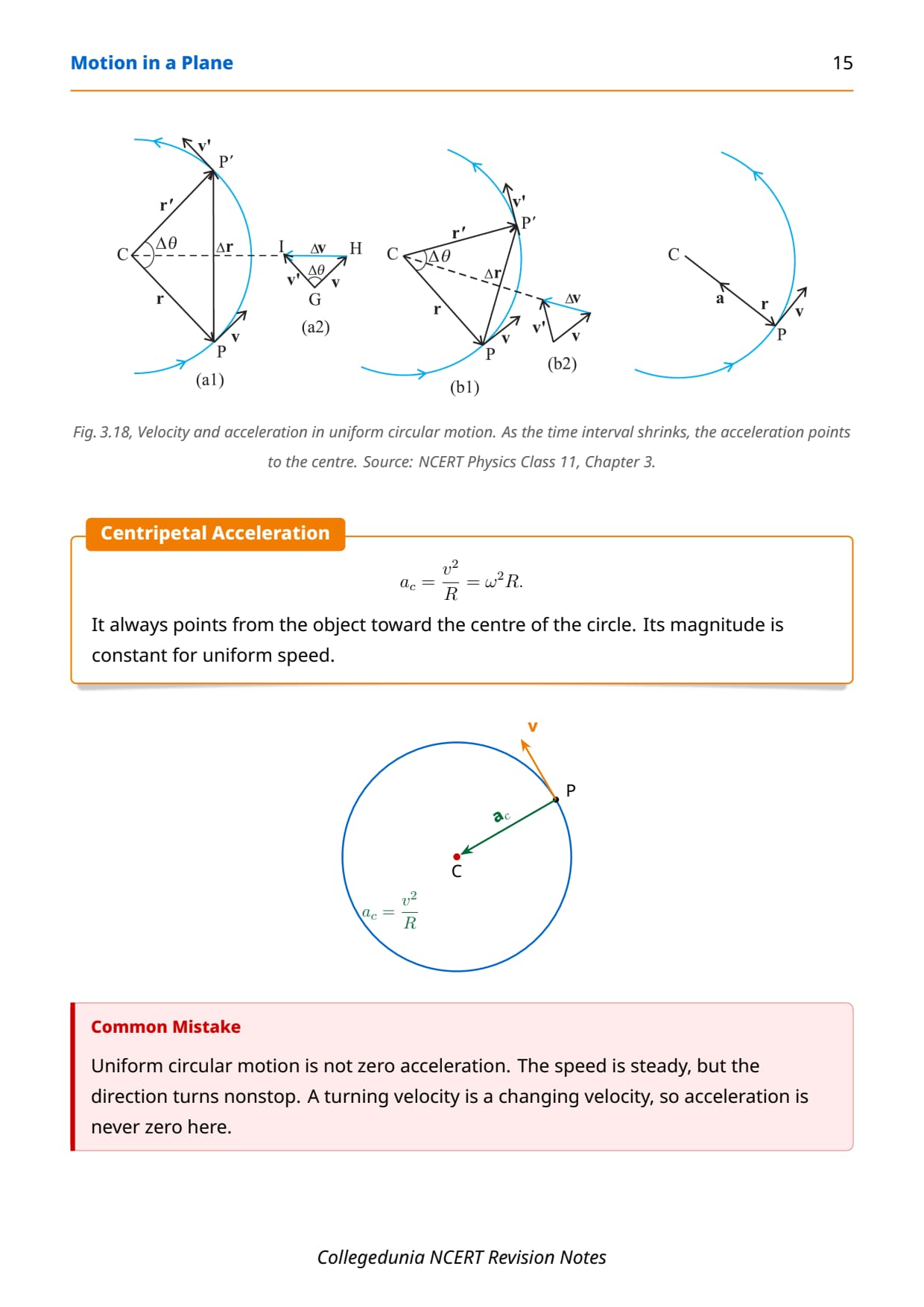
In uniform circular motion a body moves in a circle at constant speed. The speed does not change, but the direction of velocity changes every instant, so there is still an acceleration. This idea confuses many students, so read it carefully.
- Centripetal acceleration: always points to the centre, with magnitude ac = v2/r.
- Angular speed: the angle swept per second, ω, linked to linear speed by v = rω.
- Time period: the time for one full circle, T = 2πr/v.
The acceleration is directed to the centre even though the speed is constant. This is because velocity is a vector, and its direction keeps turning. Understanding this one point unlocks the whole topic and is exactly what CBSE tests in the short-answer question on circular motion.
Common Mistakes Students Make in Motion in a Plane
These slips happen while writing or calculating, not because the concept is unclear. Each one costs 1 to 3 marks in the paper, so watch for them at the exact step.
Mistake 1: Adding vectors like plain numbers. Always resolve into components or use the parallelogram law before combining.
Mistake 2: Mixing the sine and cosine components. Use A cosθ along the axis the angle is measured from, and A sinθ for the perpendicular axis.
Mistake 3: Thinking there is no acceleration in uniform circular motion. The direction of velocity changes, so a centre-pointing acceleration always acts.
Mistake 4: Forgetting that horizontal velocity stays constant in projectile motion. Gravity acts only on the vertical part of the motion.
Motion in a Plane Weightage in CBSE Boards, JEE and NEET
This chapter is a reliable scorer. It carries a short answer on vectors plus a numerical on projectile or circular motion almost every year. Here is how the marks split across the main exams for 2026-27.
| Exam | Typical weightage | What is asked |
|---|---|---|
| CBSE Boards | 6 to 8 marks | One short answer on vectors plus one projectile or circular-motion numerical |
| JEE Main | 2 to 3 questions | Projectile range and height, vector resolution, relative velocity |
| NEET | 1 to 2 questions | Projectile motion and centripetal acceleration |
| CUET and NDA | 1 to 2 objective questions | Vector addition and simple projectile results |
Projectile motion is the single most tested idea from this chapter across all four exams. Master it first, then vector resolution, then circular motion, in that order of return on effort.
How to Revise Motion in a Plane Quickly
Use these Class 11 Physics Notes Chapter 3 Motion in a Plane for a fast, ordered recap the night before a test. The checklist below takes about 30 minutes and hits every marks-heavy idea.
- First 10 minutes: write the resultant formula and resolve three sample vectors into components from memory.
- Next 10 minutes: redo one projectile numerical for range, maximum height and time of flight.
- Last 10 minutes: derive centripetal acceleration and link linear speed to angular speed.
Close the loop by sketching one projectile path and marking its velocity at three points. If you can do all three blocks without notes, the chapter is exam-ready. Keep the All Formulas table beside you for the first pass only, then try it closed-book.
Student Feedback on the Motion in a Plane Notes
What 13,420 students told us about their Motion in a Plane revision:
- 71% of students rated projectile motion as the hardest sub-topic in the chapter.
- Most-skipped step: mixing up the sine and cosine components while resolving a vector, missed by about 3 in 10 students.
- Students who mastered vector resolution first said projectile and circular motion felt far easier.
Source: 2026-27 Class 11 Physics student poll. Sample of 13,420 students from CBSE schools across 14 states, conducted before the 2026 boards.
Other Motion in a Plane Class 11 Physics Resources
Pair these notes with the solved answers, the handwritten notes, the formula sheet, and the textbook PDF for the same chapter.
| Resource | Link |
|---|---|
| NCERT Solutions | Motion in a Plane Class 11 NCERT Solutions |
| Handwritten Notes | Motion in a Plane Class 11 Handwritten Notes |
| Formula Sheet | Motion in a Plane Class 11 Formula Sheet |
| NCERT Book PDF | Motion in a Plane Class 11 Book PDF |
NCERT Notes for Class 11 Physics: All Chapters
Jump to the revision notes for any other Class 11 Physics chapter below.
| Chapter | NCERT Notes |
|---|---|
| Chapter 1 | Units and Measurements |
| Chapter 2 | Motion in a Straight Line |
| Chapter 3 | Motion in a Plane |
| Chapter 4 | Laws of Motion |
| Chapter 5 | Work, Energy and Power |
| Chapter 6 | System of Particles and Rotational Motion |
| Chapter 7 | Gravitation |
| Chapter 8 | Mechanical Properties of Solids |
| Chapter 9 | Mechanical Properties of Fluids |
| Chapter 10 | Thermal Properties of Matter |
| Chapter 11 | Thermodynamics |
| Chapter 12 | Kinetic Theory |
| Chapter 13 | Oscillations |
| Chapter 14 | Waves |
FAQs on Motion in a Plane Class 11 Physics Notes
Motion in a Plane Notes - Frequently Asked Questions
Ques. What topics do the Class 11 Physics Notes Chapter 3 Motion in a Plane cover?
Ans. These Class 11 Physics Notes Chapter 3 Motion in a Plane cover scalars and vectors, vector addition by the triangle and parallelogram laws, resolution of vectors and unit vectors, projectile motion with its range, height and time of flight, and uniform circular motion with centripetal acceleration. Every key formula and definition is included for fast revision.
Ques. What is the difference between a scalar and a vector?
Ans. A scalar quantity has only size, such as distance, speed, mass or time. A vector quantity has both size and direction and follows the laws of vector addition, such as displacement, velocity, acceleration and force. This difference is why velocity can change even when speed stays the same.
Ques. How do I find the range of a projectile in this chapter?
Ans. The horizontal range of a projectile is R = (u2 sin2θ)/g, where u is the launch speed, theta is the launch angle, and g is gravity. The range is maximum at a launch angle of 45 degrees, and two angles that add to 90 degrees give the same range. The formula table in these notes shows each projectile result.
Ques. Why is there acceleration in uniform circular motion?
Ans. In uniform circular motion the speed is constant, but the direction of the velocity changes every instant. Because velocity is a vector, this change of direction is an acceleration. It points to the centre of the circle and is called centripetal acceleration, with magnitude ac = v2/r.
Ques. What is the weightage of Motion in a Plane in the CBSE board exam?
Ans. Motion in a Plane carries about 6 to 8 marks in the CBSE Class 11 Physics paper, usually one short answer on vectors plus one projectile or circular-motion numerical. It also appears in JEE Main and NEET as questions on projectile range and height, vector resolution, and centripetal acceleration.
Ques. How should I revise Motion in a Plane quickly for a test?
Ans. Start by writing the resultant formula and resolving three vectors into components from memory. Then redo one projectile numerical for range, maximum height and time of flight. Finish by deriving centripetal acceleration. The quick-revision checklist in these Class 11 Physics Notes Chapter 3 Motion in a Plane covers all of this in about 30 minutes.



Comments