




These Class 11 Physics Notes Chapter 2 Motion in a Straight Line gather every kinematics definition, equation and graph that the Boards, JEE Main, JEE Advanced, NEET, CUET and NDA papers actually test in 2026-27. Use them to revise the whole chapter fast, with formulas, definitions and graph rules in one place.
This is the first chapter of mechanics, and the motion ideas here set up Laws of Motion and every dynamics numerical you solve later in the year.
- CBSE Weightage: 4 to 5 marks, usually one graph-based question plus one numerical on the kinematic equations.
- Topics covered: position, distance, displacement, speed, velocity, acceleration, the three equations of motion, motion graphs, and relative velocity in one dimension.
- Key formulas: the three kinematic equations and the average velocity relation for uniform acceleration.
These Class 11 Physics Notes Chapter 2 Motion in a Straight Line are curated by subject experts, based on the 2026-27 NCERT textbook, and checked against the last five years of CBSE Board, JEE Main and NEET papers.
Topic-by-Topic Summary of Motion in a Straight Line
The chapter describes motion along one line, called rectilinear motion. It starts with how to fix position, then defines how fast and in which direction an object moves, and ends with graphs and relative velocity. Here is the quick map of what each topic gives you.
- Position and frame of reference: the location of an object measured from a chosen origin on a straight line.
- Distance and displacement: distance is the total path length; displacement is the straight change in position with direction.
- Speed and velocity: speed is how fast; velocity adds direction and can be positive or negative.
- Acceleration: the rate at which velocity changes, uniform or non-uniform.
- Kinematic equations and graphs: the three equations for uniform acceleration, plus position-time and velocity-time graphs.
- Relative velocity: the velocity of one object as seen from another moving object in one dimension.
Revise the topics in this order, because each one builds on the one before it. Fix the sign convention first, and the rest of the chapter becomes far easier. These Class 11 Physics Notes Chapter 2 Motion in a Straight Line follow the same sequence as the NCERT textbook.
Position, Distance, Displacement and Path Length
Motion always starts from a fixed point. You pick an origin and a positive direction, and every position is measured from there. This choice, called a frame of reference, decides the sign of every quantity in the chapter.
- Position: the coordinate of the object on the line, measured from the origin, with a sign for direction.
- Path length (distance): the total length of the actual path covered. It is always positive and never decreases.
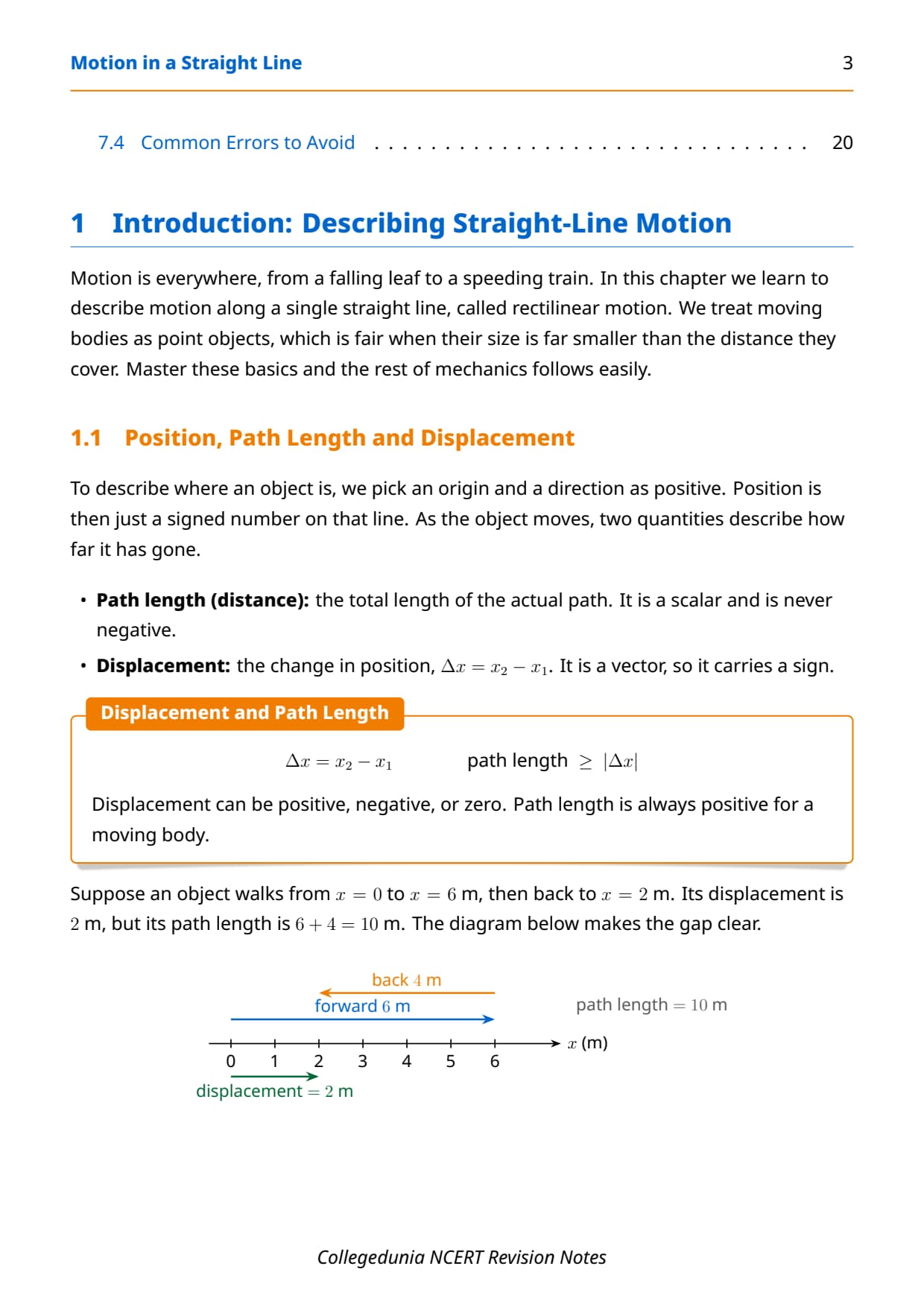
- Displacement: the change in position, Δx = x2 − x1. It has a sign and can be zero, positive or negative.
Displacement can be zero even when distance is large, such as a full round trip back to the start. This is the single most tested difference in the whole topic. The size of the displacement is always less than or equal to the path length, and they are equal only when the motion stays in one direction.
Average and Instantaneous Velocity and Speed
The chapter separates two ways of measuring how fast an object moves. Average values look at the whole trip, while instantaneous values look at a single moment. Getting the two apart is key to the graph questions later.
| Quantity | Definition | Direction? |
|---|---|---|
| Average speed | Total path length divided by total time | No, always positive |
| Average velocity | Displacement divided by total time, Δx/Δt | Yes, carries a sign |
| Instantaneous speed | The size of the instantaneous velocity | No, always positive |
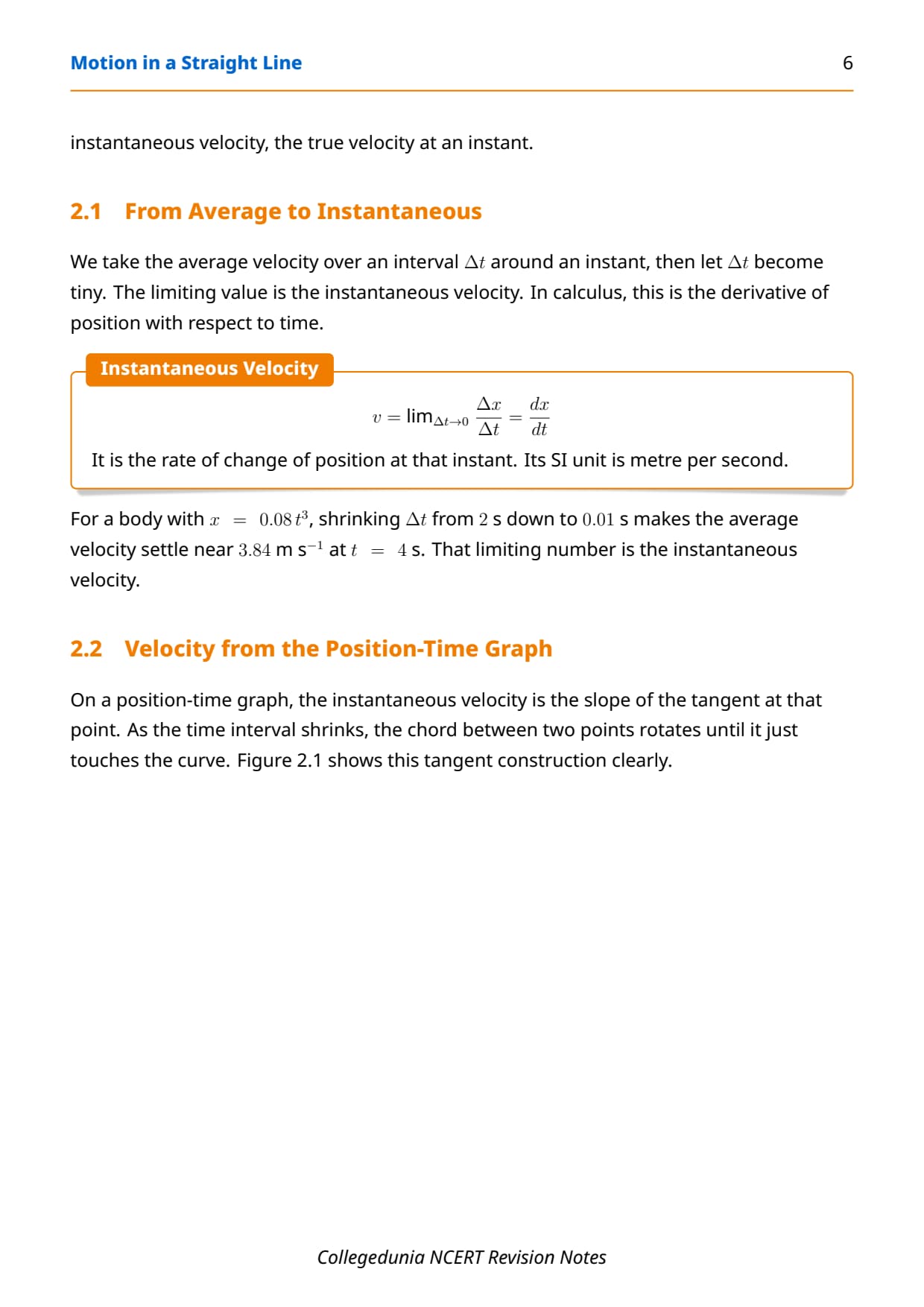
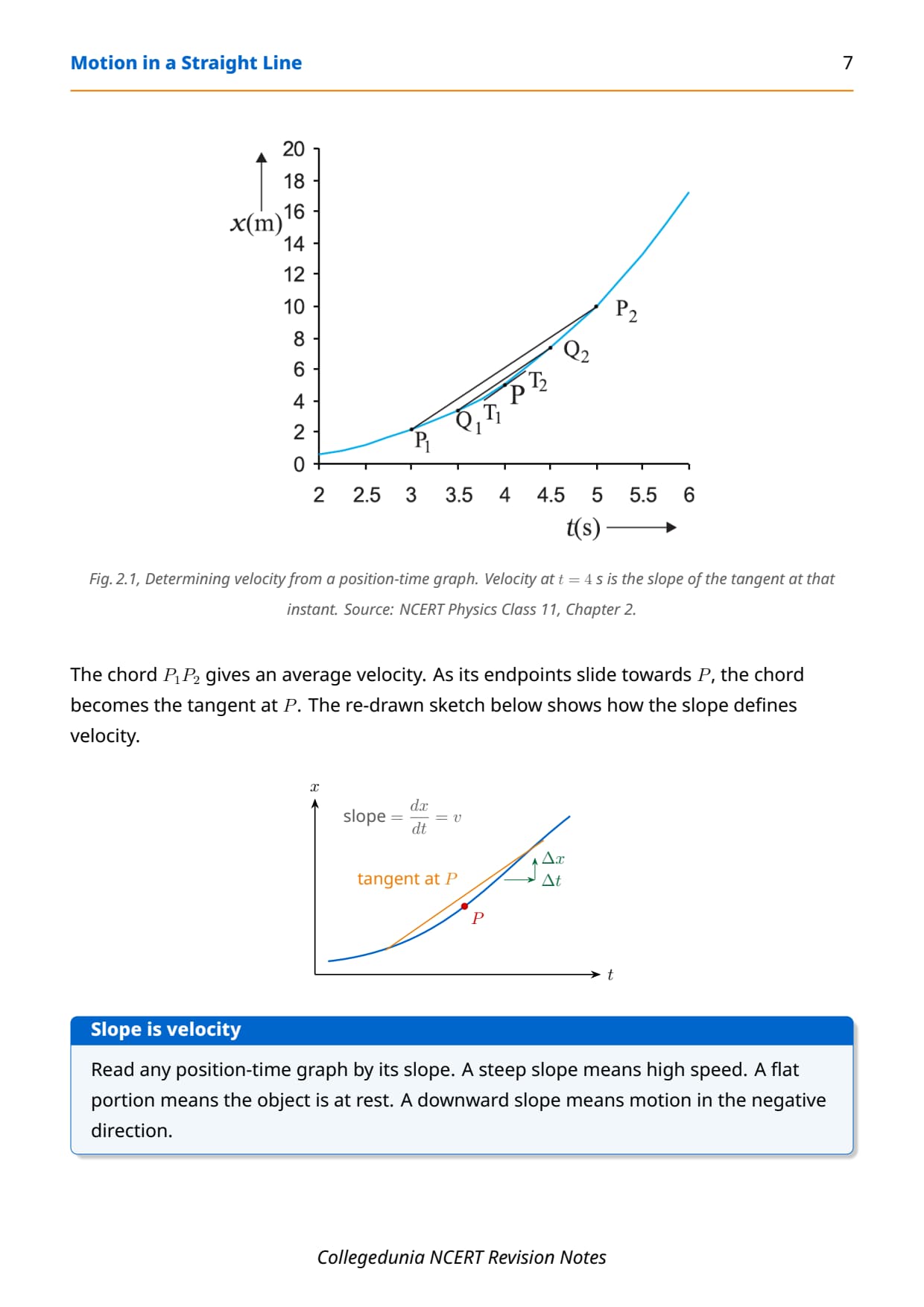
| Instantaneous velocity | The limit of Δx/Δt as Δt goes to zero, v = dx/dt | Yes, carries a sign |
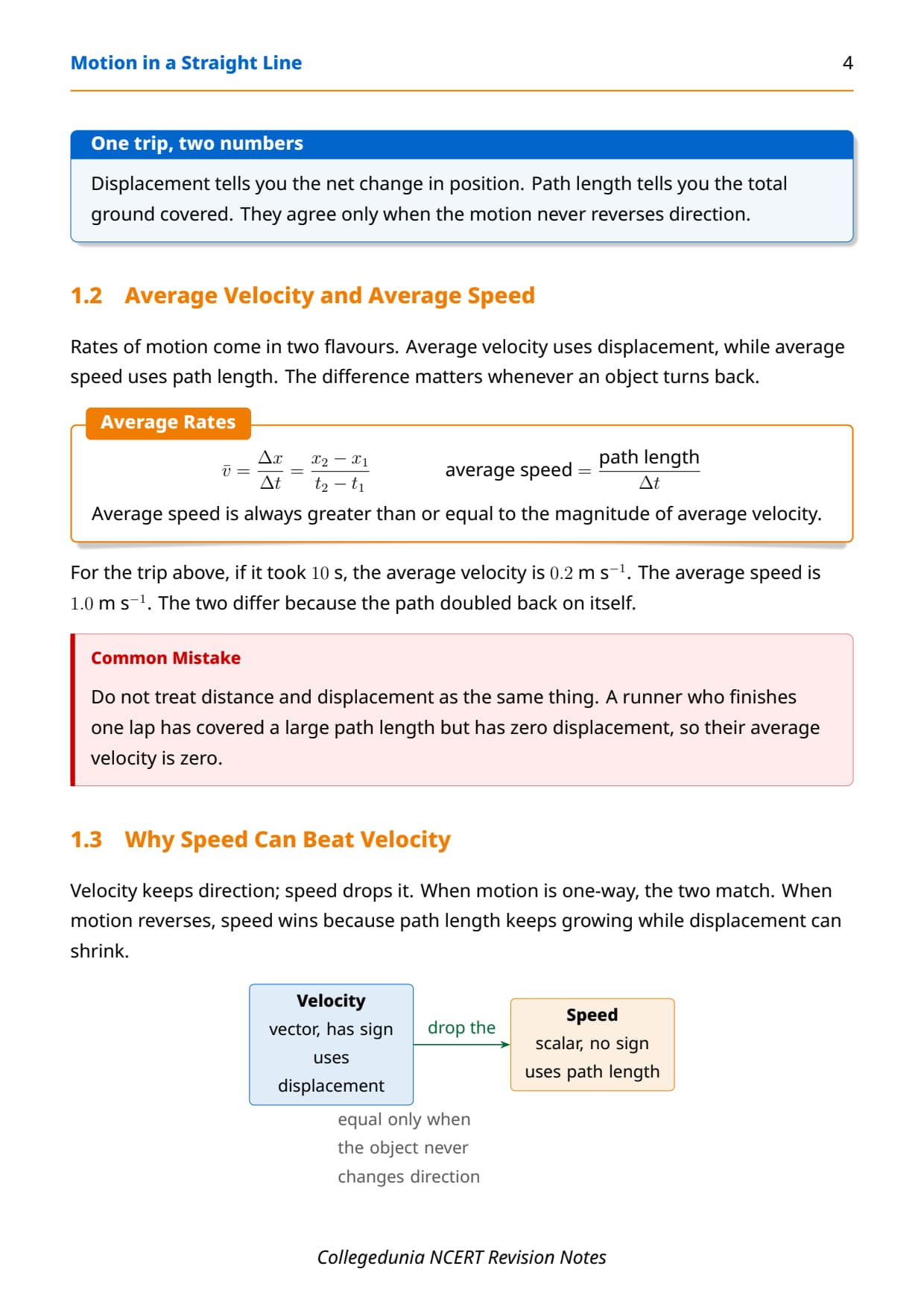
Average speed is never smaller than the size of average velocity, and the two are equal only for straight-line motion in one direction. In a velocity-time graph the slope gives acceleration and the area gives displacement. Keep this pair of facts ready, since they answer most objective questions from this topic.
Uniform and Non-Uniform Acceleration
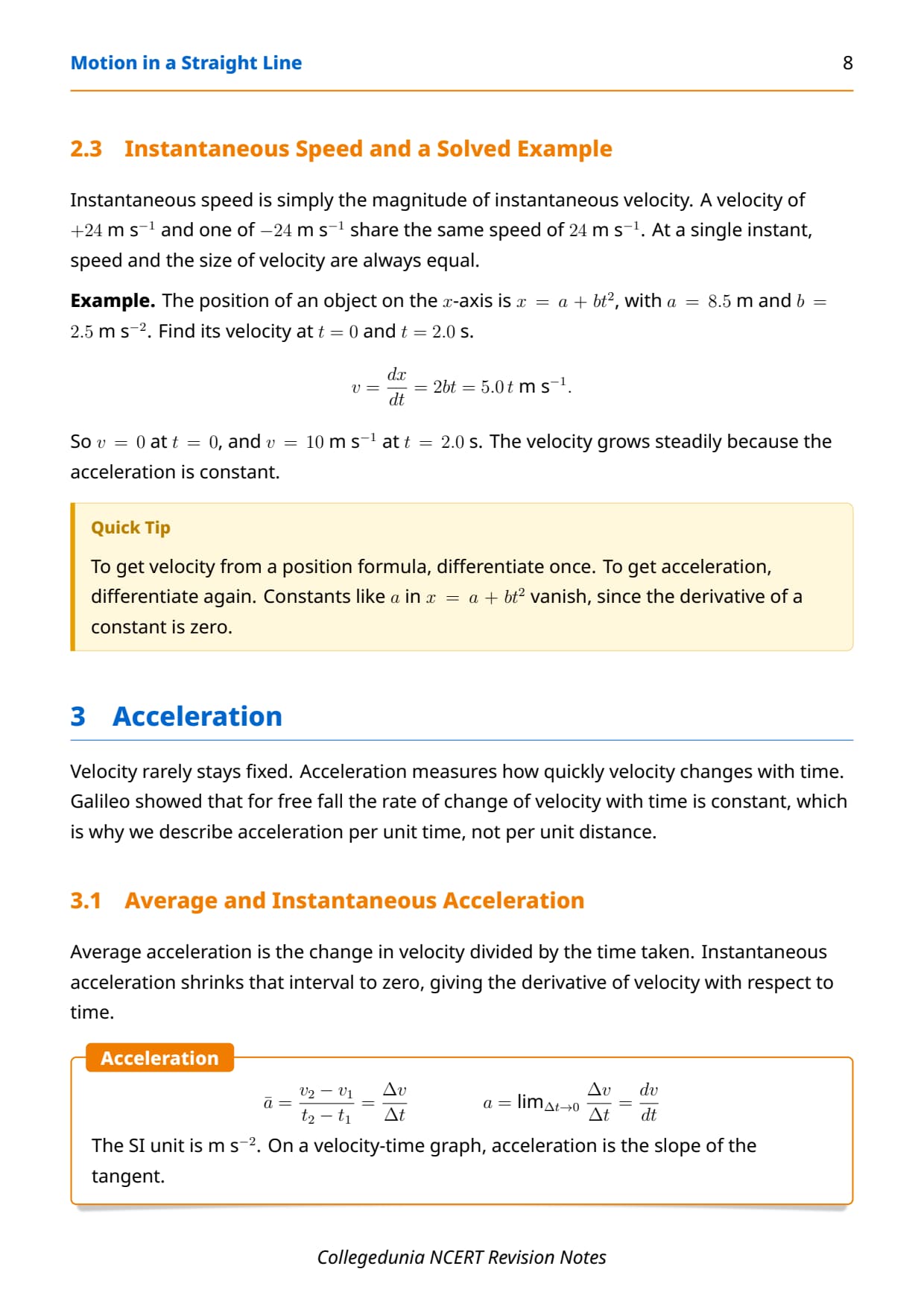
Acceleration is the rate at which velocity changes with time, a = dv/dt. The chapter sorts motion into two kinds by how acceleration behaves, and this split decides which formulas you are allowed to use.
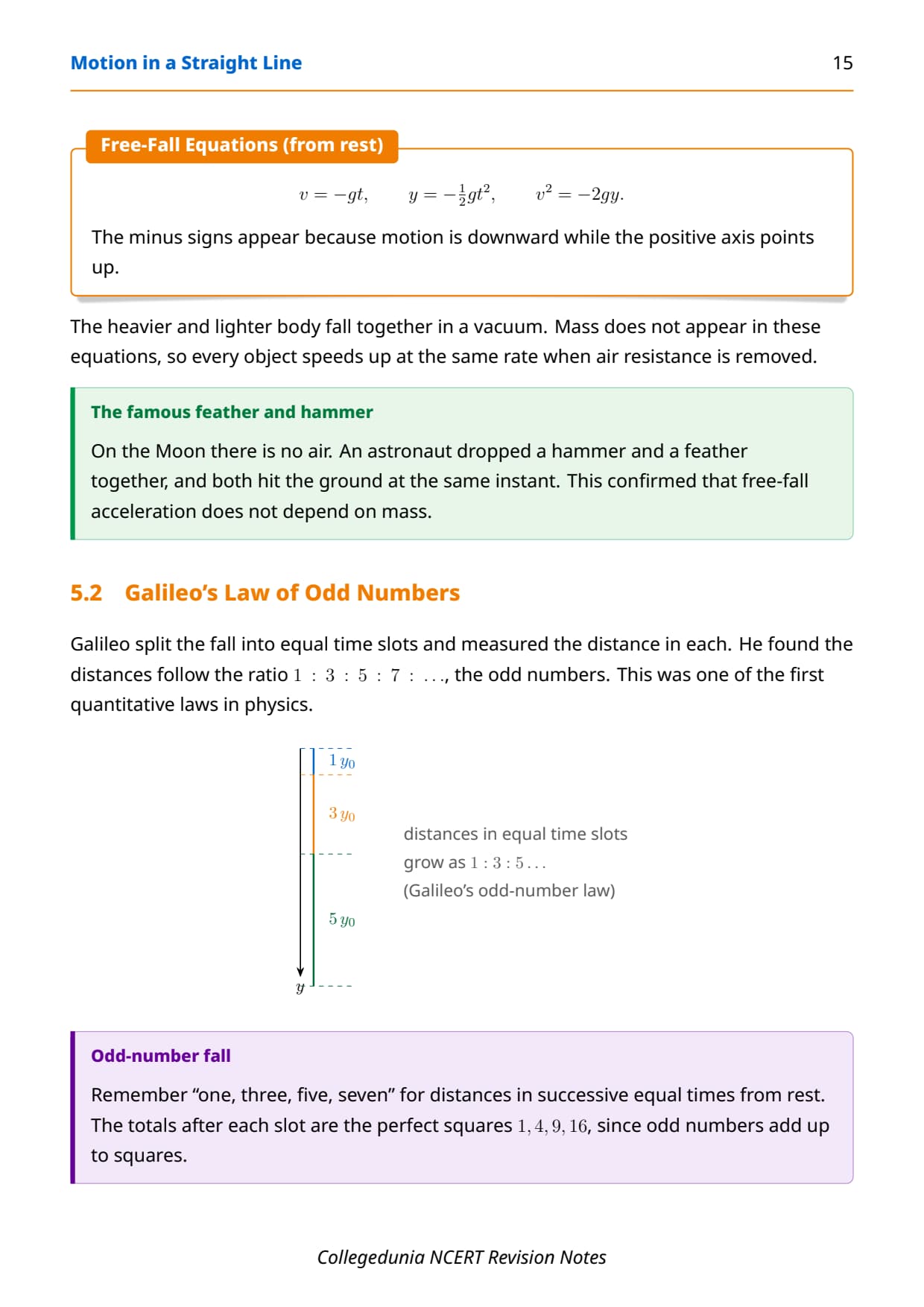
- Uniform acceleration: acceleration stays constant, so velocity changes by equal amounts in equal times. Free fall under gravity is the standard example.
- Non-uniform acceleration: acceleration itself changes with time, so the three kinematic equations no longer apply and you must use calculus.
The three equations of motion work only when acceleration is constant. Using them for changing acceleration is the most common conceptual slip in the chapter. Acceleration also carries a sign: a negative value while the object moves forward means it is slowing down, which is called retardation or deceleration.
All Formulas for Motion in a Straight Line
Every formula you need for the chapter sits in one table below, with its meaning and its SI unit. Learn the three kinematic equations first, since they carry the most marks in both Boards and entrance papers.
| Formula | What it means | SI unit |
|---|---|---|
| Average speed = total path / total time | How fast on average, no direction | m s-1 |
| vavg = Δx/Δt | Average velocity over an interval | m s-1 |
| v = dx/dt | Instantaneous velocity | m s-1 |
| a = dv/dt | Instantaneous acceleration | m s-2 |
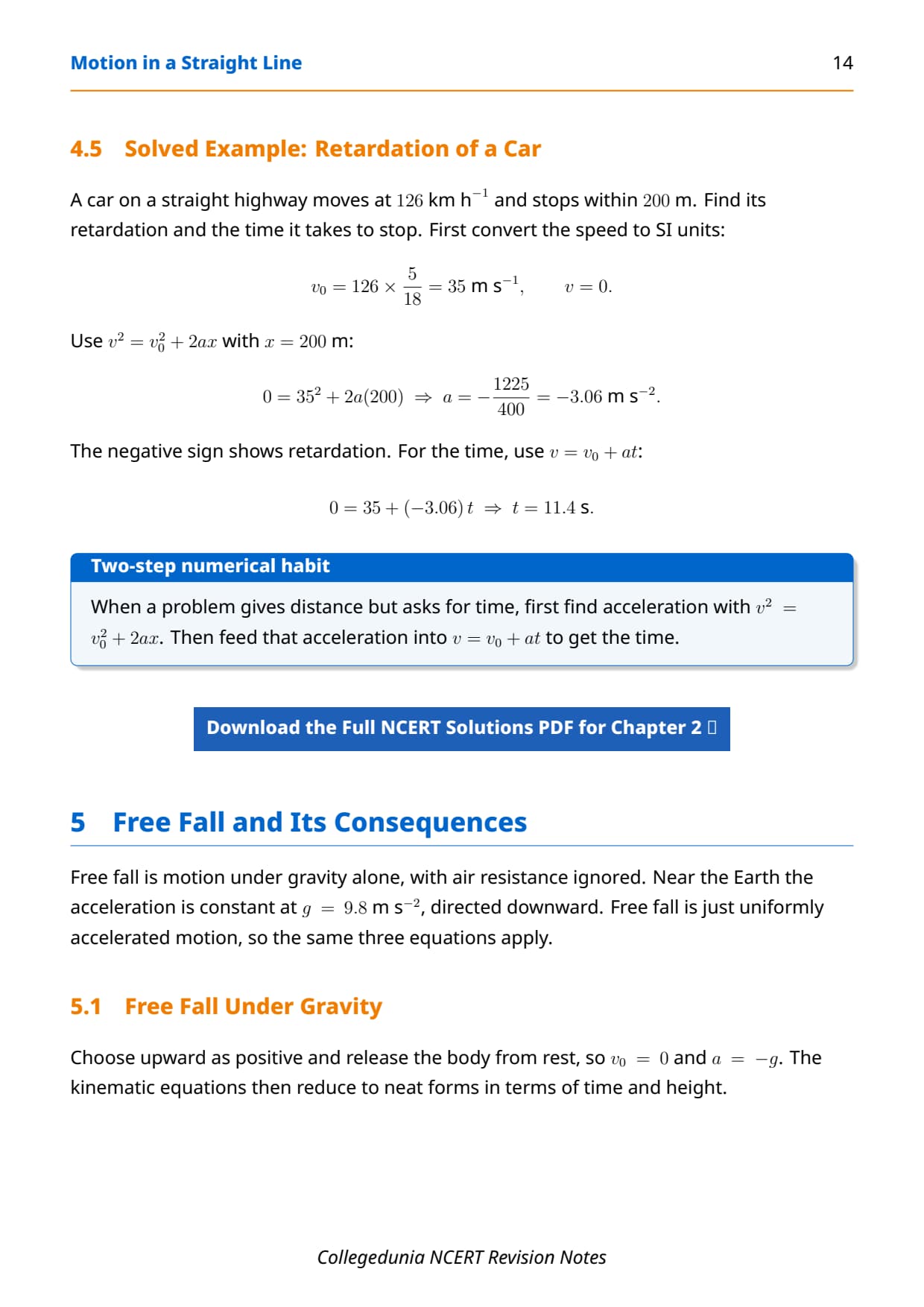
| v = u + at | First equation of motion (velocity after time t) | m s-1 |
| x = ut + ½at2 | Second equation of motion (displacement in time t) | metre (m) |
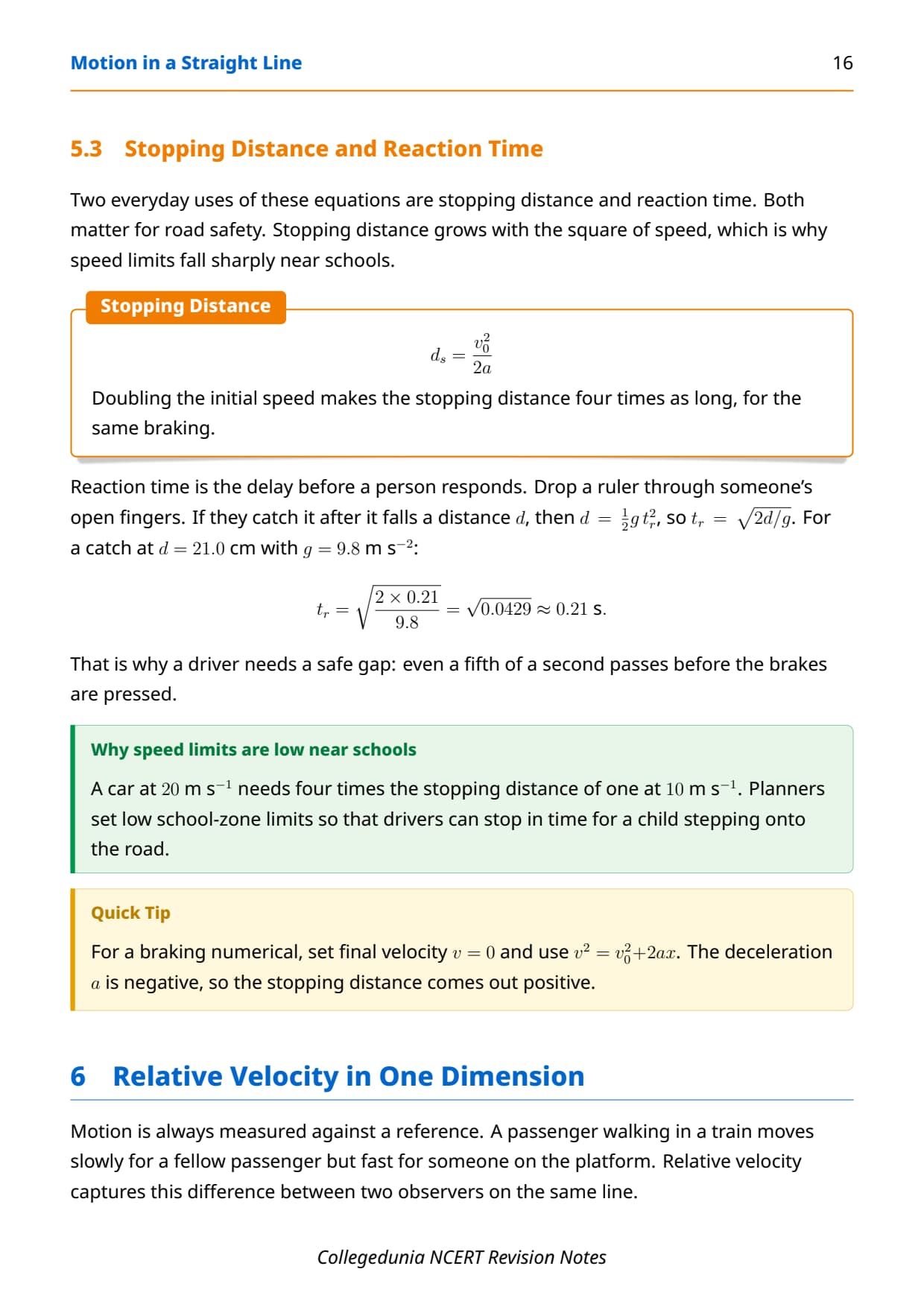
| v2 = u2 + 2ax | Third equation of motion (velocity vs displacement) | m2 s-2 |
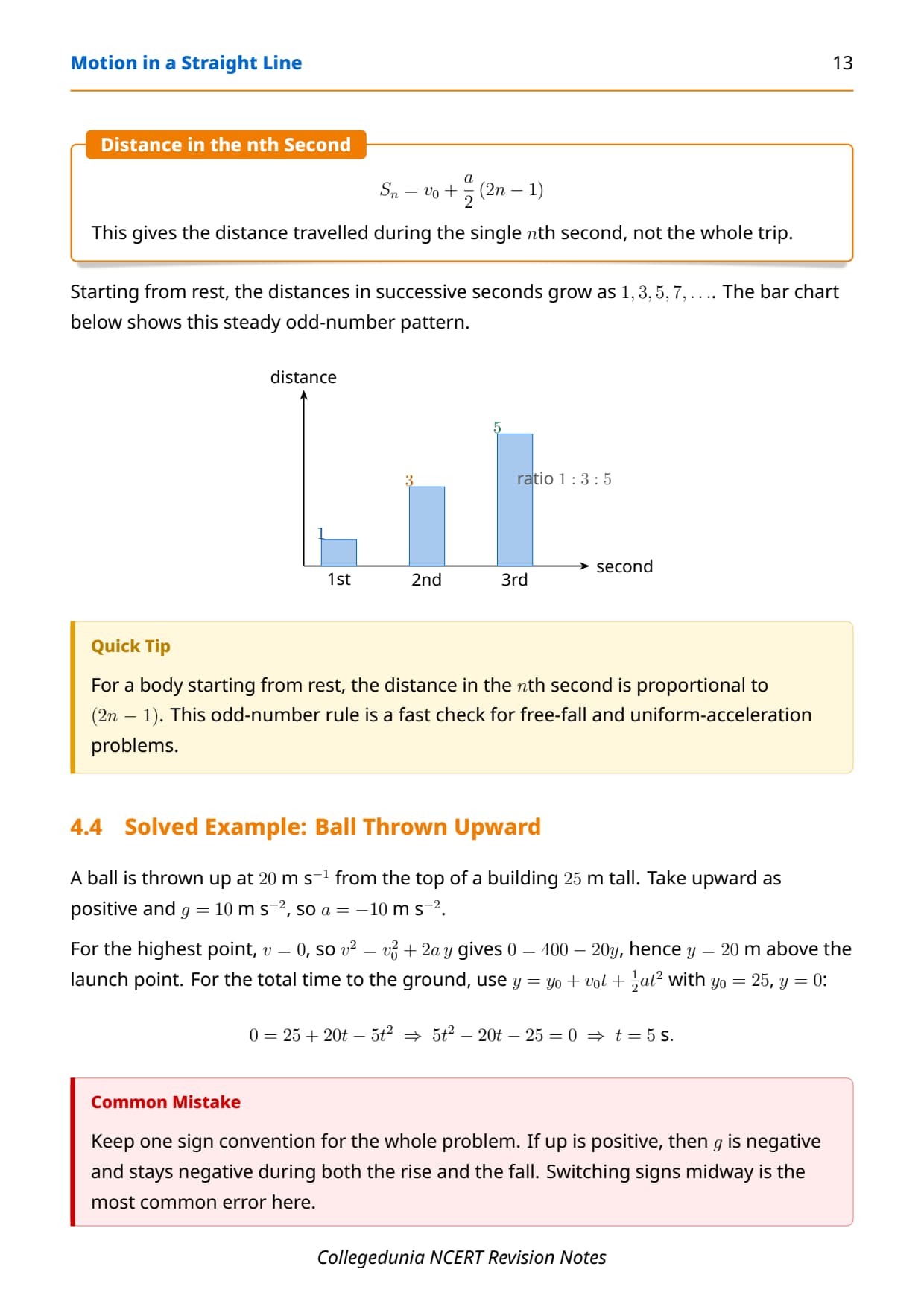
| xn = u + ½a(2n − 1) | Distance covered in the n-th second | metre (m) |
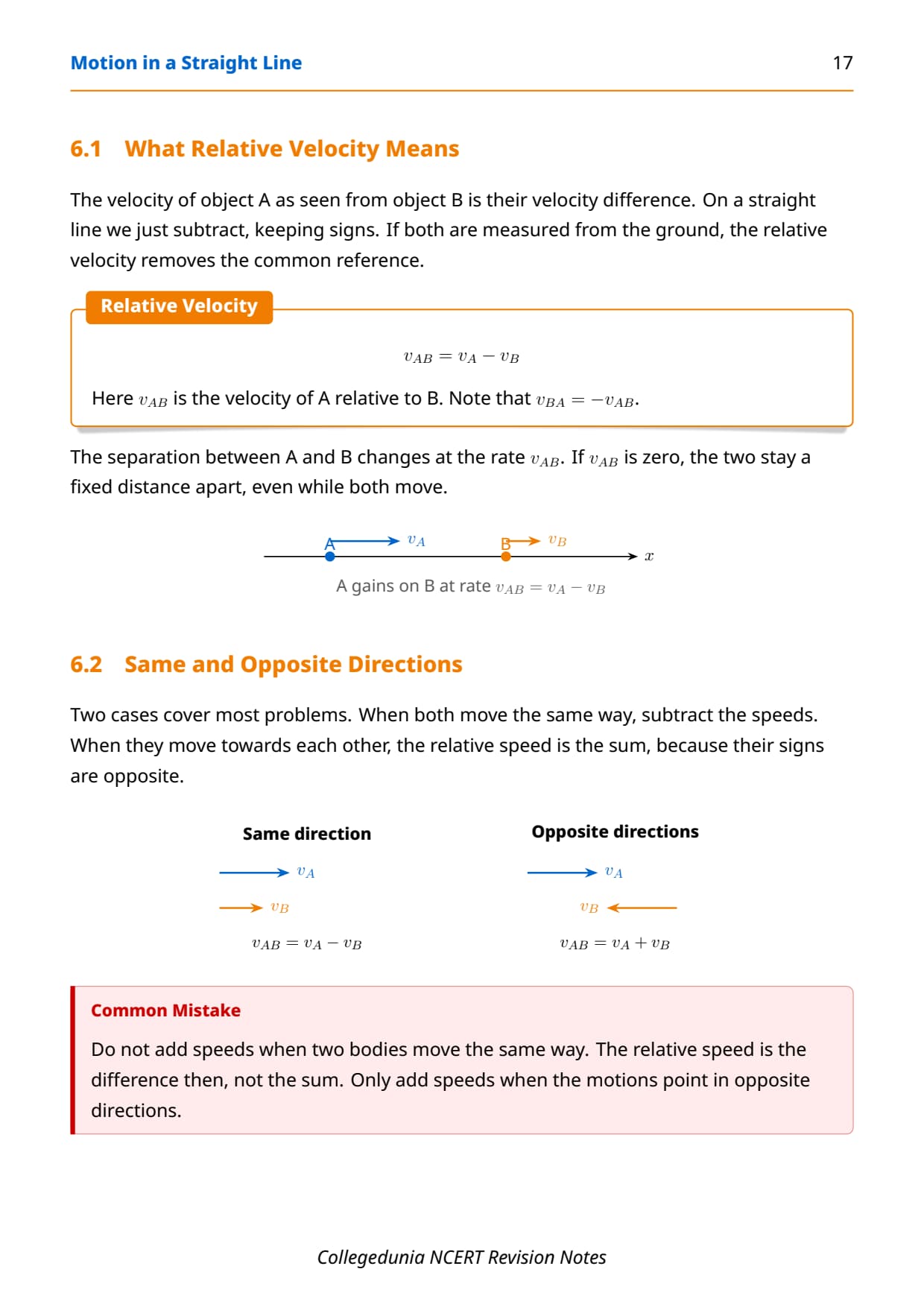
| vAB = vA − vB | Relative velocity of A with respect to B | m s-1 |
Carry the sign of each quantity on every line of your working. A wrong sign for u, v or a is the quietest way to lose the final mark even when the method is right. Keep this table open while you solve the back-exercise numericals.
Key Definitions and Derivations for Motion in a Straight Line
Boards short-answer questions often ask for a clean definition in one or two lines. Learn these word-for-word, because a vague definition loses easy marks. Each one also sets up a derivation you can be asked to show.
| Term | Definition |
|---|---|
| Rectilinear motion | Motion of an object along a straight line. |
| Displacement | The change in position of an object, with direction. |
| Average velocity | The ratio of total displacement to the total time taken. |
| Instantaneous velocity | The velocity of an object at a single instant of time. |
| Acceleration | The rate of change of velocity with time. |
| Relative velocity | The velocity of one object as seen from another object. |
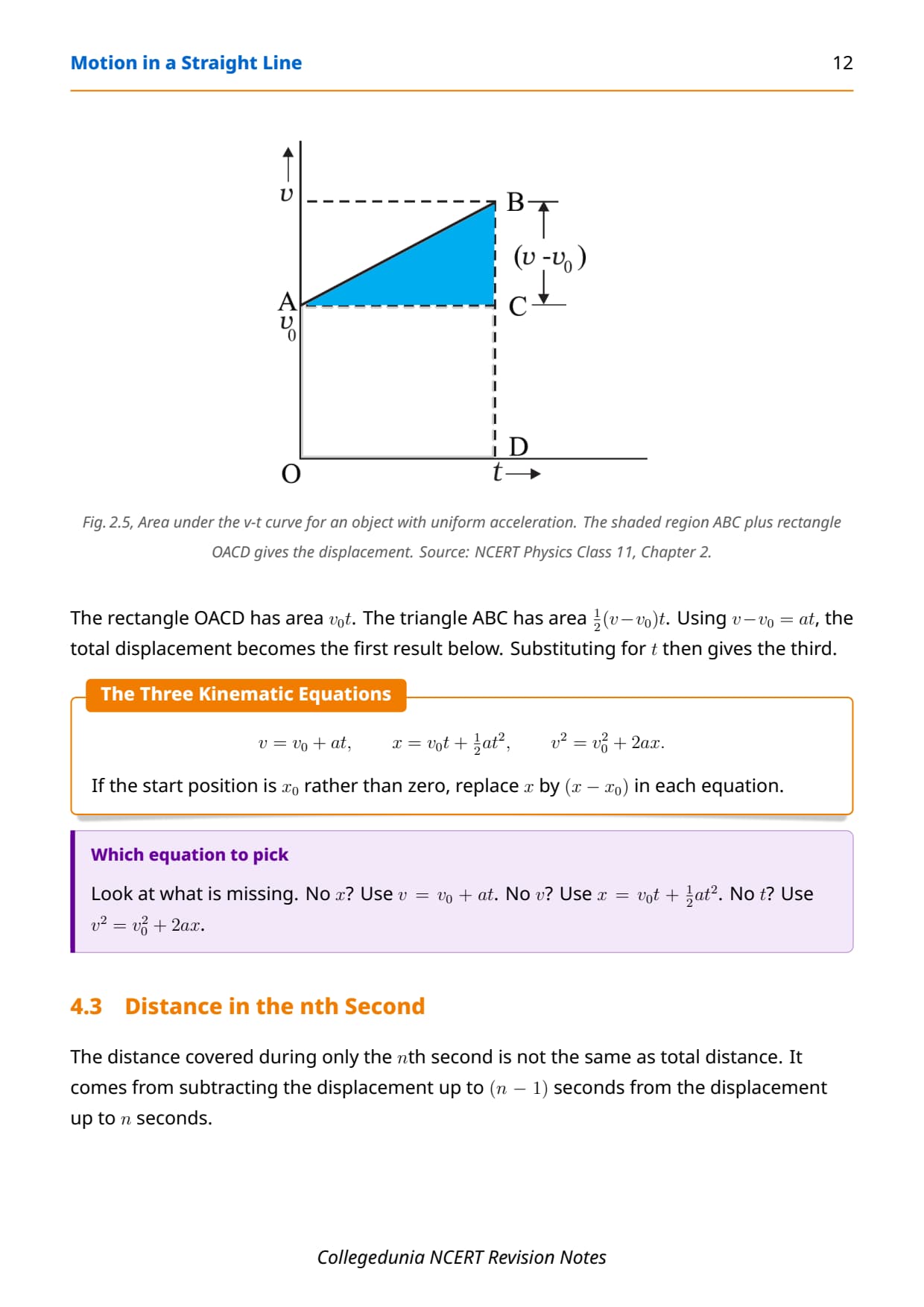
A common derivation asks you to get the three equations of motion from a velocity-time graph. Use the slope for acceleration and the area for displacement to reach v = u + at and x = ut + ½at2. Combining these two removes time and gives the third equation, v2 = u2 + 2ax.
Position-Time and Velocity-Time Graphs
Graphs turn the whole chapter into shapes you can read at a glance. The two key graphs are position against time and velocity against time. What you read from each one is fixed, so learn the slope-and-area rules once.
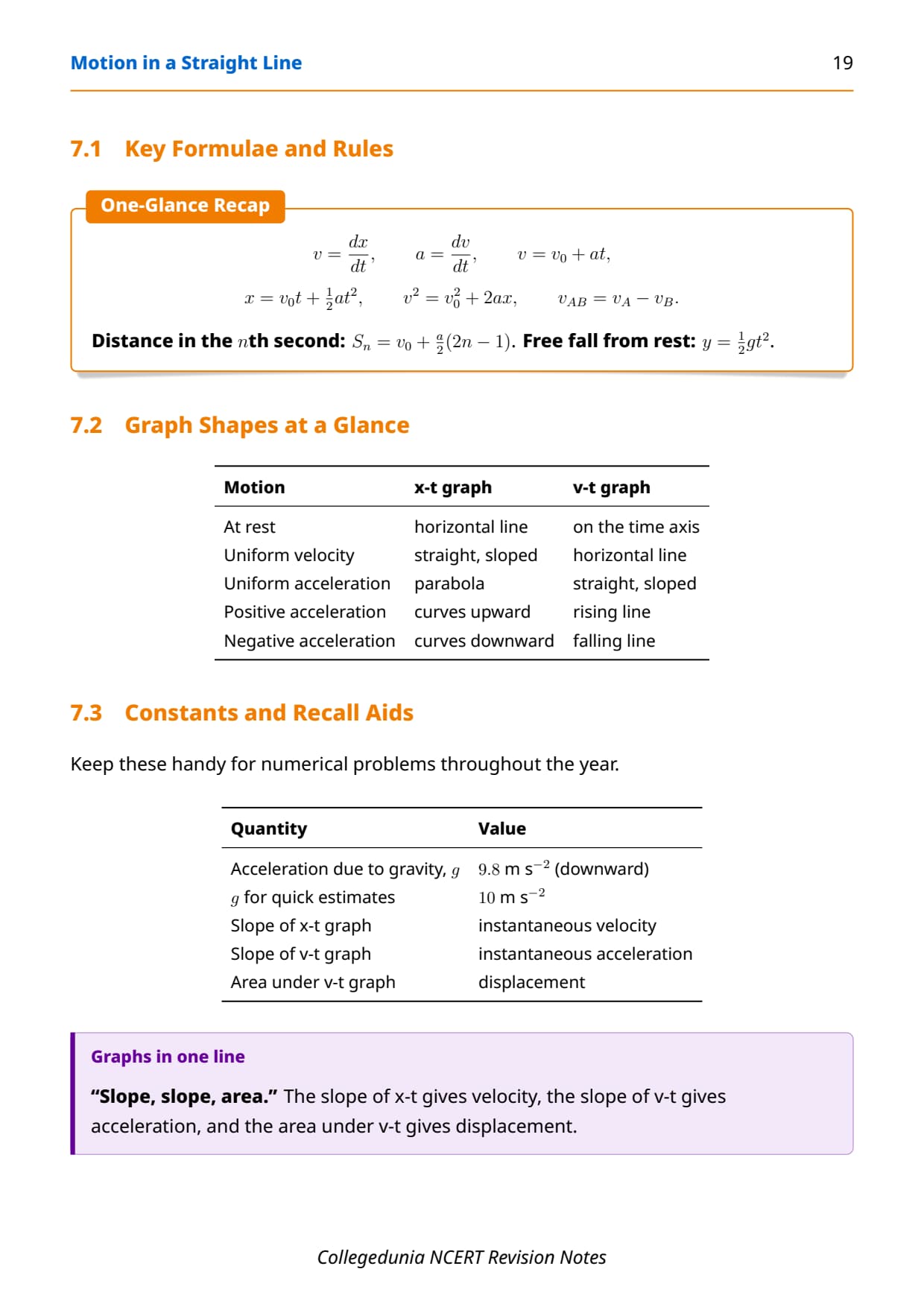
| Graph | Slope gives | Area gives |
|---|---|---|
| Position-time (x-t) | Velocity | Not used |
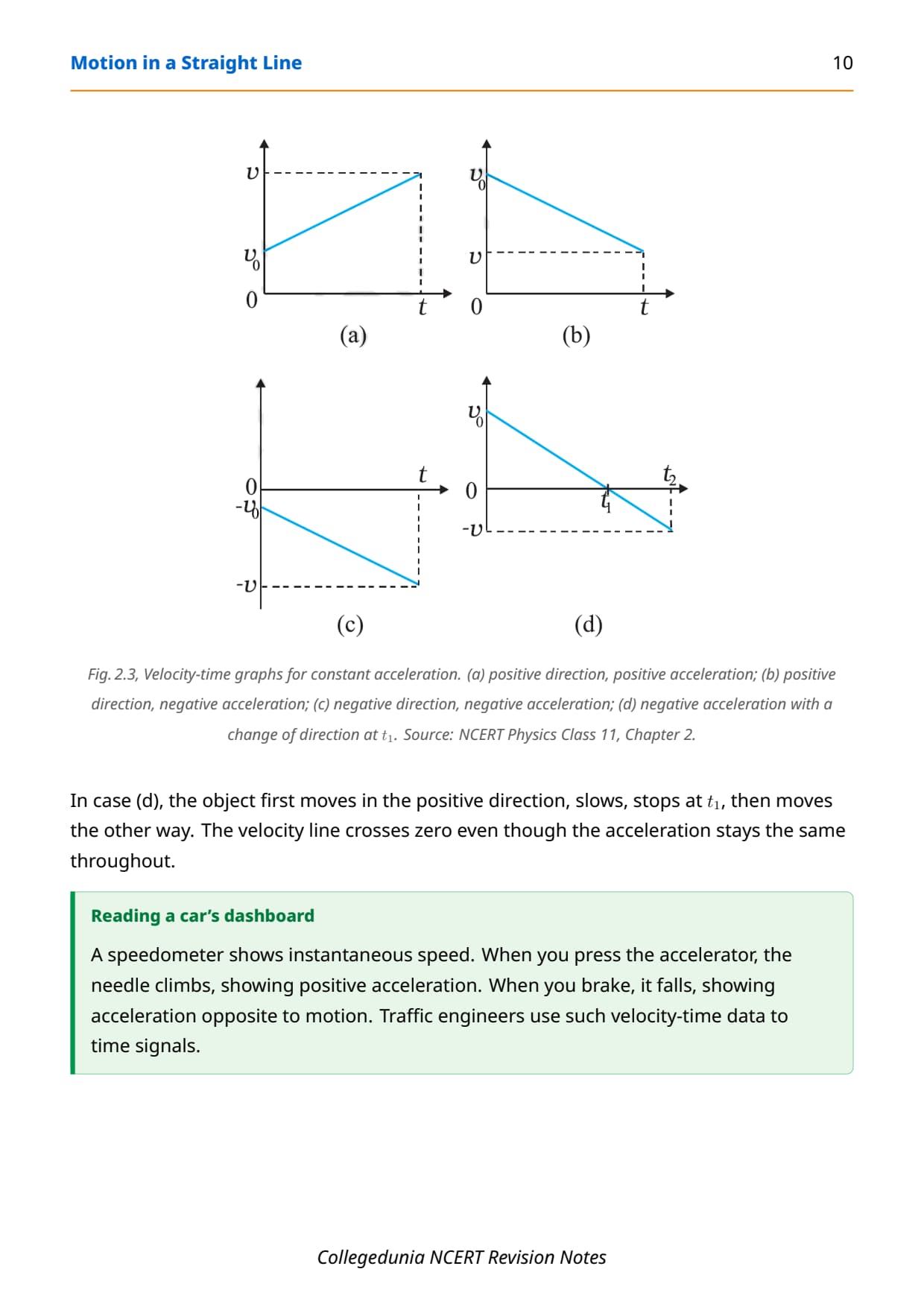
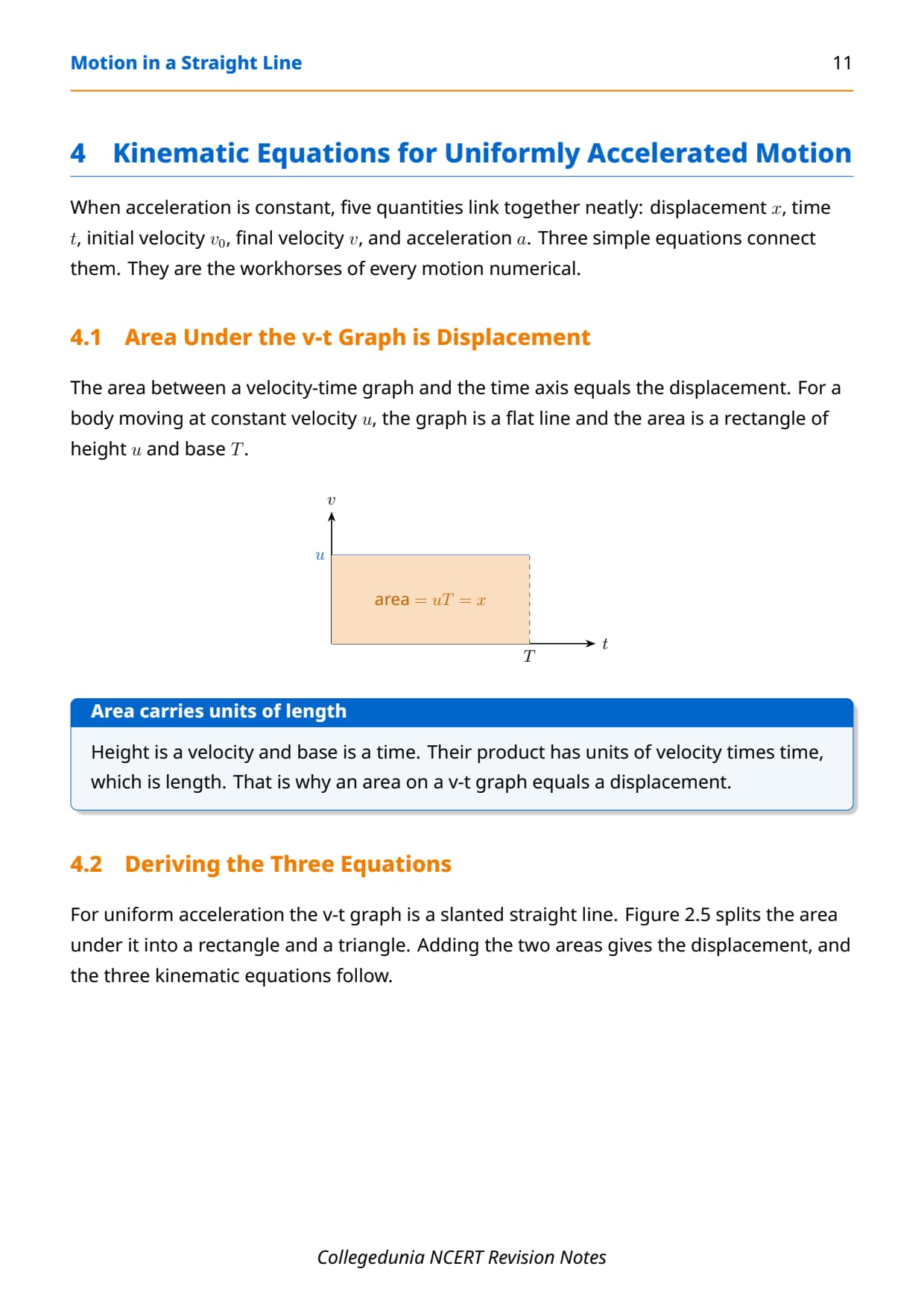
| Velocity-time (v-t) | Acceleration | Displacement |
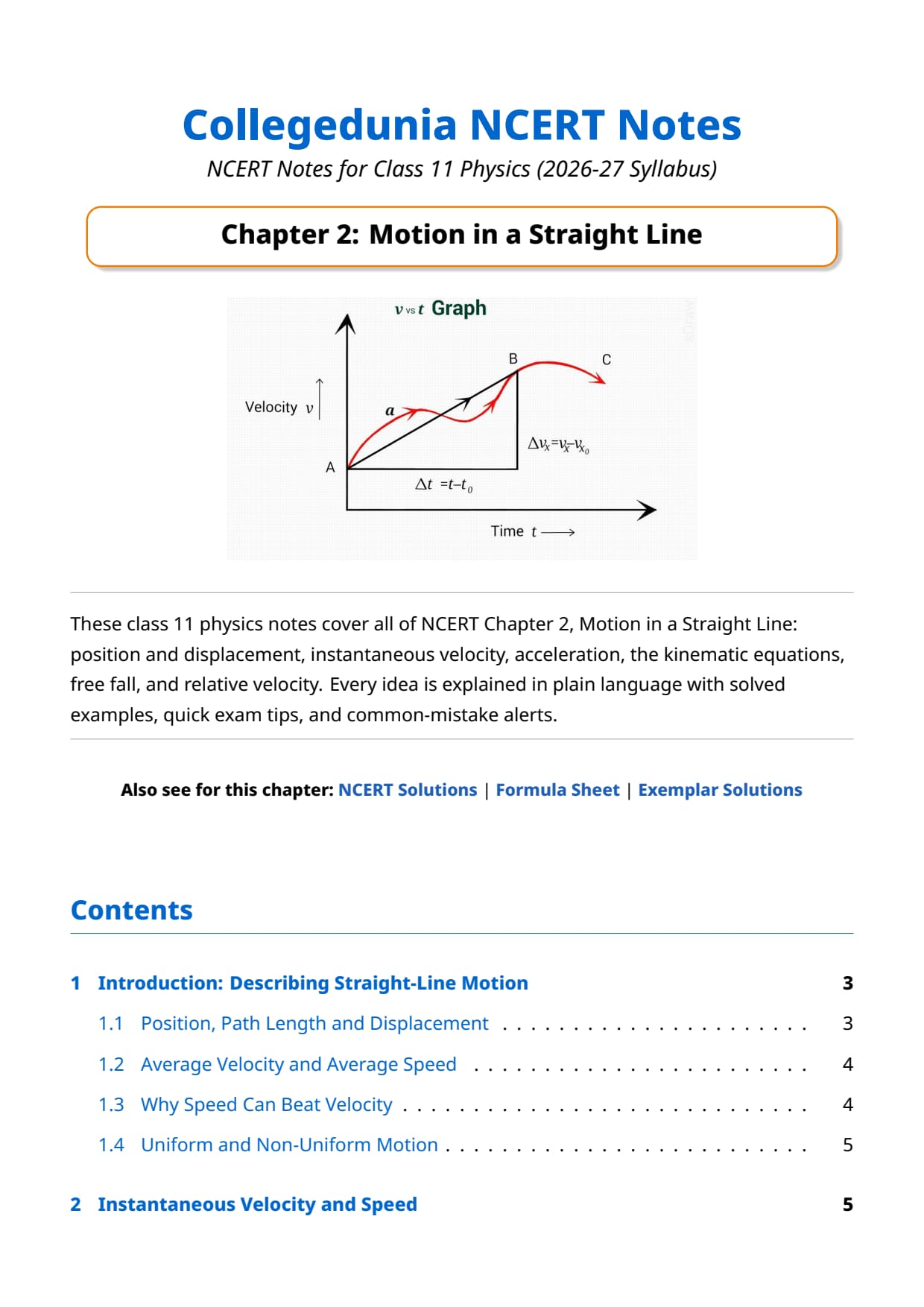
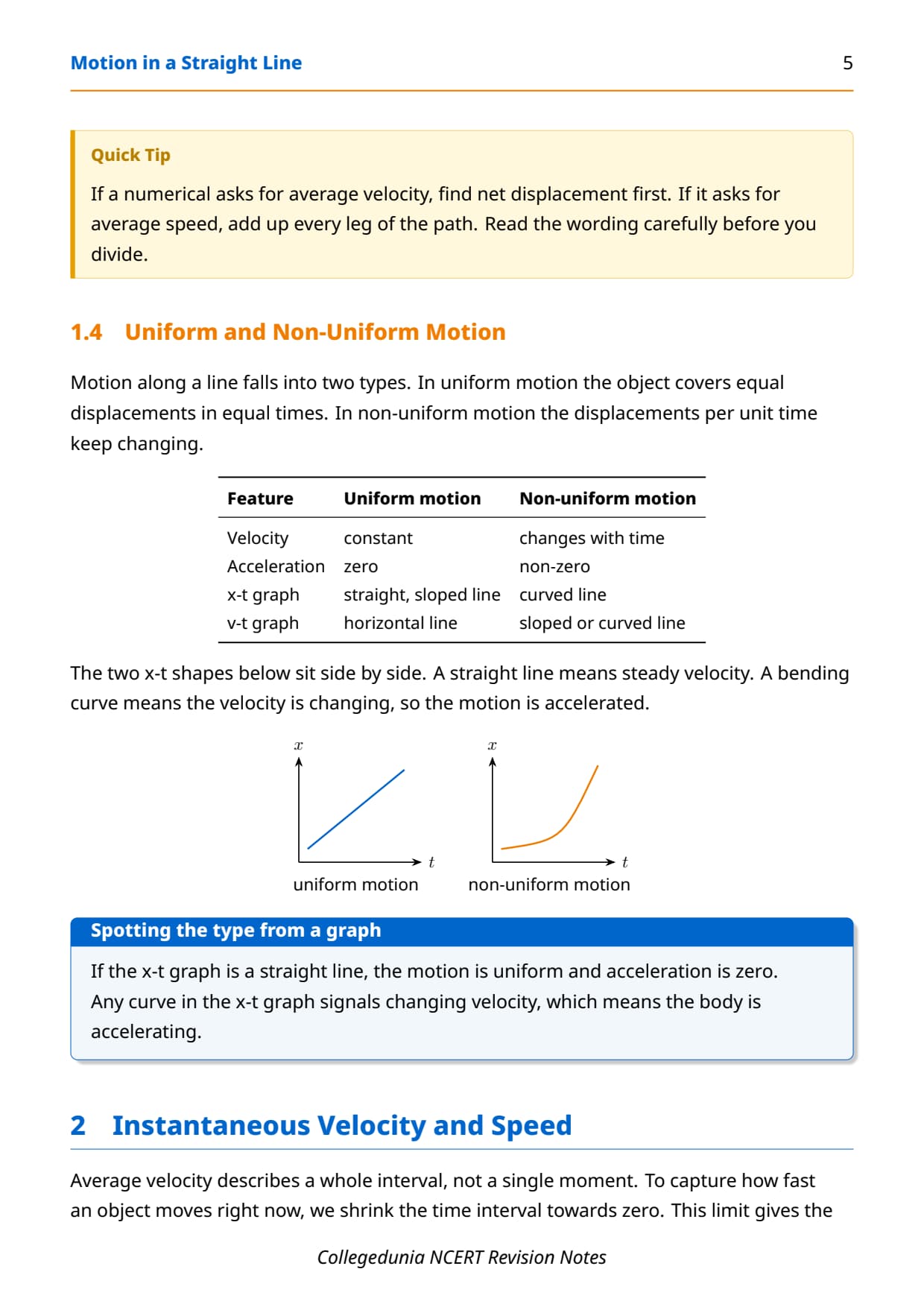
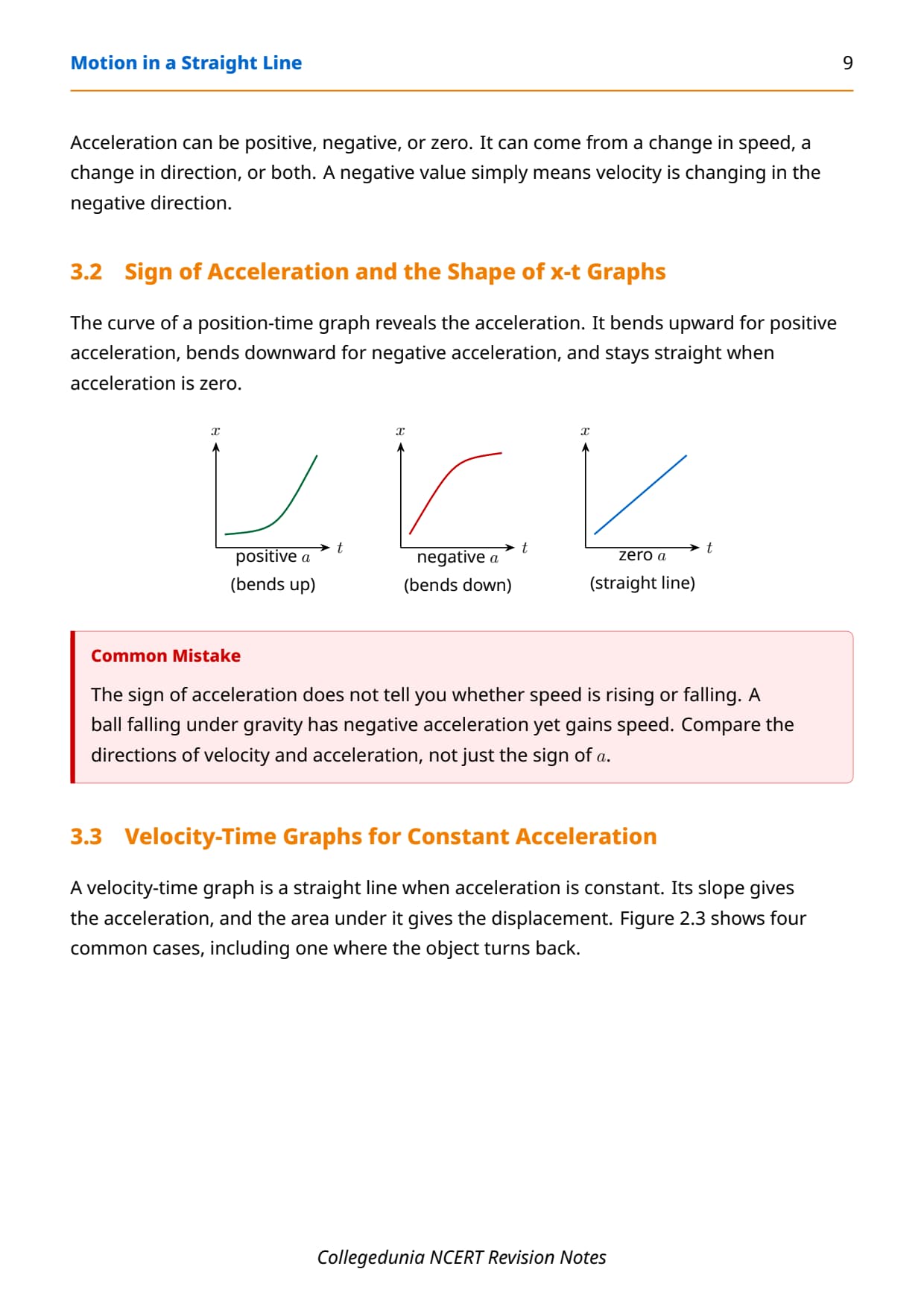
On a position-time graph, a straight slanted line means uniform velocity, while a curve means the velocity is changing. On a velocity-time graph, a horizontal line means zero acceleration, and a slanted line means uniform acceleration. The area under a velocity-time graph always equals the displacement, even when the line dips below the time axis. Area below the axis counts as negative displacement.
Relative Velocity in One Dimension
Relative velocity is the velocity of one object measured from another moving object. In one dimension you just add or subtract, but the sign convention decides everything. This topic appears in both Boards and entrance papers as a short numerical.
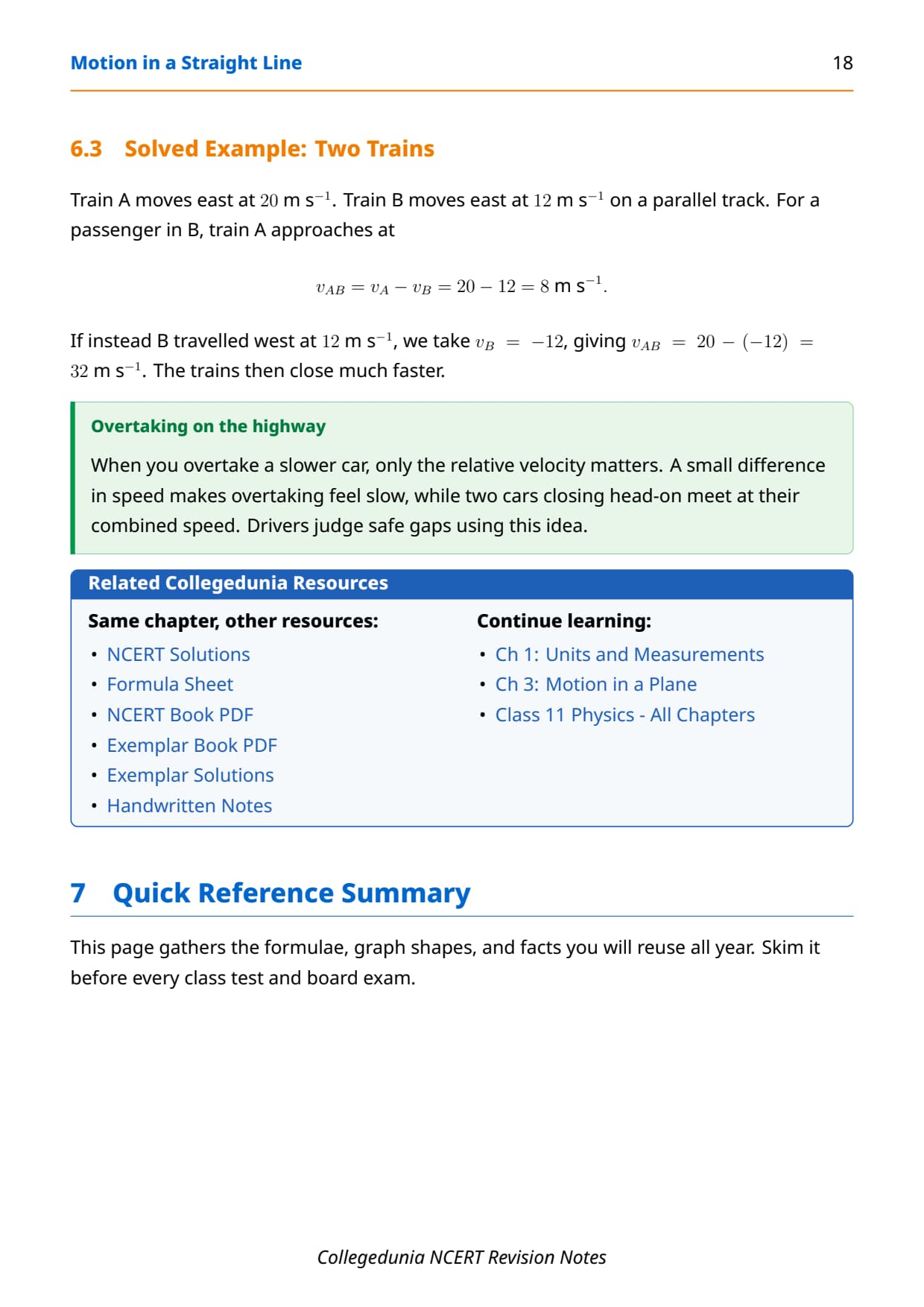
- Same direction: the relative velocity is the difference of the two speeds, so a fast car sees a slow car drift back slowly.
- Opposite directions: the relative velocity is the sum of the two speeds, which is why head-on approach feels fast.
- Equal velocities: the relative velocity is zero, so each object sees the other at rest.
Write the rule as vAB = vA − vB, where a single line and a single positive direction fix every sign. Choose the positive direction first, then substitute with signs, and the answer takes care of itself. This one habit prevents almost every error in the topic.
Common Mistakes Students Make in Motion in a Straight Line
These slips happen while writing or calculating, not because the concept is unclear. Each one costs 1 to 3 marks in the paper, so watch for them at the exact step.
Mistake 1: Confusing distance with displacement. Distance is total path and is always positive; displacement has a sign and can be zero.
Mistake 2: Using the three equations of motion when acceleration is not constant. They hold only for uniform acceleration.
Mistake 3: Dropping the sign of u, v, a or g. Fix a positive direction first and keep every sign through the working.
Mistake 4: Reading area off a position-time graph. Area is meaningful only under a velocity-time graph, where it gives displacement.
Motion in a Straight Line Weightage in CBSE Boards, JEE and NEET
This chapter is a reliable scorer. It almost always brings one graph question and one numerical on the kinematic equations. Here is how the marks split across the main exams for 2026-27.
| Exam | Typical weightage | What is asked |
|---|---|---|
| CBSE Boards | 4 to 5 marks | One graph question plus one numerical on the equations of motion |
| JEE Main | 1 to 2 questions | Kinematic equations, graphs, and relative velocity |
| NEET | 1 to 2 questions | Displacement vs distance, and motion under gravity |
| CUET and NDA | 1 objective question | Speed, velocity, and simple equation-of-motion sums |
The three equations of motion are the single most tested idea from this chapter across all four exams. Master them first, then the velocity-time graph, then relative velocity, in that order of return on effort.
How to Revise Motion in a Straight Line Quickly
Use these Class 11 Physics Notes Chapter 2 Motion in a Straight Line for a fast, ordered recap the night before a test. The checklist below takes about 30 minutes and hits every marks-heavy idea.
- First 10 minutes: write the three equations of motion and the distance-in-the-n-th-second formula from memory.
- Next 10 minutes: redo one numerical for uniform acceleration and one for free fall under gravity.
- Last 10 minutes: sketch a velocity-time graph and read off acceleration from the slope and displacement from the area.
Close the loop by solving one relative-velocity sum in one dimension. If you can do all four blocks without notes, the chapter is exam-ready. Keep the All Formulas table beside you for the first pass only, then try it closed-book.
Student Feedback on the Motion in a Straight Line Notes
What 13,420 students told us about their Motion in a Straight Line revision:
- 64% of students rated velocity-time graph reading as the hardest sub-topic in the chapter.
- Most-skipped step: keeping the sign of acceleration during free fall, missed by about 3 in 10 students.
- Students who learned the three equations of motion first said the numericals felt much easier.
Source: 2026-27 Class 11 Physics student poll. Sample of 13,420 students from CBSE schools across 14 states, conducted before the 2026 boards.
Other Motion in a Straight Line Class 11 Physics Resources
Pair these notes with the solved answers, the handwritten notes, the formula sheet, and the textbook PDF for the same chapter.
| Resource | Link |
|---|---|
| NCERT Solutions | Motion in a Straight Line Class 11 NCERT Solutions |
| Handwritten Notes | Motion in a Straight Line Class 11 Handwritten Notes |
| Formula Sheet | Motion in a Straight Line Class 11 Formula Sheet |
| NCERT Book PDF | Motion in a Straight Line Class 11 Book PDF |
NCERT Notes for Class 11 Physics: All Chapters
Jump to the revision notes for any other Class 11 Physics chapter below.
| Chapter | NCERT Notes |
|---|---|
| Chapter 1 | Units and Measurements |
| Chapter 2 | Motion in a Straight Line |
| Chapter 3 | Motion in a Plane |
| Chapter 4 | Laws of Motion |
| Chapter 5 | Work, Energy and Power |
| Chapter 6 | System of Particles and Rotational Motion |
| Chapter 7 | Gravitation |
| Chapter 8 | Mechanical Properties of Solids |
| Chapter 9 | Mechanical Properties of Fluids |
| Chapter 10 | Thermal Properties of Matter |
| Chapter 11 | Thermodynamics |
| Chapter 12 | Kinetic Theory |
| Chapter 13 | Oscillations |
| Chapter 14 | Waves |
FAQs on Motion in a Straight Line Class 11 Physics Notes
Motion in a Straight Line Notes - Frequently Asked Questions
Ques. What topics do the Class 11 Physics Notes Chapter 2 Motion in a Straight Line cover?
Ans. These Class 11 Physics Notes Chapter 2 Motion in a Straight Line cover position and frame of reference, distance and displacement, average and instantaneous speed and velocity, uniform and non-uniform acceleration, the three equations of motion, position-time and velocity-time graphs, and relative velocity in one dimension. Every key formula and definition is included for fast revision.
Ques. What is the difference between distance and displacement?
Ans. Distance is the total length of the path covered, so it is always positive and never decreases. Displacement is the straight change in position from start to finish, so it carries a sign and can be zero, positive or negative. The size of the displacement is always less than or equal to the distance, and they are equal only for motion in one direction.
Ques. What are the three equations of motion?
Ans. The three equations of motion are v = u + at, x = ut + ½at², and v² = u² + 2ax, where u is the initial velocity, v is the final velocity, a is the acceleration, x is the displacement and t is the time. They apply only when the acceleration is constant, and they are the most tested formulas in the chapter.
Ques. What do the slope and area of a velocity-time graph represent?
Ans. On a velocity-time graph, the slope of the line gives the acceleration of the object, and the area between the line and the time axis gives the displacement. Area below the time axis counts as negative displacement. On a position-time graph, the slope instead gives the velocity, and the area has no physical meaning.
Ques. What is the weightage of Motion in a Straight Line in the CBSE board exam?
Ans. Motion in a Straight Line carries about 4 to 5 marks in the CBSE Class 11 Physics paper, usually one graph question plus one numerical on the equations of motion. It also appears in JEE Main and NEET as questions on the kinematic equations, motion graphs, and relative velocity in one dimension.
Ques. How should I revise Motion in a Straight Line quickly for a test?
Ans. Start by writing the three equations of motion and the distance-in-the-n-th-second formula from memory. Then redo one uniform-acceleration numerical and one free-fall sum. Finish by reading acceleration and displacement off a velocity-time graph. The quick-revision checklist in these Class 11 Physics Notes Chapter 2 Motion in a Straight Line covers all of this in about 30 minutes.



Comments