



The class 11 maths notes chapter 2 relations and functions pull together every ordered pair, Cartesian product, and function type that the CBSE Boards, JEE Main, JEE Advanced, and CUET actually test in 2026-27. These revision notes explain relations, their domain and range, the standard function types, and the algebra of real functions in plain language, with a full formula table for quick recall.
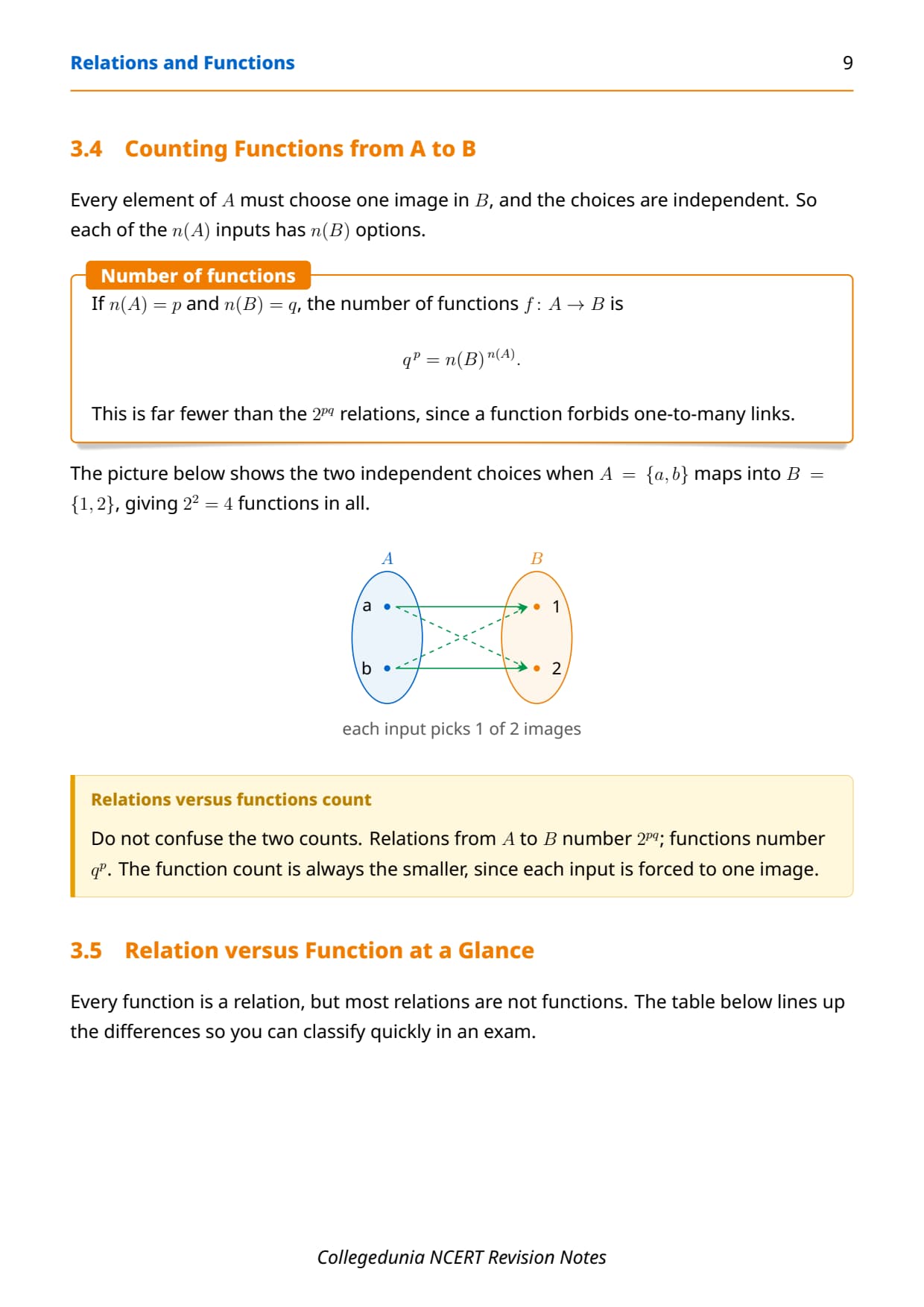
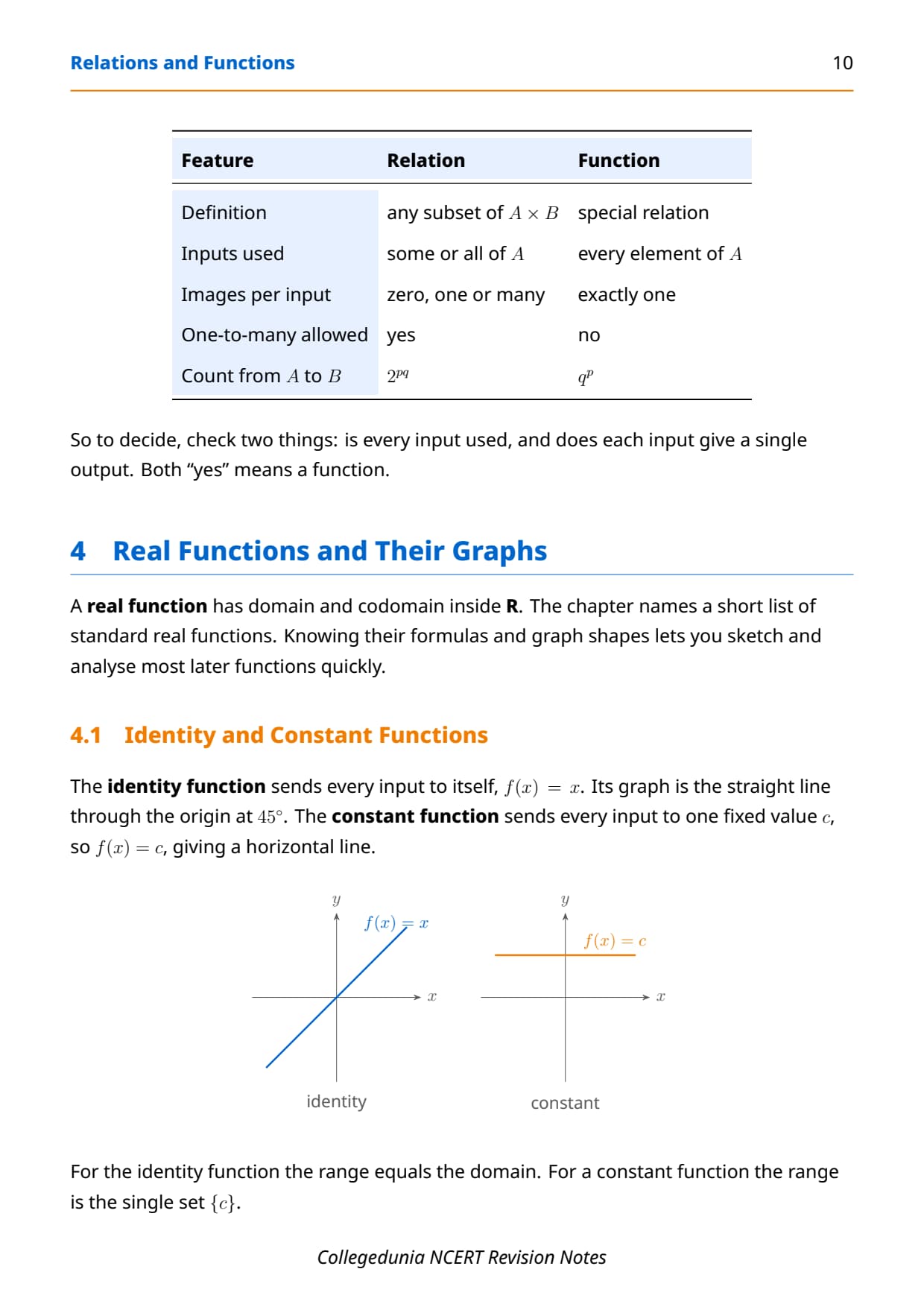
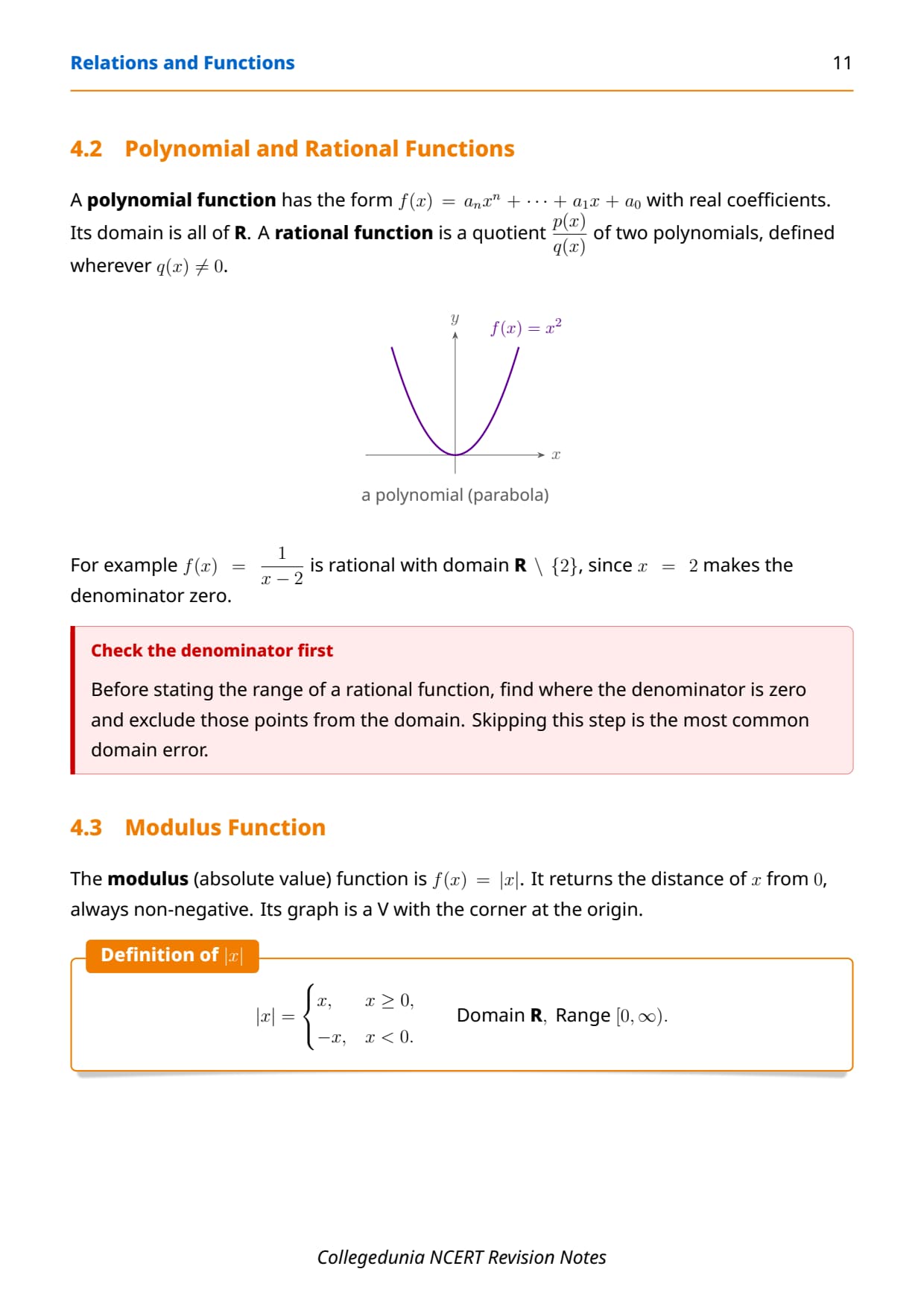
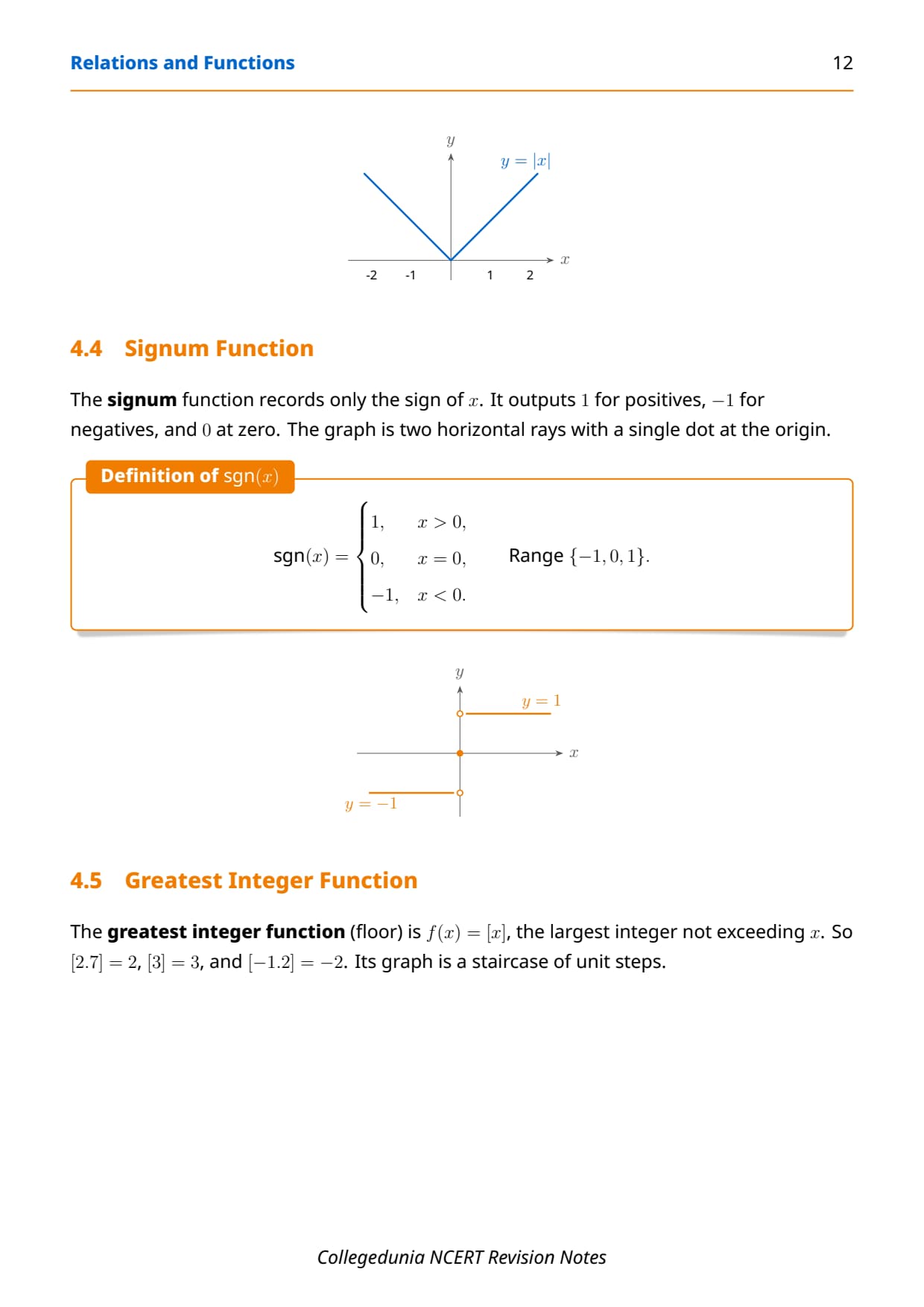
You can download the complete Relations and Functions notes PDF above, then use the topic-by-topic summary and the formula table on this page for a fast last-minute revision.
- CBSE Boards: Relations and Functions closes Unit 1 (Sets and Functions) and carries roughly 6 to 8 marks along with Sets.
- JEE Main and CUET: expect 1 to 2 questions on domain and range, the number of relations, and the signum or greatest integer function every year.
- What is covered: ordered pairs, Cartesian product, relations, functions, seven standard function types, and the algebra of real functions.
Every entry in these Relations and Functions notes is curated by Collegedunia subject experts, according to the 2026-27 NCERT textbook, and checked against the last five years of CBSE Board and JEE Main papers.
Also Check:
- NCERT Solutions for Class 11 Maths Relations and Functions
- Class 11 Maths Relations and Functions Handwritten Notes
Topic-by-Topic Summary of the Relations and Functions Chapter for Class 11 Maths
The Relations and Functions chapter splits into five sub-topic blocks. The class 11 maths notes chapter 2 relations and functions map each block to what the exam asks, so students know where the marks sit before they revise.
- Ordered pairs and Cartesian product: forming A × B and counting its elements. Usually a 1-mark definition or counting question.
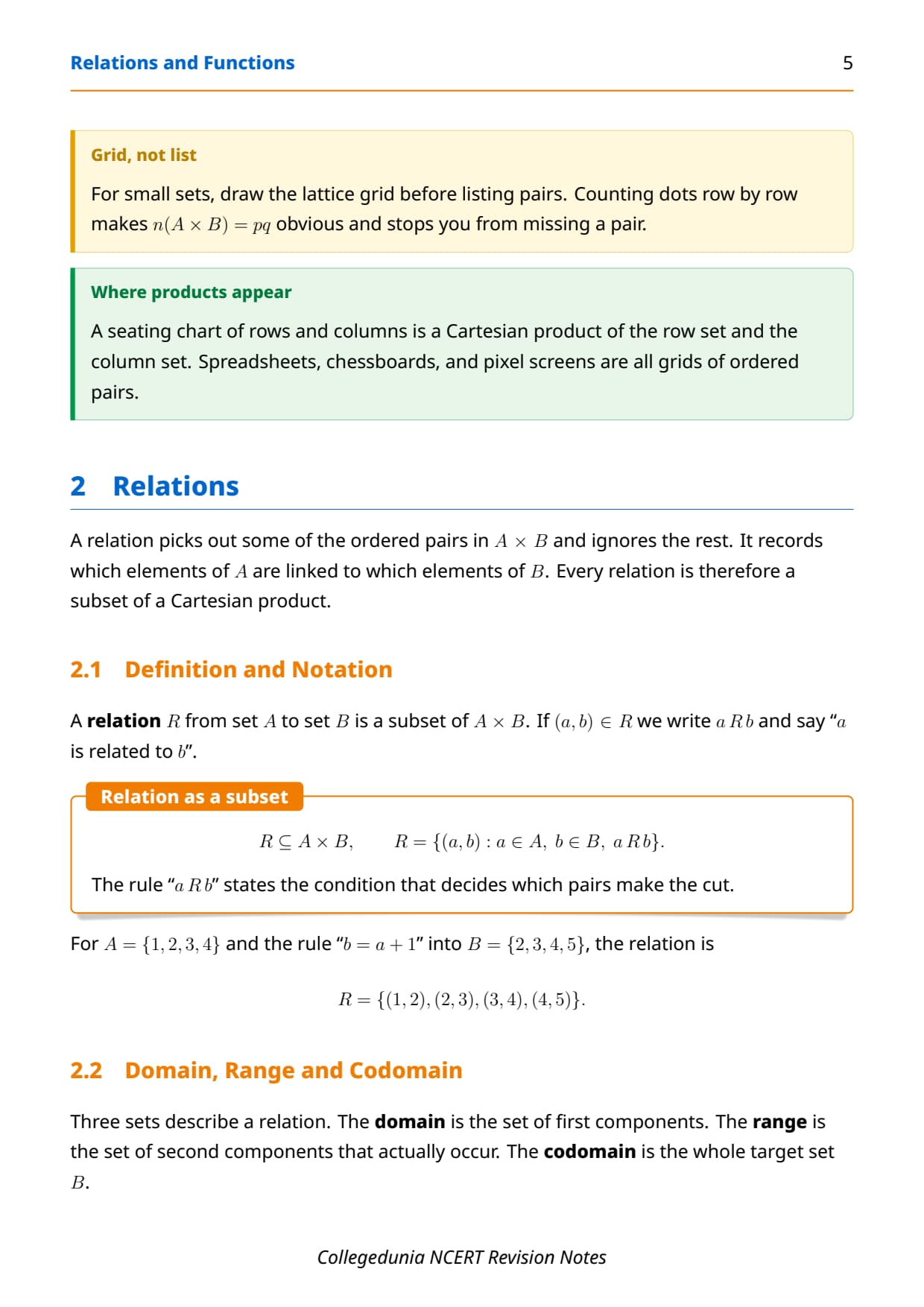
- Relations: a relation as a subset of A × B, with its domain, codomain, and range. A frequent 1 to 2-mark block.
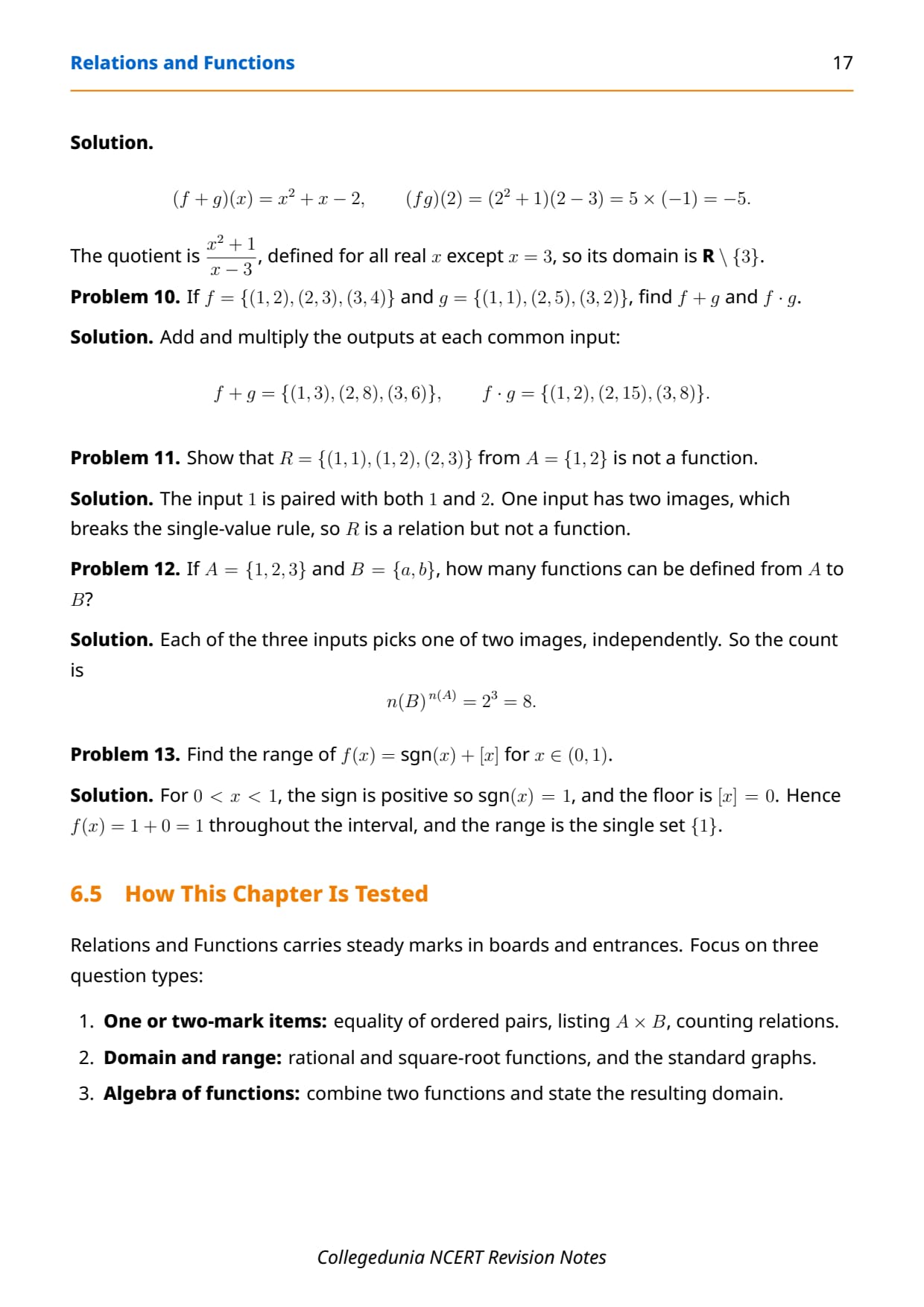
- Functions: when a relation becomes a function, plus real-valued functions. The core 2 to 3-mark idea.
- Types of functions: identity, constant, polynomial, rational, modulus, signum, and greatest integer. High-frequency MCQ and graph questions.
- Algebra of real functions: adding, subtracting, multiplying, and dividing functions. A common 2-mark question.
The rest of these notes take each block in order, so a first read from top to bottom mirrors the NCERT chapter flow.
Ordered Pairs and the Cartesian Product of Two Sets
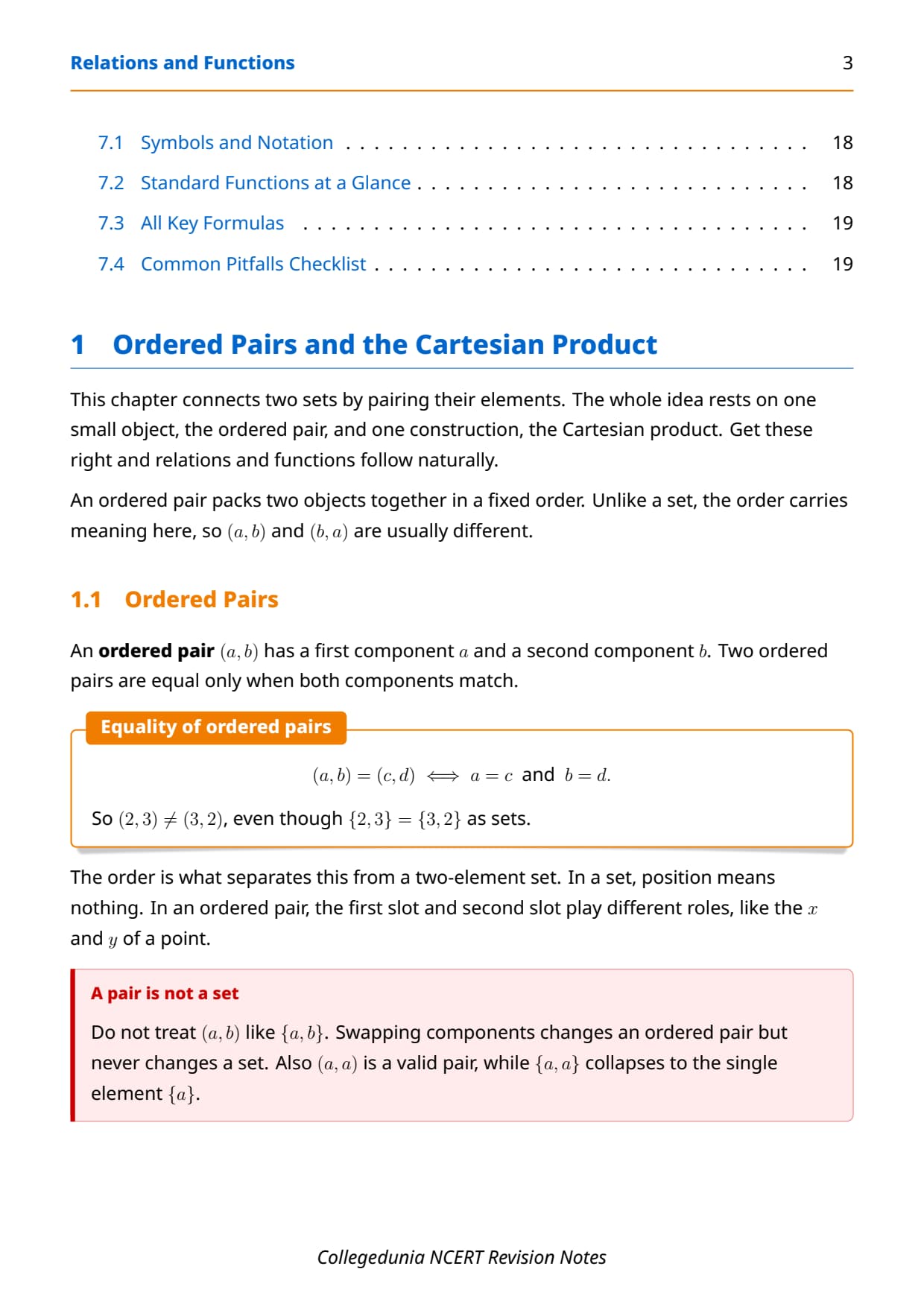
An ordered pair is a pair of elements written in a fixed order, such as (a, b). The order matters, so (a, b) and (b, a) are different unless a = b. Two ordered pairs are equal only when their first elements match and their second elements match.
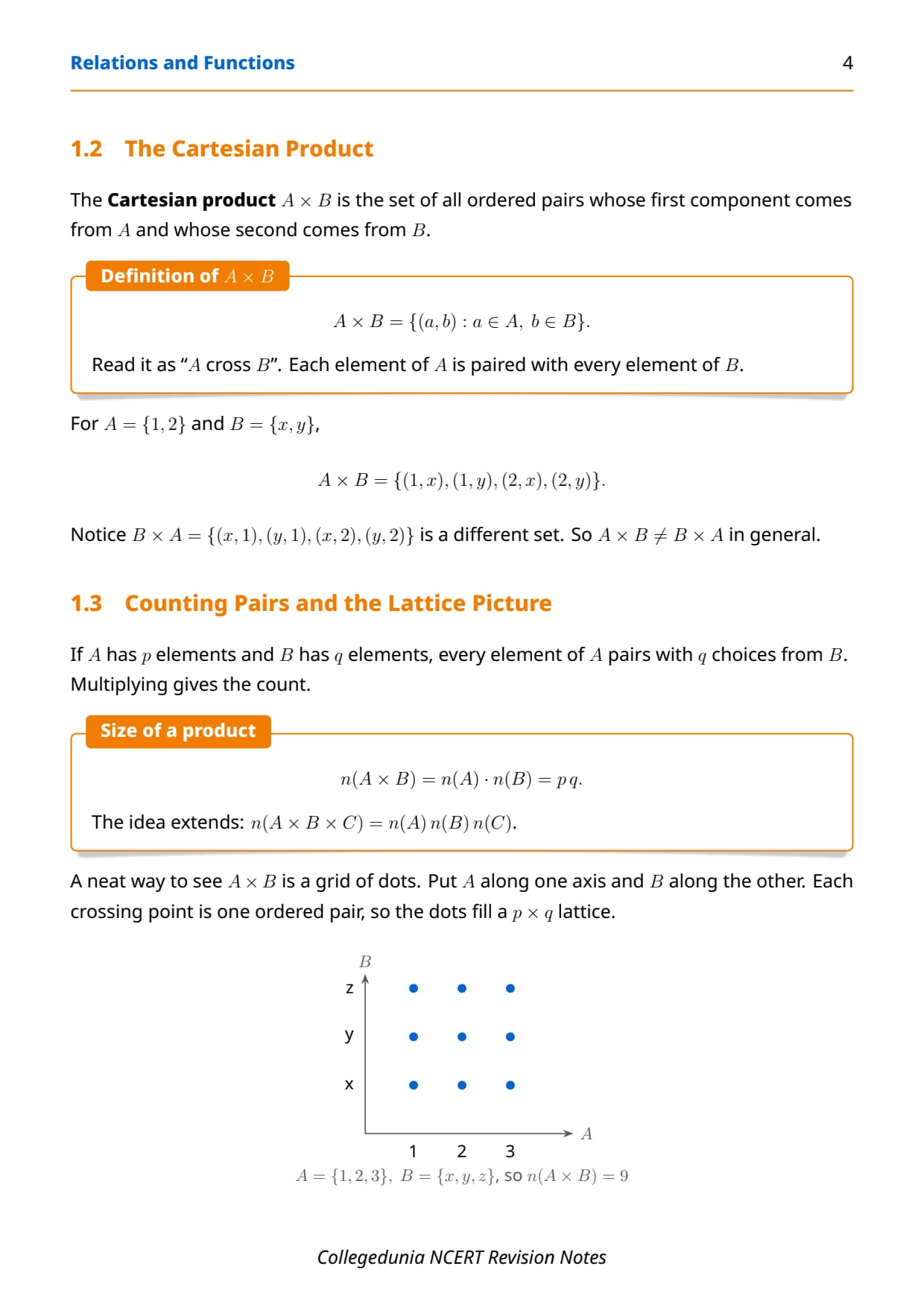
The Cartesian product A × B is the set of all ordered pairs whose first element comes from A and second from B:
- Definition: A × B = {(a, b) : a ∈ A and b ∈ B}. Read it as "every a paired with every b".
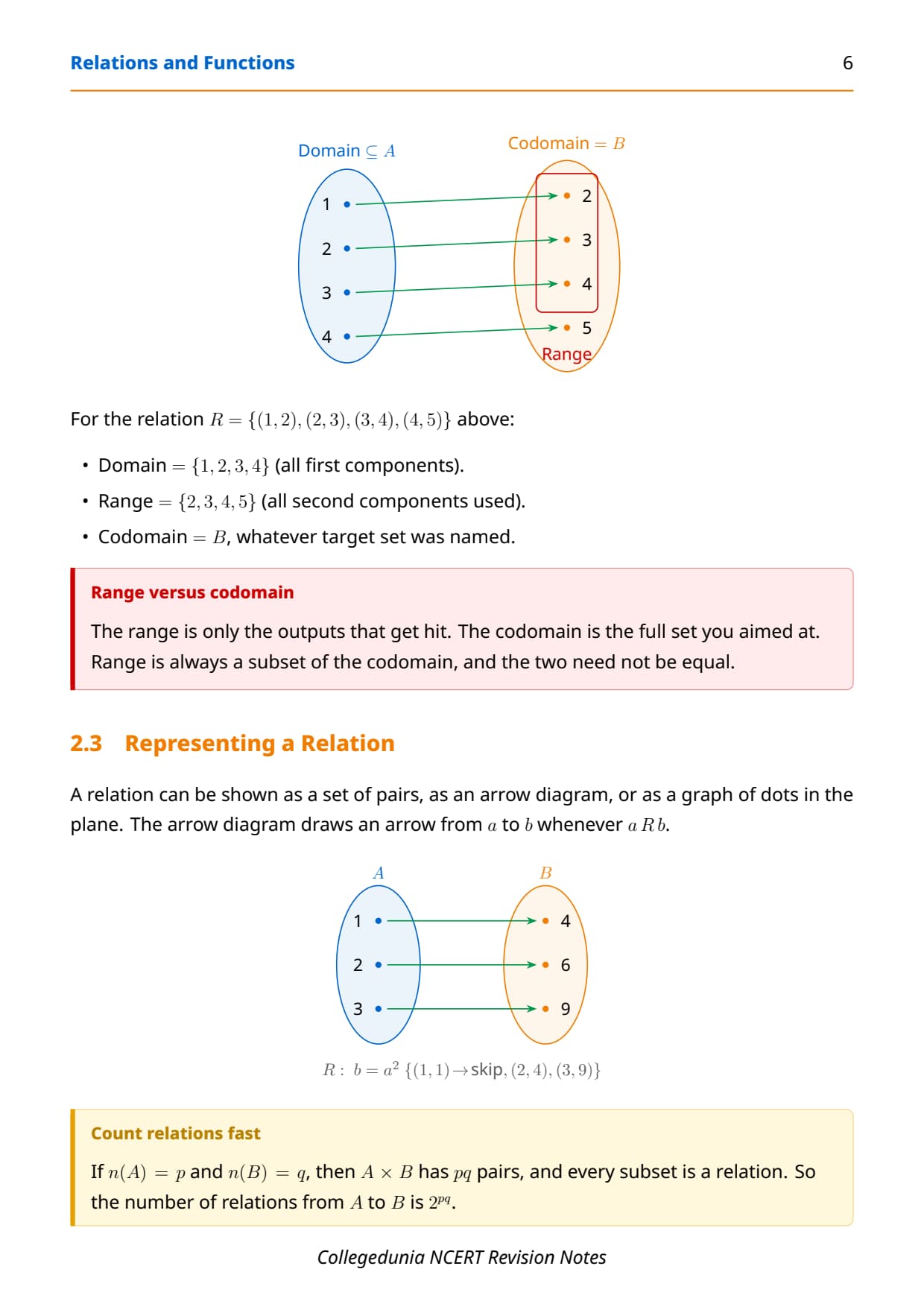
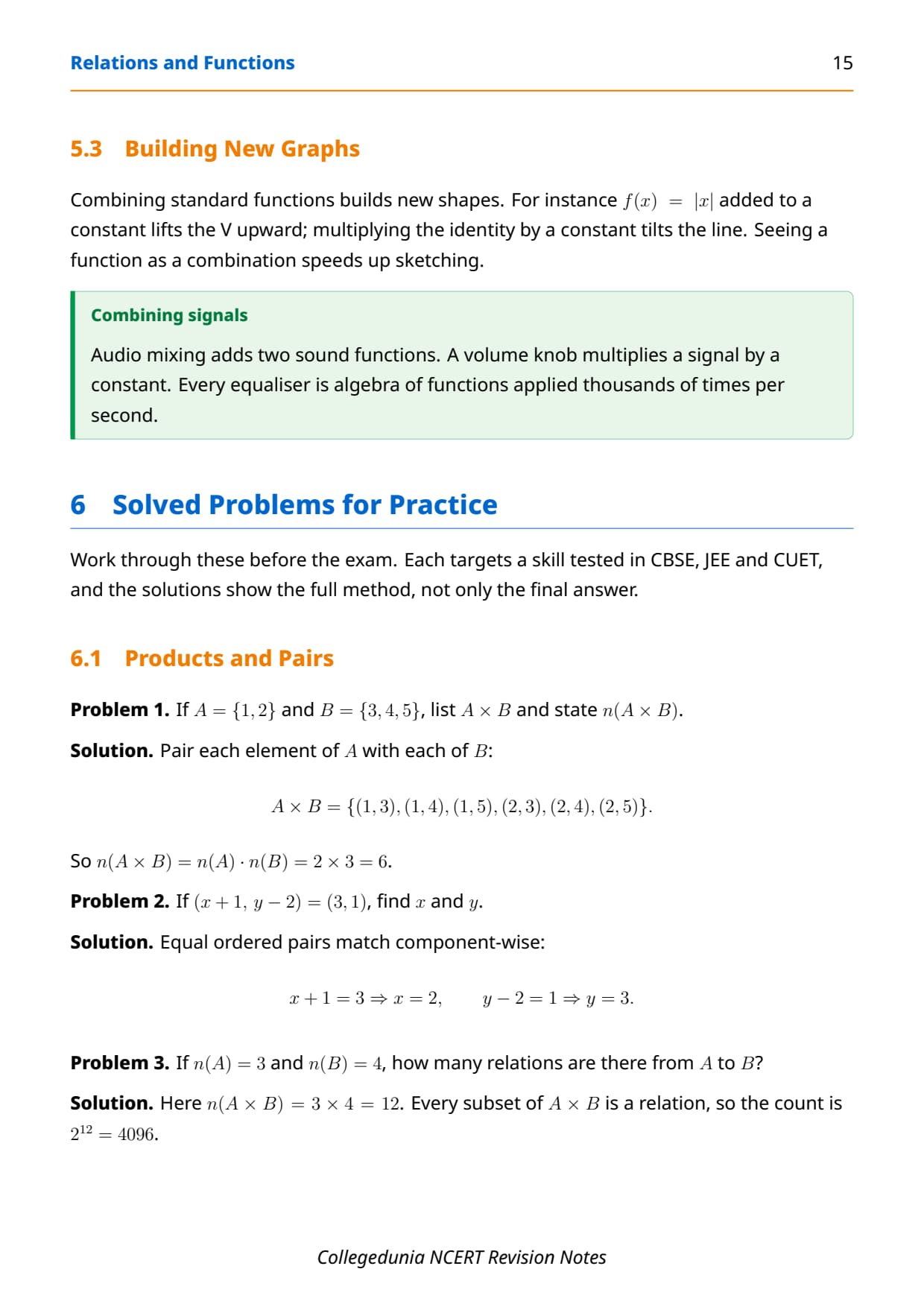
- Counting rule: if n(A) = p and n(B) = q, then n(A × B) = pq. This is the most-used counting fact from the block.
- Order matters: A × B is not the same as B × A unless A = B, because the pairs are ordered.
A × A × A gives ordered triplets and models points in three-dimensional space, which is why R × R × R is written as R³. The plane itself is R × R, or R².
Relations: Domain, Codomain and Range
A relation R from a set A to a set B is any subset of A × B. In other words, a relation just picks out some of the ordered pairs. If (a, b) belongs to R, we say a is related to b and write a R b.
| Term | Meaning | Quick Example |
|---|---|---|
| Domain | Set of all first elements of the pairs in R | For {(1, 2), (1, 4)}, domain = {1} |
| Codomain | The whole set B that R maps into | B = {2, 3, 4} |
| Range | Set of all second elements that actually appear | For {(1, 2), (1, 4)}, range = {2, 4} |
Two facts examiners love: the range is always a subset of the codomain, and if n(A) = p and n(B) = q, the number of possible relations from A to B is 2 to the power pq. Both are direct 1-mark questions.
Functions and How They Differ from Relations
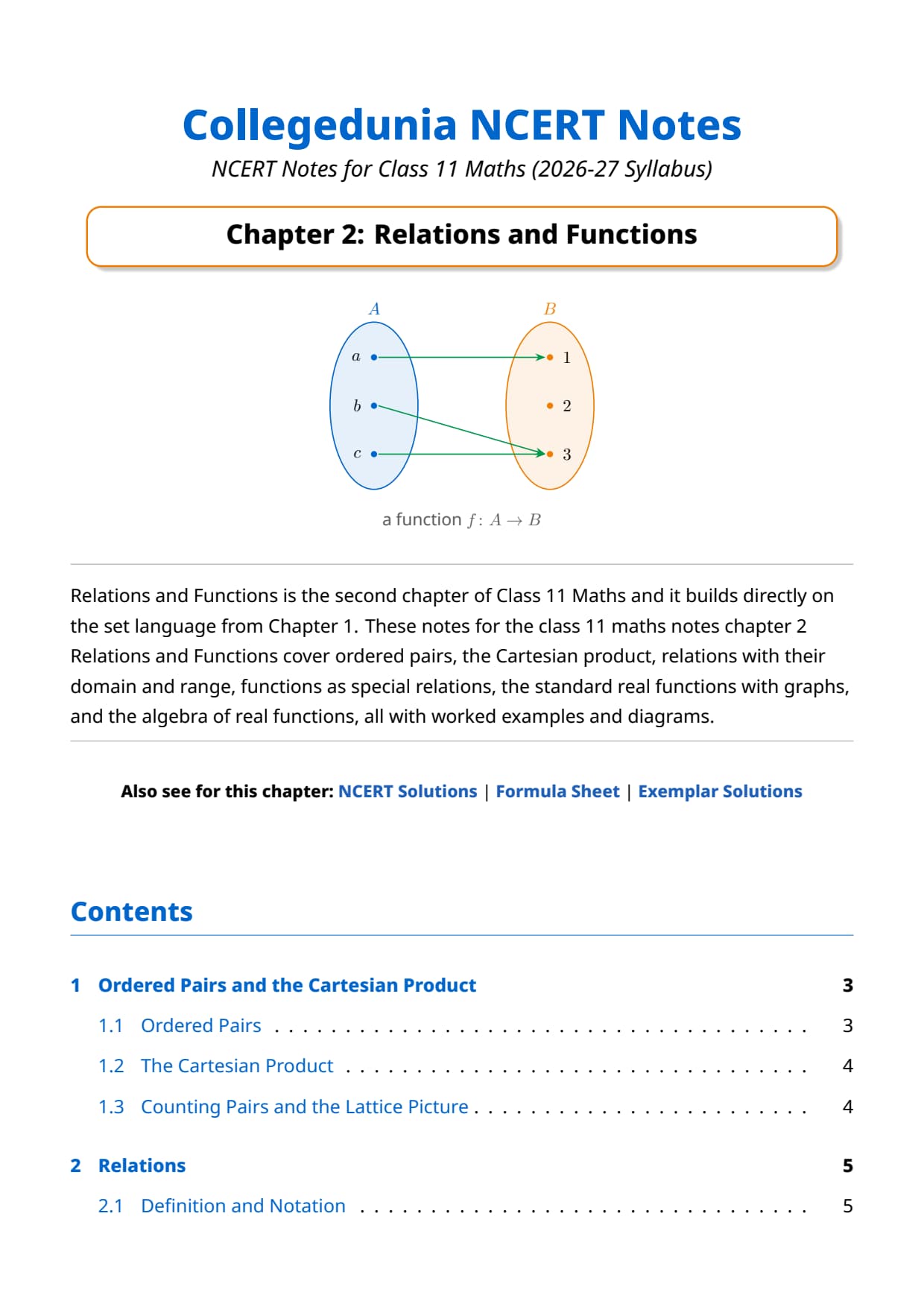
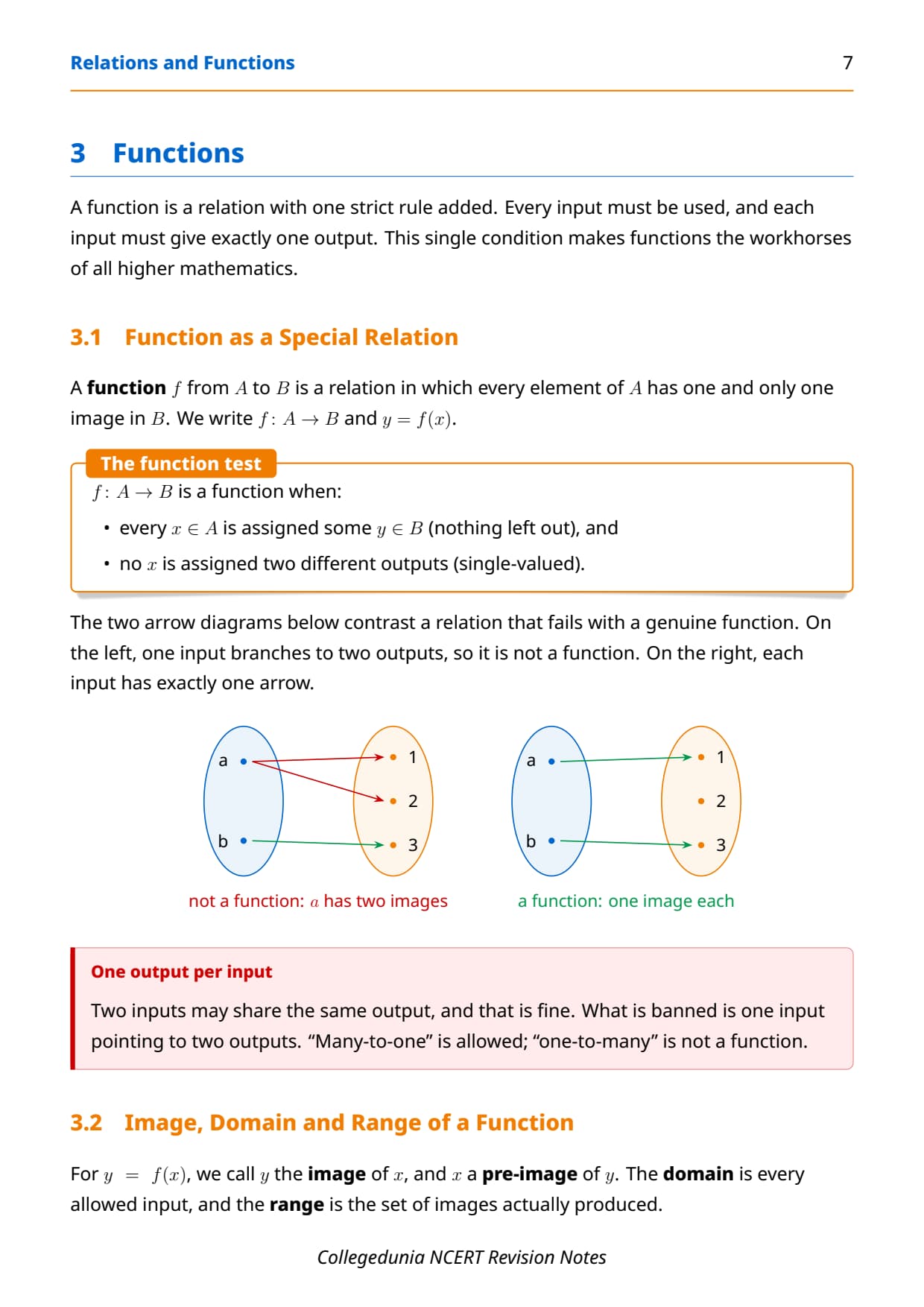
A function f from A to B is a special relation in which every element of A is paired with exactly one element of B. So a function allows no element of the domain to be left out and no element to have two images. We write f : A → B, and if f pairs a with b, then b = f(a) is the image of a.
- Every input has an output: no element of A can be missing from the pairs.
- Each input has one output: no element of A can map to two different elements of B.
- Real-valued function: when the codomain B is a subset of the real numbers R, f is called a real-valued function.
- Real function: when both the domain and codomain are subsets of R, f is called a real function.
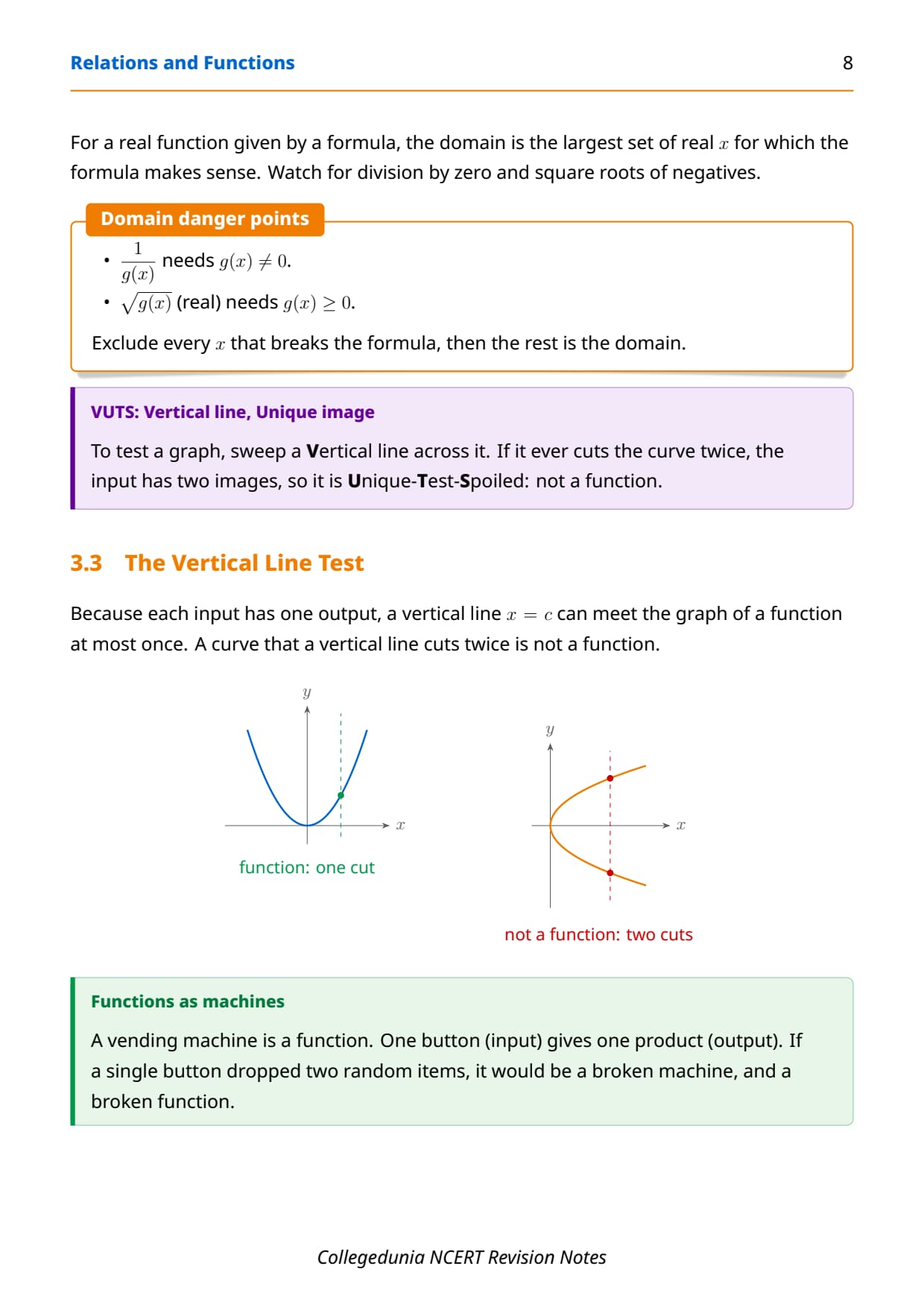
The quickest test in a graph is the vertical line test: if any vertical line cuts the graph more than once, the relation is not a function.
Types of Functions Every Class 11 Student Must Know
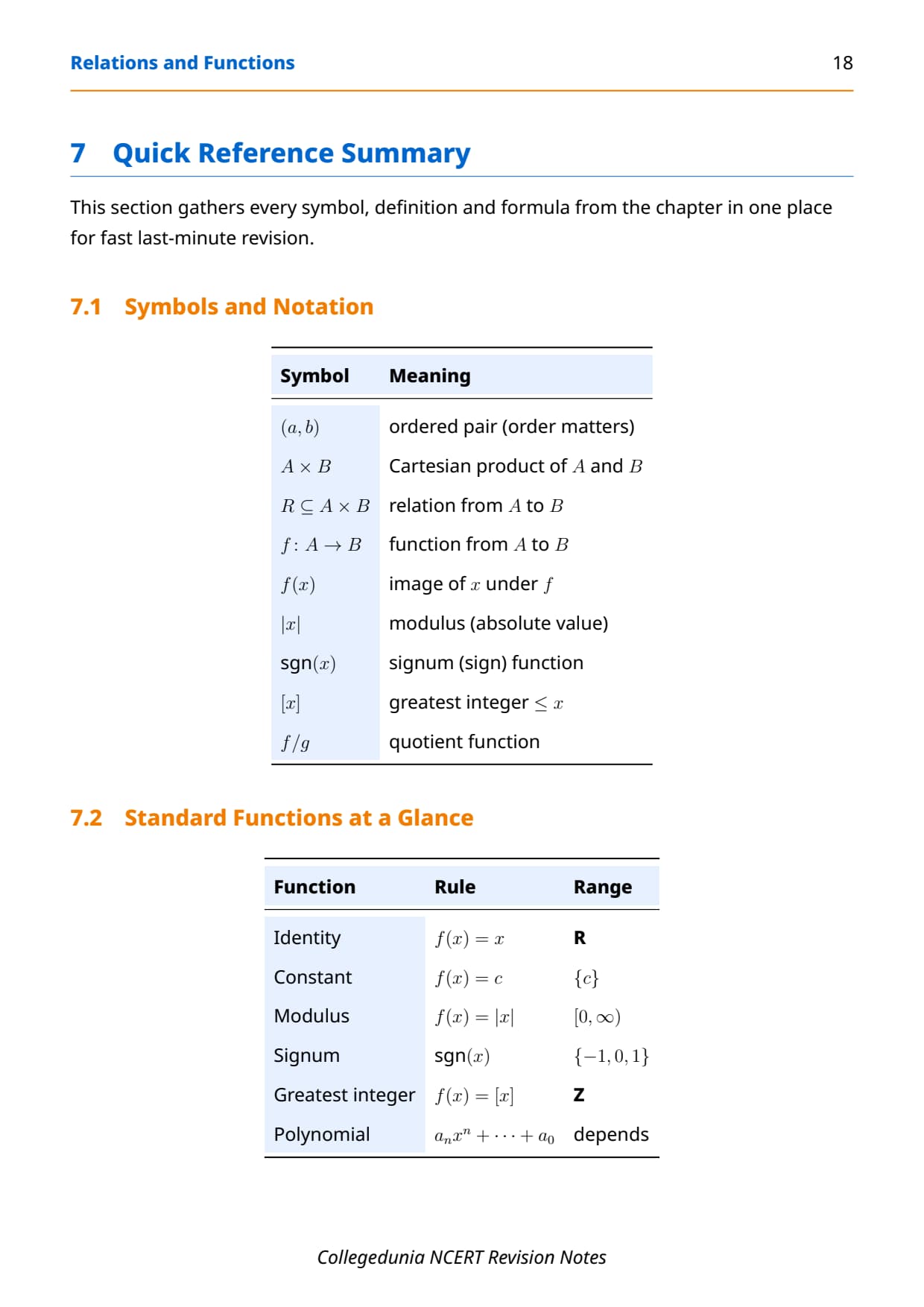
The standard real functions are the highest-frequency graph and MCQ source in this chapter. The table below defines each type with its rule and range, so students can match a function to its name in one look.
| Function | Rule | Domain and Range |
|---|---|---|
| Identity function | f(x) = x | Domain R, range R |
| Constant function | f(x) = c | Domain R, range {c} |
| Polynomial function | f(x) = a₀ + a₁x + ... + aₙxⁿ | Domain R |
| Rational function | f(x) = p(x) / q(x), q(x) ≠ 0 | Domain R minus zeros of q(x) |
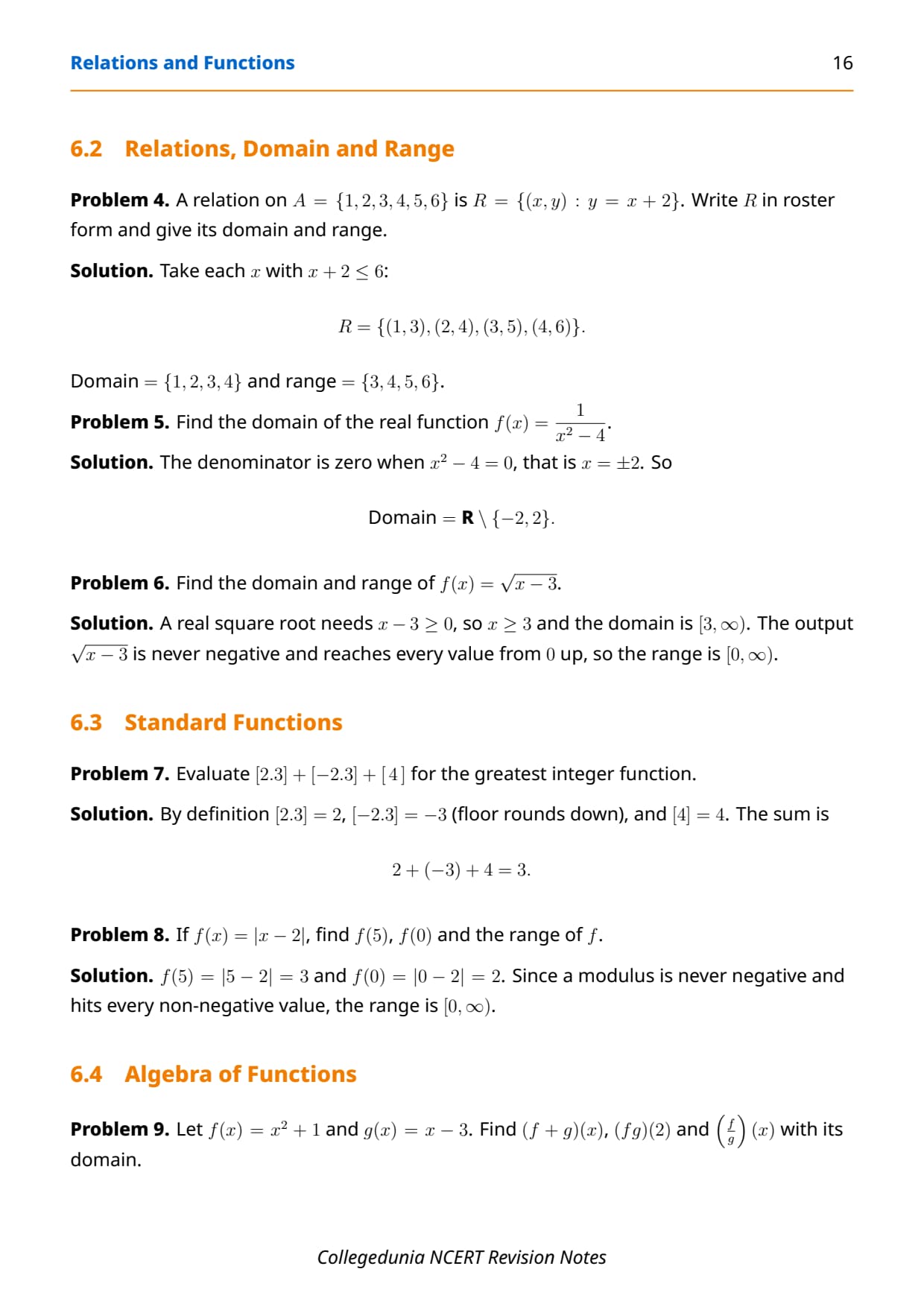
| Modulus function | f(x) = |x| | Domain R, range [0, ∞) |
| Signum function | 1 if x > 0, 0 if x = 0, −1 if x < 0 | Domain R, range {−1, 0, 1} |
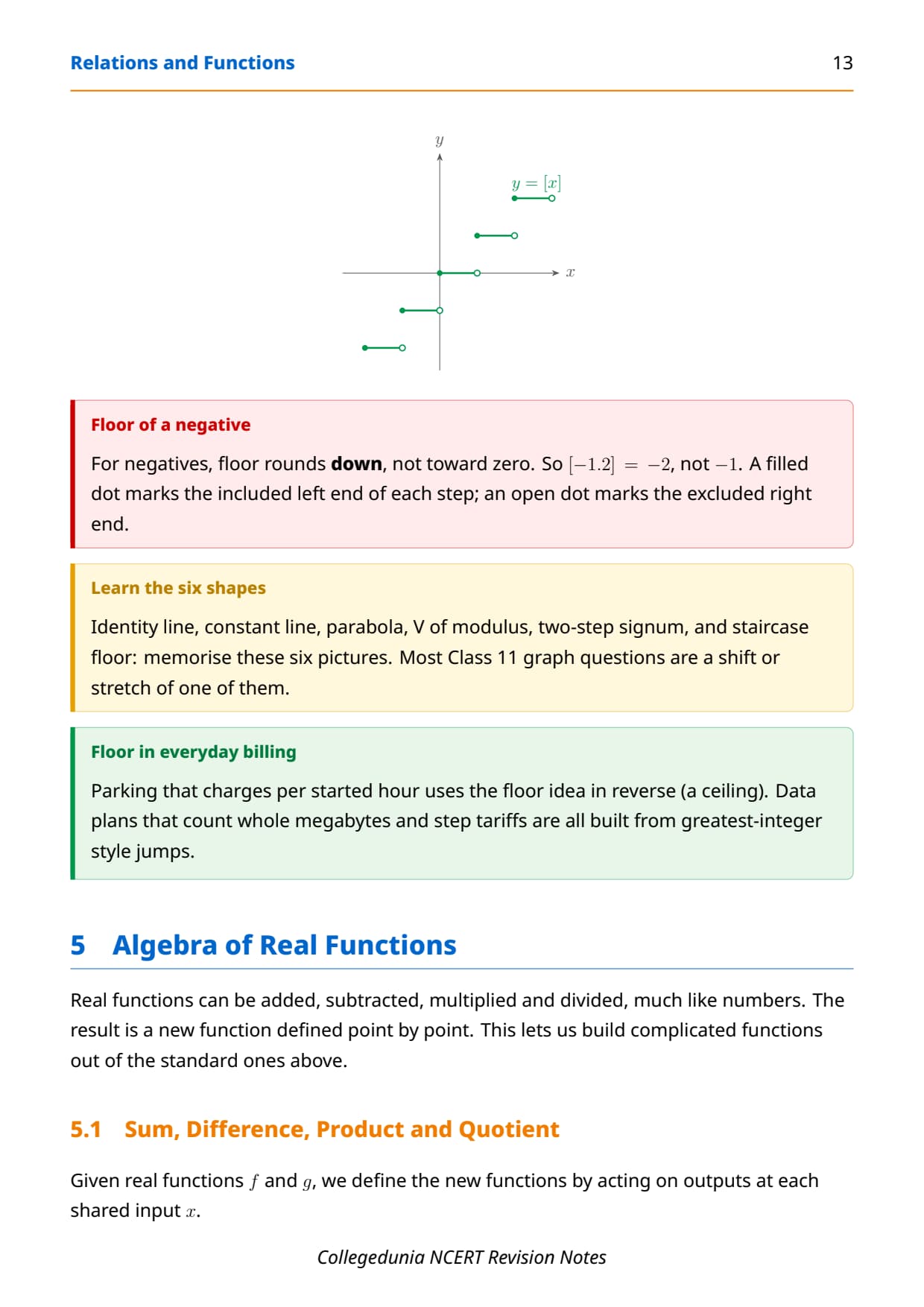
| Greatest integer function | f(x) = [x], the integer just below or equal to x | Domain R, range Z |
The greatest integer function [x] is a step graph: [2.7] = 2, [3] = 3, and [−1.5] = −2. Sketching each of these seven graphs once by hand is the fastest way to lock the class 11 maths notes chapter 2 relations and functions into memory before an exam.
Algebra of Real Functions: Adding and Dividing Functions
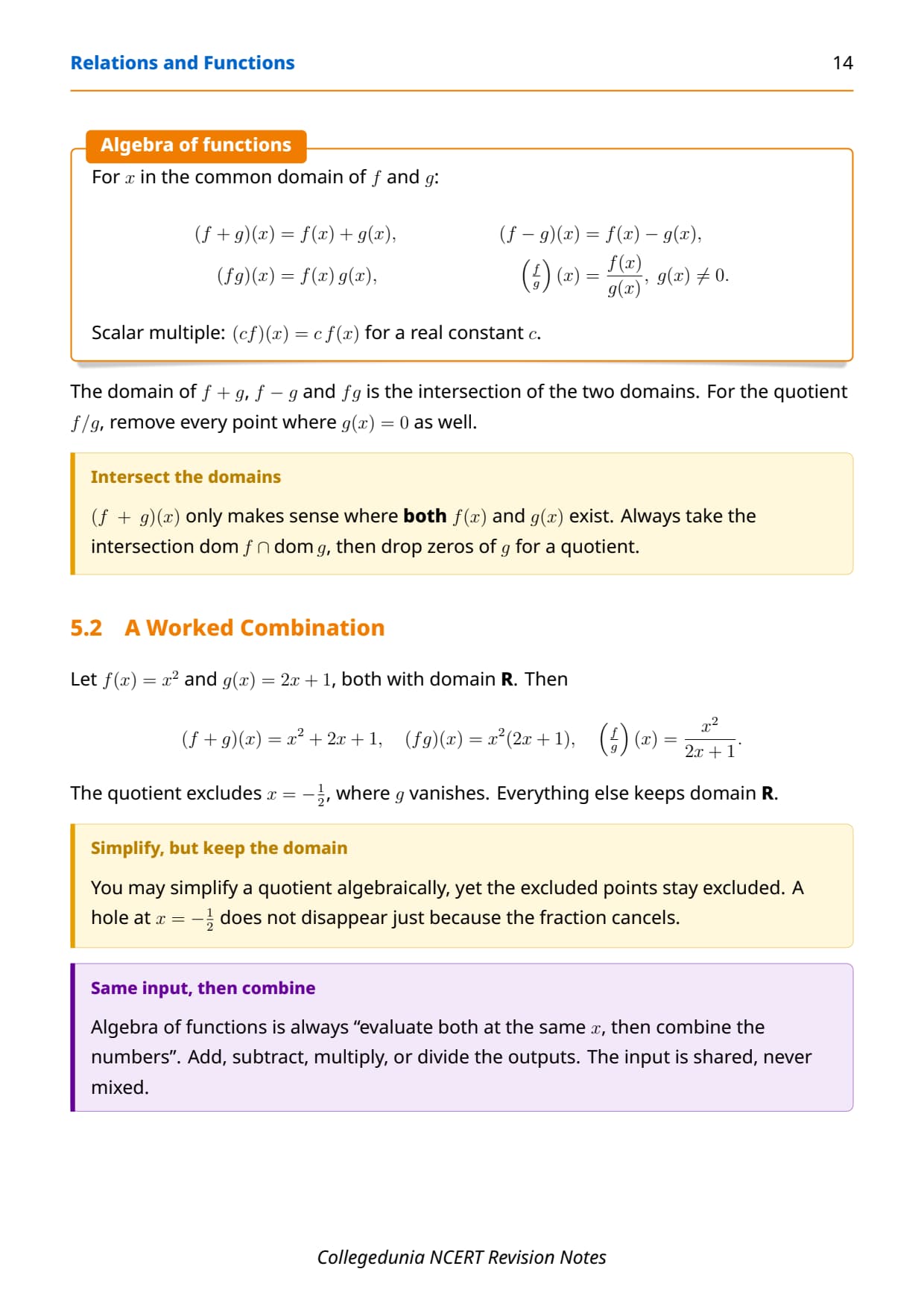
When f and g are two real functions with the same domain, we can build new functions from them. The rules apply pointwise, meaning the operation is done on the output values at each x.
- Sum: (f + g)(x) = f(x) + g(x).
- Difference: (f − g)(x) = f(x) − g(x).
- Product: (fg)(x) = f(x) × g(x).
- Scalar multiple: (kf)(x) = k × f(x), where k is a real number.
- Quotient: (f / g)(x) = f(x) / g(x), defined only where g(x) ≠ 0.
Important: the quotient function drops every point where the denominator is zero, so its domain is smaller. Always state the excluded points when you write down f / g.
All Formulas for Relations and Functions: Quick-Reference Table
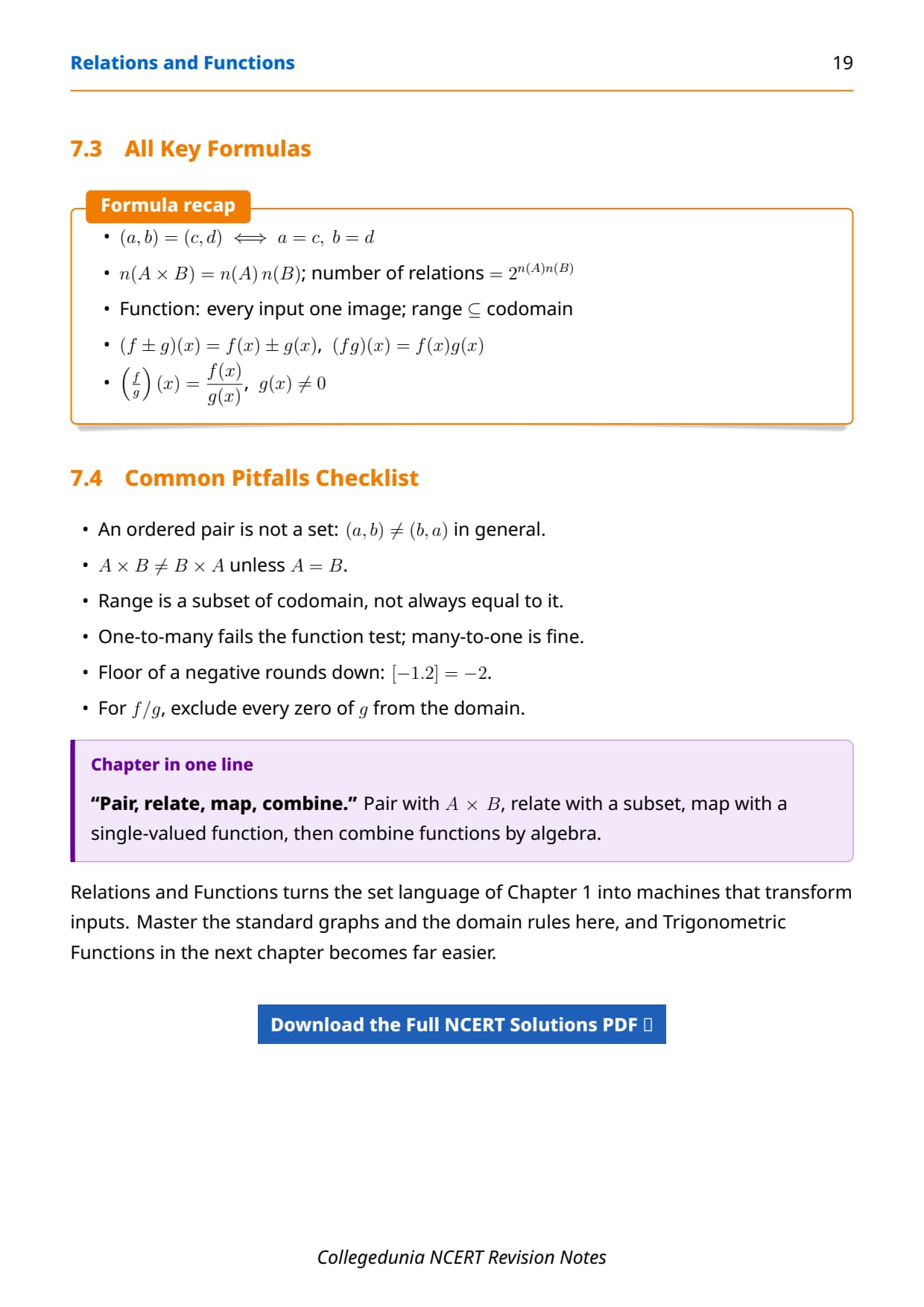
The formula table below covers every counting rule and definition the Relations and Functions chapter can generate. These formulas are the ones students should copy onto a flashcard before the exam.
| Formula | What It Means | When to Use |
|---|---|---|
| n(A × B) = n(A) × n(B) | Number of ordered pairs in A × B | Cartesian product counting |
| Number of relations = 2 to the power pq | All subsets of A × B, where p = n(A), q = n(B) | Counting relations |
| Number of functions = q to the power p | Functions from A to B, where p = n(A), q = n(B) | Counting functions |
| (a, b) = (c, d) iff a = c and b = d | Equality of ordered pairs | Solving for unknowns in a pair |
| Range ⊆ Codomain | Actual outputs sit inside the codomain | Checking a relation or function |
| |x| = x if x ≥ 0, else −x | Modulus function definition | Modulus graphs and equations |
| [x] = greatest integer ≤ x | Greatest integer (step) function | Step-function questions |
| (f / g)(x) = f(x) / g(x), g(x) ≠ 0 | Quotient of two real functions | Algebra of functions |
Important: the number of relations = 2 to the power pq rule is the single most-tested counting formula from this chapter in both CBSE Boards and CUET.
Key Definitions and Theorems in the Relations and Functions Chapter
Beyond the formulas, a few precise definitions carry marks in the reasoning-style questions. These are the results the class 11 maths notes chapter 2 relations and functions expect students to state exactly.
- Ordered pair: (a, b) with a fixed first and second element, where (a, b) = (b, a) only if a = b.
- Relation: a relation R from A to B is a subset of A × B.
- Function: a relation in which every element of the domain has exactly one image in the codomain.
- Domain and range: the domain is the set of first elements; the range is the set of images actually taken.
- Equal functions: two functions are equal when they have the same domain and give the same value at every point.
For the greatest integer function, remember that [x] rounds down toward negative infinity, so [−2.3] = −3, not −2. Every real number therefore lies between two consecutive integers.
Common Mistakes Students Make in the Relations and Functions Chapter
Mistake 1: Treating A × B as the same as B × A. The pairs are ordered, so the two products differ unless A = B.
Mistake 2: Confusing codomain with range. The range is only the outputs that occur; the codomain is the full target set.
Mistake 3: Calling every relation a function. A function needs exactly one image for each input, with none left out.
Mistake 4: Rounding [x] toward zero. The greatest integer function always rounds down, so [−1.5] = −2.
Each slip costs 1 to 2 marks in the board exam.
Relations and Functions Weightage in CBSE Boards, JEE Main and CUET
Relations and Functions is a scoring chapter because the questions are short and rule-based. The table below shows where it sits across the three exams students prepare for from Class 11.
| Exam | Typical Weightage | Most-Tested Topic |
|---|---|---|
| CBSE Class 11 Boards | 6 to 8 marks (with Sets) | Domain, range, and Cartesian product counting |
| JEE Main | 1 to 2 questions per year | Domain of rational and modulus functions |
| CUET (UG) Mathematics | 1 to 2 MCQs per paper | Types of functions and their graphs |
Tip: because Relations and Functions feeds directly into Class 12 relations, inverse functions, and calculus, a strong grip here pays off across the whole Class 11 and Class 12 syllabus.
How to Revise the Relations and Functions Chapter Quickly
Relations and Functions can be revised in about 90 minutes because the content is compact. Use the class 11 maths notes chapter 2 relations and functions in the three-block plan below for a last-minute recap.
- 0 to 30 min: ordered pairs, Cartesian product, and the n(A × B) counting rule.
- 30 to 60 min: relations, domain and range, and when a relation becomes a function.
- 60 to 90 min: the seven function types and the algebra of functions. Draw each graph once by hand.
Finish by flushing through the eight-row formula table until every rule can be written from memory.
Student Feedback on the Relations and Functions Notes
In a Collegedunia poll of 11,860 Class 11 Maths students conducted before the 2026 boards, 62% of students rated the greatest integer and signum function graphs as the trickiest part of the chapter, ahead of relation counting.
What 11,860 students told us about the Relations and Functions revision journey:
- 62% of students surveyed found the greatest integer and signum graphs the hardest sub-topic.
- 57% said they had mixed up range with codomain at least once in a class test.
- 4 out of 5 students revised the formula table the night before the exam.
- Out of 11,860 students, 59% said sketching each function once made the types easier to recall.
Source: 2026-27 Class 11 Maths student poll. Sample of 11,860 students from CBSE schools across 14 states.
Other Relations and Functions Class 11 Maths Resources
Use these notes together with the linked resources below for the full Relations and Functions study set. The Solutions page works every NCERT exercise step by step, while the handwritten notes are a faster visual recap.
| Resource | What It Gives You |
|---|---|
| NCERT Solutions for Class 11 Maths Relations and Functions | Step-by-step answers to every exercise question |
| Class 11 Maths Relations and Functions Handwritten Notes | Neat handwritten revision notes with formula boxes |
| Class 11 Maths Relations and Functions NCERT Book PDF | The official NCERT chapter PDF to read alongside |
NCERT Notes for Class 11 Maths: All Chapters
| Chapter | Revision Notes |
|---|---|
| Chapter 1 | Sets Notes |
| Chapter 2 | Relations and Functions Notes (this page) |
| Chapter 3 | Trigonometric Functions Notes |
| Chapter 4 | Complex Numbers and Quadratic Equations Notes |
| Chapter 5 | Linear Inequalities Notes |
| Chapter 6 | Permutations and Combinations Notes |
| Chapter 7 | Binomial Theorem Notes |
| Chapter 8 | Sequences and Series Notes |
| Chapter 9 | Straight Lines Notes |
| Chapter 10 | Conic Sections Notes |
| Chapter 11 | Introduction to Three Dimensional Geometry Notes |
| Chapter 12 | Limits and Derivatives Notes |
| Chapter 13 | Statistics Notes |
| Chapter 14 | Probability Notes |
FAQs on Relations and Functions Class 11 Maths Notes
Relations and Functions Notes - Frequently Asked Questions
Ques. What are the main topics in the class 11 maths notes chapter 2 relations and functions?
Ans. These Relations and Functions notes cover ordered pairs, the Cartesian product of sets, relations with their domain, codomain and range, functions, the seven standard function types (identity, constant, polynomial, rational, modulus, signum, and greatest integer), and the algebra of real functions.
Ques. What is an ordered pair?
Ans. An ordered pair is a pair of elements written in a fixed order, such as (a, b). Order matters, so (a, b) is different from (b, a) unless a = b. Two ordered pairs are equal only when their first elements and second elements match.
Ques. What is the difference between a relation and a function?
Ans. A relation from A to B is any subset of A × B. A function is a special relation in which every element of A is paired with exactly one element of B, with none left out. So every function is a relation, but not every relation is a function.
Ques. What are the domain, codomain and range of a relation?
Ans. The domain is the set of all first elements of the ordered pairs in the relation. The codomain is the whole set the relation maps into. The range is the set of second elements that actually occur, and the range is always a subset of the codomain.
Ques. How many relations can be defined from set A to set B?
Ans. A relation from A to B is a subset of A × B, which has pq ordered pairs when n(A) = p and n(B) = q. The number of subsets, and therefore the number of relations, is 2 to the power pq. This is a common 1-mark question.
Ques. What are the types of functions in Class 11 Maths?
Ans. The standard real functions are the identity function f(x) = x, the constant function f(x) = c, polynomial functions, rational functions, the modulus function |x|, the signum function, and the greatest integer function [x]. Each has a fixed rule, domain, and range.
Ques. What is the greatest integer function?
Ans. The greatest integer function [x] gives the greatest integer that is less than or equal to x. For example, [2.7] = 2, [3] = 3, and [−1.5] = −2. It always rounds down toward negative infinity, and its graph is a series of steps.
Ques. Is the Relations and Functions chapter important for JEE Main and CUET?
Ans. Yes. Relations and Functions usually gives 1 to 2 questions in JEE Main and CUET (UG) Mathematics every year, mostly on domain and range, counting relations, and function graphs. It is a short, scoring chapter, so it is worth revising fully.
Ques. Where can I download the Class 11 Maths Relations and Functions notes PDF?
Ans. The Relations and Functions notes PDF is available on this page through the download card above. It covers all definitions, the full formula table, the seven function types, and the algebra of functions, and matches the 2026-27 NCERT chapter.



Comments