




The class 11 maths notes chapter 1 sets bring together every definition, Venn diagram, and set operation that the CBSE Boards, JEE Main, JEE Advanced, and CUET actually test in 2026-27. These revision notes explain sets and their representation, the types of sets, operations on sets, and De Morgan's laws in plain language, with a full formula table for quick recall.
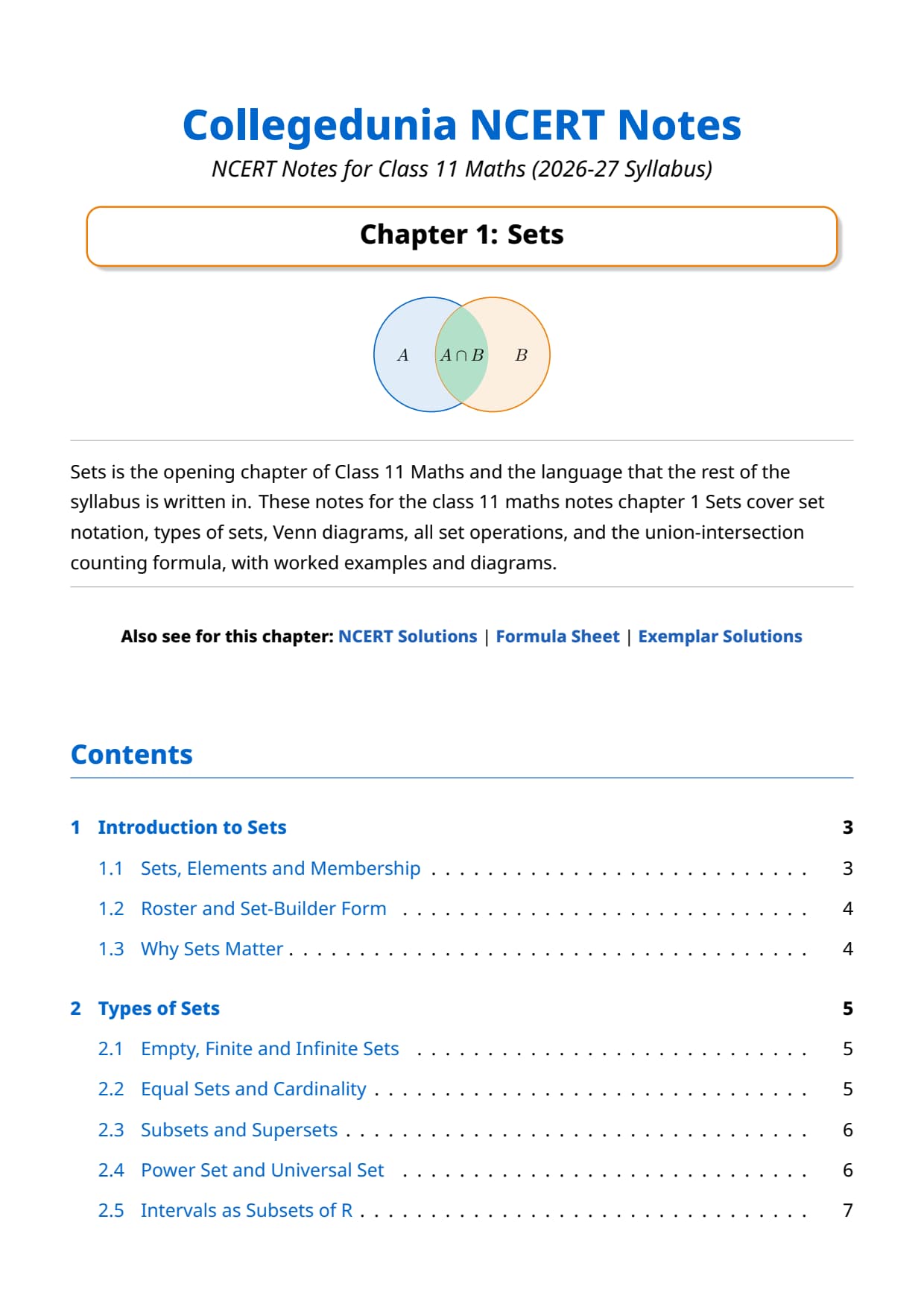
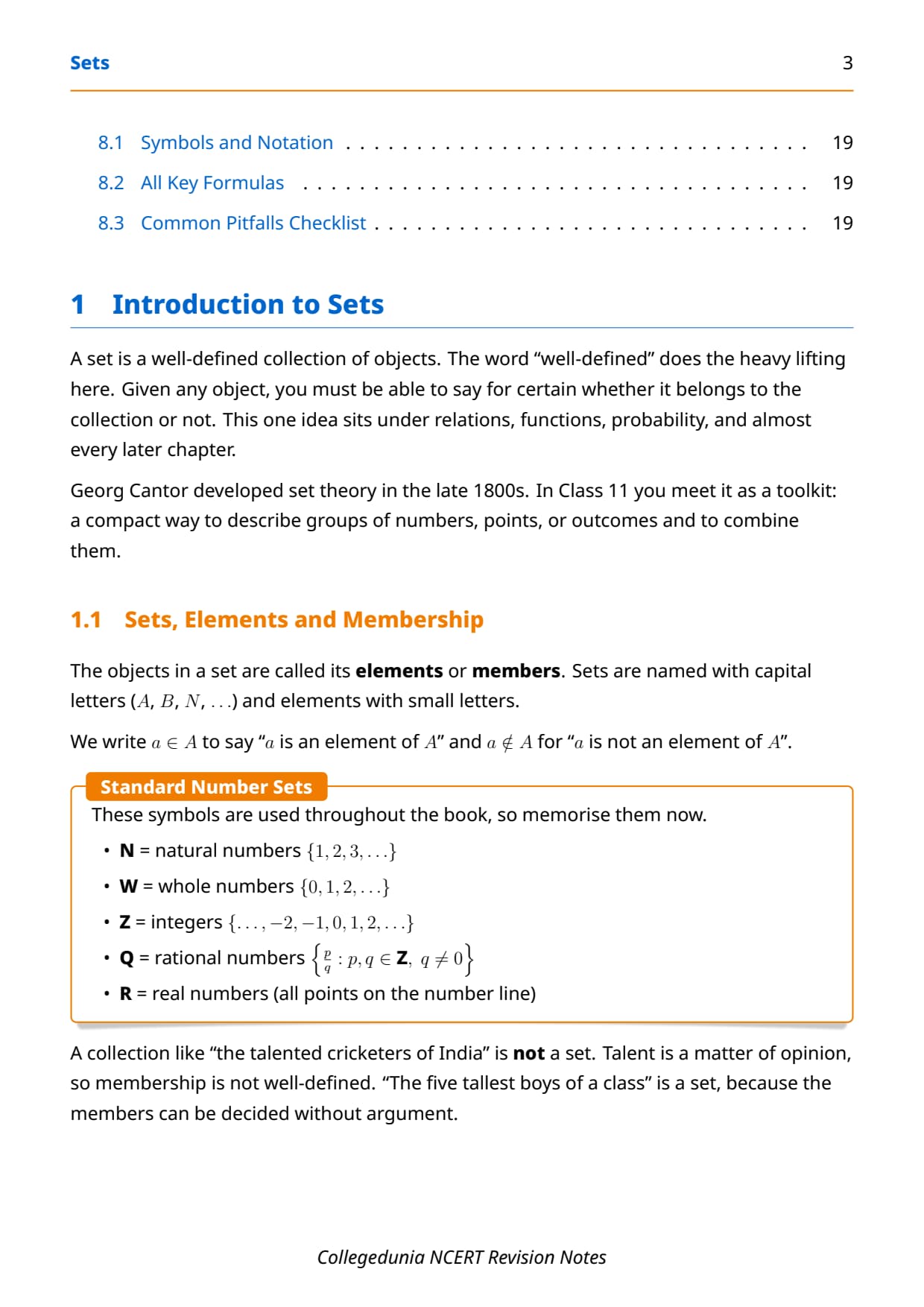
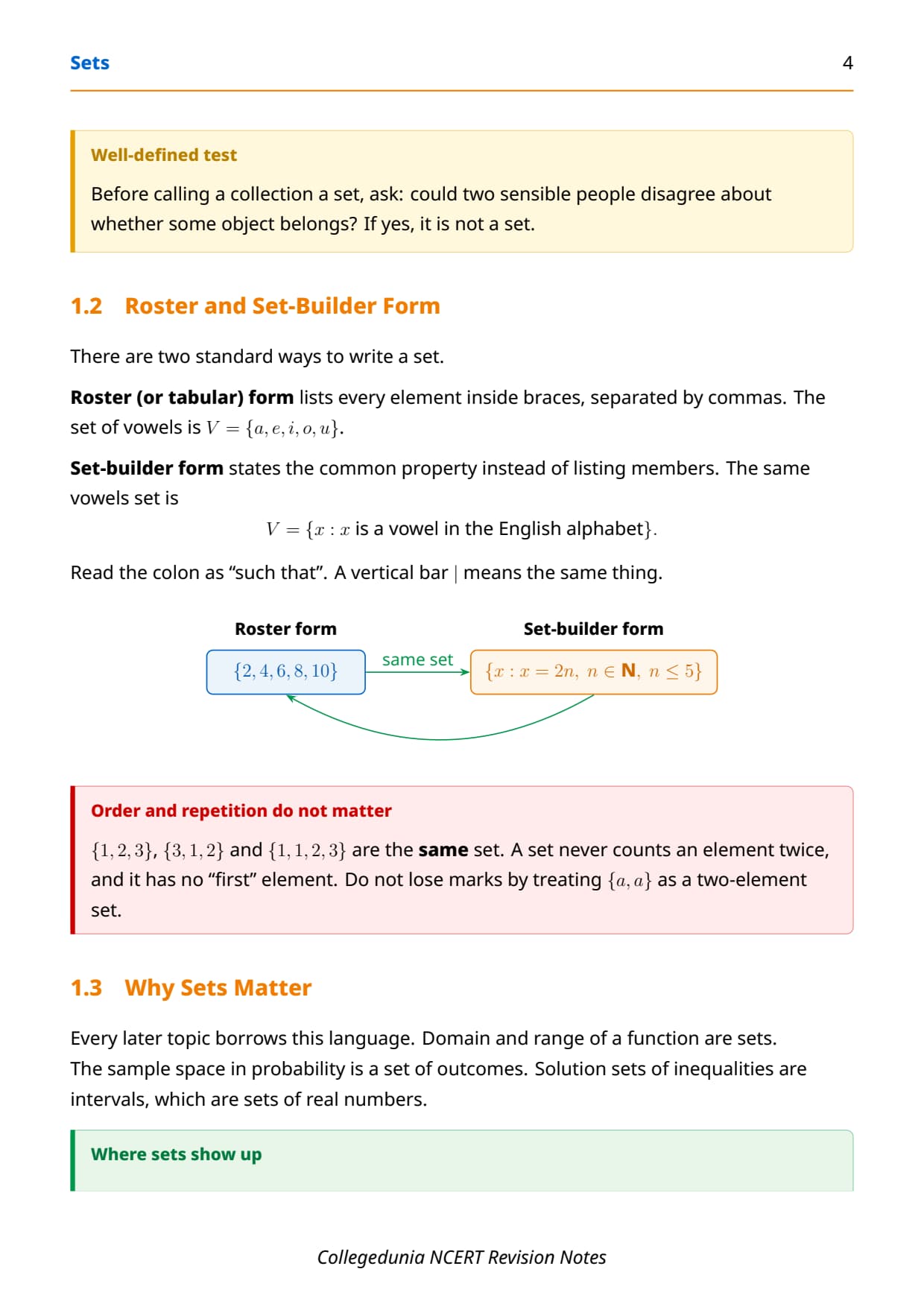
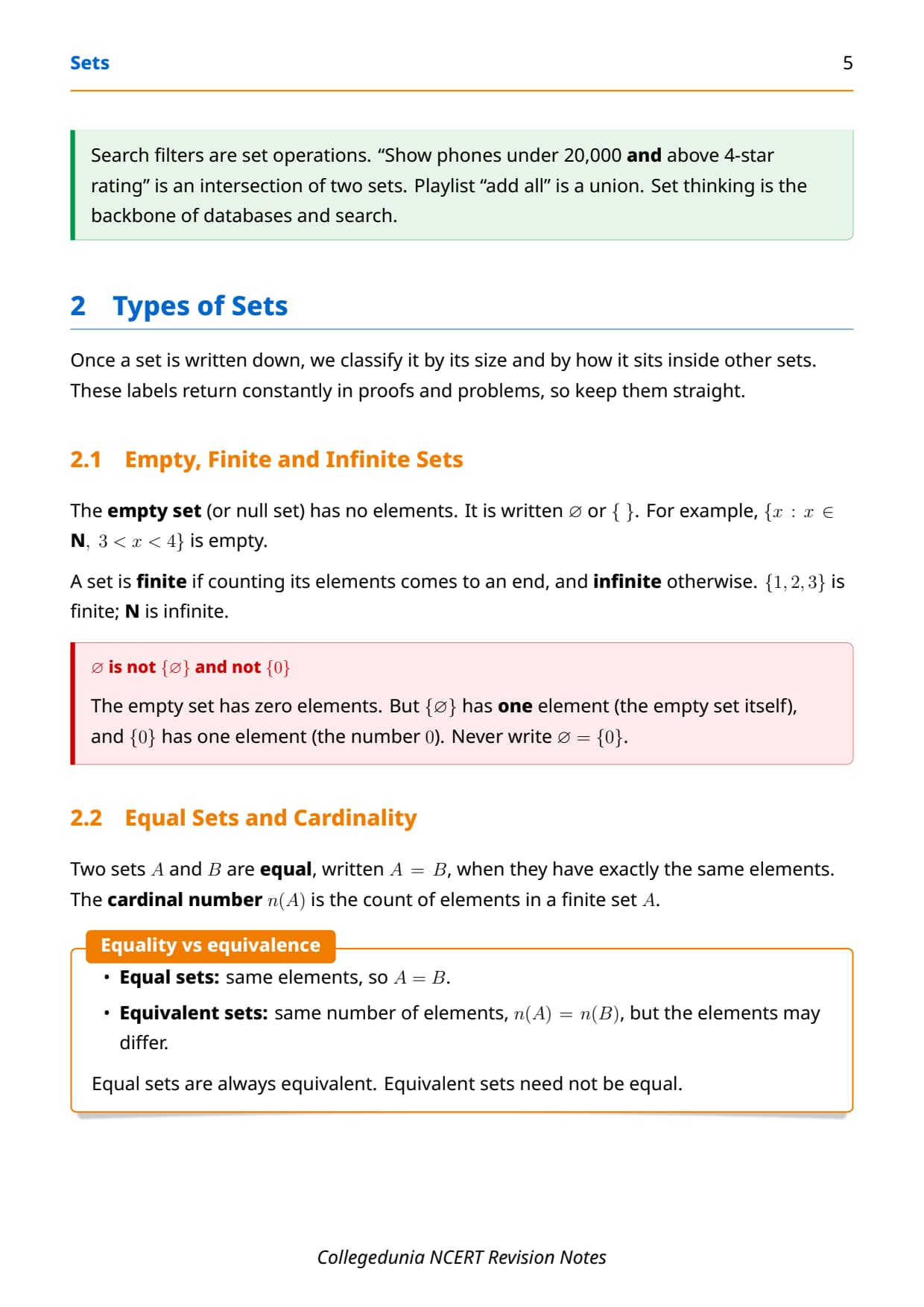
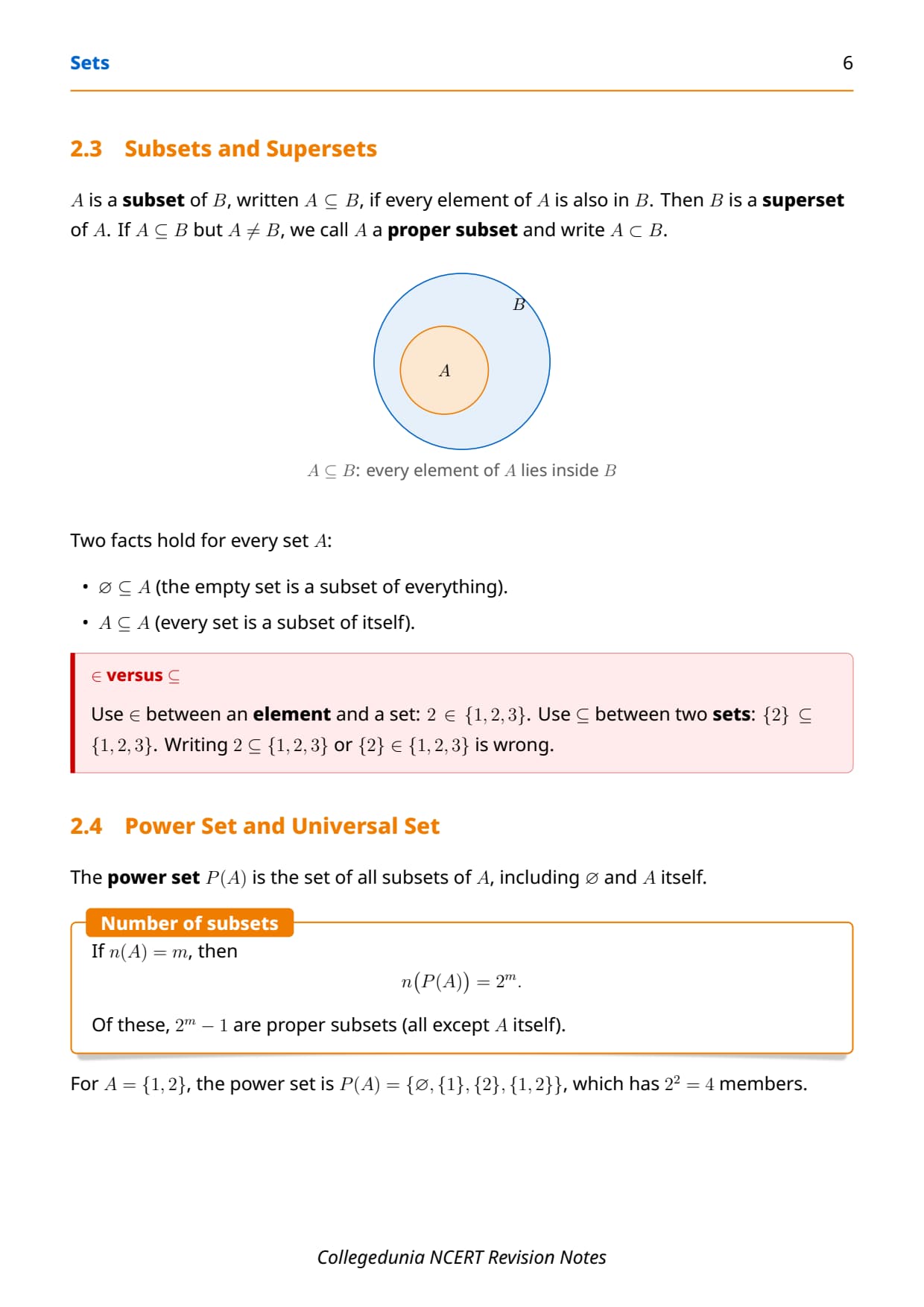
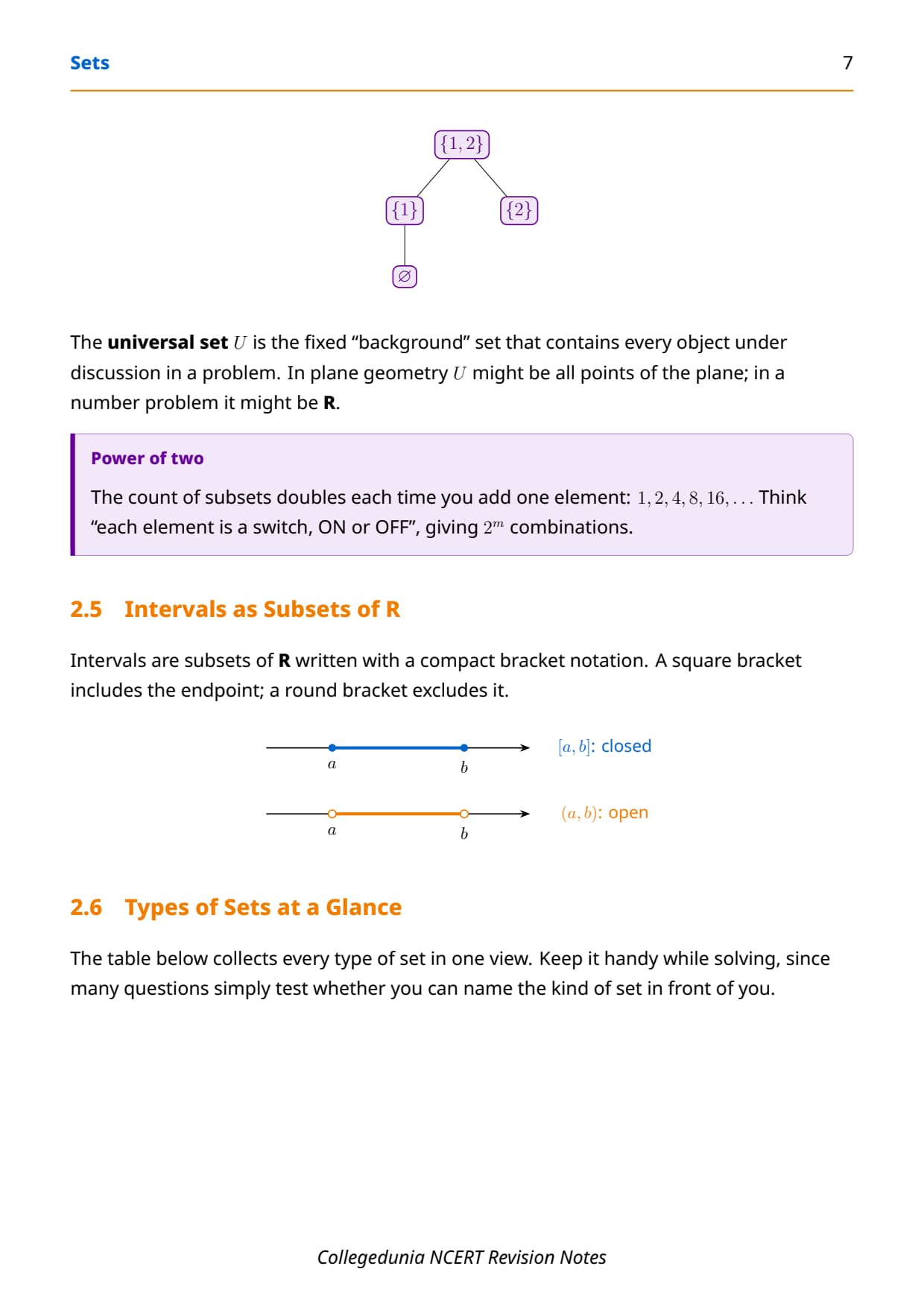
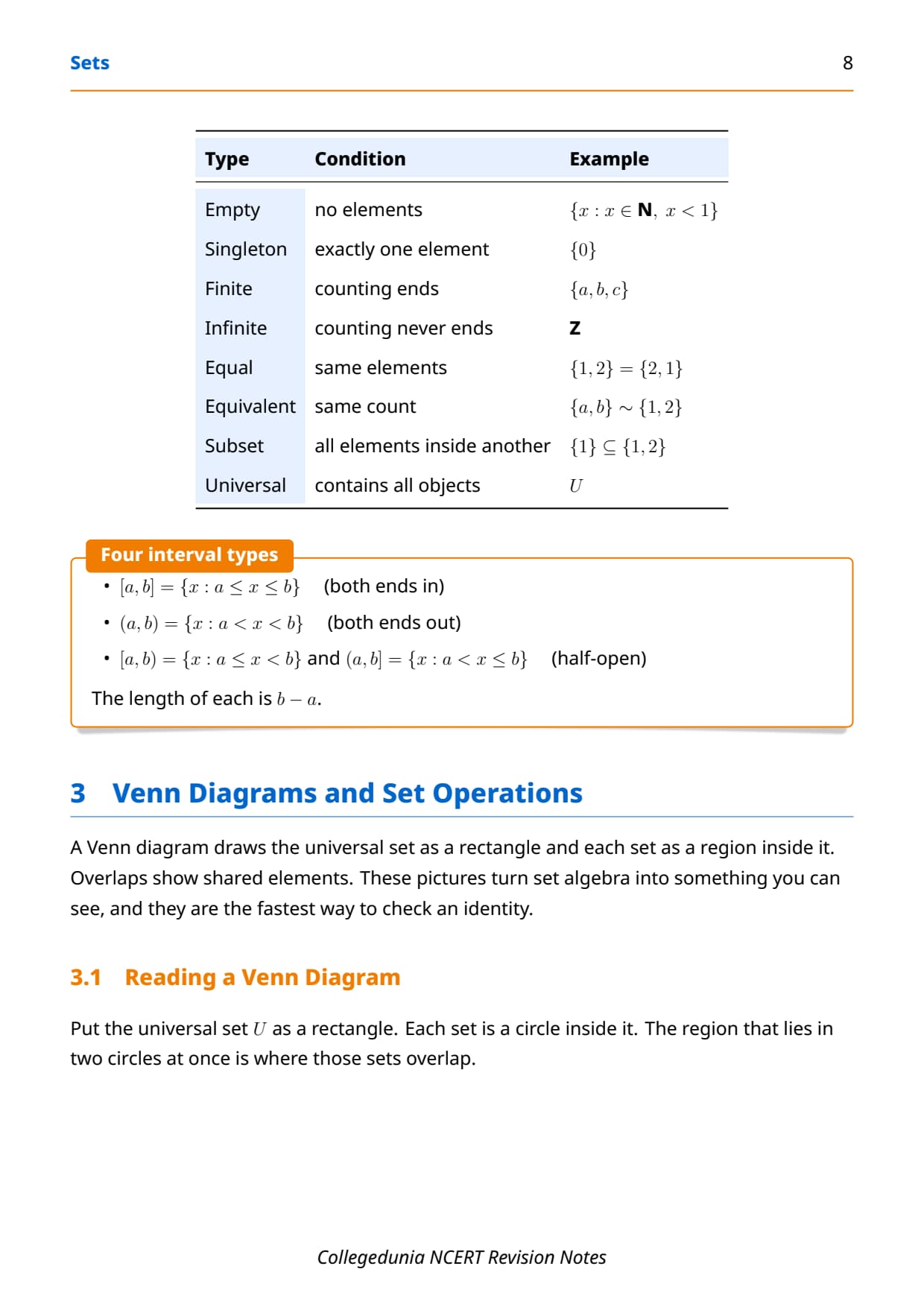
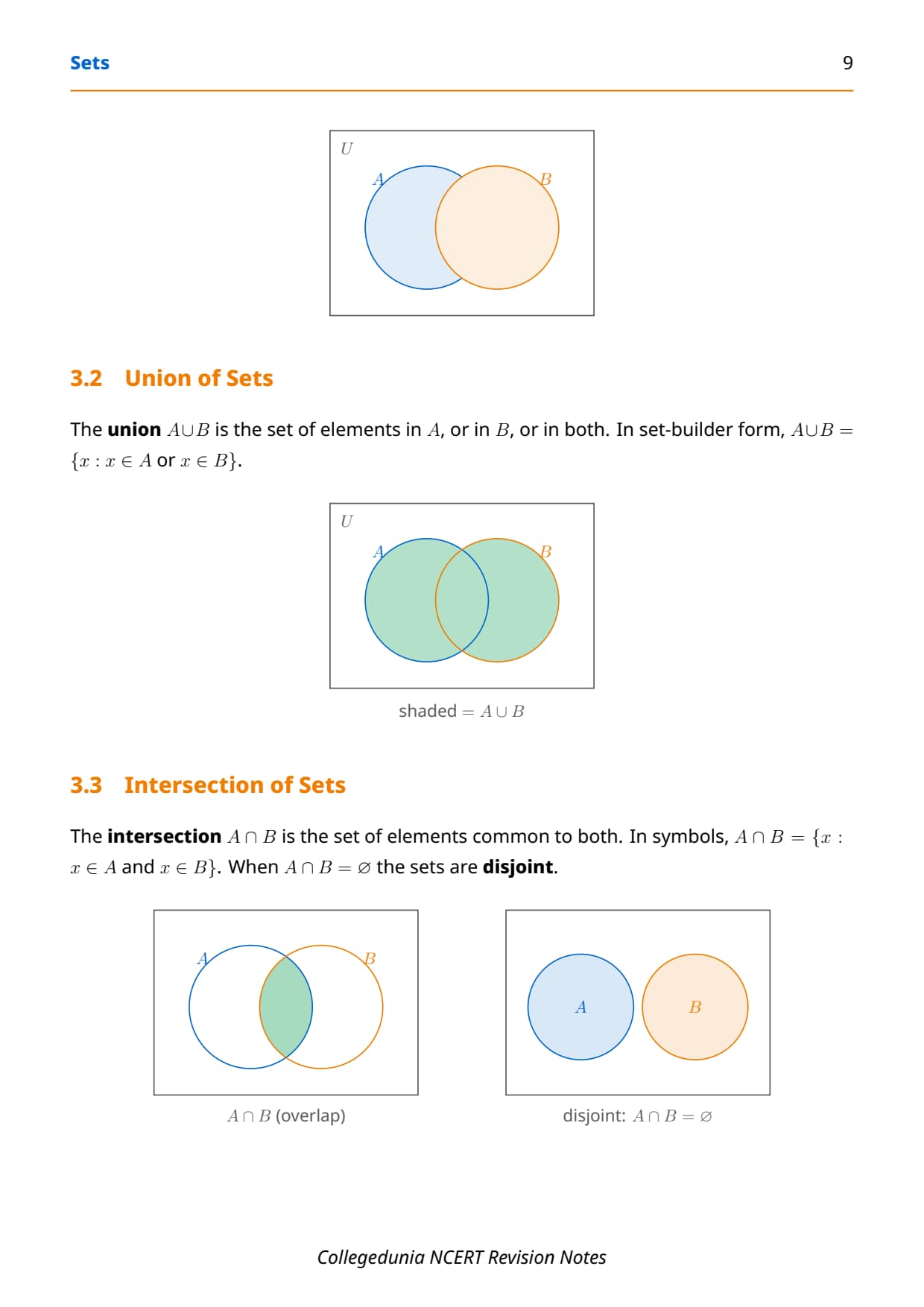
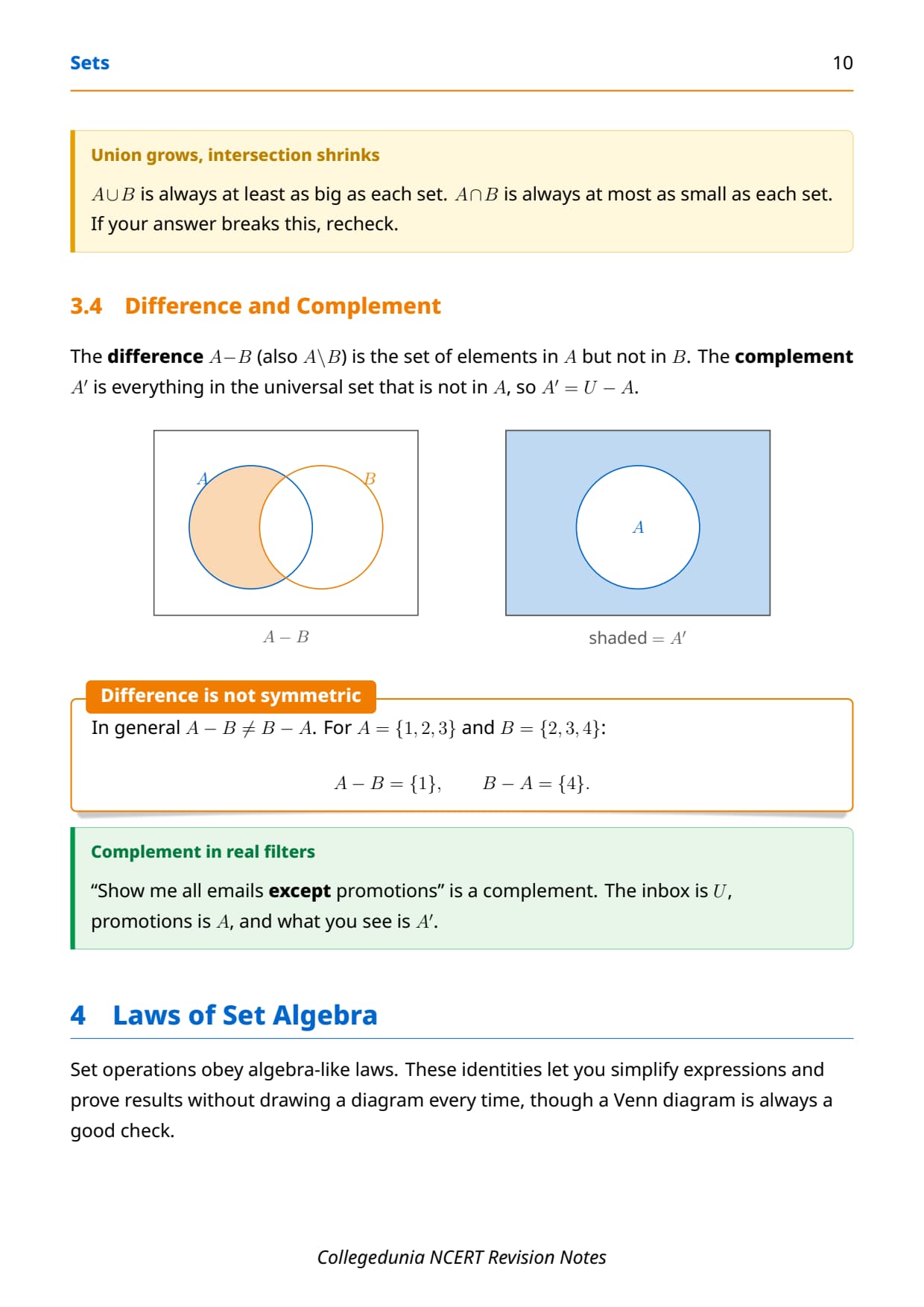
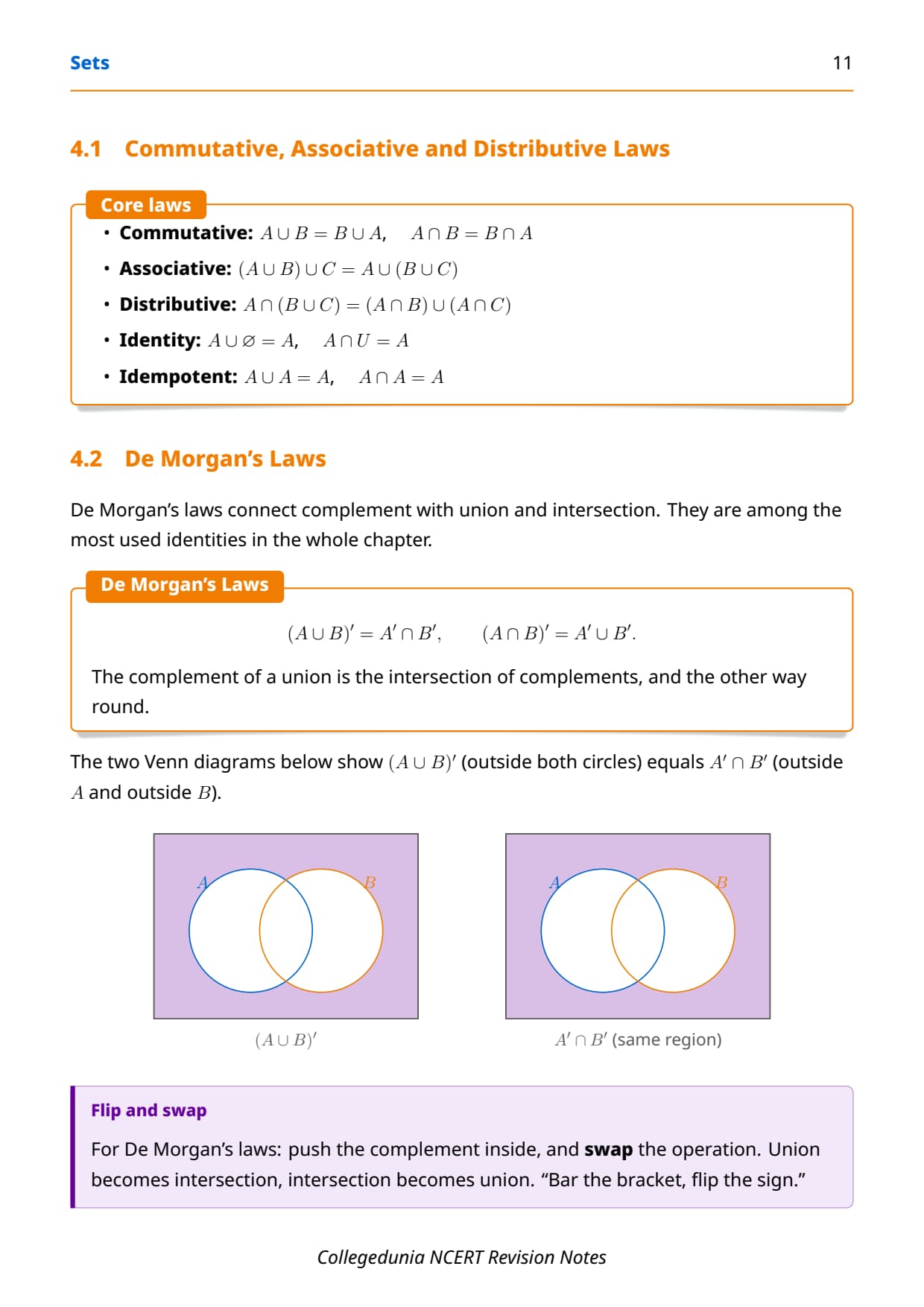
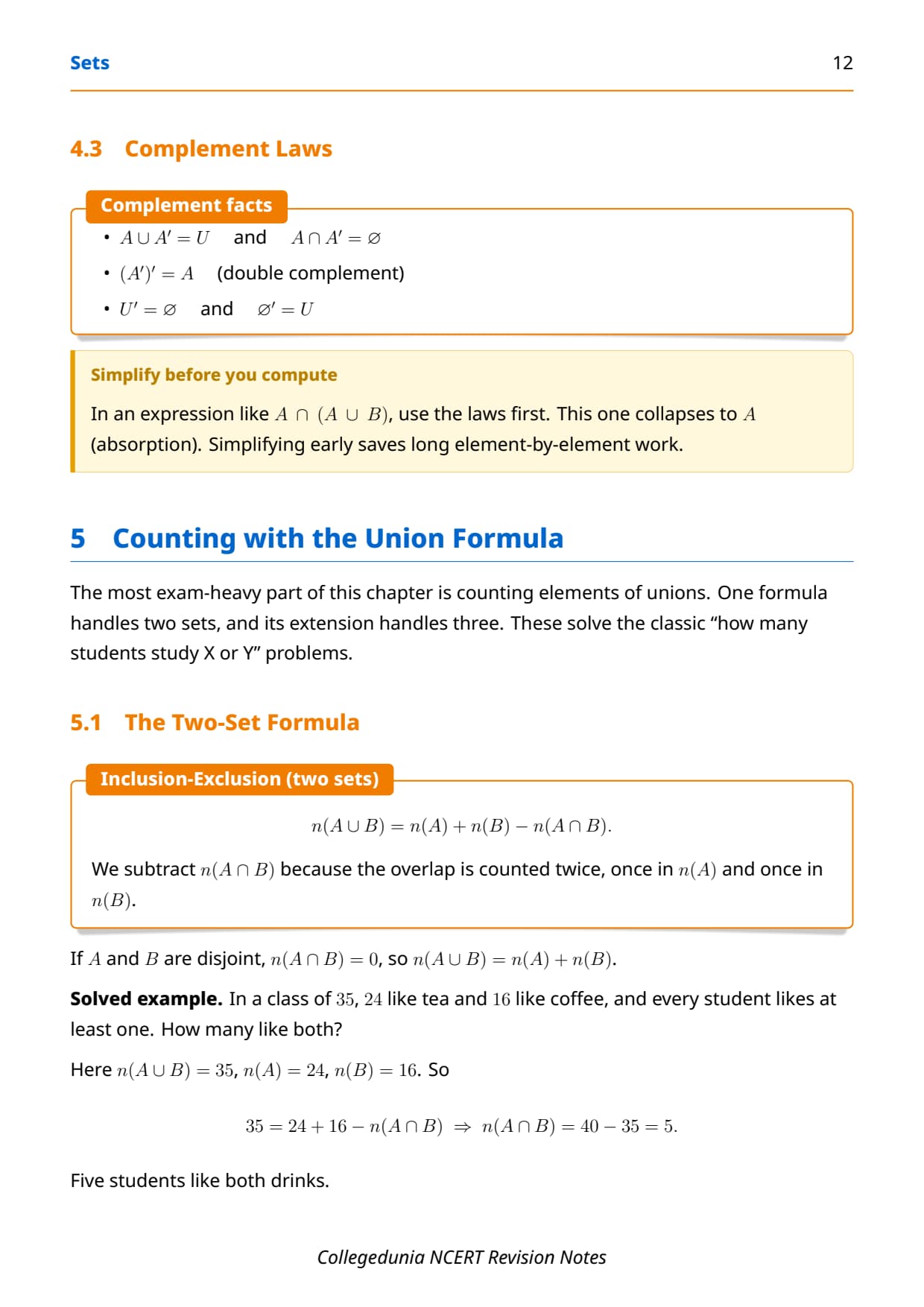
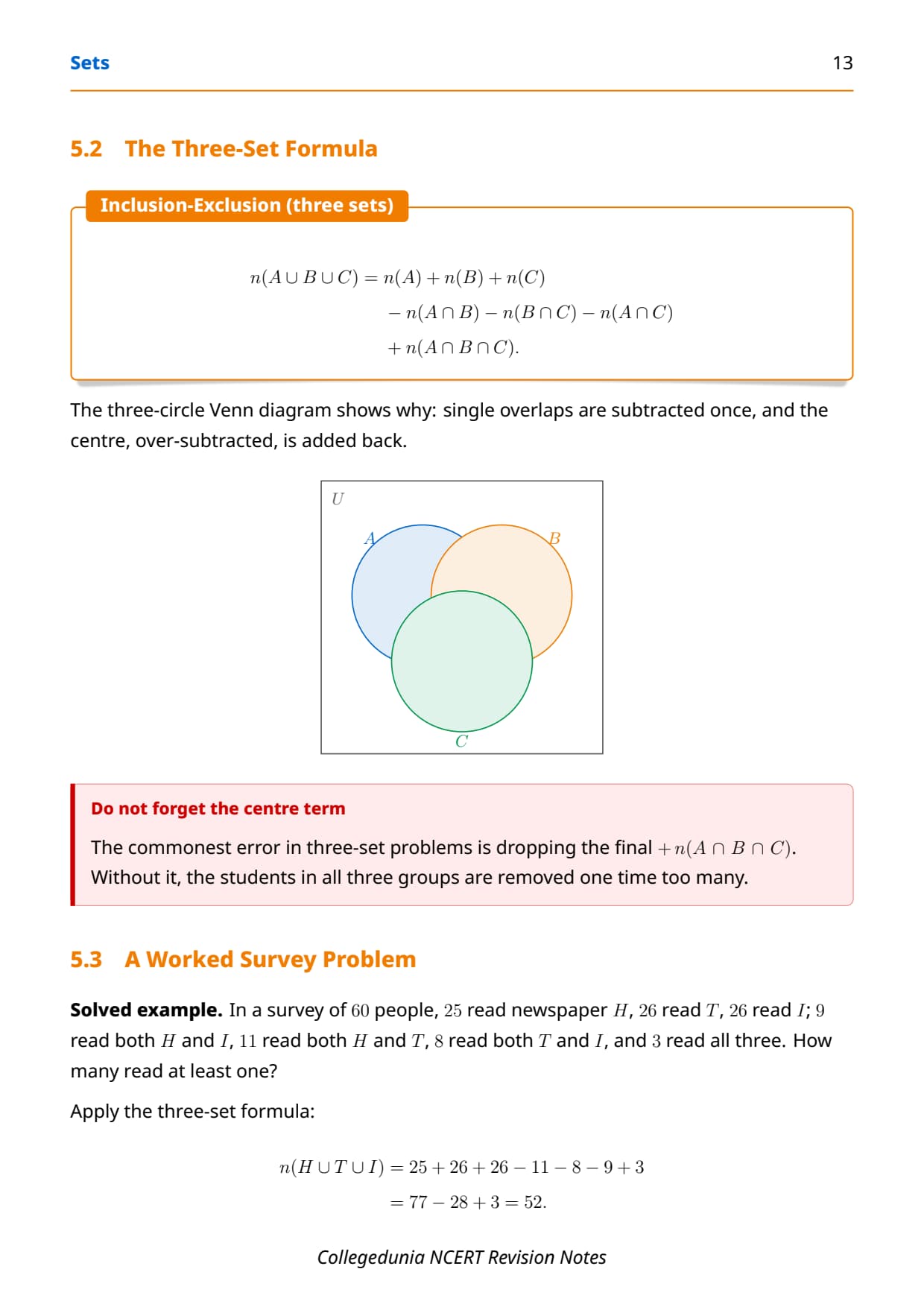
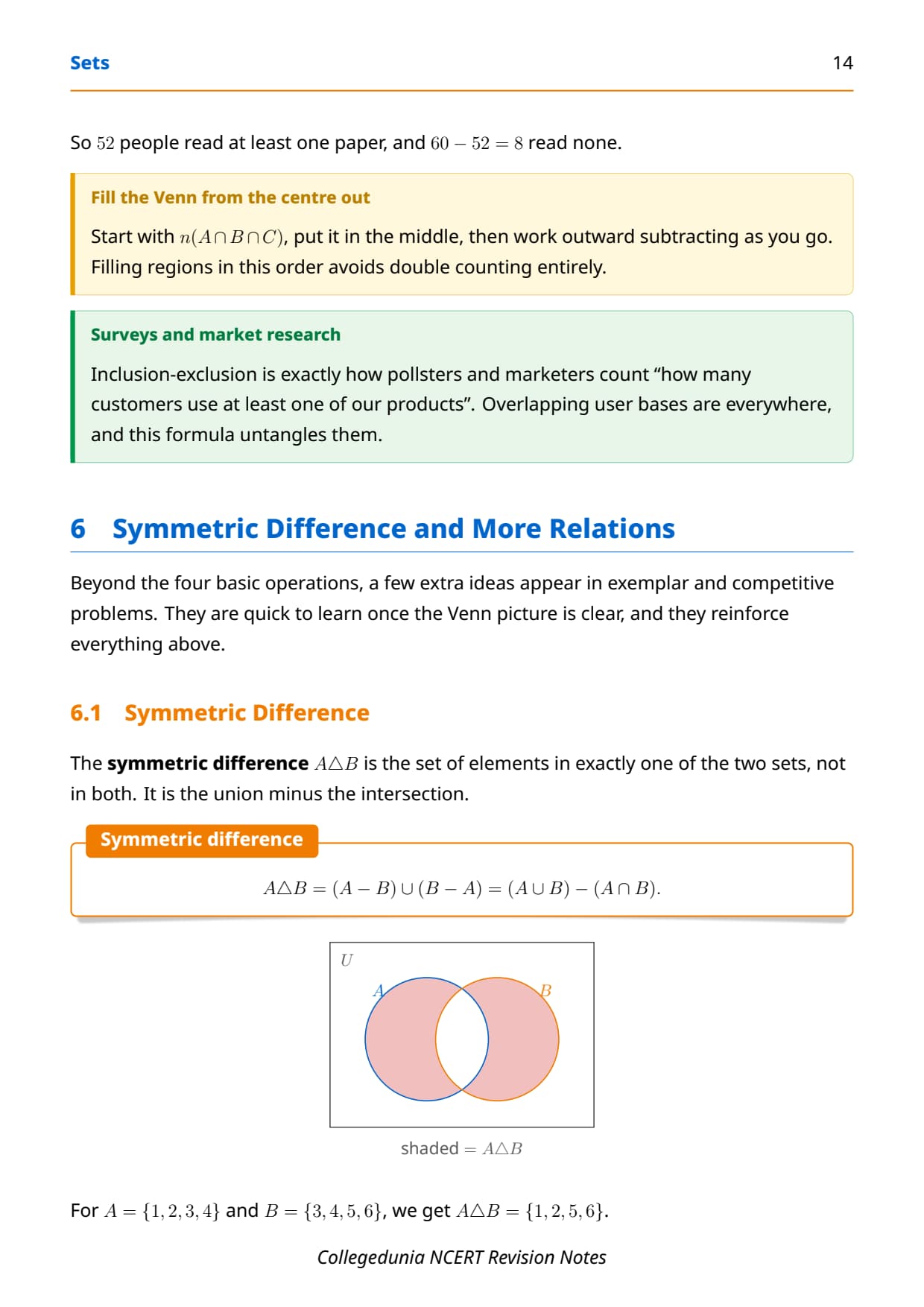
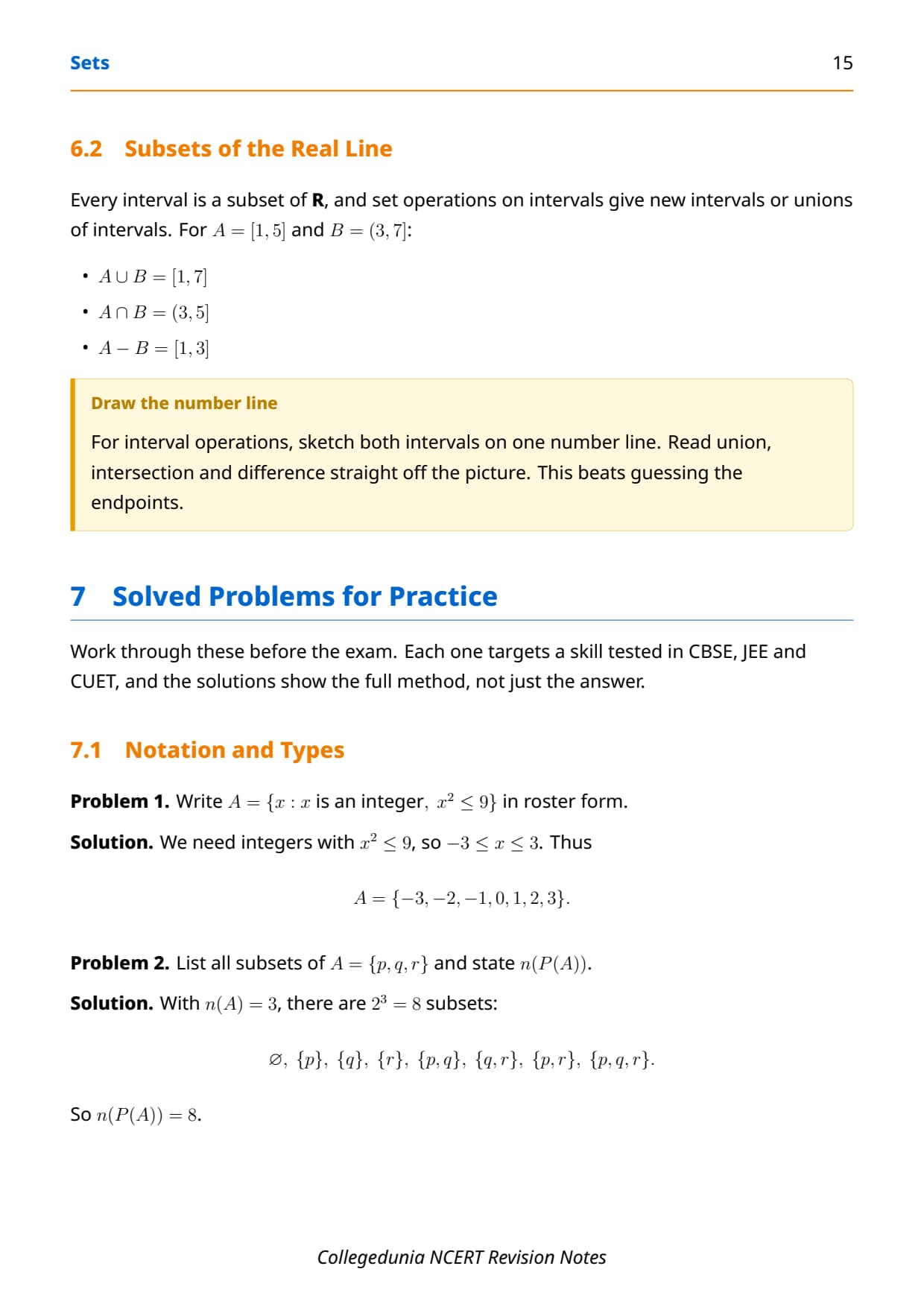
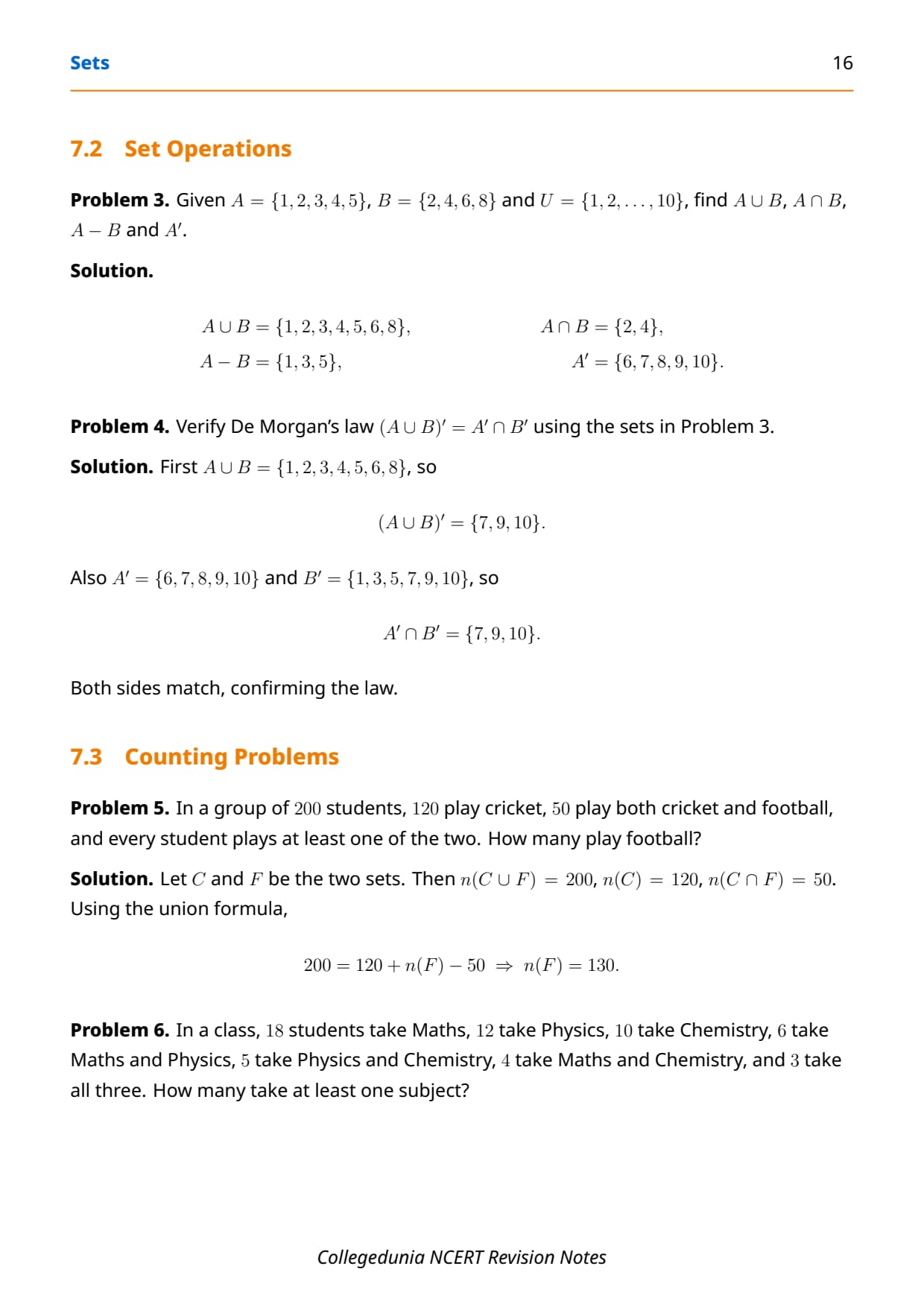
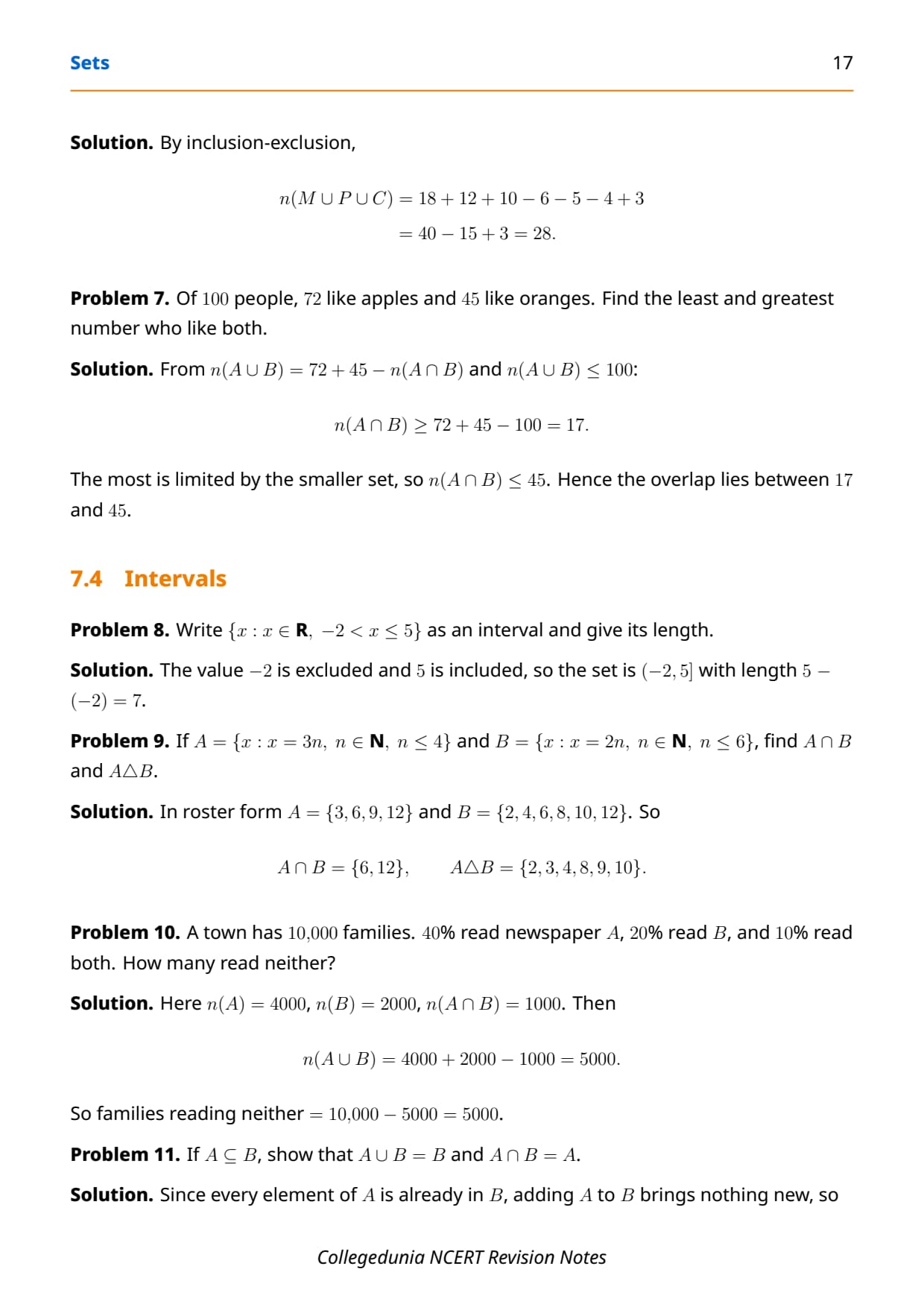
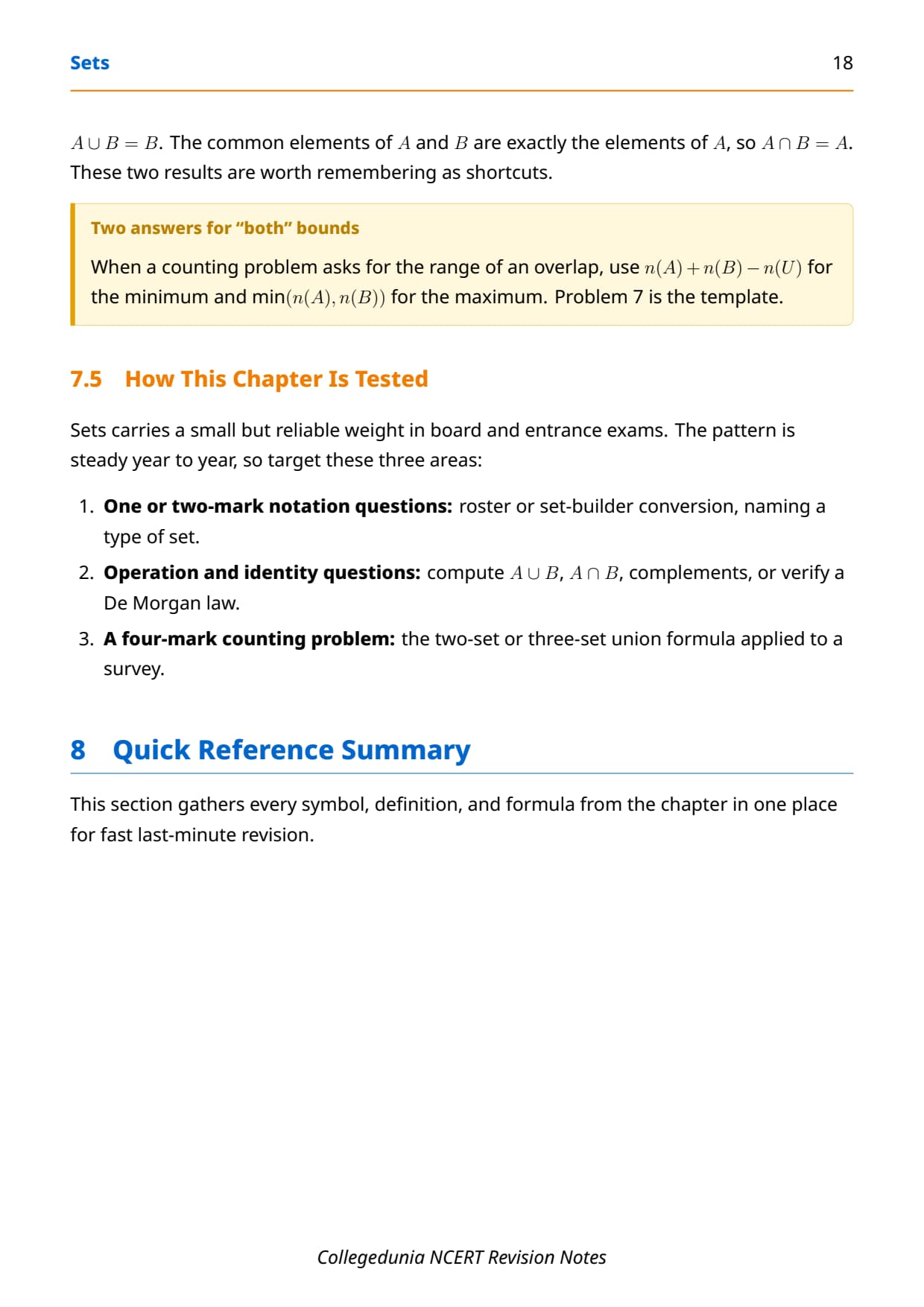
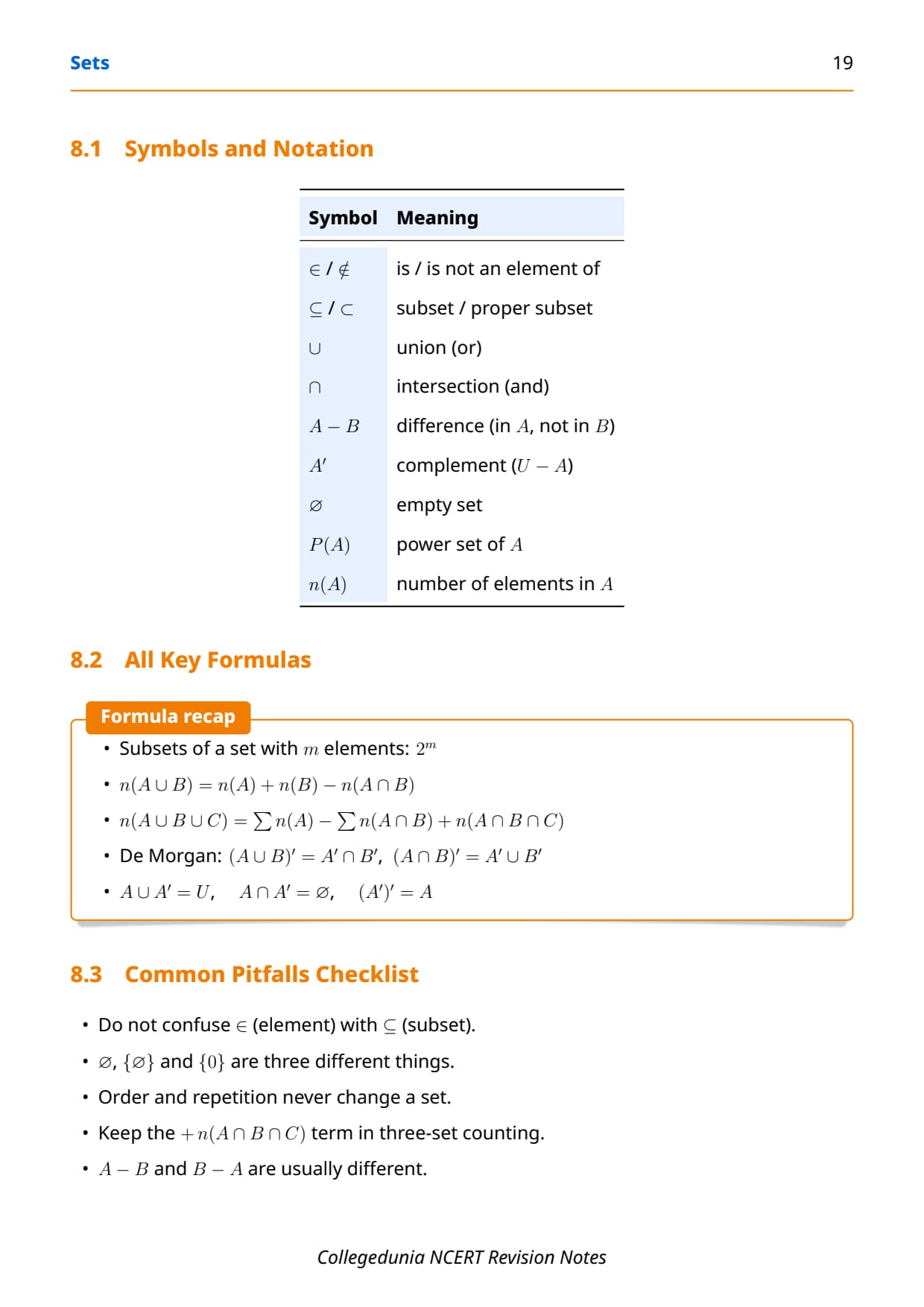
You can download the complete Sets notes PDF above, then use the topic-by-topic summary and the formula table on this page for a fast last-minute revision.
- CBSE Boards: Sets is the opening chapter of Unit 1 (Sets and Functions) and carries roughly 6 to 8 marks along with Relations and Functions.
- JEE Main and CUET: expect 1 to 2 direct questions on set operations, the n(A ∪ B) formula, and power sets every year.
- What is covered: roster and set-builder form, types of sets, subsets, power set, Venn diagrams, and the four set operations.
Every entry in these Sets notes is curated by Collegedunia subject experts, mapped to the 2026-27 NCERT textbook, and checked against the last five years of CBSE Board and JEE Main papers.
Also Check:
Topic-by-Topic Summary of the Sets Chapter for Class 11 Maths
The Sets chapter splits into five sub-topic blocks. The class 11 maths notes chapter 1 sets map each block to what the exam asks, so students know where the marks sit before they revise.
- Sets and their representation: defining a set, roster form, and set-builder form. Usually a 1-mark conversion question.
- Types of sets: empty, finite, infinite, equal, subset, power set, and universal set. A frequent 1 to 2-mark MCQ block.
- Venn diagrams: drawing sets and their relationships inside a universal set. Used to justify almost every set identity.
- Operations on sets: union, intersection, difference, and complement. The 3 to 4-mark core of the chapter.
- Practical problems and De Morgan's laws: counting with the n(A ∪ B) formula. A common word-problem question.
The rest of these notes take each block in order, so a first read from top to bottom mirrors the NCERT chapter flow.
Sets and Their Representation: Roster and Set-Builder Form
A set is a well-defined collection of distinct objects. "Well-defined" means there is a clear rule to decide whether any object belongs to the set or not. Each object in a set is called an element. If x is an element of set A we write x ∈ A, and if it is not, we write x ∉ A.
There are two ways to write a set:
- Roster (or tabular) form: list every element inside braces, separated by commas. Example: A = {2, 4, 6, 8}. Order does not matter and elements are never repeated.
- Set-builder form: state the common property of the elements. Example: A = {x : x is an even natural number less than 10}. Read the colon as "such that".
Standard number sets you must memorise: N (natural numbers), W (whole numbers), Z (integers), Q (rational numbers), and R (real numbers). These appear in set-builder questions throughout Class 11 and Class 12.
Types of Sets Every Class 11 Student Must Know
The types of sets are the highest-frequency MCQ source in this chapter. The table below defines each type with a quick example, so students can match a set to its name in one look.
| Type of Set | Meaning | Example |
|---|---|---|
| Empty (null) set | Has no elements; written ∅ or { } | {x : x is a natural number, x < 1} |
| Singleton set | Has exactly one element | {5} |
| Finite set | Number of elements can be counted | {1, 2, 3, 4} |
| Infinite set | Elements cannot be counted fully | {x : x ∈ N} |
| Equal sets | Have exactly the same elements | {1, 2, 3} = {3, 2, 1} |
| Subset (A ⊆ B) | Every element of A is in B | {1, 2} ⊆ {1, 2, 3} |
| Power set P(A) | Set of all subsets of A | P({1,2}) has 4 subsets |
| Universal set (U) | Contains all sets under discussion | U = R for real-number problems |
Two facts examiners love: the empty set is a subset of every set, and a set with n elements has exactly 2 to the power n subsets. Both are direct 1-mark questions.
Venn Diagrams and Operations on Sets
A Venn diagram shows the universal set as a rectangle and each set as a circle inside it. It is the fastest way to picture how sets overlap and to prove set identities without algebra. Every operation below has a standard Venn picture that the class 11 maths notes chapter 1 sets use to explain it.
- Union (A ∪ B): all elements in A, or B, or both. A ∪ B = {x : x ∈ A or x ∈ B}.
- Intersection (A ∩ B): elements common to both A and B. A ∩ B = {x : x ∈ A and x ∈ B}.
- Difference (A − B): elements in A but not in B.
- Complement (A'): elements in the universal set U that are not in A. A' = U − A.
Two sets with no common element (A ∩ B = ∅) are called disjoint sets. When you shade a Venn diagram, always draw the universal-set rectangle first, then the circles, so the complement region is visible.
All Formulas for Sets: Quick-Reference Table
The formula table below covers every identity and counting rule the Sets chapter can generate. These formulas for sets are the ones students should copy onto a flashcard before the exam.
| Formula | What It Means | When to Use |
|---|---|---|
| n(A ∪ B) = n(A) + n(B) − n(A ∩ B) | Size of the union of two sets | Two overlapping sets |
| n(A ∪ B) = n(A) + n(B) | Union when sets are disjoint | A ∩ B = ∅ |
| n(A ∪ B ∪ C) = n(A) + n(B) + n(C) − n(A ∩ B) − n(B ∩ C) − n(A ∩ C) + n(A ∩ B ∩ C) | Size of the union of three sets | Three-set word problems |
| n(A − B) = n(A) − n(A ∩ B) | Elements in A only | Difference counting |
| Number of subsets = 2 to the power n | All subsets of an n-element set | Power-set questions |
| Number of proper subsets = 2 to the power n, minus 1 | All subsets except the set itself | Subset counting |
| n(P(A)) = 2 to the power n | Size of the power set | Power-set size |
| (A ∪ B)' = A' ∩ B' | De Morgan's first law | Complement of a union |
| (A ∩ B)' = A' ∪ B' | De Morgan's second law | Complement of an intersection |
Important: the n(A ∪ B) = n(A) + n(B) − n(A ∩ B) rule is the single most-tested formula from this chapter in both CBSE Boards and CUET.
Key Definitions and Theorems in the Sets Chapter
Beyond the formulas, a few named laws and definitions carry marks in the reasoning-style questions. These are the results the class 11 maths notes chapter 1 sets expect students to state precisely.
- Subset: A ⊆ B means every element of A is also in B. If A ⊆ B and A ≠ B, then A is a proper subset, written A ⊂ B.
- Power set: P(A) is the set of all subsets of A, including the empty set and A itself.
- Complement laws: A ∪ A' = U and A ∩ A' = ∅. Also (A')' = A.
- De Morgan's laws: (A ∪ B)' = A' ∩ B' and (A ∩ B)' = A' ∪ B'. These convert a complement of a combined set into simpler pieces.
- Distributive laws: A ∪ (B ∩ C) = (A ∪ B) ∩ (A ∪ C) and A ∩ (B ∪ C) = (A ∩ B) ∪ (A ∩ C).
For intervals on the real line, remember that closed intervals like [a, b] include their end-points, while open intervals (a, b) do not. Every interval is a subset of R.
Common Mistakes Students Make in the Sets Chapter
Mistake 1: Repeating an element inside a set. A set never lists the same element twice, so {1, 1, 2} is just {1, 2}.
Mistake 2: Confusing ∈ (belongs to) with ⊆ (subset). 2 ∈ {1, 2, 3} is correct, but {2} ⊆ {1, 2, 3}.
Mistake 3: Forgetting to subtract n(A ∩ B) in the union formula, which double-counts the common elements.
Mistake 4: Swapping the two De Morgan's laws. Complement of a union gives intersection of complements, not union.
Each slip costs 1 to 2 marks in the board exam.
Sets Weightage in CBSE Boards, JEE Main and CUET
Sets is a scoring chapter because the questions are short and rule-based. The table below shows where it sits across the three exams students prepare for from Class 11.
| Exam | Typical Weightage | Most-Tested Topic |
|---|---|---|
| CBSE Class 11 Boards | 6 to 8 marks (with Relations and Functions) | Set operations and n(A ∪ B) word problems |
| JEE Main | 1 to 2 questions per year | Power sets and De Morgan's laws |
| CUET (UG) Mathematics | 1 to 2 MCQs per paper | Types of sets and Venn diagrams |
Tip: because Sets feeds directly into Relations, Functions, and Probability, a strong grip here pays off across the whole Class 11 and Class 12 syllabus.
How to Revise the Sets Chapter Quickly
Sets can be revised in about 90 minutes because the content is compact. Use the class 11 maths notes chapter 1 sets in the three-block plan below for a last-minute recap.
- 0 to 30 min: definitions, roster and set-builder form, and all eight types of sets.
- 30 to 60 min: Venn diagrams and the four operations. Draw each operation once by hand.
- 60 to 90 min: the formula table, De Morgan's laws, and two or three n(A ∪ B) word problems.
Finish by flushing through the nine-row formula table until every rule can be written from memory.
Student Feedback on the Sets Notes
In a Collegedunia poll of 11,540 Class 11 Maths students conducted before the 2026 boards, 64% of students rated the three-set n(A ∪ B ∪ C) word problem as the trickiest part of the chapter, ahead of power-set counting.
What 11,540 students told us about the Sets revision journey:
- 64% of students surveyed found the three-set union word problem the hardest sub-topic.
- 58% said they had swapped the two De Morgan's laws at least once in a class test.
- 4 out of 5 students revised the formula table the night before the exam.
- Out of 11,540 students, 61% said Venn diagrams made set operations easier to remember.
Source: 2026-27 Class 11 Maths student poll. Sample of 11,540 students from CBSE schools across 14 states.
Other Sets Class 11 Maths Resources
Use these notes together with the linked resources below for the full Sets study set. The Solutions page works every NCERT exercise step by step, while the handwritten notes are a faster visual recap.
| Resource | What It Gives You |
|---|---|
| NCERT Solutions for Class 11 Maths Sets | Step-by-step answers to every exercise question |
| Class 11 Maths Sets Handwritten Notes | Neat handwritten revision notes with formula boxes |
| Class 11 Maths Sets NCERT Book PDF | The official NCERT chapter PDF to read alongside |
NCERT Notes for Class 11 Maths: All Chapters
| Chapter | Revision Notes |
|---|---|
| Chapter 1 | Sets Notes (this page) |
| Chapter 2 | Relations and Functions Notes |
| Chapter 3 | Trigonometric Functions Notes |
| Chapter 4 | Complex Numbers and Quadratic Equations Notes |
| Chapter 5 | Linear Inequalities Notes |
| Chapter 6 | Permutations and Combinations Notes |
| Chapter 7 | Binomial Theorem Notes |
| Chapter 8 | Sequences and Series Notes |
| Chapter 9 | Straight Lines Notes |
| Chapter 10 | Conic Sections Notes |
| Chapter 11 | Introduction to Three Dimensional Geometry Notes |
| Chapter 12 | Limits and Derivatives Notes |
| Chapter 13 | Statistics Notes |
| Chapter 14 | Probability Notes |
FAQs on Sets Class 11 Maths Notes
Sets Notes - Frequently Asked Questions
Ques. What are the main topics in the class 11 maths notes chapter 1 sets?
Ans. These Sets notes cover sets and their representation (roster and set-builder form), the types of sets, subsets and power sets, the universal set, Venn diagrams, operations on sets (union, intersection, difference, complement), De Morgan's laws, and the n(A ∪ B) counting formula.
Ques. What is a set in maths?
Ans. A set is a well-defined collection of distinct objects, called elements. "Well-defined" means there is a clear rule to decide whether any object belongs to the set. A set is written in roster form, such as {2, 4, 6}, or in set-builder form.
Ques. How is the power set defined?
Ans. The power set P(A) is the set of all subsets of A, including the empty set and A itself. If A has n elements, then P(A) has 2 to the power n subsets. For example, if A = {1, 2}, then P(A) has 4 subsets.
Ques. What are the types of sets in Class 11 Maths?
Ans. The main types are the empty (null) set, singleton set, finite set, infinite set, equal sets, subsets, the power set, and the universal set. The empty set has no elements and is a subset of every set.
Ques. What is the formula for n(A ∪ B)?
Ans. For two sets, n(A ∪ B) = n(A) + n(B) − n(A ∩ B). If the sets are disjoint (A ∩ B = ∅), it reduces to n(A ∪ B) = n(A) + n(B). This formula is the most-tested rule from the chapter.
Ques. What are De Morgan's laws?
Ans. De Morgan's laws state that (A ∪ B)' = A' ∩ B' and (A ∩ B)' = A' ∪ B'. In words, the complement of a union is the intersection of the complements, and the complement of an intersection is the union of the complements.
Ques. Is the Sets chapter important for JEE Main and CUET?
Ans. Yes. Sets usually gives 1 to 2 questions in JEE Main and CUET (UG) Mathematics every year, mostly on set operations, power sets, and De Morgan's laws. It is a short, scoring chapter, so it is worth revising fully.
Ques. Where can I download the Class 11 Maths Sets notes PDF?
Ans. The Sets notes PDF is available on this page through the download card above. It covers all definitions, the full formula table, Venn diagrams, and De Morgan's laws, and matches the 2026-27 NCERT chapter.



Comments