




Cash book balance not matching the pass book balance is the first shock most Class 11 Accountancy students get. The NCERT Notes Class 11 Accountancy Chapter 5 Bank Reconciliation Statement on this page explain exactly why the two figures differ and are free to download as a 21-page PDF, covering every cause of difference and all three BRS methods the 2026-27 NCERT expects.
- CBSE Weightage: A full BRS numerical, worth 4 to 6 marks, appears in almost every Class 11 Accountancy board paper.
- CUET Weightage: Add/less classification of a single reconciling item is a recurring MCQ pattern in CUET Commerce.
- Covers: Causes of difference, BRS from cash book balance, BRS from pass book balance, amended cash book, and the overdraft case, according to the 2026-27 NCERT.
This NCERT Notes Class 11 Accountancy Chapter 5 Bank Reconciliation Statement page is curated by subject experts, mapped to the 2026-27 NCERT, and checked against the last five years of CBSE board question papers.
|
Table of Contents |
Why the Cash Book and Pass Book Balances Never Quite Match
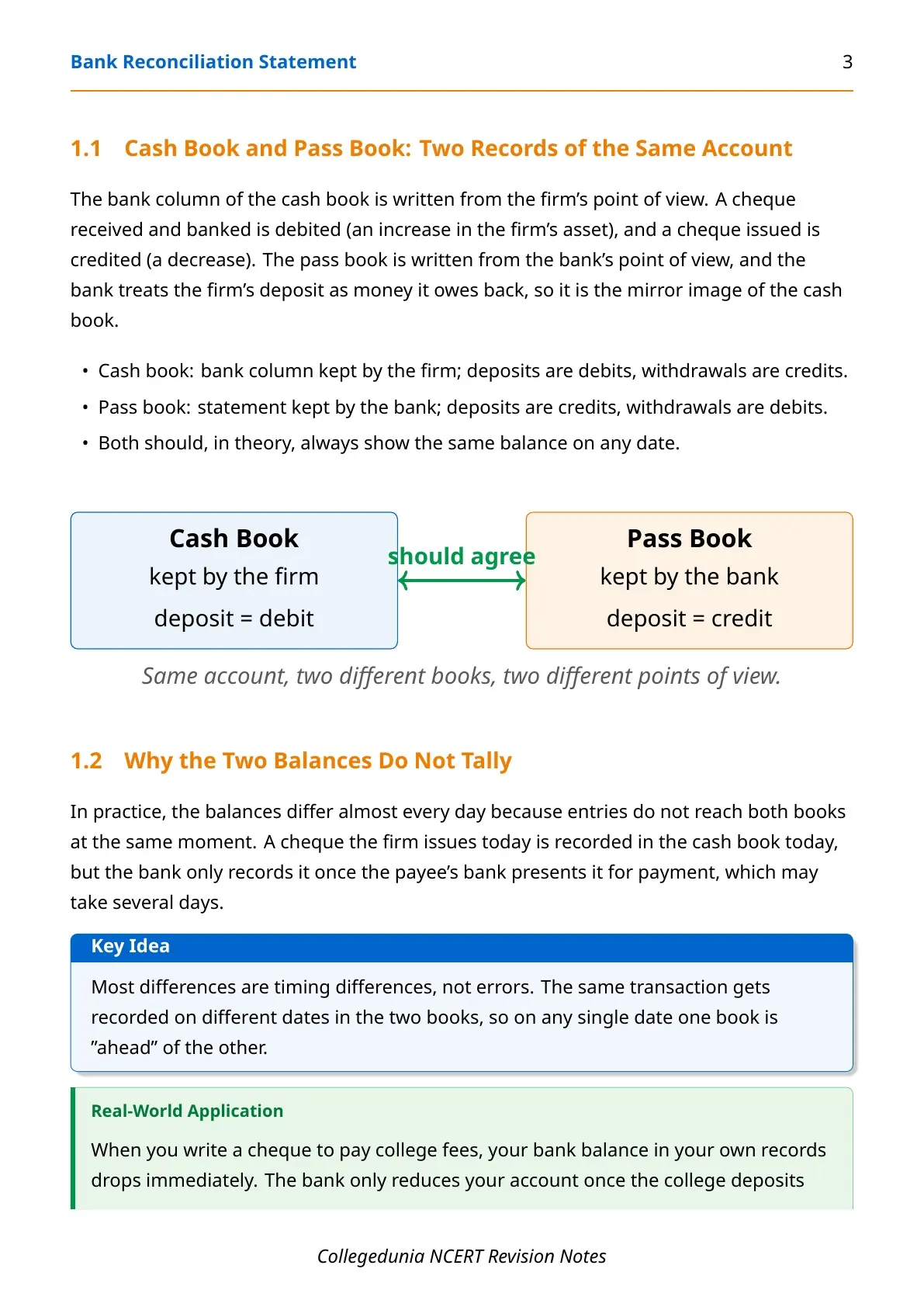
A firm records every cheque it deposits and issues in the bank column of its own cash book. The bank keeps a parallel record of the same account, called the pass book or bank statement. Both track the same transactions, yet on any given date the two balances rarely agree, simply because entries do not reach both books at the same moment.
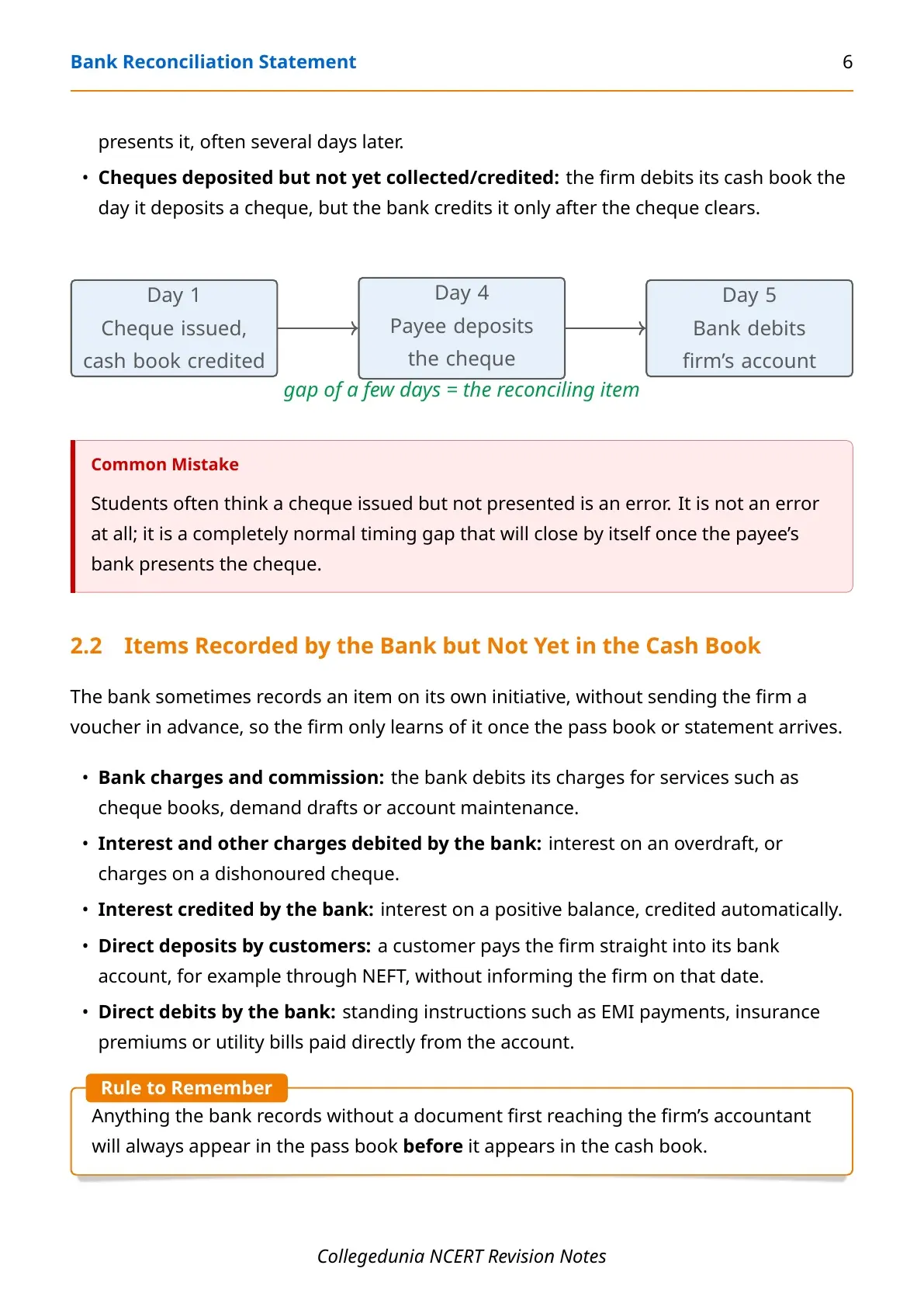
- A cheque the firm issues today is credited in the cash book today, but the bank only debits it once the payee's bank presents it, often days later.
- The bank posts some items, such as charges or direct debits, on its own, so the firm only learns of them once the pass book arrives.
Bank Reconciliation Statement Class 11 Revision in One Shot
Source: Next Toppers - 11th Commerce on YouTube
Causes of Difference Between Cash Book and Pass Book
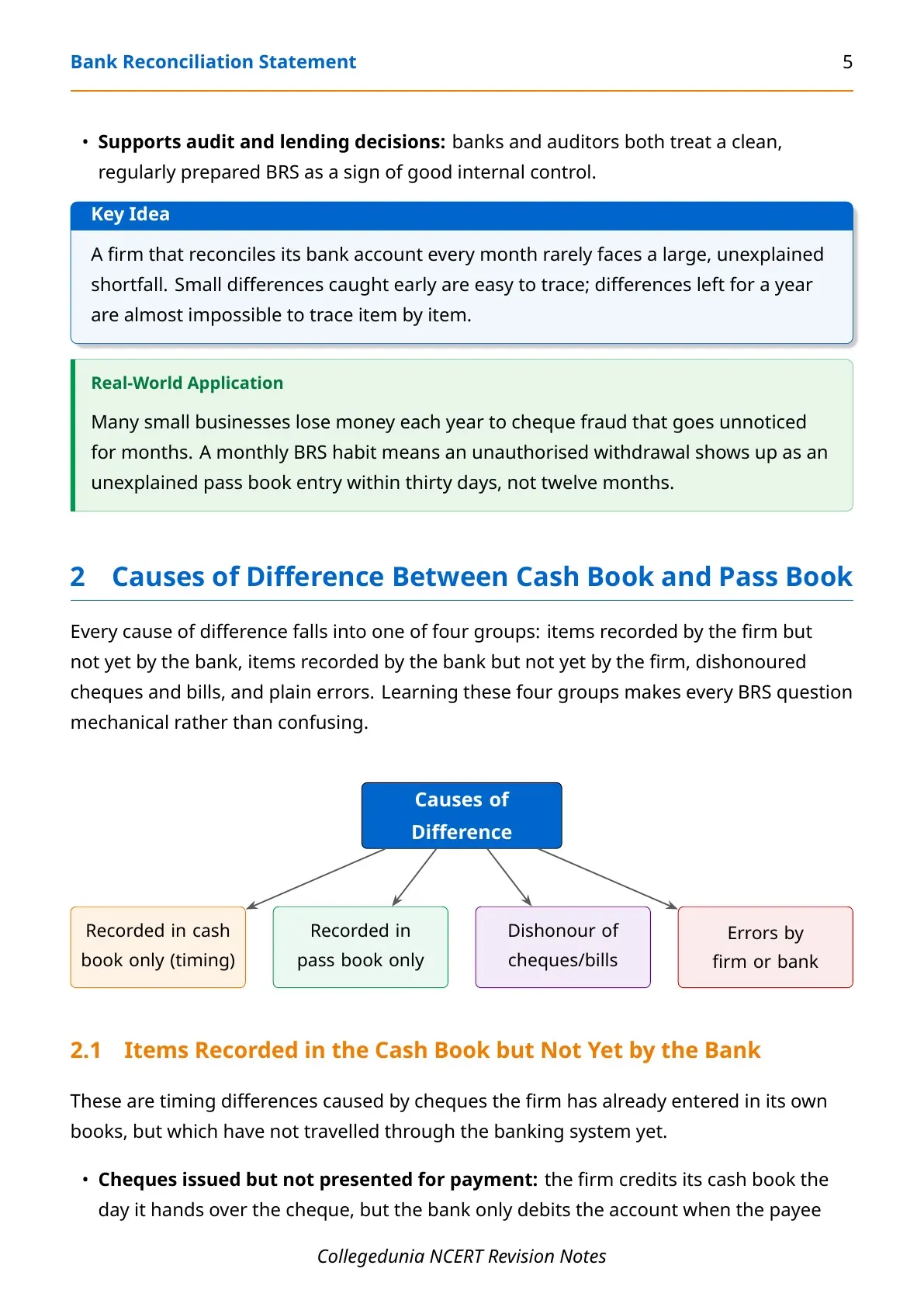
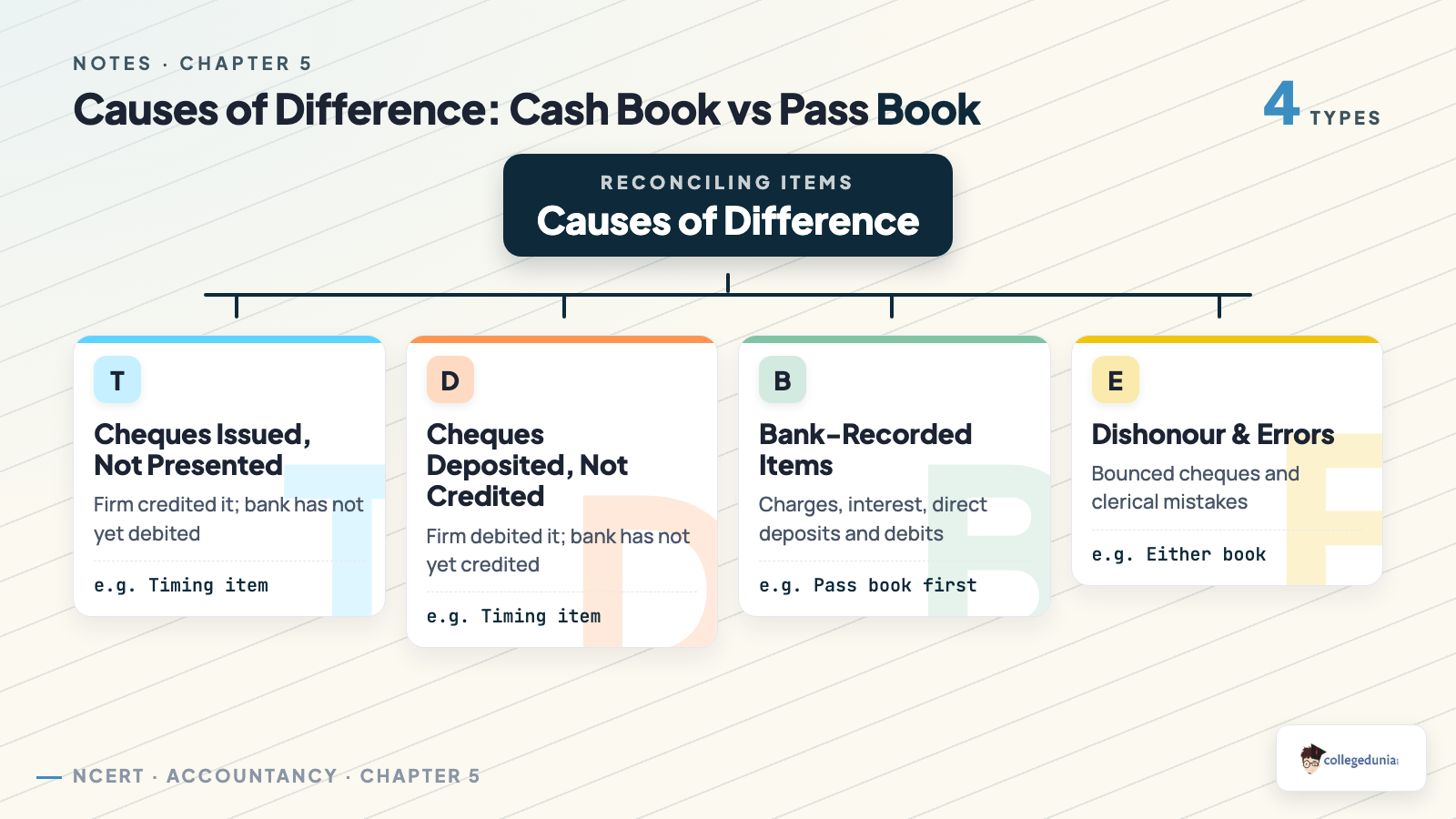
Every reason a Class 11 board question tests falls into one of four groups. Learning these four groups first turns every BRS numerical mechanical instead of confusing.
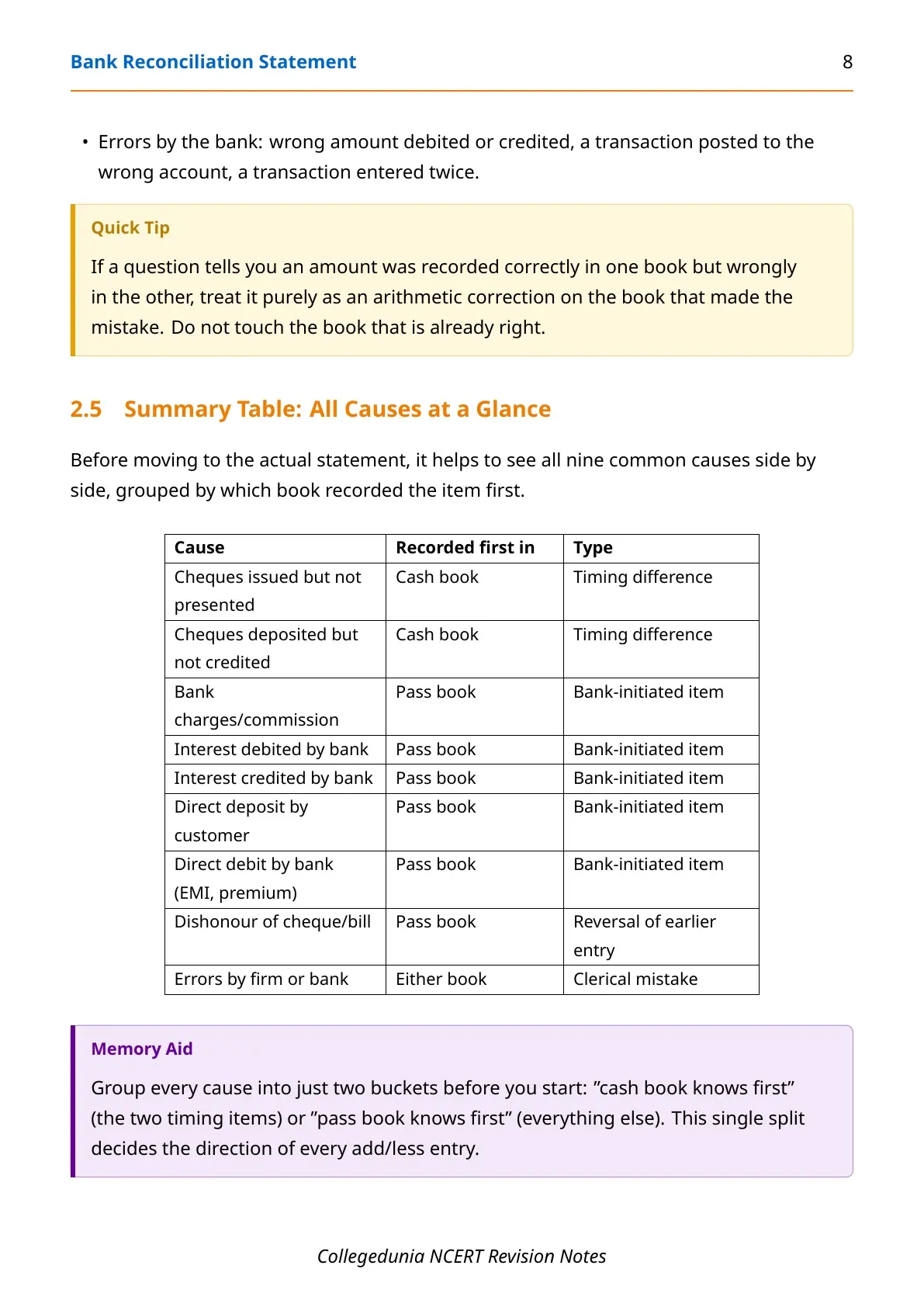
| Cause | Recorded First In |
|---|---|
| Cheques issued but not presented for payment | Cash book |
| Cheques deposited but not yet credited | Cash book |
| Bank charges / commission | Pass book |
| Interest credited or debited by the bank | Pass book |
| Direct deposit by a customer | Pass book |
| Direct debit by the bank (EMI, insurance premium) | Pass book |
| Dishonour of a cheque or bill | Pass book |
| Errors committed by the firm or the bank | Either book |
The first two causes are pure timing differences; the firm already knows about them, the bank simply has not caught up yet. Every other cause is something the bank knew first, and the firm's cash book has not caught up.
Bank Reconciliation Statement: Three Methods Explained
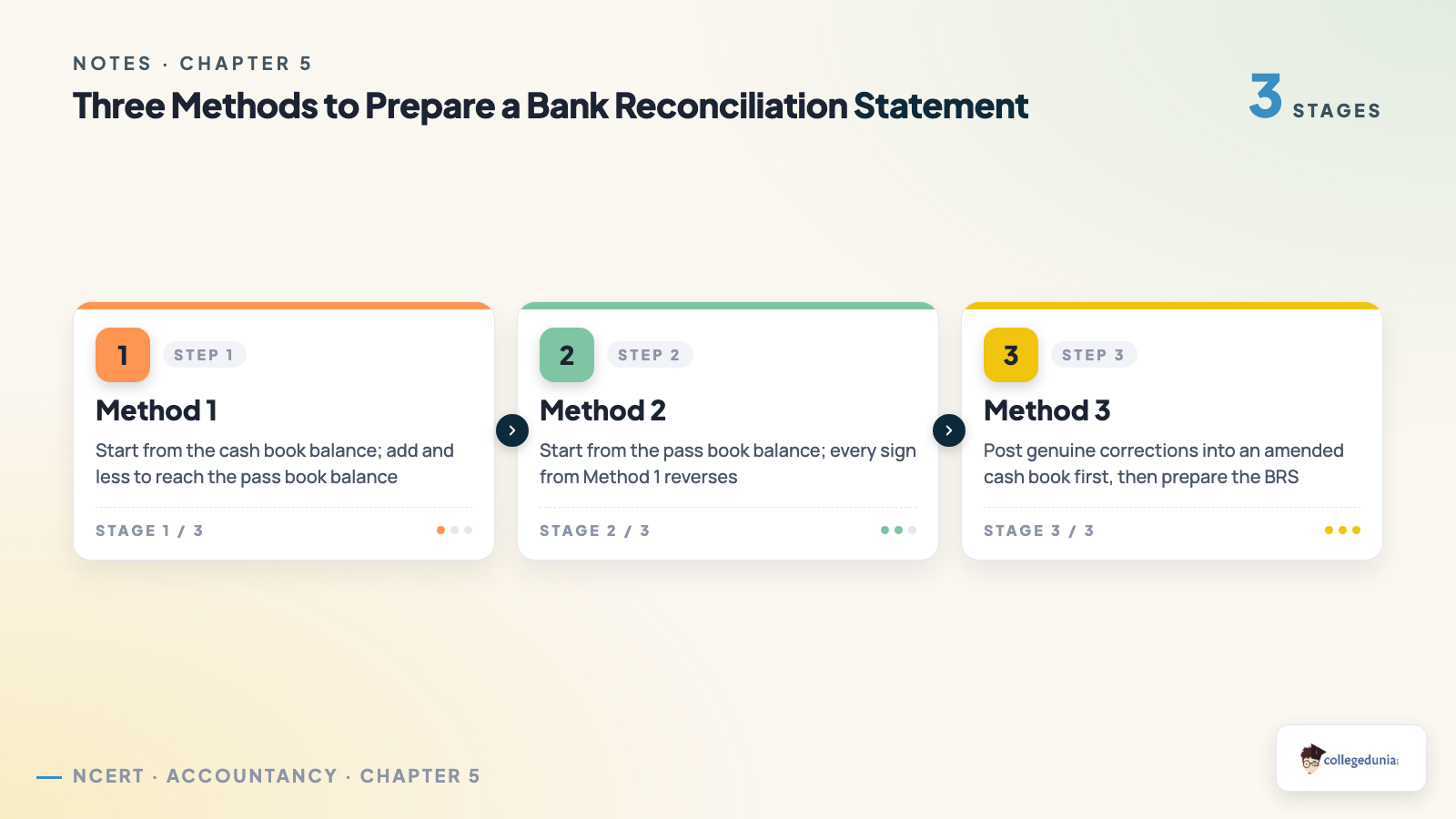
The 2026-27 NCERT expects Class 11 students to prepare a BRS three different ways, and a board question can start from either balance or ask for an amended cash book first.
| Method | Starts From | When It Is Used |
|---|---|---|
| Method 1 | Cash book balance | Question gives the cash book figure directly |
| Method 2 | Pass book balance | Question gives the pass book / bank statement figure directly |
| Method 3 | Amended cash book, then BRS | Question asks the firm's own books to be corrected first |
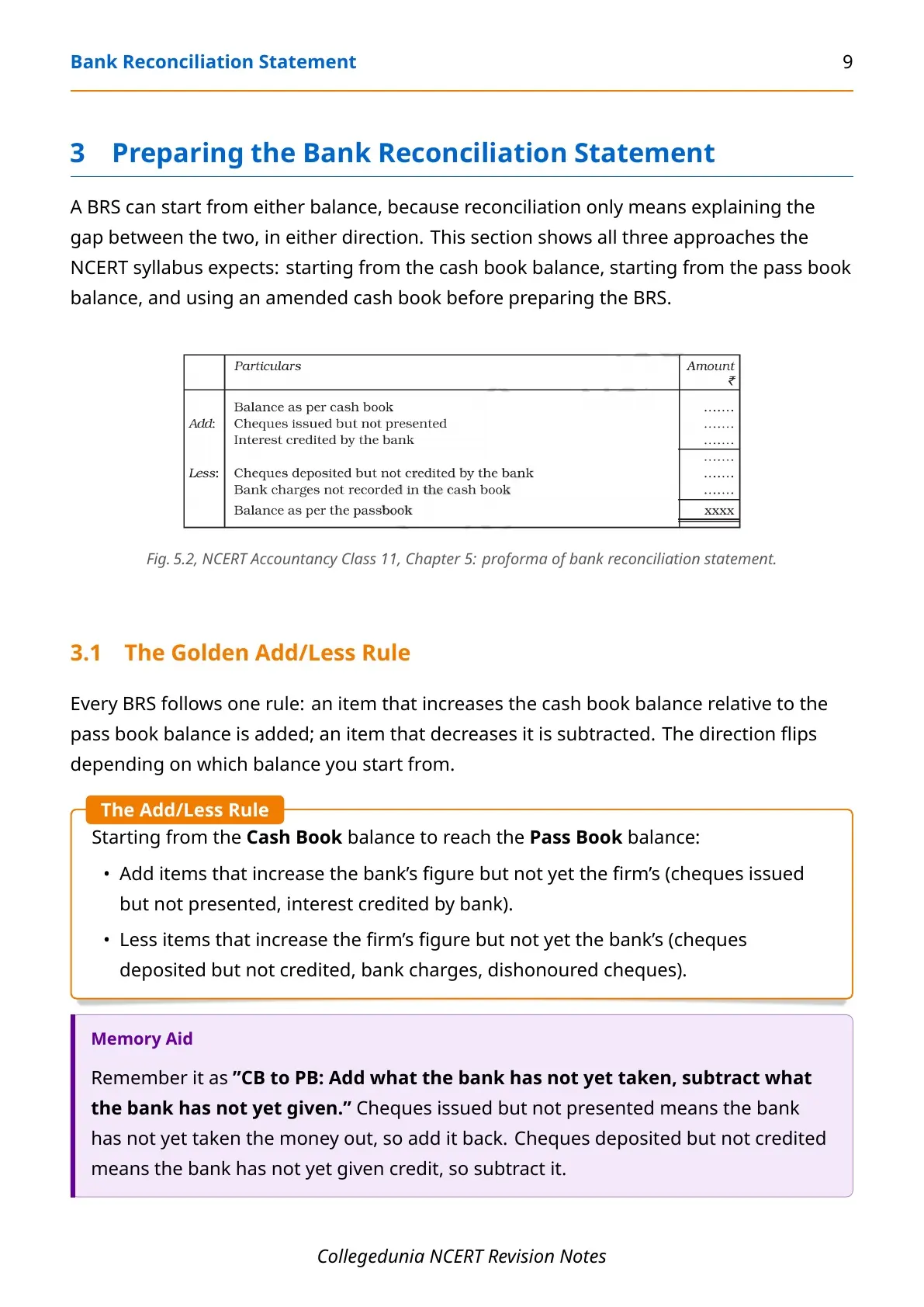
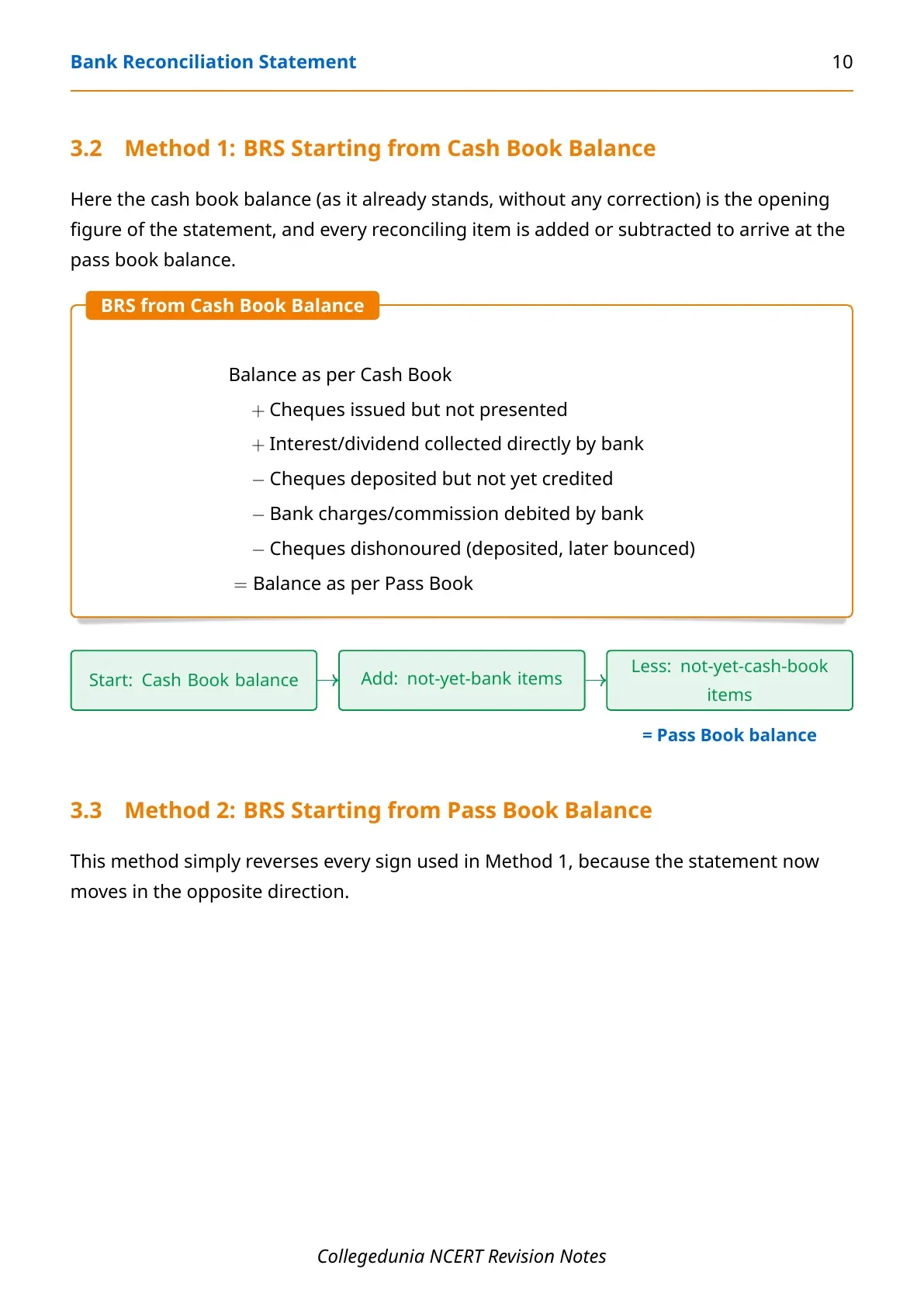
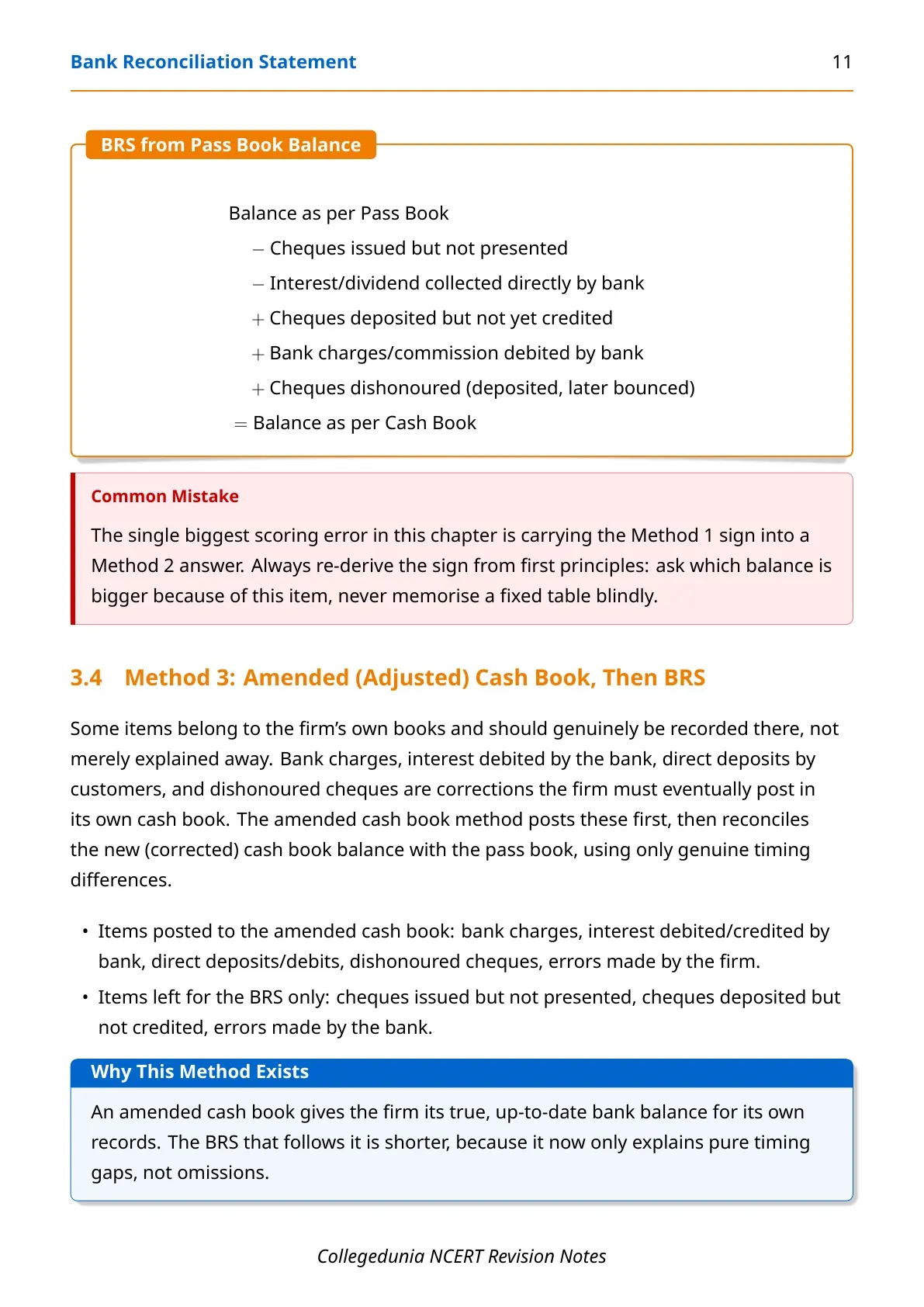
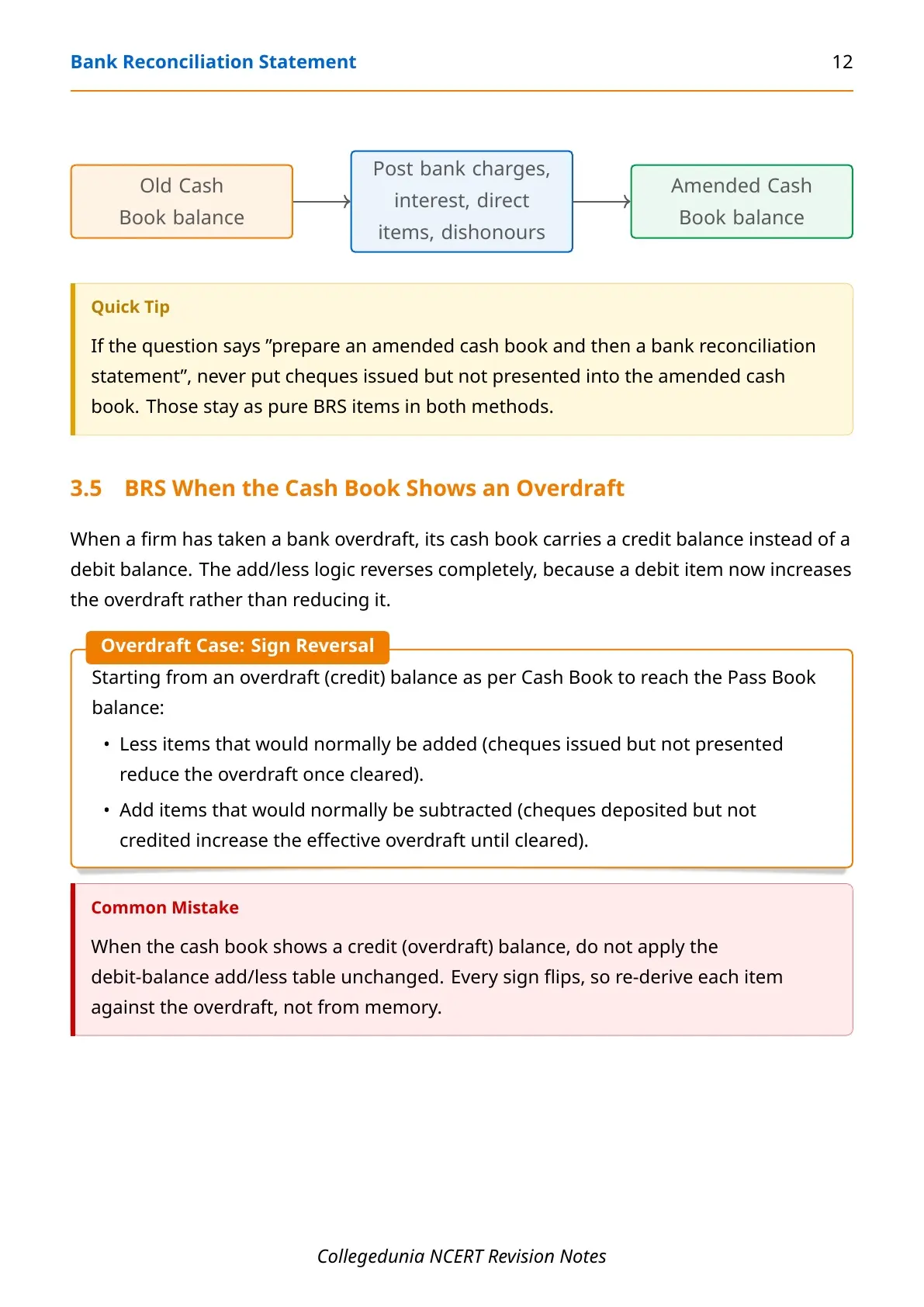
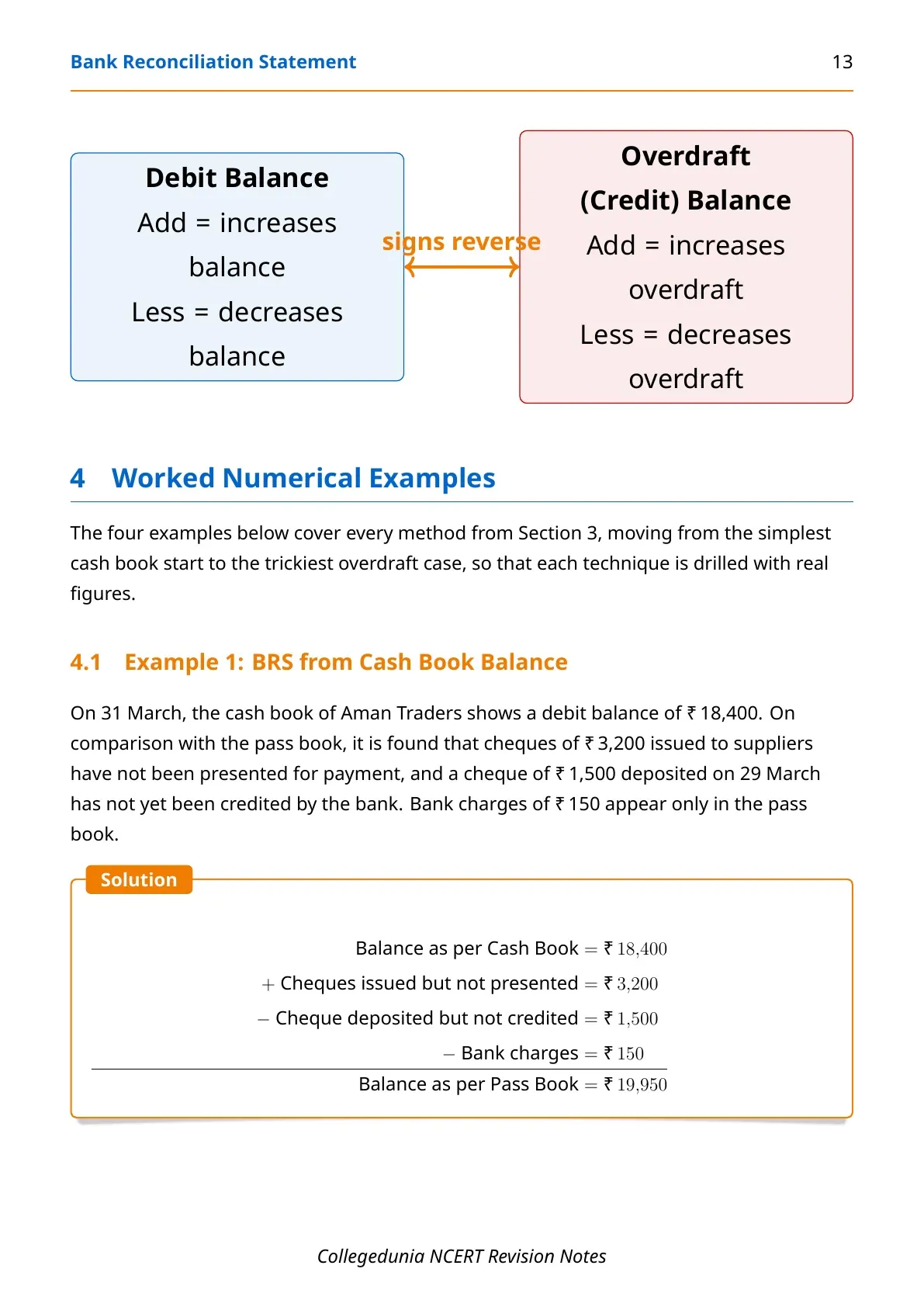
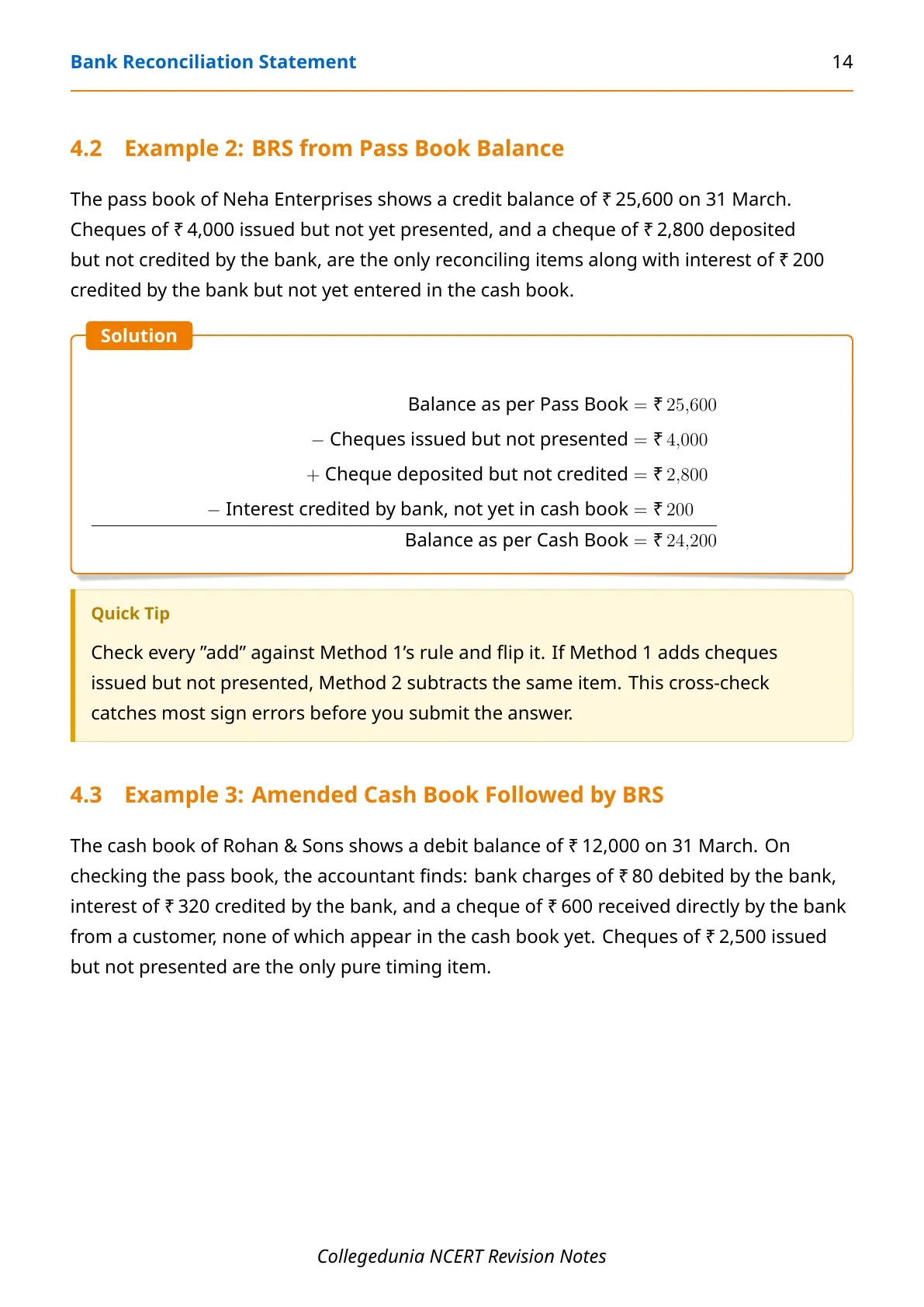
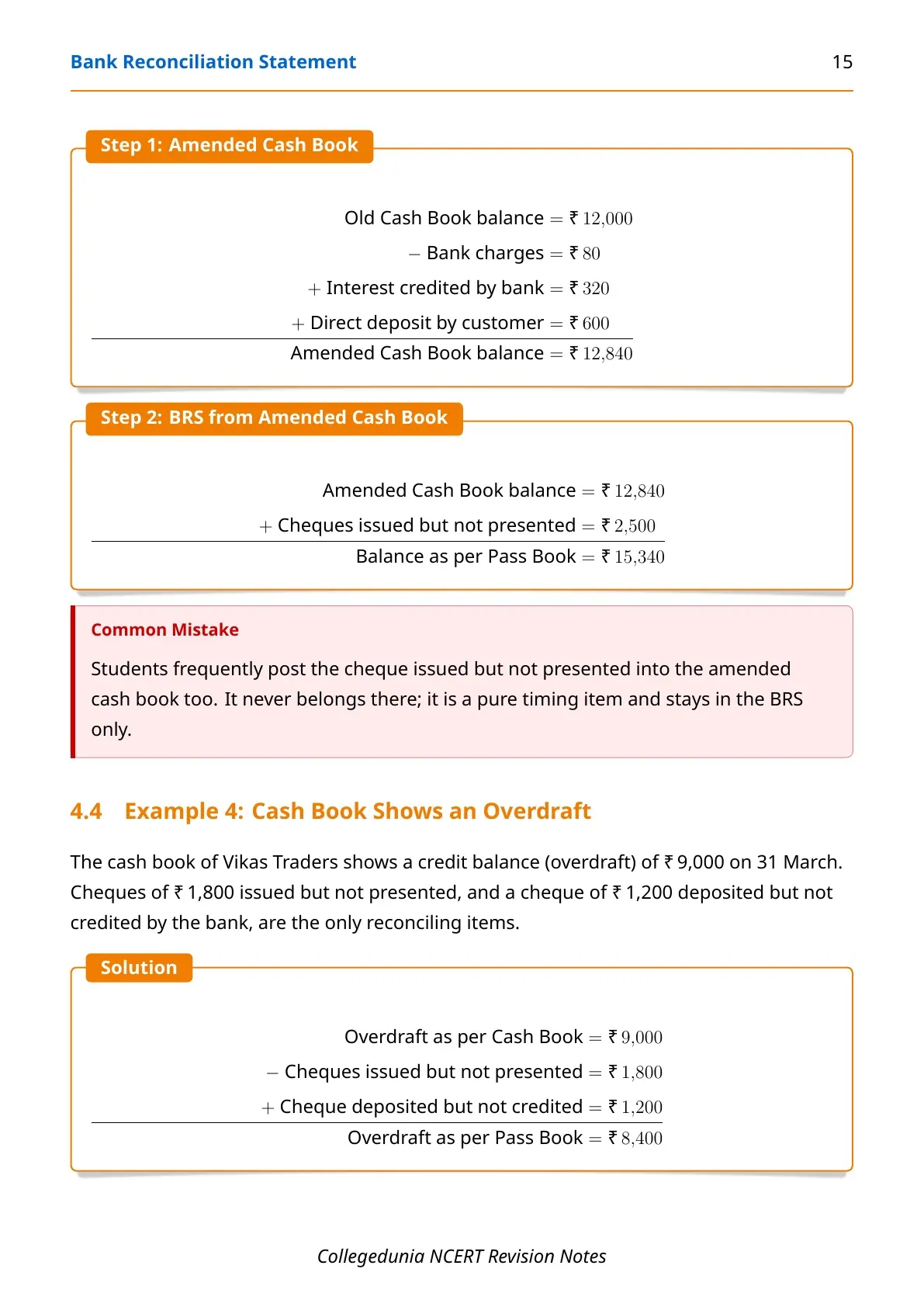
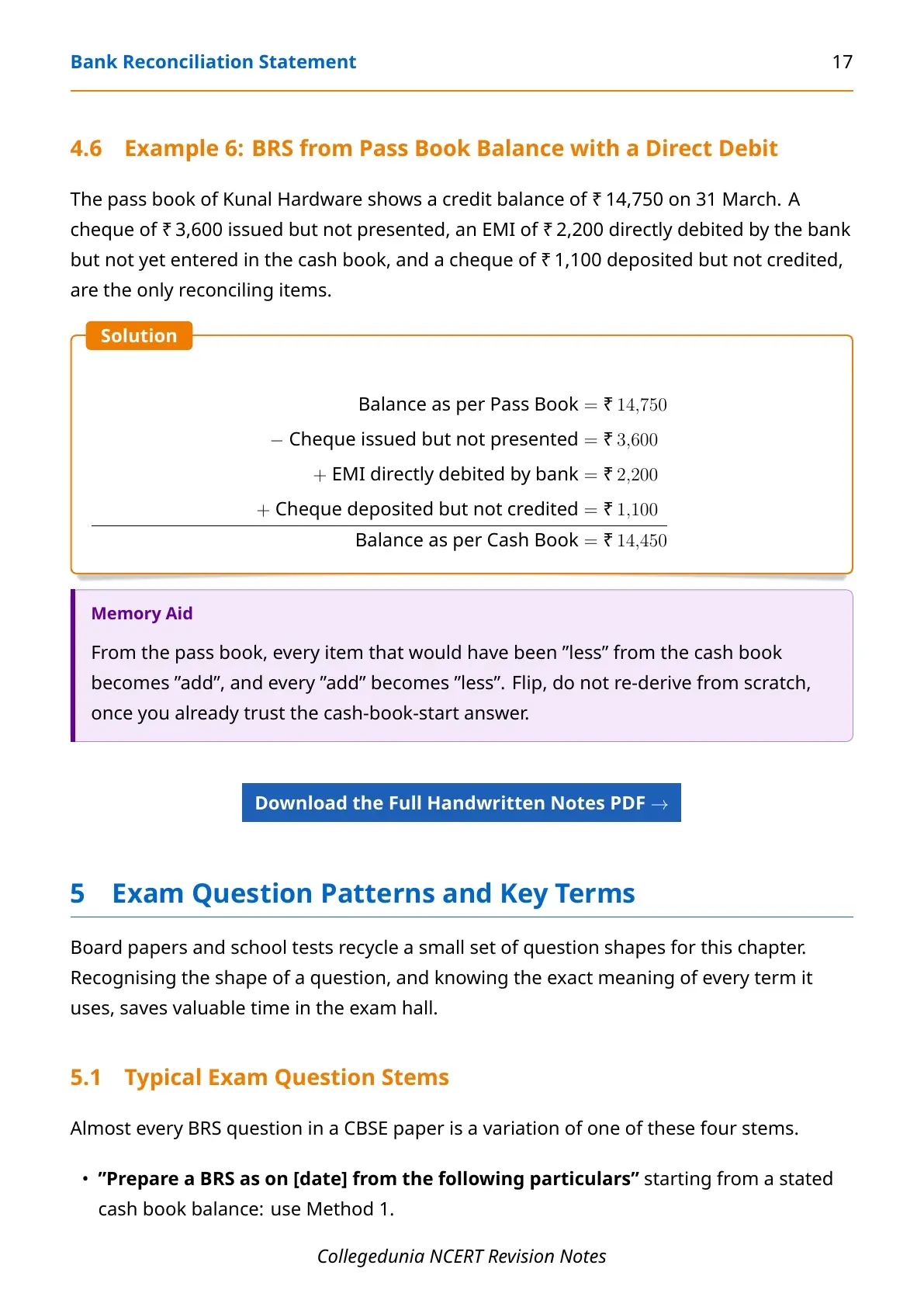
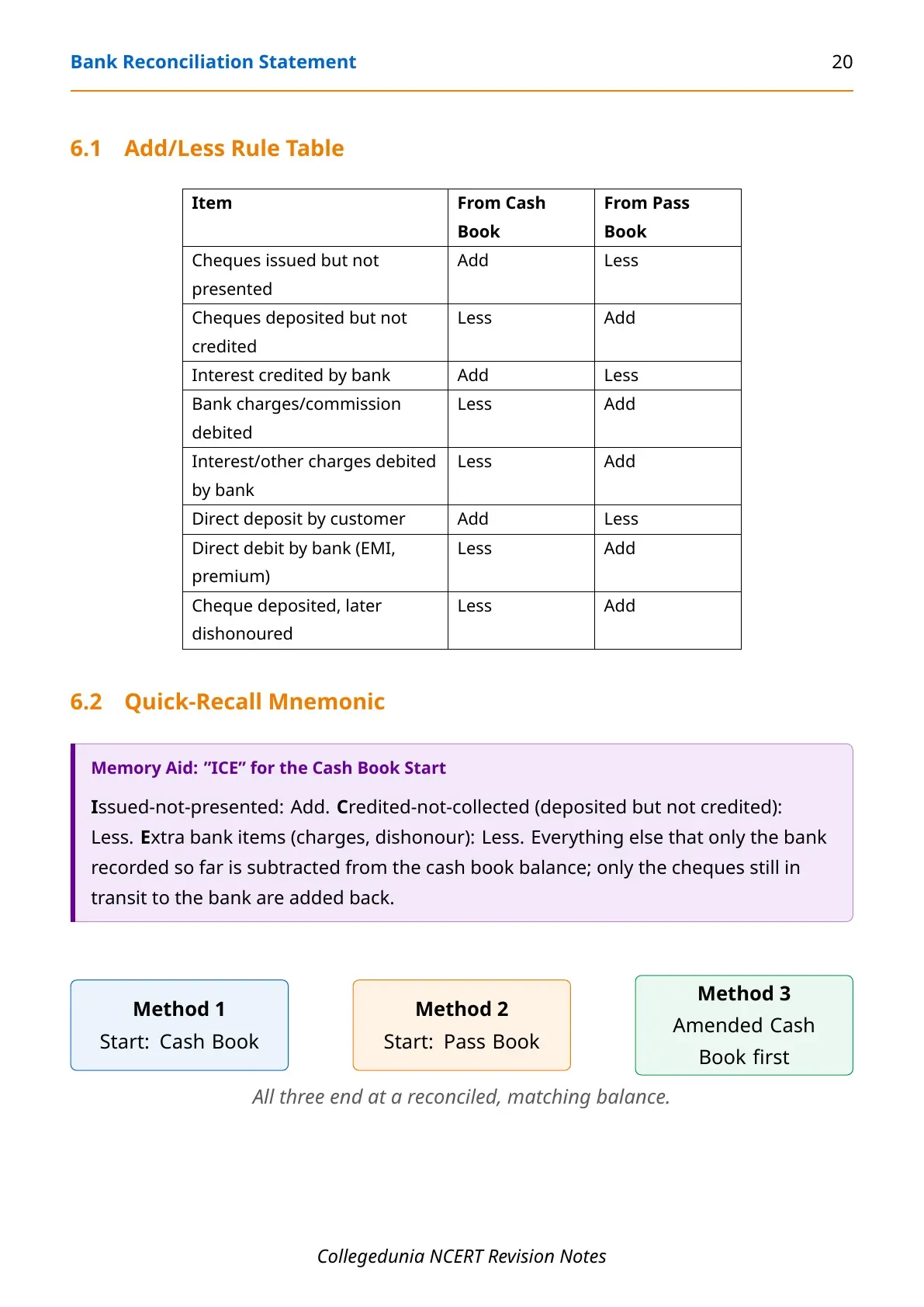
In Method 1, add items the bank has not yet taken out (cheques issued but not presented, interest credited by the bank) and subtract items the bank has not yet given credit for (cheques deposited but not credited, bank charges, dishonoured cheques). Method 2 simply reverses every sign. Method 3 first posts bank charges, interest and direct items into the firm's own cash book, so the BRS that follows only explains genuine timing gaps.
Solved Bank Reconciliation Statement Example
Here is one full worked example in the pattern CBSE tests most often. The complete PDF carries six such solved numericals, moving from the simplest cash book start to the overdraft case.
| Particulars | Amount (₹) |
|---|---|
| Balance as per Cash Book | 18,400 |
| Add: Cheques issued but not presented | 3,200 |
| Less: Cheque deposited but not credited | 1,500 |
| Less: Bank charges | 150 |
| Balance as per Pass Book | 19,950 |
Every step follows the Method 1 add/less rule above. Classify each item into a cause group before you write a single figure, since examiners award part marks for a correct classification even when the final total is wrong.
Bank Reconciliation Statement Topic-wise Weightage for CBSE Class 11
A full BRS numerical is the most predictable question this chapter sends into the board paper, since it can test causes, both methods and the overdraft case in a single problem.
| Sub-topic | Weightage | CBSE Frequency |
|---|---|---|
| Full BRS numerical (cash book or pass book start) | High | Almost every year |
| Amended cash book followed by BRS | Medium | 3 out of last 5 years |
| Overdraft / credit-balance case | Medium | 2-3 out of last 5 years |
| Causes of difference (theory / short answer) | Low | 1-2 out of last 5 years |
Important BRS Formats and Formulas to Remember
These are the exact format and add/less rule this chapter is built on. Keep this box open while you practise BRS numericals.
- BRS format: Particulars column, then a single amount column (or separate + and - columns), ending in the other book's balance.
- From Cash Book: Add items the bank has not yet taken out; subtract items the bank has not yet credited.
- From Pass Book: Reverse every sign used from the cash book start.
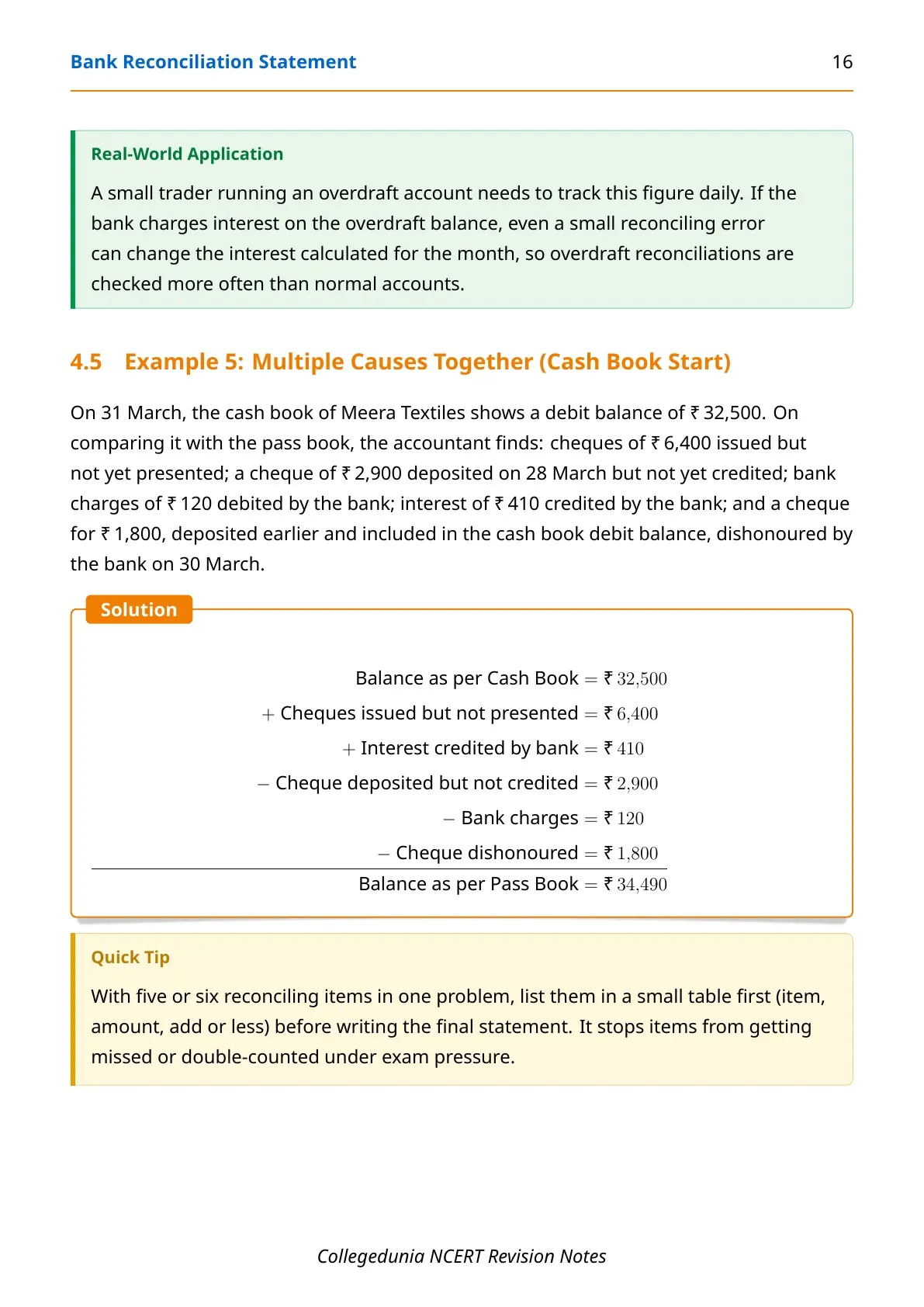
- Overdraft case: Add increases the overdraft, subtract decreases it, the opposite of a normal debit balance.
Common Mistakes Students Make in the Bank Reconciliation Statement Chapter
| Mistake | Fix |
|---|---|
| Treating a cheque issued but not presented as an error | It is a normal timing gap, not a mistake by either side. |
| Carrying a Method 1 sign into a Method 2 answer unchanged | Every sign reverses when the statement starts from the pass book. |
| Posting a timing item into the amended cash book | Only genuine firm-side corrections (charges, interest, direct items) belong there. |
| Applying the debit-balance add/less table to an overdraft | Re-derive every sign; an overdraft reverses the whole rule. |
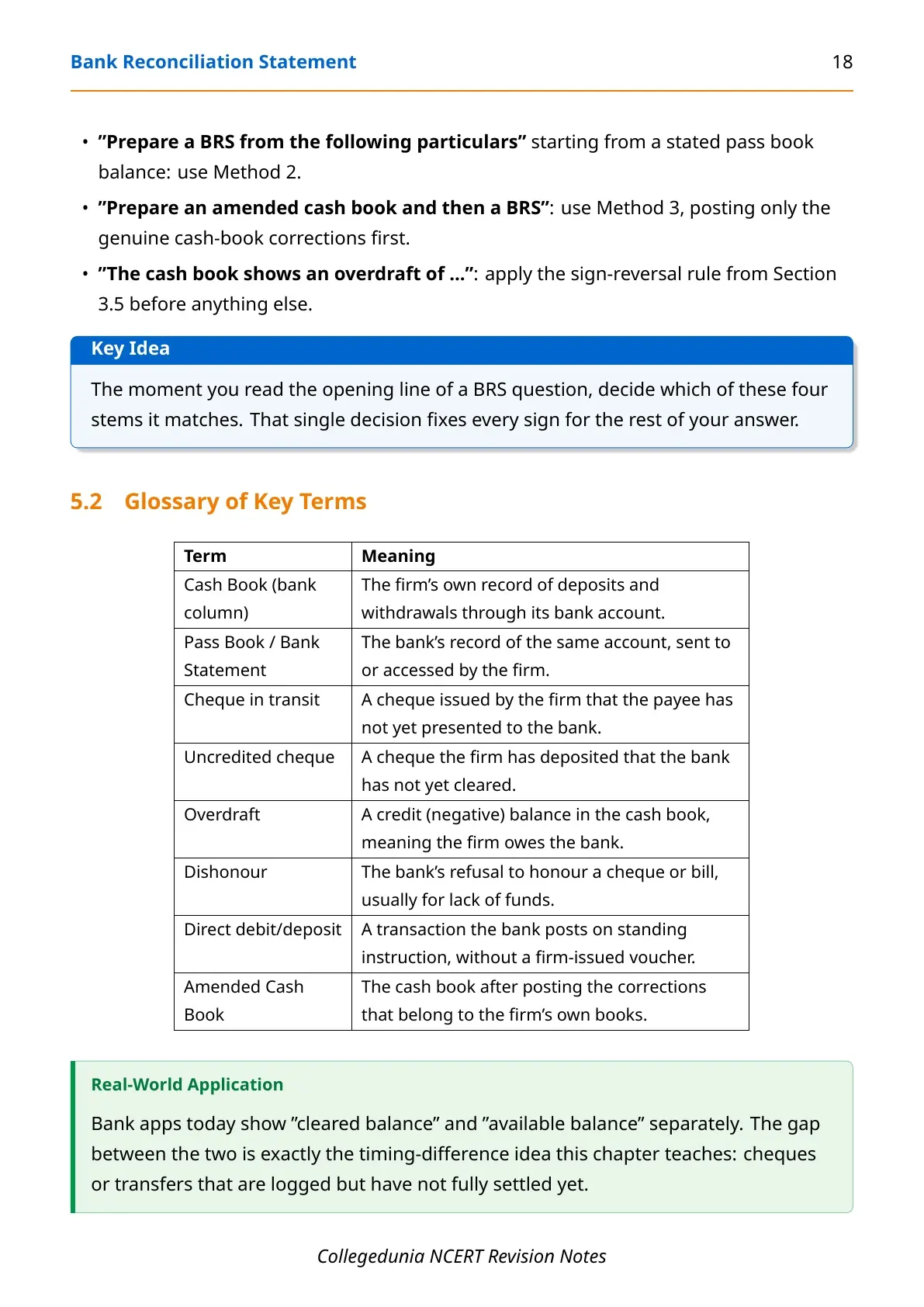
Key Accounting Terms Glossary for Bank Reconciliation Statement
| Term | Meaning |
|---|---|
| Cash book (bank column) | The firm's own record of deposits and withdrawals through its bank account |
| Pass book / bank statement | The bank's record of the same account |
| Cheque in transit | A cheque issued by the firm that the payee has not yet presented |
| Uncredited cheque | A cheque the firm has deposited that the bank has not yet cleared |
| Overdraft | A credit (negative) balance in the cash book, meaning the firm owes the bank |
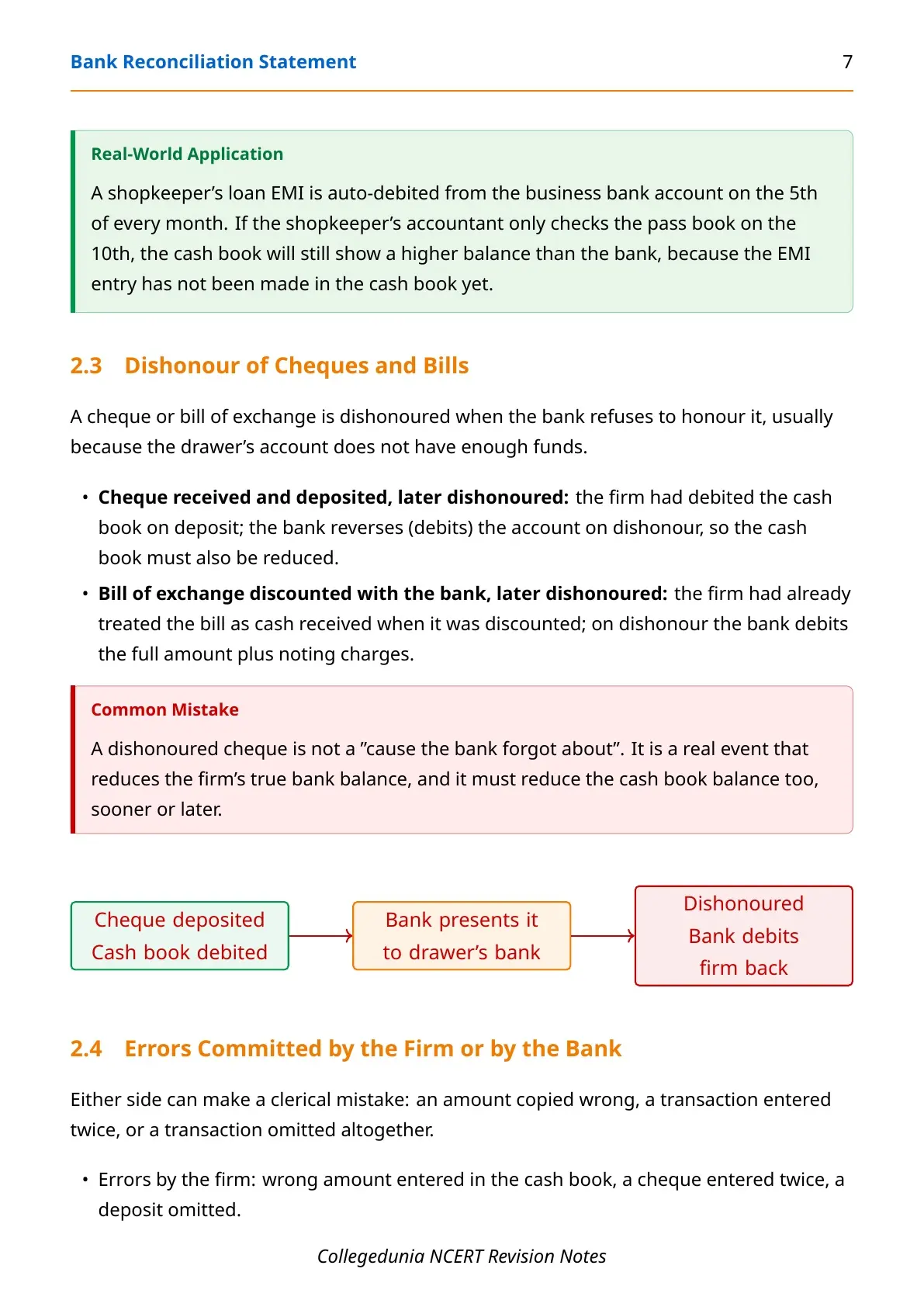
| Dishonour | The bank's refusal to honour a cheque or bill, usually for lack of funds |
| Amended cash book | The cash book after posting the corrections that belong to the firm's own books |
How Collegedunia's Notes Help You With Bank Reconciliation Statement
The NCERT Notes Class 11 Accountancy Chapter 5 Bank Reconciliation Statement on this page are built to match how Class 11 board papers actually test this chapter.
- 2026-27 NCERT Alignment: Every format and rule matches the current NCERT print.
- All Three Methods Side by Side: Cash book start, pass book start and amended cash book, in one place.
- Six Solved BRS Numericals: From the simplest case to the overdraft case, the exact skill the board tests.
- Quick Recall Boxes: The BRS format, the add/less rule and a mnemonic for last-day revision.
Bank Reconciliation Statement Class 11 Accountancy Resources
Besides the NCERT Notes Class 11 Accountancy Chapter 5 Bank Reconciliation Statement on this page, every other resource type for this chapter sits in one place below.
| Resource | Status |
|---|---|
| Bank Reconciliation Statement Class 11 Notes | You are reading this page |
| Bank Reconciliation Statement Class 11 Handwritten Notes | (coming soon) |
| Bank Reconciliation Statement Class 11 NCERT Solutions | (coming soon) |
| Bank Reconciliation Statement Class 11 NCERT Book PDF | (coming soon) |
NCERT Notes for Class 11 Accountancy: All Chapters
Jump to the notes for any other Class 11 Accountancy chapter.
| Chapter | Notes |
|---|---|
| Chapter 1 | Introduction to Accounting |
| Chapter 2 | Theory Base of Accounting |
| Chapter 3 | Recording of Transactions-I |
| Chapter 4 | Recording of Transactions-II (coming soon) |
| Chapter 5 | Bank Reconciliation Statement (this page) |
| Chapter 6 | Trial Balance and Rectification of Errors (coming soon) |
| Chapter 7 | Depreciation, Provisions and Reserves (coming soon) |
Bank Reconciliation Statement Class 11 Accountancy Notes FAQs
Ques. What is a Bank Reconciliation Statement in Class 11 Accountancy Chapter 5?
Ans. A Bank Reconciliation Statement, or BRS, is a statement that lists every item causing the cash book balance to differ from the pass book balance on a given date, and explains the gap by adding and subtracting those items.
Ques. What are the main causes of difference between cash book and pass book?
Ans. Cheques issued but not presented, cheques deposited but not credited, bank charges, interest credited or debited by the bank, direct deposits or debits, dishonour of a cheque or bill, and errors by either the firm or the bank.
Ques. How do you prepare a BRS from the cash book balance?
Ans. Start with the cash book balance, add items the bank has not yet taken out (such as cheques issued but not presented), and subtract items the bank has not yet credited (such as cheques deposited but not credited, or bank charges), to arrive at the pass book balance.
Ques. How is a BRS different when starting from the pass book balance?
Ans. Every add/less sign used from the cash book start reverses. An item added while starting from the cash book is subtracted while starting from the pass book, and vice versa.
Ques. What is an amended cash book in Bank Reconciliation Statement?
Ans. An amended cash book is the firm's own cash book after posting corrections such as bank charges, interest, direct deposits or debits, and dishonoured cheques. A BRS is then prepared from this corrected balance, covering only the remaining timing differences.
Ques. How does an overdraft change the BRS add/less rule?
Ans. When the cash book shows a credit balance (overdraft), the add/less rule reverses completely. An item that would normally be added, such as a cheque issued but not presented, now reduces the overdraft, and vice versa.
Ques. Are these Class 11 Accountancy notes aligned with the 2026-27 NCERT?
Ans. Yes. These notes follow the current 2026-27 NCERT print for Class 11 Accountancy Chapter 5, Bank Reconciliation Statement, including its BRS format and every method the textbook covers.
Ques. How many pages is the Class 11 Accountancy Chapter 5 Notes PDF?
Ans. The Notes PDF runs to 21 pages and covers causes of difference, all three BRS methods, the overdraft case, six solved numerical examples and a quick-recall summary.
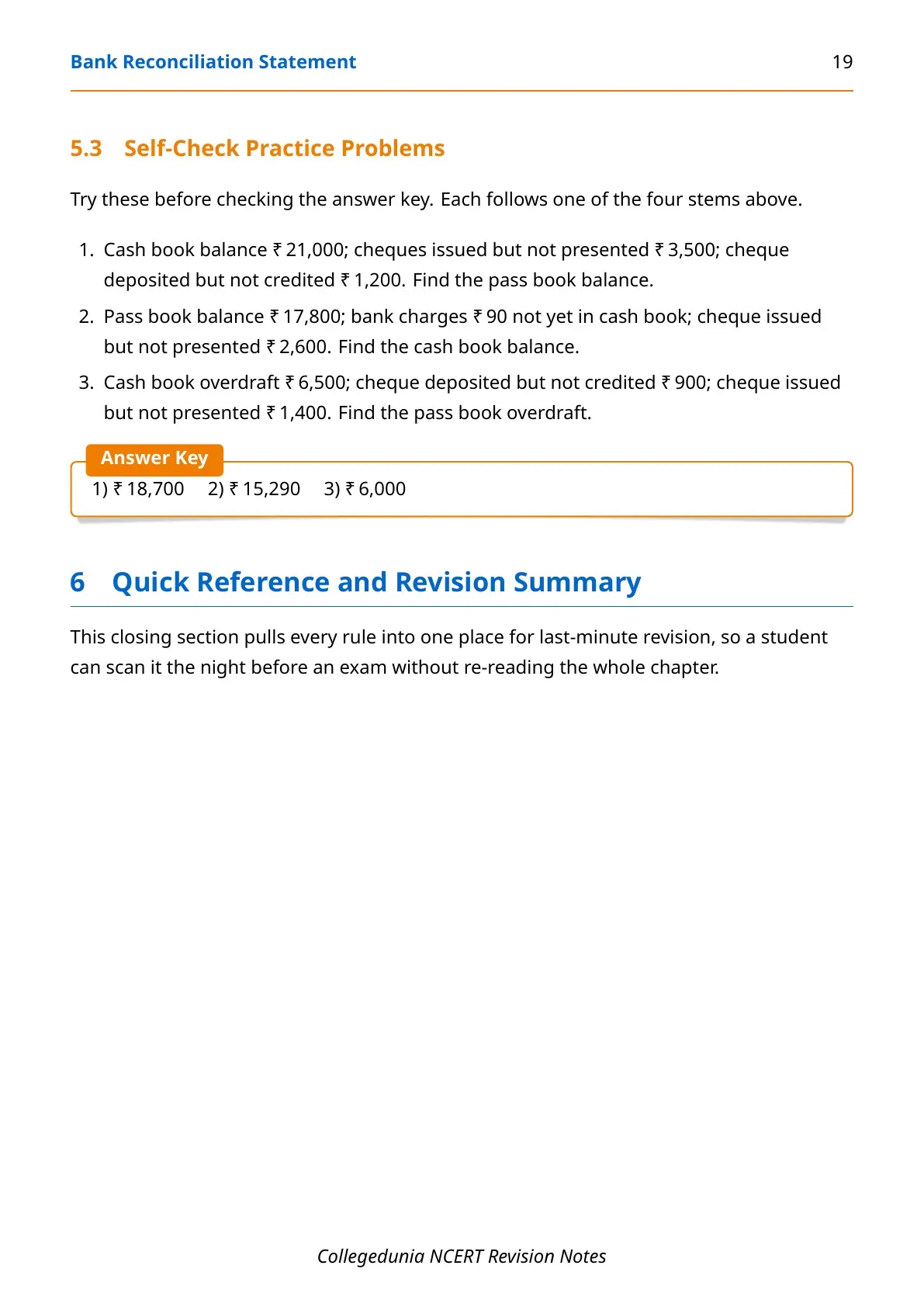
Ques. What is a cheque issued but not presented for payment?
Ans. It is a cheque the firm has already credited in its own cash book, but which the payee has not yet presented to the bank for payment, so the bank has not yet debited the firm's account.



Comments