



These Notes for Class 10 Maths Chapter 7 Coordinate Geometry give you a clean, concept-first revision of the whole chapter. They cover the Distance Formula, the Section Formula (internal and external division), and the area of a triangle from coordinates. These three ideas come up in board papers year after year.
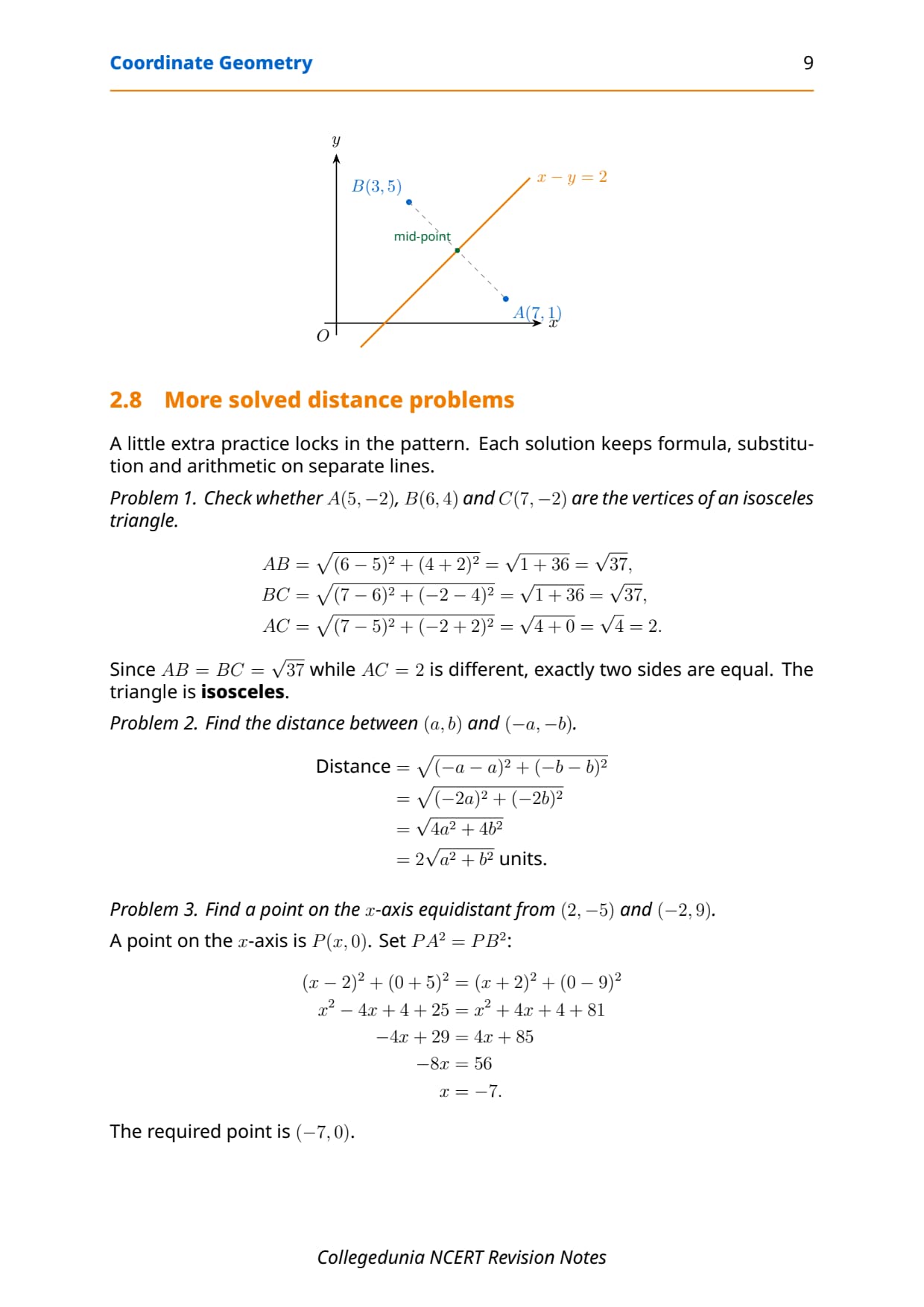
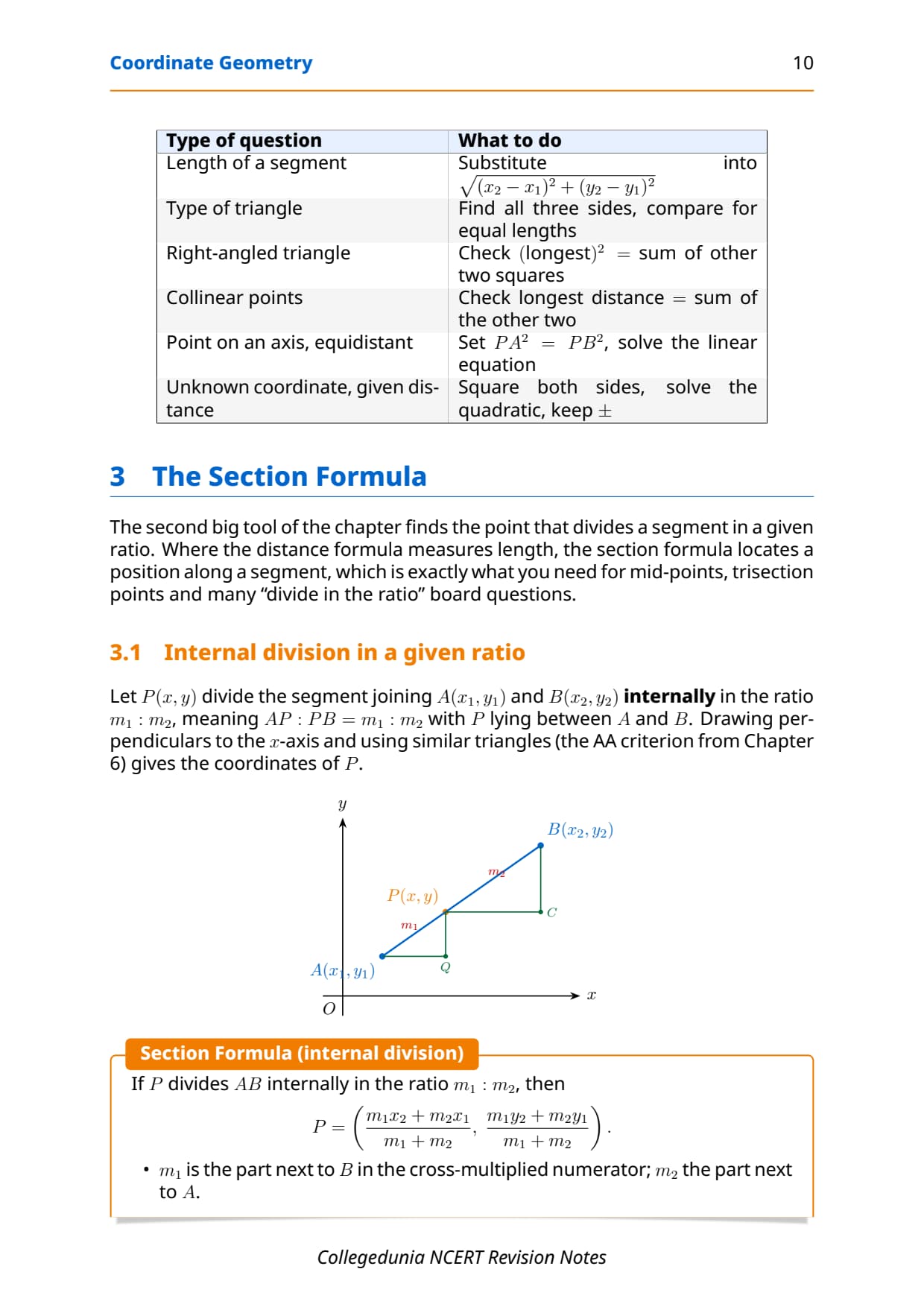
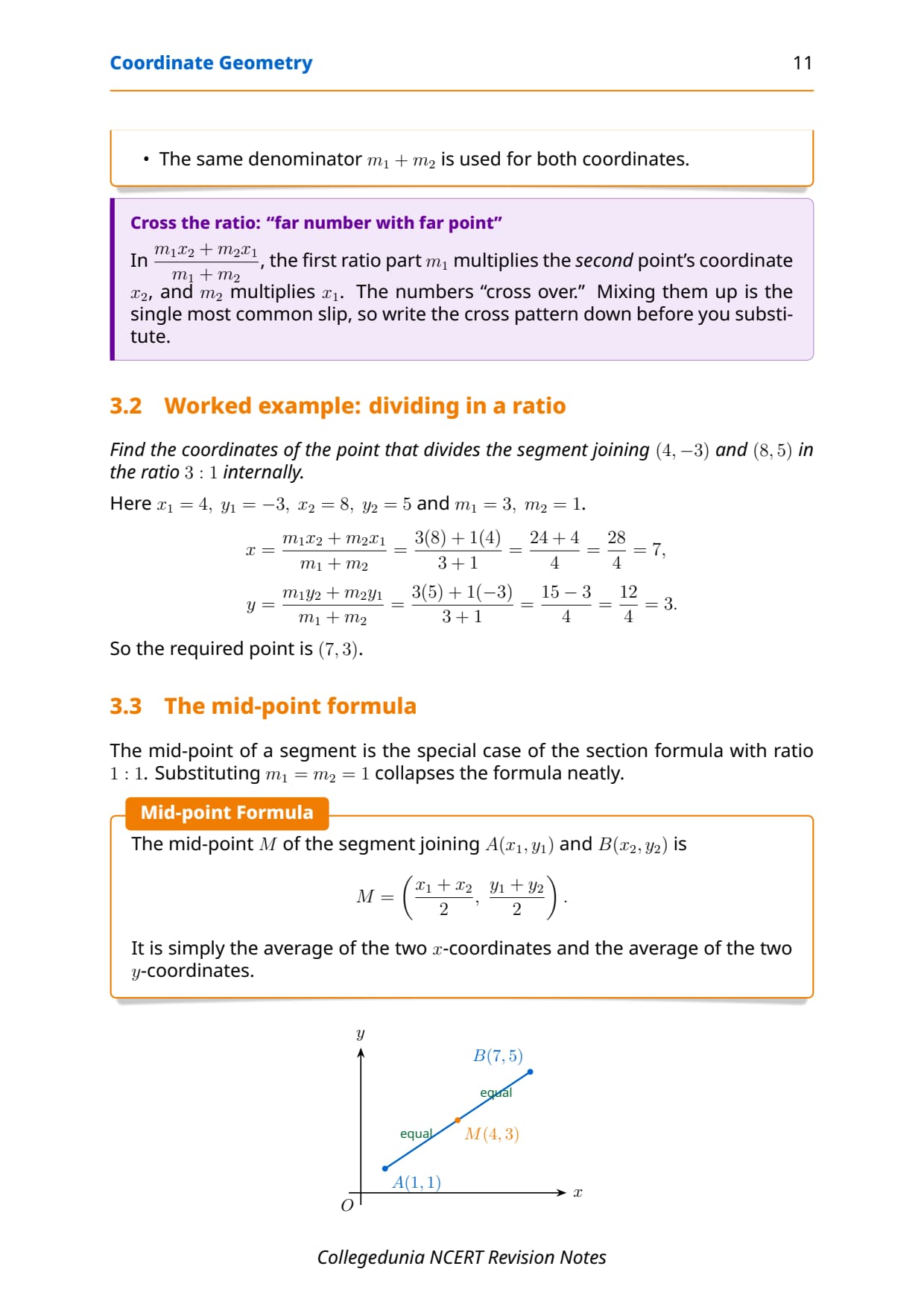
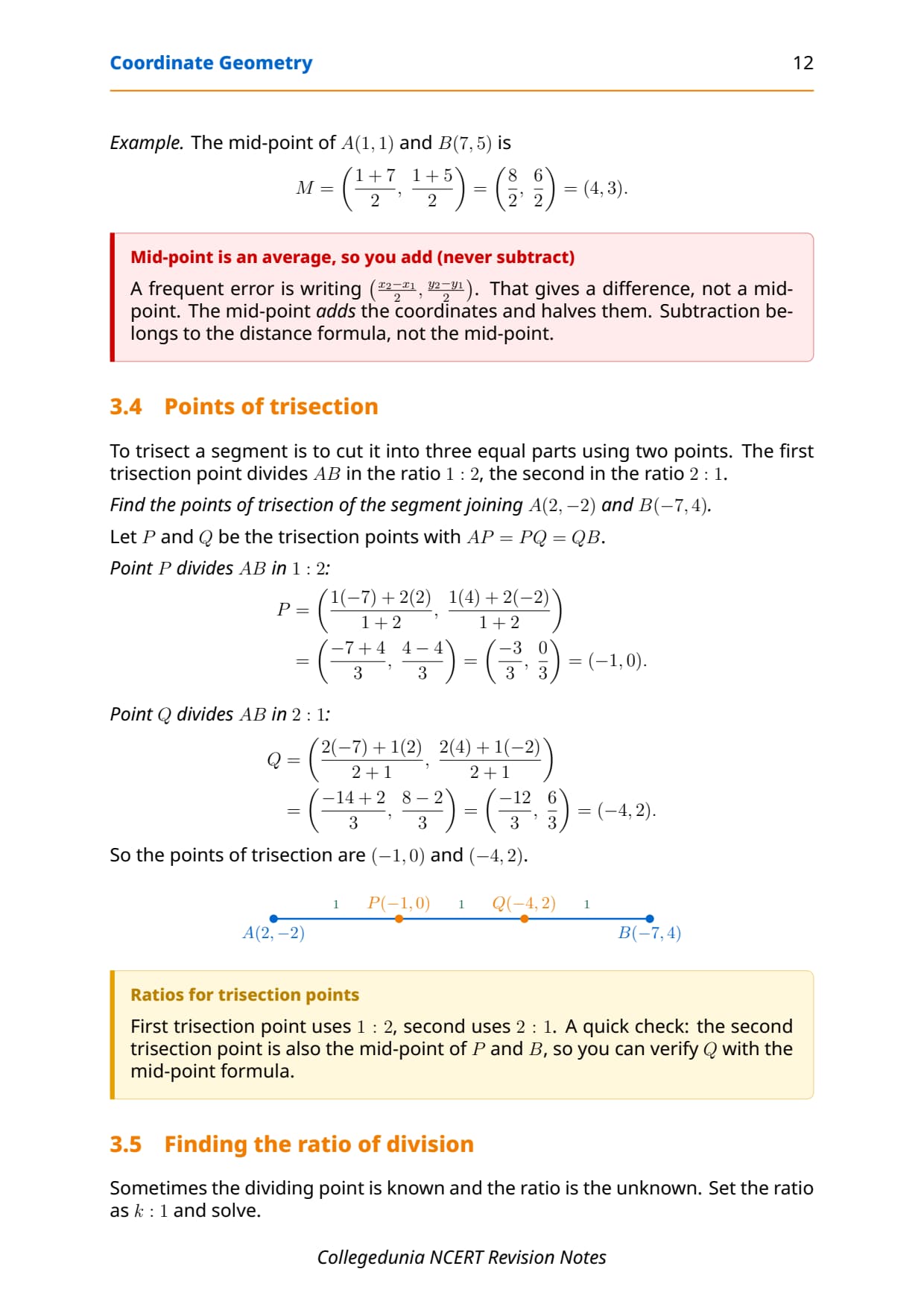
- Every formula explained step by step, with plain-word derivations, solved examples, and a board tip for each one.
- Full coverage of the Distance, Section, Midpoint, and Area formulae, plus memory tricks and common-mistake alerts.
- Written for the rationalised 2026-27 CBSE Class 10 Maths syllabus.
These Collegedunia revision notes are curated by Maths subject experts, according to the 2026-27 NCERT textbook, and refined against the last five years of CBSE Class 10 Maths board papers.
Student Feedback: What 8,700 students told us about this chapter
71% of Class 10 students said the Section Formula was the trickiest part. They kept mixing up the ratio order for internal versus external division. 4 out of 5 students said writing down every point's coordinates first, before any formula, stopped most careless errors.
Toppers said the biggest time-saver was knowing when to use the collinearity test (area of triangle = 0) and when to use the Distance Formula. The average student spent 2 to 3 hours on this chapter across the first read, formula practice, and revision.
Source: 2026-27 Class 10 Maths student poll. Sample of 8,700 students from CBSE schools across 12 states, conducted before the 2026 boards.
|
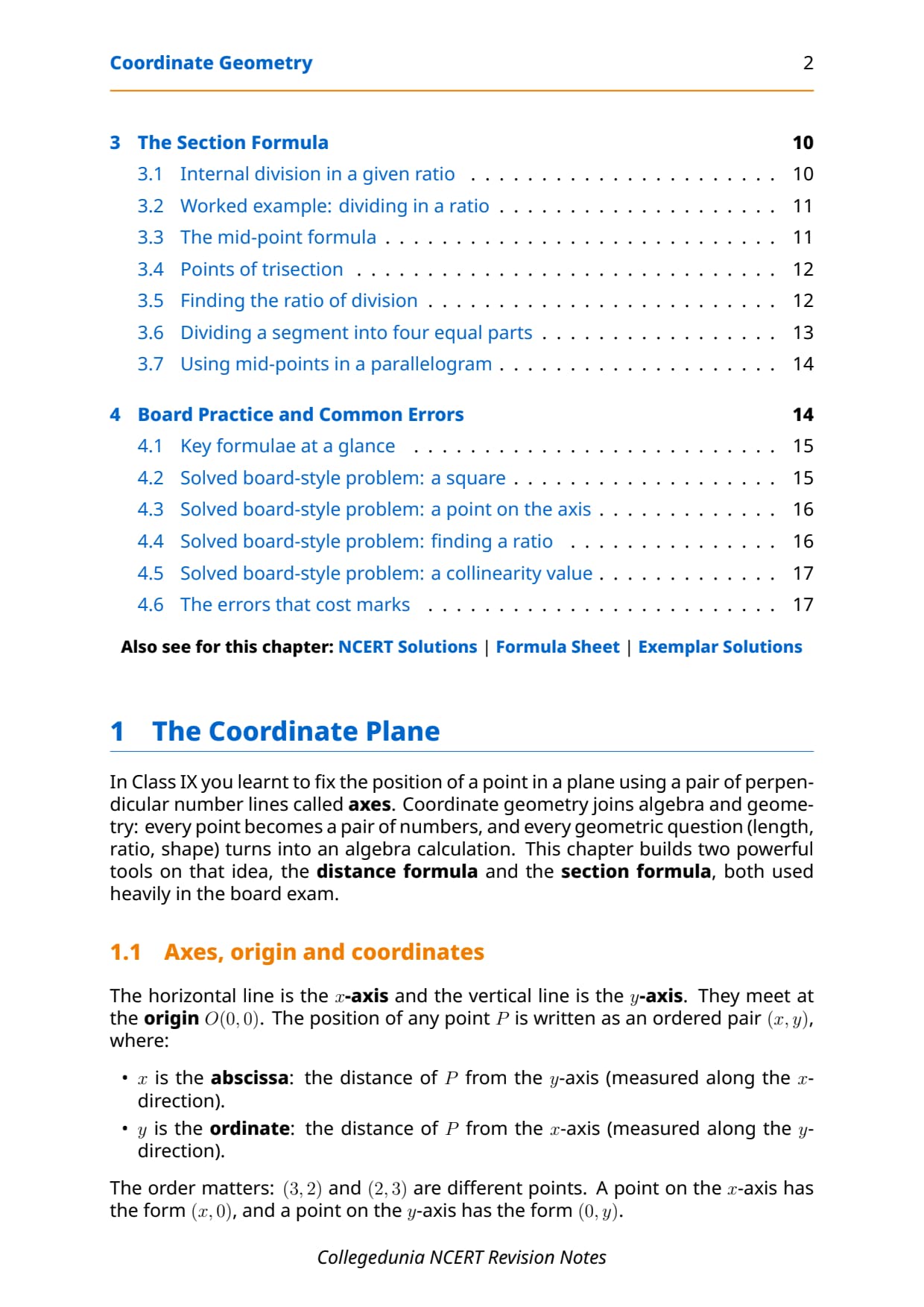
Table of Contents |
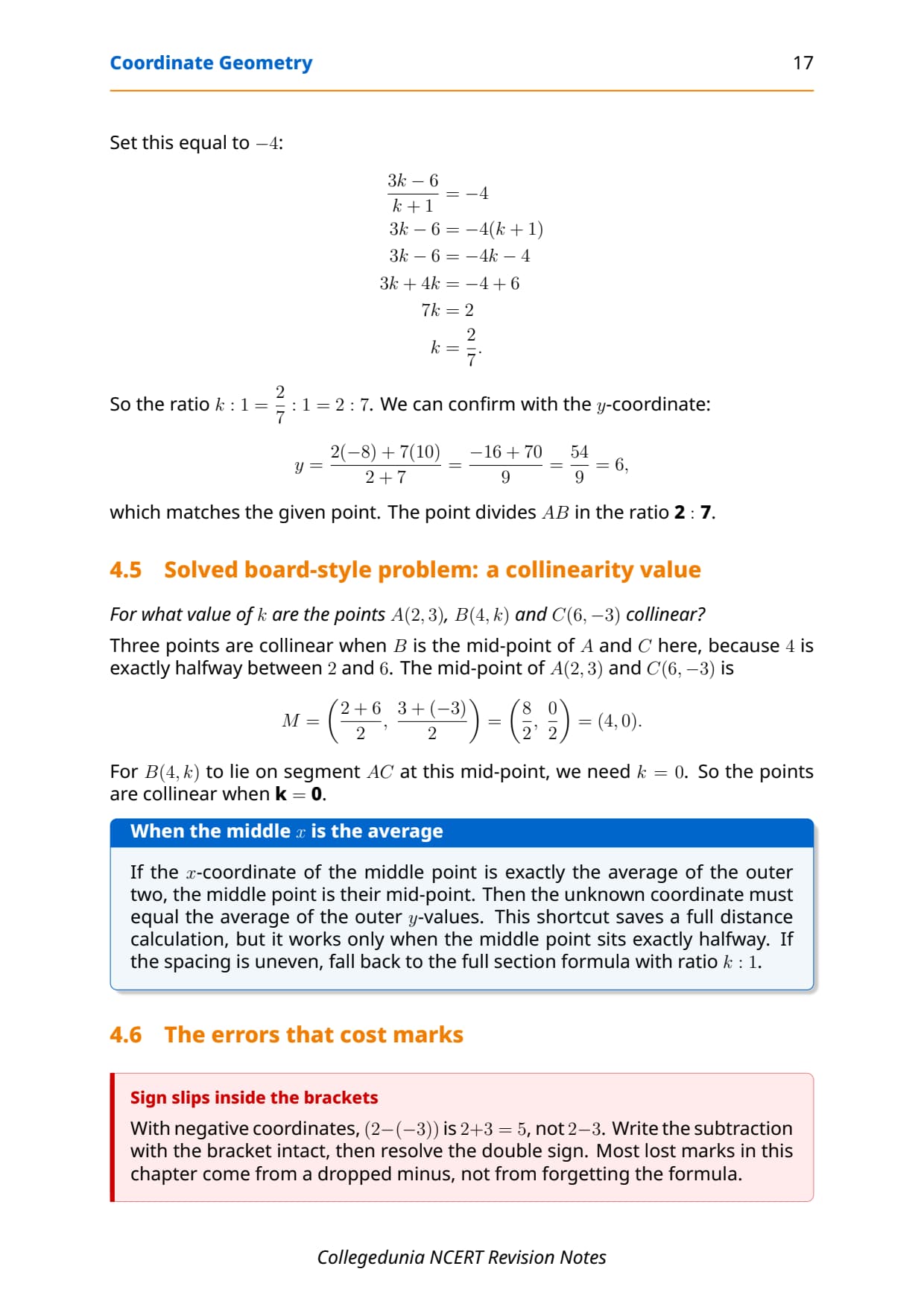
Watch Coordinate Geometry Class 10 Maths Explained
Source: Magnet Brains on YouTube
What These Notes Cover
Chapter 7 builds on the Cartesian plane from Class 9, adding three tools for working with points. Instead of drawing figures, you find distances, dividing points, and areas from coordinates alone. The rationalised 2026-27 syllabus has three big ideas.
- Distance Formula: the exact distance between two points, from their x and y coordinates. No ruler needed.
- Section Formula: the coordinates of a point that divides a segment in a given ratio, internally or externally.
- Area of a Triangle: the area from the three vertices alone. The zero-area case also tells you if three points are collinear.
Distance Formula
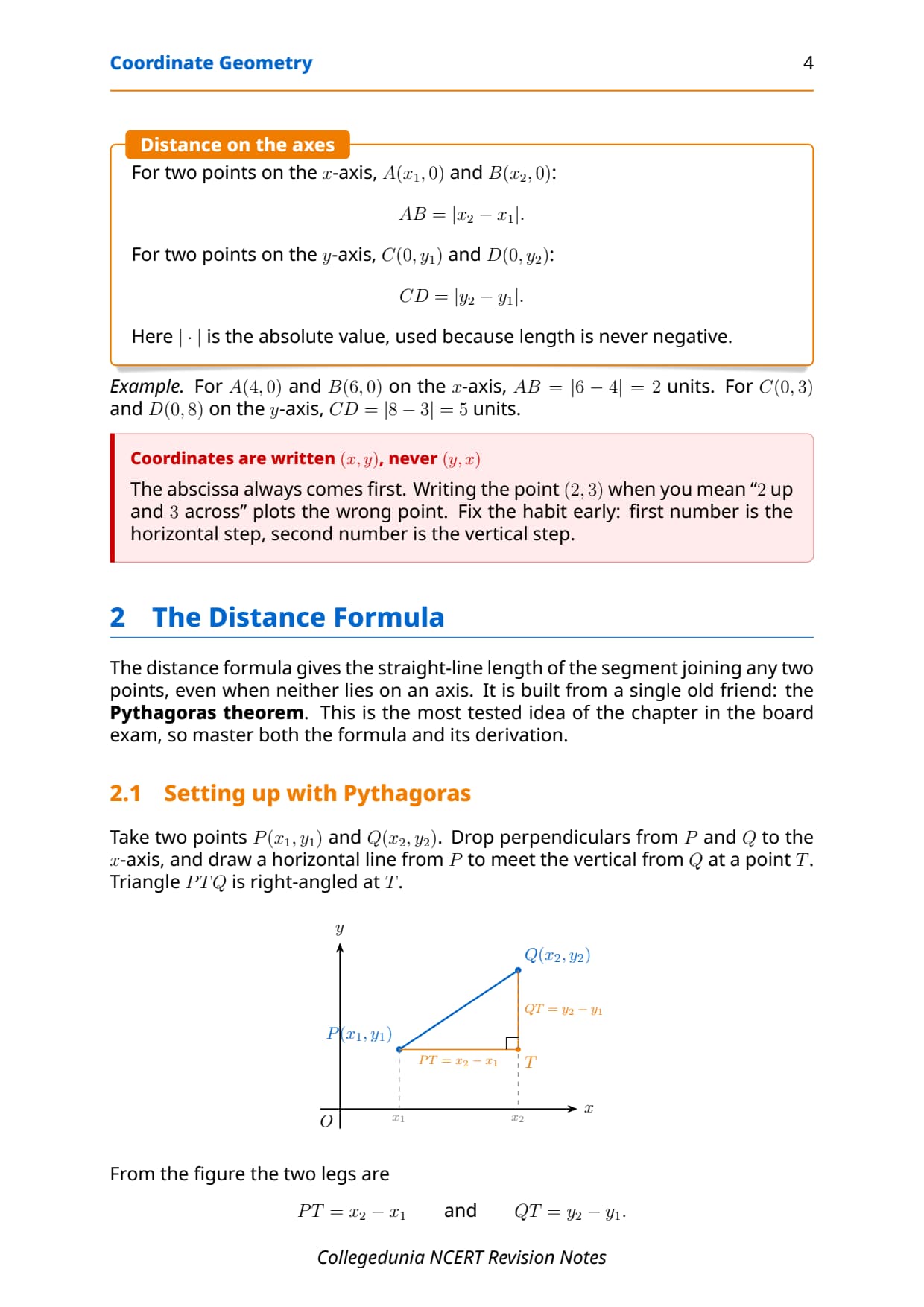
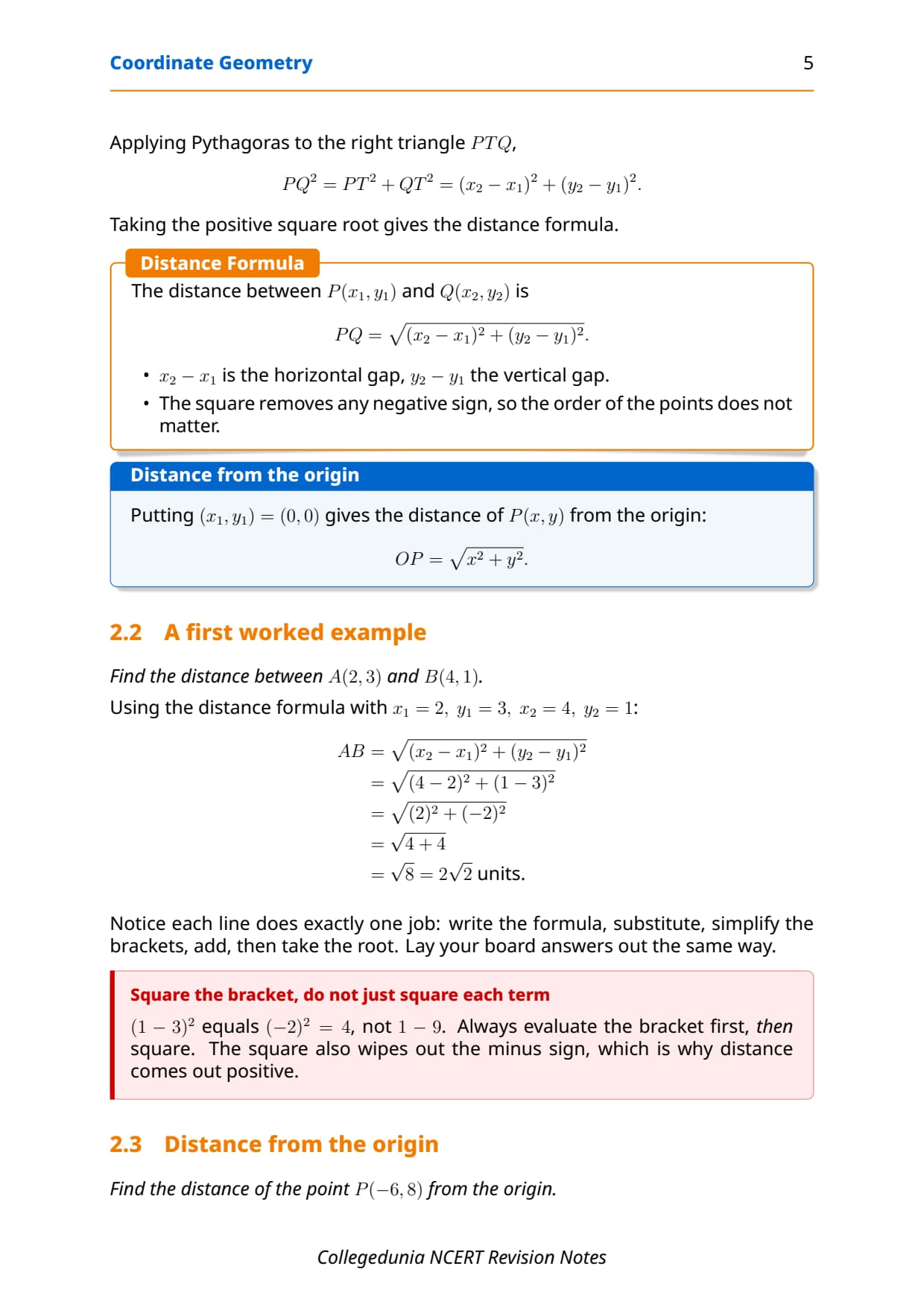
The Distance Formula is the most-used tool in this chapter. It gives the straight-line distance between P(x1, y1) and Q(x2, y2), straight from the Pythagorean Theorem: PQ is the hypotenuse of a right-angled triangle whose legs are the horizontal and vertical gaps.
PQ = √[(x2 − x1)2 + (y2 − y1)2]
Squaring the differences removes negative signs, so it works in all four quadrants and distance is never negative. The order of the points does not matter: PQ = QP.
| What you know | What you find | Formula |
|---|---|---|
| Two points P(x1, y1) and Q(x2, y2) | Distance PQ | √[(x2−x1)2 + (y2−y1)2] |
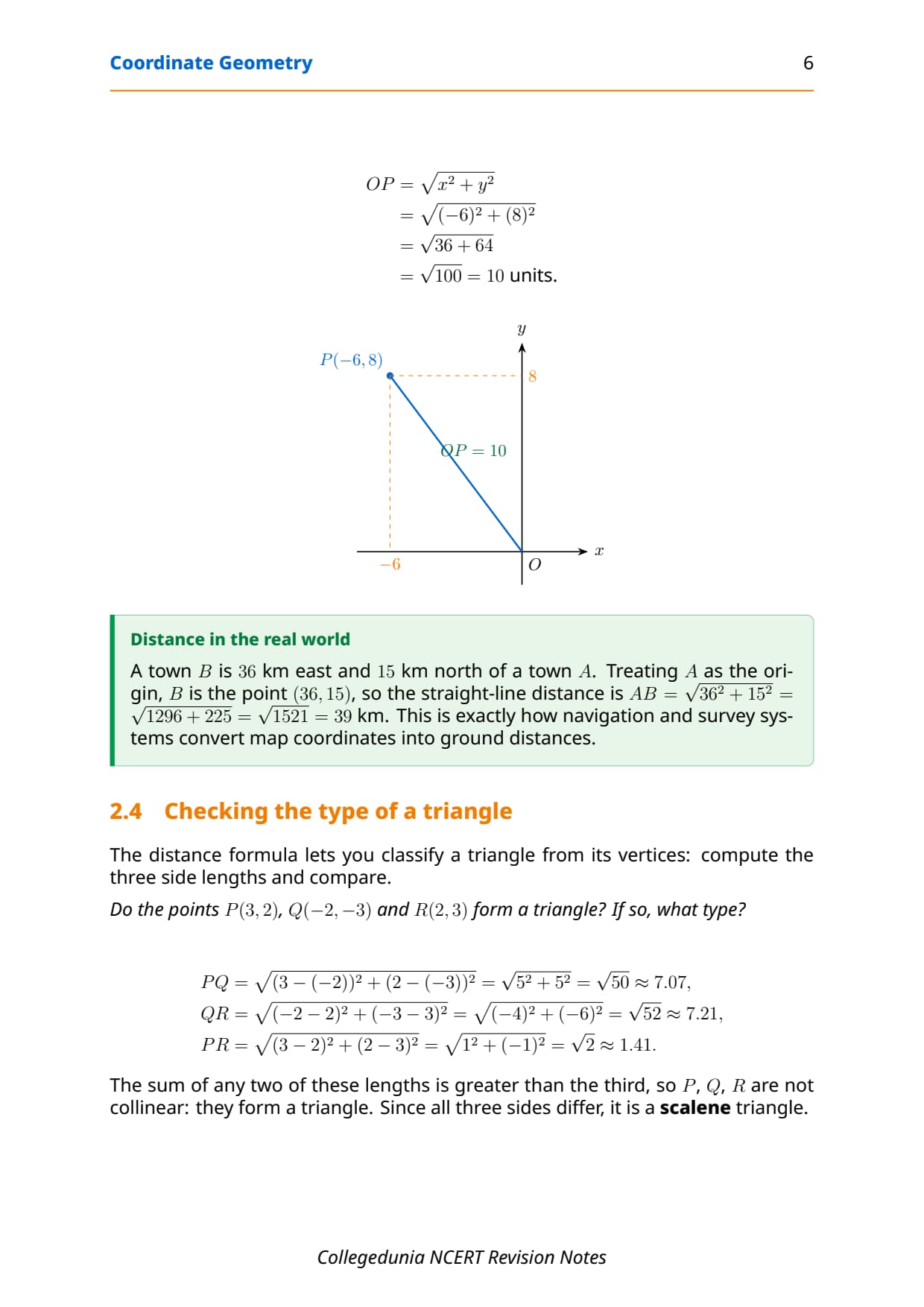
| Origin O(0, 0) to P(x, y) | OP | √(x2 + y2) |
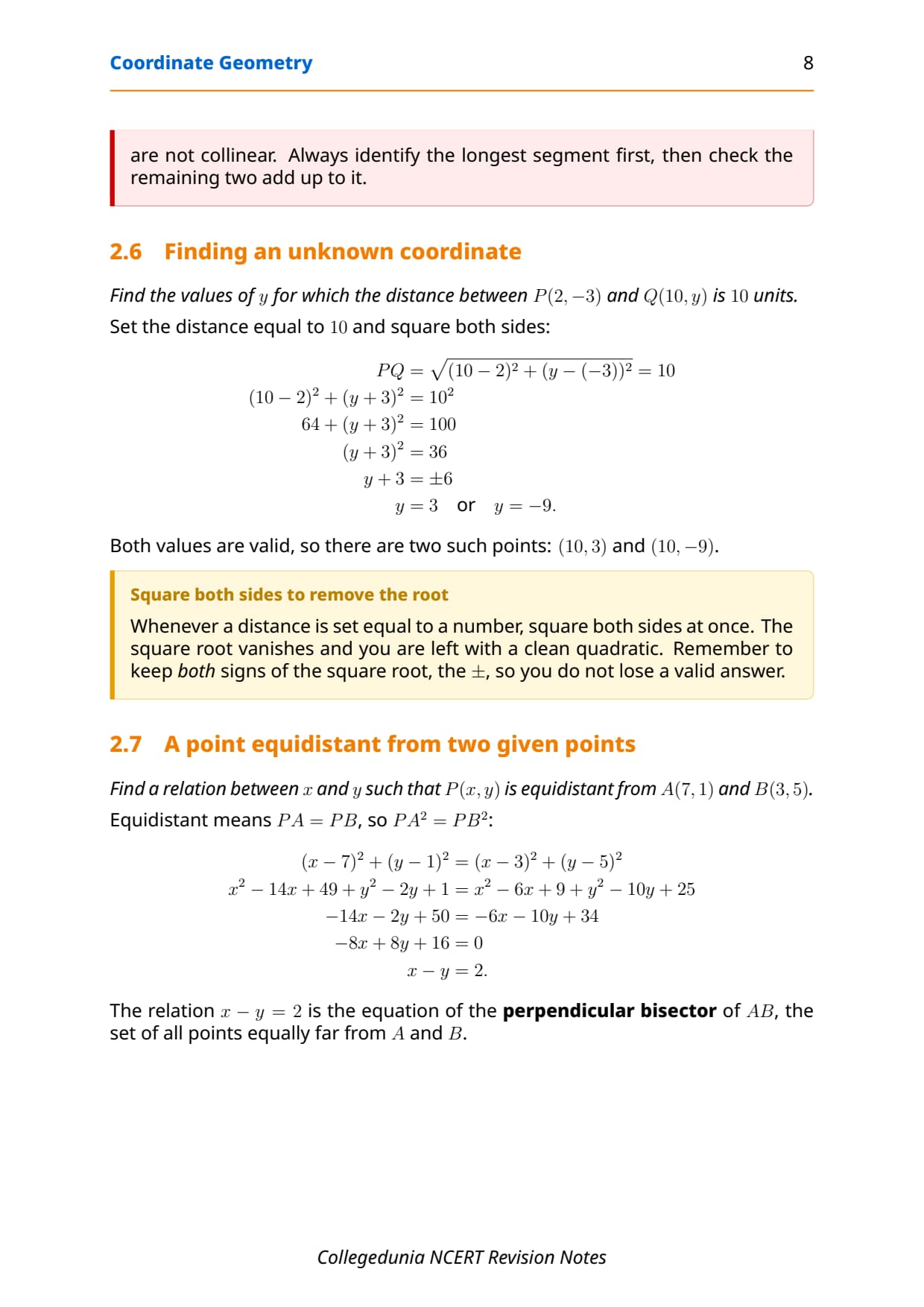
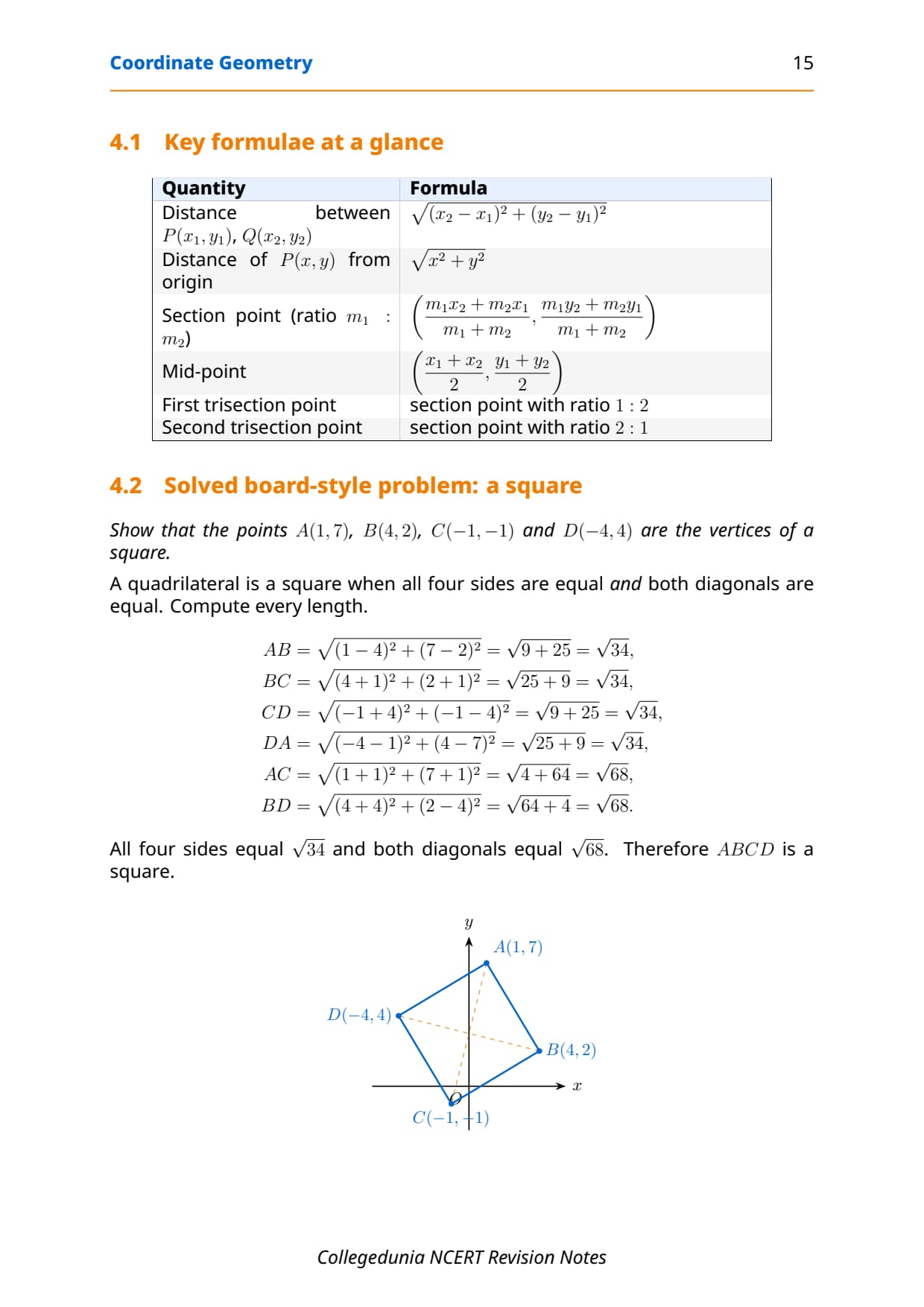
A common board task: show three points form a certain type of triangle. Find all three side lengths, then check: three equal means equilateral, two equal means isosceles, and the Pythagorean relation means right-angled.
Section Formula: Internal & External Division
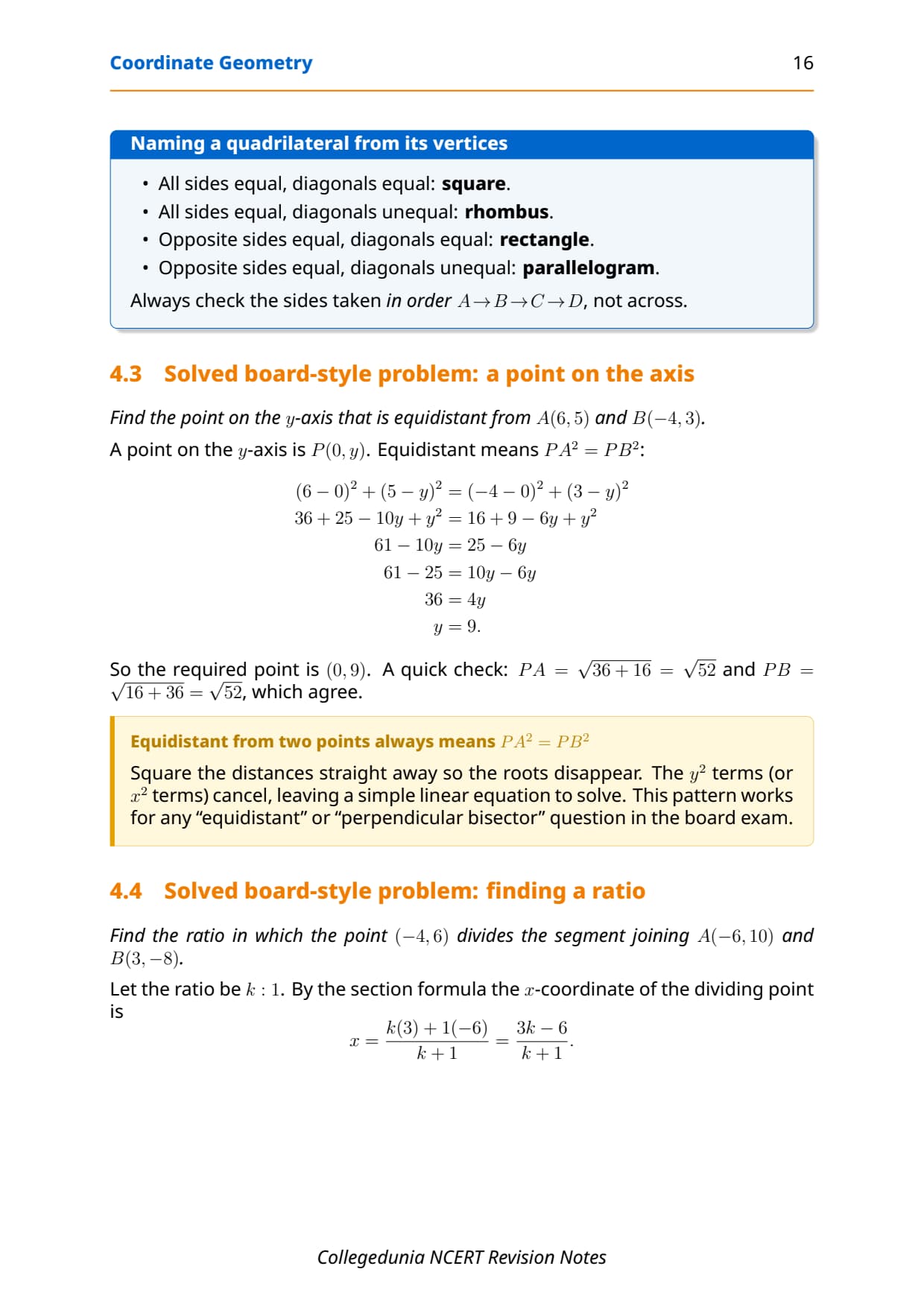
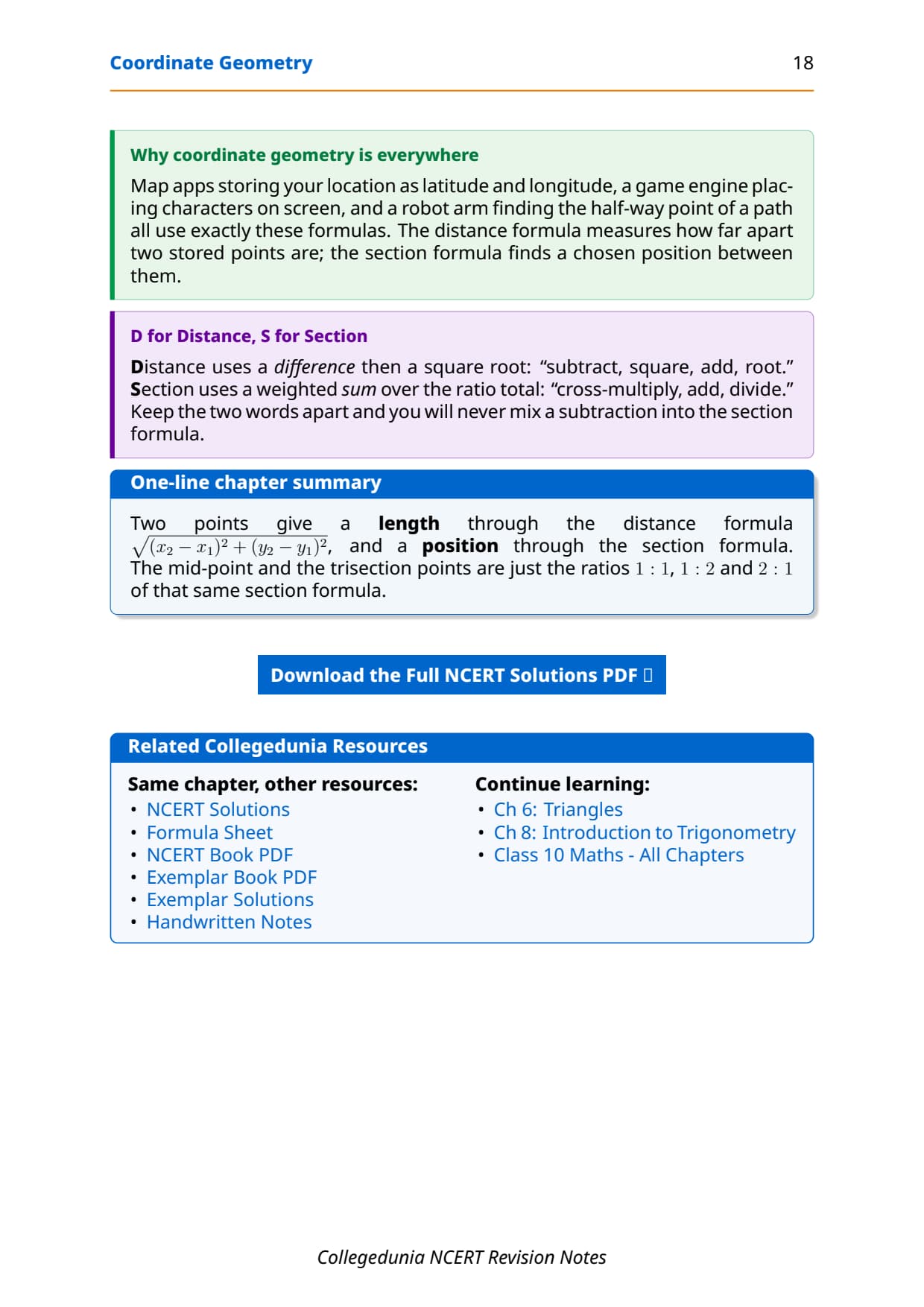
The Section Formula finds the point P that divides the segment from A(x1, y1) to B(x2, y2) in a ratio m : n.
For internal division, P lies between A and B:
P = ( (mx2 + nx1) / (m + n) , (my2 + ny1) / (m + n) )
For external division, P lies outside AB on the same line:
P = ( (mx2 − nx1) / (m − n) , (my2 − ny1) / (m − n) )
The board mostly tests internal division; external division turns up occasionally in 3-mark questions. Memory trick: m "pulls" the point toward B, n toward A.
| Division type | Position of P | x-coordinate of P | y-coordinate of P |
|---|---|---|---|
| Internal in ratio m : n | Between A and B | (mx2 + nx1) / (m + n) | (my2 + ny1) / (m + n) |
| External in ratio m : n | Outside segment AB | (mx2 − nx1) / (m − n) | (my2 − ny1) / (m − n) |
Example: divide A(1, 3) to B(4, 9) in ratio 2 : 1 internally. x = (2×4 + 1×1)/3 = 3, y = (2×9 + 1×3)/3 = 7, so P = (3, 7).
Midpoint Formula & Its Uses
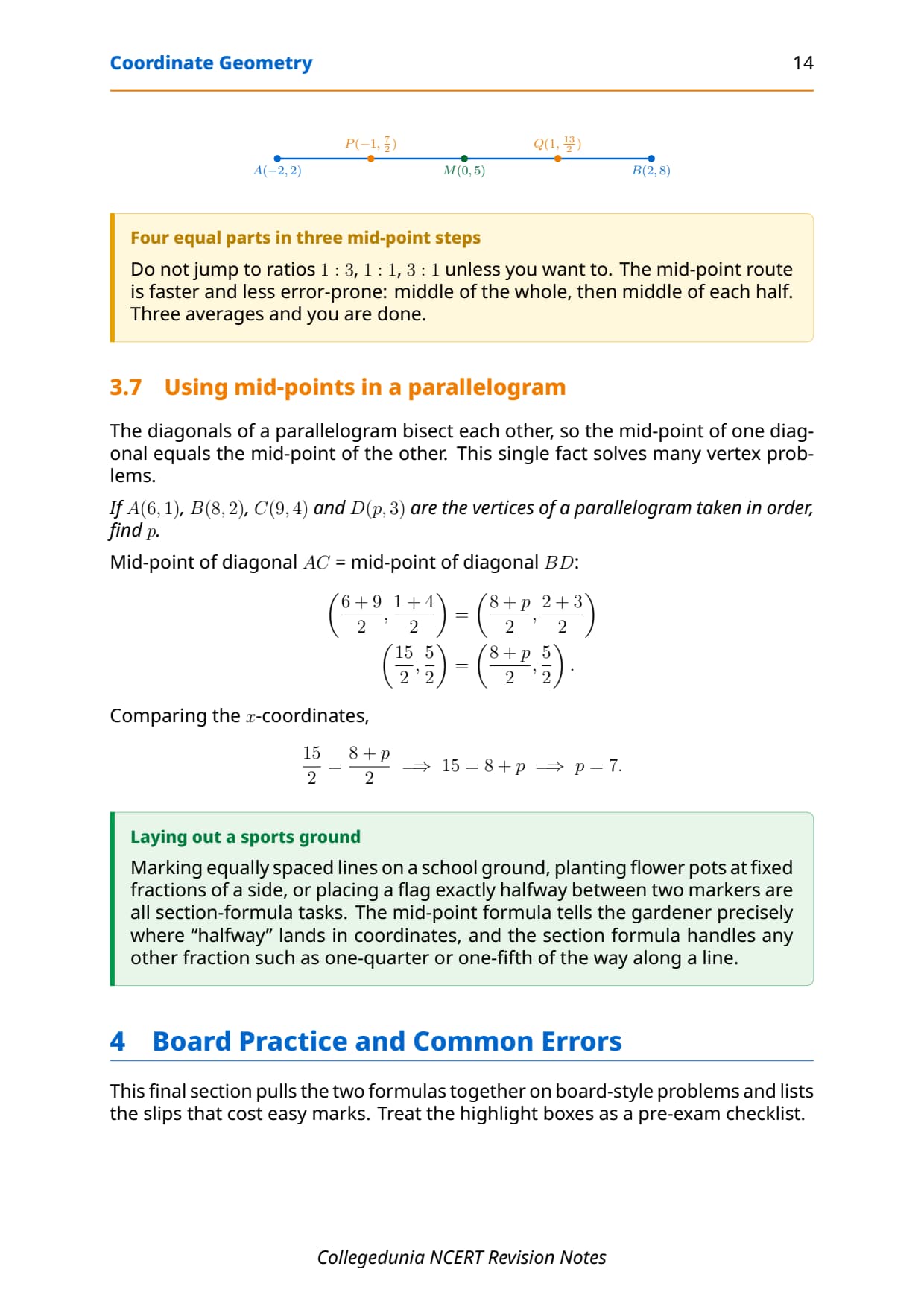
The Midpoint Formula is just the Section Formula at ratio 1 : 1. If M is the midpoint of AB, with A = (x1, y1) and B = (x2, y2), then:
M = ( (x1 + x2) / 2 , (y1 + y2) / 2 )
You just average the two x-values and the two y-values. It is the internal Section Formula with m = n = 1.
- Centre of a circle: given the ends of a diameter, the centre is their midpoint.
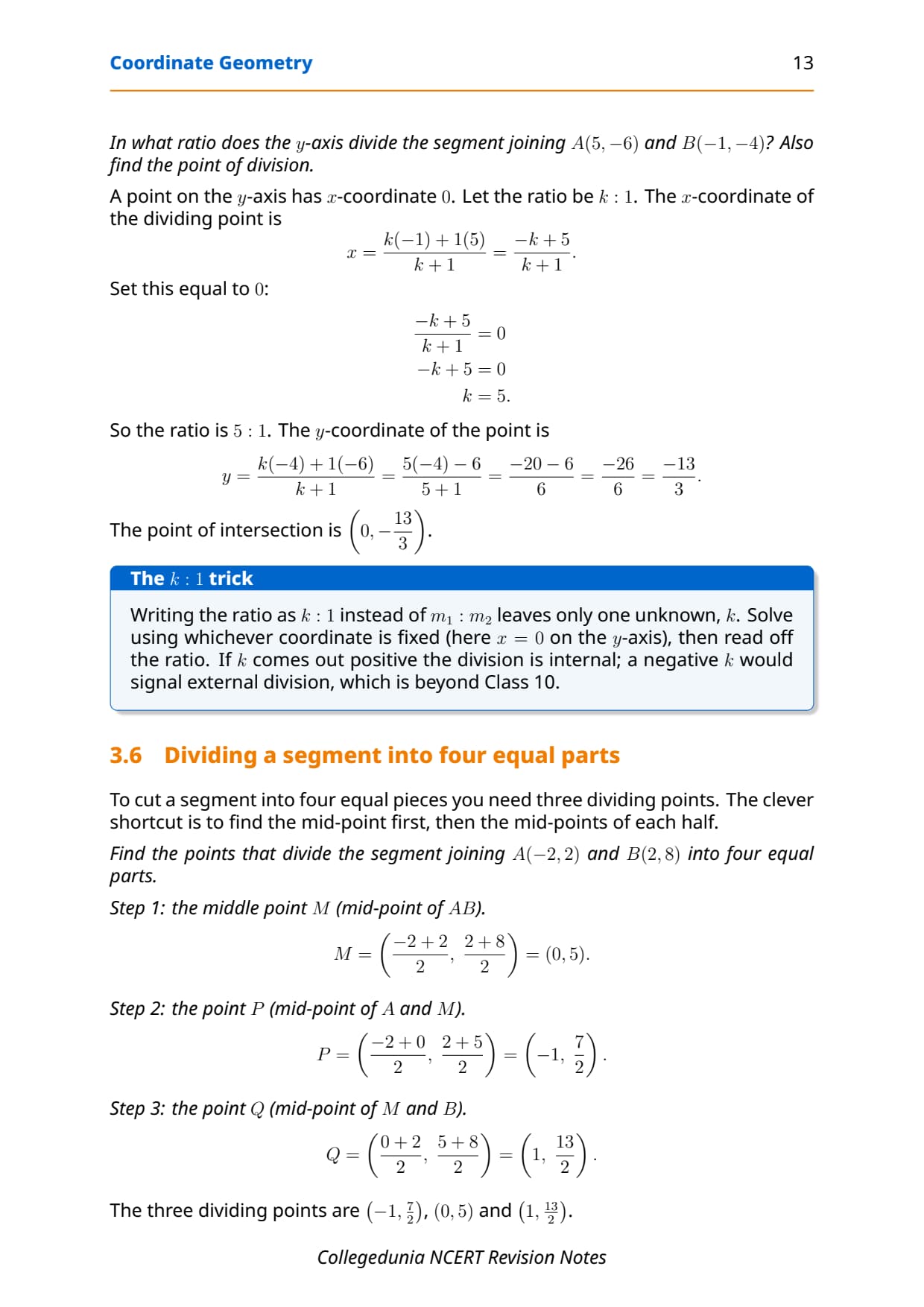
- Fourth vertex of a parallelogram: the diagonals bisect, so midpoint of AC = midpoint of BD. Set them equal and solve.
- Check a midpoint: compute both values and compare with the given point.
Area of a Triangle from Coordinates
Given the three vertices, you do not need to draw the triangle. For vertices A(x1, y1), B(x2, y2), C(x3, y3):
Area = (1/2) |x1(y2 − y3) + x2(y3 − y1) + x3(y1 − y2)|
Take the absolute value at the end, so the area is always positive. It works for any triangle in any position, with no base or height needed.
| What the formula gives you | Condition | What it means |
|---|---|---|
| Area > 0 | Three distinct, non-collinear points | A proper triangle exists |
| Area = 0 | All three points are collinear | The "triangle" is a straight line |
A worked example: A(2, 3), B(−1, 0), C(4, −1). Area = (1/2)|2(0−(−1)) + (−1)((−1)−3) + 4(3−0)| = (1/2)|2(1) + (−1)(−4) + 4(3)| = (1/2)|2 + 4 + 12| = (1/2)(18) = 9 sq units.
Collinearity of Three Points
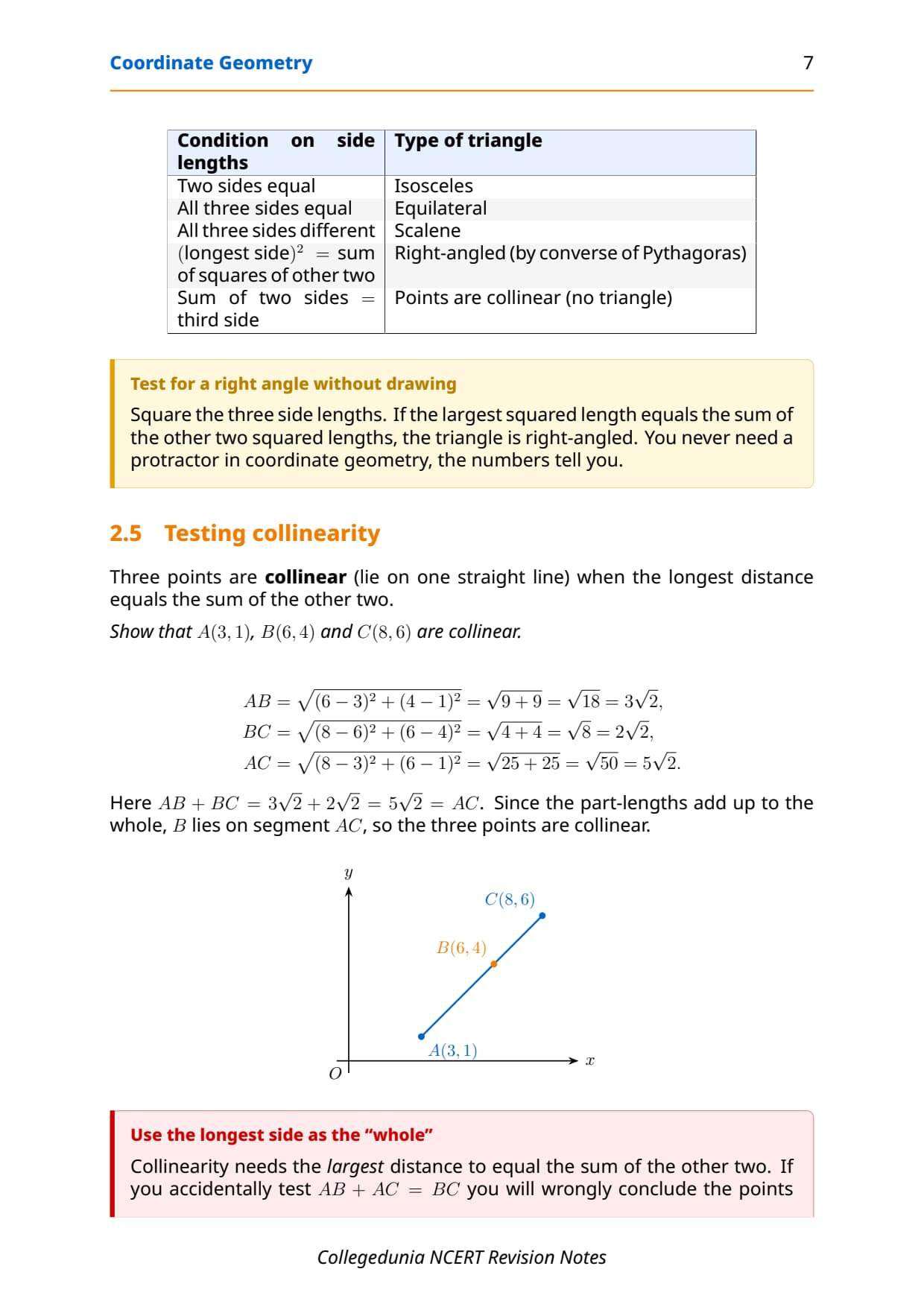
Three points are collinear (on one straight line) exactly when the triangle they form has zero area. So the test is simple: put the three coordinates in the area formula. Zero means collinear; non-zero means a triangle.
- This is the cleanest collinearity method in Class 10, and unlike checking slope AB = slope BC, it never divides by zero, so it works for vertical and horizontal cases too.
- Common board question: "For what value of k are A, B, C(k, ...) collinear?" Set area = 0, expand, solve for k.
Using These Notes for Board Revision
Chapter 7 has a tight set of formulae and a predictable question pattern. A two-pass plan works well:
- First, read and derive each formula in order (Distance, Section, Midpoint, Area). Read each derivation, then write the formula by hand once before moving on.
- Then solve at least 10 numericals from Exercises 7.1 and 7.2 with these notes open. Focus on questions that mix two formulae, like naming a triangle by distances, then finding its centroid. Mark any step where you paused and drill it.
For 2026-27, Coordinate Geometry usually carries 6 to 8 marks: a 2-mark Distance question, a 3-mark Section Formula problem, and sometimes a 3-mark Area question. Write the formula first, substitute clearly, and show the absolute value in area sums, since examiners give method marks step by step.
Previous Year Question Trends
Coordinate Geometry is a steady scorer in the CBSE Class 10 paper, with the three formulae appearing in fresh combinations each year.
| Year | Question type asked | Marks |
|---|---|---|
| 2025 | Find the coordinates of a point dividing a segment internally in a given ratio (Section Formula) | 3 |
| 2024 | Show that given four points form a specific quadrilateral using the Distance Formula | 4 |
| 2023 | Find the value of k if three given points are collinear (area = 0 condition) | 3 |
| 2022 | Use the Midpoint Formula to find the fourth vertex of a parallelogram | 3 |
| 2021 | Find the area of a triangle whose vertices are given as coordinate pairs | 2 |
Also Check: The full set of CBSE board paper questions for this chapter, with step-by-step answers, is included in the downloadable PDF above, updated for the 2026-27 cycle.
Common Mistakes to Avoid
Most lost marks in Chapter 7 come from a short list of formula slips.
- Swapping the ratio terms in the Section Formula. Use m with the second endpoint, n with the first; reversing gives the wrong point.
- Dropping the absolute value in the Area Formula. A negative area costs the final mark.
- Not squaring the differences in the Distance Formula. The sum of differences is not the distance.
- Mixing up internal and external division. Ratio 2:1 internally and externally give different answers; read the word.
- Sign errors with negative coordinates. Always bracket negative values before squaring.
Other Resources for Chapter 7
Pair these notes with the matching NCERT Solutions, formula sheet, handwritten notes, and the official NCERT book chapter. All Chapter 7 resources are linked below.
| Resource | What it covers | Open |
|---|---|---|
| Notes | Concept-first revision notes on Distance Formula, Section Formula, Midpoint Formula, Area of Triangle, and Collinearity for the board exam. | You are here |
| NCERT Solutions | Step-by-step answers to all Exercise 7.1 and Exercise 7.2 questions, with an Expert Solution for each. | Class 10 Maths Chapter 7 NCERT Solutions |
| Formula Sheet | One-page list of Distance, Section, Midpoint, and Area formulae for fast last-minute revision. | Class 10 Maths Chapter 7 Formula Sheet |
| Handwritten Notes | Scanned-style handwritten pages for last-minute board revision. | Class 10 Maths Chapter 7 Handwritten Notes |
| NCERT Book PDF | Official NCERT Maths Chapter 7 Coordinate Geometry textbook in PDF form. | Class 10 Maths Chapter 7 NCERT Book PDF |
| Exemplar Solutions | Worked answers to the harder NCERT Exemplar problems for extra practice. | Class 10 Maths Chapter 7 Exemplar Solutions |
Notes for Class 10 Maths: All Chapters
Related Links: Open the revision notes for any other chapter from the table below. Each one has the same concept-first style, full PDF, and revision FAQ.
| Chapter | Notes link |
|---|---|
| Chapter 1 | Real Numbers Notes |
| Chapter 2 | Polynomials Notes |
| Chapter 3 | Pair of Linear Equations in Two Variables Notes |
| Chapter 4 | Quadratic Equations Notes |
| Chapter 5 | Arithmetic Progressions Notes |
| Chapter 6 | Triangles Notes |
| Chapter 7 | Coordinate Geometry Notes (You are here) |
| Chapter 8 | Introduction to Trigonometry Notes |
| Chapter 9 | Some Applications of Trigonometry Notes |
| Chapter 10 | Circles Notes |
| Chapter 11 | Areas Related to Circles Notes |
| Chapter 12 | Surface Areas and Volumes Notes |
| Chapter 13 | Statistics Notes |
| Chapter 14 | Probability Notes |
Notes Class 10 Maths Chapter 7 Coordinate Geometry FAQs
Ques. What does Chapter 7 Coordinate Geometry cover in Class 10 Maths?
Ans. Chapter 7 covers three tools for points on the Cartesian plane. First, the Distance Formula: the straight-line distance between two points from their coordinates, derived from the Pythagorean Theorem. Second, the Section Formula: the coordinates of a point that divides a segment in a given ratio, internally (between the endpoints) or externally (outside). The 1:1 internal case gives the Midpoint Formula. Third, the Area of a Triangle from its three vertices, with the zero-area condition as a quick collinearity check.
Ques. What is the Distance Formula in Class 10 Coordinate Geometry?
Ans. It gives the length of the segment joining P(x1, y1) and Q(x2, y2): PQ = square root of [(x2 minus x1) squared plus (y2 minus y1) squared]. It comes from the Pythagorean Theorem, treating the horizontal and vertical gaps as the legs of a right-angled triangle and PQ as the hypotenuse. Squaring both differences keeps the result non-negative, so it works in all four quadrants. A special case: the distance from the origin O(0, 0) to P(x, y) is the square root of (x squared plus y squared).
Ques. What is the Section Formula and when do you use it?
Ans. It finds the point P that divides the segment from A(x1, y1) to B(x2, y2) in the ratio m : n. For internal division, P lies between A and B: x = (m times x2 plus n times x1) over (m plus n), y = (m times y2 plus n times y1) over (m plus n). Use it whenever a question gives a dividing ratio and asks for the point. Common trap: m goes with the second point B and n with the first point A, not the reverse. Write the formula out before substituting.
Ques. What is the Midpoint Formula in Coordinate Geometry?
Ans. It gives the centre of a segment. If A = (x1, y1) and B = (x2, y2), then M = ((x1 plus x2) over 2, (y1 plus y2) over 2). This is the Section Formula with m = n = 1. Use it for the centre of a segment, the centre of a circle given a diameter, or parallelograms (the diagonals bisect, so their midpoints match). To find a missing endpoint, rearrange: if you know M and one endpoint A, solve for the other endpoint B.
Ques. How do you find the area of a triangle using coordinates?
Ans. For vertices A(x1, y1), B(x2, y2), C(x3, y3): Area = half the absolute value of [x1(y2 minus y3) plus x2(y3 minus y1) plus x3(y1 minus y2)]. The absolute value keeps the area positive no matter how you label the vertices. Steps: write the three products separately, add them, take the absolute value, then halve it. The top mistake is dropping the absolute value at the end, which gives a negative result that loses the mark even when the working is right.
Ques. How do you check if three points are collinear using coordinates?
Ans. Three points are collinear if the triangle they form has zero area. Put all three coordinates in the area formula: Area = half the absolute value of [x1(y2 minus y3) plus x2(y3 minus y1) plus x3(y1 minus y2)]. Zero means they lie on a line; non-zero means a proper triangle. Board questions often give one coordinate as an unknown k and ask for collinearity. Set the bracket equal to zero, expand, and solve for k.
Ques. Which exercises are in Chapter 7 Coordinate Geometry in Class 10 Maths?
Ans. The rationalised 2026-27 syllabus has two exercises. Exercise 7.1 is the Distance Formula: distances between points, the type of triangle or quadrilateral formed, and collinearity checks. Exercise 7.2 is the Section and Midpoint formulae: dividing points, centroids, missing parallelogram vertices, and the ratio in which a point divides a segment. Step-by-step solutions to both are in the PDF above.
Ques. Are these Coordinate Geometry Notes aligned with the 2026-27 CBSE syllabus?
Ans. Yes. They follow the rationalised 2026-27 CBSE syllabus for Class 10 Maths. Chapter 7 sits in the Coordinate Geometry unit and focuses on the Distance Formula, Section Formula (internal and external), Midpoint Formula, and Area of a Triangle, including the collinearity condition. The notes follow the current NCERT order and are built for the CBSE board exam. These coordinate methods carry straight into Class 11 and Class 12 for conic sections, 3D geometry, and vectors.



Comments