




These Notes for Class 10 Maths Chapter 5 Arithmetic Progressions give you a fast, concept-first revision of the whole chapter. They explain what an AP is, the nth term formula an = a + (n−1)d, and the sum of n terms Sn = n/2 [2a + (n−1)d]. They also show how to spot AP patterns in the real-life sums the board loves.
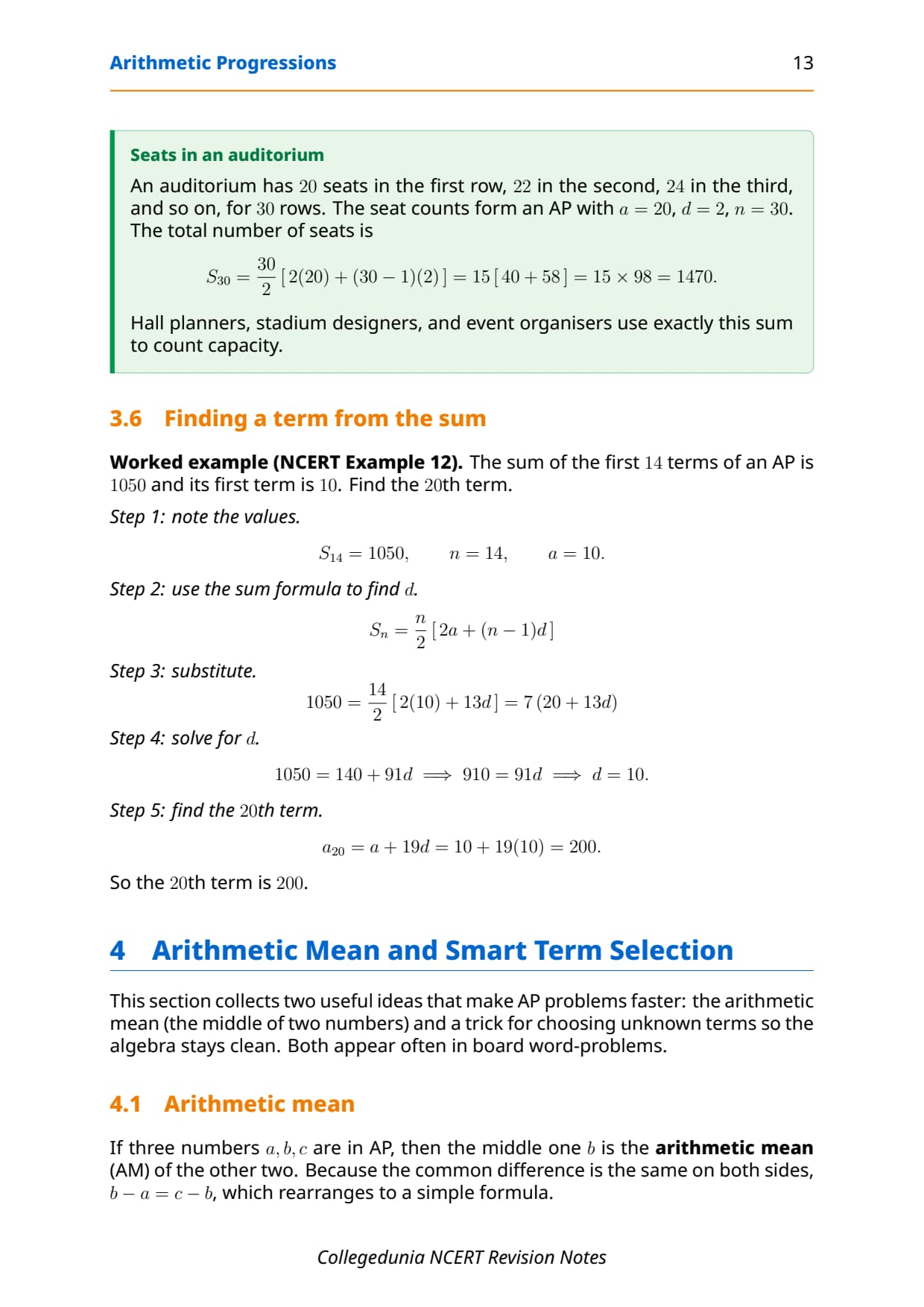
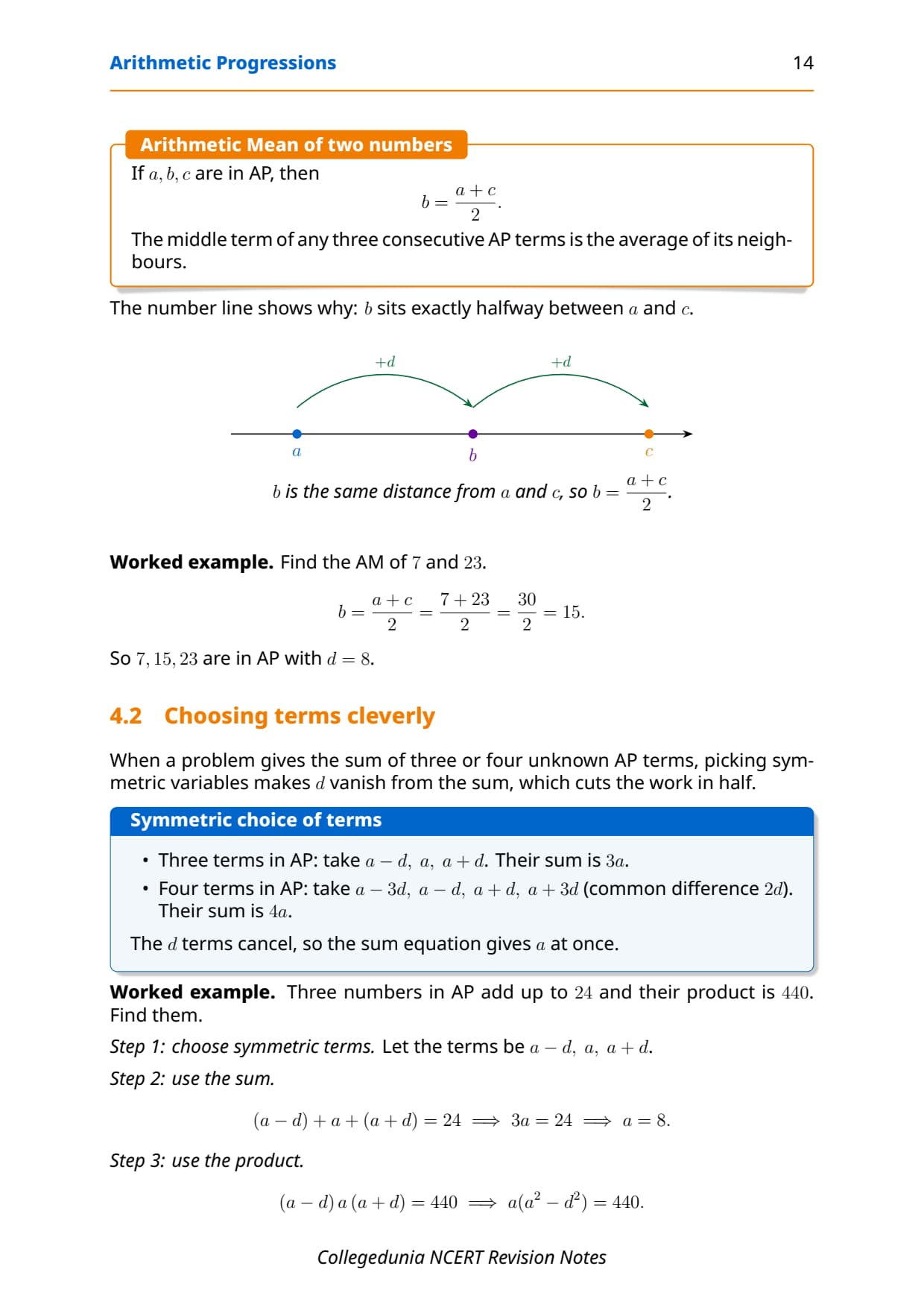
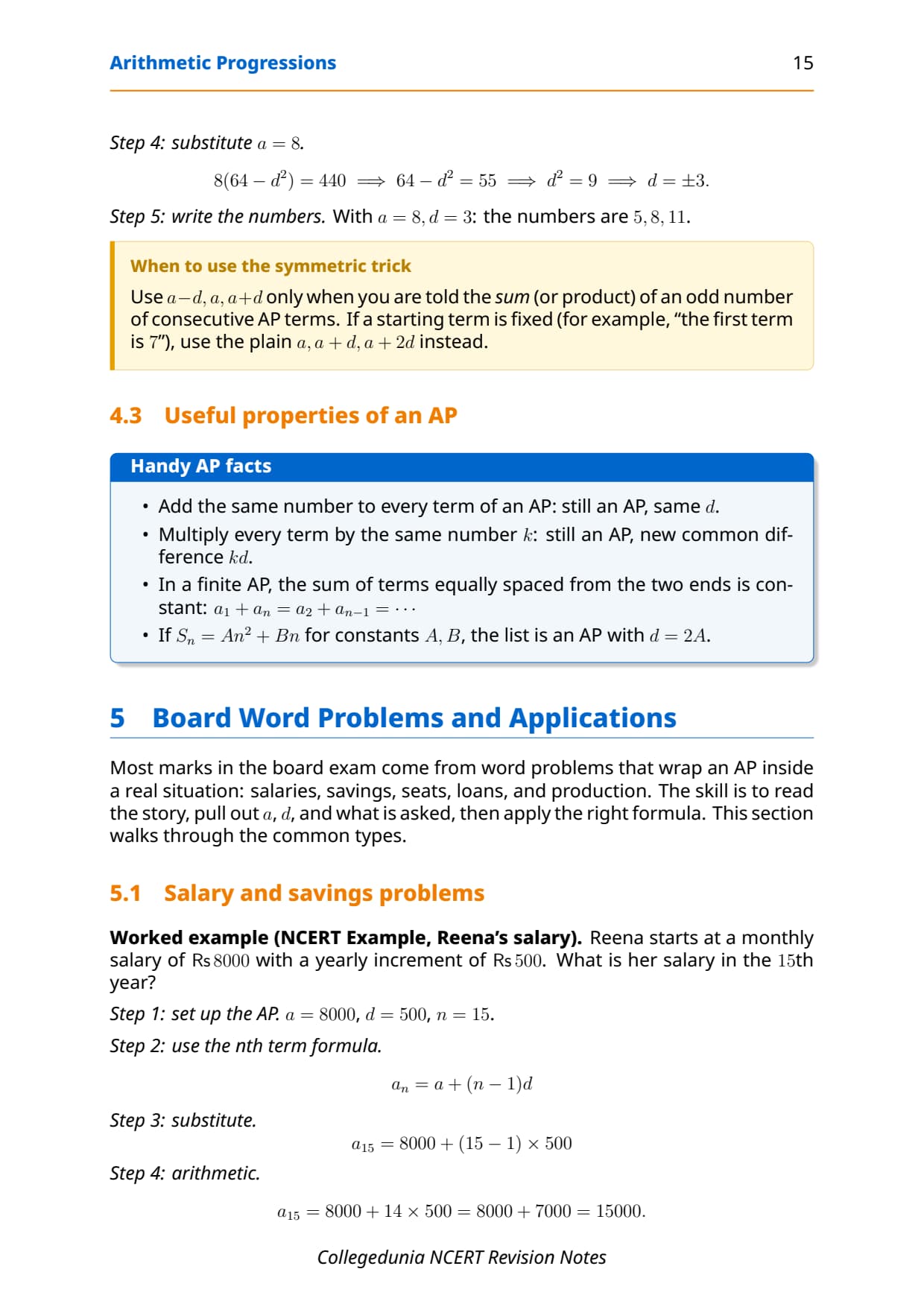
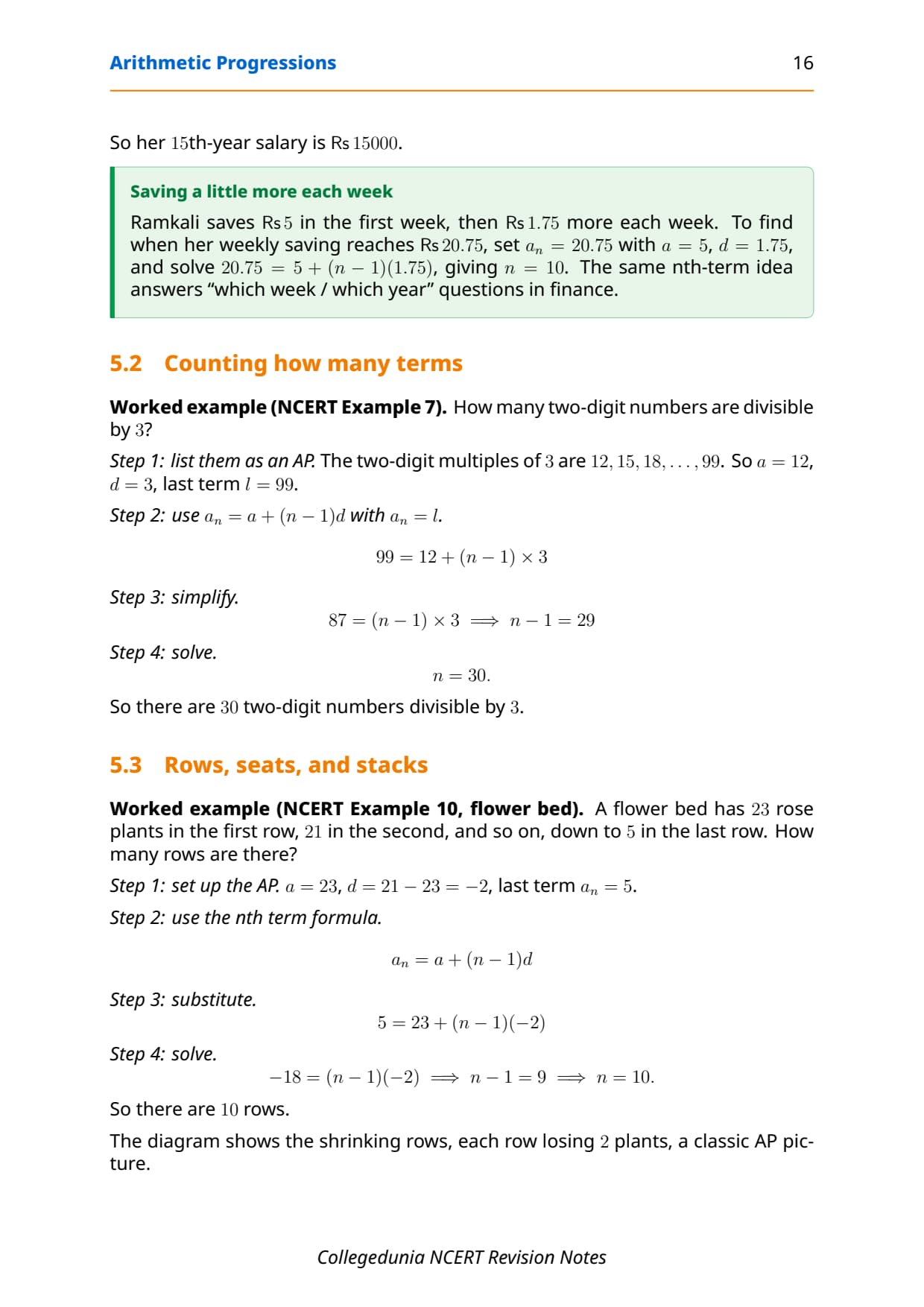
- Every key idea in plain words, with one short solved example and a board-exam tip per concept.
- Full coverage of the nth term, sum formulas, and word problems the CBSE board asks most.
- Aligned with the rationalised 2026-27 CBSE Class 10 Maths syllabus.
These Collegedunia revision notes are written by Maths experts from the 2026-27 NCERT textbook and checked against the last five years of CBSE board papers.
Student Feedback: What 10,200 students told us about this chapter
71% of Class 10 students said the sum of n terms formula needed the most practice, because of its two forms Sn = n/2 [2a + (n−1)d] and Sn = n/2 (a + l). 4 out of 5 students said learning the nth term formula first made word problems much easier to set up.
Toppers said writing down a, d, and what they need to find, all before touching a formula, saved the most time. The average student spent 2 to 3 hours on these notes across the first read and final revision.
Source: 2026-27 Class 10 Maths student poll, 10,200 students from CBSE schools in 15 states, before the 2026 boards.
|
Table of Contents |
Watch Arithmetic Progressions Class 10 Maths Explained
Source: Magnet Brains on YouTube
What These Notes Cover
This chapter builds one pattern-recognition skill seen across many real-life sequences: taxi fares that rise by a fixed amount each kilometre, savings that grow by the same amount monthly, rows of seats in a stadium. These notes keep the NCERT order in revision-ready blocks. The 2026-27 syllabus rests on three big ideas.
- Recognising an AP: checking that the difference between any two consecutive terms is the same (the common difference d).
- Finding any term: using the nth term formula an = a + (n−1)d to reach any term without listing all the ones before it.
- Finding the total: using the sum formula Sn = n/2 [2a + (n−1)d] or Sn = n/2 (a + l) to add up any number of terms at once.
What Is an Arithmetic Progression?
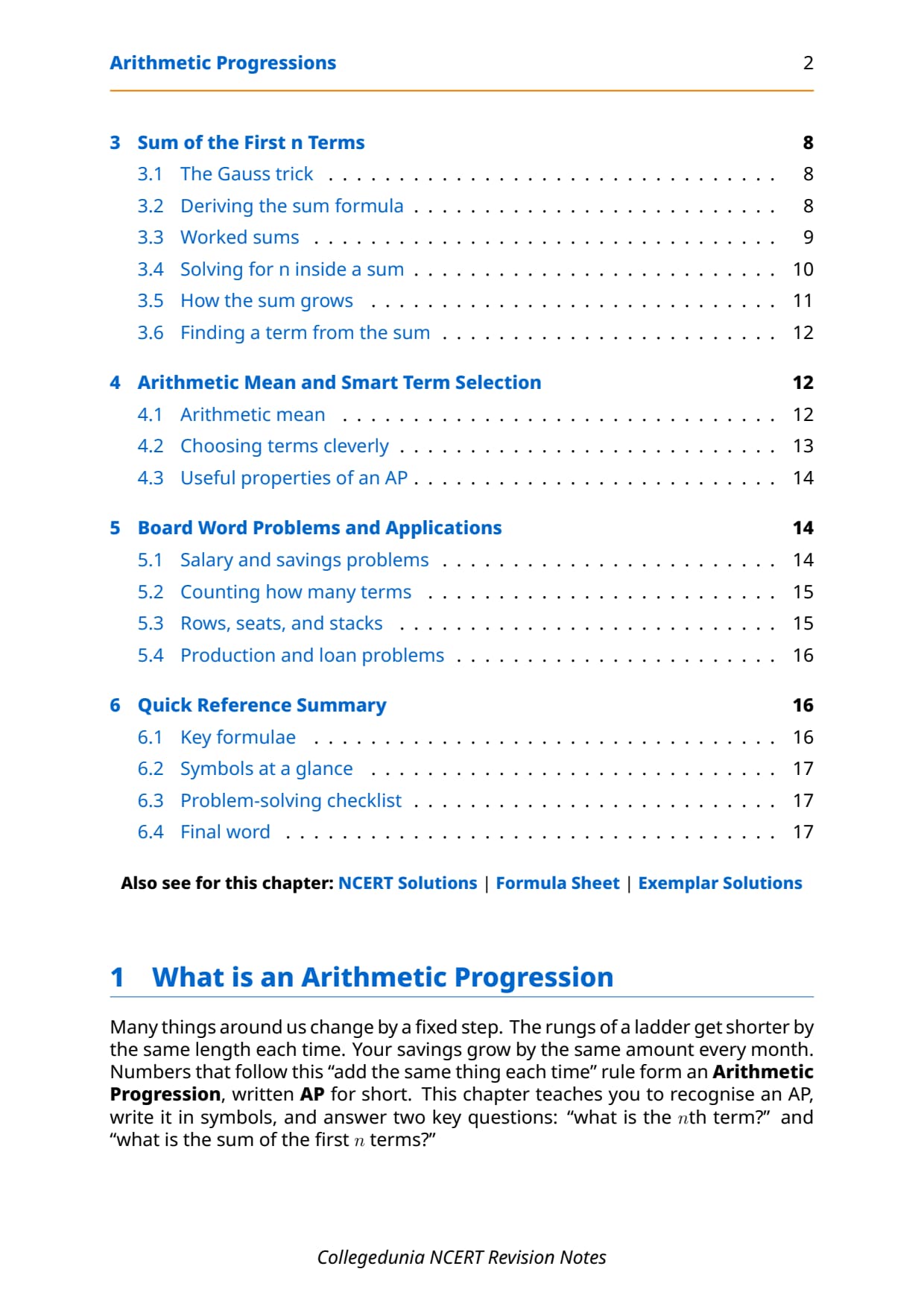
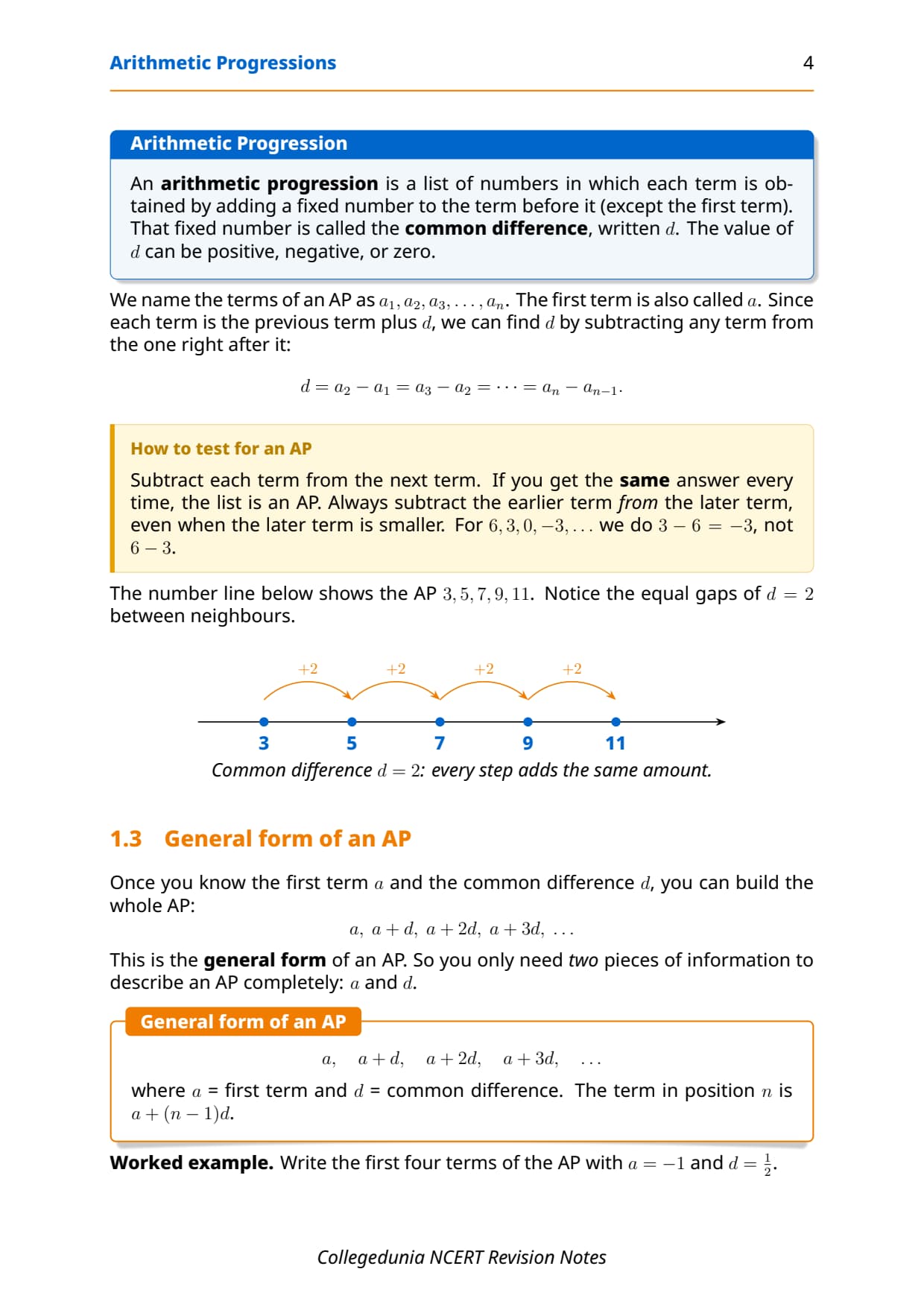
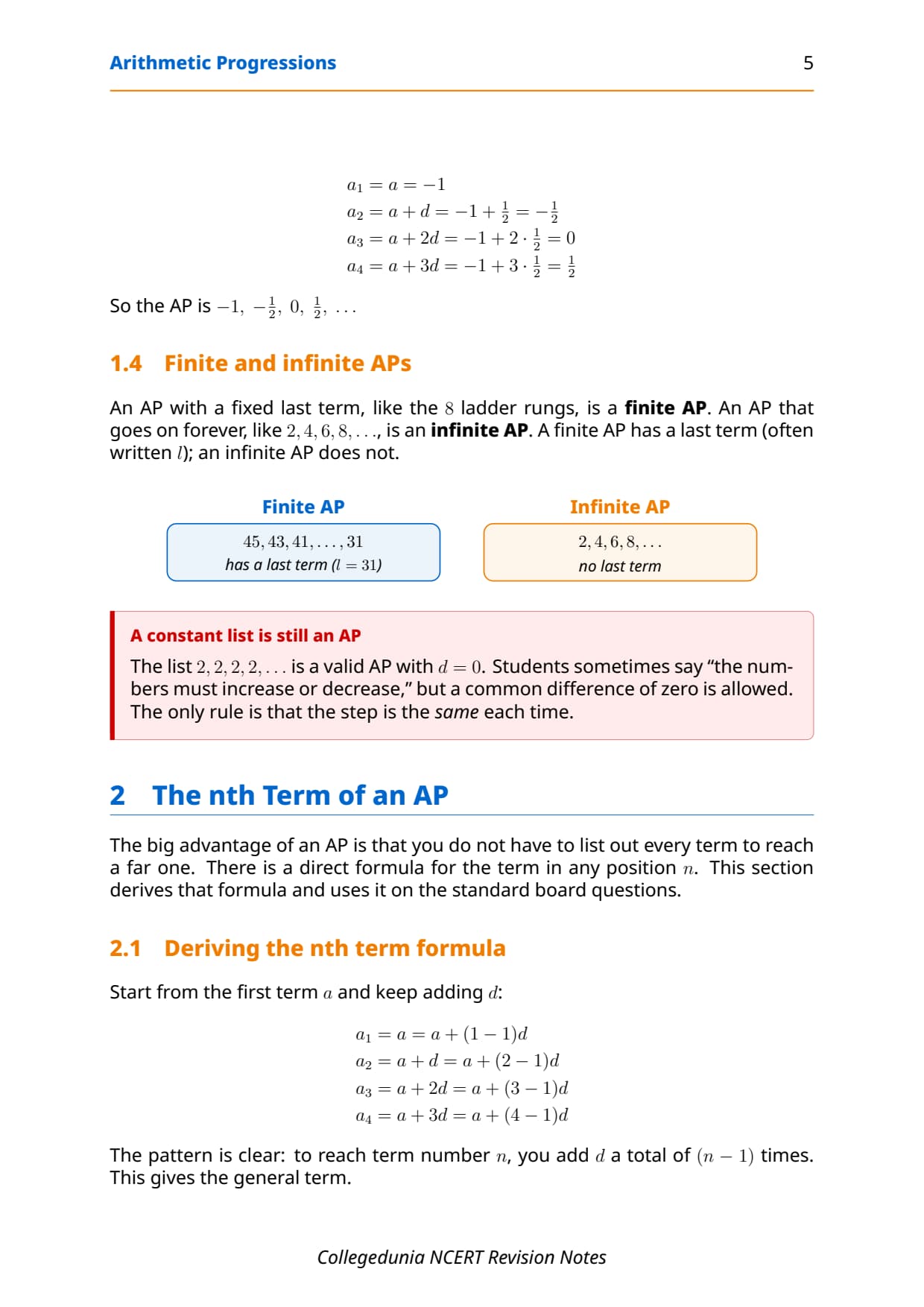
A list of numbers is an Arithmetic Progression (AP) when the gap between each pair of consecutive terms is the same. That fixed gap is the common difference d, and the first term is a. So the sequence runs a, a + d, a + 2d, a + 3d, and so on. A taxi charging Rs 8 for the first kilometre and Rs 5 for each one after gives the AP 8, 13, 18, 23, … with a = 8 and d = 5.
| Sequence | Is it an AP? | First term a | Common difference d |
|---|---|---|---|
| 1, 4, 7, 10, 13, … | Yes | 1 | 3 |
| 3, 1, −1, −3, … | Yes | 3 | −2 |
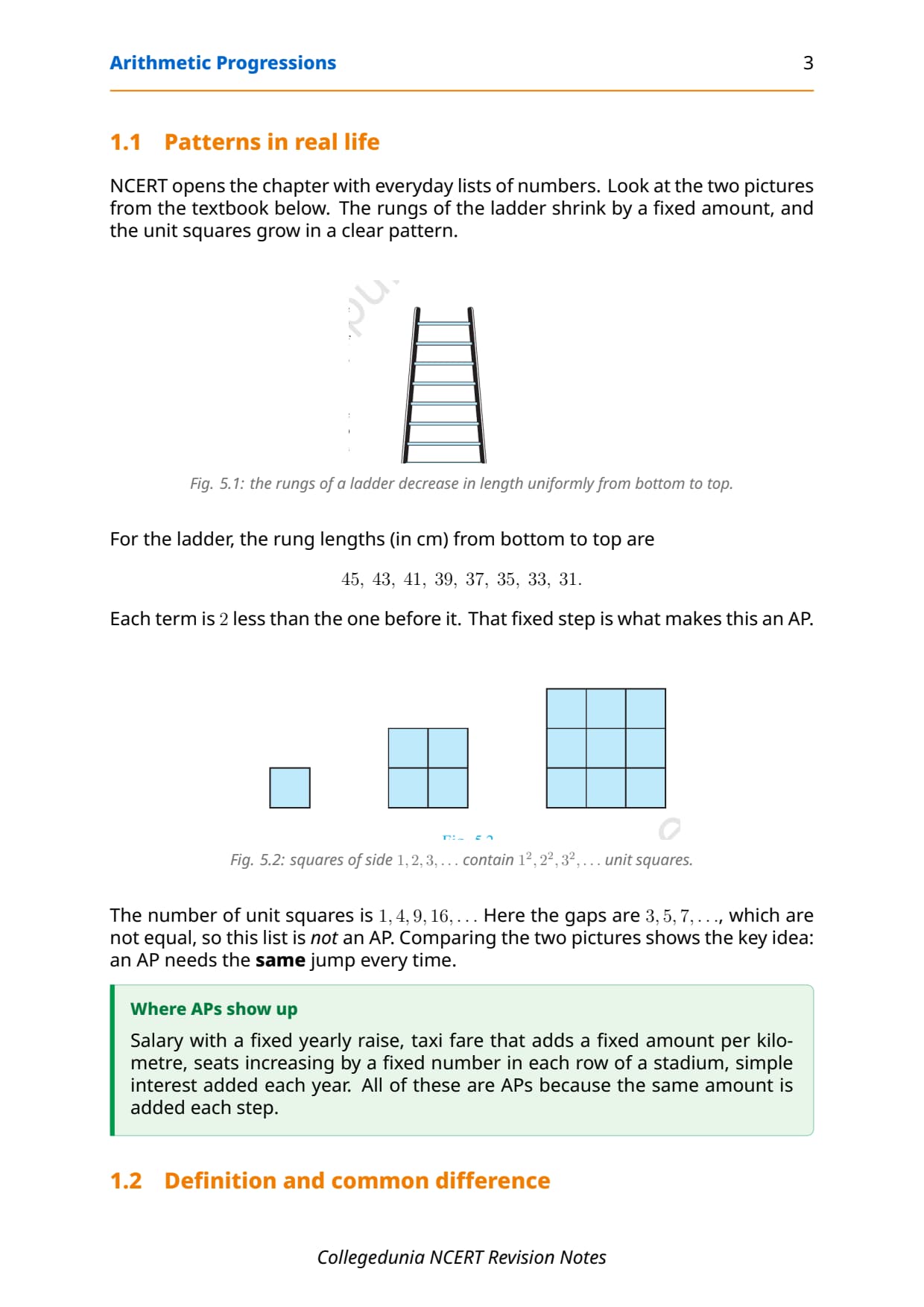
| 1, 1, 2, 3, 5, 8, … | No | 1 | not constant (Fibonacci) |
| 2, 2, 2, 2, … | Yes | 2 | 0 |
The table shows one tricky case: d can be zero. If every term is the same, d = 0 and the list is still a valid AP. This catches students out in one-mark questions.
Common Difference and Identifying an AP
The common difference d = a2 − a1 = ak+1 − ak for every k. Three properties follow, each a frequent one-mark question: d positive means terms increase (ascending AP); d negative means they decrease (e.g. 20, 17, 14, 11 has d = −3); d = 0 is allowed, giving a constant sequence.
A common board question gives a general term in n (say an = 3n + 2) and asks whether the sequence is an AP. Find the first few terms, check the difference is constant, then state a and d. By algebra, if an = An + B, then d = A and a = A + B.
| General term an | Sequence (first four terms) | AP? | Common difference d |
|---|---|---|---|
| 3n + 2 | 5, 8, 11, 14 | Yes | 3 |
| n² + 1 | 2, 5, 10, 17 | No | differences are 3, 5, 7 (not constant) |
| 5 − 2n | 3, 1, −1, −3 | Yes | −2 |
nth Term of an AP: an = a + (n−1)d
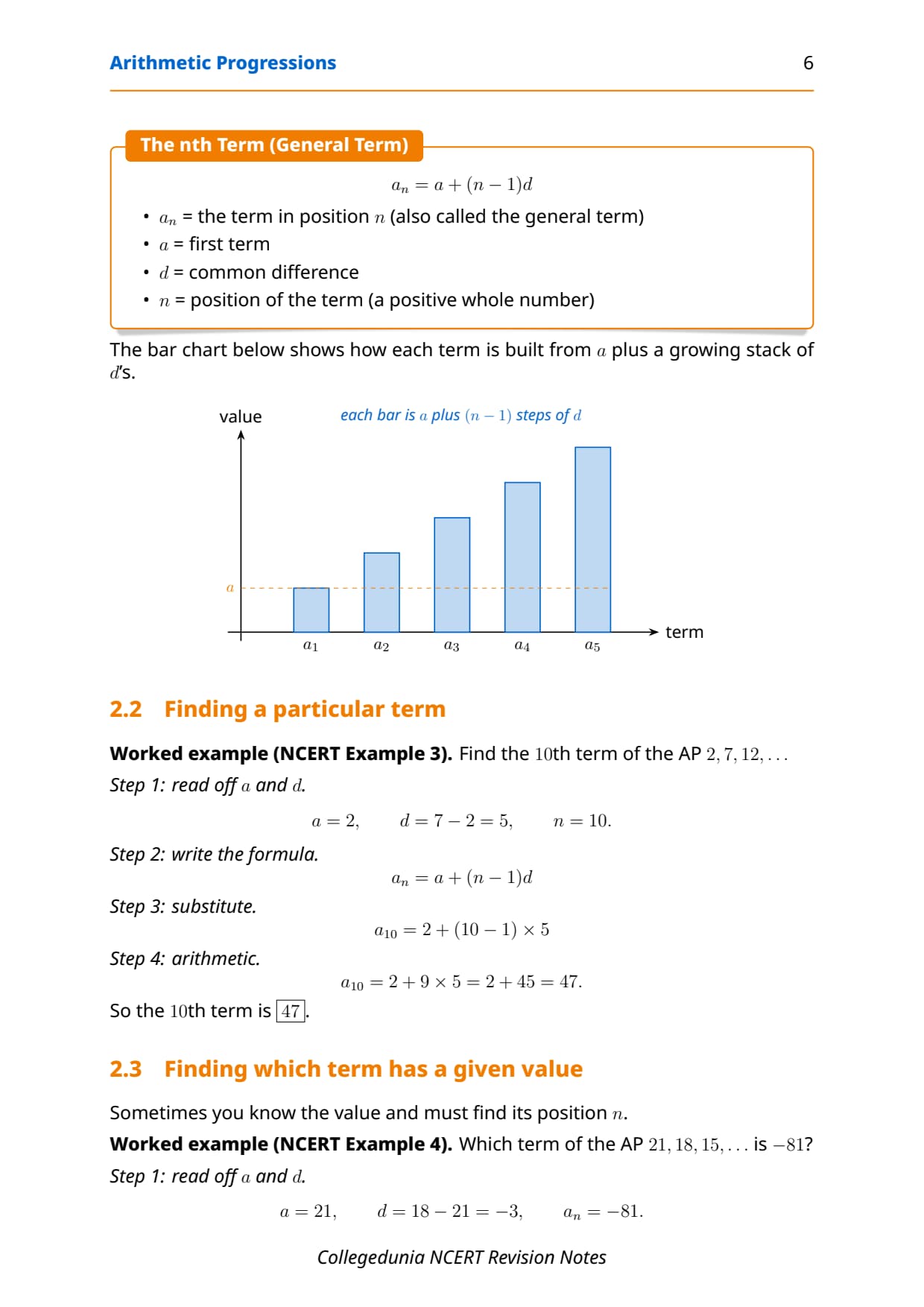
The nth term formula is the most important result in the chapter. It reaches any term without writing the ones before it. If the first term is a and the common difference is d:
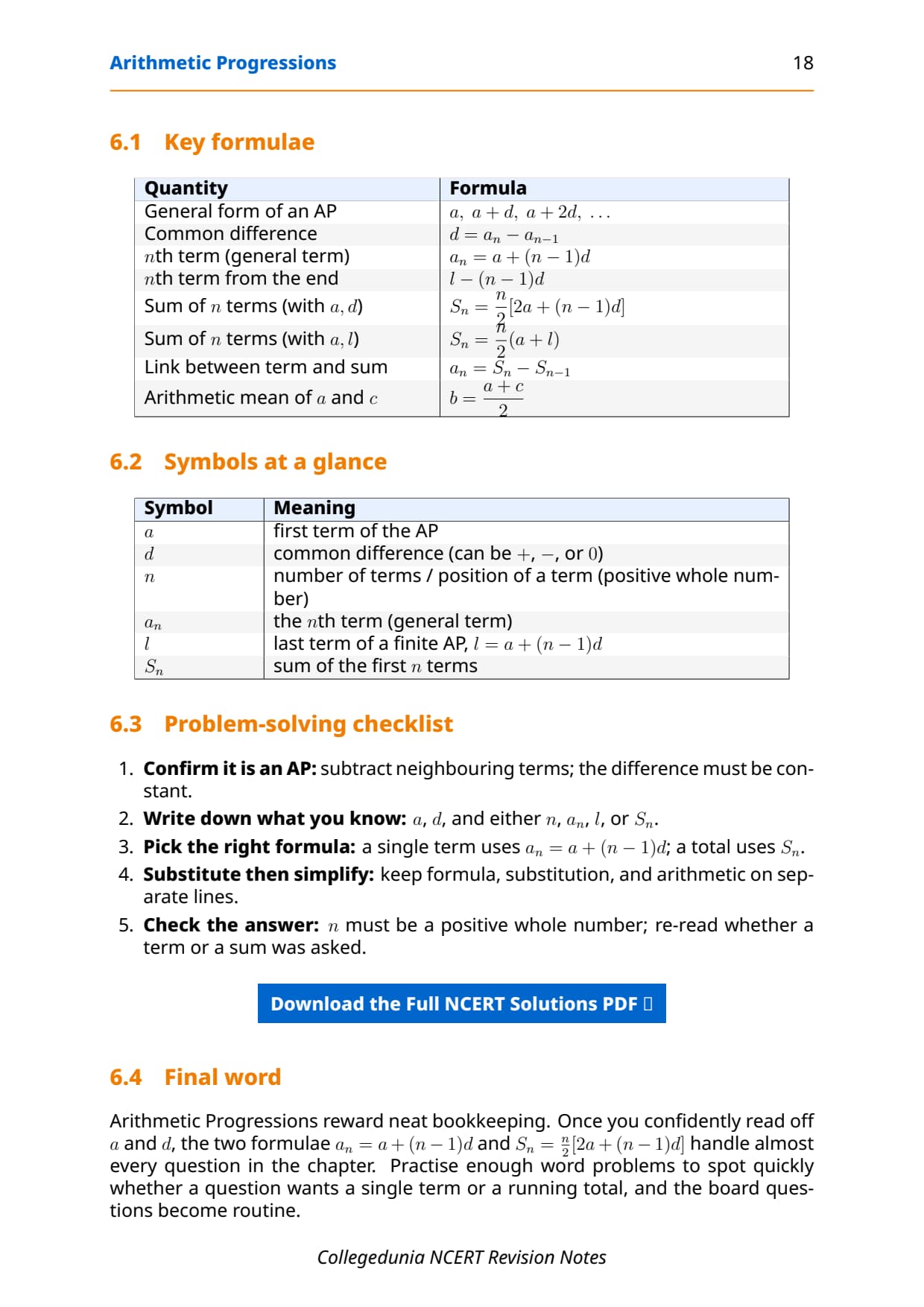
an = a + (n − 1)d
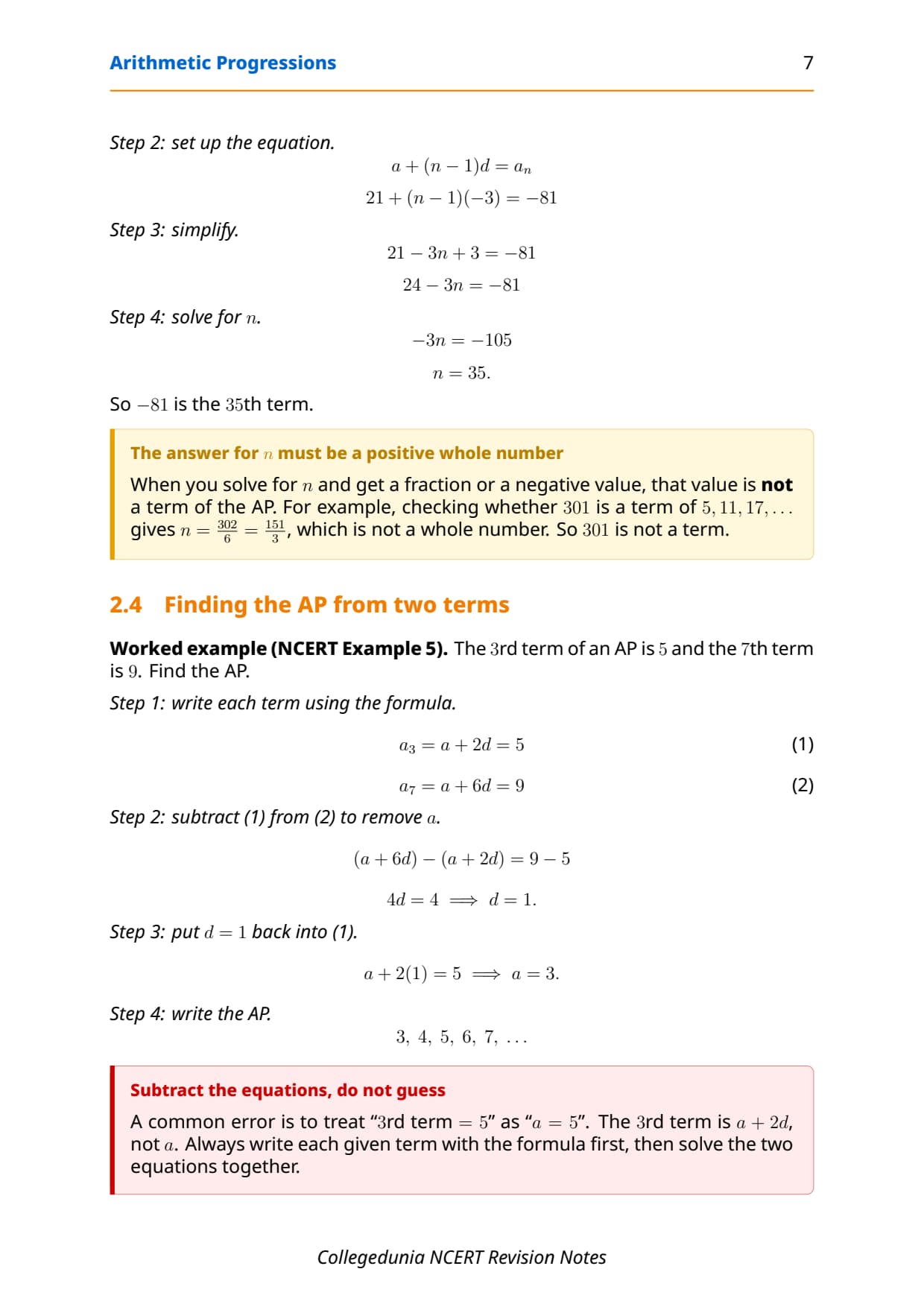
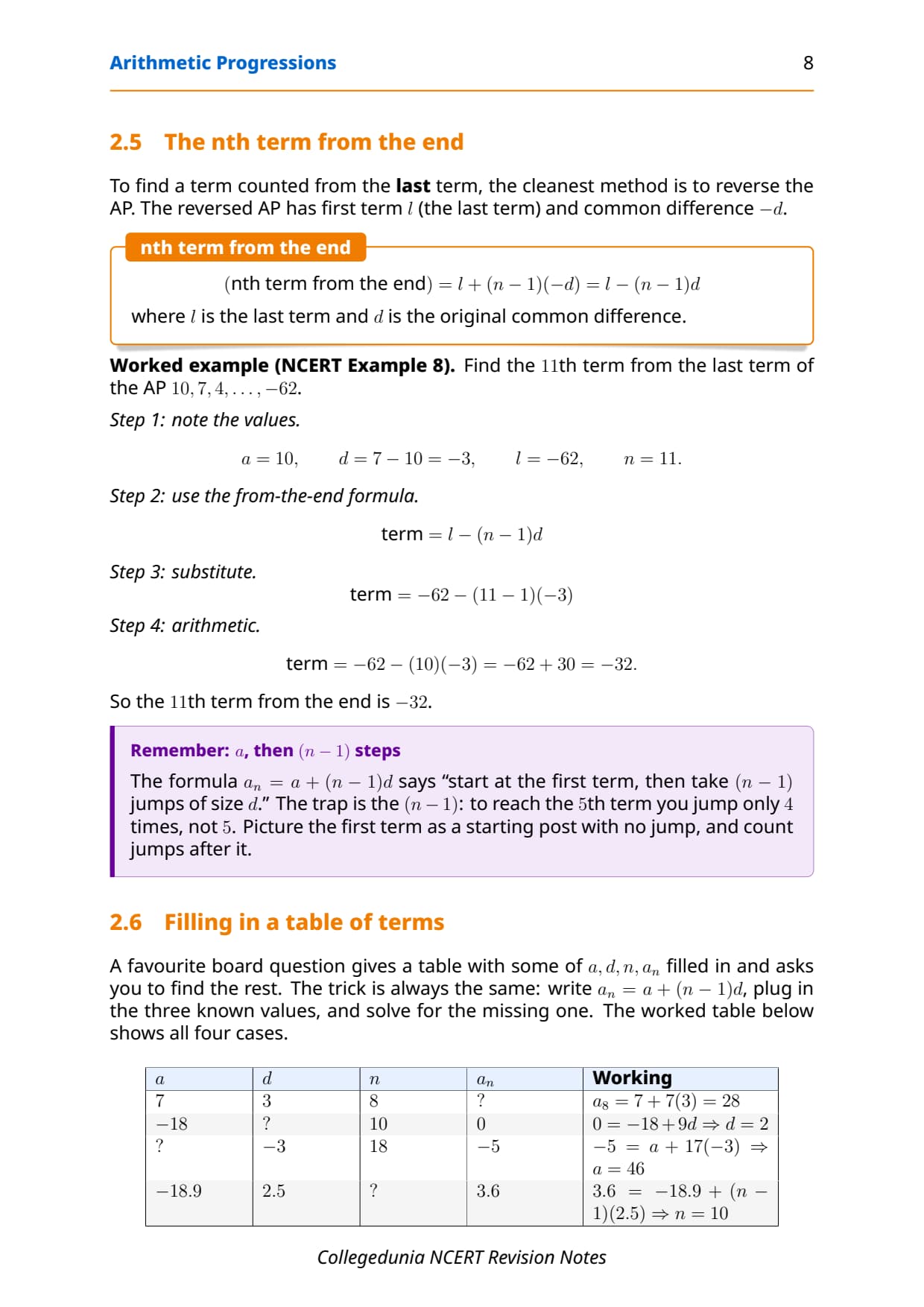
For the last term we write an = l, so l = a + (n − 1)d. Given any three of the four values (a, d, n, an), you can find the fourth, which is why the board sets so many question types on it.
- Find the 20th term: read off a and d, then put n = 20.
- Find which term equals a value: set an to that value and solve for n. If n is not a positive integer, the value is not in the AP.
- Is a value in the AP?: find n. A positive whole number means yes; anything else means no.
Example: for the AP 5, 8, 11, 14, …, a = 5 and d = 3. The 30th term is a30 = 5 + (30 − 1) × 3 = 5 + 87 = 92. Which term equals 89? Solve 89 = 5 + (n − 1) × 3, so 84 = 3(n − 1) and n = 29. So 89 is the 29th term.
Sum of n Terms of an AP
Adding the first n terms by hand is slow. The sum formula does it in one step, in two equal forms.
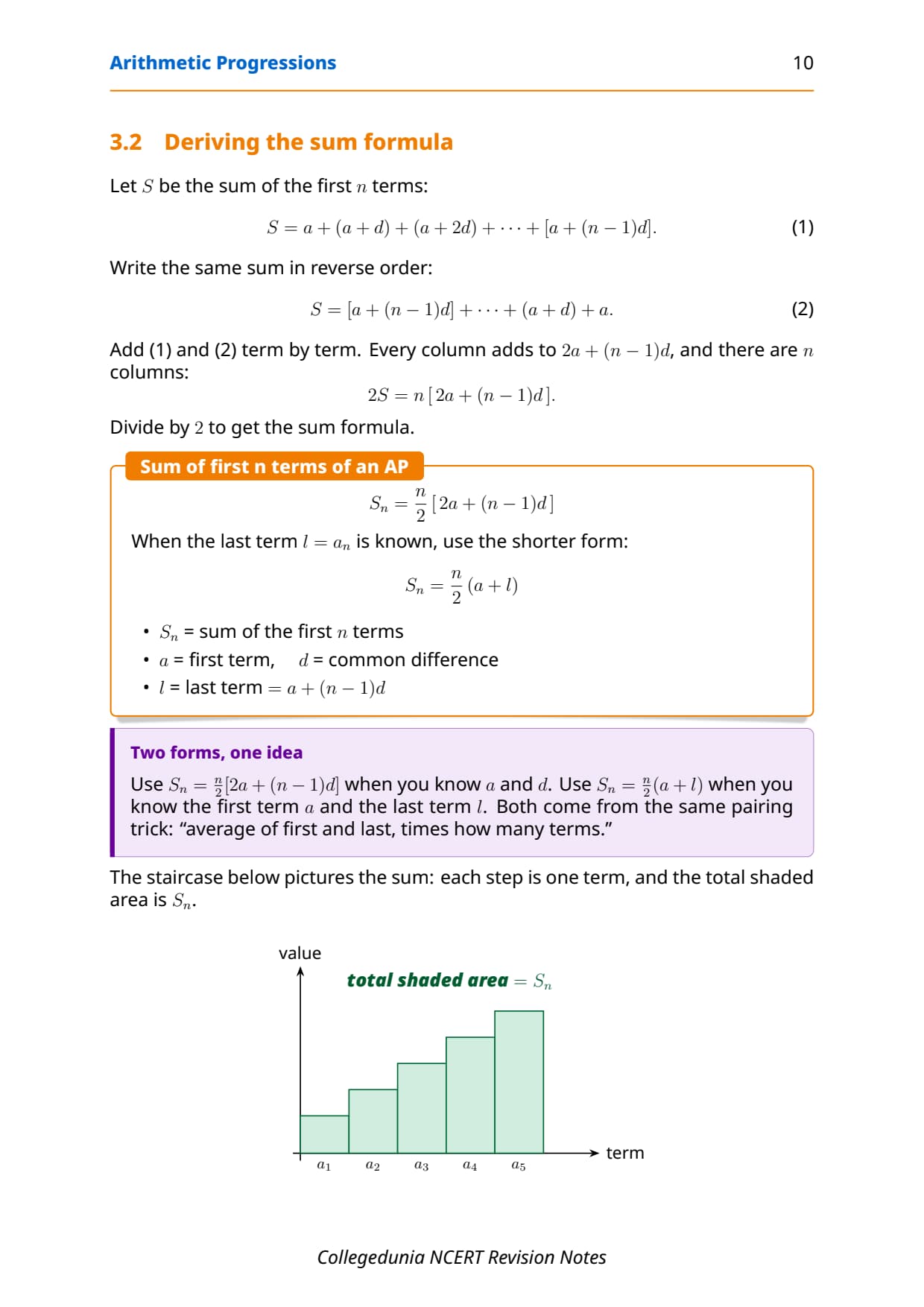
Sn = n/2 [2a + (n−1)d] (use when you know a and d)
Sn = n/2 (a + l) (use when you know the first term a and the last term l)
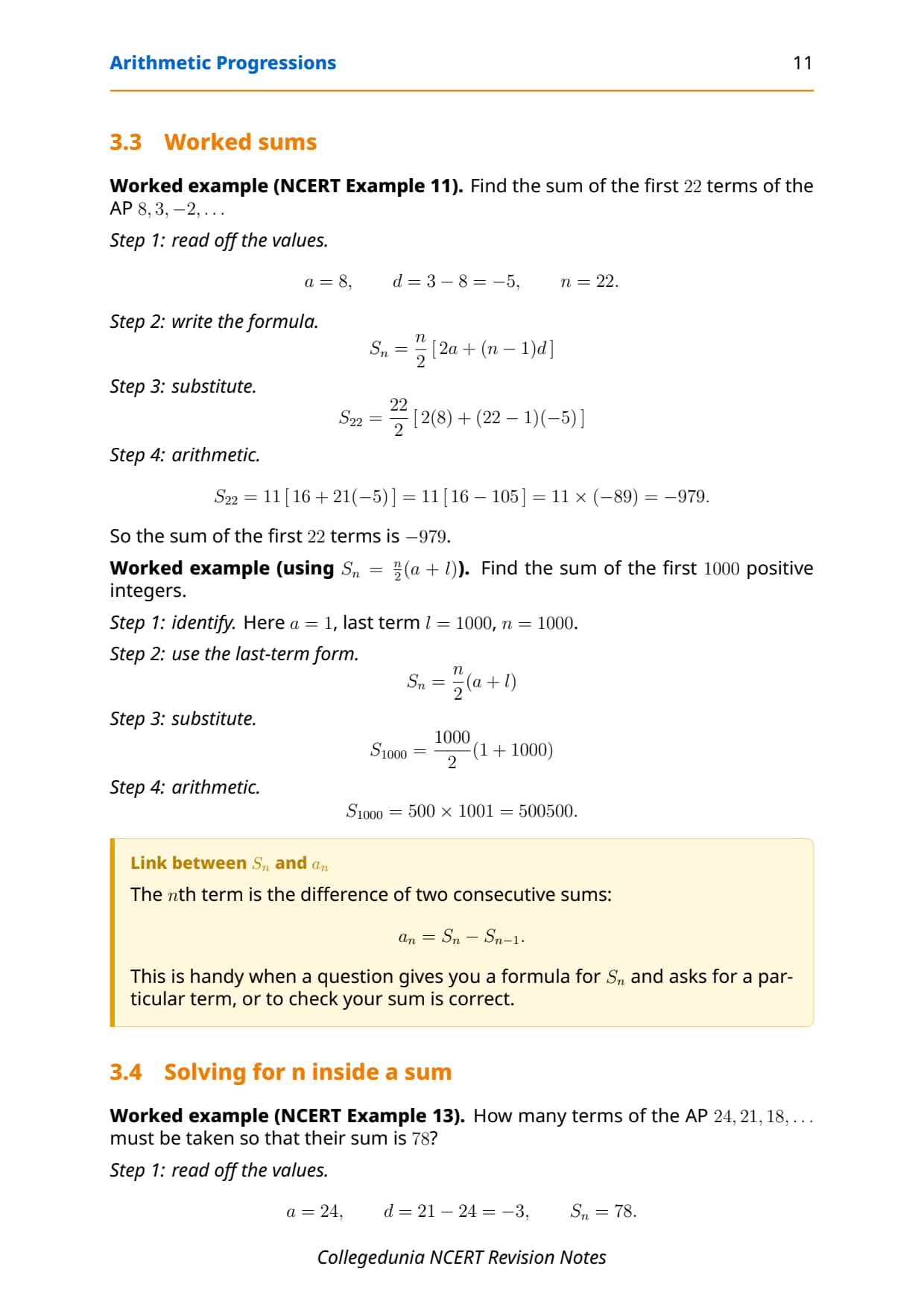
The second form comes from the first by putting l = a + (n−1)d. If a question gives Sn and asks for a term, use an = Sn − Sn−1 for n ≥ 2.
| AP | n | Formula used | Sum Sn |
|---|---|---|---|
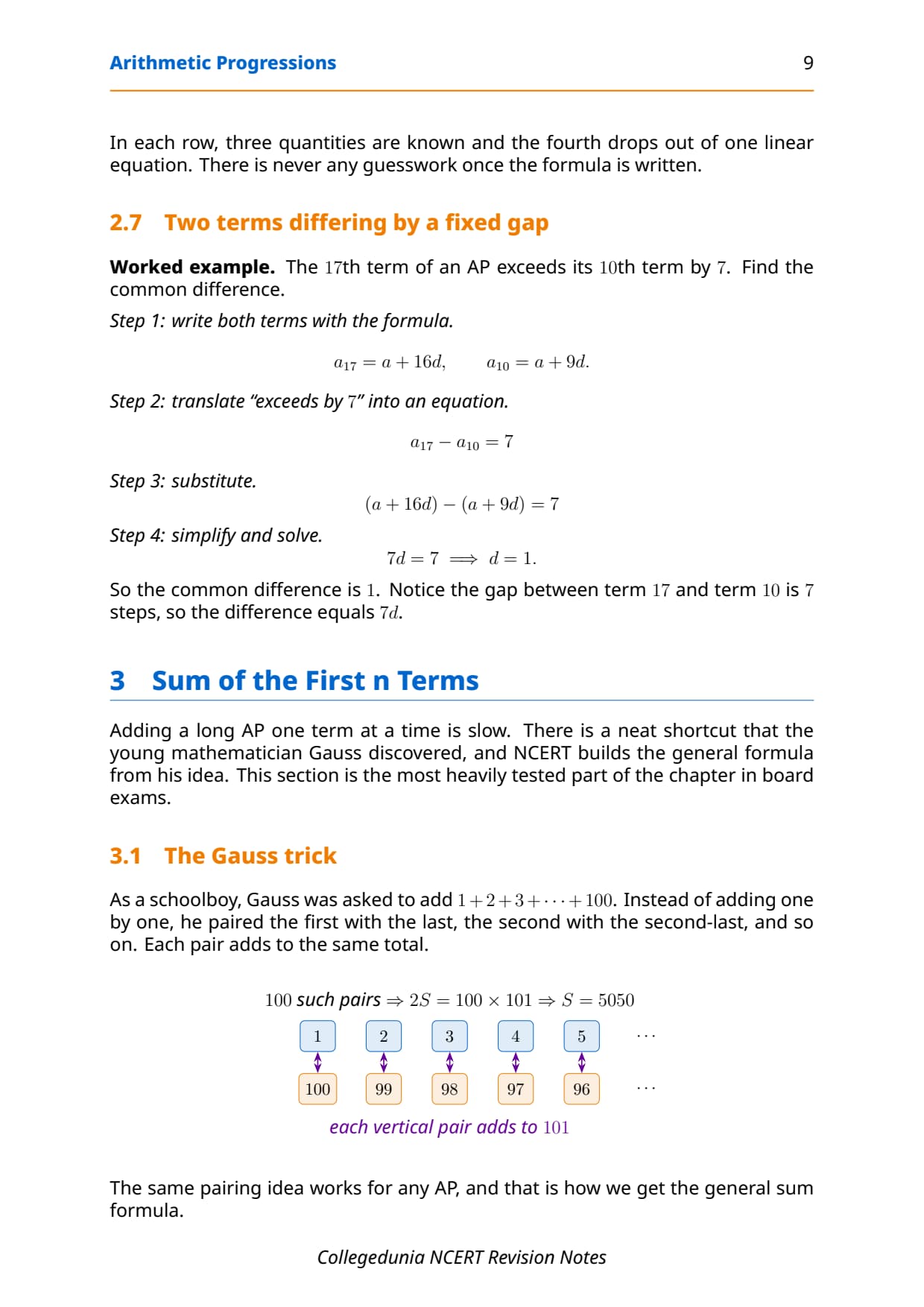
| 1, 2, 3, … | 100 | Sn = n/2 (a + l) with a=1, l=100 | 5050 |
| 7, 10, 13, … | 20 | Sn = n/2 [2a + (n−1)d] with a=7, d=3 | 20/2 [14 + 57] = 710 |
| 5, −3, −11, … | 10 | Sn = n/2 [2(5) + 9(−8)] | 5[10 − 72] = −310 |
The Gauss story of adding 1 to 100 (= 100/2 × 101 = 5050) sits inside the second form, and the NCERT textbook uses it to build the proof. Note that in Sn = n/2 [2a + (n−1)d], n is outside and (n−1) is inside; a common slip is putting the same one in both spots.
Word Problems on Arithmetic Progressions
Board papers almost always set a 3-mark or 5-mark word problem here. The key step is spotting what a, d, and n stand for in the story, then picking the right formula.
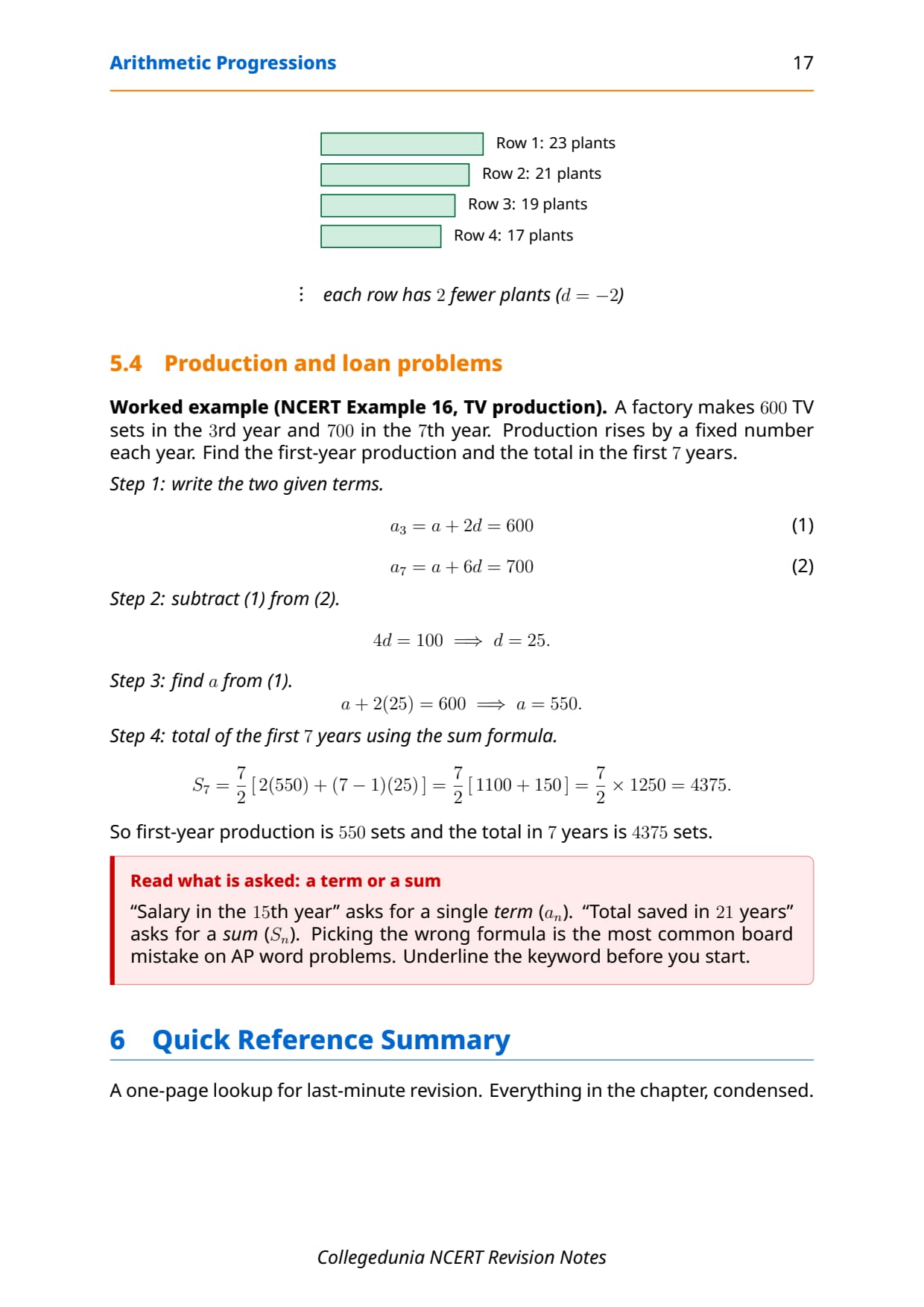
- Stadium rows or seats: seats per row form an AP. Use the sum formula for total seats.
- Savings or installments: equal monthly savings form an AP. Use the sum formula for the total after n months.
- Prizes and decreasing amounts: first prize, second prize, … form a falling AP. Find the total prize money.
- Three numbers in AP: write them as a−d, a, a+d, so their sum = 3a and d cancels. This shortcut cuts the work in half.
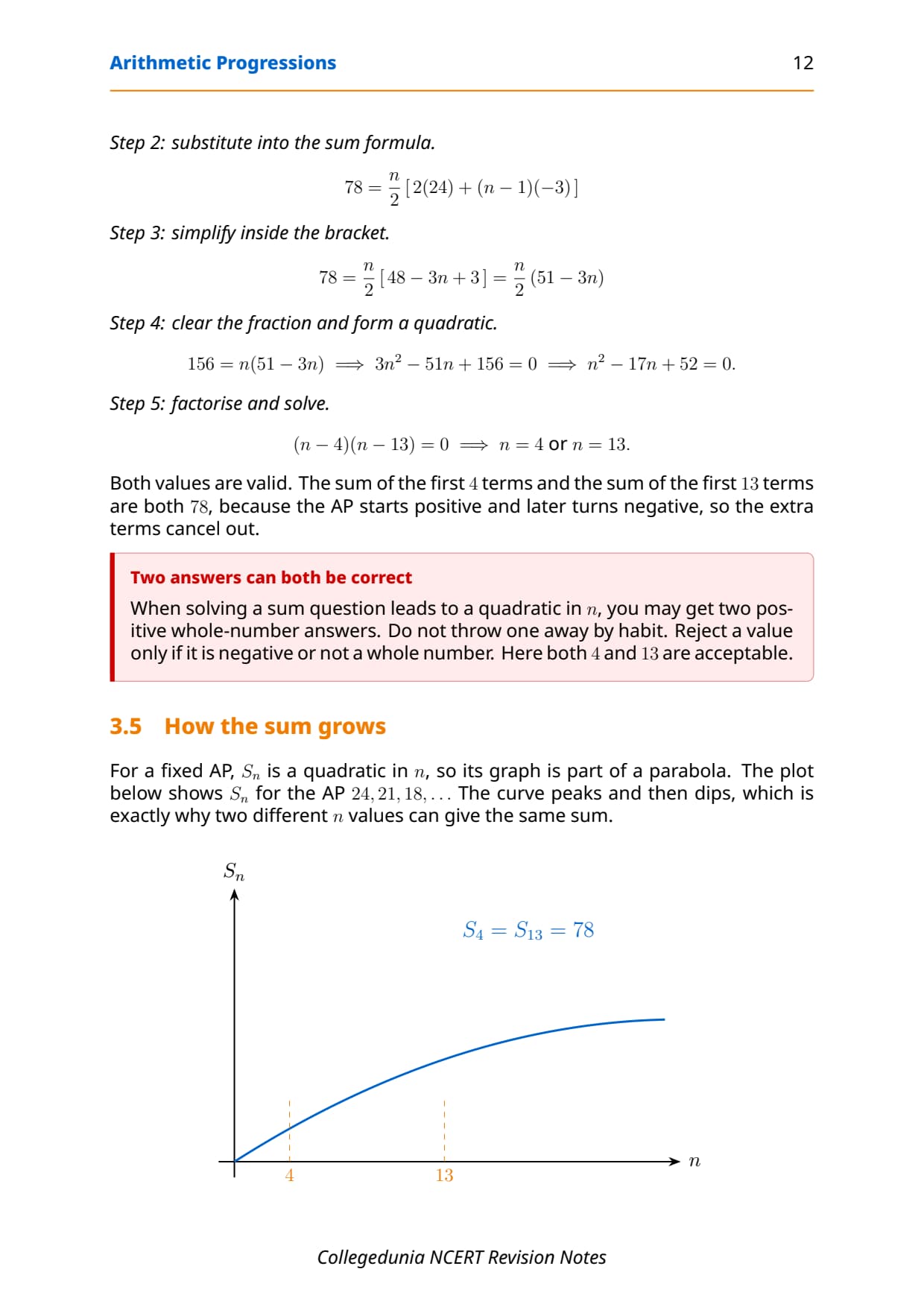
Example: prizes are Rs 600, Rs 500, Rs 400, …, total Rs 2100. Here a = 600 and d = −100. Set Sn = 2100: 2100 = n/2 [1200 + (n−1)(−100)], which gives n² − 13n + 42 = 0. Factorising, (n − 6)(n − 7) = 0, so n = 6 or n = 7. The 7th prize would be Rs 0, so 6 prizes are given.
How to Use These Notes for Board Revision
This chapter has three linked formulas, so revise in two passes. First, lock the basics: what an AP is, how to find d, how to test a general term, and the nth term formula an = a + (n−1)d, until finding any term feels automatic. Second, learn both sum forms and the a−d, a, a+d trick, then drill word problems. Every question type follows a fixed two or three step pattern, so practising Exercise 5.1 to 5.4 is the fastest route to full marks.
Previous Year Question Trends
Arithmetic Progressions is one of the most reliable score-givers in the CBSE Class 10 paper, appearing almost every year on the nth term, the sum formula, and word problems. The table maps recent question types.
| Year | Question type asked | Marks |
|---|---|---|
| 2025 | Sum of n terms, or find n given the sum | 3 |
| 2024 | Find the nth term, or check if a value is a term | 2 |
| 2023 | Word problem on installments, prizes, or rows of seats | 4 or 5 |
| 2022 | Find the common difference and first term | 2 or 3 |
| 2021 | Middle term, or sum of middle terms, of a finite AP | 2 |
Also Check: the full set of CBSE board questions for this chapter, with step-by-step answers, is in the PDF above, updated for 2026-27.
Common Mistakes to Avoid
Most lost marks here come from a few repeat errors. Each one is easy to dodge once you have seen it named.
The repeat-offender mistakes in AP board answers:
- Wrong sign on d: in a falling AP like 10, 7, 4, 1, d = −3, not +3. Dropping the minus gives the wrong term.
- Off-by-one: the formula is a + (n−1)d, not a + nd. The −1 is there because the first term has d applied zero times.
- Mixing up Sn and an: Sn is the total of n terms; an is just the nth term. The 15th term needs an, not Sn.
- Not checking n: when you find which term equals a value, n must be a positive whole number. A fraction or zero means the value is not in the AP.
- Forgetting the short sum form: when you know the last term l, use Sn = n/2 (a + l). The longer form just wastes time.
Other Resources for This Chapter
Pair these notes with the matching NCERT Solutions, formula sheet, handwritten notes, and the official NCERT book chapter. All resources for Class 10 Maths Chapter 5 Arithmetic Progressions are linked below.
| Resource | What it covers | Open |
|---|---|---|
| Notes | Concept-first revision on the AP definition, common difference, nth term, sum of n terms, and word problems. | You are here |
| NCERT Solutions | Step-by-step answers to all Exercise 5.1 to 5.4 questions, with an Expert Solution each. | Class 10 Maths Chapter 5 NCERT Solutions |
| Formula Sheet | One-page list of the nth term formula, both sum forms, and the middle-term shortcuts. | Class 10 Maths Chapter 5 Formula Sheet |
| Handwritten Notes | Scanned-style handwritten pages for last-minute board revision. | Class 10 Maths Chapter 5 Handwritten Notes |
| NCERT Book PDF | Official NCERT Maths Chapter 5 Arithmetic Progressions textbook in PDF form. | Class 10 Maths Chapter 5 NCERT Book PDF |
| Exemplar Solutions | Worked answers to the harder NCERT Exemplar problems for extra practice. | Class 10 Maths Chapter 5 Exemplar Solutions |
Notes for Class 10 Maths: All Chapters
Related Links: use the table below to open the revision notes for the other chapters of Class 10 Maths. Each one has the same concept-first style, full PDF download, and revision FAQ.
| Chapter | Notes link |
|---|---|
| Chapter 1 | Real Numbers Notes |
| Chapter 2 | Polynomials Notes |
| Chapter 3 | Pair of Linear Equations in Two Variables Notes |
| Chapter 4 | Quadratic Equations Notes |
| Chapter 5 | Arithmetic Progressions Notes (You are here) |
| Chapter 6 | Triangles Notes |
| Chapter 7 | Coordinate Geometry Notes |
| Chapter 8 | Introduction to Trigonometry Notes |
| Chapter 9 | Some Applications of Trigonometry Notes |
| Chapter 10 | Circles Notes |
| Chapter 11 | Areas Related to Circles Notes |
| Chapter 12 | Surface Areas and Volumes Notes |
| Chapter 13 | Statistics Notes |
| Chapter 14 | Probability Notes |
Class 10 Maths Chapter 5 Arithmetic Progressions Notes FAQs
Ques. What does Chapter 5 Arithmetic Progressions cover in Class 10 Maths?
Ans. Chapter 5 covers four ideas in the 2026-27 CBSE syllabus. First, recognising an AP: a list where the gap between consecutive terms is a fixed constant, the common difference d. Second, the nth term formula an = a + (n−1)d, which finds any term without listing the earlier ones. Third, the sum of n terms: Sn = n/2 [2a + (n−1)d] when you know d, or Sn = n/2 (a + l) when you know the last term l. Fourth, using these in word problems on savings, installments, prizes, and stadium seating.
Ques. What is the formula for the nth term of an AP?
Ans. The nth term is an = a + (n−1)d, where a is the first term, d is the common difference, and n is the position you want. For 3, 7, 11, 15, …, read a = 3 and d = 4, so a15 = 3 + (15−1) × 4 = 3 + 56 = 59. The same formula finds how many terms the AP has: set an to the last term and solve for n. Use it in reverse to test if a number is in the AP: a positive whole n means yes, anything else means no.
Ques. What are the two formulas for the sum of n terms of an AP?
Ans. There are two equal forms. Sn = n/2 [2a + (n−1)d] uses the first term a and the common difference d. Sn = n/2 (a + l) uses a and the last term l, where l = a + (n−1)d. Both give the same answer. Use the second form when l is known, since it is shorter. A handy result is an = Sn − Sn−1 for n ≥ 2. It gives any single term when you are only given the sum formula, a common board question.
Ques. How do you check whether a sequence is an Arithmetic Progression?
Ans. Subtract consecutive terms and check the gaps are all equal. Find t2 − t1, then t3 − t2, then t4 − t3. If all three are the same, it is an AP and that value is d. If any pair differs, it is not an AP. Given a general term like an = 3n + 2, put n = 1, 2, 3, 4 to get the first four terms, then check the gaps. A linear an (degree 1) always gives an AP; quadratic or higher does not.
Ques. What is the trick for "three numbers in AP" questions?
Ans. When three numbers are in AP and you know their sum, write them as a−d, a, a+d instead of a, a+d, a+2d. Their sum is (a−d) + a + (a+d) = 3a, so d cancels. You get a from the sum alone, and d from another condition (often their product or squares). This halves the algebra. For four numbers, use a−3d, a−d, a+d, a+3d, so their sum is 4a and d still cancels.
Ques. Can the common difference of an AP be zero or negative?
Ans. Yes to both. If d = 0, every term equals the first, giving a constant list like 5, 5, 5, 5, …. That is a valid AP. If d is negative, the terms fall as you go further, giving a descending AP like 20, 15, 10, 5, … with d = −5. Board papers test this in one-mark questions, often by asking for d of a falling list. Always work out d = a2 − a1 from the actual terms rather than guessing the sign.
Ques. How many pages is the Class 10 Maths Arithmetic Progressions Notes PDF?
Ans. The Notes PDF runs about 22 pages and covers the full chapter in concept-first blocks. It has the AP definition and common difference, how to spot APs from general terms, the nth term formula an = a + (n−1)d, both sum forms, the middle-term trick, and solved word problems on savings, prizes, and seating. It is free to download for 2026-27, and a green Handwritten Notes button on this page opens the scanned-style version.
Ques. Are these Notes for Class 10 Maths Chapter 5 aligned with the 2026-27 syllabus?
Ans. Yes. This page follows the current 2026-27 CBSE syllabus for Class 10 Maths. Arithmetic Progressions is Chapter 5 in the Algebra unit, focused on APs, the nth term formula, the sum of n terms, and real-life uses. These notes keep the NCERT order and are built for the CBSE board exam. The same AP formulas return in higher classes, so the pattern habit you build here helps with Class 11 sequences and series.



Comments