




These Notes for Class 10 Maths Chapter 10 Circles give a concept-first revision of the whole chapter, set to the 2026-27 CBSE syllabus. Circles asks one question: when a line meets a circle, how many points can they share? That leads to two theorems. The tangent is perpendicular to the radius at the point of contact. The two tangents from an outside point are equal. These two results power every board question.
- Theorem 10.1 and Theorem 10.2 fully covered with proofs, worked examples, and the figures you must draw.
- Standard setups solved step by step: two tangents from a point, a circumscribing quadrilateral, concentric circles, and a triangle around a circle.
- Set to the rationalised 2026-27 syllabus, so you score full on the 4 to 6 marks this chapter carries.
These Collegedunia revision notes are curated by Maths subject experts, according to the 2026-27 NCERT textbook, and refined against the last five years of CBSE Class 10 Maths board papers.
Student Feedback: What 9,200 students said
78% of students said marking the right angle between radius and tangent first saved the most marks. Once that 90° is on paper, a right triangle appears and Pythagoras does the rest. 4 out of 5 students who lost marks erred before writing any equation. They skipped the diagram or forgot the right angle.
Toppers called Circles one of the most formula-light but concept-heavy chapters in Class 10 Maths. There are only two theorems. Students who learned each proof, not just the result, found every board question familiar. Each one is just a variation on those two results.
Source: 2026-27 Class 10 Maths student poll, 9,200 students from CBSE schools in 14 states, before the 2026 boards.
Watch Circles Class 10 Maths Explained
Source: Magnet Brains on YouTube
What These Circles Notes Cover
Circles shifts the focus from chords to tangents, a line that touches the circle at exactly one point. The chapter proves two theorems, then uses them to solve board problems.
- Line and circle positions: a line can miss, cut (secant, two points), or touch (tangent, one point) the circle, decided by the distance from the centre versus the radius.
- Theorem 10.1: the tangent is perpendicular to the radius at the contact point. This right angle unlocks Pythagoras in almost every problem.
- Theorem 10.2: the two tangents from an external point are equal, which gives the circumscribing polygon results.
- Standard setups: two tangents from a point, a quadrilateral or triangle around a circle, and concentric circles.
A Circle and a Line: Secant vs Tangent
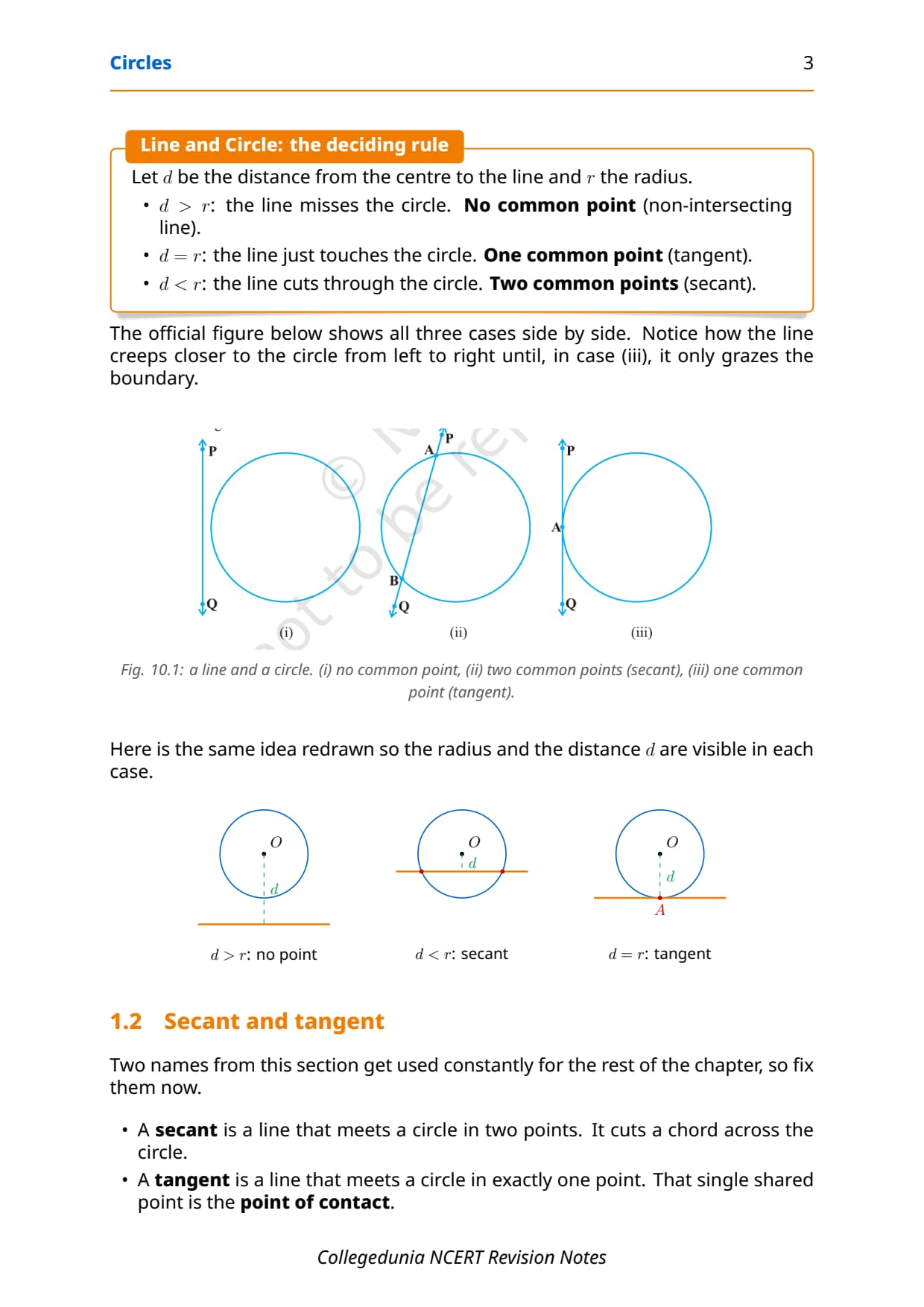
When a line and a circle sit in the same plane, how many points they share turns on one number: the perpendicular distance d from the centre to the line, compared with the radius r.
| Condition | Number of common points | What the line is called |
|---|---|---|
| d > r | 0 | Non-intersecting line (misses the circle) |
| d = r | 1 | Tangent (touches the circle at one point) |
| d < r | 2 | Secant (cuts through the circle) |
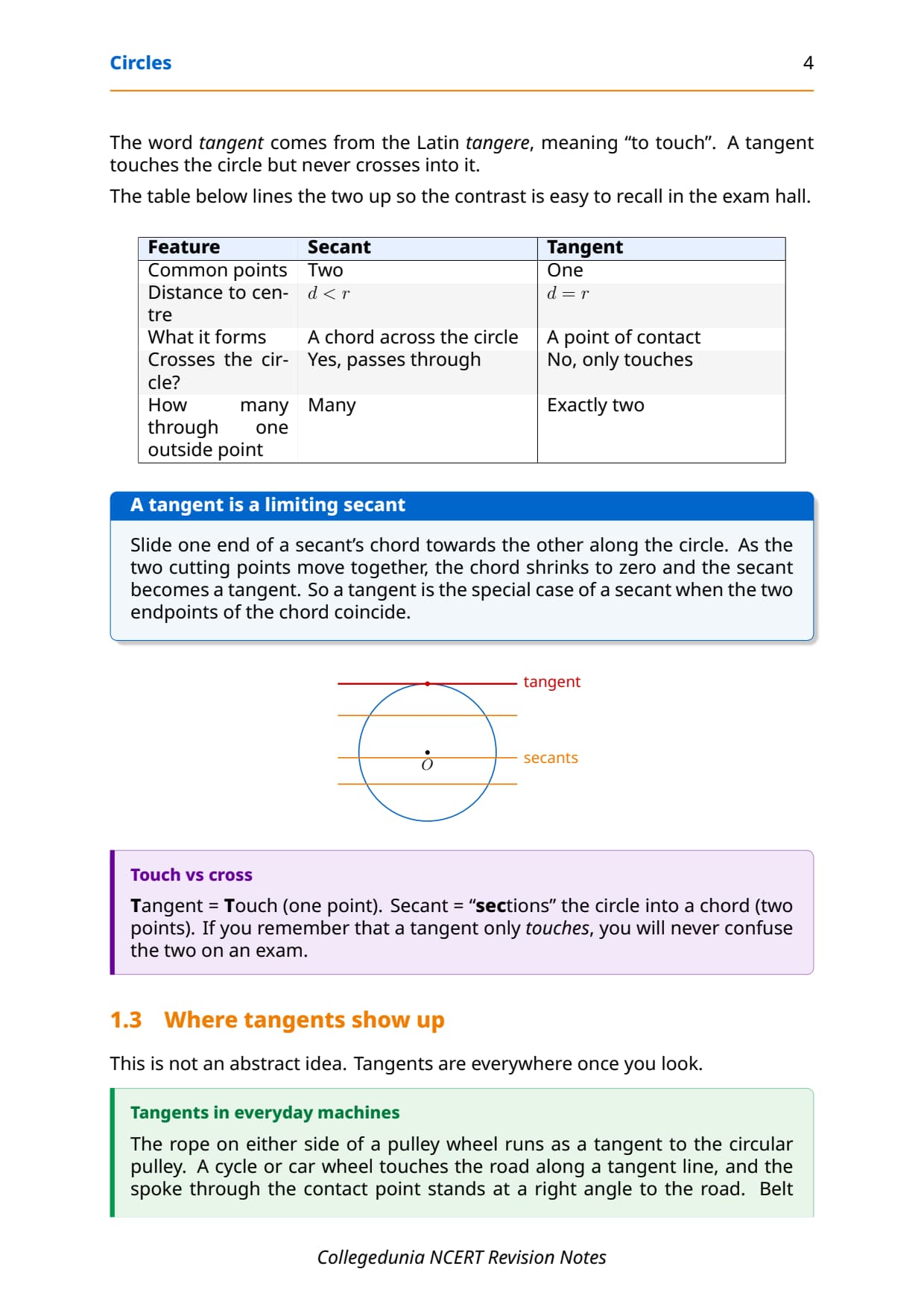
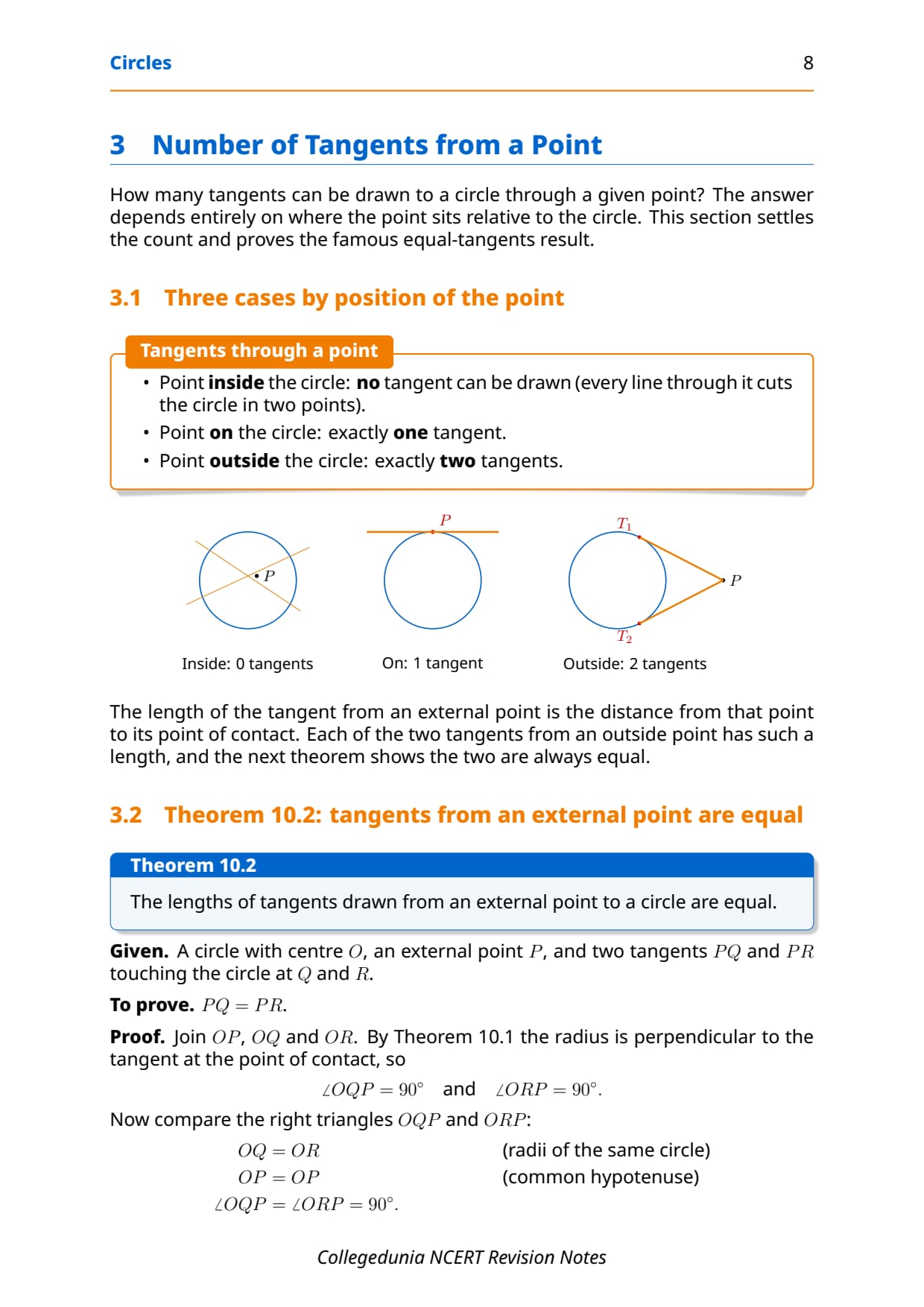
The point where a tangent meets the circle is the point of contact. A tangent is a secant whose chord has shrunk to zero. Through a point inside the circle no tangent passes; on the circle, one; outside, exactly two.
Theorem 10.1: Tangent is Perpendicular to the Radius
Statement: the tangent at any point of a circle is perpendicular to the radius drawn to the point of contact.
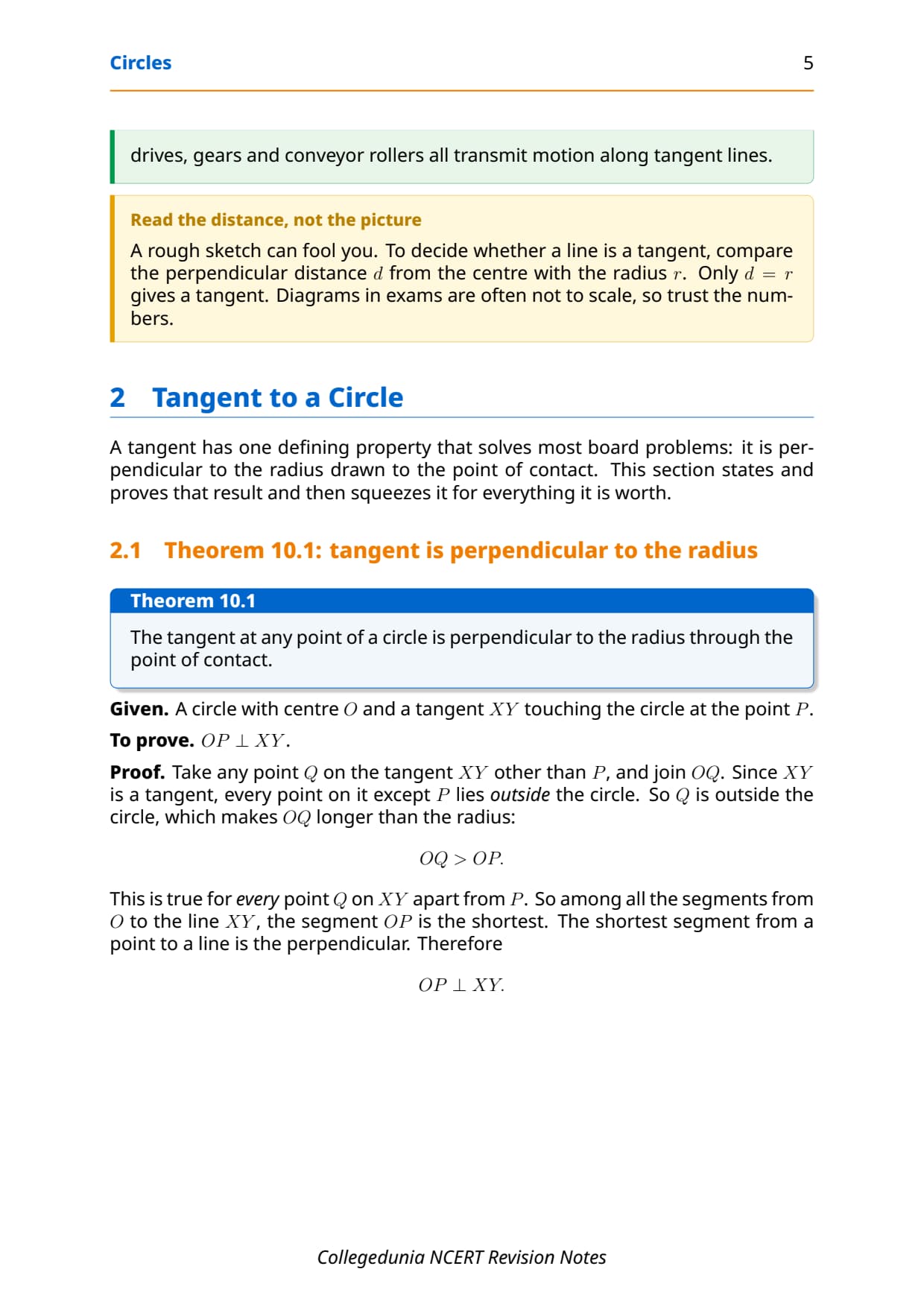
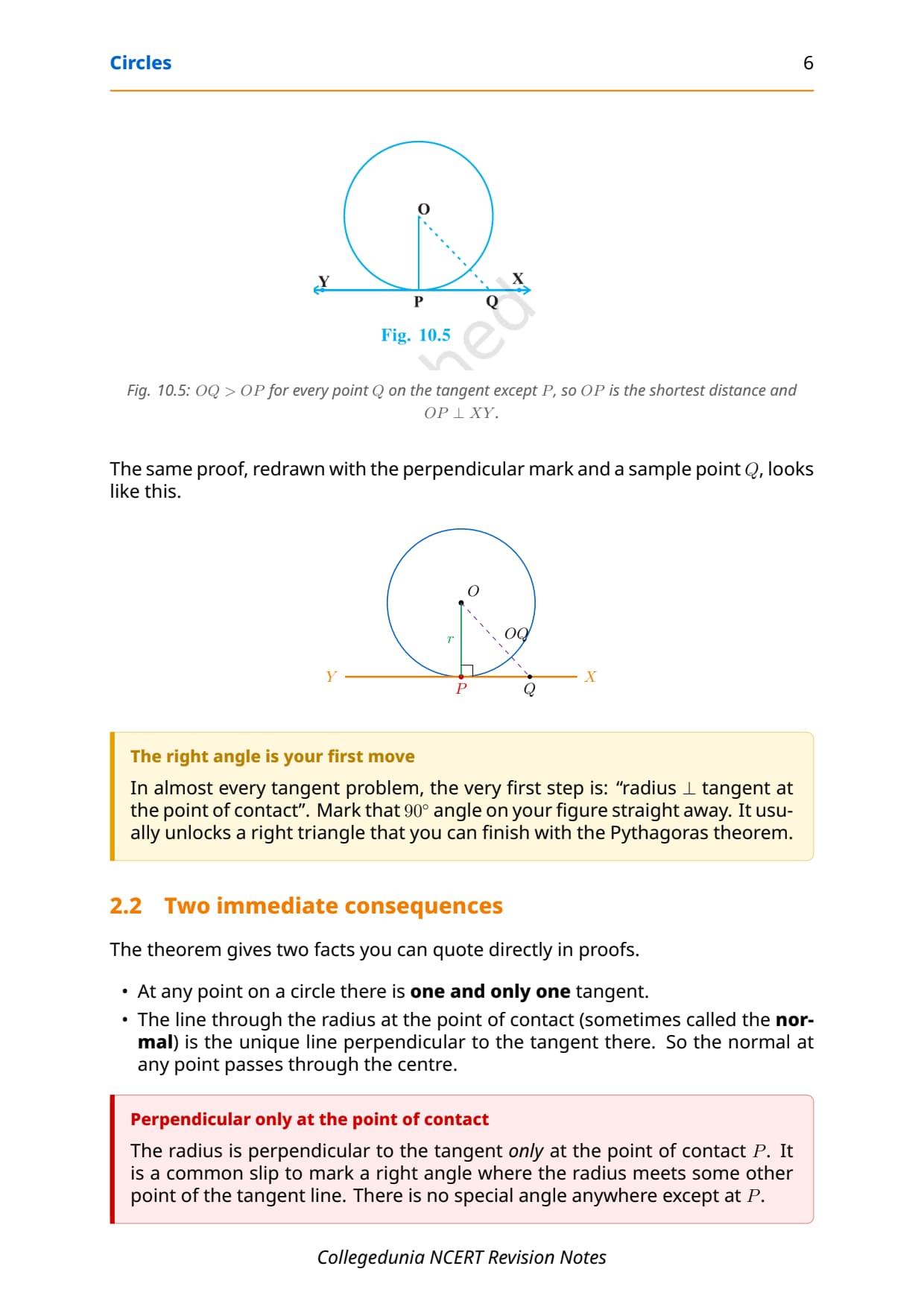
Proof (shortest-distance): Let tangent XY touch the circle (centre O) at P. Any other point Q on XY lies outside the circle, so OQ > OP. So OP is the shortest segment from O to the line, and the shortest distance is the perpendicular. Hence OP ⊥ XY.
Finding the tangent length
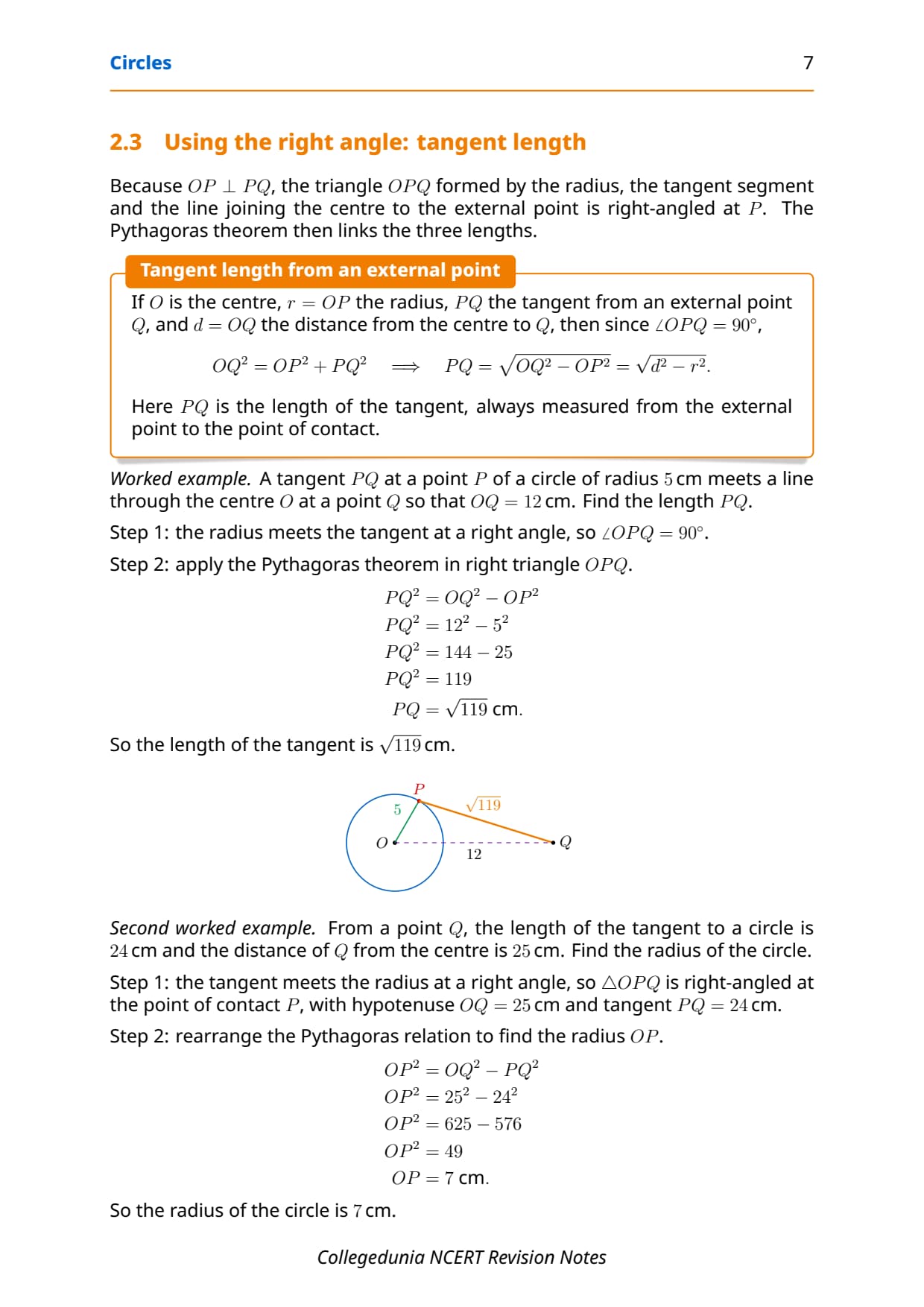
The triangle made by the radius (OP), tangent segment (PQ), and line from centre to external point (OQ) is right-angled at P, so Pythagoras gives:
PQ = √(OQ2 − OP2) = √(d2 − r2)
where d = OQ (centre to external point) and r = OP (radius). Two facts follow: each point has exactly one tangent, and the normal at the contact point passes through the centre.
Theorem 10.2: Tangents from an External Point are Equal
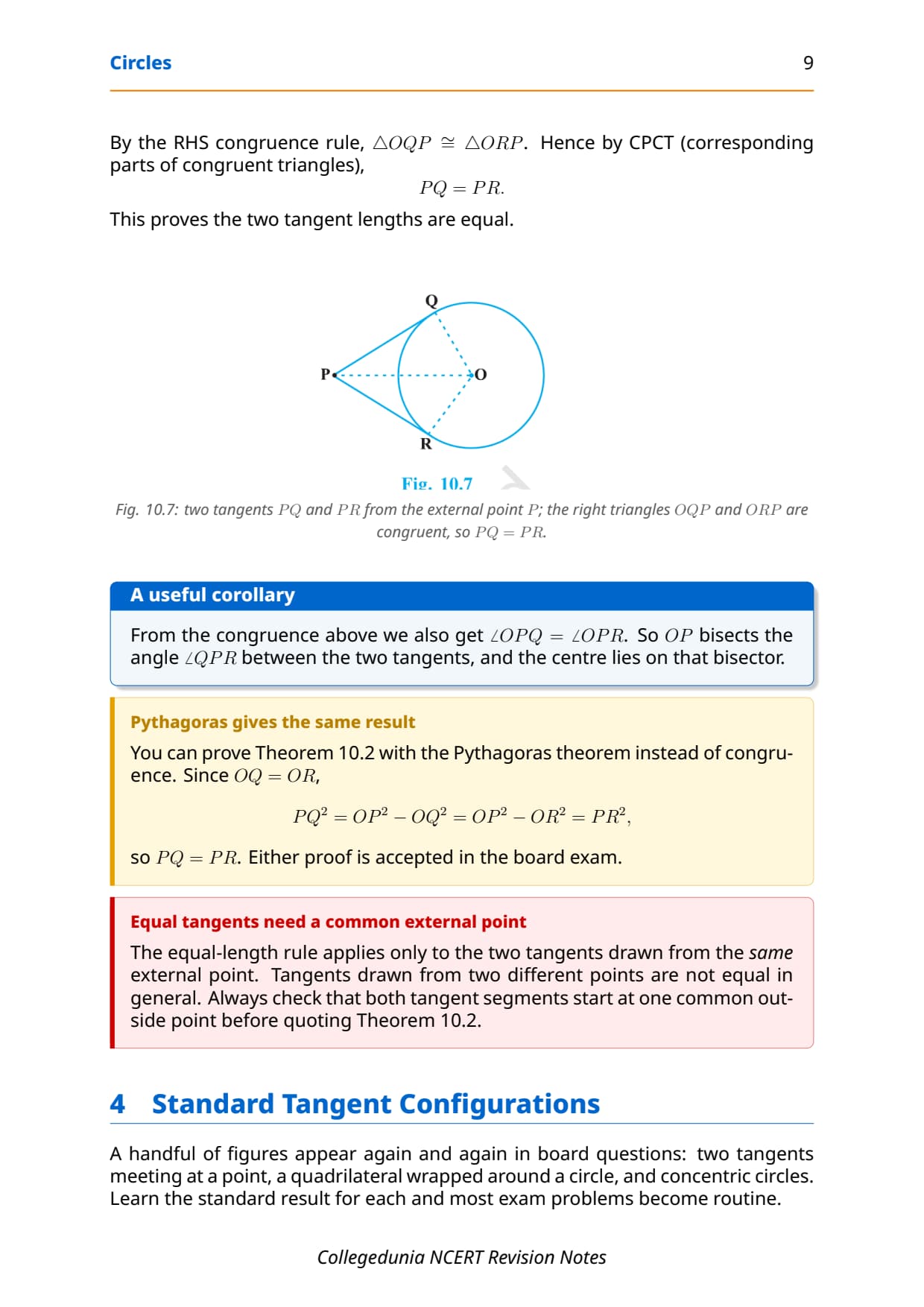
Statement: the two tangents drawn from an external point to a circle are equal in length. This equal-tangent property drives the circumscribing polygon results.
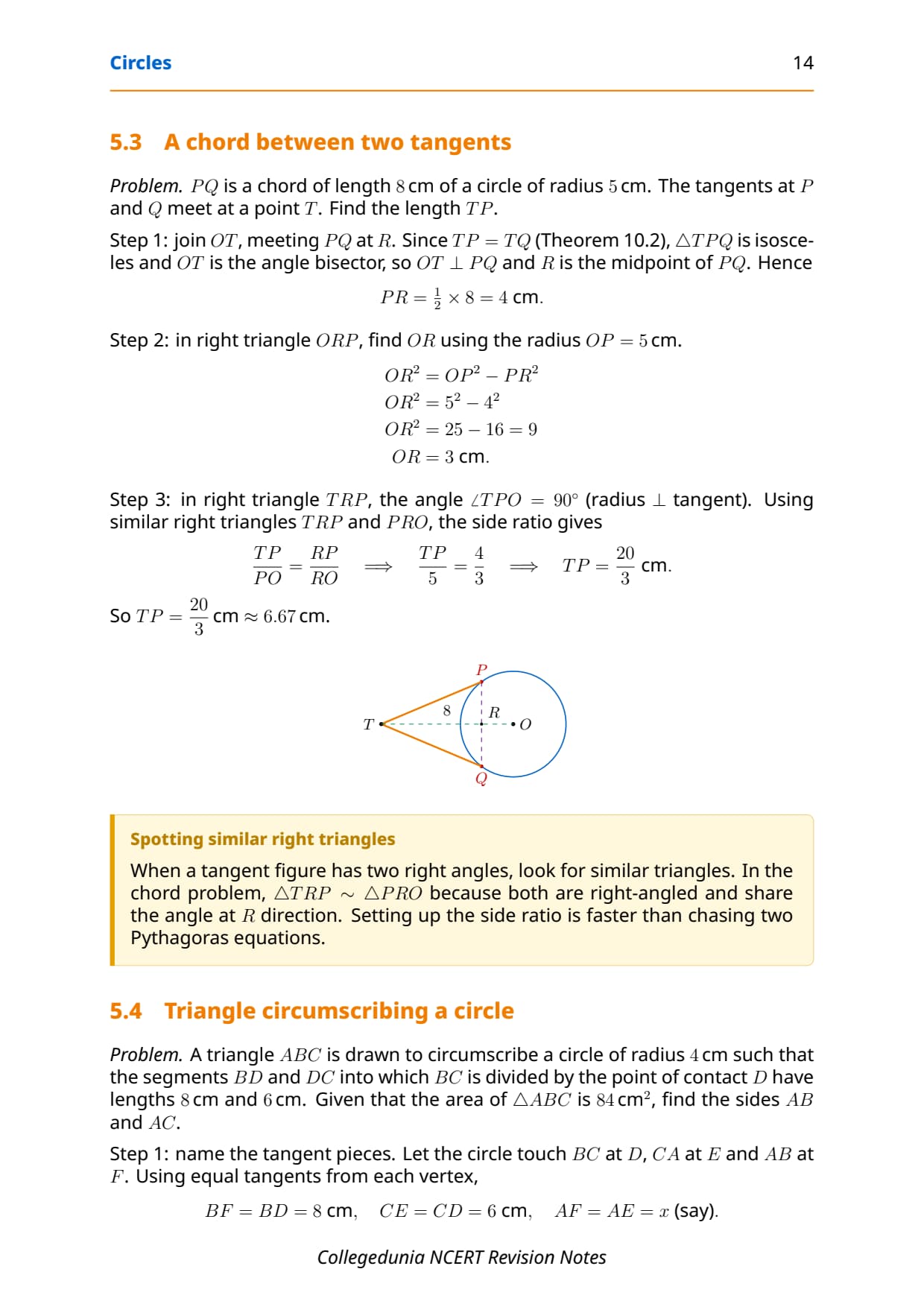
Proof (RHS congruence): For tangents PQ and PR from external point P, join OP, OQ, OR. By Theorem 10.1, angle OQP = angle ORP = 90°. The right triangles OQP and ORP share OP (hypotenuse) and have OQ = OR (radii), so they are congruent by RHS, giving PQ = PR by CPCT. The same congruence shows OP bisects angle QPR and is the perpendicular bisector of chord QR. The points O, Q, P, R form a kite with right angles at Q and R, so the other two angles are supplementary:
angle QPR + angle QOR = 180°
This supplementary-angle result is a very common "find the angle" board question.
Standard Tangent Configurations
Board questions come in a short list of setups. This table maps each to its opening step.
| Configuration | First move | Key formula or rule |
|---|---|---|
| Tangent length from external point | Mark 90°; right triangle OPQ | PQ = √(OQ2 − r2) |
| Radius from tangent length | Same right triangle | r = √(OQ2 − PQ2) |
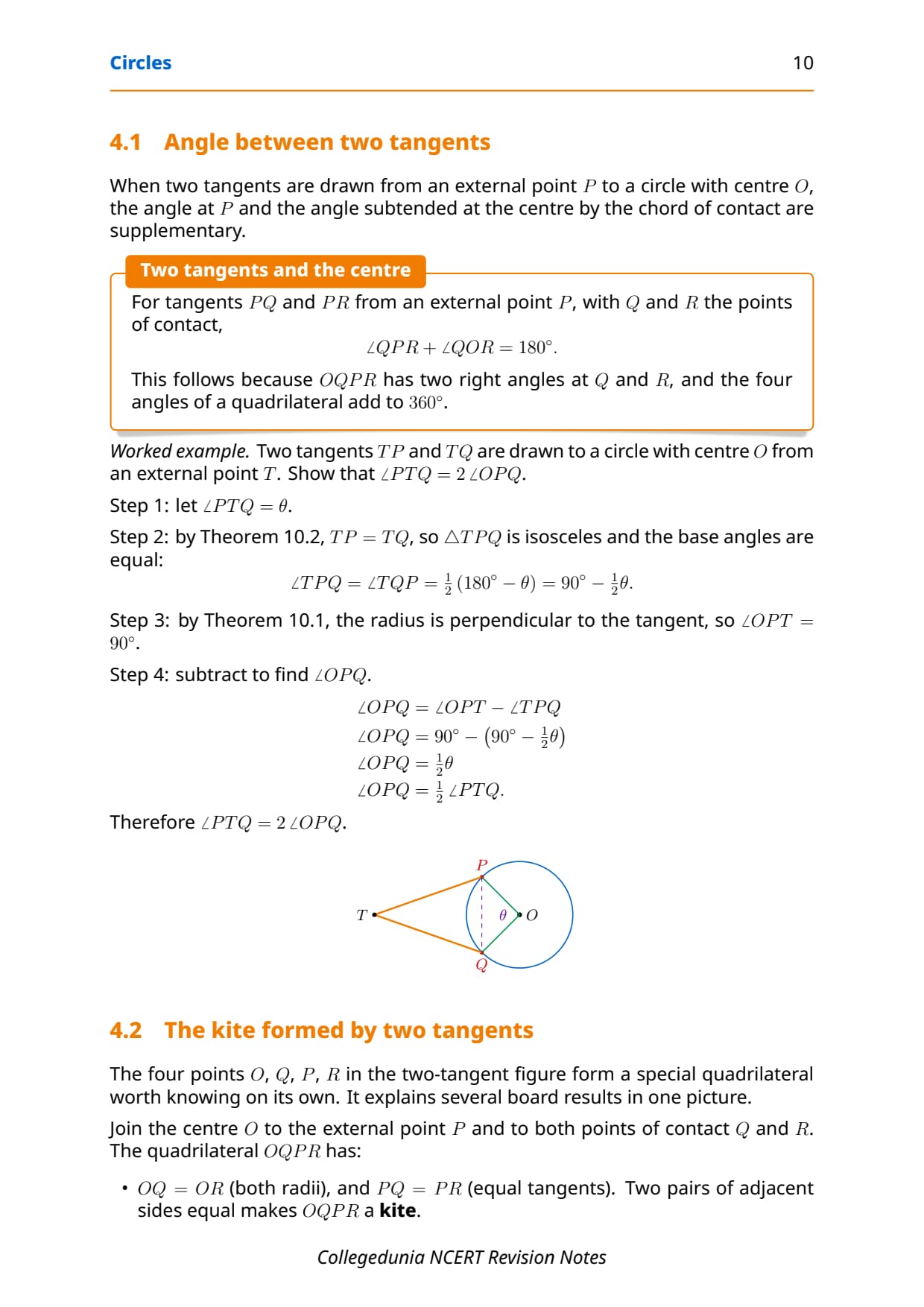
| Centre angle from tangent angle | Supplementary pair | angle QPR + angle QOR = 180° |
| Angle POQ from angle at P | OP bisects angle QPR | angle POQ = 90° − (angle QPR / 2) |
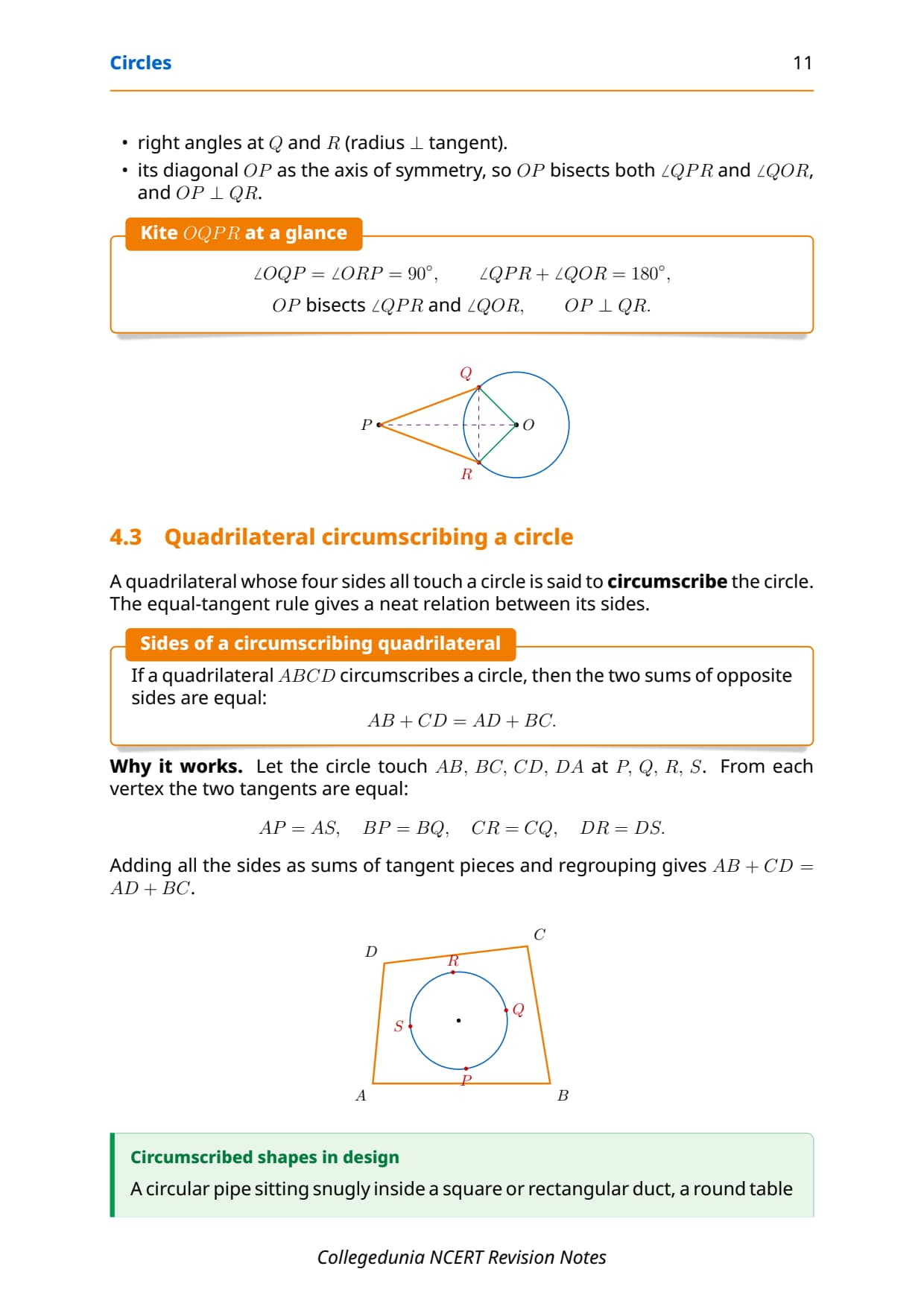
| Quadrilateral circumscribing circle | Equal tangents per vertex | AB + CD = AD + BC |
| Triangle circumscribing circle | Equal tangents + semi-perimeter | Area = r × s |
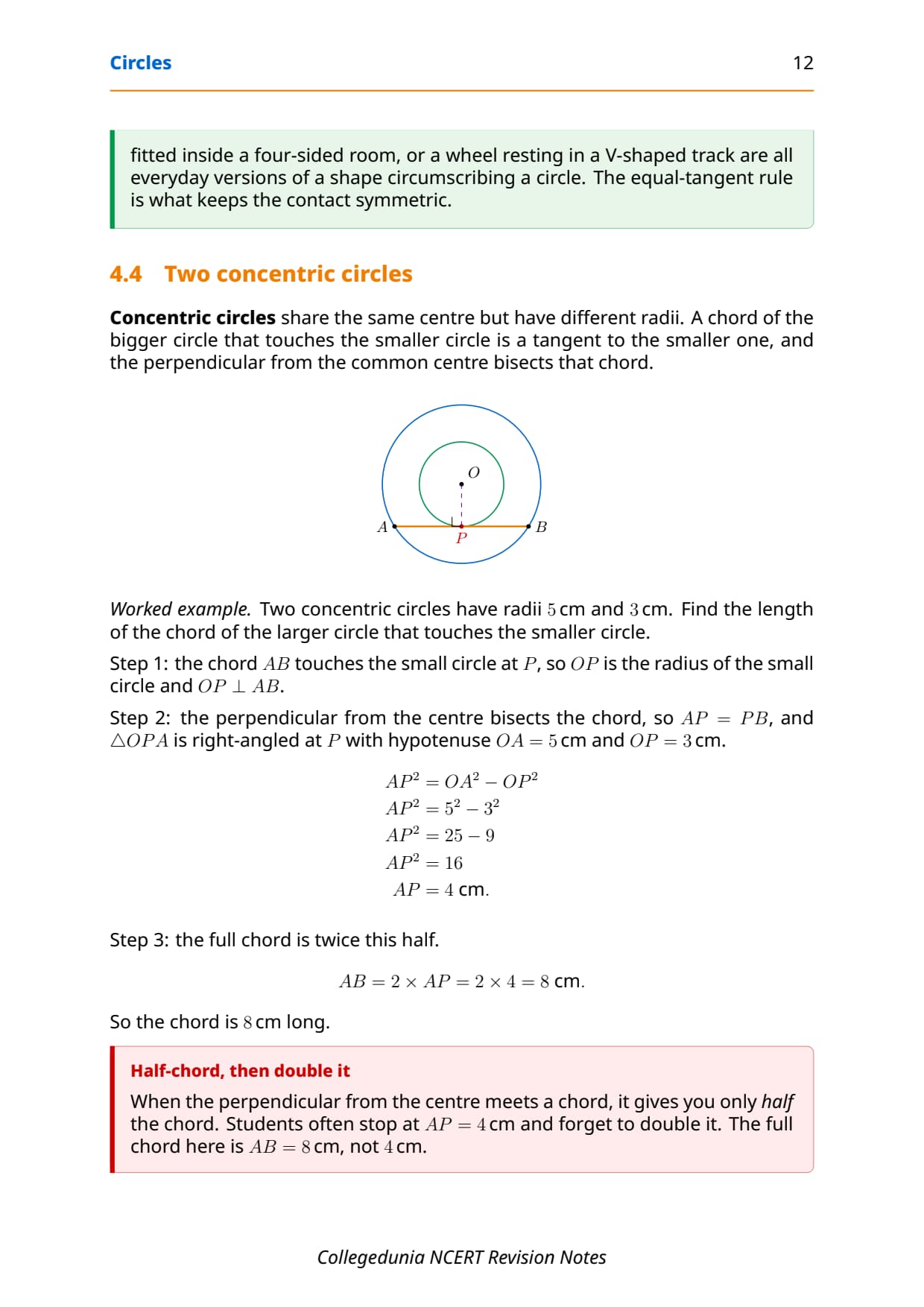
| Concentric circles, chord tangent to inner | Perpendicular bisects chord | Half-chord = √(R2 − r2) |
When a quadrilateral ABCD has all four sides touching a circle, AB + CD = AD + BC (opposite sides sum equally). The board uses this to show a parallelogram around a circle must be a rhombus.
Worked Board Problems
The four types below follow one pattern: draw, mark the right angle, apply Pythagoras.
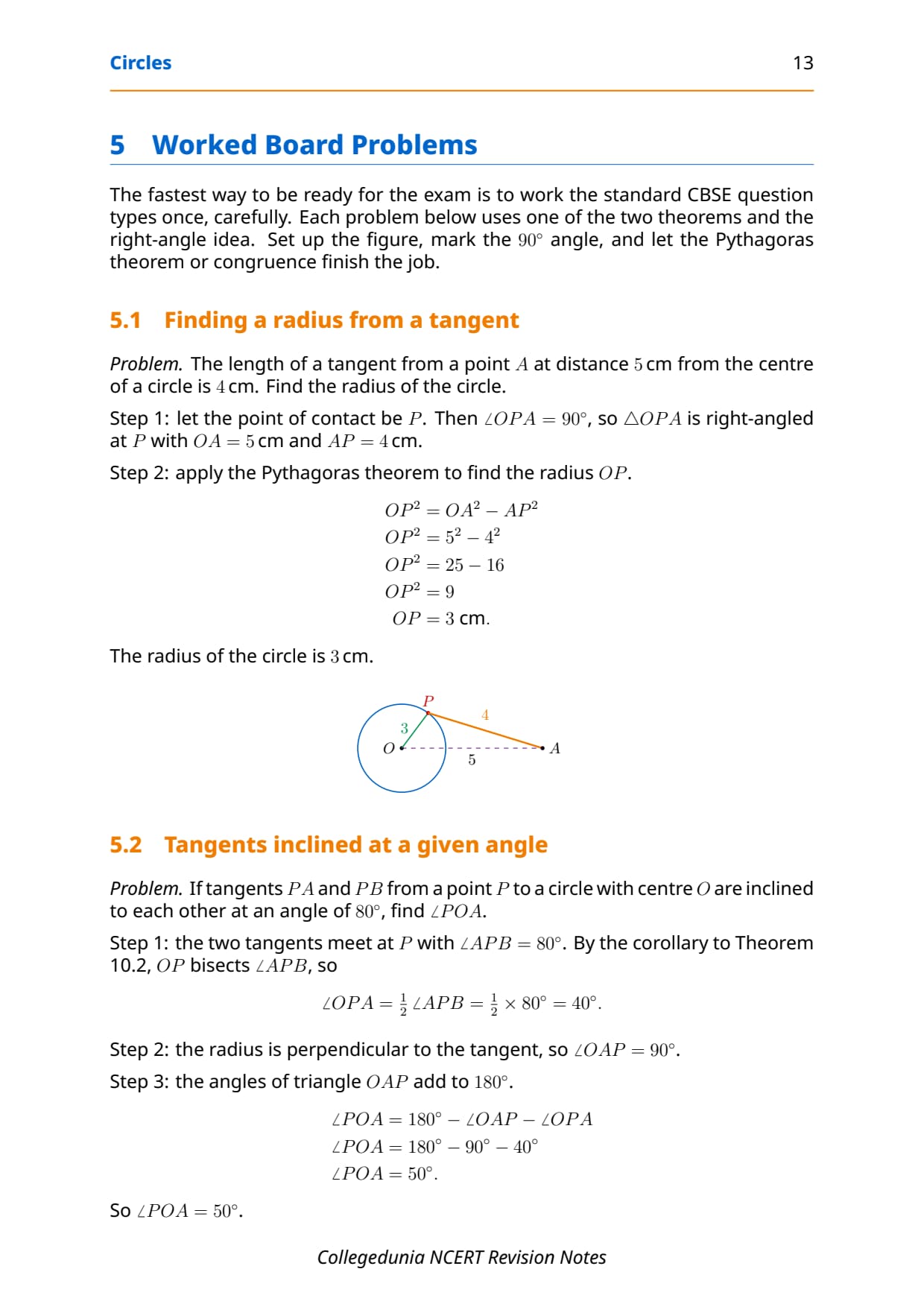
1. Radius from tangent length. OA = 5, AP = 4. OP2 = 25 − 16 = 9, radius = 3 cm.
2. Angle between tangents. Angle at P = 80°. OP bisects it, so angle POA = 180° − 90° − 40° = 50°.
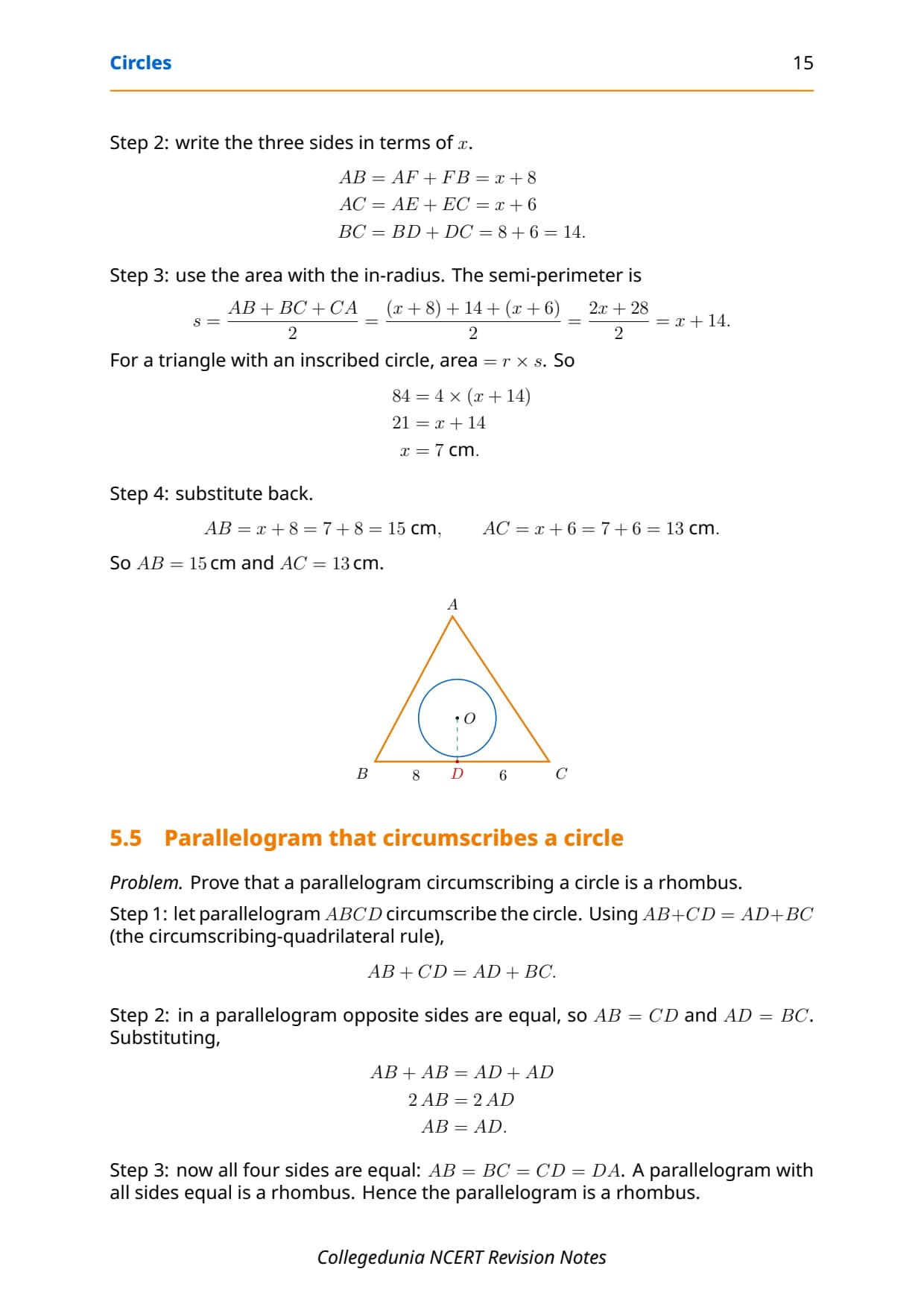
3. Circumscribing triangle (radius 4, base segments 8 and 6, area 84 cm2). Area = r × s with 84 = 4(x + 14) gives x = 7, so AB = 15 cm, AC = 13 cm.
4. Concentric circles (radii 5 and 3 cm). Half-chord = √(25 − 9) = 4, full chord = 8 cm.
Common Mistakes to Avoid
Most marks lost here come from a short list of avoidable errors.
The repeat-offender mistakes in board answers:
- Skipping the 90° mark: the right angle at the contact point gives the right triangle. Draw first, mark it, then write equations.
- Equal tangents from two different points: the rule only applies when both tangents start from the same external point.
- Stopping at the half-chord: in concentric-circle problems the full chord is twice the half the perpendicular gives.
- Quadrilateral vs cyclic: AB + CD = AD + BC holds only when all four sides touch the circle, not for a cyclic quadrilateral.
- No units: writing "3" instead of "3 cm" costs a presentation mark.
Previous Year Question Trends
Circles is a steady source of 3-mark and 4-mark questions, and types repeat year to year: angle between tangents and the centre angle (2025), the circumscribing-quadrilateral and rhombus proof (2024), tangent length by Pythagoras (2023), the circumscribing-triangle problem (2022), and the concentric-circles chord (2021).
Also Check: The complete set of step-by-step NCERT exercise solutions for Chapter 10 Circles, including Exercise 10.1 and Exercise 10.2, is at the Chapter 10 Circles NCERT Solutions page.
Quick Revision Summary
The night before the exam, run through the Standard Configurations table above for every formula, then the mnemonic RREP: Radius drawn to contact point, Right angle marked, Equal tangents noted, Pythagoras applied. Always state the answer with its unit.
Other Circles Resources
Pair these notes with the matching Circles resources below.
| Resource | What it covers | Open |
|---|---|---|
| Notes | Concept-first revision notes on Theorem 10.1, Theorem 10.2, standard configurations, worked board problems, and a full revision summary for Circles. | You are here |
| NCERT Solutions | Step-by-step answers to all Exercise 10.1 and Exercise 10.2 questions, with diagrams and full Pythagoras working for every problem. | Class 10 Maths Chapter 10 NCERT Solutions |
| Formula Sheet | One-page reference with tangent length formula, supplementary angle rule, circumscribing polygon results, and the concentric-circle half-chord formula. | Class 10 Maths Chapter 10 Formula Sheet |
| Handwritten Notes | Scanned-style handwritten pages covering the two theorems and worked examples for last-minute board revision of Circles. | Class 10 Maths Chapter 10 Handwritten Notes |
| NCERT Book PDF | Official NCERT Maths Chapter 10 Circles textbook in PDF form, with all figures and exercises. | Class 10 Maths Chapter 10 NCERT Book PDF |
| Exemplar Solutions | Worked answers to the harder NCERT Exemplar problems on Circles for additional board practice and deeper understanding. | Class 10 Maths Chapter 10 Exemplar Solutions |
All Class 10 Maths Notes
Related Links: Open the revision notes for the other chapters below. Each one uses the same concept-first style, full PDF download, and a revision FAQ.
| Chapter | Notes link |
|---|---|
| Chapter 1 | Real Numbers Notes |
| Chapter 2 | Polynomials Notes |
| Chapter 3 | Pair of Linear Equations in Two Variables Notes |
| Chapter 4 | Quadratic Equations Notes |
| Chapter 5 | Arithmetic Progressions Notes |
| Chapter 6 | Triangles Notes |
| Chapter 7 | Coordinate Geometry Notes |
| Chapter 8 | Introduction to Trigonometry Notes |
| Chapter 9 | Some Applications of Trigonometry Notes |
| Chapter 10 | Circles Notes (You are here) |
| Chapter 11 | Areas Related to Circles Notes |
| Chapter 12 | Surface Areas and Volumes Notes |
| Chapter 13 | Statistics Notes |
| Chapter 14 | Probability Notes |
Notes Class 10 Maths Chapter 10 Circles FAQs
Ques. What does Chapter 10 Circles cover in Class 10 Maths?
Ans. Circles covers two theorems about tangents. First, the tangent at any point is perpendicular to the radius at the contact point (Theorem 10.1). Second, the two tangents from an external point are equal in length (Theorem 10.2). The chapter applies these to tangent lengths, angles between tangents, circumscribing quadrilaterals and triangles, and concentric circles. There are two exercises: Exercise 10.1 (4 theory and angle questions) and Exercise 10.2 (13 problems on all the setups).
Ques. What is the tangent to a circle in Class 10?
Ans. A tangent is a straight line that meets the circle at exactly one point and does not cross it. That point is the point of contact. A secant differs: it meets the circle in two points and cuts a chord. The deciding factor is the perpendicular distance d from the centre. When d equals the radius r, the line is a tangent; when d is less than r, it is a secant; when d is greater than r, the line misses the circle. The key property is that the radius to the contact point is perpendicular to the tangent (Theorem 10.1), which gives the right angle that solves most board problems.
Ques. What is Theorem 10.1 in Class 10 Maths Circles?
Ans. Theorem 10.1 says the tangent at any point of a circle is perpendicular to the radius at the contact point. The proof: every point on the tangent except the contact point lies outside the circle, so its distance from the centre is greater than the radius. That makes the radius the shortest segment from the centre to the line, and the shortest distance is always perpendicular. So a right angle sits between every radius and its tangent. This right angle starts nearly every board problem in the chapter.
Ques. What is Theorem 10.2 in Class 10 Maths Circles?
Ans. Theorem 10.2 says the two tangents from an external point are equal in length. The proof compares the two right triangles formed by joining the centre to the external point and to each contact point. They share the same hypotenuse (centre to external point) and the same shorter leg (the radius), so they are congruent by RHS. By CPCT, the two tangent lengths are equal. The proof also shows that the line from centre to external point bisects the angle between the tangents and is perpendicular to the chord joining the contact points. These facts appear often in board MCQ and proof questions.
Ques. How many pages is the Chapter 10 Circles Notes PDF?
Ans. The Circles Notes PDF runs about 20 to 25 pages. It covers the two theorems with full proofs, all standard setups (two tangents from a point, circumscribing quadrilateral, circumscribing triangle, concentric circles), worked board problems for each type, a quick-revision summary, and the common mistakes. It is sized for the rationalised 2026-27 NCERT, which keeps the chapter focused on the two tangent theorems and their uses.
Ques. Is Chapter 10 Circles important for the CBSE Class 10 board exam?
Ans. Yes. Circles appears in the board paper every year, usually as one or two questions worth 3 to 4 marks, sometimes with a 2-mark proof. The types are steady: tangent length by Pythagoras, angle between tangents, circumscribing polygon side relation, and concentric circles. Practise these four with a clear diagram habit and you can score full marks. The chapter is also short, so it is high return for the effort.
Ques. What is the formula for the length of a tangent from an external point?
Ans. The tangent length from an external point is PQ = square root of (OQ squared minus r squared), where OQ is the distance from the centre to the external point and r is the radius. It comes from Pythagoras on the right triangle made by the radius (OP = r), the tangent (PQ), and the hypotenuse OQ. So OQ squared equals OP squared plus PQ squared, and rearranging gives PQ squared equals OQ squared minus r squared. Check that the right angle is at the contact point P before using it.
Ques. What is a circumscribing quadrilateral in Class 10 Circles?
Ans. A circumscribing quadrilateral is one whose four sides each touch the circle inside it. The equal-tangent result (Theorem 10.2) at each vertex shows the two sums of opposite sides are equal: AB plus CD equals AD plus BC. You prove it by writing each side as a sum of two tangent pieces and rearranging. A common board task is to show that a parallelogram around a circle must be a rhombus: opposite sides of a parallelogram are equal, so the rule forces all four sides equal.



Comments