



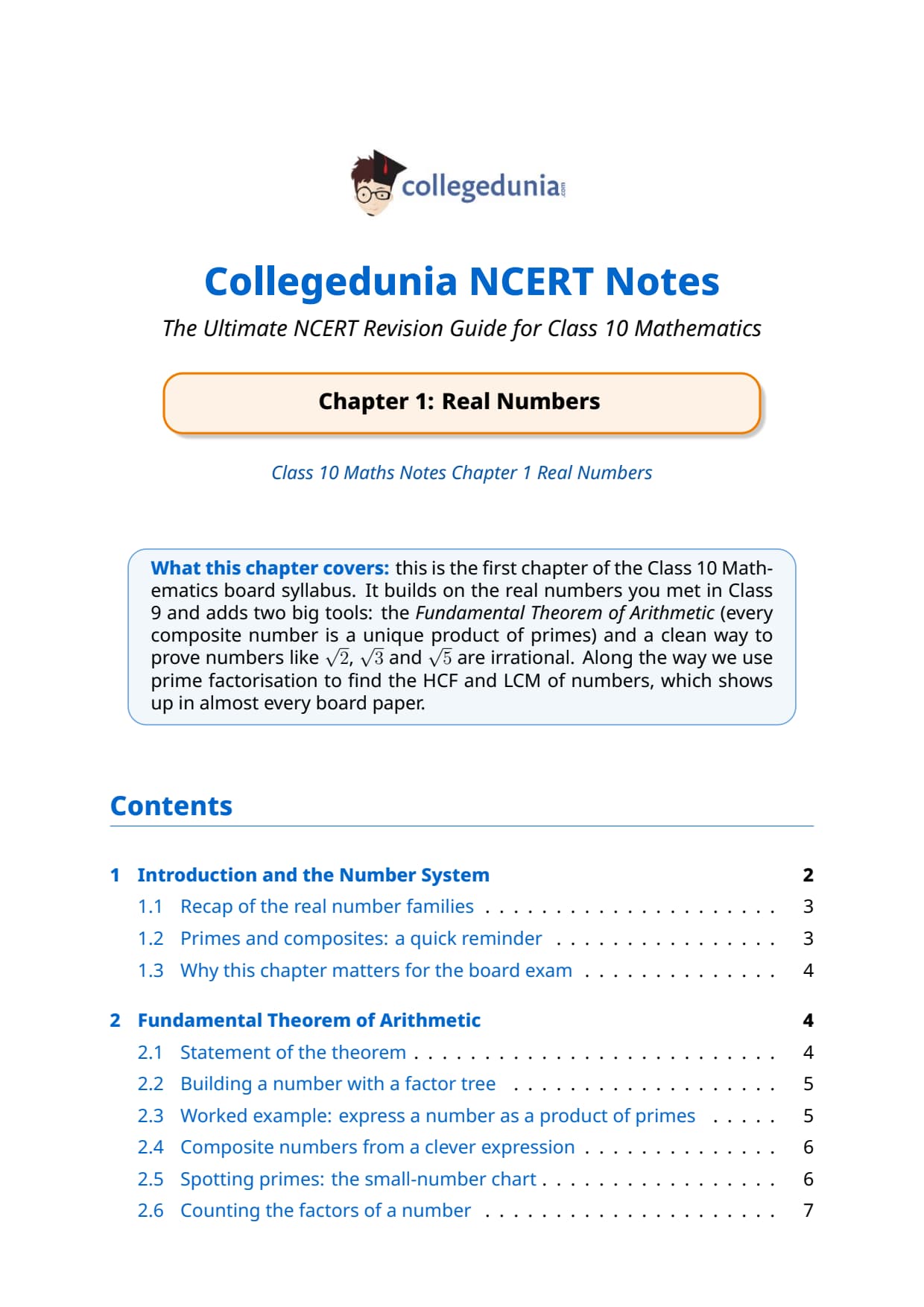
These Notes for Class 10 Maths Chapter 1 Real Numbers give you a fast, concept-first revision built on the 2026-27 CBSE syllabus. They cover the Fundamental Theorem of Arithmetic, writing any composite number as a unique product of primes, finding HCF and LCM by prime factorisation, the link HCF x LCM = product of the two numbers, and the proof that numbers like √2 are irrational.
- Every idea explained in plain words, with one short solved example and a clear board-exam tip.
- Full coverage of prime factorisation, HCF, LCM and the proof that √2, √3 and √5 are irrational, the parts the board asks most.
- Aligned with the rationalised 2026-27 CBSE syllabus, useful for the board exam and CUET number work.
These Collegedunia revision notes are curated by Maths subject experts, according to the 2026-27 NCERT textbook, and refined against the last five years of CBSE Class 10 Maths board papers.
Student Feedback: What 9,800 students told us about this chapter
71% of Class 10 students said the proof that √2 is irrational was the part they feared most before the board exam. 3 out of 5 students told us that one neat prime factor tree made HCF and LCM finally click in their heads.
Toppers found that memorising the single relation HCF x LCM = a x b saved them 2 to 3 minutes per question, and the average student spent 1 to 2 hours on these notes across the first read and the final revision.
Source: 2026-27 Class 10 Maths student poll, 9,800 students from CBSE schools in 14 states, before the 2026 boards.
|
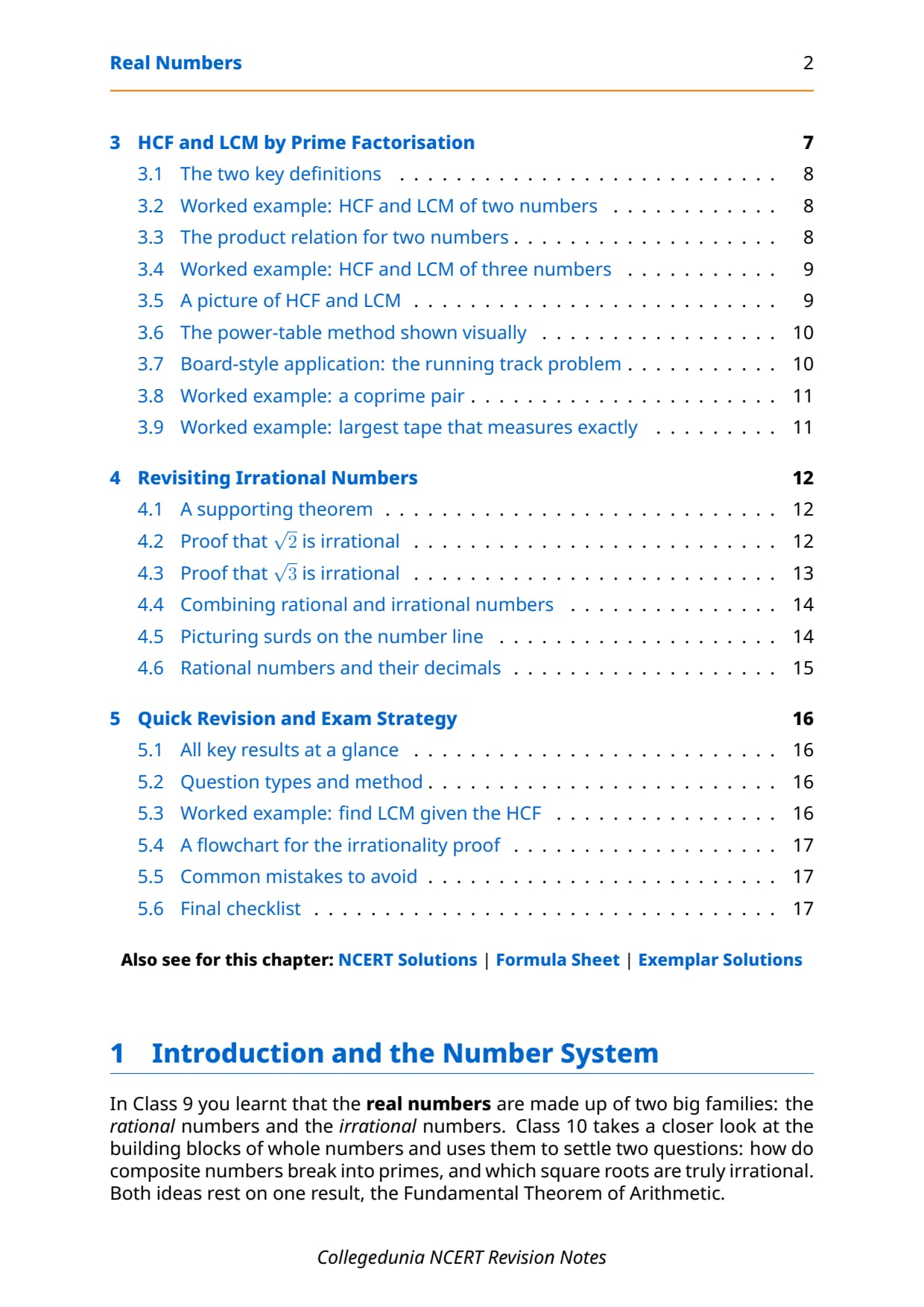
Table of Contents |
Watch Real Numbers Class 10 Maths Explained
Source: Ritik Mishra - 9th & 10th on YouTube
What These Notes Cover
This chapter answers one question: what are real numbers built from, and how do we split them? These notes keep the NCERT order but compress it into revision-ready blocks. The rationalised 2026-27 syllabus focuses on two big ideas.
- The Fundamental Theorem of Arithmetic: every composite number is a unique product of prime numbers, and this builds HCF and LCM.
- HCF and LCM by prime factorisation, plus the handy relation HCF(a, b) x LCM(a, b) = a x b for any two positive integers.
- Irrational numbers: what they are, and the proof by contradiction that √2, √3 and √5 are irrational.
The Fundamental Theorem of Arithmetic
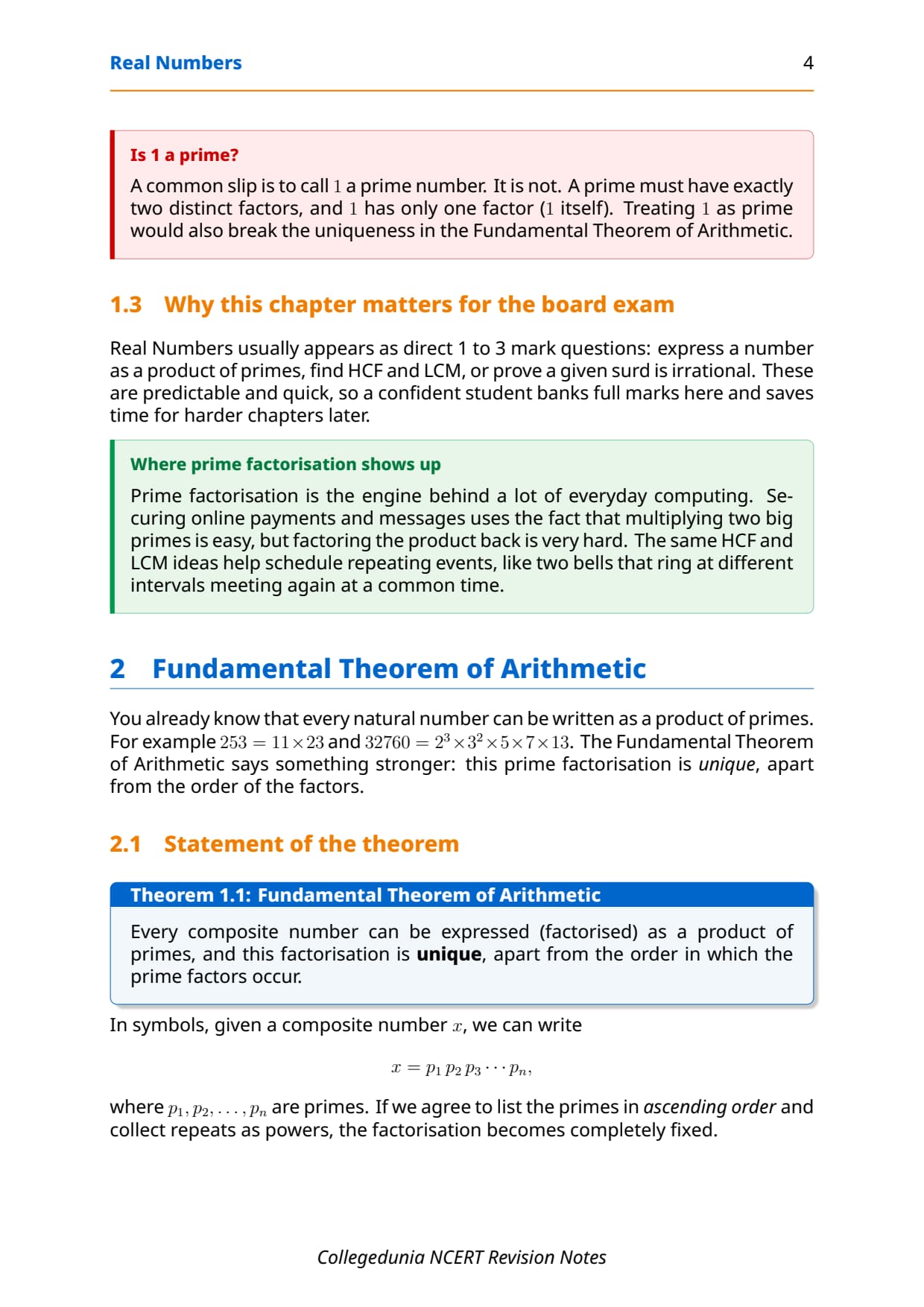
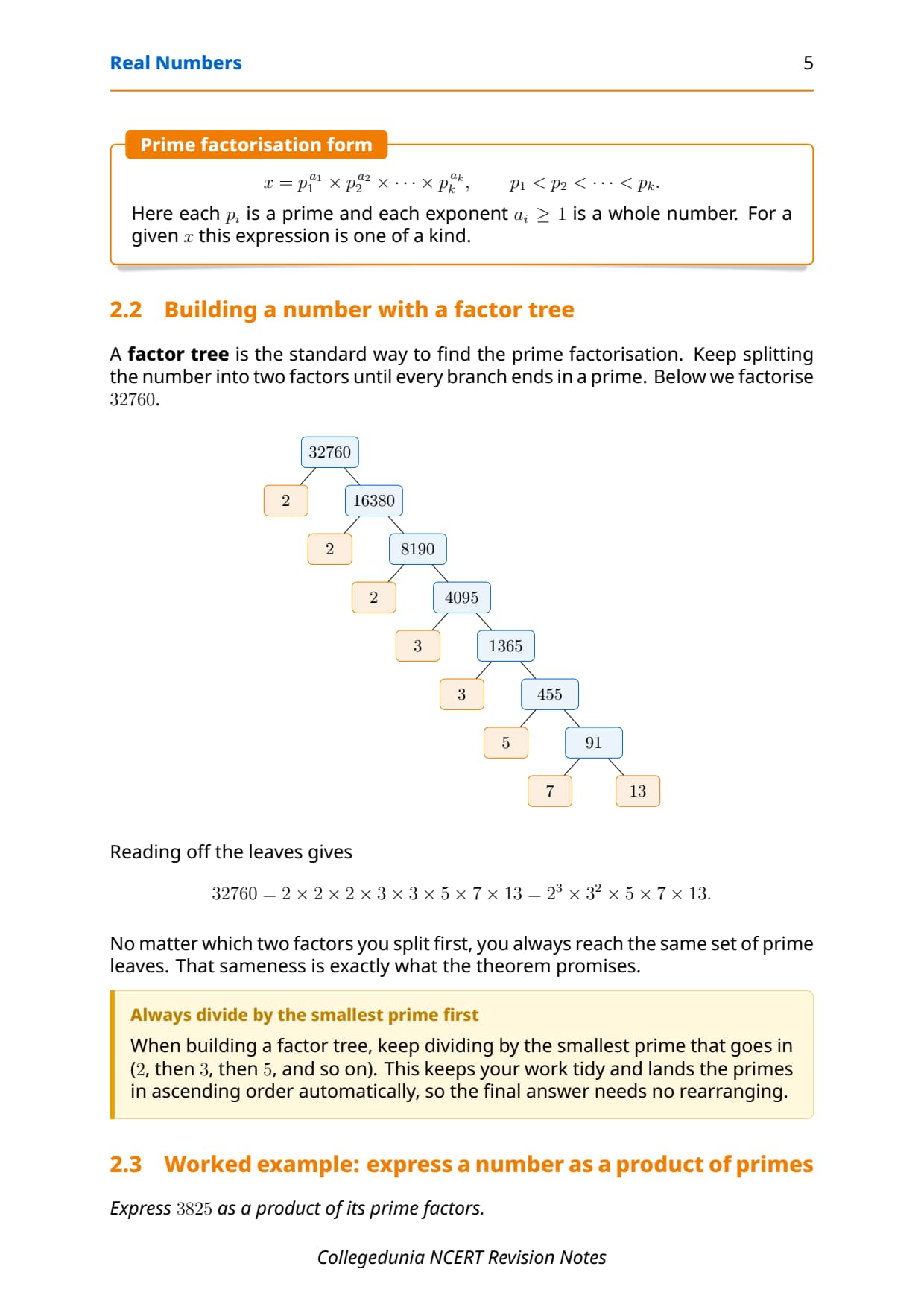
The Fundamental Theorem of Arithmetic says every composite number can be written as a product of primes, and this prime factorisation is unique except for the order of the factors. Primes are the building blocks of every whole number.
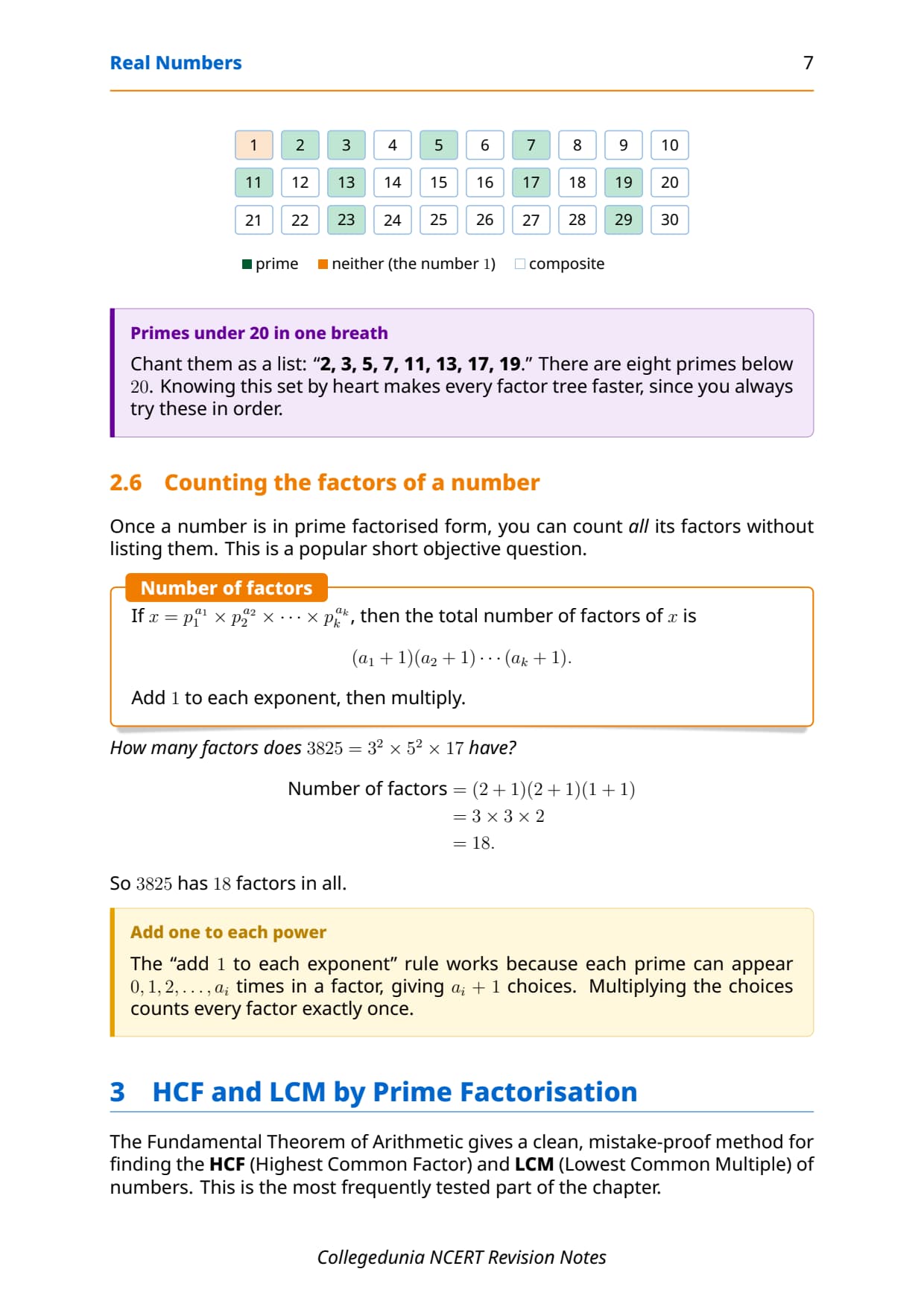
- Prime number: a number greater than 1 with exactly two factors, 1 and itself, such as 2, 3, 5, 7 and 11.
- Composite number: a number with more than two factors, such as 4, 6, 8 and 9.
- Unique factorisation: the set of prime factors is fixed; only the order you write them in can change.
For example, 3825 = 3 x 3 x 5 x 5 x 17, and no other set of primes multiplies to 3825. This is why a factor tree always lands on the same primes, no matter where you start splitting.
Finding HCF and LCM by Prime Factorisation
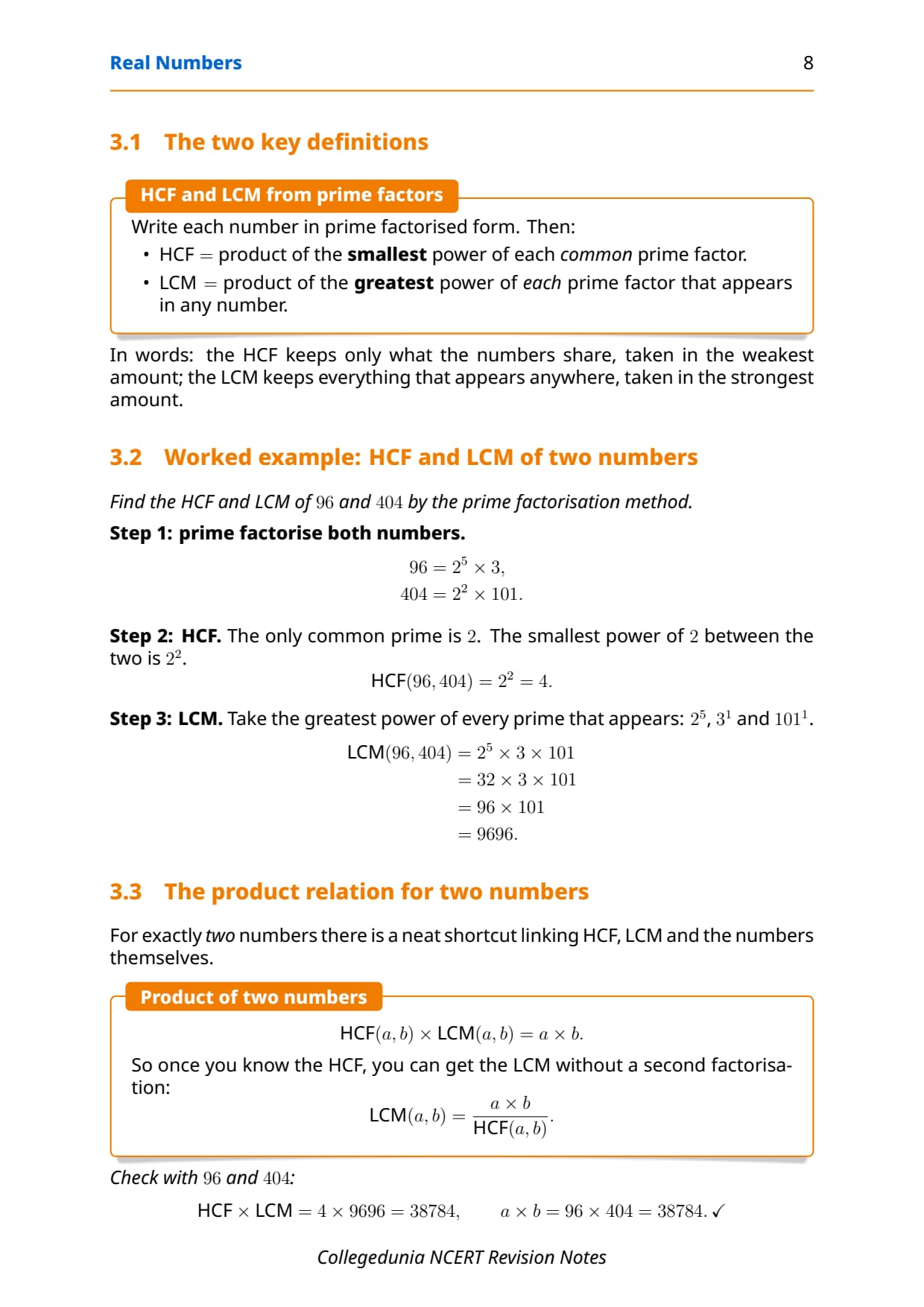
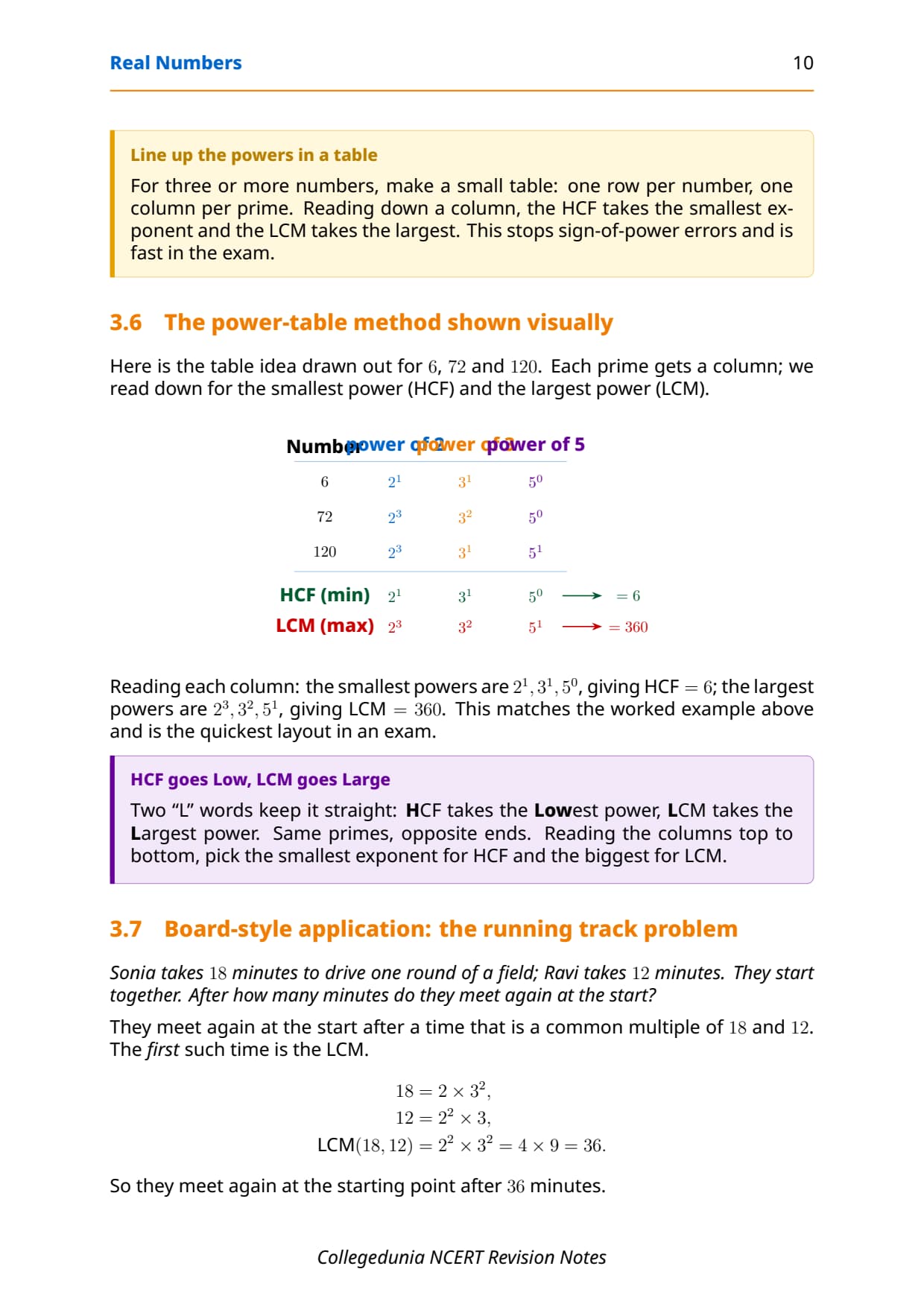
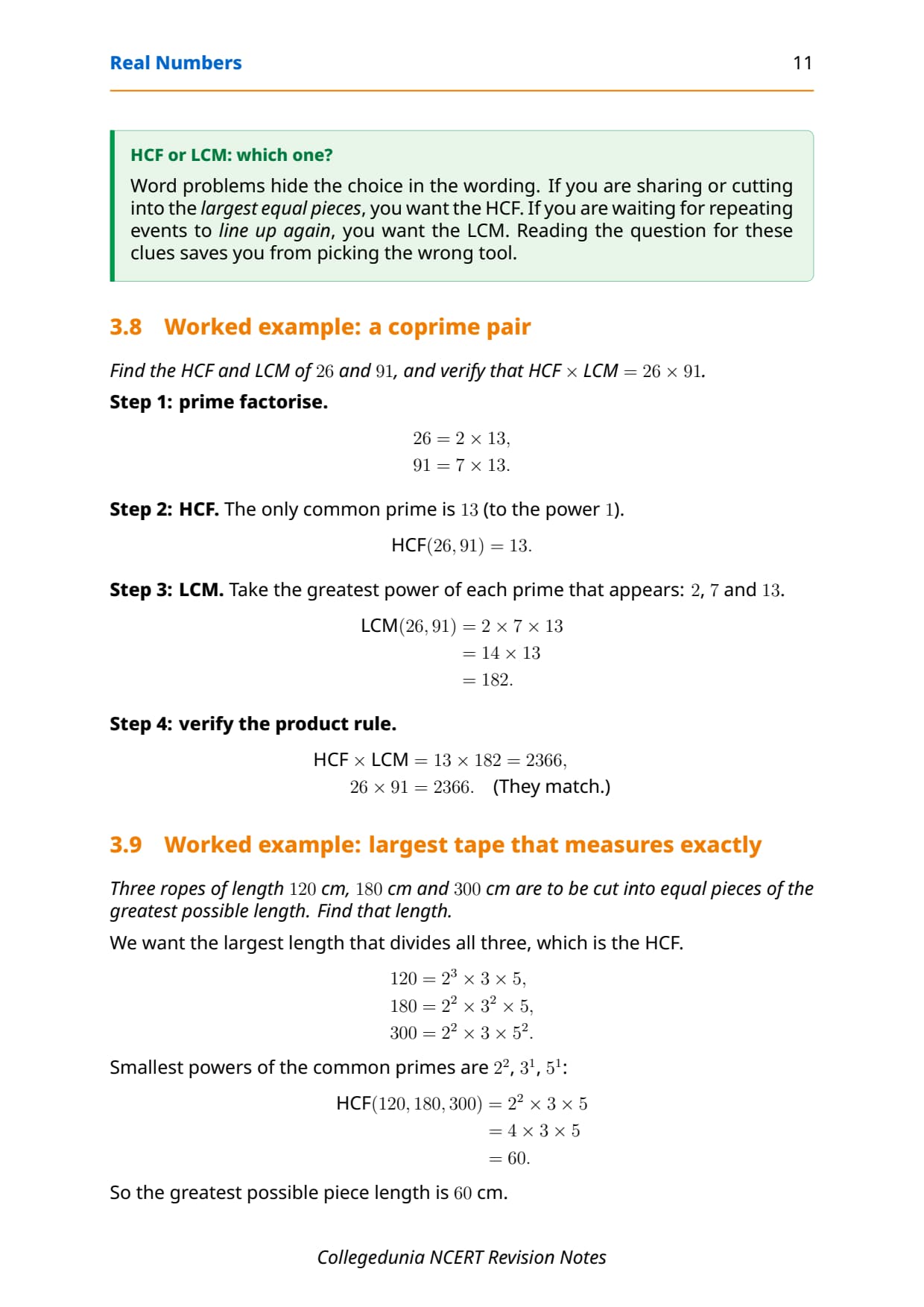
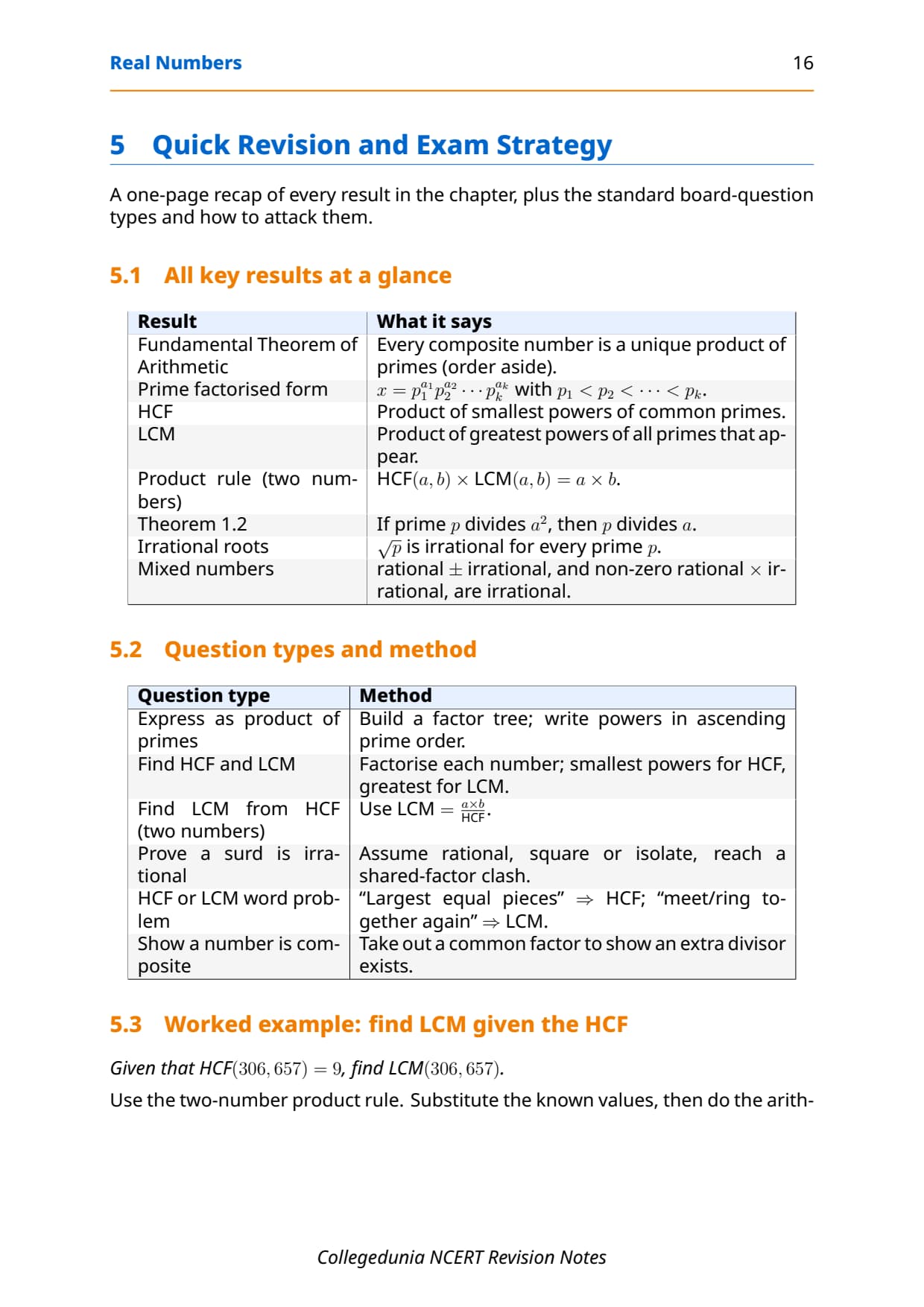
Once you can break a number into primes, finding the HCF (Highest Common Factor) and LCM (Lowest Common Multiple) is quick. Write each number as a product of primes, then use two short rules, the method the board paper expects.
| Quantity | Rule using prime factors | Plain meaning |
|---|---|---|
| HCF | Product of the smallest power of each common prime | The biggest number that divides both |
| LCM | Product of the greatest power of every prime that appears | The smallest number both divide into |
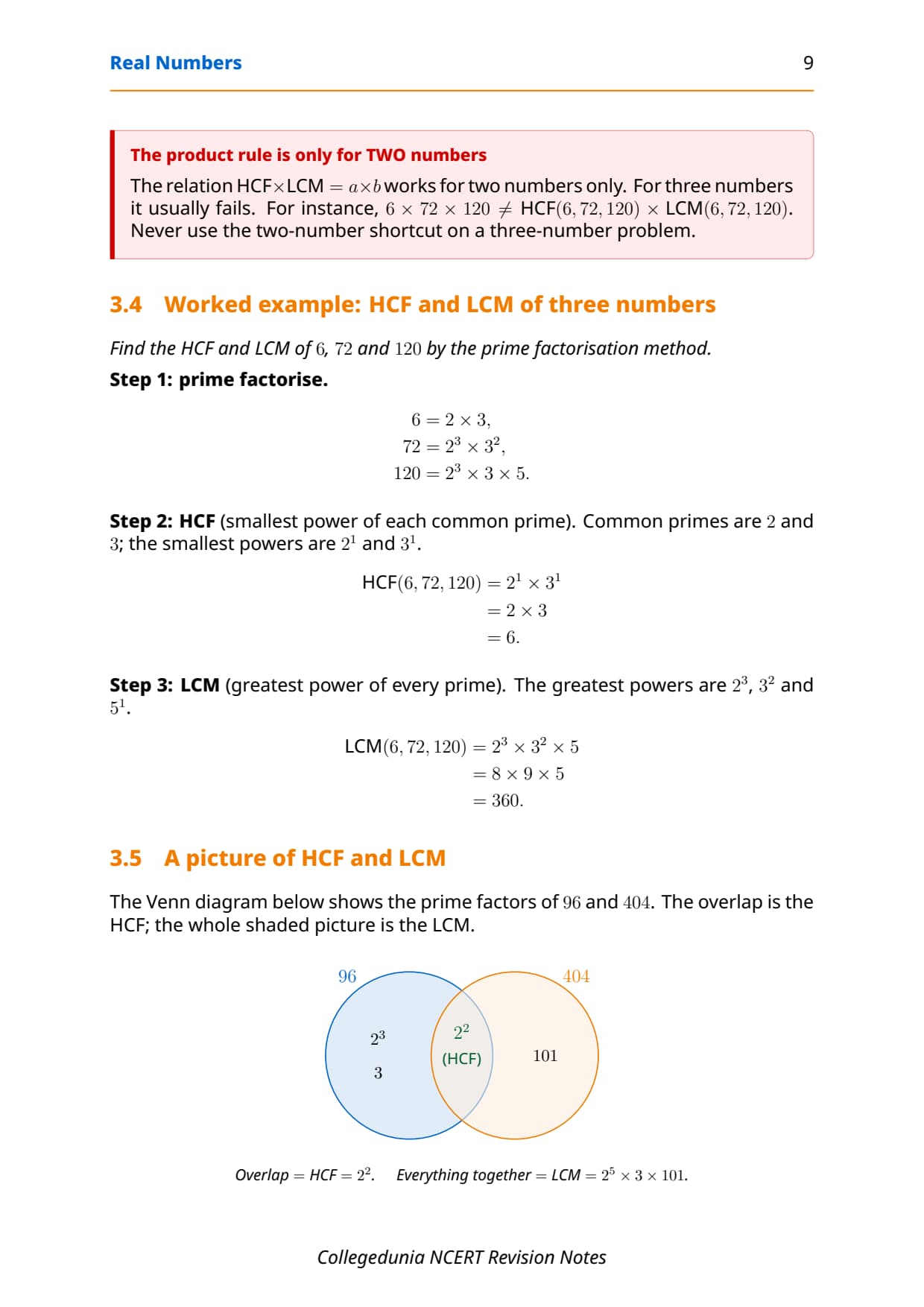
Take 6 = 2 x 3 and 20 = 2 x 2 x 5. The only common prime is 2, at its smallest power, so the HCF is 2. For the LCM, take the greatest power of every prime that shows up: 2 squared, 3 and 5. That gives 2 x 2 x 3 x 5 = 60. So HCF(6, 20) = 2 and LCM(6, 20) = 60.
- HCF uses common primes only, each at its lowest power.
- LCM uses all primes that appear in either number, each at its highest power.
- For three numbers, the same idea works; just compare the powers across all three.
The HCF and LCM Relationship
One relation saves time in almost every two-number question. For any two positive integers a and b, the product of their HCF and LCM equals the product of the numbers. So you only ever need to find one of them, then divide.
The formula is HCF(a, b) x LCM(a, b) = a x b. Using our example, HCF(6, 20) = 2 and LCM(6, 20) = 60, so the left side is 2 x 60 = 120. The right side is 6 x 20 = 120. Both sides match, just as the rule promises. This check also catches arithmetic slips fast.
- If a question gives you the HCF and asks for the LCM, use LCM = (a x b) / HCF.
- The relation works for two numbers only; it is not true for three numbers, a frequent exam trap.
- Use it as a 10-second check: multiply your HCF and LCM and confirm it equals the product of the two numbers.
Rational and Irrational Numbers
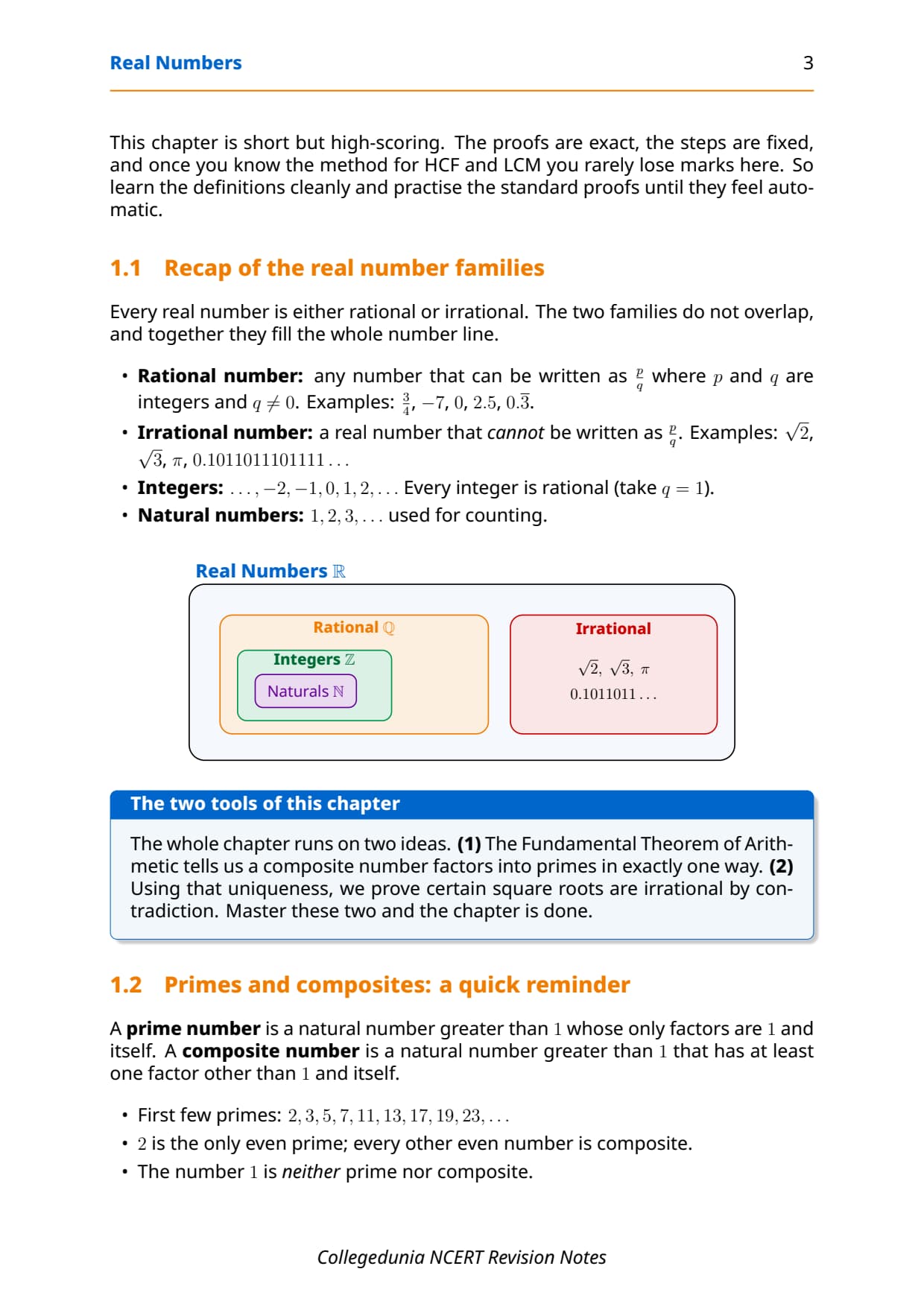
Real numbers split into two families. The first one-mark questions reward exact definitions, so say each one in a clean line. The key word for an irrational number: it cannot be written as a simple fraction.
| Type | Definition | Examples |
|---|---|---|
| Rational number | Can be written as p/q where p and q are integers and q is not 0 | 3, −7, 1/2, 0.75, 0.333... |
| Irrational number | Cannot be written as p/q; its decimal goes on forever with no repeating pattern | √2, √3, π, 0.1010010001... |
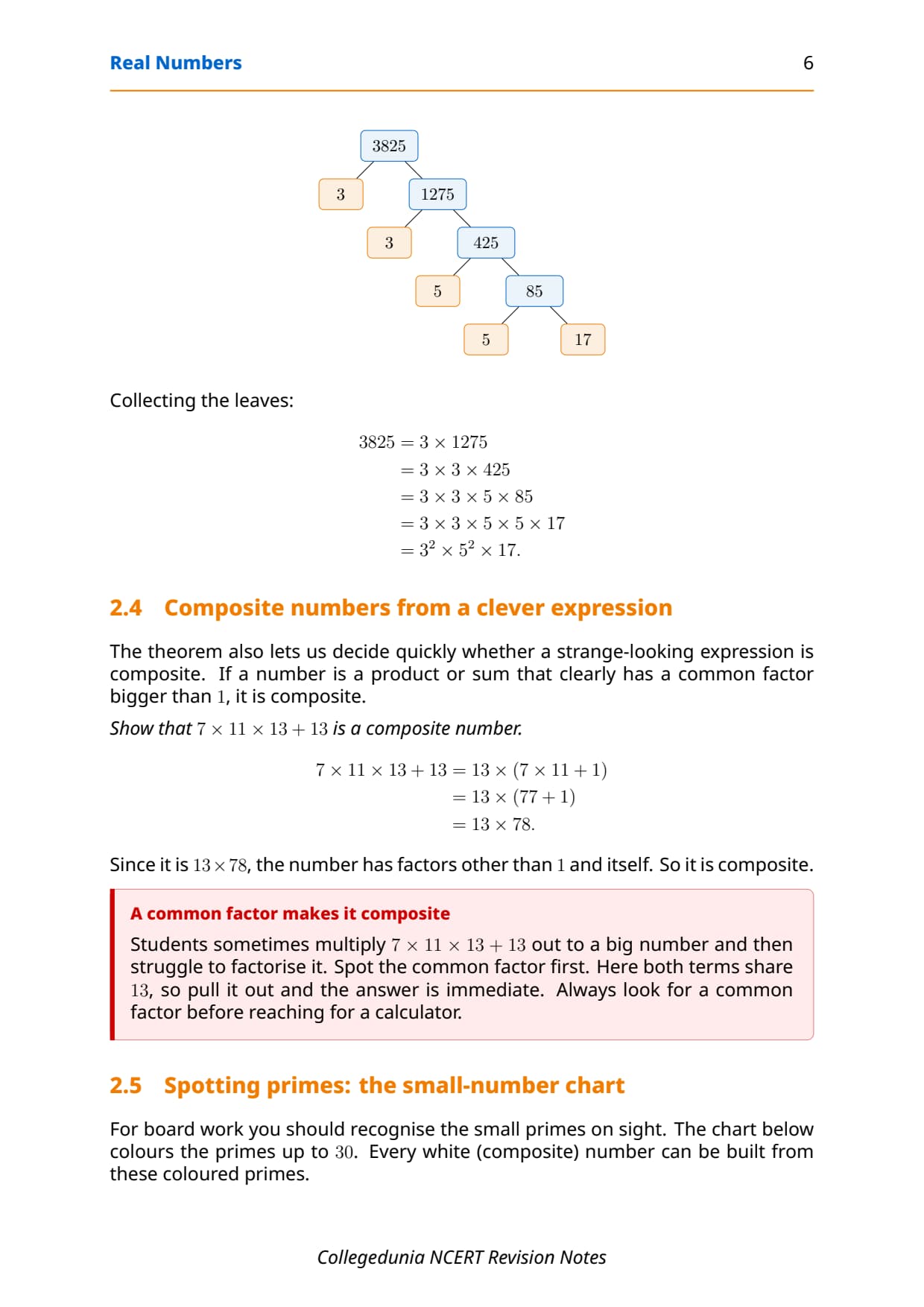
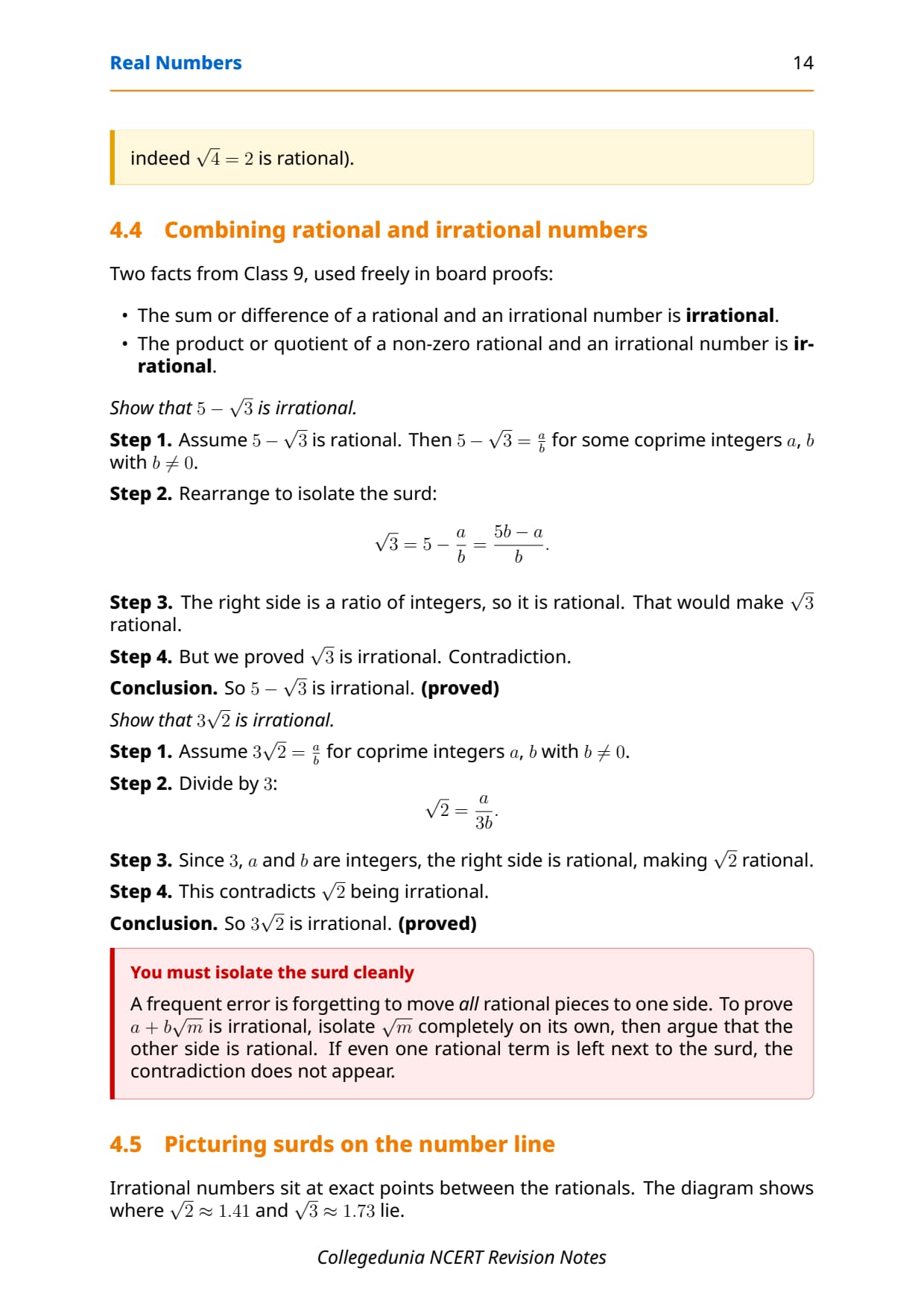
Keep one fact ready: the sum or difference of a rational and an irrational number is always irrational. So 5 + √2 and 3 − √5 are both irrational. A non-zero rational times an irrational is also irrational, which is why 2√3 is irrational. These facts turn up directly in board questions.
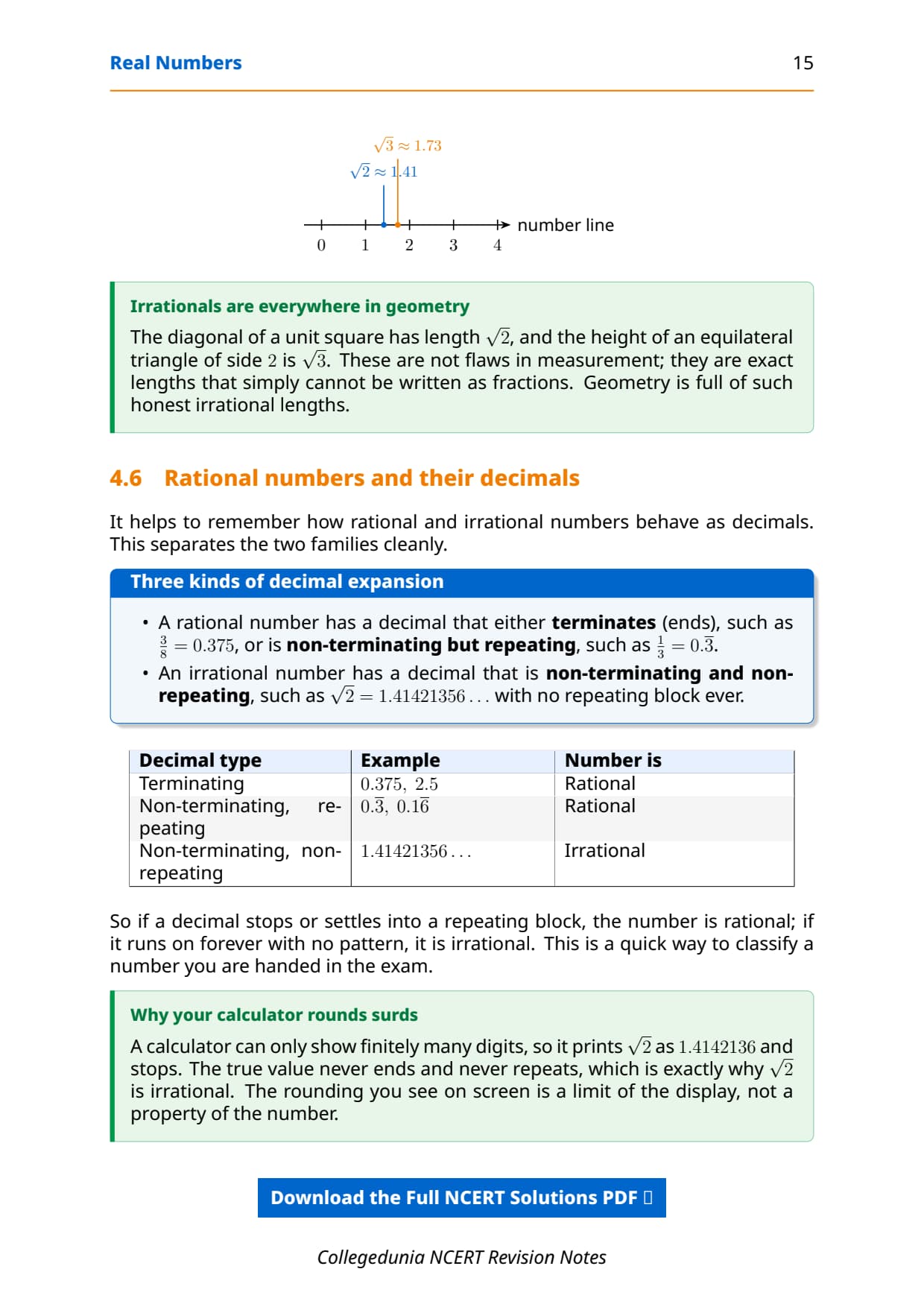
- Rational: terminating decimals like 0.75 and repeating decimals like 0.333... both count.
- Irrational: non-terminating and non-repeating decimals, like the square roots of non-perfect-square numbers.
- Rational plus irrational, and rational times irrational (non-zero), are always irrational.
Proving Root 2 Is Irrational
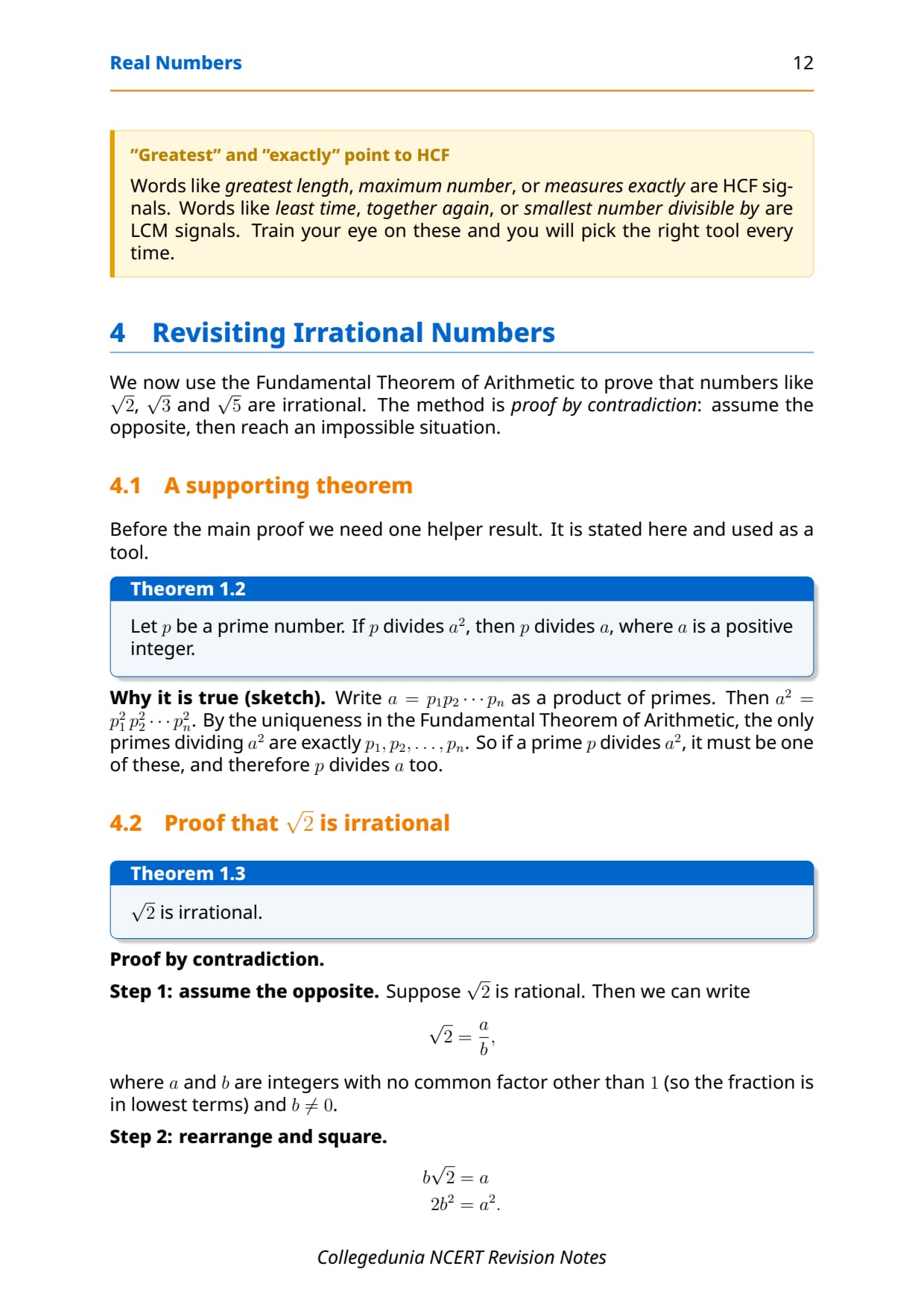
This is the proof the chapter is famous for, and it often appears as a 3-mark question. It uses proof by contradiction: assume the opposite, then show it leads to something impossible. The same steps prove √3 and √5 are irrational, so learn the pattern once.
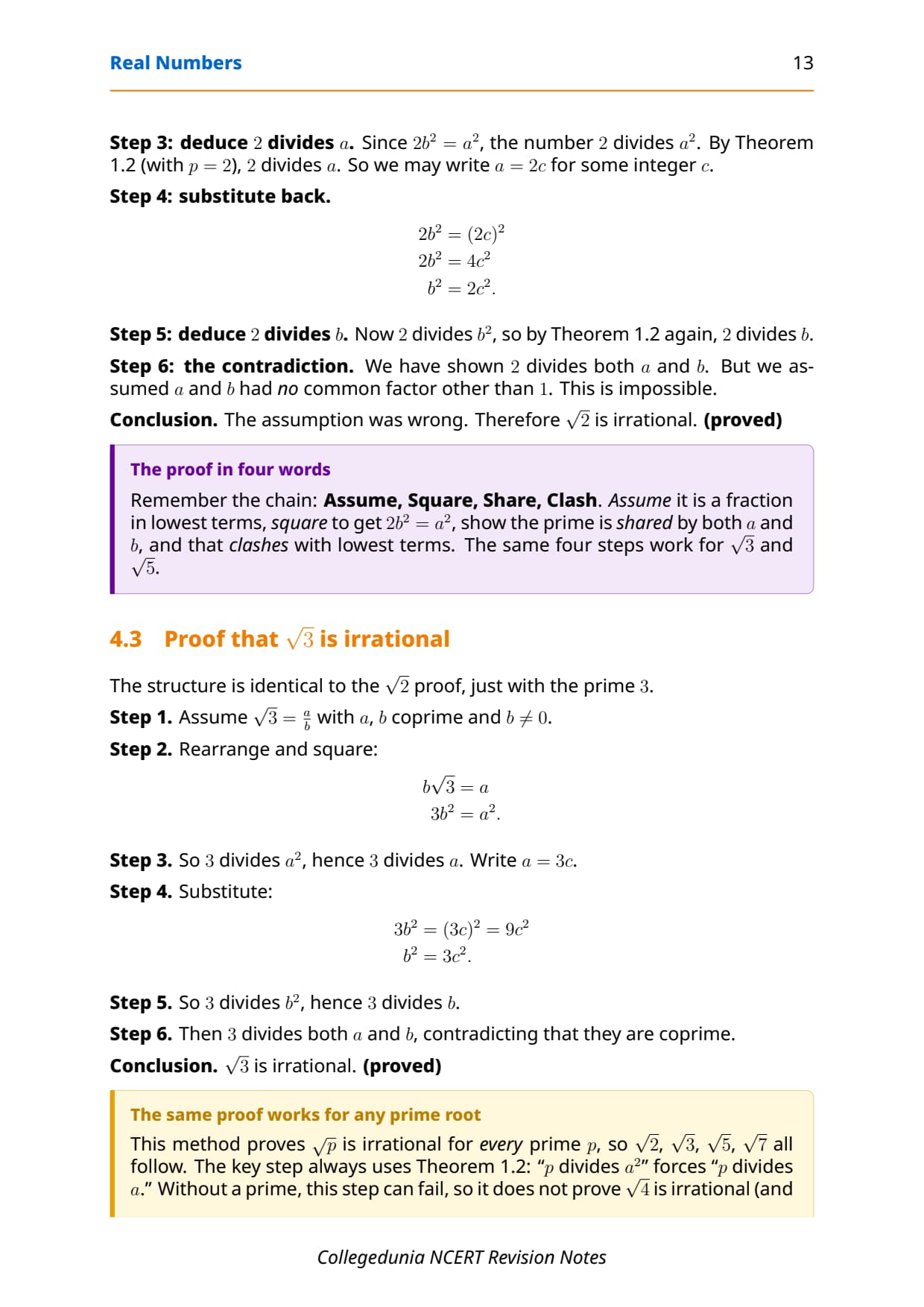
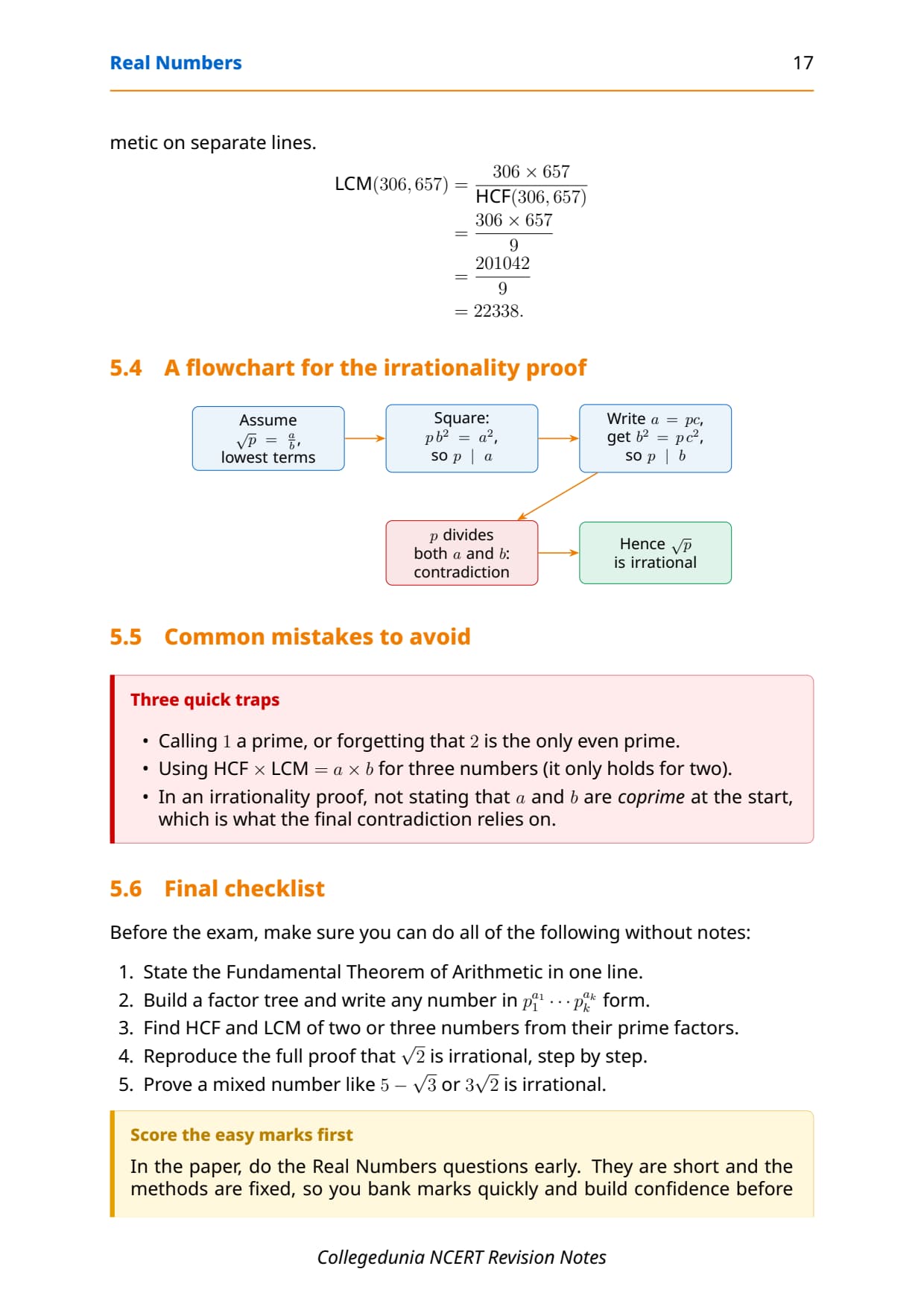
- Assume √2 is rational, so √2 = a/b where a and b are integers with no common factor other than 1 and b is not 0.
- Square both sides: 2 = a squared / b squared, so a squared = 2 b squared. This means a squared is even, so a is even.
- Write a = 2c. Then a squared = 4c squared, so 4c squared = 2 b squared, giving b squared = 2 c squared. So b is also even.
- Contradiction: a and b are both even, so they share the factor 2, but we assumed they had no common factor. The assumption fails.
The assumption that √2 is rational leads to an impossible situation, so √2 must be irrational. The heart of the argument is one lemma: if 2 divides a squared, then 2 divides a. The Fundamental Theorem of Arithmetic guarantees this, which is why the chapter teaches that theorem first.
How to Revise These Notes
Real Numbers is short but definition-heavy and proof-heavy. The best approach is two passes:
- First pass: lock the Fundamental Theorem of Arithmetic, the HCF and LCM rules from prime factors, and the relation HCF x LCM = a x b. Solve two or three two-number examples so the method becomes automatic.
- Second pass: write out the √2 proof on paper without looking, then repeat for √3 and √5. The steps are identical, and this covers the most common 3-mark board question for the 2026-27 session.
Previous Year Question Trends
CBSE tests Real Numbers mainly through HCF and LCM problems and the irrationality proof, plus short definition questions. The table below maps the question types across recent board papers, so your revision targets the high-frequency areas.
| Year | Question type asked | Marks |
|---|---|---|
| 2025 | Find HCF and LCM of two numbers by prime factorisation | 2 or 3 |
| 2024 | Prove that √2 (or √5) is irrational | 3 |
| 2023 | Use HCF x LCM = product to find the missing value | 2 |
| 2022 | Show that a number like 5 + √3 is irrational | 2 or 3 |
| 2021 | State the Fundamental Theorem of Arithmetic; factorise a composite number | 1 + 1 |
Also Check: The full set of CBSE board questions for this chapter, with step-by-step answers, is in the downloadable PDF above, updated for the 2026-27 cycle.
Common Mistakes to Avoid
Most lost marks in this chapter come from a few repeat errors. Knowing them in advance is the cheapest way to gain marks. Each one is easy to avoid once you have seen it named.
The repeat-offender mistakes in Real Numbers board answers:
- Swapping HCF and LCM rules: HCF uses the lowest power of common primes; LCM uses the highest power of all primes.
- Extending the product rule: HCF x LCM = a x b works for two numbers only, never three.
- Skipping the coprime line: in the √2 proof you must state that a and b have no common factor, or the contradiction does not hold.
- Calling 0.333... irrational: a repeating decimal is rational; only non-terminating, non-repeating decimals are irrational.
- Forgetting the unique-factorisation reason: the lemma "if 2 divides a squared then 2 divides a" rests on the Fundamental Theorem of Arithmetic.
Other Resources for This Chapter
Pair these notes with the matching NCERT Solutions, formula sheet, handwritten notes and the official NCERT book chapter. All resources for Class 10 Maths Chapter 1 Real Numbers are linked below.
| Resource | What it covers | Open |
|---|---|---|
| Notes | Concept-first revision notes on the Fundamental Theorem of Arithmetic, HCF and LCM, and proving numbers irrational. | You are here |
| NCERT Solutions | Step-by-step answers to all exercise questions, with an Expert Solution for each. | Class 10 Maths Chapter 1 NCERT Solutions |
| Formula Sheet | One-page list of the key prime factorisation, HCF and LCM relations for fast revision. | Class 10 Maths Chapter 1 Formula Sheet |
| Handwritten Notes | Scanned-style handwritten pages for last-minute board revision. | Class 10 Maths Chapter 1 Handwritten Notes |
| NCERT Book PDF | Official NCERT Maths Chapter 1 Real Numbers textbook in PDF form. | Class 10 Maths Chapter 1 NCERT Book PDF |
| Exemplar Solutions | Worked answers to the harder NCERT Exemplar problems for extra practice. | Class 10 Maths Chapter 1 Exemplar Solutions |
Notes for Class 10 Maths: All Chapters
Related Links: Use the table below to open notes for the other Class 10 Maths chapters. Each one has the same concept-first style, full PDF download, and revision FAQ.
| Chapter | Notes link |
|---|---|
| Chapter 1 | Real Numbers Notes (You are here) |
| Chapter 2 | Polynomials Notes |
| Chapter 3 | Pair of Linear Equations in Two Variables Notes |
| Chapter 4 | Quadratic Equations Notes |
| Chapter 5 | Arithmetic Progressions Notes |
| Chapter 6 | Triangles Notes |
| Chapter 7 | Coordinate Geometry Notes |
| Chapter 8 | Introduction to Trigonometry Notes |
| Chapter 9 | Some Applications of Trigonometry Notes |
| Chapter 10 | Circles Notes |
| Chapter 11 | Areas Related to Circles Notes |
| Chapter 12 | Surface Areas and Volumes Notes |
| Chapter 13 | Statistics Notes |
| Chapter 14 | Probability Notes |
Notes Class 10 Maths Chapter 1 Real Numbers FAQs
Ques. What does Chapter 1 Real Numbers cover in Class 10 Maths?
Ans. Chapter 1 Real Numbers covers two main ideas in the 2026-27 CBSE syllabus. The first is the Fundamental Theorem of Arithmetic: every composite number is a unique product of primes. This lets you find HCF and LCM by prime factorisation and gives the relation HCF x LCM = product of the two numbers. The second is irrational numbers. You learn the difference between rational and irrational numbers, then prove by contradiction that the square roots of 2, 3 and 5 are irrational.
Ques. What is the Fundamental Theorem of Arithmetic?
Ans. The Fundamental Theorem of Arithmetic states that every composite number can be expressed as a product of prime numbers, and this factorisation is unique apart from the order in which the prime factors are written. For example, 3825 can be written as 3 x 3 x 5 x 5 x 17, and no other set of primes multiplies to give 3825. The factors can be written in any order, but the primes themselves are always the same. This theorem is the reason a factor tree always ends at the same primes, and it is also the basis for finding HCF and LCM and for proving certain numbers irrational.
Ques. How do you find HCF and LCM using prime factorisation?
Ans. First write each number as a product of its prime factors. The HCF is the product of the smallest power of each prime that is common to all the numbers. The LCM is the product of the greatest power of every prime that appears in any of the numbers. For example, 6 = 2 x 3 and 20 = 2 x 2 x 5. The only common prime is 2 at its lowest power, so the HCF is 2. Taking the greatest power of each prime gives 2 x 2 x 3 x 5 = 60, so the LCM is 60. The HCF is always a divisor of both numbers, and the LCM is always a multiple of both.
Ques. What is the relationship between HCF and LCM of two numbers?
Ans. For any two positive integers a and b, the product of their HCF and LCM equals the product of the numbers themselves, written as HCF(a, b) x LCM(a, b) = a x b. For example, for 6 and 20 the HCF is 2 and the LCM is 60, so 2 x 60 = 120, which equals 6 x 20. This relation is useful when a question gives you three of the four values and asks for the fourth, since you can rearrange it to LCM = (a x b) / HCF. Important: this rule holds only for two numbers and cannot be extended to three numbers.
Ques. How do you prove that root 2 is irrational?
Ans. You use proof by contradiction. Assume the square root of 2 is rational, so it can be written as a/b where a and b are integers with no common factor other than 1 and b is not zero. Squaring gives 2 = a squared divided by b squared, so a squared = 2 b squared, which means a squared is even and therefore a is even. Writing a = 2c and substituting gives b squared = 2 c squared, so b is also even. But then a and b share the factor 2, which contradicts the assumption that they have no common factor. Since the assumption fails, the square root of 2 cannot be rational, so it is irrational. The same steps prove the square roots of 3 and 5 are irrational.
Ques. What is the difference between rational and irrational numbers?
Ans. A rational number is any number that can be written in the form p/q, where p and q are integers and q is not zero. Rational numbers include whole numbers, fractions, terminating decimals like 0.75, and repeating decimals like 0.333... An irrational number cannot be written as p/q, and its decimal expansion goes on forever without any repeating pattern. Examples include the square root of 2, the square root of 3, and pi. A useful fact is that the sum or difference of a rational and an irrational number is always irrational, and a non-zero rational number times an irrational number is also irrational.
Ques. How many pages is the Class 10 Maths Real Numbers Notes PDF?
Ans. The Real Numbers Notes PDF runs about 20 pages and covers the full chapter in concept-first revision blocks, with the Fundamental Theorem of Arithmetic, prime factor trees, HCF and LCM examples, the HCF x LCM relation, and the step-by-step irrationality proofs for the square roots of 2, 3 and 5. The PDF is free to download for the 2026-27 session, and a green Handwritten Notes button on this page opens the scanned-style version for last-minute revision.
Ques. Are these Notes for Class 10 Maths Chapter 1 aligned with the 2026-27 syllabus?
Ans. Yes. This page reflects the current rationalised 2026-27 CBSE syllabus for Class 10 Maths. Real Numbers is the first chapter of the Number Systems unit, and the focus is on the Fundamental Theorem of Arithmetic, finding HCF and LCM by prime factorisation, and proving numbers irrational. These notes follow the NCERT textbook order and are useful for the CBSE board exam, while the same number-system ideas also help with the CUET General Test and JEE foundation questions.



Comments