




NCERT Handwritten Notes for Class 7 Arts (Kriti) Chapter 10 Dance and Sculpture help students revise body postures, geometric shapes, temple sculptures, hastas and navarasa according to the 2026-27 NCERT syllabus. The PDF keeps the chapter in clear handwritten revision pages for quick classroom and home study.
- Download a 24-page handwritten revision PDF for Class 7 Arts Chapter 10.
- Revise dance and sculpture links, torso bends, knee bends, hand gestures and emotions.
- Use the notes before posture practice, sculpture observation and self-assessment.
Chapter10DanceandSculptureHandwrittenNotes.pdf?page=1&dpi=150)
Chapter10DanceandSculptureHandwrittenNotes.pdf?page=2&dpi=150)
Chapter10DanceandSculptureHandwrittenNotes.pdf?page=3&dpi=150)
Chapter10DanceandSculptureHandwrittenNotes.pdf?page=4&dpi=150)
Chapter10DanceandSculptureHandwrittenNotes.pdf?page=5&dpi=150)
Chapter10DanceandSculptureHandwrittenNotes.pdf?page=6&dpi=150)
Chapter10DanceandSculptureHandwrittenNotes.pdf?page=7&dpi=150)
Chapter10DanceandSculptureHandwrittenNotes.pdf?page=8&dpi=150)
Chapter10DanceandSculptureHandwrittenNotes.pdf?page=9&dpi=150)
Chapter10DanceandSculptureHandwrittenNotes.pdf?page=10&dpi=150)
Chapter10DanceandSculptureHandwrittenNotes.pdf?page=11&dpi=150)
Chapter10DanceandSculptureHandwrittenNotes.pdf?page=12&dpi=150)
Chapter10DanceandSculptureHandwrittenNotes.pdf?page=13&dpi=150)
Chapter10DanceandSculptureHandwrittenNotes.pdf?page=14&dpi=150)
Chapter10DanceandSculptureHandwrittenNotes.pdf?page=15&dpi=150)
Chapter10DanceandSculptureHandwrittenNotes.pdf?page=16&dpi=150)
Chapter10DanceandSculptureHandwrittenNotes.pdf?page=17&dpi=150)
Chapter10DanceandSculptureHandwrittenNotes.pdf?page=18&dpi=150)
Chapter10DanceandSculptureHandwrittenNotes.pdf?page=19&dpi=150)
Chapter10DanceandSculptureHandwrittenNotes.pdf?page=20&dpi=150)
Chapter10DanceandSculptureHandwrittenNotes.pdf?page=21&dpi=150)
Chapter10DanceandSculptureHandwrittenNotes.pdf?page=22&dpi=150)
Chapter10DanceandSculptureHandwrittenNotes.pdf?page=23&dpi=150)
Chapter10DanceandSculptureHandwrittenNotes.pdf?page=24&dpi=150)
Clear handwritten notes on dance postures, sculpture links, hastas and rasas.
Dance and Sculpture Chapter Snapshot
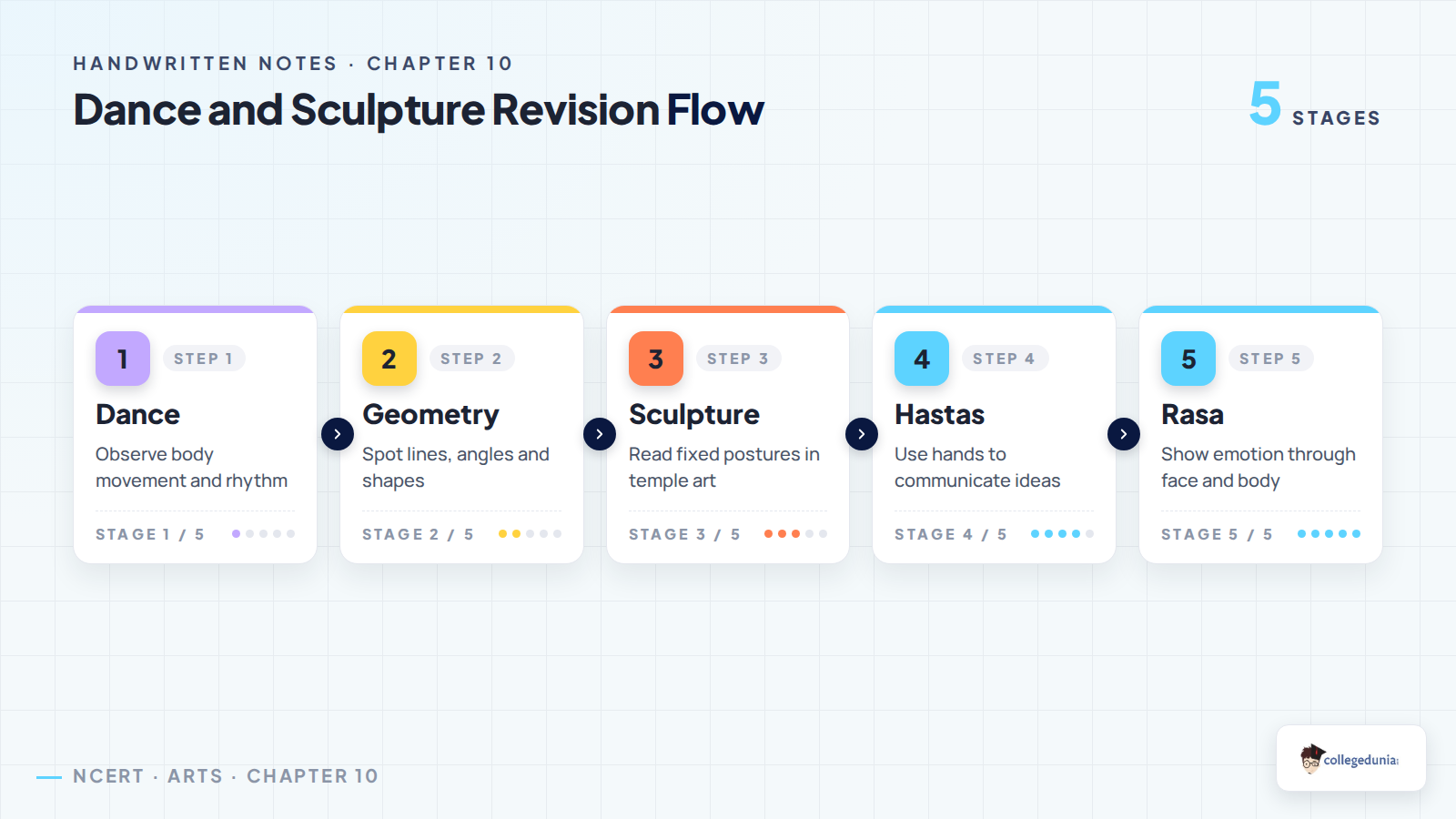
Chapter 10 explains how dance, geometry, sculpture and emotions are connected. Students learn that a dancing body can create lines, angles and shapes, and that sculptures often preserve similar body postures.
The fastest way to revise the chapter is to connect every topic with one question: what is the body showing? The answer may be a shape, a gesture, an emotion or a sculptural pose.
| Topic | What to Remember |
|---|---|
| Dance and sculpture | Both study the expressive body and its visual form. |
| Geometry | Dance postures can create triangles, lines, circles and angles. |
| Expression | Hastas and rasas help the body communicate meaning. |
Dancing Body and Sculpture Link
The chapter begins with an idea from Vishnudharmottara Purana. It says that image-making and painting are difficult to understand without knowing dance.
This means the arts are linked. Dance teaches body movement, painting studies line and form, and sculpture fixes a posture into stone or metal.
- The chapter mentions the late Gupta period, around 400 to 600 CE.
- It points to dancing Shiva carvings at Ellora caves in Maharashtra.
- It asks students to observe the body as a moving visual form.
Geometrical Shapes in Dance
Dance and mathematics meet when the body creates clear shapes. A student can see triangles, circles, lines and angles in arms, feet and torso positions.
The chapter asks students to combine upper torso, lower torso and arms in Activity 10.1. Friends then identify squares, triangles, rectangles, parallels or rhombuses.
A good answer should explain both the posture and the shape seen in it.
Body Postures and Knee Bends
Students revise upper torso postures such as samabhang, dwibhang, abhang, tribhang and atibhang. Each bend changes the balance and mood of the body.
The chapter also shows lower torso work through knee bends and foot distance. No bend, one fourth bend, half bend, three fourth bend and full seating on toes create different levels and body shapes.
- Arms create angles, circles, half circles and diagonals.
- Knee bends change level, strength and balance.
- Foot distance decides how stable or wide the posture feels.
Dancing Sculptures and Temples
Activity 10.2 asks students to observe dancing sculptures from temples and caves. They compare upper torso, lower torso and angle combinations in the pictures.
The chapter names Chidambaram Temple in Tamil Nadu, Konark Sun Temple in Odisha, Dilwara Temple in Rajasthan and Elephanta Caves in Maharashtra. It also shows examples from Halebidu, Hampi and Haridwar.
Students should try simple and challenging postures with care. The aim is careful observation, not forcing the body into a difficult pose.
Hastas and Navarasa
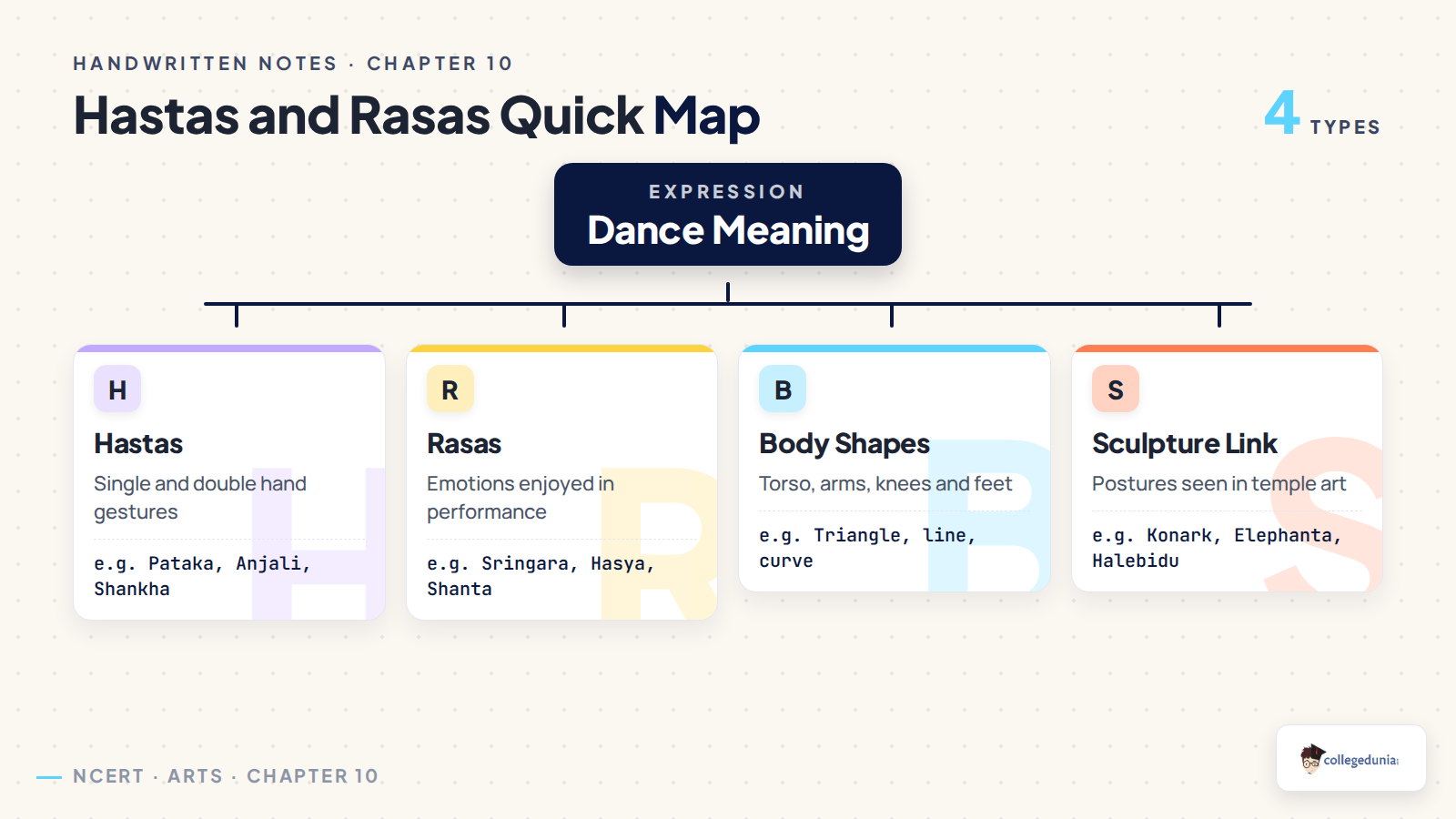
The chapter recalls asamyuta hastas and samyuta hastas from Kriti Grade 6. Asamyuta hastas use one hand, while samyuta hastas use both hands.
Activity 10.3 asks students to find hastas in sculptures. Activity 10.4 asks students to act daily activities with emotions such as happiness, sadness, anger, surprise, fear and calm.
| Expression Topic | Revision Cue |
|---|---|
| Asamyuta hasta | Single-hand gesture, such as Pataka or Mayura. |
| Samyuta hasta | Double-hand gesture, such as Anjali or Shankha. |
| Navarasa | Nine emotions, including sringara, hasya, veera, adbhuta and shanta. |
Dance and Sculpture Chapter Video
Source: Prof.Analysis on YouTube
Related NCERT Class 7 Arts (Kriti) Resources
Use these related resources when you want the official book chapter or nearby handwritten notes from the same Arts (Kriti) unit.
| Resource | Link |
|---|---|
| NCERT Book PDF | Class 7 Arts Chapter 10 NCERT Book PDF |
| Previous Chapter | Class 7 Arts Chapter 9 Handwritten Notes |
| Next Chapter | Class 7 Arts Chapter 11 Handwritten Notes |
All Chapters for Class 7 Arts (Kriti) Handwritten Notes
| Chapter | Handwritten Notes |
|---|---|
| Chapter 5 Making Music | Download Notes |
| Chapter 6 Music, Emotions and Creativity | Download Notes |
| Chapter 7 Ragas and Talas/Taal | Download Notes |
| Chapter 8 The Music of the People | Download Notes |
| Chapter 9 Performance | Download Notes |
FAQs on NCERT Class 7 Arts Chapter 10 Handwritten Notes
Ques. What is covered in Class 7 Arts Chapter 10 Dance and Sculpture?
Ans. The chapter covers the link between dance and sculpture, geometrical shapes in dance, body postures, temple sculptures, hastas and navarasa.
Ques. What is the main idea of Dance and Sculpture?
Ans. The main idea is that dance, painting and sculpture are connected through body movement, line, form, posture and expression.
Ques. What are hastas in this chapter?
Ans. Hastas are hand gestures used in dance. Asamyuta hastas use one hand, and samyuta hastas use both hands.
Ques. Why are these handwritten notes useful?
Ans. The notes turn the chapter into short handwritten pages with flow charts, posture cues, activity points and quick revision tables.



Comments