




The handwritten notes on Class 6 Science Chapter 10 Living Creatures: Exploring their Characteristics are prepared for quick 2026-27 revision. The PDF covers living and non-living features, seed germination, plant movement, plant life cycle, mosquito life cycle, and frog life cycle.
- Best use: revise this PDF after reading the NCERT Curiosity chapter once.
- PDF focus: definitions, activity conclusions, life-cycle stages, diagrams, and quick recall points.
- Chapter value: this chapter builds observation skills through plants, seeds, mosquitoes, and frogs.
Chapter10LivingCreatures:ExploringtheirCharacteristicsHandwrittenNotes.pdf?page=1&dpi=150)
Chapter10LivingCreatures:ExploringtheirCharacteristicsHandwrittenNotes.pdf?page=2&dpi=150)
Chapter10LivingCreatures:ExploringtheirCharacteristicsHandwrittenNotes.pdf?page=3&dpi=150)
Chapter10LivingCreatures:ExploringtheirCharacteristicsHandwrittenNotes.pdf?page=4&dpi=150)
Chapter10LivingCreatures:ExploringtheirCharacteristicsHandwrittenNotes.pdf?page=5&dpi=150)
Chapter10LivingCreatures:ExploringtheirCharacteristicsHandwrittenNotes.pdf?page=6&dpi=150)
Chapter10LivingCreatures:ExploringtheirCharacteristicsHandwrittenNotes.pdf?page=7&dpi=150)
Chapter10LivingCreatures:ExploringtheirCharacteristicsHandwrittenNotes.pdf?page=8&dpi=150)
Chapter10LivingCreatures:ExploringtheirCharacteristicsHandwrittenNotes.pdf?page=9&dpi=150)
Chapter10LivingCreatures:ExploringtheirCharacteristicsHandwrittenNotes.pdf?page=10&dpi=150)
Chapter10LivingCreatures:ExploringtheirCharacteristicsHandwrittenNotes.pdf?page=11&dpi=150)
Chapter10LivingCreatures:ExploringtheirCharacteristicsHandwrittenNotes.pdf?page=12&dpi=150)
Chapter10LivingCreatures:ExploringtheirCharacteristicsHandwrittenNotes.pdf?page=13&dpi=150)
Chapter10LivingCreatures:ExploringtheirCharacteristicsHandwrittenNotes.pdf?page=14&dpi=150)
Chapter10LivingCreatures:ExploringtheirCharacteristicsHandwrittenNotes.pdf?page=15&dpi=150)
Chapter10LivingCreatures:ExploringtheirCharacteristicsHandwrittenNotes.pdf?page=16&dpi=150)
Chapter10LivingCreatures:ExploringtheirCharacteristicsHandwrittenNotes.pdf?page=17&dpi=150)
Chapter10LivingCreatures:ExploringtheirCharacteristicsHandwrittenNotes.pdf?page=18&dpi=150)
Chapter10LivingCreatures:ExploringtheirCharacteristicsHandwrittenNotes.pdf?page=19&dpi=150)
Chapter10LivingCreatures:ExploringtheirCharacteristicsHandwrittenNotes.pdf?page=20&dpi=150)
Chapter10LivingCreatures:ExploringtheirCharacteristicsHandwrittenNotes.pdf?page=21&dpi=150)
Chapter10LivingCreatures:ExploringtheirCharacteristicsHandwrittenNotes.pdf?page=22&dpi=150)
Student Feedback: In a Collegedunia study check, 81% of Class 6 students said the life-cycle diagrams helped them remember the mosquito and frog stages faster.
|
Table of Contents |
Class 6 Science Chapter 10 Handwritten Notes Overview
Class 6 Science Chapter 10 begins with a simple question: how do we know that something is living? The chapter uses everyday examples like a snail shell, a pigeon, a car, a seedling, and a child to show why one clue is not enough.
The handwritten PDF turns the full chapter into a short revision notebook. Students can revise the life features, activity results, and life-cycle stages without rereading the full textbook every time.
Living Creatures Chapter 10 Video Revision
Source: Magnet Brains on YouTube
Living and Non-living Things
Living beings carry out life processes. A pigeon, snail, bean plant, child, dog, and frog are living examples. A pencil, book, stone, table, and car are non-living examples.
Movement alone cannot decide life. A car moves, but it does not grow, respire, reproduce, or respond like a living being. Plants do not move from place to place, but flowers open, climbers coil, and some leaves move when touched.
Main Characteristics of Living Beings
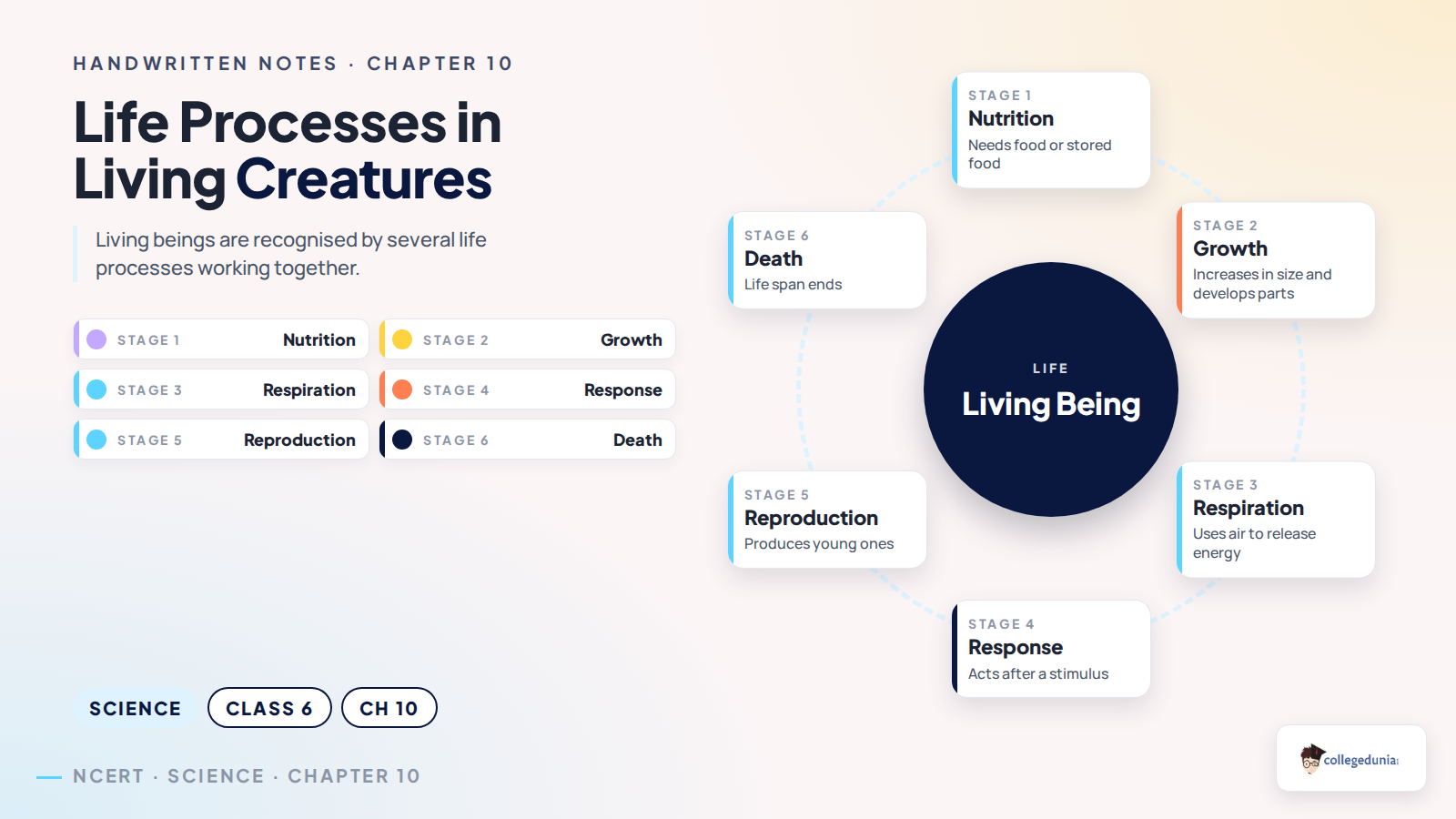
The chapter asks students to look for a set of features. Living beings need nutrition, grow, respire, excrete, respond, reproduce, and die. If these features are absent, the object is non-living.
| Feature | Meaning | Example |
|---|---|---|
| Growth | Increase in size and development | A child becomes taller |
| Respiration | Energy release from food | Animals breathe, plants use stomata |
| Response | Action after a stimulus | Shoot bends toward light |
| Reproduction | Producing young ones | Frog lays eggs |
Seed Germination Conditions
Activity 10.2 uses four pots with bean seeds. Pot A has sunlight but no water. Pot B has sunlight but excess water. Pot C has moist soil in the dark. Pot D has moist soil in sunlight.
Bean seeds need the right amount of water and air for germination. Sunlight is not essential for the first sprouting step. Excess water blocks air spaces in soil, so seeds may not respire properly.
Growth and Movement in Plants
Activity 10.3 shows the direction of root and shoot growth. When a plant is kept upright, the root grows downward and the shoot grows upward. When a seedling is inverted, the root and shoot bend to their usual directions.
When sunlight comes from one side, the shoot grows toward the light. This shows response to a stimulus. Roots generally grow downward, while shoots grow upward and toward light.
Jagadish Chandra Bose studied plant responses. His crescograph measured very small plant growth and showed that plants sense and respond to stimuli.
Plant Life Cycle
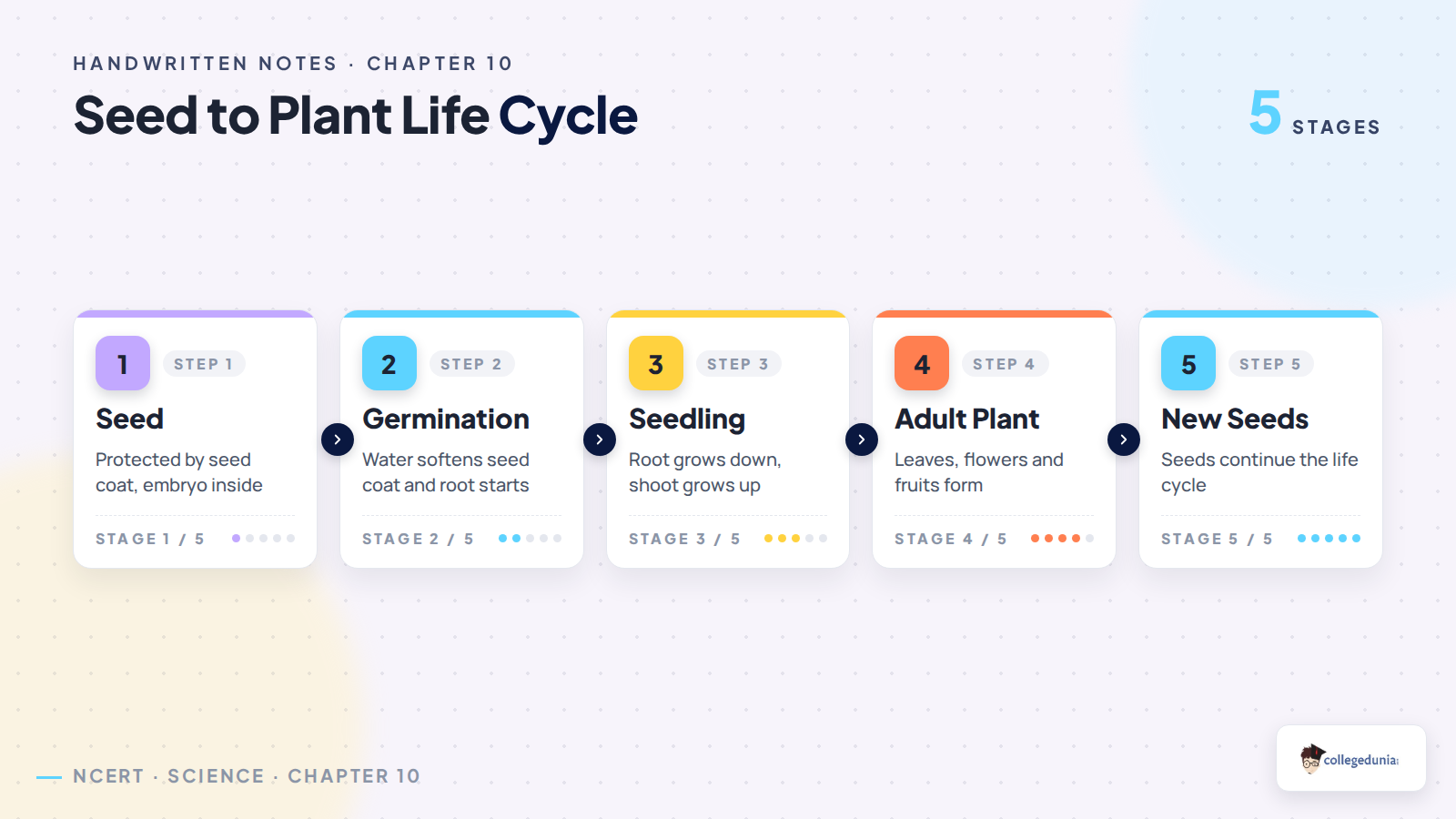
A plant life cycle begins with a seed. Under suitable conditions, the seed germinates into a seedling. The seedling grows into a young plant and then an adult plant.
The adult plant may produce flowers, fruits, and seeds. The new seeds can germinate and continue the cycle. The handwritten notes include this sequence as seed to seedling to plant to flower or fruit to seed.
Mosquito Life Cycle
Mosquitoes have four stages: egg, larva, pupa, and adult. Female mosquitoes lay eggs on or near water. Larvae and pupae live in water but come to the surface for air.
Stagnant water helps mosquitoes complete their life cycle. Removing stagnant water breaks the cycle. Kerosene forms a thin layer over water and stops larvae and pupae from getting air.
Frog Life Cycle
Frog eggs are found as a jelly-like cluster called spawn, usually near water during the rainy season. Eggs hatch into tadpoles. Tadpoles live in water and look different from adult frogs.
As development continues, legs appear, the tail reduces, and a froglet forms. The froglet later becomes an adult frog. The notes compare this with the mosquito cycle so students can remember the difference between larva, pupa, tadpole, and froglet.
Key Takeaways for Quick Revision
- Use several features together to identify living beings.
- Movement alone does not prove that something is living.
- Seeds need water and air for germination.
- Roots grow downward and shoots grow upward.
- Shoots bend toward light when light comes from one side.
- Mosquito life cycle: egg, larva, pupa, adult.
- Frog life cycle: eggs, tadpole, froglet, adult frog.
- Significant body changes occur in mosquitoes and frogs.
Related NCERT Resources for This Chapter
| Resource | Link |
|---|---|
| Chapter 10 NCERT Book PDF | Living Creatures Book PDF |
| Chapter 10 Notes | Living Creatures Notes |
| Chapter 10 NCERT Solutions | Living Creatures Solutions |
More Class 6 Science Handwritten Notes
| Chapter | Handwritten Notes |
|---|---|
| Chapter 6 | Materials Around Us |
| Chapter 7 | Temperature and its Measurement |
| Chapter 8 | A Journey through States of Water |
| Chapter 9 | Methods of Separation in Everyday Life |
Quick Questions for Revision
Living Creatures Class 6 Handwritten Notes FAQs
Ques. What is covered in Class 6 Science Chapter 10 handwritten notes?
Ans. The notes cover living features, seed germination, plant movement, plant life cycle, mosquito life cycle, and frog life cycle.
Ques. Are these handwritten notes based on the 2026-27 NCERT Curiosity textbook?
Ans. Yes. The PDF follows Class 6 Science Curiosity Chapter 10 Living Creatures: Exploring their Characteristics for the 2026-27 NCERT syllabus.
Ques. Which conditions are needed for seed germination?
Ans. Bean seeds need the right amount of water and air. Sunlight is not essential for the first germination step.
Ques. What are the stages in a mosquito life cycle?
Ans. A mosquito passes through egg, larva, pupa, and adult stages. The early stages need stagnant water.



Comments