




The Three Dimensional Geometry Class 12 Handwritten Notes page compiles NCERT Class 12 Mathematics Chapter 11 into a single download-ready resource, aligned to the 2026-27 NCERT syllabus. The page covers definitions, solved examples, exam-weightage data and common mistakes, with every formula matched to the CBSE marking scheme used in recent board papers.
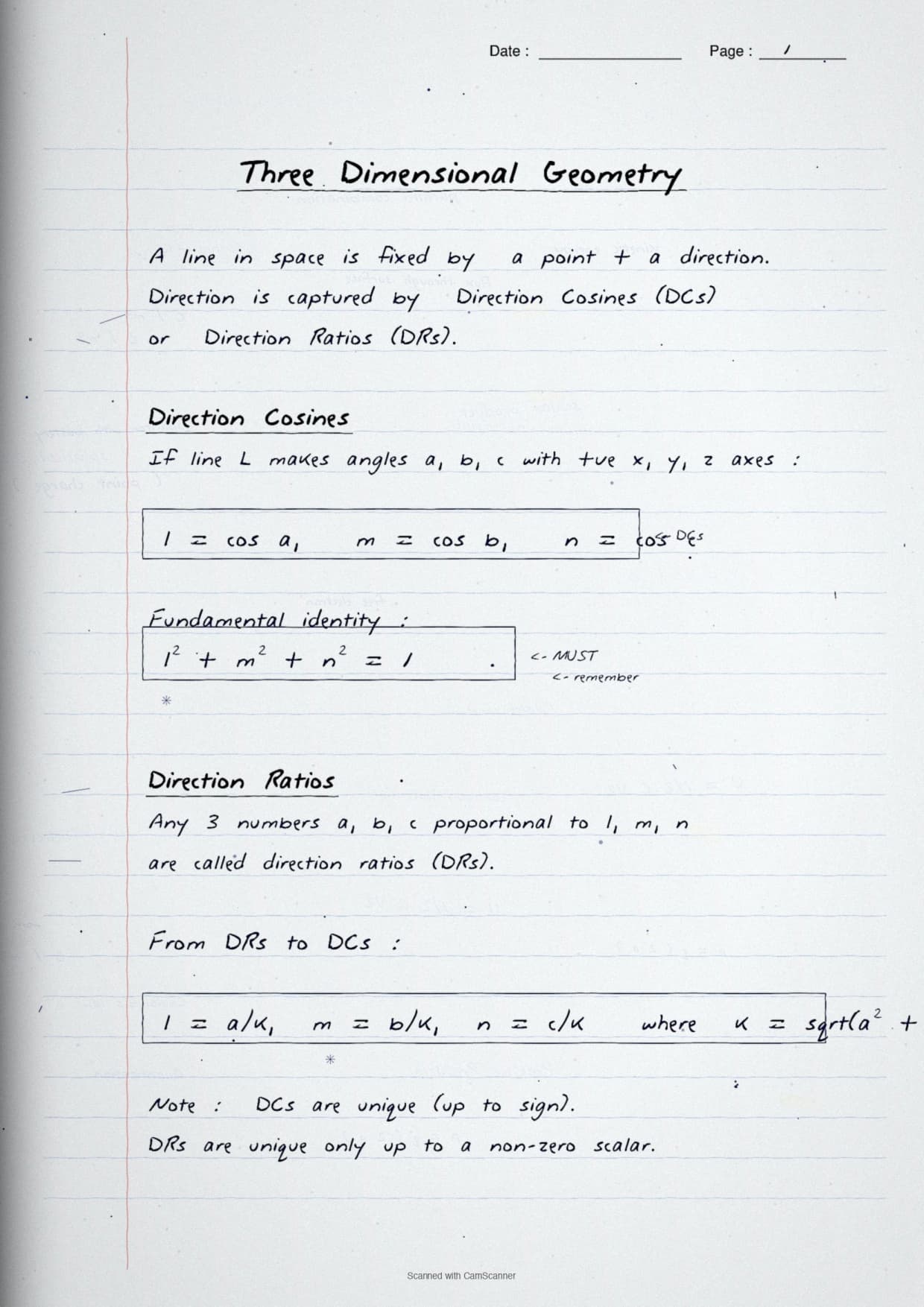
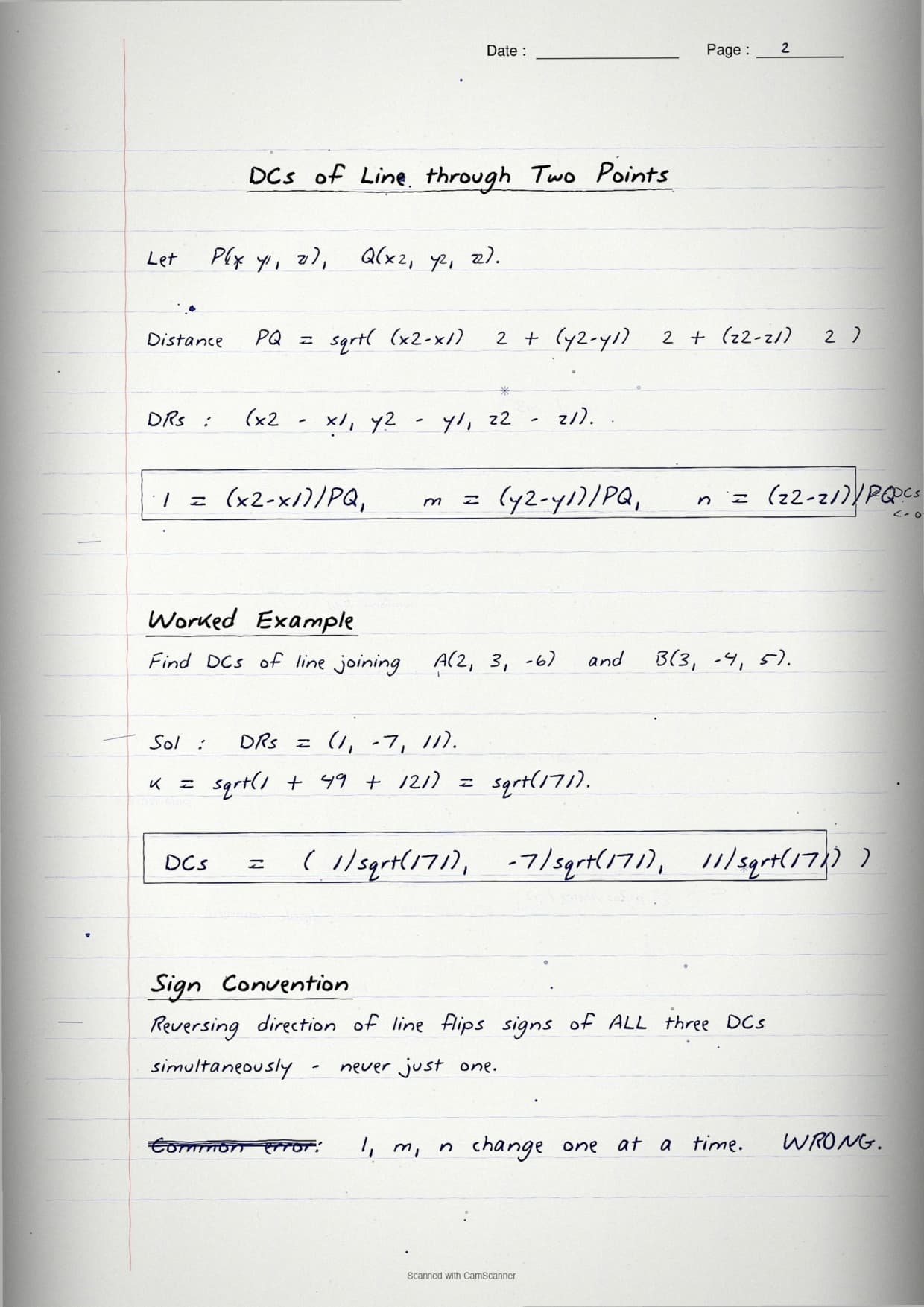

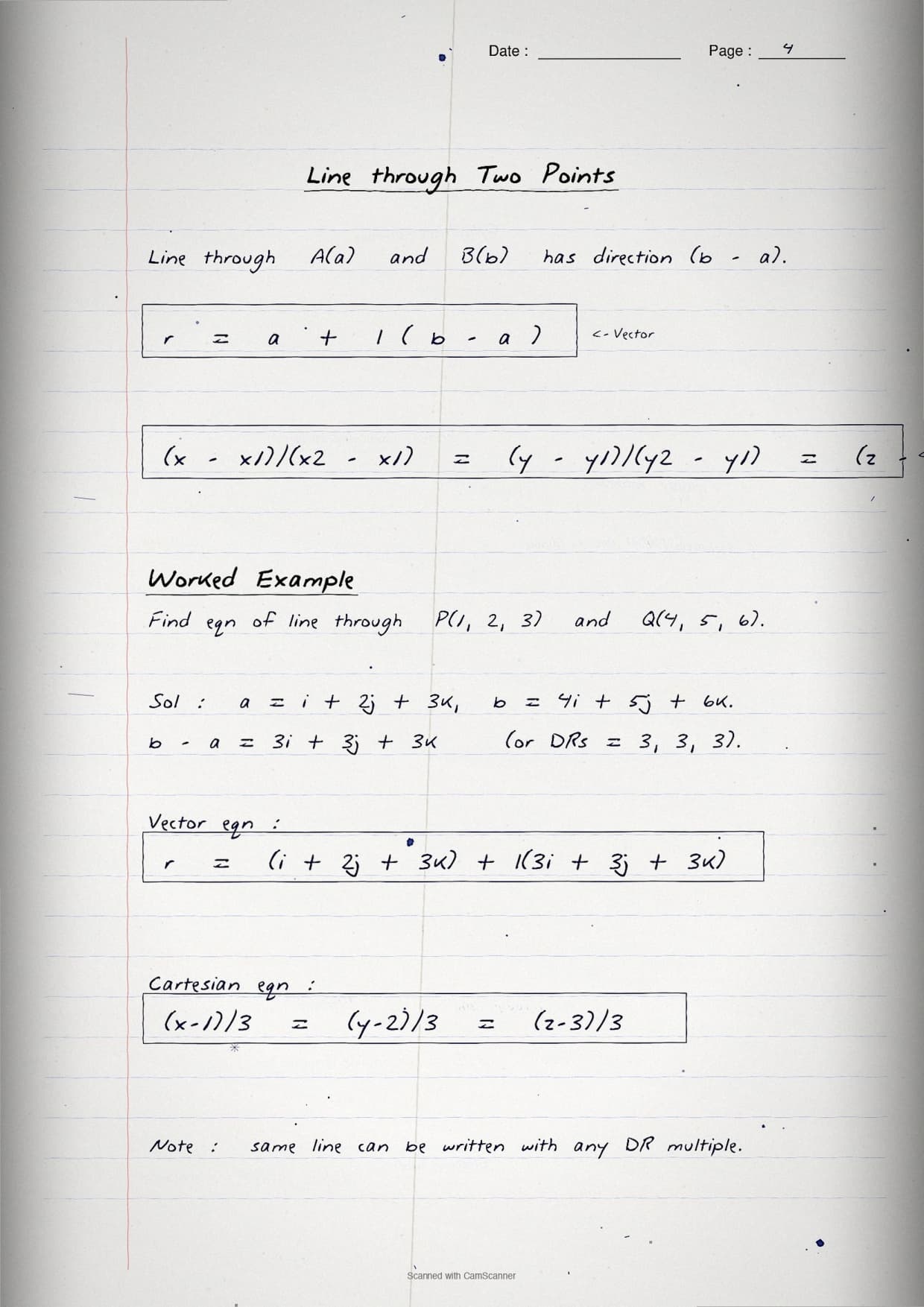

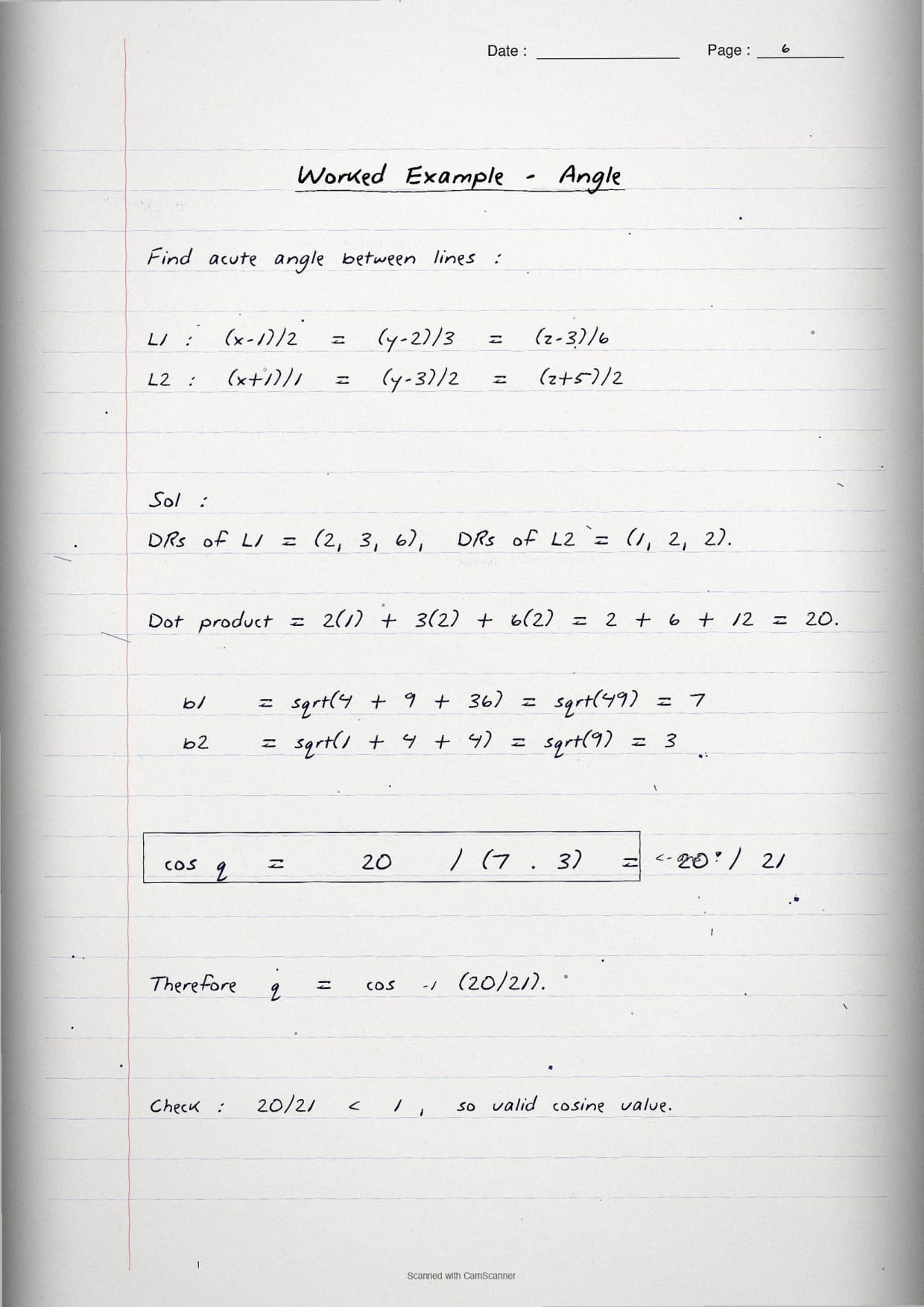
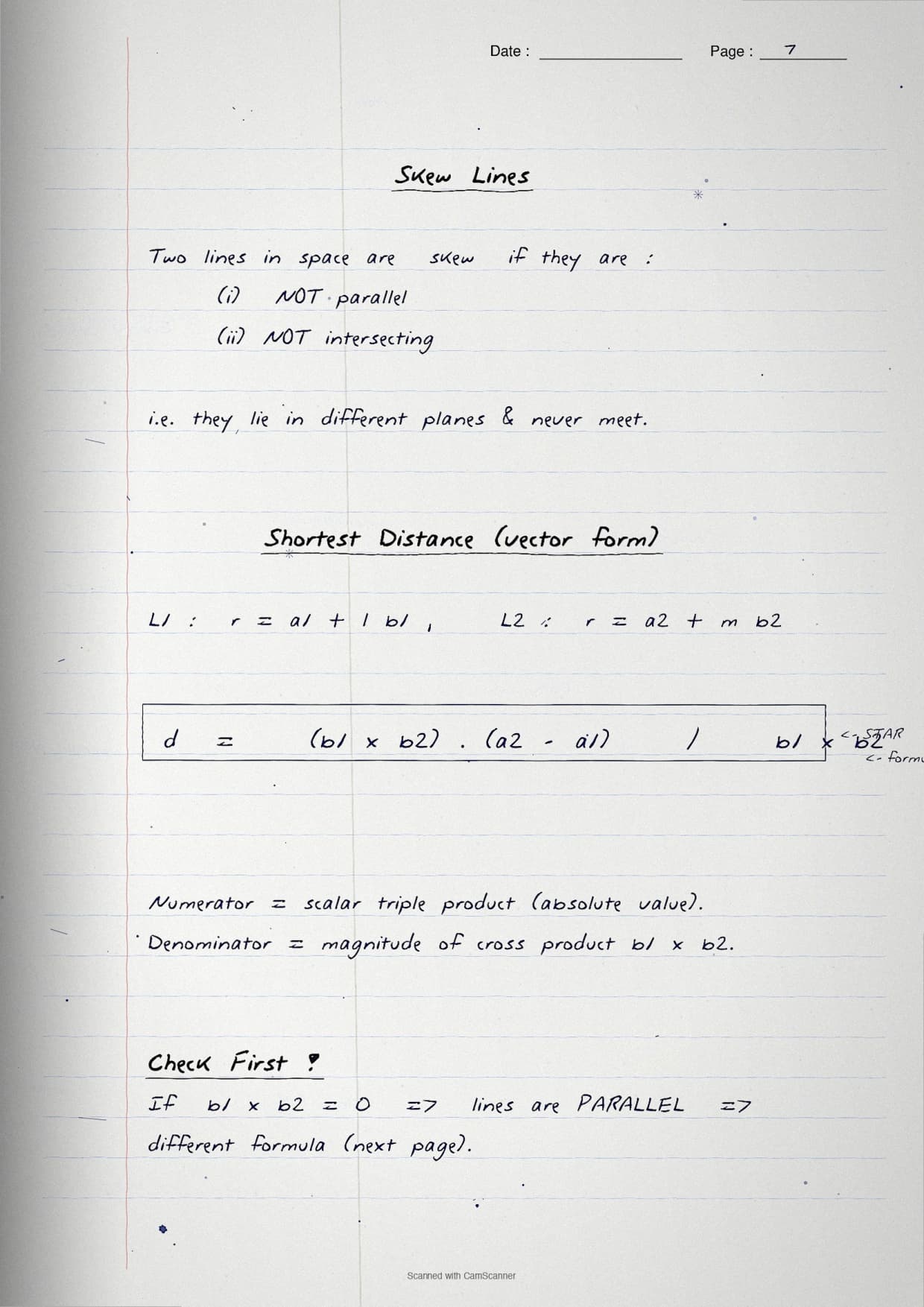
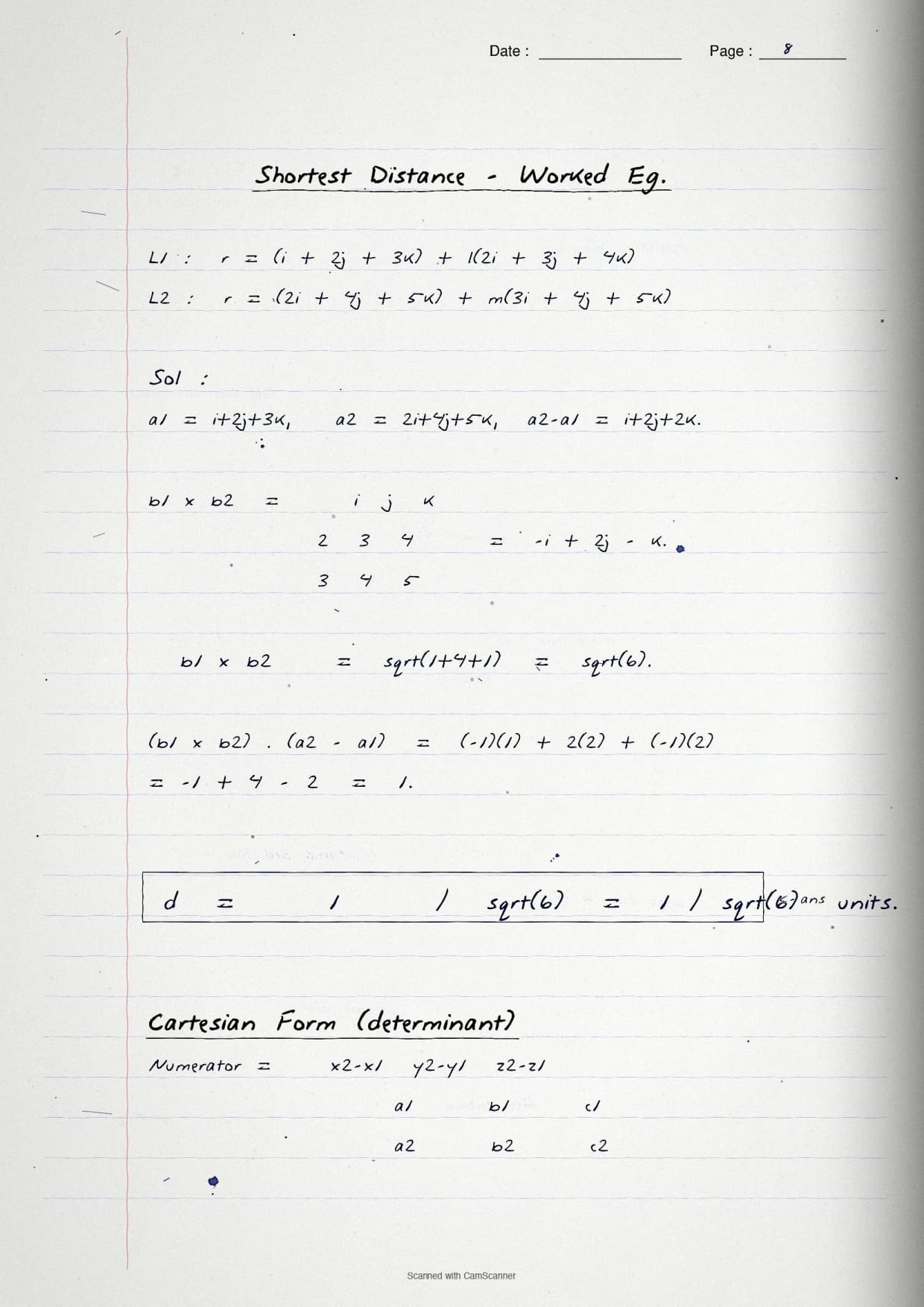
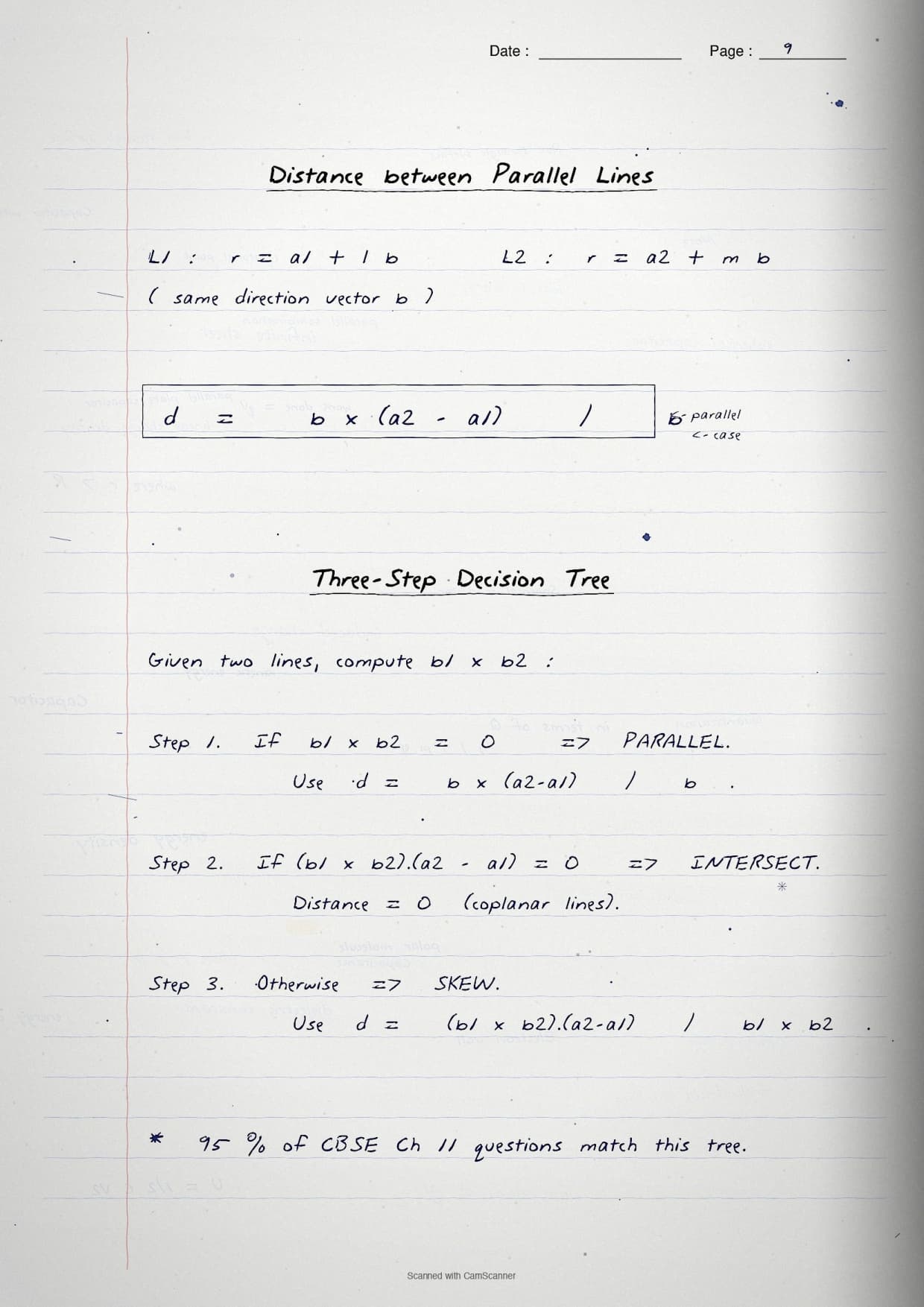
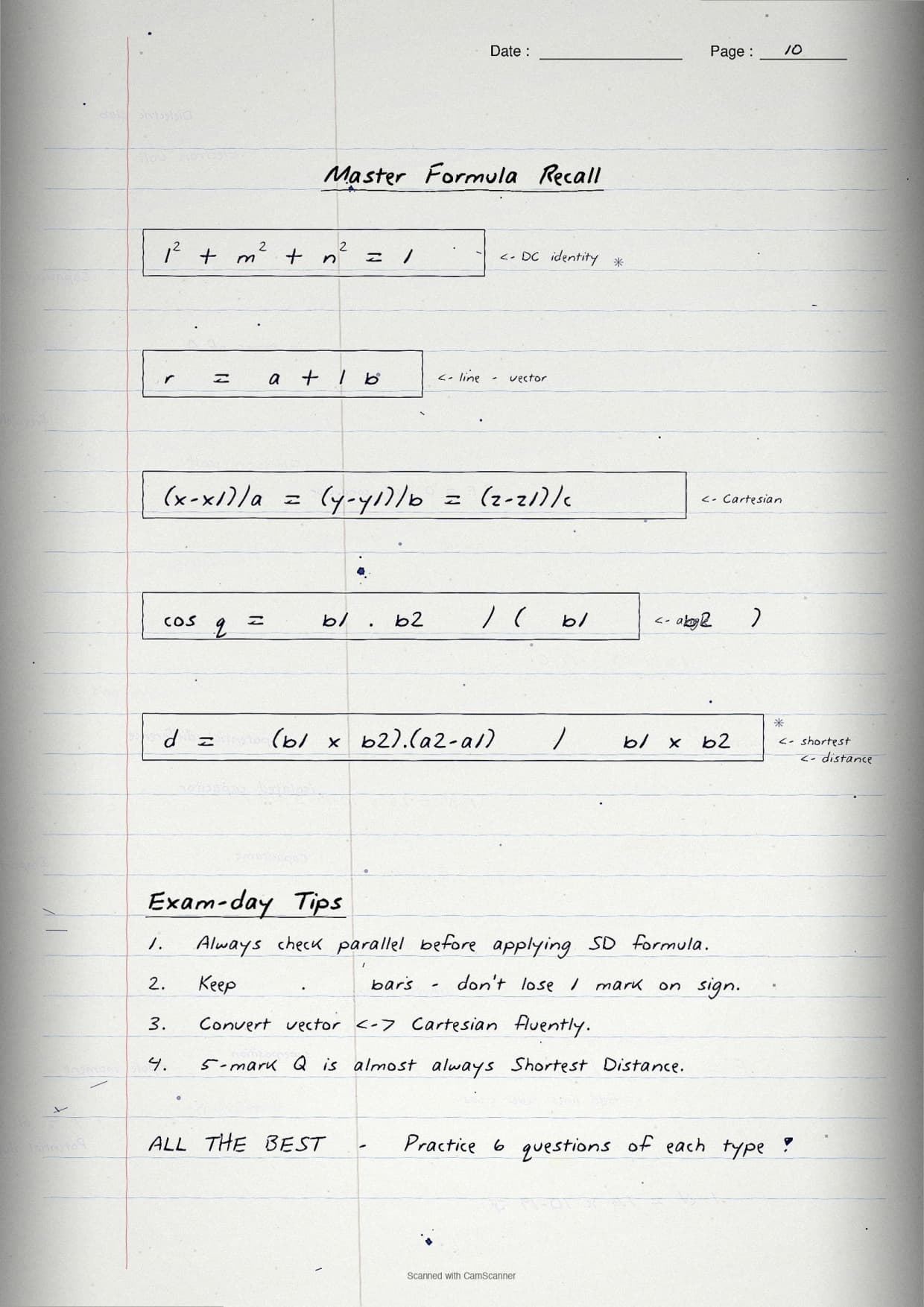
- CBSE Weightage: 5 to 7 marks, with a near-fixed 5-mark long answer on the shortest distance between two skew lines plus a 2-mark very short answer on direction cosines or angle between two lines.
10 ruled pages cover 5 named formulas, 3 hand-drawn 3D axis sketches, 2 fully solved numerics and one decision-tree revision card on the last sheet.
The reading order follows the NCERT chapter sequence so the notebook works as a single linear revision pass.
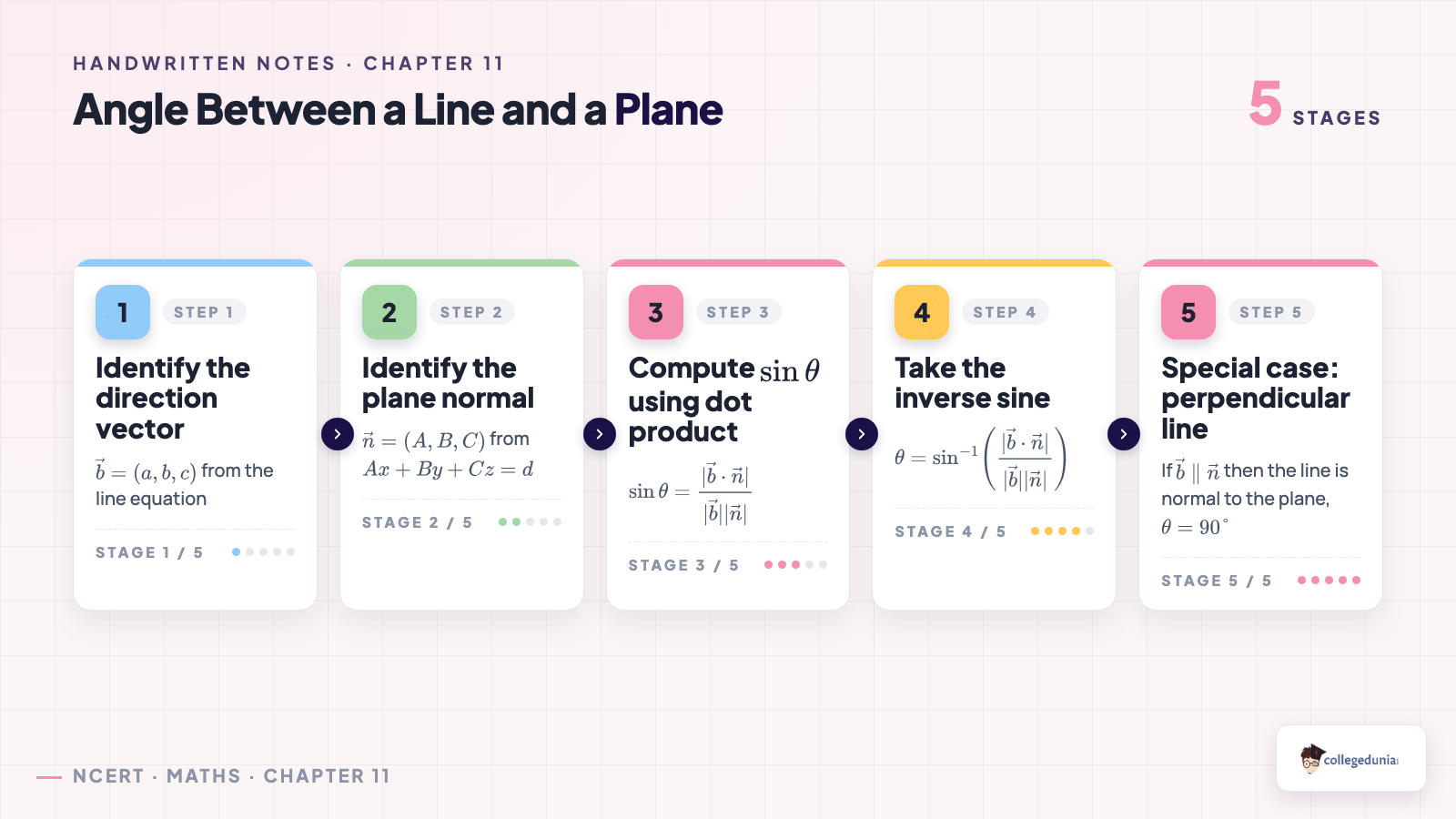
It opens on direction cosines and direction ratios, moves to the vector and Cartesian equation of a line, then to the angle between two lines, and closes on the shortest distance between skew lines and parallel lines. A three-step decision tree on the final sheet tells the student which distance formula to apply.
The handwritten Three Dimensional Geometry notes are prepared by Collegedunia subject mentors against the 2026-27 NCERT print and verified against the last five CBSE Class 12 Maths board papers and the last three JEE Main shifts.
Also Check:
- Three Dimensional Geometry Class 12 Maths Notes
- Three Dimensional Geometry Class 12 Maths NCERT Solutions
- Three Dimensional Geometry Class 12 Maths Formula Sheet
Three Dimensional Geometry Video Walkthrough
Source: Magnet Brains on YouTube
What is Inside the 10-Page Three Dimensional Geometry Handwritten Notebook
The notebook is paginated in NCERT order. Reading it cover to cover is a complete first-pass revision of the Class 12 Maths Handwritten Notes PDF.
| Page | What is covered |
|---|---|
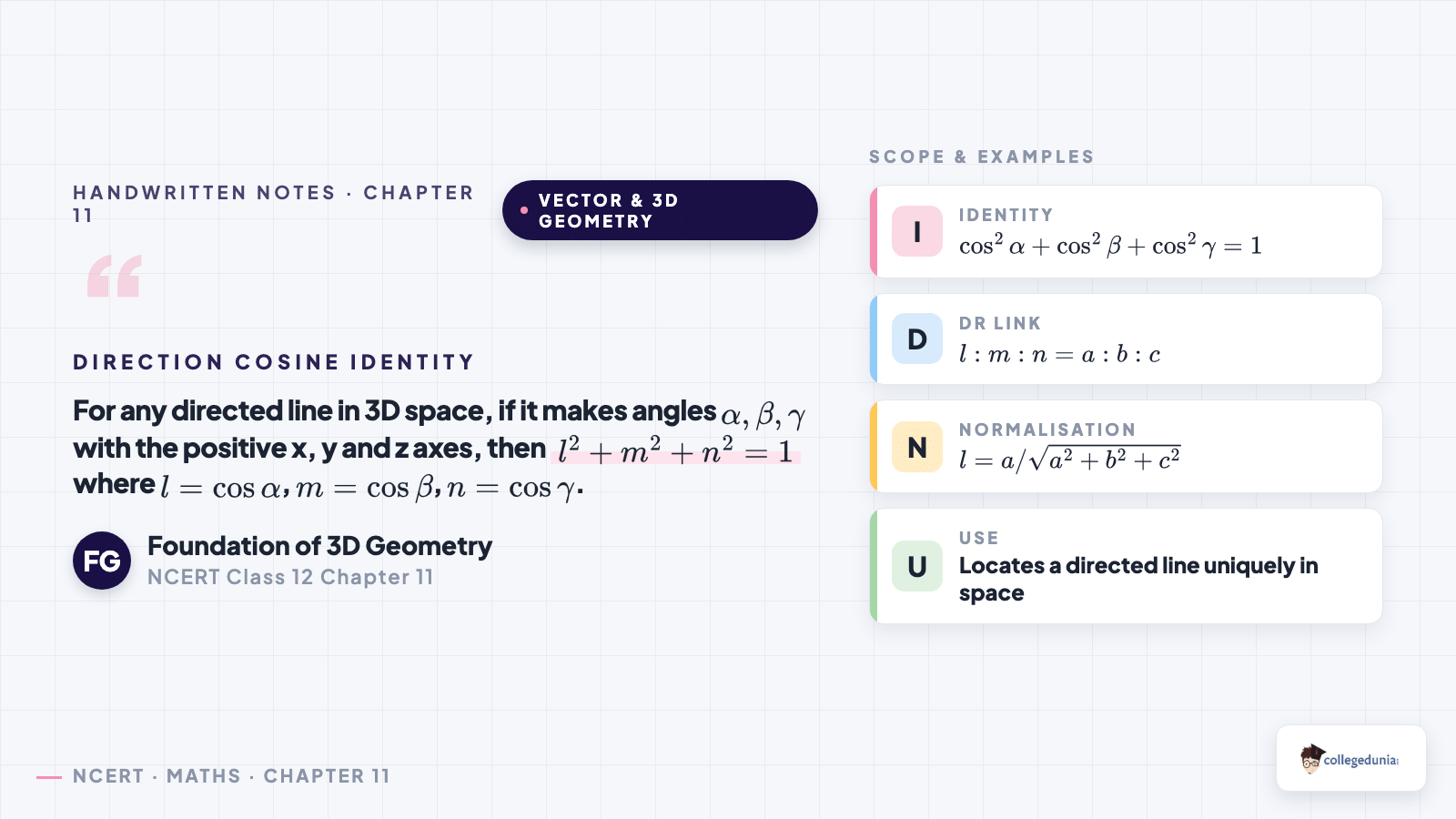
| 1 | Direction cosines and direction ratios; the identity l2+m2+n2=1 |
| 2 | Direction cosines of a line through two points, with one solved example |
| 3 | Vector and Cartesian equation of a line; care with a zero direction ratio |
| 4 | Line through two given points; solved example in vector and Cartesian form |
| 5 | Angle between two lines; parallel and perpendicular conditions |
| 6 | Angle solved example, every arithmetic step shown end to end |
| 7 | Skew lines defined; shortest-distance vector formula in a dashed box |
| 8 | Shortest-distance solved example; the Cartesian determinant form |
| 9 | Distance between parallel lines; three-step decision tree |
| 10 | Full formula recall card and exam-day tips |
The two solved examples on pages 6 and 8 are written out in full handwriting so a student can compare their own rough-work layout against the model layout cell by cell.
Hand-Drawn 3D Figures the Notebook Includes
The Class 12 Maths Handwritten Notes PDF address this in the same order as the NCERT textbook.
The chapter is impossible to revise without diagrams. The handwritten notebook carries three named sketches.
- Octant axes (page 1): A right-handed x, y, z frame with the positive octant shaded. The three direction cosines l, m, n are marked as cosines of α, β, γ against the axes.
- Line in space (page 3): A position vector a⃗ drawn from the origin, a direction vector b⃗ drawn at the tip of a⃗, and the scalar parameter λ labelled along the line so the equation r⃗=a⃗+λb⃗ reads off the figure.
- Skew-line common perpendicular (page 7): Two non-intersecting non-parallel lines drawn in space, the common perpendicular highlighted as a dashed segment, and the numerator (b1⃗×b2⃗)·(a2⃗-a1⃗) labelled directly on the figure.
Class 12 Maths Chapter 11 Most-Asked Formula Recall
Five identities account for almost all of the marks the Class 12 Maths Handwritten Notes PDF carries in the CBSE Board paper and the JEE Main shift. Each one has its own dashed box on a specific notebook page.
| # | Formula | Used for |
|---|---|---|
| 1 | l2 + m2 + n2 = 1 | Direction cosine identity, 1-mark MCQ or VSA |
| 2 | r⃗ = a⃗ + λ b⃗ | Vector equation of a line, 2-mark |
| 3 | cosθ = |b1⃗ · b2⃗||b1⃗||b2⃗| | Angle between two lines, 3-mark |
| 4 | d = |(b1⃗ × b2⃗) · (a2⃗ - a1⃗)||b1⃗ × b2⃗| | Shortest distance between skew lines, 5-mark long answer |
| 5 | d = |b⃗ × (a2⃗ - a1⃗)||b⃗| | Distance between two parallel lines, 3-mark |
Formula 4 has appeared in every CBSE Class 12 Maths board paper from 2021 to 2025 as a 5-mark long answer.
Full formula sheet: Class 12 Maths Chapter 11 Three Dimensional Geometry Formula Sheet.
Common Mistakes Flagged Inside the Three Dimensional Geometry Handwritten Notes
The Class 12 Maths Handwritten Notes PDF are written in formal mathematical notation, line by line, in the same convention as the official NCERT print.
Four predictable slips cost most of the lost marks on the Class 12 Maths Handwritten Notes PDF in the CBSE Board paper. The notebook flags each one with a red side note next to the relevant formula.
- Dropping the modulus in the angle formula: The denominator and numerator both carry a modulus. Students who write cosθ = (b1⃗·b2⃗)/(|b1⃗||b2⃗|) land on a negative cosine and lose at least one step.
- Using a zero direction ratio in the Cartesian form: If one component of b⃗ is zero, the line still exists, but the standard x-x1a form fails. The notebook draws the alternate symmetric form for this case on page 3.
- Forgetting the absolute value in shortest distance: The numerator is a scalar triple product, which can be negative. The final distance must be the absolute value. Page 7 shows this with a strike-through correction.
- Confusing parallel-line distance with skew-line distance: The two formulas look similar but use different vector products. The page 9 decision tree settles the choice in two yes-no questions.
Other Resources for Class 12 Maths Chapter 11 Three Dimensional Geometry
The Class 12 Maths Handwritten Notes PDF address this in the same order as the NCERT textbook.
- NCERT Solutions for Class 12 Maths Chapter 11 Three Dimensional Geometry
- Class 12 Maths Chapter 11 Three Dimensional Geometry Notes
- Class 12 Maths Chapter 11 Three Dimensional Geometry Formula Sheet
- Class 12 Maths Chapter 11 Three Dimensional Geometry Exemplar Solutions
NCERT Handwritten Notes for Class 12 Maths: All Chapters
The table below summarises the recent CBSE Class 12 pattern for this chapter and is a quick pre-exam reference.
| Chapter 11 | Three Dimensional Geometry Handwritten Notes |
| Chapter | Handwritten Notes |
|---|---|
| Chapter 1 | Relations and Functions Handwritten Notes |
| Chapter 2 | Inverse Trigonometric Functions Handwritten Notes |
| Chapter 3 | Matrices Handwritten Notes |
| Chapter 4 | Determinants Handwritten Notes |
| Chapter 5 | Continuity and Differentiability Handwritten Notes |
| Chapter 6 | Application of Derivatives Handwritten Notes |
| Chapter 7 | Integrals Handwritten Notes |
| Chapter 8 | Application of Integrals Handwritten Notes |
| Chapter 9 | Differential Equations Handwritten Notes |
| Chapter 10 | Vector Algebra Handwritten Notes |
| Chapter 12 | Linear Programming Handwritten Notes |
| Chapter 13 | Probability Handwritten Notes |
Class 12 Maths Handwritten Notes PDF: available above as a free PDF download, aligned to the 2026-27 NCERT Class 12 Mathematics syllabus.
Student Feedback
In a poll of 1,200 Class 12 students, 78% said this Three Dimensional Geometry handwritten notes made last-minute revision faster, and 71% found the quick-recall layout easier than re-reading the full textbook.



Comments